Cambridge A Level Biology 9700 — 2004 Oct/Nov Paper 4 · Variant 1
9700/41/O/N/04
The question paper and its mark scheme, free to read here and free to download. This is Cambridge’s own paper, exactly as it was sat.
Question paper12 pages

Mark scheme9 pages
Answers below. Sit the paper first if you are practising.
Paper as text
Question paper, page 1
This document consists of 12 printed pages. SP (NF/KS) S72117/3 © UCLES 2004 [Turn over UNIVERSITY OF CAMBRIDGE INTERNATIONAL EXAMINATIONS General Certificate of Education Advanced Level BIOLOGY 9700/04 Paper 4 Structured Question A2 Core October/November 2004 1 hour 15 minutes Candidates answer on the question paper. Additional Materials: Answer Paper should be available on request. READ THESE INSTRUCTIONS FIRST Write your Centre number, candidate number and name in the spaces provided at the top of this page. Write in dark blue or black pen in the spaces provided on the Question Paper. You may use a soft pencil for any diagrams, graphs or rough working. Do not use staples, paper clips, highlighters, glue or correction fluid. Section A Answer all questions in Section A and one question from Section B. Circle the number of the Section B question you have answered in the grid below. At the end of the examination, fasten all your work securely together. The number of marks is given in brackets [ ] at the end of each question or part question. Centre Number Candidate Number Name If you have been given a label, look at the details. If any details are incorrect or missing, please fill in your correct details in the space given at the top of this page. Stick your personal label here, if provided. For Examiner’s Use 1 2 3 4 5 Section A 6 or 7 Total
Question paper, page 2
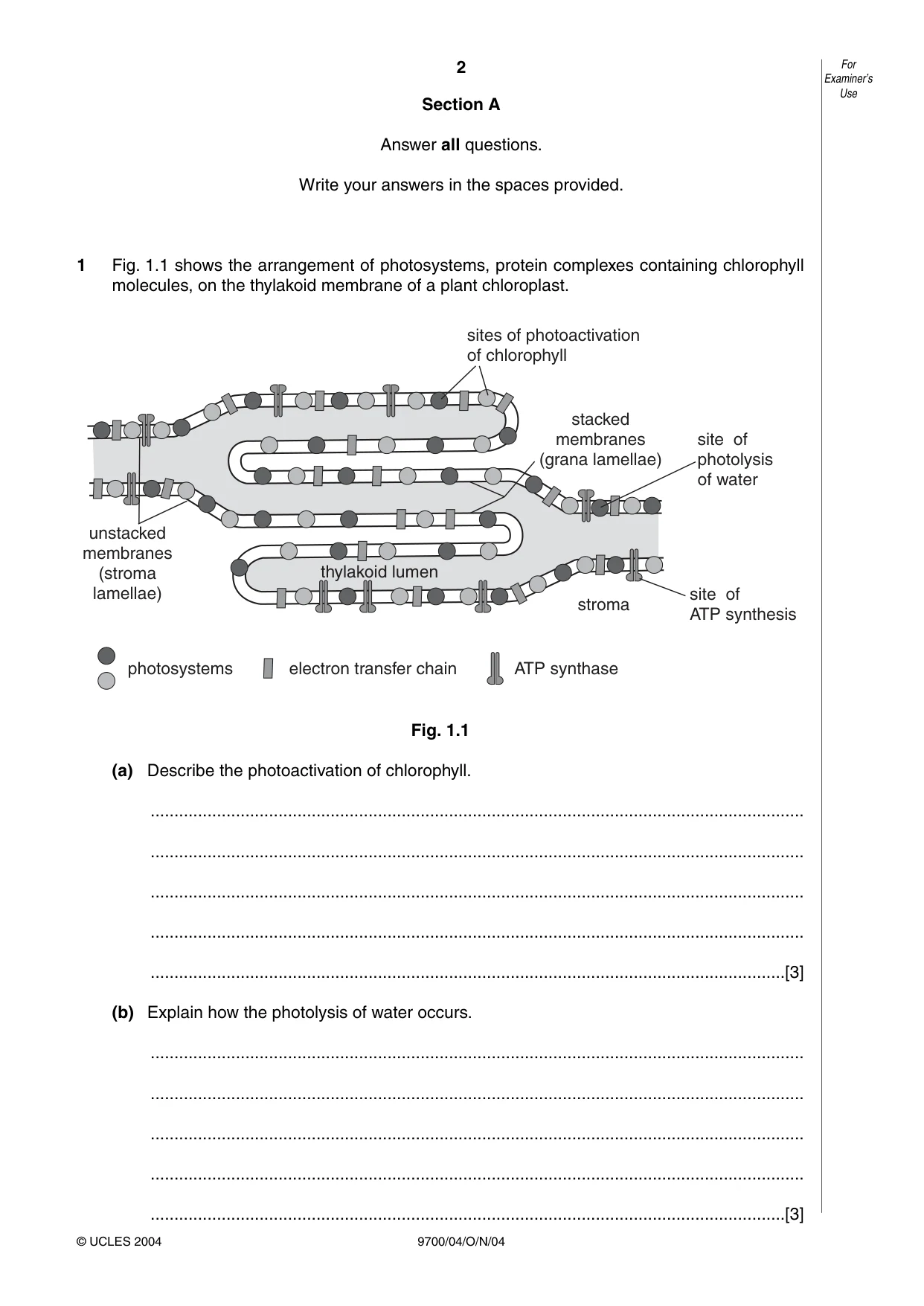
2 9700/04/O/N/04 Section A Answer all questions. Write your answers in the spaces provided. 1 Fig. 1.1 shows the arrangement of photosystems, protein complexes containing chlorophyll molecules, on the thylakoid membrane of a plant chloroplast. Fig. 1.1 (a) Describe the photoactivation of chlorophyll. … … … … …[3] (b) Explain how the photolysis of water occurs. … … … … …[3] photosystems electron transfer chain ATP synthase sites of photoactivation of chlorophyll site of ATP synthesis site of photolysis of water unstacked membranes (stroma lamellae) thylakoid lumen stroma stacked membranes (grana lamellae) For Examiner’s Use © UCLES 2004
Question paper, page 3
3 9700/04/O/N/04 [Turn over (c) Outline how ATP is formed in the chloroplast. … … … … …[3] (d) Suggest an advantage of having photosystems, the electron transport chain and ATP synthase as part of the thylakoid membrane. …[1] [Total : 10] For Examiner’s Use © UCLES 2004
Question paper, page 4
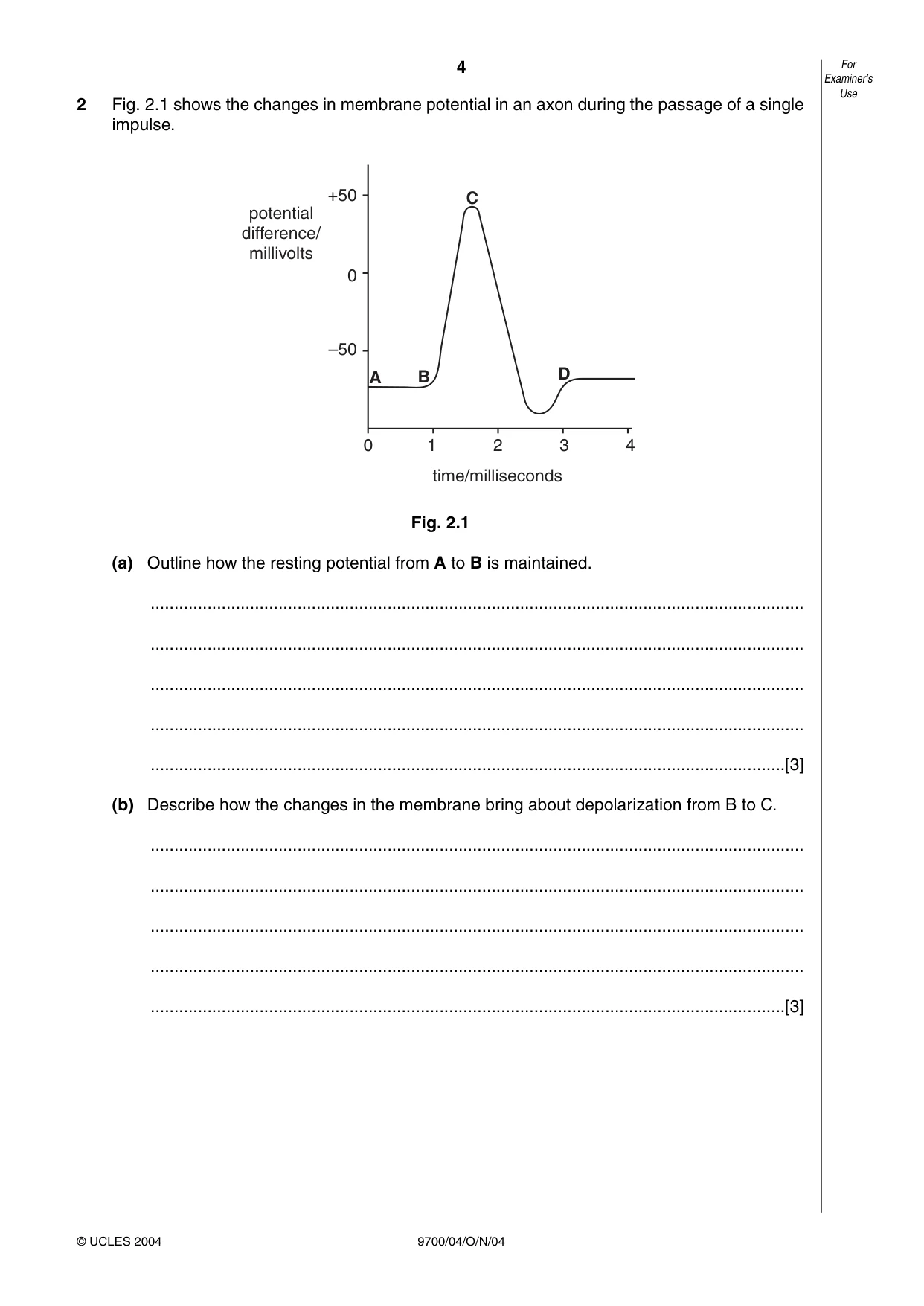
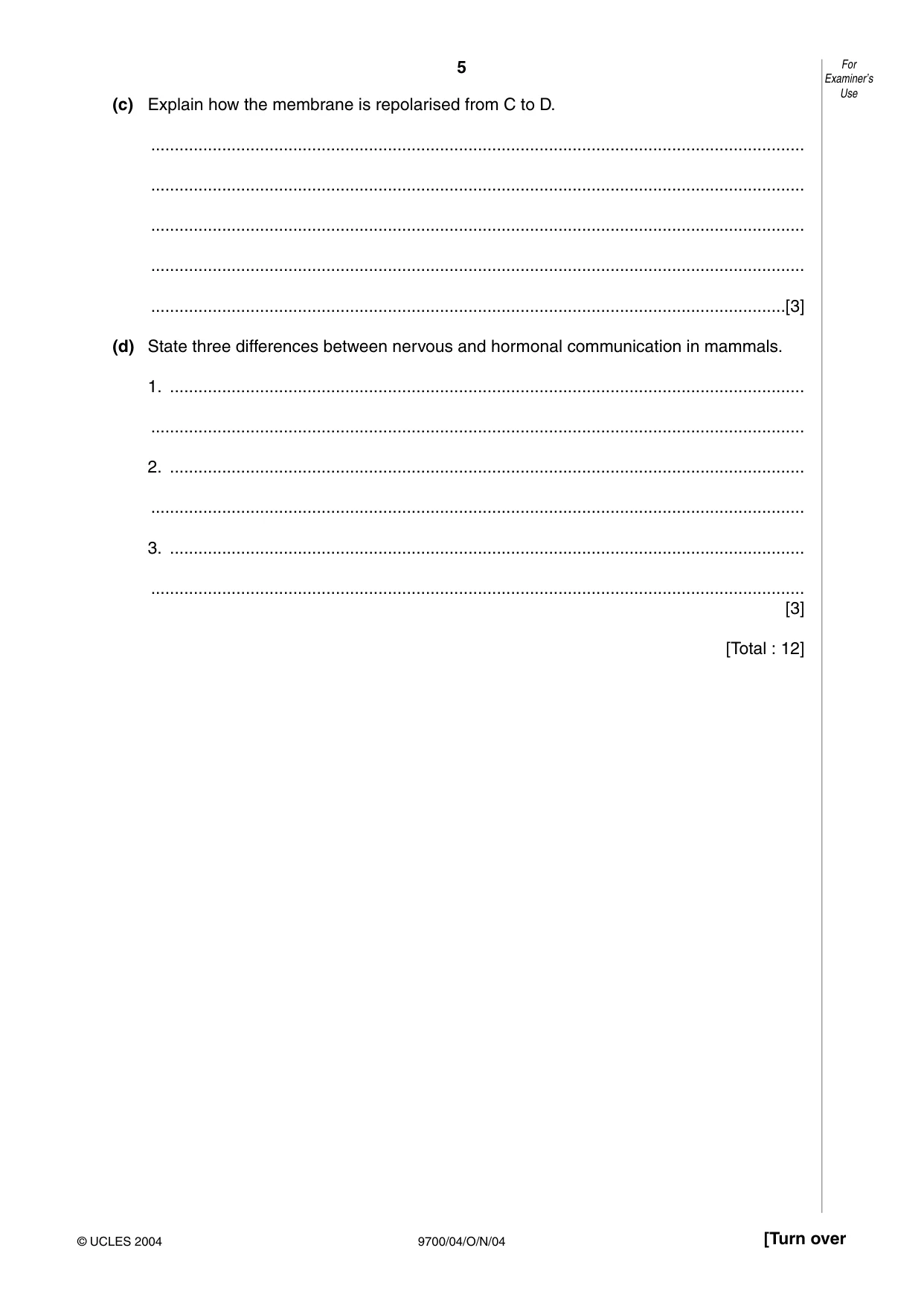
4 9700/04/O/N/04 2 Fig. 2.1 shows the changes in membrane potential in an axon during the passage of a single impulse. Fig. 2.1 (a) Outline how the resting potential from A to B is maintained. … … … … …[3] (b) Describe how the changes in the membrane bring about depolarization from B to C. … … … … …[3] 0 1 2 3 4 –50 0 +50 A B D C time/milliseconds potential difference/ millivolts For Examiner’s Use © UCLES 2004
Question paper, page 5
5 9700/04/O/N/04 [Turn over (c) Explain how the membrane is repolarised from C to D. … … … … …[3] (d) State three differences between nervous and hormonal communication in mammals. 1. … … 2. … … 3. … … [3] [Total : 12] For Examiner’s Use © UCLES 2004
Question paper, page 6
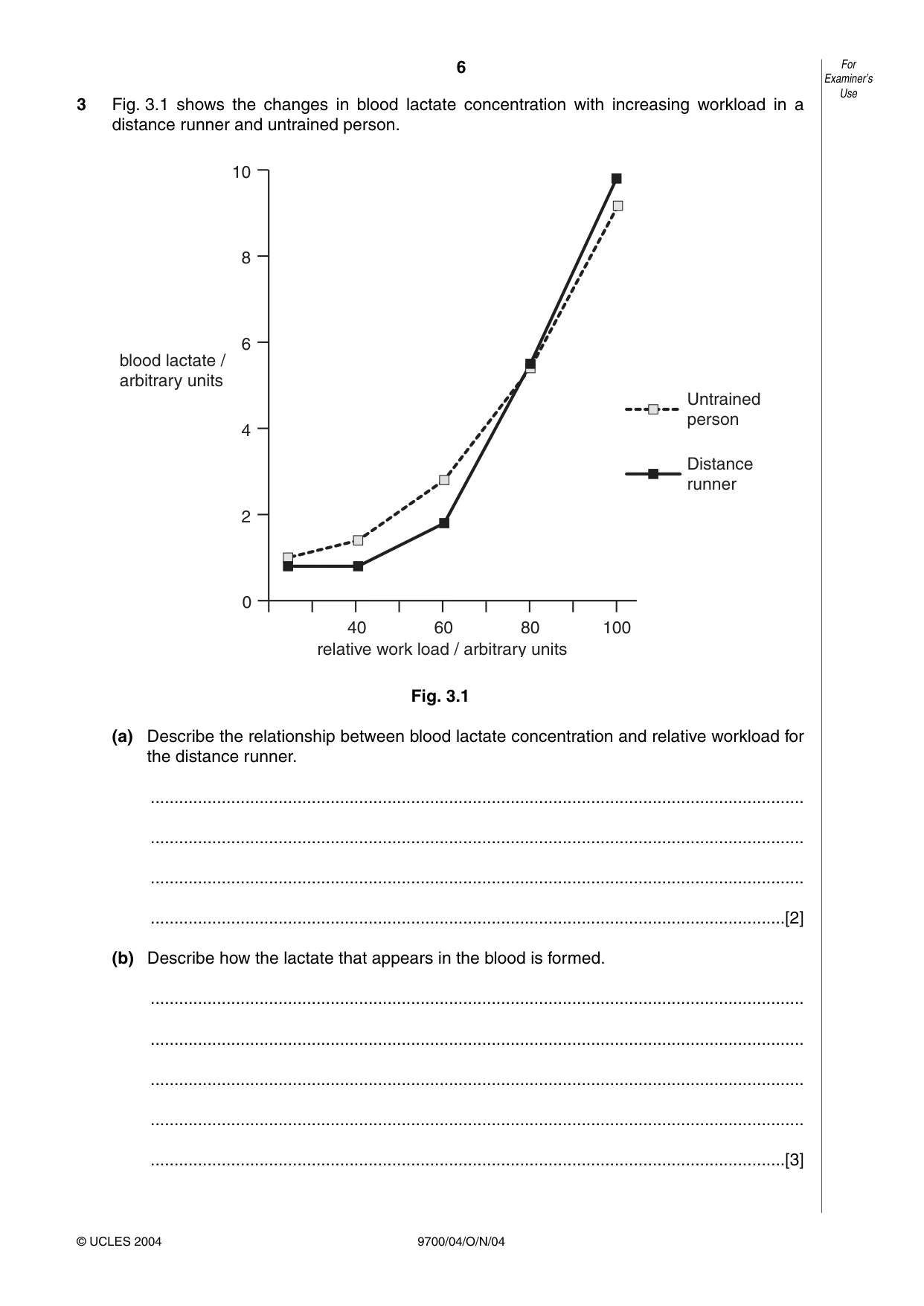
6 9700/04/O/N/04 3 Fig. 3.1 shows the changes in blood lactate concentration with increasing workload in a distance runner and untrained person. Fig. 3.1 (a) Describe the relationship between blood lactate concentration and relative workload for the distance runner. … … … …[2] (b) Describe how the lactate that appears in the blood is formed. … … … … …[3] 0 2 4 6 8 10 Untrained person Distance runner 40 60 80 100 relative work load / arbitrary units blood lactate / arbitrary units For Examiner’s Use © UCLES 2004
Question paper, page 7
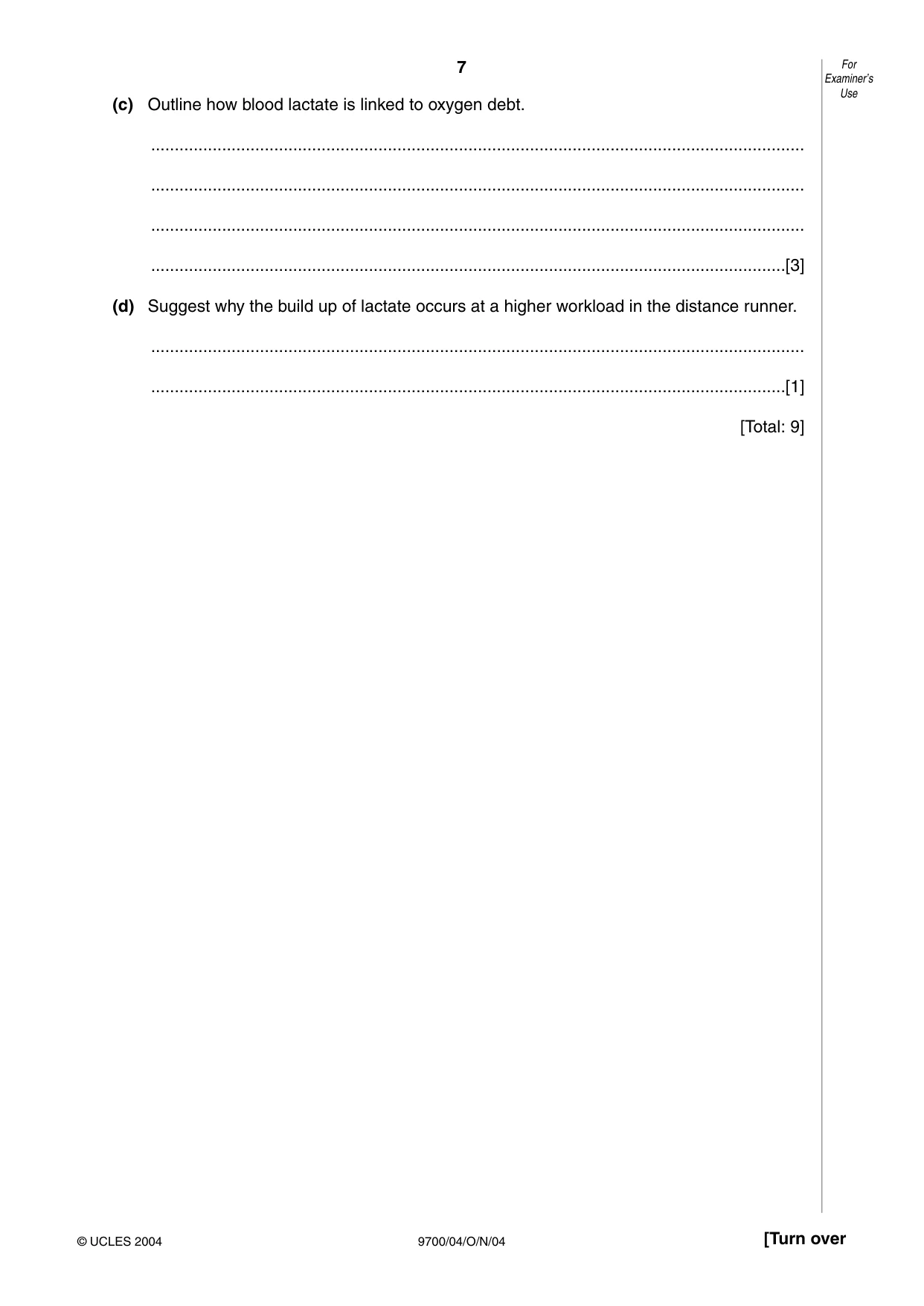
7 9700/04/O/N/04 [Turn over (c) Outline how blood lactate is linked to oxygen debt. … … … …[3] (d) Suggest why the build up of lactate occurs at a higher workload in the distance runner. … …[1] [Total: 9] For Examiner’s Use © UCLES 2004
Question paper, page 8
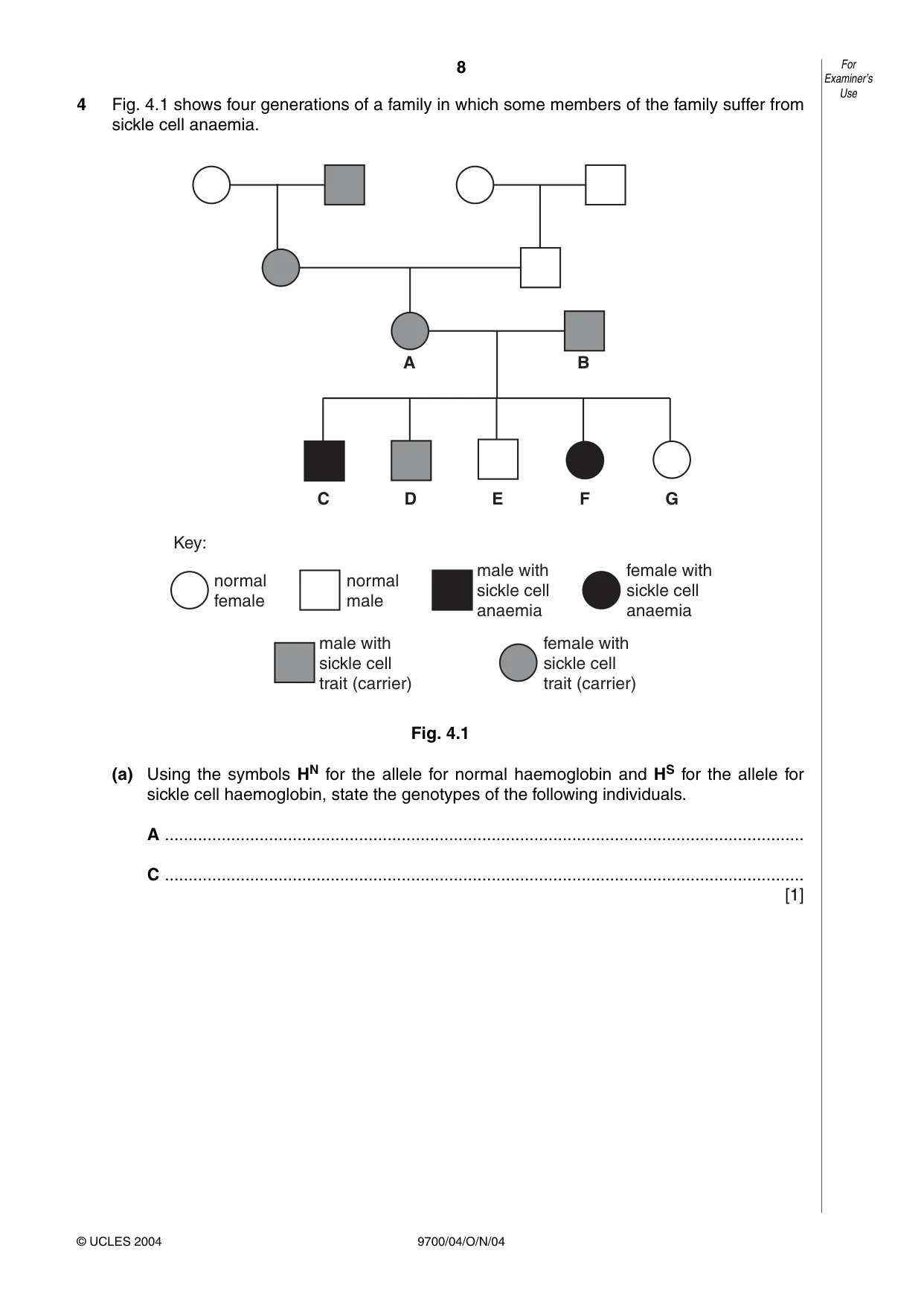
8 9700/04/O/N/04 4 Fig. 4.1 shows four generations of a family in which some members of the family suffer from sickle cell anaemia. Fig. 4.1 (a) Using the symbols HN for the allele for normal haemoglobin and HS for the allele for sickle cell haemoglobin, state the genotypes of the following individuals. A … C … [1] Key: normal female normal male male with sickle cell anaemia female with sickle cell anaemia male with sickle cell trait (carrier) female with sickle cell trait (carrier) A B C D E F G For Examiner’s Use © UCLES 2004
Question paper, page 9
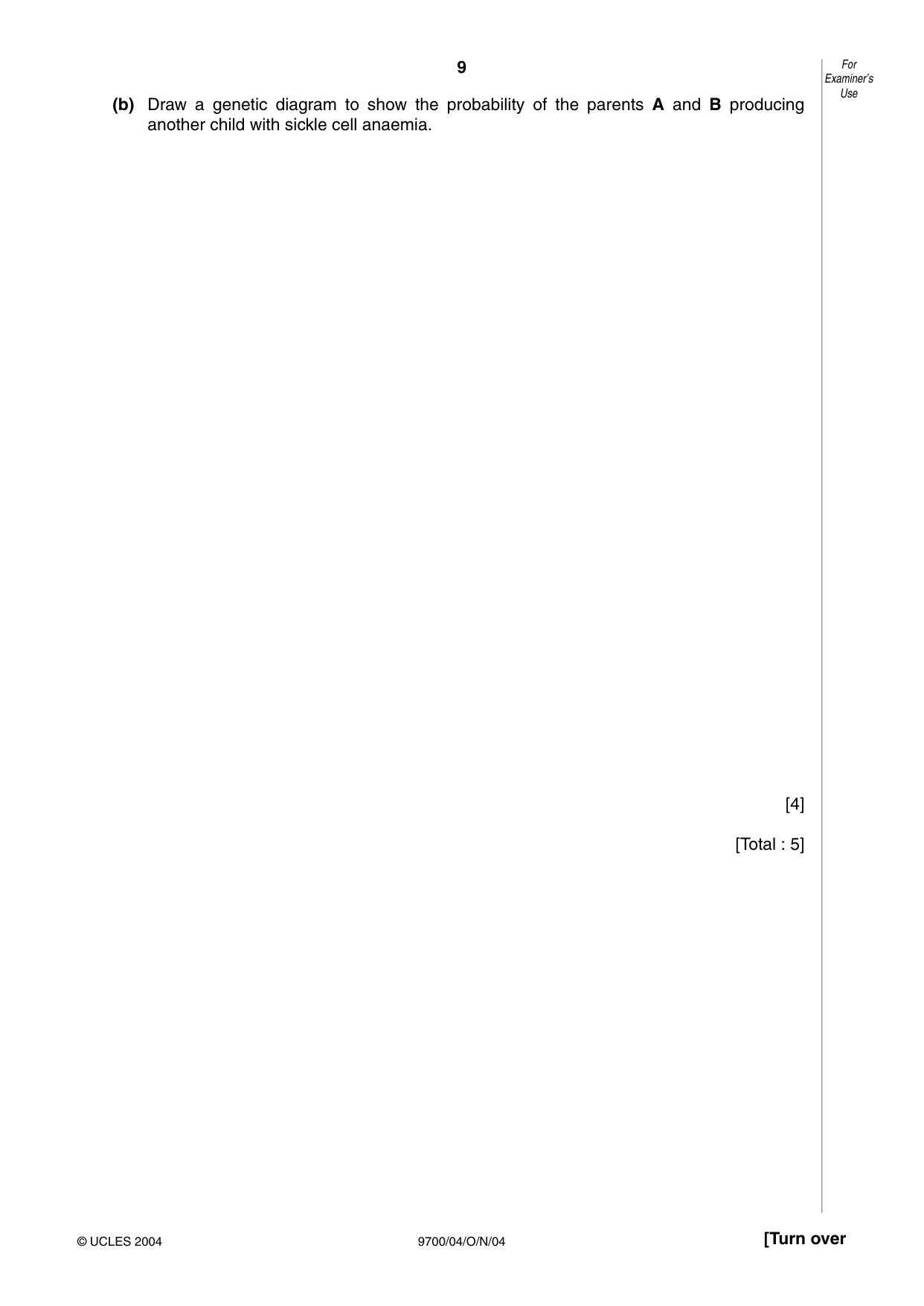
9 9700/04/O/N/04 [Turn over (b) Draw a genetic diagram to show the probability of the parents A and B producing another child with sickle cell anaemia. [4] [Total : 5] For Examiner’s Use © UCLES 2004
Question paper, page 10
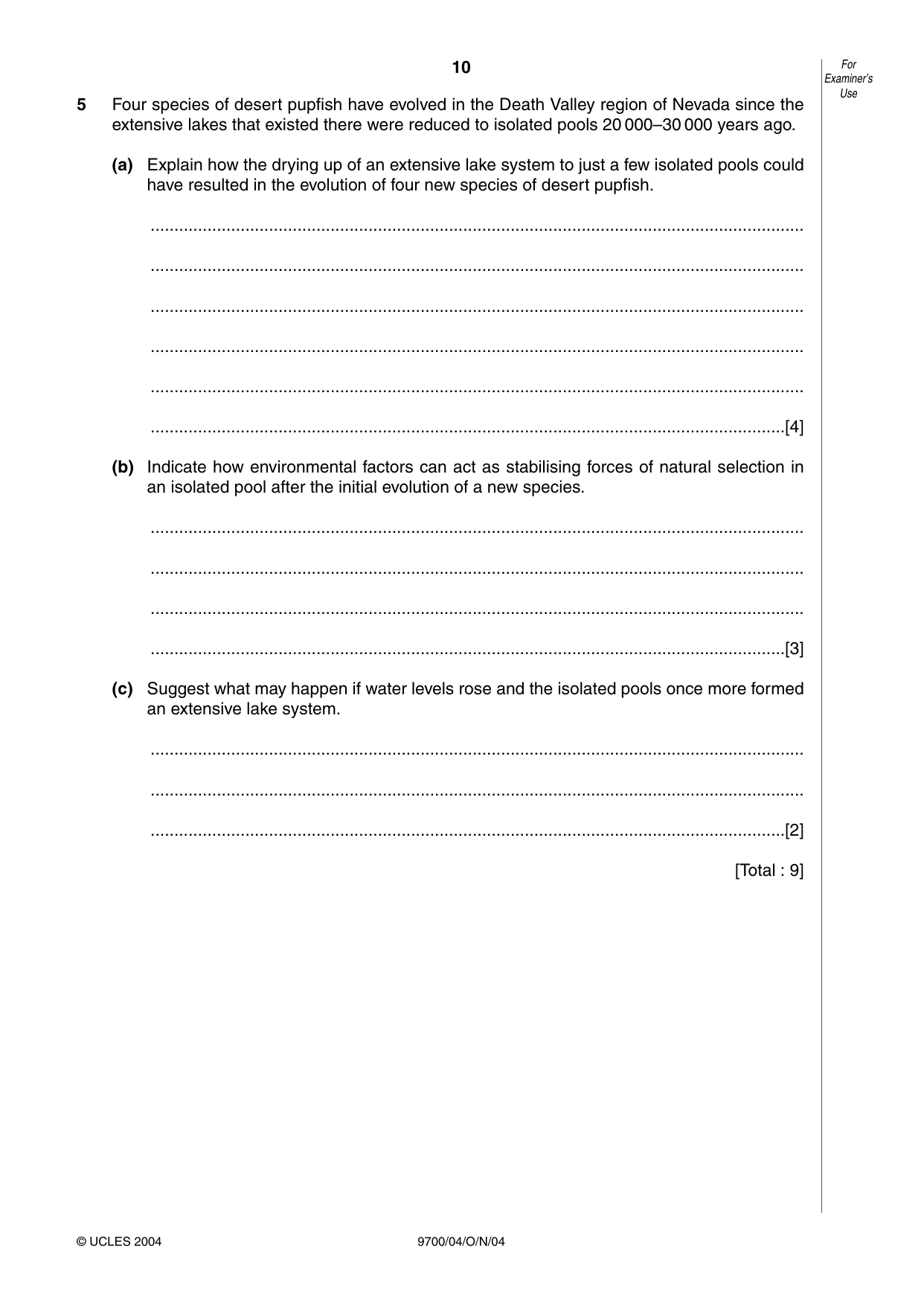
10 9700/04/O/N/04 5 Four species of desert pupfish have evolved in the Death Valley region of Nevada since the extensive lakes that existed there were reduced to isolated pools 20 000–30 000 years ago. (a) Explain how the drying up of an extensive lake system to just a few isolated pools could have resulted in the evolution of four new species of desert pupfish. … … … … … …[4] (b) Indicate how environmental factors can act as stabilising forces of natural selection in an isolated pool after the initial evolution of a new species. … … … …[3] (c) Suggest what may happen if water levels rose and the isolated pools once more formed an extensive lake system. … … …[2] [Total : 9] For Examiner’s Use © UCLES 2004
Question paper, page 11
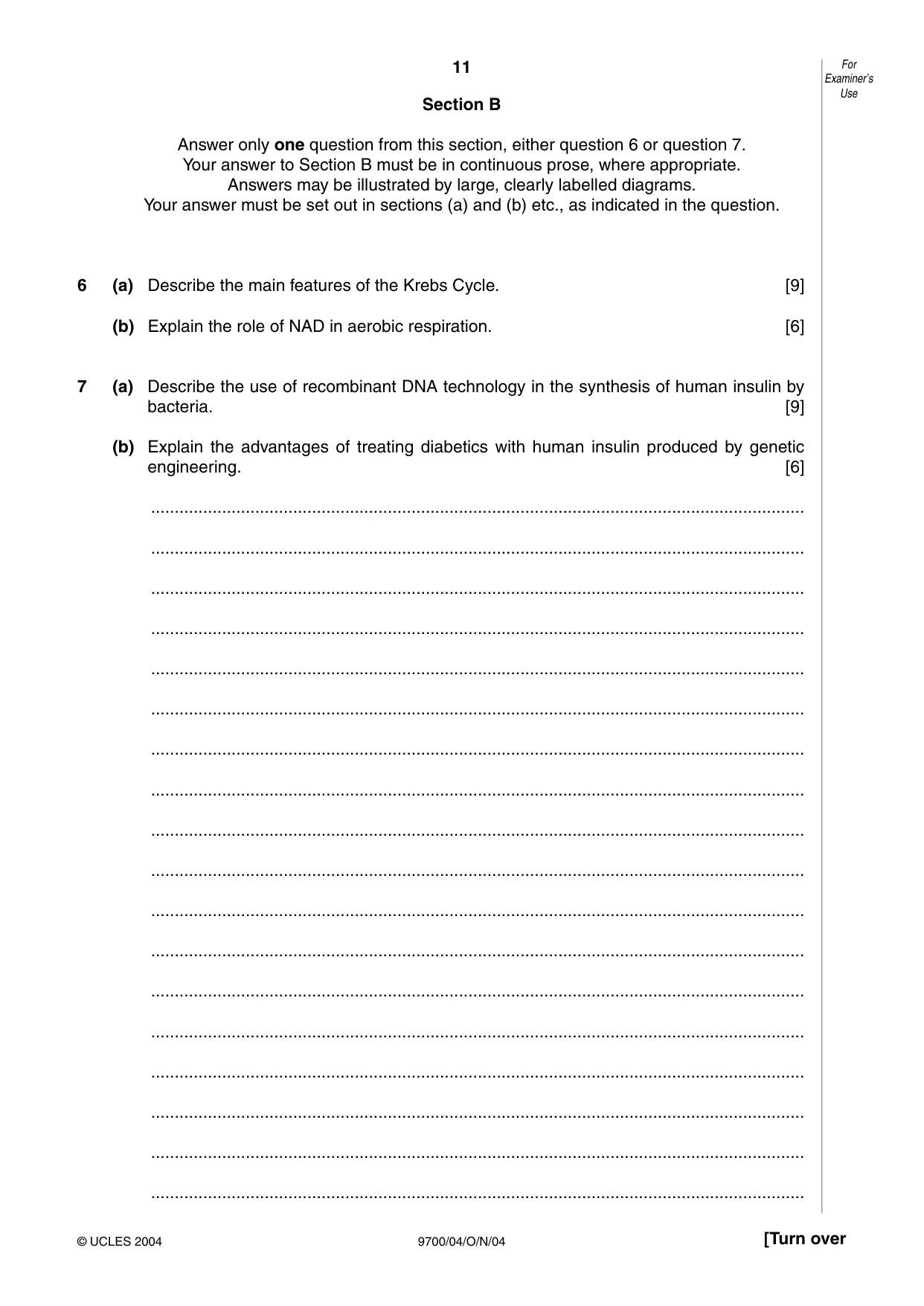
11 9700/04/O/N/04 [Turn over Section B Answer only one question from this section, either question 6 or question 7. Your answer to Section B must be in continuous prose, where appropriate. Answers may be illustrated by large, clearly labelled diagrams. Your answer must be set out in sections (a) and (b) etc., as indicated in the question. 6 (a) Describe the main features of the Krebs Cycle. [9] (b) Explain the role of NAD in aerobic respiration. [6] 7 (a) Describe the use of recombinant DNA technology in the synthesis of human insulin by bacteria. [9] (b) Explain the advantages of treating diabetics with human insulin produced by genetic engineering. [6] … … … … … … … … … … … … … … … … … … For Examiner’s Use © UCLES 2004
Question paper, page 12
12 9700/04/O/N/04 … … … … … … … … … … … … … … … … … … … … … … … … … For Examiner’s Use © UCLES 2004 Every reasonable effort has been made to trace all copyright holders where the publishers (i.e. UCLES) are aware that third-party material has been reproduced. The publishers would be pleased to hear from anyone whose rights they have unwittingly infringed. University of Cambridge International Examinations is part of the University of Cambridge Local Examinations Syndicate (UCLES), which is itself a department of the University of Cambridge.
Mark scheme, page 1
UNIVERSITY OF CAMBRIDGE INTERNATIONAL EXAMINATIONS GCE Advanced Level MARK SCHEME for the November 2004 question paper 9700 BIOLOGY 9700/04 Paper 4 (Structured Question A2 Core), maximum raw mark 60 This mark scheme is published as an aid to teachers and students, to indicate the requirements of the examination. This shows the basis on which Examiners were initially instructed to award marks. It does not indicate the details of the discussions that took place at an Examiners’ meeting before marking began. Any substantial changes to the mark scheme that arose from these discussions will be recorded in the published Report on the Examination. All Examiners are instructed that alternative correct answers and unexpected approaches in candidates’ scripts must be given marks that fairly reflect the relevant knowledge and skills demonstrated. Mark schemes must be read in conjunction with the question papers and the Report on the Examination. • CIE will not enter into discussion or correspondence in connection with these mark schemes. CIE is publishing the mark schemes for the November 2004 question papers for most IGCSE and GCE Advanced Level syllabuses.
Mark scheme, page 2
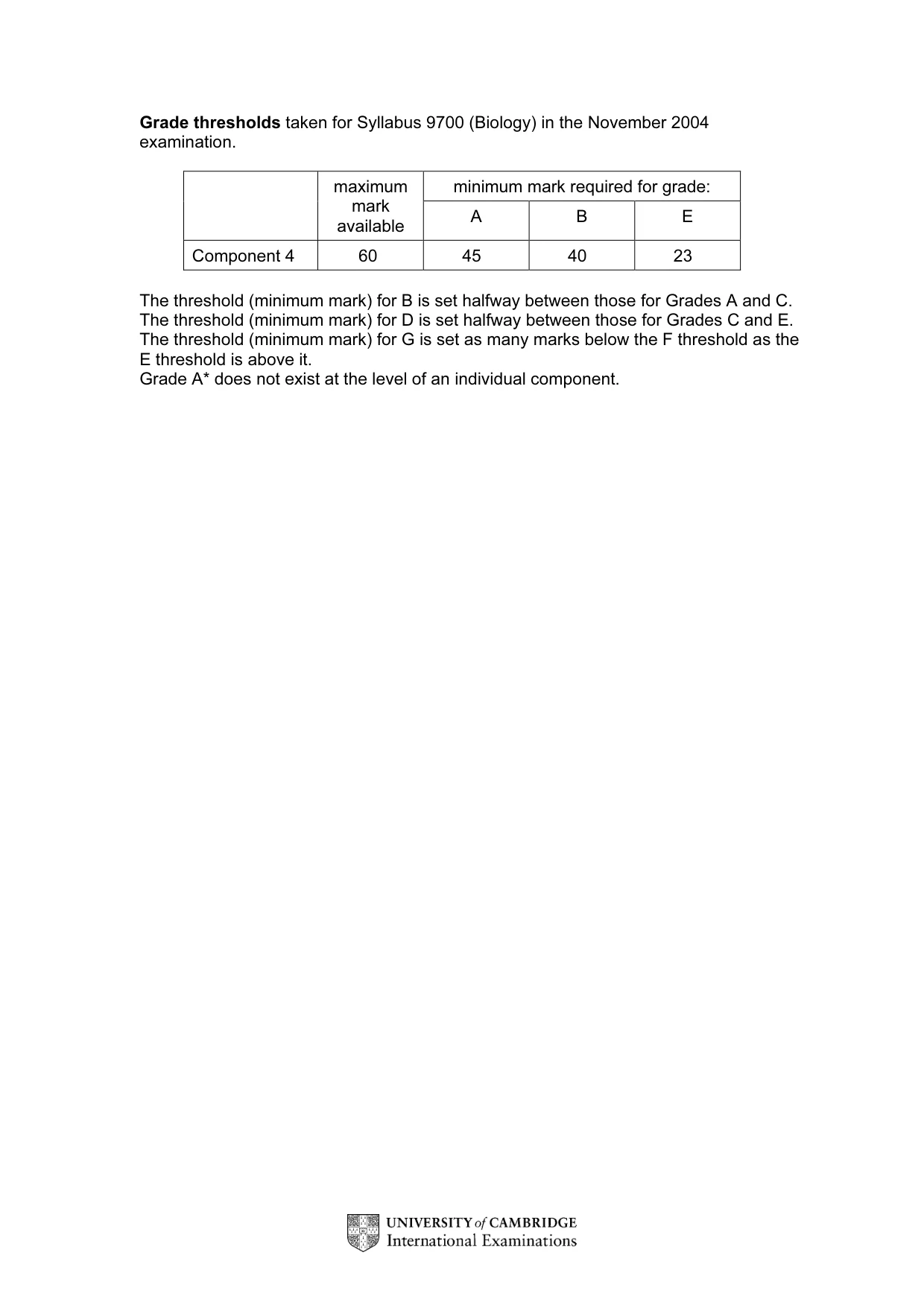
Grade thresholds taken for Syllabus 9700 (Biology) in the November 2004 examination. minimum mark required for grade: maximum mark available A B E Component 4 60 45 40 23 The threshold (minimum mark) for B is set halfway between those for Grades A and C. The threshold (minimum mark) for D is set halfway between those for Grades C and E. The threshold (minimum mark) for G is set as many marks below the F threshold as the E threshold is above it. Grade A* does not exist at the level of an individual component.
Mark scheme, page 3
November 2004 GCE A LEVEL MARK SCHEME MAXIMUM MARK: 60 SYLLABUS/COMPONENT: 9700/04 BIOLOGY Paper 4 (Structured Question A2 Core)
Mark scheme, page 4
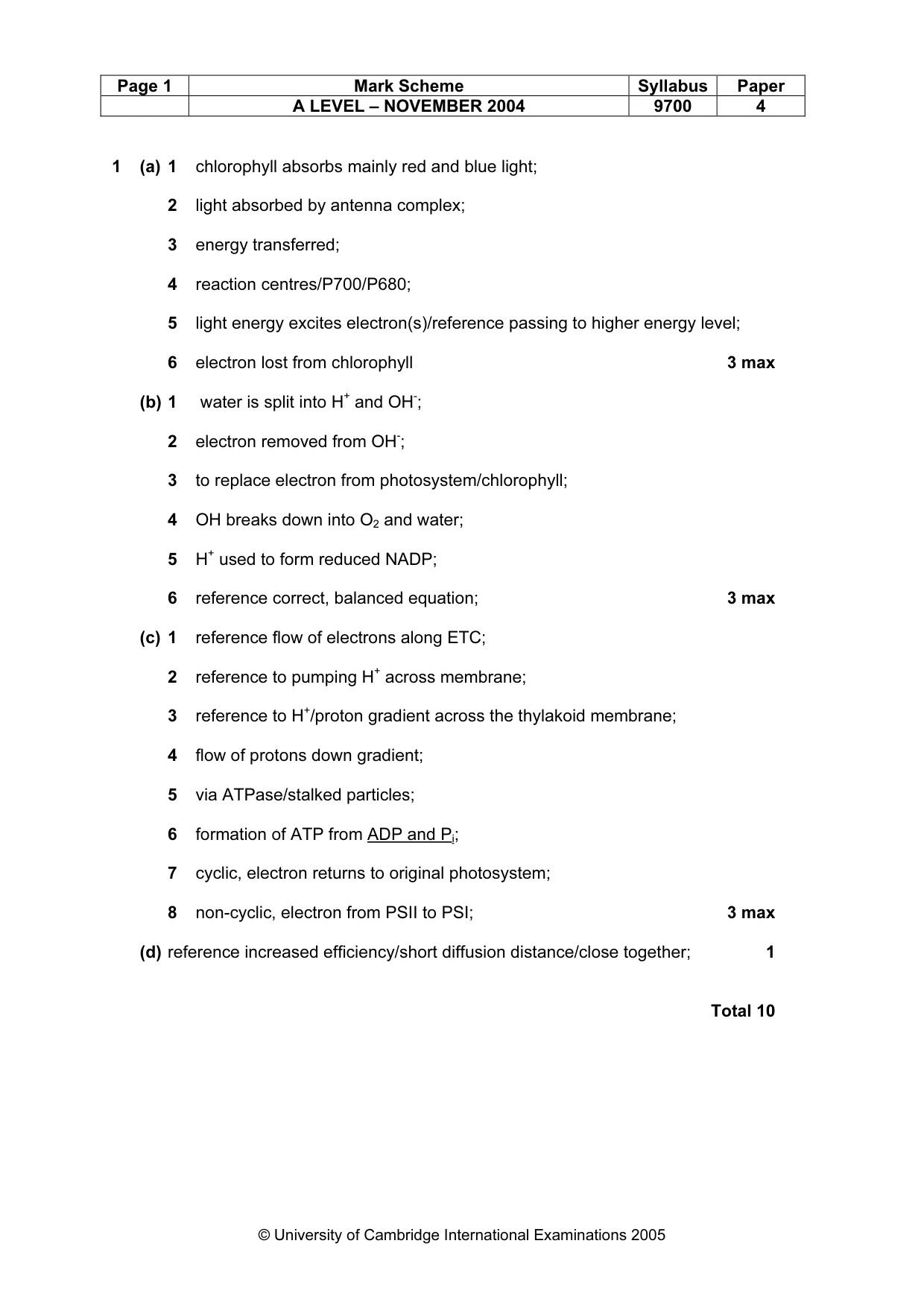
Page 1 Mark Scheme Syllabus Paper A LEVEL – NOVEMBER 2004 9700 4 © University of Cambridge International Examinations 2005 1 (a) 1 chlorophyll absorbs mainly red and blue light; 2 light absorbed by antenna complex; 3 energy transferred; 4 reaction centres/P700/P680; 5 light energy excites electron(s)/reference passing to higher energy level; 6 electron lost from chlorophyll 3 max (b) 1 water is split into H+ and OH-; 2 electron removed from OH-; 3 to replace electron from photosystem/chlorophyll; 4 OH breaks down into O2 and water; 5 H+ used to form reduced NADP; 6 reference correct, balanced equation; 3 max (c) 1 reference flow of electrons along ETC; 2 reference to pumping H+ across membrane; 3 reference to H+/proton gradient across the thylakoid membrane; 4 flow of protons down gradient; 5 via ATPase/stalked particles; 6 formation of ATP from ADP and Pi; 7 cyclic, electron returns to original photosystem; 8 non-cyclic, electron from PSII to PSI; 3 max (d) reference increased efficiency/short diffusion distance/close together; 1 Total 10
Mark scheme, page 5
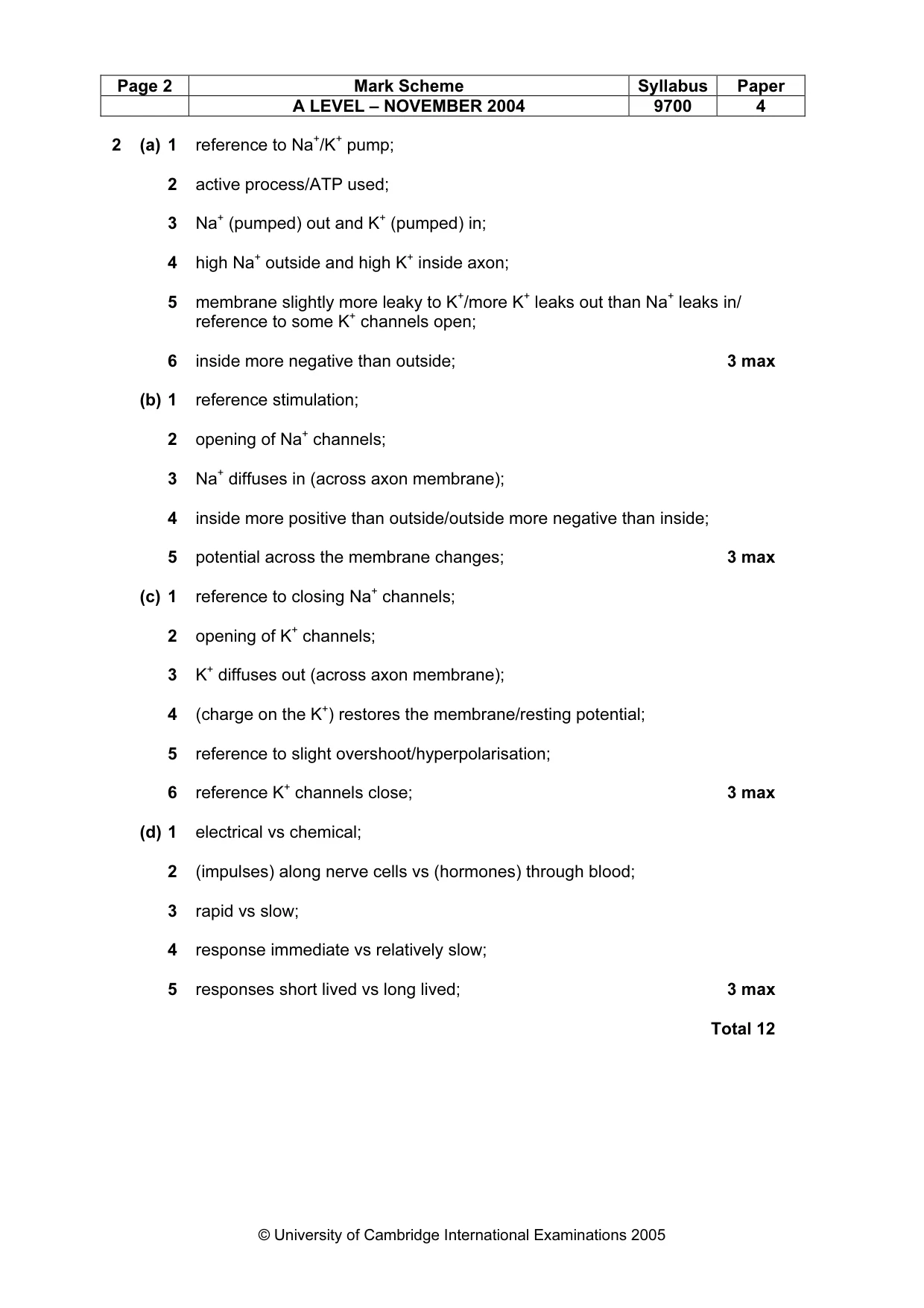
Page 2 Mark Scheme Syllabus Paper A LEVEL – NOVEMBER 2004 9700 4 © University of Cambridge International Examinations 2005 2 (a) 1 reference to Na+/K+ pump; 2 active process/ATP used; 3 Na+ (pumped) out and K+ (pumped) in; 4 high Na+ outside and high K+ inside axon; 5 membrane slightly more leaky to K+/more K+ leaks out than Na+ leaks in/ reference to some K+ channels open; 6 inside more negative than outside; 3 max (b) 1 reference stimulation; 2 opening of Na+ channels; 3 Na+ diffuses in (across axon membrane); 4 inside more positive than outside/outside more negative than inside; 5 potential across the membrane changes; 3 max (c) 1 reference to closing Na+ channels; 2 opening of K+ channels; 3 K+ diffuses out (across axon membrane); 4 (charge on the K+) restores the membrane/resting potential; 5 reference to slight overshoot/hyperpolarisation; 6 reference K+ channels close; 3 max (d) 1 electrical vs chemical; 2 (impulses) along nerve cells vs (hormones) through blood; 3 rapid vs slow; 4 response immediate vs relatively slow; 5 responses short lived vs long lived; 3 max Total 12
Mark scheme, page 6
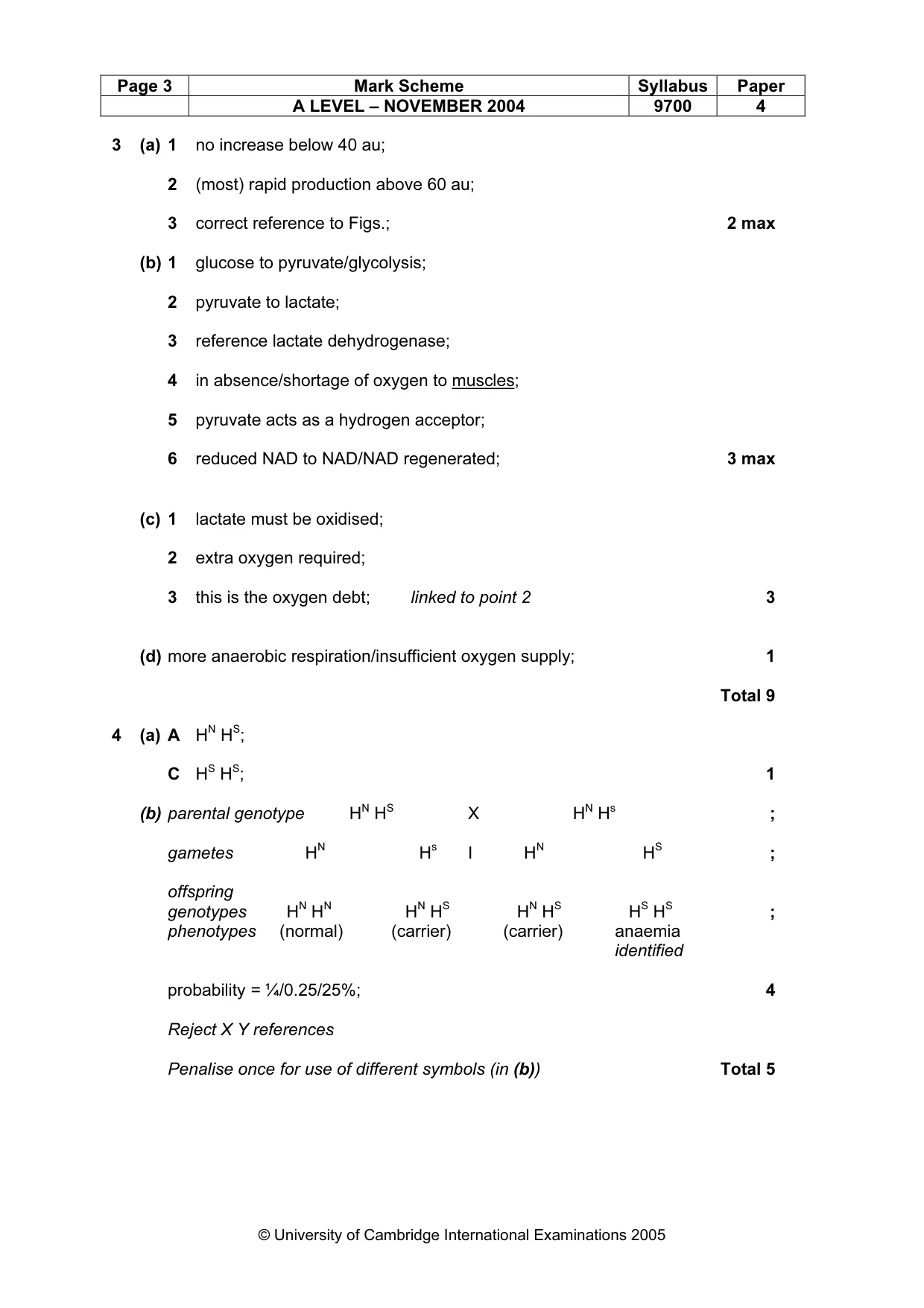
Page 3 Mark Scheme Syllabus Paper A LEVEL – NOVEMBER 2004 9700 4 © University of Cambridge International Examinations 2005 3 (a) 1 no increase below 40 au; 2 (most) rapid production above 60 au; 3 correct reference to Figs.; 2 max (b) 1 glucose to pyruvate/glycolysis; 2 pyruvate to lactate; 3 reference lactate dehydrogenase; 4 in absence/shortage of oxygen to muscles; 5 pyruvate acts as a hydrogen acceptor; 6 reduced NAD to NAD/NAD regenerated; 3 max (c) 1 lactate must be oxidised; 2 extra oxygen required; 3 this is the oxygen debt; linked to point 2 3 (d) more anaerobic respiration/insufficient oxygen supply; 1 Total 9 4 (a) A HN HS; C HS HS; 1 (b) parental genotype HN HS X HN Hs ; gametes HN Hs I HN HS ; offspring genotypes HN HN HN HS HN HS HS HS ; phenotypes (normal) (carrier) (carrier) anaemia identified probability = ¼/0.25/25%; 4 Reject X Y references Penalise once for use of different symbols (in (b)) Total 5
Mark scheme, page 7
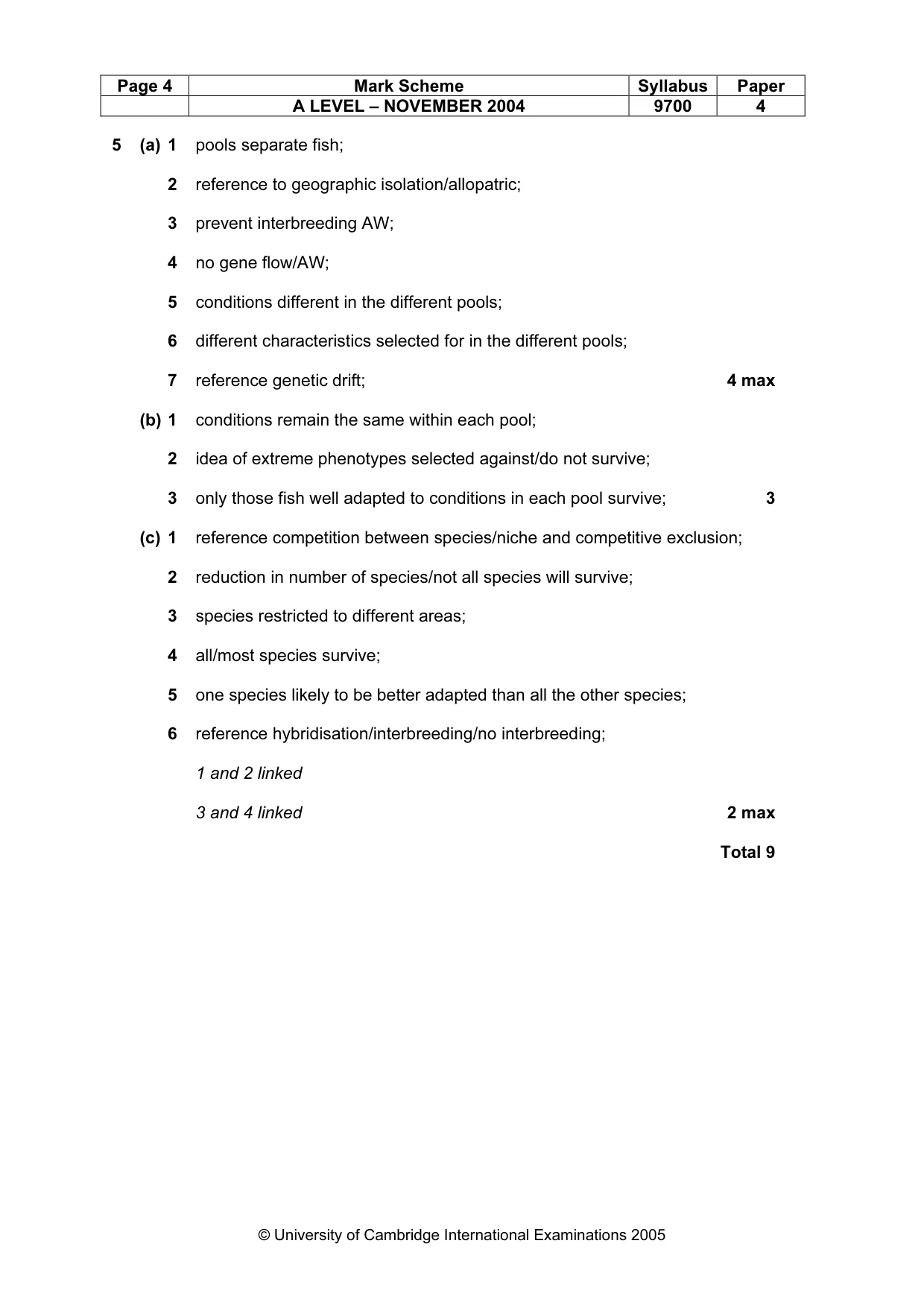
Page 4 Mark Scheme Syllabus Paper A LEVEL – NOVEMBER 2004 9700 4 © University of Cambridge International Examinations 2005 5 (a) 1 pools separate fish; 2 reference to geographic isolation/allopatric; 3 prevent interbreeding AW; 4 no gene flow/AW; 5 conditions different in the different pools; 6 different characteristics selected for in the different pools; 7 reference genetic drift; 4 max (b) 1 conditions remain the same within each pool; 2 idea of extreme phenotypes selected against/do not survive; 3 only those fish well adapted to conditions in each pool survive; 3 (c) 1 reference competition between species/niche and competitive exclusion; 2 reduction in number of species/not all species will survive; 3 species restricted to different areas; 4 all/most species survive; 5 one species likely to be better adapted than all the other species; 6 reference hybridisation/interbreeding/no interbreeding; 1 and 2 linked 3 and 4 linked 2 max Total 9
Mark scheme, page 8
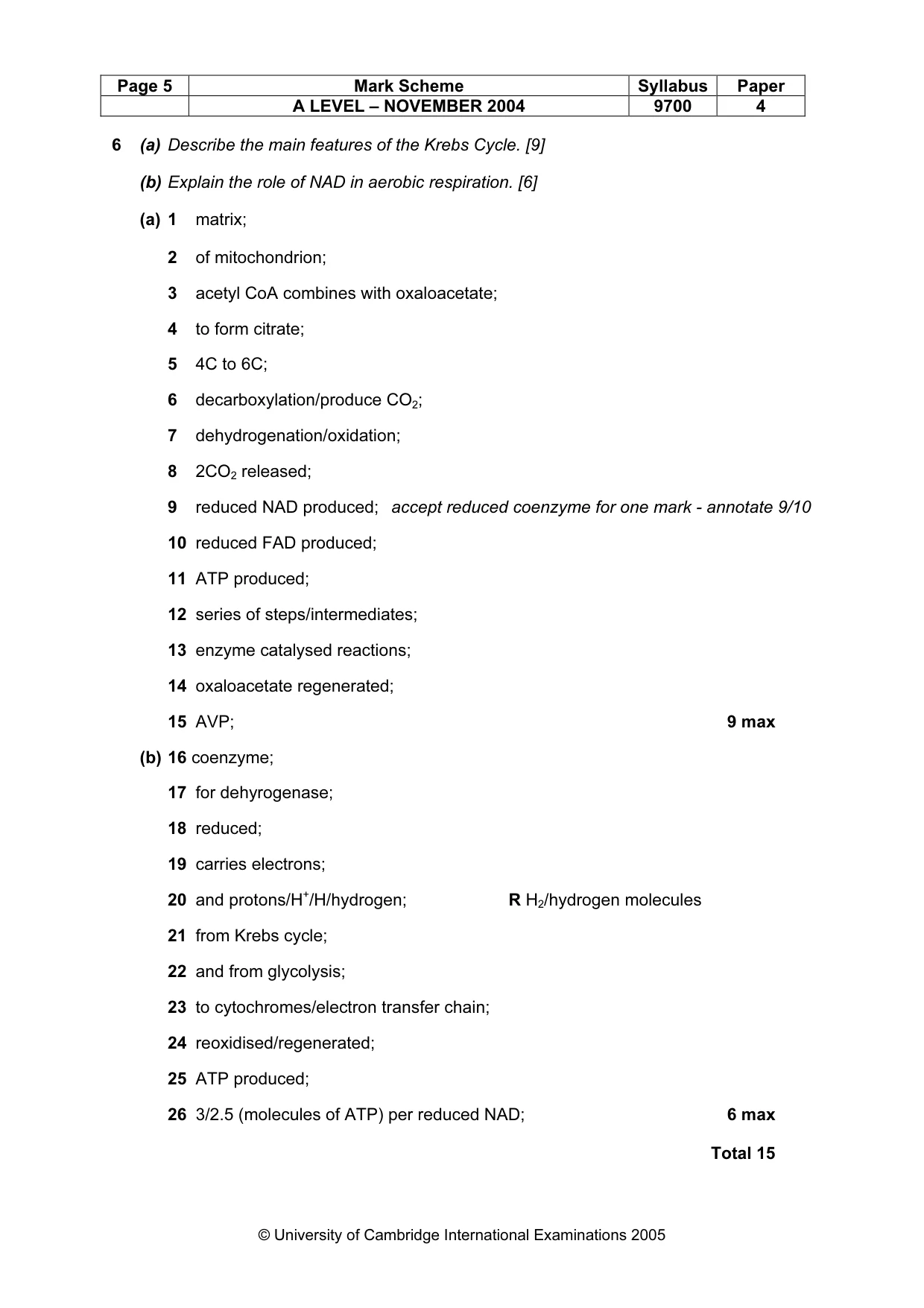
Page 5 Mark Scheme Syllabus Paper A LEVEL – NOVEMBER 2004 9700 4 © University of Cambridge International Examinations 2005 6 (a) Describe the main features of the Krebs Cycle. [9] (b) Explain the role of NAD in aerobic respiration. [6] (a) 1 matrix; 2 of mitochondrion; 3 acetyl CoA combines with oxaloacetate; 4 to form citrate; 5 4C to 6C; 6 decarboxylation/produce CO2; 7 dehydrogenation/oxidation; 8 2CO2 released; 9 reduced NAD produced; accept reduced coenzyme for one mark - annotate 9/10 10 reduced FAD produced; 11 ATP produced; 12 series of steps/intermediates; 13 enzyme catalysed reactions; 14 oxaloacetate regenerated; 15 AVP; 9 max (b) 16 coenzyme; 17 for dehyrogenase; 18 reduced; 19 carries electrons; 20 and protons/H+/H/hydrogen; R H2/hydrogen molecules 21 from Krebs cycle; 22 and from glycolysis; 23 to cytochromes/electron transfer chain; 24 reoxidised/regenerated; 25 ATP produced; 26 3/2.5 (molecules of ATP) per reduced NAD; 6 max Total 15
Mark scheme, page 9
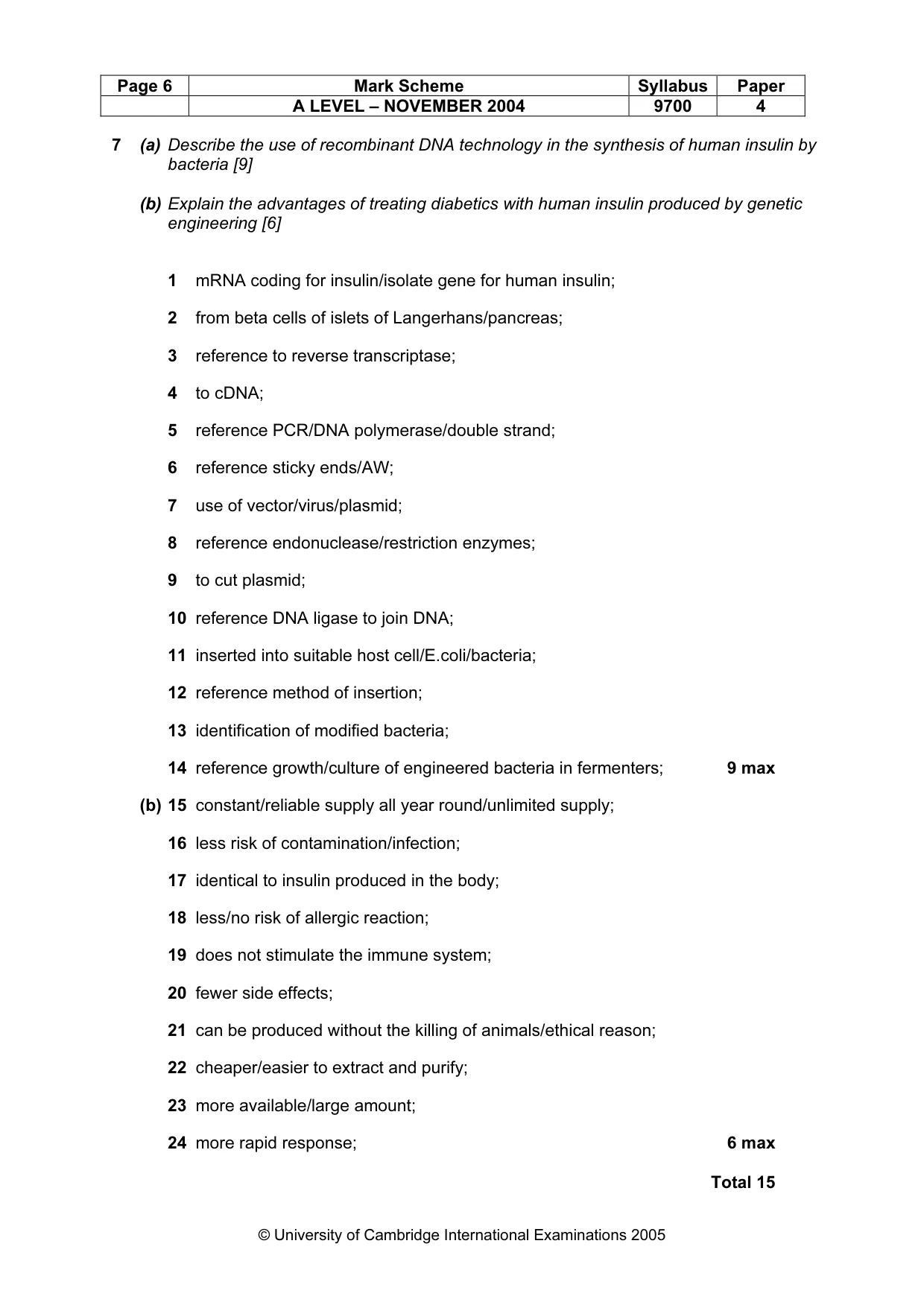
Page 6 Mark Scheme Syllabus Paper A LEVEL – NOVEMBER 2004 9700 4 © University of Cambridge International Examinations 2005 7 (a) Describe the use of recombinant DNA technology in the synthesis of human insulin by bacteria [9] (b) Explain the advantages of treating diabetics with human insulin produced by genetic engineering [6] 1 mRNA coding for insulin/isolate gene for human insulin; 2 from beta cells of islets of Langerhans/pancreas; 3 reference to reverse transcriptase; 4 to cDNA; 5 reference PCR/DNA polymerase/double strand; 6 reference sticky ends/AW; 7 use of vector/virus/plasmid; 8 reference endonuclease/restriction enzymes; 9 to cut plasmid; 10 reference DNA ligase to join DNA; 11 inserted into suitable host cell/E.coli/bacteria; 12 reference method of insertion; 13 identification of modified bacteria; 14 reference growth/culture of engineered bacteria in fermenters; 9 max (b) 15 constant/reliable supply all year round/unlimited supply; 16 less risk of contamination/infection; 17 identical to insulin produced in the body; 18 less/no risk of allergic reaction; 19 does not stimulate the immune system; 20 fewer side effects; 21 can be produced without the killing of animals/ethical reason; 22 cheaper/easier to extract and purify; 23 more available/large amount; 24 more rapid response; 6 max Total 15