Cambridge A Level Biology 9700 — 2003 May/June Paper 2 · Variant 1
9700/21/M/J/03
The question paper and its mark scheme, free to read here and free to download. This is Cambridge’s own paper, exactly as it was sat.
Question paper12 pages

Mark scheme
No mark scheme is in the library for this paper.
Paper as text
Question paper, page 1
For Examiner’s Use 1 2 3 4 5 6 TOTAL This document consists of 11 printed pages and 1 blank page. SP (SC/KN) S41709/3 © CIE 2003 [Turn over CAMBRIDGE INTERNATIONAL EXAMINATIONS General Certificate of Education Advanced Subsidiary Level and Advanced Level BIOLOGY 9700/02 Paper 2 Structured Questions AS May/June 2003 1 hour Candidates answer on the Question Paper. No Additional Materials are required. READ THESE INSTRUCTIONS FIRST Write your Centre number, candidate number and name in the spaces provided at the top of this page. Write in dark blue or black pen in the spaces provided on the Question Paper. You may use a soft pencil for any diagrams, graphs, or rough working. Do not use staples, paper clips, highlighters, glue or correction fluid. Answer all questions. The number of marks is given in brackets [ ] at the end of each question or part question. Centre Number Candidate Number Name If you have been given a label, look at the details. If any details are incorrect or missing, please fill in your correct details in the space given at the top of this page. Stick your personal label here, if provided.
Question paper, page 2
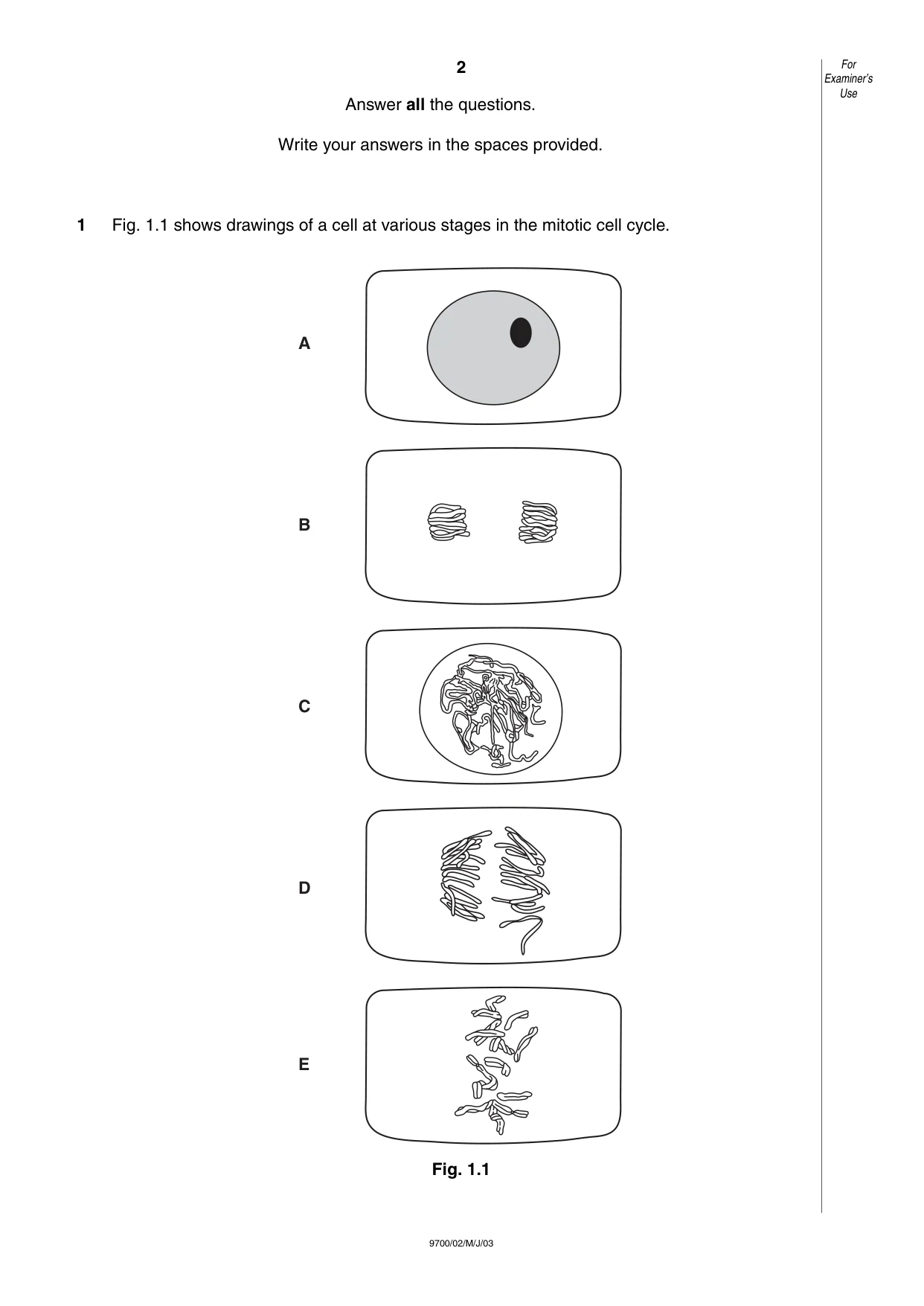
2 9700/02/M/J/03 Answer all the questions. Write your answers in the spaces provided. 1 Fig. 1.1 shows drawings of a cell at various stages in the mitotic cell cycle. Fig. 1.1 A B C D E For Examiner’s Use
Question paper, page 3
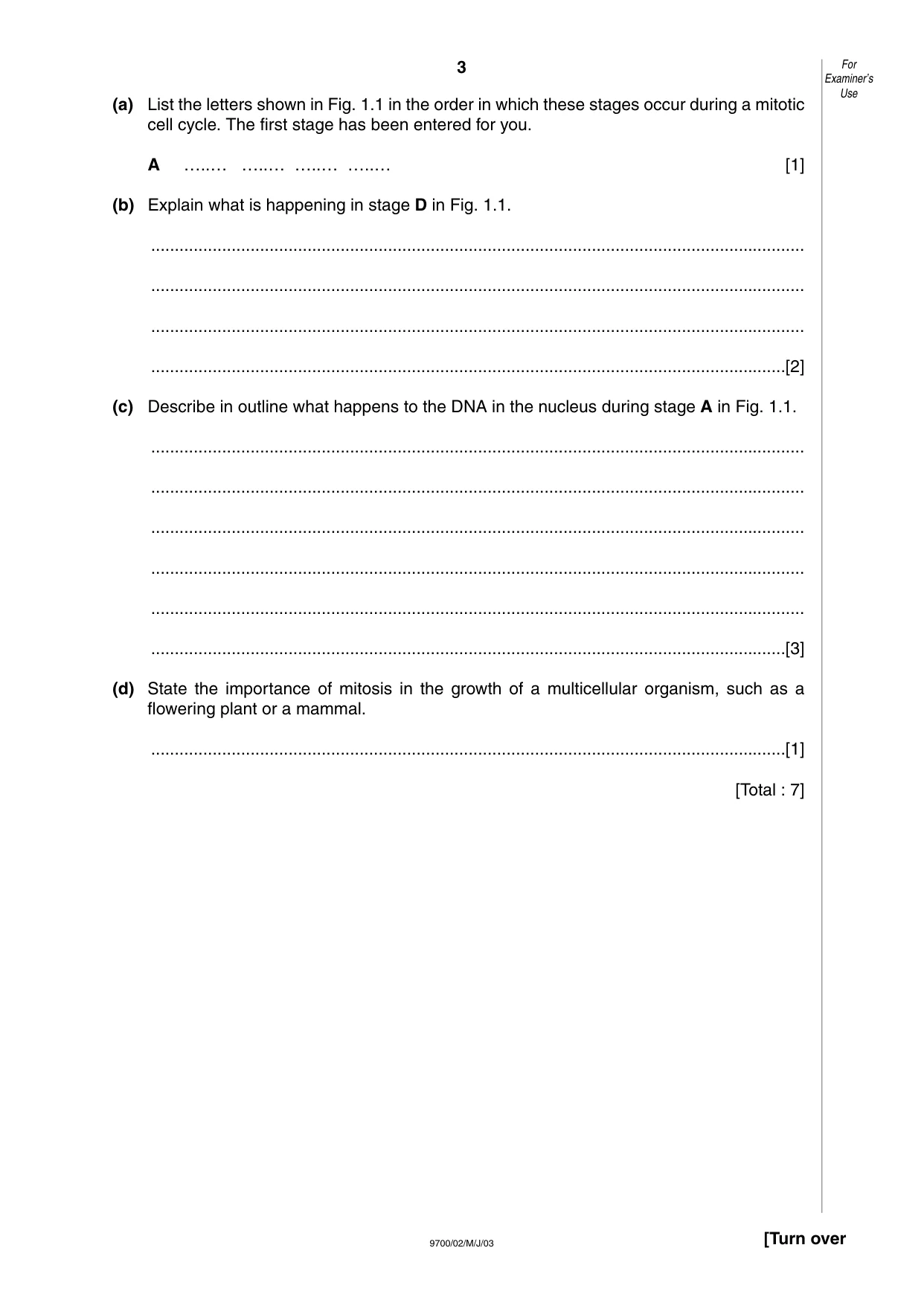
3 9700/02/M/J/03 [Turn over (a) List the letters shown in Fig. 1.1 in the order in which these stages occur during a mitotic cell cycle. The first stage has been entered for you. A …..… …..… …..… …..… [1] (b) Explain what is happening in stage D in Fig. 1.1. … … … …[2] (c) Describe in outline what happens to the DNA in the nucleus during stage A in Fig. 1.1. … … … … … …[3] (d) State the importance of mitosis in the growth of a multicellular organism, such as a flowering plant or a mammal. …[1] [Total : 7] For Examiner’s Use
Question paper, page 4
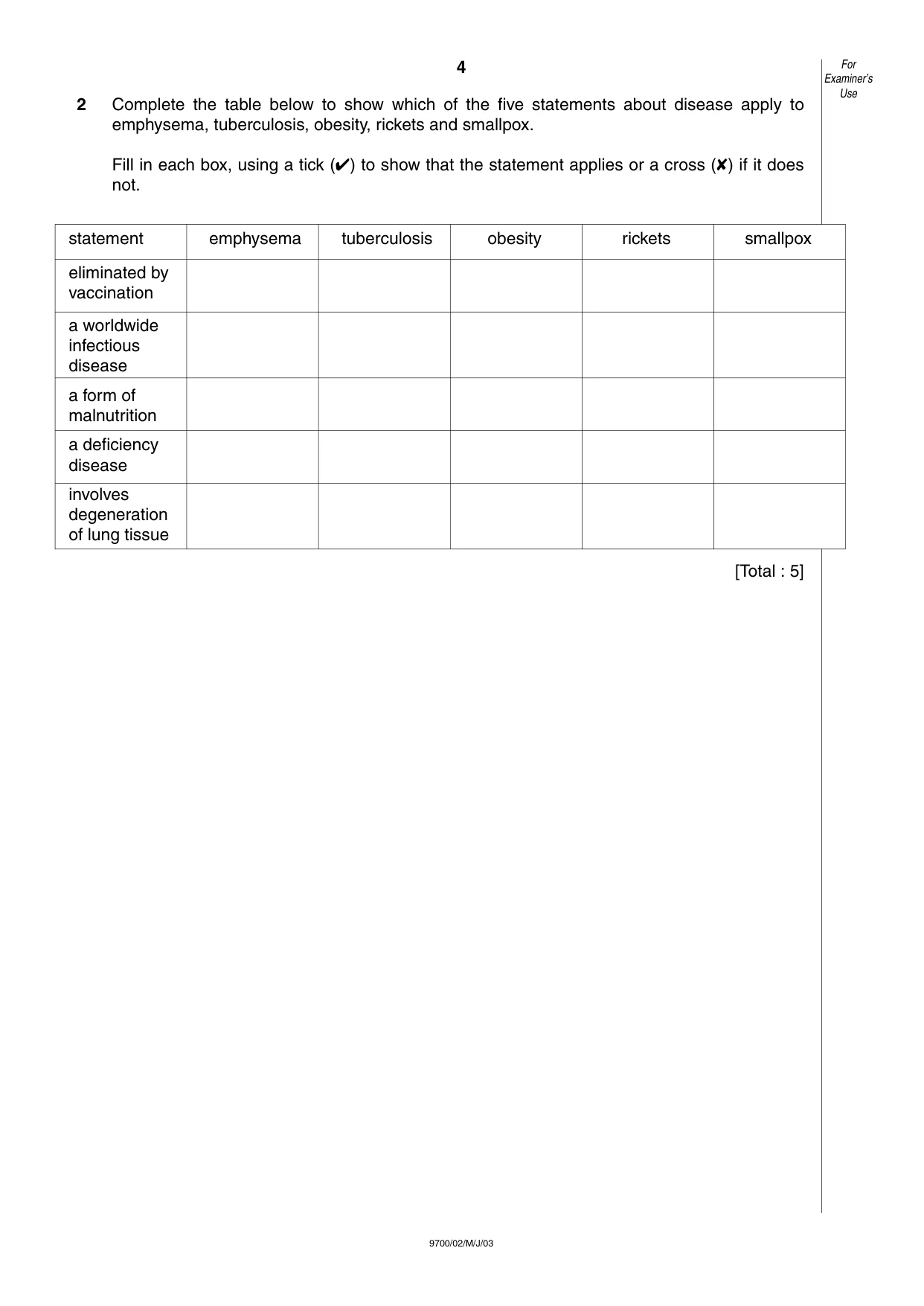
4 9700/02/M/J/03 2 Complete the table below to show which of the five statements about disease apply to emphysema, tuberculosis, obesity, rickets and smallpox. Fill in each box, using a tick (✔) to show that the statement applies or a cross (✘) if it does not. [Total : 5] For Examiner’s Use statement emphysema tuberculosis obesity rickets smallpox eliminated by vaccination a worldwide infectious disease a form of malnutrition a deficiency disease involves degeneration of lung tissue
Question paper, page 5
5 9700/02/M/J/03 [Turn over BLANK PAGE Turn over to page 6 for the next question.
Question paper, page 6
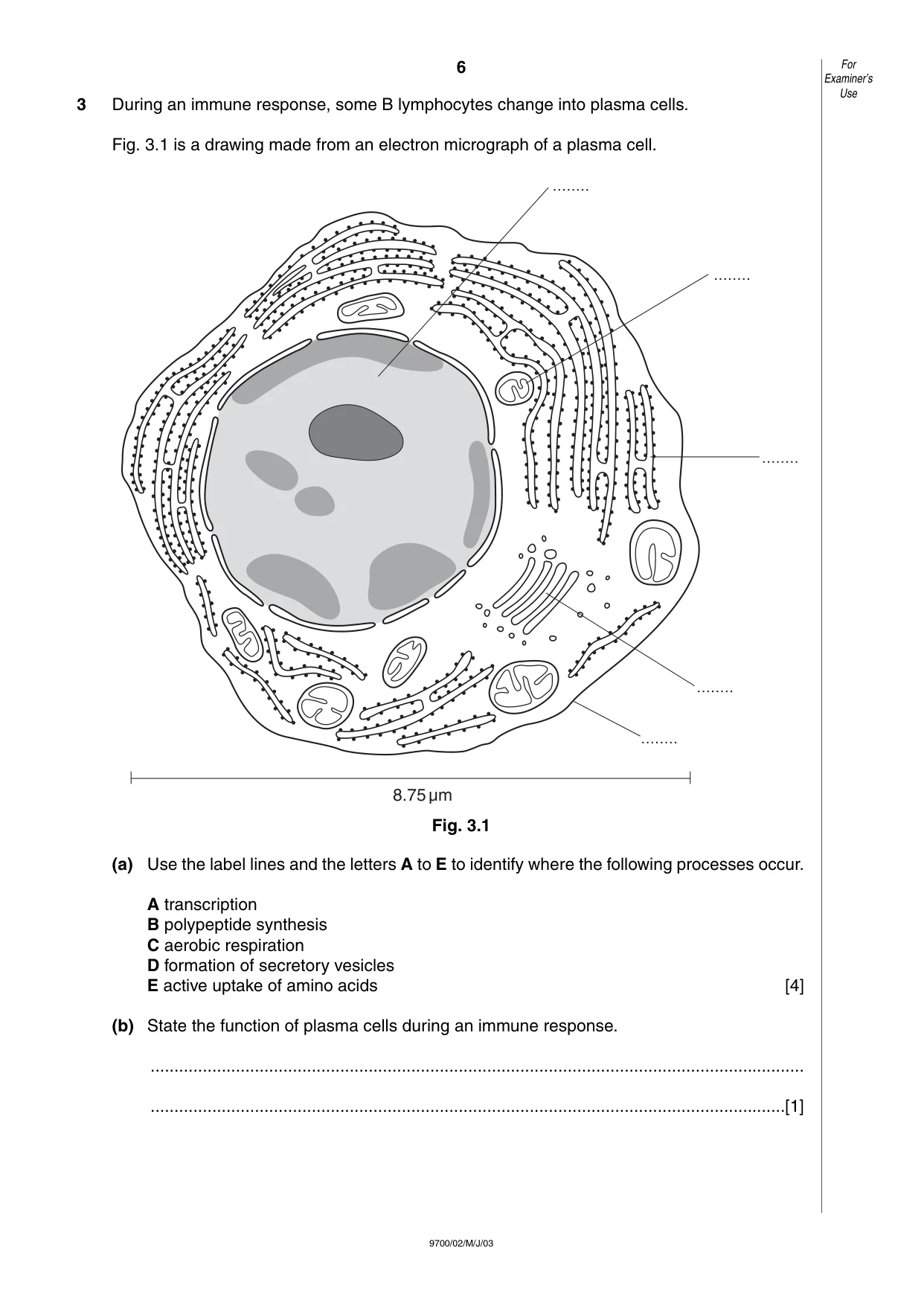
6 9700/02/M/J/03 3 During an immune response, some B lymphocytes change into plasma cells. Fig. 3.1 is a drawing made from an electron micrograph of a plasma cell. Fig. 3.1 (a) Use the label lines and the letters A to E to identify where the following processes occur. A transcription B polypeptide synthesis C aerobic respiration D formation of secretory vesicles E active uptake of amino acids [4] (b) State the function of plasma cells during an immune response. … …[1] 8.75µm For Examiner’s Use
Question paper, page 7
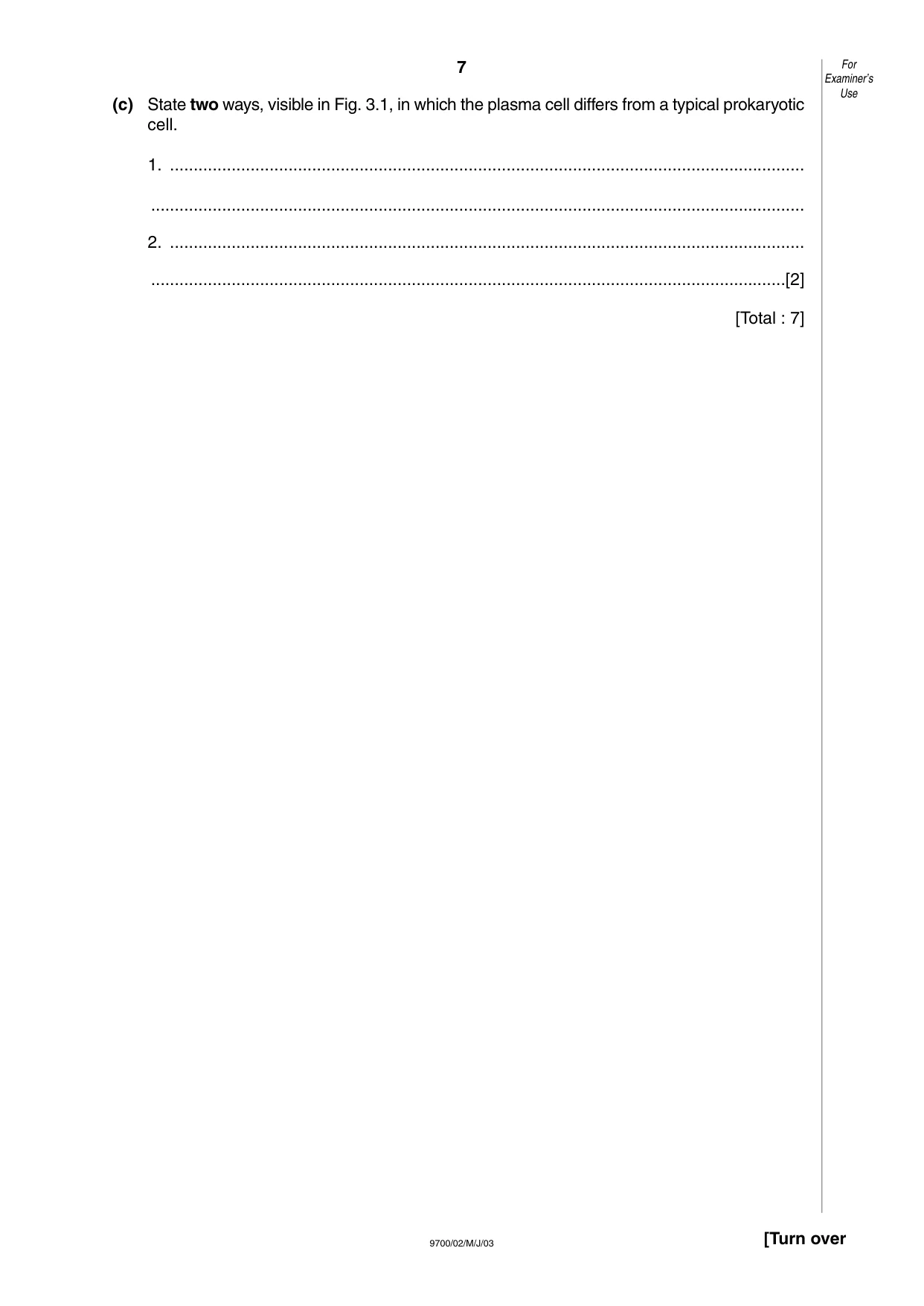
7 9700/02/M/J/03 [Turn over (c) State two ways, visible in Fig. 3.1, in which the plasma cell differs from a typical prokaryotic cell. 1. … … 2. … …[2] [Total : 7] For Examiner’s Use
Question paper, page 8
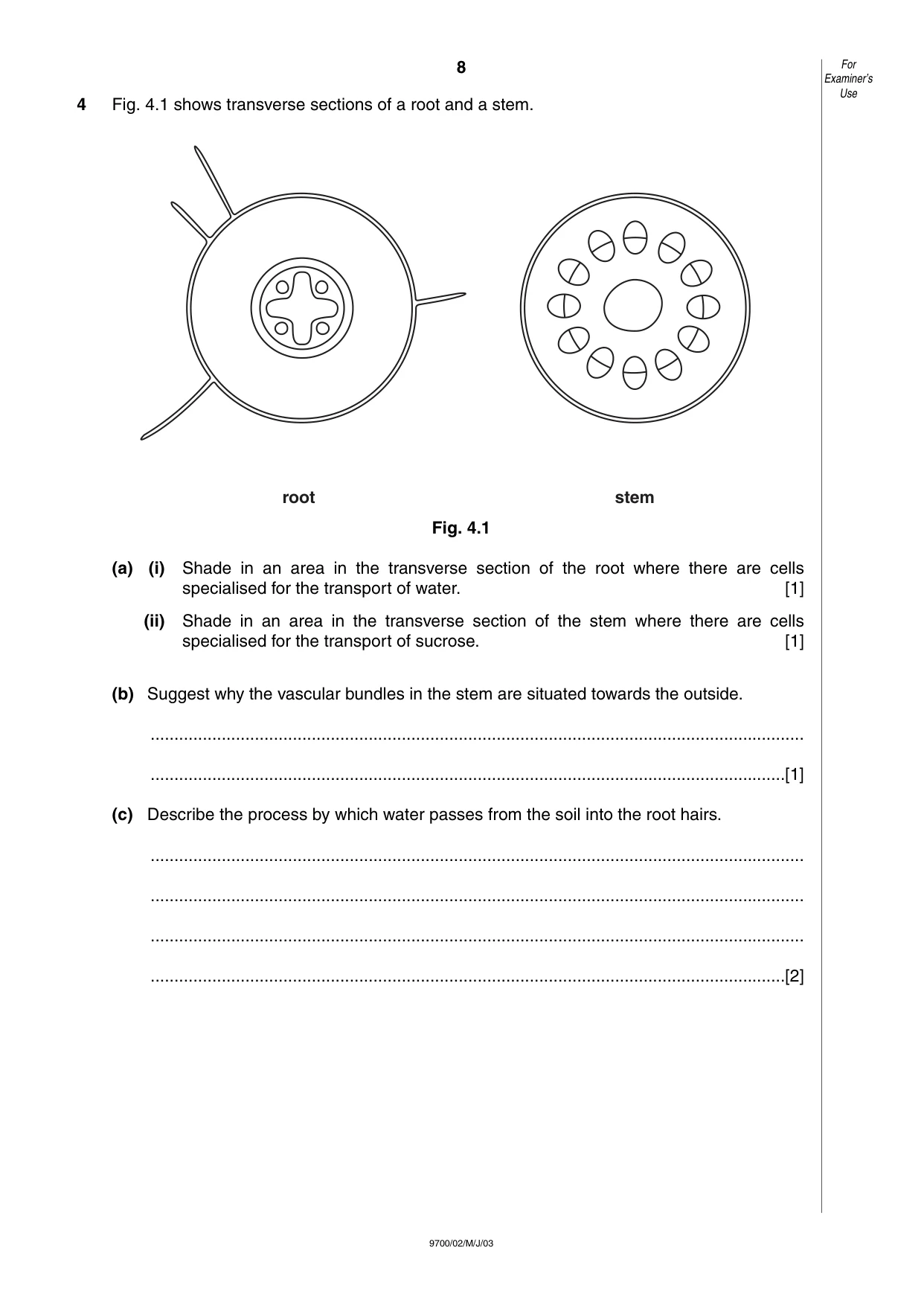
8 9700/02/M/J/03 4 Fig. 4.1 shows transverse sections of a root and a stem. Fig. 4.1 (a) (i) Shade in an area in the transverse section of the root where there are cells specialised for the transport of water. [1] (ii) Shade in an area in the transverse section of the stem where there are cells specialised for the transport of sucrose. [1] (b) Suggest why the vascular bundles in the stem are situated towards the outside. … …[1] (c) Describe the process by which water passes from the soil into the root hairs. … … … …[2] root stem For Examiner’s Use
Question paper, page 9
9 9700/02/M/J/03 [Turn over (d) Explain how water passes from the stem to the air surrounding a leaf. … … … … … …[4] [Total : 9] For Examiner’s Use
Question paper, page 10
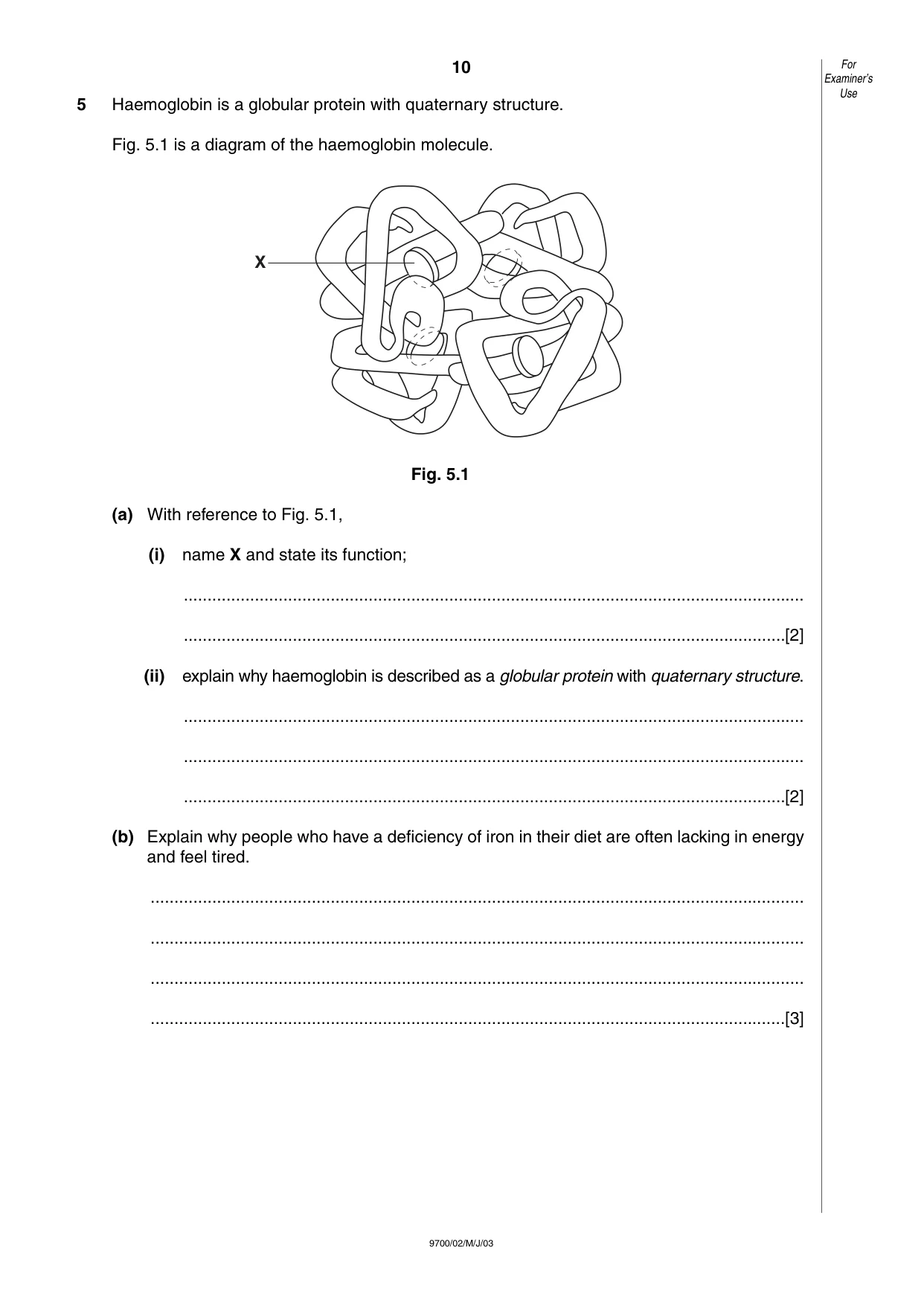
10 9700/02/M/J/03 5 Haemoglobin is a globular protein with quaternary structure. Fig. 5.1 is a diagram of the haemoglobin molecule. Fig. 5.1 (a) With reference to Fig. 5.1, (i) name X and state its function; … …[2] (ii) explain why haemoglobin is described as a globular protein with quaternary structure. … … …[2] (b) Explain why people who have a deficiency of iron in their diet are often lacking in energy and feel tired. … … … …[3] X For Examiner’s Use
Question paper, page 11
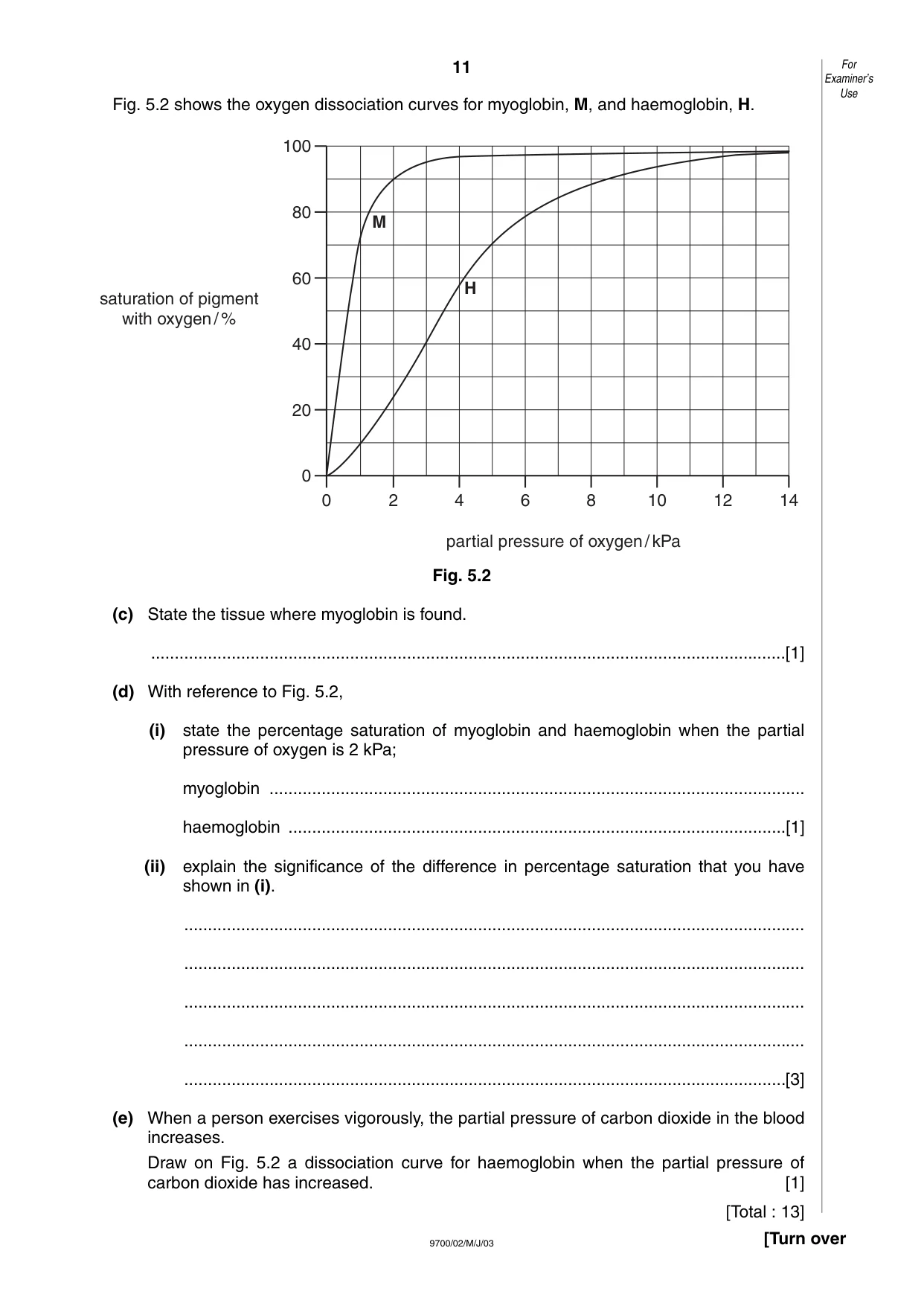
11 9700/02/M/J/03 [Turn over Fig. 5.2 shows the oxygen dissociation curves for myoglobin, M, and haemoglobin, H. Fig. 5.2 (c) State the tissue where myoglobin is found. …[1] (d) With reference to Fig. 5.2, (i) state the percentage saturation of myoglobin and haemoglobin when the partial pressure of oxygen is 2 kPa; myoglobin … haemoglobin …[1] (ii) explain the significance of the difference in percentage saturation that you have shown in (i). … … … … …[3] (e) When a person exercises vigorously, the partial pressure of carbon dioxide in the blood increases. Draw on Fig. 5.2 a dissociation curve for haemoglobin when the partial pressure of carbon dioxide has increased. [1] [Total : 13] 0 0 2 4 6 8 10 12 14 20 40 60 80 100 partial pressure of oxygen/kPa saturation of pigment with oxygen/% M H For Examiner’s Use
Question paper, page 12
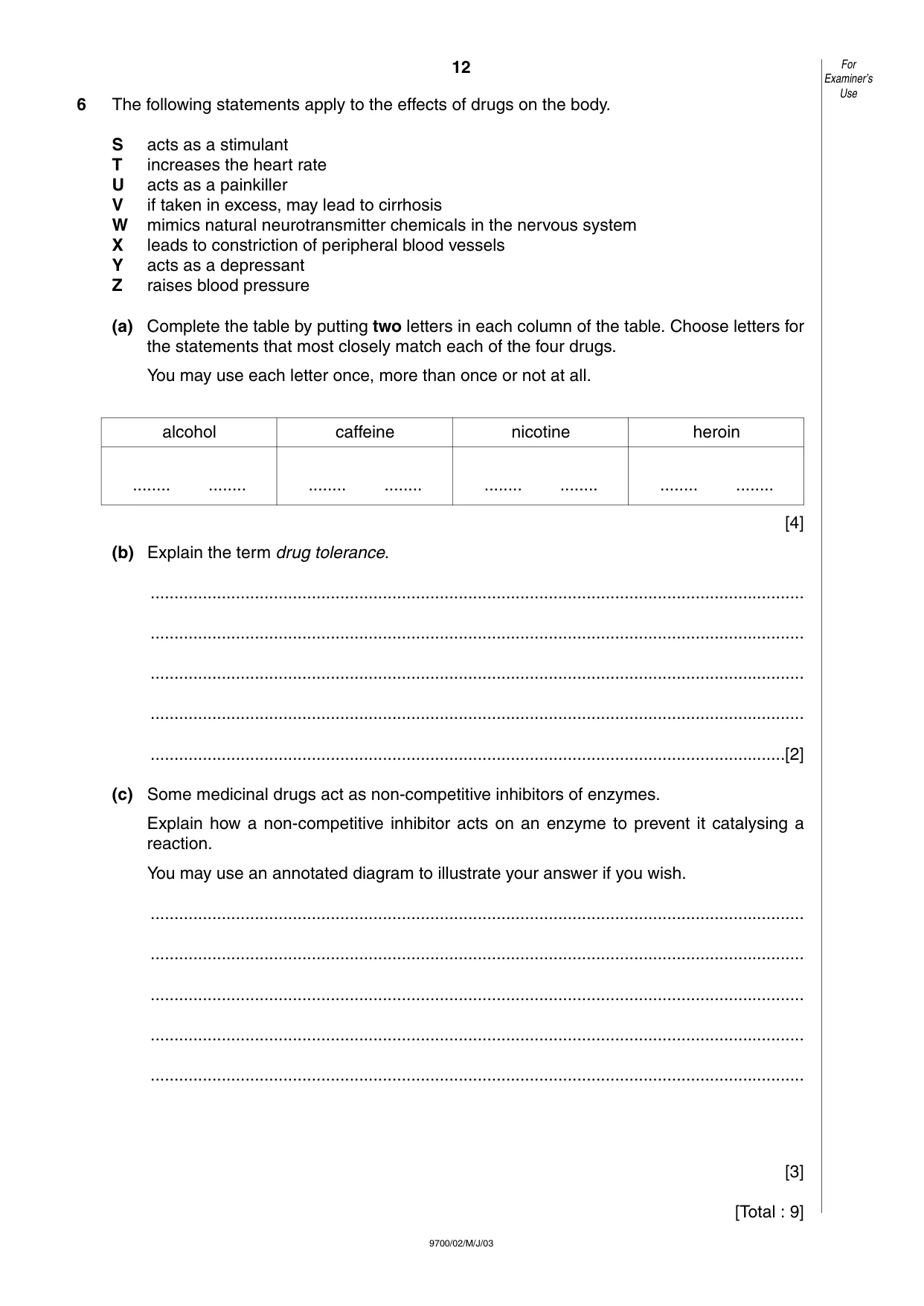
12 9700/02/M/J/03 6 The following statements apply to the effects of drugs on the body. S acts as a stimulant T increases the heart rate U acts as a painkiller V if taken in excess, may lead to cirrhosis W mimics natural neurotransmitter chemicals in the nervous system X leads to constriction of peripheral blood vessels Y acts as a depressant Z raises blood pressure (a) Complete the table by putting two letters in each column of the table. Choose letters for the statements that most closely match each of the four drugs. You may use each letter once, more than once or not at all. [4] (b) Explain the term drug tolerance. … … … … …[2] (c) Some medicinal drugs act as non-competitive inhibitors of enzymes. Explain how a non-competitive inhibitor acts on an enzyme to prevent it catalysing a reaction. You may use an annotated diagram to illustrate your answer if you wish. … … … … … [3] [Total : 9] alcohol caffeine nicotine heroin … … … … … … … … For Examiner’s Use