Cambridge A Level Biology 9700 — 2002 Oct/Nov Paper 6 · Variant 1
9700/61/O/N/02
The question paper and its mark scheme, free to read here and free to download. This is Cambridge’s own paper, exactly as it was sat.
Question paper24 pages
Mark scheme17 pages
Answers below. Sit the paper first if you are practising.
Paper as text
Question paper, page 1
This question paper consists of 24 printed pages. SP (NF/SLC) S35713/2 © CIE 2002 [Turn over CAMBRIDGE INTERNATIONAL EXAMINATIONS General Certificate of Education Advanced Level BIOLOGY 9700/6 PAPER 6 Options OCTOBER/NOVEMBER SESSION 2002 1 hour Additional materials: Answer paper TIME 1 hour INSTRUCTIONS TO CANDIDATES Write your name, Centre number and candidate number in the spaces at the top of this page and on all separate answer paper used. Answer the questions set on one of the options. Within your chosen option, Questions 1 and 2 are to be answered in the spaces provided on the question paper. Question 3 is to be answered on the separate answer paper provided. The answer to Question 3 should be illustrated by large, clearly labelled diagrams, where appropriate. At the end of the examination, 1. fasten all separate answer paper securely to the question paper; 2. enter the number of the option you have answered in the grid below. INFORMATION FOR CANDIDATES The intended number of marks is given in brackets [ ] at the end of each question or part question. The options are: 1 – Biodiversity (page 2) 2 – Biotechnology (page 8) 3 – Growth, Development and Reproduction (page 13) 4 – Applications of Genetics (page 20) Candidate Centre Number Number Candidate Name FOR EXAMINER’S USE OPTION ANSWERED 1 2 3(a) 3(b) TOTAL
Question paper, page 2
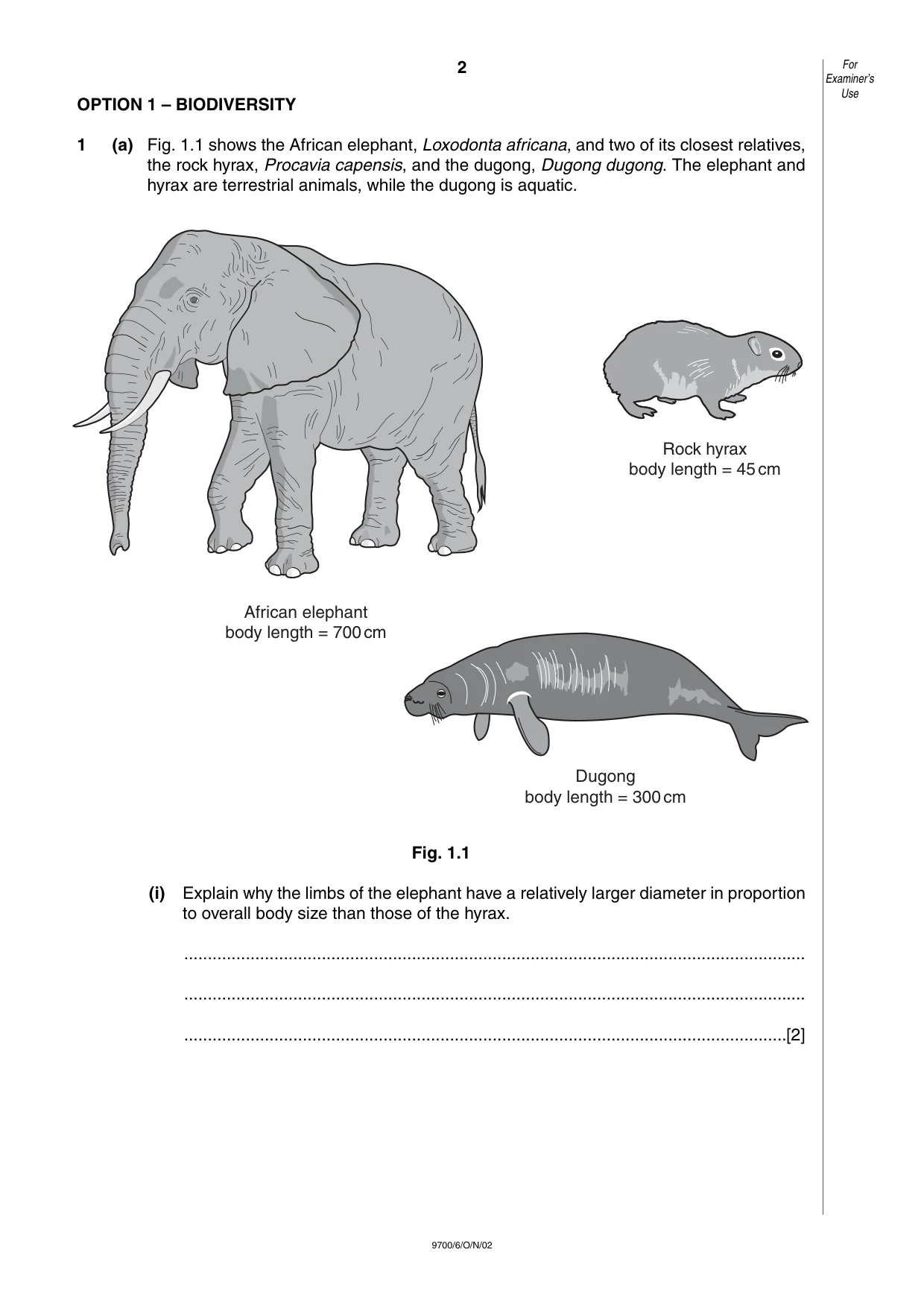
2 9700/6/O/N/02 OPTION 1 – BIODIVERSITY 1 (a) Fig. 1.1 shows the African elephant, Loxodonta africana, and two of its closest relatives, the rock hyrax, Procavia capensis, and the dugong, Dugong dugong. The elephant and hyrax are terrestrial animals, while the dugong is aquatic. Fig. 1.1 (i) Explain why the limbs of the elephant have a relatively larger diameter in proportion to overall body size than those of the hyrax. … … …[2] For Examiner’s Use African elephant body length = 700cm Rock hyrax body length = 45cm Dugong body length = 300cm
Question paper, page 3
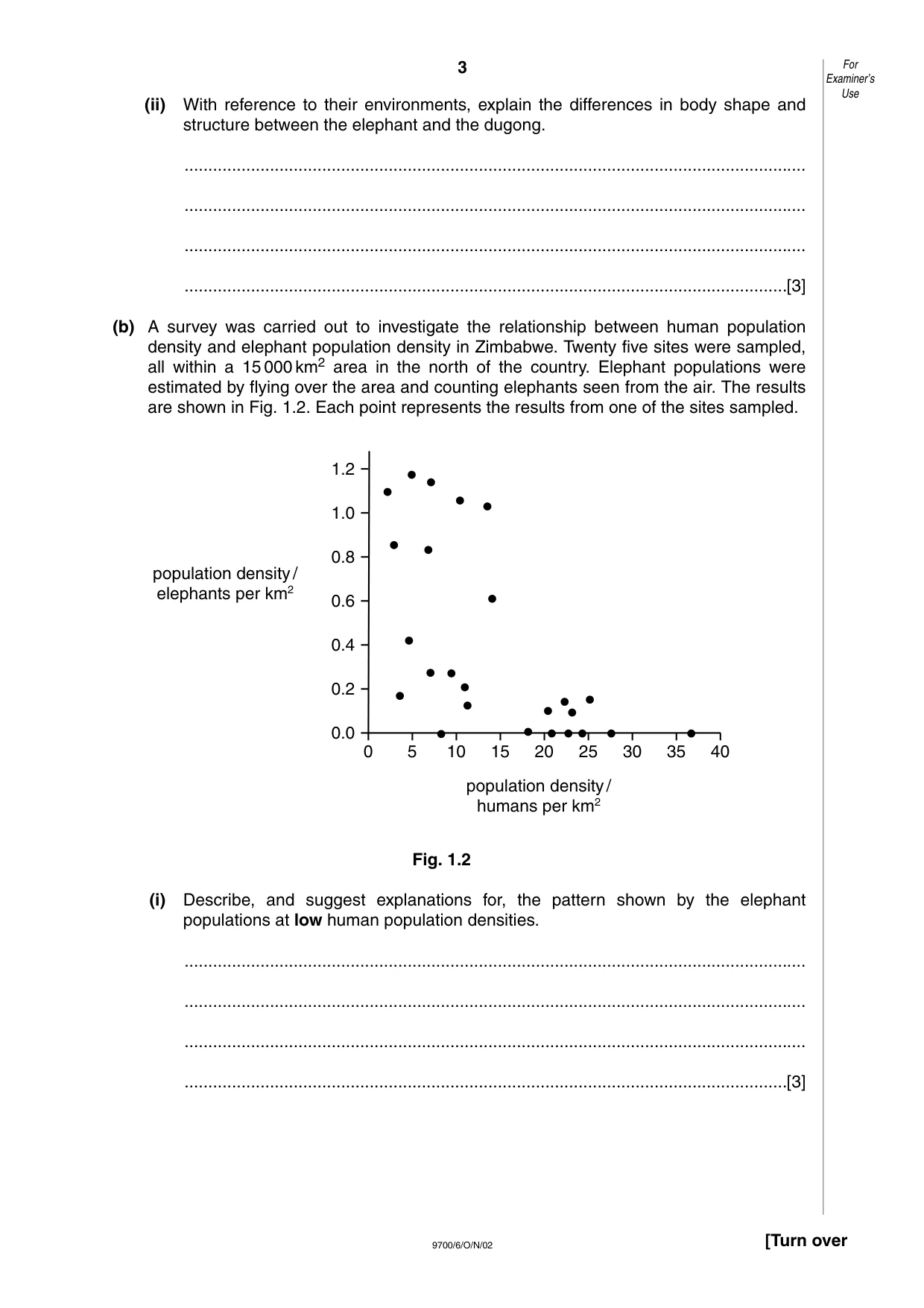
3 9700/6/O/N/02 [Turn over (ii) With reference to their environments, explain the differences in body shape and structure between the elephant and the dugong. … … … …[3] (b) A survey was carried out to investigate the relationship between human population density and elephant population density in Zimbabwe. Twenty five sites were sampled, all within a 15 000 km2 area in the north of the country. Elephant populations were estimated by flying over the area and counting elephants seen from the air. The results are shown in Fig. 1.2. Each point represents the results from one of the sites sampled. Fig. 1.2 (i) Describe, and suggest explanations for, the pattern shown by the elephant populations at low human population densities. … … … …[3] 0 5 10 15 20 25 30 35 40 0.0 0.2 0.4 0.6 0.8 1.0 1.2 population density/ humans per km2 population density/ elephants per km2 For Examiner’s Use
Question paper, page 4
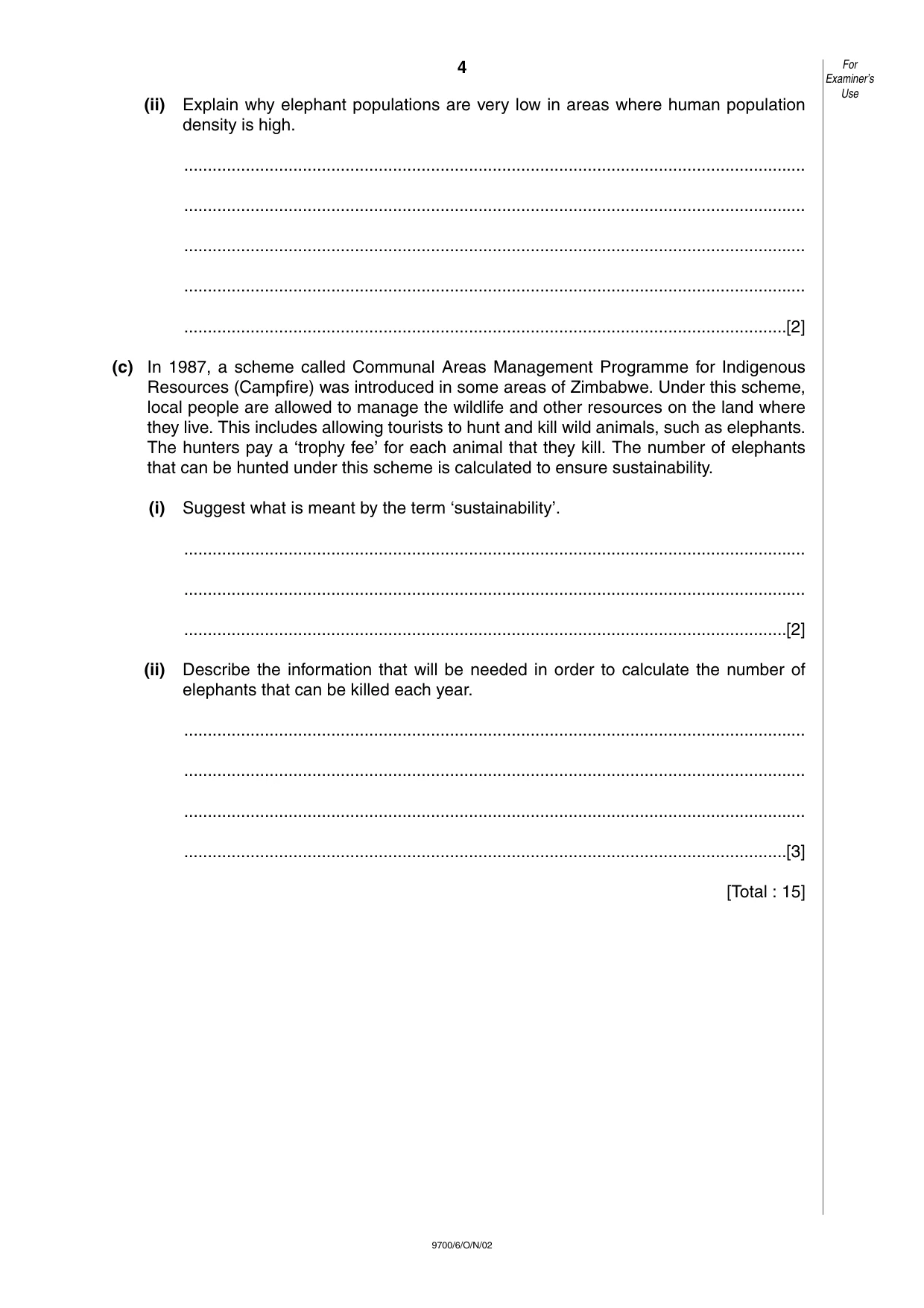
4 9700/6/O/N/02 (ii) Explain why elephant populations are very low in areas where human population density is high. … … … … …[2] (c) In 1987, a scheme called Communal Areas Management Programme for Indigenous Resources (Campfire) was introduced in some areas of Zimbabwe. Under this scheme, local people are allowed to manage the wildlife and other resources on the land where they live. This includes allowing tourists to hunt and kill wild animals, such as elephants. The hunters pay a ‘trophy fee’ for each animal that they kill. The number of elephants that can be hunted under this scheme is calculated to ensure sustainability. (i) Suggest what is meant by the term ‘sustainability’. … … …[2] (ii) Describe the information that will be needed in order to calculate the number of elephants that can be killed each year. … … … …[3] [Total : 15] For Examiner’s Use
Question paper, page 5
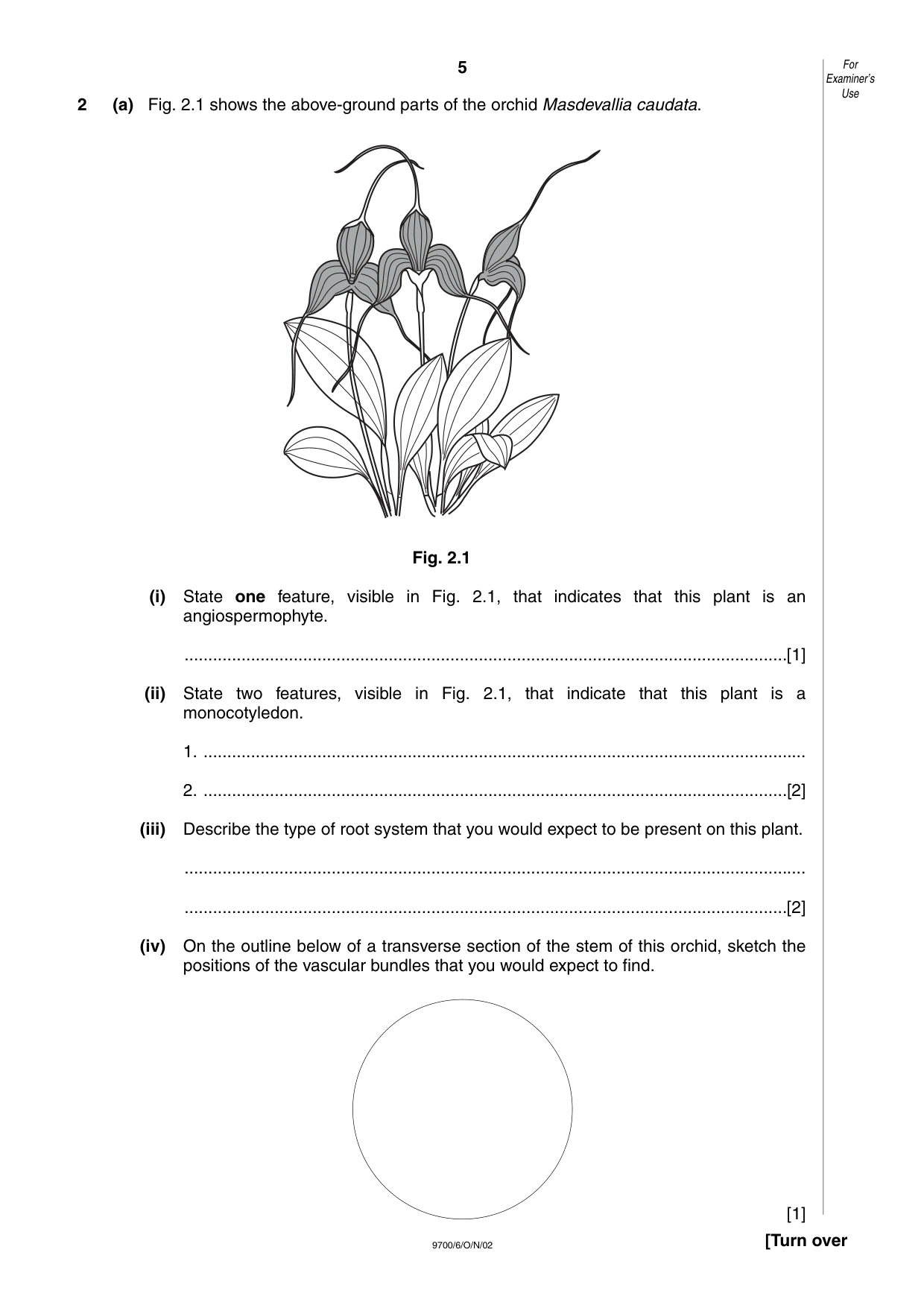
5 9700/6/O/N/02 [Turn over 2 (a) Fig. 2.1 shows the above-ground parts of the orchid Masdevallia caudata. Fig. 2.1 (i) State one feature, visible in Fig. 2.1, that indicates that this plant is an angiospermophyte. …[1] (ii) State two features, visible in Fig. 2.1, that indicate that this plant is a monocotyledon. 1. … 2. …[2] (iii) Describe the type of root system that you would expect to be present on this plant. … …[2] (iv) On the outline below of a transverse section of the stem of this orchid, sketch the positions of the vascular bundles that you would expect to find. [1] For Examiner’s Use
Question paper, page 6
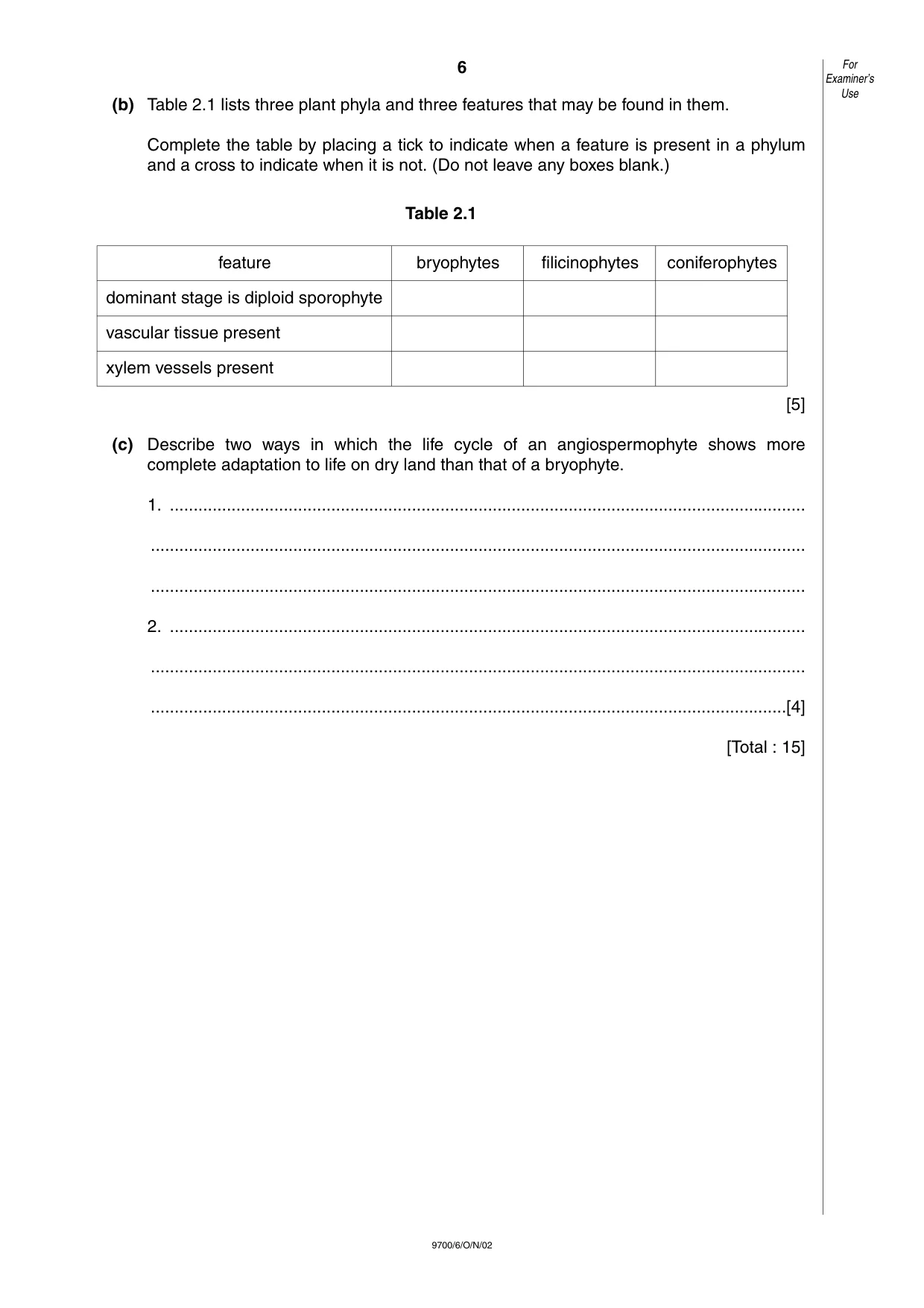
6 9700/6/O/N/02 (b) Table 2.1 lists three plant phyla and three features that may be found in them. Complete the table by placing a tick to indicate when a feature is present in a phylum and a cross to indicate when it is not. (Do not leave any boxes blank.) Table 2.1 [5] (c) Describe two ways in which the life cycle of an angiospermophyte shows more complete adaptation to life on dry land than that of a bryophyte. 1. … … … 2. … … …[4] [Total : 15] For Examiner’s Use feature bryophytes filicinophytes coniferophytes dominant stage is diploid sporophyte vascular tissue present xylem vessels present
Question paper, page 7
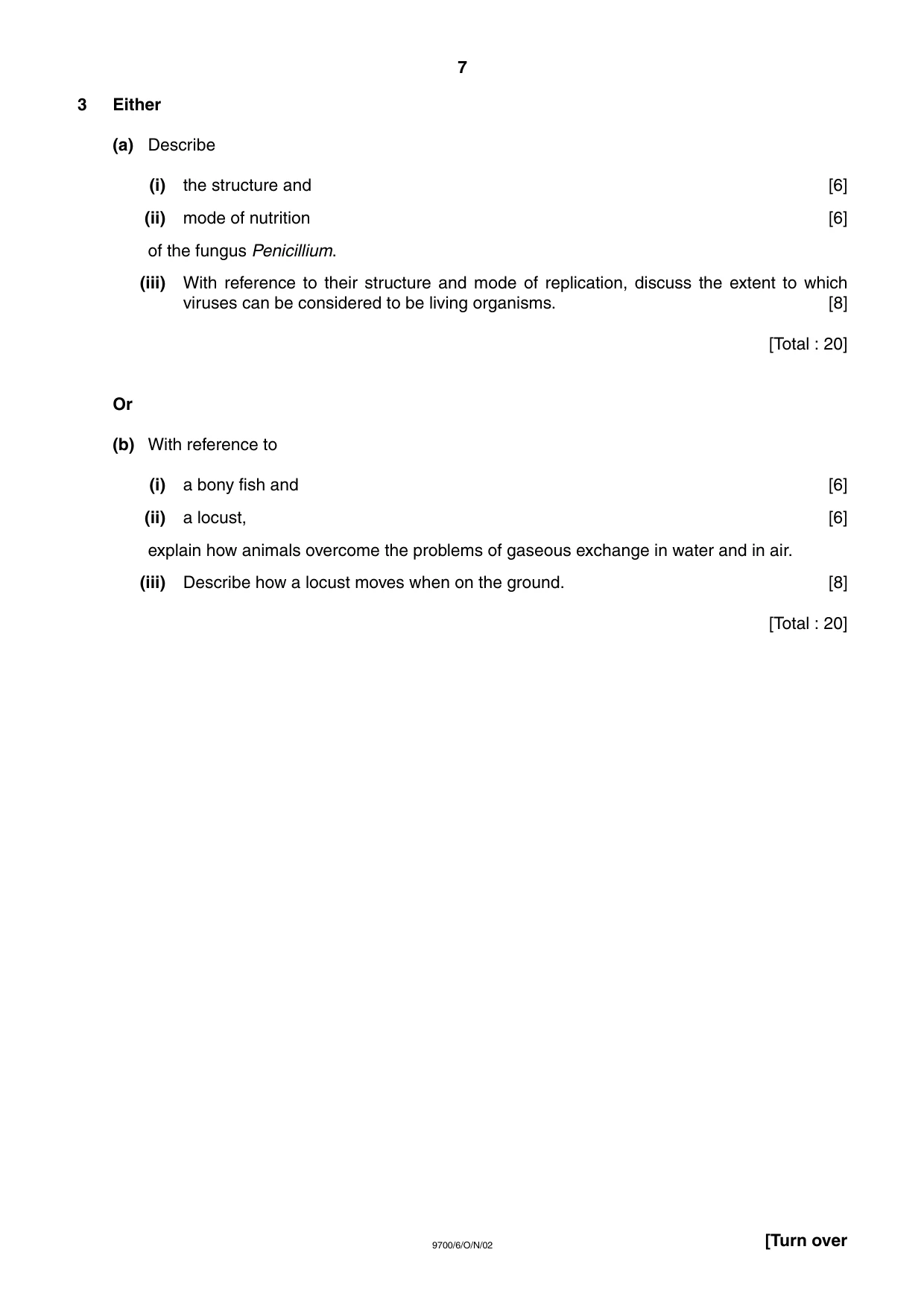
7 9700/6/O/N/02 [Turn over 3 Either (a) Describe (i) the structure and [6] (ii) mode of nutrition [6] of the fungus Penicillium. (iii) With reference to their structure and mode of replication, discuss the extent to which viruses can be considered to be living organisms. [8] [Total : 20] Or (b) With reference to (i) a bony fish and [6] (ii) a locust, [6] explain how animals overcome the problems of gaseous exchange in water and in air. (iii) Describe how a locust moves when on the ground. [8] [Total : 20]
Question paper, page 8
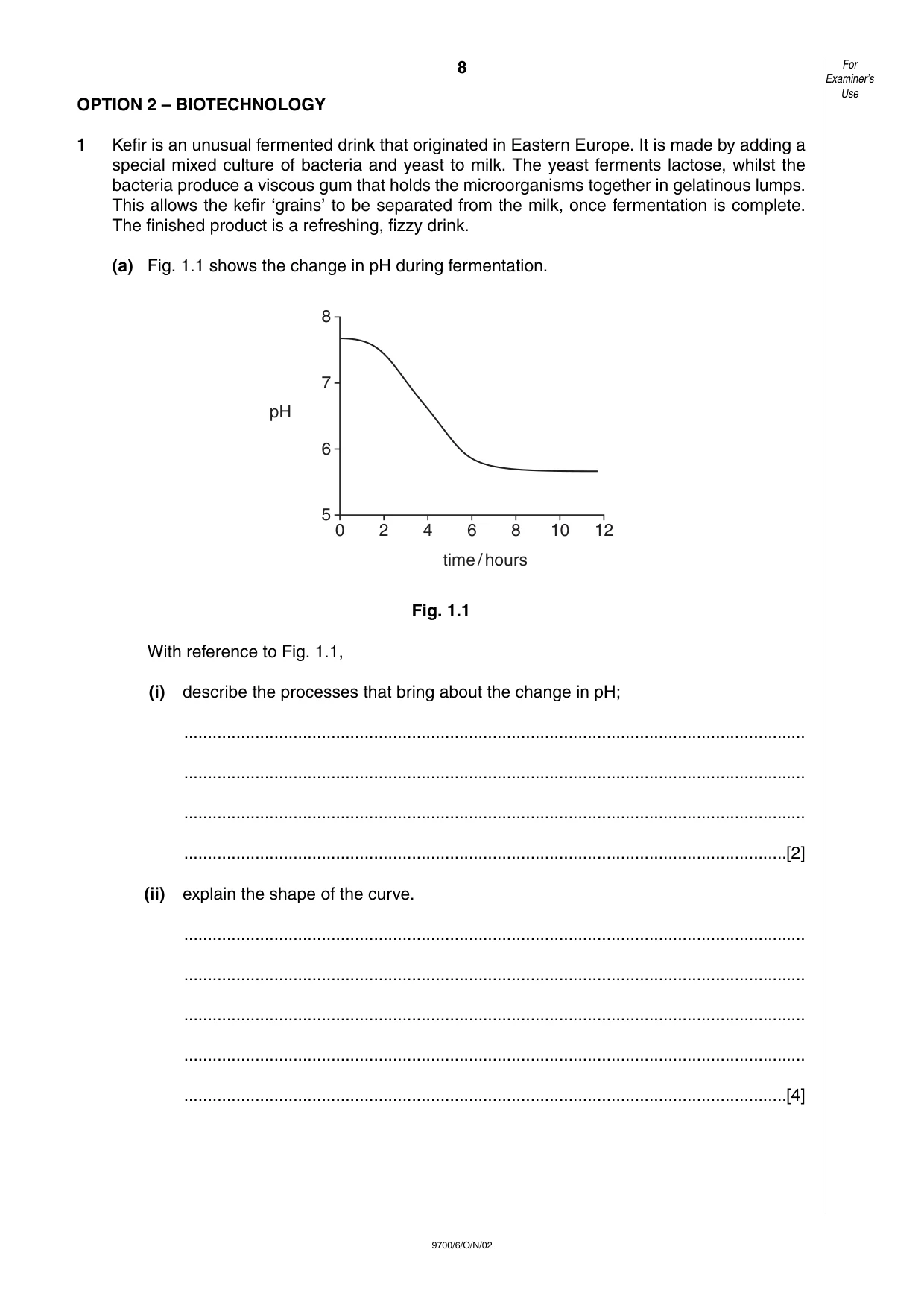
8 9700/6/O/N/02 OPTION 2 – BIOTECHNOLOGY 1 Kefir is an unusual fermented drink that originated in Eastern Europe. It is made by adding a special mixed culture of bacteria and yeast to milk. The yeast ferments lactose, whilst the bacteria produce a viscous gum that holds the microorganisms together in gelatinous lumps. This allows the kefir ‘grains’ to be separated from the milk, once fermentation is complete. The finished product is a refreshing, fizzy drink. (a) Fig. 1.1 shows the change in pH during fermentation. Fig. 1.1 With reference to Fig. 1.1, (i) describe the processes that bring about the change in pH; … … … …[2] (ii) explain the shape of the curve. … … … … …[4] 5 0 2 4 6 8 10 12 6 7 8 time/hours pH For Examiner’s Use
Question paper, page 9
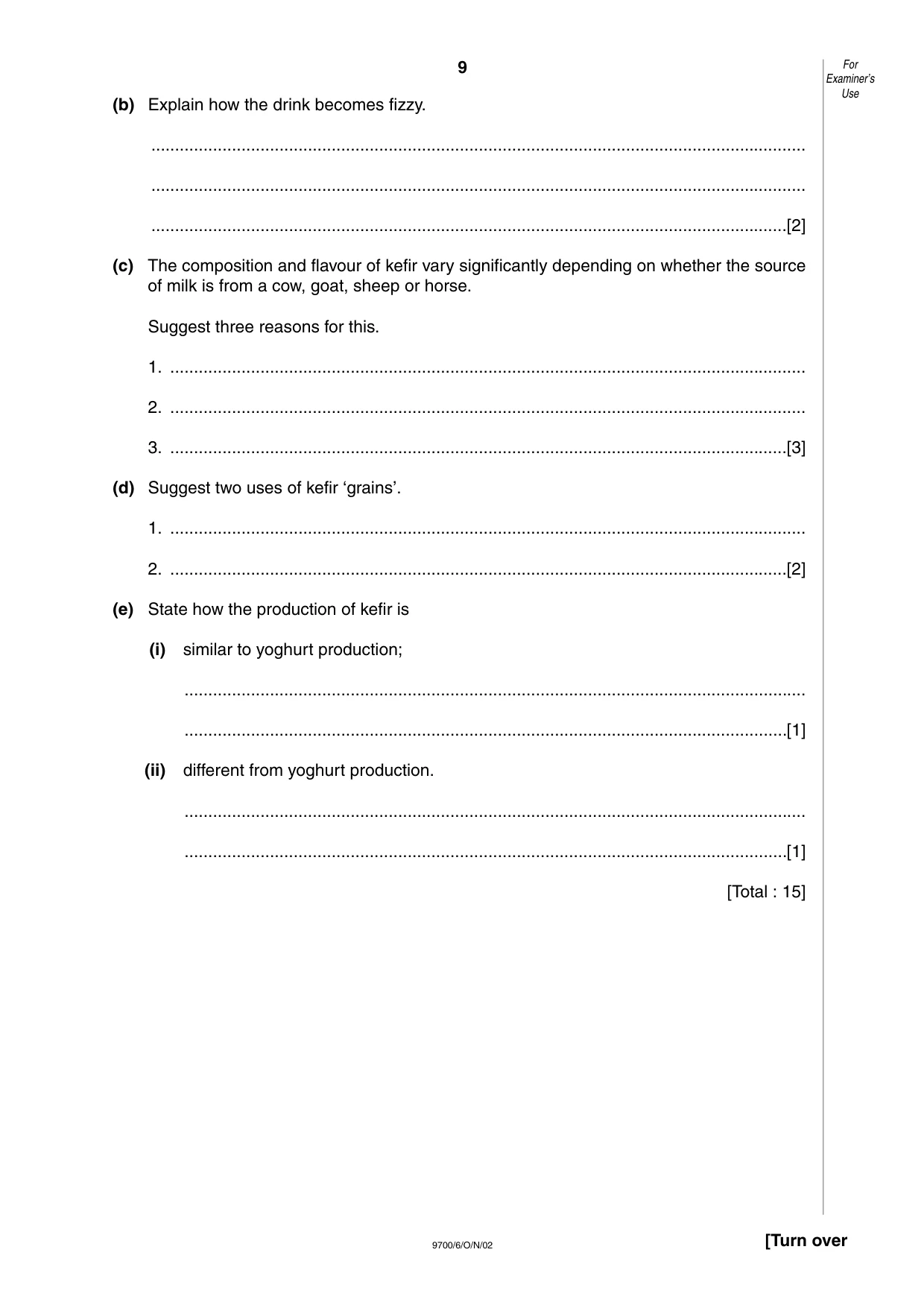
9 9700/6/O/N/02 [Turn over (b) Explain how the drink becomes fizzy. … … …[2] (c) The composition and flavour of kefir vary significantly depending on whether the source of milk is from a cow, goat, sheep or horse. Suggest three reasons for this. 1. … 2. … 3. …[3] (d) Suggest two uses of kefir ‘grains’. 1. … 2. …[2] (e) State how the production of kefir is (i) similar to yoghurt production; … …[1] (ii) different from yoghurt production. … …[1] [Total : 15] For Examiner’s Use
Question paper, page 10
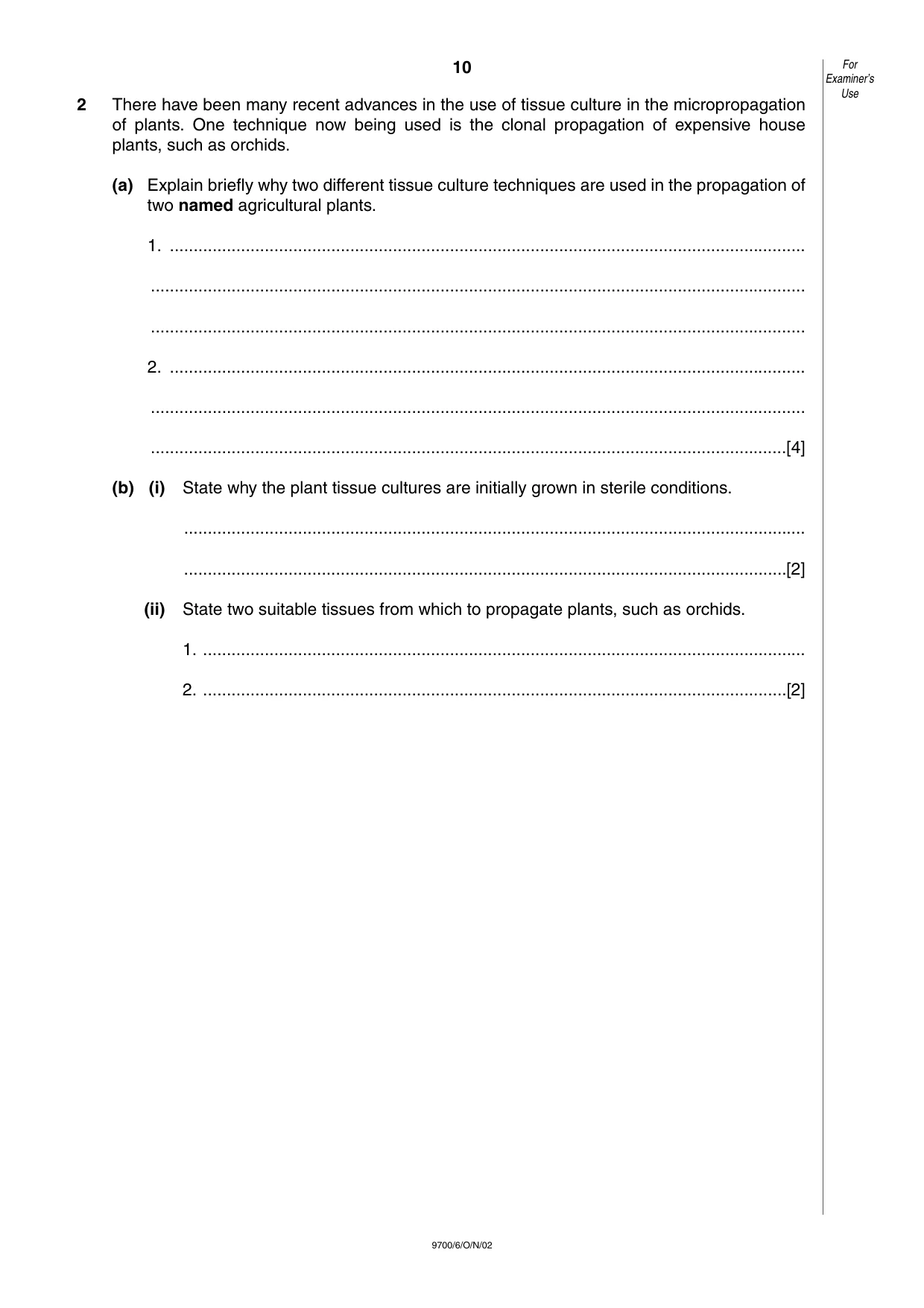
10 9700/6/O/N/02 2 There have been many recent advances in the use of tissue culture in the micropropagation of plants. One technique now being used is the clonal propagation of expensive house plants, such as orchids. (a) Explain briefly why two different tissue culture techniques are used in the propagation of two named agricultural plants. 1. … … … 2. … … …[4] (b) (i) State why the plant tissue cultures are initially grown in sterile conditions. … …[2] (ii) State two suitable tissues from which to propagate plants, such as orchids. 1. … 2. …[2] For Examiner’s Use
Question paper, page 11
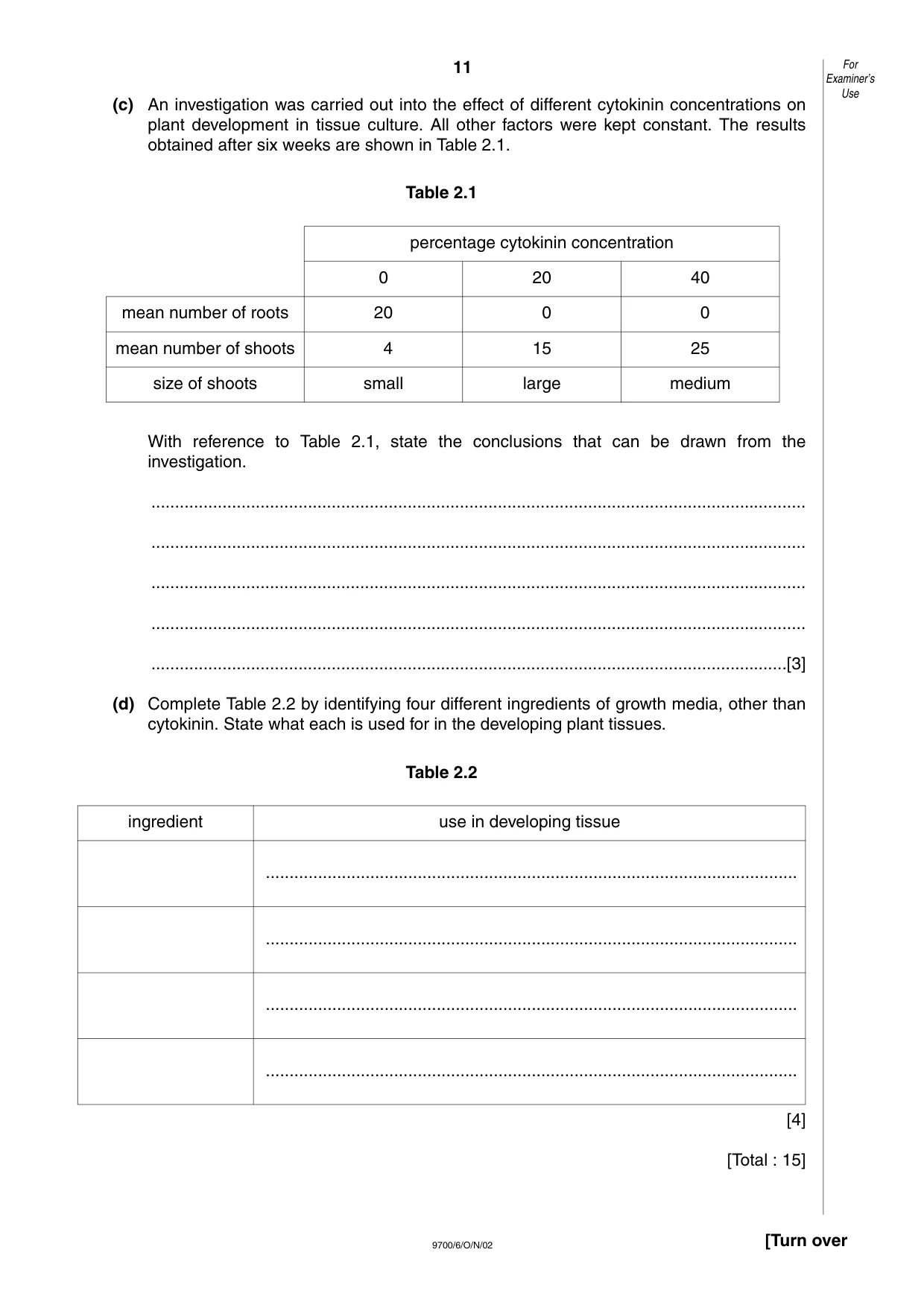
11 9700/6/O/N/02 [Turn over (c) An investigation was carried out into the effect of different cytokinin concentrations on plant development in tissue culture. All other factors were kept constant. The results obtained after six weeks are shown in Table 2.1. Table 2.1 With reference to Table 2.1, state the conclusions that can be drawn from the investigation. … … … … …[3] (d) Complete Table 2.2 by identifying four different ingredients of growth media, other than cytokinin. State what each is used for in the developing plant tissues. Table 2.2 [4] [Total : 15] For Examiner’s Use percentage cytokinin concentration 0 20 40 mean number of roots 20 0 0 mean number of shoots 4 15 25 size of shoots small large medium ingredient use in developing tissue … … … …
Question paper, page 12
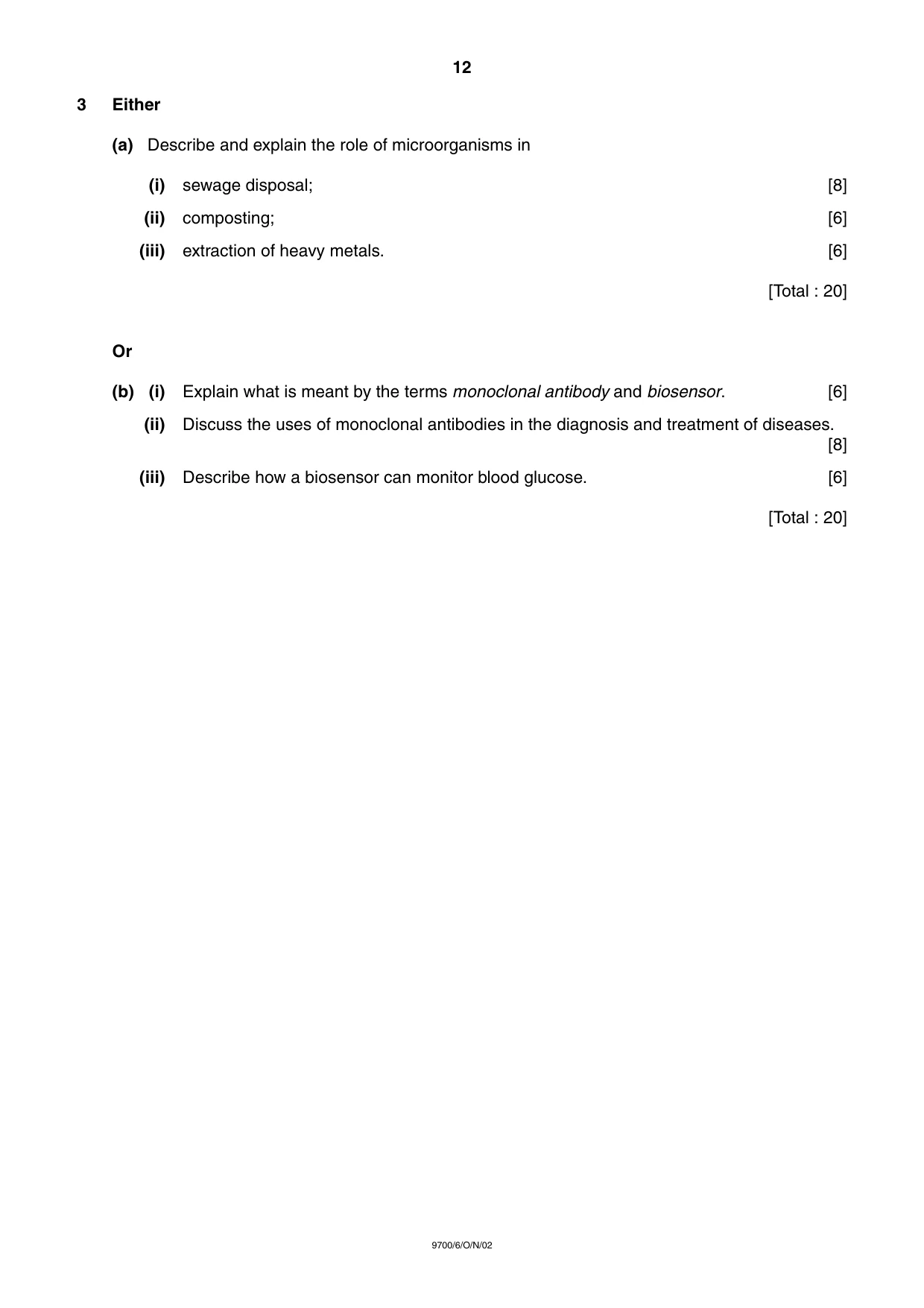
12 9700/6/O/N/02 3 Either (a) Describe and explain the role of microorganisms in (i) sewage disposal; [8] (ii) composting; [6] (iii) extraction of heavy metals. [6] [Total : 20] Or (b) (i) Explain what is meant by the terms monoclonal antibody and biosensor. [6] (ii) Discuss the uses of monoclonal antibodies in the diagnosis and treatment of diseases. [8] (iii) Describe how a biosensor can monitor blood glucose. [6] [Total : 20]
Question paper, page 13
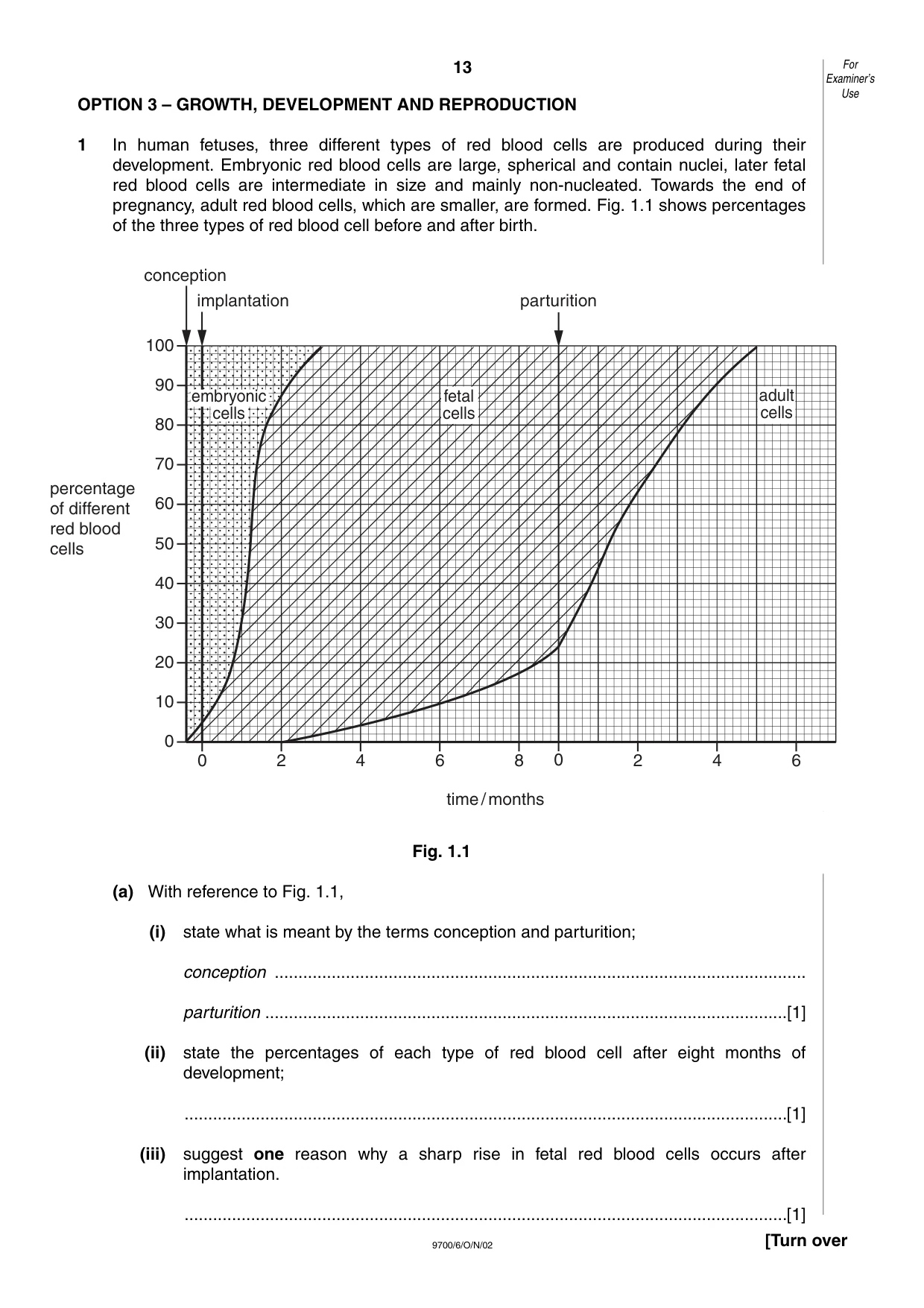
13 9700/6/O/N/02 [Turn over OPTION 3 – GROWTH, DEVELOPMENT AND REPRODUCTION 1 In human fetuses, three different types of red blood cells are produced during their development. Embryonic red blood cells are large, spherical and contain nuclei, later fetal red blood cells are intermediate in size and mainly non-nucleated. Towards the end of pregnancy, adult red blood cells, which are smaller, are formed. Fig. 1.1 shows percentages of the three types of red blood cell before and after birth. Fig. 1.1 (a) With reference to Fig. 1.1, (i) state what is meant by the terms conception and parturition; conception … parturition …[1] (ii) state the percentages of each type of red blood cell after eight months of development; …[1] (iii) suggest one reason why a sharp rise in fetal red blood cells occurs after implantation. …[1] For Examiner’s Use 0 0 2 4 6 8 0 2 4 6 10 20 30 40 50 60 70 80 90 100 conception implantation parturition adult cells fetal cells embryonic cells time/months percentage of different red blood cells
Question paper, page 14
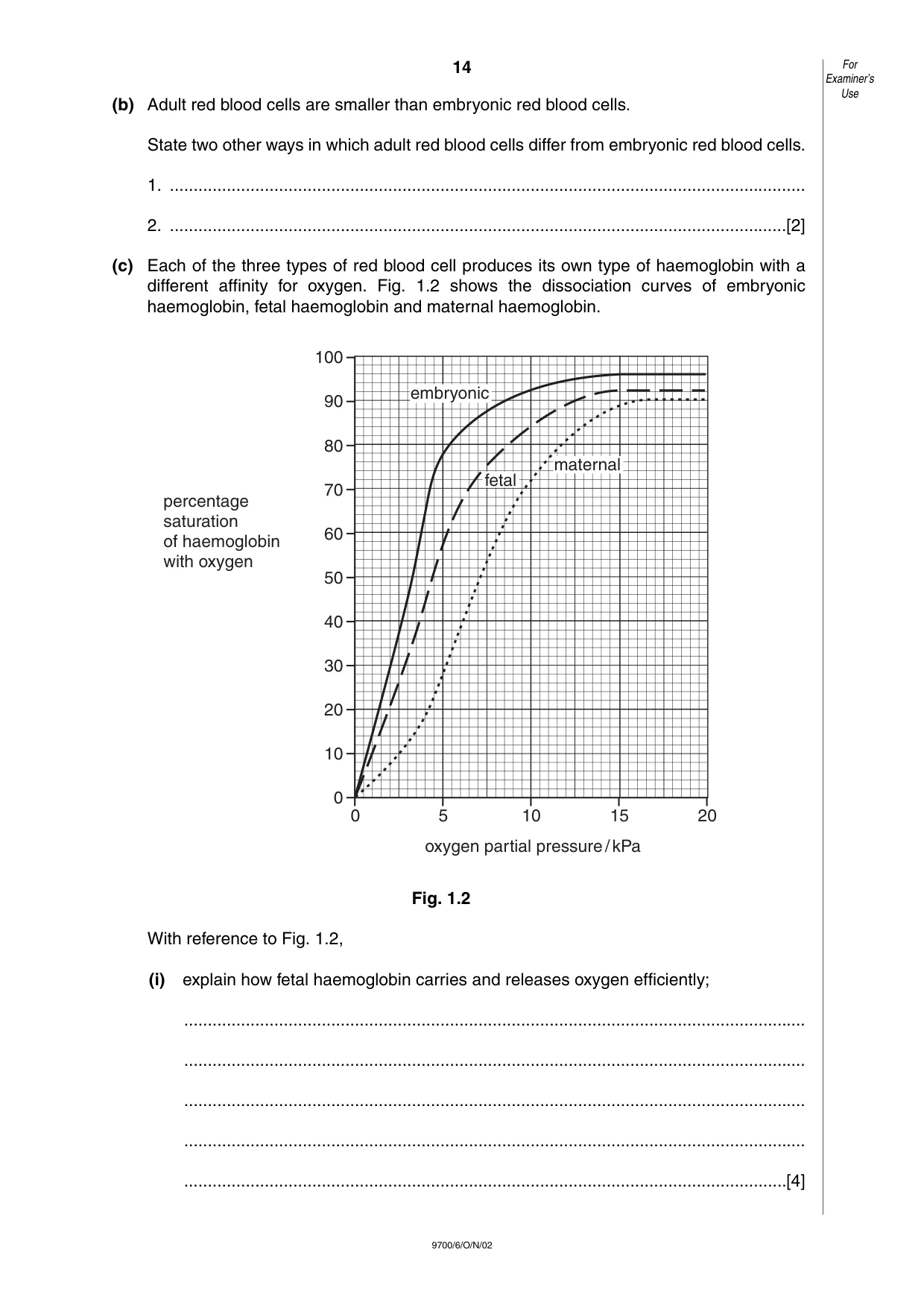
14 9700/6/O/N/02 (b) Adult red blood cells are smaller than embryonic red blood cells. State two other ways in which adult red blood cells differ from embryonic red blood cells. 1. … 2. …[2] (c) Each of the three types of red blood cell produces its own type of haemoglobin with a different affinity for oxygen. Fig. 1.2 shows the dissociation curves of embryonic haemoglobin, fetal haemoglobin and maternal haemoglobin. Fig. 1.2 With reference to Fig. 1.2, (i) explain how fetal haemoglobin carries and releases oxygen efficiently; … … … … …[4] 0 10 20 30 40 50 60 70 80 90 100 percentage saturation of haemoglobin with oxygen embryonic fetal maternal 0 5 10 oxygen partial pressure/kPa 15 20 For Examiner’s Use
Question paper, page 15
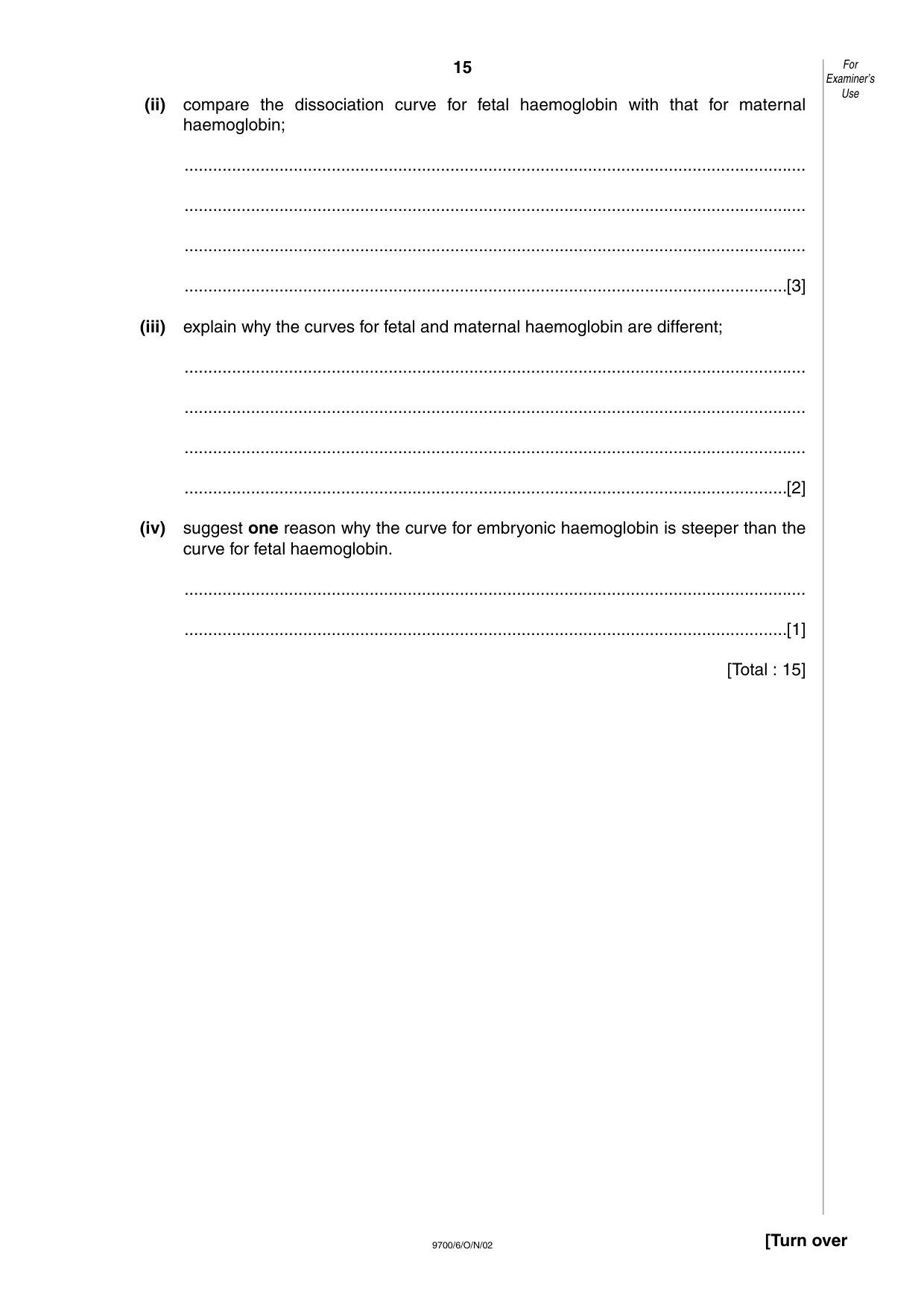
15 9700/6/O/N/02 [Turn over (ii) compare the dissociation curve for fetal haemoglobin with that for maternal haemoglobin; … … … …[3] (iii) explain why the curves for fetal and maternal haemoglobin are different; … … … …[2] (iv) suggest one reason why the curve for embryonic haemoglobin is steeper than the curve for fetal haemoglobin. … …[1] [Total : 15] For Examiner’s Use
Question paper, page 16
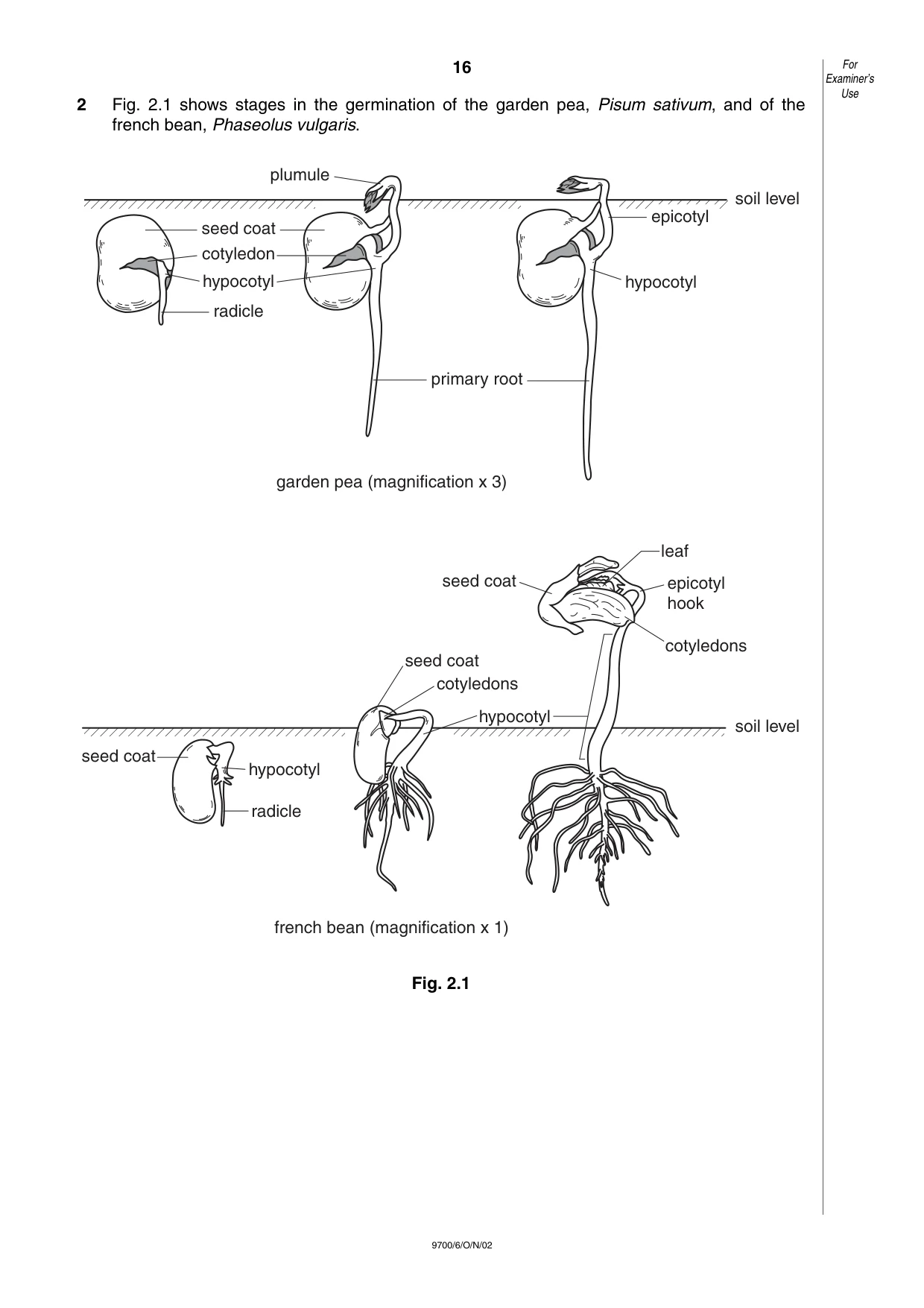
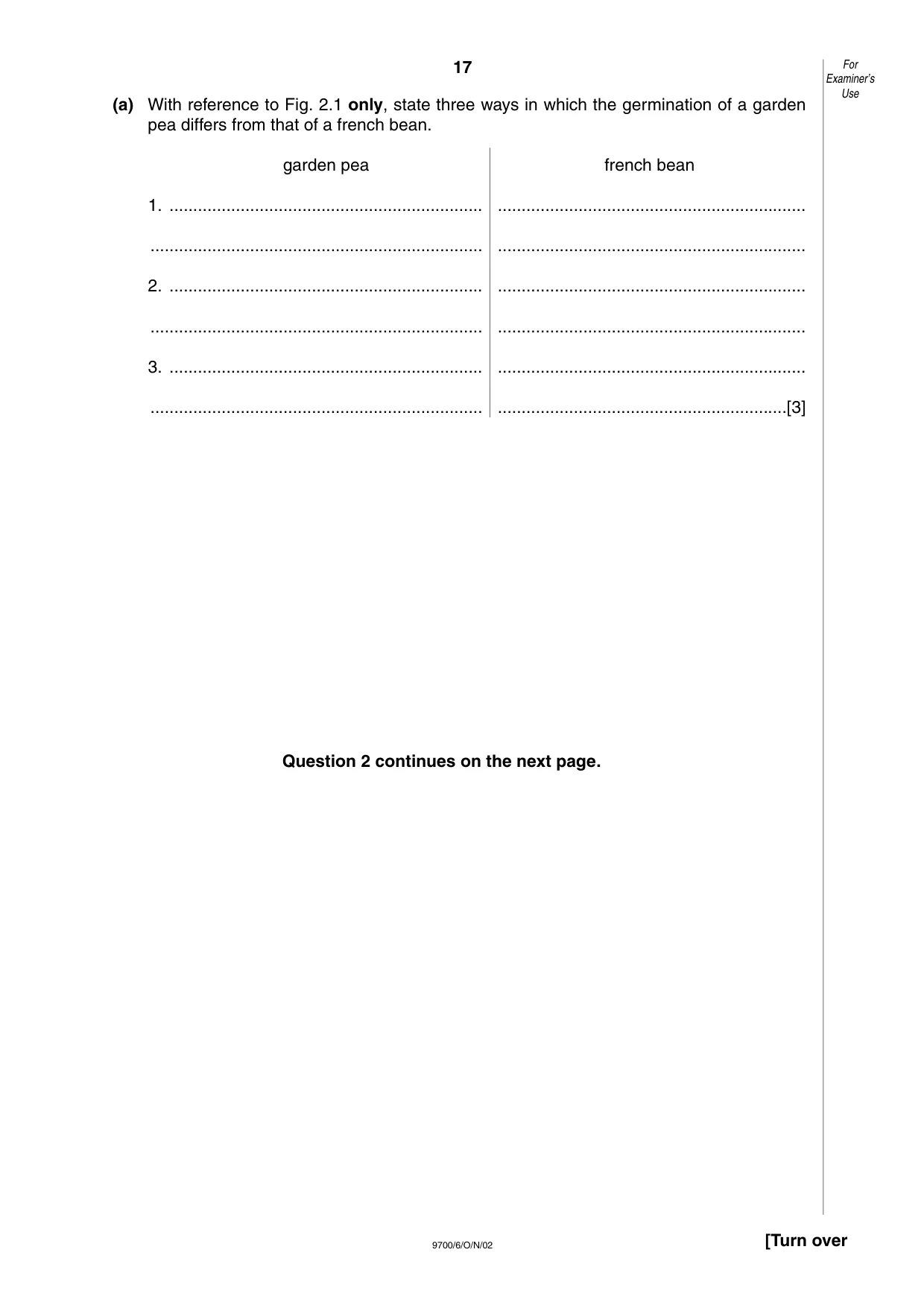
16 9700/6/O/N/02 2 Fig. 2.1 shows stages in the germination of the garden pea, Pisum sativum, and of the french bean, Phaseolus vulgaris. Fig. 2.1 For Examiner’s Use seed coat cotyledon hypocotyl hypocotyl radicle plumule primary root epicotyl soil level soil level garden pea (magnification x 3) french bean (magnification x 1) seed coat hypocotyl radicle seed coat seed coat cotyledons hypocotyl leaf epicotyl hook cotyledons
Question paper, page 17
17 9700/6/O/N/02 [Turn over (a) With reference to Fig. 2.1 only, state three ways in which the germination of a garden pea differs from that of a french bean. garden pea french bean 1. … … … … 2. … … … … 3. … … … …[3] Question 2 continues on the next page. For Examiner’s Use
Question paper, page 18
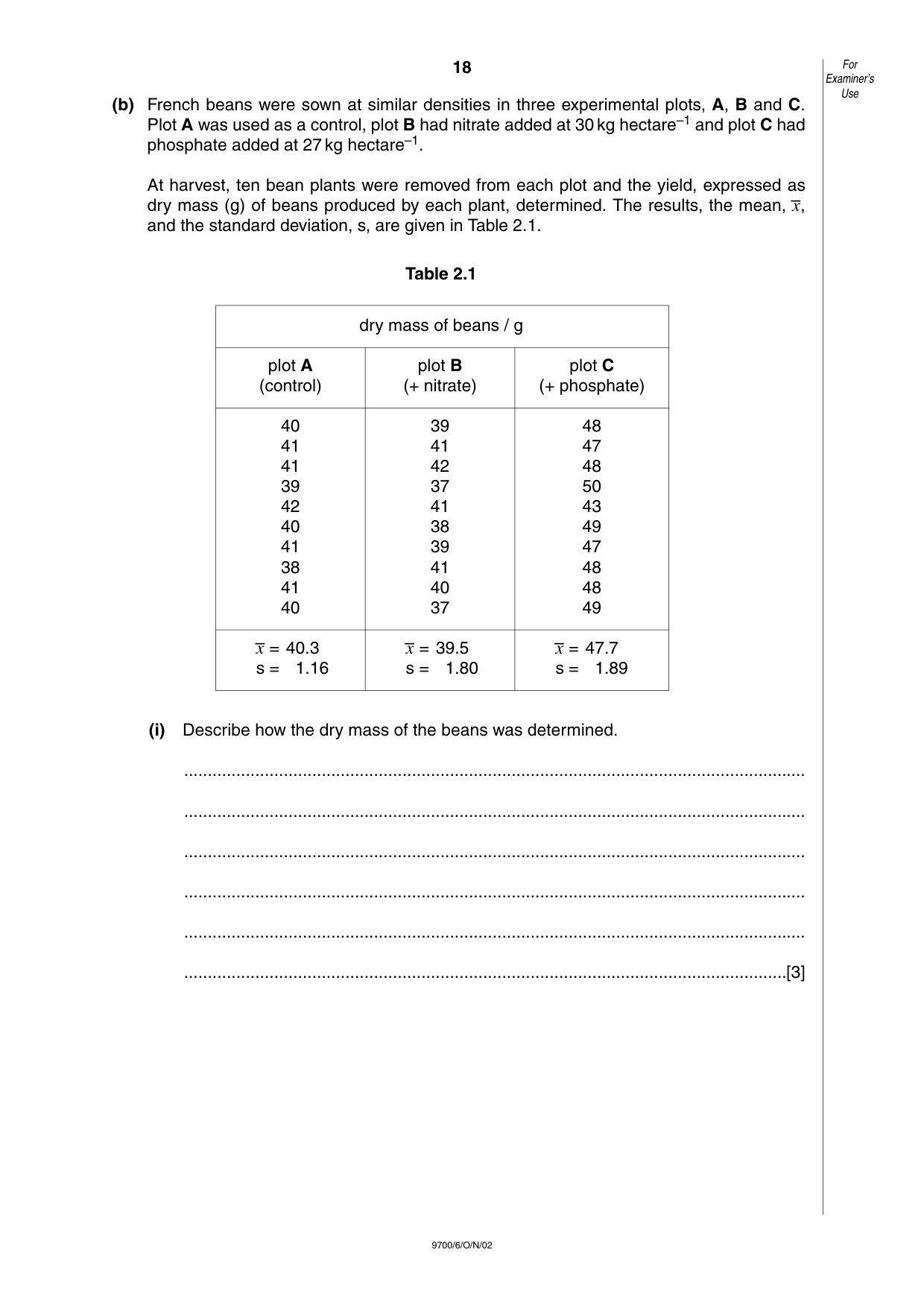
18 9700/6/O/N/02 (b) French beans were sown at similar densities in three experimental plots, A, B and C. Plot A was used as a control, plot B had nitrate added at 30 kg hectare–1 and plot C had phosphate added at 27 kg hectare–1. At harvest, ten bean plants were removed from each plot and the yield, expressed as dry mass (g) of beans produced by each plant, determined. The results, the mean, x–, and the standard deviation, s, are given in Table 2.1. Table 2.1 dry mass of beans / g plot A plot B plot C (control) (+ nitrate) (+ phosphate) 40 39 48 41 41 47 41 42 48 39 37 50 42 41 43 40 38 49 41 39 47 38 41 48 41 40 48 40 37 49 x– = 40.3 x– = 39.5 x– = 47.7 s = 1.16 s = 1.80 s = 1.89 (i) Describe how the dry mass of the beans was determined. … … … … … …[3] For Examiner’s Use
Question paper, page 19
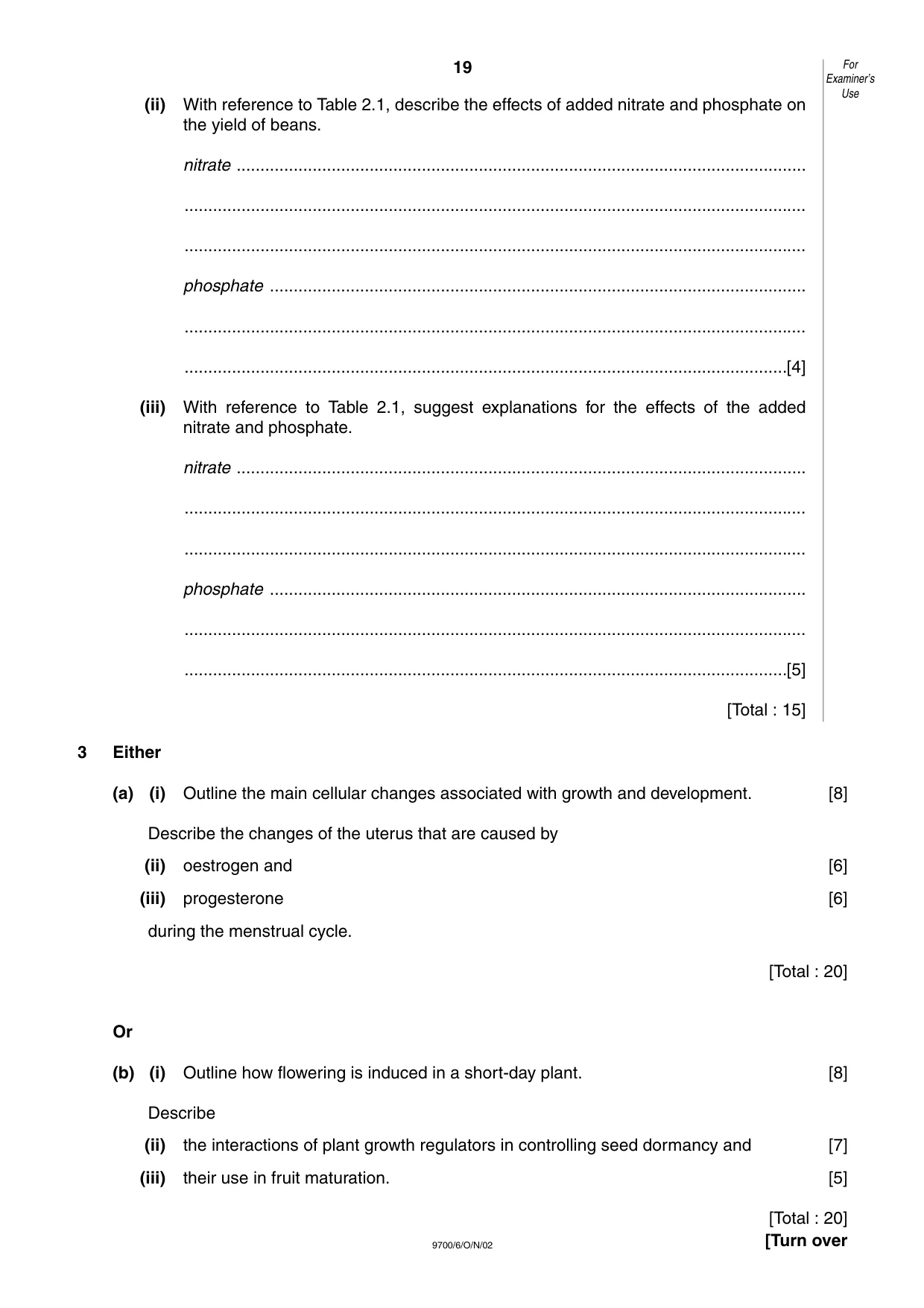
19 9700/6/O/N/02 [Turn over (ii) With reference to Table 2.1, describe the effects of added nitrate and phosphate on the yield of beans. nitrate … … … phosphate … … …[4] (iii) With reference to Table 2.1, suggest explanations for the effects of the added nitrate and phosphate. nitrate … … … phosphate … … …[5] [Total : 15] For Examiner’s Use 3 Either (a) (i) Outline the main cellular changes associated with growth and development. [8] Describe the changes of the uterus that are caused by (ii) oestrogen and [6] (iii) progesterone [6] during the menstrual cycle. [Total : 20] Or (b) (i) Outline how flowering is induced in a short-day plant. [8] Describe (ii) the interactions of plant growth regulators in controlling seed dormancy and [7] (iii) their use in fruit maturation. [5] [Total : 20]
Question paper, page 20
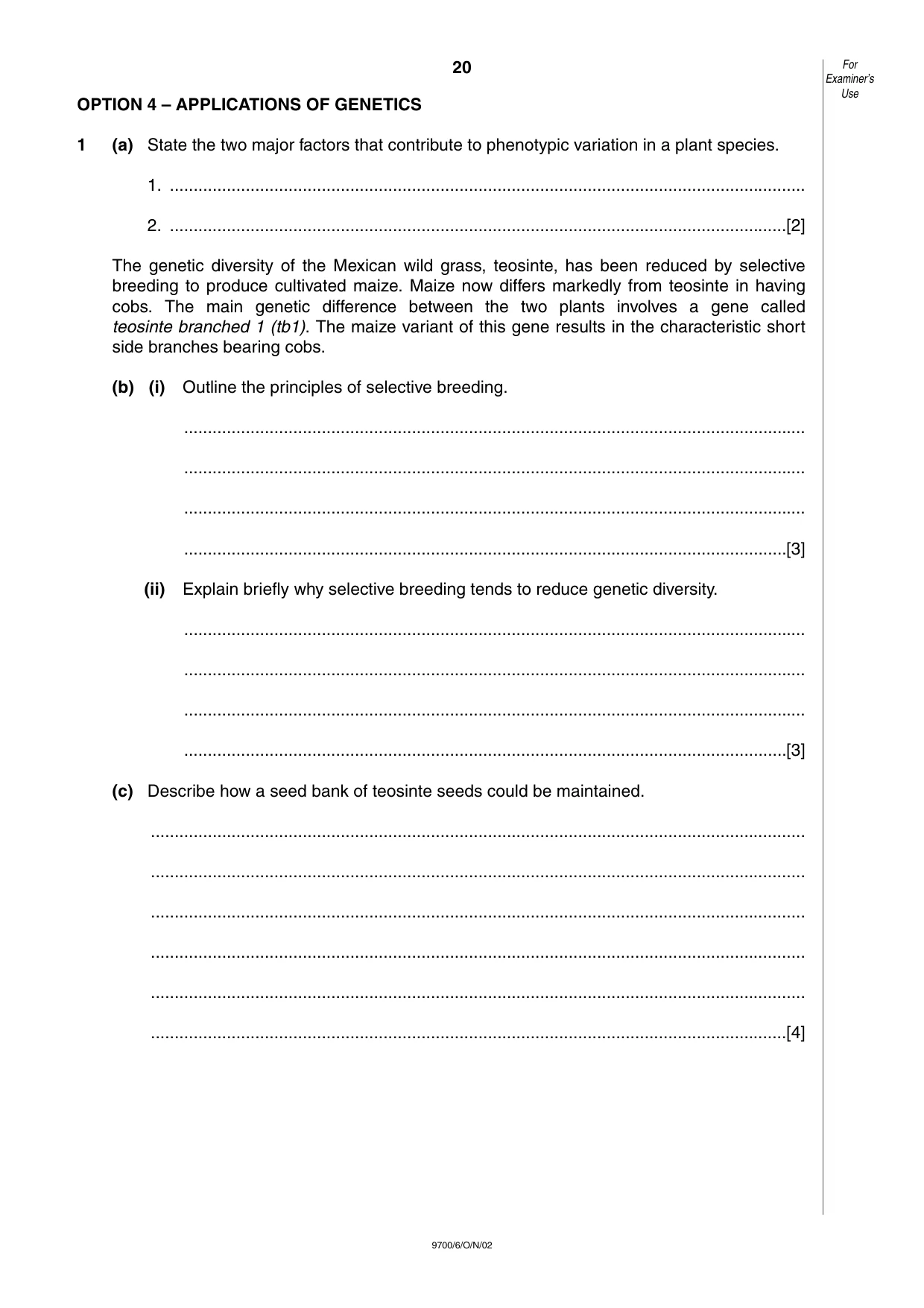
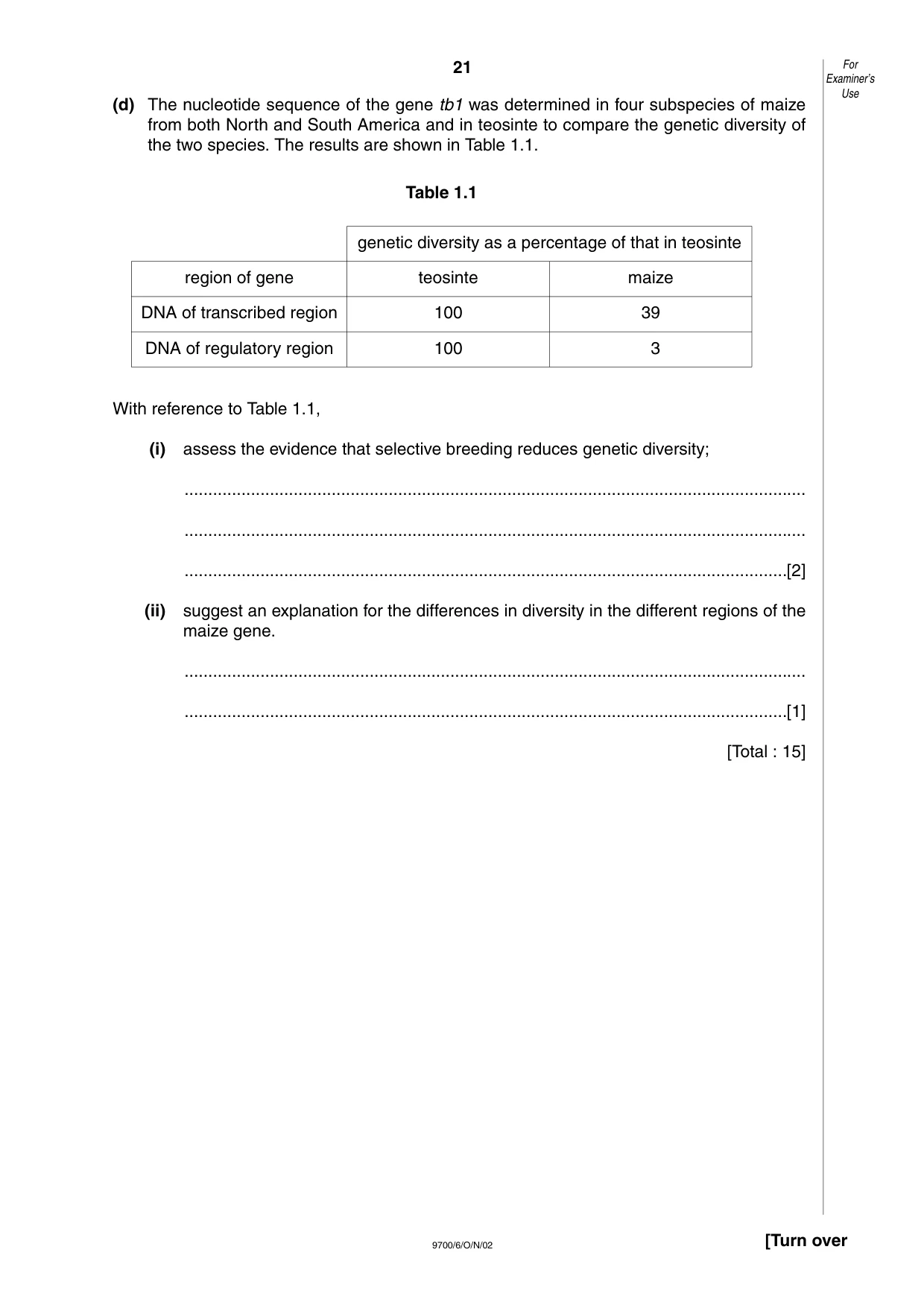
20 9700/6/O/N/02 OPTION 4 – APPLICATIONS OF GENETICS 1 (a) State the two major factors that contribute to phenotypic variation in a plant species. 1. … 2. …[2] The genetic diversity of the Mexican wild grass, teosinte, has been reduced by selective breeding to produce cultivated maize. Maize now differs markedly from teosinte in having cobs. The main genetic difference between the two plants involves a gene called teosinte branched 1 (tb1). The maize variant of this gene results in the characteristic short side branches bearing cobs. (b) (i) Outline the principles of selective breeding. … … … …[3] (ii) Explain briefly why selective breeding tends to reduce genetic diversity. … … … …[3] (c) Describe how a seed bank of teosinte seeds could be maintained. … … … … … …[4] For Examiner’s Use
Question paper, page 21
21 9700/6/O/N/02 [Turn over (d) The nucleotide sequence of the gene tb1 was determined in four subspecies of maize from both North and South America and in teosinte to compare the genetic diversity of the two species. The results are shown in Table 1.1. Table 1.1 With reference to Table 1.1, (i) assess the evidence that selective breeding reduces genetic diversity; … … …[2] (ii) suggest an explanation for the differences in diversity in the different regions of the maize gene. … …[1] [Total : 15] For Examiner’s Use genetic diversity as a percentage of that in teosinte region of gene teosinte maize DNA of transcribed region 100 39 DNA of regulatory region 100 3
Question paper, page 22
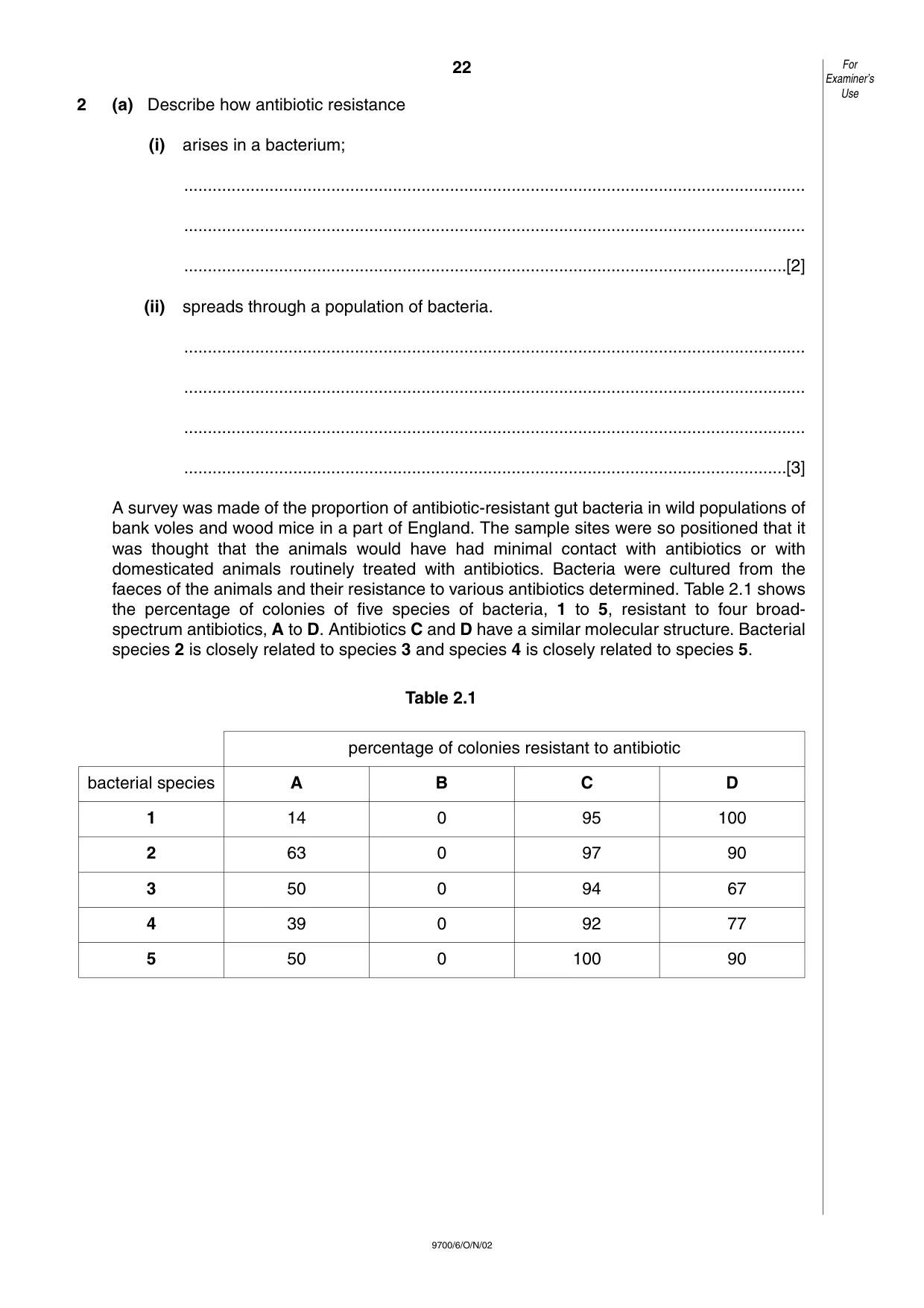
22 9700/6/O/N/02 2 (a) Describe how antibiotic resistance (i) arises in a bacterium; … … …[2] (ii) spreads through a population of bacteria. … … … …[3] A survey was made of the proportion of antibiotic-resistant gut bacteria in wild populations of bank voles and wood mice in a part of England. The sample sites were so positioned that it was thought that the animals would have had minimal contact with antibiotics or with domesticated animals routinely treated with antibiotics. Bacteria were cultured from the faeces of the animals and their resistance to various antibiotics determined. Table 2.1 shows the percentage of colonies of five species of bacteria, 1 to 5, resistant to four broad- spectrum antibiotics, A to D. Antibiotics C and D have a similar molecular structure. Bacterial species 2 is closely related to species 3 and species 4 is closely related to species 5. Table 2.1 For Examiner’s Use percentage of colonies resistant to antibiotic bacterial species A B C D 1 14 0 95 100 2 63 0 97 90 3 50 0 94 67 4 39 0 92 77 5 50 0 100 90
Question paper, page 23
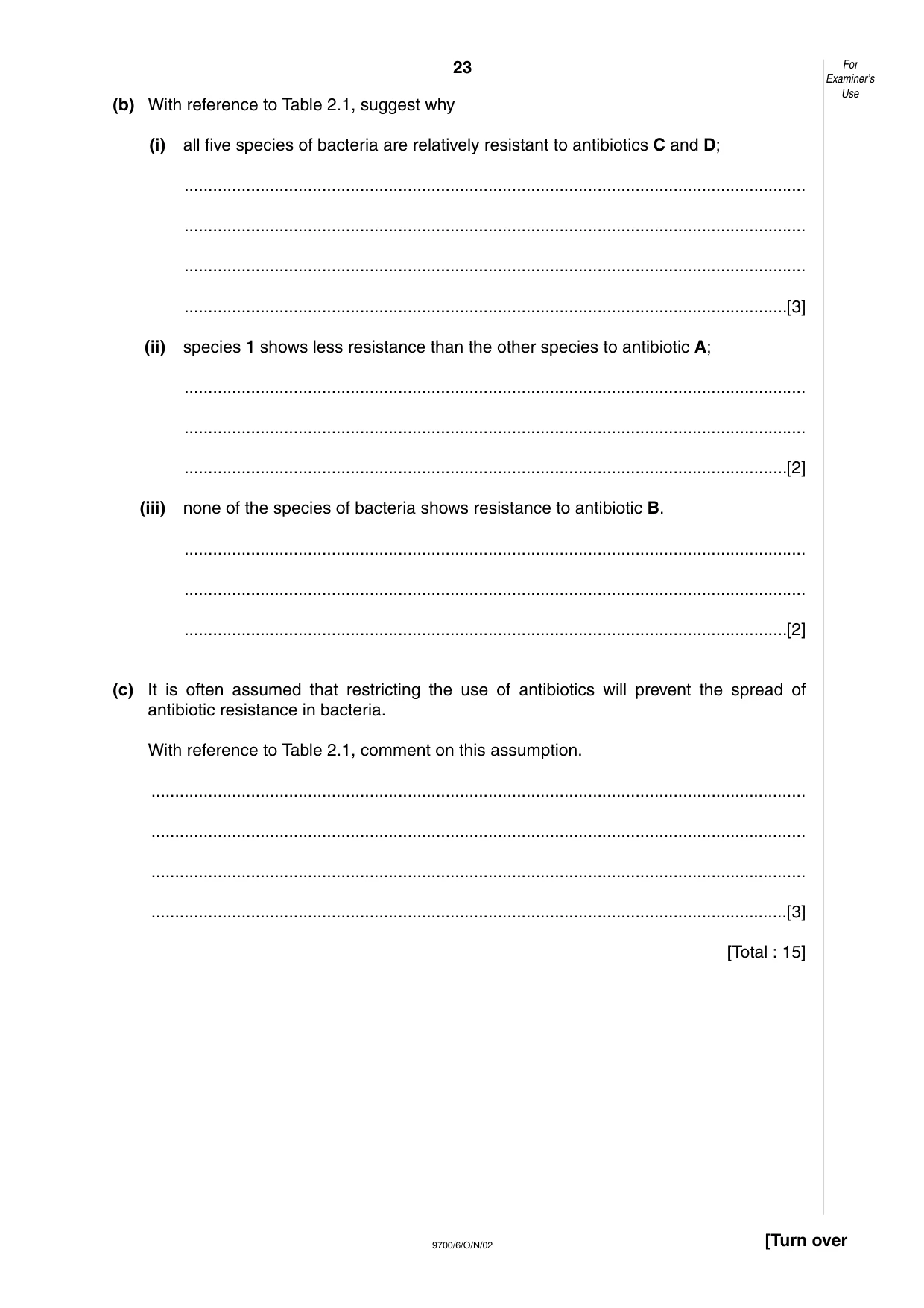
23 9700/6/O/N/02 [Turn over (b) With reference to Table 2.1, suggest why (i) all five species of bacteria are relatively resistant to antibiotics C and D; … … … …[3] (ii) species 1 shows less resistance than the other species to antibiotic A; … … …[2] (iii) none of the species of bacteria shows resistance to antibiotic B. … … …[2] (c) It is often assumed that restricting the use of antibiotics will prevent the spread of antibiotic resistance in bacteria. With reference to Table 2.1, comment on this assumption. … … … …[3] [Total : 15] For Examiner’s Use
Question paper, page 24
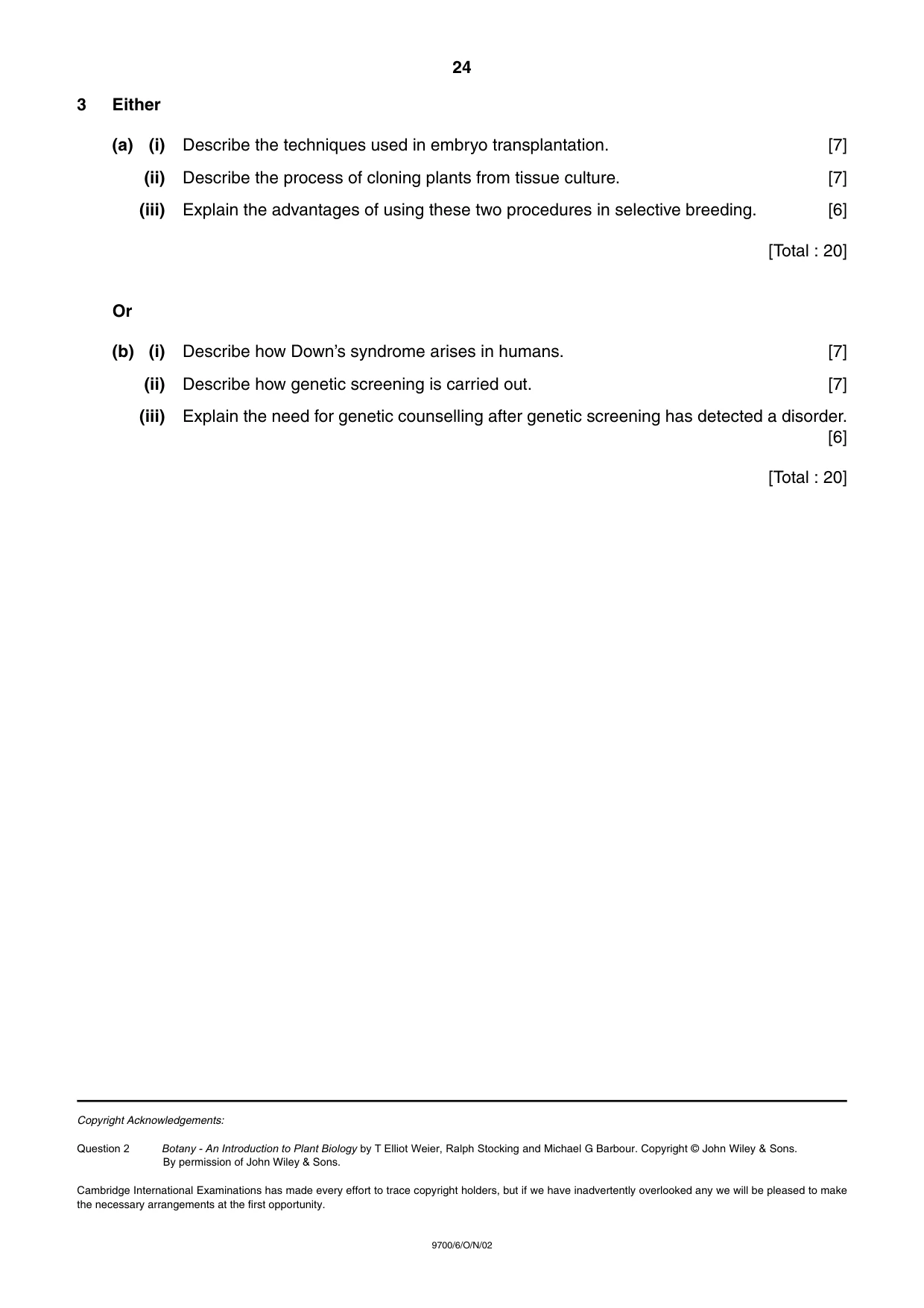
24 9700/6/O/N/02 3 Either (a) (i) Describe the techniques used in embryo transplantation. [7] (ii) Describe the process of cloning plants from tissue culture. [7] (iii) Explain the advantages of using these two procedures in selective breeding. [6] [Total : 20] Or (b) (i) Describe how Down’s syndrome arises in humans. [7] (ii) Describe how genetic screening is carried out. [7] (iii) Explain the need for genetic counselling after genetic screening has detected a disorder. [6] [Total : 20] Copyright Acknowledgements: Question 2 Botany - An Introduction to Plant Biology by T Elliot Weier, Ralph Stocking and Michael G Barbour. Copyright © John Wiley & Sons. By permission of John Wiley & Sons. Cambridge International Examinations has made every effort to trace copyright holders, but if we have inadvertently overlooked any we will be pleased to make the necessary arrangements at the first opportunity.
Mark scheme, page 1
CAMBRIDGE INTERNATIONAL EXAMINATIONS NOVEMBER 2002 GCE Advanced Level UNIVERSITY of CAMBRIDGE Local Examinations Syndicate
Mark scheme, page 2
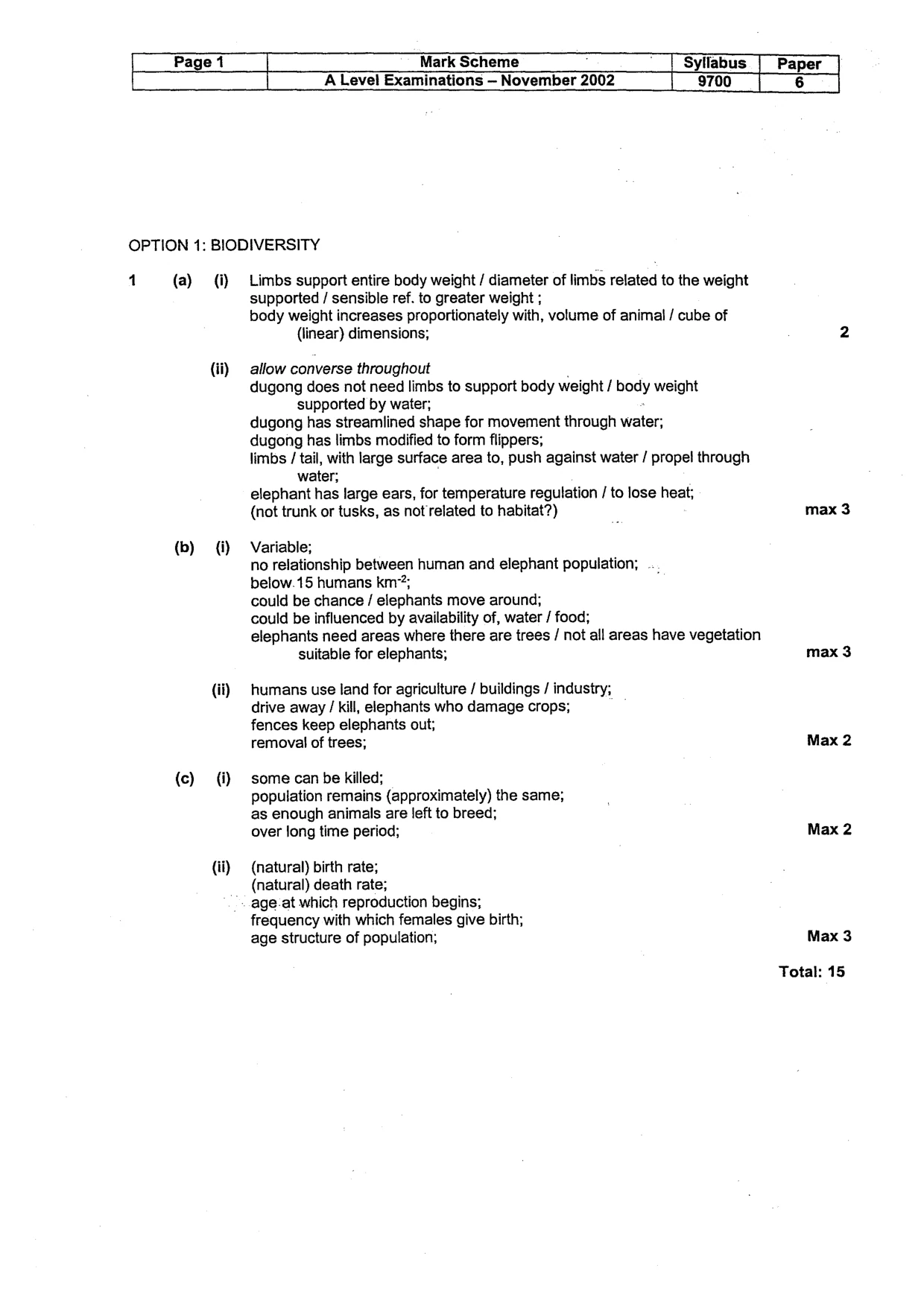
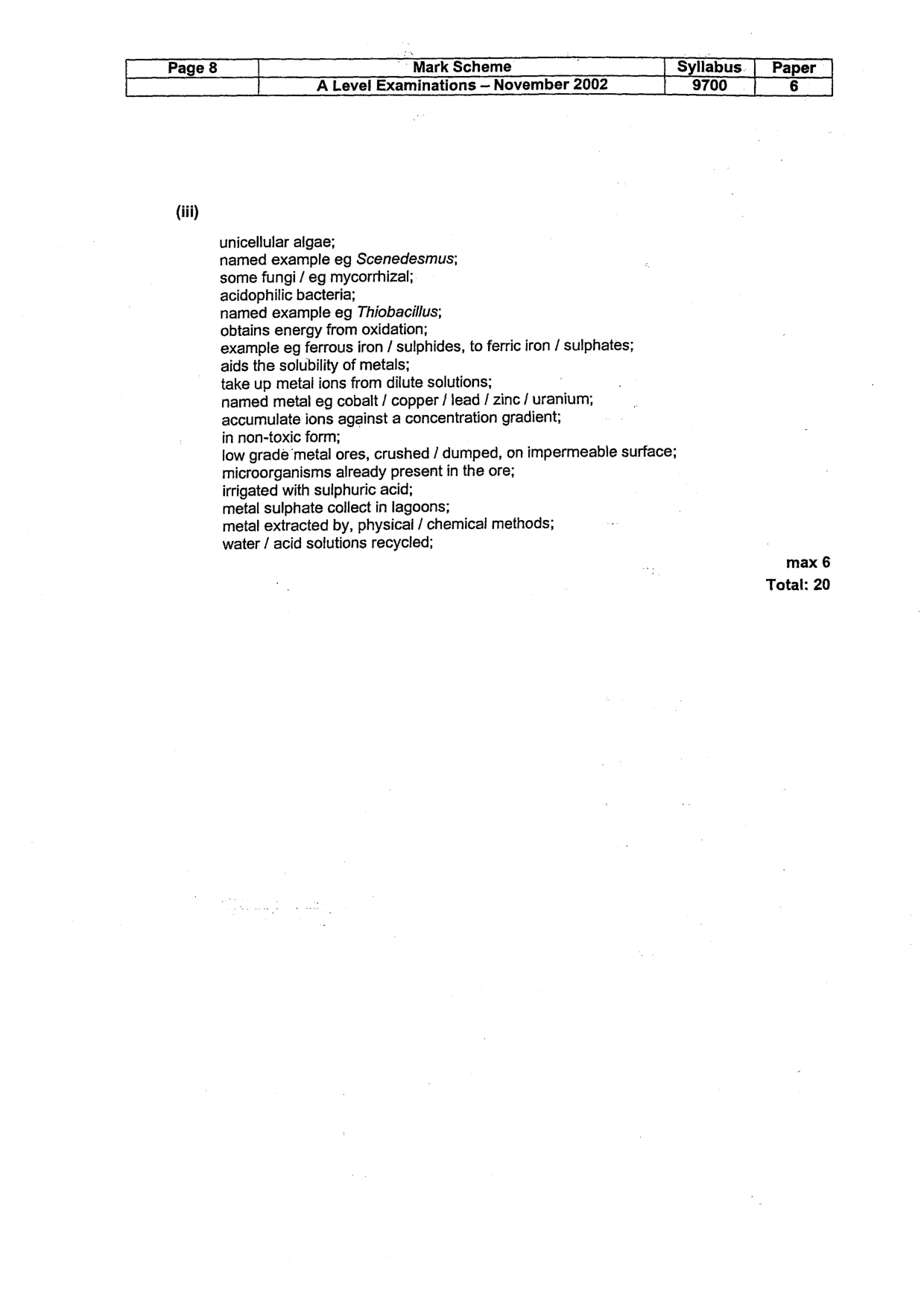
Page 1 A Level Examinations — November 2002 9700 Mark Scheme ° “| Syllabus [Paper ] 6 | OPTION 1: BIODIVERSITY 1 (a) (b) (c) (i) (ii) (i) (ii) (i) (ii) Limbs support entire body weight / diameter of limbs related to the weight supported / sensible ref. to greater weight ; body weight increases proportionately with, volume of animal / cube of (linear) dimensions; allow converse throughout dugong does not need limbs to support body weight / body weight supported by water; . dugong has streamlined shape for movement through water; dugong has limbs modified to form flippers; limbs / tail, with large surface area to, push against water / propel through water; elephant has large ears, for temperature regulation / to lose heat; (not trunk or tusks, as not related to habitat?) Variable; no relationship between human and elephant population; below.15 humans km’; could be chance / elephants move around; could be influenced by availability of, water / food; elephants need areas where there are trees / not all areas have vegetation suitable for elephants; humans use land for agriculture / buildings / industry; drive away / kill, elephants who damage crops; fences keep elephants out; removal of trees; some can be killed; population remains (approximately) the same; as enough animals are left to breed; over long time period; (natural) birth rate; (natural) death rate; age-at which reproduction begins; frequency with which females give birth; age structure of population; max 3 max 3 Max 2 Max 2 Max 3 Total: 15
Mark scheme, page 3
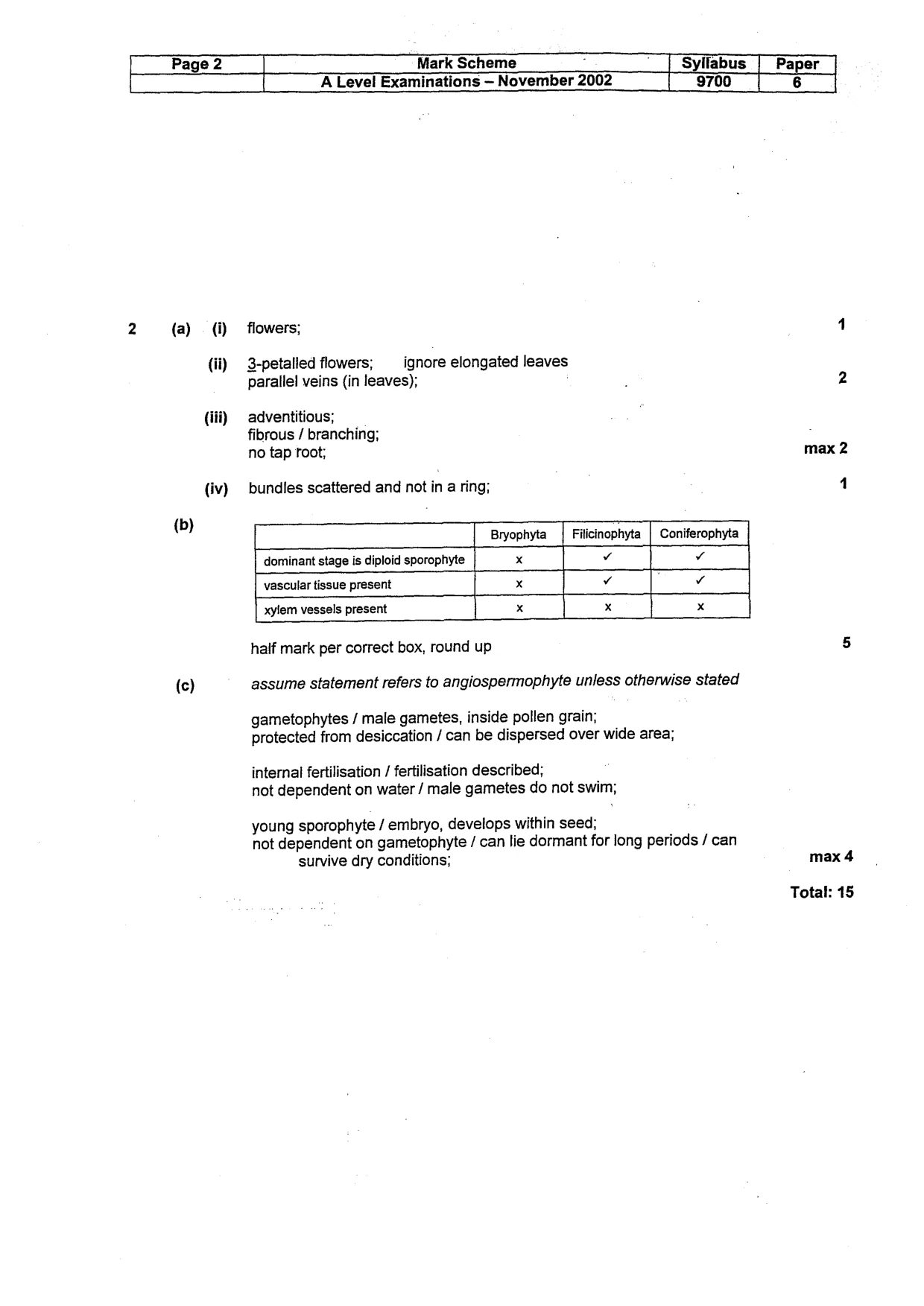
Page 2 Mark Scheme “ _Syllabus | Paper A Level Examinations — November 2002 9700 6 (a) (i) (ii) (iii) (iv) (b) (c) flowers; 3-petalled flowers; ignore elongated leaves parallel veins (in leaves), adventitious; fibrous / branching; no tap root; bundles scattered and not in a ring; vascular tissue present x Bryophyta | Filicinophyta | Coniferophyta dominant stage is diploid sporophyte x v v v v xylem vessels present x x x | half mark per correct box, round up assume statement refers to angiospermophyte unless otherwise stated gametophytes / male gametes, inside pollen grain; protected from desiccation / can be dispersed over wide area; internal fertilisation / fertilisation described; not dependent on water / male gametes do not swim; young sporophyte / embryo, develops within seed; not dependent on gametophyte / can lie dormant for long periods / can survive dry conditions; max 2 max 4 Total: 15
Mark scheme, page 4
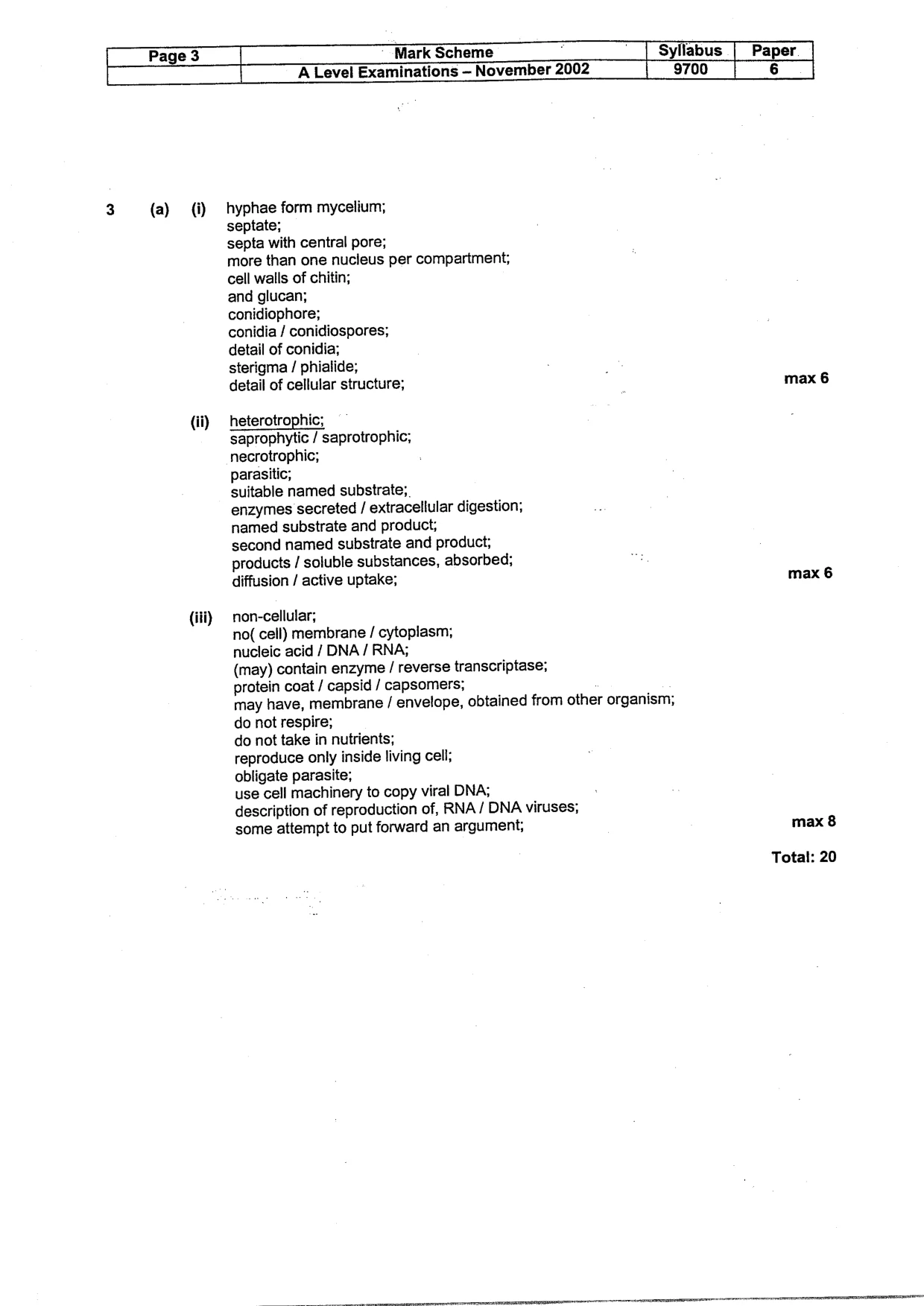
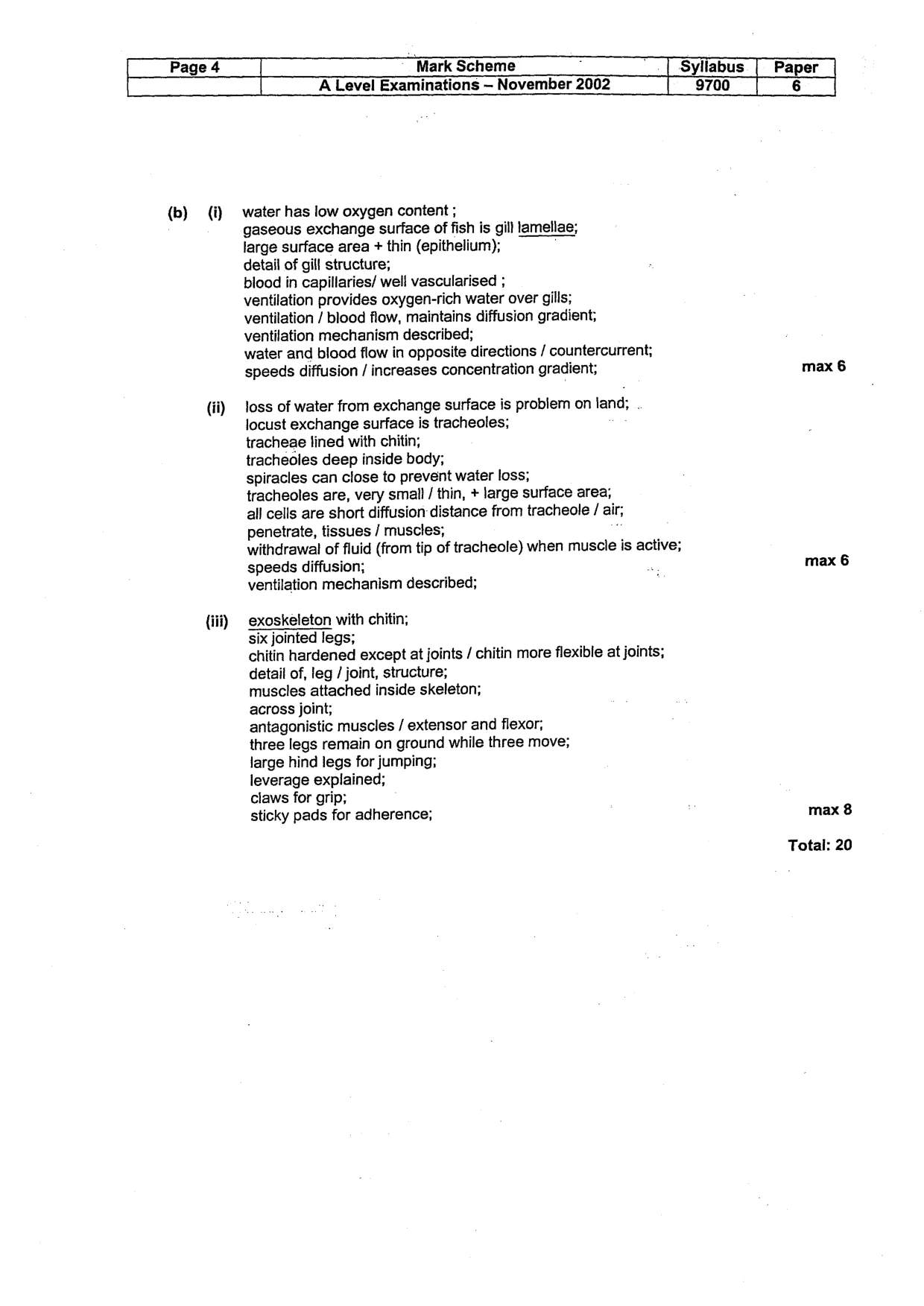
Page 3 Mark Scheme : Syllabus | Paper. | A Level Examinations — November 2002 [9700 6 (a) (i) hyphae form mycelium; septate; septa with central pore; more than one nucleus per compartment; cell walls of chitin; and glucan; conidiophore; conidia / conidiospores; detail of conidia; sterigma / phialide; : detail of cellular structure; : max 6 (ii) heterotrophic; saprophytic / saprotrophic, necrotrophic; parasitic; suitable named substrate; enzymes secreted / extracellular digestion; named substrate and product; second named substrate and product; products / soluble substances, absorbed; diffusion / active uptake; max 6 (ili) non-cellular; no( cell) membrane / cytoplasm; nucleic acid / DNA/ RNA; (may) contain enzyme / reverse transcriptase; protein coat / capsid / capsomers; may have, membrane / envelope, obtained from other organism; do not respire; do not take in nutrients; reproduce only inside living cell; obligate parasite; use cell machinery to copy viral DNA; description of reproduction of, RNA/ DNA viruses; some attempt to put forward an argument; max 8 Total: 20
Mark scheme, page 5
Page 4 Mark Scheme i Syllabus | Paper A Level Examinations — November 2002 9700 6 (6) (i) (iii) water has low oxygen content ; gaseous exchange surface of fish is gill lamellae; large surface area + thin (epithelium); detail of gill structure; blood in capillaries/ well vascularised ; ventilation provides oxygen-rich water over gills; ventilation / blood flow, maintains diffusion gradient; ventilation mechanism described; water and blood flow in opposite directions / countercurrent; speeds diffusion / increases concentration gradient, max 6 loss of water from exchange surface is problem on land; . locust exchange surface is tracheoles; tracheae lined with chitin; tracheoles deep inside body; spiracles can close to prevent water loss; tracheoles are, very small / thin, + large surface area; all cells are short diffusion distance from tracheole / air; penetrate, tissues / muscles, withdrawal of fluid (from tip of tracheole) when muscle is active; speeds diffusion; max 6 ventilation mechanism described; : exoskeleton with chitin; six jointed legs; chitin hardened except at joints / chitin more flexible at joints; detail of, leg / joint, structure; muscles attached inside skeleton; across joint; antagonistic muscles / extensor and flexor; three legs remain on ground while three move; large hind legs for jumping; leverage explained; claws for grip; sticky pads for adherence; max 8 Total: 20
Mark scheme, page 6
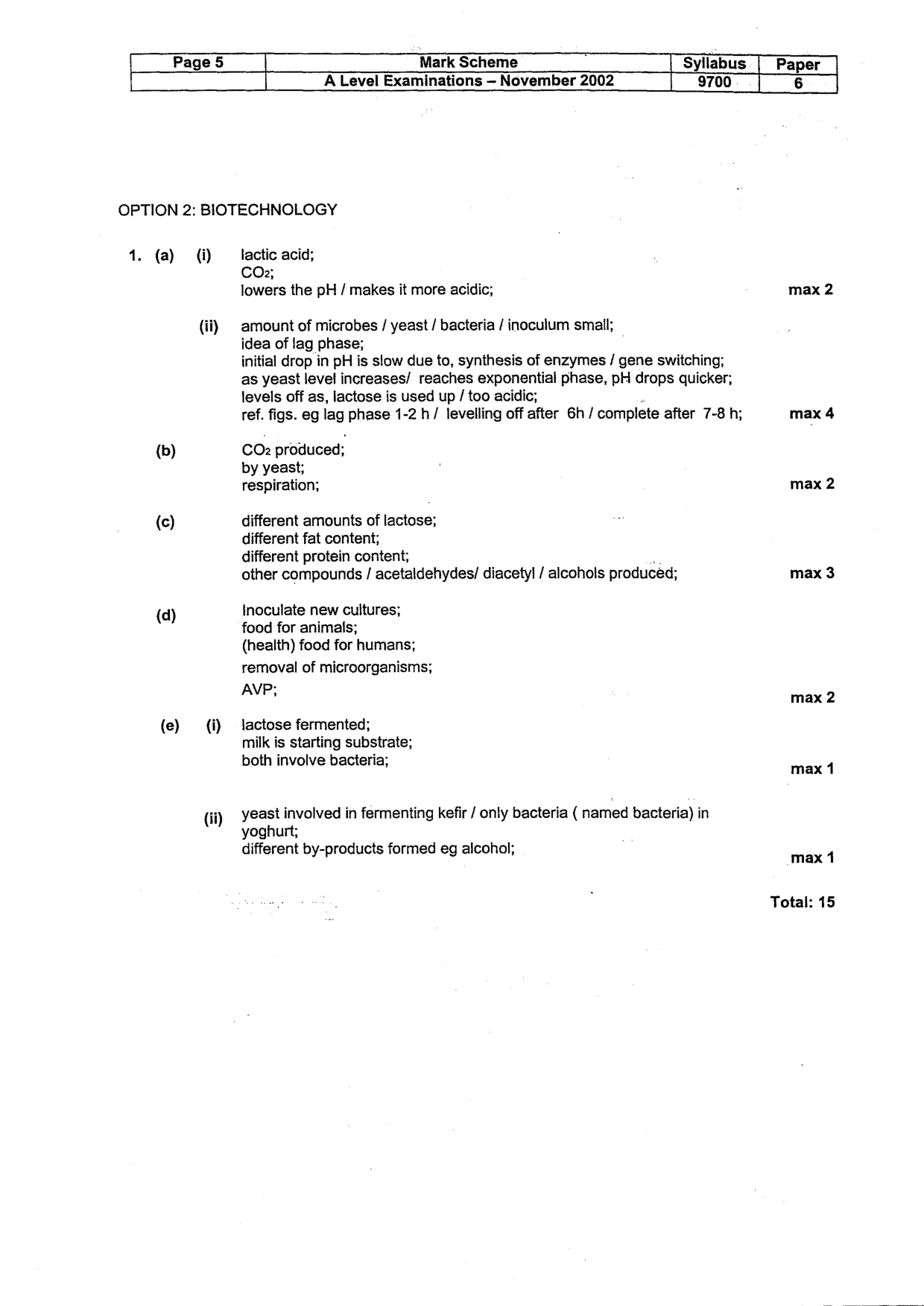
Page 5 Mark Scheme Syllabus A Level Examinations — November 2002 9700 Paper 6 OPTION 2: BIOTECHNOLOGY 41. (a) {b) (c) (d) (e) (i) (ii) (i) (ii) lactic acid; C02; lowers the pH / makes it more acidic; amount of microbes / yeast / bacteria / inoculum small; idea of lag phase; initial drop in pH is slow due to, synthesis of enzymes / gene switching; as yeast level increases/ reaches exponential phase, pH drops quicker; levels off as, lactose is used up / too acidic; . ref. figs. eg lag phase 1-2 h/ levelling off after 6h / complete after 7-8 h; COz produced; by yeast, respiration; different amounts of lactose; different fat content; different protein content; other compounds / acetaldehydes/ diacetyl / alcohols produced; inoculate new cultures; food for animats; (health) food for humans; removal of microorganisms; AVP; lactose fermented; milk is starting substrate; both involve bacteria; yeast involved in fermenting kefir / only bacteria ( named bacteria) in yoghurt; different by-products formed eg alcohol; max 2 max 4 max 2 max 3 max 2 max 1 max 1 Total: 15
Mark scheme, page 7
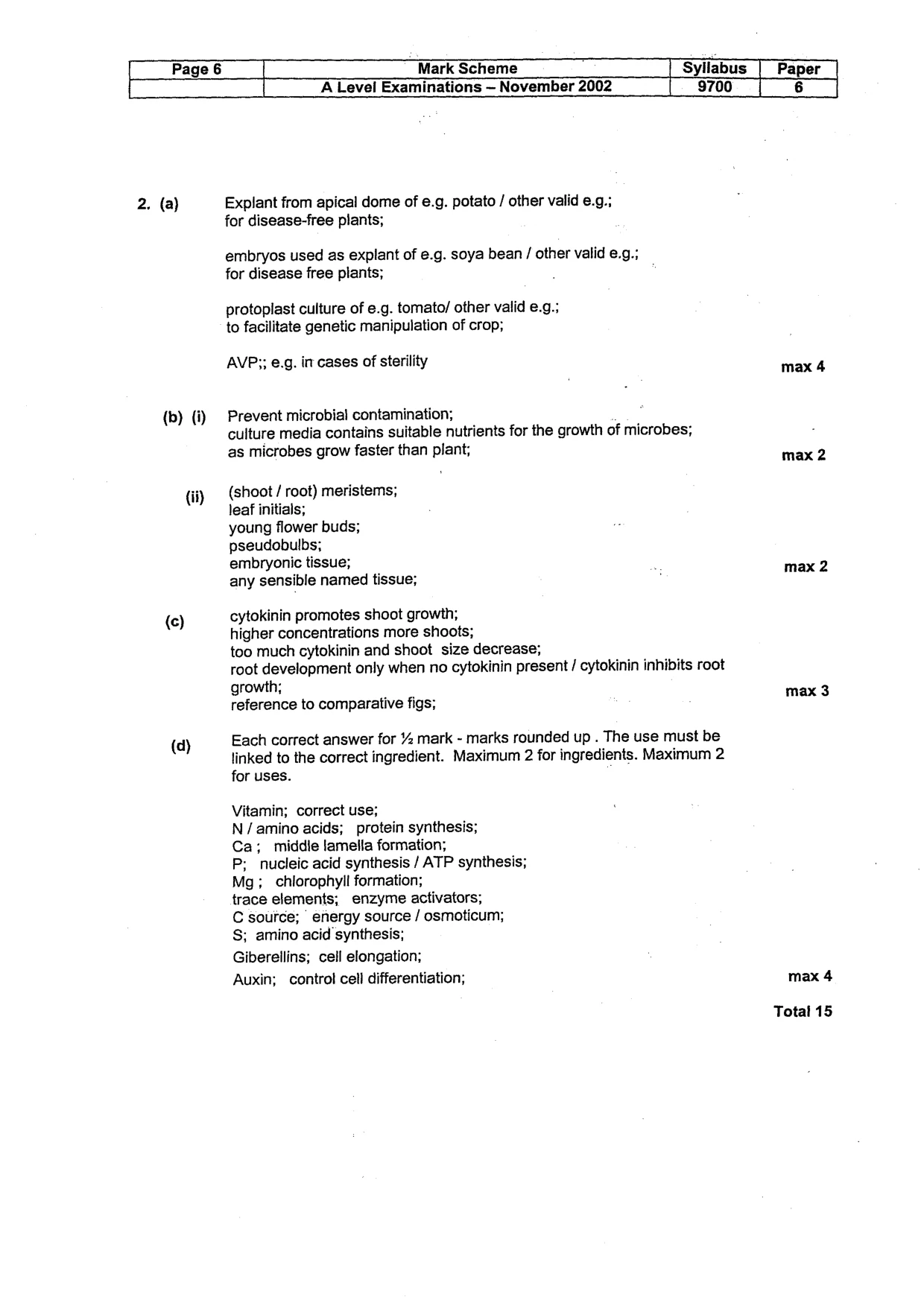
Page 6 I Mark Scheme " Syllabus { A Level Examinations ~ November 2002 9700 Paper 6 2. (a) (b) (i) (ii) (c) (d) Explant from apical dome of e.g. potato / other valid e.g.; for disease-free plants; embryos used as explant of e.g. soya bean / other valid e.g.; for disease free plants; protoplast culture of e.g. tomato/ other valid e.g.; to facilitate genetic manipulation of crop; AVP;; e.g. in cases of sterility Prevent microbial contamination; culture media contains suitable nutrients for the growth of microbes; as microbes grow faster than plant; (shoot / root) meristems; leaf initials; young flower buds; pseudobulbs; embryonic tissue; any sensible named tissue; cytokinin promotes shoot growth; higher concentrations more shoots; too much cytokinin and shoot size decrease; root development only when no cytokinin present / cytokinin inhibits root growth; reference to comparative figs; Each correct answer for % mark - marks rounded up . The use must be linked to the correct ingredient. Maximum 2 for ingredients. Maximum 2 for uses. Vitamin; correct use; N/amino acids; protein synthesis; Ca; middie lamella formation; P; nucleic acid synthesis / ATP synthesis; Mg; chlorophyll formation; trace elements; enzyme activators; C source; energy source / osmoticum; S; amino acid synthesis; Giberellins; cell elongation; Auxin; control cell differentiation; max 4 max 2 max 2 max 3 max 4 Total 15
Mark scheme, page 8
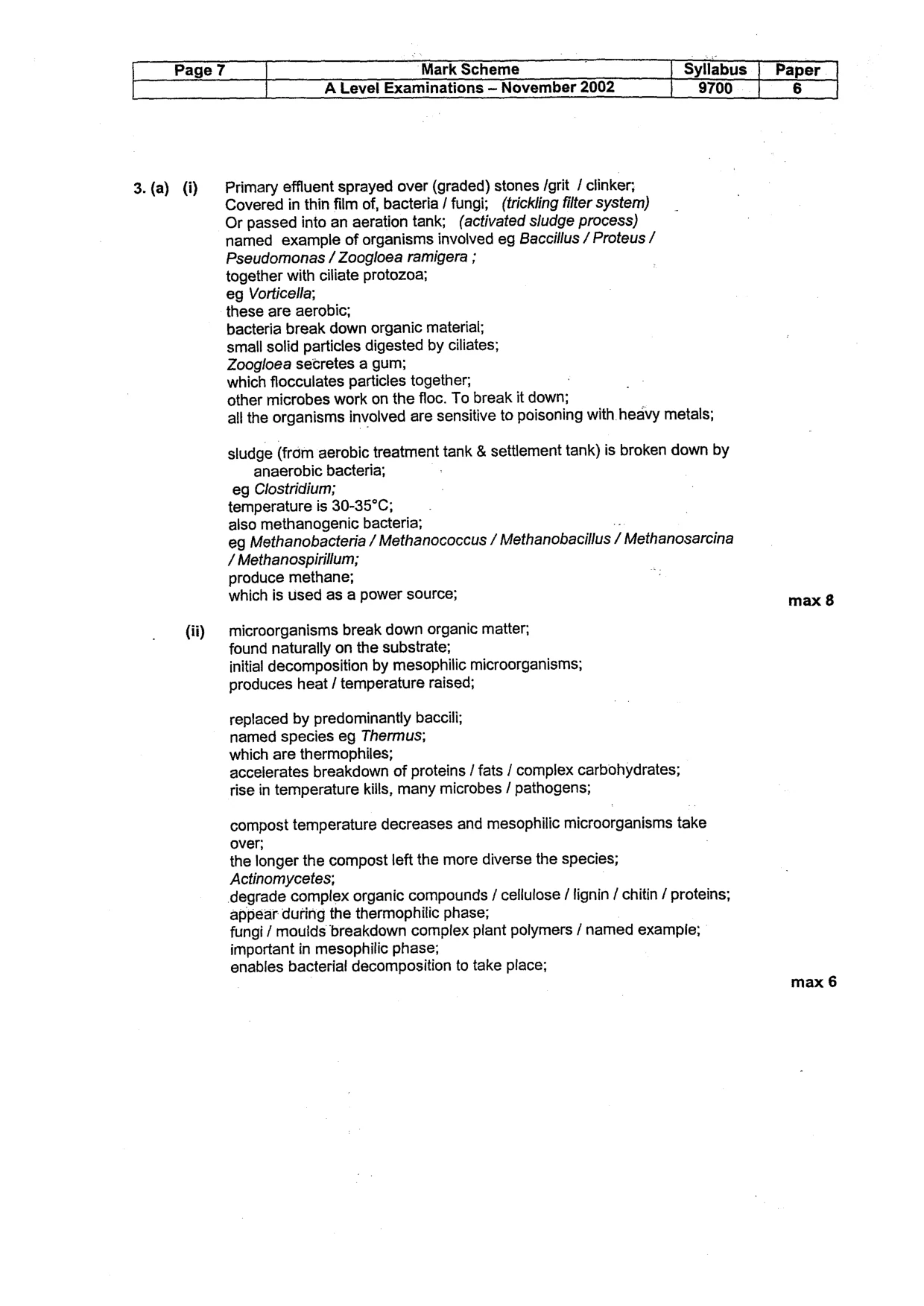
Page 7 I Mark Scheme - Syllabus Paper A Level Examinations — November 2002 9700 6 3.(a) (i) (ii) Primary effluent sprayed over (graded) stones /grit / clinker; Covered in thin film of, bacteria / fungi; (trickling filter system) Or passed into an aeration tank; (activated sludge process) named example of organisms involved eg Baccillus / Proteus / Pseudomonas / Zoogloea ramigera ; together with ciliate protozoa; eg Vorticella; these are aerobic; bacteria break down organic material; smail solid particles digested by ciliates; Zoogloea secretes a gum; which flocculates particles together; other microbes work on the floc. To break it down; all the organisms involved are sensitive to poisoning with heavy metals; sludge (from aerobic treatment tank & settlement tank) is broken down by anaerobic bacteria; eg Clostridium; temperature is 30-35°C; also methanogenic bacteria; eg Methanobacteria / Methanococcus / Methanobacillus / Methanosarcina / Methanospirillum; produce methane; which is used as a power source; max & microorganisms break down organic matter; found naturally on the substrate; initial decomposition by mesophilic microorganisms, produces heat / temperature raised; replaced by predominantly baccili; named species eg Thermus; which are thermophiles; accelerates breakdown of proteins / fats / complex carbohydrates; rise in temperature kills, many microbes / pathogens; compost temperature decreases and mesophilic microorganisms take over; the longer the compost left the more diverse the species; Actinomycetes; degrade complex organic compounds / cellulose / lignin / chitin / proteins; appear during the thermophilic phase; fungi / moulds breakdown complex plant polymers / named example; important in mesophilic phase; enables bacterial decomposition to take place; max 6
Mark scheme, page 9
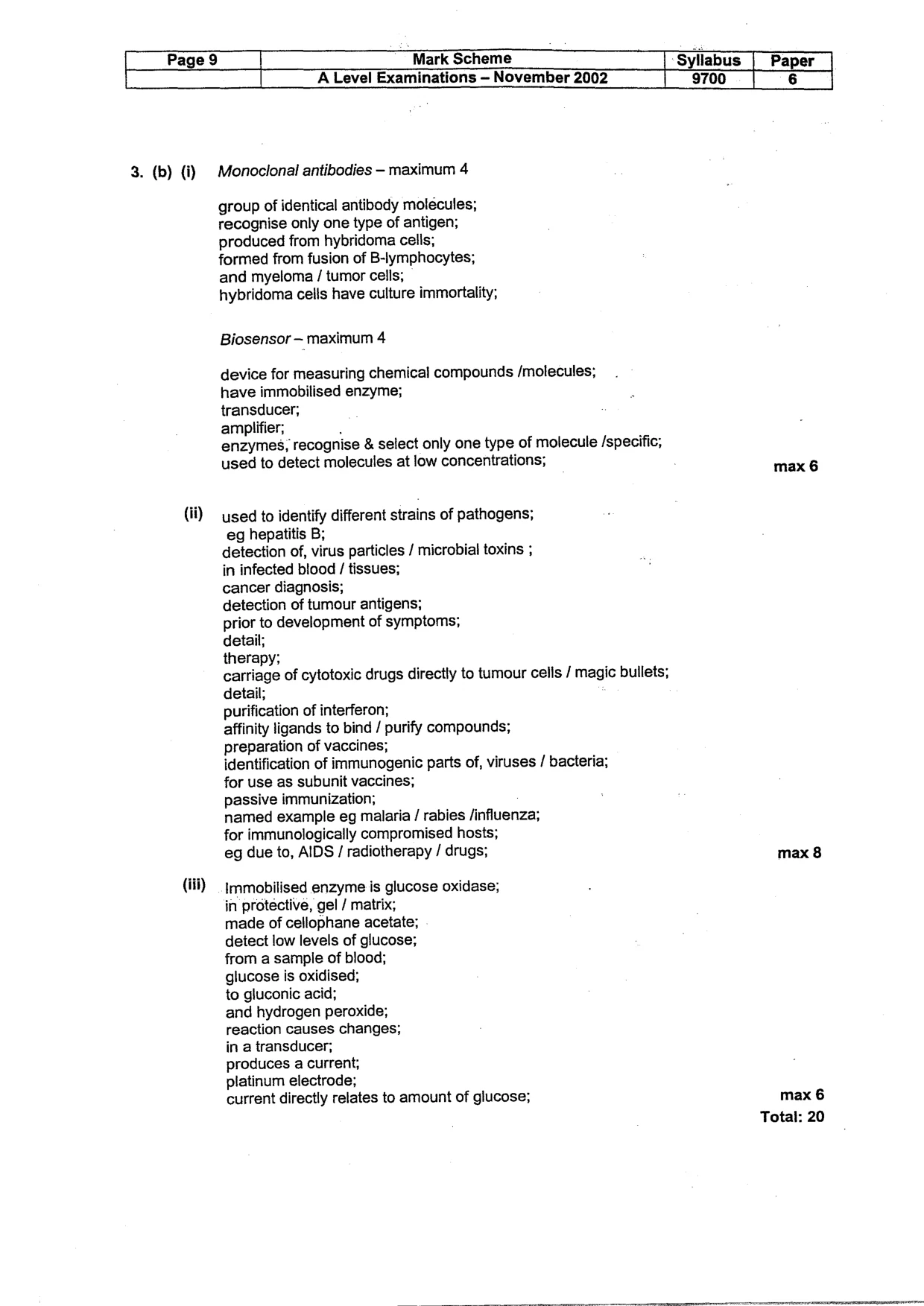
Page 8 Mark Scheme : | Syllabus. | Paper | A Level Examinations — November 2002 [9700 | 6 «| (iii) unicellular algae; named example eg Scenedesmus; some fungi / eg mycorrhizal; acidophilic bacteria; named example eg Thiobacillus; obtains energy from oxidation; example eg ferrous iron / sulphides, to ferric iron / sulphates; aids the solubility of metals; take up metal ions from dilute solutions; named metal eg cobalt / copper / lead / zinc / uranium; accumulate ions against a concentration gradient; in non-toxic form; low grade metal ores, crushed / dumped, on impermeable surface; microorganisms already present in the ore; irrigated with sulphuric acid; metal sulphate collect in lagoons; metal extracted by, physical / chemical methods; water / acid solutions recycled; max 6 Total: 20
Mark scheme, page 10
Page 9 Mark Scheme Syllabus | Paper A Level Examinations — November 2002 9700 3. (b) (i) (ii) (ii) Monoclonal antibodies — maximum 4 group of identical antibody molecules; recognise only one type of antigen; produced from hybridoma cells; formed from fusion of B-lymphocytes; and myeloma / tumor cells; hybridoma cells have culture immortality; Biosensor — maximum 4 device for measuring chemical compounds /molecules; have immobilised enzyme; transducer; amplifier; . enzymes, recognise & select only one type of molecule /specific; ni ions; used to detect molecules at low concentrations; max 6 used to identify different strains of pathogens; eg hepatitis B; detection of, virus particles / microbial toxins ; in infected blood / tissues; cancer diagnosis; detection of tumour antigens; prior to development of symptoms; detail; therapy; carriage of cytotoxic drugs directly to tumour cells / magic bullets; detail; purification of interferon; affinity ligands to bind / purify compounds; preparation of vaccines; identification of immunogenic parts of, viruses / bacteria; for use as subunit vaccines; passive immunization; named example eg malaria / rabies /influenza; for immunologically compromised hosts; eg due to, AIDS / radiotherapy / drugs; max 8 Immobilised enzyme is glucose oxidase; in protective, gel / matrix; made of cellophane acetate; detect low levels of glucose; from a sample of blood; glucose is oxidised; to gluconic acid; and hydrogen peroxide; reaction causes changes; in a transducer; produces a current; platinum electrode; current directly relates to amount of glucose; max 6 Total: 20
Mark scheme, page 11
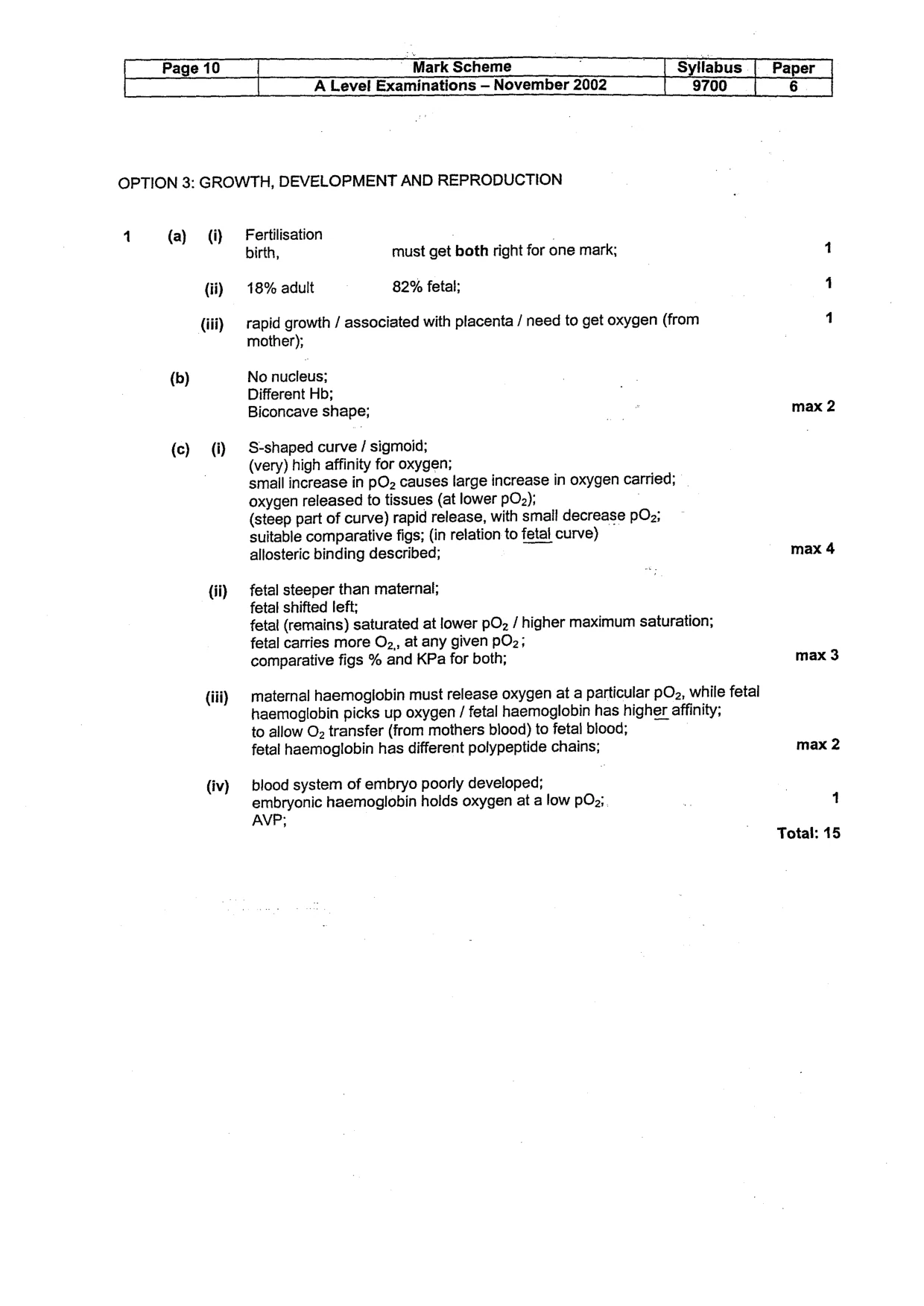
("Page to | Mark Scheme Syllabus “| Paper { [ A Level Examinations — November 2002 9700 6 OPTION 3: GROWTH, DEVELOPMENT AND REPRODUCTION 1 (a) (b) (c) (i) (ii) (iii) (ii) (ii) (iv) Fertilisation birth, must get both right for one mark; 18% adult 82% fetal; rapid growth / associated with placenta / need to get oxygen (from mother); No nucleus; Different Hb; Biconcave shape; S-shaped curve / sigmoid; (very) high affinity for oxygen; small increase in pO. causes large increase in oxygen carried; oxygen released to tissues (at lower pO2); (steep part of curve) rapid release, with small decrease pO2; suitable comparative figs; (in relation to fetal curve) allosteric binding described; fetal steeper than maternal; fetal shifted left; fetal (remains) saturated at lower pOz / higher maximum saturation; fetal carries more Oz,, at any given pO2; comparative figs % and KPa for both; maternal haemoglobin must release oxygen at a particular pO2, while fetal haemoglobin picks up oxygen / fetal haemoglobin has higher affinity; to allow O2 transfer (from mothers blood) to fetal blood; fetal haemoglobin has different polypeptide chains; blood system of embryo poorly developed; embryonic haemoglobin holds oxygen at a low pOz; AVP; max 2 max 4 max 3 max 2 1 Total: 15
Mark scheme, page 12
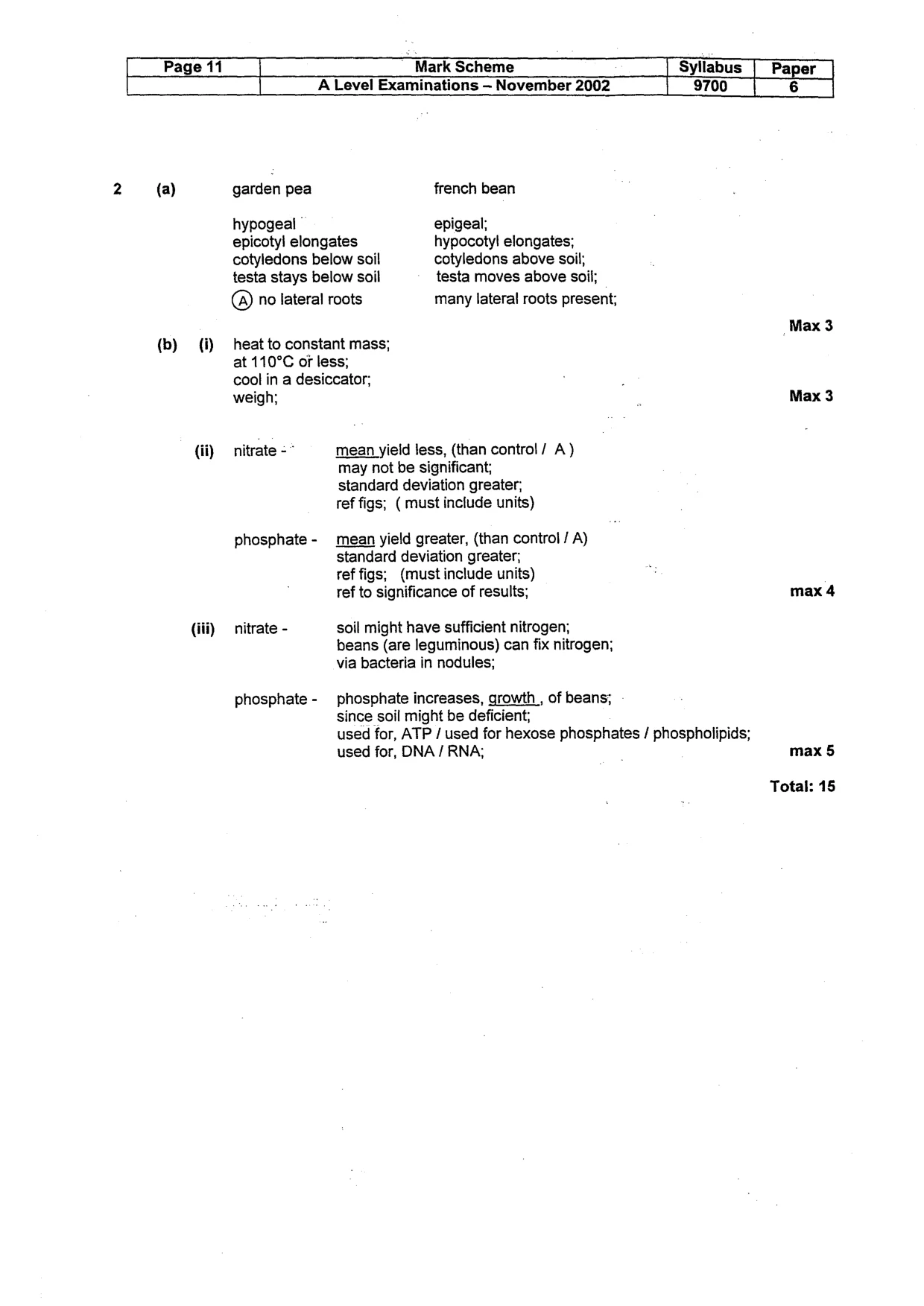
Page 11 Mark Scheme Syllabus | Paper A Level Examinations — November 2002 9700 6 (a) garden pea french bean hypogeal " epigeal; epicotyl elongates hypocotyl elongates; cotyledons below soil cotyledons above soil; testa stays below soil testa moves above soil; ©) no lateral roots many lateral roots present; Max 3 (b) (i) _ heat to constant mass; at 110°C of less; cool in a desiccator; weigh; Max 3 (ii) nitrate =~ mean yield less, (than control/ A) may not be significant; standard deviation greater; ref figs; ( must include units) phosphate - mean yield greater, (than control / A) standard deviation greater; ref figs; (must include units) ref to significance of results; max 4 nitrate - soil might have sufficient nitrogen; beans (are leguminous) can fix nitrogen; via bacteria in nodules; phosphate - phosphate increases, growth , of beans; since soil might be deficient; used for, ATP / used for hexose phosphates / phospholipids; used for, DNA / RNA; max 5 Total: 15
Mark scheme, page 13
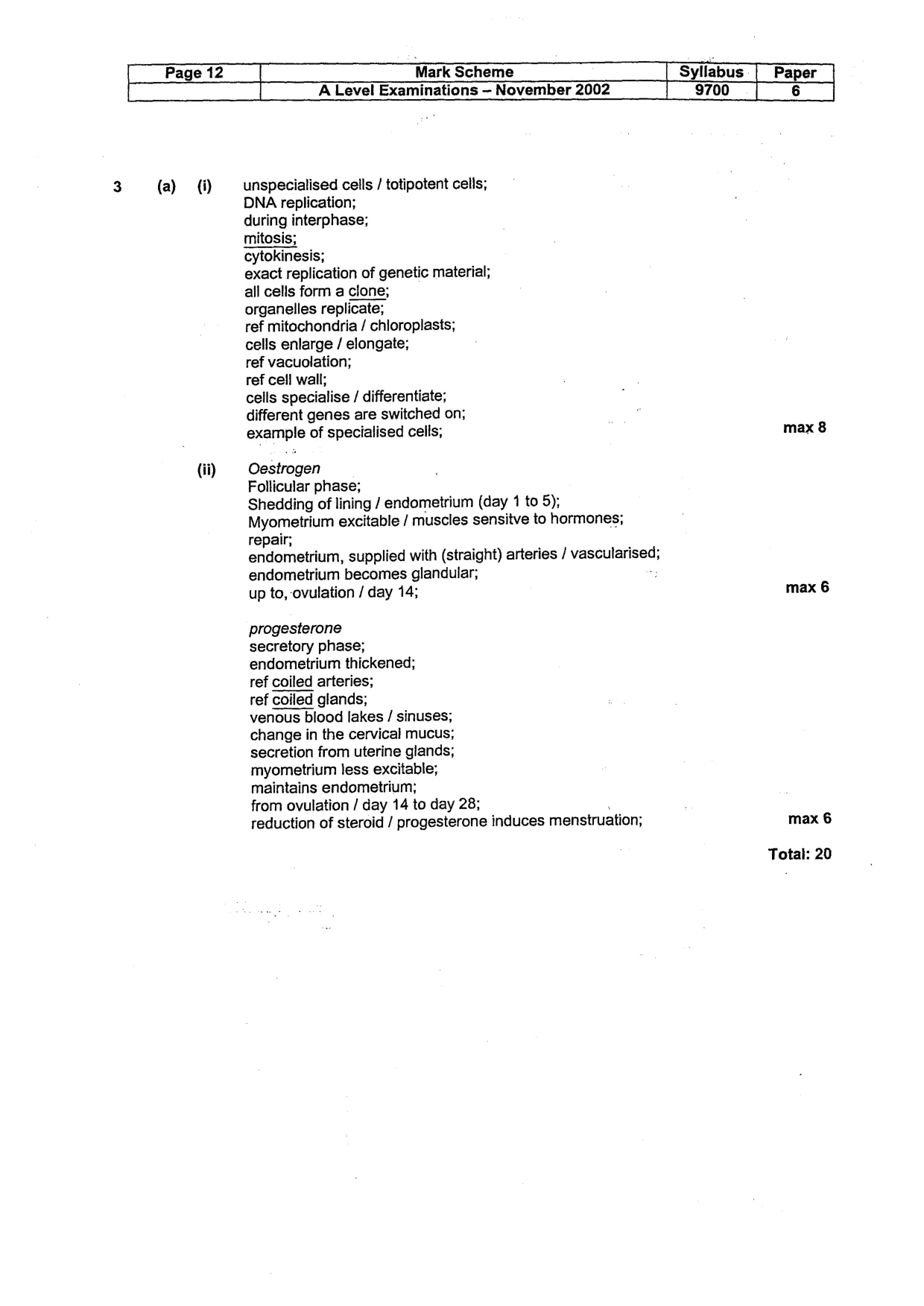
Page 12 Mark Scheme [Syllabus P; M aper C A Level Examinations — November 2002 [9700 6 (a) (i) unspecialised cells / totipotent cells; DNA replication; during interphase; mitosis; cytokinesis; exact replication of genetic material; all cells form a clone; organelles replicate; ref mitochondria / chloroplasts; cells enlarge / elongate; ref vacuolation; ref cell wall; cells specialise / differentiate; different genes are switched on; example of specialised cells; max 8 (ii) Oestrogen Follicular phase; Shedding of lining / endometrium (day 1 to 5); Myometrium excitable / muscles sensitve to hormones; repair; endometrium, supplied with (straight) arteries / vascularised; endometrium becomes glandular; : up to, ovulation / day 14; max 6 progesterone secretory phase; endometrium thickened; ref coiled arteries; ref coiled glands; venous blood lakes / sinuses; change in the cervical mucus; secretion from uterine glands; myometrium less excitable; maintains endometrium; from ovulation / day 14 to day 28; reduction of steroid / progesterone induces menstruation; max 6 Total: 20
Mark scheme, page 14
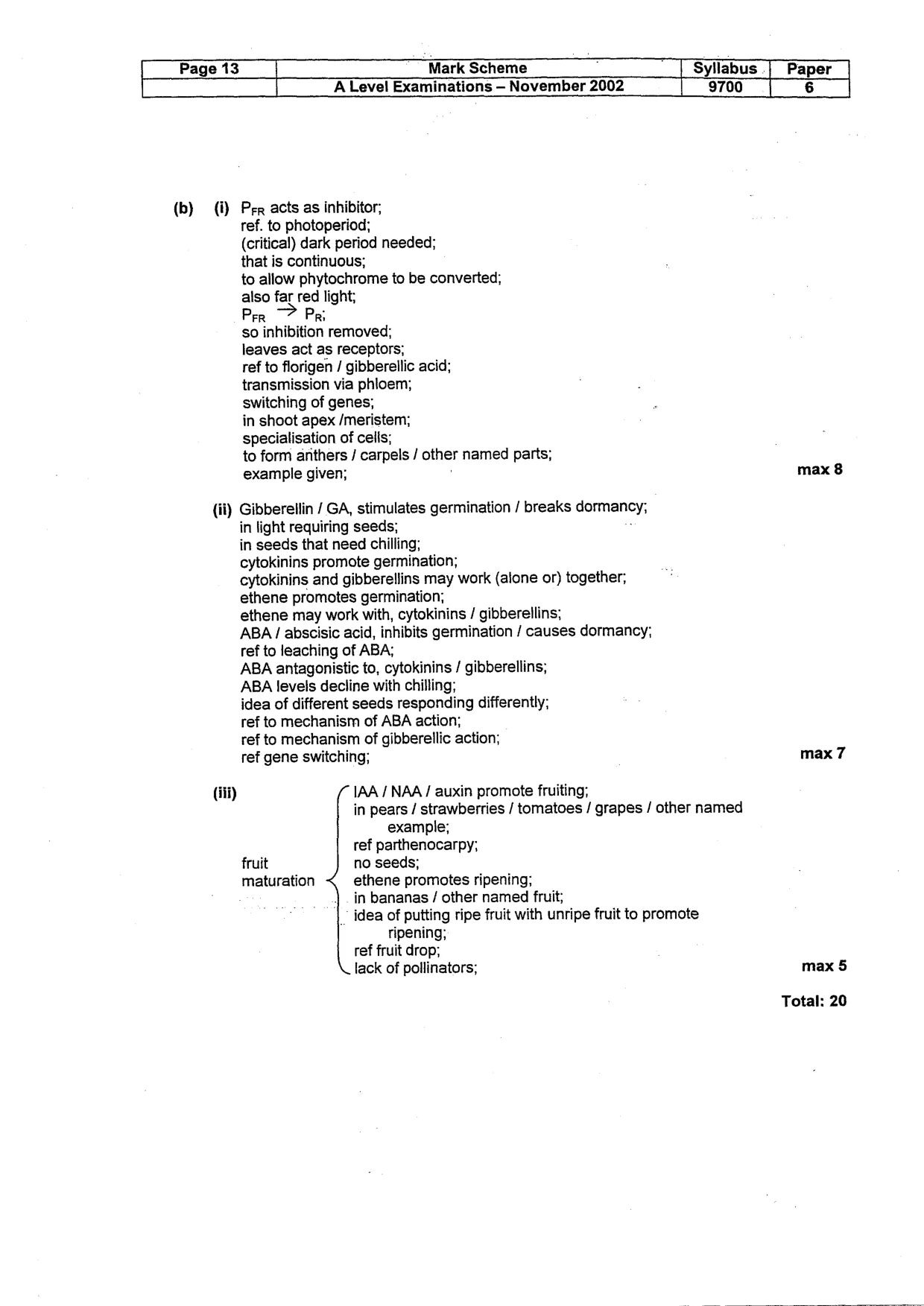
Page 13 I Mark Scheme "_| Syllabus | Paper | [ A Level Examinations — November 2002 9700 6 (b) @ (ii) (iii) Per acts as inhibitor; ref. to photoperiod; (critical) dark period needed; that is continuous; to allow phytochrome to be converted; also far red light; Per Pri so inhibition removed; leaves act as receptors; ref to florigen / gibberellic acid; transmission via phloem; switching of genes; in shoot apex /meristem; specialisation of cells; to form anthers / carpels / other named parts; example given; . max 8 Gibberellin / GA, stimulates germination / breaks dormancy; in light requiring seeds; in seeds that need chilling; cytokinins promote germination; cytokinins and gibberellins may work (alone or) together; ethene promotes germination; ethene may work with, cytokinins / gibberellins; ABA/ abscisic acid, inhibits germination / causes dormancy; tef to leaching of ABA; ABA antagonistic to, cytokinins / gibberellins; ABA levels decline with chilling; idea of different seeds responding differently; ref to mechanism of ABA action; ref to mechanism of gibberellic action; tef gene switching; max 7 IAA / NAA / auxin promote fruiting; in pears / strawberries / tomatoes / grapes / other named example; ref parthenocarpy; fruit no seeds; maturation ethene promotes ripening; ) . in bananas / other named fruit; idea of putting ripe fruit with unripe fruit to promote ripening; tef fruit drop; lack of pollinators; max 5 Total: 20
Mark scheme, page 15
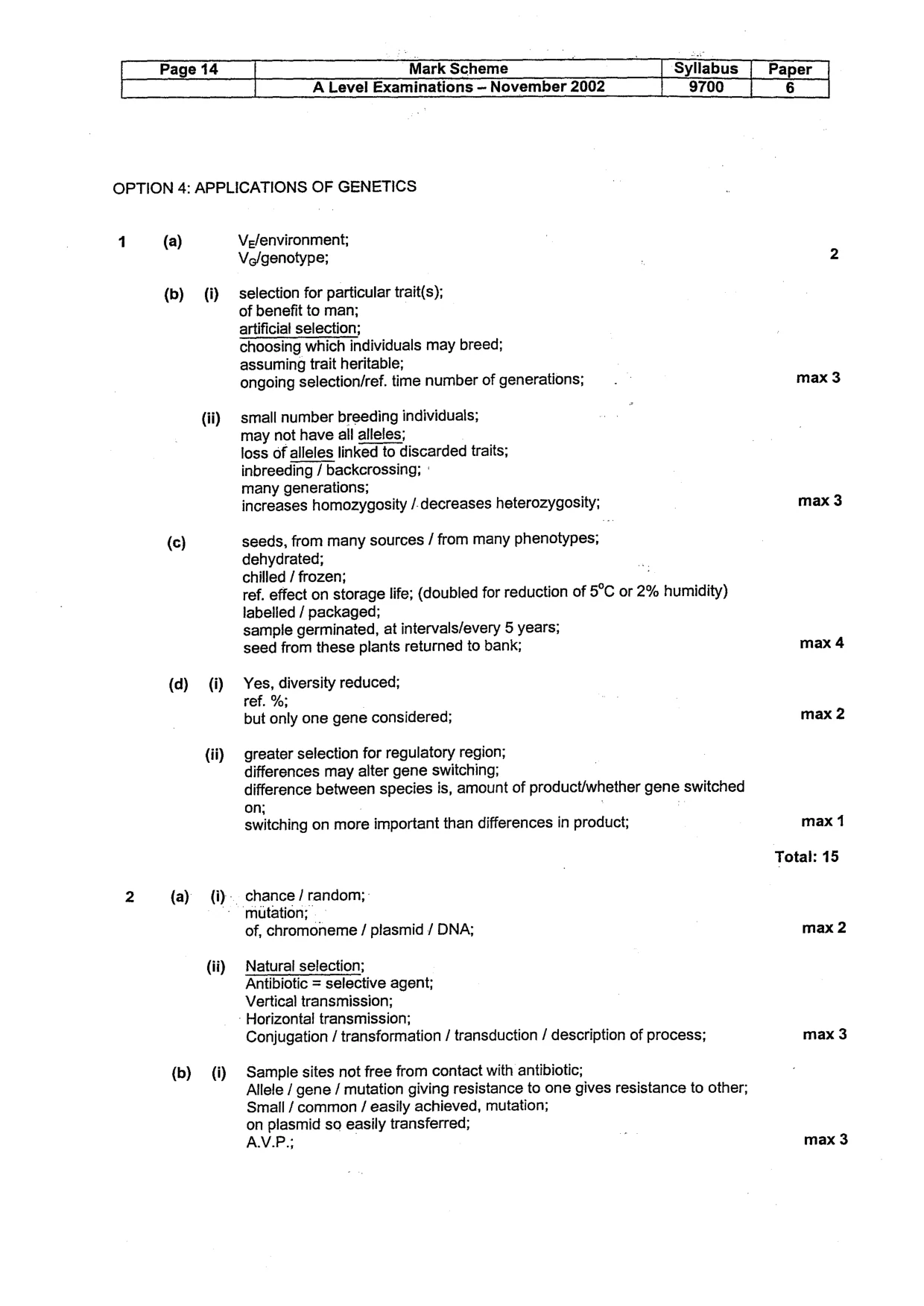
Paper [Page 14 | Mark Scheme ; Syllabus A Level Examinations — November 2002 9700 [6 OPTION 4: APPLICATIONS OF GENETICS 1 (a) (b) (c) (d) 2 (a) (b) (i (ii) (i) (ii) (iy (ii) (i) V-/environment; Ve/genotype; selection for particular trait(s); of benefit to man; artificial selection; choosing which individuals may breed; assuming trait heritable; ongoing selection/ref. time number of generations; small number breeding individuals; may not have all alleles; loss of alleles linked to discarded traits; inbreeding / backcrossing; « many generations; increases homozygosity /. decreases heterozygosity; seeds, from many sources / from many phenotypes, dehydrated; chilled / frozen; ref. effect on storage life; (doubled for reduction of 5°C or 2% humidity) labelled / packaged; sample germinated, at intervals/every 5 years; seed from these plants returned to bank; Yes, diversity reduced; ref. %; but only one gene considered; greater selection for regulatory region; differences may alter gene switching; difference between species is, amount of product/whether gene switched on; switching on more important than differences in product; chance / random; mutation; of, chromoneme / plasmid / DNA; Natural selection; Antibiotic = selective agent; Vertical transmission; Horizontal transmission; Conjugation / transformation / transduction / description of process; Sample sites not free from contact with antibiotic; Allele / gene / mutation giving resistance to one gives resistance to other; Small / common / easily achieved, mutation; on plasmid so easily transferred; ANP; max 3 max 3 max 4 max 2 max 1 Total: 15 max 2 max 3 max 3
Mark scheme, page 16
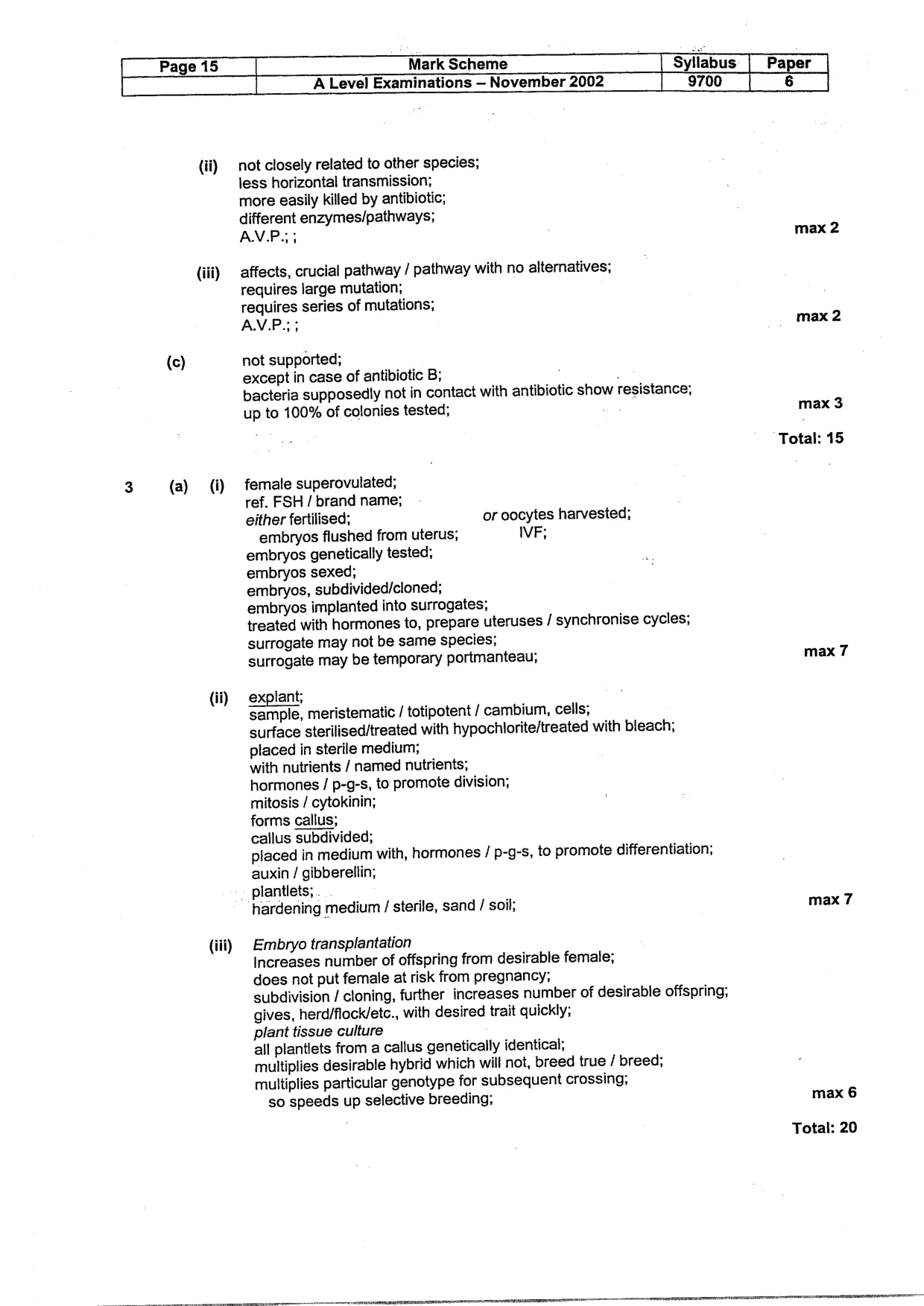
Page 15 Mark Scheme ; Syllabus Papei A Level Examinations — November 2002 9700 (c) 3 (a) (ii) (iii) (i) (ii) (iii) not closely related to other species; less horizontal transmission; more easily killed by antibiotic; different enzymes/pathways; ANP. affects, crucial pathway / pathway with no alternatives; requires large mutation; requires series of mutations; AN.P. not supported; except in case of antibiotic B; . bacteria supposedly not in contact with antibiotic show resistance; up to 100% of colonies tested; female superovulated; ref. FSH / brand name; either fertilised; or oocytes harvested; embryos flushed from uterus; IVF; embryos genetically tested; embryos sexed; embryos, subdivided/cloned; embryos implanted into surrogates; treated with hormones to, prepare uteruses / synchronise cycles; surrogate may not be same species; surrogate may be temporary portmanteau; explant; sample, meristematic / totipotent / cambium, cells; surface sterilised/treated with hypochlorite/treated with bleach; placed in sterile medium; with nutrients / named nutrients, hormones / p-g-s, to promote division; mitosis / cytokinin; forms callus; callus subdivided; placed in medium with, hormones / p-g-s, to promote differentiation; auxin / gibberellin; plantlets; hardening medium / sterile, sand / soil; Embryo transplantation Increases number of offspring from desirable female; does not put female at risk from pregnancy; subdivision / cloning, further increases number of desirable offspring; gives, herd/flock/etc., with desired trait quickly; plant tissue culture all plantlets from a callus genetically identical; multiplies desirable hybrid which will not, breed true / breed; multiplies particular genotype for subsequent crossing; so speeds up selective breeding; max 2 max 2 max 3 Total: 15 max 7 max 7 max 6 Total: 20
Mark scheme, page 17
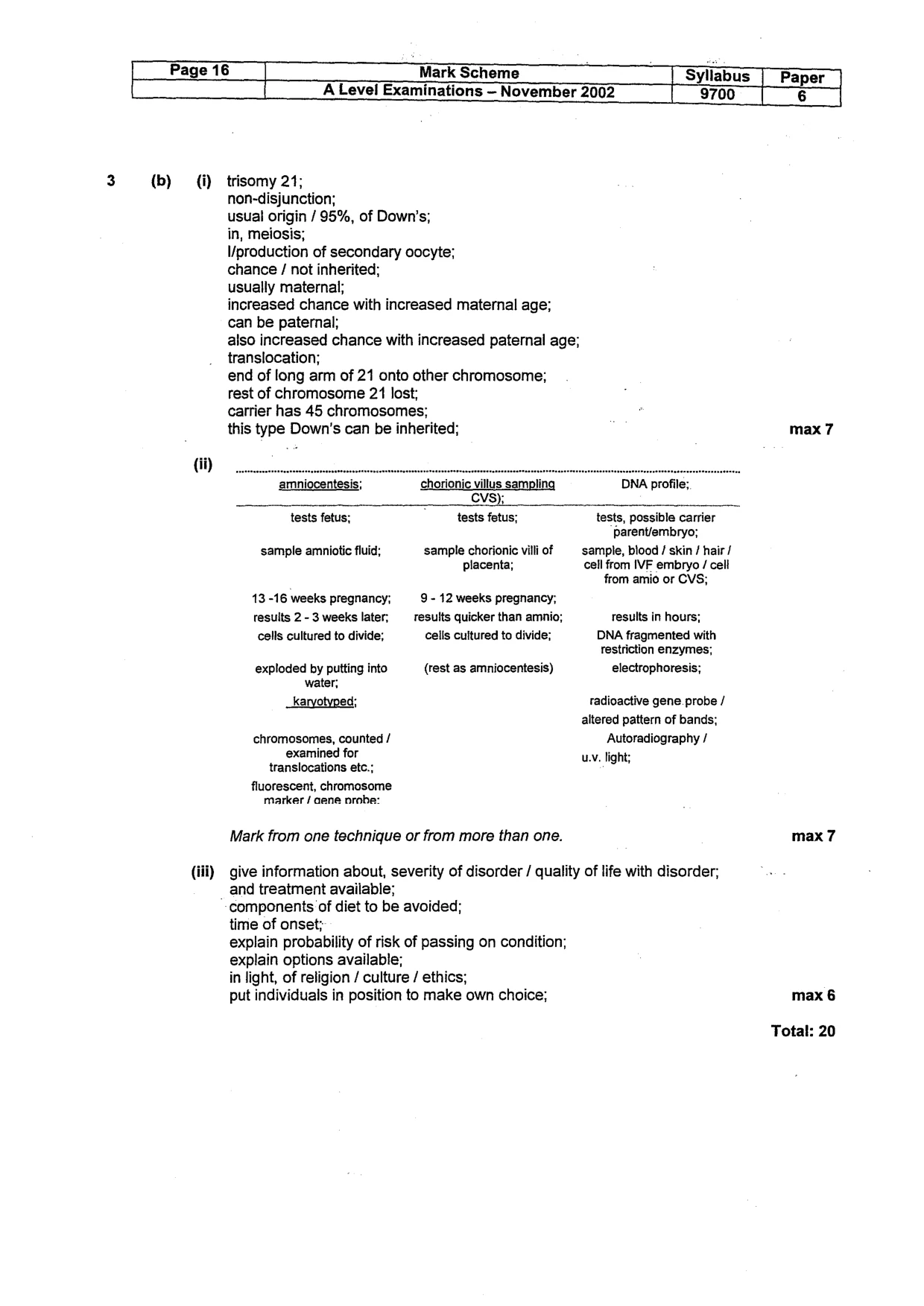
Page 16 Mark Scheme A Level Examinations —- November 2002 = Syllabus Paper 9700 6 (b) (i) trisomy 21; non-disjunction; usual origin / 95%, of Down’s; in, meiosis; production of secondary oocyte; chance / not inherited; usually maternal; increased chance with increased maternal age; can be paternal; also increased chance with increased paternal age; translocation; end of long arm of 21 onto other chromosome; rest of chromosome 21 lost; carrier has 45 chromosomes; this type Down's can be inherited; max 7 (ii) se chorionic villus sampling DNA profile;. Cvs); _ tests fetus; tests fetus; tests, possible carrier parentlembryo; sample amniotic fluid; sample chorionic villi of sample, blood / skin / hair / placenta; cell from IVF embryo / cell from amio or CVS; 13 -16 weeks pregnancy; 9- 12 weeks pregnancy; results 2 - 3 weeks later; results quicker than amnio; results in hours; cells cultured to divide; cells cultured to divide; DNA fragmented with restriction enzymes; exploded by putting into (rest as amniocentesis) electrophoresis; water; karyotyped; radioactive gene probe / altered pattern of bands; chromosomes, counted / Autoradiography / examined for wy. light; translocations etc.; fluorescent, chromosome marker / aene nrobe: Mark from one technique or from more than one. max7 (iii) give information about, severity of disorder / quality of life with disorder; and treatment available; components of diet to be avoided; time of onset; explain probability of risk of passing on condition; explain options available; in light, of religion / culture / ethics; put individuals in position to make own choice; max 6 Total: 20