Cambridge A Level Biology 9700 — 2002 Oct/Nov Paper 4 · Variant 1
9700/41/O/N/02
The question paper and its mark scheme, free to read here and free to download. This is Cambridge’s own paper, exactly as it was sat.
Question paper12 pages

Mark scheme5 pages
Answers below. Sit the paper first if you are practising.
Paper as text
Question paper, page 1
This question paper consists of 12 printed pages. SP (SM/SLC) S29591/4 © CIE 2002 [Turn over CAMBRIDGE INTERNATIONAL EXAMINATIONS General Certificate of Education Advanced Level BIOLOGY 9700/4 PAPER 4 OCTOBER/NOVEMBER SESSION 2002 1 hour Candidates answer on the question paper. No additional materials are required. TIME 1 hour INSTRUCTIONS TO CANDIDATES Write your name, Centre number and candidate number in the spaces at the top of this page. Answer all questions. Write your answers in the spaces provided on the question paper. All working for numerical answers must be shown. INFORMATION FOR CANDIDATES The intended number of marks is given in brackets [ ] at the end of each question or part question. Candidate Centre Number Number Candidate Name FOR EXAMINER’S USE TOTAL 1 2 3 4 5
Question paper, page 2
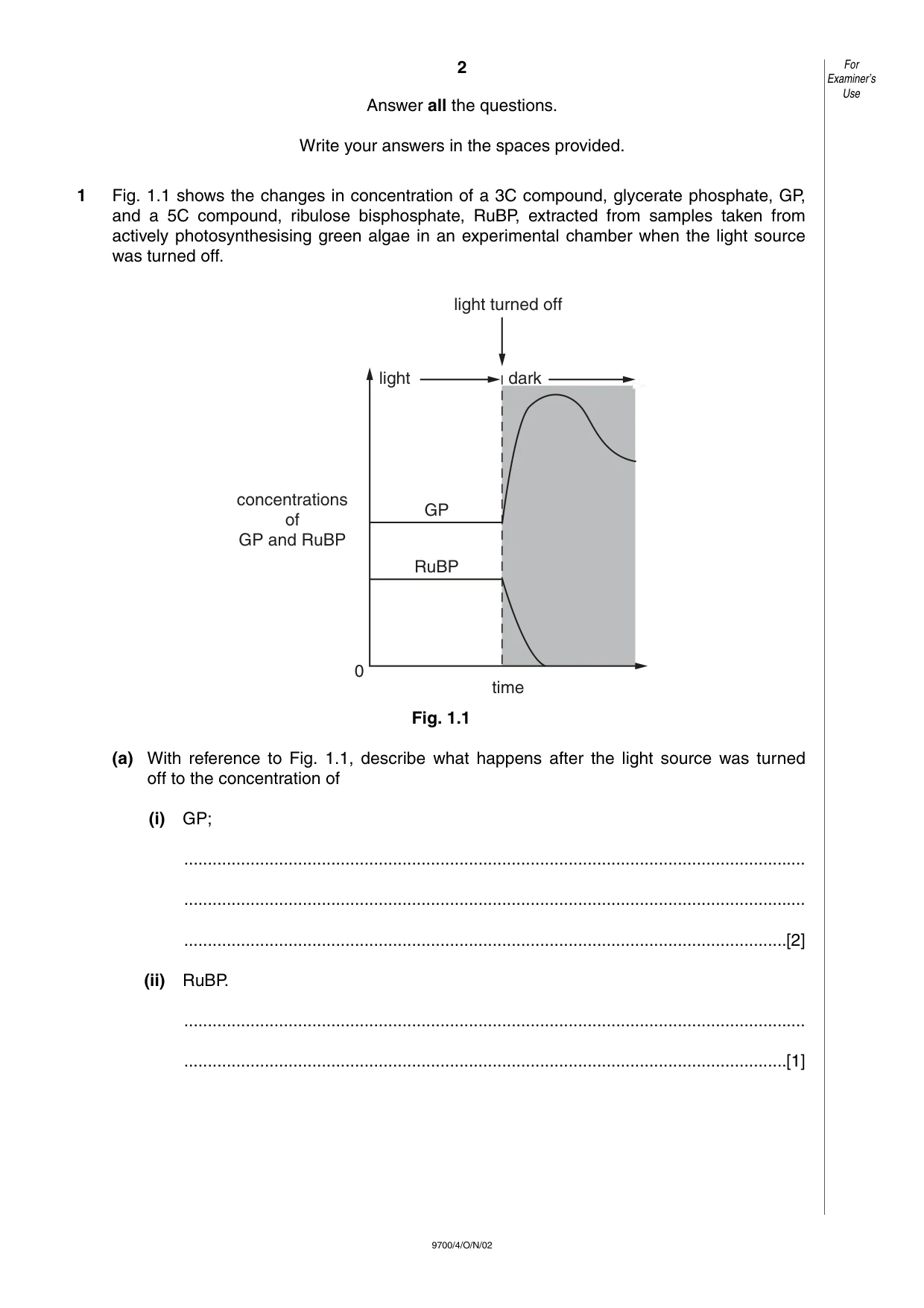
2 9700/4/O/N/02 Answer all the questions. Write your answers in the spaces provided. 1 Fig. 1.1 shows the changes in concentration of a 3C compound, glycerate phosphate, GP, and a 5C compound, ribulose bisphosphate, RuBP, extracted from samples taken from actively photosynthesising green algae in an experimental chamber when the light source was turned off. Fig. 1.1 (a) With reference to Fig. 1.1, describe what happens after the light source was turned off to the concentration of (i) GP; … … …[2] (ii) RuBP. … …[1] concentrations of GP and RuBP GP RuBP time light turned off 0 light dark For Examiner’s Use
Question paper, page 3
3 9700/4/O/N/02 [Turn over (b) Explain, with reference to the Calvin cycle, the reasons for these observed changes in (i) GP; … … …[2] (ii) RuBP. … … …[2] (c) State the two products of photophosphorylation that drive the Calvin cycle. 1. … 2. …[2] [Total : 9] For Examiner’s Use
Question paper, page 4
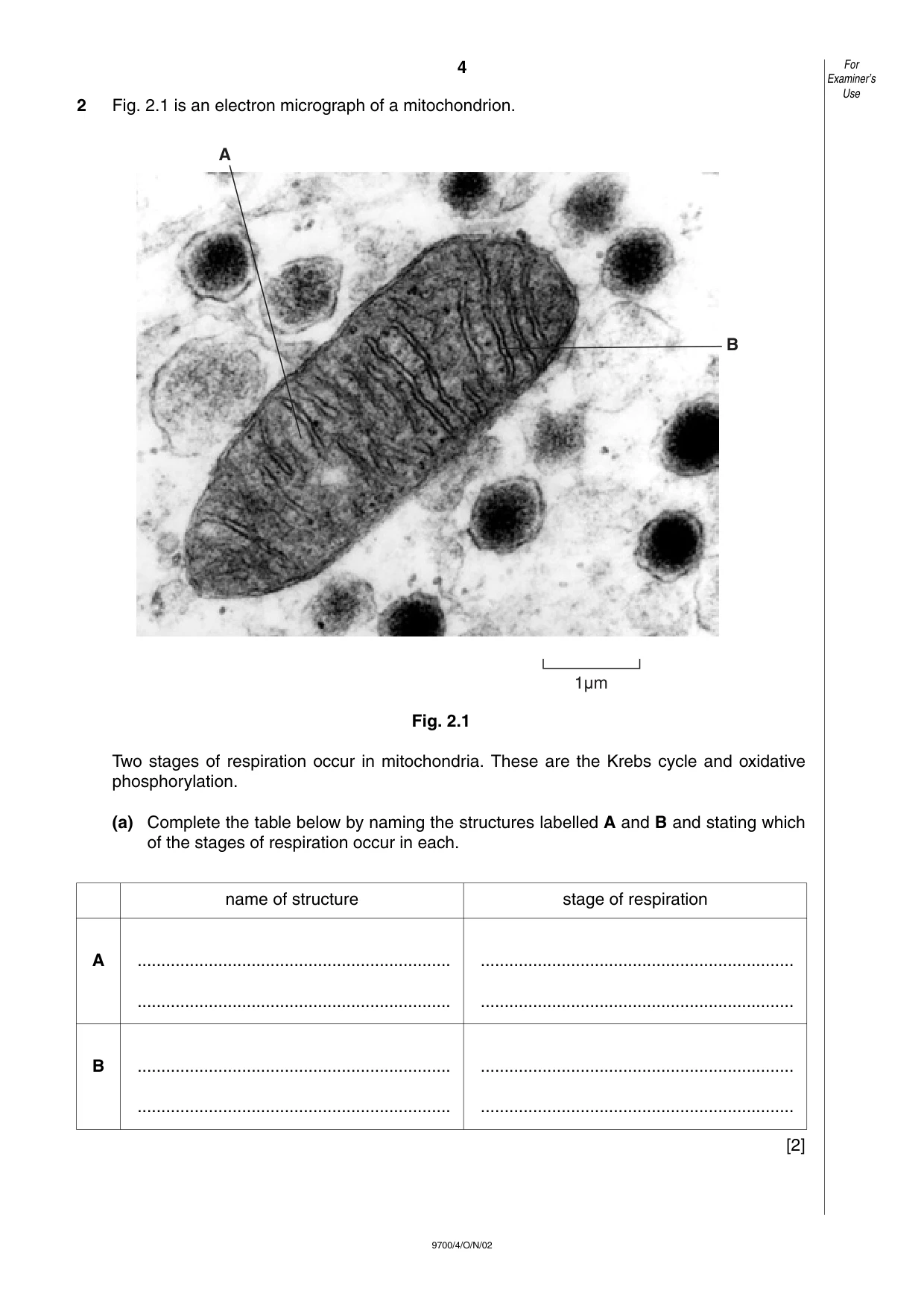
4 9700/4/O/N/02 2 Fig. 2.1 is an electron micrograph of a mitochondrion. Fig. 2.1 Two stages of respiration occur in mitochondria. These are the Krebs cycle and oxidative phosphorylation. (a) Complete the table below by naming the structures labelled A and B and stating which of the stages of respiration occur in each. [2] A B For Examiner’s Use A B name of structure … … … … … … … … stage of respiration
Question paper, page 5
5 9700/4/O/N/02 [Turn over (b) Describe how the structure of a mitochondrion is adapted to carry out these two processes. … … … …[3] (c) Describe briefly the role of NAD in respiration. … … … …[3] (d) Describe how photophosphorylation differs from oxidative phosphorylation. … … … …[3] [Total : 11] For Examiner’s Use
Question paper, page 6
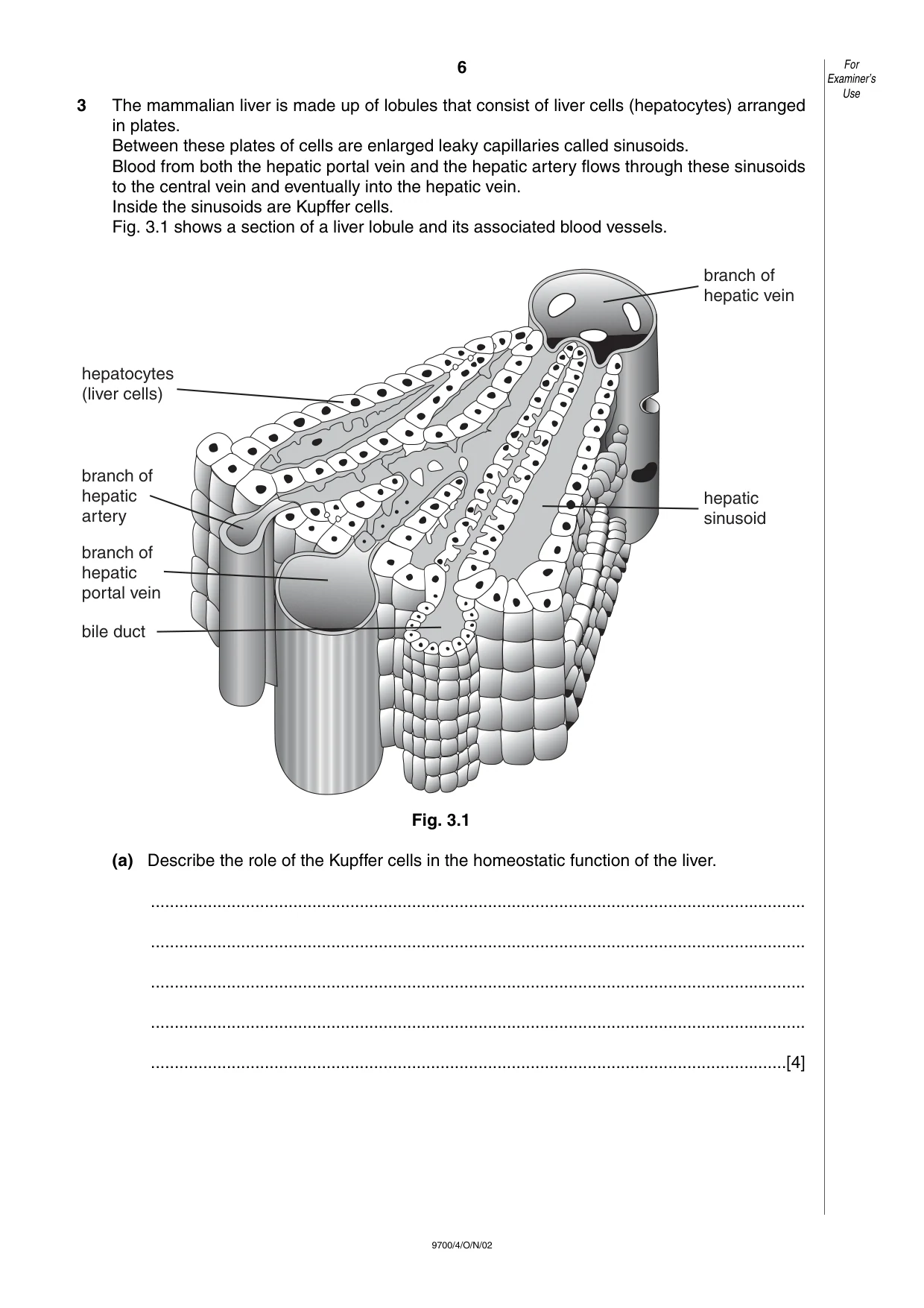
6 9700/4/O/N/02 3 The mammalian liver is made up of lobules that consist of liver cells (hepatocytes) arranged in plates. Between these plates of cells are enlarged leaky capillaries called sinusoids. Blood from both the hepatic portal vein and the hepatic artery flows through these sinusoids to the central vein and eventually into the hepatic vein. Inside the sinusoids are Kupffer cells. Fig. 3.1 shows a section of a liver lobule and its associated blood vessels. Fig. 3.1 (a) Describe the role of the Kupffer cells in the homeostatic function of the liver. … … … … …[4] hepatocytes (liver cells) branch of hepatic artery branch of hepatic vein hepatic sinusoid branch of hepatic portal vein bile duct For Examiner’s Use
Question paper, page 7
7 9700/4/O/N/02 [Turn over (b) State how liver cells are involved in fat metabolism. … … … …[3] (c) Explain how urea produced by liver cells from the deamination of excess amino acids is transported to the kidney for excretion. … … …[2] (d) State how blood in the hepatic vein will differ after a heavy meal from blood in (i) the hepatic portal vein; … …[1] (ii) the hepatic artery. … …[1] [Total : 11] For Examiner’s Use
Question paper, page 8
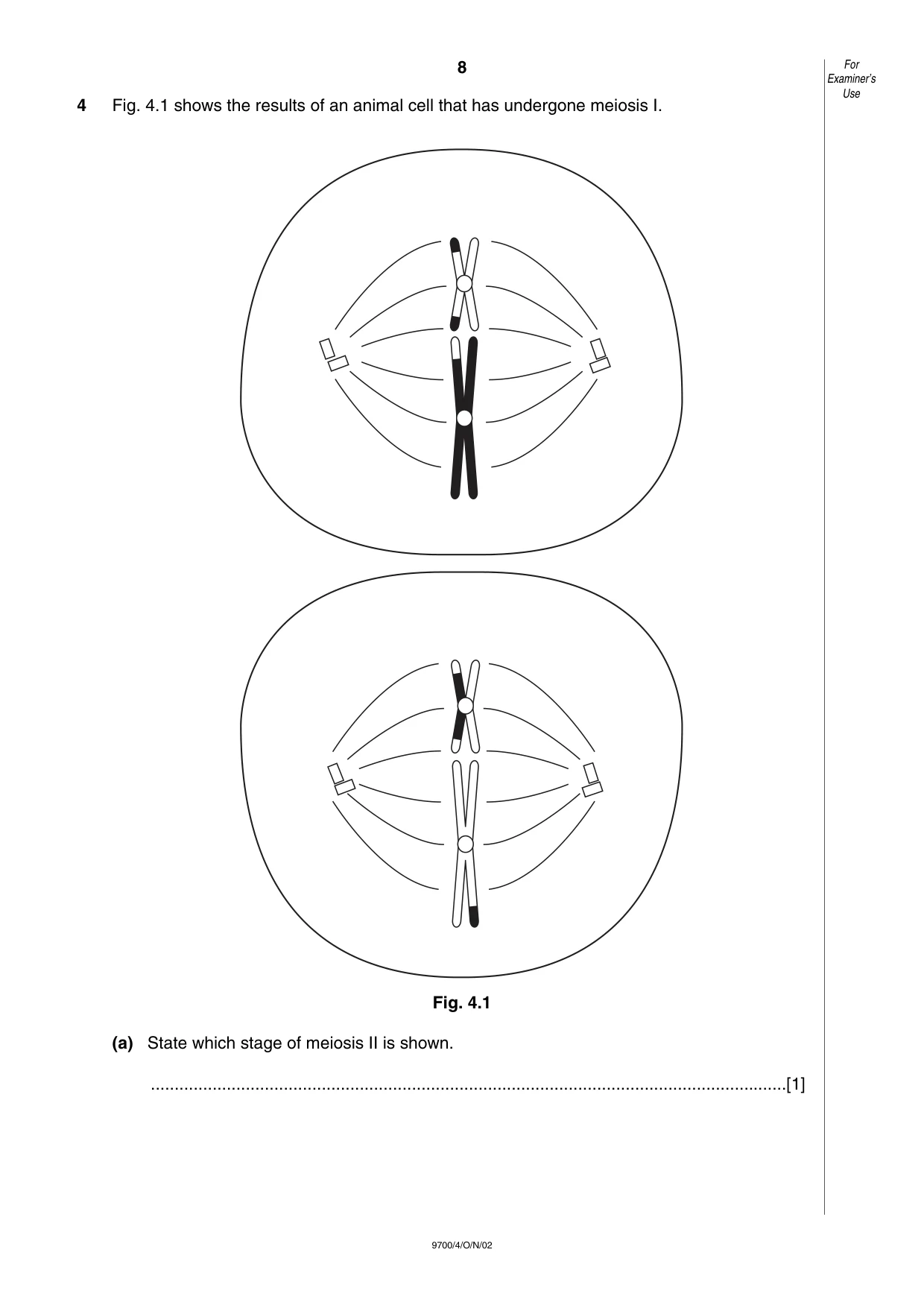
8 9700/4/O/N/02 4 Fig. 4.1 shows the results of an animal cell that has undergone meiosis I. Fig. 4.1 (a) State which stage of meiosis II is shown. …[1] For Examiner’s Use
Question paper, page 9
9 9700/4/O/N/02 [Turn over (b) Describe the next stage of meiosis II. … … … …[3] (c) Describe what has happened before the start of meiosis to (i) the nuclear membrane; … …[1] (ii) the centrioles. … …[2] (d) Name and explain two ways in which meiosis can lead to variation. 1. … … … 2. … … …[4] [Total : 11] For Examiner’s Use
Question paper, page 10
10 9700/4/O/N/02 5 Scallops, which are bivalve molluscs, are important commercially throughout the world. The marine bay scallop, Agropecten irradians, has three distinct shell colours, yellow, orange and black. The shell colour is controlled by a gene with three alleles, yellow, Sy, orange, So, and black, Sb. Scallops are hermaphrodite and are able to fertilise themselves to produce offspring. Single mature adult specimens of yellow, orange and black scallops were collected and kept in separate tanks of seawater until they produced young. The young were then scored for shell colour. The results were as follows. yellow scallop – 25 yellow and 8 black orange scallop – 31 orange and 9 black black scallop – 27 black (a) Explain the results from the orange and black scallops, using the symbols given. … … … [6] For Examiner’s Use
Question paper, page 11
11 9700/4/O/N/02 (b) Orange scallops are more valued for human consumption. Describe how a marine biologist could produce a pure-breeding line of orange scallops for commercial exploitation using the offspring from the single orange scallop. … … … …[2] [Total : 8] For Examiner’s Use
Question paper, page 12
12 9700/4/O/N/02 Copyright Acknowledgements: Question 3. S. Siddiqui, Comprehensive Practical Biology for A Level, Ferez and Sons, 1999. Cambridge International Examinations has made every effort to trace copyright holders, but if we have inadvertently overlooked any we will be pleased to make the necessary arrangements at the first opportunity.
Mark scheme, page 1
CAMBRIDGE INTERNATIONAL EXAMINATIONS NOVEMBER 2002 GCE Advanced Level UNIVERSITY of CAMBRIDGE Local Examinations Syndicate
Mark scheme, page 2
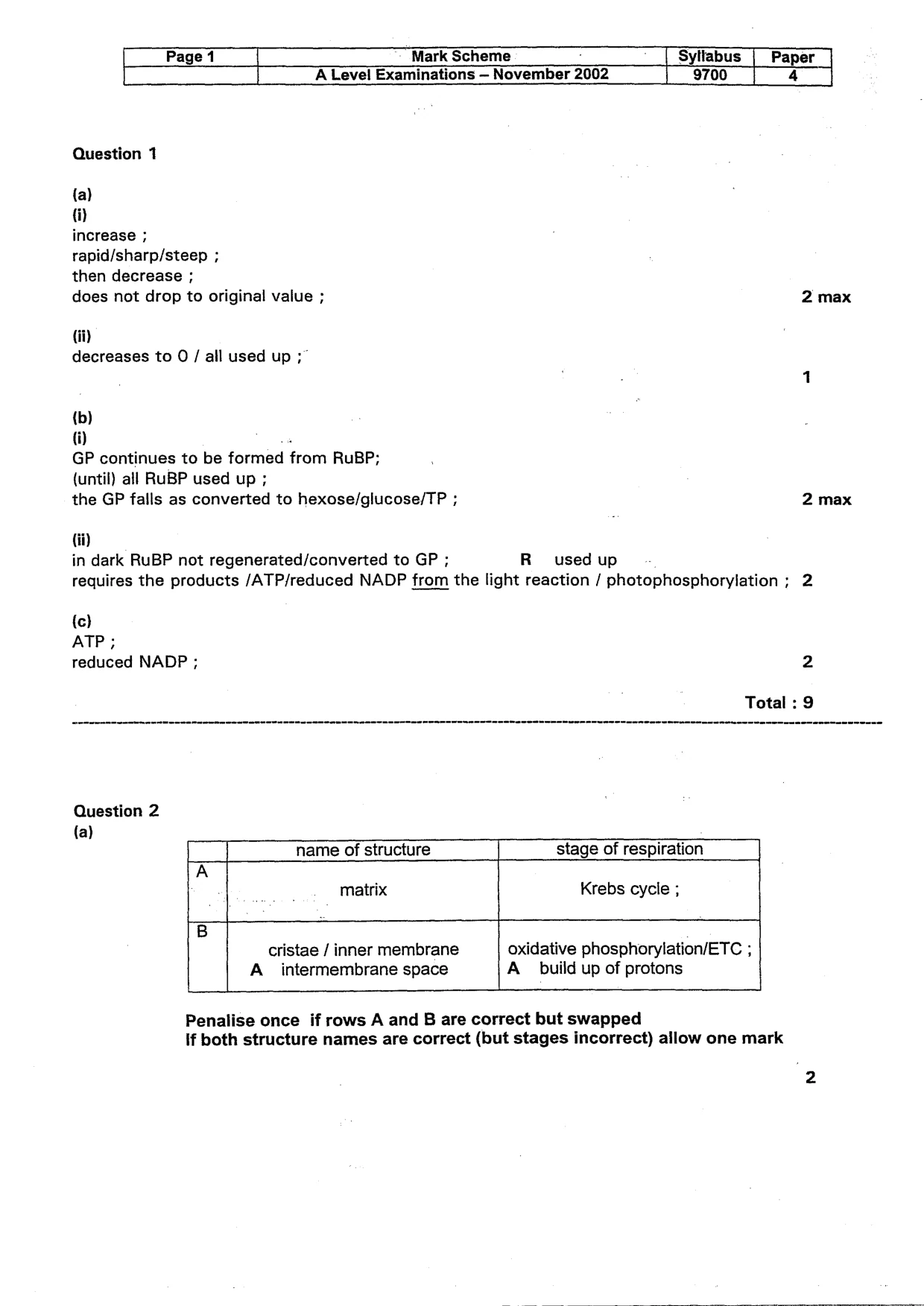
Page 1 Mark Scheme : Syllabus | Paper | I A Level Examinations — November 2002 9700 | 4 | Question 1 (a) (i) increase ; rapid/sharp/steep ; then decrease ; does not drop to original value ; 2 max (ii) decreases to O / all used up ; 1 (b) (i) “ GP continues to be formed from RuBP; (until) all RUBP used up ; the GP falls as converted to hexose/glucose/TP ; 2 max (ii) in dark RuBP not regenerated/converted to GP ; R_ used up requires the products /ATP/reduced NADP from the light reaction / photophosphorylation ; 2 (c) ATP; reduced NADP ; 2 Total: 9 Question 2 (a) name of structure stage of respiration A matrix Krebs cycle ; B cristae / inner membrane oxidative phosphorylation/ETC ; A intermembrane space A build up of protons Penalise once if rows A and B are correct but swapped If both structure names are correct (but stages incorrect) allow one mark
Mark scheme, page 3
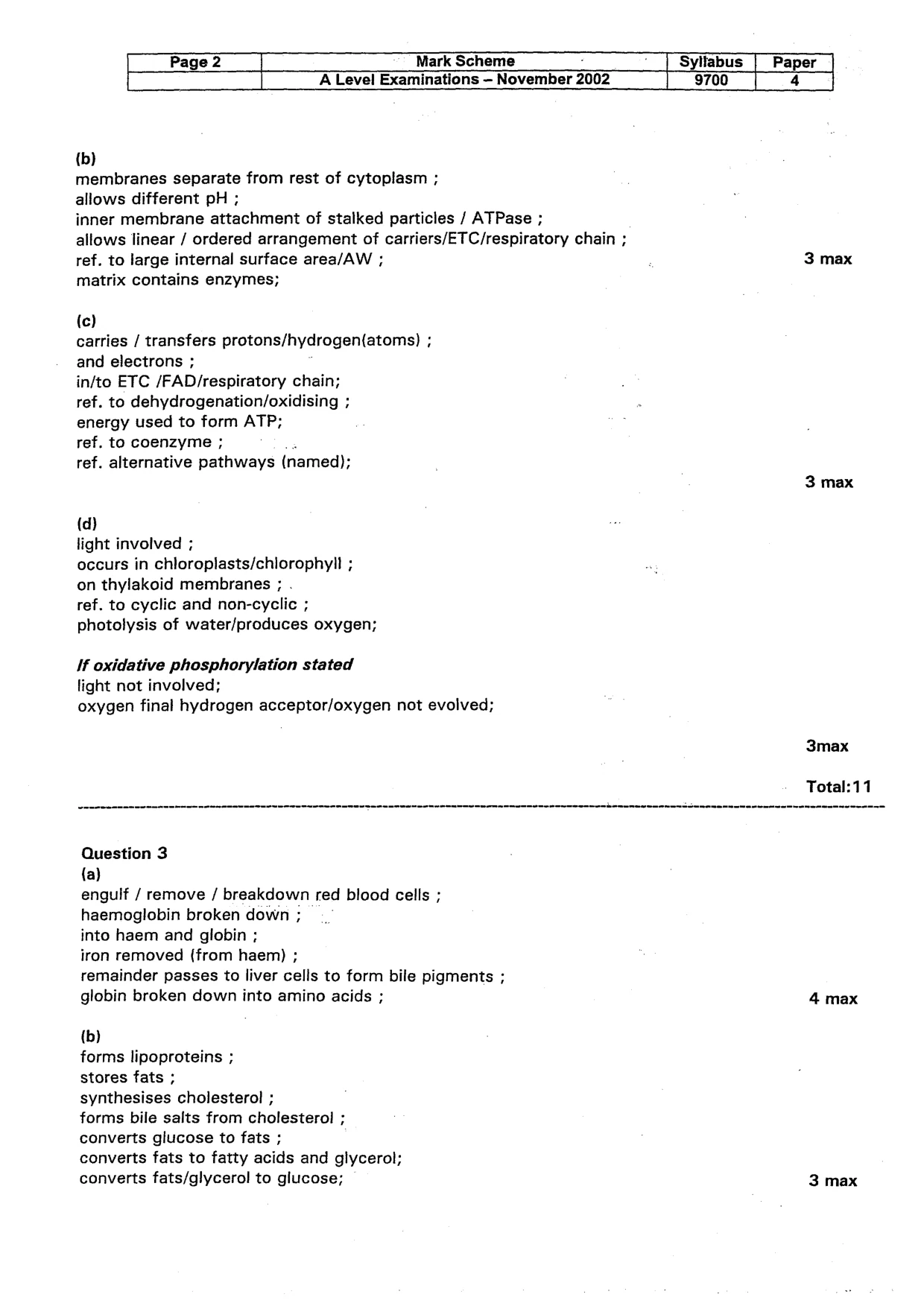
[ Page 2 | Mark Scheme = Sylfabus | Paper | { | A Level Examinations — November 2002 9700 4 i (b) membranes separate from rest of cytoplasm ; allows different pH ; inner membrane attachment of stalked particles / ATPase ; allows linear / ordered arrangement of carriers/ETC/respiratory chain ; ref. to large internal surface area/AW ; 3 max matrix contains enzymes; (c) carries / transfers protons/hydrogen(atoms) ; and electrons ; in/to ETC /FAD/respiratory chain; ref. to dehydrogenation/oxidising ; energy used to form ATP; ref. to coenzyme ; . ref. alternative pathways (named); 3 max (d) light involved ; occurs in chloroplasts/chlorophyll ; on thylakoid membranes ; ref. to cyclic and non-cyclic ; photolysis of water/produces oxygen; If oxidative phosphorylation stated light not involved; oxygen final hydrogen acceptor/oxygen not evolved; Question 3 (a) engulf / remove / breakdown red blood cells ; haemoglobin broken down ; into haem and globin ; iron removed (from haem) ; remainder passes to liver cells to form bile pigments ; globin broken down into amino acids ; 4 max (b) forms lipoproteins ; stores fats ; synthesises cholesterol ; forms bile salts from cholesterol ; converts glucose to fats ; converts fats to fatty acids and glycerol; converts fats/glycerol to glucose; 3 max
Mark scheme, page 4
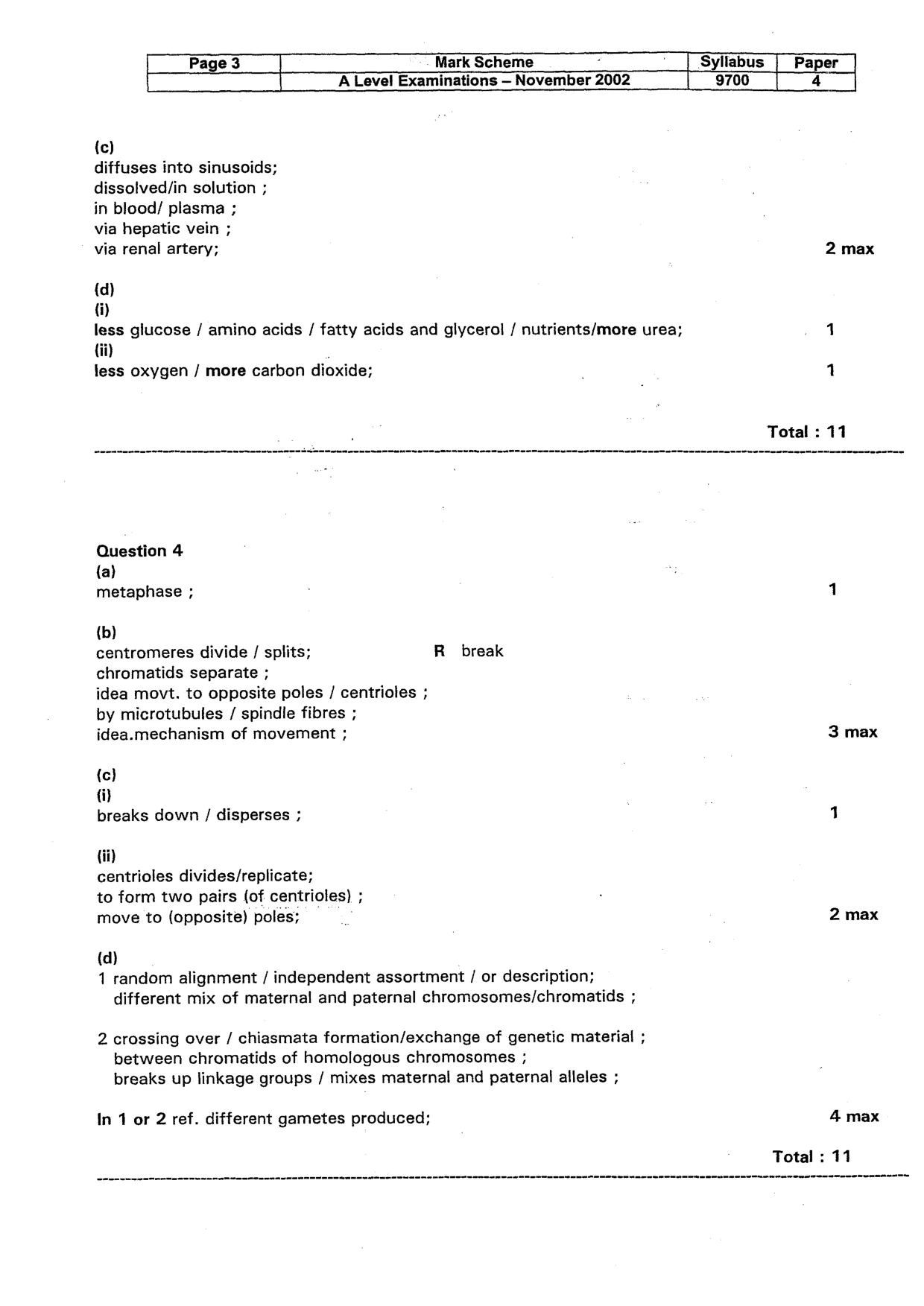
Page 3 I Mark Scheme : Syllabus | Paper A Level Examinations — November 2002 [9700 4 | (c) diffuses into sinusoids; dissolved/in solution ; in blood/ plasma ; via hepatic vein ; via renal artery; 2 max {d) (i) less glucose / amino acids / fatty acids and glycerol / nutrients/more urea; 1 (ii) less oxygen / more carbon dioxide; 1 Question 4 (a) metaphase ; 1 (b) centromeres divide / splits; R_ break chromatids separate ; idea movt. to opposite poles / centrioles ; by microtubules / spindle fibres ; idea.mechanism of movement ; 3 max (c} (i) breaks down / disperses ; 1 (ii) centrioles divides/replicate; to form two pairs (of centrioles) } move to (opposite) poles; . 2 max (d) 1 random alignment / independent assortment / or description; different mix of maternal and paternal chromosomes/chromatids ; 2 crossing over / chiasmata formation/exchange of genetic material ; between chromatids of homologous chromosomes ; breaks up linkage groups / mixes maternal and paternal alleles ; In 1 or 2 ref. different gametes produced; 4 max Total : 11
Mark scheme, page 5
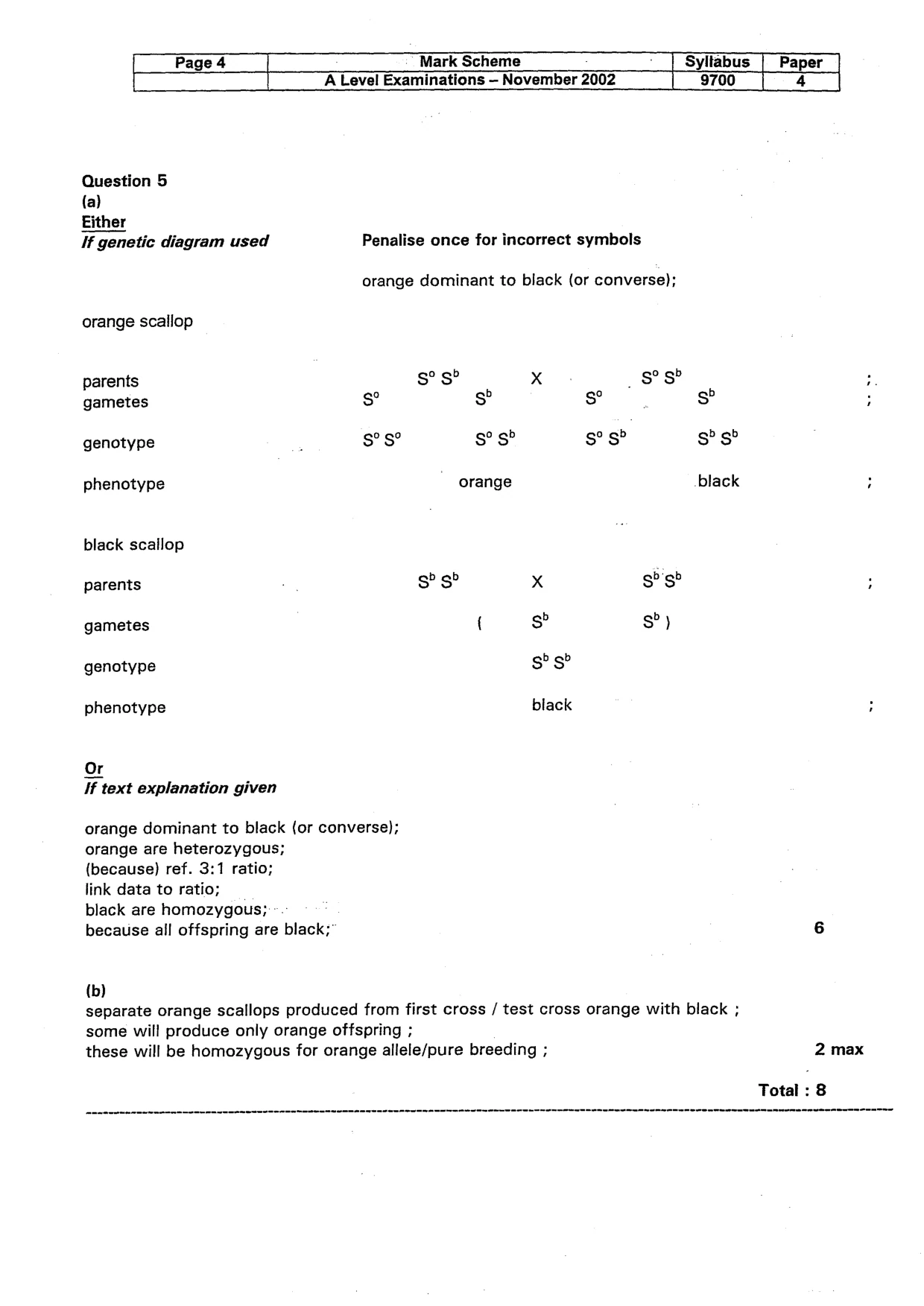
Page 4 Mark Scheme A Level Examinations — November 2002 9700 Syltabus | Paper | 4 | Question 5 (a) Either If genetic diagram used orange scallop parents gametes genotype phenotype black scallop parents gametes genotype phenotype Or If text explanation given Penalise once for incorrect symbols orange dominant to black (or converse); s°s? s s s°s? ses? orange s’s? orange dominant to black (or converse); orange are heterozygous; (because) ref. 3:1 ratio; link data to ratio; black are homozygous; because all offspring are black;” (b) separate orange scallops produced from first cross / test cross orange with black ; some will produce only orange offspring ; these will be homozygous for orange allele/pure breeding ; x _s°s? s° s> ses? ss? black x ss? s° a) ss? black