Cambridge A Level Accounting 9706 — 2015 May/June Paper 4 · Variant 1
9706/41/M/J/15 · 120 marks · ≈135 min
The question paper and its mark scheme, free to read here and free to download. This is Cambridge’s own paper, exactly as it was sat.
Question paper12 pages


Mark scheme7 pages
Answers below. Sit the paper first if you are practising.
Paper as text
Question paper, page 1
This document consists of 10 printed pages, 2 blank pages and 1 insert. IB15 06_9706_41/5RP © UCLES 2015 [Turn over *2140323821* Cambridge International Examinations Cambridge International Advanced Subsidiary and Advanced Level ACCOUNTING 9706/41 Paper 4 Problem Solving (Supplementary Topics) May/June 2015 2 hours No Additional Materials are required. READ THESE INSTRUCTIONS FIRST An answer booklet is provided inside this question paper. You should follow the instructions on the front cover of the answer booklet. If you need additional answer paper ask the invigilator for a continuation booklet. Answer all questions. All accounting statements are to be presented in good style. International accounting terms and formats should be used as appropriate. Workings should be shown. You may use a calculator. The number of marks is given in brackets [ ] at the end of each question or part question.
Question paper, page 2
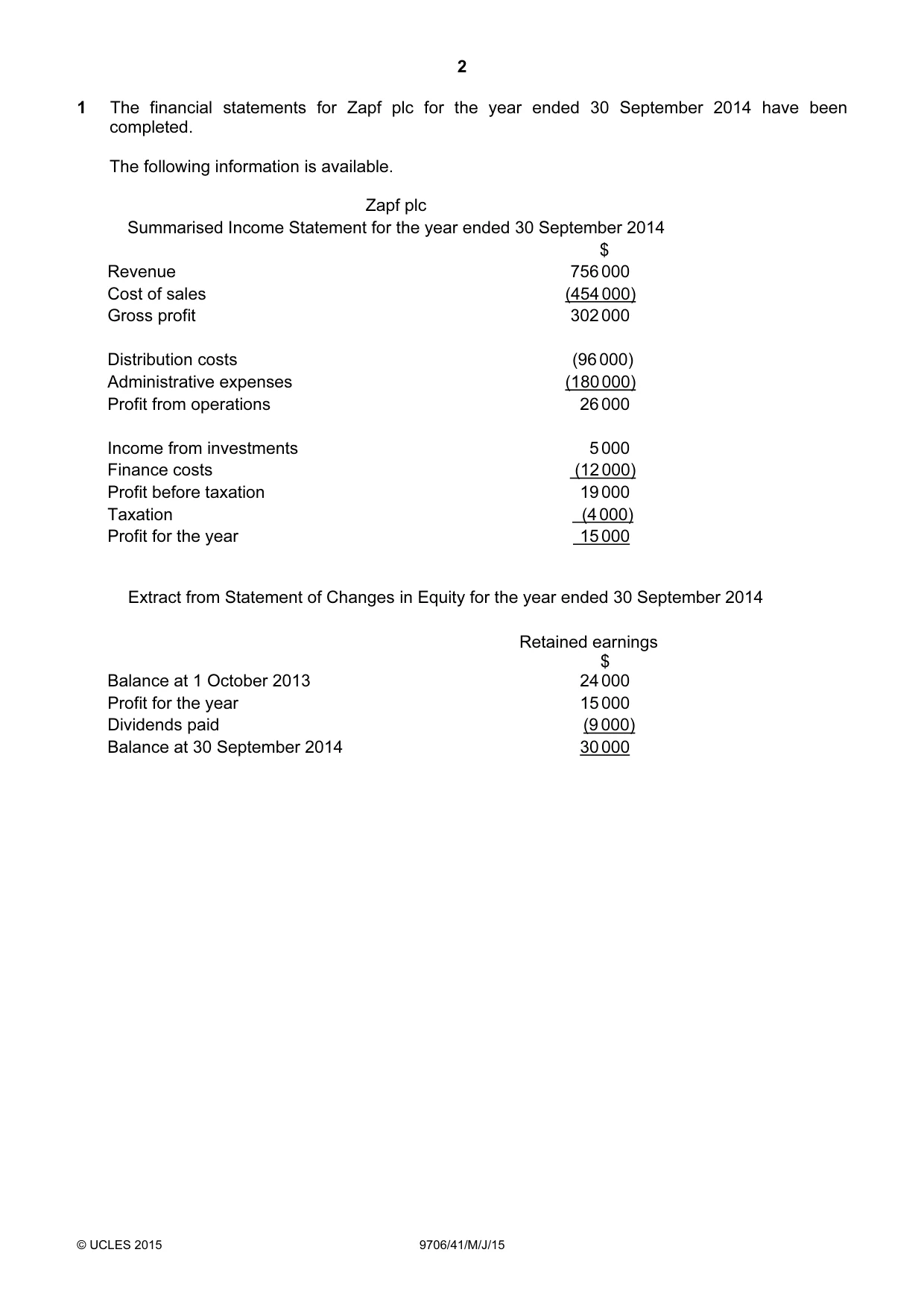
2 © UCLES 2015 9706/41/M/J/15 1 The financial statements for Zapf plc for the year ended 30 September 2014 have been completed. The following information is available. Zapf plc Summarised Income Statement for the year ended 30 September 2014 $ Revenue 756 000 Cost of sales (454 000) Gross profit 302 000 Distribution costs (96 000) Administrative expenses (180 000) Profit from operations 26 000 Income from investments 5 000 Finance costs (12 000) Profit before taxation 19 000 Taxation (4 000) Profit for the year 15 000 Extract from Statement of Changes in Equity for the year ended 30 September 2014 Retained earnings $ Balance at 1 October 2013 24 000 Profit for the year 15 000 Dividends paid (9 000) Balance at 30 September 2014 30 000
Question paper, page 3
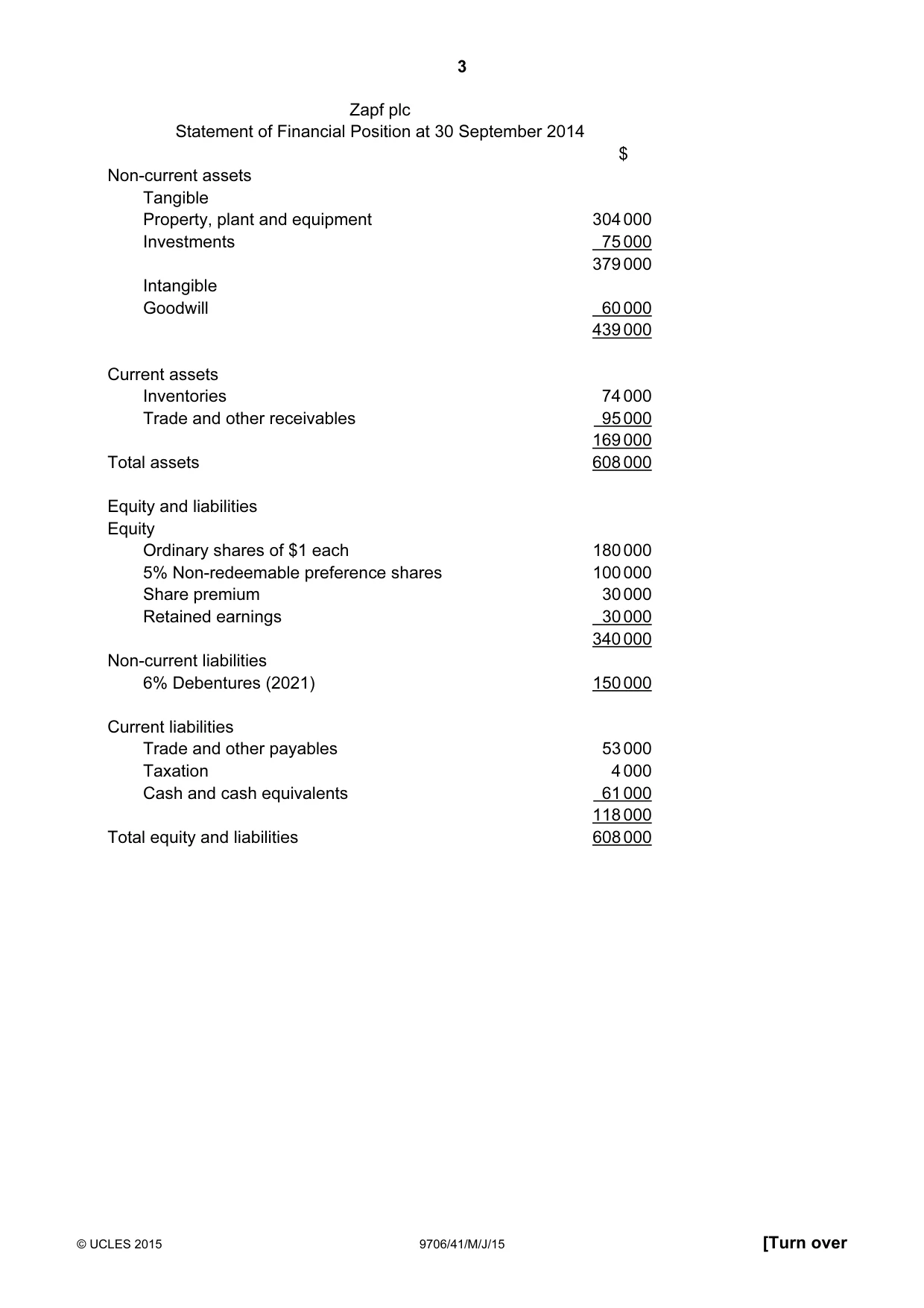
3 © UCLES 2015 9706/41/M/J/15 [Turn over Zapf plc Statement of Financial Position at 30 September 2014 $ Non-current assets Tangible Property, plant and equipment 304 000 Investments 75 000 379 000 Intangible Goodwill 60 000 439 000 Current assets Inventories 74 000 Trade and other receivables 95 000 169 000 Total assets 608 000 Equity and liabilities Equity Ordinary shares of $1 each 180 000 5% Non-redeemable preference shares 100 000 Share premium 30 000 Retained earnings 30 000 340 000 Non-current liabilities 6% Debentures (2021) 150 000 Current liabilities Trade and other payables 53 000 Taxation 4 000 Cash and cash equivalents 61 000 118 000 Total equity and liabilities 608 000
Question paper, page 4
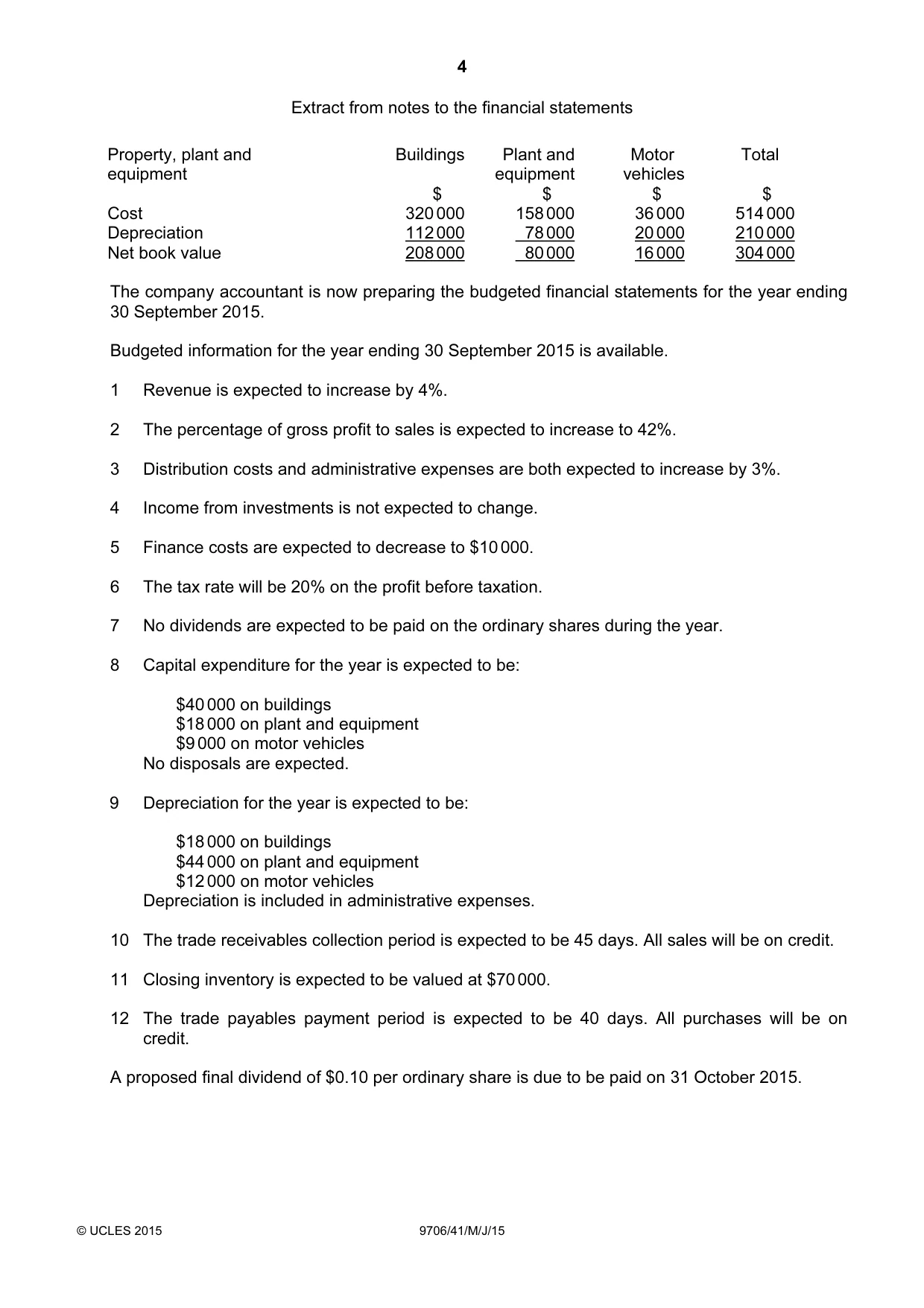
4 © UCLES 2015 9706/41/M/J/15 Extract from notes to the financial statements Property, plant and equipment Buildings Plant and equipment Motor vehicles Total $ $ $ $ Cost 320 000 158 000 36 000 514 000 Depreciation 112 000 78 000 20 000 210 000 Net book value 208 000 80 000 16 000 304 000 The company accountant is now preparing the budgeted financial statements for the year ending 30 September 2015. Budgeted information for the year ending 30 September 2015 is available. 1 Revenue is expected to increase by 4%. 2 The percentage of gross profit to sales is expected to increase to 42%. 3 Distribution costs and administrative expenses are both expected to increase by 3%. 4 Income from investments is not expected to change. 5 Finance costs are expected to decrease to $10 000. 6 The tax rate will be 20% on the profit before taxation. 7 No dividends are expected to be paid on the ordinary shares during the year. 8 Capital expenditure for the year is expected to be: $40 000 on buildings $18 000 on plant and equipment $9 000 on motor vehicles No disposals are expected. 9 Depreciation for the year is expected to be: $18 000 on buildings $44 000 on plant and equipment $12 000 on motor vehicles Depreciation is included in administrative expenses. 10 The trade receivables collection period is expected to be 45 days. All sales will be on credit. 11 Closing inventory is expected to be valued at $70 000. 12 The trade payables payment period is expected to be 40 days. All purchases will be on credit. A proposed final dividend of $0.10 per ordinary share is due to be paid on 31 October 2015.
Question paper, page 5
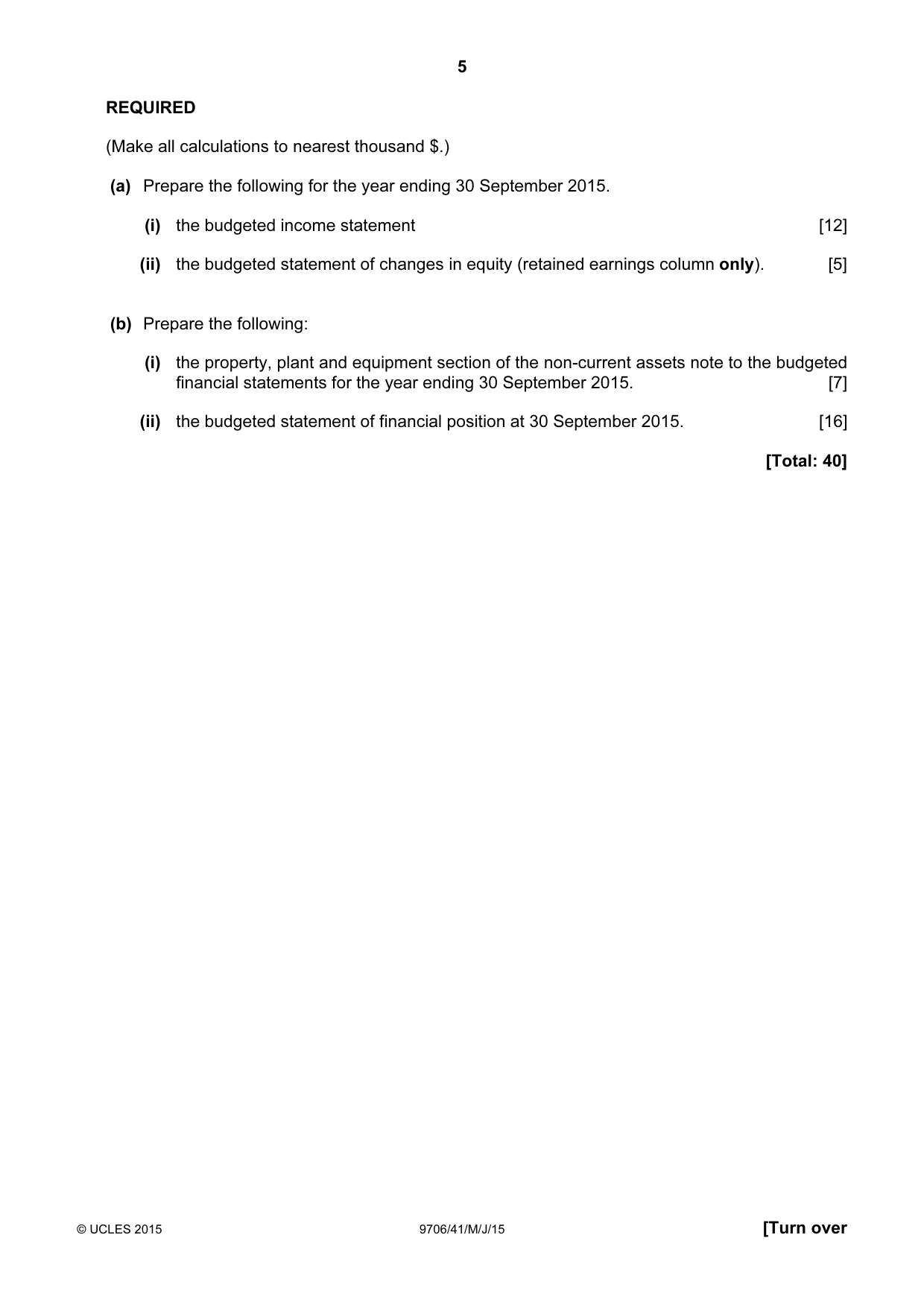
5 © UCLES 2015 9706/41/M/J/15 [Turn over REQUIRED (Make all calculations to nearest thousand $.) (a) Prepare the following for the year ending 30 September 2015. (i) the budgeted income statement [12] (ii) the budgeted statement of changes in equity (retained earnings column only). [5] (b) Prepare the following: (i) the property, plant and equipment section of the non-current assets note to the budgeted financial statements for the year ending 30 September 2015. [7] (ii) the budgeted statement of financial position at 30 September 2015. [16] [Total: 40]
Question paper, page 6
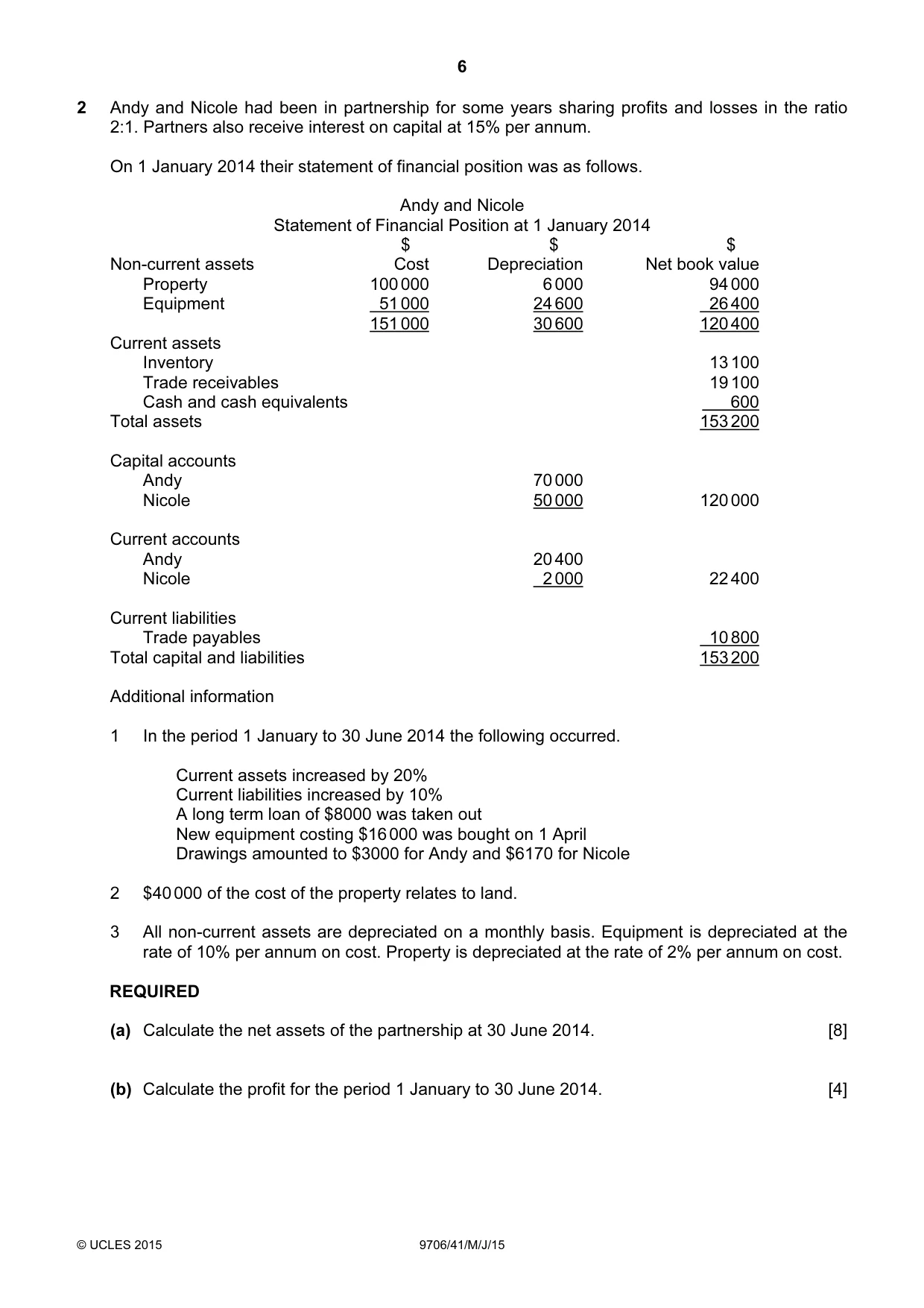
6 © UCLES 2015 9706/41/M/J/15 2 Andy and Nicole had been in partnership for some years sharing profits and losses in the ratio 2:1. Partners also receive interest on capital at 15% per annum. On 1 January 2014 their statement of financial position was as follows. Andy and Nicole Statement of Financial Position at 1 January 2014 $ $ $ Non-current assets Cost Depreciation Net book value Property 100 000 6 000 94 000 Equipment 51 000 24 600 26 400 151 000 30 600 120 400 Current assets Inventory 13 100 Trade receivables 19 100 Cash and cash equivalents 600 Total assets 153 200 Capital accounts Andy 70 000 Nicole 50 000 120 000 Current accounts Andy 20 400 Nicole 2 000 22 400 Current liabilities Trade payables 10 800 Total capital and liabilities 153 200 Additional information 1 In the period 1 January to 30 June 2014 the following occurred. Current assets increased by 20% Current liabilities increased by 10% A long term loan of $8000 was taken out New equipment costing $16 000 was bought on 1 April Drawings amounted to $3000 for Andy and $6170 for Nicole 2 $40 000 of the cost of the property relates to land. 3 All non-current assets are depreciated on a monthly basis. Equipment is depreciated at the rate of 10% per annum on cost. Property is depreciated at the rate of 2% per annum on cost. REQUIRED (a) Calculate the net assets of the partnership at 30 June 2014. [8] (b) Calculate the profit for the period 1 January to 30 June 2014. [4]
Question paper, page 7
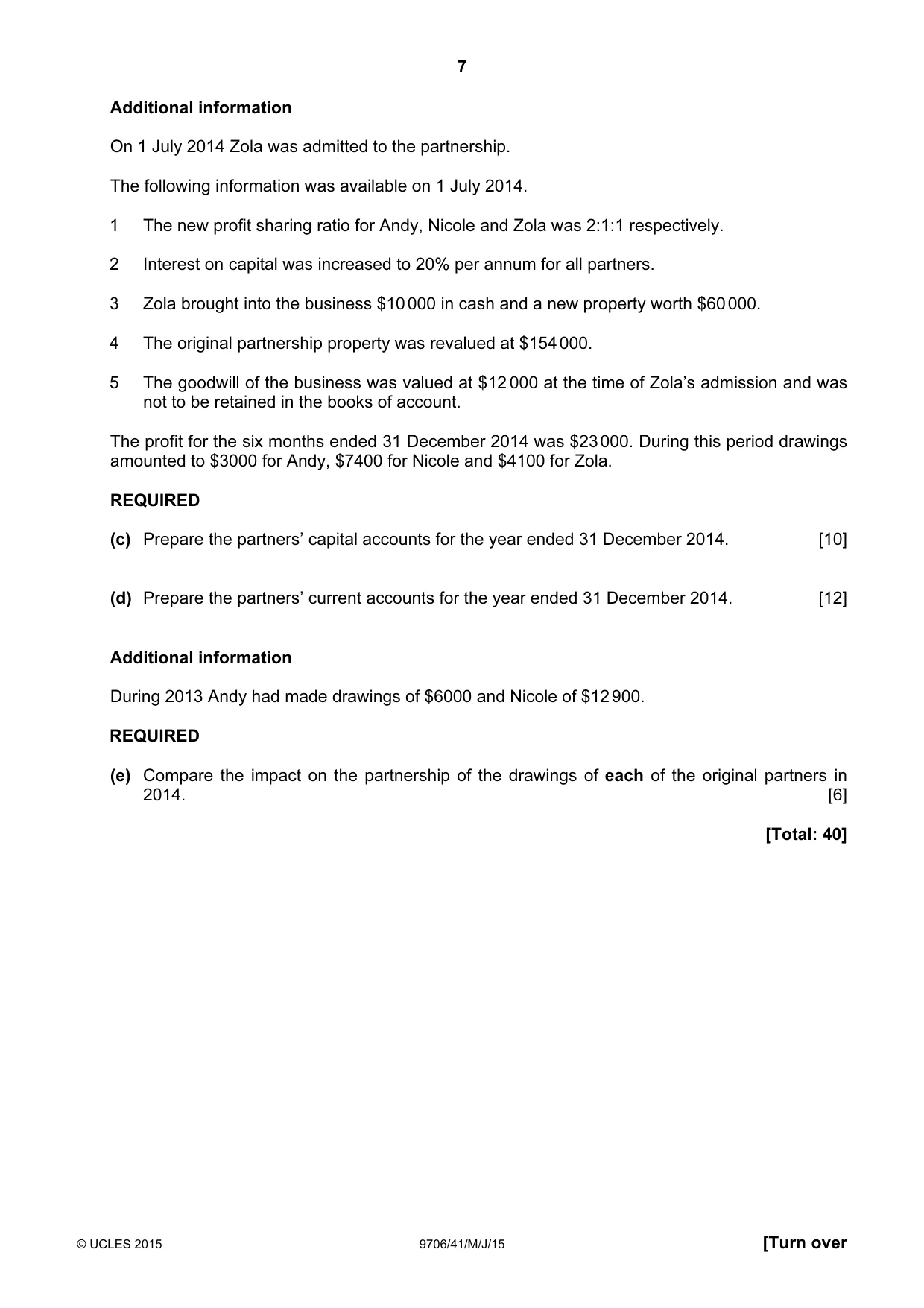
7 © UCLES 2015 9706/41/M/J/15 [Turn over Additional information On 1 July 2014 Zola was admitted to the partnership. The following information was available on 1 July 2014. 1 The new profit sharing ratio for Andy, Nicole and Zola was 2:1:1 respectively. 2 Interest on capital was increased to 20% per annum for all partners. 3 Zola brought into the business $10 000 in cash and a new property worth $60 000. 4 The original partnership property was revalued at $154 000. 5 The goodwill of the business was valued at $12 000 at the time of Zola’s admission and was not to be retained in the books of account. The profit for the six months ended 31 December 2014 was $23 000. During this period drawings amounted to $3000 for Andy, $7400 for Nicole and $4100 for Zola. REQUIRED (c) Prepare the partners’ capital accounts for the year ended 31 December 2014. [10] (d) Prepare the partners’ current accounts for the year ended 31 December 2014. [12] Additional information During 2013 Andy had made drawings of $6000 and Nicole of $12 900. REQUIRED (e) Compare the impact on the partnership of the drawings of each of the original partners in 2014. [6] [Total: 40]
Question paper, page 8
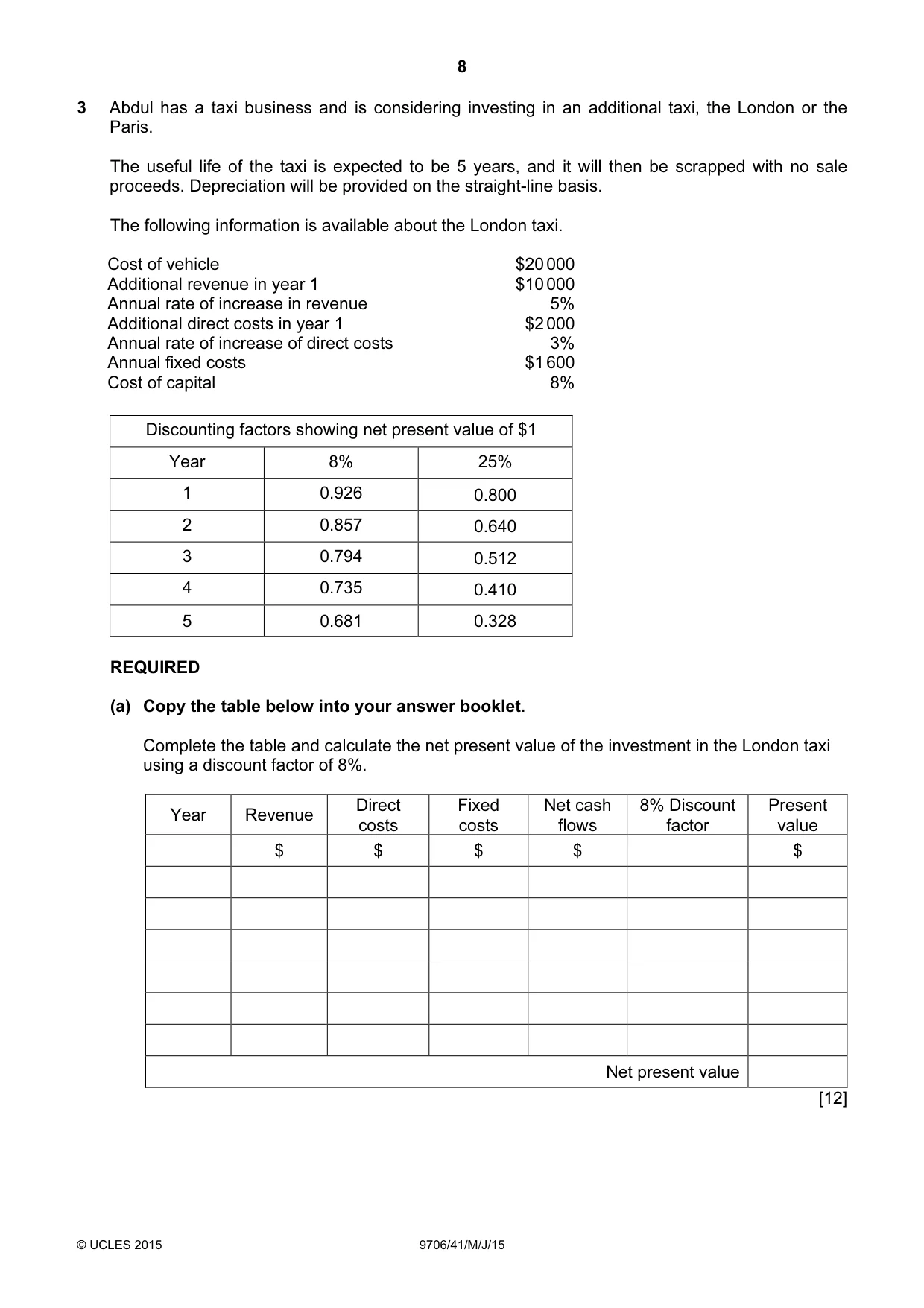
8 © UCLES 2015 9706/41/M/J/15 3 Abdul has a taxi business and is considering investing in an additional taxi, the London or the Paris. The useful life of the taxi is expected to be 5 years, and it will then be scrapped with no sale proceeds. Depreciation will be provided on the straight-line basis. The following information is available about the London taxi. Cost of vehicle $20 000 Additional revenue in year 1 $10 000 Annual rate of increase in revenue 5% Additional direct costs in year 1 $2 000 Annual rate of increase of direct costs 3% Annual fixed costs $1 600 Cost of capital 8% Discounting factors showing net present value of $1 Year 8% 25% 1 0.926 0.800 2 0.857 0.640 3 0.794 0.512 4 0.735 0.410 5 0.681 0.328 REQUIRED (a) Copy the table below into your answer booklet. Complete the table and calculate the net present value of the investment in the London taxi using a discount factor of 8%. Year Revenue Direct costs Fixed costs Net cash flows 8% Discount factor Present value $ $ $ $ $ Net present value [12]
Question paper, page 9
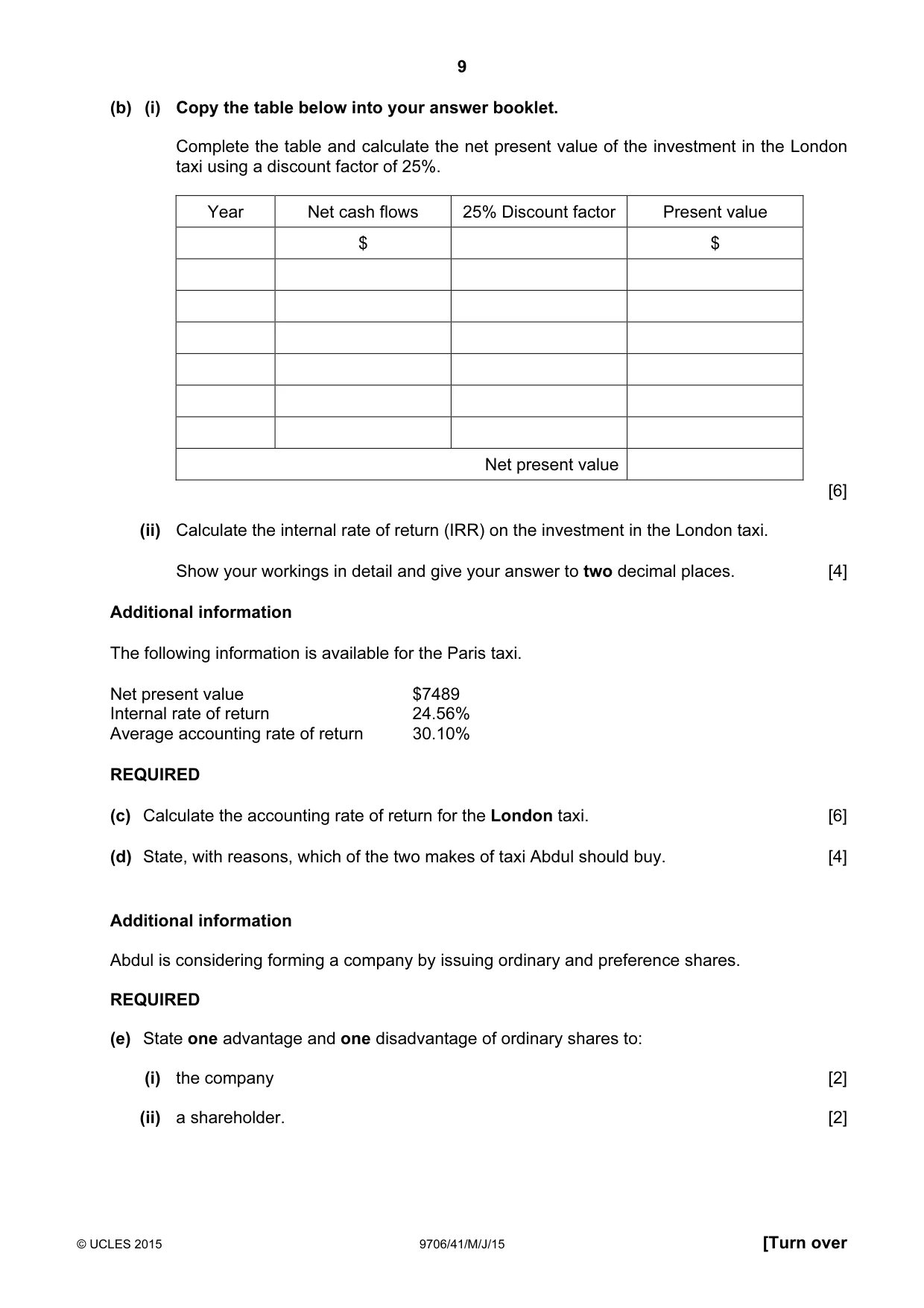
9 © UCLES 2015 9706/41/M/J/15 [Turn over (b) (i) Copy the table below into your answer booklet. Complete the table and calculate the net present value of the investment in the London taxi using a discount factor of 25%. Year Net cash flows 25% Discount factor Present value $ $ Net present value [6] (ii) Calculate the internal rate of return (IRR) on the investment in the London taxi. Show your workings in detail and give your answer to two decimal places. [4] Additional information The following information is available for the Paris taxi. Net present value $7489 Internal rate of return 24.56% Average accounting rate of return 30.10% REQUIRED (c) Calculate the accounting rate of return for the London taxi. [6] (d) State, with reasons, which of the two makes of taxi Abdul should buy. [4] Additional information Abdul is considering forming a company by issuing ordinary and preference shares. REQUIRED (e) State one advantage and one disadvantage of ordinary shares to: (i) the company [2] (ii) a shareholder. [2]
Question paper, page 10
10 © UCLES 2015 9706/41/M/J/15 (f) State one advantage and one disadvantage of preference shares to: (i) the company [2] (ii) a shareholder. [2] [Total: 40]
Question paper, page 11
11 © UCLES 2015 9706/41/M/J/15 BLANK PAGE
Question paper, page 12
12 Permission to reproduce items where third-party owned material protected by copyright is included has been sought and cleared where possible. Every reasonable effort has been made by the publisher (UCLES) to trace copyright holders, but if any items requiring clearance have unwittingly been included, the publisher will be pleased to make amends at the earliest possible opportunity. To avoid the issue of disclosure of answer-related information to candidates, all copyright acknowledgements are reproduced online in the Cambridge International Examinations Copyright Acknowledgements Booklet. This is produced for each series of examinations and is freely available to download at www.cie.org.uk after the live examination series. Cambridge International Examinations is part of the Cambridge Assessment Group. Cambridge Assessment is the brand name of University of Cambridge Local Examinations Syndicate (UCLES), which is itself a department of the University of Cambridge. © UCLES 2015 9706/41/M/J/15 BLANK PAGE
Mark scheme, page 1
® IGCSE is the registered trademark of Cambridge International Examinations. CAMBRIDGE INTERNATIONAL EXAMINATIONS Cambridge International Advanced Level MARK SCHEME for the May/June 2015 series 9706 ACCOUNTING 9706/41 Paper 4 (Problem Solving – Supplement), maximum raw mark 120 This mark scheme is published as an aid to teachers and candidates, to indicate the requirements of the examination. It shows the basis on which Examiners were instructed to award marks. It does not indicate the details of the discussions that took place at an Examiners’ meeting before marking began, which would have considered the acceptability of alternative answers. Mark schemes should be read in conjunction with the question paper and the Principal Examiner Report for Teachers. Cambridge will not enter into discussions about these mark schemes. Cambridge is publishing the mark schemes for the May/June 2015 series for most Cambridge IGCSE®, Cambridge International A and AS Level components and some Cambridge O Level components.
Mark scheme, page 2
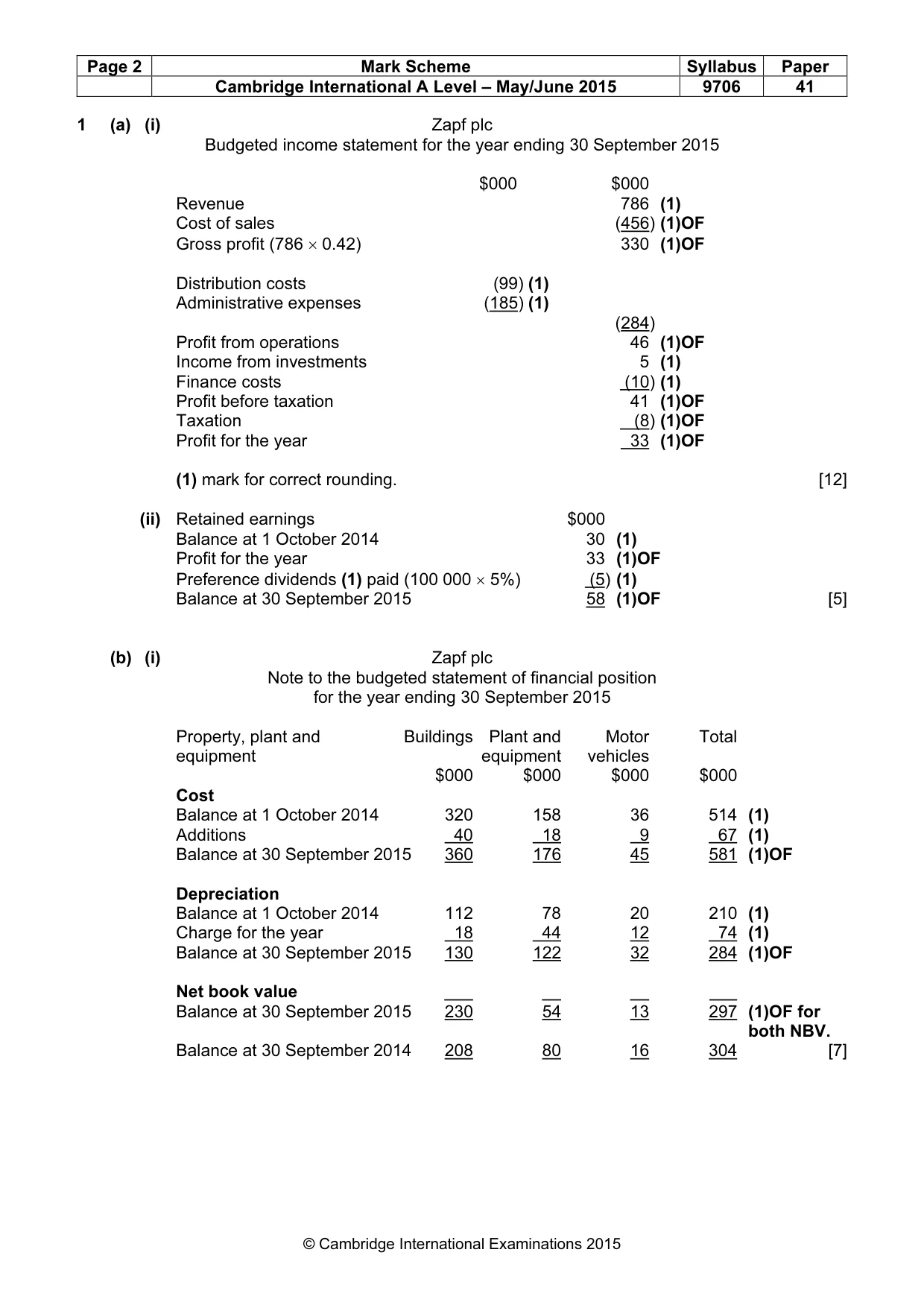
Page 2 Mark Scheme Syllabus Paper Cambridge International A Level – May/June 2015 9706 41 © Cambridge International Examinations 2015 1 (a) (i) Zapf plc Budgeted income statement for the year ending 30 September 2015 $000 $000 Revenue 786 (1) Cost of sales (456) (1)OF Gross profit (786 × 0.42) 330 (1)OF Distribution costs (99) (1) Administrative expenses (185) (1) (284) Profit from operations 46 (1)OF Income from investments 5 (1) Finance costs (10) (1) Profit before taxation 41 (1)OF Taxation (8) (1)OF Profit for the year 33 (1)OF (1) mark for correct rounding. [12] (ii) Retained earnings $000 Balance at 1 October 2014 30 (1) Profit for the year 33 (1)OF Preference dividends (1) paid (100 000 × 5%) (5) (1) Balance at 30 September 2015 58 (1)OF [5] (b) (i) Zapf plc Note to the budgeted statement of financial position for the year ending 30 September 2015 Property, plant and Buildings Plant and Motor Total equipment equipment vehicles $000 $000 $000 $000 Cost Balance at 1 October 2014 320 158 36 514 (1) Additions 40 18 9 67 (1) Balance at 30 September 2015 360 176 45 581 (1)OF Depreciation Balance at 1 October 2014 112 78 20 210 (1) Charge for the year 18 44 12 74 (1) Balance at 30 September 2015 130 122 32 284 (1)OF Net book value Balance at 30 September 2015 230 54 13 297 (1)OF for both NBV. Balance at 30 September 2014 208 80 16 304 [7]
Mark scheme, page 3
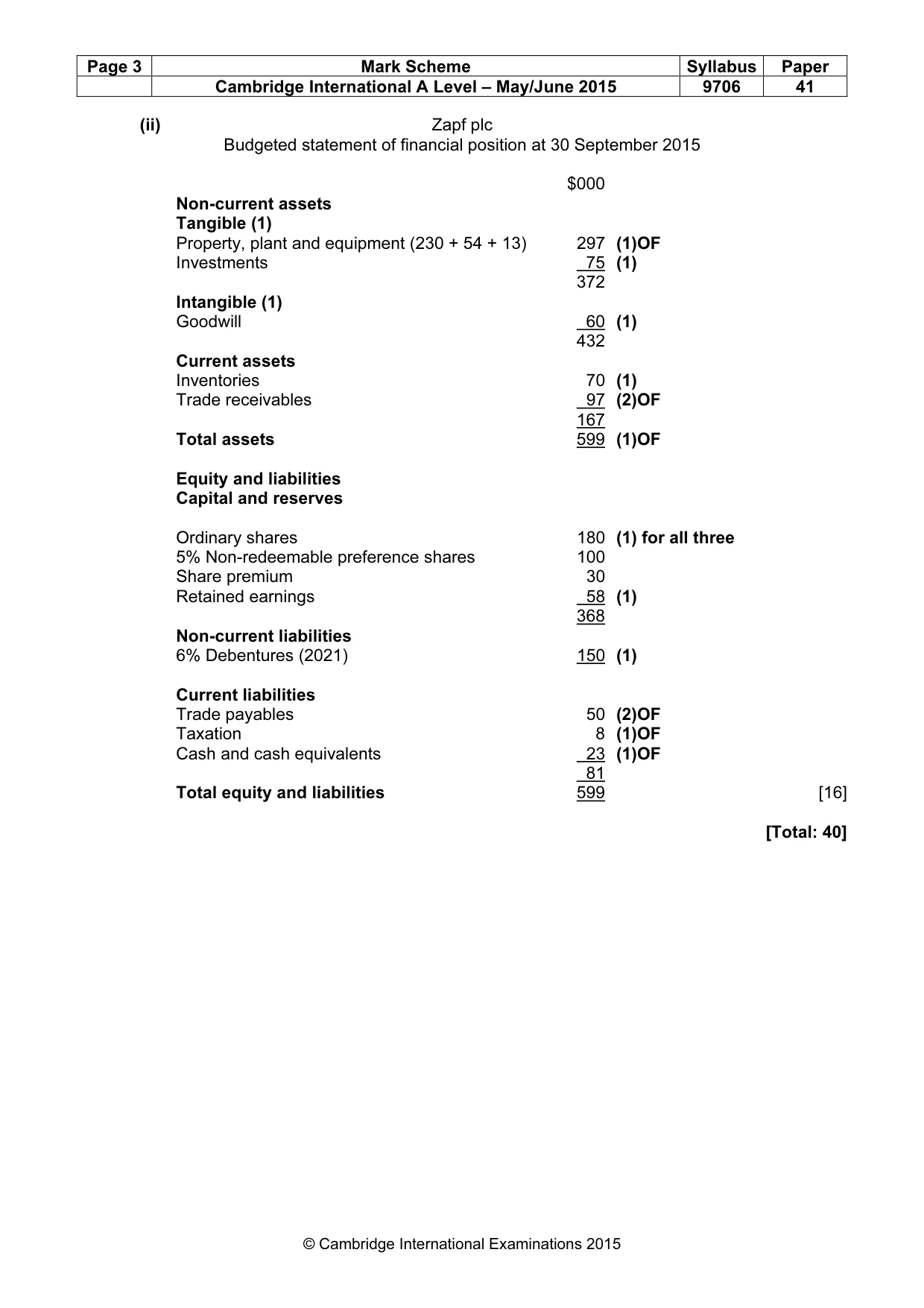
Page 3 Mark Scheme Syllabus Paper Cambridge International A Level – May/June 2015 9706 41 © Cambridge International Examinations 2015 (ii) Zapf plc Budgeted statement of financial position at 30 September 2015 $000 Non-current assets Tangible (1) Property, plant and equipment (230 + 54 + 13) 297 (1)OF Investments 75 (1) 372 Intangible (1) Goodwill 60 (1) 432 Current assets Inventories 70 (1) Trade receivables 97 (2)OF 167 Total assets 599 (1)OF Equity and liabilities Capital and reserves Ordinary shares 180 (1) for all three 5% Non-redeemable preference shares 100 Share premium 30 Retained earnings 58 (1) 368 Non-current liabilities 6% Debentures (2021) 150 (1) Current liabilities Trade payables 50 (2)OF Taxation 8 (1)OF Cash and cash equivalents 23 (1)OF 81 Total equity and liabilities 599 [16] [Total: 40]
Mark scheme, page 4
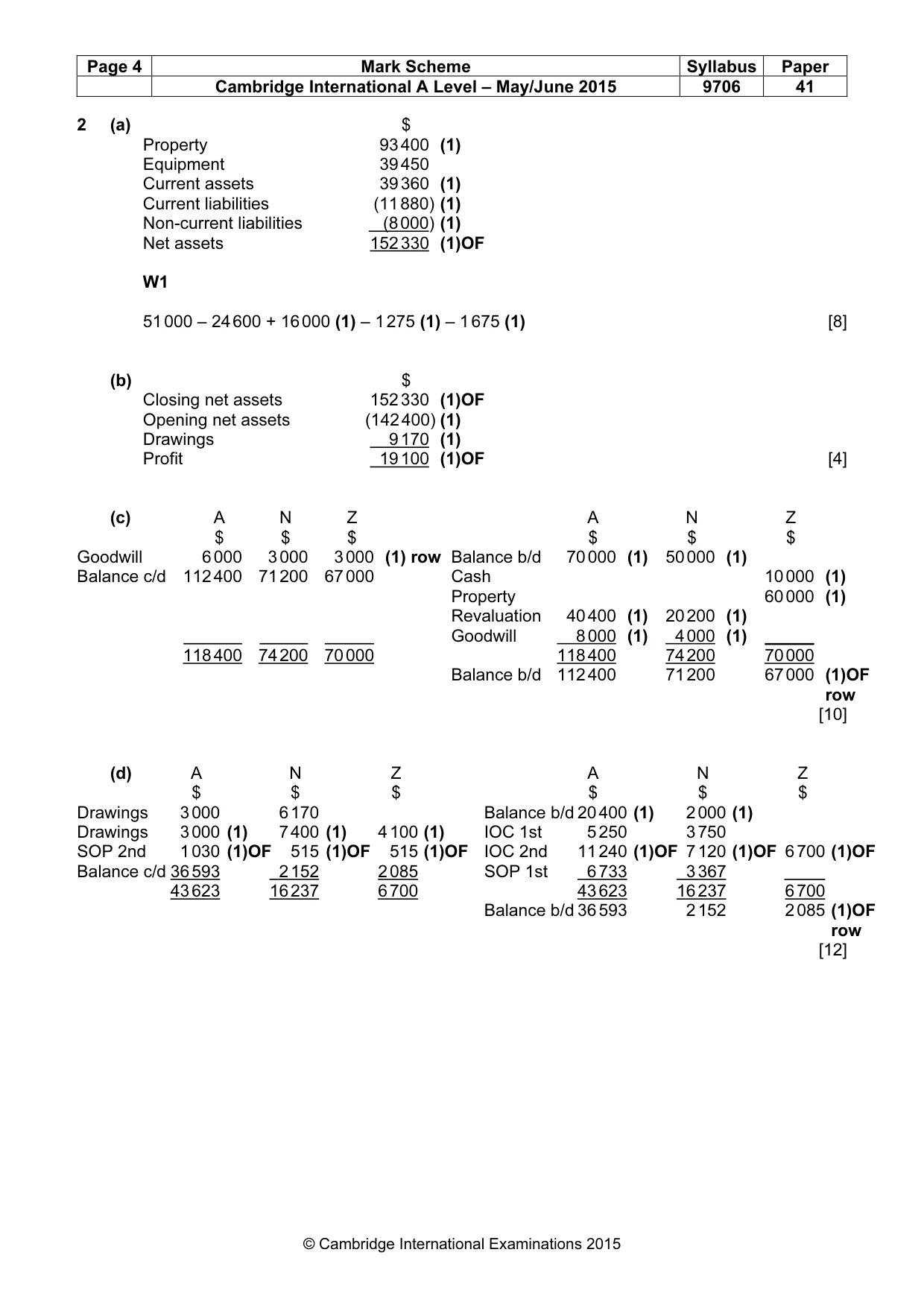
Page 4 Mark Scheme Syllabus Paper Cambridge International A Level – May/June 2015 9706 41 © Cambridge International Examinations 2015 2 (a) $ Property 93 400 (1) Equipment 39 450 Current assets 39 360 (1) Current liabilities (11 880) (1) Non-current liabilities (8 000) (1) Net assets 152 330 (1)OF W1 51 000 – 24 600 + 16 000 (1) – 1 275 (1) – 1 675 (1) [8] (b) $ Closing net assets 152 330 (1)OF Opening net assets (142 400) (1) Drawings 9 170 (1) Profit 19 100 (1)OF [4] (c) A N Z A N Z $ $ $ $ $ $ Goodwill 6 000 3 000 3 000 (1) row Balance b/d 70 000 (1) 50 000 (1) Balance c/d 112 400 71 200 67 000 Cash 10 000 (1) Property 60 000 (1) Revaluation 40 400 (1) 20 200 (1) Goodwill 8 000 (1) 4 000 (1) 118 400 74 200 70 000 118 400 74 200 70 000 Balance b/d 112 400 71 200 67 000 (1)OF row [10] (d) A N Z A N Z $ $ $ $ $ $ Drawings 3 000 6 170 Balance b/d 20 400 (1) 2 000 (1) Drawings 3 000 (1) 7 400 (1) 4 100 (1) IOC 1st 5 250 3 750 SOP 2nd 1 030 (1)OF 515 (1)OF 515 (1)OF IOC 2nd 11 240 (1)OF 7 120 (1)OF 6 700 (1)OF Balance c/d 36 593 2 152 2 085 SOP 1st 6 733 3 367 43 623 16 237 6 700 43 623 16 237 6 700 Balance b/d 36 593 2 152 2 085 (1)OF row [12]
Mark scheme, page 5
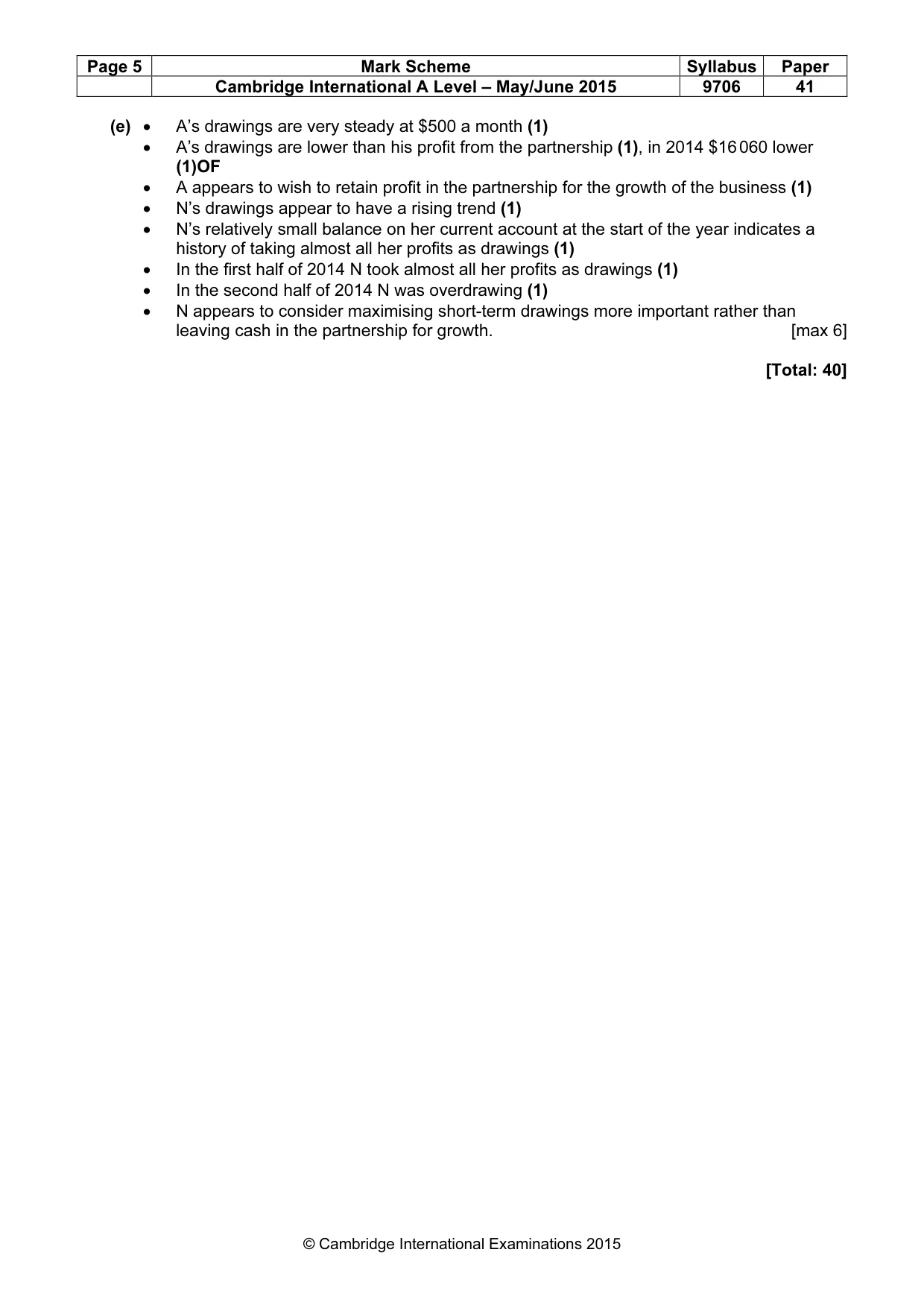
Page 5 Mark Scheme Syllabus Paper Cambridge International A Level – May/June 2015 9706 41 © Cambridge International Examinations 2015 (e) • A’s drawings are very steady at $500 a month (1) • A’s drawings are lower than his profit from the partnership (1), in 2014 $16 060 lower (1)OF • A appears to wish to retain profit in the partnership for the growth of the business (1) • N’s drawings appear to have a rising trend (1) • N’s relatively small balance on her current account at the start of the year indicates a history of taking almost all her profits as drawings (1) • In the first half of 2014 N took almost all her profits as drawings (1) • In the second half of 2014 N was overdrawing (1) • N appears to consider maximising short-term drawings more important rather than leaving cash in the partnership for growth. [max 6] [Total: 40]
Mark scheme, page 6
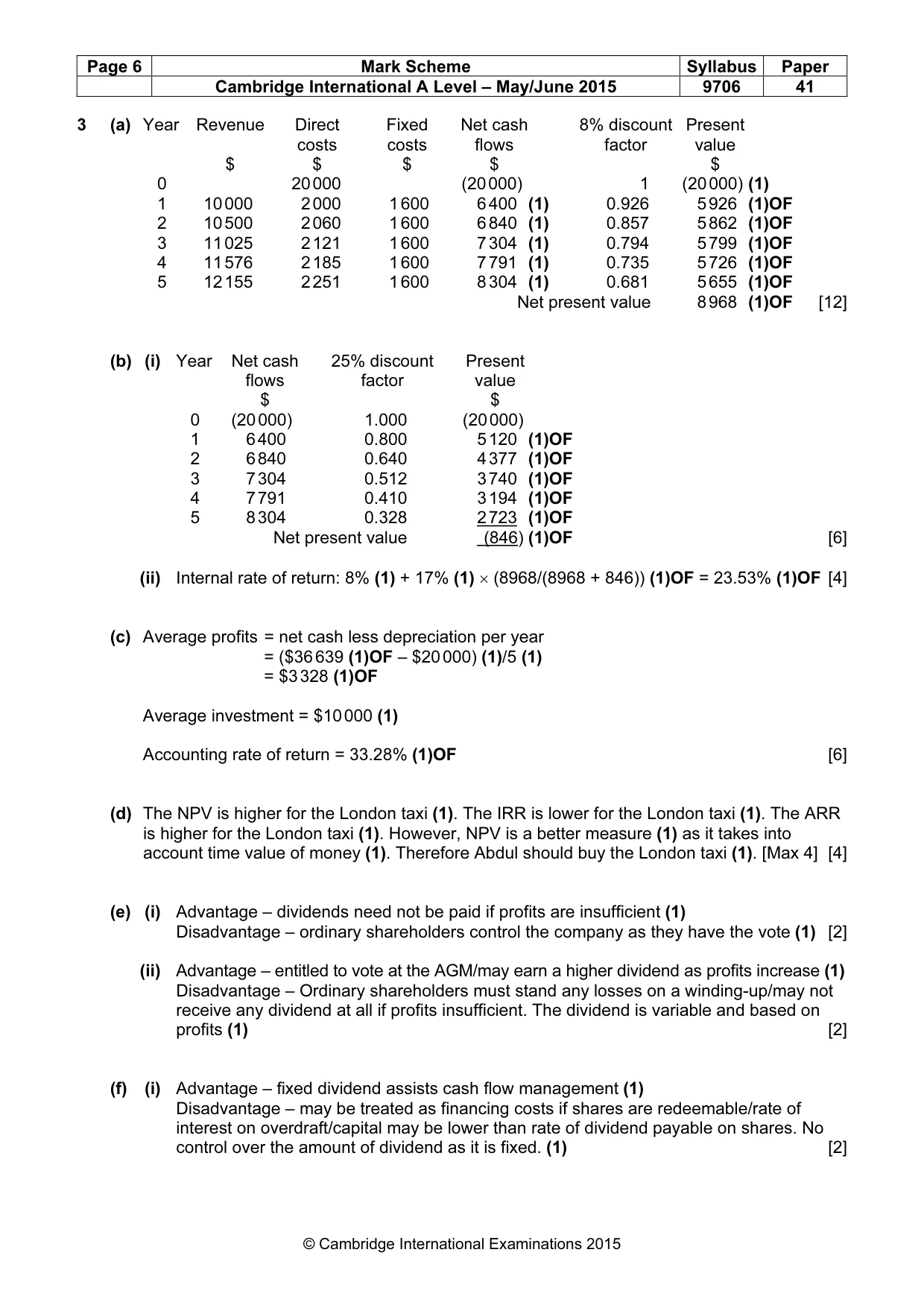
Page 6 Mark Scheme Syllabus Paper Cambridge International A Level – May/June 2015 9706 41 © Cambridge International Examinations 2015 3 (a) Year Revenue Direct Fixed Net cash 8% discount Present costs costs flows factor value $ $ $ $ $ 0 20 000 (20 000) 1 (20 000) (1) 1 10 000 2 000 1 600 6 400 (1) 0.926 5 926 (1)OF 2 10 500 2 060 1 600 6 840 (1) 0.857 5 862 (1)OF 3 11 025 2 121 1 600 7 304 (1) 0.794 5 799 (1)OF 4 11 576 2 185 1 600 7 791 (1) 0.735 5 726 (1)OF 5 12 155 2 251 1 600 8 304 (1) 0.681 5 655 (1)OF Net present value 8 968 (1)OF [12] (b) (i) Year Net cash 25% discount Present flows factor value $ $ 0 (20 000) 1.000 (20 000) 1 6 400 0.800 5 120 (1)OF 2 6 840 0.640 4 377 (1)OF 3 7 304 0.512 3 740 (1)OF 4 7 791 0.410 3 194 (1)OF 5 8 304 0.328 2 723 (1)OF Net present value (846) (1)OF [6] (ii) Internal rate of return: 8% (1) + 17% (1) × (8968/(8968 + 846)) (1)OF = 23.53% (1)OF [4] (c) Average profits = net cash less depreciation per year = ($36 639 (1)OF – $20 000) (1)/5 (1) = $3 328 (1)OF Average investment = $10 000 (1) Accounting rate of return = 33.28% (1)OF [6] (d) The NPV is higher for the London taxi (1). The IRR is lower for the London taxi (1). The ARR is higher for the London taxi (1). However, NPV is a better measure (1) as it takes into account time value of money (1). Therefore Abdul should buy the London taxi (1). [Max 4] [4] (e) (i) Advantage – dividends need not be paid if profits are insufficient (1) Disadvantage – ordinary shareholders control the company as they have the vote (1) [2] (ii) Advantage – entitled to vote at the AGM/may earn a higher dividend as profits increase (1) Disadvantage – Ordinary shareholders must stand any losses on a winding-up/may not receive any dividend at all if profits insufficient. The dividend is variable and based on profits (1) [2] (f) (i) Advantage – fixed dividend assists cash flow management (1) Disadvantage – may be treated as financing costs if shares are redeemable/rate of interest on overdraft/capital may be lower than rate of dividend payable on shares. No control over the amount of dividend as it is fixed. (1) [2]
Mark scheme, page 7
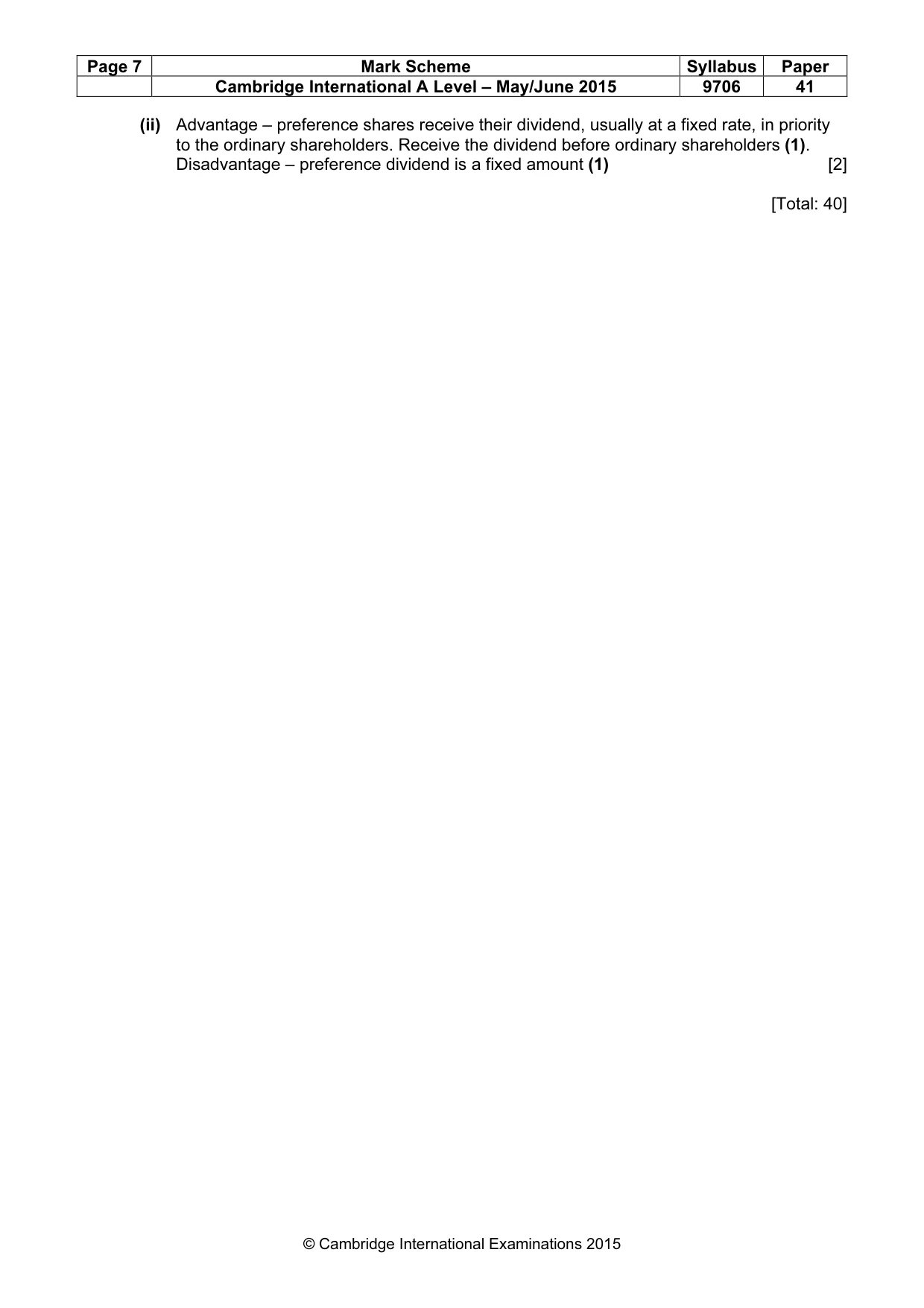
Page 7 Mark Scheme Syllabus Paper Cambridge International A Level – May/June 2015 9706 41 © Cambridge International Examinations 2015 (ii) Advantage – preference shares receive their dividend, usually at a fixed rate, in priority to the ordinary shareholders. Receive the dividend before ordinary shareholders (1). Disadvantage – preference dividend is a fixed amount (1) [2] [Total: 40]
What you needed in this session
Cambridge’s own grade thresholds for 2015 May/June, Paper 4 · Variant 1. A higher threshold means an easier paper — the bar moves with how the cohort did.