Cambridge A Level Accounting 9706 — 2021 Feb/March Paper 2 · Variant 2
9706/22/F/M/21 · 4 questions · 90 marks · ≈101 min
The question paper and its mark scheme, free to read here and free to download. This is Cambridge’s own paper, exactly as it was sat.
Question paper20 pages
Mark scheme12 pages
Answers below. Sit the paper first if you are practising.
Questions as text
Q1 · Faraz, Javed and Leah were in partnership
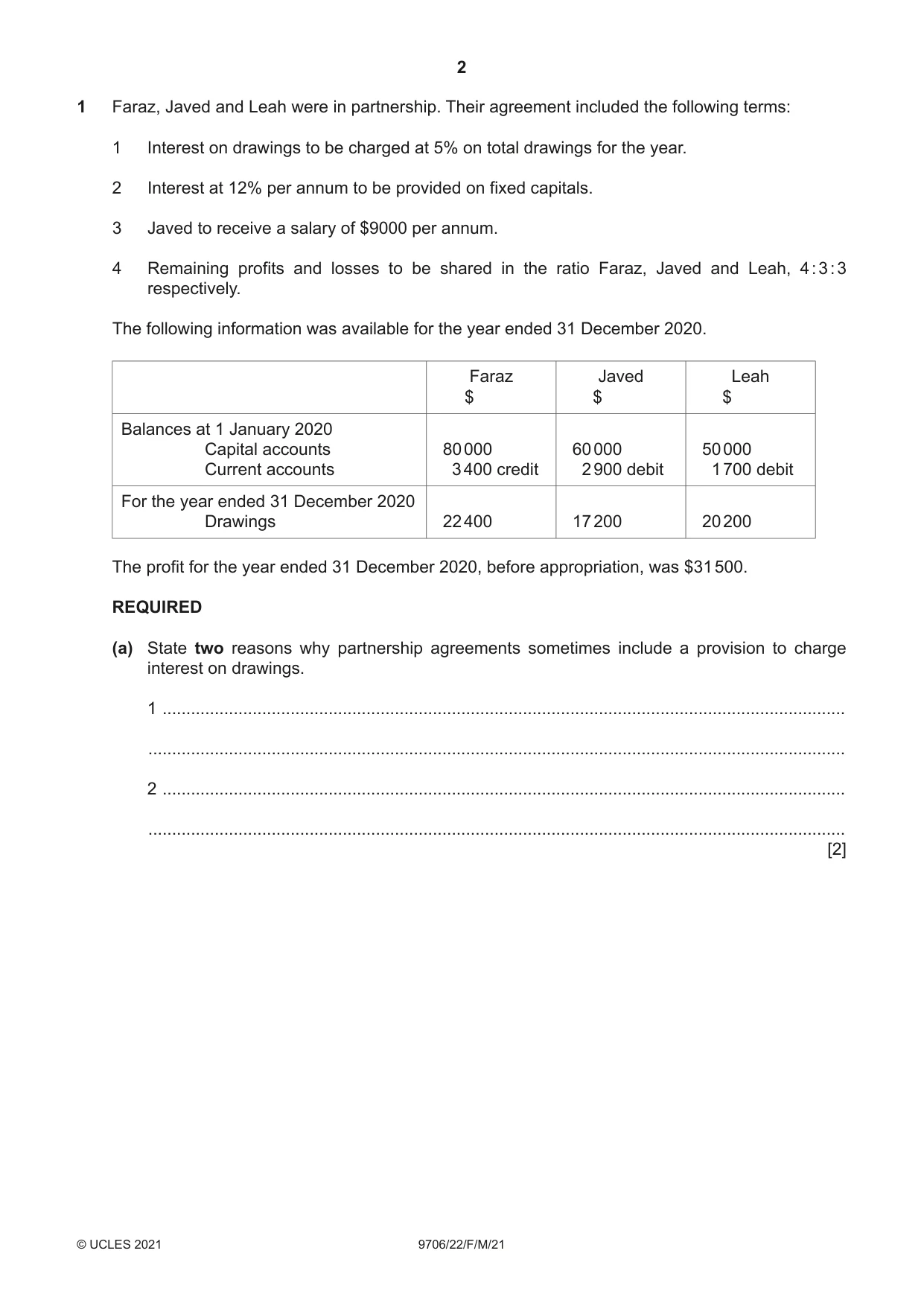
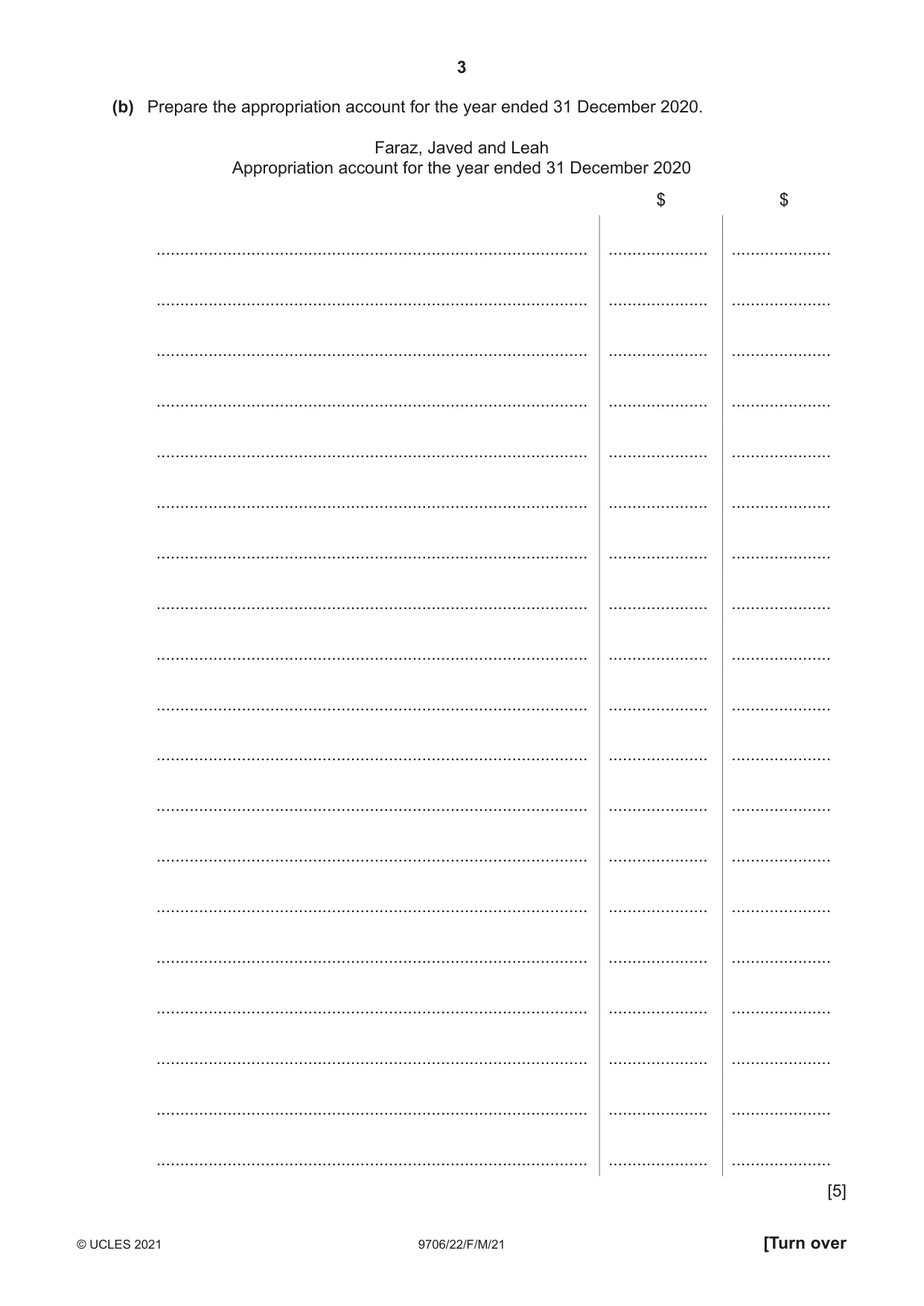
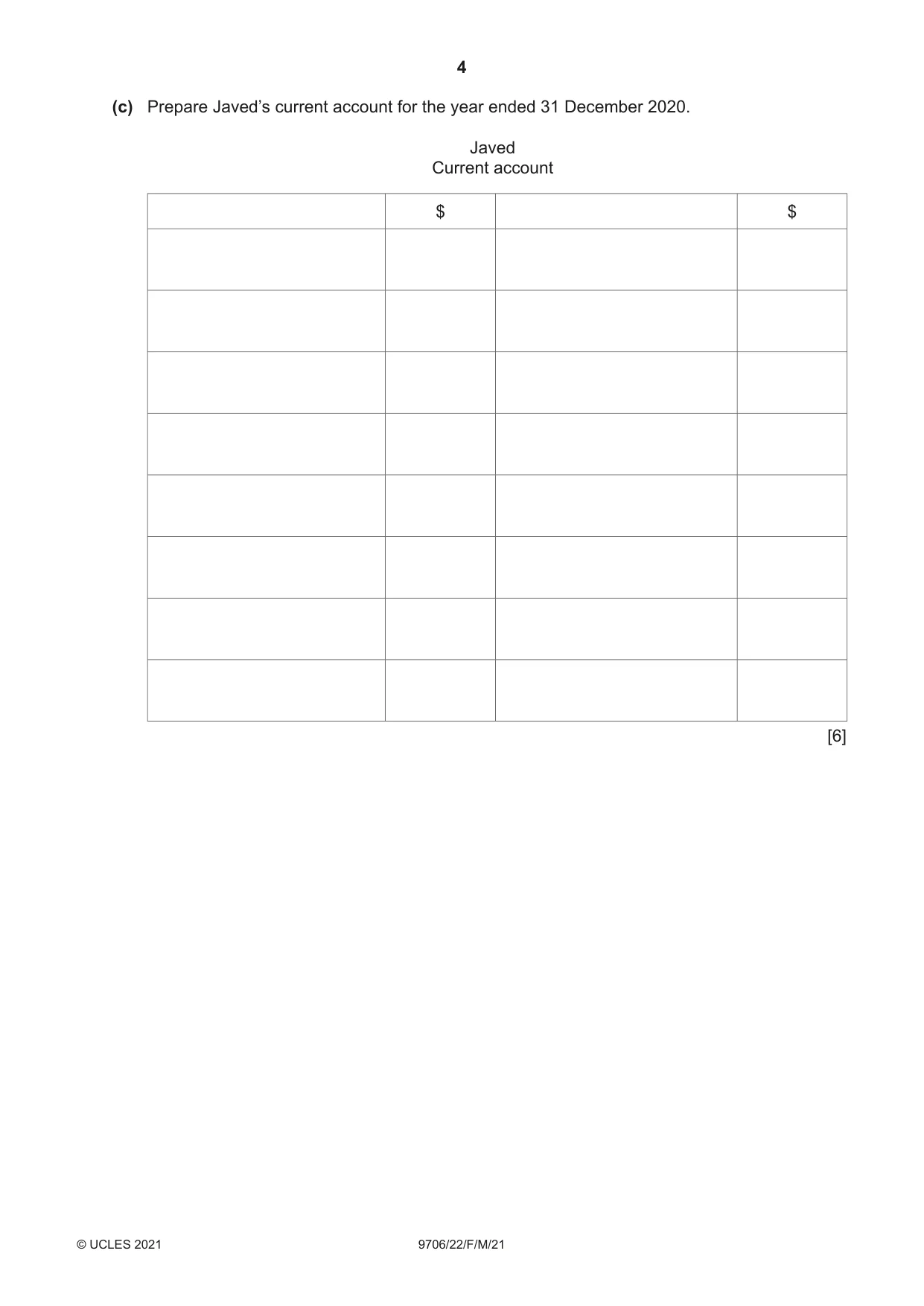
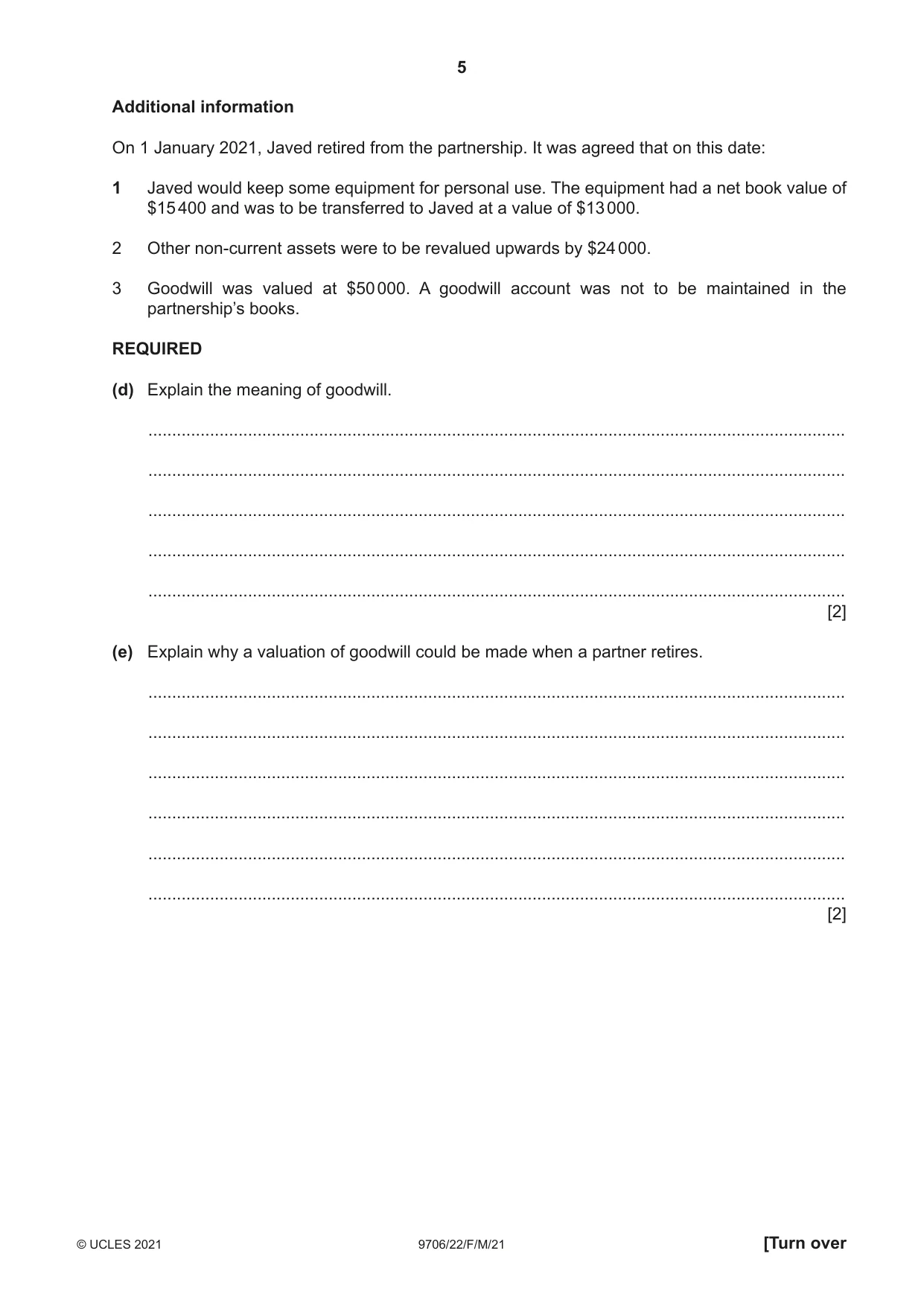
1 Faraz, Javed and Leah were in partnership. Their agreement included the following terms: 1 Interest on drawings to be charged at 5% on total drawings for the year. 2 Interest at 12% per annum to be provided on fixed capitals. 3 Javed to receive a salary of $9000 per annum. 4 Remaining profits and losses to be shared in the ratio Faraz, Javed and Leah, 4 : 3 : 3 respectively. The following information was available for the year ended 31 December 2020. Faraz Javed Leah $ $ $ Balances at 1 January 2020 Capital accounts 80 000 60 000 50 000 Current accounts 3 400 credit 2 900 debit 1 700 debit For the year ended 31 December 2020 Drawings 22 400 17 200 20 200 The profit for the year ended 31 December 2020, before appropriation, was $31 500. REQUIRED (a) State two reasons why partnership agreements sometimes include a provision to charge interest on drawings. 1 ................................................................................................................................................ ................................................................................................................................................... 2 ................................................................................................................................................ ................................................................................................................................................... [2] (b) Prepare the appropriation account for the year ended 31 December 2020. Faraz, Javed and Leah Appropriation account for the year ended 31 December 2020 $ $ ........................................................................................... ..................... ..................... ........................................................................................... ..................... ..................... ........................................................................................... ..................... ..................... ........................................................................................... ..................... ..................... ........................................................................................... ..................... ..................... ........................................................................................... ..................... ..................... ........................................................................................... ..................... ..................... ........................................................................................... ..................... ..................... ........................................................................................... ..................... ..................... ........................................................................................... ..................... ..................... ........................................................................................... ..................... ..................... ........................................................................................... ..................... ..................... ........................................................................................... ..................... ..................... ........................................................................................... ..................... ..................... ........................................................................................... ..................... ..................... ........................................................................................... ..................... ..................... ........................................................................................... ..................... ..................... ........................................................................................... ..................... ..................... ........................................................................................... ..................... ..................... [5] (c) Prepare Javed’s current account for the year ended 31 December 2020. Javed Current account $ $ [6] Additional information On 1 January 2021, Javed retired from the partnership. It was agreed that on this date: 1 Javed would keep some equipment for personal use. The equipment had a net book value of $15 400 and was to be transferred to Javed at a value of $13 000.
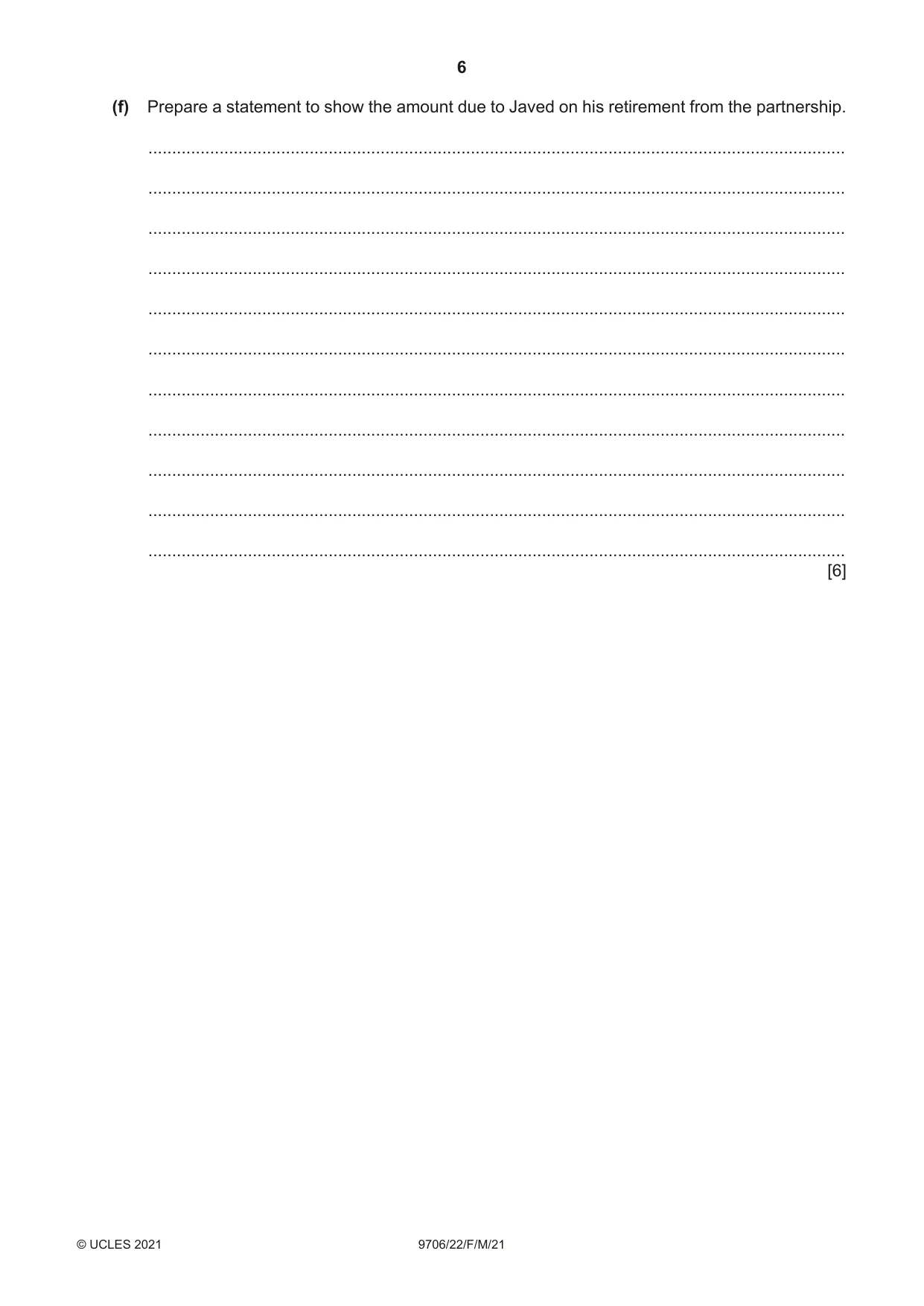
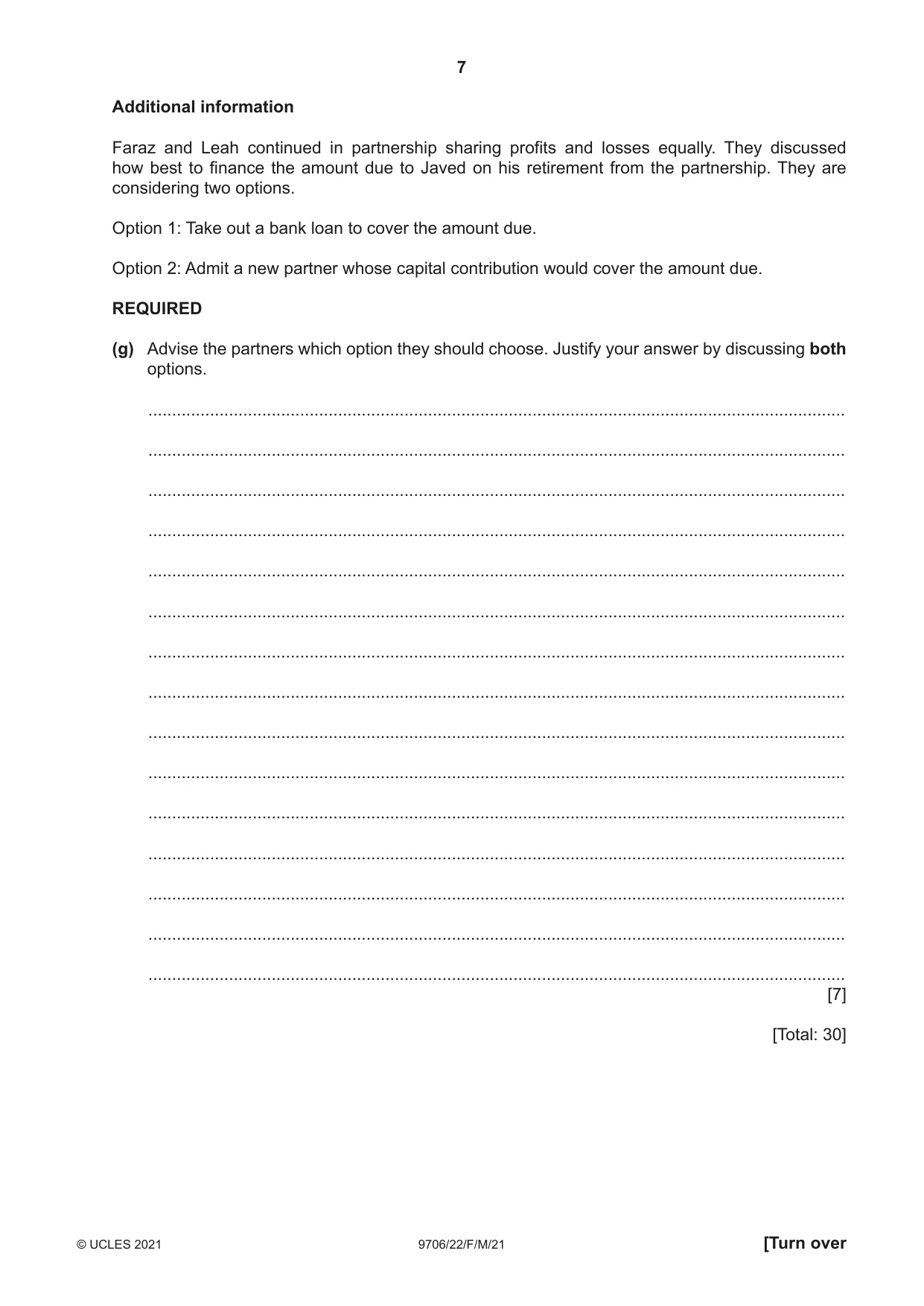
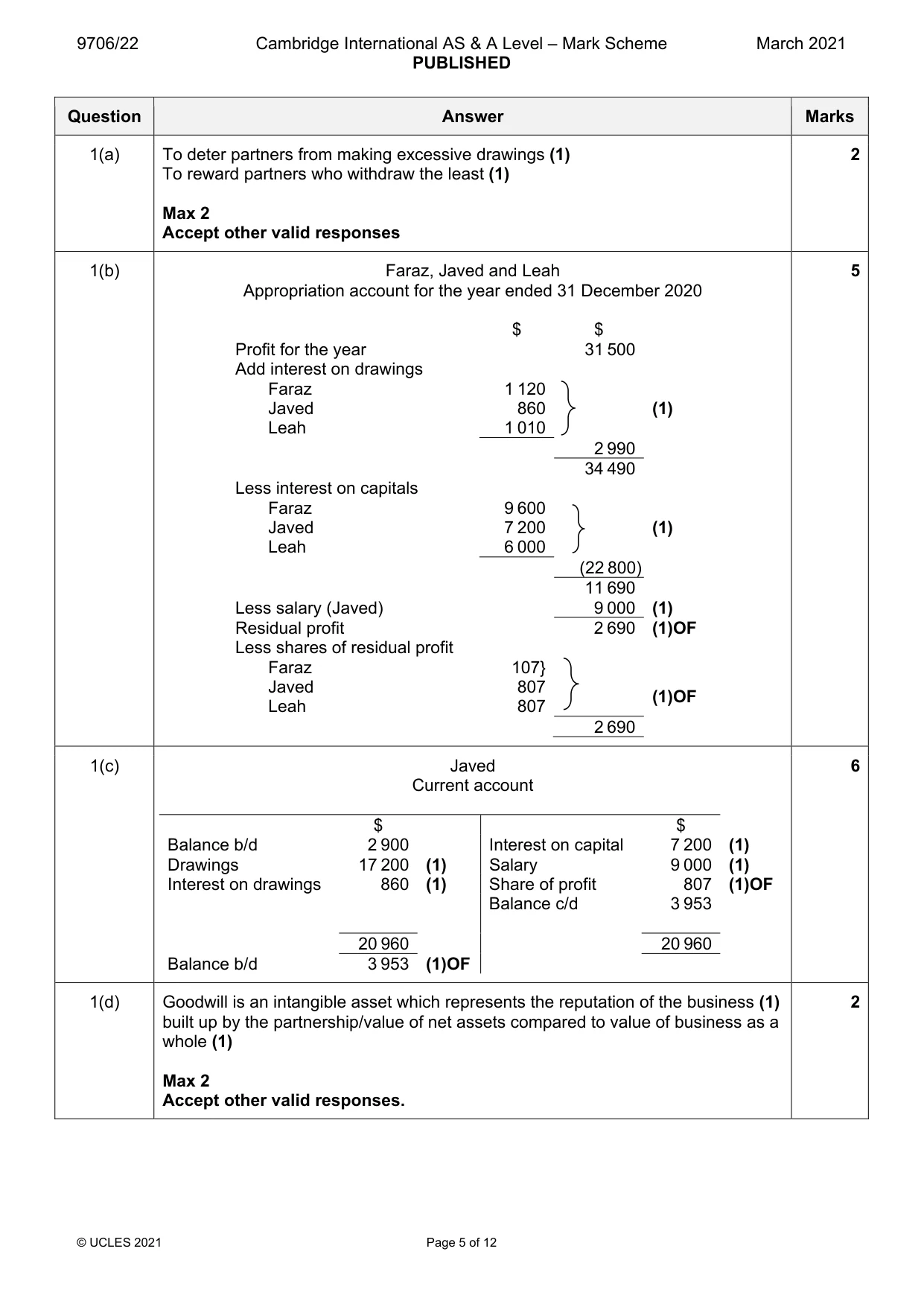
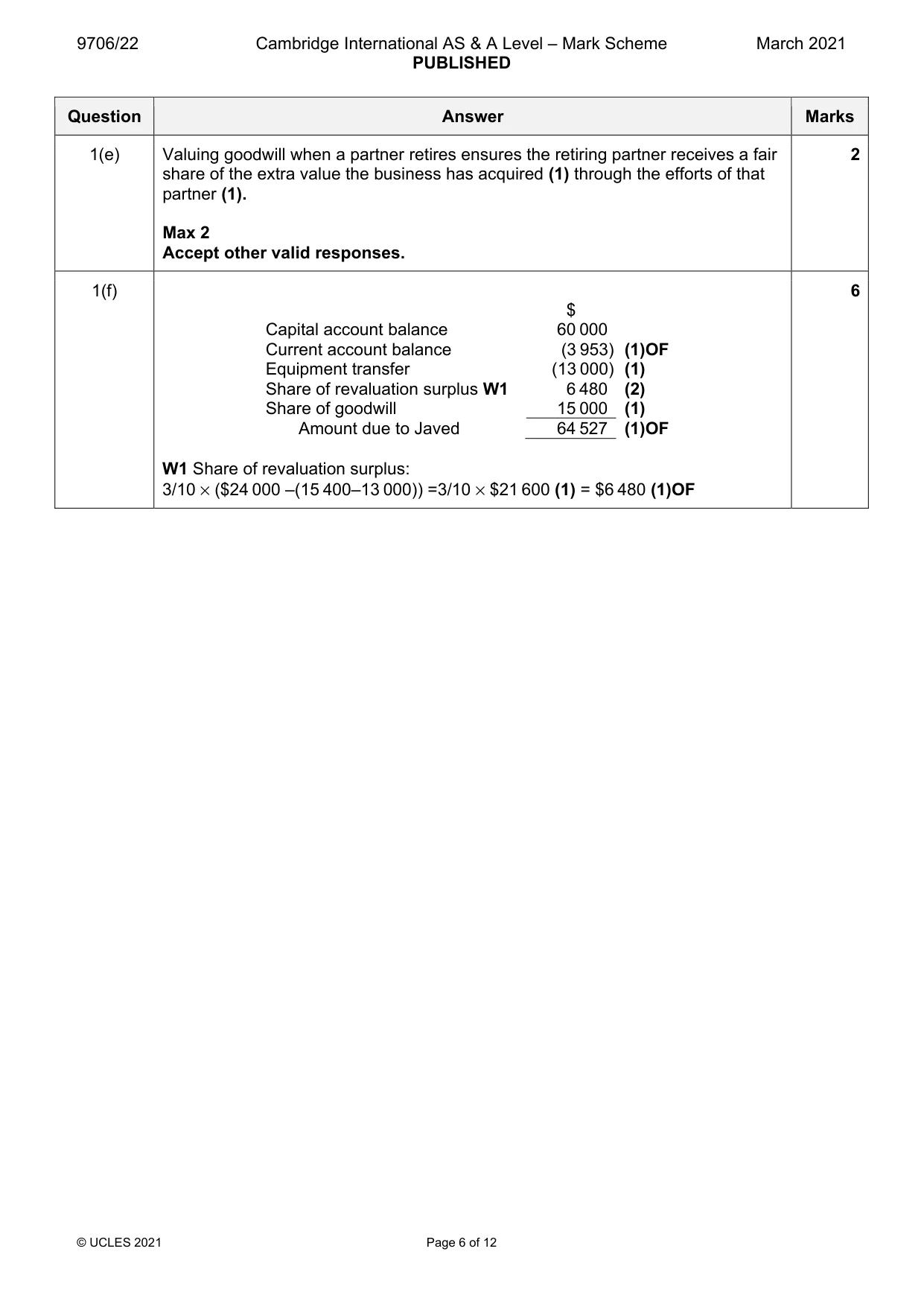
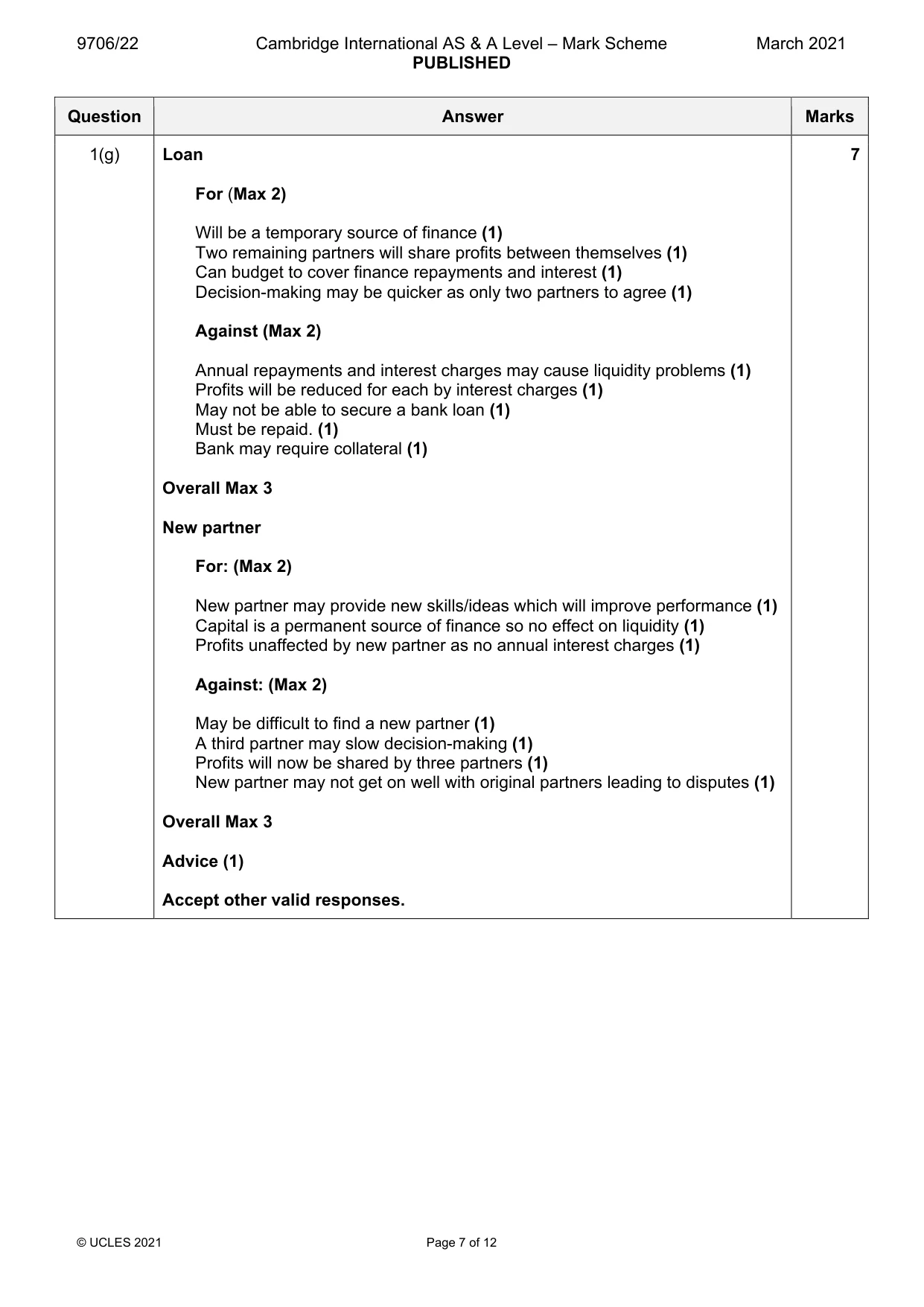
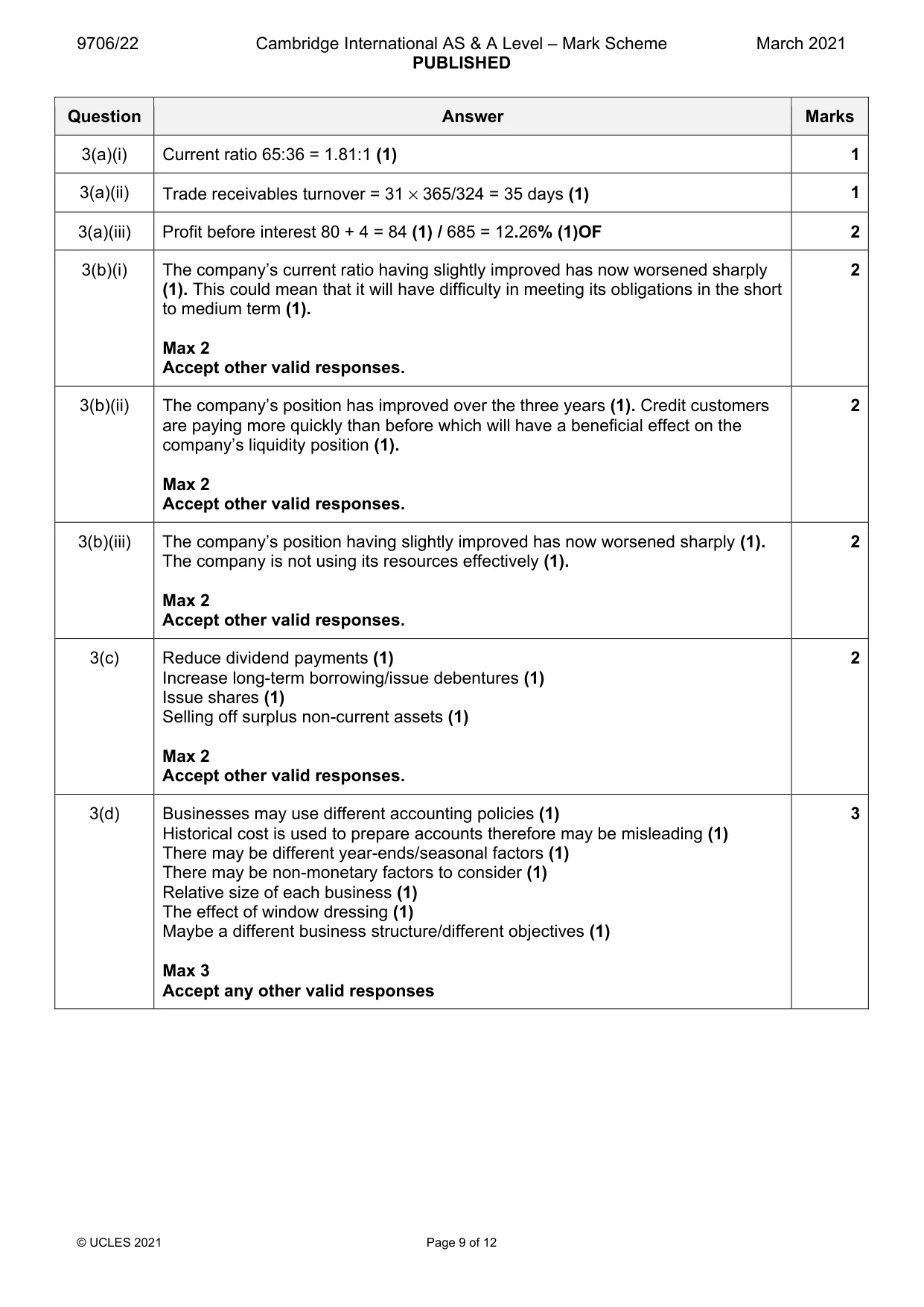
Mark scheme: Question Answer Marks 1(a) To deter partners from making excessive drawings (1) 2 To reward partners who withdraw the least (1) Max 2 Accept other valid responses 1(b) Faraz, Javed and Leah 5 Appropriation account for the year ended 31 December 2020 $ $ Profit for the year 31 500 Add interest on drawings Faraz 1 120 Javed 860 (1) Leah 1 010 2 990 34 490 Less interest on capitals Faraz 9 600 Javed 7 200 (1) Leah 6 000 (22 800) 11 690 Less salary (Javed) 9 000 (1) Residual profit 2 690 (1)OF Less shares of residual profit Faraz 107} Javed 807 (1)OF Leah 807 2 690 1(c) Javed 6 Current account $ $ Balance b/d 2 900 Interest on capital 7 200 (1) Drawings 17 200 (1) Salary 9 000 (1) Interest on drawings 860 (1) Share of profit 807 (1)OF Balance c/d 3 953 20 960 20 960 Balance b/d 3 953 (1)OF 1(d) Goodwill is an intangible asset which represents the reputation of the business (1) 2 built up by the partnership/value of net assets compared to value of business as a whole (1) Max 2 Accept other valid responses. 1(e) Valuing goodwill when a partner retires ensures the retiring partner receives a fair 2 share of the extra value the business has acquired (1) through the efforts of that partner (1). Max 2 Accept other valid responses. 1(f) 6 $ Capital account balance 60 000 Current account balance (3 953) (1)OF Equipment transfer (13 000) (1) Share of revaluation surplus W1 6 480 (2) Share of goodwill 15 000 (1) Amount due to Javed 64 527 (1)OF W1 Share of revaluation surplus: 3/10 × ($24 000 –(15 400–13 000)) =3/10 × $21 600 (1) = $6 480 (1)OF 1(g) Loan 7 For (Max 2) Will be a temporary source of finance (1) Two remaining partners will share profits between themselves (1) Can budget to cover finance repayments and interest (1) Decision-making may be quicker as only two partners to agree (1) Against (Max 2) Annual repayments and interest charges may cause liquidity problems (1) Profits will be reduced for each by interest charges (1) May not be able to secure a bank loan (1) Must be repaid. (1) Bank may require collateral (1) Overall Max 3 New partner For: (Max 2) New partner may provide new skills/ideas which will improve performance (1) Capital is a permanent source of finance so no effect on liquidity (1) Profits unaffected by new partner as no annual interest charges (1) Against: (Max 2) May be difficult to find a new partner (1) A third partner may slow decision-making (1) Profits will now be shared by three partners (1) New partner may not get on well with original partners leading to disputes (1) Overall Max 3 Advice (1) Accept other valid responses.
Q2 · Myra owns a delivery business
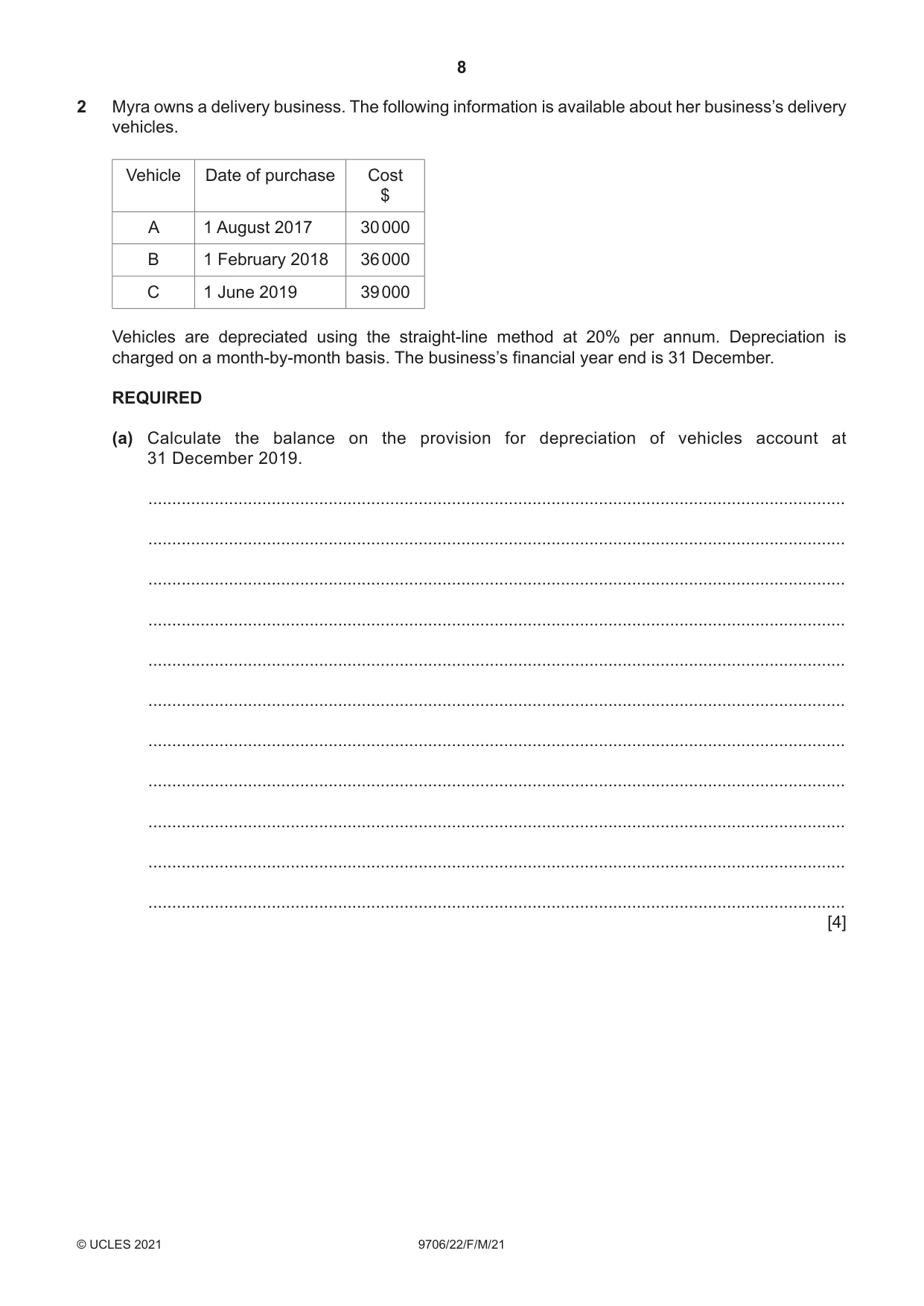
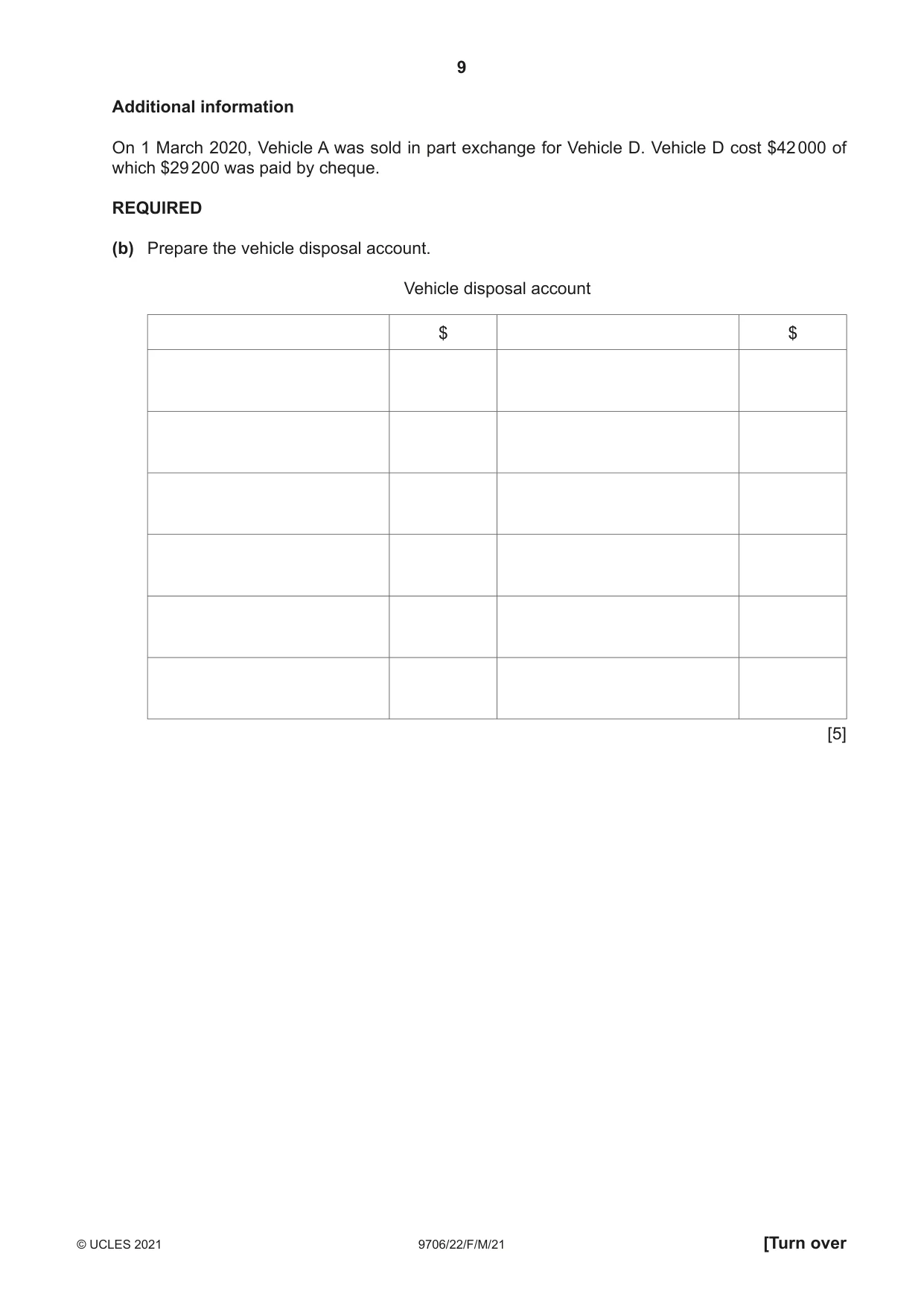
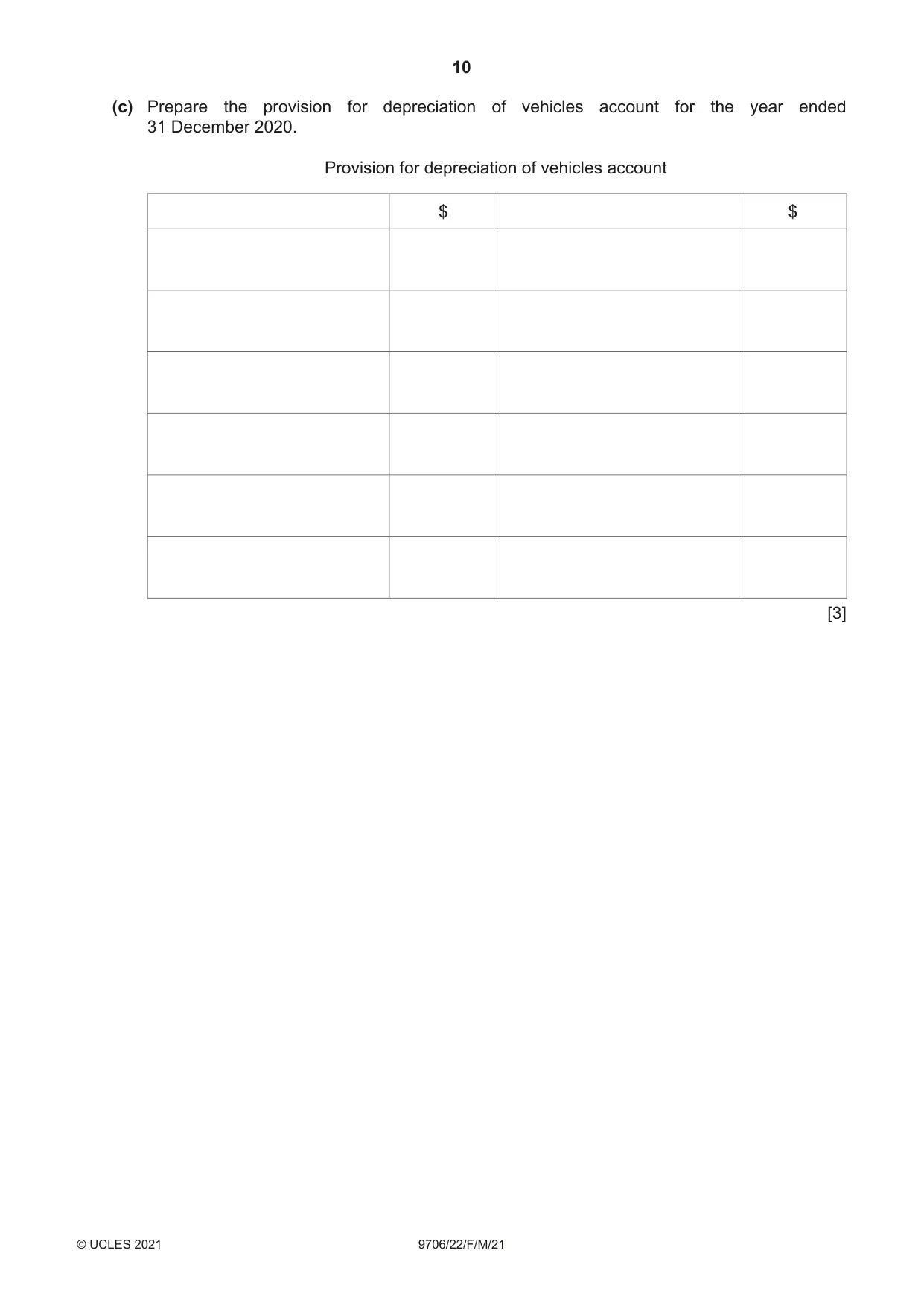
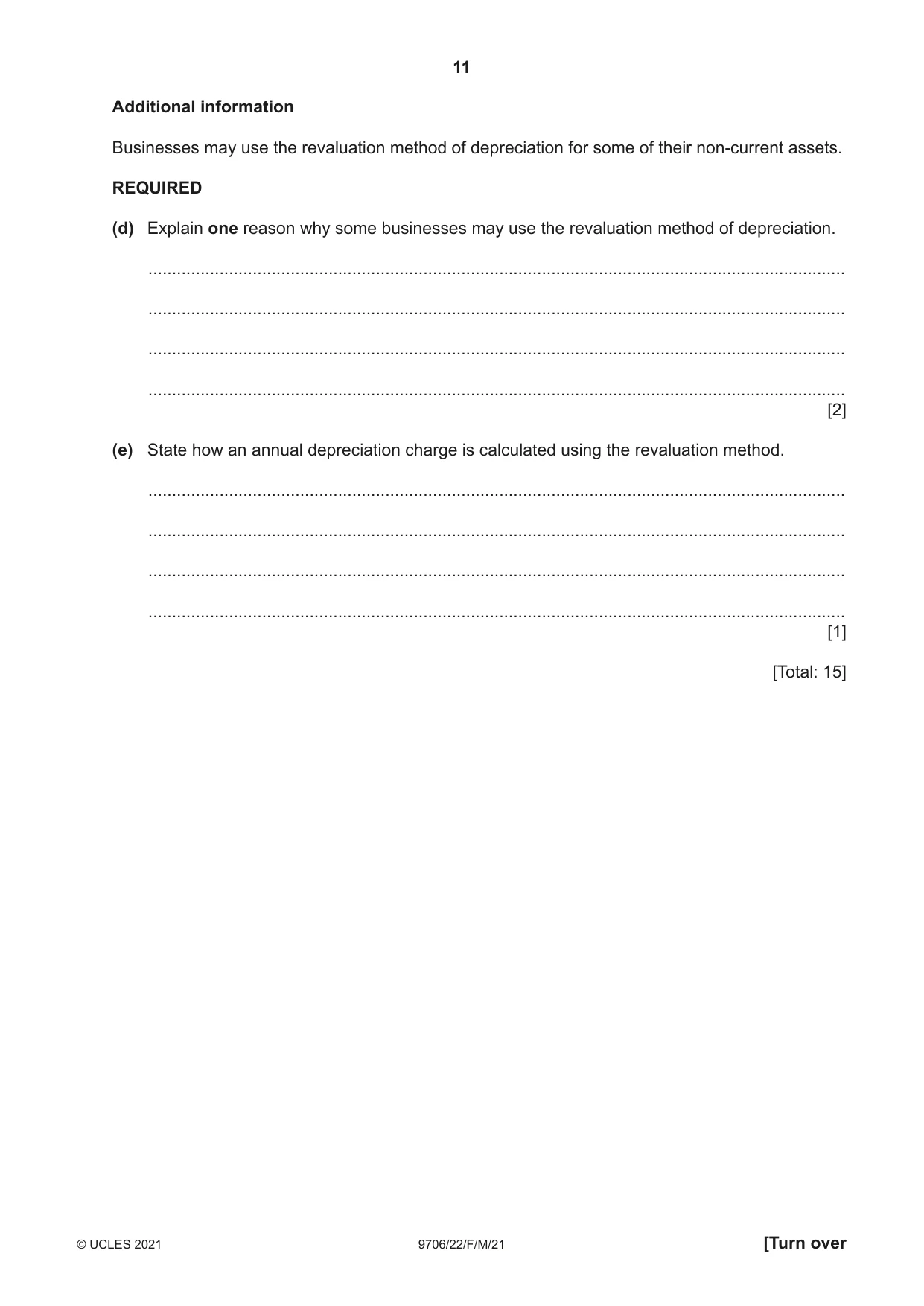
2 Myra owns a delivery business. The following information is available about her business’s delivery vehicles. Vehicle Date of purchase Cost $ A 1 August 2017 30 000 B 1 February 2018 36 000 C 1 June 2019 39 000 Vehicles are depreciated using the straight-line method at 20% per annum. Depreciation is charged on a month-by-month basis. The business’s financial year end is 31 December. REQUIRED (a) Calculate the balance on the provision for depreciation of vehicles account at 31 December 2019. ................................................................................................................................................... ................................................................................................................................................... ................................................................................................................................................... ................................................................................................................................................... ................................................................................................................................................... ................................................................................................................................................... ................................................................................................................................................... ................................................................................................................................................... ................................................................................................................................................... ................................................................................................................................................... ................................................................................................................................................... [4] Additional information On 1 March 2020, Vehicle A was sold in part exchange for Vehicle D. Vehicle D cost $42 000 of which $29 200 was paid by cheque. REQUIRED (b) Prepare the vehicle disposal account. Vehicle disposal account $ $ [5] (c) Prepare the provision for depreciation of vehicles account for the year ended 31 December 2020. Provision for depreciation of vehicles account $ $ [3] Additional information Businesses may use the revaluation method of depreciation for some of their non-current assets. REQUIRED (d) Explain one reason why some businesses may use the revaluation method of depreciation. ................................................................................................................................................... ................................................................................................................................................... ................................................................................................................................................... ................................................................................................................................................... [2] (e) State how an annual depreciation charge is calculated using the revaluation method. ................................................................................................................................................... ................................................................................................................................................... ................................................................................................................................................... ................................................................................................................................................... [1] [Total: 15]
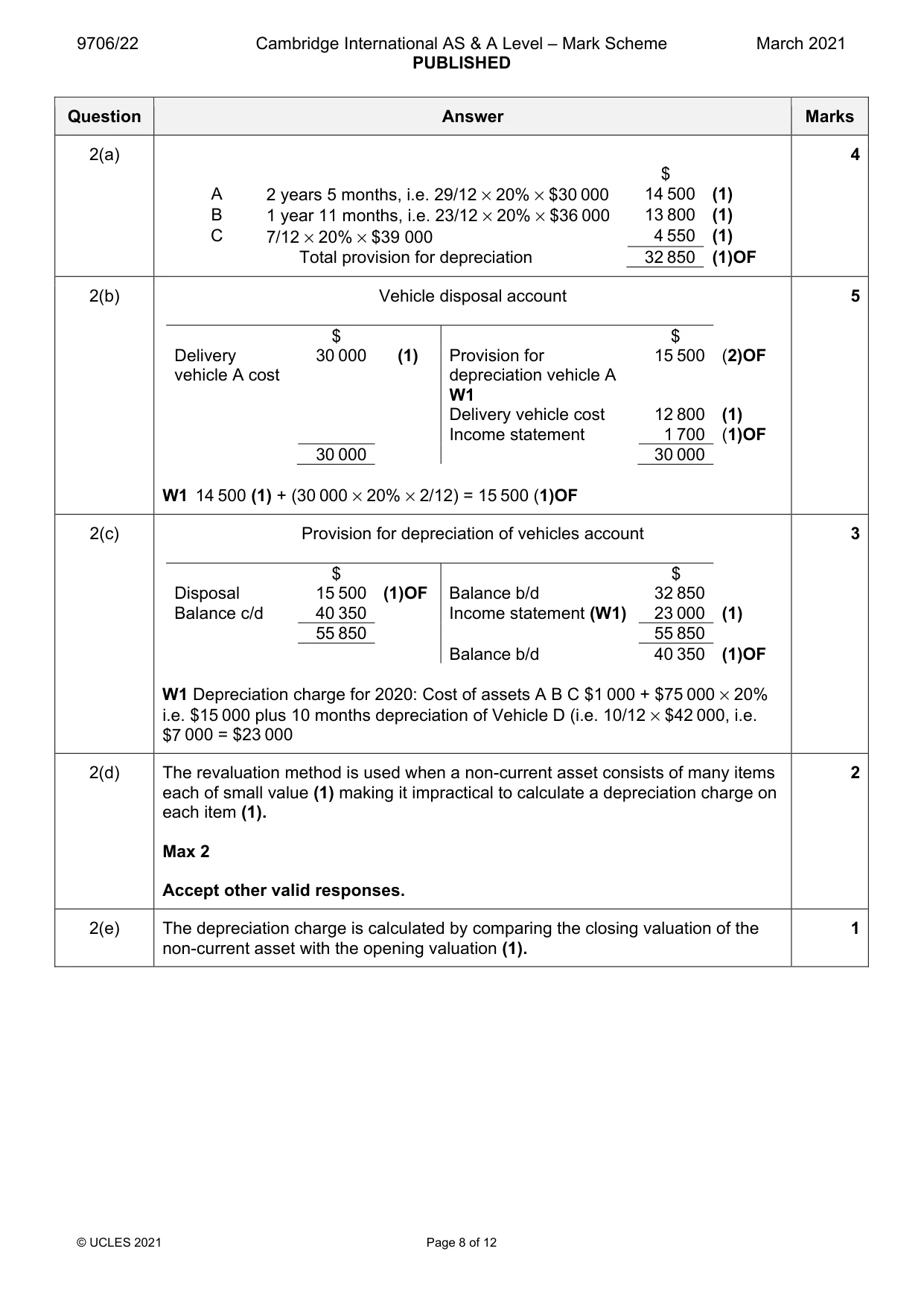
Mark scheme: Question Answer Marks 2(a) 4 $ A 2 years 5 months, i.e. 29/12 × 20% × $30 000 14 500 (1) B 1 year 11 months, i.e. 23/12 × 20% × $36 000 13 800 (1) C 7/12 × 20% × $39 000 4 550 (1) Total provision for depreciation 32 850 (1)OF 2(b) Vehicle disposal account 5 $ $ Delivery 30 000 (1) Provision for 15 500 (2)OF vehicle A cost depreciation vehicle A W1 Delivery vehicle cost 12 800 (1) Income statement 1 700 (1)OF 30 000 30 000 W1 14 500 (1) + (30 000 × 20% × 2/12) = 15 500 (1)OF 2(c) Provision for depreciation of vehicles account 3 $ $ Disposal 15 500 (1)OF Balance b/d 32 850 Balance c/d 40 350 Income statement (W1) 23 000 (1) 55 850 55 850 Balance b/d 40 350 (1)OF W1 Depreciation charge for 2020: Cost of assets A B C $1 000 + $75 000 × 20% i.e. $15 000 plus 10 months depreciation of Vehicle D (i.e. 10/12 × $42 000, i.e. $7 000 = $23 000 2(d) The revaluation method is used when a non-current asset consists of many items 2 each of small value (1) making it impractical to calculate a depreciation charge on each item (1). Max 2 Accept other valid responses. 2(e) The depreciation charge is calculated by comparing the closing valuation of the 1 non-current asset with the opening valuation (1).
Q3 · Goodwill was valued at $50 000
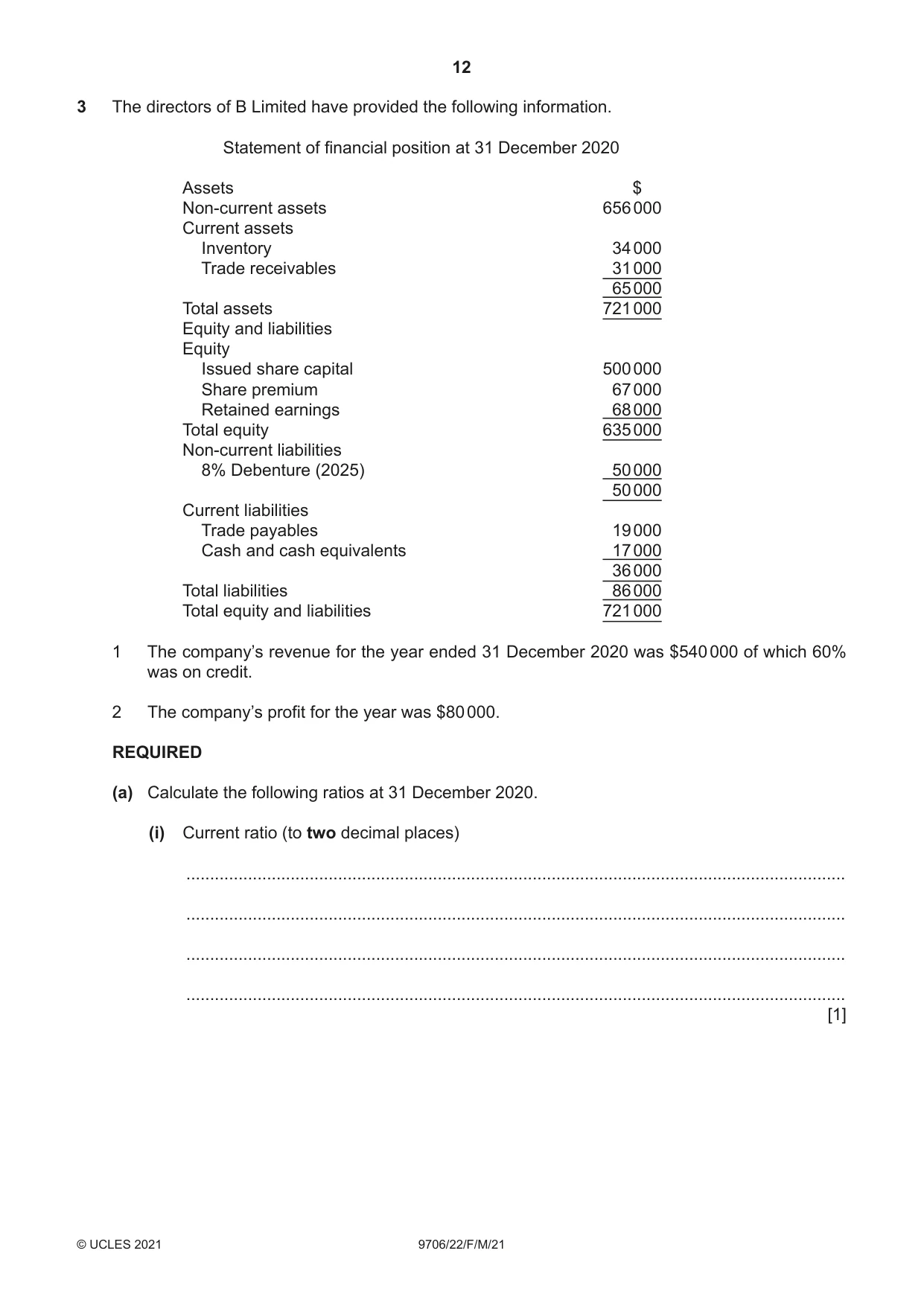
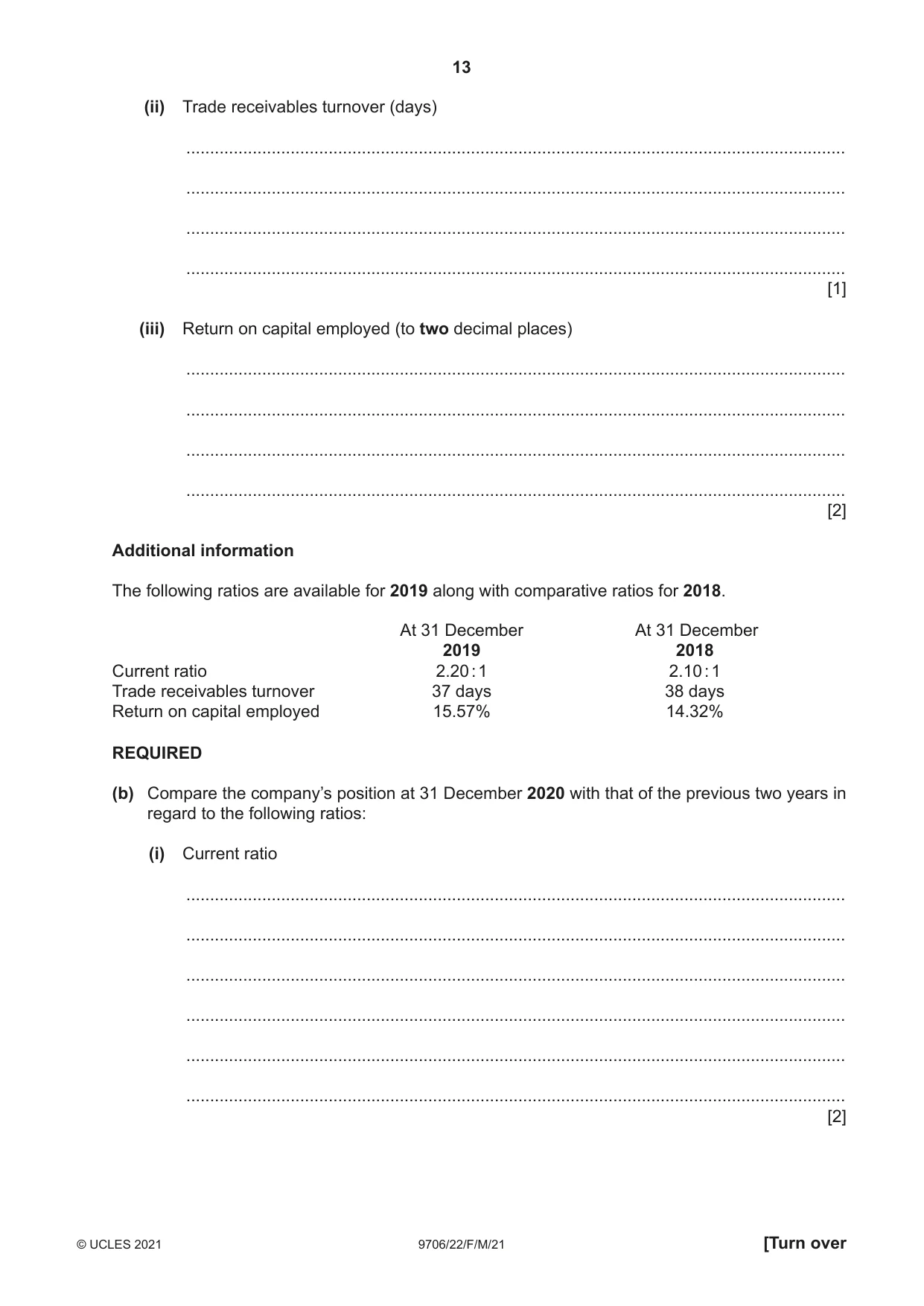
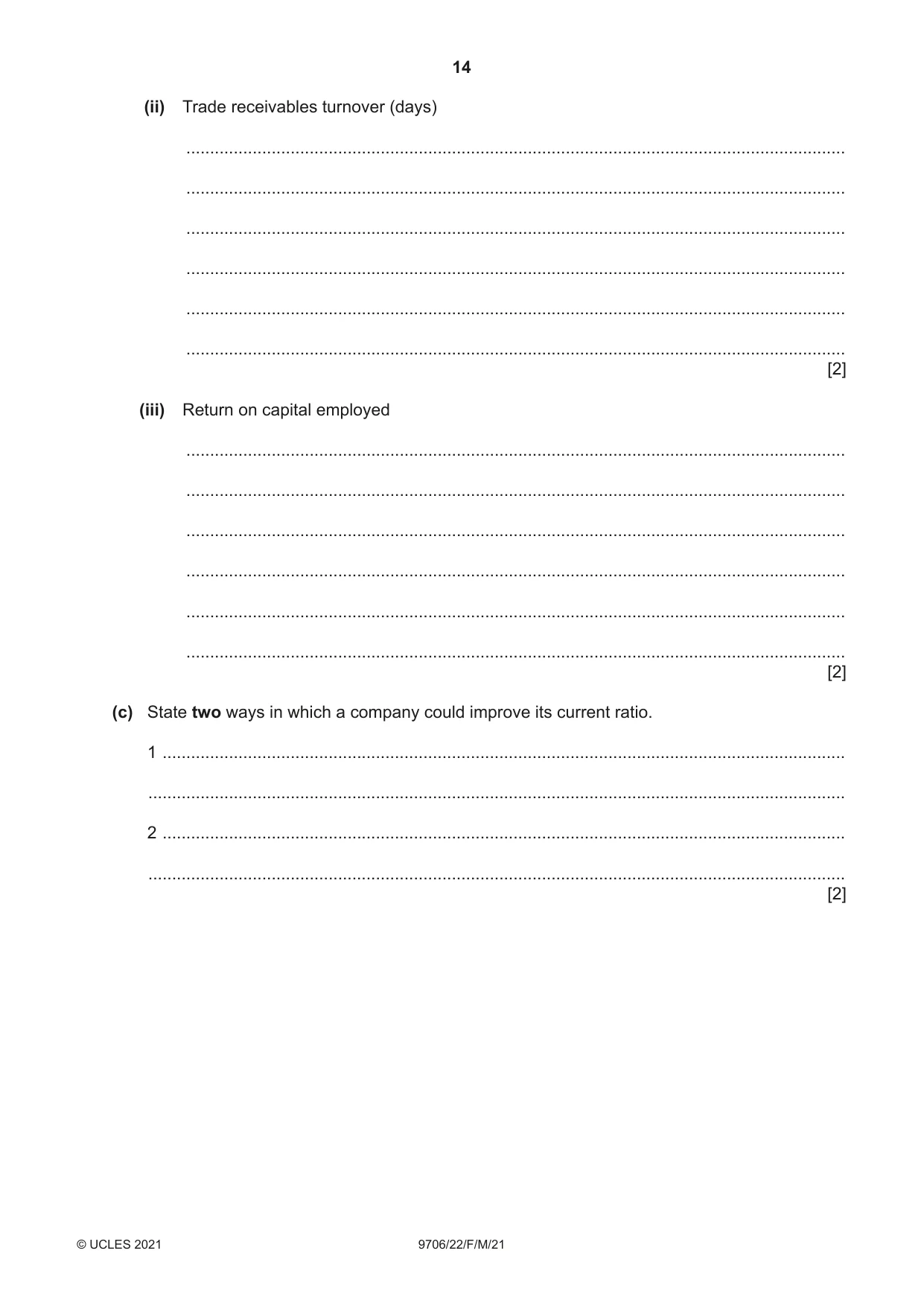
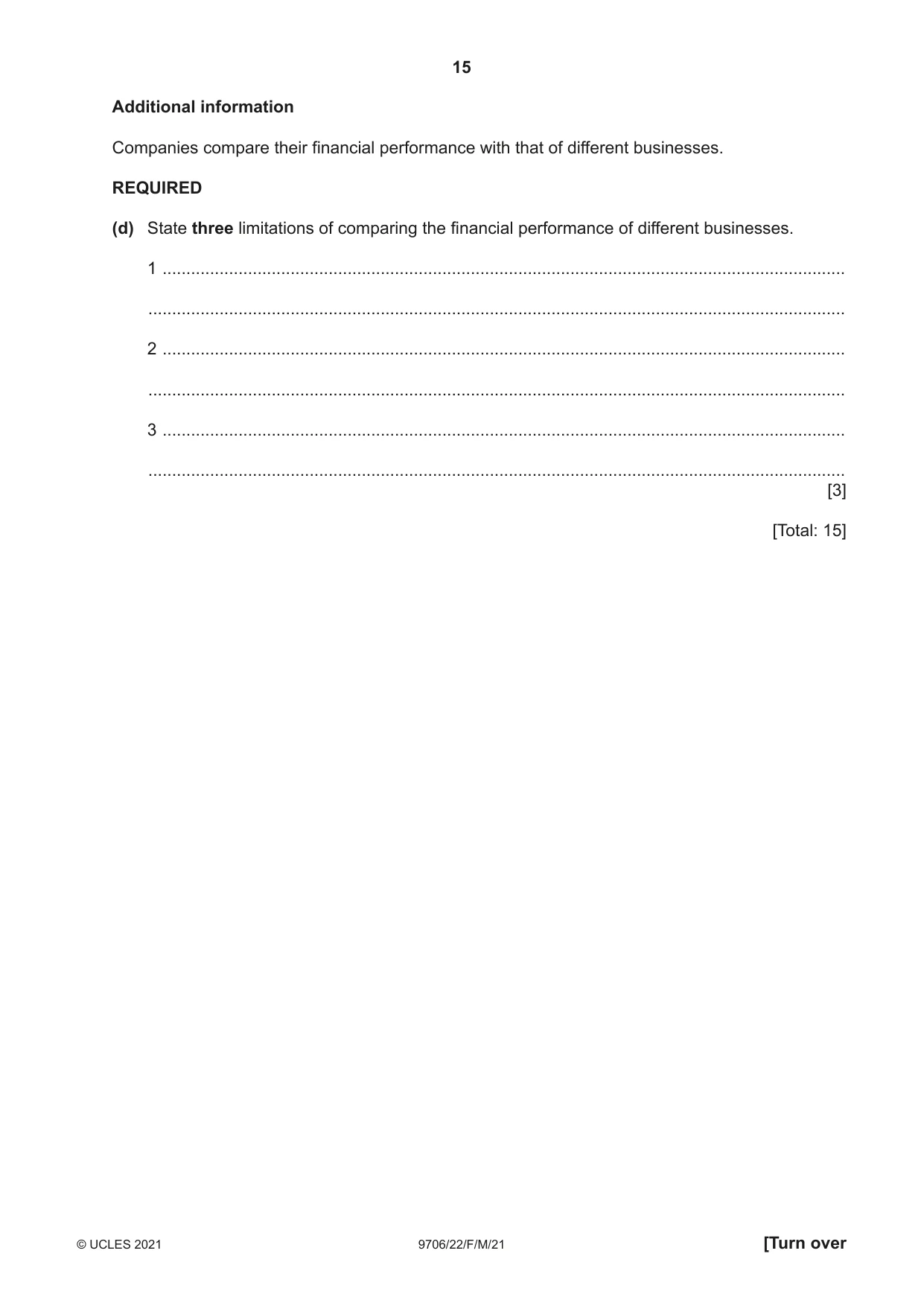
3 Goodwill was valued at $50 000. A goodwill account was not to be maintained in the partnership’s books. REQUIRED (d) Explain the meaning of goodwill. ................................................................................................................................................... ................................................................................................................................................... ................................................................................................................................................... ................................................................................................................................................... ................................................................................................................................................... [2] (e) Explain why a valuation of goodwill could be made when a partner retires. ................................................................................................................................................... ................................................................................................................................................... ................................................................................................................................................... ................................................................................................................................................... ................................................................................................................................................... ................................................................................................................................................... [2] (f) Prepare a statement to show the amount due to Javed on his retirement from the partnership. ................................................................................................................................................... ................................................................................................................................................... ................................................................................................................................................... ................................................................................................................................................... ................................................................................................................................................... ................................................................................................................................................... ................................................................................................................................................... ................................................................................................................................................... ................................................................................................................................................... ................................................................................................................................................... ................................................................................................................................................... [6] Additional information Faraz and Leah continued in partnership sharing profits and losses equally. They discussed how best to finance the amount due to Javed on his retirement from the partnership. They are considering two options. Option 1: Take out a bank loan to cover the amount due. Option 2: Admit a new partner whose capital contribution would cover the amount due. REQUIRED (g) Advise the partners which option they should choose. Justify your answer by discussing both options. ................................................................................................................................................... ................................................................................................................................................... ................................................................................................................................................... ................................................................................................................................................... ................................................................................................................................................... ................................................................................................................................................... ................................................................................................................................................... ................................................................................................................................................... ................................................................................................................................................... ................................................................................................................................................... ................................................................................................................................................... ................................................................................................................................................... ................................................................................................................................................... ................................................................................................................................................... ................................................................................................................................................... [7] [Total: 30] 2 Myra owns a delivery business. The following information is available about her business’s delivery vehicles. Vehicle Date of purchase Cost $ A 1 August 2017 30 000 B 1 February 2018 36 000 C 1 June 2019 39 000 Vehicles are depreciated using the straight-line method at 20% per annum. Depreciation is charged on a month-by-month basis. The business’s financial year end is 31 December. REQUIRED (a) Calculate the balance on the provision for depreciation of vehicles account at 31 December 2019. ................................................................................................................................................... ................................................................................................................................................... ................................................................................................................................................... ................................................................................................................................................... ................................................................................................................................................... ................................................................................................................................................... ................................................................................................................................................... ................................................................................................................................................... ................................................................................................................................................... ................................................................................................................................................... ................................................................................................................................................... [4] Additional information On 1 March 2020, Vehicle A was sold in part exchange for Vehicle D. Vehicle D cost $42 000 of which $29 200 was paid by cheque. REQUIRED (b) Prepare the vehicle disposal account. Vehicle disposal account $ $ [5] (c) Prepare the provision for depreciation of vehicles account for the year ended 31 December 2020. Provision for depreciation of vehicles account $ $ [3] Additional information Businesses may use the revaluation method of depreciation for some of their non-current assets. REQUIRED (d) Explain one reason why some businesses may use the revaluation method of depreciation. ................................................................................................................................................... ................................................................................................................................................... ................................................................................................................................................... ................................................................................................................................................... [2] (e) State how an annual depreciation charge is calculated using the revaluation method. ................................................................................................................................................... ................................................................................................................................................... ................................................................................................................................................... ................................................................................................................................................... [1] [Total: 15] 3 The directors of B Limited have provided the following information. Statement of financial position at 31 December 2020 Assets $ Non-current assets 656 000 Current assets Inventory 34 000 Trade receivables 31 000 65 000 Total assets 721 000 Equity and liabilities Equity Issued share capital 500 000 Share premium 67 000 Retained earnings 68 000 Total equity 635 000 Non-current liabilities 8% Debenture (2025) 50 000 50 000 Current liabilities Trade payables 19 000 Cash and cash equivalents 17 000 36 000 Total liabilities 86 000 Total equity and liabilities 721 000 1 The company’s revenue for the year ended 31 December 2020 was $540 000 of which 60% was on credit. 2 The company’s profit for the year was $80 000. REQUIRED (a) Calculate the following ratios at 31 December 2020. (i) Current ratio (to two decimal places) ........................................................................................................................................... ........................................................................................................................................... ........................................................................................................................................... ........................................................................................................................................... [1] (ii) Trade receivables turnover (days) ........................................................................................................................................... ........................................................................................................................................... ........................................................................................................................................... ........................................................................................................................................... [1] (iii) Return on capital employed (to two decimal places) ........................................................................................................................................... ........................................................................................................................................... ........................................................................................................................................... ........................................................................................................................................... [2] Additional information The following ratios are available for 2019 along with comparative ratios for 2018. At 31 December At 31 December 2019 2018 Current ratio 2.20 : 1 2.10 : 1 Trade receivables turnover 37 days 38 days Return on capital employed 15.57% 14.32% REQUIRED (b) Compare the company’s position at 31 December 2020 with that of the previous two years in regard to the following ratios: (i) Current ratio ........................................................................................................................................... ........................................................................................................................................... ........................................................................................................................................... ........................................................................................................................................... ........................................................................................................................................... ........................................................................................................................................... [2] (ii) Trade receivables turnover (days) ........................................................................................................................................... ........................................................................................................................................... ........................................................................................................................................... ........................................................................................................................................... ........................................................................................................................................... ........................................................................................................................................... [2] (iii) Return on capital employed ........................................................................................................................................... ........................................................................................................................................... ........................................................................................................................................... ........................................................................................................................................... ........................................................................................................................................... ........................................................................................................................................... [2] (c) State two ways in which a company could improve its current ratio. 1 ................................................................................................................................................ ................................................................................................................................................... 2 ................................................................................................................................................ ................................................................................................................................................... [2] Additional information Companies compare their financial performance with that of different businesses. REQUIRED (d) State three limitations of comparing the financial performance of different businesses. 1 ................................................................................................................................................ ................................................................................................................................................... 2 ................................................................................................................................................ ................................................................................................................................................... 3 ................................................................................................................................................ ................................................................................................................................................... [3] [Total: 15]
Mark scheme: 3(a)(i) Current ratio 65:36 = 1.81:1 (1) 1 3(a)(ii) Trade receivables turnover = 31 × 365/324 = 35 days (1) 1 3(a)(iii) Profit before interest 80 + 4 = 84 (1) / 685 = 12.26% (1)OF 2 3(b)(i) The company’s current ratio having slightly improved has now worsened sharply 2 (1). This could mean that it will have difficulty in meeting its obligations in the short to medium term (1). Max 2 Accept other valid responses. 3(b)(ii) The company’s position has improved over the three years (1). Credit customers 2 are paying more quickly than before which will have a beneficial effect on the company’s liquidity position (1). Max 2 Accept other valid responses. 3(b)(iii) The company’s position having slightly improved has now worsened sharply (1). 2 The company is not using its resources effectively (1). Max 2 Accept other valid responses. 3(c) Reduce dividend payments (1) 2 Increase long-term borrowing/issue debentures (1) Issue shares (1) Selling off surplus non-current assets (1) Max 2 Accept other valid responses. 3(d) Businesses may use different accounting policies (1) 3 Historical cost is used to prepare accounts therefore may be misleading (1) There may be different year-ends/seasonal factors (1) There may be non-monetary factors to consider (1) Relative size of each business (1) The effect of window dressing (1) Maybe a different business structure/different objectives (1) Max 3 Accept any other valid responses
More questions on Analysis and communication of accounting information
Q4 · K Limited produces goods at two sites and uses marginal costing
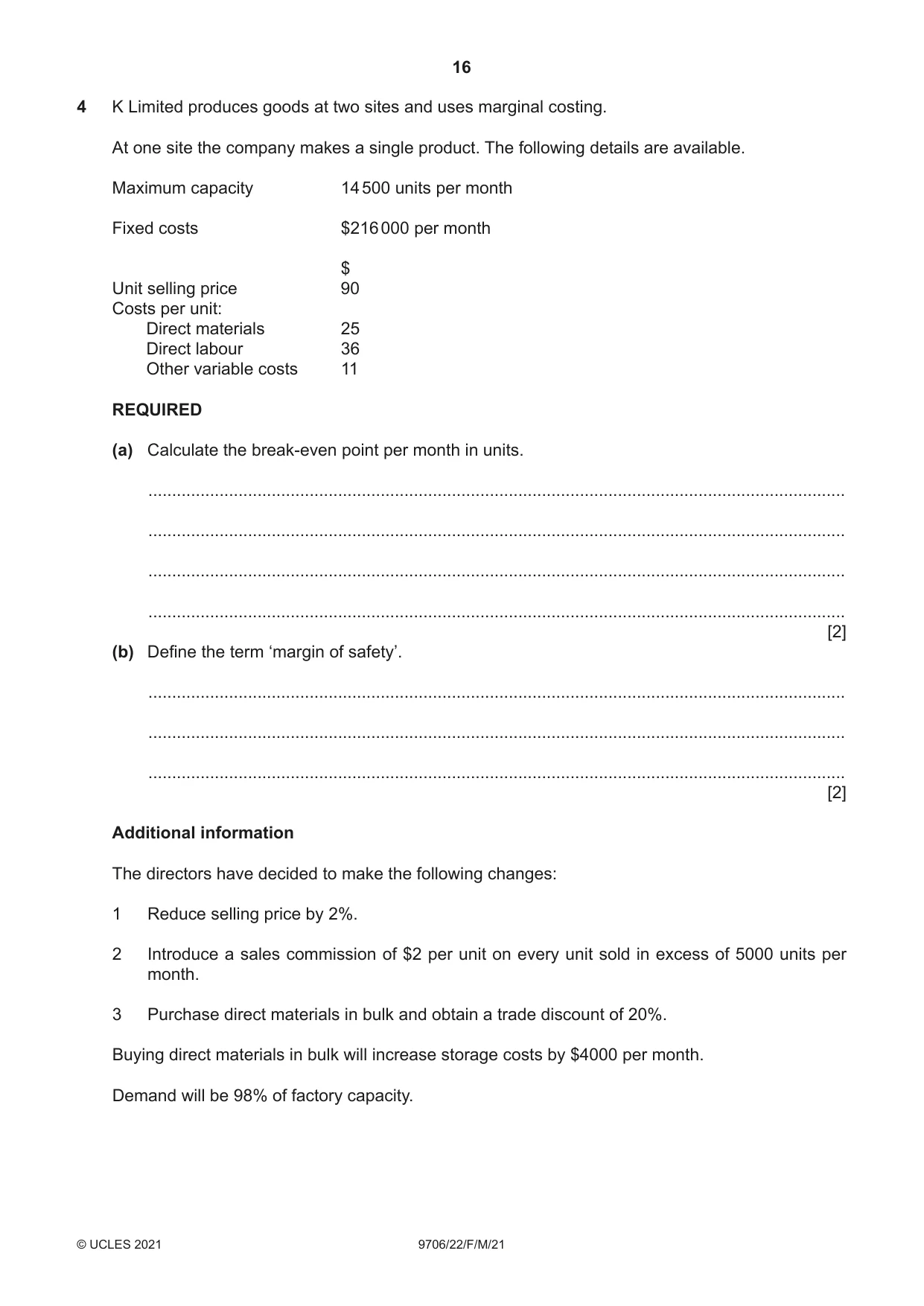
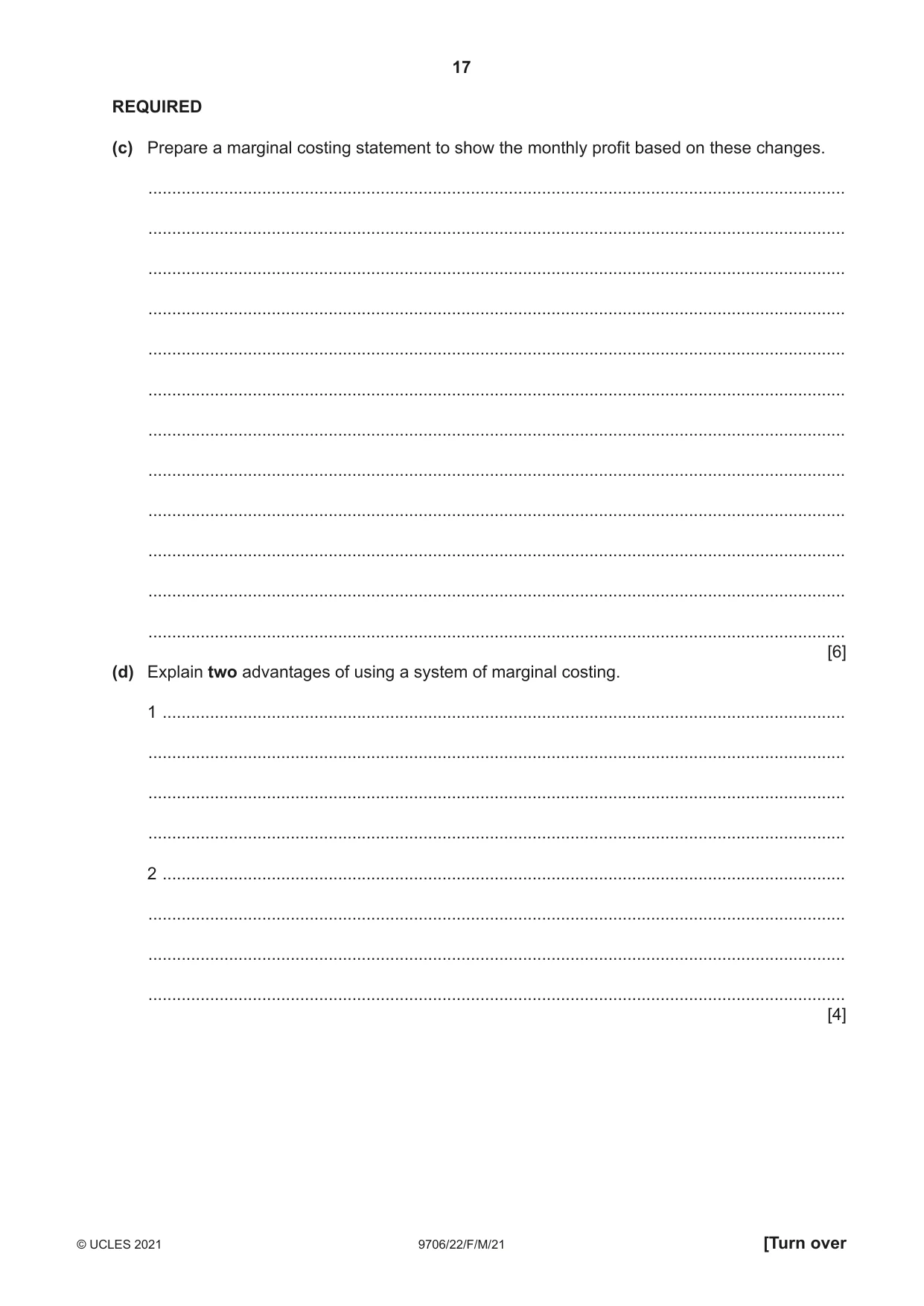
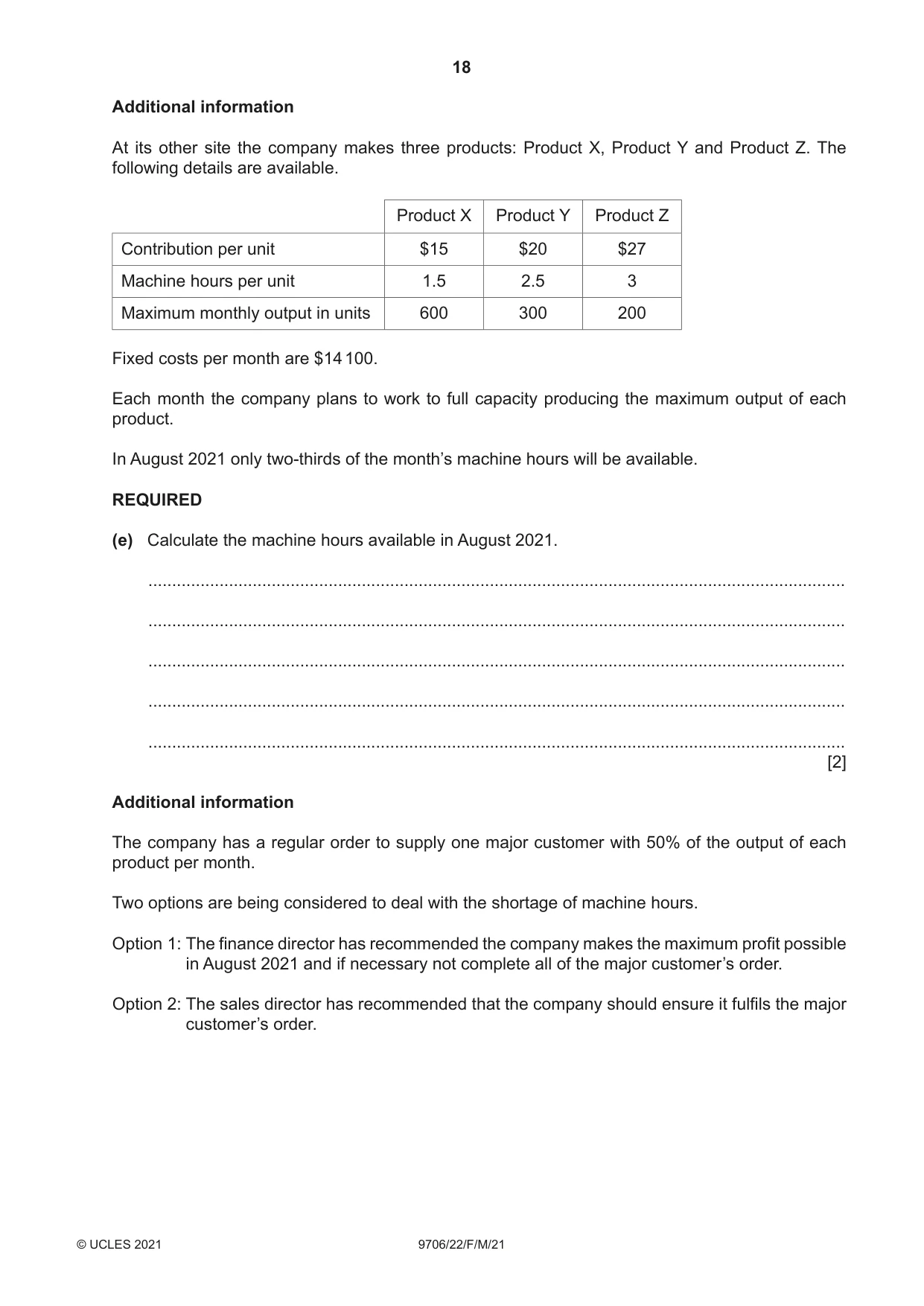
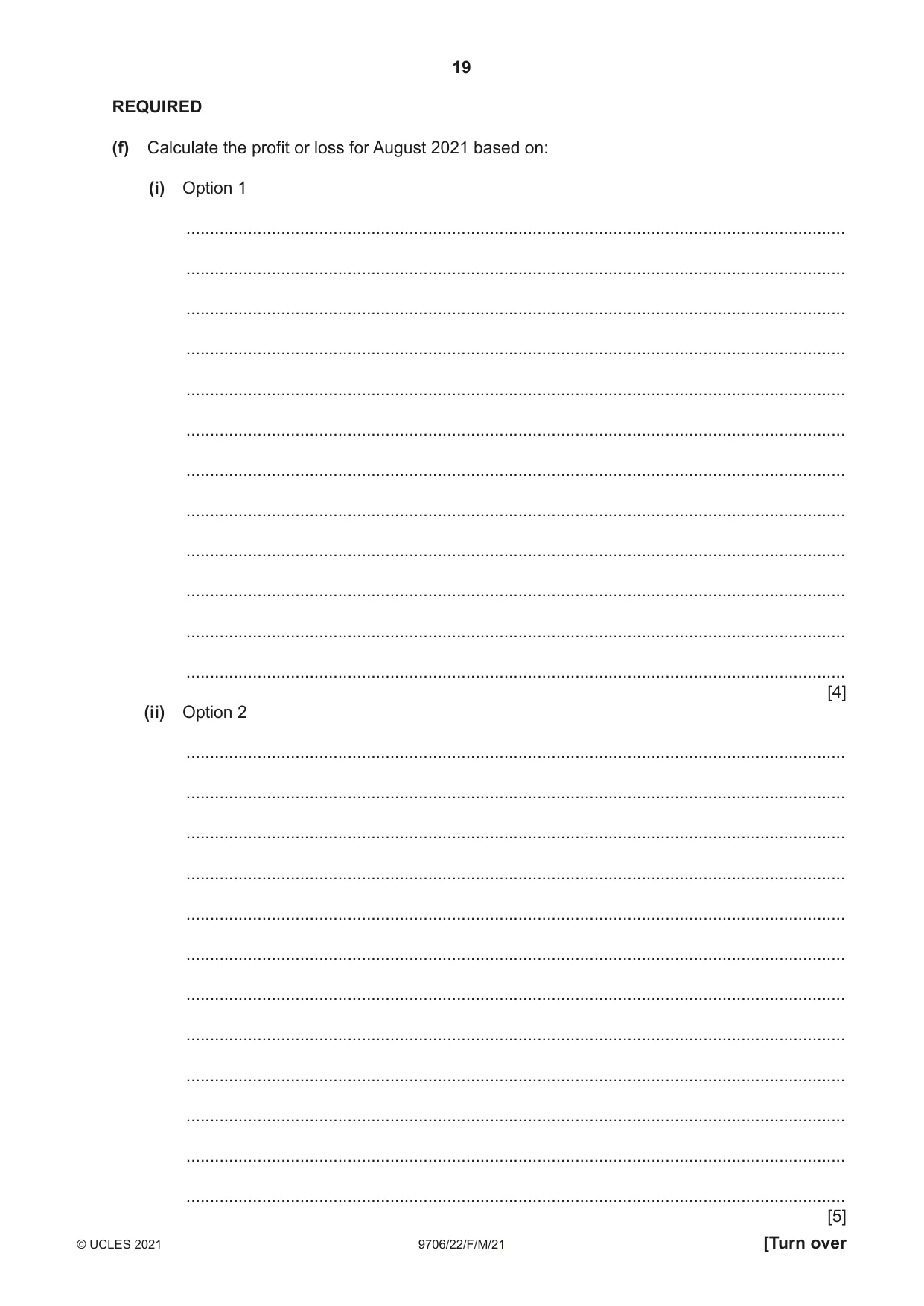
4 K Limited produces goods at two sites and uses marginal costing. At one site the company makes a single product. The following details are available. Maximum capacity 14 500 units per month Fixed costs $216 000 per month $ Unit selling price 90 Costs per unit: Direct materials 25 Direct labour 36 Other variable costs 11 REQUIRED (a) Calculate the break-even point per month in units. ................................................................................................................................................... ................................................................................................................................................... ................................................................................................................................................... ................................................................................................................................................... [2] (b) Define the term ‘margin of safety’. ................................................................................................................................................... ................................................................................................................................................... ................................................................................................................................................... [2] Additional information The directors have decided to make the following changes: 1 Reduce selling price by 2%. 2 Introduce a sales commission of $2 per unit on every unit sold in excess of 5000 units per month. 3 Purchase direct materials in bulk and obtain a trade discount of 20%. Buying direct materials in bulk will increase storage costs by $4000 per month. Demand will be 98% of factory capacity. REQUIRED (c) Prepare a marginal costing statement to show the monthly profit based on these changes. ................................................................................................................................................... ................................................................................................................................................... ................................................................................................................................................... ................................................................................................................................................... ................................................................................................................................................... ................................................................................................................................................... ................................................................................................................................................... ................................................................................................................................................... ................................................................................................................................................... ................................................................................................................................................... ................................................................................................................................................... ................................................................................................................................................... [6] (d) Explain two advantages of using a system of marginal costing. 1 ................................................................................................................................................ ................................................................................................................................................... ................................................................................................................................................... ................................................................................................................................................... 2 ................................................................................................................................................ ................................................................................................................................................... ................................................................................................................................................... ................................................................................................................................................... [4] Additional information At its other site the company makes three products: Product X, Product Y and Product Z. The following details are available. Product X Product Y Product Z Contribution per unit $15 $20 $27 Machine hours per unit 1.5 2.5 3 Maximum monthly output in units 600 300 200 Fixed costs per month are $14 100. Each month the company plans to work to full capacity producing the maximum output of each product. In August 2021 only two-thirds of the month’s machine hours will be available. REQUIRED (e) Calculate the machine hours available in August 2021. ................................................................................................................................................... ................................................................................................................................................... ................................................................................................................................................... ................................................................................................................................................... ................................................................................................................................................... [2] Additional information The company has a regular order to supply one major customer with 50% of the output of each product per month. Two options are being considered to deal with the shortage of machine hours. Option 1: The finance director has recommended the company makes the maximum profit possible in August 2021 and if necessary not complete all of the major customer’s order. Option 2: The sales director has recommended that the company should ensure it fulfils the major customer’s order.
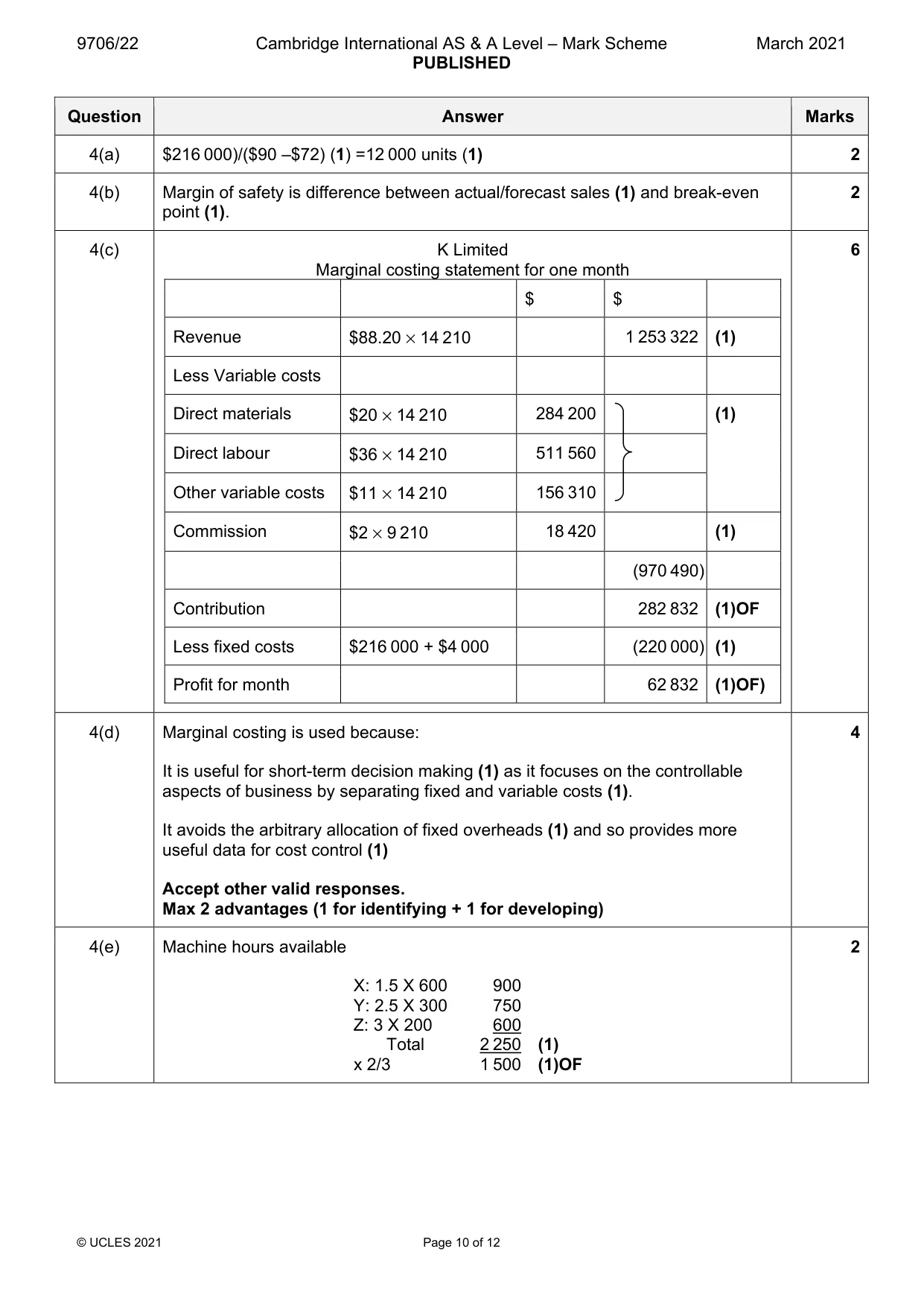
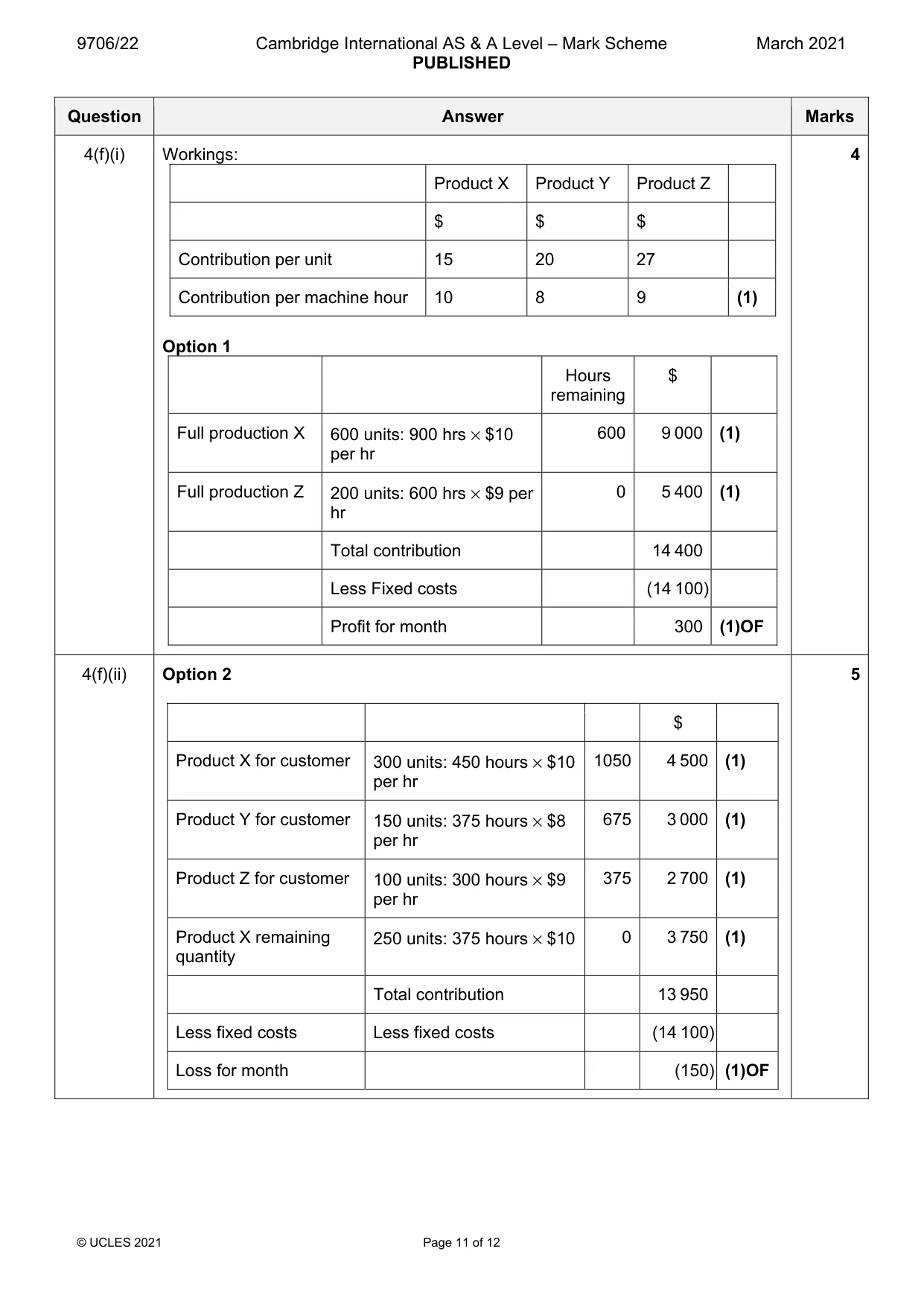
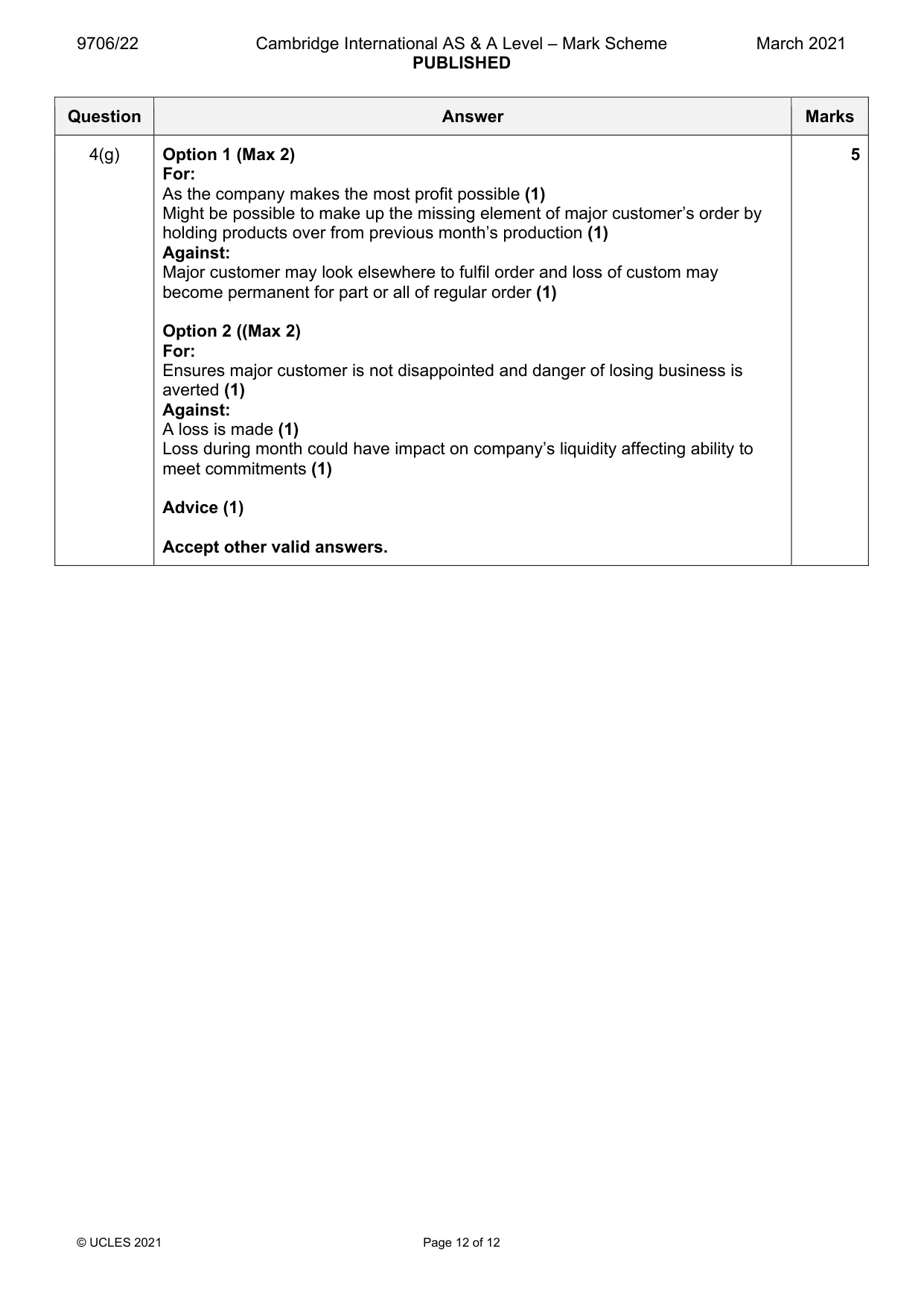
Mark scheme: 4(a) $216 000)/($90 –$72) (1) =12 000 units (1) 2 4(b) Margin of safety is difference between actual/forecast sales (1) and break-even 2 point (1). 4(c) K Limited 6 Marginal costing statement for one month $ $ Revenue $88.20 × 14 210 1 253 322 (1) Less Variable costs Direct materials $20 × 14 210 284 200 (1) Direct labour $36 × 14 210 511 560 Other variable costs $11 × 14 210 156 310 Commission $2 × 9 210 18 420 (1) (970 490) Contribution 282 832 (1)OF Less fixed costs $216 000 + $4 000 (220 000) (1) Profit for month 62 832 (1)OF) 4(d) Marginal costing is used because: 4 It is useful for short-term decision making (1) as it focuses on the controllable aspects of business by separating fixed and variable costs (1). It avoids the arbitrary allocation of fixed overheads (1) and so provides more useful data for cost control (1) Accept other valid responses. Max 2 advantages (1 for identifying + 1 for developing) 4(e) Machine hours available 2 X: 1.5 X 600 900 Y: 2.5 X 300 750 Z: 3 X 200 600 Total 2 250 (1) x 2/3 1 500 (1)OF 4(f)(i) Workings: 4 Product X Product Y Product Z $ $ $ Contribution per unit 15 20 27 Contribution per machine hour 10 8 9 (1) Option 1 Hours $ remaining Full production X 600 units: 900 hrs × $10 600 9 000 (1) per hr Full production Z 200 units: 600 hrs × $9 per 0 5 400 (1) hr Total contribution 14 400 Less Fixed costs (14 100) Profit for month 300 (1)OF 4(f)(ii) Option 2 5 $ Product X for customer 300 units: 450 hours × $10 1050 4 500 (1) per hr Product Y for customer 150 units: 375 hours × $8 675 3 000 (1) per hr Product Z for customer 100 units: 300 hours × $9 375 2 700 (1) per hr Product X remaining 250 units: 375 hours × $10 0 3 750 (1) quantity Total contribution 13 950 Less fixed costs Less fixed costs (14 100) Loss for month (150) (1)OF 4(g) Option 1 (Max 2) 5 For: As the company makes the most profit possible (1) Might be possible to make up the missing element of major customer’s order by holding products over from previous month’s production (1) Against: Major customer may look elsewhere to fulfil order and loss of custom may become permanent for part or all of regular order (1) Option 2 ((Max 2) For: Ensures major customer is not disappointed and danger of losing business is averted (1) Against: A loss is made (1) Loss during month could have impact on company’s liquidity affecting ability to meet commitments (1) Advice (1) Accept other valid answers.
What was in this paper
The subtopics covered by these 4 questions, and how many questions each got. Open one in a new tab to see every Cambridge question on it.
What you needed in this session
Cambridge’s own grade thresholds for 2021 Feb/March, Paper 2 · Variant 2. A higher threshold means an easier paper — the bar moves with how the cohort did.