Cambridge A Level Accounting 9706 — 2018 Feb/March Paper 2 · Variant 2
9706/22/F/M/18 · 4 questions · 90 marks · ≈101 min
The question paper and its mark scheme, free to read here and free to download. This is Cambridge’s own paper, exactly as it was sat.
Question paper20 pages



Mark scheme12 pages
Answers below. Sit the paper first if you are practising.
Questions as text
Q1 · Delph started trading on 1 July 2016
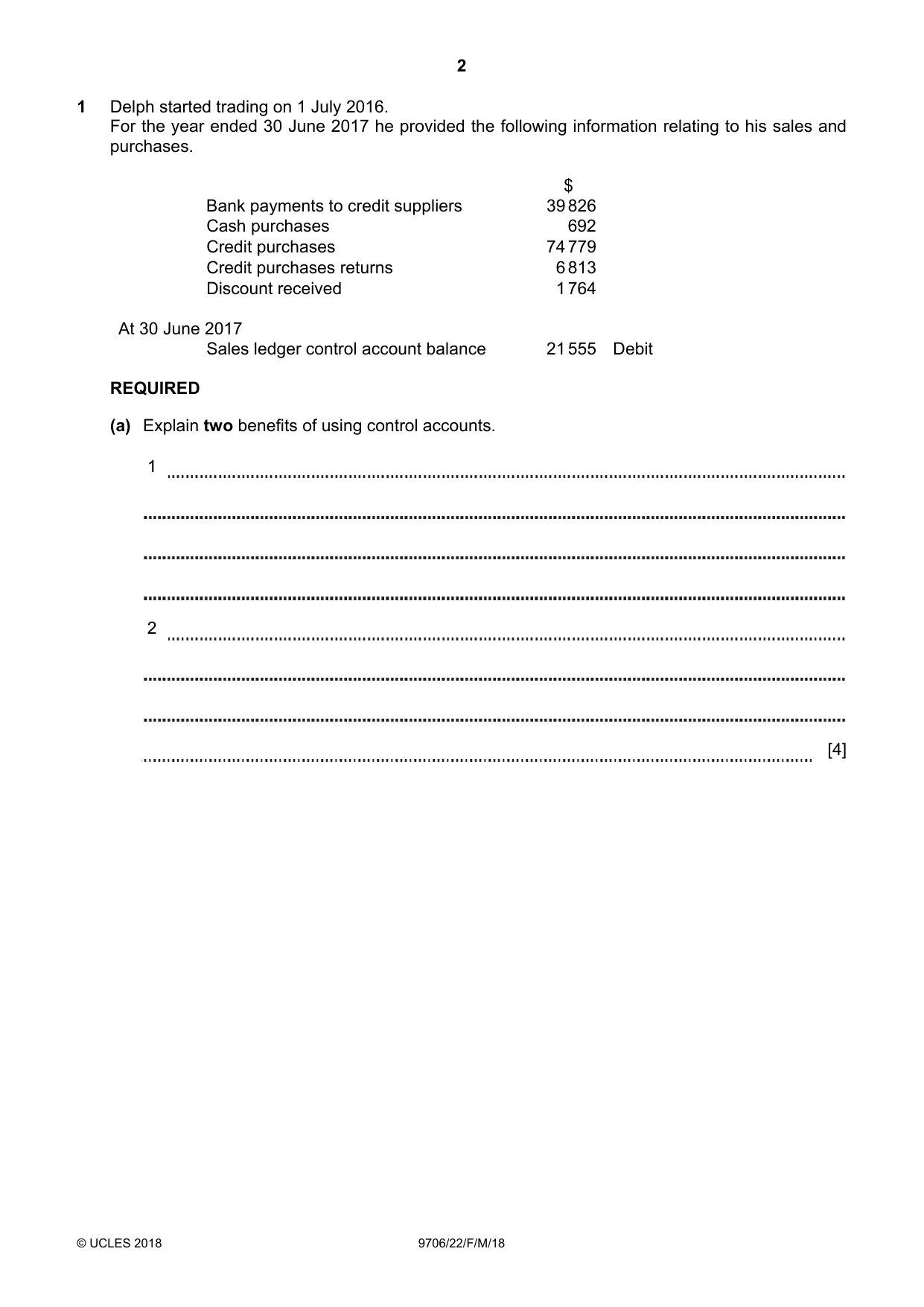
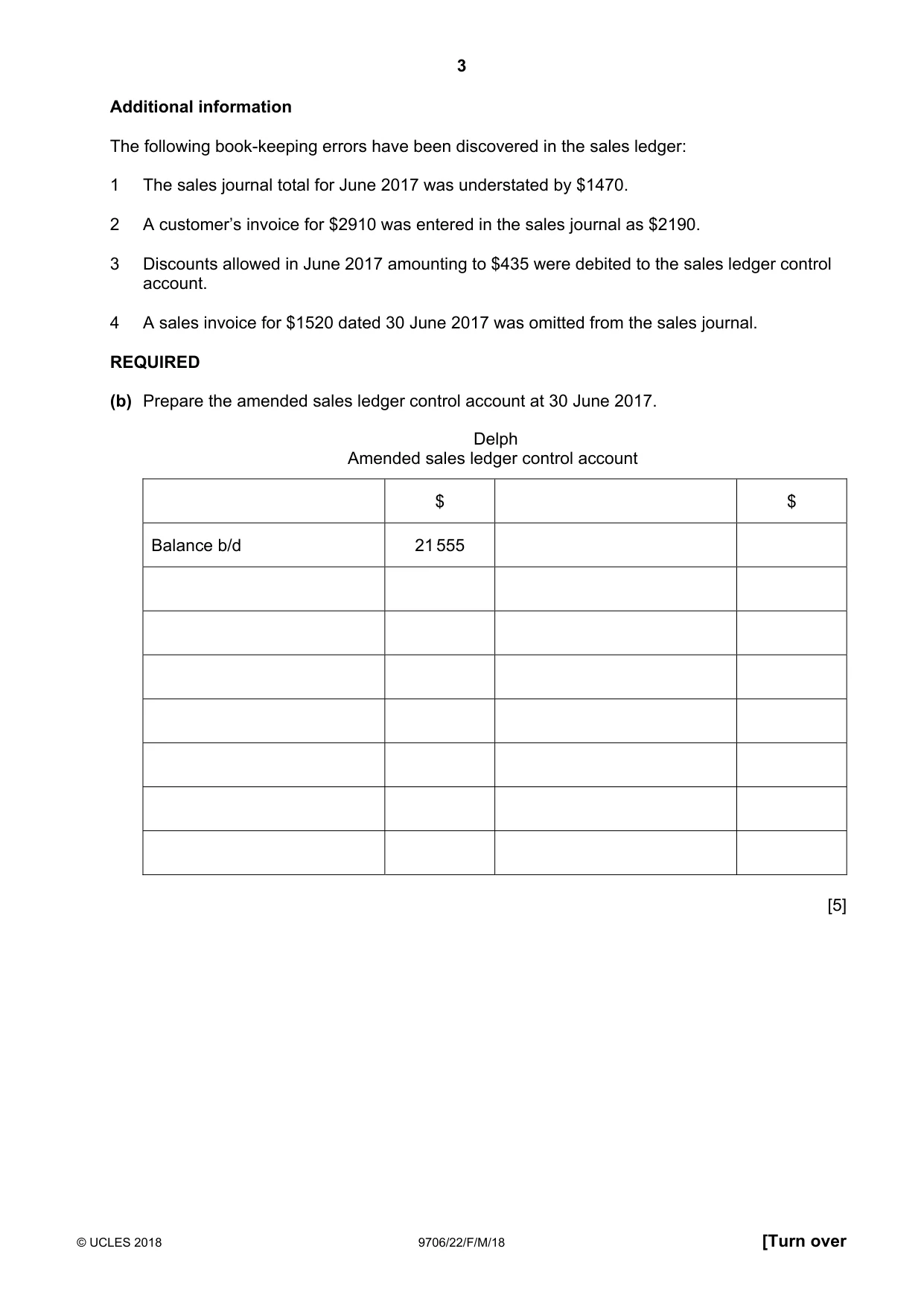
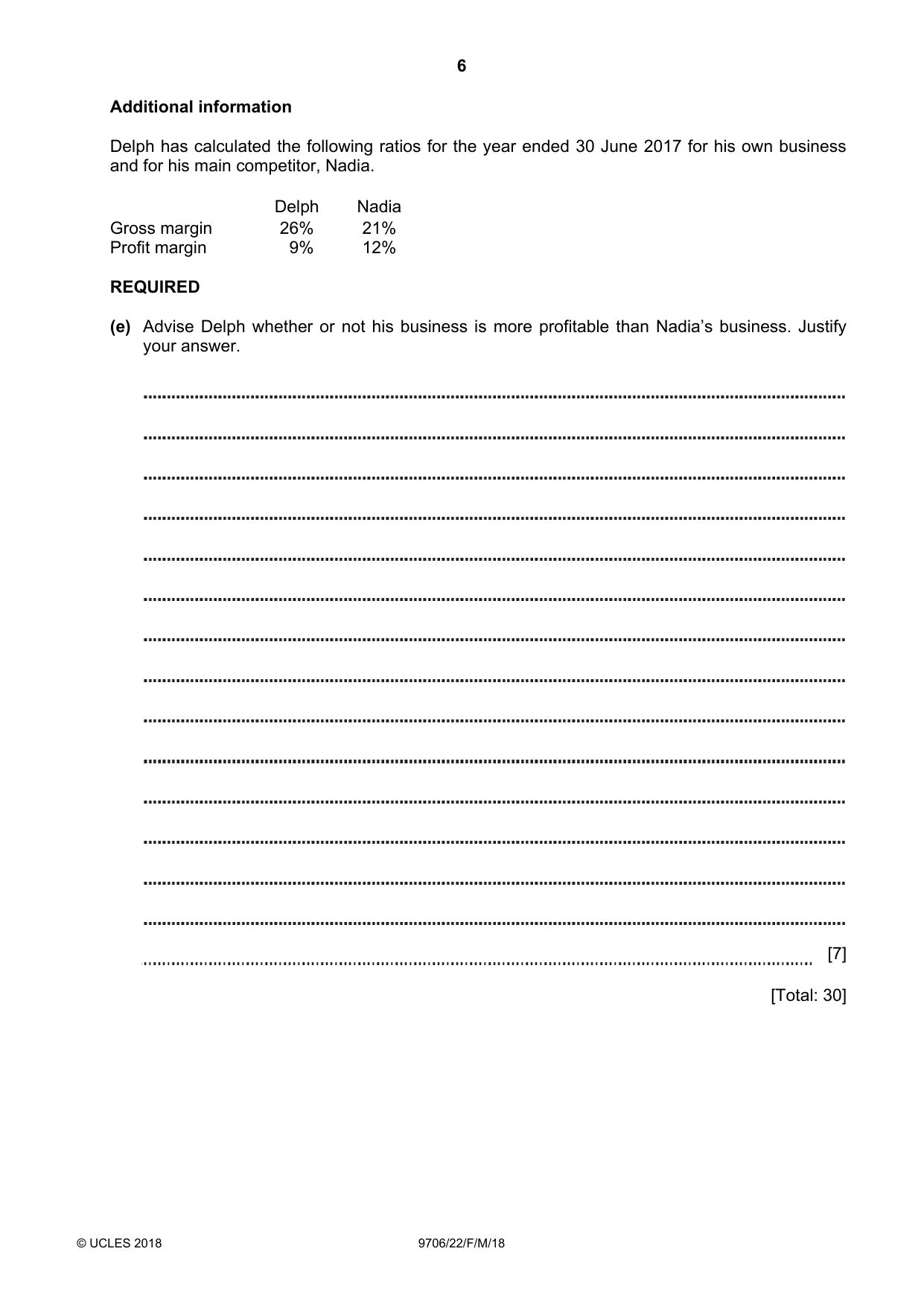
1 Delph started trading on 1 July 2016. For the year ended 30 June 2017 he provided the following information relating to his sales and purchases. $ Bank payments to credit suppliers 39 826 Cash purchases 692 Credit purchases 74 779 Credit purchases returns 6 813 Discount received 1 764 At 30 June 2017 Sales ledger control account balance 21 555 Debit REQUIRED (a) Explain two benefits of using control accounts. 1 2 [4] Additional information The following book-keeping errors have been discovered in the sales ledger: 1 The sales journal total for June 2017 was understated by $1470.
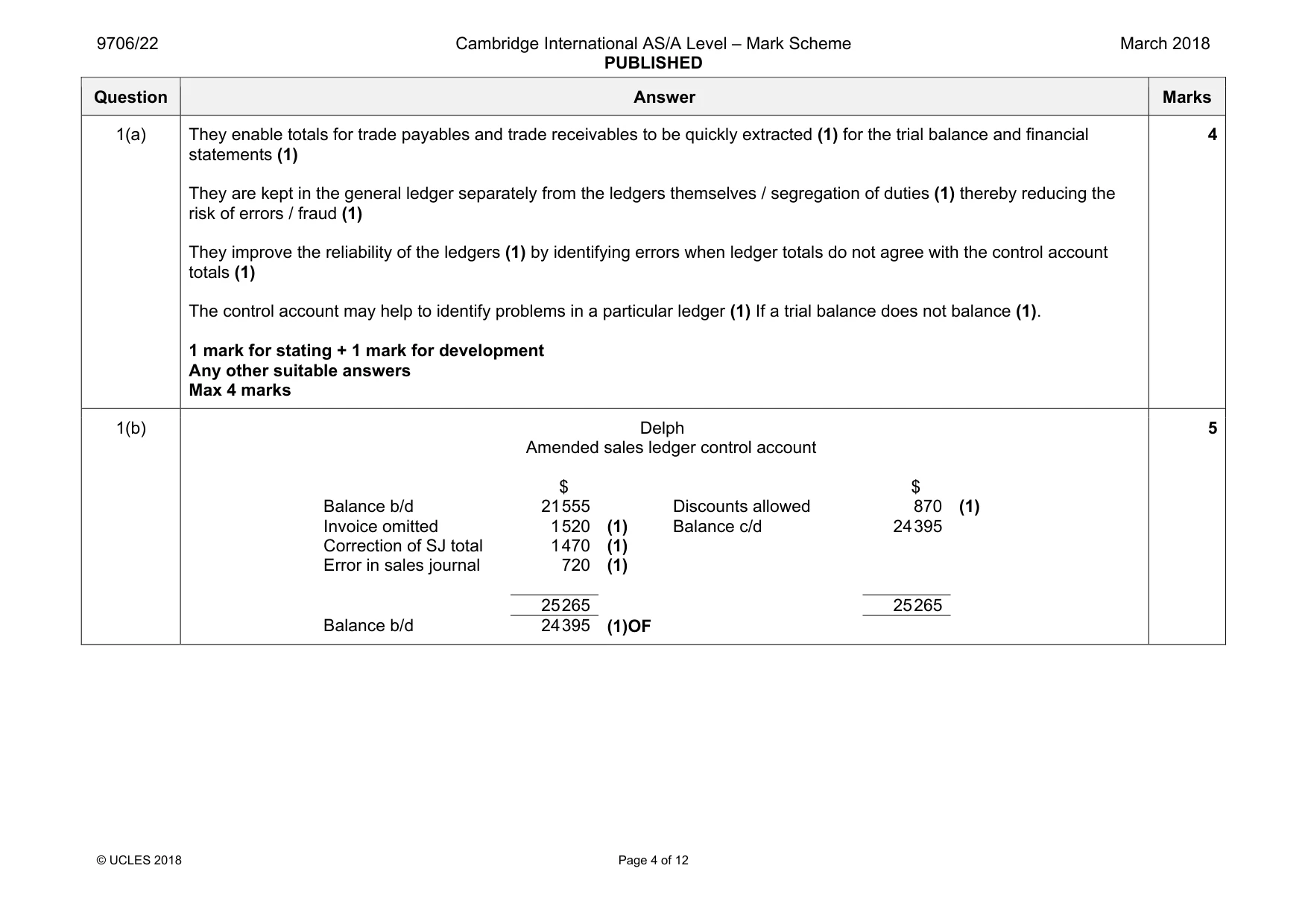
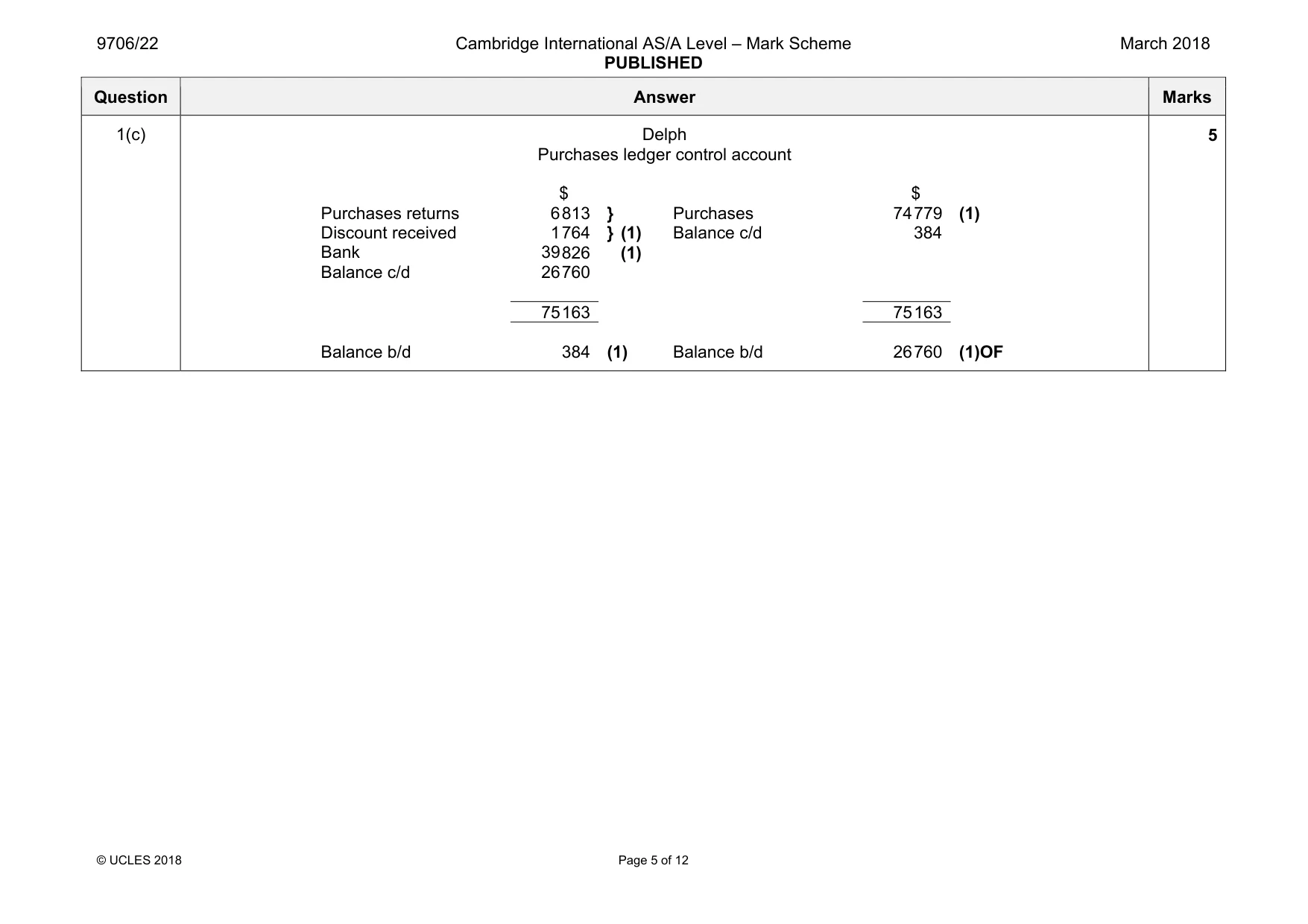
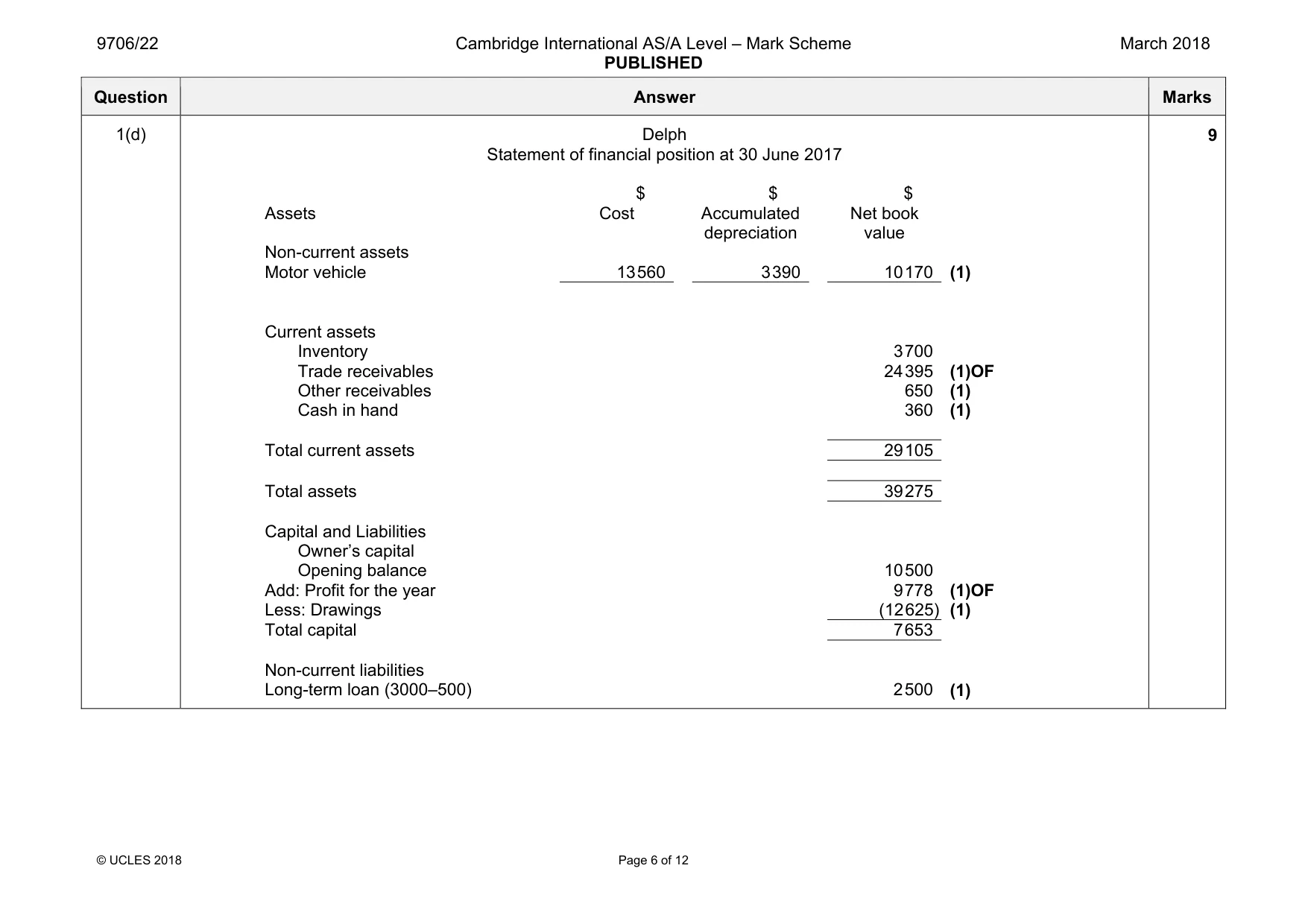
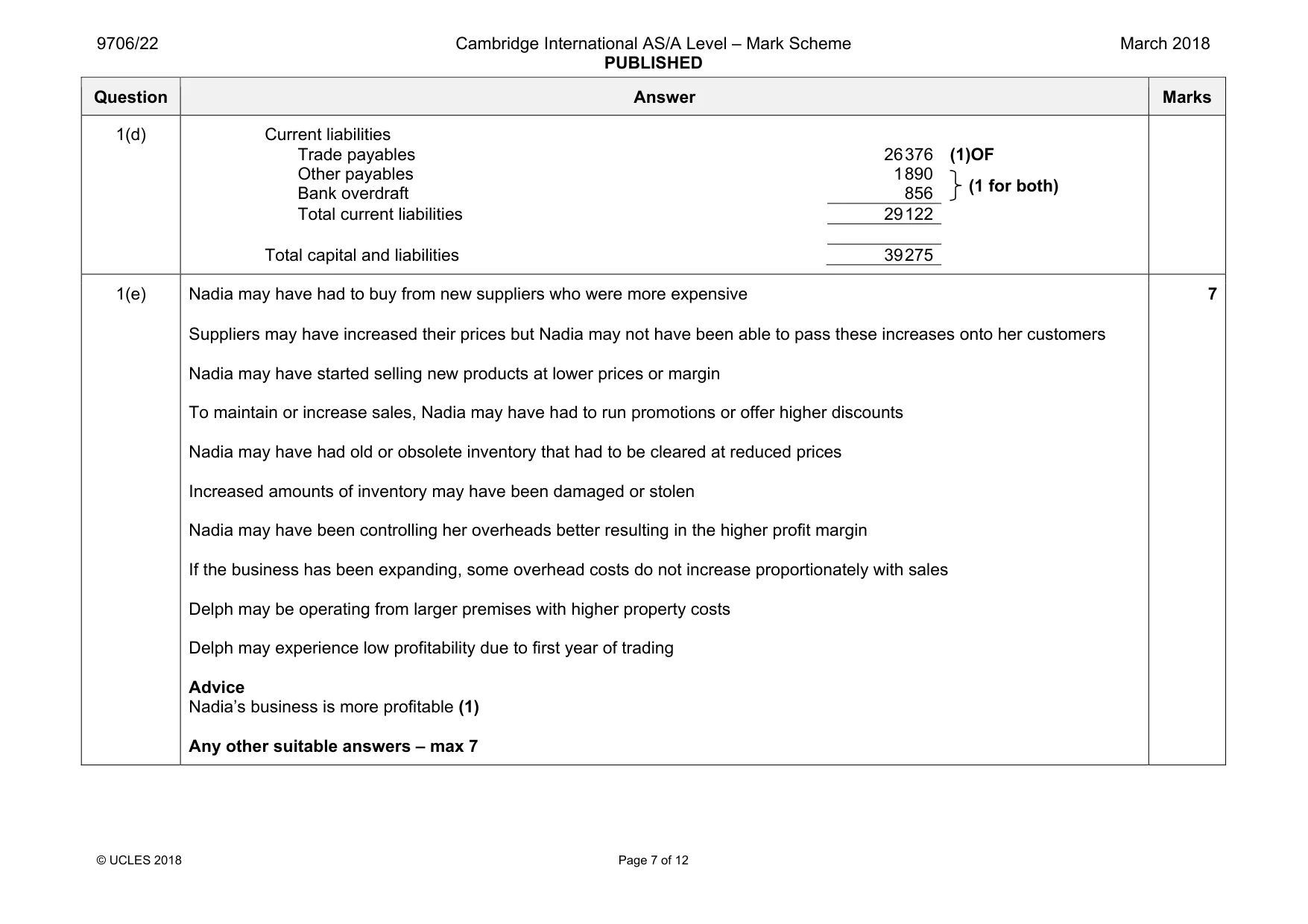
Mark scheme: 1(a) They enable totals for trade payables and trade receivables to be quickly extracted (1) for the trial balance and financial statements (1) They are kept in the general ledger separately from the ledgers themselves / segregation of duties (1) thereby reducing the risk of errors / fraud (1) They improve the reliability of the ledgers (1) by identifying errors when ledger totals do not agree with the control account totals (1) The control account may help to identify problems in a particular ledger (1) If a trial balance does not balance (1). 1 mark for stating + 1 mark for development Any other suitable answers Max 4 marks 4 1(b) Delph Amended sales ledger control account $ $ Balance b/d 21 555 Discounts allowed 870 (1) Invoice omitted 1 520 (1) Balance c/d 24 395 Correction of SJ total 1 470 (1) Error in sales journal 720 (1) 25 265 25 265 Balance b/d 24 395 (1)OF 5 Question Answer Marks 1(c) Delph Purchases ledger control account $ $ Purchases returns 6 813 } Purchases 74 779 (1) Discount received 1 764 } (1) Balance c/d 384 Bank 39 826 (1) Balance c/d 26 760 75 163 75 163 Balance b/d 384 (1) Balance b/d 26 760 (1)OF 5 Question Answer Marks 1(d) Delph Statement of financial position at 30 June 2017 $ $ $ Assets Cost Accumulated depreciation Net book value Non-current assets Motor vehicle 13 560 3 390 10 170 (1) Current assets Inventory 3 700 Trade receivables 24 395 (1)OF Other receivables 650 (1) Cash in hand 360 (1) Total current assets 29 105 Total assets 39 275 Capital and Liabilities Owner’s capital Opening balance 10 500 Add: Profit for the year 9 778 (1)OF Less: Drawings (12 625) (1) Total capital 7 653 Non-current liabilities Long-term loan (3000–500) 2 500 (1) 9 Question Answer Marks 1(d) Current liabilities Trade payables 26 376 (1)OF Other payables 1 890 (1 for both) Bank overdraft 856 Total current liabilities 29 122 Total capital and liabilities 39 275 1(e) Nadia may have had to buy from new suppliers who were more expensive Suppliers may have increased their prices but Nadia may not have been able to pass these increases onto her customers Nadia may have started selling new products at lower prices or margin To maintain or increase sales, Nadia may have had to run promotions or offer higher discounts Nadia may have had old or obsolete inventory that had to be cleared at reduced prices Increased amounts of inventory may have been damaged or stolen Nadia may have been controlling her overheads better resulting in the higher profit margin If the business has been expanding, some overhead costs do not increase proportionately with sales Delph may be operating from larger premises with higher property costs Delph may experience low profitability due to first year of trading Advice Nadia’s business is more profitable (1) Any other suitable answers – max 7 7
Q2 · The following is an extract from the statement of financial position of X Limited at 31…
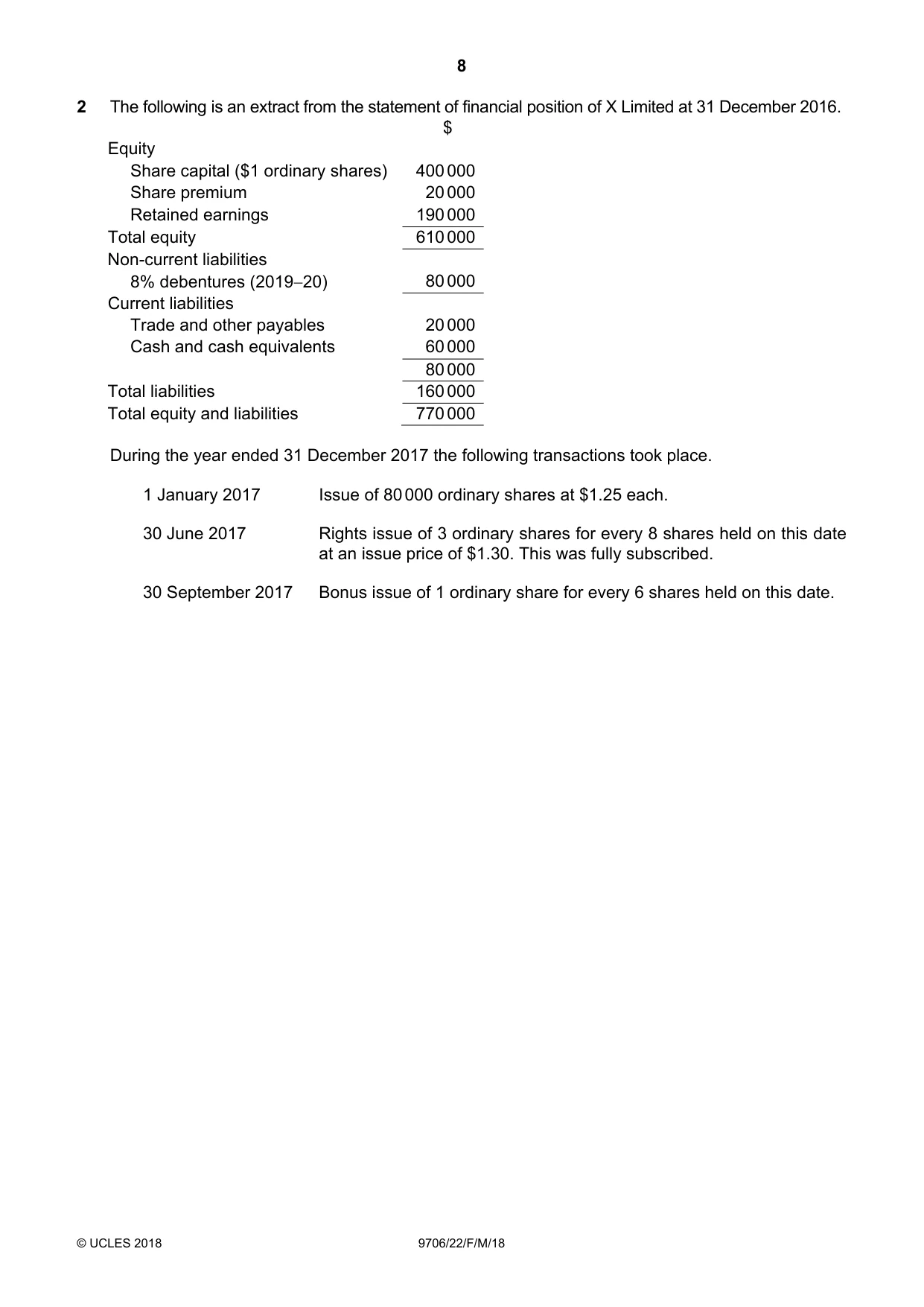
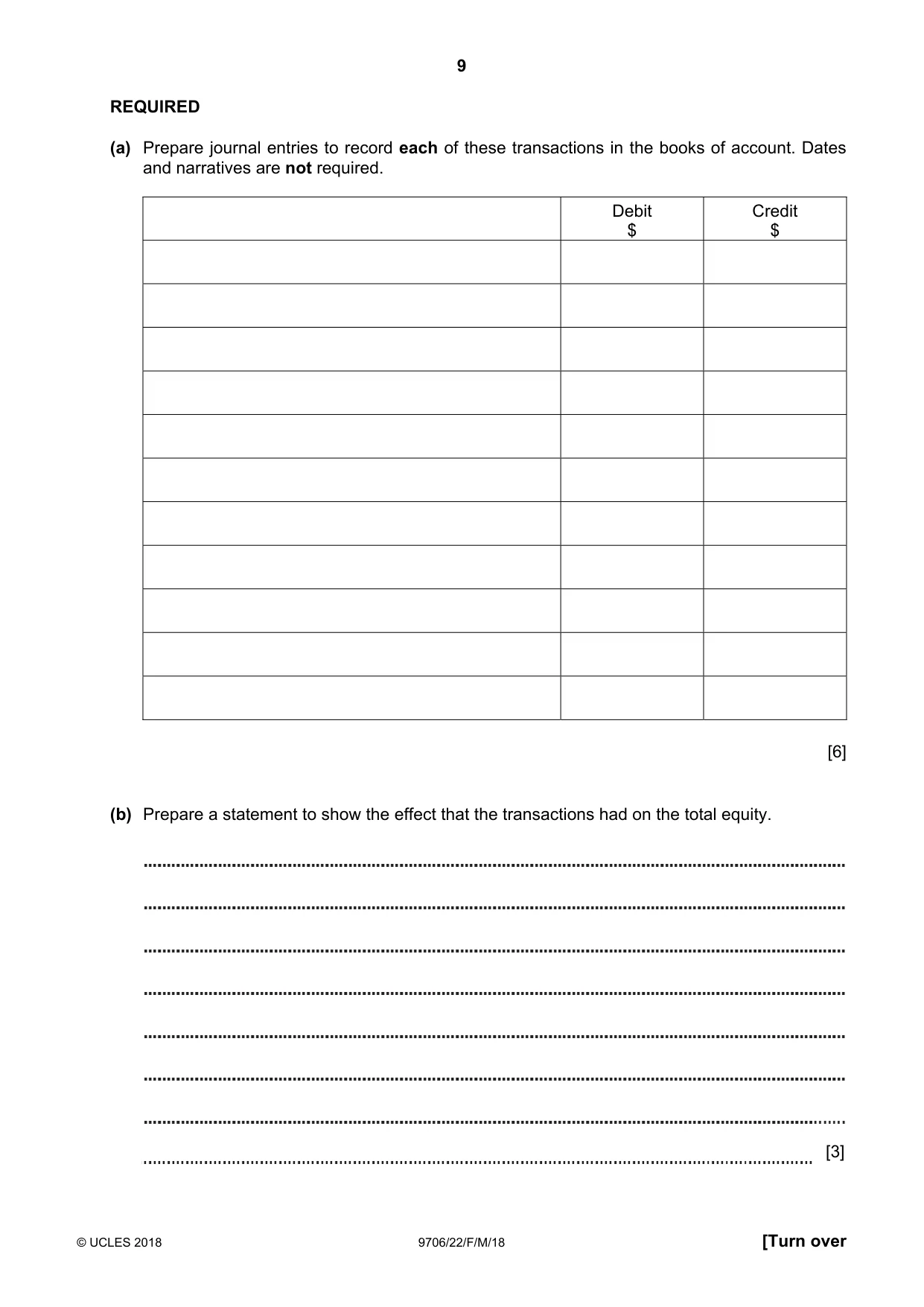
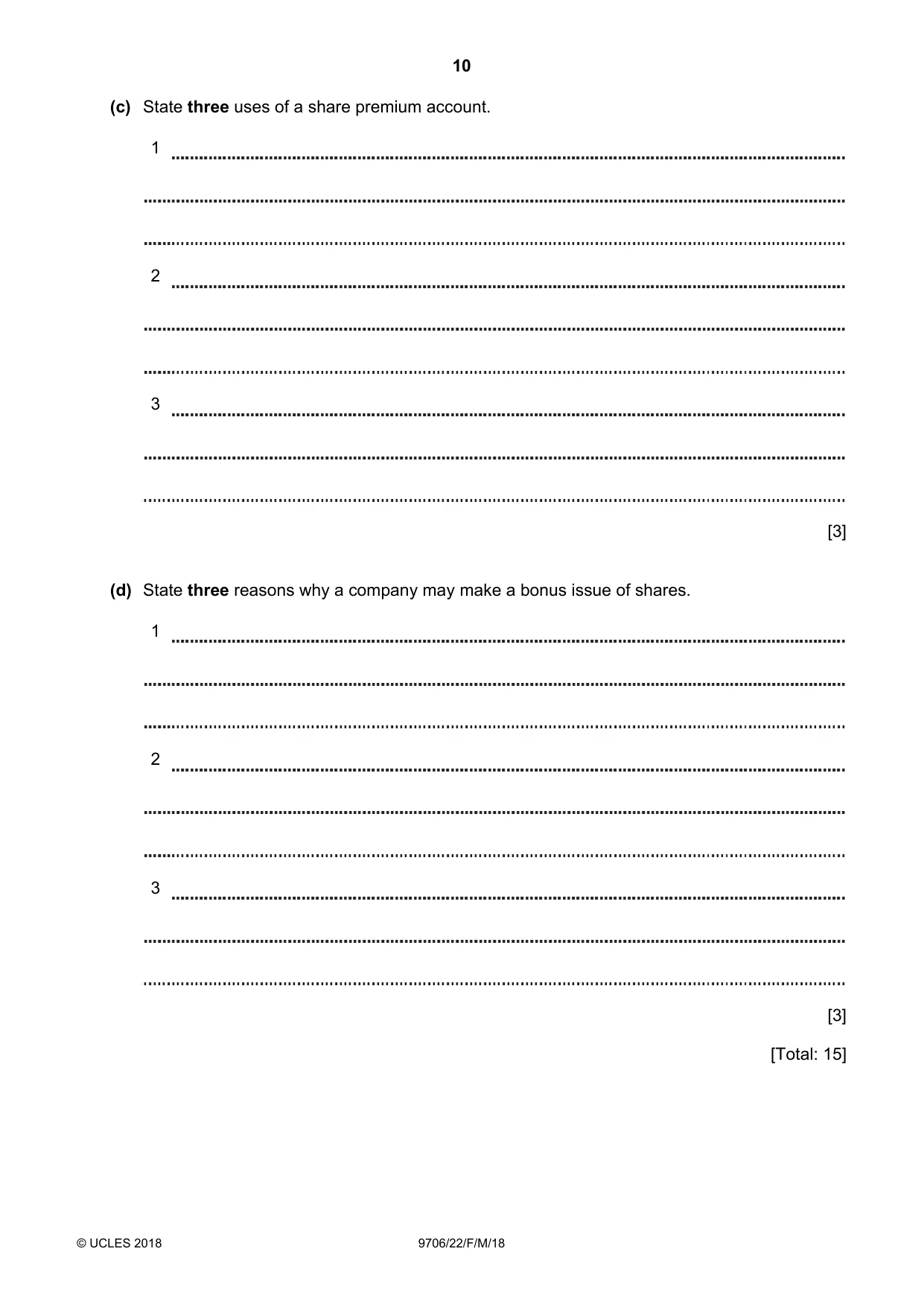
2 The following is an extract from the statement of financial position of X Limited at 31 December 2016. $ Equity Share capital ($1 ordinary shares) 400 000 Share premium 20 000 Retained earnings 190 000 Total equity 610 000 Non-current liabilities 8% debentures (201920) 80 000 Current liabilities Trade and other payables 20 000 Cash and cash equivalents 60 000 80 000 Total liabilities 160 000 Total equity and liabilities 770 000 During the year ended 31 December 2017 the following transactions took place. 1 January 2017 Issue of 80 000 ordinary shares at $1.25 each. 30 June 2017 Rights issue of 3 ordinary shares for every 8 shares held on this date at an issue price of $1.30. This was fully subscribed. 30 September 2017 Bonus issue of 1 ordinary share for every 6 shares held on this date. REQUIRED (a) Prepare journal entries to record each of these transactions in the books of account. Dates and narratives are not required. Debit Credit $ $ [6] (b) Prepare a statement to show the effect that the transactions had on the total equity. [3] (c) State three uses of a share premium account. 1 2 3 [3] (d) State three reasons why a company may make a bonus issue of shares. 1 2 3 [3] [Total: 15]
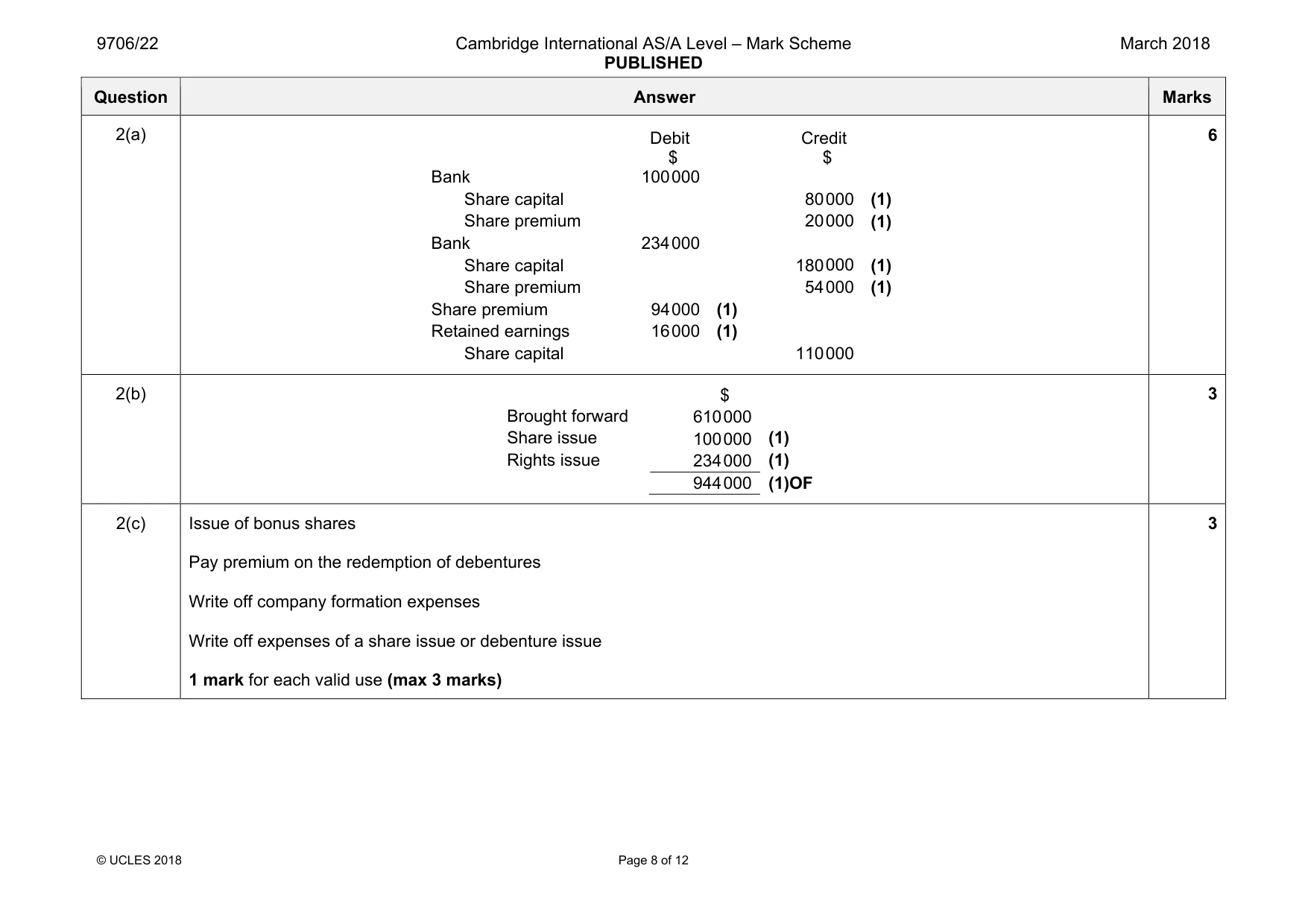
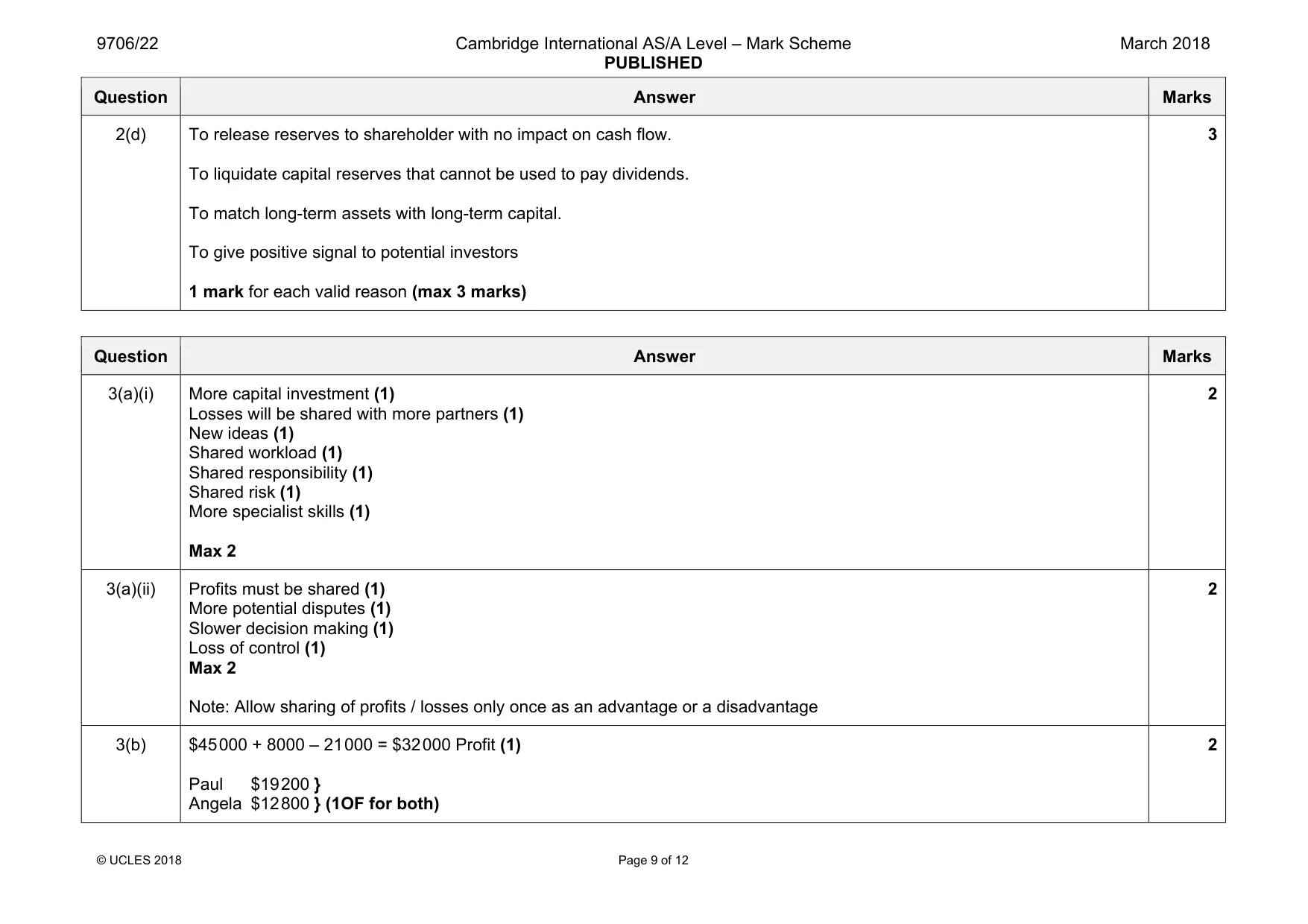
Mark scheme: 2(a) Debit $ Credit $ Bank 100 000 Share capital 80 000 (1) Share premium 20 000 (1) Bank 234 000 Share capital 180 000 (1) Share premium 54 000 (1) Share premium 94 000 (1) Retained earnings 16 000 (1) Share capital 110 000 6 2(b) $ Brought forward 610 000 Share issue 100 000 (1) Rights issue 234 000 (1) 944 000 (1)OF 3 2(c) Issue of bonus shares Pay premium on the redemption of debentures Write off company formation expenses Write off expenses of a share issue or debenture issue 1 mark for each valid use (max 3 marks) 3 Question Answer Marks 2(d) To release reserves to shareholder with no impact on cash flow. To liquidate capital reserves that cannot be used to pay dividends. To match long-term assets with long-term capital. To give positive signal to potential investors 1 mark for each valid reason (max 3 marks) 3
Q3 · Discounts allowed in June 2017 amounting to $435 were debited to the sales ledger control…
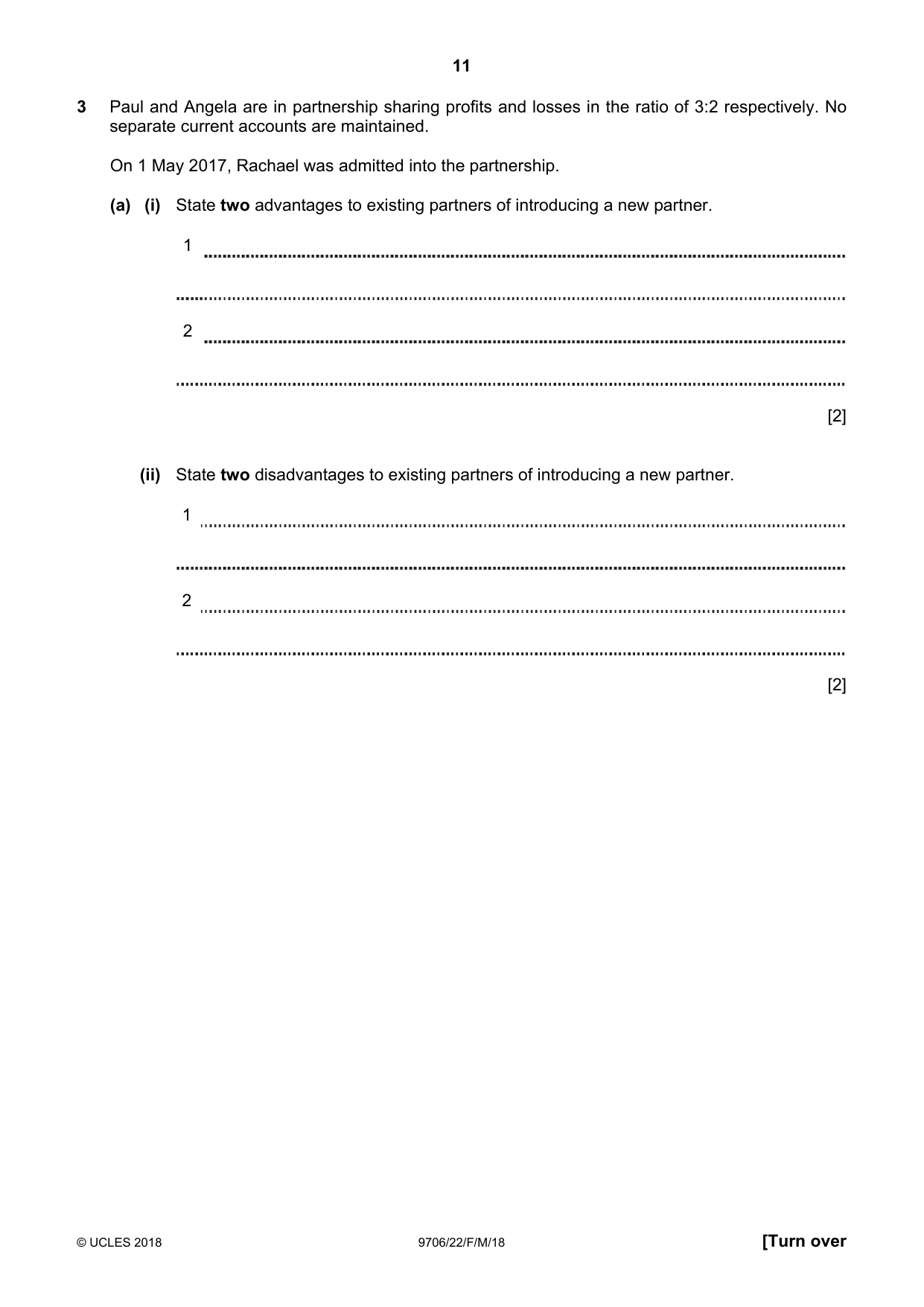
3 Discounts allowed in June 2017 amounting to $435 were debited to the sales ledger control account.
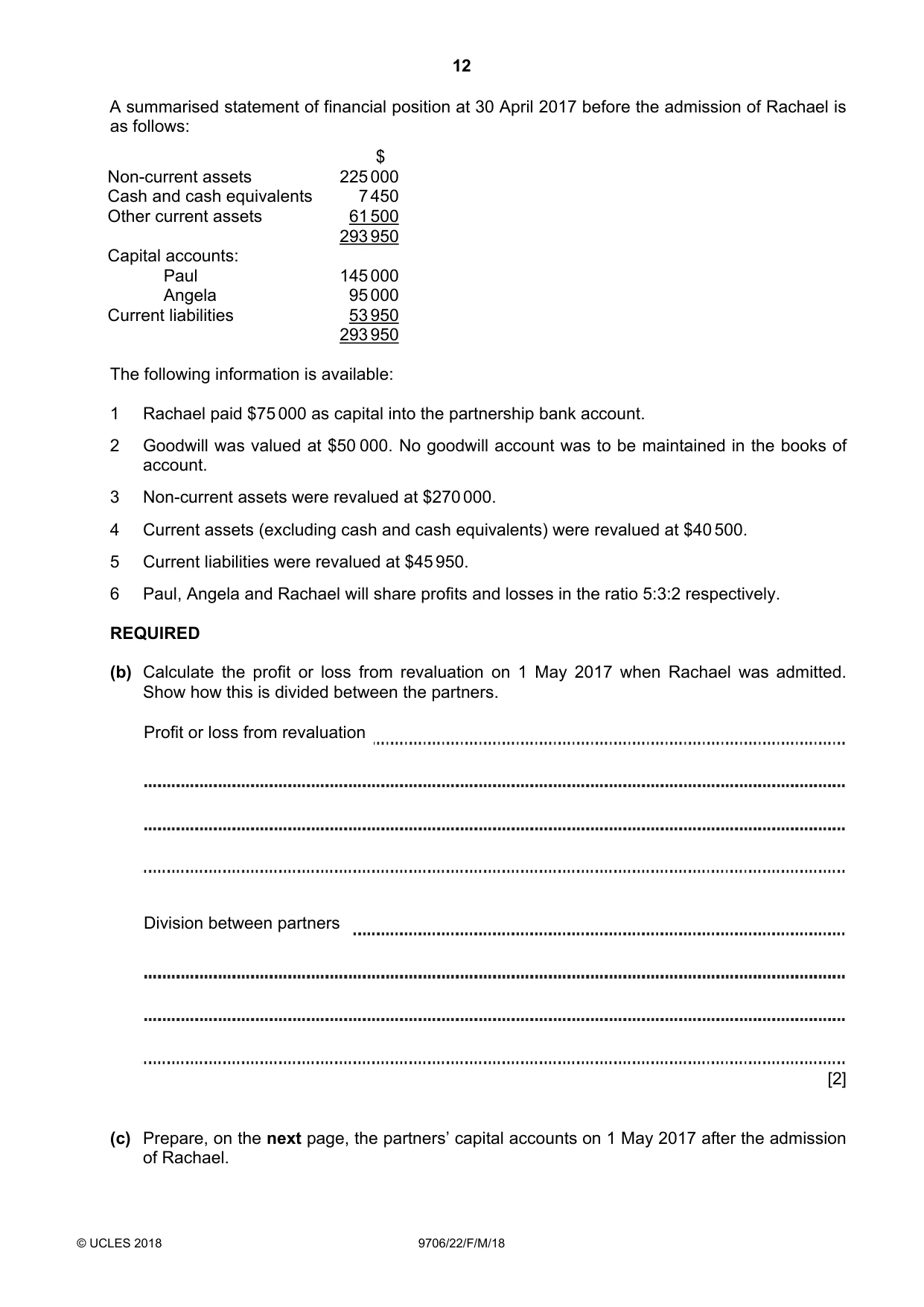
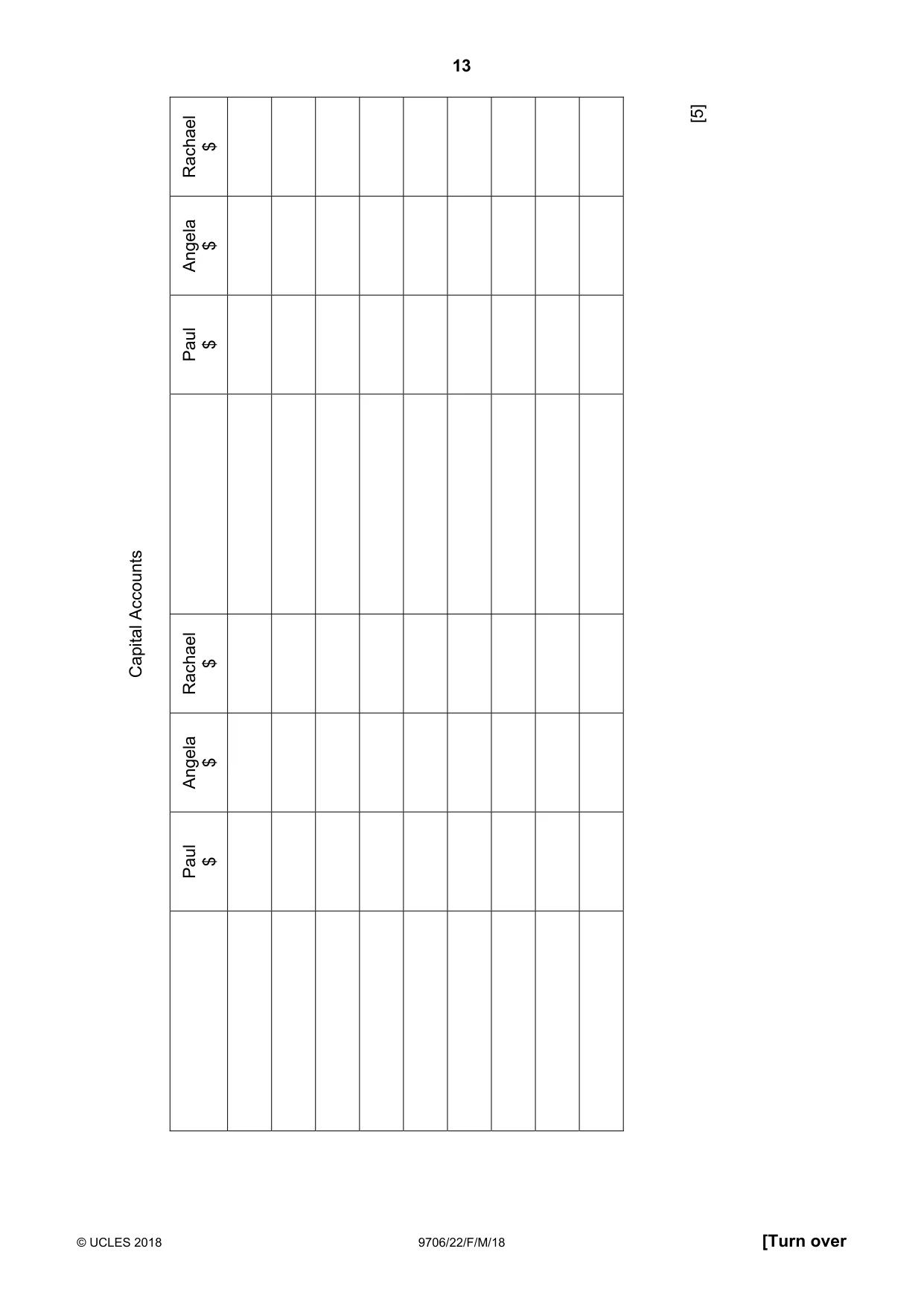
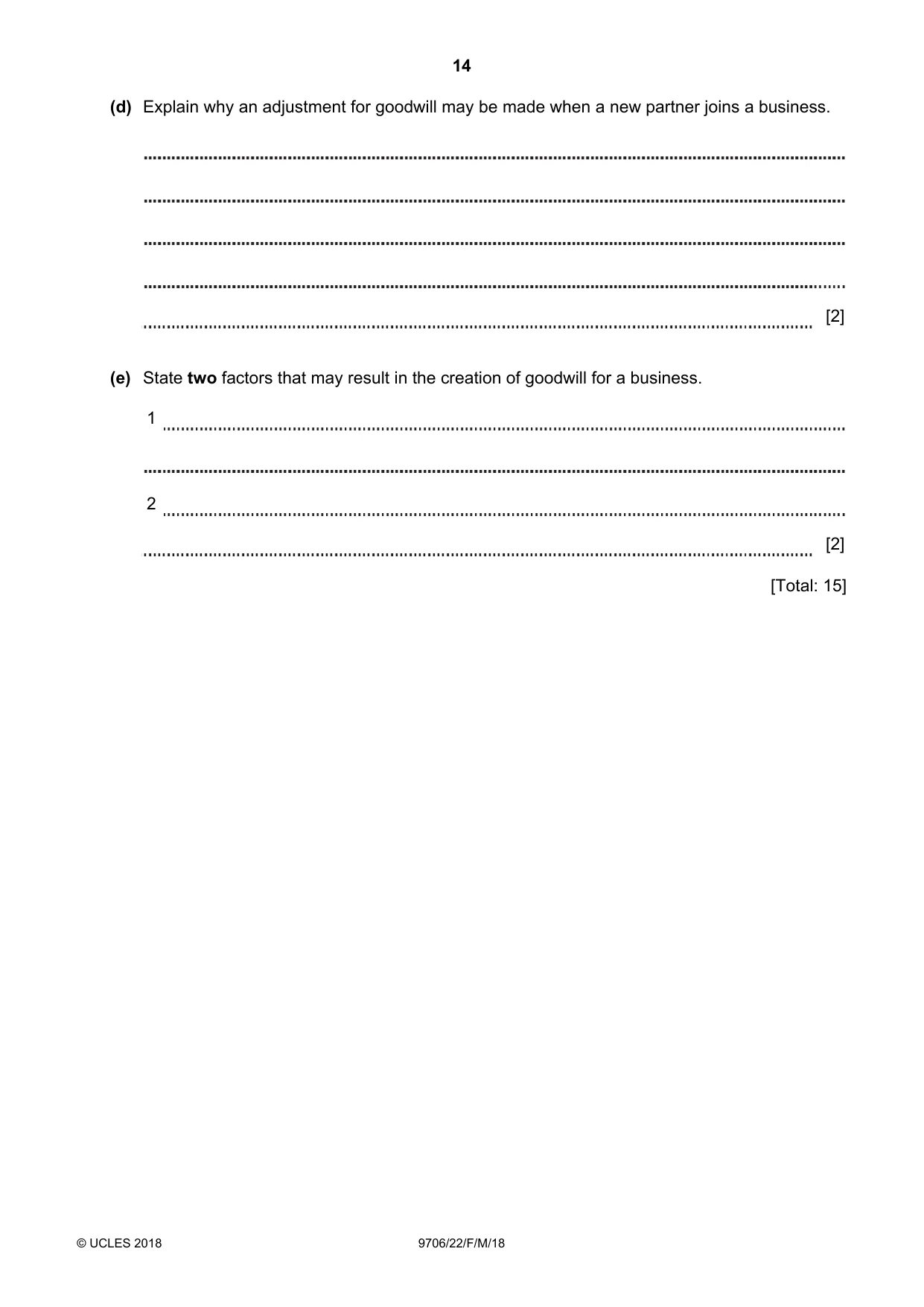
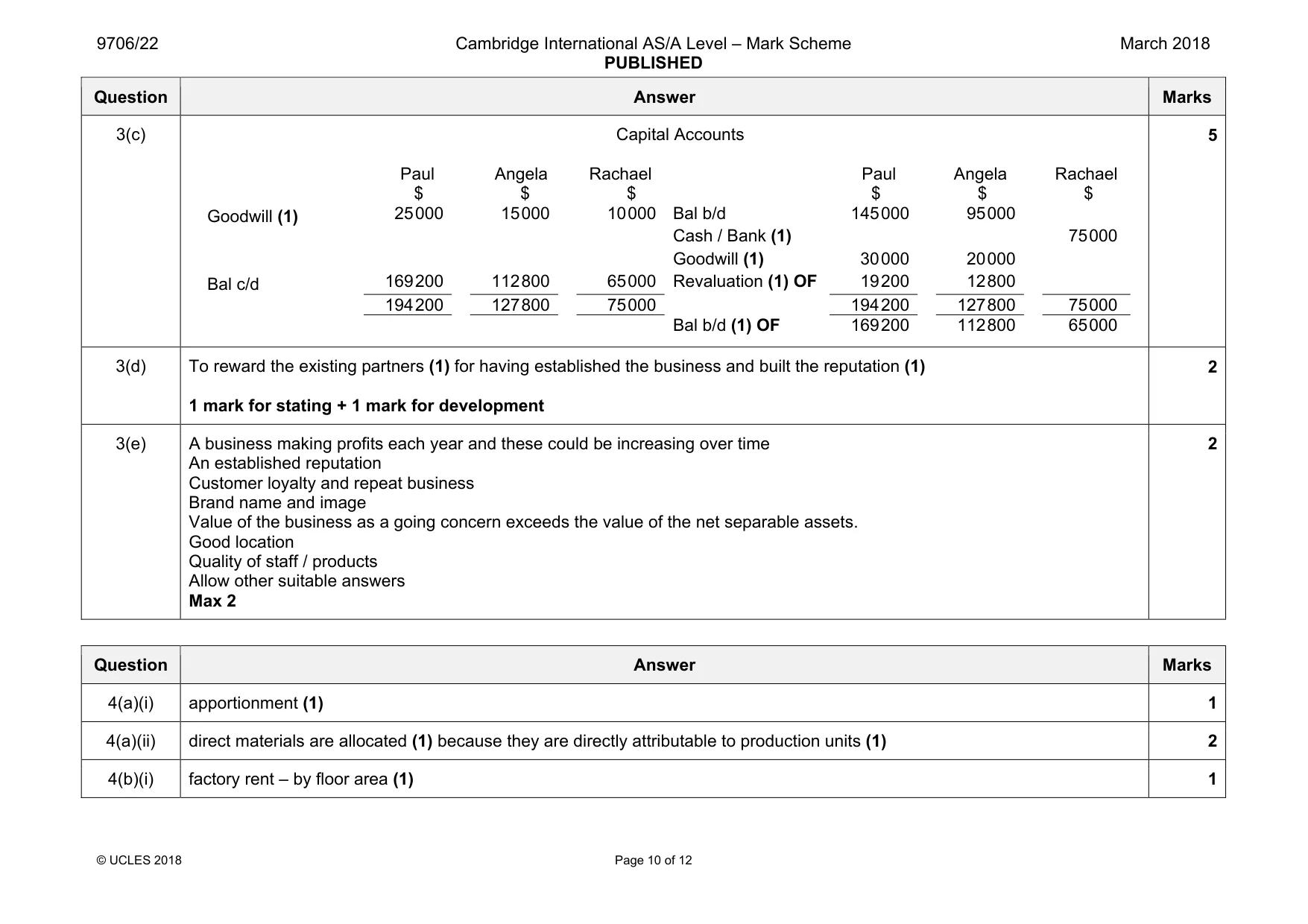
Mark scheme: 3(a)(i) More capital investment (1) Losses will be shared with more partners (1) New ideas (1) Shared workload (1) Shared responsibility (1) Shared risk (1) More specialist skills (1) Max 2 2 3(a)(ii) Profits must be shared (1) More potential disputes (1) Slower decision making (1) Loss of control (1) Max 2 Note: Allow sharing of profits / losses only once as an advantage or a disadvantage 2 3(b) $45 000 + 8000 – 21 000 = $32 000 Profit (1) Paul $19 200 } Angela $12 800 } (1OF for both) 2 Question Answer Marks 3(c) Capital Accounts Paul $ Angela $ Rachael $ Paul $ Angela $ Rachael $ Goodwill (1) 25 000 15 000 10 000 Bal b/d 145 000 95 000 Cash / Bank (1) 75 000 Goodwill (1) 30 000 20 000 Bal c/d 169 200 112 800 65 000 Revaluation (1) OF 19 200 12 800 194 200 127 800 75 000 194 200 127 800 75 000 Bal b/d (1) OF 169 200 112 800 65 000 5 3(d) To reward the existing partners (1) for having established the business and built the reputation (1) 1 mark for stating + 1 mark for development 2 3(e) A business making profits each year and these could be increasing over time An established reputation Customer loyalty and repeat business Brand name and image Value of the business as a going concern exceeds the value of the net separable assets. Good location Quality of staff / products Allow other suitable answers Max 2 2
Q4 · A sales invoice for $1520 dated 30 June 2017 was omitted from the sales journal
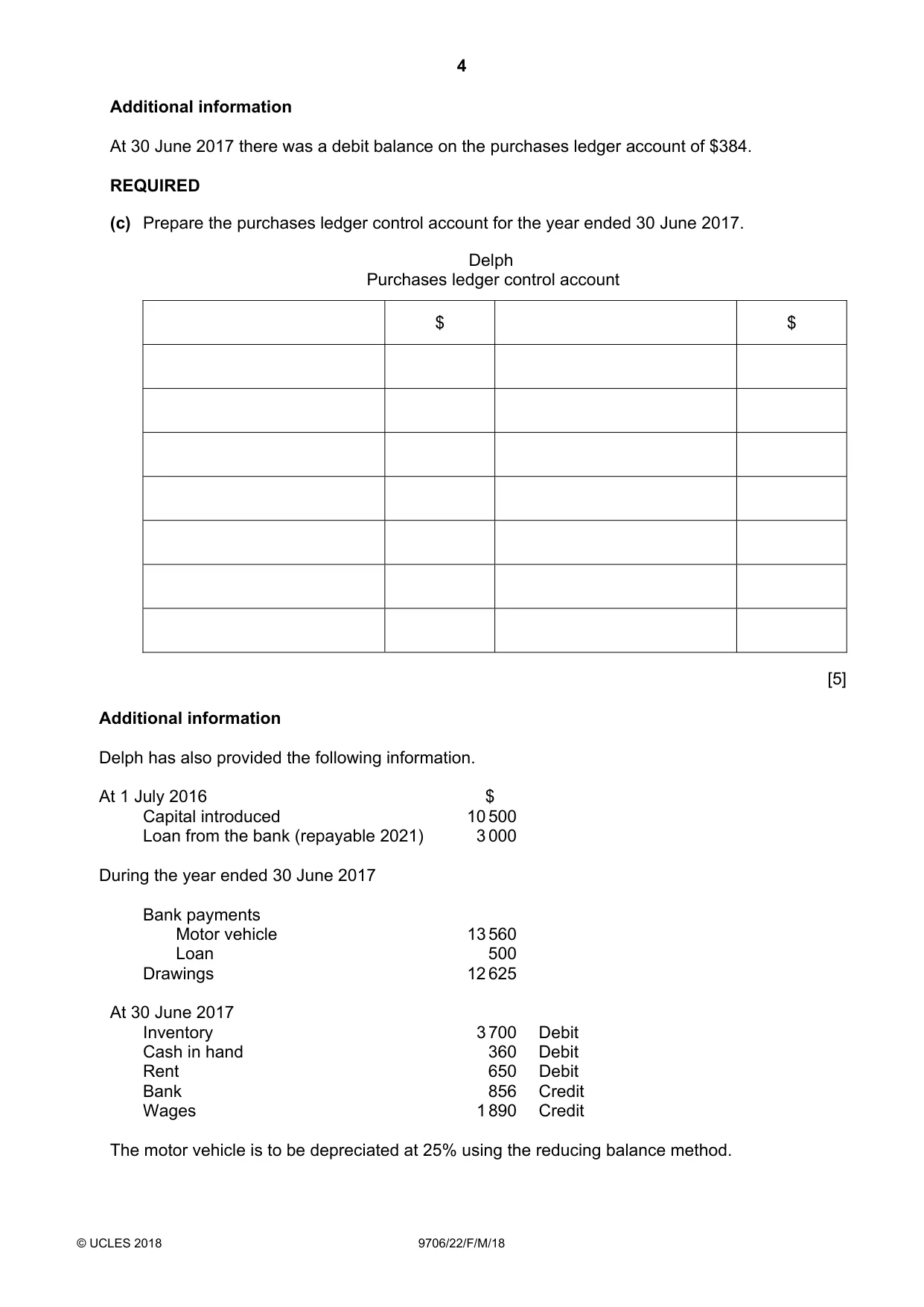
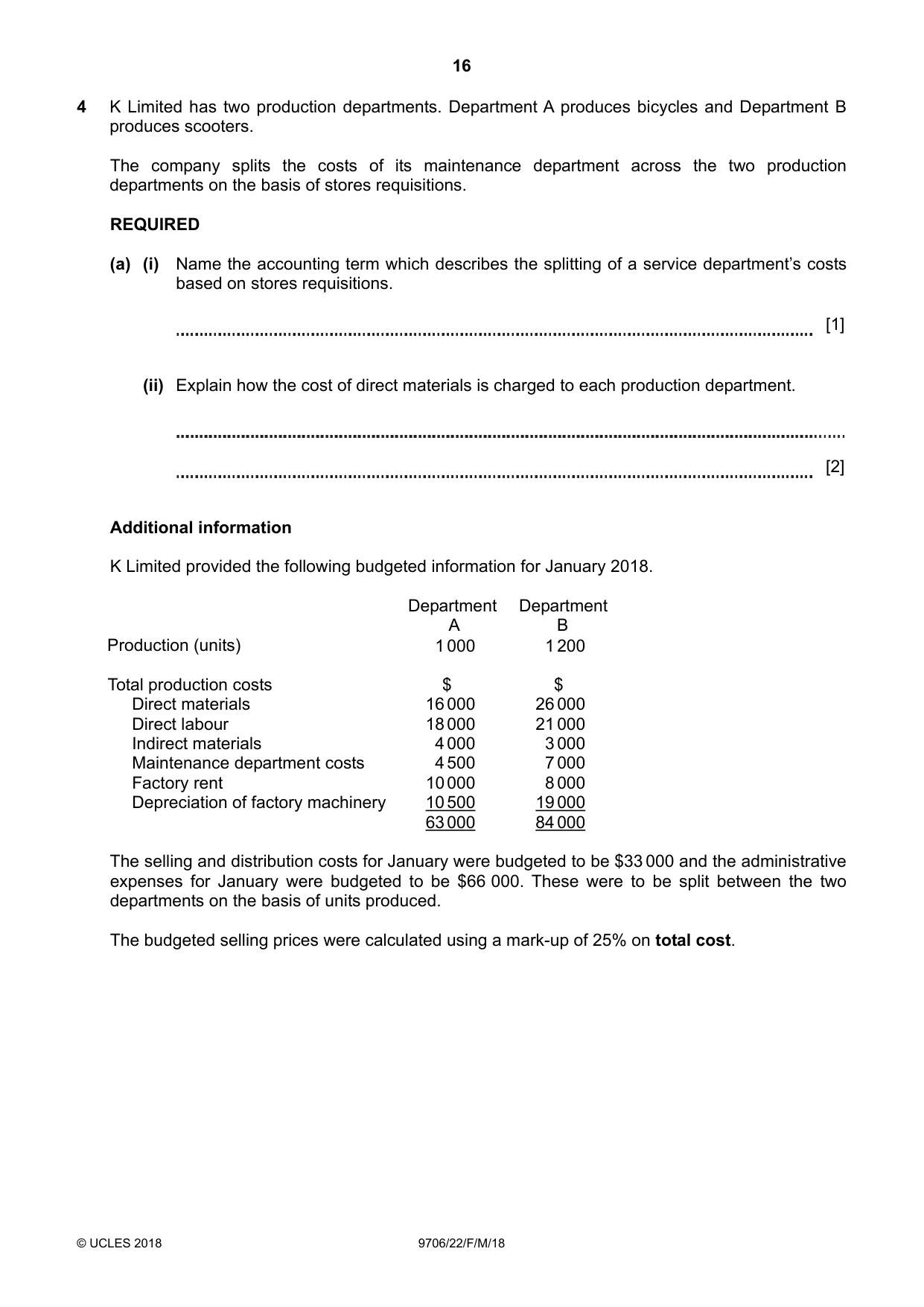
4 A sales invoice for $1520 dated 30 June 2017 was omitted from the sales journal. REQUIRED (b) Prepare the amended sales ledger control account at 30 June 2017. Delph Amended sales ledger control account $ $ Balance b/d 21 555 [5] Additional information At 30 June 2017 there was a debit balance on the purchases ledger account of $384. REQUIRED (c) Prepare the purchases ledger control account for the year ended 30 June 2017. Delph Purchases ledger control account $ $ [5] Additional information Delph has also provided the following information. At 1 July 2016 $ Capital introduced 10 500 Loan from the bank (repayable 2021) 3 000 During the year ended 30 June 2017 Bank payments Motor vehicle 13 560 Loan 500 Drawings 12 625 At 30 June 2017 Inventory 3 700 Debit Cash in hand 360 Debit Rent 650 Debit Bank 856 Credit Wages 1 890 Credit The motor vehicle is to be depreciated at 25% using the reducing balance method. REQUIRED (d) Prepare the statement of financial position at 30 June 2017. Delph Statement of financial position at 30 June 2017 [9]
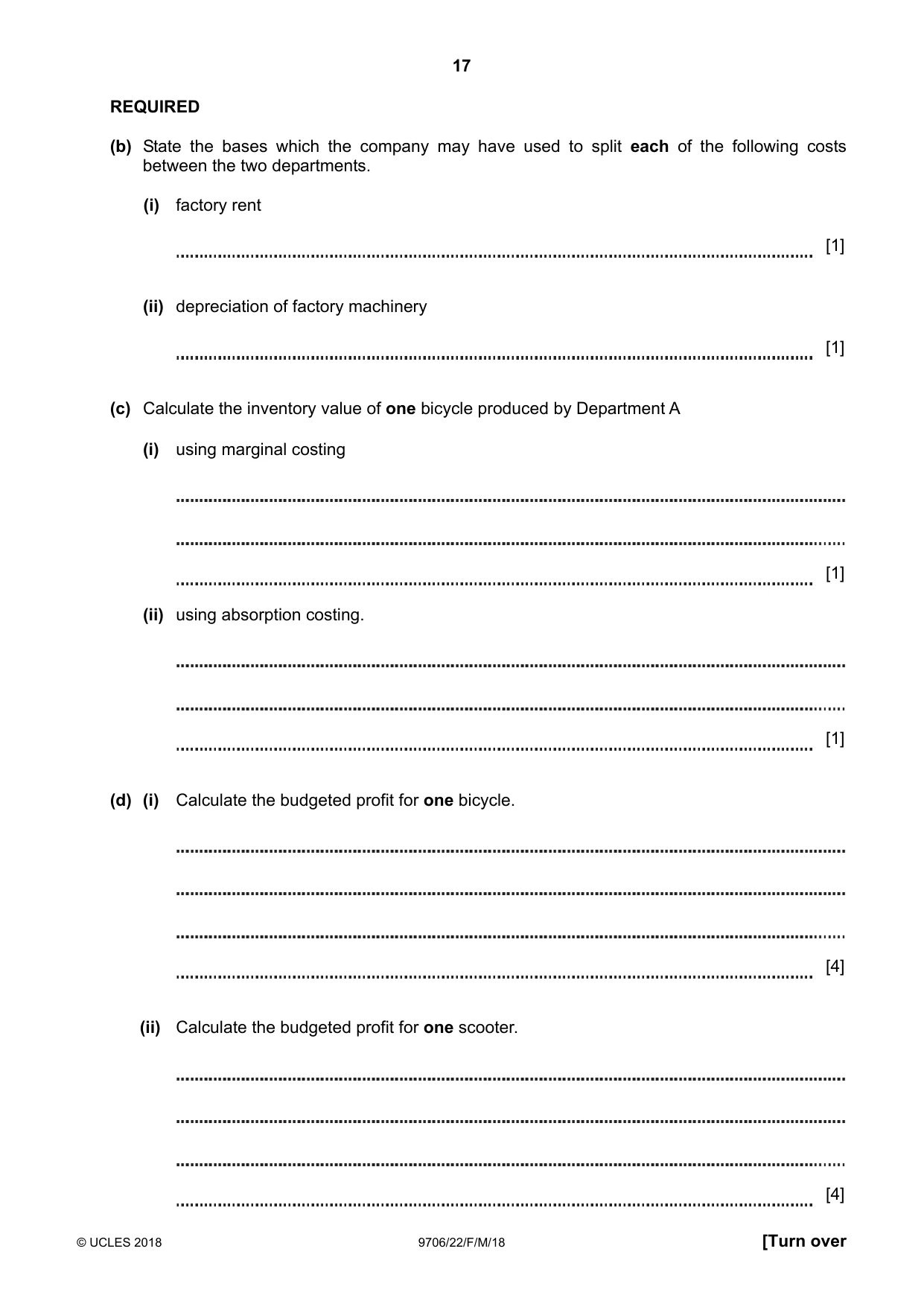
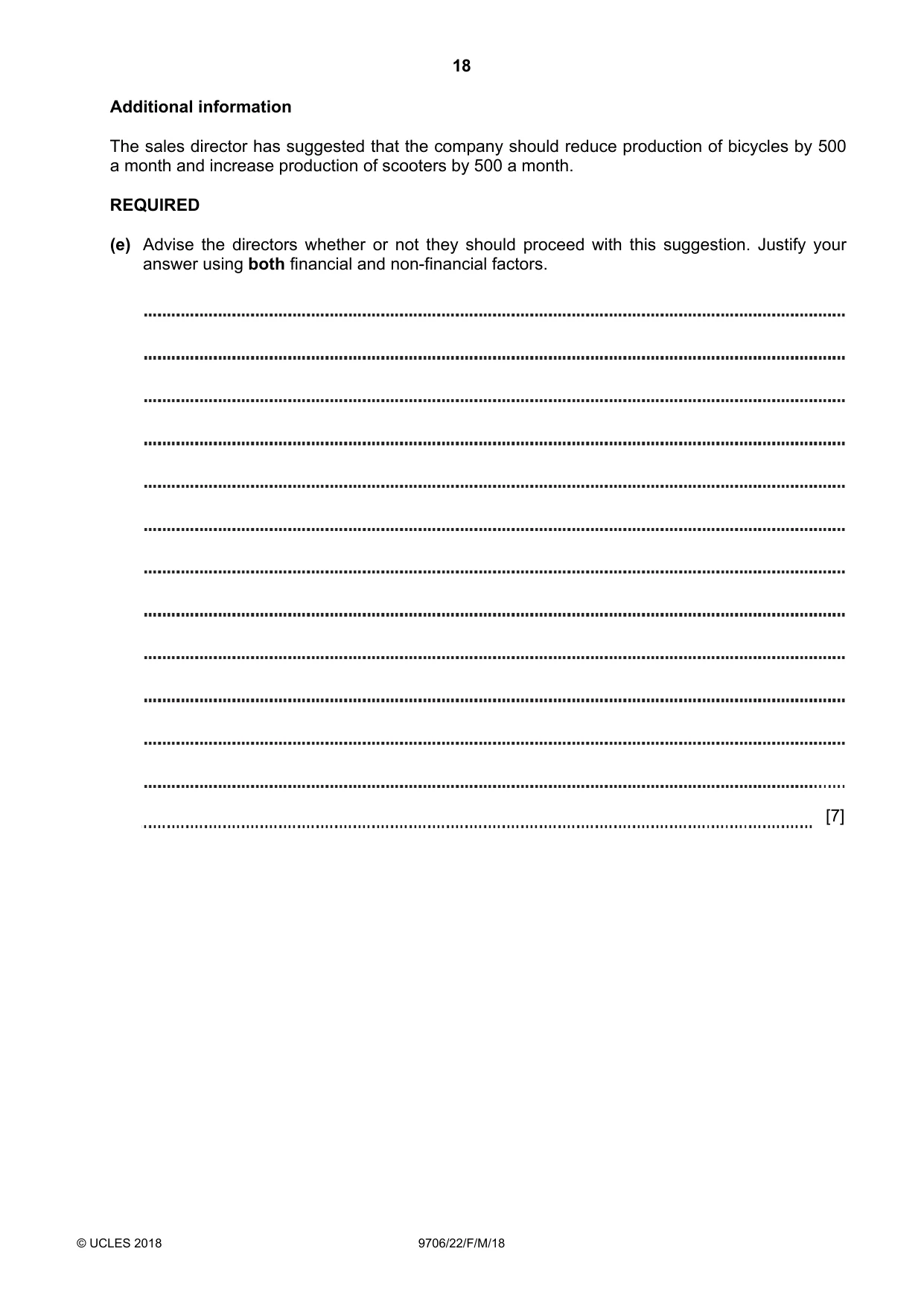
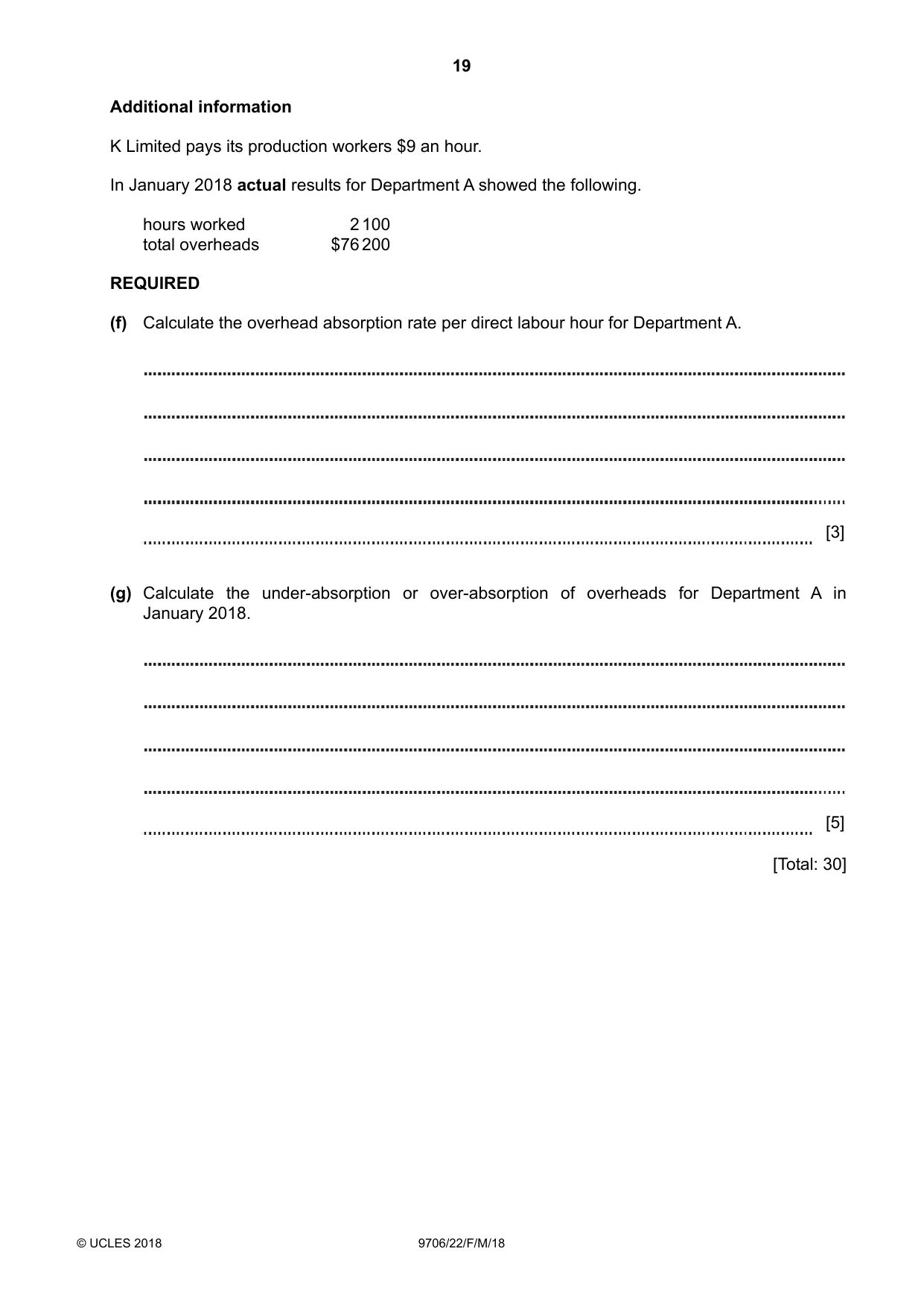
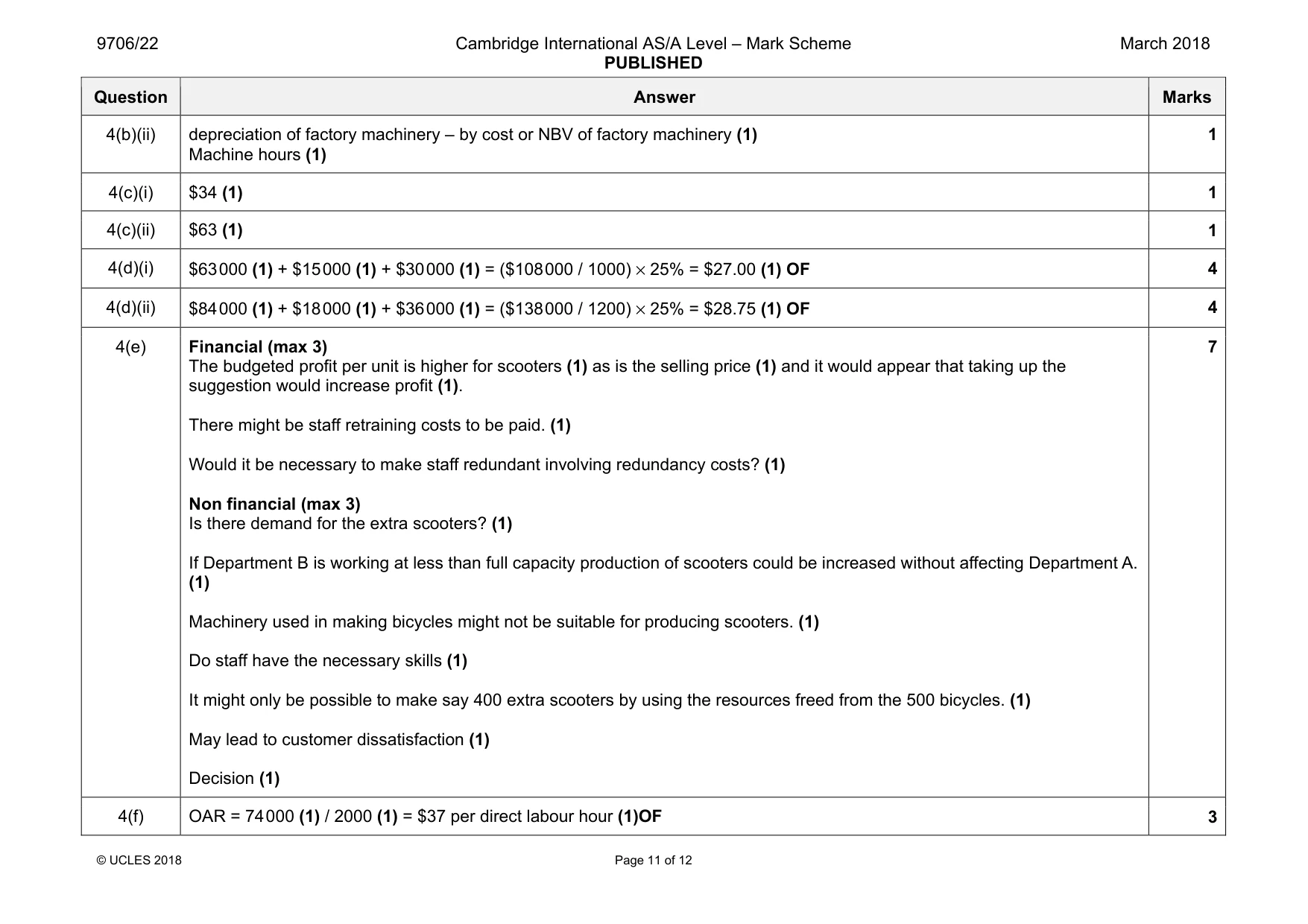
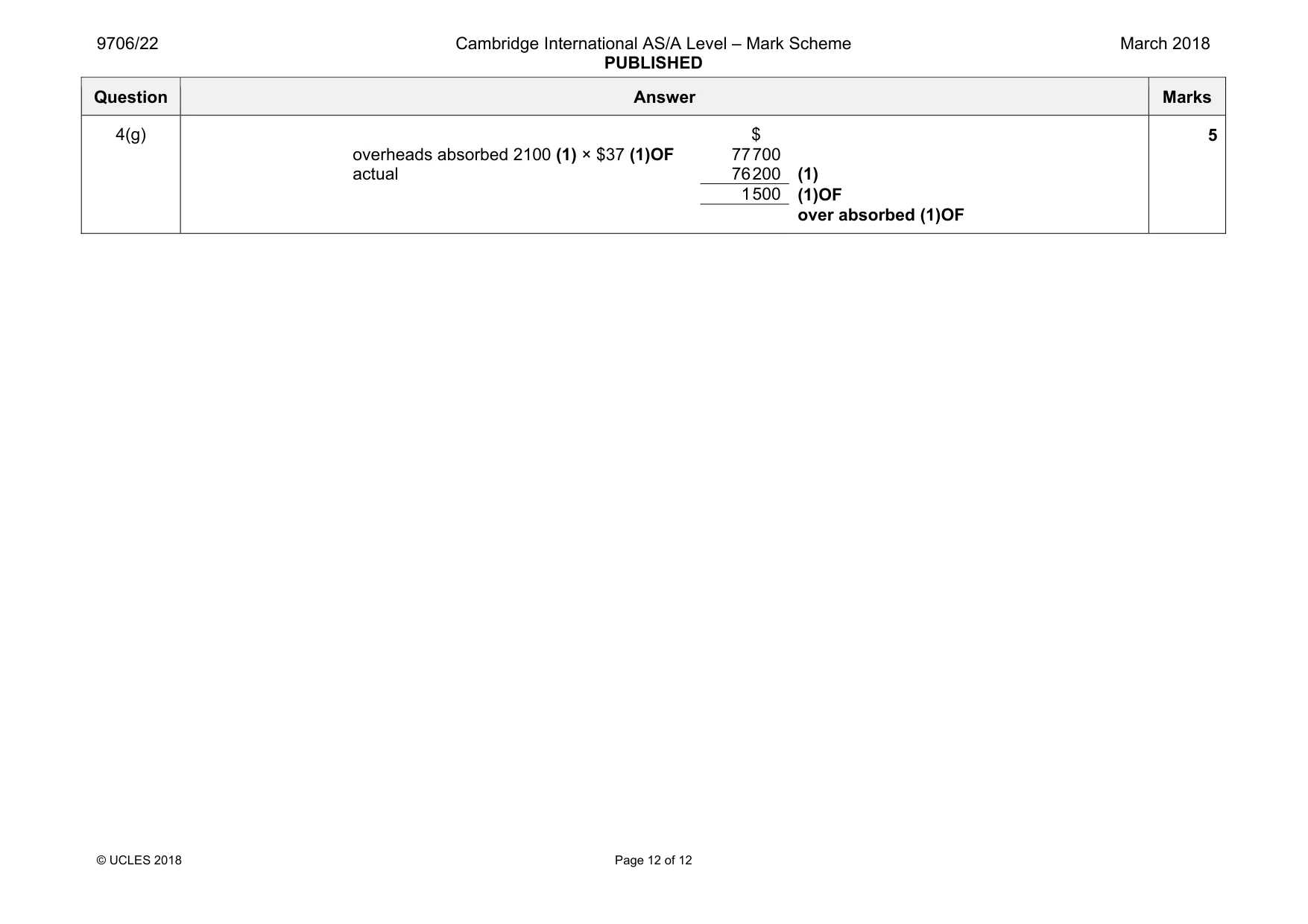
Mark scheme: 4(a)(i) apportionment (1) 1 4(a)(ii) direct materials are allocated (1) because they are directly attributable to production units (1) 2 4(b)(i) factory rent – by floor area (1) 1 Question Answer Marks 4(b)(ii) depreciation of factory machinery – by cost or NBV of factory machinery (1) Machine hours (1) 1 4(c)(i) $34 (1) 1 4(c)(ii) $63 (1) 1 4(d)(i) $63 000 (1) + $15 000 (1) + $30 000 (1) = ($108 000 / 1000) × 25% = $27.00 (1) OF 4 4(d)(ii) $84 000 (1) + $18 000 (1) + $36 000 (1) = ($138 000 / 1200) × 25% = $28.75 (1) OF 4 4(e) Financial (max 3) The budgeted profit per unit is higher for scooters (1) as is the selling price (1) and it would appear that taking up the suggestion would increase profit (1). There might be staff retraining costs to be paid. (1) Would it be necessary to make staff redundant involving redundancy costs? (1) Non financial (max 3) Is there demand for the extra scooters? (1) If Department B is working at less than full capacity production of scooters could be increased without affecting Department A. (1) Machinery used in making bicycles might not be suitable for producing scooters. (1) Do staff have the necessary skills (1) It might only be possible to make say 400 extra scooters by using the resources freed from the 500 bicycles. (1) May lead to customer dissatisfaction (1) Decision (1) 7 4(f) OAR = 74 000 (1) / 2000 (1) = $37 per direct labour hour (1)OF 3 Question Answer Marks 4(g) $ overheads absorbed 2100 (1) × $37 (1)OF 77 700 actual 76 200 (1) 1 500 (1)OF over absorbed (1)OF 5
What was in this paper
The subtopics covered by these 4 questions, and how many questions each got. Open one in a new tab to see every Cambridge question on it.
What you needed in this session
Cambridge’s own grade thresholds for 2018 Feb/March, Paper 2 · Variant 2. A higher threshold means an easier paper — the bar moves with how the cohort did.