Cambridge A Level Accounting 9706 — 2017 Feb/March Paper 2 · Variant 2
9706/22/F/M/17 · 4 questions · 90 marks · ≈101 min
The question paper and its mark scheme, free to read here and free to download. This is Cambridge’s own paper, exactly as it was sat.
Question paper20 pages



Mark scheme11 pages
Answers below. Sit the paper first if you are practising.
Questions as text
Q1 · Razia, a sole trader, started her business on 1 July 2015 selling ladies’ clothing
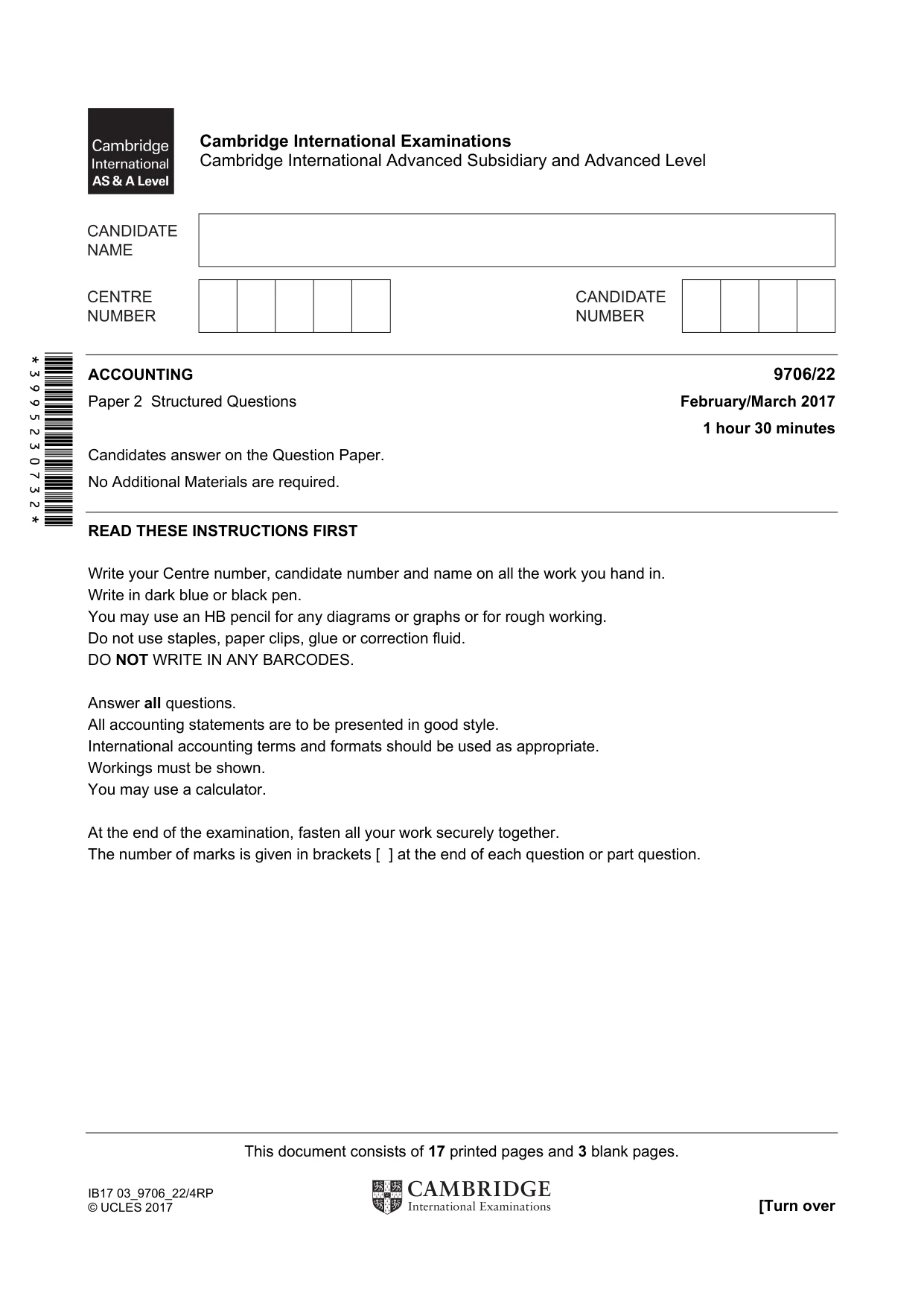
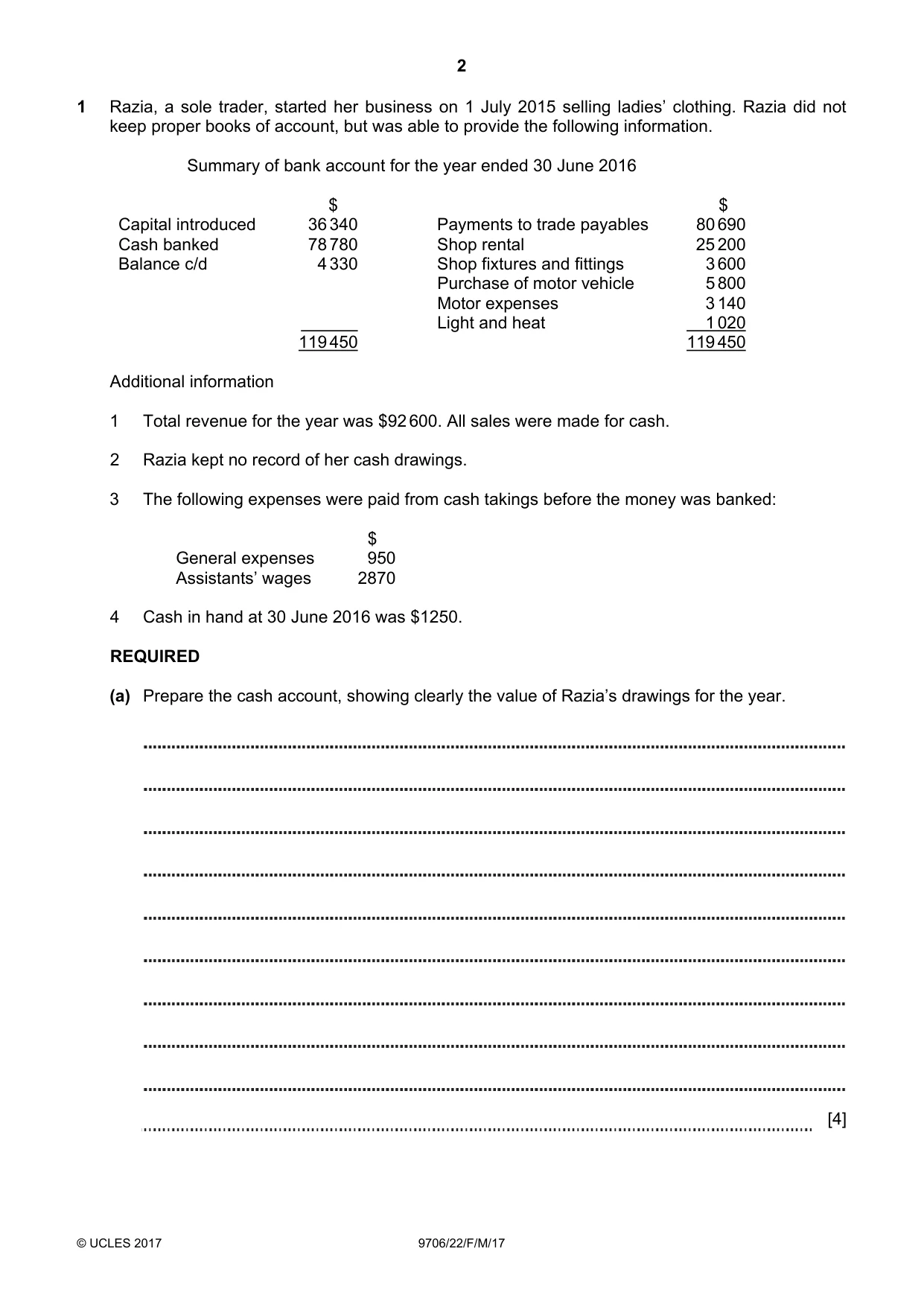
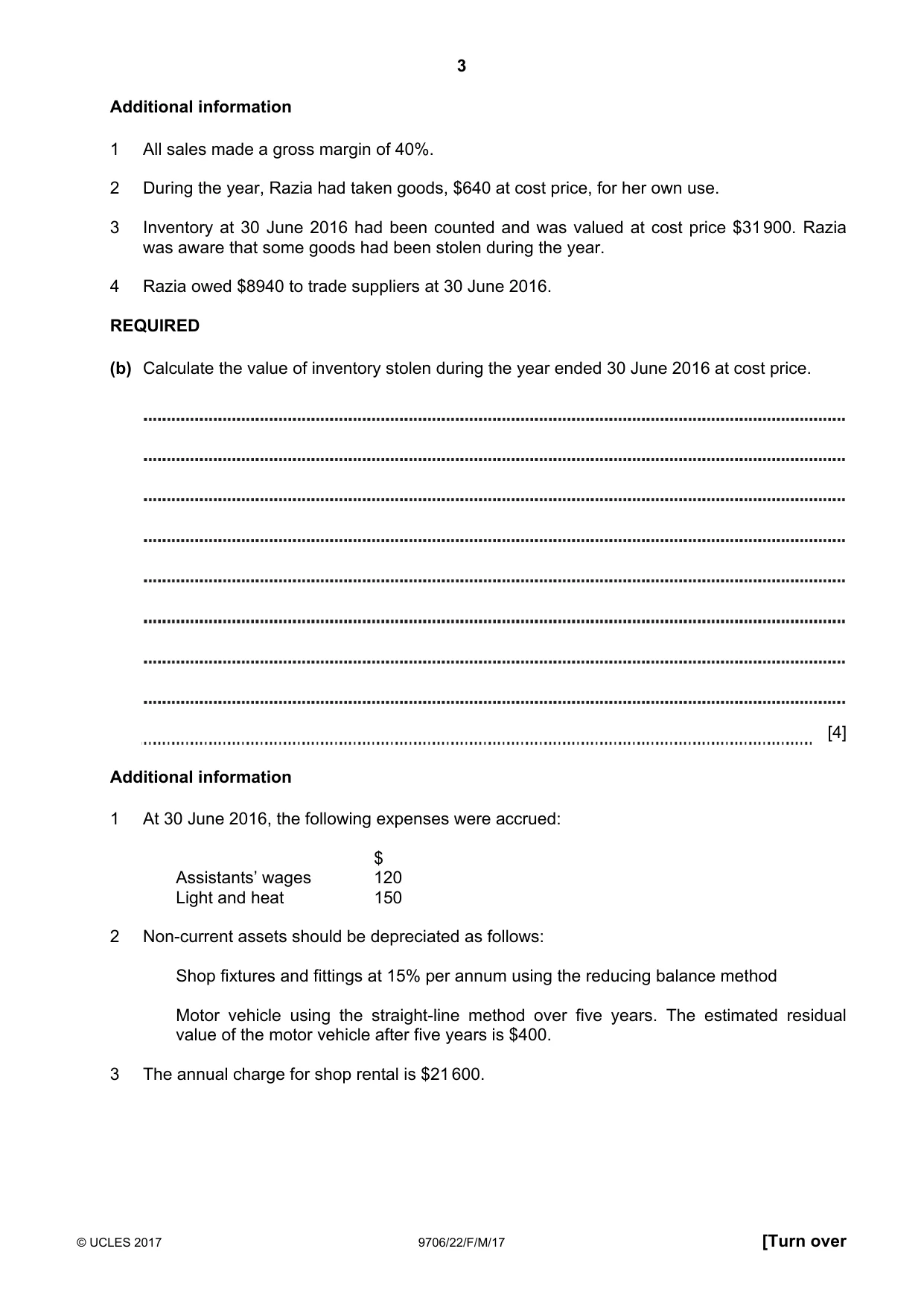
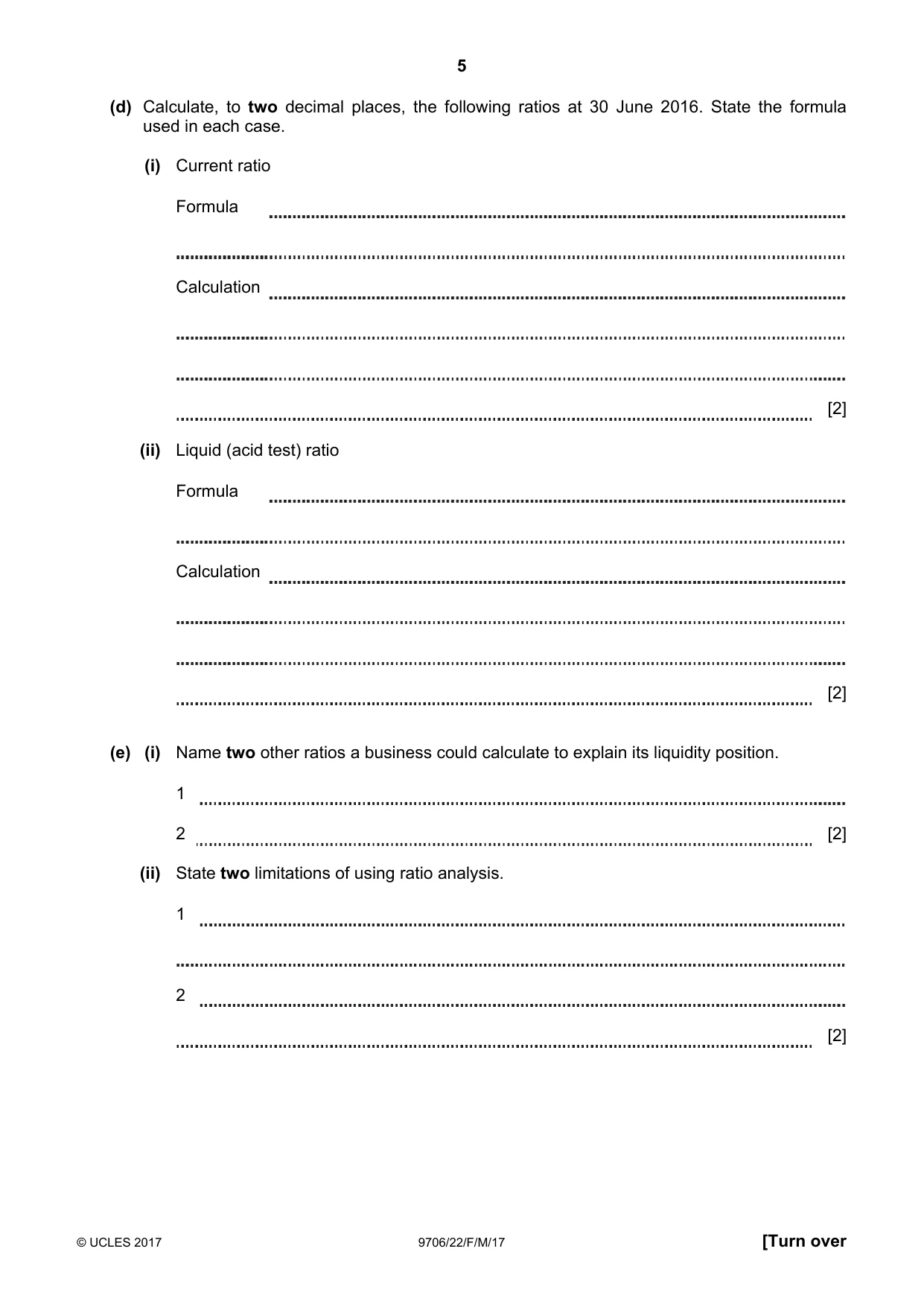
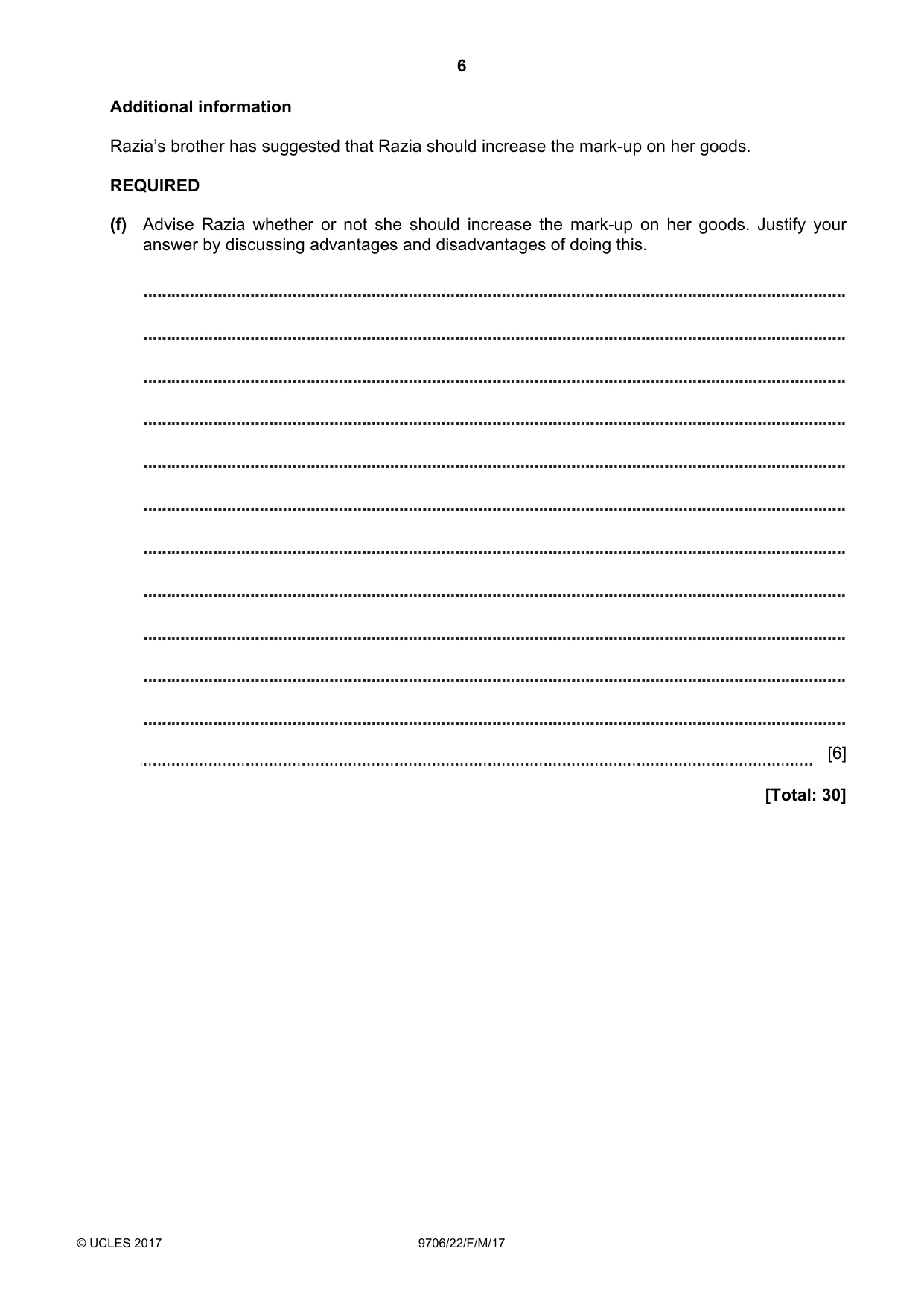
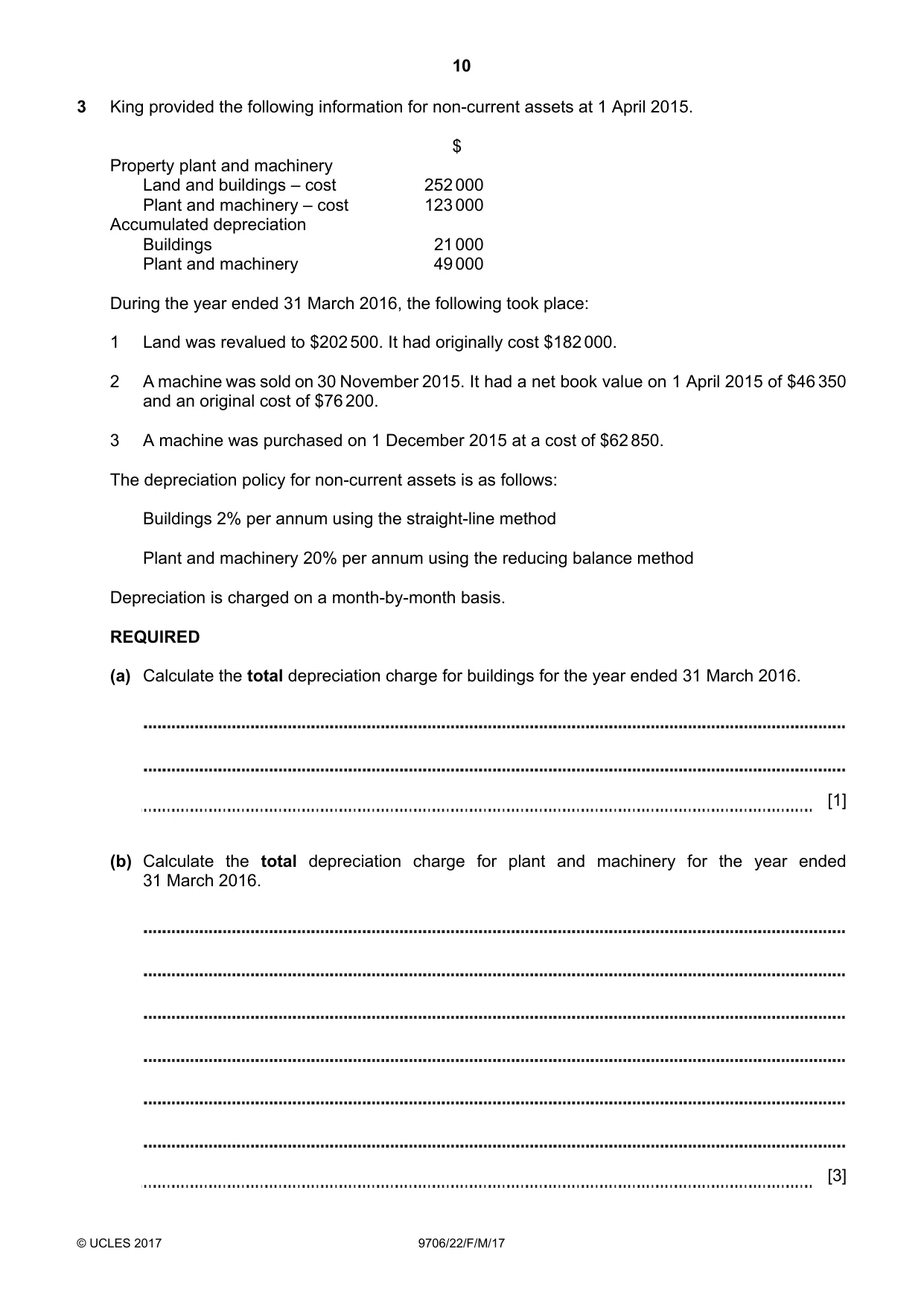
1 Razia, a sole trader, started her business on 1 July 2015 selling ladies’ clothing. Razia did not keep proper books of account, but was able to provide the following information. Summary of bank account for the year ended 30 June 2016 $ $ Capital introduced 36 340 Payments to trade payables 80 690 Cash banked 78 780 Shop rental 25 200 Balance c/d 4 330 Shop fixtures and fittings 3 600 Purchase of motor vehicle 5 800 Motor expenses 3 140 Light and heat 1 020 119 450 119 450 Additional information 1 Total revenue for the year was $92 600. All sales were made for cash. 2 Razia kept no record of her cash drawings. 3 The following expenses were paid from cash takings before the money was banked: $ General expenses 950 Assistants’ wages 2870 4 Cash in hand at 30 June 2016 was $1250. REQUIRED (a) Prepare the cash account, showing clearly the value of Razia’s drawings for the year. [4] Additional information 1 All sales made a gross margin of 40%. 2 During the year, Razia had taken goods, $640 at cost price, for her own use. 3 Inventory at 30 June 2016 had been counted and was valued at cost price $31 900. Razia was aware that some goods had been stolen during the year. 4 Razia owed $8940 to trade suppliers at 30 June 2016. REQUIRED (b) Calculate the value of inventory stolen during the year ended 30 June 2016 at cost price. [4] Additional information 1 At 30 June 2016, the following expenses were accrued: $ Assistants’ wages 120 Light and heat 150 2 Non-current assets should be depreciated as follows: Shop fixtures and fittings at 15% per annum using the reducing balance method Motor vehicle using the straight-line method over five years. The estimated residual value of the motor vehicle after five years is $400. 3 The annual charge for shop rental is $21 600. REQUIRED (c) Prepare the income statement for the year ended 30 June 2016. [8] (d) Calculate, to two decimal places, the following ratios at 30 June 2016. State the formula used in each case. (i) Current ratio Formula Calculation [2] (ii) Liquid (acid test) ratio Formula Calculation [2] (e) (i) Name two other ratios a business could calculate to explain its liquidity position. 1 2 [2] (ii) State two limitations of using ratio analysis. 1 2 [2] Additional information Razia’s brother has suggested that Razia should increase the mark-up on her goods. REQUIRED (f) Advise Razia whether or not she should increase the mark-up on her goods. Justify your answer by discussing advantages and disadvantages of doing this. [6] [Total: 30] Question 2 is on the next page.
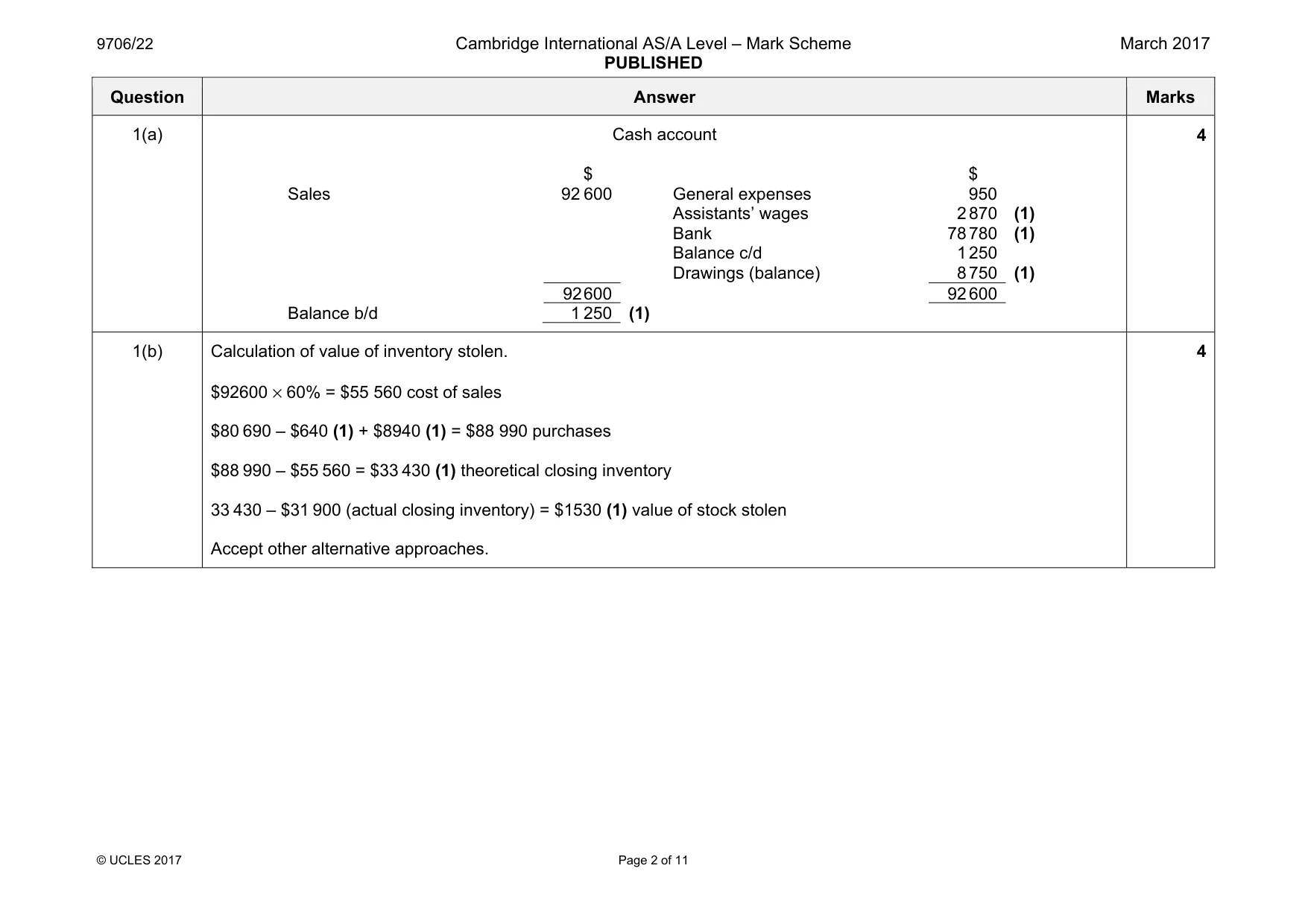
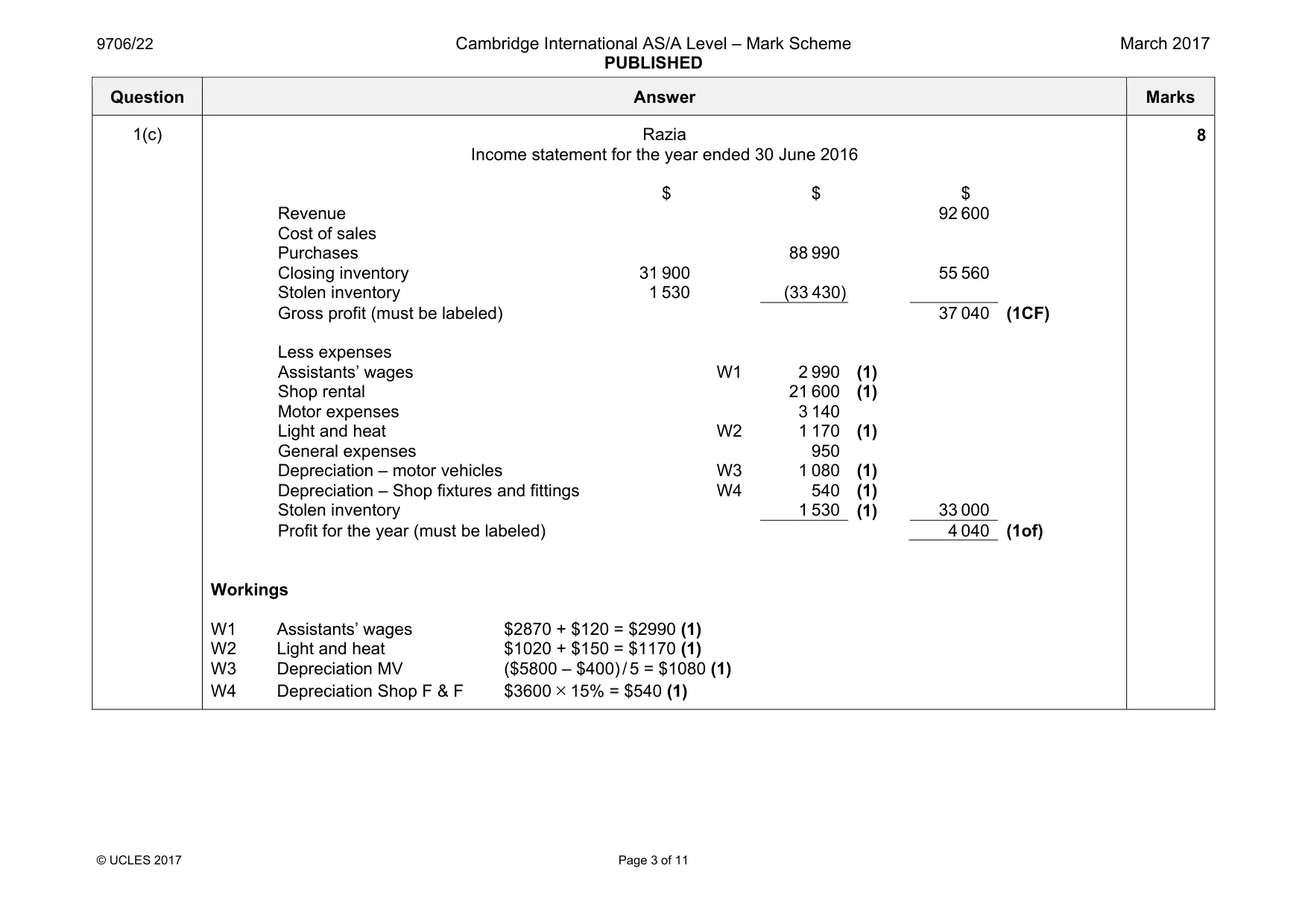
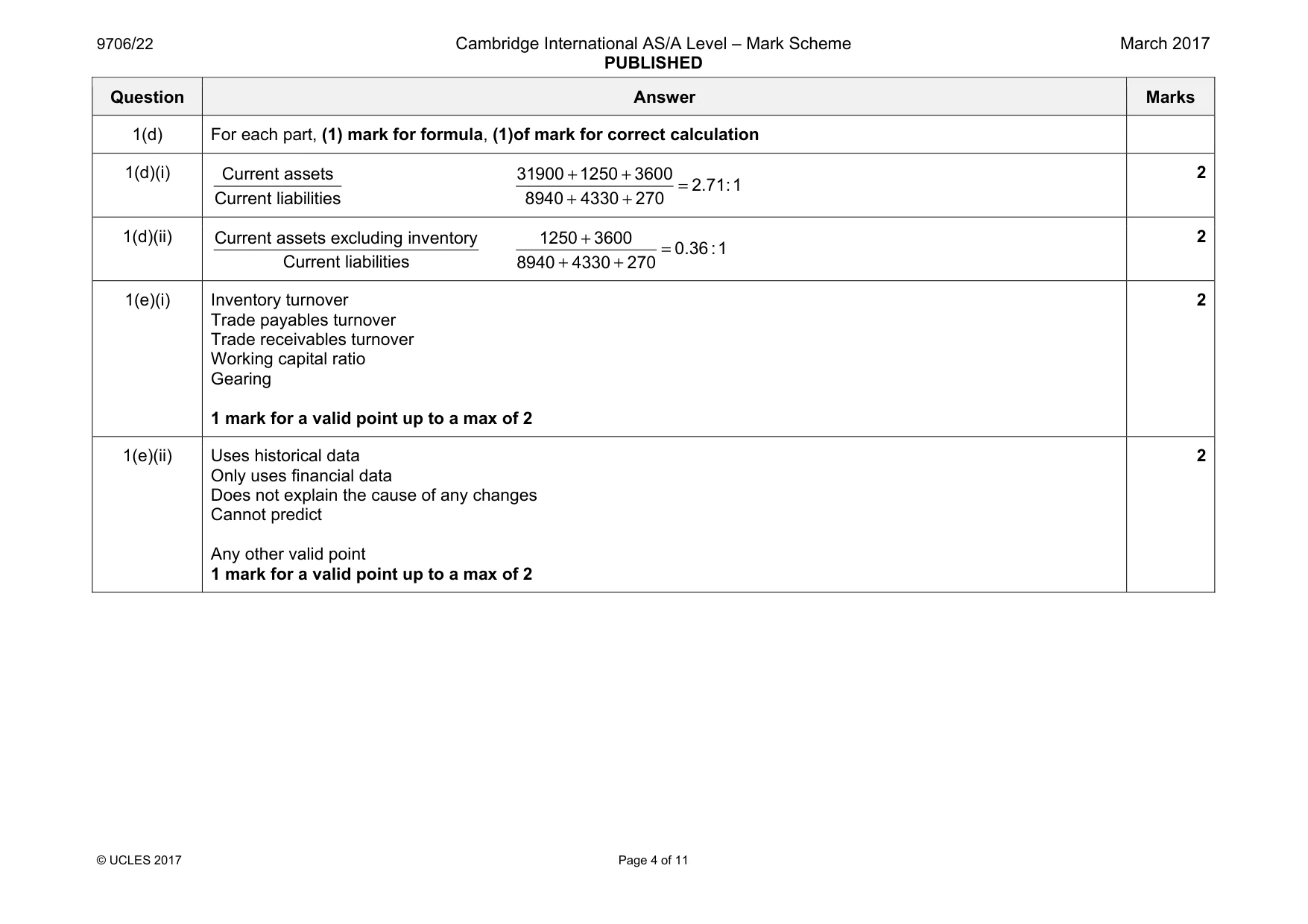
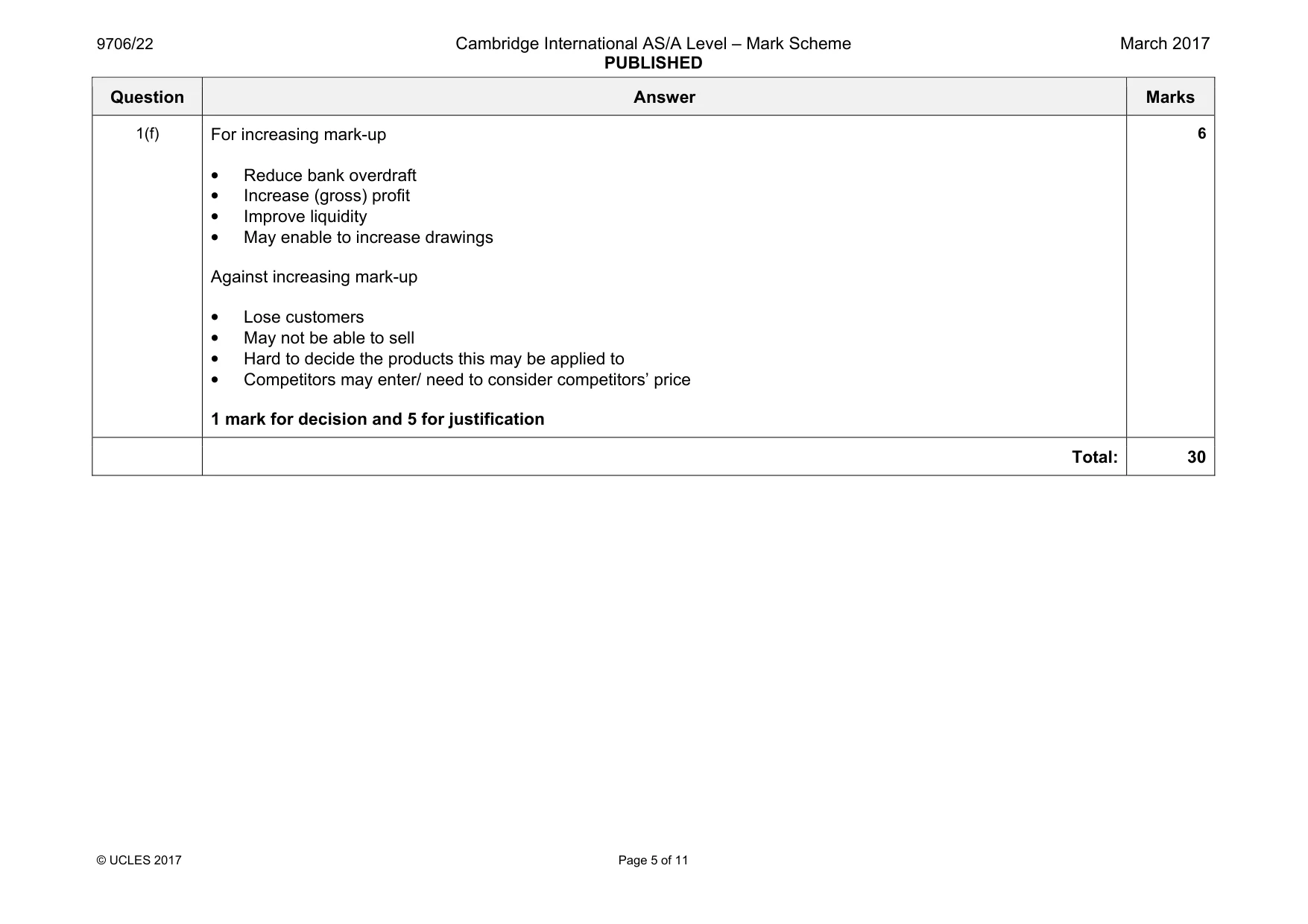
Mark scheme: 1(a) Cash account $ $ Sales 92 600 General expenses 950 Assistants’ wages 2 870 (1) Bank 78 780 (1) Balance c/d 1 250 Drawings (balance) 8 750 (1) 92 600 92 600 Balance b/d 1 250 (1) 4 1(b) Calculation of value of inventory stolen. $92600 × 60% = $55 560 cost of sales $80 690 – $640 (1) + $8940 (1) = $88 990 purchases $88 990 – $55 560 = $33 430 (1) theoretical closing inventory 33 430 – $31 900 (actual closing inventory) = $1530 (1) value of stock stolen Accept other alternative approaches. 4 Question Answer Marks 1(c) Razia Income statement for the year ended 30 June 2016 $ $ $ Revenue 92 600 Cost of sales Purchases 88 990 Closing inventory 31 900 55 560 Stolen inventory 1 530 (33 430) Gross profit (must be labeled) 37 040 (1CF) Less expenses Assistants’ wages W1 2 990 (1) Shop rental 21 600 (1) Motor expenses 3 140 Light and heat W2 1 170 (1) General expenses 950 Depreciation – motor vehicles W3 1 080 (1) Depreciation – Shop fixtures and fittings W4 540 (1) Stolen inventory 1 530 (1) 33 000 Profit for the year (must be labeled) 4 040 (1of) Workings W1 Assistants’ wages $2870 + $120 = $2990 (1) W2 Light and heat $1020 + $150 = $1170 (1) W3 Depreciation MV ($5800 – $400) / 5 = $1080 (1) W4 Depreciation Shop F & F $3600 × 15% = $540 (1) 8 Question Answer Marks 1(d) For each part, (1) mark for formula, (1)of mark for correct calculation 1(d)(i) Current assets Current liabilities 31900 1250 3600 2.71:1 8940 4330 270 + + = + + 2 1(d)(ii) Current assets excluding inventory Current liabilities 1250 3600 0.36 :1 8940 4330 270 + = + + 2 1(e)(i) Inventory turnover Trade payables turnover Trade receivables turnover Working capital ratio Gearing 1 mark for a valid point up to a max of 2 2 1(e)(ii) Uses historical data Only uses financial data Does not explain the cause of any changes Cannot predict Any other valid point 1 mark for a valid point up to a max of 2 2 Question Answer Marks 1(f) For increasing mark-up • Reduce bank overdraft • Increase (gross) profit • Improve liquidity • May enable to increase drawings Against increasing mark-up • Lose customers • May not be able to sell • Hard to decide the products this may be applied to • Competitors may enter/ need to consider competitors’ price 1 mark for decision and 5 for justification 6 Total: 30
More questions on Analysis and communication of accounting information
Q2 · Sturgess has provided the following information: 1 The provision for doubtful debts at 1…
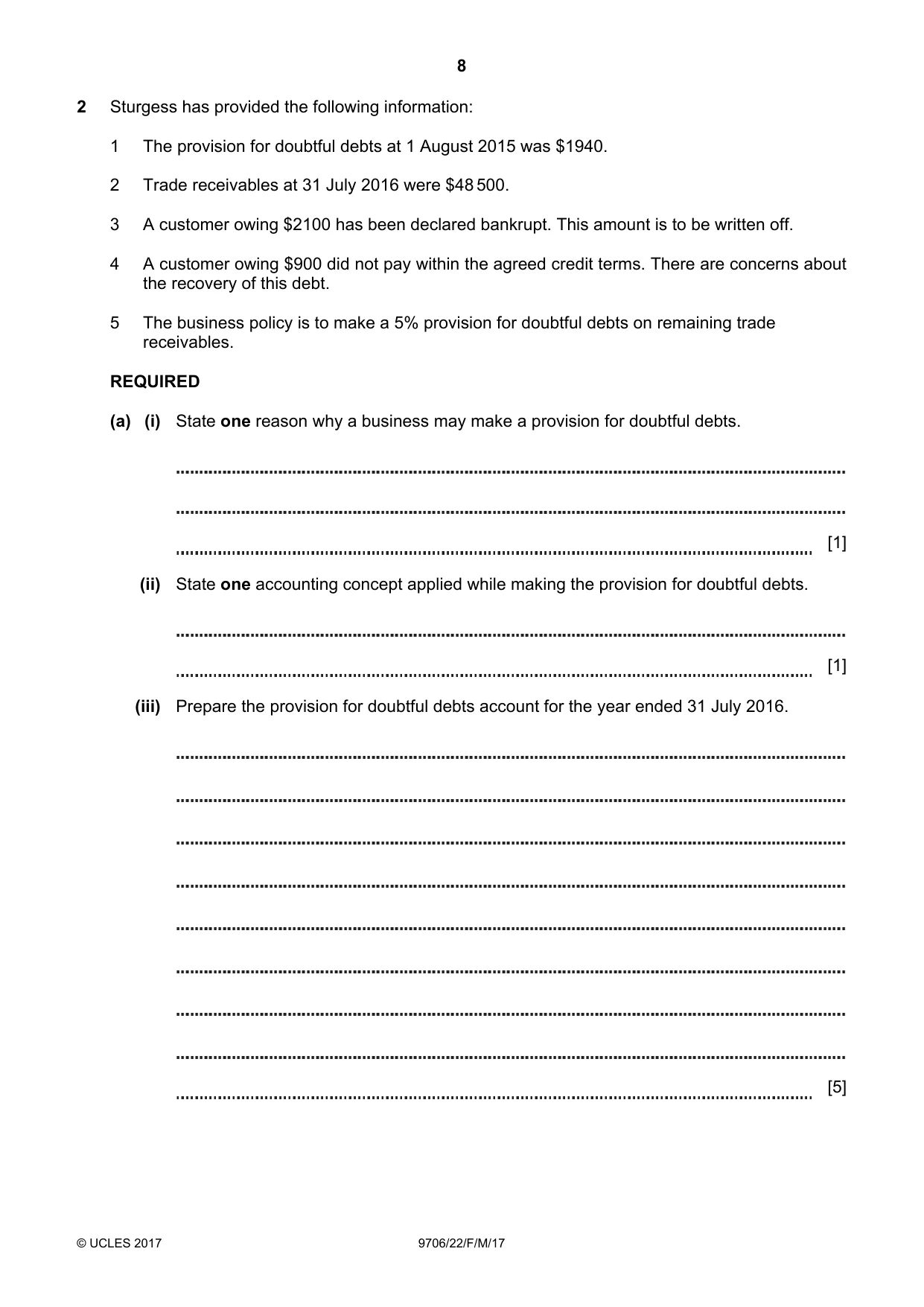
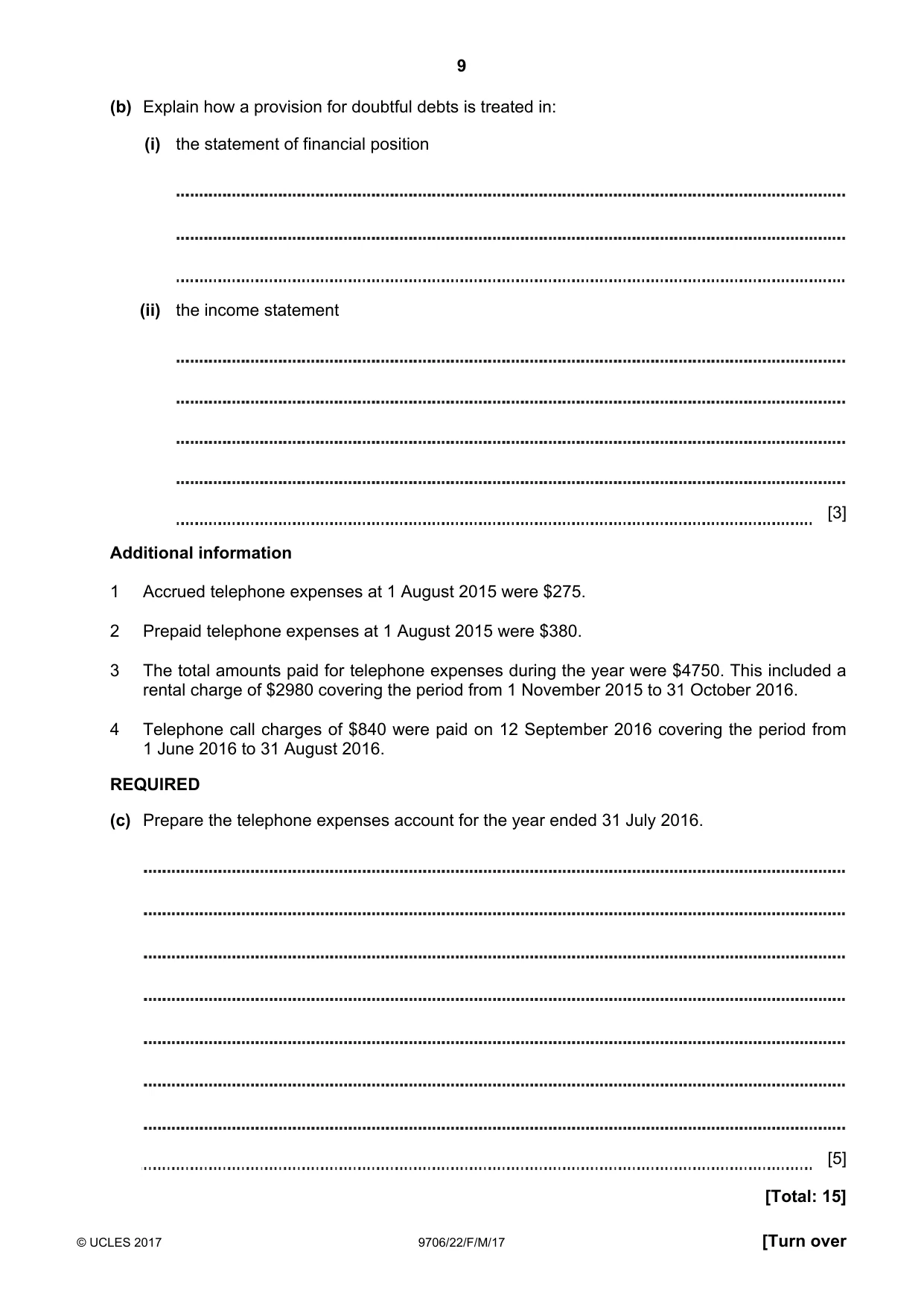
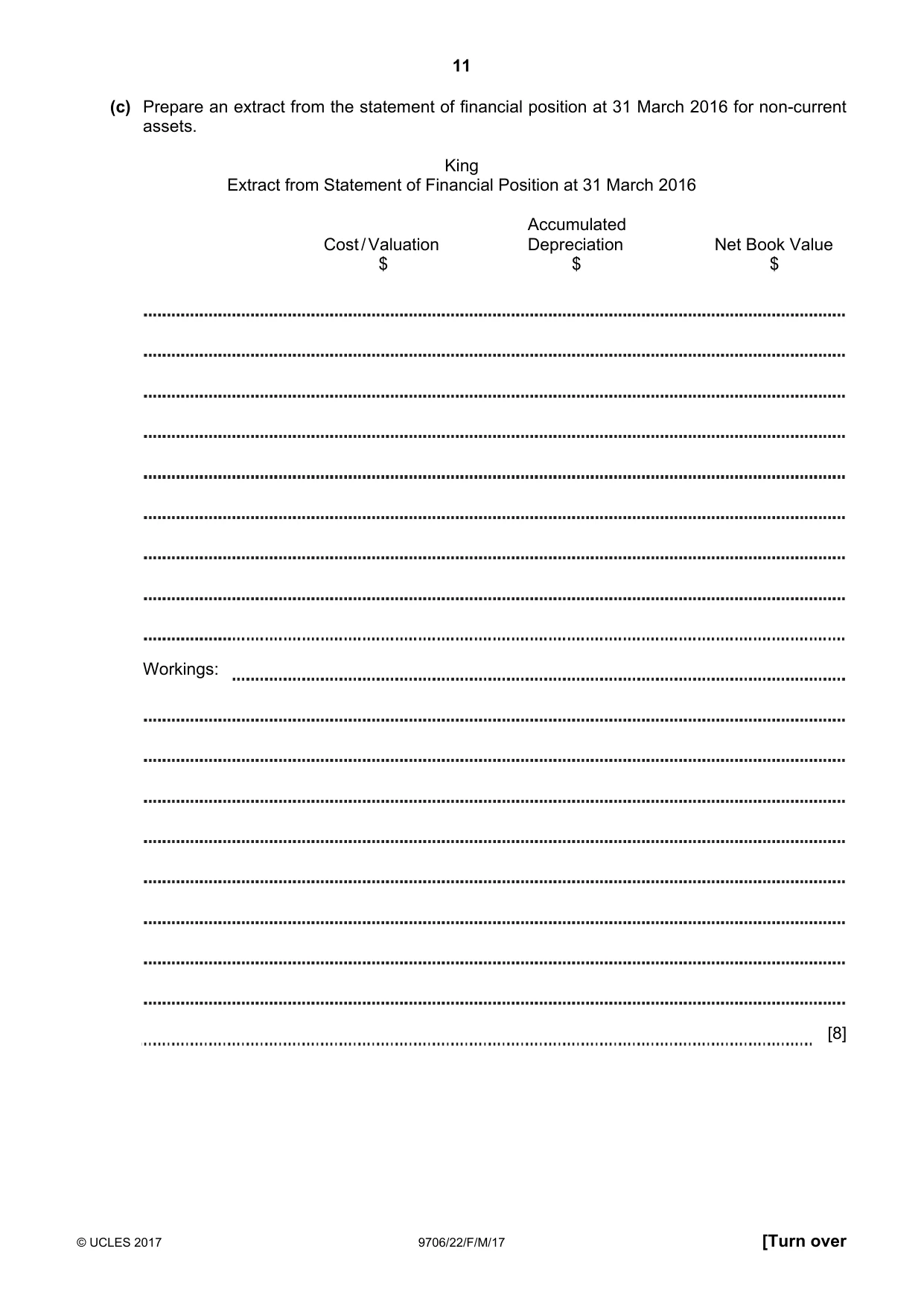
2 Sturgess has provided the following information: 1 The provision for doubtful debts at 1 August 2015 was $1940. 2 Trade receivables at 31 July 2016 were $48 500. 3 A customer owing $2100 has been declared bankrupt. This amount is to be written off. 4 A customer owing $900 did not pay within the agreed credit terms. There are concerns about the recovery of this debt. 5 The business policy is to make a 5% provision for doubtful debts on remaining trade receivables. REQUIRED (a) (i) State one reason why a business may make a provision for doubtful debts. [1] (ii) State one accounting concept applied while making the provision for doubtful debts. [1] (iii) Prepare the provision for doubtful debts account for the year ended 31 July 2016. [5] (b) Explain how a provision for doubtful debts is treated in: (i) the statement of financial position (ii) the income statement [3] Additional information 1 Accrued telephone expenses at 1 August 2015 were $275. 2 Prepaid telephone expenses at 1 August 2015 were $380.
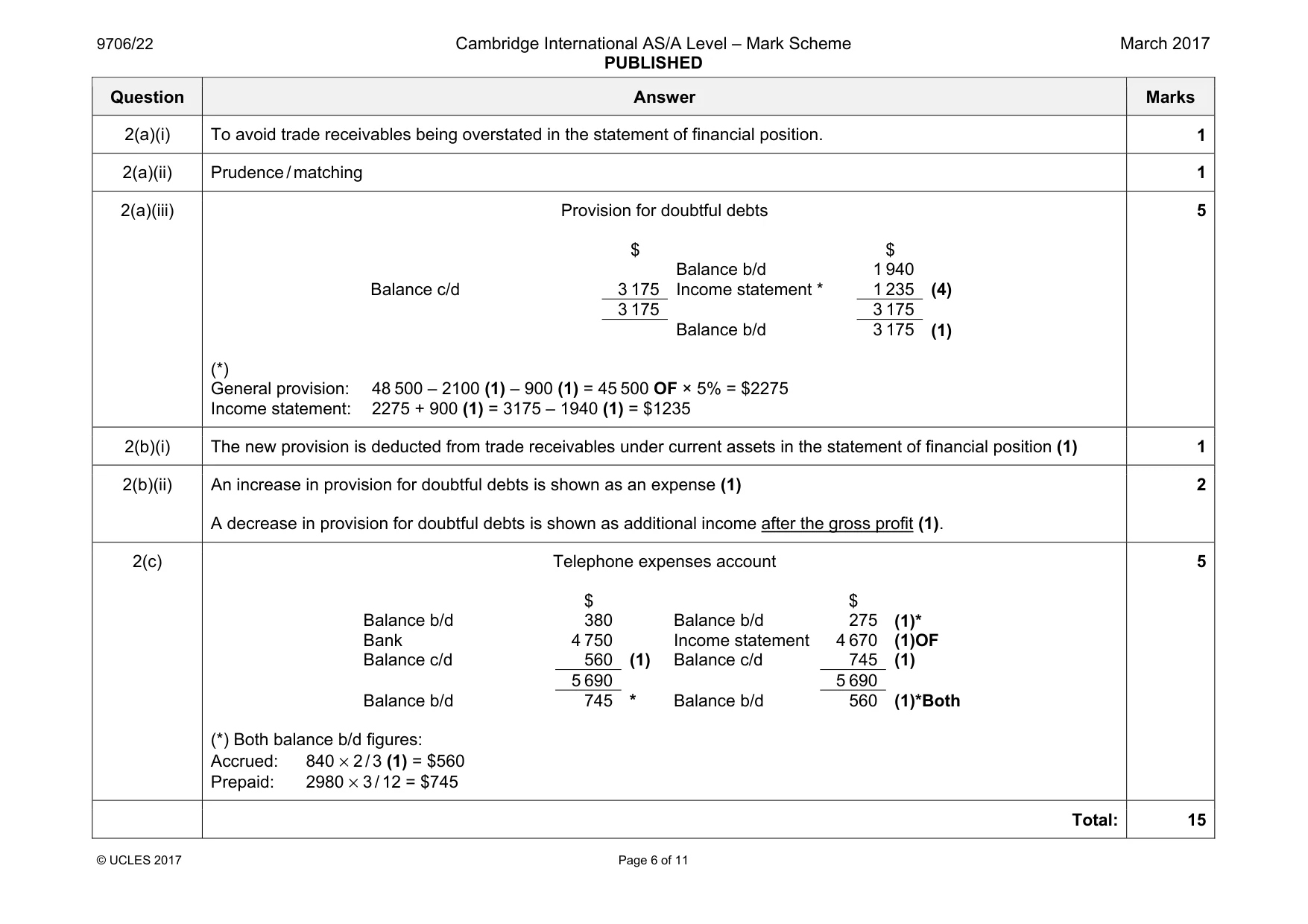
Mark scheme: 2(a)(i) To avoid trade receivables being overstated in the statement of financial position. 1 2(a)(ii) Prudence / matching 1 2(a)(iii) Provision for doubtful debts $ $ Balance b/d 1 940 Balance c/d 3 175 Income statement * 1 235 (4) 3 175 3 175 Balance b/d 3 175 (1) (*) General provision: 48 500 – 2100 (1) – 900 (1) = 45 500 OF × 5% = $2275 Income statement: 2275 + 900 (1) = 3175 – 1940 (1) = $1235 5 2(b)(i) The new provision is deducted from trade receivables under current assets in the statement of financial position (1) 1 2(b)(ii) An increase in provision for doubtful debts is shown as an expense (1) A decrease in provision for doubtful debts is shown as additional income after the gross profit (1). 2 2(c) Telephone expenses account $ $ Balance b/d 380 Balance b/d 275 (1)* Bank 4 750 Income statement 4 670 (1)OF Balance c/d 560 (1) Balance c/d 745 (1) 5 690 5 690 Balance b/d 745 * Balance b/d 560 (1)*Both (*) Both balance b/d figures: Accrued: 840 × 2 / 3 (1) = $560 Prepaid: 2980 × 3 / 12 = $745 5 Total: 15
Q3 · The total amounts paid for telephone expenses during the year were $4750
3 The total amounts paid for telephone expenses during the year were $4750. This included a rental charge of $2980 covering the period from 1 November 2015 to 31 October 2016.
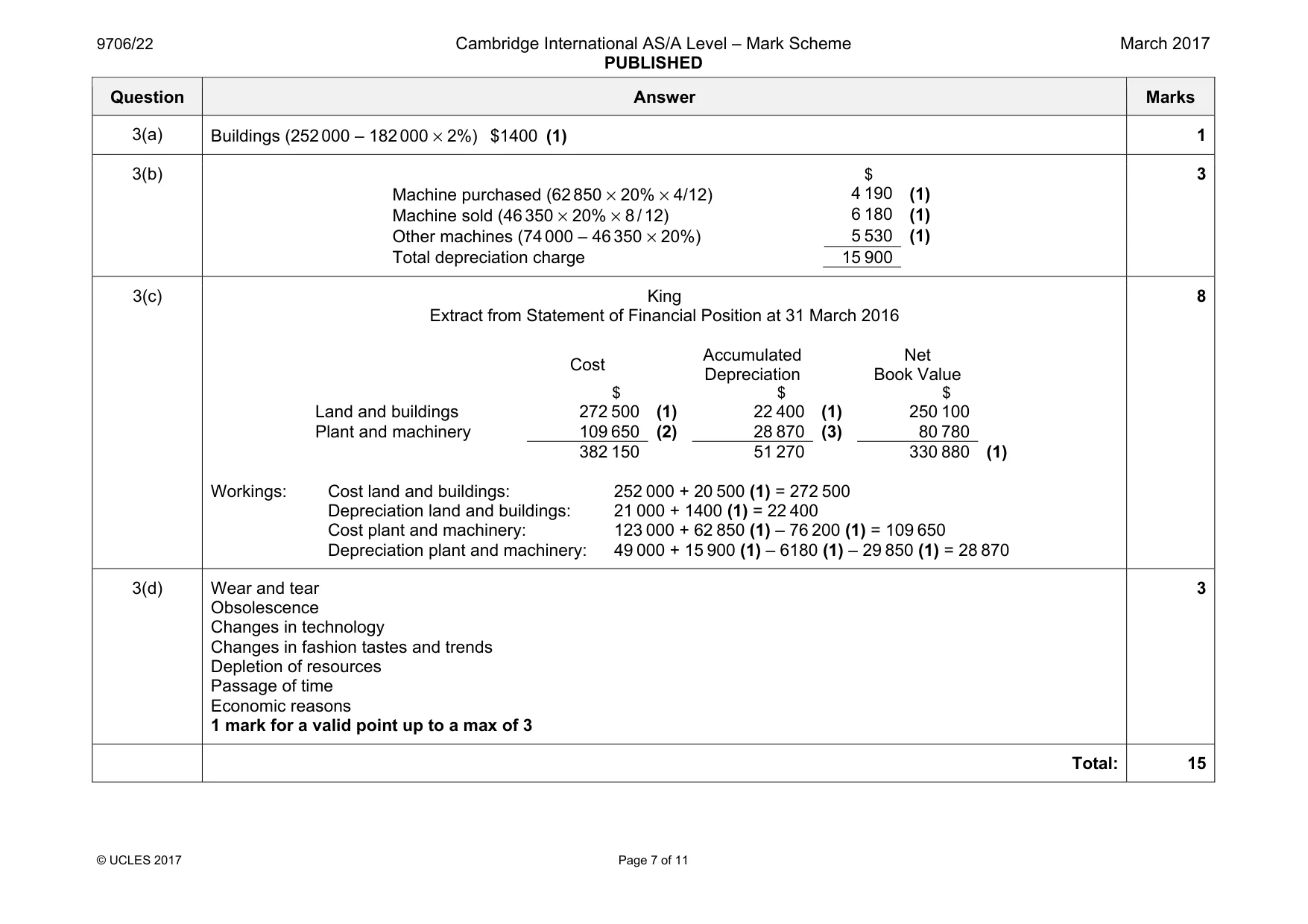
Mark scheme: 3(a) 1 3(b) $ Machine purchased (62 850 × 20% × 4/12) 4 190 (1) Machine sold (46 350 × 20% × 8 / 12) 6 180 (1) Other machines (74 000 – 46 350 × 20%) 5 530 (1) Total depreciation charge 15 900 3 3(c) King Extract from Statement of Financial Position at 31 March 2016 Cost Accumulated Depreciation Net Book Value $ $ $ Land and buildings 272 500 (1) 22 400 (1) 250 100 Plant and machinery 109 650 (2) 28 870 (3) 80 780 382 150 51 270 330 880 (1) Workings: Cost land and buildings: 252 000 + 20 500 (1) = 272 500 Depreciation land and buildings: 21 000 + 1400 (1) = 22 400 Cost plant and machinery: 123 000 + 62 850 (1) – 76 200 (1) = 109 650 Depreciation plant and machinery: 49 000 + 15 900 (1) – 6180 (1) – 29 850 (1) = 28 870 8 3(d) Wear and tear Obsolescence Changes in technology Changes in fashion tastes and trends Depletion of resources Passage of time Economic reasons 1 mark for a valid point up to a max of 3 3 Total: 15
Q4 · Telephone call charges of $840 were paid on 12 September 2016 covering the period from 1…
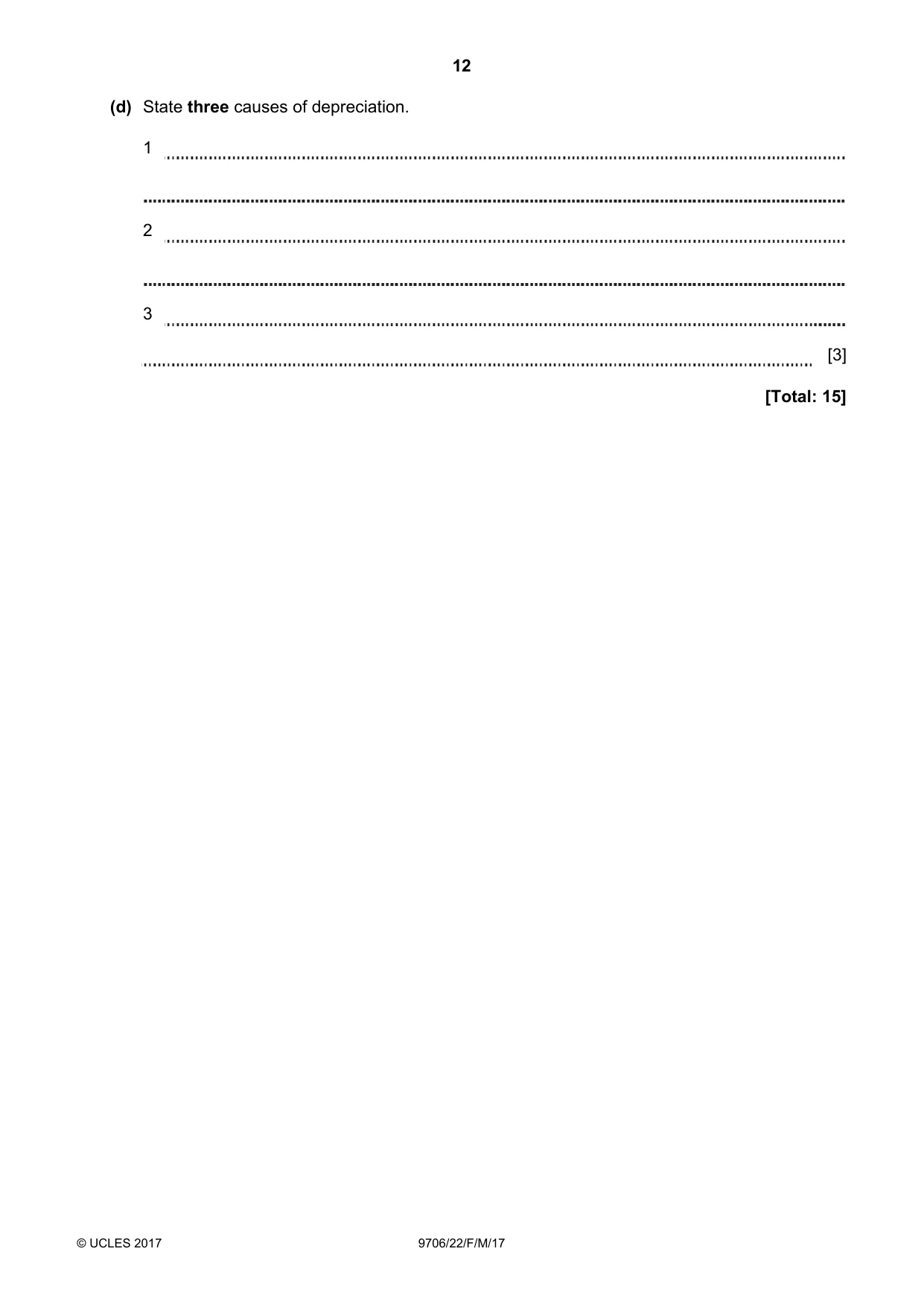
4 Telephone call charges of $840 were paid on 12 September 2016 covering the period from 1 June 2016 to 31 August 2016. REQUIRED (c) Prepare the telephone expenses account for the year ended 31 July 2016. [5] [Total: 15] 3 King provided the following information for non-current assets at 1 April 2015. $ Property plant and machinery Land and buildings – cost 252 000 Plant and machinery – cost 123 000 Accumulated depreciation Buildings 21 000 Plant and machinery 49 000 During the year ended 31 March 2016, the following took place: 1 Land was revalued to $202 500. It had originally cost $182 000. 2 A machine was sold on 30 November 2015. It had a net book value on 1 April 2015 of $46 350 and an original cost of $76 200. 3 A machine was purchased on 1 December 2015 at a cost of $62 850. The depreciation policy for non-current assets is as follows: Buildings 2% per annum using the straight-line method Plant and machinery 20% per annum using the reducing balance method Depreciation is charged on a month-by-month basis. REQUIRED (a) Calculate the total depreciation charge for buildings for the year ended 31 March 2016. [1] (b) Calculate the total depreciation charge for plant and machinery for the year ended 31 March 2016. [3] (c) Prepare an extract from the statement of financial position at 31 March 2016 for non-current assets. King Extract from Statement of Financial Position at 31 March 2016 Accumulated Cost / Valuation Depreciation Net Book Value $ $ $ Workings: [8]
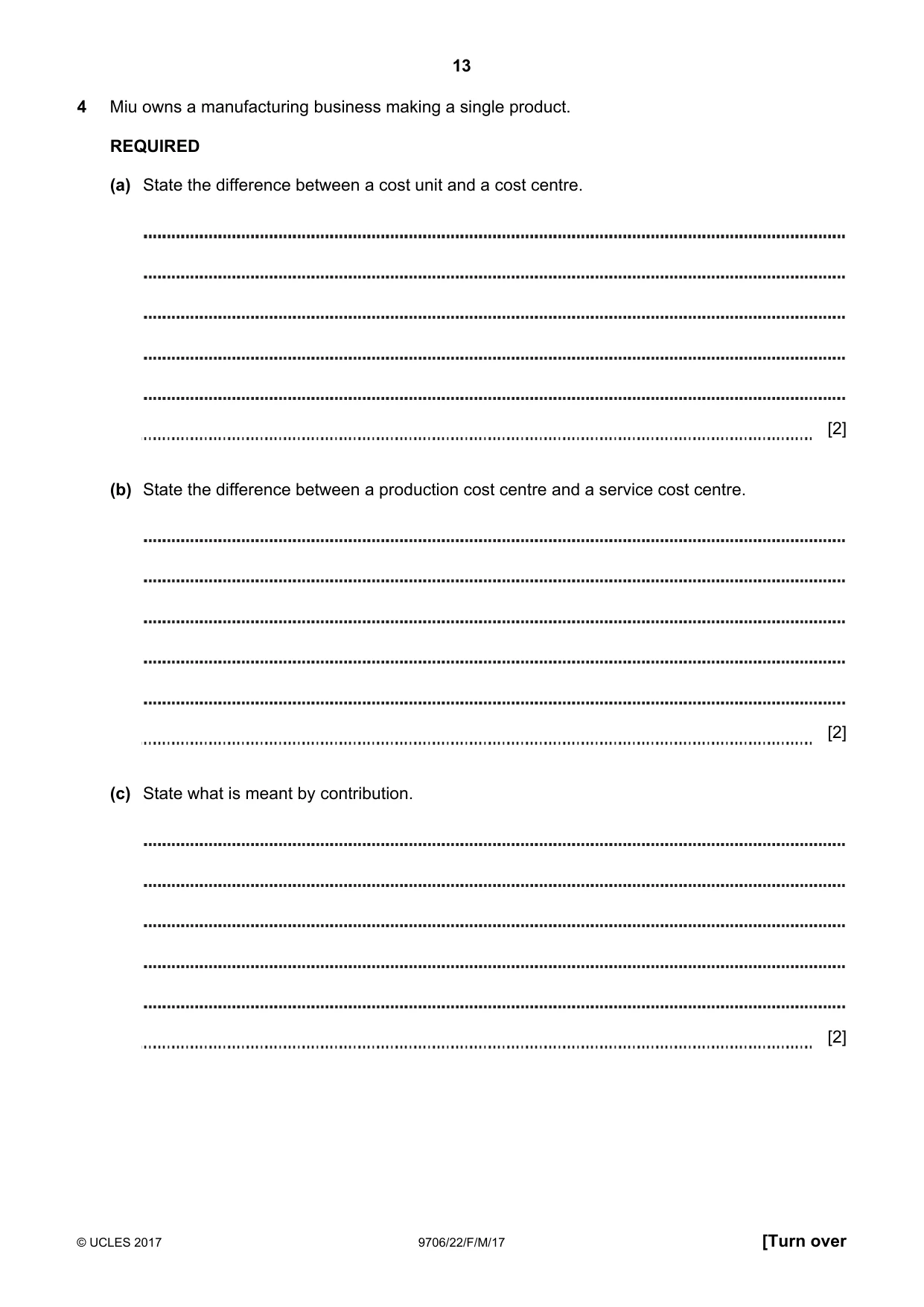
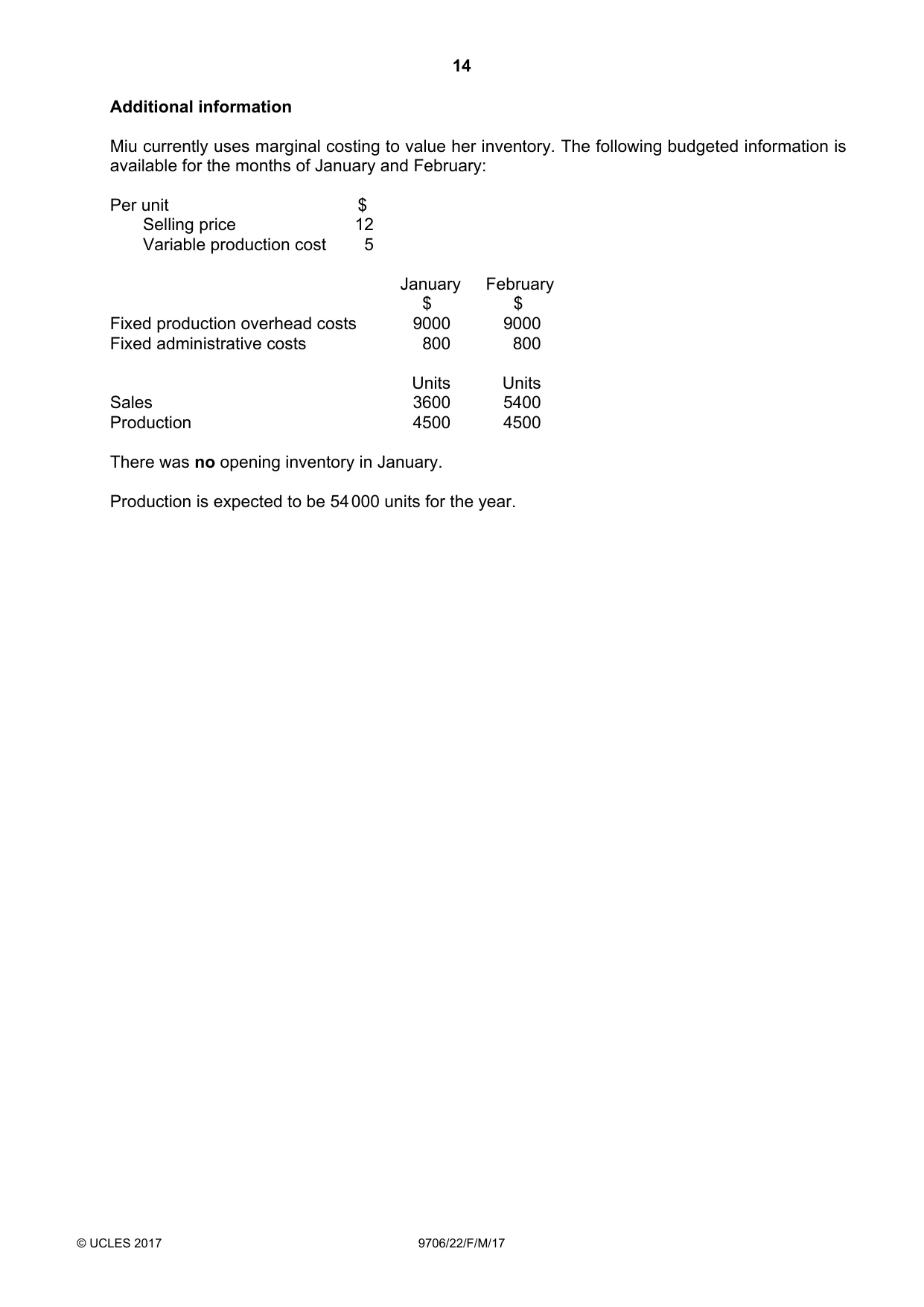
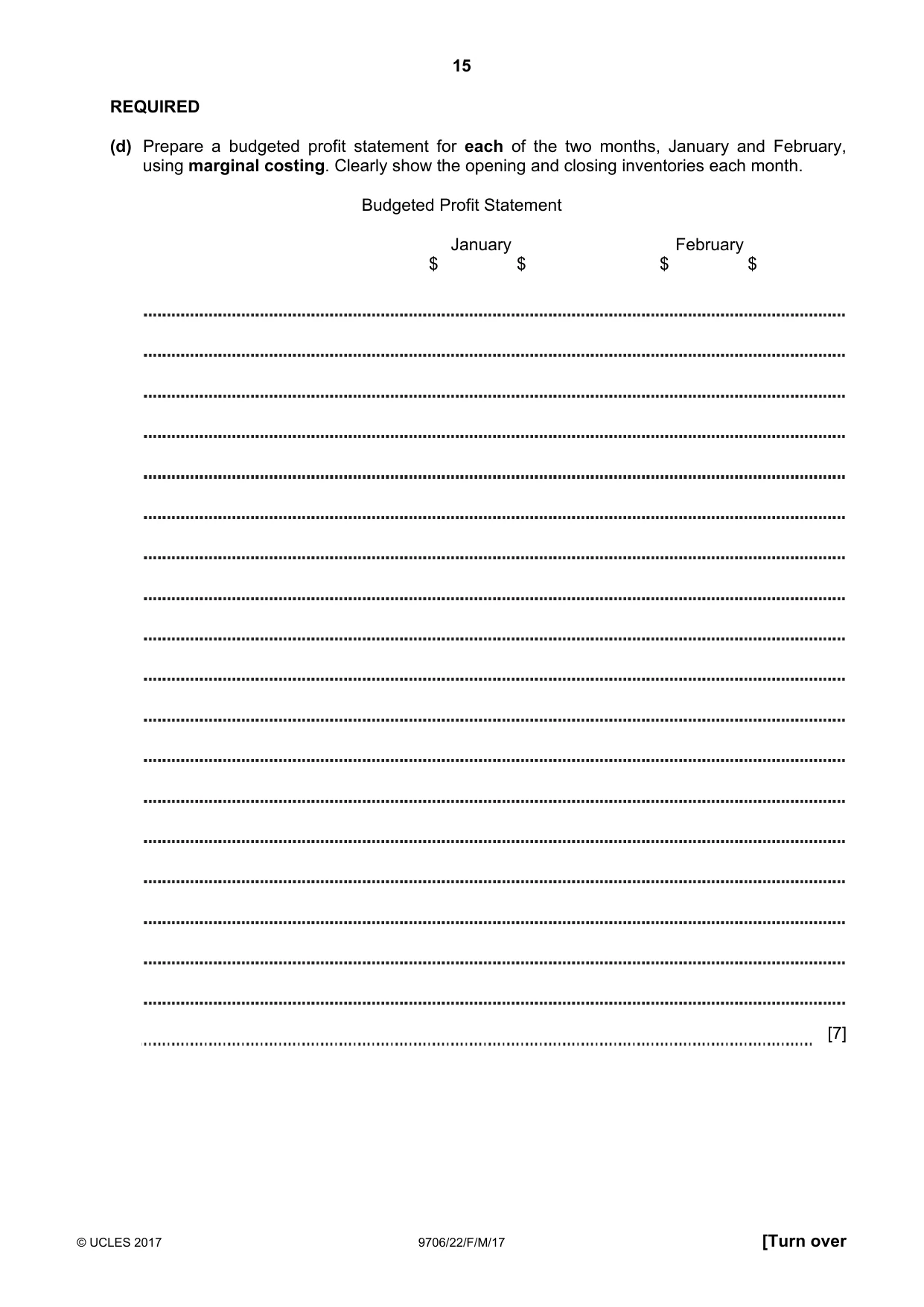
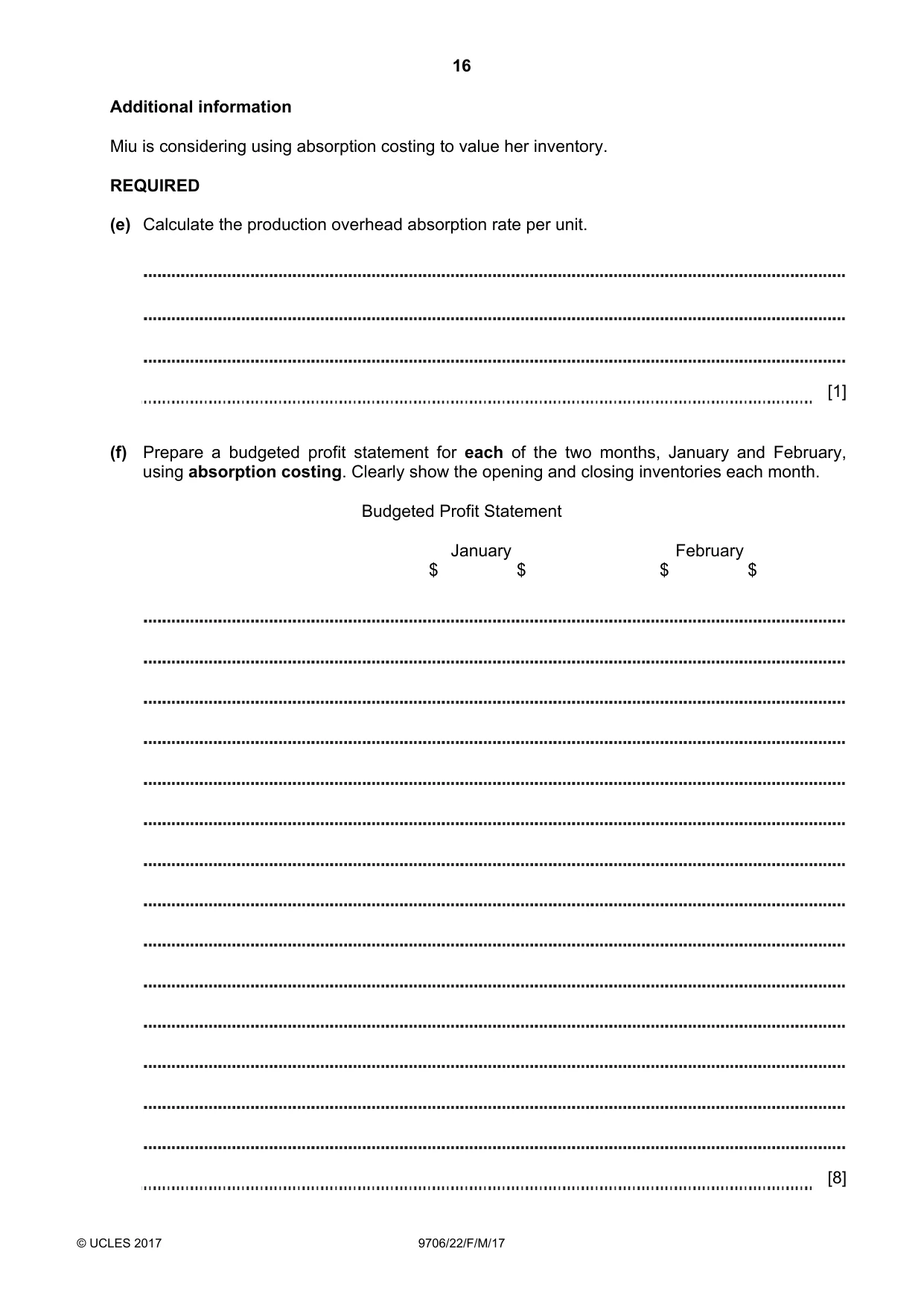
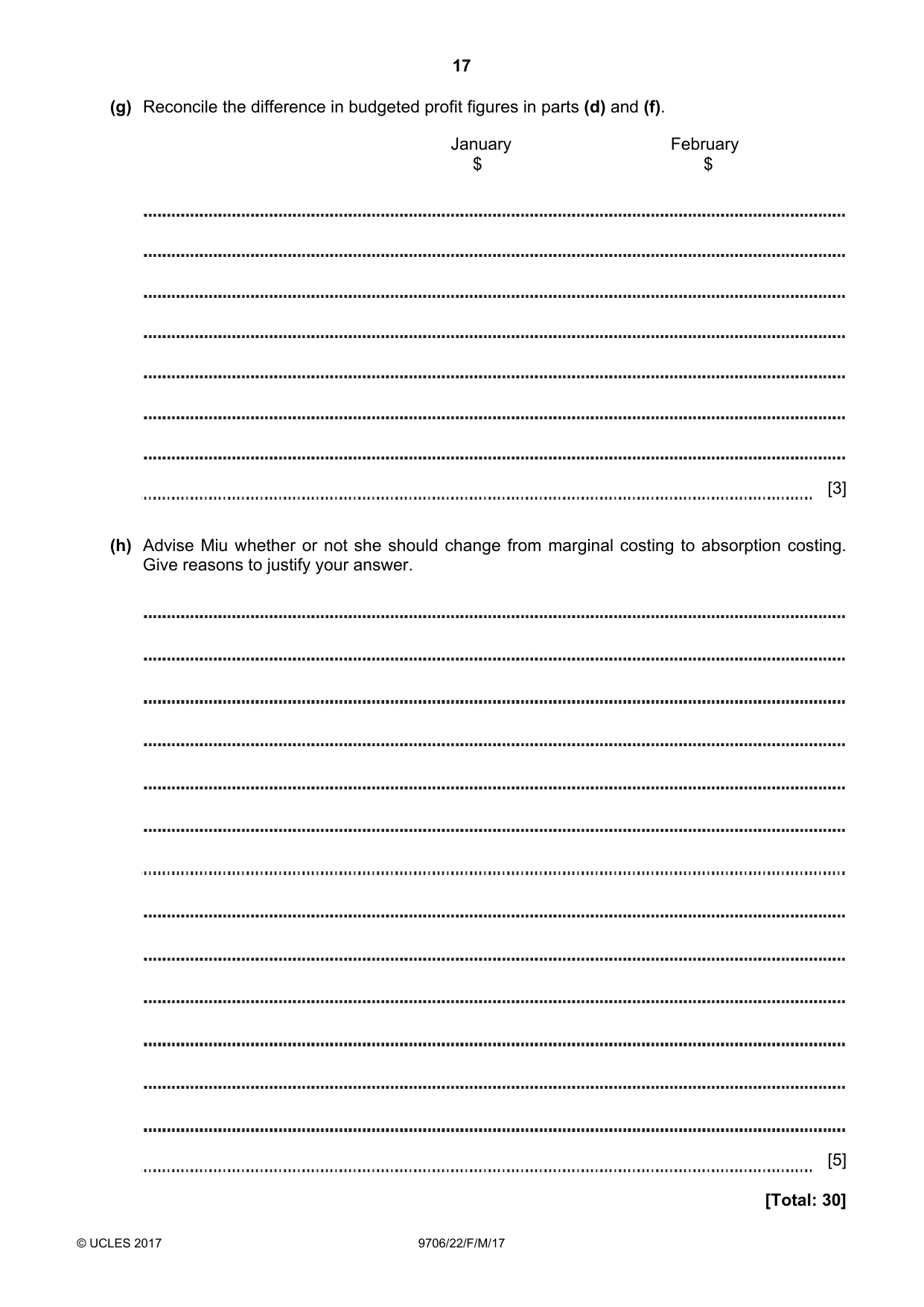
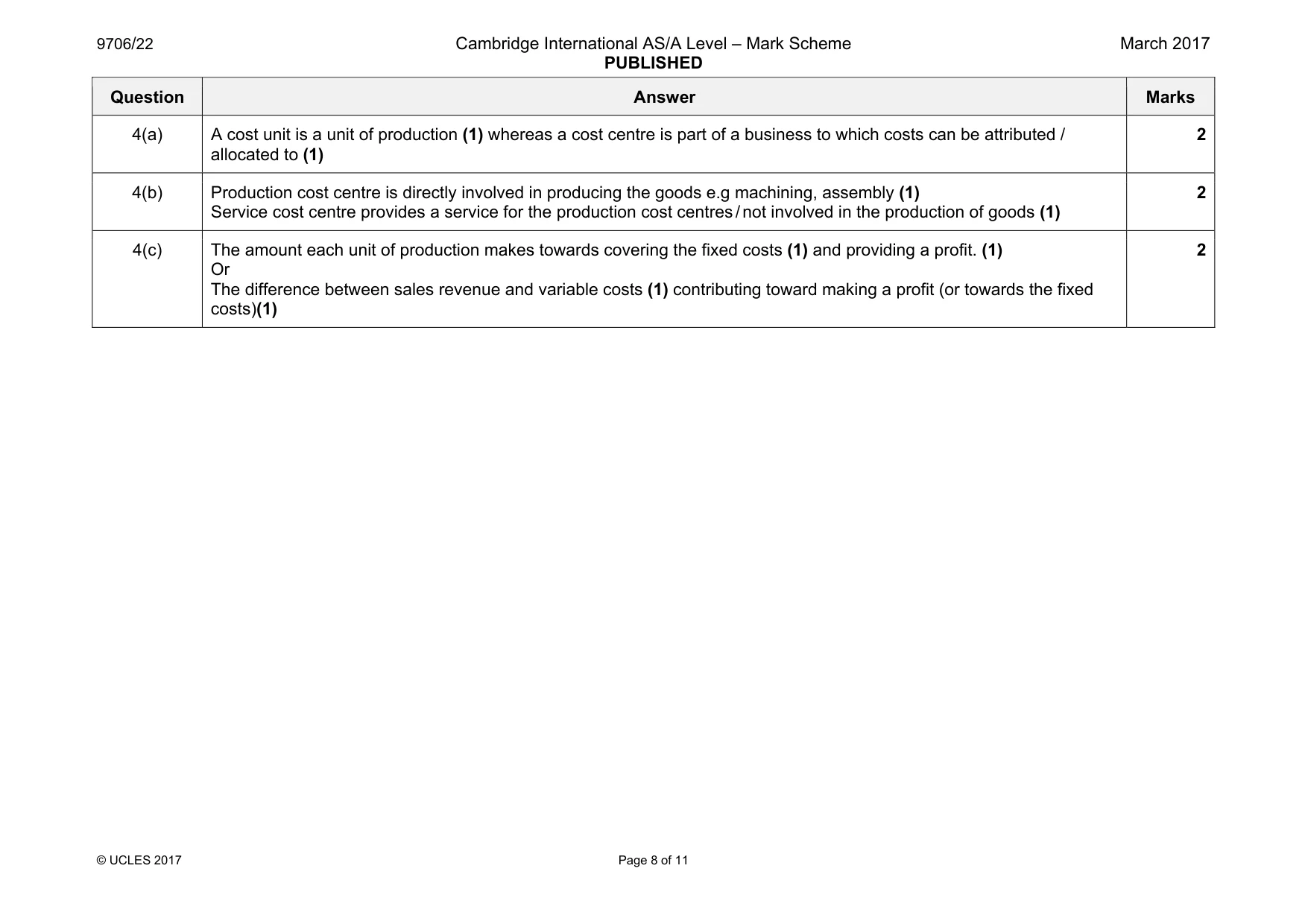
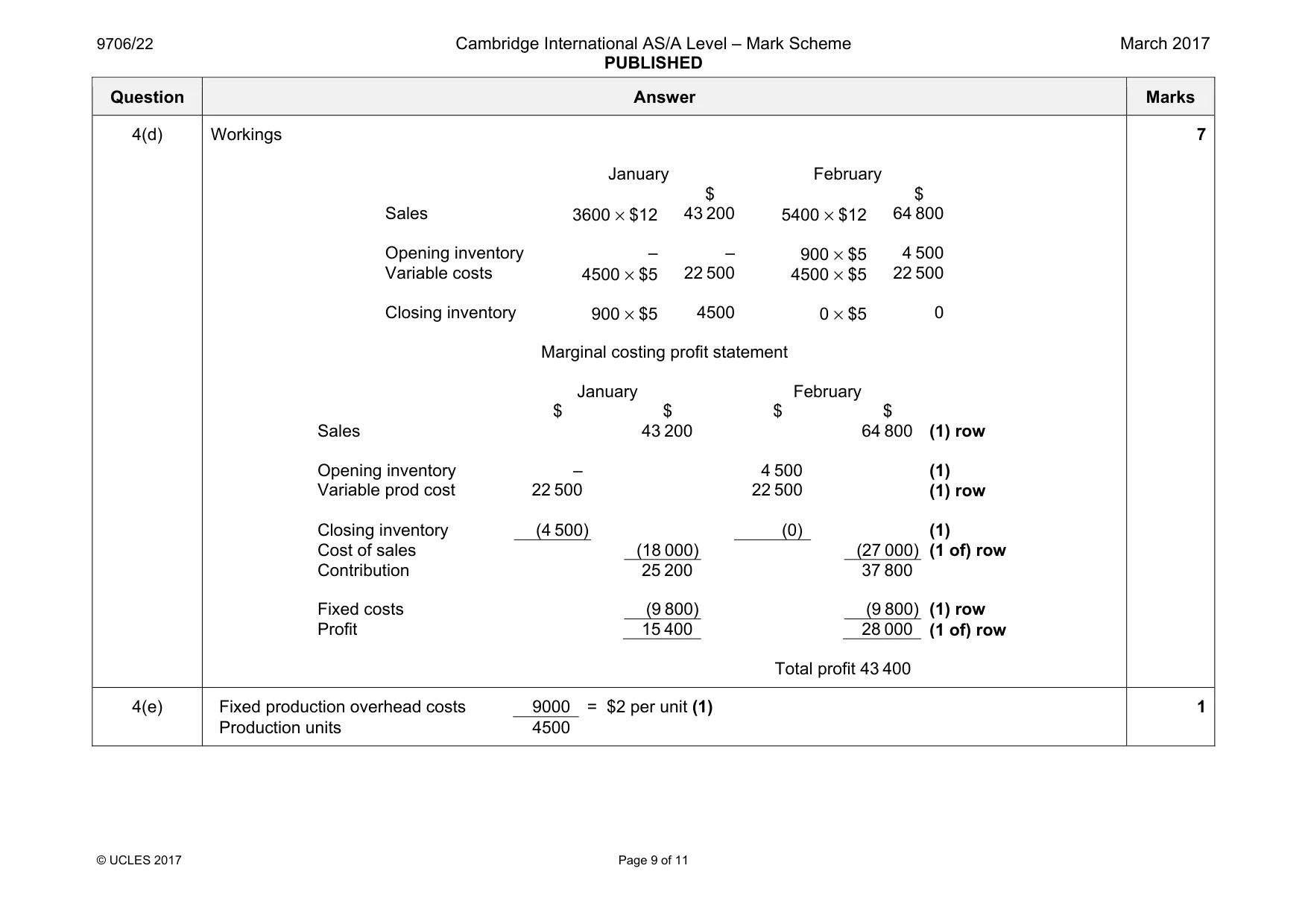
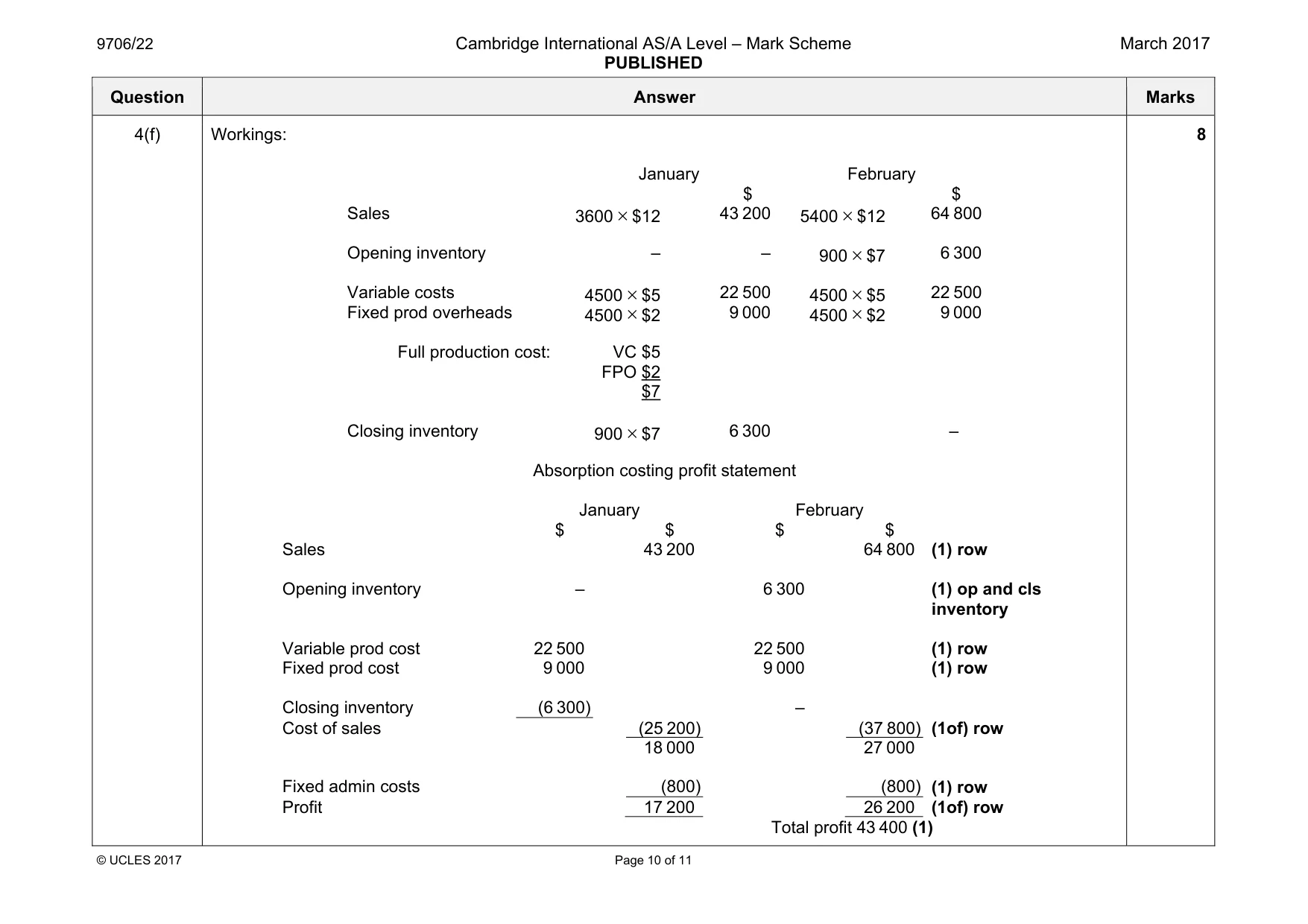
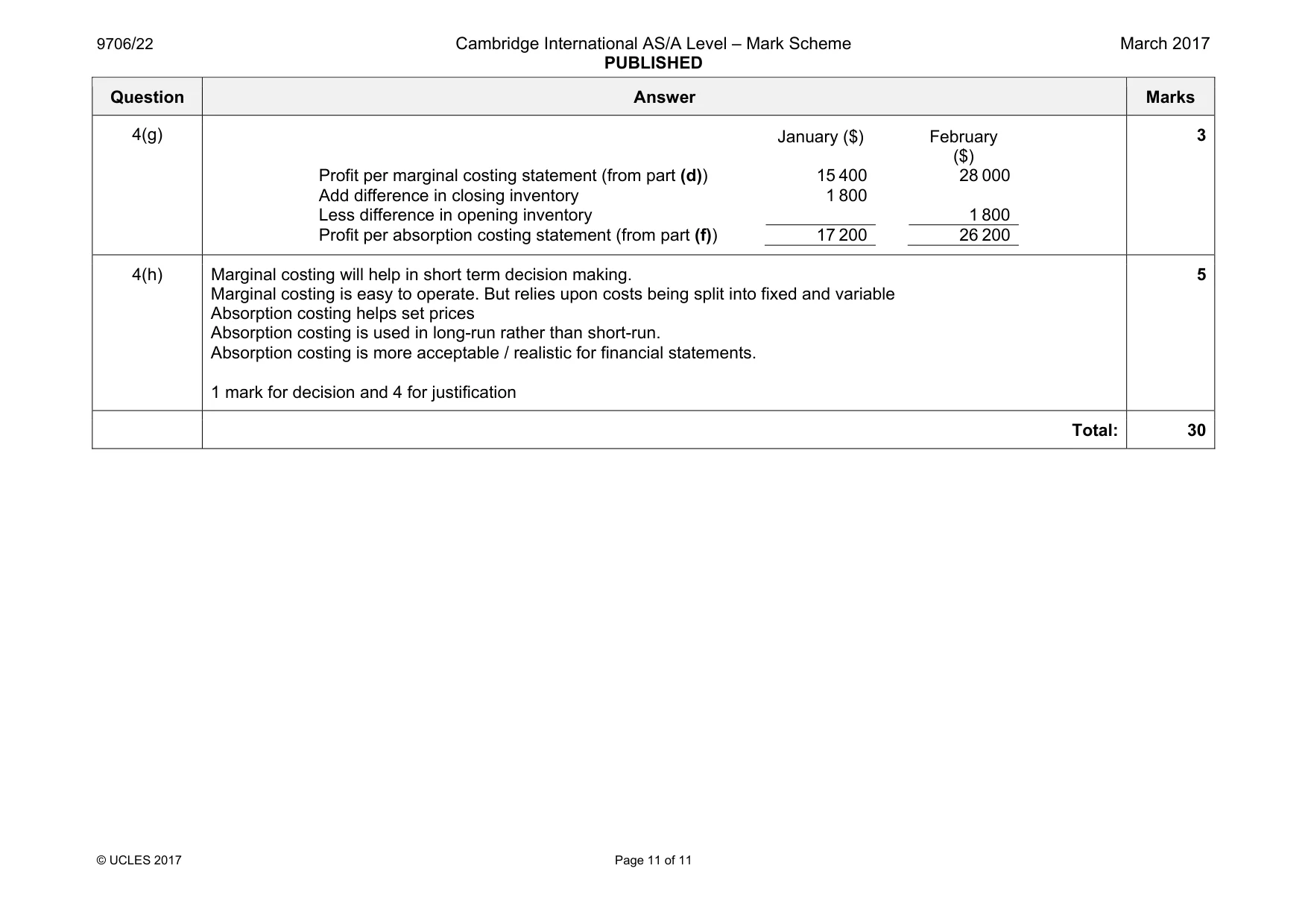
Mark scheme: 4(a) A cost unit is a unit of production (1) whereas a cost centre is part of a business to which costs can be attributed / allocated to (1) 2 4(b) Production cost centre is directly involved in producing the goods e.g machining, assembly (1) Service cost centre provides a service for the production cost centres / not involved in the production of goods (1) 2 4(c) The amount each unit of production makes towards covering the fixed costs (1) and providing a profit. (1) Or The difference between sales revenue and variable costs (1) contributing toward making a profit (or towards the fixed costs)(1) 2 Question Answer Marks 4(d) Workings January February $ $ Sales 3600 × $12 43 200 5400 × $12 64 800 Opening inventory – – 900 × $5 4 500 Variable costs 4500 × $5 22 500 4500 × $5 22 500 Closing inventory 900 × $5 4500 0 × $5 0 Marginal costing profit statement January February $ $ $ $ Sales 43 200 64 800 (1) row Opening inventory – 4 500 (1) Variable prod cost 22 500 22 500 (1) row Closing inventory (4 500) (0) (1) Cost of sales (18 000) (27 000) (1 of) row Contribution 25 200 37 800 Fixed costs (9 800) (9 800) (1) row Profit 15 400 28 000 (1 of) row Total profit 43 400 7 4(e) Fixed production overhead costs 9000 = $2 per unit (1) Production units 4500 1 Question Answer Marks 4(f) Workings: January February $ $ Sales 3600 × $12 43 200 5400 × $12 64 800 Opening inventory – – 900 × $7 6 300 Variable costs 4500 × $5 22 500 4500 × $5 22 500 Fixed prod overheads 4500 × $2 9 000 4500 × $2 9 000 Full production cost: VC $5 FPO $2 $7 Closing inventory 900 × $7 6 300 – Absorption costing profit statement January February $ $ $ $ Sales 43 200 64 800 (1) row Opening inventory – 6 300 (1) op and cls inventory Variable prod cost 22 500 22 500 (1) row Fixed prod cost 9 000 9 000 (1) row Closing inventory (6 300) – Cost of sales (25 200) (37 800) (1of) row 18 000 27 000 Fixed admin costs (800) (800) (1) row Profit 17 200 26 200 (1of) row Total profit 43 400 (1) 8 Question Answer Marks 4(g) January ($) February ($) Profit per marginal costing statement (from part (d)) 15 400 28 000 Add difference in closing inventory 1 800 Less difference in opening inventory 1 800 Profit per absorption costing statement (from part (f)) 17 200 26 200 3 4(h) Marginal costing will help in short term decision making. Marginal costing is easy to operate. But relies upon costs being split into fixed and variable Absorption costing helps set prices Absorption costing is used in long-run rather than short-run. Absorption costing is more acceptable / realistic for financial statements. 1 mark for decision and 4 for justification 5 Total: 30
What was in this paper
The subtopics covered by these 4 questions, and how many questions each got. Open one in a new tab to see every Cambridge question on it.
What you needed in this session
Cambridge’s own grade thresholds for 2017 Feb/March, Paper 2 · Variant 2. A higher threshold means an easier paper — the bar moves with how the cohort did.