Cambridge A Level Accounting 9706 — 2016 Feb/March Paper 2 · Variant 2
9706/22/F/M/16 · 90 marks · ≈101 min
The question paper and its mark scheme, free to read here and free to download. This is Cambridge’s own paper, exactly as it was sat.
Question paper20 pages
Mark scheme8 pages
Answers below. Sit the paper first if you are practising.
Paper as text
Question paper, page 1
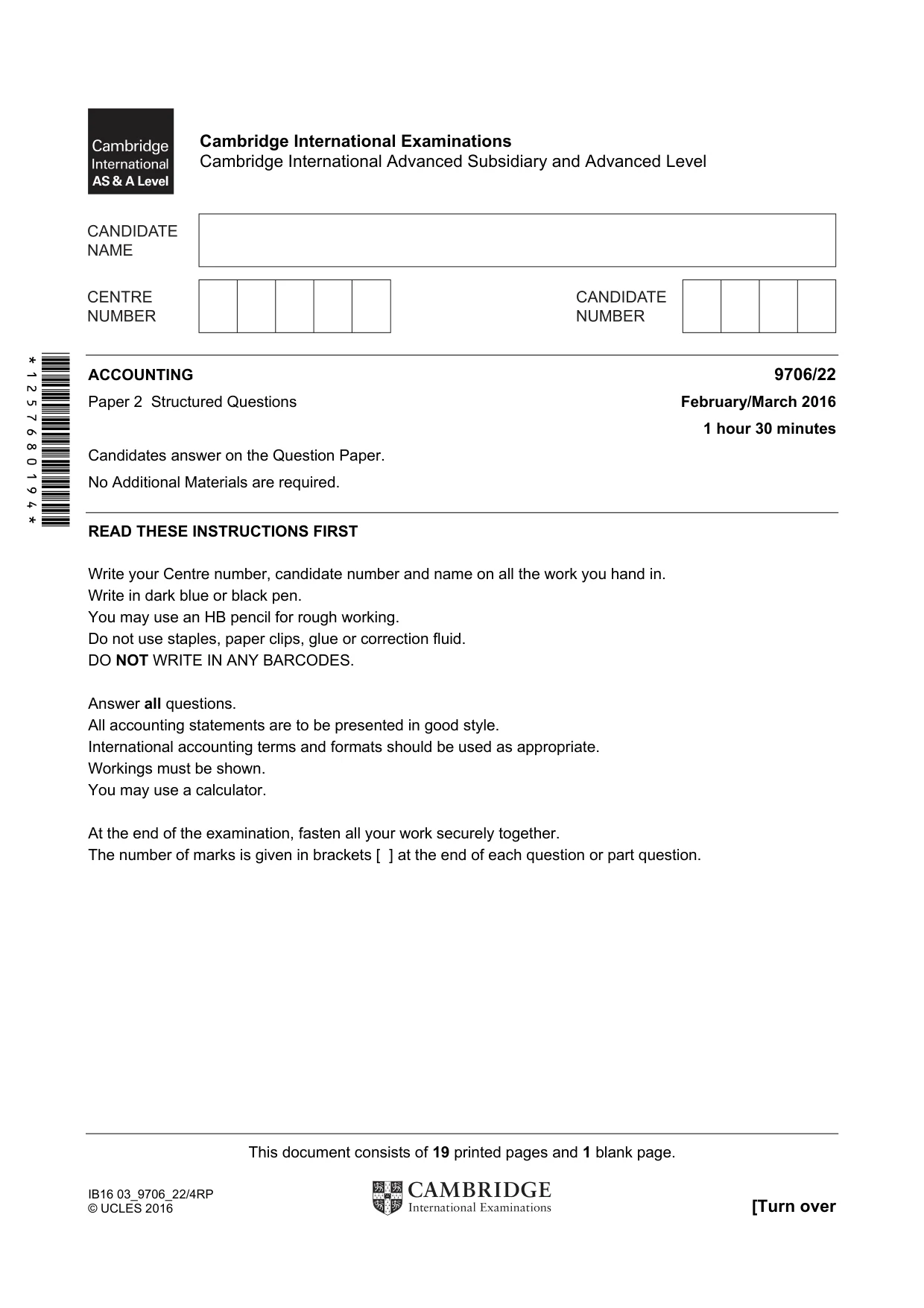
This document consists of 19 printed pages and 1 blank page. IB16 03_9706_22/4RP © UCLES 2016 [Turn over *1257680194* Cambridge International Examinations Cambridge International Advanced Subsidiary and Advanced Level ACCOUNTING 9706/22 Paper 2 Structured Questions February/March 2016 1 hour 30 minutes Candidates answer on the Question Paper. No Additional Materials are required. READ THESE INSTRUCTIONS FIRST Write your Centre number, candidate number and name on all the work you hand in. Write in dark blue or black pen. You may use an HB pencil for rough working. Do not use staples, paper clips, glue or correction fluid. DO NOT WRITE IN ANY BARCODES. Answer all questions. All accounting statements are to be presented in good style. International accounting terms and formats should be used as appropriate. Workings must be shown. You may use a calculator. At the end of the examination, fasten all your work securely together. The number of marks is given in brackets [ ] at the end of each question or part question.
Question paper, page 2
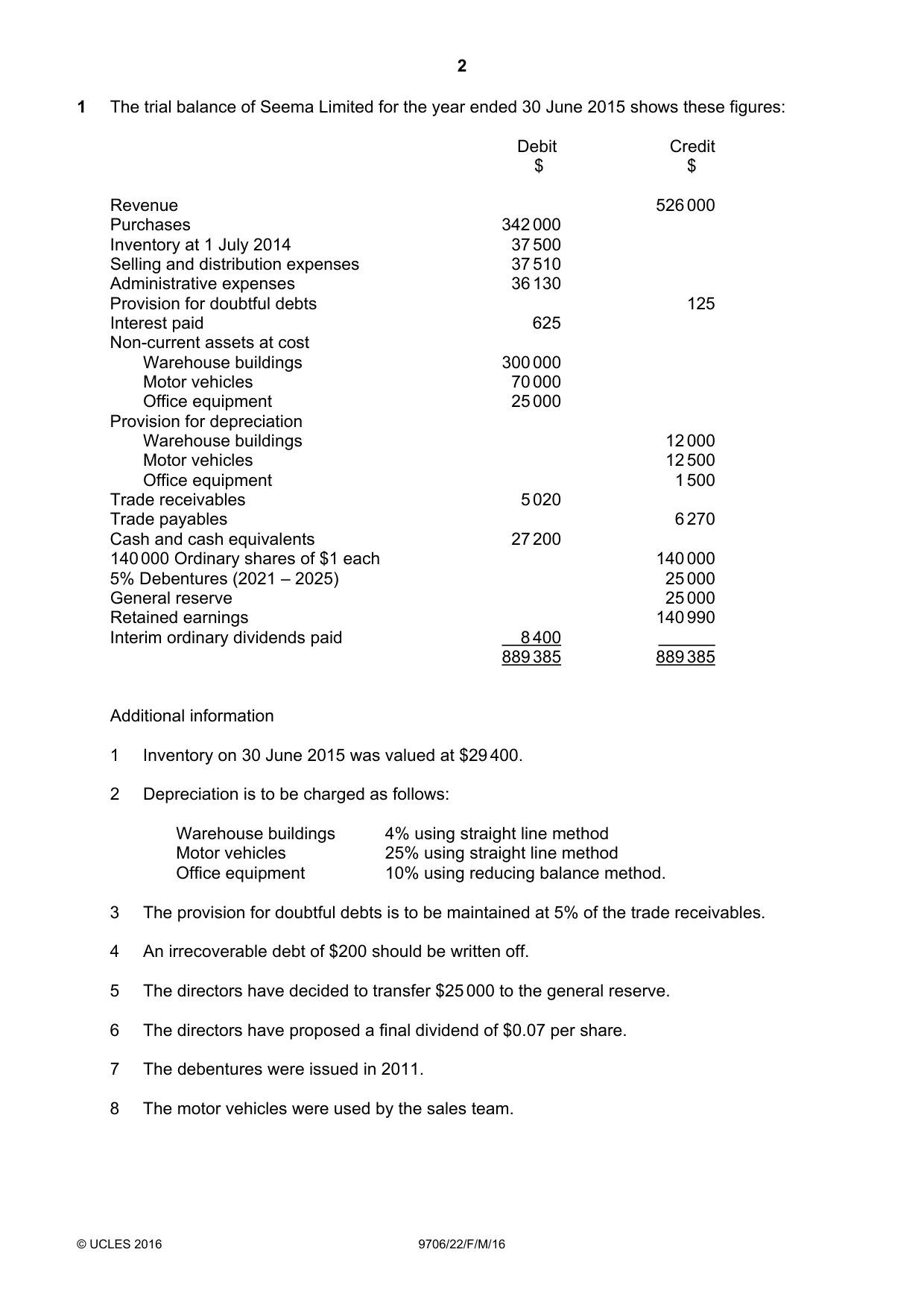
2 © UCLES 2016 9706/22/F/M/16 1 The trial balance of Seema Limited for the year ended 30 June 2015 shows these figures: Debit Credit $ $ Revenue 526 000 Purchases 342 000 Inventory at 1 July 2014 37 500 Selling and distribution expenses 37 510 Administrative expenses 36 130 Provision for doubtful debts 125 Interest paid 625 Non-current assets at cost Warehouse buildings 300 000 Motor vehicles 70 000 Office equipment 25 000 Provision for depreciation Warehouse buildings 12 000 Motor vehicles 12 500 Office equipment 1 500 Trade receivables 5 020 Trade payables 6 270 Cash and cash equivalents 27 200 140 000 Ordinary shares of $1 each 140 000 5% Debentures (2021 – 2025) 25 000 General reserve 25 000 Retained earnings 140 990 Interim ordinary dividends paid 8 400 889 385 889 385 Additional information 1 Inventory on 30 June 2015 was valued at $29 400. 2 Depreciation is to be charged as follows: Warehouse buildings 4% using straight line method Motor vehicles 25% using straight line method Office equipment 10% using reducing balance method. 3 The provision for doubtful debts is to be maintained at 5% of the trade receivables. 4 An irrecoverable debt of $200 should be written off. 5 The directors have decided to transfer $25 000 to the general reserve. 6 The directors have proposed a final dividend of $0.07 per share. 7 The debentures were issued in 2011. 8 The motor vehicles were used by the sales team.
Question paper, page 3
3 © UCLES 2016 9706/22/F/M/16 [Turn over REQUIRED (a) Prepare the income statement for the year ended 30 June 2015. [10]
Question paper, page 4
4 © UCLES 2016 9706/22/F/M/16 (b) Prepare the statement of financial position at 30 June 2015. [8]
Question paper, page 5
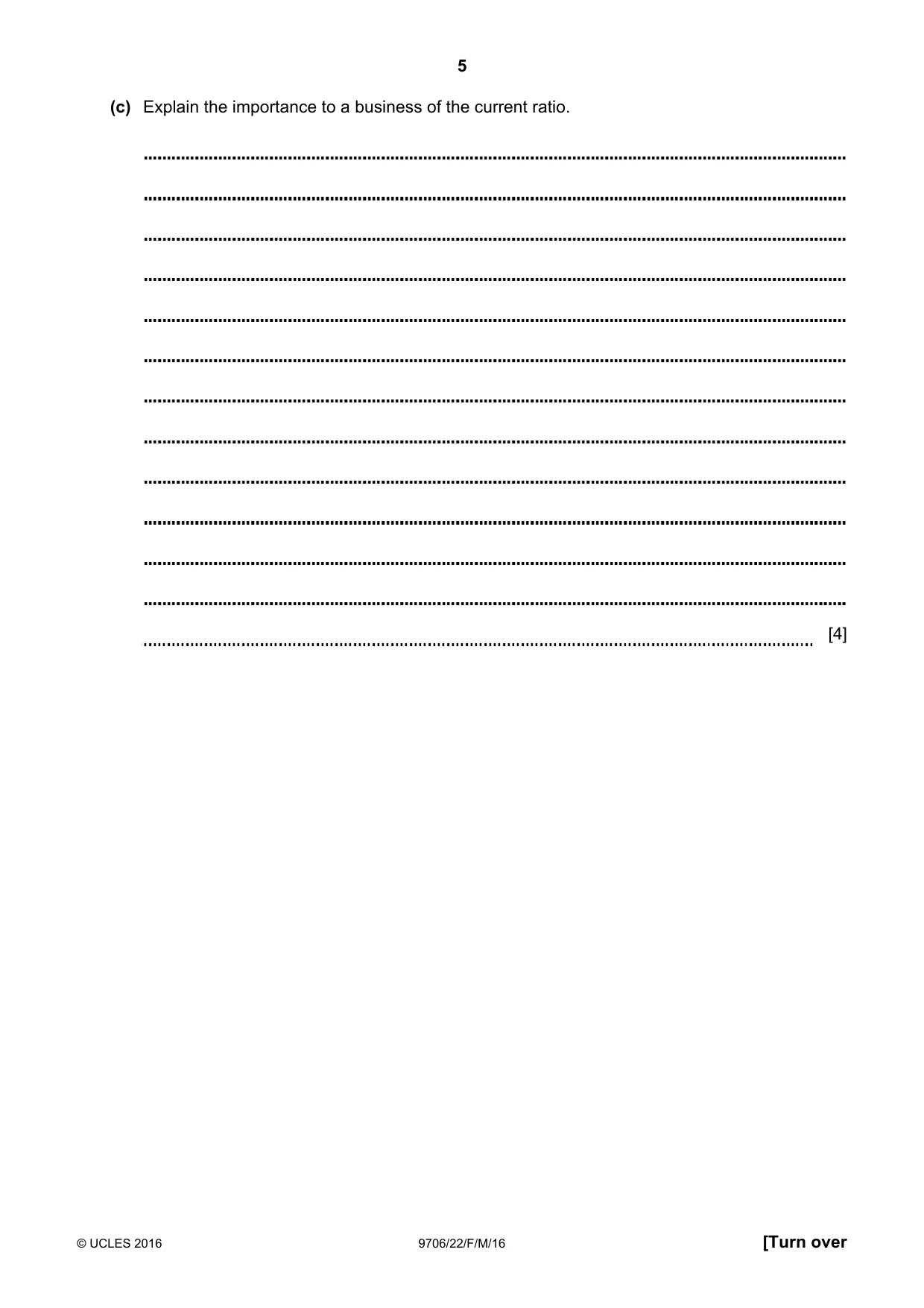
5 © UCLES 2016 9706/22/F/M/16 [Turn over (c) Explain the importance to a business of the current ratio. [4]
Question paper, page 6
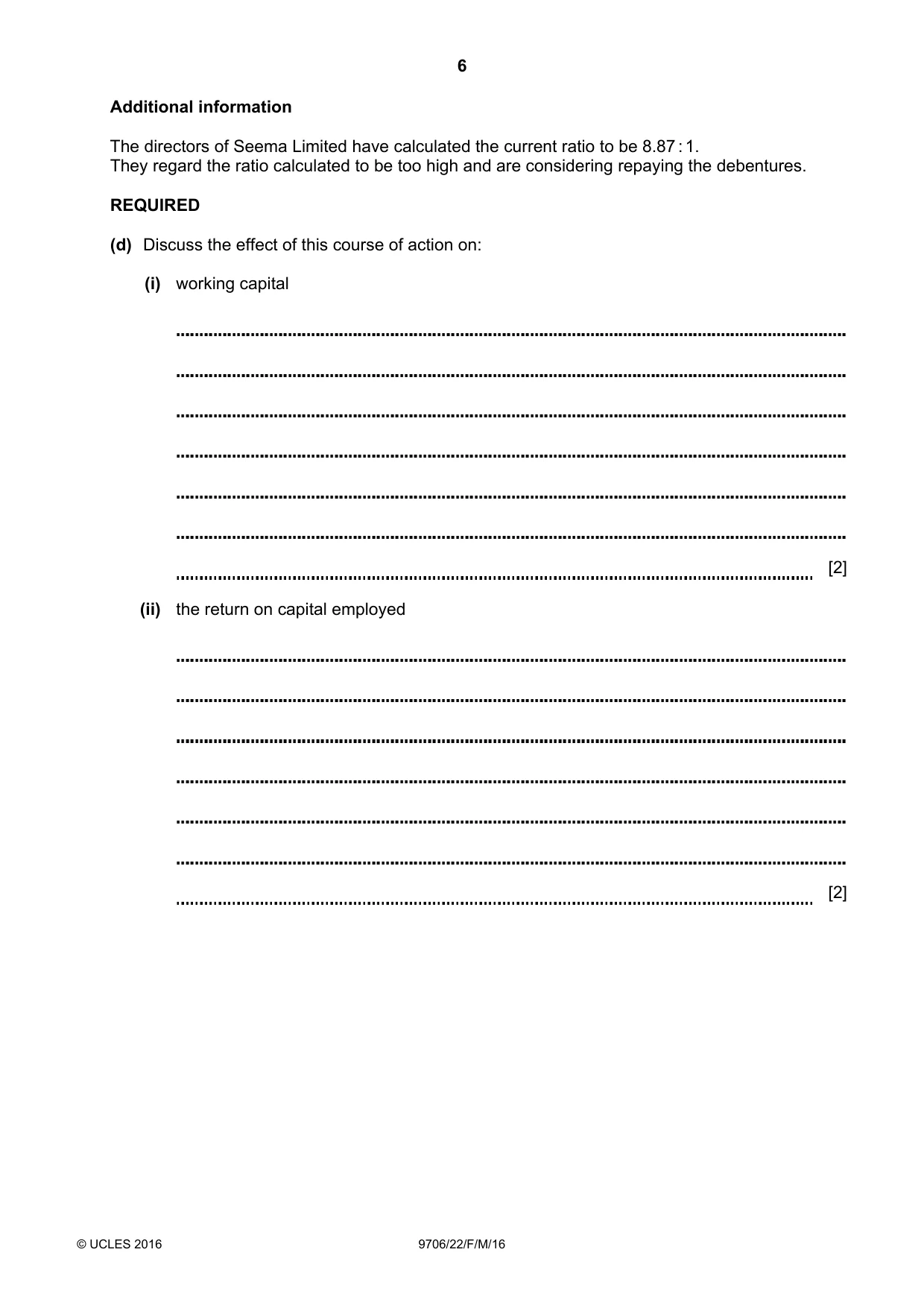
6 © UCLES 2016 9706/22/F/M/16 Additional information The directors of Seema Limited have calculated the current ratio to be 8.87 : 1. They regard the ratio calculated to be too high and are considering repaying the debentures. REQUIRED (d) Discuss the effect of this course of action on: (i) working capital [2] (ii) the return on capital employed [2]
Question paper, page 7
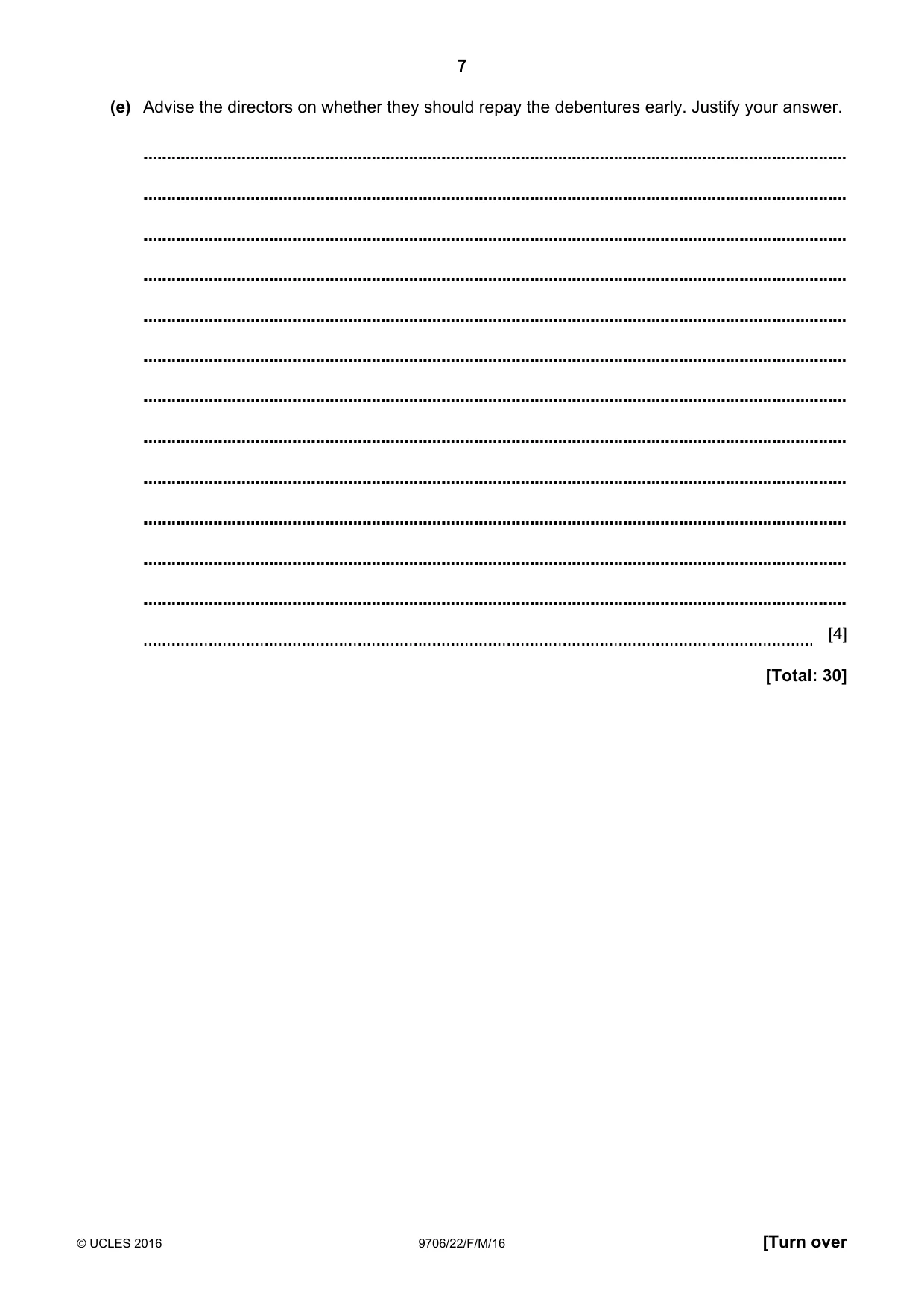
7 © UCLES 2016 9706/22/F/M/16 [Turn over (e) Advise the directors on whether they should repay the debentures early. Justify your answer. [4] [Total: 30]
Question paper, page 8
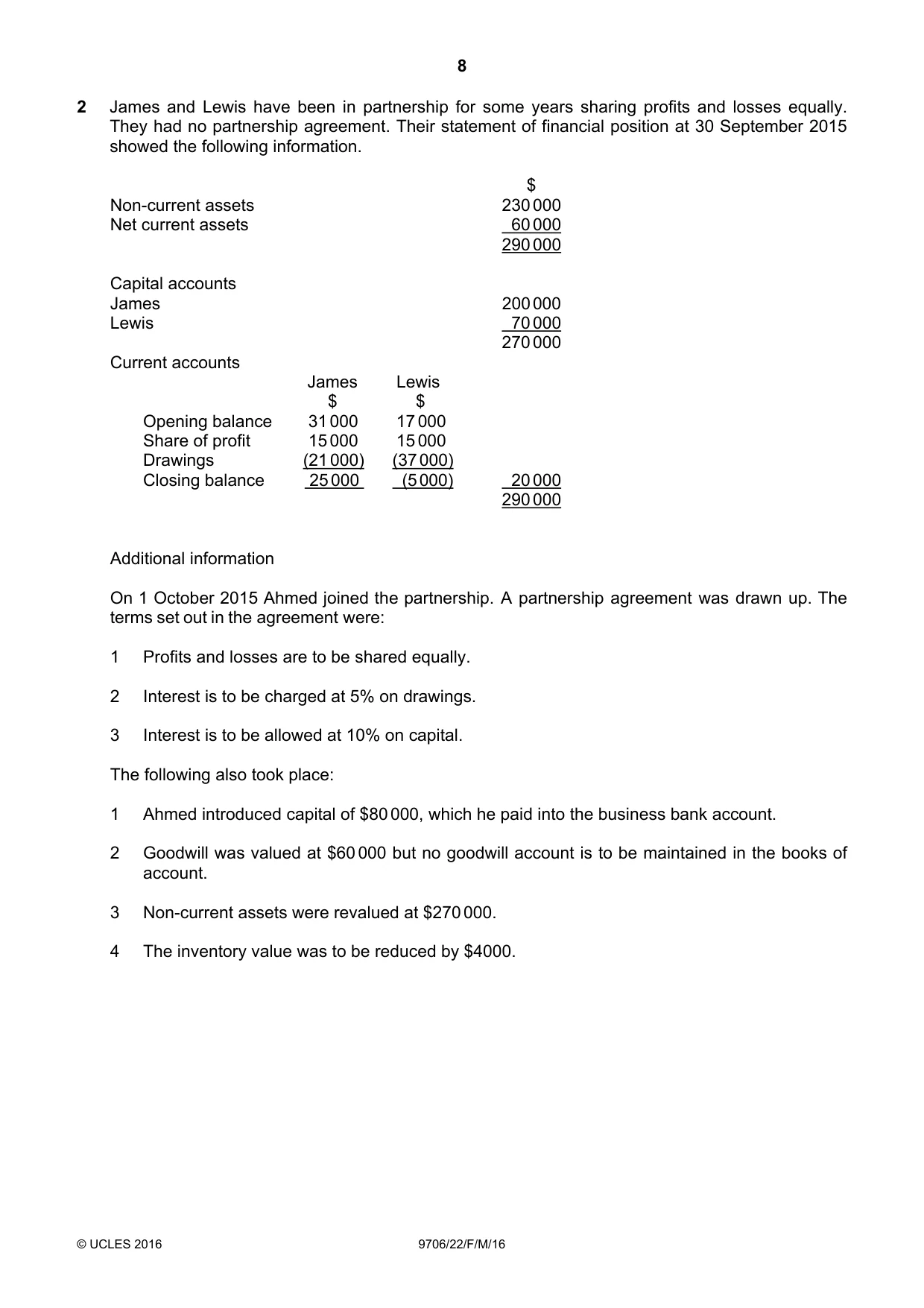
8 © UCLES 2016 9706/22/F/M/16 2 James and Lewis have been in partnership for some years sharing profits and losses equally. They had no partnership agreement. Their statement of financial position at 30 September 2015 showed the following information. $ Non-current assets 230 000 Net current assets 60 000 290 000 Capital accounts James 200 000 Lewis 70 000 270 000 Current accounts James Lewis $ $ Opening balance 31 000 17 000 Share of profit 15 000 15 000 Drawings (21 000) (37 000) Closing balance 25 000 (5 000) 20 000 290 000 Additional information On 1 October 2015 Ahmed joined the partnership. A partnership agreement was drawn up. The terms set out in the agreement were: 1 Profits and losses are to be shared equally. 2 Interest is to be charged at 5% on drawings. 3 Interest is to be allowed at 10% on capital. The following also took place: 1 Ahmed introduced capital of $80 000, which he paid into the business bank account. 2 Goodwill was valued at $60 000 but no goodwill account is to be maintained in the books of account. 3 Non-current assets were revalued at $270 000. 4 The inventory value was to be reduced by $4000.
Question paper, page 9
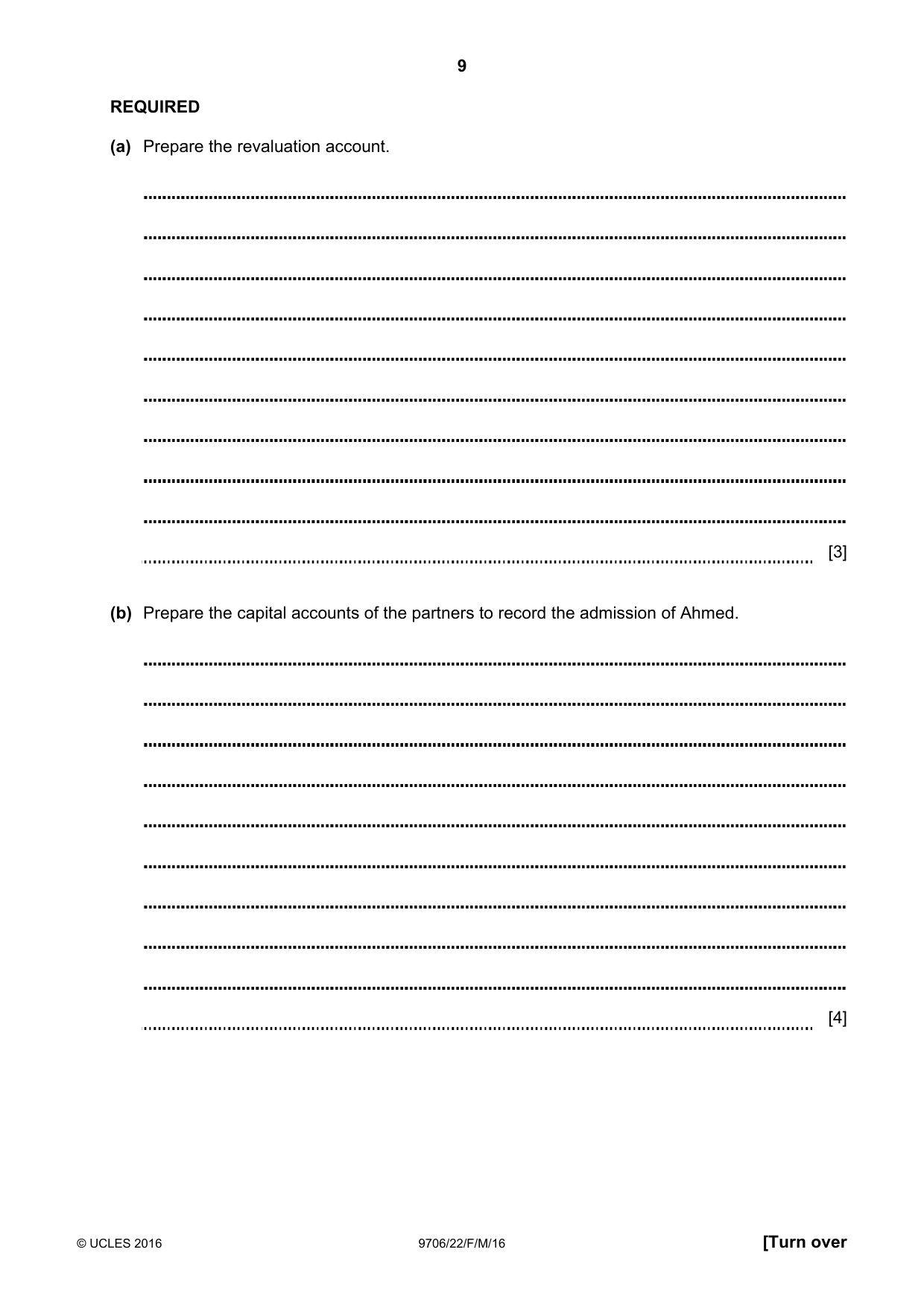
9 © UCLES 2016 9706/22/F/M/16 [Turn over REQUIRED (a) Prepare the revaluation account. [3] (b) Prepare the capital accounts of the partners to record the admission of Ahmed. [4]
Question paper, page 10
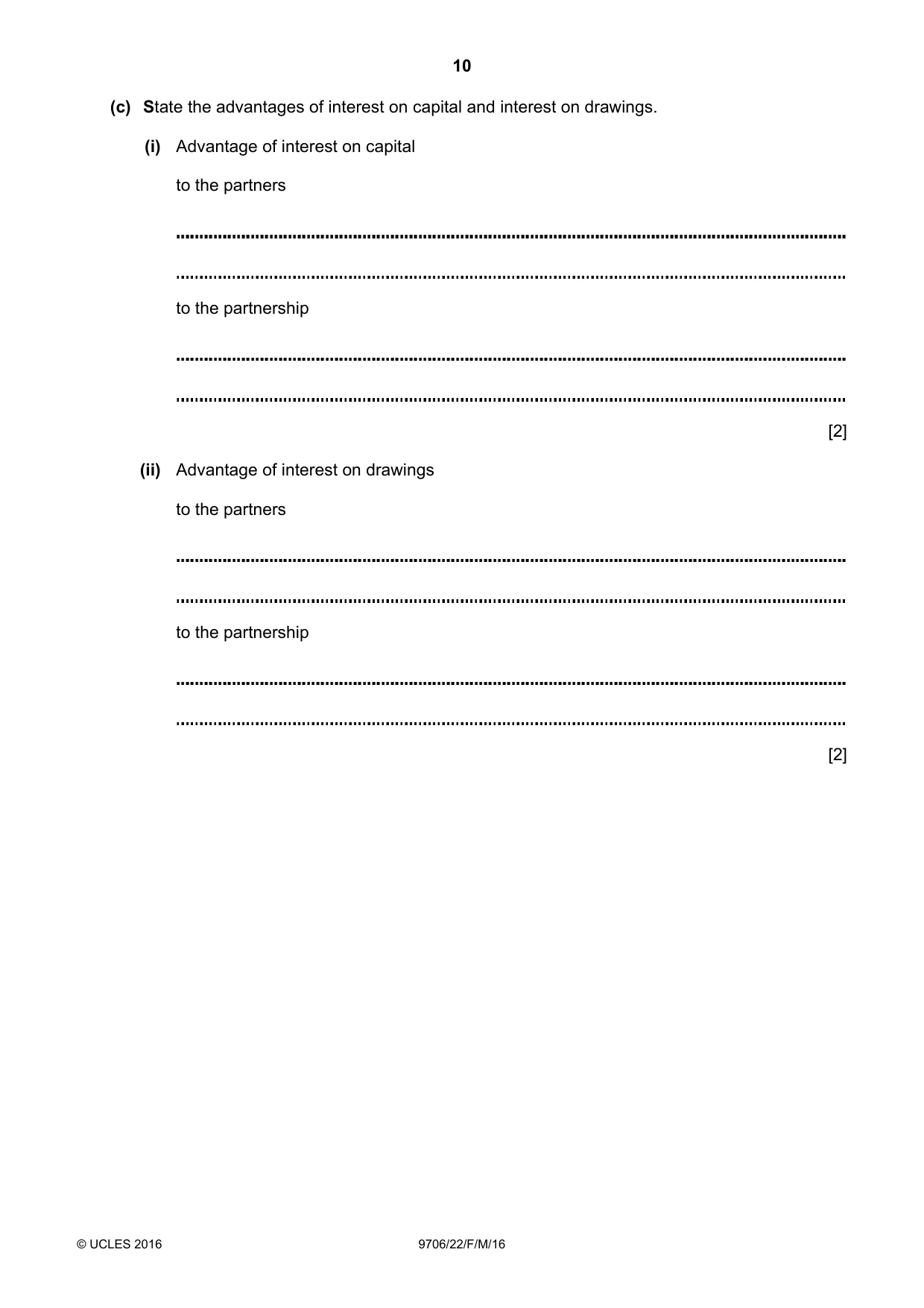
10 © UCLES 2016 9706/22/F/M/16 (c) State the advantages of interest on capital and interest on drawings. (i) Advantage of interest on capital to the partners to the partnership [2] (ii) Advantage of interest on drawings to the partners to the partnership [2]
Question paper, page 11
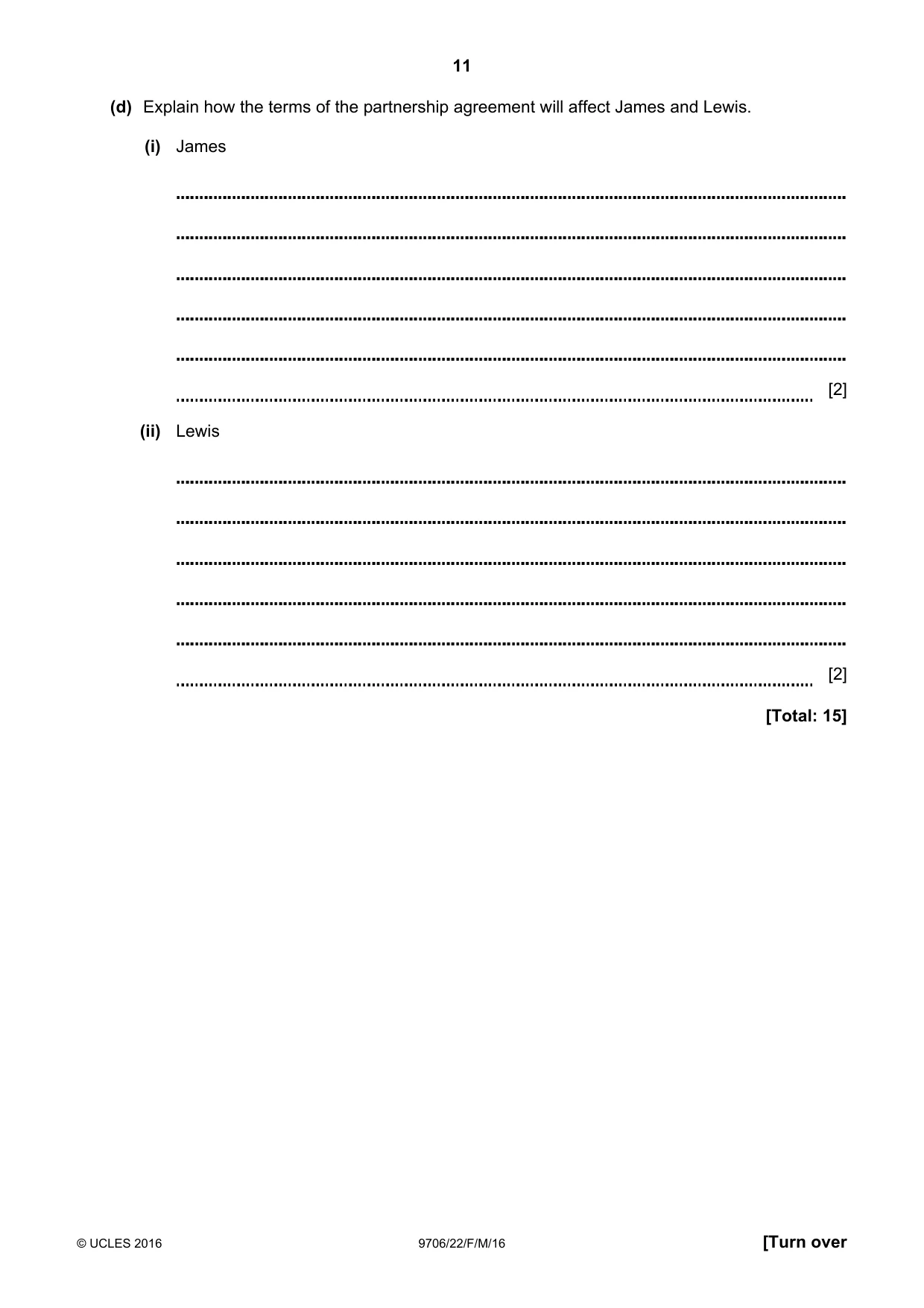
11 © UCLES 2016 9706/22/F/M/16 [Turn over (d) Explain how the terms of the partnership agreement will affect James and Lewis. (i) James [2] (ii) Lewis [2] [Total: 15]
Question paper, page 12
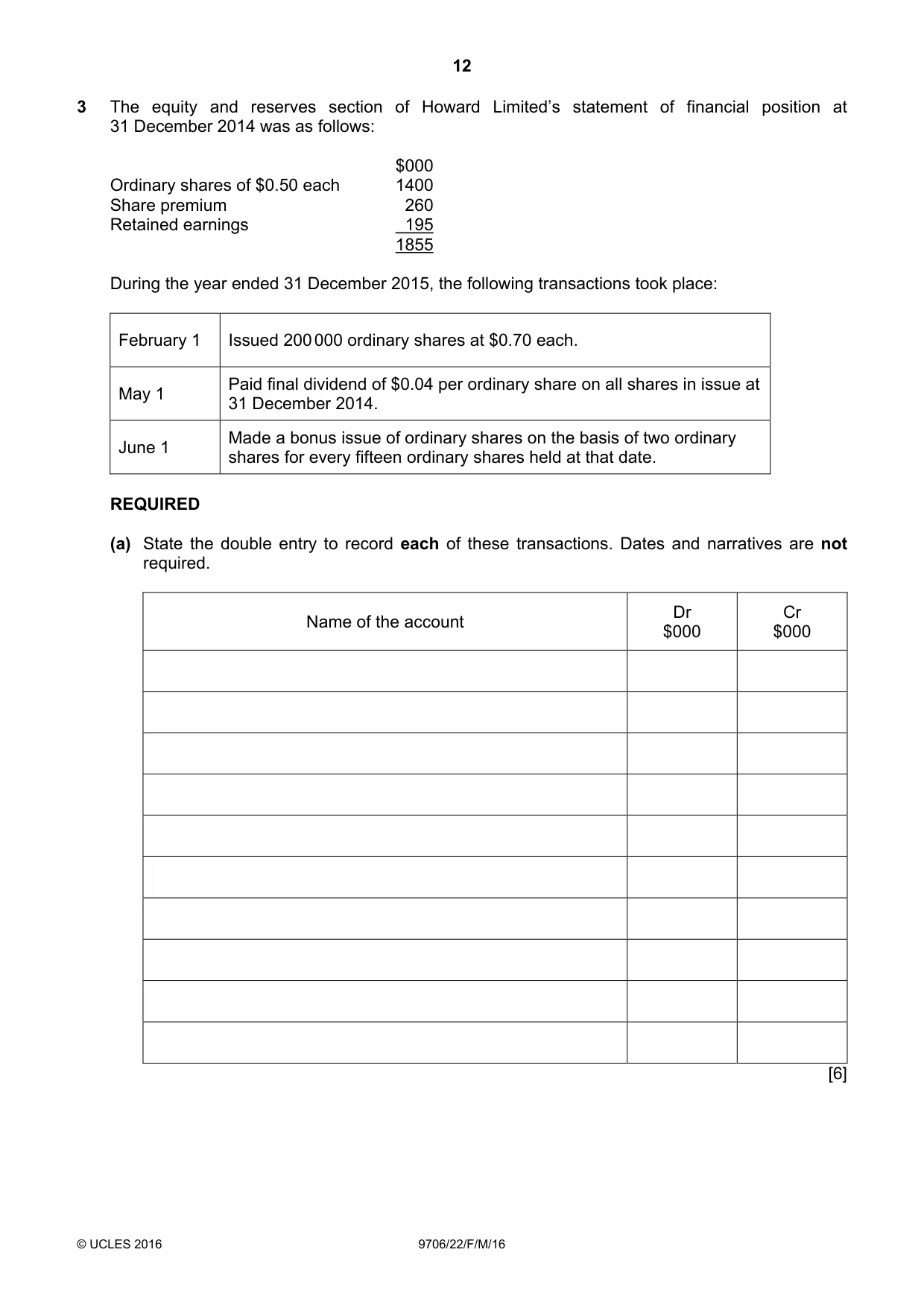
12 © UCLES 2016 9706/22/F/M/16 3 The equity and reserves section of Howard Limited’s statement of financial position at 31 December 2014 was as follows: $000 Ordinary shares of $0.50 each 1400 Share premium 260 Retained earnings 195 1855 During the year ended 31 December 2015, the following transactions took place: February 1 Issued 200 000 ordinary shares at $0.70 each. May 1 Paid final dividend of $0.04 per ordinary share on all shares in issue at 31 December 2014. June 1 Made a bonus issue of ordinary shares on the basis of two ordinary shares for every fifteen ordinary shares held at that date. REQUIRED (a) State the double entry to record each of these transactions. Dates and narratives are not required. Name of the account Dr $000 Cr $000 [6]
Question paper, page 13
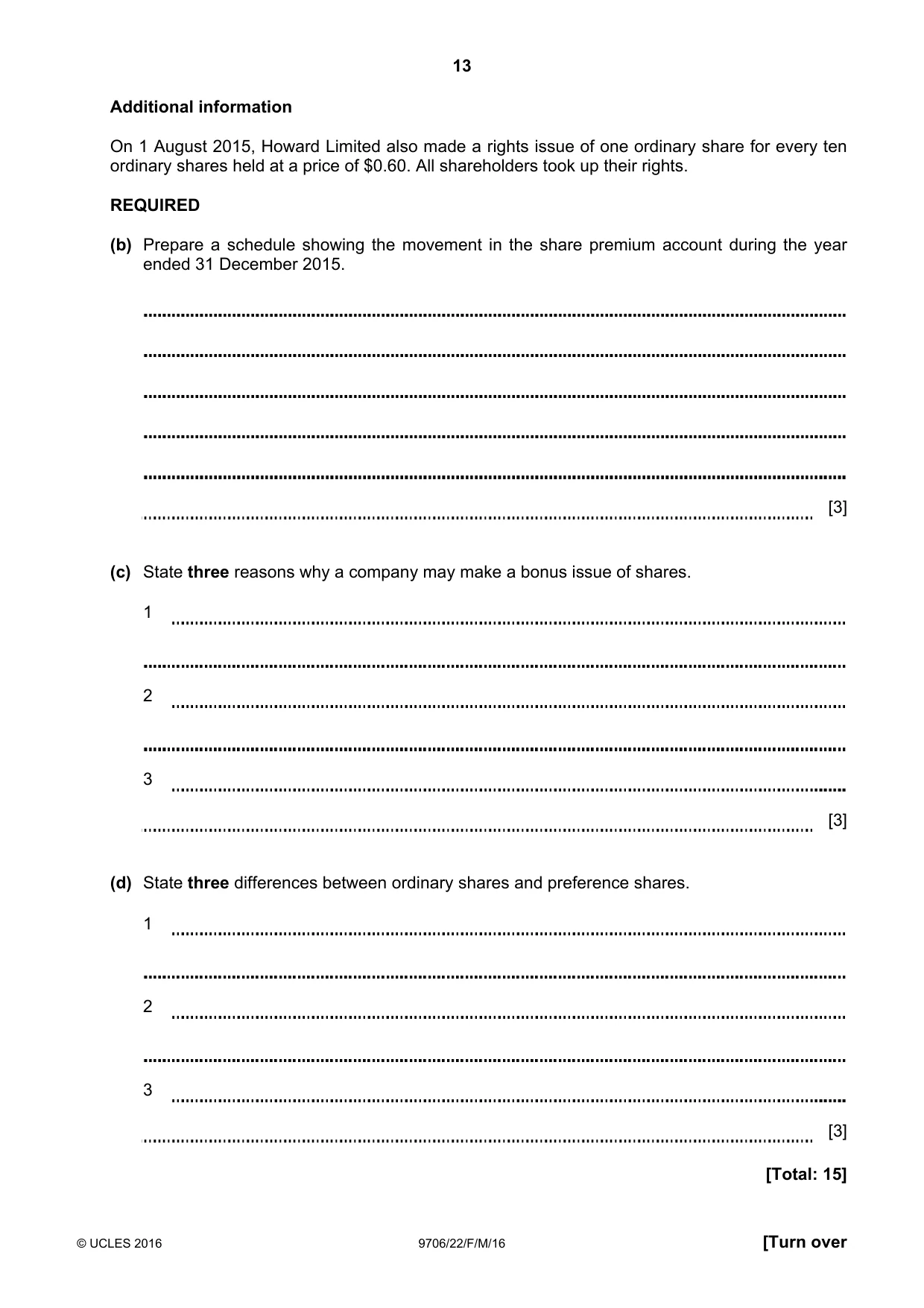
13 © UCLES 2016 9706/22/F/M/16 [Turn over Additional information On 1 August 2015, Howard Limited also made a rights issue of one ordinary share for every ten ordinary shares held at a price of $0.60. All shareholders took up their rights. REQUIRED (b) Prepare a schedule showing the movement in the share premium account during the year ended 31 December 2015. [3] (c) State three reasons why a company may make a bonus issue of shares. 1 2 3 [3] (d) State three differences between ordinary shares and preference shares. 1 2 3 [3] [Total: 15]
Question paper, page 14
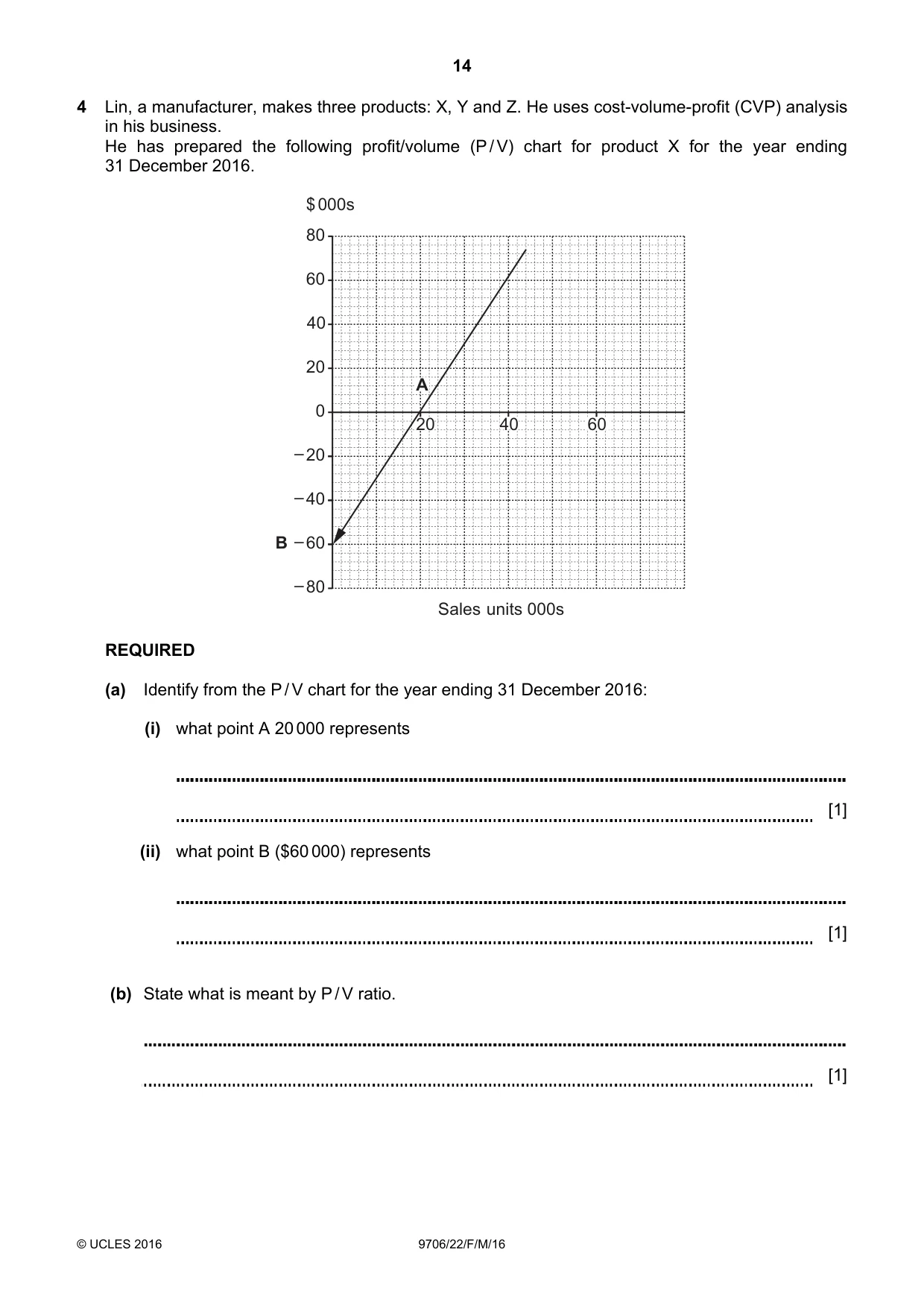
14 © UCLES 2016 9706/22/F/M/16 4 Lin, a manufacturer, makes three products: X, Y and Z. He uses cost-volume-profit (CVP) analysis in his business. He has prepared the following profit/volume (P / V) chart for product X for the year ending 31 December 2016. 60 0 20 40 20 40 $ 000s units 000s Sales 60 80 – – – 60 40 20 A B 80 – REQUIRED (a) Identify from the P / V chart for the year ending 31 December 2016: (i) what point A 20 000 represents [1] (ii) what point B ($60 000) represents [1] (b) State what is meant by P / V ratio. [1]
Question paper, page 15
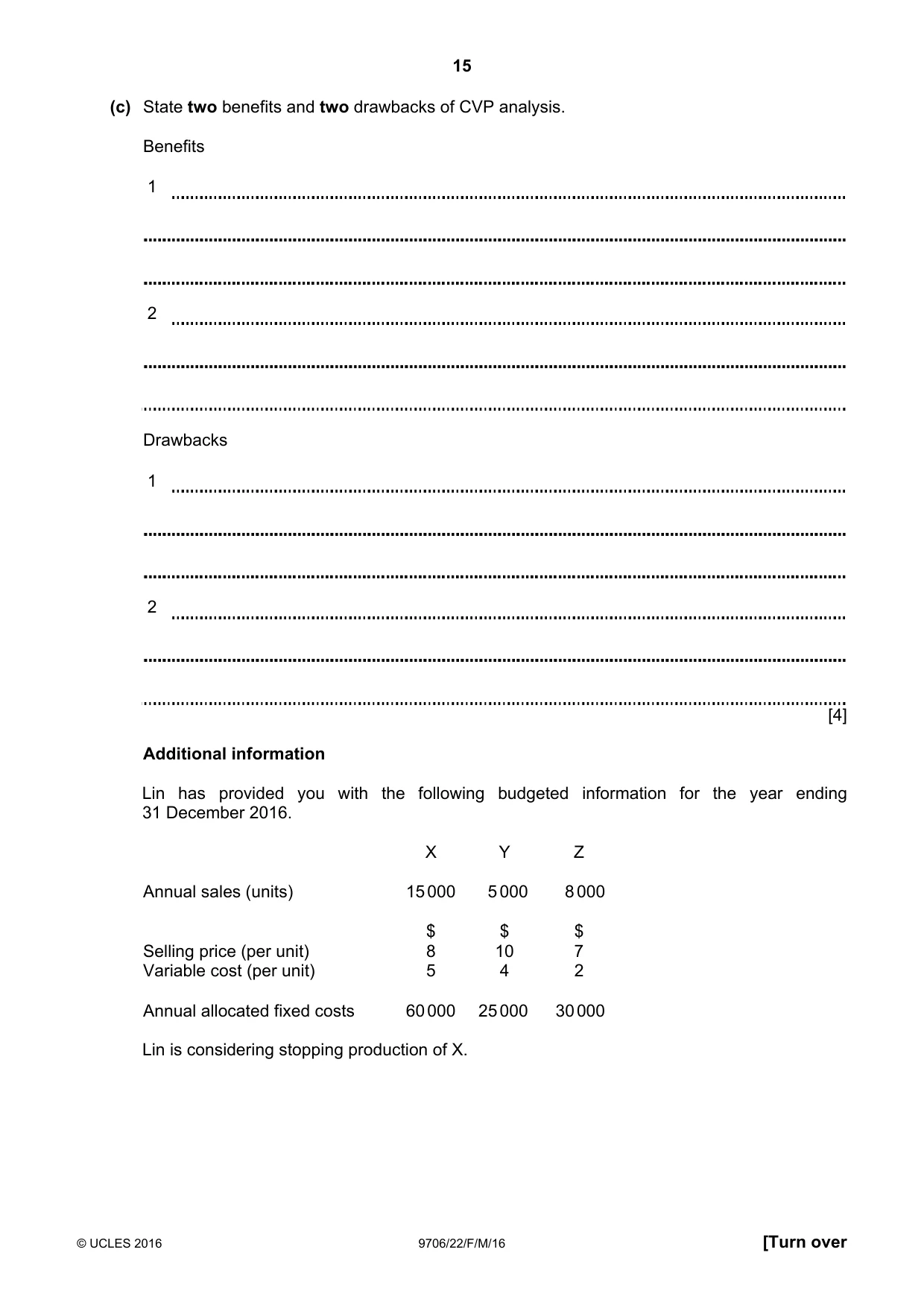
15 © UCLES 2016 9706/22/F/M/16 [Turn over (c) State two benefits and two drawbacks of CVP analysis. Benefits 1 2 Drawbacks 1 2 [4] Additional information Lin has provided you with the following budgeted information for the year ending 31 December 2016. X Y Z Annual sales (units) 15 000 5 000 8 000 $ $ $ Selling price (per unit) 8 10 7 Variable cost (per unit) 5 4 2 Annual allocated fixed costs 60 000 25 000 30 000 Lin is considering stopping production of X.
Question paper, page 16
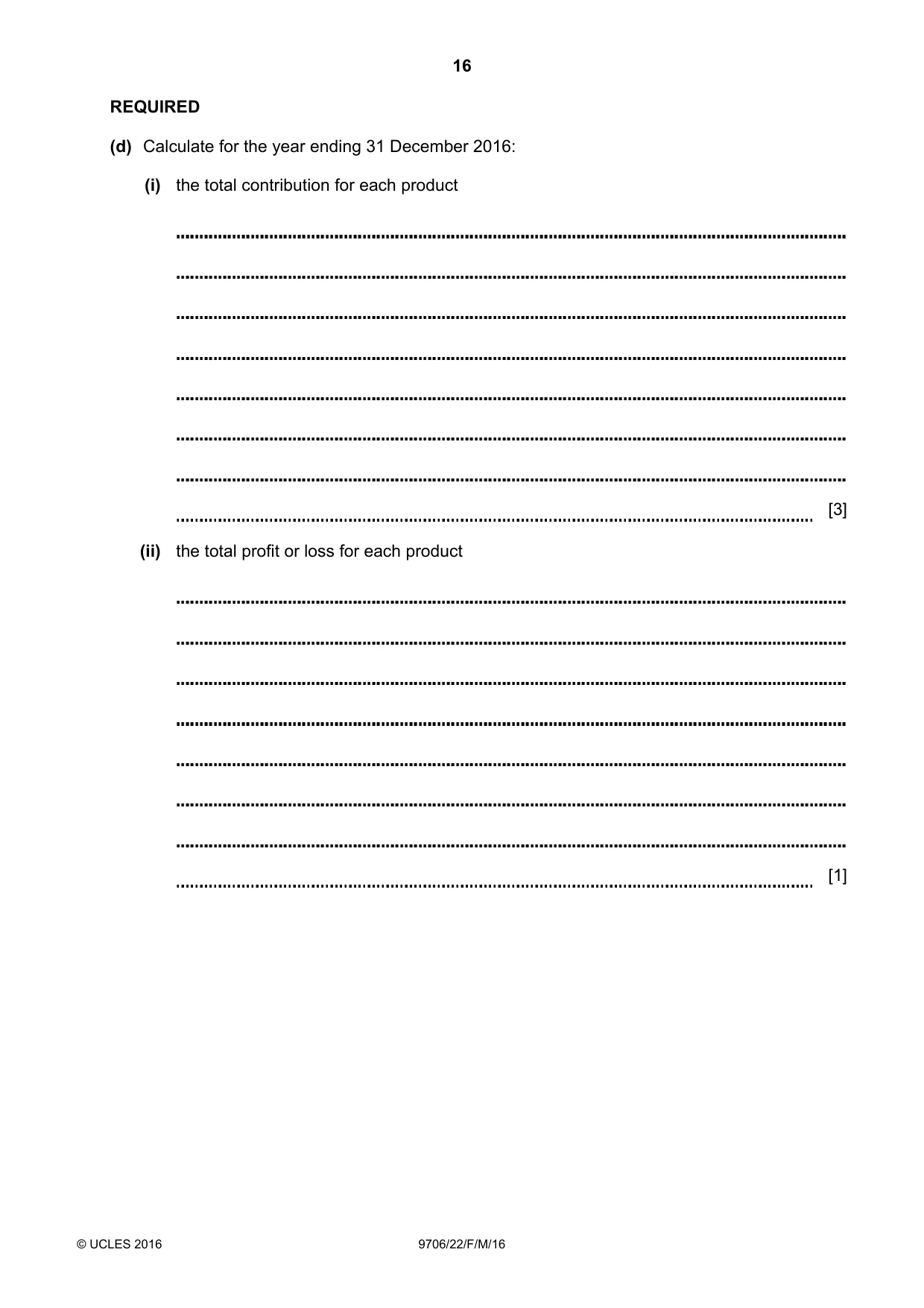
16 © UCLES 2016 9706/22/F/M/16 REQUIRED (d) Calculate for the year ending 31 December 2016: (i) the total contribution for each product [3] (ii) the total profit or loss for each product [1]
Question paper, page 17
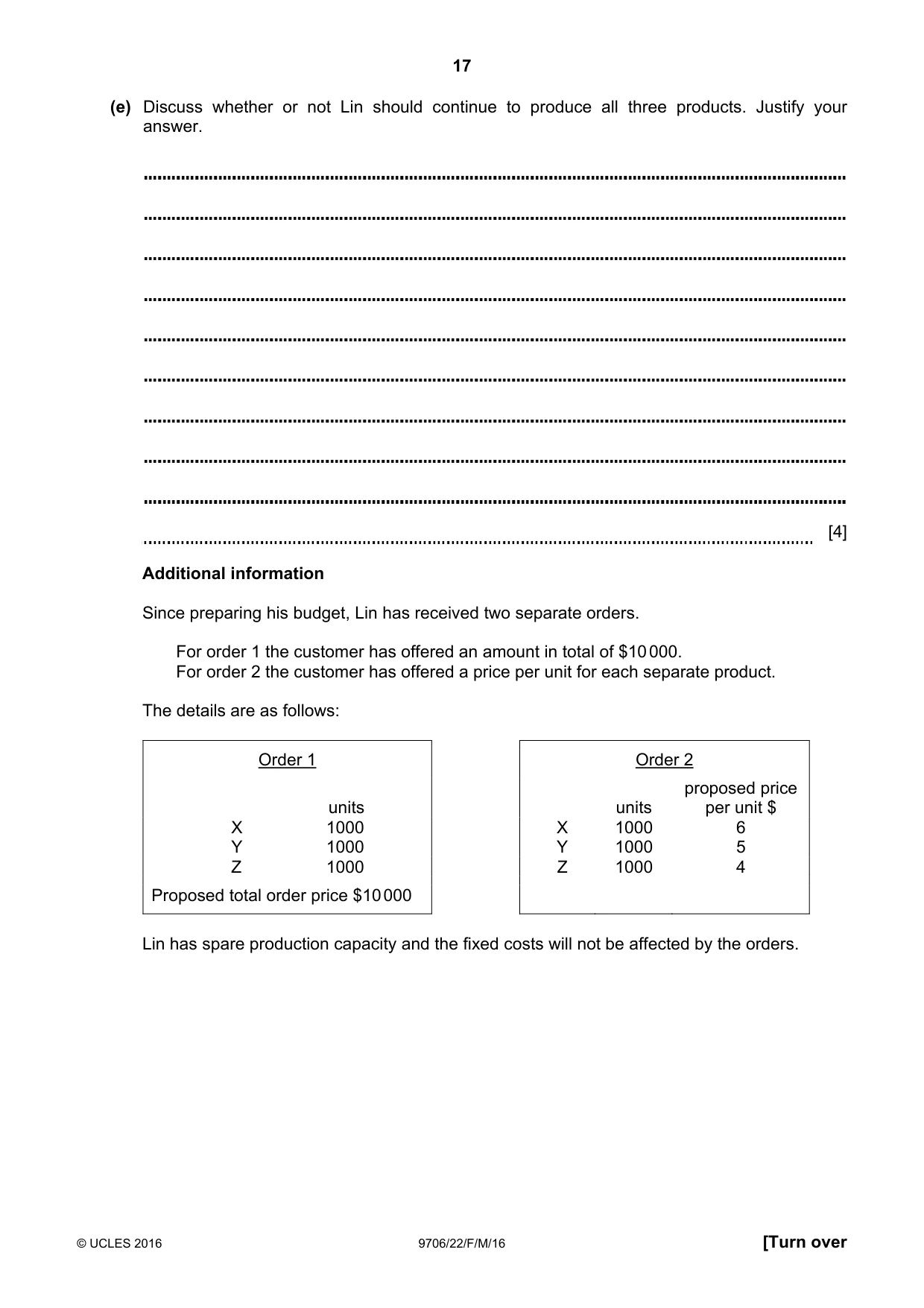
17 © UCLES 2016 9706/22/F/M/16 [Turn over (e) Discuss whether or not Lin should continue to produce all three products. Justify your answer. [4] Additional information Since preparing his budget, Lin has received two separate orders. For order 1 the customer has offered an amount in total of $10 000. For order 2 the customer has offered a price per unit for each separate product. The details are as follows: Order 1 Order 2 units units proposed price per unit $ X 1000 X 1000 6 Y 1000 Y 1000 5 Z 1000 Z 1000 4 Proposed total order price $10 000 Lin has spare production capacity and the fixed costs will not be affected by the orders.
Question paper, page 18
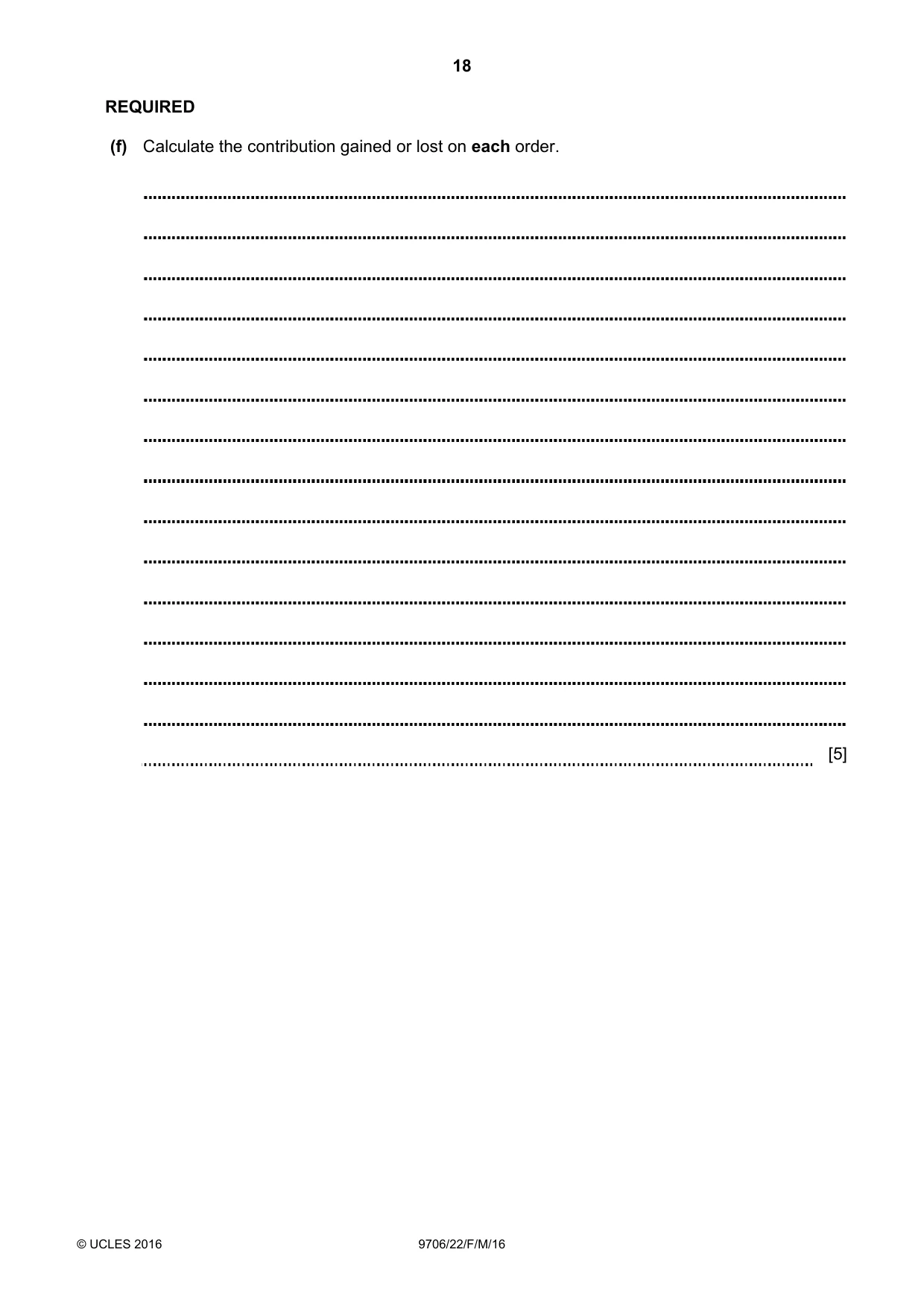
18 © UCLES 2016 9706/22/F/M/16 REQUIRED (f) Calculate the contribution gained or lost on each order. [5]
Question paper, page 19
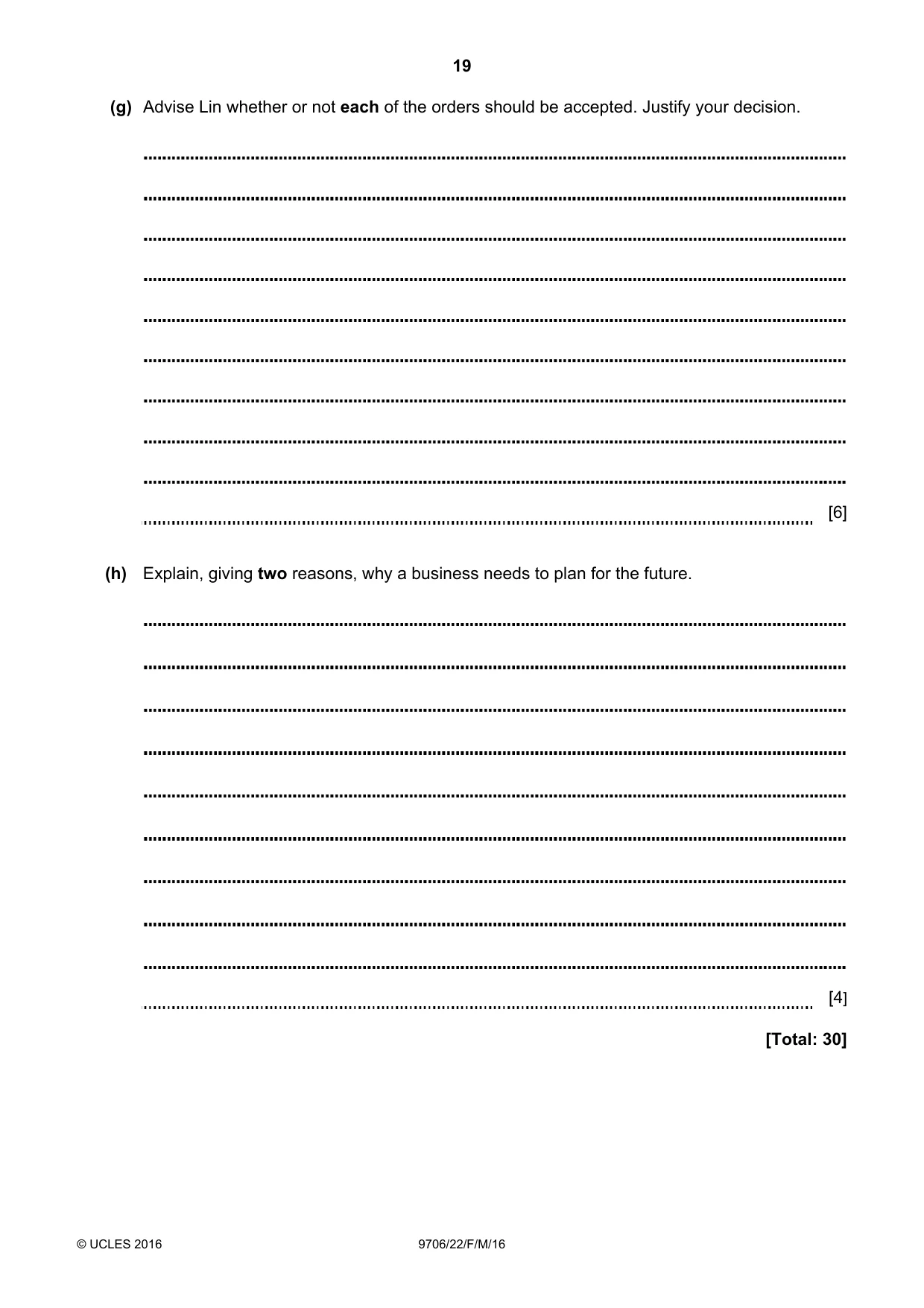
19 © UCLES 2016 9706/22/F/M/16 (g) Advise Lin whether or not each of the orders should be accepted. Justify your decision. [6] (h) Explain, giving two reasons, why a business needs to plan for the future. [4] [Total: 30]
Question paper, page 20
20 Permission to reproduce items where third-party owned material protected by copyright is included has been sought and cleared where possible. Every reasonable effort has been made by the publisher (UCLES) to trace copyright holders, but if any items requiring clearance have unwittingly been included, the publisher will be pleased to make amends at the earliest possible opportunity. To avoid the issue of disclosure of answer-related information to candidates, all copyright acknowledgements are reproduced online in the Cambridge International Examinations Copyright Acknowledgements Booklet. This is produced for each series of examinations and is freely available to download at www.cie.org.uk after the live examination series. Cambridge International Examinations is part of the Cambridge Assessment Group. Cambridge Assessment is the brand name of University of Cambridge Local Examinations Syndicate (UCLES), which is itself a department of the University of Cambridge. © UCLES 2016 9706/22/F/M/16 BLANK PAGE
Mark scheme, page 1
® IGCSE is the registered trademark of Cambridge International Examinations. CAMBRIDGE INTERNATIONAL EXAMINATIONS Cambridge International Advanced Subsidiary and Advanced Level MARK SCHEME for the March 2016 series 9706 ACCOUNTING 9706/22 Paper 22 (AS Level Structured Questions), maximum raw mark 90 This mark scheme is published as an aid to teachers and candidates, to indicate the requirements of the examination. It shows the basis on which Examiners were instructed to award marks. It does not indicate the details of the discussions that took place at an Examiners’ meeting before marking began, which would have considered the acceptability of alternative answers. Mark schemes should be read in conjunction with the question paper and the Principal Examiner Report for Teachers. Cambridge will not enter into discussions about these mark schemes. Cambridge is publishing the mark schemes for the March 2016 series for most Cambridge IGCSE® and Cambridge International A and AS Level components.
Mark scheme, page 2
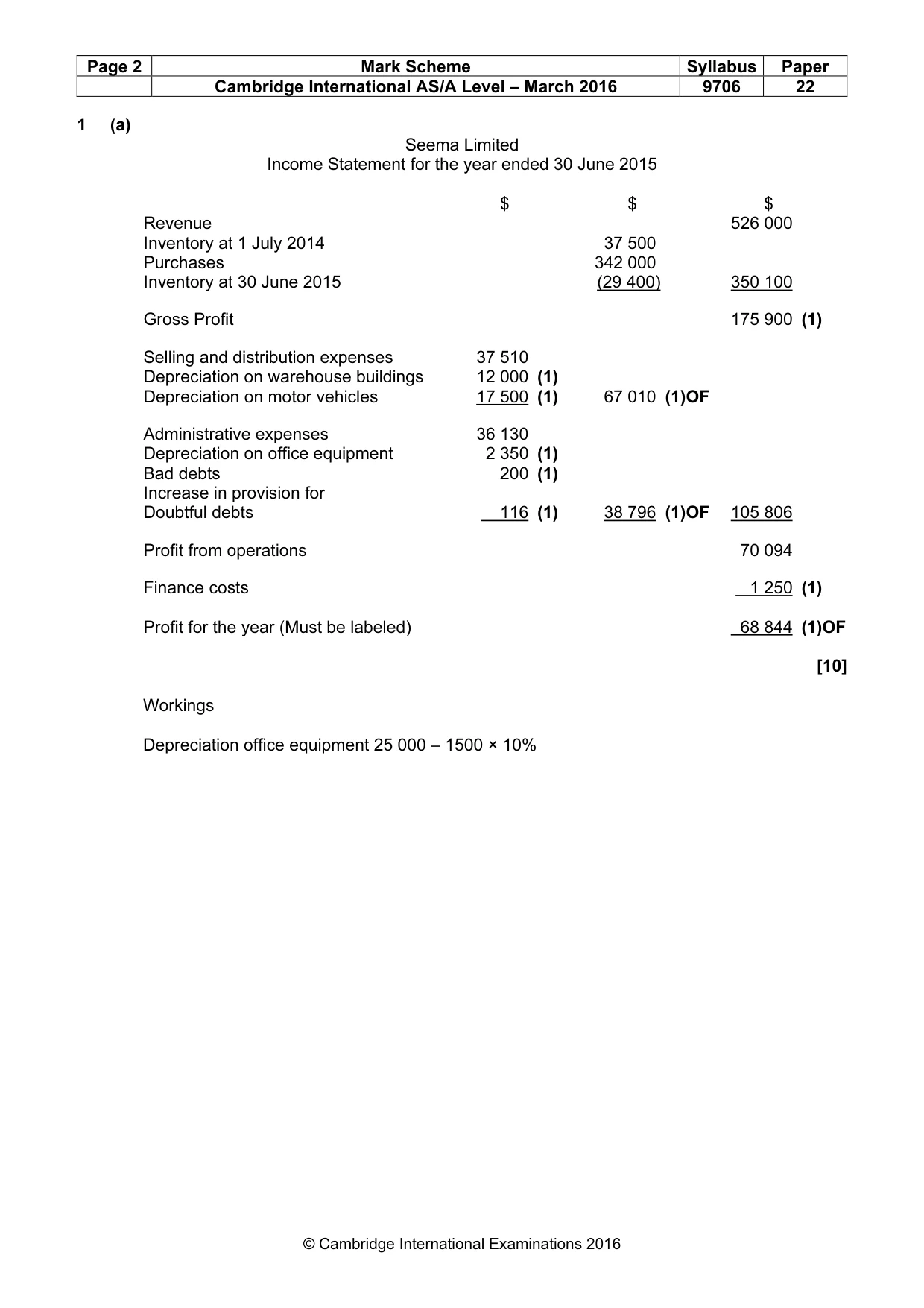
Page 2 Mark Scheme Syllabus Paper Cambridge International AS/A Level – March 2016 9706 22 © Cambridge International Examinations 2016 1 (a) Seema Limited Income Statement for the year ended 30 June 2015 $ $ $ Revenue 526 000 Inventory at 1 July 2014 37 500 Purchases 342 000 Inventory at 30 June 2015 (29 400) 350 100 Gross Profit 175 900 (1) Selling and distribution expenses 37 510 Depreciation on warehouse buildings 12 000 (1) Depreciation on motor vehicles 17 500 (1) 67 010 (1)OF Administrative expenses 36 130 Depreciation on office equipment 2 350 (1) Bad debts 200 (1) Increase in provision for Doubtful debts 116 (1) 38 796 (1)OF 105 806 Profit from operations 70 094 Finance costs 1 250 (1) Profit for the year (Must be labeled) 68 844 (1)OF [10] Workings Depreciation office equipment 25 000 – 1500 × 10%
Mark scheme, page 3
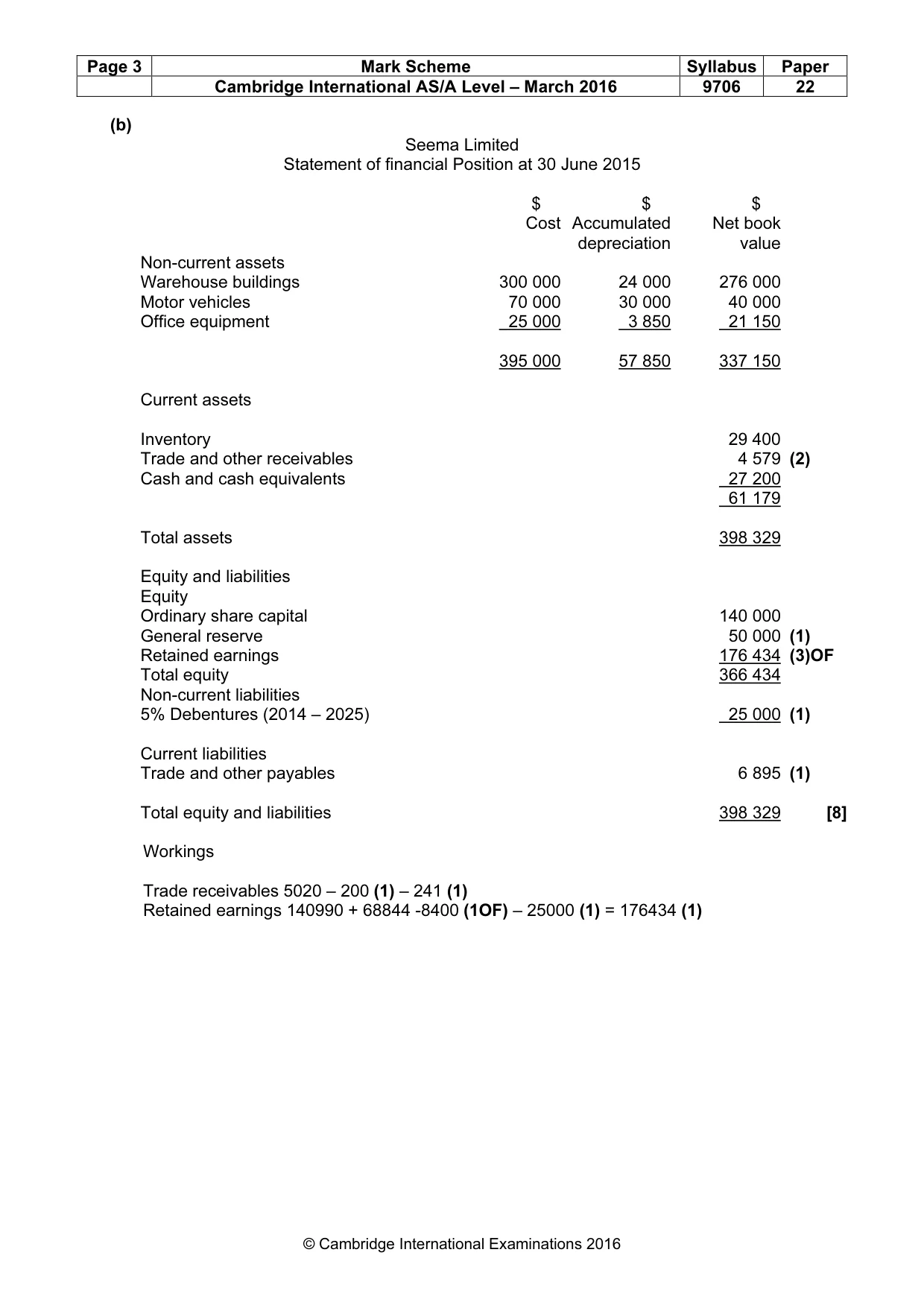
Page 3 Mark Scheme Syllabus Paper Cambridge International AS/A Level – March 2016 9706 22 © Cambridge International Examinations 2016 (b) Seema Limited Statement of financial Position at 30 June 2015 $ $ $ Cost Accumulated depreciation Net book value Non-current assets Warehouse buildings 300 000 24 000 276 000 Motor vehicles 70 000 30 000 40 000 Office equipment 25 000 3 850 21 150 395 000 57 850 337 150 Current assets Inventory 29 400 Trade and other receivables 4 579 (2) Cash and cash equivalents 27 200 61 179 Total assets 398 329 Equity and liabilities Equity Ordinary share capital 140 000 General reserve 50 000 (1) Retained earnings 176 434 (3)OF Total equity 366 434 Non-current liabilities 5% Debentures (2014 – 2025) 25 000 (1) Current liabilities Trade and other payables 6 895 (1) Total equity and liabilities 398 329 [8] Workings Trade receivables 5020 – 200 (1) – 241 (1) Retained earnings 140990 + 68844 -8400 (1OF) – 25000 (1) = 176434 (1)
Mark scheme, page 4
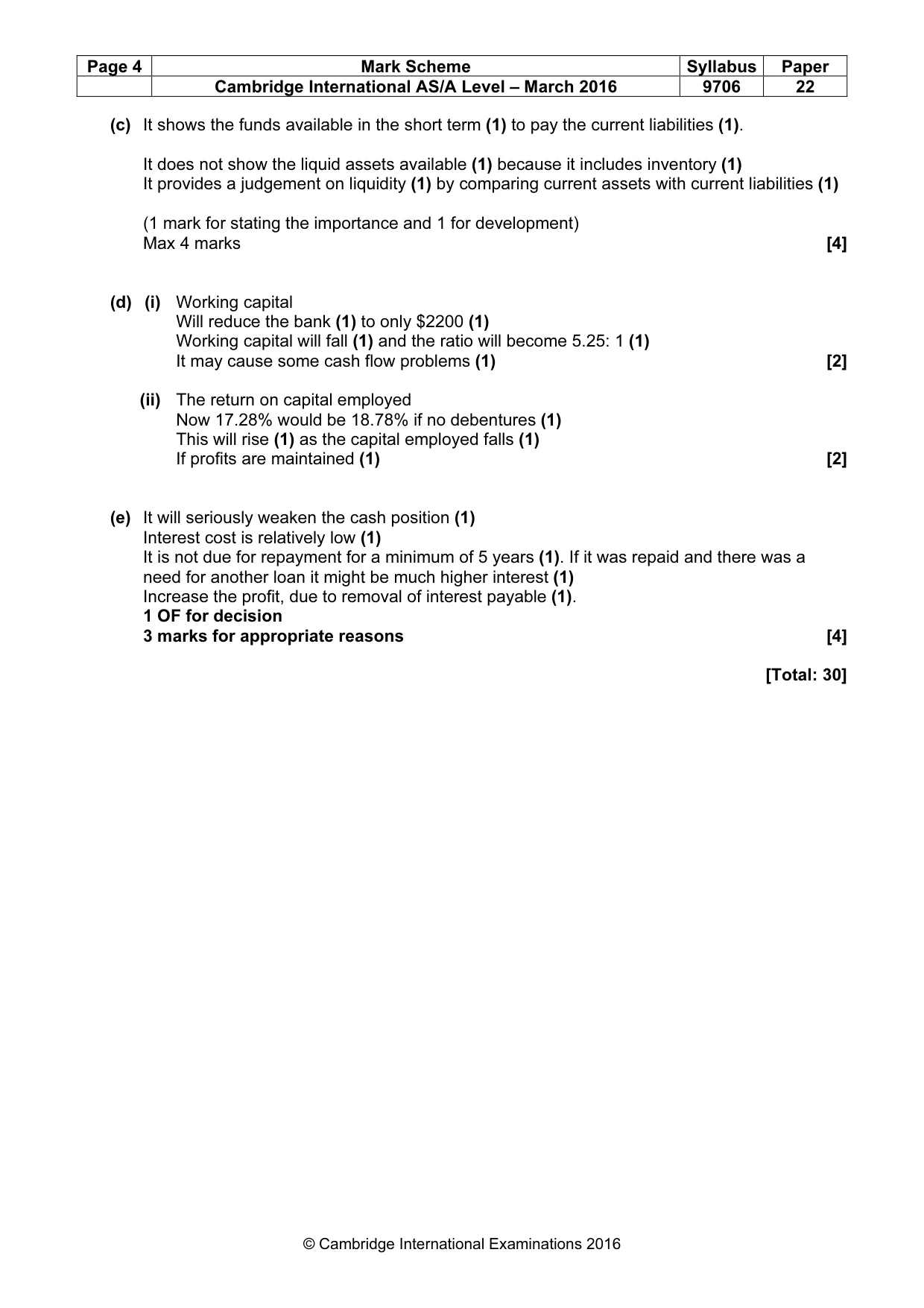
Page 4 Mark Scheme Syllabus Paper Cambridge International AS/A Level – March 2016 9706 22 © Cambridge International Examinations 2016 (c) It shows the funds available in the short term (1) to pay the current liabilities (1). It does not show the liquid assets available (1) because it includes inventory (1) It provides a judgement on liquidity (1) by comparing current assets with current liabilities (1) (1 mark for stating the importance and 1 for development) Max 4 marks [4] (d) (i) Working capital Will reduce the bank (1) to only $2200 (1) Working capital will fall (1) and the ratio will become 5.25: 1 (1) It may cause some cash flow problems (1) [2] (ii) The return on capital employed Now 17.28% would be 18.78% if no debentures (1) This will rise (1) as the capital employed falls (1) If profits are maintained (1) [2] (e) It will seriously weaken the cash position (1) Interest cost is relatively low (1) It is not due for repayment for a minimum of 5 years (1). If it was repaid and there was a need for another loan it might be much higher interest (1) Increase the profit, due to removal of interest payable (1). 1 OF for decision 3 marks for appropriate reasons [4] [Total: 30]
Mark scheme, page 5
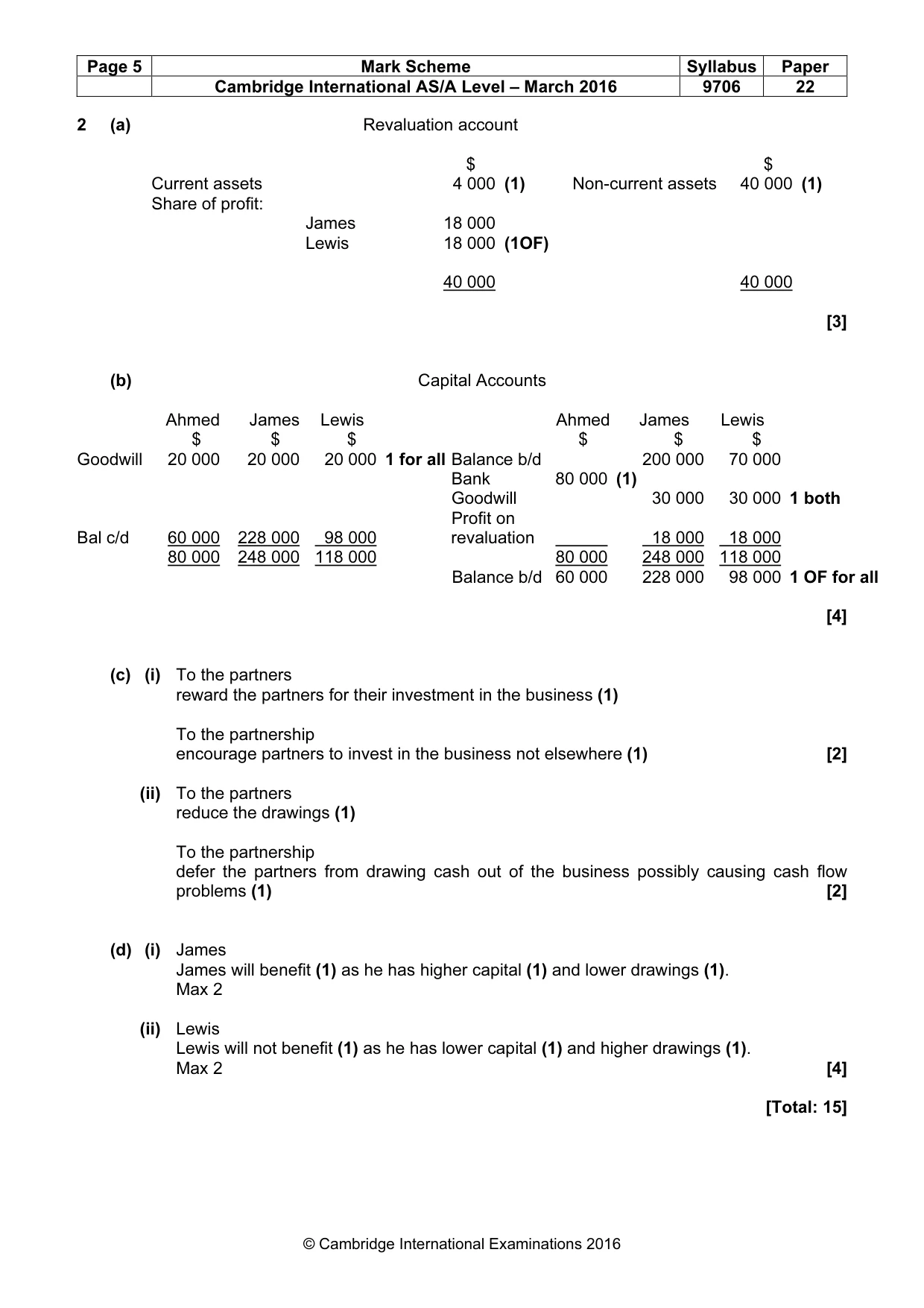
Page 5 Mark Scheme Syllabus Paper Cambridge International AS/A Level – March 2016 9706 22 © Cambridge International Examinations 2016 2 (a) Revaluation account $ $ Current assets 4 000 (1) Non-current assets 40 000 (1) Share of profit: James 18 000 Lewis 18 000 (1OF) 40 000 40 000 [3] (b) Capital Accounts Ahmed James Lewis Ahmed James Lewis $ $ $ $ $ $ Goodwill 20 000 20 000 20 000 1 for all Balance b/d 200 000 70 000 Bank 80 000 (1) Goodwill 30 000 30 000 1 both Bal c/d 60 000 228 000 98 000 Profit on revaluation 18 000 18 000 80 000 248 000 118 000 80 000 248 000 118 000 Balance b/d 60 000 228 000 98 000 1 OF for all [4] (c) (i) To the partners reward the partners for their investment in the business (1) To the partnership encourage partners to invest in the business not elsewhere (1) [2] (ii) To the partners reduce the drawings (1) To the partnership defer the partners from drawing cash out of the business possibly causing cash flow problems (1) [2] (d) (i) James James will benefit (1) as he has higher capital (1) and lower drawings (1). Max 2 (ii) Lewis Lewis will not benefit (1) as he has lower capital (1) and higher drawings (1). Max 2 [4] [Total: 15]
Mark scheme, page 6
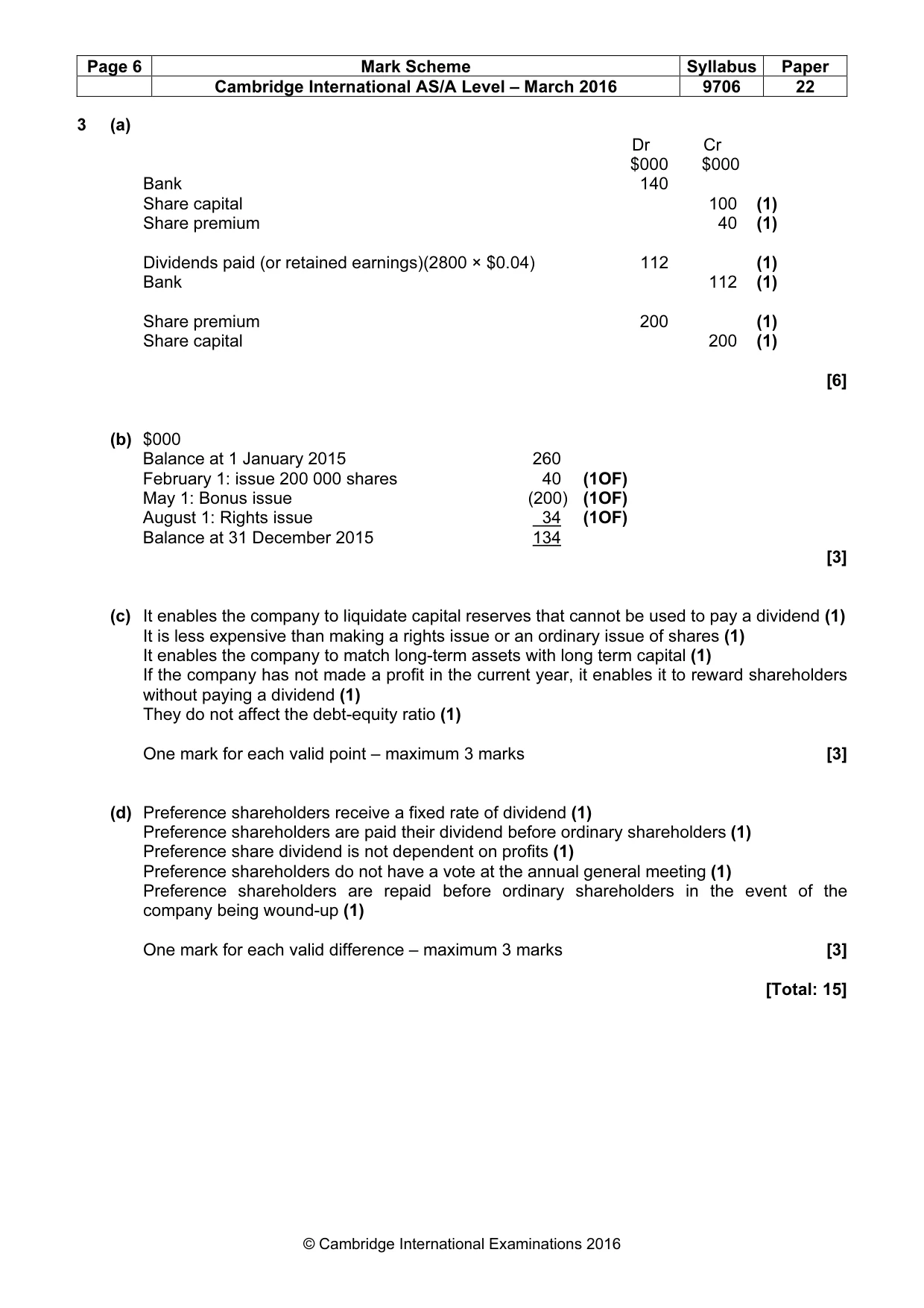
Page 6 Mark Scheme Syllabus Paper Cambridge International AS/A Level – March 2016 9706 22 © Cambridge International Examinations 2016 3 (a) Dr $000 Cr $000 Bank 140 Share capital 100 (1) Share premium 40 (1) Dividends paid (or retained earnings)(2800 × $0.04) 112 (1) Bank 112 (1) Share premium 200 (1) Share capital 200 (1) [6] (b) $000 Balance at 1 January 2015 260 February 1: issue 200 000 shares 40 (1OF) May 1: Bonus issue (200) (1OF) August 1: Rights issue 34 (1OF) Balance at 31 December 2015 134 [3] (c) It enables the company to liquidate capital reserves that cannot be used to pay a dividend (1) It is less expensive than making a rights issue or an ordinary issue of shares (1) It enables the company to match long-term assets with long term capital (1) If the company has not made a profit in the current year, it enables it to reward shareholders without paying a dividend (1) They do not affect the debt-equity ratio (1) One mark for each valid point – maximum 3 marks [3] (d) Preference shareholders receive a fixed rate of dividend (1) Preference shareholders are paid their dividend before ordinary shareholders (1) Preference share dividend is not dependent on profits (1) Preference shareholders do not have a vote at the annual general meeting (1) Preference shareholders are repaid before ordinary shareholders in the event of the company being wound-up (1) One mark for each valid difference – maximum 3 marks [3] [Total: 15]
Mark scheme, page 7
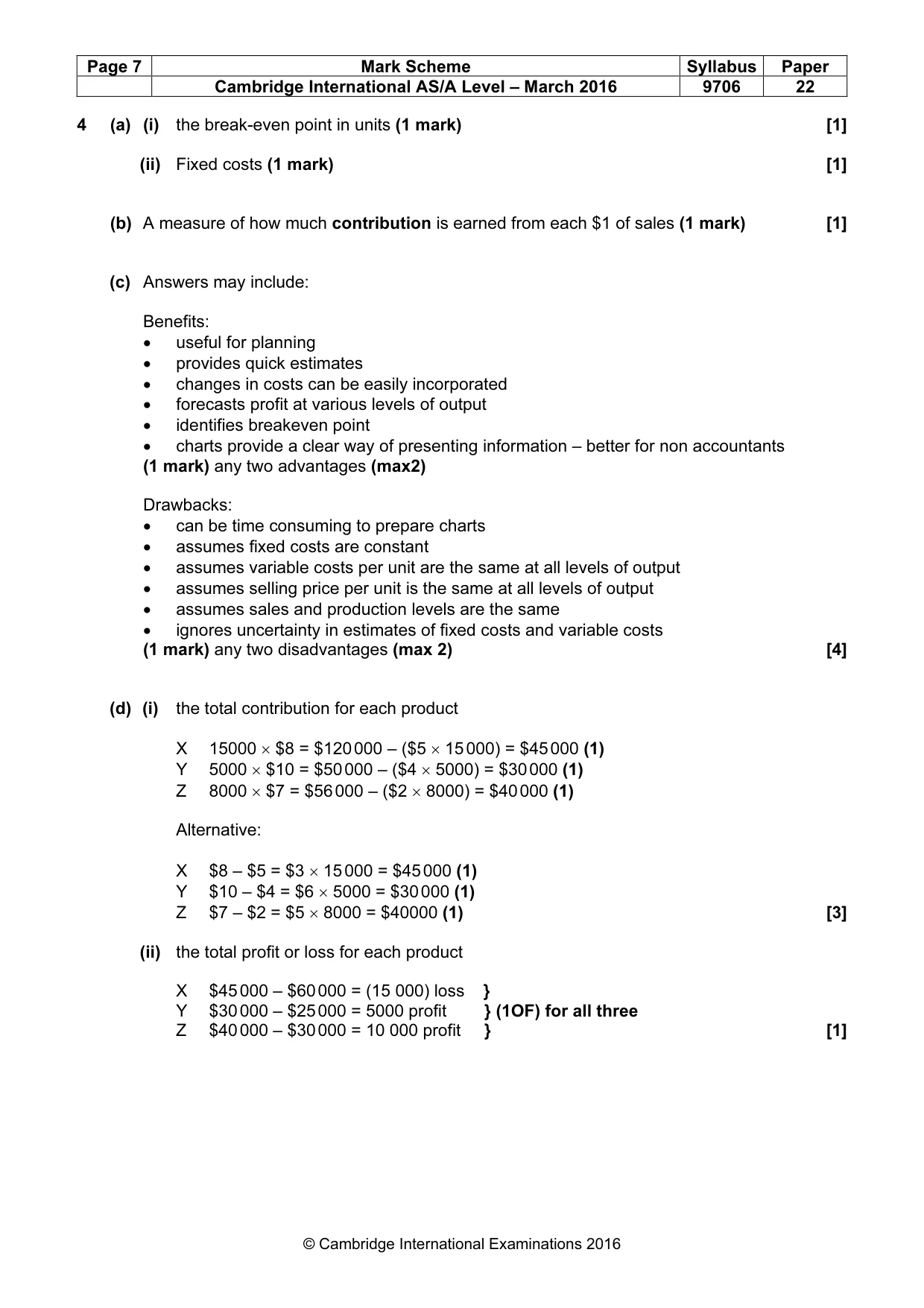
Page 7 Mark Scheme Syllabus Paper Cambridge International AS/A Level – March 2016 9706 22 © Cambridge International Examinations 2016 4 (a) (i) the break-even point in units (1 mark) [1] (ii) Fixed costs (1 mark) [1] (b) A measure of how much contribution is earned from each $1 of sales (1 mark) [1] (c) Answers may include: Benefits: • useful for planning • provides quick estimates • changes in costs can be easily incorporated • forecasts profit at various levels of output • identifies breakeven point • charts provide a clear way of presenting information – better for non accountants (1 mark) any two advantages (max2) Drawbacks: • can be time consuming to prepare charts • assumes fixed costs are constant • assumes variable costs per unit are the same at all levels of output • assumes selling price per unit is the same at all levels of output • assumes sales and production levels are the same • ignores uncertainty in estimates of fixed costs and variable costs (1 mark) any two disadvantages (max 2) [4] (d) (i) the total contribution for each product X 15000 × $8 = $120 000 – ($5 × 15 000) = $45 000 (1) Y 5000 × $10 = $50 000 – ($4 × 5000) = $30 000 (1) Z 8000 × $7 = $56 000 – ($2 × 8000) = $40 000 (1) Alternative: X $8 – $5 = $3 × 15 000 = $45 000 (1) Y $10 – $4 = $6 × 5000 = $30 000 (1) Z $7 – $2 = $5 × 8000 = $40000 (1) [3] (ii) the total profit or loss for each product X $45 000 – $60 000 = (15 000) loss } Y $30 000 – $25 000 = 5000 profit } (1OF) for all three Z $40 000 – $30 000 = 10 000 profit } [1]
Mark scheme, page 8
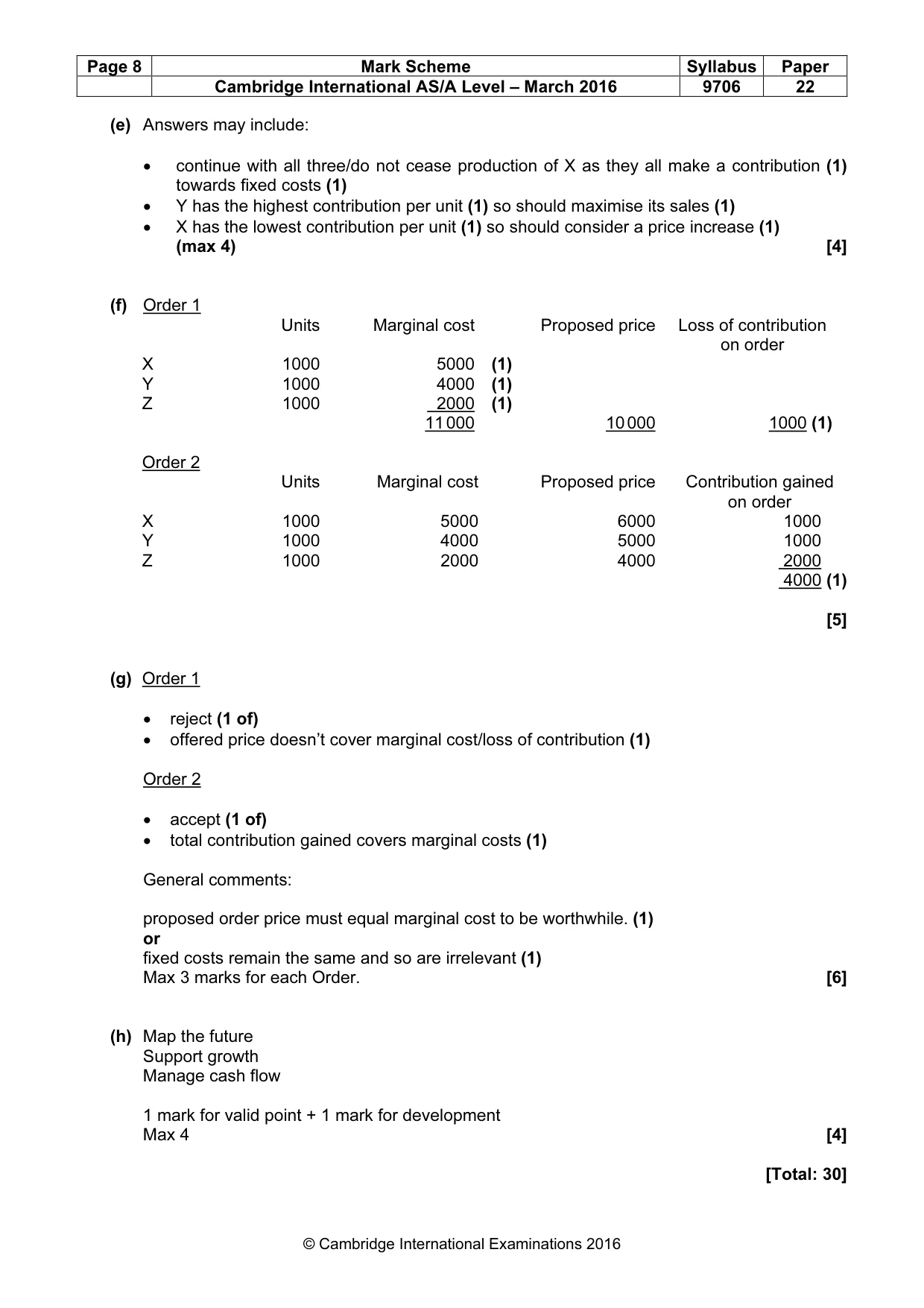
Page 8 Mark Scheme Syllabus Paper Cambridge International AS/A Level – March 2016 9706 22 © Cambridge International Examinations 2016 (e) Answers may include: • continue with all three/do not cease production of X as they all make a contribution (1) towards fixed costs (1) • Y has the highest contribution per unit (1) so should maximise its sales (1) • X has the lowest contribution per unit (1) so should consider a price increase (1) (max 4) [4] (f) Order 1 Units Marginal cost Proposed price Loss of contribution on order X 1000 5000 (1) Y 1000 4000 (1) Z 1000 2000 (1) 11 000 10 000 1000 (1) Order 2 Units Marginal cost Proposed price Contribution gained on order X 1000 5000 6000 1000 Y 1000 4000 5000 1000 Z 1000 2000 4000 2000 4000 (1) [5] (g) Order 1 • reject (1 of) • offered price doesn’t cover marginal cost/loss of contribution (1) Order 2 • accept (1 of) • total contribution gained covers marginal costs (1) General comments: proposed order price must equal marginal cost to be worthwhile. (1) or fixed costs remain the same and so are irrelevant (1) Max 3 marks for each Order. [6] (h) Map the future Support growth Manage cash flow 1 mark for valid point + 1 mark for development Max 4 [4] [Total: 30]
What you needed in this session
Cambridge’s own grade thresholds for 2016 Feb/March, Paper 2 · Variant 2. A higher threshold means an easier paper — the bar moves with how the cohort did.