Cambridge A Level Accounting 9706 — 2010 Oct/Nov Paper 4 · Variant 3
9706/43/O/N/10 · 120 marks · ≈135 min
The question paper and its mark scheme, free to read here and free to download. This is Cambridge’s own paper, exactly as it was sat.
Question paper8 pages
Mark scheme6 pages
Answers below. Sit the paper first if you are practising.
Paper as text
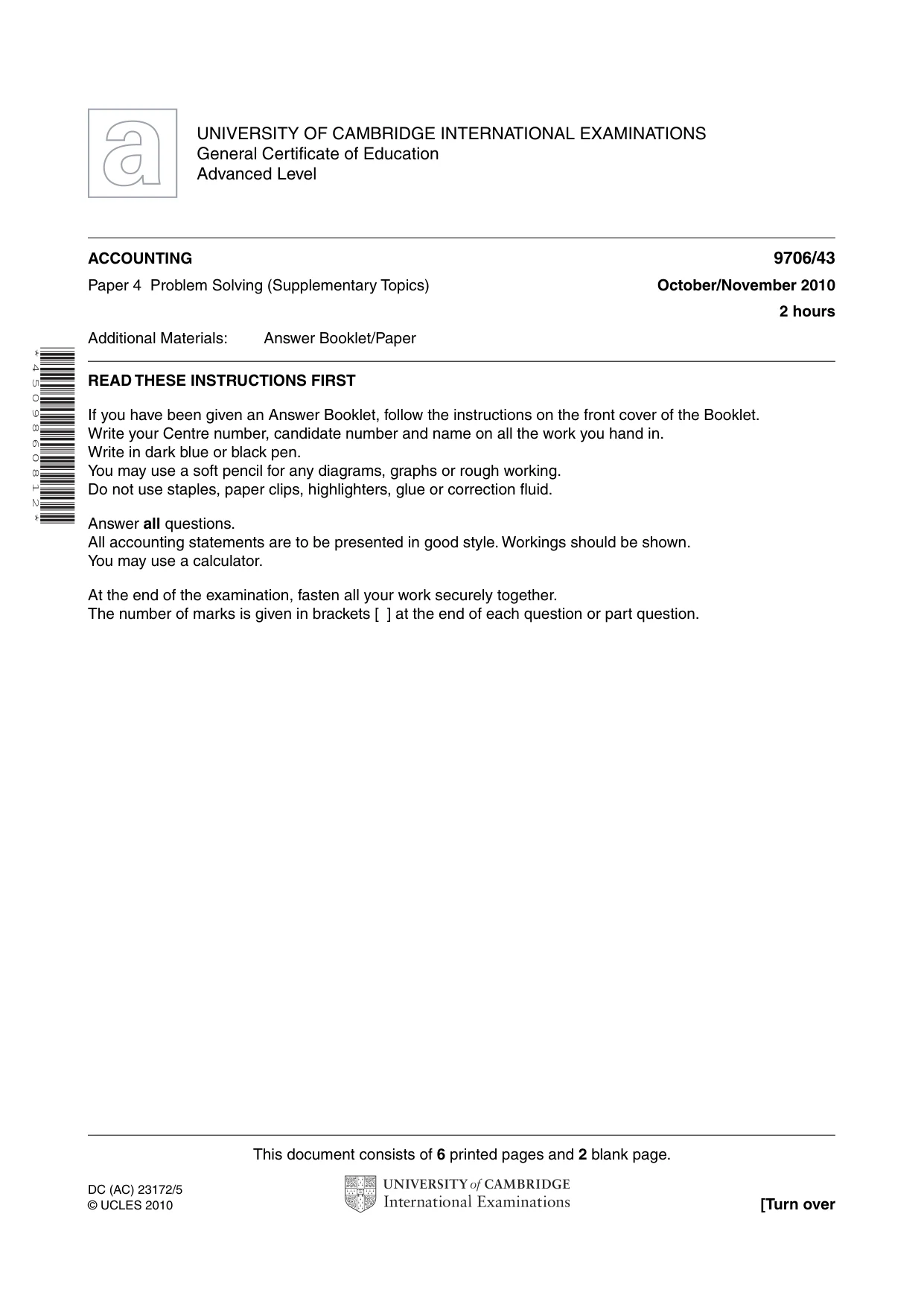
Question paper, page 1
This document consists of 6 printed pages and 2 blank page. DC (AC) 23172/5 © UCLES 2010 [Turn over UNIVERSITY OF CAMBRIDGE INTERNATIONAL EXAMINATIONS General Certificate of Education Advanced Level * 4 5 0 9 8 6 0 8 1 2 * ACCOUNTING 9706/43 Paper 4 Problem Solving (Supplementary Topics) October/November 2010 2 hours Additional Materials: Answer Booklet/Paper READ THESE INSTRUCTIONS FIRST If you have been given an Answer Booklet, follow the instructions on the front cover of the Booklet. Write your Centre number, candidate number and name on all the work you hand in. Write in dark blue or black pen. You may use a soft pencil for any diagrams, graphs or rough working. Do not use staples, paper clips, highlighters, glue or correction fluid. Answer all questions. All accounting statements are to be presented in good style. Workings should be shown. You may use a calculator. At the end of the examination, fasten all your work securely together. The number of marks is given in brackets [ ] at the end of each question or part question.
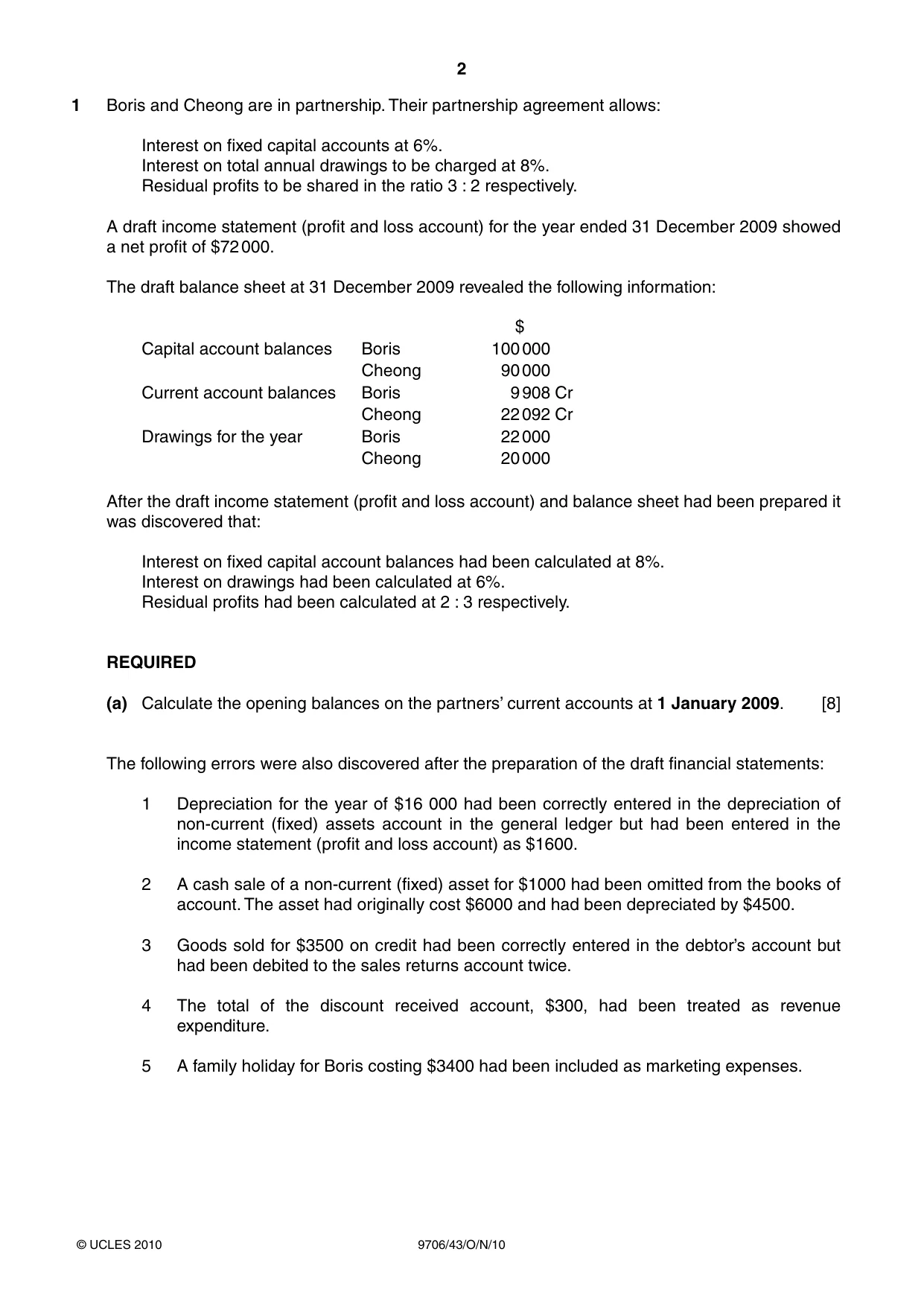
Question paper, page 2
2 9706/43/O/N/10 © UCLES 2010 1 Boris and Cheong are in partnership. Their partnership agreement allows: Interest on fixed capital accounts at 6%. Interest on total annual drawings to be charged at 8%. Residual profits to be shared in the ratio 3 : 2 respectively. A draft income statement (profit and loss account) for the year ended 31 December 2009 showed a net profit of $72 000. The draft balance sheet at 31 December 2009 revealed the following information: $ Capital account balances Boris 100 000 Cheong 90 000 Current account balances Boris 9 908 Cr Cheong 22 092 Cr Drawings for the year Boris 22 000 Cheong 20 000 After the draft income statement (profit and loss account) and balance sheet had been prepared it was discovered that: Interest on fixed capital account balances had been calculated at 8%. Interest on drawings had been calculated at 6%. Residual profits had been calculated at 2 : 3 respectively. REQUIRED (a) Calculate the opening balances on the partners’ current accounts at 1 January 2009. [8] The following errors were also discovered after the preparation of the draft financial statements: 1 Depreciation for the year of $16 000 had been correctly entered in the depreciation of non-current (fixed) assets account in the general ledger but had been entered in the income statement (profit and loss account) as $1600. 2 A cash sale of a non-current (fixed) asset for $1000 had been omitted from the books of account. The asset had originally cost $6000 and had been depreciated by $4500. 3 Goods sold for $3500 on credit had been correctly entered in the debtor’s account but had been debited to the sales returns account twice. 4 The total of the discount received account, $300, had been treated as revenue expenditure. 5 A family holiday for Boris costing $3400 had been included as marketing expenses.
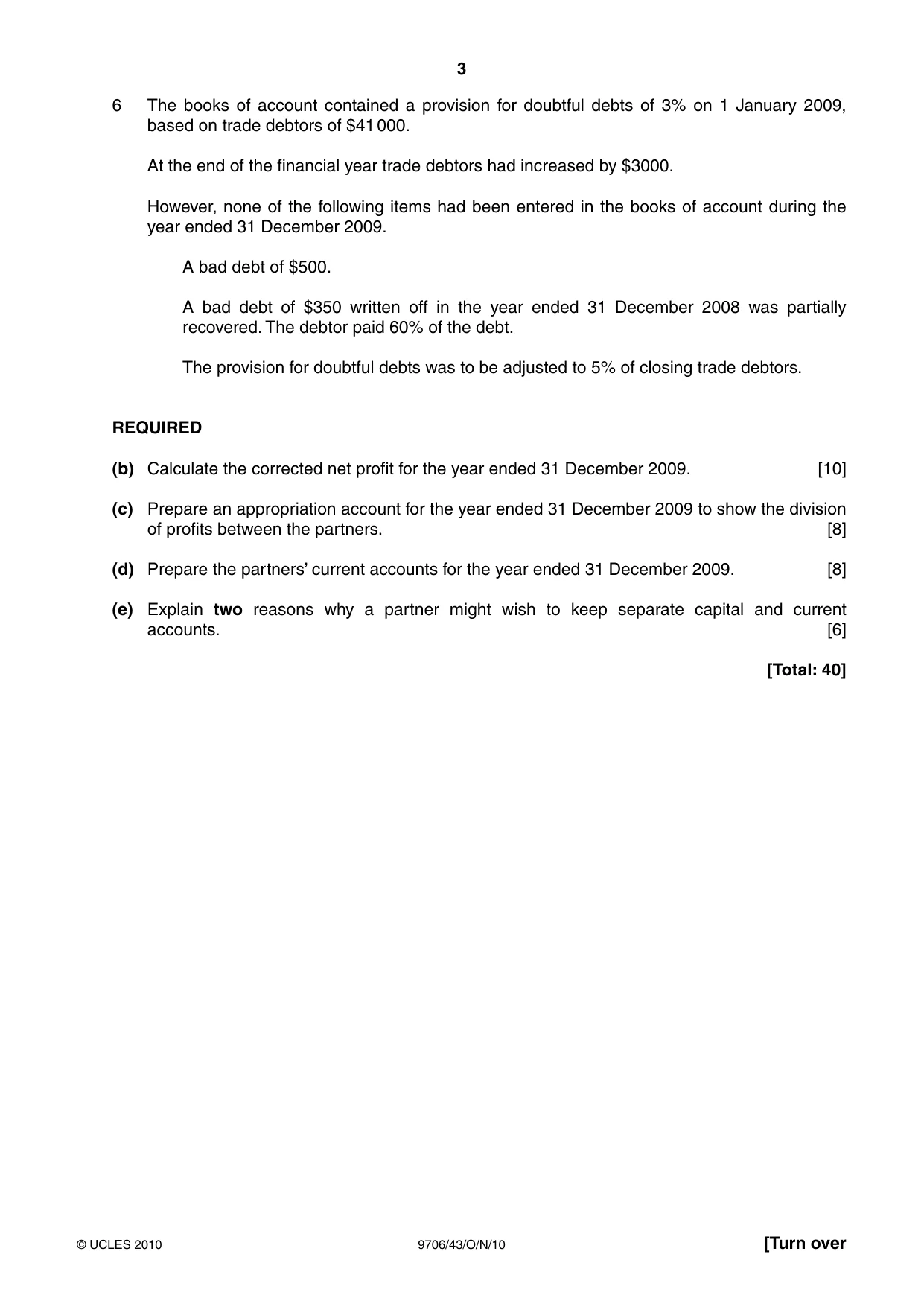
Question paper, page 3
3 9706/43/O/N/10 © UCLES 2010 [Turn over 6 The books of account contained a provision for doubtful debts of 3% on 1 January 2009, based on trade debtors of $41 000. At the end of the financial year trade debtors had increased by $3000. However, none of the following items had been entered in the books of account during the year ended 31 December 2009. A bad debt of $500. A bad debt of $350 written off in the year ended 31 December 2008 was partially recovered. The debtor paid 60% of the debt. The provision for doubtful debts was to be adjusted to 5% of closing trade debtors. REQUIRED (b) Calculate the corrected net profit for the year ended 31 December 2009. [10] (c) Prepare an appropriation account for the year ended 31 December 2009 to show the division of profits between the partners. [8] (d) Prepare the partners’ current accounts for the year ended 31 December 2009. [8] (e) Explain two reasons why a partner might wish to keep separate capital and current accounts. [6] [Total: 40]
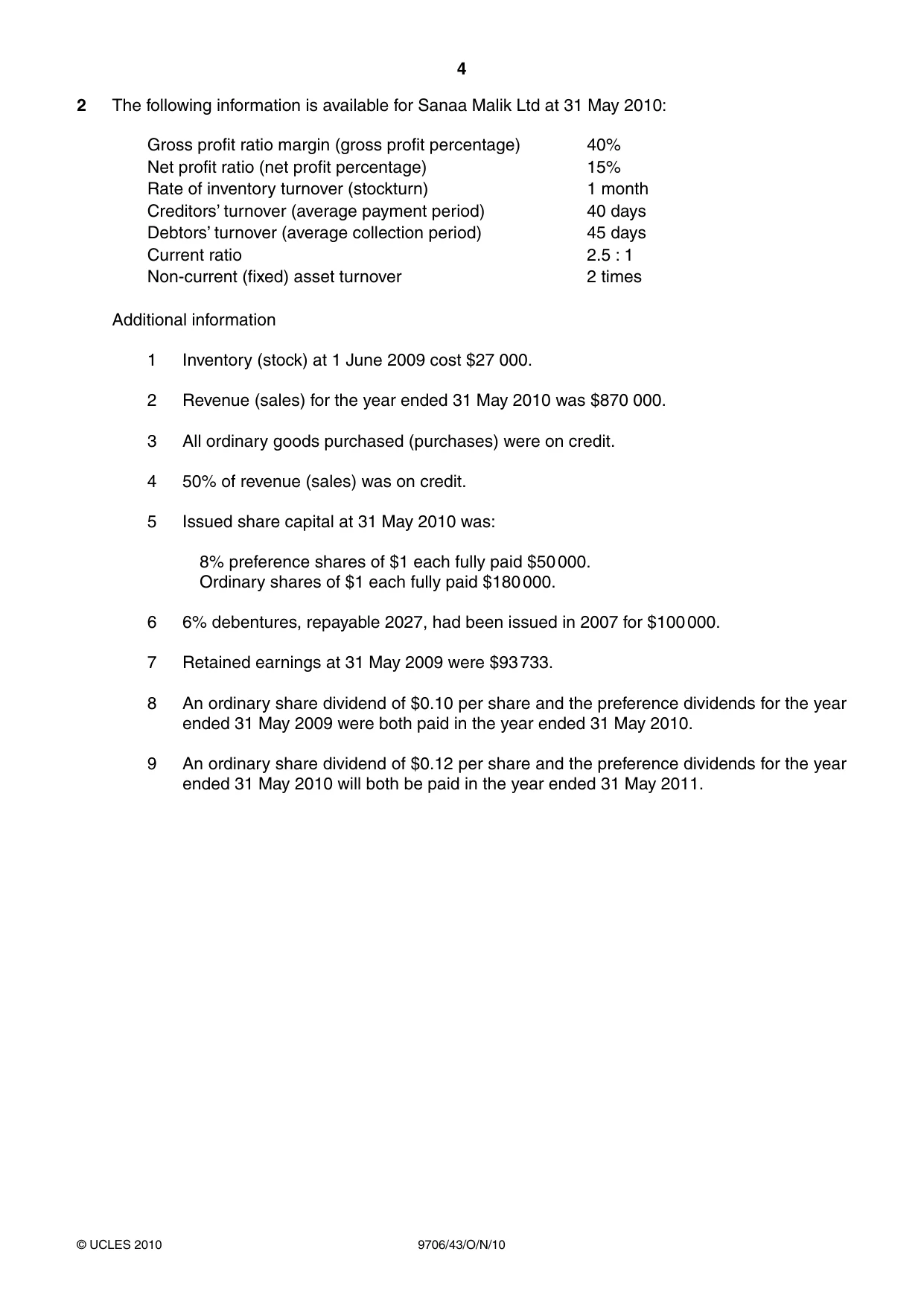
Question paper, page 4
4 9706/43/O/N/10 © UCLES 2010 2 The following information is available for Sanaa Malik Ltd at 31 May 2010: Gross profit ratio margin (gross profit percentage) 40% Net profit ratio (net profit percentage) 15% Rate of inventory turnover (stockturn) 1 month Creditors’ turnover (average payment period) 40 days Debtors’ turnover (average collection period) 45 days Current ratio 2.5 : 1 Non-current (fixed) asset turnover 2 times Additional information 1 Inventory (stock) at 1 June 2009 cost $27 000. 2 Revenue (sales) for the year ended 31 May 2010 was $870 000. 3 All ordinary goods purchased (purchases) were on credit. 4 50% of revenue (sales) was on credit. 5 Issued share capital at 31 May 2010 was: 8% preference shares of $1 each fully paid $50 000. Ordinary shares of $1 each fully paid $180 000. 6 6% debentures, repayable 2027, had been issued in 2007 for $100 000. 7 Retained earnings at 31 May 2009 were $93 733. 8 An ordinary share dividend of $0.10 per share and the preference dividends for the year ended 31 May 2009 were both paid in the year ended 31 May 2010. 9 An ordinary share dividend of $0.12 per share and the preference dividends for the year ended 31 May 2010 will both be paid in the year ended 31 May 2011.
Question paper, page 5
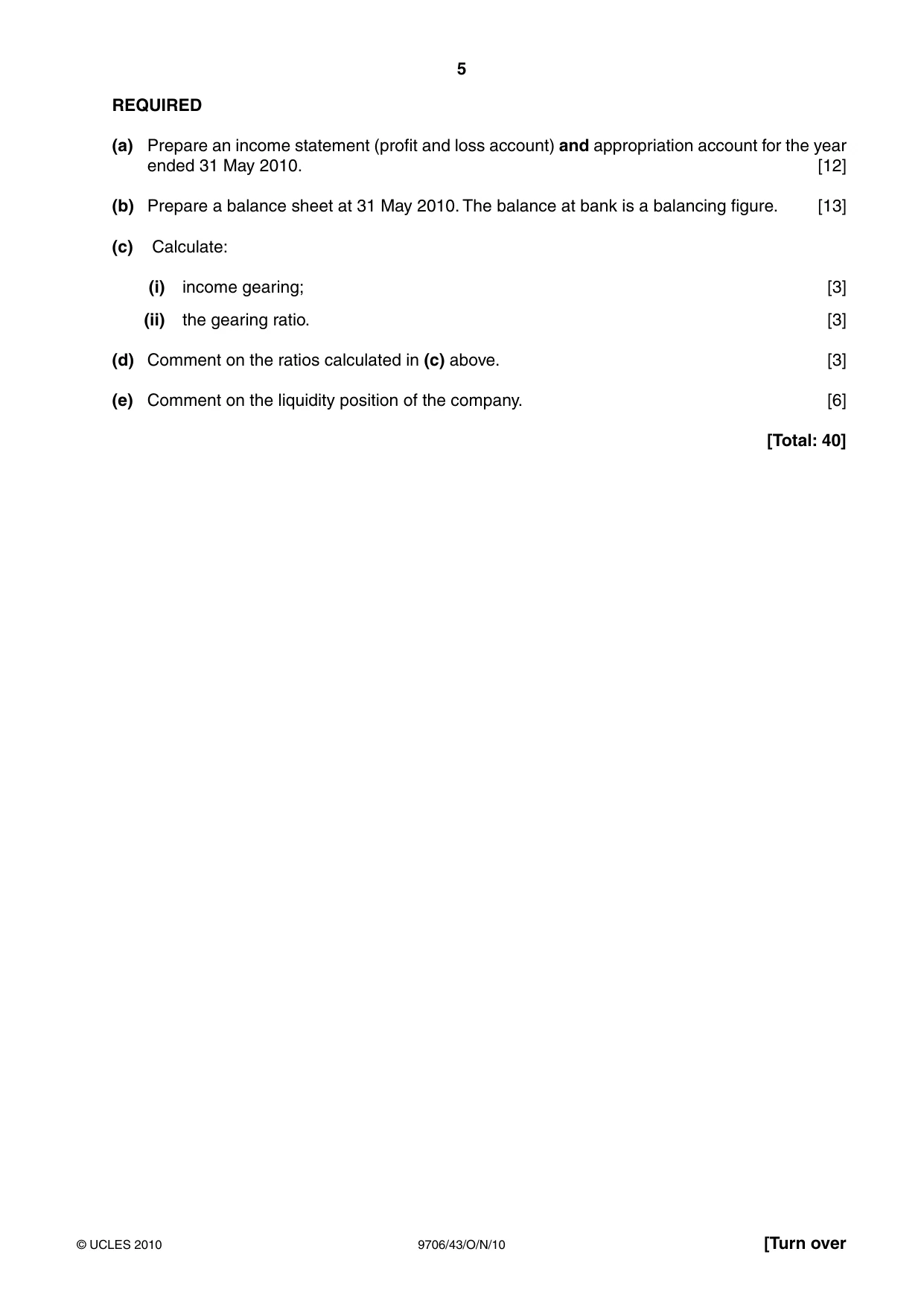
5 9706/43/O/N/10 © UCLES 2010 [Turn over REQUIRED (a) Prepare an income statement (profit and loss account) and appropriation account for the year ended 31 May 2010. [12] (b) Prepare a balance sheet at 31 May 2010. The balance at bank is a balancing figure. [13] (c) Calculate: (i) income gearing; [3] (ii) the gearing ratio. [3] (d) Comment on the ratios calculated in (c) above. [3] (e) Comment on the liquidity position of the company. [6] [Total: 40]
Question paper, page 6
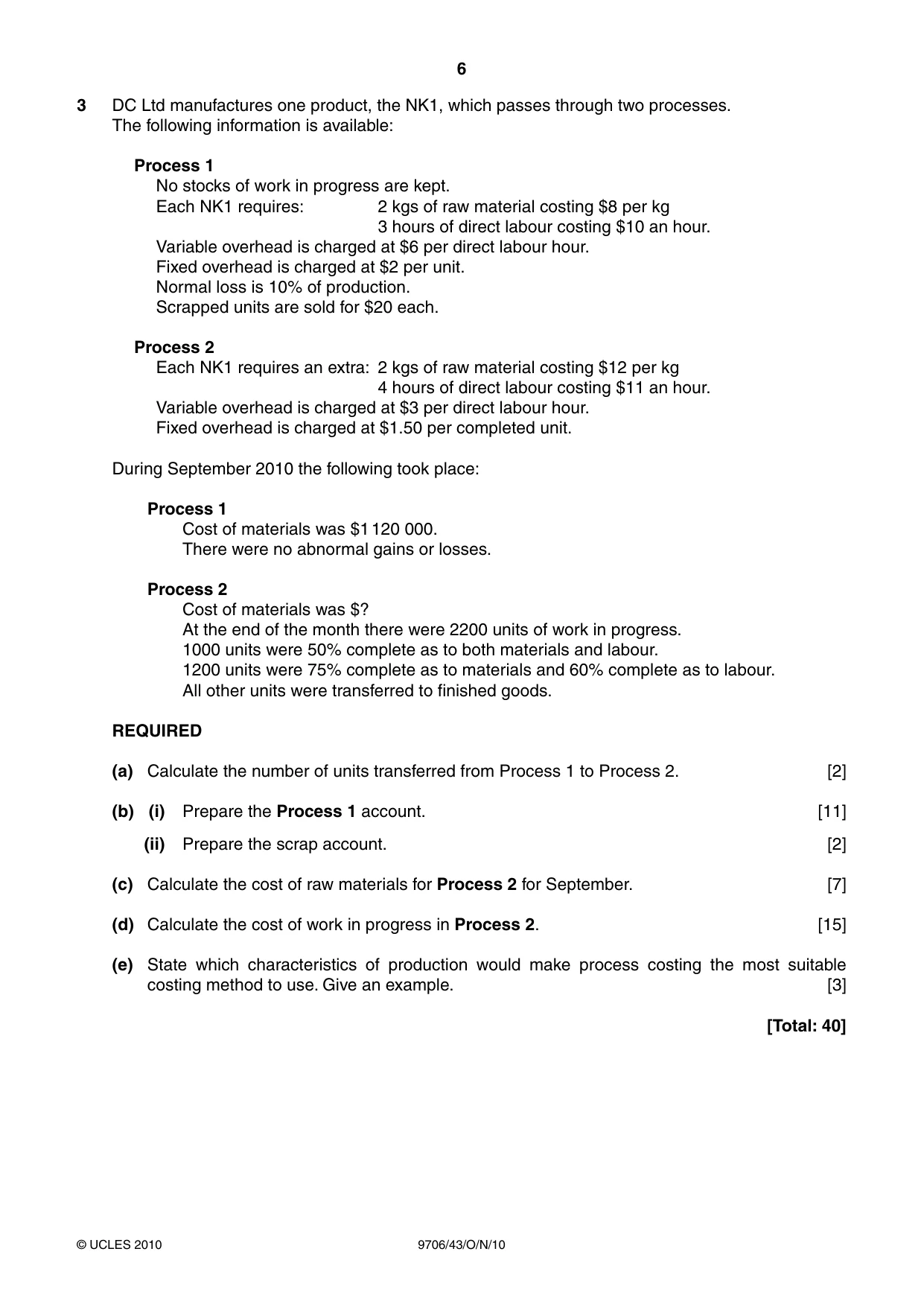
6 9706/43/O/N/10 © UCLES 2010 3 DC Ltd manufactures one product, the NK1, which passes through two processes. The following information is available: Process 1 No stocks of work in progress are kept. Each NK1 requires: 2 kgs of raw material costing $8 per kg 3 hours of direct labour costing $10 an hour. Variable overhead is charged at $6 per direct labour hour. Fixed overhead is charged at $2 per unit. Normal loss is 10% of production. Scrapped units are sold for $20 each. Process 2 Each NK1 requires an extra: 2 kgs of raw material costing $12 per kg 4 hours of direct labour costing $11 an hour. Variable overhead is charged at $3 per direct labour hour. Fixed overhead is charged at $1.50 per completed unit. During September 2010 the following took place: Process 1 Cost of materials was $1 120 000. There were no abnormal gains or losses. Process 2 Cost of materials was $? At the end of the month there were 2200 units of work in progress. 1000 units were 50% complete as to both materials and labour. 1200 units were 75% complete as to materials and 60% complete as to labour. All other units were transferred to finished goods. REQUIRED (a) Calculate the number of units transferred from Process 1 to Process 2. [2] (b) (i) Prepare the Process 1 account. [11] (ii) Prepare the scrap account. [2] (c) Calculate the cost of raw materials for Process 2 for September. [7] (d) Calculate the cost of work in progress in Process 2. [15] (e) State which characteristics of production would make process costing the most suitable costing method to use. Give an example. [3] [Total: 40]
Question paper, page 7
7 9706/43/O/N/10 © UCLES 2010 BLANK PAGE
Question paper, page 8
8 9706/43/O/N/10 © UCLES 2010 Permission to reproduce items where third-party owned material protected by copyright is included has been sought and cleared where possible. Every reasonable effort has been made by the publisher (UCLES) to trace copyright holders, but if any items requiring clearance have unwittingly been included, the publisher will be pleased to make amends at the earliest possible opportunity. University of Cambridge International Examinations is part of the Cambridge Assessment Group. Cambridge Assessment is the brand name of University of Cambridge Local Examinations Syndicate (UCLES), which is itself a department of the University of Cambridge. BLANK PAGE
Mark scheme, page 1
UNIVERSITY OF CAMBRIDGE INTERNATIONAL EXAMINATIONS GCE Advanced Subsidiary Level and GCE Advanced Level MARK SCHEME for the October/November 2010 question paper for the guidance of teachers 9706 ACCOUNTING 9706/43 Paper 4 (Problem Solving (Supplement), maximum raw mark 120 This mark scheme is published as an aid to teachers and candidates, to indicate the requirements of the examination. It shows the basis on which Examiners were instructed to award marks. It does not indicate the details of the discussions that took place at an Examiners’ meeting before marking began, which would have considered the acceptability of alternative answers. Mark schemes must be read in conjunction with the question papers and the report on the examination. • CIE will not enter into discussions or correspondence in connection with these mark schemes. CIE is publishing the mark schemes for the October/November 2010 question papers for most IGCSE, GCE Advanced Level and Advanced Subsidiary Level syllabuses and some Ordinary Level syllabuses.
Mark scheme, page 2
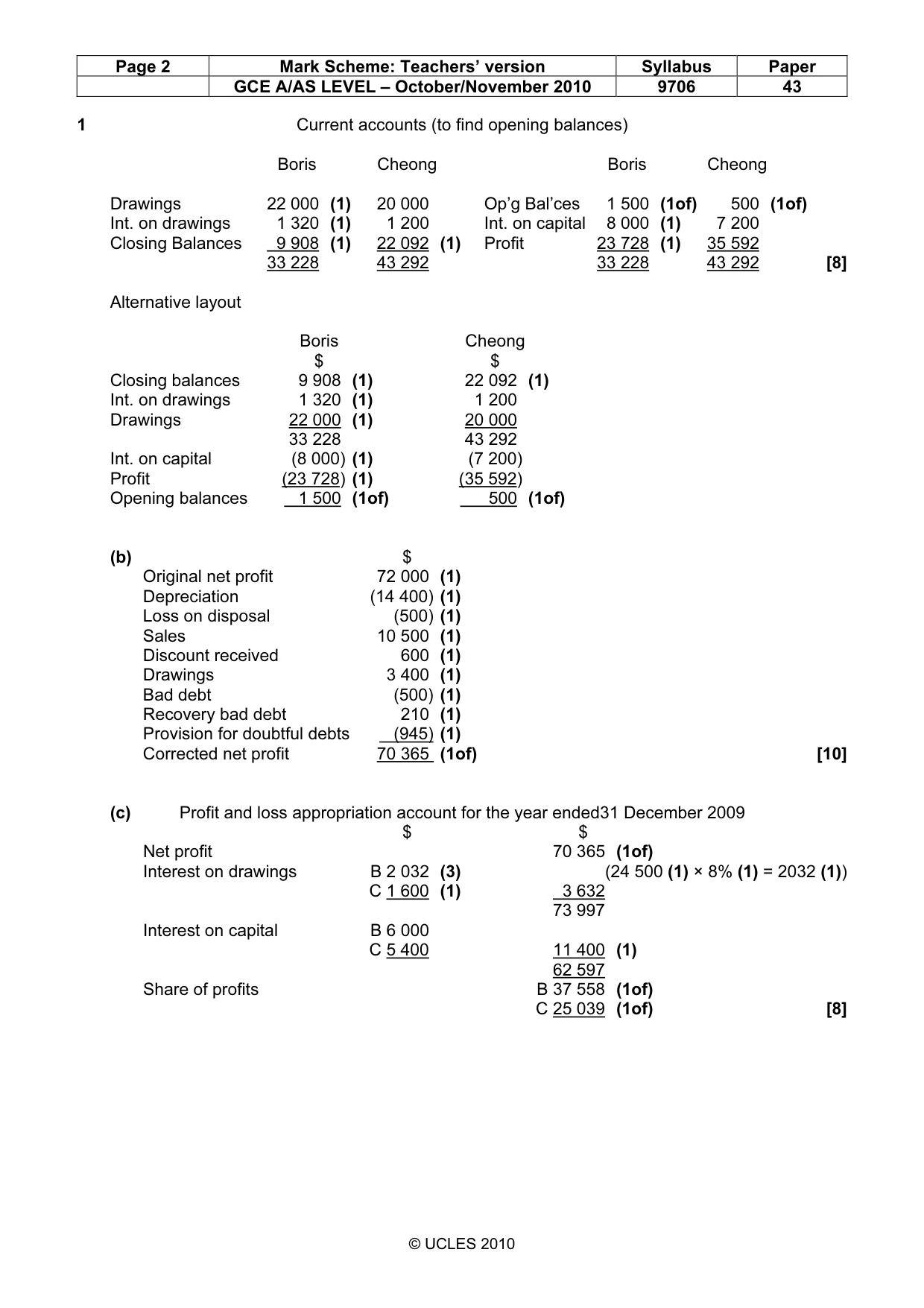
Page 2 Mark Scheme: Teachers’ version Syllabus Paper GCE A/AS LEVEL – October/November 2010 9706 43 © UCLES 2010 1 Current accounts (to find opening balances) Boris Cheong Boris Cheong Drawings 22 000 (1) 20 000 Op’g Bal’ces 1 500 (1of) 500 (1of) Int. on drawings 1 320 (1) 1 200 Int. on capital 8 000 (1) 7 200 Closing Balances 9 908 (1) 22 092 (1) Profit 23 728 (1) 35 592 33 228 43 292 33 228 43 292 [8] Alternative layout Boris Cheong $ $ Closing balances 9 908 (1) 22 092 (1) Int. on drawings 1 320 (1) 1 200 Drawings 22 000 (1) 20 000 33 228 43 292 Int. on capital (8 000) (1) (7 200) Profit (23 728) (1) (35 592) Opening balances 1 500 (1of) 500 (1of) (b) $ Original net profit 72 000 (1) Depreciation (14 400) (1) Loss on disposal (500) (1) Sales 10 500 (1) Discount received 600 (1) Drawings 3 400 (1) Bad debt (500) (1) Recovery bad debt 210 (1) Provision for doubtful debts (945) (1) Corrected net profit 70 365 (1of) [10] (c) Profit and loss appropriation account for the year ended31 December 2009 $ $ Net profit 70 365 (1of) Interest on drawings B 2 032 (3) (24 500 (1) × 8% (1) = 2032 (1)) C 1 600 (1) 3 632 73 997 Interest on capital B 6 000 C 5 400 11 400 (1) 62 597 Share of profits B 37 558 (1of) C 25 039 (1of) [8]
Mark scheme, page 3
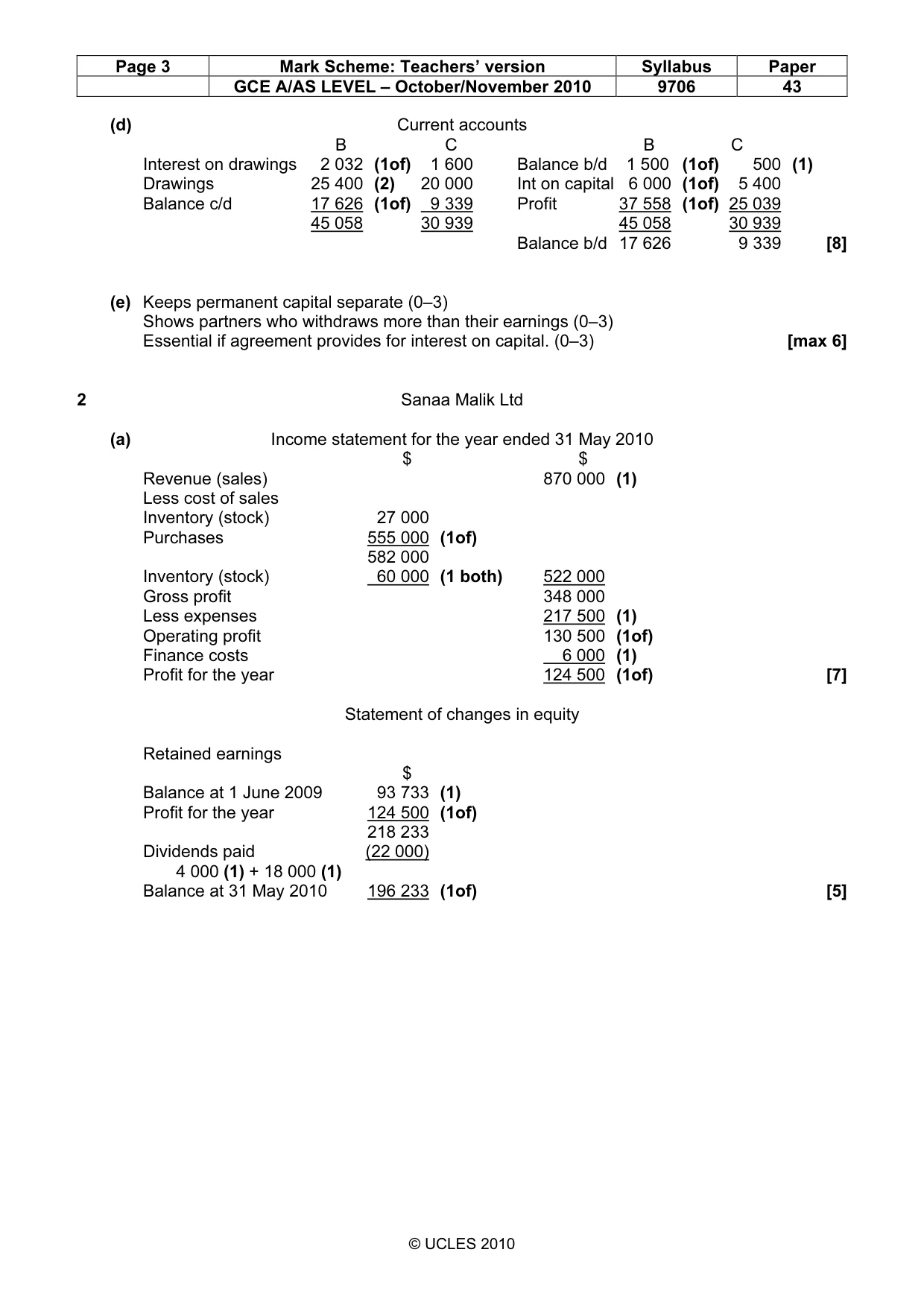
Page 3 Mark Scheme: Teachers’ version Syllabus Paper GCE A/AS LEVEL – October/November 2010 9706 43 © UCLES 2010 (d) Current accounts B C B C Interest on drawings 2 032 (1of) 1 600 Balance b/d 1 500 (1of) 500 (1) Drawings 25 400 (2) 20 000 Int on capital 6 000 (1of) 5 400 Balance c/d 17 626 (1of) 9 339 Profit 37 558 (1of) 25 039 45 058 30 939 45 058 30 939 Balance b/d 17 626 9 339 [8] (e) Keeps permanent capital separate (0–3) Shows partners who withdraws more than their earnings (0–3) Essential if agreement provides for interest on capital. (0–3) [max 6] 2 Sanaa Malik Ltd (a) Income statement for the year ended 31 May 2010 $ $ Revenue (sales) 870 000 (1) Less cost of sales Inventory (stock) 27 000 Purchases 555 000 (1of) 582 000 Inventory (stock) 60 000 (1 both) 522 000 Gross profit 348 000 Less expenses 217 500 (1) Operating profit 130 500 (1of) Finance costs 6 000 (1) Profit for the year 124 500 (1of) [7] Statement of changes in equity Retained earnings $ Balance at 1 June 2009 93 733 (1) Profit for the year 124 500 (1of) 218 233 Dividends paid (22 000) 4 000 (1) + 18 000 (1) Balance at 31 May 2010 196 233 (1of) [5]
Mark scheme, page 4
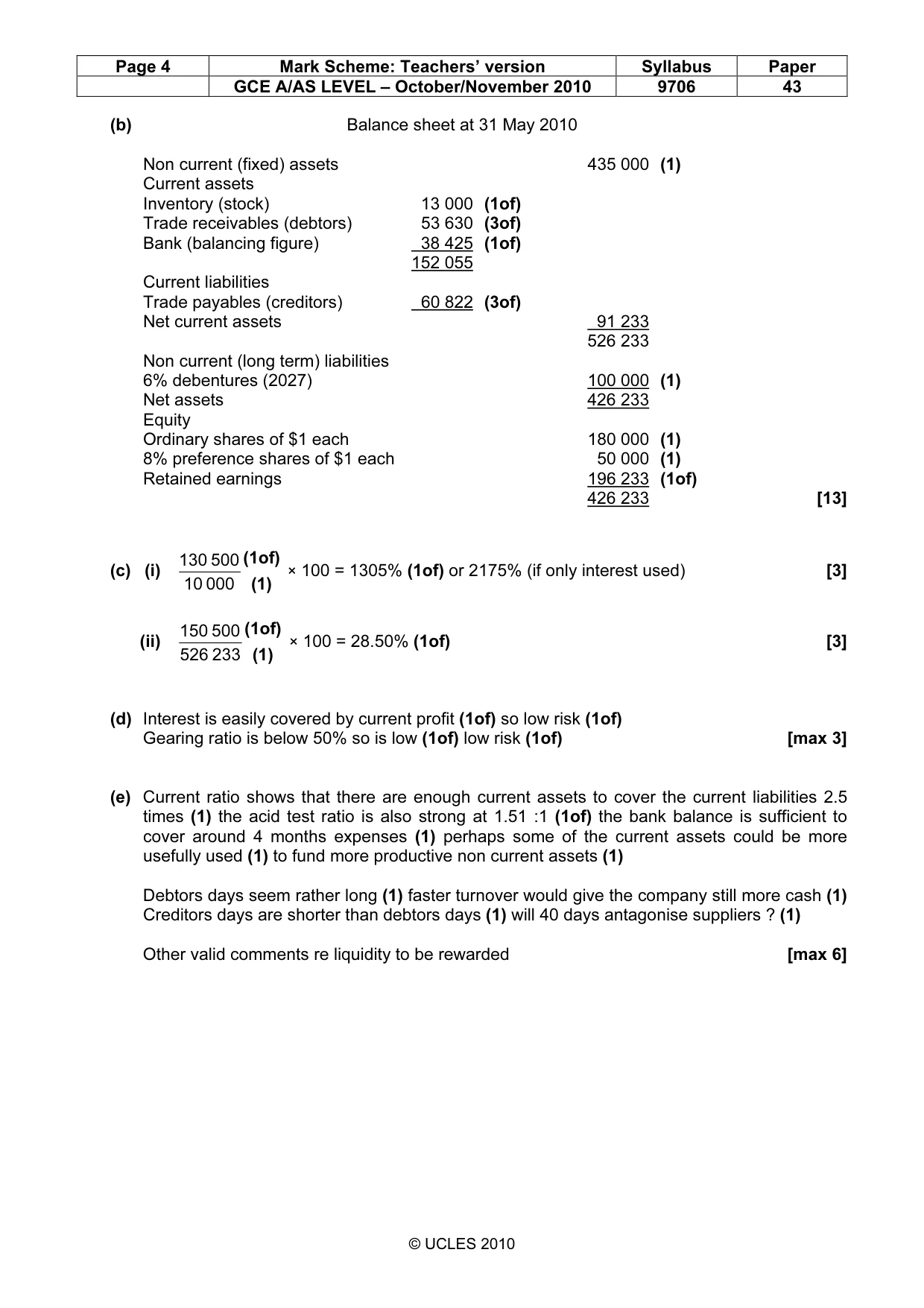
Page 4 Mark Scheme: Teachers’ version Syllabus Paper GCE A/AS LEVEL – October/November 2010 9706 43 © UCLES 2010 (b) Balance sheet at 31 May 2010 Non current (fixed) assets 435 000 (1) Current assets Inventory (stock) 13 000 (1of) Trade receivables (debtors) 53 630 (3of) Bank (balancing figure) 38 425 (1of) 152 055 Current liabilities Trade payables (creditors) 60 822 (3of) Net current assets 91 233 526 233 Non current (long term) liabilities 6% debentures (2027) 100 000 (1) Net assets 426 233 Equity Ordinary shares of $1 each 180 000 (1) 8% preference shares of $1 each 50 000 (1) Retained earnings 196 233 (1of) 426 233 [13] (c) (i) (1) (1of) 000 10 500 130 × 100 = 1305% (1of) or 2175% (if only interest used) [3] (ii) (1) (1of) 233 526 500 150 × 100 = 28.50% (1of) [3] (d) Interest is easily covered by current profit (1of) so low risk (1of) Gearing ratio is below 50% so is low (1of) low risk (1of) [max 3] (e) Current ratio shows that there are enough current assets to cover the current liabilities 2.5 times (1) the acid test ratio is also strong at 1.51 :1 (1of) the bank balance is sufficient to cover around 4 months expenses (1) perhaps some of the current assets could be more usefully used (1) to fund more productive non current assets (1) Debtors days seem rather long (1) faster turnover would give the company still more cash (1) Creditors days are shorter than debtors days (1) will 40 days antagonise suppliers ? (1) Other valid comments re liquidity to be rewarded [max 6]
Mark scheme, page 5
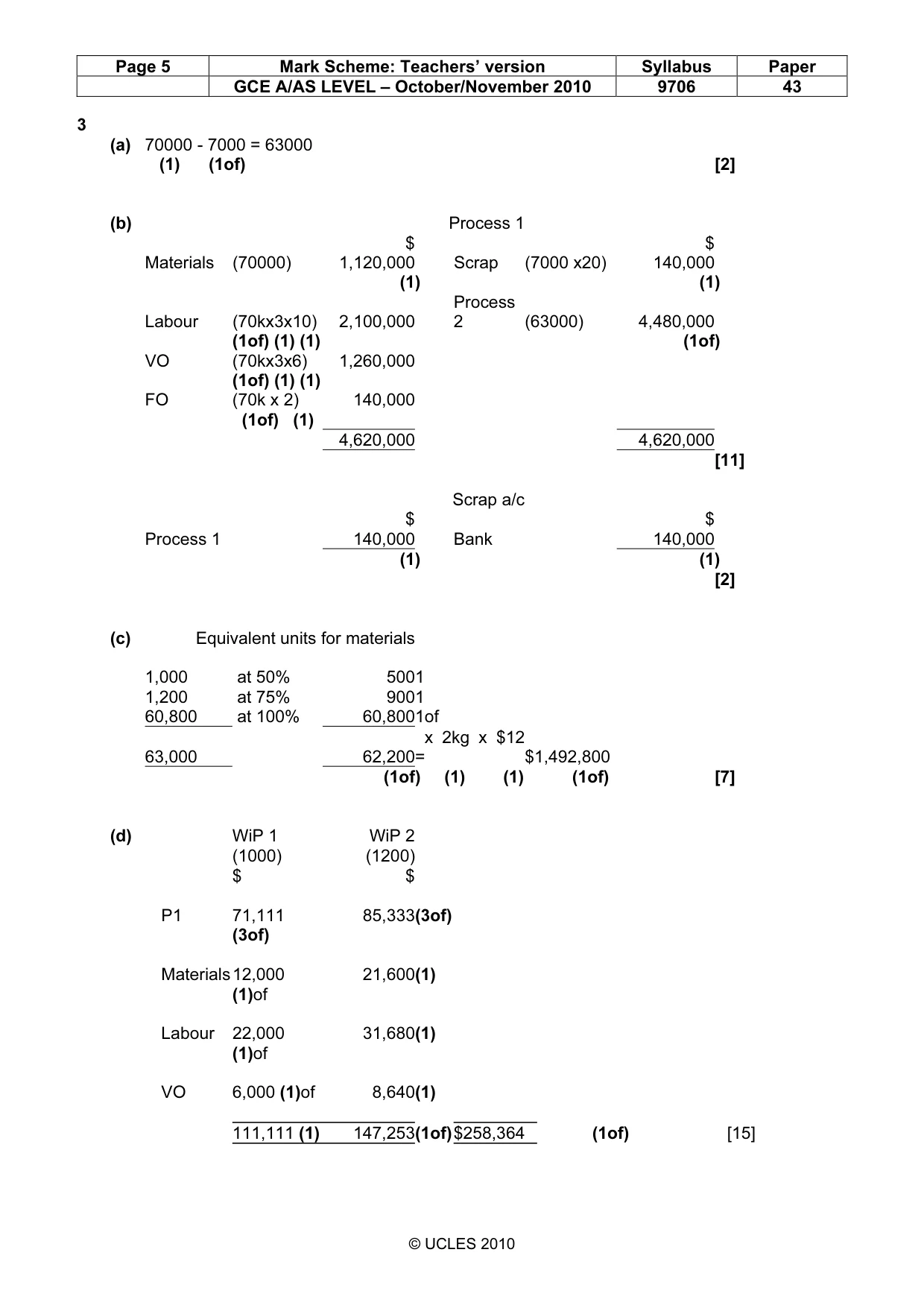
Page 5 Mark Scheme: Teachers’ version Syllabus Paper GCE A/AS LEVEL – October/November 2010 9706 43 © UCLES 2010 3 (a) 70000 - 7000 = 63000 (1) (1of) [2] (b) Process 1 $ $ Materials (70000) 1,120,000 Scrap (7000 x20) 140,000 (1) (1) Labour (70kx3x10) 2,100,000 Process 2 (63000) 4,480,000 (1of) (1) (1) (1of) VO (70kx3x6) 1,260,000 (1of) (1) (1) FO (70k x 2) 140,000 (1of) (1) 4,620,000 4,620,000 [11] Scrap a/c $ $ Process 1 140,000 Bank 140,000 (1) (1) [2] (c) Equivalent units for materials 1,000 at 50% 5001 1,200 at 75% 9001 60,800 at 100% 60,8001of 63,000 62,200 x 2kg x $12 = $1,492,800 (1of) (1) (1) (1of) [7] (d) WiP 1 WiP 2 (1000) (1200) $ $ P1 71,111 (3of) 85,333(3of) Materials 12,000 (1)of 21,600(1) Labour 22,000 (1)of 31,680(1) VO 6,000 (1)of 8,640(1) 111,111 (1) 147,253(1of) $258,364 (1of) [15]
Mark scheme, page 6
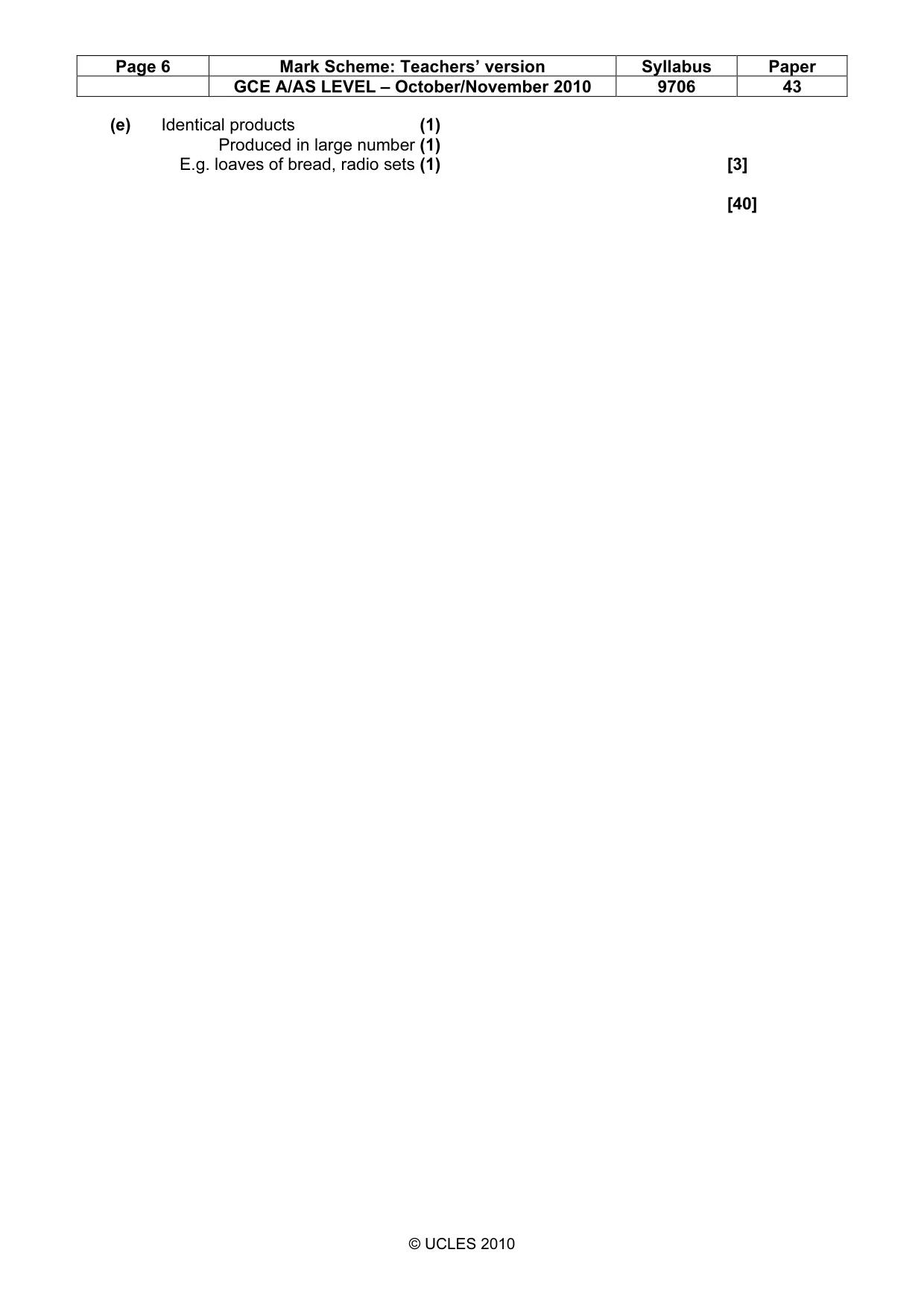
Page 6 Mark Scheme: Teachers’ version Syllabus Paper GCE A/AS LEVEL – October/November 2010 9706 43 © UCLES 2010 (e) Identical products (1) Produced in large number (1) E.g. loaves of bread, radio sets (1) [3] [40]
What you needed in this session
Cambridge’s own grade thresholds for 2010 Oct/Nov, Paper 4 · Variant 3. A higher threshold means an easier paper — the bar moves with how the cohort did.