Cambridge A Level Accounting 9706 — 2010 Oct/Nov Paper 4 · Variant 1
9706/41/O/N/10 · 120 marks · ≈135 min
The question paper and its mark scheme, free to read here and free to download. This is Cambridge’s own paper, exactly as it was sat.
Question paper8 pages
Mark scheme5 pages
Answers below. Sit the paper first if you are practising.
Paper as text
Question paper, page 1
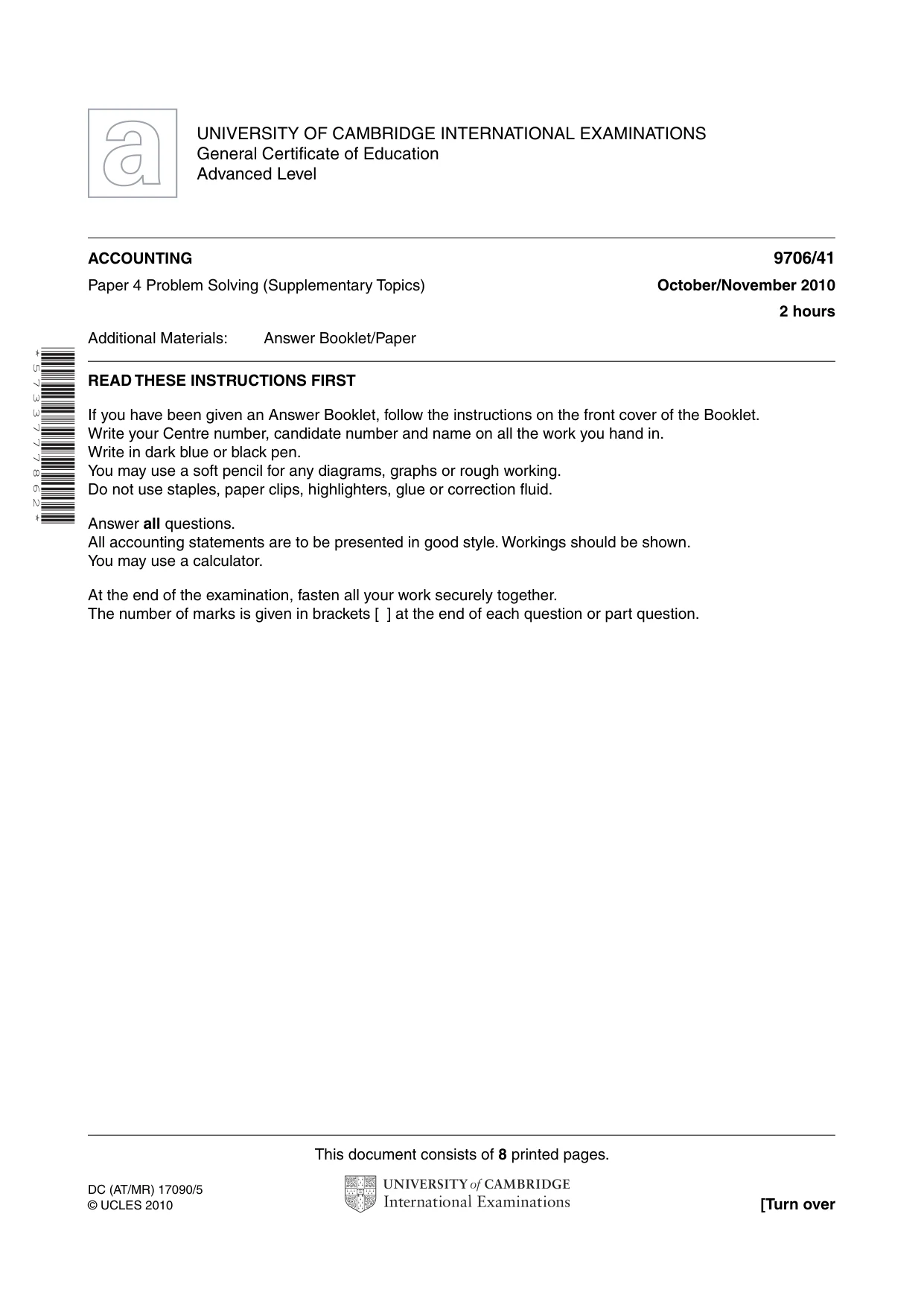
This document consists of 8 printed pages. DC (AT/MR) 17090/5 © UCLES 2010 [Turn over UNIVERSITY OF CAMBRIDGE INTERNATIONAL EXAMINATIONS General Certificate of Education Advanced Level * 5 7 3 3 7 7 7 8 6 2 * ACCOUNTING 9706/41 Paper 4 Problem Solving (Supplementary Topics) October/November 2010 2 hours Additional Materials: Answer Booklet/Paper READ THESE INSTRUCTIONS FIRST If you have been given an Answer Booklet, follow the instructions on the front cover of the Booklet. Write your Centre number, candidate number and name on all the work you hand in. Write in dark blue or black pen. You may use a soft pencil for any diagrams, graphs or rough working. Do not use staples, paper clips, highlighters, glue or correction fluid. Answer all questions. All accounting statements are to be presented in good style. Workings should be shown. You may use a calculator. At the end of the examination, fasten all your work securely together. The number of marks is given in brackets [ ] at the end of each question or part question.
Question paper, page 2
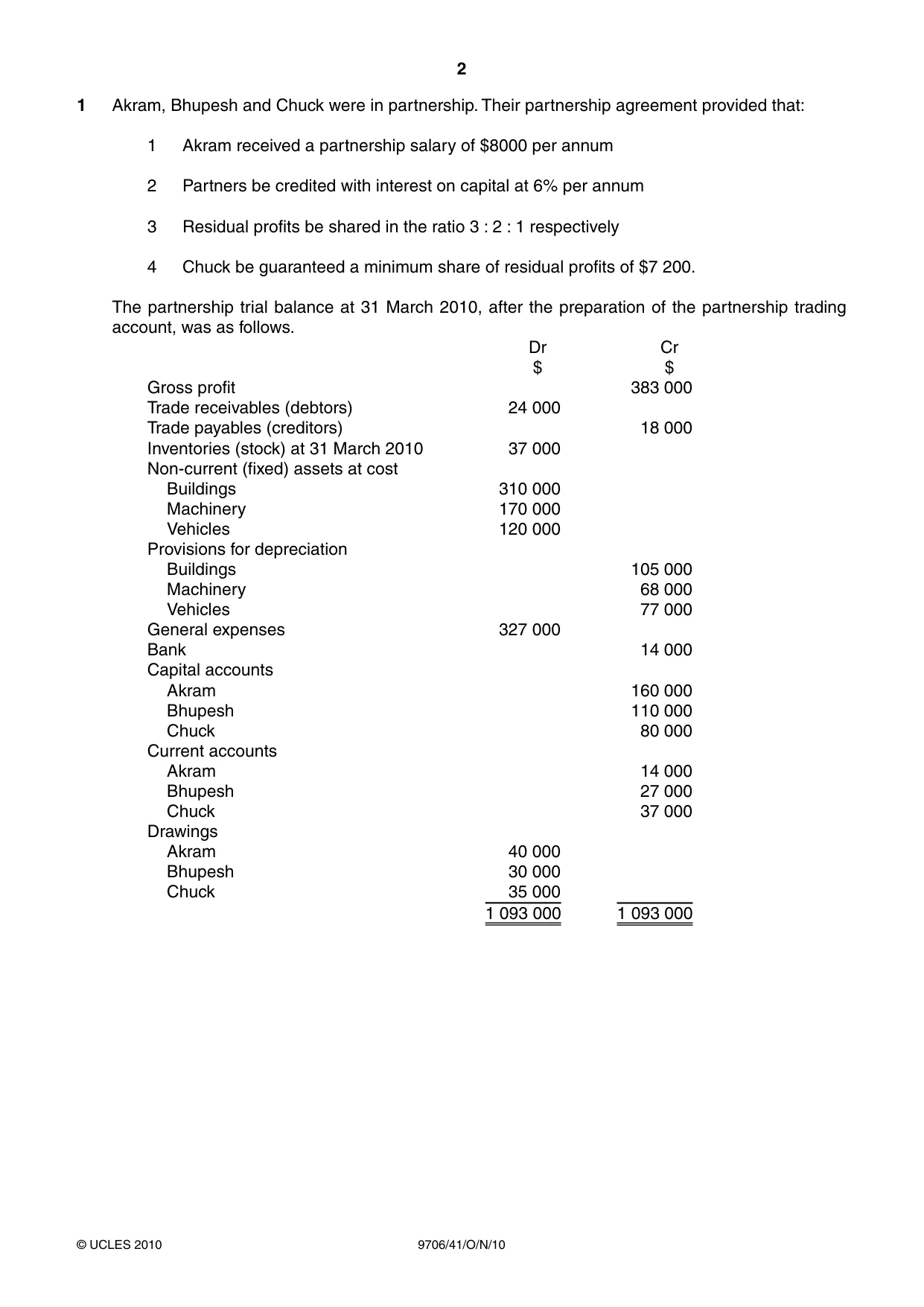
2 9706/41/O/N/10 © UCLES 2010 1 Akram, Bhupesh and Chuck were in partnership. Their partnership agreement provided that: 1 Akram received a partnership salary of $8000 per annum 2 Partners be credited with interest on capital at 6% per annum 3 Residual profits be shared in the ratio 3 : 2 : 1 respectively 4 Chuck be guaranteed a minimum share of residual profits of $7 200. The partnership trial balance at 31 March 2010, after the preparation of the partnership trading account, was as follows. Dr Cr $ $ Gross profit 383 000 Trade receivables (debtors) 24 000 Trade payables (creditors) 18 000 Inventories (stock) at 31 March 2010 37 000 Non-current (fixed) assets at cost Buildings 310 000 Machinery 170 000 Vehicles 120 000 Provisions for depreciation Buildings 105 000 Machinery 68 000 Vehicles 77 000 General expenses 327 000 Bank 14 000 Capital accounts Akram 160 000 Bhupesh 110 000 Chuck 80 000 Current accounts Akram 14 000 Bhupesh 27 000 Chuck 37 000 Drawings Akram 40 000 Bhupesh 30 000 Chuck 35 000 1 093 000 1 093 000
Question paper, page 3
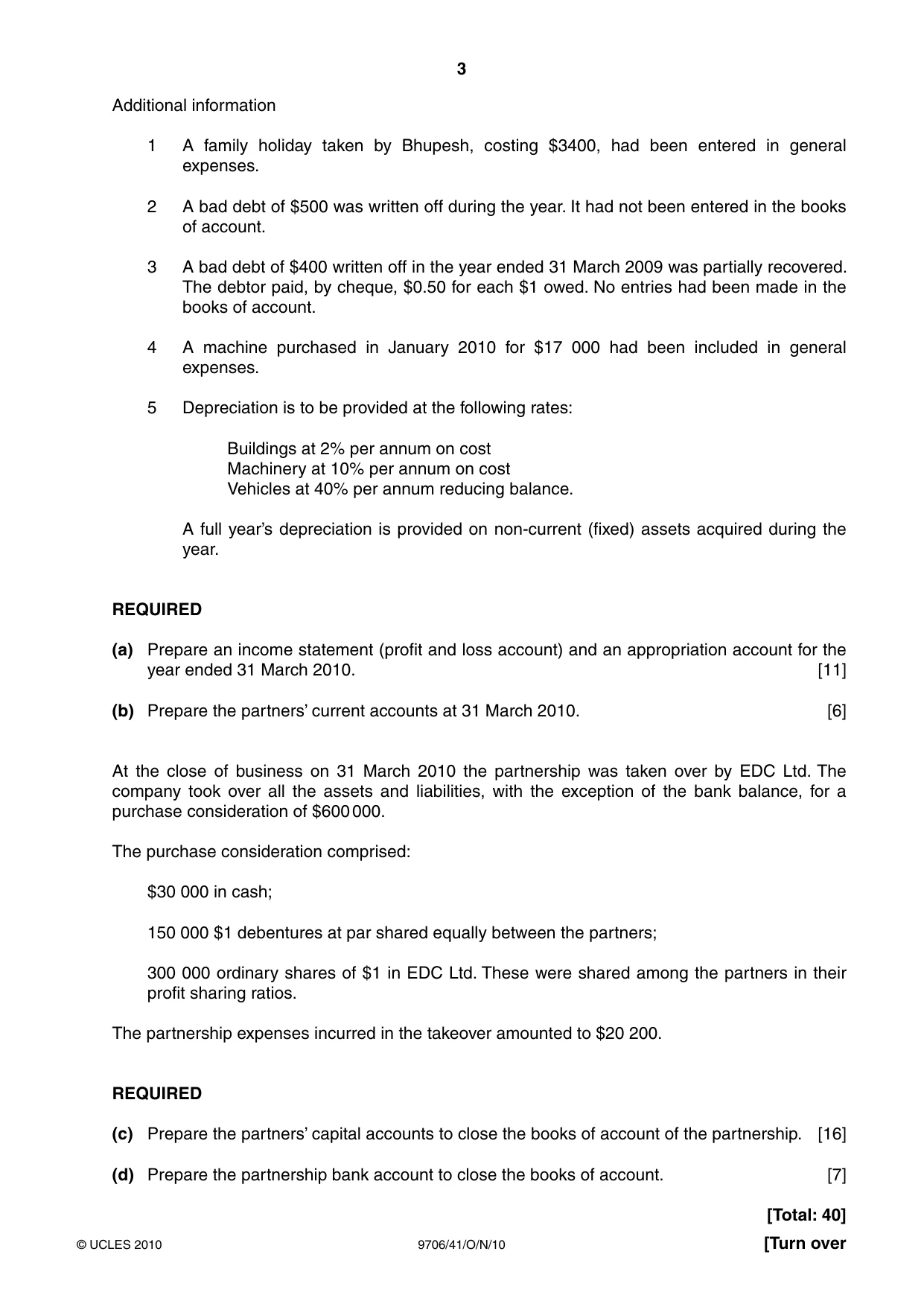
3 9706/41/O/N/10 © UCLES 2010 [Turn over Additional information 1 A family holiday taken by Bhupesh, costing $3400, had been entered in general expenses. 2 A bad debt of $500 was written off during the year. It had not been entered in the books of account. 3 A bad debt of $400 written off in the year ended 31 March 2009 was partially recovered. The debtor paid, by cheque, $0.50 for each $1 owed. No entries had been made in the books of account. 4 A machine purchased in January 2010 for $17 000 had been included in general expenses. 5 Depreciation is to be provided at the following rates: Buildings at 2% per annum on cost Machinery at 10% per annum on cost Vehicles at 40% per annum reducing balance. A full year’s depreciation is provided on non-current (fixed) assets acquired during the year. REQUIRED (a) Prepare an income statement (profit and loss account) and an appropriation account for the year ended 31 March 2010. [11] (b) Prepare the partners’ current accounts at 31 March 2010. [6] At the close of business on 31 March 2010 the partnership was taken over by EDC Ltd. The company took over all the assets and liabilities, with the exception of the bank balance, for a purchase consideration of $600 000. The purchase consideration comprised: $30 000 in cash; 150 000 $1 debentures at par shared equally between the partners; 300 000 ordinary shares of $1 in EDC Ltd. These were shared among the partners in their profit sharing ratios. The partnership expenses incurred in the takeover amounted to $20 200. REQUIRED (c) Prepare the partners’ capital accounts to close the books of account of the partnership. [16] (d) Prepare the partnership bank account to close the books of account. [7] [Total: 40]
Question paper, page 4
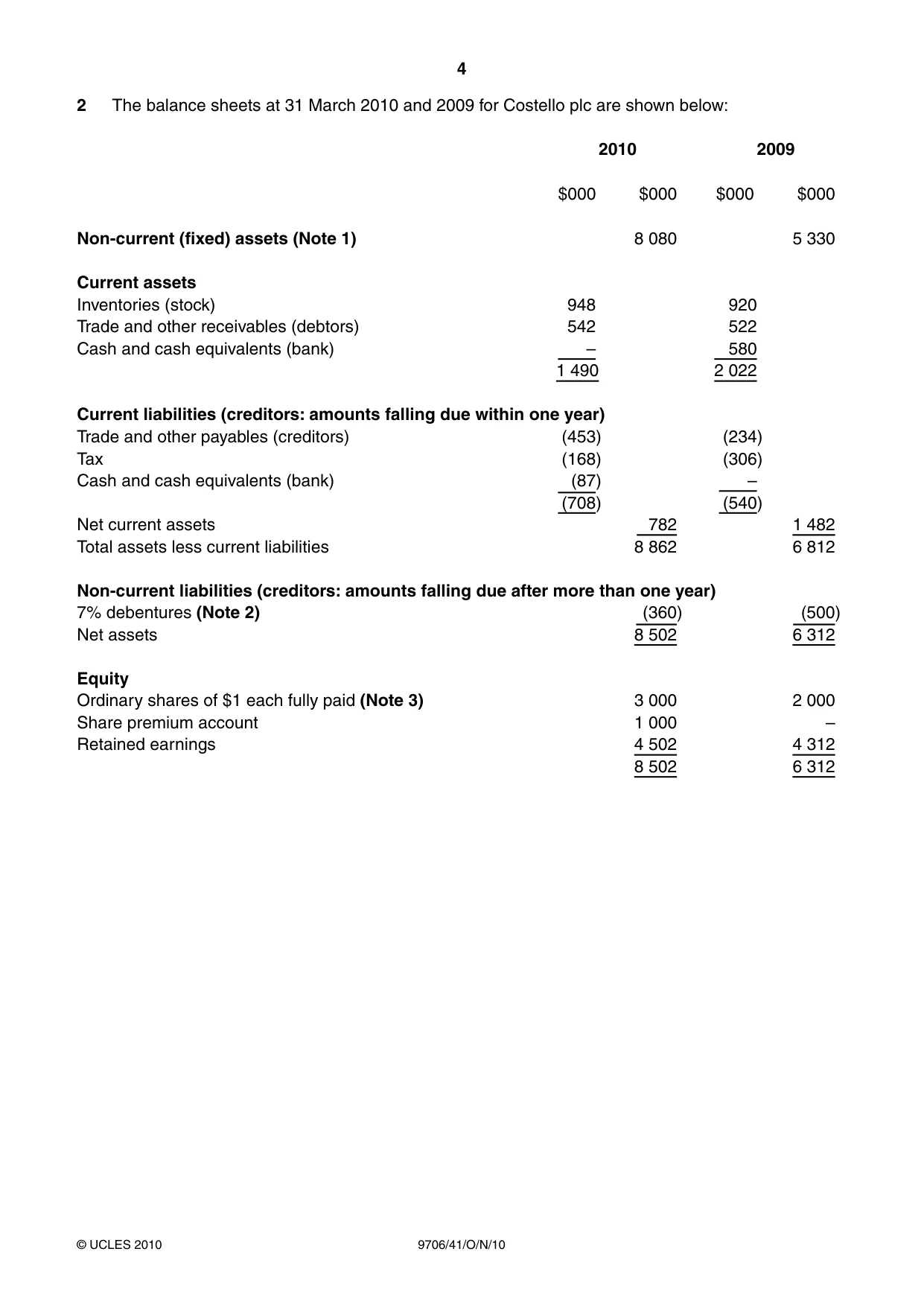
4 9706/41/O/N/10 © UCLES 2010 2 The balance sheets at 31 March 2010 and 2009 for Costello plc are shown below: 2010 2009 $000 $000 $000 $000 Non-current (fixed) assets (Note 1) 8 080 5 330 Current assets Inventories (stock) 948 920 Trade and other receivables (debtors) 542 522 Cash and cash equivalents (bank) – 580 1 490 2 022 Current liabilities (creditors: amounts falling due within one year) Trade and other payables (creditors) (453) (234) Tax (168) (306) Cash and cash equivalents (bank) (87) – (708) (540) Net current assets 782 1 482 Total assets less current liabilities 8 862 6 812 Non-current liabilities (creditors: amounts falling due after more than one year) 7% debentures (Note 2) (360) (500) Net assets 8 502 6 312 Equity Ordinary shares of $1 each fully paid (Note 3) 3 000 2 000 Share premium account 1 000 – Retained earnings 4 502 4 312 8 502 6 312
Question paper, page 5
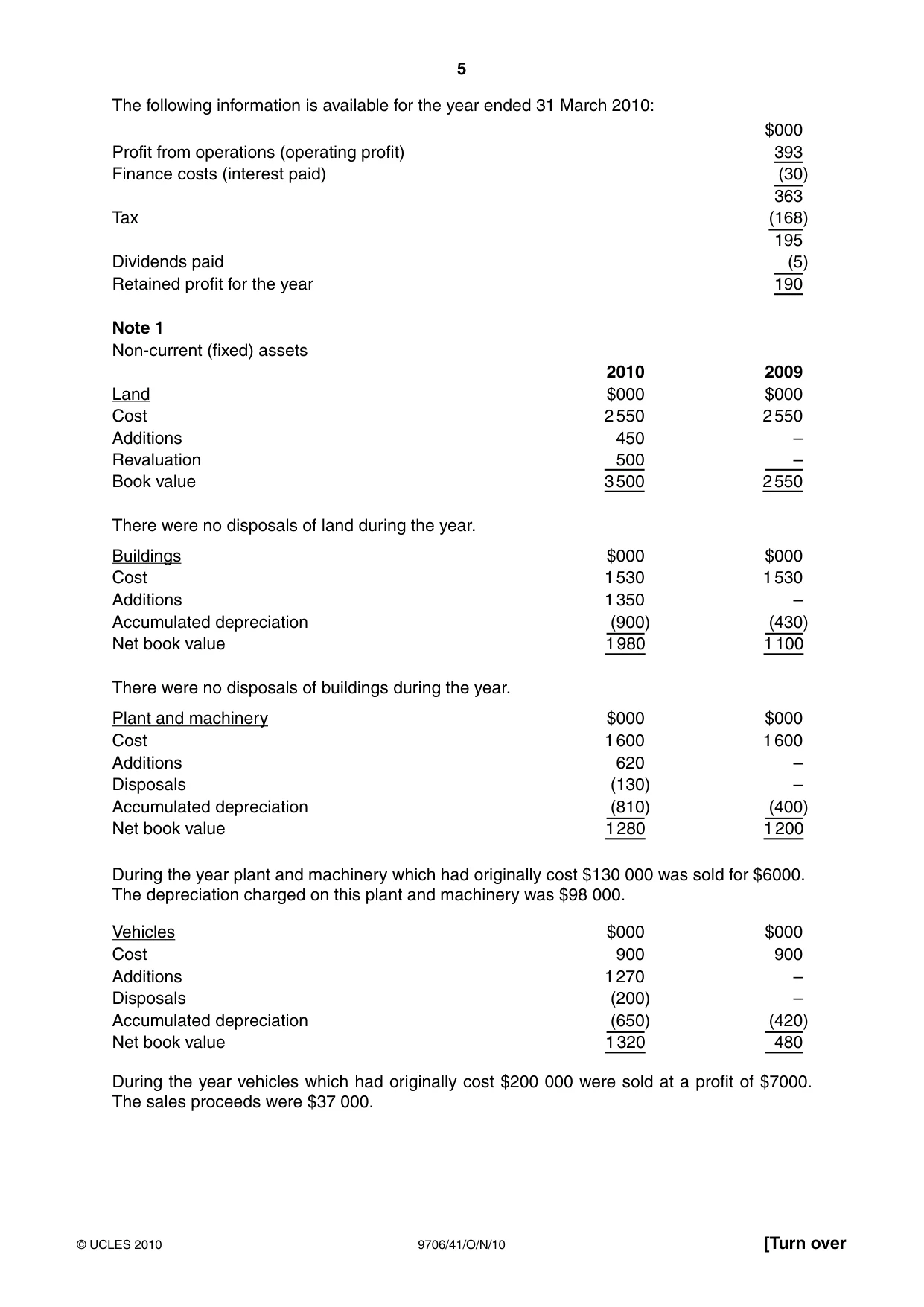
5 9706/41/O/N/10 © UCLES 2010 [Turn over The following information is available for the year ended 31 March 2010: $000 Profit from operations (operating profit) 393 Finance costs (interest paid) (30) 363 Tax (168) 195 Dividends paid (5) Retained profit for the year 190 Note 1 Non-current (fixed) assets 2010 2009 Land $000 $000 Cost 2 550 2 550 Additions 450 – Revaluation 500 – Book value 3 500 2 550 There were no disposals of land during the year. Buildings $000 $000 Cost 1 530 1 530 Additions 1 350 – Accumulated depreciation (900) (430) Net book value 1 980 1 100 There were no disposals of buildings during the year. Plant and machinery $000 $000 Cost 1 600 1 600 Additions 620 – Disposals (130) – Accumulated depreciation (810) (400) Net book value 1 280 1 200 During the year plant and machinery which had originally cost $130 000 was sold for $6000. The depreciation charged on this plant and machinery was $98 000. Vehicles $000 $000 Cost 900 900 Additions 1 270 – Disposals (200) – Accumulated depreciation (650) (420) Net book value 1 320 480 During the year vehicles which had originally cost $200 000 were sold at a profit of $7000. The sales proceeds were $37 000.
Question paper, page 6
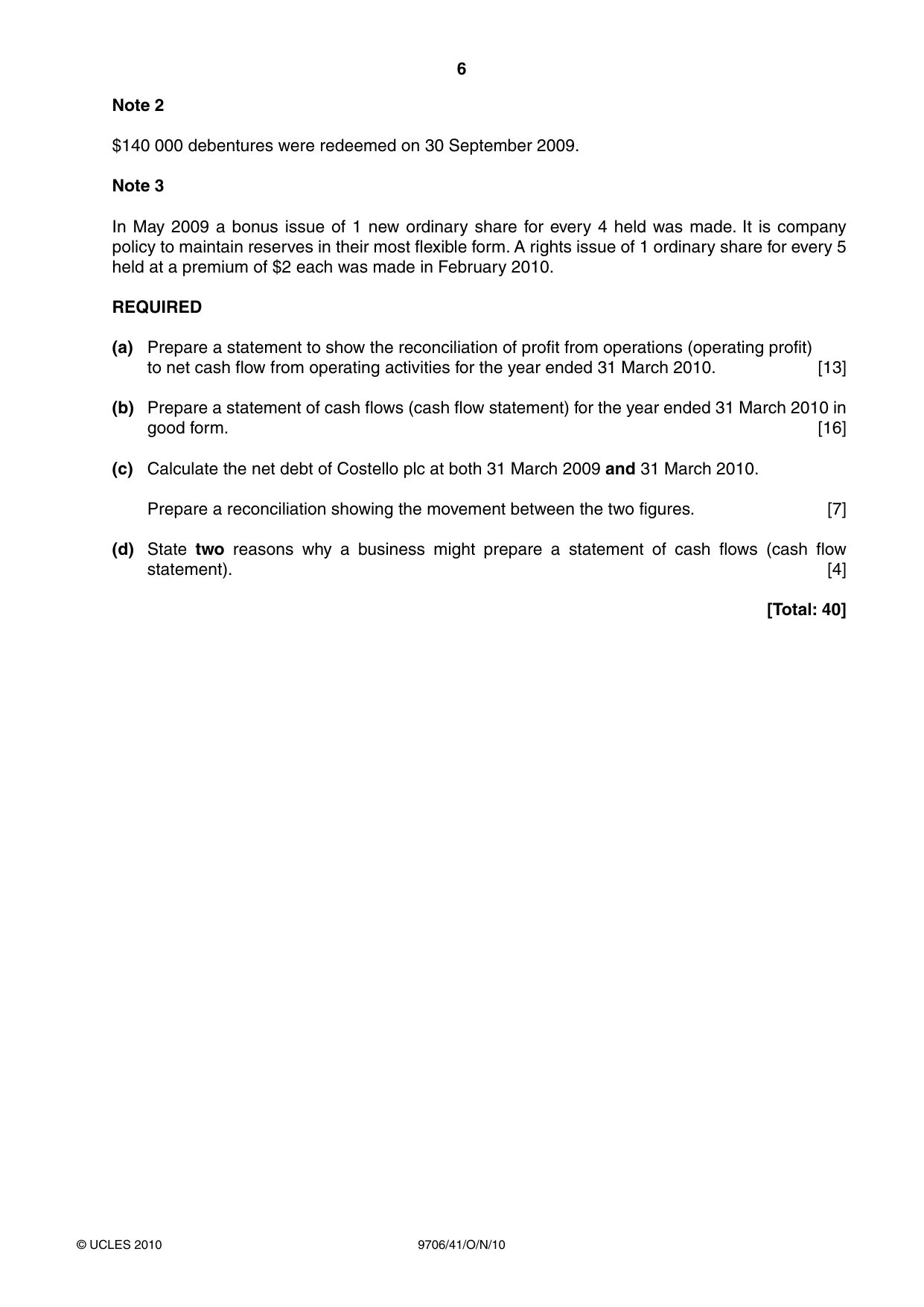
6 9706/41/O/N/10 © UCLES 2010 Note 2 $140 000 debentures were redeemed on 30 September 2009. Note 3 In May 2009 a bonus issue of 1 new ordinary share for every 4 held was made. It is company policy to maintain reserves in their most flexible form. A rights issue of 1 ordinary share for every 5 held at a premium of $2 each was made in February 2010. REQUIRED (a) Prepare a statement to show the reconciliation of profit from operations (operating profit) to net cash flow from operating activities for the year ended 31 March 2010. [13] (b) Prepare a statement of cash flows (cash flow statement) for the year ended 31 March 2010 in good form. [16] (c) Calculate the net debt of Costello plc at both 31 March 2009 and 31 March 2010. Prepare a reconciliation showing the movement between the two figures. [7] (d) State two reasons why a business might prepare a statement of cash flows (cash flow statement). [4] [Total: 40]
Question paper, page 7
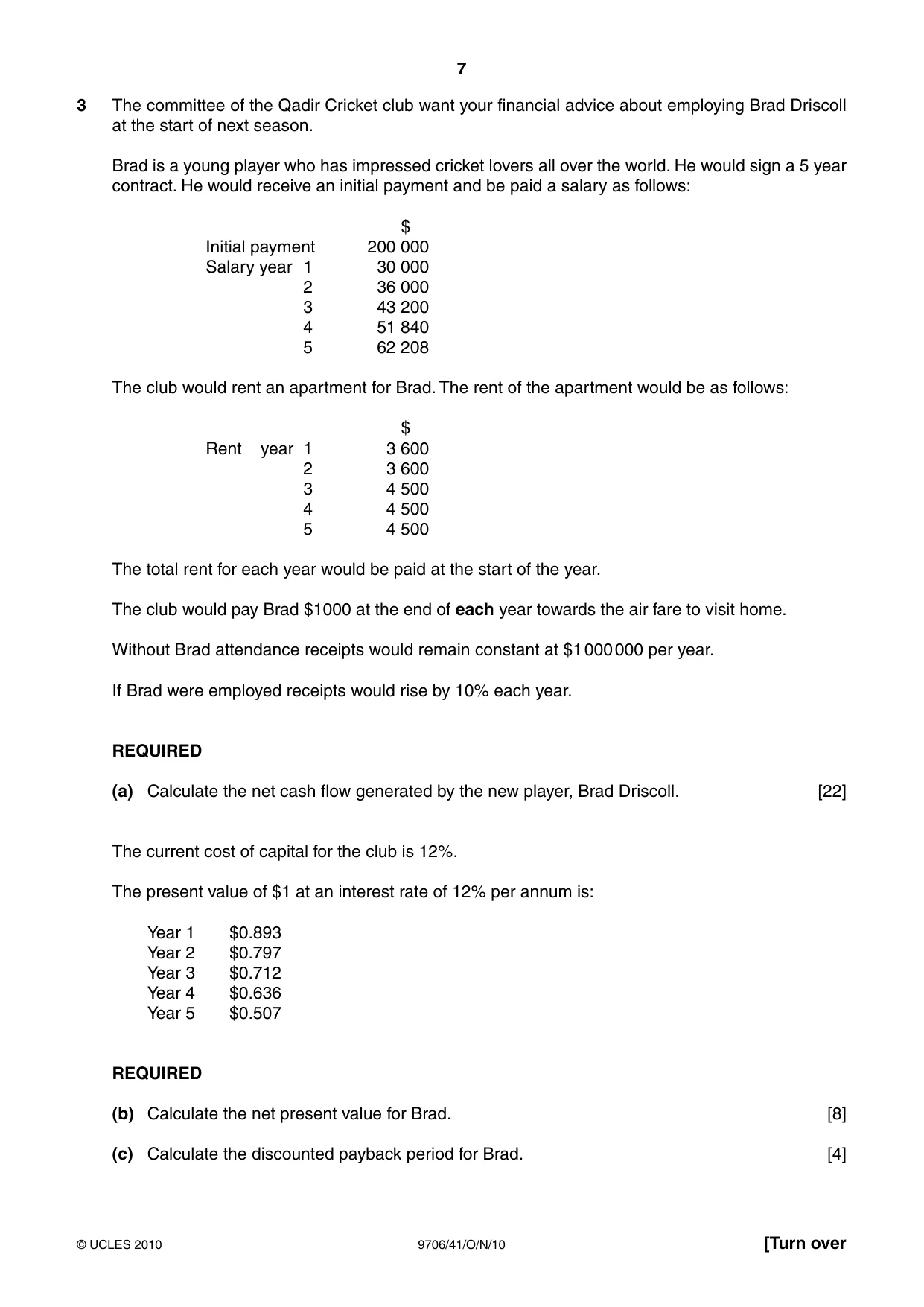
7 9706/41/O/N/10 © UCLES 2010 [Turn over 3 The committee of the Qadir Cricket club want your financial advice about employing Brad Driscoll at the start of next season. Brad is a young player who has impressed cricket lovers all over the world. He would sign a 5 year contract. He would receive an initial payment and be paid a salary as follows: $ Initial payment 200 000 Salary year 1 30 000 2 36 000 3 43 200 4 51 840 5 62 208 The club would rent an apartment for Brad. The rent of the apartment would be as follows: $ Rent year 1 3 600 2 3 600 3 4 500 4 4 500 5 4 500 The total rent for each year would be paid at the start of the year. The club would pay Brad $1000 at the end of each year towards the air fare to visit home. Without Brad attendance receipts would remain constant at $1 000 000 per year. If Brad were employed receipts would rise by 10% each year. REQUIRED (a) Calculate the net cash flow generated by the new player, Brad Driscoll. [22] The current cost of capital for the club is 12%. The present value of $1 at an interest rate of 12% per annum is: Year 1 $0.893 Year 2 $0.797 Year 3 $0.712 Year 4 $0.636 Year 5 $0.507 REQUIRED (b) Calculate the net present value for Brad. [8] (c) Calculate the discounted payback period for Brad. [4]
Question paper, page 8
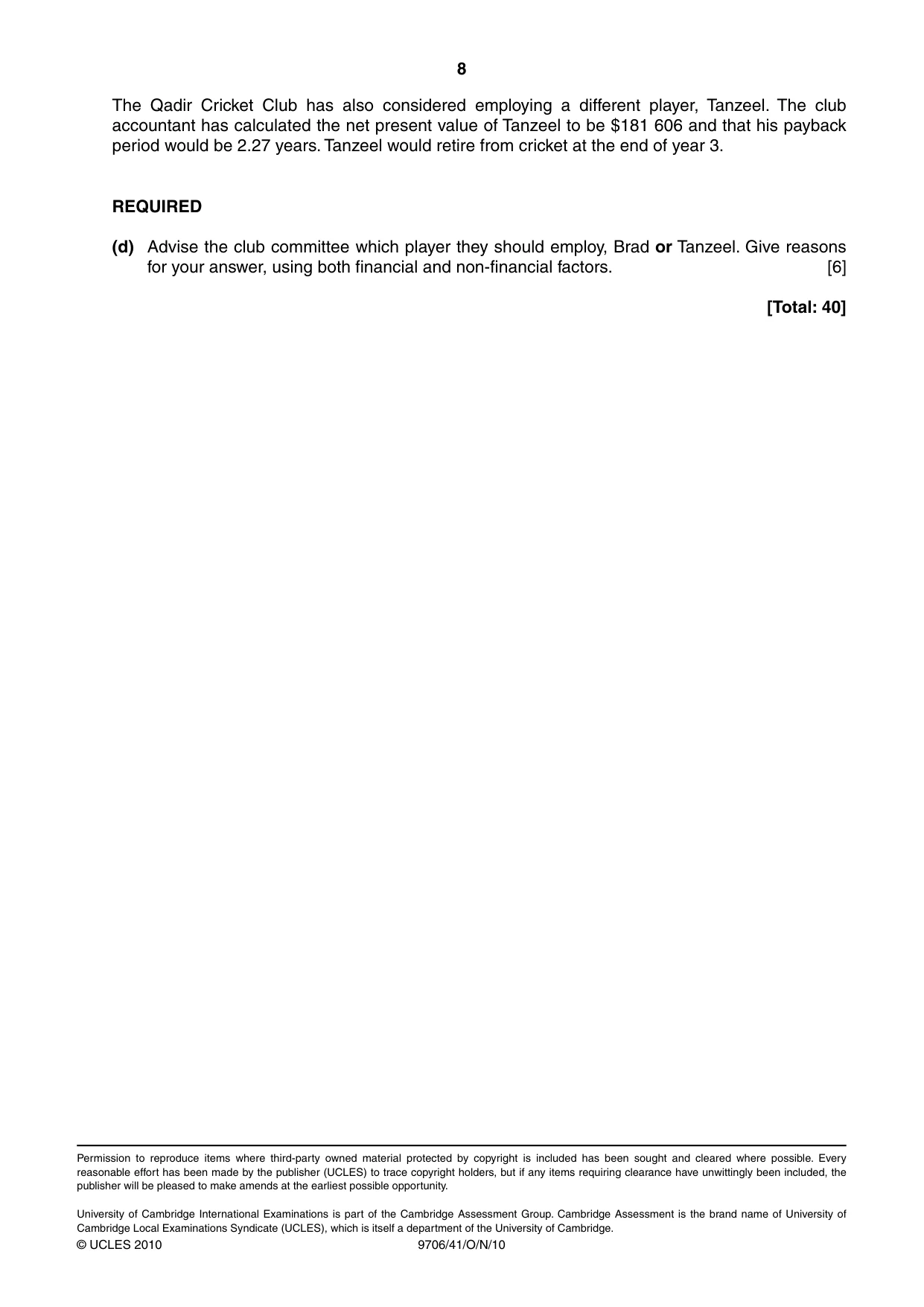
8 9706/41/O/N/10 © UCLES 2010 Permission to reproduce items where third-party owned material protected by copyright is included has been sought and cleared where possible. Every reasonable effort has been made by the publisher (UCLES) to trace copyright holders, but if any items requiring clearance have unwittingly been included, the publisher will be pleased to make amends at the earliest possible opportunity. University of Cambridge International Examinations is part of the Cambridge Assessment Group. Cambridge Assessment is the brand name of University of Cambridge Local Examinations Syndicate (UCLES), which is itself a department of the University of Cambridge. The Qadir Cricket Club has also considered employing a different player, Tanzeel. The club accountant has calculated the net present value of Tanzeel to be $181 606 and that his payback period would be 2.27 years. Tanzeel would retire from cricket at the end of year 3. REQUIRED (d) Advise the club committee which player they should employ, Brad or Tanzeel. Give reasons for your answer, using both financial and non-financial factors. [6] [Total: 40]
Mark scheme, page 1
UNIVERSITY OF CAMBRIDGE INTERNATIONAL EXAMINATIONS GCE Advanced Subsidiary Level and GCE Advanced Level MARK SCHEME for the October/November 2010 question paper for the guidance of teachers 9706 ACCOUNTING 9706/41 Paper 4 (Problem Solving (Supplement)), maximum raw mark 120 This mark scheme is published as an aid to teachers and candidates, to indicate the requirements of the examination. It shows the basis on which Examiners were instructed to award marks. It does not indicate the details of the discussions that took place at an Examiners’ meeting before marking began, which would have considered the acceptability of alternative answers. Mark schemes must be read in conjunction with the question papers and the report on the examination. • CIE will not enter into discussions or correspondence in connection with these mark schemes. CIE is publishing the mark schemes for the October/November 2010 question papers for most IGCSE, GCE Advanced Level and Advanced Subsidiary Level syllabuses and some Ordinary Level syllabuses.
Mark scheme, page 2
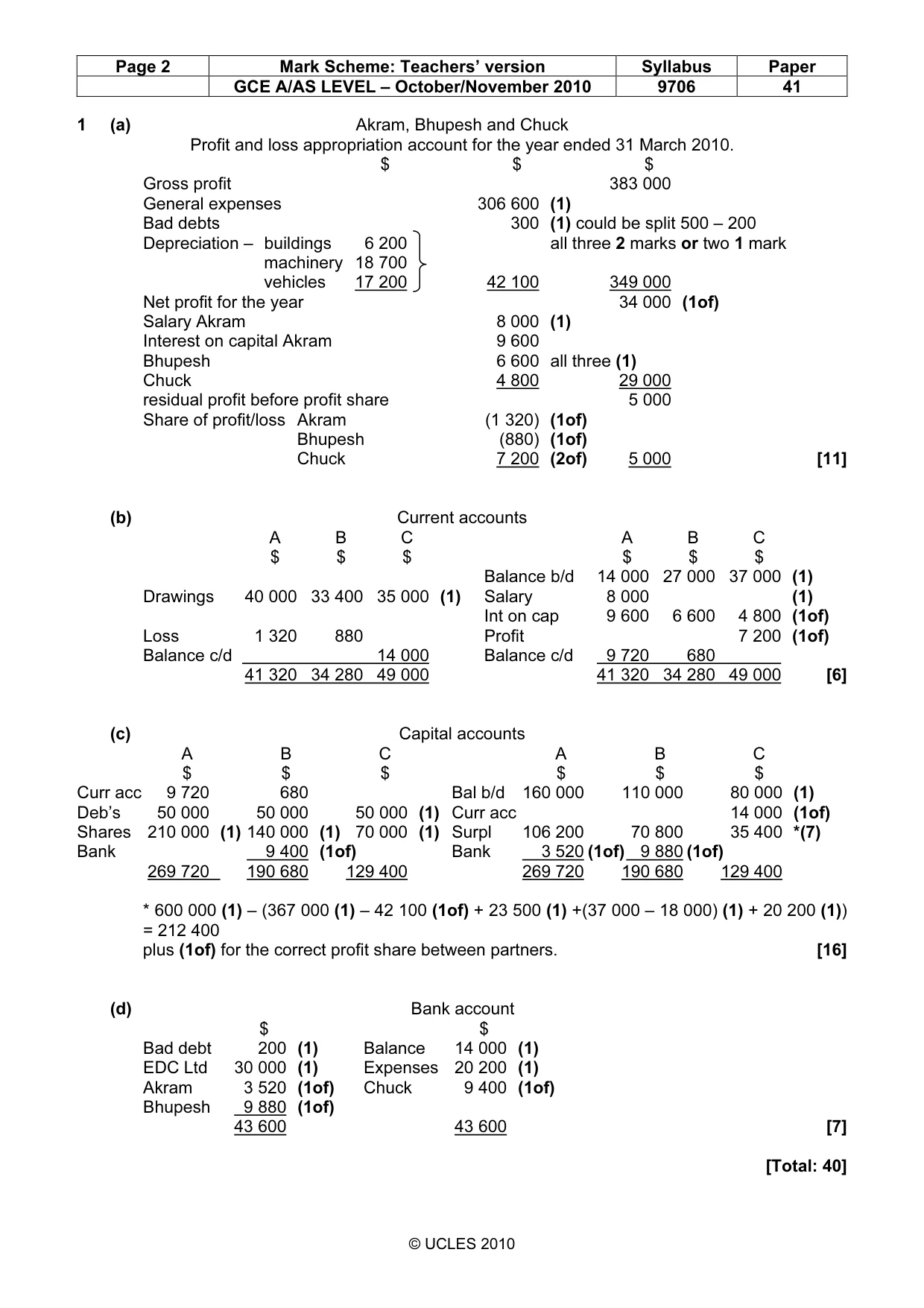
Page 2 Mark Scheme: Teachers’ version Syllabus Paper GCE A/AS LEVEL – October/November 2010 9706 41 © UCLES 2010 1 (a) Akram, Bhupesh and Chuck Profit and loss appropriation account for the year ended 31 March 2010. $ $ $ Gross profit 383 000 General expenses 306 600 (1) Bad debts 300 (1) could be split 500 – 200 Depreciation – buildings 6 200 all three 2 marks or two 1 mark machinery 18 700 vehicles 17 200 42 100 349 000 Net profit for the year 34 000 (1of) Salary Akram 8 000 (1) Interest on capital Akram 9 600 Bhupesh 6 600 all three (1) Chuck 4 800 29 000 residual profit before profit share 5 000 Share of profit/loss Akram (1 320) (1of) Bhupesh (880) (1of) Chuck 7 200 (2of) 5 000 [11] (b) Current accounts A B C A B C $ $ $ $ $ $ Balance b/d 14 000 27 000 37 000 (1) Drawings 40 000 33 400 35 000 (1) Salary 8 000 (1) Int on cap 9 600 6 600 4 800 (1of) Loss 1 320 880 Profit 7 200 (1of) Balance c/d 14 000 Balance c/d 9 720 680 41 320 34 280 49 000 41 320 34 280 49 000 [6] (c) Capital accounts A B C A B C $ $ $ $ $ $ Curr acc 9 720 680 Bal b/d 160 000 110 000 80 000 (1) Deb’s 50 000 50 000 50 000 (1) Curr acc 14 000 (1of) Shares 210 000 (1) 140 000 (1) 70 000 (1) Surpl 106 200 70 800 35 400 *(7) Bank 9 400 (1of) Bank 3 520 (1of) 9 880 (1of) 269 720 190 680 129 400 269 720 190 680 129 400 * 600 000 (1) – (367 000 (1) – 42 100 (1of) + 23 500 (1) +(37 000 – 18 000) (1) + 20 200 (1)) = 212 400 plus (1of) for the correct profit share between partners. [16] (d) Bank account $ $ Bad debt 200 (1) Balance 14 000 (1) EDC Ltd 30 000 (1) Expenses 20 200 (1) Akram 3 520 (1of) Chuck 9 400 (1of) Bhupesh 9 880 (1of) 43 600 43 600 [7] [Total: 40]
Mark scheme, page 3
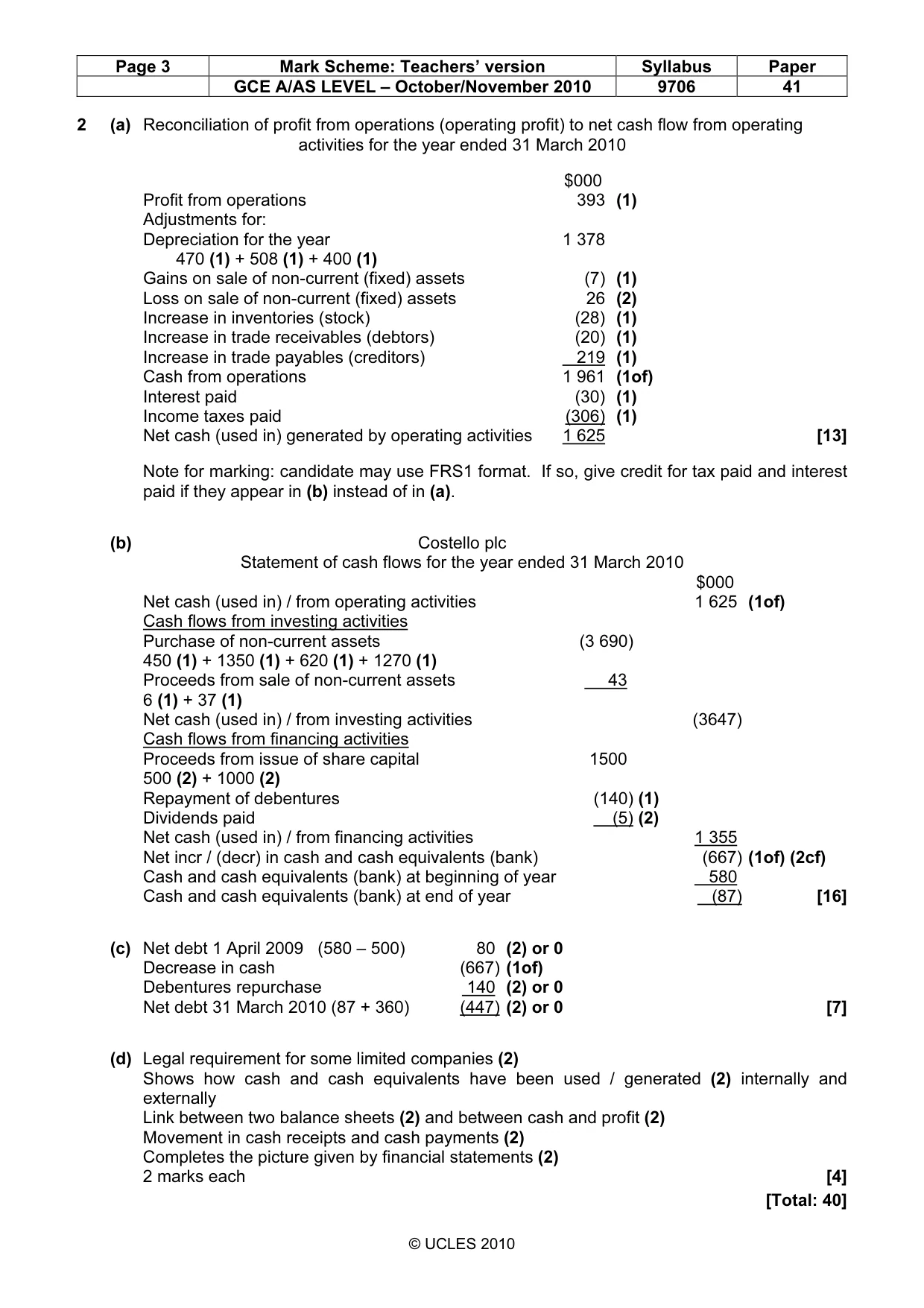
Page 3 Mark Scheme: Teachers’ version Syllabus Paper GCE A/AS LEVEL – October/November 2010 9706 41 © UCLES 2010 2 (a) Reconciliation of profit from operations (operating profit) to net cash flow from operating activities for the year ended 31 March 2010 $000 Profit from operations 393 (1) Adjustments for: Depreciation for the year 1 378 470 (1) + 508 (1) + 400 (1) Gains on sale of non-current (fixed) assets (7) (1) Loss on sale of non-current (fixed) assets 26 (2) Increase in inventories (stock) (28) (1) Increase in trade receivables (debtors) (20) (1) Increase in trade payables (creditors) 219 (1) Cash from operations 1 961 (1of) Interest paid (30) (1) Income taxes paid (306) (1) Net cash (used in) generated by operating activities 1 625 [13] Note for marking: candidate may use FRS1 format. If so, give credit for tax paid and interest paid if they appear in (b) instead of in (a). (b) Costello plc Statement of cash flows for the year ended 31 March 2010 $000 Net cash (used in) / from operating activities 1 625 (1of) Cash flows from investing activities Purchase of non-current assets (3 690) 450 (1) + 1350 (1) + 620 (1) + 1270 (1) Proceeds from sale of non-current assets 43 6 (1) + 37 (1) Net cash (used in) / from investing activities (3647) Cash flows from financing activities Proceeds from issue of share capital 1500 500 (2) + 1000 (2) Repayment of debentures (140) (1) Dividends paid (5) (2) Net cash (used in) / from financing activities 1 355 Net incr / (decr) in cash and cash equivalents (bank) (667) (1of) (2cf) Cash and cash equivalents (bank) at beginning of year 580 Cash and cash equivalents (bank) at end of year (87) [16] (c) Net debt 1 April 2009 (580 – 500) 80 (2) or 0 Decrease in cash (667) (1of) Debentures repurchase 140 (2) or 0 Net debt 31 March 2010 (87 + 360) (447) (2) or 0 [7] (d) Legal requirement for some limited companies (2) Shows how cash and cash equivalents have been used / generated (2) internally and externally Link between two balance sheets (2) and between cash and profit (2) Movement in cash receipts and cash payments (2) Completes the picture given by financial statements (2) 2 marks each [4] [Total: 40]
Mark scheme, page 4
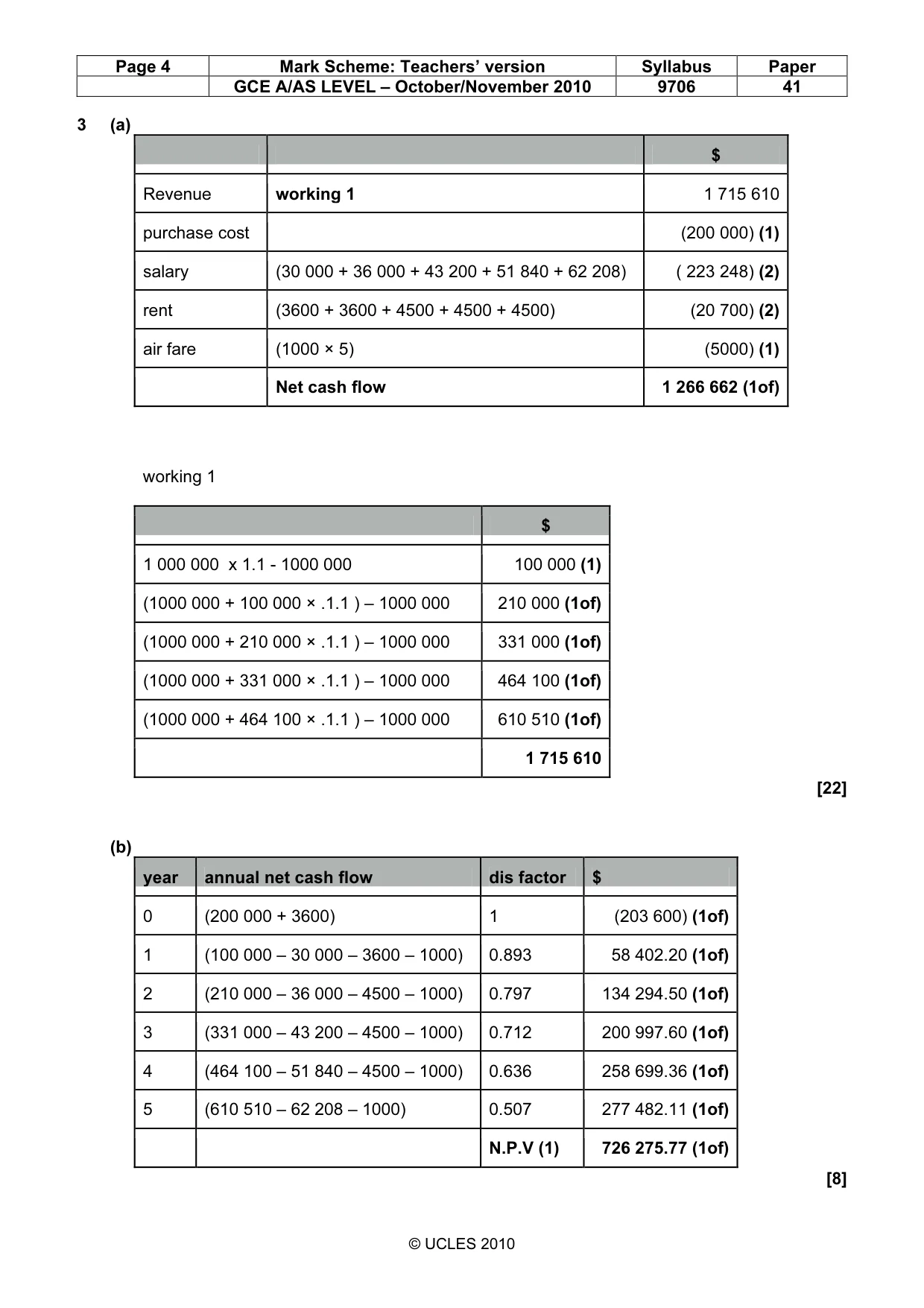
Page 4 Mark Scheme: Teachers’ version Syllabus Paper GCE A/AS LEVEL – October/November 2010 9706 41 © UCLES 2010 3 (a) $ Revenue working 1 1 715 610 purchase cost (200 000) (1) salary (30 000 + 36 000 + 43 200 + 51 840 + 62 208) ( 223 248) (2) rent (3600 + 3600 + 4500 + 4500 + 4500) (20 700) (2) air fare (1000 × 5) (5000) (1) Net cash flow 1 266 662 (1of) working 1 $ 1 000 000 x 1.1 - 1000 000 100 000 (1) (1000 000 + 100 000 × .1.1 ) – 1000 000 210 000 (1of) (1000 000 + 210 000 × .1.1 ) – 1000 000 331 000 (1of) (1000 000 + 331 000 × .1.1 ) – 1000 000 464 100 (1of) (1000 000 + 464 100 × .1.1 ) – 1000 000 610 510 (1of) 1 715 610 [22] (b) year annual net cash flow dis factor $ 0 (200 000 + 3600) 1 (203 600) (1of) 1 (100 000 – 30 000 – 3600 – 1000) 0.893 58 402.20 (1of) 2 (210 000 – 36 000 – 4500 – 1000) 0.797 134 294.50 (1of) 3 (331 000 – 43 200 – 4500 – 1000) 0.712 200 997.60 (1of) 4 (464 100 – 51 840 – 4500 – 1000) 0.636 258 699.36 (1of) 5 (610 510 – 62 208 – 1000) 0.507 277 482.11 (1of) N.P.V (1) 726 275.77 (1of) [8]
Mark scheme, page 5
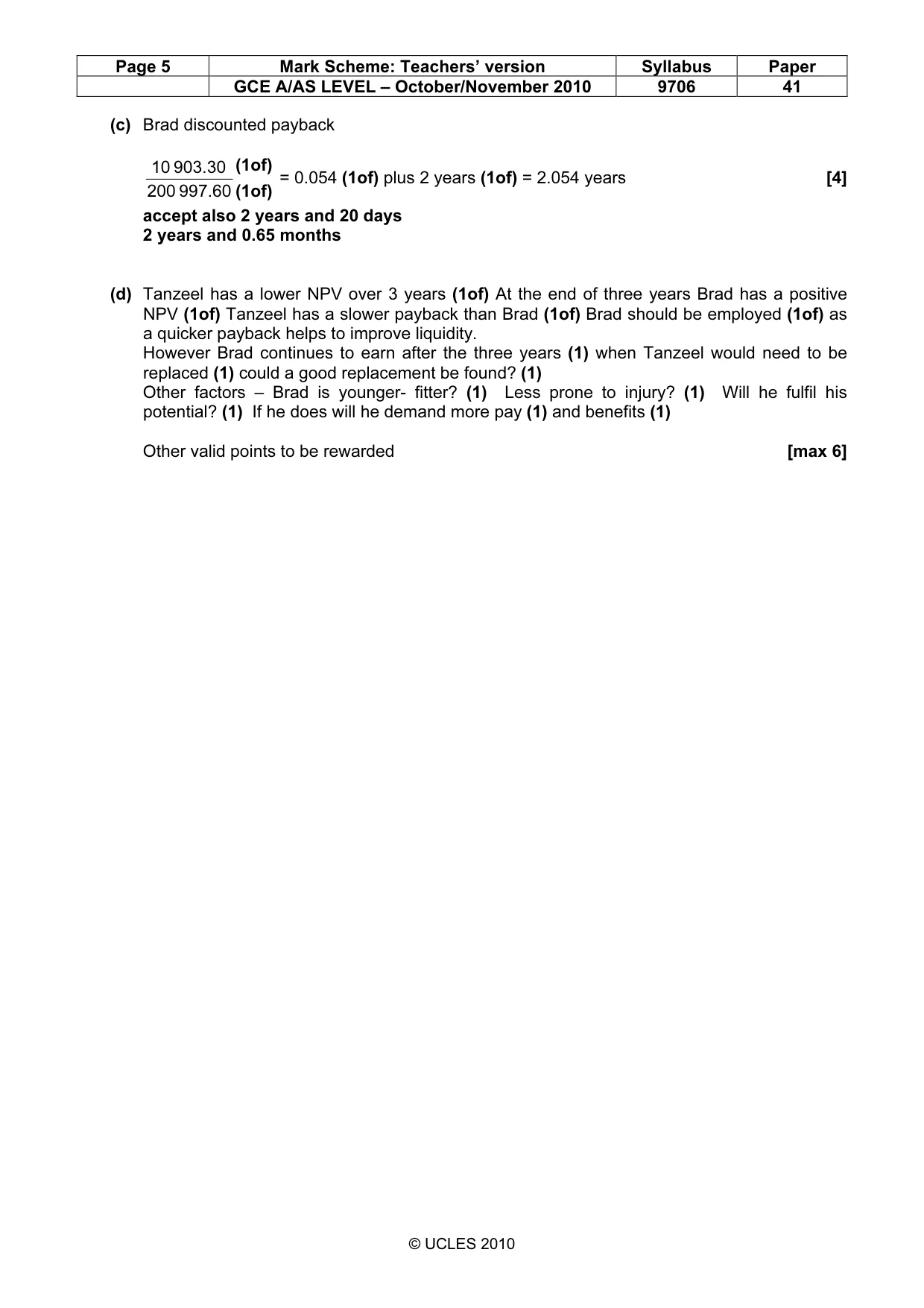
Page 5 Mark Scheme: Teachers’ version Syllabus Paper GCE A/AS LEVEL – October/November 2010 9706 41 © UCLES 2010 (c) Brad discounted payback (1of) (1of) 997.60 200 903.30 10 = 0.054 (1of) plus 2 years (1of) = 2.054 years [4] accept also 2 years and 20 days 2 years and 0.65 months (d) Tanzeel has a lower NPV over 3 years (1of) At the end of three years Brad has a positive NPV (1of) Tanzeel has a slower payback than Brad (1of) Brad should be employed (1of) as a quicker payback helps to improve liquidity. However Brad continues to earn after the three years (1) when Tanzeel would need to be replaced (1) could a good replacement be found? (1) Other factors – Brad is younger- fitter? (1) Less prone to injury? (1) Will he fulfil his potential? (1) If he does will he demand more pay (1) and benefits (1) Other valid points to be rewarded [max 6]
What you needed in this session
Cambridge’s own grade thresholds for 2010 Oct/Nov, Paper 4 · Variant 1. A higher threshold means an easier paper — the bar moves with how the cohort did.