Cambridge A Level Accounting 9706 — 2010 May/June Paper 4 · Variant 3
9706/43/M/J/10 · 120 marks · ≈135 min
The question paper and its mark scheme, free to read here and free to download. This is Cambridge’s own paper, exactly as it was sat.
Question paper8 pages
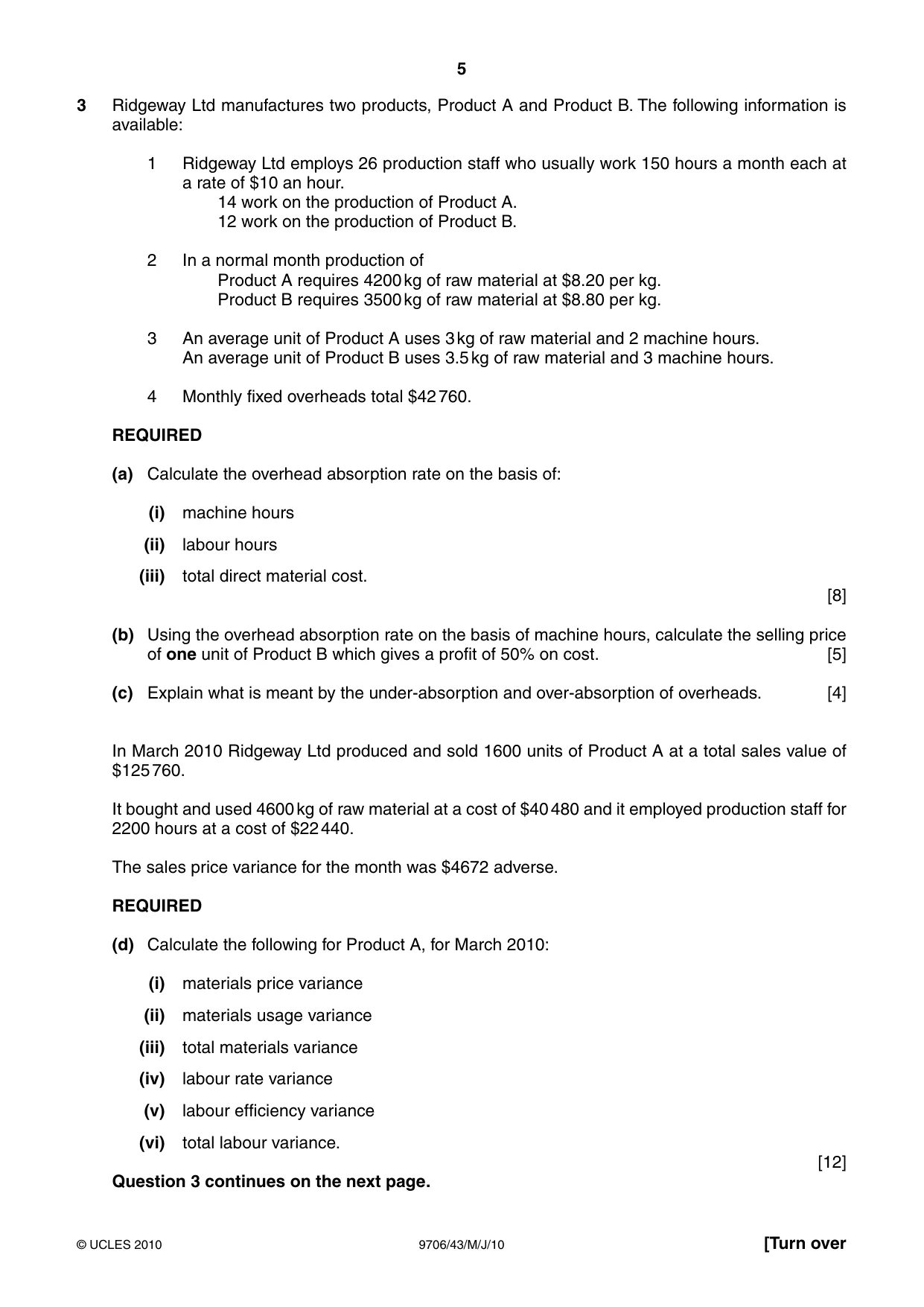
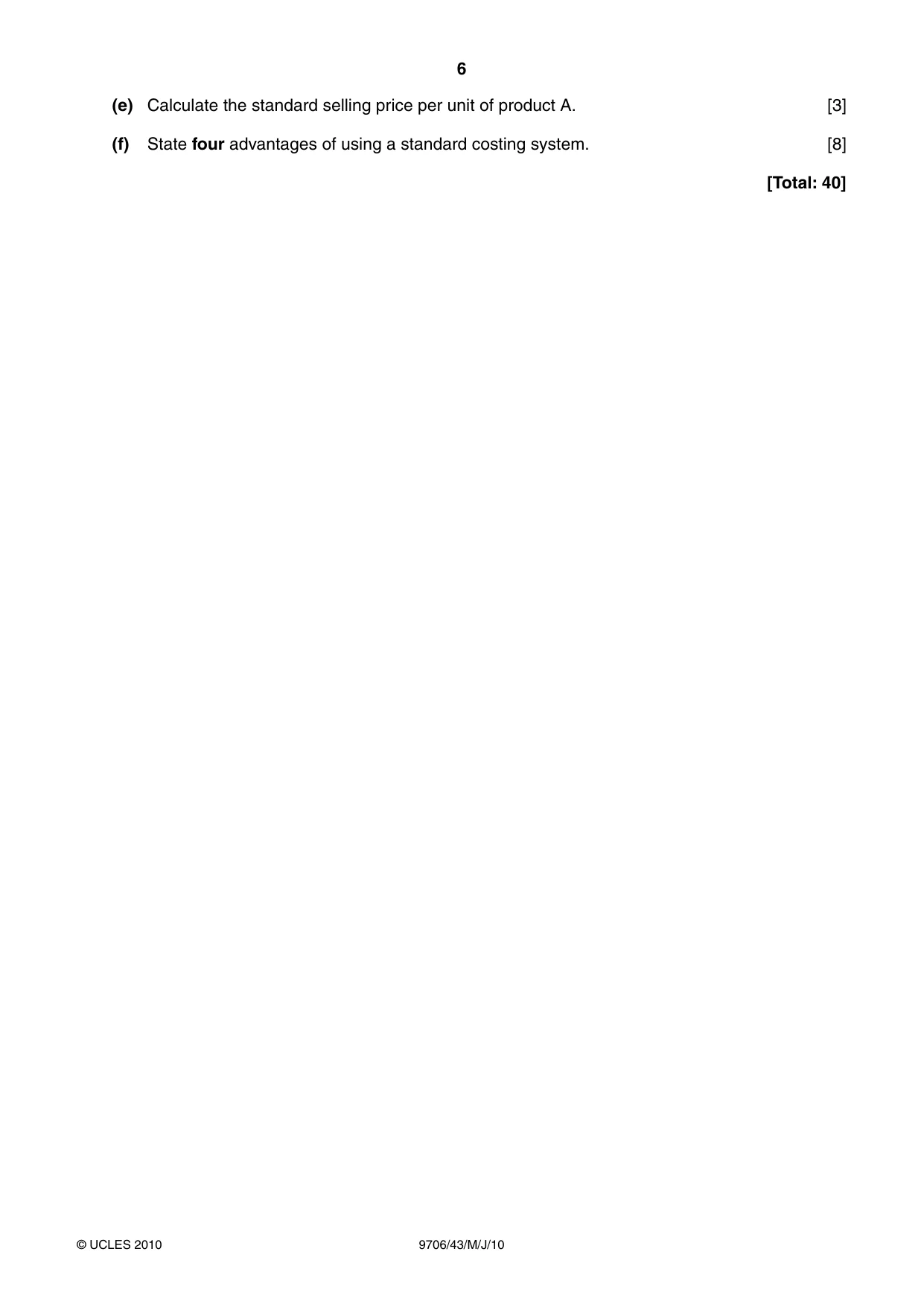


Mark scheme6 pages
Answers below. Sit the paper first if you are practising.
Paper as text
Question paper, page 1
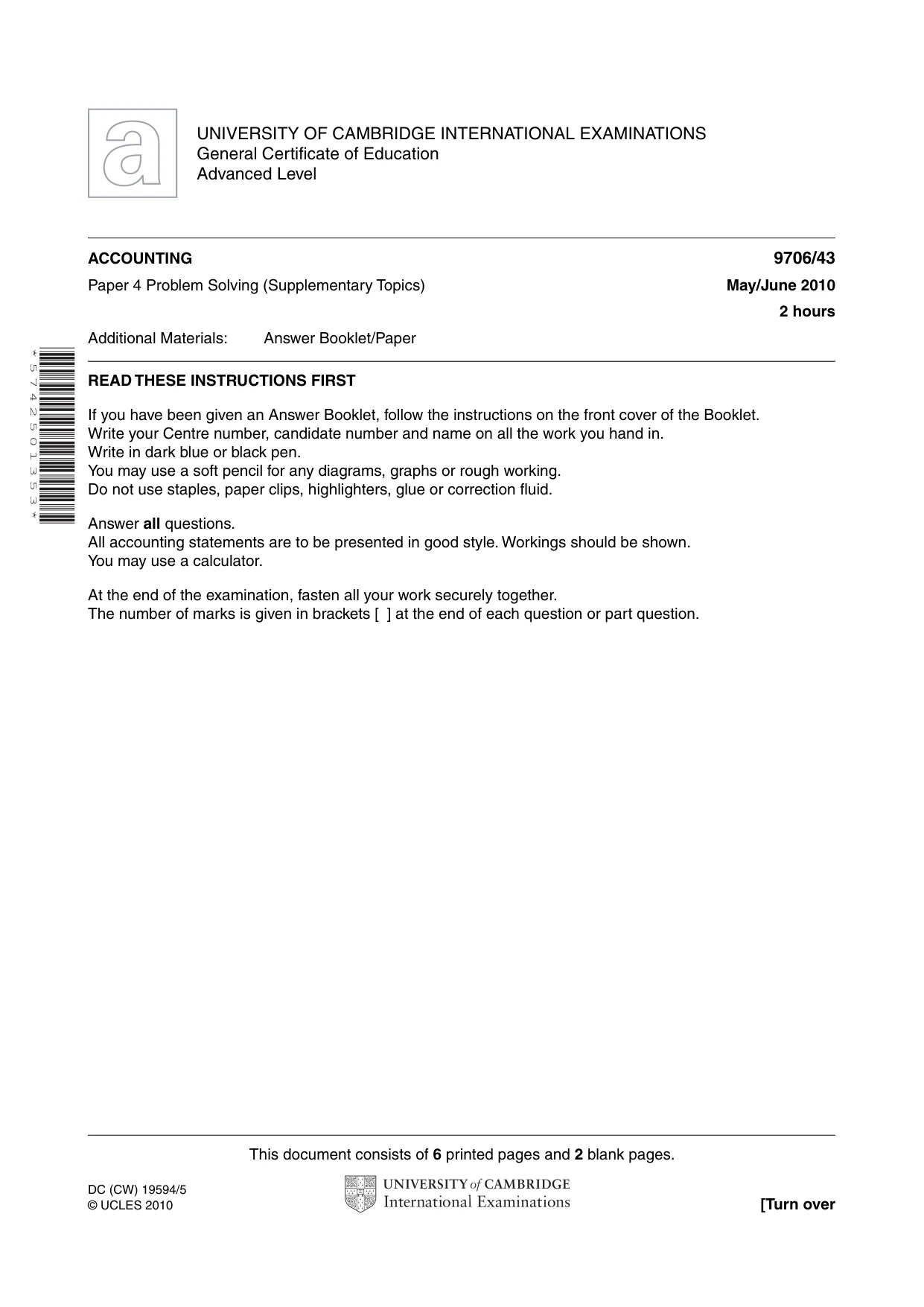
This document consists of 6 printed pages and 2 blank pages. DC (CW) 19594/5 © UCLES 2010 [Turn over UNIVERSITY OF CAMBRIDGE INTERNATIONAL EXAMINATIONS General Certificate of Education Advanced Level * 5 7 4 2 5 0 1 3 5 3 * ACCOUNTING 9706/43 Paper 4 Problem Solving (Supplementary Topics) May/June 2010 2 hours Additional Materials: Answer Booklet/Paper READ THESE INSTRUCTIONS FIRST If you have been given an Answer Booklet, follow the instructions on the front cover of the Booklet. Write your Centre number, candidate number and name on all the work you hand in. Write in dark blue or black pen. You may use a soft pencil for any diagrams, graphs or rough working. Do not use staples, paper clips, highlighters, glue or correction fluid. Answer all questions. All accounting statements are to be presented in good style. Workings should be shown. You may use a calculator. At the end of the examination, fasten all your work securely together. The number of marks is given in brackets [ ] at the end of each question or part question.
Question paper, page 2
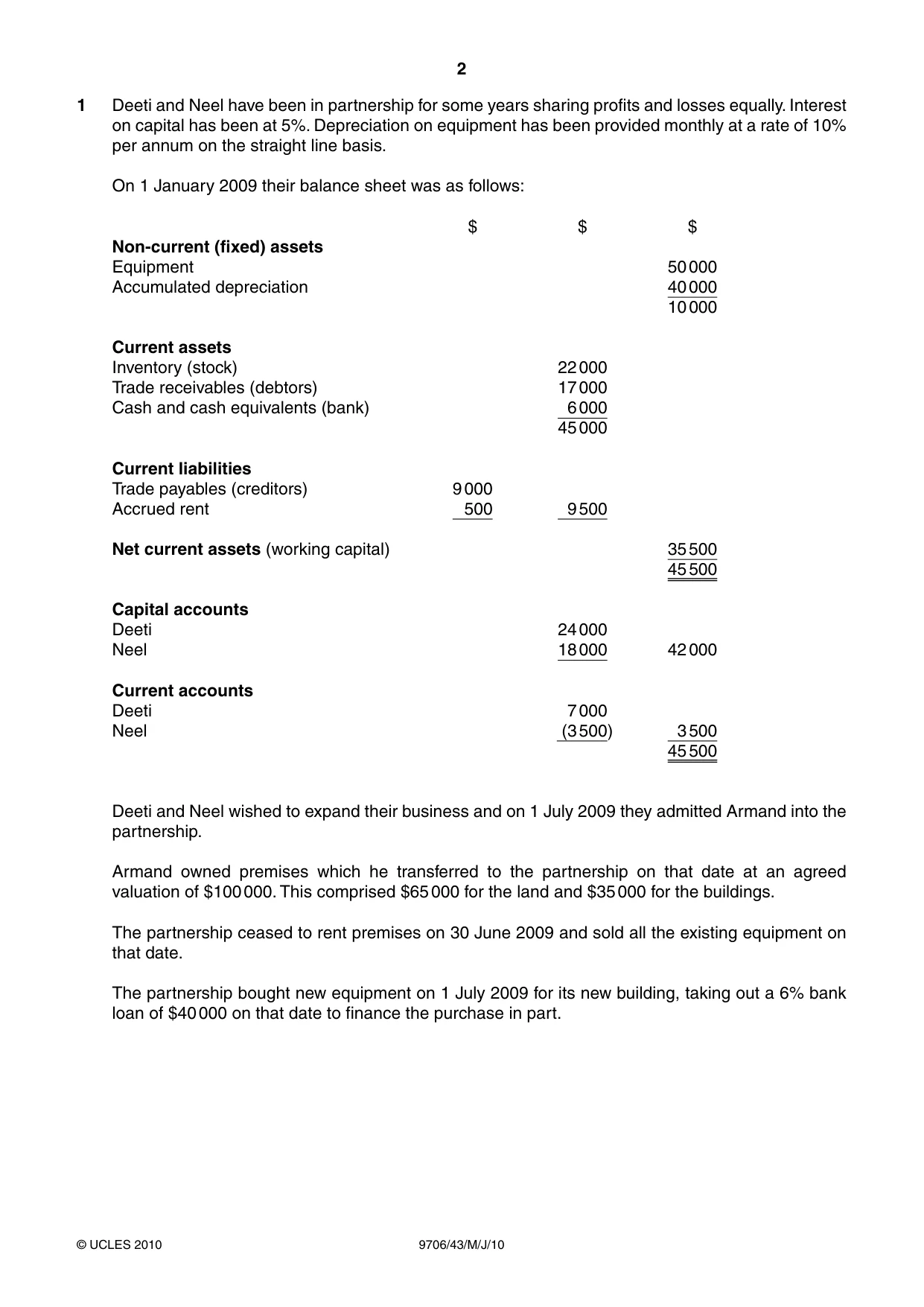
2 9706/43/M/J/10 © UCLES 2010 1 Deeti and Neel have been in partnership for some years sharing profits and losses equally. Interest on capital has been at 5%. Depreciation on equipment has been provided monthly at a rate of 10% per annum on the straight line basis. On 1 January 2009 their balance sheet was as follows: $ $ $ Non-current (fixed) assets Equipment 50 000 Accumulated depreciation 40 000 10 000 Current assets Inventory (stock) 22 000 Trade receivables (debtors) 17 000 Cash and cash equivalents (bank) 6 000 45 000 Current liabilities Trade payables (creditors) 9 000 Accrued rent 500 9 500 Net current assets (working capital) 35 500 45 500 Capital accounts Deeti 24 000 Neel 18 000 42 000 Current accounts Deeti 7 000 Neel (3 500) 3 500 45 500 Deeti and Neel wished to expand their business and on 1 July 2009 they admitted Armand into the partnership. Armand owned premises which he transferred to the partnership on that date at an agreed valuation of $100 000. This comprised $65 000 for the land and $35 000 for the buildings. The partnership ceased to rent premises on 30 June 2009 and sold all the existing equipment on that date. The partnership bought new equipment on 1 July 2009 for its new building, taking out a 6% bank loan of $40 000 on that date to finance the purchase in part.
Question paper, page 3
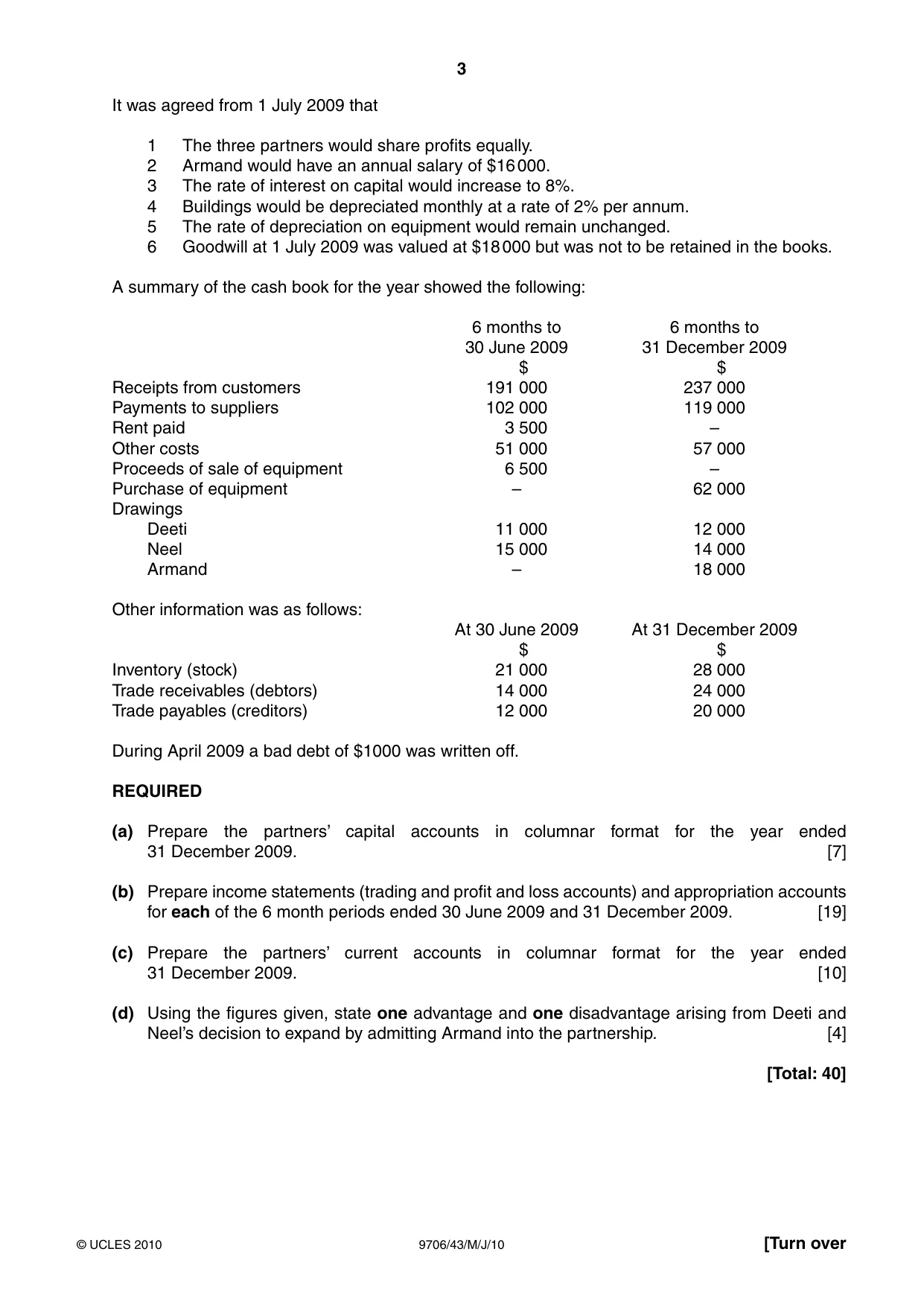
3 9706/43/M/J/10 © UCLES 2010 [Turn over It was agreed from 1 July 2009 that 1 The three partners would share profits equally. 2 Armand would have an annual salary of $16 000. 3 The rate of interest on capital would increase to 8%. 4 Buildings would be depreciated monthly at a rate of 2% per annum. 5 The rate of depreciation on equipment would remain unchanged. 6 Goodwill at 1 July 2009 was valued at $18 000 but was not to be retained in the books. A summary of the cash book for the year showed the following: 6 months to 6 months to 30 June 2009 31 December 2009 $ $ Receipts from customers 191 000 237 000 Payments to suppliers 102 000 119 000 Rent paid 3 500 – Other costs 51 000 57 000 Proceeds of sale of equipment 6 500 – Purchase of equipment – 62 000 Drawings Deeti 11 000 12 000 Neel 15 000 14 000 Armand – 18 000 Other information was as follows: At 30 June 2009 At 31 December 2009 $ $ Inventory (stock) 21 000 28 000 Trade receivables (debtors) 14 000 24 000 Trade payables (creditors) 12 000 20 000 During April 2009 a bad debt of $1000 was written off. REQUIRED (a) Prepare the partners’ capital accounts in columnar format for the year ended 31 December 2009. [7] (b) Prepare income statements (trading and profit and loss accounts) and appropriation accounts for each of the 6 month periods ended 30 June 2009 and 31 December 2009. [19] (c) Prepare the partners’ current accounts in columnar format for the year ended 31 December 2009. [10] (d) Using the figures given, state one advantage and one disadvantage arising from Deeti and Neel’s decision to expand by admitting Armand into the partnership. [4] [Total: 40]
Question paper, page 4
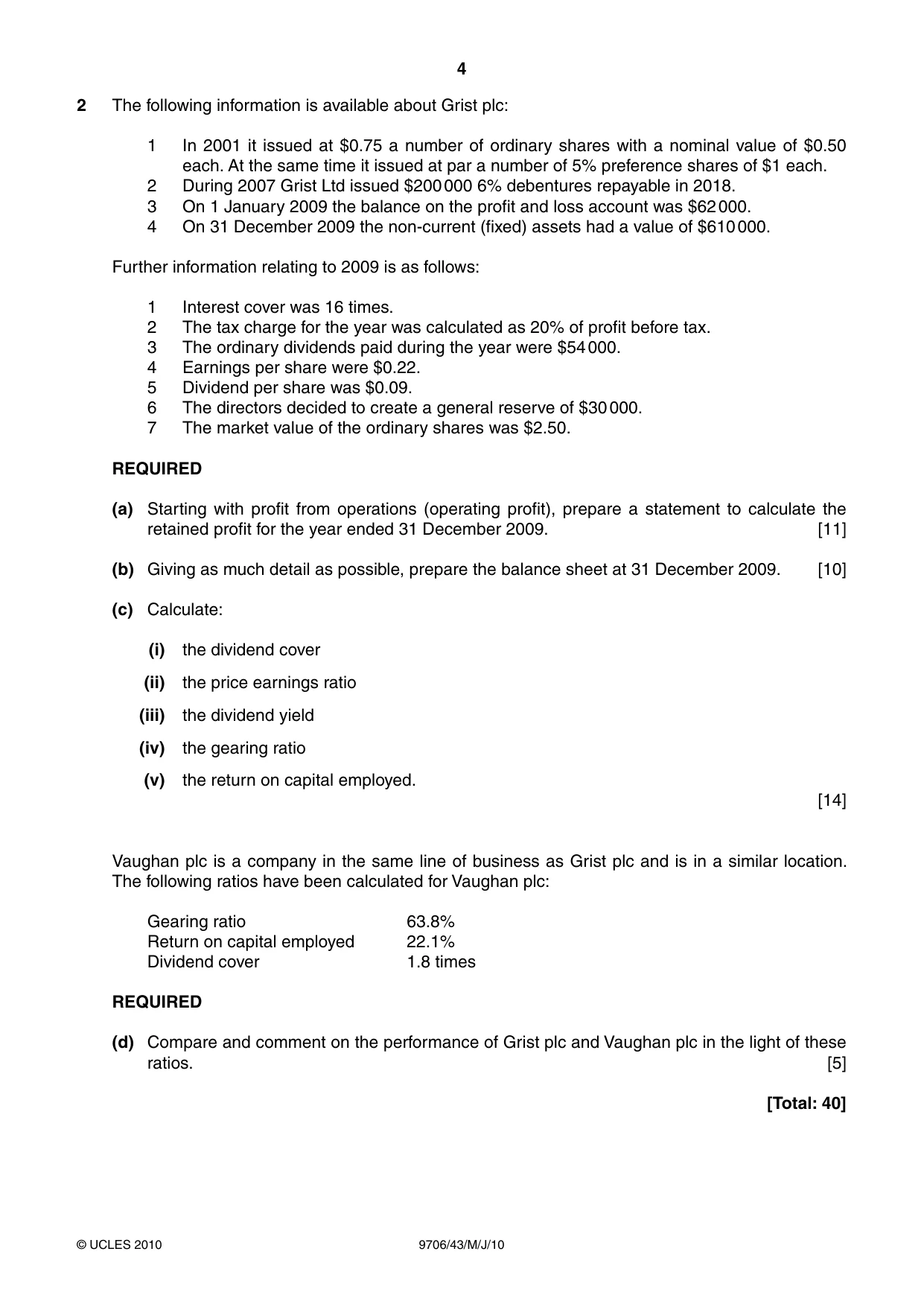
4 9706/43/M/J/10 © UCLES 2010 2 The following information is available about Grist plc: 1 In 2001 it issued at $0.75 a number of ordinary shares with a nominal value of $0.50 each. At the same time it issued at par a number of 5% preference shares of $1 each. 2 During 2007 Grist Ltd issued $200 000 6% debentures repayable in 2018. 3 On 1 January 2009 the balance on the profit and loss account was $62 000. 4 On 31 December 2009 the non-current (fixed) assets had a value of $610 000. Further information relating to 2009 is as follows: 1 Interest cover was 16 times. 2 The tax charge for the year was calculated as 20% of profit before tax. 3 The ordinary dividends paid during the year were $54 000. 4 Earnings per share were $0.22. 5 Dividend per share was $0.09. 6 The directors decided to create a general reserve of $30 000. 7 The market value of the ordinary shares was $2.50. REQUIRED (a) Starting with profit from operations (operating profit), prepare a statement to calculate the retained profit for the year ended 31 December 2009. [11] (b) Giving as much detail as possible, prepare the balance sheet at 31 December 2009. [10] (c) Calculate: (i) the dividend cover (ii) the price earnings ratio (iii) the dividend yield (iv) the gearing ratio (v) the return on capital employed. [14] Vaughan plc is a company in the same line of business as Grist plc and is in a similar location. The following ratios have been calculated for Vaughan plc: Gearing ratio 63.8% Return on capital employed 22.1% Dividend cover 1.8 times REQUIRED (d) Compare and comment on the performance of Grist plc and Vaughan plc in the light of these ratios. [5] [Total: 40]
Question paper, page 5
5 9706/43/M/J/10 © UCLES 2010 [Turn over 3 Ridgeway Ltd manufactures two products, Product A and Product B. The following information is available: 1 Ridgeway Ltd employs 26 production staff who usually work 150 hours a month each at a rate of $10 an hour. 14 work on the production of Product A. 12 work on the production of Product B. 2 In a normal month production of Product A requires 4200 kg of raw material at $8.20 per kg. Product B requires 3500 kg of raw material at $8.80 per kg. 3 An average unit of Product A uses 3 kg of raw material and 2 machine hours. An average unit of Product B uses 3.5 kg of raw material and 3 machine hours. 4 Monthly fixed overheads total $42 760. REQUIRED (a) Calculate the overhead absorption rate on the basis of: (i) machine hours (ii) labour hours (iii) total direct material cost. [8] (b) Using the overhead absorption rate on the basis of machine hours, calculate the selling price of one unit of Product B which gives a profit of 50% on cost. [5] (c) Explain what is meant by the under-absorption and over-absorption of overheads. [4] In March 2010 Ridgeway Ltd produced and sold 1600 units of Product A at a total sales value of $125 760. It bought and used 4600 kg of raw material at a cost of $40 480 and it employed production staff for 2200 hours at a cost of $22 440. The sales price variance for the month was $4672 adverse. REQUIRED (d) Calculate the following for Product A, for March 2010: (i) materials price variance (ii) materials usage variance (iii) total materials variance (iv) labour rate variance (v) labour efficiency variance (vi) total labour variance. [12] Question 3 continues on the next page.
Question paper, page 6
6 9706/43/M/J/10 © UCLES 2010 (e) Calculate the standard selling price per unit of product A. [3] (f) State four advantages of using a standard costing system. [8] [Total: 40]
Question paper, page 7
7 9706/43/M/J/10 © UCLES 2010 BLANK PAGE
Question paper, page 8
8 9706/43/M/J/10 © UCLES 2010 BLANK PAGE Permission to reproduce items where third-party owned material protected by copyright is included has been sought and cleared where possible. Every reasonable effort has been made by the publisher (UCLES) to trace copyright holders, but if any items requiring clearance have unwittingly been included, the publisher will be pleased to make amends at the earliest possible opportunity. University of Cambridge International Examinations is part of the Cambridge Assessment Group. Cambridge Assessment is the brand name of University of Cambridge Local Examinations Syndicate (UCLES), which is itself a department of the University of Cambridge.
Mark scheme, page 1
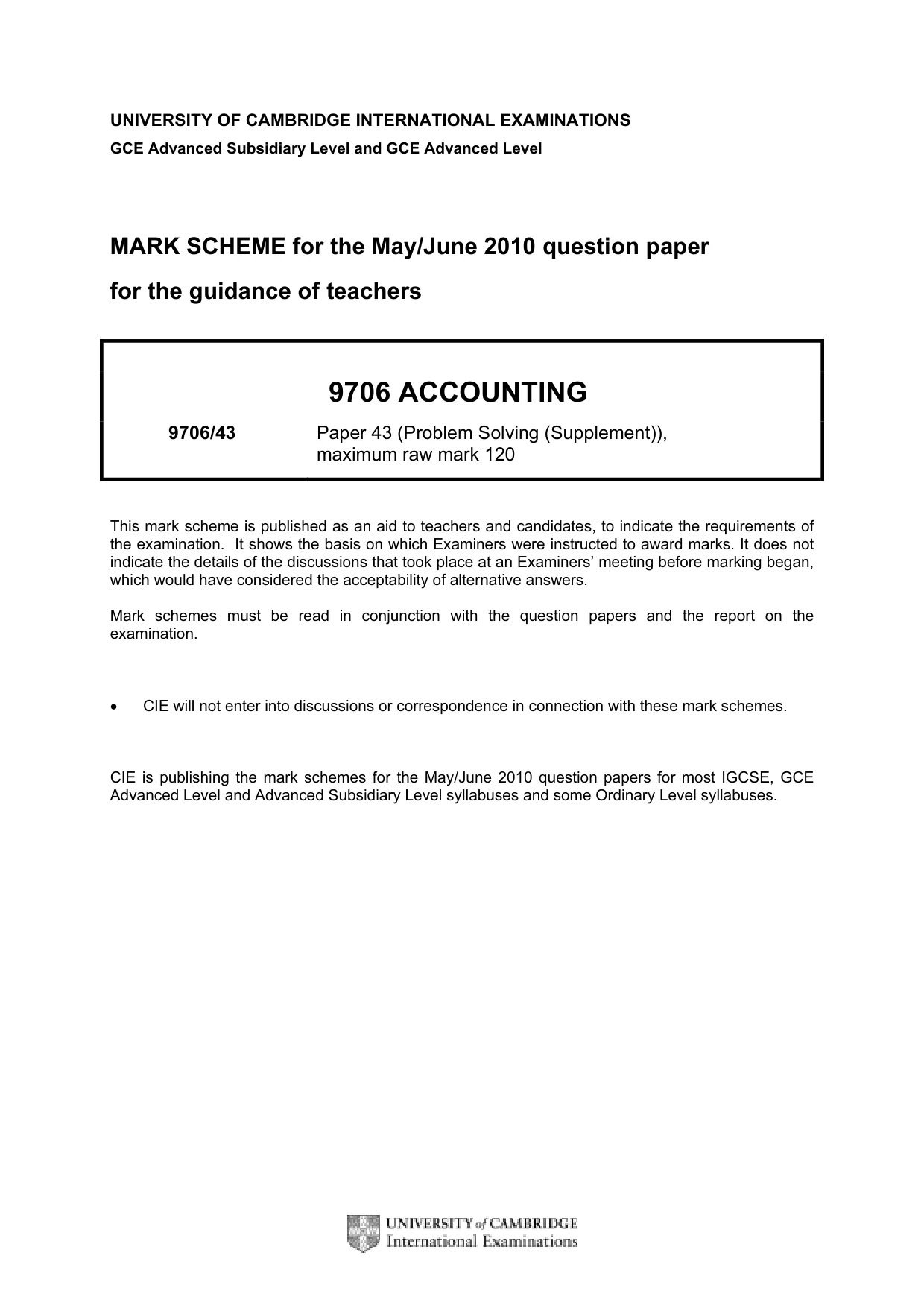
UNIVERSITY OF CAMBRIDGE INTERNATIONAL EXAMINATIONS GCE Advanced Subsidiary Level and GCE Advanced Level MARK SCHEME for the May/June 2010 question paper for the guidance of teachers 9706 ACCOUNTING 9706/43 Paper 43 (Problem Solving (Supplement)), maximum raw mark 120 This mark scheme is published as an aid to teachers and candidates, to indicate the requirements of the examination. It shows the basis on which Examiners were instructed to award marks. It does not indicate the details of the discussions that took place at an Examiners’ meeting before marking began, which would have considered the acceptability of alternative answers. Mark schemes must be read in conjunction with the question papers and the report on the examination. • CIE will not enter into discussions or correspondence in connection with these mark schemes. CIE is publishing the mark schemes for the May/June 2010 question papers for most IGCSE, GCE Advanced Level and Advanced Subsidiary Level syllabuses and some Ordinary Level syllabuses.
Mark scheme, page 2
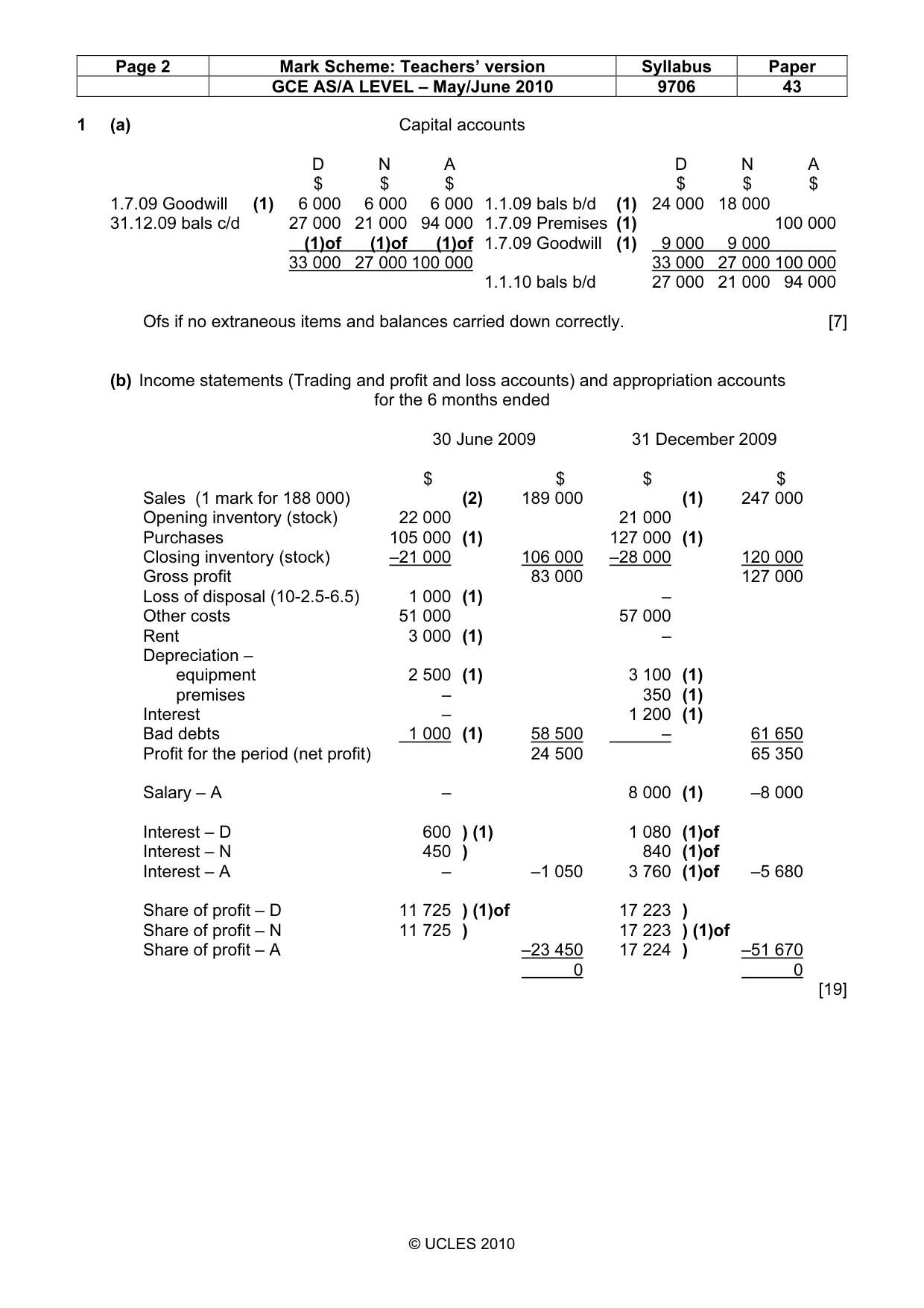
Page 2 Mark Scheme: Teachers’ version Syllabus Paper GCE AS/A LEVEL – May/June 2010 9706 43 © UCLES 2010 1 (a) Capital accounts D N A D N A $ $ $ $ $ $ 1.7.09 Goodwill (1) 6 000 6 000 6 000 1.1.09 bals b/d (1) 24 000 18 000 31.12.09 bals c/d 27 000 21 000 94 000 1.7.09 Premises (1) 100 000 (1)of (1)of (1)of 1.7.09 Goodwill (1) 9 000 9 000 33 000 27 000 100 000 33 000 27 000 100 000 1.1.10 bals b/d 27 000 21 000 94 000 Ofs if no extraneous items and balances carried down correctly. [7] (b) Income statements (Trading and profit and loss accounts) and appropriation accounts for the 6 months ended 30 June 2009 31 December 2009 $ $ $ $ Sales (1 mark for 188 000) (2) 189 000 (1) 247 000 Opening inventory (stock) 22 000 21 000 Purchases 105 000 (1) 127 000 (1) Closing inventory (stock) –21 000 106 000 –28 000 120 000 Gross profit 83 000 127 000 Loss of disposal (10-2.5-6.5) 1 000 (1) – Other costs 51 000 57 000 Rent 3 000 (1) – Depreciation – equipment 2 500 (1) 3 100 (1) premises – 350 (1) Interest – 1 200 (1) Bad debts 1 000 (1) 58 500 – 61 650 Profit for the period (net profit) 24 500 65 350 Salary – A – 8 000 (1) –8 000 Interest – D 600 ) (1) 1 080 (1)of Interest – N 450 ) 840 (1)of Interest – A – –1 050 3 760 (1)of –5 680 Share of profit – D 11 725 ) (1)of 17 223 ) Share of profit – N 11 725 ) 17 223 ) (1)of Share of profit – A –23 450 17 224 ) –51 670 0 0 [19]
Mark scheme, page 3
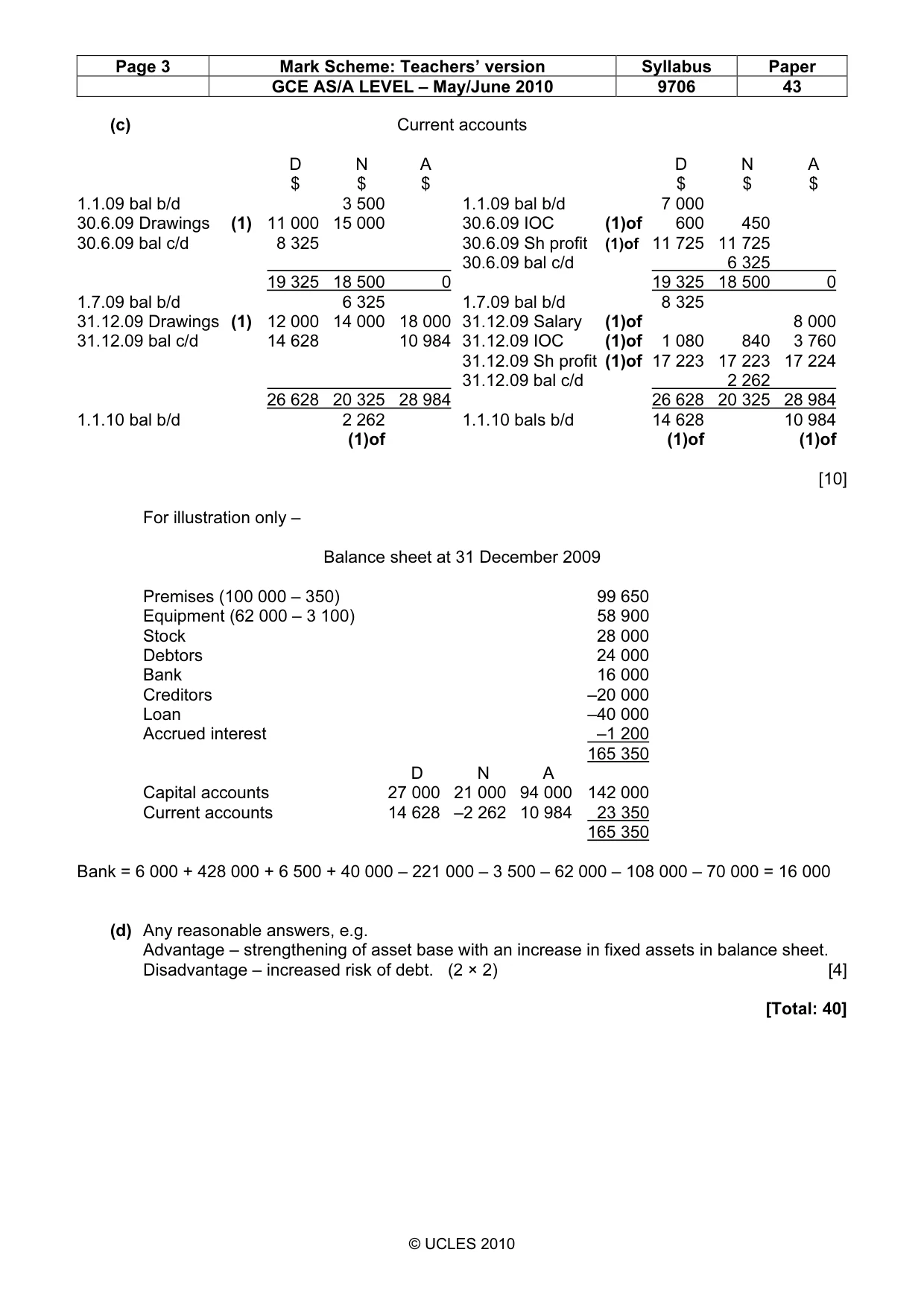
Page 3 Mark Scheme: Teachers’ version Syllabus Paper GCE AS/A LEVEL – May/June 2010 9706 43 © UCLES 2010 (c) Current accounts D N A D N A $ $ $ $ $ $ 1.1.09 bal b/d 3 500 1.1.09 bal b/d 7 000 30.6.09 Drawings (1) 11 000 15 000 30.6.09 IOC (1)of 600 450 30.6.09 bal c/d 8 325 30.6.09 Sh profit (1)of 11 725 11 725 30.6.09 bal c/d 6 325 19 325 18 500 0 19 325 18 500 0 1.7.09 bal b/d 6 325 1.7.09 bal b/d 8 325 31.12.09 Drawings (1) 12 000 14 000 18 000 31.12.09 Salary (1)of 8 000 31.12.09 bal c/d 14 628 10 984 31.12.09 IOC (1)of 1 080 840 3 760 31.12.09 Sh profit (1)of 17 223 17 223 17 224 31.12.09 bal c/d 2 262 26 628 20 325 28 984 26 628 20 325 28 984 1.1.10 bal b/d 2 262 1.1.10 bals b/d 14 628 10 984 (1)of (1)of (1)of [10] For illustration only – Balance sheet at 31 December 2009 Premises (100 000 – 350) 99 650 Equipment (62 000 – 3 100) 58 900 Stock 28 000 Debtors 24 000 Bank 16 000 Creditors –20 000 Loan –40 000 Accrued interest –1 200 165 350 D N A Capital accounts 27 000 21 000 94 000 142 000 Current accounts 14 628 –2 262 10 984 23 350 165 350 Bank = 6 000 + 428 000 + 6 500 + 40 000 – 221 000 – 3 500 – 62 000 – 108 000 – 70 000 = 16 000 (d) Any reasonable answers, e.g. Advantage – strengthening of asset base with an increase in fixed assets in balance sheet. Disadvantage – increased risk of debt. (2 × 2) [4] [Total: 40]
Mark scheme, page 4
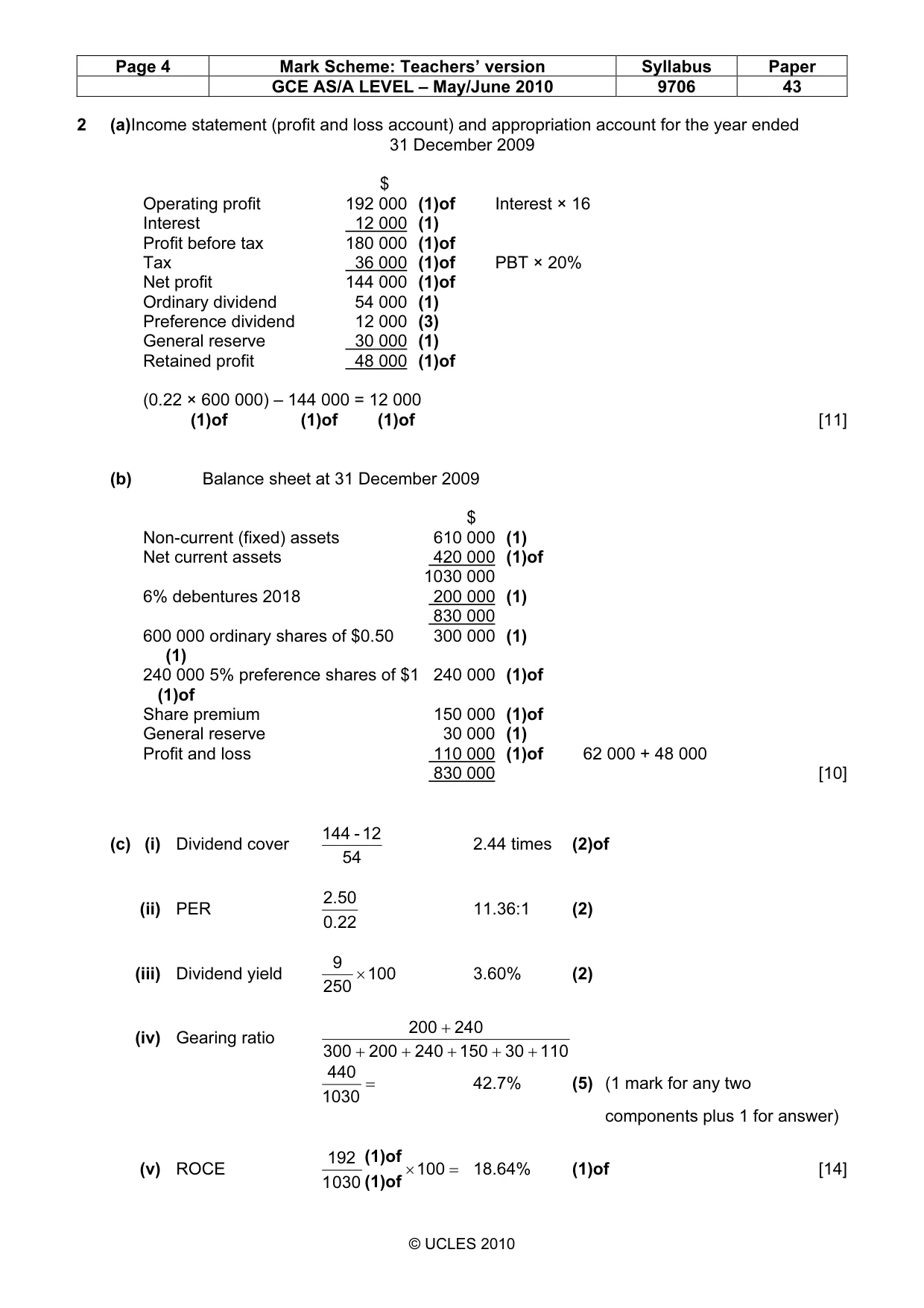
Page 4 Mark Scheme: Teachers’ version Syllabus Paper GCE AS/A LEVEL – May/June 2010 9706 43 © UCLES 2010 2 (a)Income statement (profit and loss account) and appropriation account for the year ended 31 December 2009 $ Operating profit 192 000 (1)of Interest × 16 Interest 12 000 (1) Profit before tax 180 000 (1)of Tax 36 000 (1)of PBT × 20% Net profit 144 000 (1)of Ordinary dividend 54 000 (1) Preference dividend 12 000 (3) General reserve 30 000 (1) Retained profit 48 000 (1)of (0.22 × 600 000) – 144 000 = 12 000 (1)of (1)of (1)of [11] (b) Balance sheet at 31 December 2009 $ Non-current (fixed) assets 610 000 (1) Net current assets 420 000 (1)of 1030 000 6% debentures 2018 200 000 (1) 830 000 600 000 ordinary shares of $0.50 300 000 (1) (1) 240 000 5% preference shares of $1 240 000 (1)of (1)of Share premium 150 000 (1)of General reserve 30 000 (1) Profit and loss 110 000 (1)of 62 000 + 48 000 830 000 [10] (c) (i) Dividend cover 54 12 - 144 2.44 times (2)of (ii) PER 0.22 2.50 11.36:1 (2) (iii) Dividend yield 100 250 9 × 3.60% (2) (iv) Gearing ratio 110 30 150 240 200 300 240 200 + + + + + + = 1030 440 42.7% (5) (1 mark for any two components plus 1 for answer) (v) ROCE 100 030 1 192 = × (1)of (1)of 18.64% (1)of [14]
Mark scheme, page 5
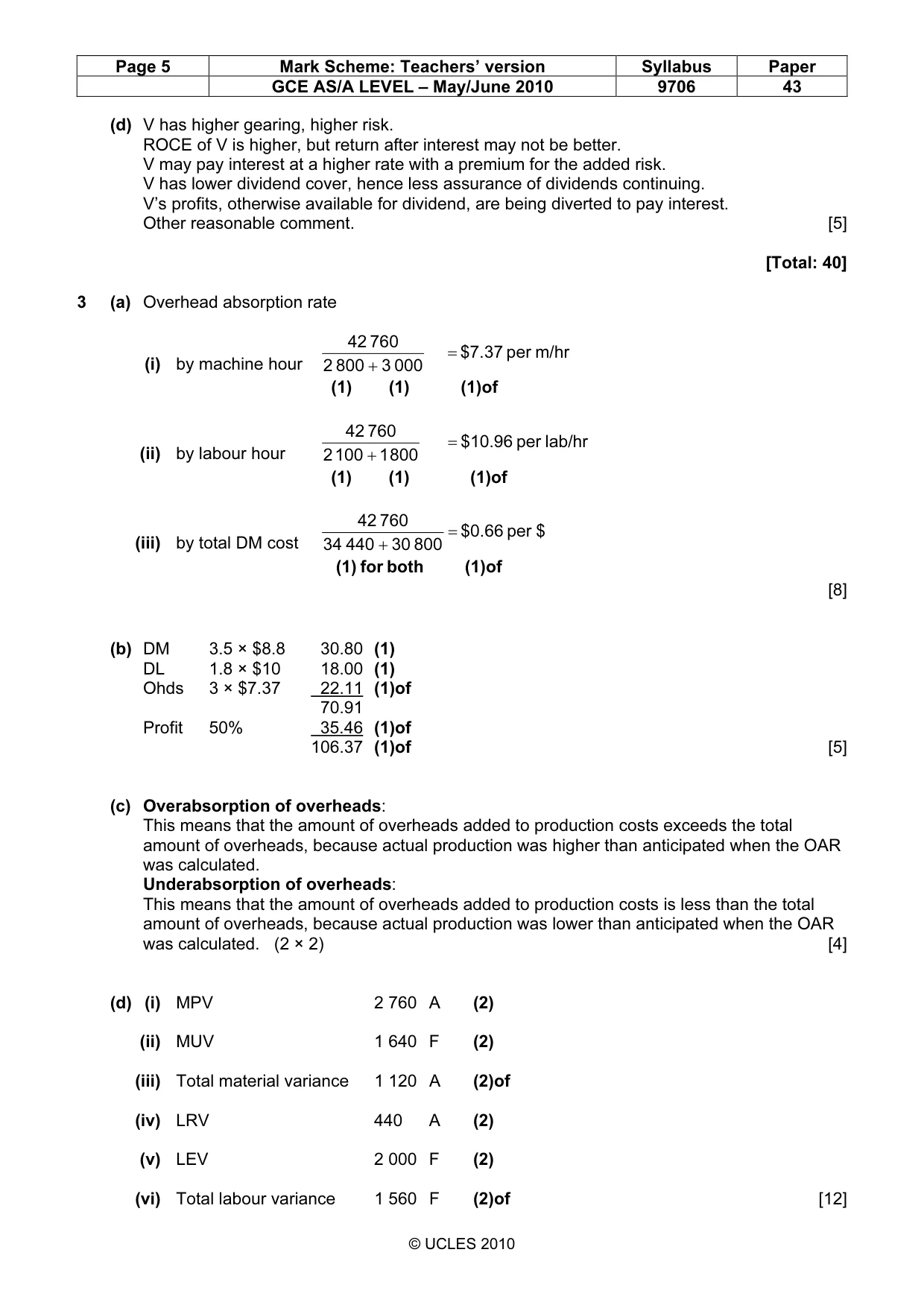
Page 5 Mark Scheme: Teachers’ version Syllabus Paper GCE AS/A LEVEL – May/June 2010 9706 43 © UCLES 2010 (d) V has higher gearing, higher risk. ROCE of V is higher, but return after interest may not be better. V may pay interest at a higher rate with a premium for the added risk. V has lower dividend cover, hence less assurance of dividends continuing. V’s profits, otherwise available for dividend, are being diverted to pay interest. Other reasonable comment. [5] [Total: 40] 3 (a) Overhead absorption rate (i) by machine hour (1)of (1) (1) m/hr per $7.37 000 3 800 2 760 42 = + (ii) by labour hour (1)of (1) (1) lab/hr per $10.96 800 1 100 2 760 42 = + (iii) by total DM cost (1)of both for (1) $ per $0.66 800 30 440 34 760 42 = + [8] (b) DM 3.5 × $8.8 30.80 (1) DL 1.8 × $10 18.00 (1) Ohds 3 × $7.37 22.11 (1)of 70.91 Profit 50% 35.46 (1)of 106.37 (1)of [5] (c) Overabsorption of overheads: This means that the amount of overheads added to production costs exceeds the total amount of overheads, because actual production was higher than anticipated when the OAR was calculated. Underabsorption of overheads: This means that the amount of overheads added to production costs is less than the total amount of overheads, because actual production was lower than anticipated when the OAR was calculated. (2 × 2) [4] (d) (i) MPV 2 760 A (2) (ii) MUV 1 640 F (2) (iii) Total material variance 1 120 A (2)of (iv) LRV 440 A (2) (v) LEV 2 000 F (2) (vi) Total labour variance 1 560 F (2)of [12]
Mark scheme, page 6
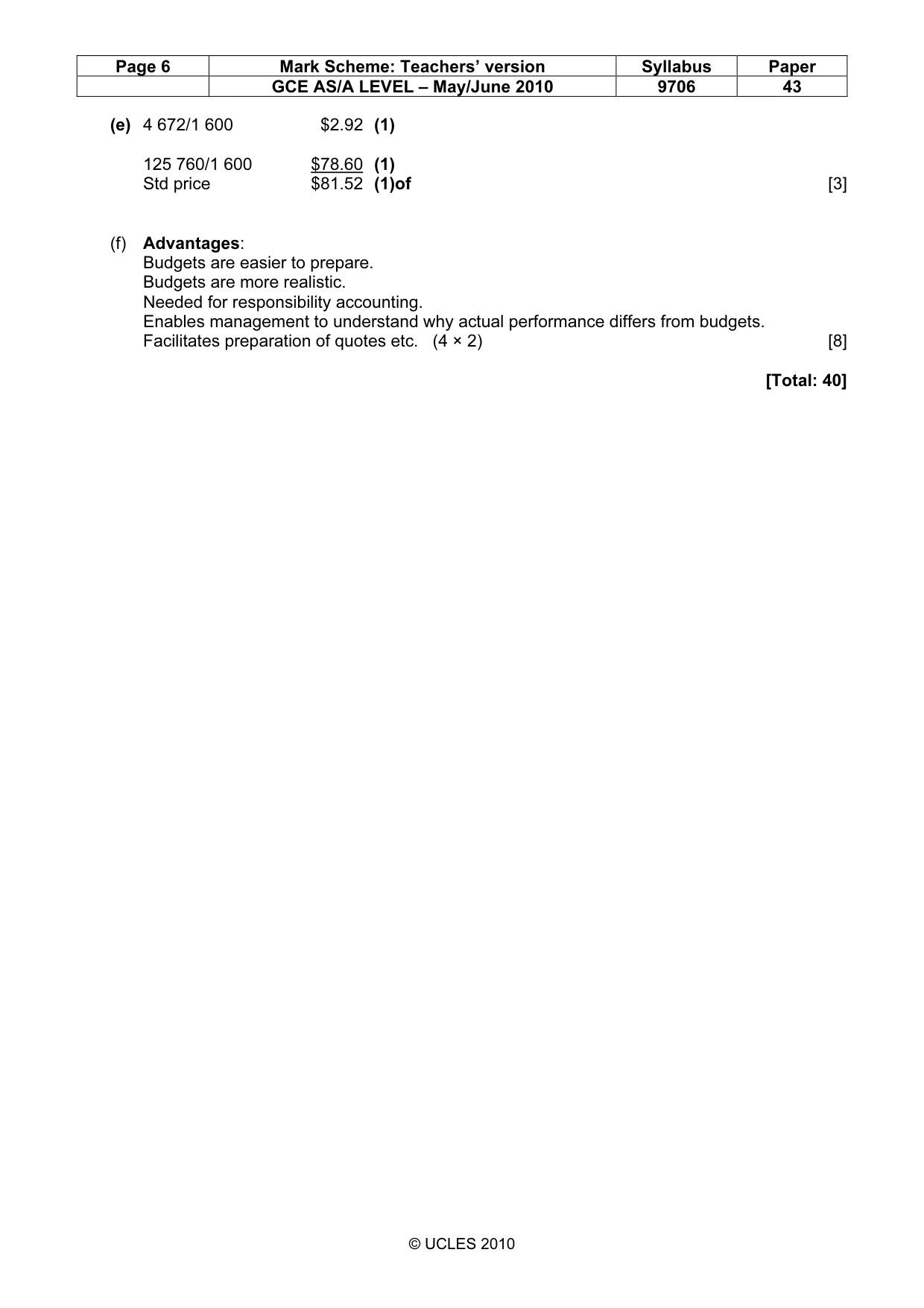
Page 6 Mark Scheme: Teachers’ version Syllabus Paper GCE AS/A LEVEL – May/June 2010 9706 43 © UCLES 2010 (e) 4 672/1 600 $2.92 (1) 125 760/1 600 $78.60 (1) Std price $81.52 (1)of [3] (f) Advantages: Budgets are easier to prepare. Budgets are more realistic. Needed for responsibility accounting. Enables management to understand why actual performance differs from budgets. Facilitates preparation of quotes etc. (4 × 2) [8] [Total: 40]
What you needed in this session
Cambridge’s own grade thresholds for 2010 May/June, Paper 4 · Variant 3. A higher threshold means an easier paper — the bar moves with how the cohort did.