Cambridge A Level Accounting 9706 — 2010 May/June Paper 4 · Variant 1
9706/41/M/J/10 · 120 marks · ≈135 min
The question paper and its mark scheme, free to read here and free to download. This is Cambridge’s own paper, exactly as it was sat.
Question paper8 pages


Mark scheme5 pages
Answers below. Sit the paper first if you are practising.
Paper as text
Question paper, page 1
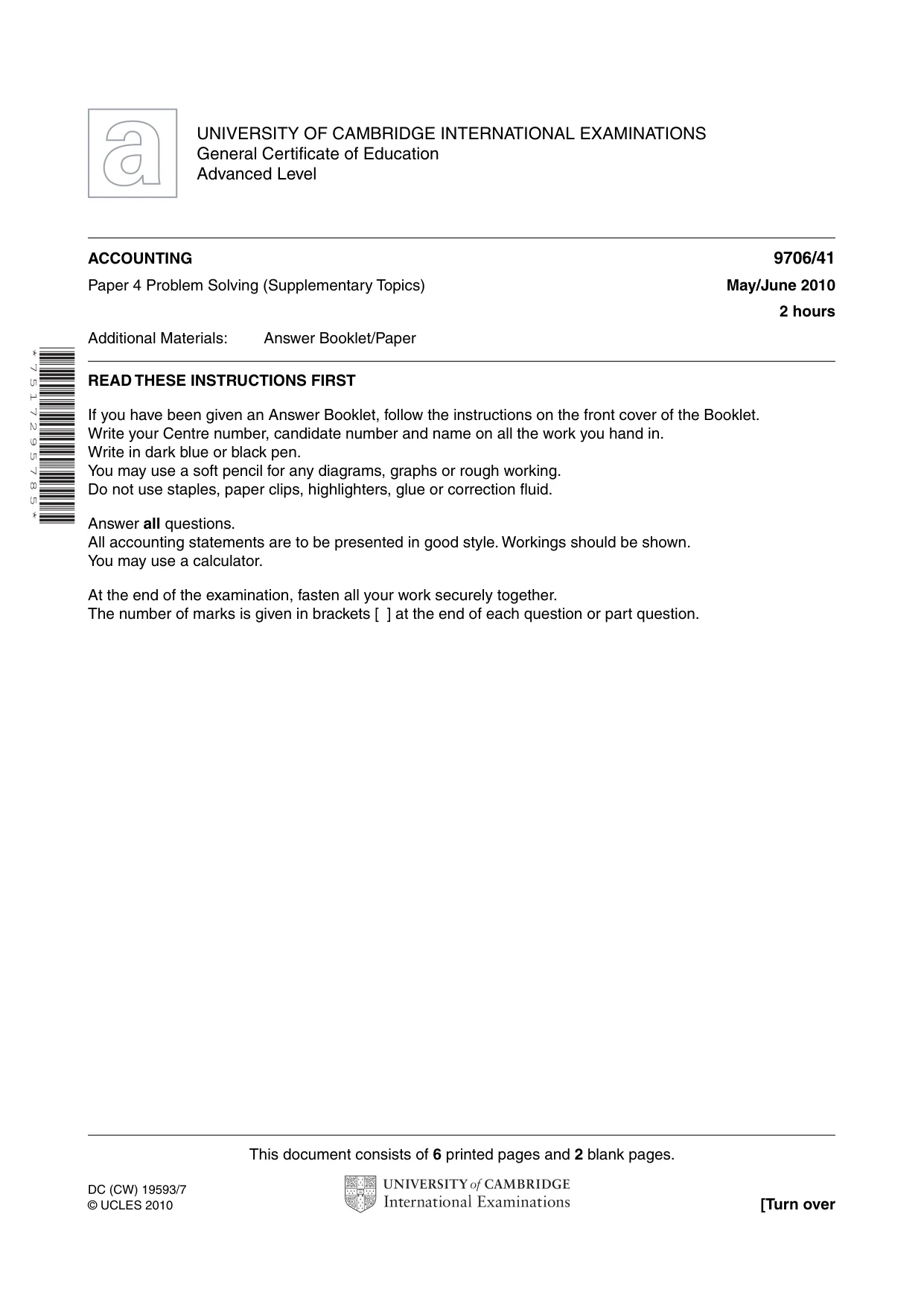
This document consists of 6 printed pages and 2 blank pages. DC (CW) 19593/7 © UCLES 2010 [Turn over UNIVERSITY OF CAMBRIDGE INTERNATIONAL EXAMINATIONS General Certificate of Education Advanced Level * 7 5 1 7 2 9 5 7 8 5 * ACCOUNTING 9706/41 Paper 4 Problem Solving (Supplementary Topics) May/June 2010 2 hours Additional Materials: Answer Booklet/Paper READ THESE INSTRUCTIONS FIRST If you have been given an Answer Booklet, follow the instructions on the front cover of the Booklet. Write your Centre number, candidate number and name on all the work you hand in. Write in dark blue or black pen. You may use a soft pencil for any diagrams, graphs or rough working. Do not use staples, paper clips, highlighters, glue or correction fluid. Answer all questions. All accounting statements are to be presented in good style. Workings should be shown. You may use a calculator. At the end of the examination, fasten all your work securely together. The number of marks is given in brackets [ ] at the end of each question or part question.
Question paper, page 2
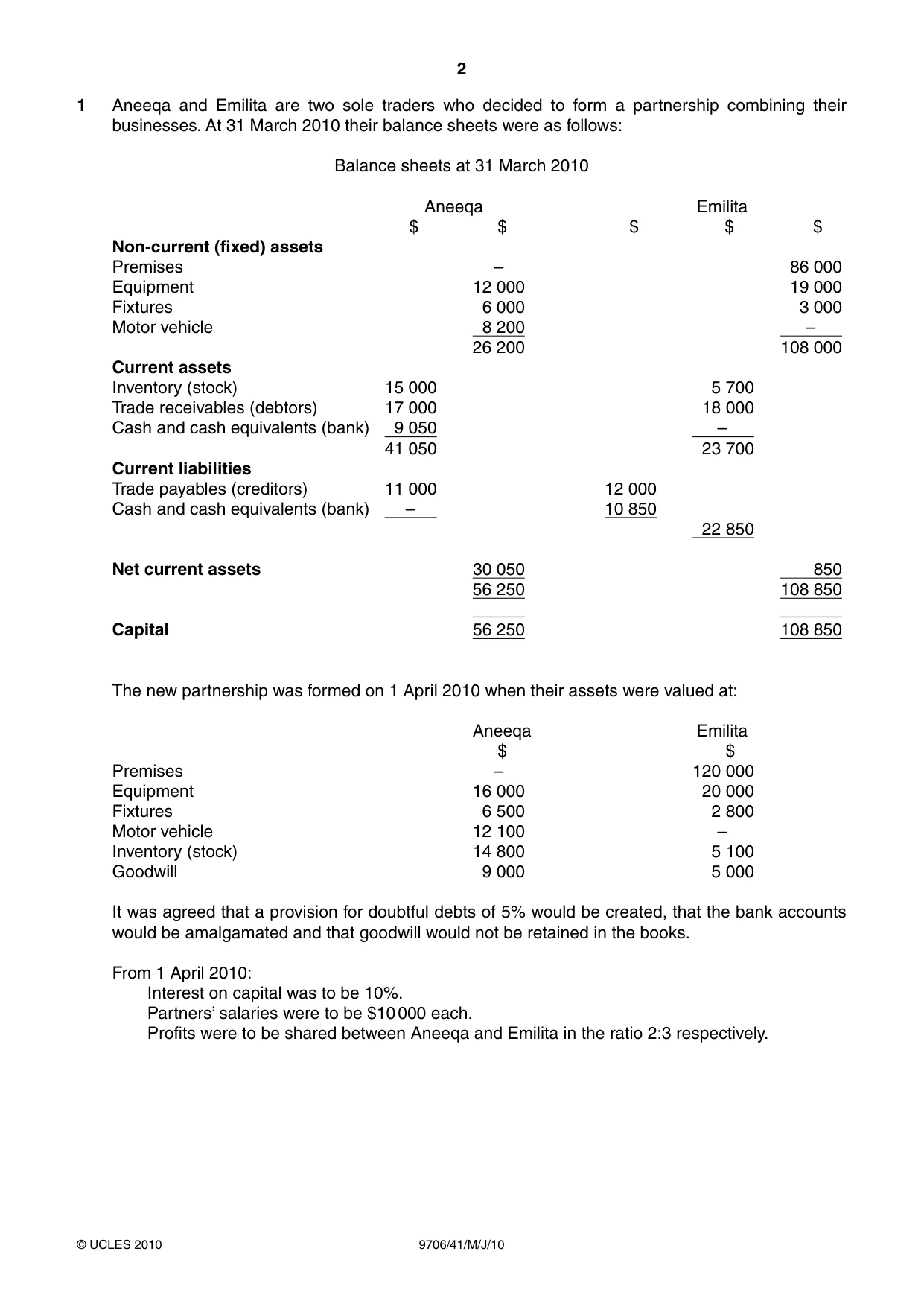
2 9706/41/M/J/10 © UCLES 2010 1 Aneeqa and Emilita are two sole traders who decided to form a partnership combining their businesses. At 31 March 2010 their balance sheets were as follows: Balance sheets at 31 March 2010 Aneeqa Emilita $ $ $ $ $ Non-current (fixed) assets Premises – 86 000 Equipment 12 000 19 000 Fixtures 6 000 3 000 Motor vehicle 8 200 – 26 200 108 000 Current assets Inventory (stock) 15 000 5 700 Trade receivables (debtors) 17 000 18 000 Cash and cash equivalents (bank) 9 050 – 41 050 23 700 Current liabilities Trade payables (creditors) 11 000 12 000 Cash and cash equivalents (bank) – 10 850 22 850 Net current assets 30 050 850 56 250 108 850 Capital 56 250 108 850 The new partnership was formed on 1 April 2010 when their assets were valued at: Aneeqa Emilita $ $ Premises – 120 000 Equipment 16 000 20 000 Fixtures 6 500 2 800 Motor vehicle 12 100 – Inventory (stock) 14 800 5 100 Goodwill 9 000 5 000 It was agreed that a provision for doubtful debts of 5% would be created, that the bank accounts would be amalgamated and that goodwill would not be retained in the books. From 1 April 2010: Interest on capital was to be 10%. Partners’ salaries were to be $10 000 each. Profits were to be shared between Aneeqa and Emilita in the ratio 2:3 respectively.
Question paper, page 3
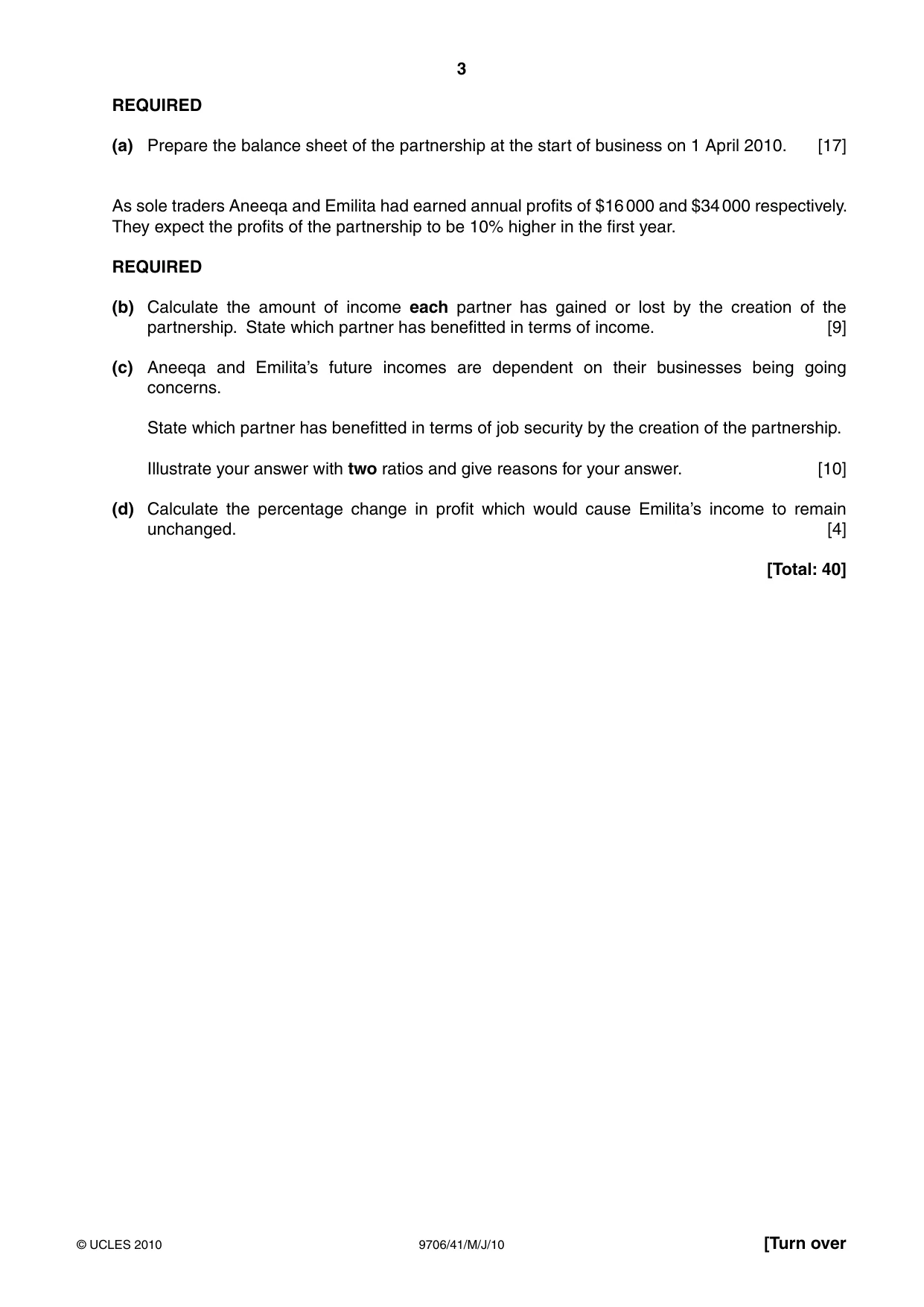
3 9706/41/M/J/10 © UCLES 2010 [Turn over REQUIRED (a) Prepare the balance sheet of the partnership at the start of business on 1 April 2010. [17] As sole traders Aneeqa and Emilita had earned annual profits of $16 000 and $34 000 respectively. They expect the profits of the partnership to be 10% higher in the first year. REQUIRED (b) Calculate the amount of income each partner has gained or lost by the creation of the partnership. State which partner has benefitted in terms of income. [9] (c) Aneeqa and Emilita’s future incomes are dependent on their businesses being going concerns. State which partner has benefitted in terms of job security by the creation of the partnership. Illustrate your answer with two ratios and give reasons for your answer. [10] (d) Calculate the percentage change in profit which would cause Emilita’s income to remain unchanged. [4] [Total: 40]
Question paper, page 4
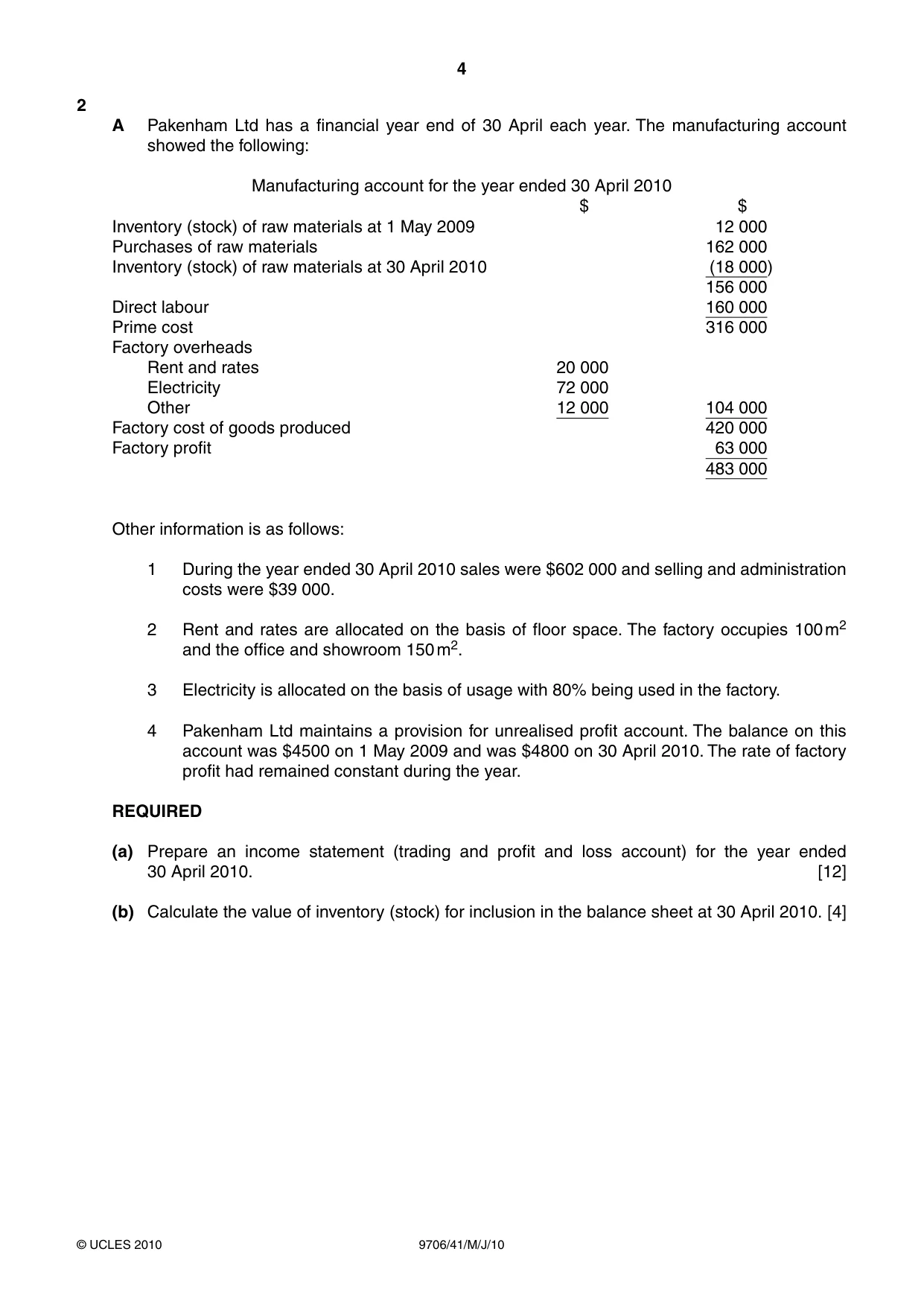
4 9706/41/M/J/10 © UCLES 2010 2 A Pakenham Ltd has a financial year end of 30 April each year. The manufacturing account showed the following: Manufacturing account for the year ended 30 April 2010 $ $ Inventory (stock) of raw materials at 1 May 2009 12 000 Purchases of raw materials 162 000 Inventory (stock) of raw materials at 30 April 2010 (18 000) 156 000 Direct labour 160 000 Prime cost 316 000 Factory overheads Rent and rates 20 000 Electricity 72 000 Other 12 000 104 000 Factory cost of goods produced 420 000 Factory profit 63 000 483 000 Other information is as follows: 1 During the year ended 30 April 2010 sales were $602 000 and selling and administration costs were $39 000. 2 Rent and rates are allocated on the basis of floor space. The factory occupies 100 m2 and the office and showroom 150 m2. 3 Electricity is allocated on the basis of usage with 80% being used in the factory. 4 Pakenham Ltd maintains a provision for unrealised profit account. The balance on this account was $4500 on 1 May 2009 and was $4800 on 30 April 2010. The rate of factory profit had remained constant during the year. REQUIRED (a) Prepare an income statement (trading and profit and loss account) for the year ended 30 April 2010. [12] (b) Calculate the value of inventory (stock) for inclusion in the balance sheet at 30 April 2010. [4]
Question paper, page 5
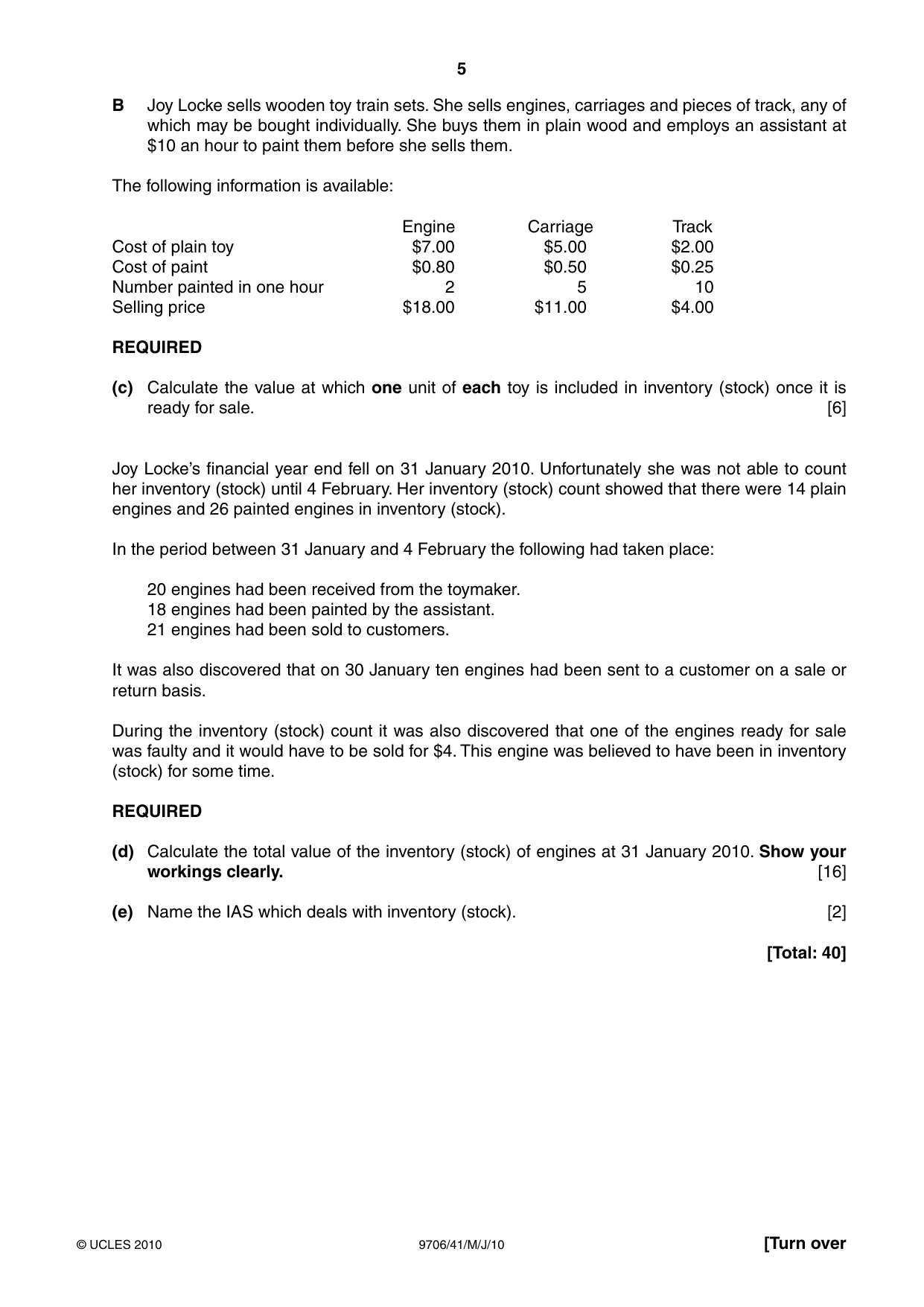
5 9706/41/M/J/10 © UCLES 2010 [Turn over B Joy Locke sells wooden toy train sets. She sells engines, carriages and pieces of track, any of which may be bought individually. She buys them in plain wood and employs an assistant at $10 an hour to paint them before she sells them. The following information is available: Engine Carriage Track Cost of plain toy $7.00 $5.00 $2.00 Cost of paint $0.80 $0.50 $0.25 Number painted in one hour 2 5 10 Selling price $18.00 $11.00 $4.00 REQUIRED (c) Calculate the value at which one unit of each toy is included in inventory (stock) once it is ready for sale. [6] Joy Locke’s financial year end fell on 31 January 2010. Unfortunately she was not able to count her inventory (stock) until 4 February. Her inventory (stock) count showed that there were 14 plain engines and 26 painted engines in inventory (stock). In the period between 31 January and 4 February the following had taken place: 20 engines had been received from the toymaker. 18 engines had been painted by the assistant. 21 engines had been sold to customers. It was also discovered that on 30 January ten engines had been sent to a customer on a sale or return basis. During the inventory (stock) count it was also discovered that one of the engines ready for sale was faulty and it would have to be sold for $4. This engine was believed to have been in inventory (stock) for some time. REQUIRED (d) Calculate the total value of the inventory (stock) of engines at 31 January 2010. Show your workings clearly. [16] (e) Name the IAS which deals with inventory (stock). [2] [Total: 40]
Question paper, page 6
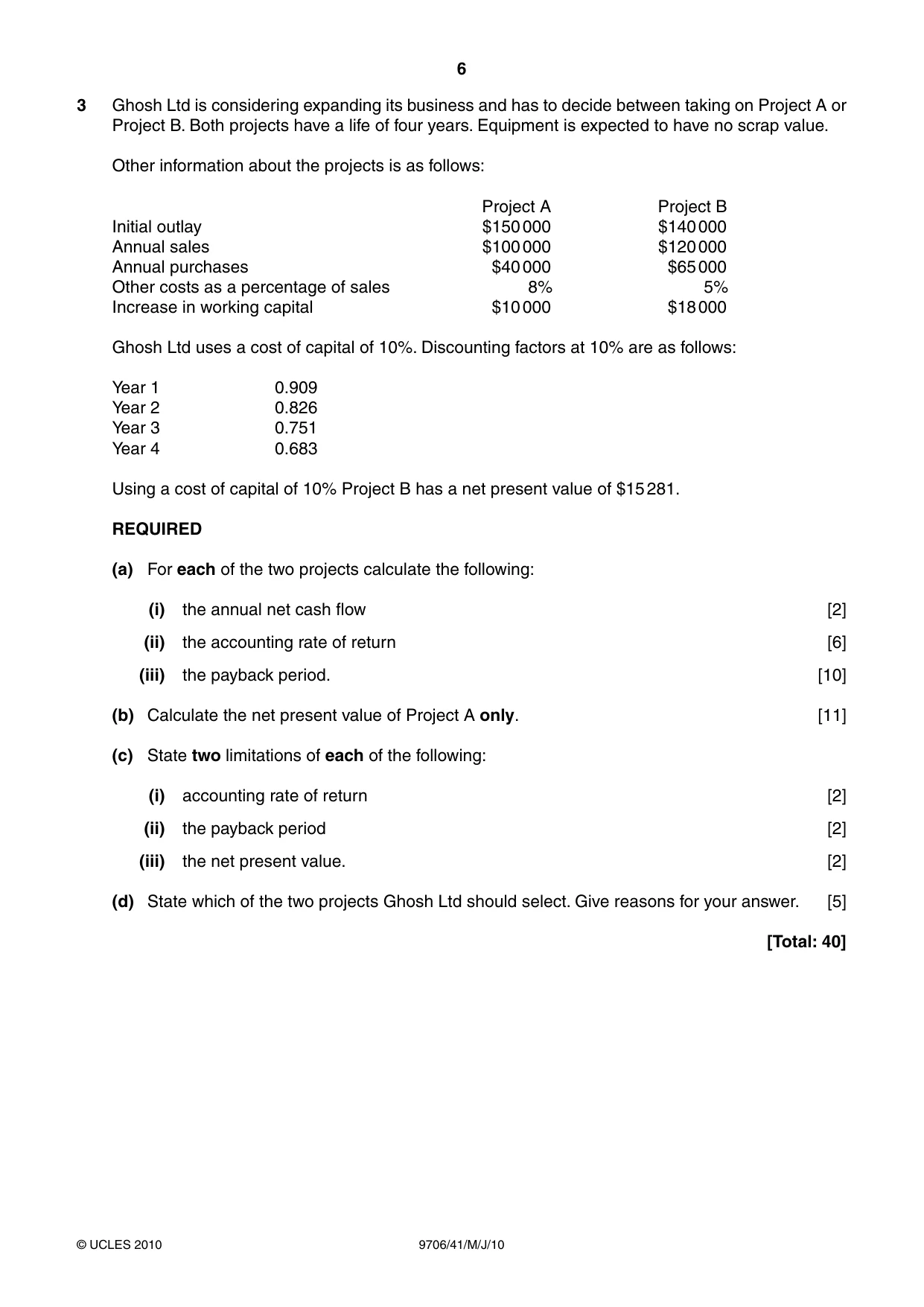
6 9706/41/M/J/10 © UCLES 2010 3 Ghosh Ltd is considering expanding its business and has to decide between taking on Project A or Project B. Both projects have a life of four years. Equipment is expected to have no scrap value. Other information about the projects is as follows: Project A Project B Initial outlay $150 000 $140 000 Annual sales $100 000 $120 000 Annual purchases $40 000 $65 000 Other costs as a percentage of sales 8% 5% Increase in working capital $10 000 $18 000 Ghosh Ltd uses a cost of capital of 10%. Discounting factors at 10% are as follows: Year 1 0.909 Year 2 0.826 Year 3 0.751 Year 4 0.683 Using a cost of capital of 10% Project B has a net present value of $15 281. REQUIRED (a) For each of the two projects calculate the following: (i) the annual net cash flow [2] (ii) the accounting rate of return [6] (iii) the payback period. [10] (b) Calculate the net present value of Project A only. [11] (c) State two limitations of each of the following: (i) accounting rate of return [2] (ii) the payback period [2] (iii) the net present value. [2] (d) State which of the two projects Ghosh Ltd should select. Give reasons for your answer. [5] [Total: 40]
Question paper, page 7
7 9706/41/M/J/10 © UCLES 2010 BLANK PAGE
Question paper, page 8
8 9706/41/M/J/10 © UCLES 2010 BLANK PAGE Permission to reproduce items where third-party owned material protected by copyright is included has been sought and cleared where possible. Every reasonable effort has been made by the publisher (UCLES) to trace copyright holders, but if any items requiring clearance have unwittingly been included, the publisher will be pleased to make amends at the earliest possible opportunity. University of Cambridge International Examinations is part of the Cambridge Assessment Group. Cambridge Assessment is the brand name of University of Cambridge Local Examinations Syndicate (UCLES), which is itself a department of the University of Cambridge.
Mark scheme, page 1
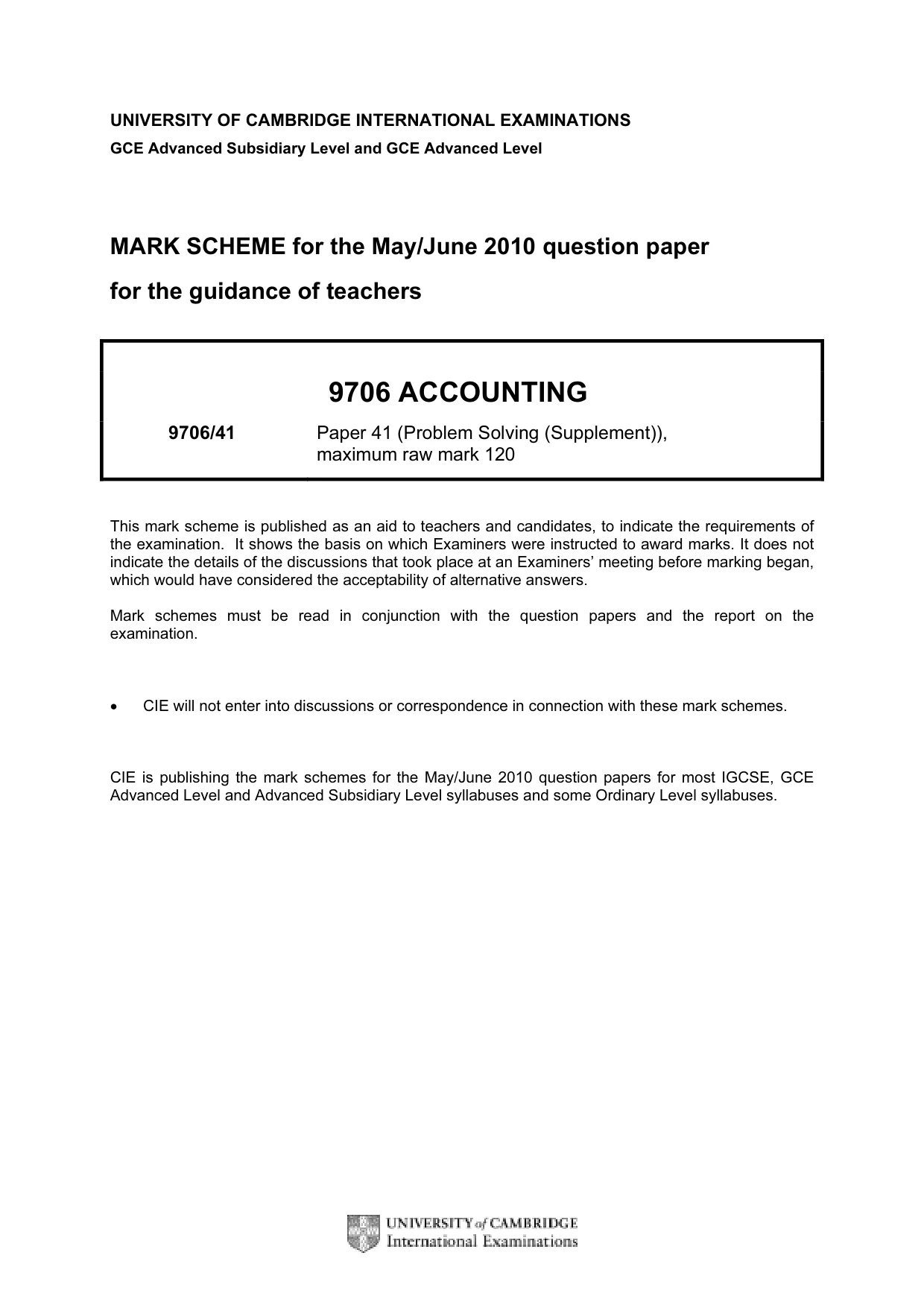
UNIVERSITY OF CAMBRIDGE INTERNATIONAL EXAMINATIONS GCE Advanced Subsidiary Level and GCE Advanced Level MARK SCHEME for the May/June 2010 question paper for the guidance of teachers 9706 ACCOUNTING 9706/41 Paper 41 (Problem Solving (Supplement)), maximum raw mark 120 This mark scheme is published as an aid to teachers and candidates, to indicate the requirements of the examination. It shows the basis on which Examiners were instructed to award marks. It does not indicate the details of the discussions that took place at an Examiners’ meeting before marking began, which would have considered the acceptability of alternative answers. Mark schemes must be read in conjunction with the question papers and the report on the examination. • CIE will not enter into discussions or correspondence in connection with these mark schemes. CIE is publishing the mark schemes for the May/June 2010 question papers for most IGCSE, GCE Advanced Level and Advanced Subsidiary Level syllabuses and some Ordinary Level syllabuses.
Mark scheme, page 2
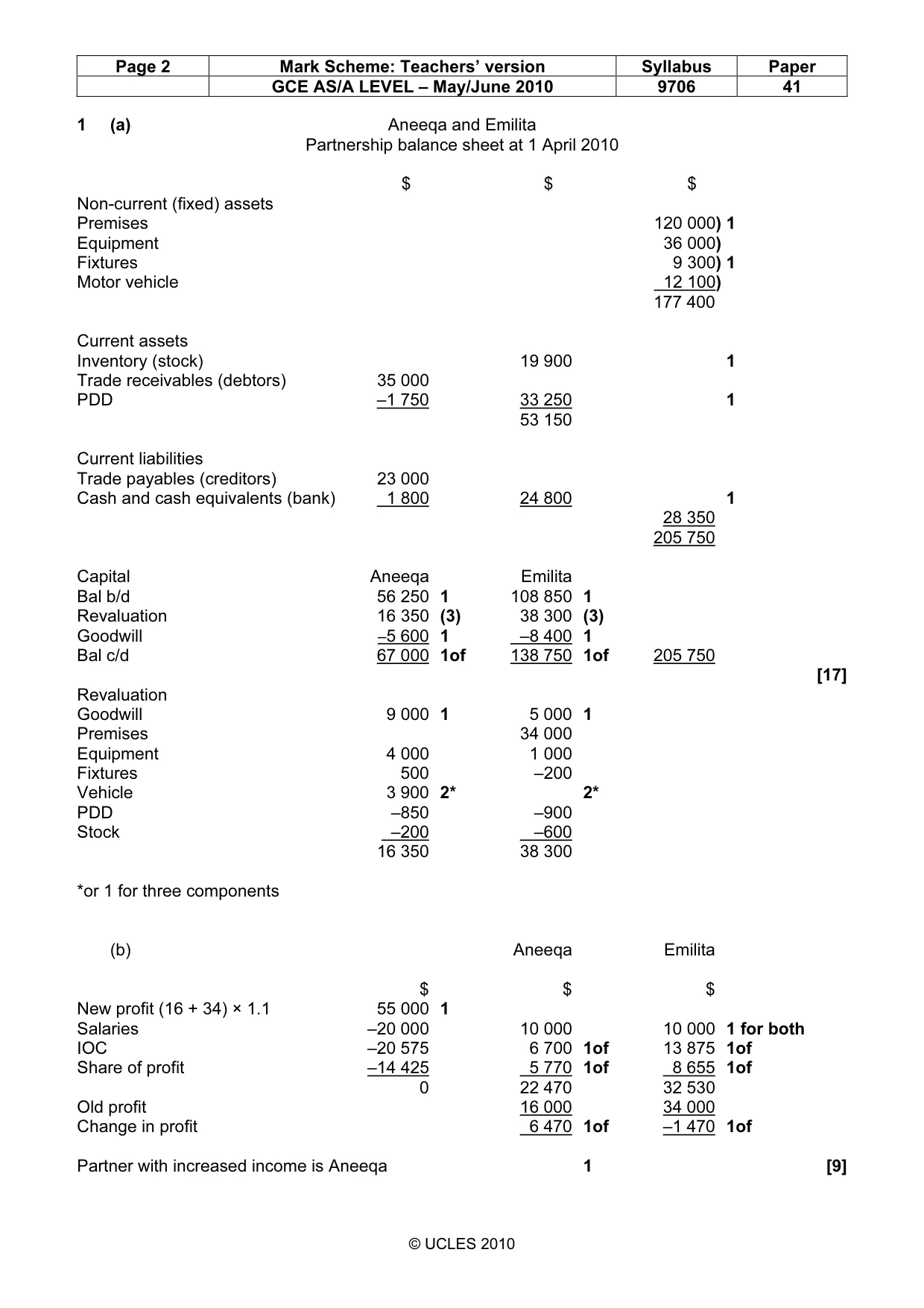
Page 2 Mark Scheme: Teachers’ version Syllabus Paper GCE AS/A LEVEL – May/June 2010 9706 41 © UCLES 2010 1 (a) Aneeqa and Emilita Partnership balance sheet at 1 April 2010 $ $ $ Non-current (fixed) assets Premises 120 000) 1 Equipment 36 000) Fixtures 9 300) 1 Motor vehicle 12 100) 177 400 Current assets Inventory (stock) 19 900 1 Trade receivables (debtors) 35 000 PDD –1 750 33 250 1 53 150 Current liabilities Trade payables (creditors) 23 000 Cash and cash equivalents (bank) 1 800 24 800 1 28 350 205 750 Capital Aneeqa Emilita Bal b/d 56 250 1 108 850 1 Revaluation 16 350 (3) 38 300 (3) Goodwill –5 600 1 –8 400 1 Bal c/d 67 000 1of 138 750 1of 205 750 [17] Revaluation Goodwill 9 000 1 5 000 1 Premises 34 000 Equipment 4 000 1 000 Fixtures 500 –200 Vehicle 3 900 2* 2* PDD –850 –900 Stock –200 –600 16 350 38 300 *or 1 for three components (b) Aneeqa Emilita $ $ $ New profit (16 + 34) × 1.1 55 000 1 Salaries –20 000 10 000 10 000 1 for both IOC –20 575 6 700 1of 13 875 1of Share of profit –14 425 5 770 1of 8 655 1of 0 22 470 32 530 Old profit 16 000 34 000 Change in profit 6 470 1of –1 470 1of Partner with increased income is Aneeqa 1 [9]
Mark scheme, page 3
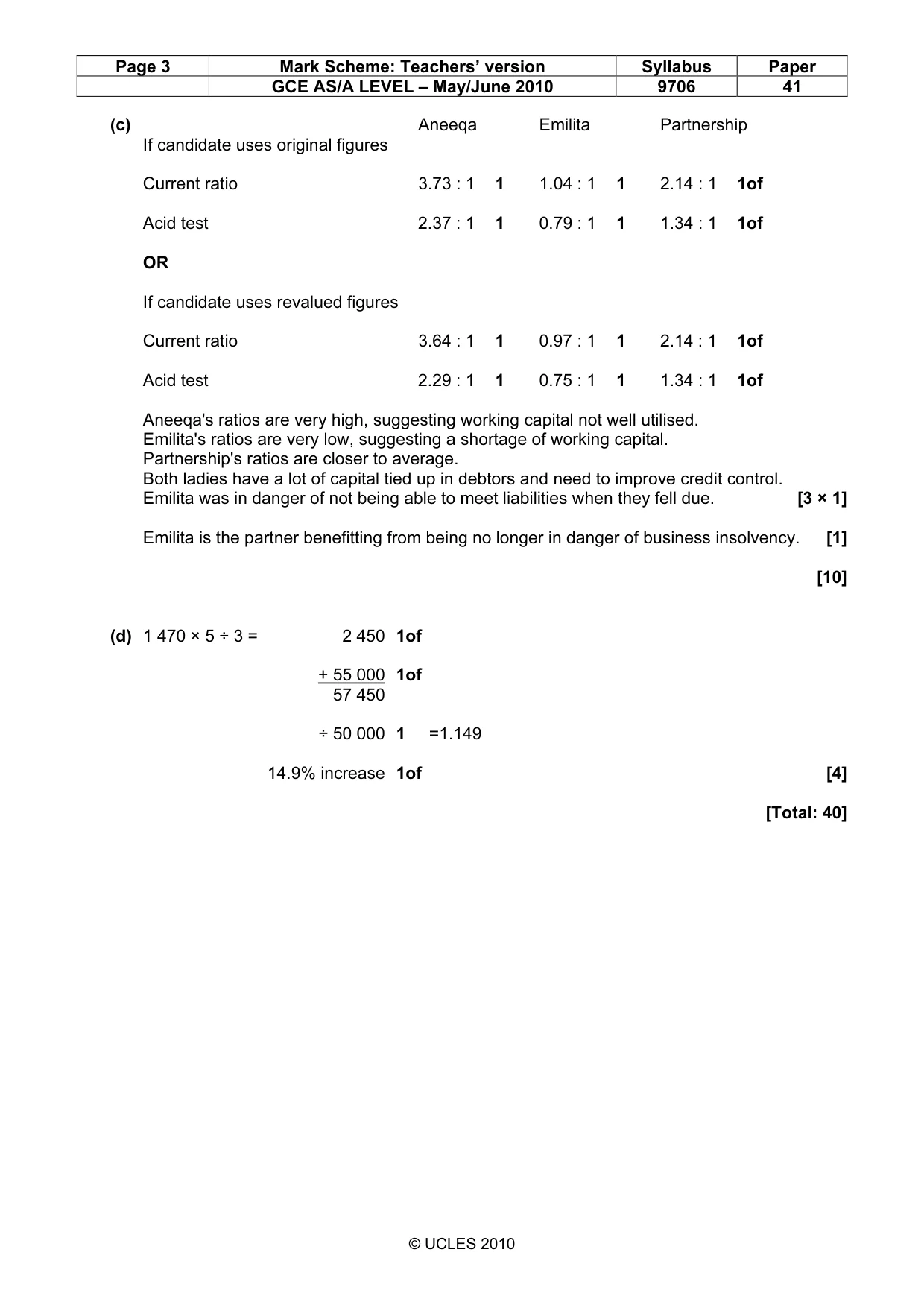
Page 3 Mark Scheme: Teachers’ version Syllabus Paper GCE AS/A LEVEL – May/June 2010 9706 41 © UCLES 2010 (c) Aneeqa Emilita Partnership If candidate uses original figures Current ratio 3.73 : 1 1 1.04 : 1 1 2.14 : 1 1of Acid test 2.37 : 1 1 0.79 : 1 1 1.34 : 1 1of OR If candidate uses revalued figures Current ratio 3.64 : 1 1 0.97 : 1 1 2.14 : 1 1of Acid test 2.29 : 1 1 0.75 : 1 1 1.34 : 1 1of Aneeqa's ratios are very high, suggesting working capital not well utilised. Emilita's ratios are very low, suggesting a shortage of working capital. Partnership's ratios are closer to average. Both ladies have a lot of capital tied up in debtors and need to improve credit control. Emilita was in danger of not being able to meet liabilities when they fell due. [3 × 1] Emilita is the partner benefitting from being no longer in danger of business insolvency. [1] [10] (d) 1 470 × 5 ÷ 3 = 2 450 1of + 55 000 1of 57 450 ÷ 50 000 1 =1.149 14.9% increase 1of [4] [Total: 40]
Mark scheme, page 4
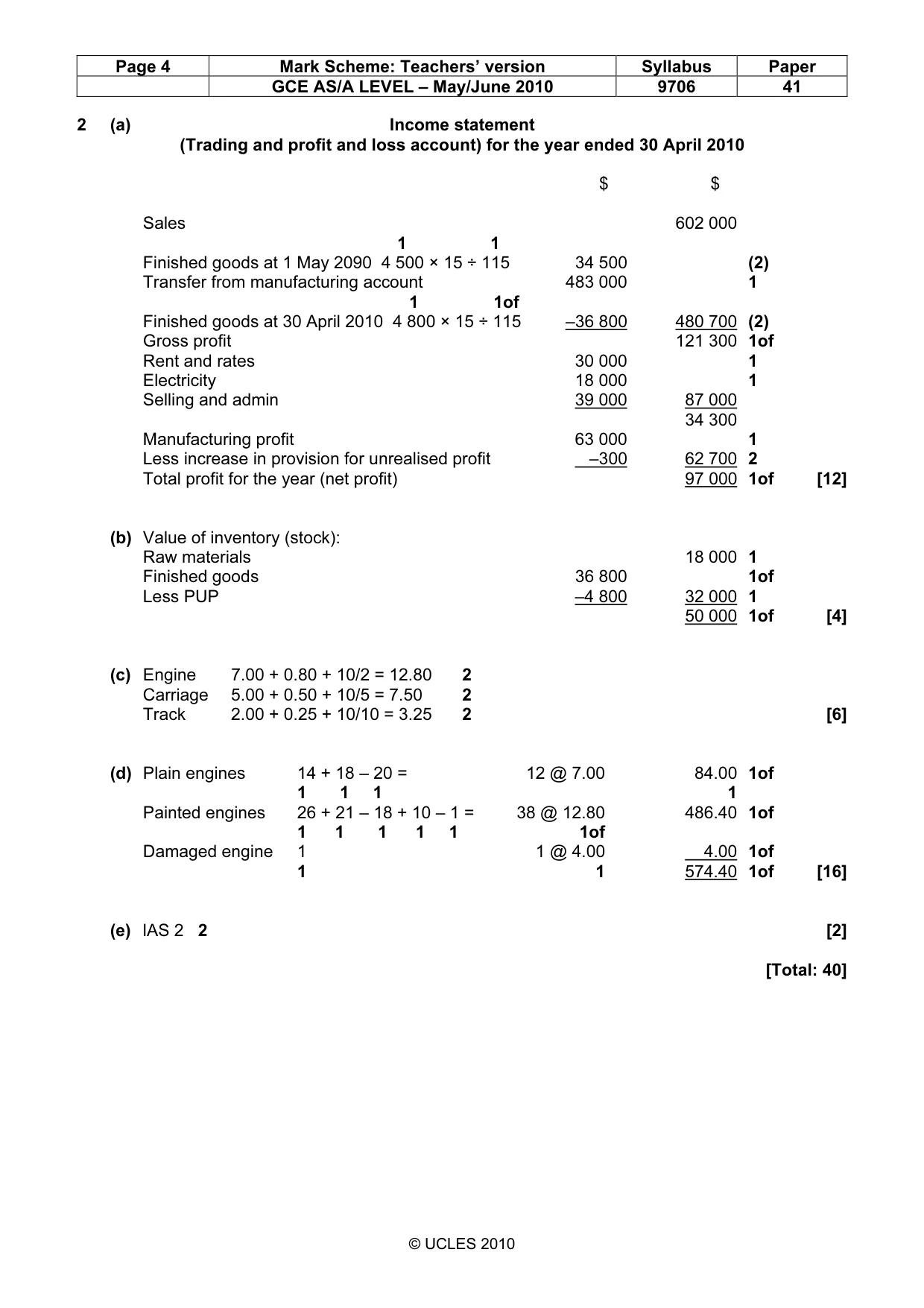
Page 4 Mark Scheme: Teachers’ version Syllabus Paper GCE AS/A LEVEL – May/June 2010 9706 41 © UCLES 2010 2 (a) Income statement (Trading and profit and loss account) for the year ended 30 April 2010 $ $ Sales 602 000 1 1 Finished goods at 1 May 2090 4 500 × 15 ÷ 115 34 500 (2) Transfer from manufacturing account 483 000 1 1 1of Finished goods at 30 April 2010 4 800 × 15 ÷ 115 –36 800 480 700 (2) Gross profit 121 300 1of Rent and rates 30 000 1 Electricity 18 000 1 Selling and admin 39 000 87 000 34 300 Manufacturing profit 63 000 1 Less increase in provision for unrealised profit –300 62 700 2 Total profit for the year (net profit) 97 000 1of [12] (b) Value of inventory (stock): Raw materials 18 000 1 Finished goods 36 800 1of Less PUP –4 800 32 000 1 50 000 1of [4] (c) Engine 7.00 + 0.80 + 10/2 = 12.80 2 Carriage 5.00 + 0.50 + 10/5 = 7.50 2 Track 2.00 + 0.25 + 10/10 = 3.25 2 [6] (d) Plain engines 14 + 18 – 20 = 12 @ 7.00 84.00 1of 1 1 1 1 Painted engines 26 + 21 – 18 + 10 – 1 = 38 @ 12.80 486.40 1of 1 1 1 1 1 1of Damaged engine 1 1 @ 4.00 4.00 1of 1 1 574.40 1of [16] (e) lAS 2 2 [2] [Total: 40]
Mark scheme, page 5
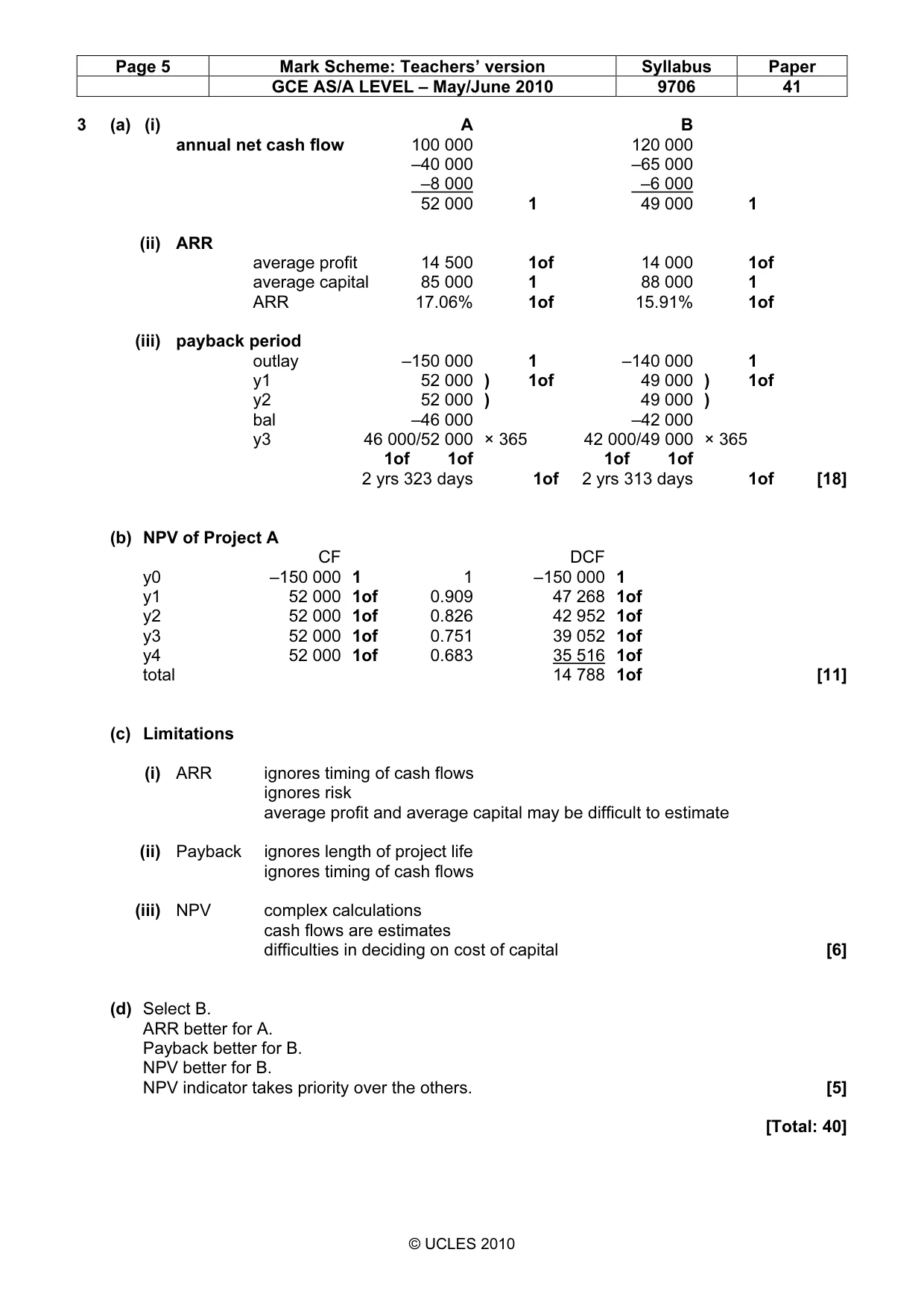
Page 5 Mark Scheme: Teachers’ version Syllabus Paper GCE AS/A LEVEL – May/June 2010 9706 41 © UCLES 2010 3 (a) (i) A B annual net cash flow 100 000 120 000 –40 000 –65 000 –8 000 –6 000 52 000 1 49 000 1 (ii) ARR average profit 14 500 1of 14 000 1of average capital 85 000 1 88 000 1 ARR 17.06% 1of 15.91% 1of (iii) payback period outlay –150 000 1 –140 000 1 y1 52 000 ) 1of 49 000 ) 1of y2 52 000 ) 49 000 ) bal –46 000 –42 000 y3 46 000/52 000 × 365 42 000/49 000 × 365 1of 1of 1of 1of 2 yrs 323 days 1of 2 yrs 313 days 1of [18] (b) NPV of Project A CF DCF y0 –150 000 1 1 –150 000 1 y1 52 000 1of 0.909 47 268 1of y2 52 000 1of 0.826 42 952 1of y3 52 000 1of 0.751 39 052 1of y4 52 000 1of 0.683 35 516 1of total 14 788 1of [11] (c) Limitations (i) ARR ignores timing of cash flows ignores risk average profit and average capital may be difficult to estimate (ii) Payback ignores length of project life ignores timing of cash flows (iii) NPV complex calculations cash flows are estimates difficulties in deciding on cost of capital [6] (d) Select B. ARR better for A. Payback better for B. NPV better for B. NPV indicator takes priority over the others. [5] [Total: 40]
What you needed in this session
Cambridge’s own grade thresholds for 2010 May/June, Paper 4 · Variant 1. A higher threshold means an easier paper — the bar moves with how the cohort did.