Cambridge IGCSE Travel and Tourism 0471 — 2020 Oct/Nov Paper 1 · Variant 2
0471/12/O/N/20 · 100 marks · ≈113 min
The question paper and its mark scheme, free to read here and free to download. This is Cambridge’s own paper, exactly as it was sat.
Question paper12 pages

Mark scheme11 pages
Answers below. Sit the paper first if you are practising.
Paper as text
Question paper, page 1
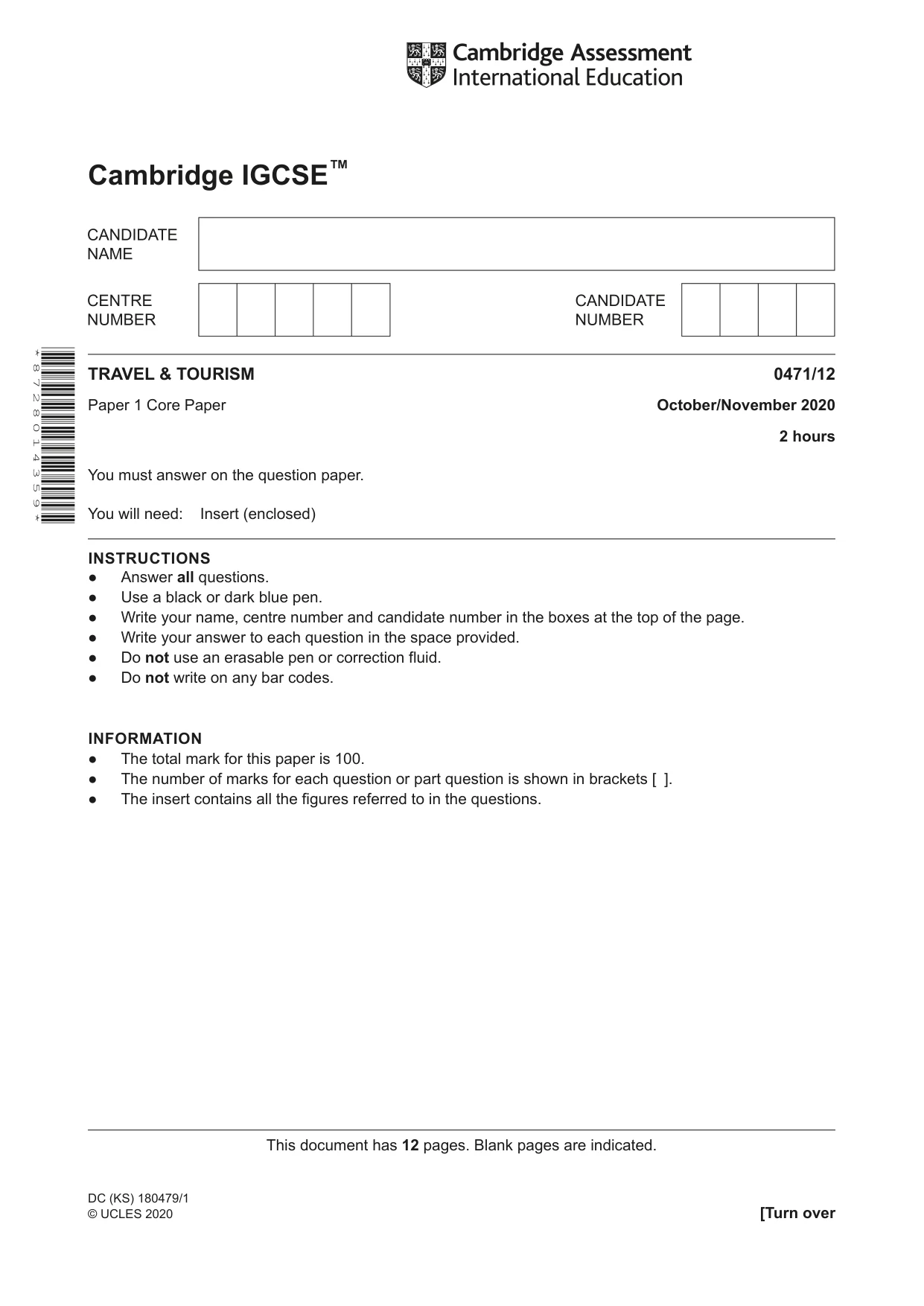
Cambridge IGCSE™ DC (KS) 180479/1 © UCLES 2020 [Turn over This document has 12 pages. Blank pages are indicated. * 8 7 2 8 0 1 4 3 5 9 * TRAVEL & TOURISM 0471/12 Paper 1 Core Paper October/November 2020 2 hours You must answer on the question paper. You will need: Insert (enclosed) INSTRUCTIONS ● Answer all questions. ● Use a black or dark blue pen. ● Write your name, centre number and candidate number in the boxes at the top of the page. ● Write your answer to each question in the space provided. ● Do not use an erasable pen or correction fluid. ● Do not write on any bar codes. INFORMATION ● The total mark for this paper is 100. ● The number of marks for each question or part question is shown in brackets [ ]. ● The insert contains all the figures referred to in the questions.
Question paper, page 2
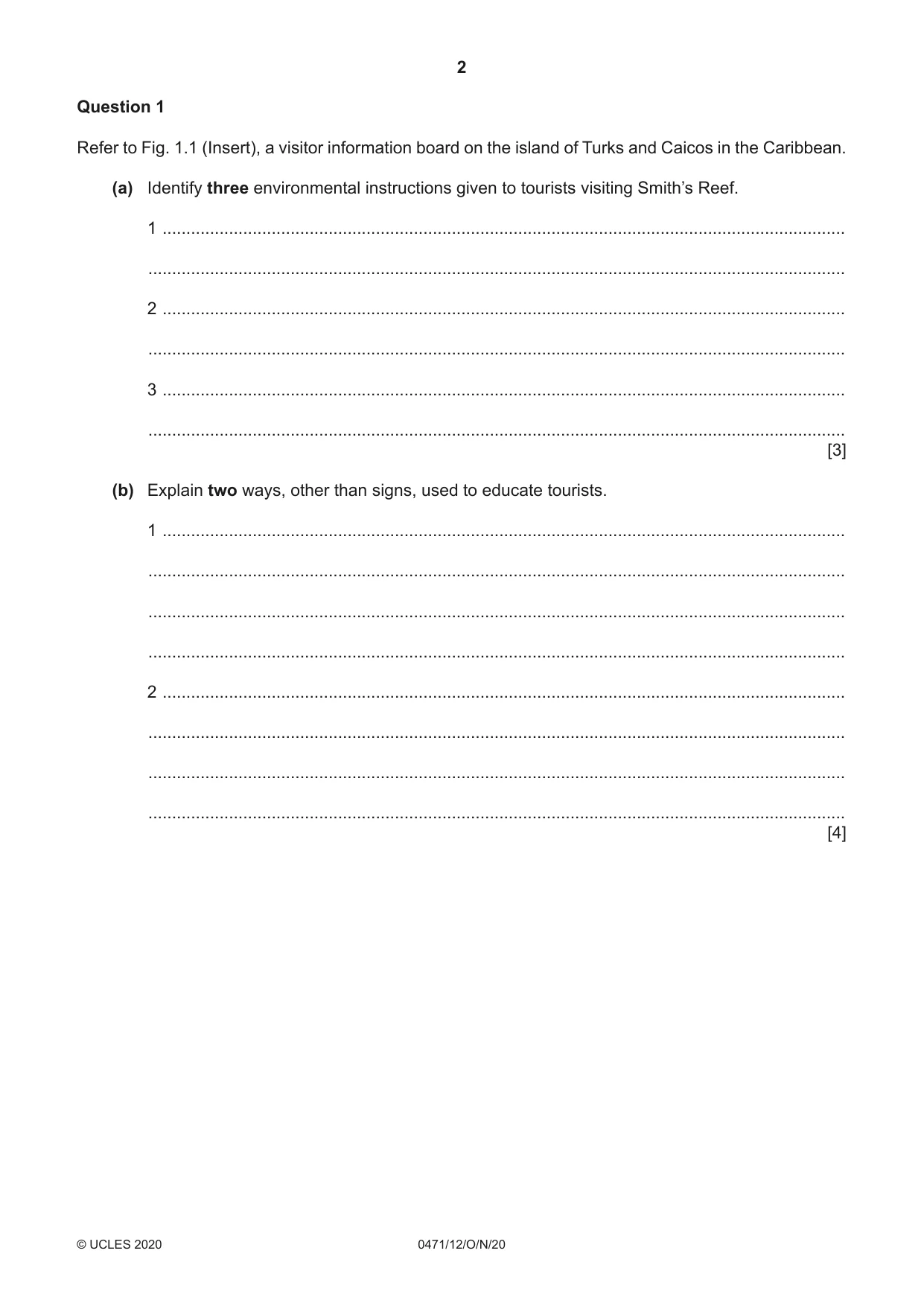
2 0471/12/O/N/20 © UCLES 2020 Question 1 Refer to Fig. 1.1 (Insert), a visitor information board on the island of Turks and Caicos in the Caribbean. (a) Identify three environmental instructions given to tourists visiting Smith’s Reef. 1 … … 2 … … 3 … … [3] (b) Explain two ways, other than signs, used to educate tourists. 1 … … … … 2 … … … … [4]
Question paper, page 3
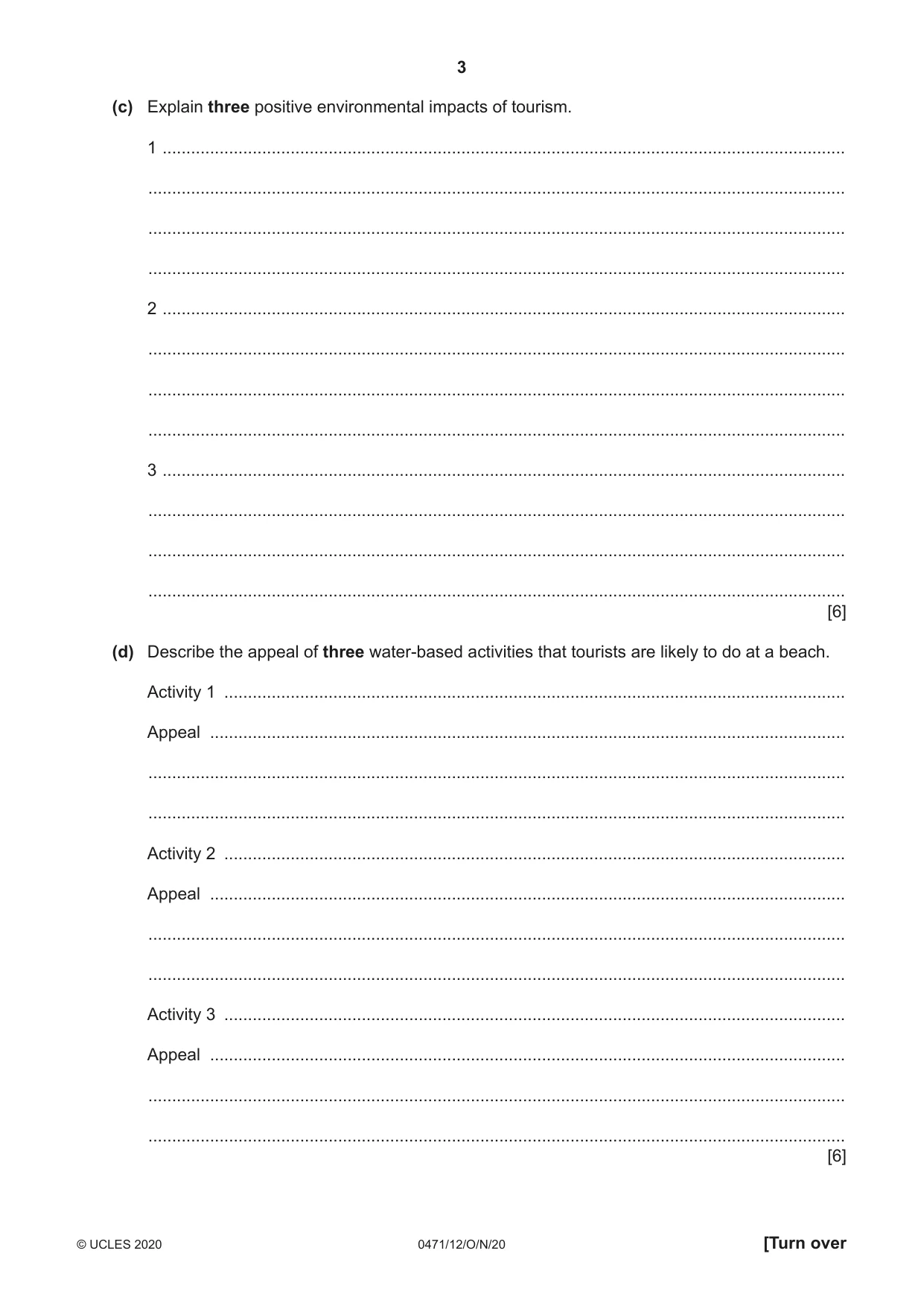
3 0471/12/O/N/20 © UCLES 2020 [Turn over (c) Explain three positive environmental impacts of tourism. 1 … … … … 2 … … … … 3 … … … … [6] (d) Describe the appeal of three water-based activities that tourists are likely to do at a beach. Activity 1 … Appeal … … … Activity 2 … Appeal … … … Activity 3 … Appeal … … … [6]
Question paper, page 4
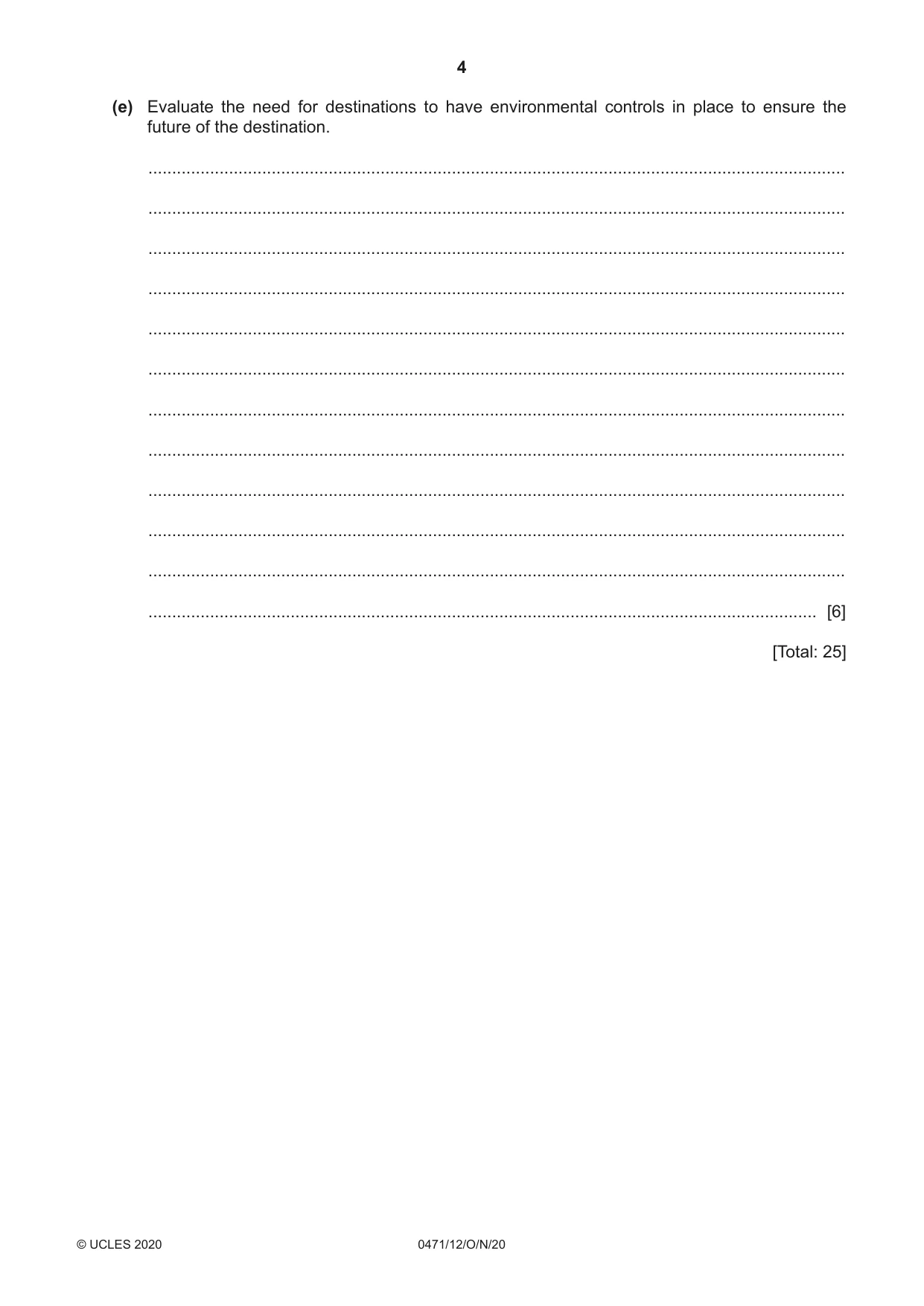
4 0471/12/O/N/20 © UCLES 2020 (e) Evaluate the need for destinations to have environmental controls in place to ensure the future of the destination. … … … … … … … … … … … … [6] [Total: 25]
Question paper, page 5
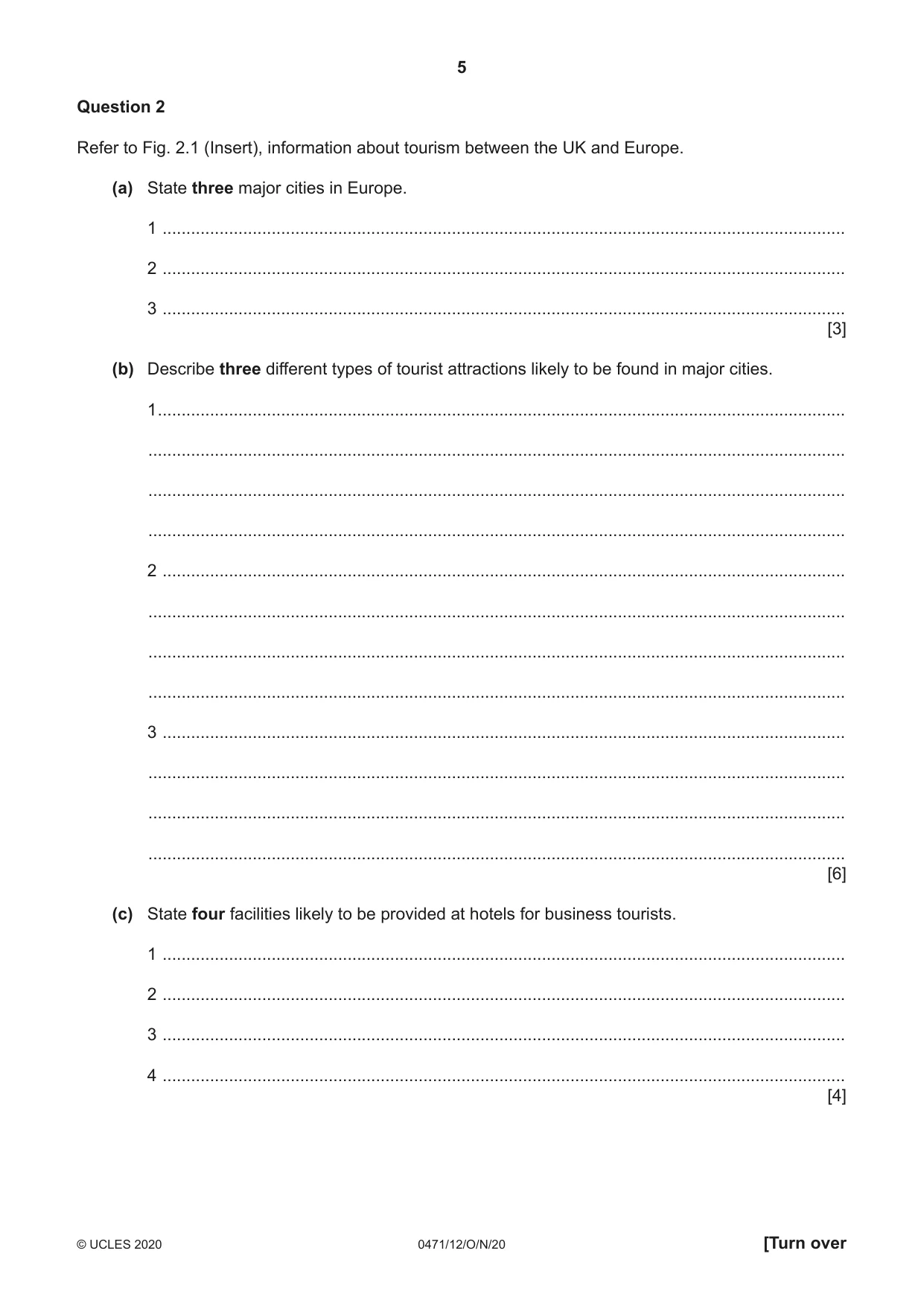
5 0471/12/O/N/20 © UCLES 2020 [Turn over Question 2 Refer to Fig. 2.1 (Insert), information about tourism between the UK and Europe. (a) State three major cities in Europe. 1 … 2 … 3 … [3] (b) Describe three different types of tourist attractions likely to be found in major cities. 1 … … … … 2 … … … … 3 … … … … [6] (c) State four facilities likely to be provided at hotels for business tourists. 1 … 2 … 3 … 4 … [4]
Question paper, page 6
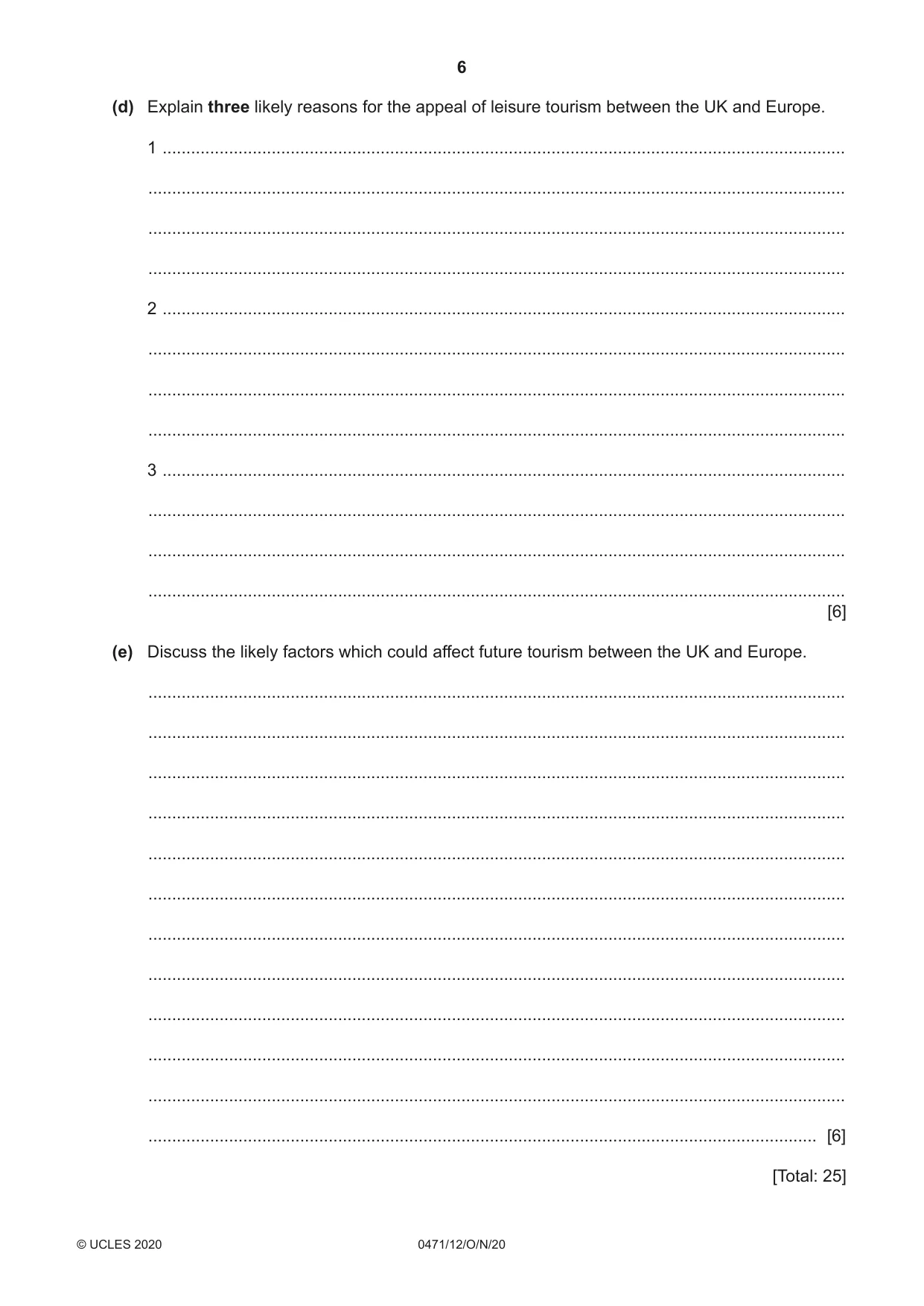
6 0471/12/O/N/20 © UCLES 2020 (d) Explain three likely reasons for the appeal of leisure tourism between the UK and Europe. 1 … … … … 2 … … … … 3 … … … … [6] (e) Discuss the likely factors which could affect future tourism between the UK and Europe. … … … … … … … … … … … … [6] [Total: 25]
Question paper, page 7
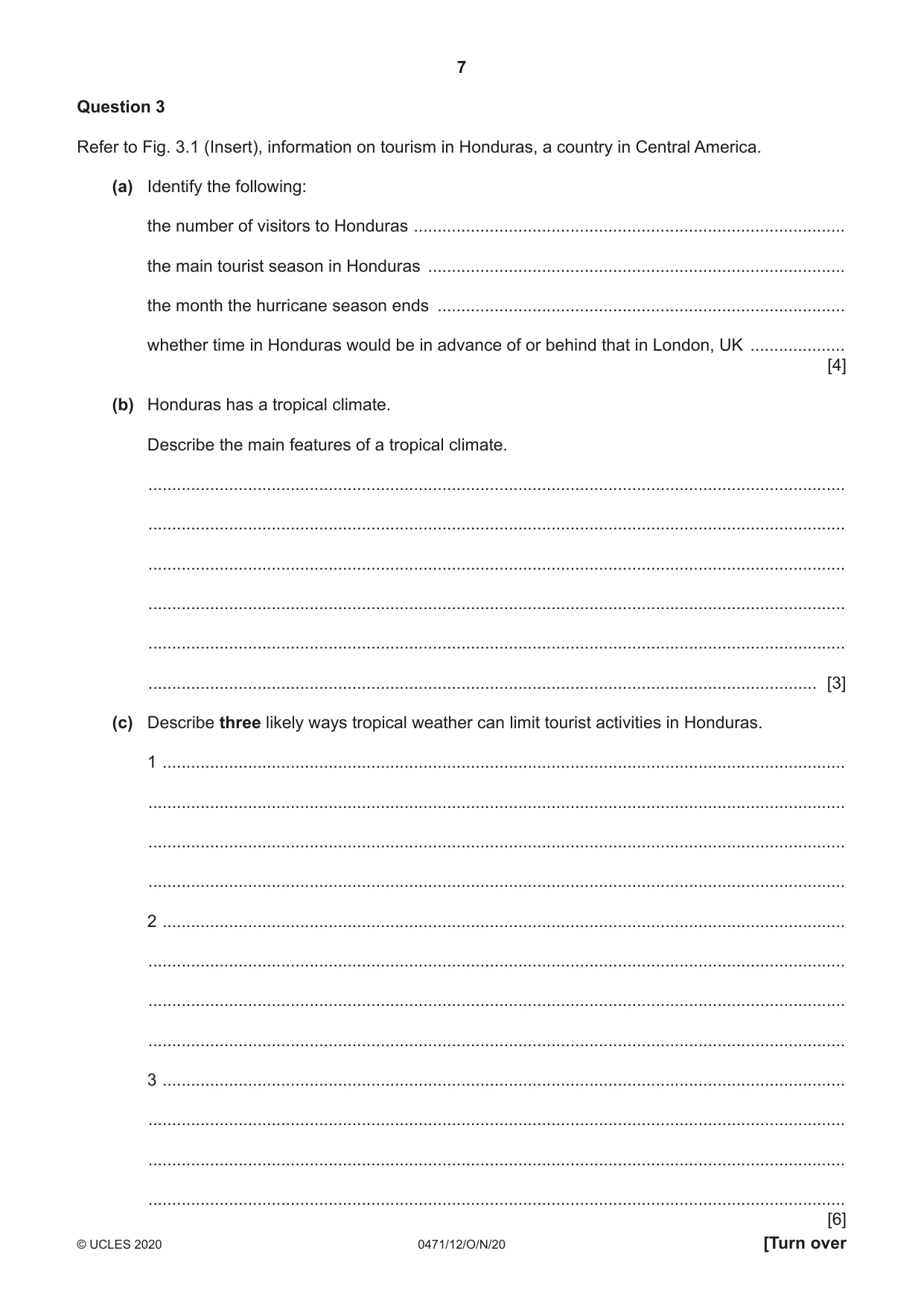
7 0471/12/O/N/20 © UCLES 2020 [Turn over Question 3 Refer to Fig. 3.1 (Insert), information on tourism in Honduras, a country in Central America. (a) Identify the following: the number of visitors to Honduras … the main tourist season in Honduras … the month the hurricane season ends … whether time in Honduras would be in advance of or behind that in London, UK … [4] (b) Honduras has a tropical climate. Describe the main features of a tropical climate. … … … … … … [3] (c) Describe three likely ways tropical weather can limit tourist activities in Honduras. 1 … … … … 2 … … … … 3 … … … … [6]
Question paper, page 8
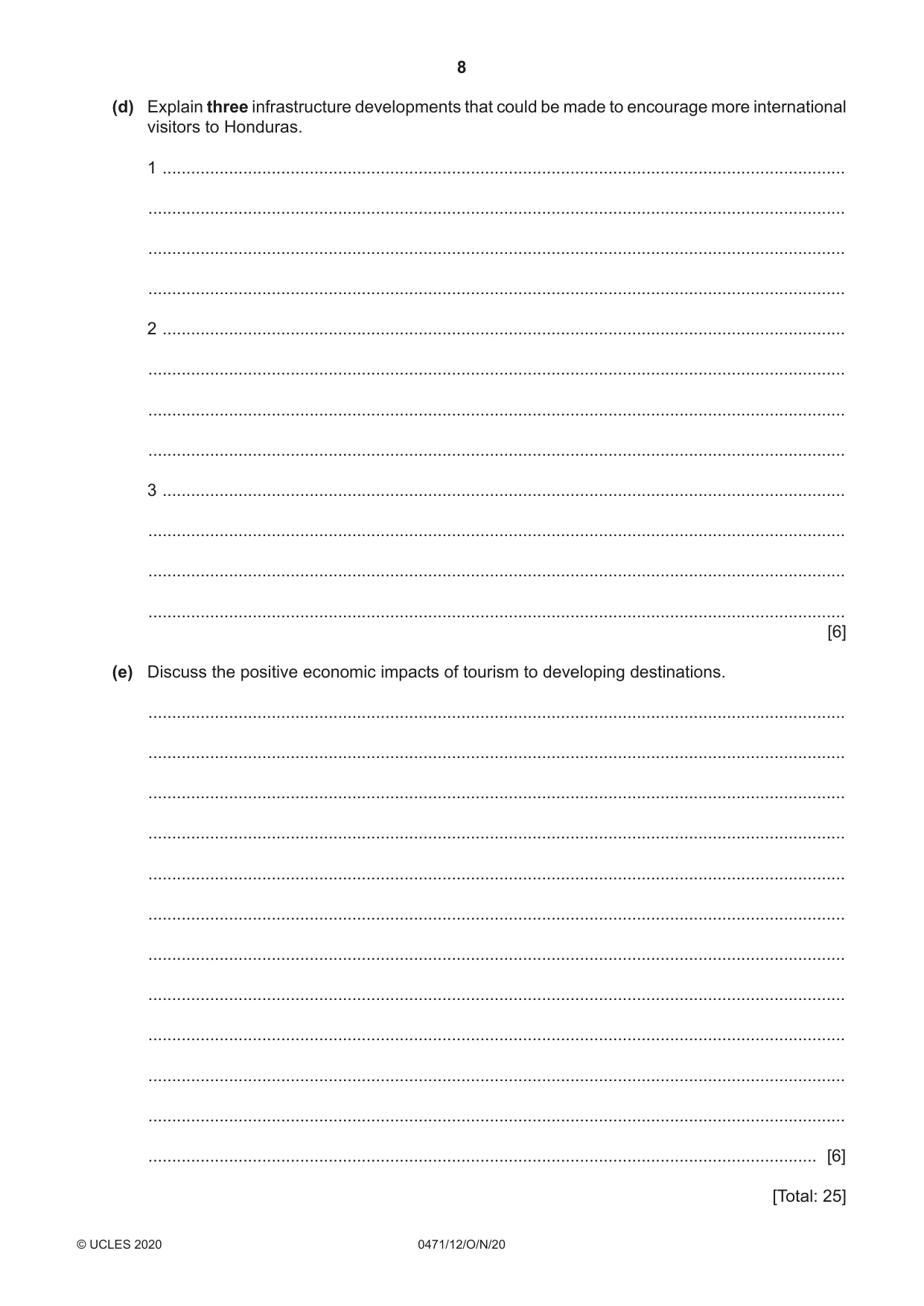
8 0471/12/O/N/20 © UCLES 2020 (d) Explain three infrastructure developments that could be made to encourage more international visitors to Honduras. 1 … … … … 2 … … … … 3 … … … … [6] (e) Discuss the positive economic impacts of tourism to developing destinations. … … … … … … … … … … … … [6] [Total: 25]
Question paper, page 9
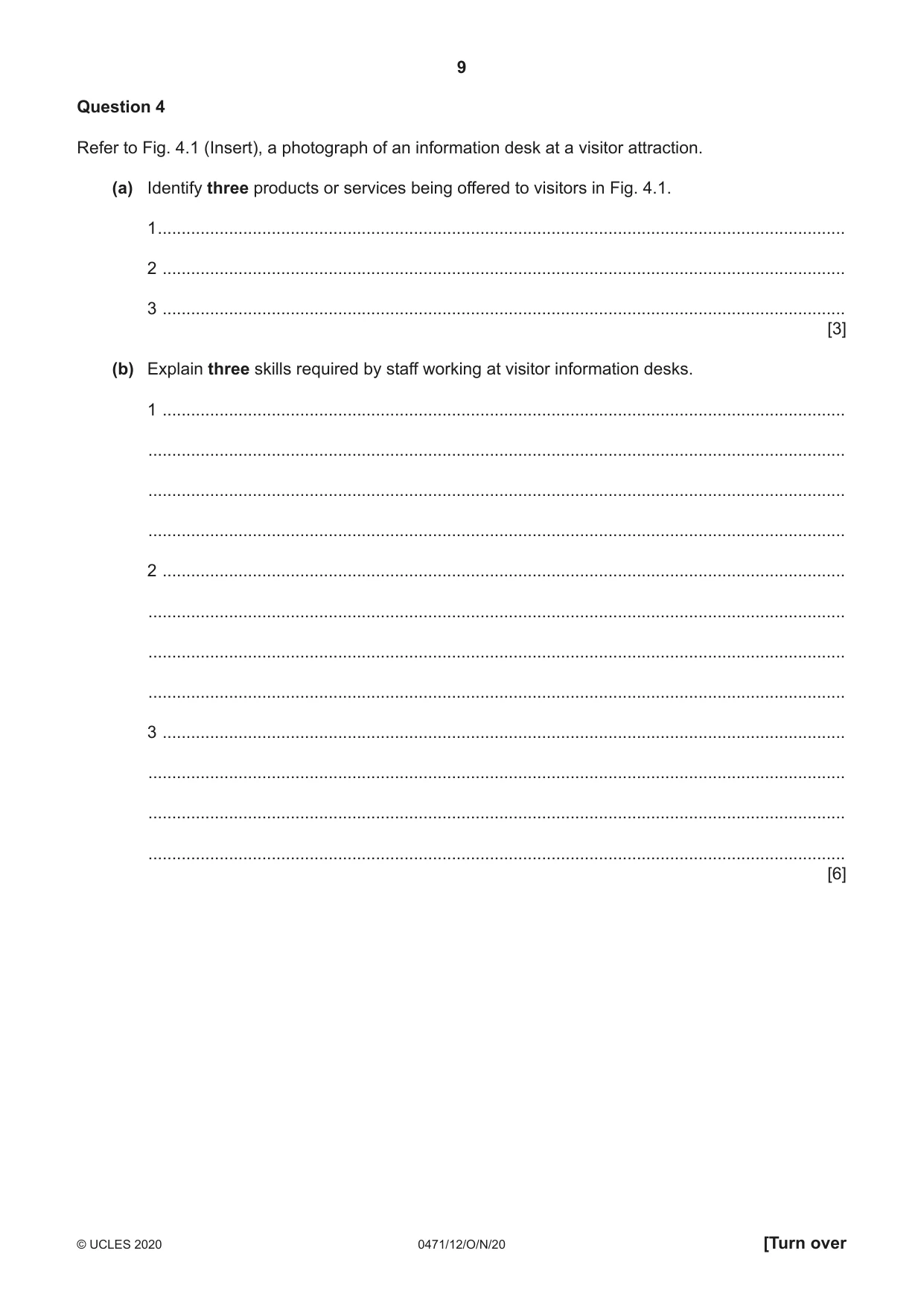
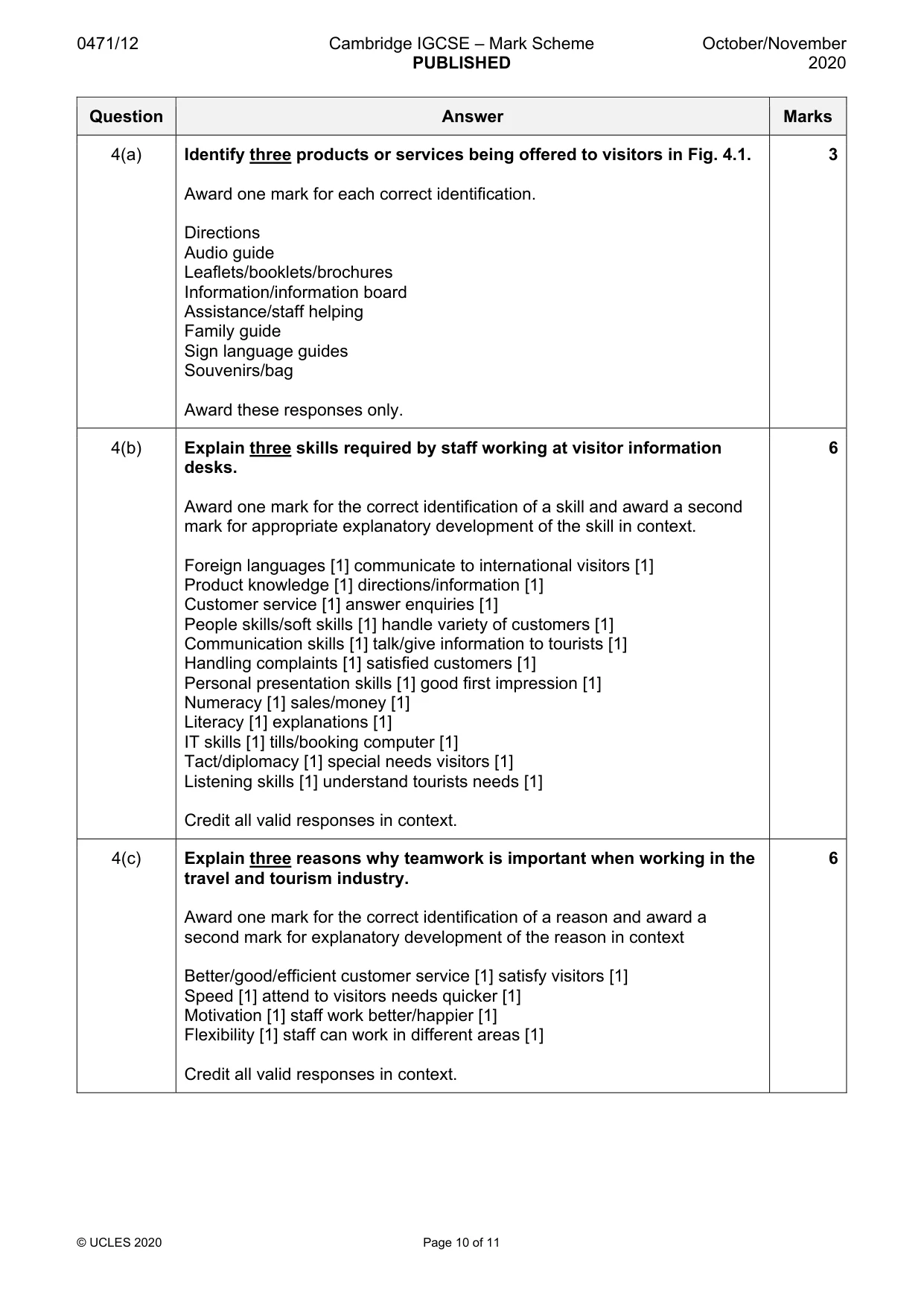
9 0471/12/O/N/20 © UCLES 2020 [Turn over Question 4 Refer to Fig. 4.1 (Insert), a photograph of an information desk at a visitor attraction. (a) Identify three products or services being offered to visitors in Fig. 4.1. 1 … 2 … 3 … [3] (b) Explain three skills required by staff working at visitor information desks. 1 … … … … 2 … … … … 3 … … … … [6]
Question paper, page 10
10 0471/12/O/N/20 © UCLES 2020 (c) Explain three reasons why teamwork is important when working in the travel and tourism industry. 1 … … … … 2 … … … … 3 … … … … [6] (d) Explain two reasons for the appeal to tourists of audio guides. 1 … … … … 2 … … … … [4]
Question paper, page 11
11 0471/12/O/N/20 © UCLES 2020 (e) Discuss the role of tourist attractions in the tourism industry. … … … … … … … … … … … … [6] [Total: 25]
Question paper, page 12
12 0471/12/O/N/20 © UCLES 2020 Permission to reproduce items where third-party owned material protected by copyright is included has been sought and cleared where possible. Every reasonable effort has been made by the publisher (UCLES) to trace copyright holders, but if any items requiring clearance have unwittingly been included, the publisher will be pleased to make amends at the earliest possible opportunity. To avoid the issue of disclosure of answer-related information to candidates, all copyright acknowledgements are reproduced online in the Cambridge Assessment International Education Copyright Acknowledgements Booklet. This is produced for each series of examinations and is freely available to download at www.cambridgeinternational.org after the live examination series. Cambridge Assessment International Education is part of the Cambridge Assessment Group. Cambridge Assessment is the brand name of the University of Cambridge Local Examinations Syndicate (UCLES), which itself is a department of the University of Cambridge. BLANK PAGE
Mark scheme, page 1
This document consists of 11 printed pages. © UCLES 2020 [Turn over Cambridge IGCSE™ TRAVEL AND TOURISM 0471/12 Paper 1 Core Paper October/November 2020 MARK SCHEME Maximum Mark: 100 Published This mark scheme is published as an aid to teachers and candidates, to indicate the requirements of the examination. It shows the basis on which Examiners were instructed to award marks. It does not indicate the details of the discussions that took place at an Examiners’ meeting before marking began, which would have considered the acceptability of alternative answers. Mark schemes should be read in conjunction with the question paper and the Principal Examiner Report for Teachers. Cambridge International will not enter into discussions about these mark schemes. Cambridge International is publishing the mark schemes for the October/November 2020 series for most Cambridge IGCSE™, Cambridge International A and AS Level and Cambridge Pre-U components, and some Cambridge O Level components.
Mark scheme, page 2
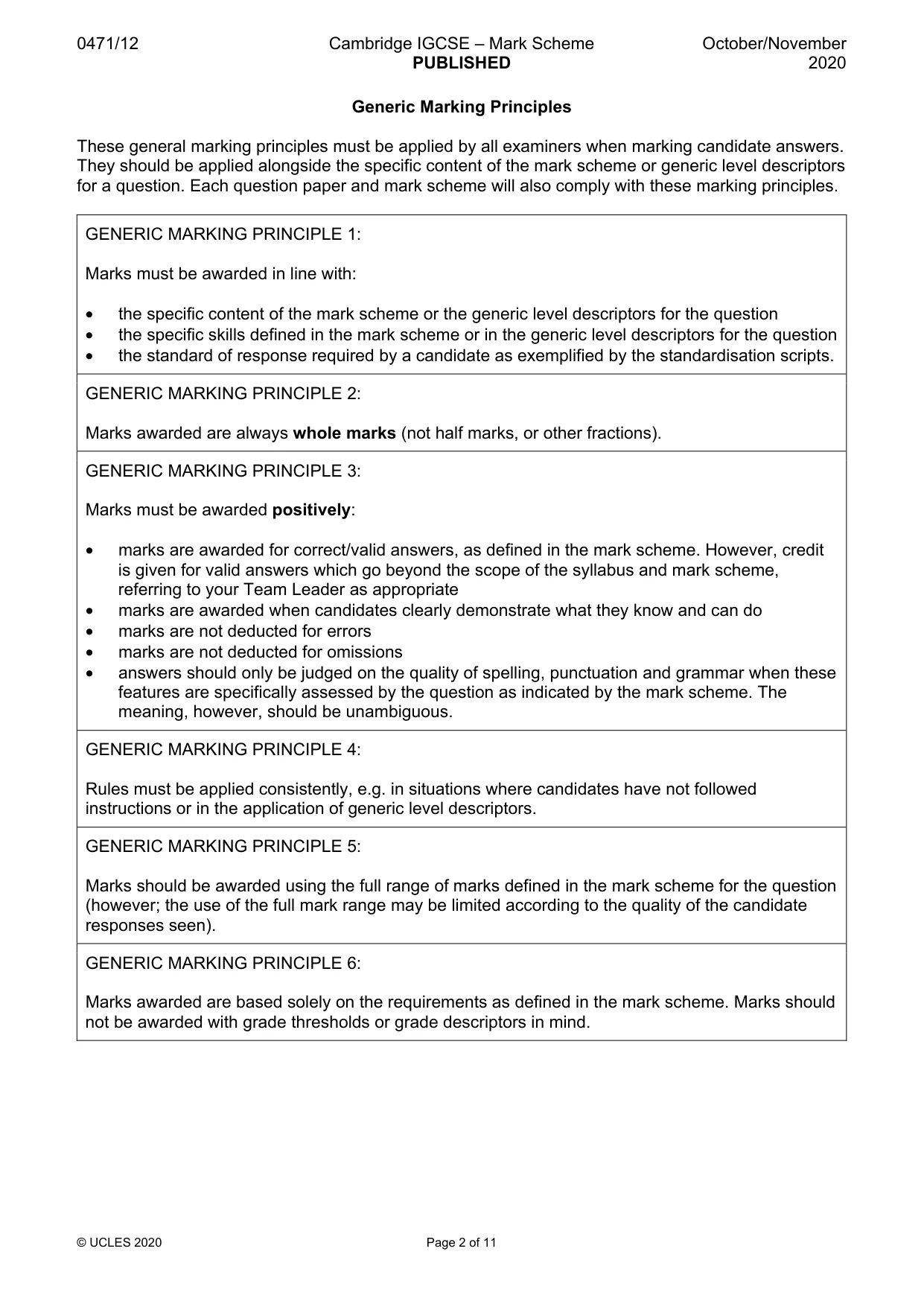
0471/12 Cambridge IGCSE – Mark Scheme PUBLISHED October/November 2020 © UCLES 2020 Page 2 of 11 Generic Marking Principles These general marking principles must be applied by all examiners when marking candidate answers. They should be applied alongside the specific content of the mark scheme or generic level descriptors for a question. Each question paper and mark scheme will also comply with these marking principles. GENERIC MARKING PRINCIPLE 1: Marks must be awarded in line with: • the specific content of the mark scheme or the generic level descriptors for the question • the specific skills defined in the mark scheme or in the generic level descriptors for the question • the standard of response required by a candidate as exemplified by the standardisation scripts. GENERIC MARKING PRINCIPLE 2: Marks awarded are always whole marks (not half marks, or other fractions). GENERIC MARKING PRINCIPLE 3: Marks must be awarded positively: • marks are awarded for correct/valid answers, as defined in the mark scheme. However, credit is given for valid answers which go beyond the scope of the syllabus and mark scheme, referring to your Team Leader as appropriate • marks are awarded when candidates clearly demonstrate what they know and can do • marks are not deducted for errors • marks are not deducted for omissions • answers should only be judged on the quality of spelling, punctuation and grammar when these features are specifically assessed by the question as indicated by the mark scheme. The meaning, however, should be unambiguous. GENERIC MARKING PRINCIPLE 4: Rules must be applied consistently, e.g. in situations where candidates have not followed instructions or in the application of generic level descriptors. GENERIC MARKING PRINCIPLE 5: Marks should be awarded using the full range of marks defined in the mark scheme for the question (however; the use of the full mark range may be limited according to the quality of the candidate responses seen). GENERIC MARKING PRINCIPLE 6: Marks awarded are based solely on the requirements as defined in the mark scheme. Marks should not be awarded with grade thresholds or grade descriptors in mind.
Mark scheme, page 3
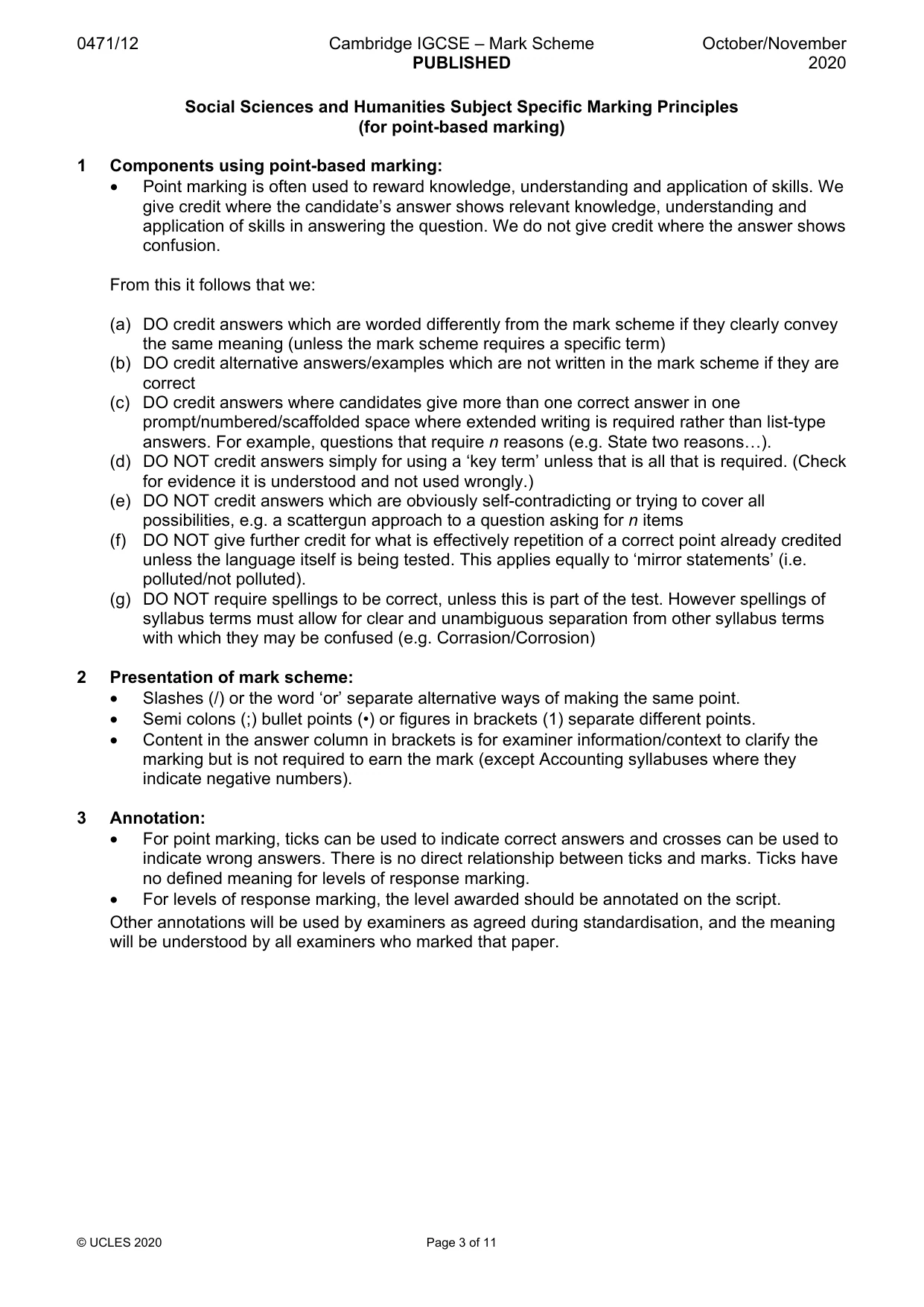
0471/12 Cambridge IGCSE – Mark Scheme PUBLISHED October/November 2020 © UCLES 2020 Page 3 of 11 Social Sciences and Humanities Subject Specific Marking Principles (for point-based marking) 1 Components using point-based marking: • Point marking is often used to reward knowledge, understanding and application of skills. We give credit where the candidate’s answer shows relevant knowledge, understanding and application of skills in answering the question. We do not give credit where the answer shows confusion. From this it follows that we: (a) DO credit answers which are worded differently from the mark scheme if they clearly convey the same meaning (unless the mark scheme requires a specific term) (b) DO credit alternative answers/examples which are not written in the mark scheme if they are correct (c) DO credit answers where candidates give more than one correct answer in one prompt/numbered/scaffolded space where extended writing is required rather than list-type answers. For example, questions that require n reasons (e.g. State two reasons…). (d) DO NOT credit answers simply for using a ‘key term’ unless that is all that is required. (Check for evidence it is understood and not used wrongly.) (e) DO NOT credit answers which are obviously self-contradicting or trying to cover all possibilities, e.g. a scattergun approach to a question asking for n items (f) DO NOT give further credit for what is effectively repetition of a correct point already credited unless the language itself is being tested. This applies equally to ‘mirror statements’ (i.e. polluted/not polluted). (g) DO NOT require spellings to be correct, unless this is part of the test. However spellings of syllabus terms must allow for clear and unambiguous separation from other syllabus terms with which they may be confused (e.g. Corrasion/Corrosion) 2 Presentation of mark scheme: • Slashes (/) or the word ‘or’ separate alternative ways of making the same point. • Semi colons (;) bullet points (•) or figures in brackets (1) separate different points. • Content in the answer column in brackets is for examiner information/context to clarify the marking but is not required to earn the mark (except Accounting syllabuses where they indicate negative numbers). 3 Annotation: • For point marking, ticks can be used to indicate correct answers and crosses can be used to indicate wrong answers. There is no direct relationship between ticks and marks. Ticks have no defined meaning for levels of response marking. • For levels of response marking, the level awarded should be annotated on the script. Other annotations will be used by examiners as agreed during standardisation, and the meaning will be understood by all examiners who marked that paper.
Mark scheme, page 4
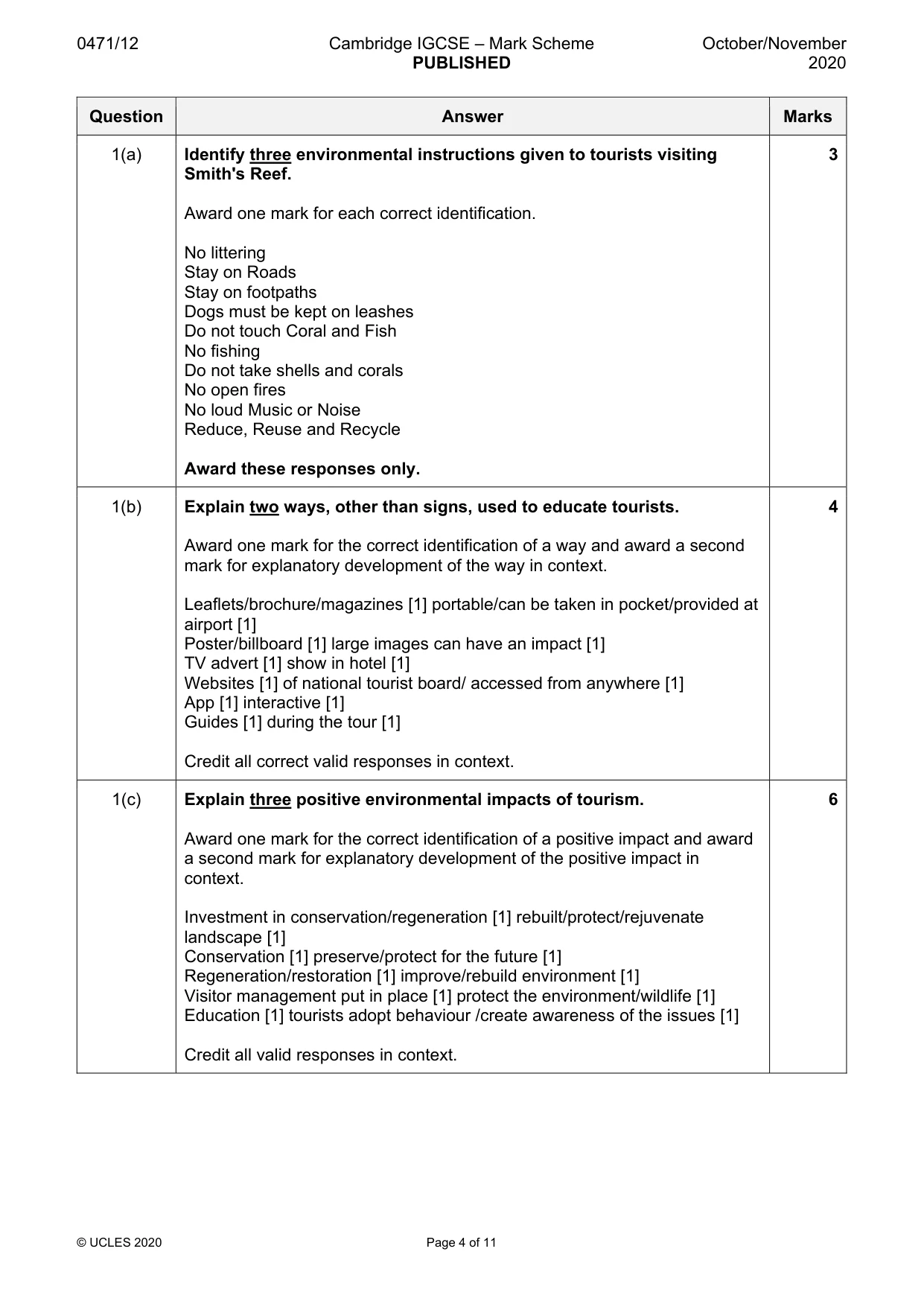
0471/12 Cambridge IGCSE – Mark Scheme PUBLISHED October/November 2020 © UCLES 2020 Page 4 of 11 Question Answer Marks 1(a) Identify three environmental instructions given to tourists visiting Smith's Reef. Award one mark for each correct identification. No littering Stay on Roads Stay on footpaths Dogs must be kept on leashes Do not touch Coral and Fish No fishing Do not take shells and corals No open fires No loud Music or Noise Reduce, Reuse and Recycle Award these responses only. 3 1(b) Explain two ways, other than signs, used to educate tourists. Award one mark for the correct identification of a way and award a second mark for explanatory development of the way in context. Leaflets/brochure/magazines [1] portable/can be taken in pocket/provided at airport [1] Poster/billboard [1] large images can have an impact [1] TV advert [1] show in hotel [1] Websites [1] of national tourist board/ accessed from anywhere [1] App [1] interactive [1] Guides [1] during the tour [1] Credit all correct valid responses in context. 4 1(c) Explain three positive environmental impacts of tourism. Award one mark for the correct identification of a positive impact and award a second mark for explanatory development of the positive impact in context. Investment in conservation/regeneration [1] rebuilt/protect/rejuvenate landscape [1] Conservation [1] preserve/protect for the future [1] Regeneration/restoration [1] improve/rebuild environment [1] Visitor management put in place [1] protect the environment/wildlife [1] Education [1] tourists adopt behaviour /create awareness of the issues [1] Credit all valid responses in context. 6
Mark scheme, page 5
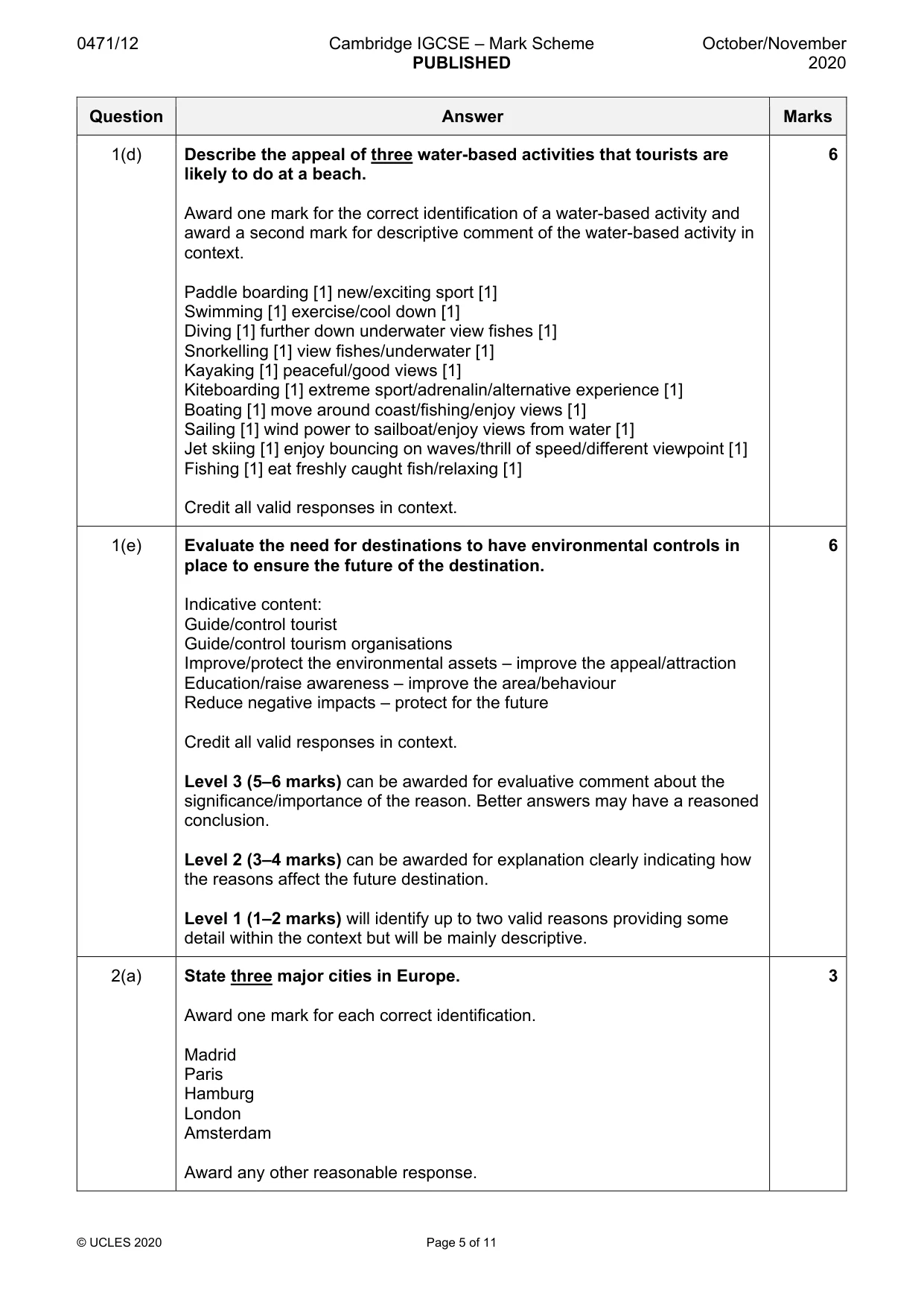
0471/12 Cambridge IGCSE – Mark Scheme PUBLISHED October/November 2020 © UCLES 2020 Page 5 of 11 Question Answer Marks 1(d) Describe the appeal of three water-based activities that tourists are likely to do at a beach. Award one mark for the correct identification of a water-based activity and award a second mark for descriptive comment of the water-based activity in context. Paddle boarding [1] new/exciting sport [1] Swimming [1] exercise/cool down [1] Diving [1] further down underwater view fishes [1] Snorkelling [1] view fishes/underwater [1] Kayaking [1] peaceful/good views [1] Kiteboarding [1] extreme sport/adrenalin/alternative experience [1] Boating [1] move around coast/fishing/enjoy views [1] Sailing [1] wind power to sailboat/enjoy views from water [1] Jet skiing [1] enjoy bouncing on waves/thrill of speed/different viewpoint [1] Fishing [1] eat freshly caught fish/relaxing [1] Credit all valid responses in context. 6 1(e) Evaluate the need for destinations to have environmental controls in place to ensure the future of the destination. Indicative content: Guide/control tourist Guide/control tourism organisations Improve/protect the environmental assets – improve the appeal/attraction Education/raise awareness – improve the area/behaviour Reduce negative impacts – protect for the future Credit all valid responses in context. Level 3 (5–6 marks) can be awarded for evaluative comment about the significance/importance of the reason. Better answers may have a reasoned conclusion. Level 2 (3–4 marks) can be awarded for explanation clearly indicating how the reasons affect the future destination. Level 1 (1–2 marks) will identify up to two valid reasons providing some detail within the context but will be mainly descriptive. 6 2(a) State three major cities in Europe. Award one mark for each correct identification. Madrid Paris Hamburg London Amsterdam Award any other reasonable response. 3
Mark scheme, page 6
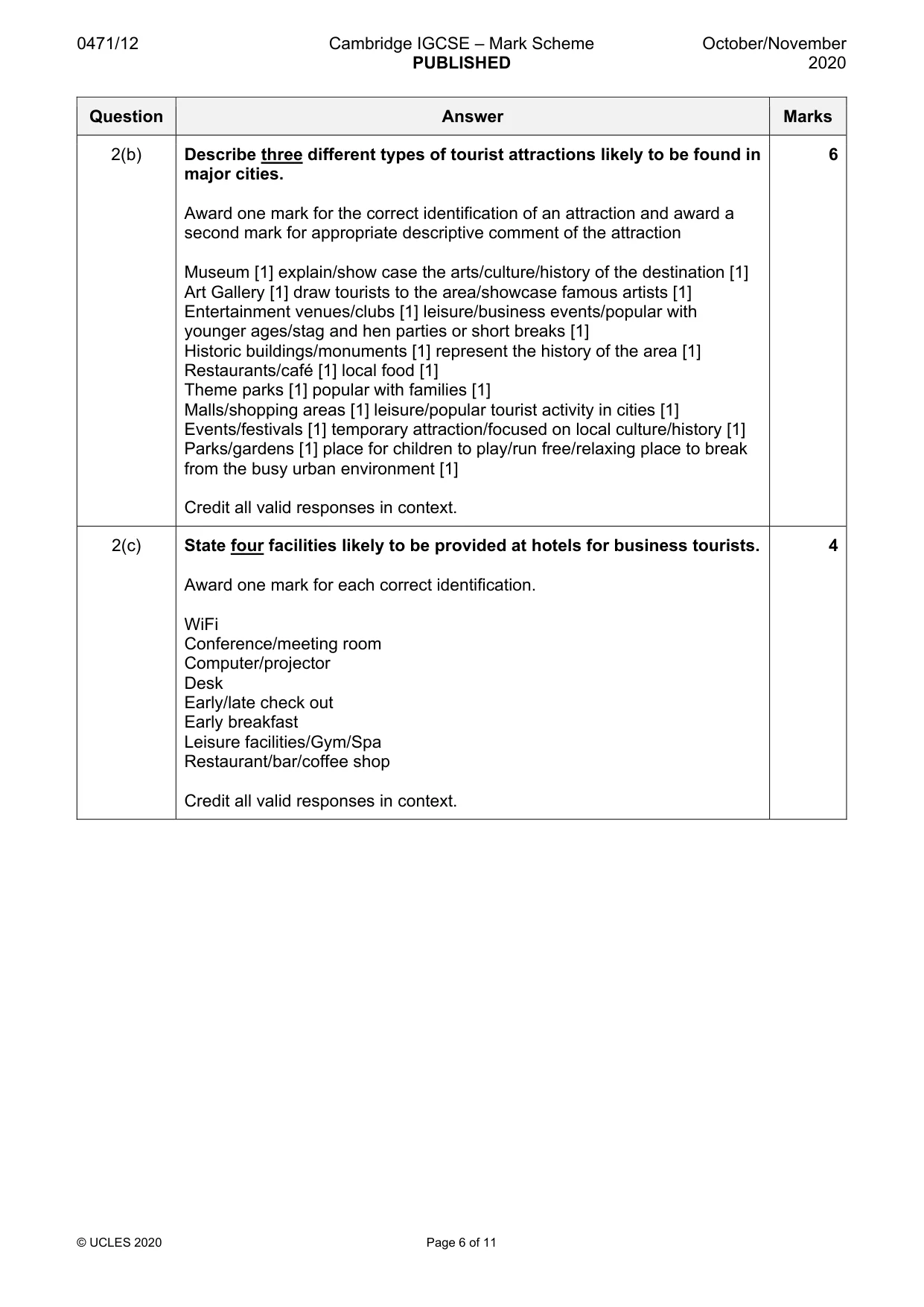
0471/12 Cambridge IGCSE – Mark Scheme PUBLISHED October/November 2020 © UCLES 2020 Page 6 of 11 Question Answer Marks 2(b) Describe three different types of tourist attractions likely to be found in major cities. Award one mark for the correct identification of an attraction and award a second mark for appropriate descriptive comment of the attraction Museum [1] explain/show case the arts/culture/history of the destination [1] Art Gallery [1] draw tourists to the area/showcase famous artists [1] Entertainment venues/clubs [1] leisure/business events/popular with younger ages/stag and hen parties or short breaks [1] Historic buildings/monuments [1] represent the history of the area [1] Restaurants/café [1] local food [1] Theme parks [1] popular with families [1] Malls/shopping areas [1] leisure/popular tourist activity in cities [1] Events/festivals [1] temporary attraction/focused on local culture/history [1] Parks/gardens [1] place for children to play/run free/relaxing place to break from the busy urban environment [1] Credit all valid responses in context. 6 2(c) State four facilities likely to be provided at hotels for business tourists. Award one mark for each correct identification. WiFi Conference/meeting room Computer/projector Desk Early/late check out Early breakfast Leisure facilities/Gym/Spa Restaurant/bar/coffee shop Credit all valid responses in context. 4
Mark scheme, page 7
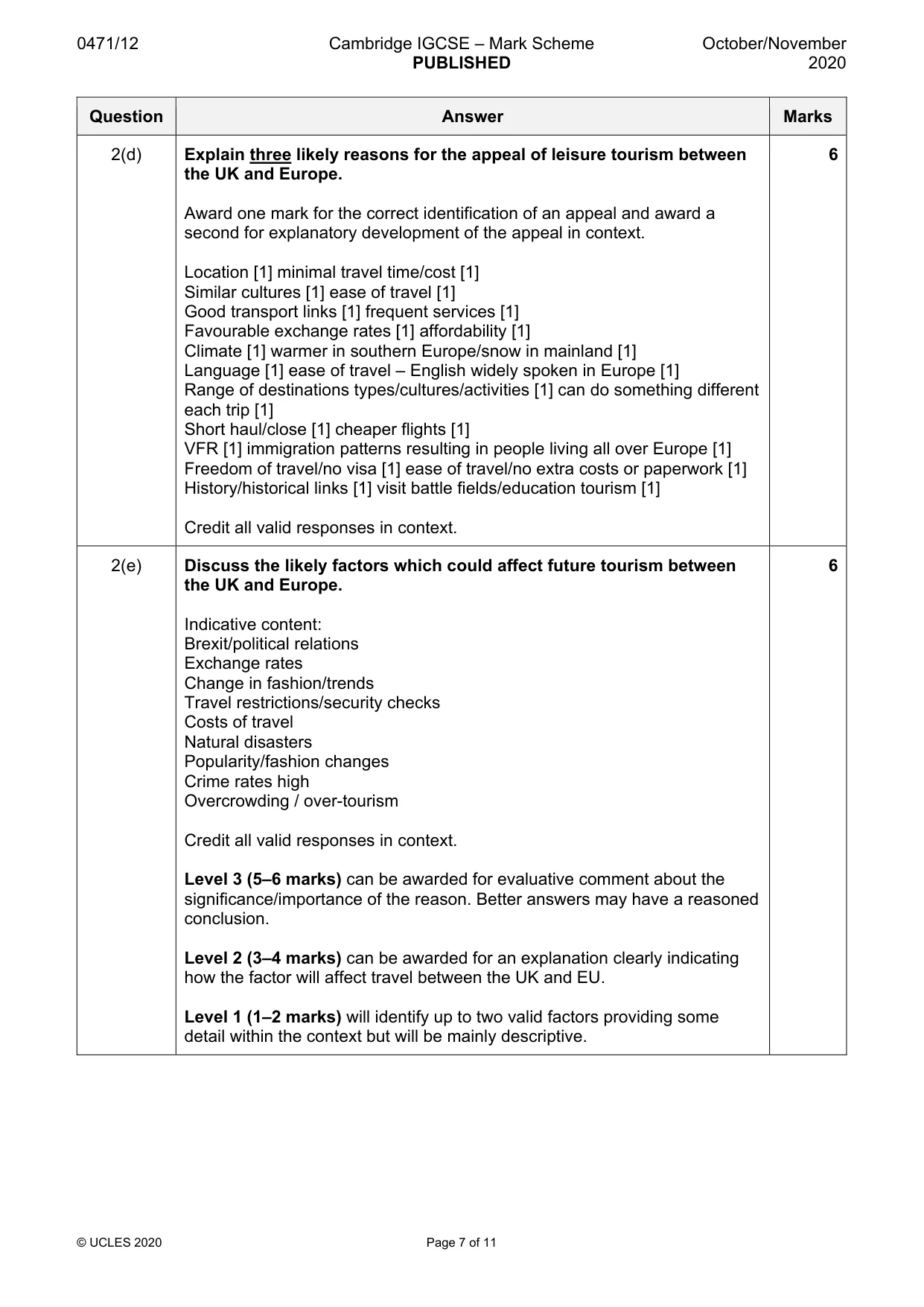
0471/12 Cambridge IGCSE – Mark Scheme PUBLISHED October/November 2020 © UCLES 2020 Page 7 of 11 Question Answer Marks 2(d) Explain three likely reasons for the appeal of leisure tourism between the UK and Europe. Award one mark for the correct identification of an appeal and award a second for explanatory development of the appeal in context. Location [1] minimal travel time/cost [1] Similar cultures [1] ease of travel [1] Good transport links [1] frequent services [1] Favourable exchange rates [1] affordability [1] Climate [1] warmer in southern Europe/snow in mainland [1] Language [1] ease of travel – English widely spoken in Europe [1] Range of destinations types/cultures/activities [1] can do something different each trip [1] Short haul/close [1] cheaper flights [1] VFR [1] immigration patterns resulting in people living all over Europe [1] Freedom of travel/no visa [1] ease of travel/no extra costs or paperwork [1] History/historical links [1] visit battle fields/education tourism [1] Credit all valid responses in context. 6 2(e) Discuss the likely factors which could affect future tourism between the UK and Europe. Indicative content: Brexit/political relations Exchange rates Change in fashion/trends Travel restrictions/security checks Costs of travel Natural disasters Popularity/fashion changes Crime rates high Overcrowding / over-tourism Credit all valid responses in context. Level 3 (5–6 marks) can be awarded for evaluative comment about the significance/importance of the reason. Better answers may have a reasoned conclusion. Level 2 (3–4 marks) can be awarded for an explanation clearly indicating how the factor will affect travel between the UK and EU. Level 1 (1–2 marks) will identify up to two valid factors providing some detail within the context but will be mainly descriptive. 6
Mark scheme, page 8
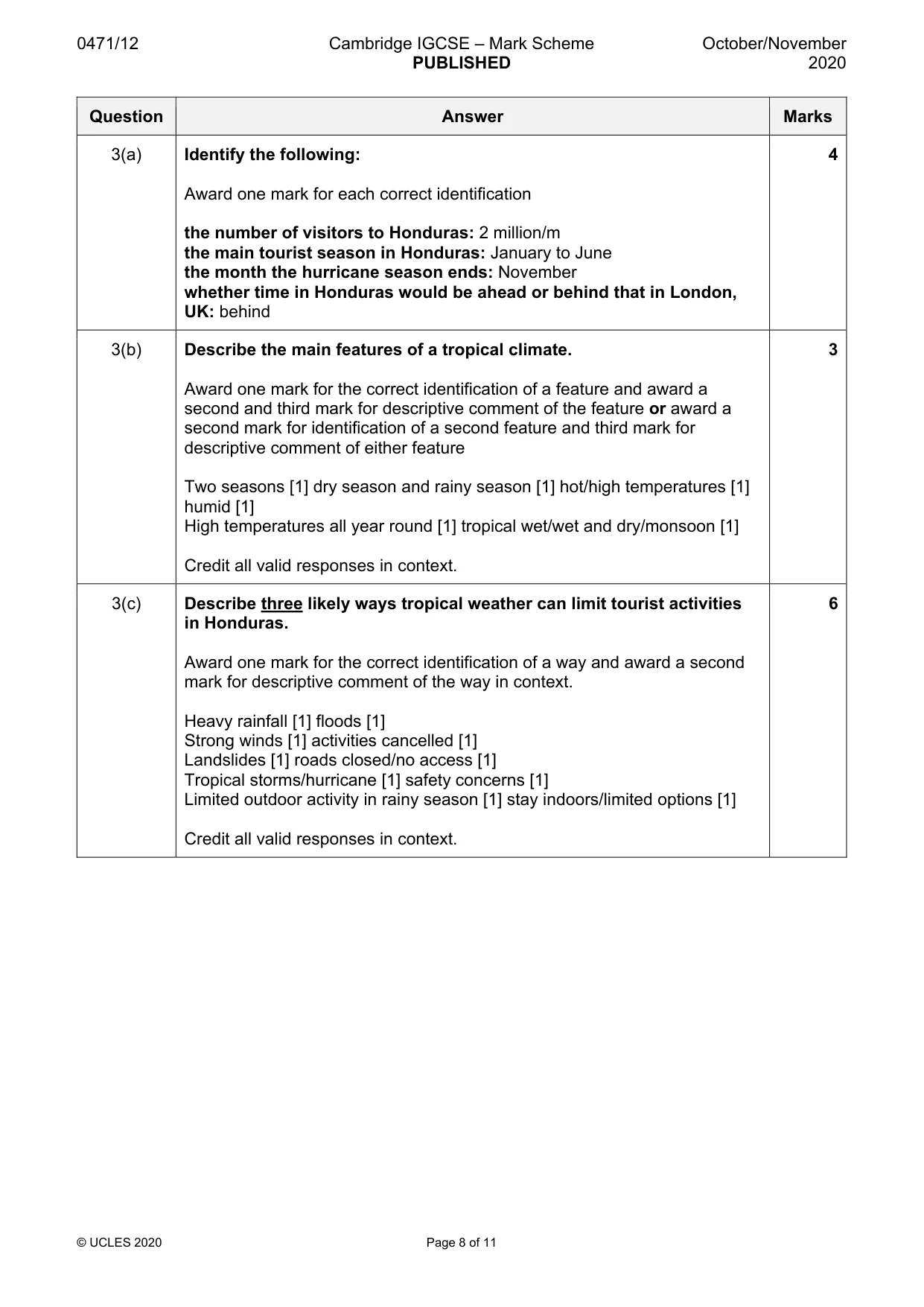
0471/12 Cambridge IGCSE – Mark Scheme PUBLISHED October/November 2020 © UCLES 2020 Page 8 of 11 Question Answer Marks 3(a) Identify the following: Award one mark for each correct identification the number of visitors to Honduras: 2 million/m the main tourist season in Honduras: January to June the month the hurricane season ends: November whether time in Honduras would be ahead or behind that in London, UK: behind 4 3(b) Describe the main features of a tropical climate. Award one mark for the correct identification of a feature and award a second and third mark for descriptive comment of the feature or award a second mark for identification of a second feature and third mark for descriptive comment of either feature Two seasons [1] dry season and rainy season [1] hot/high temperatures [1] humid [1] High temperatures all year round [1] tropical wet/wet and dry/monsoon [1] Credit all valid responses in context. 3 3(c) Describe three likely ways tropical weather can limit tourist activities in Honduras. Award one mark for the correct identification of a way and award a second mark for descriptive comment of the way in context. Heavy rainfall [1] floods [1] Strong winds [1] activities cancelled [1] Landslides [1] roads closed/no access [1] Tropical storms/hurricane [1] safety concerns [1] Limited outdoor activity in rainy season [1] stay indoors/limited options [1] Credit all valid responses in context. 6
Mark scheme, page 9
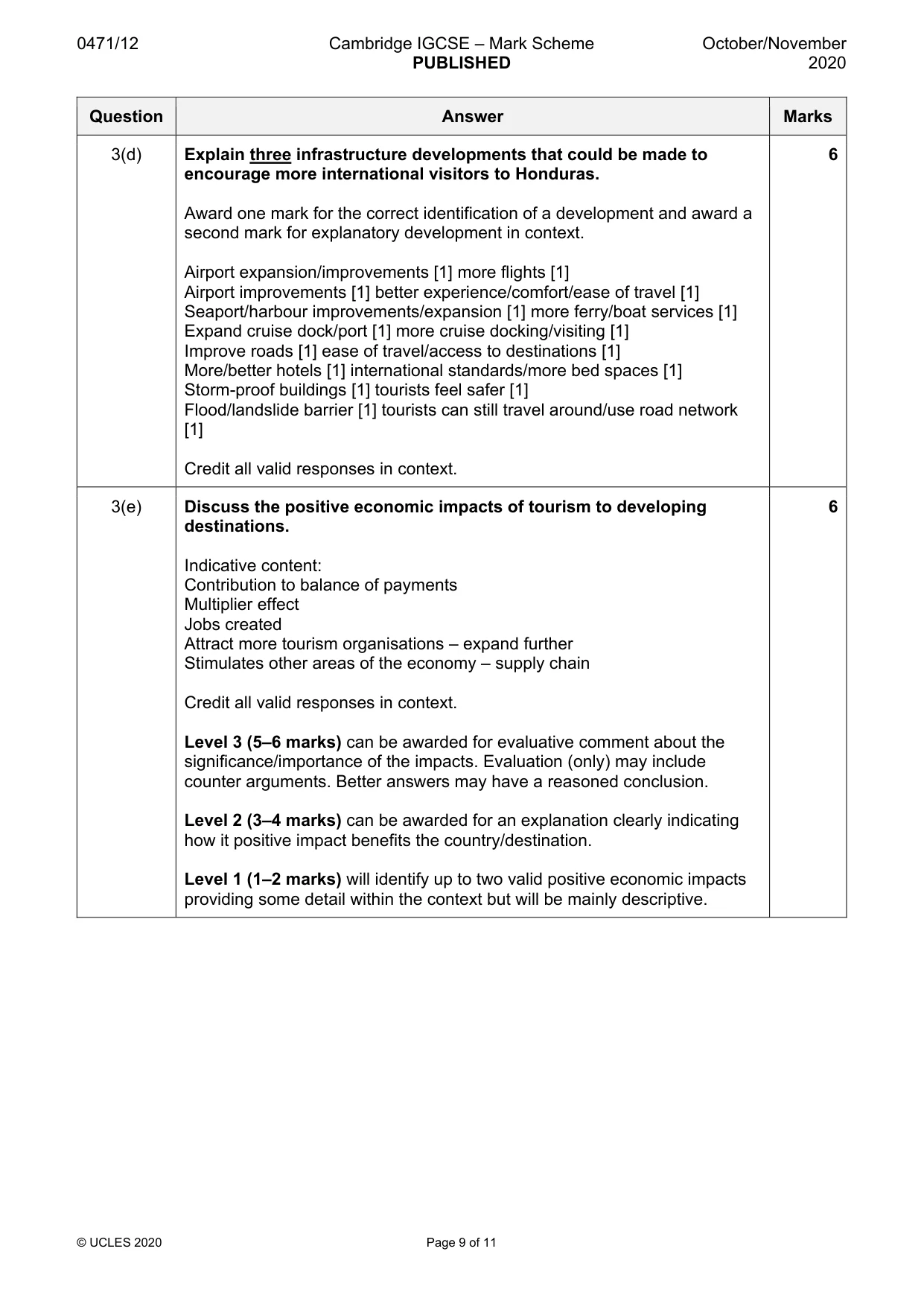
0471/12 Cambridge IGCSE – Mark Scheme PUBLISHED October/November 2020 © UCLES 2020 Page 9 of 11 Question Answer Marks 3(d) Explain three infrastructure developments that could be made to encourage more international visitors to Honduras. Award one mark for the correct identification of a development and award a second mark for explanatory development in context. Airport expansion/improvements [1] more flights [1] Airport improvements [1] better experience/comfort/ease of travel [1] Seaport/harbour improvements/expansion [1] more ferry/boat services [1] Expand cruise dock/port [1] more cruise docking/visiting [1] Improve roads [1] ease of travel/access to destinations [1] More/better hotels [1] international standards/more bed spaces [1] Storm-proof buildings [1] tourists feel safer [1] Flood/landslide barrier [1] tourists can still travel around/use road network [1] Credit all valid responses in context. 6 3(e) Discuss the positive economic impacts of tourism to developing destinations. Indicative content: Contribution to balance of payments Multiplier effect Jobs created Attract more tourism organisations – expand further Stimulates other areas of the economy – supply chain Credit all valid responses in context. Level 3 (5–6 marks) can be awarded for evaluative comment about the significance/importance of the impacts. Evaluation (only) may include counter arguments. Better answers may have a reasoned conclusion. Level 2 (3–4 marks) can be awarded for an explanation clearly indicating how it positive impact benefits the country/destination. Level 1 (1–2 marks) will identify up to two valid positive economic impacts providing some detail within the context but will be mainly descriptive. 6
Mark scheme, page 10
0471/12 Cambridge IGCSE – Mark Scheme PUBLISHED October/November 2020 © UCLES 2020 Page 10 of 11 Question Answer Marks 4(a) Identify three products or services being offered to visitors in Fig. 4.1. Award one mark for each correct identification. Directions Audio guide Leaflets/booklets/brochures Information/information board Assistance/staff helping Family guide Sign language guides Souvenirs/bag Award these responses only. 3 4(b) Explain three skills required by staff working at visitor information desks. Award one mark for the correct identification of a skill and award a second mark for appropriate explanatory development of the skill in context. Foreign languages [1] communicate to international visitors [1] Product knowledge [1] directions/information [1] Customer service [1] answer enquiries [1] People skills/soft skills [1] handle variety of customers [1] Communication skills [1] talk/give information to tourists [1] Handling complaints [1] satisfied customers [1] Personal presentation skills [1] good first impression [1] Numeracy [1] sales/money [1] Literacy [1] explanations [1] IT skills [1] tills/booking computer [1] Tact/diplomacy [1] special needs visitors [1] Listening skills [1] understand tourists needs [1] Credit all valid responses in context. 6 4(c) Explain three reasons why teamwork is important when working in the travel and tourism industry. Award one mark for the correct identification of a reason and award a second mark for explanatory development of the reason in context Better/good/efficient customer service [1] satisfy visitors [1] Speed [1] attend to visitors needs quicker [1] Motivation [1] staff work better/happier [1] Flexibility [1] staff can work in different areas [1] Credit all valid responses in context. 6
Mark scheme, page 11
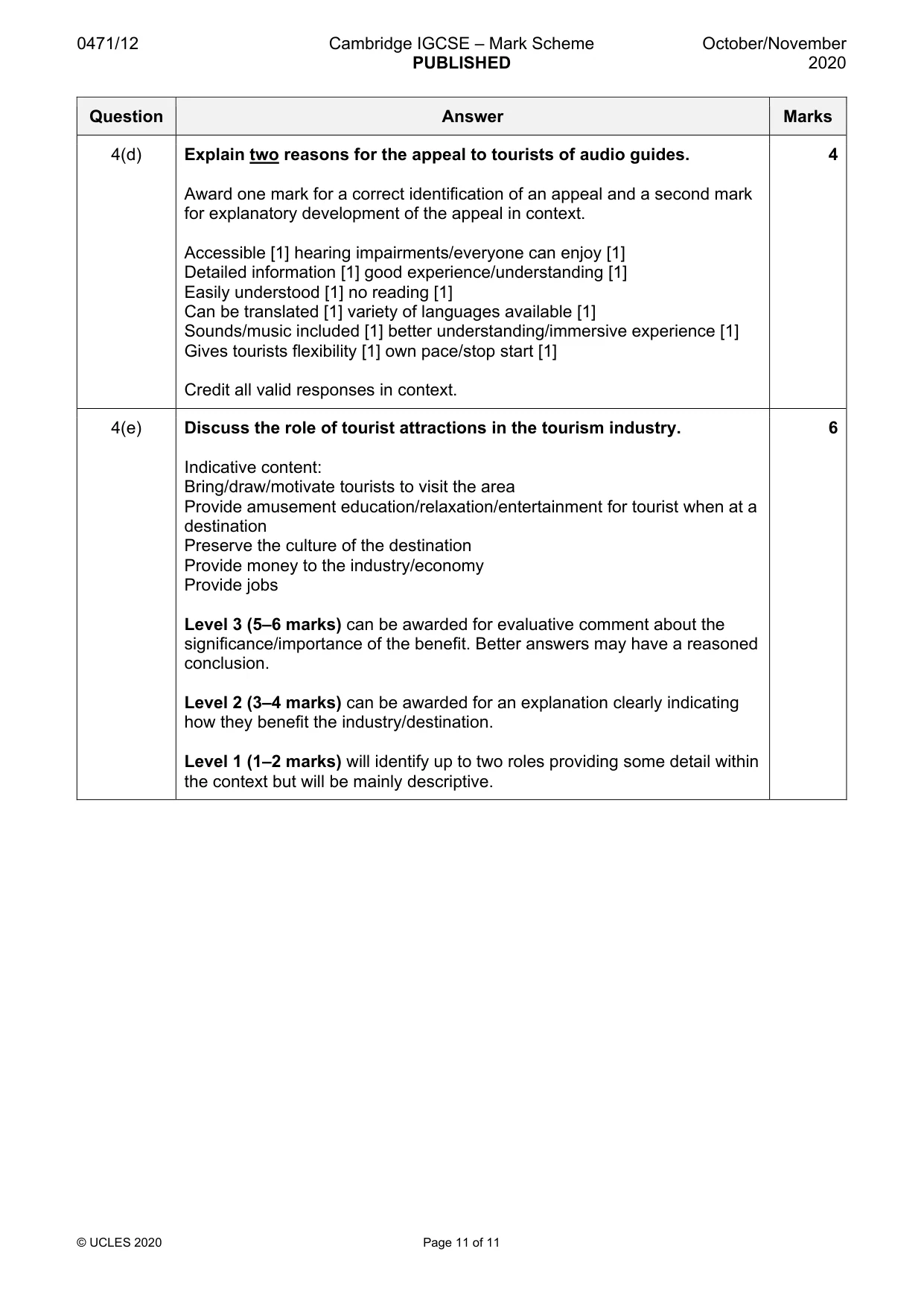
0471/12 Cambridge IGCSE – Mark Scheme PUBLISHED October/November 2020 © UCLES 2020 Page 11 of 11 Question Answer Marks 4(d) Explain two reasons for the appeal to tourists of audio guides. Award one mark for a correct identification of an appeal and a second mark for explanatory development of the appeal in context. Accessible [1] hearing impairments/everyone can enjoy [1] Detailed information [1] good experience/understanding [1] Easily understood [1] no reading [1] Can be translated [1] variety of languages available [1] Sounds/music included [1] better understanding/immersive experience [1] Gives tourists flexibility [1] own pace/stop start [1] Credit all valid responses in context. 4 4(e) Discuss the role of tourist attractions in the tourism industry. Indicative content: Bring/draw/motivate tourists to visit the area Provide amusement education/relaxation/entertainment for tourist when at a destination Preserve the culture of the destination Provide money to the industry/economy Provide jobs Level 3 (5–6 marks) can be awarded for evaluative comment about the significance/importance of the benefit. Better answers may have a reasoned conclusion. Level 2 (3–4 marks) can be awarded for an explanation clearly indicating how they benefit the industry/destination. Level 1 (1–2 marks) will identify up to two roles providing some detail within the context but will be mainly descriptive. 6
What you needed in this session
Cambridge’s own grade thresholds for 2020 Oct/Nov, Paper 1 · Variant 2. A higher threshold means an easier paper — the bar moves with how the cohort did.