Cambridge IGCSE Travel and Tourism 0471 — 2020 Oct/Nov Paper 1 · Variant 3
0471/13/O/N/20 · 100 marks · ≈113 min
The question paper and its mark scheme, free to read here and free to download. This is Cambridge’s own paper, exactly as it was sat.
Question paper12 pages
Mark scheme12 pages
Answers below. Sit the paper first if you are practising.
Paper as text
Question paper, page 1
Cambridge IGCSE™ * 5 1 8 7 3 7 1 4 4 3 * DC (PQ) 180404/2 © UCLES 2020 [Turn over This document has 12 pages. Blank pages are indicated. TRAVEL & TOURISM 0471/13 Paper 1 Core Paper October/November 2020 2 hours You must answer on the question paper. You will need: Insert (enclosed) INSTRUCTIONS ● Answer all questions. ● Use a black or dark blue pen. ● Write your name, centre number and candidate number in the boxes at the top of the page. ● Write your answer to each question in the space provided. ● Do not use an erasable pen or correction fluid. ● Do not write on any bar codes. INFORMATION ● The total mark for this paper is 100. ● The number of marks for each question or part question is shown in brackets [ ]. ● The insert contains all the figures referred to in the questions.
Question paper, page 2
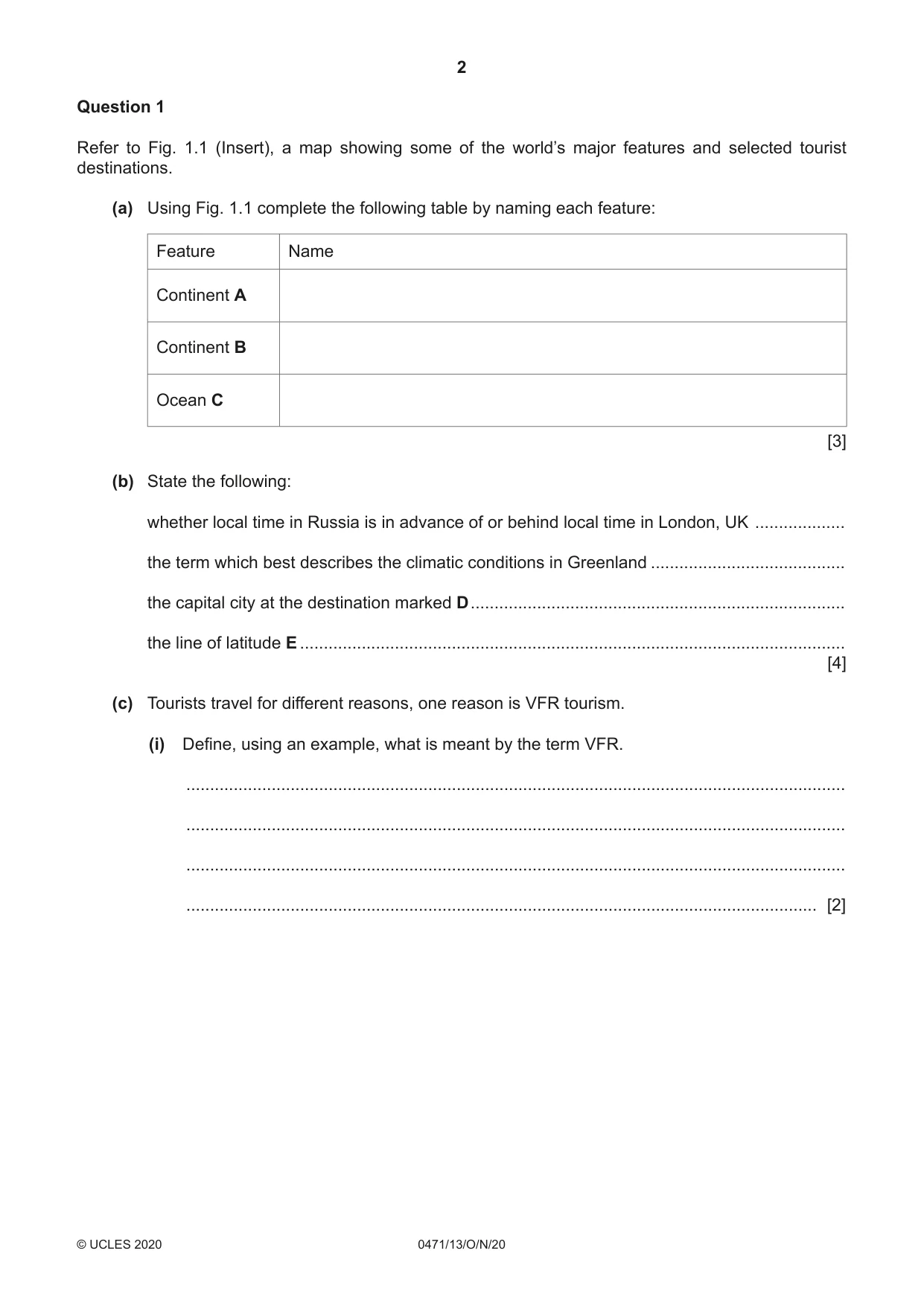
2 0471/13/O/N/20 © UCLES 2020 Question 1 Refer to Fig. 1.1 (Insert), a map showing some of the world’s major features and selected tourist destinations. (a) Using Fig. 1.1 complete the following table by naming each feature: Feature Name Continent A Continent B Ocean C [3] (b) State the following: whether local time in Russia is in advance of or behind local time in London, UK … the term which best describes the climatic conditions in Greenland … the capital city at the destination marked D … the line of latitude E … [4] (c) Tourists travel for different reasons, one reason is VFR tourism. (i) Define, using an example, what is meant by the term VFR. … … … … [2]
Question paper, page 3
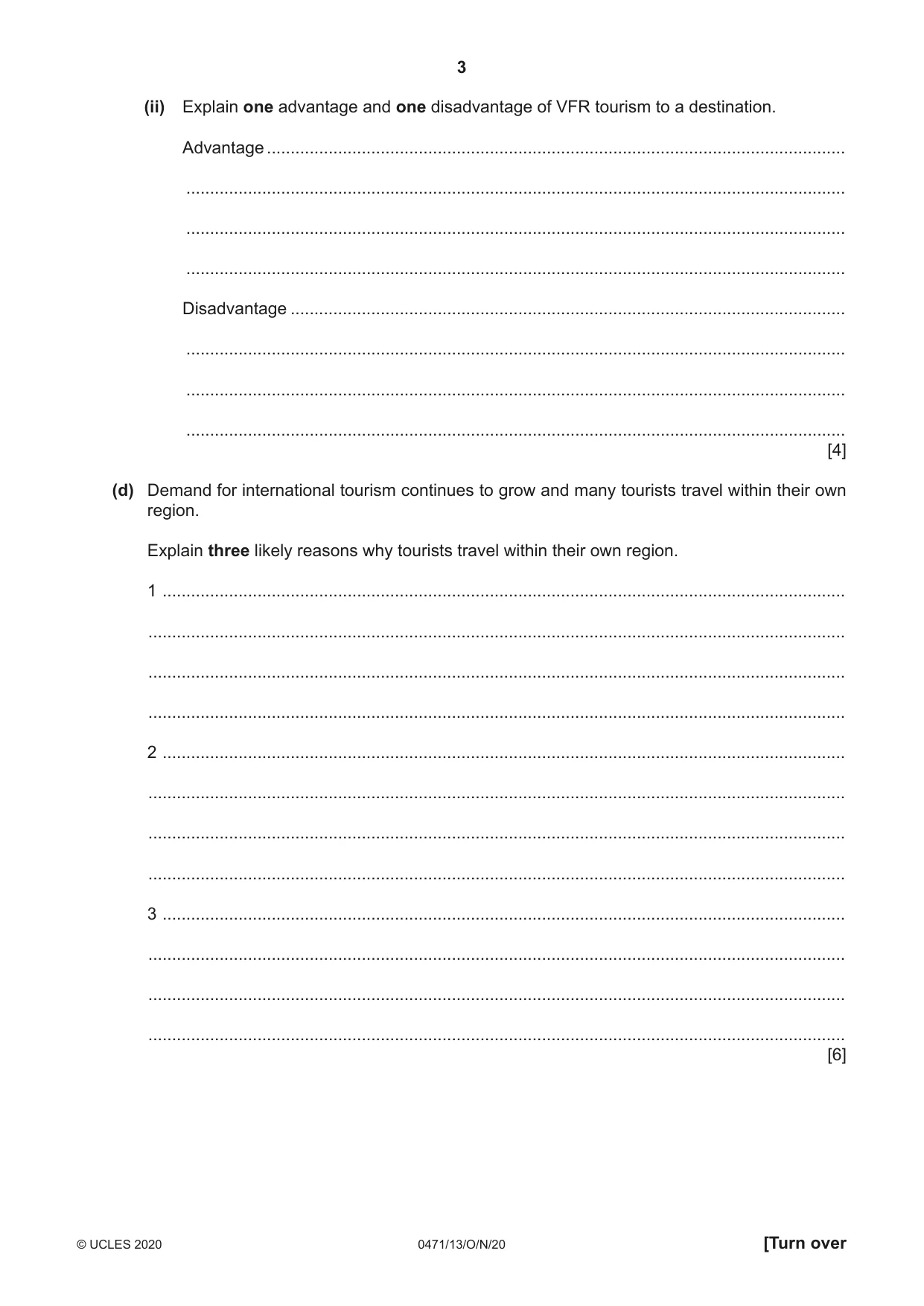
3 0471/13/O/N/20 © UCLES 2020 [Turn over (ii) Explain one advantage and one disadvantage of VFR tourism to a destination. Advantage … … … … Disadvantage … … … … [4] (d) Demand for international tourism continues to grow and many tourists travel within their own region. Explain three likely reasons why tourists travel within their own region. 1 … … … … 2 … … … … 3 … … … … [6]
Question paper, page 4
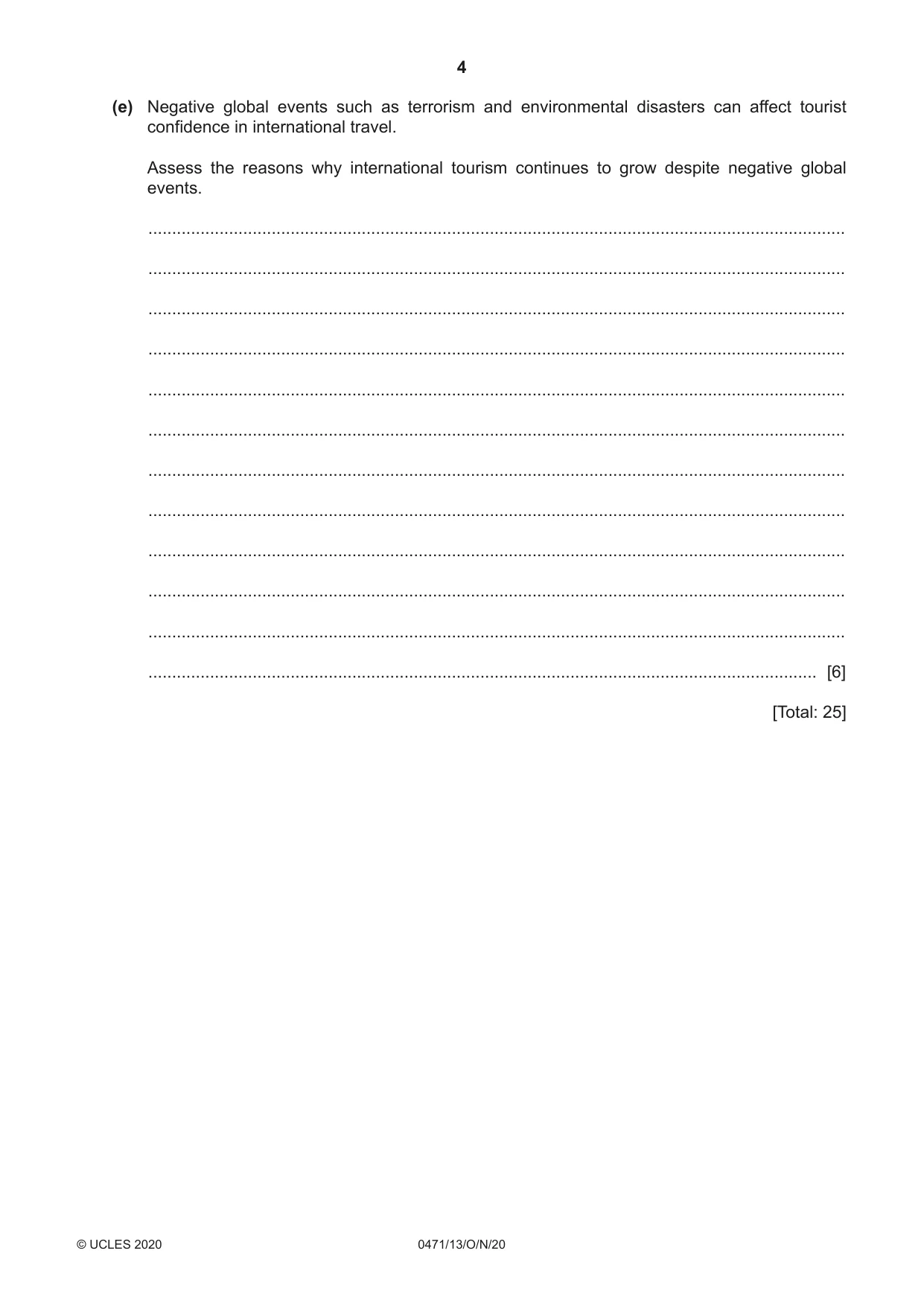
4 0471/13/O/N/20 © UCLES 2020 (e) Negative global events such as terrorism and environmental disasters can affect tourist confidence in international travel. Assess the reasons why international tourism continues to grow despite negative global events. … … … … … … … … … … … … [6] [Total: 25]
Question paper, page 5
5 0471/13/O/N/20 © UCLES 2020 [Turn over Question 2 Refer to Fig. 2.1 (Insert), a photograph of a travel agency in Queensland, Australia. (a) State four products or services sold by travel agents. 1 … 2 … 3 … 4 … [4] (b) Explain how the following factors affect the prices set by tour operators: seasonality … … … … flight departure time … … … … [4] (c) (i) State three travel and tourism principals. 1 … 2 … 3 … [3] (ii) Explain how travel and tourism principals are dependent on each other. … … … … [2]
Question paper, page 6
6 0471/13/O/N/20 © UCLES 2020 (d) Explain three ways the internet has changed the way travel agents operate. 1 … … … … 2 … … … … 3 … … … … [6] (e) Assess the importance to travel agents of offering ancillary services. … … … … … … … … … … … … [6] [Total: 25]
Question paper, page 7
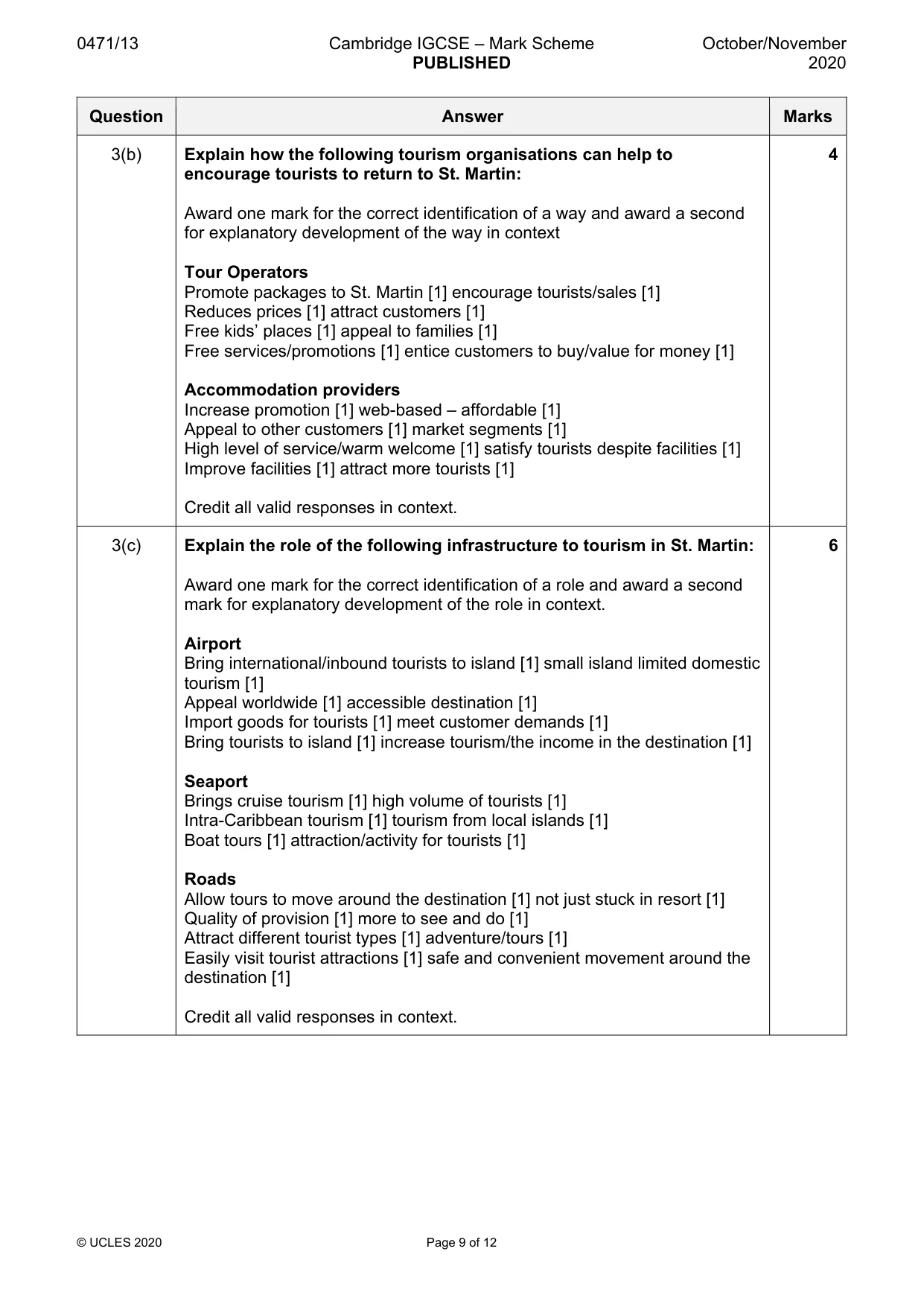
7 0471/13/O/N/20 © UCLES 2020 [Turn over Question 3 Refer to Fig. 3.1 (Insert), information about St. Martin, a country in the Caribbean. (a) State three promotional methods the NTO can use to encourage tourists back to the island. 1 … … 2 … … 3 … … [3] (b) Explain how the following tourism organisations can help to encourage tourists to return to St. Martin: tour operators … … … … accommodation providers … … … … [4]
Question paper, page 8
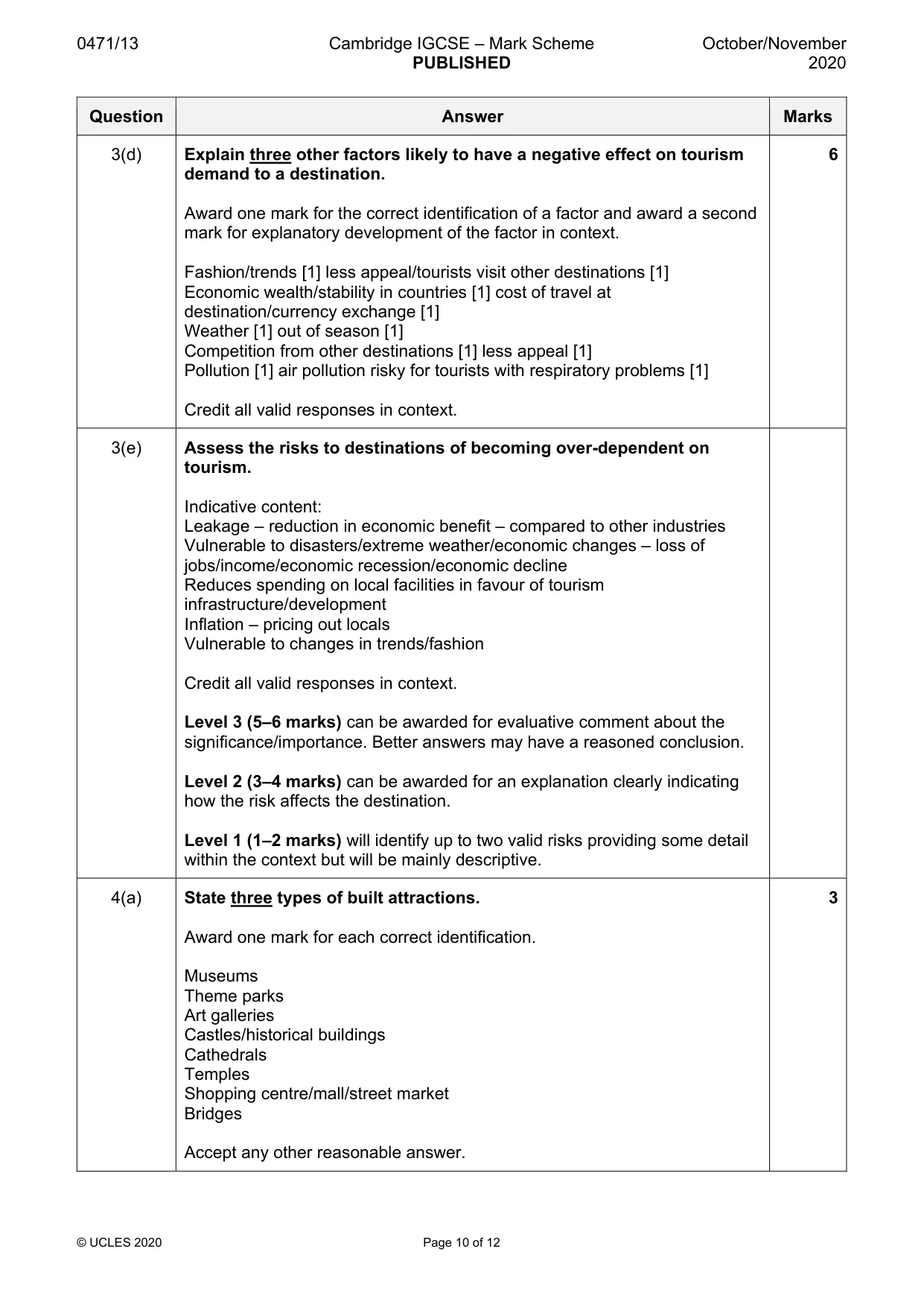
8 0471/13/O/N/20 © UCLES 2020 (c) Explain the role of the following infrastructure to tourism in St. Martin: airports … … … … seaports … … … … roads … … … … [6] (d) The extreme weather of Hurricane Irma caused a reduction in tourists visiting St. Martin. Explain three other factors likely to have a negative effect on tourism demand to a destination. 1 … … … … 2 … … … … 3 … … … … [6]
Question paper, page 9
9 0471/13/O/N/20 © UCLES 2020 [Turn over (e) Assess the risks to destinations of becoming over-dependent on tourism. … … … … … … … … … … … … [6] [Total: 25]
Question paper, page 10
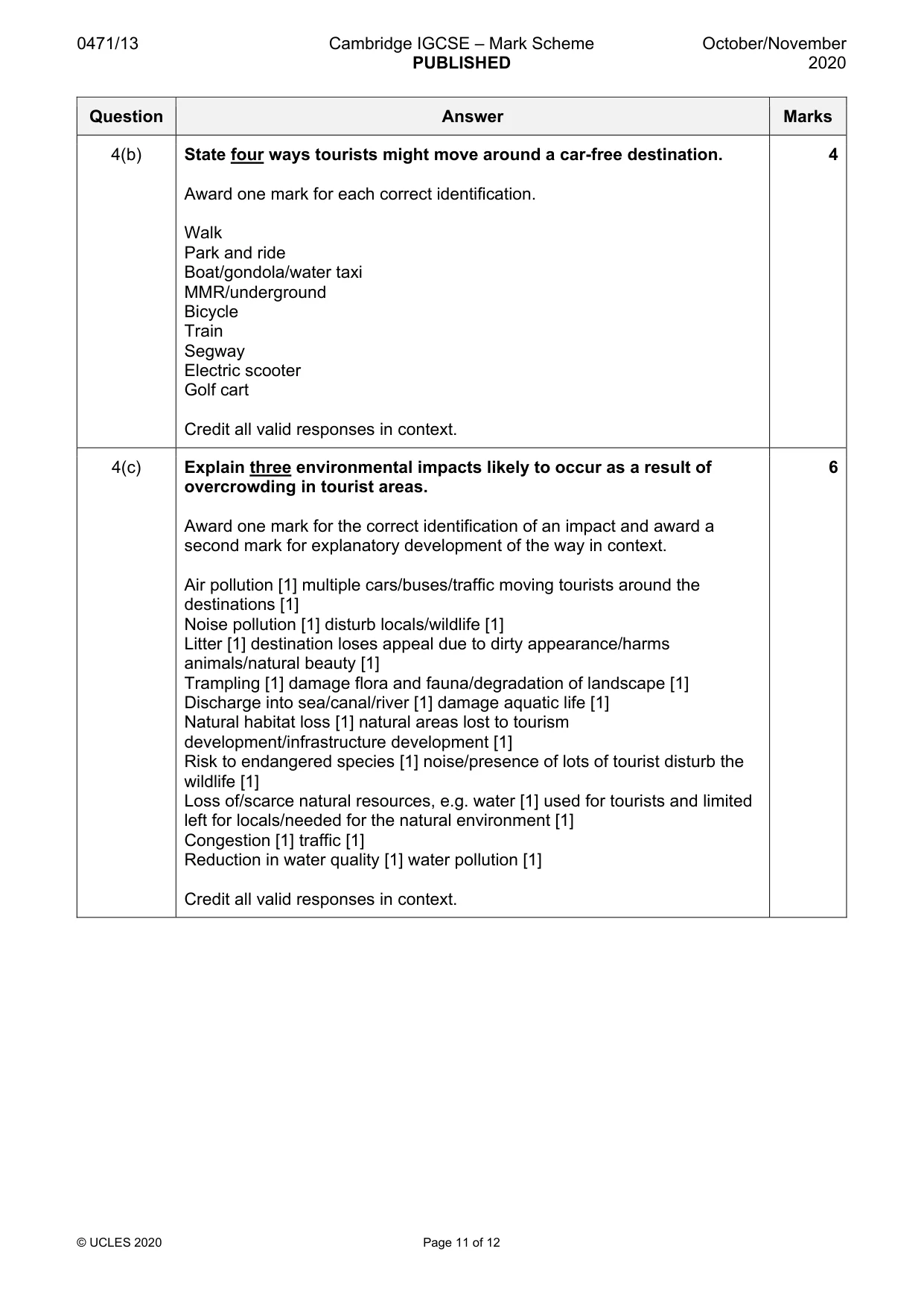
10 0471/13/O/N/20 © UCLES 2020 Question 4 Refer to Fig. 4.1 (Insert), a photograph of an overcrowded area of Venice, a city in Italy. (a) State three types of built attractions. 1 … 2 … 3 … [3] (b) Venice is a car-free city. State four ways tourists might move around a car-free destination. 1 … … 2 … … 3 … … 4 … … [4]
Question paper, page 11
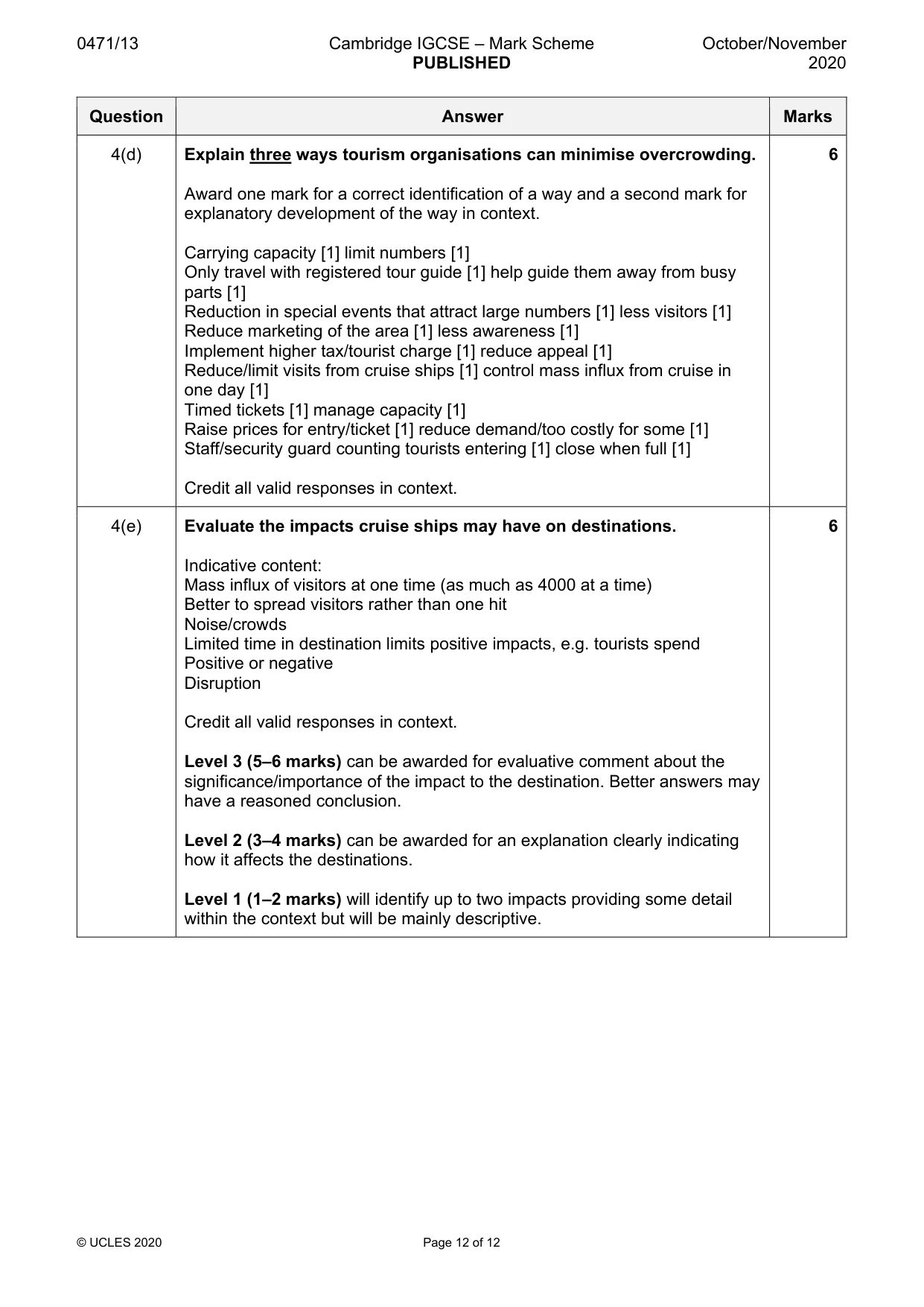
11 0471/13/O/N/20 © UCLES 2020 [Turn over (c) Explain three environmental impacts likely to occur as a result of overcrowding in tourist areas. 1 … … … … 2 … … … … 3 … … … … [6] (d) Explain three ways tourism organisations can minimise overcrowding. 1 … … … … 2 … … … … 3 … … … … [6]
Question paper, page 12
12 0471/13/O/N/20 © UCLES 2020 Permission to reproduce items where third-party owned material protected by copyright is included has been sought and cleared where possible. Every reasonable effort has been made by the publisher (UCLES) to trace copyright holders, but if any items requiring clearance have unwittingly been included, the publisher will be pleased to make amends at the earliest possible opportunity. To avoid the issue of disclosure of answer-related information to candidates, all copyright acknowledgements are reproduced online in the Cambridge Assessment International Education Copyright Acknowledgements Booklet. This is produced for each series of examinations and is freely available to download at www.cambridgeinternational.org after the live examination series. Cambridge Assessment International Education is part of the Cambridge Assessment Group. Cambridge Assessment is the brand name of the University of Cambridge Local Examinations Syndicate (UCLES), which itself is a department of the University of Cambridge. (e) Evaluate the impacts cruise ships may have on destinations. … … … … … … … … … … … … [6] [Total: 25]
Mark scheme, page 1
This document consists of 12 printed pages. © UCLES 2020 [Turn over Cambridge IGCSE™ TRAVEL AND TOURISM 0471/13 Paper 1 Core Paper October/November 2020 MARK SCHEME Maximum Mark: 100 Published This mark scheme is published as an aid to teachers and candidates, to indicate the requirements of the examination. It shows the basis on which Examiners were instructed to award marks. It does not indicate the details of the discussions that took place at an Examiners’ meeting before marking began, which would have considered the acceptability of alternative answers. Mark schemes should be read in conjunction with the question paper and the Principal Examiner Report for Teachers. Cambridge International will not enter into discussions about these mark schemes. Cambridge International is publishing the mark schemes for the October/November 2020 series for most Cambridge IGCSE™, Cambridge International A and AS Level and Cambridge Pre-U components, and some Cambridge O Level components.
Mark scheme, page 2
0471/13 Cambridge IGCSE – Mark Scheme PUBLISHED October/November 2020 © UCLES 2020 Page 2 of 12 Generic Marking Principles These general marking principles must be applied by all examiners when marking candidate answers. They should be applied alongside the specific content of the mark scheme or generic level descriptors for a question. Each question paper and mark scheme will also comply with these marking principles. GENERIC MARKING PRINCIPLE 1: Marks must be awarded in line with: • the specific content of the mark scheme or the generic level descriptors for the question • the specific skills defined in the mark scheme or in the generic level descriptors for the question • the standard of response required by a candidate as exemplified by the standardisation scripts. GENERIC MARKING PRINCIPLE 2: Marks awarded are always whole marks (not half marks, or other fractions). GENERIC MARKING PRINCIPLE 3: Marks must be awarded positively: • marks are awarded for correct/valid answers, as defined in the mark scheme. However, credit is given for valid answers which go beyond the scope of the syllabus and mark scheme, referring to your Team Leader as appropriate • marks are awarded when candidates clearly demonstrate what they know and can do • marks are not deducted for errors • marks are not deducted for omissions • answers should only be judged on the quality of spelling, punctuation and grammar when these features are specifically assessed by the question as indicated by the mark scheme. The meaning, however, should be unambiguous. GENERIC MARKING PRINCIPLE 4: Rules must be applied consistently, e.g. in situations where candidates have not followed instructions or in the application of generic level descriptors. GENERIC MARKING PRINCIPLE 5: Marks should be awarded using the full range of marks defined in the mark scheme for the question (however; the use of the full mark range may be limited according to the quality of the candidate responses seen). GENERIC MARKING PRINCIPLE 6: Marks awarded are based solely on the requirements as defined in the mark scheme. Marks should not be awarded with grade thresholds or grade descriptors in mind.
Mark scheme, page 3
0471/13 Cambridge IGCSE – Mark Scheme PUBLISHED October/November 2020 © UCLES 2020 Page 3 of 12 Social Sciences and Humanities Subject Specific Marking Principles (for point-based marking) 1 Components using point-based marking: • Point marking is often used to reward knowledge, understanding and application of skills. We give credit where the candidate’s answer shows relevant knowledge, understanding and application of skills in answering the question. We do not give credit where the answer shows confusion. From this it follows that we: a DO credit answers which are worded differently from the mark scheme if they clearly convey the same meaning (unless the mark scheme requires a specific term) b DO credit alternative answers/examples which are not written in the mark scheme if they are correct c DO credit answers where candidates give more than one correct answer in one prompt/numbered/scaffolded space where extended writing is required rather than list-type answers. For example, questions that require n reasons (e.g. State two reasons…). d DO NOT credit answers simply for using a ‘key term’ unless that is all that is required. (Check for evidence it is understood and not used wrongly.) e DO NOT credit answers which are obviously self-contradicting or trying to cover all possibilities, e.g. a scattergun approach to a question asking for n items f DO NOT give further credit for what is effectively repetition of a correct point already credited unless the language itself is being tested. This applies equally to ‘mirror statements’ (i.e. polluted/not polluted). g DO NOT require spellings to be correct, unless this is part of the test. However spellings of syllabus terms must allow for clear and unambiguous separation from other syllabus terms with which they may be confused (e.g. Corrasion/Corrosion) 2 Presentation of mark scheme: • Slashes (/) or the word ‘or’ separate alternative ways of making the same point. • Semi colons (;) bullet points (•) or figures in brackets (1) separate different points. • Content in the answer column in brackets is for examiner information/context to clarify the marking but is not required to earn the mark (except Accounting syllabuses where they indicate negative numbers). 3 Annotation: • For point marking, ticks can be used to indicate correct answers and crosses can be used to indicate wrong answers. There is no direct relationship between ticks and marks. Ticks have no defined meaning for levels of response marking. • For levels of response marking, the level awarded should be annotated on the script. Other annotations will be used by examiners as agreed during standardisation, and the meaning will be understood by all examiners who marked that paper.
Mark scheme, page 4
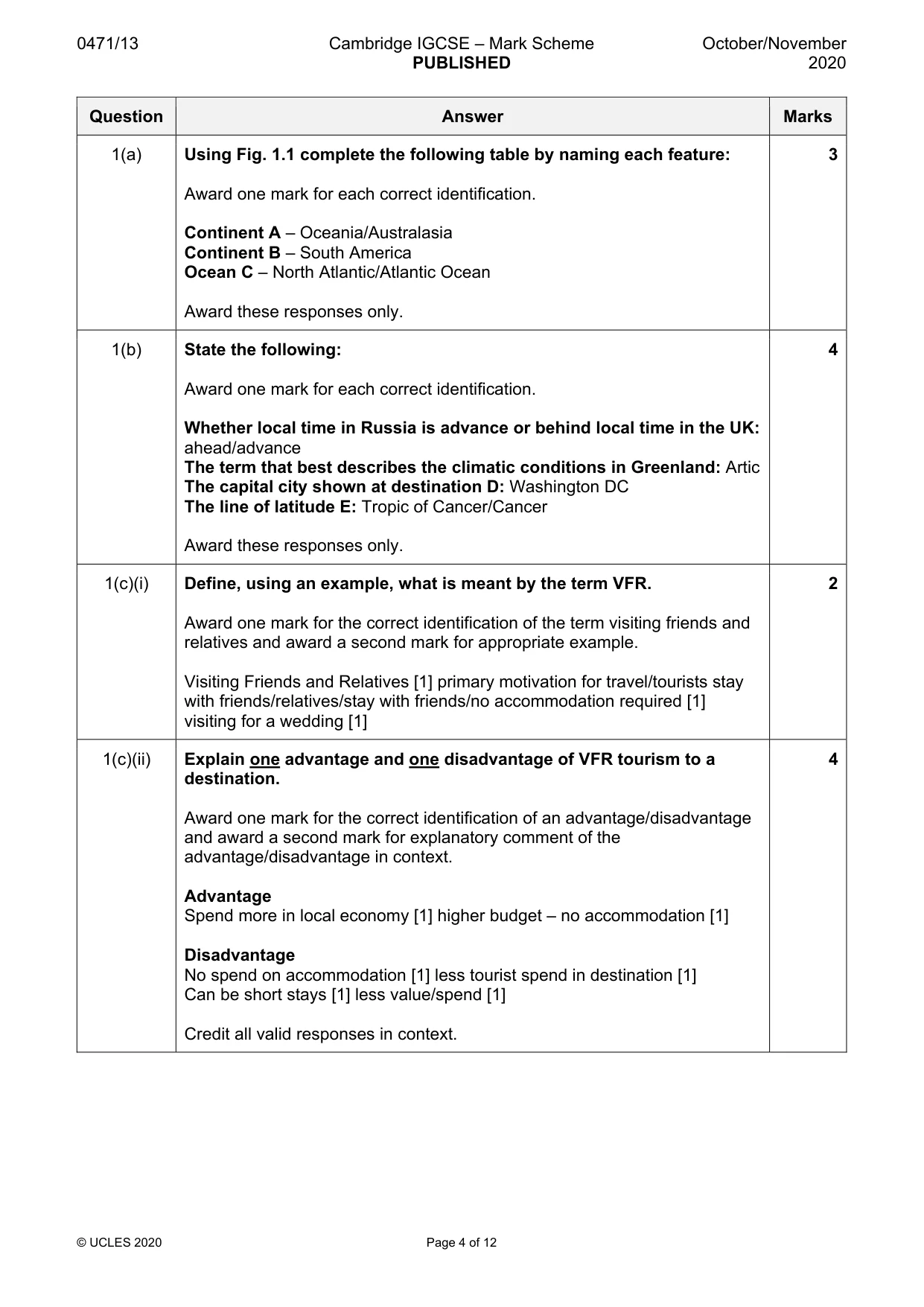
0471/13 Cambridge IGCSE – Mark Scheme PUBLISHED October/November 2020 © UCLES 2020 Page 4 of 12 Question Answer Marks 1(a) Using Fig. 1.1 complete the following table by naming each feature: Award one mark for each correct identification. Continent A – Oceania/Australasia Continent B – South America Ocean C – North Atlantic/Atlantic Ocean Award these responses only. 3 1(b) State the following: Award one mark for each correct identification. Whether local time in Russia is advance or behind local time in the UK: ahead/advance The term that best describes the climatic conditions in Greenland: Artic The capital city shown at destination D: Washington DC The line of latitude E: Tropic of Cancer/Cancer Award these responses only. 4 1(c)(i) Define, using an example, what is meant by the term VFR. Award one mark for the correct identification of the term visiting friends and relatives and award a second mark for appropriate example. Visiting Friends and Relatives [1] primary motivation for travel/tourists stay with friends/relatives/stay with friends/no accommodation required [1] visiting for a wedding [1] 2 1(c)(ii) Explain one advantage and one disadvantage of VFR tourism to a destination. Award one mark for the correct identification of an advantage/disadvantage and award a second mark for explanatory comment of the advantage/disadvantage in context. Advantage Spend more in local economy [1] higher budget – no accommodation [1] Disadvantage No spend on accommodation [1] less tourist spend in destination [1] Can be short stays [1] less value/spend [1] Credit all valid responses in context. 4
Mark scheme, page 5
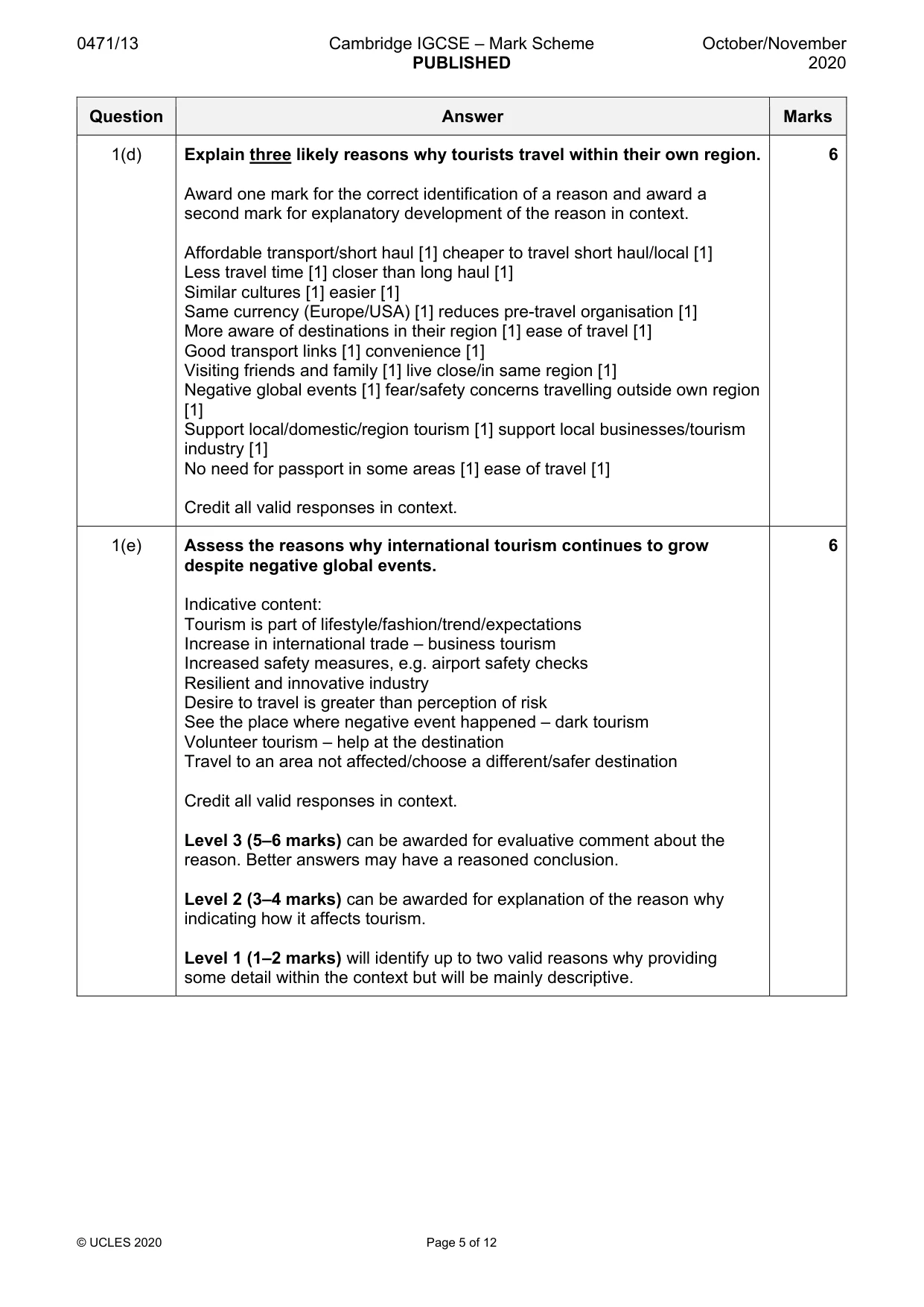
0471/13 Cambridge IGCSE – Mark Scheme PUBLISHED October/November 2020 © UCLES 2020 Page 5 of 12 Question Answer Marks 1(d) Explain three likely reasons why tourists travel within their own region. Award one mark for the correct identification of a reason and award a second mark for explanatory development of the reason in context. Affordable transport/short haul [1] cheaper to travel short haul/local [1] Less travel time [1] closer than long haul [1] Similar cultures [1] easier [1] Same currency (Europe/USA) [1] reduces pre-travel organisation [1] More aware of destinations in their region [1] ease of travel [1] Good transport links [1] convenience [1] Visiting friends and family [1] live close/in same region [1] Negative global events [1] fear/safety concerns travelling outside own region [1] Support local/domestic/region tourism [1] support local businesses/tourism industry [1] No need for passport in some areas [1] ease of travel [1] Credit all valid responses in context. 6 1(e) Assess the reasons why international tourism continues to grow despite negative global events. Indicative content: Tourism is part of lifestyle/fashion/trend/expectations Increase in international trade – business tourism Increased safety measures, e.g. airport safety checks Resilient and innovative industry Desire to travel is greater than perception of risk See the place where negative event happened – dark tourism Volunteer tourism – help at the destination Travel to an area not affected/choose a different/safer destination Credit all valid responses in context. Level 3 (5–6 marks) can be awarded for evaluative comment about the reason. Better answers may have a reasoned conclusion. Level 2 (3–4 marks) can be awarded for explanation of the reason why indicating how it affects tourism. Level 1 (1–2 marks) will identify up to two valid reasons why providing some detail within the context but will be mainly descriptive. 6
Mark scheme, page 6
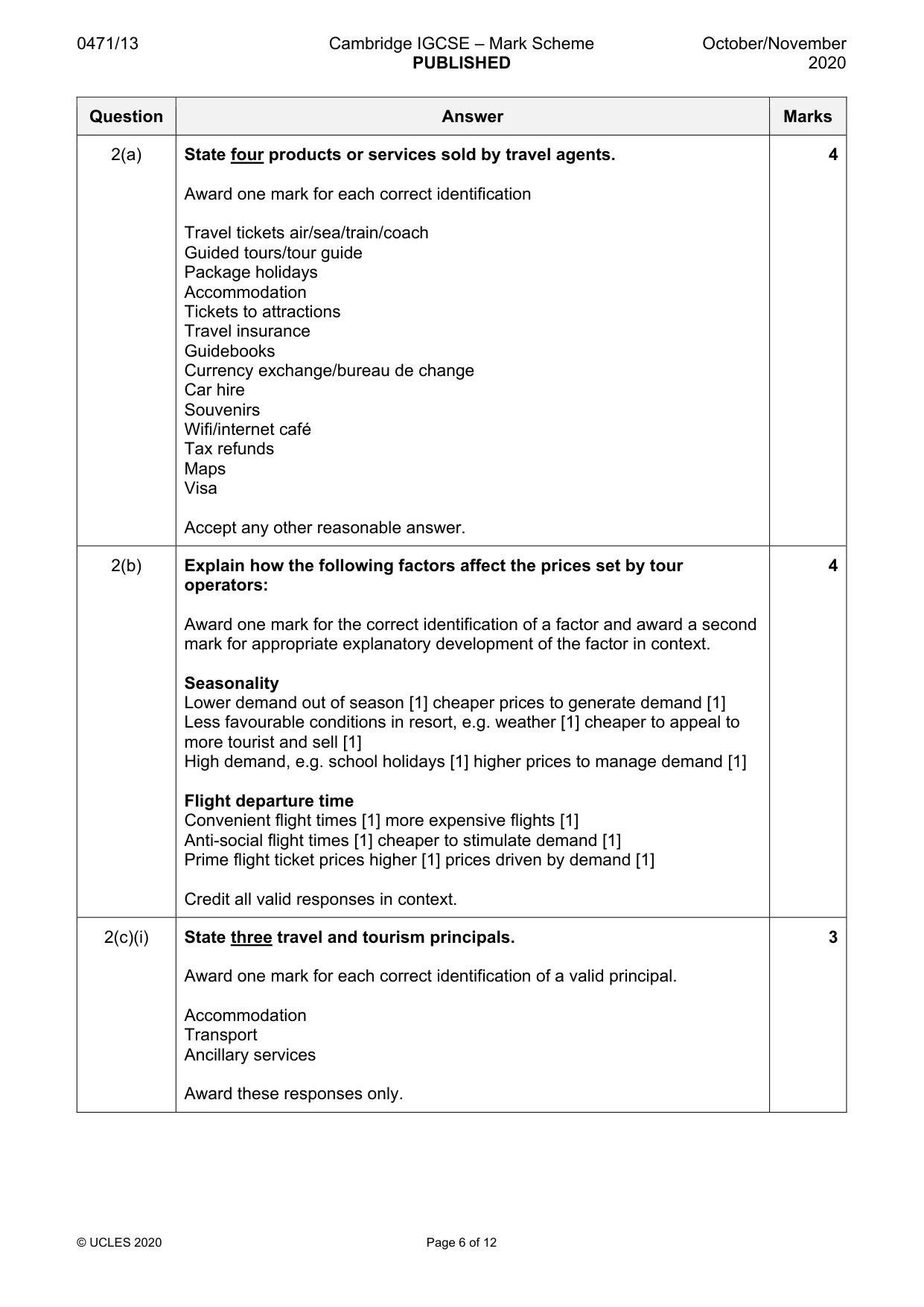
0471/13 Cambridge IGCSE – Mark Scheme PUBLISHED October/November 2020 © UCLES 2020 Page 6 of 12 Question Answer Marks 2(a) State four products or services sold by travel agents. Award one mark for each correct identification Travel tickets air/sea/train/coach Guided tours/tour guide Package holidays Accommodation Tickets to attractions Travel insurance Guidebooks Currency exchange/bureau de change Car hire Souvenirs Wifi/internet café Tax refunds Maps Visa Accept any other reasonable answer. 4 2(b) Explain how the following factors affect the prices set by tour operators: Award one mark for the correct identification of a factor and award a second mark for appropriate explanatory development of the factor in context. Seasonality Lower demand out of season [1] cheaper prices to generate demand [1] Less favourable conditions in resort, e.g. weather [1] cheaper to appeal to more tourist and sell [1] High demand, e.g. school holidays [1] higher prices to manage demand [1] Flight departure time Convenient flight times [1] more expensive flights [1] Anti-social flight times [1] cheaper to stimulate demand [1] Prime flight ticket prices higher [1] prices driven by demand [1] Credit all valid responses in context. 4 2(c)(i) State three travel and tourism principals. Award one mark for each correct identification of a valid principal. Accommodation Transport Ancillary services Award these responses only. 3
Mark scheme, page 7
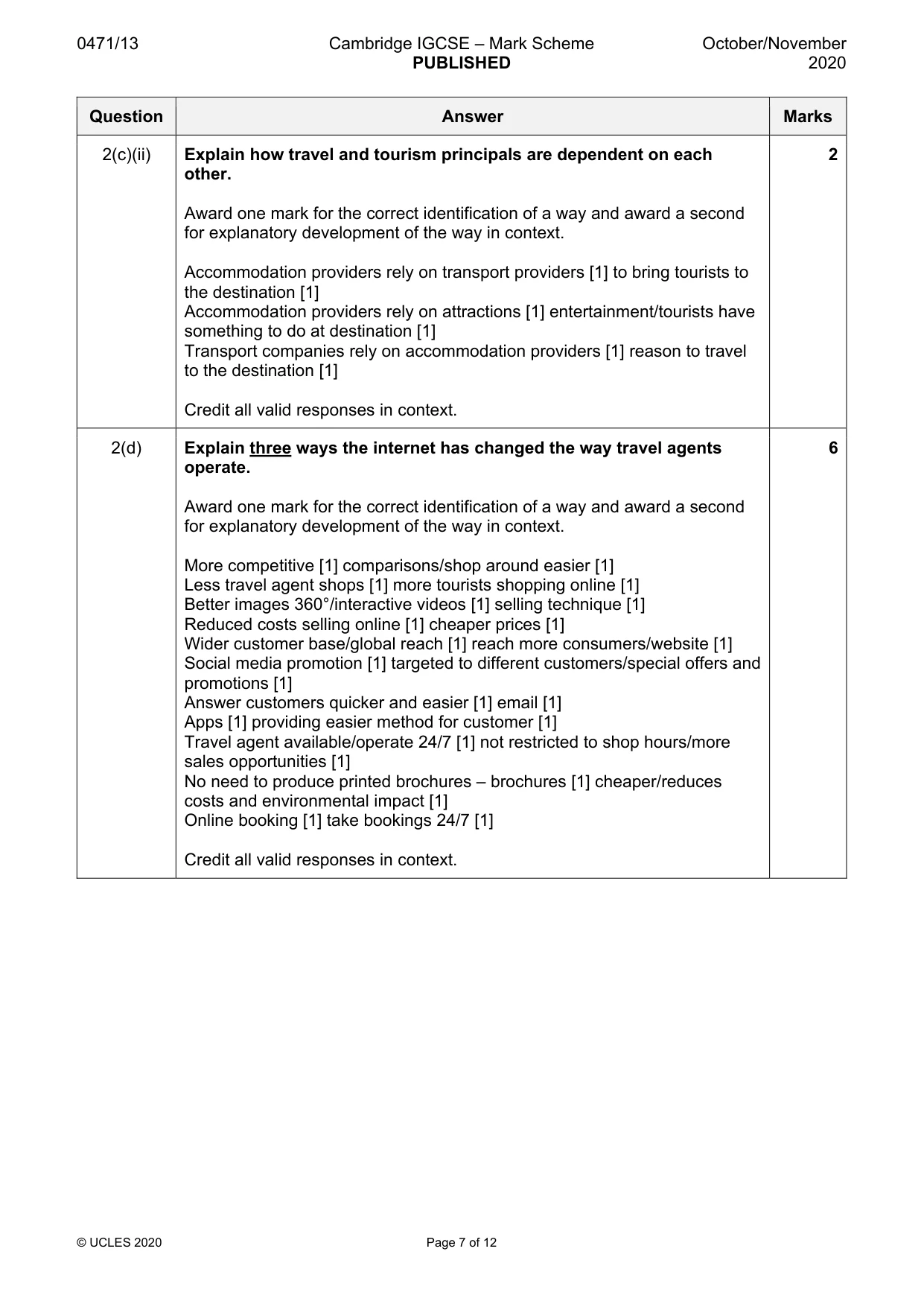
0471/13 Cambridge IGCSE – Mark Scheme PUBLISHED October/November 2020 © UCLES 2020 Page 7 of 12 Question Answer Marks 2(c)(ii) Explain how travel and tourism principals are dependent on each other. Award one mark for the correct identification of a way and award a second for explanatory development of the way in context. Accommodation providers rely on transport providers [1] to bring tourists to the destination [1] Accommodation providers rely on attractions [1] entertainment/tourists have something to do at destination [1] Transport companies rely on accommodation providers [1] reason to travel to the destination [1] Credit all valid responses in context. 2 2(d) Explain three ways the internet has changed the way travel agents operate. Award one mark for the correct identification of a way and award a second for explanatory development of the way in context. More competitive [1] comparisons/shop around easier [1] Less travel agent shops [1] more tourists shopping online [1] Better images 360°/interactive videos [1] selling technique [1] Reduced costs selling online [1] cheaper prices [1] Wider customer base/global reach [1] reach more consumers/website [1] Social media promotion [1] targeted to different customers/special offers and promotions [1] Answer customers quicker and easier [1] email [1] Apps [1] providing easier method for customer [1] Travel agent available/operate 24/7 [1] not restricted to shop hours/more sales opportunities [1] No need to produce printed brochures – brochures [1] cheaper/reduces costs and environmental impact [1] Online booking [1] take bookings 24/7 [1] Credit all valid responses in context. 6
Mark scheme, page 8
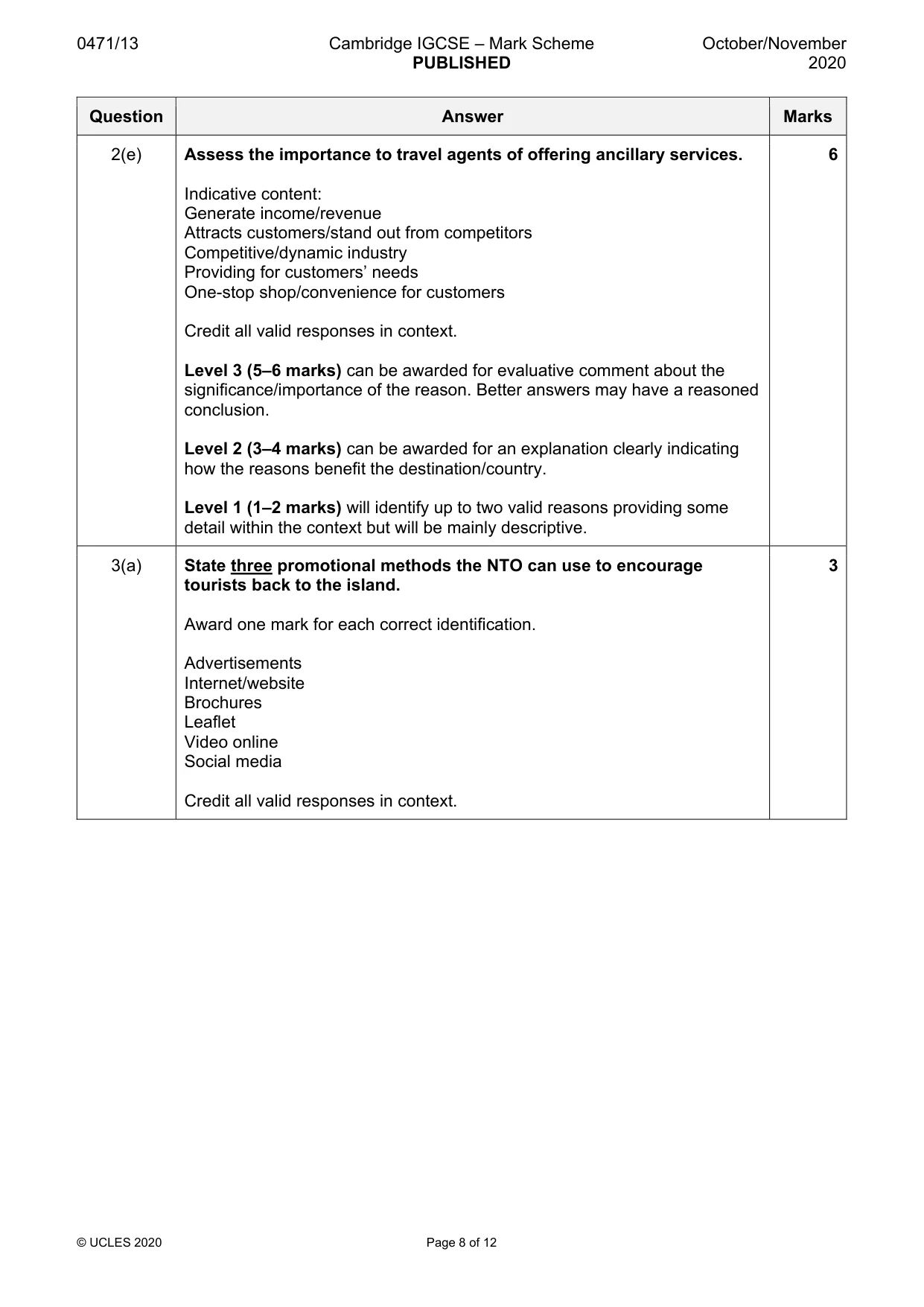
0471/13 Cambridge IGCSE – Mark Scheme PUBLISHED October/November 2020 © UCLES 2020 Page 8 of 12 Question Answer Marks 2(e) Assess the importance to travel agents of offering ancillary services. Indicative content: Generate income/revenue Attracts customers/stand out from competitors Competitive/dynamic industry Providing for customers’ needs One-stop shop/convenience for customers Credit all valid responses in context. Level 3 (5–6 marks) can be awarded for evaluative comment about the significance/importance of the reason. Better answers may have a reasoned conclusion. Level 2 (3–4 marks) can be awarded for an explanation clearly indicating how the reasons benefit the destination/country. Level 1 (1–2 marks) will identify up to two valid reasons providing some detail within the context but will be mainly descriptive. 6 3(a) State three promotional methods the NTO can use to encourage tourists back to the island. Award one mark for each correct identification. Advertisements Internet/website Brochures Leaflet Video online Social media Credit all valid responses in context. 3
Mark scheme, page 9
0471/13 Cambridge IGCSE – Mark Scheme PUBLISHED October/November 2020 © UCLES 2020 Page 9 of 12 Question Answer Marks 3(b) Explain how the following tourism organisations can help to encourage tourists to return to St. Martin: Award one mark for the correct identification of a way and award a second for explanatory development of the way in context Tour Operators Promote packages to St. Martin [1] encourage tourists/sales [1] Reduces prices [1] attract customers [1] Free kids’ places [1] appeal to families [1] Free services/promotions [1] entice customers to buy/value for money [1] Accommodation providers Increase promotion [1] web-based – affordable [1] Appeal to other customers [1] market segments [1] High level of service/warm welcome [1] satisfy tourists despite facilities [1] Improve facilities [1] attract more tourists [1] Credit all valid responses in context. 4 3(c) Explain the role of the following infrastructure to tourism in St. Martin: Award one mark for the correct identification of a role and award a second mark for explanatory development of the role in context. Airport Bring international/inbound tourists to island [1] small island limited domestic tourism [1] Appeal worldwide [1] accessible destination [1] Import goods for tourists [1] meet customer demands [1] Bring tourists to island [1] increase tourism/the income in the destination [1] Seaport Brings cruise tourism [1] high volume of tourists [1] Intra-Caribbean tourism [1] tourism from local islands [1] Boat tours [1] attraction/activity for tourists [1] Roads Allow tours to move around the destination [1] not just stuck in resort [1] Quality of provision [1] more to see and do [1] Attract different tourist types [1] adventure/tours [1] Easily visit tourist attractions [1] safe and convenient movement around the destination [1] Credit all valid responses in context. 6
Mark scheme, page 10
0471/13 Cambridge IGCSE – Mark Scheme PUBLISHED October/November 2020 © UCLES 2020 Page 10 of 12 Question Answer Marks 3(d) Explain three other factors likely to have a negative effect on tourism demand to a destination. Award one mark for the correct identification of a factor and award a second mark for explanatory development of the factor in context. Fashion/trends [1] less appeal/tourists visit other destinations [1] Economic wealth/stability in countries [1] cost of travel at destination/currency exchange [1] Weather [1] out of season [1] Competition from other destinations [1] less appeal [1] Pollution [1] air pollution risky for tourists with respiratory problems [1] Credit all valid responses in context. 6 3(e) Assess the risks to destinations of becoming over-dependent on tourism. Indicative content: Leakage – reduction in economic benefit – compared to other industries Vulnerable to disasters/extreme weather/economic changes – loss of jobs/income/economic recession/economic decline Reduces spending on local facilities in favour of tourism infrastructure/development Inflation – pricing out locals Vulnerable to changes in trends/fashion Credit all valid responses in context. Level 3 (5–6 marks) can be awarded for evaluative comment about the significance/importance. Better answers may have a reasoned conclusion. Level 2 (3–4 marks) can be awarded for an explanation clearly indicating how the risk affects the destination. Level 1 (1–2 marks) will identify up to two valid risks providing some detail within the context but will be mainly descriptive. 4(a) State three types of built attractions. Award one mark for each correct identification. Museums Theme parks Art galleries Castles/historical buildings Cathedrals Temples Shopping centre/mall/street market Bridges Accept any other reasonable answer. 3
Mark scheme, page 11
0471/13 Cambridge IGCSE – Mark Scheme PUBLISHED October/November 2020 © UCLES 2020 Page 11 of 12 Question Answer Marks 4(b) State four ways tourists might move around a car-free destination. Award one mark for each correct identification. Walk Park and ride Boat/gondola/water taxi MMR/underground Bicycle Train Segway Electric scooter Golf cart Credit all valid responses in context. 4 4(c) Explain three environmental impacts likely to occur as a result of overcrowding in tourist areas. Award one mark for the correct identification of an impact and award a second mark for explanatory development of the way in context. Air pollution [1] multiple cars/buses/traffic moving tourists around the destinations [1] Noise pollution [1] disturb locals/wildlife [1] Litter [1] destination loses appeal due to dirty appearance/harms animals/natural beauty [1] Trampling [1] damage flora and fauna/degradation of landscape [1] Discharge into sea/canal/river [1] damage aquatic life [1] Natural habitat loss [1] natural areas lost to tourism development/infrastructure development [1] Risk to endangered species [1] noise/presence of lots of tourist disturb the wildlife [1] Loss of/scarce natural resources, e.g. water [1] used for tourists and limited left for locals/needed for the natural environment [1] Congestion [1] traffic [1] Reduction in water quality [1] water pollution [1] Credit all valid responses in context. 6
Mark scheme, page 12
0471/13 Cambridge IGCSE – Mark Scheme PUBLISHED October/November 2020 © UCLES 2020 Page 12 of 12 Question Answer Marks 4(d) Explain three ways tourism organisations can minimise overcrowding. Award one mark for a correct identification of a way and a second mark for explanatory development of the way in context. Carrying capacity [1] limit numbers [1] Only travel with registered tour guide [1] help guide them away from busy parts [1] Reduction in special events that attract large numbers [1] less visitors [1] Reduce marketing of the area [1] less awareness [1] Implement higher tax/tourist charge [1] reduce appeal [1] Reduce/limit visits from cruise ships [1] control mass influx from cruise in one day [1] Timed tickets [1] manage capacity [1] Raise prices for entry/ticket [1] reduce demand/too costly for some [1] Staff/security guard counting tourists entering [1] close when full [1] Credit all valid responses in context. 6 4(e) Evaluate the impacts cruise ships may have on destinations. Indicative content: Mass influx of visitors at one time (as much as 4000 at a time) Better to spread visitors rather than one hit Noise/crowds Limited time in destination limits positive impacts, e.g. tourists spend Positive or negative Disruption Credit all valid responses in context. Level 3 (5–6 marks) can be awarded for evaluative comment about the significance/importance of the impact to the destination. Better answers may have a reasoned conclusion. Level 2 (3–4 marks) can be awarded for an explanation clearly indicating how it affects the destinations. Level 1 (1–2 marks) will identify up to two impacts providing some detail within the context but will be mainly descriptive. 6
What you needed in this session
Cambridge’s own grade thresholds for 2020 Oct/Nov, Paper 1 · Variant 3. A higher threshold means an easier paper — the bar moves with how the cohort did.