Cambridge IGCSE Travel and Tourism 0471 — 2023 May/June Paper 1 · Variant 2
0471/12/M/J/23 · 100 marks · ≈113 min
The question paper and its mark scheme, free to read here and free to download. This is Cambridge’s own paper, exactly as it was sat.
Question paper12 pages



Mark scheme13 pages
Answers below. Sit the paper first if you are practising.

Paper as text
Question paper, page 1
This document has 12 pages. Any blank pages are indicated. [Turn over Cambridge IGCSE™ TRAVEL & TOURISM 0471/12 Paper 1 Core Paper May/June 2023 2 hours You must answer on the question paper. You will need: Insert (enclosed) INSTRUCTIONS ● Answer all questions. ● Use a black or dark blue pen. ● Write your name, centre number and candidate number in the boxes at the top of the page. ● Write your answer to each question in the space provided. ● Do not use an erasable pen or correction fluid. ● Do not write on any bar codes. INFORMATION ● The total mark for this paper is 100. ● The number of marks for each question or part question is shown in brackets [ ]. ● The insert contains all the figures referred to in the questions. * 9 7 1 0 9 0 1 7 2 0 * DC (ST) 311852/1 © UCLES 2023
Question paper, page 2
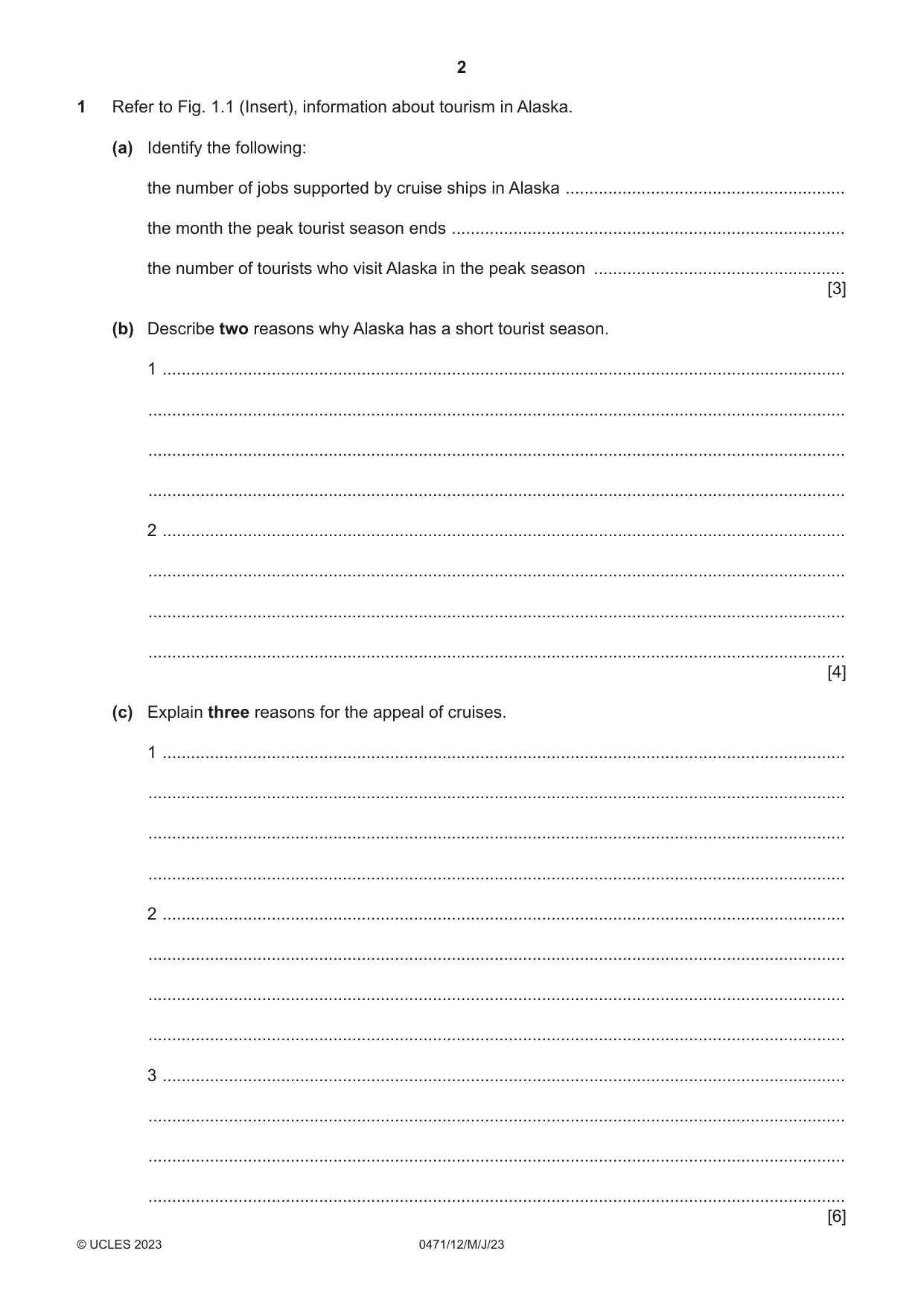
2 0471/12/M/J/23 © UCLES 2023 1 Refer to Fig. 1.1 (Insert), information about tourism in Alaska. (a) Identify the following: the number of jobs supported by cruise ships in Alaska … the month the peak tourist season ends … the number of tourists who visit Alaska in the peak season … [3] (b) Describe two reasons why Alaska has a short tourist season. 1 … … … … 2 … … … … [4] (c) Explain three reasons for the appeal of cruises. 1 … … … … 2 … … … … 3 … … … … [6]
Question paper, page 3
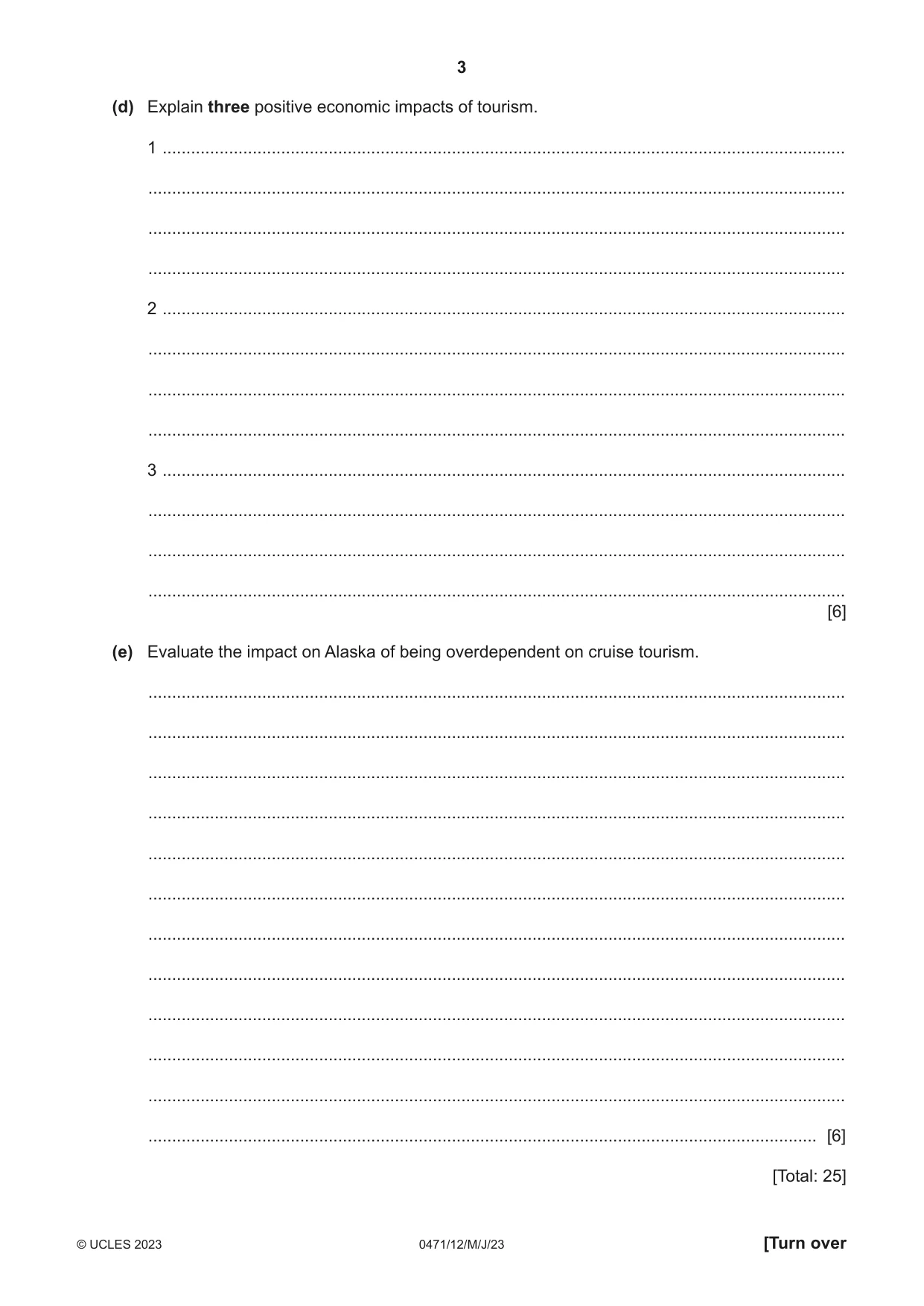
3 0471/12/M/J/23 © UCLES 2023 [Turn over (d) Explain three positive economic impacts of tourism. 1 … … … … 2 … … … … 3 … … … … [6] (e) Evaluate the impact on Alaska of being overdependent on cruise tourism. … … … … … … … … … … … … [6] [Total: 25]
Question paper, page 4
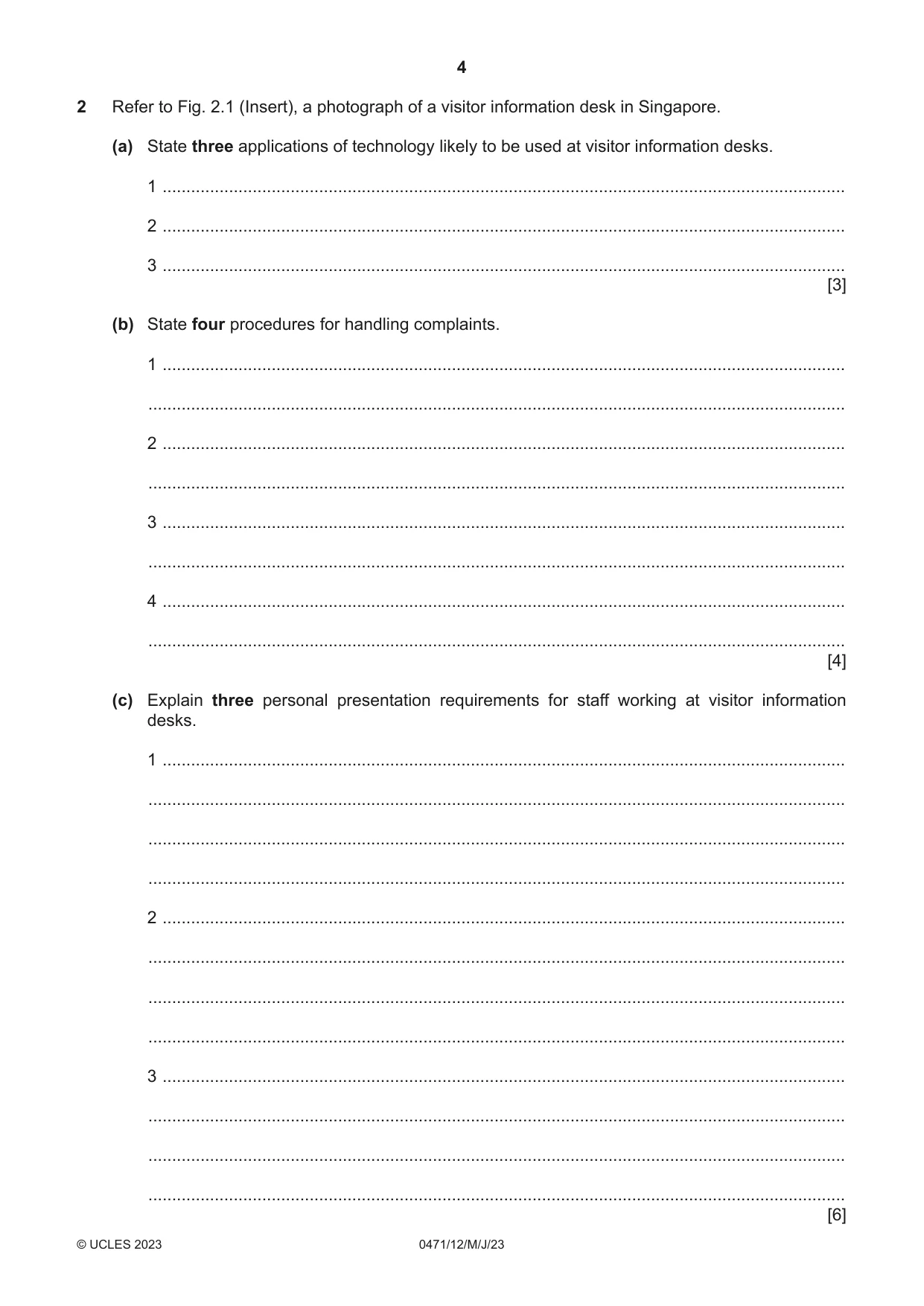
4 0471/12/M/J/23 © UCLES 2023 2 Refer to Fig. 2.1 (Insert), a photograph of a visitor information desk in Singapore. (a) State three applications of technology likely to be used at visitor information desks. 1 … 2 … 3 … [3] (b) State four procedures for handling complaints. 1 … … 2 … … 3 … … 4 … … [4] (c) Explain three personal presentation requirements for staff working at visitor information desks. 1 … … … … 2 … … … … 3 … … … … [6]
Question paper, page 5
5 0471/12/M/J/23 © UCLES 2023 [Turn over (d) Explain why the following skills are important for staff dealing with customer enquiries: clear speech … … … … … … literacy skills … … … … … … [6] (e) Assess the importance of customer care policies in travel and tourism. … … … … … … … … … … … … [6] [Total: 25]
Question paper, page 6
6 0471/12/M/J/23 © UCLES 2023 3 Refer to Fig. 3.1 (Insert), information about cycling tourism in Crete. (a) Other than cycling, state three types of transport tourists can use when travelling around a small island destination. 1 … 2 … 3 … [3] (b) Describe what is meant by the following terms: tour operator … … … … destination … … … … [4] (c) Describe three ways international tourists might get information about the cycling routes in Rethymno. 1 … … … … 2 … … … … 3 … … … … [6]
Question paper, page 7
7 0471/12/M/J/23 © UCLES 2023 [Turn over (d) Explain three positive environmental benefits to destinations of developing cycling tourism. 1 … … … … 2 … … … … 3 … … … … [6] (e) Discuss the importance of destinations having a range of accommodation services available to tourists. … … … … … … … … … … … … [6] [Total: 25]
Question paper, page 8
8 0471/12/M/J/23 © UCLES 2023 4 Refer to Fig. 4.1 (Insert), a photograph of a guided tour at Lesedi cultural village in Johannesburg, South Africa. (a) (i) State two ways tourists can purchase a guided tour. 1 … 2 … [2] (ii) A guided tour is an ancillary service. State two other ancillary services. 1 … 2 … [2] (b) Identify the types of tourists described below: a tourist who visits a tourist attraction and returns home on the same day … a tourist who travels to attend a conference … a family who take a one week beach holiday … [3] (c) Explain three reasons for the appeal of guided tours. 1 … … … … 2 … … … … 3 … … … … [6]
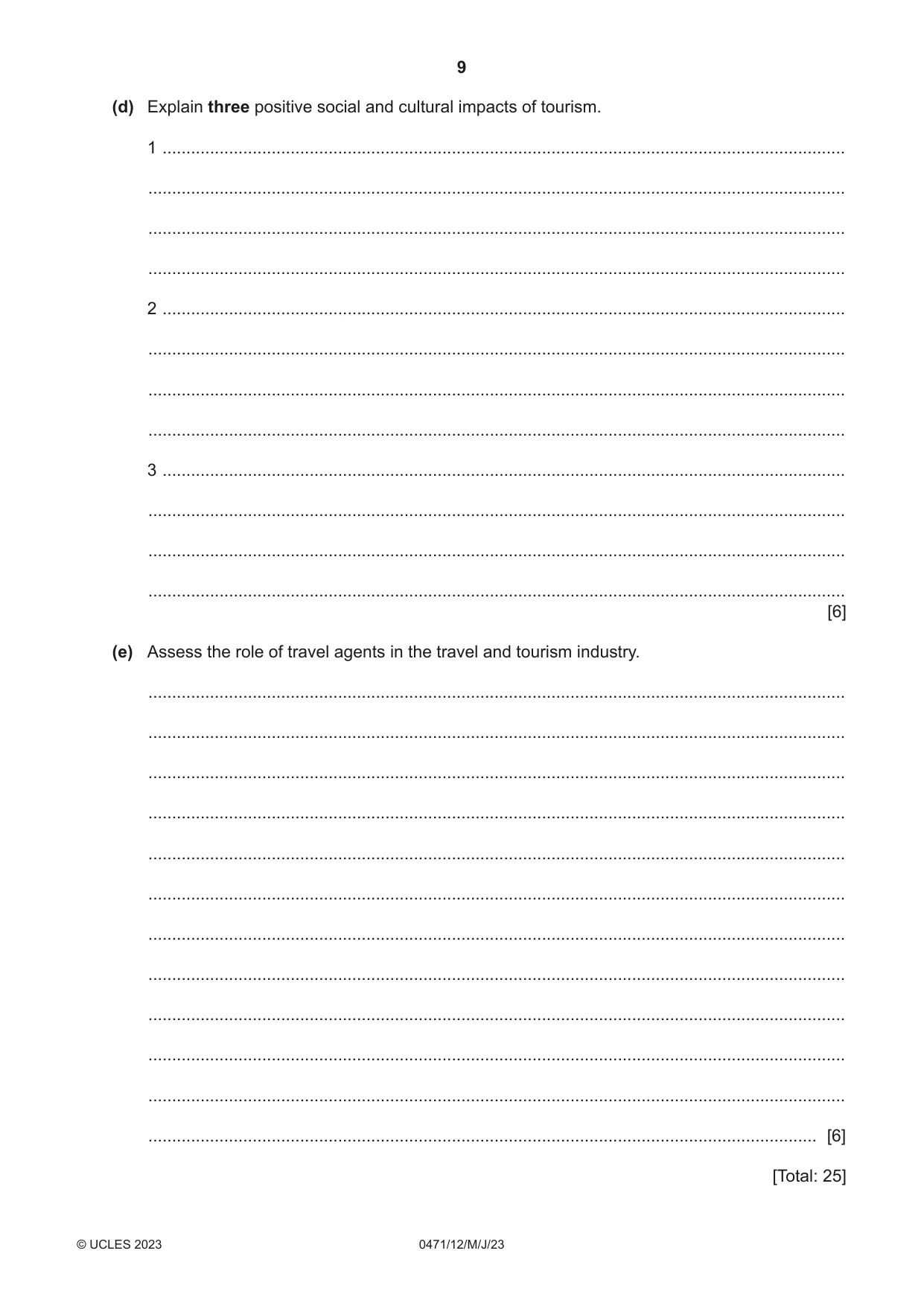
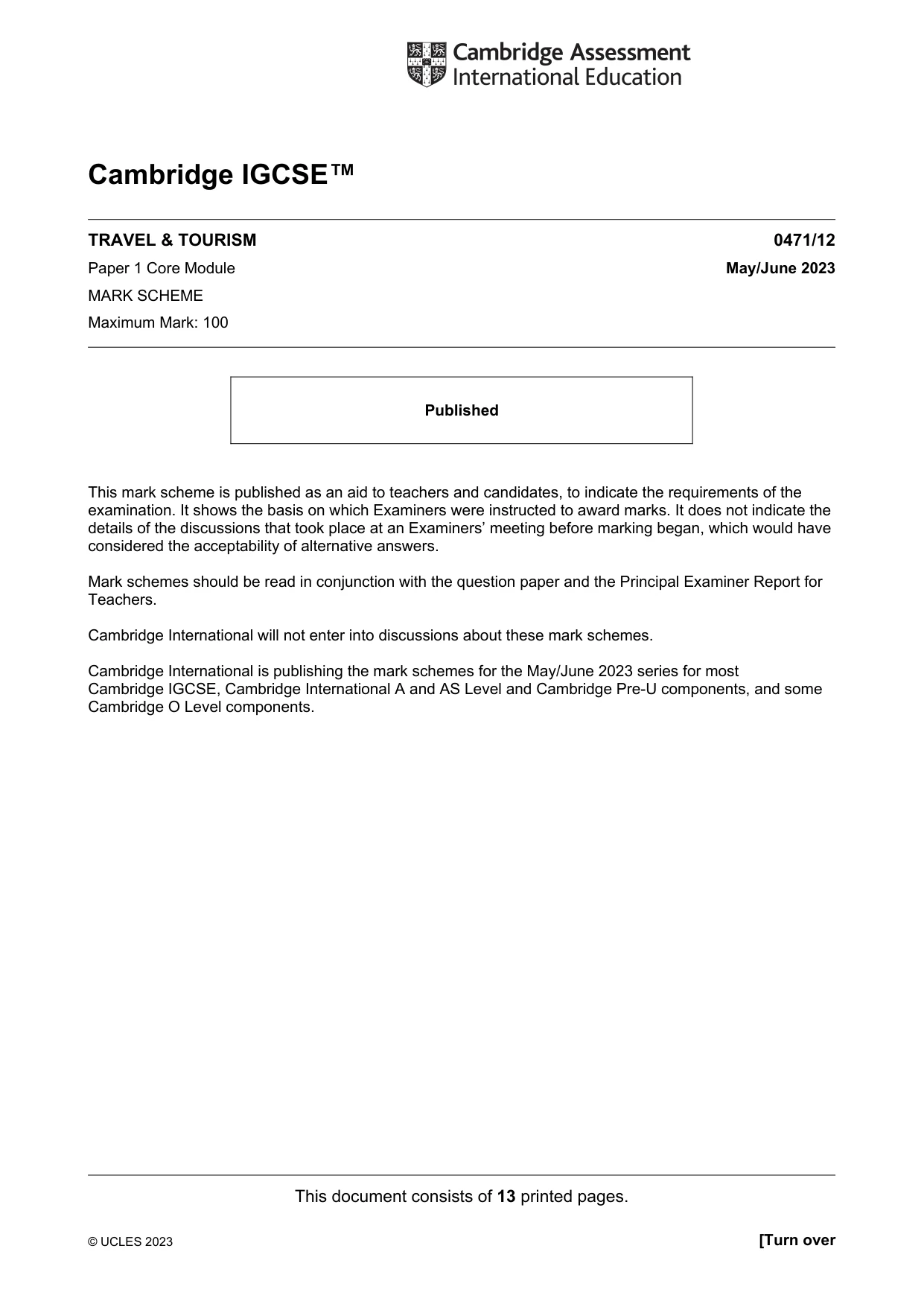
Question paper, page 9
9 0471/12/M/J/23 © UCLES 2023 (d) Explain three positive social and cultural impacts of tourism. 1 … … … … 2 … … … … 3 … … … … [6] (e) Assess the role of travel agents in the travel and tourism industry. … … … … … … … … … … … … [6] [Total: 25]
Question paper, page 10
10 0471/12/M/J/23 © UCLES 2023 BLANK PAGE
Question paper, page 11
11 0471/12/M/J/23 © UCLES 2023 BLANK PAGE
Question paper, page 12
12 0471/12/M/J/23 © UCLES 2023 The boundaries and names shown, the designations used and the presentation of material on any maps contained in this question paper/insert do not imply official endorsement or acceptance by Cambridge Assessment International Education concerning the legal status of any country, territory, or area or any of its authorities, or of the delimitation of its frontiers or boundaries. Permission to reproduce items where third-party owned material protected by copyright is included has been sought and cleared where possible. Every reasonable effort has been made by the publisher (UCLES) to trace copyright holders, but if any items requiring clearance have unwittingly been included, the publisher will be pleased to make amends at the earliest possible opportunity. To avoid the issue of disclosure of answer-related information to candidates, all copyright acknowledgements are reproduced online in the Cambridge Assessment International Education Copyright Acknowledgements Booklet. This is produced for each series of examinations and is freely available to download at www.cambridgeinternational.org after the live examination series. Cambridge Assessment International Education is part of Cambridge Assessment. Cambridge Assessment is the brand name of the University of Cambridge Local Examinations Syndicate (UCLES), which is a department of the University of Cambridge. BLANK PAGE
Mark scheme, page 1
This document consists of 13 printed pages. © UCLES 2023 [Turn over Cambridge IGCSE™ TRAVEL & TOURISM 0471/12 Paper 1 Core Module May/June 2023 MARK SCHEME Maximum Mark: 100 Published This mark scheme is published as an aid to teachers and candidates, to indicate the requirements of the examination. It shows the basis on which Examiners were instructed to award marks. It does not indicate the details of the discussions that took place at an Examiners’ meeting before marking began, which would have considered the acceptability of alternative answers. Mark schemes should be read in conjunction with the question paper and the Principal Examiner Report for Teachers. Cambridge International will not enter into discussions about these mark schemes. Cambridge International is publishing the mark schemes for the May/June 2023 series for most Cambridge IGCSE, Cambridge International A and AS Level and Cambridge Pre-U components, and some Cambridge O Level components.
Mark scheme, page 2
0471/12 Cambridge IGCSE – Mark Scheme PUBLISHED May/June 2023 © UCLES 2023 Page 2 of 13 Generic Marking Principles These general marking principles must be applied by all examiners when marking candidate answers. They should be applied alongside the specific content of the mark scheme or generic level descriptors for a question. Each question paper and mark scheme will also comply with these marking principles. GENERIC MARKING PRINCIPLE 1: Marks must be awarded in line with: the specific content of the mark scheme or the generic level descriptors for the question the specific skills defined in the mark scheme or in the generic level descriptors for the question the standard of response required by a candidate as exemplified by the standardisation scripts. GENERIC MARKING PRINCIPLE 2: Marks awarded are always whole marks (not half marks, or other fractions). GENERIC MARKING PRINCIPLE 3: Marks must be awarded positively: marks are awarded for correct/valid answers, as defined in the mark scheme. However, credit is given for valid answers which go beyond the scope of the syllabus and mark scheme, referring to your Team Leader as appropriate marks are awarded when candidates clearly demonstrate what they know and can do marks are not deducted for errors marks are not deducted for omissions answers should only be judged on the quality of spelling, punctuation and grammar when these features are specifically assessed by the question as indicated by the mark scheme. The meaning, however, should be unambiguous. GENERIC MARKING PRINCIPLE 4: Rules must be applied consistently, e.g. in situations where candidates have not followed instructions or in the application of generic level descriptors. GENERIC MARKING PRINCIPLE 5: Marks should be awarded using the full range of marks defined in the mark scheme for the question (however; the use of the full mark range may be limited according to the quality of the candidate responses seen). GENERIC MARKING PRINCIPLE 6: Marks awarded are based solely on the requirements as defined in the mark scheme. Marks should not be awarded with grade thresholds or grade descriptors in mind.
Mark scheme, page 3
0471/12 Cambridge IGCSE – Mark Scheme PUBLISHED May/June 2023 © UCLES 2023 Page 3 of 13 Social Science-Specific Marking Principles (for point-based marking) 1 Components using point-based marking: Point marking is often used to reward knowledge, understanding and application of skills. We give credit where the candidate’s answer shows relevant knowledge, understanding and application of skills in answering the question. We do not give credit where the answer shows confusion. From this it follows that we: a DO credit answers which are worded differently from the mark scheme if they clearly convey the same meaning (unless the mark scheme requires a specific term) b DO credit alternative answers/examples which are not written in the mark scheme if they are correct c DO credit answers where candidates give more than one correct answer in one prompt/numbered/scaffolded space where extended writing is required rather than list-type answers. For example, questions that require n reasons (e.g. State two reasons …). d DO NOT credit answers simply for using a ‘key term’ unless that is all that is required. (Check for evidence it is understood and not used wrongly.) e DO NOT credit answers which are obviously self-contradicting or trying to cover all possibilities f DO NOT give further credit for what is effectively repetition of a correct point already credited unless the language itself is being tested. This applies equally to ‘mirror statements’ (i.e. polluted/not polluted). g DO NOT require spellings to be correct, unless this is part of the test. However spellings of syllabus terms must allow for clear and unambiguous separation from other syllabus terms with which they may be confused (e.g. Corrasion/Corrosion) 2 Presentation of mark scheme: Slashes (/) or the word ‘or’ separate alternative ways of making the same point. Semi colons (;) bullet points (•) or figures in brackets (1) separate different points. Content in the answer column in brackets is for examiner information/context to clarify the marking but is not required to earn the mark (except Accounting syllabuses where they indicate negative numbers). 3 Calculation questions: The mark scheme will show the steps in the most likely correct method(s), the mark for each step, the correct answer(s) and the mark for each answer If working/explanation is considered essential for full credit, this will be indicated in the question paper and in the mark scheme. In all other instances, the correct answer to a calculation should be given full credit, even if no supporting working is shown. Where the candidate uses a valid method which is not covered by the mark scheme, award equivalent marks for reaching equivalent stages. Where an answer makes use of a candidate’s own incorrect figure from previous working, the ‘own figure rule’ applies: full marks will be given if a correct and complete method is used. Further guidance will be included in the mark scheme where necessary and any exceptions to this general principle will be noted.
Mark scheme, page 4
0471/12 Cambridge IGCSE – Mark Scheme PUBLISHED May/June 2023 © UCLES 2023 Page 4 of 13 4 Annotation: For point marking, ticks can be used to indicate correct answers and crosses can be used to indicate wrong answers. There is no direct relationship between ticks and marks. Ticks have no defined meaning for levels of response marking. For levels of response marking, the level awarded should be annotated on the script. Other annotations will be used by examiners as agreed during standardisation, and the meaning will be understood by all examiners who marked that paper.
Mark scheme, page 5
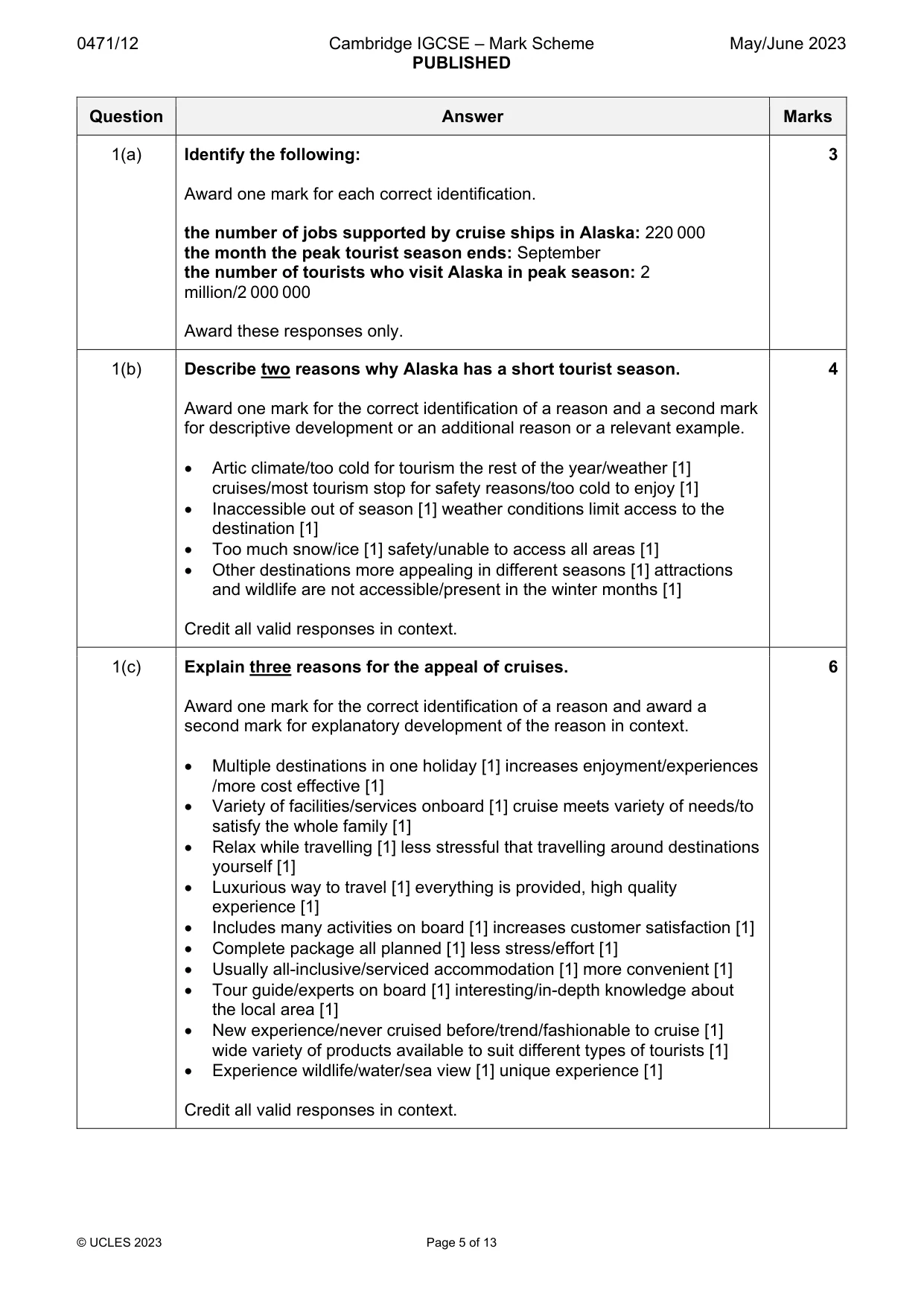
0471/12 Cambridge IGCSE – Mark Scheme PUBLISHED May/June 2023 © UCLES 2023 Page 5 of 13 Question Answer Marks 1(a) Identify the following: Award one mark for each correct identification. the number of jobs supported by cruise ships in Alaska: 220 000 the month the peak tourist season ends: September the number of tourists who visit Alaska in peak season: 2 million/2 000 000 Award these responses only. 3 1(b) Describe two reasons why Alaska has a short tourist season. Award one mark for the correct identification of a reason and a second mark for descriptive development or an additional reason or a relevant example. Artic climate/too cold for tourism the rest of the year/weather [1] cruises/most tourism stop for safety reasons/too cold to enjoy [1] Inaccessible out of season [1] weather conditions limit access to the destination [1] Too much snow/ice [1] safety/unable to access all areas [1] Other destinations more appealing in different seasons [1] attractions and wildlife are not accessible/present in the winter months [1] Credit all valid responses in context. 4 1(c) Explain three reasons for the appeal of cruises. Award one mark for the correct identification of a reason and award a second mark for explanatory development of the reason in context. Multiple destinations in one holiday [1] increases enjoyment/experiences /more cost effective [1] Variety of facilities/services onboard [1] cruise meets variety of needs/to satisfy the whole family [1] Relax while travelling [1] less stressful that travelling around destinations yourself [1] Luxurious way to travel [1] everything is provided, high quality experience [1] Includes many activities on board [1] increases customer satisfaction [1] Complete package all planned [1] less stress/effort [1] Usually all-inclusive/serviced accommodation [1] more convenient [1] Tour guide/experts on board [1] interesting/in-depth knowledge about the local area [1] New experience/never cruised before/trend/fashionable to cruise [1] wide variety of products available to suit different types of tourists [1] Experience wildlife/water/sea view [1] unique experience [1] Credit all valid responses in context. 6
Mark scheme, page 6
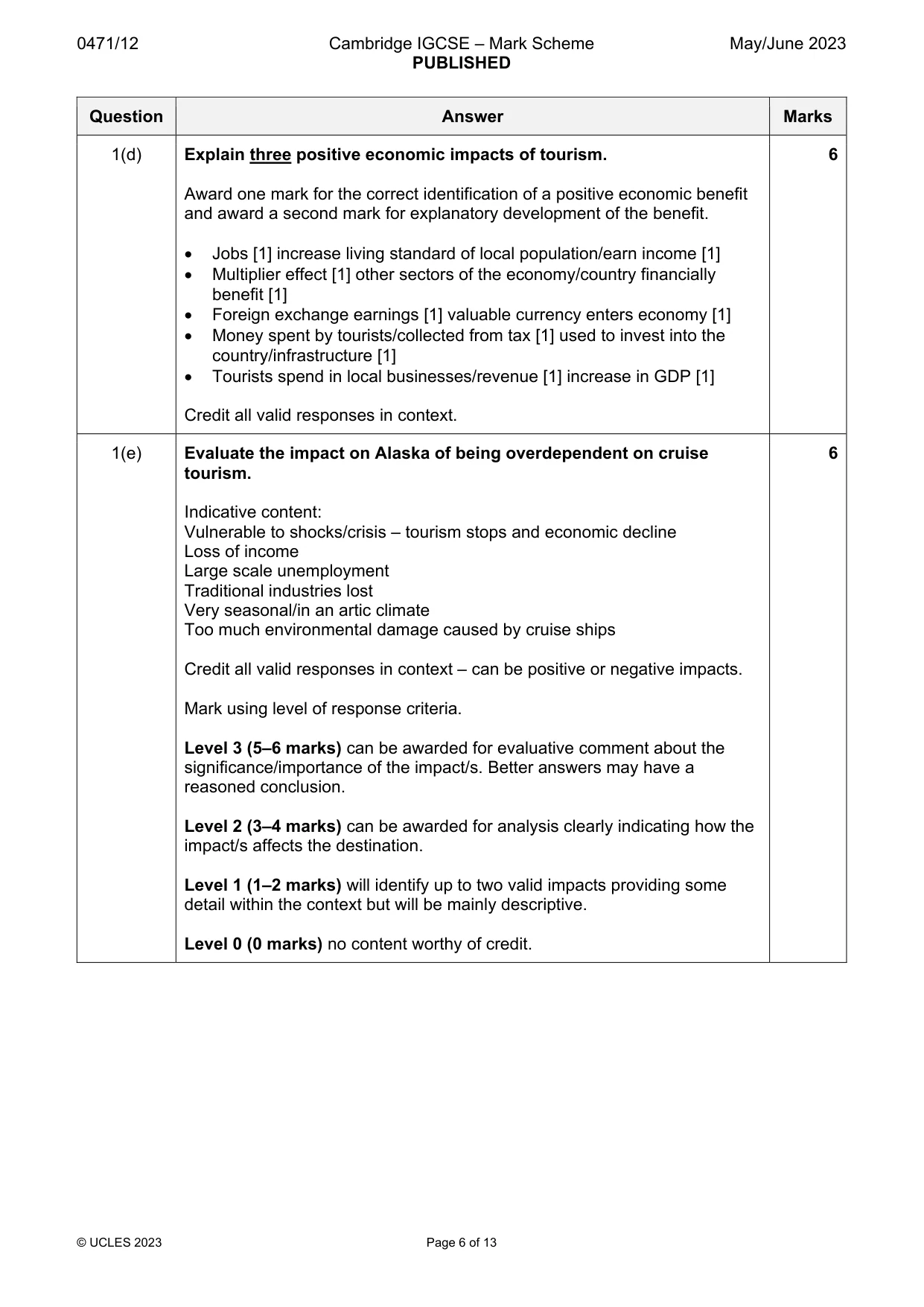
0471/12 Cambridge IGCSE – Mark Scheme PUBLISHED May/June 2023 © UCLES 2023 Page 6 of 13 Question Answer Marks 1(d) Explain three positive economic impacts of tourism. Award one mark for the correct identification of a positive economic benefit and award a second mark for explanatory development of the benefit. Jobs [1] increase living standard of local population/earn income [1] Multiplier effect [1] other sectors of the economy/country financially benefit [1] Foreign exchange earnings [1] valuable currency enters economy [1] Money spent by tourists/collected from tax [1] used to invest into the country/infrastructure [1] Tourists spend in local businesses/revenue [1] increase in GDP [1] Credit all valid responses in context. 6 1(e) Evaluate the impact on Alaska of being overdependent on cruise tourism. Indicative content: Vulnerable to shocks/crisis – tourism stops and economic decline Loss of income Large scale unemployment Traditional industries lost Very seasonal/in an artic climate Too much environmental damage caused by cruise ships Credit all valid responses in context – can be positive or negative impacts. Mark using level of response criteria. Level 3 (5–6 marks) can be awarded for evaluative comment about the significance/importance of the impact/s. Better answers may have a reasoned conclusion. Level 2 (3–4 marks) can be awarded for analysis clearly indicating how the impact/s affects the destination. Level 1 (1–2 marks) will identify up to two valid impacts providing some detail within the context but will be mainly descriptive. Level 0 (0 marks) no content worthy of credit. 6
Mark scheme, page 7
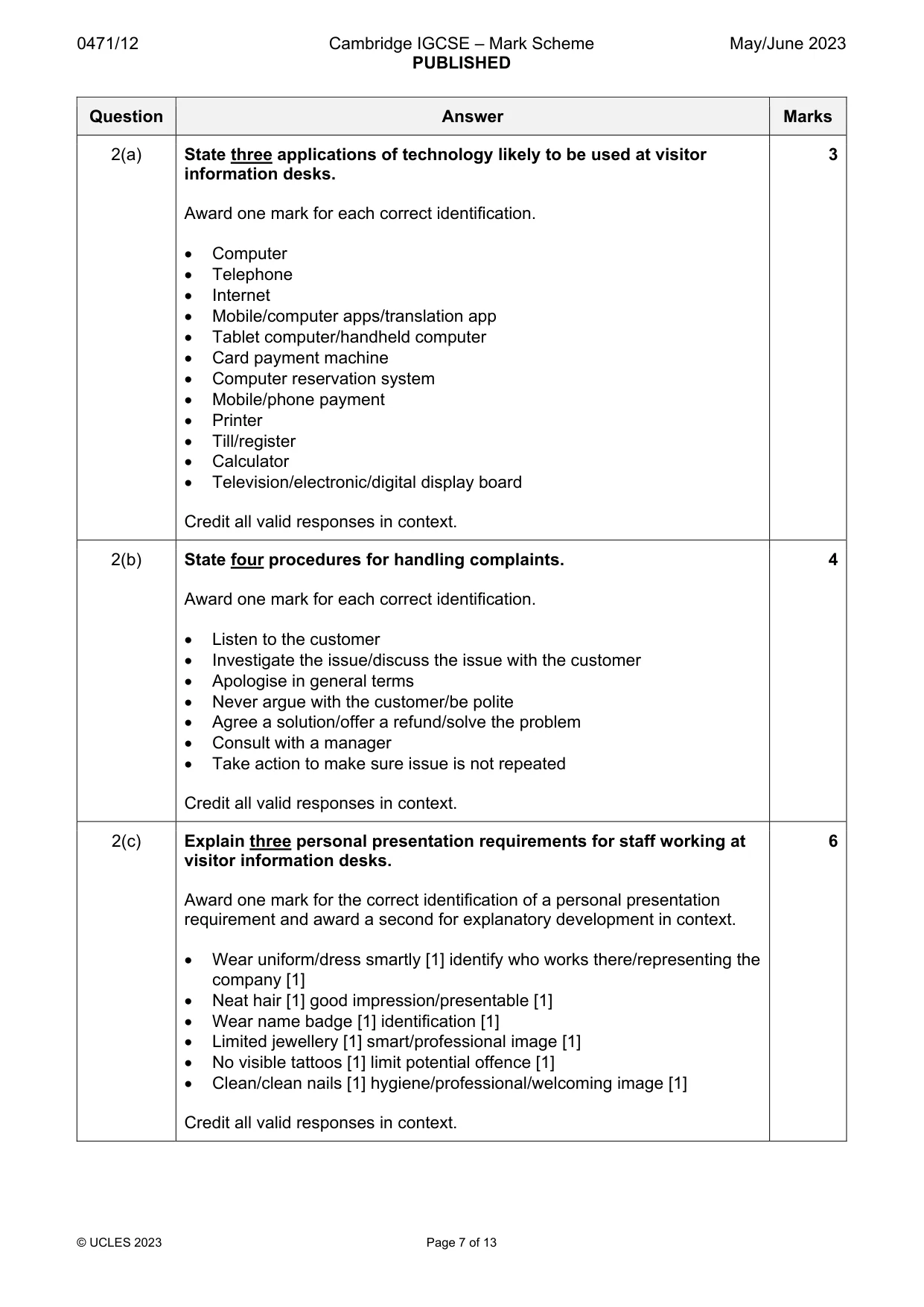
0471/12 Cambridge IGCSE – Mark Scheme PUBLISHED May/June 2023 © UCLES 2023 Page 7 of 13 Question Answer Marks 2(a) State three applications of technology likely to be used at visitor information desks. Award one mark for each correct identification. Computer Telephone Internet Mobile/computer apps/translation app Tablet computer/handheld computer Card payment machine Computer reservation system Mobile/phone payment Printer Till/register Calculator Television/electronic/digital display board Credit all valid responses in context. 3 2(b) State four procedures for handling complaints. Award one mark for each correct identification. Listen to the customer Investigate the issue/discuss the issue with the customer Apologise in general terms Never argue with the customer/be polite Agree a solution/offer a refund/solve the problem Consult with a manager Take action to make sure issue is not repeated Credit all valid responses in context. 4 2(c) Explain three personal presentation requirements for staff working at visitor information desks. Award one mark for the correct identification of a personal presentation requirement and award a second for explanatory development in context. Wear uniform/dress smartly [1] identify who works there/representing the company [1] Neat hair [1] good impression/presentable [1] Wear name badge [1] identification [1] Limited jewellery [1] smart/professional image [1] No visible tattoos [1] limit potential offence [1] Clean/clean nails [1] hygiene/professional/welcoming image [1] Credit all valid responses in context. 6
Mark scheme, page 8
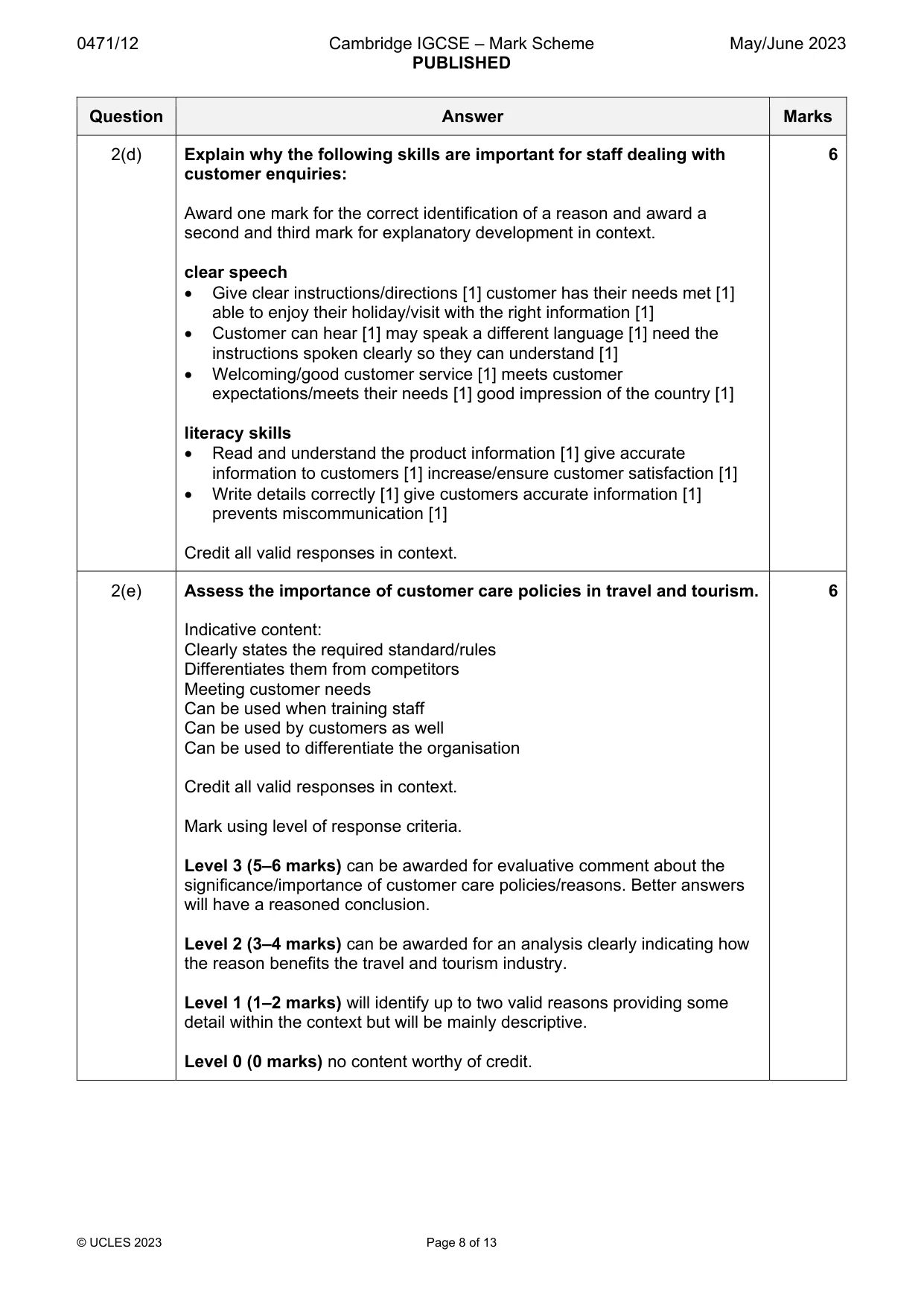
0471/12 Cambridge IGCSE – Mark Scheme PUBLISHED May/June 2023 © UCLES 2023 Page 8 of 13 Question Answer Marks 2(d) Explain why the following skills are important for staff dealing with customer enquiries: Award one mark for the correct identification of a reason and award a second and third mark for explanatory development in context. clear speech Give clear instructions/directions [1] customer has their needs met [1] able to enjoy their holiday/visit with the right information [1] Customer can hear [1] may speak a different language [1] need the instructions spoken clearly so they can understand [1] Welcoming/good customer service [1] meets customer expectations/meets their needs [1] good impression of the country [1] literacy skills Read and understand the product information [1] give accurate information to customers [1] increase/ensure customer satisfaction [1] Write details correctly [1] give customers accurate information [1] prevents miscommunication [1] Credit all valid responses in context. 6 2(e) Assess the importance of customer care policies in travel and tourism. Indicative content: Clearly states the required standard/rules Differentiates them from competitors Meeting customer needs Can be used when training staff Can be used by customers as well Can be used to differentiate the organisation Credit all valid responses in context. Mark using level of response criteria. Level 3 (5–6 marks) can be awarded for evaluative comment about the significance/importance of customer care policies/reasons. Better answers will have a reasoned conclusion. Level 2 (3–4 marks) can be awarded for an analysis clearly indicating how the reason benefits the travel and tourism industry. Level 1 (1–2 marks) will identify up to two valid reasons providing some detail within the context but will be mainly descriptive. Level 0 (0 marks) no content worthy of credit. 6
Mark scheme, page 9
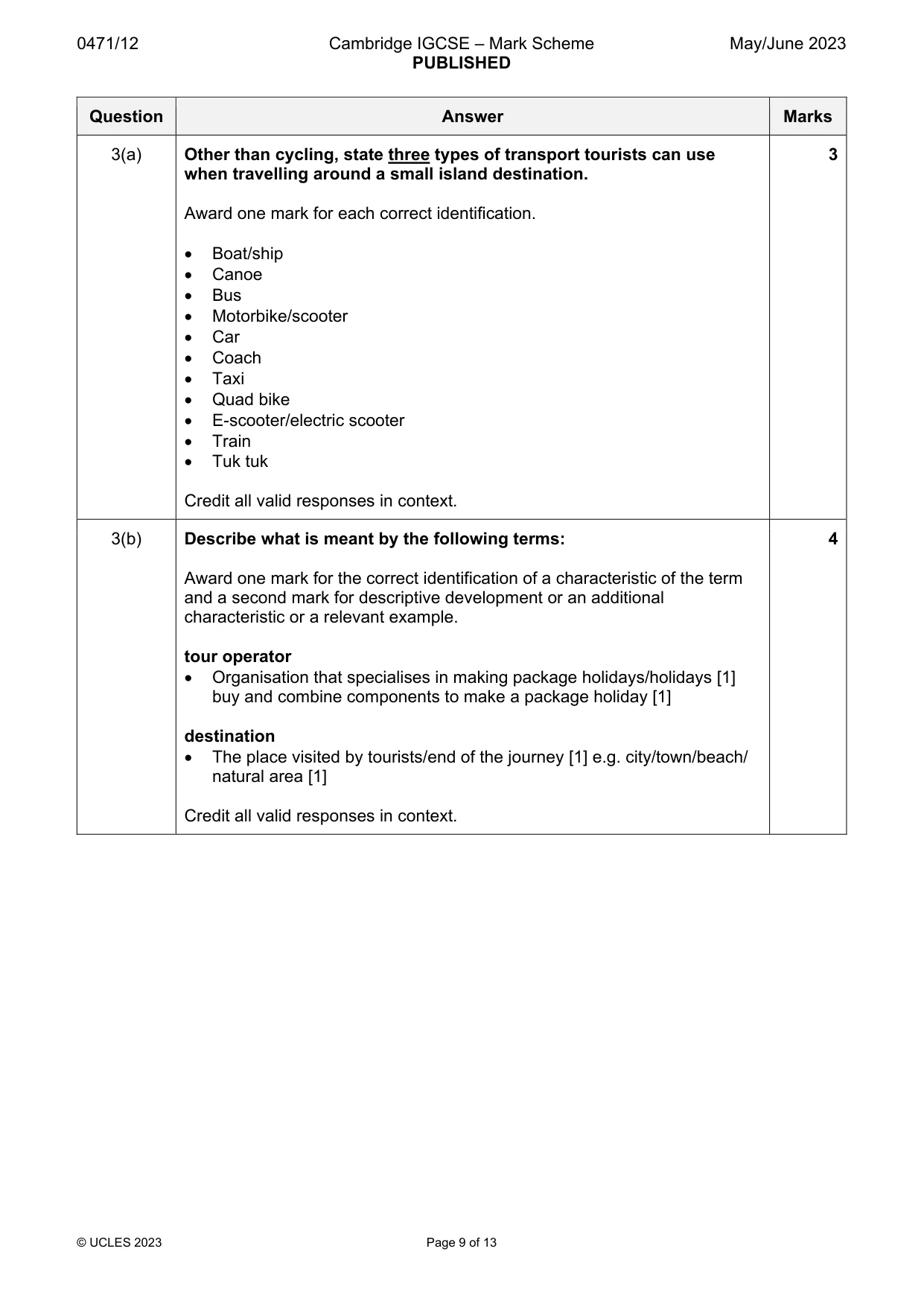
0471/12 Cambridge IGCSE – Mark Scheme PUBLISHED May/June 2023 © UCLES 2023 Page 9 of 13 Question Answer Marks 3(a) Other than cycling, state three types of transport tourists can use when travelling around a small island destination. Award one mark for each correct identification. Boat/ship Canoe Bus Motorbike/scooter Car Coach Taxi Quad bike E-scooter/electric scooter Train Tuk tuk Credit all valid responses in context. 3 3(b) Describe what is meant by the following terms: Award one mark for the correct identification of a characteristic of the term and a second mark for descriptive development or an additional characteristic or a relevant example. tour operator Organisation that specialises in making package holidays/holidays [1] buy and combine components to make a package holiday [1] destination The place visited by tourists/end of the journey [1] e.g. city/town/beach/ natural area [1] Credit all valid responses in context. 4
Mark scheme, page 10
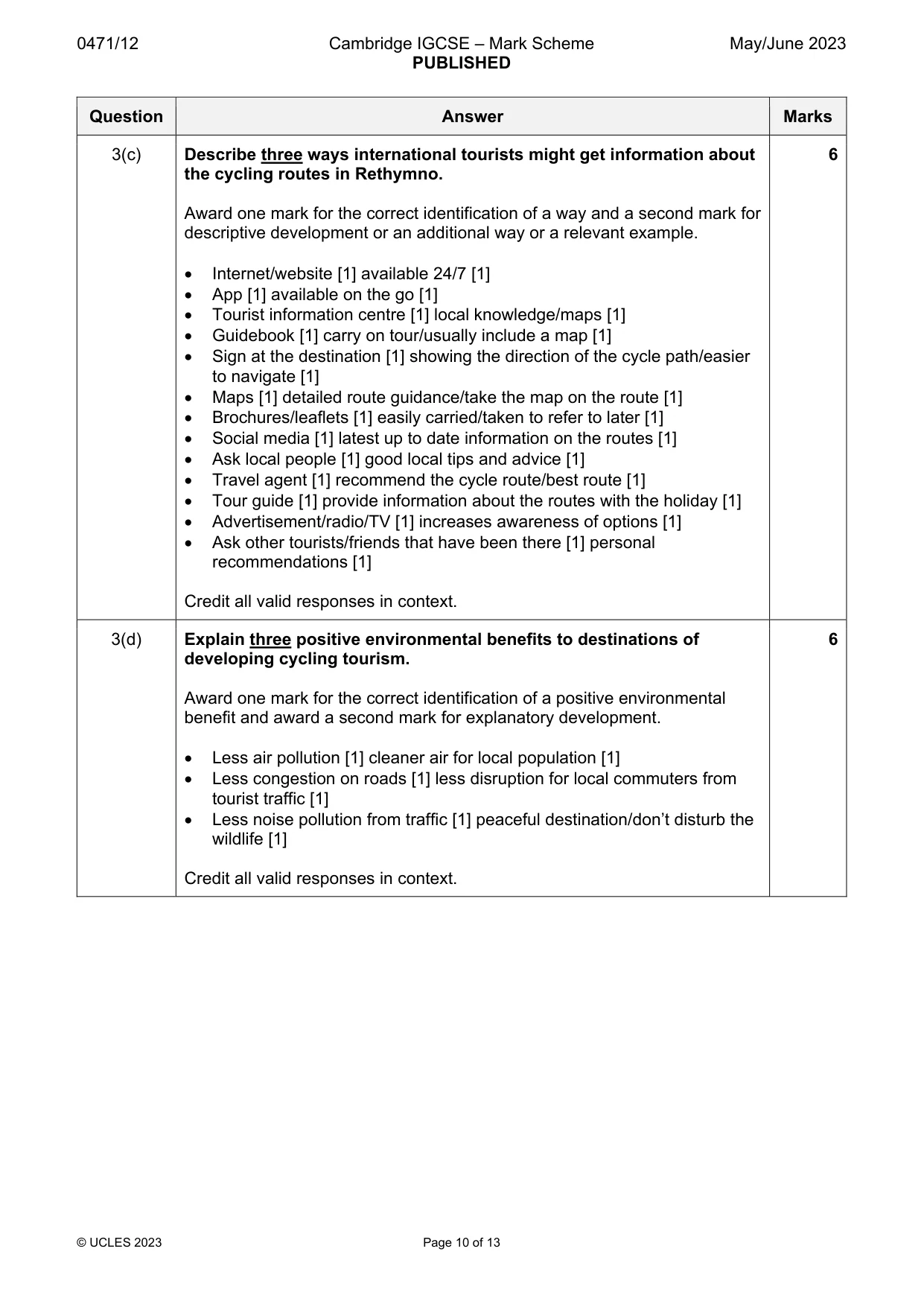
0471/12 Cambridge IGCSE – Mark Scheme PUBLISHED May/June 2023 © UCLES 2023 Page 10 of 13 Question Answer Marks 3(c) Describe three ways international tourists might get information about the cycling routes in Rethymno. Award one mark for the correct identification of a way and a second mark for descriptive development or an additional way or a relevant example. Internet/website [1] available 24/7 [1] App [1] available on the go [1] Tourist information centre [1] local knowledge/maps [1] Guidebook [1] carry on tour/usually include a map [1] Sign at the destination [1] showing the direction of the cycle path/easier to navigate [1] Maps [1] detailed route guidance/take the map on the route [1] Brochures/leaflets [1] easily carried/taken to refer to later [1] Social media [1] latest up to date information on the routes [1] Ask local people [1] good local tips and advice [1] Travel agent [1] recommend the cycle route/best route [1] Tour guide [1] provide information about the routes with the holiday [1] Advertisement/radio/TV [1] increases awareness of options [1] Ask other tourists/friends that have been there [1] personal recommendations [1] Credit all valid responses in context. 6 3(d) Explain three positive environmental benefits to destinations of developing cycling tourism. Award one mark for the correct identification of a positive environmental benefit and award a second mark for explanatory development. Less air pollution [1] cleaner air for local population [1] Less congestion on roads [1] less disruption for local commuters from tourist traffic [1] Less noise pollution from traffic [1] peaceful destination/don’t disturb the wildlife [1] Credit all valid responses in context. 6
Mark scheme, page 11
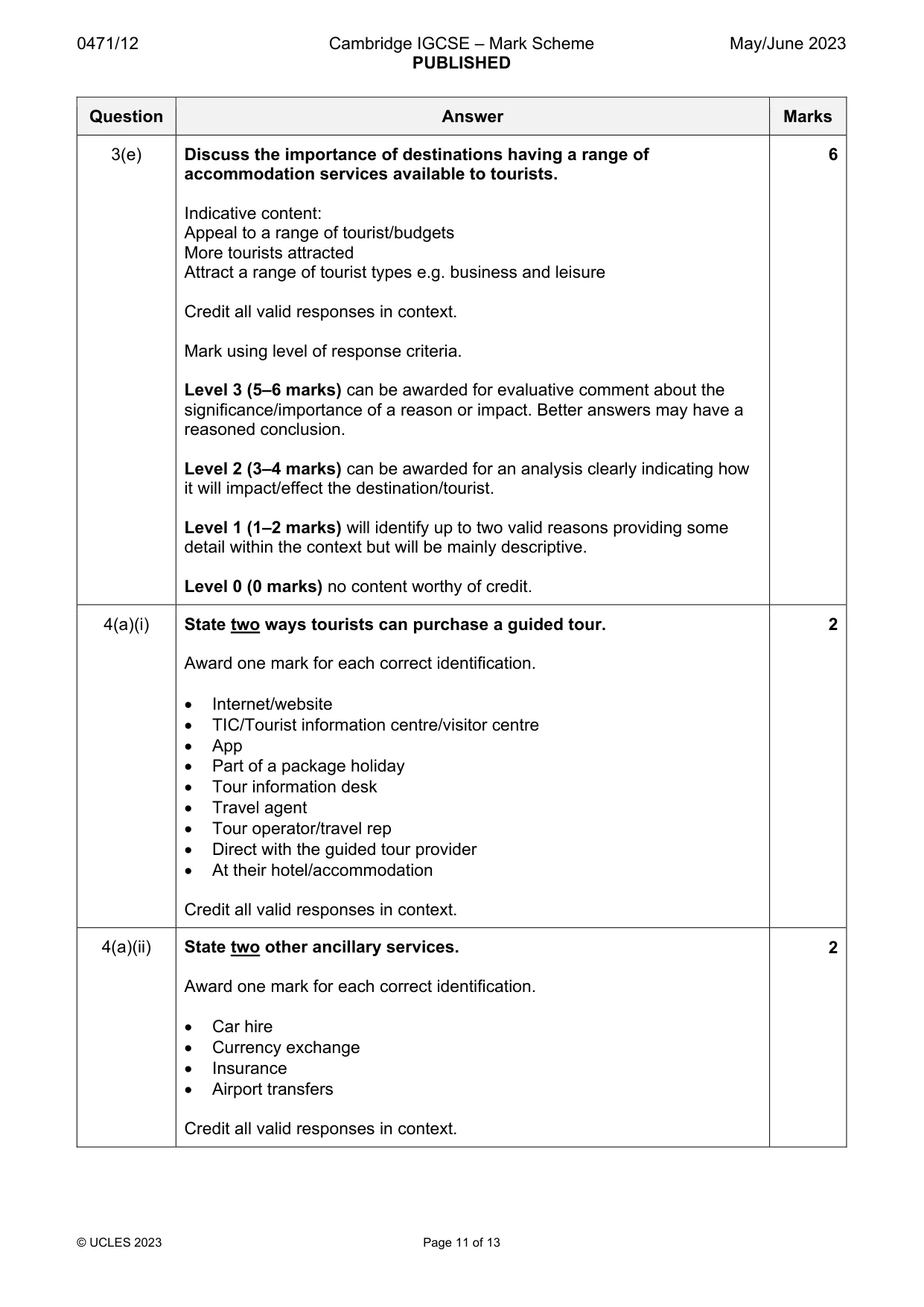
0471/12 Cambridge IGCSE – Mark Scheme PUBLISHED May/June 2023 © UCLES 2023 Page 11 of 13 Question Answer Marks 3(e) Discuss the importance of destinations having a range of accommodation services available to tourists. Indicative content: Appeal to a range of tourist/budgets More tourists attracted Attract a range of tourist types e.g. business and leisure Credit all valid responses in context. Mark using level of response criteria. Level 3 (5–6 marks) can be awarded for evaluative comment about the significance/importance of a reason or impact. Better answers may have a reasoned conclusion. Level 2 (3–4 marks) can be awarded for an analysis clearly indicating how it will impact/effect the destination/tourist. Level 1 (1–2 marks) will identify up to two valid reasons providing some detail within the context but will be mainly descriptive. Level 0 (0 marks) no content worthy of credit. 6 4(a)(i) State two ways tourists can purchase a guided tour. Award one mark for each correct identification. Internet/website TIC/Tourist information centre/visitor centre App Part of a package holiday Tour information desk Travel agent Tour operator/travel rep Direct with the guided tour provider At their hotel/accommodation Credit all valid responses in context. 2 4(a)(ii) State two other ancillary services. Award one mark for each correct identification. Car hire Currency exchange Insurance Airport transfers Credit all valid responses in context. 2
Mark scheme, page 12
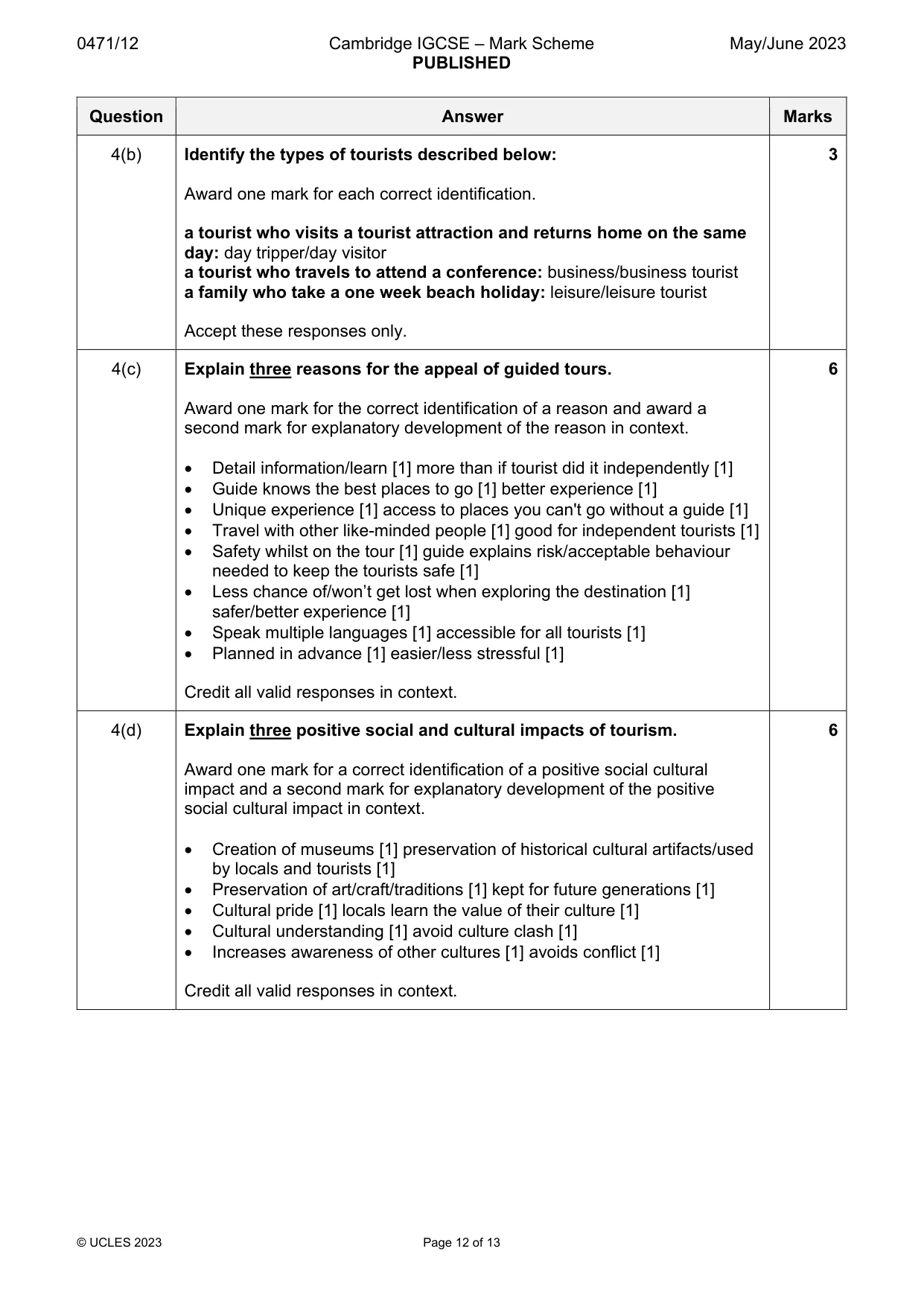
0471/12 Cambridge IGCSE – Mark Scheme PUBLISHED May/June 2023 © UCLES 2023 Page 12 of 13 Question Answer Marks 4(b) Identify the types of tourists described below: Award one mark for each correct identification. a tourist who visits a tourist attraction and returns home on the same day: day tripper/day visitor a tourist who travels to attend a conference: business/business tourist a family who take a one week beach holiday: leisure/leisure tourist Accept these responses only. 3 4(c) Explain three reasons for the appeal of guided tours. Award one mark for the correct identification of a reason and award a second mark for explanatory development of the reason in context. Detail information/learn [1] more than if tourist did it independently [1] Guide knows the best places to go [1] better experience [1] Unique experience [1] access to places you can't go without a guide [1] Travel with other like-minded people [1] good for independent tourists [1] Safety whilst on the tour [1] guide explains risk/acceptable behaviour needed to keep the tourists safe [1] Less chance of/won’t get lost when exploring the destination [1] safer/better experience [1] Speak multiple languages [1] accessible for all tourists [1] Planned in advance [1] easier/less stressful [1] Credit all valid responses in context. 6 4(d) Explain three positive social and cultural impacts of tourism. Award one mark for a correct identification of a positive social cultural impact and a second mark for explanatory development of the positive social cultural impact in context. Creation of museums [1] preservation of historical cultural artifacts/used by locals and tourists [1] Preservation of art/craft/traditions [1] kept for future generations [1] Cultural pride [1] locals learn the value of their culture [1] Cultural understanding [1] avoid culture clash [1] Increases awareness of other cultures [1] avoids conflict [1] Credit all valid responses in context. 6
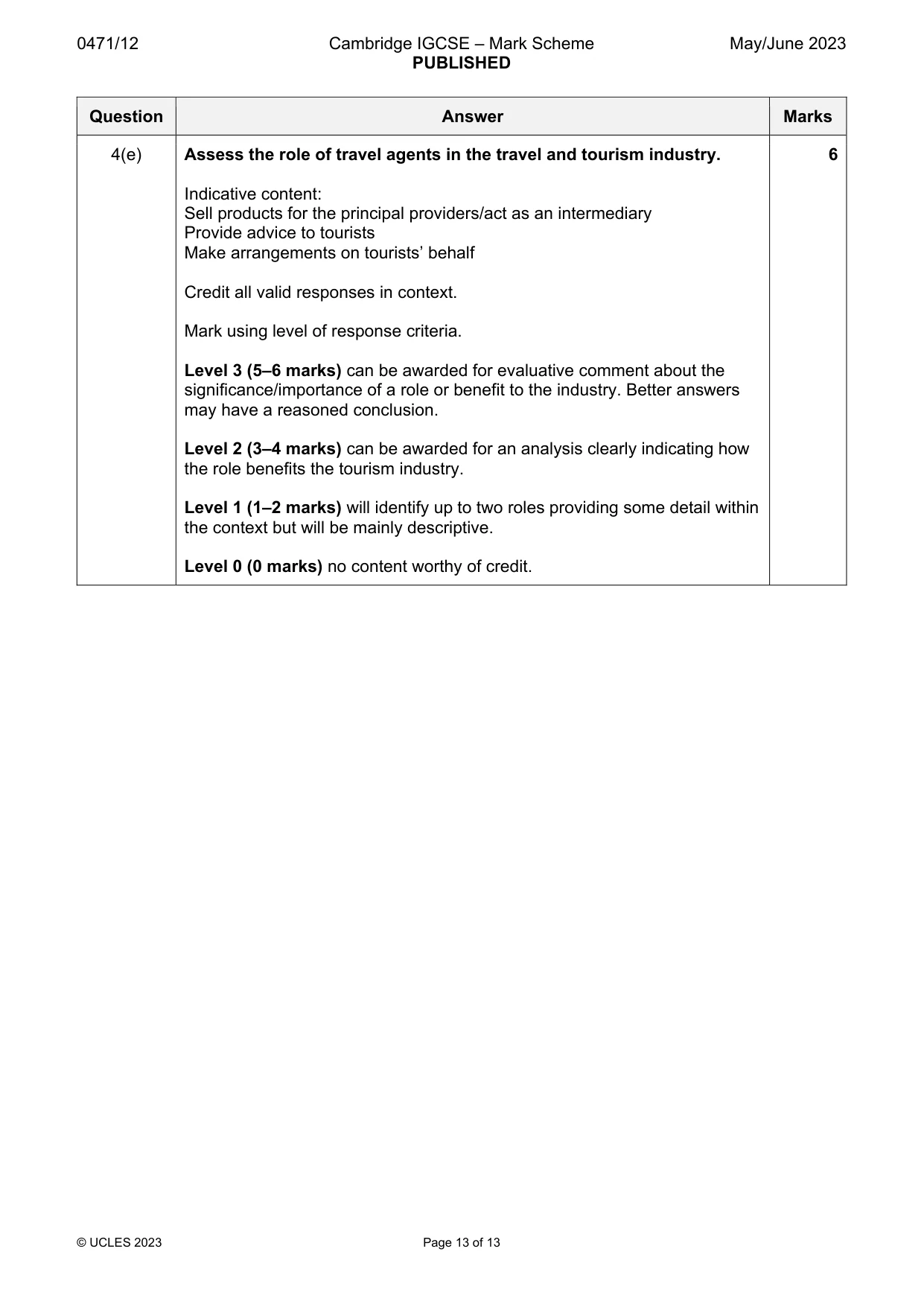
Mark scheme, page 13
0471/12 Cambridge IGCSE – Mark Scheme PUBLISHED May/June 2023 © UCLES 2023 Page 13 of 13 Question Answer Marks 4(e) Assess the role of travel agents in the travel and tourism industry. Indicative content: Sell products for the principal providers/act as an intermediary Provide advice to tourists Make arrangements on tourists’ behalf Credit all valid responses in context. Mark using level of response criteria. Level 3 (5–6 marks) can be awarded for evaluative comment about the significance/importance of a role or benefit to the industry. Better answers may have a reasoned conclusion. Level 2 (3–4 marks) can be awarded for an analysis clearly indicating how the role benefits the tourism industry. Level 1 (1–2 marks) will identify up to two roles providing some detail within the context but will be mainly descriptive. Level 0 (0 marks) no content worthy of credit. 6
What you needed in this session
Cambridge’s own grade thresholds for 2023 May/June, Paper 1 · Variant 2. A higher threshold means an easier paper — the bar moves with how the cohort did.