Cambridge IGCSE Travel and Tourism 0471 — 2020 Oct/Nov Paper 1 · Variant 1
0471/11/O/N/20 · 100 marks · ≈113 min
The question paper and its mark scheme, free to read here and free to download. This is Cambridge’s own paper, exactly as it was sat.
Question paper12 pages

Mark scheme10 pages
Answers below. Sit the paper first if you are practising.
Paper as text
Question paper, page 1
Cambridge IGCSE™ This document has 12 pages. Blank pages are indicated. TRAVEL & TOURISM 0471/11 Paper 1 Core Paper October/November 2020 2 hours You must answer on the question paper. You will need: Insert (enclosed) INSTRUCTIONS ● Answer all questions. ● Use a black or dark blue pen. ● Write your name, centre number and candidate number in the boxes at the top of the page. ● Write your answer to each question in the space provided. ● Do not use an erasable pen or correction fluid. ● Do not write on any bar codes. INFORMATION ● The total mark for this paper is 100. ● The number of marks for each question or part question is shown in brackets [ ]. ● The insert contains all the figures referred to in the questions. DC (ST) 180402/1 © UCLES 2020 [Turn over * 9 8 8 0 4 6 4 5 3 4 *
Question paper, page 2
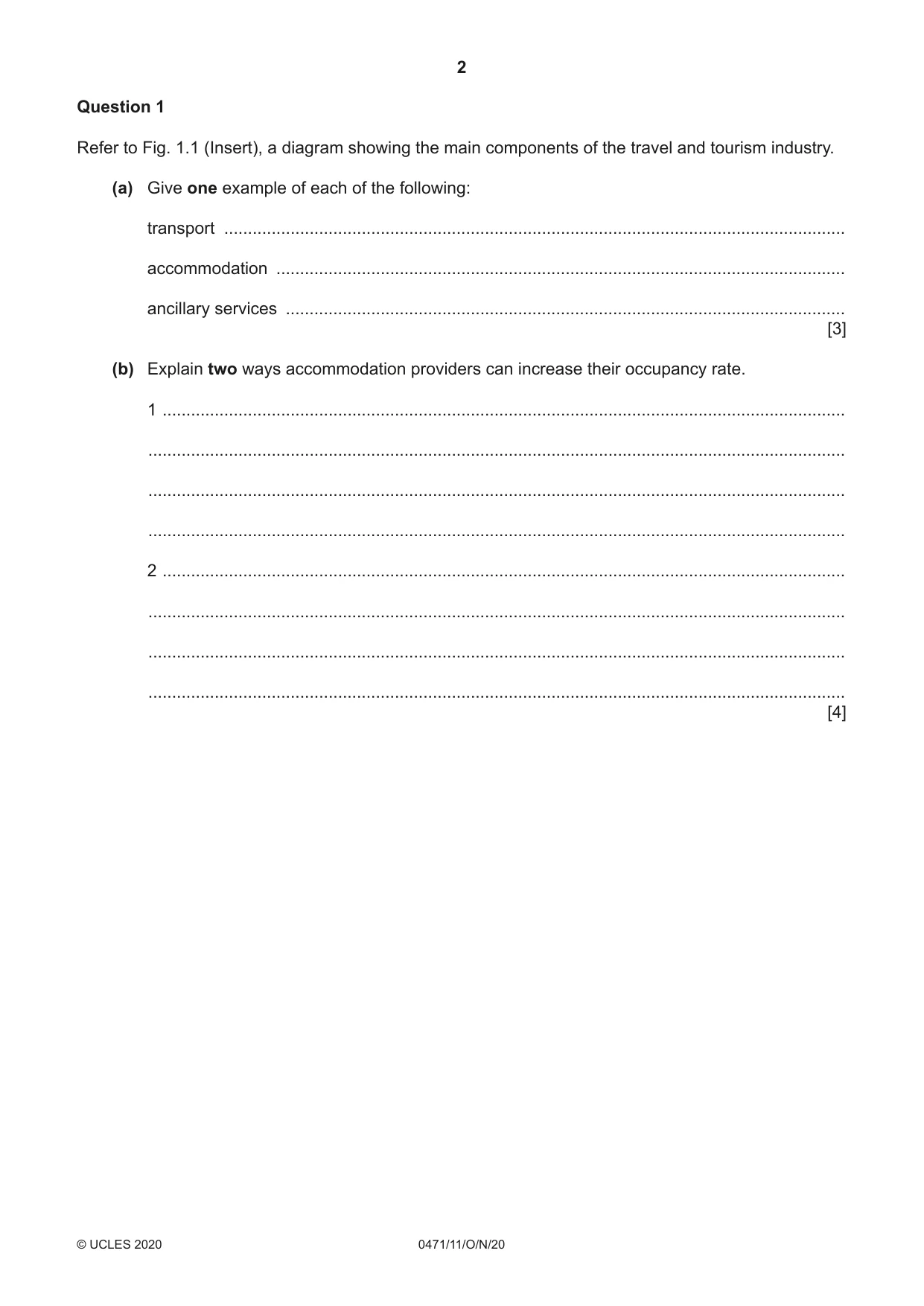
2 0471/11/O/N/20 © UCLES 2020 Question 1 Refer to Fig. 1.1 (Insert), a diagram showing the main components of the travel and tourism industry. (a) Give one example of each of the following: transport … accommodation … ancillary services … [3] (b) Explain two ways accommodation providers can increase their occupancy rate. 1 … … … … 2 … … … … [4]
Question paper, page 3
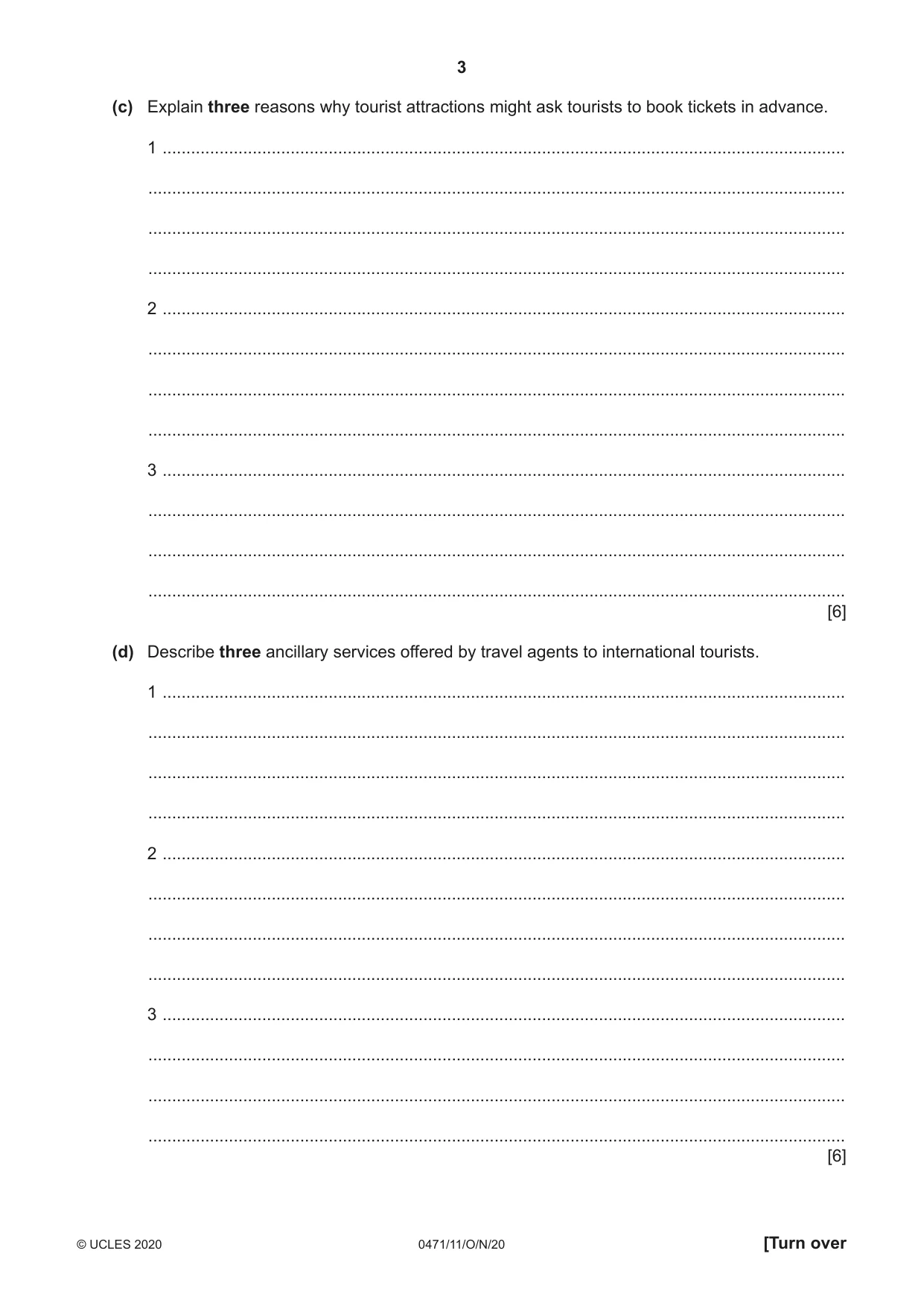
3 0471/11/O/N/20 © UCLES 2020 [Turn over (c) Explain three reasons why tourist attractions might ask tourists to book tickets in advance. 1 … … … … 2 … … … … 3 … … … … [6] (d) Describe three ancillary services offered by travel agents to international tourists. 1 … … … … 2 … … … … 3 … … … … [6]
Question paper, page 4
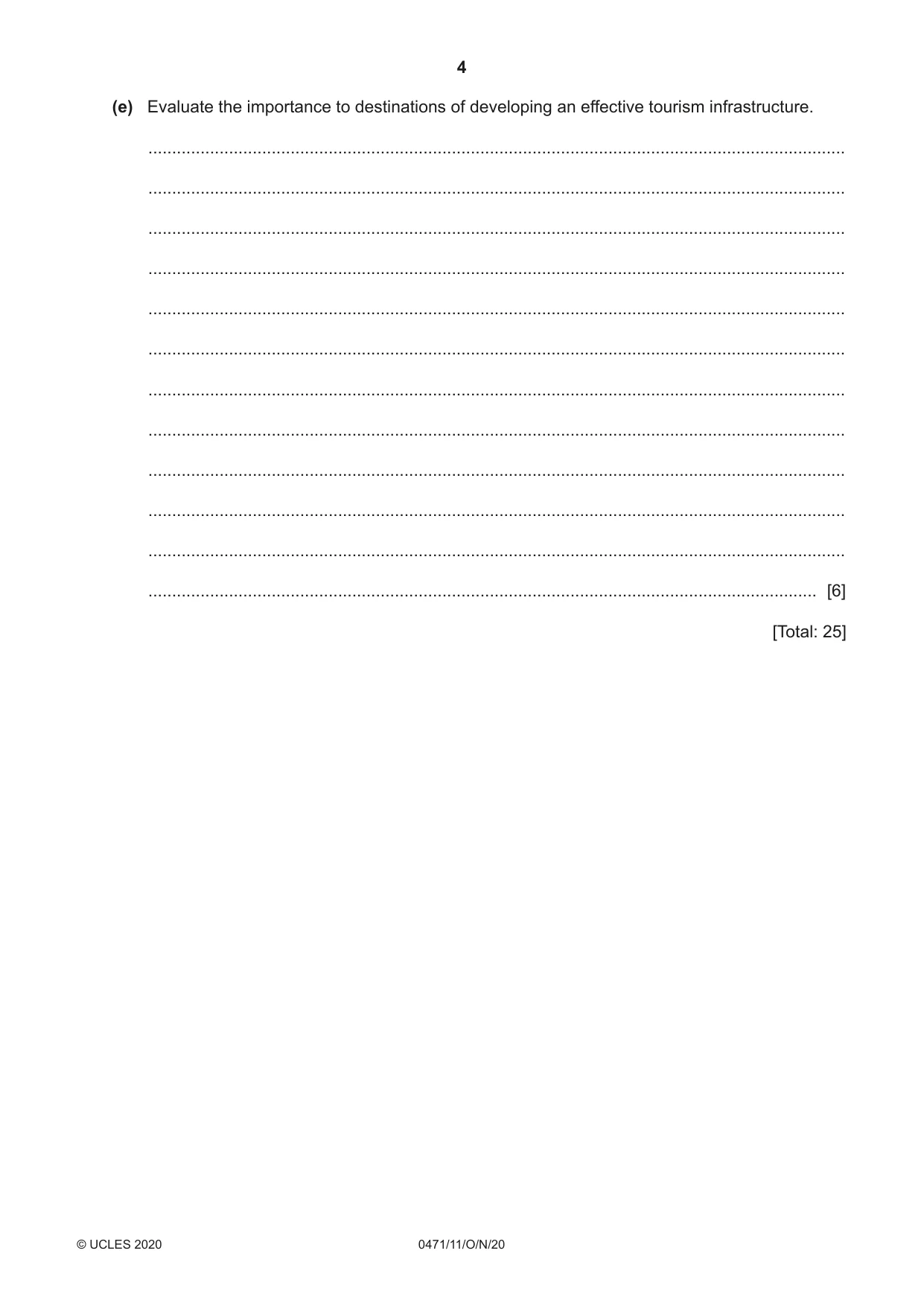
4 0471/11/O/N/20 © UCLES 2020 (e) Evaluate the importance to destinations of developing an effective tourism infrastructure. … … … … … … … … … … … … [6] [Total: 25]
Question paper, page 5
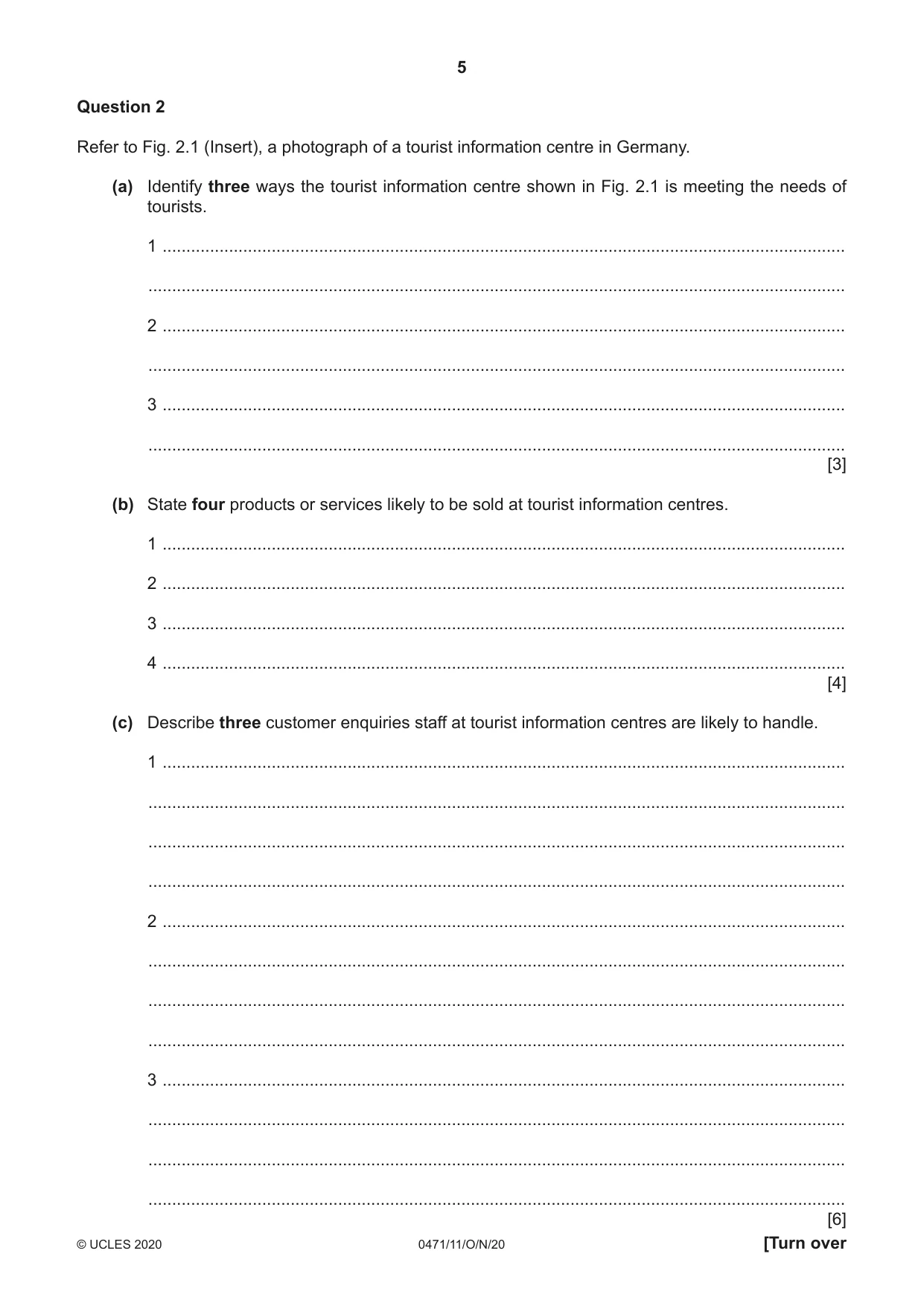
5 0471/11/O/N/20 © UCLES 2020 [Turn over Question 2 Refer to Fig. 2.1 (Insert), a photograph of a tourist information centre in Germany. (a) Identify three ways the tourist information centre shown in Fig. 2.1 is meeting the needs of tourists. 1 … … 2 … … 3 … … [3] (b) State four products or services likely to be sold at tourist information centres. 1 … 2 … 3 … 4 … [4] (c) Describe three customer enquiries staff at tourist information centres are likely to handle. 1 … … … … 2 … … … … 3 … … … … [6]
Question paper, page 6
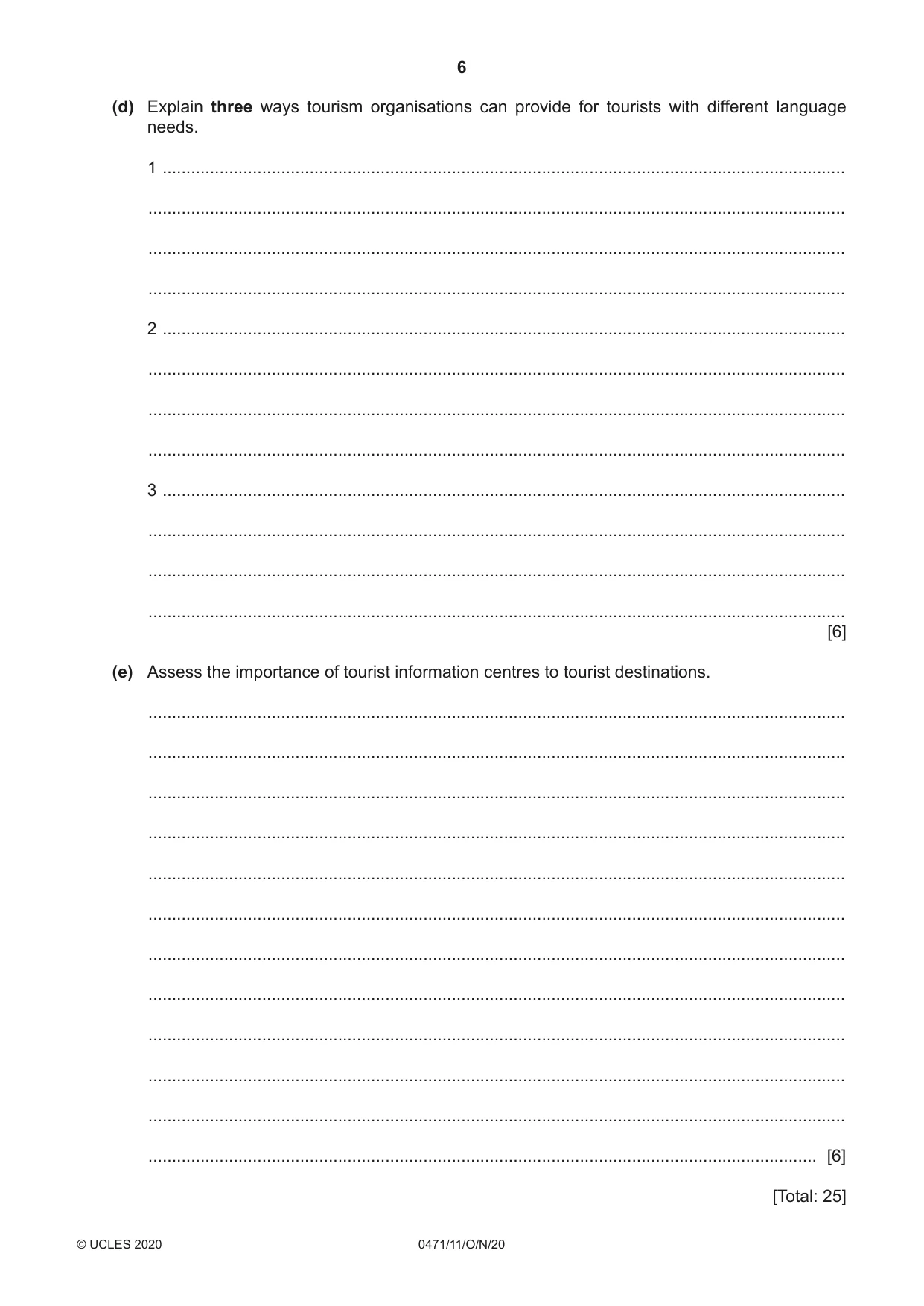
6 0471/11/O/N/20 © UCLES 2020 (d) Explain three ways tourism organisations can provide for tourists with different language needs. 1 … … … … 2 … … … … 3 … … … … [6] (e) Assess the importance of tourist information centres to tourist destinations. … … … … … … … … … … … … [6] [Total: 25]
Question paper, page 7
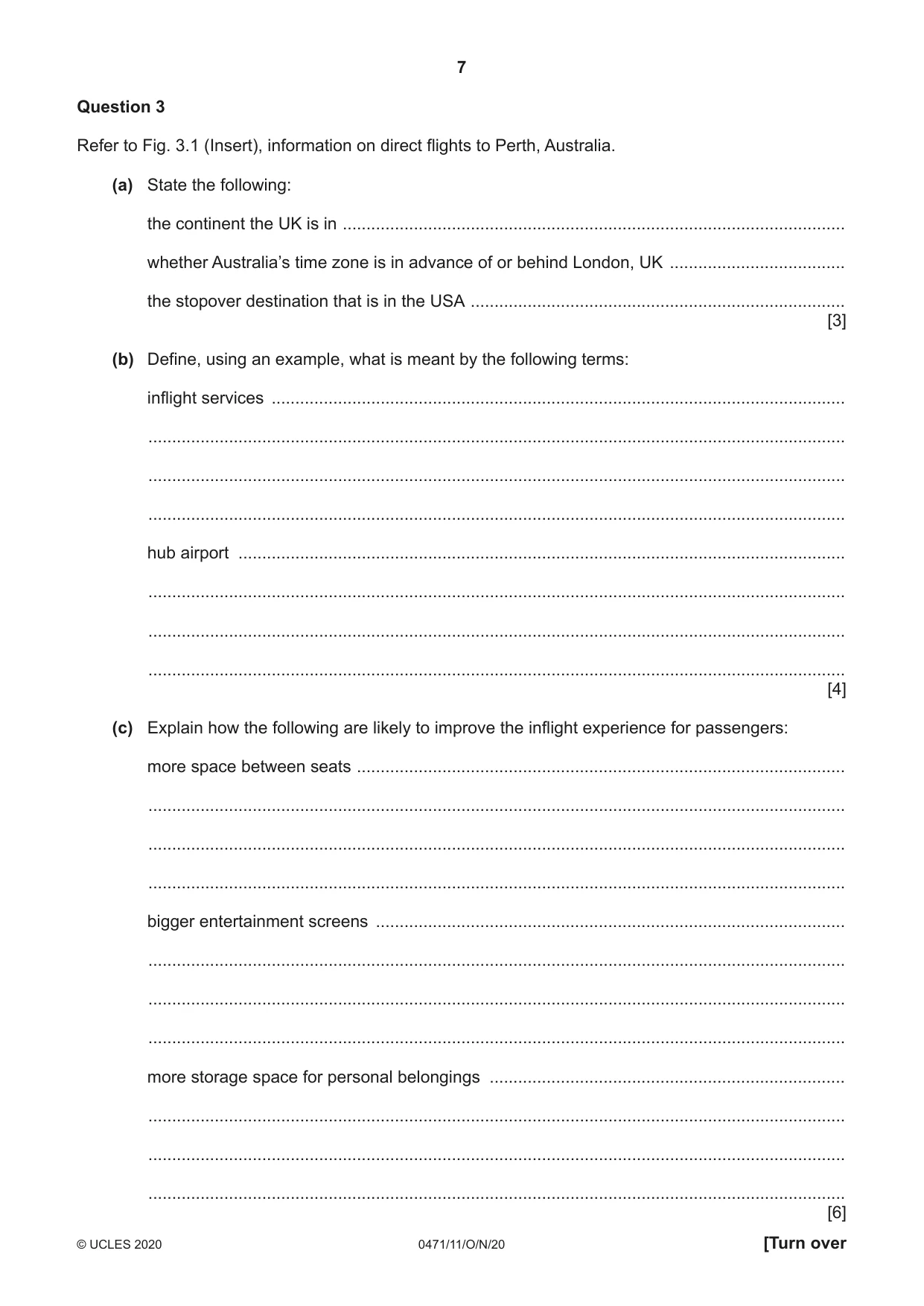
7 0471/11/O/N/20 © UCLES 2020 [Turn over Question 3 Refer to Fig. 3.1 (Insert), information on direct flights to Perth, Australia. (a) State the following: the continent the UK is in … whether Australia’s time zone is in advance of or behind London, UK … the stopover destination that is in the USA … [3] (b) Define, using an example, what is meant by the following terms: inflight services … … … … hub airport … … … … [4] (c) Explain how the following are likely to improve the inflight experience for passengers: more space between seats … … … … bigger entertainment screens … … … … more storage space for personal belongings … … … … [6]
Question paper, page 8
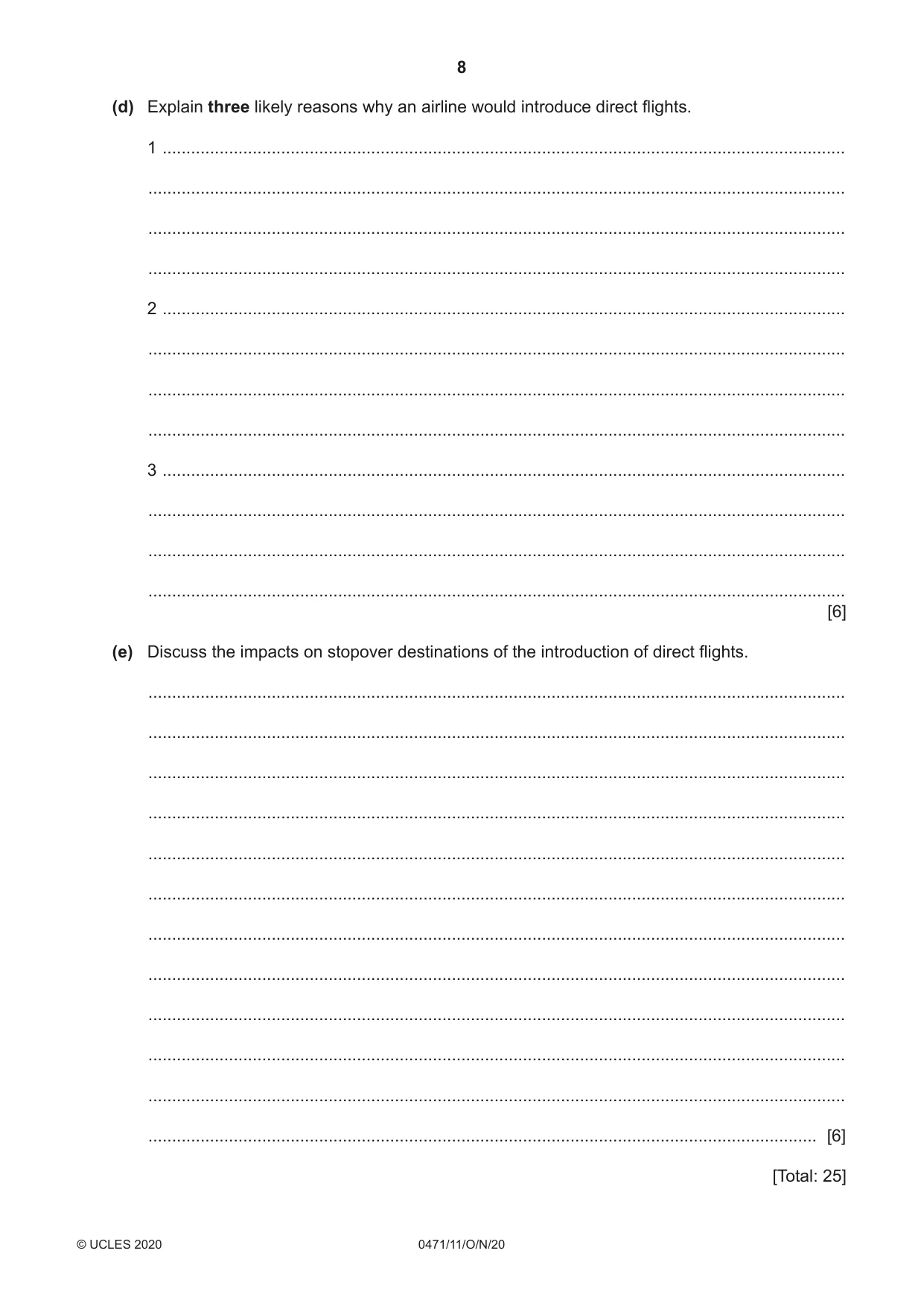
8 0471/11/O/N/20 © UCLES 2020 (d) Explain three likely reasons why an airline would introduce direct flights. 1 … … … … 2 … … … … 3 … … … … [6] (e) Discuss the impacts on stopover destinations of the introduction of direct flights. … … … … … … … … … … … … [6] [Total: 25]
Question paper, page 9
9 0471/11/O/N/20 © UCLES 2020 [Turn over Question 4 Refer to Fig. 4.1 (Insert), a photograph of a carnival parade in Cologne, Germany. (a) State three types of events, other than carnivals, likely to attract tourists. 1 … 2 … 3 … [3] (b) Explain three likely reasons for the appeal to tourists of carnivals. 1 … … … … 2 … … … … 3 … … … … [6]
Question paper, page 10
10 0471/11/O/N/20 © UCLES 2020 (c) Explain three risks to tourists in overcrowded areas. 1 … … … … 2 … … … … 3 … … … … [6] (d) Describe two temporary infrastructure changes likely to be made during a large event, such as a carnival. 1 … … … … 2 … … … … [4]
Question paper, page 11
11 0471/11/O/N/20 © UCLES 2020 (e) Discuss the benefits to tourist destinations of hosting events. … … … … … … … … … … … … [6] [Total: 25]
Question paper, page 12
12 0471/11/O/N/20 © UCLES 2020 Permission to reproduce items where third-party owned material protected by copyright is included has been sought and cleared where possible. Every reasonable effort has been made by the publisher (UCLES) to trace copyright holders, but if any items requiring clearance have unwittingly been included, the publisher will be pleased to make amends at the earliest possible opportunity. To avoid the issue of disclosure of answer-related information to candidates, all copyright acknowledgements are reproduced online in the Cambridge Assessment International Education Copyright Acknowledgements Booklet. This is produced for each series of examinations and is freely available to download at www.cambridgeinternational.org after the live examination series. Cambridge Assessment International Education is part of the Cambridge Assessment Group. Cambridge Assessment is the brand name of the University of Cambridge Local Examinations Syndicate (UCLES), which itself is a department of the University of Cambridge. BLANK PAGE
Mark scheme, page 1
This document consists of 10 printed pages. © UCLES 2020 [Turn over Cambridge IGCSE™ TRAVEL AND TOURISM 0471/11 Paper 1 Core Paper October/November 2020 MARK SCHEME Maximum Mark: 100 Published This mark scheme is published as an aid to teachers and candidates, to indicate the requirements of the examination. It shows the basis on which Examiners were instructed to award marks. It does not indicate the details of the discussions that took place at an Examiners’ meeting before marking began, which would have considered the acceptability of alternative answers. Mark schemes should be read in conjunction with the question paper and the Principal Examiner Report for Teachers. Cambridge International will not enter into discussions about these mark schemes. Cambridge International is publishing the mark schemes for the October/November 2020 series for most Cambridge IGCSE, Cambridge International A and AS Level and Cambridge Pre-U components, and some Cambridge O Level components.
Mark scheme, page 2
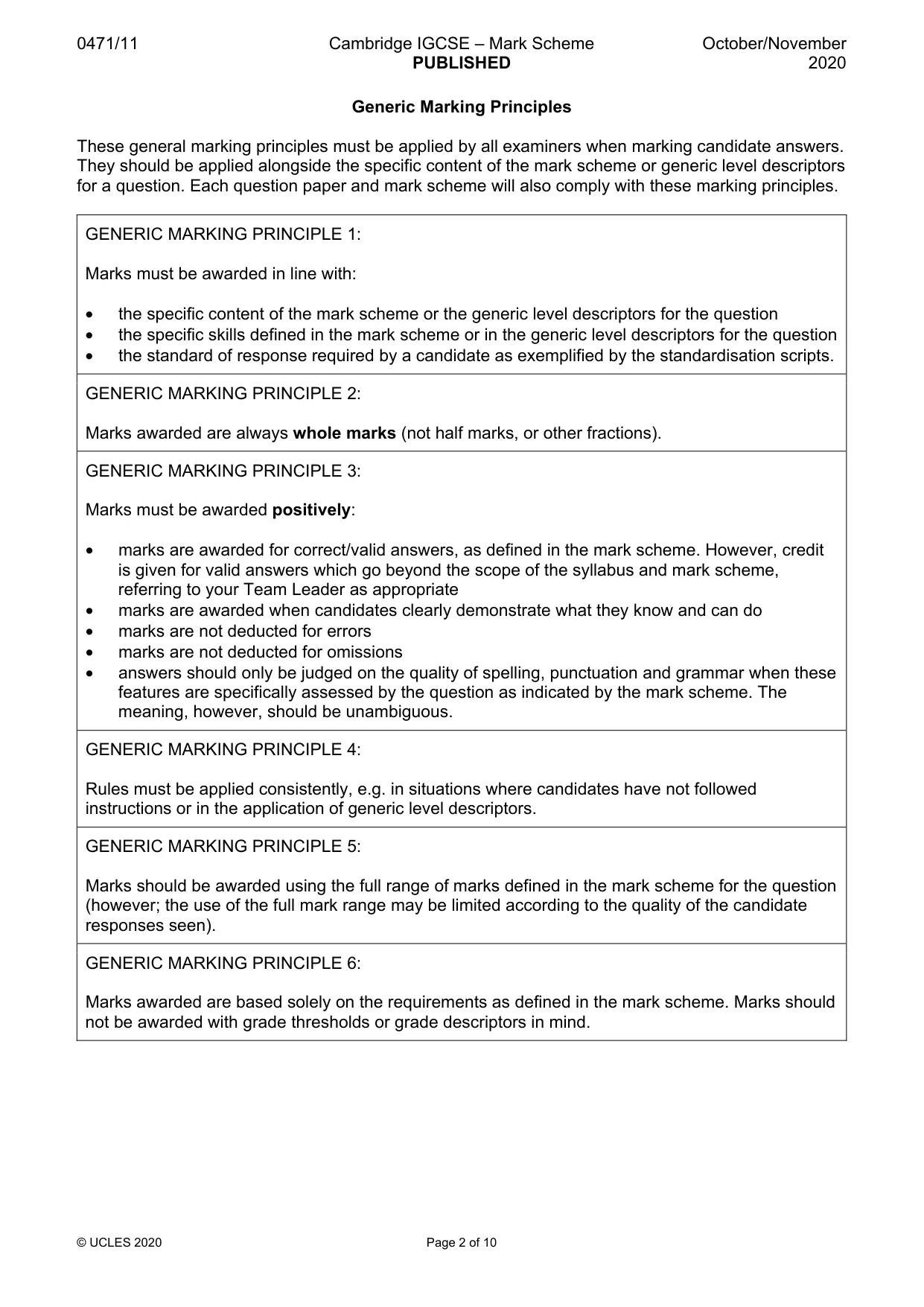
0471/11 Cambridge IGCSE – Mark Scheme PUBLISHED October/November 2020 © UCLES 2020 Page 2 of 10 Generic Marking Principles These general marking principles must be applied by all examiners when marking candidate answers. They should be applied alongside the specific content of the mark scheme or generic level descriptors for a question. Each question paper and mark scheme will also comply with these marking principles. GENERIC MARKING PRINCIPLE 1: Marks must be awarded in line with: • the specific content of the mark scheme or the generic level descriptors for the question • the specific skills defined in the mark scheme or in the generic level descriptors for the question • the standard of response required by a candidate as exemplified by the standardisation scripts. GENERIC MARKING PRINCIPLE 2: Marks awarded are always whole marks (not half marks, or other fractions). GENERIC MARKING PRINCIPLE 3: Marks must be awarded positively: • marks are awarded for correct/valid answers, as defined in the mark scheme. However, credit is given for valid answers which go beyond the scope of the syllabus and mark scheme, referring to your Team Leader as appropriate • marks are awarded when candidates clearly demonstrate what they know and can do • marks are not deducted for errors • marks are not deducted for omissions • answers should only be judged on the quality of spelling, punctuation and grammar when these features are specifically assessed by the question as indicated by the mark scheme. The meaning, however, should be unambiguous. GENERIC MARKING PRINCIPLE 4: Rules must be applied consistently, e.g. in situations where candidates have not followed instructions or in the application of generic level descriptors. GENERIC MARKING PRINCIPLE 5: Marks should be awarded using the full range of marks defined in the mark scheme for the question (however; the use of the full mark range may be limited according to the quality of the candidate responses seen). GENERIC MARKING PRINCIPLE 6: Marks awarded are based solely on the requirements as defined in the mark scheme. Marks should not be awarded with grade thresholds or grade descriptors in mind.
Mark scheme, page 3
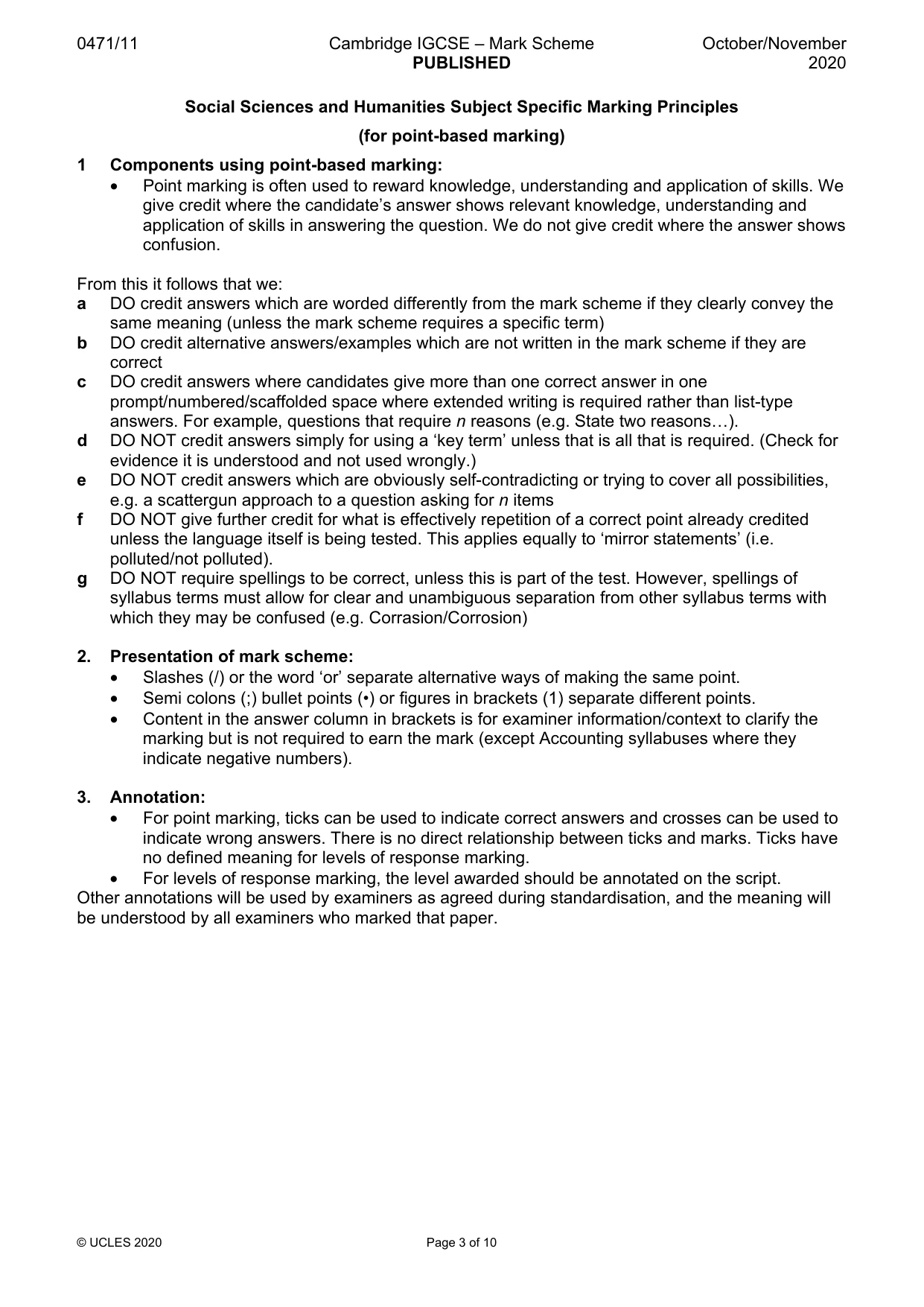
0471/11 Cambridge IGCSE – Mark Scheme PUBLISHED October/November 2020 © UCLES 2020 Page 3 of 10 Social Sciences and Humanities Subject Specific Marking Principles (for point-based marking) 1 Components using point-based marking: • Point marking is often used to reward knowledge, understanding and application of skills. We give credit where the candidate’s answer shows relevant knowledge, understanding and application of skills in answering the question. We do not give credit where the answer shows confusion. From this it follows that we: a DO credit answers which are worded differently from the mark scheme if they clearly convey the same meaning (unless the mark scheme requires a specific term) b DO credit alternative answers/examples which are not written in the mark scheme if they are correct c DO credit answers where candidates give more than one correct answer in one prompt/numbered/scaffolded space where extended writing is required rather than list-type answers. For example, questions that require n reasons (e.g. State two reasons…). d DO NOT credit answers simply for using a ‘key term’ unless that is all that is required. (Check for evidence it is understood and not used wrongly.) e DO NOT credit answers which are obviously self-contradicting or trying to cover all possibilities, e.g. a scattergun approach to a question asking for n items f DO NOT give further credit for what is effectively repetition of a correct point already credited unless the language itself is being tested. This applies equally to ‘mirror statements’ (i.e. polluted/not polluted). g DO NOT require spellings to be correct, unless this is part of the test. However, spellings of syllabus terms must allow for clear and unambiguous separation from other syllabus terms with which they may be confused (e.g. Corrasion/Corrosion) 2. Presentation of mark scheme: • Slashes (/) or the word ‘or’ separate alternative ways of making the same point. • Semi colons (;) bullet points (•) or figures in brackets (1) separate different points. • Content in the answer column in brackets is for examiner information/context to clarify the marking but is not required to earn the mark (except Accounting syllabuses where they indicate negative numbers). 3. Annotation: • For point marking, ticks can be used to indicate correct answers and crosses can be used to indicate wrong answers. There is no direct relationship between ticks and marks. Ticks have no defined meaning for levels of response marking. • For levels of response marking, the level awarded should be annotated on the script. Other annotations will be used by examiners as agreed during standardisation, and the meaning will be understood by all examiners who marked that paper.
Mark scheme, page 4
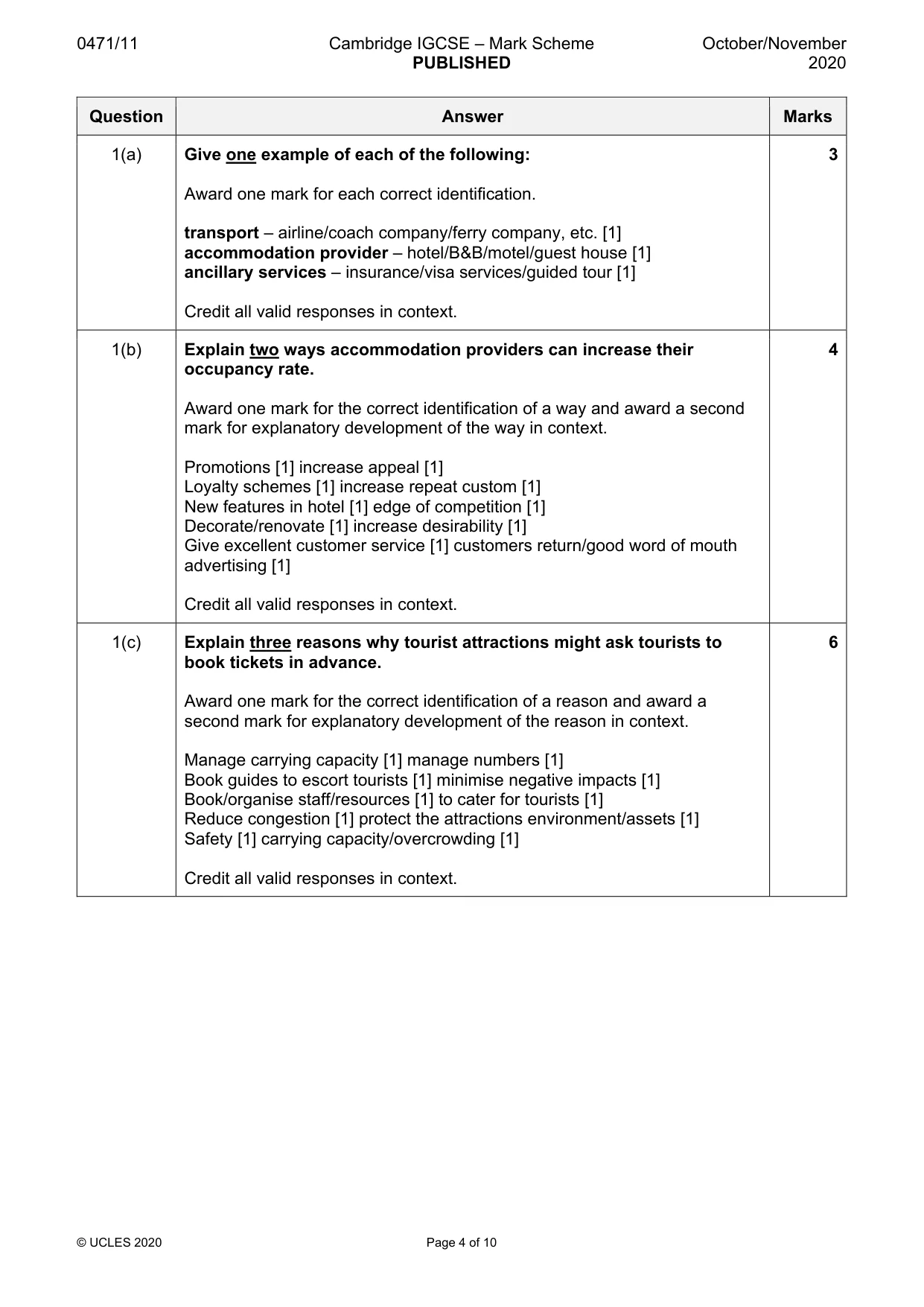
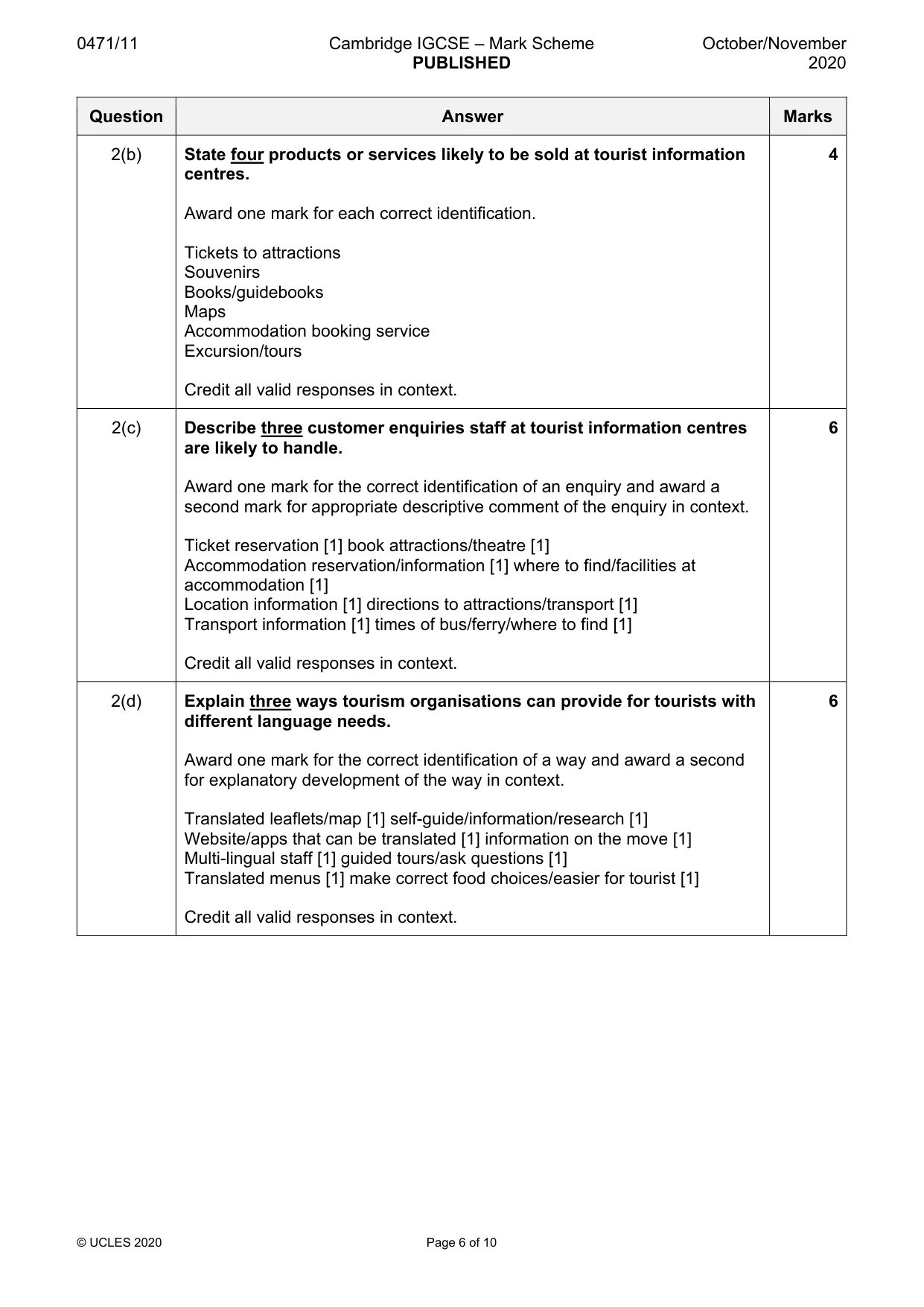
0471/11 Cambridge IGCSE – Mark Scheme PUBLISHED October/November 2020 © UCLES 2020 Page 4 of 10 Question Answer Marks 1(a) Give one example of each of the following: Award one mark for each correct identification. transport – airline/coach company/ferry company, etc. [1] accommodation provider – hotel/B&B/motel/guest house [1] ancillary services – insurance/visa services/guided tour [1] Credit all valid responses in context. 3 1(b) Explain two ways accommodation providers can increase their occupancy rate. Award one mark for the correct identification of a way and award a second mark for explanatory development of the way in context. Promotions [1] increase appeal [1] Loyalty schemes [1] increase repeat custom [1] New features in hotel [1] edge of competition [1] Decorate/renovate [1] increase desirability [1] Give excellent customer service [1] customers return/good word of mouth advertising [1] Credit all valid responses in context. 4 1(c) Explain three reasons why tourist attractions might ask tourists to book tickets in advance. Award one mark for the correct identification of a reason and award a second mark for explanatory development of the reason in context. Manage carrying capacity [1] manage numbers [1] Book guides to escort tourists [1] minimise negative impacts [1] Book/organise staff/resources [1] to cater for tourists [1] Reduce congestion [1] protect the attractions environment/assets [1] Safety [1] carrying capacity/overcrowding [1] Credit all valid responses in context. 6
Mark scheme, page 5
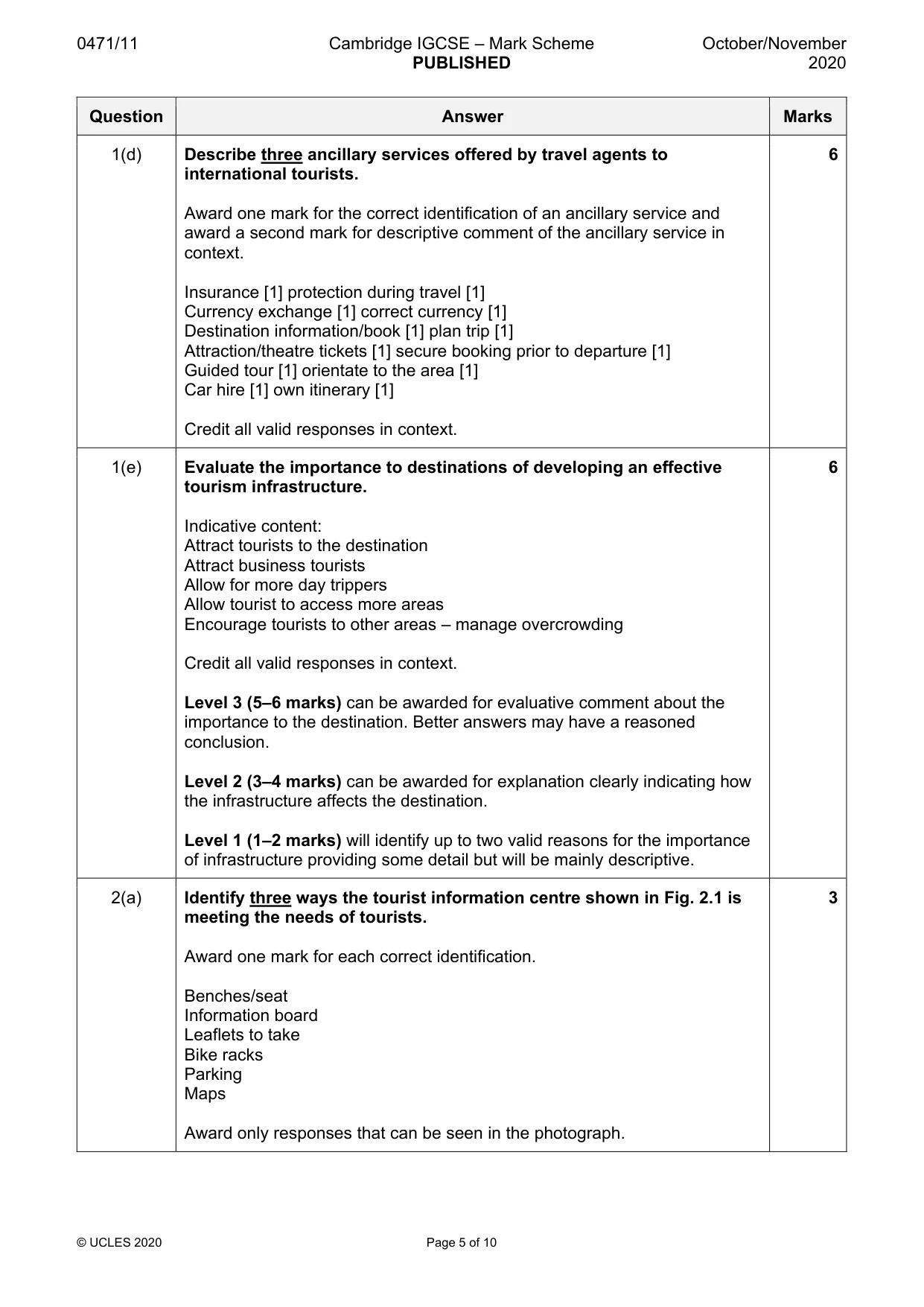
0471/11 Cambridge IGCSE – Mark Scheme PUBLISHED October/November 2020 © UCLES 2020 Page 5 of 10 Question Answer Marks 1(d) Describe three ancillary services offered by travel agents to international tourists. Award one mark for the correct identification of an ancillary service and award a second mark for descriptive comment of the ancillary service in context. Insurance [1] protection during travel [1] Currency exchange [1] correct currency [1] Destination information/book [1] plan trip [1] Attraction/theatre tickets [1] secure booking prior to departure [1] Guided tour [1] orientate to the area [1] Car hire [1] own itinerary [1] Credit all valid responses in context. 6 1(e) Evaluate the importance to destinations of developing an effective tourism infrastructure. Indicative content: Attract tourists to the destination Attract business tourists Allow for more day trippers Allow tourist to access more areas Encourage tourists to other areas – manage overcrowding Credit all valid responses in context. Level 3 (5–6 marks) can be awarded for evaluative comment about the importance to the destination. Better answers may have a reasoned conclusion. Level 2 (3–4 marks) can be awarded for explanation clearly indicating how the infrastructure affects the destination. Level 1 (1–2 marks) will identify up to two valid reasons for the importance of infrastructure providing some detail but will be mainly descriptive. 6 2(a) Identify three ways the tourist information centre shown in Fig. 2.1 is meeting the needs of tourists. Award one mark for each correct identification. Benches/seat Information board Leaflets to take Bike racks Parking Maps Award only responses that can be seen in the photograph. 3
Mark scheme, page 6
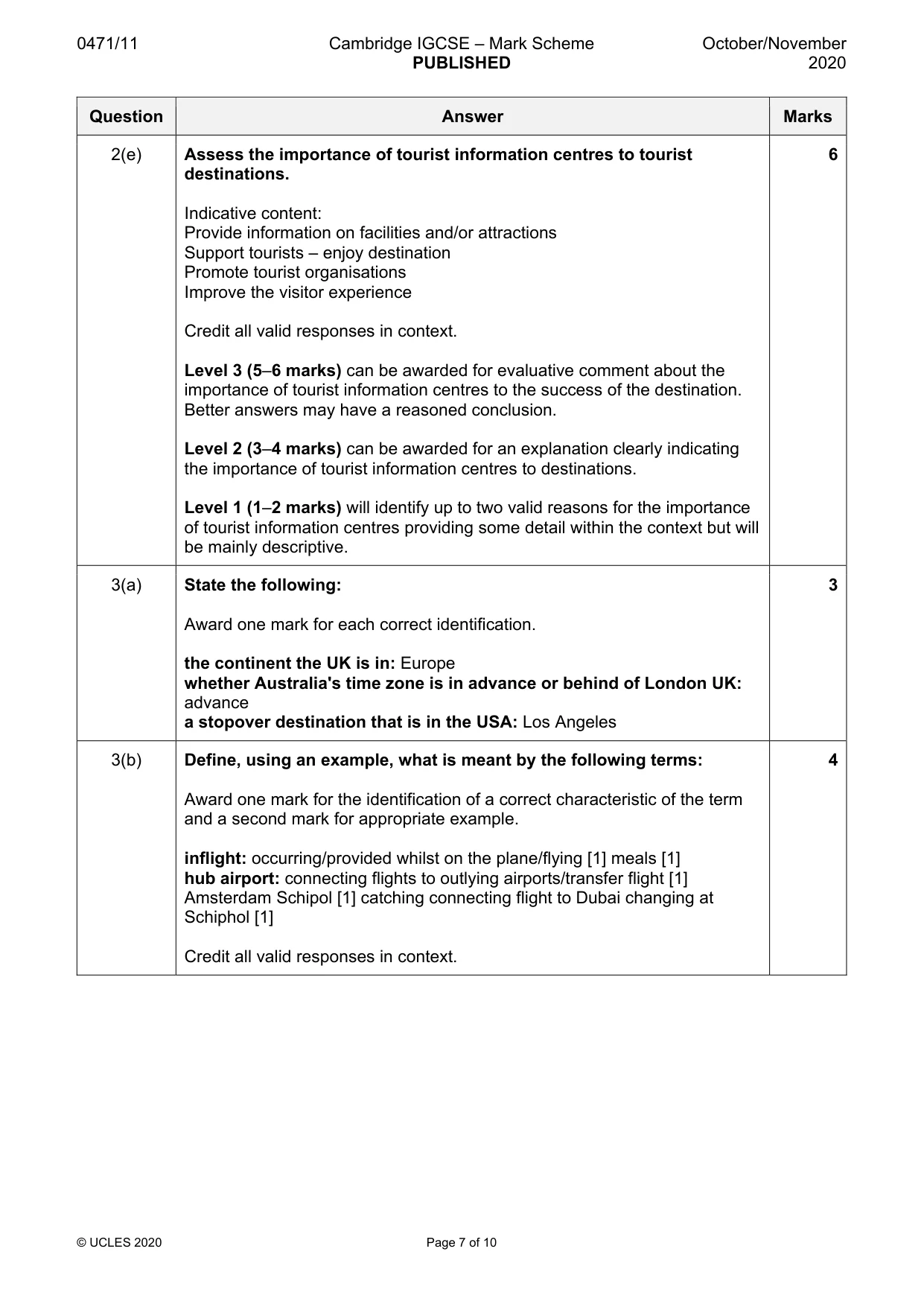
0471/11 Cambridge IGCSE – Mark Scheme PUBLISHED October/November 2020 © UCLES 2020 Page 6 of 10 Question Answer Marks 2(b) State four products or services likely to be sold at tourist information centres. Award one mark for each correct identification. Tickets to attractions Souvenirs Books/guidebooks Maps Accommodation booking service Excursion/tours Credit all valid responses in context. 4 2(c) Describe three customer enquiries staff at tourist information centres are likely to handle. Award one mark for the correct identification of an enquiry and award a second mark for appropriate descriptive comment of the enquiry in context. Ticket reservation [1] book attractions/theatre [1] Accommodation reservation/information [1] where to find/facilities at accommodation [1] Location information [1] directions to attractions/transport [1] Transport information [1] times of bus/ferry/where to find [1] Credit all valid responses in context. 6 2(d) Explain three ways tourism organisations can provide for tourists with different language needs. Award one mark for the correct identification of a way and award a second for explanatory development of the way in context. Translated leaflets/map [1] self-guide/information/research [1] Website/apps that can be translated [1] information on the move [1] Multi-lingual staff [1] guided tours/ask questions [1] Translated menus [1] make correct food choices/easier for tourist [1] Credit all valid responses in context. 6
Mark scheme, page 7
0471/11 Cambridge IGCSE – Mark Scheme PUBLISHED October/November 2020 © UCLES 2020 Page 7 of 10 Question Answer Marks 2(e) Assess the importance of tourist information centres to tourist destinations. Indicative content: Provide information on facilities and/or attractions Support tourists – enjoy destination Promote tourist organisations Improve the visitor experience Credit all valid responses in context. Level 3 (5–6 marks) can be awarded for evaluative comment about the importance of tourist information centres to the success of the destination. Better answers may have a reasoned conclusion. Level 2 (3–4 marks) can be awarded for an explanation clearly indicating the importance of tourist information centres to destinations. Level 1 (1–2 marks) will identify up to two valid reasons for the importance of tourist information centres providing some detail within the context but will be mainly descriptive. 6 3(a) State the following: Award one mark for each correct identification. the continent the UK is in: Europe whether Australia's time zone is in advance or behind of London UK: advance a stopover destination that is in the USA: Los Angeles 3 3(b) Define, using an example, what is meant by the following terms: Award one mark for the identification of a correct characteristic of the term and a second mark for appropriate example. inflight: occurring/provided whilst on the plane/flying [1] meals [1] hub airport: connecting flights to outlying airports/transfer flight [1] Amsterdam Schipol [1] catching connecting flight to Dubai changing at Schiphol [1] Credit all valid responses in context. 4
Mark scheme, page 8
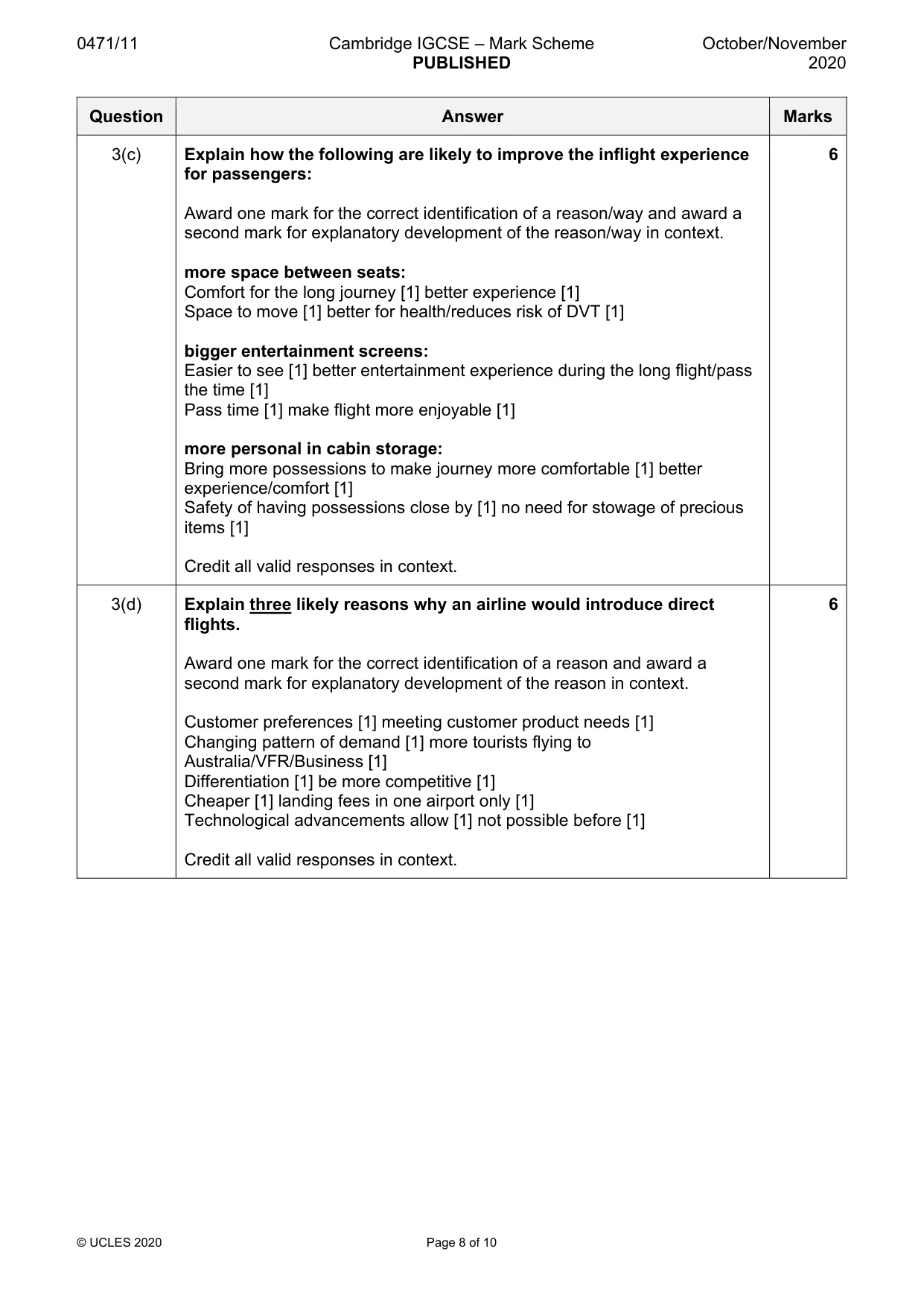
0471/11 Cambridge IGCSE – Mark Scheme PUBLISHED October/November 2020 © UCLES 2020 Page 8 of 10 Question Answer Marks 3(c) Explain how the following are likely to improve the inflight experience for passengers: Award one mark for the correct identification of a reason/way and award a second mark for explanatory development of the reason/way in context. more space between seats: Comfort for the long journey [1] better experience [1] Space to move [1] better for health/reduces risk of DVT [1] bigger entertainment screens: Easier to see [1] better entertainment experience during the long flight/pass the time [1] Pass time [1] make flight more enjoyable [1] more personal in cabin storage: Bring more possessions to make journey more comfortable [1] better experience/comfort [1] Safety of having possessions close by [1] no need for stowage of precious items [1] Credit all valid responses in context. 6 3(d) Explain three likely reasons why an airline would introduce direct flights. Award one mark for the correct identification of a reason and award a second mark for explanatory development of the reason in context. Customer preferences [1] meeting customer product needs [1] Changing pattern of demand [1] more tourists flying to Australia/VFR/Business [1] Differentiation [1] be more competitive [1] Cheaper [1] landing fees in one airport only [1] Technological advancements allow [1] not possible before [1] Credit all valid responses in context. 6
Mark scheme, page 9
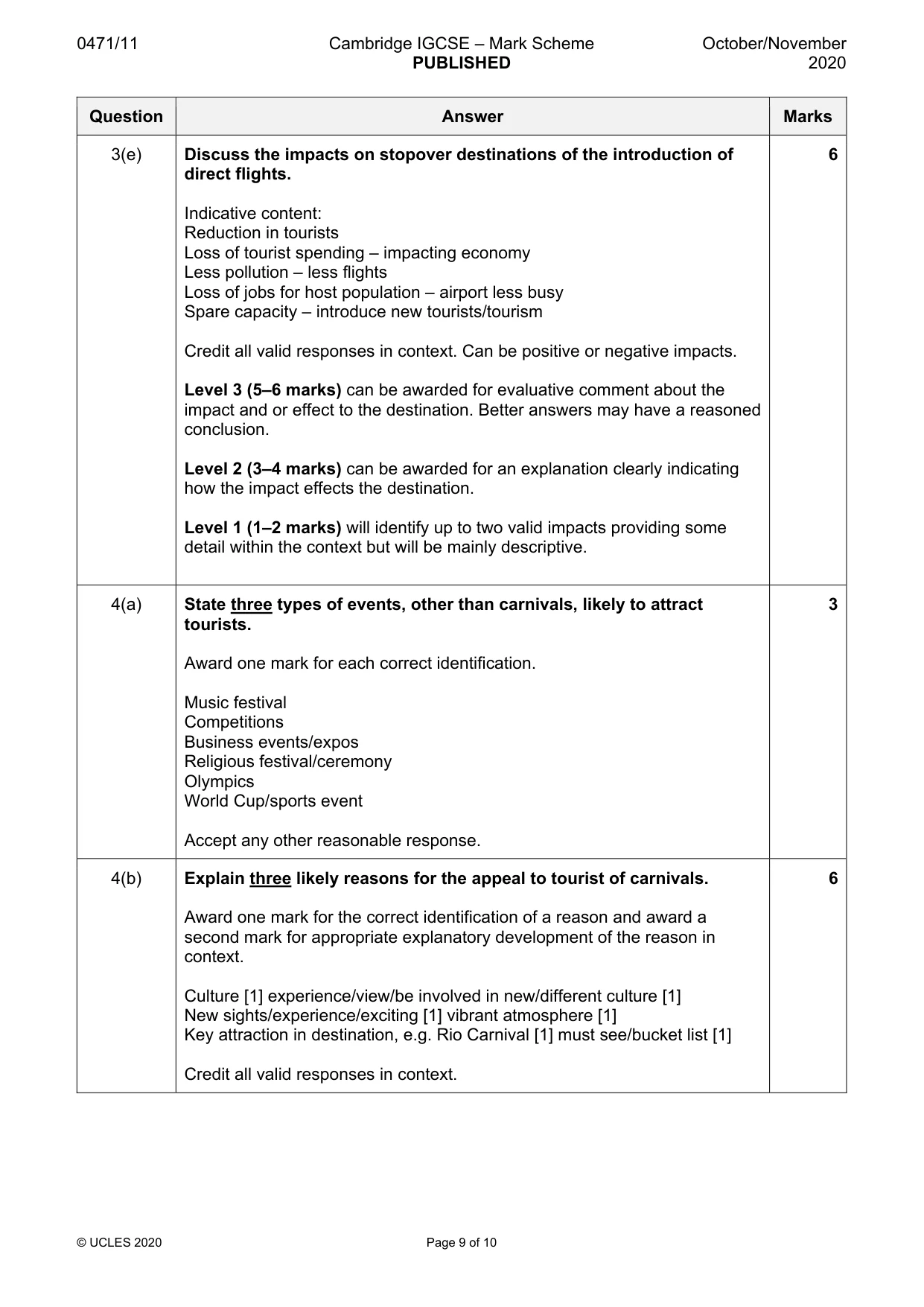
0471/11 Cambridge IGCSE – Mark Scheme PUBLISHED October/November 2020 © UCLES 2020 Page 9 of 10 Question Answer Marks 3(e) Discuss the impacts on stopover destinations of the introduction of direct flights. Indicative content: Reduction in tourists Loss of tourist spending – impacting economy Less pollution – less flights Loss of jobs for host population – airport less busy Spare capacity – introduce new tourists/tourism Credit all valid responses in context. Can be positive or negative impacts. Level 3 (5–6 marks) can be awarded for evaluative comment about the impact and or effect to the destination. Better answers may have a reasoned conclusion. Level 2 (3–4 marks) can be awarded for an explanation clearly indicating how the impact effects the destination. Level 1 (1–2 marks) will identify up to two valid impacts providing some detail within the context but will be mainly descriptive. 6 4(a) State three types of events, other than carnivals, likely to attract tourists. Award one mark for each correct identification. Music festival Competitions Business events/expos Religious festival/ceremony Olympics World Cup/sports event Accept any other reasonable response. 3 4(b) Explain three likely reasons for the appeal to tourist of carnivals. Award one mark for the correct identification of a reason and award a second mark for appropriate explanatory development of the reason in context. Culture [1] experience/view/be involved in new/different culture [1] New sights/experience/exciting [1] vibrant atmosphere [1] Key attraction in destination, e.g. Rio Carnival [1] must see/bucket list [1] Credit all valid responses in context. 6
Mark scheme, page 10
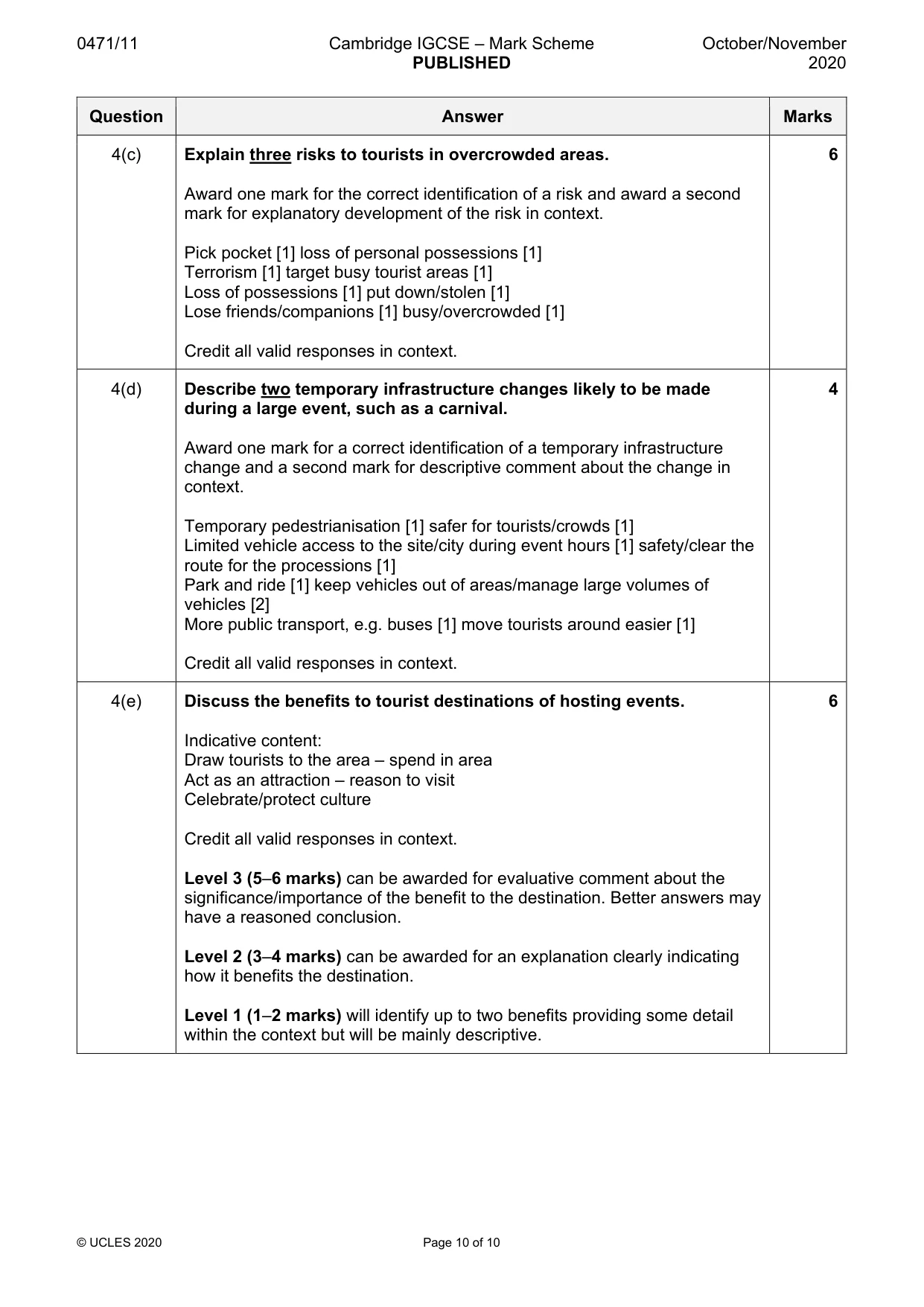
0471/11 Cambridge IGCSE – Mark Scheme PUBLISHED October/November 2020 © UCLES 2020 Page 10 of 10 Question Answer Marks 4(c) Explain three risks to tourists in overcrowded areas. Award one mark for the correct identification of a risk and award a second mark for explanatory development of the risk in context. Pick pocket [1] loss of personal possessions [1] Terrorism [1] target busy tourist areas [1] Loss of possessions [1] put down/stolen [1] Lose friends/companions [1] busy/overcrowded [1] Credit all valid responses in context. 6 4(d) Describe two temporary infrastructure changes likely to be made during a large event, such as a carnival. Award one mark for a correct identification of a temporary infrastructure change and a second mark for descriptive comment about the change in context. Temporary pedestrianisation [1] safer for tourists/crowds [1] Limited vehicle access to the site/city during event hours [1] safety/clear the route for the processions [1] Park and ride [1] keep vehicles out of areas/manage large volumes of vehicles [2] More public transport, e.g. buses [1] move tourists around easier [1] Credit all valid responses in context. 4 4(e) Discuss the benefits to tourist destinations of hosting events. Indicative content: Draw tourists to the area – spend in area Act as an attraction – reason to visit Celebrate/protect culture Credit all valid responses in context. Level 3 (5–6 marks) can be awarded for evaluative comment about the significance/importance of the benefit to the destination. Better answers may have a reasoned conclusion. Level 2 (3–4 marks) can be awarded for an explanation clearly indicating how it benefits the destination. Level 1 (1–2 marks) will identify up to two benefits providing some detail within the context but will be mainly descriptive. 6
What you needed in this session
Cambridge’s own grade thresholds for 2020 Oct/Nov, Paper 1 · Variant 1. A higher threshold means an easier paper — the bar moves with how the cohort did.