Cambridge IGCSE Travel and Tourism 0471 — 2023 Oct/Nov Paper 1 · Variant 2
0471/12/O/N/23 · 100 marks · ≈113 min
The question paper and its mark scheme, free to read here and free to download. This is Cambridge’s own paper, exactly as it was sat.
Question paper12 pages

Mark scheme14 pages
Answers below. Sit the paper first if you are practising.

Paper as text
Question paper, page 1
This document has 12 pages. Any blank pages are indicated. [Turn over Cambridge IGCSE™ TRAVEL & TOURISM 0471/12 Paper 1 Core Paper October/November 2023 2 hours You must answer on the question paper. You will need: Insert (enclosed) INSTRUCTIONS ● Answer all questions. ● Use a black or dark blue pen. ● Write your name, centre number and candidate number in the boxes at the top of the page. ● Write your answer to each question in the space provided. ● Do not use an erasable pen or correction fluid. ● Do not write on any bar codes. INFORMATION ● The total mark for this paper is 100. ● The number of marks for each question or part question is shown in brackets [ ]. ● The insert contains all the figures referred to in the questions. * 7 3 6 0 3 5 9 2 0 2 * DC (PQ/CB) 312138 © UCLES 2023
Question paper, page 2
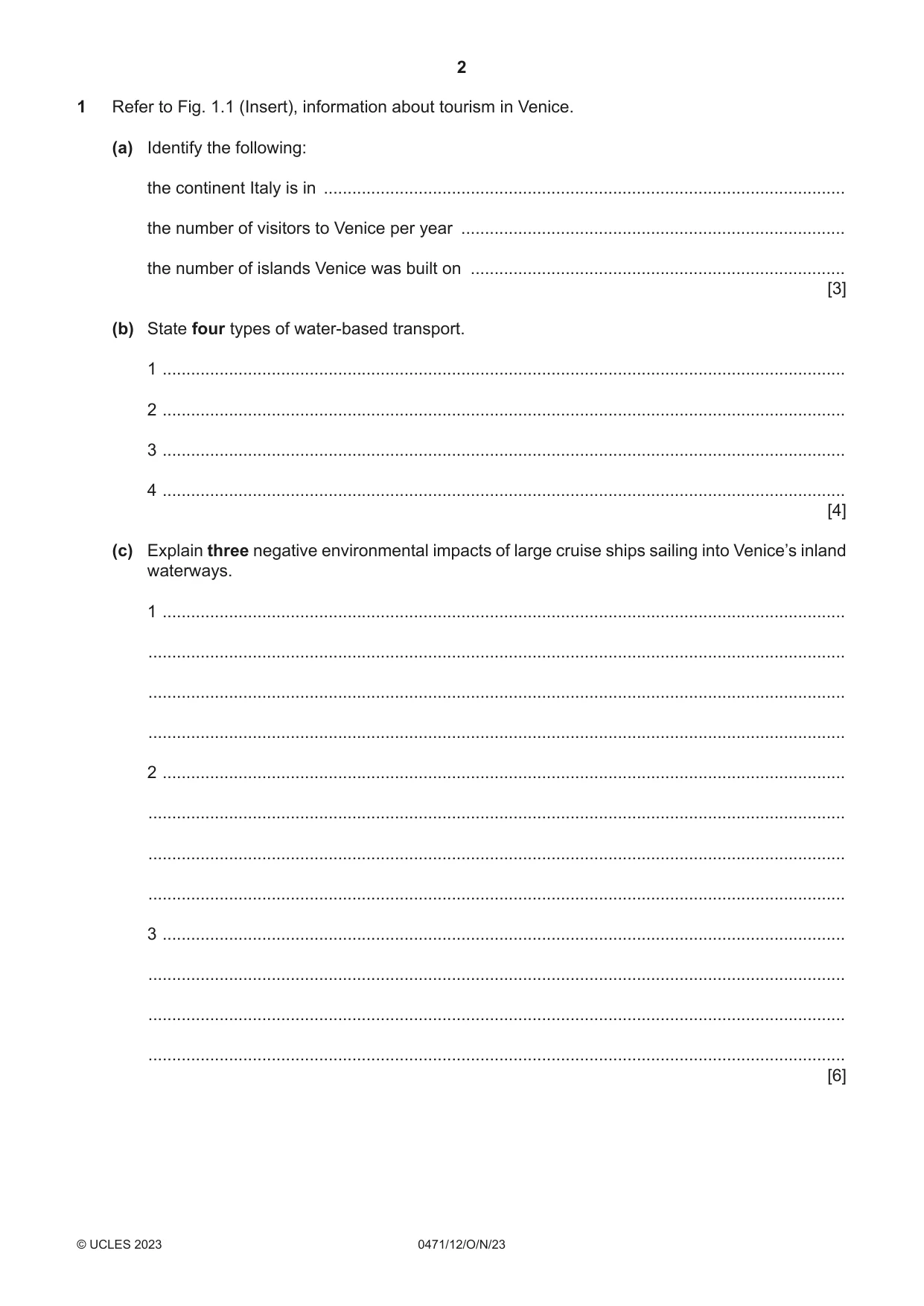
2 0471/12/O/N/23 © UCLES 2023 1 Refer to Fig. 1.1 (Insert), information about tourism in Venice. (a) Identify the following: the continent Italy is in … the number of visitors to Venice per year … the number of islands Venice was built on … [3] (b) State four types of water-based transport. 1 … 2 … 3 … 4 … [4] (c) Explain three negative environmental impacts of large cruise ships sailing into Venice’s inland waterways. 1 … … … … 2 … … … … 3 … … … … [6]
Question paper, page 3
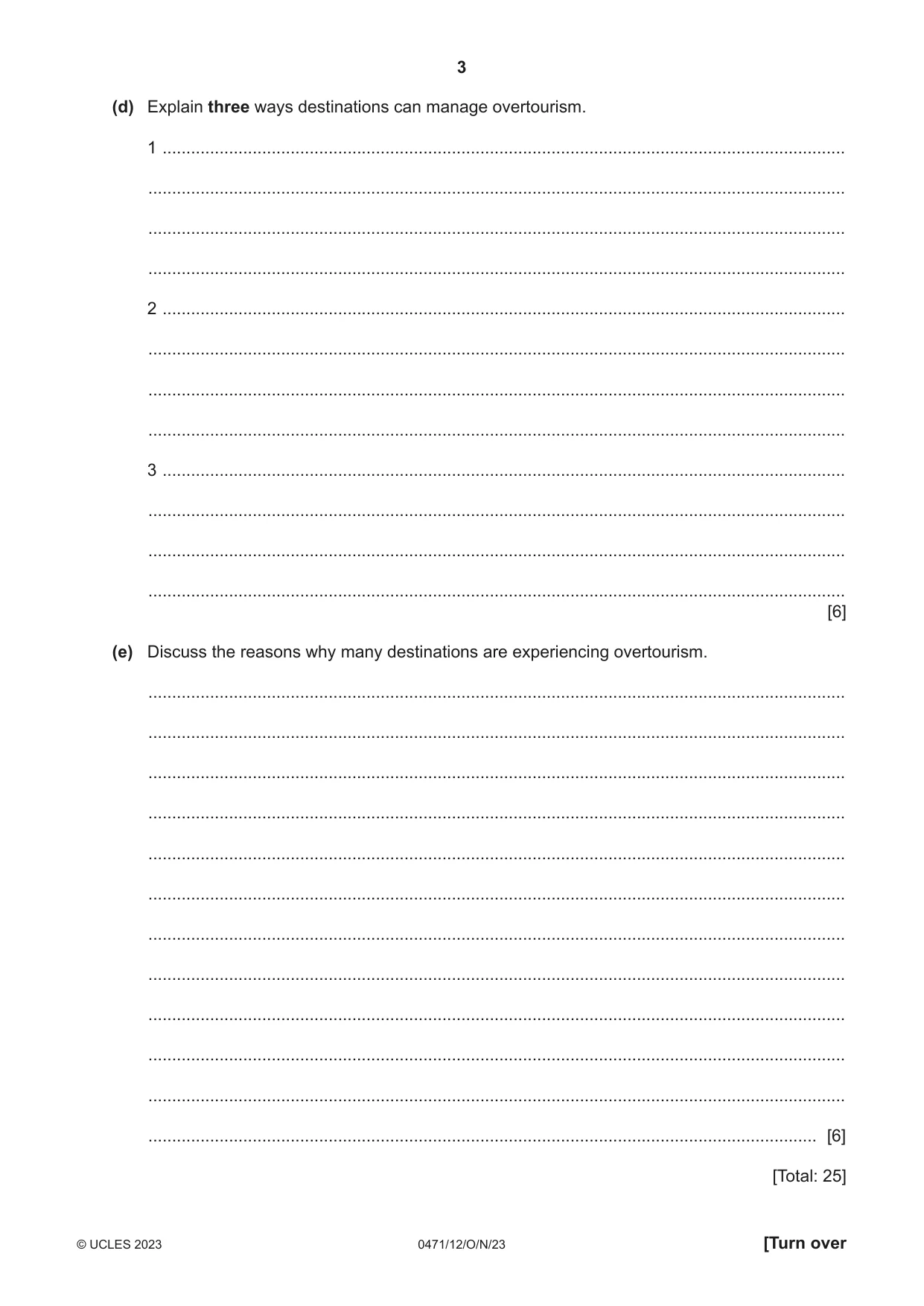
3 0471/12/O/N/23 © UCLES 2023 [Turn over (d) Explain three ways destinations can manage overtourism. 1 … … … … 2 … … … … 3 … … … … [6] (e) Discuss the reasons why many destinations are experiencing overtourism. … … … … … … … … … … … … [6] [Total: 25]
Question paper, page 4
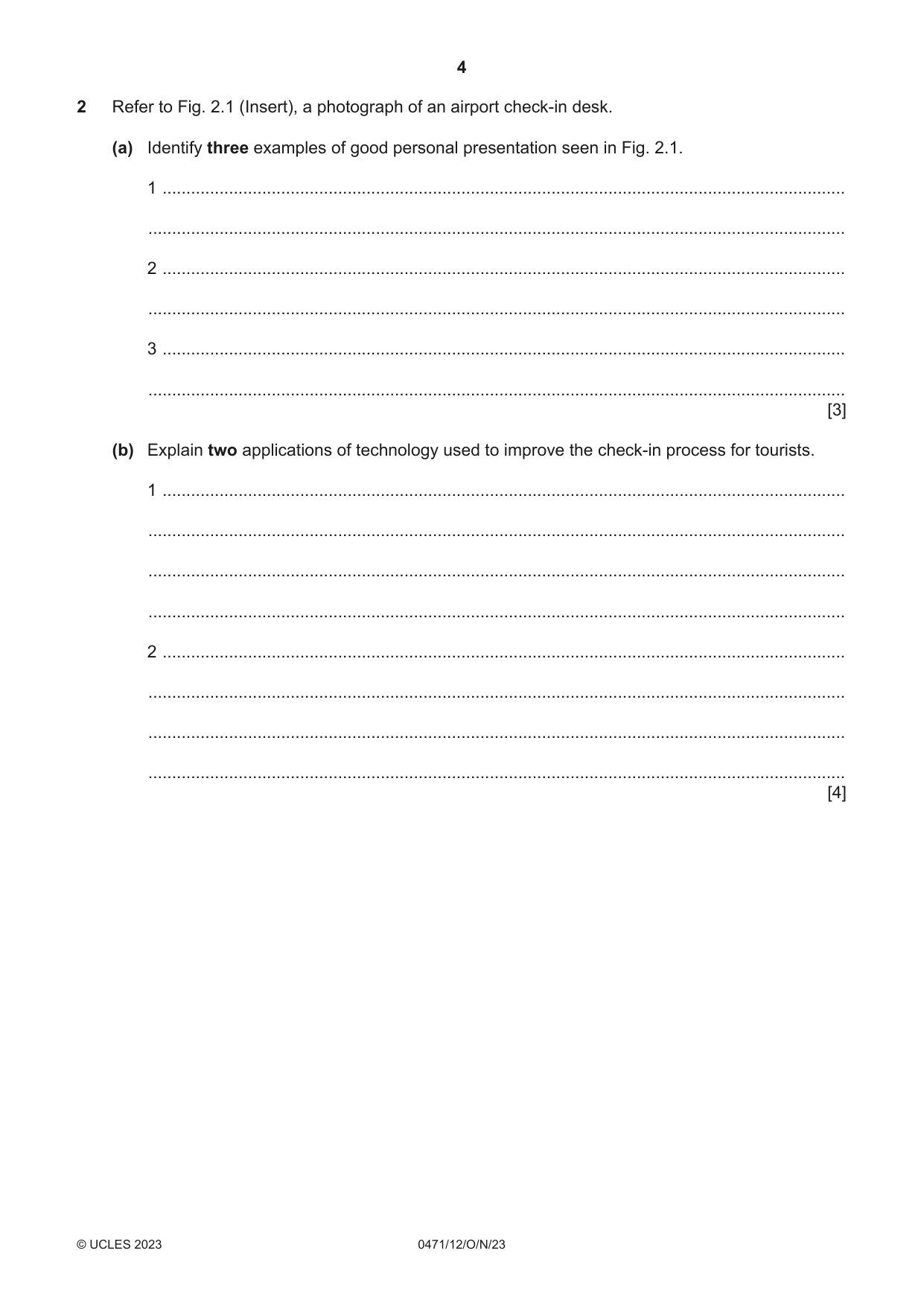
4 0471/12/O/N/23 © UCLES 2023 2 Refer to Fig. 2.1 (Insert), a photograph of an airport check-in desk. (a) Identify three examples of good personal presentation seen in Fig. 2.1. 1 … … 2 … … 3 … … [3] (b) Explain two applications of technology used to improve the check-in process for tourists. 1 … … … … 2 … … … … [4]
Question paper, page 5
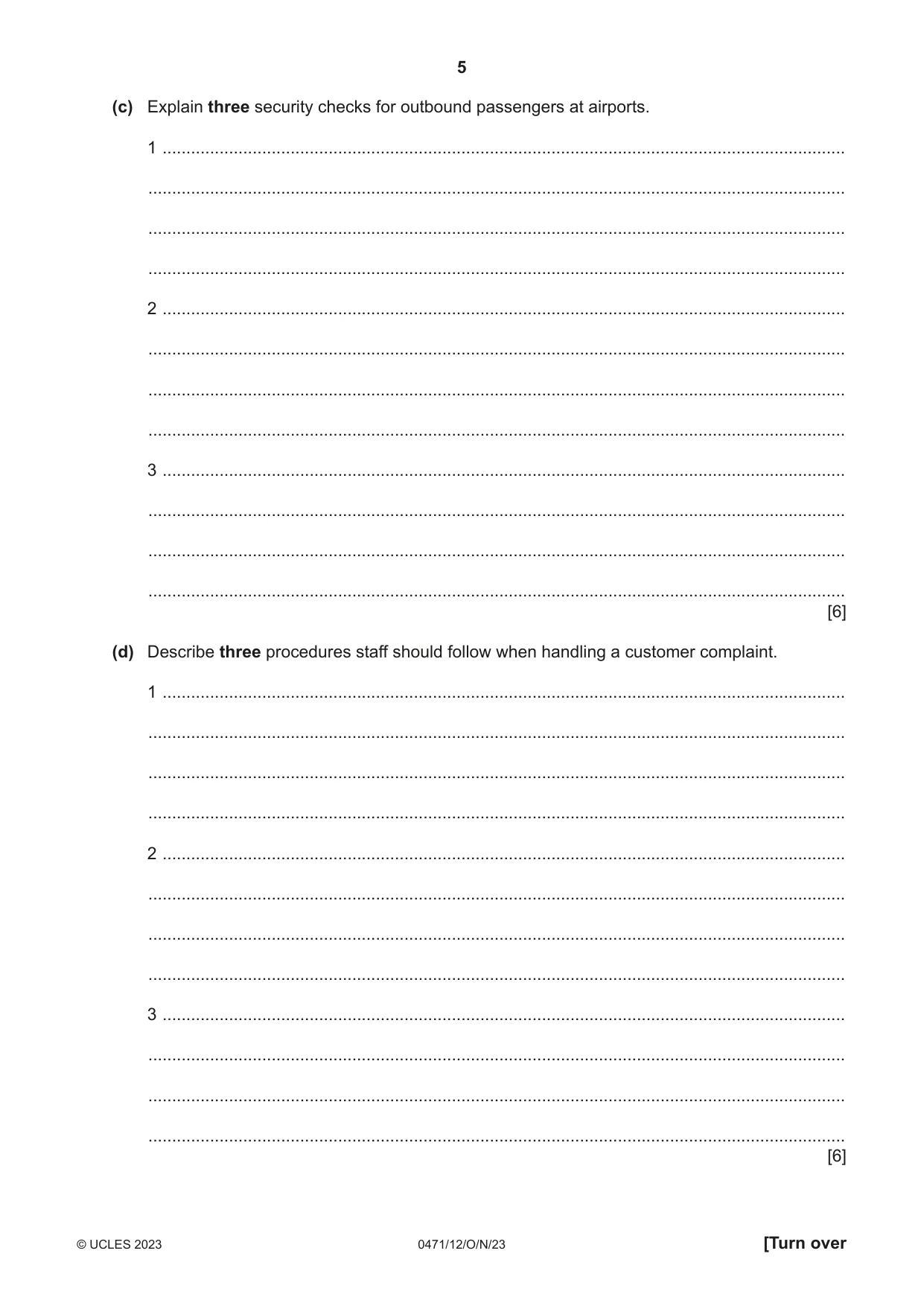
5 0471/12/O/N/23 © UCLES 2023 [Turn over (c) Explain three security checks for outbound passengers at airports. 1 … … … … 2 … … … … 3 … … … … [6] (d) Describe three procedures staff should follow when handling a customer complaint. 1 … … … … 2 … … … … 3 … … … … [6]
Question paper, page 6
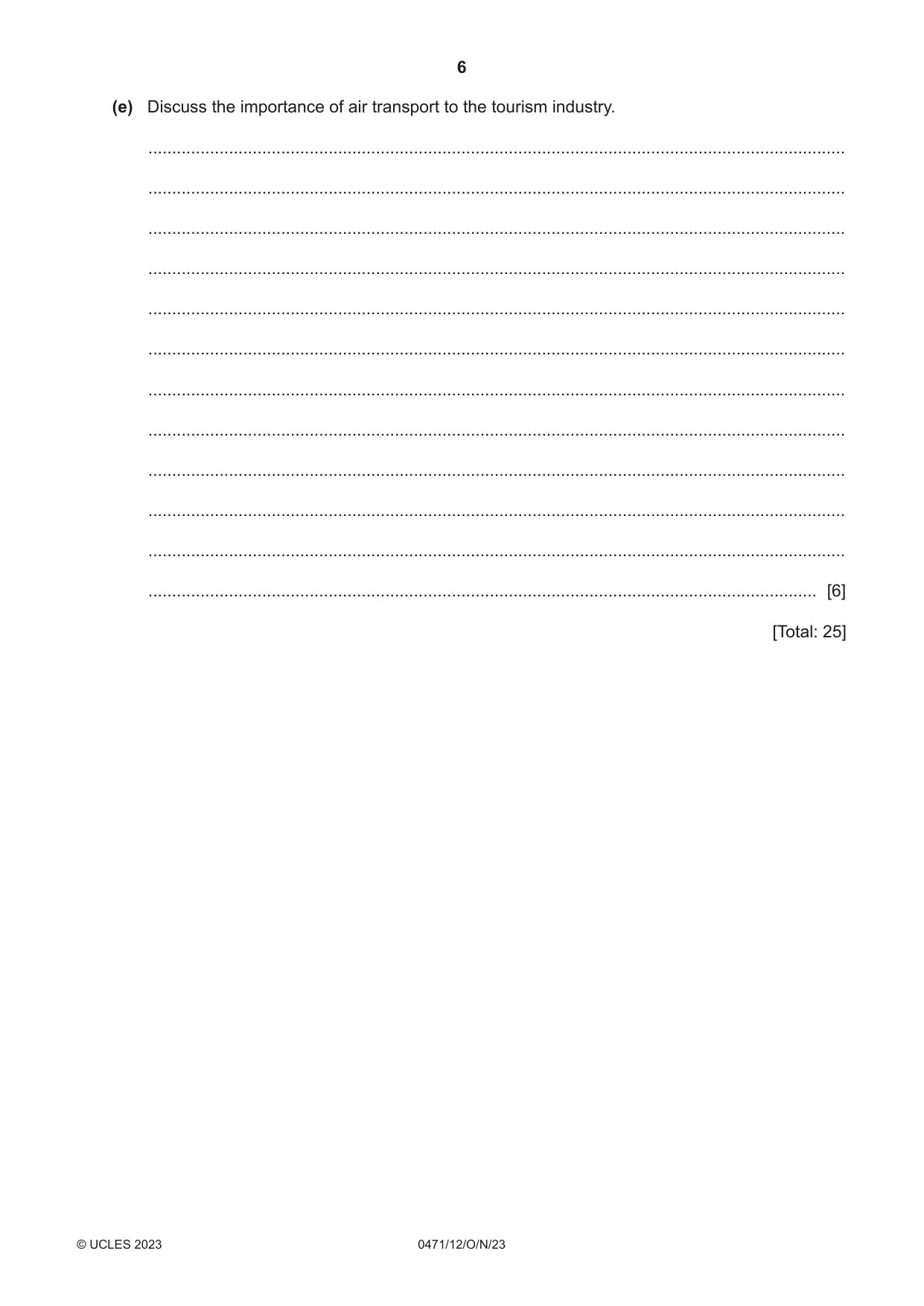
6 0471/12/O/N/23 © UCLES 2023 (e) Discuss the importance of air transport to the tourism industry. … … … … … … … … … … … … [6] [Total: 25]
Question paper, page 7
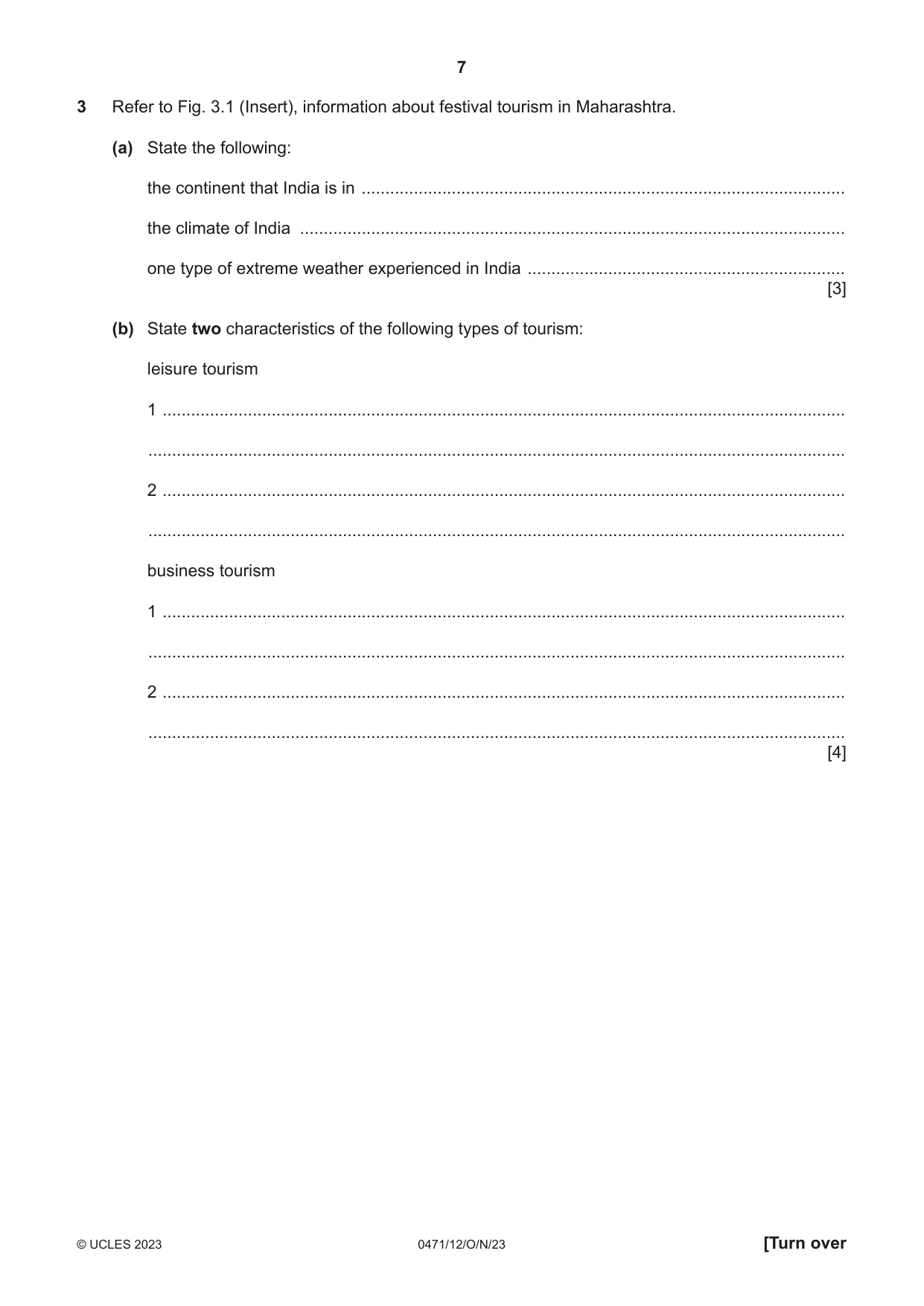
7 0471/12/O/N/23 © UCLES 2023 [Turn over 3 Refer to Fig. 3.1 (Insert), information about festival tourism in Maharashtra. (a) State the following: the continent that India is in … the climate of India … one type of extreme weather experienced in India … [3] (b) State two characteristics of the following types of tourism: leisure tourism 1 … … 2 … … business tourism 1 … … 2 … … [4]
Question paper, page 8
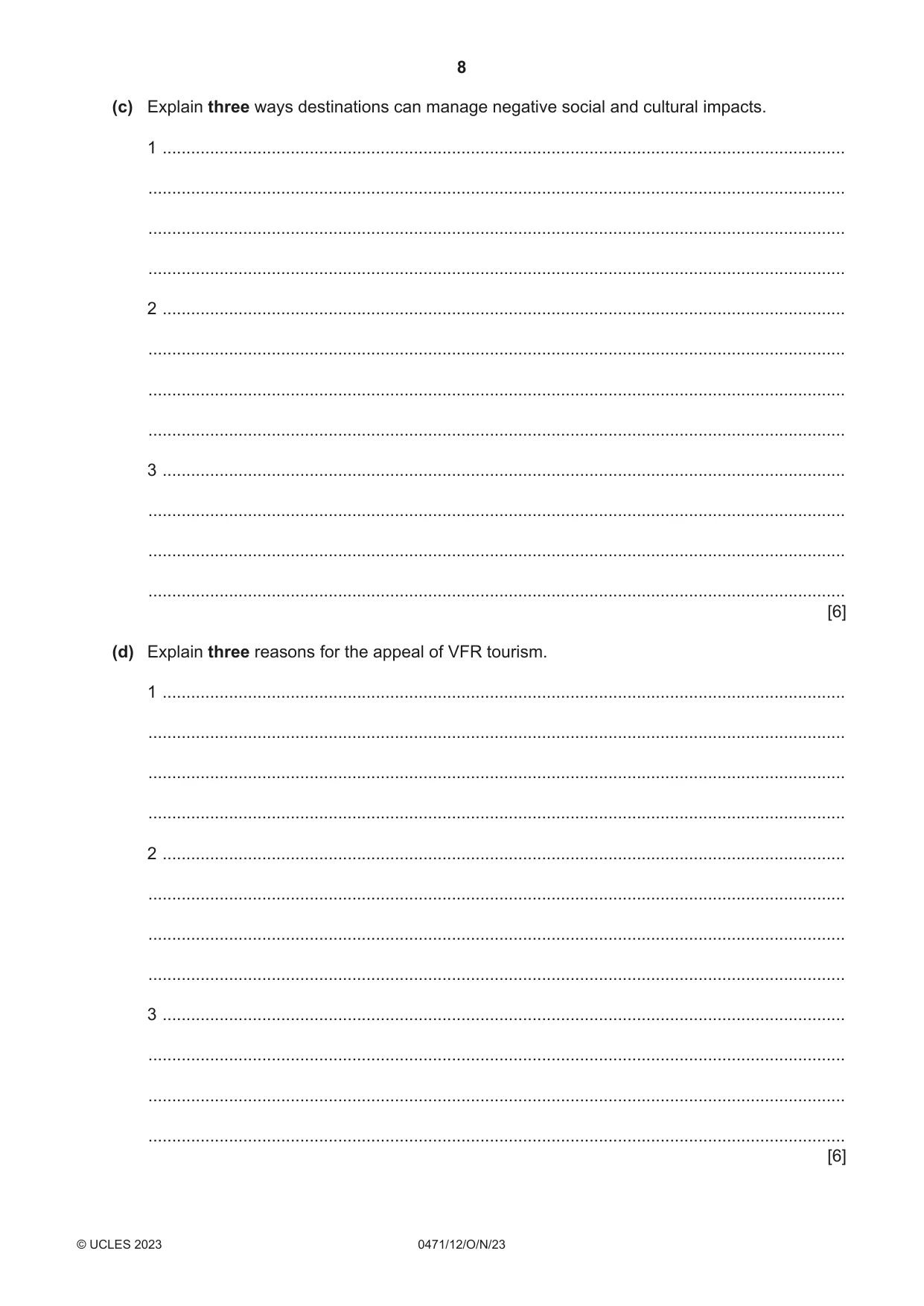
8 0471/12/O/N/23 © UCLES 2023 (c) Explain three ways destinations can manage negative social and cultural impacts. 1 … … … … 2 … … … … 3 … … … … [6] (d) Explain three reasons for the appeal of VFR tourism. 1 … … … … 2 … … … … 3 … … … … [6]
Question paper, page 9
9 0471/12/O/N/23 © UCLES 2023 [Turn over (e) Assess the benefits of domestic tourism to destinations. … … … … … … … … … … … … [6] [Total: 25]
Question paper, page 10
10 0471/12/O/N/23 © UCLES 2023 4 Refer to Fig. 4.1 (Insert), a photograph of tour agents selling boat tours at an island destination. (a) State three land-based adventure tourism activities. 1 … 2 … 3 … [3] (b) State four ways boat tours can keep their guests safe. 1 … … 2 … … 3 … … 4 … … [4] (c) Describe three ways seasonality is likely to affect boat tour providers. 1 … … … … 2 … … … … 3 … … … … [6]
Question paper, page 11
11 0471/12/O/N/23 © UCLES 2023 (d) Explain three reasons for the appeal of boat tours to tourists visiting island destinations. 1 … … … … 2 … … … … 3 … … … … [6] (e) Discuss the role of tourist information centres (TICs). … … … … … … … … … … … … [6] [Total: 25]
Question paper, page 12
12 0471/12/O/N/23 © UCLES 2023 The boundaries and names shown, the designations used and the presentation of material on any maps contained in this question paper/insert do not imply official endorsement or acceptance by Cambridge Assessment International Education concerning the legal status of any country, territory, or area or any of its authorities, or of the delimitation of its frontiers or boundaries. Permission to reproduce items where third-party owned material protected by copyright is included has been sought and cleared where possible. Every reasonable effort has been made by the publisher (UCLES) to trace copyright holders, but if any items requiring clearance have unwittingly been included, the publisher will be pleased to make amends at the earliest possible opportunity. To avoid the issue of disclosure of answer-related information to candidates, all copyright acknowledgements are reproduced online in the Cambridge Assessment International Education Copyright Acknowledgements Booklet. This is produced for each series of examinations and is freely available to download at www.cambridgeinternational.org after the live examination series. Cambridge Assessment International Education is part of Cambridge Assessment. Cambridge Assessment is the brand name of the University of Cambridge Local Examinations Syndicate (UCLES), which is a department of the University of Cambridge. BLANK PAGE
Mark scheme, page 1
This document consists of 14 printed pages. © UCLES 2023 [Turn over Cambridge IGCSE™ TRAVEL & TOURISM 0471/12 Paper 1 Core Paper October/November 2023 MARK SCHEME Maximum Mark: 100 Published This mark scheme is published as an aid to teachers and candidates, to indicate the requirements of the examination. It shows the basis on which Examiners were instructed to award marks. It does not indicate the details of the discussions that took place at an Examiners’ meeting before marking began, which would have considered the acceptability of alternative answers. Mark schemes should be read in conjunction with the question paper and the Principal Examiner Report for Teachers. Cambridge International will not enter into discussions about these mark schemes. Cambridge International is publishing the mark schemes for the October/November 2023 series for most Cambridge IGCSE, Cambridge International A and AS Level components, and some Cambridge O Level components.
Mark scheme, page 2
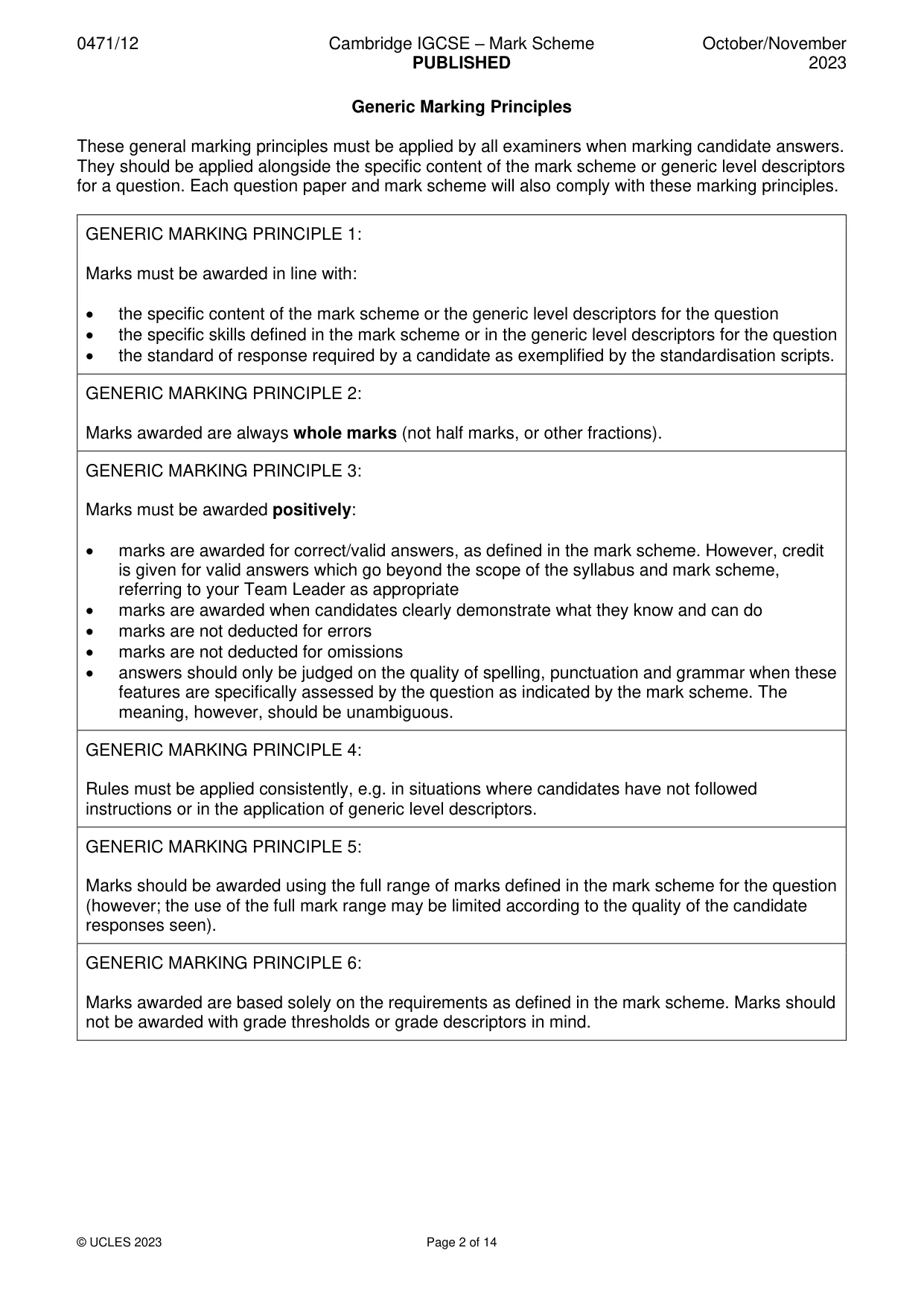
0471/12 Cambridge IGCSE – Mark Scheme PUBLISHED October/November 2023 © UCLES 2023 Page 2 of 14 Generic Marking Principles These general marking principles must be applied by all examiners when marking candidate answers. They should be applied alongside the specific content of the mark scheme or generic level descriptors for a question. Each question paper and mark scheme will also comply with these marking principles. GENERIC MARKING PRINCIPLE 1: Marks must be awarded in line with: • the specific content of the mark scheme or the generic level descriptors for the question • the specific skills defined in the mark scheme or in the generic level descriptors for the question • the standard of response required by a candidate as exemplified by the standardisation scripts. GENERIC MARKING PRINCIPLE 2: Marks awarded are always whole marks (not half marks, or other fractions). GENERIC MARKING PRINCIPLE 3: Marks must be awarded positively: • marks are awarded for correct/valid answers, as defined in the mark scheme. However, credit is given for valid answers which go beyond the scope of the syllabus and mark scheme, referring to your Team Leader as appropriate • marks are awarded when candidates clearly demonstrate what they know and can do • marks are not deducted for errors • marks are not deducted for omissions • answers should only be judged on the quality of spelling, punctuation and grammar when these features are specifically assessed by the question as indicated by the mark scheme. The meaning, however, should be unambiguous. GENERIC MARKING PRINCIPLE 4: Rules must be applied consistently, e.g. in situations where candidates have not followed instructions or in the application of generic level descriptors. GENERIC MARKING PRINCIPLE 5: Marks should be awarded using the full range of marks defined in the mark scheme for the question (however; the use of the full mark range may be limited according to the quality of the candidate responses seen). GENERIC MARKING PRINCIPLE 6: Marks awarded are based solely on the requirements as defined in the mark scheme. Marks should not be awarded with grade thresholds or grade descriptors in mind.
Mark scheme, page 3
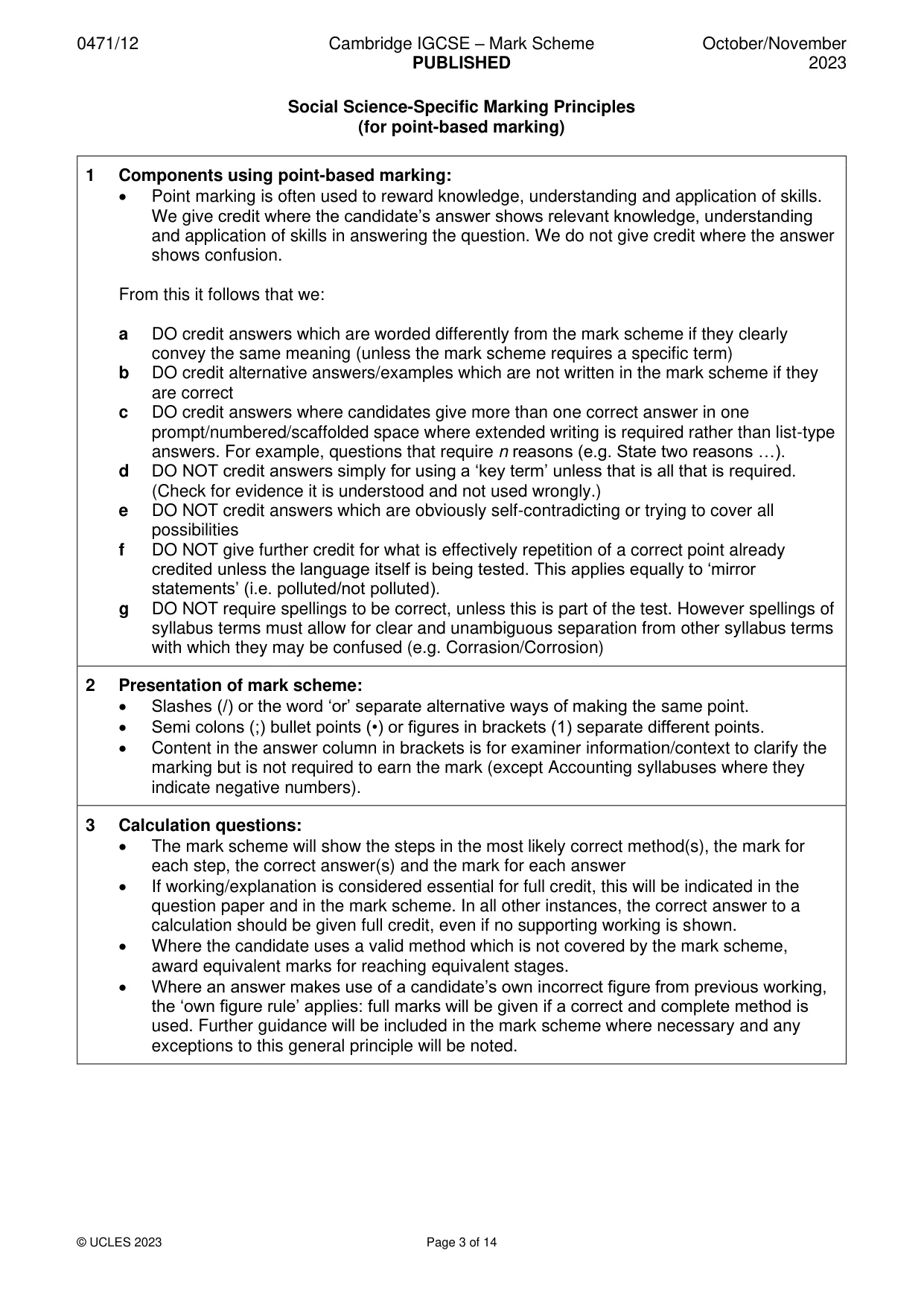
0471/12 Cambridge IGCSE – Mark Scheme PUBLISHED October/November 2023 © UCLES 2023 Page 3 of 14 Social Science-Specific Marking Principles (for point-based marking) 1 Components using point-based marking: • Point marking is often used to reward knowledge, understanding and application of skills. We give credit where the candidate’s answer shows relevant knowledge, understanding and application of skills in answering the question. We do not give credit where the answer shows confusion. From this it follows that we: a DO credit answers which are worded differently from the mark scheme if they clearly convey the same meaning (unless the mark scheme requires a specific term) b DO credit alternative answers/examples which are not written in the mark scheme if they are correct c DO credit answers where candidates give more than one correct answer in one prompt/numbered/scaffolded space where extended writing is required rather than list-type answers. For example, questions that require n reasons (e.g. State two reasons …). d DO NOT credit answers simply for using a ‘key term’ unless that is all that is required. (Check for evidence it is understood and not used wrongly.) e DO NOT credit answers which are obviously self-contradicting or trying to cover all possibilities f DO NOT give further credit for what is effectively repetition of a correct point already credited unless the language itself is being tested. This applies equally to ‘mirror statements’ (i.e. polluted/not polluted). g DO NOT require spellings to be correct, unless this is part of the test. However spellings of syllabus terms must allow for clear and unambiguous separation from other syllabus terms with which they may be confused (e.g. Corrasion/Corrosion) 2 Presentation of mark scheme: • Slashes (/) or the word ‘or’ separate alternative ways of making the same point. • Semi colons (;) bullet points (•) or figures in brackets (1) separate different points. • Content in the answer column in brackets is for examiner information/context to clarify the marking but is not required to earn the mark (except Accounting syllabuses where they indicate negative numbers). 3 Calculation questions: • The mark scheme will show the steps in the most likely correct method(s), the mark for each step, the correct answer(s) and the mark for each answer • If working/explanation is considered essential for full credit, this will be indicated in the question paper and in the mark scheme. In all other instances, the correct answer to a calculation should be given full credit, even if no supporting working is shown. • Where the candidate uses a valid method which is not covered by the mark scheme, award equivalent marks for reaching equivalent stages. • Where an answer makes use of a candidate’s own incorrect figure from previous working, the ‘own figure rule’ applies: full marks will be given if a correct and complete method is used. Further guidance will be included in the mark scheme where necessary and any exceptions to this general principle will be noted.
Mark scheme, page 4
0471/12 Cambridge IGCSE – Mark Scheme PUBLISHED October/November 2023 © UCLES 2023 Page 4 of 14 4 Annotation: • For point marking, ticks can be used to indicate correct answers and crosses can be used to indicate wrong answers. There is no direct relationship between ticks and marks. Ticks have no defined meaning for levels of response marking. • For levels of response marking, the level awarded should be annotated on the script. • Other annotations will be used by examiners as agreed during standardisation, and the meaning will be understood by all examiners who marked that paper.
Mark scheme, page 5
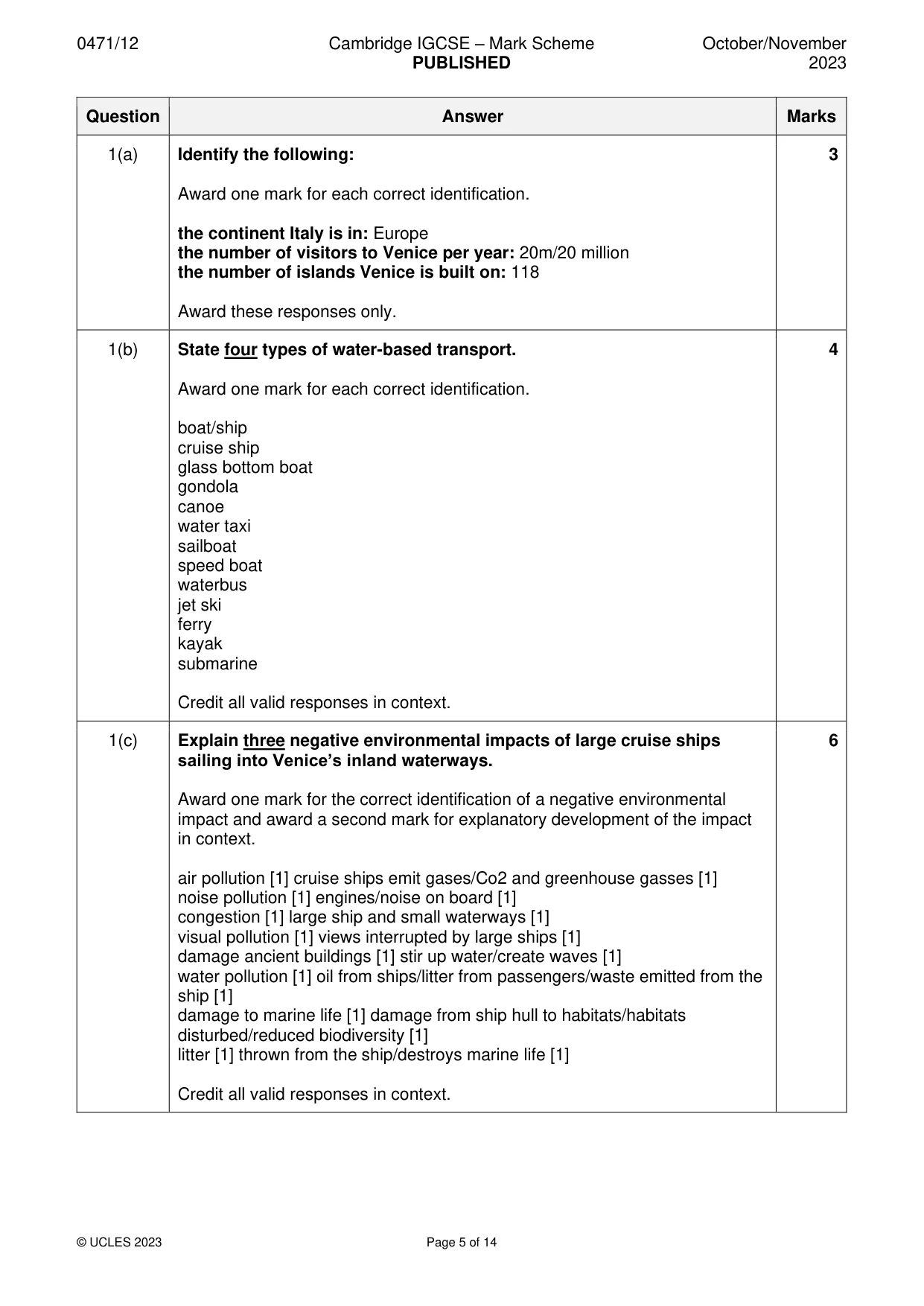
0471/12 Cambridge IGCSE – Mark Scheme PUBLISHED October/November 2023 © UCLES 2023 Page 5 of 14 Question Answer Marks 1(a) Identify the following: Award one mark for each correct identification. the continent Italy is in: Europe the number of visitors to Venice per year: 20m/20 million the number of islands Venice is built on: 118 Award these responses only. 3 1(b) State four types of water-based transport. Award one mark for each correct identification. boat/ship cruise ship glass bottom boat gondola canoe water taxi sailboat speed boat waterbus jet ski ferry kayak submarine Credit all valid responses in context. 4 1(c) Explain three negative environmental impacts of large cruise ships sailing into Venice’s inland waterways. Award one mark for the correct identification of a negative environmental impact and award a second mark for explanatory development of the impact in context. air pollution [1] cruise ships emit gases/Co2 and greenhouse gasses [1] noise pollution [1] engines/noise on board [1] congestion [1] large ship and small waterways [1] visual pollution [1] views interrupted by large ships [1] damage ancient buildings [1] stir up water/create waves [1] water pollution [1] oil from ships/litter from passengers/waste emitted from the ship [1] damage to marine life [1] damage from ship hull to habitats/habitats disturbed/reduced biodiversity [1] litter [1] thrown from the ship/destroys marine life [1] Credit all valid responses in context. 6
Mark scheme, page 6
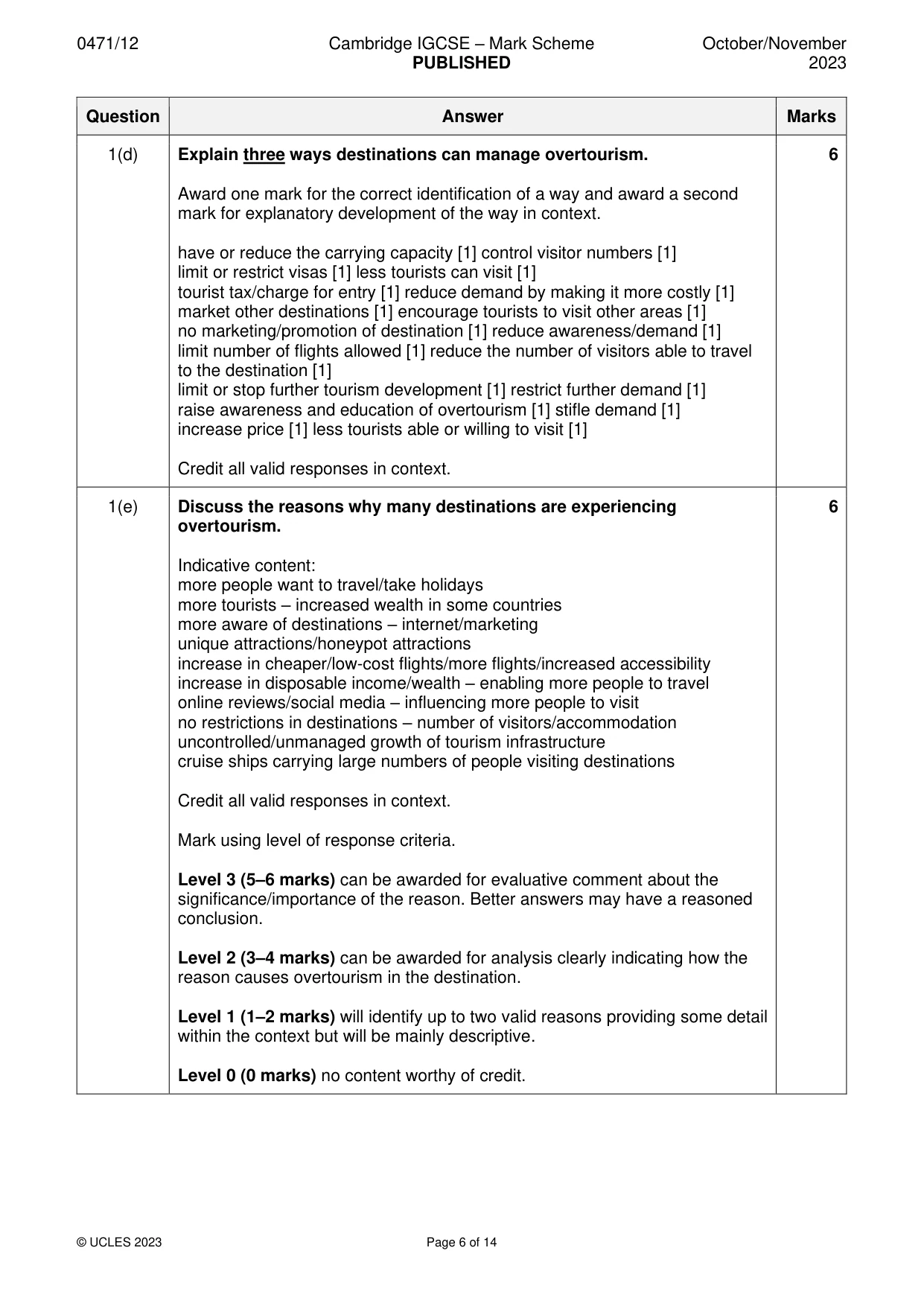
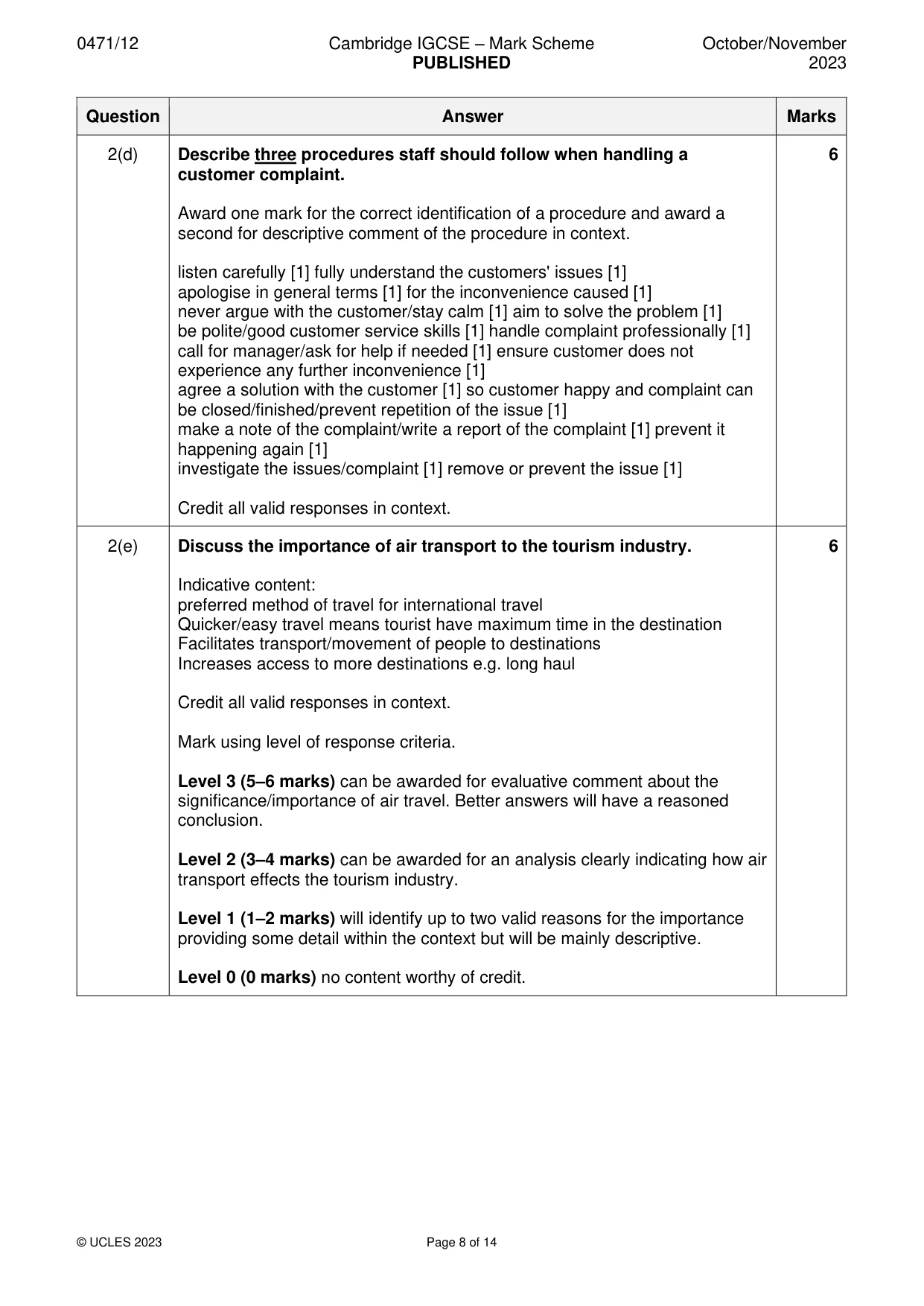
0471/12 Cambridge IGCSE – Mark Scheme PUBLISHED October/November 2023 © UCLES 2023 Page 6 of 14 Question Answer Marks 1(d) Explain three ways destinations can manage overtourism. Award one mark for the correct identification of a way and award a second mark for explanatory development of the way in context. have or reduce the carrying capacity [1] control visitor numbers [1] limit or restrict visas [1] less tourists can visit [1] tourist tax/charge for entry [1] reduce demand by making it more costly [1] market other destinations [1] encourage tourists to visit other areas [1] no marketing/promotion of destination [1] reduce awareness/demand [1] limit number of flights allowed [1] reduce the number of visitors able to travel to the destination [1] limit or stop further tourism development [1] restrict further demand [1] raise awareness and education of overtourism [1] stifle demand [1] increase price [1] less tourists able or willing to visit [1] Credit all valid responses in context. 6 1(e) Discuss the reasons why many destinations are experiencing overtourism. Indicative content: more people want to travel/take holidays more tourists – increased wealth in some countries more aware of destinations – internet/marketing unique attractions/honeypot attractions increase in cheaper/low-cost flights/more flights/increased accessibility increase in disposable income/wealth – enabling more people to travel online reviews/social media – influencing more people to visit no restrictions in destinations – number of visitors/accommodation uncontrolled/unmanaged growth of tourism infrastructure cruise ships carrying large numbers of people visiting destinations Credit all valid responses in context. Mark using level of response criteria. Level 3 (5–6 marks) can be awarded for evaluative comment about the significance/importance of the reason. Better answers may have a reasoned conclusion. Level 2 (3–4 marks) can be awarded for analysis clearly indicating how the reason causes overtourism in the destination. Level 1 (1–2 marks) will identify up to two valid reasons providing some detail within the context but will be mainly descriptive. Level 0 (0 marks) no content worthy of credit. 6
Mark scheme, page 7
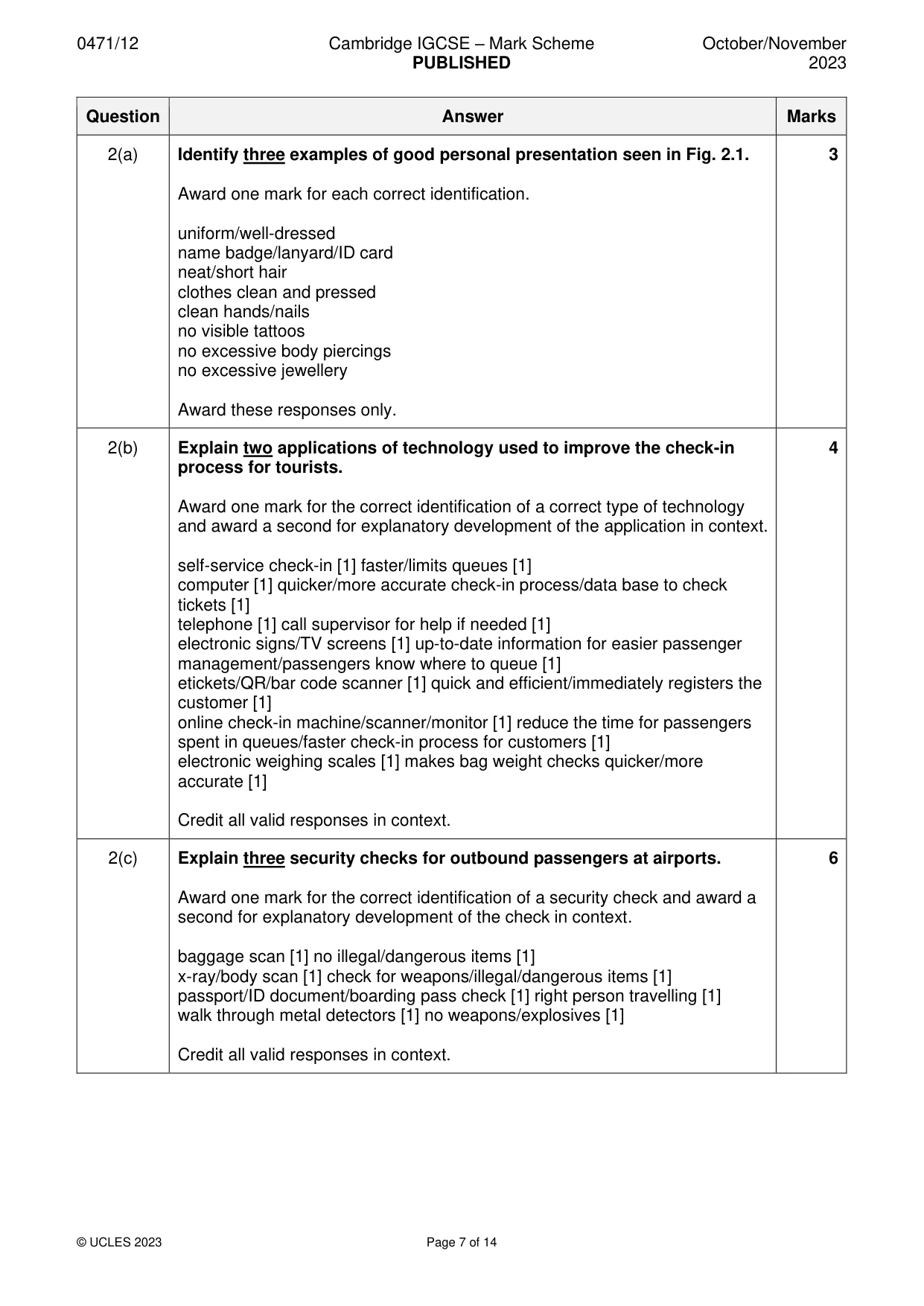
0471/12 Cambridge IGCSE – Mark Scheme PUBLISHED October/November 2023 © UCLES 2023 Page 7 of 14 Question Answer Marks 2(a) Identify three examples of good personal presentation seen in Fig. 2.1. Award one mark for each correct identification. uniform/well-dressed name badge/lanyard/ID card neat/short hair clothes clean and pressed clean hands/nails no visible tattoos no excessive body piercings no excessive jewellery Award these responses only. 3 2(b) Explain two applications of technology used to improve the check-in process for tourists. Award one mark for the correct identification of a correct type of technology and award a second for explanatory development of the application in context. self-service check-in [1] faster/limits queues [1] computer [1] quicker/more accurate check-in process/data base to check tickets [1] telephone [1] call supervisor for help if needed [1] electronic signs/TV screens [1] up-to-date information for easier passenger management/passengers know where to queue [1] etickets/QR/bar code scanner [1] quick and efficient/immediately registers the customer [1] online check-in machine/scanner/monitor [1] reduce the time for passengers spent in queues/faster check-in process for customers [1] electronic weighing scales [1] makes bag weight checks quicker/more accurate [1] Credit all valid responses in context. 4 2(c) Explain three security checks for outbound passengers at airports. Award one mark for the correct identification of a security check and award a second for explanatory development of the check in context. baggage scan [1] no illegal/dangerous items [1] x-ray/body scan [1] check for weapons/illegal/dangerous items [1] passport/ID document/boarding pass check [1] right person travelling [1] walk through metal detectors [1] no weapons/explosives [1] Credit all valid responses in context. 6
Mark scheme, page 8
0471/12 Cambridge IGCSE – Mark Scheme PUBLISHED October/November 2023 © UCLES 2023 Page 8 of 14 Question Answer Marks 2(d) Describe three procedures staff should follow when handling a customer complaint. Award one mark for the correct identification of a procedure and award a second for descriptive comment of the procedure in context. listen carefully [1] fully understand the customers' issues [1] apologise in general terms [1] for the inconvenience caused [1] never argue with the customer/stay calm [1] aim to solve the problem [1] be polite/good customer service skills [1] handle complaint professionally [1] call for manager/ask for help if needed [1] ensure customer does not experience any further inconvenience [1] agree a solution with the customer [1] so customer happy and complaint can be closed/finished/prevent repetition of the issue [1] make a note of the complaint/write a report of the complaint [1] prevent it happening again [1] investigate the issues/complaint [1] remove or prevent the issue [1] Credit all valid responses in context. 6 2(e) Discuss the importance of air transport to the tourism industry. Indicative content: preferred method of travel for international travel Quicker/easy travel means tourist have maximum time in the destination Facilitates transport/movement of people to destinations Increases access to more destinations e.g. long haul Credit all valid responses in context. Mark using level of response criteria. Level 3 (5–6 marks) can be awarded for evaluative comment about the significance/importance of air travel. Better answers will have a reasoned conclusion. Level 2 (3–4 marks) can be awarded for an analysis clearly indicating how air transport effects the tourism industry. Level 1 (1–2 marks) will identify up to two valid reasons for the importance providing some detail within the context but will be mainly descriptive. Level 0 (0 marks) no content worthy of credit. 6
Mark scheme, page 9
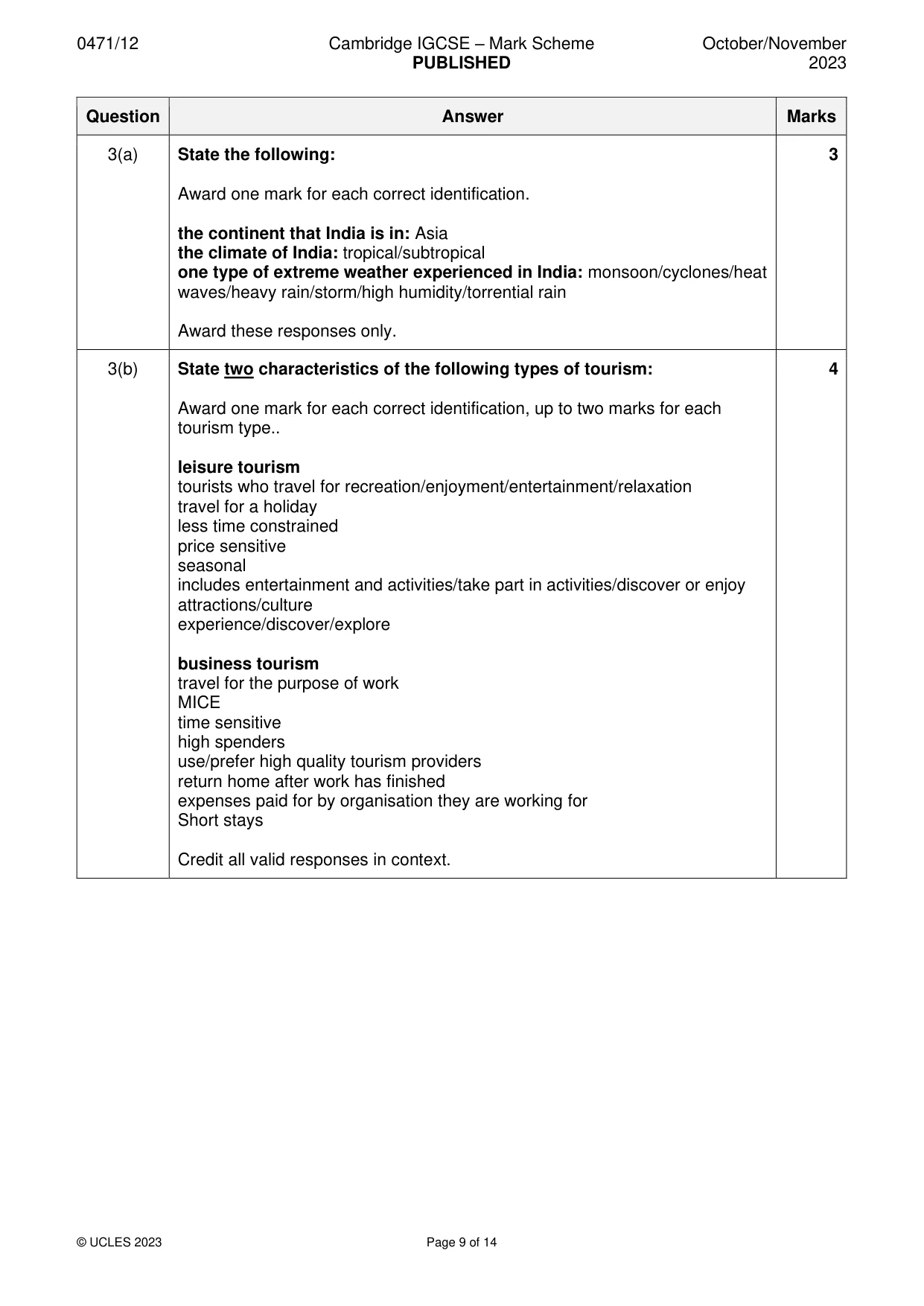
0471/12 Cambridge IGCSE – Mark Scheme PUBLISHED October/November 2023 © UCLES 2023 Page 9 of 14 Question Answer Marks 3(a) State the following: Award one mark for each correct identification. the continent that India is in: Asia the climate of India: tropical/subtropical one type of extreme weather experienced in India: monsoon/cyclones/heat waves/heavy rain/storm/high humidity/torrential rain Award these responses only. 3 3(b) State two characteristics of the following types of tourism: Award one mark for each correct identification, up to two marks for each tourism type.. leisure tourism tourists who travel for recreation/enjoyment/entertainment/relaxation travel for a holiday less time constrained price sensitive seasonal includes entertainment and activities/take part in activities/discover or enjoy attractions/culture experience/discover/explore business tourism travel for the purpose of work MICE time sensitive high spenders use/prefer high quality tourism providers return home after work has finished expenses paid for by organisation they are working for Short stays Credit all valid responses in context. 4
Mark scheme, page 10
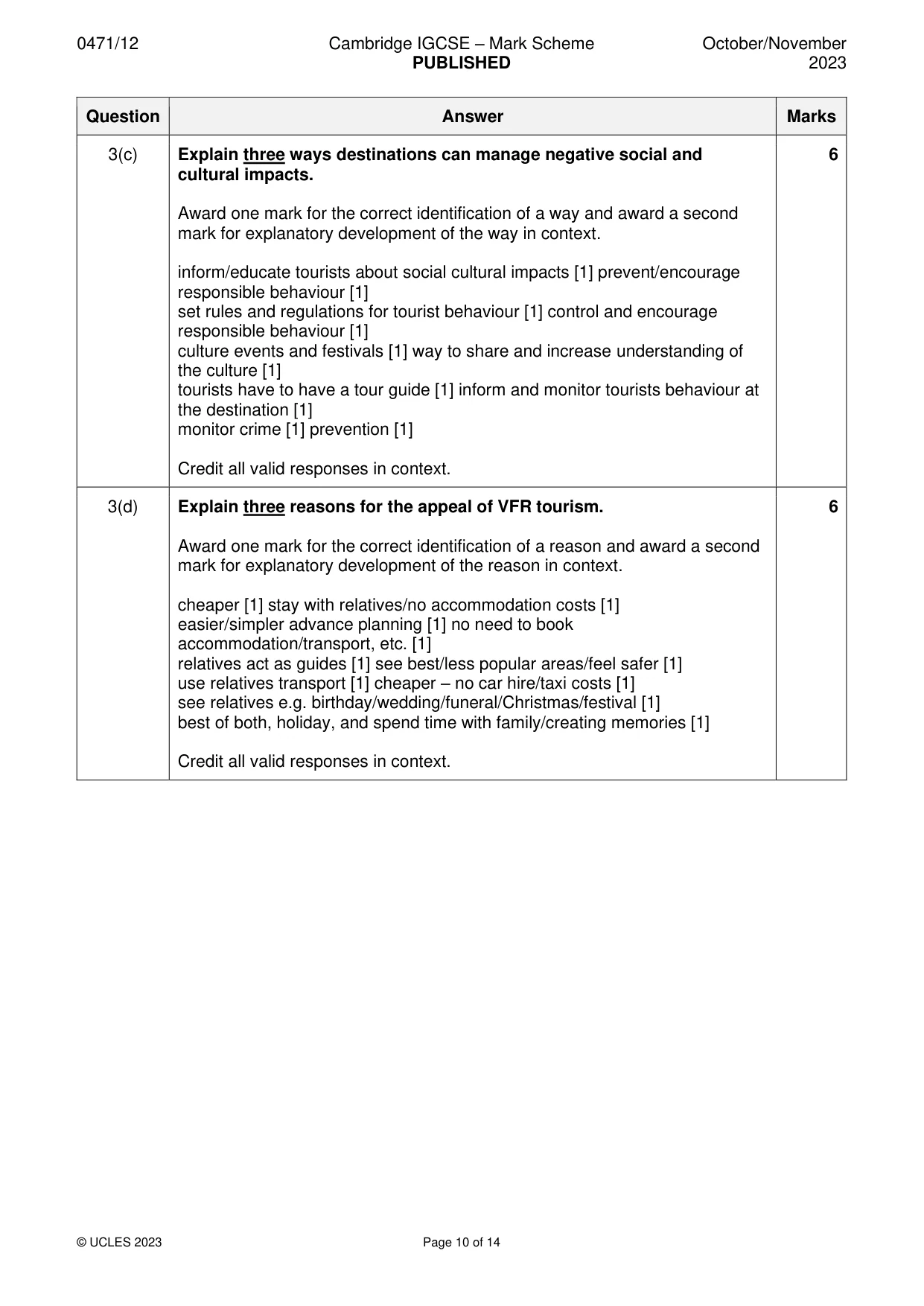
0471/12 Cambridge IGCSE – Mark Scheme PUBLISHED October/November 2023 © UCLES 2023 Page 10 of 14 Question Answer Marks 3(c) Explain three ways destinations can manage negative social and cultural impacts. Award one mark for the correct identification of a way and award a second mark for explanatory development of the way in context. inform/educate tourists about social cultural impacts [1] prevent/encourage responsible behaviour [1] set rules and regulations for tourist behaviour [1] control and encourage responsible behaviour [1] culture events and festivals [1] way to share and increase understanding of the culture [1] tourists have to have a tour guide [1] inform and monitor tourists behaviour at the destination [1] monitor crime [1] prevention [1] Credit all valid responses in context. 6 3(d) Explain three reasons for the appeal of VFR tourism. Award one mark for the correct identification of a reason and award a second mark for explanatory development of the reason in context. cheaper [1] stay with relatives/no accommodation costs [1] easier/simpler advance planning [1] no need to book accommodation/transport, etc. [1] relatives act as guides [1] see best/less popular areas/feel safer [1] use relatives transport [1] cheaper – no car hire/taxi costs [1] see relatives e.g. birthday/wedding/funeral/Christmas/festival [1] best of both, holiday, and spend time with family/creating memories [1] Credit all valid responses in context. 6
Mark scheme, page 11
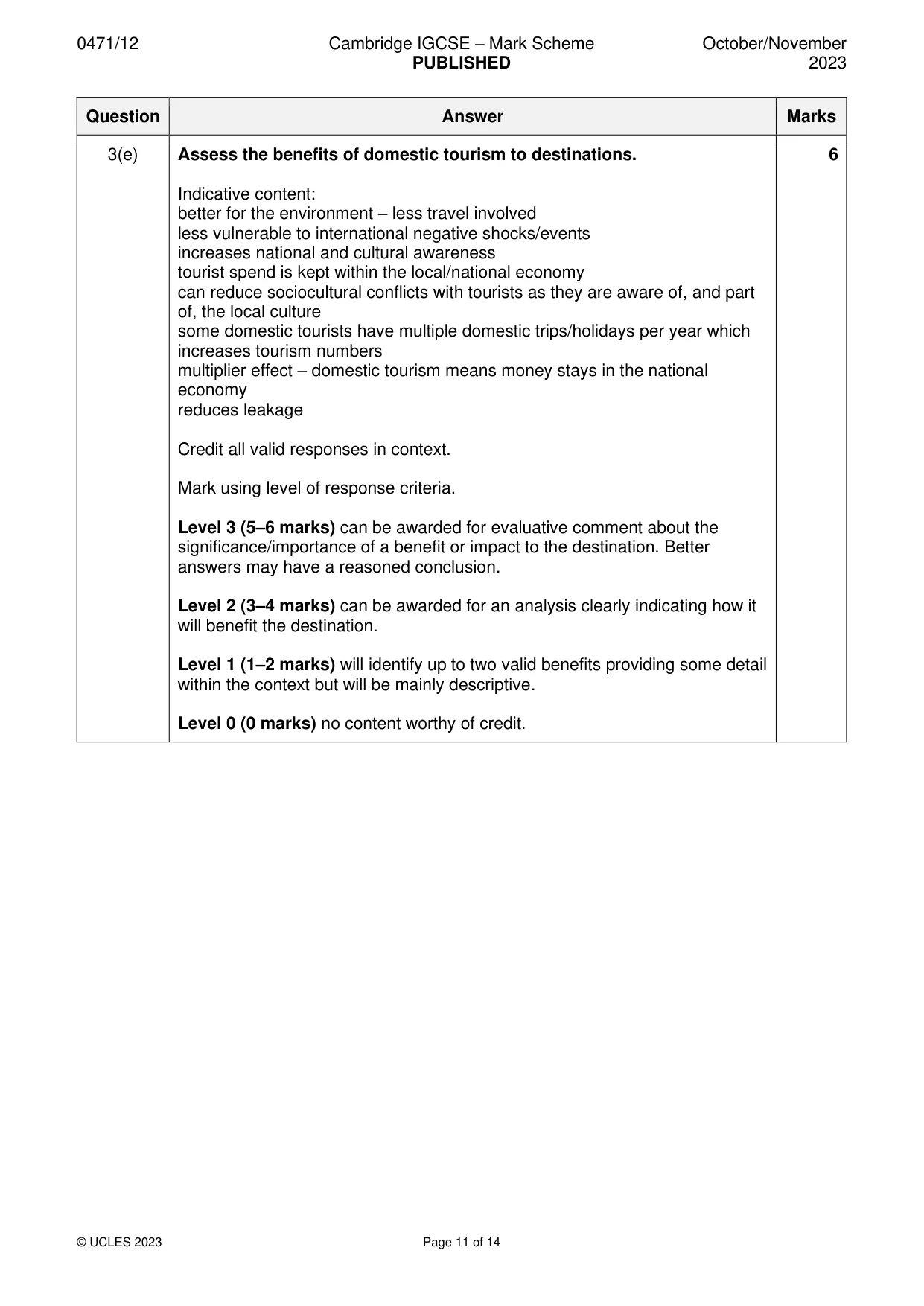
0471/12 Cambridge IGCSE – Mark Scheme PUBLISHED October/November 2023 © UCLES 2023 Page 11 of 14 Question Answer Marks 3(e) Assess the benefits of domestic tourism to destinations. Indicative content: better for the environment – less travel involved less vulnerable to international negative shocks/events increases national and cultural awareness tourist spend is kept within the local/national economy can reduce sociocultural conflicts with tourists as they are aware of, and part of, the local culture some domestic tourists have multiple domestic trips/holidays per year which increases tourism numbers multiplier effect – domestic tourism means money stays in the national economy reduces leakage Credit all valid responses in context. Mark using level of response criteria. Level 3 (5–6 marks) can be awarded for evaluative comment about the significance/importance of a benefit or impact to the destination. Better answers may have a reasoned conclusion. Level 2 (3–4 marks) can be awarded for an analysis clearly indicating how it will benefit the destination. Level 1 (1–2 marks) will identify up to two valid benefits providing some detail within the context but will be mainly descriptive. Level 0 (0 marks) no content worthy of credit. 6
Mark scheme, page 12
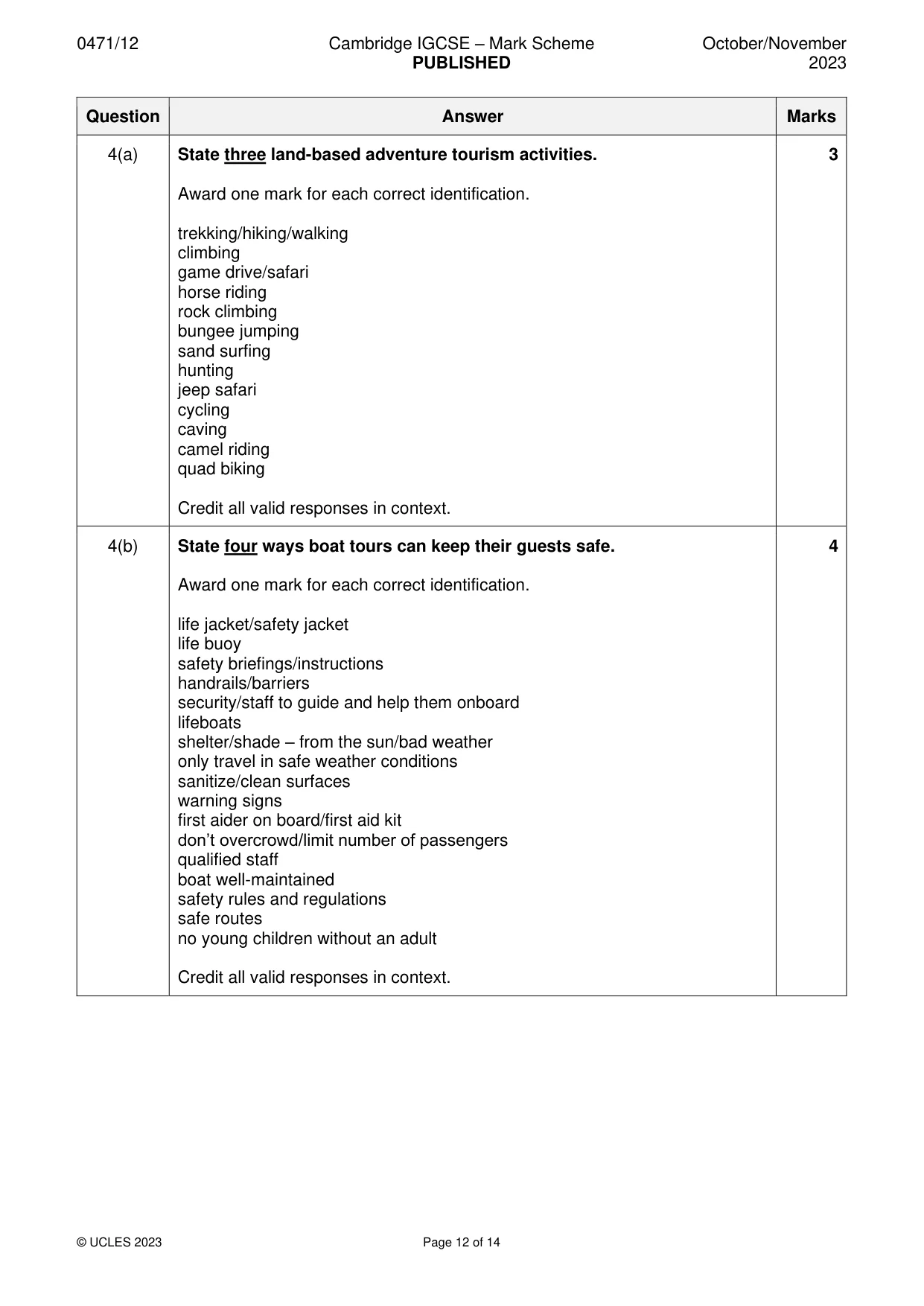
0471/12 Cambridge IGCSE – Mark Scheme PUBLISHED October/November 2023 © UCLES 2023 Page 12 of 14 Question Answer Marks 4(a) State three land-based adventure tourism activities. Award one mark for each correct identification. trekking/hiking/walking climbing game drive/safari horse riding rock climbing bungee jumping sand surfing hunting jeep safari cycling caving camel riding quad biking Credit all valid responses in context. 3 4(b) State four ways boat tours can keep their guests safe. Award one mark for each correct identification. life jacket/safety jacket life buoy safety briefings/instructions handrails/barriers security/staff to guide and help them onboard lifeboats shelter/shade – from the sun/bad weather only travel in safe weather conditions sanitize/clean surfaces warning signs first aider on board/first aid kit don’t overcrowd/limit number of passengers qualified staff boat well-maintained safety rules and regulations safe routes no young children without an adult Credit all valid responses in context. 4
Mark scheme, page 13
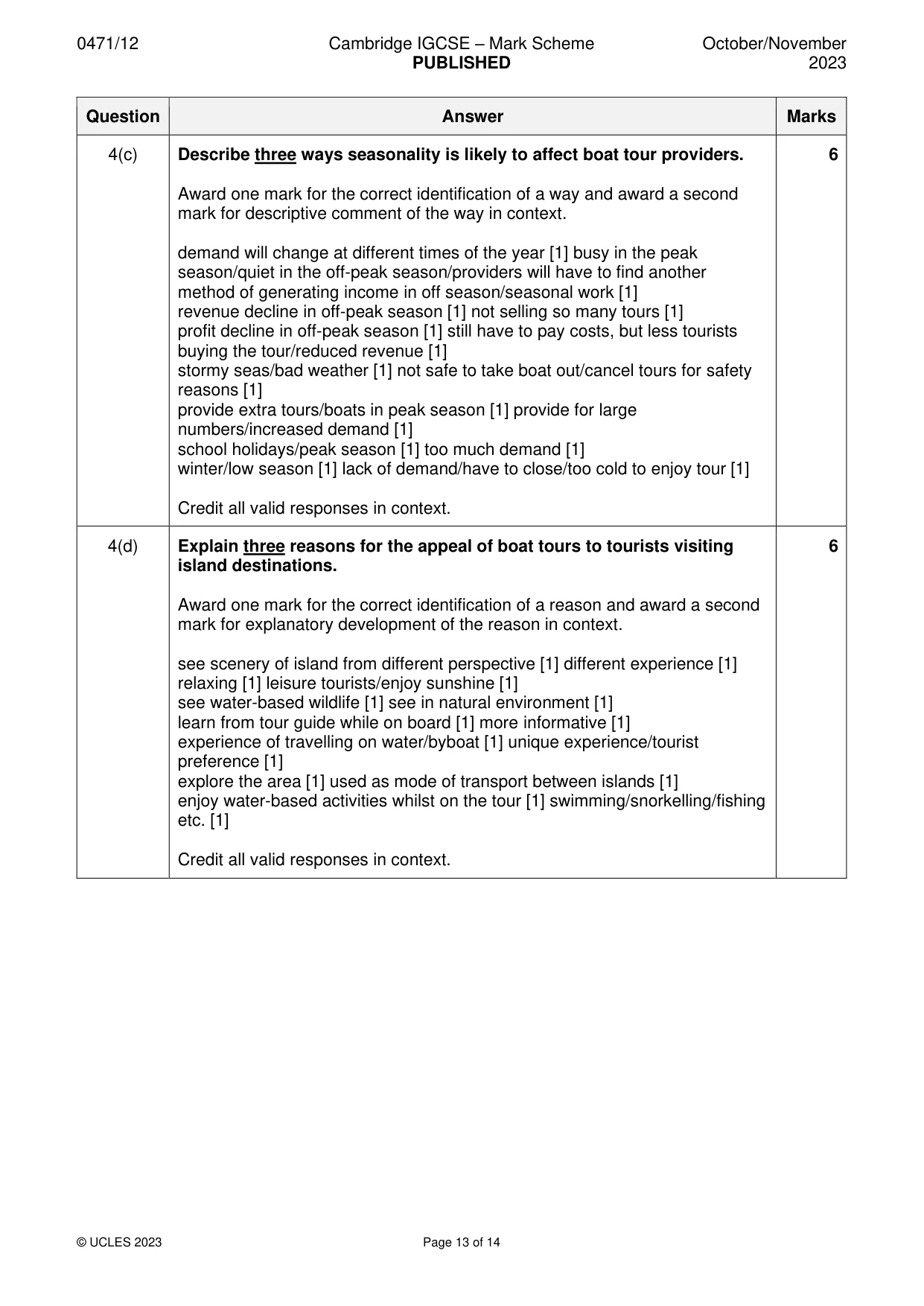
0471/12 Cambridge IGCSE – Mark Scheme PUBLISHED October/November 2023 © UCLES 2023 Page 13 of 14 Question Answer Marks 4(c) Describe three ways seasonality is likely to affect boat tour providers. Award one mark for the correct identification of a way and award a second mark for descriptive comment of the way in context. demand will change at different times of the year [1] busy in the peak season/quiet in the off-peak season/providers will have to find another method of generating income in off season/seasonal work [1] revenue decline in off-peak season [1] not selling so many tours [1] profit decline in off-peak season [1] still have to pay costs, but less tourists buying the tour/reduced revenue [1] stormy seas/bad weather [1] not safe to take boat out/cancel tours for safety reasons [1] provide extra tours/boats in peak season [1] provide for large numbers/increased demand [1] school holidays/peak season [1] too much demand [1] winter/low season [1] lack of demand/have to close/too cold to enjoy tour [1] Credit all valid responses in context. 6 4(d) Explain three reasons for the appeal of boat tours to tourists visiting island destinations. Award one mark for the correct identification of a reason and award a second mark for explanatory development of the reason in context. see scenery of island from different perspective [1] different experience [1] relaxing [1] leisure tourists/enjoy sunshine [1] see water-based wildlife [1] see in natural environment [1] learn from tour guide while on board [1] more informative [1] experience of travelling on water/byboat [1] unique experience/tourist preference [1] explore the area [1] used as mode of transport between islands [1] enjoy water-based activities whilst on the tour [1] swimming/snorkelling/fishing etc. [1] Credit all valid responses in context. 6
Mark scheme, page 14
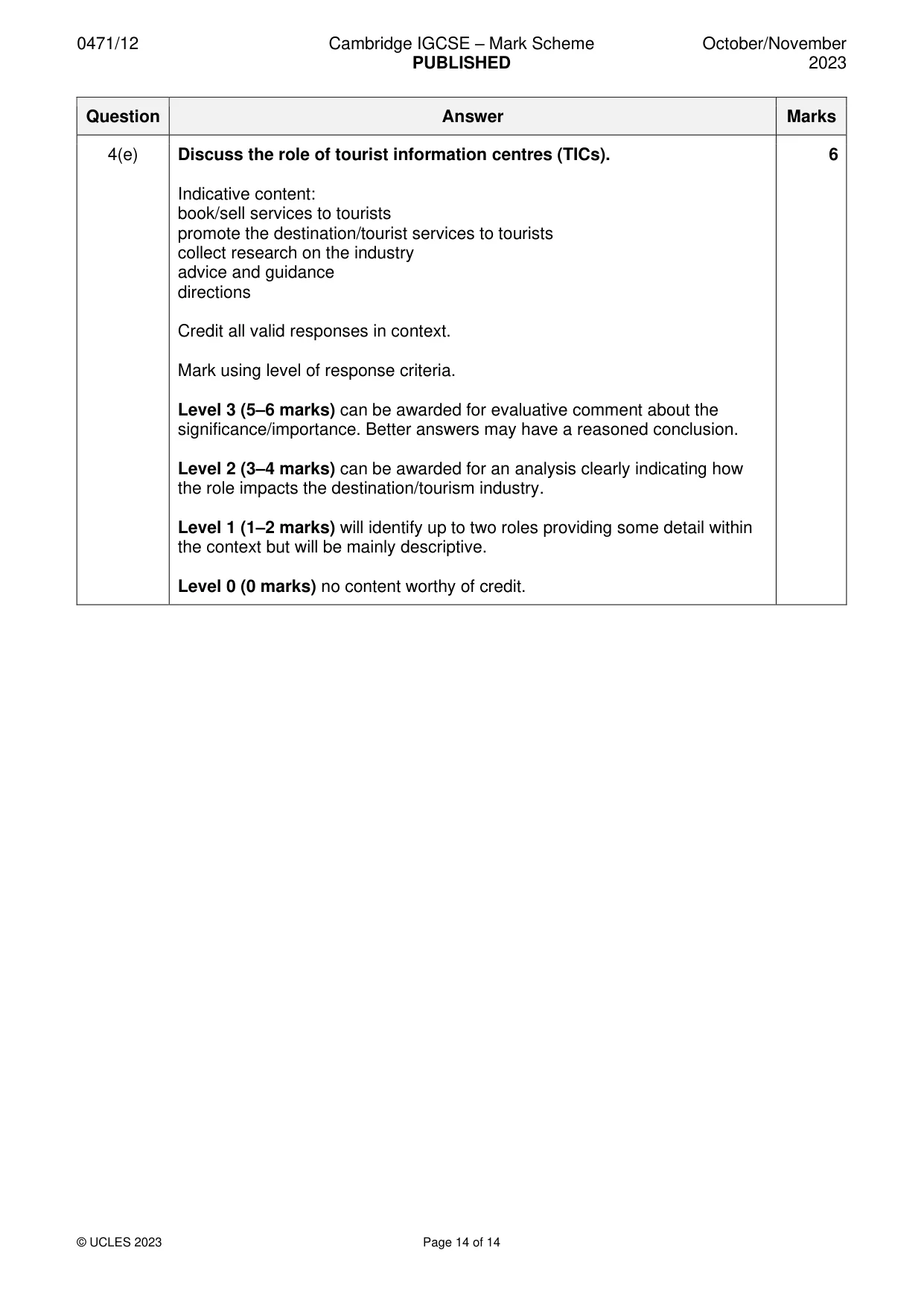
0471/12 Cambridge IGCSE – Mark Scheme PUBLISHED October/November 2023 © UCLES 2023 Page 14 of 14 Question Answer Marks 4(e) Discuss the role of tourist information centres (TICs). Indicative content: book/sell services to tourists promote the destination/tourist services to tourists collect research on the industry advice and guidance directions Credit all valid responses in context. Mark using level of response criteria. Level 3 (5–6 marks) can be awarded for evaluative comment about the significance/importance. Better answers may have a reasoned conclusion. Level 2 (3–4 marks) can be awarded for an analysis clearly indicating how the role impacts the destination/tourism industry. Level 1 (1–2 marks) will identify up to two roles providing some detail within the context but will be mainly descriptive. Level 0 (0 marks) no content worthy of credit. 6
What you needed in this session
Cambridge’s own grade thresholds for 2023 Oct/Nov, Paper 1 · Variant 2. A higher threshold means an easier paper — the bar moves with how the cohort did.