Cambridge IGCSE Travel and Tourism 0471 — 2024 May/June Paper 1 · Variant 2
0471/12/M/J/24 · 80 marks · 90 min
The question paper and its mark scheme, free to read here and free to download. This is Cambridge’s own paper, exactly as it was sat.
Question paper12 pages



Mark scheme19 pages
Answers below. Sit the paper first if you are practising.
Paper as text
Question paper, page 1
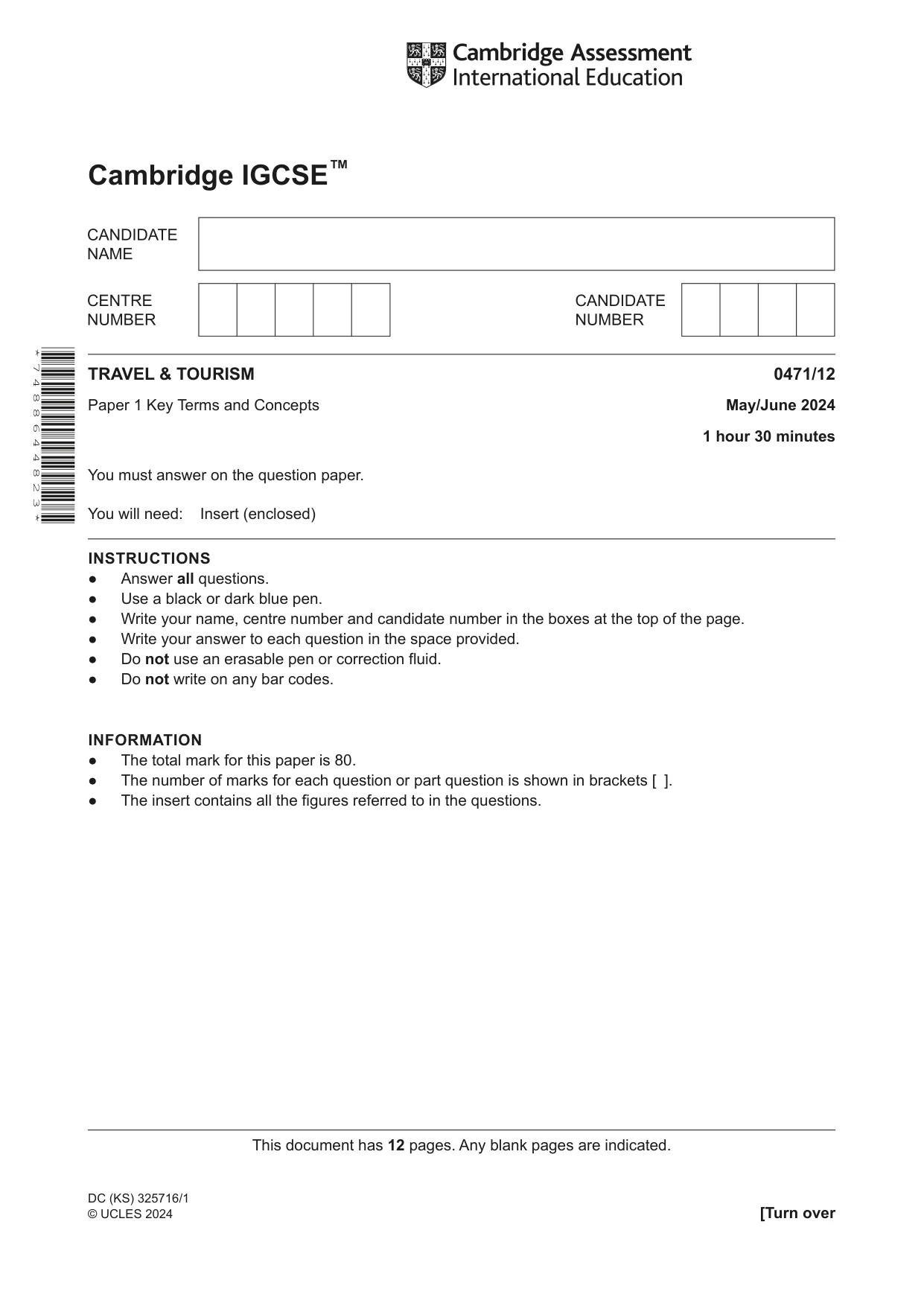
This document has 12 pages. Any blank pages are indicated. [Turn over Cambridge IGCSE™ * 7 4 8 8 6 4 4 8 2 3 * DC (KS) 325716/1 © UCLES 2024 TRAVEL & TOURISM 0471/12 Paper 1 Key Terms and Concepts May/June 2024 1 hour 30 minutes You must answer on the question paper. You will need: Insert (enclosed) INSTRUCTIONS ● Answer all questions. ● Use a black or dark blue pen. ● Write your name, centre number and candidate number in the boxes at the top of the page. ● Write your answer to each question in the space provided. ● Do not use an erasable pen or correction fluid. ● Do not write on any bar codes. INFORMATION ● The total mark for this paper is 80. ● The number of marks for each question or part question is shown in brackets [ ]. ● The insert contains all the figures referred to in the questions.
Question paper, page 2
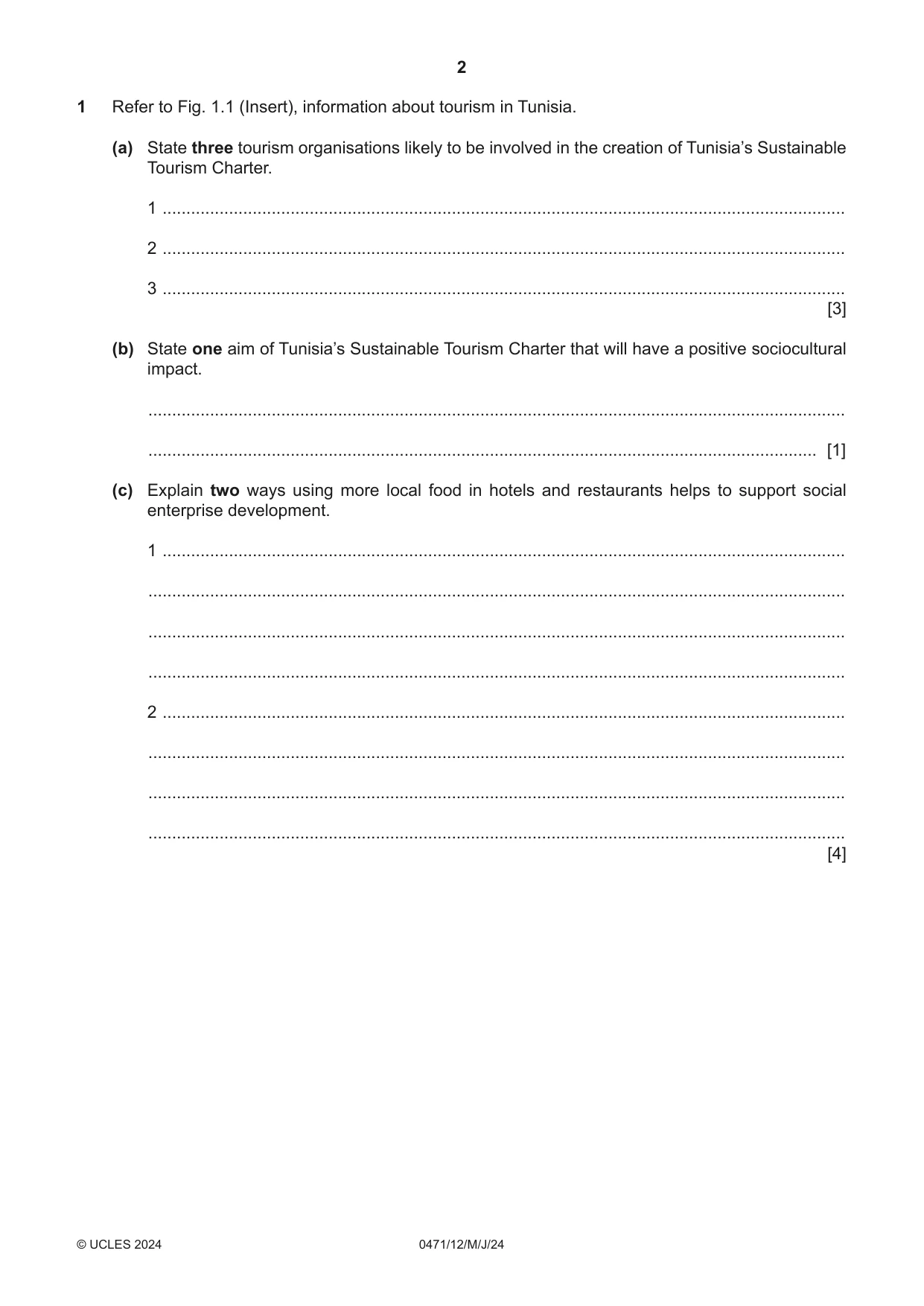
2 0471/12/M/J/24 © UCLES 2024 1 Refer to Fig. 1.1 (Insert), information about tourism in Tunisia. (a) State three tourism organisations likely to be involved in the creation of Tunisia’s Sustainable Tourism Charter. 1 … 2 … 3 … [3] (b) State one aim of Tunisia’s Sustainable Tourism Charter that will have a positive sociocultural impact. … … [1] (c) Explain two ways using more local food in hotels and restaurants helps to support social enterprise development. 1 … … … … 2 … … … … [4]
Question paper, page 3
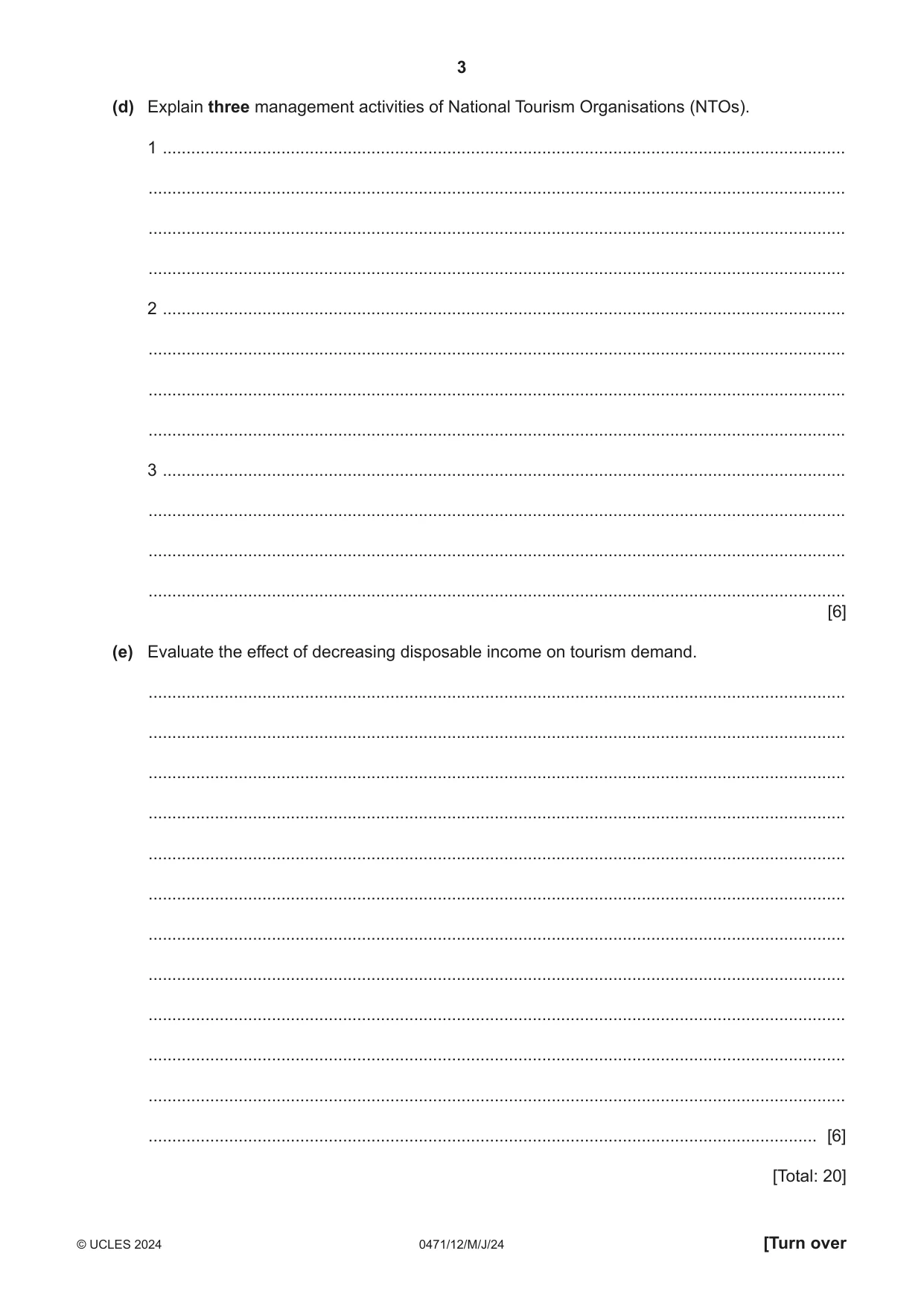
3 0471/12/M/J/24 © UCLES 2024 [Turn over (d) Explain three management activities of National Tourism Organisations (NTOs). 1 … … … … 2 … … … … 3 … … … … [6] (e) Evaluate the effect of decreasing disposable income on tourism demand. … … … … … … … … … … … … [6] [Total: 20]
Question paper, page 4
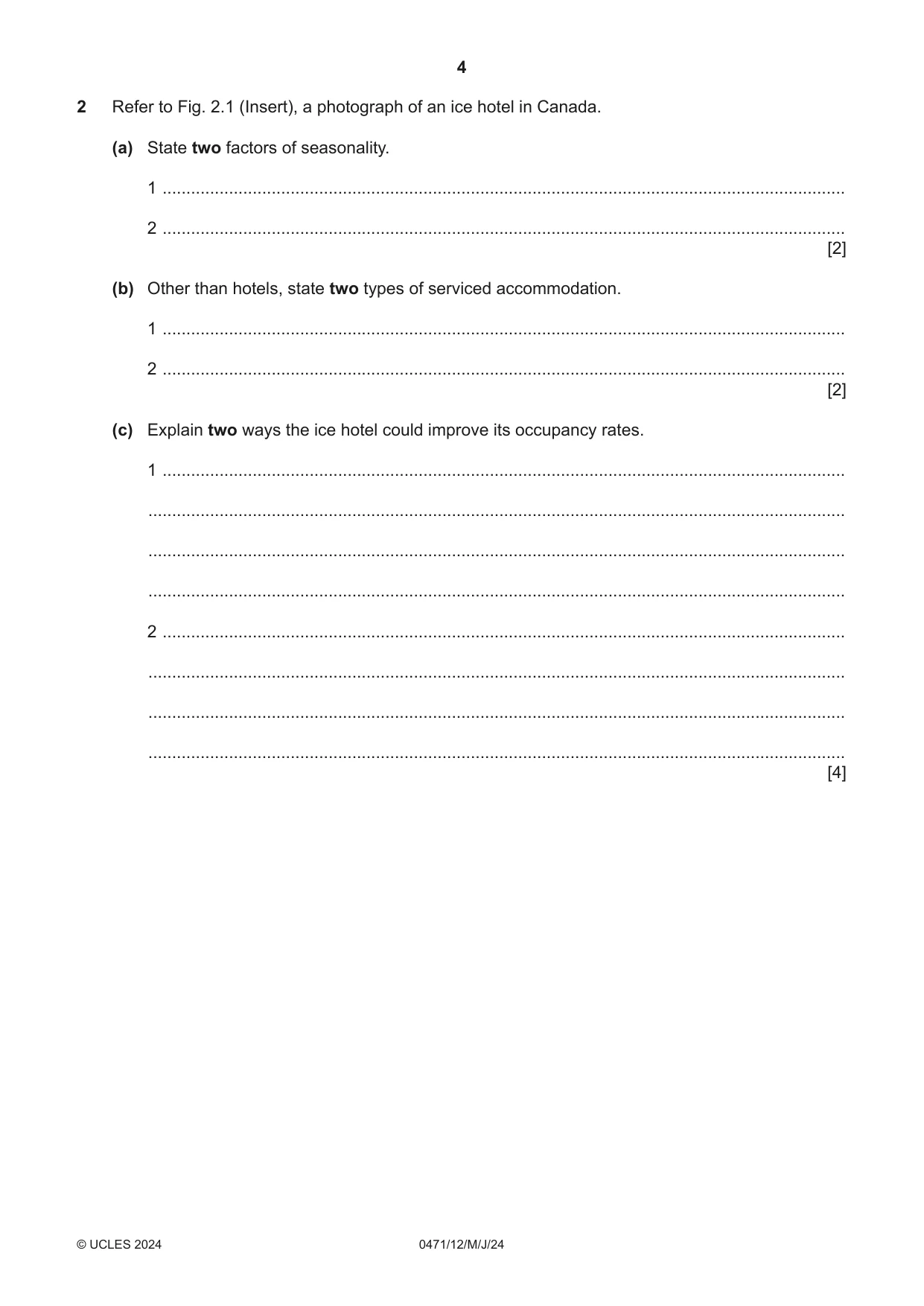
4 0471/12/M/J/24 © UCLES 2024 2 Refer to Fig. 2.1 (Insert), a photograph of an ice hotel in Canada. (a) State two factors of seasonality. 1 … 2 … [2] (b) Other than hotels, state two types of serviced accommodation. 1 … 2 … [2] (c) Explain two ways the ice hotel could improve its occupancy rates. 1 … … … … 2 … … … … [4]
Question paper, page 5
5 0471/12/M/J/24 © UCLES 2024 [Turn over (d) Evaluate two benefits of good customer service. 1 … … … … … … 2 … … … … … … [6] (e) Evaluate the appeal of serviced accommodation. … … … … … … … … … … … … [6] [Total: 20]
Question paper, page 6
6 0471/12/M/J/24 © UCLES 2024 3 Refer to Fig. 3.1 (Insert), information about national parks in Tanzania. (a) Define the term ‘GDP’. … … [1] (b) State three adventure activities tourists can do in national parks. 1 … 2 … 3 … [3] (c) Wildlife and safari holidays can be purchased through a travel agent or arranged independently. Explain two benefits of booking a wildlife or safari holiday through a travel agent. 1 … … … … 2 … … … … [4]
Question paper, page 7
7 0471/12/M/J/24 © UCLES 2024 [Turn over (d) Explain three negative economic impacts of tourism. 1 … … … … 2 … … … … 3 … … … … [6] (e) Discuss the importance of involving local communities in decision making when managing a sustainable destination. … … … … … … … … … … … … [6] [Total: 20]
Question paper, page 8
8 0471/12/M/J/24 © UCLES 2024 4 Refer to Fig. 4.1 (Insert), a photograph of an electric sightseeing bus in Wroclaw, Poland. (a) Other than a bus, state two types of public transport. 1 … 2 … [2] (b) Electric powered vehicles are one way transport has become more sustainable. Other than electric powered vehicles, state two sustainable transport developments. 1 … … 2 … … [2] (c) Describe the interdependency between transport providers and the following tourism organisations: tour operator … … … … airport … … … … [4]
Question paper, page 9
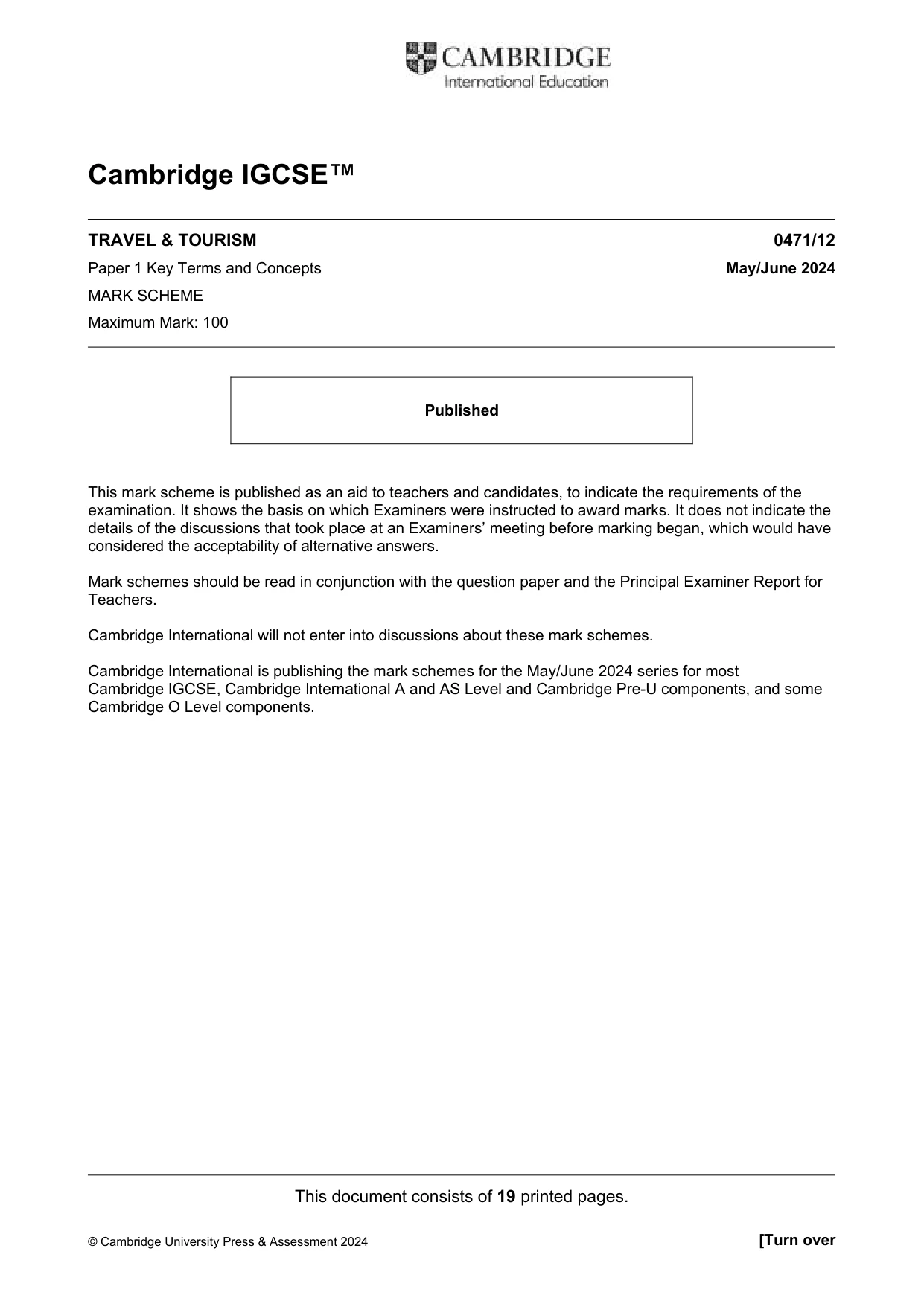
9 0471/12/M/J/24 © UCLES 2024 (d) Explain three reasons for the appeal of sightseeing tourist buses. 1 … … … … 2 … … … … 3 … … … … [6] (e) Assess the importance of destinations having sustainable public transport. … … … … … … … … … … … … [6] [Total: 20]
Question paper, page 10
10 0471/12/M/J/24 © UCLES 2024 BLANK PAGE
Question paper, page 11
11 0471/12/M/J/24 © UCLES 2024 BLANK PAGE
Question paper, page 12
12 0471/12/M/J/24 © UCLES 2024 The boundaries and names shown, the designations used and the presentation of material on any maps contained in this question paper/insert do not imply official endorsement or acceptance by Cambridge Assessment International Education concerning the legal status of any country, territory, or area or any of its authorities, or of the delimitation of its frontiers or boundaries. Permission to reproduce items where third-party owned material protected by copyright is included has been sought and cleared where possible. Every reasonable effort has been made by the publisher (UCLES) to trace copyright holders, but if any items requiring clearance have unwittingly been included, the publisher will be pleased to make amends at the earliest possible opportunity. To avoid the issue of disclosure of answer-related information to candidates, all copyright acknowledgements are reproduced online in the Cambridge Assessment International Education Copyright Acknowledgements Booklet. This is produced for each series of examinations and is freely available to download at www.cambridgeinternational.org after the live examination series. Cambridge Assessment International Education is part of Cambridge Assessment. Cambridge Assessment is the brand name of the University of Cambridge Local Examinations Syndicate (UCLES), which is a department of the University of Cambridge. BLANK PAGE
Mark scheme, page 1
This document consists of 19 printed pages. © Cambridge University Press & Assessment 2024 [Turn over Cambridge IGCSE™ TRAVEL & TOURISM 0471/12 Paper 1 Key Terms and Concepts May/June 2024 MARK SCHEME Maximum Mark: 100 Published This mark scheme is published as an aid to teachers and candidates, to indicate the requirements of the examination. It shows the basis on which Examiners were instructed to award marks. It does not indicate the details of the discussions that took place at an Examiners’ meeting before marking began, which would have considered the acceptability of alternative answers. Mark schemes should be read in conjunction with the question paper and the Principal Examiner Report for Teachers. Cambridge International will not enter into discussions about these mark schemes. Cambridge International is publishing the mark schemes for the May/June 2024 series for most Cambridge IGCSE, Cambridge International A and AS Level and Cambridge Pre-U components, and some Cambridge O Level components.
Mark scheme, page 2
0471/12 Cambridge IGCSE – Mark Scheme PUBLISHED May/June 2024 © Cambridge University Press & Assessment 2024 Page 2 of 19 Generic Marking Principles These general marking principles must be applied by all examiners when marking candidate answers. They should be applied alongside the specific content of the mark scheme or generic level descriptions for a question. Each question paper and mark scheme will also comply with these marking principles. GENERIC MARKING PRINCIPLE 1: Marks must be awarded in line with: the specific content of the mark scheme or the generic level descriptors for the question the specific skills defined in the mark scheme or in the generic level descriptors for the question the standard of response required by a candidate as exemplified by the standardisation scripts. GENERIC MARKING PRINCIPLE 2: Marks awarded are always whole marks (not half marks, or other fractions). GENERIC MARKING PRINCIPLE 3: Marks must be awarded positively: marks are awarded for correct/valid answers, as defined in the mark scheme. However, credit is given for valid answers which go beyond the scope of the syllabus and mark scheme, referring to your Team Leader as appropriate marks are awarded when candidates clearly demonstrate what they know and can do marks are not deducted for errors marks are not deducted for omissions answers should only be judged on the quality of spelling, punctuation and grammar when these features are specifically assessed by the question as indicated by the mark scheme. The meaning, however, should be unambiguous. GENERIC MARKING PRINCIPLE 4: Rules must be applied consistently, e.g. in situations where candidates have not followed instructions or in the application of generic level descriptors. GENERIC MARKING PRINCIPLE 5: Marks should be awarded using the full range of marks defined in the mark scheme for the question (however; the use of the full mark range may be limited according to the quality of the candidate responses seen). GENERIC MARKING PRINCIPLE 6: Marks awarded are based solely on the requirements as defined in the mark scheme. Marks should not be awarded with grade thresholds or grade descriptors in mind.
Mark scheme, page 3
0471/12 Cambridge IGCSE – Mark Scheme PUBLISHED May/June 2024 © Cambridge University Press & Assessment 2024 Page 3 of 19 Social Science-Specific Marking Principles (for point-based marking) 1 Components using point-based marking: Point marking is often used to reward knowledge, understanding and application of skills. We give credit where the candidate’s answer shows relevant knowledge, understanding and application of skills in answering the question. We do not give credit where the answer shows confusion. From this it follows that we: a DO credit answers which are worded differently from the mark scheme if they clearly convey the same meaning (unless the mark scheme requires a specific term) b DO credit alternative answers/examples which are not written in the mark scheme if they are correct c DO credit answers where candidates give more than one correct answer in one prompt/numbered/scaffolded space where extended writing is required rather than list-type answers. For example, questions that require n reasons (e.g. State two reasons …). d DO NOT credit answers simply for using a ‘key term’ unless that is all that is required. (Check for evidence it is understood and not used wrongly.) e DO NOT credit answers which are obviously self-contradicting or trying to cover all possibilities f DO NOT give further credit for what is effectively repetition of a correct point already credited unless the language itself is being tested. This applies equally to ‘mirror statements’ (i.e. polluted/not polluted). g DO NOT require spellings to be correct, unless this is part of the test. However spellings of syllabus terms must allow for clear and unambiguous separation from other syllabus terms with which they may be confused (e.g. Corrasion/Corrosion). 2 Presentation of mark scheme: Slashes (/) or the word ‘or’ separate alternative ways of making the same point. Semi colons (;) bullet points (•) or figures in brackets (1) separate different points. Content in the answer column in brackets is for examiner information/context to clarify the marking but is not required to earn the mark (except Accounting syllabuses where they indicate negative numbers). 3 Calculation questions: The mark scheme will show the steps in the most likely correct method(s), the mark for each step, the correct answer(s) and the mark for each answer. If working/explanation is considered essential for full credit, this will be indicated in the question paper and in the mark scheme. In all other instances, the correct answer to a calculation should be given full credit, even if no supporting working is shown. Where the candidate uses a valid method which is not covered by the mark scheme, award equivalent marks for reaching equivalent stages. Where an answer makes use of a candidate’s own incorrect figure from previous working, the ‘own figure rule’ applies: full marks will be given if a correct and complete method is used. Further guidance will be included in the mark scheme where necessary and any exceptions to this general principle will be noted.
Mark scheme, page 4
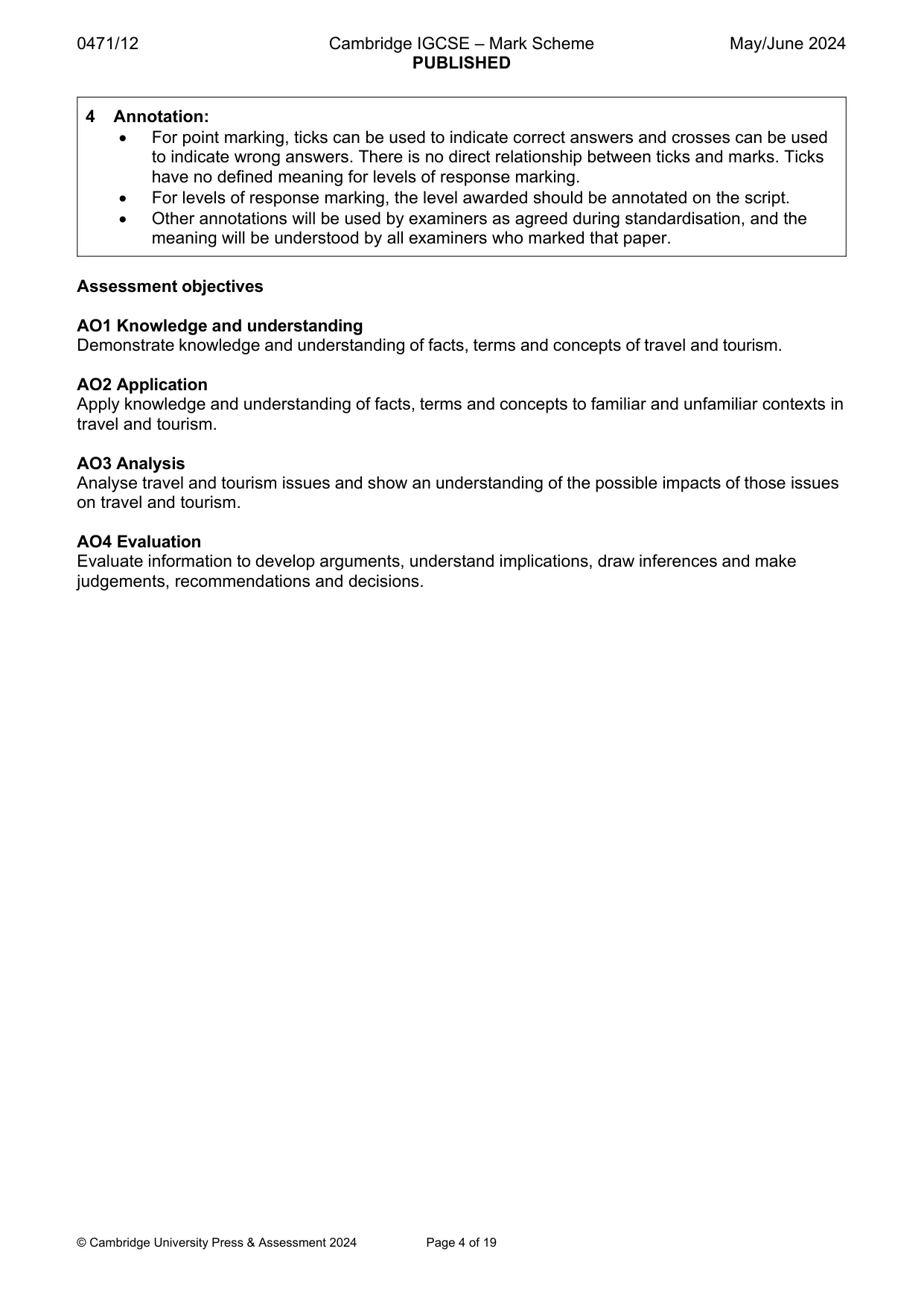
0471/12 Cambridge IGCSE – Mark Scheme PUBLISHED May/June 2024 © Cambridge University Press & Assessment 2024 Page 4 of 19 4 Annotation: For point marking, ticks can be used to indicate correct answers and crosses can be used to indicate wrong answers. There is no direct relationship between ticks and marks. Ticks have no defined meaning for levels of response marking. For levels of response marking, the level awarded should be annotated on the script. Other annotations will be used by examiners as agreed during standardisation, and the meaning will be understood by all examiners who marked that paper. Assessment objectives AO1 Knowledge and understanding Demonstrate knowledge and understanding of facts, terms and concepts of travel and tourism. AO2 Application Apply knowledge and understanding of facts, terms and concepts to familiar and unfamiliar contexts in travel and tourism. AO3 Analysis Analyse travel and tourism issues and show an understanding of the possible impacts of those issues on travel and tourism. AO4 Evaluation Evaluate information to develop arguments, understand implications, draw inferences and make judgements, recommendations and decisions.
Mark scheme, page 5
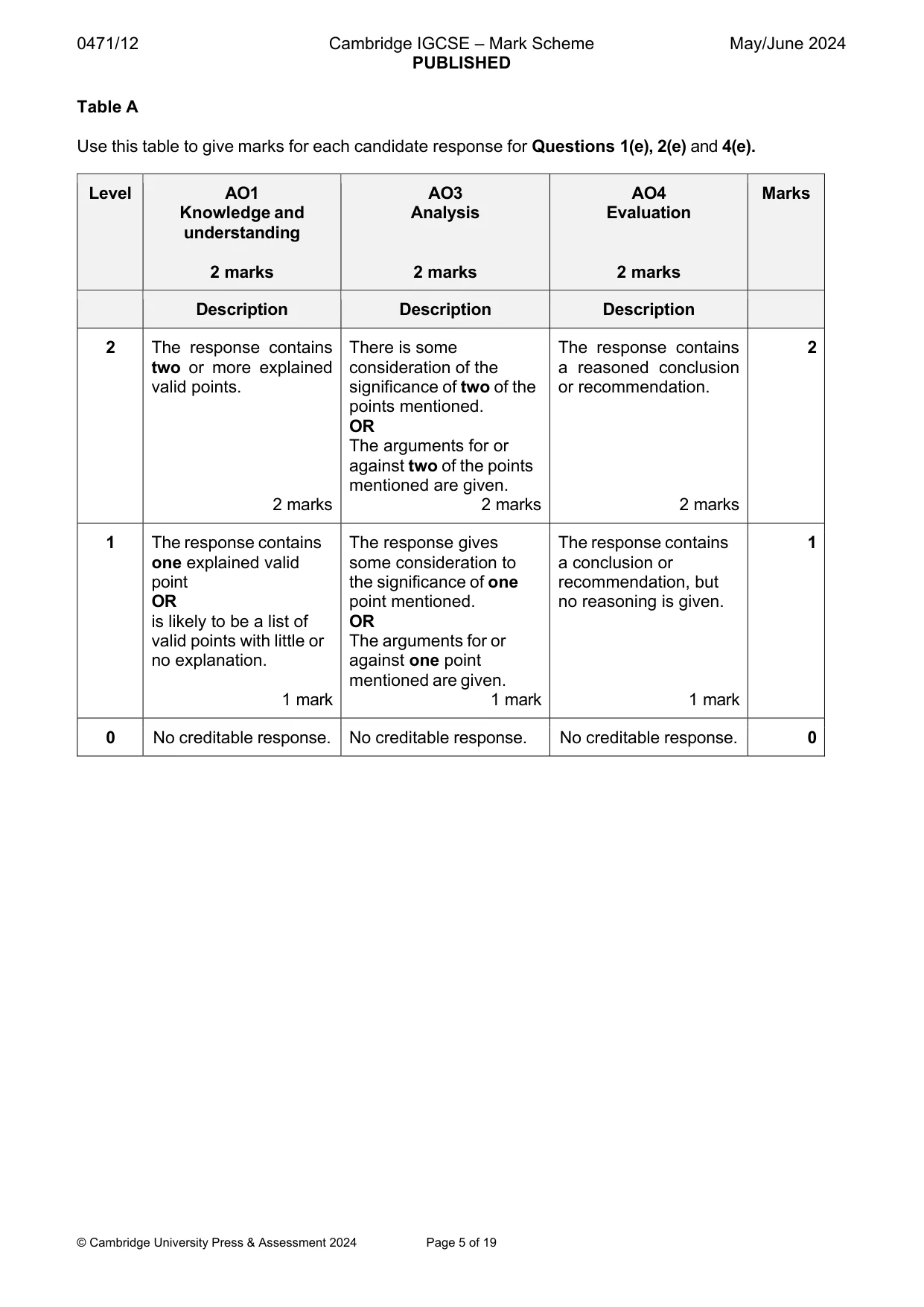
0471/12 Cambridge IGCSE – Mark Scheme PUBLISHED May/June 2024 © Cambridge University Press & Assessment 2024 Page 5 of 19 Table A Use this table to give marks for each candidate response for Questions 1(e), 2(e) and 4(e). Level AO1 Knowledge and understanding 2 marks AO3 Analysis 2 marks AO4 Evaluation 2 marks Marks Description Description Description 2 The response contains two or more explained valid points. 2 marks There is some consideration of the significance of two of the points mentioned. OR The arguments for or against two of the points mentioned are given. 2 marks The response contains a reasoned conclusion or recommendation. 2 marks 2 1 The response contains one explained valid point OR is likely to be a list of valid points with little or no explanation. 1 mark The response gives some consideration to the significance of one point mentioned. OR The arguments for or against one point mentioned are given. 1 mark The response contains a conclusion or recommendation, but no reasoning is given. 1 mark 1 0 No creditable response. No creditable response. No creditable response. 0
Mark scheme, page 6
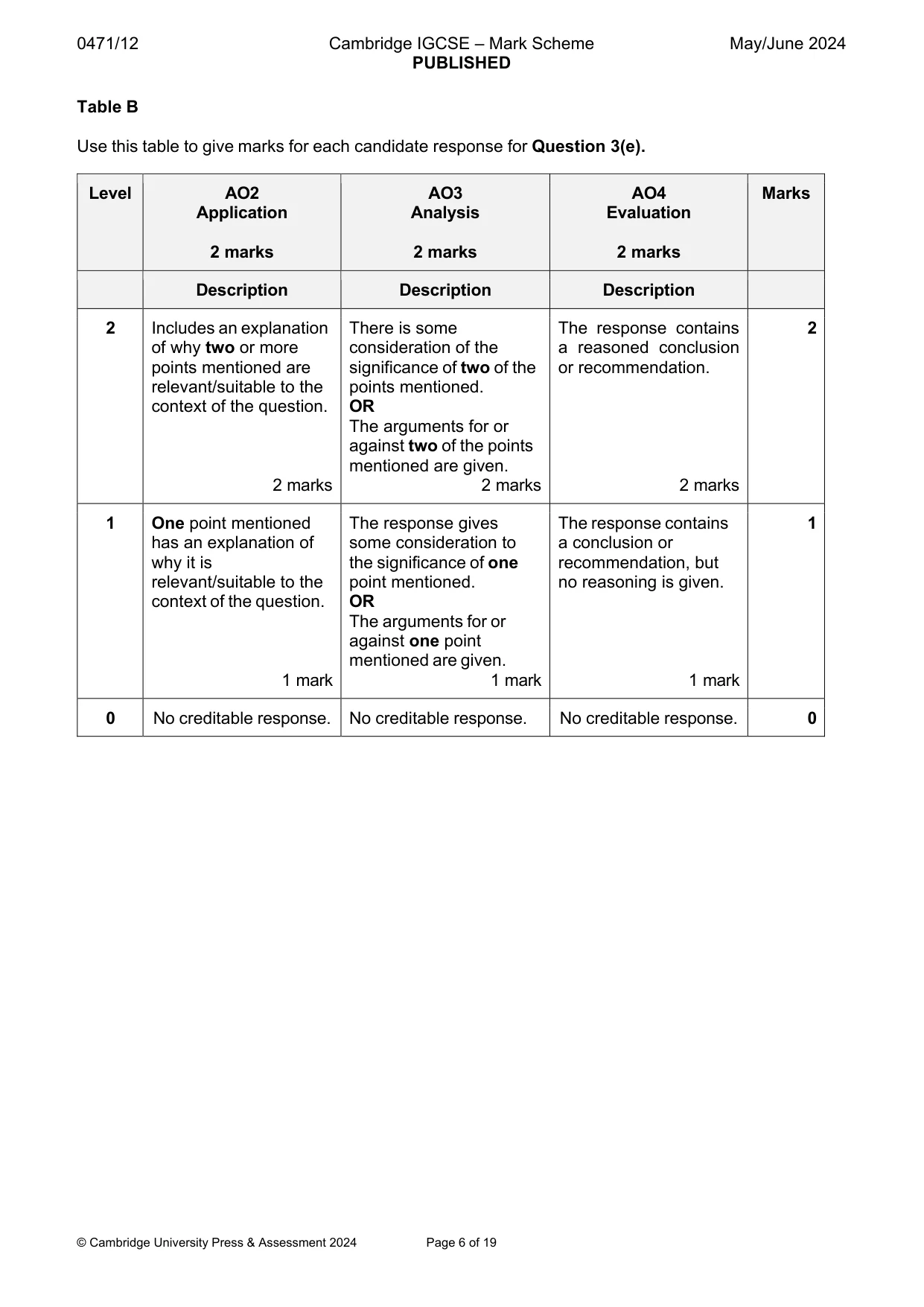
0471/12 Cambridge IGCSE – Mark Scheme PUBLISHED May/June 2024 © Cambridge University Press & Assessment 2024 Page 6 of 19 Table B Use this table to give marks for each candidate response for Question 3(e). Level AO2 Application 2 marks AO3 Analysis 2 marks AO4 Evaluation 2 marks Marks Description Description Description 2 Includes an explanation of why two or more points mentioned are relevant/suitable to the context of the question. 2 marks There is some consideration of the significance of two of the points mentioned. OR The arguments for or against two of the points mentioned are given. 2 marks The response contains a reasoned conclusion or recommendation. 2 marks 2 1 One point mentioned has an explanation of why it is relevant/suitable to the context of the question. 1 mark The response gives some consideration to the significance of one point mentioned. OR The arguments for or against one point mentioned are given. 1 mark The response contains a conclusion or recommendation, but no reasoning is given. 1 mark 1 0 No creditable response. No creditable response. No creditable response. 0
Mark scheme, page 7
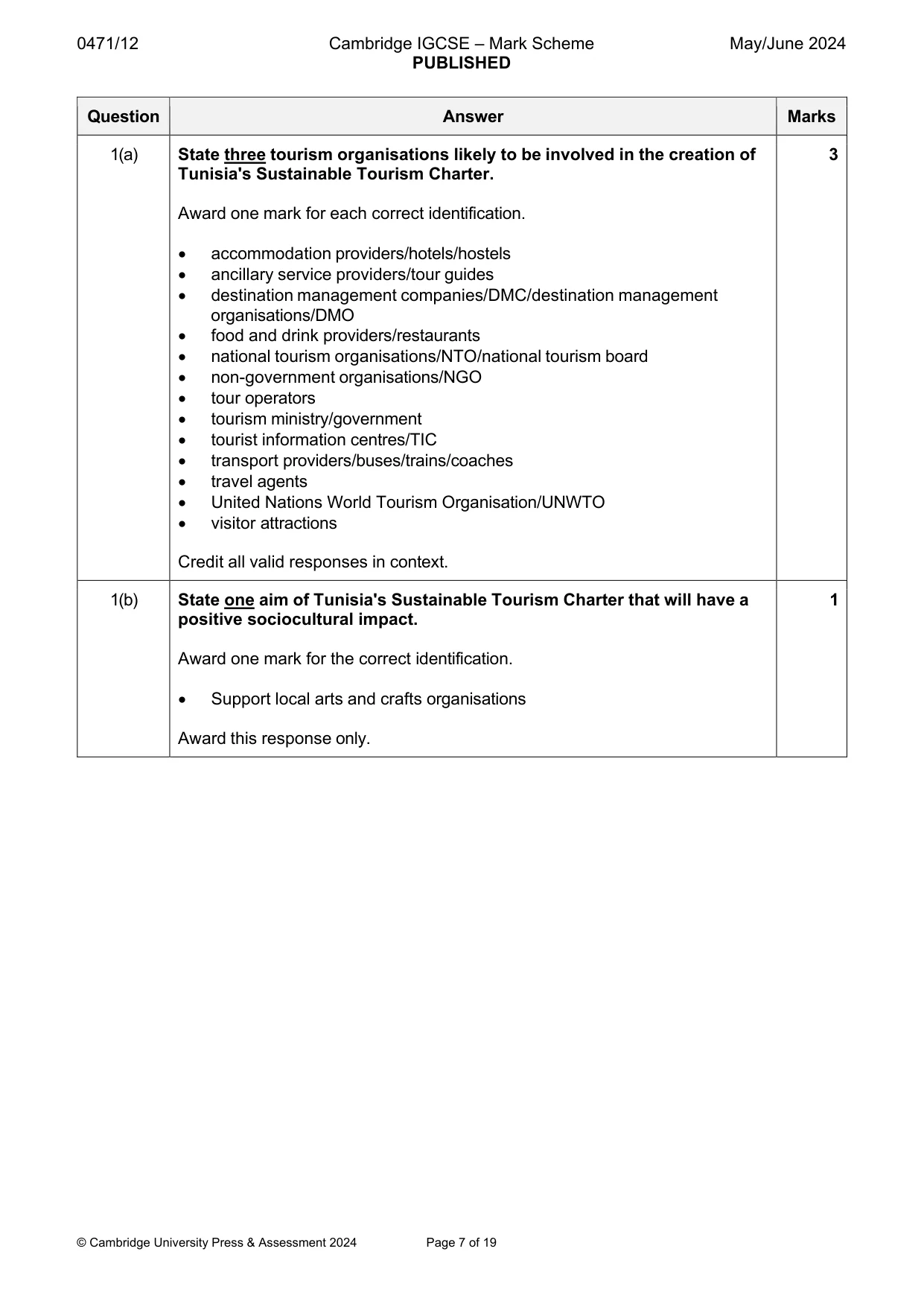
0471/12 Cambridge IGCSE – Mark Scheme PUBLISHED May/June 2024 © Cambridge University Press & Assessment 2024 Page 7 of 19 Question Answer Marks 1(a) State three tourism organisations likely to be involved in the creation of Tunisia's Sustainable Tourism Charter. Award one mark for each correct identification. accommodation providers/hotels/hostels ancillary service providers/tour guides destination management companies/DMC/destination management organisations/DMO food and drink providers/restaurants national tourism organisations/NTO/national tourism board non-government organisations/NGO tour operators tourism ministry/government tourist information centres/TIC transport providers/buses/trains/coaches travel agents United Nations World Tourism Organisation/UNWTO visitor attractions Credit all valid responses in context. 3 1(b) State one aim of Tunisia's Sustainable Tourism Charter that will have a positive sociocultural impact. Award one mark for the correct identification. Support local arts and crafts organisations Award this response only. 1
Mark scheme, page 8
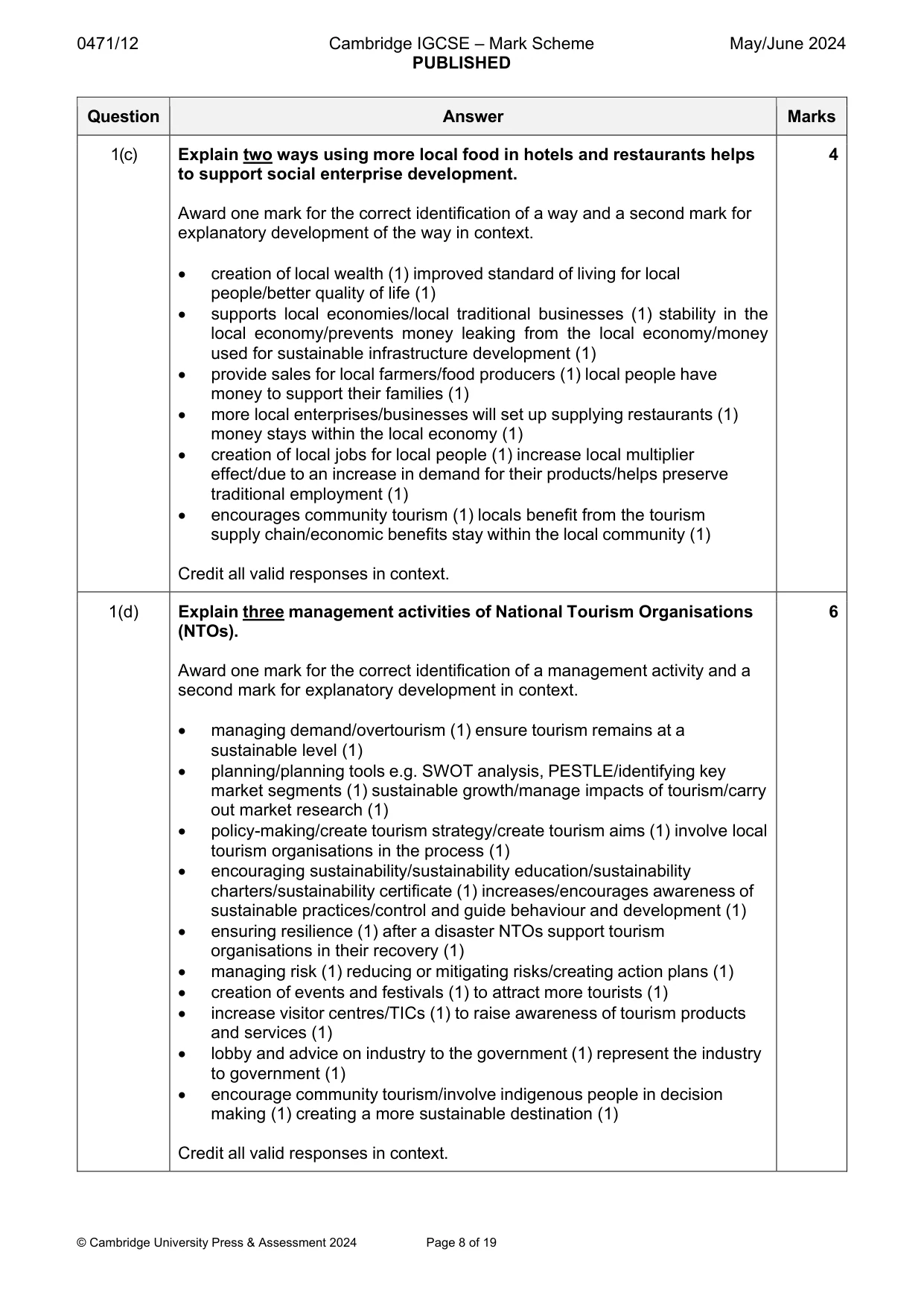
0471/12 Cambridge IGCSE – Mark Scheme PUBLISHED May/June 2024 © Cambridge University Press & Assessment 2024 Page 8 of 19 Question Answer Marks 1(c) Explain two ways using more local food in hotels and restaurants helps to support social enterprise development. Award one mark for the correct identification of a way and a second mark for explanatory development of the way in context. creation of local wealth (1) improved standard of living for local people/better quality of life (1) supports local economies/local traditional businesses (1) stability in the local economy/prevents money leaking from the local economy/money used for sustainable infrastructure development (1) provide sales for local farmers/food producers (1) local people have money to support their families (1) more local enterprises/businesses will set up supplying restaurants (1) money stays within the local economy (1) creation of local jobs for local people (1) increase local multiplier effect/due to an increase in demand for their products/helps preserve traditional employment (1) encourages community tourism (1) locals benefit from the tourism supply chain/economic benefits stay within the local community (1) Credit all valid responses in context. 4 1(d) Explain three management activities of National Tourism Organisations (NTOs). Award one mark for the correct identification of a management activity and a second mark for explanatory development in context. managing demand/overtourism (1) ensure tourism remains at a sustainable level (1) planning/planning tools e.g. SWOT analysis, PESTLE/identifying key market segments (1) sustainable growth/manage impacts of tourism/carry out market research (1) policy-making/create tourism strategy/create tourism aims (1) involve local tourism organisations in the process (1) encouraging sustainability/sustainability education/sustainability charters/sustainability certificate (1) increases/encourages awareness of sustainable practices/control and guide behaviour and development (1) ensuring resilience (1) after a disaster NTOs support tourism organisations in their recovery (1) managing risk (1) reducing or mitigating risks/creating action plans (1) creation of events and festivals (1) to attract more tourists (1) increase visitor centres/TICs (1) to raise awareness of tourism products and services (1) lobby and advice on industry to the government (1) represent the industry to government (1) encourage community tourism/involve indigenous people in decision making (1) creating a more sustainable destination (1) Credit all valid responses in context. 6
Mark scheme, page 9
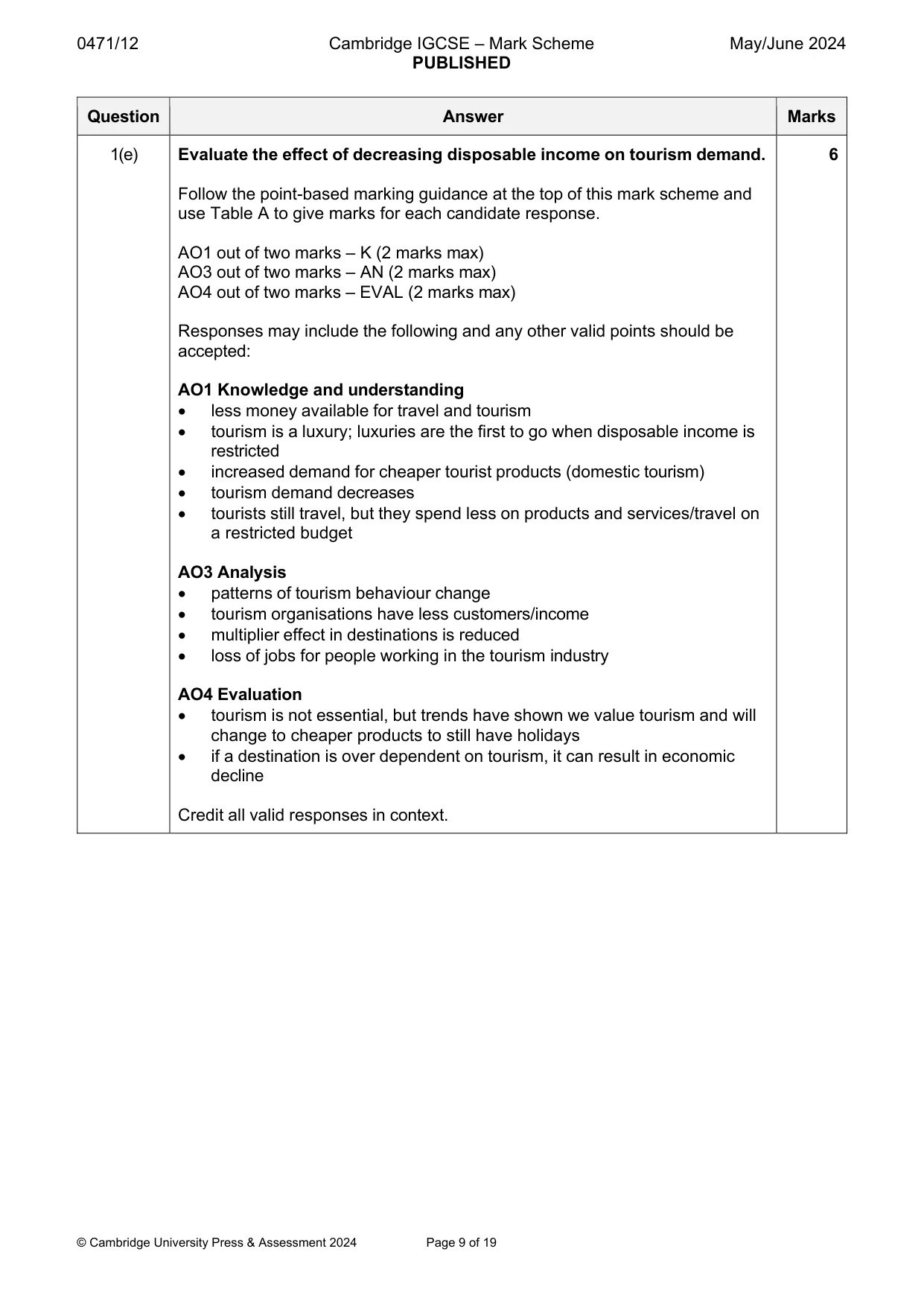
0471/12 Cambridge IGCSE – Mark Scheme PUBLISHED May/June 2024 © Cambridge University Press & Assessment 2024 Page 9 of 19 Question Answer Marks 1(e) Evaluate the effect of decreasing disposable income on tourism demand. Follow the point-based marking guidance at the top of this mark scheme and use Table A to give marks for each candidate response. AO1 out of two marks – K (2 marks max) AO3 out of two marks – AN (2 marks max) AO4 out of two marks – EVAL (2 marks max) Responses may include the following and any other valid points should be accepted: AO1 Knowledge and understanding less money available for travel and tourism tourism is a luxury; luxuries are the first to go when disposable income is restricted increased demand for cheaper tourist products (domestic tourism) tourism demand decreases tourists still travel, but they spend less on products and services/travel on a restricted budget AO3 Analysis patterns of tourism behaviour change tourism organisations have less customers/income multiplier effect in destinations is reduced loss of jobs for people working in the tourism industry AO4 Evaluation tourism is not essential, but trends have shown we value tourism and will change to cheaper products to still have holidays if a destination is over dependent on tourism, it can result in economic decline Credit all valid responses in context. 6
Mark scheme, page 10
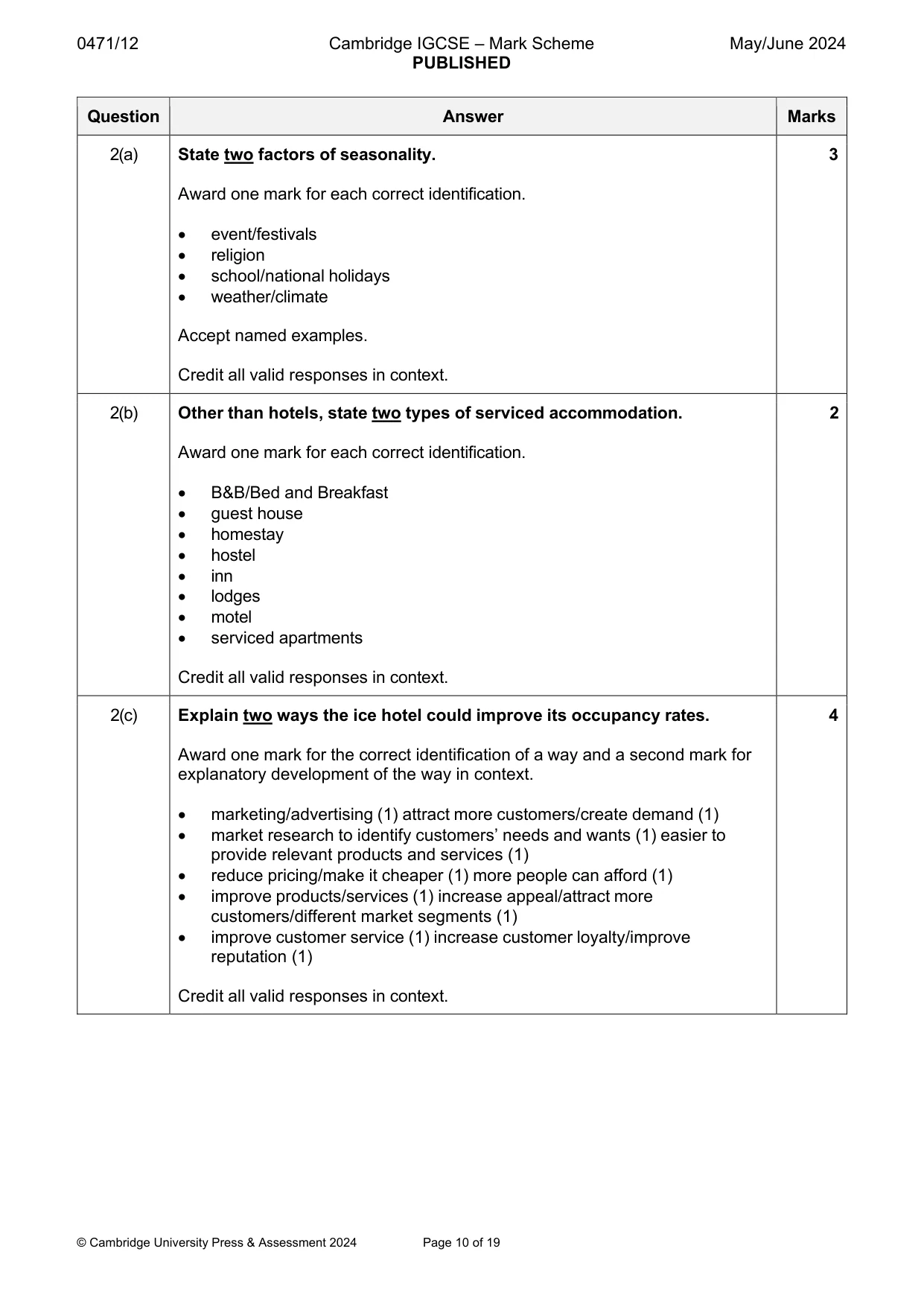
0471/12 Cambridge IGCSE – Mark Scheme PUBLISHED May/June 2024 © Cambridge University Press & Assessment 2024 Page 10 of 19 Question Answer Marks 2(a) State two factors of seasonality. Award one mark for each correct identification. event/festivals religion school/national holidays weather/climate Accept named examples. Credit all valid responses in context. 3 2(b) Other than hotels, state two types of serviced accommodation. Award one mark for each correct identification. B&B/Bed and Breakfast guest house homestay hostel inn lodges motel serviced apartments Credit all valid responses in context. 2 2(c) Explain two ways the ice hotel could improve its occupancy rates. Award one mark for the correct identification of a way and a second mark for explanatory development of the way in context. marketing/advertising (1) attract more customers/create demand (1) market research to identify customers’ needs and wants (1) easier to provide relevant products and services (1) reduce pricing/make it cheaper (1) more people can afford (1) improve products/services (1) increase appeal/attract more customers/different market segments (1) improve customer service (1) increase customer loyalty/improve reputation (1) Credit all valid responses in context. 4
Mark scheme, page 11
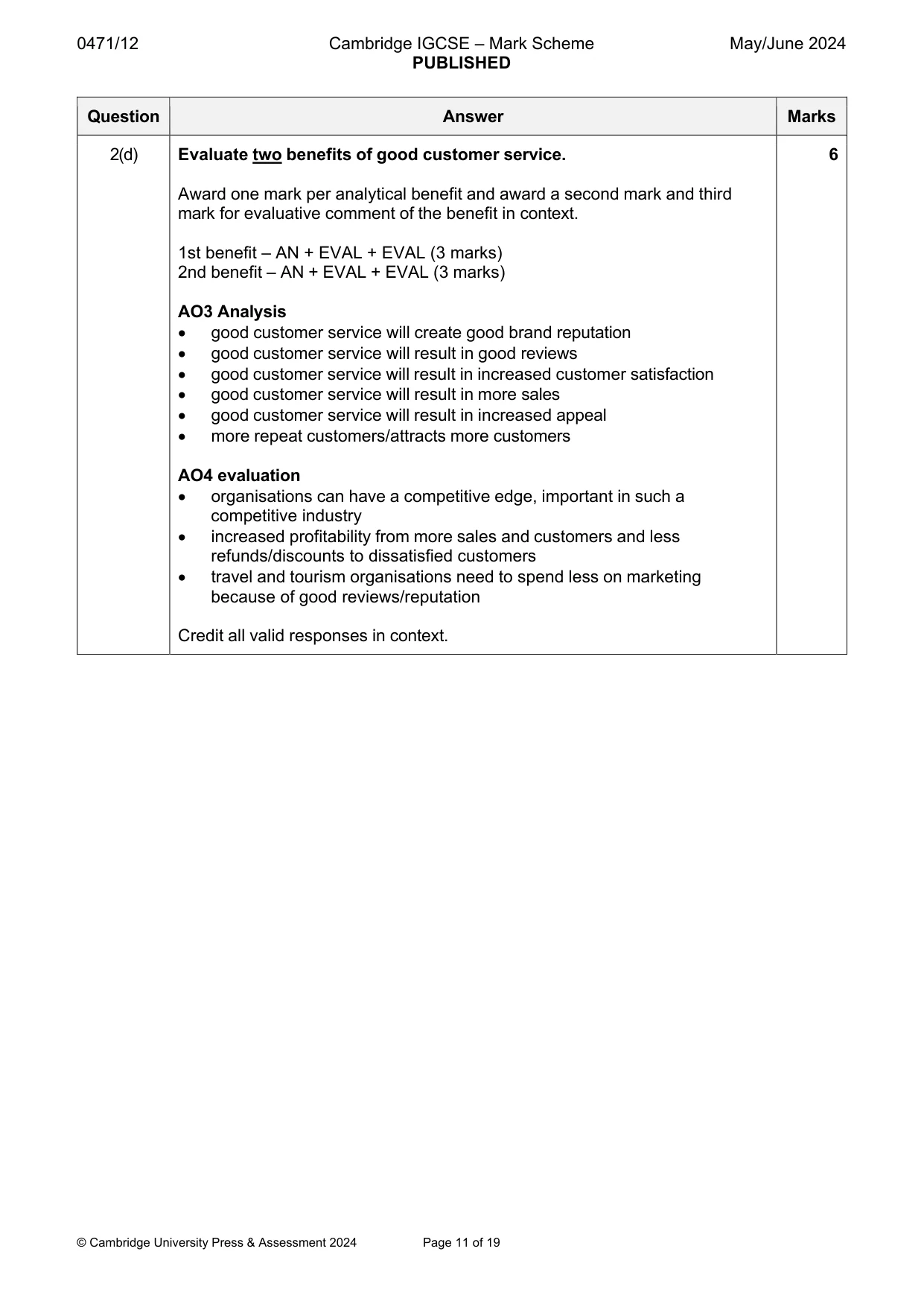
0471/12 Cambridge IGCSE – Mark Scheme PUBLISHED May/June 2024 © Cambridge University Press & Assessment 2024 Page 11 of 19 Question Answer Marks 2(d) Evaluate two benefits of good customer service. Award one mark per analytical benefit and award a second mark and third mark for evaluative comment of the benefit in context. 1st benefit – AN + EVAL + EVAL (3 marks) 2nd benefit – AN + EVAL + EVAL (3 marks) AO3 Analysis good customer service will create good brand reputation good customer service will result in good reviews good customer service will result in increased customer satisfaction good customer service will result in more sales good customer service will result in increased appeal more repeat customers/attracts more customers AO4 evaluation organisations can have a competitive edge, important in such a competitive industry increased profitability from more sales and customers and less refunds/discounts to dissatisfied customers travel and tourism organisations need to spend less on marketing because of good reviews/reputation Credit all valid responses in context. 6
Mark scheme, page 12
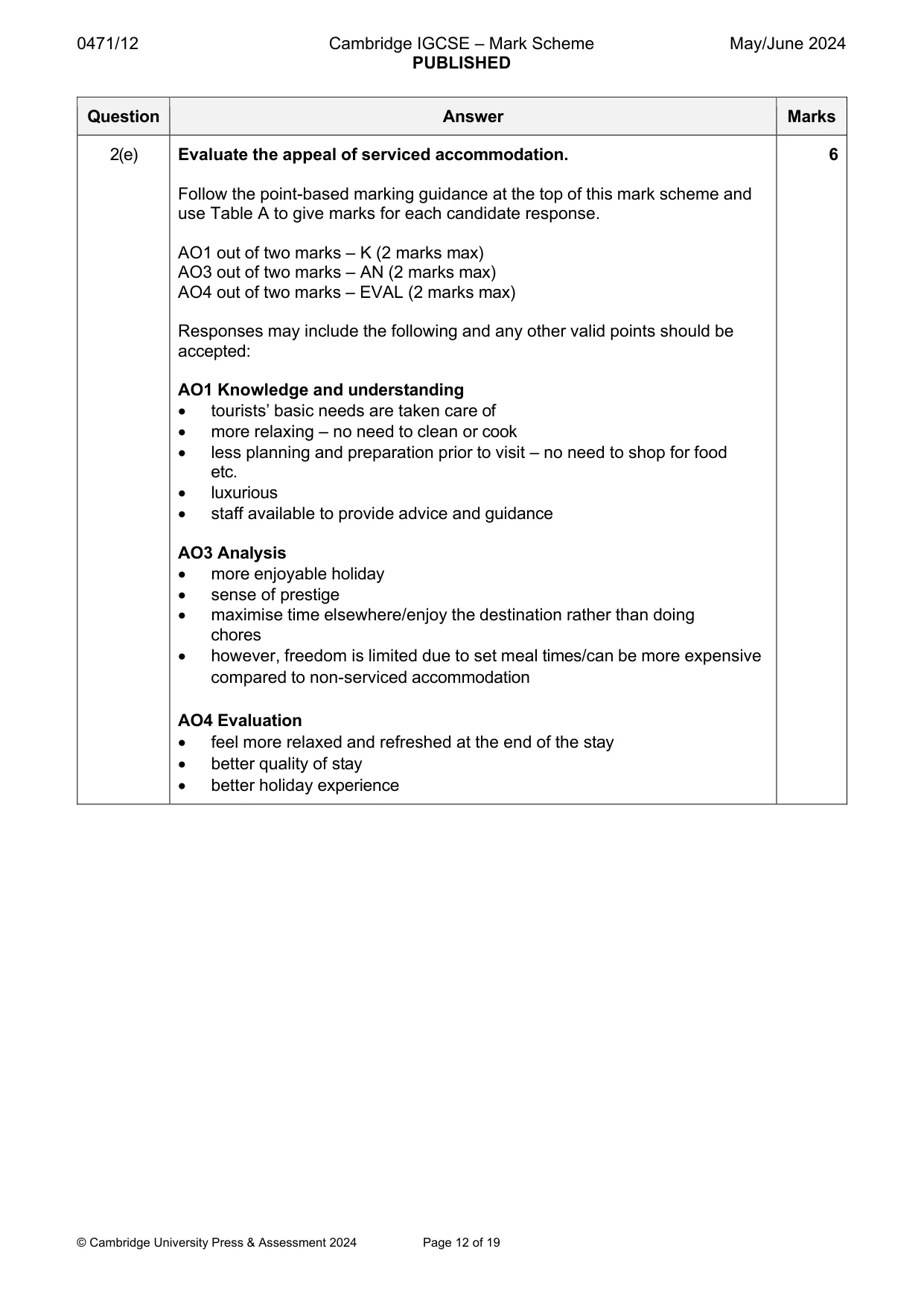
0471/12 Cambridge IGCSE – Mark Scheme PUBLISHED May/June 2024 © Cambridge University Press & Assessment 2024 Page 12 of 19 Question Answer Marks 2(e) Evaluate the appeal of serviced accommodation. Follow the point-based marking guidance at the top of this mark scheme and use Table A to give marks for each candidate response. AO1 out of two marks – K (2 marks max) AO3 out of two marks – AN (2 marks max) AO4 out of two marks – EVAL (2 marks max) Responses may include the following and any other valid points should be accepted: AO1 Knowledge and understanding tourists’ basic needs are taken care of more relaxing – no need to clean or cook less planning and preparation prior to visit – no need to shop for food etc. luxurious staff available to provide advice and guidance AO3 Analysis more enjoyable holiday sense of prestige maximise time elsewhere/enjoy the destination rather than doing chores however, freedom is limited due to set meal times/can be more expensive compared to non-serviced accommodation AO4 Evaluation feel more relaxed and refreshed at the end of the stay better quality of stay better holiday experience 6
Mark scheme, page 13
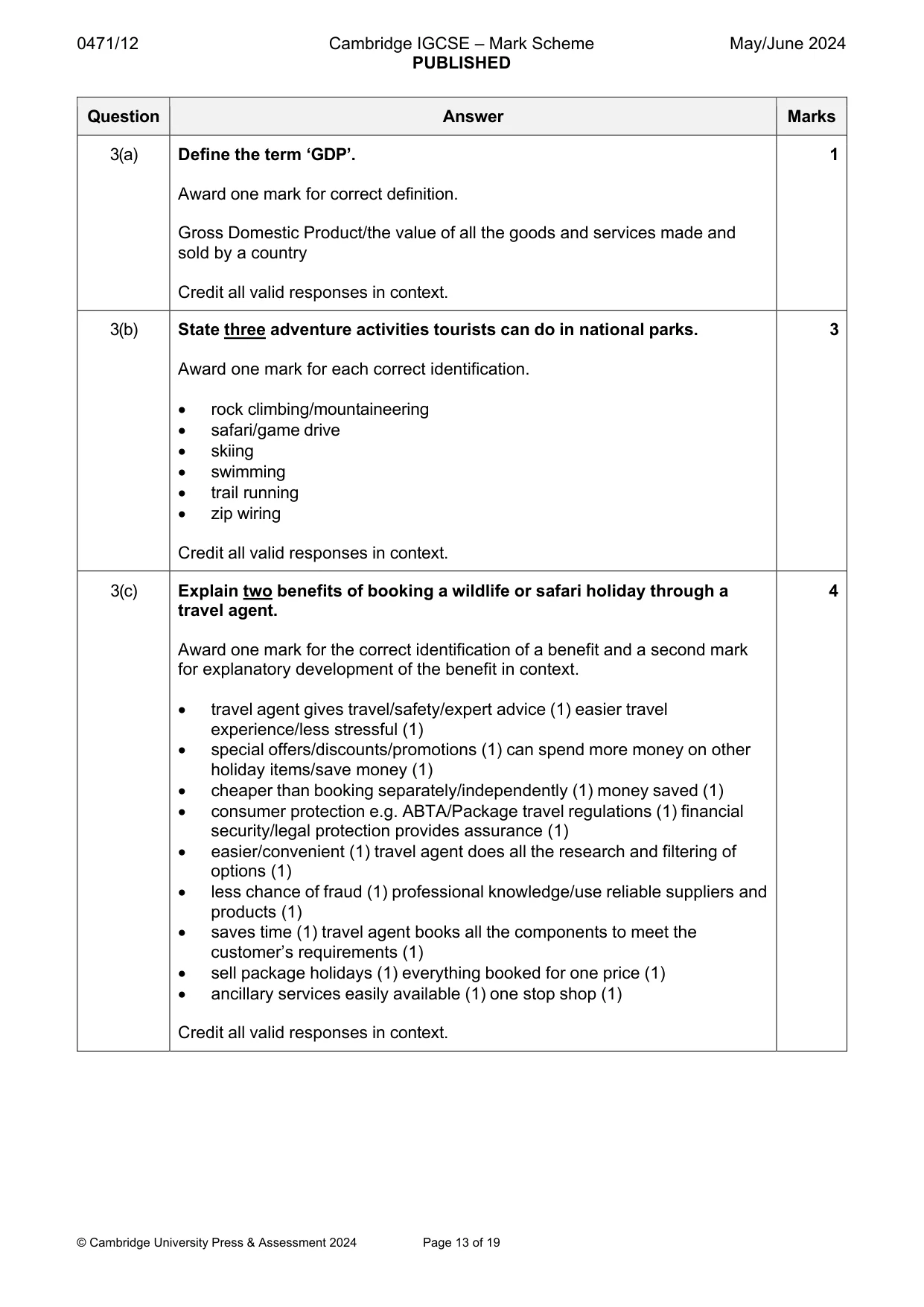
0471/12 Cambridge IGCSE – Mark Scheme PUBLISHED May/June 2024 © Cambridge University Press & Assessment 2024 Page 13 of 19 Question Answer Marks 3(a) Define the term ‘GDP’. Award one mark for correct definition. Gross Domestic Product/the value of all the goods and services made and sold by a country Credit all valid responses in context. 1 3(b) State three adventure activities tourists can do in national parks. Award one mark for each correct identification. rock climbing/mountaineering safari/game drive skiing swimming trail running zip wiring Credit all valid responses in context. 3 3(c) Explain two benefits of booking a wildlife or safari holiday through a travel agent. Award one mark for the correct identification of a benefit and a second mark for explanatory development of the benefit in context. travel agent gives travel/safety/expert advice (1) easier travel experience/less stressful (1) special offers/discounts/promotions (1) can spend more money on other holiday items/save money (1) cheaper than booking separately/independently (1) money saved (1) consumer protection e.g. ABTA/Package travel regulations (1) financial security/legal protection provides assurance (1) easier/convenient (1) travel agent does all the research and filtering of options (1) less chance of fraud (1) professional knowledge/use reliable suppliers and products (1) saves time (1) travel agent books all the components to meet the customer’s requirements (1) sell package holidays (1) everything booked for one price (1) ancillary services easily available (1) one stop shop (1) Credit all valid responses in context. 4
Mark scheme, page 14
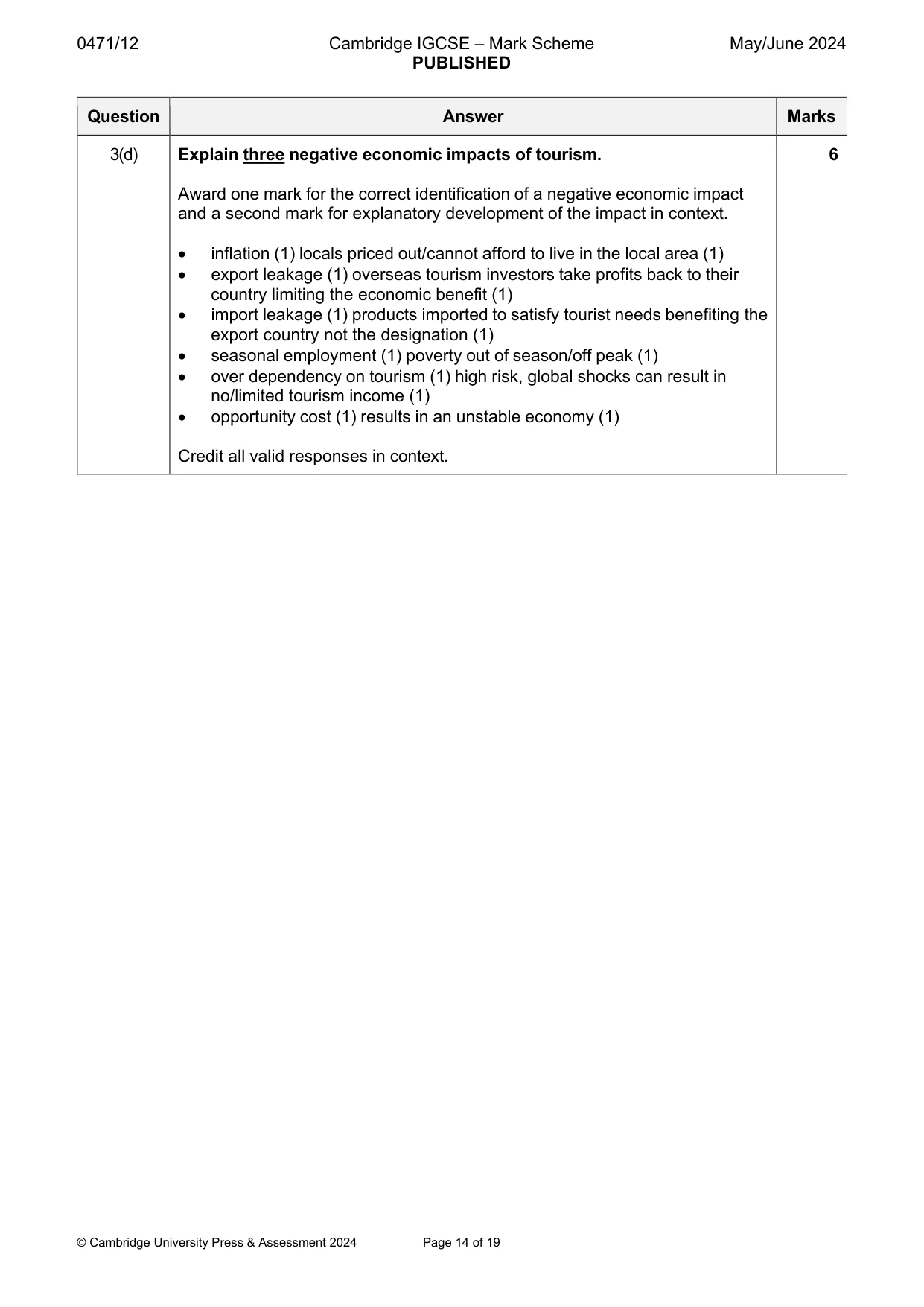
0471/12 Cambridge IGCSE – Mark Scheme PUBLISHED May/June 2024 © Cambridge University Press & Assessment 2024 Page 14 of 19 Question Answer Marks 3(d) Explain three negative economic impacts of tourism. Award one mark for the correct identification of a negative economic impact and a second mark for explanatory development of the impact in context. inflation (1) locals priced out/cannot afford to live in the local area (1) export leakage (1) overseas tourism investors take profits back to their country limiting the economic benefit (1) import leakage (1) products imported to satisfy tourist needs benefiting the export country not the designation (1) seasonal employment (1) poverty out of season/off peak (1) over dependency on tourism (1) high risk, global shocks can result in no/limited tourism income (1) opportunity cost (1) results in an unstable economy (1) Credit all valid responses in context. 6
Mark scheme, page 15
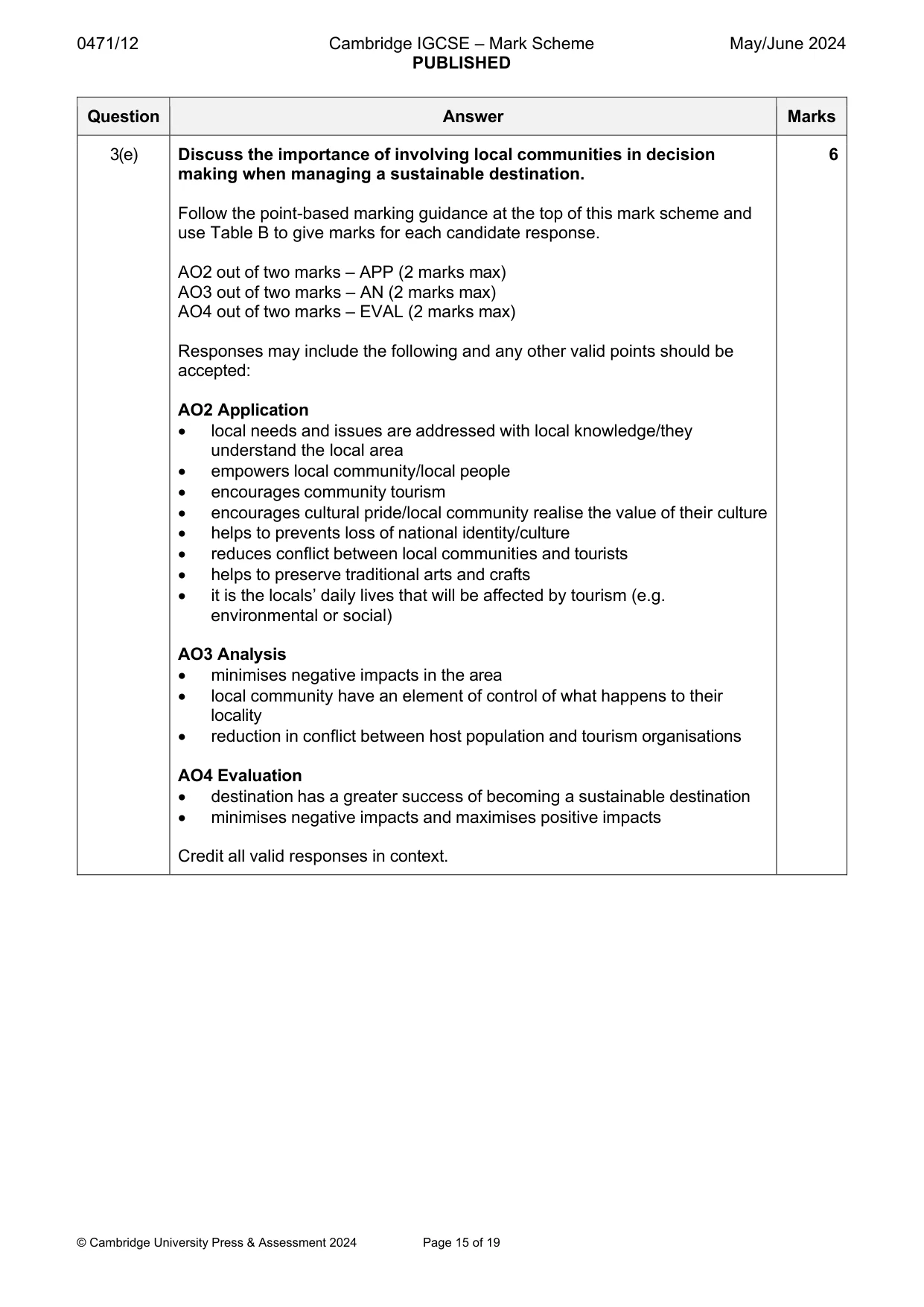
0471/12 Cambridge IGCSE – Mark Scheme PUBLISHED May/June 2024 © Cambridge University Press & Assessment 2024 Page 15 of 19 Question Answer Marks 3(e) Discuss the importance of involving local communities in decision making when managing a sustainable destination. Follow the point-based marking guidance at the top of this mark scheme and use Table B to give marks for each candidate response. AO2 out of two marks – APP (2 marks max) AO3 out of two marks – AN (2 marks max) AO4 out of two marks – EVAL (2 marks max) Responses may include the following and any other valid points should be accepted: AO2 Application local needs and issues are addressed with local knowledge/they understand the local area empowers local community/local people encourages community tourism encourages cultural pride/local community realise the value of their culture helps to prevents loss of national identity/culture reduces conflict between local communities and tourists helps to preserve traditional arts and crafts it is the locals’ daily lives that will be affected by tourism (e.g. environmental or social) AO3 Analysis minimises negative impacts in the area local community have an element of control of what happens to their locality reduction in conflict between host population and tourism organisations AO4 Evaluation destination has a greater success of becoming a sustainable destination minimises negative impacts and maximises positive impacts Credit all valid responses in context. 6
Mark scheme, page 16
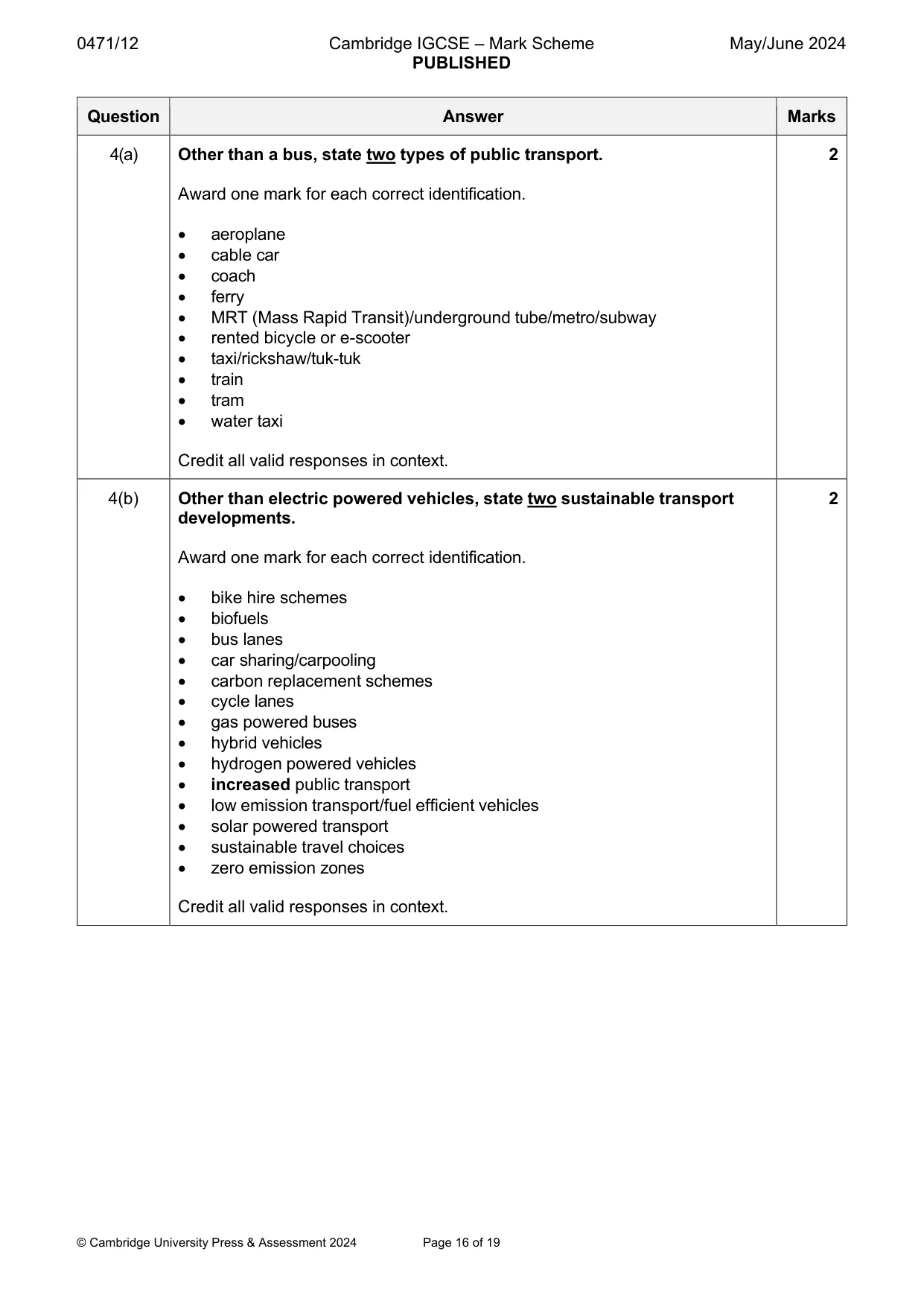
0471/12 Cambridge IGCSE – Mark Scheme PUBLISHED May/June 2024 © Cambridge University Press & Assessment 2024 Page 16 of 19 Question Answer Marks 4(a) Other than a bus, state two types of public transport. Award one mark for each correct identification. aeroplane cable car coach ferry MRT (Mass Rapid Transit)/underground tube/metro/subway rented bicycle or e-scooter taxi/rickshaw/tuk-tuk train tram water taxi Credit all valid responses in context. 2 4(b) Other than electric powered vehicles, state two sustainable transport developments. Award one mark for each correct identification. bike hire schemes biofuels bus lanes car sharing/carpooling carbon replacement schemes cycle lanes gas powered buses hybrid vehicles hydrogen powered vehicles increased public transport low emission transport/fuel efficient vehicles solar powered transport sustainable travel choices zero emission zones Credit all valid responses in context. 2
Mark scheme, page 17
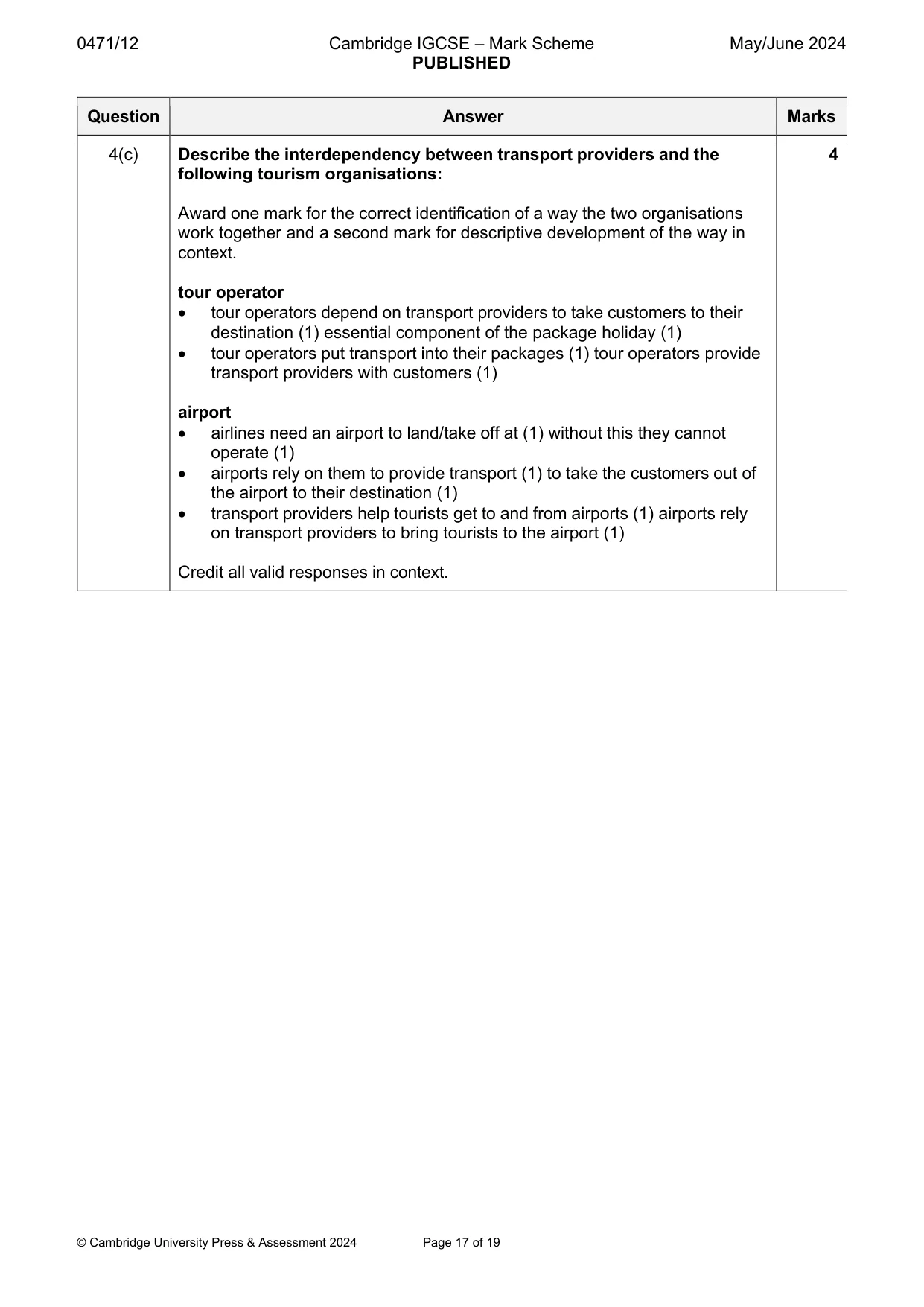
0471/12 Cambridge IGCSE – Mark Scheme PUBLISHED May/June 2024 © Cambridge University Press & Assessment 2024 Page 17 of 19 Question Answer Marks 4(c) Describe the interdependency between transport providers and the following tourism organisations: Award one mark for the correct identification of a way the two organisations work together and a second mark for descriptive development of the way in context. tour operator tour operators depend on transport providers to take customers to their destination (1) essential component of the package holiday (1) tour operators put transport into their packages (1) tour operators provide transport providers with customers (1) airport airlines need an airport to land/take off at (1) without this they cannot operate (1) airports rely on them to provide transport (1) to take the customers out of the airport to their destination (1) transport providers help tourists get to and from airports (1) airports rely on transport providers to bring tourists to the airport (1) Credit all valid responses in context. 4
Mark scheme, page 18
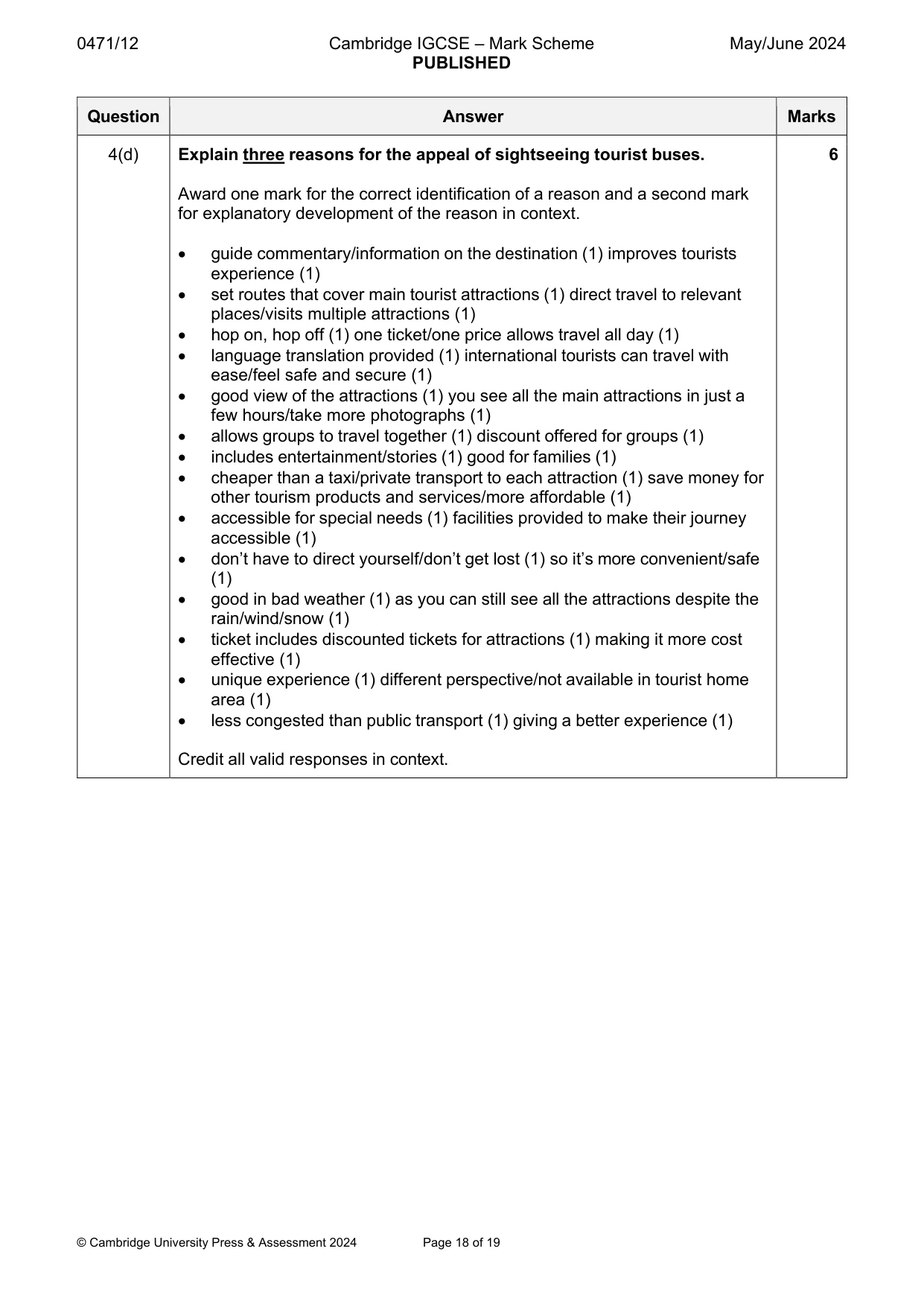
0471/12 Cambridge IGCSE – Mark Scheme PUBLISHED May/June 2024 © Cambridge University Press & Assessment 2024 Page 18 of 19 Question Answer Marks 4(d) Explain three reasons for the appeal of sightseeing tourist buses. Award one mark for the correct identification of a reason and a second mark for explanatory development of the reason in context. guide commentary/information on the destination (1) improves tourists experience (1) set routes that cover main tourist attractions (1) direct travel to relevant places/visits multiple attractions (1) hop on, hop off (1) one ticket/one price allows travel all day (1) language translation provided (1) international tourists can travel with ease/feel safe and secure (1) good view of the attractions (1) you see all the main attractions in just a few hours/take more photographs (1) allows groups to travel together (1) discount offered for groups (1) includes entertainment/stories (1) good for families (1) cheaper than a taxi/private transport to each attraction (1) save money for other tourism products and services/more affordable (1) accessible for special needs (1) facilities provided to make their journey accessible (1) don’t have to direct yourself/don’t get lost (1) so it’s more convenient/safe (1) good in bad weather (1) as you can still see all the attractions despite the rain/wind/snow (1) ticket includes discounted tickets for attractions (1) making it more cost effective (1) unique experience (1) different perspective/not available in tourist home area (1) less congested than public transport (1) giving a better experience (1) Credit all valid responses in context. 6
Mark scheme, page 19
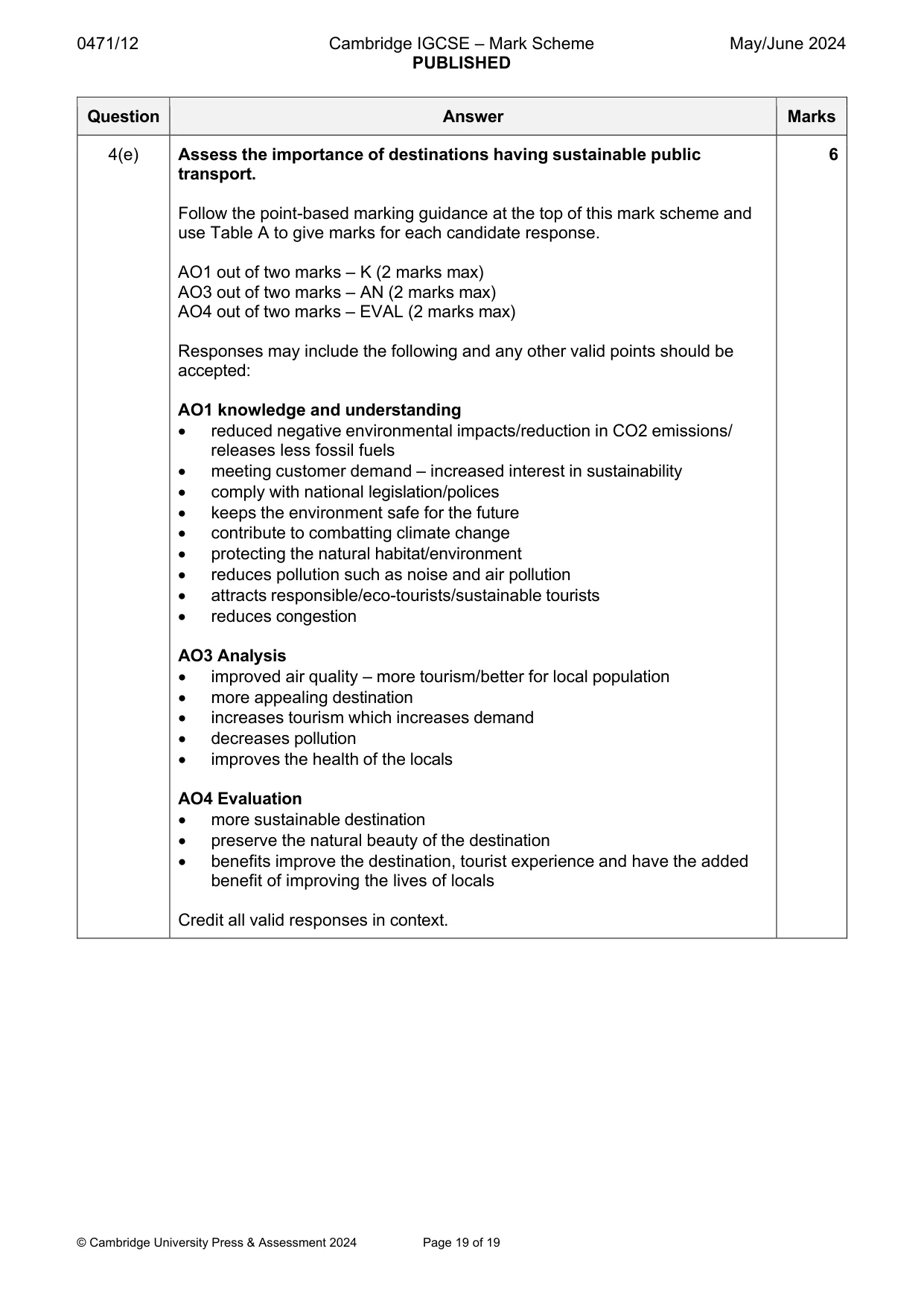
0471/12 Cambridge IGCSE – Mark Scheme PUBLISHED May/June 2024 © Cambridge University Press & Assessment 2024 Page 19 of 19 Question Answer Marks 4(e) Assess the importance of destinations having sustainable public transport. Follow the point-based marking guidance at the top of this mark scheme and use Table A to give marks for each candidate response. AO1 out of two marks – K (2 marks max) AO3 out of two marks – AN (2 marks max) AO4 out of two marks – EVAL (2 marks max) Responses may include the following and any other valid points should be accepted: AO1 knowledge and understanding reduced negative environmental impacts/reduction in CO2 emissions/ releases less fossil fuels meeting customer demand – increased interest in sustainability comply with national legislation/polices keeps the environment safe for the future contribute to combatting climate change protecting the natural habitat/environment reduces pollution such as noise and air pollution attracts responsible/eco-tourists/sustainable tourists reduces congestion AO3 Analysis improved air quality – more tourism/better for local population more appealing destination increases tourism which increases demand decreases pollution improves the health of the locals AO4 Evaluation more sustainable destination preserve the natural beauty of the destination benefits improve the destination, tourist experience and have the added benefit of improving the lives of locals Credit all valid responses in context. 6
What you needed in this session
Cambridge’s own grade thresholds for 2024 May/June, Paper 1 · Variant 2. A higher threshold means an easier paper — the bar moves with how the cohort did.