Cambridge IGCSE Spanish - Literature 0488 — 2024 May/June Paper 1 · Variant 3
0488/13/M/J/24 · 60 marks · ≈68 min
The question paper and its mark scheme, free to read here and free to download. This is Cambridge’s own paper, exactly as it was sat.
Question paper8 pages

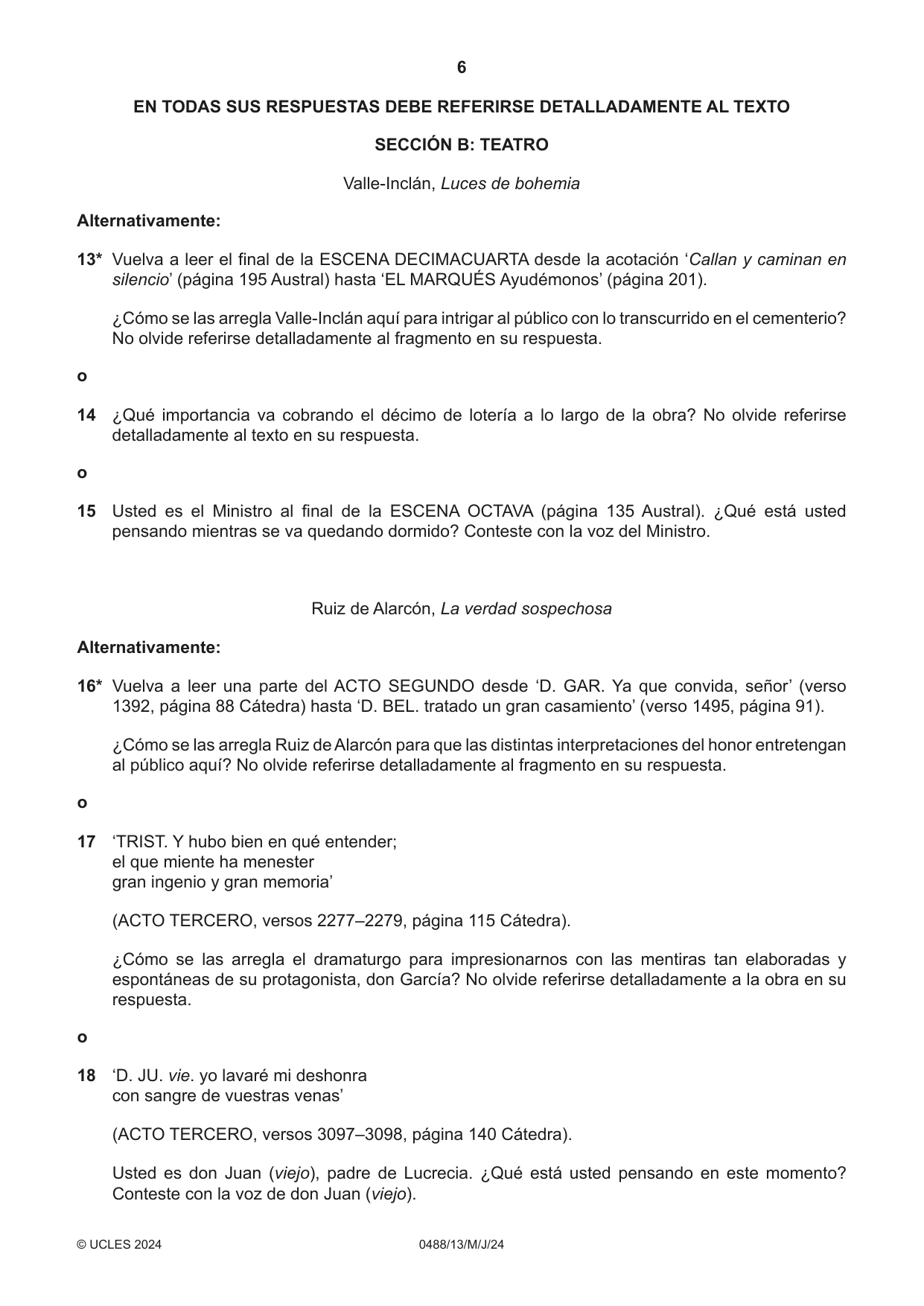
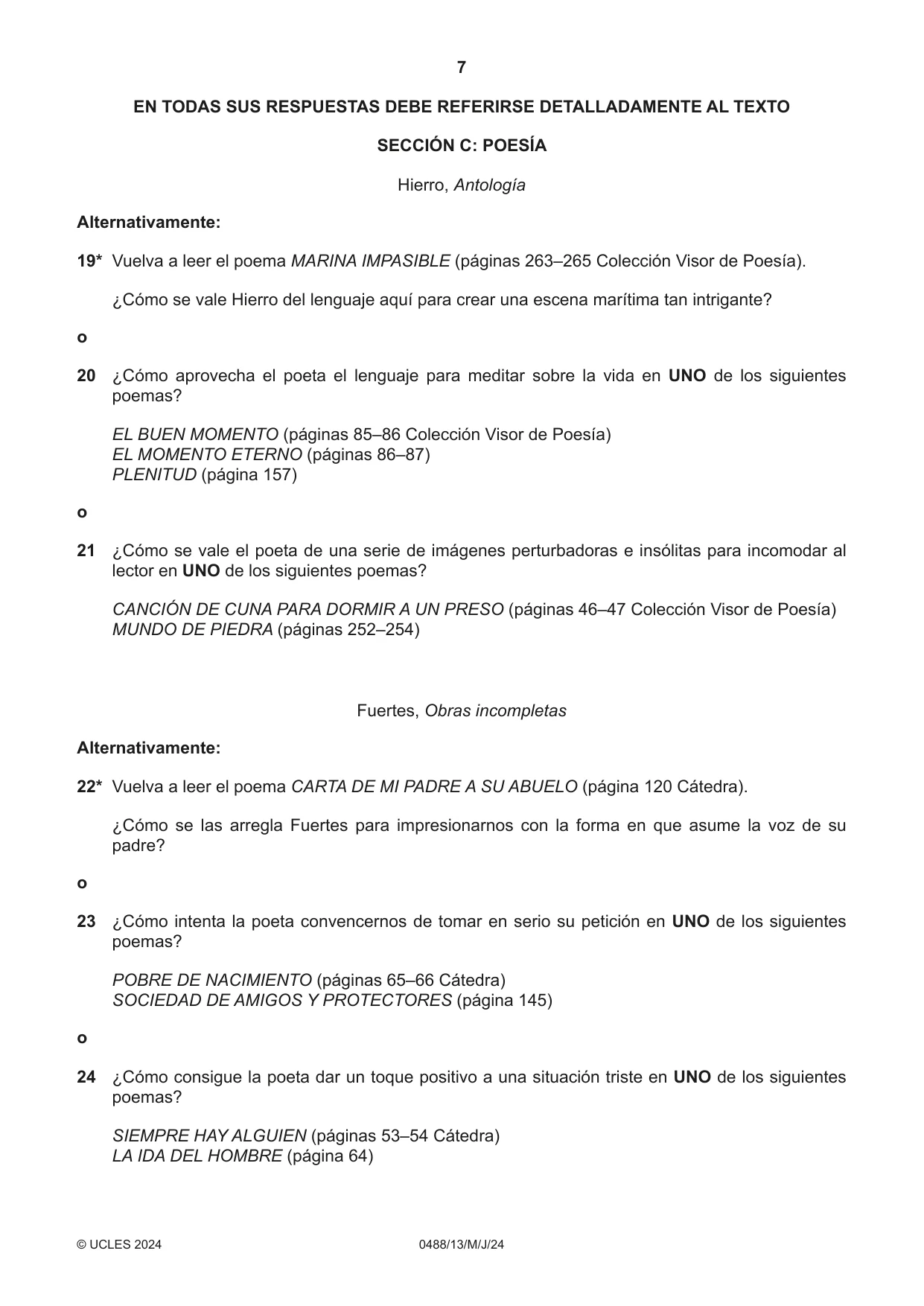

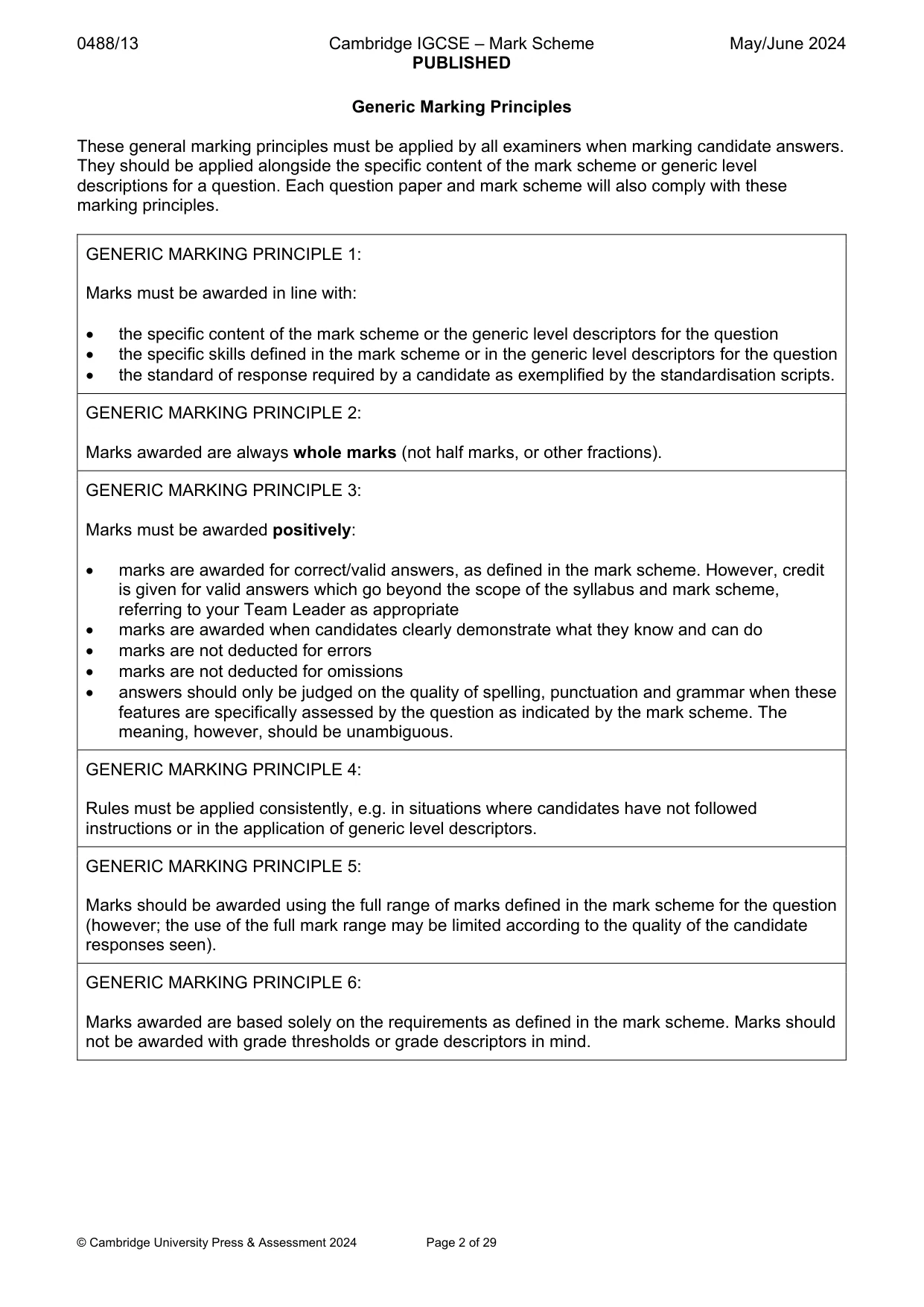
Mark scheme29 pages
Answers below. Sit the paper first if you are practising.
Paper as text
Question paper, page 1
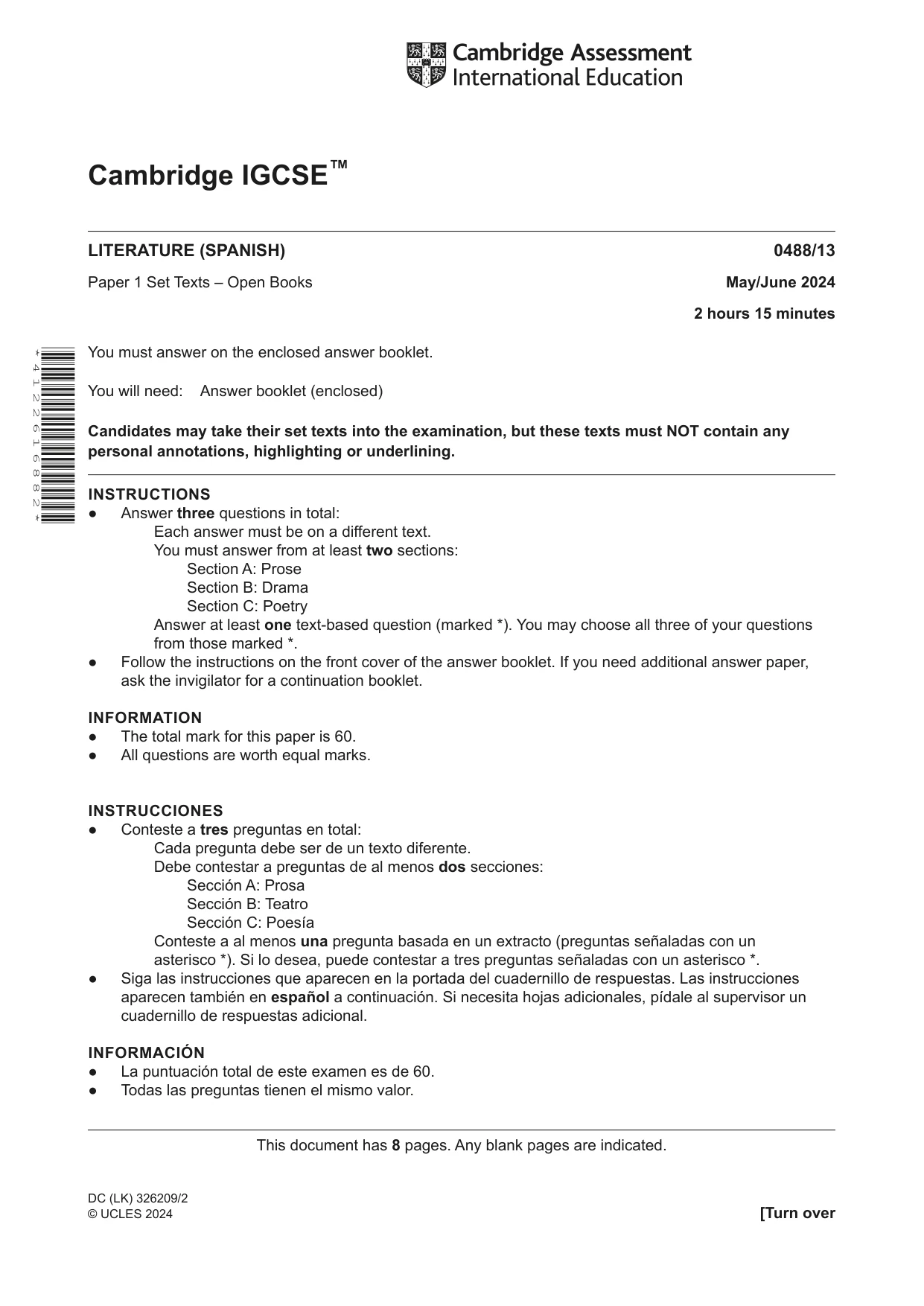
This document has 8 pages. Any blank pages are indicated. [Turn over Cambridge IGCSE™ DC (LK) 326209/2 © UCLES 2024 LITERATURE (SPANISH) 0488/13 Paper 1 Set Texts – Open Books May/June 2024 2 hours 15 minutes You must answer on the enclosed answer booklet. You will need: Answer booklet (enclosed) Candidates may take their set texts into the examination, but these texts must NOT contain any personal annotations, highlighting or underlining. INSTRUCTIONS ● Answer three questions in total: Each answer must be on a different text. You must answer from at least two sections: Section A: Prose Section B: Drama Section C: Poetry Answer at least one text-based question (marked *). You may choose all three of your questions from those marked *. ● Follow the instructions on the front cover of the answer booklet. If you need additional answer paper, ask the invigilator for a continuation booklet. INFORMATION ● The total mark for this paper is 60. ● All questions are worth equal marks. INSTRUCCIONES ● Conteste a tres preguntas en total: Cada pregunta debe ser de un texto diferente. Debe contestar a preguntas de al menos dos secciones: Sección A: Prosa Sección B: Teatro Sección C: Poesía Conteste a al menos una pregunta basada en un extracto (preguntas señaladas con un asterisco *). Si lo desea, puede contestar a tres preguntas señaladas con un asterisco *. ● Siga las instrucciones que aparecen en la portada del cuadernillo de respuestas. Las instrucciones aparecen también en español a continuación. Si necesita hojas adicionales, pídale al supervisor un cuadernillo de respuestas adicional. INFORMACIÓN ● La puntuación total de este examen es de 60. ● Todas las preguntas tienen el mismo valor. * 4 1 2 2 6 1 6 8 8 2 *
Question paper, page 2
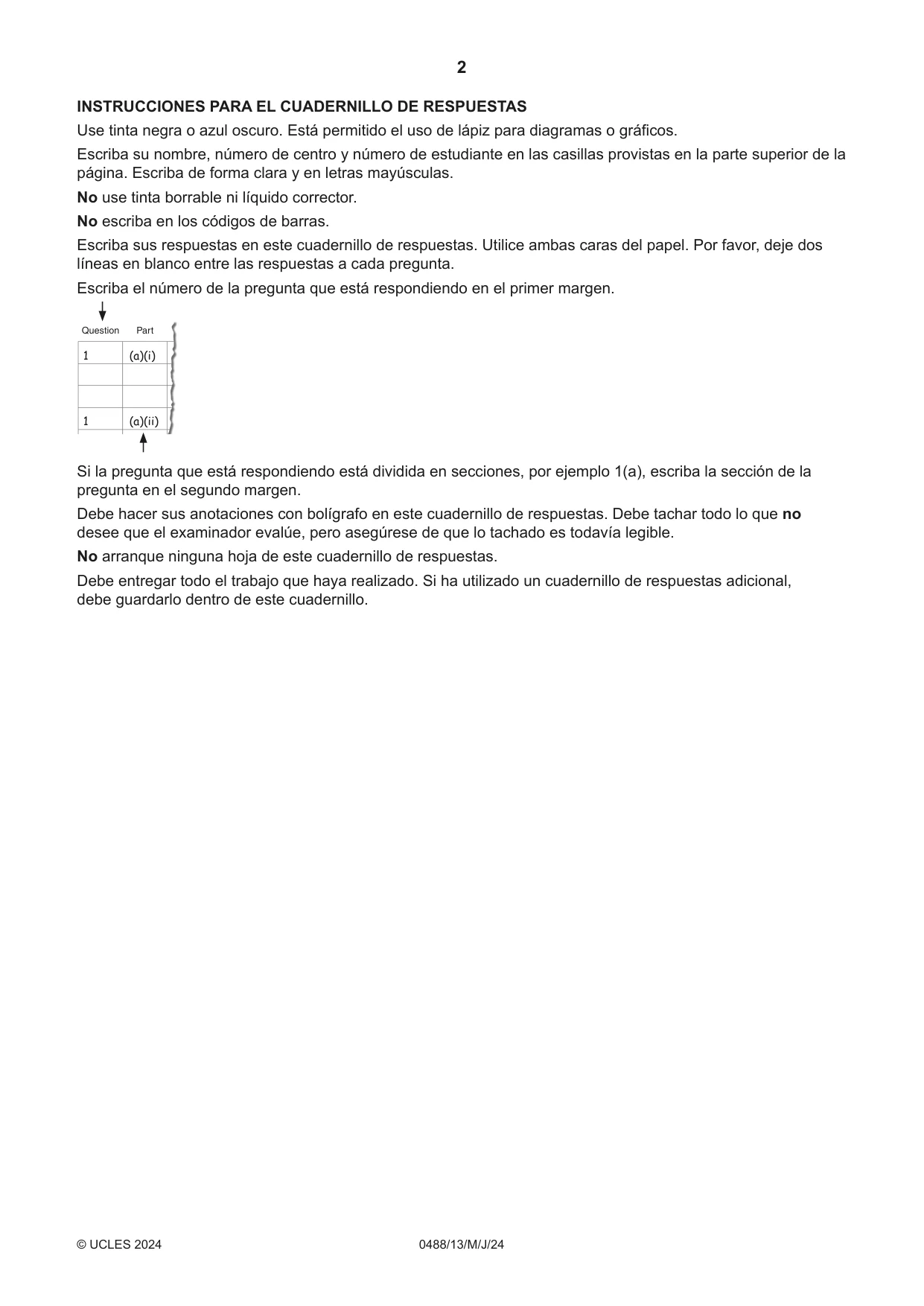
2 0488/13/ M / J /24 © UCLES 2024 INSTRUCCIONES PARA EL CUADERNILLO DE RESPUESTAS Use tinta negra o azul oscuro. Está permitido el uso de lápiz para diagramas o gráficos. Escriba su nombre, número de centro y número de estudiante en las casillas provistas en la parte superior de la página. Escriba de forma clara y en letras mayúsculas. No use tinta borrable ni líquido corrector. No escriba en los códigos de barras. Escriba sus respuestas en este cuadernillo de respuestas. Utilice ambas caras del papel. Por favor, deje dos líneas en blanco entre las respuestas a cada pregunta. Escriba el número de la pregunta que está respondiendo en el primer margen. Question Part 1 1 (a)(i) (a)(ii) Si la pregunta que está respondiendo está dividida en secciones, por ejemplo 1(a), escriba la sección de la pregunta en el segundo margen. Debe hacer sus anotaciones con bolígrafo en este cuadernillo de respuestas. Debe tachar todo lo que no desee que el examinador evalúe, pero asegúrese de que lo tachado es todavía legible. No arranque ninguna hoja de este cuadernillo de respuestas. Debe entregar todo el trabajo que haya realizado. Si ha utilizado un cuadernillo de respuestas adicional, debe guardarlo dentro de este cuadernillo.
Question paper, page 3
3 0488/13/M/J/24 © UCLES 2024 [Turn over BLANK PAGE
Question paper, page 4
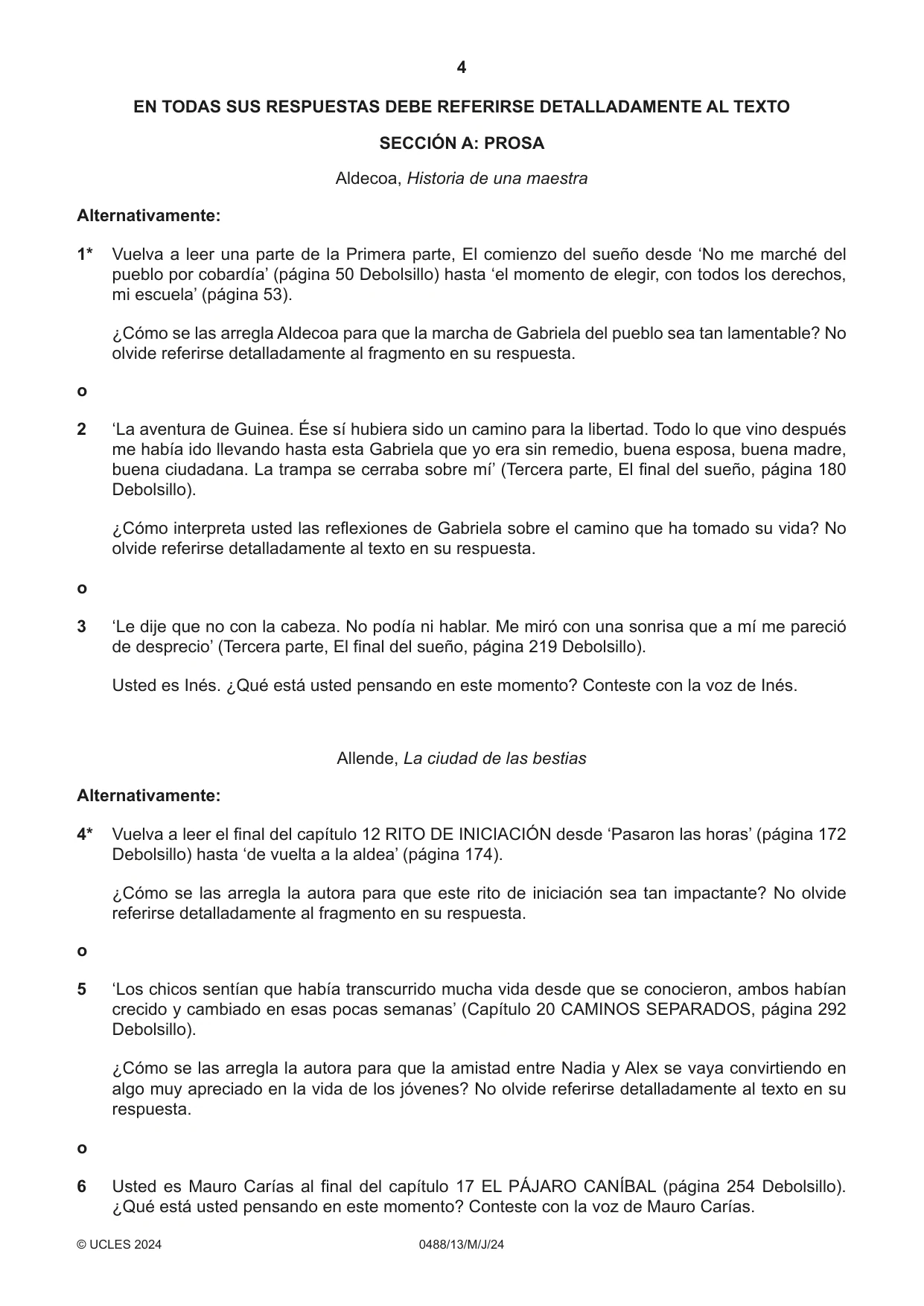
4 0488/13/M/J/24 © UCLES 2024 EN TODAS SUS RESPUESTAS DEBE REFERIRSE DETALLADAMENTE AL TEXTO SECCIÓN A: PROSA Aldecoa, Historia de una maestra Alternativamente: 1* Vuelva a leer una parte de la Primera parte, El comienzo del sueño desde ‘No me marché del pueblo por cobardía’ (página 50 Debolsillo) hasta ‘el momento de elegir, con todos los derechos, mi escuela’ (página 53). ¿Cómo se las arregla Aldecoa para que la marcha de Gabriela del pueblo sea tan lamentable? No olvide referirse detalladamente al fragmento en su respuesta. o 2 ‘La aventura de Guinea. Ése sí hubiera sido un camino para la libertad. Todo lo que vino después me había ido llevando hasta esta Gabriela que yo era sin remedio, buena esposa, buena madre, buena ciudadana. La trampa se cerraba sobre mí’ (Tercera parte, El final del sueño, página 180 Debolsillo). ¿Cómo interpreta usted las reflexiones de Gabriela sobre el camino que ha tomado su vida? No olvide referirse detalladamente al texto en su respuesta. o 3 ‘Le dije que no con la cabeza. No podía ni hablar. Me miró con una sonrisa que a mí me pareció de desprecio’ (Tercera parte, El final del sueño, página 219 Debolsillo). Usted es Inés. ¿Qué está usted pensando en este momento? Conteste con la voz de Inés. Allende, La ciudad de las bestias Alternativamente: 4* Vuelva a leer el final del capítulo 12 RITO DE INICIACIÓN desde ‘Pasaron las horas’ (página 172 Debolsillo) hasta ‘de vuelta a la aldea’ (página 174). ¿Cómo se las arregla la autora para que este rito de iniciación sea tan impactante? No olvide referirse detalladamente al fragmento en su respuesta. o 5 ‘Los chicos sentían que había transcurrido mucha vida desde que se conocieron, ambos habían crecido y cambiado en esas pocas semanas’ (Capítulo 20 CAMINOS SEPARADOS, página 292 Debolsillo). ¿Cómo se las arregla la autora para que la amistad entre Nadia y Alex se vaya convirtiendo en algo muy apreciado en la vida de los jóvenes? No olvide referirse detalladamente al texto en su respuesta. o 6 Usted es Mauro Carías al final del capítulo 17 EL PÁJARO CANÍBAL (página 254 Debolsillo). ¿Qué está usted pensando en este momento? Conteste con la voz de Mauro Carías.
Question paper, page 5
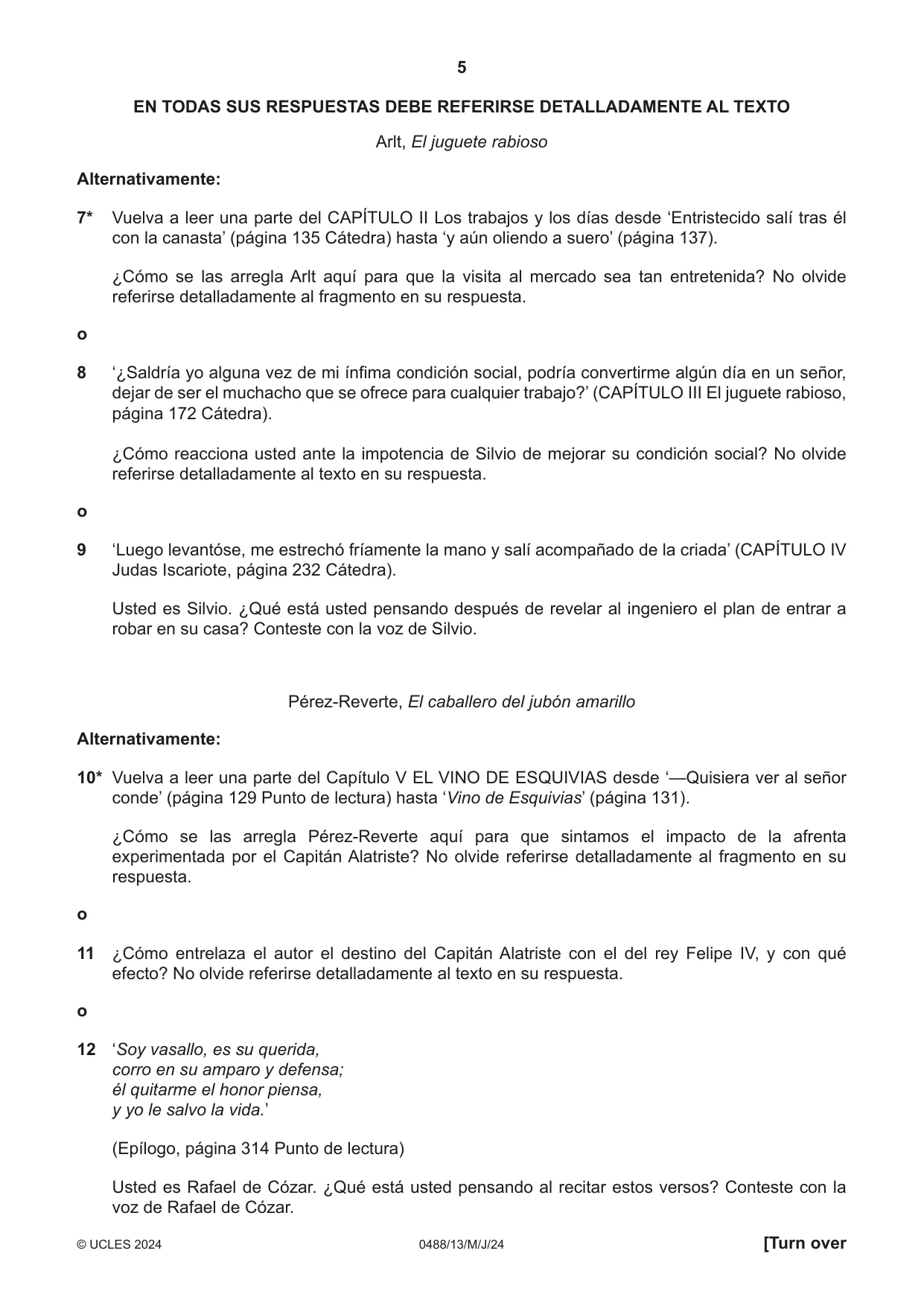
5 0488/13/M/J/24 © UCLES 2024 [Turn over EN TODAS SUS RESPUESTAS DEBE REFERIRSE DETALLADAMENTE AL TEXTO Arlt, El juguete rabioso Alternativamente: 7* Vuelva a leer una parte del CAPÍTULO II Los trabajos y los días desde ‘Entristecido salí tras él con la canasta’ (página 135 Cátedra) hasta ‘y aún oliendo a suero’ (página 137). ¿Cómo se las arregla Arlt aquí para que la visita al mercado sea tan entretenida? No olvide referirse detalladamente al fragmento en su respuesta. o 8 ‘¿Saldría yo alguna vez de mi ínfima condición social, podría convertirme algún día en un señor, dejar de ser el muchacho que se ofrece para cualquier trabajo?’ (CAPÍTULO III El juguete rabioso, página 172 Cátedra). ¿Cómo reacciona usted ante la impotencia de Silvio de mejorar su condición social? No olvide referirse detalladamente al texto en su respuesta. o 9 ‘Luego levantóse, me estrechó fríamente la mano y salí acompañado de la criada’ (CAPÍTULO IV Judas Iscariote, página 232 Cátedra). Usted es Silvio. ¿Qué está usted pensando después de revelar al ingeniero el plan de entrar a robar en su casa? Conteste con la voz de Silvio. Pérez-Reverte, El caballero del jubón amarillo Alternativamente: 10* Vuelva a leer una parte del Capítulo V EL VINO DE ESQUIVIAS desde ‘—Quisiera ver al señor conde’ (página 129 Punto de lectura) hasta ‘Vino de Esquivias’ (página 131). ¿Cómo se las arregla Pérez-Reverte aquí para que sintamos el impacto de la afrenta experimentada por el Capitán Alatriste? No olvide referirse detalladamente al fragmento en su respuesta. o 11 ¿Cómo entrelaza el autor el destino del Capitán Alatriste con el del rey Felipe IV, y con qué efecto? No olvide referirse detalladamente al texto en su respuesta. o 12 ‘Soy vasallo, es su querida, corro en su amparo y defensa; él quitarme el honor piensa, y yo le salvo la vida.’ (Epílogo, página 314 Punto de lectura) Usted es Rafael de Cózar. ¿Qué está usted pensando al recitar estos versos? Conteste con la voz de Rafael de Cózar.
Question paper, page 6
6 0488/13/M/J/24 © UCLES 2024 EN TODAS SUS RESPUESTAS DEBE REFERIRSE DETALLADAMENTE AL TEXTO SECCIÓN B: TEATRO Valle-Inclán, Luces de bohemia Alternativamente: 13* Vuelva a leer el final de la ESCENA DECIMACUARTA desde la acotación ‘Callan y caminan en silencio’ (página 195 Austral) hasta ‘EL MARQUÉS Ayudémonos’ (página 201). ¿Cómo se las arregla Valle-Inclán aquí para intrigar al público con lo transcurrido en el cementerio? No olvide referirse detalladamente al fragmento en su respuesta. o 14 ¿Qué importancia va cobrando el décimo de lotería a lo largo de la obra? No olvide referirse detalladamente al texto en su respuesta. o 15 Usted es el Ministro al final de la ESCENA OCTAVA (página 135 Austral). ¿Qué está usted pensando mientras se va quedando dormido? Conteste con la voz del Ministro. Ruiz de Alarcón, La verdad sospechosa Alternativamente: 16* Vuelva a leer una parte del ACTO SEGUNDO desde ‘D. GAR. Ya que convida, señor’ (verso 1392, página 88 Cátedra) hasta ‘D. BEL. tratado un gran casamiento’ (verso 1495, página 91). ¿Cómo se las arregla Ruiz de Alarcón para que las distintas interpretaciones del honor entretengan al público aquí? No olvide referirse detalladamente al fragmento en su respuesta. o 17 ‘TRIST. Y hubo bien en qué entender; el que miente ha menester gran ingenio y gran memoria’ (ACTO TERCERO, versos 2277–2279, página 115 Cátedra). ¿Cómo se las arregla el dramaturgo para impresionarnos con las mentiras tan elaboradas y espontáneas de su protagonista, don García? No olvide referirse detalladamente a la obra en su respuesta. o 18 ‘D. JU. vie. yo lavaré mi deshonra con sangre de vuestras venas’ (ACTO TERCERO, versos 3097–3098, página 140 Cátedra). Usted es don Juan (viejo), padre de Lucrecia. ¿Qué está usted pensando en este momento? Conteste con la voz de don Juan (viejo).
Question paper, page 7
7 0488/13/M/J/24 © UCLES 2024 EN TODAS SUS RESPUESTAS DEBE REFERIRSE DETALLADAMENTE AL TEXTO SECCIÓN C: POESÍA Hierro, Antología Alternativamente: 19* Vuelva a leer el poema MARINA IMPASIBLE (páginas 263–265 Colección Visor de Poesía). ¿Cómo se vale Hierro del lenguaje aquí para crear una escena marítima tan intrigante? o 20 ¿Cómo aprovecha el poeta el lenguaje para meditar sobre la vida en UNO de los siguientes poemas? EL BUEN MOMENTO (páginas 85–86 Colección Visor de Poesía) EL MOMENTO ETERNO (páginas 86–87) PLENITUD (página 157) o 21 ¿Cómo se vale el poeta de una serie de imágenes perturbadoras e insólitas para incomodar al lector en UNO de los siguientes poemas? CANCIÓN DE CUNA PARA DORMIR A UN PRESO (páginas 46–47 Colección Visor de Poesía) MUNDO DE PIEDRA (páginas 252–254) Fuertes, Obras incompletas Alternativamente: 22* Vuelva a leer el poema CARTA DE MI PADRE A SU ABUELO (página 120 Cátedra). ¿Cómo se las arregla Fuertes para impresionarnos con la forma en que asume la voz de su padre? o 23 ¿Cómo intenta la poeta convencernos de tomar en serio su petición en UNO de los siguientes poemas? POBRE DE NACIMIENTO (páginas 65–66 Cátedra) SOCIEDAD DE AMIGOS Y PROTECTORES (página 145) o 24 ¿Cómo consigue la poeta dar un toque positivo a una situación triste en UNO de los siguientes poemas? SIEMPRE HAY ALGUIEN (páginas 53–54 Cátedra) LA IDA DEL HOMBRE (página 64)
Question paper, page 8
8 0488/13/M/J/24 © UCLES 2024 Permission to reproduce items where third-party owned material protected by copyright is included has been sought and cleared where possible. Every reasonable effort has been made by the publisher (UCLES) to trace copyright holders, but if any items requiring clearance have unwittingly been included, the publisher will be pleased to make amends at the earliest possible opportunity. To avoid the issue of disclosure of answer-related information to candidates, all copyright acknowledgements are reproduced online in the Cambridge Assessment International Education Copyright Acknowledgements Booklet. This is produced for each series of examinations and is freely available to download at www.cambridgeinternational.org after the live examination series. Cambridge Assessment International Education is part of Cambridge Assessment. Cambridge Assessment is the brand name of the University of Cambridge Local Examinations Syndicate (UCLES), which is a department of the University of Cambridge. BLANK PAGE
Mark scheme, page 1
This document consists of 29 printed pages. © Cambridge University Press & Assessment 2024 [Turn over Cambridge IGCSE™ LITERATURE (SPANISH) 0488/13 Paper 1 Set Texts (Open Books) May/June 2024 MARK SCHEME Maximum Mark: 60 Published This mark scheme is published as an aid to teachers and candidates, to indicate the requirements of the examination. It shows the basis on which Examiners were instructed to award marks. It does not indicate the details of the discussions that took place at an Examiners’ meeting before marking began, which would have considered the acceptability of alternative answers. Mark schemes should be read in conjunction with the question paper and the Principal Examiner Report for Teachers. Cambridge International will not enter into discussions about these mark schemes. Cambridge International is publishing the mark schemes for the May/June 2024 series for most Cambridge IGCSE, Cambridge International A and AS Level and Cambridge Pre-U components, and some Cambridge O Level components.
Mark scheme, page 2
0488/13 Cambridge IGCSE – Mark Scheme PUBLISHED May/June 2024 © Cambridge University Press & Assessment 2024 Page 2 of 29 Generic Marking Principles These general marking principles must be applied by all examiners when marking candidate answers. They should be applied alongside the specific content of the mark scheme or generic level descriptions for a question. Each question paper and mark scheme will also comply with these marking principles. GENERIC MARKING PRINCIPLE 1: Marks must be awarded in line with: the specific content of the mark scheme or the generic level descriptors for the question the specific skills defined in the mark scheme or in the generic level descriptors for the question the standard of response required by a candidate as exemplified by the standardisation scripts. GENERIC MARKING PRINCIPLE 2: Marks awarded are always whole marks (not half marks, or other fractions). GENERIC MARKING PRINCIPLE 3: Marks must be awarded positively: marks are awarded for correct/valid answers, as defined in the mark scheme. However, credit is given for valid answers which go beyond the scope of the syllabus and mark scheme, referring to your Team Leader as appropriate marks are awarded when candidates clearly demonstrate what they know and can do marks are not deducted for errors marks are not deducted for omissions answers should only be judged on the quality of spelling, punctuation and grammar when these features are specifically assessed by the question as indicated by the mark scheme. The meaning, however, should be unambiguous. GENERIC MARKING PRINCIPLE 4: Rules must be applied consistently, e.g. in situations where candidates have not followed instructions or in the application of generic level descriptors. GENERIC MARKING PRINCIPLE 5: Marks should be awarded using the full range of marks defined in the mark scheme for the question (however; the use of the full mark range may be limited according to the quality of the candidate responses seen). GENERIC MARKING PRINCIPLE 6: Marks awarded are based solely on the requirements as defined in the mark scheme. Marks should not be awarded with grade thresholds or grade descriptors in mind.
Mark scheme, page 3
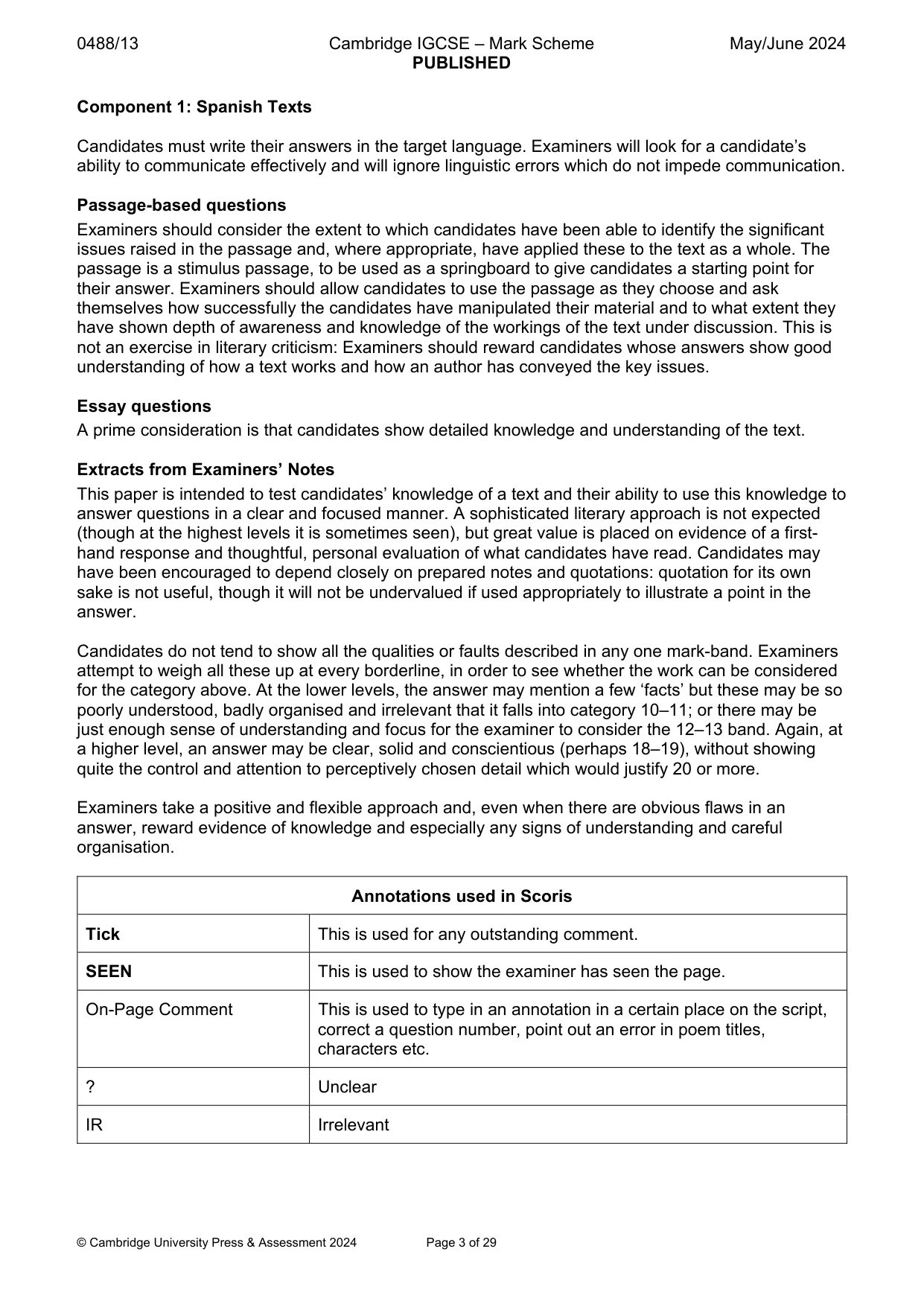
0488/13 Cambridge IGCSE – Mark Scheme PUBLISHED May/June 2024 © Cambridge University Press & Assessment 2024 Page 3 of 29 Component 1: Spanish Texts Candidates must write their answers in the target language. Examiners will look for a candidate’s ability to communicate effectively and will ignore linguistic errors which do not impede communication. Passage-based questions Examiners should consider the extent to which candidates have been able to identify the significant issues raised in the passage and, where appropriate, have applied these to the text as a whole. The passage is a stimulus passage, to be used as a springboard to give candidates a starting point for their answer. Examiners should allow candidates to use the passage as they choose and ask themselves how successfully the candidates have manipulated their material and to what extent they have shown depth of awareness and knowledge of the workings of the text under discussion. This is not an exercise in literary criticism: Examiners should reward candidates whose answers show good understanding of how a text works and how an author has conveyed the key issues. Essay questions A prime consideration is that candidates show detailed knowledge and understanding of the text. Extracts from Examiners’ Notes This paper is intended to test candidates’ knowledge of a text and their ability to use this knowledge to answer questions in a clear and focused manner. A sophisticated literary approach is not expected (though at the highest levels it is sometimes seen), but great value is placed on evidence of a first- hand response and thoughtful, personal evaluation of what candidates have read. Candidates may have been encouraged to depend closely on prepared notes and quotations: quotation for its own sake is not useful, though it will not be undervalued if used appropriately to illustrate a point in the answer. Candidates do not tend to show all the qualities or faults described in any one mark-band. Examiners attempt to weigh all these up at every borderline, in order to see whether the work can be considered for the category above. At the lower levels, the answer may mention a few ‘facts’ but these may be so poorly understood, badly organised and irrelevant that it falls into category 10–11; or there may be just enough sense of understanding and focus for the examiner to consider the 12–13 band. Again, at a higher level, an answer may be clear, solid and conscientious (perhaps 18–19), without showing quite the control and attention to perceptively chosen detail which would justify 20 or more. Examiners take a positive and flexible approach and, even when there are obvious flaws in an answer, reward evidence of knowledge and especially any signs of understanding and careful organisation. Annotations used in Scoris Tick This is used for any outstanding comment. SEEN This is used to show the examiner has seen the page. On-Page Comment This is used to type in an annotation in a certain place on the script, correct a question number, point out an error in poem titles, characters etc. ? Unclear IR Irrelevant
Mark scheme, page 4
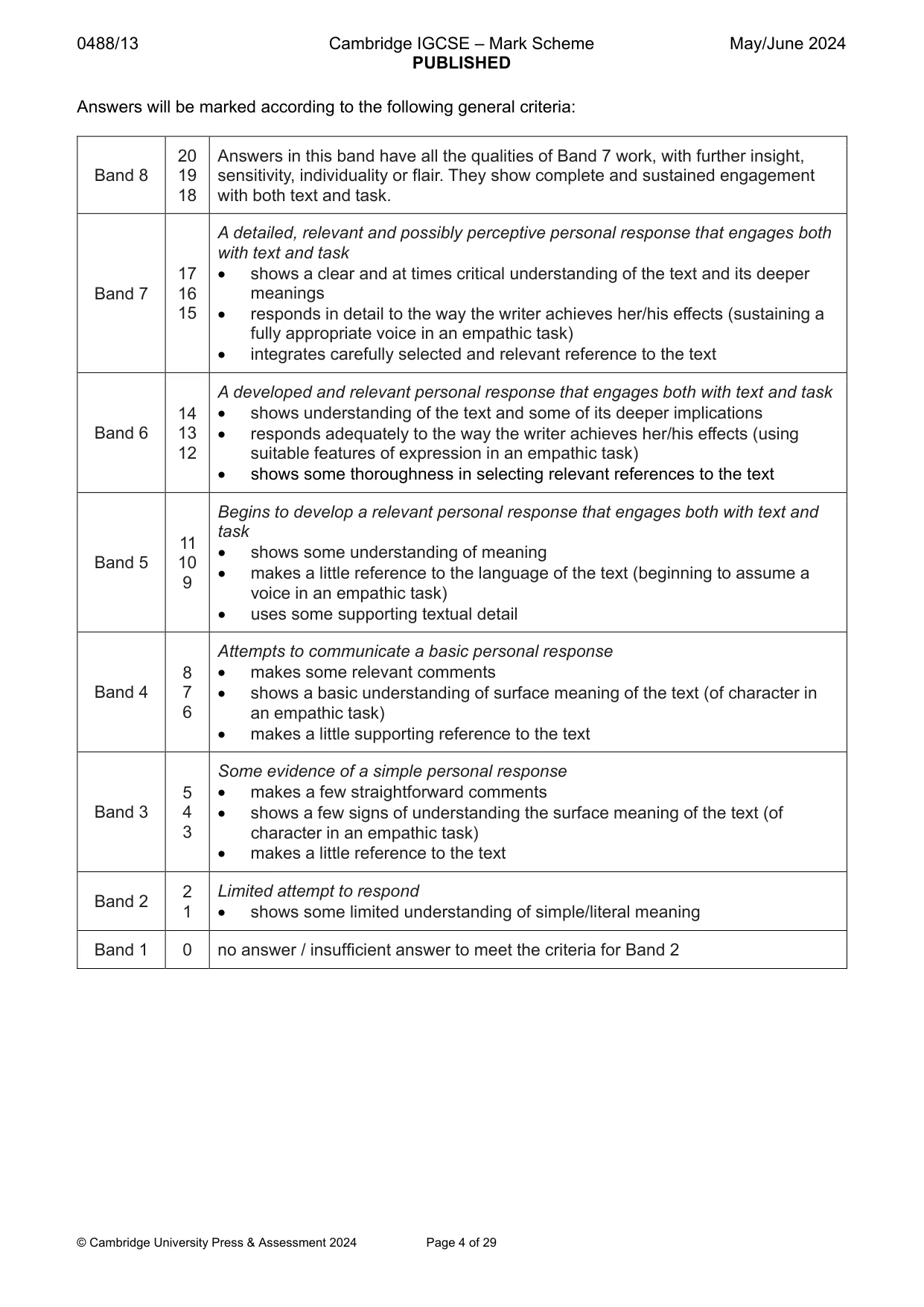
0488/13 Cambridge IGCSE – Mark Scheme PUBLISHED May/June 2024 © Cambridge University Press & Assessment 2024 Page 4 of 29 Answers will be marked according to the following general criteria: Band 8 20 19 18 Answers in this band have all the qualities of Band 7 work, with further insight, sensitivity, individuality or flair. They show complete and sustained engagement with both text and task. Band 7 17 16 15 A detailed, relevant and possibly perceptive personal response that engages both with text and task shows a clear and at times critical understanding of the text and its deeper meanings responds in detail to the way the writer achieves her/his effects (sustaining a fully appropriate voice in an empathic task) integrates carefully selected and relevant reference to the text Band 6 14 13 12 A developed and relevant personal response that engages both with text and task shows understanding of the text and some of its deeper implications responds adequately to the way the writer achieves her/his effects (using suitable features of expression in an empathic task) shows some thoroughness in selecting relevant references to the text Band 5 11 10 9 Begins to develop a relevant personal response that engages both with text and task shows some understanding of meaning makes a little reference to the language of the text (beginning to assume a voice in an empathic task) uses some supporting textual detail Band 4 8 7 6 Attempts to communicate a basic personal response makes some relevant comments shows a basic understanding of surface meaning of the text (of character in an empathic task) makes a little supporting reference to the text Band 3 5 4 3 Some evidence of a simple personal response makes a few straightforward comments shows a few signs of understanding the surface meaning of the text (of character in an empathic task) makes a little reference to the text Band 2 2 1 Limited attempt to respond shows some limited understanding of simple/literal meaning Band 1 0 no answer / insufficient answer to meet the criteria for Band 2
Mark scheme, page 5
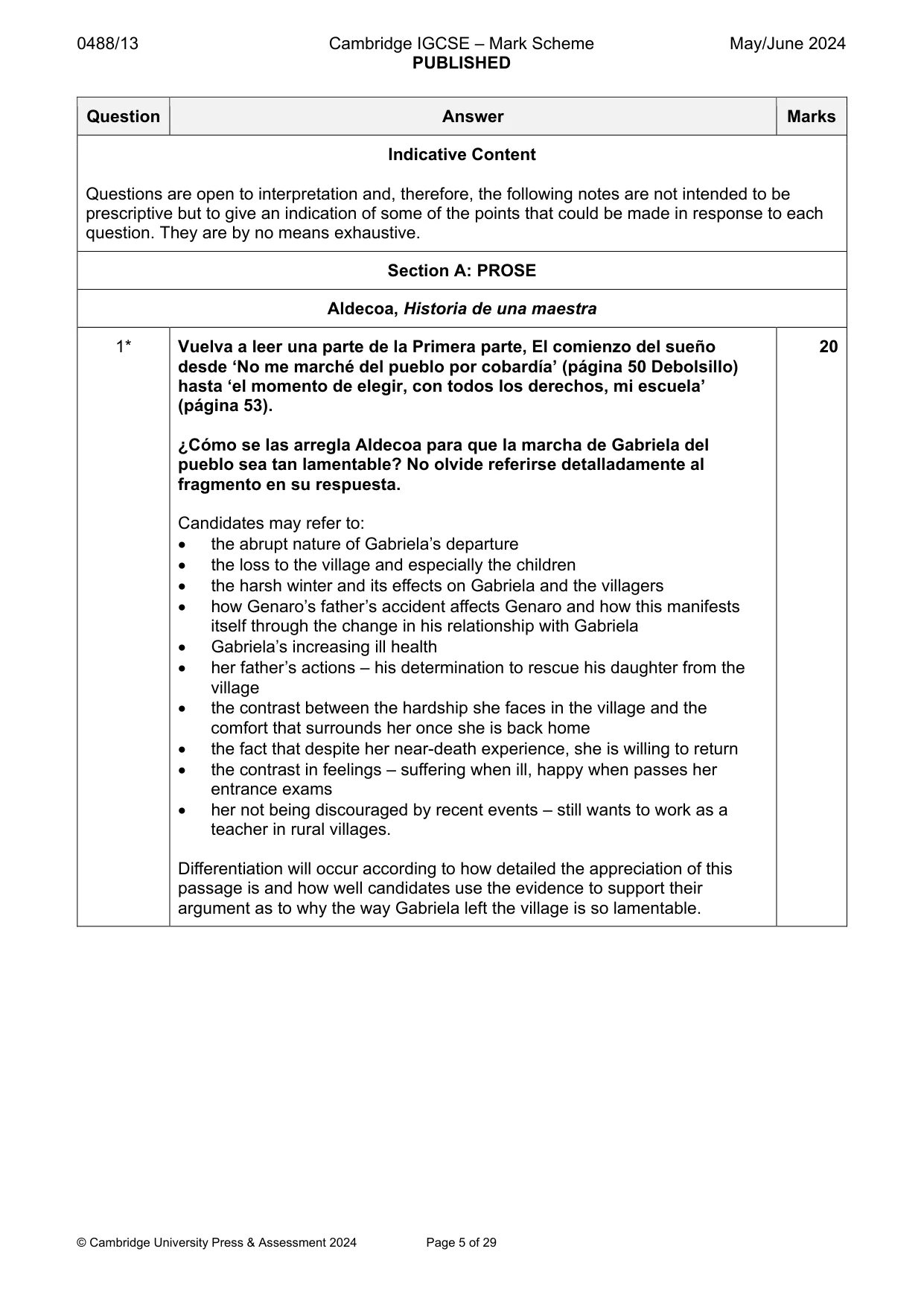
0488/13 Cambridge IGCSE – Mark Scheme PUBLISHED May/June 2024 © Cambridge University Press & Assessment 2024 Page 5 of 29 Question Answer Marks Indicative Content Questions are open to interpretation and, therefore, the following notes are not intended to be prescriptive but to give an indication of some of the points that could be made in response to each question. They are by no means exhaustive. Section A: PROSE Aldecoa, Historia de una maestra 1* Vuelva a leer una parte de la Primera parte, El comienzo del sueño desde ‘No me marché del pueblo por cobardía’ (página 50 Debolsillo) hasta ‘el momento de elegir, con todos los derechos, mi escuela’ (página 53). ¿Cómo se las arregla Aldecoa para que la marcha de Gabriela del pueblo sea tan lamentable? No olvide referirse detalladamente al fragmento en su respuesta. Candidates may refer to: the abrupt nature of Gabriela’s departure the loss to the village and especially the children the harsh winter and its effects on Gabriela and the villagers how Genaro’s father’s accident affects Genaro and how this manifests itself through the change in his relationship with Gabriela Gabriela’s increasing ill health her father’s actions – his determination to rescue his daughter from the village the contrast between the hardship she faces in the village and the comfort that surrounds her once she is back home the fact that despite her near-death experience, she is willing to return the contrast in feelings – suffering when ill, happy when passes her entrance exams her not being discouraged by recent events – still wants to work as a teacher in rural villages. Differentiation will occur according to how detailed the appreciation of this passage is and how well candidates use the evidence to support their argument as to why the way Gabriela left the village is so lamentable. 20
Mark scheme, page 6
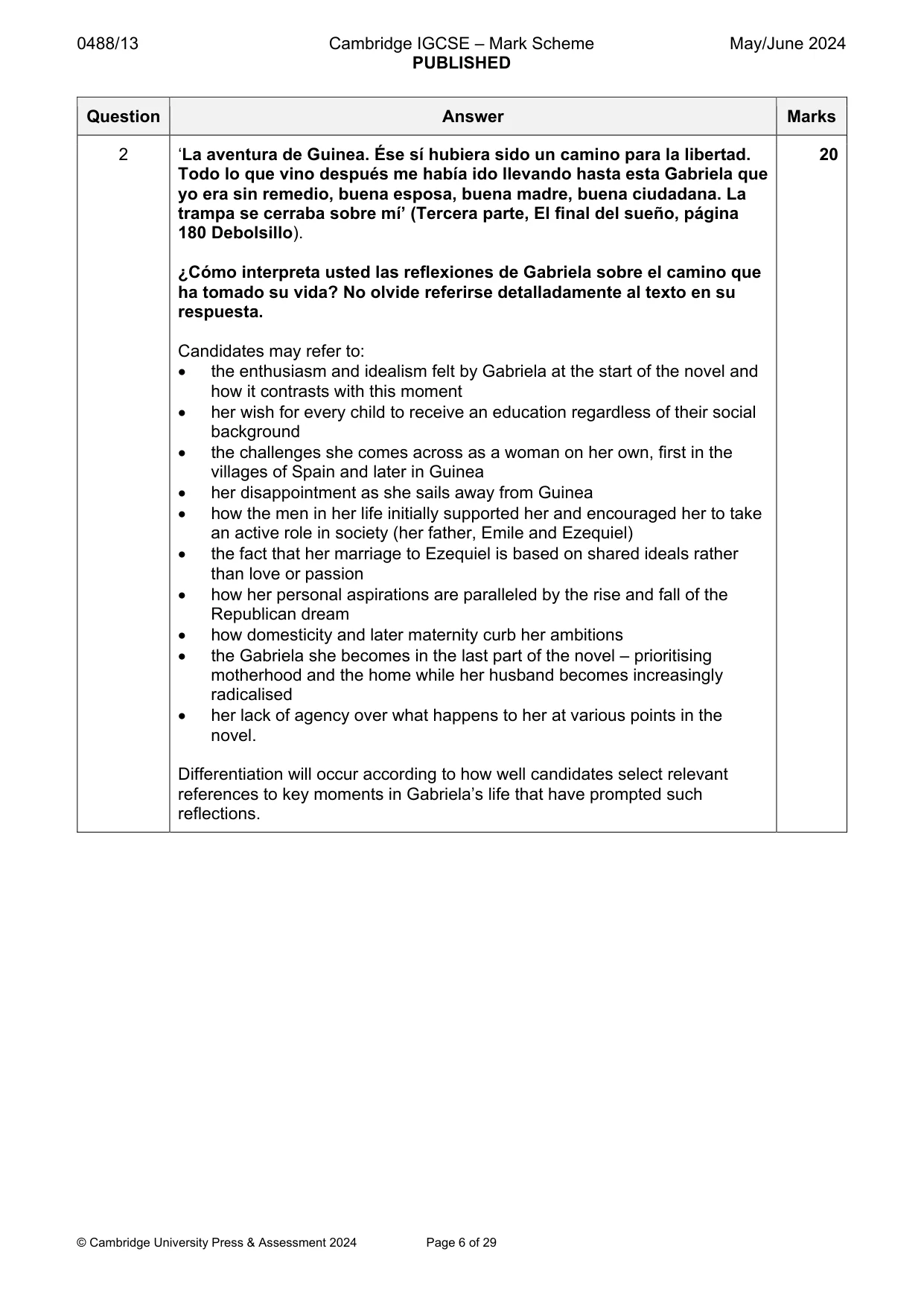
0488/13 Cambridge IGCSE – Mark Scheme PUBLISHED May/June 2024 © Cambridge University Press & Assessment 2024 Page 6 of 29 Question Answer Marks 2 ‘La aventura de Guinea. Ése sí hubiera sido un camino para la libertad. Todo lo que vino después me había ido llevando hasta esta Gabriela que yo era sin remedio, buena esposa, buena madre, buena ciudadana. La trampa se cerraba sobre mí’ (Tercera parte, El final del sueño, página 180 Debolsillo). ¿Cómo interpreta usted las reflexiones de Gabriela sobre el camino que ha tomado su vida? No olvide referirse detalladamente al texto en su respuesta. Candidates may refer to: the enthusiasm and idealism felt by Gabriela at the start of the novel and how it contrasts with this moment her wish for every child to receive an education regardless of their social background the challenges she comes across as a woman on her own, first in the villages of Spain and later in Guinea her disappointment as she sails away from Guinea how the men in her life initially supported her and encouraged her to take an active role in society (her father, Emile and Ezequiel) the fact that her marriage to Ezequiel is based on shared ideals rather than love or passion how her personal aspirations are paralleled by the rise and fall of the Republican dream how domesticity and later maternity curb her ambitions the Gabriela she becomes in the last part of the novel – prioritising motherhood and the home while her husband becomes increasingly radicalised her lack of agency over what happens to her at various points in the novel. Differentiation will occur according to how well candidates select relevant references to key moments in Gabriela’s life that have prompted such reflections. 20
Mark scheme, page 7
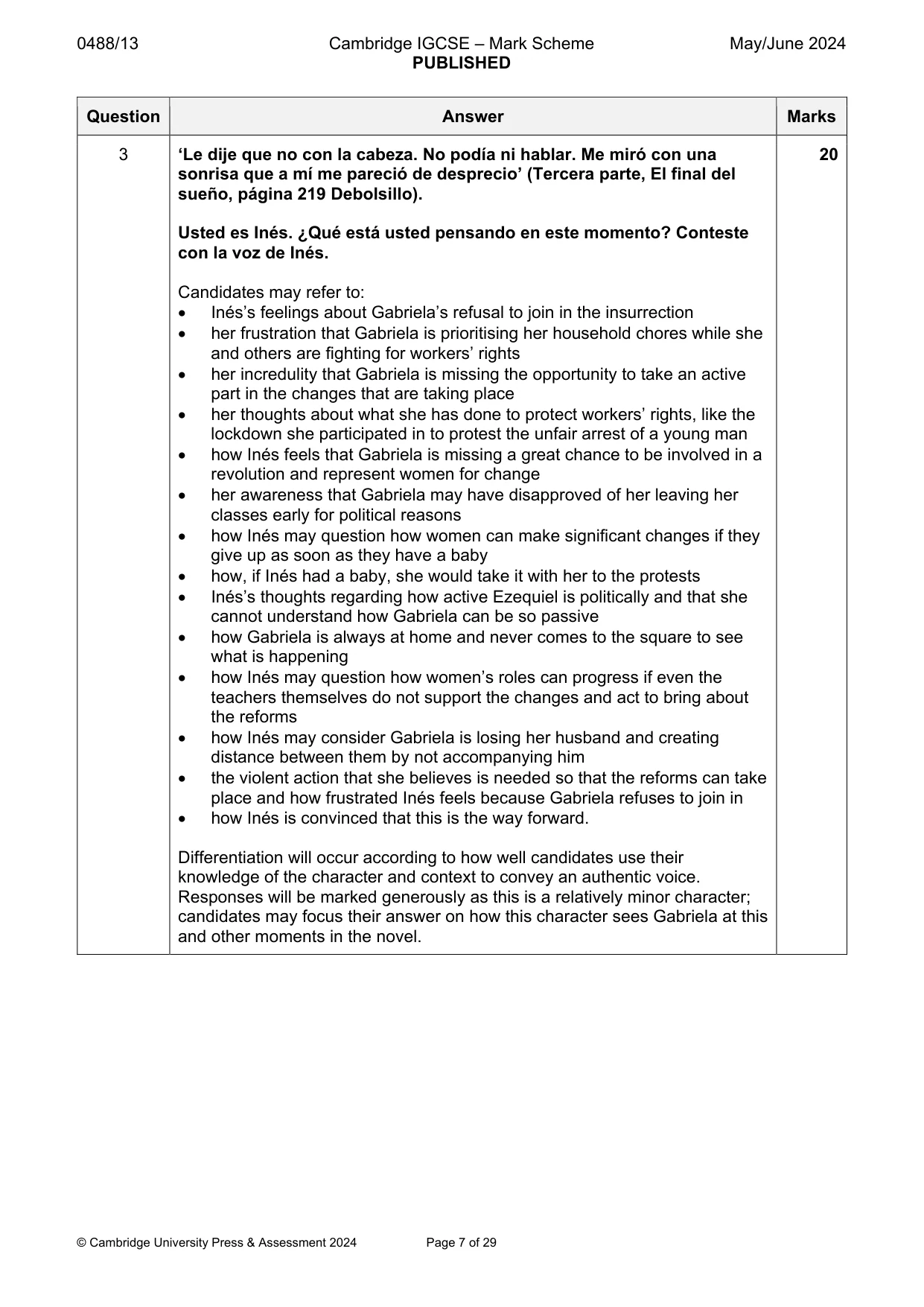
0488/13 Cambridge IGCSE – Mark Scheme PUBLISHED May/June 2024 © Cambridge University Press & Assessment 2024 Page 7 of 29 Question Answer Marks 3 ‘Le dije que no con la cabeza. No podía ni hablar. Me miró con una sonrisa que a mí me pareció de desprecio’ (Tercera parte, El final del sueño, página 219 Debolsillo). Usted es Inés. ¿Qué está usted pensando en este momento? Conteste con la voz de Inés. Candidates may refer to: Inés’s feelings about Gabriela’s refusal to join in the insurrection her frustration that Gabriela is prioritising her household chores while she and others are fighting for workers’ rights her incredulity that Gabriela is missing the opportunity to take an active part in the changes that are taking place her thoughts about what she has done to protect workers’ rights, like the lockdown she participated in to protest the unfair arrest of a young man how Inés feels that Gabriela is missing a great chance to be involved in a revolution and represent women for change her awareness that Gabriela may have disapproved of her leaving her classes early for political reasons how Inés may question how women can make significant changes if they give up as soon as they have a baby how, if Inés had a baby, she would take it with her to the protests Inés’s thoughts regarding how active Ezequiel is politically and that she cannot understand how Gabriela can be so passive how Gabriela is always at home and never comes to the square to see what is happening how Inés may question how women’s roles can progress if even the teachers themselves do not support the changes and act to bring about the reforms how Inés may consider Gabriela is losing her husband and creating distance between them by not accompanying him the violent action that she believes is needed so that the reforms can take place and how frustrated Inés feels because Gabriela refuses to join in how Inés is convinced that this is the way forward. Differentiation will occur according to how well candidates use their knowledge of the character and context to convey an authentic voice. Responses will be marked generously as this is a relatively minor character; candidates may focus their answer on how this character sees Gabriela at this and other moments in the novel. 20
Mark scheme, page 8
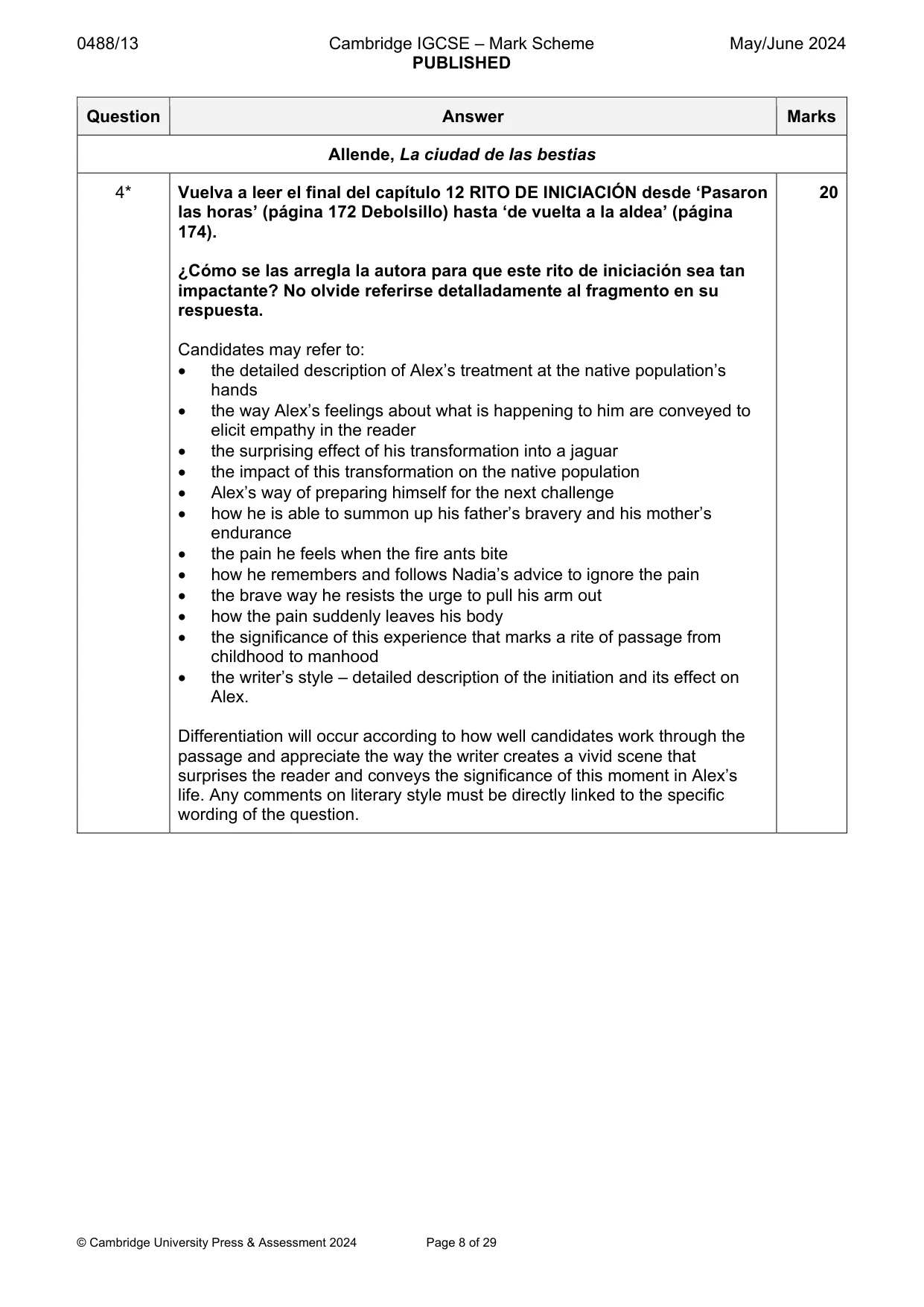
0488/13 Cambridge IGCSE – Mark Scheme PUBLISHED May/June 2024 © Cambridge University Press & Assessment 2024 Page 8 of 29 Question Answer Marks Allende, La ciudad de las bestias 4* Vuelva a leer el final del capítulo 12 RITO DE INICIACIÓN desde ‘Pasaron las horas’ (página 172 Debolsillo) hasta ‘de vuelta a la aldea’ (página 174). ¿Cómo se las arregla la autora para que este rito de iniciación sea tan impactante? No olvide referirse detalladamente al fragmento en su respuesta. Candidates may refer to: the detailed description of Alex’s treatment at the native population’s hands the way Alex’s feelings about what is happening to him are conveyed to elicit empathy in the reader the surprising effect of his transformation into a jaguar the impact of this transformation on the native population Alex’s way of preparing himself for the next challenge how he is able to summon up his father’s bravery and his mother’s endurance the pain he feels when the fire ants bite how he remembers and follows Nadia’s advice to ignore the pain the brave way he resists the urge to pull his arm out how the pain suddenly leaves his body the significance of this experience that marks a rite of passage from childhood to manhood the writer’s style – detailed description of the initiation and its effect on Alex. Differentiation will occur according to how well candidates work through the passage and appreciate the way the writer creates a vivid scene that surprises the reader and conveys the significance of this moment in Alex’s life. Any comments on literary style must be directly linked to the specific wording of the question. 20
Mark scheme, page 9
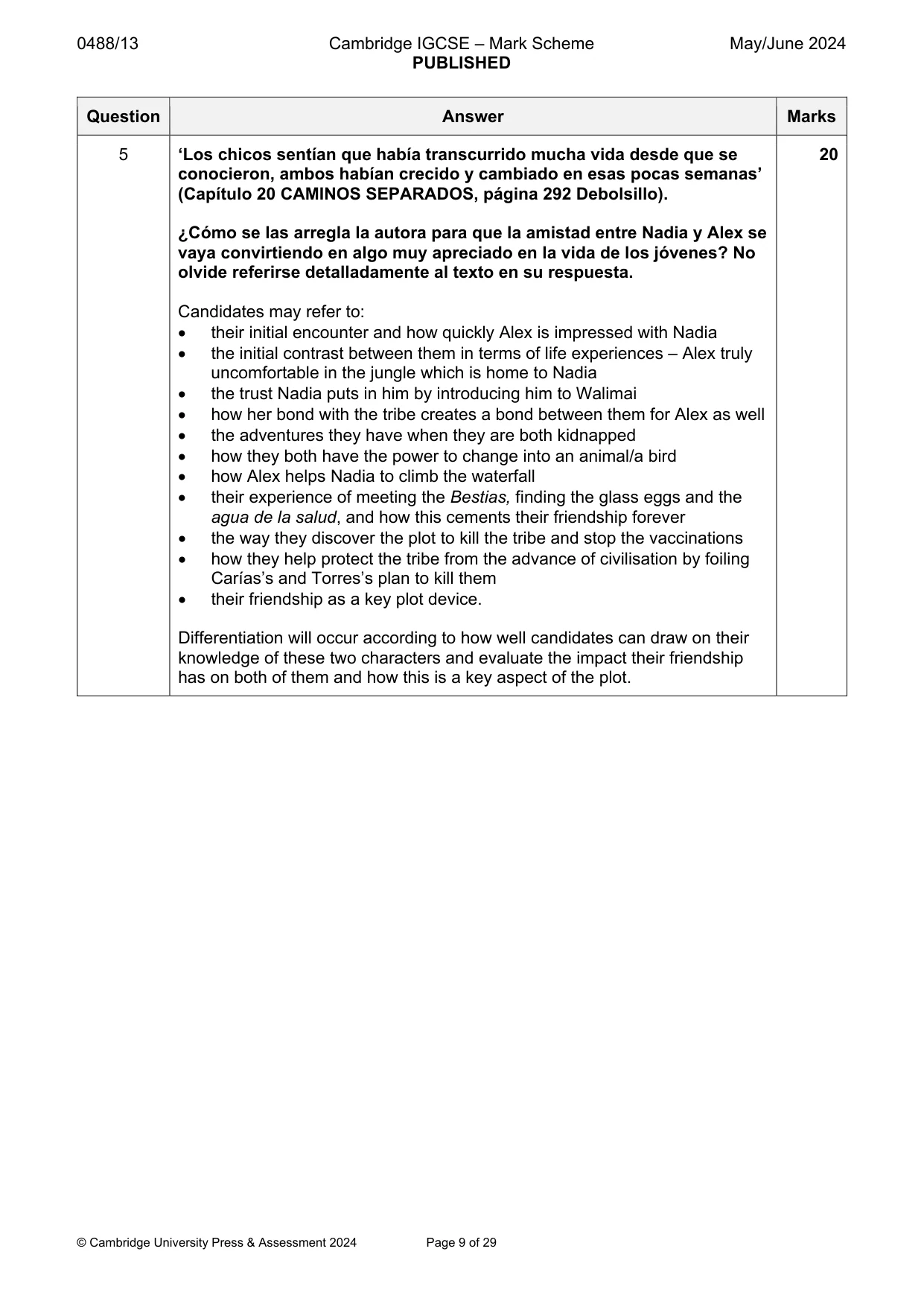
0488/13 Cambridge IGCSE – Mark Scheme PUBLISHED May/June 2024 © Cambridge University Press & Assessment 2024 Page 9 of 29 Question Answer Marks 5 ‘Los chicos sentían que había transcurrido mucha vida desde que se conocieron, ambos habían crecido y cambiado en esas pocas semanas’ (Capítulo 20 CAMINOS SEPARADOS, página 292 Debolsillo). ¿Cómo se las arregla la autora para que la amistad entre Nadia y Alex se vaya convirtiendo en algo muy apreciado en la vida de los jóvenes? No olvide referirse detalladamente al texto en su respuesta. Candidates may refer to: their initial encounter and how quickly Alex is impressed with Nadia the initial contrast between them in terms of life experiences – Alex truly uncomfortable in the jungle which is home to Nadia the trust Nadia puts in him by introducing him to Walimai how her bond with the tribe creates a bond between them for Alex as well the adventures they have when they are both kidnapped how they both have the power to change into an animal/a bird how Alex helps Nadia to climb the waterfall their experience of meeting the Bestias, finding the glass eggs and the agua de la salud, and how this cements their friendship forever the way they discover the plot to kill the tribe and stop the vaccinations how they help protect the tribe from the advance of civilisation by foiling Carías’s and Torres’s plan to kill them their friendship as a key plot device. Differentiation will occur according to how well candidates can draw on their knowledge of these two characters and evaluate the impact their friendship has on both of them and how this is a key aspect of the plot. 20
Mark scheme, page 10
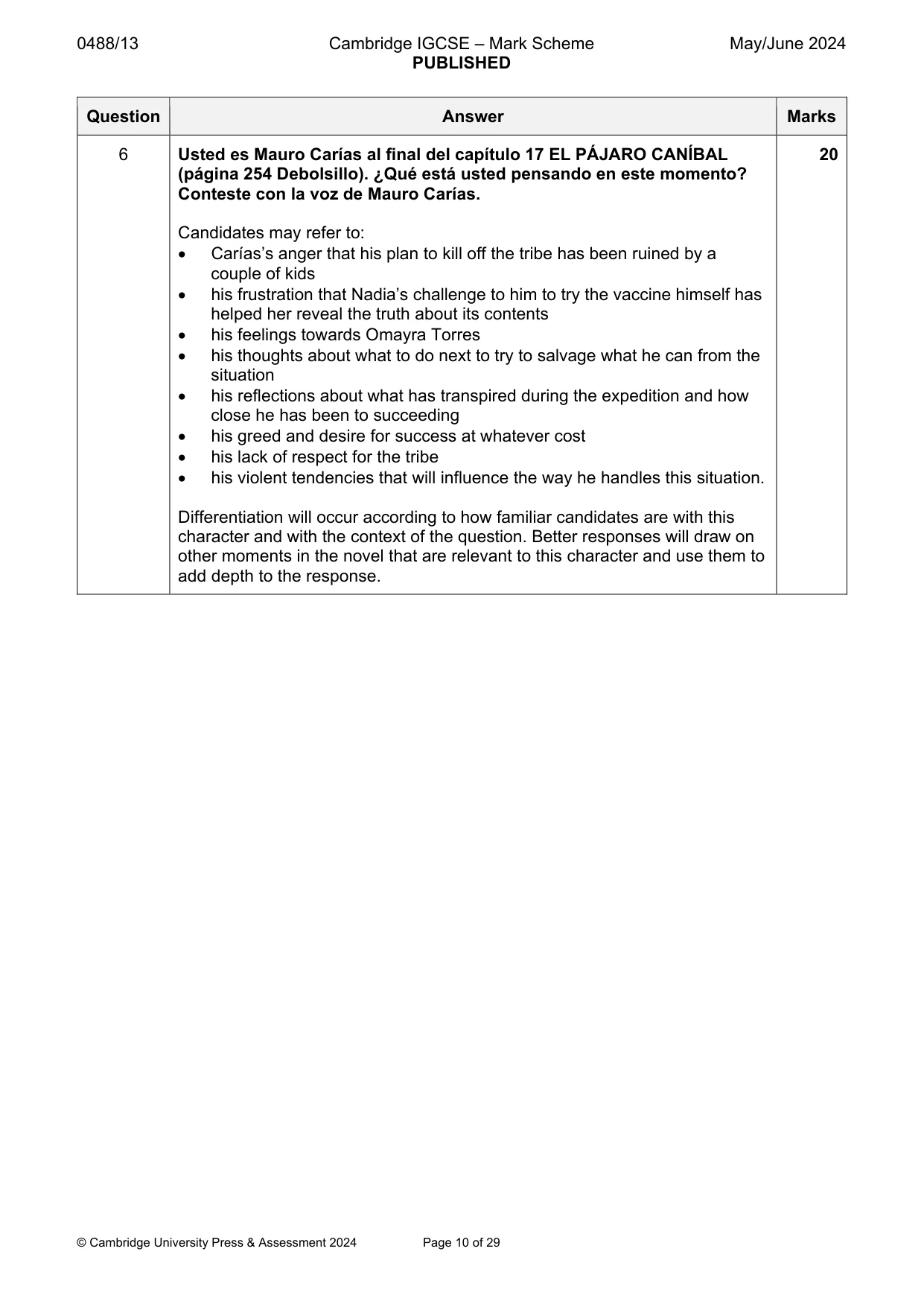
0488/13 Cambridge IGCSE – Mark Scheme PUBLISHED May/June 2024 © Cambridge University Press & Assessment 2024 Page 10 of 29 Question Answer Marks 6 Usted es Mauro Carías al final del capítulo 17 EL PÁJARO CANÍBAL (página 254 Debolsillo). ¿Qué está usted pensando en este momento? Conteste con la voz de Mauro Carías. Candidates may refer to: Carías’s anger that his plan to kill off the tribe has been ruined by a couple of kids his frustration that Nadia’s challenge to him to try the vaccine himself has helped her reveal the truth about its contents his feelings towards Omayra Torres his thoughts about what to do next to try to salvage what he can from the situation his reflections about what has transpired during the expedition and how close he has been to succeeding his greed and desire for success at whatever cost his lack of respect for the tribe his violent tendencies that will influence the way he handles this situation. Differentiation will occur according to how familiar candidates are with this character and with the context of the question. Better responses will draw on other moments in the novel that are relevant to this character and use them to add depth to the response. 20
Mark scheme, page 11
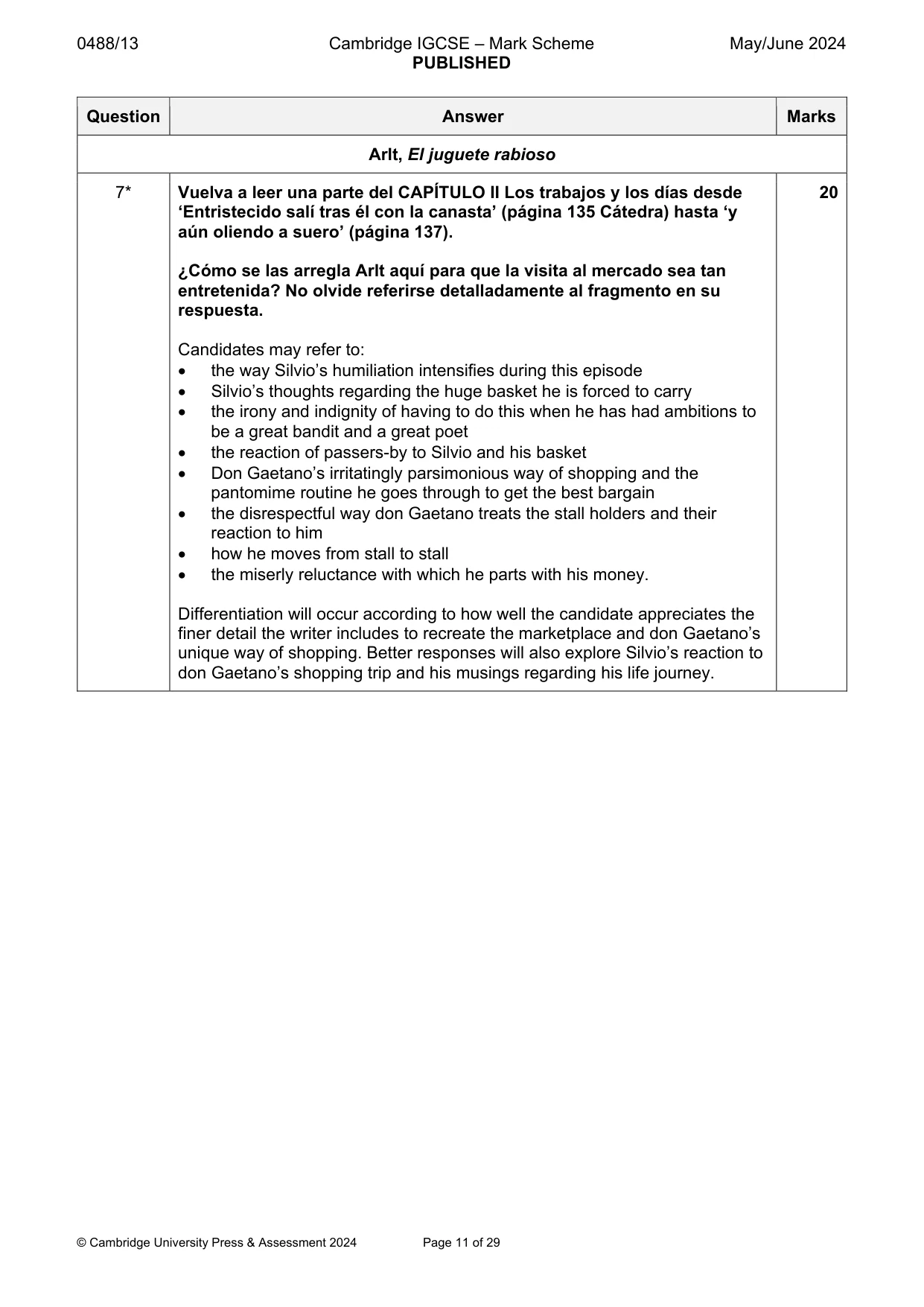
0488/13 Cambridge IGCSE – Mark Scheme PUBLISHED May/June 2024 © Cambridge University Press & Assessment 2024 Page 11 of 29 Question Answer Marks Arlt, El juguete rabioso 7* Vuelva a leer una parte del CAPÍTULO II Los trabajos y los días desde ‘Entristecido salí tras él con la canasta’ (página 135 Cátedra) hasta ‘y aún oliendo a suero’ (página 137). ¿Cómo se las arregla Arlt aquí para que la visita al mercado sea tan entretenida? No olvide referirse detalladamente al fragmento en su respuesta. Candidates may refer to: the way Silvio’s humiliation intensifies during this episode Silvio’s thoughts regarding the huge basket he is forced to carry the irony and indignity of having to do this when he has had ambitions to be a great bandit and a great poet the reaction of passers-by to Silvio and his basket Don Gaetano’s irritatingly parsimonious way of shopping and the pantomime routine he goes through to get the best bargain the disrespectful way don Gaetano treats the stall holders and their reaction to him how he moves from stall to stall the miserly reluctance with which he parts with his money. Differentiation will occur according to how well the candidate appreciates the finer detail the writer includes to recreate the marketplace and don Gaetano’s unique way of shopping. Better responses will also explore Silvio’s reaction to don Gaetano’s shopping trip and his musings regarding his life journey. 20
Mark scheme, page 12
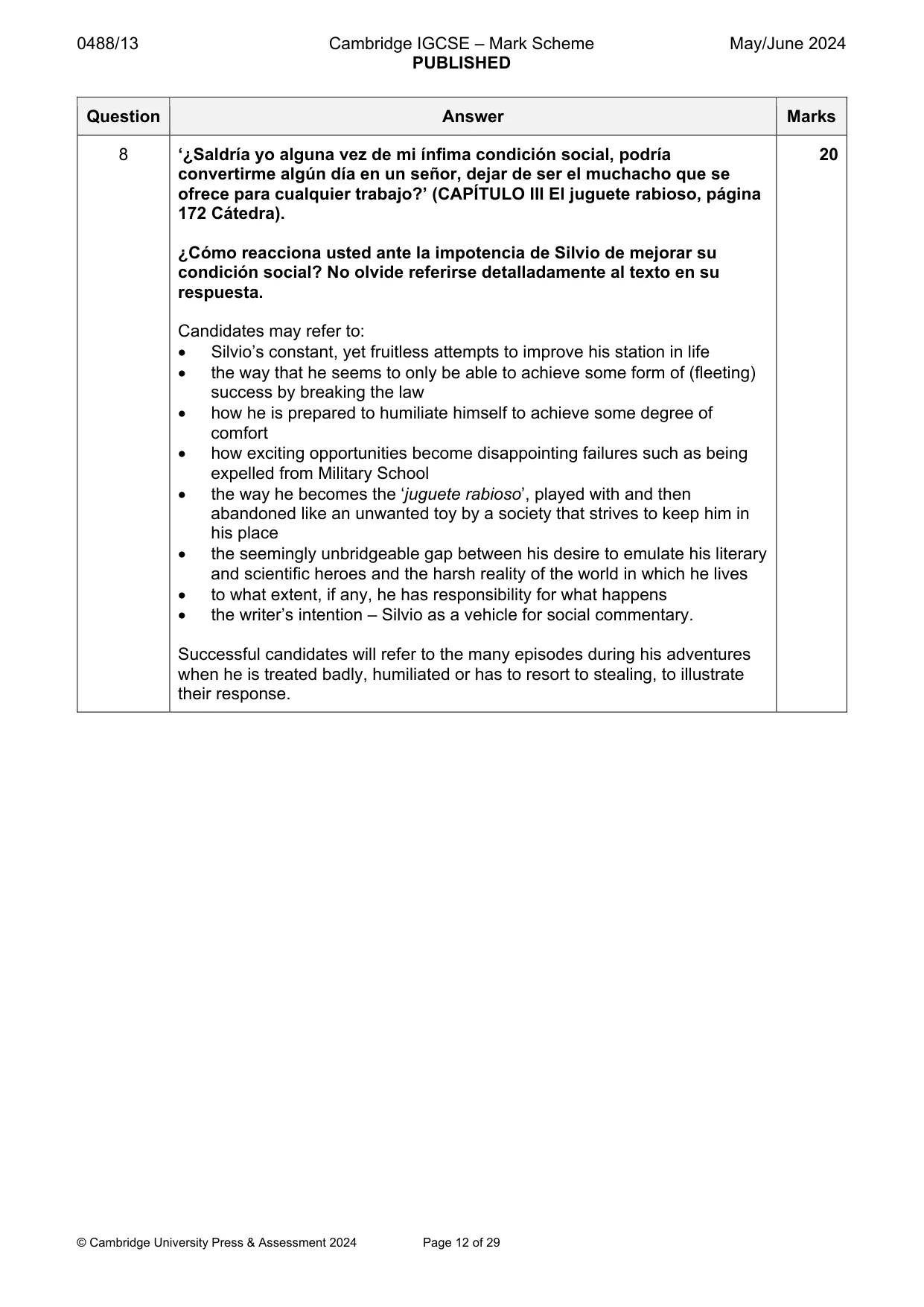
0488/13 Cambridge IGCSE – Mark Scheme PUBLISHED May/June 2024 © Cambridge University Press & Assessment 2024 Page 12 of 29 Question Answer Marks 8 ‘¿Saldría yo alguna vez de mi ínfima condición social, podría convertirme algún día en un señor, dejar de ser el muchacho que se ofrece para cualquier trabajo?’ (CAPÍTULO III El juguete rabioso, página 172 Cátedra). ¿Cómo reacciona usted ante la impotencia de Silvio de mejorar su condición social? No olvide referirse detalladamente al texto en su respuesta. Candidates may refer to: Silvio’s constant, yet fruitless attempts to improve his station in life the way that he seems to only be able to achieve some form of (fleeting) success by breaking the law how he is prepared to humiliate himself to achieve some degree of comfort how exciting opportunities become disappointing failures such as being expelled from Military School the way he becomes the ‘juguete rabioso’, played with and then abandoned like an unwanted toy by a society that strives to keep him in his place the seemingly unbridgeable gap between his desire to emulate his literary and scientific heroes and the harsh reality of the world in which he lives to what extent, if any, he has responsibility for what happens the writer’s intention – Silvio as a vehicle for social commentary. Successful candidates will refer to the many episodes during his adventures when he is treated badly, humiliated or has to resort to stealing, to illustrate their response. 20
Mark scheme, page 13
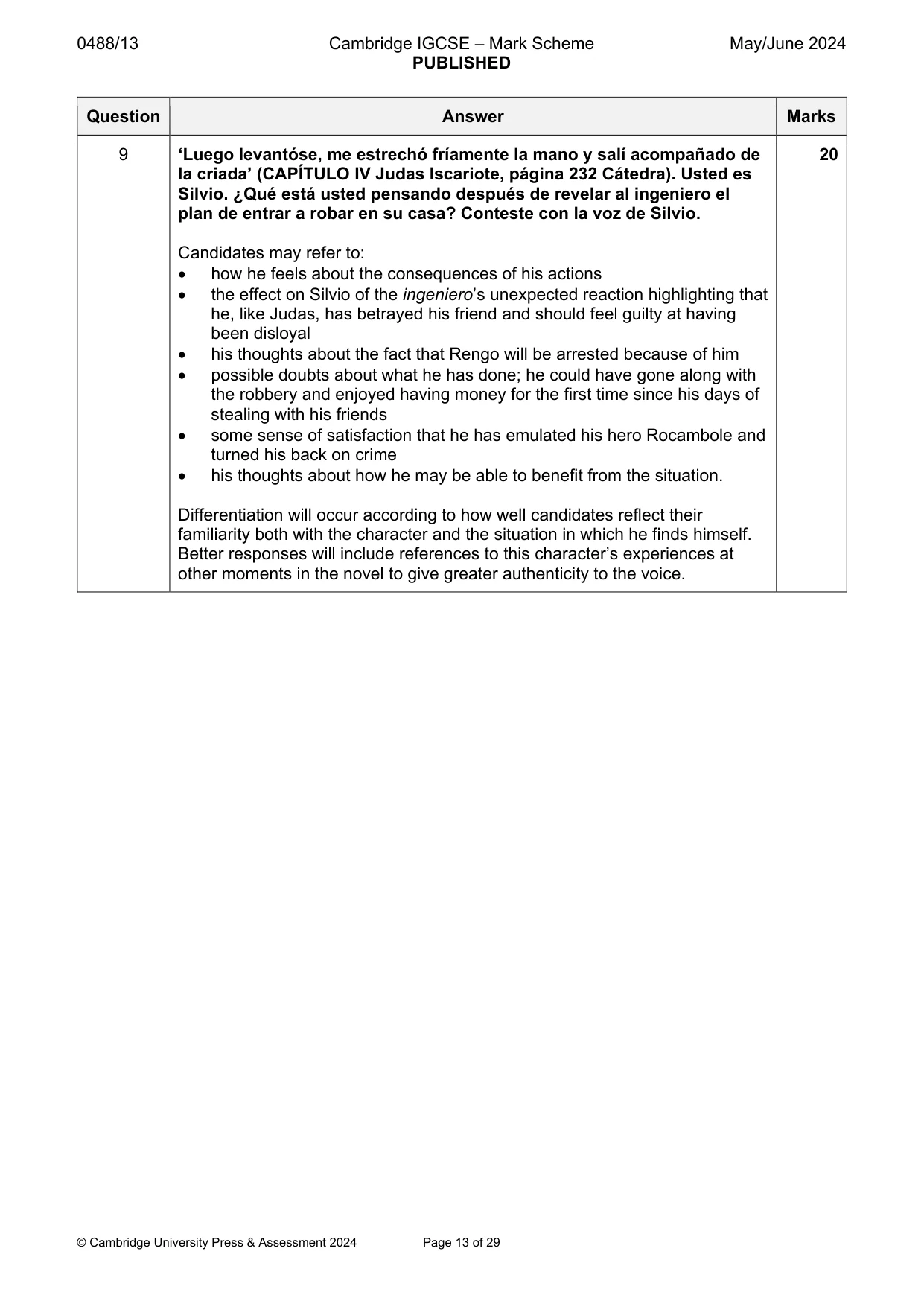
0488/13 Cambridge IGCSE – Mark Scheme PUBLISHED May/June 2024 © Cambridge University Press & Assessment 2024 Page 13 of 29 Question Answer Marks 9 ‘Luego levantóse, me estrechó fríamente la mano y salí acompañado de la criada’ (CAPÍTULO IV Judas Iscariote, página 232 Cátedra). Usted es Silvio. ¿Qué está usted pensando después de revelar al ingeniero el plan de entrar a robar en su casa? Conteste con la voz de Silvio. Candidates may refer to: how he feels about the consequences of his actions the effect on Silvio of the ingeniero’s unexpected reaction highlighting that he, like Judas, has betrayed his friend and should feel guilty at having been disloyal his thoughts about the fact that Rengo will be arrested because of him possible doubts about what he has done; he could have gone along with the robbery and enjoyed having money for the first time since his days of stealing with his friends some sense of satisfaction that he has emulated his hero Rocambole and turned his back on crime his thoughts about how he may be able to benefit from the situation. Differentiation will occur according to how well candidates reflect their familiarity both with the character and the situation in which he finds himself. Better responses will include references to this character’s experiences at other moments in the novel to give greater authenticity to the voice. 20
Mark scheme, page 14
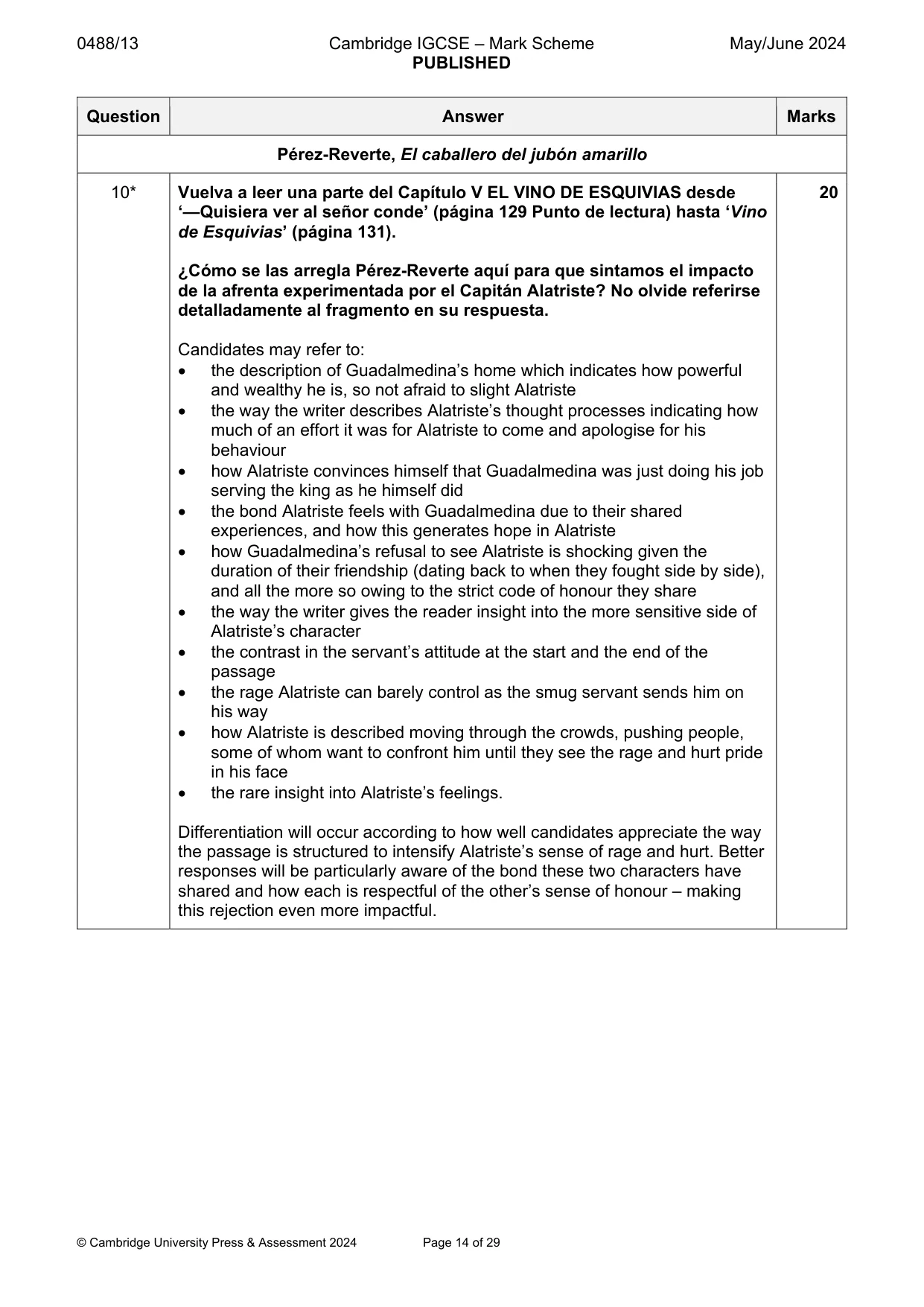
0488/13 Cambridge IGCSE – Mark Scheme PUBLISHED May/June 2024 © Cambridge University Press & Assessment 2024 Page 14 of 29 Question Answer Marks Pérez-Reverte, El caballero del jubón amarillo 10* Vuelva a leer una parte del Capítulo V EL VINO DE ESQUIVIAS desde ‘—Quisiera ver al señor conde’ (página 129 Punto de lectura) hasta ‘Vino de Esquivias’ (página 131). ¿Cómo se las arregla Pérez-Reverte aquí para que sintamos el impacto de la afrenta experimentada por el Capitán Alatriste? No olvide referirse detalladamente al fragmento en su respuesta. Candidates may refer to: the description of Guadalmedina’s home which indicates how powerful and wealthy he is, so not afraid to slight Alatriste the way the writer describes Alatriste’s thought processes indicating how much of an effort it was for Alatriste to come and apologise for his behaviour how Alatriste convinces himself that Guadalmedina was just doing his job serving the king as he himself did the bond Alatriste feels with Guadalmedina due to their shared experiences, and how this generates hope in Alatriste how Guadalmedina’s refusal to see Alatriste is shocking given the duration of their friendship (dating back to when they fought side by side), and all the more so owing to the strict code of honour they share the way the writer gives the reader insight into the more sensitive side of Alatriste’s character the contrast in the servant’s attitude at the start and the end of the passage the rage Alatriste can barely control as the smug servant sends him on his way how Alatriste is described moving through the crowds, pushing people, some of whom want to confront him until they see the rage and hurt pride in his face the rare insight into Alatriste’s feelings. Differentiation will occur according to how well candidates appreciate the way the passage is structured to intensify Alatriste’s sense of rage and hurt. Better responses will be particularly aware of the bond these two characters have shared and how each is respectful of the other’s sense of honour – making this rejection even more impactful. 20
Mark scheme, page 15
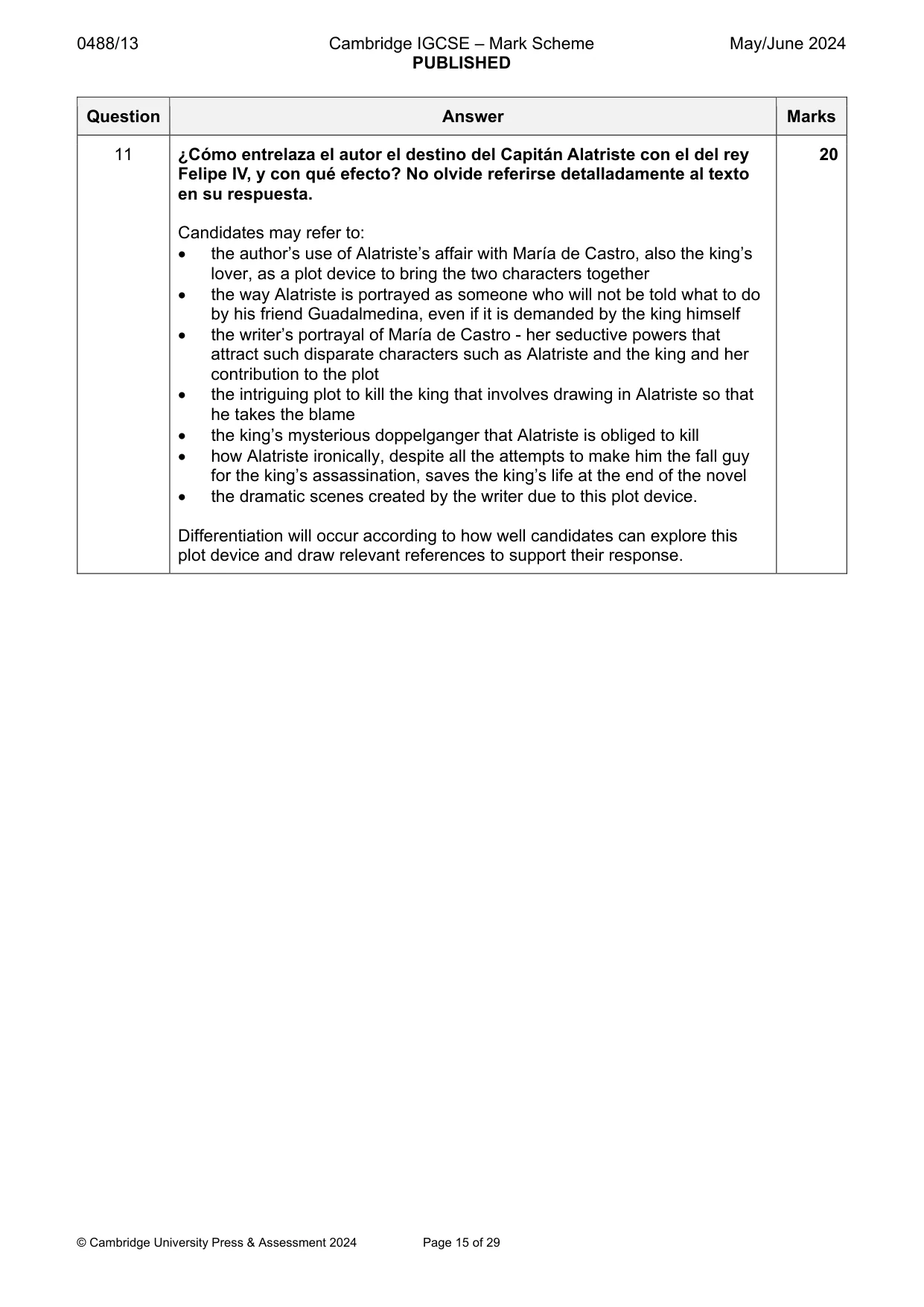
0488/13 Cambridge IGCSE – Mark Scheme PUBLISHED May/June 2024 © Cambridge University Press & Assessment 2024 Page 15 of 29 Question Answer Marks 11 ¿Cómo entrelaza el autor el destino del Capitán Alatriste con el del rey Felipe IV, y con qué efecto? No olvide referirse detalladamente al texto en su respuesta. Candidates may refer to: the author’s use of Alatriste’s affair with María de Castro, also the king’s lover, as a plot device to bring the two characters together the way Alatriste is portrayed as someone who will not be told what to do by his friend Guadalmedina, even if it is demanded by the king himself the writer’s portrayal of María de Castro - her seductive powers that attract such disparate characters such as Alatriste and the king and her contribution to the plot the intriguing plot to kill the king that involves drawing in Alatriste so that he takes the blame the king’s mysterious doppelganger that Alatriste is obliged to kill how Alatriste ironically, despite all the attempts to make him the fall guy for the king’s assassination, saves the king’s life at the end of the novel the dramatic scenes created by the writer due to this plot device. Differentiation will occur according to how well candidates can explore this plot device and draw relevant references to support their response. 20
Mark scheme, page 16
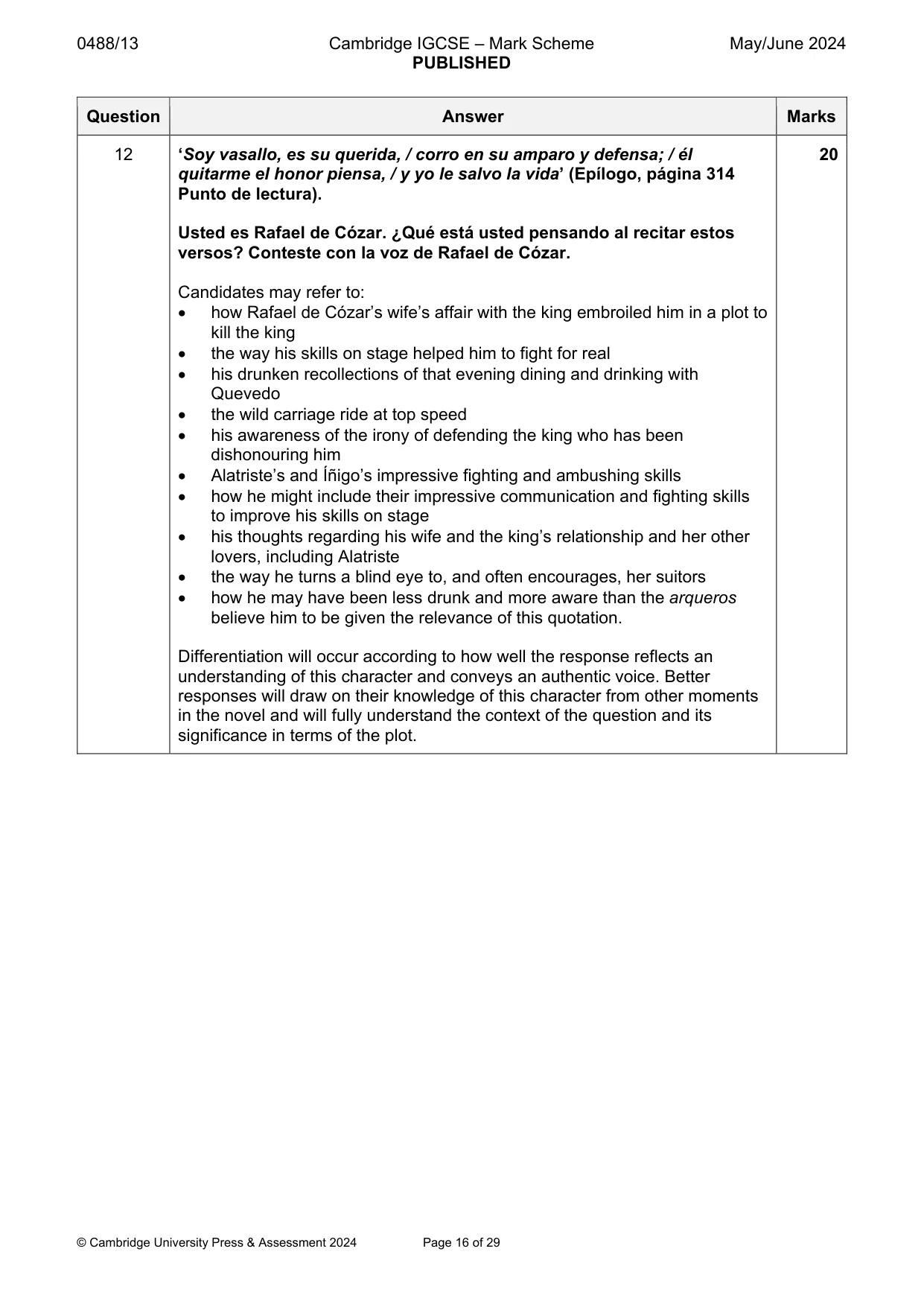
0488/13 Cambridge IGCSE – Mark Scheme PUBLISHED May/June 2024 © Cambridge University Press & Assessment 2024 Page 16 of 29 Question Answer Marks 12 ‘Soy vasallo, es su querida, / corro en su amparo y defensa; / él quitarme el honor piensa, / y yo le salvo la vida’ (Epílogo, página 314 Punto de lectura). Usted es Rafael de Cózar. ¿Qué está usted pensando al recitar estos versos? Conteste con la voz de Rafael de Cózar. Candidates may refer to: how Rafael de Cózar’s wife’s affair with the king embroiled him in a plot to kill the king the way his skills on stage helped him to fight for real his drunken recollections of that evening dining and drinking with Quevedo the wild carriage ride at top speed his awareness of the irony of defending the king who has been dishonouring him Alatriste’s and Íñigo’s impressive fighting and ambushing skills how he might include their impressive communication and fighting skills to improve his skills on stage his thoughts regarding his wife and the king’s relationship and her other lovers, including Alatriste the way he turns a blind eye to, and often encourages, her suitors how he may have been less drunk and more aware than the arqueros believe him to be given the relevance of this quotation. Differentiation will occur according to how well the response reflects an understanding of this character and conveys an authentic voice. Better responses will draw on their knowledge of this character from other moments in the novel and will fully understand the context of the question and its significance in terms of the plot. 20
Mark scheme, page 17
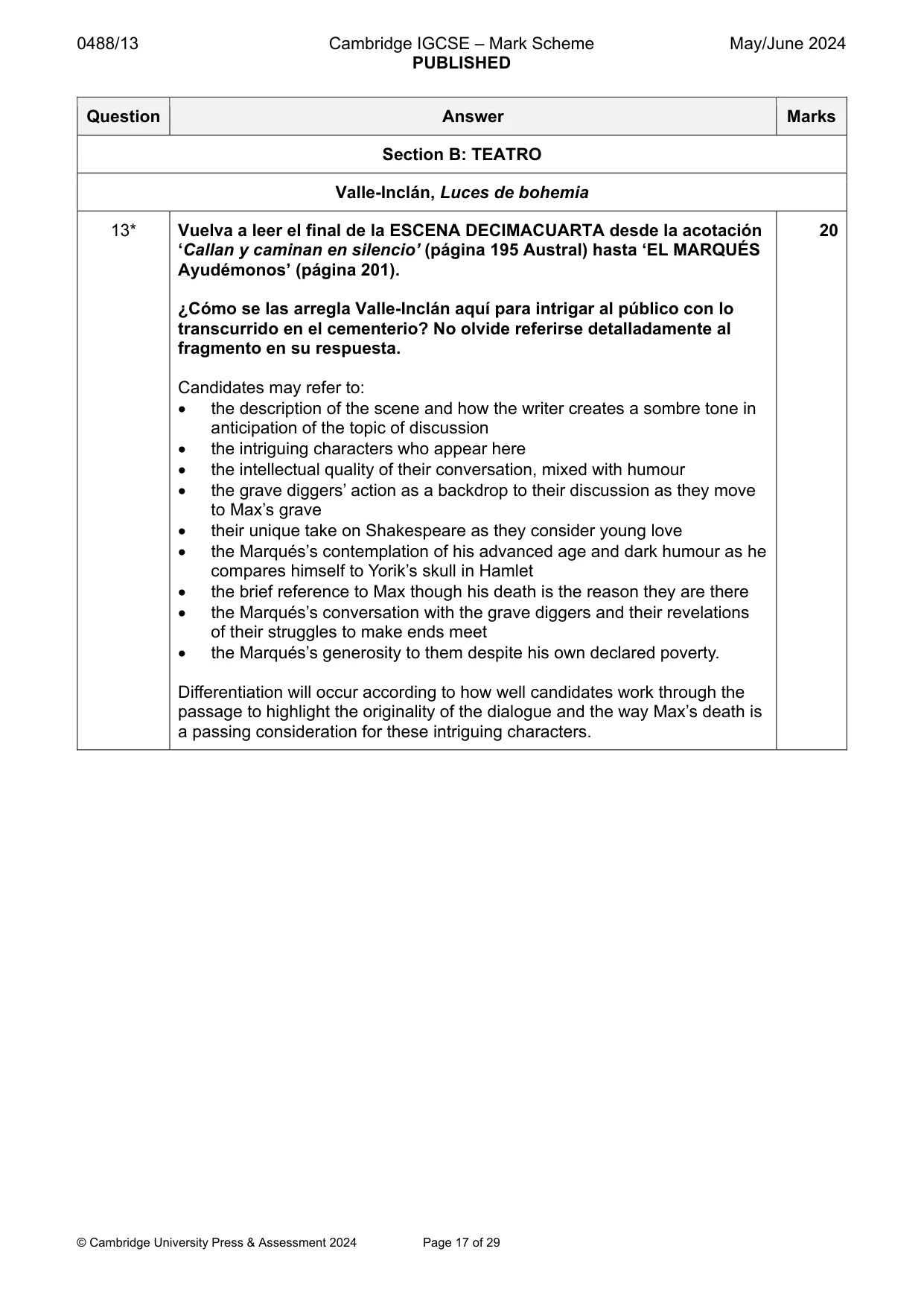
0488/13 Cambridge IGCSE – Mark Scheme PUBLISHED May/June 2024 © Cambridge University Press & Assessment 2024 Page 17 of 29 Question Answer Marks Section B: TEATRO Valle-Inclán, Luces de bohemia 13* Vuelva a leer el final de la ESCENA DECIMACUARTA desde la acotación ‘Callan y caminan en silencio’ (página 195 Austral) hasta ‘EL MARQUÉS Ayudémonos’ (página 201). ¿Cómo se las arregla Valle-Inclán aquí para intrigar al público con lo transcurrido en el cementerio? No olvide referirse detalladamente al fragmento en su respuesta. Candidates may refer to: the description of the scene and how the writer creates a sombre tone in anticipation of the topic of discussion the intriguing characters who appear here the intellectual quality of their conversation, mixed with humour the grave diggers’ action as a backdrop to their discussion as they move to Max’s grave their unique take on Shakespeare as they consider young love the Marqués’s contemplation of his advanced age and dark humour as he compares himself to Yorik’s skull in Hamlet the brief reference to Max though his death is the reason they are there the Marqués’s conversation with the grave diggers and their revelations of their struggles to make ends meet the Marqués’s generosity to them despite his own declared poverty. Differentiation will occur according to how well candidates work through the passage to highlight the originality of the dialogue and the way Max’s death is a passing consideration for these intriguing characters. 20
Mark scheme, page 18
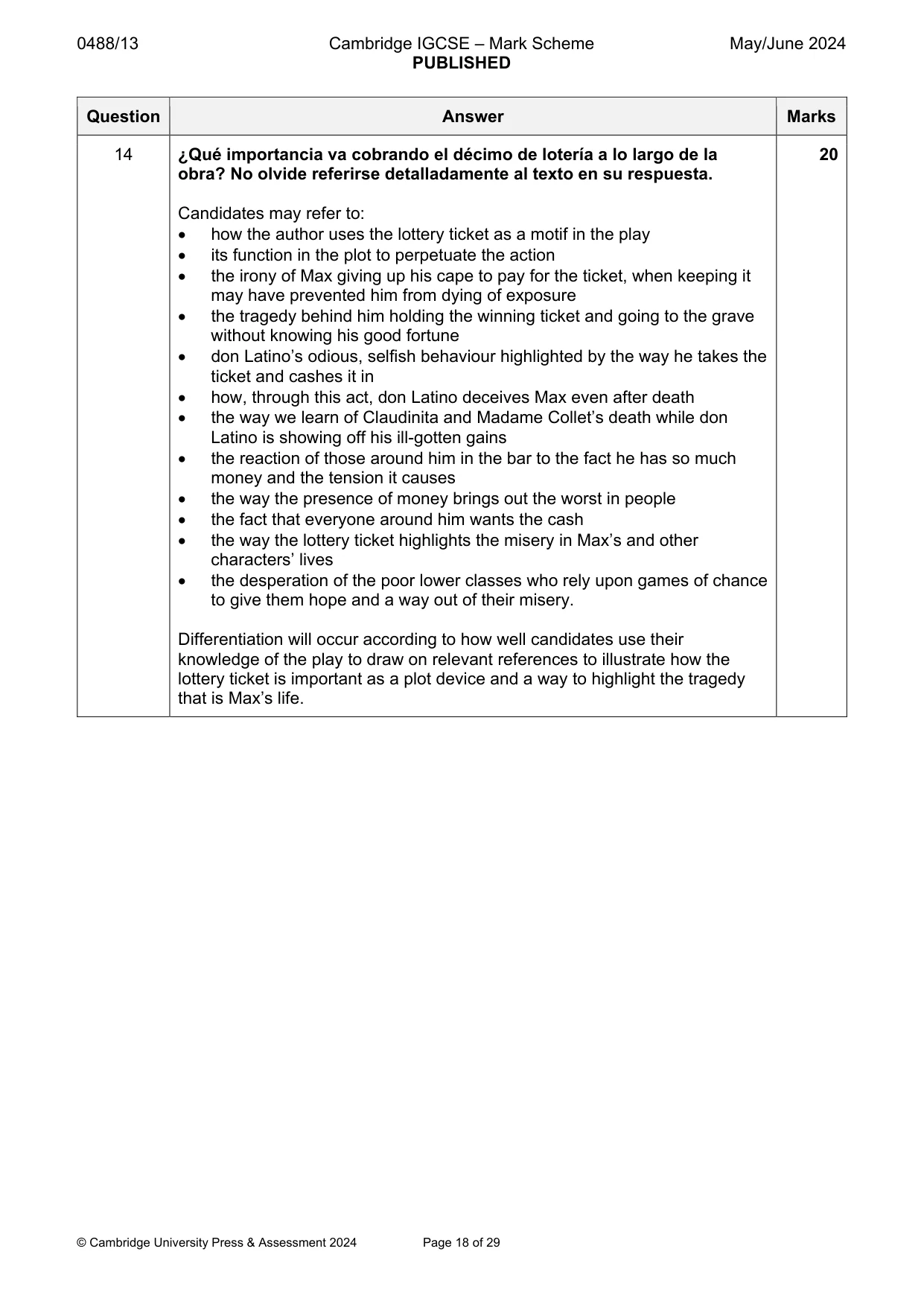
0488/13 Cambridge IGCSE – Mark Scheme PUBLISHED May/June 2024 © Cambridge University Press & Assessment 2024 Page 18 of 29 Question Answer Marks 14 ¿Qué importancia va cobrando el décimo de lotería a lo largo de la obra? No olvide referirse detalladamente al texto en su respuesta. Candidates may refer to: how the author uses the lottery ticket as a motif in the play its function in the plot to perpetuate the action the irony of Max giving up his cape to pay for the ticket, when keeping it may have prevented him from dying of exposure the tragedy behind him holding the winning ticket and going to the grave without knowing his good fortune don Latino’s odious, selfish behaviour highlighted by the way he takes the ticket and cashes it in how, through this act, don Latino deceives Max even after death the way we learn of Claudinita and Madame Collet’s death while don Latino is showing off his ill-gotten gains the reaction of those around him in the bar to the fact he has so much money and the tension it causes the way the presence of money brings out the worst in people the fact that everyone around him wants the cash the way the lottery ticket highlights the misery in Max’s and other characters’ lives the desperation of the poor lower classes who rely upon games of chance to give them hope and a way out of their misery. Differentiation will occur according to how well candidates use their knowledge of the play to draw on relevant references to illustrate how the lottery ticket is important as a plot device and a way to highlight the tragedy that is Max’s life. 20
Mark scheme, page 19
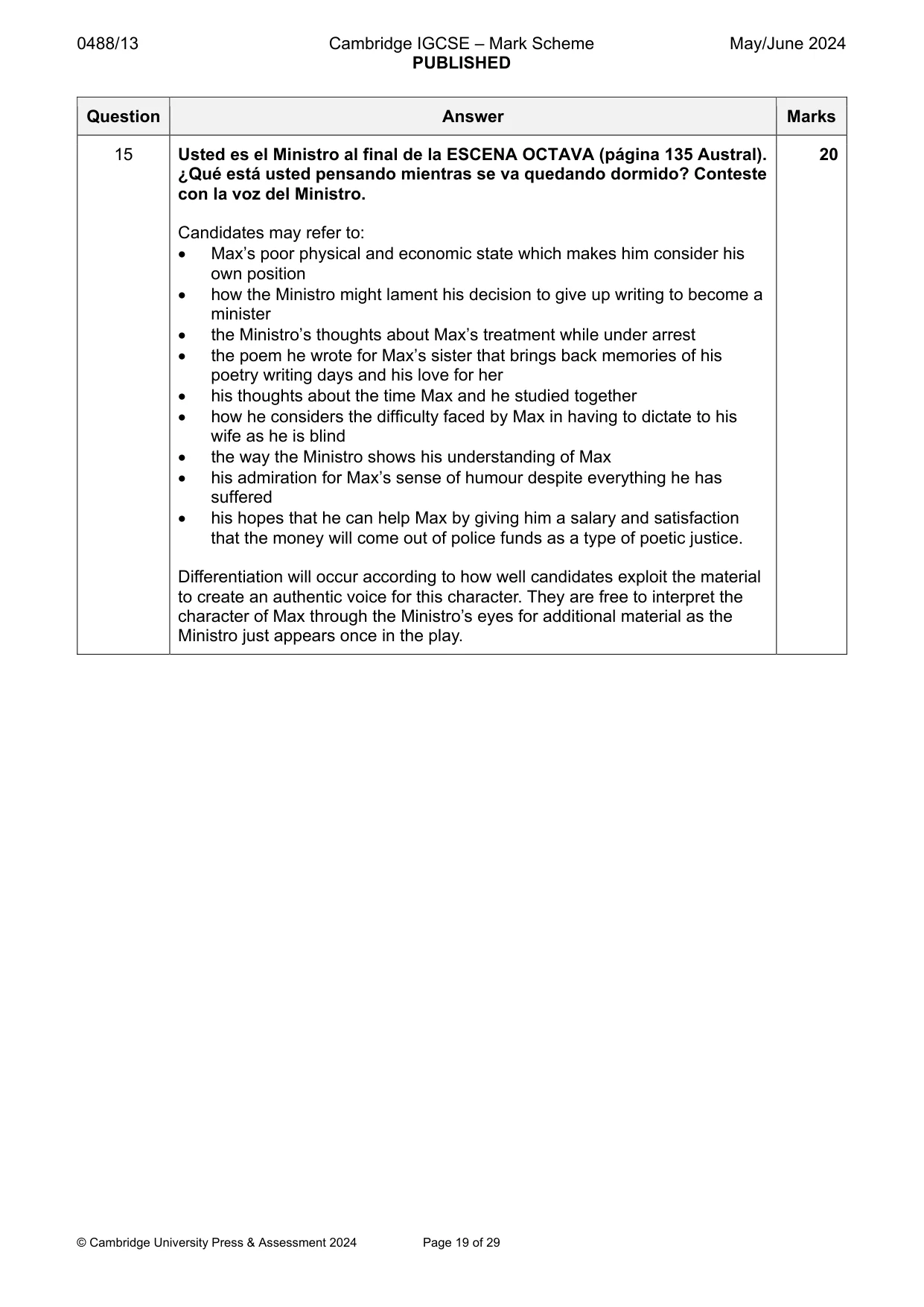
0488/13 Cambridge IGCSE – Mark Scheme PUBLISHED May/June 2024 © Cambridge University Press & Assessment 2024 Page 19 of 29 Question Answer Marks 15 Usted es el Ministro al final de la ESCENA OCTAVA (página 135 Austral). ¿Qué está usted pensando mientras se va quedando dormido? Conteste con la voz del Ministro. Candidates may refer to: Max’s poor physical and economic state which makes him consider his own position how the Ministro might lament his decision to give up writing to become a minister the Ministro’s thoughts about Max’s treatment while under arrest the poem he wrote for Max’s sister that brings back memories of his poetry writing days and his love for her his thoughts about the time Max and he studied together how he considers the difficulty faced by Max in having to dictate to his wife as he is blind the way the Ministro shows his understanding of Max his admiration for Max’s sense of humour despite everything he has suffered his hopes that he can help Max by giving him a salary and satisfaction that the money will come out of police funds as a type of poetic justice. Differentiation will occur according to how well candidates exploit the material to create an authentic voice for this character. They are free to interpret the character of Max through the Ministro’s eyes for additional material as the Ministro just appears once in the play. 20
Mark scheme, page 20
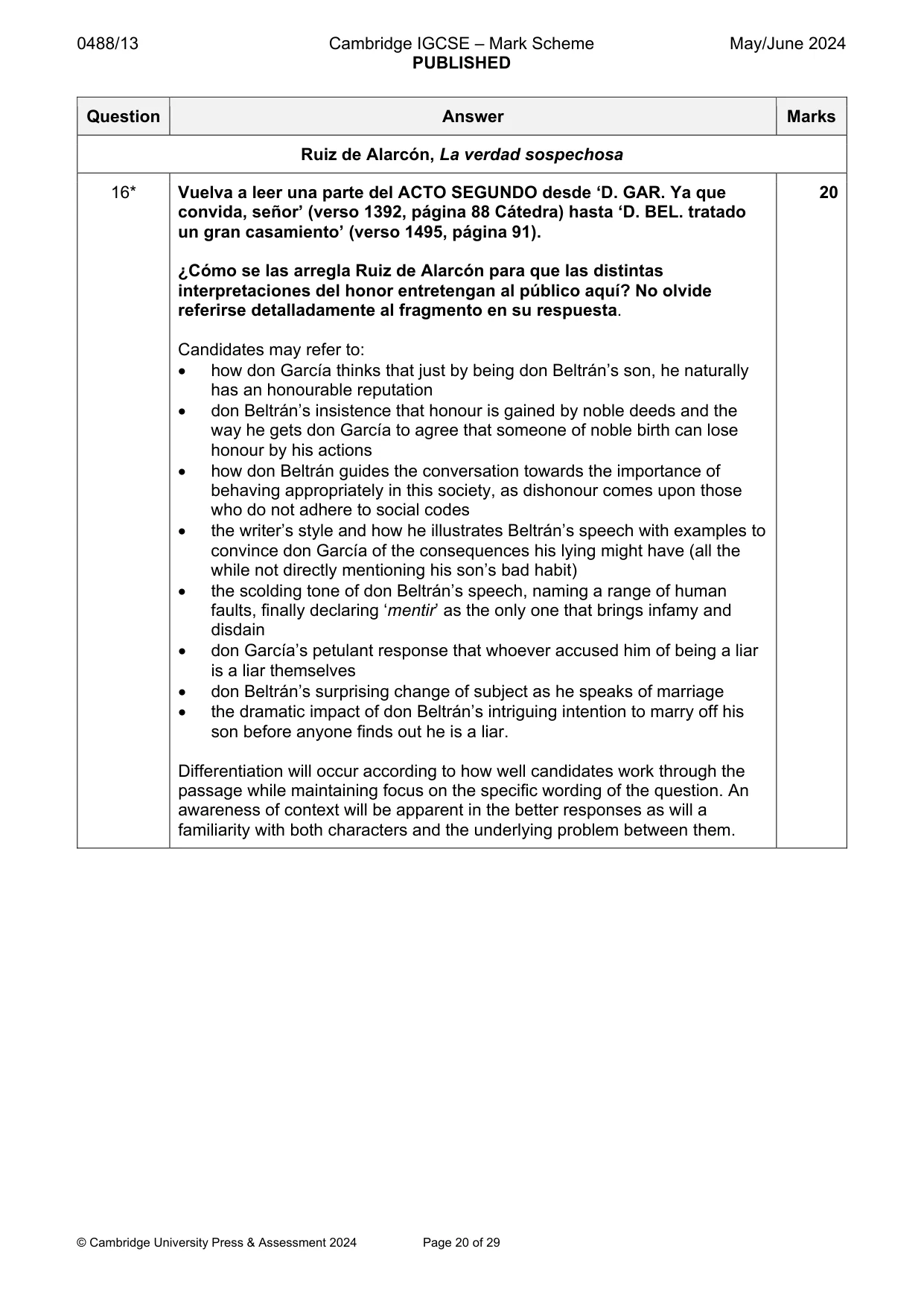
0488/13 Cambridge IGCSE – Mark Scheme PUBLISHED May/June 2024 © Cambridge University Press & Assessment 2024 Page 20 of 29 Question Answer Marks Ruiz de Alarcón, La verdad sospechosa 16* Vuelva a leer una parte del ACTO SEGUNDO desde ‘D. GAR. Ya que convida, señor’ (verso 1392, página 88 Cátedra) hasta ‘D. BEL. tratado un gran casamiento’ (verso 1495, página 91). ¿Cómo se las arregla Ruiz de Alarcón para que las distintas interpretaciones del honor entretengan al público aquí? No olvide referirse detalladamente al fragmento en su respuesta. Candidates may refer to: how don García thinks that just by being don Beltrán’s son, he naturally has an honourable reputation don Beltrán’s insistence that honour is gained by noble deeds and the way he gets don García to agree that someone of noble birth can lose honour by his actions how don Beltrán guides the conversation towards the importance of behaving appropriately in this society, as dishonour comes upon those who do not adhere to social codes the writer’s style and how he illustrates Beltrán’s speech with examples to convince don García of the consequences his lying might have (all the while not directly mentioning his son’s bad habit) the scolding tone of don Beltrán’s speech, naming a range of human faults, finally declaring ‘mentir’ as the only one that brings infamy and disdain don García’s petulant response that whoever accused him of being a liar is a liar themselves don Beltrán’s surprising change of subject as he speaks of marriage the dramatic impact of don Beltrán’s intriguing intention to marry off his son before anyone finds out he is a liar. Differentiation will occur according to how well candidates work through the passage while maintaining focus on the specific wording of the question. An awareness of context will be apparent in the better responses as will a familiarity with both characters and the underlying problem between them. 20
Mark scheme, page 21
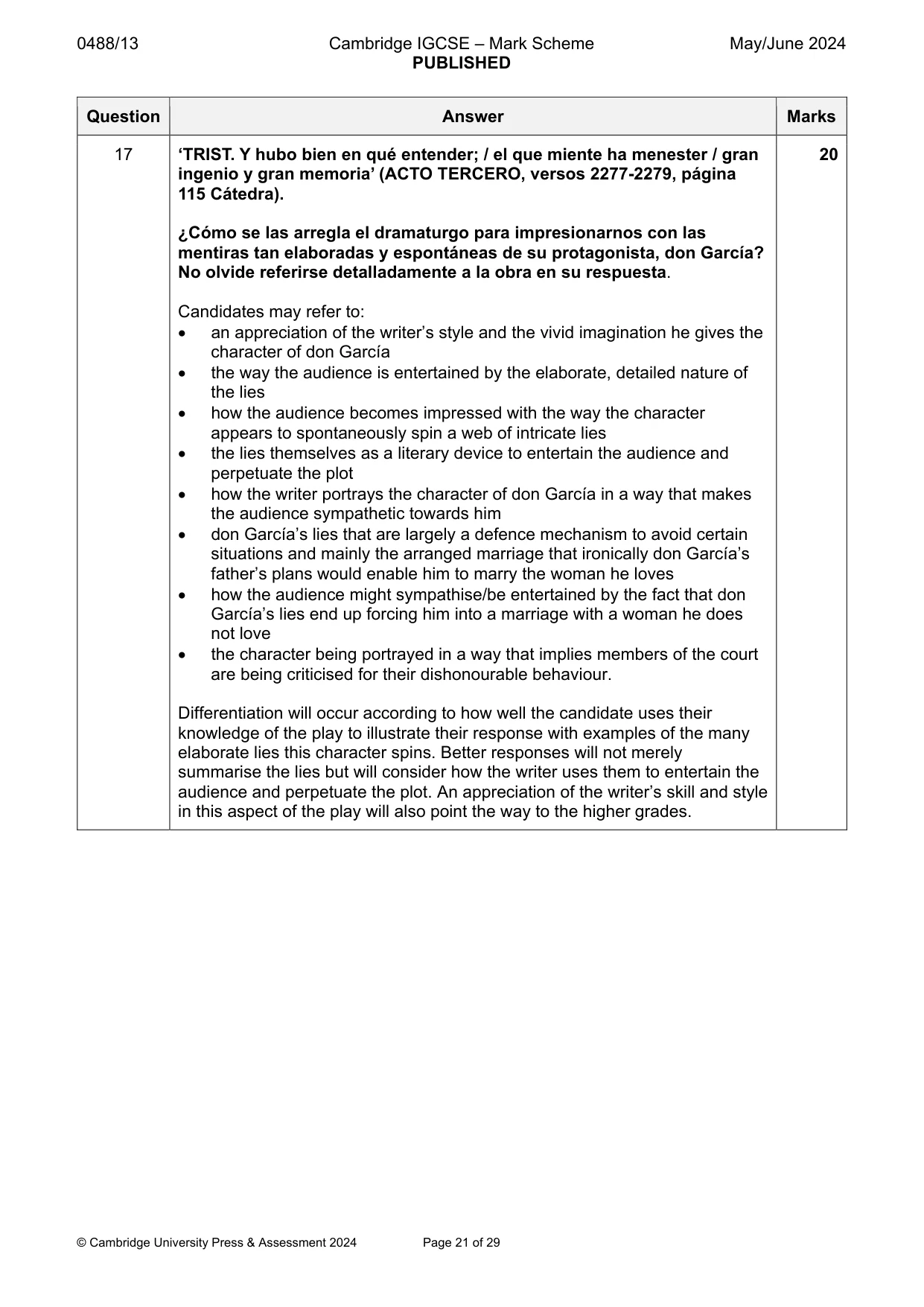
0488/13 Cambridge IGCSE – Mark Scheme PUBLISHED May/June 2024 © Cambridge University Press & Assessment 2024 Page 21 of 29 Question Answer Marks 17 ‘TRIST. Y hubo bien en qué entender; / el que miente ha menester / gran ingenio y gran memoria’ (ACTO TERCERO, versos 2277-2279, página 115 Cátedra). ¿Cómo se las arregla el dramaturgo para impresionarnos con las mentiras tan elaboradas y espontáneas de su protagonista, don García? No olvide referirse detalladamente a la obra en su respuesta. Candidates may refer to: an appreciation of the writer’s style and the vivid imagination he gives the character of don García the way the audience is entertained by the elaborate, detailed nature of the lies how the audience becomes impressed with the way the character appears to spontaneously spin a web of intricate lies the lies themselves as a literary device to entertain the audience and perpetuate the plot how the writer portrays the character of don García in a way that makes the audience sympathetic towards him don García’s lies that are largely a defence mechanism to avoid certain situations and mainly the arranged marriage that ironically don García’s father’s plans would enable him to marry the woman he loves how the audience might sympathise/be entertained by the fact that don García’s lies end up forcing him into a marriage with a woman he does not love the character being portrayed in a way that implies members of the court are being criticised for their dishonourable behaviour. Differentiation will occur according to how well the candidate uses their knowledge of the play to illustrate their response with examples of the many elaborate lies this character spins. Better responses will not merely summarise the lies but will consider how the writer uses them to entertain the audience and perpetuate the plot. An appreciation of the writer’s skill and style in this aspect of the play will also point the way to the higher grades. 20
Mark scheme, page 22
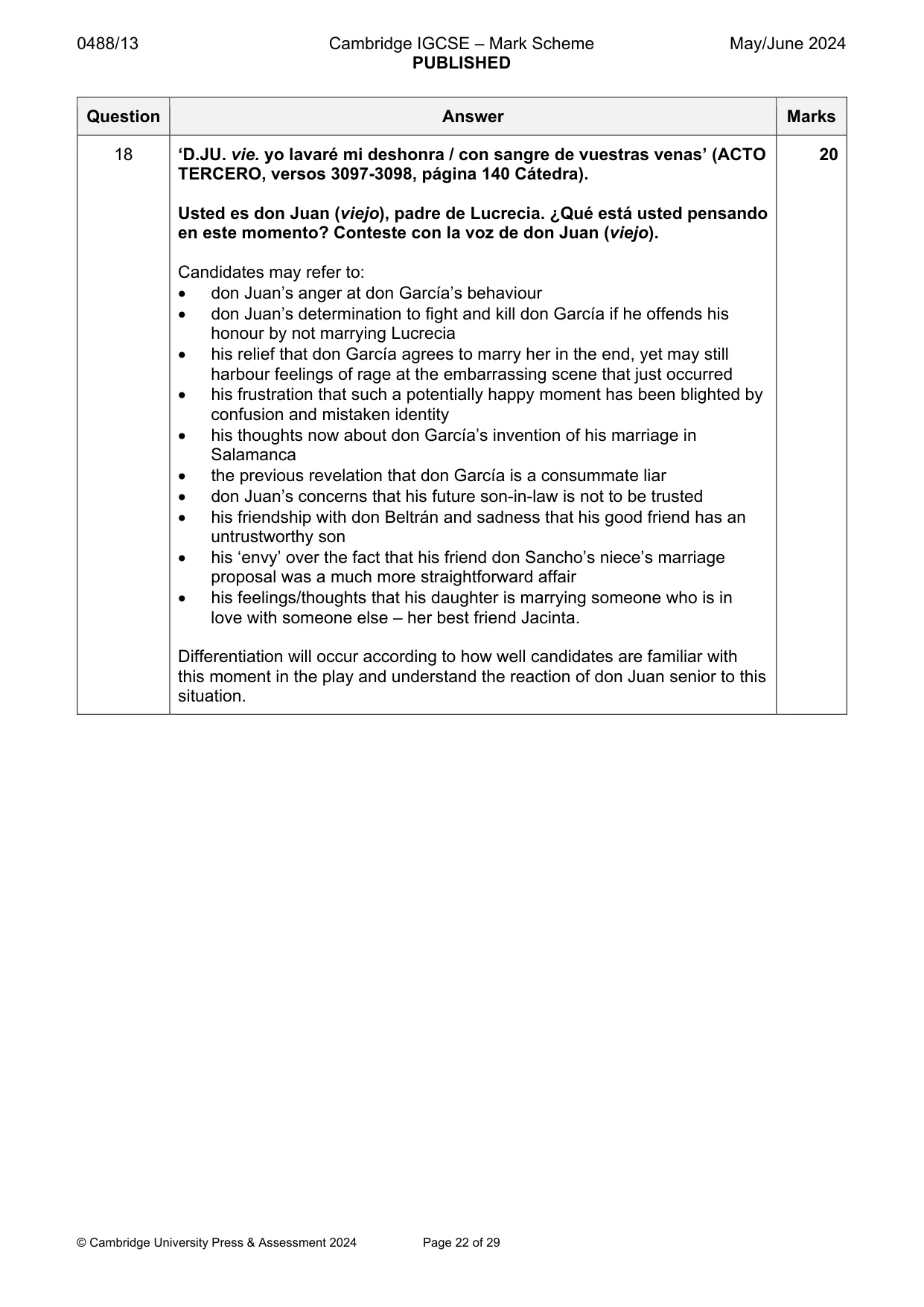
0488/13 Cambridge IGCSE – Mark Scheme PUBLISHED May/June 2024 © Cambridge University Press & Assessment 2024 Page 22 of 29 Question Answer Marks 18 ‘D.JU. vie. yo lavaré mi deshonra / con sangre de vuestras venas’ (ACTO TERCERO, versos 3097-3098, página 140 Cátedra). Usted es don Juan (viejo), padre de Lucrecia. ¿Qué está usted pensando en este momento? Conteste con la voz de don Juan (viejo). Candidates may refer to: don Juan’s anger at don García’s behaviour don Juan’s determination to fight and kill don García if he offends his honour by not marrying Lucrecia his relief that don García agrees to marry her in the end, yet may still harbour feelings of rage at the embarrassing scene that just occurred his frustration that such a potentially happy moment has been blighted by confusion and mistaken identity his thoughts now about don García’s invention of his marriage in Salamanca the previous revelation that don García is a consummate liar don Juan’s concerns that his future son-in-law is not to be trusted his friendship with don Beltrán and sadness that his good friend has an untrustworthy son his ‘envy’ over the fact that his friend don Sancho’s niece’s marriage proposal was a much more straightforward affair his feelings/thoughts that his daughter is marrying someone who is in love with someone else – her best friend Jacinta. Differentiation will occur according to how well candidates are familiar with this moment in the play and understand the reaction of don Juan senior to this situation. 20
Mark scheme, page 23
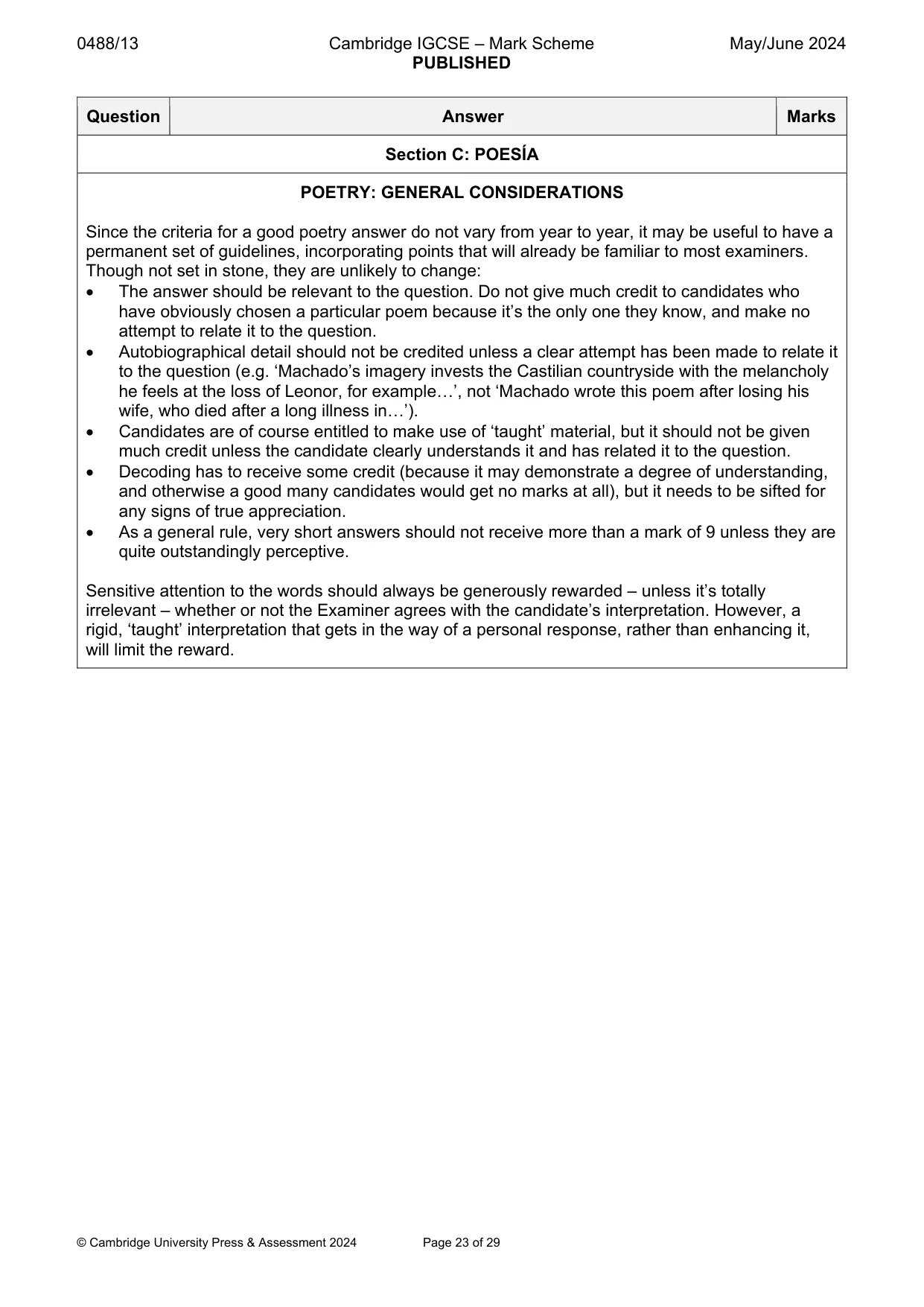
0488/13 Cambridge IGCSE – Mark Scheme PUBLISHED May/June 2024 © Cambridge University Press & Assessment 2024 Page 23 of 29 Question Answer Marks Section C: POESÍA POETRY: GENERAL CONSIDERATIONS Since the criteria for a good poetry answer do not vary from year to year, it may be useful to have a permanent set of guidelines, incorporating points that will already be familiar to most examiners. Though not set in stone, they are unlikely to change: The answer should be relevant to the question. Do not give much credit to candidates who have obviously chosen a particular poem because it’s the only one they know, and make no attempt to relate it to the question. Autobiographical detail should not be credited unless a clear attempt has been made to relate it to the question (e.g. ‘Machado’s imagery invests the Castilian countryside with the melancholy he feels at the loss of Leonor, for example…’, not ‘Machado wrote this poem after losing his wife, who died after a long illness in…’). Candidates are of course entitled to make use of ‘taught’ material, but it should not be given much credit unless the candidate clearly understands it and has related it to the question. Decoding has to receive some credit (because it may demonstrate a degree of understanding, and otherwise a good many candidates would get no marks at all), but it needs to be sifted for any signs of true appreciation. As a general rule, very short answers should not receive more than a mark of 9 unless they are quite outstandingly perceptive. Sensitive attention to the words should always be generously rewarded – unless it’s totally irrelevant – whether or not the Examiner agrees with the candidate’s interpretation. However, a rigid, ‘taught’ interpretation that gets in the way of a personal response, rather than enhancing it, will limit the reward.
Mark scheme, page 24
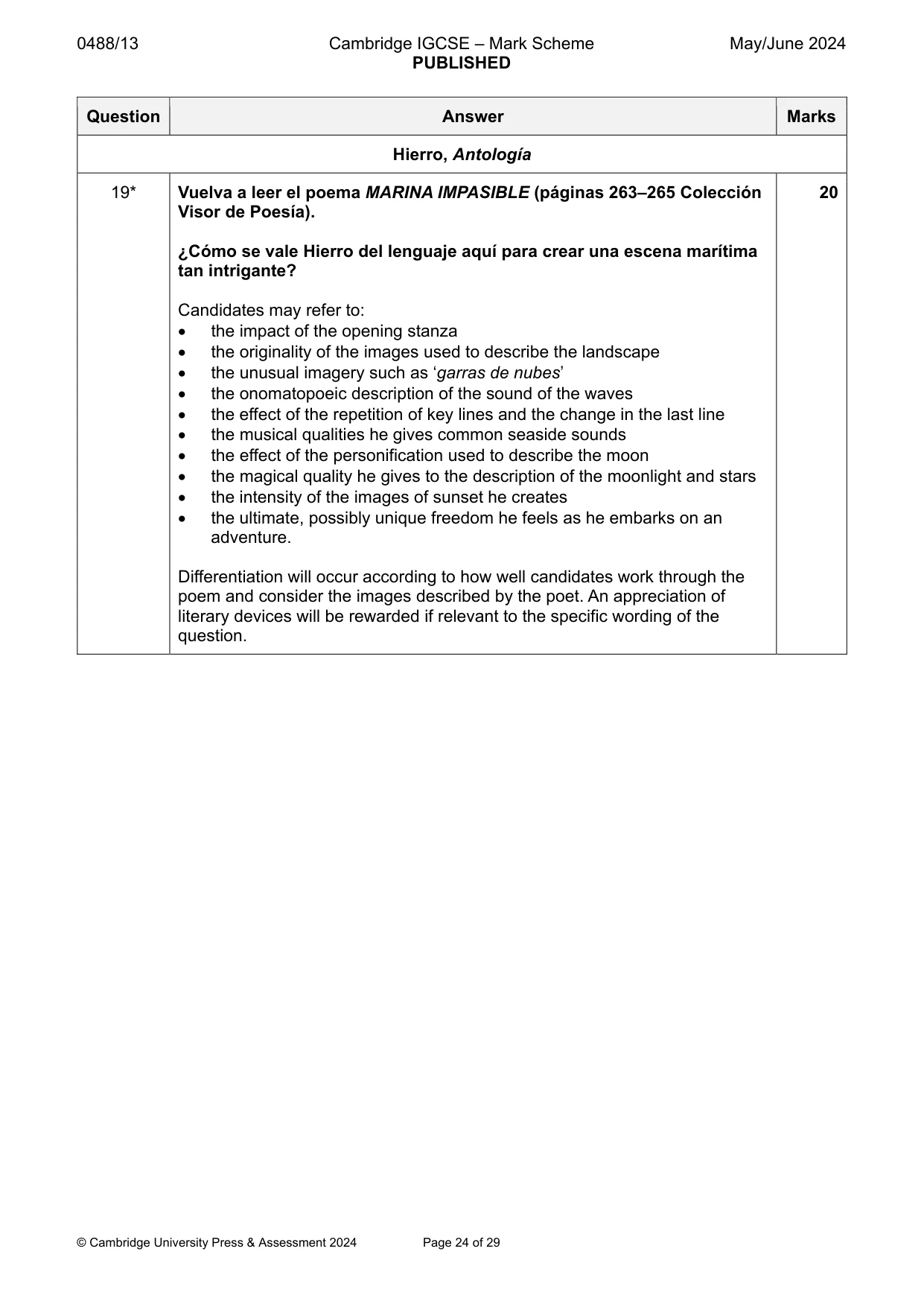
0488/13 Cambridge IGCSE – Mark Scheme PUBLISHED May/June 2024 © Cambridge University Press & Assessment 2024 Page 24 of 29 Question Answer Marks Hierro, Antología 19* Vuelva a leer el poema MARINA IMPASIBLE (páginas 263–265 Colección Visor de Poesía). ¿Cómo se vale Hierro del lenguaje aquí para crear una escena marítima tan intrigante? Candidates may refer to: the impact of the opening stanza the originality of the images used to describe the landscape the unusual imagery such as ‘garras de nubes’ the onomatopoeic description of the sound of the waves the effect of the repetition of key lines and the change in the last line the musical qualities he gives common seaside sounds the effect of the personification used to describe the moon the magical quality he gives to the description of the moonlight and stars the intensity of the images of sunset he creates the ultimate, possibly unique freedom he feels as he embarks on an adventure. Differentiation will occur according to how well candidates work through the poem and consider the images described by the poet. An appreciation of literary devices will be rewarded if relevant to the specific wording of the question. 20
Mark scheme, page 25
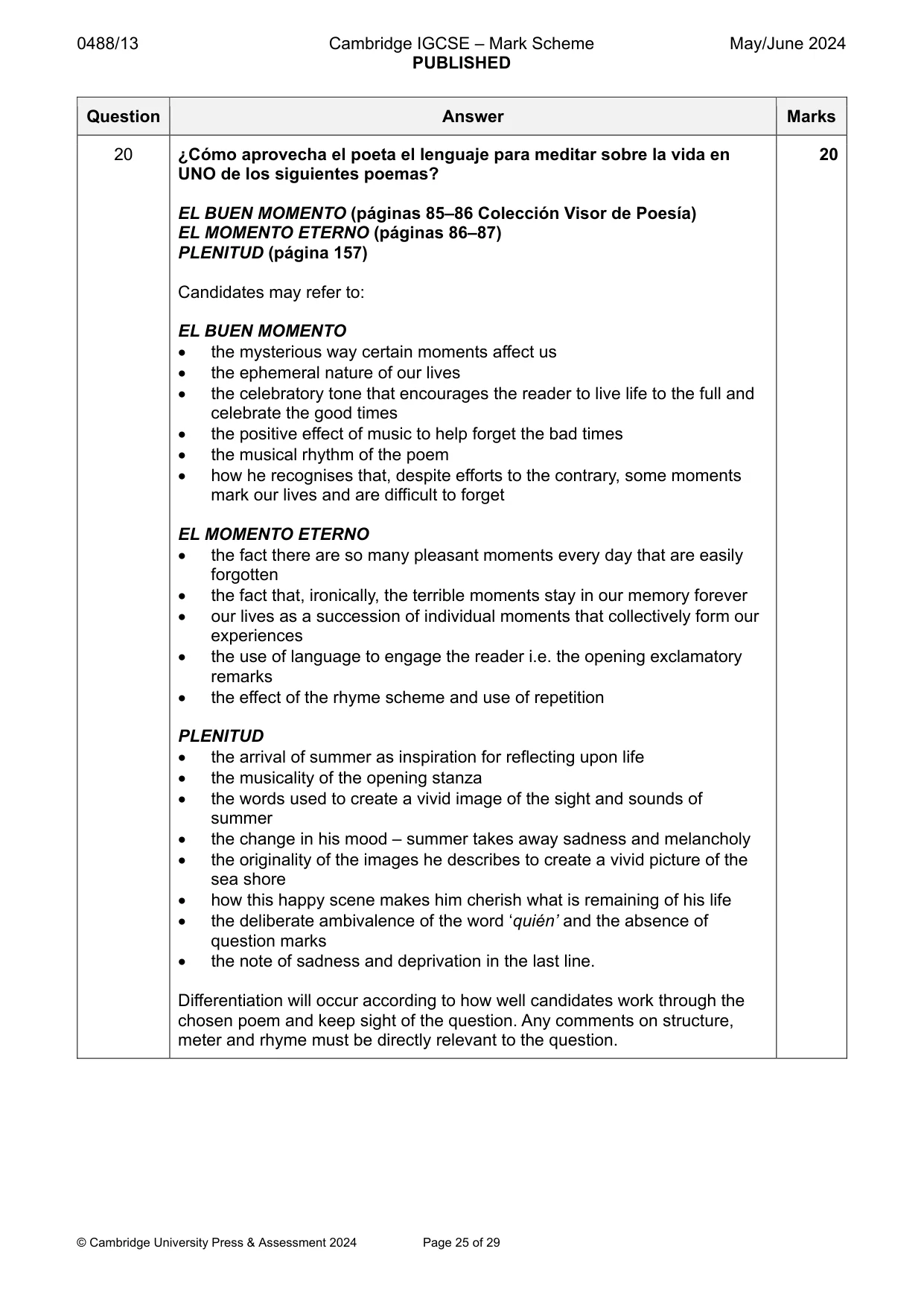
0488/13 Cambridge IGCSE – Mark Scheme PUBLISHED May/June 2024 © Cambridge University Press & Assessment 2024 Page 25 of 29 Question Answer Marks 20 ¿Cómo aprovecha el poeta el lenguaje para meditar sobre la vida en UNO de los siguientes poemas? EL BUEN MOMENTO (páginas 85–86 Colección Visor de Poesía) EL MOMENTO ETERNO (páginas 86–87) PLENITUD (página 157) Candidates may refer to: EL BUEN MOMENTO the mysterious way certain moments affect us the ephemeral nature of our lives the celebratory tone that encourages the reader to live life to the full and celebrate the good times the positive effect of music to help forget the bad times the musical rhythm of the poem how he recognises that, despite efforts to the contrary, some moments mark our lives and are difficult to forget EL MOMENTO ETERNO the fact there are so many pleasant moments every day that are easily forgotten the fact that, ironically, the terrible moments stay in our memory forever our lives as a succession of individual moments that collectively form our experiences the use of language to engage the reader i.e. the opening exclamatory remarks the effect of the rhyme scheme and use of repetition PLENITUD the arrival of summer as inspiration for reflecting upon life the musicality of the opening stanza the words used to create a vivid image of the sight and sounds of summer the change in his mood – summer takes away sadness and melancholy the originality of the images he describes to create a vivid picture of the sea shore how this happy scene makes him cherish what is remaining of his life the deliberate ambivalence of the word ‘quién’ and the absence of question marks the note of sadness and deprivation in the last line. Differentiation will occur according to how well candidates work through the chosen poem and keep sight of the question. Any comments on structure, meter and rhyme must be directly relevant to the question. 20
Mark scheme, page 26
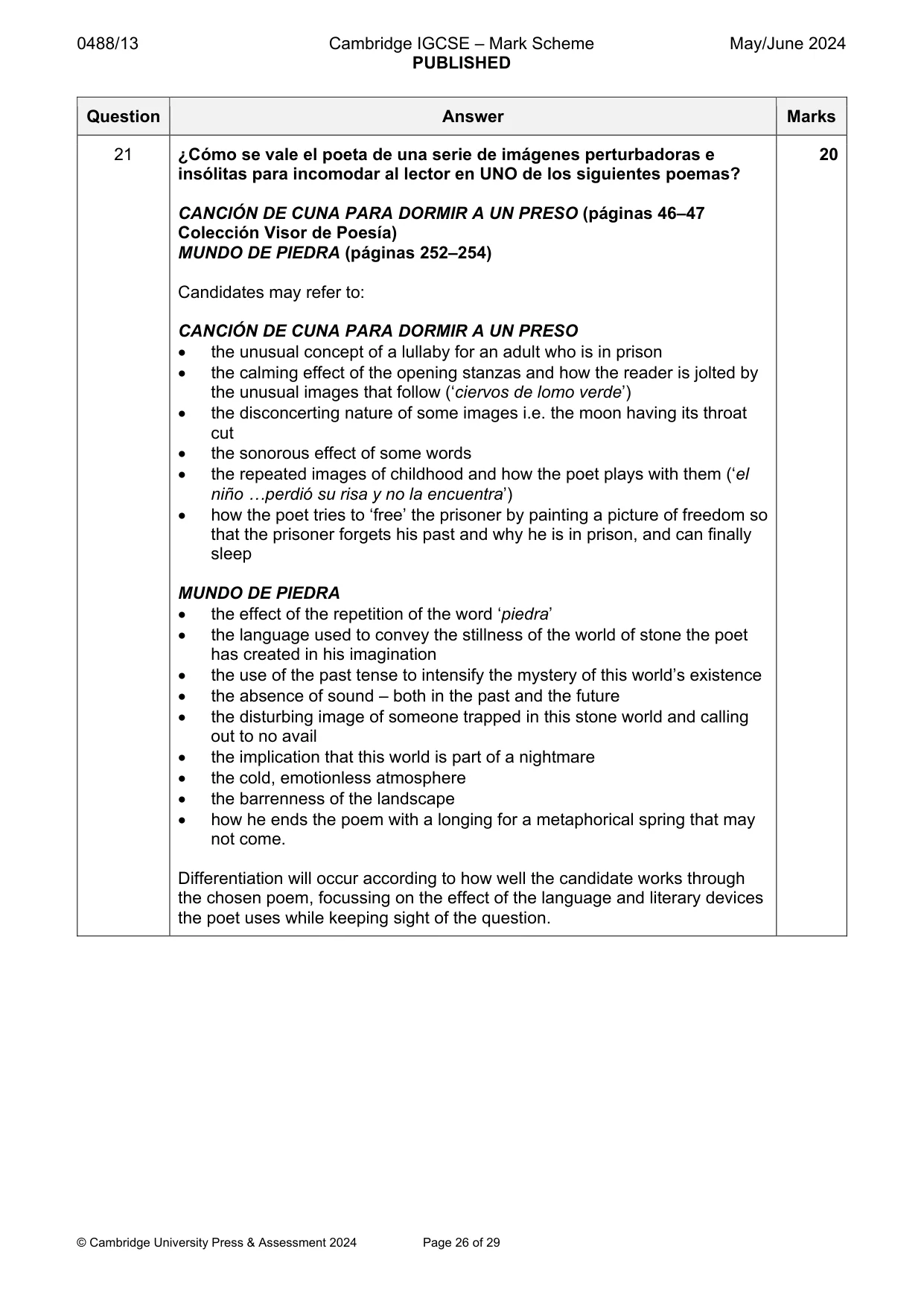
0488/13 Cambridge IGCSE – Mark Scheme PUBLISHED May/June 2024 © Cambridge University Press & Assessment 2024 Page 26 of 29 Question Answer Marks 21 ¿Cómo se vale el poeta de una serie de imágenes perturbadoras e insólitas para incomodar al lector en UNO de los siguientes poemas? CANCIÓN DE CUNA PARA DORMIR A UN PRESO (páginas 46–47 Colección Visor de Poesía) MUNDO DE PIEDRA (páginas 252–254) Candidates may refer to: CANCIÓN DE CUNA PARA DORMIR A UN PRESO the unusual concept of a lullaby for an adult who is in prison the calming effect of the opening stanzas and how the reader is jolted by the unusual images that follow (‘ciervos de lomo verde’) the disconcerting nature of some images i.e. the moon having its throat cut the sonorous effect of some words the repeated images of childhood and how the poet plays with them (‘el niño …perdió su risa y no la encuentra’) how the poet tries to ‘free’ the prisoner by painting a picture of freedom so that the prisoner forgets his past and why he is in prison, and can finally sleep MUNDO DE PIEDRA the effect of the repetition of the word ‘piedra’ the language used to convey the stillness of the world of stone the poet has created in his imagination the use of the past tense to intensify the mystery of this world’s existence the absence of sound – both in the past and the future the disturbing image of someone trapped in this stone world and calling out to no avail the implication that this world is part of a nightmare the cold, emotionless atmosphere the barrenness of the landscape how he ends the poem with a longing for a metaphorical spring that may not come. Differentiation will occur according to how well the candidate works through the chosen poem, focussing on the effect of the language and literary devices the poet uses while keeping sight of the question. 20
Mark scheme, page 27
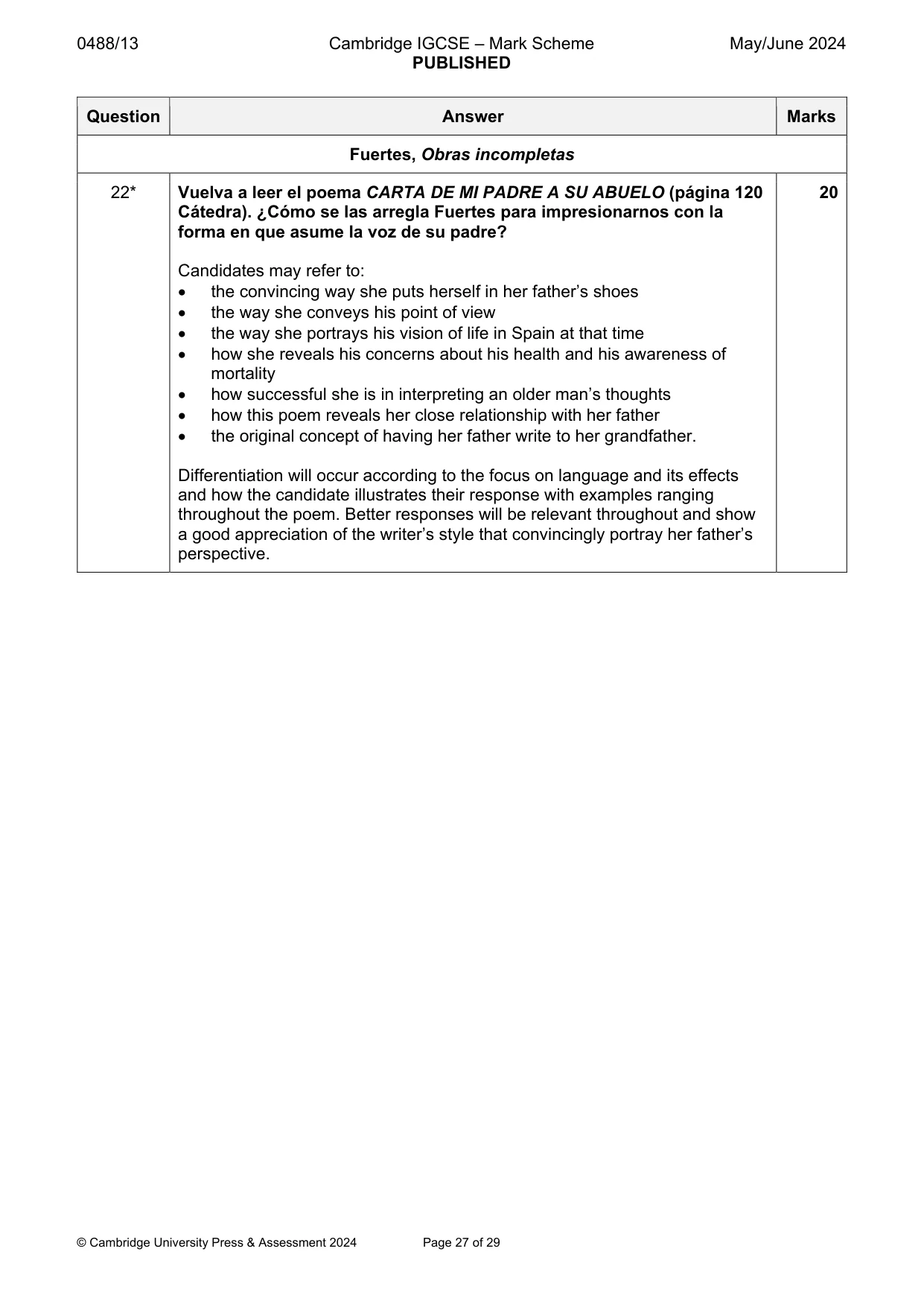
0488/13 Cambridge IGCSE – Mark Scheme PUBLISHED May/June 2024 © Cambridge University Press & Assessment 2024 Page 27 of 29 Question Answer Marks Fuertes, Obras incompletas 22* Vuelva a leer el poema CARTA DE MI PADRE A SU ABUELO (página 120 Cátedra). ¿Cómo se las arregla Fuertes para impresionarnos con la forma en que asume la voz de su padre? Candidates may refer to: the convincing way she puts herself in her father’s shoes the way she conveys his point of view the way she portrays his vision of life in Spain at that time how she reveals his concerns about his health and his awareness of mortality how successful she is in interpreting an older man’s thoughts how this poem reveals her close relationship with her father the original concept of having her father write to her grandfather. Differentiation will occur according to the focus on language and its effects and how the candidate illustrates their response with examples ranging throughout the poem. Better responses will be relevant throughout and show a good appreciation of the writer’s style that convincingly portray her father’s perspective. 20
Mark scheme, page 28
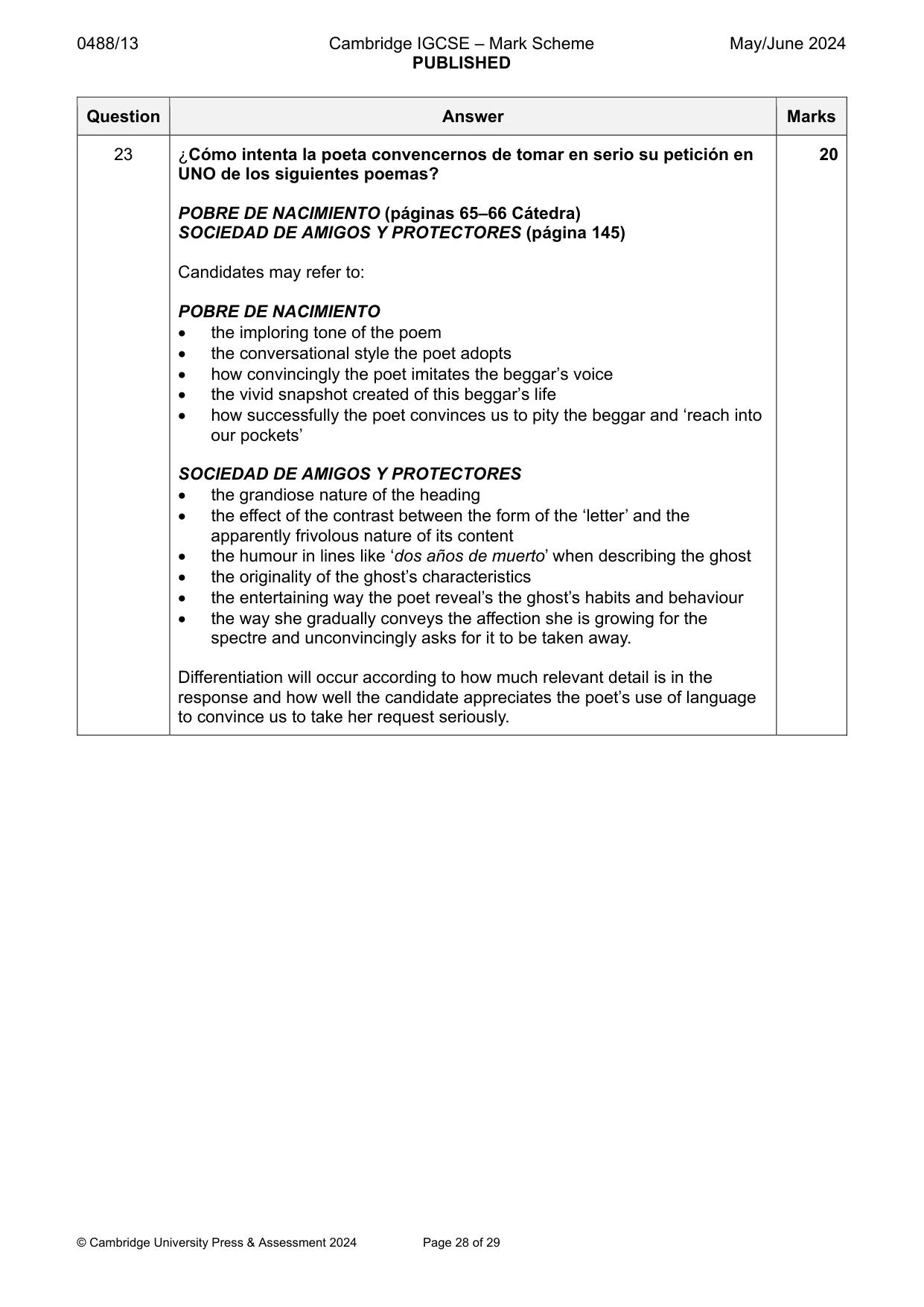
0488/13 Cambridge IGCSE – Mark Scheme PUBLISHED May/June 2024 © Cambridge University Press & Assessment 2024 Page 28 of 29 Question Answer Marks 23 ¿Cómo intenta la poeta convencernos de tomar en serio su petición en UNO de los siguientes poemas? POBRE DE NACIMIENTO (páginas 65–66 Cátedra) SOCIEDAD DE AMIGOS Y PROTECTORES (página 145) Candidates may refer to: POBRE DE NACIMIENTO the imploring tone of the poem the conversational style the poet adopts how convincingly the poet imitates the beggar’s voice the vivid snapshot created of this beggar’s life how successfully the poet convinces us to pity the beggar and ‘reach into our pockets’ SOCIEDAD DE AMIGOS Y PROTECTORES the grandiose nature of the heading the effect of the contrast between the form of the ‘letter’ and the apparently frivolous nature of its content the humour in lines like ‘dos años de muerto’ when describing the ghost the originality of the ghost’s characteristics the entertaining way the poet reveal’s the ghost’s habits and behaviour the way she gradually conveys the affection she is growing for the spectre and unconvincingly asks for it to be taken away. Differentiation will occur according to how much relevant detail is in the response and how well the candidate appreciates the poet’s use of language to convince us to take her request seriously. 20
Mark scheme, page 29
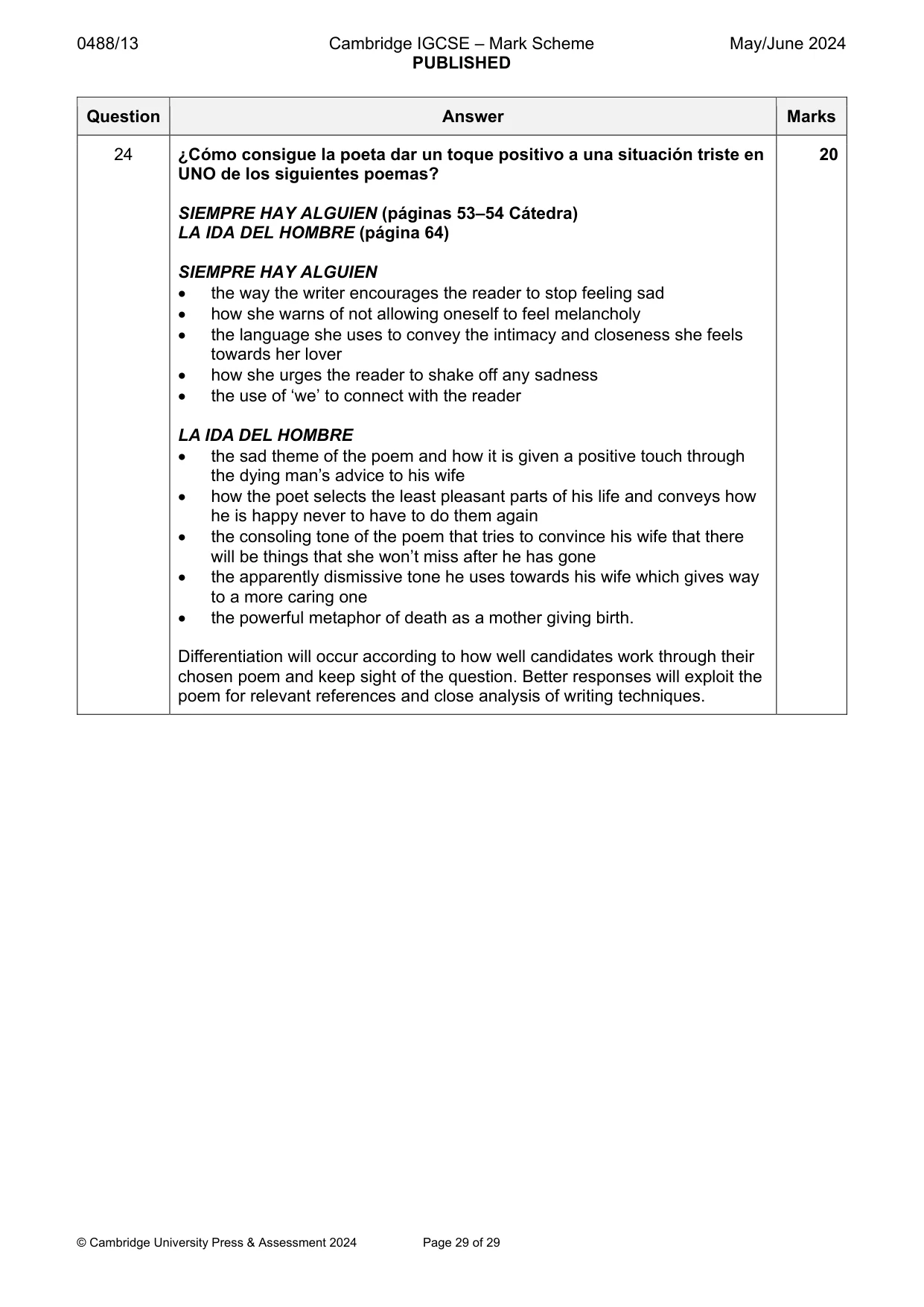
0488/13 Cambridge IGCSE – Mark Scheme PUBLISHED May/June 2024 © Cambridge University Press & Assessment 2024 Page 29 of 29 Question Answer Marks 24 ¿Cómo consigue la poeta dar un toque positivo a una situación triste en UNO de los siguientes poemas? SIEMPRE HAY ALGUIEN (páginas 53–54 Cátedra) LA IDA DEL HOMBRE (página 64) SIEMPRE HAY ALGUIEN the way the writer encourages the reader to stop feeling sad how she warns of not allowing oneself to feel melancholy the language she uses to convey the intimacy and closeness she feels towards her lover how she urges the reader to shake off any sadness the use of ‘we’ to connect with the reader LA IDA DEL HOMBRE the sad theme of the poem and how it is given a positive touch through the dying man’s advice to his wife how the poet selects the least pleasant parts of his life and conveys how he is happy never to have to do them again the consoling tone of the poem that tries to convince his wife that there will be things that she won’t miss after he has gone the apparently dismissive tone he uses towards his wife which gives way to a more caring one the powerful metaphor of death as a mother giving birth. Differentiation will occur according to how well candidates work through their chosen poem and keep sight of the question. Better responses will exploit the poem for relevant references and close analysis of writing techniques. 20
What you needed in this session
Cambridge’s own grade thresholds for 2024 May/June, Paper 1 · Variant 3. A higher threshold means an easier paper — the bar moves with how the cohort did.