Cambridge IGCSE Spanish - Literature 0488 — 2024 May/June Paper 1 · Variant 1
0488/11/M/J/24 · 60 marks · ≈68 min
The question paper and its mark scheme, free to read here and free to download. This is Cambridge’s own paper, exactly as it was sat.
Question paper8 pages

Mark scheme26 pages
Answers below. Sit the paper first if you are practising.
Paper as text
Question paper, page 1
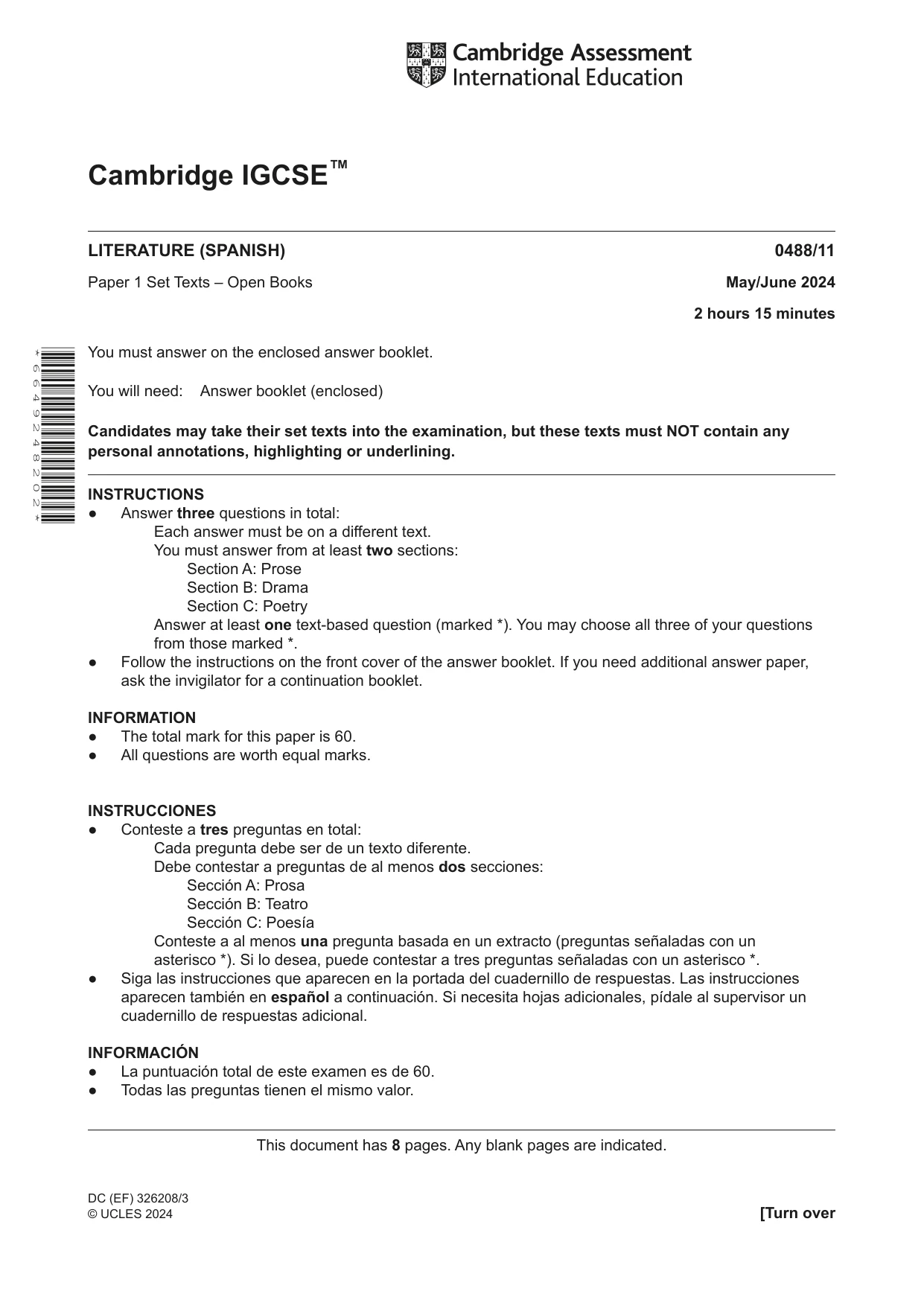
This document has 8 pages. Any blank pages are indicated. [Turn over Cambridge IGCSE™ * 6 6 4 9 2 4 8 2 0 2 * DC (EF) 326208/3 © UCLES 2024 LITERATURE (SPANISH) 0488/11 Paper 1 Set Texts – Open Books May/June 2024 2 hours 15 minutes You must answer on the enclosed answer booklet. You will need: Answer booklet (enclosed) Candidates may take their set texts into the examination, but these texts must NOT contain any personal annotations, highlighting or underlining. INSTRUCTIONS ● Answer three questions in total: Each answer must be on a different text. You must answer from at least two sections: Section A: Prose Section B: Drama Section C: Poetry Answer at least one text-based question (marked *). You may choose all three of your questions from those marked *. ● Follow the instructions on the front cover of the answer booklet. If you need additional answer paper, ask the invigilator for a continuation booklet. INFORMATION ● The total mark for this paper is 60. ● All questions are worth equal marks. INSTRUCCIONES ● Conteste a tres preguntas en total: Cada pregunta debe ser de un texto diferente. Debe contestar a preguntas de al menos dos secciones: Sección A: Prosa Sección B: Teatro Sección C: Poesía Conteste a al menos una pregunta basada en un extracto (preguntas señaladas con un asterisco *). Si lo desea, puede contestar a tres preguntas señaladas con un asterisco *. ● Siga las instrucciones que aparecen en la portada del cuadernillo de respuestas. Las instrucciones aparecen también en español a continuación. Si necesita hojas adicionales, pídale al supervisor un cuadernillo de respuestas adicional. INFORMACIÓN ● La puntuación total de este examen es de 60. ● Todas las preguntas tienen el mismo valor.
Question paper, page 2
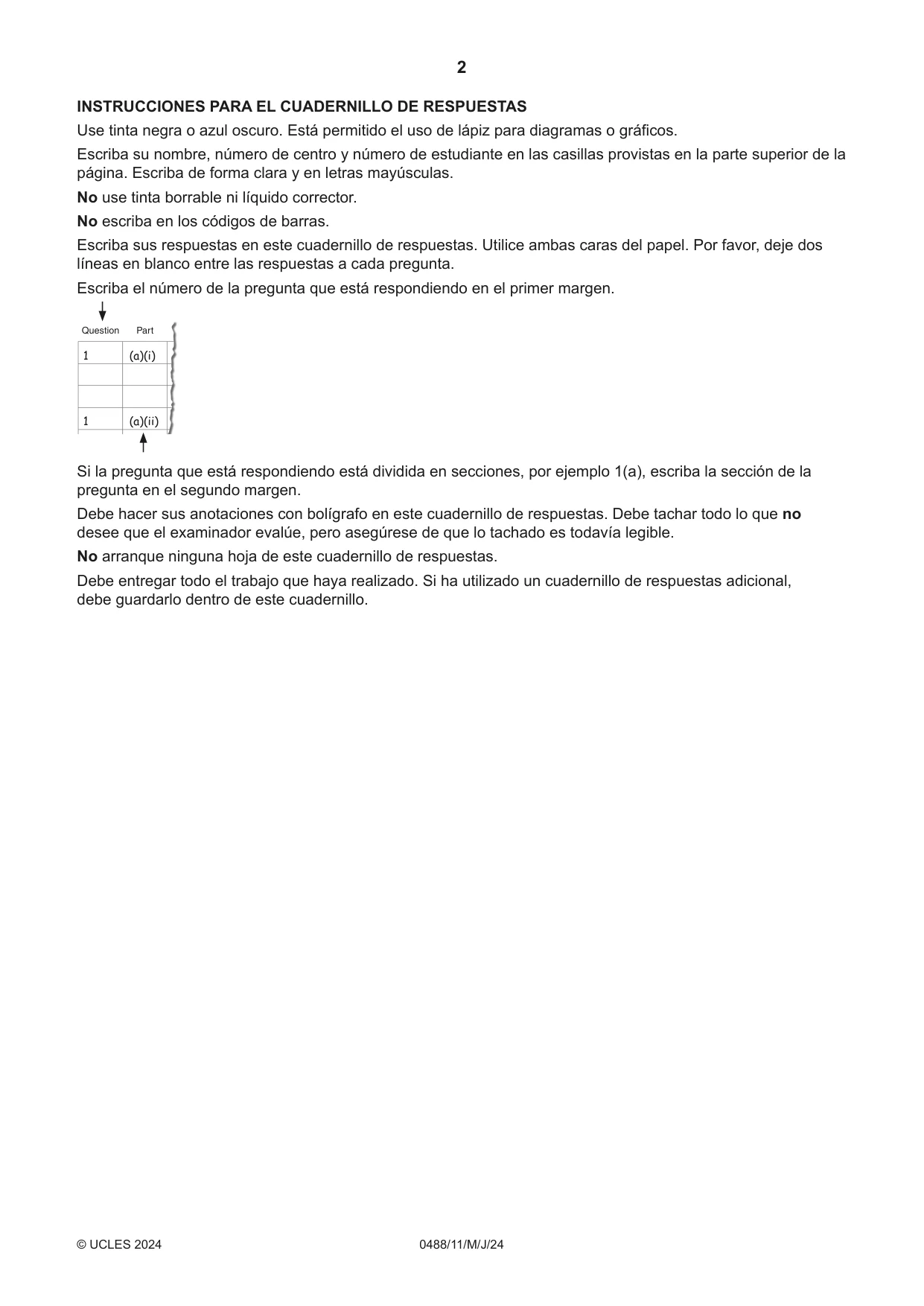
2 0488/11/ M/J/24 © UCLES 2024 INSTRUCCIONES PARA EL CUADERNILLO DE RESPUESTAS Use tinta negra o azul oscuro. Está permitido el uso de lápiz para diagramas o gráficos. Escriba su nombre, número de centro y número de estudiante en las casillas provistas en la parte superior de la página. Escriba de forma clara y en letras mayúsculas. No use tinta borrable ni líquido corrector. No escriba en los códigos de barras. Escriba sus respuestas en este cuadernillo de respuestas. Utilice ambas caras del papel. Por favor, deje dos líneas en blanco entre las respuestas a cada pregunta. Escriba el número de la pregunta que está respondiendo en el primer margen. Question Part 1 1 (a)(i) (a)(ii) Si la pregunta que está respondiendo está dividida en secciones, por ejemplo 1(a), escriba la sección de la pregunta en el segundo margen. Debe hacer sus anotaciones con bolígrafo en este cuadernillo de respuestas. Debe tachar todo lo que no desee que el examinador evalúe, pero asegúrese de que lo tachado es todavía legible. No arranque ninguna hoja de este cuadernillo de respuestas. Debe entregar todo el trabajo que haya realizado. Si ha utilizado un cuadernillo de respuestas adicional, debe guardarlo dentro de este cuadernillo.
Question paper, page 3
3 0488/11/M/J/24 © UCLES 2024 [Turn over BLANK PAGE
Question paper, page 4
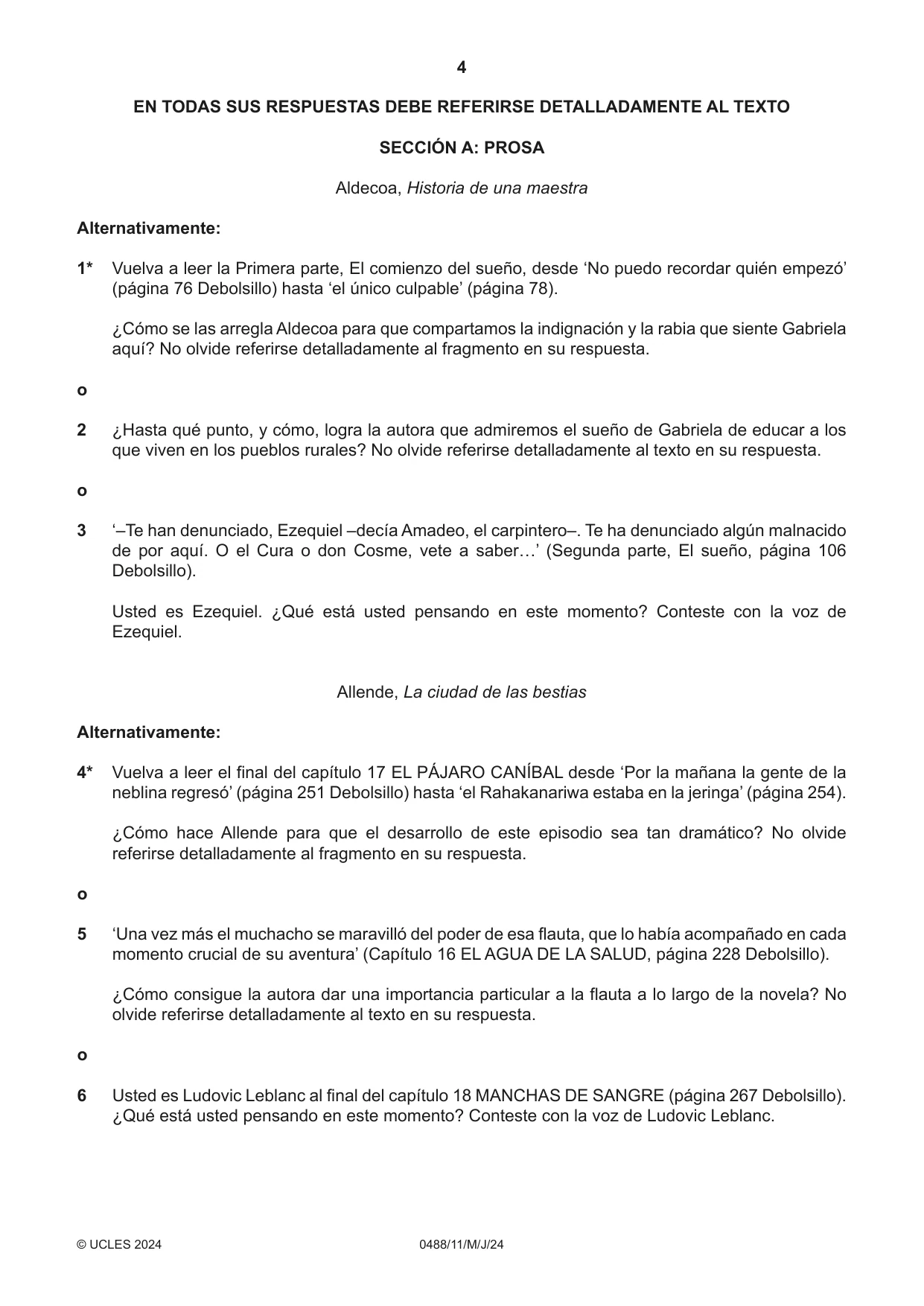
4 0488/11/M/J/24 © UCLES 2024 EN TODAS SUS RESPUESTAS DEBE REFERIRSE DETALLADAMENTE AL TEXTO SECCIÓN A: PROSA Aldecoa, Historia de una maestra Alternativamente: 1* Vuelva a leer la Primera parte, El comienzo del sueño, desde ‘No puedo recordar quién empezó’ (página 76 Debolsillo) hasta ‘el único culpable’ (página 78). ¿Cómo se las arregla Aldecoa para que compartamos la indignación y la rabia que siente Gabriela aquí? No olvide referirse detalladamente al fragmento en su respuesta. o 2 ¿Hasta qué punto, y cómo, logra la autora que admiremos el sueño de Gabriela de educar a los que viven en los pueblos rurales? No olvide referirse detalladamente al texto en su respuesta. o 3 ‘–Te han denunciado, Ezequiel –decía Amadeo, el carpintero–. Te ha denunciado algún malnacido de por aquí. O el Cura o don Cosme, vete a saber…’ (Segunda parte, El sueño, página 106 Debolsillo). Usted es Ezequiel. ¿Qué está usted pensando en este momento? Conteste con la voz de Ezequiel. Allende, La ciudad de las bestias Alternativamente: 4* Vuelva a leer el final del capítulo 17 EL PÁJARO CANÍBAL desde ‘Por la mañana la gente de la neblina regresó’ (página 251 Debolsillo) hasta ‘el Rahakanariwa estaba en la jeringa’ (página 254). ¿Cómo hace Allende para que el desarrollo de este episodio sea tan dramático? No olvide referirse detalladamente al fragmento en su respuesta. o 5 ‘Una vez más el muchacho se maravilló del poder de esa flauta, que lo había acompañado en cada momento crucial de su aventura’ (Capítulo 16 EL AGUA DE LA SALUD, página 228 Debolsillo). ¿Cómo consigue la autora dar una importancia particular a la flauta a lo largo de la novela? No olvide referirse detalladamente al texto en su respuesta. o 6 Usted es Ludovic Leblanc al final del capítulo 18 MANCHAS DE SANGRE (página 267 Debolsillo). ¿Qué está usted pensando en este momento? Conteste con la voz de Ludovic Leblanc.
Question paper, page 5
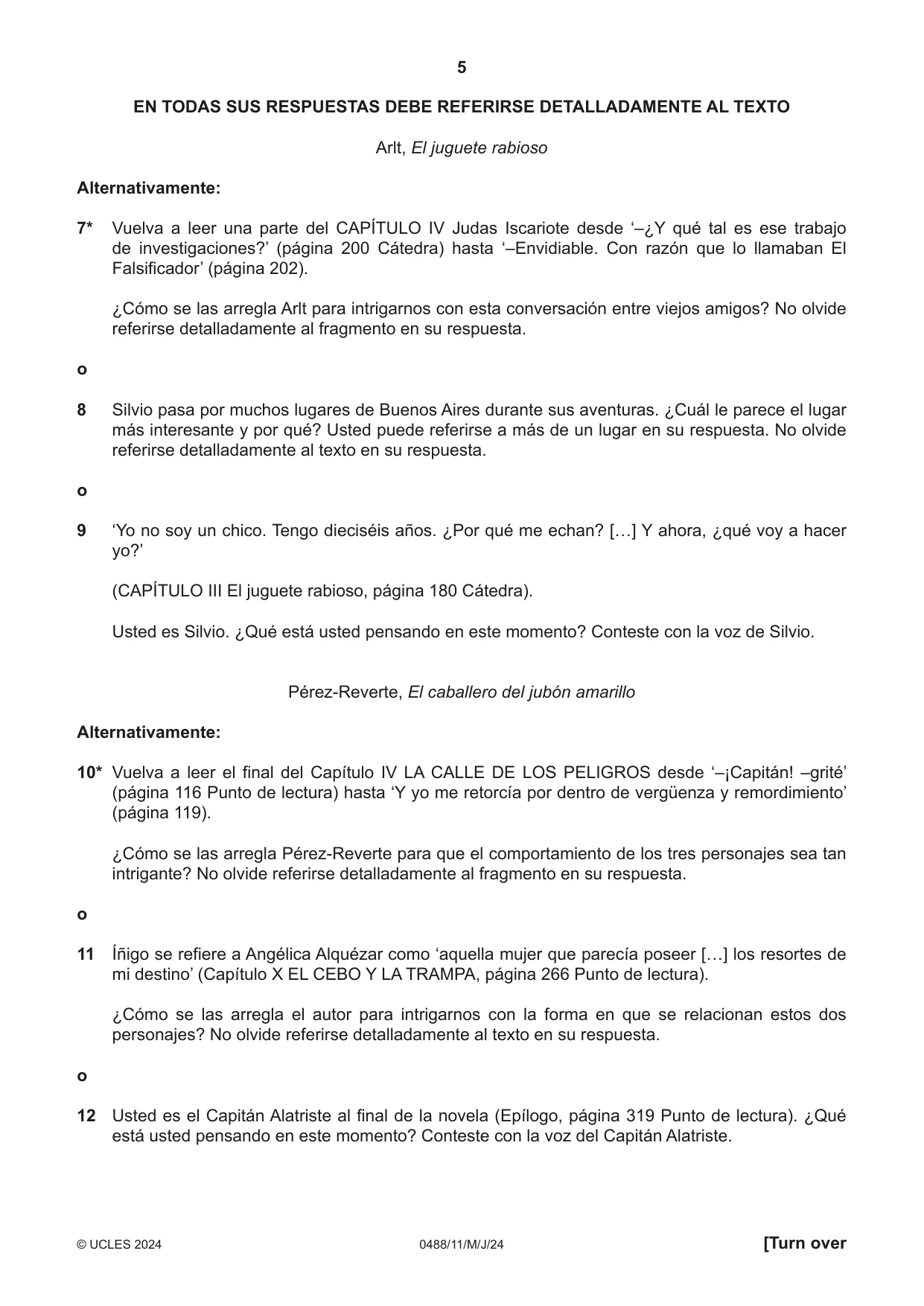
5 0488/11/M/J/24 © UCLES 2024 [Turn over EN TODAS SUS RESPUESTAS DEBE REFERIRSE DETALLADAMENTE AL TEXTO Arlt, El juguete rabioso Alternativamente: 7* Vuelva a leer una parte del CAPÍTULO IV Judas Iscariote desde ‘–¿Y qué tal es ese trabajo de investigaciones?’ (página 200 Cátedra) hasta ‘–Envidiable. Con razón que lo llamaban El Falsificador’ (página 202). ¿Cómo se las arregla Arlt para intrigarnos con esta conversación entre viejos amigos? No olvide referirse detalladamente al fragmento en su respuesta. o 8 Silvio pasa por muchos lugares de Buenos Aires durante sus aventuras. ¿Cuál le parece el lugar más interesante y por qué? Usted puede referirse a más de un lugar en su respuesta. No olvide referirse detalladamente al texto en su respuesta. o 9 ‘Yo no soy un chico. Tengo dieciséis años. ¿Por qué me echan? […] Y ahora, ¿qué voy a hacer yo?’ (CAPÍTULO III El juguete rabioso, página 180 Cátedra). Usted es Silvio. ¿Qué está usted pensando en este momento? Conteste con la voz de Silvio. Pérez-Reverte, El caballero del jubón amarillo Alternativamente: 10* Vuelva a leer el final del Capítulo IV LA CALLE DE LOS PELIGROS desde ‘–¡Capitán! –grité’ (página 116 Punto de lectura) hasta ‘Y yo me retorcía por dentro de vergüenza y remordimiento’ (página 119). ¿Cómo se las arregla Pérez-Reverte para que el comportamiento de los tres personajes sea tan intrigante? No olvide referirse detalladamente al fragmento en su respuesta. o 11 Íñigo se refiere a Angélica Alquézar como ‘aquella mujer que parecía poseer […] los resortes de mi destino’ (Capítulo X EL CEBO Y LA TRAMPA, página 266 Punto de lectura). ¿Cómo se las arregla el autor para intrigarnos con la forma en que se relacionan estos dos personajes? No olvide referirse detalladamente al texto en su respuesta. o 12 Usted es el Capitán Alatriste al final de la novela (Epílogo, página 319 Punto de lectura). ¿Qué está usted pensando en este momento? Conteste con la voz del Capitán Alatriste.
Question paper, page 6
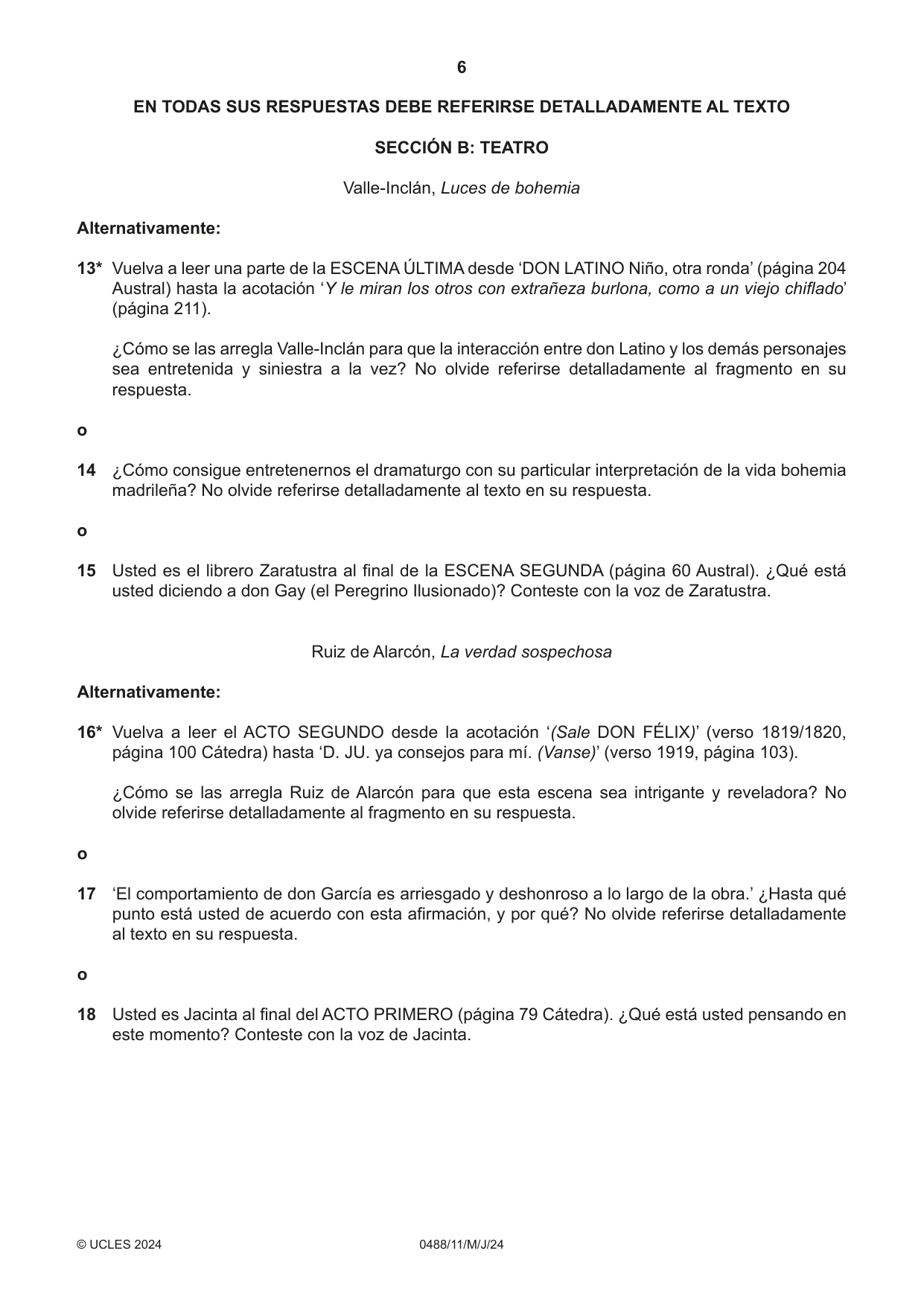
6 0488/11/M/J/24 © UCLES 2024 EN TODAS SUS RESPUESTAS DEBE REFERIRSE DETALLADAMENTE AL TEXTO SECCIÓN B: TEATRO Valle-Inclán, Luces de bohemia Alternativamente: 13* Vuelva a leer una parte de la ESCENA ÚLTIMA desde ‘DON LATINO Niño, otra ronda’ (página 204 Austral) hasta la acotación ‘Y le miran los otros con extrañeza burlona, como a un viejo chiflado’ (página 211). ¿Cómo se las arregla Valle-Inclán para que la interacción entre don Latino y los demás personajes sea entretenida y siniestra a la vez? No olvide referirse detalladamente al fragmento en su respuesta. o 14 ¿Cómo consigue entretenernos el dramaturgo con su particular interpretación de la vida bohemia madrileña? No olvide referirse detalladamente al texto en su respuesta. o 15 Usted es el librero Zaratustra al final de la ESCENA SEGUNDA (página 60 Austral). ¿Qué está usted diciendo a don Gay (el Peregrino Ilusionado)? Conteste con la voz de Zaratustra. Ruiz de Alarcón, La verdad sospechosa Alternativamente: 16* Vuelva a leer el ACTO SEGUNDO desde la acotación ‘(Sale DON FÉLIX)’ (verso 1819/1820, página 100 Cátedra) hasta ‘D. JU. ya consejos para mí. (Vanse)’ (verso 1919, página 103). ¿Cómo se las arregla Ruiz de Alarcón para que esta escena sea intrigante y reveladora? No olvide referirse detalladamente al fragmento en su respuesta. o 17 ‘El comportamiento de don García es arriesgado y deshonroso a lo largo de la obra.’ ¿Hasta qué punto está usted de acuerdo con esta afirmación, y por qué? No olvide referirse detalladamente al texto en su respuesta. o 18 Usted es Jacinta al final del ACTO PRIMERO (página 79 Cátedra). ¿Qué está usted pensando en este momento? Conteste con la voz de Jacinta.
Question paper, page 7
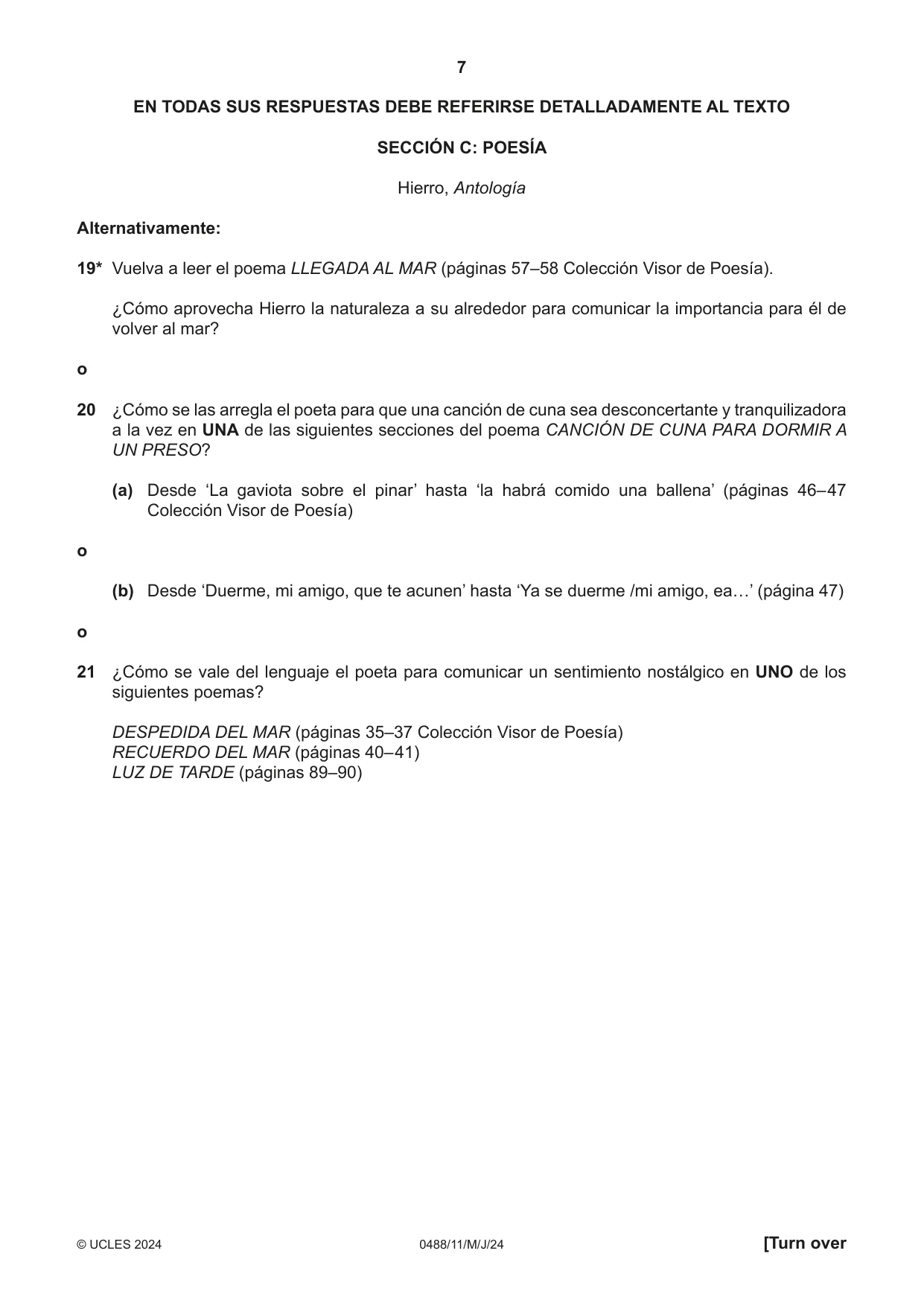
7 0488/11/M/J/24 © UCLES 2024 [Turn over EN TODAS SUS RESPUESTAS DEBE REFERIRSE DETALLADAMENTE AL TEXTO SECCIÓN C: POESÍA Hierro, Antología Alternativamente: 19* Vuelva a leer el poema LLEGADA AL MAR (páginas 57–58 Colección Visor de Poesía). ¿Cómo aprovecha Hierro la naturaleza a su alrededor para comunicar la importancia para él de volver al mar? o 20 ¿Cómo se las arregla el poeta para que una canción de cuna sea desconcertante y tranquilizadora a la vez en UNA de las siguientes secciones del poema CANCIÓN DE CUNA PARA DORMIR A UN PRESO? (a) Desde ‘La gaviota sobre el pinar’ hasta ‘la habrá comido una ballena’ (páginas 46– 47 Colección Visor de Poesía) o (b) Desde ‘Duerme, mi amigo, que te acunen’ hasta ‘Ya se duerme /mi amigo, ea…’ (página 47) o 21 ¿Cómo se vale del lenguaje el poeta para comunicar un sentimiento nostálgico en UNO de los siguientes poemas? DESPEDIDA DEL MAR (páginas 35–37 Colección Visor de Poesía) RECUERDO DEL MAR (páginas 40– 41) LUZ DE TARDE (páginas 89–90)
Question paper, page 8
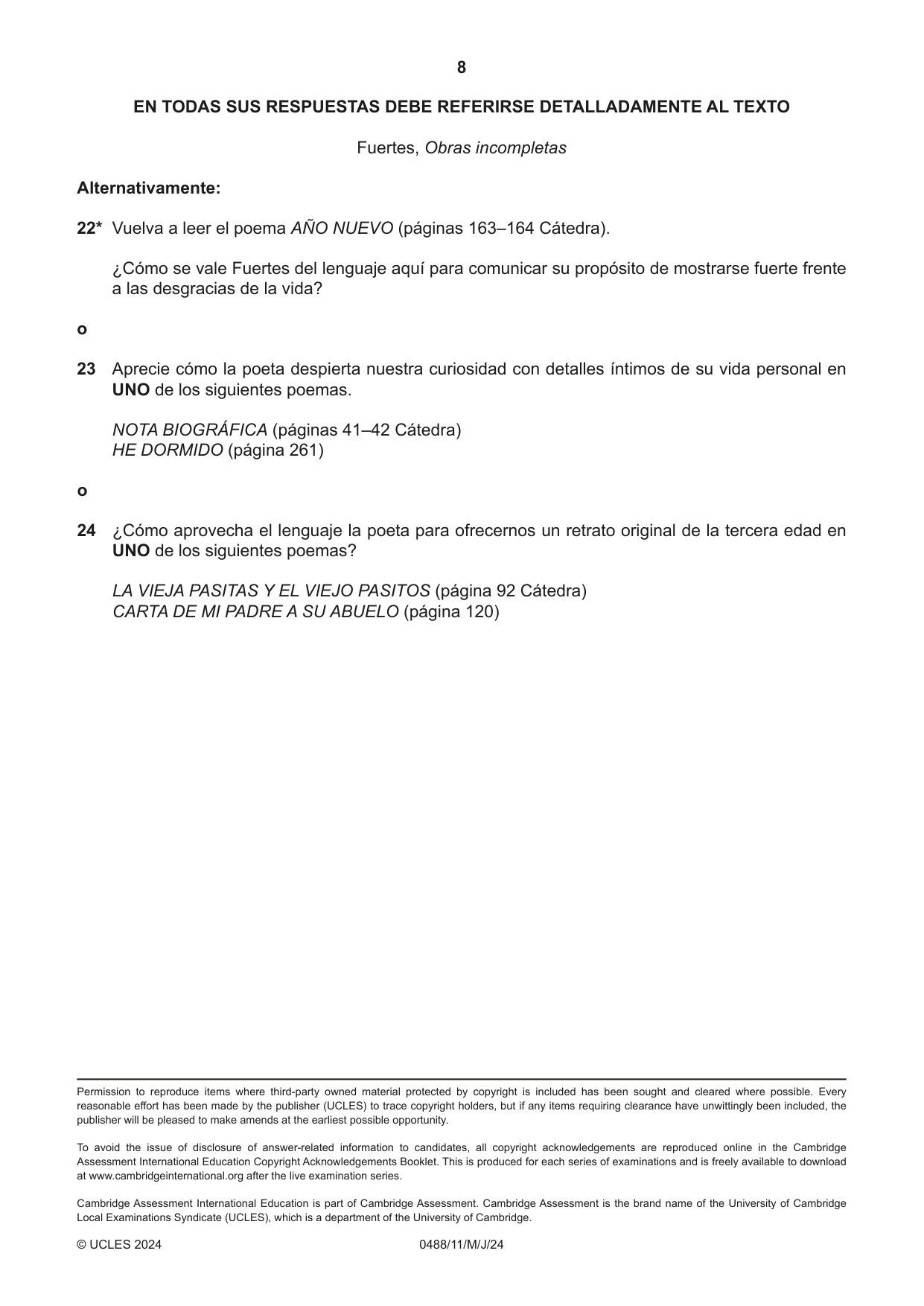
8 0488/11/M/J/24 © UCLES 2024 Permission to reproduce items where third-party owned material protected by copyright is included has been sought and cleared where possible. Every reasonable effort has been made by the publisher (UCLES) to trace copyright holders, but if any items requiring clearance have unwittingly been included, the publisher will be pleased to make amends at the earliest possible opportunity. To avoid the issue of disclosure of answer-related information to candidates, all copyright acknowledgements are reproduced online in the Cambridge Assessment International Education Copyright Acknowledgements Booklet. This is produced for each series of examinations and is freely available to download at www.cambridgeinternational.org after the live examination series. Cambridge Assessment International Education is part of Cambridge Assessment. Cambridge Assessment is the brand name of the University of Cambridge Local Examinations Syndicate (UCLES), which is a department of the University of Cambridge. EN TODAS SUS RESPUESTAS DEBE REFERIRSE DETALLADAMENTE AL TEXTO Fuertes, Obras incompletas Alternativamente: 22* Vuelva a leer el poema AÑO NUEVO (páginas 163–164 Cátedra). ¿Cómo se vale Fuertes del lenguaje aquí para comunicar su propósito de mostrarse fuerte frente a las desgracias de la vida? o 23 Aprecie cómo la poeta despierta nuestra curiosidad con detalles íntimos de su vida personal en UNO de los siguientes poemas. NOTA BIOGRÁFICA (páginas 41–42 Cátedra) HE DORMIDO (página 261) o 24 ¿Cómo aprovecha el lenguaje la poeta para ofrecernos un retrato original de la tercera edad en UNO de los siguientes poemas? LA VIEJA PASITAS Y EL VIEJO PASITOS (página 92 Cátedra) CARTA DE MI PADRE A SU ABUELO (página 120)
Mark scheme, page 1
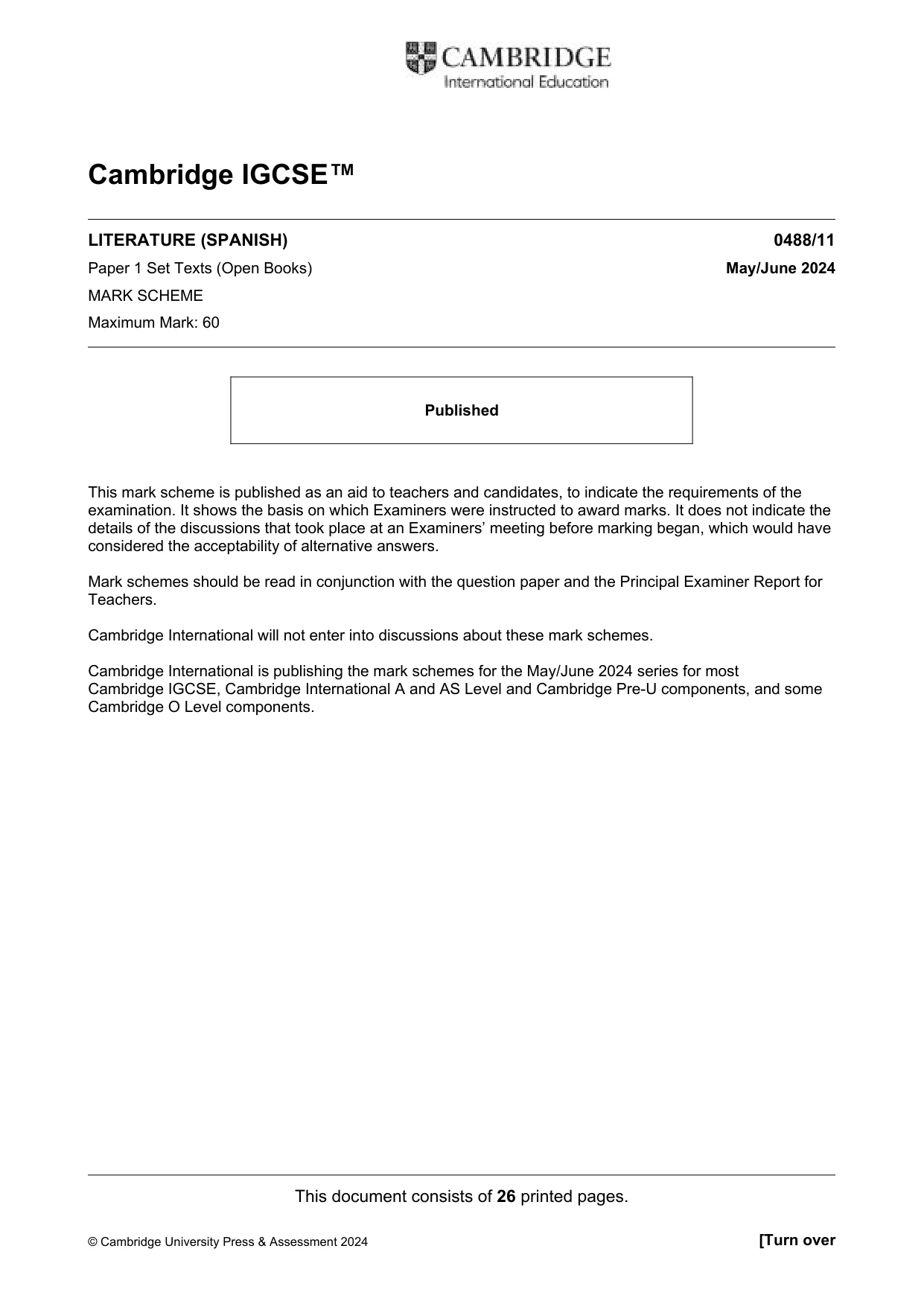
This document consists of 26 printed pages. © Cambridge University Press & Assessment 2024 [Turn over Cambridge IGCSE™ LITERATURE (SPANISH) 0488/11 Paper 1 Set Texts (Open Books) May/June 2024 MARK SCHEME Maximum Mark: 60 Published This mark scheme is published as an aid to teachers and candidates, to indicate the requirements of the examination. It shows the basis on which Examiners were instructed to award marks. It does not indicate the details of the discussions that took place at an Examiners’ meeting before marking began, which would have considered the acceptability of alternative answers. Mark schemes should be read in conjunction with the question paper and the Principal Examiner Report for Teachers. Cambridge International will not enter into discussions about these mark schemes. Cambridge International is publishing the mark schemes for the May/June 2024 series for most Cambridge IGCSE, Cambridge International A and AS Level and Cambridge Pre-U components, and some Cambridge O Level components.
Mark scheme, page 2
0488/11 Cambridge IGCSE – Mark Scheme PUBLISHED May/June 2024 © Cambridge University Press & Assessment 2024 Page 2 of 26 Generic Marking Principles These general marking principles must be applied by all examiners when marking candidate answers. They should be applied alongside the specific content of the mark scheme or generic level descriptions for a question. Each question paper and mark scheme will also comply with these marking principles. GENERIC MARKING PRINCIPLE 1: Marks must be awarded in line with: the specific content of the mark scheme or the generic level descriptors for the question the specific skills defined in the mark scheme or in the generic level descriptors for the question the standard of response required by a candidate as exemplified by the standardisation scripts. GENERIC MARKING PRINCIPLE 2: Marks awarded are always whole marks (not half marks, or other fractions). GENERIC MARKING PRINCIPLE 3: Marks must be awarded positively: marks are awarded for correct/valid answers, as defined in the mark scheme. However, credit is given for valid answers which go beyond the scope of the syllabus and mark scheme, referring to your Team Leader as appropriate marks are awarded when candidates clearly demonstrate what they know and can do marks are not deducted for errors marks are not deducted for omissions answers should only be judged on the quality of spelling, punctuation and grammar when these features are specifically assessed by the question as indicated by the mark scheme. The meaning, however, should be unambiguous. GENERIC MARKING PRINCIPLE 4: Rules must be applied consistently, e.g. in situations where candidates have not followed instructions or in the application of generic level descriptors. GENERIC MARKING PRINCIPLE 5: Marks should be awarded using the full range of marks defined in the mark scheme for the question (however; the use of the full mark range may be limited according to the quality of the candidate responses seen). GENERIC MARKING PRINCIPLE 6: Marks awarded are based solely on the requirements as defined in the mark scheme. Marks should not be awarded with grade thresholds or grade descriptors in mind.
Mark scheme, page 3
0488/11 Cambridge IGCSE – Mark Scheme PUBLISHED May/June 2024 © Cambridge University Press & Assessment 2024 Page 3 of 26 Component 1: Spanish Texts Candidates must write their answers in the target language. Examiners will look for a candidate’s ability to communicate effectively and will ignore linguistic errors which do not impede communication. Passage-based questions Examiners should consider the extent to which candidates have been able to identify the significant issues raised in the passage and, where appropriate, have applied these to the text as a whole. The passage is a stimulus passage, to be used as a springboard to give candidates a starting point for their answer. Examiners should allow candidates to use the passage as they choose and ask themselves how successfully the candidates have manipulated their material and to what extent they have shown depth of awareness and knowledge of the workings of the text under discussion. This is not an exercise in literary criticism: Examiners should reward candidates whose answers show good understanding of how a text works and how an author has conveyed the key issues. Essay questions A prime consideration is that candidates show detailed knowledge and understanding of the text. Extracts from Examiners’ Notes This paper is intended to test candidates’ knowledge of a text and their ability to use this knowledge to answer questions in a clear and focused manner. A sophisticated literary approach is not expected (though at the highest levels it is sometimes seen), but great value is placed on evidence of a firsthand response and thoughtful, personal evaluation of what candidates have read. Candidates may have been encouraged to depend closely on prepared notes and quotations: quotation for its own sake is not useful, though it will not be undervalued if used appropriately to illustrate a point in the answer. Candidates do not tend to show all the qualities or faults described in any one mark-band. Examiners attempt to weigh all these up at every borderline, in order to see whether the work can be considered for the category above. At the lower levels, the answer may mention a few ‘facts’ but these may be so poorly understood, badly organised and irrelevant that it falls into category 10–11; or there may be just enough sense of understanding and focus for the examiner to consider the 12–13 band. Again, at a higher level, an answer may be clear, solid and conscientious (perhaps 18–19), without showing quite the control and attention to perceptively chosen detail which would justify 20 or more. Examiners take a positive and flexible approach and, even when there are obvious flaws in an answer, reward evidence of knowledge and especially any signs of understanding and careful organisation. Annotations Tick This is used for any outstanding comment. SEEN This is used to show the examiner has seen the page. On-Page Comment This is used to type in an annotation in a certain place on the script, correct a question number, point out an error in poem titles, characters etc. ? Unclear IR Irrelevant
Mark scheme, page 4
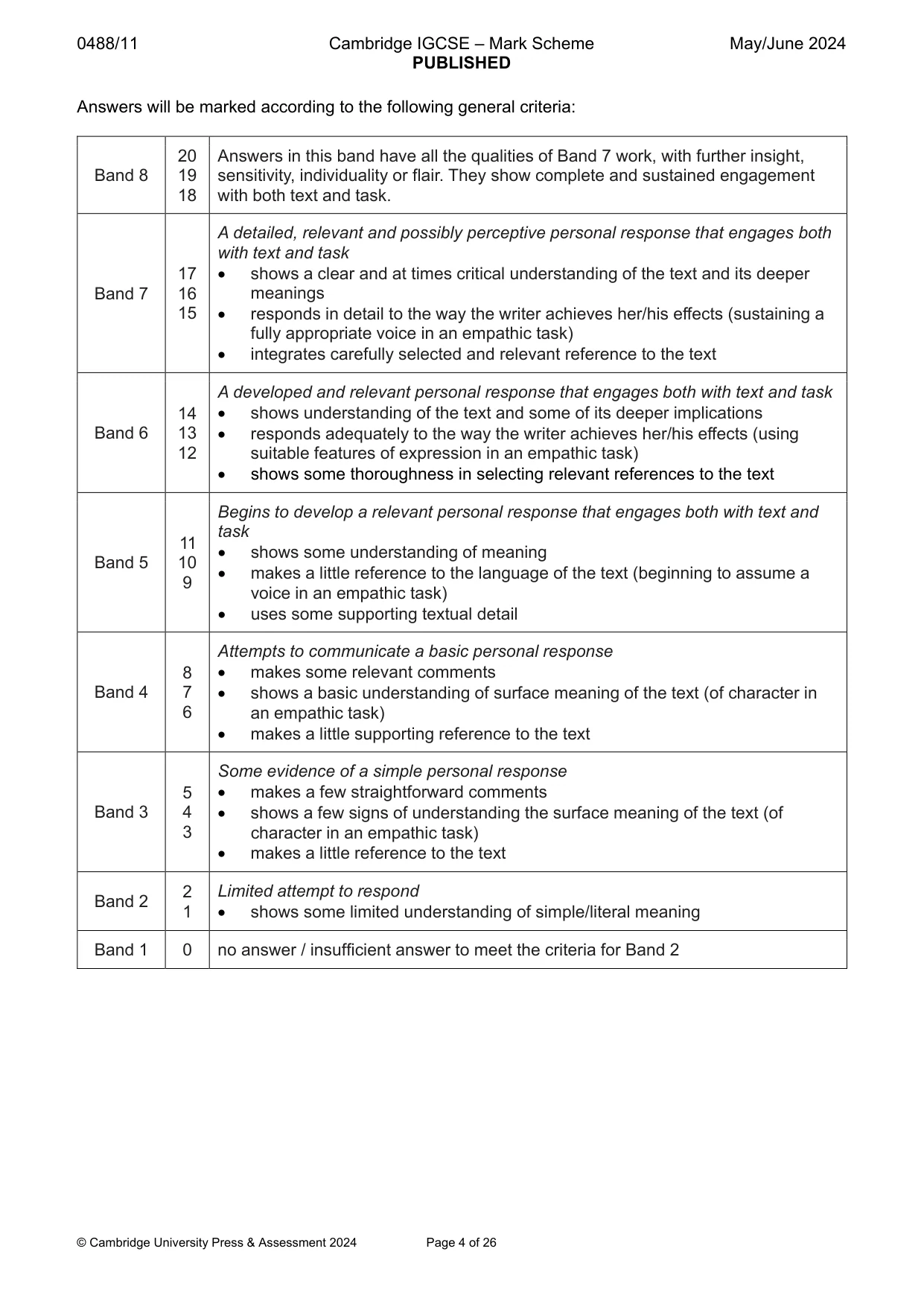
0488/11 Cambridge IGCSE – Mark Scheme PUBLISHED May/June 2024 © Cambridge University Press & Assessment 2024 Page 4 of 26 Answers will be marked according to the following general criteria: Band 8 20 19 18 Answers in this band have all the qualities of Band 7 work, with further insight, sensitivity, individuality or flair. They show complete and sustained engagement with both text and task. Band 7 17 16 15 A detailed, relevant and possibly perceptive personal response that engages both with text and task shows a clear and at times critical understanding of the text and its deeper meanings responds in detail to the way the writer achieves her/his effects (sustaining a fully appropriate voice in an empathic task) integrates carefully selected and relevant reference to the text Band 6 14 13 12 A developed and relevant personal response that engages both with text and task shows understanding of the text and some of its deeper implications responds adequately to the way the writer achieves her/his effects (using suitable features of expression in an empathic task) shows some thoroughness in selecting relevant references to the text Band 5 11 10 9 Begins to develop a relevant personal response that engages both with text and task shows some understanding of meaning makes a little reference to the language of the text (beginning to assume a voice in an empathic task) uses some supporting textual detail Band 4 8 7 6 Attempts to communicate a basic personal response makes some relevant comments shows a basic understanding of surface meaning of the text (of character in an empathic task) makes a little supporting reference to the text Band 3 5 4 3 Some evidence of a simple personal response makes a few straightforward comments shows a few signs of understanding the surface meaning of the text (of character in an empathic task) makes a little reference to the text Band 2 2 1 Limited attempt to respond shows some limited understanding of simple/literal meaning Band 1 0 no answer / insufficient answer to meet the criteria for Band 2
Mark scheme, page 5
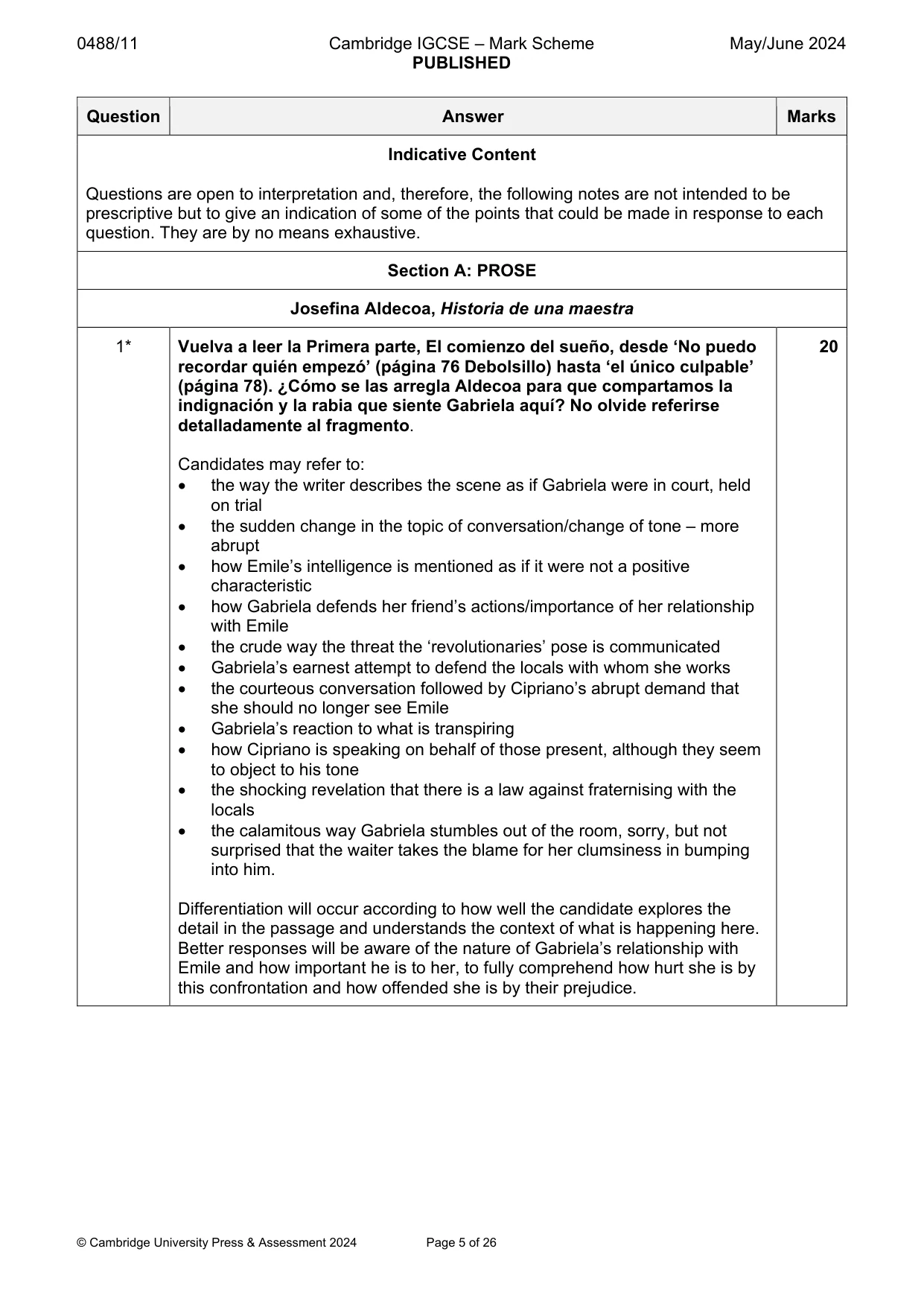
0488/11 Cambridge IGCSE – Mark Scheme PUBLISHED May/June 2024 © Cambridge University Press & Assessment 2024 Page 5 of 26 Question Answer Marks Indicative Content Questions are open to interpretation and, therefore, the following notes are not intended to be prescriptive but to give an indication of some of the points that could be made in response to each question. They are by no means exhaustive. Section A: PROSE Josefina Aldecoa, Historia de una maestra 1* Vuelva a leer la Primera parte, El comienzo del sueño, desde ‘No puedo recordar quién empezó’ (página 76 Debolsillo) hasta ‘el único culpable’ (página 78). ¿Cómo se las arregla Aldecoa para que compartamos la indignación y la rabia que siente Gabriela aquí? No olvide referirse detalladamente al fragmento. Candidates may refer to: the way the writer describes the scene as if Gabriela were in court, held on trial the sudden change in the topic of conversation/change of tone – more abrupt how Emile’s intelligence is mentioned as if it were not a positive characteristic how Gabriela defends her friend’s actions/importance of her relationship with Emile the crude way the threat the ‘revolutionaries’ pose is communicated Gabriela’s earnest attempt to defend the locals with whom she works the courteous conversation followed by Cipriano’s abrupt demand that she should no longer see Emile Gabriela’s reaction to what is transpiring how Cipriano is speaking on behalf of those present, although they seem to object to his tone the shocking revelation that there is a law against fraternising with the locals the calamitous way Gabriela stumbles out of the room, sorry, but not surprised that the waiter takes the blame for her clumsiness in bumping into him. Differentiation will occur according to how well the candidate explores the detail in the passage and understands the context of what is happening here. Better responses will be aware of the nature of Gabriela’s relationship with Emile and how important he is to her, to fully comprehend how hurt she is by this confrontation and how offended she is by their prejudice. 20
Mark scheme, page 6
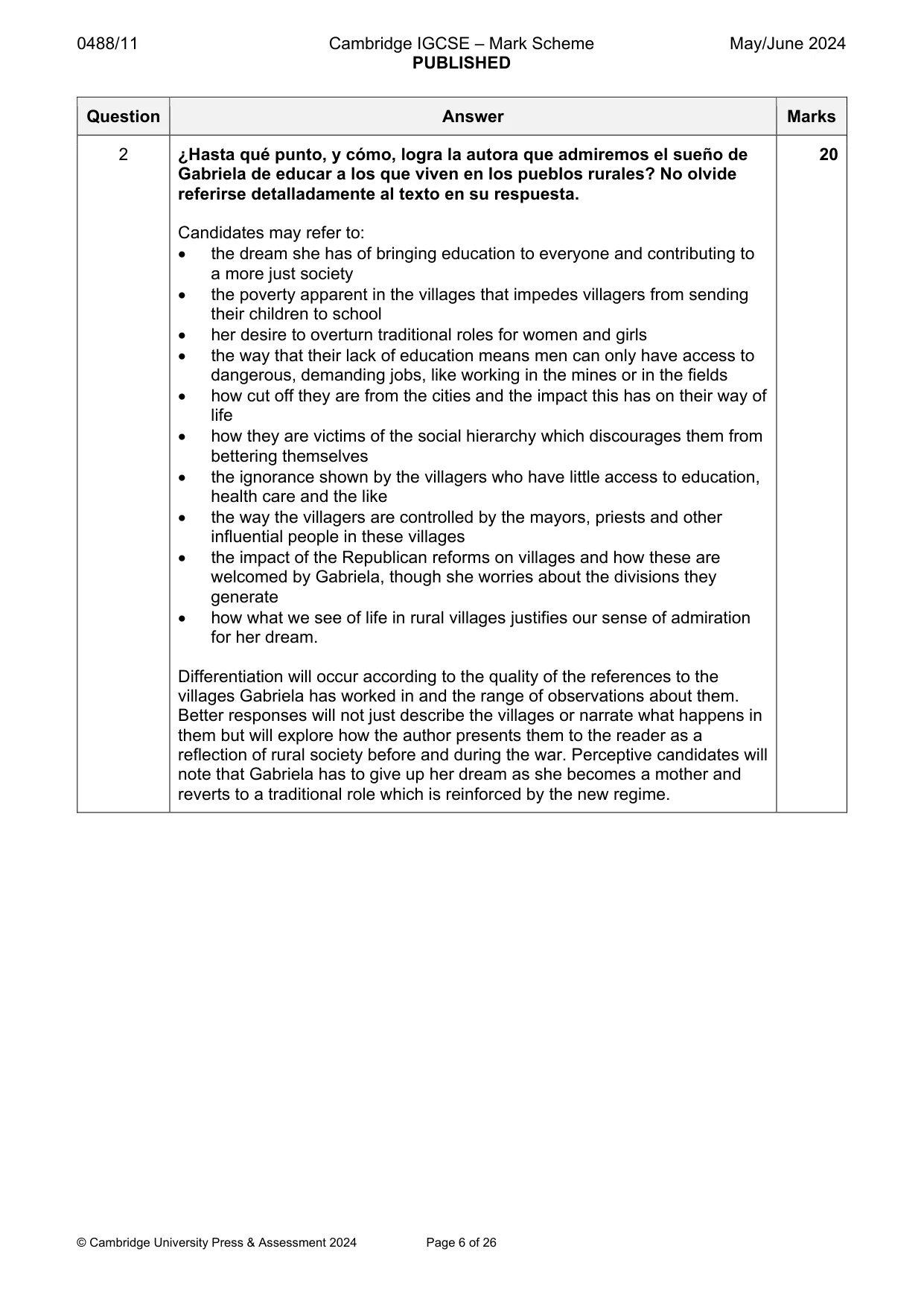
0488/11 Cambridge IGCSE – Mark Scheme PUBLISHED May/June 2024 © Cambridge University Press & Assessment 2024 Page 6 of 26 Question Answer Marks 2 ¿Hasta qué punto, y cómo, logra la autora que admiremos el sueño de Gabriela de educar a los que viven en los pueblos rurales? No olvide referirse detalladamente al texto en su respuesta. Candidates may refer to: the dream she has of bringing education to everyone and contributing to a more just society the poverty apparent in the villages that impedes villagers from sending their children to school her desire to overturn traditional roles for women and girls the way that their lack of education means men can only have access to dangerous, demanding jobs, like working in the mines or in the fields how cut off they are from the cities and the impact this has on their way of life how they are victims of the social hierarchy which discourages them from bettering themselves the ignorance shown by the villagers who have little access to education, health care and the like the way the villagers are controlled by the mayors, priests and other influential people in these villages the impact of the Republican reforms on villages and how these are welcomed by Gabriela, though she worries about the divisions they generate how what we see of life in rural villages justifies our sense of admiration for her dream. Differentiation will occur according to the quality of the references to the villages Gabriela has worked in and the range of observations about them. Better responses will not just describe the villages or narrate what happens in them but will explore how the author presents them to the reader as a reflection of rural society before and during the war. Perceptive candidates will note that Gabriela has to give up her dream as she becomes a mother and reverts to a traditional role which is reinforced by the new regime. 20
Mark scheme, page 7
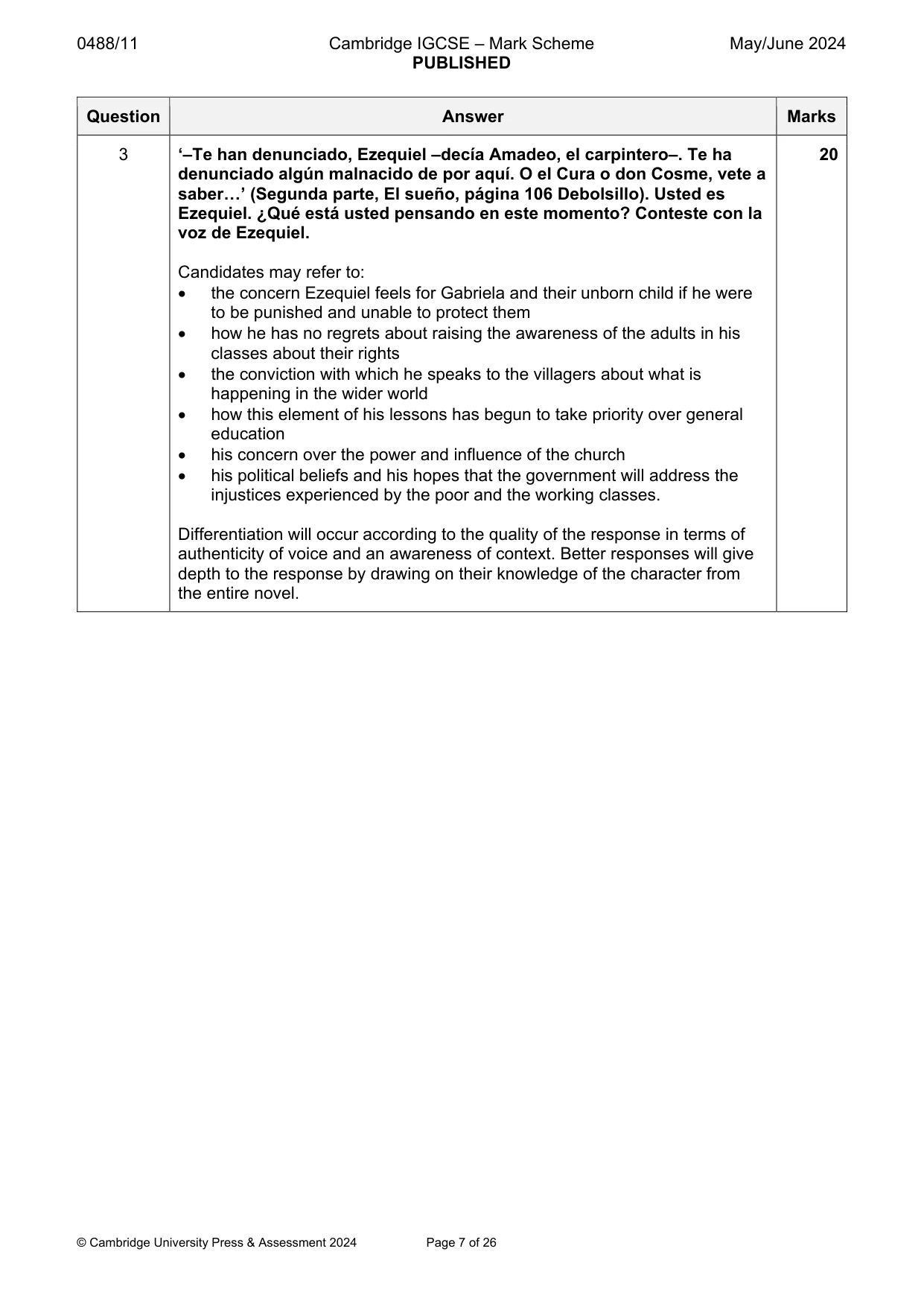
0488/11 Cambridge IGCSE – Mark Scheme PUBLISHED May/June 2024 © Cambridge University Press & Assessment 2024 Page 7 of 26 Question Answer Marks 3 ‘–Te han denunciado, Ezequiel –decía Amadeo, el carpintero–. Te ha denunciado algún malnacido de por aquí. O el Cura o don Cosme, vete a saber…’ (Segunda parte, El sueño, página 106 Debolsillo). Usted es Ezequiel. ¿Qué está usted pensando en este momento? Conteste con la voz de Ezequiel. Candidates may refer to: the concern Ezequiel feels for Gabriela and their unborn child if he were to be punished and unable to protect them how he has no regrets about raising the awareness of the adults in his classes about their rights the conviction with which he speaks to the villagers about what is happening in the wider world how this element of his lessons has begun to take priority over general education his concern over the power and influence of the church his political beliefs and his hopes that the government will address the injustices experienced by the poor and the working classes. Differentiation will occur according to the quality of the response in terms of authenticity of voice and an awareness of context. Better responses will give depth to the response by drawing on their knowledge of the character from the entire novel. 20
Mark scheme, page 8
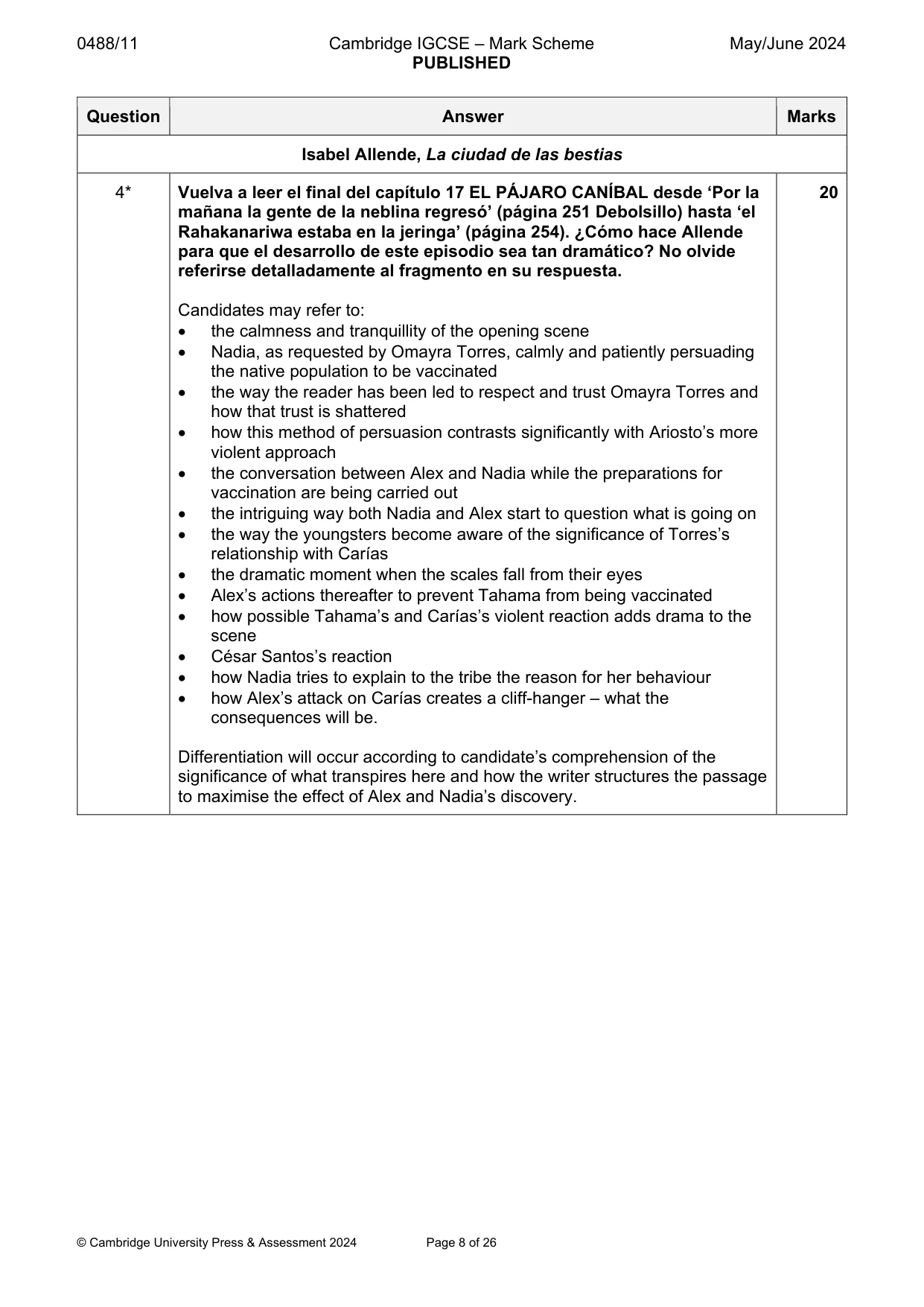
0488/11 Cambridge IGCSE – Mark Scheme PUBLISHED May/June 2024 © Cambridge University Press & Assessment 2024 Page 8 of 26 Question Answer Marks Isabel Allende, La ciudad de las bestias 4* Vuelva a leer el final del capítulo 17 EL PÁJARO CANÍBAL desde ‘Por la mañana la gente de la neblina regresó’ (página 251 Debolsillo) hasta ‘el Rahakanariwa estaba en la jeringa’ (página 254). ¿Cómo hace Allende para que el desarrollo de este episodio sea tan dramático? No olvide referirse detalladamente al fragmento en su respuesta. Candidates may refer to: the calmness and tranquillity of the opening scene Nadia, as requested by Omayra Torres, calmly and patiently persuading the native population to be vaccinated the way the reader has been led to respect and trust Omayra Torres and how that trust is shattered how this method of persuasion contrasts significantly with Ariosto’s more violent approach the conversation between Alex and Nadia while the preparations for vaccination are being carried out the intriguing way both Nadia and Alex start to question what is going on the way the youngsters become aware of the significance of Torres’s relationship with Carías the dramatic moment when the scales fall from their eyes Alex’s actions thereafter to prevent Tahama from being vaccinated how possible Tahama’s and Carías’s violent reaction adds drama to the scene César Santos’s reaction how Nadia tries to explain to the tribe the reason for her behaviour how Alex’s attack on Carías creates a cliff-hanger – what the consequences will be. Differentiation will occur according to candidate’s comprehension of the significance of what transpires here and how the writer structures the passage to maximise the effect of Alex and Nadia’s discovery. 20
Mark scheme, page 9
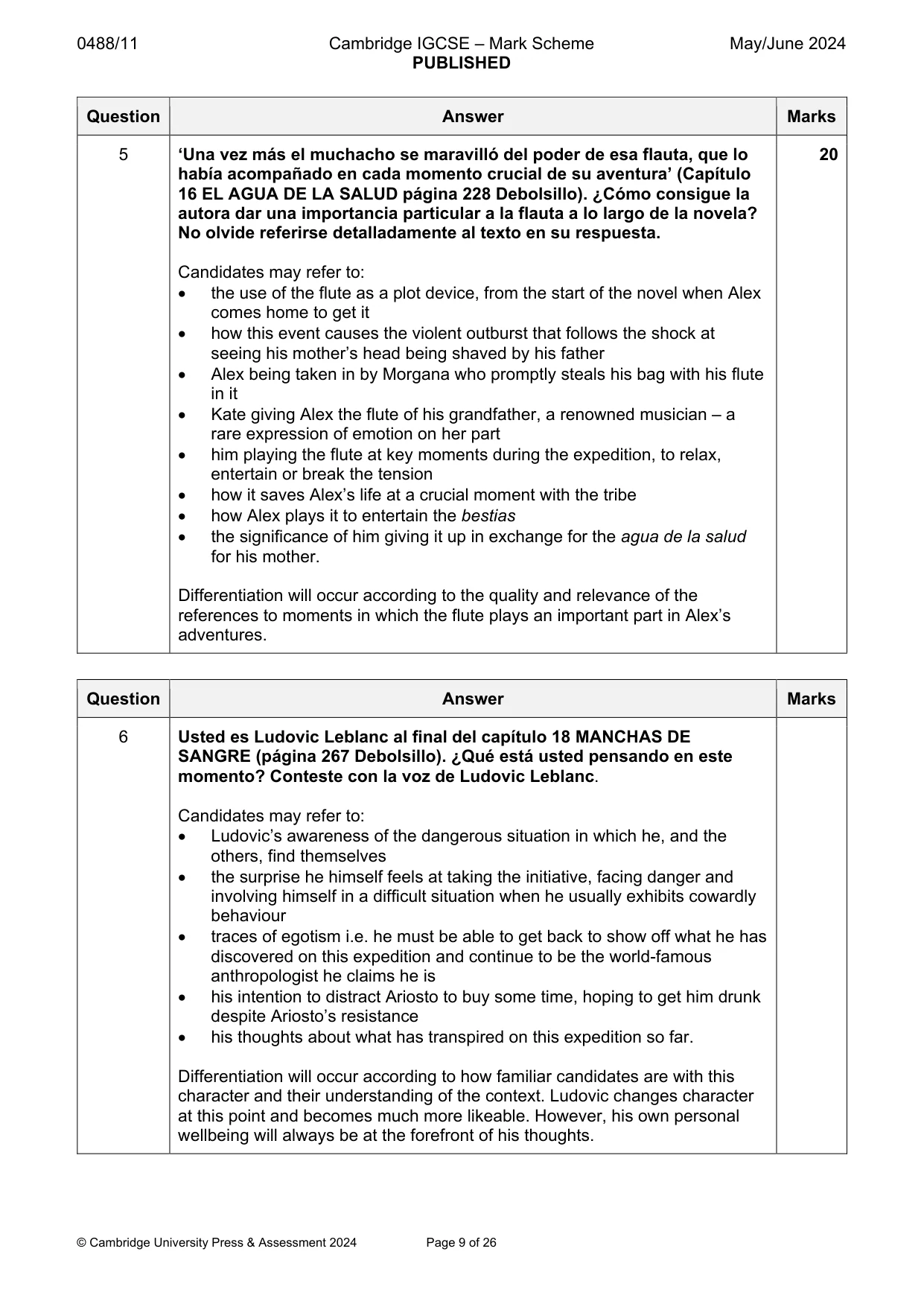
0488/11 Cambridge IGCSE – Mark Scheme PUBLISHED May/June 2024 © Cambridge University Press & Assessment 2024 Page 9 of 26 Question Answer Marks 5 ‘Una vez más el muchacho se maravilló del poder de esa flauta, que lo había acompañado en cada momento crucial de su aventura’ (Capítulo 16 EL AGUA DE LA SALUD página 228 Debolsillo). ¿Cómo consigue la autora dar una importancia particular a la flauta a lo largo de la novela? No olvide referirse detalladamente al texto en su respuesta. Candidates may refer to: the use of the flute as a plot device, from the start of the novel when Alex comes home to get it how this event causes the violent outburst that follows the shock at seeing his mother’s head being shaved by his father Alex being taken in by Morgana who promptly steals his bag with his flute in it Kate giving Alex the flute of his grandfather, a renowned musician – a rare expression of emotion on her part him playing the flute at key moments during the expedition, to relax, entertain or break the tension how it saves Alex’s life at a crucial moment with the tribe how Alex plays it to entertain the bestias the significance of him giving it up in exchange for the agua de la salud for his mother. Differentiation will occur according to the quality and relevance of the references to moments in which the flute plays an important part in Alex’s adventures. 20 Question Answer Marks 6 Usted es Ludovic Leblanc al final del capítulo 18 MANCHAS DE SANGRE (página 267 Debolsillo). ¿Qué está usted pensando en este momento? Conteste con la voz de Ludovic Leblanc. Candidates may refer to: Ludovic’s awareness of the dangerous situation in which he, and the others, find themselves the surprise he himself feels at taking the initiative, facing danger and involving himself in a difficult situation when he usually exhibits cowardly behaviour traces of egotism i.e. he must be able to get back to show off what he has discovered on this expedition and continue to be the world-famous anthropologist he claims he is his intention to distract Ariosto to buy some time, hoping to get him drunk despite Ariosto’s resistance his thoughts about what has transpired on this expedition so far. Differentiation will occur according to how familiar candidates are with this character and their understanding of the context. Ludovic changes character at this point and becomes much more likeable. However, his own personal wellbeing will always be at the forefront of his thoughts.
Mark scheme, page 10
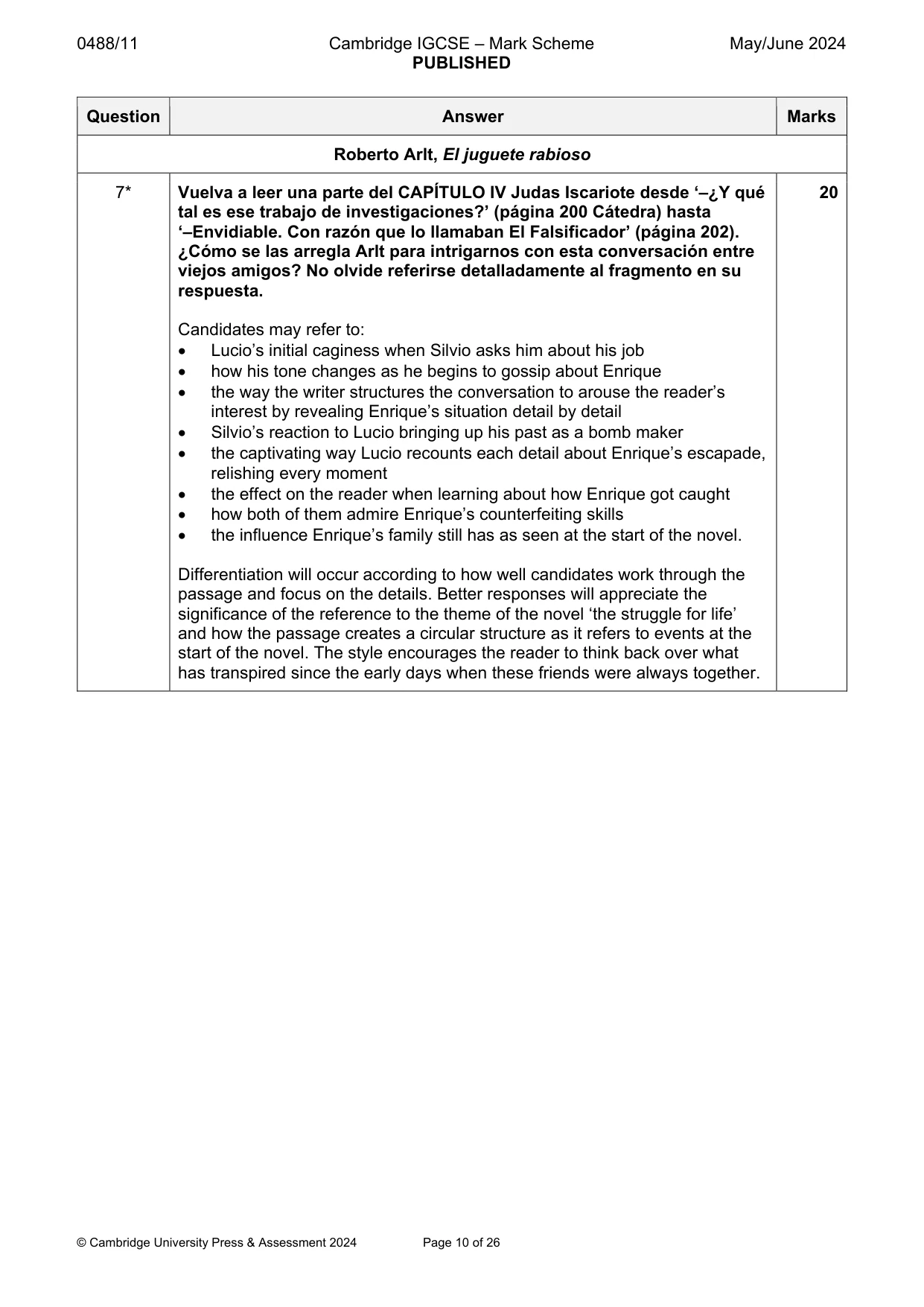
0488/11 Cambridge IGCSE – Mark Scheme PUBLISHED May/June 2024 © Cambridge University Press & Assessment 2024 Page 10 of 26 Question Answer Marks Roberto Arlt, El juguete rabioso 7* Vuelva a leer una parte del CAPÍTULO IV Judas Iscariote desde ‘–¿Y qué tal es ese trabajo de investigaciones?’ (página 200 Cátedra) hasta ‘–Envidiable. Con razón que lo llamaban El Falsificador’ (página 202). ¿Cómo se las arregla Arlt para intrigarnos con esta conversación entre viejos amigos? No olvide referirse detalladamente al fragmento en su respuesta. Candidates may refer to: Lucio’s initial caginess when Silvio asks him about his job how his tone changes as he begins to gossip about Enrique the way the writer structures the conversation to arouse the reader’s interest by revealing Enrique’s situation detail by detail Silvio’s reaction to Lucio bringing up his past as a bomb maker the captivating way Lucio recounts each detail about Enrique’s escapade, relishing every moment the effect on the reader when learning about how Enrique got caught how both of them admire Enrique’s counterfeiting skills the influence Enrique’s family still has as seen at the start of the novel. Differentiation will occur according to how well candidates work through the passage and focus on the details. Better responses will appreciate the significance of the reference to the theme of the novel ‘the struggle for life’ and how the passage creates a circular structure as it refers to events at the start of the novel. The style encourages the reader to think back over what has transpired since the early days when these friends were always together. 20
Mark scheme, page 11
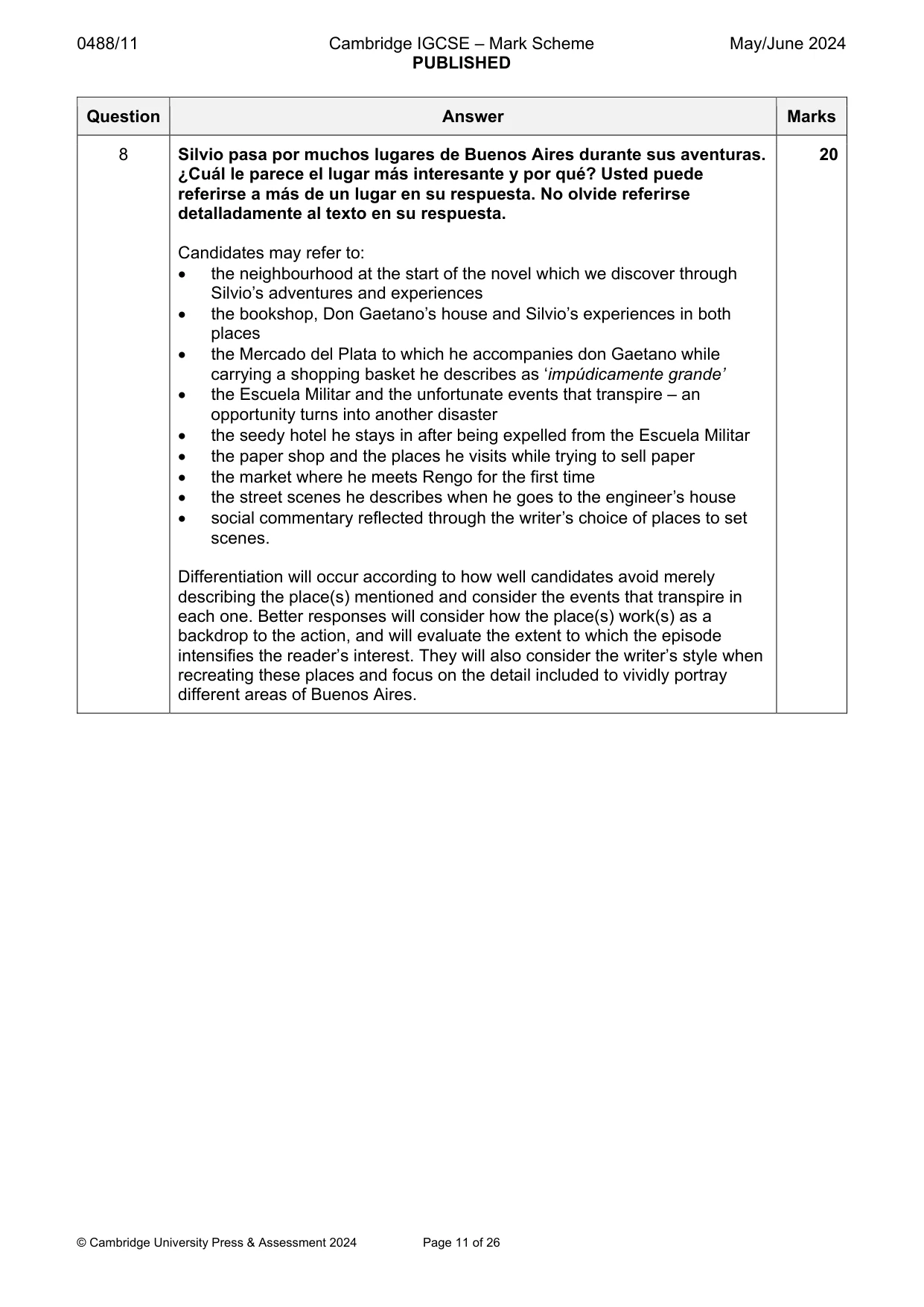
0488/11 Cambridge IGCSE – Mark Scheme PUBLISHED May/June 2024 © Cambridge University Press & Assessment 2024 Page 11 of 26 Question Answer Marks 8 Silvio pasa por muchos lugares de Buenos Aires durante sus aventuras. ¿Cuál le parece el lugar más interesante y por qué? Usted puede referirse a más de un lugar en su respuesta. No olvide referirse detalladamente al texto en su respuesta. Candidates may refer to: the neighbourhood at the start of the novel which we discover through Silvio’s adventures and experiences the bookshop, Don Gaetano’s house and Silvio’s experiences in both places the Mercado del Plata to which he accompanies don Gaetano while carrying a shopping basket he describes as ‘impúdicamente grande’ the Escuela Militar and the unfortunate events that transpire – an opportunity turns into another disaster the seedy hotel he stays in after being expelled from the Escuela Militar the paper shop and the places he visits while trying to sell paper the market where he meets Rengo for the first time the street scenes he describes when he goes to the engineer’s house social commentary reflected through the writer’s choice of places to set scenes. Differentiation will occur according to how well candidates avoid merely describing the place(s) mentioned and consider the events that transpire in each one. Better responses will consider how the place(s) work(s) as a backdrop to the action, and will evaluate the extent to which the episode intensifies the reader’s interest. They will also consider the writer’s style when recreating these places and focus on the detail included to vividly portray different areas of Buenos Aires. 20
Mark scheme, page 12
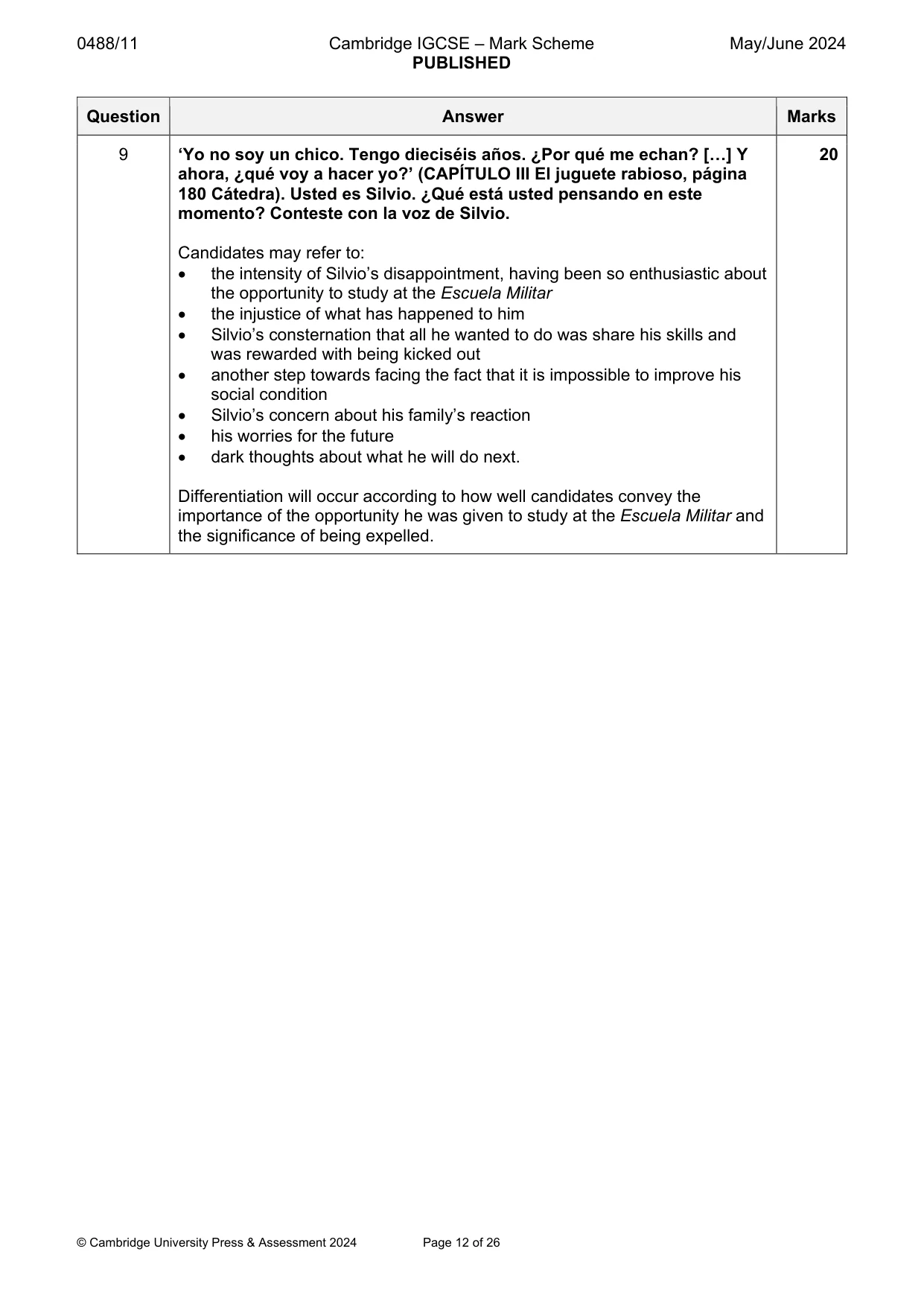
0488/11 Cambridge IGCSE – Mark Scheme PUBLISHED May/June 2024 © Cambridge University Press & Assessment 2024 Page 12 of 26 Question Answer Marks 9 ‘Yo no soy un chico. Tengo dieciséis años. ¿Por qué me echan? […] Y ahora, ¿qué voy a hacer yo?’ (CAPÍTULO III El juguete rabioso, página 180 Cátedra). Usted es Silvio. ¿Qué está usted pensando en este momento? Conteste con la voz de Silvio. Candidates may refer to: the intensity of Silvio’s disappointment, having been so enthusiastic about the opportunity to study at the Escuela Militar the injustice of what has happened to him Silvio’s consternation that all he wanted to do was share his skills and was rewarded with being kicked out another step towards facing the fact that it is impossible to improve his social condition Silvio’s concern about his family’s reaction his worries for the future dark thoughts about what he will do next. Differentiation will occur according to how well candidates convey the importance of the opportunity he was given to study at the Escuela Militar and the significance of being expelled. 20
Mark scheme, page 13
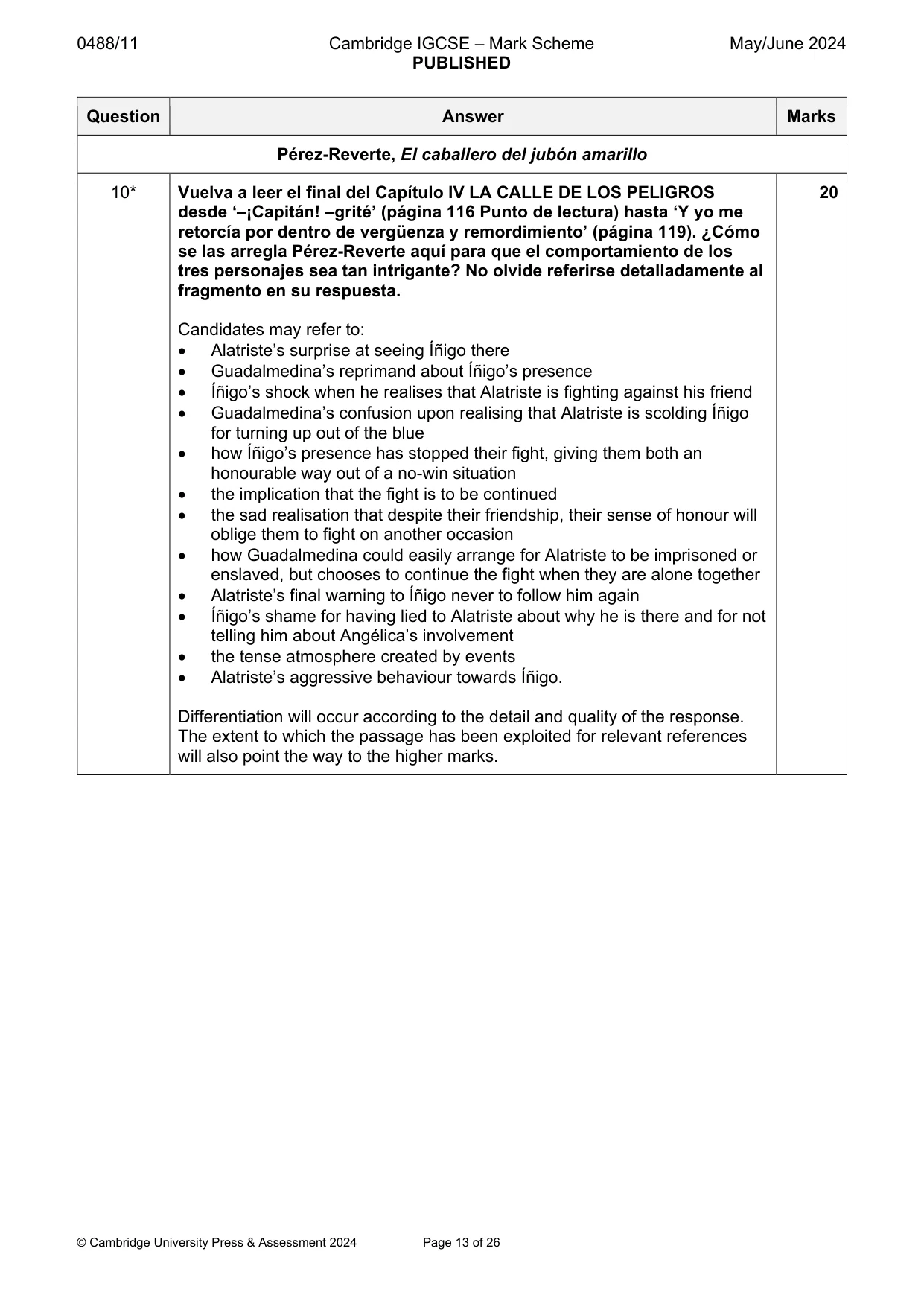
0488/11 Cambridge IGCSE – Mark Scheme PUBLISHED May/June 2024 © Cambridge University Press & Assessment 2024 Page 13 of 26 Question Answer Marks Pérez-Reverte, El caballero del jubón amarillo 10* Vuelva a leer el final del Capítulo IV LA CALLE DE LOS PELIGROS desde ‘–¡Capitán! –grité’ (página 116 Punto de lectura) hasta ‘Y yo me retorcía por dentro de vergüenza y remordimiento’ (página 119). ¿Cómo se las arregla Pérez-Reverte aquí para que el comportamiento de los tres personajes sea tan intrigante? No olvide referirse detalladamente al fragmento en su respuesta. Candidates may refer to: Alatriste’s surprise at seeing Íñigo there Guadalmedina’s reprimand about Íñigo’s presence Íñigo’s shock when he realises that Alatriste is fighting against his friend Guadalmedina’s confusion upon realising that Alatriste is scolding Íñigo for turning up out of the blue how Íñigo’s presence has stopped their fight, giving them both an honourable way out of a no-win situation the implication that the fight is to be continued the sad realisation that despite their friendship, their sense of honour will oblige them to fight on another occasion how Guadalmedina could easily arrange for Alatriste to be imprisoned or enslaved, but chooses to continue the fight when they are alone together Alatriste’s final warning to Íñigo never to follow him again Íñigo’s shame for having lied to Alatriste about why he is there and for not telling him about Angélica’s involvement the tense atmosphere created by events Alatriste’s aggressive behaviour towards Íñigo. Differentiation will occur according to the detail and quality of the response. The extent to which the passage has been exploited for relevant references will also point the way to the higher marks. 20
Mark scheme, page 14
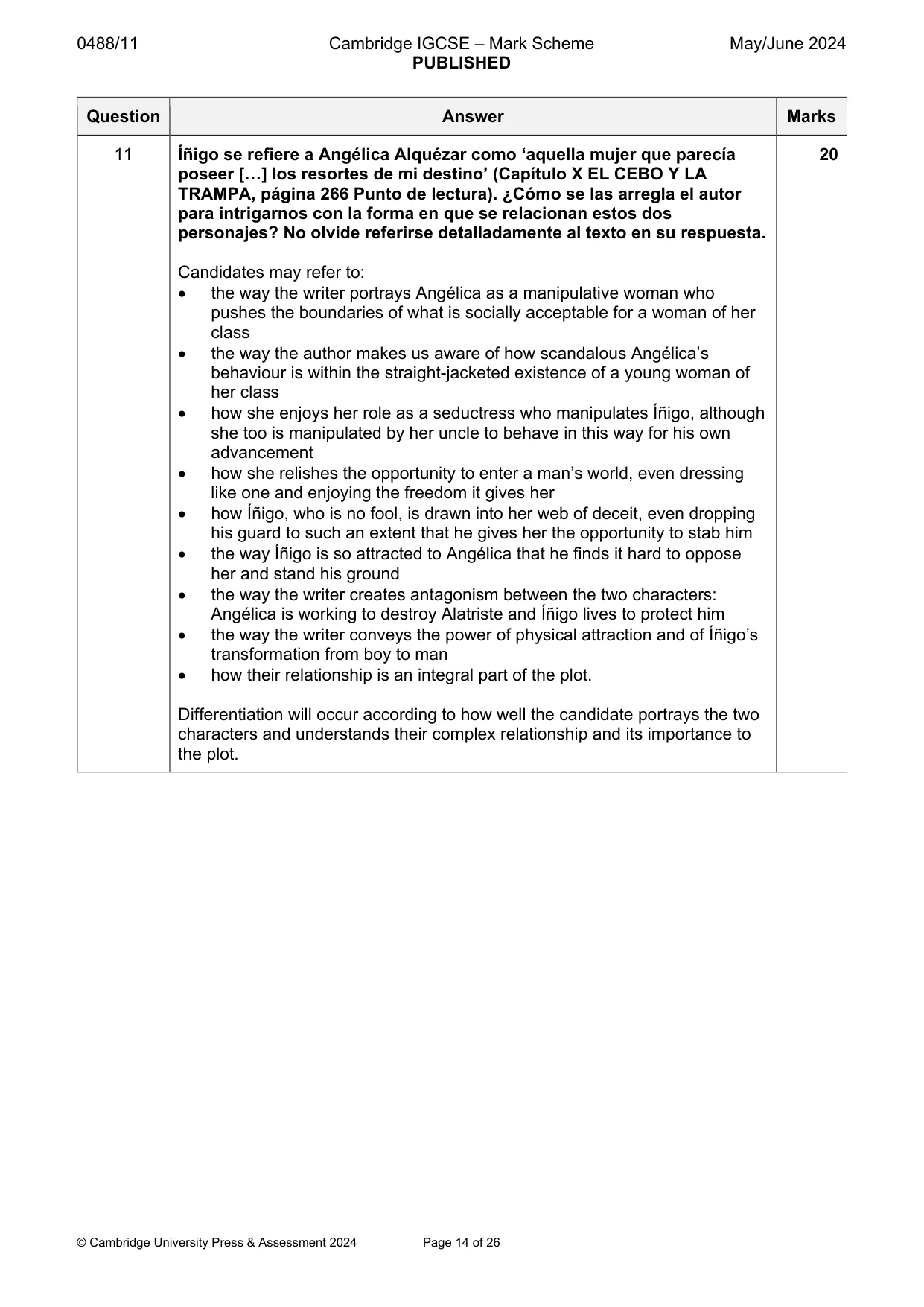
0488/11 Cambridge IGCSE – Mark Scheme PUBLISHED May/June 2024 © Cambridge University Press & Assessment 2024 Page 14 of 26 Question Answer Marks 11 Íñigo se refiere a Angélica Alquézar como ‘aquella mujer que parecía poseer […] los resortes de mi destino’ (Capítulo X EL CEBO Y LA TRAMPA, página 266 Punto de lectura). ¿Cómo se las arregla el autor para intrigarnos con la forma en que se relacionan estos dos personajes? No olvide referirse detalladamente al texto en su respuesta. Candidates may refer to: the way the writer portrays Angélica as a manipulative woman who pushes the boundaries of what is socially acceptable for a woman of her class the way the author makes us aware of how scandalous Angélica’s behaviour is within the straight-jacketed existence of a young woman of her class how she enjoys her role as a seductress who manipulates Íñigo, although she too is manipulated by her uncle to behave in this way for his own advancement how she relishes the opportunity to enter a man’s world, even dressing like one and enjoying the freedom it gives her how Íñigo, who is no fool, is drawn into her web of deceit, even dropping his guard to such an extent that he gives her the opportunity to stab him the way Íñigo is so attracted to Angélica that he finds it hard to oppose her and stand his ground the way the writer creates antagonism between the two characters: Angélica is working to destroy Alatriste and Íñigo lives to protect him the way the writer conveys the power of physical attraction and of Íñigo’s transformation from boy to man how their relationship is an integral part of the plot. Differentiation will occur according to how well the candidate portrays the two characters and understands their complex relationship and its importance to the plot. 20
Mark scheme, page 15
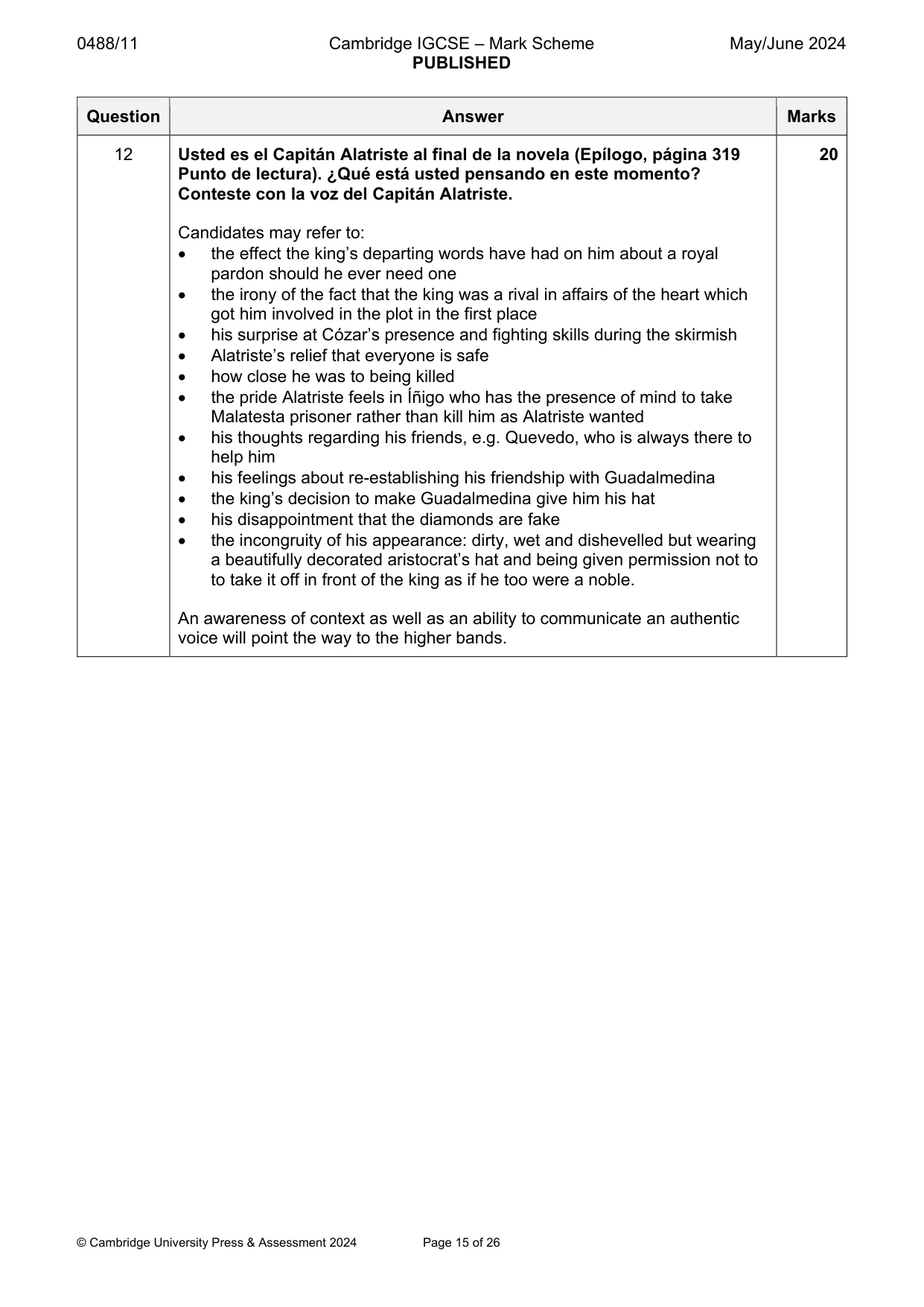
0488/11 Cambridge IGCSE – Mark Scheme PUBLISHED May/June 2024 © Cambridge University Press & Assessment 2024 Page 15 of 26 Question Answer Marks 12 Usted es el Capitán Alatriste al final de la novela (Epílogo, página 319 Punto de lectura). ¿Qué está usted pensando en este momento? Conteste con la voz del Capitán Alatriste. Candidates may refer to: the effect the king’s departing words have had on him about a royal pardon should he ever need one the irony of the fact that the king was a rival in affairs of the heart which got him involved in the plot in the first place his surprise at Cózar’s presence and fighting skills during the skirmish Alatriste’s relief that everyone is safe how close he was to being killed the pride Alatriste feels in Íñigo who has the presence of mind to take Malatesta prisoner rather than kill him as Alatriste wanted his thoughts regarding his friends, e.g. Quevedo, who is always there to help him his feelings about re-establishing his friendship with Guadalmedina the king’s decision to make Guadalmedina give him his hat his disappointment that the diamonds are fake the incongruity of his appearance: dirty, wet and dishevelled but wearing a beautifully decorated aristocrat’s hat and being given permission not to to take it off in front of the king as if he too were a noble. An awareness of context as well as an ability to communicate an authentic voice will point the way to the higher bands. 20
Mark scheme, page 16
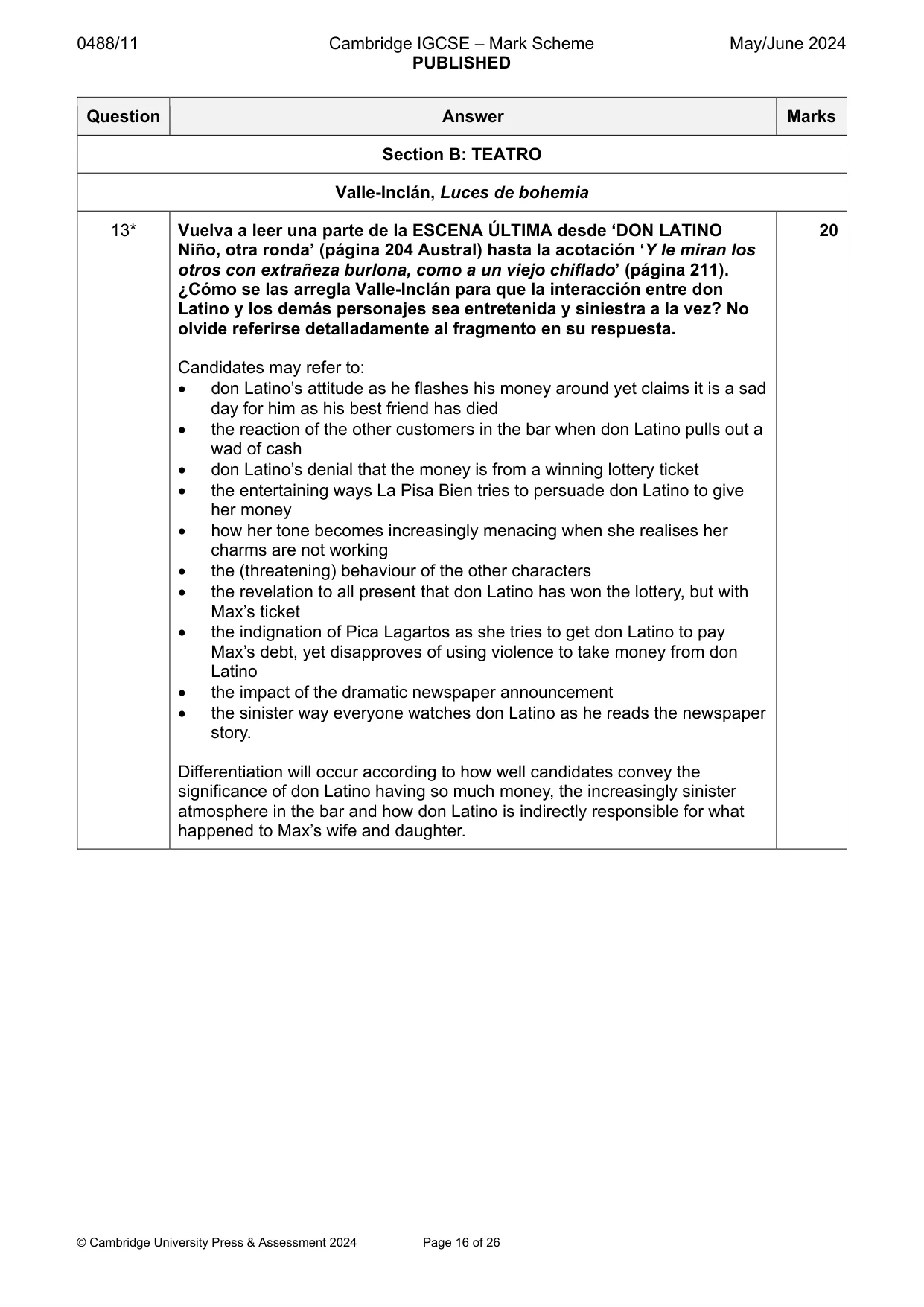
0488/11 Cambridge IGCSE – Mark Scheme PUBLISHED May/June 2024 © Cambridge University Press & Assessment 2024 Page 16 of 26 Question Answer Marks Section B: TEATRO Valle-Inclán, Luces de bohemia 13* Vuelva a leer una parte de la ESCENA ÚLTIMA desde ‘DON LATINO Niño, otra ronda’ (página 204 Austral) hasta la acotación ‘Y le miran los otros con extrañeza burlona, como a un viejo chiflado’ (página 211). ¿Cómo se las arregla Valle-Inclán para que la interacción entre don Latino y los demás personajes sea entretenida y siniestra a la vez? No olvide referirse detalladamente al fragmento en su respuesta. Candidates may refer to: don Latino’s attitude as he flashes his money around yet claims it is a sad day for him as his best friend has died the reaction of the other customers in the bar when don Latino pulls out a wad of cash don Latino’s denial that the money is from a winning lottery ticket the entertaining ways La Pisa Bien tries to persuade don Latino to give her money how her tone becomes increasingly menacing when she realises her charms are not working the (threatening) behaviour of the other characters the revelation to all present that don Latino has won the lottery, but with Max’s ticket the indignation of Pica Lagartos as she tries to get don Latino to pay Max’s debt, yet disapproves of using violence to take money from don Latino the impact of the dramatic newspaper announcement the sinister way everyone watches don Latino as he reads the newspaper story. Differentiation will occur according to how well candidates convey the significance of don Latino having so much money, the increasingly sinister atmosphere in the bar and how don Latino is indirectly responsible for what happened to Max’s wife and daughter. 20
Mark scheme, page 17
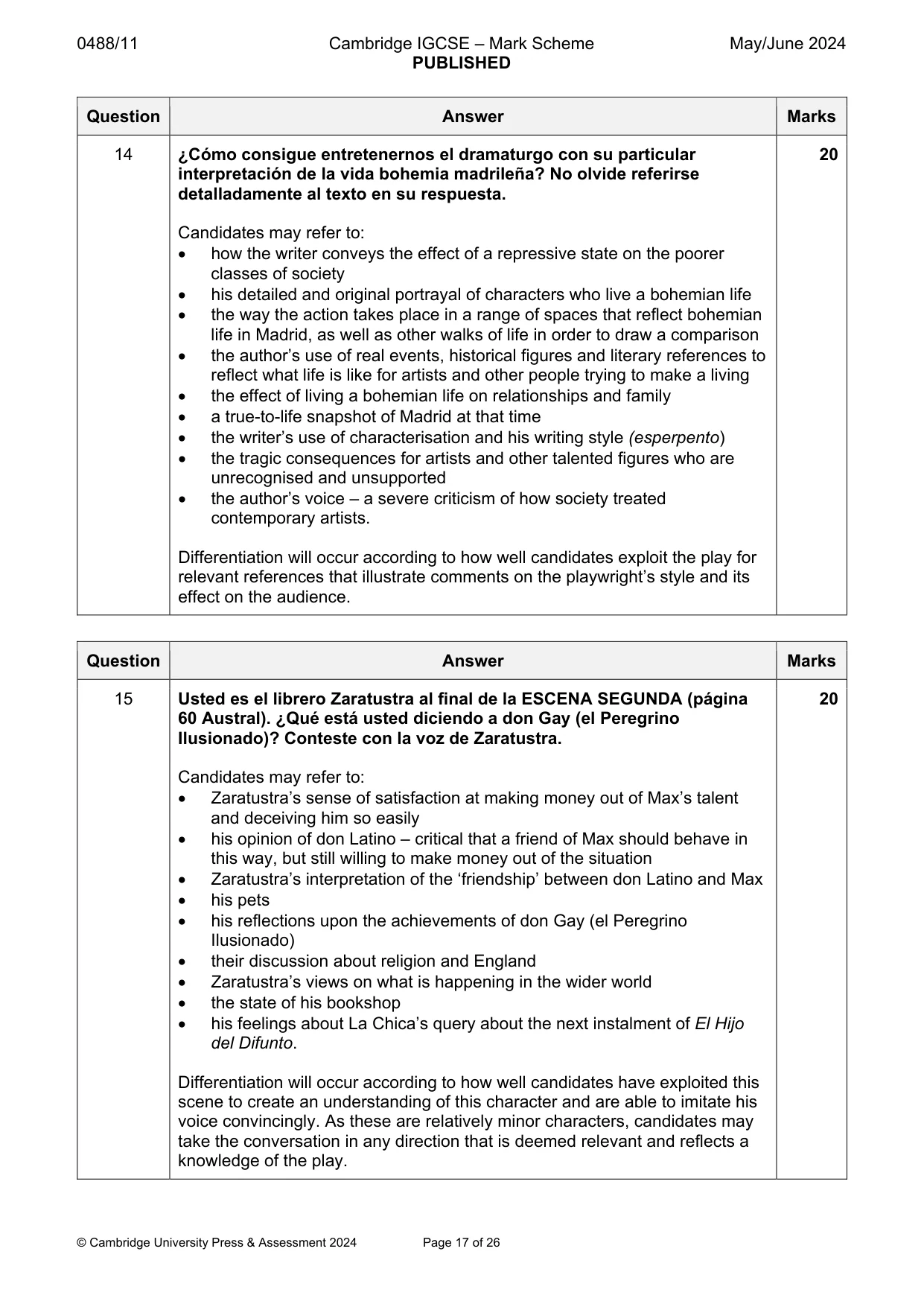
0488/11 Cambridge IGCSE – Mark Scheme PUBLISHED May/June 2024 © Cambridge University Press & Assessment 2024 Page 17 of 26 Question Answer Marks 14 ¿Cómo consigue entretenernos el dramaturgo con su particular interpretación de la vida bohemia madrileña? No olvide referirse detalladamente al texto en su respuesta. Candidates may refer to: how the writer conveys the effect of a repressive state on the poorer classes of society his detailed and original portrayal of characters who live a bohemian life the way the action takes place in a range of spaces that reflect bohemian life in Madrid, as well as other walks of life in order to draw a comparison the author’s use of real events, historical figures and literary references to reflect what life is like for artists and other people trying to make a living the effect of living a bohemian life on relationships and family a true-to-life snapshot of Madrid at that time the writer’s use of characterisation and his writing style (esperpento) the tragic consequences for artists and other talented figures who are unrecognised and unsupported the author’s voice – a severe criticism of how society treated contemporary artists. Differentiation will occur according to how well candidates exploit the play for relevant references that illustrate comments on the playwright’s style and its effect on the audience. 20 Question Answer Marks 15 Usted es el librero Zaratustra al final de la ESCENA SEGUNDA (página 60 Austral). ¿Qué está usted diciendo a don Gay (el Peregrino Ilusionado)? Conteste con la voz de Zaratustra. Candidates may refer to: Zaratustra’s sense of satisfaction at making money out of Max’s talent and deceiving him so easily his opinion of don Latino – critical that a friend of Max should behave in this way, but still willing to make money out of the situation Zaratustra’s interpretation of the ‘friendship’ between don Latino and Max his pets his reflections upon the achievements of don Gay (el Peregrino Ilusionado) their discussion about religion and England Zaratustra’s views on what is happening in the wider world the state of his bookshop his feelings about La Chica’s query about the next instalment of El Hijo del Difunto. Differentiation will occur according to how well candidates have exploited this scene to create an understanding of this character and are able to imitate his voice convincingly. As these are relatively minor characters, candidates may take the conversation in any direction that is deemed relevant and reflects a knowledge of the play. 20
Mark scheme, page 18
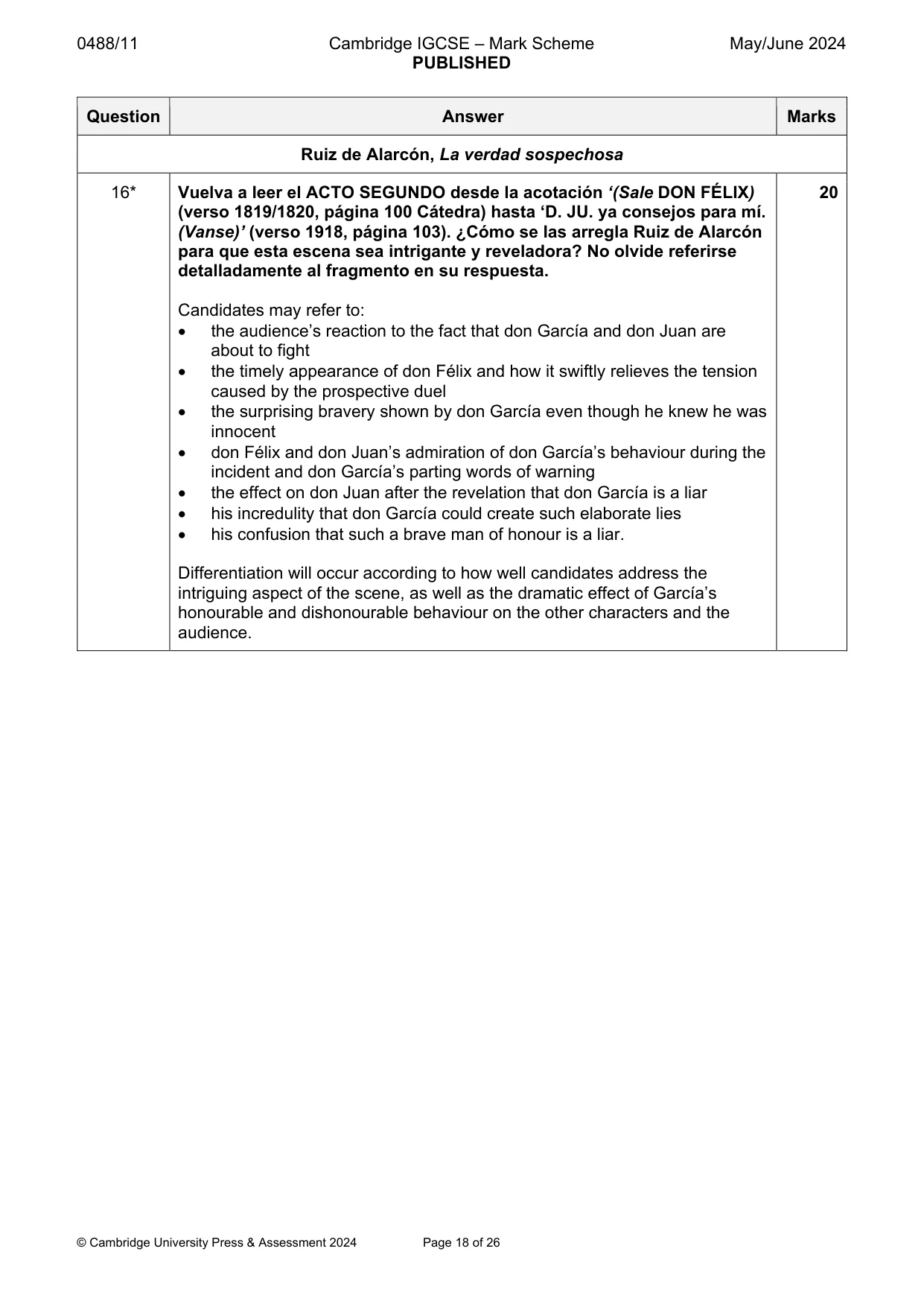
0488/11 Cambridge IGCSE – Mark Scheme PUBLISHED May/June 2024 © Cambridge University Press & Assessment 2024 Page 18 of 26 Question Answer Marks Ruiz de Alarcón, La verdad sospechosa 16* Vuelva a leer el ACTO SEGUNDO desde la acotación ‘(Sale DON FÉLIX) (verso 1819/1820, página 100 Cátedra) hasta ‘D. JU. ya consejos para mí. (Vanse)’ (verso 1918, página 103). ¿Cómo se las arregla Ruiz de Alarcón para que esta escena sea intrigante y reveladora? No olvide referirse detalladamente al fragmento en su respuesta. Candidates may refer to: the audience’s reaction to the fact that don García and don Juan are about to fight the timely appearance of don Félix and how it swiftly relieves the tension caused by the prospective duel the surprising bravery shown by don García even though he knew he was innocent don Félix and don Juan’s admiration of don García’s behaviour during the incident and don García’s parting words of warning the effect on don Juan after the revelation that don García is a liar his incredulity that don García could create such elaborate lies his confusion that such a brave man of honour is a liar. Differentiation will occur according to how well candidates address the intriguing aspect of the scene, as well as the dramatic effect of García’s honourable and dishonourable behaviour on the other characters and the audience. 20
Mark scheme, page 19
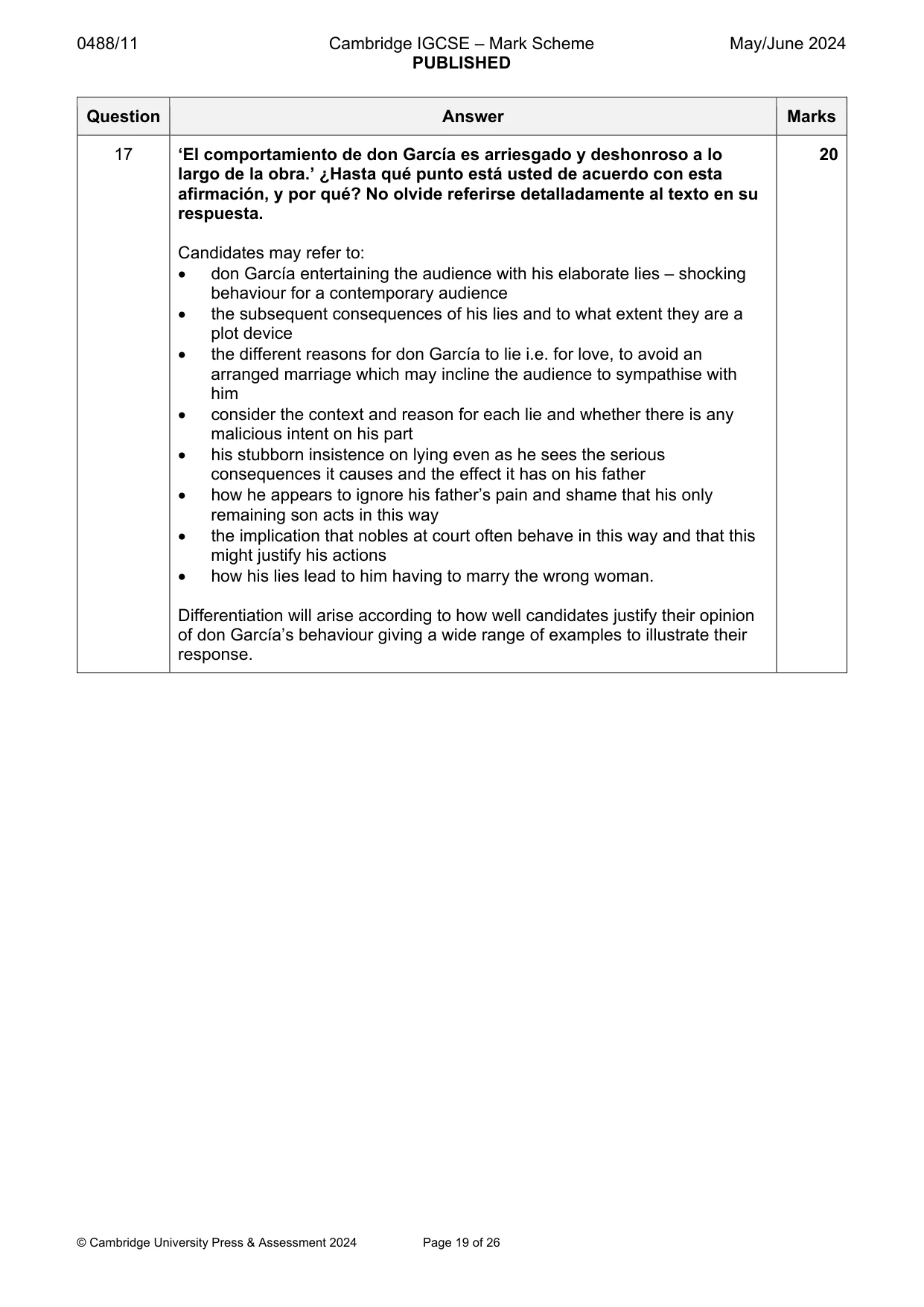
0488/11 Cambridge IGCSE – Mark Scheme PUBLISHED May/June 2024 © Cambridge University Press & Assessment 2024 Page 19 of 26 Question Answer Marks 17 ‘El comportamiento de don García es arriesgado y deshonroso a lo largo de la obra.’ ¿Hasta qué punto está usted de acuerdo con esta afirmación, y por qué? No olvide referirse detalladamente al texto en su respuesta. Candidates may refer to: don García entertaining the audience with his elaborate lies – shocking behaviour for a contemporary audience the subsequent consequences of his lies and to what extent they are a plot device the different reasons for don García to lie i.e. for love, to avoid an arranged marriage which may incline the audience to sympathise with him consider the context and reason for each lie and whether there is any malicious intent on his part his stubborn insistence on lying even as he sees the serious consequences it causes and the effect it has on his father how he appears to ignore his father’s pain and shame that his only remaining son acts in this way the implication that nobles at court often behave in this way and that this might justify his actions how his lies lead to him having to marry the wrong woman. Differentiation will arise according to how well candidates justify their opinion of don García’s behaviour giving a wide range of examples to illustrate their response. 20
Mark scheme, page 20
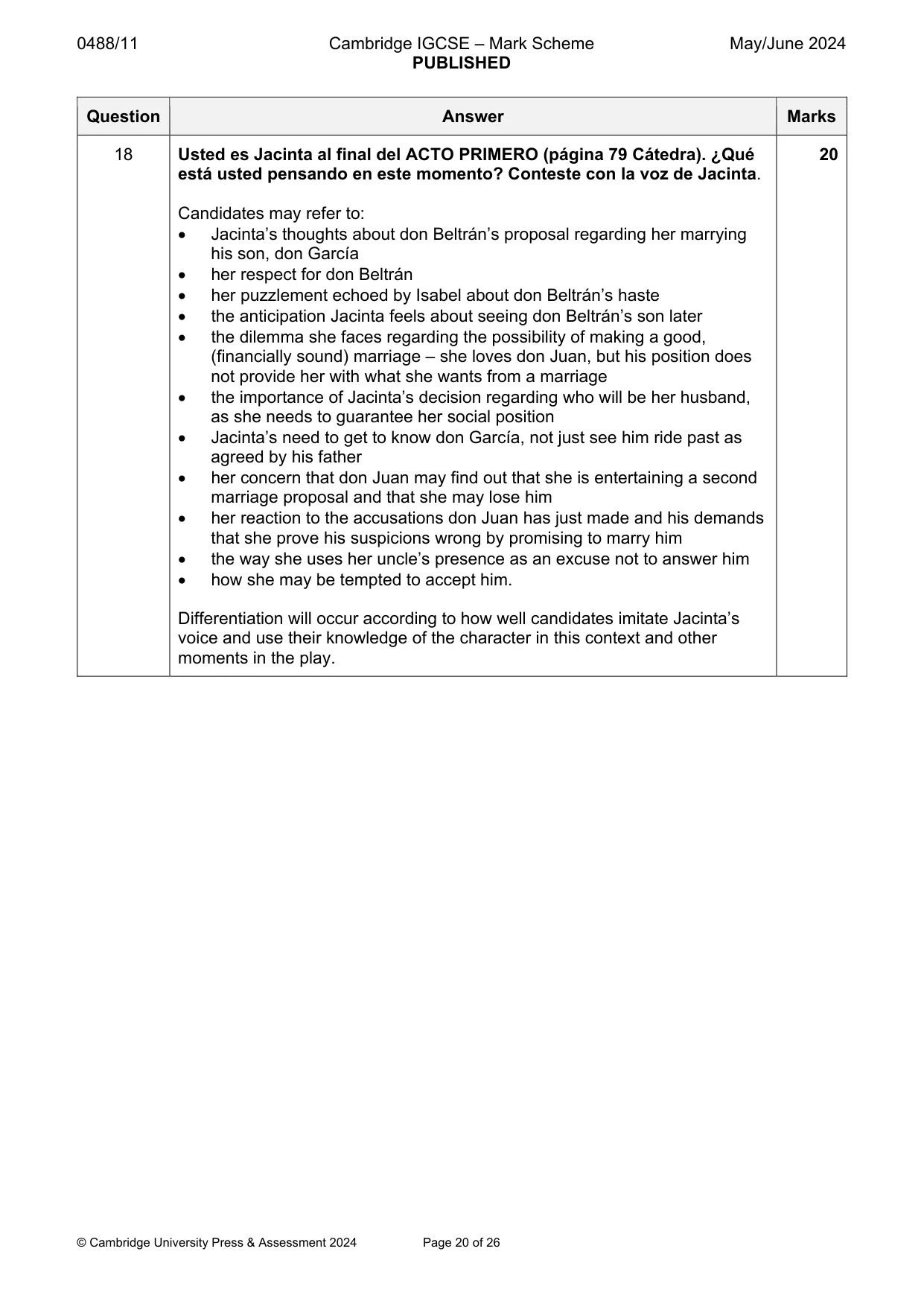
0488/11 Cambridge IGCSE – Mark Scheme PUBLISHED May/June 2024 © Cambridge University Press & Assessment 2024 Page 20 of 26 Question Answer Marks 18 Usted es Jacinta al final del ACTO PRIMERO (página 79 Cátedra). ¿Qué está usted pensando en este momento? Conteste con la voz de Jacinta. Candidates may refer to: Jacinta’s thoughts about don Beltrán’s proposal regarding her marrying his son, don García her respect for don Beltrán her puzzlement echoed by Isabel about don Beltrán’s haste the anticipation Jacinta feels about seeing don Beltrán’s son later the dilemma she faces regarding the possibility of making a good, (financially sound) marriage – she loves don Juan, but his position does not provide her with what she wants from a marriage the importance of Jacinta’s decision regarding who will be her husband, as she needs to guarantee her social position Jacinta’s need to get to know don García, not just see him ride past as agreed by his father her concern that don Juan may find out that she is entertaining a second marriage proposal and that she may lose him her reaction to the accusations don Juan has just made and his demands that she prove his suspicions wrong by promising to marry him the way she uses her uncle’s presence as an excuse not to answer him how she may be tempted to accept him. Differentiation will occur according to how well candidates imitate Jacinta’s voice and use their knowledge of the character in this context and other moments in the play. 20
Mark scheme, page 21
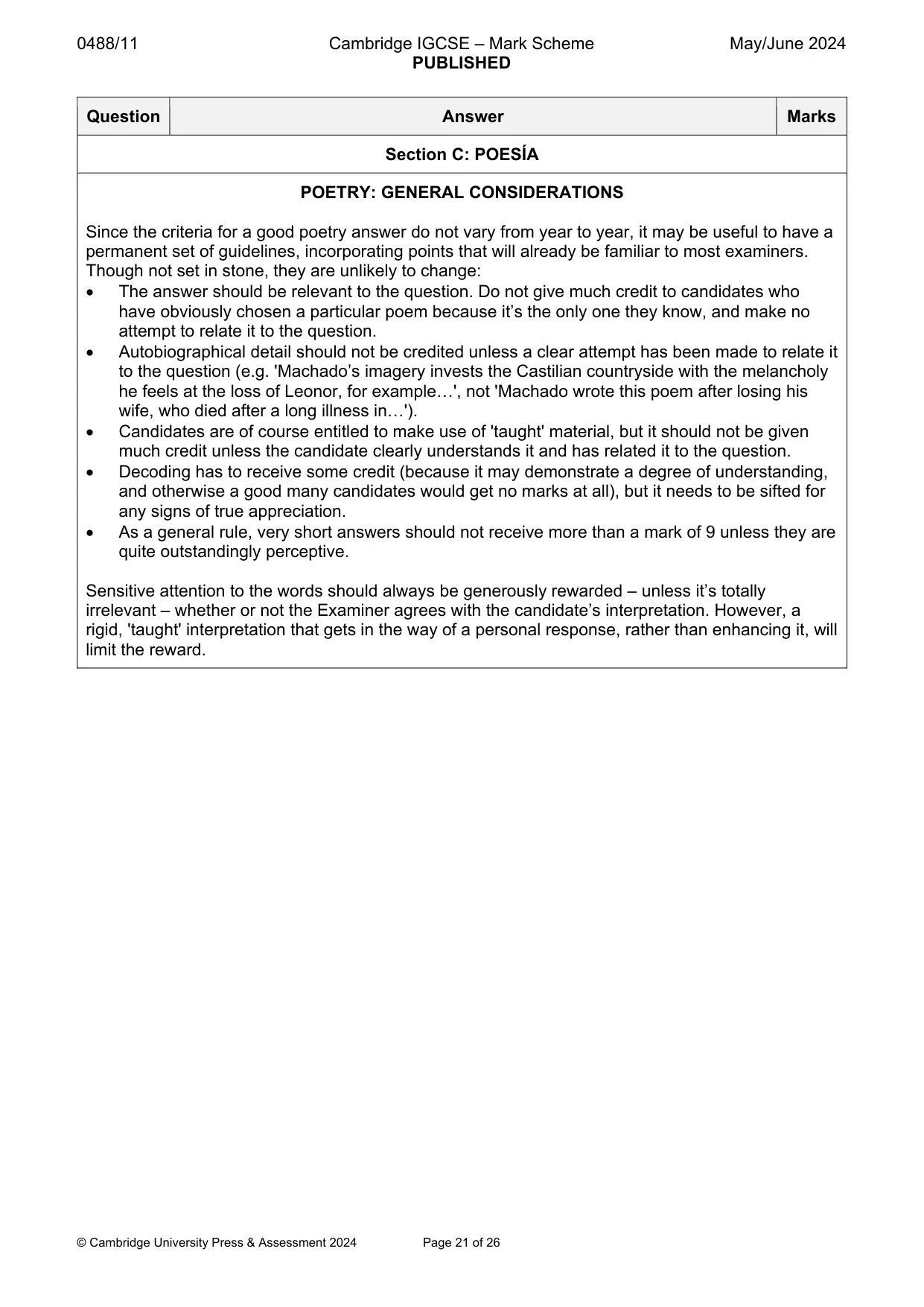
0488/11 Cambridge IGCSE – Mark Scheme PUBLISHED May/June 2024 © Cambridge University Press & Assessment 2024 Page 21 of 26 Question Answer Marks Section C: POESÍA POETRY: GENERAL CONSIDERATIONS Since the criteria for a good poetry answer do not vary from year to year, it may be useful to have a permanent set of guidelines, incorporating points that will already be familiar to most examiners. Though not set in stone, they are unlikely to change: The answer should be relevant to the question. Do not give much credit to candidates who have obviously chosen a particular poem because it’s the only one they know, and make no attempt to relate it to the question. Autobiographical detail should not be credited unless a clear attempt has been made to relate it to the question (e.g. 'Machado’s imagery invests the Castilian countryside with the melancholy he feels at the loss of Leonor, for example…', not 'Machado wrote this poem after losing his wife, who died after a long illness in…'). Candidates are of course entitled to make use of 'taught' material, but it should not be given much credit unless the candidate clearly understands it and has related it to the question. Decoding has to receive some credit (because it may demonstrate a degree of understanding, and otherwise a good many candidates would get no marks at all), but it needs to be sifted for any signs of true appreciation. As a general rule, very short answers should not receive more than a mark of 9 unless they are quite outstandingly perceptive. Sensitive attention to the words should always be generously rewarded – unless it’s totally irrelevant – whether or not the Examiner agrees with the candidate’s interpretation. However, a rigid, 'taught' interpretation that gets in the way of a personal response, rather than enhancing it, will limit the reward.
Mark scheme, page 22
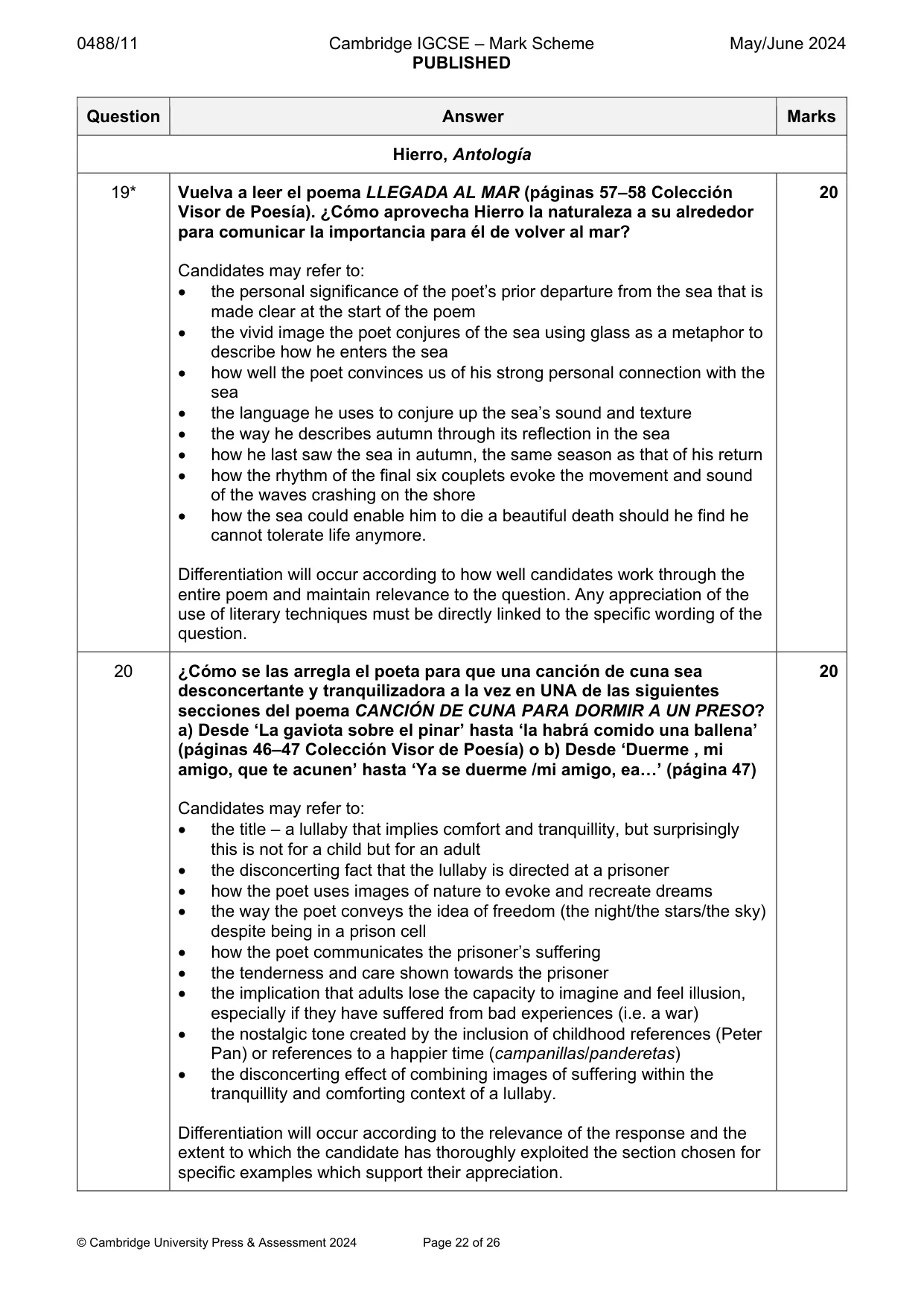
0488/11 Cambridge IGCSE – Mark Scheme PUBLISHED May/June 2024 © Cambridge University Press & Assessment 2024 Page 22 of 26 Question Answer Marks Hierro, Antología 19* Vuelva a leer el poema LLEGADA AL MAR (páginas 57–58 Colección Visor de Poesía). ¿Cómo aprovecha Hierro la naturaleza a su alrededor para comunicar la importancia para él de volver al mar? Candidates may refer to: the personal significance of the poet’s prior departure from the sea that is made clear at the start of the poem the vivid image the poet conjures of the sea using glass as a metaphor to describe how he enters the sea how well the poet convinces us of his strong personal connection with the sea the language he uses to conjure up the sea’s sound and texture the way he describes autumn through its reflection in the sea how he last saw the sea in autumn, the same season as that of his return how the rhythm of the final six couplets evoke the movement and sound of the waves crashing on the shore how the sea could enable him to die a beautiful death should he find he cannot tolerate life anymore. Differentiation will occur according to how well candidates work through the entire poem and maintain relevance to the question. Any appreciation of the use of literary techniques must be directly linked to the specific wording of the question. 20 20 ¿Cómo se las arregla el poeta para que una canción de cuna sea desconcertante y tranquilizadora a la vez en UNA de las siguientes secciones del poema CANCIÓN DE CUNA PARA DORMIR A UN PRESO? a) Desde ‘La gaviota sobre el pinar’ hasta ‘la habrá comido una ballena’ (páginas 46–47 Colección Visor de Poesía) o b) Desde ‘Duerme , mi amigo, que te acunen’ hasta ‘Ya se duerme /mi amigo, ea…’ (página 47) Candidates may refer to: the title – a lullaby that implies comfort and tranquillity, but surprisingly this is not for a child but for an adult the disconcerting fact that the lullaby is directed at a prisoner how the poet uses images of nature to evoke and recreate dreams the way the poet conveys the idea of freedom (the night/the stars/the sky) despite being in a prison cell how the poet communicates the prisoner’s suffering the tenderness and care shown towards the prisoner the implication that adults lose the capacity to imagine and feel illusion, especially if they have suffered from bad experiences (i.e. a war) the nostalgic tone created by the inclusion of childhood references (Peter Pan) or references to a happier time (campanillas/panderetas) the disconcerting effect of combining images of suffering within the tranquillity and comforting context of a lullaby. Differentiation will occur according to the relevance of the response and the extent to which the candidate has thoroughly exploited the section chosen for specific examples which support their appreciation. 20
Mark scheme, page 23
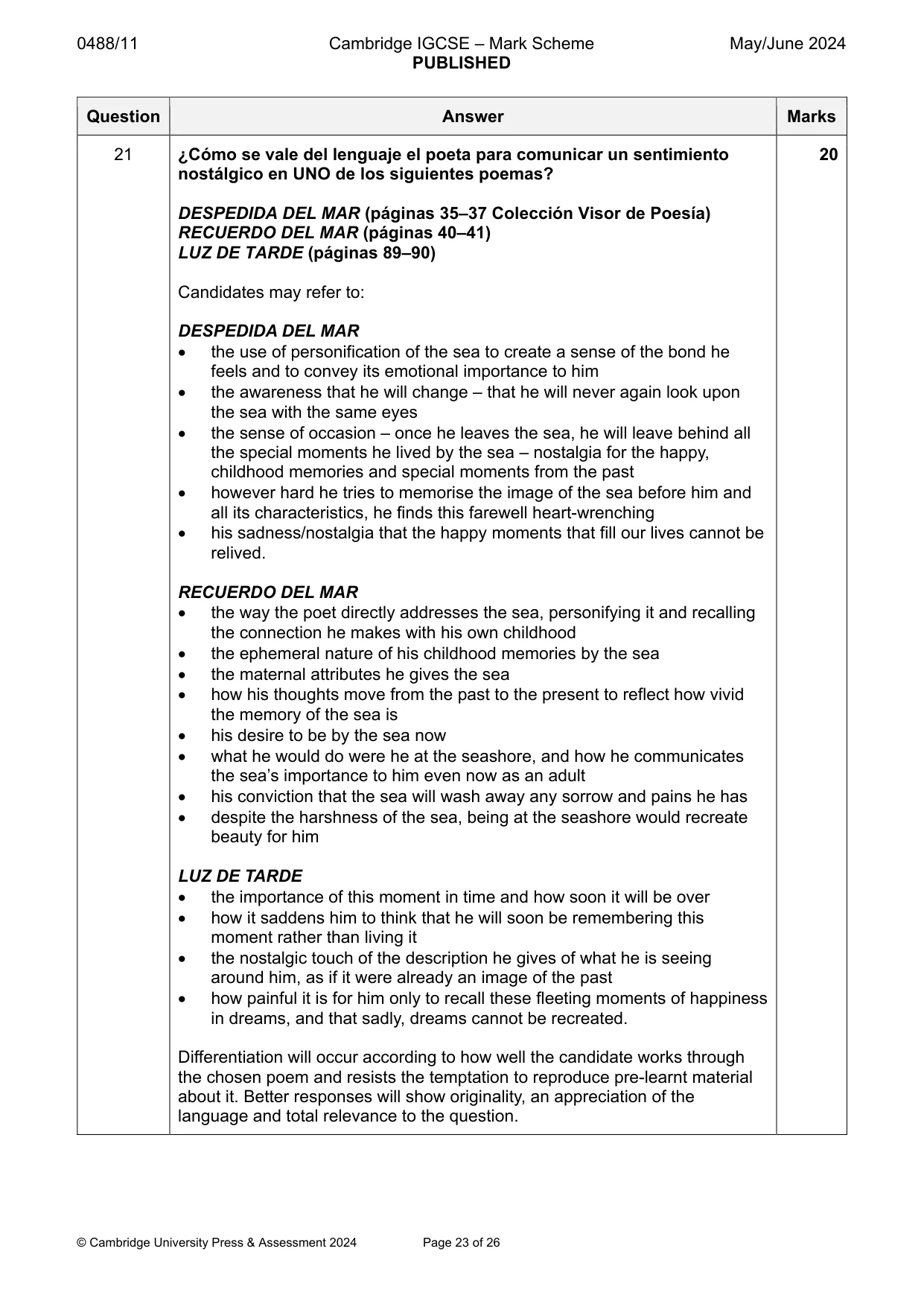
0488/11 Cambridge IGCSE – Mark Scheme PUBLISHED May/June 2024 © Cambridge University Press & Assessment 2024 Page 23 of 26 Question Answer Marks 21 ¿Cómo se vale del lenguaje el poeta para comunicar un sentimiento nostálgico en UNO de los siguientes poemas? DESPEDIDA DEL MAR (páginas 35–37 Colección Visor de Poesía) RECUERDO DEL MAR (páginas 40–41) LUZ DE TARDE (páginas 89–90) Candidates may refer to: DESPEDIDA DEL MAR the use of personification of the sea to create a sense of the bond he feels and to convey its emotional importance to him the awareness that he will change – that he will never again look upon the sea with the same eyes the sense of occasion – once he leaves the sea, he will leave behind all the special moments he lived by the sea – nostalgia for the happy, childhood memories and special moments from the past however hard he tries to memorise the image of the sea before him and all its characteristics, he finds this farewell heart-wrenching his sadness/nostalgia that the happy moments that fill our lives cannot be relived. RECUERDO DEL MAR the way the poet directly addresses the sea, personifying it and recalling the connection he makes with his own childhood the ephemeral nature of his childhood memories by the sea the maternal attributes he gives the sea how his thoughts move from the past to the present to reflect how vivid the memory of the sea is his desire to be by the sea now what he would do were he at the seashore, and how he communicates the sea’s importance to him even now as an adult his conviction that the sea will wash away any sorrow and pains he has despite the harshness of the sea, being at the seashore would recreate beauty for him LUZ DE TARDE the importance of this moment in time and how soon it will be over how it saddens him to think that he will soon be remembering this moment rather than living it the nostalgic touch of the description he gives of what he is seeing around him, as if it were already an image of the past how painful it is for him only to recall these fleeting moments of happiness in dreams, and that sadly, dreams cannot be recreated. Differentiation will occur according to how well the candidate works through the chosen poem and resists the temptation to reproduce pre-learnt material about it. Better responses will show originality, an appreciation of the language and total relevance to the question. 20
Mark scheme, page 24
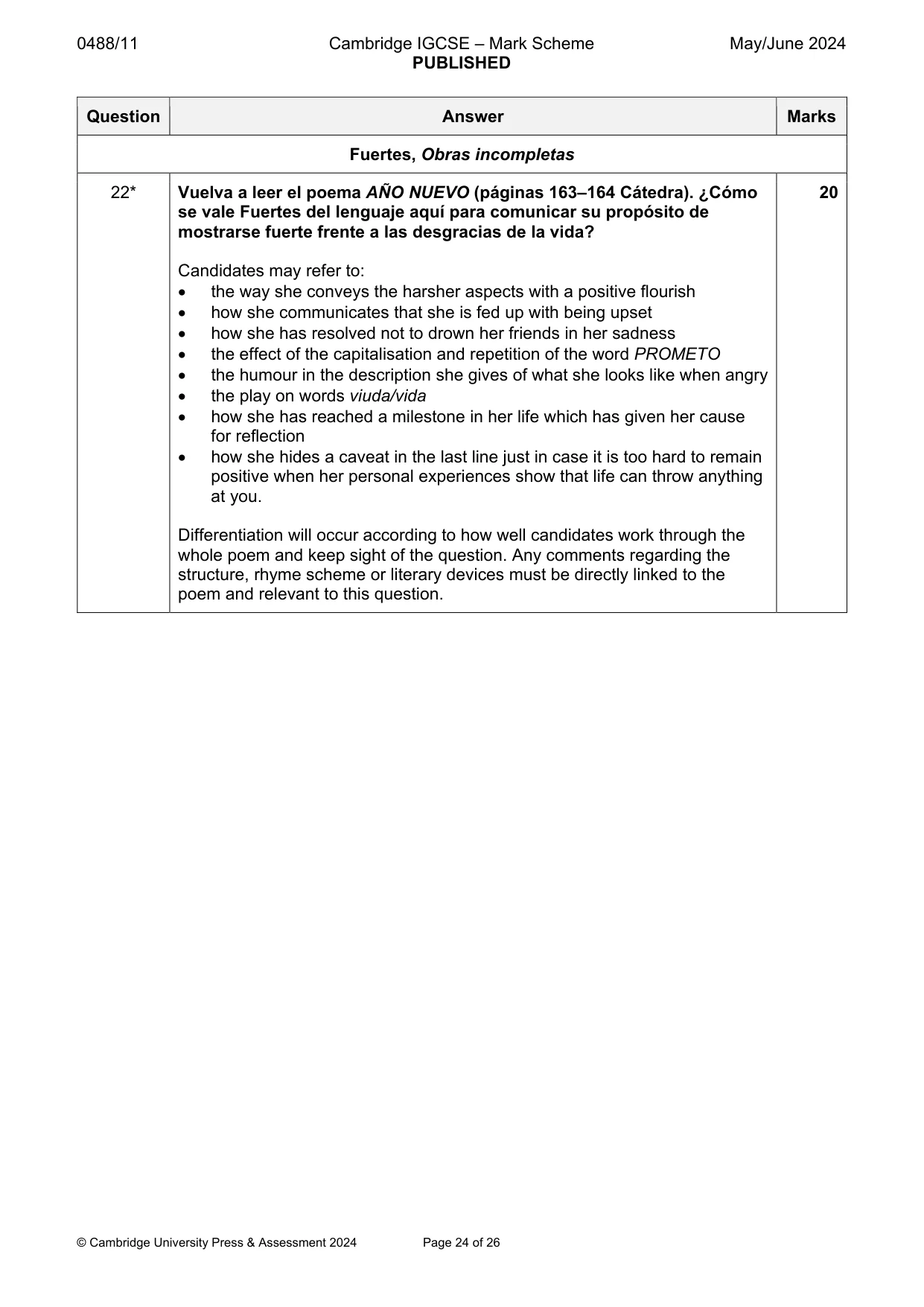
0488/11 Cambridge IGCSE – Mark Scheme PUBLISHED May/June 2024 © Cambridge University Press & Assessment 2024 Page 24 of 26 Question Answer Marks Fuertes, Obras incompletas 22* Vuelva a leer el poema AÑO NUEVO (páginas 163–164 Cátedra). ¿Cómo se vale Fuertes del lenguaje aquí para comunicar su propósito de mostrarse fuerte frente a las desgracias de la vida? Candidates may refer to: the way she conveys the harsher aspects with a positive flourish how she communicates that she is fed up with being upset how she has resolved not to drown her friends in her sadness the effect of the capitalisation and repetition of the word PROMETO the humour in the description she gives of what she looks like when angry the play on words viuda/vida how she has reached a milestone in her life which has given her cause for reflection how she hides a caveat in the last line just in case it is too hard to remain positive when her personal experiences show that life can throw anything at you. Differentiation will occur according to how well candidates work through the whole poem and keep sight of the question. Any comments regarding the structure, rhyme scheme or literary devices must be directly linked to the poem and relevant to this question. 20
Mark scheme, page 25
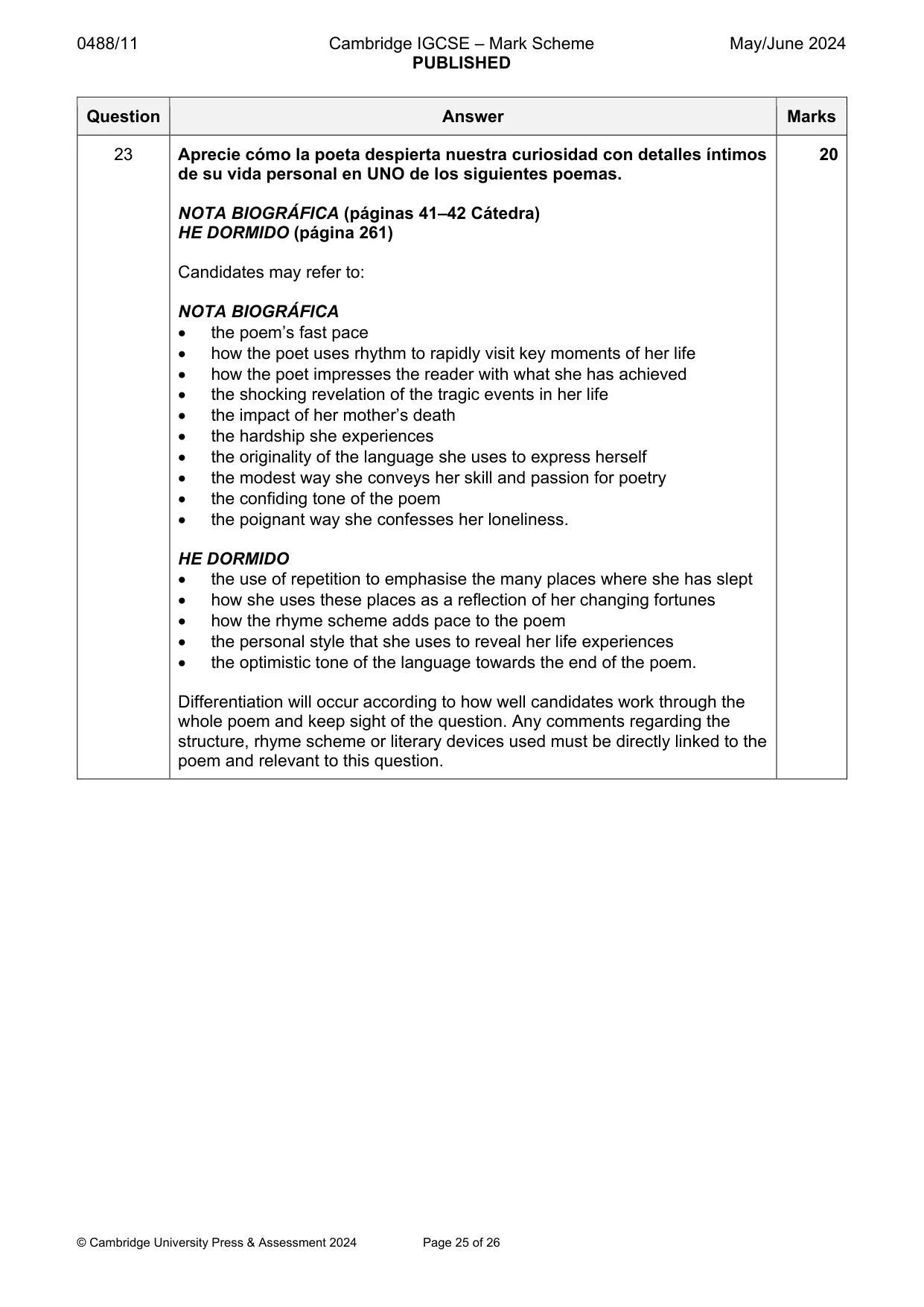
0488/11 Cambridge IGCSE – Mark Scheme PUBLISHED May/June 2024 © Cambridge University Press & Assessment 2024 Page 25 of 26 Question Answer Marks 23 Aprecie cómo la poeta despierta nuestra curiosidad con detalles íntimos de su vida personal en UNO de los siguientes poemas. NOTA BIOGRÁFICA (páginas 41–42 Cátedra) HE DORMIDO (página 261) Candidates may refer to: NOTA BIOGRÁFICA the poem’s fast pace how the poet uses rhythm to rapidly visit key moments of her life how the poet impresses the reader with what she has achieved the shocking revelation of the tragic events in her life the impact of her mother’s death the hardship she experiences the originality of the language she uses to express herself the modest way she conveys her skill and passion for poetry the confiding tone of the poem the poignant way she confesses her loneliness. HE DORMIDO the use of repetition to emphasise the many places where she has slept how she uses these places as a reflection of her changing fortunes how the rhyme scheme adds pace to the poem the personal style that she uses to reveal her life experiences the optimistic tone of the language towards the end of the poem. Differentiation will occur according to how well candidates work through the whole poem and keep sight of the question. Any comments regarding the structure, rhyme scheme or literary devices used must be directly linked to the poem and relevant to this question. 20
Mark scheme, page 26
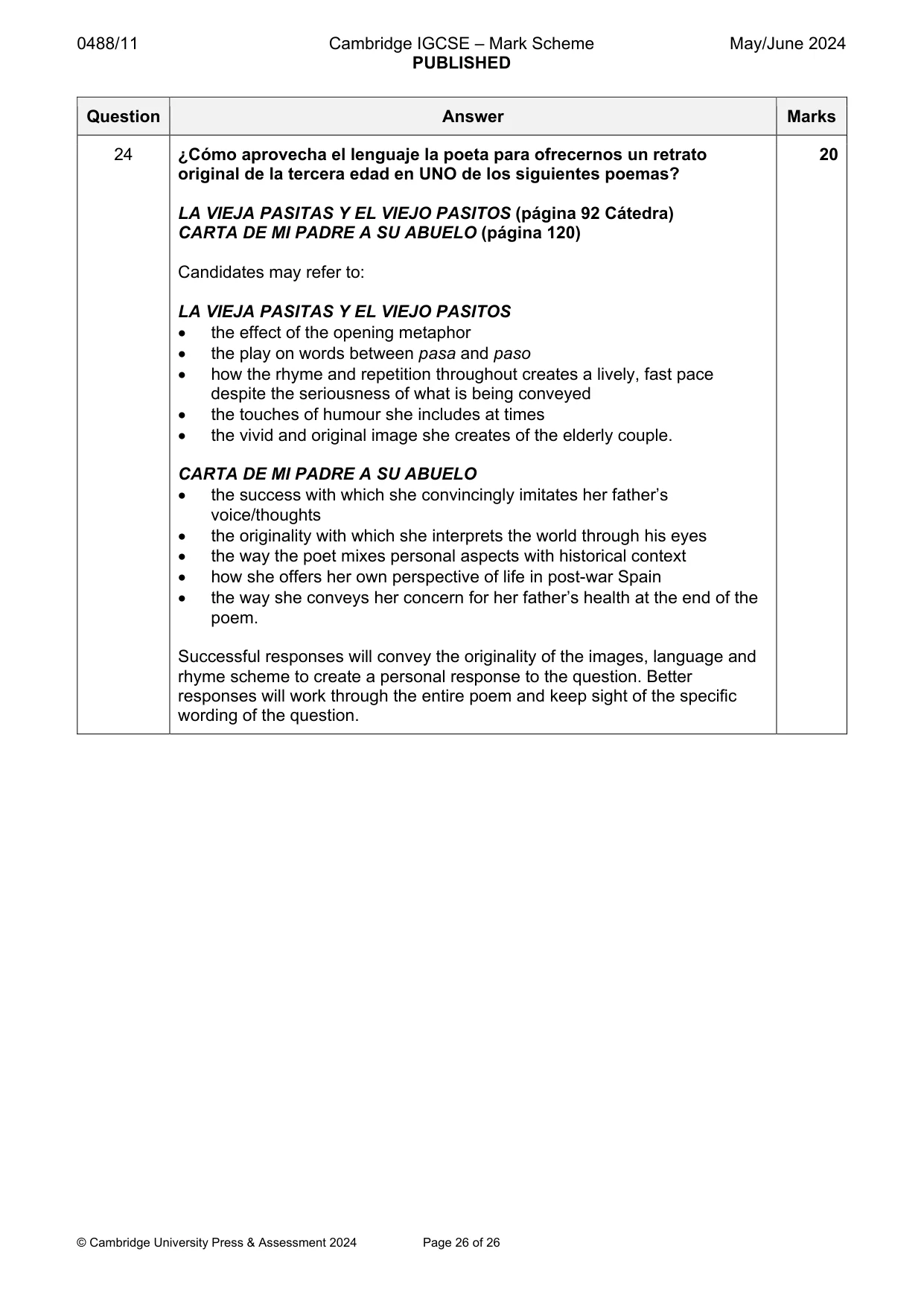
0488/11 Cambridge IGCSE – Mark Scheme PUBLISHED May/June 2024 © Cambridge University Press & Assessment 2024 Page 26 of 26 Question Answer Marks 24 ¿Cómo aprovecha el lenguaje la poeta para ofrecernos un retrato original de la tercera edad en UNO de los siguientes poemas? LA VIEJA PASITAS Y EL VIEJO PASITOS (página 92 Cátedra) CARTA DE MI PADRE A SU ABUELO (página 120) Candidates may refer to: LA VIEJA PASITAS Y EL VIEJO PASITOS the effect of the opening metaphor the play on words between pasa and paso how the rhyme and repetition throughout creates a lively, fast pace despite the seriousness of what is being conveyed the touches of humour she includes at times the vivid and original image she creates of the elderly couple. CARTA DE MI PADRE A SU ABUELO the success with which she convincingly imitates her father’s voice/thoughts the originality with which she interprets the world through his eyes the way the poet mixes personal aspects with historical context how she offers her own perspective of life in post-war Spain the way she conveys her concern for her father’s health at the end of the poem. Successful responses will convey the originality of the images, language and rhyme scheme to create a personal response to the question. Better responses will work through the entire poem and keep sight of the specific wording of the question. 20
What you needed in this session
Cambridge’s own grade thresholds for 2024 May/June, Paper 1 · Variant 1. A higher threshold means an easier paper — the bar moves with how the cohort did.