Cambridge IGCSE Spanish - Literature 0488 — 2019 May/June Paper 1 · Variant 3
0488/13/M/J/19 · 60 marks · ≈68 min
The question paper and its mark scheme, free to read here and free to download. This is Cambridge’s own paper, exactly as it was sat.
Question paper8 pages


Mark scheme24 pages
Answers below. Sit the paper first if you are practising.
Paper as text
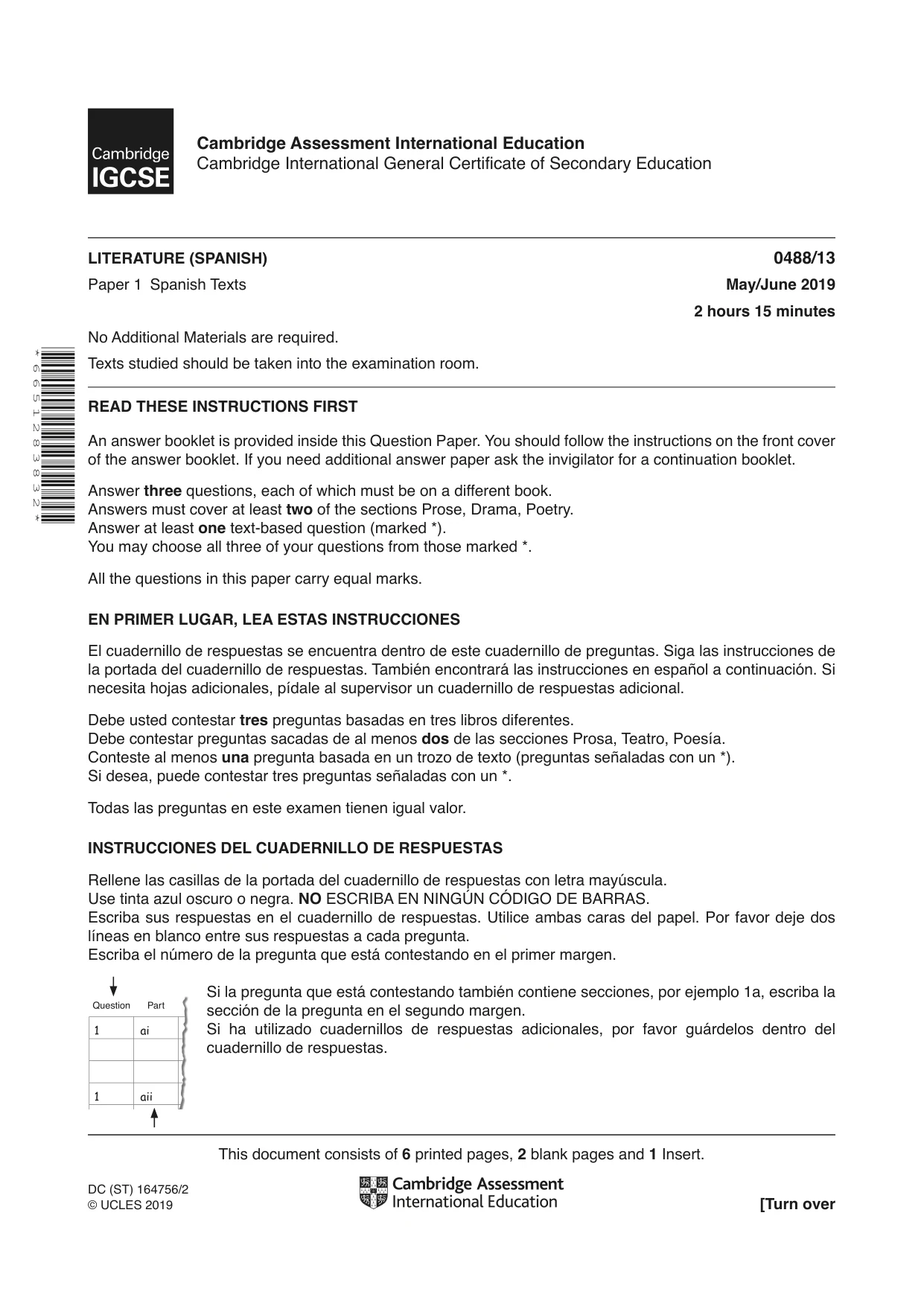
Question paper, page 1
This document consists of 6 printed pages, 2 blank pages and 1 Insert. DC (ST) 164756/2 © UCLES 2019 [Turn over Cambridge Assessment International Education Cambridge International General Certificate of Secondary Education * 6 6 5 1 2 8 3 8 3 2 * LITERATURE (SPANISH) 0488/13 Paper 1 Spanish Texts May/June 2019 2 hours 15 minutes No Additional Materials are required. Texts studied should be taken into the examination room. READ THESE INSTRUCTIONS FIRST An answer booklet is provided inside this Question Paper. You should follow the instructions on the front cover of the answer booklet. If you need additional answer paper ask the invigilator for a continuation booklet. Answer three questions, each of which must be on a different book. Answers must cover at least two of the sections Prose, Drama, Poetry. Answer at least one text-based question (marked *). You may choose all three of your questions from those marked *. All the questions in this paper carry equal marks. EN PRIMER LUGAR, LEA ESTAS INSTRUCCIONES El cuadernillo de respuestas se encuentra dentro de este cuadernillo de preguntas. Siga las instrucciones de la portada del cuadernillo de respuestas. También encontrará las instrucciones en español a continuación. Si necesita hojas adicionales, pídale al supervisor un cuadernillo de respuestas adicional. Debe usted contestar tres preguntas basadas en tres libros diferentes. Debe contestar preguntas sacadas de al menos dos de las secciones Prosa, Teatro, Poesía. Conteste al menos una pregunta basada en un trozo de texto (preguntas señaladas con un *). Si desea, puede contestar tres preguntas señaladas con un *. Todas las preguntas en este examen tienen igual valor. INSTRUCCIONES DEL CUADERNILLO DE RESPUESTAS Rellene las casillas de la portada del cuadernillo de respuestas con letra mayúscula. Use tinta azul oscuro o negra. NO ESCRIBA EN NINGÚN CÓDIGO DE BARRAS. Escriba sus respuestas en el cuadernillo de respuestas. Utilice ambas caras del papel. Por favor deje dos líneas en blanco entre sus respuestas a cada pregunta. Escriba el número de la pregunta que está contestando en el primer margen. Si la pregunta que está contestando también contiene secciones, por ejemplo 1a, escriba la sección de la pregunta en el segundo margen. Si ha utilizado cuadernillos de respuestas adicionales, por favor guárdelos dentro del cuadernillo de respuestas.
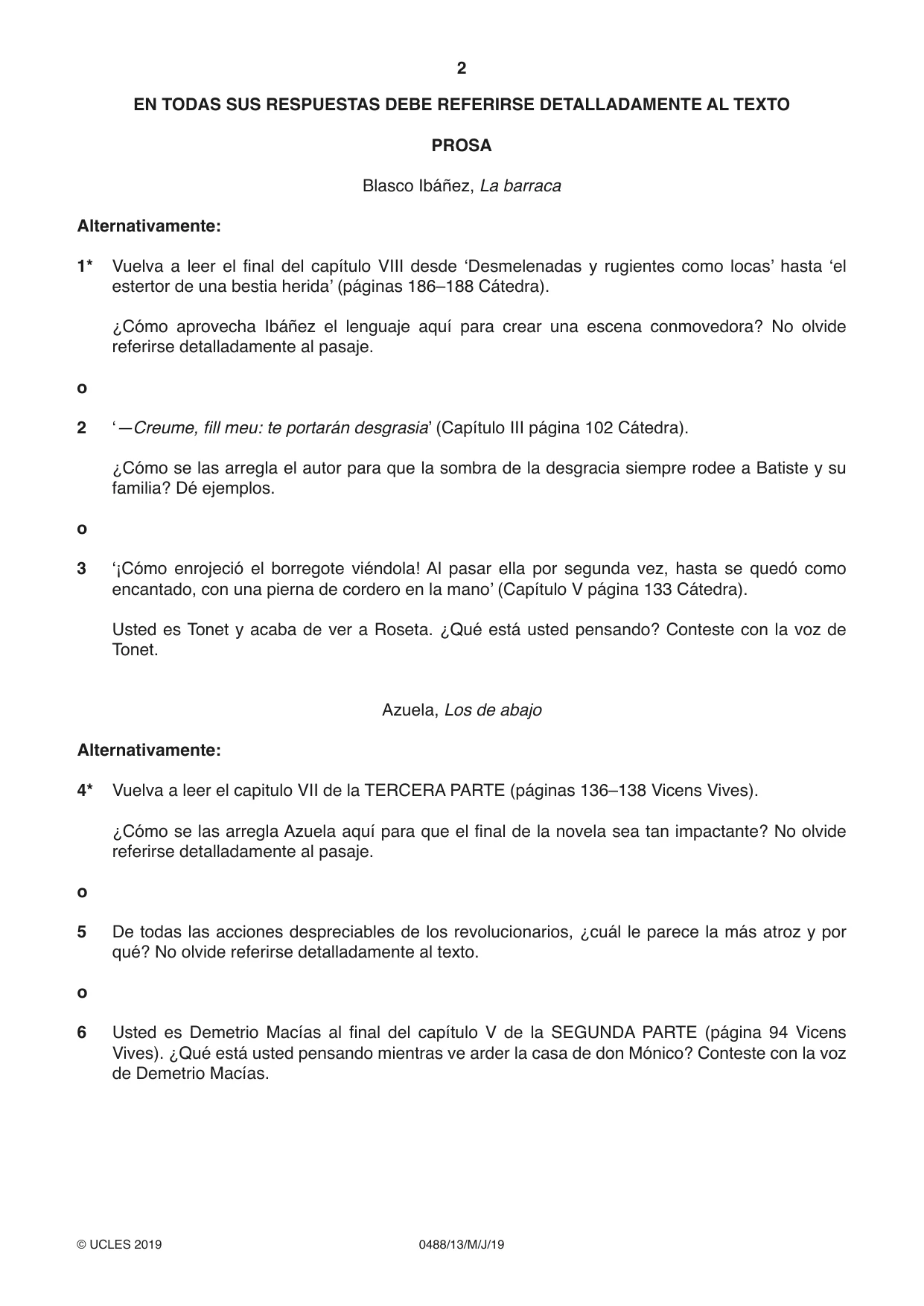
Question paper, page 2
2 0488/13/M/J/19 © UCLES 2019 EN TODAS SUS RESPUESTAS DEBE REFERIRSE DETALLADAMENTE AL TEXTO PROSA Blasco Ibáñez, La barraca Alternativamente: 1* Vuelva a leer el final del capítulo VIII desde ‘Desmelenadas y rugientes como locas’ hasta ‘el estertor de una bestia herida’ (páginas 186–188 Cátedra). ¿Cómo aprovecha Ibáñez el lenguaje aquí para crear una escena conmovedora? No olvide referirse detalladamente al pasaje. o 2 ‘—Creume, fill meu: te portarán desgrasia’ (Capítulo III página 102 Cátedra). ¿Cómo se las arregla el autor para que la sombra de la desgracia siempre rodee a Batiste y su familia? Dé ejemplos. o 3 ‘¡Cómo enrojeció el borregote viéndola! Al pasar ella por segunda vez, hasta se quedó como encantado, con una pierna de cordero en la mano’ (Capítulo V página 133 Cátedra). Usted es Tonet y acaba de ver a Roseta. ¿Qué está usted pensando? Conteste con la voz de Tonet. Azuela, Los de abajo Alternativamente: 4* Vuelva a leer el capitulo VII de la TERCERA PARTE (páginas 136–138 Vicens Vives). ¿Cómo se las arregla Azuela aquí para que el final de la novela sea tan impactante? No olvide referirse detalladamente al pasaje. o 5 De todas las acciones despreciables de los revolucionarios, ¿cuál le parece la más atroz y por qué? No olvide referirse detalladamente al texto. o 6 Usted es Demetrio Macías al final del capítulo V de la SEGUNDA PARTE (página 94 Vicens Vives). ¿Qué está usted pensando mientras ve arder la casa de don Mónico? Conteste con la voz de Demetrio Macías.
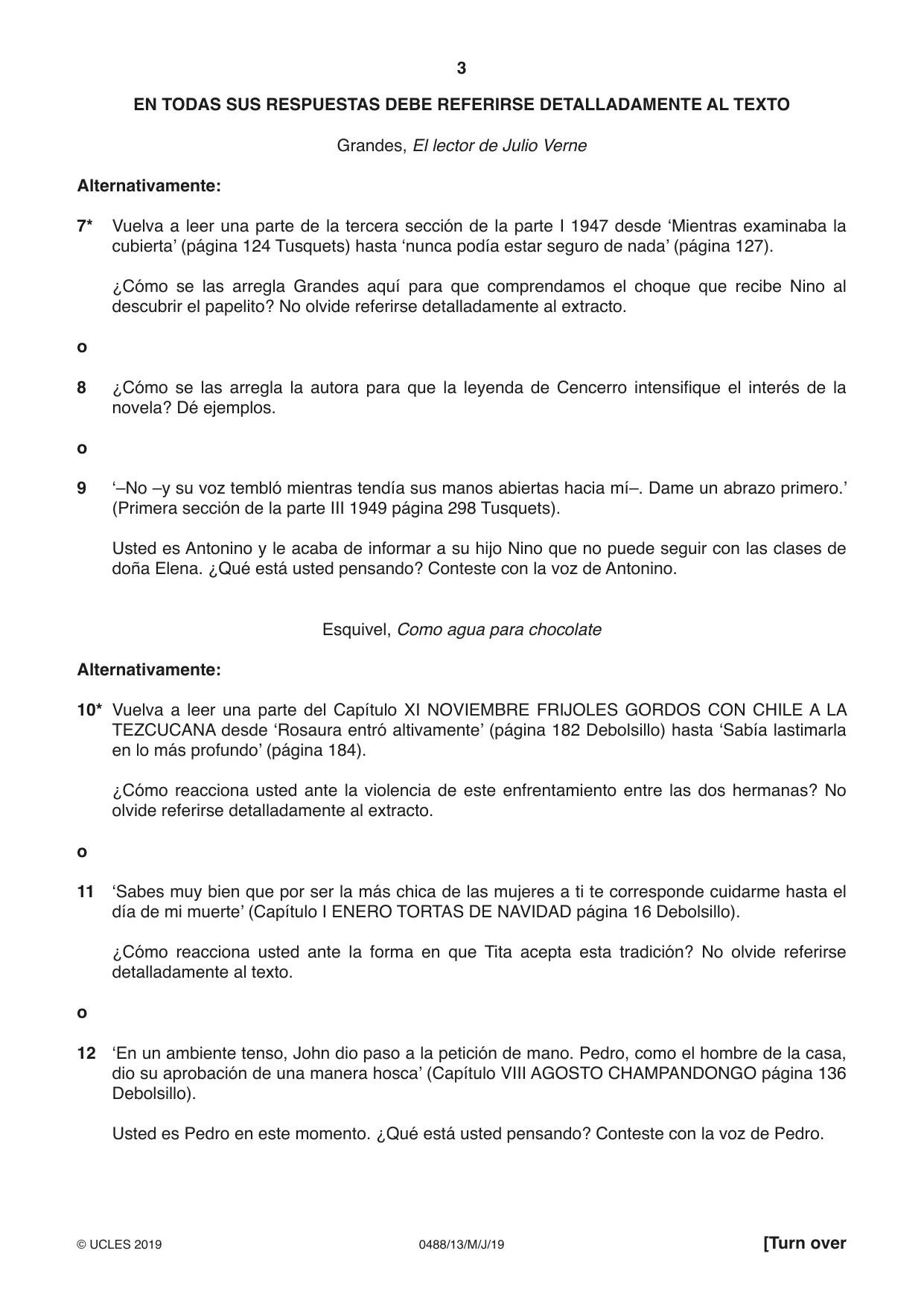
Question paper, page 3
3 0488/13/M/J/19 © UCLES 2019 [Turn over EN TODAS SUS RESPUESTAS DEBE REFERIRSE DETALLADAMENTE AL TEXTO Grandes, El lector de Julio Verne Alternativamente: 7* Vuelva a leer una parte de la tercera sección de la parte I 1947 desde ‘Mientras examinaba la cubierta’ (página 124 Tusquets) hasta ‘nunca podía estar seguro de nada’ (página 127). ¿Cómo se las arregla Grandes aquí para que comprendamos el choque que recibe Nino al descubrir el papelito? No olvide referirse detalladamente al extracto. o 8 ¿Cómo se las arregla la autora para que la leyenda de Cencerro intensifique el interés de la novela? Dé ejemplos. o 9 ‘–No –y su voz tembló mientras tendía sus manos abiertas hacia mí–. Dame un abrazo primero.’ (Primera sección de la parte III 1949 página 298 Tusquets). Usted es Antonino y le acaba de informar a su hijo Nino que no puede seguir con las clases de doña Elena. ¿Qué está usted pensando? Conteste con la voz de Antonino. Esquivel, Como agua para chocolate Alternativamente: 10* Vuelva a leer una parte del Capítulo XI NOVIEMBRE FRIJOLES GORDOS CON CHILE A LA TEZCUCANA desde ‘Rosaura entró altivamente’ (página 182 Debolsillo) hasta ‘Sabía lastimarla en lo más profundo’ (página 184). ¿Cómo reacciona usted ante la violencia de este enfrentamiento entre las dos hermanas? No olvide referirse detalladamente al extracto. o 11 ‘Sabes muy bien que por ser la más chica de las mujeres a ti te corresponde cuidarme hasta el día de mi muerte’ (Capítulo I ENERO TORTAS DE NAVIDAD página 16 Debolsillo). ¿Cómo reacciona usted ante la forma en que Tita acepta esta tradición? No olvide referirse detalladamente al texto. o 12 ‘En un ambiente tenso, John dio paso a la petición de mano. Pedro, como el hombre de la casa, dio su aprobación de una manera hosca’ (Capítulo VIII AGOSTO CHAMPANDONGO página 136 Debolsillo). Usted es Pedro en este momento. ¿Qué está usted pensando? Conteste con la voz de Pedro.
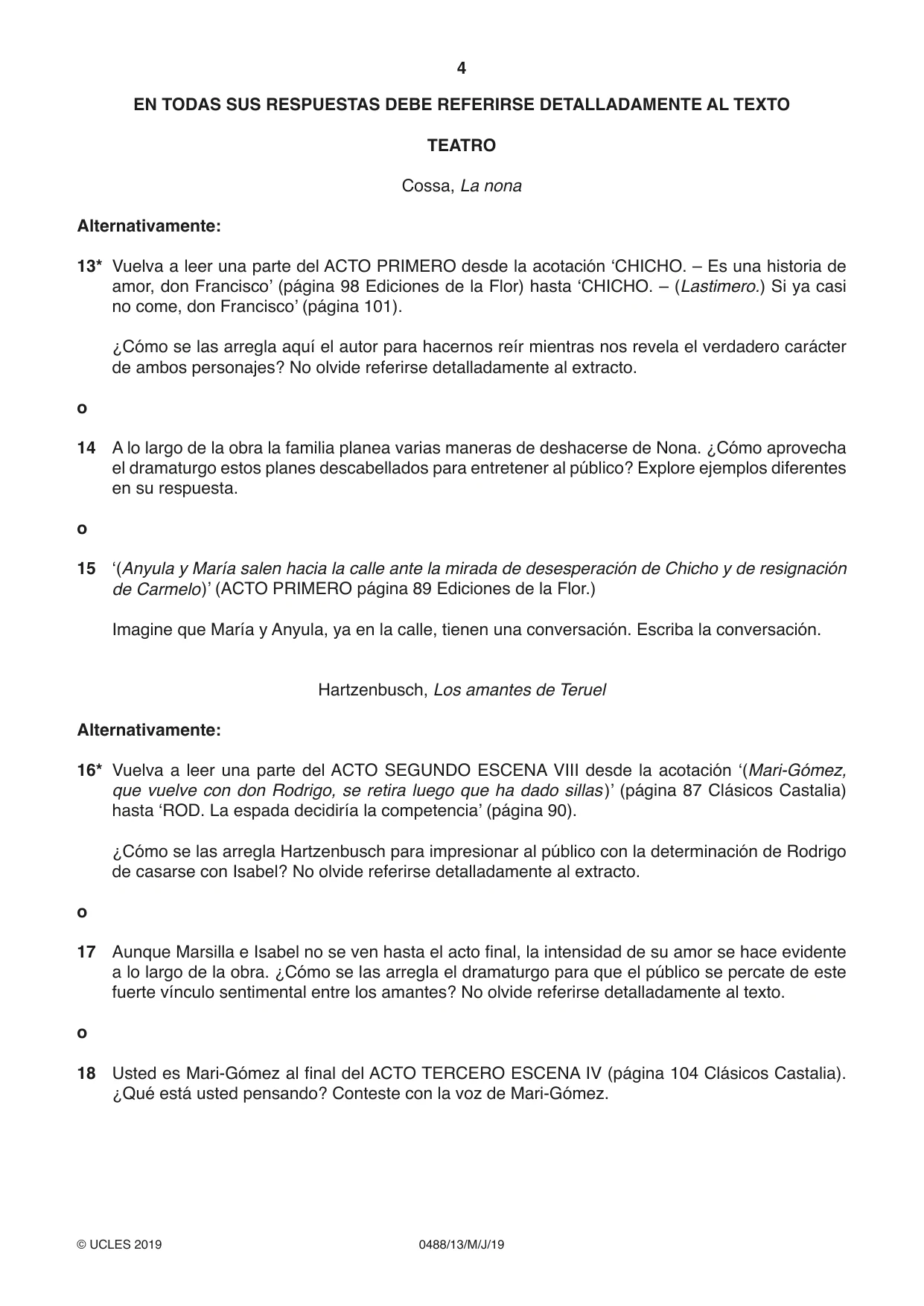
Question paper, page 4
4 0488/13/M/J/19 © UCLES 2019 EN TODAS SUS RESPUESTAS DEBE REFERIRSE DETALLADAMENTE AL TEXTO TEATRO Cossa, La nona Alternativamente: 13* Vuelva a leer una parte del ACTO PRIMERO desde la acotación ‘CHICHO. – Es una historia de amor, don Francisco’ (página 98 Ediciones de la Flor) hasta ‘CHICHO. – (Lastimero.) Si ya casi no come, don Francisco’ (página 101). ¿Cómo se las arregla aquí el autor para hacernos reír mientras nos revela el verdadero carácter de ambos personajes? No olvide referirse detalladamente al extracto. o 14 A lo largo de la obra la familia planea varias maneras de deshacerse de Nona. ¿Cómo aprovecha el dramaturgo estos planes descabellados para entretener al público? Explore ejemplos diferentes en su respuesta. o 15 ‘(Anyula y María salen hacia la calle ante la mirada de desesperación de Chicho y de resignación de Carmelo )’ (ACTO PRIMERO página 89 Ediciones de la Flor.) Imagine que María y Anyula, ya en la calle, tienen una conversación. Escriba la conversación. Hartzenbusch, Los amantes de Teruel Alternativamente: 16* Vuelva a leer una parte del ACTO SEGUNDO ESCENA VIII desde la acotación ‘(Mari-Gómez, que vuelve con don Rodrigo, se retira luego que ha dado sillas )’ (página 87 Clásicos Castalia) hasta ‘ROD. La espada decidiría la competencia’ (página 90). ¿Cómo se las arregla Hartzenbusch para impresionar al público con la determinación de Rodrigo de casarse con Isabel? No olvide referirse detalladamente al extracto. o 17 Aunque Marsilla e Isabel no se ven hasta el acto final, la intensidad de su amor se hace evidente a lo largo de la obra. ¿Cómo se las arregla el dramaturgo para que el público se percate de este fuerte vínculo sentimental entre los amantes? No olvide referirse detalladamente al texto. o 18 Usted es Mari-Gómez al final del ACTO TERCERO ESCENA IV (página 104 Clásicos Castalia). ¿Qué está usted pensando? Conteste con la voz de Mari-Gómez.
Question paper, page 5
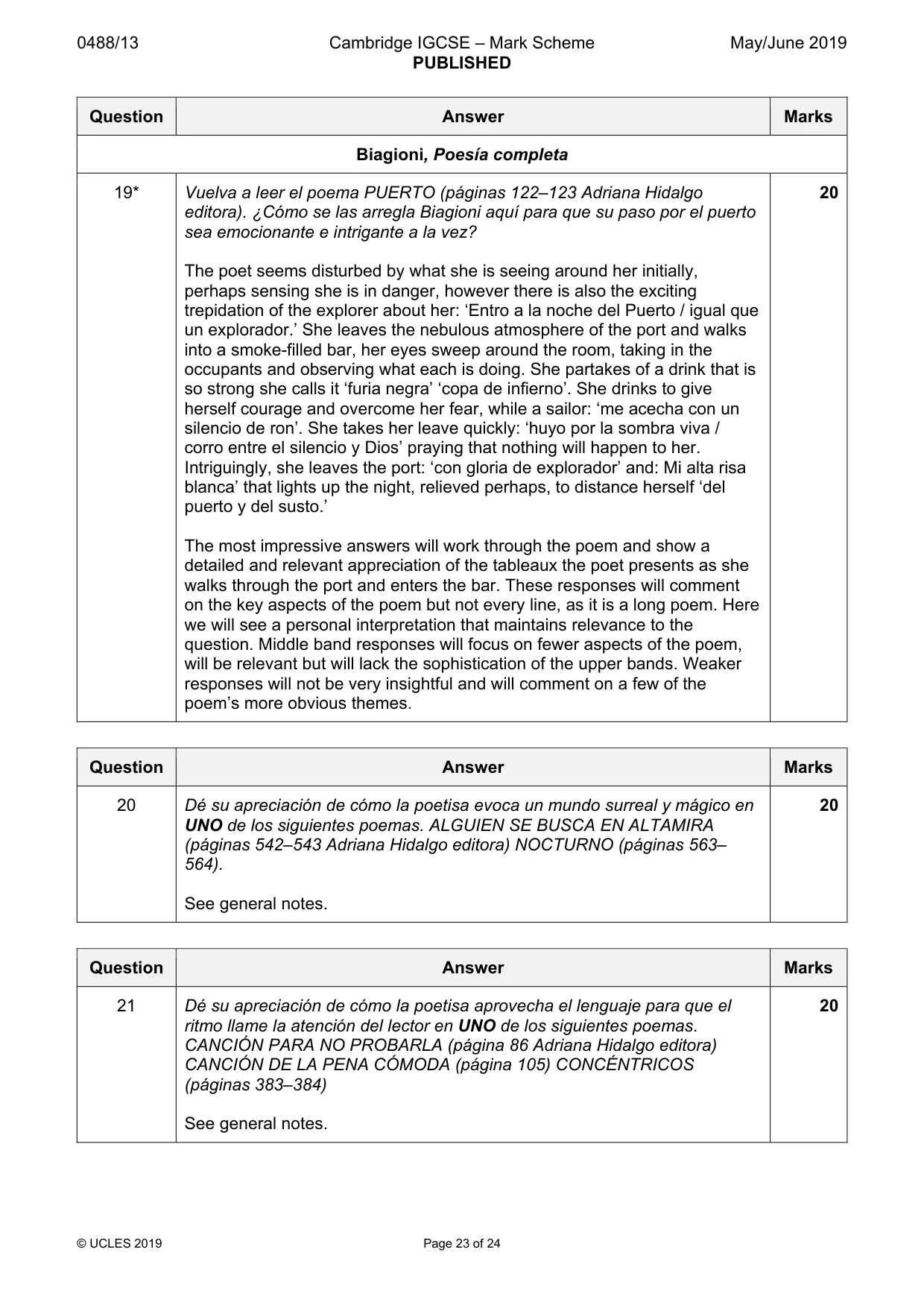
5 0488/13/M/J/19 © UCLES 2019 [Turn over EN TODAS SUS RESPUESTAS DEBE REFERIRSE DETALLADAMENTE AL TEXTO POESÍA Biagioni, Poesía completa Alternativamente: 19* Vuelva a leer el poema PUERTO (páginas 122–123 Adriana Hidalgo editora). ¿Cómo se las arregla Biagioni aquí para que su paso por el puerto sea emocionante e intrigante a la vez? o 20 Dé su apreciación de cómo la poetisa evoca un mundo surreal y mágico en UNO de los siguientes poemas. ALGUIEN SE BUSCA EN ALTAMIRA (páginas 542–543 Adriana Hidalgo editora) NOCTURNO (páginas 563–564). o 21 Dé su apreciación de cómo la poetisa aprovecha el lenguaje para que el ritmo llame la atención del lector en UNO de los siguientes poemas. CANCIÓN PARA NO PROBARLA (página 86 Adriana Hidalgo editora) CANCIÓN DE LA PENA CÓMODA (página 105) CONCÉNTRICOS (páginas 383–384).
Question paper, page 6
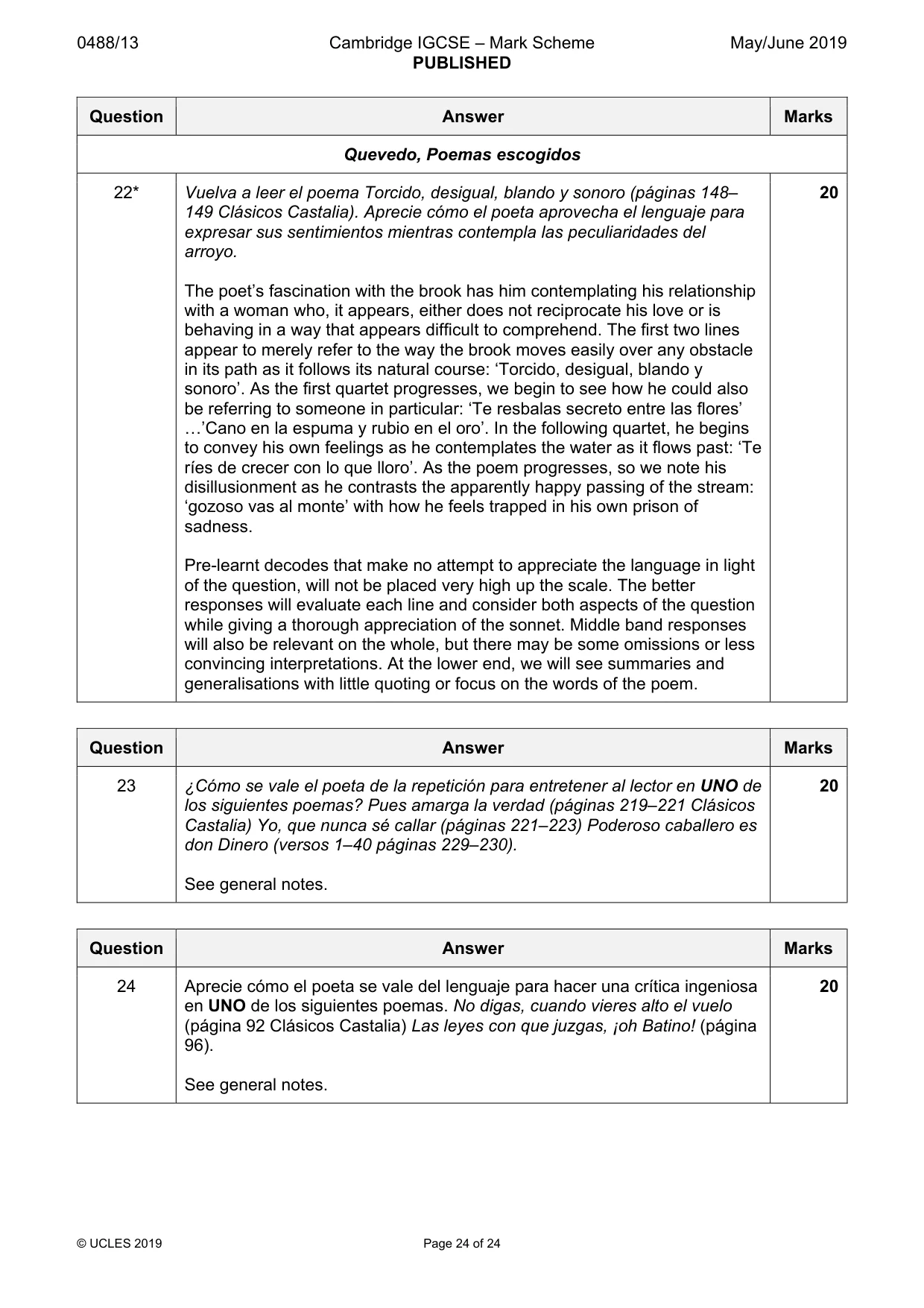
6 0488/13/M/J/19 © UCLES 2019 EN TODAS SUS RESPUESTAS DEBE REFERIRSE DETALLADAMENTE AL TEXTO Quevedo, Poemas escogidos Alternativamente: 22* Vuelva a leer el poema Torcido, desigual, blando y sonoro (páginas 148–149 Clásicos Castalia). Aprecie cómo el poeta aprovecha el lenguaje para expresar sus sentimientos mientras contempla las peculiaridades del arroyo. o 23 ¿Cómo se vale el poeta de la repetición para entretener al lector en UNO de los siguientes poemas? Pues amarga la verdad (páginas 219–221 Clásicos Castalia) Yo, que nunca sé callar (páginas 221–223) Poderoso caballero es don Dinero (versos 1–40 páginas 229–230). o 24 Aprecie cómo el poeta se vale del lenguaje para hacer una crítica ingeniosa en UNO de los siguientes poemas. No digas, cuando vieres alto el vuelo (página 92 Clásicos Castalia) Las leyes con que juzgas, ¡oh Batino! (página 96).
Question paper, page 7
7 0488/13/M/J/19 © UCLES 2019 BLANK PAGE
Question paper, page 8
8 0488/13/M/J/19 © UCLES 2019 Permission to reproduce items where third-party owned material protected by copyright is included has been sought and cleared where possible. Every reasonable effort has been made by the publisher (UCLES) to trace copyright holders, but if any items requiring clearance have unwittingly been included, the publisher will be pleased to make amends at the earliest possible opportunity. To avoid the issue of disclosure of answer-related information to candidates, all copyright acknowledgements are reproduced online in the Cambridge Assessment International Education Copyright Acknowledgements Booklet. This is produced for each series of examinations and is freely available to download at www.cambridgeinternational.org after the live examination series. Cambridge Assessment International Education is part of the Cambridge Assessment Group. Cambridge Assessment is the brand name of the University of Cambridge Local Examinations Syndicate (UCLES), which itself is a department of the University of Cambridge. BLANK PAGE
Mark scheme, page 1
This document consists of 24 printed pages. © UCLES 2019 [Turn over Cambridge Assessment International Education Cambridge International General Certificate of Secondary Education LITERATURE (SPANISH) 0488/13 Paper 1 Set Texts (Open Books) May/June 2019 MARK SCHEME Maximum Mark: 60 Published This mark scheme is published as an aid to teachers and candidates, to indicate the requirements of the examination. It shows the basis on which Examiners were instructed to award marks. It does not indicate the details of the discussions that took place at an Examiners’ meeting before marking began, which would have considered the acceptability of alternative answers. Mark schemes should be read in conjunction with the question paper and the Principal Examiner Report for Teachers. Cambridge International will not enter into discussions about these mark schemes. Cambridge International is publishing the mark schemes for the May/June 2019 series for most Cambridge IGCSE™, Cambridge International A and AS Level and Cambridge Pre-U components, and some Cambridge O Level components.
Mark scheme, page 2
0488/13 Cambridge IGCSE – Mark Scheme PUBLISHED May/June 2019 © UCLES 2019 Page 2 of 24 Generic Marking Principles These general marking principles must be applied by all examiners when marking candidate answers. They should be applied alongside the specific content of the mark scheme or generic level descriptors for a question. Each question paper and mark scheme will also comply with these marking principles. GENERIC MARKING PRINCIPLE 1: Marks must be awarded in line with: • the specific content of the mark scheme or the generic level descriptors for the question • the specific skills defined in the mark scheme or in the generic level descriptors for the question • the standard of response required by a candidate as exemplified by the standardisation scripts. GENERIC MARKING PRINCIPLE 2: Marks awarded are always whole marks (not half marks, or other fractions). GENERIC MARKING PRINCIPLE 3: Marks must be awarded positively: • marks are awarded for correct/valid answers, as defined in the mark scheme. However, credit is given for valid answers which go beyond the scope of the syllabus and mark scheme, referring to your Team Leader as appropriate • marks are awarded when candidates clearly demonstrate what they know and can do • marks are not deducted for errors • marks are not deducted for omissions • answers should only be judged on the quality of spelling, punctuation and grammar when these features are specifically assessed by the question as indicated by the mark scheme. The meaning, however, should be unambiguous. GENERIC MARKING PRINCIPLE 4: Rules must be applied consistently e.g. in situations where candidates have not followed instructions or in the application of generic level descriptors. GENERIC MARKING PRINCIPLE 5: Marks should be awarded using the full range of marks defined in the mark scheme for the question (however; the use of the full mark range may be limited according to the quality of the candidate responses seen). GENERIC MARKING PRINCIPLE 6: Marks awarded are based solely on the requirements as defined in the mark scheme. Marks should not be awarded with grade thresholds or grade descriptors in mind.
Mark scheme, page 3
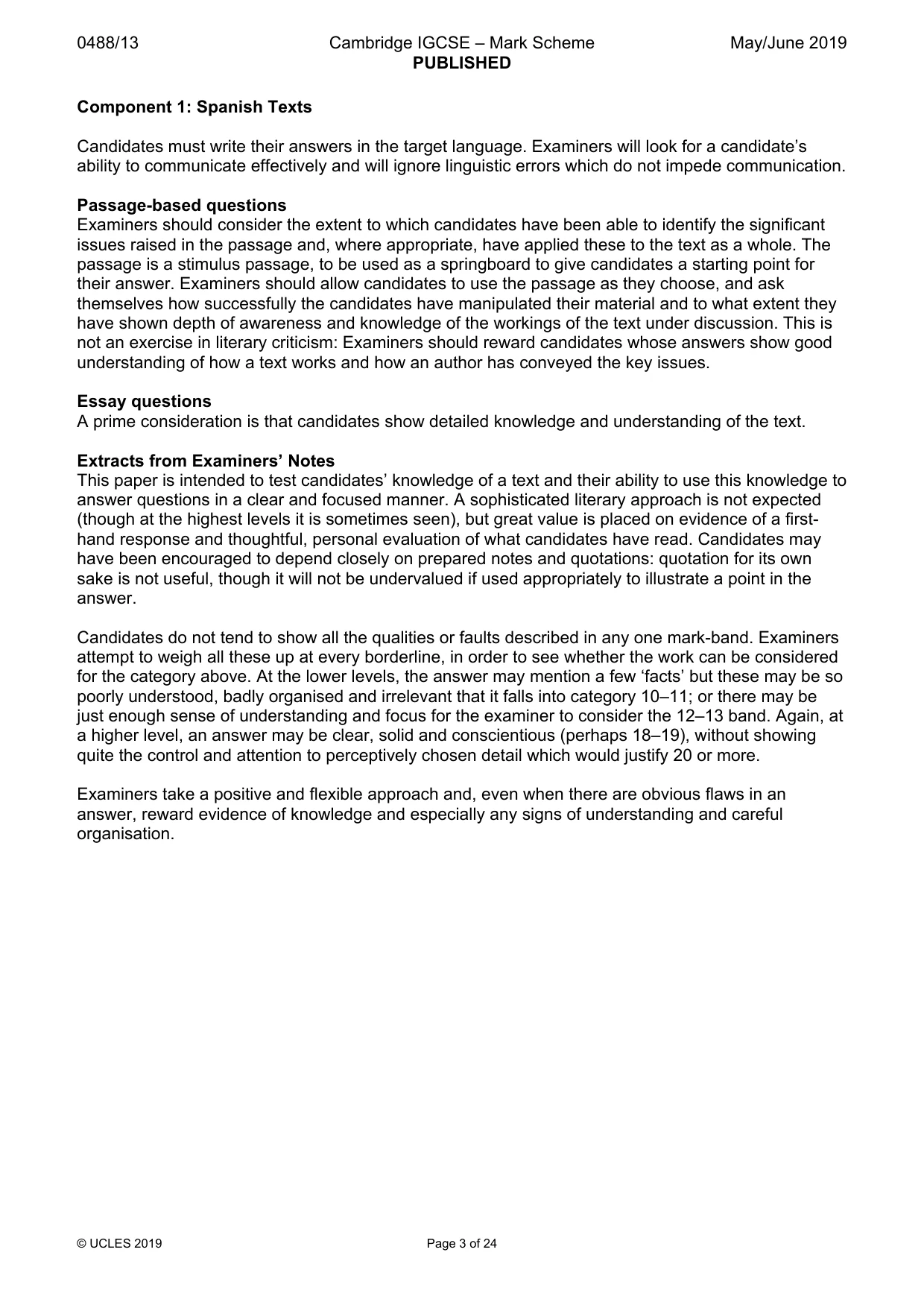
0488/13 Cambridge IGCSE – Mark Scheme PUBLISHED May/June 2019 © UCLES 2019 Page 3 of 24 Component 1: Spanish Texts Candidates must write their answers in the target language. Examiners will look for a candidate’s ability to communicate effectively and will ignore linguistic errors which do not impede communication. Passage-based questions Examiners should consider the extent to which candidates have been able to identify the significant issues raised in the passage and, where appropriate, have applied these to the text as a whole. The passage is a stimulus passage, to be used as a springboard to give candidates a starting point for their answer. Examiners should allow candidates to use the passage as they choose, and ask themselves how successfully the candidates have manipulated their material and to what extent they have shown depth of awareness and knowledge of the workings of the text under discussion. This is not an exercise in literary criticism: Examiners should reward candidates whose answers show good understanding of how a text works and how an author has conveyed the key issues. Essay questions A prime consideration is that candidates show detailed knowledge and understanding of the text. Extracts from Examiners’ Notes This paper is intended to test candidates’ knowledge of a text and their ability to use this knowledge to answer questions in a clear and focused manner. A sophisticated literary approach is not expected (though at the highest levels it is sometimes seen), but great value is placed on evidence of a first- hand response and thoughtful, personal evaluation of what candidates have read. Candidates may have been encouraged to depend closely on prepared notes and quotations: quotation for its own sake is not useful, though it will not be undervalued if used appropriately to illustrate a point in the answer. Candidates do not tend to show all the qualities or faults described in any one mark-band. Examiners attempt to weigh all these up at every borderline, in order to see whether the work can be considered for the category above. At the lower levels, the answer may mention a few ‘facts’ but these may be so poorly understood, badly organised and irrelevant that it falls into category 10–11; or there may be just enough sense of understanding and focus for the examiner to consider the 12–13 band. Again, at a higher level, an answer may be clear, solid and conscientious (perhaps 18–19), without showing quite the control and attention to perceptively chosen detail which would justify 20 or more. Examiners take a positive and flexible approach and, even when there are obvious flaws in an answer, reward evidence of knowledge and especially any signs of understanding and careful organisation.
Mark scheme, page 4
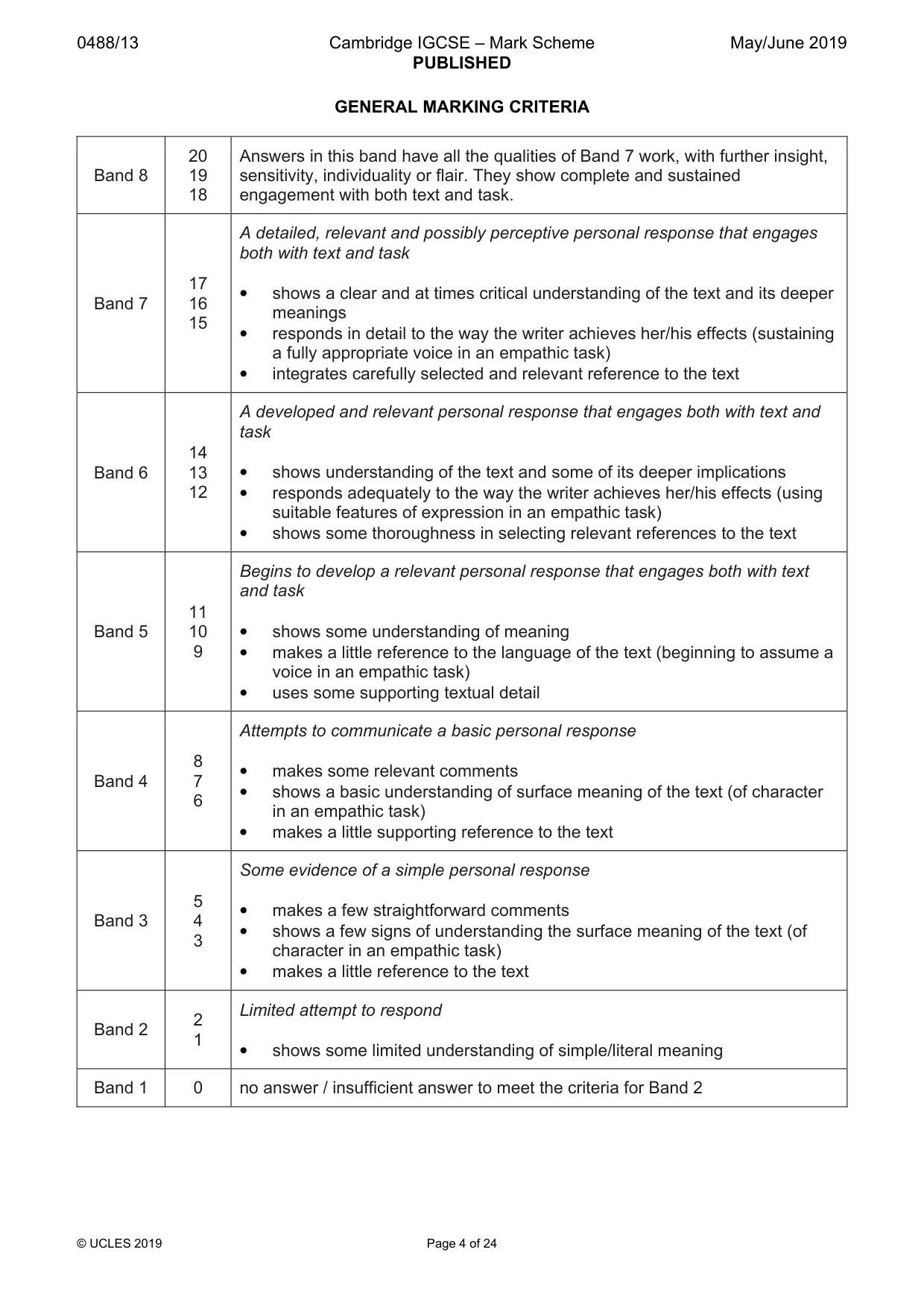
0488/13 Cambridge IGCSE – Mark Scheme PUBLISHED May/June 2019 © UCLES 2019 Page 4 of 24 GENERAL MARKING CRITERIA Band 8 20 19 18 Answers in this band have all the qualities of Band 7 work, with further insight, sensitivity, individuality or flair. They show complete and sustained engagement with both text and task. Band 7 17 16 15 A detailed, relevant and possibly perceptive personal response that engages both with text and task • shows a clear and at times critical understanding of the text and its deeper meanings • responds in detail to the way the writer achieves her/his effects (sustaining a fully appropriate voice in an empathic task) • integrates carefully selected and relevant reference to the text Band 6 14 13 12 A developed and relevant personal response that engages both with text and task • shows understanding of the text and some of its deeper implications • responds adequately to the way the writer achieves her/his effects (using suitable features of expression in an empathic task) • shows some thoroughness in selecting relevant references to the text Band 5 11 10 9 Begins to develop a relevant personal response that engages both with text and task • shows some understanding of meaning • makes a little reference to the language of the text (beginning to assume a voice in an empathic task) • uses some supporting textual detail Band 4 8 7 6 Attempts to communicate a basic personal response • makes some relevant comments • shows a basic understanding of surface meaning of the text (of character in an empathic task) • makes a little supporting reference to the text Band 3 5 4 3 Some evidence of a simple personal response • makes a few straightforward comments • shows a few signs of understanding the surface meaning of the text (of character in an empathic task) • makes a little reference to the text Band 2 2 1 Limited attempt to respond • shows some limited understanding of simple/literal meaning Band 1 0 no answer / insufficient answer to meet the criteria for Band 2
Mark scheme, page 5
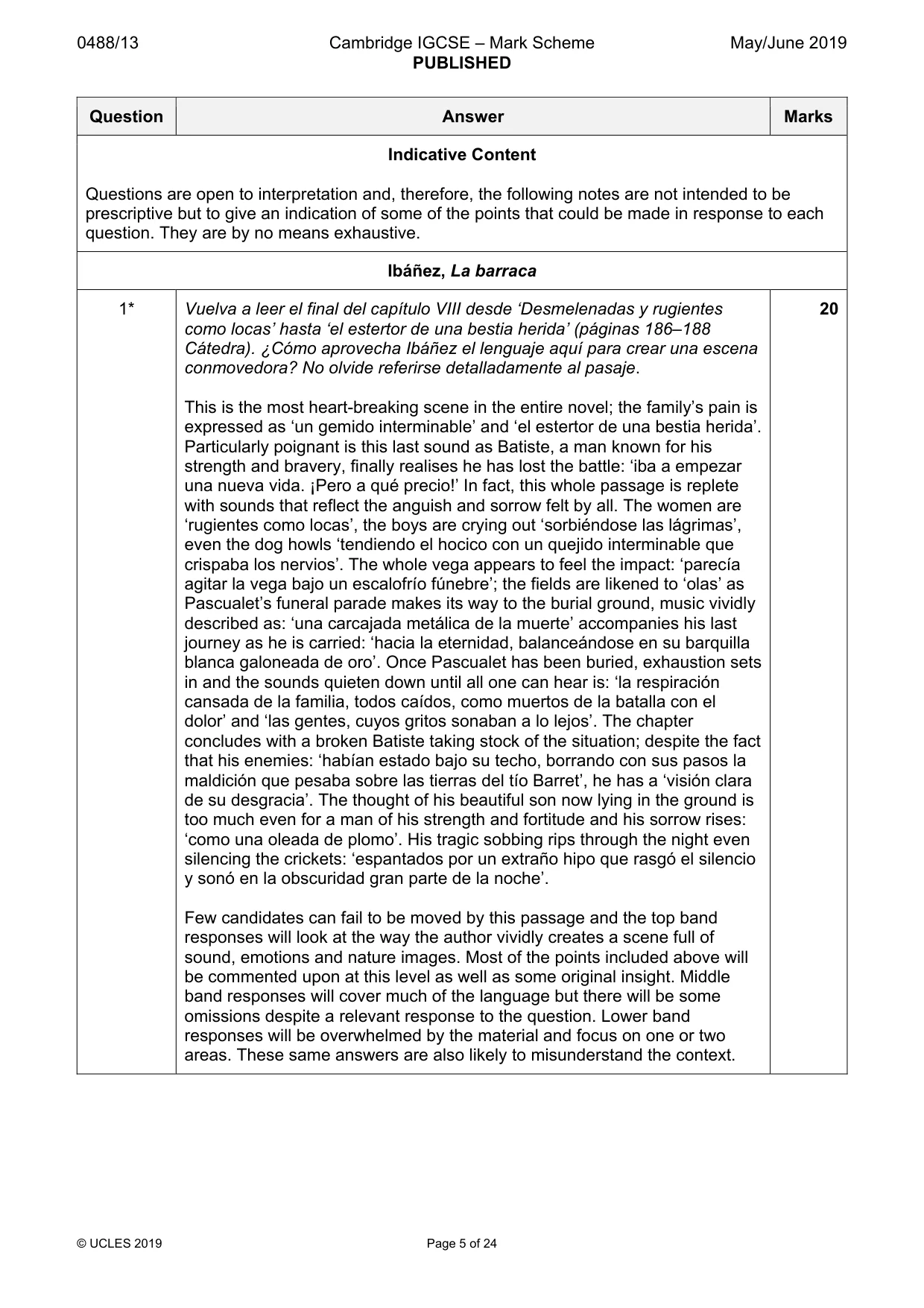
0488/13 Cambridge IGCSE – Mark Scheme PUBLISHED May/June 2019 © UCLES 2019 Page 5 of 24 Question Answer Marks Indicative Content Questions are open to interpretation and, therefore, the following notes are not intended to be prescriptive but to give an indication of some of the points that could be made in response to each question. They are by no means exhaustive. Ibáñez, La barraca 1* Vuelva a leer el final del capítulo VIII desde ‘Desmelenadas y rugientes como locas’ hasta ‘el estertor de una bestia herida’ (páginas 186–188 Cátedra). ¿Cómo aprovecha Ibáñez el lenguaje aquí para crear una escena conmovedora? No olvide referirse detalladamente al pasaje. This is the most heart-breaking scene in the entire novel; the family’s pain is expressed as ‘un gemido interminable’ and ‘el estertor de una bestia herida’. Particularly poignant is this last sound as Batiste, a man known for his strength and bravery, finally realises he has lost the battle: ‘iba a empezar una nueva vida. ¡Pero a qué precio!’ In fact, this whole passage is replete with sounds that reflect the anguish and sorrow felt by all. The women are ‘rugientes como locas’, the boys are crying out ‘sorbiéndose las lágrimas’, even the dog howls ‘tendiendo el hocico con un quejido interminable que crispaba los nervios’. The whole vega appears to feel the impact: ‘parecía agitar la vega bajo un escalofrío fúnebre’; the fields are likened to ‘olas’ as Pascualet’s funeral parade makes its way to the burial ground, music vividly described as: ‘una carcajada metálica de la muerte’ accompanies his last journey as he is carried: ‘hacia la eternidad, balanceándose en su barquilla blanca galoneada de oro’. Once Pascualet has been buried, exhaustion sets in and the sounds quieten down until all one can hear is: ‘la respiración cansada de la familia, todos caídos, como muertos de la batalla con el dolor’ and ‘las gentes, cuyos gritos sonaban a lo lejos’. The chapter concludes with a broken Batiste taking stock of the situation; despite the fact that his enemies: ‘habían estado bajo su techo, borrando con sus pasos la maldición que pesaba sobre las tierras del tío Barret’, he has a ‘visión clara de su desgracia’. The thought of his beautiful son now lying in the ground is too much even for a man of his strength and fortitude and his sorrow rises: ‘como una oleada de plomo’. His tragic sobbing rips through the night even silencing the crickets: ‘espantados por un extraño hipo que rasgó el silencio y sonó en la obscuridad gran parte de la noche’. Few candidates can fail to be moved by this passage and the top band responses will look at the way the author vividly creates a scene full of sound, emotions and nature images. Most of the points included above will be commented upon at this level as well as some original insight. Middle band responses will cover much of the language but there will be some omissions despite a relevant response to the question. Lower band responses will be overwhelmed by the material and focus on one or two areas. These same answers are also likely to misunderstand the context. 20
Mark scheme, page 6
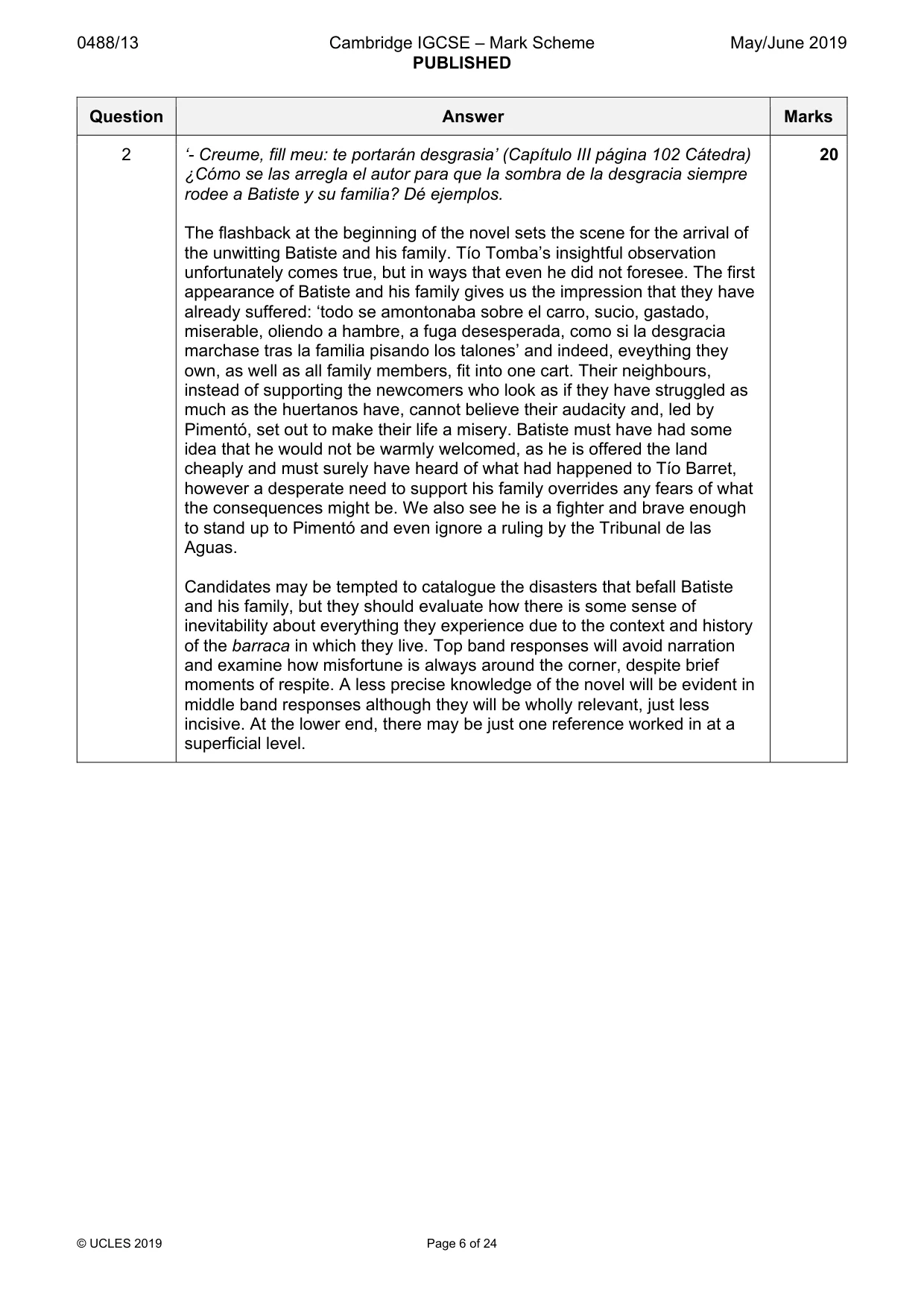
0488/13 Cambridge IGCSE – Mark Scheme PUBLISHED May/June 2019 © UCLES 2019 Page 6 of 24 Question Answer Marks 2 ‘- Creume, fill meu: te portarán desgrasia’ (Capítulo III página 102 Cátedra) ¿Cómo se las arregla el autor para que la sombra de la desgracia siempre rodee a Batiste y su familia? Dé ejemplos. The flashback at the beginning of the novel sets the scene for the arrival of the unwitting Batiste and his family. Tío Tomba’s insightful observation unfortunately comes true, but in ways that even he did not foresee. The first appearance of Batiste and his family gives us the impression that they have already suffered: ‘todo se amontonaba sobre el carro, sucio, gastado, miserable, oliendo a hambre, a fuga desesperada, como si la desgracia marchase tras la familia pisando los talones’ and indeed, eveything they own, as well as all family members, fit into one cart. Their neighbours, instead of supporting the newcomers who look as if they have struggled as much as the huertanos have, cannot believe their audacity and, led by Pimentó, set out to make their life a misery. Batiste must have had some idea that he would not be warmly welcomed, as he is offered the land cheaply and must surely have heard of what had happened to Tío Barret, however a desperate need to support his family overrides any fears of what the consequences might be. We also see he is a fighter and brave enough to stand up to Pimentó and even ignore a ruling by the Tribunal de las Aguas. Candidates may be tempted to catalogue the disasters that befall Batiste and his family, but they should evaluate how there is some sense of inevitability about everything they experience due to the context and history of the barraca in which they live. Top band responses will avoid narration and examine how misfortune is always around the corner, despite brief moments of respite. A less precise knowledge of the novel will be evident in middle band responses although they will be wholly relevant, just less incisive. At the lower end, there may be just one reference worked in at a superficial level. 20
Mark scheme, page 7
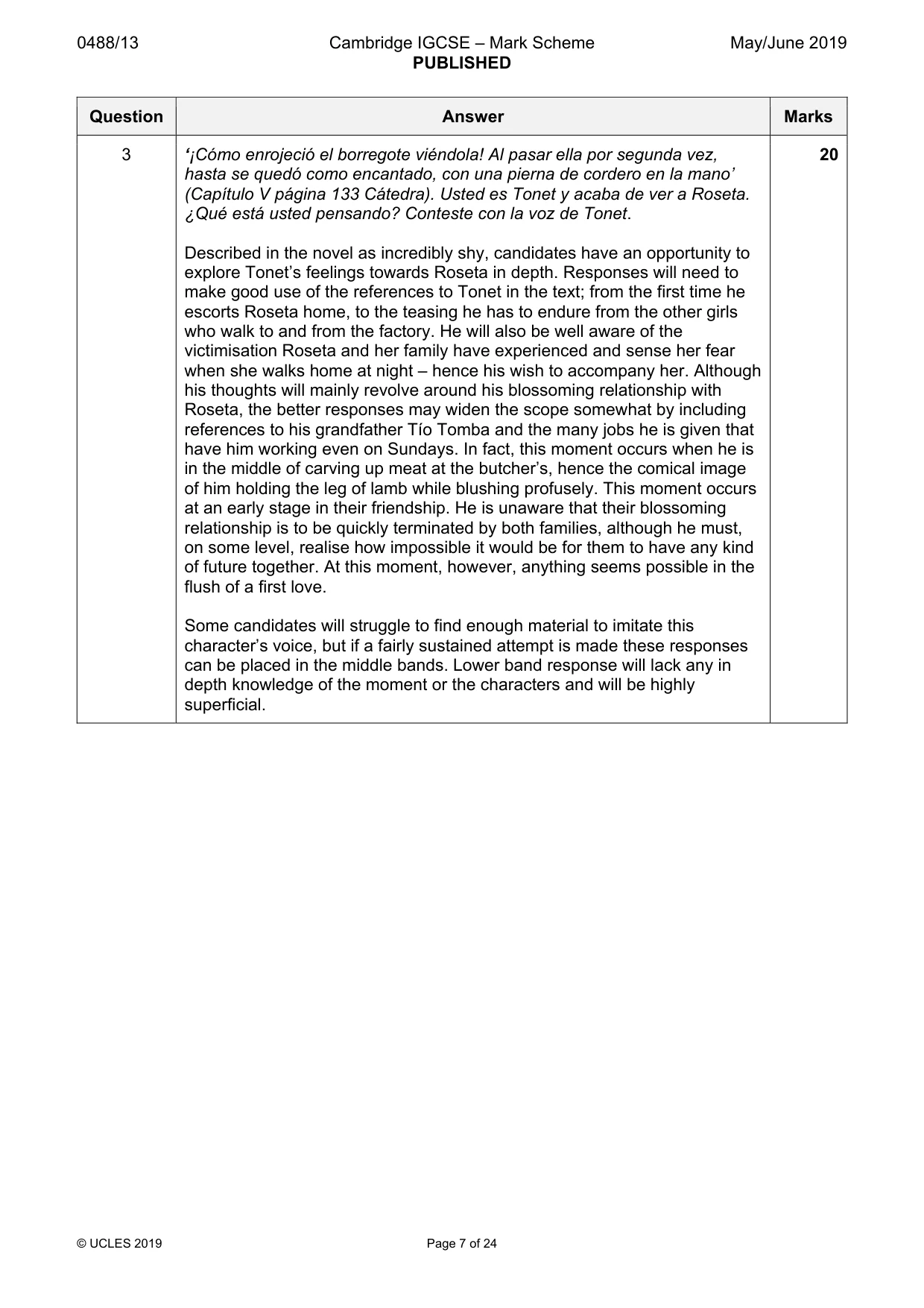
0488/13 Cambridge IGCSE – Mark Scheme PUBLISHED May/June 2019 © UCLES 2019 Page 7 of 24 Question Answer Marks 3 ‘¡Cómo enrojeció el borregote viéndola! Al pasar ella por segunda vez, hasta se quedó como encantado, con una pierna de cordero en la mano’ (Capítulo V página 133 Cátedra). Usted es Tonet y acaba de ver a Roseta. ¿Qué está usted pensando? Conteste con la voz de Tonet. Described in the novel as incredibly shy, candidates have an opportunity to explore Tonet’s feelings towards Roseta in depth. Responses will need to make good use of the references to Tonet in the text; from the first time he escorts Roseta home, to the teasing he has to endure from the other girls who walk to and from the factory. He will also be well aware of the victimisation Roseta and her family have experienced and sense her fear when she walks home at night – hence his wish to accompany her. Although his thoughts will mainly revolve around his blossoming relationship with Roseta, the better responses may widen the scope somewhat by including references to his grandfather Tío Tomba and the many jobs he is given that have him working even on Sundays. In fact, this moment occurs when he is in the middle of carving up meat at the butcher’s, hence the comical image of him holding the leg of lamb while blushing profusely. This moment occurs at an early stage in their friendship. He is unaware that their blossoming relationship is to be quickly terminated by both families, although he must, on some level, realise how impossible it would be for them to have any kind of future together. At this moment, however, anything seems possible in the flush of a first love. Some candidates will struggle to find enough material to imitate this character’s voice, but if a fairly sustained attempt is made these responses can be placed in the middle bands. Lower band response will lack any in depth knowledge of the moment or the characters and will be highly superficial. 20
Mark scheme, page 8
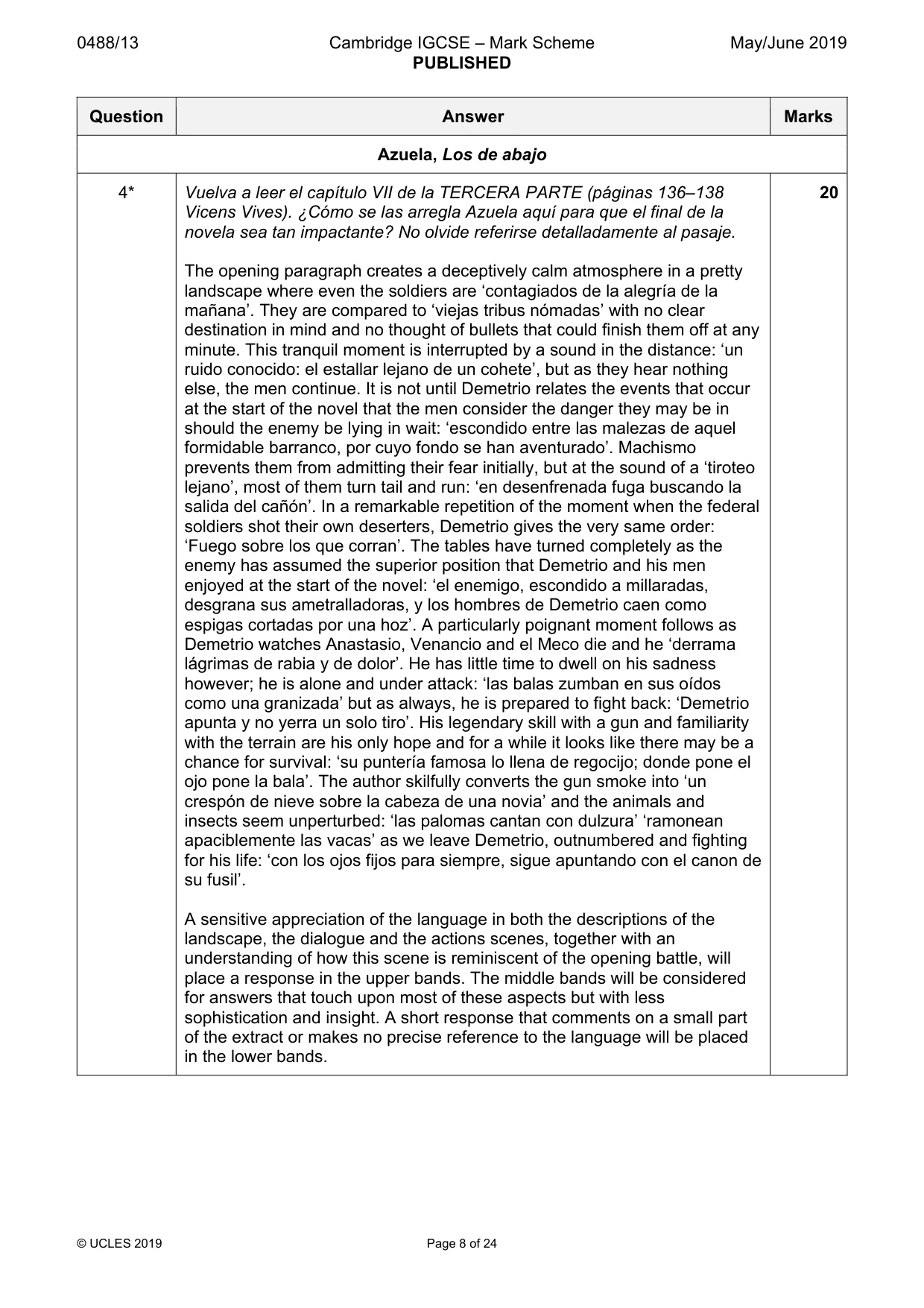
0488/13 Cambridge IGCSE – Mark Scheme PUBLISHED May/June 2019 © UCLES 2019 Page 8 of 24 Question Answer Marks Azuela, Los de abajo 4* Vuelva a leer el capítulo VII de la TERCERA PARTE (páginas 136–138 Vicens Vives). ¿Cómo se las arregla Azuela aquí para que el final de la novela sea tan impactante? No olvide referirse detalladamente al pasaje. The opening paragraph creates a deceptively calm atmosphere in a pretty landscape where even the soldiers are ‘contagiados de la alegría de la mañana’. They are compared to ‘viejas tribus nómadas’ with no clear destination in mind and no thought of bullets that could finish them off at any minute. This tranquil moment is interrupted by a sound in the distance: ‘un ruido conocido: el estallar lejano de un cohete’, but as they hear nothing else, the men continue. It is not until Demetrio relates the events that occur at the start of the novel that the men consider the danger they may be in should the enemy be lying in wait: ‘escondido entre las malezas de aquel formidable barranco, por cuyo fondo se han aventurado’. Machismo prevents them from admitting their fear initially, but at the sound of a ‘tiroteo lejano’, most of them turn tail and run: ‘en desenfrenada fuga buscando la salida del cañón’. In a remarkable repetition of the moment when the federal soldiers shot their own deserters, Demetrio gives the very same order: ‘Fuego sobre los que corran’. The tables have turned completely as the enemy has assumed the superior position that Demetrio and his men enjoyed at the start of the novel: ‘el enemigo, escondido a millaradas, desgrana sus ametralladoras, y los hombres de Demetrio caen como espigas cortadas por una hoz’. A particularly poignant moment follows as Demetrio watches Anastasio, Venancio and el Meco die and he ‘derrama lágrimas de rabia y de dolor’. He has little time to dwell on his sadness however; he is alone and under attack: ‘las balas zumban en sus oídos como una granizada’ but as always, he is prepared to fight back: ‘Demetrio apunta y no yerra un solo tiro’. His legendary skill with a gun and familiarity with the terrain are his only hope and for a while it looks like there may be a chance for survival: ‘su puntería famosa lo llena de regocijo; donde pone el ojo pone la bala’. The author skilfully converts the gun smoke into ‘un crespón de nieve sobre la cabeza de una novia’ and the animals and insects seem unperturbed: ‘las palomas cantan con dulzura’ ‘ramonean apaciblemente las vacas’ as we leave Demetrio, outnumbered and fighting for his life: ‘con los ojos fijos para siempre, sigue apuntando con el canon de su fusil’. A sensitive appreciation of the language in both the descriptions of the landscape, the dialogue and the actions scenes, together with an understanding of how this scene is reminiscent of the opening battle, will place a response in the upper bands. The middle bands will be considered for answers that touch upon most of these aspects but with less sophistication and insight. A short response that comments on a small part of the extract or makes no precise reference to the language will be placed in the lower bands. 20
Mark scheme, page 9
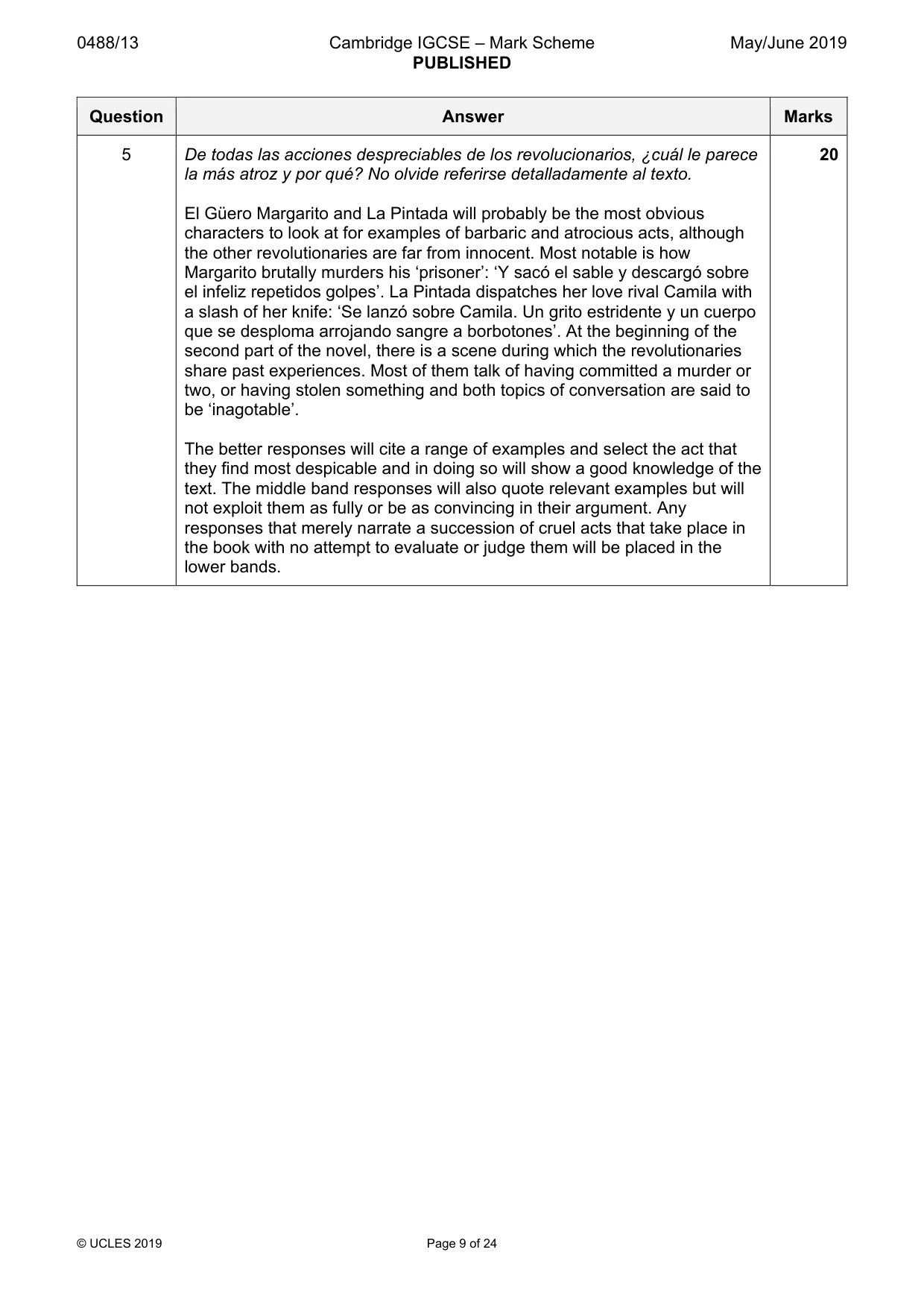
0488/13 Cambridge IGCSE – Mark Scheme PUBLISHED May/June 2019 © UCLES 2019 Page 9 of 24 Question Answer Marks 5 De todas las acciones despreciables de los revolucionarios, ¿cuál le parece la más atroz y por qué? No olvide referirse detalladamente al texto. El Güero Margarito and La Pintada will probably be the most obvious characters to look at for examples of barbaric and atrocious acts, although the other revolutionaries are far from innocent. Most notable is how Margarito brutally murders his ‘prisoner’: ‘Y sacó el sable y descargó sobre el infeliz repetidos golpes’. La Pintada dispatches her love rival Camila with a slash of her knife: ‘Se lanzó sobre Camila. Un grito estridente y un cuerpo que se desploma arrojando sangre a borbotones’. At the beginning of the second part of the novel, there is a scene during which the revolutionaries share past experiences. Most of them talk of having committed a murder or two, or having stolen something and both topics of conversation are said to be ‘inagotable’. The better responses will cite a range of examples and select the act that they find most despicable and in doing so will show a good knowledge of the text. The middle band responses will also quote relevant examples but will not exploit them as fully or be as convincing in their argument. Any responses that merely narrate a succession of cruel acts that take place in the book with no attempt to evaluate or judge them will be placed in the lower bands. 20
Mark scheme, page 10
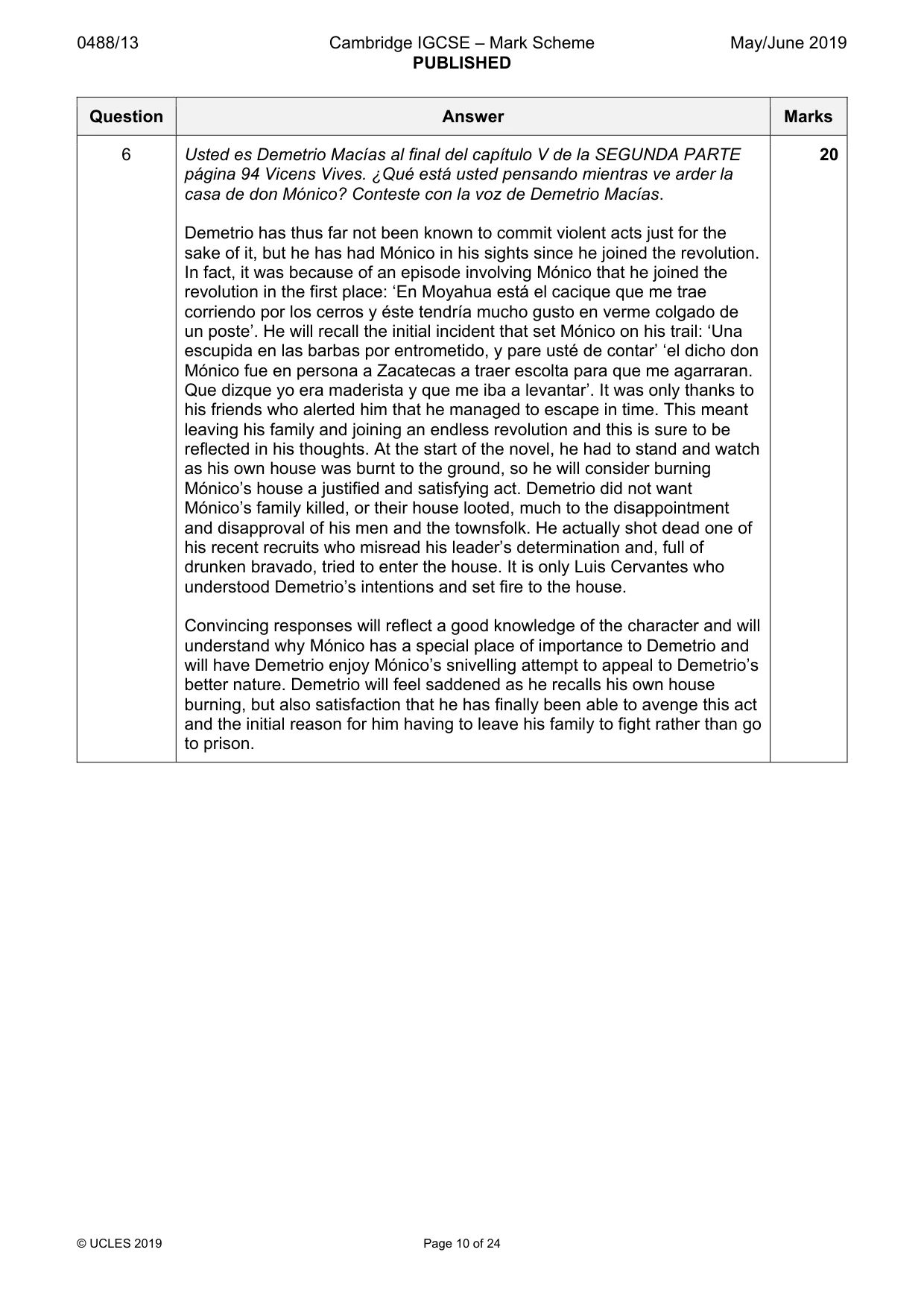
0488/13 Cambridge IGCSE – Mark Scheme PUBLISHED May/June 2019 © UCLES 2019 Page 10 of 24 Question Answer Marks 6 Usted es Demetrio Macías al final del capítulo V de la SEGUNDA PARTE página 94 Vicens Vives. ¿Qué está usted pensando mientras ve arder la casa de don Mónico? Conteste con la voz de Demetrio Macías. Demetrio has thus far not been known to commit violent acts just for the sake of it, but he has had Mónico in his sights since he joined the revolution. In fact, it was because of an episode involving Mónico that he joined the revolution in the first place: ‘En Moyahua está el cacique que me trae corriendo por los cerros y éste tendría mucho gusto en verme colgado de un poste’. He will recall the initial incident that set Mónico on his trail: ‘Una escupida en las barbas por entrometido, y pare usté de contar’ ‘el dicho don Mónico fue en persona a Zacatecas a traer escolta para que me agarraran. Que dizque yo era maderista y que me iba a levantar’. It was only thanks to his friends who alerted him that he managed to escape in time. This meant leaving his family and joining an endless revolution and this is sure to be reflected in his thoughts. At the start of the novel, he had to stand and watch as his own house was burnt to the ground, so he will consider burning Mónico’s house a justified and satisfying act. Demetrio did not want Mónico’s family killed, or their house looted, much to the disappointment and disapproval of his men and the townsfolk. He actually shot dead one of his recent recruits who misread his leader’s determination and, full of drunken bravado, tried to enter the house. It is only Luis Cervantes who understood Demetrio’s intentions and set fire to the house. Convincing responses will reflect a good knowledge of the character and will understand why Mónico has a special place of importance to Demetrio and will have Demetrio enjoy Mónico’s snivelling attempt to appeal to Demetrio’s better nature. Demetrio will feel saddened as he recalls his own house burning, but also satisfaction that he has finally been able to avenge this act and the initial reason for him having to leave his family to fight rather than go to prison. 20
Mark scheme, page 11
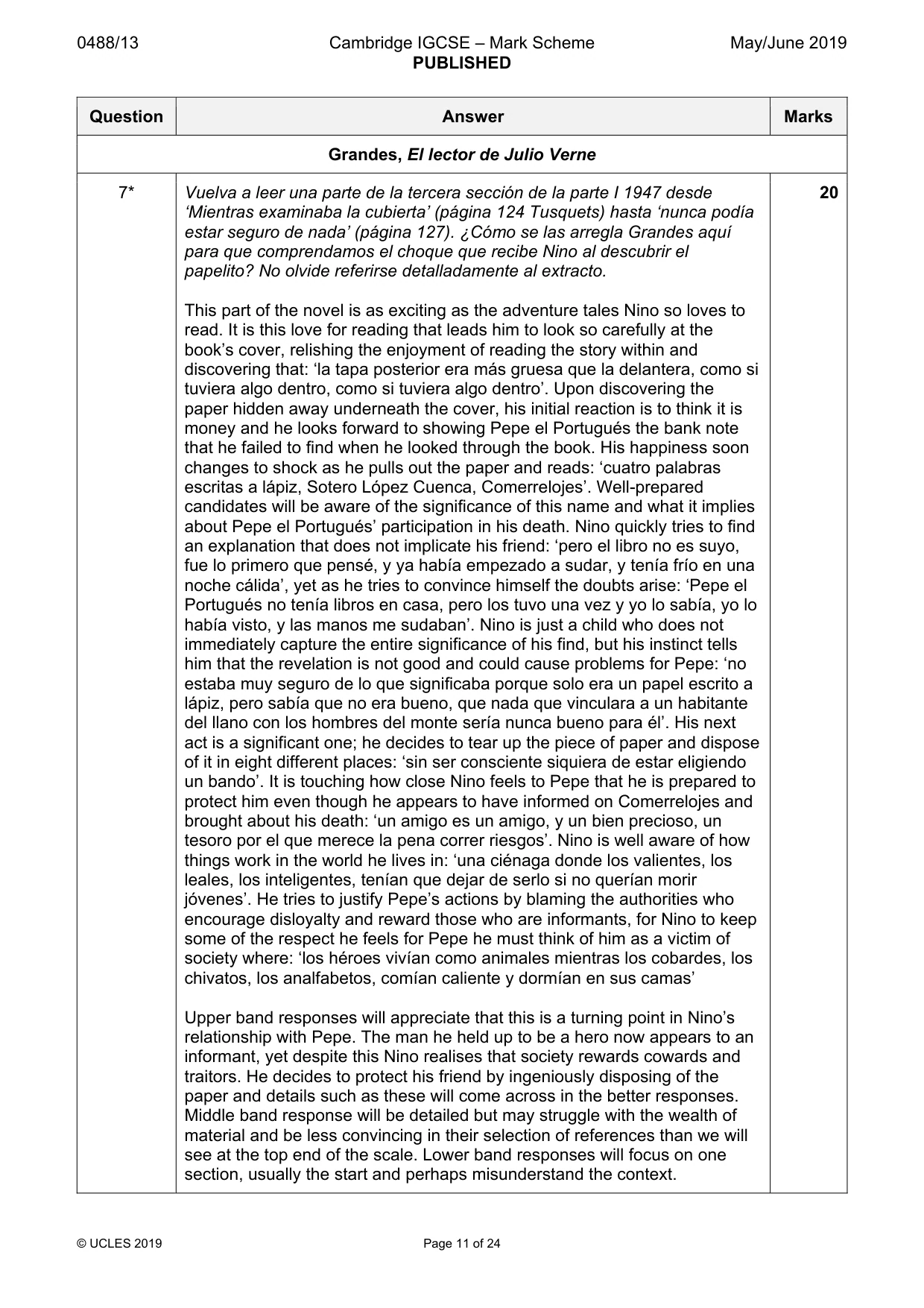
0488/13 Cambridge IGCSE – Mark Scheme PUBLISHED May/June 2019 © UCLES 2019 Page 11 of 24 Question Answer Marks Grandes, El lector de Julio Verne 7* Vuelva a leer una parte de la tercera sección de la parte I 1947 desde ‘Mientras examinaba la cubierta’ (página 124 Tusquets) hasta ‘nunca podía estar seguro de nada’ (página 127). ¿Cómo se las arregla Grandes aquí para que comprendamos el choque que recibe Nino al descubrir el papelito? No olvide referirse detalladamente al extracto. This part of the novel is as exciting as the adventure tales Nino so loves to read. It is this love for reading that leads him to look so carefully at the book’s cover, relishing the enjoyment of reading the story within and discovering that: ‘la tapa posterior era más gruesa que la delantera, como si tuviera algo dentro, como si tuviera algo dentro’. Upon discovering the paper hidden away underneath the cover, his initial reaction is to think it is money and he looks forward to showing Pepe el Portugués the bank note that he failed to find when he looked through the book. His happiness soon changes to shock as he pulls out the paper and reads: ‘cuatro palabras escritas a lápiz, Sotero López Cuenca, Comerrelojes’. Well-prepared candidates will be aware of the significance of this name and what it implies about Pepe el Portugués’ participation in his death. Nino quickly tries to find an explanation that does not implicate his friend: ‘pero el libro no es suyo, fue lo primero que pensé, y ya había empezado a sudar, y tenía frío en una noche cálida’, yet as he tries to convince himself the doubts arise: ‘Pepe el Portugués no tenía libros en casa, pero los tuvo una vez y yo lo sabía, yo lo había visto, y las manos me sudaban’. Nino is just a child who does not immediately capture the entire significance of his find, but his instinct tells him that the revelation is not good and could cause problems for Pepe: ‘no estaba muy seguro de lo que significaba porque solo era un papel escrito a lápiz, pero sabía que no era bueno, que nada que vinculara a un habitante del llano con los hombres del monte sería nunca bueno para él’. His next act is a significant one; he decides to tear up the piece of paper and dispose of it in eight different places: ‘sin ser consciente siquiera de estar eligiendo un bando’. It is touching how close Nino feels to Pepe that he is prepared to protect him even though he appears to have informed on Comerrelojes and brought about his death: ‘un amigo es un amigo, y un bien precioso, un tesoro por el que merece la pena correr riesgos’. Nino is well aware of how things work in the world he lives in: ‘una ciénaga donde los valientes, los leales, los inteligentes, tenían que dejar de serlo si no querían morir jóvenes’. He tries to justify Pepe’s actions by blaming the authorities who encourage disloyalty and reward those who are informants, for Nino to keep some of the respect he feels for Pepe he must think of him as a victim of society where: ‘los héroes vivían como animales mientras los cobardes, los chivatos, los analfabetos, comían caliente y dormían en sus camas’ Upper band responses will appreciate that this is a turning point in Nino’s relationship with Pepe. The man he held up to be a hero now appears to an informant, yet despite this Nino realises that society rewards cowards and traitors. He decides to protect his friend by ingeniously disposing of the paper and details such as these will come across in the better responses. Middle band response will be detailed but may struggle with the wealth of material and be less convincing in their selection of references than we will see at the top end of the scale. Lower band responses will focus on one section, usually the start and perhaps misunderstand the context. 20
Mark scheme, page 12
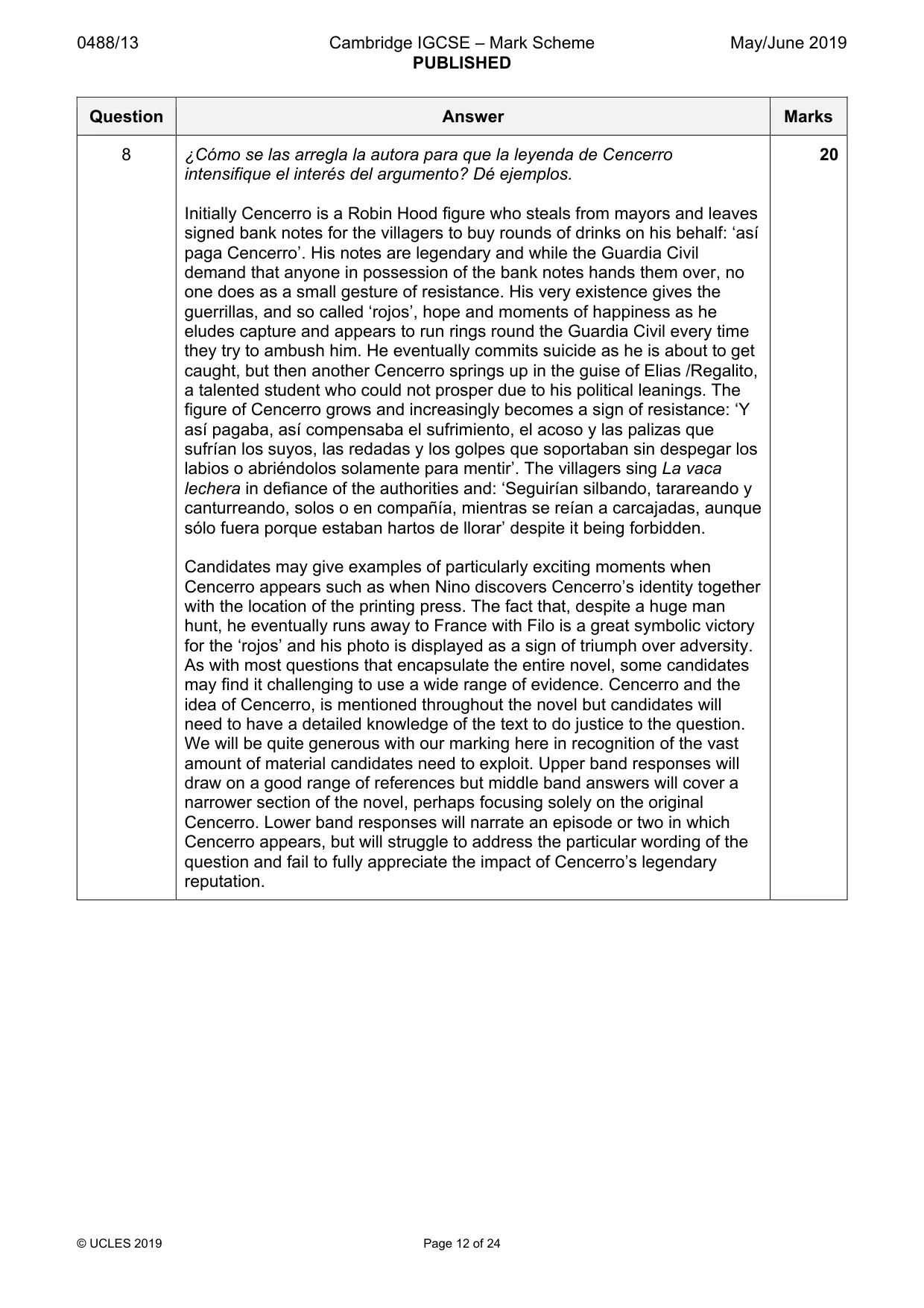
0488/13 Cambridge IGCSE – Mark Scheme PUBLISHED May/June 2019 © UCLES 2019 Page 12 of 24 Question Answer Marks 8 ¿Cómo se las arregla la autora para que la leyenda de Cencerro intensifique el interés del argumento? Dé ejemplos. Initially Cencerro is a Robin Hood figure who steals from mayors and leaves signed bank notes for the villagers to buy rounds of drinks on his behalf: ‘así paga Cencerro’. His notes are legendary and while the Guardia Civil demand that anyone in possession of the bank notes hands them over, no one does as a small gesture of resistance. His very existence gives the guerrillas, and so called ‘rojos’, hope and moments of happiness as he eludes capture and appears to run rings round the Guardia Civil every time they try to ambush him. He eventually commits suicide as he is about to get caught, but then another Cencerro springs up in the guise of Elias /Regalito, a talented student who could not prosper due to his political leanings. The figure of Cencerro grows and increasingly becomes a sign of resistance: ‘Y así pagaba, así compensaba el sufrimiento, el acoso y las palizas que sufrían los suyos, las redadas y los golpes que soportaban sin despegar los labios o abriéndolos solamente para mentir’. The villagers sing La vaca lechera in defiance of the authorities and: ‘Seguirían silbando, tarareando y canturreando, solos o en compañía, mientras se reían a carcajadas, aunque sólo fuera porque estaban hartos de llorar’ despite it being forbidden. Candidates may give examples of particularly exciting moments when Cencerro appears such as when Nino discovers Cencerro’s identity together with the location of the printing press. The fact that, despite a huge man hunt, he eventually runs away to France with Filo is a great symbolic victory for the ‘rojos’ and his photo is displayed as a sign of triumph over adversity. As with most questions that encapsulate the entire novel, some candidates may find it challenging to use a wide range of evidence. Cencerro and the idea of Cencerro, is mentioned throughout the novel but candidates will need to have a detailed knowledge of the text to do justice to the question. We will be quite generous with our marking here in recognition of the vast amount of material candidates need to exploit. Upper band responses will draw on a good range of references but middle band answers will cover a narrower section of the novel, perhaps focusing solely on the original Cencerro. Lower band responses will narrate an episode or two in which Cencerro appears, but will struggle to address the particular wording of the question and fail to fully appreciate the impact of Cencerro’s legendary reputation. 20
Mark scheme, page 13
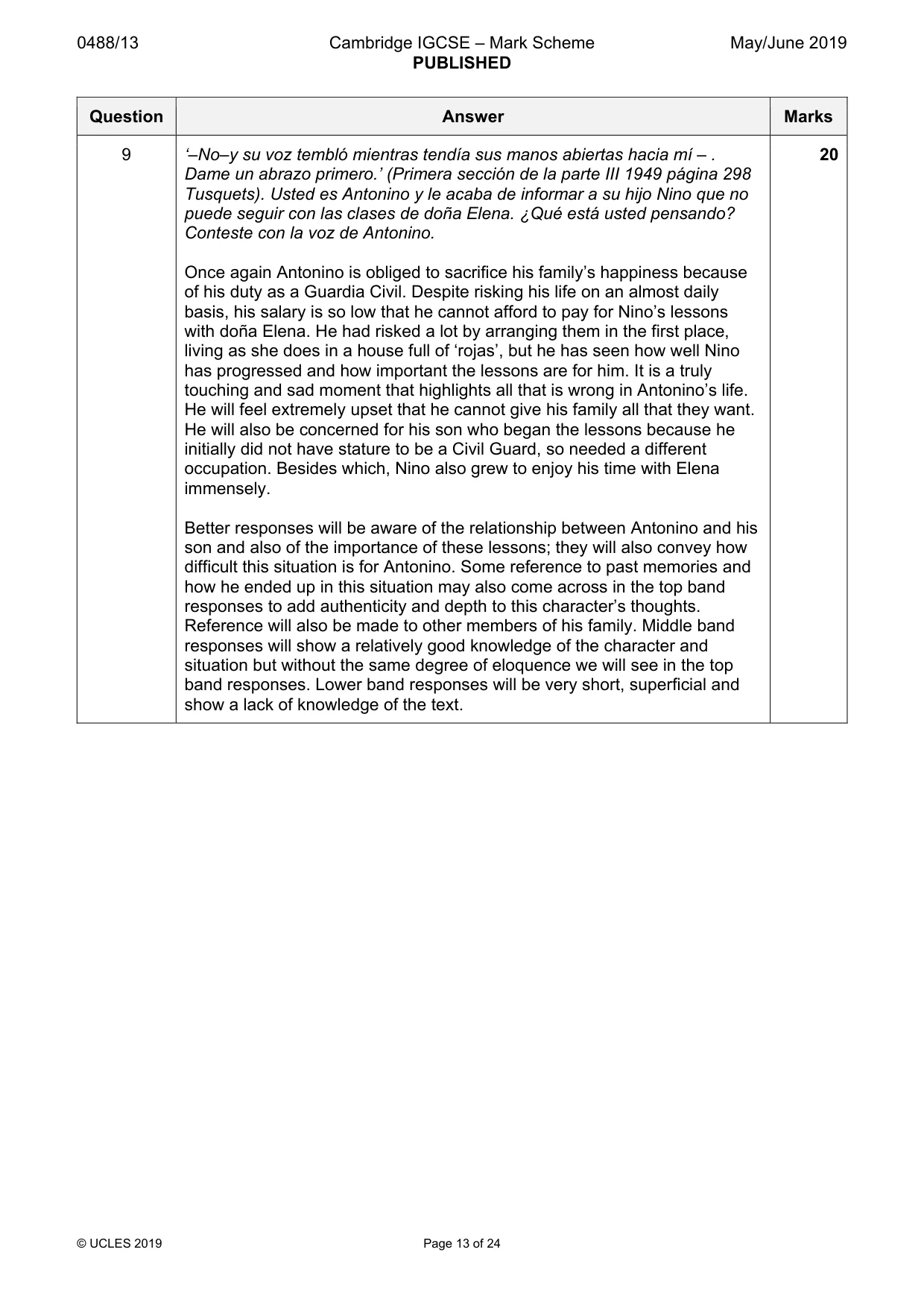
0488/13 Cambridge IGCSE – Mark Scheme PUBLISHED May/June 2019 © UCLES 2019 Page 13 of 24 Question Answer Marks 9 ‘–No–y su voz tembló mientras tendía sus manos abiertas hacia mí – . Dame un abrazo primero.’ (Primera sección de la parte III 1949 página 298 Tusquets). Usted es Antonino y le acaba de informar a su hijo Nino que no puede seguir con las clases de doña Elena. ¿Qué está usted pensando? Conteste con la voz de Antonino. Once again Antonino is obliged to sacrifice his family’s happiness because of his duty as a Guardia Civil. Despite risking his life on an almost daily basis, his salary is so low that he cannot afford to pay for Nino’s lessons with doña Elena. He had risked a lot by arranging them in the first place, living as she does in a house full of ‘rojas’, but he has seen how well Nino has progressed and how important the lessons are for him. It is a truly touching and sad moment that highlights all that is wrong in Antonino’s life. He will feel extremely upset that he cannot give his family all that they want. He will also be concerned for his son who began the lessons because he initially did not have stature to be a Civil Guard, so needed a different occupation. Besides which, Nino also grew to enjoy his time with Elena immensely. Better responses will be aware of the relationship between Antonino and his son and also of the importance of these lessons; they will also convey how difficult this situation is for Antonino. Some reference to past memories and how he ended up in this situation may also come across in the top band responses to add authenticity and depth to this character’s thoughts. Reference will also be made to other members of his family. Middle band responses will show a relatively good knowledge of the character and situation but without the same degree of eloquence we will see in the top band responses. Lower band responses will be very short, superficial and show a lack of knowledge of the text. 20
Mark scheme, page 14
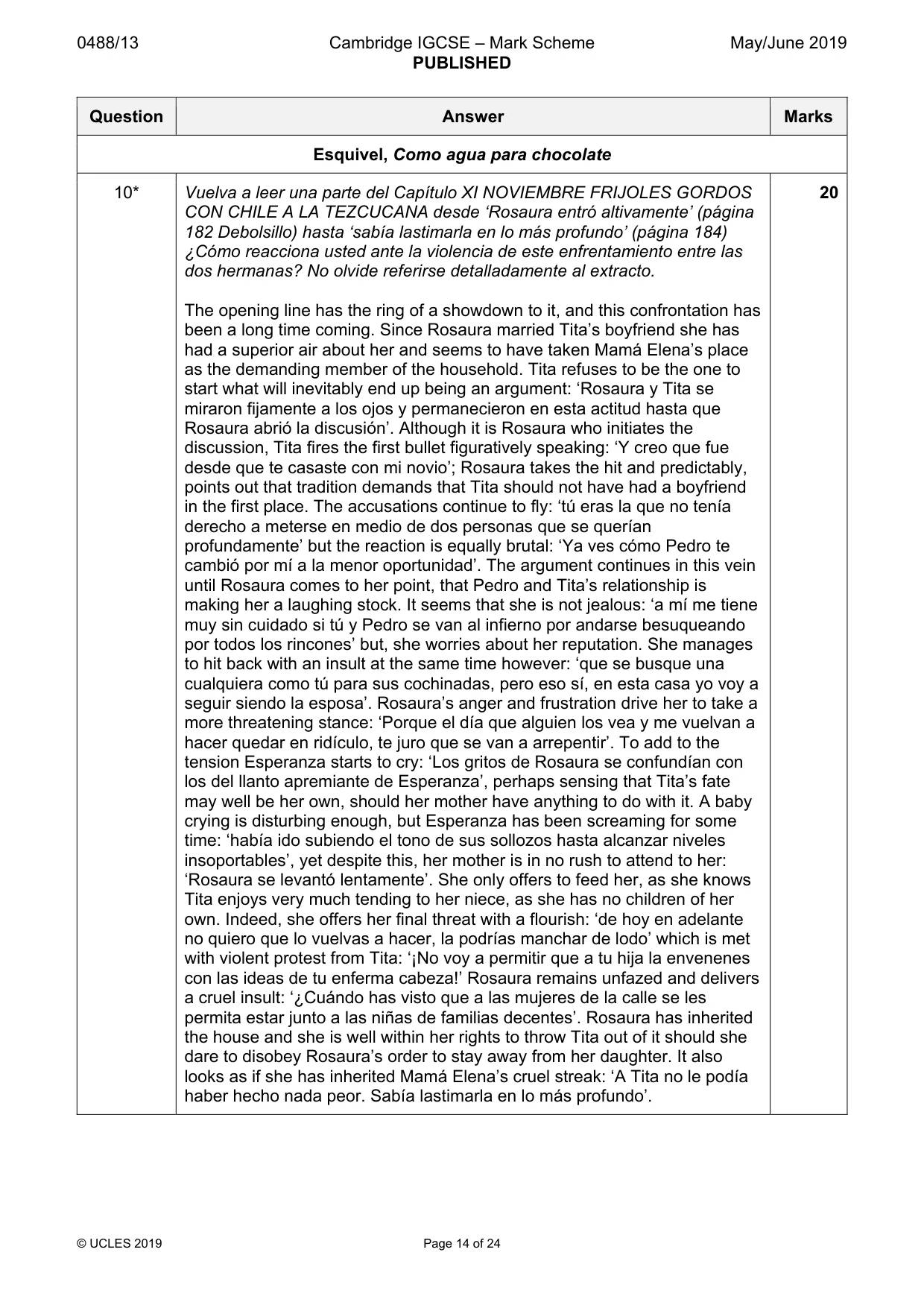
0488/13 Cambridge IGCSE – Mark Scheme PUBLISHED May/June 2019 © UCLES 2019 Page 14 of 24 Question Answer Marks Esquivel, Como agua para chocolate 10* Vuelva a leer una parte del Capítulo XI NOVIEMBRE FRIJOLES GORDOS CON CHILE A LA TEZCUCANA desde ‘Rosaura entró altivamente’ (página 182 Debolsillo) hasta ‘sabía lastimarla en lo más profundo’ (página 184) ¿Cómo reacciona usted ante la violencia de este enfrentamiento entre las dos hermanas? No olvide referirse detalladamente al extracto. The opening line has the ring of a showdown to it, and this confrontation has been a long time coming. Since Rosaura married Tita’s boyfriend she has had a superior air about her and seems to have taken Mamá Elena’s place as the demanding member of the household. Tita refuses to be the one to start what will inevitably end up being an argument: ‘Rosaura y Tita se miraron fijamente a los ojos y permanecieron en esta actitud hasta que Rosaura abrió la discusión’. Although it is Rosaura who initiates the discussion, Tita fires the first bullet figuratively speaking: ‘Y creo que fue desde que te casaste con mi novio’; Rosaura takes the hit and predictably, points out that tradition demands that Tita should not have had a boyfriend in the first place. The accusations continue to fly: ‘tú eras la que no tenía derecho a meterse en medio de dos personas que se querían profundamente’ but the reaction is equally brutal: ‘Ya ves cómo Pedro te cambió por mí a la menor oportunidad’. The argument continues in this vein until Rosaura comes to her point, that Pedro and Tita’s relationship is making her a laughing stock. It seems that she is not jealous: ‘a mí me tiene muy sin cuidado si tú y Pedro se van al infierno por andarse besuqueando por todos los rincones’ but, she worries about her reputation. She manages to hit back with an insult at the same time however: ‘que se busque una cualquiera como tú para sus cochinadas, pero eso sí, en esta casa yo voy a seguir siendo la esposa’. Rosaura’s anger and frustration drive her to take a more threatening stance: ‘Porque el día que alguien los vea y me vuelvan a hacer quedar en ridículo, te juro que se van a arrepentir’. To add to the tension Esperanza starts to cry: ‘Los gritos de Rosaura se confundían con los del llanto apremiante de Esperanza’, perhaps sensing that Tita’s fate may well be her own, should her mother have anything to do with it. A baby crying is disturbing enough, but Esperanza has been screaming for some time: ‘había ido subiendo el tono de sus sollozos hasta alcanzar niveles insoportables’, yet despite this, her mother is in no rush to attend to her: ‘Rosaura se levantó lentamente’. She only offers to feed her, as she knows Tita enjoys very much tending to her niece, as she has no children of her own. Indeed, she offers her final threat with a flourish: ‘de hoy en adelante no quiero que lo vuelvas a hacer, la podrías manchar de lodo’ which is met with violent protest from Tita: ‘¡No voy a permitir que a tu hija la envenenes con las ideas de tu enferma cabeza!’ Rosaura remains unfazed and delivers a cruel insult: ‘¿Cuándo has visto que a las mujeres de la calle se les permita estar junto a las niñas de familias decentes’. Rosaura has inherited the house and she is well within her rights to throw Tita out of it should she dare to disobey Rosaura’s order to stay away from her daughter. It also looks as if she has inherited Mamá Elena’s cruel streak: ‘A Tita no le podía haber hecho nada peor. Sabía lastimarla en lo más profundo’. 20
Mark scheme, page 15
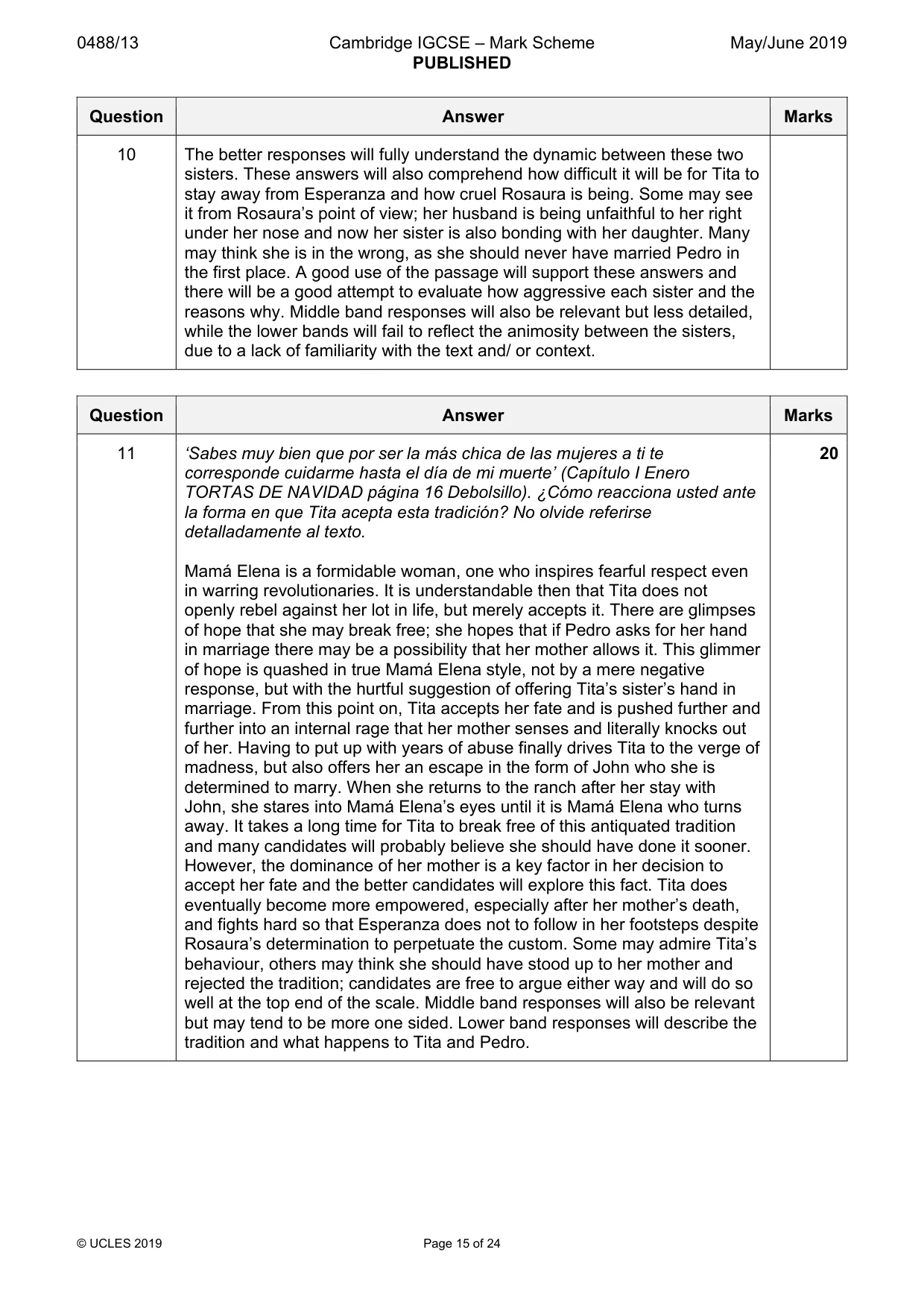
0488/13 Cambridge IGCSE – Mark Scheme PUBLISHED May/June 2019 © UCLES 2019 Page 15 of 24 Question Answer Marks 10 The better responses will fully understand the dynamic between these two sisters. These answers will also comprehend how difficult it will be for Tita to stay away from Esperanza and how cruel Rosaura is being. Some may see it from Rosaura’s point of view; her husband is being unfaithful to her right under her nose and now her sister is also bonding with her daughter. Many may think she is in the wrong, as she should never have married Pedro in the first place. A good use of the passage will support these answers and there will be a good attempt to evaluate how aggressive each sister and the reasons why. Middle band responses will also be relevant but less detailed, while the lower bands will fail to reflect the animosity between the sisters, due to a lack of familiarity with the text and/ or context. Question Answer Marks 11 ‘Sabes muy bien que por ser la más chica de las mujeres a ti te corresponde cuidarme hasta el día de mi muerte’ (Capítulo I Enero TORTAS DE NAVIDAD página 16 Debolsillo). ¿Cómo reacciona usted ante la forma en que Tita acepta esta tradición? No olvide referirse detalladamente al texto. Mamá Elena is a formidable woman, one who inspires fearful respect even in warring revolutionaries. It is understandable then that Tita does not openly rebel against her lot in life, but merely accepts it. There are glimpses of hope that she may break free; she hopes that if Pedro asks for her hand in marriage there may be a possibility that her mother allows it. This glimmer of hope is quashed in true Mamá Elena style, not by a mere negative response, but with the hurtful suggestion of offering Tita’s sister’s hand in marriage. From this point on, Tita accepts her fate and is pushed further and further into an internal rage that her mother senses and literally knocks out of her. Having to put up with years of abuse finally drives Tita to the verge of madness, but also offers her an escape in the form of John who she is determined to marry. When she returns to the ranch after her stay with John, she stares into Mamá Elena’s eyes until it is Mamá Elena who turns away. It takes a long time for Tita to break free of this antiquated tradition and many candidates will probably believe she should have done it sooner. However, the dominance of her mother is a key factor in her decision to accept her fate and the better candidates will explore this fact. Tita does eventually become more empowered, especially after her mother’s death, and fights hard so that Esperanza does not to follow in her footsteps despite Rosaura’s determination to perpetuate the custom. Some may admire Tita’s behaviour, others may think she should have stood up to her mother and rejected the tradition; candidates are free to argue either way and will do so well at the top end of the scale. Middle band responses will also be relevant but may tend to be more one sided. Lower band responses will describe the tradition and what happens to Tita and Pedro. 20
Mark scheme, page 16
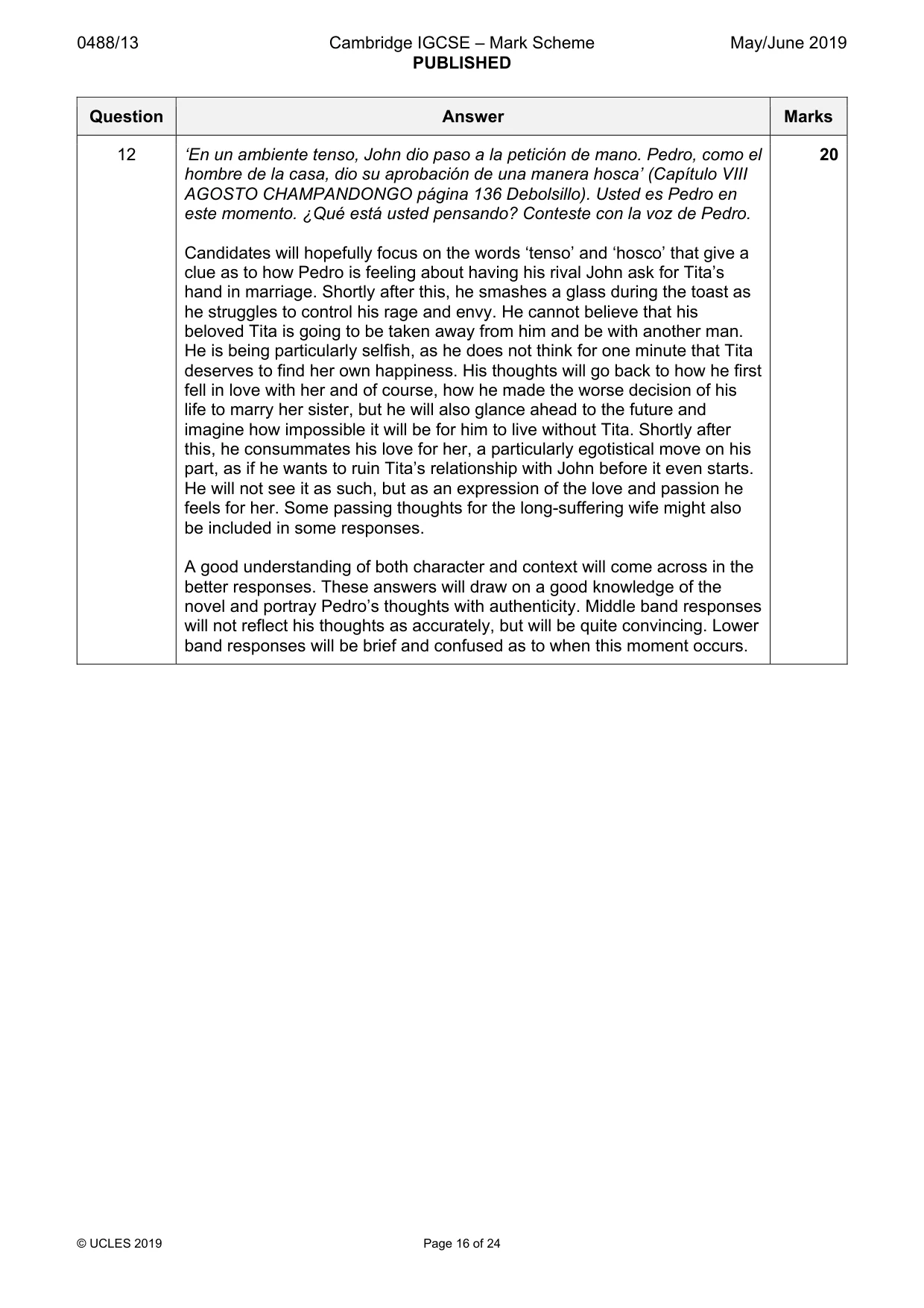
0488/13 Cambridge IGCSE – Mark Scheme PUBLISHED May/June 2019 © UCLES 2019 Page 16 of 24 Question Answer Marks 12 ‘En un ambiente tenso, John dio paso a la petición de mano. Pedro, como el hombre de la casa, dio su aprobación de una manera hosca’ (Capítulo VIII AGOSTO CHAMPANDONGO página 136 Debolsillo). Usted es Pedro en este momento. ¿Qué está usted pensando? Conteste con la voz de Pedro. Candidates will hopefully focus on the words ‘tenso’ and ‘hosco’ that give a clue as to how Pedro is feeling about having his rival John ask for Tita’s hand in marriage. Shortly after this, he smashes a glass during the toast as he struggles to control his rage and envy. He cannot believe that his beloved Tita is going to be taken away from him and be with another man. He is being particularly selfish, as he does not think for one minute that Tita deserves to find her own happiness. His thoughts will go back to how he first fell in love with her and of course, how he made the worse decision of his life to marry her sister, but he will also glance ahead to the future and imagine how impossible it will be for him to live without Tita. Shortly after this, he consummates his love for her, a particularly egotistical move on his part, as if he wants to ruin Tita’s relationship with John before it even starts. He will not see it as such, but as an expression of the love and passion he feels for her. Some passing thoughts for the long-suffering wife might also be included in some responses. A good understanding of both character and context will come across in the better responses. These answers will draw on a good knowledge of the novel and portray Pedro’s thoughts with authenticity. Middle band responses will not reflect his thoughts as accurately, but will be quite convincing. Lower band responses will be brief and confused as to when this moment occurs. 20
Mark scheme, page 17
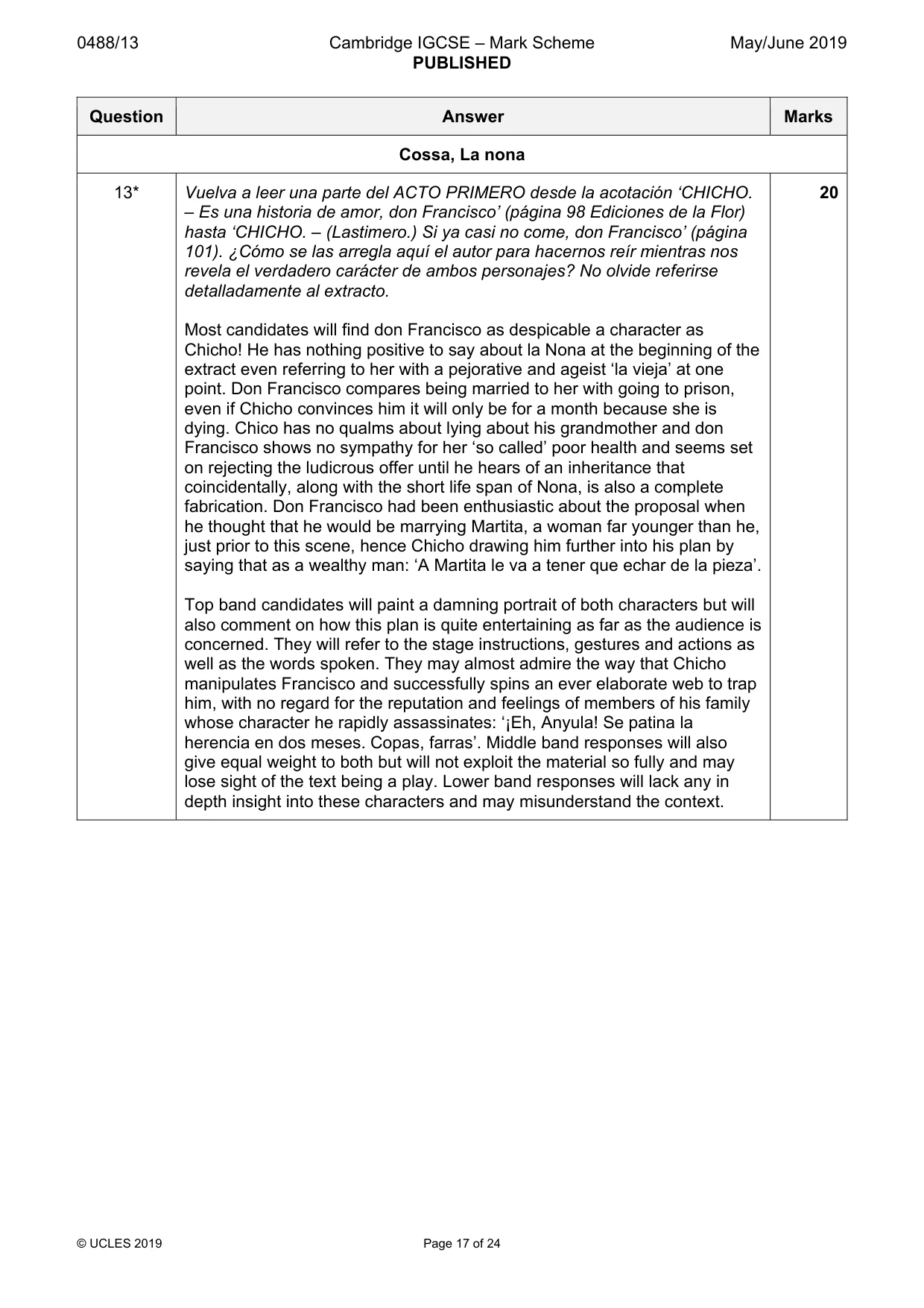
0488/13 Cambridge IGCSE – Mark Scheme PUBLISHED May/June 2019 © UCLES 2019 Page 17 of 24 Question Answer Marks Cossa, La nona 13* Vuelva a leer una parte del ACTO PRIMERO desde la acotación ‘CHICHO. – Es una historia de amor, don Francisco’ (página 98 Ediciones de la Flor) hasta ‘CHICHO. – (Lastimero.) Si ya casi no come, don Francisco’ (página 101). ¿Cómo se las arregla aquí el autor para hacernos reír mientras nos revela el verdadero carácter de ambos personajes? No olvide referirse detalladamente al extracto. Most candidates will find don Francisco as despicable a character as Chicho! He has nothing positive to say about la Nona at the beginning of the extract even referring to her with a pejorative and ageist ‘la vieja’ at one point. Don Francisco compares being married to her with going to prison, even if Chicho convinces him it will only be for a month because she is dying. Chico has no qualms about lying about his grandmother and don Francisco shows no sympathy for her ‘so called’ poor health and seems set on rejecting the ludicrous offer until he hears of an inheritance that coincidentally, along with the short life span of Nona, is also a complete fabrication. Don Francisco had been enthusiastic about the proposal when he thought that he would be marrying Martita, a woman far younger than he, just prior to this scene, hence Chicho drawing him further into his plan by saying that as a wealthy man: ‘A Martita le va a tener que echar de la pieza’. Top band candidates will paint a damning portrait of both characters but will also comment on how this plan is quite entertaining as far as the audience is concerned. They will refer to the stage instructions, gestures and actions as well as the words spoken. They may almost admire the way that Chicho manipulates Francisco and successfully spins an ever elaborate web to trap him, with no regard for the reputation and feelings of members of his family whose character he rapidly assassinates: ‘¡Eh, Anyula! Se patina la herencia en dos meses. Copas, farras’. Middle band responses will also give equal weight to both but will not exploit the material so fully and may lose sight of the text being a play. Lower band responses will lack any in depth insight into these characters and may misunderstand the context. 20
Mark scheme, page 18
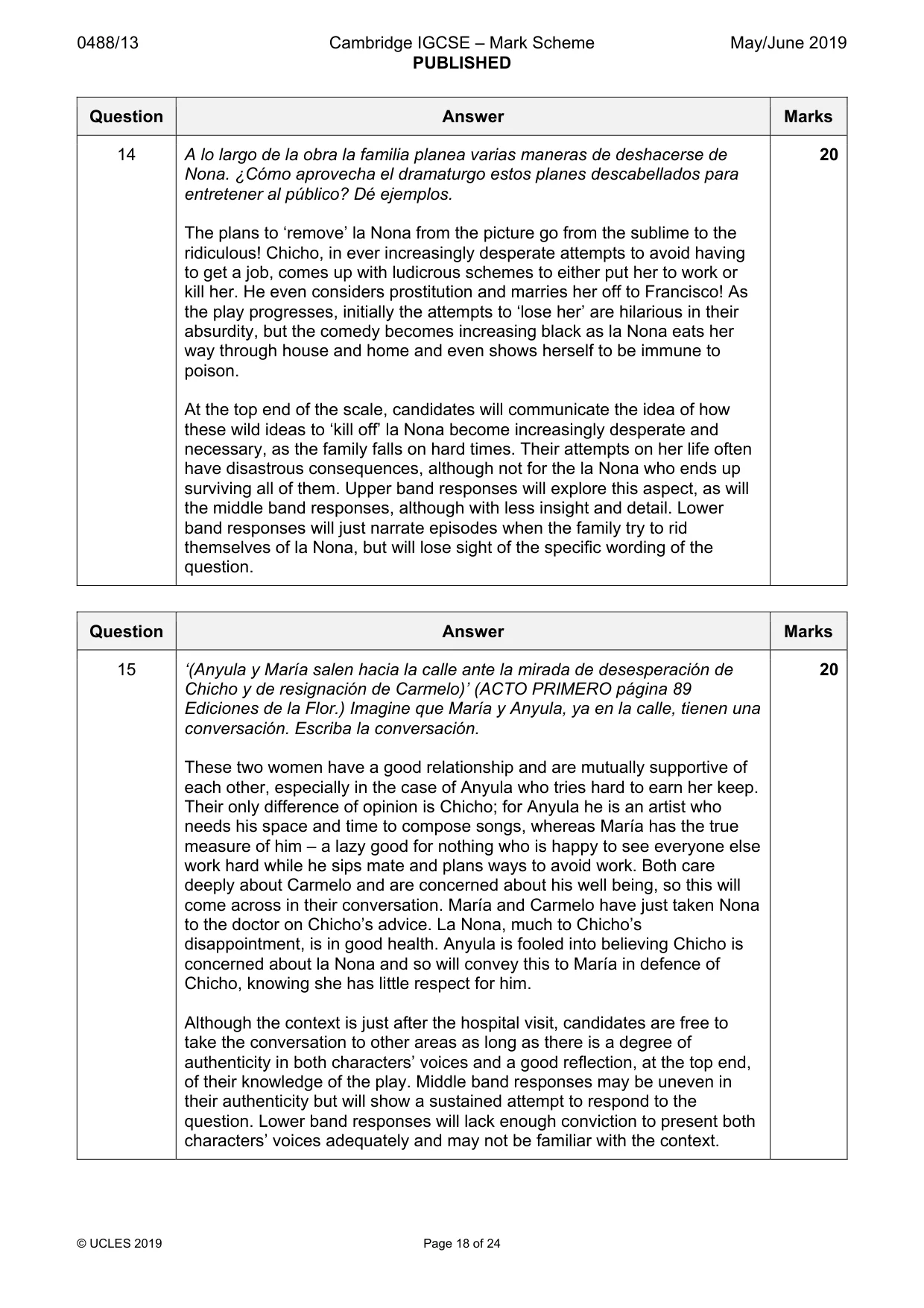
0488/13 Cambridge IGCSE – Mark Scheme PUBLISHED May/June 2019 © UCLES 2019 Page 18 of 24 Question Answer Marks 14 A lo largo de la obra la familia planea varias maneras de deshacerse de Nona. ¿Cómo aprovecha el dramaturgo estos planes descabellados para entretener al público? Dé ejemplos. The plans to ‘remove’ la Nona from the picture go from the sublime to the ridiculous! Chicho, in ever increasingly desperate attempts to avoid having to get a job, comes up with ludicrous schemes to either put her to work or kill her. He even considers prostitution and marries her off to Francisco! As the play progresses, initially the attempts to ‘lose her’ are hilarious in their absurdity, but the comedy becomes increasing black as la Nona eats her way through house and home and even shows herself to be immune to poison. At the top end of the scale, candidates will communicate the idea of how these wild ideas to ‘kill off’ la Nona become increasingly desperate and necessary, as the family falls on hard times. Their attempts on her life often have disastrous consequences, although not for the la Nona who ends up surviving all of them. Upper band responses will explore this aspect, as will the middle band responses, although with less insight and detail. Lower band responses will just narrate episodes when the family try to rid themselves of la Nona, but will lose sight of the specific wording of the question. 20 Question Answer Marks 15 ‘(Anyula y María salen hacia la calle ante la mirada de desesperación de Chicho y de resignación de Carmelo)’ (ACTO PRIMERO página 89 Ediciones de la Flor.) Imagine que María y Anyula, ya en la calle, tienen una conversación. Escriba la conversación. These two women have a good relationship and are mutually supportive of each other, especially in the case of Anyula who tries hard to earn her keep. Their only difference of opinion is Chicho; for Anyula he is an artist who needs his space and time to compose songs, whereas María has the true measure of him – a lazy good for nothing who is happy to see everyone else work hard while he sips mate and plans ways to avoid work. Both care deeply about Carmelo and are concerned about his well being, so this will come across in their conversation. María and Carmelo have just taken Nona to the doctor on Chicho’s advice. La Nona, much to Chicho’s disappointment, is in good health. Anyula is fooled into believing Chicho is concerned about la Nona and so will convey this to María in defence of Chicho, knowing she has little respect for him. Although the context is just after the hospital visit, candidates are free to take the conversation to other areas as long as there is a degree of authenticity in both characters’ voices and a good reflection, at the top end, of their knowledge of the play. Middle band responses may be uneven in their authenticity but will show a sustained attempt to respond to the question. Lower band responses will lack enough conviction to present both characters’ voices adequately and may not be familiar with the context. 20
Mark scheme, page 19
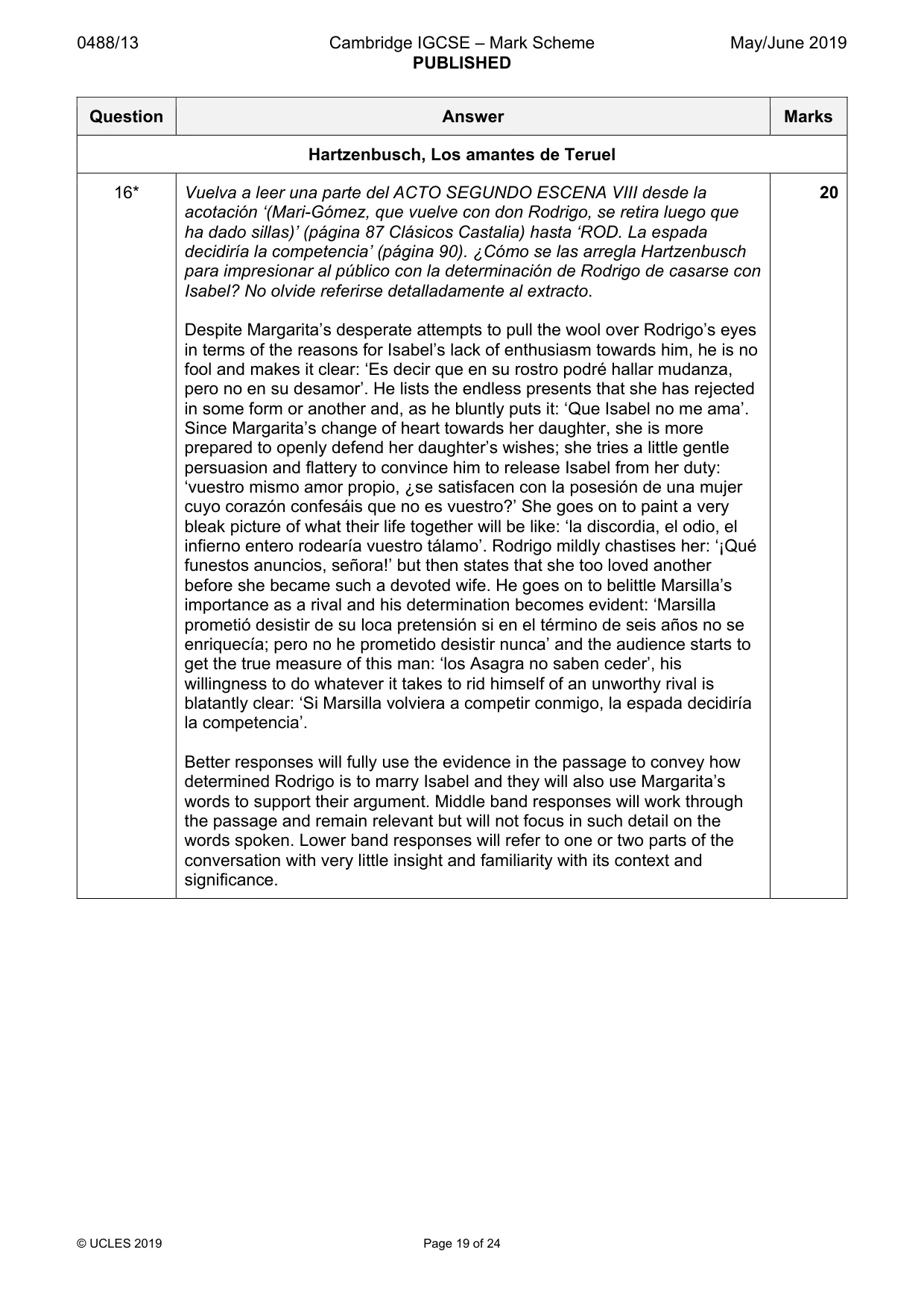
0488/13 Cambridge IGCSE – Mark Scheme PUBLISHED May/June 2019 © UCLES 2019 Page 19 of 24 Question Answer Marks Hartzenbusch, Los amantes de Teruel 16* Vuelva a leer una parte del ACTO SEGUNDO ESCENA VIII desde la acotación ‘(Mari-Gómez, que vuelve con don Rodrigo, se retira luego que ha dado sillas)’ (página 87 Clásicos Castalia) hasta ‘ROD. La espada decidiría la competencia’ (página 90). ¿Cómo se las arregla Hartzenbusch para impresionar al público con la determinación de Rodrigo de casarse con Isabel? No olvide referirse detalladamente al extracto. Despite Margarita’s desperate attempts to pull the wool over Rodrigo’s eyes in terms of the reasons for Isabel’s lack of enthusiasm towards him, he is no fool and makes it clear: ‘Es decir que en su rostro podré hallar mudanza, pero no en su desamor’. He lists the endless presents that she has rejected in some form or another and, as he bluntly puts it: ‘Que Isabel no me ama’. Since Margarita’s change of heart towards her daughter, she is more prepared to openly defend her daughter’s wishes; she tries a little gentle persuasion and flattery to convince him to release Isabel from her duty: ‘vuestro mismo amor propio, ¿se satisfacen con la posesión de una mujer cuyo corazón confesáis que no es vuestro?’ She goes on to paint a very bleak picture of what their life together will be like: ‘la discordia, el odio, el infierno entero rodearía vuestro tálamo’. Rodrigo mildly chastises her: ‘¡Qué funestos anuncios, señora!’ but then states that she too loved another before she became such a devoted wife. He goes on to belittle Marsilla’s importance as a rival and his determination becomes evident: ‘Marsilla prometió desistir de su loca pretensión si en el término de seis años no se enriquecía; pero no he prometido desistir nunca’ and the audience starts to get the true measure of this man: ‘los Asagra no saben ceder’, his willingness to do whatever it takes to rid himself of an unworthy rival is blatantly clear: ‘Si Marsilla volviera a competir conmigo, la espada decidiría la competencia’. Better responses will fully use the evidence in the passage to convey how determined Rodrigo is to marry Isabel and they will also use Margarita’s words to support their argument. Middle band responses will work through the passage and remain relevant but will not focus in such detail on the words spoken. Lower band responses will refer to one or two parts of the conversation with very little insight and familiarity with its context and significance. 20
Mark scheme, page 20
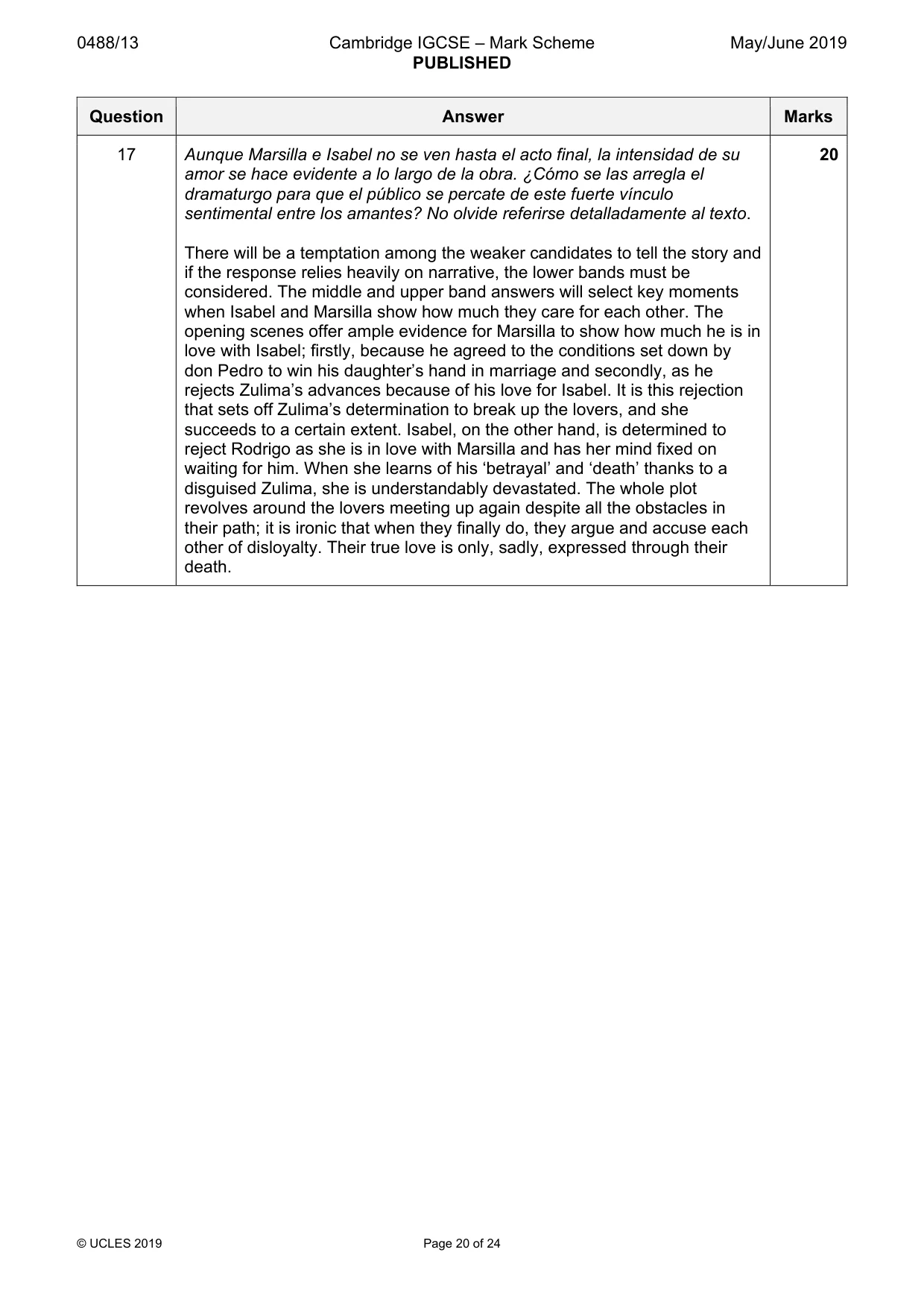
0488/13 Cambridge IGCSE – Mark Scheme PUBLISHED May/June 2019 © UCLES 2019 Page 20 of 24 Question Answer Marks 17 Aunque Marsilla e Isabel no se ven hasta el acto final, la intensidad de su amor se hace evidente a lo largo de la obra. ¿Cómo se las arregla el dramaturgo para que el público se percate de este fuerte vínculo sentimental entre los amantes? No olvide referirse detalladamente al texto. There will be a temptation among the weaker candidates to tell the story and if the response relies heavily on narrative, the lower bands must be considered. The middle and upper band answers will select key moments when Isabel and Marsilla show how much they care for each other. The opening scenes offer ample evidence for Marsilla to show how much he is in love with Isabel; firstly, because he agreed to the conditions set down by don Pedro to win his daughter’s hand in marriage and secondly, as he rejects Zulima’s advances because of his love for Isabel. It is this rejection that sets off Zulima’s determination to break up the lovers, and she succeeds to a certain extent. Isabel, on the other hand, is determined to reject Rodrigo as she is in love with Marsilla and has her mind fixed on waiting for him. When she learns of his ‘betrayal’ and ‘death’ thanks to a disguised Zulima, she is understandably devastated. The whole plot revolves around the lovers meeting up again despite all the obstacles in their path; it is ironic that when they finally do, they argue and accuse each other of disloyalty. Their true love is only, sadly, expressed through their death. 20
Mark scheme, page 21
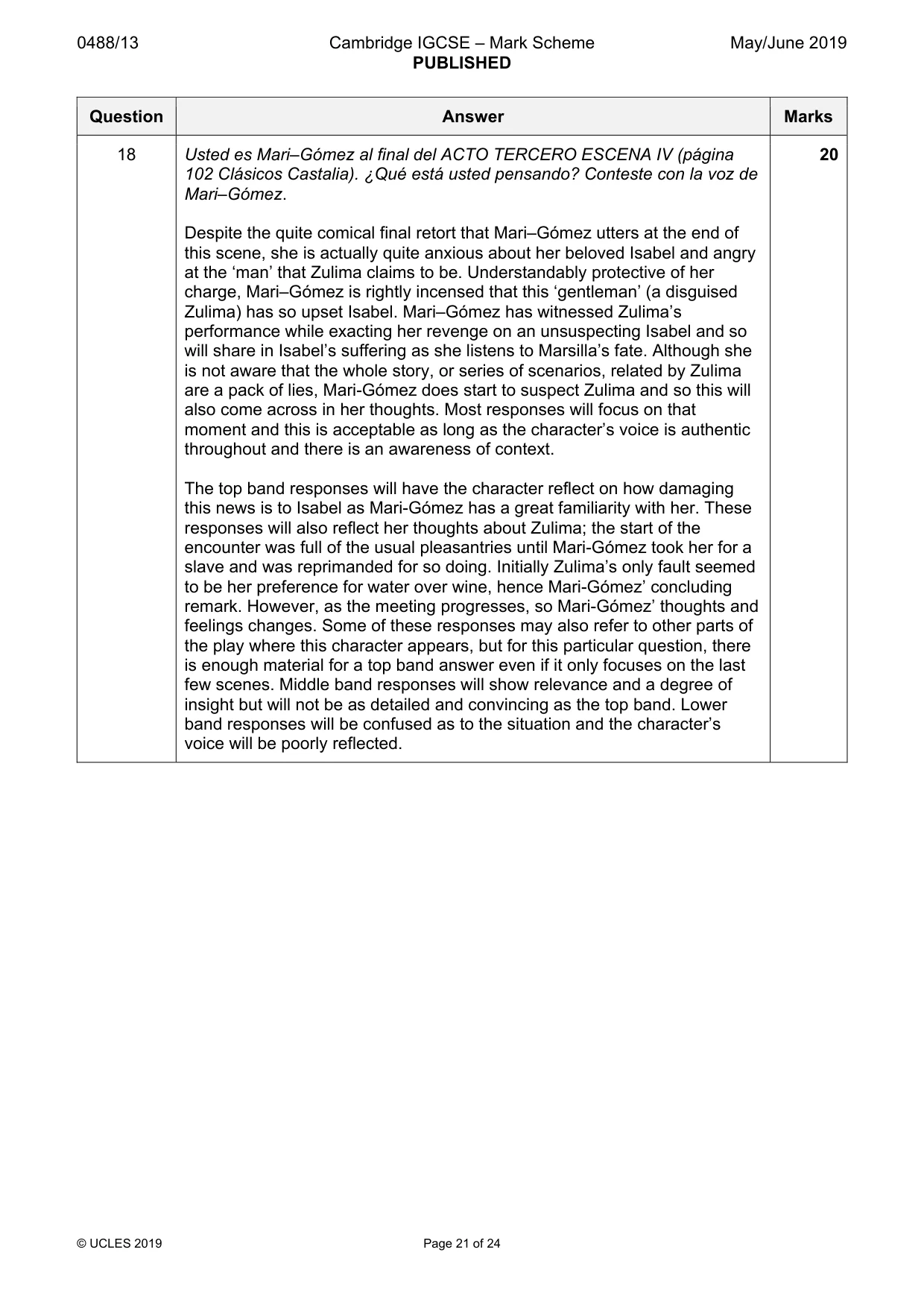
0488/13 Cambridge IGCSE – Mark Scheme PUBLISHED May/June 2019 © UCLES 2019 Page 21 of 24 Question Answer Marks 18 Usted es Mari–Gómez al final del ACTO TERCERO ESCENA IV (página 102 Clásicos Castalia). ¿Qué está usted pensando? Conteste con la voz de Mari–Gómez. Despite the quite comical final retort that Mari–Gómez utters at the end of this scene, she is actually quite anxious about her beloved Isabel and angry at the ‘man’ that Zulima claims to be. Understandably protective of her charge, Mari–Gómez is rightly incensed that this ‘gentleman’ (a disguised Zulima) has so upset Isabel. Mari–Gómez has witnessed Zulima’s performance while exacting her revenge on an unsuspecting Isabel and so will share in Isabel’s suffering as she listens to Marsilla’s fate. Although she is not aware that the whole story, or series of scenarios, related by Zulima are a pack of lies, Mari-Gómez does start to suspect Zulima and so this will also come across in her thoughts. Most responses will focus on that moment and this is acceptable as long as the character’s voice is authentic throughout and there is an awareness of context. The top band responses will have the character reflect on how damaging this news is to Isabel as Mari-Gómez has a great familiarity with her. These responses will also reflect her thoughts about Zulima; the start of the encounter was full of the usual pleasantries until Mari-Gómez took her for a slave and was reprimanded for so doing. Initially Zulima’s only fault seemed to be her preference for water over wine, hence Mari-Gómez’ concluding remark. However, as the meeting progresses, so Mari-Gómez’ thoughts and feelings changes. Some of these responses may also refer to other parts of the play where this character appears, but for this particular question, there is enough material for a top band answer even if it only focuses on the last few scenes. Middle band responses will show relevance and a degree of insight but will not be as detailed and convincing as the top band. Lower band responses will be confused as to the situation and the character’s voice will be poorly reflected. 20
Mark scheme, page 22
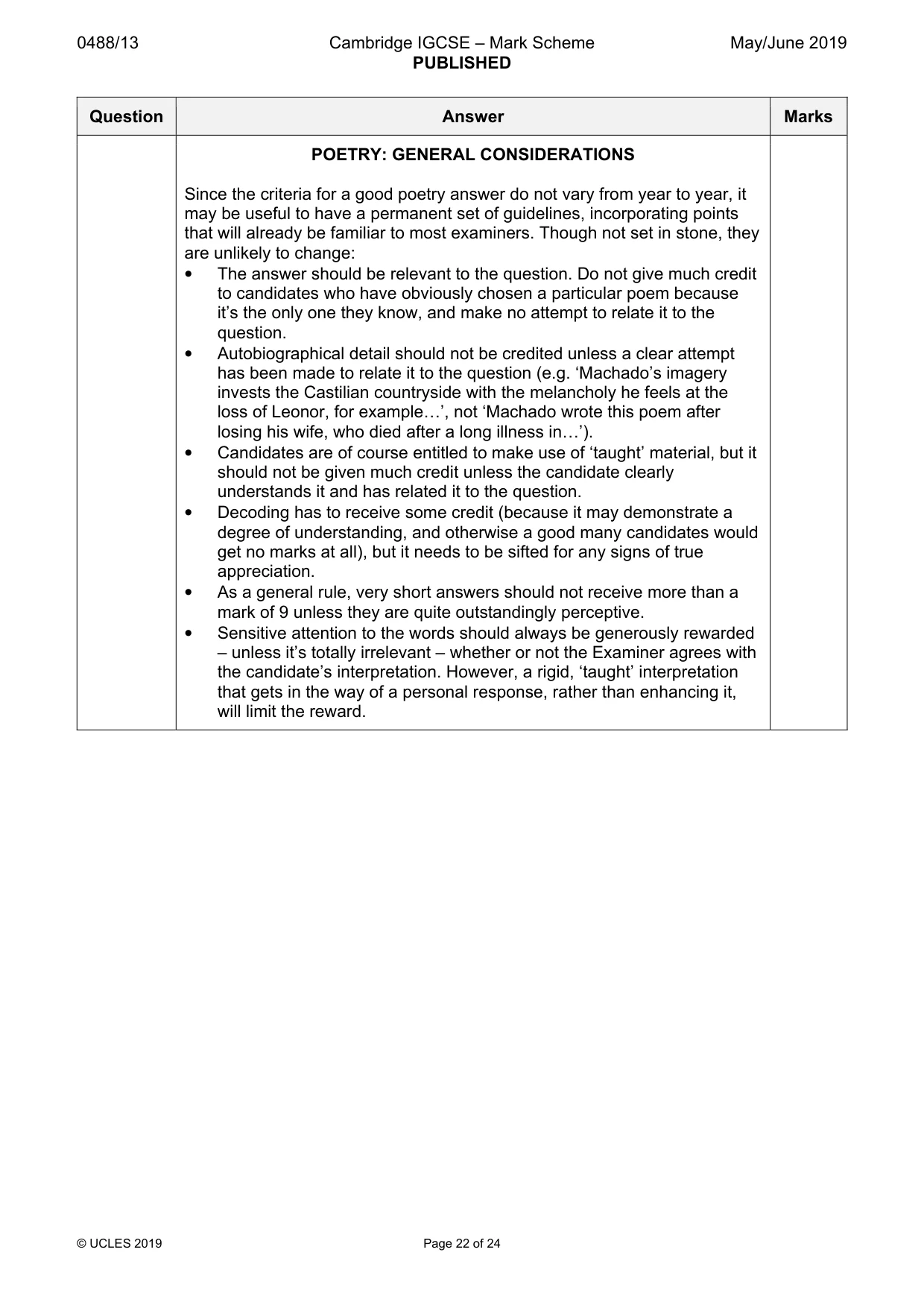
0488/13 Cambridge IGCSE – Mark Scheme PUBLISHED May/June 2019 © UCLES 2019 Page 22 of 24 Question Answer Marks POETRY: GENERAL CONSIDERATIONS Since the criteria for a good poetry answer do not vary from year to year, it may be useful to have a permanent set of guidelines, incorporating points that will already be familiar to most examiners. Though not set in stone, they are unlikely to change: • The answer should be relevant to the question. Do not give much credit to candidates who have obviously chosen a particular poem because it’s the only one they know, and make no attempt to relate it to the question. • Autobiographical detail should not be credited unless a clear attempt has been made to relate it to the question (e.g. ‘Machado’s imagery invests the Castilian countryside with the melancholy he feels at the loss of Leonor, for example«’, not ‘Machado wrote this poem after losing his wife, who died after a long illness in«’). • Candidates are of course entitled to make use of ‘taught’ material, but it should not be given much credit unless the candidate clearly understands it and has related it to the question. • Decoding has to receive some credit (because it may demonstrate a degree of understanding, and otherwise a good many candidates would get no marks at all), but it needs to be sifted for any signs of true appreciation. • As a general rule, very short answers should not receive more than a mark of 9 unless they are quite outstandingly perceptive. • Sensitive attention to the words should always be generously rewarded – unless it’s totally irrelevant – whether or not the Examiner agrees with the candidate’s interpretation. However, a rigid, ‘taught’ interpretation that gets in the way of a personal response, rather than enhancing it, will limit the reward.
Mark scheme, page 23
0488/13 Cambridge IGCSE – Mark Scheme PUBLISHED May/June 2019 © UCLES 2019 Page 23 of 24 Question Answer Marks Biagioni, Poesía completa 19* Vuelva a leer el poema PUERTO (páginas 122–123 Adriana Hidalgo editora). ¿Cómo se las arregla Biagioni aquí para que su paso por el puerto sea emocionante e intrigante a la vez? The poet seems disturbed by what she is seeing around her initially, perhaps sensing she is in danger, however there is also the exciting trepidation of the explorer about her: ‘Entro a la noche del Puerto / igual que un explorador.’ She leaves the nebulous atmosphere of the port and walks into a smoke-filled bar, her eyes sweep around the room, taking in the occupants and observing what each is doing. She partakes of a drink that is so strong she calls it ‘furia negra’ ‘copa de infierno’. She drinks to give herself courage and overcome her fear, while a sailor: ‘me acecha con un silencio de ron’. She takes her leave quickly: ‘huyo por la sombra viva / corro entre el silencio y Dios’ praying that nothing will happen to her. Intriguingly, she leaves the port: ‘con gloria de explorador’ and: Mi alta risa blanca’ that lights up the night, relieved perhaps, to distance herself ‘del puerto y del susto.’ The most impressive answers will work through the poem and show a detailed and relevant appreciation of the tableaux the poet presents as she walks through the port and enters the bar. These responses will comment on the key aspects of the poem but not every line, as it is a long poem. Here we will see a personal interpretation that maintains relevance to the question. Middle band responses will focus on fewer aspects of the poem, will be relevant but will lack the sophistication of the upper bands. Weaker responses will not be very insightful and will comment on a few of the poem’s more obvious themes. 20 Question Answer Marks 20 Dé su apreciación de cómo la poetisa evoca un mundo surreal y mágico en UNO de los siguientes poemas. ALGUIEN SE BUSCA EN ALTAMIRA (páginas 542–543 Adriana Hidalgo editora) NOCTURNO (páginas 563– 564). See general notes. 20 Question Answer Marks 21 Dé su apreciación de cómo la poetisa aprovecha el lenguaje para que el ritmo llame la atención del lector en UNO de los siguientes poemas. CANCIÓN PARA NO PROBARLA (página 86 Adriana Hidalgo editora) CANCIÓN DE LA PENA CÓMODA (página 105) CONCÉNTRICOS (páginas 383–384) See general notes. 20
Mark scheme, page 24
0488/13 Cambridge IGCSE – Mark Scheme PUBLISHED May/June 2019 © UCLES 2019 Page 24 of 24 Question Answer Marks Quevedo, Poemas escogidos 22* Vuelva a leer el poema Torcido, desigual, blando y sonoro (páginas 148– 149 Clásicos Castalia). Aprecie cómo el poeta aprovecha el lenguaje para expresar sus sentimientos mientras contempla las peculiaridades del arroyo. The poet’s fascination with the brook has him contemplating his relationship with a woman who, it appears, either does not reciprocate his love or is behaving in a way that appears difficult to comprehend. The first two lines appear to merely refer to the way the brook moves easily over any obstacle in its path as it follows its natural course: ‘Torcido, desigual, blando y sonoro’. As the first quartet progresses, we begin to see how he could also be referring to someone in particular: ‘Te resbalas secreto entre las flores’ «’Cano en la espuma y rubio en el oro’. In the following quartet, he begins to convey his own feelings as he contemplates the water as it flows past: ‘Te ríes de crecer con lo que lloro’. As the poem progresses, so we note his disillusionment as he contrasts the apparently happy passing of the stream: ‘gozoso vas al monte’ with how he feels trapped in his own prison of sadness. Pre-learnt decodes that make no attempt to appreciate the language in light of the question, will not be placed very high up the scale. The better responses will evaluate each line and consider both aspects of the question while giving a thorough appreciation of the sonnet. Middle band responses will also be relevant on the whole, but there may be some omissions or less convincing interpretations. At the lower end, we will see summaries and generalisations with little quoting or focus on the words of the poem. 20 Question Answer Marks 23 ¿Cómo se vale el poeta de la repetición para entretener al lector en UNO de los siguientes poemas? Pues amarga la verdad (páginas 219–221 Clásicos Castalia) Yo, que nunca sé callar (páginas 221–223) Poderoso caballero es don Dinero (versos 1–40 páginas 229–230). See general notes. 20 Question Answer Marks 24 Aprecie cómo el poeta se vale del lenguaje para hacer una crítica ingeniosa en UNO de los siguientes poemas. No digas, cuando vieres alto el vuelo (página 92 Clásicos Castalia) Las leyes con que juzgas, ¡oh Batino! (página 96). See general notes. 20
What you needed in this session
Cambridge’s own grade thresholds for 2019 May/June, Paper 1 · Variant 3. A higher threshold means an easier paper — the bar moves with how the cohort did.