Cambridge IGCSE Spanish - Literature 0488 — 2018 May/June Paper 1 · Variant 3
0488/13/M/J/18 · 60 marks · ≈68 min
The question paper and its mark scheme, free to read here and free to download. This is Cambridge’s own paper, exactly as it was sat.
Question paper8 pages


Mark scheme29 pages
Answers below. Sit the paper first if you are practising.
Paper as text
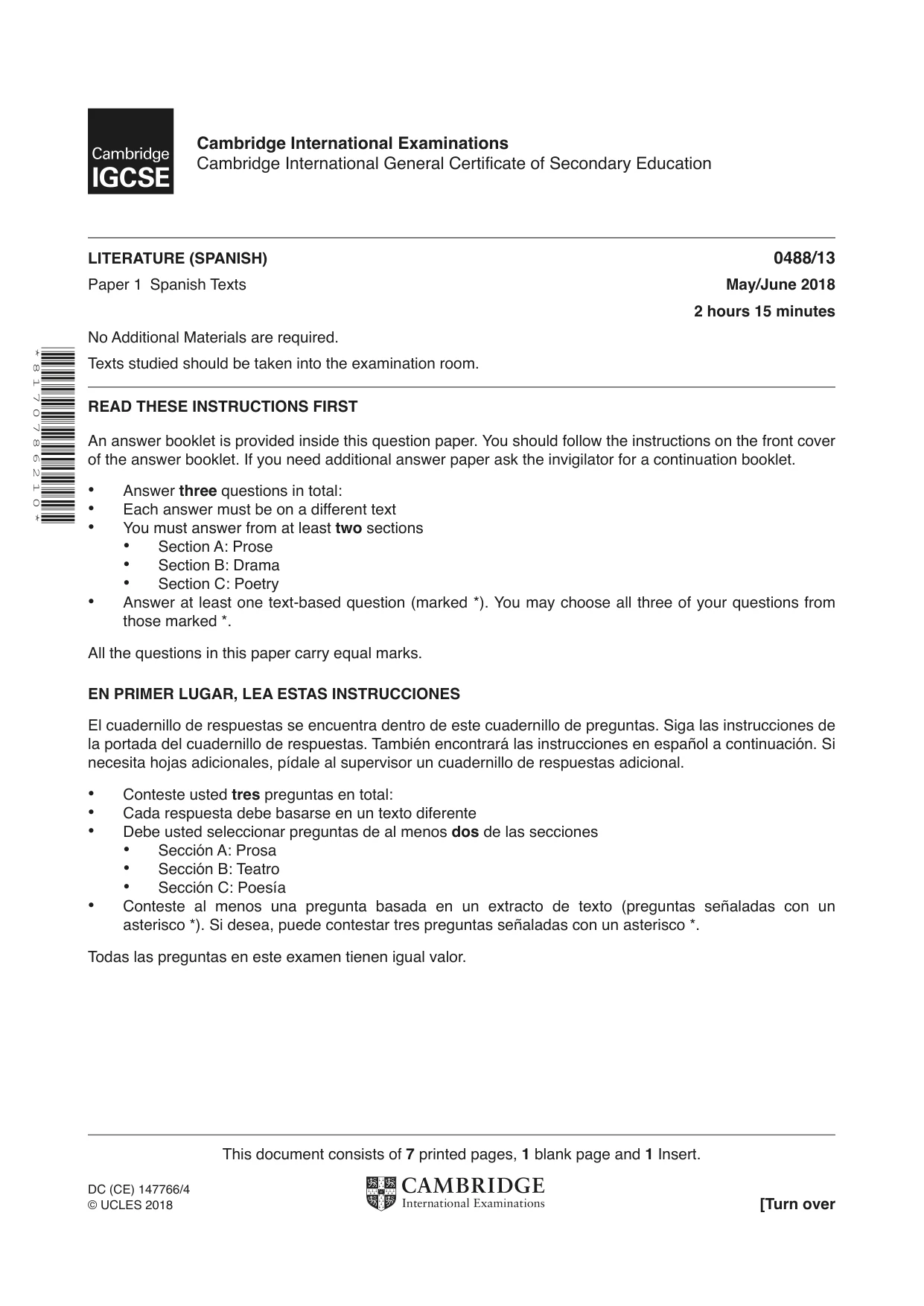
Question paper, page 1
* 8 1 7 0 7 8 6 2 1 0 * This document consists of 7 printed pages, 1 blank page and 1 Insert. DC (CE) 147766/4 © UCLES 2018 [Turn over Cambridge International Examinations Cambridge International General Certificate of Secondary Education LITERATURE (SPANISH) 0488/13 Paper 1 Spanish Texts May/June 2018 2 hours 15 minutes No Additional Materials are required. Texts studied should be taken into the examination room. READ THESE INSTRUCTIONS FIRST An answer booklet is provided inside this question paper. You should follow the instructions on the front cover of the answer booklet. If you need additional answer paper ask the invigilator for a continuation booklet. • Answer three questions in total: • Each answer must be on a different text • You must answer from at least two sections • Section A: Prose • Section B: Drama • Section C: Poetry • Answer at least one text-based question (marked *). You may choose all three of your questions from those marked *. All the questions in this paper carry equal marks. EN PRIMER LUGAR, LEA ESTAS INSTRUCCIONES El cuadernillo de respuestas se encuentra dentro de este cuadernillo de preguntas. Siga las instrucciones de la portada del cuadernillo de respuestas. También encontrará las instrucciones en español a continuación. Si necesita hojas adicionales, pídale al supervisor un cuadernillo de respuestas adicional. • Conteste usted tres preguntas en total: • Cada respuesta debe basarse en un texto diferente • Debe usted seleccionar preguntas de al menos dos de las secciones • Sección A: Prosa • Sección B: Teatro • Sección C: Poesía • Conteste al menos una pregunta basada en un extracto de texto (preguntas señaladas con un asterisco *). Si desea, puede contestar tres preguntas señaladas con un asterisco *. Todas las preguntas en este examen tienen igual valor.
Question paper, page 2
2 0488/13/M/J/18 © UCLES 2018 INSTRUCCIONES DEL CUADERNILLO DE RESPUESTAS Rellene las casillas de la portada del cuadernillo de respuestas con letra mayúscula. Use tinta azul oscuro o negra. NO ESCRIBA EN NINGÚN CÓDIGO DE BARRAS. Escriba sus respuestas en el cuadernillo de respuestas. Utilice ambas caras del papel. Por favor deje dos líneas en blanco entre sus respuestas a cada pregunta. Escriba el número de la pregunta que está contestando en el primer margen. Question Part 1 1 ai aii Si la pregunta que está contestando también contiene secciones, por ejemplo 1a, escriba la sección de la pregunta en el segundo margen. Si ha utilizado cuadernillos de respuestas adicionales, por favor guárdelos dentro del cuadernillo de respuestas.
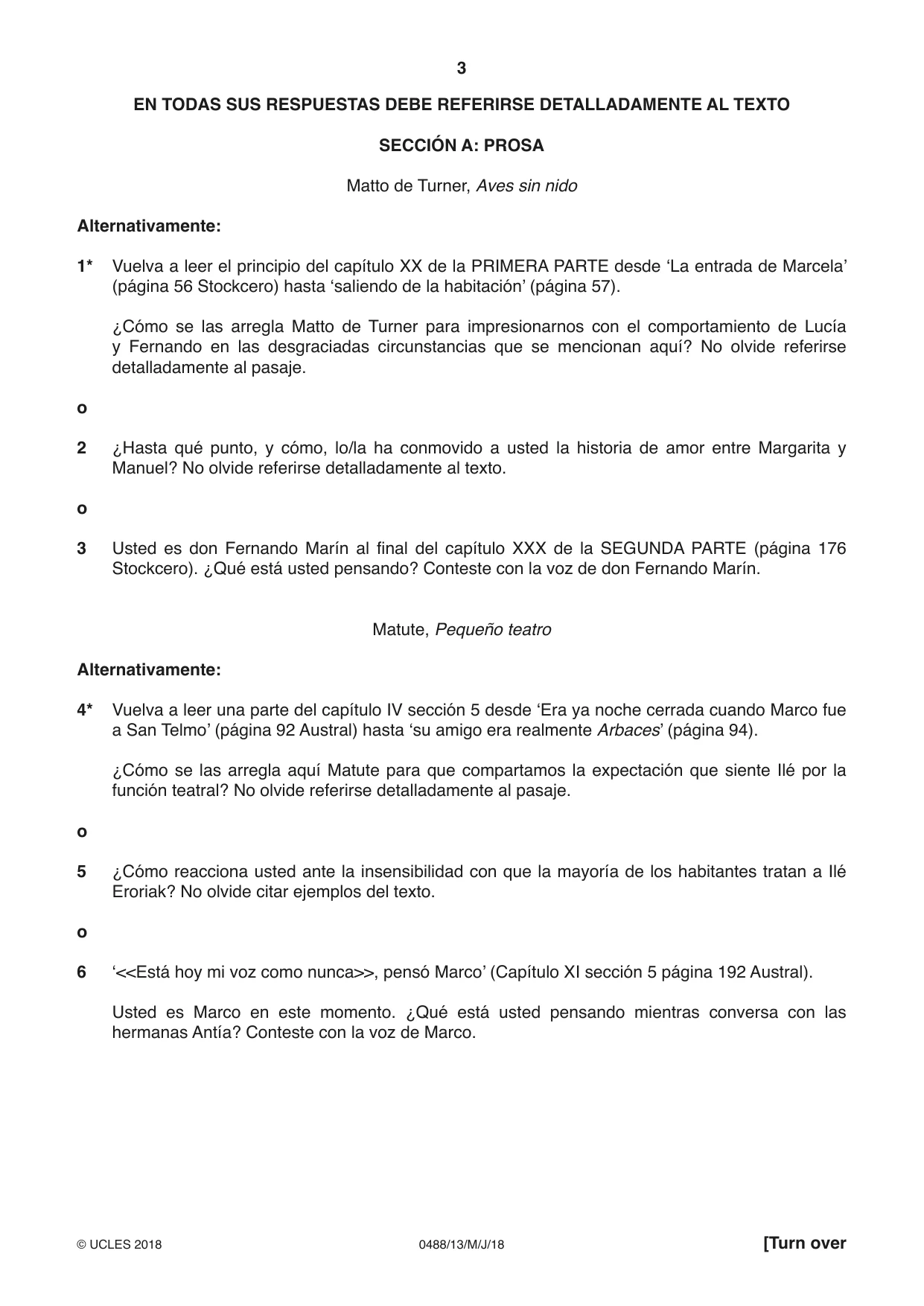
Question paper, page 3
3 0488/13/M/J/18 © UCLES 2018 [Turn over EN TODAS SUS RESPUESTAS DEBE REFERIRSE DETALLADAMENTE AL TEXTO SECCIÓN A: PROSA Matto de Turner, Aves sin nido Alternativamente: 1* Vuelva a leer el principio del capítulo XX de la PRIMERA PARTE desde ‘La entrada de Marcela’ (página 56 Stockcero) hasta ‘saliendo de la habitación’ (página 57). ¿Cómo se las arregla Matto de Turner para impresionarnos con el comportamiento de Lucía y Fernando en las desgraciadas circunstancias que se mencionan aquí? No olvide referirse detalladamente al pasaje. o 2 ¿Hasta qué punto, y cómo, lo/la ha conmovido a usted la historia de amor entre Margarita y Manuel? No olvide referirse detalladamente al texto. o 3 Usted es don Fernando Marín al final del capítulo XXX de la SEGUNDA PARTE (página 176 Stockcero). ¿Qué está usted pensando? Conteste con la voz de don Fernando Marín. Matute, Pequeño teatro Alternativamente: 4* Vuelva a leer una parte del capítulo IV sección 5 desde ‘Era ya noche cerrada cuando Marco fue a San Telmo’ (página 92 Austral) hasta ‘su amigo era realmente Arbaces’ (página 94). ¿Cómo se las arregla aquí Matute para que compartamos la expectación que siente Ilé por la función teatral? No olvide referirse detalladamente al pasaje. o 5 ¿Cómo reacciona usted ante la insensibilidad con que la mayoría de los habitantes tratan a Ilé Eroriak? No olvide citar ejemplos del texto. o 6 ‘<<Está hoy mi voz como nunca>>, pensó Marco’ (Capítulo XI sección 5 página 192 Austral). Usted es Marco en este momento. ¿Qué está usted pensando mientras conversa con las hermanas Antía? Conteste con la voz de Marco.
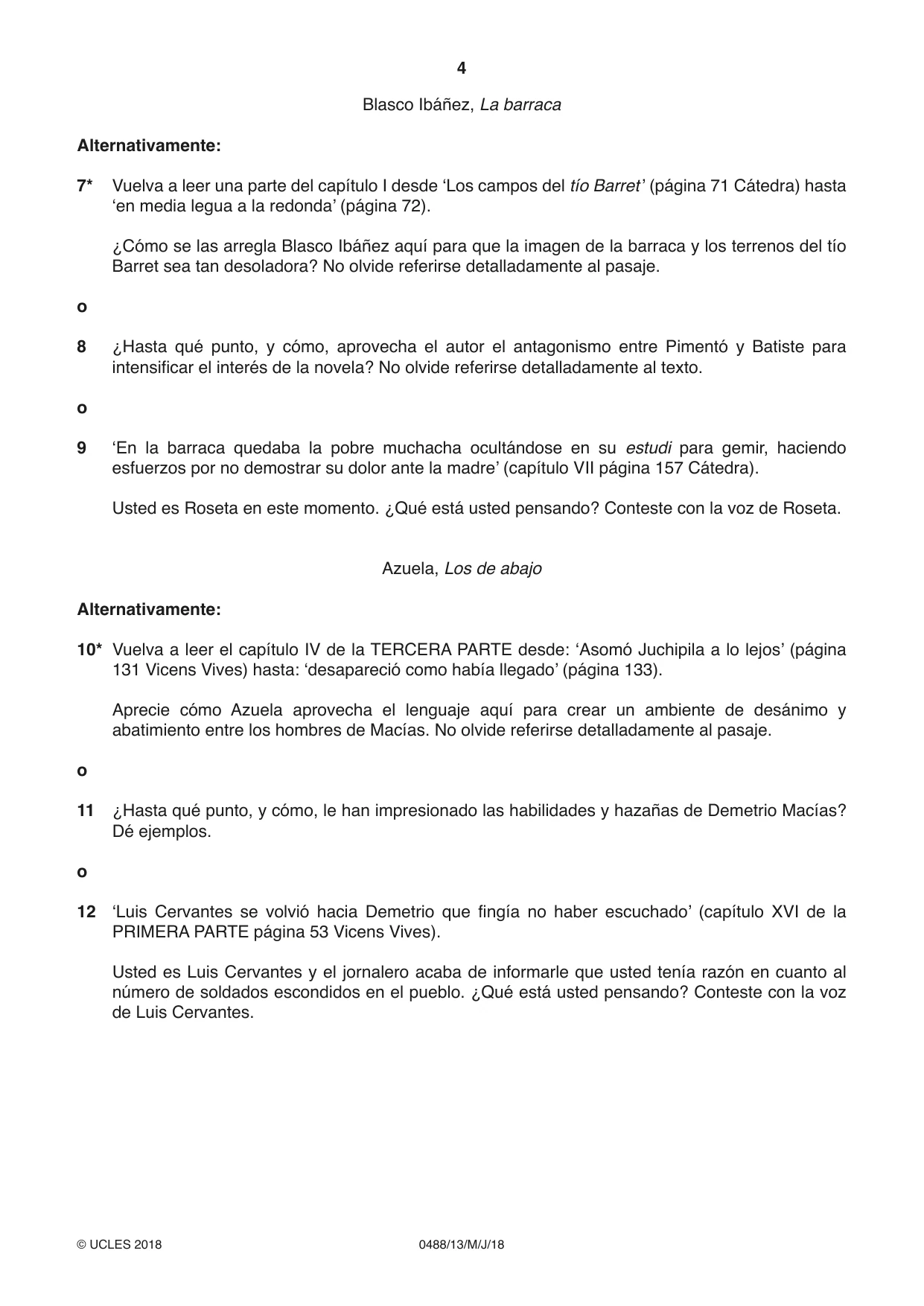
Question paper, page 4
4 0488/13/M/J/18 © UCLES 2018 Blasco Ibáñez, La barraca Alternativamente: 7* Vuelva a leer una parte del capítulo I desde ‘Los campos del tío Barret ’ (página 71 Cátedra) hasta ‘en media legua a la redonda’ (página 72). ¿Cómo se las arregla Blasco Ibáñez aquí para que la imagen de la barraca y los terrenos del tío Barret sea tan desoladora? No olvide referirse detalladamente al pasaje. o 8 ¿Hasta qué punto, y cómo, aprovecha el autor el antagonismo entre Pimentó y Batiste para intensificar el interés de la novela? No olvide referirse detalladamente al texto. o 9 ‘En la barraca quedaba la pobre muchacha ocultándose en su estudi para gemir, haciendo esfuerzos por no demostrar su dolor ante la madre’ (capítulo VII página 157 Cátedra). Usted es Roseta en este momento. ¿Qué está usted pensando? Conteste con la voz de Roseta. Azuela, Los de abajo Alternativamente: 10* Vuelva a leer el capítulo IV de la TERCERA PARTE desde: ‘Asomó Juchipila a lo lejos’ (página 131 Vicens Vives) hasta: ‘desapareció como había llegado’ (página 133). Aprecie cómo Azuela aprovecha el lenguaje aquí para crear un ambiente de desánimo y abatimiento entre los hombres de Macías. No olvide referirse detalladamente al pasaje. o 11 ¿Hasta qué punto, y cómo, le han impresionado las habilidades y hazañas de Demetrio Macías? Dé ejemplos. o 12 ‘Luis Cervantes se volvió hacia Demetrio que fingía no haber escuchado’ (capítulo XVI de la PRIMERA PARTE página 53 Vicens Vives). Usted es Luis Cervantes y el jornalero acaba de informarle que usted tenía razón en cuanto al número de soldados escondidos en el pueblo. ¿Qué está usted pensando? Conteste con la voz de Luis Cervantes.
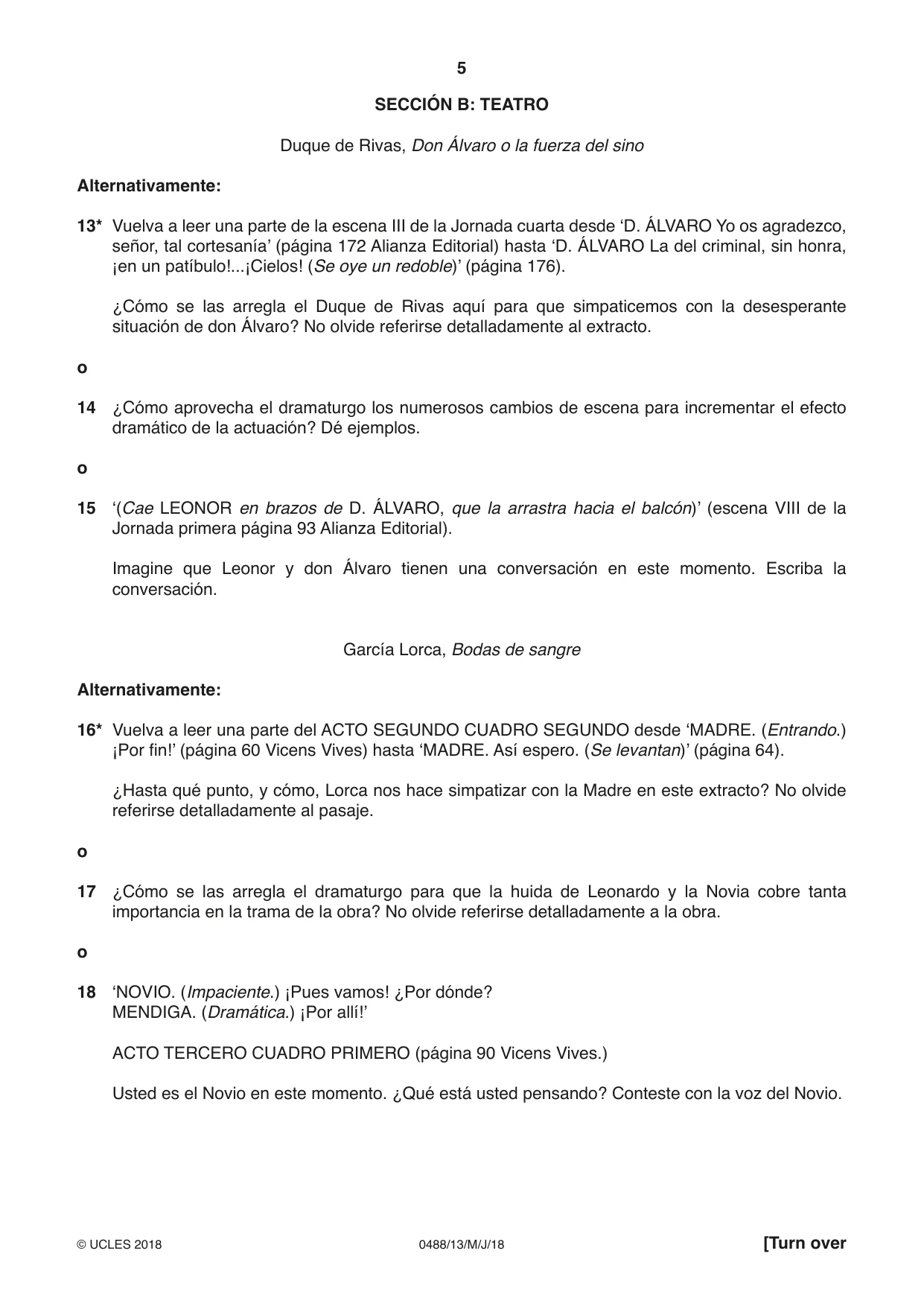
Question paper, page 5
5 0488/13/M/J/18 © UCLES 2018 [Turn over SECCIÓN B: TEATRO Duque de Rivas, Don Álvaro o la fuerza del sino Alternativamente: 13* Vuelva a leer una parte de la escena III de la Jornada cuarta desde ‘D. ÁLVARO Yo os agradezco, señor, tal cortesanía’ (página 172 Alianza Editorial) hasta ‘D. ÁLVARO La del criminal, sin honra, ¡en un patíbulo!...¡Cielos! (Se oye un redoble)’ (página 176). ¿Cómo se las arregla el Duque de Rivas aquí para que simpaticemos con la desesperante situación de don Álvaro? No olvide referirse detalladamente al extracto. o 14 ¿Cómo aprovecha el dramaturgo los numerosos cambios de escena para incrementar el efecto dramático de la actuación? Dé ejemplos. o 15 ‘(Cae LEONOR en brazos de D. ÁLVARO, que la arrastra hacia el balcón)’ (escena VIII de la Jornada primera página 93 Alianza Editorial). Imagine que Leonor y don Álvaro tienen una conversación en este momento. Escriba la conversación. García Lorca, Bodas de sangre Alternativamente: 16* Vuelva a leer una parte del ACTO SEGUNDO CUADRO SEGUNDO desde ‘MADRE. (Entrando.) ¡Por fin!’ (página 60 Vicens Vives) hasta ‘MADRE. Así espero. (Se levantan)’ (página 64). ¿Hasta qué punto, y cómo, Lorca nos hace simpatizar con la Madre en este extracto? No olvide referirse detalladamente al pasaje. o 17 ¿Cómo se las arregla el dramaturgo para que la huida de Leonardo y la Novia cobre tanta importancia en la trama de la obra? No olvide referirse detalladamente a la obra. o 18 ‘NOVIO. (Impaciente.) ¡Pues vamos! ¿Por dónde? MENDIGA. (Dramática.) ¡Por allí!’ ACTO TERCERO CUADRO PRIMERO (página 90 Vicens Vives.) Usted es el Novio en este momento. ¿Qué está usted pensando? Conteste con la voz del Novio.
Question paper, page 6
6 0488/13/M/J/18 © UCLES 2018 SECCIÓN C: POESÍA García Montero, Poesía Alternativamente: 19* Vuelva a leer el poema PARECE que soy yo quien hasta mí se acerca (páginas 172–173 Tusquets). ¿Cómo se vale García Montero del lenguaje aquí para dar una emotiva mirada a su pasado? o 20 ¿Cómo se las arregla el poeta para comunicarnos la nostalgia que siente al reflexionar sobre una relación en UNO de los siguientes poemas? IMAGINAR los sitios posibles donde estabas (páginas 199–200 Tusquets) AUNQUE TÚ NO LO SEPAS (páginas 322–323). o 21 Aprecie cómo el poeta aprovecha el lenguaje para evocar un recuerdo muy vivo de un lugar particular en UNO de los siguientes poemas: HOJAS VERDES (páginas 508–509 Tusquets) ESCALA EN BARAJAS (páginas 303–304) COMO CADA MAÑANA (páginas 72–73).
Question paper, page 7
7 0488/13/M/J/18 © UCLES 2018 Biagioni, Poesía completa Alternativamente: 22* Vuelva a leer el poema ALGUIEN SE BUSCA EN ALTAMIRA (páginas 542–543 Adriana Hidalgo editora). ¿Cómo se las arregla Biagioni aquí para hacernos comprender lo maravillosas que son estas pinturas rupestres? o 23 Aprecie cómo la poetisa crea un efecto especial al proyectar sentimientos sobre un objeto inanimado en UNO de los siguientes poemas: CANCIÓN PARA UN ROPERO DE HOTEL (página 185 Adriana Hidalgo editora) POEMA DE AGOSTO (página 188) LA LLAVE (página 191). o 24 Aprecie cómo aprovecha la poetisa el lenguaje para comunicar lo fascinante que es mirar un mundo desde lo alto en UNO de los siguientes poemas. TORRE DEL TÉ (página 170) LA TORRE (páginas 237–238).
Question paper, page 8
8 0488/13/M/J/18 © UCLES 2018 Permission to reproduce items where third-party owned material protected by copyright is included has been sought and cleared where possible. Every reasonable effort has been made by the publisher (UCLES) to trace copyright holders, but if any items requiring clearance have unwittingly been included, the publisher will be pleased to make amends at the earliest possible opportunity. To avoid the issue of disclosure of answer-related information to candidates, all copyright acknowledgements are reproduced online in the Cambridge International Examinations Copyright Acknowledgements Booklet. This is produced for each series of examinations and is freely available to download at www.cie.org.uk after the live examination series. Cambridge International Examinations is part of the Cambridge Assessment Group. Cambridge Assessment is the brand name of University of Cambridge Local Examinations Syndicate (UCLES), which is itself a department of the University of Cambridge. BLANK PAGE
Mark scheme, page 1
IGCSE™ is a registered trademark. This document consists of 29 printed pages. © UCLES 2018 [Turn over Cambridge Assessment International Education Cambridge International General Certificate of Secondary Education LITERATURE (SPANISH) 0488/13 Paper 1 Set Texts (Open Books) May/June 2018 MARK SCHEME Maximum Mark: 60 Published This mark scheme is published as an aid to teachers and candidates, to indicate the requirements of the examination. It shows the basis on which Examiners were instructed to award marks. It does not indicate the details of the discussions that took place at an Examiners’ meeting before marking began, which would have considered the acceptability of alternative answers. Mark schemes should be read in conjunction with the question paper and the Principal Examiner Report for Teachers. Cambridge International will not enter into discussions about these mark schemes. Cambridge International is publishing the mark schemes for the May/June 2018 series for most Cambridge IGCSE™, Cambridge International A and AS Level and Cambridge Pre-U components, and some Cambridge O Level components.
Mark scheme, page 2
0488/13 Cambridge IGCSE – Mark Scheme PUBLISHED May/June 2018 © UCLES 2018 Page 2 of 29 Generic Marking Principles These general marking principles must be applied by all examiners when marking candidate answers. They should be applied alongside the specific content of the mark scheme or generic level descriptors for a question. Each question paper and mark scheme will also comply with these marking principles. GENERIC MARKING PRINCIPLE 1: Marks must be awarded in line with: • the specific content of the mark scheme or the generic level descriptors for the question • the specific skills defined in the mark scheme or in the generic level descriptors for the question • the standard of response required by a candidate as exemplified by the standardisation scripts. GENERIC MARKING PRINCIPLE 2: Marks awarded are always whole marks (not half marks, or other fractions). GENERIC MARKING PRINCIPLE 3: Marks must be awarded positively: • marks are awarded for correct/valid answers, as defined in the mark scheme. However, credit is given for valid answers which go beyond the scope of the syllabus and mark scheme, referring to your Team Leader as appropriate • marks are awarded when candidates clearly demonstrate what they know and can do • marks are not deducted for errors • marks are not deducted for omissions • answers should only be judged on the quality of spelling, punctuation and grammar when these features are specifically assessed by the question as indicated by the mark scheme. The meaning, however, should be unambiguous. GENERIC MARKING PRINCIPLE 4: Rules must be applied consistently e.g. in situations where candidates have not followed instructions or in the application of generic level descriptors. GENERIC MARKING PRINCIPLE 5: Marks should be awarded using the full range of marks defined in the mark scheme for the question (however; the use of the full mark range may be limited according to the quality of the candidate responses seen). GENERIC MARKING PRINCIPLE 6: Marks awarded are based solely on the requirements as defined in the mark scheme. Marks should not be awarded with grade thresholds or grade descriptors in mind.
Mark scheme, page 3
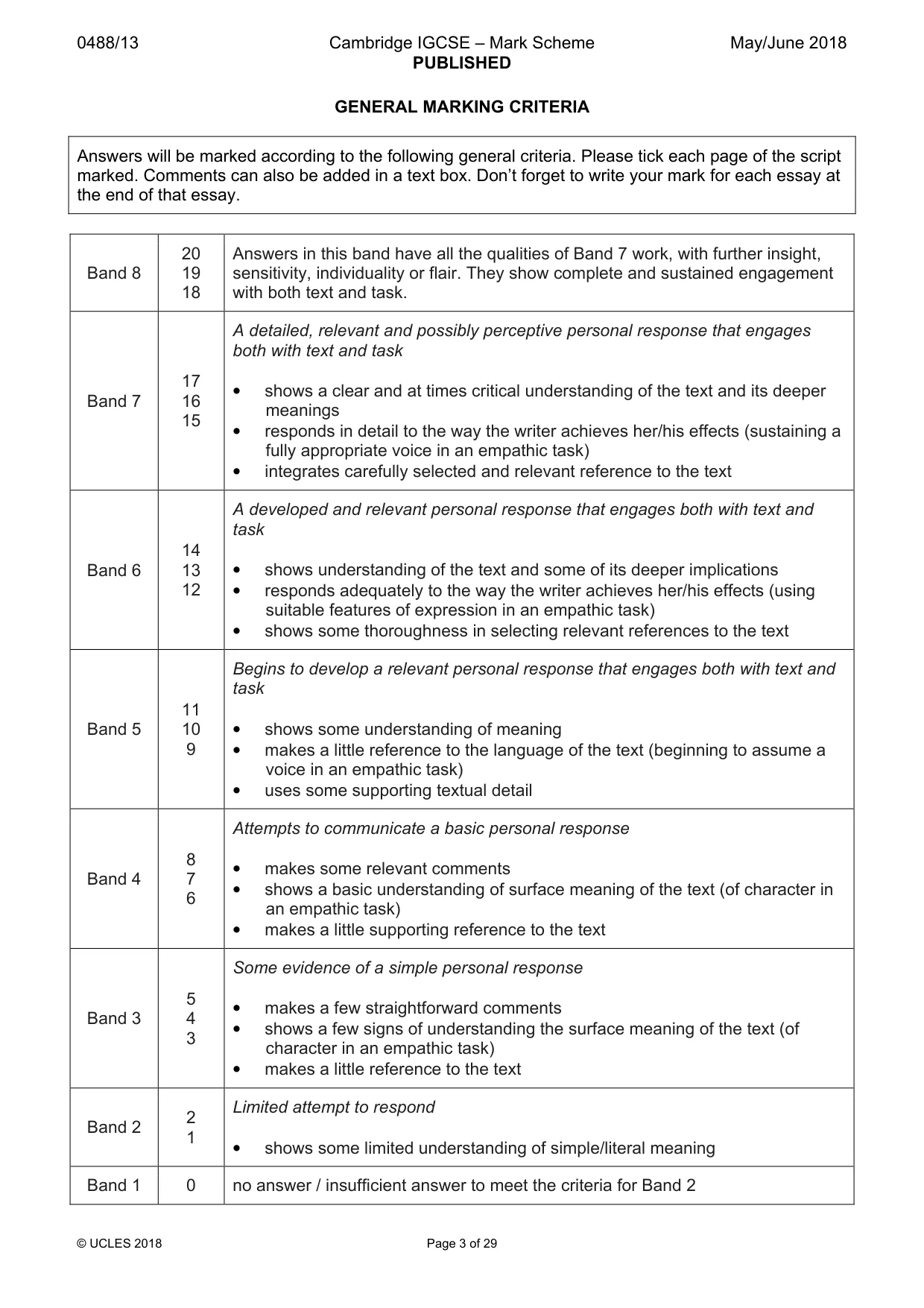
0488/13 Cambridge IGCSE – Mark Scheme PUBLISHED May/June 2018 © UCLES 2018 Page 3 of 29 GENERAL MARKING CRITERIA Answers will be marked according to the following general criteria. Please tick each page of the script marked. Comments can also be added in a text box. Don’t forget to write your mark for each essay at the end of that essay. Band 8 20 19 18 Answers in this band have all the qualities of Band 7 work, with further insight, sensitivity, individuality or flair. They show complete and sustained engagement with both text and task. Band 7 17 16 15 A detailed, relevant and possibly perceptive personal response that engages both with text and task • shows a clear and at times critical understanding of the text and its deeper meanings • responds in detail to the way the writer achieves her/his effects (sustaining a fully appropriate voice in an empathic task) • integrates carefully selected and relevant reference to the text Band 6 14 13 12 A developed and relevant personal response that engages both with text and task • shows understanding of the text and some of its deeper implications • responds adequately to the way the writer achieves her/his effects (using suitable features of expression in an empathic task) • shows some thoroughness in selecting relevant references to the text Band 5 11 10 9 Begins to develop a relevant personal response that engages both with text and task • shows some understanding of meaning • makes a little reference to the language of the text (beginning to assume a voice in an empathic task) • uses some supporting textual detail Band 4 8 7 6 Attempts to communicate a basic personal response • makes some relevant comments • shows a basic understanding of surface meaning of the text (of character in an empathic task) • makes a little supporting reference to the text Band 3 5 4 3 Some evidence of a simple personal response • makes a few straightforward comments • shows a few signs of understanding the surface meaning of the text (of character in an empathic task) • makes a little reference to the text Band 2 2 1 Limited attempt to respond • shows some limited understanding of simple/literal meaning Band 1 0 no answer / insufficient answer to meet the criteria for Band 2
Mark scheme, page 4
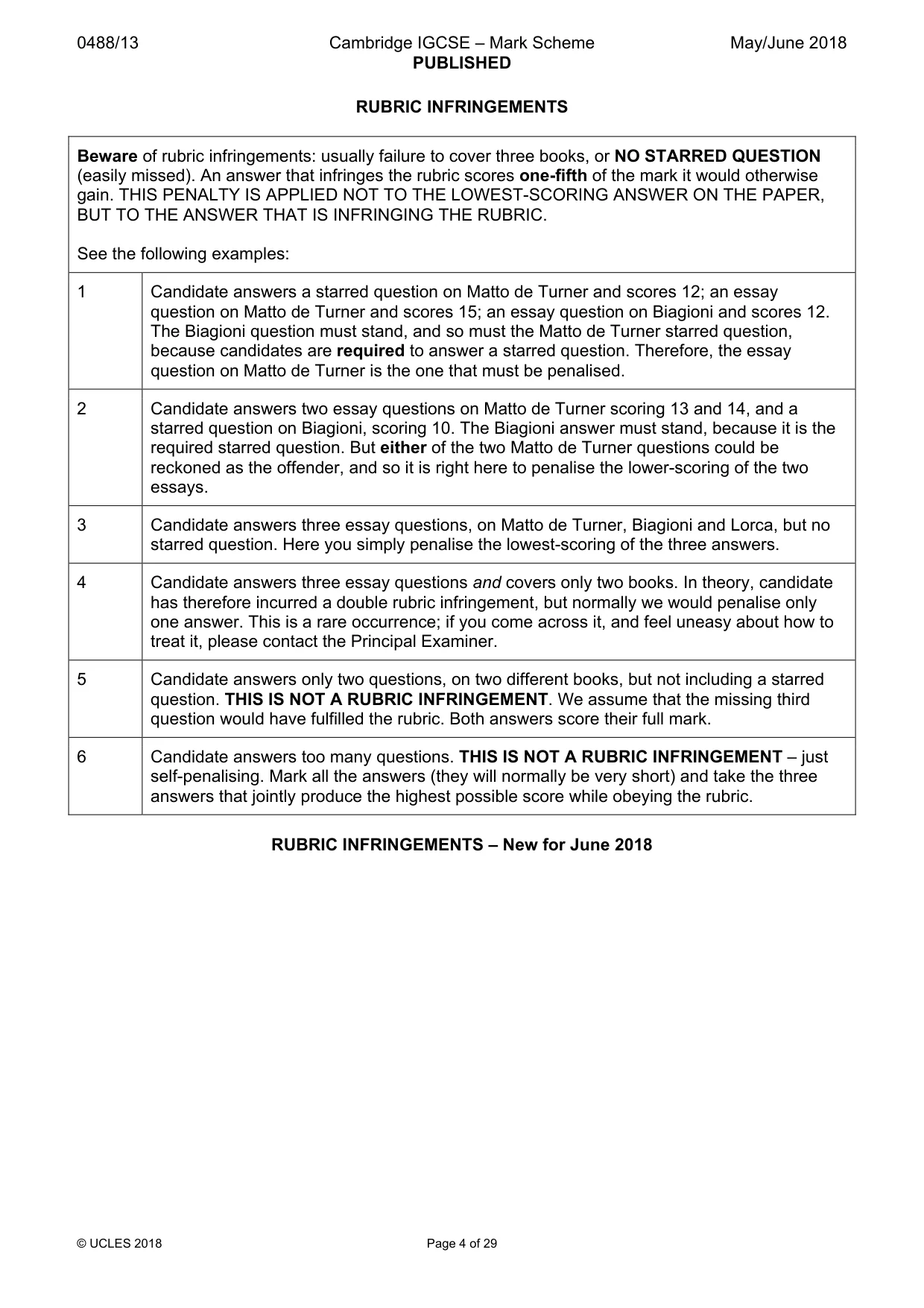
0488/13 Cambridge IGCSE – Mark Scheme PUBLISHED May/June 2018 © UCLES 2018 Page 4 of 29 RUBRIC INFRINGEMENTS Beware of rubric infringements: usually failure to cover three books, or NO STARRED QUESTION (easily missed). An answer that infringes the rubric scores one-fifth of the mark it would otherwise gain. THIS PENALTY IS APPLIED NOT TO THE LOWEST-SCORING ANSWER ON THE PAPER, BUT TO THE ANSWER THAT IS INFRINGING THE RUBRIC. See the following examples: 1 Candidate answers a starred question on Matto de Turner and scores 12; an essay question on Matto de Turner and scores 15; an essay question on Biagioni and scores 12. The Biagioni question must stand, and so must the Matto de Turner starred question, because candidates are required to answer a starred question. Therefore, the essay question on Matto de Turner is the one that must be penalised. 2 Candidate answers two essay questions on Matto de Turner scoring 13 and 14, and a starred question on Biagioni, scoring 10. The Biagioni answer must stand, because it is the required starred question. But either of the two Matto de Turner questions could be reckoned as the offender, and so it is right here to penalise the lower-scoring of the two essays. 3 Candidate answers three essay questions, on Matto de Turner, Biagioni and Lorca, but no starred question. Here you simply penalise the lowest-scoring of the three answers. 4 Candidate answers three essay questions and covers only two books. In theory, candidate has therefore incurred a double rubric infringement, but normally we would penalise only one answer. This is a rare occurrence; if you come across it, and feel uneasy about how to treat it, please contact the Principal Examiner. 5 Candidate answers only two questions, on two different books, but not including a starred question. THIS IS NOT A RUBRIC INFRINGEMENT. We assume that the missing third question would have fulfilled the rubric. Both answers score their full mark. 6 Candidate answers too many questions. THIS IS NOT A RUBRIC INFRINGEMENT – just self-penalising. Mark all the answers (they will normally be very short) and take the three answers that jointly produce the highest possible score while obeying the rubric. RUBRIC INFRINGEMENTS – New for June 2018
Mark scheme, page 5
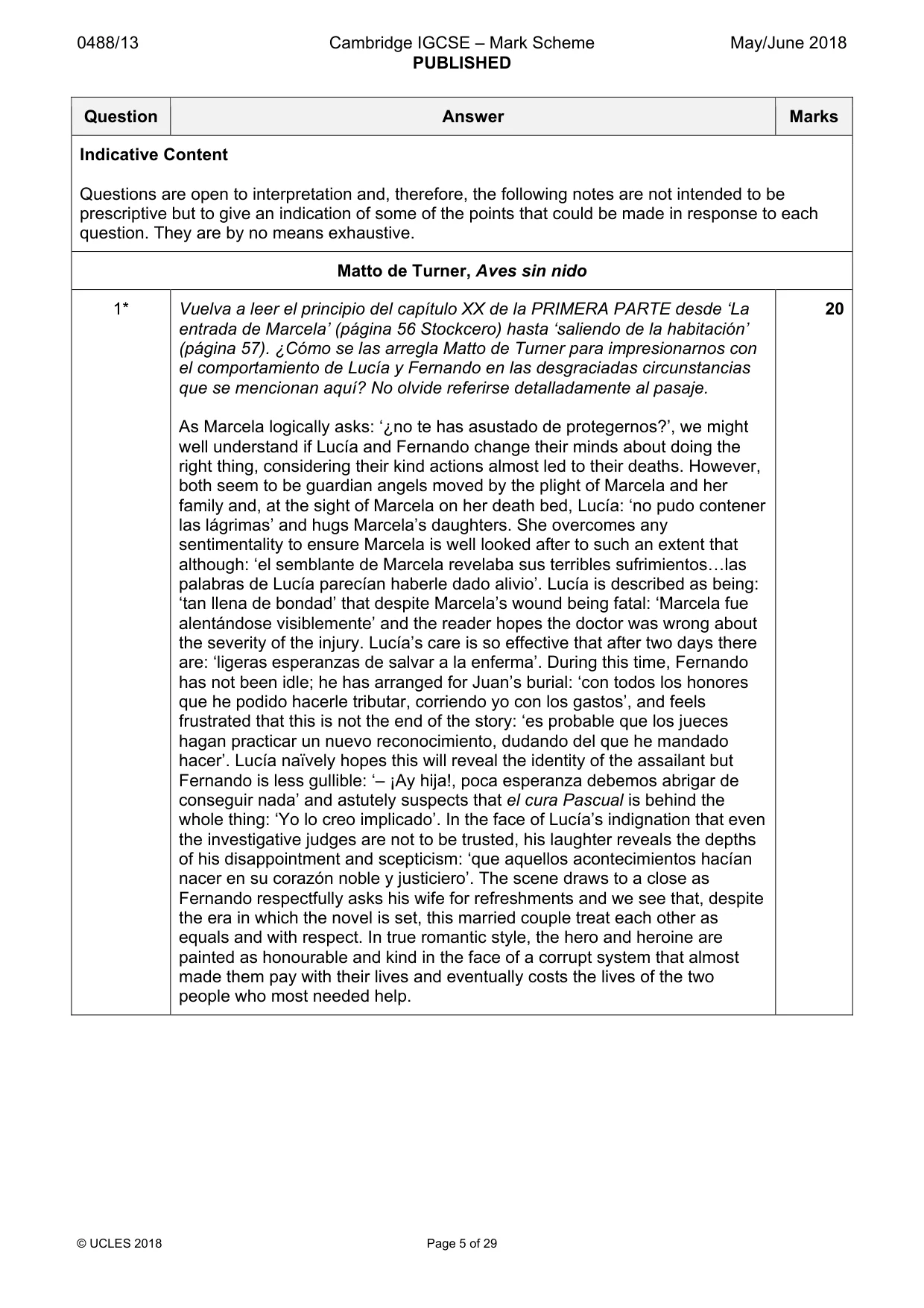
0488/13 Cambridge IGCSE – Mark Scheme PUBLISHED May/June 2018 © UCLES 2018 Page 5 of 29 Question Answer Marks Indicative Content Questions are open to interpretation and, therefore, the following notes are not intended to be prescriptive but to give an indication of some of the points that could be made in response to each question. They are by no means exhaustive. Matto de Turner, Aves sin nido 1* Vuelva a leer el principio del capítulo XX de la PRIMERA PARTE desde ‘La entrada de Marcela’ (página 56 Stockcero) hasta ‘saliendo de la habitación’ (página 57). ¿Cómo se las arregla Matto de Turner para impresionarnos con el comportamiento de Lucía y Fernando en las desgraciadas circunstancias que se mencionan aquí? No olvide referirse detalladamente al pasaje. As Marcela logically asks: ‘¿no te has asustado de protegernos?’, we might well understand if Lucía and Fernando change their minds about doing the right thing, considering their kind actions almost led to their deaths. However, both seem to be guardian angels moved by the plight of Marcela and her family and, at the sight of Marcela on her death bed, Lucía: ‘no pudo contener las lágrimas’ and hugs Marcela’s daughters. She overcomes any sentimentality to ensure Marcela is well looked after to such an extent that although: ‘el semblante de Marcela revelaba sus terribles sufrimientos«las palabras de Lucía parecían haberle dado alivio’. Lucía is described as being: ‘tan llena de bondad’ that despite Marcela’s wound being fatal: ‘Marcela fue alentándose visiblemente’ and the reader hopes the doctor was wrong about the severity of the injury. Lucía’s care is so effective that after two days there are: ‘ligeras esperanzas de salvar a la enferma’. During this time, Fernando has not been idle; he has arranged for Juan’s burial: ‘con todos los honores que he podido hacerle tributar, corriendo yo con los gastos’, and feels frustrated that this is not the end of the story: ‘es probable que los jueces hagan practicar un nuevo reconocimiento, dudando del que he mandado hacer’. Lucía naïvely hopes this will reveal the identity of the assailant but Fernando is less gullible: ‘– ¡Ay hija!, poca esperanza debemos abrigar de conseguir nada’ and astutely suspects that el cura Pascual is behind the whole thing: ‘Yo lo creo implicado’. In the face of Lucía’s indignation that even the investigative judges are not to be trusted, his laughter reveals the depths of his disappointment and scepticism: ‘que aquellos acontecimientos hacían nacer en su corazón noble y justiciero’. The scene draws to a close as Fernando respectfully asks his wife for refreshments and we see that, despite the era in which the novel is set, this married couple treat each other as equals and with respect. In true romantic style, the hero and heroine are painted as honourable and kind in the face of a corrupt system that almost made them pay with their lives and eventually costs the lives of the two people who most needed help. 20
Mark scheme, page 6
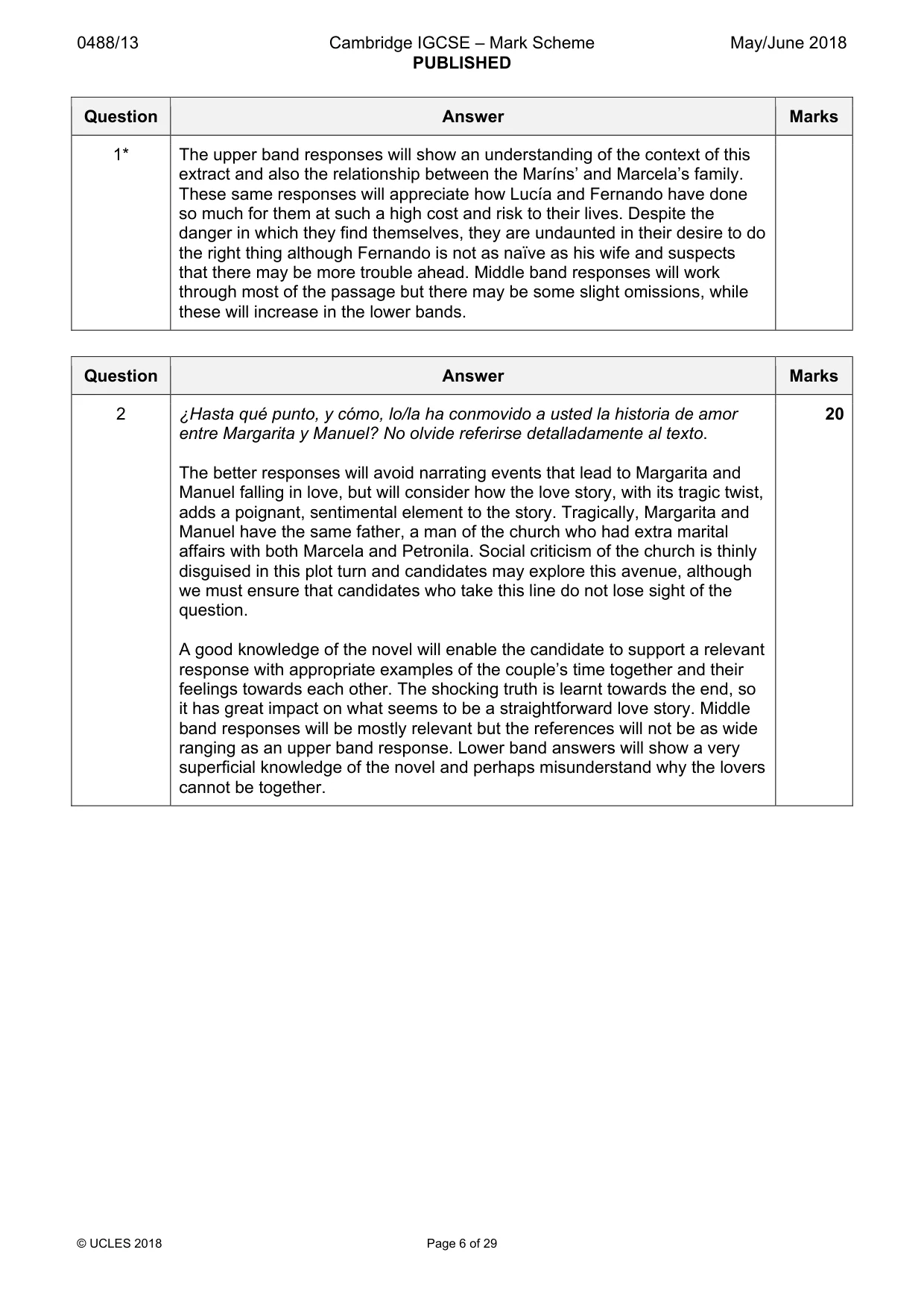
0488/13 Cambridge IGCSE – Mark Scheme PUBLISHED May/June 2018 © UCLES 2018 Page 6 of 29 Question Answer Marks 1* The upper band responses will show an understanding of the context of this extract and also the relationship between the Maríns’ and Marcela’s family. These same responses will appreciate how Lucía and Fernando have done so much for them at such a high cost and risk to their lives. Despite the danger in which they find themselves, they are undaunted in their desire to do the right thing although Fernando is not as naïve as his wife and suspects that there may be more trouble ahead. Middle band responses will work through most of the passage but there may be some slight omissions, while these will increase in the lower bands. Question Answer Marks 2 ¿Hasta qué punto, y cómo, lo/la ha conmovido a usted la historia de amor entre Margarita y Manuel? No olvide referirse detalladamente al texto. The better responses will avoid narrating events that lead to Margarita and Manuel falling in love, but will consider how the love story, with its tragic twist, adds a poignant, sentimental element to the story. Tragically, Margarita and Manuel have the same father, a man of the church who had extra marital affairs with both Marcela and Petronila. Social criticism of the church is thinly disguised in this plot turn and candidates may explore this avenue, although we must ensure that candidates who take this line do not lose sight of the question. A good knowledge of the novel will enable the candidate to support a relevant response with appropriate examples of the couple’s time together and their feelings towards each other. The shocking truth is learnt towards the end, so it has great impact on what seems to be a straightforward love story. Middle band responses will be mostly relevant but the references will not be as wide ranging as an upper band response. Lower band answers will show a very superficial knowledge of the novel and perhaps misunderstand why the lovers cannot be together. 20
Mark scheme, page 7
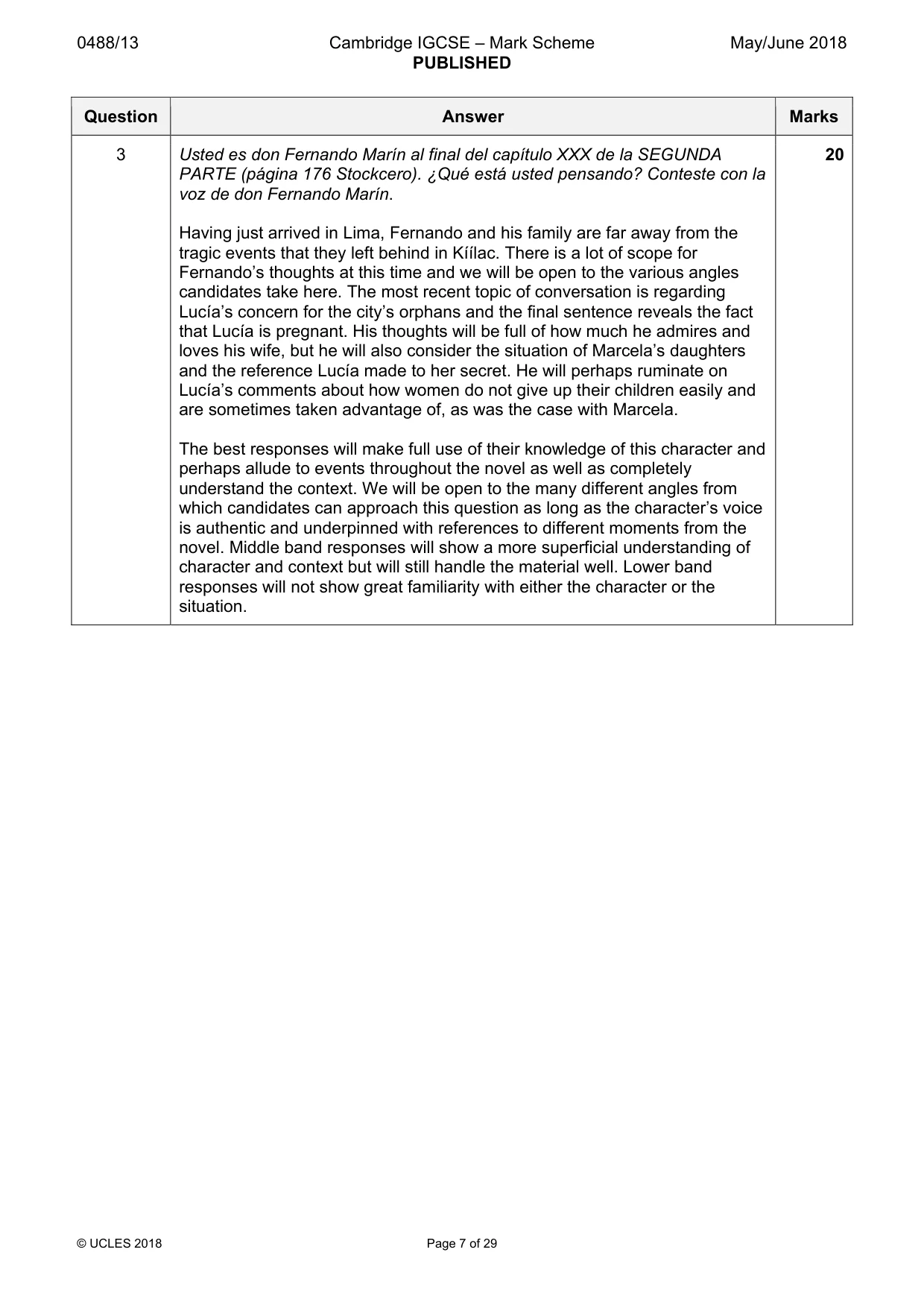
0488/13 Cambridge IGCSE – Mark Scheme PUBLISHED May/June 2018 © UCLES 2018 Page 7 of 29 Question Answer Marks 3 Usted es don Fernando Marín al final del capítulo XXX de la SEGUNDA PARTE (página 176 Stockcero). ¿Qué está usted pensando? Conteste con la voz de don Fernando Marín. Having just arrived in Lima, Fernando and his family are far away from the tragic events that they left behind in Kíílac. There is a lot of scope for Fernando’s thoughts at this time and we will be open to the various angles candidates take here. The most recent topic of conversation is regarding Lucía’s concern for the city’s orphans and the final sentence reveals the fact that Lucía is pregnant. His thoughts will be full of how much he admires and loves his wife, but he will also consider the situation of Marcela’s daughters and the reference Lucía made to her secret. He will perhaps ruminate on Lucía’s comments about how women do not give up their children easily and are sometimes taken advantage of, as was the case with Marcela. The best responses will make full use of their knowledge of this character and perhaps allude to events throughout the novel as well as completely understand the context. We will be open to the many different angles from which candidates can approach this question as long as the character’s voice is authentic and underpinned with references to different moments from the novel. Middle band responses will show a more superficial understanding of character and context but will still handle the material well. Lower band responses will not show great familiarity with either the character or the situation. 20
Mark scheme, page 8
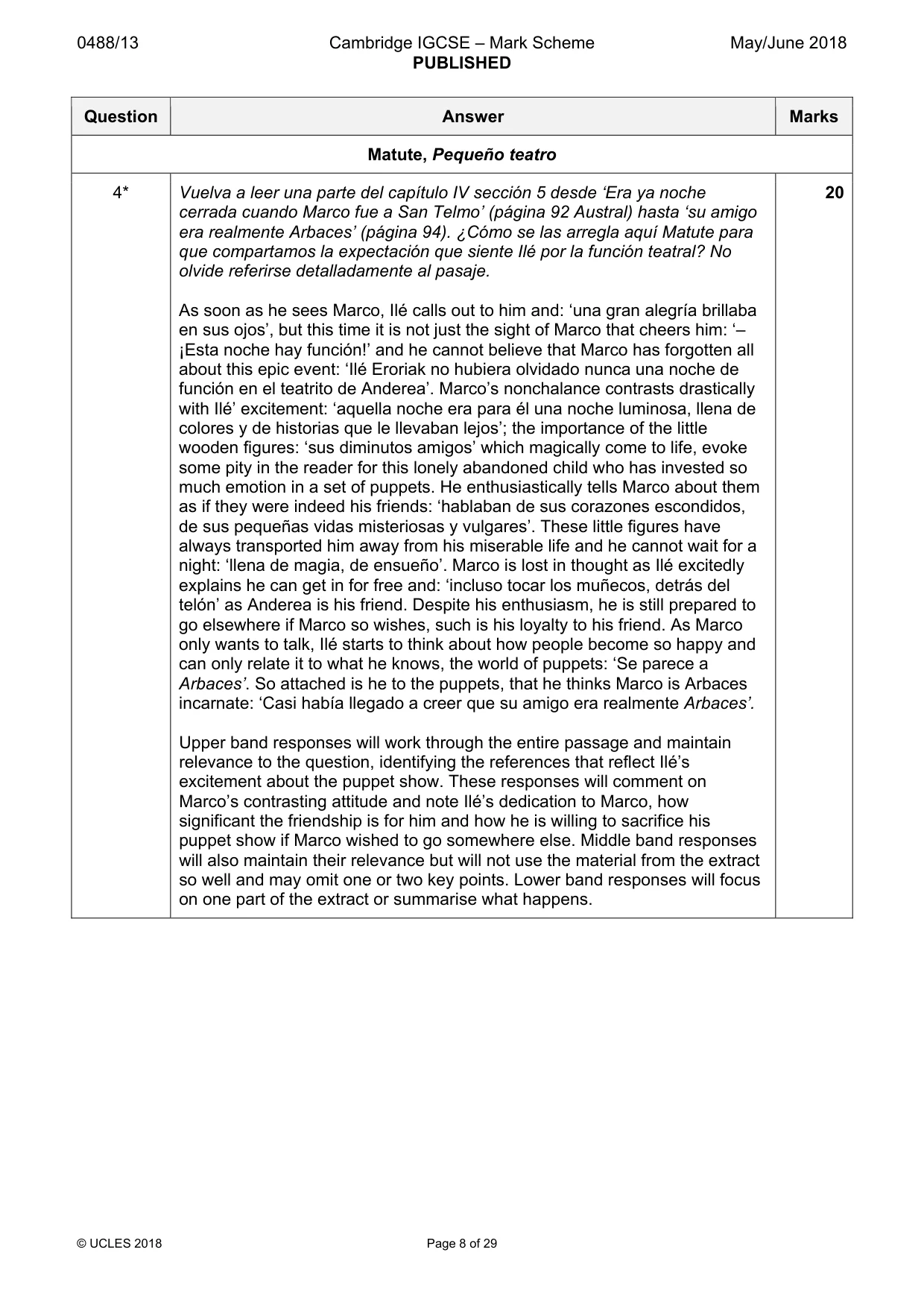
0488/13 Cambridge IGCSE – Mark Scheme PUBLISHED May/June 2018 © UCLES 2018 Page 8 of 29 Question Answer Marks Matute, Pequeño teatro 4* Vuelva a leer una parte del capítulo IV sección 5 desde ‘Era ya noche cerrada cuando Marco fue a San Telmo’ (página 92 Austral) hasta ‘su amigo era realmente Arbaces’ (página 94). ¿Cómo se las arregla aquí Matute para que compartamos la expectación que siente Ilé por la función teatral? No olvide referirse detalladamente al pasaje. As soon as he sees Marco, Ilé calls out to him and: ‘una gran alegría brillaba en sus ojos’, but this time it is not just the sight of Marco that cheers him: ‘– ¡Esta noche hay función!’ and he cannot believe that Marco has forgotten all about this epic event: ‘Ilé Eroriak no hubiera olvidado nunca una noche de función en el teatrito de Anderea’. Marco’s nonchalance contrasts drastically with Ilé’ excitement: ‘aquella noche era para él una noche luminosa, llena de colores y de historias que le llevaban lejos’; the importance of the little wooden figures: ‘sus diminutos amigos’ which magically come to life, evoke some pity in the reader for this lonely abandoned child who has invested so much emotion in a set of puppets. He enthusiastically tells Marco about them as if they were indeed his friends: ‘hablaban de sus corazones escondidos, de sus pequeñas vidas misteriosas y vulgares’. These little figures have always transported him away from his miserable life and he cannot wait for a night: ‘llena de magia, de ensueño’. Marco is lost in thought as Ilé excitedly explains he can get in for free and: ‘incluso tocar los muñecos, detrás del telón’ as Anderea is his friend. Despite his enthusiasm, he is still prepared to go elsewhere if Marco so wishes, such is his loyalty to his friend. As Marco only wants to talk, Ilé starts to think about how people become so happy and can only relate it to what he knows, the world of puppets: ‘Se parece a Arbaces’. So attached is he to the puppets, that he thinks Marco is Arbaces incarnate: ‘Casi había llegado a creer que su amigo era realmente Arbaces’. Upper band responses will work through the entire passage and maintain relevance to the question, identifying the references that reflect Ilé’s excitement about the puppet show. These responses will comment on Marco’s contrasting attitude and note Ilé’s dedication to Marco, how significant the friendship is for him and how he is willing to sacrifice his puppet show if Marco wished to go somewhere else. Middle band responses will also maintain their relevance but will not use the material from the extract so well and may omit one or two key points. Lower band responses will focus on one part of the extract or summarise what happens. 20
Mark scheme, page 9
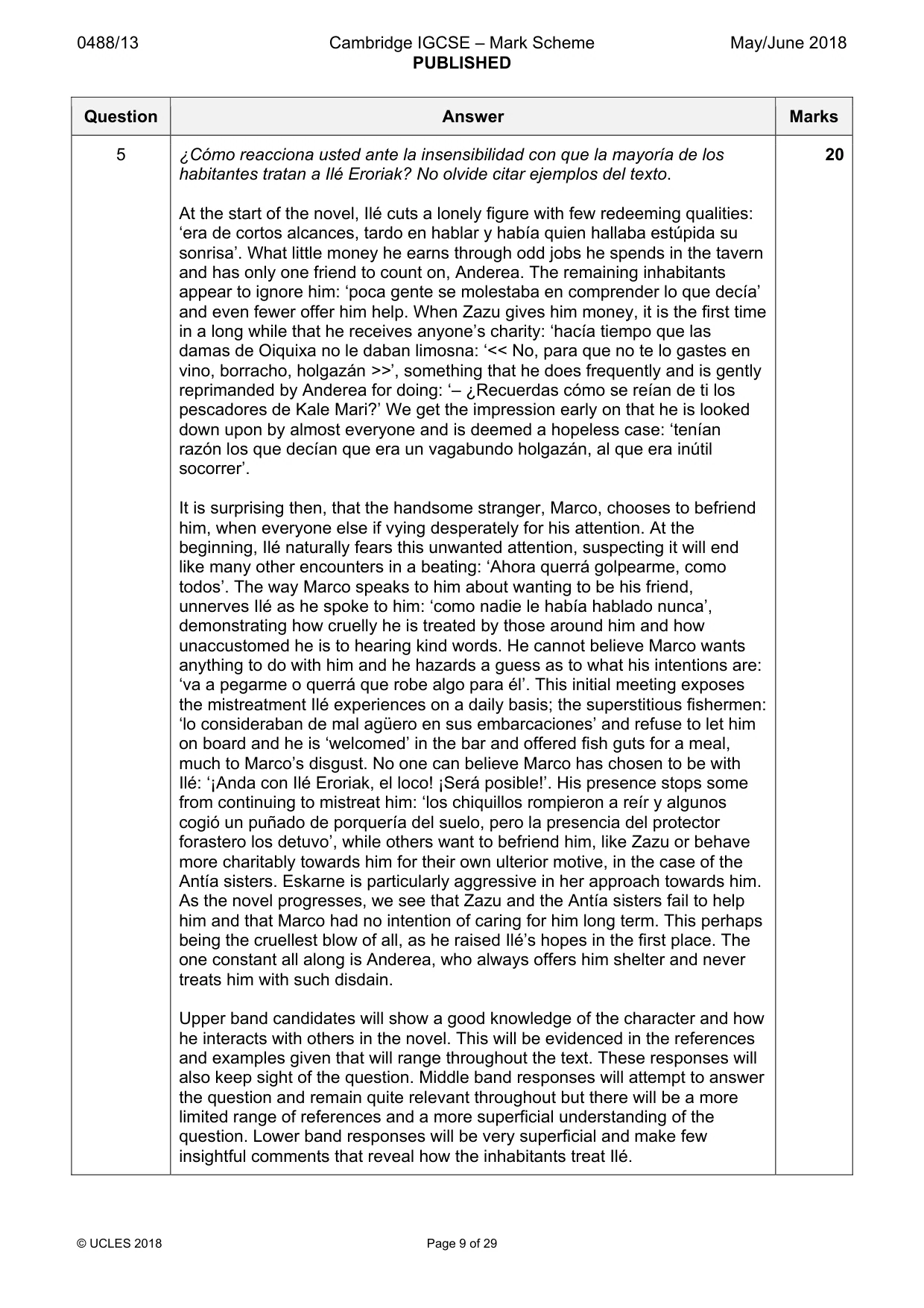
0488/13 Cambridge IGCSE – Mark Scheme PUBLISHED May/June 2018 © UCLES 2018 Page 9 of 29 Question Answer Marks 5 ¿Cómo reacciona usted ante la insensibilidad con que la mayoría de los habitantes tratan a Ilé Eroriak? No olvide citar ejemplos del texto. At the start of the novel, Ilé cuts a lonely figure with few redeeming qualities: ‘era de cortos alcances, tardo en hablar y había quien hallaba estúpida su sonrisa’. What little money he earns through odd jobs he spends in the tavern and has only one friend to count on, Anderea. The remaining inhabitants appear to ignore him: ‘poca gente se molestaba en comprender lo que decía’ and even fewer offer him help. When Zazu gives him money, it is the first time in a long while that he receives anyone’s charity: ‘hacía tiempo que las damas de Oiquixa no le daban limosna: ‘<< No, para que no te lo gastes en vino, borracho, holgazán >>’, something that he does frequently and is gently reprimanded by Anderea for doing: ‘– ¿Recuerdas cómo se reían de ti los pescadores de Kale Mari?’ We get the impression early on that he is looked down upon by almost everyone and is deemed a hopeless case: ‘tenían razón los que decían que era un vagabundo holgazán, al que era inútil socorrer’. It is surprising then, that the handsome stranger, Marco, chooses to befriend him, when everyone else if vying desperately for his attention. At the beginning, Ilé naturally fears this unwanted attention, suspecting it will end like many other encounters in a beating: ‘Ahora querrá golpearme, como todos’. The way Marco speaks to him about wanting to be his friend, unnerves Ilé as he spoke to him: ‘como nadie le había hablado nunca’, demonstrating how cruelly he is treated by those around him and how unaccustomed he is to hearing kind words. He cannot believe Marco wants anything to do with him and he hazards a guess as to what his intentions are: ‘va a pegarme o querrá que robe algo para él’. This initial meeting exposes the mistreatment Ilé experiences on a daily basis; the superstitious fishermen: ‘lo consideraban de mal agüero en sus embarcaciones’ and refuse to let him on board and he is ‘welcomed’ in the bar and offered fish guts for a meal, much to Marco’s disgust. No one can believe Marco has chosen to be with Ilé: ‘¡Anda con Ilé Eroriak, el loco! ¡Será posible!’. His presence stops some from continuing to mistreat him: ‘los chiquillos rompieron a reír y algunos cogió un puñado de porquería del suelo, pero la presencia del protector forastero los detuvo’, while others want to befriend him, like Zazu or behave more charitably towards him for their own ulterior motive, in the case of the Antía sisters. Eskarne is particularly aggressive in her approach towards him. As the novel progresses, we see that Zazu and the Antía sisters fail to help him and that Marco had no intention of caring for him long term. This perhaps being the cruellest blow of all, as he raised Ilé’s hopes in the first place. The one constant all along is Anderea, who always offers him shelter and never treats him with such disdain. Upper band candidates will show a good knowledge of the character and how he interacts with others in the novel. This will be evidenced in the references and examples given that will range throughout the text. These responses will also keep sight of the question. Middle band responses will attempt to answer the question and remain quite relevant throughout but there will be a more limited range of references and a more superficial understanding of the question. Lower band responses will be very superficial and make few insightful comments that reveal how the inhabitants treat Ilé. 20
Mark scheme, page 10
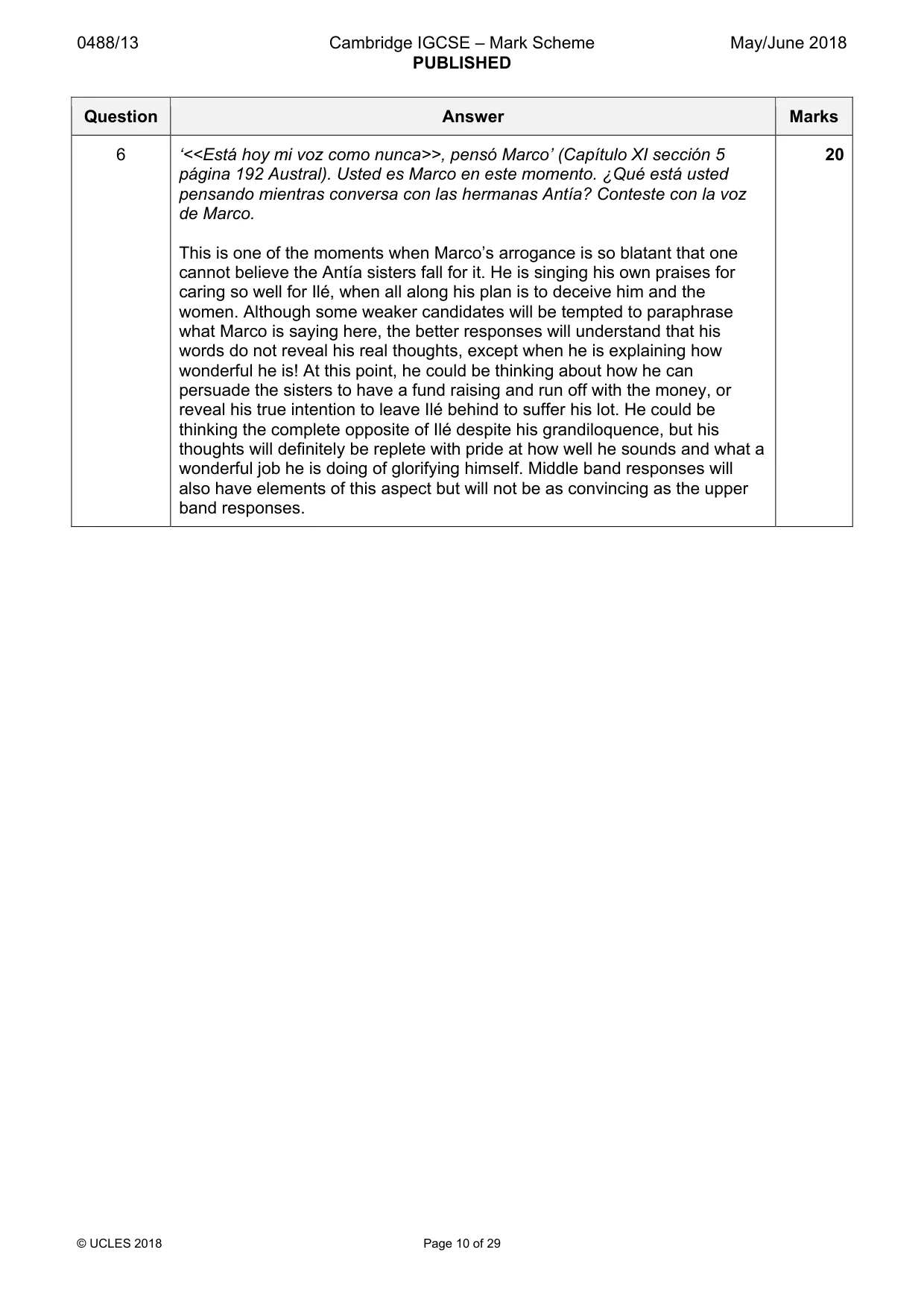
0488/13 Cambridge IGCSE – Mark Scheme PUBLISHED May/June 2018 © UCLES 2018 Page 10 of 29 Question Answer Marks 6 ‘<<Está hoy mi voz como nunca>>, pensó Marco’ (Capítulo XI sección 5 página 192 Austral). Usted es Marco en este momento. ¿Qué está usted pensando mientras conversa con las hermanas Antía? Conteste con la voz de Marco. This is one of the moments when Marco’s arrogance is so blatant that one cannot believe the Antía sisters fall for it. He is singing his own praises for caring so well for Ilé, when all along his plan is to deceive him and the women. Although some weaker candidates will be tempted to paraphrase what Marco is saying here, the better responses will understand that his words do not reveal his real thoughts, except when he is explaining how wonderful he is! At this point, he could be thinking about how he can persuade the sisters to have a fund raising and run off with the money, or reveal his true intention to leave Ilé behind to suffer his lot. He could be thinking the complete opposite of Ilé despite his grandiloquence, but his thoughts will definitely be replete with pride at how well he sounds and what a wonderful job he is doing of glorifying himself. Middle band responses will also have elements of this aspect but will not be as convincing as the upper band responses. 20
Mark scheme, page 11
0488/13 Cambridge IGCSE – Mark Scheme PUBLISHED May/June 2018 © UCLES 2018 Page 11 of 29 Question Answer Marks Ibáñez, La barraca 7* Vuelva a leer una parte del capítulo I desde ‘Los campos del tío Barret’ (página 71 Cátedra) hasta ‘en media legua a la redonda’ (página 72). ¿Cómo se las arregla Blasco Ibáñez aquí para que la imagen de la barraca y los terrenos del tío Barret sea tan desoladora? No olvide referirse detalladamente al pasaje. The lands that Barret worked for years lie abandoned in the middle of the fertile plain, a testament to the tragedy that befell him ten years before. The neglect they suffer is vividly described: ‘haciendo brotar de sus infecundas entrañas todas las plantas parásitas, todos los abrojos que Dios ha criado para castigo del labrador’, among them mysterious flowers: ‘que solo surgen de la ruinas y los cementerios’. Coupled with this is the emergence of all manner of: ‘bichos asquerosos’ that overrun the place and, despite the fact they infect the surrounding lands, they are left to infest it: ‘formando estado aparte’. The workers: ‘los respetaban hasta con cierta veneración’, knowing that the lands will never be worked by men ever again and accept that they are: ‘como una mancha de mugre en un manto regio de verde terciopelo’. There is a touch of humour in the description of the barraca itself: ‘en el centro de estos campos de desolación«alzábase la barraca, o más bien dicho, caía’, and the picture painted of the building is indeed a tragic one: ‘aquella ruina apenaba el ánimo, oprimía el corazón’. The author gives it a mysterious air: ‘parecía que del casuco abandonado iban a salir fantasmas en cuanto cerrase la noche; que en su interior partían gritos de personas asesinadas.’ Just contemplating the land provokes: ‘cosas horribles’ to enter one’s mind, especially as it contrasts so dramatically with the surrounding lands: ‘su tétrica miseria aún descollaba más con el contraste de las tierras que la rodeaban’. All but the largest birds with their ‘plumajes fúnebres’ flee the area leaving a deathly silence. The task is a straightforward one and there are ample references to support a detailed appreciation of the vivid picture the author paints of this desolate scene. We will be quite exigent at the top of the scale, expecting answers of this level to work through the entire passage appreciating the style and structure of the passage. The middle band responses will consider most of the extract but with some slight omissions. The lower band responses will only comment on one or two aspects of the extract. 20
Mark scheme, page 12
0488/13 Cambridge IGCSE – Mark Scheme PUBLISHED May/June 2018 © UCLES 2018 Page 12 of 29 Question Answer Marks 8 ¿Hasta qué punto, y cómo, aprovecha el autor el antagonismo entre Pimentó y Batiste para intensificar el interés de la novela? No olvide referirse detalladamente al texto. Pimentó is the driving force behind the huertanos’ aggressive treatment of Batiste and his family and in the past, he has managed to drive any occupants of Barret’s lands away with his bullying tactics. His initial confrontation with Batiste is disconcerting for Pimentó: ‘acostumbrado a que le temblara toda la huerta, estaba cada vez más desconcertado por la serenidad de Batiste’. It is, perhaps, Batiste’s lack of fear that makes Pimentó intensify his aggressive pursuit of the family and he will not be satisfied until they leave. We must ensure at the top end of the scale that responses do not merely narrate events, but assess and evaluate how Pimentó’s violent determination and increasingly underhand tactics antagonise and hurt Batiste and his family. These responses will also consider the extent of Pimentó’s influence on the huertanos, as even Batiste’s children become victims indirectly because of his influence. Each reveals his character traits before the other until things come to a head and Batiste, a peace loving and calm man, even considers killing him at one point. A perceptive use of the many moments when these two characters clash, together with an understanding of what is revealed about their personalities in question of their drive and determination, will place a response at the top end of the scale. Middle band responses will not draw on such a wide range of material but will remain relevant to the question although less perceptive. Lower band responses will summarise episodes when the two come face to face without revealing depth of insight. 20
Mark scheme, page 13
0488/13 Cambridge IGCSE – Mark Scheme PUBLISHED May/June 2018 © UCLES 2018 Page 13 of 29 Question Answer Marks 9 ‘En la barraca quedaba la pobre muchacha ocultándose en su estudi para gemir, haciendo esfuerzos por no demostrar su dolor ante la madre’ (capítulo VII página 157 Cátedra). Usted es Roseta en este momento. ¿Qué está usted pensando? Conteste con la voz de Roseta. The poor girl has had to pay for just a few moments of happiness and excitement in her hard life. This scene takes place after she has had the fight at the fountain incited by the huertanas’ jibes and taunts about her relationship with Tonet. An innocent relationship, it began when Tonet accompanied Roseta on her walk home from work where she suffered from all manner of fears and worries about potential and realistic dangers. Roseta revealed nothing of her escort to her parents, who unfortunately found out about it after the scandalous fight at the fountain. Her punishment was a severe reprimand from her father; Tonet’s punishment was to be sent to Valencia and given no free time in case he tries to see: ‘la hija del enemigo de la huerta’. She tries hard to hide her pain in front of her family, but once in her room she gives free reign to her heartache and sadness. She loses her appetite and cannot sleep, but her pride and loyalty to her family prevent her from complaining. At the top end of the scale, we will see a good understanding of the situation and an excellent use of the candidate’s knowledge of this doomed relationship, another consequence of being the unfortunate occupants of Barret’s lands. The middle band responses will also show a good knowledge of the text but will not have as much insight into this character. The lower band responses will have a vague idea of what is happening but will lack incisiveness and relevance. 20
Mark scheme, page 14
0488/13 Cambridge IGCSE – Mark Scheme PUBLISHED May/June 2018 © UCLES 2018 Page 14 of 29 Question Answer Marks Azuela, Los de abajo 10* Vuelva a leer el capitulo IV de la TERCERA PARTE desde: ‘Asomó Juchipila a lo lejos’ (página 131 Vicens Vives) hasta: ‘desapareció como había llegado’ (página 133). Aprecie cómo Azuela aprovecha el lenguaje aquí para crear un ambiente de desánimo y abatimiento entre los hombres de Macías. No olvide referirse detalladamente al pasaje. In the distance, lies Juchipila: ‘cuna de la Revolución de 1910’, this fact, instead of animating the group of revolutionaries, seems to depress them: ‘algunos soldados, mirando las torrecillas de Juchipila, suspiraron con tristeza’. Their sadness is understandable as the path is littered with all manner of crosses marking where the dead lie: ‘el rastro de sangre de los primeros revolucionarios de 1910, asesinados por el gobierno’. Valderrama pays his respects to the dead much to the others’ amusement or indifference. His praise of the original revolutionaries: ‘¡tierra regada con sangre de mártires, con sangre de soñadores«de los únicos buenos..!’ is met with a cynical: ‘– Porque no tuvieron tiempo de ser malos’ – this comment coming from an ex federal officer, no less. The loyalty and camaraderie of Macías’ men have been gradually undermined by the incorporation of: ‘soldados mancos, cojos, reumáticos y tosigosos’ who: ‘dicen mal de Demetrio’. The surprising incorporation of ex federals and: ‘señoritines de capital, perfumados y peripuestos’, spreads the resentment to Demetrio’s original members of the group. Even Anastasio admits: ‘si vamos a tener aquí a los federales siempre, malamente andamos’, but at least he has enough loyalty to express his concern to Demetrio’s face. Demetrio agrees, but recalls the worker they saw in Tepatitlán who: ‘no paraba de rezongar de su patrón, pero no paraba de trabajar tampoco’ and encourages Anastasio to help lift his men’s spirit: ‘lo que ha de hacer es dármele ánimo a la gente’. When he relates the next part of the plan, a wise Valderrama: ‘pescó algo de las palabras de Demetrio, y como no hay loco que coma lumbre, ese mismo día desapareció como había llegado’. A good knowledge of the novel and a deep understanding of the change of attitude in the men will come through in the better responses here. These answers will fully comprehend how drastic the change in loyalty and enthusiasm among the men is compared to the beginning of the novel, although references to any other passages apart from this one are not required. The fact that Valderrama just disappears because he knows what is in store for them, is a great contrast to the beginning when his men rally together even if outnumbered. The top band answers will also focus on the entire passage and draw good examples of how morale among the men is low due to the inclusion of ex federals and other upper-class officials: ‘malamente andamos: ‘los soldados hablan mal de las clases, las clases de los oficiales y los oficiales de nosotros’. It appears only Demetrio still has some fighting spirit: ‘y nosotros estamos ya pa (sic) despachar a Villa y a Carranza’. Middle band responses will also convey the dejection felt among the men and attempt to contrast it with Demetrio’s more realistic, or idealistic approach. Lower band responses will omit most of the passage and convey one or two ideas that may or may not be relevant. 20
Mark scheme, page 15
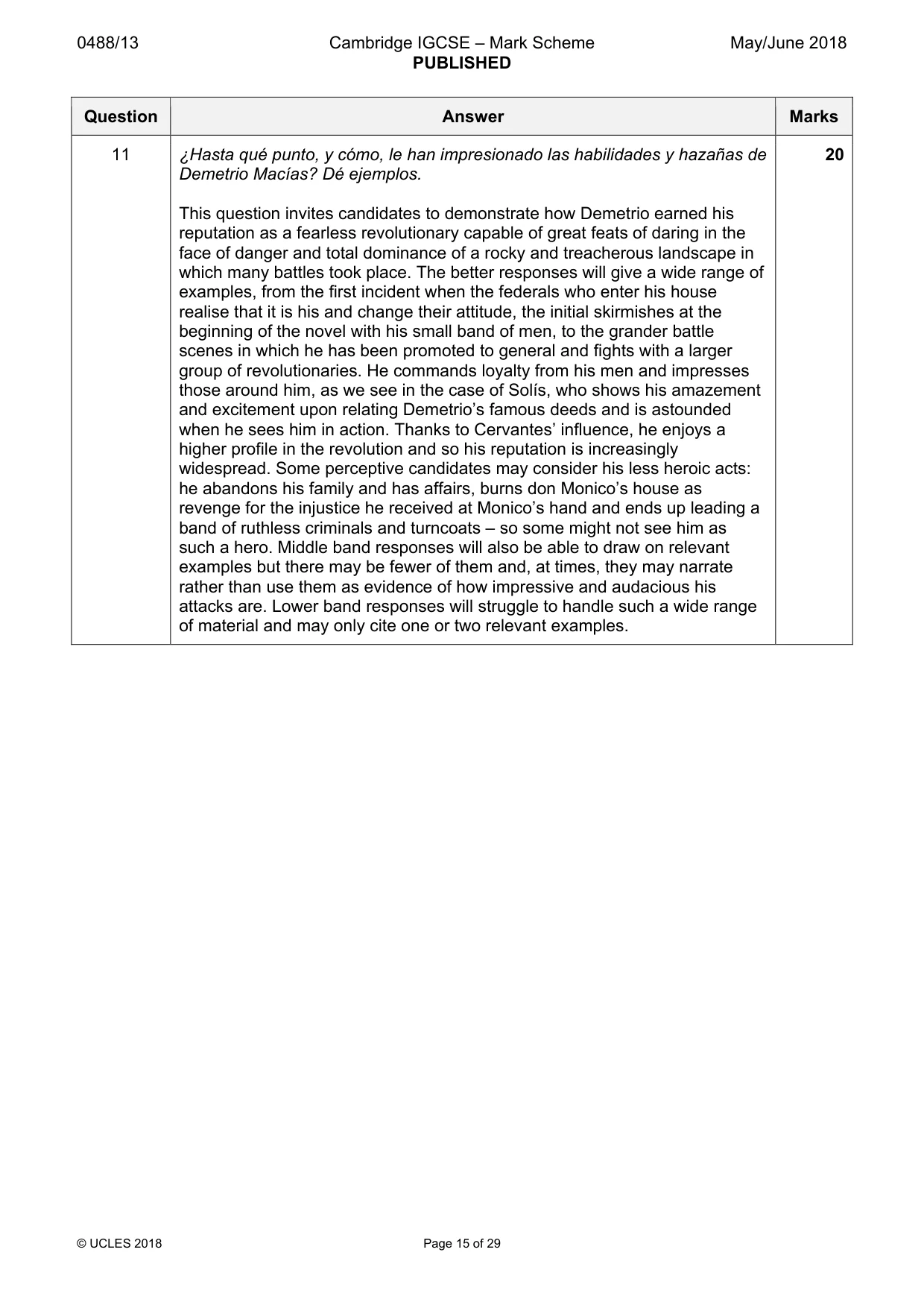
0488/13 Cambridge IGCSE – Mark Scheme PUBLISHED May/June 2018 © UCLES 2018 Page 15 of 29 Question Answer Marks 11 ¿Hasta qué punto, y cómo, le han impresionado las habilidades y hazañas de Demetrio Macías? Dé ejemplos. This question invites candidates to demonstrate how Demetrio earned his reputation as a fearless revolutionary capable of great feats of daring in the face of danger and total dominance of a rocky and treacherous landscape in which many battles took place. The better responses will give a wide range of examples, from the first incident when the federals who enter his house realise that it is his and change their attitude, the initial skirmishes at the beginning of the novel with his small band of men, to the grander battle scenes in which he has been promoted to general and fights with a larger group of revolutionaries. He commands loyalty from his men and impresses those around him, as we see in the case of Solís, who shows his amazement and excitement upon relating Demetrio’s famous deeds and is astounded when he sees him in action. Thanks to Cervantes’ influence, he enjoys a higher profile in the revolution and so his reputation is increasingly widespread. Some perceptive candidates may consider his less heroic acts: he abandons his family and has affairs, burns don Monico’s house as revenge for the injustice he received at Monico’s hand and ends up leading a band of ruthless criminals and turncoats – so some might not see him as such a hero. Middle band responses will also be able to draw on relevant examples but there may be fewer of them and, at times, they may narrate rather than use them as evidence of how impressive and audacious his attacks are. Lower band responses will struggle to handle such a wide range of material and may only cite one or two relevant examples. 20
Mark scheme, page 16
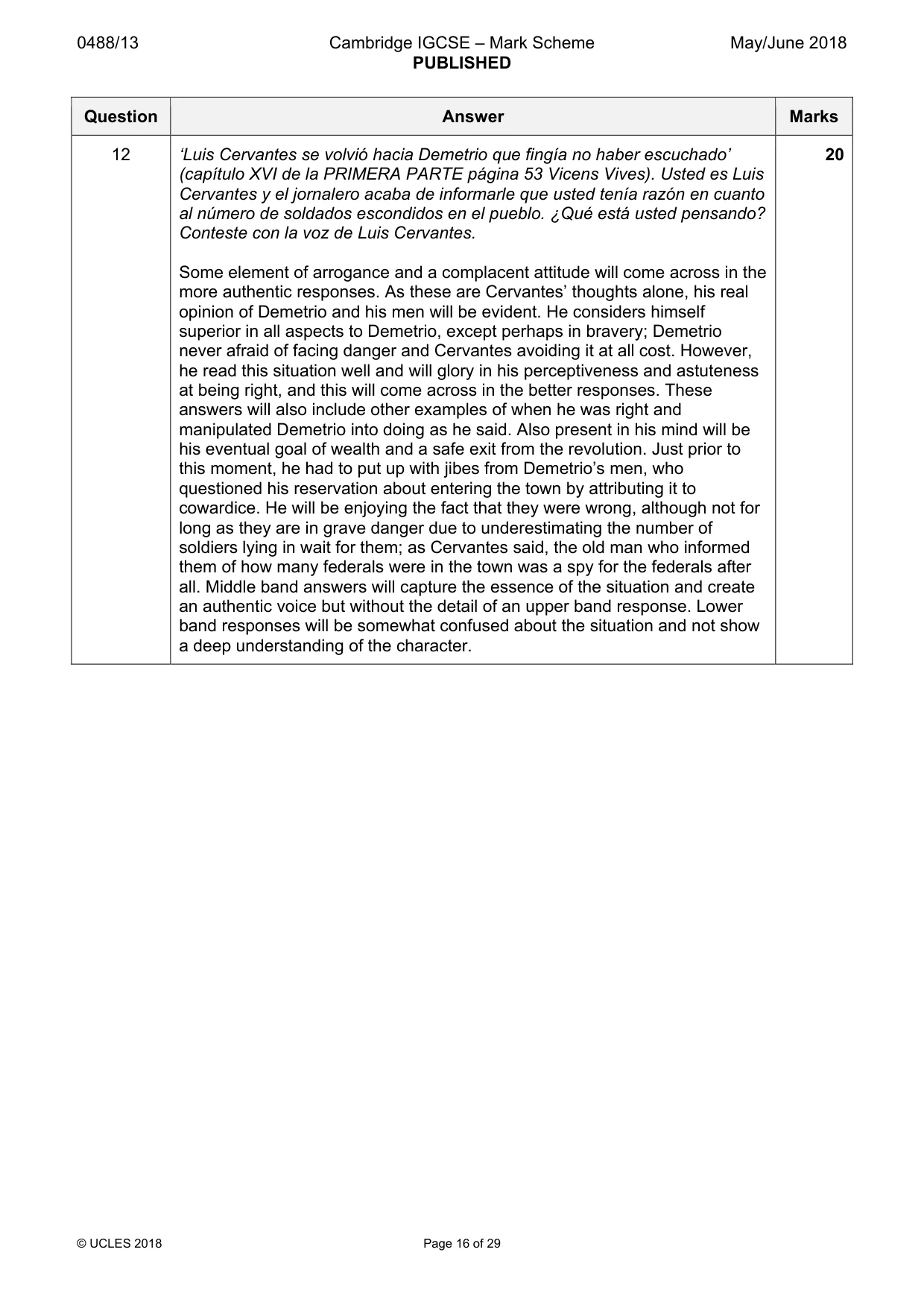
0488/13 Cambridge IGCSE – Mark Scheme PUBLISHED May/June 2018 © UCLES 2018 Page 16 of 29 Question Answer Marks 12 ‘Luis Cervantes se volvió hacia Demetrio que fingía no haber escuchado’ (capítulo XVI de la PRIMERA PARTE página 53 Vicens Vives). Usted es Luis Cervantes y el jornalero acaba de informarle que usted tenía razón en cuanto al número de soldados escondidos en el pueblo. ¿Qué está usted pensando? Conteste con la voz de Luis Cervantes. Some element of arrogance and a complacent attitude will come across in the more authentic responses. As these are Cervantes’ thoughts alone, his real opinion of Demetrio and his men will be evident. He considers himself superior in all aspects to Demetrio, except perhaps in bravery; Demetrio never afraid of facing danger and Cervantes avoiding it at all cost. However, he read this situation well and will glory in his perceptiveness and astuteness at being right, and this will come across in the better responses. These answers will also include other examples of when he was right and manipulated Demetrio into doing as he said. Also present in his mind will be his eventual goal of wealth and a safe exit from the revolution. Just prior to this moment, he had to put up with jibes from Demetrio’s men, who questioned his reservation about entering the town by attributing it to cowardice. He will be enjoying the fact that they were wrong, although not for long as they are in grave danger due to underestimating the number of soldiers lying in wait for them; as Cervantes said, the old man who informed them of how many federals were in the town was a spy for the federals after all. Middle band answers will capture the essence of the situation and create an authentic voice but without the detail of an upper band response. Lower band responses will be somewhat confused about the situation and not show a deep understanding of the character. 20
Mark scheme, page 17
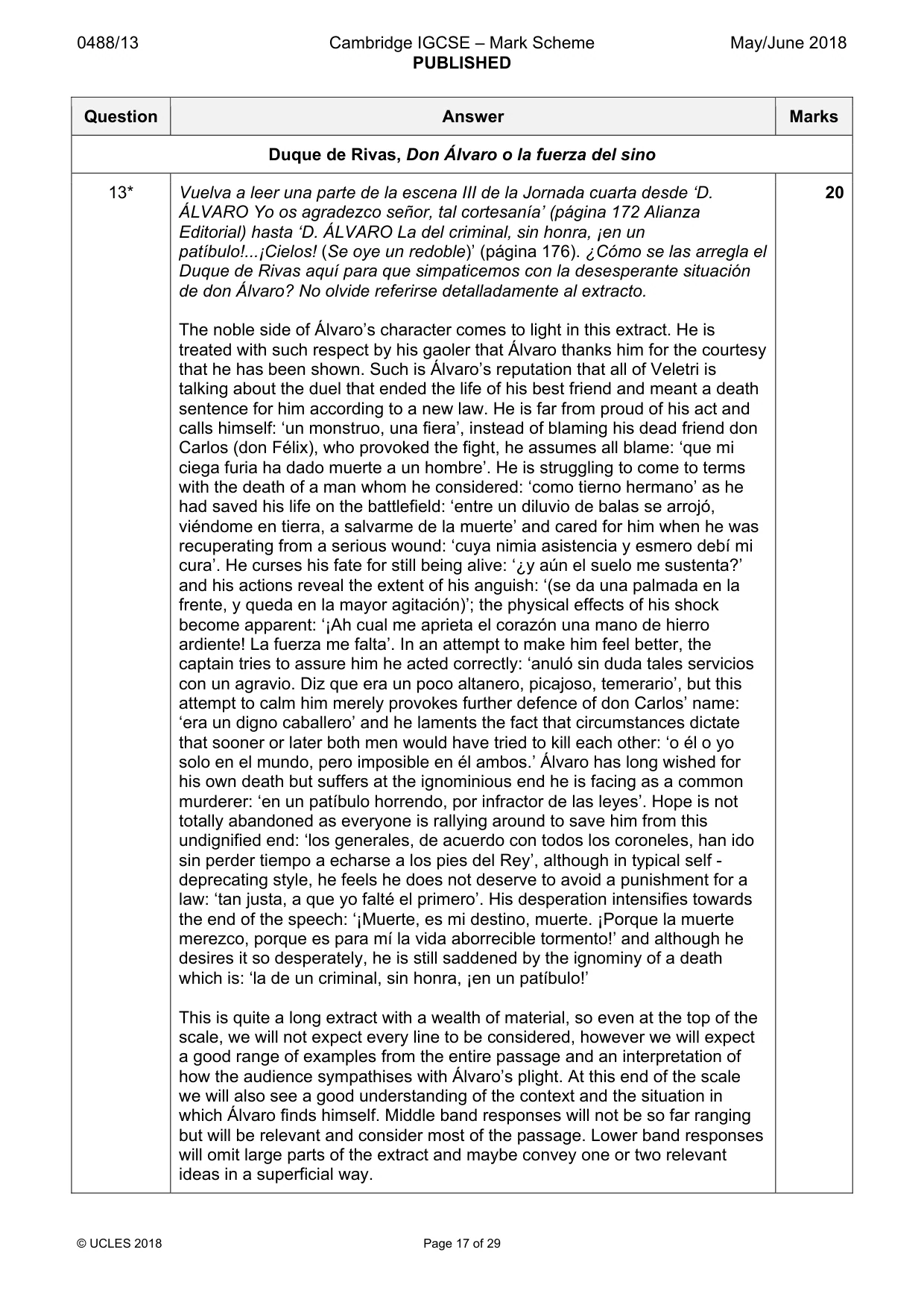
0488/13 Cambridge IGCSE – Mark Scheme PUBLISHED May/June 2018 © UCLES 2018 Page 17 of 29 Question Answer Marks Duque de Rivas, Don Álvaro o la fuerza del sino 13* Vuelva a leer una parte de la escena III de la Jornada cuarta desde ‘D. ÁLVARO Yo os agradezco señor, tal cortesanía’ (página 172 Alianza Editorial) hasta ‘D. ÁLVARO La del criminal, sin honra, ¡en un patíbulo!...¡Cielos! (Se oye un redoble)’ (página 176). ¿Cómo se las arregla el Duque de Rivas aquí para que simpaticemos con la desesperante situación de don Álvaro? No olvide referirse detalladamente al extracto. The noble side of Álvaro’s character comes to light in this extract. He is treated with such respect by his gaoler that Álvaro thanks him for the courtesy that he has been shown. Such is Álvaro’s reputation that all of Veletri is talking about the duel that ended the life of his best friend and meant a death sentence for him according to a new law. He is far from proud of his act and calls himself: ‘un monstruo, una fiera’, instead of blaming his dead friend don Carlos (don Félix), who provoked the fight, he assumes all blame: ‘que mi ciega furia ha dado muerte a un hombre’. He is struggling to come to terms with the death of a man whom he considered: ‘como tierno hermano’ as he had saved his life on the battlefield: ‘entre un diluvio de balas se arrojó, viéndome en tierra, a salvarme de la muerte’ and cared for him when he was recuperating from a serious wound: ‘cuya nimia asistencia y esmero debí mi cura’. He curses his fate for still being alive: ‘¿y aún el suelo me sustenta?’ and his actions reveal the extent of his anguish: ‘(se da una palmada en la frente, y queda en la mayor agitación)’; the physical effects of his shock become apparent: ‘¡Ah cual me aprieta el corazón una mano de hierro ardiente! La fuerza me falta’. In an attempt to make him feel better, the captain tries to assure him he acted correctly: ‘anuló sin duda tales servicios con un agravio. Diz que era un poco altanero, picajoso, temerario’, but this attempt to calm him merely provokes further defence of don Carlos’ name: ‘era un digno caballero’ and he laments the fact that circumstances dictate that sooner or later both men would have tried to kill each other: ‘o él o yo solo en el mundo, pero imposible en él ambos.’ Álvaro has long wished for his own death but suffers at the ignominious end he is facing as a common murderer: ‘en un patíbulo horrendo, por infractor de las leyes’. Hope is not totally abandoned as everyone is rallying around to save him from this undignified end: ‘los generales, de acuerdo con todos los coroneles, han ido sin perder tiempo a echarse a los pies del Rey’, although in typical self - deprecating style, he feels he does not deserve to avoid a punishment for a law: ‘tan justa, a que yo falté el primero’. His desperation intensifies towards the end of the speech: ‘¡Muerte, es mi destino, muerte. ¡Porque la muerte merezco, porque es para mí la vida aborrecible tormento!’ and although he desires it so desperately, he is still saddened by the ignominy of a death which is: ‘la de un criminal, sin honra, ¡en un patíbulo!’ This is quite a long extract with a wealth of material, so even at the top of the scale, we will not expect every line to be considered, however we will expect a good range of examples from the entire passage and an interpretation of how the audience sympathises with Álvaro’s plight. At this end of the scale we will also see a good understanding of the context and the situation in which Álvaro finds himself. Middle band responses will not be so far ranging but will be relevant and consider most of the passage. Lower band responses will omit large parts of the extract and maybe convey one or two relevant ideas in a superficial way. 20
Mark scheme, page 18
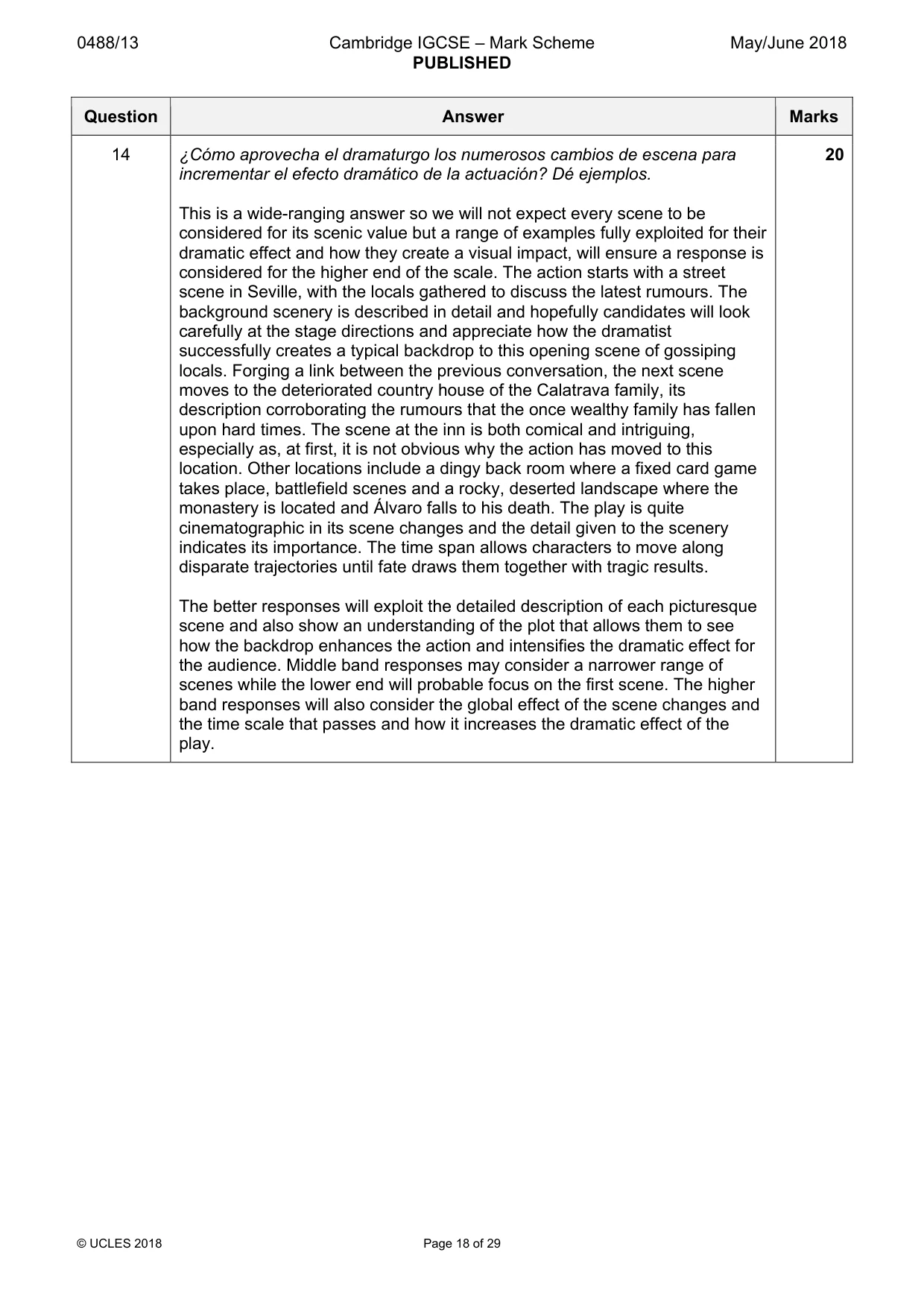
0488/13 Cambridge IGCSE – Mark Scheme PUBLISHED May/June 2018 © UCLES 2018 Page 18 of 29 Question Answer Marks 14 ¿Cómo aprovecha el dramaturgo los numerosos cambios de escena para incrementar el efecto dramático de la actuación? Dé ejemplos. This is a wide-ranging answer so we will not expect every scene to be considered for its scenic value but a range of examples fully exploited for their dramatic effect and how they create a visual impact, will ensure a response is considered for the higher end of the scale. The action starts with a street scene in Seville, with the locals gathered to discuss the latest rumours. The background scenery is described in detail and hopefully candidates will look carefully at the stage directions and appreciate how the dramatist successfully creates a typical backdrop to this opening scene of gossiping locals. Forging a link between the previous conversation, the next scene moves to the deteriorated country house of the Calatrava family, its description corroborating the rumours that the once wealthy family has fallen upon hard times. The scene at the inn is both comical and intriguing, especially as, at first, it is not obvious why the action has moved to this location. Other locations include a dingy back room where a fixed card game takes place, battlefield scenes and a rocky, deserted landscape where the monastery is located and Álvaro falls to his death. The play is quite cinematographic in its scene changes and the detail given to the scenery indicates its importance. The time span allows characters to move along disparate trajectories until fate draws them together with tragic results. The better responses will exploit the detailed description of each picturesque scene and also show an understanding of the plot that allows them to see how the backdrop enhances the action and intensifies the dramatic effect for the audience. Middle band responses may consider a narrower range of scenes while the lower end will probable focus on the first scene. The higher band responses will also consider the global effect of the scene changes and the time scale that passes and how it increases the dramatic effect of the play. 20
Mark scheme, page 19
0488/13 Cambridge IGCSE – Mark Scheme PUBLISHED May/June 2018 © UCLES 2018 Page 19 of 29 Question Answer Marks 15 ‘(Cae LEONOR en brazos de D.ÁLVARO, que la arrastra hacia el balcón)’ (escena VIII de la Jornada primera página 93 Alianza Editorial). Imagine que Leonor y don Álvaro tienen una conversación en este momento. Escriba la conversación. Leonor and Álvaro rarely have any time to speak to each other in the play, so this will be a good opportunity for candidates to imagine what they will say to each other at this point. Unfortunately, Álvaro has just killed Leonor’s father so he will be shocked by recent events and desperate to comfort Leonor. At the same time the couple must make their escape and if Leonor was having any doubts before, she must be even more uncertain as to her next step. She does eventually run off with him so she will have allowed herself to be convinced. Despite this unfortunate turn of events, Álvaro must have a plan as to how to escape with her and he may use this opportunity to assure her that everything will turn out well in the end. Most clear in this conversation will be their feelings towards each other and fear for the future now that Álvaro has killed Leonor’s father. Leonor must be aware that her brothers will avenge his death and so her concern will also be evident that their safety is in question and their lives in danger. The upper band responses will be fully aware of what has just happened and what the next stage entails for this couple. They will also successfully reflect the lovers’ feelings towards each other making full use of their knowledge of the play. The middle band responses will also be aware of the context but not fully exploit the play for relevant references although there will be more evidence in these responses that in a lower band answer. 20
Mark scheme, page 20
0488/13 Cambridge IGCSE – Mark Scheme PUBLISHED May/June 2018 © UCLES 2018 Page 20 of 29 Question Answer Marks García Lorca, Bodas de sangre 16* Vuelva a leer una parte del ACTO SEGUNDO CUADRO SEGUNDO desde ‘MADRE. (Entrando.) ¡Por fin!’ (página 60 Vicens Vives) hasta ‘MADRE. Así espero. (Se levantan)’ (página 64). ¿Hasta qué punto, y cómo, Lorca nos hace simpatizar con la Madre en este extracto? No olvide referirse detalladamente al pasaje. The mention of Leonardo incites a severe criticism of both him and his family, as they were responsible for killing the Madre’s husband and son: ‘toda la mala ralea, manejadores de cuchillos y gente de falsa sonrisa’. Her pain is evident: ‘me duele hasta la punta de las venas’ but such is society that she has to hide her true feelings: ‘se llevan a los muertos y hay que callar. Luego la gente critica.’ Despite the supposedly happy occasion, the Padre finds it quite a hard task to animate her: ‘hoy no es día de que te acuerdes de esas cosas’ and it is only the mention of future grandchildren that temporarily distracts her: ‘esa es mi ilusión: los nietos’. The Padre’s obsession with his lands is revealed in his impatience to have grandsons old enough to work the land straight away, whereas the Madre would prefer granddaughters: ‘tienen por fuerza que manejar las armas. Las niñas no salen jamás a la calle’. As the Padre emphasises his haste: ‘que en seguida tuvieran dos o tres hombres’, the Madre laments how years of care spent watching a child grow into a man is then cut short so quickly: ‘por eso es tan terrible ver la sangre de una derramada por el suelo. Una fuente que corre un minuto y a nosotros nos ha costado años’. Candidates who are very familiar with the play might find the Madre a little tiresome at this point, as it seems she always brings the topic round to the same thing. However, she lost her son and husband in exceptionally violent circumstances and understandably fears her son may share the same destiny. She is feeling particularly vulnerable about being left alone now that her son is married and she still has her doubts about the Novia; Leonardo’s presence at the wedding will not do anything to put her mind at ease. Responses at the top end of the scale will show a good understanding of this character and will express why they sympathise or not with the Madre. These answers will also use the extract well to support their opinions. Middle band responses will also show relevance but will not use the passage so effectively while lower band responses will omit most of the dialogue and make a few superficial judgements. 20
Mark scheme, page 21
0488/13 Cambridge IGCSE – Mark Scheme PUBLISHED May/June 2018 © UCLES 2018 Page 21 of 29 Question Answer Marks 17 ¿Cómo se las arregla el dramaturgo para que la huida de Leonardo y la Novia cobre tanta importancia en la trama de la obra? No olvide referirse detalladamente a la obra. Even though the audience is given hint after hint that Leonardo and the Novia still have feelings for each other, it is still quite shocking that they decided to run away on her wedding day. At the beginning of the play, we learn of their former relationship and realise that it was quite scandalous for the Novia to have already have had a boyfriend before her fiancé. We then learn that Leonardo married her cousin, but has a flighty character and a horse that seems to always lead to Novia’s house. Mujer and Suegra are aware of his feelings towards the Novia, particularly evident when he learns of the Novia’s upcoming marriage. Even when we meet the Novia – a reluctant bride if ever we saw one – the audience perhaps still does not suspect that she will renege on her promise, indeed she seems set on fulfilling her duty: ‘yo sabré cumplir’. It is not until she is alone with the Criada that her anxiety is revealed and she admits that Leonardo visits her. We finally see the two of them together on the morning of her wedding and although the conversation is passionate and reveals the hurt they suffer from being apart, the Novia is still determined to marry. At this point the audience may question her actions but will be convinced she will do the right thing, as indeed she does. However, it is after the wedding ceremony that she makes the scandalous decision to run away with her lover; an honourable married woman and her married lover disappear and it is a while before someone realises that they have run off together. We sense the severe consequences of their actions when the Novio sets off in search of them armed with a knife and fear the outcome will not be pleasant. The fact that a bride ran away with her former lover, on her wedding day is indecent even by modern standards and a contemporary audience would have been extremely shocked. The Leñadores’ commentary reflects how their actions provoke different reactions to the ‘huida’; through this Greek chorus Lorca conveys that however strict society’s laws may be, one cannot stand in the way of true love and while some applaud their actions, others are aware that it cannot end well. Despite knowing their actions will lead to social rejection and possibly death, the couple simply have to be together and Lorca celebrates their passion and desire to follow their natural instinct, as may some of the candidates. The outcome is tragic for all and the better responses will consider this aspect by questioning the Novia’s decision to run away even though she knows Leonardo is the one who will be punished. The play is based on a real-life story that must have sent shock waves through the community at the time. Likewise, the lovers’ actions are equally shocking. The better response will consider how Lorca heightens the drama through the couple’s actions and dialogue as well as the reaction of their families once the news of their escape is made public. Middle band responses will consider a narrower range of references but will be relevant and keep sight of the question for most of their answer. Lower band responses will probably resort to describing the scene when the lovers run away without considering the dramatic build up and tragic ending. 20
Mark scheme, page 22
0488/13 Cambridge IGCSE – Mark Scheme PUBLISHED May/June 2018 © UCLES 2018 Page 22 of 29 Question Answer Marks 18 ‘NOVIO. (Impaciente.) ¡Pues vamos! ¿Por dónde? / MENDIGA. (Dramática.) ¡Por allí!’ ACTO TERCERO CUADRO PRIMERO página 90 Vicens Vives.) Usted es el Novio en este momento. ¿En qué está usted pensando? Conteste con la voz del Novio. We see a different side to the Novio’s character since his wife ran away with her lover. He has supported his mother since the loss of his brother and father, but since he was jilted so publicly, he has no choice but to set off in search of them. The rage and pain so often expressed by his mother, is evident as he aggressively cajoles the Mendiga into telling him where the lovers are, ignorant that she is leading him to his death. At this moment, he is blinded by rage; his thoughts will be of what he will do when he finds his new bride and Leonardo. Also present, will be the memory of his father and brother who were murdered by the Félix family, and he will also see this as an opportunity to avenge them. His thoughts towards his bride will be of hurt and betrayal; he seemed to love her in his own way and did not deserve such a public humiliation. He may even have a passing thought about the Mujer; the poor woman had to tell everyone that her husband ran away with another woman. Better responses will be very familiar with this character and how he has changed drastically since his wife abandoned him. These responses will also know the context well and understand the Novio’s thoughts and actions. The middle band responses will convey a relevant reflection of his thoughts but with less insight than an upper band response, but the lower band answers will show some misunderstanding of either character or context. 20
Mark scheme, page 23
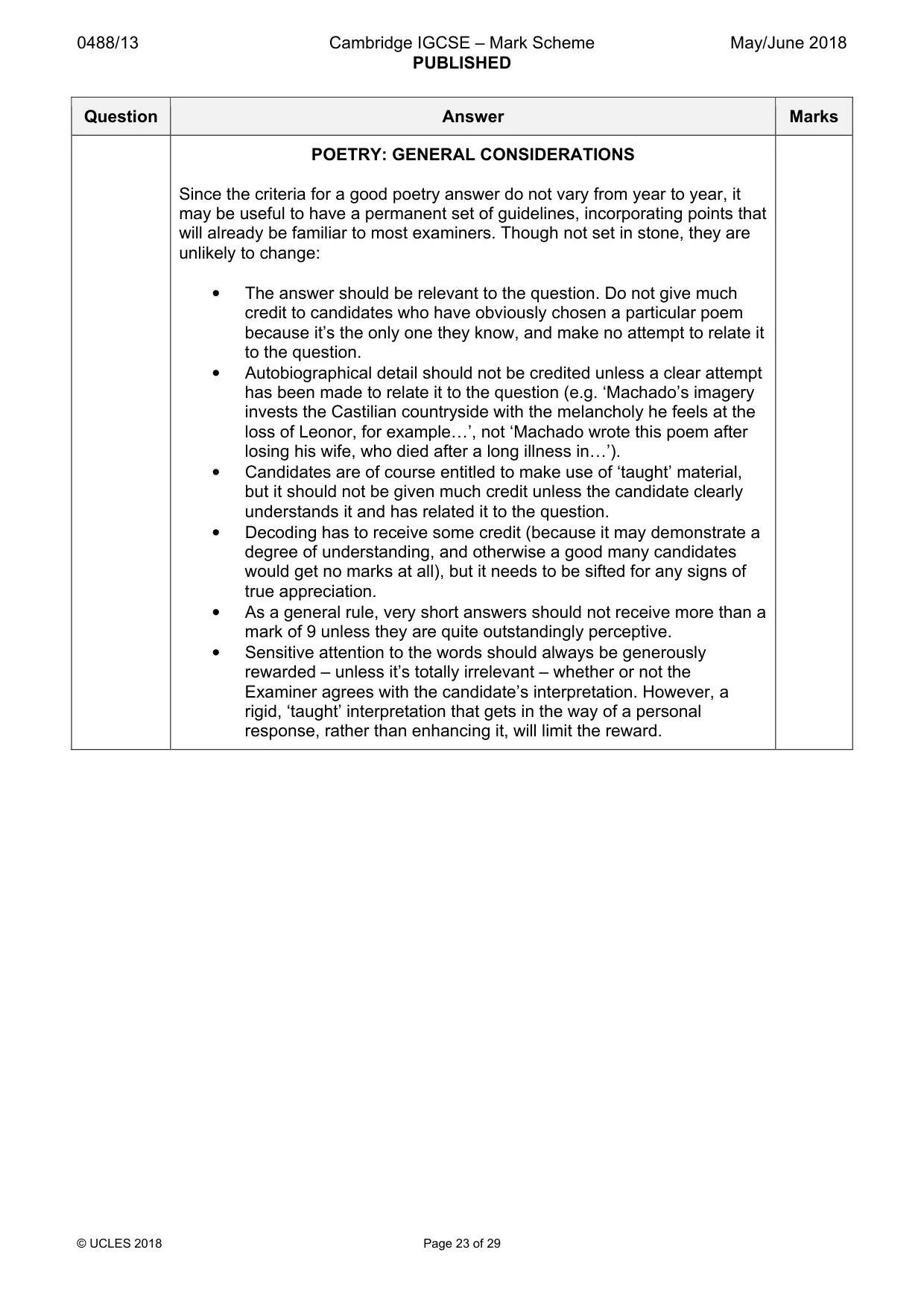
0488/13 Cambridge IGCSE – Mark Scheme PUBLISHED May/June 2018 © UCLES 2018 Page 23 of 29 Question Answer Marks POETRY: GENERAL CONSIDERATIONS Since the criteria for a good poetry answer do not vary from year to year, it may be useful to have a permanent set of guidelines, incorporating points that will already be familiar to most examiners. Though not set in stone, they are unlikely to change: • The answer should be relevant to the question. Do not give much credit to candidates who have obviously chosen a particular poem because it’s the only one they know, and make no attempt to relate it to the question. • Autobiographical detail should not be credited unless a clear attempt has been made to relate it to the question (e.g. ‘Machado’s imagery invests the Castilian countryside with the melancholy he feels at the loss of Leonor, for example«’, not ‘Machado wrote this poem after losing his wife, who died after a long illness in«’). • Candidates are of course entitled to make use of ‘taught’ material, but it should not be given much credit unless the candidate clearly understands it and has related it to the question. • Decoding has to receive some credit (because it may demonstrate a degree of understanding, and otherwise a good many candidates would get no marks at all), but it needs to be sifted for any signs of true appreciation. • As a general rule, very short answers should not receive more than a mark of 9 unless they are quite outstandingly perceptive. • Sensitive attention to the words should always be generously rewarded – unless it’s totally irrelevant – whether or not the Examiner agrees with the candidate’s interpretation. However, a rigid, ‘taught’ interpretation that gets in the way of a personal response, rather than enhancing it, will limit the reward.
Mark scheme, page 24
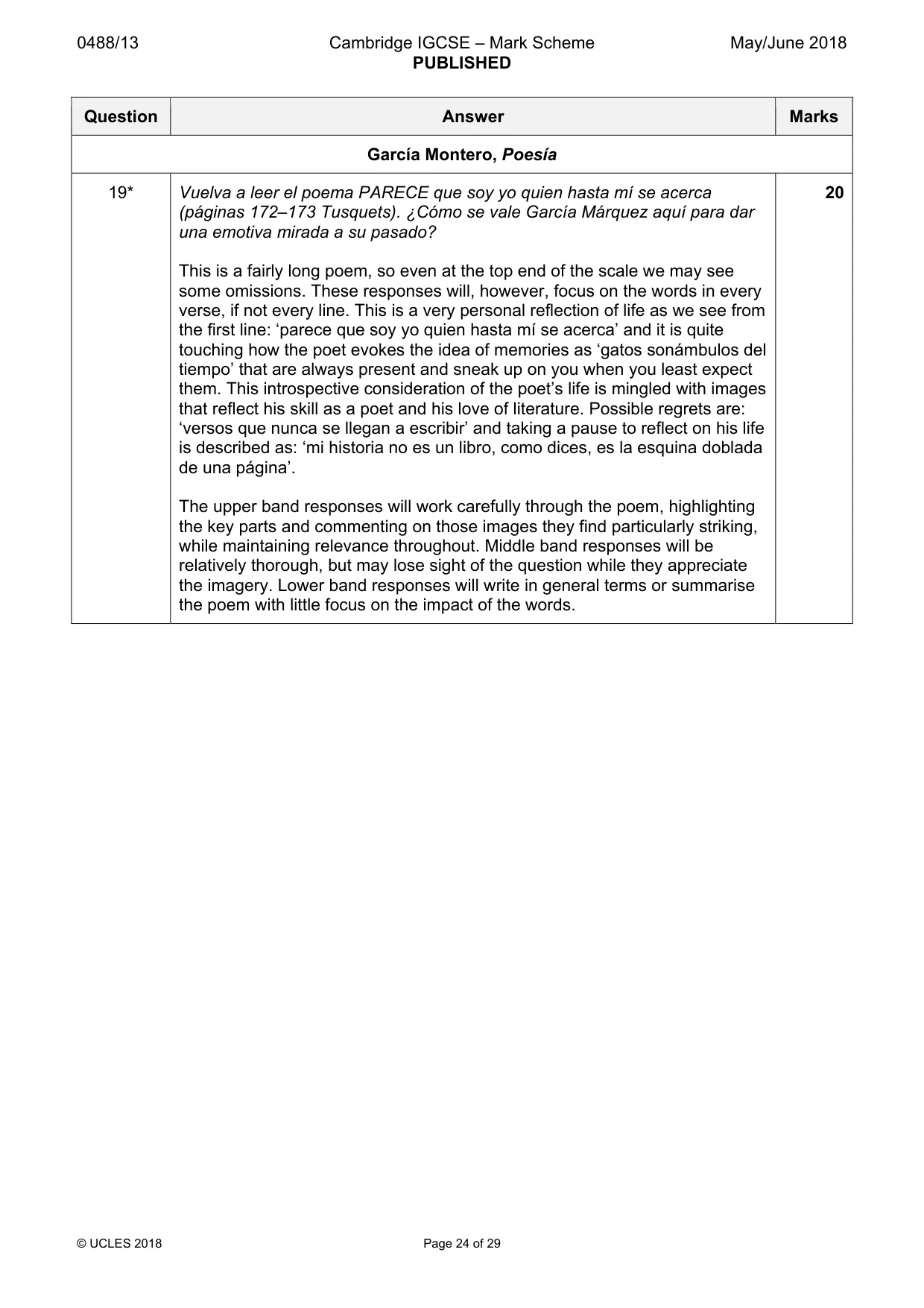
0488/13 Cambridge IGCSE – Mark Scheme PUBLISHED May/June 2018 © UCLES 2018 Page 24 of 29 Question Answer Marks García Montero, Poesía 19* Vuelva a leer el poema PARECE que soy yo quien hasta mí se acerca (páginas 172–173 Tusquets). ¿Cómo se vale García Márquez aquí para dar una emotiva mirada a su pasado? This is a fairly long poem, so even at the top end of the scale we may see some omissions. These responses will, however, focus on the words in every verse, if not every line. This is a very personal reflection of life as we see from the first line: ‘parece que soy yo quien hasta mí se acerca’ and it is quite touching how the poet evokes the idea of memories as ‘gatos sonámbulos del tiempo’ that are always present and sneak up on you when you least expect them. This introspective consideration of the poet’s life is mingled with images that reflect his skill as a poet and his love of literature. Possible regrets are: ‘versos que nunca se llegan a escribir’ and taking a pause to reflect on his life is described as: ‘mi historia no es un libro, como dices, es la esquina doblada de una página’. The upper band responses will work carefully through the poem, highlighting the key parts and commenting on those images they find particularly striking, while maintaining relevance throughout. Middle band responses will be relatively thorough, but may lose sight of the question while they appreciate the imagery. Lower band responses will write in general terms or summarise the poem with little focus on the impact of the words. 20
Mark scheme, page 25
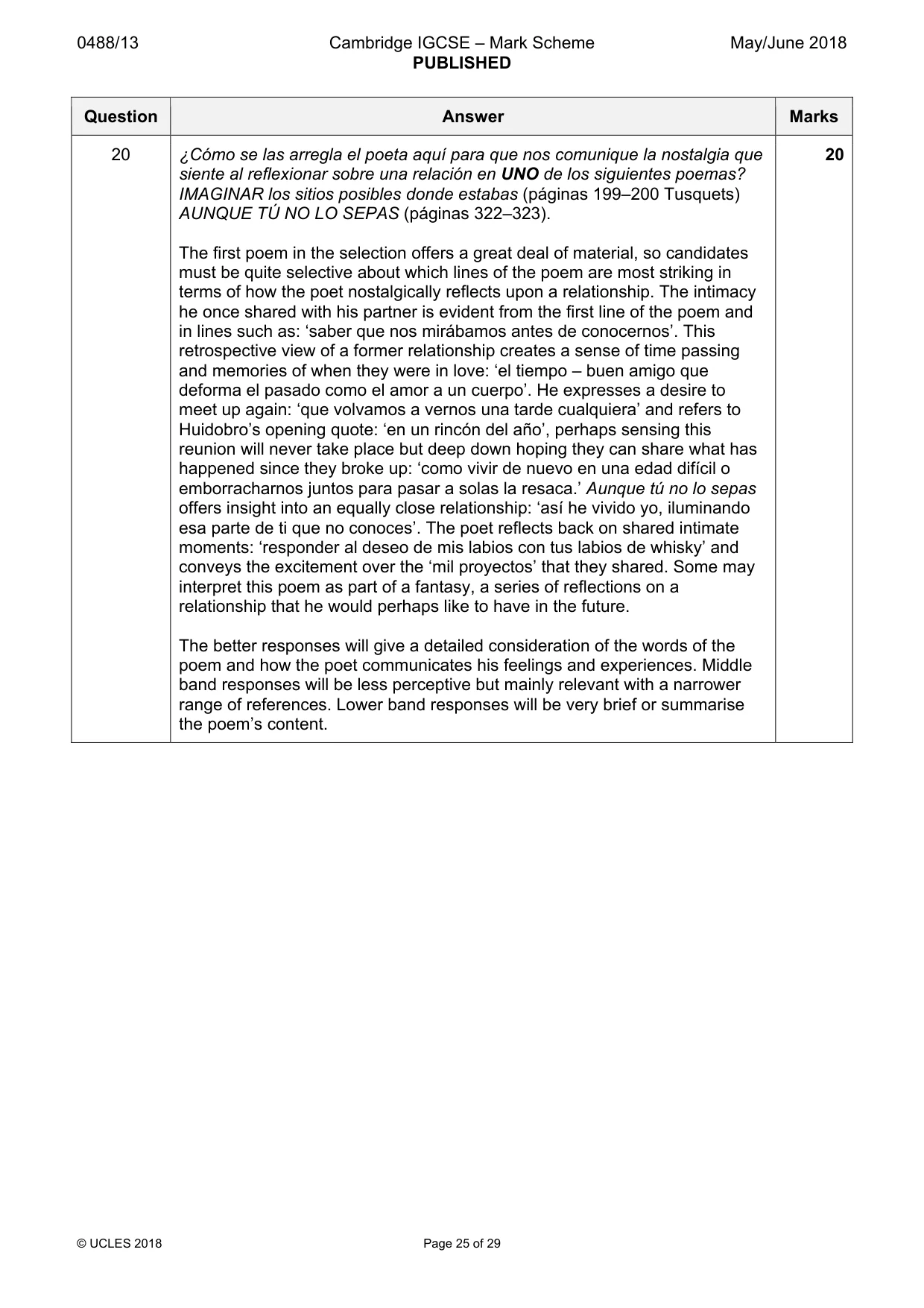
0488/13 Cambridge IGCSE – Mark Scheme PUBLISHED May/June 2018 © UCLES 2018 Page 25 of 29 Question Answer Marks 20 ¿Cómo se las arregla el poeta aquí para que nos comunique la nostalgia que siente al reflexionar sobre una relación en UNO de los siguientes poemas? IMAGINAR los sitios posibles donde estabas (páginas 199–200 Tusquets) AUNQUE TÚ NO LO SEPAS (páginas 322–323). The first poem in the selection offers a great deal of material, so candidates must be quite selective about which lines of the poem are most striking in terms of how the poet nostalgically reflects upon a relationship. The intimacy he once shared with his partner is evident from the first line of the poem and in lines such as: ‘saber que nos mirábamos antes de conocernos’. This retrospective view of a former relationship creates a sense of time passing and memories of when they were in love: ‘el tiempo – buen amigo que deforma el pasado como el amor a un cuerpo’. He expresses a desire to meet up again: ‘que volvamos a vernos una tarde cualquiera’ and refers to Huidobro’s opening quote: ‘en un rincón del año’, perhaps sensing this reunion will never take place but deep down hoping they can share what has happened since they broke up: ‘como vivir de nuevo en una edad difícil o emborracharnos juntos para pasar a solas la resaca.’ Aunque tú no lo sepas offers insight into an equally close relationship: ‘así he vivido yo, iluminando esa parte de ti que no conoces’. The poet reflects back on shared intimate moments: ‘responder al deseo de mis labios con tus labios de whisky’ and conveys the excitement over the ‘mil proyectos’ that they shared. Some may interpret this poem as part of a fantasy, a series of reflections on a relationship that he would perhaps like to have in the future. The better responses will give a detailed consideration of the words of the poem and how the poet communicates his feelings and experiences. Middle band responses will be less perceptive but mainly relevant with a narrower range of references. Lower band responses will be very brief or summarise the poem’s content. 20
Mark scheme, page 26
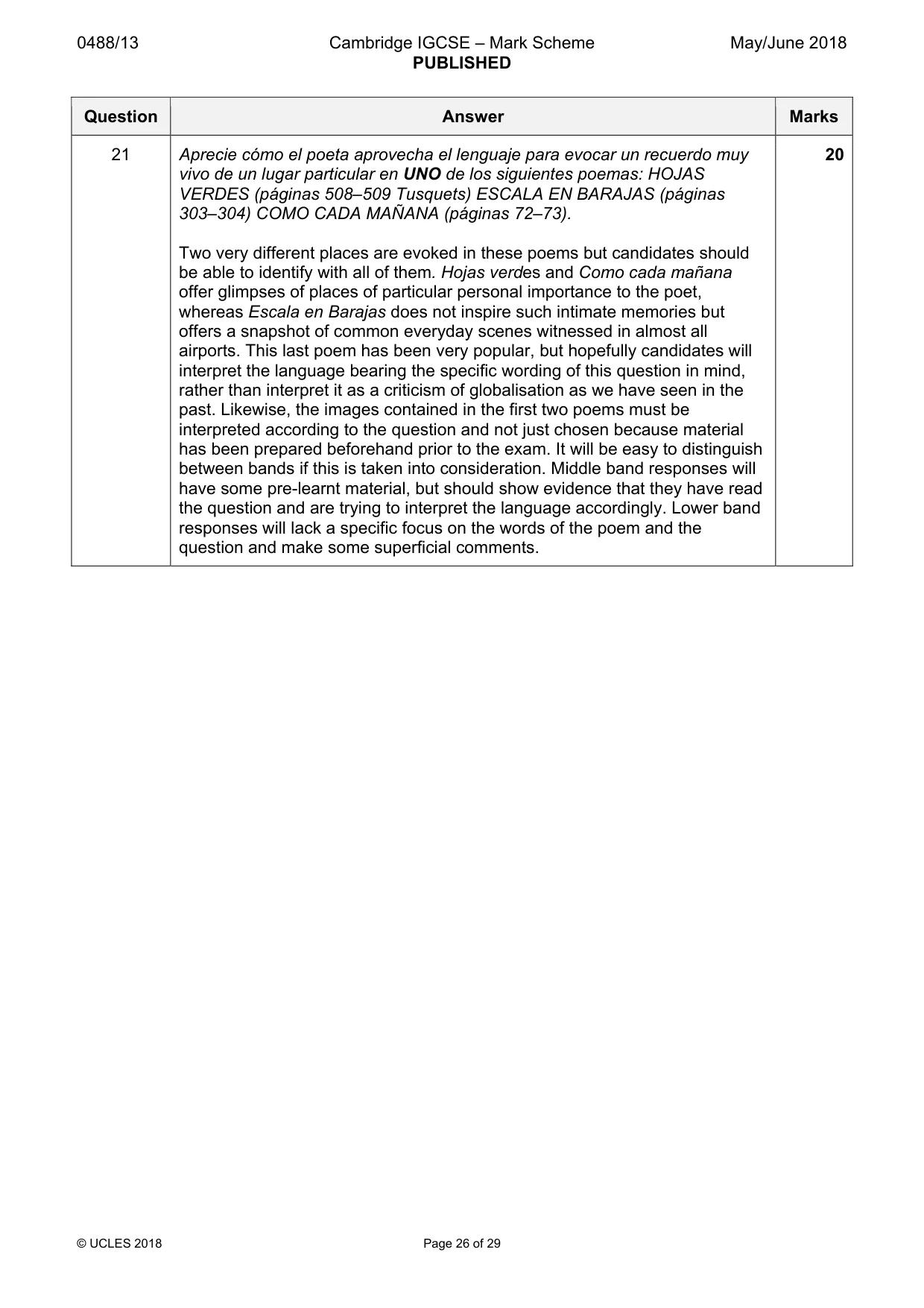
0488/13 Cambridge IGCSE – Mark Scheme PUBLISHED May/June 2018 © UCLES 2018 Page 26 of 29 Question Answer Marks 21 Aprecie cómo el poeta aprovecha el lenguaje para evocar un recuerdo muy vivo de un lugar particular en UNO de los siguientes poemas: HOJAS VERDES (páginas 508–509 Tusquets) ESCALA EN BARAJAS (páginas 303–304) COMO CADA MAÑANA (páginas 72–73). Two very different places are evoked in these poems but candidates should be able to identify with all of them. Hojas verdes and Como cada mañana offer glimpses of places of particular personal importance to the poet, whereas Escala en Barajas does not inspire such intimate memories but offers a snapshot of common everyday scenes witnessed in almost all airports. This last poem has been very popular, but hopefully candidates will interpret the language bearing the specific wording of this question in mind, rather than interpret it as a criticism of globalisation as we have seen in the past. Likewise, the images contained in the first two poems must be interpreted according to the question and not just chosen because material has been prepared beforehand prior to the exam. It will be easy to distinguish between bands if this is taken into consideration. Middle band responses will have some pre-learnt material, but should show evidence that they have read the question and are trying to interpret the language accordingly. Lower band responses will lack a specific focus on the words of the poem and the question and make some superficial comments. 20
Mark scheme, page 27
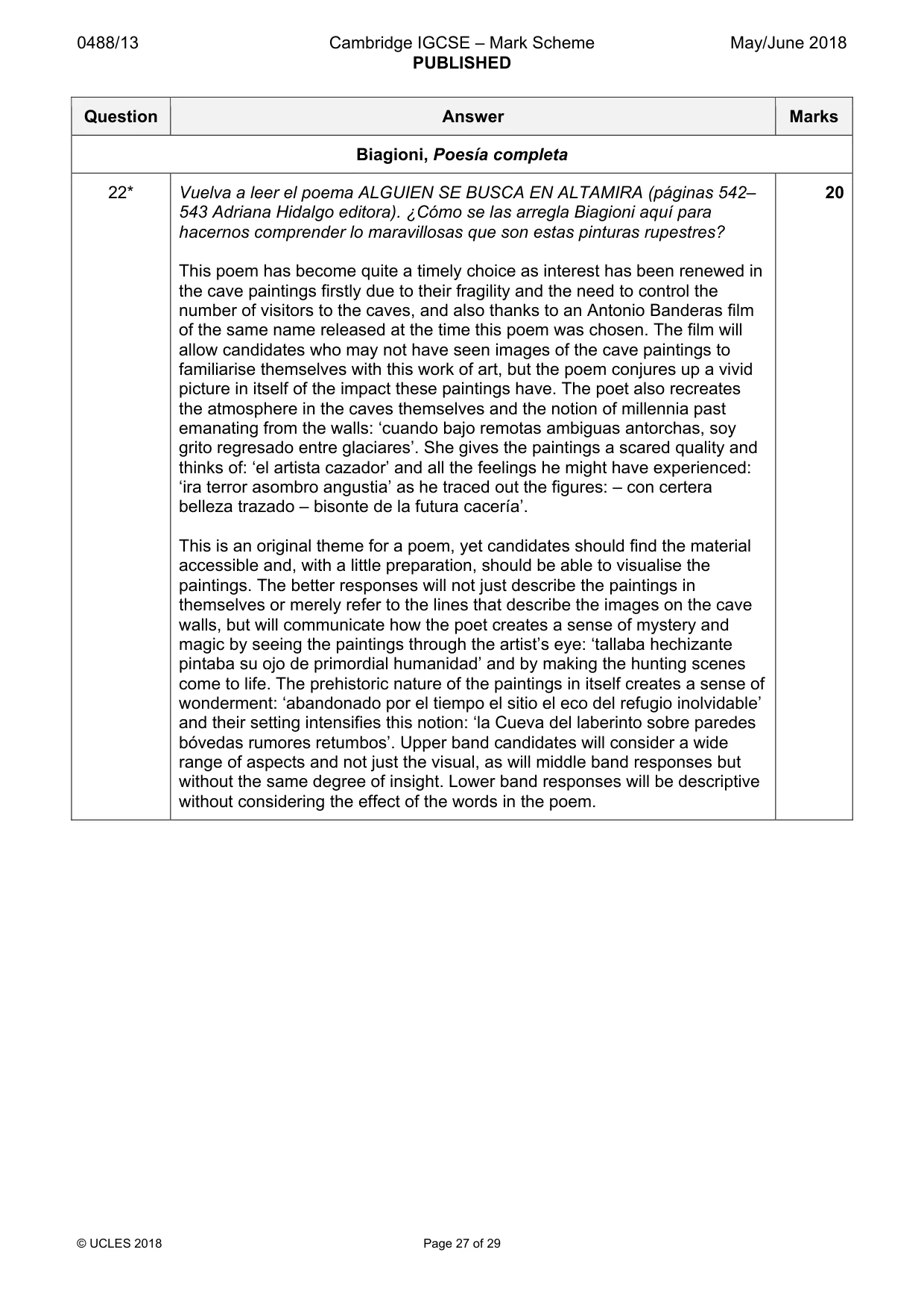
0488/13 Cambridge IGCSE – Mark Scheme PUBLISHED May/June 2018 © UCLES 2018 Page 27 of 29 Question Answer Marks Biagioni, Poesía completa 22* Vuelva a leer el poema ALGUIEN SE BUSCA EN ALTAMIRA (páginas 542– 543 Adriana Hidalgo editora). ¿Cómo se las arregla Biagioni aquí para hacernos comprender lo maravillosas que son estas pinturas rupestres? This poem has become quite a timely choice as interest has been renewed in the cave paintings firstly due to their fragility and the need to control the number of visitors to the caves, and also thanks to an Antonio Banderas film of the same name released at the time this poem was chosen. The film will allow candidates who may not have seen images of the cave paintings to familiarise themselves with this work of art, but the poem conjures up a vivid picture in itself of the impact these paintings have. The poet also recreates the atmosphere in the caves themselves and the notion of millennia past emanating from the walls: ‘cuando bajo remotas ambiguas antorchas, soy grito regresado entre glaciares’. She gives the paintings a scared quality and thinks of: ‘el artista cazador’ and all the feelings he might have experienced: ‘ira terror asombro angustia’ as he traced out the figures: – con certera belleza trazado – bisonte de la futura cacería’. This is an original theme for a poem, yet candidates should find the material accessible and, with a little preparation, should be able to visualise the paintings. The better responses will not just describe the paintings in themselves or merely refer to the lines that describe the images on the cave walls, but will communicate how the poet creates a sense of mystery and magic by seeing the paintings through the artist’s eye: ‘tallaba hechizante pintaba su ojo de primordial humanidad’ and by making the hunting scenes come to life. The prehistoric nature of the paintings in itself creates a sense of wonderment: ‘abandonado por el tiempo el sitio el eco del refugio inolvidable’ and their setting intensifies this notion: ‘la Cueva del laberinto sobre paredes bóvedas rumores retumbos’. Upper band candidates will consider a wide range of aspects and not just the visual, as will middle band responses but without the same degree of insight. Lower band responses will be descriptive without considering the effect of the words in the poem. 20
Mark scheme, page 28
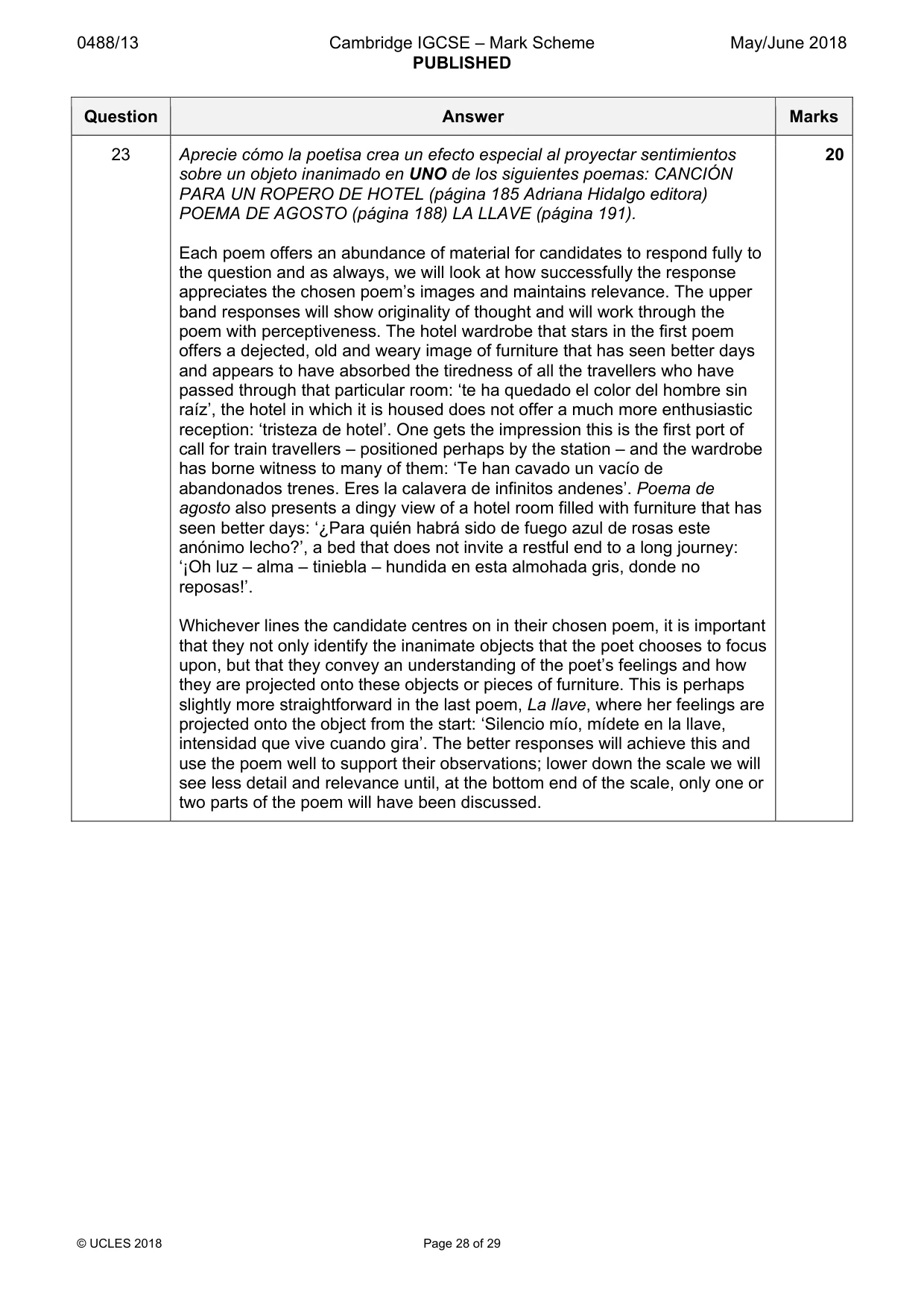
0488/13 Cambridge IGCSE – Mark Scheme PUBLISHED May/June 2018 © UCLES 2018 Page 28 of 29 Question Answer Marks 23 Aprecie cómo la poetisa crea un efecto especial al proyectar sentimientos sobre un objeto inanimado en UNO de los siguientes poemas: CANCIÓN PARA UN ROPERO DE HOTEL (página 185 Adriana Hidalgo editora) POEMA DE AGOSTO (página 188) LA LLAVE (página 191). Each poem offers an abundance of material for candidates to respond fully to the question and as always, we will look at how successfully the response appreciates the chosen poem’s images and maintains relevance. The upper band responses will show originality of thought and will work through the poem with perceptiveness. The hotel wardrobe that stars in the first poem offers a dejected, old and weary image of furniture that has seen better days and appears to have absorbed the tiredness of all the travellers who have passed through that particular room: ‘te ha quedado el color del hombre sin raíz’, the hotel in which it is housed does not offer a much more enthusiastic reception: ‘tristeza de hotel’. One gets the impression this is the first port of call for train travellers – positioned perhaps by the station – and the wardrobe has borne witness to many of them: ‘Te han cavado un vacío de abandonados trenes. Eres la calavera de infinitos andenes’. Poema de agosto also presents a dingy view of a hotel room filled with furniture that has seen better days: ‘¿Para quién habrá sido de fuego azul de rosas este anónimo lecho?’, a bed that does not invite a restful end to a long journey: ‘¡Oh luz – alma – tiniebla – hundida en esta almohada gris, donde no reposas!’. Whichever lines the candidate centres on in their chosen poem, it is important that they not only identify the inanimate objects that the poet chooses to focus upon, but that they convey an understanding of the poet’s feelings and how they are projected onto these objects or pieces of furniture. This is perhaps slightly more straightforward in the last poem, La llave, where her feelings are projected onto the object from the start: ‘Silencio mío, mídete en la llave, intensidad que vive cuando gira’. The better responses will achieve this and use the poem well to support their observations; lower down the scale we will see less detail and relevance until, at the bottom end of the scale, only one or two parts of the poem will have been discussed. 20
Mark scheme, page 29
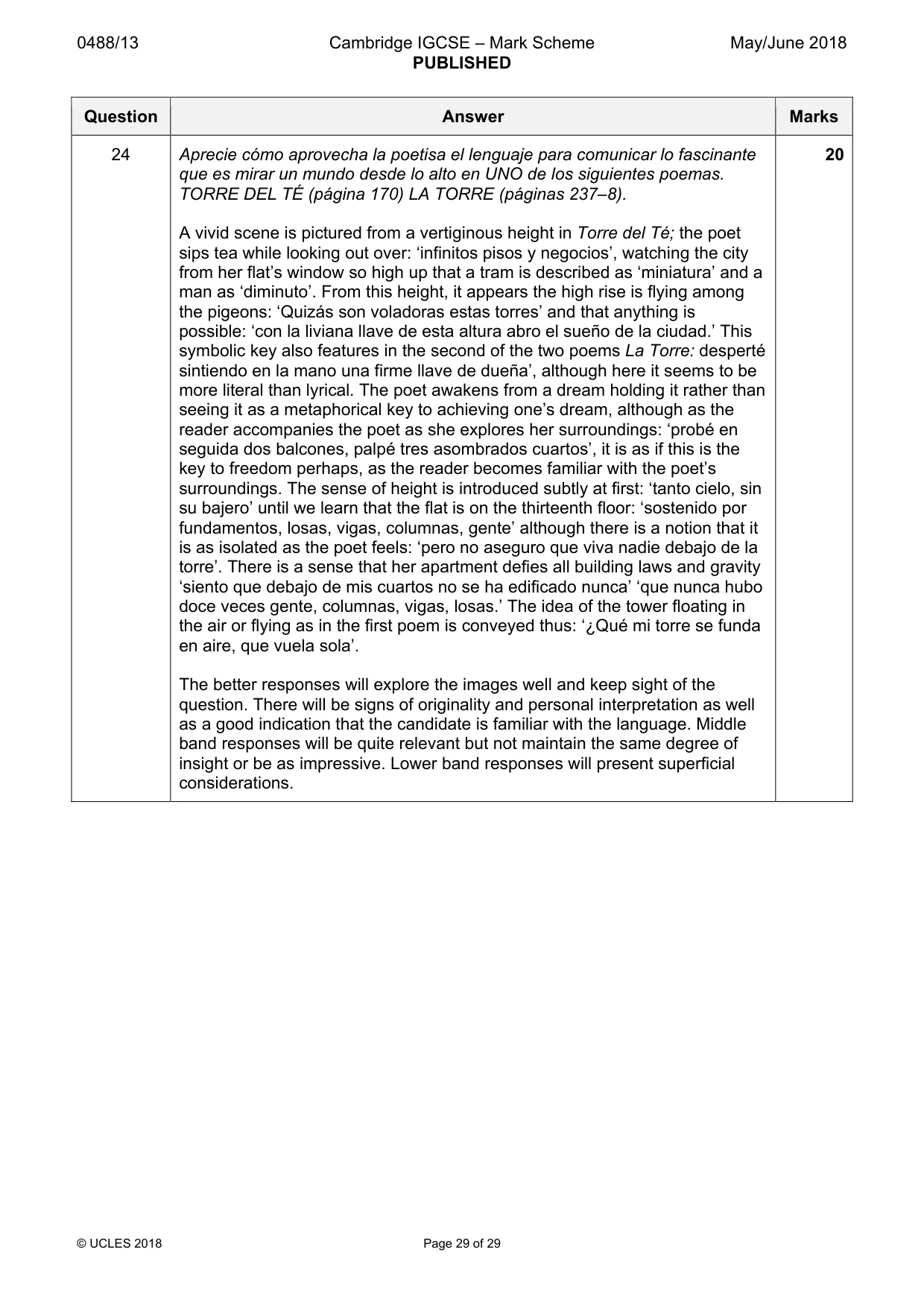
0488/13 Cambridge IGCSE – Mark Scheme PUBLISHED May/June 2018 © UCLES 2018 Page 29 of 29 Question Answer Marks 24 Aprecie cómo aprovecha la poetisa el lenguaje para comunicar lo fascinante que es mirar un mundo desde lo alto en UNO de los siguientes poemas. TORRE DEL TÉ (página 170) LA TORRE (páginas 237–8). A vivid scene is pictured from a vertiginous height in Torre del Té; the poet sips tea while looking out over: ‘infinitos pisos y negocios’, watching the city from her flat’s window so high up that a tram is described as ‘miniatura’ and a man as ‘diminuto’. From this height, it appears the high rise is flying among the pigeons: ‘Quizás son voladoras estas torres’ and that anything is possible: ‘con la liviana llave de esta altura abro el sueño de la ciudad.’ This symbolic key also features in the second of the two poems La Torre: desperté sintiendo en la mano una firme llave de dueña’, although here it seems to be more literal than lyrical. The poet awakens from a dream holding it rather than seeing it as a metaphorical key to achieving one’s dream, although as the reader accompanies the poet as she explores her surroundings: ‘probé en seguida dos balcones, palpé tres asombrados cuartos’, it is as if this is the key to freedom perhaps, as the reader becomes familiar with the poet’s surroundings. The sense of height is introduced subtly at first: ‘tanto cielo, sin su bajero’ until we learn that the flat is on the thirteenth floor: ‘sostenido por fundamentos, losas, vigas, columnas, gente’ although there is a notion that it is as isolated as the poet feels: ‘pero no aseguro que viva nadie debajo de la torre’. There is a sense that her apartment defies all building laws and gravity ‘siento que debajo de mis cuartos no se ha edificado nunca’ ‘que nunca hubo doce veces gente, columnas, vigas, losas.’ The idea of the tower floating in the air or flying as in the first poem is conveyed thus: ‘¿Qué mi torre se funda en aire, que vuela sola’. The better responses will explore the images well and keep sight of the question. There will be signs of originality and personal interpretation as well as a good indication that the candidate is familiar with the language. Middle band responses will be quite relevant but not maintain the same degree of insight or be as impressive. Lower band responses will present superficial considerations. 20
What you needed in this session
Cambridge’s own grade thresholds for 2018 May/June, Paper 1 · Variant 3. A higher threshold means an easier paper — the bar moves with how the cohort did.