Cambridge IGCSE Spanish - Literature 0488 — 2020 May/June Paper 1 · Variant 3
0488/13/M/J/20
The question paper and its mark scheme, free to read here and free to download. This is Cambridge’s own paper, exactly as it was sat.
Question paper8 pages


Mark scheme19 pages
Answers below. Sit the paper first if you are practising.
Paper as text
Question paper, page 1
Cambridge IGCSE™ DC (LK) 183418/2 © UCLES 2020 [Turn over This document has 8 pages. Blank pages are indicated. LITERATURE (SPANISH) 0488/13 Paper 1 Spanish Texts May/June 2020 2 hours 15 minutes You must answer on the enclosed answer booklet. You will need: Answer booklet (enclosed) Texts studied should be taken into the examination room. INSTRUCTIONS ● Answer three questions in total: Each answer must be on a different text. You must answer from at least two sections: Section A: Prose Section B: Drama Section C: Poetry Answer at least one text-based question (marked *). You may choose all three of your questions from those marked *. ● Follow the instructions on the front cover of the answer booklet. If you need additional answer paper, ask the invigilator for a continuation booklet. INFORMATION ● The total mark for this paper is 60. ● All questions are worth equal marks. INSTRUCCIONES ● Conteste a tres preguntas en total: Cada pregunta debe ser de un texto diferente. Debe contestar a preguntas de al menos dos secciones: Sección A: Prosa Sección B: Teatro Sección C: Poesía Conteste a al menos una pregunta basada en un extracto (preguntas señaladas con un asterisco *). Si lo desea, puede contestar a tres preguntas señaladas con un asterisco *. ● Siga las instrucciones que aparecen en la portada del cuadernillo de respuestas. Las instrucciones aparecen también en español a continuación. Si necesita hojas adicionales, pídale al supervisor un cuadernillo de respuestas adicional. INFORMACIÓN ● La puntuación total de este examen es de 60. ● Todas las preguntas tienen el mismo valor. * 6 5 0 7 6 2 2 4 7 2 *
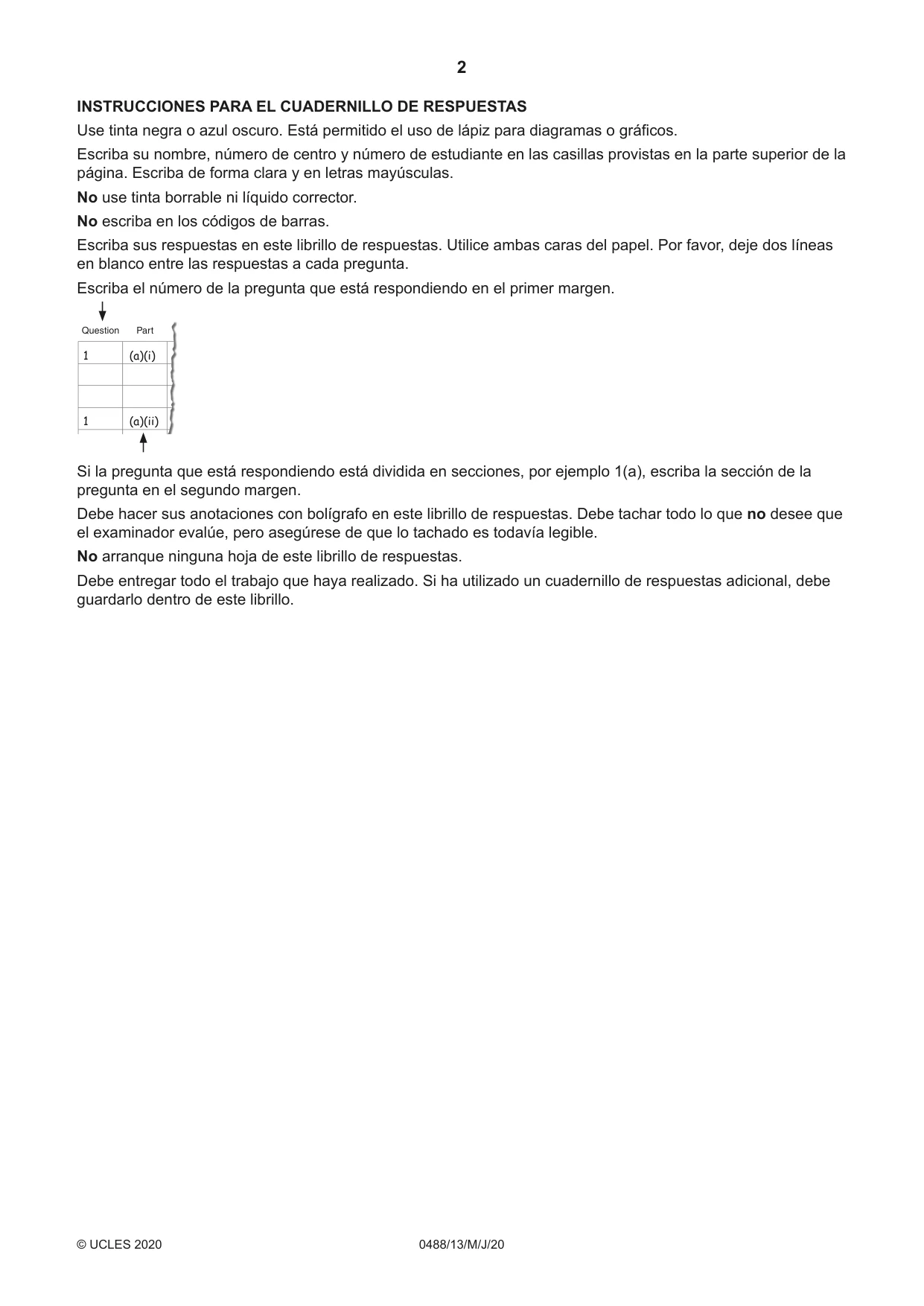
Question paper, page 2
2 0488/13/M/J/20 © UCLES 2020 INSTRUCCIONES PARA EL CUADERNILLO DE RESPUESTAS Use tinta negra o azul oscuro. Está permitido el uso de lápiz para diagramas o gráficos. Escriba su nombre, número de centro y número de estudiante en las casillas provistas en la parte superior de la página. Escriba de forma clara y en letras mayúsculas. No use tinta borrable ni líquido corrector. No escriba en los códigos de barras. Escriba sus respuestas en este librillo de respuestas. Utilice ambas caras del papel. Por favor, deje dos líneas en blanco entre las respuestas a cada pregunta. Escriba el número de la pregunta que está respondiendo en el primer margen. Question Part 1 1 (a)(i) (a)(ii) Si la pregunta que está respondiendo está dividida en secciones, por ejemplo 1(a), escriba la sección de la pregunta en el segundo margen. Debe hacer sus anotaciones con bolígrafo en este librillo de respuestas. Debe tachar todo lo que no desee que el examinador evalúe, pero asegúrese de que lo tachado es todavía legible. No arranque ninguna hoja de este librillo de respuestas. Debe entregar todo el trabajo que haya realizado. Si ha utilizado un cuadernillo de respuestas adicional, debe guardarlo dentro de este librillo.
Question paper, page 3
3 0488/13/M/J/20 © UCLES 2020 [Turn over BLANK PAGE
Question paper, page 4
4 0488/13/M/J/20 © UCLES 2020 EN TODAS SUS RESPUESTAS DEBE REFERIRSE DETALLADAMENTE AL TEXTO SECCIÓN A: PROSA Grandes, El lector de Julio Verne Alternativamente: 1* Vuelva a leer una parte de la tercera sección de la parte II 1948 desde ‘Rodeé la casa para estudiar la fachada’ (página 250 Colección Andanzas) hasta ‘que como se enteren arriba de que he bajado a verte, me fusilan’ (página 253). ¿Cómo se las arregla Grandes aquí para crear una escena emocionante? No olvide referirse detalladamente al extracto. o 2 ‘En mi pueblo, y más que los olivos, se cultivaban las traiciones, las delaciones, el miedo y los fusiles. Vivíamos en el centro de una guerra que no iba a acabar nunca’ (La tercera sección de la parte I 1947 página 127 Colección Andanzas). ¿Cómo reacciona usted ante la forma en que la gente del pueblo convive en este entorno? No olvide referirse detalladamente al texto. o 3 ‘Pepe me daba la espalda pero debía de estar hablando y no para defenderse, porque el guardia asentía con la cabeza y una expresión serena, los labios relajados, las manos en los bolsillos’ (La tercera sección de la parte I 1947 página 112 Colección Andanzas). Imagine y escriba la conversación entre Pepe el Portugués y Sanchís en este momento. Conteste con la voz de Pepe el Portugués y Sanchís. Esquivel, Como agua para chocolate Alternativamente: 4* Vuelva a leer el final del Capítulo IV ABRIL MOLE DE GUAJOLOTE CON ALMENDRA Y AJONJOLÍ desde ‘–¡Qué bien se ve este niño, al lado de una tía tan bella!’ (página 73 Debolsillo) hasta ‘la primera fiesta que gozaba en su vida’ (página 75). ¿Cómo se las arregla Esquivel para que compartamos los sentimientos que experimenta Tita aquí? No olvide referirse detalladamente al extracto. o 5 La revolución impacta en la vida del rancho en varias ocasiones a lo largo de la novela. ¿Cómo se vale la autora de estos momentos para intensificar el interés del argumento? No olvide referirse detalladamente al texto. o 6 ‘Tita tomó nuevamente la mano de Pedro, Rosaura y Tita se miraron un momento retadoramente. Entonces Rosaura comprendió que ella no tenía nada que hacer ahí, se metió en su recámara y se cerró con llave’ (Capítulo X OCTUBRE TORREJAS DE NATAS página 173 Debolsillo). Usted es Rosaura en este momento. ¿Qué está usted pensando? Conteste con la voz de Rosaura.
Question paper, page 5
5 0488/13/M/J/20 © UCLES 2020 [Turn over García Márquez, Crónica de una muerte anunciada Alternativamente: 7* Vuelva a leer una parte de la sección 3 desde ‘En realidad no se demoró más de diez minutos’ (página 73 Debolsillo) hasta ‘si era cierto que estaban esperando a Santiago Nasar para matarlo’ (página 75). ¿Cómo se las arregla García Márquez aquí para crear suspense ante el inminente asesinato de Santiago Nasar? No olvide referirse detalladamente al pasaje. o 8 Enigmática e inocente. Astuta y engañosa. En su opinión de lector, ¿cuál es la descripción más apta para Ángela Vicario, y por qué? No olvide referirse detalladamente al texto. o 9 ‘Fue el hombre de mi vida’ (Sección 1 página 13 Debolsillo). Usted es Plácida Linero en este momento. ¿Qué está usted pensando al recordar a su difunto hijo? Conteste con la voz de Plácida Linero. Ruiz Zafón, El prisionero del cielo Alternativamente: 10* Vuelva a leer el capítulo 11 de la Cuarta parte SOSPECHA desde ‘Cuando regresé a la habitación’ (página 323 Booket) hasta ‘empujándome a toda velocidad hacia la salida’ (página 326). Aprecie cómo Ruiz Zafón aprovecha el lenguaje aquí para crear un ambiente tenso y cómico a la vez. No olvide referirse detalladamente al extracto. o 11 ‘Para Fermín Romero de Torres, que regresó de entre los muertos y tiene la llave del futuro. 13’ (Capítulo 3 de la Primera parte UN CUENTO de NAVIDAD página 32 Booket). Aprecie cómo el autor crea intriga al desenredar paulatinamente el misterio de esta dedicatoria. No olvide referirse detalladamente al texto. o 12 Usted es Fermín Romero de Torres al final del capítulo 11 de la Segunda parte DE ENTRE los MUERTOS (página 150 Booket). ¿Qué está usted pensando? Conteste con la voz de Fermín.
Question paper, page 6
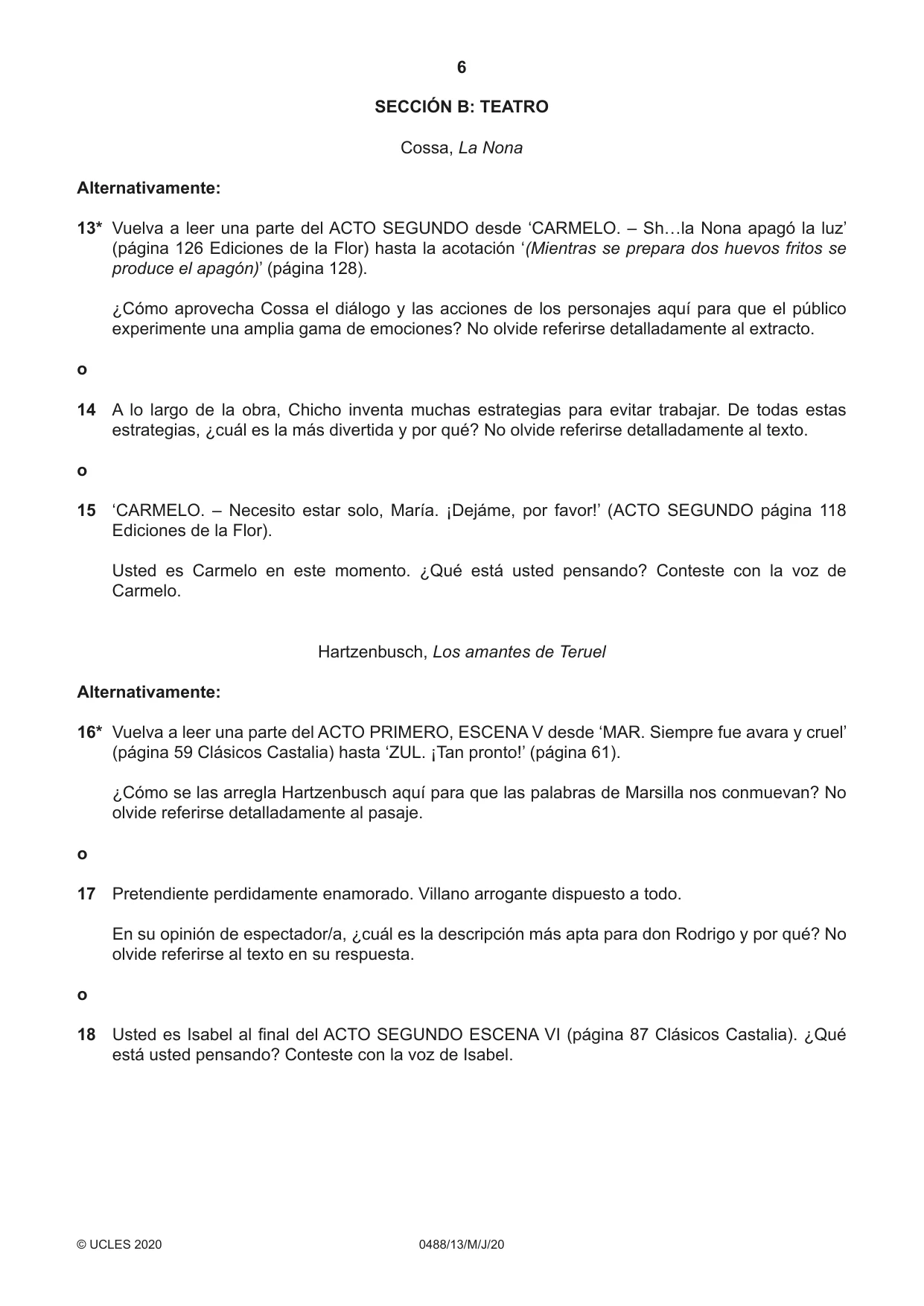
6 0488/13/M/J/20 © UCLES 2020 SECCIÓN B: TEATRO Cossa, La Nona Alternativamente: 13* Vuelva a leer una parte del ACTO SEGUNDO desde ‘CARMELO. – Sh…la Nona apagó la luz’ (página 126 Ediciones de la Flor) hasta la acotación ‘(Mientras se prepara dos huevos fritos se produce el apagón)’ (página 128). ¿Cómo aprovecha Cossa el diálogo y las acciones de los personajes aquí para que el público experimente una amplia gama de emociones? No olvide referirse detalladamente al extracto. o 14 A lo largo de la obra, Chicho inventa muchas estrategias para evitar trabajar. De todas estas estrategias, ¿cuál es la más divertida y por qué? No olvide referirse detalladamente al texto. o 15 ‘CARMELO. – Necesito estar solo, María. ¡Dejáme, por favor!’ (ACTO SEGUNDO página 118 Ediciones de la Flor). Usted es Carmelo en este momento. ¿Qué está usted pensando? Conteste con la voz de Carmelo. Hartzenbusch, Los amantes de Teruel Alternativamente: 16* Vuelva a leer una parte del ACTO PRIMERO, ESCENA V desde ‘MAR. Siempre fue avara y cruel’ (página 59 Clásicos Castalia) hasta ‘ZUL. ¡Tan pronto!’ (página 61). ¿Cómo se las arregla Hartzenbusch aquí para que las palabras de Marsilla nos conmuevan? No olvide referirse detalladamente al pasaje. o 17 Pretendiente perdidamente enamorado. Villano arrogante dispuesto a todo. En su opinión de espectador/a, ¿cuál es la descripción más apta para don Rodrigo y por qué? No olvide referirse al texto en su respuesta. o 18 Usted es Isabel al final del ACTO SEGUNDO ESCENA VI (página 87 Clásicos Castalia). ¿Qué está usted pensando? Conteste con la voz de Isabel.
Question paper, page 7
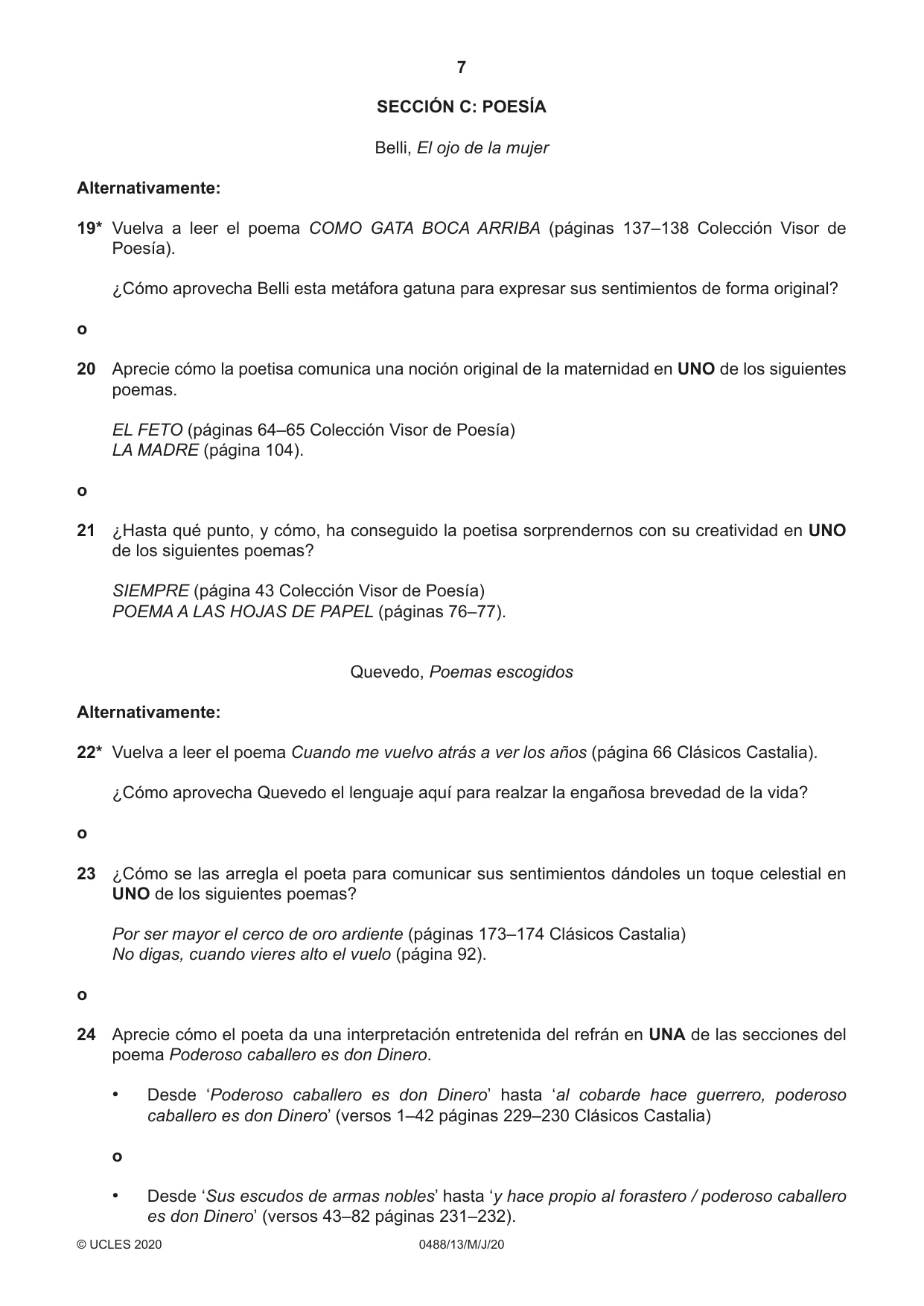
7 0488/13/M/J/20 © UCLES 2020 SECCIÓN C: POESÍA Belli, El ojo de la mujer Alternativamente: 19* Vuelva a leer el poema COMO GATA BOCA ARRIBA (páginas 137–138 Colección Visor de Poesía). ¿Cómo aprovecha Belli esta metáfora gatuna para expresar sus sentimientos de forma original? o 20 Aprecie cómo la poetisa comunica una noción original de la maternidad en UNO de los siguientes poemas. EL FETO (páginas 64–65 Colección Visor de Poesía) LA MADRE (página 104). o 21 ¿Hasta qué punto, y cómo, ha conseguido la poetisa sorprendernos con su creatividad en UNO de los siguientes poemas? SIEMPRE (página 43 Colección Visor de Poesía) POEMA A LAS HOJAS DE PAPEL (páginas 76–77). Quevedo, Poemas escogidos Alternativamente: 22* Vuelva a leer el poema Cuando me vuelvo atrás a ver los años (página 66 Clásicos Castalia). ¿Cómo aprovecha Quevedo el lenguaje aquí para realzar la engañosa brevedad de la vida? o 23 ¿Cómo se las arregla el poeta para comunicar sus sentimientos dándoles un toque celestial en UNO de los siguientes poemas? Por ser mayor el cerco de oro ardiente (páginas 173–174 Clásicos Castalia) No digas, cuando vieres alto el vuelo (página 92). o 24 Aprecie cómo el poeta da una interpretación entretenida del refrán en UNA de las secciones del poema Poderoso caballero es don Dinero. • Desde ‘Poderoso caballero es don Dinero’ hasta ‘al cobarde hace guerrero, poderoso caballero es don Dinero’ (versos 1–42 páginas 229–230 Clásicos Castalia) o • Desde ‘Sus escudos de armas nobles’ hasta ‘y hace propio al forastero / poderoso caballero es don Dinero’ (versos 43–82 páginas 231–232).
Question paper, page 8
8 0488/13/M/J/20 © UCLES 2020 Permission to reproduce items where third-party owned material protected by copyright is included has been sought and cleared where possible. Every reasonable effort has been made by the publisher (UCLES) to trace copyright holders, but if any items requiring clearance have unwittingly been included, the publisher will be pleased to make amends at the earliest possible opportunity. To avoid the issue of disclosure of answer-related information to candidates, all copyright acknowledgements are reproduced online in the Cambridge Assessment International Education Copyright Acknowledgements Booklet. This is produced for each series of examinations and is freely available to download at www.cambridgeinternational.org after the live examination series. Cambridge Assessment International Education is part of the Cambridge Assessment Group. Cambridge Assessment is the brand name of the University of Cambridge Local Examinations Syndicate (UCLES), which itself is a department of the University of Cambridge. BLANK PAGE
Mark scheme, page 1
This document consists of 19 printed pages. © UCLES 2020 [Turn over Cambridge IGCSE™ LITERATURE (SPANISH) 0488/13 Paper 1 Set Texts (Open Books) May/June 2020 MARK SCHEME Maximum Mark: 60 Published Students did not sit exam papers in the June 2020 series due to the Covid-19 global pandemic. This mark scheme is published to support teachers and students and should be read together with the question paper. It shows the requirements of the exam. The answer column of the mark scheme shows the proposed basis on which Examiners would award marks for this exam. Where appropriate, this column also provides the most likely acceptable alternative responses expected from students. Examiners usually review the mark scheme after they have seen student responses and update the mark scheme if appropriate. In the June series, Examiners were unable to consider the acceptability of alternative responses, as there were no student responses to consider. Mark schemes should usually be read together with the Principal Examiner Report for Teachers. However, because students did not sit exam papers, there is no Principal Examiner Report for Teachers for the June 2020 series. Cambridge International will not enter into discussions about these mark schemes. Cambridge International is publishing the mark schemes for the June 2020 series for most Cambridge IGCSE™ and Cambridge International A & AS Level components, and some Cambridge O Level components.
Mark scheme, page 2
0488/13 Cambridge IGCSE – Mark Scheme PUBLISHED May/June 2020 © UCLES 2020 Page 2 of 19 Generic Marking Principles These general marking principles must be applied by all examiners when marking candidate answers. They should be applied alongside the specific content of the mark scheme or generic level descriptors for a question. Each question paper and mark scheme will also comply with these marking principles. GENERIC MARKING PRINCIPLE 1: Marks must be awarded in line with: • the specific content of the mark scheme or the generic level descriptors for the question • the specific skills defined in the mark scheme or in the generic level descriptors for the question • the standard of response required by a candidate as exemplified by the standardisation scripts. GENERIC MARKING PRINCIPLE 2: Marks awarded are always whole marks (not half marks, or other fractions). GENERIC MARKING PRINCIPLE 3: Marks must be awarded positively: • marks are awarded for correct/valid answers, as defined in the mark scheme. However, credit is given for valid answers which go beyond the scope of the syllabus and mark scheme, referring to your Team Leader as appropriate • marks are awarded when candidates clearly demonstrate what they know and can do • marks are not deducted for errors • marks are not deducted for omissions • answers should only be judged on the quality of spelling, punctuation and grammar when these features are specifically assessed by the question as indicated by the mark scheme. The meaning, however, should be unambiguous. GENERIC MARKING PRINCIPLE 4: Rules must be applied consistently e.g. in situations where candidates have not followed instructions or in the application of generic level descriptors. GENERIC MARKING PRINCIPLE 5: Marks should be awarded using the full range of marks defined in the mark scheme for the question (however; the use of the full mark range may be limited according to the quality of the candidate responses seen). GENERIC MARKING PRINCIPLE 6: Marks awarded are based solely on the requirements as defined in the mark scheme. Marks should not be awarded with grade thresholds or grade descriptors in mind.
Mark scheme, page 3
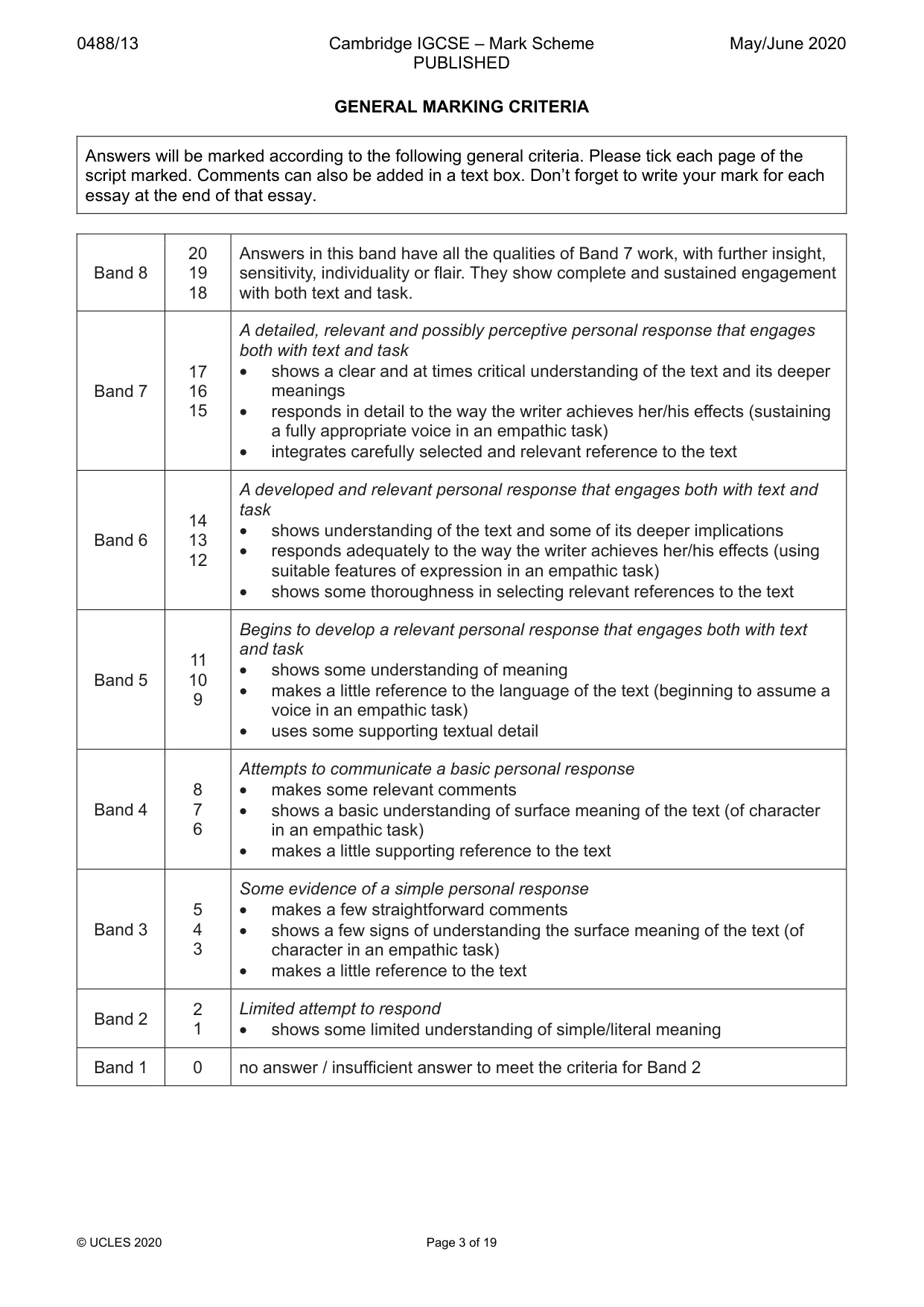
0488/13 Cambridge IGCSE – Mark Scheme PUBLISHED May/June 2020 © UCLES 2020 Page 3 of 19 GENERAL MARKING CRITERIA Answers will be marked according to the following general criteria. Please tick each page of the script marked. Comments can also be added in a text box. Don’t forget to write your mark for each essay at the end of that essay. Band 8 20 19 18 Answers in this band have all the qualities of Band 7 work, with further insight, sensitivity, individuality or flair. They show complete and sustained engagement with both text and task. Band 7 17 16 15 A detailed, relevant and possibly perceptive personal response that engages both with text and task • shows a clear and at times critical understanding of the text and its deeper meanings • responds in detail to the way the writer achieves her/his effects (sustaining a fully appropriate voice in an empathic task) • integrates carefully selected and relevant reference to the text Band 6 14 13 12 A developed and relevant personal response that engages both with text and task • shows understanding of the text and some of its deeper implications • responds adequately to the way the writer achieves her/his effects (using suitable features of expression in an empathic task) • shows some thoroughness in selecting relevant references to the text Band 5 11 10 9 Begins to develop a relevant personal response that engages both with text and task • shows some understanding of meaning • makes a little reference to the language of the text (beginning to assume a voice in an empathic task) • uses some supporting textual detail Band 4 8 7 6 Attempts to communicate a basic personal response • makes some relevant comments • shows a basic understanding of surface meaning of the text (of character in an empathic task) • makes a little supporting reference to the text Band 3 5 4 3 Some evidence of a simple personal response • makes a few straightforward comments • shows a few signs of understanding the surface meaning of the text (of character in an empathic task) • makes a little reference to the text Band 2 2 1 Limited attempt to respond • shows some limited understanding of simple/literal meaning Band 1 0 no answer / insufficient answer to meet the criteria for Band 2
Mark scheme, page 4
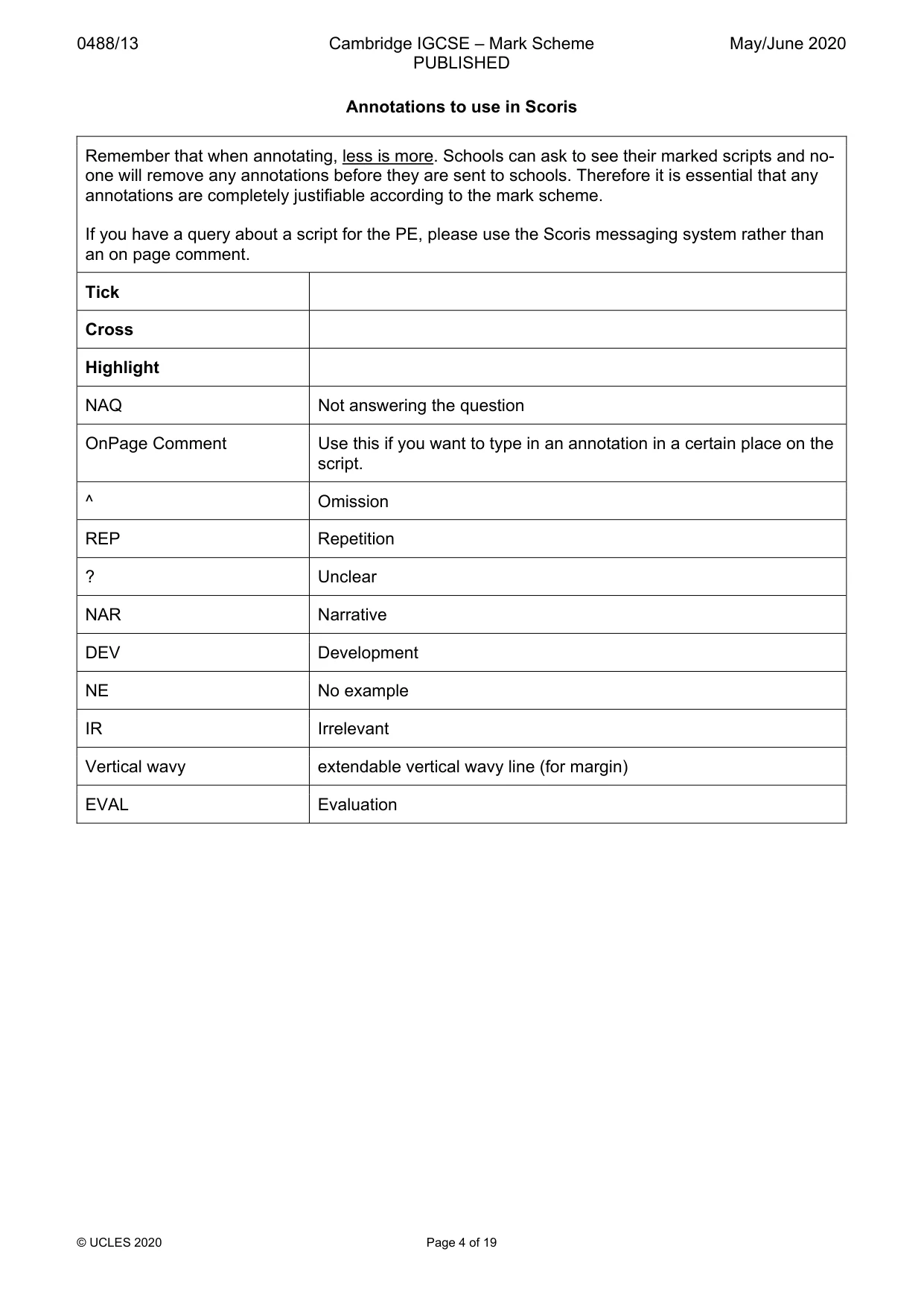
0488/13 Cambridge IGCSE – Mark Scheme PUBLISHED May/June 2020 © UCLES 2020 Page 4 of 19 Annotations to use in Scoris Remember that when annotating, less is more. Schools can ask to see their marked scripts and no- one will remove any annotations before they are sent to schools. Therefore it is essential that any annotations are completely justifiable according to the mark scheme. If you have a query about a script for the PE, please use the Scoris messaging system rather than an on page comment. Tick Cross Highlight NAQ Not answering the question OnPage Comment Use this if you want to type in an annotation in a certain place on the script. ^ Omission REP Repetition ? Unclear NAR Narrative DEV Development NE No example IR Irrelevant Vertical wavy extendable vertical wavy line (for margin) EVAL Evaluation
Mark scheme, page 5
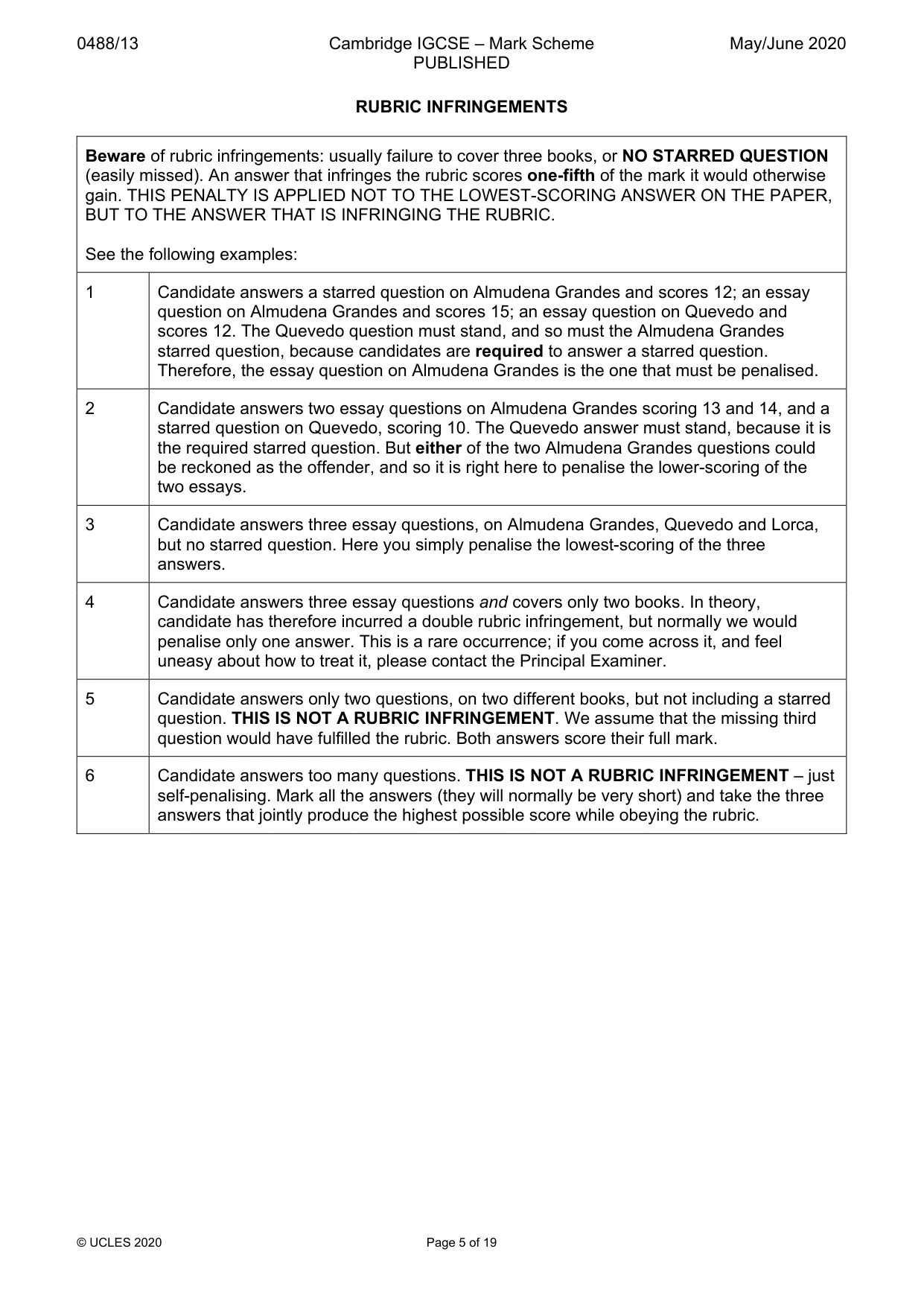
0488/13 Cambridge IGCSE – Mark Scheme PUBLISHED May/June 2020 © UCLES 2020 Page 5 of 19 RUBRIC INFRINGEMENTS Beware of rubric infringements: usually failure to cover three books, or NO STARRED QUESTION (easily missed). An answer that infringes the rubric scores one-fifth of the mark it would otherwise gain. THIS PENALTY IS APPLIED NOT TO THE LOWEST-SCORING ANSWER ON THE PAPER, BUT TO THE ANSWER THAT IS INFRINGING THE RUBRIC. See the following examples: 1 Candidate answers a starred question on Almudena Grandes and scores 12; an essay question on Almudena Grandes and scores 15; an essay question on Quevedo and scores 12. The Quevedo question must stand, and so must the Almudena Grandes starred question, because candidates are required to answer a starred question. Therefore, the essay question on Almudena Grandes is the one that must be penalised. 2 Candidate answers two essay questions on Almudena Grandes scoring 13 and 14, and a starred question on Quevedo, scoring 10. The Quevedo answer must stand, because it is the required starred question. But either of the two Almudena Grandes questions could be reckoned as the offender, and so it is right here to penalise the lower-scoring of the two essays. 3 Candidate answers three essay questions, on Almudena Grandes, Quevedo and Lorca, but no starred question. Here you simply penalise the lowest-scoring of the three answers. 4 Candidate answers three essay questions and covers only two books. In theory, candidate has therefore incurred a double rubric infringement, but normally we would penalise only one answer. This is a rare occurrence; if you come across it, and feel uneasy about how to treat it, please contact the Principal Examiner. 5 Candidate answers only two questions, on two different books, but not including a starred question. THIS IS NOT A RUBRIC INFRINGEMENT. We assume that the missing third question would have fulfilled the rubric. Both answers score their full mark. 6 Candidate answers too many questions. THIS IS NOT A RUBRIC INFRINGEMENT – just self-penalising. Mark all the answers (they will normally be very short) and take the three answers that jointly produce the highest possible score while obeying the rubric.
Mark scheme, page 6
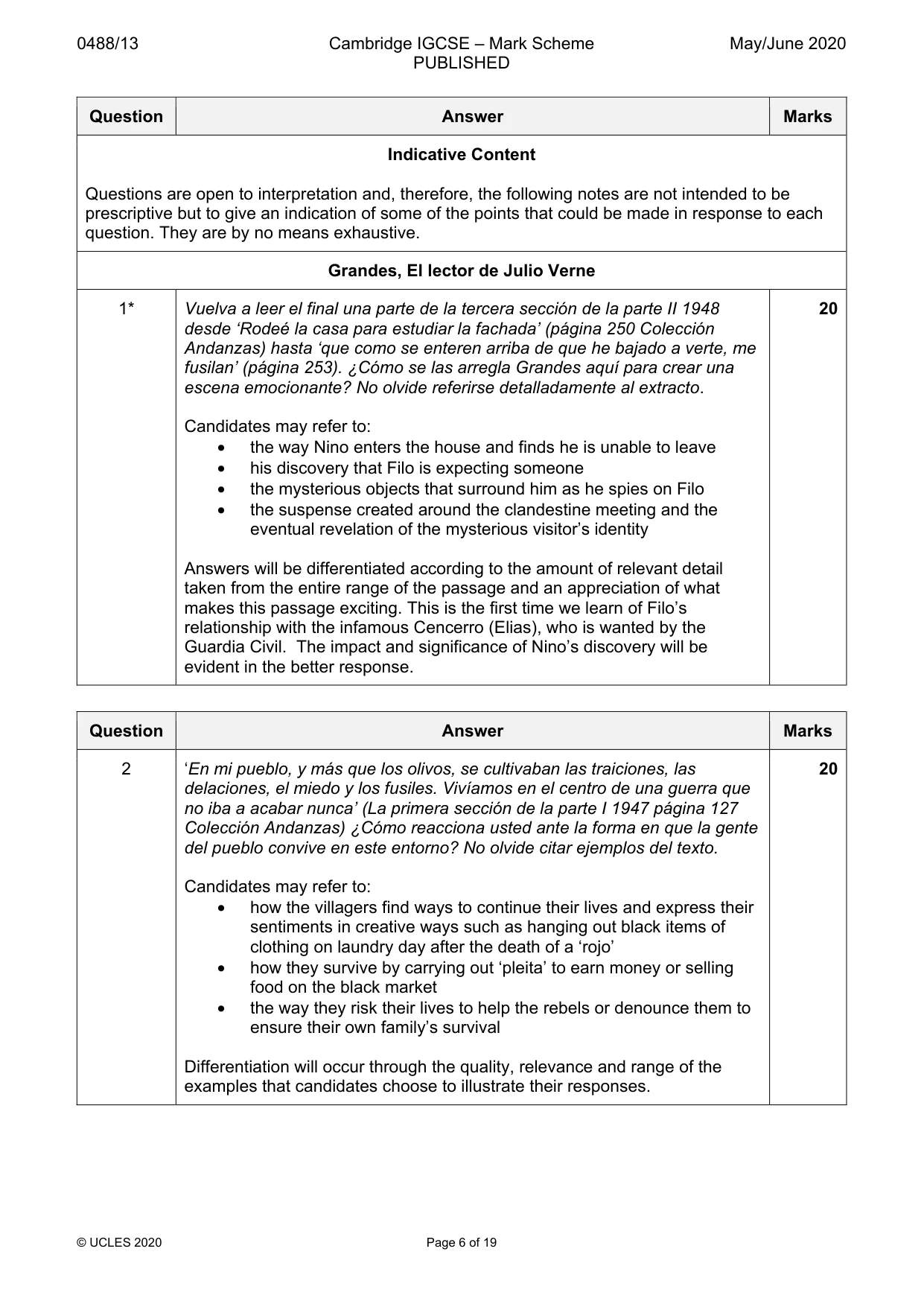
0488/13 Cambridge IGCSE – Mark Scheme PUBLISHED May/June 2020 © UCLES 2020 Page 6 of 19 Question Answer Marks Indicative Content Questions are open to interpretation and, therefore, the following notes are not intended to be prescriptive but to give an indication of some of the points that could be made in response to each question. They are by no means exhaustive. Grandes, El lector de Julio Verne 1* Vuelva a leer el final una parte de la tercera sección de la parte II 1948 desde ‘Rodeé la casa para estudiar la fachada’ (página 250 Colección Andanzas) hasta ‘que como se enteren arriba de que he bajado a verte, me fusilan’ (página 253). ¿Cómo se las arregla Grandes aquí para crear una escena emocionante? No olvide referirse detalladamente al extracto. Candidates may refer to: • the way Nino enters the house and finds he is unable to leave • his discovery that Filo is expecting someone • the mysterious objects that surround him as he spies on Filo • the suspense created around the clandestine meeting and the eventual revelation of the mysterious visitor’s identity Answers will be differentiated according to the amount of relevant detail taken from the entire range of the passage and an appreciation of what makes this passage exciting. This is the first time we learn of Filo’s relationship with the infamous Cencerro (Elias), who is wanted by the Guardia Civil. The impact and significance of Nino’s discovery will be evident in the better response. 20 Question Answer Marks 2 ‘En mi pueblo, y más que los olivos, se cultivaban las traiciones, las delaciones, el miedo y los fusiles. Vivíamos en el centro de una guerra que no iba a acabar nunca’ (La primera sección de la parte I 1947 página 127 Colección Andanzas) ¿Cómo reacciona usted ante la forma en que la gente del pueblo convive en este entorno? No olvide citar ejemplos del texto. Candidates may refer to: • how the villagers find ways to continue their lives and express their sentiments in creative ways such as hanging out black items of clothing on laundry day after the death of a ‘rojo’ • how they survive by carrying out ‘pleita’ to earn money or selling food on the black market • the way they risk their lives to help the rebels or denounce them to ensure their own family’s survival Differentiation will occur through the quality, relevance and range of the examples that candidates choose to illustrate their responses. 20
Mark scheme, page 7
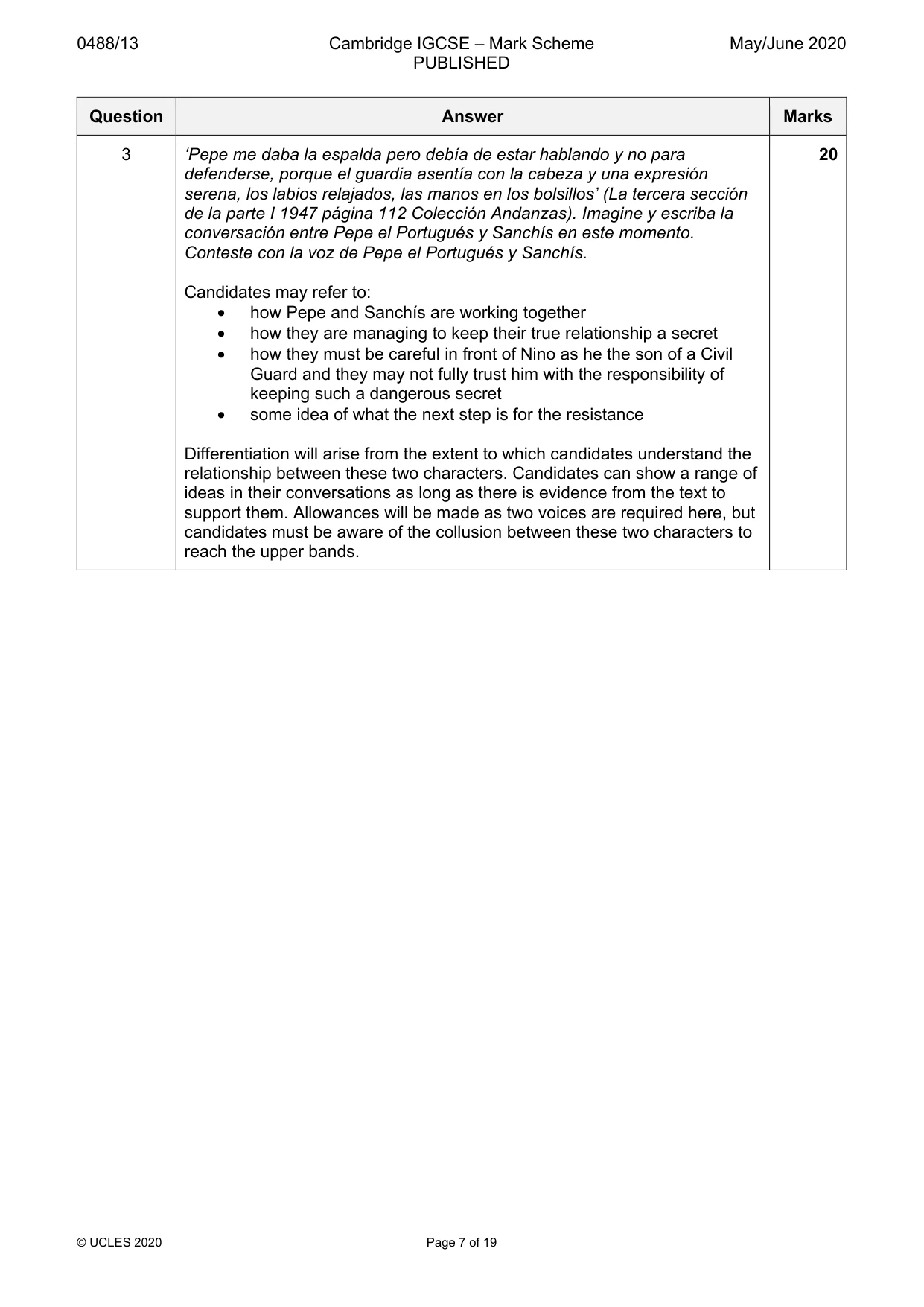
0488/13 Cambridge IGCSE – Mark Scheme PUBLISHED May/June 2020 © UCLES 2020 Page 7 of 19 Question Answer Marks 3 ‘Pepe me daba la espalda pero debía de estar hablando y no para defenderse, porque el guardia asentía con la cabeza y una expresión serena, los labios relajados, las manos en los bolsillos’ (La tercera sección de la parte I 1947 página 112 Colección Andanzas). Imagine y escriba la conversación entre Pepe el Portugués y Sanchís en este momento. Conteste con la voz de Pepe el Portugués y Sanchís. Candidates may refer to: • how Pepe and Sanchís are working together • how they are managing to keep their true relationship a secret • how they must be careful in front of Nino as he the son of a Civil Guard and they may not fully trust him with the responsibility of keeping such a dangerous secret • some idea of what the next step is for the resistance Differentiation will arise from the extent to which candidates understand the relationship between these two characters. Candidates can show a range of ideas in their conversations as long as there is evidence from the text to support them. Allowances will be made as two voices are required here, but candidates must be aware of the collusion between these two characters to reach the upper bands. 20
Mark scheme, page 8
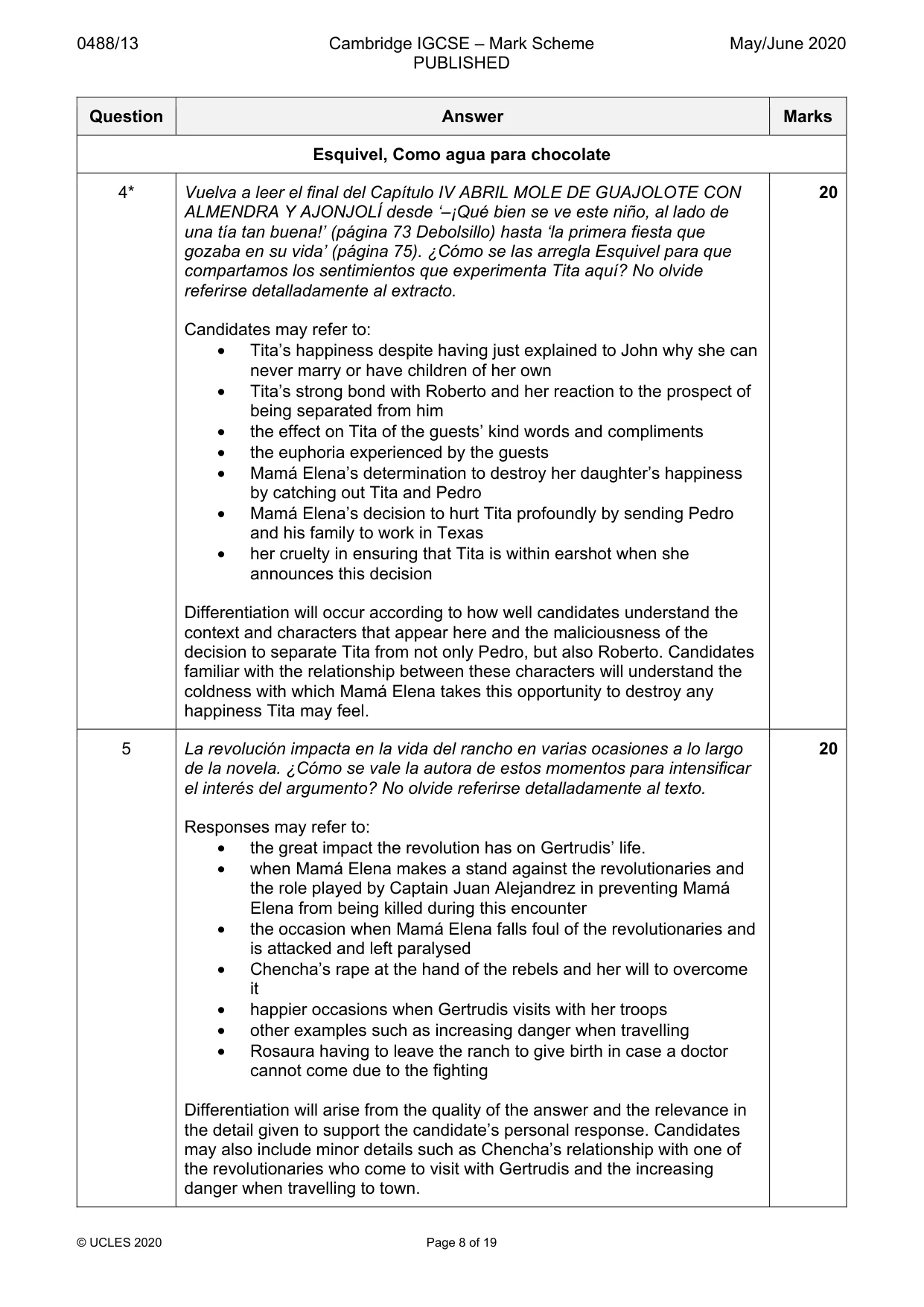
0488/13 Cambridge IGCSE – Mark Scheme PUBLISHED May/June 2020 © UCLES 2020 Page 8 of 19 Question Answer Marks Esquivel, Como agua para chocolate 4* Vuelva a leer el final del Capítulo IV ABRIL MOLE DE GUAJOLOTE CON ALMENDRA Y AJONJOLÍ desde ‘–¡Qué bien se ve este niño, al lado de una tía tan buena!’ (página 73 Debolsillo) hasta ‘la primera fiesta que gozaba en su vida’ (página 75). ¿Cómo se las arregla Esquivel para que compartamos los sentimientos que experimenta Tita aquí? No olvide referirse detalladamente al extracto. Candidates may refer to: • Tita’s happiness despite having just explained to John why she can never marry or have children of her own • Tita’s strong bond with Roberto and her reaction to the prospect of being separated from him • the effect on Tita of the guests’ kind words and compliments • the euphoria experienced by the guests • Mamá Elena’s determination to destroy her daughter’s happiness by catching out Tita and Pedro • Mamá Elena’s decision to hurt Tita profoundly by sending Pedro and his family to work in Texas • her cruelty in ensuring that Tita is within earshot when she announces this decision Differentiation will occur according to how well candidates understand the context and characters that appear here and the maliciousness of the decision to separate Tita from not only Pedro, but also Roberto. Candidates familiar with the relationship between these characters will understand the coldness with which Mamá Elena takes this opportunity to destroy any happiness Tita may feel. 20 5 La revolución impacta en la vida del rancho en varias ocasiones a lo largo de la novela. ¿Cómo se vale la autora de estos momentos para intensificar el interés del argumento? No olvide referirse detalladamente al texto. Responses may refer to: • the great impact the revolution has on Gertrudis’ life. • when Mamá Elena makes a stand against the revolutionaries and the role played by Captain Juan Alejandrez in preventing Mamá Elena from being killed during this encounter • the occasion when Mamá Elena falls foul of the revolutionaries and is attacked and left paralysed • Chencha’s rape at the hand of the rebels and her will to overcome it • happier occasions when Gertrudis visits with her troops • other examples such as increasing danger when travelling • Rosaura having to leave the ranch to give birth in case a doctor cannot come due to the fighting Differentiation will arise from the quality of the answer and the relevance in the detail given to support the candidate’s personal response. Candidates may also include minor details such as Chencha’s relationship with one of the revolutionaries who come to visit with Gertrudis and the increasing danger when travelling to town. 20
Mark scheme, page 9
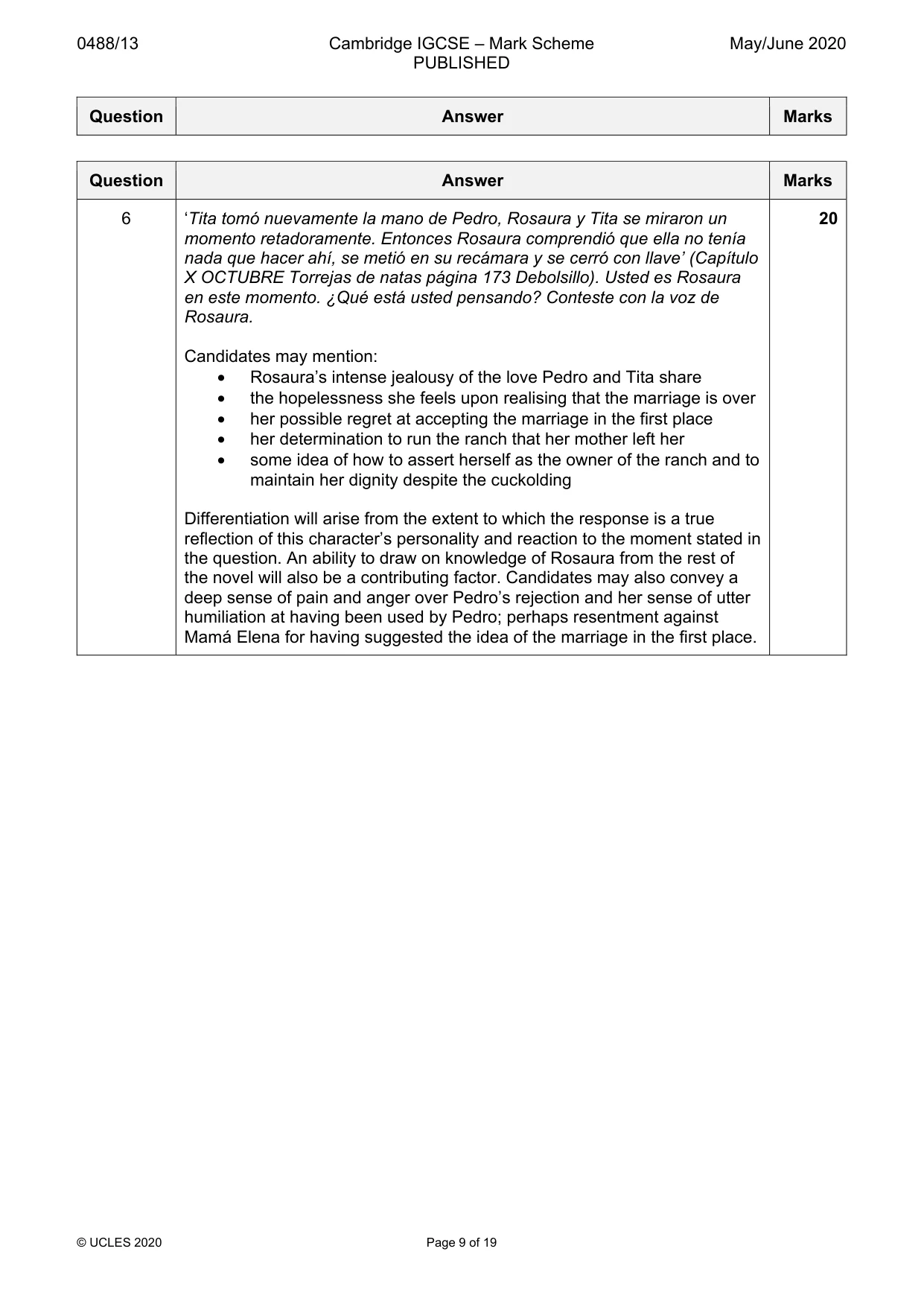
0488/13 Cambridge IGCSE – Mark Scheme PUBLISHED May/June 2020 © UCLES 2020 Page 9 of 19 Question Answer Marks Question Answer Marks 6 ‘Tita tomó nuevamente la mano de Pedro, Rosaura y Tita se miraron un momento retadoramente. Entonces Rosaura comprendió que ella no tenía nada que hacer ahí, se metió en su recámara y se cerró con llave’ (Capítulo X OCTUBRE Torrejas de natas página 173 Debolsillo). Usted es Rosaura en este momento. ¿Qué está usted pensando? Conteste con la voz de Rosaura. Candidates may mention: • Rosaura’s intense jealousy of the love Pedro and Tita share • the hopelessness she feels upon realising that the marriage is over • her possible regret at accepting the marriage in the first place • her determination to run the ranch that her mother left her • some idea of how to assert herself as the owner of the ranch and to maintain her dignity despite the cuckolding Differentiation will arise from the extent to which the response is a true reflection of this character’s personality and reaction to the moment stated in the question. An ability to draw on knowledge of Rosaura from the rest of the novel will also be a contributing factor. Candidates may also convey a deep sense of pain and anger over Pedro’s rejection and her sense of utter humiliation at having been used by Pedro; perhaps resentment against Mamá Elena for having suggested the idea of the marriage in the first place. 20
Mark scheme, page 10
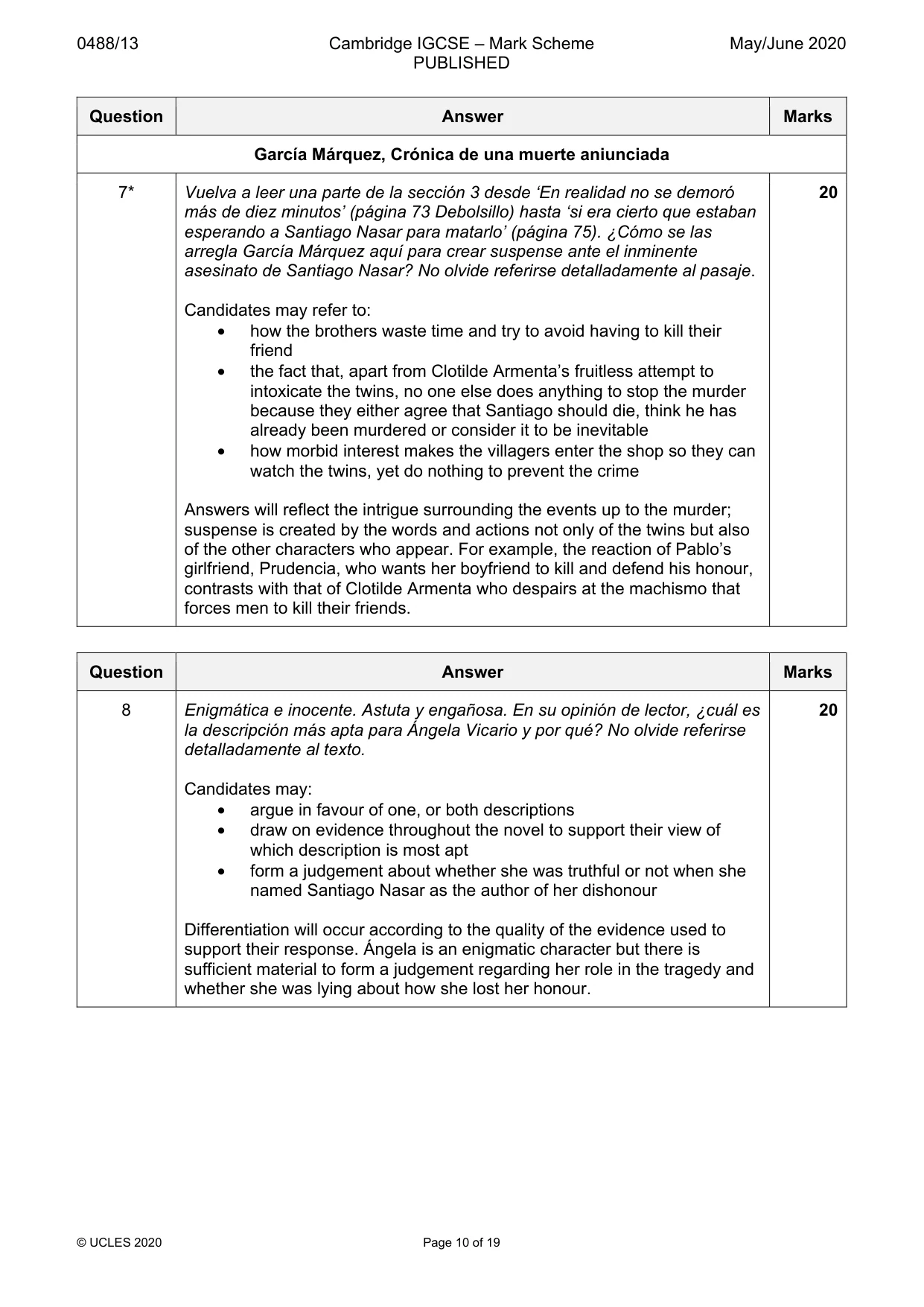
0488/13 Cambridge IGCSE – Mark Scheme PUBLISHED May/June 2020 © UCLES 2020 Page 10 of 19 Question Answer Marks García Márquez, Crónica de una muerte aniunciada 7* Vuelva a leer una parte de la sección 3 desde ‘En realidad no se demoró más de diez minutos’ (página 73 Debolsillo) hasta ‘si era cierto que estaban esperando a Santiago Nasar para matarlo’ (página 75). ¿Cómo se las arregla García Márquez aquí para crear suspense ante el inminente asesinato de Santiago Nasar? No olvide referirse detalladamente al pasaje. Candidates may refer to: • how the brothers waste time and try to avoid having to kill their friend • the fact that, apart from Clotilde Armenta’s fruitless attempt to intoxicate the twins, no one else does anything to stop the murder because they either agree that Santiago should die, think he has already been murdered or consider it to be inevitable • how morbid interest makes the villagers enter the shop so they can watch the twins, yet do nothing to prevent the crime Answers will reflect the intrigue surrounding the events up to the murder; suspense is created by the words and actions not only of the twins but also of the other characters who appear. For example, the reaction of Pablo’s girlfriend, Prudencia, who wants her boyfriend to kill and defend his honour, contrasts with that of Clotilde Armenta who despairs at the machismo that forces men to kill their friends. 20 Question Answer Marks 8 Enigmática e inocente. Astuta y engañosa. En su opinión de lector, ¿cuál es la descripción más apta para Ángela Vicario y por qué? No olvide referirse detalladamente al texto. Candidates may: • argue in favour of one, or both descriptions • draw on evidence throughout the novel to support their view of which description is most apt • form a judgement about whether she was truthful or not when she named Santiago Nasar as the author of her dishonour Differentiation will occur according to the quality of the evidence used to support their response. Ángela is an enigmatic character but there is sufficient material to form a judgement regarding her role in the tragedy and whether she was lying about how she lost her honour. 20
Mark scheme, page 11
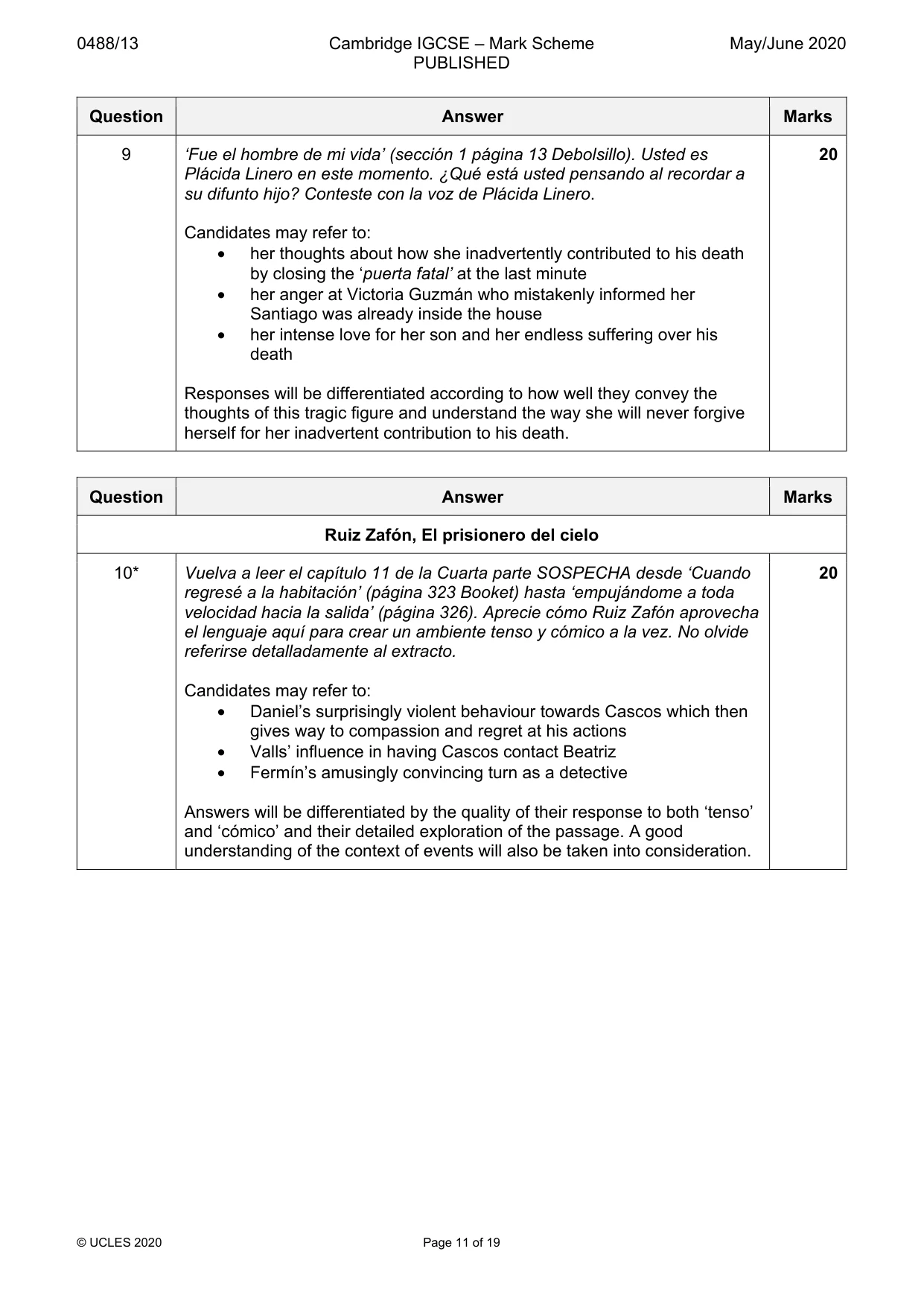
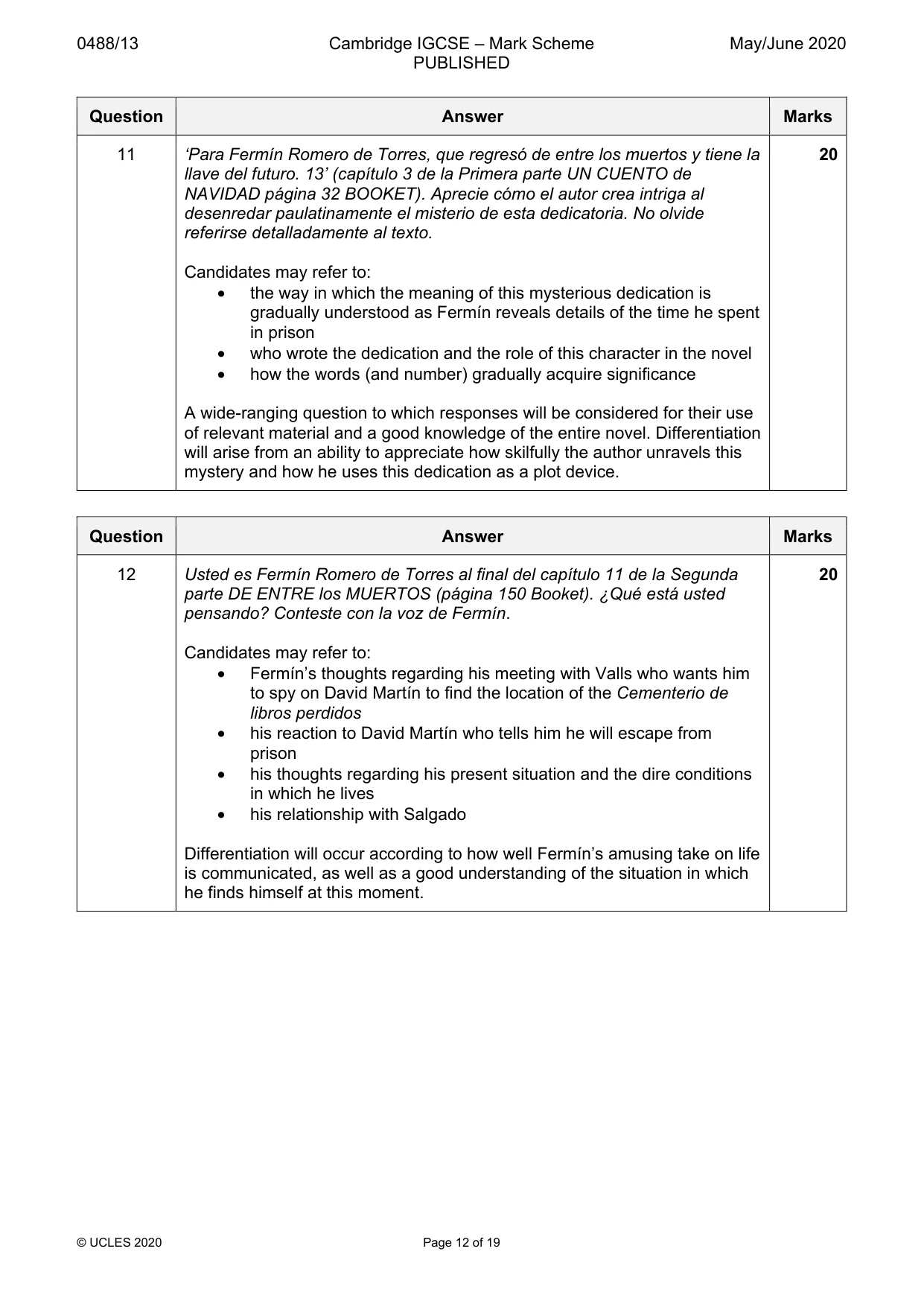
0488/13 Cambridge IGCSE – Mark Scheme PUBLISHED May/June 2020 © UCLES 2020 Page 11 of 19 Question Answer Marks 9 ‘Fue el hombre de mi vida’ (sección 1 página 13 Debolsillo). Usted es Plácida Linero en este momento. ¿Qué está usted pensando al recordar a su difunto hijo? Conteste con la voz de Plácida Linero. Candidates may refer to: • her thoughts about how she inadvertently contributed to his death by closing the ‘puerta fatal’ at the last minute • her anger at Victoria Guzmán who mistakenly informed her Santiago was already inside the house • her intense love for her son and her endless suffering over his death Responses will be differentiated according to how well they convey the thoughts of this tragic figure and understand the way she will never forgive herself for her inadvertent contribution to his death. 20 Question Answer Marks Ruiz Zafón, El prisionero del cielo 10* Vuelva a leer el capítulo 11 de la Cuarta parte SOSPECHA desde ‘Cuando regresé a la habitación’ (página 323 Booket) hasta ‘empujándome a toda velocidad hacia la salida’ (página 326). Aprecie cómo Ruiz Zafón aprovecha el lenguaje aquí para crear un ambiente tenso y cómico a la vez. No olvide referirse detalladamente al extracto. Candidates may refer to: • Daniel’s surprisingly violent behaviour towards Cascos which then gives way to compassion and regret at his actions • Valls’ influence in having Cascos contact Beatriz • Fermín’s amusingly convincing turn as a detective Answers will be differentiated by the quality of their response to both ‘tenso’ and ‘cómico’ and their detailed exploration of the passage. A good understanding of the context of events will also be taken into consideration. 20
Mark scheme, page 12
0488/13 Cambridge IGCSE – Mark Scheme PUBLISHED May/June 2020 © UCLES 2020 Page 12 of 19 Question Answer Marks 11 ‘Para Fermín Romero de Torres, que regresó de entre los muertos y tiene la llave del futuro. 13’ (capítulo 3 de la Primera parte UN CUENTO de NAVIDAD página 32 BOOKET). Aprecie cómo el autor crea intriga al desenredar paulatinamente el misterio de esta dedicatoria. No olvide referirse detalladamente al texto. Candidates may refer to: • the way in which the meaning of this mysterious dedication is gradually understood as Fermín reveals details of the time he spent in prison • who wrote the dedication and the role of this character in the novel • how the words (and number) gradually acquire significance A wide-ranging question to which responses will be considered for their use of relevant material and a good knowledge of the entire novel. Differentiation will arise from an ability to appreciate how skilfully the author unravels this mystery and how he uses this dedication as a plot device. 20 Question Answer Marks 12 Usted es Fermín Romero de Torres al final del capítulo 11 de la Segunda parte DE ENTRE los MUERTOS (página 150 Booket). ¿Qué está usted pensando? Conteste con la voz de Fermín. Candidates may refer to: • Fermín’s thoughts regarding his meeting with Valls who wants him to spy on David Martín to find the location of the Cementerio de libros perdidos • his reaction to David Martín who tells him he will escape from prison • his thoughts regarding his present situation and the dire conditions in which he lives • his relationship with Salgado Differentiation will occur according to how well Fermín’s amusing take on life is communicated, as well as a good understanding of the situation in which he finds himself at this moment. 20
Mark scheme, page 13
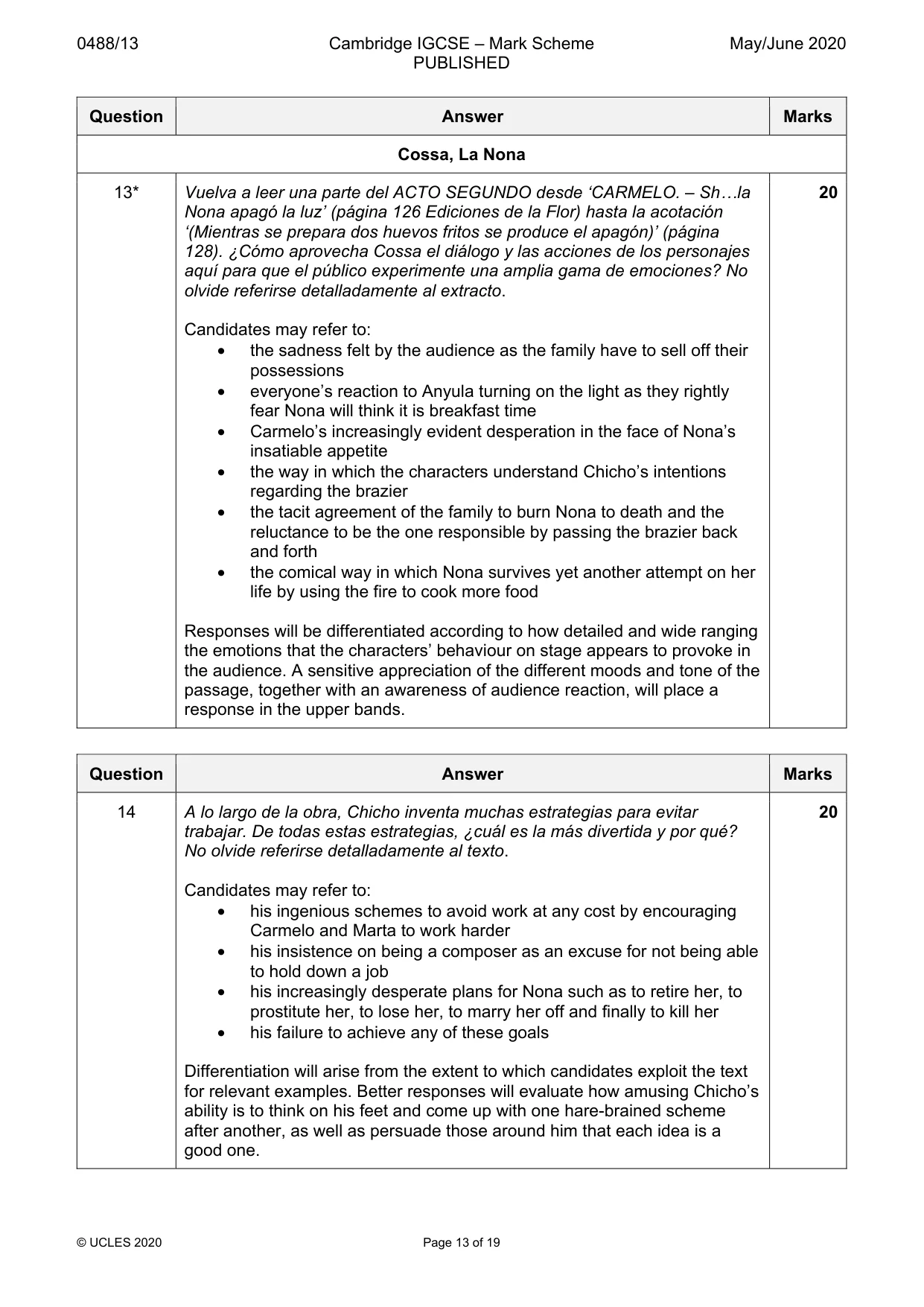
0488/13 Cambridge IGCSE – Mark Scheme PUBLISHED May/June 2020 © UCLES 2020 Page 13 of 19 Question Answer Marks Cossa, La Nona 13* Vuelva a leer una parte del ACTO SEGUNDO desde ‘CARMELO. – Sh…la Nona apagó la luz’ (página 126 Ediciones de la Flor) hasta la acotación ‘(Mientras se prepara dos huevos fritos se produce el apagón)’ (página 128). ¿Cómo aprovecha Cossa el diálogo y las acciones de los personajes aquí para que el público experimente una amplia gama de emociones? No olvide referirse detalladamente al extracto. Candidates may refer to: • the sadness felt by the audience as the family have to sell off their possessions • everyone’s reaction to Anyula turning on the light as they rightly fear Nona will think it is breakfast time • Carmelo’s increasingly evident desperation in the face of Nona’s insatiable appetite • the way in which the characters understand Chicho’s intentions regarding the brazier • the tacit agreement of the family to burn Nona to death and the reluctance to be the one responsible by passing the brazier back and forth • the comical way in which Nona survives yet another attempt on her life by using the fire to cook more food Responses will be differentiated according to how detailed and wide ranging the emotions that the characters’ behaviour on stage appears to provoke in the audience. A sensitive appreciation of the different moods and tone of the passage, together with an awareness of audience reaction, will place a response in the upper bands. 20 Question Answer Marks 14 A lo largo de la obra, Chicho inventa muchas estrategias para evitar trabajar. De todas estas estrategias, ¿cuál es la más divertida y por qué? No olvide referirse detalladamente al texto. Candidates may refer to: • his ingenious schemes to avoid work at any cost by encouraging Carmelo and Marta to work harder • his insistence on being a composer as an excuse for not being able to hold down a job • his increasingly desperate plans for Nona such as to retire her, to prostitute her, to lose her, to marry her off and finally to kill her • his failure to achieve any of these goals Differentiation will arise from the extent to which candidates exploit the text for relevant examples. Better responses will evaluate how amusing Chicho’s ability is to think on his feet and come up with one hare-brained scheme after another, as well as persuade those around him that each idea is a good one. 20
Mark scheme, page 14
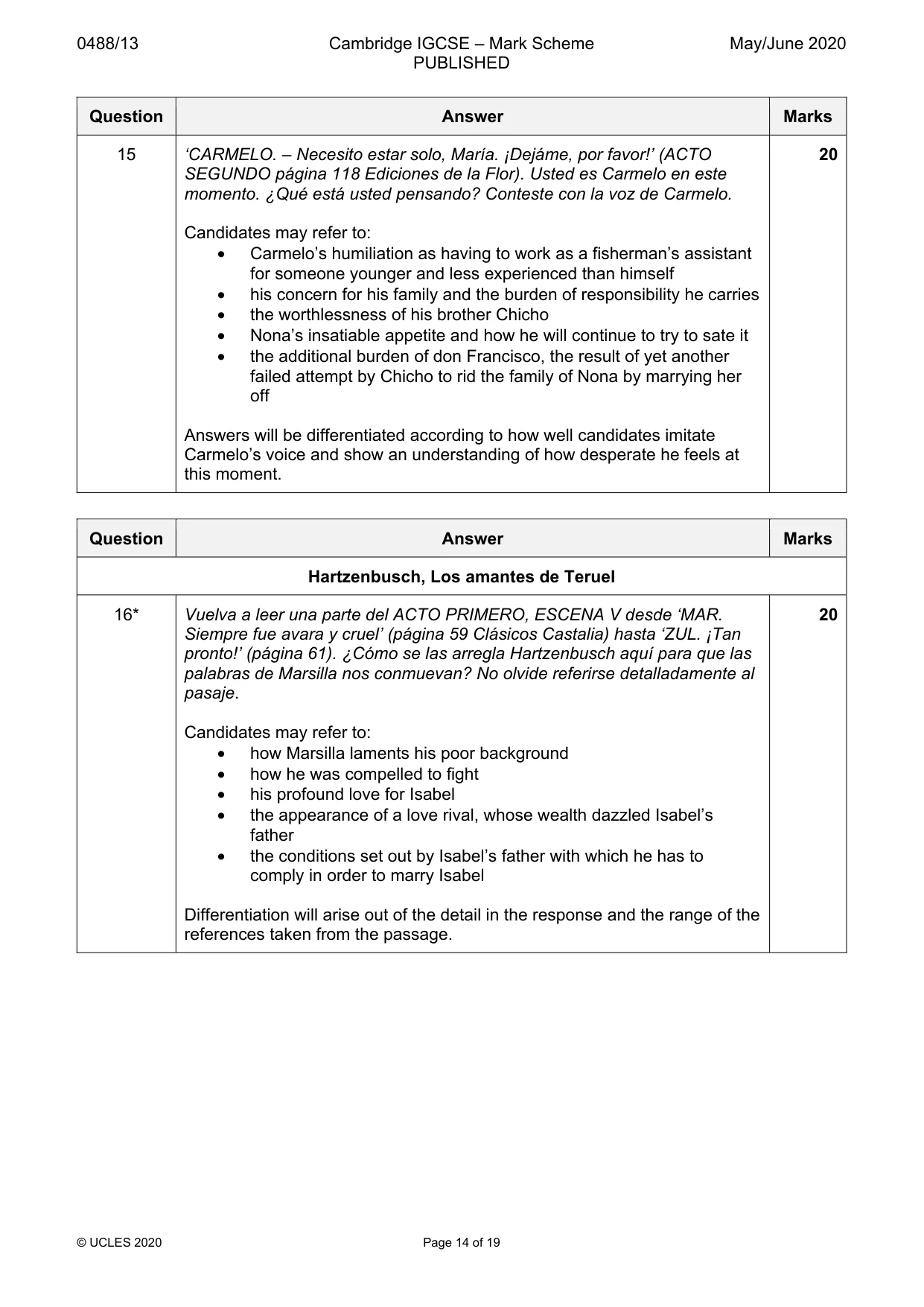
0488/13 Cambridge IGCSE – Mark Scheme PUBLISHED May/June 2020 © UCLES 2020 Page 14 of 19 Question Answer Marks 15 ‘CARMELO. – Necesito estar solo, María. ¡Dejáme, por favor!’ (ACTO SEGUNDO página 118 Ediciones de la Flor). Usted es Carmelo en este momento. ¿Qué está usted pensando? Conteste con la voz de Carmelo. Candidates may refer to: • Carmelo’s humiliation as having to work as a fisherman’s assistant for someone younger and less experienced than himself • his concern for his family and the burden of responsibility he carries • the worthlessness of his brother Chicho • Nona’s insatiable appetite and how he will continue to try to sate it • the additional burden of don Francisco, the result of yet another failed attempt by Chicho to rid the family of Nona by marrying her off Answers will be differentiated according to how well candidates imitate Carmelo’s voice and show an understanding of how desperate he feels at this moment. 20 Question Answer Marks Hartzenbusch, Los amantes de Teruel 16* Vuelva a leer una parte del ACTO PRIMERO, ESCENA V desde ‘MAR. Siempre fue avara y cruel’ (página 59 Clásicos Castalia) hasta ‘ZUL. ¡Tan pronto!’ (página 61). ¿Cómo se las arregla Hartzenbusch aquí para que las palabras de Marsilla nos conmuevan? No olvide referirse detalladamente al pasaje. Candidates may refer to: • how Marsilla laments his poor background • how he was compelled to fight • his profound love for Isabel • the appearance of a love rival, whose wealth dazzled Isabel’s father • the conditions set out by Isabel’s father with which he has to comply in order to marry Isabel Differentiation will arise out of the detail in the response and the range of the references taken from the passage. 20
Mark scheme, page 15
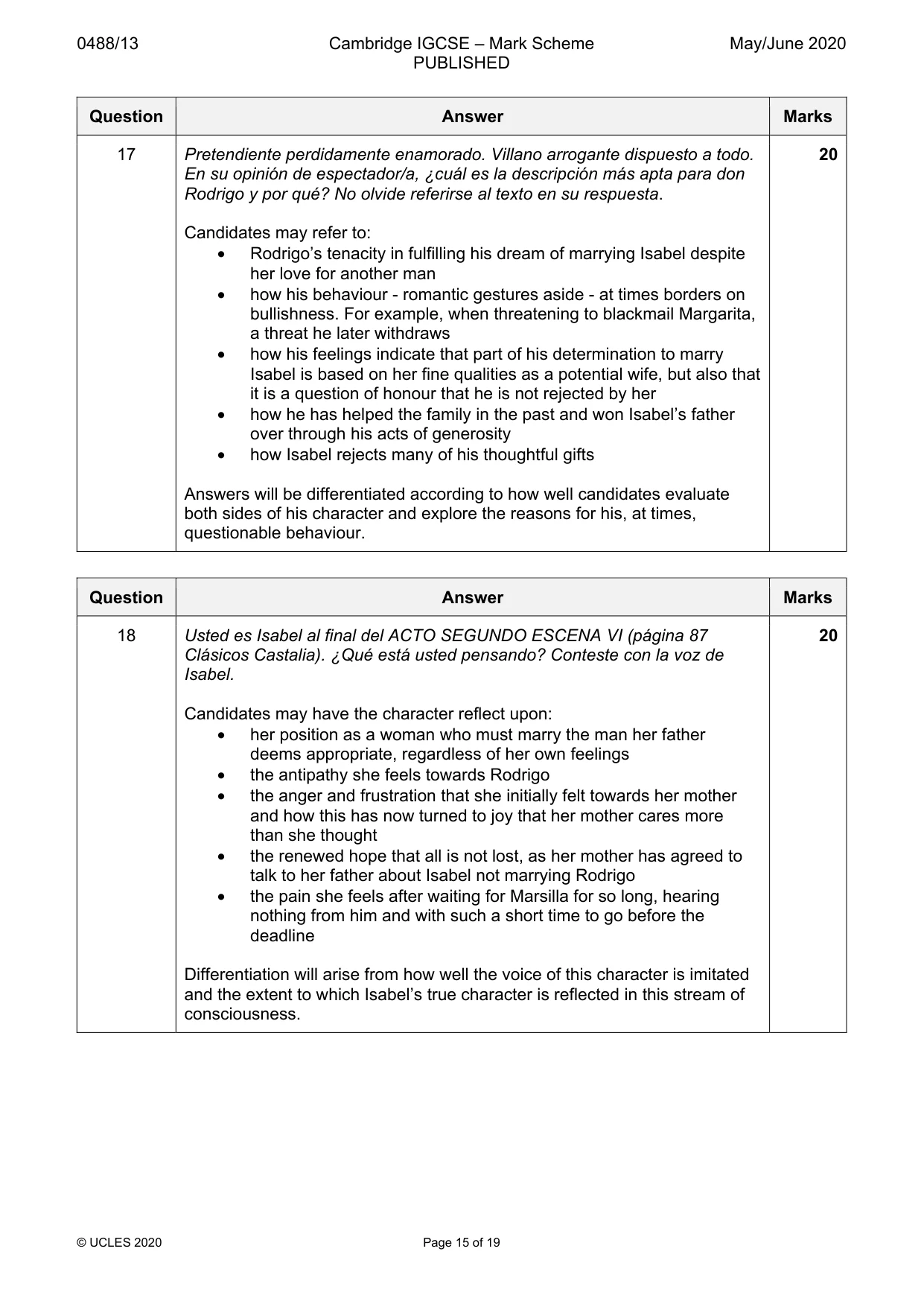
0488/13 Cambridge IGCSE – Mark Scheme PUBLISHED May/June 2020 © UCLES 2020 Page 15 of 19 Question Answer Marks 17 Pretendiente perdidamente enamorado. Villano arrogante dispuesto a todo. En su opinión de espectador/a, ¿cuál es la descripción más apta para don Rodrigo y por qué? No olvide referirse al texto en su respuesta. Candidates may refer to: • Rodrigo’s tenacity in fulfilling his dream of marrying Isabel despite her love for another man • how his behaviour - romantic gestures aside - at times borders on bullishness. For example, when threatening to blackmail Margarita, a threat he later withdraws • how his feelings indicate that part of his determination to marry Isabel is based on her fine qualities as a potential wife, but also that it is a question of honour that he is not rejected by her • how he has helped the family in the past and won Isabel’s father over through his acts of generosity • how Isabel rejects many of his thoughtful gifts Answers will be differentiated according to how well candidates evaluate both sides of his character and explore the reasons for his, at times, questionable behaviour. 20 Question Answer Marks 18 Usted es Isabel al final del ACTO SEGUNDO ESCENA VI (página 87 Clásicos Castalia). ¿Qué está usted pensando? Conteste con la voz de Isabel. Candidates may have the character reflect upon: • her position as a woman who must marry the man her father deems appropriate, regardless of her own feelings • the antipathy she feels towards Rodrigo • the anger and frustration that she initially felt towards her mother and how this has now turned to joy that her mother cares more than she thought • the renewed hope that all is not lost, as her mother has agreed to talk to her father about Isabel not marrying Rodrigo • the pain she feels after waiting for Marsilla for so long, hearing nothing from him and with such a short time to go before the deadline Differentiation will arise from how well the voice of this character is imitated and the extent to which Isabel’s true character is reflected in this stream of consciousness. 20
Mark scheme, page 16
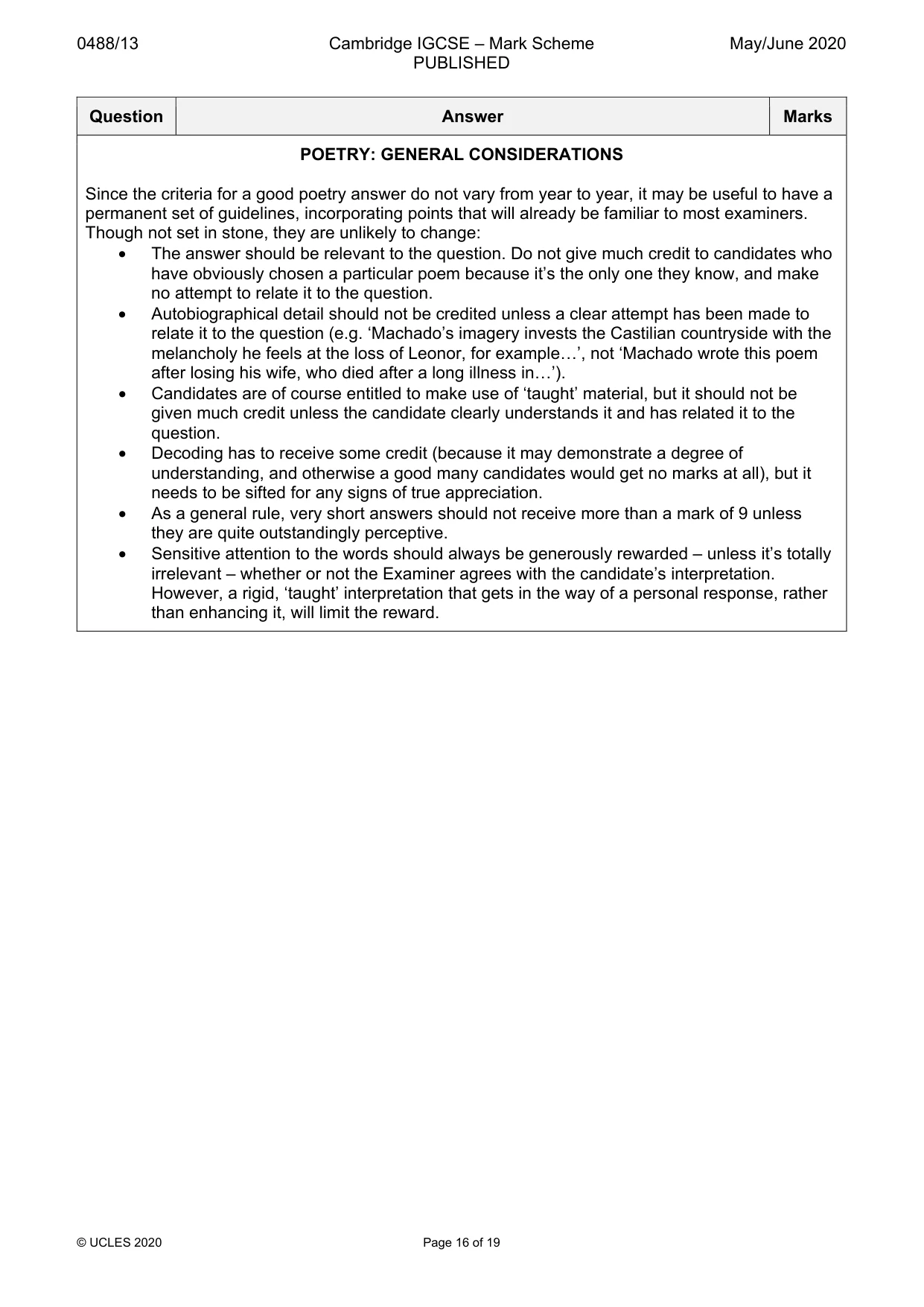
0488/13 Cambridge IGCSE – Mark Scheme PUBLISHED May/June 2020 © UCLES 2020 Page 16 of 19 Question Answer Marks POETRY: GENERAL CONSIDERATIONS Since the criteria for a good poetry answer do not vary from year to year, it may be useful to have a permanent set of guidelines, incorporating points that will already be familiar to most examiners. Though not set in stone, they are unlikely to change: • The answer should be relevant to the question. Do not give much credit to candidates who have obviously chosen a particular poem because it’s the only one they know, and make no attempt to relate it to the question. • Autobiographical detail should not be credited unless a clear attempt has been made to relate it to the question (e.g. ‘Machado’s imagery invests the Castilian countryside with the melancholy he feels at the loss of Leonor, for example…’, not ‘Machado wrote this poem after losing his wife, who died after a long illness in…’). • Candidates are of course entitled to make use of ‘taught’ material, but it should not be given much credit unless the candidate clearly understands it and has related it to the question. • Decoding has to receive some credit (because it may demonstrate a degree of understanding, and otherwise a good many candidates would get no marks at all), but it needs to be sifted for any signs of true appreciation. • As a general rule, very short answers should not receive more than a mark of 9 unless they are quite outstandingly perceptive. • Sensitive attention to the words should always be generously rewarded – unless it’s totally irrelevant – whether or not the Examiner agrees with the candidate’s interpretation. However, a rigid, ‘taught’ interpretation that gets in the way of a personal response, rather than enhancing it, will limit the reward.
Mark scheme, page 17
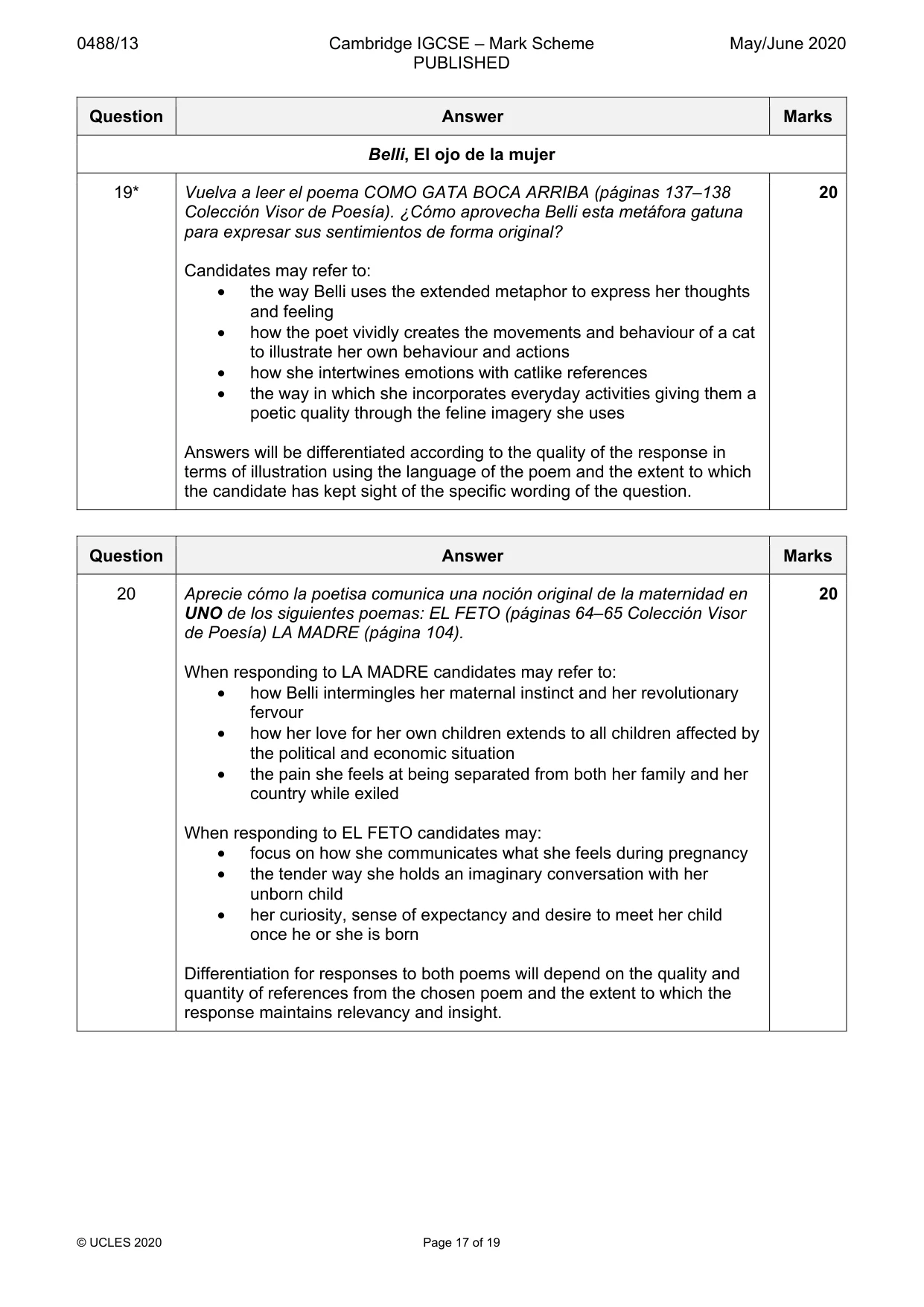
0488/13 Cambridge IGCSE – Mark Scheme PUBLISHED May/June 2020 © UCLES 2020 Page 17 of 19 Question Answer Marks Belli, El ojo de la mujer 19* Vuelva a leer el poema COMO GATA BOCA ARRIBA (páginas 137–138 Colección Visor de Poesía). ¿Cómo aprovecha Belli esta metáfora gatuna para expresar sus sentimientos de forma original? Candidates may refer to: • the way Belli uses the extended metaphor to express her thoughts and feeling • how the poet vividly creates the movements and behaviour of a cat to illustrate her own behaviour and actions • how she intertwines emotions with catlike references • the way in which she incorporates everyday activities giving them a poetic quality through the feline imagery she uses Answers will be differentiated according to the quality of the response in terms of illustration using the language of the poem and the extent to which the candidate has kept sight of the specific wording of the question. 20 Question Answer Marks 20 Aprecie cómo la poetisa comunica una noción original de la maternidad en UNO de los siguientes poemas: EL FETO (páginas 64–65 Colección Visor de Poesía) LA MADRE (página 104). When responding to LA MADRE candidates may refer to: • how Belli intermingles her maternal instinct and her revolutionary fervour • how her love for her own children extends to all children affected by the political and economic situation • the pain she feels at being separated from both her family and her country while exiled When responding to EL FETO candidates may: • focus on how she communicates what she feels during pregnancy • the tender way she holds an imaginary conversation with her unborn child • her curiosity, sense of expectancy and desire to meet her child once he or she is born Differentiation for responses to both poems will depend on the quality and quantity of references from the chosen poem and the extent to which the response maintains relevancy and insight. 20
Mark scheme, page 18
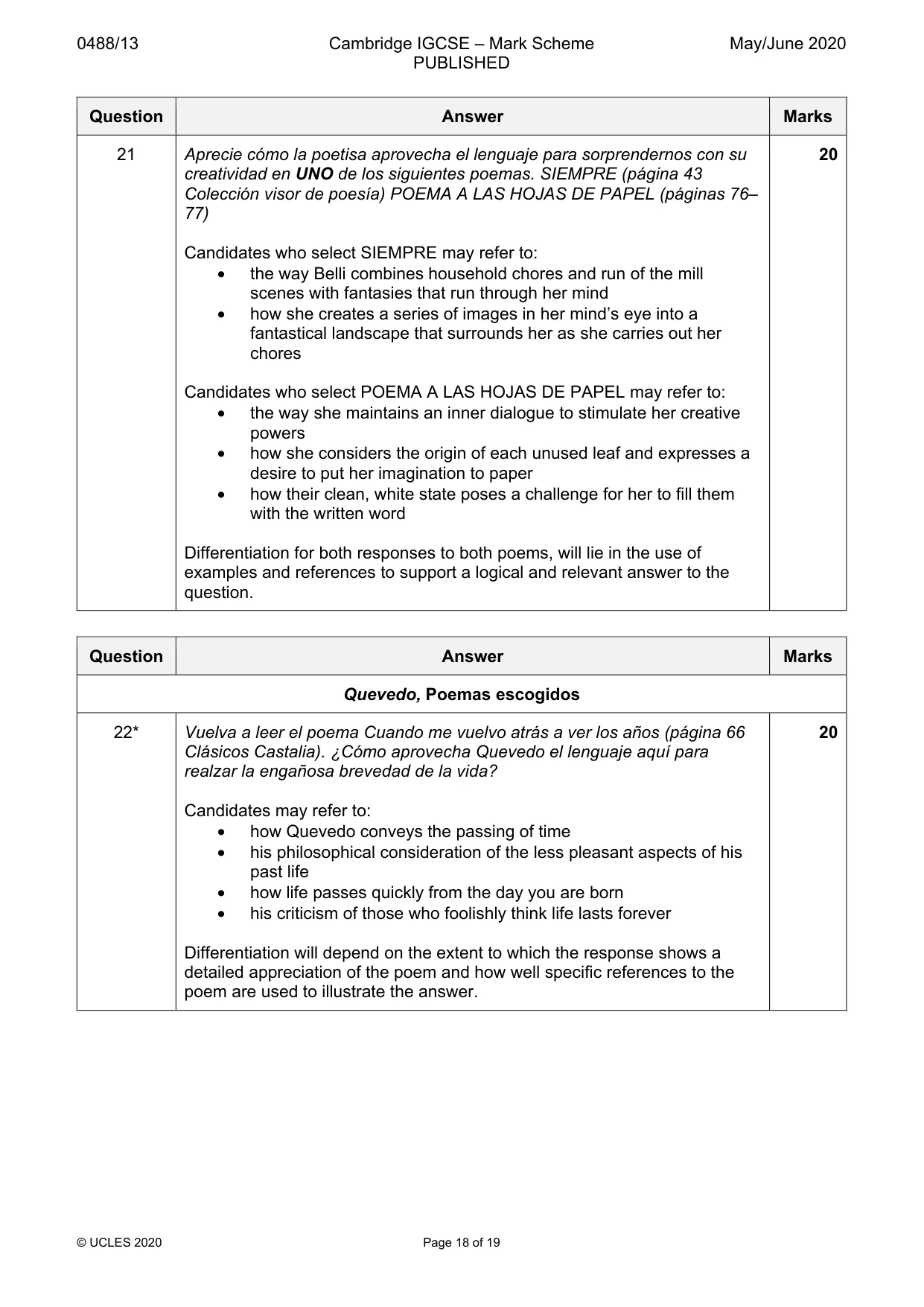
0488/13 Cambridge IGCSE – Mark Scheme PUBLISHED May/June 2020 © UCLES 2020 Page 18 of 19 Question Answer Marks 21 Aprecie cómo la poetisa aprovecha el lenguaje para sorprendernos con su creatividad en UNO de los siguientes poemas. SIEMPRE (página 43 Colección visor de poesía) POEMA A LAS HOJAS DE PAPEL (páginas 76– 77) Candidates who select SIEMPRE may refer to: • the way Belli combines household chores and run of the mill scenes with fantasies that run through her mind • how she creates a series of images in her mind’s eye into a fantastical landscape that surrounds her as she carries out her chores Candidates who select POEMA A LAS HOJAS DE PAPEL may refer to: • the way she maintains an inner dialogue to stimulate her creative powers • how she considers the origin of each unused leaf and expresses a desire to put her imagination to paper • how their clean, white state poses a challenge for her to fill them with the written word Differentiation for both responses to both poems, will lie in the use of examples and references to support a logical and relevant answer to the question. 20 Question Answer Marks Quevedo, Poemas escogidos 22* Vuelva a leer el poema Cuando me vuelvo atrás a ver los años (página 66 Clásicos Castalia). ¿Cómo aprovecha Quevedo el lenguaje aquí para realzar la engañosa brevedad de la vida? Candidates may refer to: • how Quevedo conveys the passing of time • his philosophical consideration of the less pleasant aspects of his past life • how life passes quickly from the day you are born • his criticism of those who foolishly think life lasts forever Differentiation will depend on the extent to which the response shows a detailed appreciation of the poem and how well specific references to the poem are used to illustrate the answer. 20
Mark scheme, page 19
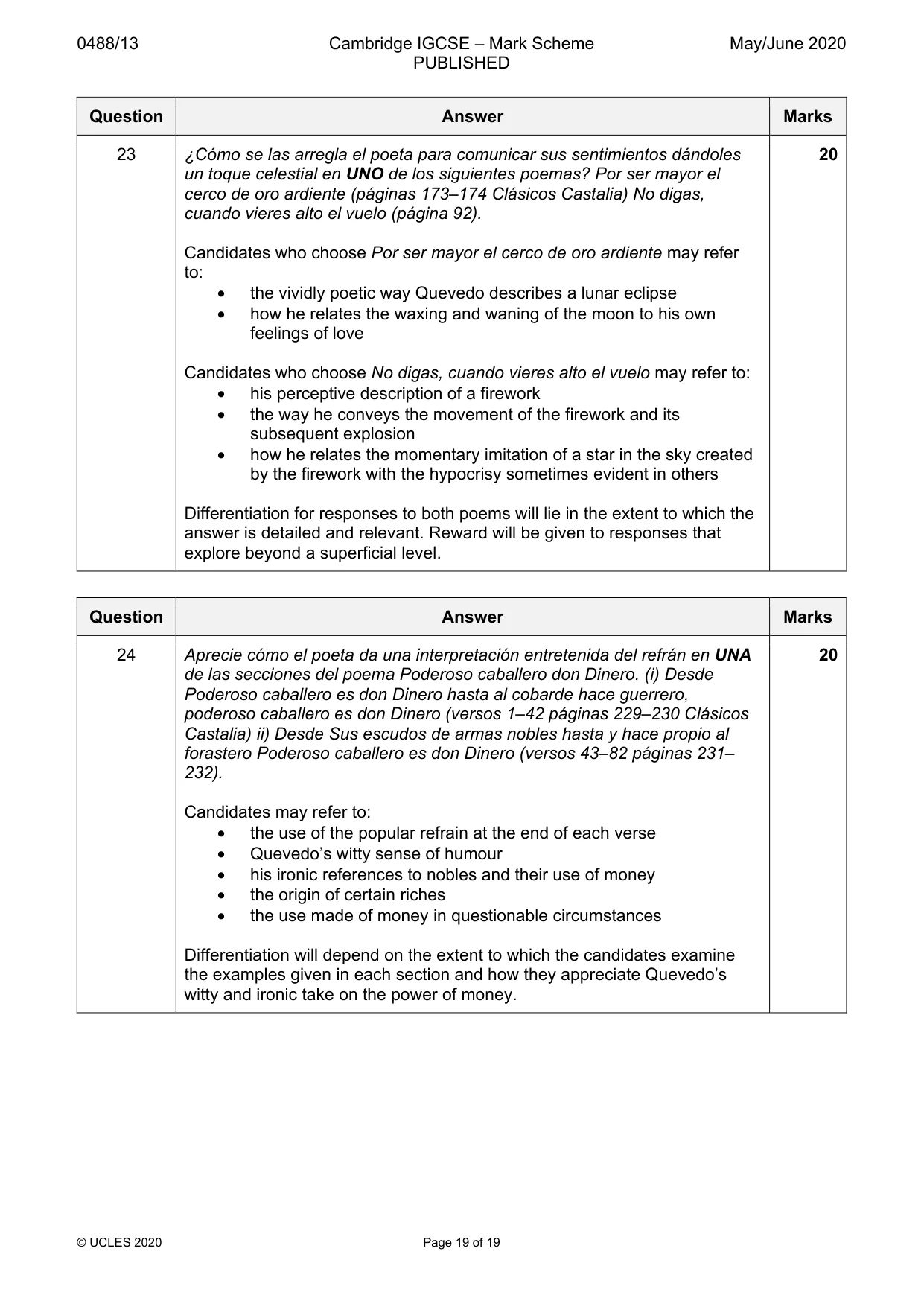
0488/13 Cambridge IGCSE – Mark Scheme PUBLISHED May/June 2020 © UCLES 2020 Page 19 of 19 Question Answer Marks 23 ¿Cómo se las arregla el poeta para comunicar sus sentimientos dándoles un toque celestial en UNO de los siguientes poemas? Por ser mayor el cerco de oro ardiente (páginas 173–174 Clásicos Castalia) No digas, cuando vieres alto el vuelo (página 92). Candidates who choose Por ser mayor el cerco de oro ardiente may refer to: • the vividly poetic way Quevedo describes a lunar eclipse • how he relates the waxing and waning of the moon to his own feelings of love Candidates who choose No digas, cuando vieres alto el vuelo may refer to: • his perceptive description of a firework • the way he conveys the movement of the firework and its subsequent explosion • how he relates the momentary imitation of a star in the sky created by the firework with the hypocrisy sometimes evident in others Differentiation for responses to both poems will lie in the extent to which the answer is detailed and relevant. Reward will be given to responses that explore beyond a superficial level. 20 Question Answer Marks 24 Aprecie cómo el poeta da una interpretación entretenida del refrán en UNA de las secciones del poema Poderoso caballero don Dinero. (i) Desde Poderoso caballero es don Dinero hasta al cobarde hace guerrero, poderoso caballero es don Dinero (versos 1–42 páginas 229–230 Clásicos Castalia) ii) Desde Sus escudos de armas nobles hasta y hace propio al forastero Poderoso caballero es don Dinero (versos 43–82 páginas 231– 232). Candidates may refer to: • the use of the popular refrain at the end of each verse • Quevedo’s witty sense of humour • his ironic references to nobles and their use of money • the origin of certain riches • the use made of money in questionable circumstances Differentiation will depend on the extent to which the candidates examine the examples given in each section and how they appreciate Quevedo’s witty and ironic take on the power of money. 20