Cambridge IGCSE Spanish - Literature 0488 — 2023 May/June Paper 1 · Variant 3
0488/13/M/J/23 · 60 marks · ≈68 min
The question paper and its mark scheme, free to read here and free to download. This is Cambridge’s own paper, exactly as it was sat.
Question paper8 pages


Mark scheme26 pages
Answers below. Sit the paper first if you are practising.

Paper as text
Question paper, page 1
This document has 8 pages. Any blank pages are indicated. [Turn over Cambridge IGCSE™ LITERATURE (SPANISH) 0488/13 Paper 1 Set Texts – Open Books May/June 2023 2 hours 15 minutes You must answer on the enclosed answer booklet. You will need: Answer booklet (enclosed) Candidates may take their set texts into the examination, but these texts must NOT contain any personal annotations, highlighting or underlining. INSTRUCTIONS ● Answer three questions in total: Each answer must be on a different text. You must answer from at least two sections: Section A: Prose Section B: Drama Section C: Poetry Answer at least one text-based question (marked *). You may choose all three of your questions from those marked *. ● Follow the instructions on the front cover of the answer booklet. If you need additional answer paper, ask the invigilator for a continuation booklet. INFORMATION ● The total mark for this paper is 60. ● All questions are worth equal marks. INSTRUCCIONES ● Conteste a tres preguntas en total: Cada pregunta debe ser de un texto diferente. Debe contestar a preguntas de al menos dos secciones: Sección A: Prosa Sección B: Teatro Sección C: Poesía Conteste a al menos una pregunta basada en un extracto (preguntas señaladas con un asterisco *). Si lo desea, puede contestar a tres preguntas señaladas con un asterisco *. ● Siga las instrucciones que aparecen en la portada del cuadernillo de respuestas. Las instrucciones aparecen también en español a continuación. Si necesita hojas adicionales, pídale al supervisor un cuadernillo de respuestas adicional. INFORMACIÓN ● La puntuación total de este examen es de 60. ● Todas las preguntas tienen el mismo valor. * 1 2 3 9 8 7 4 3 0 4 * DC (LK) 314015/3 © UCLES 2023
Question paper, page 2
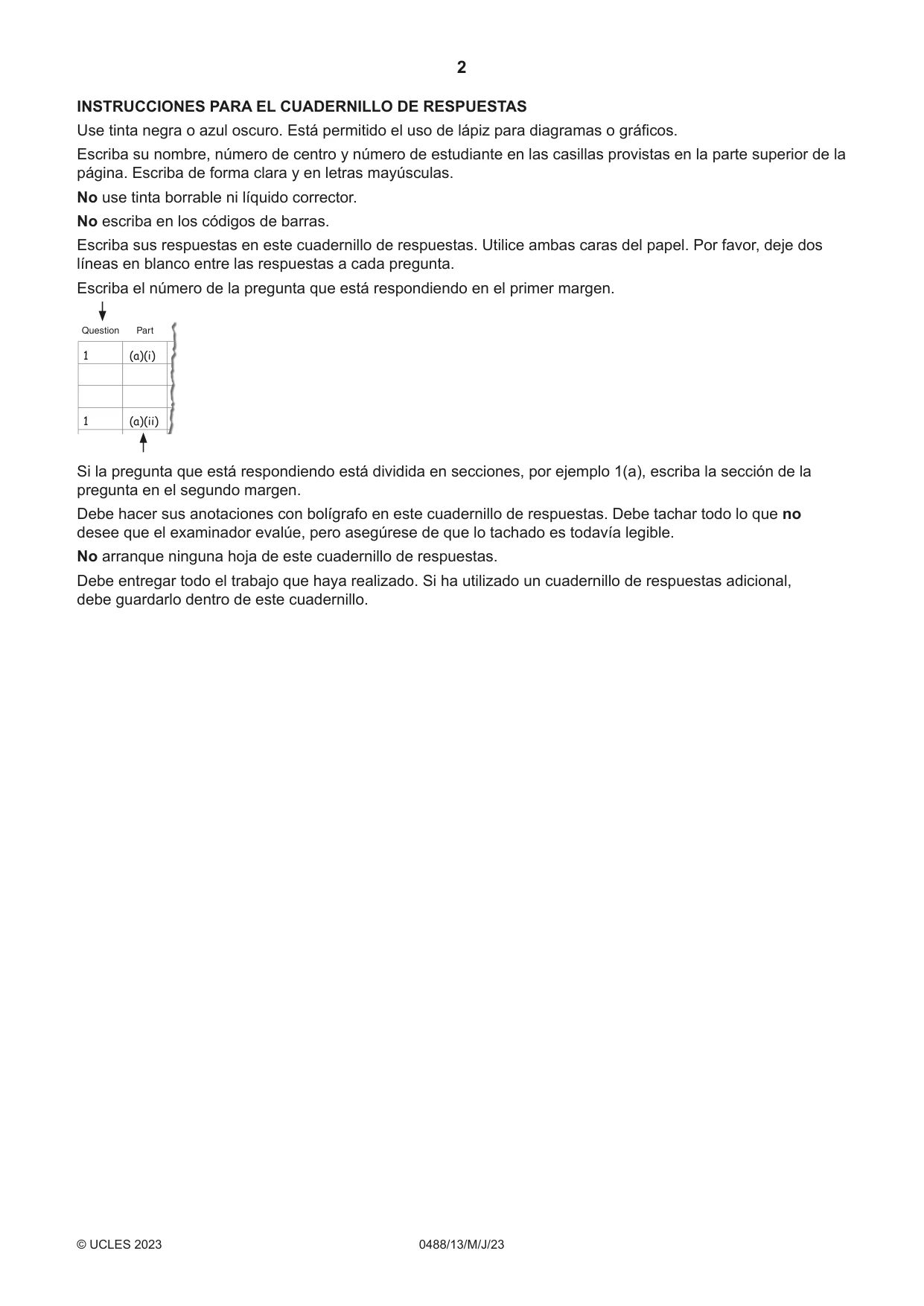
2 0488/13/ M / J /23 © UCLES 2023 INSTRUCCIONES PARA EL CUADERNILLO DE RESPUESTAS Use tinta negra o azul oscuro. Está permitido el uso de lápiz para diagramas o gráficos. Escriba su nombre, número de centro y número de estudiante en las casillas provistas en la parte superior de la página. Escriba de forma clara y en letras mayúsculas. No use tinta borrable ni líquido corrector. No escriba en los códigos de barras. Escriba sus respuestas en este cuadernillo de respuestas. Utilice ambas caras del papel. Por favor, deje dos líneas en blanco entre las respuestas a cada pregunta. Escriba el número de la pregunta que está respondiendo en el primer margen. Question Part 1 1 (a)(i) (a)(ii) Si la pregunta que está respondiendo está dividida en secciones, por ejemplo 1(a), escriba la sección de la pregunta en el segundo margen. Debe hacer sus anotaciones con bolígrafo en este cuadernillo de respuestas. Debe tachar todo lo que no desee que el examinador evalúe, pero asegúrese de que lo tachado es todavía legible. No arranque ninguna hoja de este cuadernillo de respuestas. Debe entregar todo el trabajo que haya realizado. Si ha utilizado un cuadernillo de respuestas adicional, debe guardarlo dentro de este cuadernillo.
Question paper, page 3
3 0488/13/M/J/23 © UCLES 2023 [Turn over BLANK PAGE
Question paper, page 4
4 0488/13/M/J/23 © UCLES 2023 EN TODAS SUS RESPUESTAS DEBE REFERIRSE DETALLADAMENTE AL TEXTO SECCIÓN A: PROSA Aldecoa, Historia de una maestra Alternativamente: 1* Vuelva a leer la Primera parte El comienzo del sueño desde ‘Nunca olvidaré aquella mañana’ (página 14 Debolsillo) hasta ‘marcarían para siempre mi destino’ (página 16). ¿Cómo se vale Aldecoa del lenguaje aquí para que esta escena sea tan intrigante? No olvide referirse detalladamente al fragmento en su respuesta. o 2 ‘Evocaba mi escuela, los niños negros, el color de los mercados, el calor húmedo que exhalaba la selva, el gris azul del mar; las praderas que nunca alcancé. Emile aparecía sin cesar en mis ensoñaciones’ (Segunda parte El sueño, página 127 Debolsillo). ¿Cómo se las arregla la autora para comunicar el profundo impacto que tuvo en Gabriela su tiempo en Guinea Ecuatorial? No olvide referirse detalladamente al texto en su respuesta. o 3 ‘Al día siguiente Amadeo nos contó que hasta las doce de la noche hubo luz en la sala de don Cosme. Desde la calle se oían las voces de él y del Cura’ (Segunda parte El sueño, página 123 Debolsillo). Escriba la conversación entre don Cosme y el Cura. Allende, La ciudad de las bestias Alternativamente: 4* Vuelva a leer una parte del Capítulo 19 PROTECCIÓN desde ‘Alex, como los soldados, tiritaba de frío’ (página 270 Debolsillo) hasta ‘pudieron llegar a algunas conclusiones’ (página 273). ¿Cómo se las arregla Allende para que lo transcurrido aquí mantenga al lector expectante? No olvide referirse detalladamente al fragmento en su respuesta. o 5 ‘No quería ir al Amazonas con Kate Cold. Esa abuela le daba un poco de miedo’ (Capítulo 1 LA PESADILLA, página 19 Debolsillo). ¿Cómo intensifica el interés del argumento la forma en que Alex va cambiando su actitud hacia su abuela? No olvide referirse detalladamente al texto en su respuesta. o 6 ‘Nadia y Alex lo sorprendieron una vez escarbando el equipaje de la doctora Omayra Torres. —Tarántula —dijo a modo de explicación’ (Capítulo 8 LA EXPEDICIÓN, página 91 Debolsillo). Usted es Karakawe. ¿Qué está usted pensando en este momento? Conteste con la voz de Karakawe.
Question paper, page 5
5 0488/13/M/J/23 © UCLES 2023 [Turn over EN TODAS SUS RESPUESTAS DEBE REFERIRSE DETALLADAMENTE AL TEXTO Arlt, El juguete rabioso Alternativamente: 7* Vuelva a leer el CAPÍTULO III El juguete rabioso desde ‘Eran las dos de la tarde’ (página 175 Cátedra) hasta ‘sino brutos para el trabajo’ (página 178). ¿Cómo se las arregla Arlt para que nos indignemos ante el trato de Silvio aquí? No olvide referirse detalladamente al fragmento en su respuesta. o 8 ‘—Esta casa es el infierno, don Silvio…, el infierno —y bajando la voz, temeroso de ser escuchado—: esto es… la mujer… la comida… Ah Dío Fetente, ¡qué casa ésta!’ (CAPÍTULO II Los trabajos y los días, página 139 Cátedra) ¿Cómo aprovecha el autor las experiencias de Silvio en dicha casa para que compartamos esta opinión de don Miguel? No olvide referirse detalladamente al texto en su respuesta. o 9 ‘Después callamos. Recordaba a Enrique’ (CAPÍTULO IV Judas Iscariote, página 202 Cátedra). Usted es Silvio. ¿Qué está usted pensando en este momento? No olvide referirse detalladamente al texto en su respuesta. Pérez-Reverte, El caballero del jubón amarillo Alternativamente: 10* Vuelva a leer el Capítulo II LA CASA DE LA CALLE FRANCOS desde ‘Anduvimos por la fuente de los Relatores’ (página 38 Punto de lectura) hasta ‘deparar a sus mejores hijos’ (página 40). Aprecie cómo Pérez-Reverte aprovecha el lenguaje aquí para fascinarnos mientras acompañamos a Íñigo y Alatriste de paseo por Madrid. No olvide referirse detalladamente al fragmento en su respuesta. o 11 Aunque aparece poco en la novela, María de Castro desempeña un papel clave. ¿Cómo se vale el autor de este personaje para crear intriga e interés en el argumento? No olvide referirse detalladamente al texto en su respuesta. o 12 ‘Sonó atrás la risa sofocada y espontánea del italiano, interrumpida por una feroz mirada de fray Emilio Bocanegra’ (Capítulo X EL CEBO Y LA TRAMPA, página 273 Punto de lectura). Usted es Malatesta. ¿Qué está usted pensando en este momento? Conteste con la voz de Malatesta.
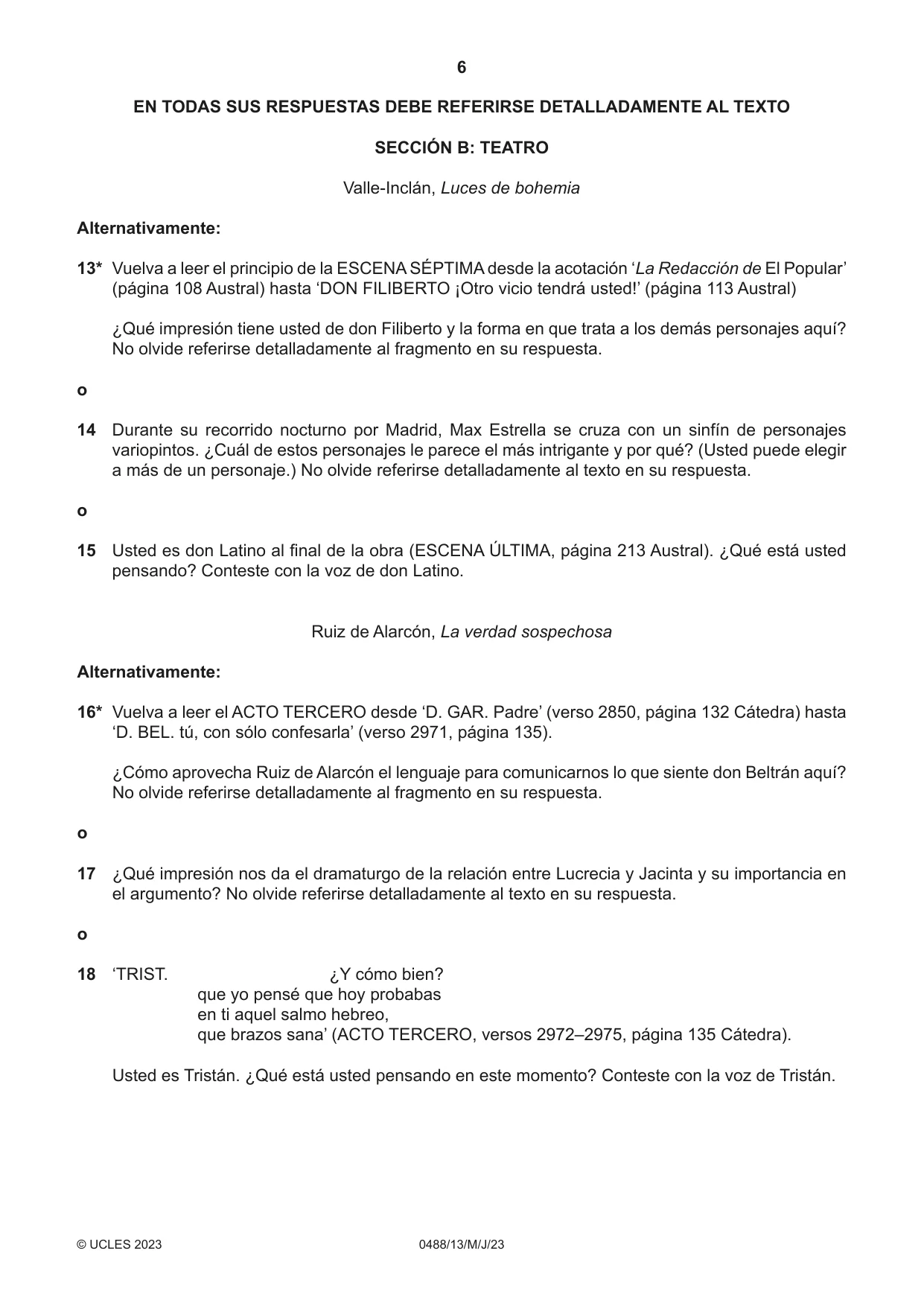
Question paper, page 6
6 0488/13/M/J/23 © UCLES 2023 EN TODAS SUS RESPUESTAS DEBE REFERIRSE DETALLADAMENTE AL TEXTO SECCIÓN B: TEATRO Valle-Inclán, Luces de bohemia Alternativamente: 13* Vuelva a leer el principio de la ESCENA SÉPTIMA desde la acotación ‘La Redacción de El Popular’ (página 108 Austral) hasta ‘DON FILIBERTO ¡Otro vicio tendrá usted!’ (página 113 Austral) ¿Qué impresión tiene usted de don Filiberto y la forma en que trata a los demás personajes aquí? No olvide referirse detalladamente al fragmento en su respuesta. o 14 Durante su recorrido nocturno por Madrid, Max Estrella se cruza con un sinfín de personajes variopintos. ¿Cuál de estos personajes le parece el más intrigante y por qué? (Usted puede elegir a más de un personaje.) No olvide referirse detalladamente al texto en su respuesta. o 15 Usted es don Latino al final de la obra (ESCENA ÚLTIMA, página 213 Austral). ¿Qué está usted pensando? Conteste con la voz de don Latino. Ruiz de Alarcón, La verdad sospechosa Alternativamente: 16* Vuelva a leer el ACTO TERCERO desde ‘D. GAR. Padre’ (verso 2850, página 132 Cátedra) hasta ‘D. BEL. tú, con sólo confesarla’ (verso 2971, página 135). ¿Cómo aprovecha Ruiz de Alarcón el lenguaje para comunicarnos lo que siente don Beltrán aquí? No olvide referirse detalladamente al fragmento en su respuesta. o 17 ¿Qué impresión nos da el dramaturgo de la relación entre Lucrecia y Jacinta y su importancia en el argumento? No olvide referirse detalladamente al texto en su respuesta. o 18 ‘TRIST. ¿Y cómo bien? que yo pensé que hoy probabas en ti aquel salmo hebreo, que brazos sana’ (ACTO TERCERO, versos 2972–2975, página 135 Cátedra). Usted es Tristán. ¿Qué está usted pensando en este momento? Conteste con la voz de Tristán.
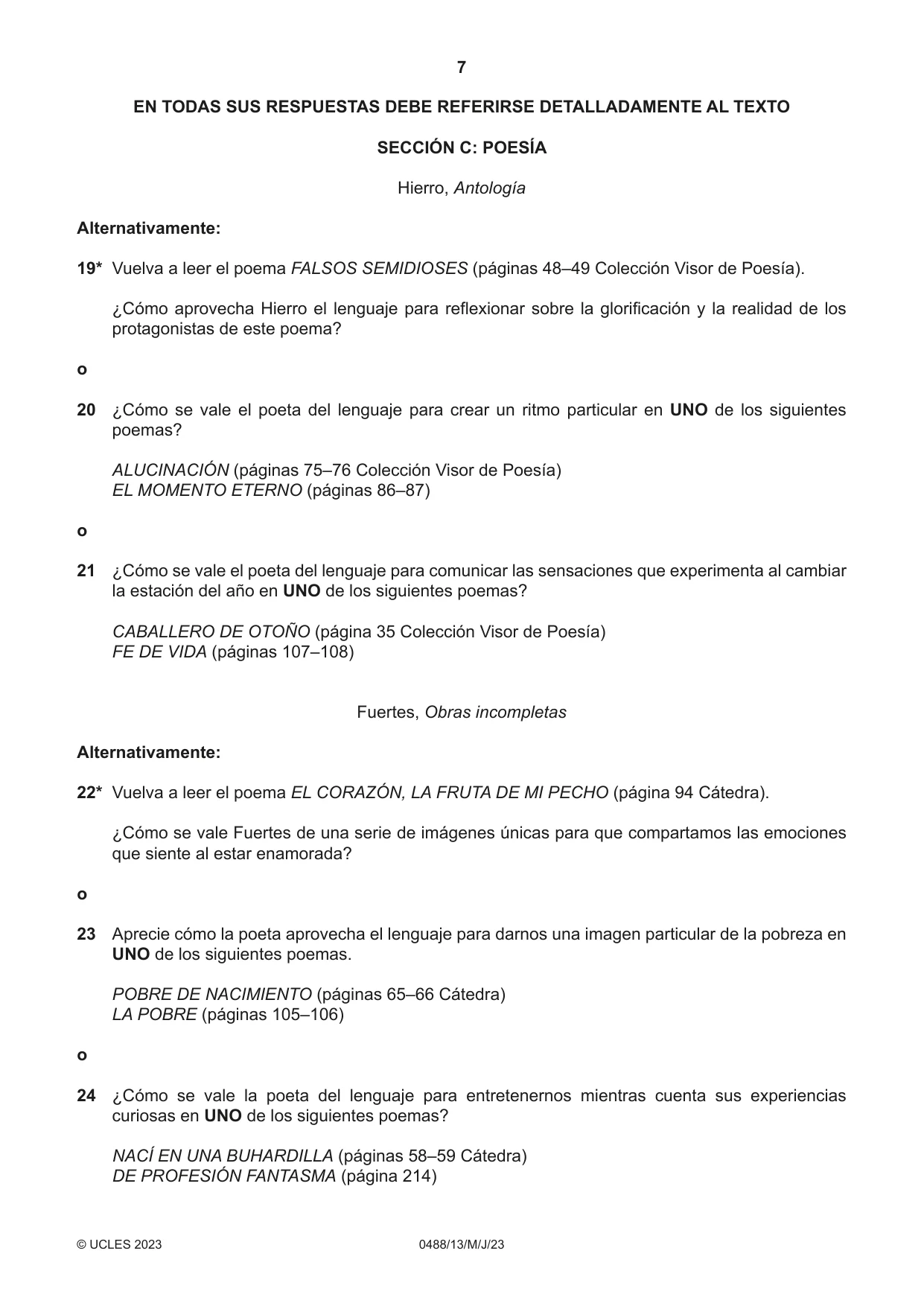
Question paper, page 7
7 0488/13/M/J/23 © UCLES 2023 EN TODAS SUS RESPUESTAS DEBE REFERIRSE DETALLADAMENTE AL TEXTO SECCIÓN C: POESÍA Hierro, Antología Alternativamente: 19* Vuelva a leer el poema FALSOS SEMIDIOSES (páginas 48–49 Colección Visor de Poesía). ¿Cómo aprovecha Hierro el lenguaje para reflexionar sobre la glorificación y la realidad de los protagonistas de este poema? o 20 ¿Cómo se vale el poeta del lenguaje para crear un ritmo particular en UNO de los siguientes poemas? ALUCINACIÓN (páginas 75–76 Colección Visor de Poesía) EL MOMENTO ETERNO (páginas 86–87) o 21 ¿Cómo se vale el poeta del lenguaje para comunicar las sensaciones que experimenta al cambiar la estación del año en UNO de los siguientes poemas? CABALLERO DE OTOÑO (página 35 Colección Visor de Poesía) FE DE VIDA (páginas 107–108) Fuertes, Obras incompletas Alternativamente: 22* Vuelva a leer el poema EL CORAZÓN, LA FRUTA DE MI PECHO (página 94 Cátedra). ¿Cómo se vale Fuertes de una serie de imágenes únicas para que compartamos las emociones que siente al estar enamorada? o 23 Aprecie cómo la poeta aprovecha el lenguaje para darnos una imagen particular de la pobreza en UNO de los siguientes poemas. POBRE DE NACIMIENTO (páginas 65–66 Cátedra) LA POBRE (páginas 105–106) o 24 ¿Cómo se vale la poeta del lenguaje para entretenernos mientras cuenta sus experiencias curiosas en UNO de los siguientes poemas? NACÍ EN UNA BUHARDILLA (páginas 58–59 Cátedra) DE PROFESIÓN FANTASMA (página 214)
Question paper, page 8
8 0488/13/M/J/23 © UCLES 2023 Permission to reproduce items where third-party owned material protected by copyright is included has been sought and cleared where possible. Every reasonable effort has been made by the publisher (UCLES) to trace copyright holders, but if any items requiring clearance have unwittingly been included, the publisher will be pleased to make amends at the earliest possible opportunity. To avoid the issue of disclosure of answer-related information to candidates, all copyright acknowledgements are reproduced online in the Cambridge Assessment International Education Copyright Acknowledgements Booklet. This is produced for each series of examinations and is freely available to download at www.cambridgeinternational.org after the live examination series. Cambridge Assessment International Education is part of Cambridge Assessment. Cambridge Assessment is the brand name of the University of Cambridge Local Examinations Syndicate (UCLES), which is a department of the University of Cambridge. BLANK PAGE
Mark scheme, page 1
This document consists of 26 printed pages. © UCLES 2023 [Turn over Cambridge IGCSE™ LITERATURE (SPANISH) 0488/13 Paper 1 Set Texts (Open Books) May/June 2023 MARK SCHEME Maximum Mark: 60 Published This mark scheme is published as an aid to teachers and candidates, to indicate the requirements of the examination. It shows the basis on which Examiners were instructed to award marks. It does not indicate the details of the discussions that took place at an Examiners’ meeting before marking began, which would have considered the acceptability of alternative answers. Mark schemes should be read in conjunction with the question paper and the Principal Examiner Report for Teachers. Cambridge International will not enter into discussions about these mark schemes. Cambridge International is publishing the mark schemes for the May/June 2023 series for most Cambridge IGCSE, Cambridge International A and AS Level and Cambridge Pre-U components, and some Cambridge O Level components.
Mark scheme, page 2
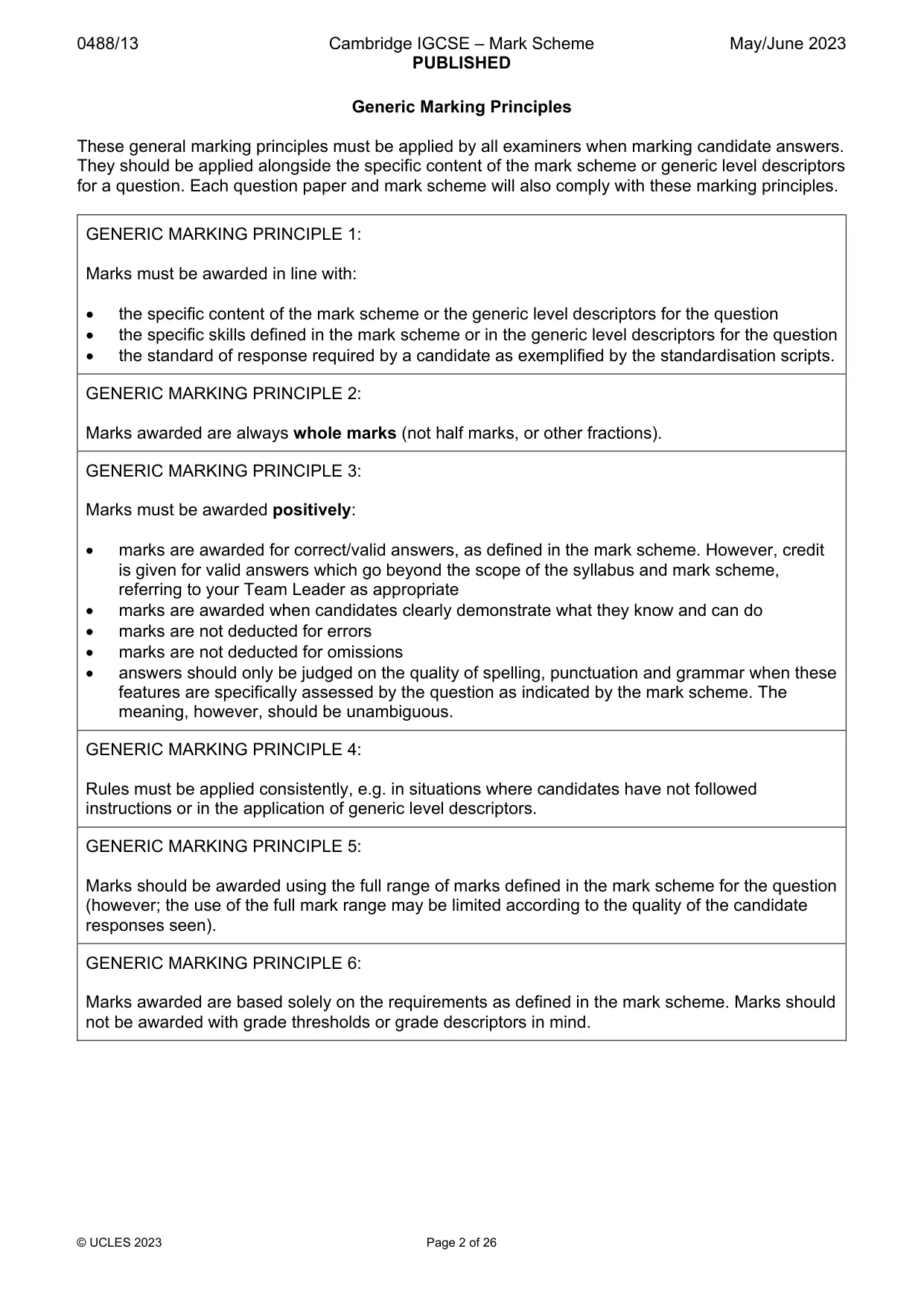
0488/13 Cambridge IGCSE – Mark Scheme PUBLISHED May/June 2023 © UCLES 2023 Page 2 of 26 Generic Marking Principles These general marking principles must be applied by all examiners when marking candidate answers. They should be applied alongside the specific content of the mark scheme or generic level descriptors for a question. Each question paper and mark scheme will also comply with these marking principles. GENERIC MARKING PRINCIPLE 1: Marks must be awarded in line with: the specific content of the mark scheme or the generic level descriptors for the question the specific skills defined in the mark scheme or in the generic level descriptors for the question the standard of response required by a candidate as exemplified by the standardisation scripts. GENERIC MARKING PRINCIPLE 2: Marks awarded are always whole marks (not half marks, or other fractions). GENERIC MARKING PRINCIPLE 3: Marks must be awarded positively: marks are awarded for correct/valid answers, as defined in the mark scheme. However, credit is given for valid answers which go beyond the scope of the syllabus and mark scheme, referring to your Team Leader as appropriate marks are awarded when candidates clearly demonstrate what they know and can do marks are not deducted for errors marks are not deducted for omissions answers should only be judged on the quality of spelling, punctuation and grammar when these features are specifically assessed by the question as indicated by the mark scheme. The meaning, however, should be unambiguous. GENERIC MARKING PRINCIPLE 4: Rules must be applied consistently, e.g. in situations where candidates have not followed instructions or in the application of generic level descriptors. GENERIC MARKING PRINCIPLE 5: Marks should be awarded using the full range of marks defined in the mark scheme for the question (however; the use of the full mark range may be limited according to the quality of the candidate responses seen). GENERIC MARKING PRINCIPLE 6: Marks awarded are based solely on the requirements as defined in the mark scheme. Marks should not be awarded with grade thresholds or grade descriptors in mind.
Mark scheme, page 3
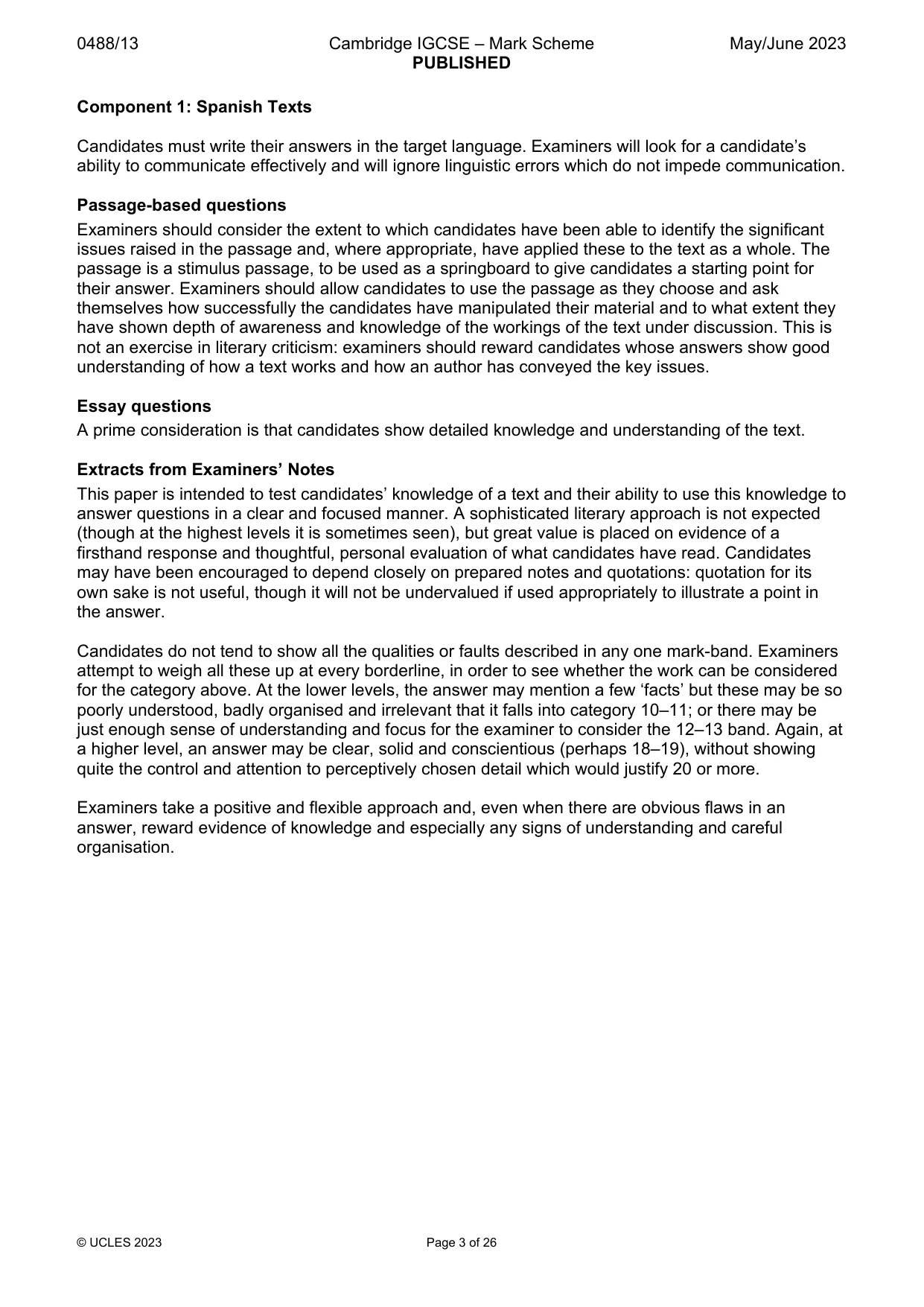
0488/13 Cambridge IGCSE – Mark Scheme PUBLISHED May/June 2023 © UCLES 2023 Page 3 of 26 Component 1: Spanish Texts Candidates must write their answers in the target language. Examiners will look for a candidate’s ability to communicate effectively and will ignore linguistic errors which do not impede communication. Passage-based questions Examiners should consider the extent to which candidates have been able to identify the significant issues raised in the passage and, where appropriate, have applied these to the text as a whole. The passage is a stimulus passage, to be used as a springboard to give candidates a starting point for their answer. Examiners should allow candidates to use the passage as they choose and ask themselves how successfully the candidates have manipulated their material and to what extent they have shown depth of awareness and knowledge of the workings of the text under discussion. This is not an exercise in literary criticism: examiners should reward candidates whose answers show good understanding of how a text works and how an author has conveyed the key issues. Essay questions A prime consideration is that candidates show detailed knowledge and understanding of the text. Extracts from Examiners’ Notes This paper is intended to test candidates’ knowledge of a text and their ability to use this knowledge to answer questions in a clear and focused manner. A sophisticated literary approach is not expected (though at the highest levels it is sometimes seen), but great value is placed on evidence of a firsthand response and thoughtful, personal evaluation of what candidates have read. Candidates may have been encouraged to depend closely on prepared notes and quotations: quotation for its own sake is not useful, though it will not be undervalued if used appropriately to illustrate a point in the answer. Candidates do not tend to show all the qualities or faults described in any one mark-band. Examiners attempt to weigh all these up at every borderline, in order to see whether the work can be considered for the category above. At the lower levels, the answer may mention a few ‘facts’ but these may be so poorly understood, badly organised and irrelevant that it falls into category 10–11; or there may be just enough sense of understanding and focus for the examiner to consider the 12–13 band. Again, at a higher level, an answer may be clear, solid and conscientious (perhaps 18–19), without showing quite the control and attention to perceptively chosen detail which would justify 20 or more. Examiners take a positive and flexible approach and, even when there are obvious flaws in an answer, reward evidence of knowledge and especially any signs of understanding and careful organisation.
Mark scheme, page 4
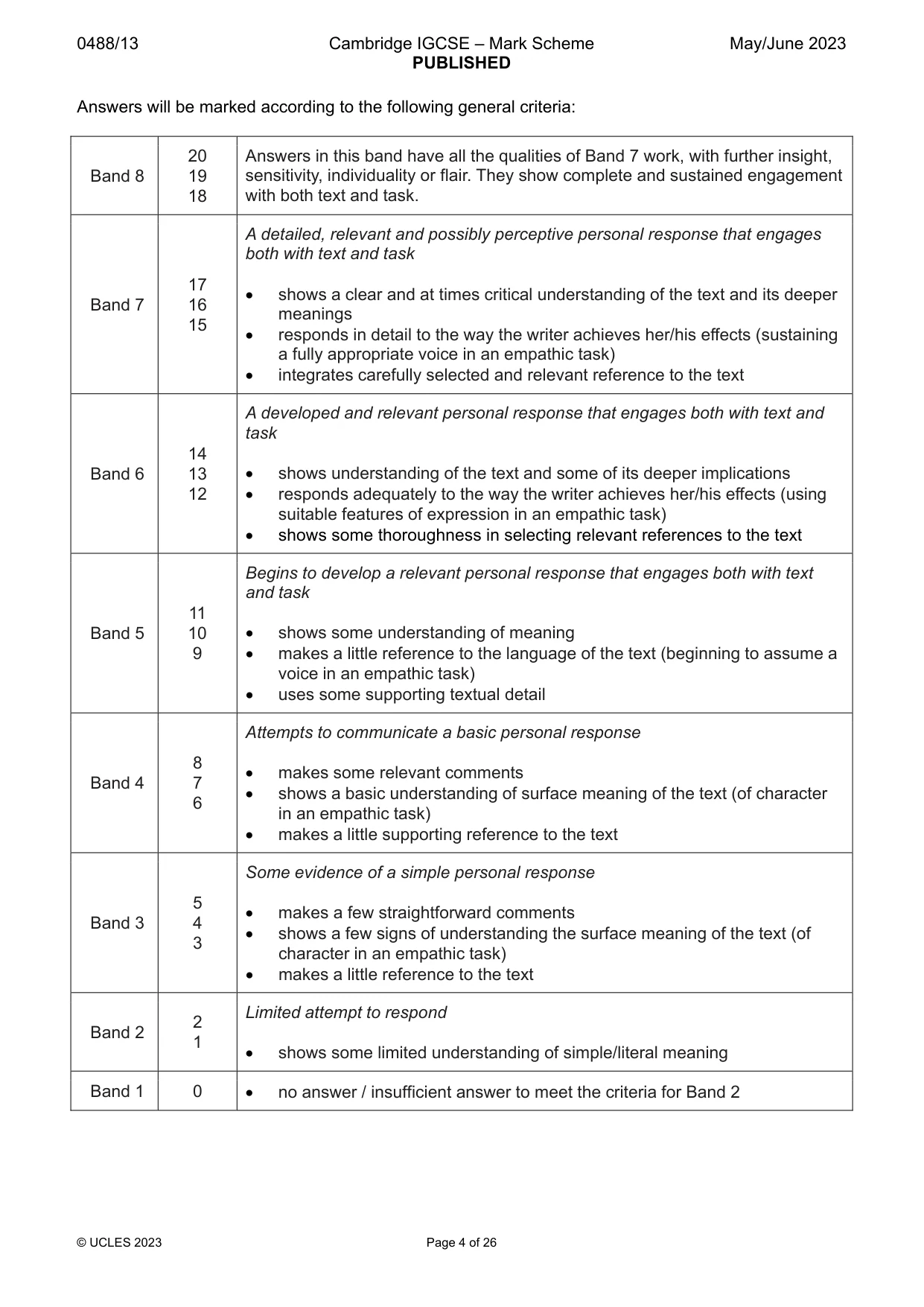
0488/13 Cambridge IGCSE – Mark Scheme PUBLISHED May/June 2023 © UCLES 2023 Page 4 of 26 Answers will be marked according to the following general criteria: Band 8 20 19 18 Answers in this band have all the qualities of Band 7 work, with further insight, sensitivity, individuality or flair. They show complete and sustained engagement with both text and task. Band 7 17 16 15 A detailed, relevant and possibly perceptive personal response that engages both with text and task shows a clear and at times critical understanding of the text and its deeper meanings responds in detail to the way the writer achieves her/his effects (sustaining a fully appropriate voice in an empathic task) integrates carefully selected and relevant reference to the text Band 6 14 13 12 A developed and relevant personal response that engages both with text and task shows understanding of the text and some of its deeper implications responds adequately to the way the writer achieves her/his effects (using suitable features of expression in an empathic task) shows some thoroughness in selecting relevant references to the text Band 5 11 10 9 Begins to develop a relevant personal response that engages both with text and task shows some understanding of meaning makes a little reference to the language of the text (beginning to assume a voice in an empathic task) uses some supporting textual detail Band 4 8 7 6 Attempts to communicate a basic personal response makes some relevant comments shows a basic understanding of surface meaning of the text (of character in an empathic task) makes a little supporting reference to the text Band 3 5 4 3 Some evidence of a simple personal response makes a few straightforward comments shows a few signs of understanding the surface meaning of the text (of character in an empathic task) makes a little reference to the text Band 2 2 1 Limited attempt to respond shows some limited understanding of simple/literal meaning Band 1 0 no answer / insufficient answer to meet the criteria for Band 2
Mark scheme, page 5
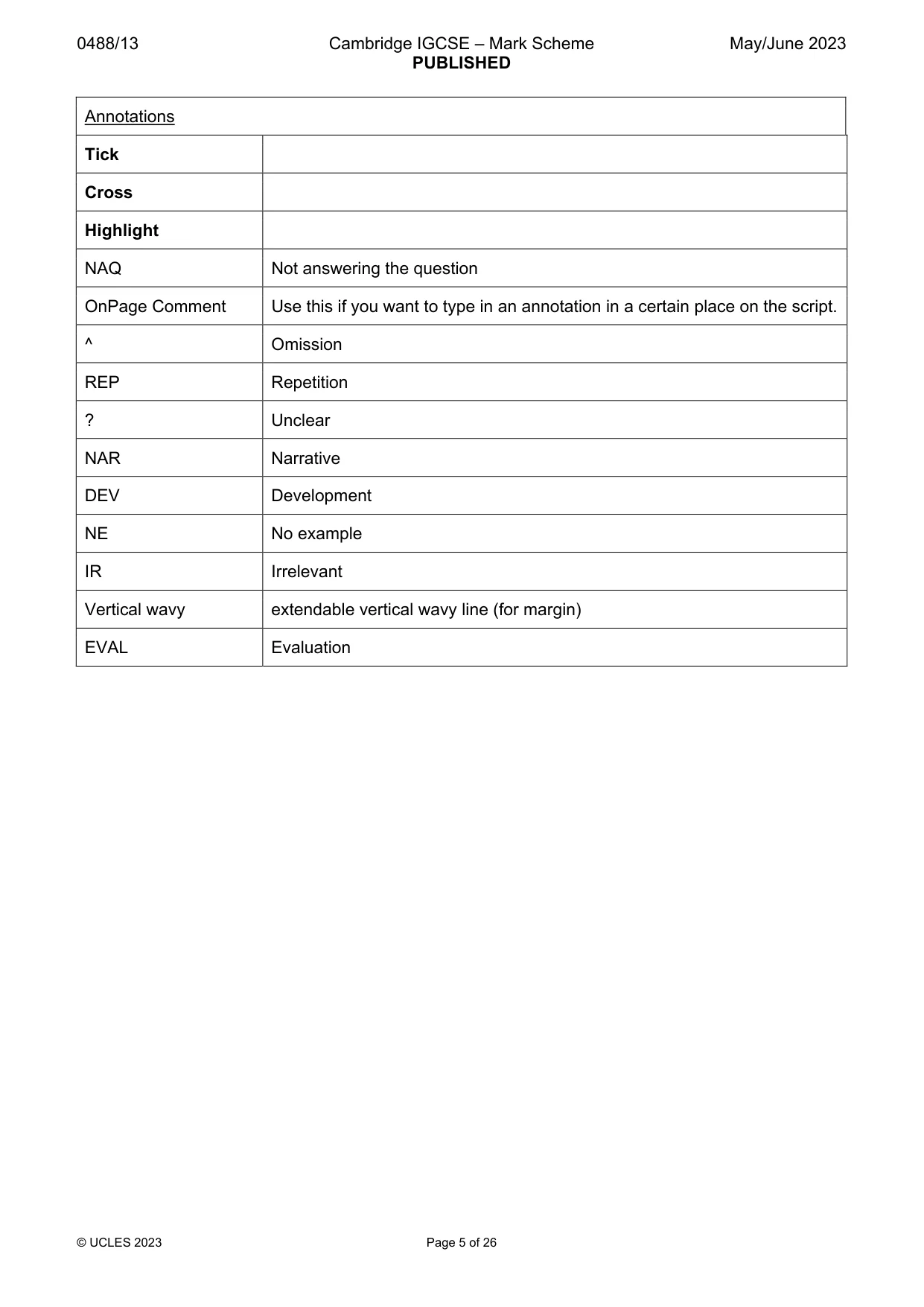
0488/13 Cambridge IGCSE – Mark Scheme PUBLISHED May/June 2023 © UCLES 2023 Page 5 of 26 Annotations Tick Cross Highlight NAQ Not answering the question OnPage Comment Use this if you want to type in an annotation in a certain place on the script. ^ Omission REP Repetition ? Unclear NAR Narrative DEV Development NE No example IR Irrelevant Vertical wavy extendable vertical wavy line (for margin) EVAL Evaluation
Mark scheme, page 6
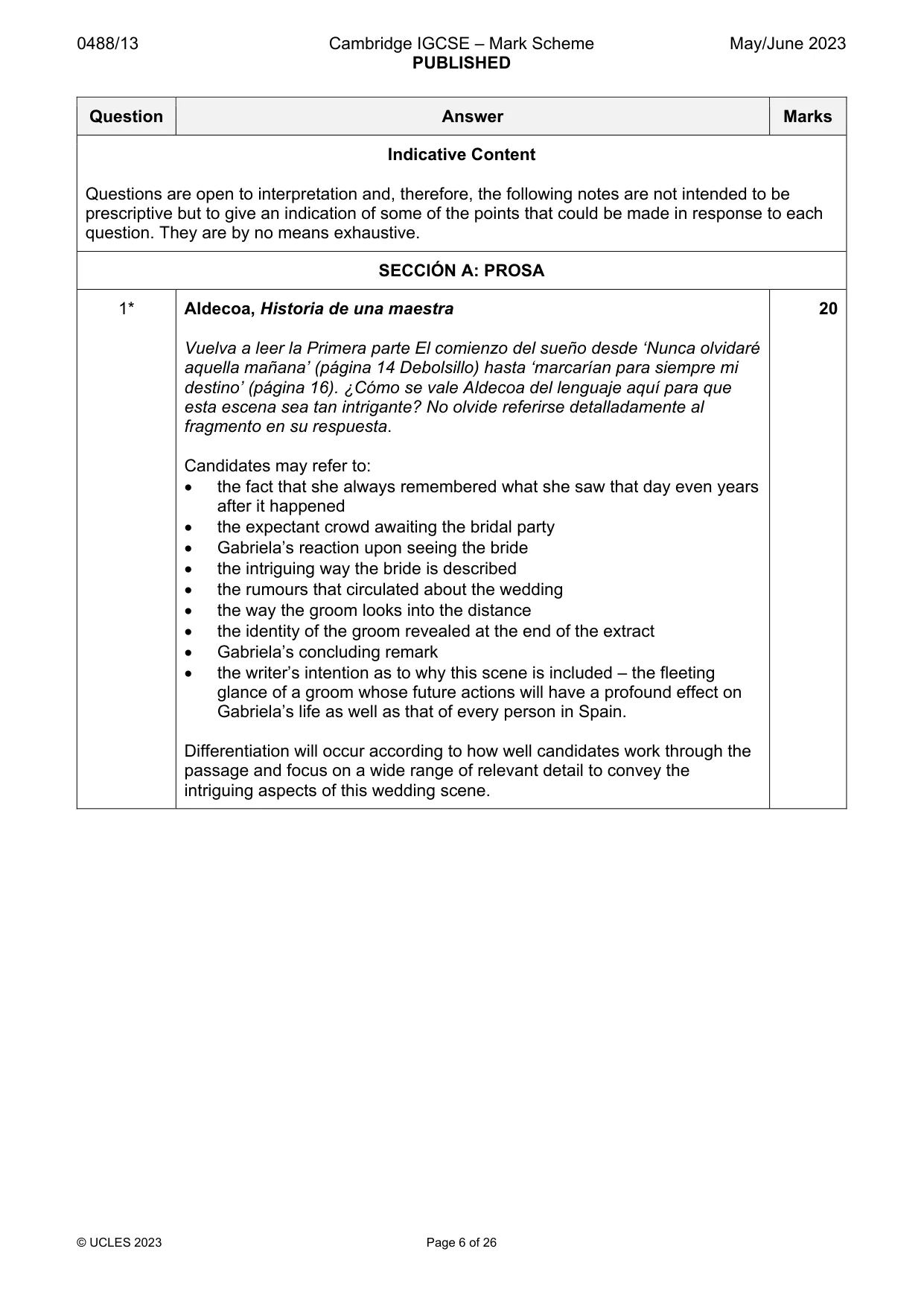
0488/13 Cambridge IGCSE – Mark Scheme PUBLISHED May/June 2023 © UCLES 2023 Page 6 of 26 Question Answer Marks Indicative Content Questions are open to interpretation and, therefore, the following notes are not intended to be prescriptive but to give an indication of some of the points that could be made in response to each question. They are by no means exhaustive. SECCIÓN A: PROSA 1* Aldecoa, Historia de una maestra Vuelva a leer la Primera parte El comienzo del sueño desde ‘Nunca olvidaré aquella mañana’ (página 14 Debolsillo) hasta ‘marcarían para siempre mi destino’ (página 16). ¿Cómo se vale Aldecoa del lenguaje aquí para que esta escena sea tan intrigante? No olvide referirse detalladamente al fragmento en su respuesta. Candidates may refer to: the fact that she always remembered what she saw that day even years after it happened the expectant crowd awaiting the bridal party Gabriela’s reaction upon seeing the bride the intriguing way the bride is described the rumours that circulated about the wedding the way the groom looks into the distance the identity of the groom revealed at the end of the extract Gabriela’s concluding remark the writer’s intention as to why this scene is included – the fleeting glance of a groom whose future actions will have a profound effect on Gabriela’s life as well as that of every person in Spain. Differentiation will occur according to how well candidates work through the passage and focus on a wide range of relevant detail to convey the intriguing aspects of this wedding scene. 20
Mark scheme, page 7
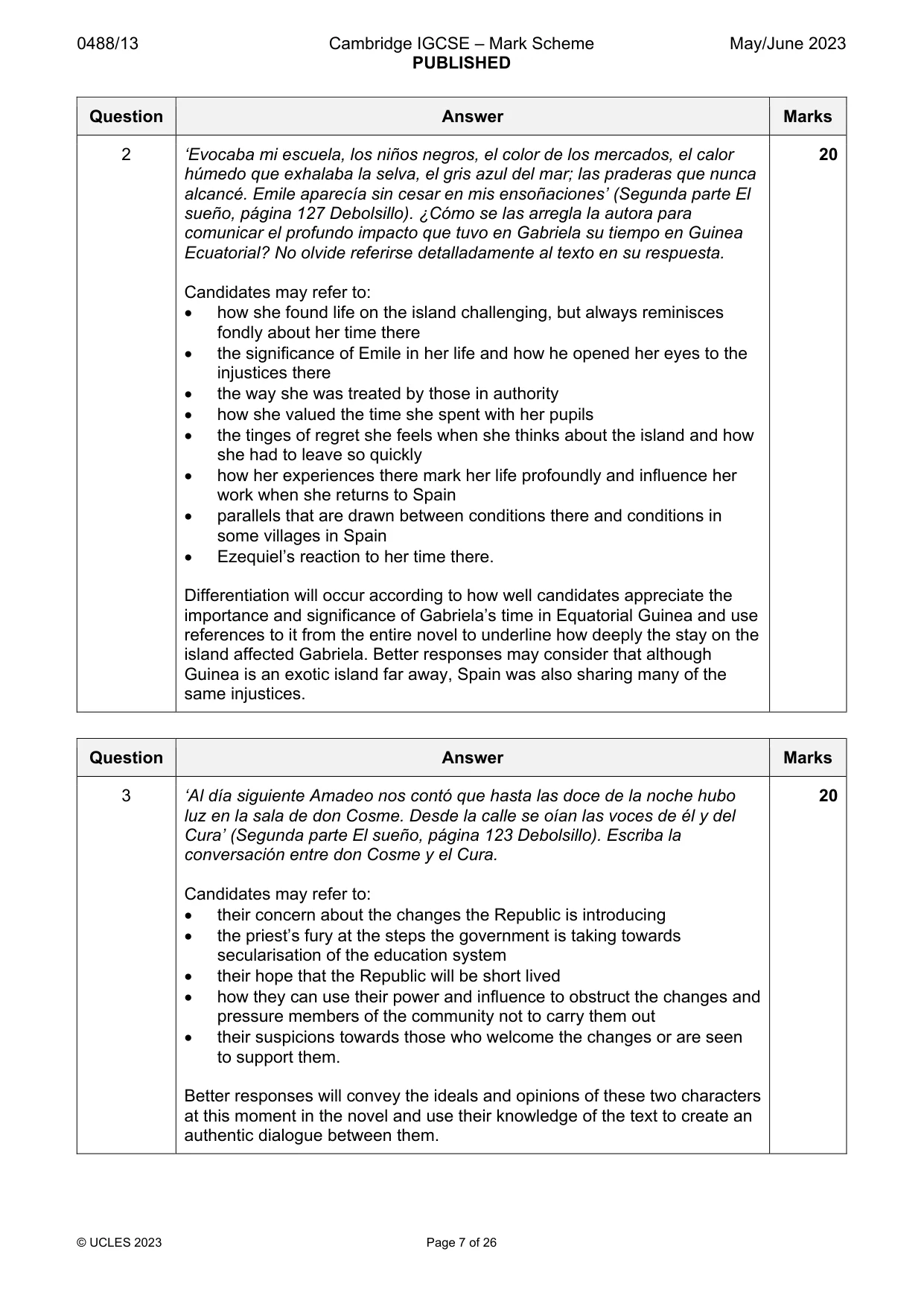
0488/13 Cambridge IGCSE – Mark Scheme PUBLISHED May/June 2023 © UCLES 2023 Page 7 of 26 Question Answer Marks 2 ‘Evocaba mi escuela, los niños negros, el color de los mercados, el calor húmedo que exhalaba la selva, el gris azul del mar; las praderas que nunca alcancé. Emile aparecía sin cesar en mis ensoñaciones’ (Segunda parte El sueño, página 127 Debolsillo). ¿Cómo se las arregla la autora para comunicar el profundo impacto que tuvo en Gabriela su tiempo en Guinea Ecuatorial? No olvide referirse detalladamente al texto en su respuesta. Candidates may refer to: how she found life on the island challenging, but always reminisces fondly about her time there the significance of Emile in her life and how he opened her eyes to the injustices there the way she was treated by those in authority how she valued the time she spent with her pupils the tinges of regret she feels when she thinks about the island and how she had to leave so quickly how her experiences there mark her life profoundly and influence her work when she returns to Spain parallels that are drawn between conditions there and conditions in some villages in Spain Ezequiel’s reaction to her time there. Differentiation will occur according to how well candidates appreciate the importance and significance of Gabriela’s time in Equatorial Guinea and use references to it from the entire novel to underline how deeply the stay on the island affected Gabriela. Better responses may consider that although Guinea is an exotic island far away, Spain was also sharing many of the same injustices. 20 Question Answer Marks 3 ‘Al día siguiente Amadeo nos contó que hasta las doce de la noche hubo luz en la sala de don Cosme. Desde la calle se oían las voces de él y del Cura’ (Segunda parte El sueño, página 123 Debolsillo). Escriba la conversación entre don Cosme y el Cura. Candidates may refer to: their concern about the changes the Republic is introducing the priest’s fury at the steps the government is taking towards secularisation of the education system their hope that the Republic will be short lived how they can use their power and influence to obstruct the changes and pressure members of the community not to carry them out their suspicions towards those who welcome the changes or are seen to support them. Better responses will convey the ideals and opinions of these two characters at this moment in the novel and use their knowledge of the text to create an authentic dialogue between them. 20
Mark scheme, page 8
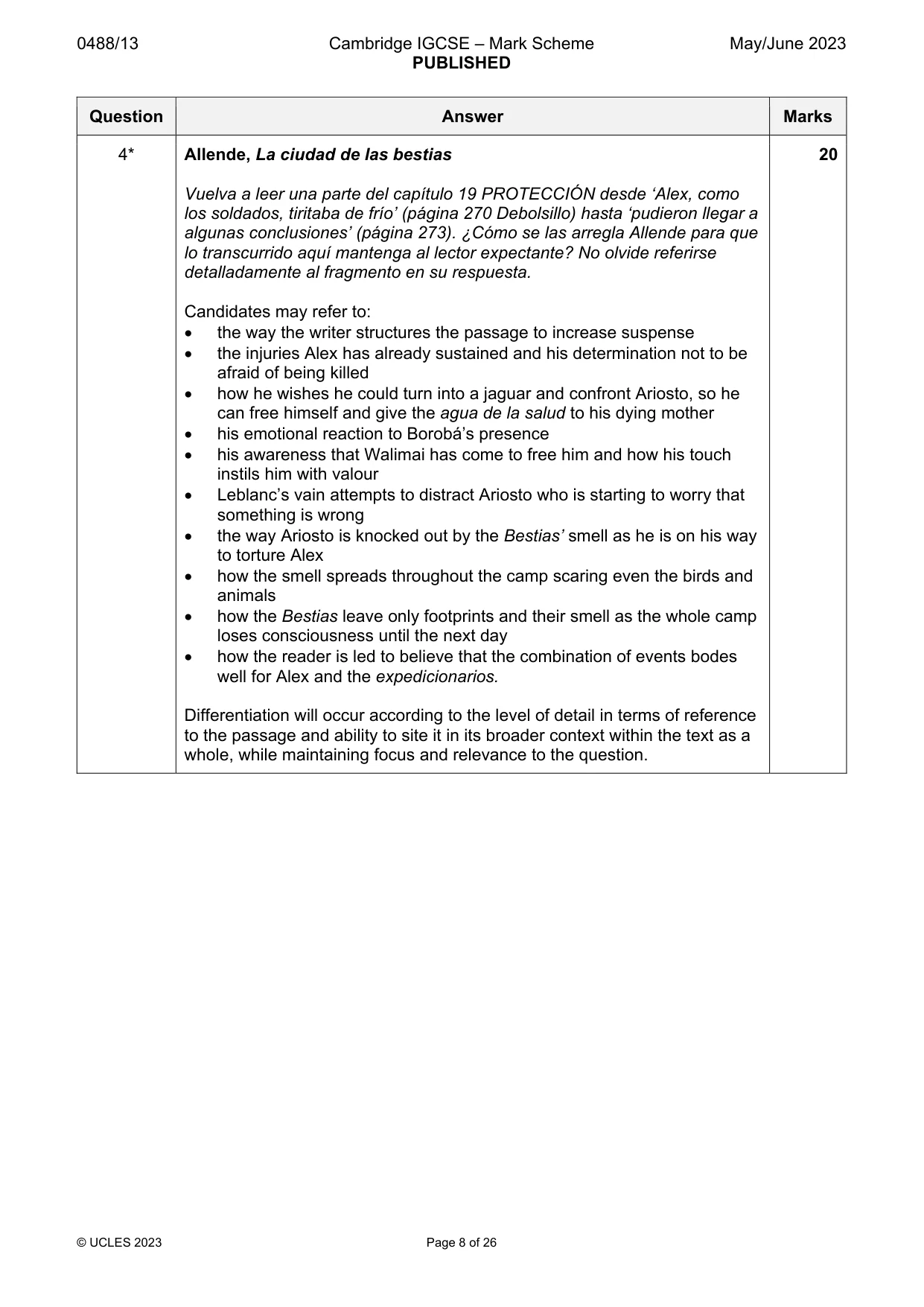
0488/13 Cambridge IGCSE – Mark Scheme PUBLISHED May/June 2023 © UCLES 2023 Page 8 of 26 Question Answer Marks 4* Allende, La ciudad de las bestias Vuelva a leer una parte del capítulo 19 PROTECCIÓN desde ‘Alex, como los soldados, tiritaba de frío’ (página 270 Debolsillo) hasta ‘pudieron llegar a algunas conclusiones’ (página 273). ¿Cómo se las arregla Allende para que lo transcurrido aquí mantenga al lector expectante? No olvide referirse detalladamente al fragmento en su respuesta. Candidates may refer to: the way the writer structures the passage to increase suspense the injuries Alex has already sustained and his determination not to be afraid of being killed how he wishes he could turn into a jaguar and confront Ariosto, so he can free himself and give the agua de la salud to his dying mother his emotional reaction to Borobá’s presence his awareness that Walimai has come to free him and how his touch instils him with valour Leblanc’s vain attempts to distract Ariosto who is starting to worry that something is wrong the way Ariosto is knocked out by the Bestias’ smell as he is on his way to torture Alex how the smell spreads throughout the camp scaring even the birds and animals how the Bestias leave only footprints and their smell as the whole camp loses consciousness until the next day how the reader is led to believe that the combination of events bodes well for Alex and the expedicionarios. Differentiation will occur according to the level of detail in terms of reference to the passage and ability to site it in its broader context within the text as a whole, while maintaining focus and relevance to the question. 20
Mark scheme, page 9
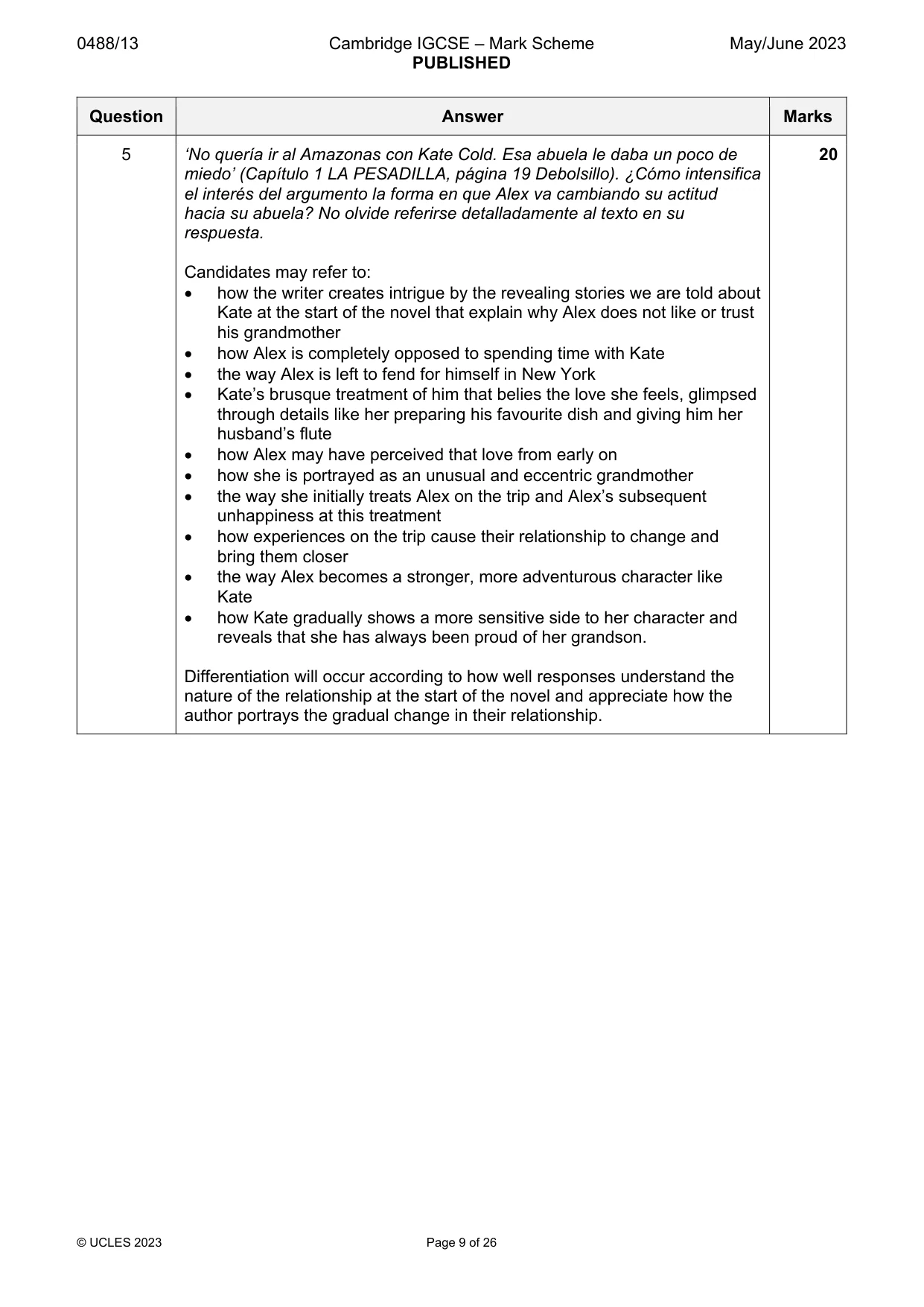
0488/13 Cambridge IGCSE – Mark Scheme PUBLISHED May/June 2023 © UCLES 2023 Page 9 of 26 Question Answer Marks 5 ‘No quería ir al Amazonas con Kate Cold. Esa abuela le daba un poco de miedo’ (Capítulo 1 LA PESADILLA, página 19 Debolsillo). ¿Cómo intensifica el interés del argumento la forma en que Alex va cambiando su actitud hacia su abuela? No olvide referirse detalladamente al texto en su respuesta. Candidates may refer to: how the writer creates intrigue by the revealing stories we are told about Kate at the start of the novel that explain why Alex does not like or trust his grandmother how Alex is completely opposed to spending time with Kate the way Alex is left to fend for himself in New York Kate’s brusque treatment of him that belies the love she feels, glimpsed through details like her preparing his favourite dish and giving him her husband’s flute how Alex may have perceived that love from early on how she is portrayed as an unusual and eccentric grandmother the way she initially treats Alex on the trip and Alex’s subsequent unhappiness at this treatment how experiences on the trip cause their relationship to change and bring them closer the way Alex becomes a stronger, more adventurous character like Kate how Kate gradually shows a more sensitive side to her character and reveals that she has always been proud of her grandson. Differentiation will occur according to how well responses understand the nature of the relationship at the start of the novel and appreciate how the author portrays the gradual change in their relationship. 20
Mark scheme, page 10
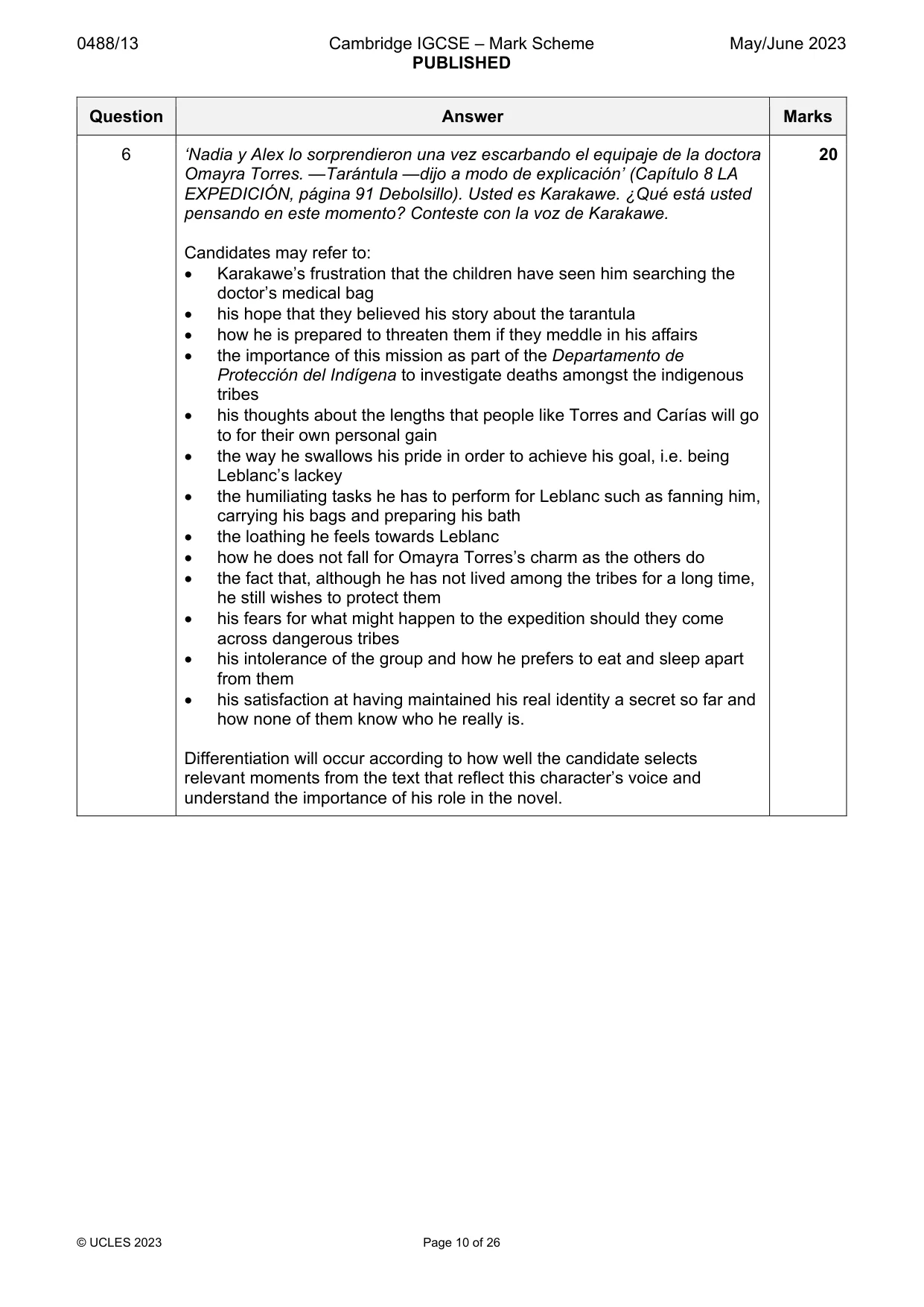
0488/13 Cambridge IGCSE – Mark Scheme PUBLISHED May/June 2023 © UCLES 2023 Page 10 of 26 Question Answer Marks 6 ‘Nadia y Alex lo sorprendieron una vez escarbando el equipaje de la doctora Omayra Torres. —Tarántula —dijo a modo de explicación’ (Capítulo 8 LA EXPEDICIÓN, página 91 Debolsillo). Usted es Karakawe. ¿Qué está usted pensando en este momento? Conteste con la voz de Karakawe. Candidates may refer to: Karakawe’s frustration that the children have seen him searching the doctor’s medical bag his hope that they believed his story about the tarantula how he is prepared to threaten them if they meddle in his affairs the importance of this mission as part of the Departamento de Protección del Indígena to investigate deaths amongst the indigenous tribes his thoughts about the lengths that people like Torres and Carías will go to for their own personal gain the way he swallows his pride in order to achieve his goal, i.e. being Leblanc’s lackey the humiliating tasks he has to perform for Leblanc such as fanning him, carrying his bags and preparing his bath the loathing he feels towards Leblanc how he does not fall for Omayra Torres’s charm as the others do the fact that, although he has not lived among the tribes for a long time, he still wishes to protect them his fears for what might happen to the expedition should they come across dangerous tribes his intolerance of the group and how he prefers to eat and sleep apart from them his satisfaction at having maintained his real identity a secret so far and how none of them know who he really is. Differentiation will occur according to how well the candidate selects relevant moments from the text that reflect this character’s voice and understand the importance of his role in the novel. 20
Mark scheme, page 11
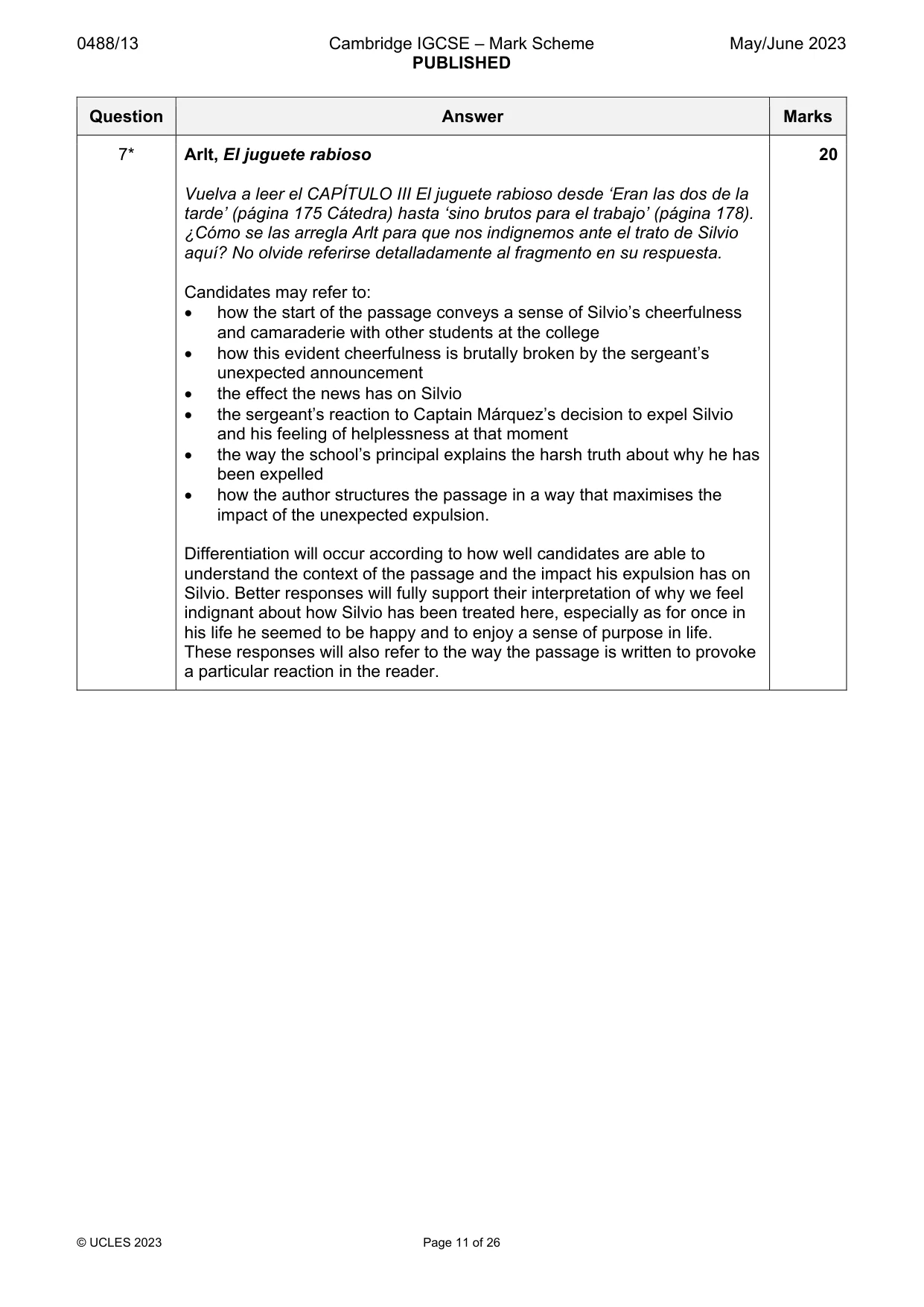
0488/13 Cambridge IGCSE – Mark Scheme PUBLISHED May/June 2023 © UCLES 2023 Page 11 of 26 Question Answer Marks 7* Arlt, El juguete rabioso Vuelva a leer el CAPÍTULO III El juguete rabioso desde ‘Eran las dos de la tarde’ (página 175 Cátedra) hasta ‘sino brutos para el trabajo’ (página 178). ¿Cómo se las arregla Arlt para que nos indignemos ante el trato de Silvio aquí? No olvide referirse detalladamente al fragmento en su respuesta. Candidates may refer to: how the start of the passage conveys a sense of Silvio’s cheerfulness and camaraderie with other students at the college how this evident cheerfulness is brutally broken by the sergeant’s unexpected announcement the effect the news has on Silvio the sergeant’s reaction to Captain Márquez’s decision to expel Silvio and his feeling of helplessness at that moment the way the school’s principal explains the harsh truth about why he has been expelled how the author structures the passage in a way that maximises the impact of the unexpected expulsion. Differentiation will occur according to how well candidates are able to understand the context of the passage and the impact his expulsion has on Silvio. Better responses will fully support their interpretation of why we feel indignant about how Silvio has been treated here, especially as for once in his life he seemed to be happy and to enjoy a sense of purpose in life. These responses will also refer to the way the passage is written to provoke a particular reaction in the reader. 20
Mark scheme, page 12
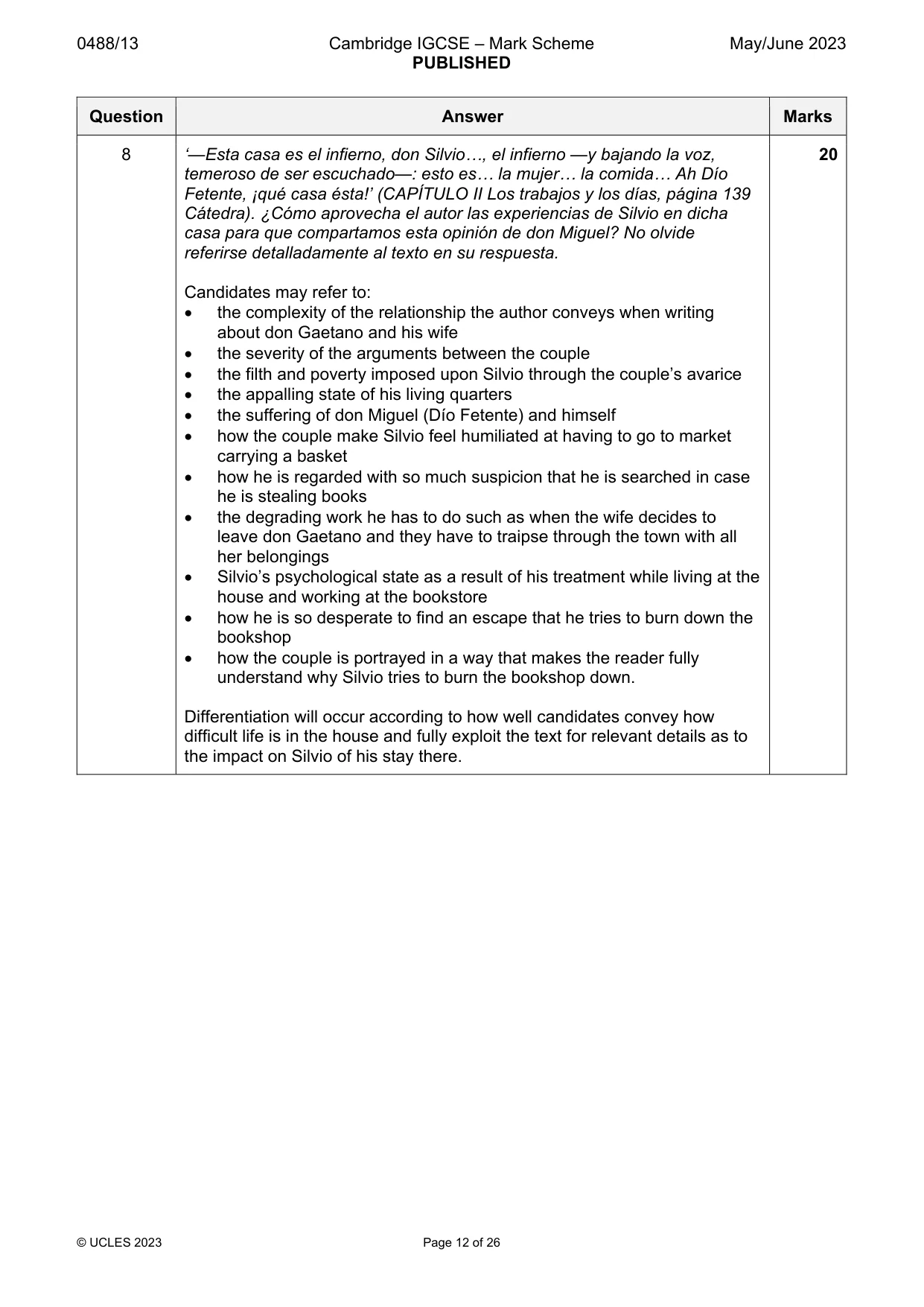
0488/13 Cambridge IGCSE – Mark Scheme PUBLISHED May/June 2023 © UCLES 2023 Page 12 of 26 Question Answer Marks 8 ‘—Esta casa es el infierno, don Silvio…, el infierno —y bajando la voz, temeroso de ser escuchado—: esto es… la mujer… la comida… Ah Dío Fetente, ¡qué casa ésta!’ (CAPÍTULO II Los trabajos y los días, página 139 Cátedra). ¿Cómo aprovecha el autor las experiencias de Silvio en dicha casa para que compartamos esta opinión de don Miguel? No olvide referirse detalladamente al texto en su respuesta. Candidates may refer to: the complexity of the relationship the author conveys when writing about don Gaetano and his wife the severity of the arguments between the couple the filth and poverty imposed upon Silvio through the couple’s avarice the appalling state of his living quarters the suffering of don Miguel (Dío Fetente) and himself how the couple make Silvio feel humiliated at having to go to market carrying a basket how he is regarded with so much suspicion that he is searched in case he is stealing books the degrading work he has to do such as when the wife decides to leave don Gaetano and they have to traipse through the town with all her belongings Silvio’s psychological state as a result of his treatment while living at the house and working at the bookstore how he is so desperate to find an escape that he tries to burn down the bookshop how the couple is portrayed in a way that makes the reader fully understand why Silvio tries to burn the bookshop down. Differentiation will occur according to how well candidates convey how difficult life is in the house and fully exploit the text for relevant details as to the impact on Silvio of his stay there. 20
Mark scheme, page 13
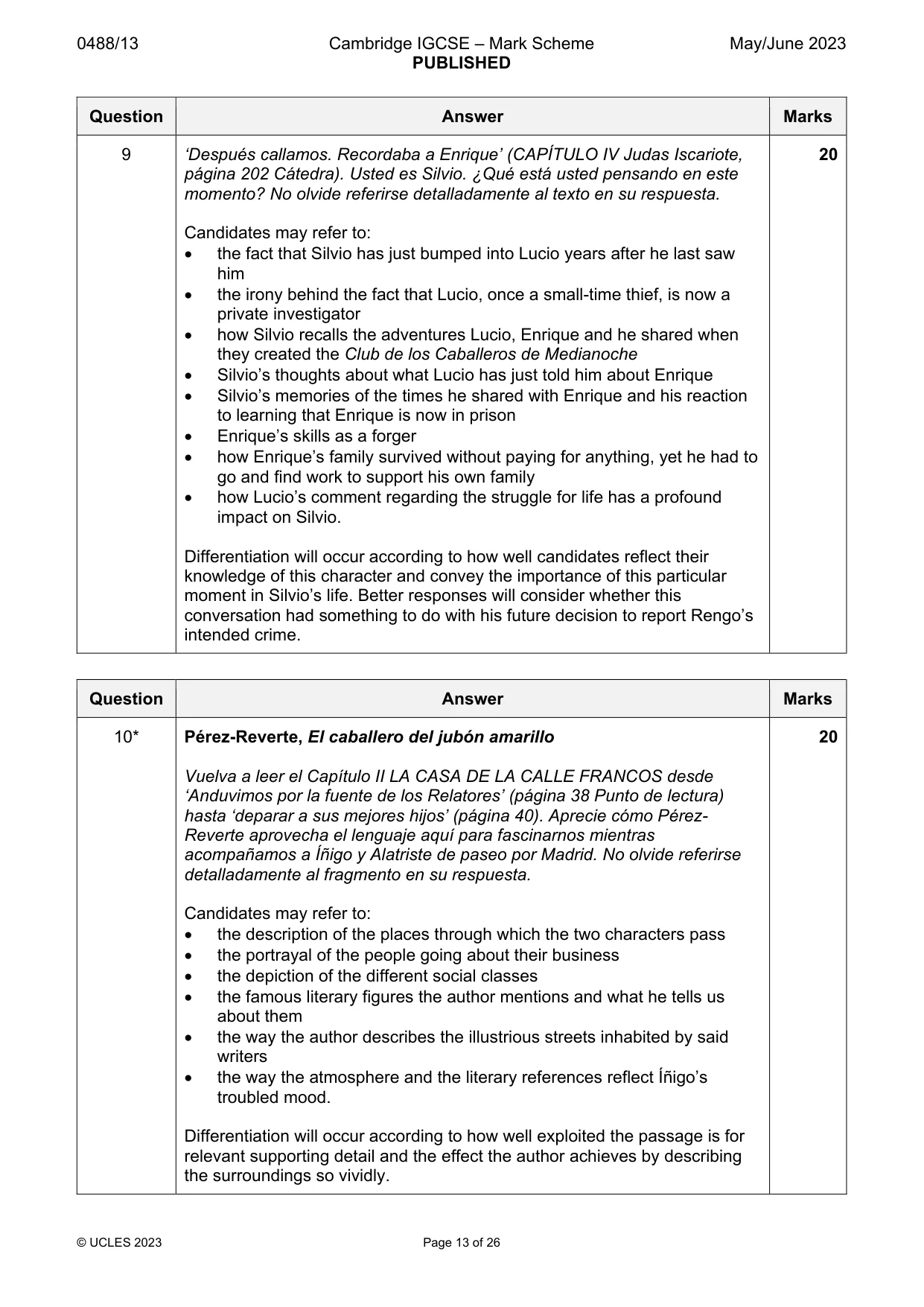
0488/13 Cambridge IGCSE – Mark Scheme PUBLISHED May/June 2023 © UCLES 2023 Page 13 of 26 Question Answer Marks 9 ‘Después callamos. Recordaba a Enrique’ (CAPÍTULO IV Judas Iscariote, página 202 Cátedra). Usted es Silvio. ¿Qué está usted pensando en este momento? No olvide referirse detalladamente al texto en su respuesta. Candidates may refer to: the fact that Silvio has just bumped into Lucio years after he last saw him the irony behind the fact that Lucio, once a small-time thief, is now a private investigator how Silvio recalls the adventures Lucio, Enrique and he shared when they created the Club de los Caballeros de Medianoche Silvio’s thoughts about what Lucio has just told him about Enrique Silvio’s memories of the times he shared with Enrique and his reaction to learning that Enrique is now in prison Enrique’s skills as a forger how Enrique’s family survived without paying for anything, yet he had to go and find work to support his own family how Lucio’s comment regarding the struggle for life has a profound impact on Silvio. Differentiation will occur according to how well candidates reflect their knowledge of this character and convey the importance of this particular moment in Silvio’s life. Better responses will consider whether this conversation had something to do with his future decision to report Rengo’s intended crime. 20 Question Answer Marks 10* Pérez-Reverte, El caballero del jubón amarillo Vuelva a leer el Capítulo II LA CASA DE LA CALLE FRANCOS desde ‘Anduvimos por la fuente de los Relatores’ (página 38 Punto de lectura) hasta ‘deparar a sus mejores hijos’ (página 40). Aprecie cómo Pérez- Reverte aprovecha el lenguaje aquí para fascinarnos mientras acompañamos a Íñigo y Alatriste de paseo por Madrid. No olvide referirse detalladamente al fragmento en su respuesta. Candidates may refer to: the description of the places through which the two characters pass the portrayal of the people going about their business the depiction of the different social classes the famous literary figures the author mentions and what he tells us about them the way the author describes the illustrious streets inhabited by said writers the way the atmosphere and the literary references reflect Íñigo’s troubled mood. Differentiation will occur according to how well exploited the passage is for relevant supporting detail and the effect the author achieves by describing the surroundings so vividly. 20
Mark scheme, page 14
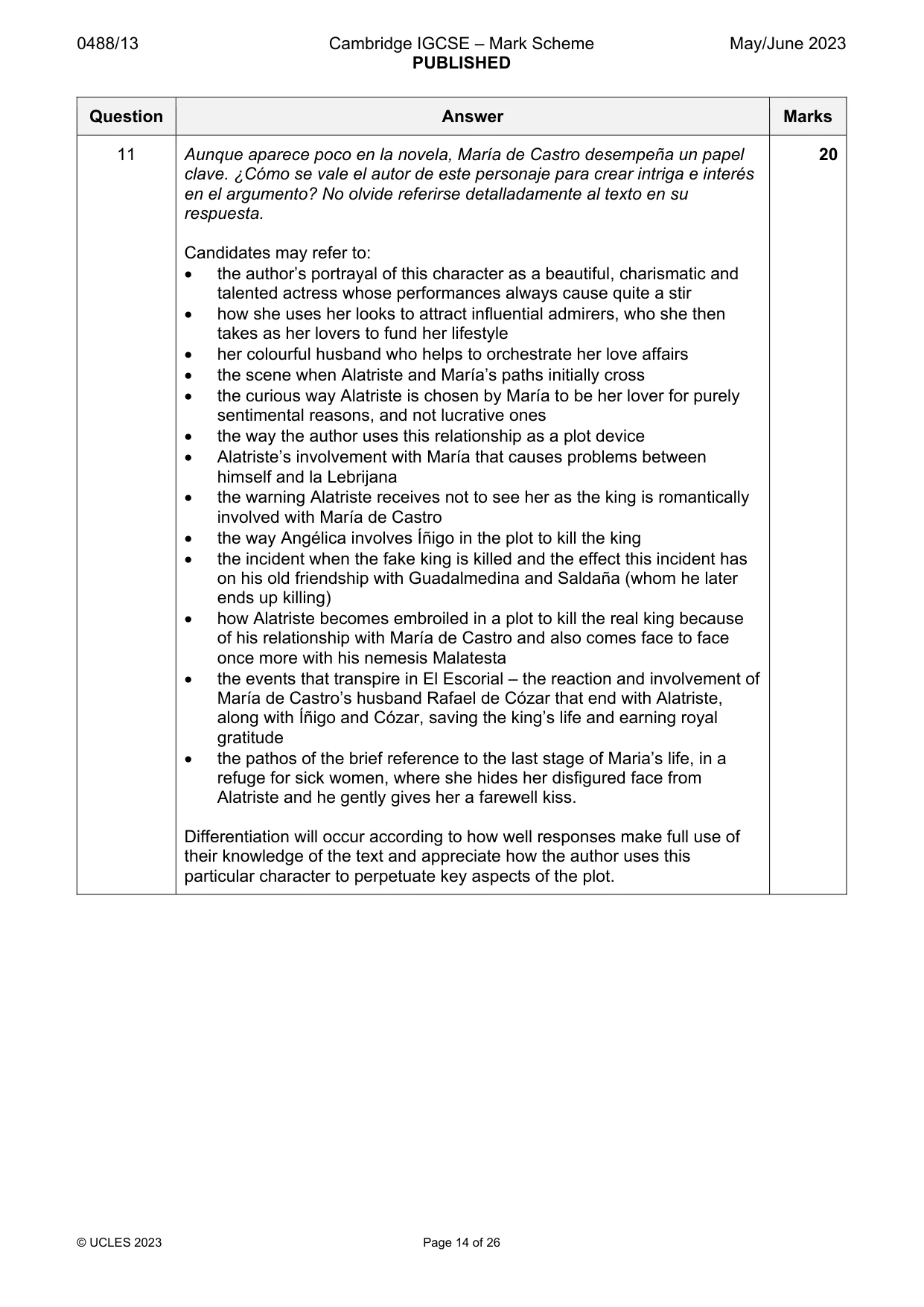
0488/13 Cambridge IGCSE – Mark Scheme PUBLISHED May/June 2023 © UCLES 2023 Page 14 of 26 Question Answer Marks 11 Aunque aparece poco en la novela, María de Castro desempeña un papel clave. ¿Cómo se vale el autor de este personaje para crear intriga e interés en el argumento? No olvide referirse detalladamente al texto en su respuesta. Candidates may refer to: the author’s portrayal of this character as a beautiful, charismatic and talented actress whose performances always cause quite a stir how she uses her looks to attract influential admirers, who she then takes as her lovers to fund her lifestyle her colourful husband who helps to orchestrate her love affairs the scene when Alatriste and María’s paths initially cross the curious way Alatriste is chosen by María to be her lover for purely sentimental reasons, and not lucrative ones the way the author uses this relationship as a plot device Alatriste’s involvement with María that causes problems between himself and la Lebrijana the warning Alatriste receives not to see her as the king is romantically involved with María de Castro the way Angélica involves Íñigo in the plot to kill the king the incident when the fake king is killed and the effect this incident has on his old friendship with Guadalmedina and Saldaña (whom he later ends up killing) how Alatriste becomes embroiled in a plot to kill the real king because of his relationship with María de Castro and also comes face to face once more with his nemesis Malatesta the events that transpire in El Escorial – the reaction and involvement of María de Castro’s husband Rafael de Cózar that end with Alatriste, along with Íñigo and Cózar, saving the king’s life and earning royal gratitude the pathos of the brief reference to the last stage of Maria’s life, in a refuge for sick women, where she hides her disfigured face from Alatriste and he gently gives her a farewell kiss. Differentiation will occur according to how well responses make full use of their knowledge of the text and appreciate how the author uses this particular character to perpetuate key aspects of the plot. 20
Mark scheme, page 15
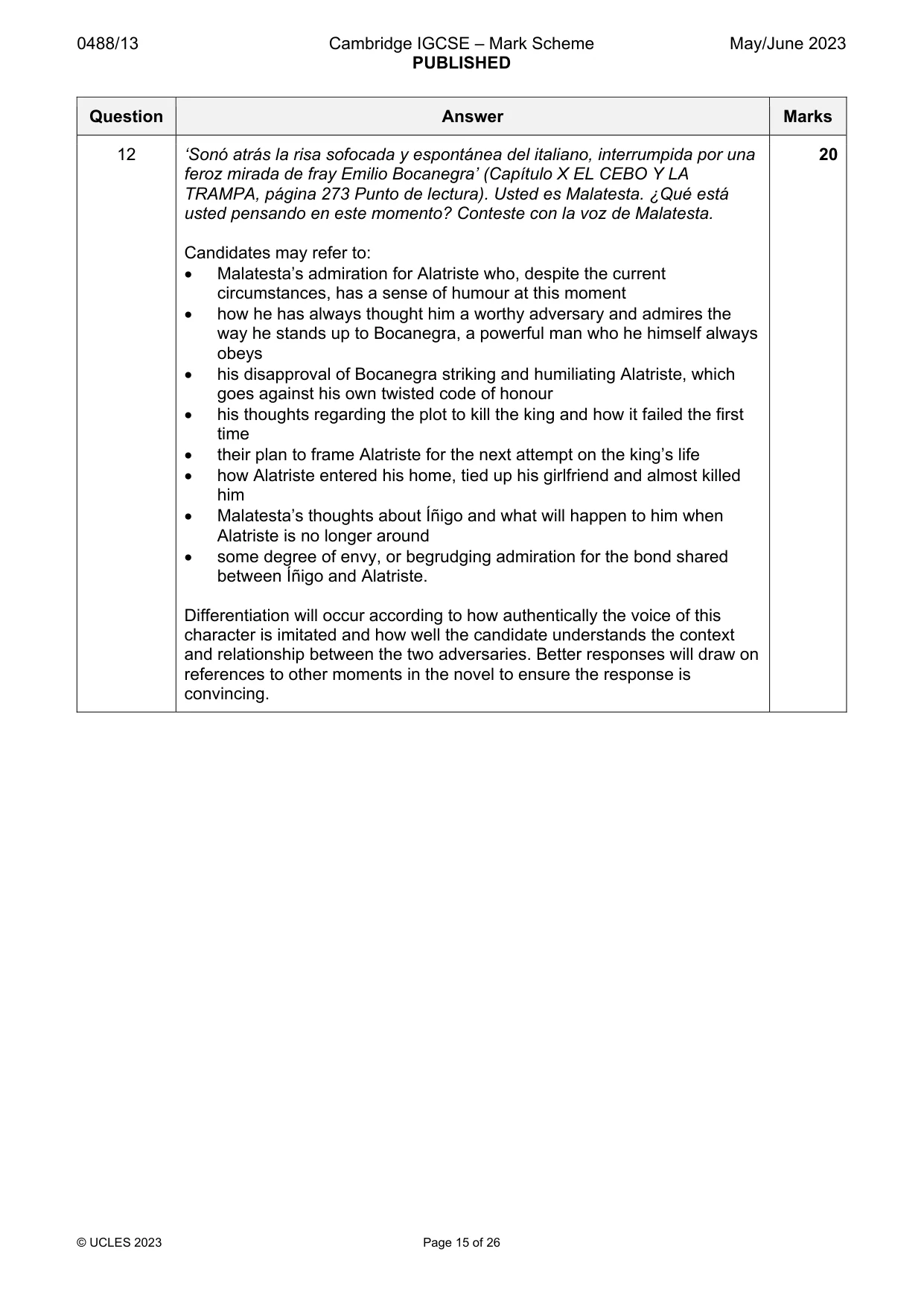
0488/13 Cambridge IGCSE – Mark Scheme PUBLISHED May/June 2023 © UCLES 2023 Page 15 of 26 Question Answer Marks 12 ‘Sonó atrás la risa sofocada y espontánea del italiano, interrumpida por una feroz mirada de fray Emilio Bocanegra’ (Capítulo X EL CEBO Y LA TRAMPA, página 273 Punto de lectura). Usted es Malatesta. ¿Qué está usted pensando en este momento? Conteste con la voz de Malatesta. Candidates may refer to: Malatesta’s admiration for Alatriste who, despite the current circumstances, has a sense of humour at this moment how he has always thought him a worthy adversary and admires the way he stands up to Bocanegra, a powerful man who he himself always obeys his disapproval of Bocanegra striking and humiliating Alatriste, which goes against his own twisted code of honour his thoughts regarding the plot to kill the king and how it failed the first time their plan to frame Alatriste for the next attempt on the king’s life how Alatriste entered his home, tied up his girlfriend and almost killed him Malatesta’s thoughts about Íñigo and what will happen to him when Alatriste is no longer around some degree of envy, or begrudging admiration for the bond shared between Íñigo and Alatriste. Differentiation will occur according to how authentically the voice of this character is imitated and how well the candidate understands the context and relationship between the two adversaries. Better responses will draw on references to other moments in the novel to ensure the response is convincing. 20
Mark scheme, page 16
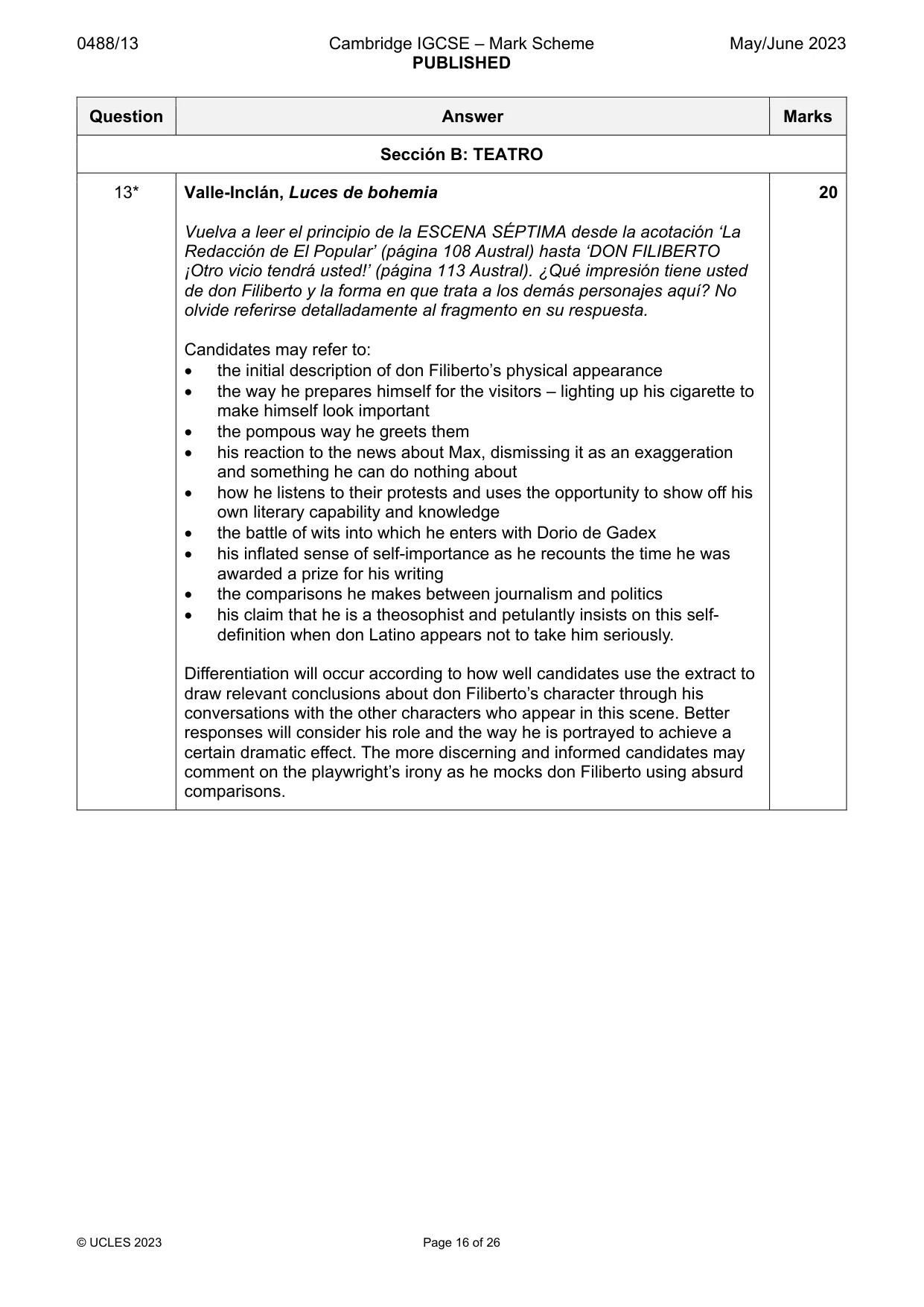
0488/13 Cambridge IGCSE – Mark Scheme PUBLISHED May/June 2023 © UCLES 2023 Page 16 of 26 Question Answer Marks Sección B: TEATRO 13* Valle-Inclán, Luces de bohemia Vuelva a leer el principio de la ESCENA SÉPTIMA desde la acotación ‘La Redacción de El Popular’ (página 108 Austral) hasta ‘DON FILIBERTO ¡Otro vicio tendrá usted!’ (página 113 Austral). ¿Qué impresión tiene usted de don Filiberto y la forma en que trata a los demás personajes aquí? No olvide referirse detalladamente al fragmento en su respuesta. Candidates may refer to: the initial description of don Filiberto’s physical appearance the way he prepares himself for the visitors – lighting up his cigarette to make himself look important the pompous way he greets them his reaction to the news about Max, dismissing it as an exaggeration and something he can do nothing about how he listens to their protests and uses the opportunity to show off his own literary capability and knowledge the battle of wits into which he enters with Dorio de Gadex his inflated sense of self-importance as he recounts the time he was awarded a prize for his writing the comparisons he makes between journalism and politics his claim that he is a theosophist and petulantly insists on this self- definition when don Latino appears not to take him seriously. Differentiation will occur according to how well candidates use the extract to draw relevant conclusions about don Filiberto’s character through his conversations with the other characters who appear in this scene. Better responses will consider his role and the way he is portrayed to achieve a certain dramatic effect. The more discerning and informed candidates may comment on the playwright’s irony as he mocks don Filiberto using absurd comparisons. 20
Mark scheme, page 17
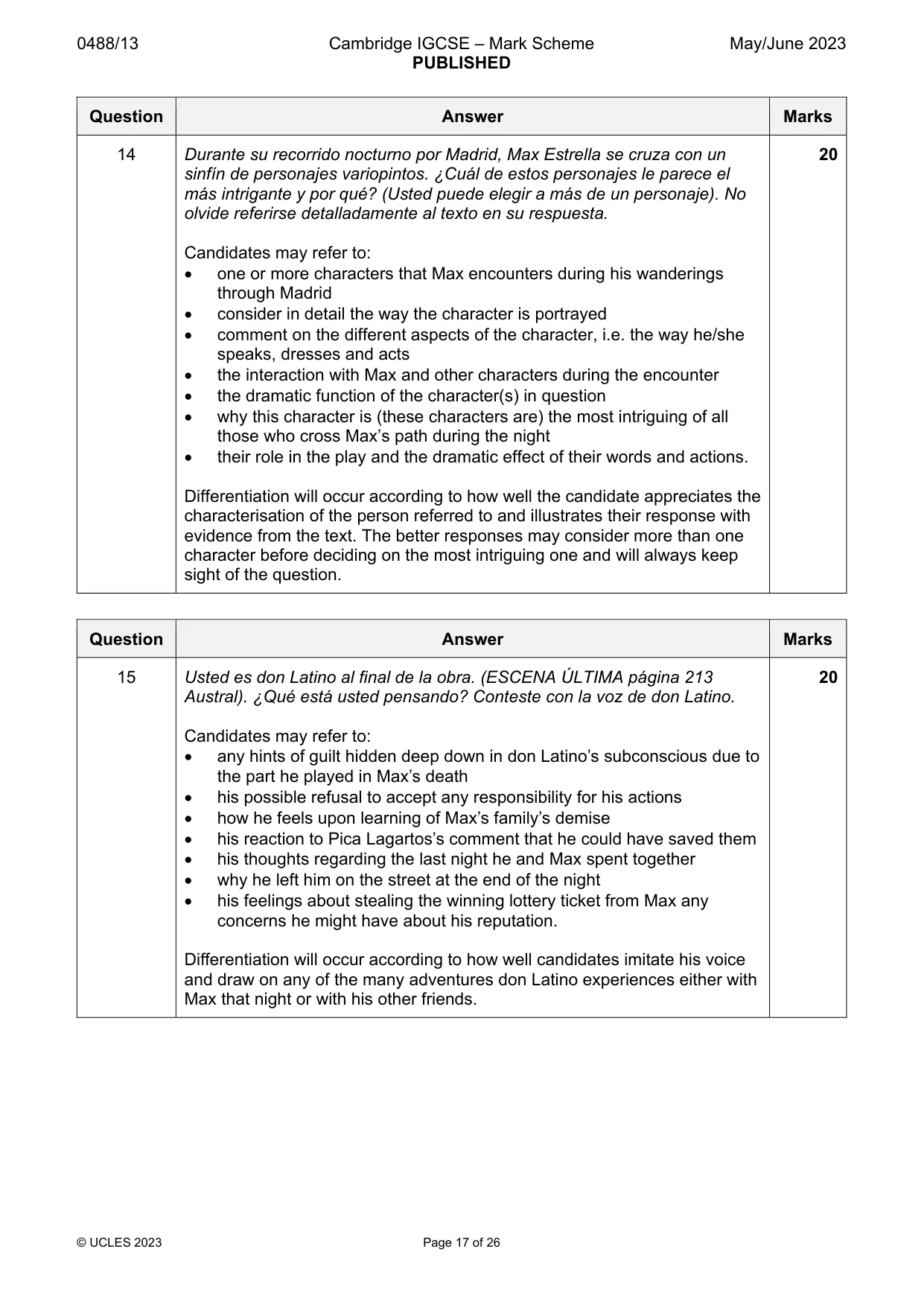
0488/13 Cambridge IGCSE – Mark Scheme PUBLISHED May/June 2023 © UCLES 2023 Page 17 of 26 Question Answer Marks 14 Durante su recorrido nocturno por Madrid, Max Estrella se cruza con un sinfín de personajes variopintos. ¿Cuál de estos personajes le parece el más intrigante y por qué? (Usted puede elegir a más de un personaje). No olvide referirse detalladamente al texto en su respuesta. Candidates may refer to: one or more characters that Max encounters during his wanderings through Madrid consider in detail the way the character is portrayed comment on the different aspects of the character, i.e. the way he/she speaks, dresses and acts the interaction with Max and other characters during the encounter the dramatic function of the character(s) in question why this character is (these characters are) the most intriguing of all those who cross Max’s path during the night their role in the play and the dramatic effect of their words and actions. Differentiation will occur according to how well the candidate appreciates the characterisation of the person referred to and illustrates their response with evidence from the text. The better responses may consider more than one character before deciding on the most intriguing one and will always keep sight of the question. 20 Question Answer Marks 15 Usted es don Latino al final de la obra. (ESCENA ÚLTIMA página 213 Austral). ¿Qué está usted pensando? Conteste con la voz de don Latino. Candidates may refer to: any hints of guilt hidden deep down in don Latino’s subconscious due to the part he played in Max’s death his possible refusal to accept any responsibility for his actions how he feels upon learning of Max’s family’s demise his reaction to Pica Lagartos’s comment that he could have saved them his thoughts regarding the last night he and Max spent together why he left him on the street at the end of the night his feelings about stealing the winning lottery ticket from Max any concerns he might have about his reputation. Differentiation will occur according to how well candidates imitate his voice and draw on any of the many adventures don Latino experiences either with Max that night or with his other friends. 20
Mark scheme, page 18
0488/13 Cambridge IGCSE – Mark Scheme PUBLISHED May/June 2023 © UCLES 2023 Page 18 of 26 Question Answer Marks 16* Ruiz de Alarcón, La verdad sospechosa Vuelva a leer el ACTO TERCERO desde ‘D. GAR. Padre’ (verso 2849, página 132 Cátedra) hasta ‘D. BEL. tú, con sólo confesarla’ (verso 2971, página 135). ¿Cómo aprovecha Ruiz de Alarcón el lenguaje para comunicarnos lo que siente don Beltrán aquí? No olvide referirse detalladamente al fragmento en su respuesta. Candidates may refer to: the rage don Beltrán feels towards don García that makes him want to disown his own son don Beltrán’s incredulity that a son of his could be a liar when he himself holds truth and honour in such high esteem the sorrow he feels at not only having lost his eldest son, but also that his sole heir behaves so dishonourably the way he challenges his son about the invented marriage the anger and shame he feels at having to reveal the falsehood of his son’s marriage how he tries to make his son understand how his behaviour has put him in the unenviable position of having to admit that a member of his family has behaved dishonourably how don García explains himself the fact that don Beltrán does not believe what his son says about Lucrecia (Jacinta) how don García has betrayed his class by behaving in a way that makes everyone question the veracity of what he says – so much so that a servant has to vouch for him the way don Beltrán sees his son lying bringing a stain on the family’s reputation. Differentiation will occur according to the extent to which responses fully exploit the passage for relevant evidence to convey why don García’s lies have such an impact on his father and his place in society. Better responses will consider the author’s intention of conveying to the audience the effect of don García’s lies. 20
Mark scheme, page 19
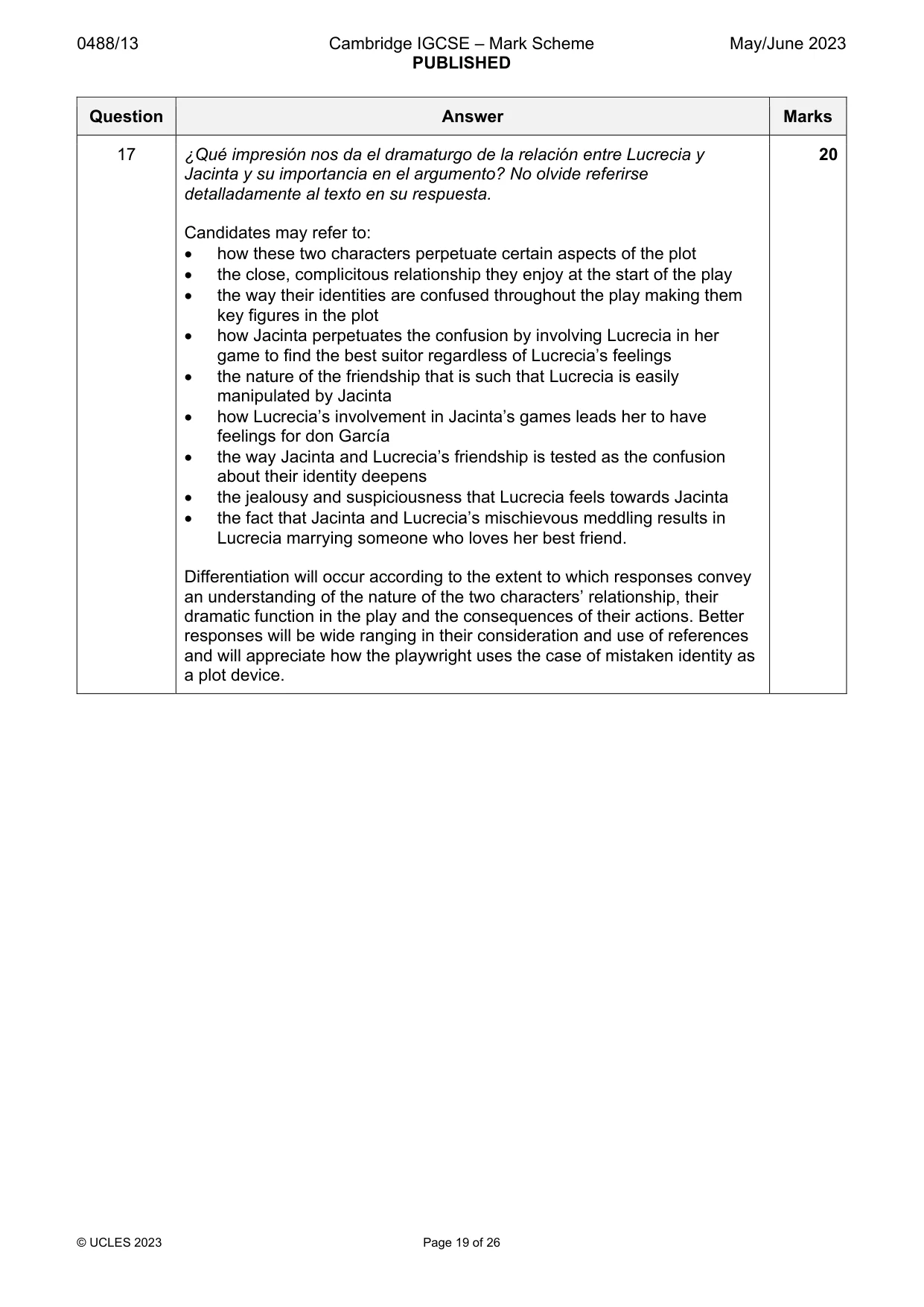
0488/13 Cambridge IGCSE – Mark Scheme PUBLISHED May/June 2023 © UCLES 2023 Page 19 of 26 Question Answer Marks 17 ¿Qué impresión nos da el dramaturgo de la relación entre Lucrecia y Jacinta y su importancia en el argumento? No olvide referirse detalladamente al texto en su respuesta. Candidates may refer to: how these two characters perpetuate certain aspects of the plot the close, complicitous relationship they enjoy at the start of the play the way their identities are confused throughout the play making them key figures in the plot how Jacinta perpetuates the confusion by involving Lucrecia in her game to find the best suitor regardless of Lucrecia’s feelings the nature of the friendship that is such that Lucrecia is easily manipulated by Jacinta how Lucrecia’s involvement in Jacinta’s games leads her to have feelings for don García the way Jacinta and Lucrecia’s friendship is tested as the confusion about their identity deepens the jealousy and suspiciousness that Lucrecia feels towards Jacinta the fact that Jacinta and Lucrecia’s mischievous meddling results in Lucrecia marrying someone who loves her best friend. Differentiation will occur according to the extent to which responses convey an understanding of the nature of the two characters’ relationship, their dramatic function in the play and the consequences of their actions. Better responses will be wide ranging in their consideration and use of references and will appreciate how the playwright uses the case of mistaken identity as a plot device. 20
Mark scheme, page 20
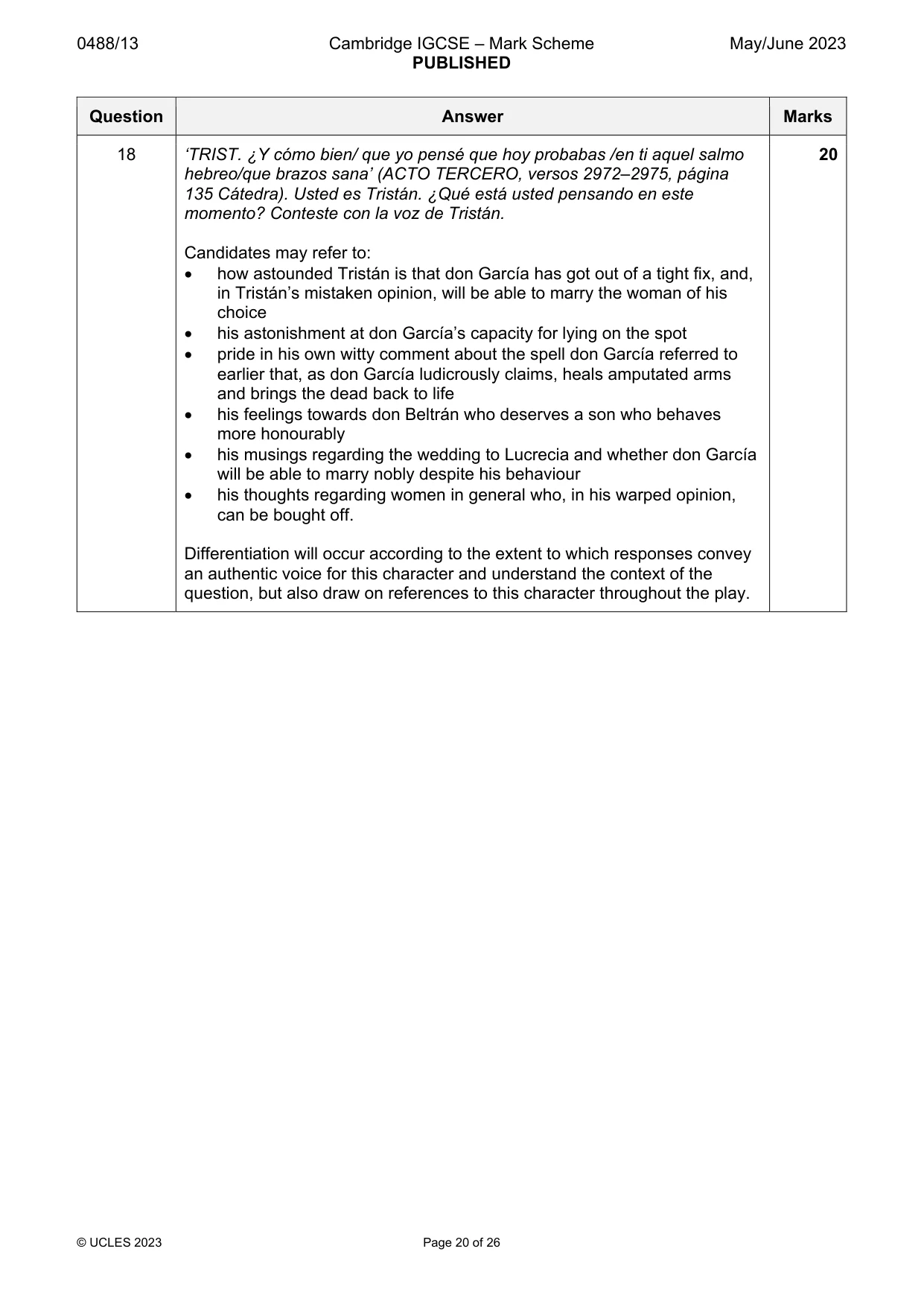
0488/13 Cambridge IGCSE – Mark Scheme PUBLISHED May/June 2023 © UCLES 2023 Page 20 of 26 Question Answer Marks 18 ‘TRIST. ¿Y cómo bien/ que yo pensé que hoy probabas /en ti aquel salmo hebreo/que brazos sana’ (ACTO TERCERO, versos 2972–2975, página 135 Cátedra). Usted es Tristán. ¿Qué está usted pensando en este momento? Conteste con la voz de Tristán. Candidates may refer to: how astounded Tristán is that don García has got out of a tight fix, and, in Tristán’s mistaken opinion, will be able to marry the woman of his choice his astonishment at don García’s capacity for lying on the spot pride in his own witty comment about the spell don García referred to earlier that, as don García ludicrously claims, heals amputated arms and brings the dead back to life his feelings towards don Beltrán who deserves a son who behaves more honourably his musings regarding the wedding to Lucrecia and whether don García will be able to marry nobly despite his behaviour his thoughts regarding women in general who, in his warped opinion, can be bought off. Differentiation will occur according to the extent to which responses convey an authentic voice for this character and understand the context of the question, but also draw on references to this character throughout the play. 20
Mark scheme, page 21
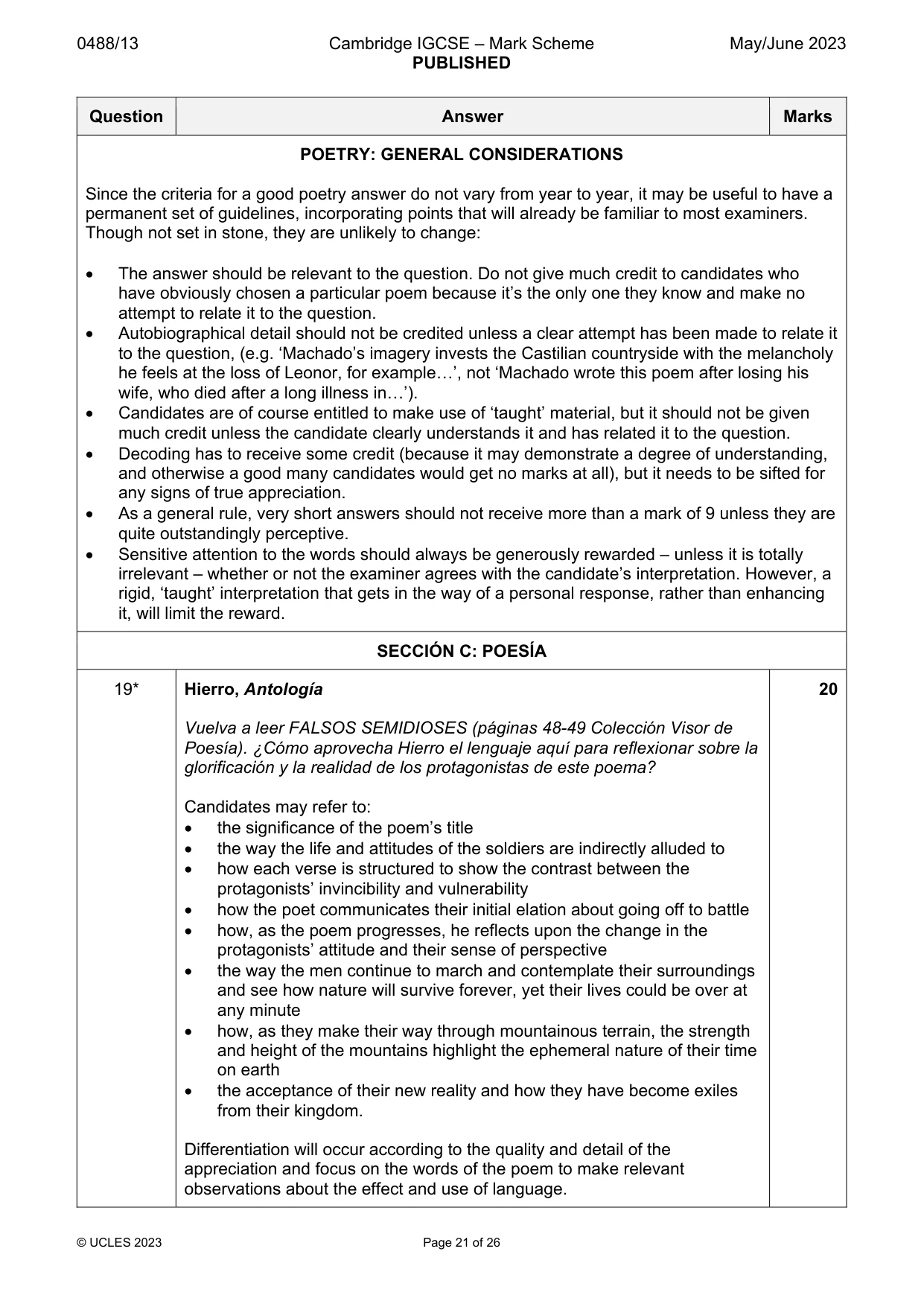
0488/13 Cambridge IGCSE – Mark Scheme PUBLISHED May/June 2023 © UCLES 2023 Page 21 of 26 Question Answer Marks POETRY: GENERAL CONSIDERATIONS Since the criteria for a good poetry answer do not vary from year to year, it may be useful to have a permanent set of guidelines, incorporating points that will already be familiar to most examiners. Though not set in stone, they are unlikely to change: The answer should be relevant to the question. Do not give much credit to candidates who have obviously chosen a particular poem because it’s the only one they know and make no attempt to relate it to the question. Autobiographical detail should not be credited unless a clear attempt has been made to relate it to the question, (e.g. ‘Machado’s imagery invests the Castilian countryside with the melancholy he feels at the loss of Leonor, for example…’, not ‘Machado wrote this poem after losing his wife, who died after a long illness in…’). Candidates are of course entitled to make use of ‘taught’ material, but it should not be given much credit unless the candidate clearly understands it and has related it to the question. Decoding has to receive some credit (because it may demonstrate a degree of understanding, and otherwise a good many candidates would get no marks at all), but it needs to be sifted for any signs of true appreciation. As a general rule, very short answers should not receive more than a mark of 9 unless they are quite outstandingly perceptive. Sensitive attention to the words should always be generously rewarded – unless it is totally irrelevant – whether or not the examiner agrees with the candidate’s interpretation. However, a rigid, ‘taught’ interpretation that gets in the way of a personal response, rather than enhancing it, will limit the reward. SECCIÓN C: POESÍA 19* Hierro, Antología Vuelva a leer FALSOS SEMIDIOSES (páginas 48-49 Colección Visor de Poesía). ¿Cómo aprovecha Hierro el lenguaje aquí para reflexionar sobre la glorificación y la realidad de los protagonistas de este poema? Candidates may refer to: the significance of the poem’s title the way the life and attitudes of the soldiers are indirectly alluded to how each verse is structured to show the contrast between the protagonists’ invincibility and vulnerability how the poet communicates their initial elation about going off to battle how, as the poem progresses, he reflects upon the change in the protagonists’ attitude and their sense of perspective the way the men continue to march and contemplate their surroundings and see how nature will survive forever, yet their lives could be over at any minute how, as they make their way through mountainous terrain, the strength and height of the mountains highlight the ephemeral nature of their time on earth the acceptance of their new reality and how they have become exiles from their kingdom. Differentiation will occur according to the quality and detail of the appreciation and focus on the words of the poem to make relevant observations about the effect and use of language. 20
Mark scheme, page 22
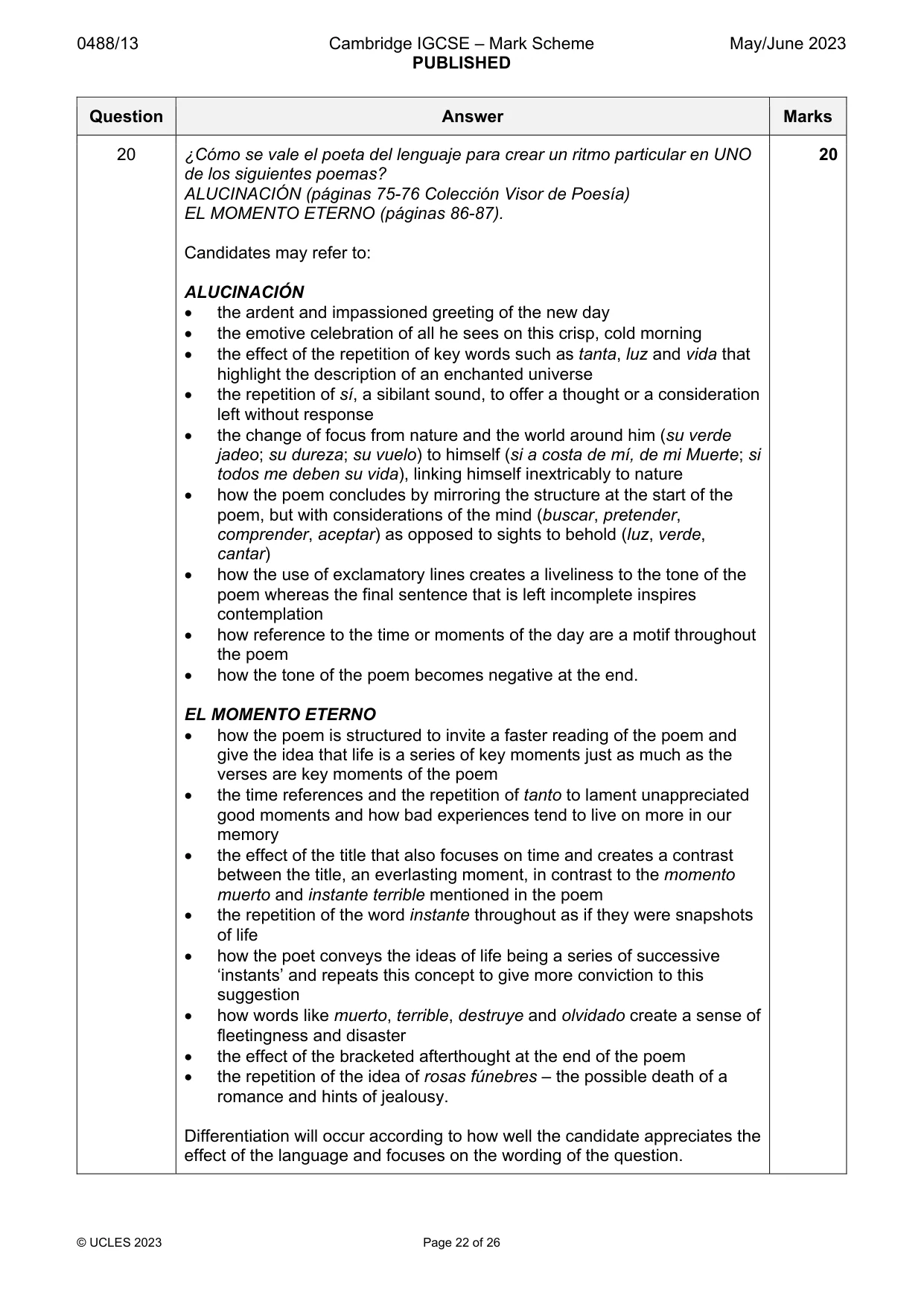
0488/13 Cambridge IGCSE – Mark Scheme PUBLISHED May/June 2023 © UCLES 2023 Page 22 of 26 Question Answer Marks 20 ¿Cómo se vale el poeta del lenguaje para crear un ritmo particular en UNO de los siguientes poemas? ALUCINACIÓN (páginas 75-76 Colección Visor de Poesía) EL MOMENTO ETERNO (páginas 86-87). Candidates may refer to: ALUCINACIÓN the ardent and impassioned greeting of the new day the emotive celebration of all he sees on this crisp, cold morning the effect of the repetition of key words such as tanta, luz and vida that highlight the description of an enchanted universe the repetition of sí, a sibilant sound, to offer a thought or a consideration left without response the change of focus from nature and the world around him (su verde jadeo; su dureza; su vuelo) to himself (si a costa de mí, de mi Muerte; si todos me deben su vida), linking himself inextricably to nature how the poem concludes by mirroring the structure at the start of the poem, but with considerations of the mind (buscar, pretender, comprender, aceptar) as opposed to sights to behold (luz, verde, cantar) how the use of exclamatory lines creates a liveliness to the tone of the poem whereas the final sentence that is left incomplete inspires contemplation how reference to the time or moments of the day are a motif throughout the poem how the tone of the poem becomes negative at the end. EL MOMENTO ETERNO how the poem is structured to invite a faster reading of the poem and give the idea that life is a series of key moments just as much as the verses are key moments of the poem the time references and the repetition of tanto to lament unappreciated good moments and how bad experiences tend to live on more in our memory the effect of the title that also focuses on time and creates a contrast between the title, an everlasting moment, in contrast to the momento muerto and instante terrible mentioned in the poem the repetition of the word instante throughout as if they were snapshots of life how the poet conveys the ideas of life being a series of successive ‘instants’ and repeats this concept to give more conviction to this suggestion how words like muerto, terrible, destruye and olvidado create a sense of fleetingness and disaster the effect of the bracketed afterthought at the end of the poem the repetition of the idea of rosas fúnebres – the possible death of a romance and hints of jealousy. Differentiation will occur according to how well the candidate appreciates the effect of the language and focuses on the wording of the question. 20
Mark scheme, page 23
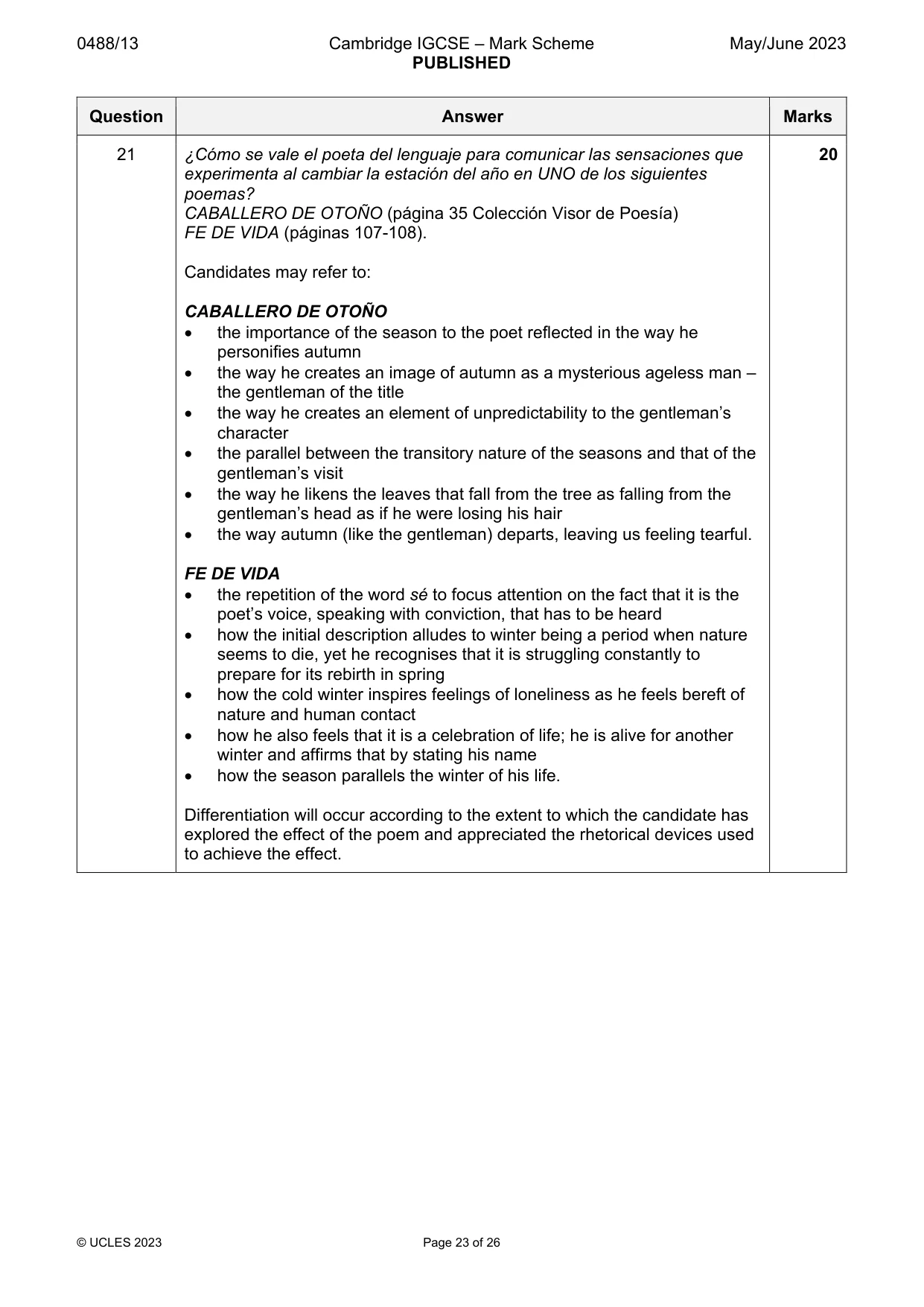
0488/13 Cambridge IGCSE – Mark Scheme PUBLISHED May/June 2023 © UCLES 2023 Page 23 of 26 Question Answer Marks 21 ¿Cómo se vale el poeta del lenguaje para comunicar las sensaciones que experimenta al cambiar la estación del año en UNO de los siguientes poemas? CABALLERO DE OTOÑO (página 35 Colección Visor de Poesía) FE DE VIDA (páginas 107-108). Candidates may refer to: CABALLERO DE OTOÑO the importance of the season to the poet reflected in the way he personifies autumn the way he creates an image of autumn as a mysterious ageless man – the gentleman of the title the way he creates an element of unpredictability to the gentleman’s character the parallel between the transitory nature of the seasons and that of the gentleman’s visit the way he likens the leaves that fall from the tree as falling from the gentleman’s head as if he were losing his hair the way autumn (like the gentleman) departs, leaving us feeling tearful. FE DE VIDA the repetition of the word sé to focus attention on the fact that it is the poet’s voice, speaking with conviction, that has to be heard how the initial description alludes to winter being a period when nature seems to die, yet he recognises that it is struggling constantly to prepare for its rebirth in spring how the cold winter inspires feelings of loneliness as he feels bereft of nature and human contact how he also feels that it is a celebration of life; he is alive for another winter and affirms that by stating his name how the season parallels the winter of his life. Differentiation will occur according to the extent to which the candidate has explored the effect of the poem and appreciated the rhetorical devices used to achieve the effect. 20
Mark scheme, page 24
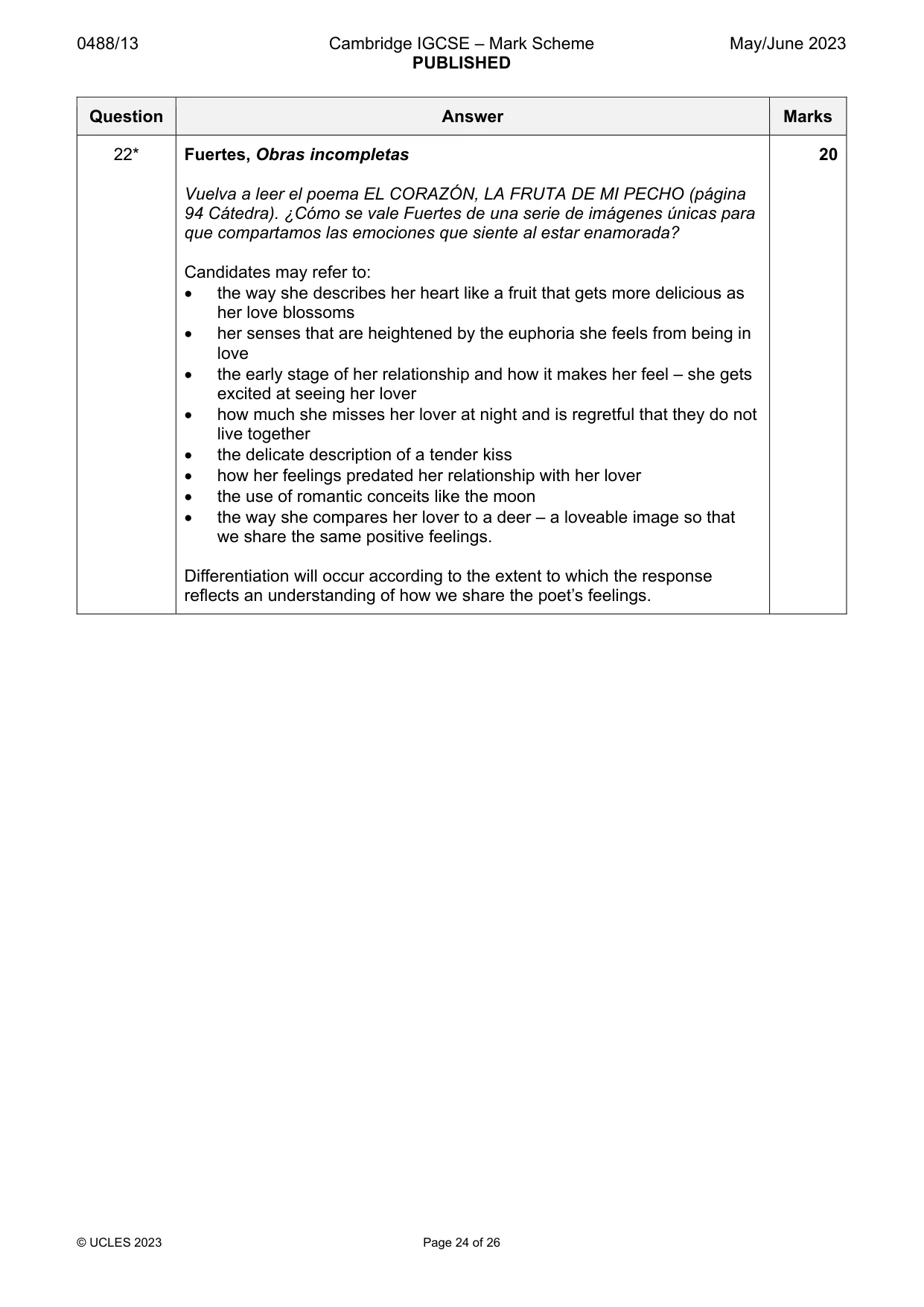
0488/13 Cambridge IGCSE – Mark Scheme PUBLISHED May/June 2023 © UCLES 2023 Page 24 of 26 Question Answer Marks 22* Fuertes, Obras incompletas Vuelva a leer el poema EL CORAZÓN, LA FRUTA DE MI PECHO (página 94 Cátedra). ¿Cómo se vale Fuertes de una serie de imágenes únicas para que compartamos las emociones que siente al estar enamorada? Candidates may refer to: the way she describes her heart like a fruit that gets more delicious as her love blossoms her senses that are heightened by the euphoria she feels from being in love the early stage of her relationship and how it makes her feel – she gets excited at seeing her lover how much she misses her lover at night and is regretful that they do not live together the delicate description of a tender kiss how her feelings predated her relationship with her lover the use of romantic conceits like the moon the way she compares her lover to a deer – a loveable image so that we share the same positive feelings. Differentiation will occur according to the extent to which the response reflects an understanding of how we share the poet’s feelings. 20
Mark scheme, page 25
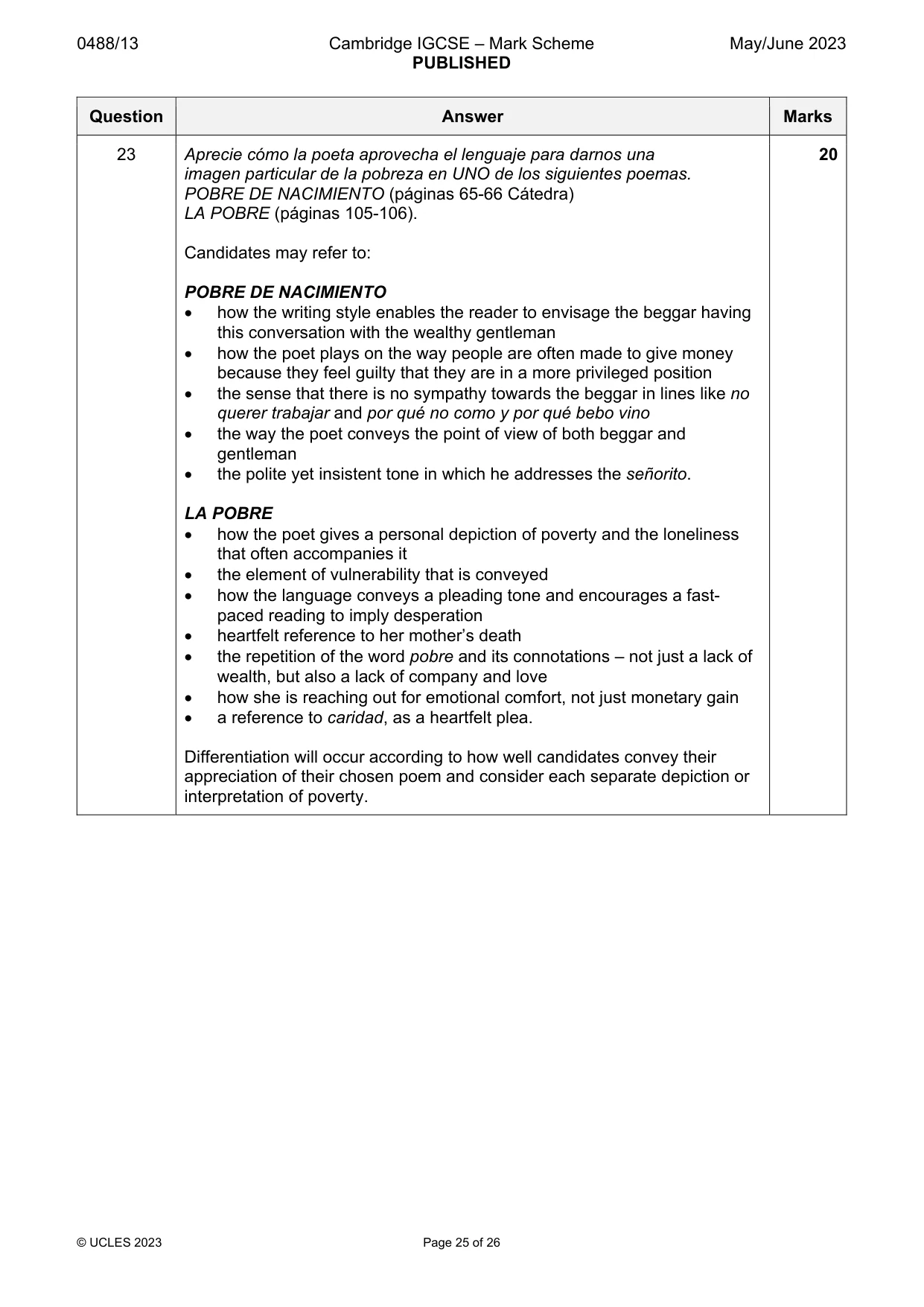
0488/13 Cambridge IGCSE – Mark Scheme PUBLISHED May/June 2023 © UCLES 2023 Page 25 of 26 Question Answer Marks 23 Aprecie cómo la poeta aprovecha el lenguaje para darnos una imagen particular de la pobreza en UNO de los siguientes poemas. POBRE DE NACIMIENTO (páginas 65-66 Cátedra) LA POBRE (páginas 105-106). Candidates may refer to: POBRE DE NACIMIENTO how the writing style enables the reader to envisage the beggar having this conversation with the wealthy gentleman how the poet plays on the way people are often made to give money because they feel guilty that they are in a more privileged position the sense that there is no sympathy towards the beggar in lines like no querer trabajar and por qué no como y por qué bebo vino the way the poet conveys the point of view of both beggar and gentleman the polite yet insistent tone in which he addresses the señorito. LA POBRE how the poet gives a personal depiction of poverty and the loneliness that often accompanies it the element of vulnerability that is conveyed how the language conveys a pleading tone and encourages a fast- paced reading to imply desperation heartfelt reference to her mother’s death the repetition of the word pobre and its connotations – not just a lack of wealth, but also a lack of company and love how she is reaching out for emotional comfort, not just monetary gain a reference to caridad, as a heartfelt plea. Differentiation will occur according to how well candidates convey their appreciation of their chosen poem and consider each separate depiction or interpretation of poverty. 20
Mark scheme, page 26
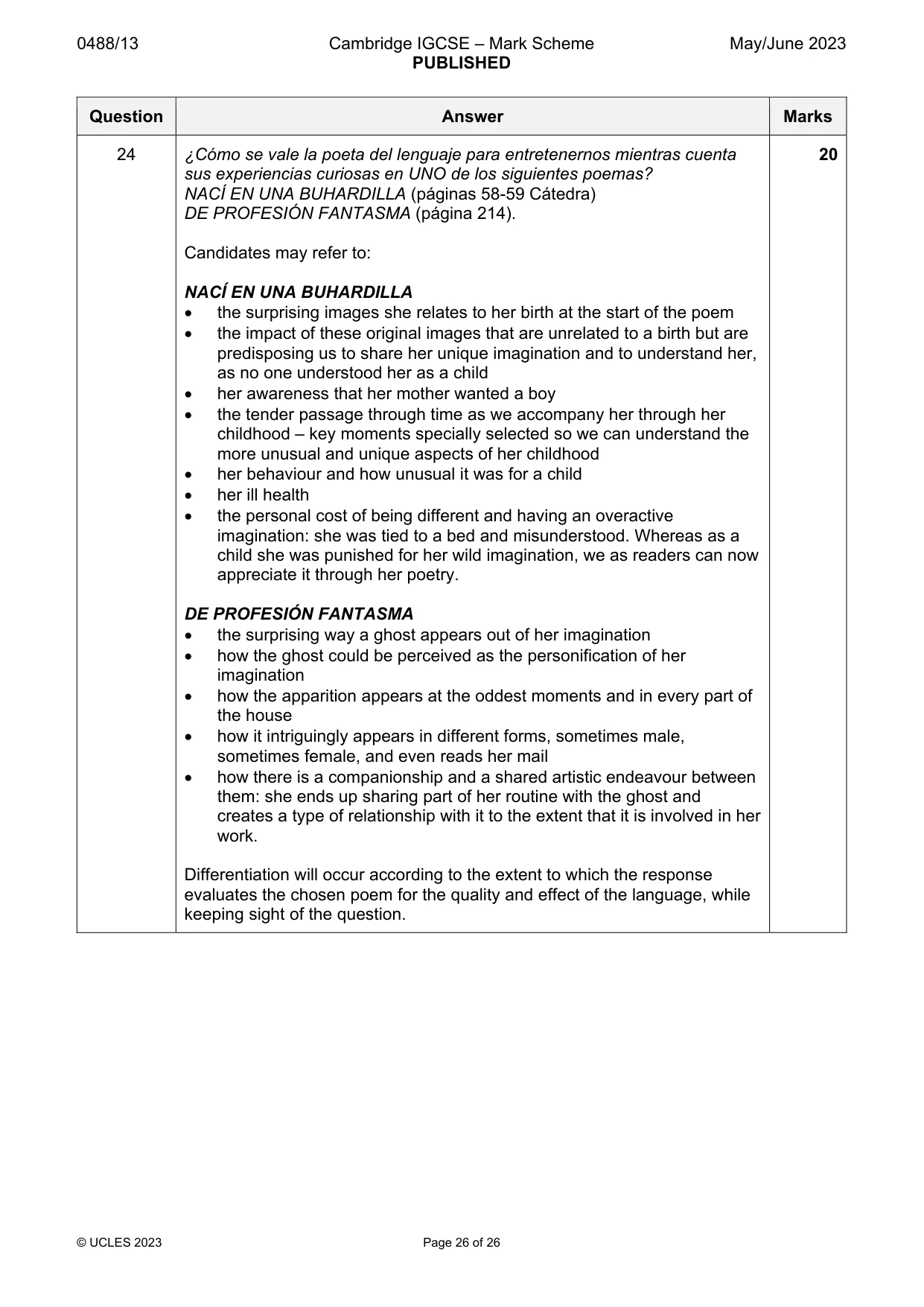
0488/13 Cambridge IGCSE – Mark Scheme PUBLISHED May/June 2023 © UCLES 2023 Page 26 of 26 Question Answer Marks 24 ¿Cómo se vale la poeta del lenguaje para entretenernos mientras cuenta sus experiencias curiosas en UNO de los siguientes poemas? NACÍ EN UNA BUHARDILLA (páginas 58-59 Cátedra) DE PROFESIÓN FANTASMA (página 214). Candidates may refer to: NACÍ EN UNA BUHARDILLA the surprising images she relates to her birth at the start of the poem the impact of these original images that are unrelated to a birth but are predisposing us to share her unique imagination and to understand her, as no one understood her as a child her awareness that her mother wanted a boy the tender passage through time as we accompany her through her childhood – key moments specially selected so we can understand the more unusual and unique aspects of her childhood her behaviour and how unusual it was for a child her ill health the personal cost of being different and having an overactive imagination: she was tied to a bed and misunderstood. Whereas as a child she was punished for her wild imagination, we as readers can now appreciate it through her poetry. DE PROFESIÓN FANTASMA the surprising way a ghost appears out of her imagination how the ghost could be perceived as the personification of her imagination how the apparition appears at the oddest moments and in every part of the house how it intriguingly appears in different forms, sometimes male, sometimes female, and even reads her mail how there is a companionship and a shared artistic endeavour between them: she ends up sharing part of her routine with the ghost and creates a type of relationship with it to the extent that it is involved in her work. Differentiation will occur according to the extent to which the response evaluates the chosen poem for the quality and effect of the language, while keeping sight of the question. 20
What you needed in this session
Cambridge’s own grade thresholds for 2023 May/June, Paper 1 · Variant 3. A higher threshold means an easier paper — the bar moves with how the cohort did.