Cambridge IGCSE Spanish - Literature 0488 — 2020 May/June Paper 1 · Variant 1
0488/11/M/J/20
The question paper and its mark scheme, free to read here and free to download. This is Cambridge’s own paper, exactly as it was sat.
Question paper8 pages

Mark scheme18 pages
Answers below. Sit the paper first if you are practising.
Paper as text
Question paper, page 1
Cambridge IGCSE™ * 8 5 7 0 2 4 7 4 4 8 * DC (KN) 183419/2 © UCLES 2020 [Turn over This document has 8 pages. Blank pages are indicated. LITERATURE (SPANISH) 0488/11 Paper 1 Spanish Texts May/June 2020 2 hours 15 minutes You must answer on the enclosed answer booklet. You will need: Answer booklet (enclosed) Texts studied should be taken into the examination room. INSTRUCTIONS ● Answer three questions in total: Each answer must be on a different text. You must answer from at least two sections: Section A: Prose Section B: Drama Section C: Poetry Answer at least one text-based question (marked *). You may choose all three of your questions from those marked *. ● Follow the instructions on the front cover of the answer booklet. If you need additional answer paper, ask the invigilator for a continuation booklet. INFORMATION ● The total mark for this paper is 60. ● All questions are worth equal marks. INSTRUCCIONES ● Conteste a tres preguntas en total: Cada pregunta debe ser de un texto diferente. Debe contestar a preguntas de al menos dos secciones: Sección A: Prosa Sección B: Teatro Sección C: Poesía Conteste a al menos una pregunta basada en un extracto (preguntas señaladas con un asterisco *). Si lo desea, puede contestar a tres preguntas señaladas con un asterisco *. ● Siga las instrucciones que aparecen en la portada del cuadernillo de respuestas. Las instrucciones aparecen también en español a continuación. Si necesita hojas adicionales, pídale al supervisor un cuadernillo de respuestas adicional. INFORMACIÓN ● La puntuación total de este examen es de 60. ● Todas las preguntas tienen el mismo valor.
Question paper, page 2
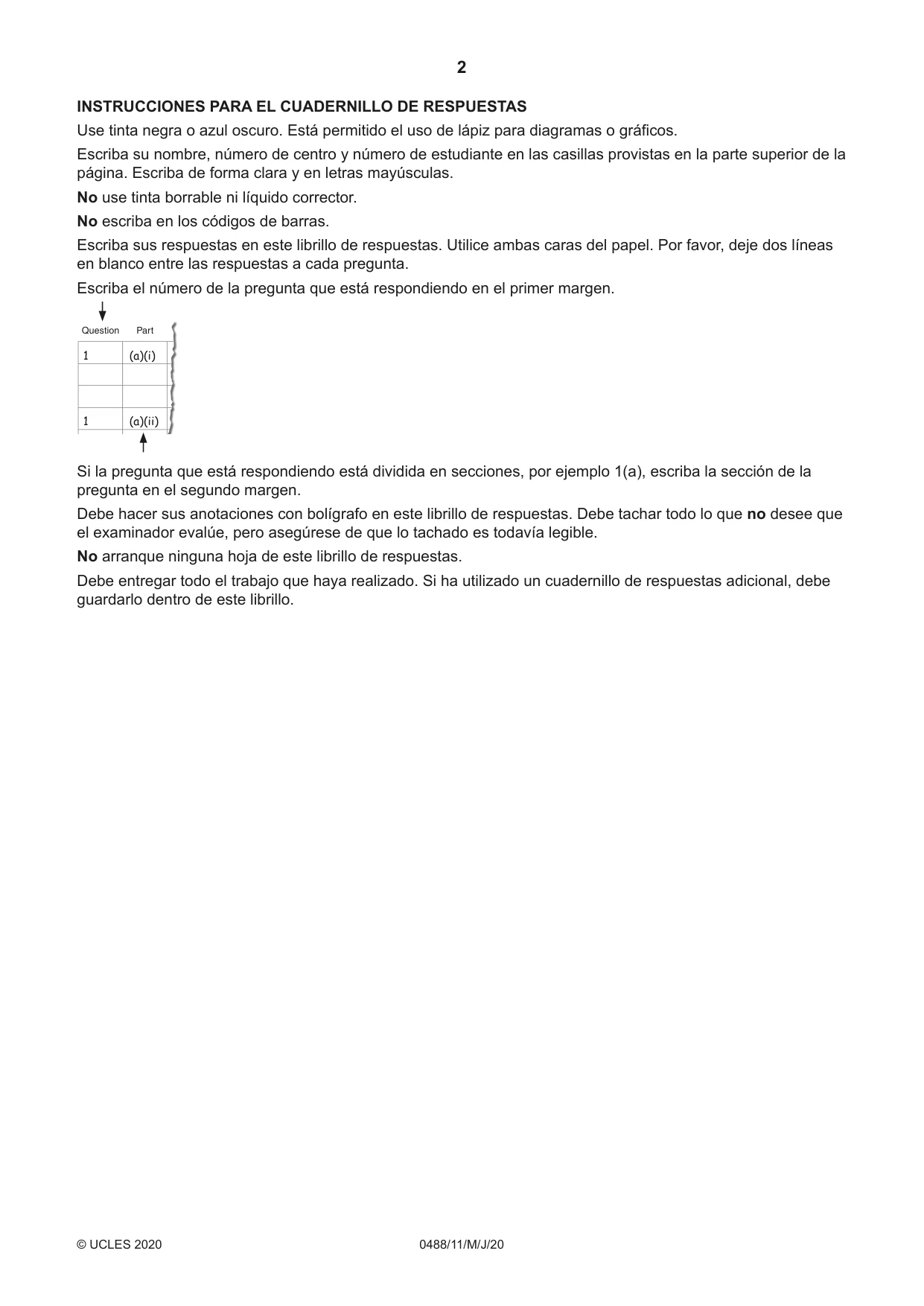
2 0488/11/M/J/20 © UCLES 2020 INSTRUCCIONES PARA EL CUADERNILLO DE RESPUESTAS Use tinta negra o azul oscuro. Está permitido el uso de lápiz para diagramas o gráficos. Escriba su nombre, número de centro y número de estudiante en las casillas provistas en la parte superior de la página. Escriba de forma clara y en letras mayúsculas. No use tinta borrable ni líquido corrector. No escriba en los códigos de barras. Escriba sus respuestas en este librillo de respuestas. Utilice ambas caras del papel. Por favor, deje dos líneas en blanco entre las respuestas a cada pregunta. Escriba el número de la pregunta que está respondiendo en el primer margen. Question Part 1 1 (a)(i) (a)(ii) Si la pregunta que está respondiendo está dividida en secciones, por ejemplo 1(a), escriba la sección de la pregunta en el segundo margen. Debe hacer sus anotaciones con bolígrafo en este librillo de respuestas. Debe tachar todo lo que no desee que el examinador evalúe, pero asegúrese de que lo tachado es todavía legible. No arranque ninguna hoja de este librillo de respuestas. Debe entregar todo el trabajo que haya realizado. Si ha utilizado un cuadernillo de respuestas adicional, debe guardarlo dentro de este librillo.
Question paper, page 3
3 0488/11/M/J/20 © UCLES 2020 [Turn over BLANK PAGE
Question paper, page 4
4 0488/11/M/J/20 © UCLES 2020 EN TODAS SUS RESPUESTAS DEBE REFERIRSE DETALLADAMENTE AL TEXTO SECCIÓN A: PROSA Grandes, El lector de Julio Verne Alternativamente: 1* Vuelva a leer una parte de la tercera sección de la parte I 1947 desde ‘Yo, que siempre había vivido entre ellos’ (página 104 Coleción Andanzas ) hasta ‘Todos menos Sanchís’ (página 106). ¿Cómo se las arregla Grandes aquí para retratar una imagen impactante de la vida de la posguerra? No olvide referirse detalladamente al pasaje. o 2 ¿Hasta qué punto, y cómo, le han inspirado admiración y asombro los actos de rebeldía de parte de la gente del pueblo? No olvide citar ejemplos del texto. o 3 ‘ –No– él se acercó a mí y me abrazó, apretándome fuerte con las dos manos–. Gracias a ti, Nino. Muchas gracias por todo’ (La segunda sección de la parte III 1949 página 338 Colección Andanzas). Usted es Pepe el Portugués en este momento. ¿Qué está usted pensando? Conteste con la voz de Pepe el Portugués. Esquivel, Como agua para chocolate Alternativamente: 4* Vuelva a leer una parte del Capítulo XI NOVIEMBRE FRIJOLES GORDOS CON CHILE A LA TEZCUCANA desde ‘Mientras discutía con Rosaura’ (página 184 Debolsillo) hasta ‘la comida para John y la tía Mary’ (página 187). ¿Cómo se las arregla Esquivel para sorprendernos con el dramatismo de los acontecimientos aquí? No olvide referirse detalladamente al extracto. o 5 La autora da toques de realismo mágico a ciertos eventos en la novela. ¿Cómo aprovecha la autora este estilo literario para impactar al lector? No olvide referirse detalladamente al texto. o 6 Usted es John Brown al final del Capítulo X OCTUBRE TORREJAS DE NATAS (página 175 Debolsillo). ¿Qué está usted pensando? Conteste con la voz de John Brown.
Question paper, page 5
5 0488/11/M/J/20 © UCLES 2020 [Turn over García Márquez, Crónica de una muerte anunciada Alternativamente: 7* Vuelva a leer una parte de la sección 4 desde ‘Dejaron la quinta intacta’ (página 100 Debolsillo) hasta ‘casarse con una mujer que no había visto nunca’ (página 102). Aprecie cómo García Márquez consigue intrigarnos con los acontecimientos que transcurren aquí. No olvide referirse detalladamente al fragmento. o 8 ‘Es para librar a esos pobres muchachos del horrible compromiso que les ha caído encima’ (Sección 3 página 68 Debolsillo). ¿Hasta qué punto, y cómo, le inspiran simpatía los hermanos Vicario al verse obligados a matar a su amigo Santiago Nasar? No olvide referirse detalladamente al texto. o 9 Usted es Ángela Vicario al final de la sección 2 (página 57 Debolsillo). ¿Qué está usted pensando? Conteste con la voz de Ángela Vicario. Ruiz Zafón, El prisionero del cielo Alternativamente: 10* Vuelva a leer una parte del capítulo 3 de la Segunda parte DE ENTRE los MUERTOS desde ‘La rutina ayudaba’ (página 105 Booket) hasta ‘lo más parecido a un ángel’ (página 107). ¿Cómo se las arregla Ruiz Zafón aquí para convencernos que la cárcel era un ‘infierno’? No olvide referirse detalladamente al fragmento en su respuesta. o 11 ¿Hasta qué punto, y cómo, le ha impactado el comportamiento de Mauricio Valls a lo largo de la novela? No olvide citar referencias del texto en su respuesta. o 12 Usted es el señor Sempere, padre de Daniel, al final de la Tercera parte VOLVER a NACER (página 263 Booket). ¿Qué está usted pensando mientras su hijo lo abraza? Conteste con la voz del señor Sempere.
Question paper, page 6
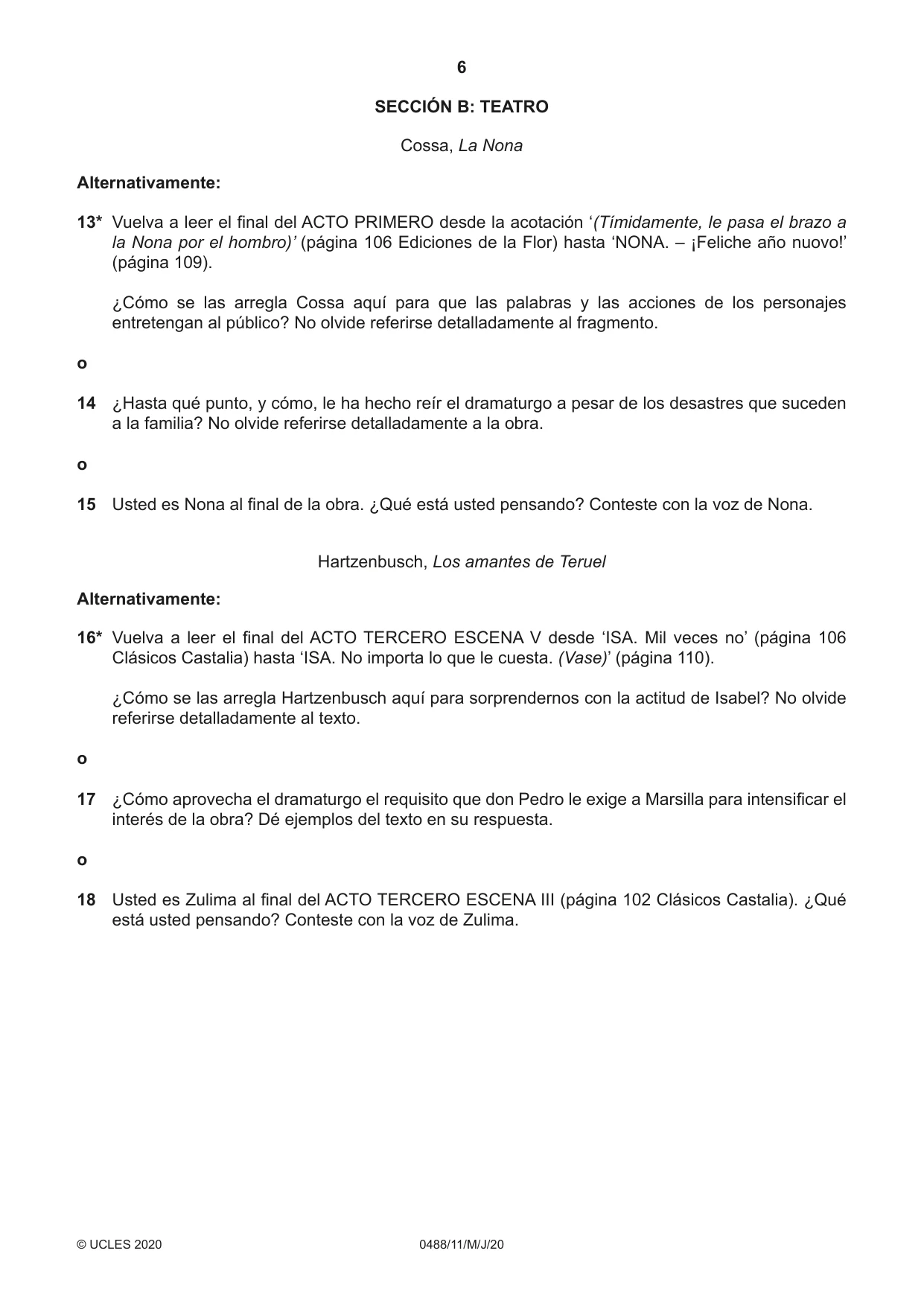
6 0488/11/M/J/20 © UCLES 2020 SECCIÓN B: TEATRO Cossa, La Nona Alternativamente: 13* Vuelva a leer el final del ACTO PRIMERO desde la acotación ‘(Tímidamente, le pasa el brazo a la Nona por el hombro)’ (página 106 Ediciones de la Flor) hasta ‘NONA. – ¡Feliche año nuovo!’ (página 109). ¿Cómo se las arregla Cossa aquí para que las palabras y las acciones de los personajes entretengan al público? No olvide referirse detalladamente al fragmento. o 14 ¿Hasta qué punto, y cómo, le ha hecho reír el dramaturgo a pesar de los desastres que suceden a la familia? No olvide referirse detalladamente a la obra. o 15 Usted es Nona al final de la obra. ¿Qué está usted pensando? Conteste con la voz de Nona. Hartzenbusch, Los amantes de Teruel Alternativamente: 16* Vuelva a leer el final del ACTO TERCERO ESCENA V desde ‘ISA. Mil veces no’ (página 106 Clásicos Castalia) hasta ‘ISA. No importa lo que le cuesta. (Vase)’ (página 110). ¿Cómo se las arregla Hartzenbusch aquí para sorprendernos con la actitud de Isabel? No olvide referirse detalladamente al texto. o 17 ¿Cómo aprovecha el dramaturgo el requisito que don Pedro le exige a Marsilla para intensificar el interés de la obra? Dé ejemplos del texto en su respuesta. o 18 Usted es Zulima al final del ACTO TERCERO ESCENA III (página 102 Clásicos Castalia). ¿Qué está usted pensando? Conteste con la voz de Zulima.
Question paper, page 7
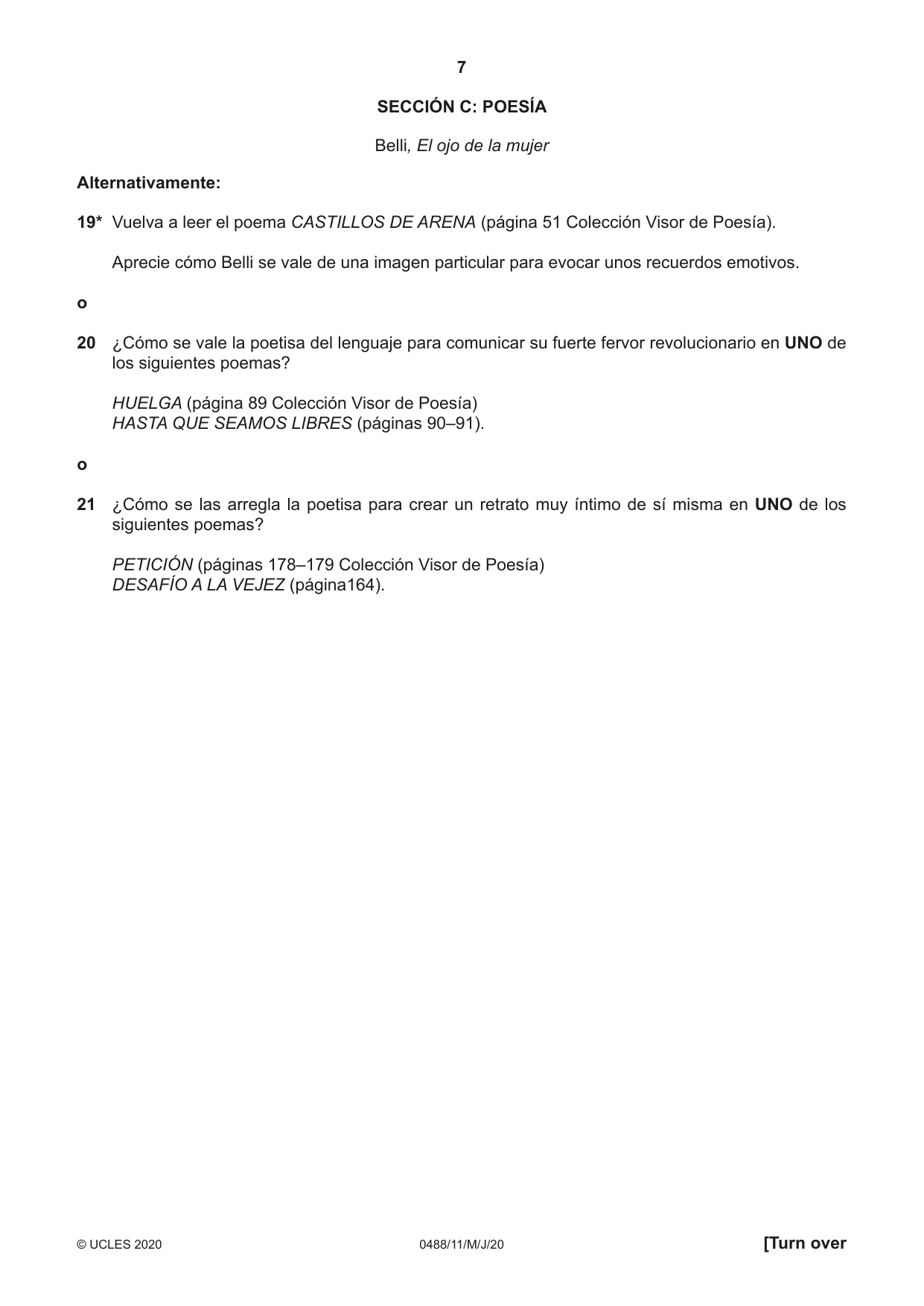
7 0488/11/M/J/20 © UCLES 2020 [Turn over SECCIÓN C: POESÍA Belli, El ojo de la mujer Alternativamente: 19* Vuelva a leer el poema CASTILLOS DE ARENA (página 51 Colección Visor de Poesía). Aprecie cómo Belli se vale de una imagen particular para evocar unos recuerdos emotivos. o 20 ¿Cómo se vale la poetisa del lenguaje para comunicar su fuerte fervor revolucionario en UNO de los siguientes poemas? HUELGA (página 89 Colección Visor de Poesía) HASTA QUE SEAMOS LIBRES (páginas 90–91). o 21 ¿Cómo se las arregla la poetisa para crear un retrato muy íntimo de sí misma en UNO de los siguientes poemas? PETICIÓN (páginas 178–179 Colección Visor de Poesía) DESAFÍO A LA VEJEZ (página164).
Question paper, page 8
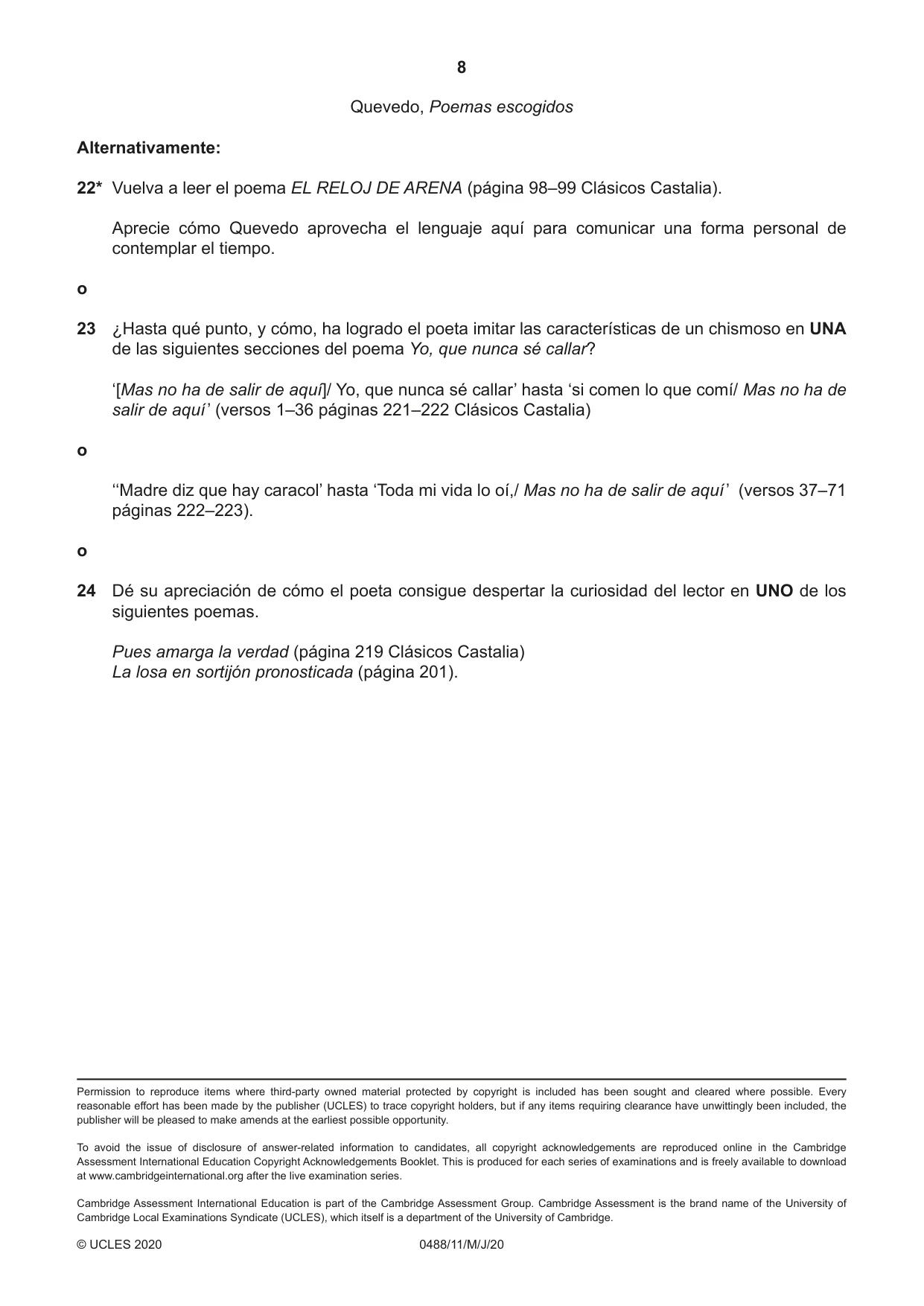
8 0488/11/M/J/20 © UCLES 2020 Quevedo, Poemas escogidos Alternativamente: 22* Vuelva a leer el poema EL RELOJ DE ARENA (página 98–99 Clásicos Castalia). Aprecie cómo Quevedo aprovecha el lenguaje aquí para comunicar una forma personal de contemplar el tiempo. o 23 ¿Hasta qué punto, y cómo, ha logrado el poeta imitar las características de un chismoso en UNA de las siguientes secciones del poema Yo, que nunca sé callar? ‘[Mas no ha de salir de aquí]/ Yo, que nunca sé callar’ hasta ‘si comen lo que comí/ Mas no ha de salir de aquí ’ (versos 1–36 páginas 221–222 Clásicos Castalia) o ‘‘Madre diz que hay caracol’ hasta ‘Toda mi vida lo oí,/ Mas no ha de salir de aquí ’ (versos 37–71 páginas 222–223). o 24 Dé su apreciación de cómo el poeta consigue despertar la curiosidad del lector en UNO de los siguientes poemas. Pues amarga la verdad (página 219 Clásicos Castalia) La losa en sortijón pronosticada (página 201). Permission to reproduce items where third-party owned material protected by copyright is included has been sought and cleared where possible. Every reasonable effort has been made by the publisher (UCLES) to trace copyright holders, but if any items requiring clearance have unwittingly been included, the publisher will be pleased to make amends at the earliest possible opportunity. To avoid the issue of disclosure of answer-related information to candidates, all copyright acknowledgements are reproduced online in the Cambridge Assessment International Education Copyright Acknowledgements Booklet. This is produced for each series of examinations and is freely available to download at www.cambridgeinternational.org after the live examination series. Cambridge Assessment International Education is part of the Cambridge Assessment Group. Cambridge Assessment is the brand name of the University of Cambridge Local Examinations Syndicate (UCLES), which itself is a department of the University of Cambridge.
Mark scheme, page 1
This document consists of 18 printed pages. © UCLES 2020 [Turn over Cambridge IGCSE™ LITERATURE (SPANISH) 0488/11 Paper 1 Set Texts (Open Books) May/June 2020 MARK SCHEME Maximum Mark: 60 Published Students did not sit exam papers in the June 2020 series due to the Covid-19 global pandemic. This mark scheme is published to support teachers and students and should be read together with the question paper. It shows the requirements of the exam. The answer column of the mark scheme shows the proposed basis on which Examiners would award marks for this exam. Where appropriate, this column also provides the most likely acceptable alternative responses expected from students. Examiners usually review the mark scheme after they have seen student responses and update the mark scheme if appropriate. In the June series, Examiners were unable to consider the acceptability of alternative responses, as there were no student responses to consider. Mark schemes should usually be read together with the Principal Examiner Report for Teachers. However, because students did not sit exam papers, there is no Principal Examiner Report for Teachers for the June 2020 series. Cambridge International will not enter into discussions about these mark schemes. Cambridge International is publishing the mark schemes for the June 2020 series for most Cambridge IGCSE™ and Cambridge International A & AS Level components, and some Cambridge O Level components.
Mark scheme, page 2
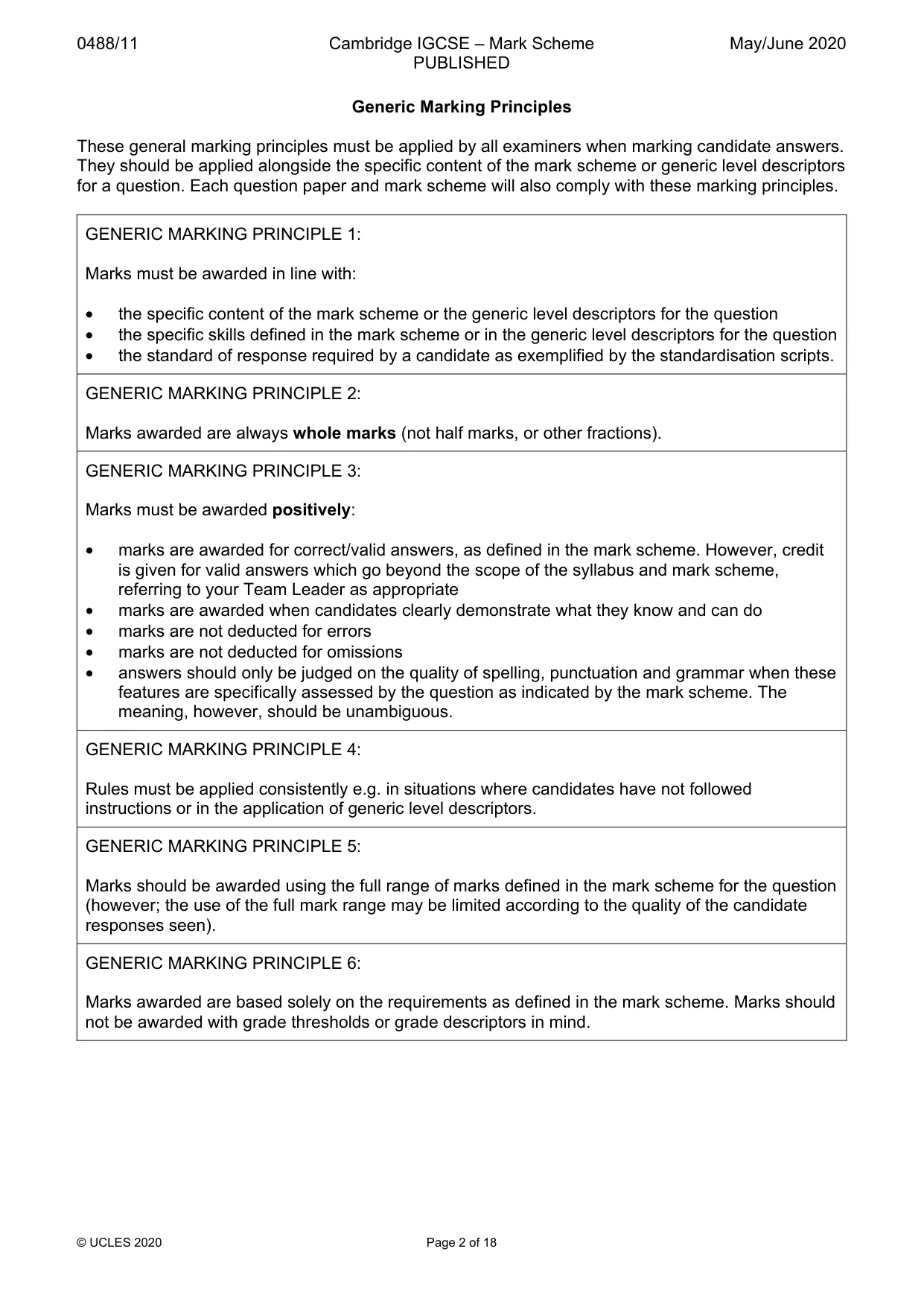
0488/11 Cambridge IGCSE – Mark Scheme PUBLISHED May/June 2020 © UCLES 2020 Page 2 of 18 Generic Marking Principles These general marking principles must be applied by all examiners when marking candidate answers. They should be applied alongside the specific content of the mark scheme or generic level descriptors for a question. Each question paper and mark scheme will also comply with these marking principles. GENERIC MARKING PRINCIPLE 1: Marks must be awarded in line with: • the specific content of the mark scheme or the generic level descriptors for the question • the specific skills defined in the mark scheme or in the generic level descriptors for the question • the standard of response required by a candidate as exemplified by the standardisation scripts. GENERIC MARKING PRINCIPLE 2: Marks awarded are always whole marks (not half marks, or other fractions). GENERIC MARKING PRINCIPLE 3: Marks must be awarded positively: • marks are awarded for correct/valid answers, as defined in the mark scheme. However, credit is given for valid answers which go beyond the scope of the syllabus and mark scheme, referring to your Team Leader as appropriate • marks are awarded when candidates clearly demonstrate what they know and can do • marks are not deducted for errors • marks are not deducted for omissions • answers should only be judged on the quality of spelling, punctuation and grammar when these features are specifically assessed by the question as indicated by the mark scheme. The meaning, however, should be unambiguous. GENERIC MARKING PRINCIPLE 4: Rules must be applied consistently e.g. in situations where candidates have not followed instructions or in the application of generic level descriptors. GENERIC MARKING PRINCIPLE 5: Marks should be awarded using the full range of marks defined in the mark scheme for the question (however; the use of the full mark range may be limited according to the quality of the candidate responses seen). GENERIC MARKING PRINCIPLE 6: Marks awarded are based solely on the requirements as defined in the mark scheme. Marks should not be awarded with grade thresholds or grade descriptors in mind.
Mark scheme, page 3
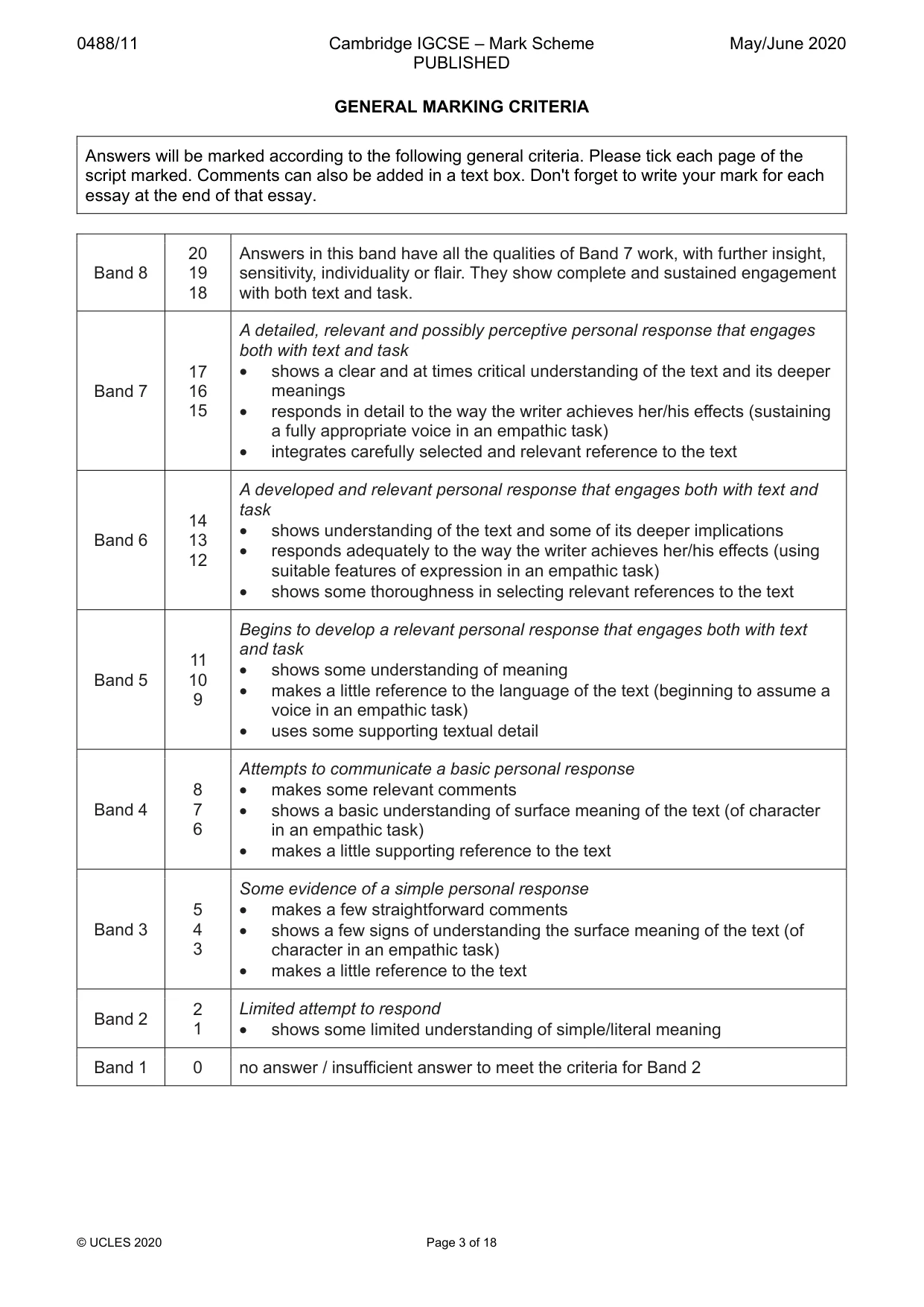
0488/11 Cambridge IGCSE – Mark Scheme PUBLISHED May/June 2020 © UCLES 2020 Page 3 of 18 GENERAL MARKING CRITERIA Answers will be marked according to the following general criteria. Please tick each page of the script marked. Comments can also be added in a text box. Don't forget to write your mark for each essay at the end of that essay. Band 8 20 19 18 Answers in this band have all the qualities of Band 7 work, with further insight, sensitivity, individuality or flair. They show complete and sustained engagement with both text and task. Band 7 17 16 15 A detailed, relevant and possibly perceptive personal response that engages both with text and task • shows a clear and at times critical understanding of the text and its deeper meanings • responds in detail to the way the writer achieves her/his effects (sustaining a fully appropriate voice in an empathic task) • integrates carefully selected and relevant reference to the text Band 6 14 13 12 A developed and relevant personal response that engages both with text and task • shows understanding of the text and some of its deeper implications • responds adequately to the way the writer achieves her/his effects (using suitable features of expression in an empathic task) • shows some thoroughness in selecting relevant references to the text Band 5 11 10 9 Begins to develop a relevant personal response that engages both with text and task • shows some understanding of meaning • makes a little reference to the language of the text (beginning to assume a voice in an empathic task) • uses some supporting textual detail Band 4 8 7 6 Attempts to communicate a basic personal response • makes some relevant comments • shows a basic understanding of surface meaning of the text (of character in an empathic task) • makes a little supporting reference to the text Band 3 5 4 3 Some evidence of a simple personal response • makes a few straightforward comments • shows a few signs of understanding the surface meaning of the text (of character in an empathic task) • makes a little reference to the text Band 2 2 1 Limited attempt to respond • shows some limited understanding of simple/literal meaning Band 1 0 no answer / insufficient answer to meet the criteria for Band 2
Mark scheme, page 4
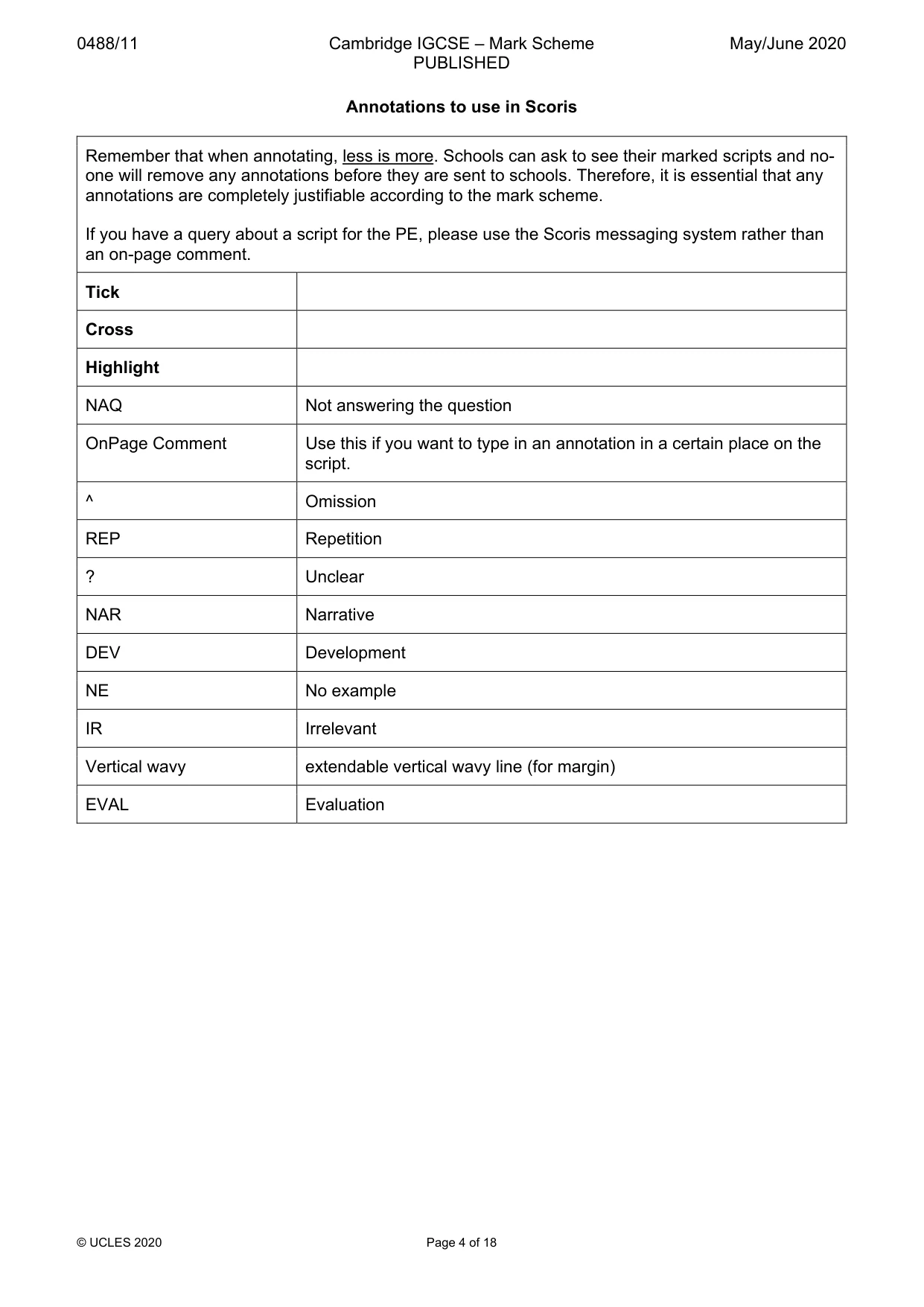
0488/11 Cambridge IGCSE – Mark Scheme PUBLISHED May/June 2020 © UCLES 2020 Page 4 of 18 Annotations to use in Scoris Remember that when annotating, less is more. Schools can ask to see their marked scripts and no- one will remove any annotations before they are sent to schools. Therefore, it is essential that any annotations are completely justifiable according to the mark scheme. If you have a query about a script for the PE, please use the Scoris messaging system rather than an on-page comment. Tick Cross Highlight NAQ Not answering the question OnPage Comment Use this if you want to type in an annotation in a certain place on the script. ^ Omission REP Repetition ? Unclear NAR Narrative DEV Development NE No example IR Irrelevant Vertical wavy extendable vertical wavy line (for margin) EVAL Evaluation
Mark scheme, page 5
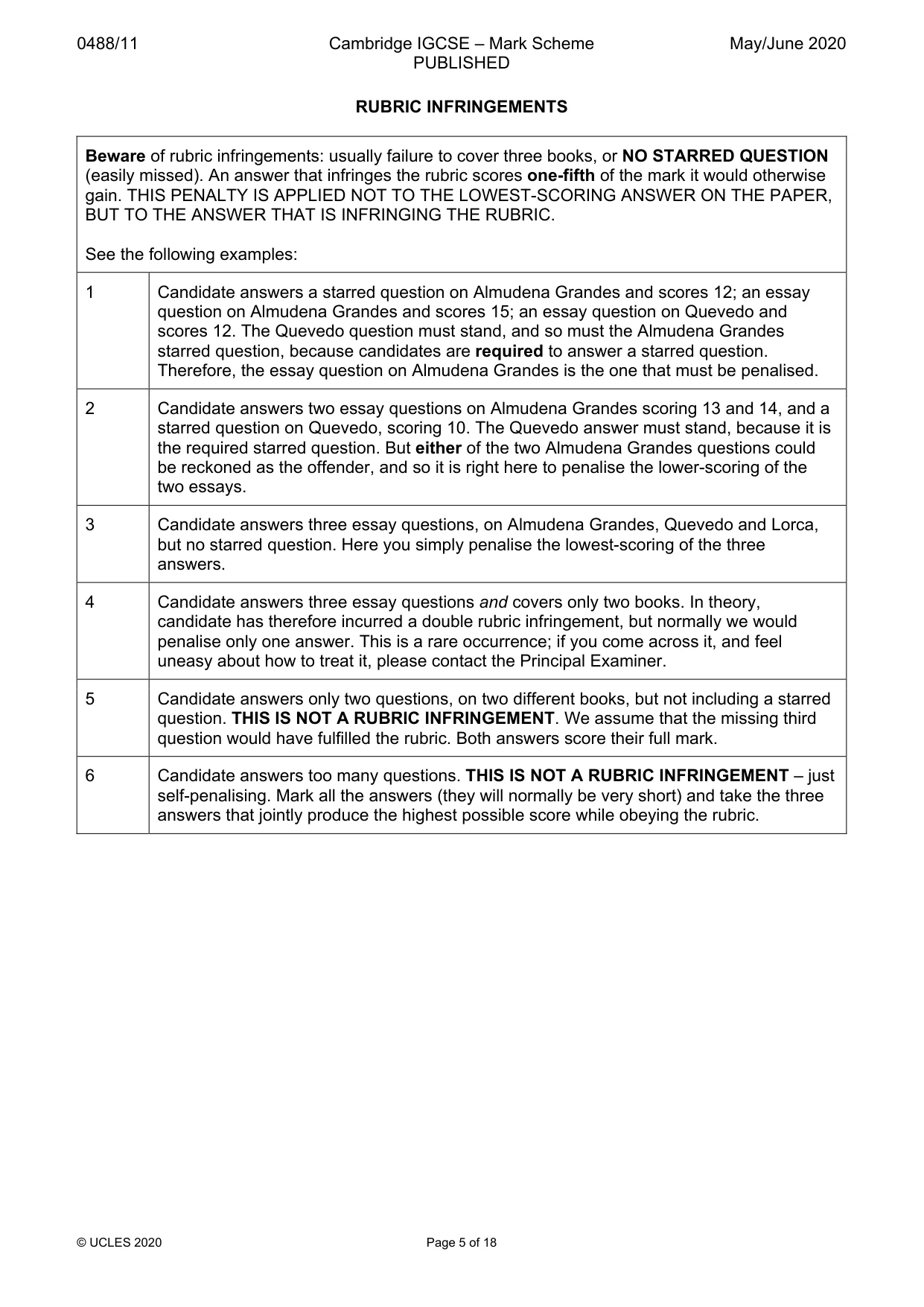
0488/11 Cambridge IGCSE – Mark Scheme PUBLISHED May/June 2020 © UCLES 2020 Page 5 of 18 RUBRIC INFRINGEMENTS Beware of rubric infringements: usually failure to cover three books, or NO STARRED QUESTION (easily missed). An answer that infringes the rubric scores one-fifth of the mark it would otherwise gain. THIS PENALTY IS APPLIED NOT TO THE LOWEST-SCORING ANSWER ON THE PAPER, BUT TO THE ANSWER THAT IS INFRINGING THE RUBRIC. See the following examples: 1 Candidate answers a starred question on Almudena Grandes and scores 12; an essay question on Almudena Grandes and scores 15; an essay question on Quevedo and scores 12. The Quevedo question must stand, and so must the Almudena Grandes starred question, because candidates are required to answer a starred question. Therefore, the essay question on Almudena Grandes is the one that must be penalised. 2 Candidate answers two essay questions on Almudena Grandes scoring 13 and 14, and a starred question on Quevedo, scoring 10. The Quevedo answer must stand, because it is the required starred question. But either of the two Almudena Grandes questions could be reckoned as the offender, and so it is right here to penalise the lower-scoring of the two essays. 3 Candidate answers three essay questions, on Almudena Grandes, Quevedo and Lorca, but no starred question. Here you simply penalise the lowest-scoring of the three answers. 4 Candidate answers three essay questions and covers only two books. In theory, candidate has therefore incurred a double rubric infringement, but normally we would penalise only one answer. This is a rare occurrence; if you come across it, and feel uneasy about how to treat it, please contact the Principal Examiner. 5 Candidate answers only two questions, on two different books, but not including a starred question. THIS IS NOT A RUBRIC INFRINGEMENT. We assume that the missing third question would have fulfilled the rubric. Both answers score their full mark. 6 Candidate answers too many questions. THIS IS NOT A RUBRIC INFRINGEMENT – just self-penalising. Mark all the answers (they will normally be very short) and take the three answers that jointly produce the highest possible score while obeying the rubric.
Mark scheme, page 6
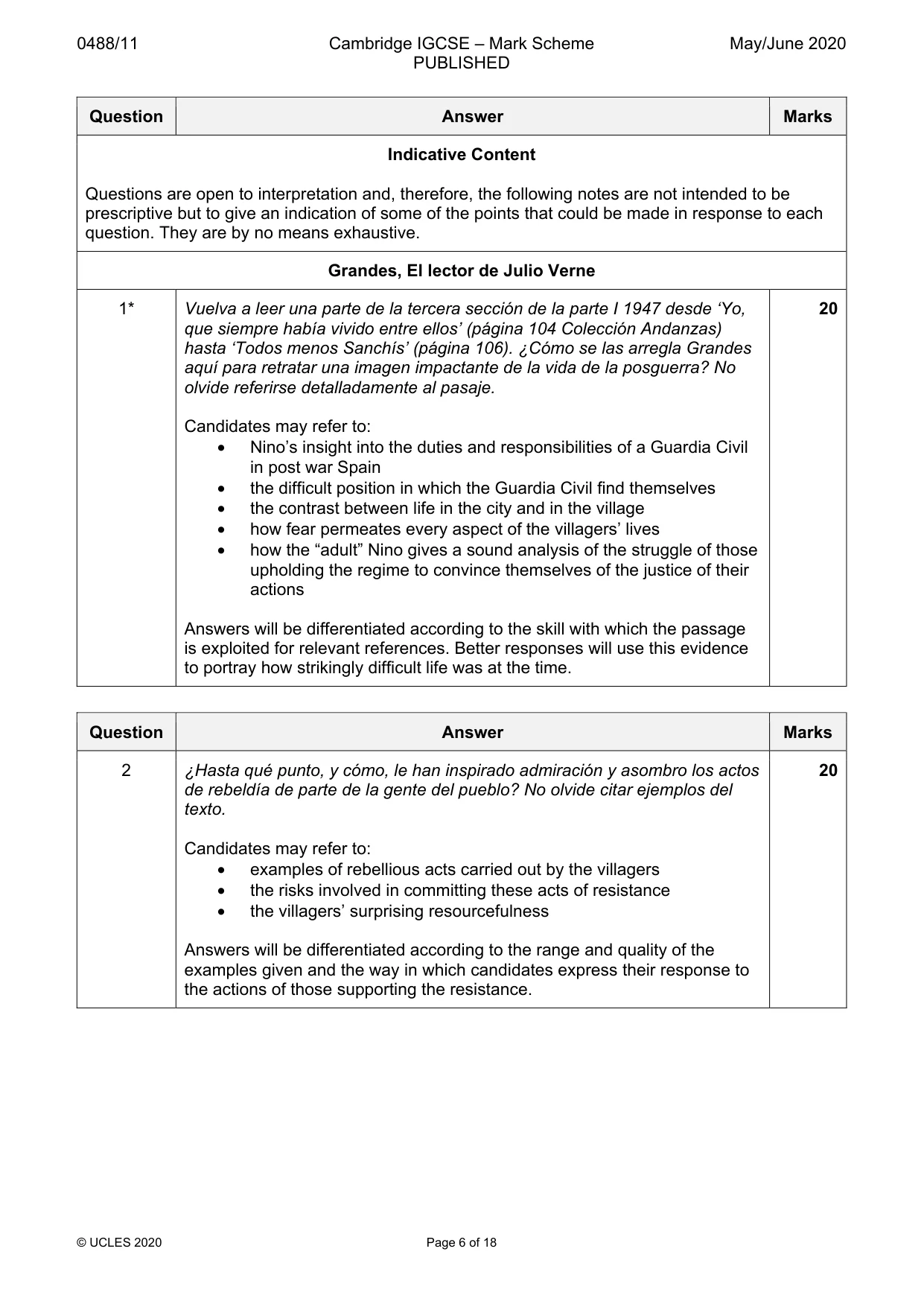
0488/11 Cambridge IGCSE – Mark Scheme PUBLISHED May/June 2020 © UCLES 2020 Page 6 of 18 Question Answer Marks Indicative Content Questions are open to interpretation and, therefore, the following notes are not intended to be prescriptive but to give an indication of some of the points that could be made in response to each question. They are by no means exhaustive. Grandes, El lector de Julio Verne 1* Vuelva a leer una parte de la tercera sección de la parte I 1947 desde ‘Yo, que siempre había vivido entre ellos’ (página 104 Colección Andanzas) hasta ‘Todos menos Sanchís’ (página 106). ¿Cómo se las arregla Grandes aquí para retratar una imagen impactante de la vida de la posguerra? No olvide referirse detalladamente al pasaje. Candidates may refer to: • Nino’s insight into the duties and responsibilities of a Guardia Civil in post war Spain • the difficult position in which the Guardia Civil find themselves • the contrast between life in the city and in the village • how fear permeates every aspect of the villagers’ lives • how the “adult” Nino gives a sound analysis of the struggle of those upholding the regime to convince themselves of the justice of their actions Answers will be differentiated according to the skill with which the passage is exploited for relevant references. Better responses will use this evidence to portray how strikingly difficult life was at the time. 20 Question Answer Marks 2 ¿Hasta qué punto, y cómo, le han inspirado admiración y asombro los actos de rebeldía de parte de la gente del pueblo? No olvide citar ejemplos del texto. Candidates may refer to: • examples of rebellious acts carried out by the villagers • the risks involved in committing these acts of resistance • the villagers’ surprising resourcefulness Answers will be differentiated according to the range and quality of the examples given and the way in which candidates express their response to the actions of those supporting the resistance. 20
Mark scheme, page 7
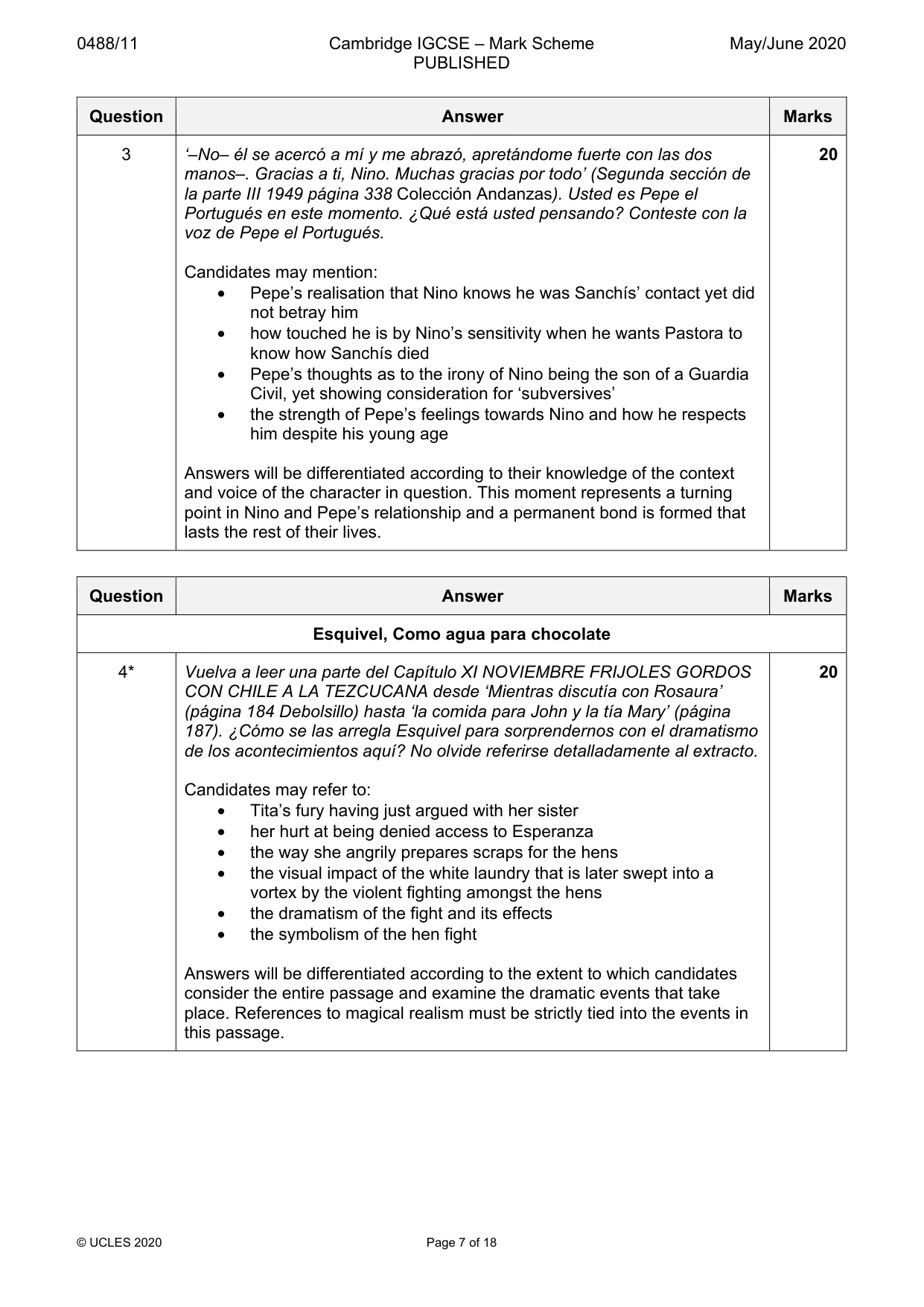
0488/11 Cambridge IGCSE – Mark Scheme PUBLISHED May/June 2020 © UCLES 2020 Page 7 of 18 Question Answer Marks 3 ‘–No– él se acercó a mí y me abrazó, apretándome fuerte con las dos manos–. Gracias a ti, Nino. Muchas gracias por todo’ (Segunda sección de la parte III 1949 página 338 Colección Andanzas). Usted es Pepe el Portugués en este momento. ¿Qué está usted pensando? Conteste con la voz de Pepe el Portugués. Candidates may mention: • Pepe’s realisation that Nino knows he was Sanchís’ contact yet did not betray him • how touched he is by Nino’s sensitivity when he wants Pastora to know how Sanchís died • Pepe’s thoughts as to the irony of Nino being the son of a Guardia Civil, yet showing consideration for ‘subversives’ • the strength of Pepe’s feelings towards Nino and how he respects him despite his young age Answers will be differentiated according to their knowledge of the context and voice of the character in question. This moment represents a turning point in Nino and Pepe’s relationship and a permanent bond is formed that lasts the rest of their lives. 20 Question Answer Marks Esquivel, Como agua para chocolate 4* Vuelva a leer una parte del Capítulo XI NOVIEMBRE FRIJOLES GORDOS CON CHILE A LA TEZCUCANA desde ‘Mientras discutía con Rosaura’ (página 184 Debolsillo) hasta ‘la comida para John y la tía Mary’ (página 187). ¿Cómo se las arregla Esquivel para sorprendernos con el dramatismo de los acontecimientos aquí? No olvide referirse detalladamente al extracto. Candidates may refer to: • Tita’s fury having just argued with her sister • her hurt at being denied access to Esperanza • the way she angrily prepares scraps for the hens • the visual impact of the white laundry that is later swept into a vortex by the violent fighting amongst the hens • the dramatism of the fight and its effects • the symbolism of the hen fight Answers will be differentiated according to the extent to which candidates consider the entire passage and examine the dramatic events that take place. References to magical realism must be strictly tied into the events in this passage. 20
Mark scheme, page 8
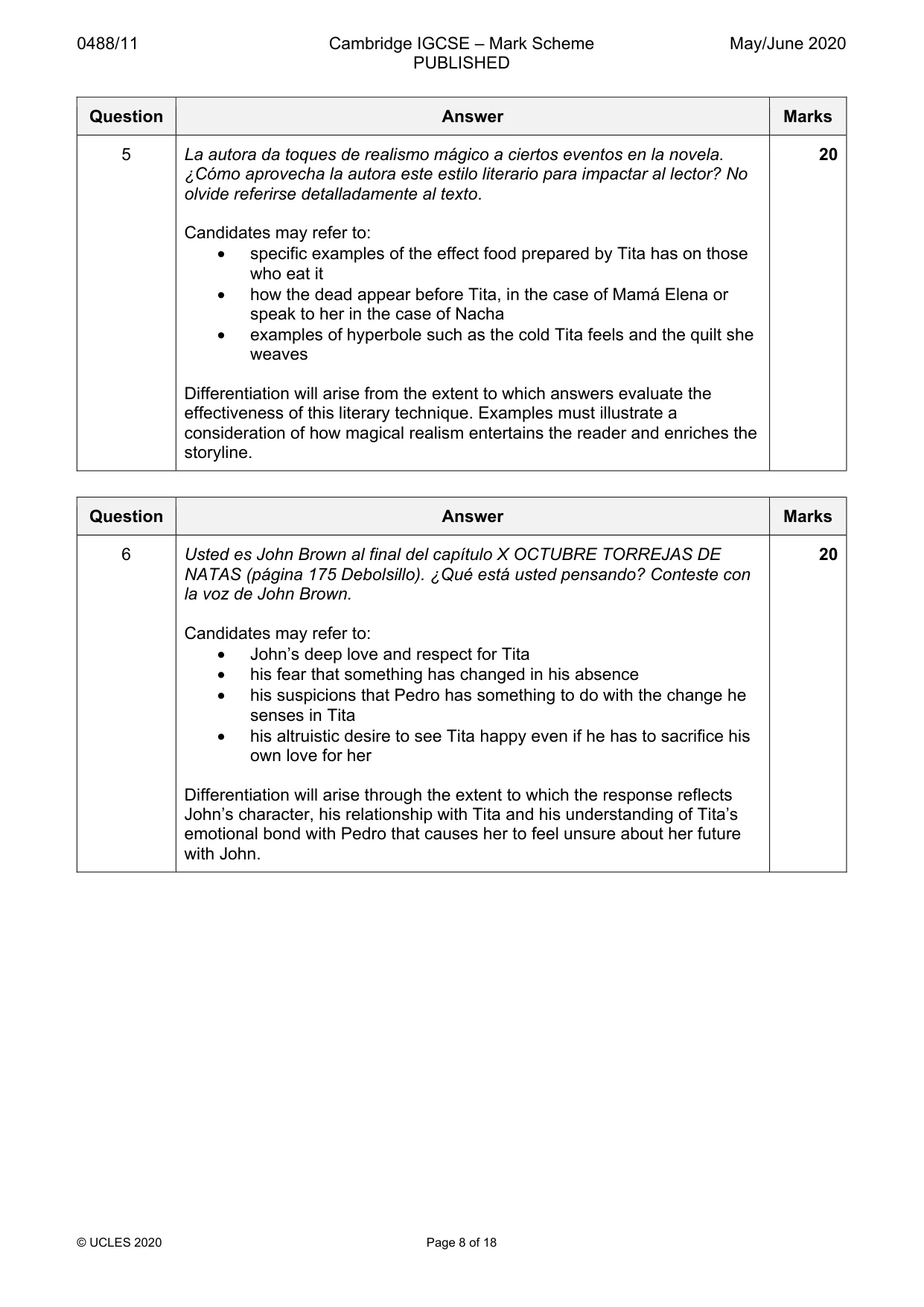
0488/11 Cambridge IGCSE – Mark Scheme PUBLISHED May/June 2020 © UCLES 2020 Page 8 of 18 Question Answer Marks 5 La autora da toques de realismo mágico a ciertos eventos en la novela. ¿Cómo aprovecha la autora este estilo literario para impactar al lector? No olvide referirse detalladamente al texto. Candidates may refer to: • specific examples of the effect food prepared by Tita has on those who eat it • how the dead appear before Tita, in the case of Mamá Elena or speak to her in the case of Nacha • examples of hyperbole such as the cold Tita feels and the quilt she weaves Differentiation will arise from the extent to which answers evaluate the effectiveness of this literary technique. Examples must illustrate a consideration of how magical realism entertains the reader and enriches the storyline. 20 Question Answer Marks 6 Usted es John Brown al final del capítulo X OCTUBRE TORREJAS DE NATAS (página 175 Debolsillo). ¿Qué está usted pensando? Conteste con la voz de John Brown. Candidates may refer to: • John’s deep love and respect for Tita • his fear that something has changed in his absence • his suspicions that Pedro has something to do with the change he senses in Tita • his altruistic desire to see Tita happy even if he has to sacrifice his own love for her Differentiation will arise through the extent to which the response reflects John’s character, his relationship with Tita and his understanding of Tita’s emotional bond with Pedro that causes her to feel unsure about her future with John. 20
Mark scheme, page 9
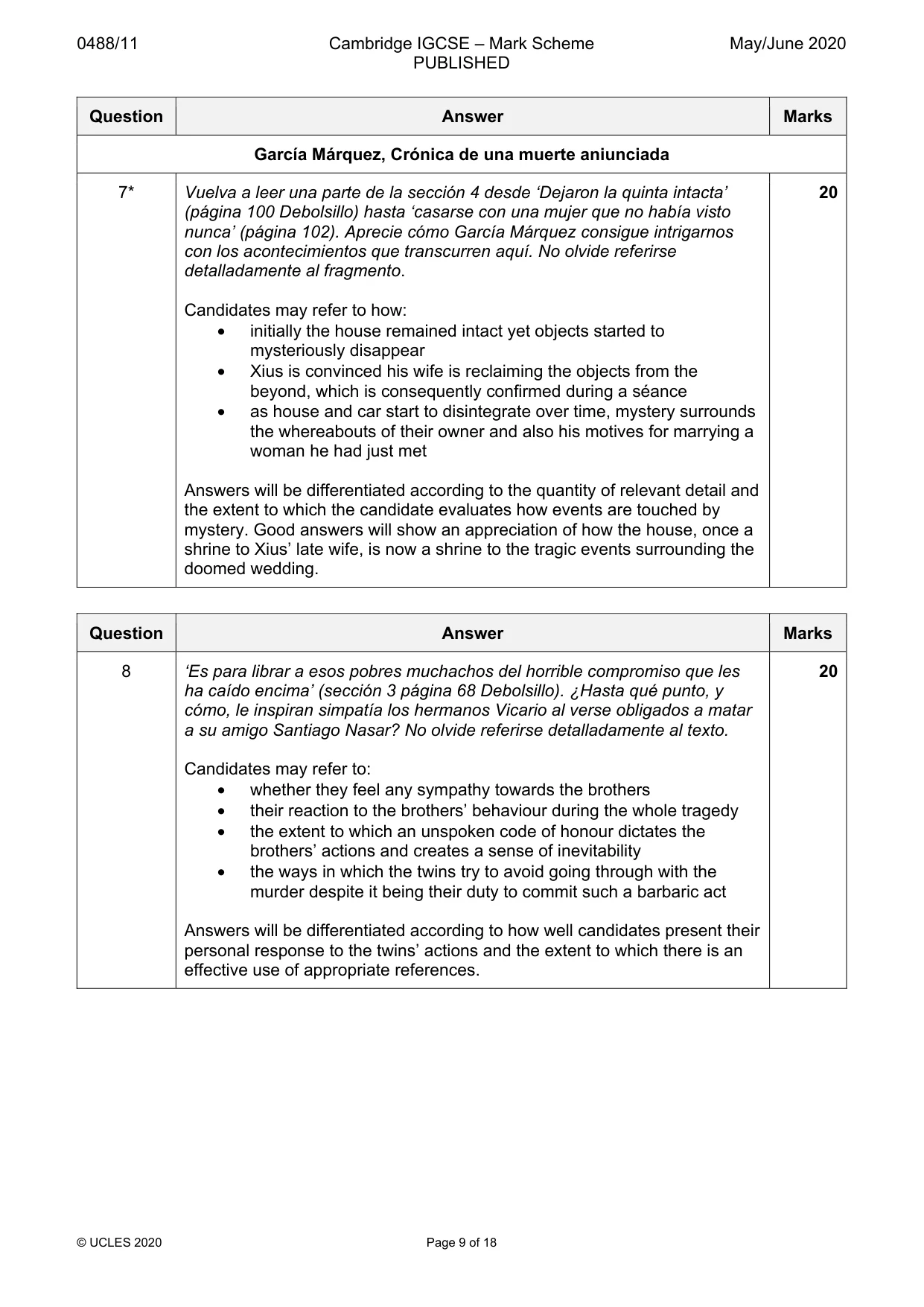
0488/11 Cambridge IGCSE – Mark Scheme PUBLISHED May/June 2020 © UCLES 2020 Page 9 of 18 Question Answer Marks García Márquez, Crónica de una muerte aniunciada 7* Vuelva a leer una parte de la sección 4 desde ‘Dejaron la quinta intacta’ (página 100 Debolsillo) hasta ‘casarse con una mujer que no había visto nunca’ (página 102). Aprecie cómo García Márquez consigue intrigarnos con los acontecimientos que transcurren aquí. No olvide referirse detalladamente al fragmento. Candidates may refer to how: • initially the house remained intact yet objects started to mysteriously disappear • Xius is convinced his wife is reclaiming the objects from the beyond, which is consequently confirmed during a séance • as house and car start to disintegrate over time, mystery surrounds the whereabouts of their owner and also his motives for marrying a woman he had just met Answers will be differentiated according to the quantity of relevant detail and the extent to which the candidate evaluates how events are touched by mystery. Good answers will show an appreciation of how the house, once a shrine to Xius’ late wife, is now a shrine to the tragic events surrounding the doomed wedding. 20 Question Answer Marks 8 ‘Es para librar a esos pobres muchachos del horrible compromiso que les ha caído encima’ (sección 3 página 68 Debolsillo). ¿Hasta qué punto, y cómo, le inspiran simpatía los hermanos Vicario al verse obligados a matar a su amigo Santiago Nasar? No olvide referirse detalladamente al texto. Candidates may refer to: • whether they feel any sympathy towards the brothers • their reaction to the brothers’ behaviour during the whole tragedy • the extent to which an unspoken code of honour dictates the brothers’ actions and creates a sense of inevitability • the ways in which the twins try to avoid going through with the murder despite it being their duty to commit such a barbaric act Answers will be differentiated according to how well candidates present their personal response to the twins’ actions and the extent to which there is an effective use of appropriate references. 20
Mark scheme, page 10
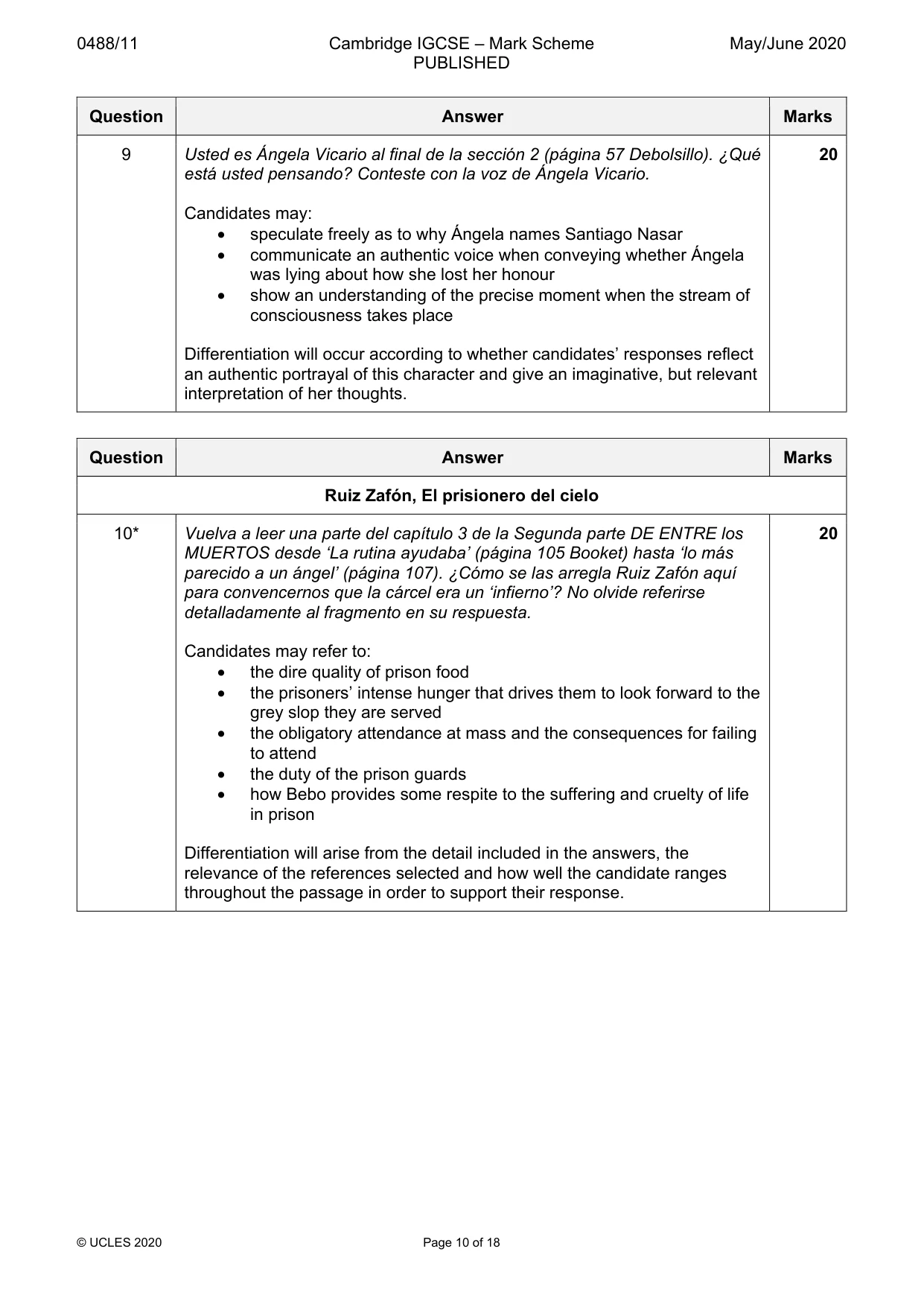
0488/11 Cambridge IGCSE – Mark Scheme PUBLISHED May/June 2020 © UCLES 2020 Page 10 of 18 Question Answer Marks 9 Usted es Ángela Vicario al final de la sección 2 (página 57 Debolsillo). ¿Qué está usted pensando? Conteste con la voz de Ángela Vicario. Candidates may: • speculate freely as to why Ángela names Santiago Nasar • communicate an authentic voice when conveying whether Ángela was lying about how she lost her honour • show an understanding of the precise moment when the stream of consciousness takes place Differentiation will occur according to whether candidates’ responses reflect an authentic portrayal of this character and give an imaginative, but relevant interpretation of her thoughts. 20 Question Answer Marks Ruiz Zafón, El prisionero del cielo 10* Vuelva a leer una parte del capítulo 3 de la Segunda parte DE ENTRE los MUERTOS desde ‘La rutina ayudaba’ (página 105 Booket) hasta ‘lo más parecido a un ángel’ (página 107). ¿Cómo se las arregla Ruiz Zafón aquí para convencernos que la cárcel era un ‘infierno’? No olvide referirse detalladamente al fragmento en su respuesta. Candidates may refer to: • the dire quality of prison food • the prisoners’ intense hunger that drives them to look forward to the grey slop they are served • the obligatory attendance at mass and the consequences for failing to attend • the duty of the prison guards • how Bebo provides some respite to the suffering and cruelty of life in prison Differentiation will arise from the detail included in the answers, the relevance of the references selected and how well the candidate ranges throughout the passage in order to support their response. 20
Mark scheme, page 11
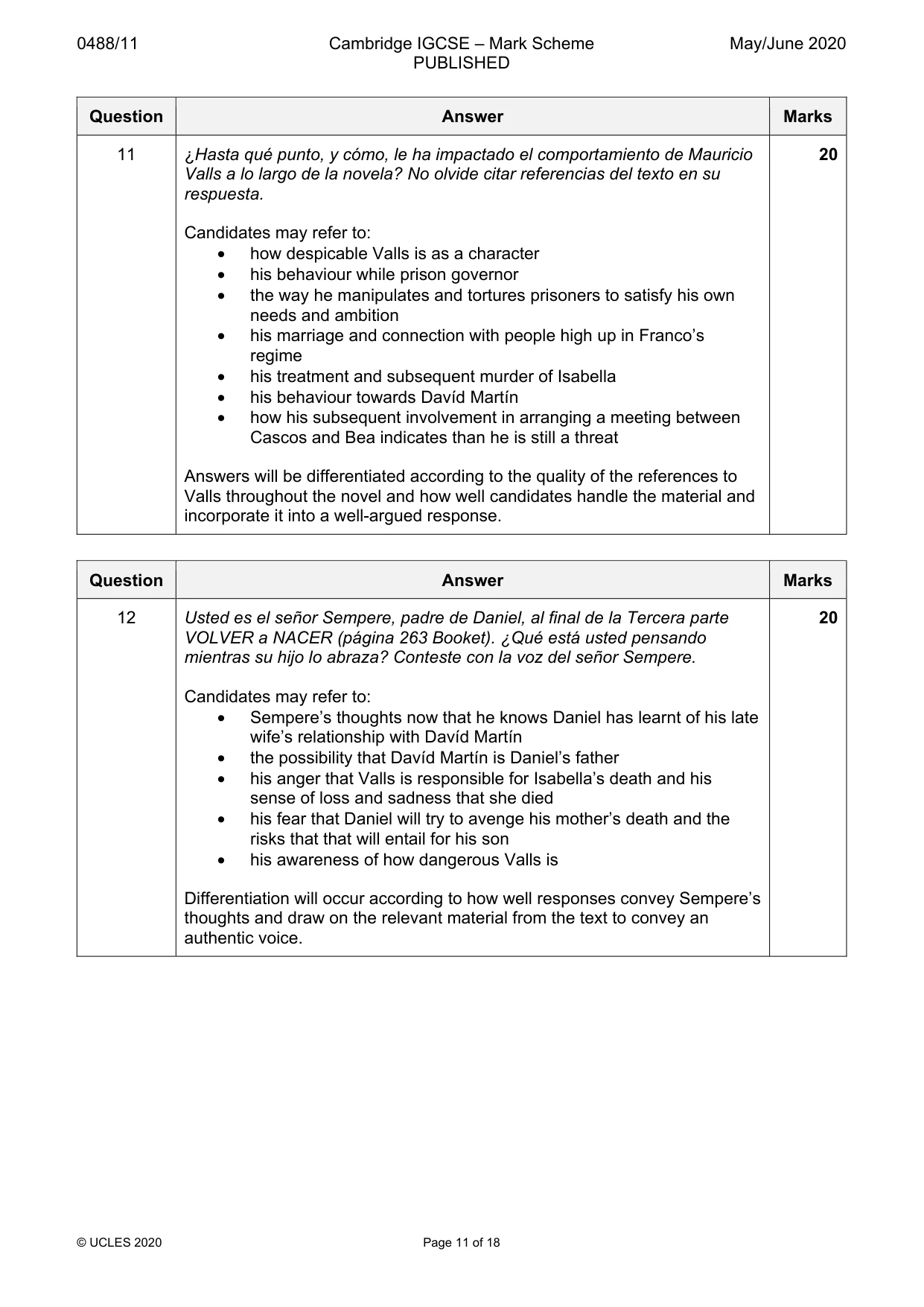
0488/11 Cambridge IGCSE – Mark Scheme PUBLISHED May/June 2020 © UCLES 2020 Page 11 of 18 Question Answer Marks 11 ¿Hasta qué punto, y cómo, le ha impactado el comportamiento de Mauricio Valls a lo largo de la novela? No olvide citar referencias del texto en su respuesta. Candidates may refer to: • how despicable Valls is as a character • his behaviour while prison governor • the way he manipulates and tortures prisoners to satisfy his own needs and ambition • his marriage and connection with people high up in Franco’s regime • his treatment and subsequent murder of Isabella • his behaviour towards Davíd Martín • how his subsequent involvement in arranging a meeting between Cascos and Bea indicates than he is still a threat Answers will be differentiated according to the quality of the references to Valls throughout the novel and how well candidates handle the material and incorporate it into a well-argued response. 20 Question Answer Marks 12 Usted es el señor Sempere, padre de Daniel, al final de la Tercera parte VOLVER a NACER (página 263 Booket). ¿Qué está usted pensando mientras su hijo lo abraza? Conteste con la voz del señor Sempere. Candidates may refer to: • Sempere’s thoughts now that he knows Daniel has learnt of his late wife’s relationship with Davíd Martín • the possibility that Davíd Martín is Daniel’s father • his anger that Valls is responsible for Isabella’s death and his sense of loss and sadness that she died • his fear that Daniel will try to avenge his mother’s death and the risks that that will entail for his son • his awareness of how dangerous Valls is Differentiation will occur according to how well responses convey Sempere’s thoughts and draw on the relevant material from the text to convey an authentic voice. 20
Mark scheme, page 12
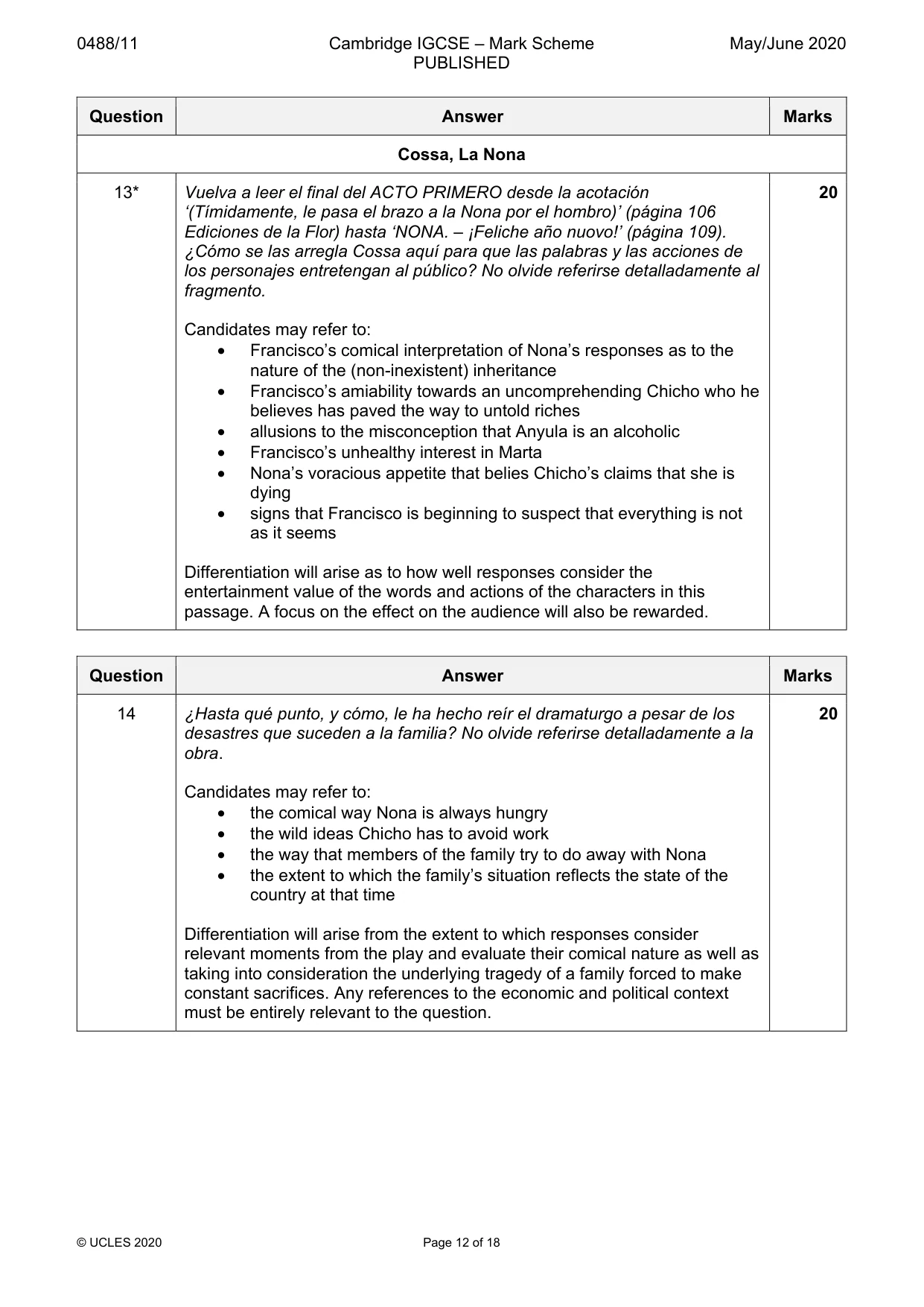
0488/11 Cambridge IGCSE – Mark Scheme PUBLISHED May/June 2020 © UCLES 2020 Page 12 of 18 Question Answer Marks Cossa, La Nona 13* Vuelva a leer el final del ACTO PRIMERO desde la acotación ‘(Tímidamente, le pasa el brazo a la Nona por el hombro)’ (página 106 Ediciones de la Flor) hasta ‘NONA. – ¡Feliche año nuovo!’ (página 109). ¿Cómo se las arregla Cossa aquí para que las palabras y las acciones de los personajes entretengan al público? No olvide referirse detalladamente al fragmento. Candidates may refer to: • Francisco’s comical interpretation of Nona’s responses as to the nature of the (non-inexistent) inheritance • Francisco’s amiability towards an uncomprehending Chicho who he believes has paved the way to untold riches • allusions to the misconception that Anyula is an alcoholic • Francisco’s unhealthy interest in Marta • Nona’s voracious appetite that belies Chicho’s claims that she is dying • signs that Francisco is beginning to suspect that everything is not as it seems Differentiation will arise as to how well responses consider the entertainment value of the words and actions of the characters in this passage. A focus on the effect on the audience will also be rewarded. 20 Question Answer Marks 14 ¿Hasta qué punto, y cómo, le ha hecho reír el dramaturgo a pesar de los desastres que suceden a la familia? No olvide referirse detalladamente a la obra. Candidates may refer to: • the comical way Nona is always hungry • the wild ideas Chicho has to avoid work • the way that members of the family try to do away with Nona • the extent to which the family’s situation reflects the state of the country at that time Differentiation will arise from the extent to which responses consider relevant moments from the play and evaluate their comical nature as well as taking into consideration the underlying tragedy of a family forced to make constant sacrifices. Any references to the economic and political context must be entirely relevant to the question. 20
Mark scheme, page 13
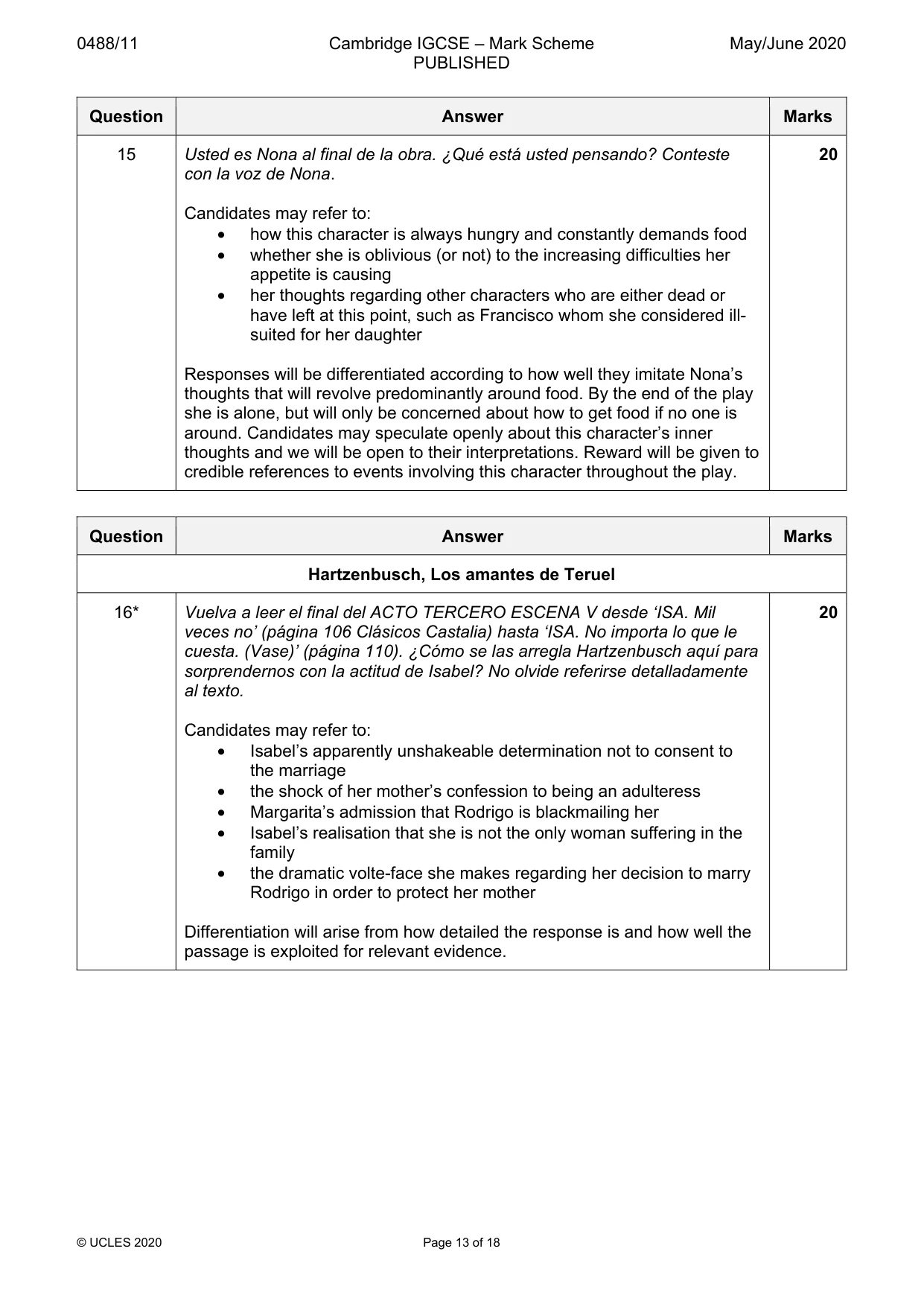
0488/11 Cambridge IGCSE – Mark Scheme PUBLISHED May/June 2020 © UCLES 2020 Page 13 of 18 Question Answer Marks 15 Usted es Nona al final de la obra. ¿Qué está usted pensando? Conteste con la voz de Nona. Candidates may refer to: • how this character is always hungry and constantly demands food • whether she is oblivious (or not) to the increasing difficulties her appetite is causing • her thoughts regarding other characters who are either dead or have left at this point, such as Francisco whom she considered ill- suited for her daughter Responses will be differentiated according to how well they imitate Nona’s thoughts that will revolve predominantly around food. By the end of the play she is alone, but will only be concerned about how to get food if no one is around. Candidates may speculate openly about this character’s inner thoughts and we will be open to their interpretations. Reward will be given to credible references to events involving this character throughout the play. 20 Question Answer Marks Hartzenbusch, Los amantes de Teruel 16* Vuelva a leer el final del ACTO TERCERO ESCENA V desde ‘ISA. Mil veces no’ (página 106 Clásicos Castalia) hasta ‘ISA. No importa lo que le cuesta. (Vase)’ (página 110). ¿Cómo se las arregla Hartzenbusch aquí para sorprendernos con la actitud de Isabel? No olvide referirse detalladamente al texto. Candidates may refer to: • Isabel’s apparently unshakeable determination not to consent to the marriage • the shock of her mother’s confession to being an adulteress • Margarita’s admission that Rodrigo is blackmailing her • Isabel’s realisation that she is not the only woman suffering in the family • the dramatic volte-face she makes regarding her decision to marry Rodrigo in order to protect her mother Differentiation will arise from how detailed the response is and how well the passage is exploited for relevant evidence. 20
Mark scheme, page 14
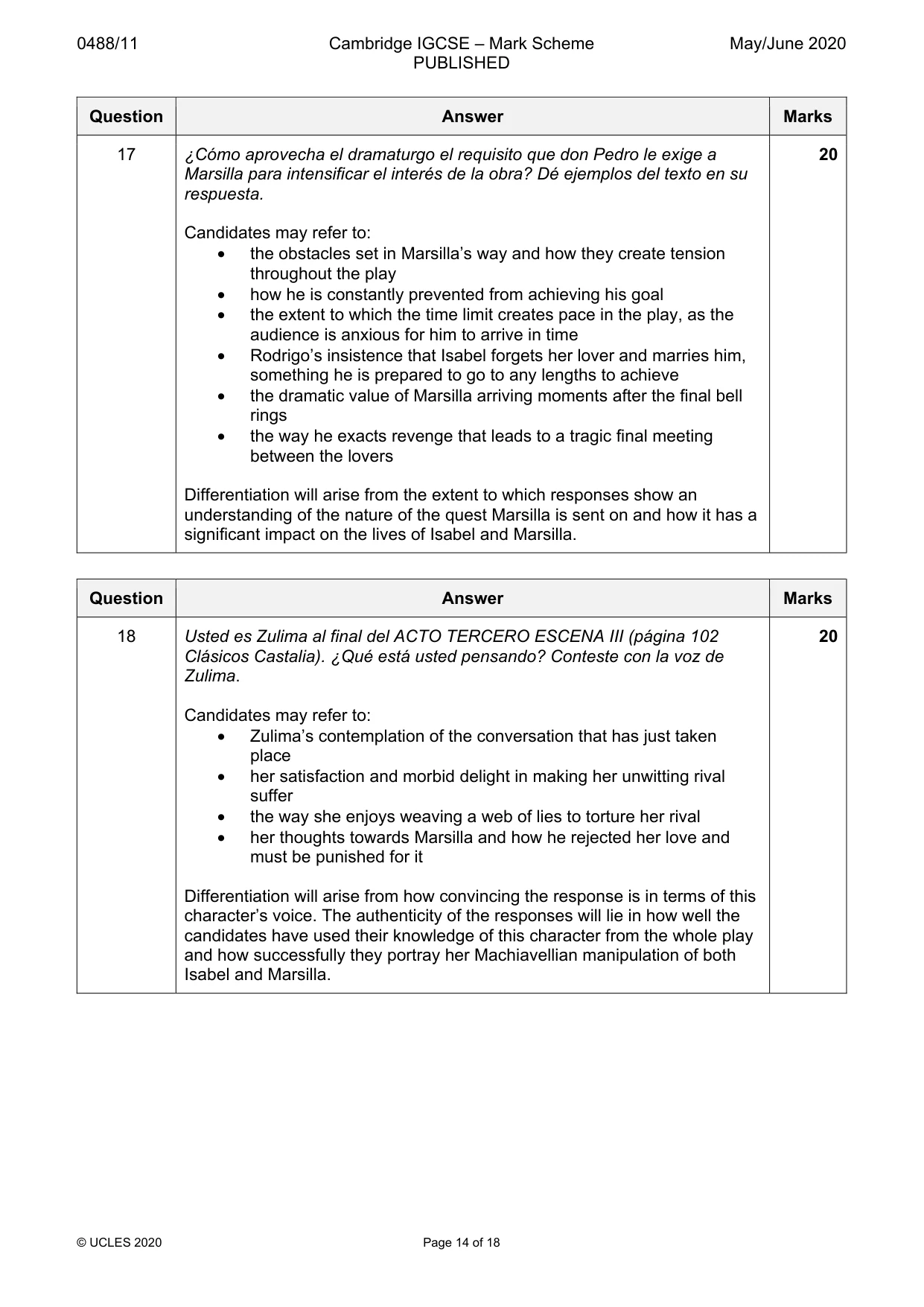
0488/11 Cambridge IGCSE – Mark Scheme PUBLISHED May/June 2020 © UCLES 2020 Page 14 of 18 Question Answer Marks 17 ¿Cómo aprovecha el dramaturgo el requisito que don Pedro le exige a Marsilla para intensificar el interés de la obra? Dé ejemplos del texto en su respuesta. Candidates may refer to: • the obstacles set in Marsilla’s way and how they create tension throughout the play • how he is constantly prevented from achieving his goal • the extent to which the time limit creates pace in the play, as the audience is anxious for him to arrive in time • Rodrigo’s insistence that Isabel forgets her lover and marries him, something he is prepared to go to any lengths to achieve • the dramatic value of Marsilla arriving moments after the final bell rings • the way he exacts revenge that leads to a tragic final meeting between the lovers Differentiation will arise from the extent to which responses show an understanding of the nature of the quest Marsilla is sent on and how it has a significant impact on the lives of Isabel and Marsilla. 20 Question Answer Marks 18 Usted es Zulima al final del ACTO TERCERO ESCENA III (página 102 Clásicos Castalia). ¿Qué está usted pensando? Conteste con la voz de Zulima. Candidates may refer to: • Zulima’s contemplation of the conversation that has just taken place • her satisfaction and morbid delight in making her unwitting rival suffer • the way she enjoys weaving a web of lies to torture her rival • her thoughts towards Marsilla and how he rejected her love and must be punished for it Differentiation will arise from how convincing the response is in terms of this character’s voice. The authenticity of the responses will lie in how well the candidates have used their knowledge of this character from the whole play and how successfully they portray her Machiavellian manipulation of both Isabel and Marsilla. 20
Mark scheme, page 15
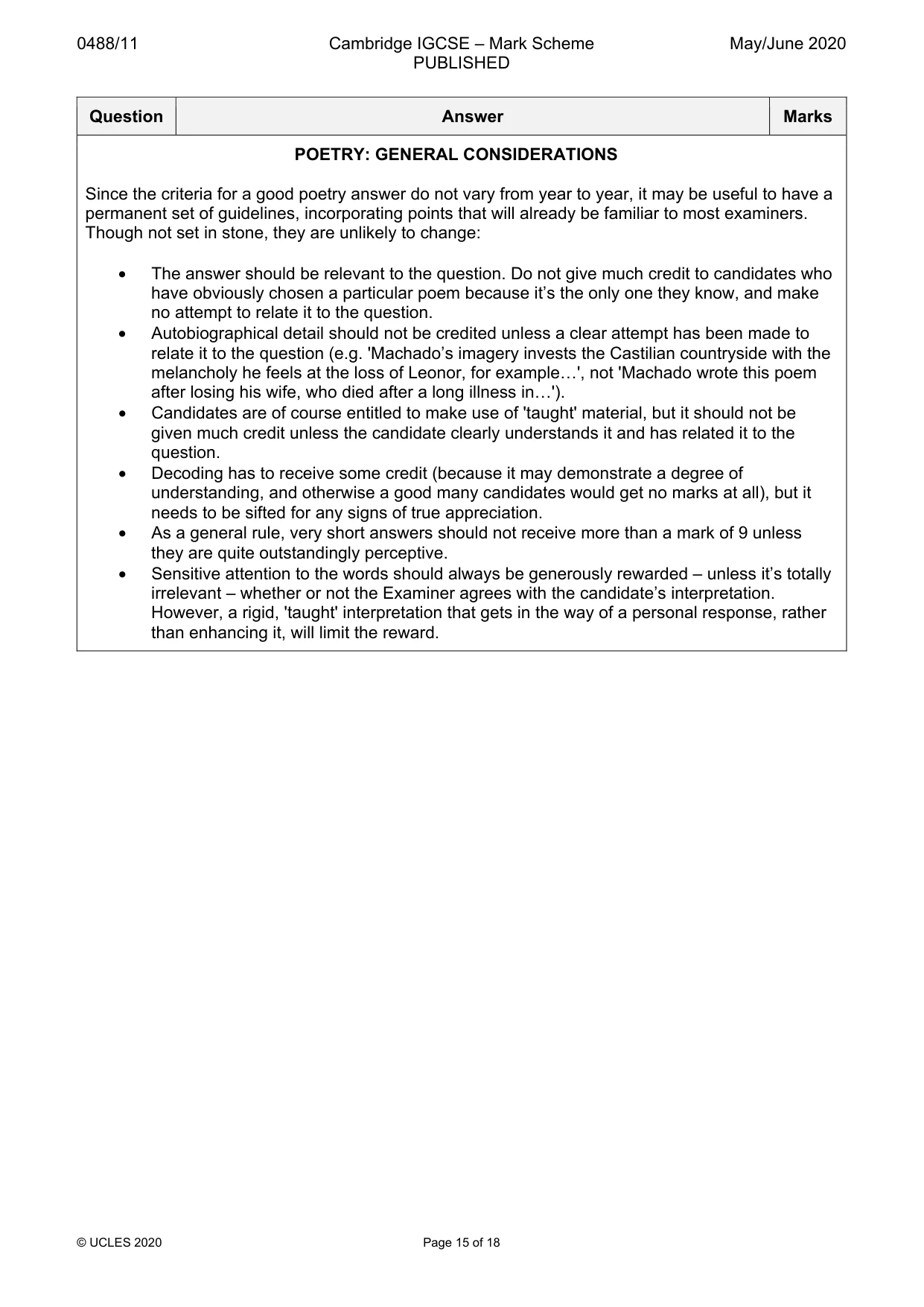
0488/11 Cambridge IGCSE – Mark Scheme PUBLISHED May/June 2020 © UCLES 2020 Page 15 of 18 Question Answer Marks POETRY: GENERAL CONSIDERATIONS Since the criteria for a good poetry answer do not vary from year to year, it may be useful to have a permanent set of guidelines, incorporating points that will already be familiar to most examiners. Though not set in stone, they are unlikely to change: • The answer should be relevant to the question. Do not give much credit to candidates who have obviously chosen a particular poem because it’s the only one they know, and make no attempt to relate it to the question. • Autobiographical detail should not be credited unless a clear attempt has been made to relate it to the question (e.g. 'Machado’s imagery invests the Castilian countryside with the melancholy he feels at the loss of Leonor, for example…', not 'Machado wrote this poem after losing his wife, who died after a long illness in…'). • Candidates are of course entitled to make use of 'taught' material, but it should not be given much credit unless the candidate clearly understands it and has related it to the question. • Decoding has to receive some credit (because it may demonstrate a degree of understanding, and otherwise a good many candidates would get no marks at all), but it needs to be sifted for any signs of true appreciation. • As a general rule, very short answers should not receive more than a mark of 9 unless they are quite outstandingly perceptive. • Sensitive attention to the words should always be generously rewarded – unless it’s totally irrelevant – whether or not the Examiner agrees with the candidate’s interpretation. However, a rigid, 'taught' interpretation that gets in the way of a personal response, rather than enhancing it, will limit the reward.
Mark scheme, page 16
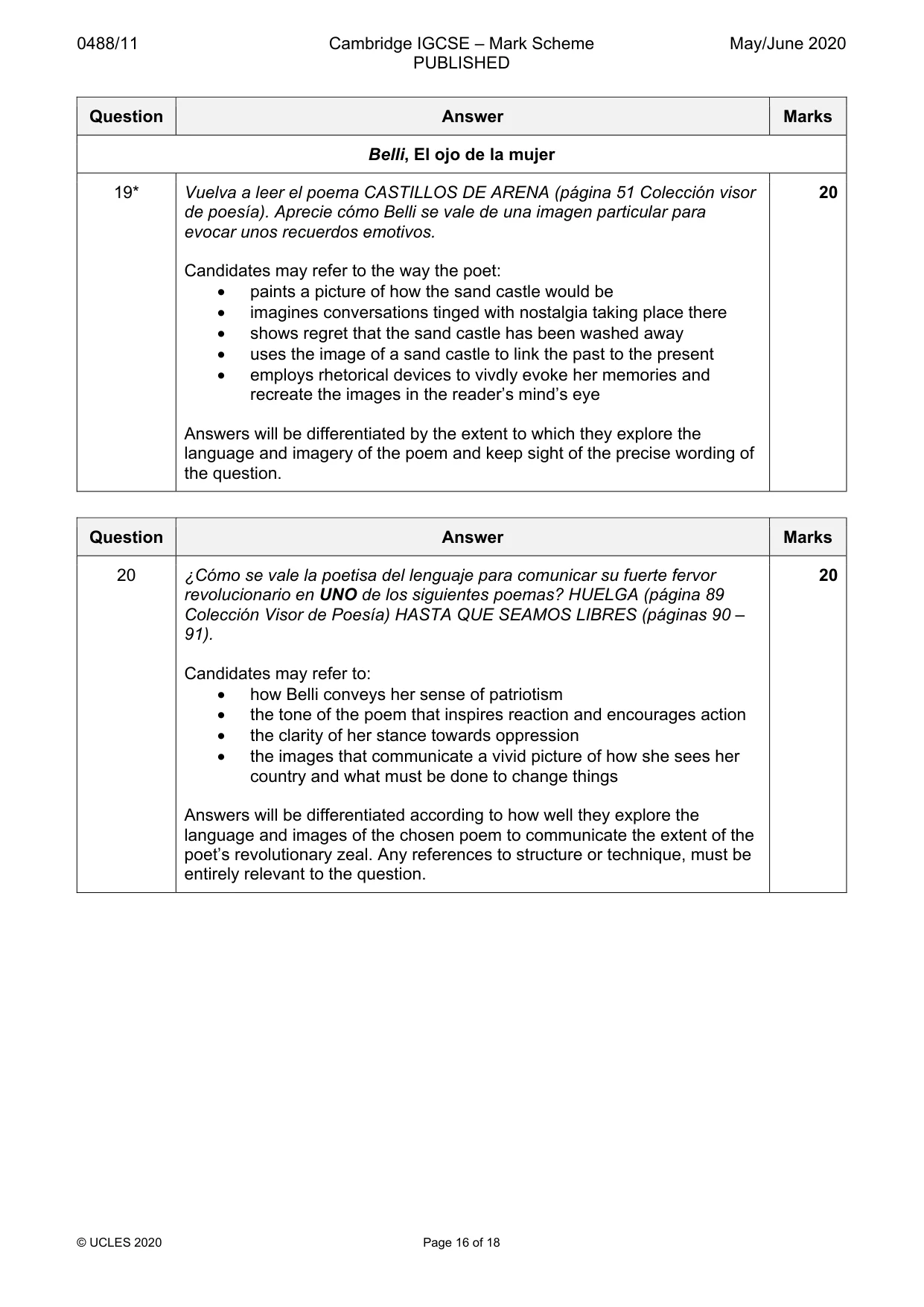
0488/11 Cambridge IGCSE – Mark Scheme PUBLISHED May/June 2020 © UCLES 2020 Page 16 of 18 Question Answer Marks Belli, El ojo de la mujer 19* Vuelva a leer el poema CASTILLOS DE ARENA (página 51 Colección visor de poesía). Aprecie cómo Belli se vale de una imagen particular para evocar unos recuerdos emotivos. Candidates may refer to the way the poet: • paints a picture of how the sand castle would be • imagines conversations tinged with nostalgia taking place there • shows regret that the sand castle has been washed away • uses the image of a sand castle to link the past to the present • employs rhetorical devices to vivdly evoke her memories and recreate the images in the reader’s mind’s eye Answers will be differentiated by the extent to which they explore the language and imagery of the poem and keep sight of the precise wording of the question. 20 Question Answer Marks 20 ¿Cómo se vale la poetisa del lenguaje para comunicar su fuerte fervor revolucionario en UNO de los siguientes poemas? HUELGA (página 89 Colección Visor de Poesía) HASTA QUE SEAMOS LIBRES (páginas 90 – 91). Candidates may refer to: • how Belli conveys her sense of patriotism • the tone of the poem that inspires reaction and encourages action • the clarity of her stance towards oppression • the images that communicate a vivid picture of how she sees her country and what must be done to change things Answers will be differentiated according to how well they explore the language and images of the chosen poem to communicate the extent of the poet’s revolutionary zeal. Any references to structure or technique, must be entirely relevant to the question. 20
Mark scheme, page 17
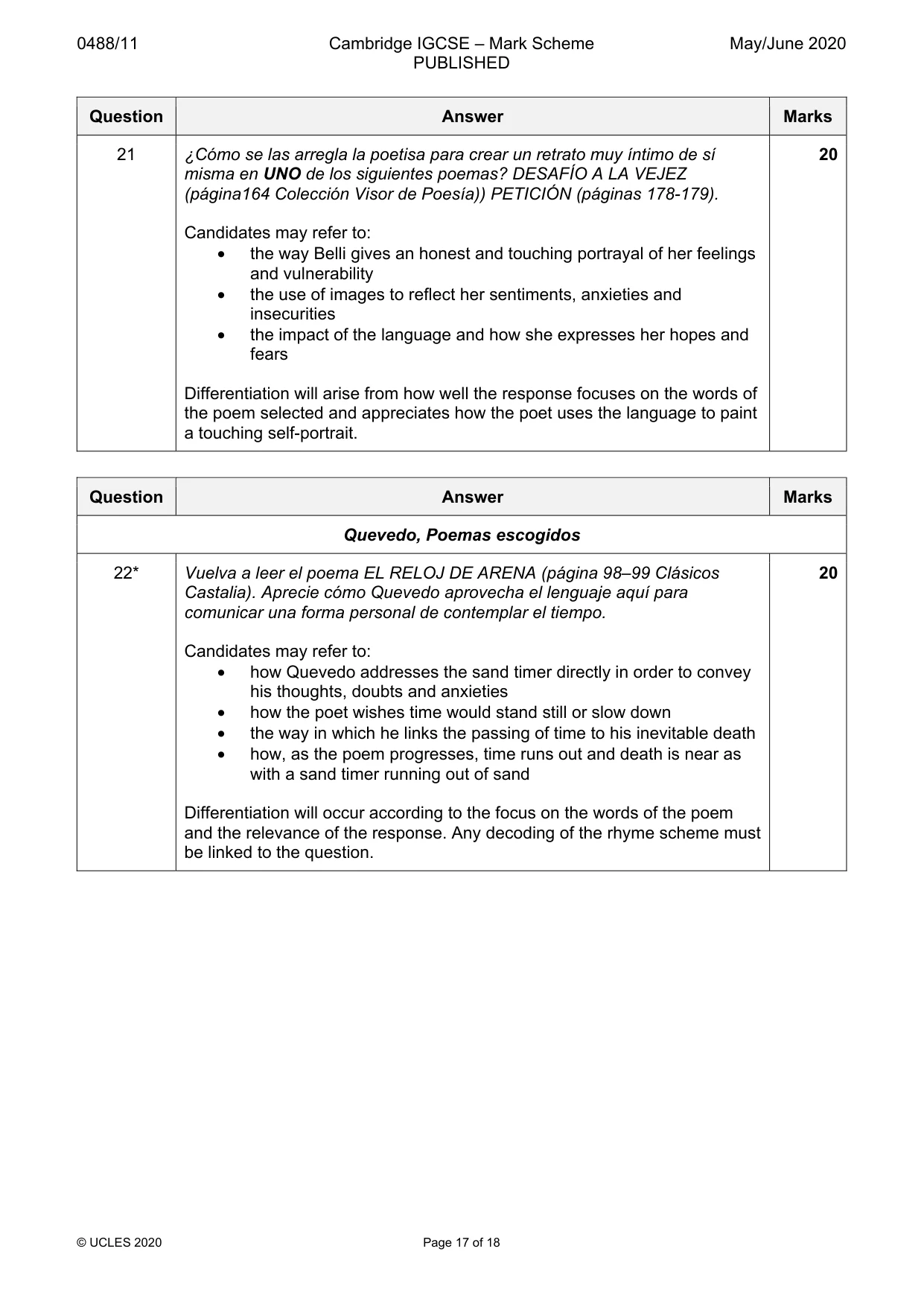
0488/11 Cambridge IGCSE – Mark Scheme PUBLISHED May/June 2020 © UCLES 2020 Page 17 of 18 Question Answer Marks 21 ¿Cómo se las arregla la poetisa para crear un retrato muy íntimo de sí misma en UNO de los siguientes poemas? DESAFÍO A LA VEJEZ (página164 Colección Visor de Poesía)) PETICIÓN (páginas 178-179). Candidates may refer to: • the way Belli gives an honest and touching portrayal of her feelings and vulnerability • the use of images to reflect her sentiments, anxieties and insecurities • the impact of the language and how she expresses her hopes and fears Differentiation will arise from how well the response focuses on the words of the poem selected and appreciates how the poet uses the language to paint a touching self-portrait. 20 Question Answer Marks Quevedo, Poemas escogidos 22* Vuelva a leer el poema EL RELOJ DE ARENA (página 98–99 Clásicos Castalia). Aprecie cómo Quevedo aprovecha el lenguaje aquí para comunicar una forma personal de contemplar el tiempo. Candidates may refer to: • how Quevedo addresses the sand timer directly in order to convey his thoughts, doubts and anxieties • how the poet wishes time would stand still or slow down • the way in which he links the passing of time to his inevitable death • how, as the poem progresses, time runs out and death is near as with a sand timer running out of sand Differentiation will occur according to the focus on the words of the poem and the relevance of the response. Any decoding of the rhyme scheme must be linked to the question. 20
Mark scheme, page 18
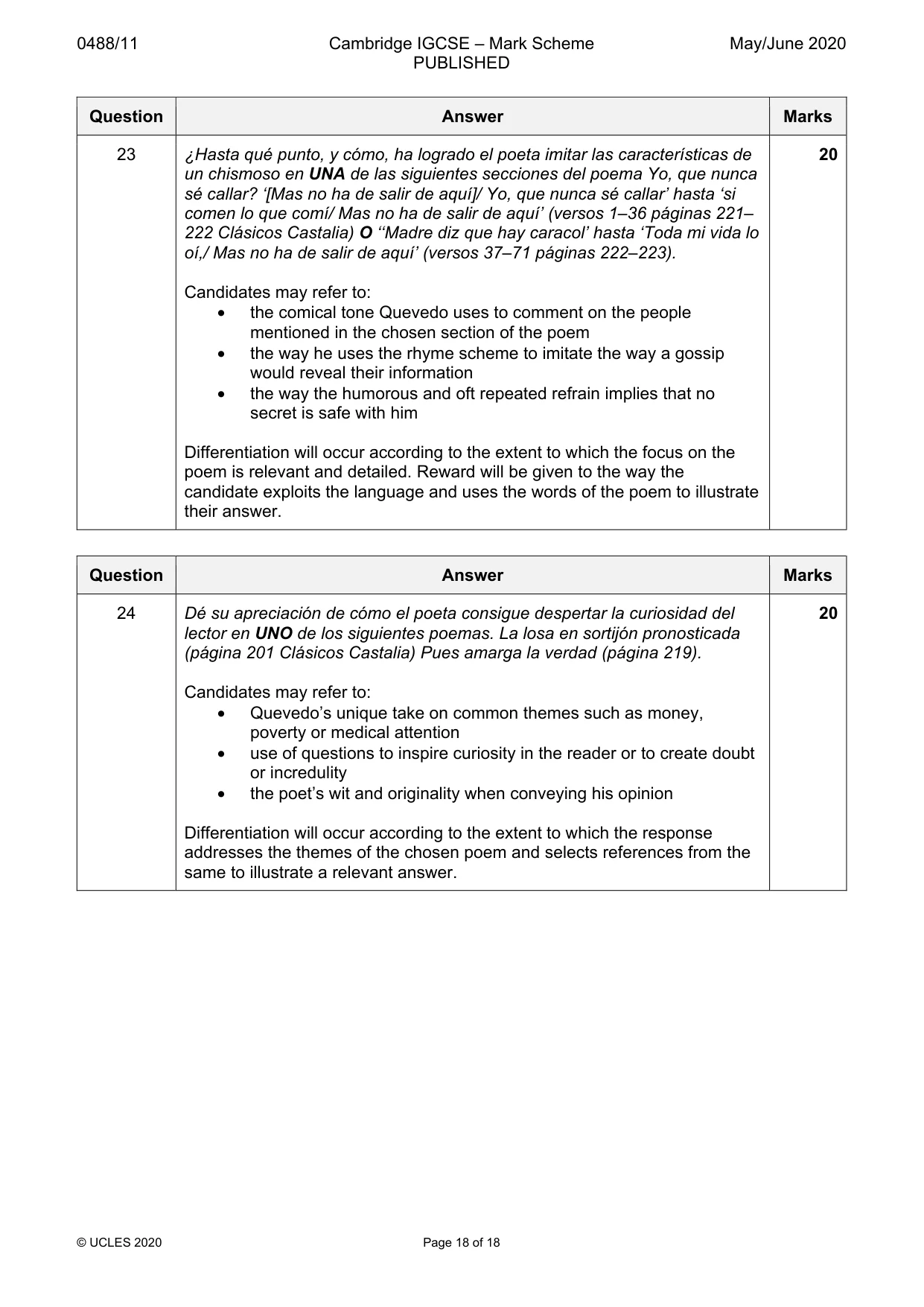
0488/11 Cambridge IGCSE – Mark Scheme PUBLISHED May/June 2020 © UCLES 2020 Page 18 of 18 Question Answer Marks 23 ¿Hasta qué punto, y cómo, ha logrado el poeta imitar las características de un chismoso en UNA de las siguientes secciones del poema Yo, que nunca sé callar? ‘[Mas no ha de salir de aquí]/ Yo, que nunca sé callar’ hasta ‘si comen lo que comí/ Mas no ha de salir de aquí’ (versos 1–36 páginas 221– 222 Clásicos Castalia) O ‘‘Madre diz que hay caracol’ hasta ‘Toda mi vida lo oí,/ Mas no ha de salir de aquí’ (versos 37–71 páginas 222–223). Candidates may refer to: • the comical tone Quevedo uses to comment on the people mentioned in the chosen section of the poem • the way he uses the rhyme scheme to imitate the way a gossip would reveal their information • the way the humorous and oft repeated refrain implies that no secret is safe with him Differentiation will occur according to the extent to which the focus on the poem is relevant and detailed. Reward will be given to the way the candidate exploits the language and uses the words of the poem to illustrate their answer. 20 Question Answer Marks 24 Dé su apreciación de cómo el poeta consigue despertar la curiosidad del lector en UNO de los siguientes poemas. La losa en sortijón pronosticada (página 201 Clásicos Castalia) Pues amarga la verdad (página 219). Candidates may refer to: • Quevedo’s unique take on common themes such as money, poverty or medical attention • use of questions to inspire curiosity in the reader or to create doubt or incredulity • the poet’s wit and originality when conveying his opinion Differentiation will occur according to the extent to which the response addresses the themes of the chosen poem and selects references from the same to illustrate a relevant answer. 20