Cambridge IGCSE Spanish - Literature 0488 — 2019 May/June Paper 1 · Variant 1
0488/11/M/J/19 · 60 marks · ≈68 min
The question paper and its mark scheme, free to read here and free to download. This is Cambridge’s own paper, exactly as it was sat.
Question paper8 pages


Mark scheme25 pages
Answers below. Sit the paper first if you are practising.

Paper as text
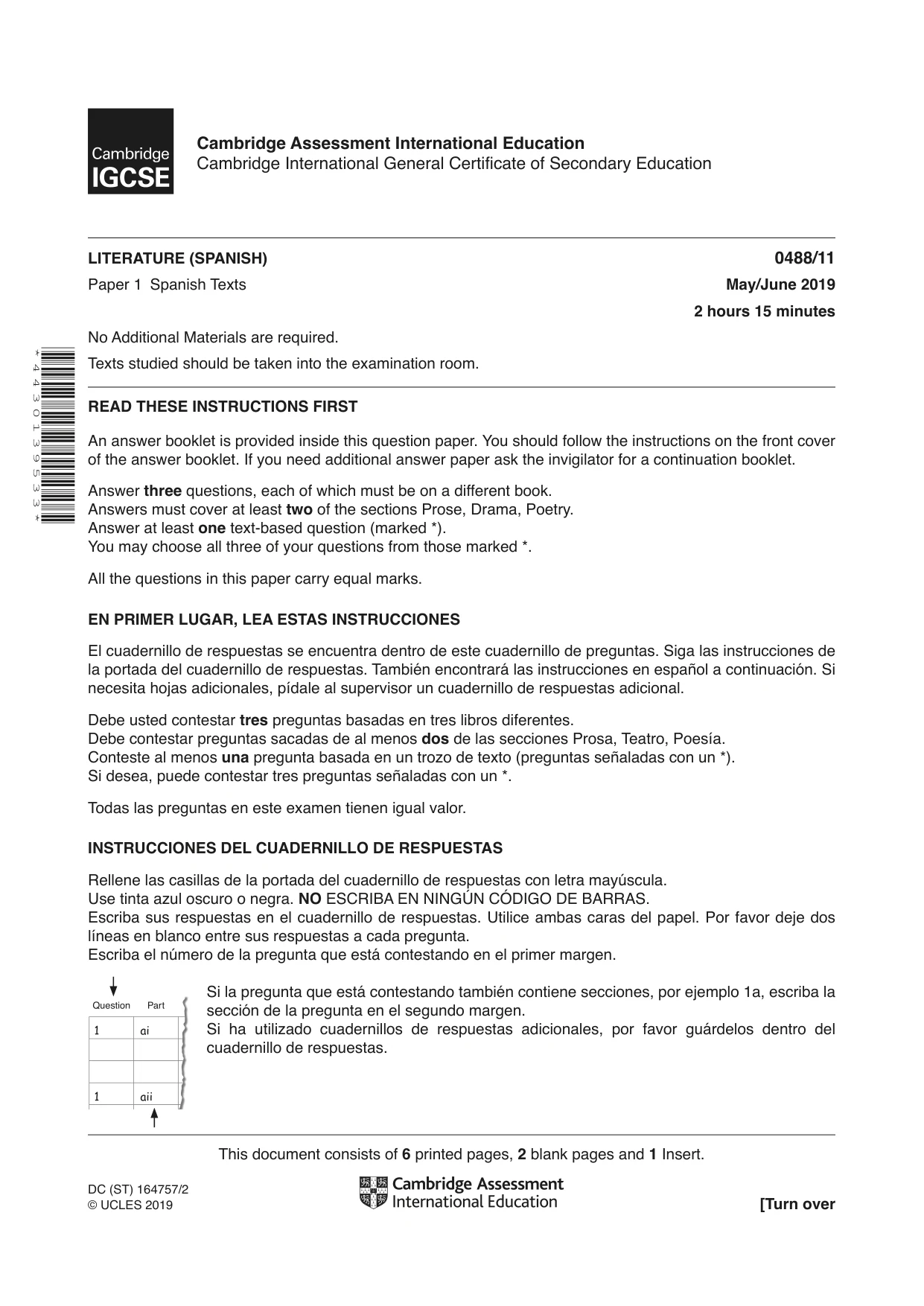
Question paper, page 1
This document consists of 6 printed pages, 2 blank pages and 1 Insert. DC (ST) 164757/2 © UCLES 2019 [Turn over Cambridge Assessment International Education Cambridge International General Certificate of Secondary Education * 4 4 3 0 1 3 9 5 3 3 * LITERATURE (SPANISH) 0488/11 Paper 1 Spanish Texts May/June 2019 2 hours 15 minutes No Additional Materials are required. Texts studied should be taken into the examination room. READ THESE INSTRUCTIONS FIRST An answer booklet is provided inside this question paper. You should follow the instructions on the front cover of the answer booklet. If you need additional answer paper ask the invigilator for a continuation booklet. Answer three questions, each of which must be on a different book. Answers must cover at least two of the sections Prose, Drama, Poetry. Answer at least one text-based question (marked *). You may choose all three of your questions from those marked *. All the questions in this paper carry equal marks. EN PRIMER LUGAR, LEA ESTAS INSTRUCCIONES El cuadernillo de respuestas se encuentra dentro de este cuadernillo de preguntas. Siga las instrucciones de la portada del cuadernillo de respuestas. También encontrará las instrucciones en español a continuación. Si necesita hojas adicionales, pídale al supervisor un cuadernillo de respuestas adicional. Debe usted contestar tres preguntas basadas en tres libros diferentes. Debe contestar preguntas sacadas de al menos dos de las secciones Prosa, Teatro, Poesía. Conteste al menos una pregunta basada en un trozo de texto (preguntas señaladas con un *). Si desea, puede contestar tres preguntas señaladas con un *. Todas las preguntas en este examen tienen igual valor. INSTRUCCIONES DEL CUADERNILLO DE RESPUESTAS Rellene las casillas de la portada del cuadernillo de respuestas con letra mayúscula. Use tinta azul oscuro o negra. NO ESCRIBA EN NINGÚN CÓDIGO DE BARRAS. Escriba sus respuestas en el cuadernillo de respuestas. Utilice ambas caras del papel. Por favor deje dos líneas en blanco entre sus respuestas a cada pregunta. Escriba el número de la pregunta que está contestando en el primer margen. Si la pregunta que está contestando también contiene secciones, por ejemplo 1a, escriba la sección de la pregunta en el segundo margen. Si ha utilizado cuadernillos de respuestas adicionales, por favor guárdelos dentro del cuadernillo de respuestas.
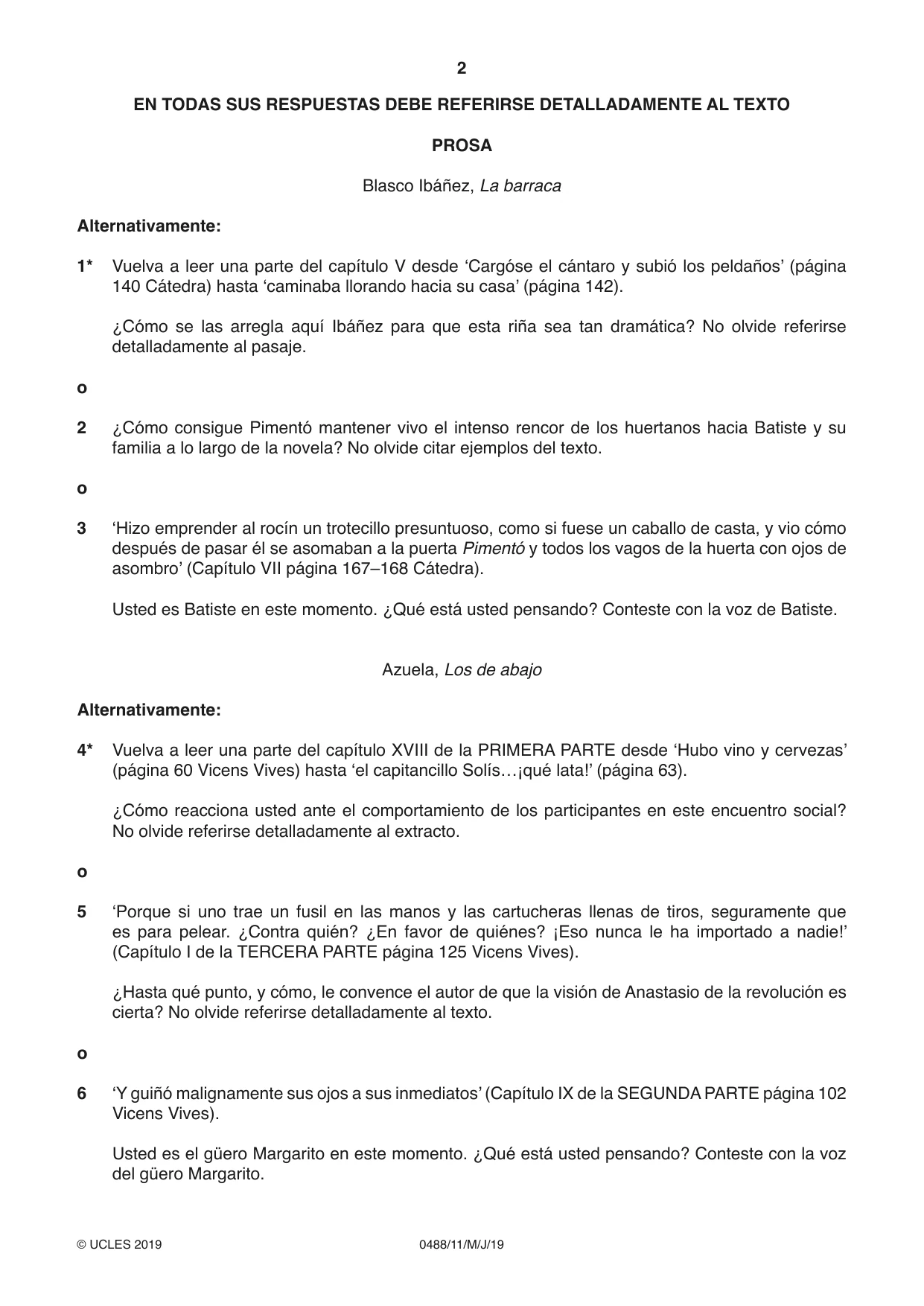
Question paper, page 2
2 0488/11/M/J/19 © UCLES 2019 EN TODAS SUS RESPUESTAS DEBE REFERIRSE DETALLADAMENTE AL TEXTO PROSA Blasco Ibáñez, La barraca Alternativamente: 1* Vuelva a leer una parte del capítulo V desde ‘Cargóse el cántaro y subió los peldaños’ (página 140 Cátedra) hasta ‘caminaba llorando hacia su casa’ (página 142). ¿Cómo se las arregla aquí Ibáñez para que esta riña sea tan dramática? No olvide referirse detalladamente al pasaje. o 2 ¿Cómo consigue Pimentó mantener vivo el intenso rencor de los huertanos hacia Batiste y su familia a lo largo de la novela? No olvide citar ejemplos del texto. o 3 ‘Hizo emprender al rocín un trotecillo presuntuoso, como si fuese un caballo de casta, y vio cómo después de pasar él se asomaban a la puerta Pimentó y todos los vagos de la huerta con ojos de asombro’ (Capítulo VII página 167–168 Cátedra). Usted es Batiste en este momento. ¿Qué está usted pensando? Conteste con la voz de Batiste. Azuela, Los de abajo Alternativamente: 4* Vuelva a leer una parte del capítulo XVIII de la PRIMERA PARTE desde ‘Hubo vino y cervezas’ (página 60 Vicens Vives) hasta ‘el capitancillo Solís…¡qué lata!’ (página 63). ¿Cómo reacciona usted ante el comportamiento de los participantes en este encuentro social? No olvide referirse detalladamente al extracto. o 5 ‘Porque si uno trae un fusil en las manos y las cartucheras llenas de tiros, seguramente que es para pelear. ¿Contra quién? ¿En favor de quiénes? ¡Eso nunca le ha importado a nadie!’ (Capítulo I de la TERCERA PARTE página 125 Vicens Vives). ¿Hasta qué punto, y cómo, le convence el autor de que la visión de Anastasio de la revolución es cierta? No olvide referirse detalladamente al texto. o 6 ‘Y guiñó malignamente sus ojos a sus inmediatos’ (Capítulo IX de la SEGUNDA PARTE página 102 Vicens Vives). Usted es el güero Margarito en este momento. ¿Qué está usted pensando? Conteste con la voz del güero Margarito.
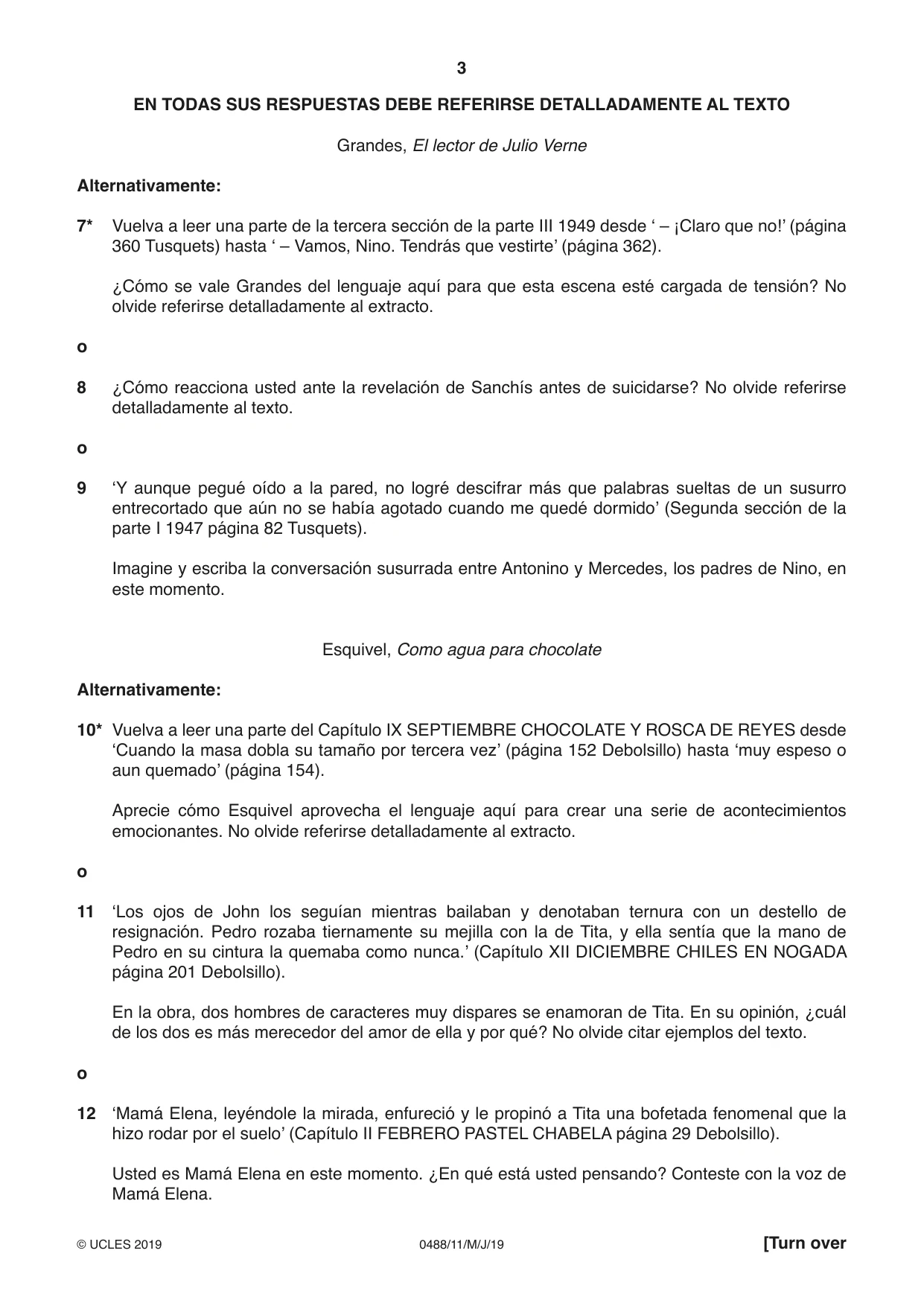
Question paper, page 3
3 0488/11/M/J/19 © UCLES 2019 [Turn over EN TODAS SUS RESPUESTAS DEBE REFERIRSE DETALLADAMENTE AL TEXTO Grandes, El lector de Julio Verne Alternativamente: 7* Vuelva a leer una parte de la tercera sección de la parte III 1949 desde ‘ – ¡Claro que no!’ (página 360 Tusquets) hasta ‘ – Vamos, Nino. Tendrás que vestirte’ (página 362). ¿Cómo se vale Grandes del lenguaje aquí para que esta escena esté cargada de tensión? No olvide referirse detalladamente al extracto. o 8 ¿Cómo reacciona usted ante la revelación de Sanchís antes de suicidarse? No olvide referirse detalladamente al texto. o 9 ‘Y aunque pegué oído a la pared, no logré descifrar más que palabras sueltas de un susurro entrecortado que aún no se había agotado cuando me quedé dormido’ (Segunda sección de la parte I 1947 página 82 Tusquets). Imagine y escriba la conversación susurrada entre Antonino y Mercedes, los padres de Nino, en este momento. Esquivel, Como agua para chocolate Alternativamente: 10* Vuelva a leer una parte del Capítulo IX SEPTIEMBRE CHOCOLATE Y ROSCA DE REYES desde ‘Cuando la masa dobla su tamaño por tercera vez’ (página 152 Debolsillo) hasta ‘muy espeso o aun quemado’ (página 154). Aprecie cómo Esquivel aprovecha el lenguaje aquí para crear una serie de acontecimientos emocionantes. No olvide referirse detalladamente al extracto. o 11 ‘Los ojos de John los seguían mientras bailaban y denotaban ternura con un destello de resignación. Pedro rozaba tiernamente su mejilla con la de Tita, y ella sentía que la mano de Pedro en su cintura la quemaba como nunca.’ (Capítulo XII DICIEMBRE CHILES EN NOGADA página 201 Debolsillo). En la obra, dos hombres de caracteres muy dispares se enamoran de Tita. En su opinión, ¿cuál de los dos es más merecedor del amor de ella y por qué? No olvide citar ejemplos del texto. o 12 ‘Mamá Elena, leyéndole la mirada, enfureció y le propinó a Tita una bofetada fenomenal que la hizo rodar por el suelo’ (Capítulo II FEBRERO PASTEL CHABELA página 29 Debolsillo). Usted es Mamá Elena en este momento. ¿En qué está usted pensando? Conteste con la voz de Mamá Elena.
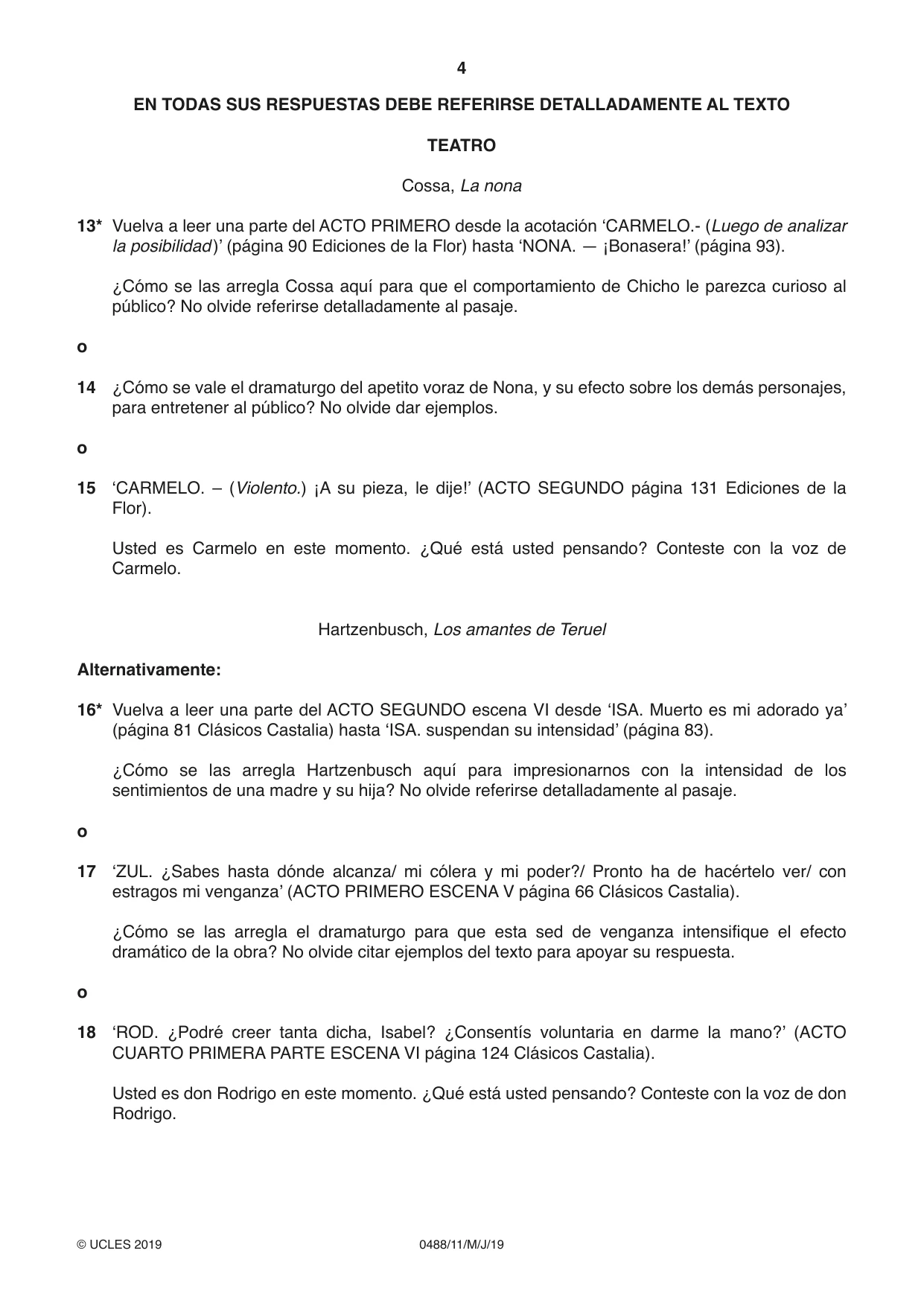
Question paper, page 4
4 0488/11/M/J/19 © UCLES 2019 EN TODAS SUS RESPUESTAS DEBE REFERIRSE DETALLADAMENTE AL TEXTO TEATRO Cossa, La nona 13* Vuelva a leer una parte del ACTO PRIMERO desde la acotación ‘CARMELO.- (Luego de analizar la posibilidad )’ (página 90 Ediciones de la Flor) hasta ‘NONA. — ¡Bonasera!’ (página 93). ¿Cómo se las arregla Cossa aquí para que el comportamiento de Chicho le parezca curioso al público? No olvide referirse detalladamente al pasaje. o 14 ¿Cómo se vale el dramaturgo del apetito voraz de Nona, y su efecto sobre los demás personajes, para entretener al público? No olvide dar ejemplos. o 15 ‘CARMELO. – (Violento.) ¡A su pieza, le dije!’ (ACTO SEGUNDO página 131 Ediciones de la Flor). Usted es Carmelo en este momento. ¿Qué está usted pensando? Conteste con la voz de Carmelo. Hartzenbusch, Los amantes de Teruel Alternativamente: 16* Vuelva a leer una parte del ACTO SEGUNDO escena VI desde ‘ISA. Muerto es mi adorado ya’ (página 81 Clásicos Castalia) hasta ‘ISA. suspendan su intensidad’ (página 83). ¿Cómo se las arregla Hartzenbusch aquí para impresionarnos con la intensidad de los sentimientos de una madre y su hija? No olvide referirse detalladamente al pasaje. o 17 ‘ZUL. ¿Sabes hasta dónde alcanza/ mi cólera y mi poder?/ Pronto ha de hacértelo ver/ con estragos mi venganza’ (ACTO PRIMERO ESCENA V página 66 Clásicos Castalia). ¿Cómo se las arregla el dramaturgo para que esta sed de venganza intensifique el efecto dramático de la obra? No olvide citar ejemplos del texto para apoyar su respuesta. o 18 ‘ROD. ¿Podré creer tanta dicha, Isabel? ¿Consentís voluntaria en darme la mano?’ (ACTO CUARTO PRIMERA PARTE ESCENA VI página 124 Clásicos Castalia). Usted es don Rodrigo en este momento. ¿Qué está usted pensando? Conteste con la voz de don Rodrigo.
Question paper, page 5
5 0488/11/M/J/19 © UCLES 2019 [Turn over EN TODAS SUS RESPUESTAS DEBE REFERIRSE DETALLADAMENTE AL TEXTO POESÍA Biagioni, Poesía completa 19* Vuelva a leer el poema CAMPO DE TRIGO BAJO CUERVOS (página 508 Adriana Hidalgo editora). Aprecie cómo aprovecha Biagioni el lenguaje aquí para que visualicemos con nitidez este paisaje impactante. o 20 Aprecie cómo se vale la poetisa del lenguaje para ofrecer una visión personal del entorno en UNO de los siguientes poemas. CANCIÓN DE LA PENA CÓMODA (página 105 Adriana Hidalgo editora) PUERTO (páginas 122–123). o 21 ¿Cómo se las arregla la poetisa aquí para que experimentemos un sentimiento de inquietud en UNO de los siguientes poemas? LA CONDENA (página 277 Adriana Hidalgo editora) LA SEÑALADA (comenzarán a señalarme) (páginas 403–405) LA FUGITIVA (Dónde/en qué noche y maleza) (páginas 407–410).
Question paper, page 6
6 0488/11/M/J/19 © UCLES 2019 EN TODAS SUS RESPUESTAS DEBE REFERIRSE DETALLADAMENTE AL TEXTO POESÍA Quevedo, Poemas escogidos Alternativamente: 22* Vuelva a leer el poema Huye sin percibirse, lento, el día (páginas 55–56 Clásicos Castalia). ¿Cómo se vale Quevedo del lenguaje aquí para comunicar su angustia ante el paso fugaz de la vida? o 23 ¿Cómo se las arregla el poeta para halagar un atributo femenino de forma entretenida en UNO de los siguientes poemas? Si a una parte miraran solamente (página 152 Clásicos Castalia) En crespa tempestad del oro undoso (páginas 171–172). o 24 Dé su apreciación de cómo el poeta aprovecha el lenguaje para que esta boda sea tan entretenida en UNA de las siguientes secciones del poema Don Repollo y doña Berza (páginas 238–241 Clásicos Castalia). • Desde ‘Don Repollo y doña Berza ’ hasta ‘más tratable, dulce y blanda ’ (versos 1–48) • Desde ‘La Cereza, a lo hermosura ’ hasta ‘ni desposados sin tachas ’ (versos 49–96)
Question paper, page 7
7 0488/11/M/J/19 © UCLES 2019 BLANK PAGE
Question paper, page 8
8 0488/11/M/J/19 © UCLES 2019 Permission to reproduce items where third-party owned material protected by copyright is included has been sought and cleared where possible. Every reasonable effort has been made by the publisher (UCLES) to trace copyright holders, but if any items requiring clearance have unwittingly been included, the publisher will be pleased to make amends at the earliest possible opportunity. To avoid the issue of disclosure of answer-related information to candidates, all copyright acknowledgements are reproduced online in the Cambridge Assessment International Education Copyright Acknowledgements Booklet. This is produced for each series of examinations and is freely available to download at www.cambridgeinternational.org after the live examination series. Cambridge Assessment International Education is part of the Cambridge Assessment Group. Cambridge Assessment is the brand name of the University of Cambridge Local Examinations Syndicate (UCLES), which itself is a department of the University of Cambridge. BLANK PAGE
Mark scheme, page 1
This document consists of 25 printed pages. © UCLES 2019 [Turn over Cambridge Assessment International Education Cambridge International General Certificate of Secondary Education LITERATURE (SPANISH) 0488/11 Paper 1 Set Texts (Open Books) May/June 2019 MARK SCHEME Maximum Mark: 60 Published This mark scheme is published as an aid to teachers and candidates, to indicate the requirements of the examination. It shows the basis on which Examiners were instructed to award marks. It does not indicate the details of the discussions that took place at an Examiners’ meeting before marking began, which would have considered the acceptability of alternative answers. Mark schemes should be read in conjunction with the question paper and the Principal Examiner Report for Teachers. Cambridge International will not enter into discussions about these mark schemes. Cambridge International is publishing the mark schemes for the May/June 2019 series for most Cambridge IGCSE™, Cambridge International A and AS Level and Cambridge Pre-U components, and some Cambridge O Level components.
Mark scheme, page 2
0488/11 Cambridge IGCSE – Mark Scheme PUBLISHED May/June 2019 © UCLES 2019 Page 2 of 25 Generic Marking Principles These general marking principles must be applied by all examiners when marking candidate answers. They should be applied alongside the specific content of the mark scheme or generic level descriptors for a question. Each question paper and mark scheme will also comply with these marking principles. GENERIC MARKING PRINCIPLE 1: Marks must be awarded in line with: • the specific content of the mark scheme or the generic level descriptors for the question • the specific skills defined in the mark scheme or in the generic level descriptors for the question • the standard of response required by a candidate as exemplified by the standardisation scripts. GENERIC MARKING PRINCIPLE 2: Marks awarded are always whole marks (not half marks, or other fractions). GENERIC MARKING PRINCIPLE 3: Marks must be awarded positively: • marks are awarded for correct/valid answers, as defined in the mark scheme. However, credit is given for valid answers which go beyond the scope of the syllabus and mark scheme, referring to your Team Leader as appropriate • marks are awarded when candidates clearly demonstrate what they know and can do • marks are not deducted for errors • marks are not deducted for omissions • answers should only be judged on the quality of spelling, punctuation and grammar when these features are specifically assessed by the question as indicated by the mark scheme. The meaning, however, should be unambiguous. GENERIC MARKING PRINCIPLE 4: Rules must be applied consistently e.g. in situations where candidates have not followed instructions or in the application of generic level descriptors. GENERIC MARKING PRINCIPLE 5: Marks should be awarded using the full range of marks defined in the mark scheme for the question (however; the use of the full mark range may be limited according to the quality of the candidate responses seen). GENERIC MARKING PRINCIPLE 6: Marks awarded are based solely on the requirements as defined in the mark scheme. Marks should not be awarded with grade thresholds or grade descriptors in mind.
Mark scheme, page 3
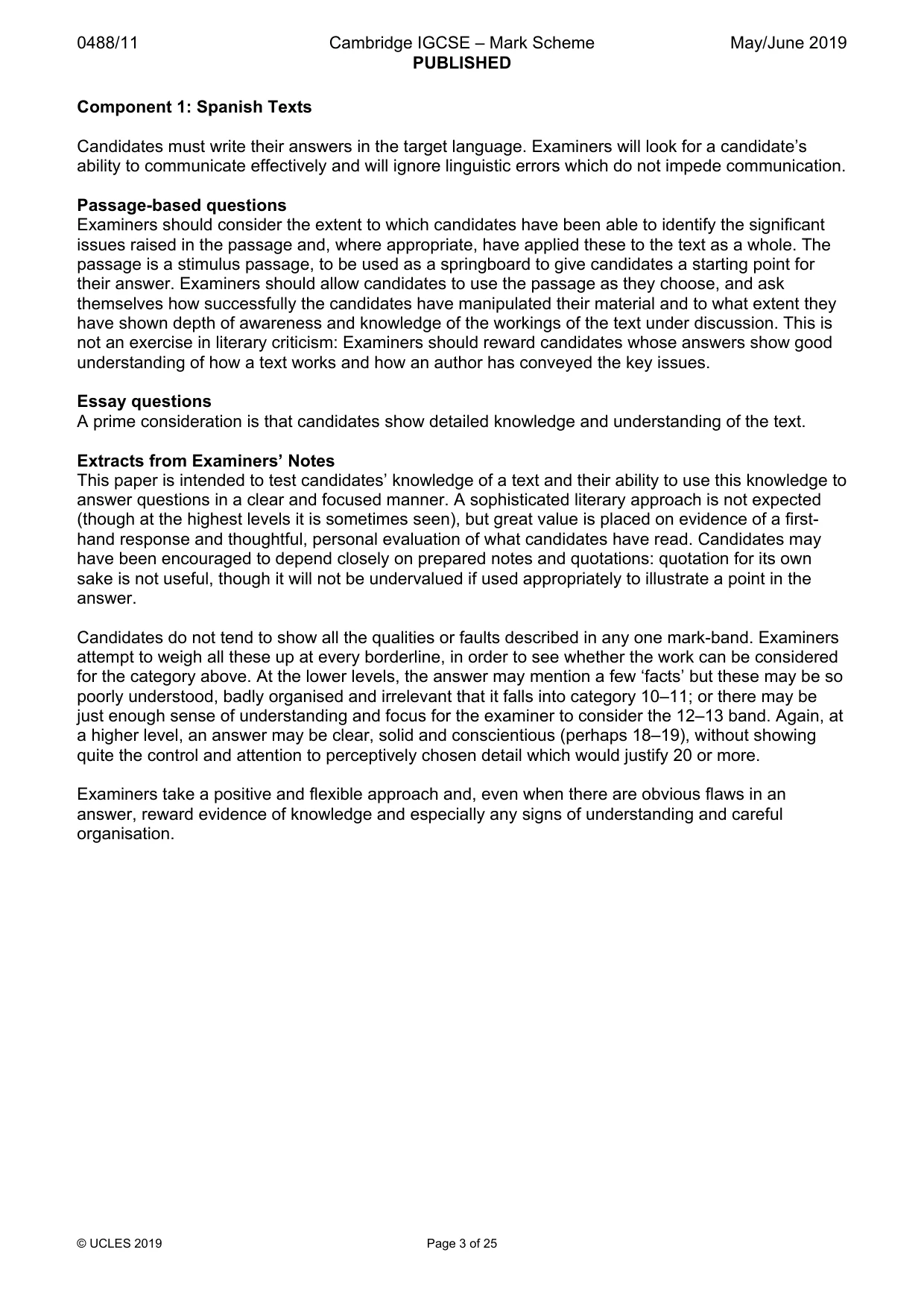
0488/11 Cambridge IGCSE – Mark Scheme PUBLISHED May/June 2019 © UCLES 2019 Page 3 of 25 Component 1: Spanish Texts Candidates must write their answers in the target language. Examiners will look for a candidate’s ability to communicate effectively and will ignore linguistic errors which do not impede communication. Passage-based questions Examiners should consider the extent to which candidates have been able to identify the significant issues raised in the passage and, where appropriate, have applied these to the text as a whole. The passage is a stimulus passage, to be used as a springboard to give candidates a starting point for their answer. Examiners should allow candidates to use the passage as they choose, and ask themselves how successfully the candidates have manipulated their material and to what extent they have shown depth of awareness and knowledge of the workings of the text under discussion. This is not an exercise in literary criticism: Examiners should reward candidates whose answers show good understanding of how a text works and how an author has conveyed the key issues. Essay questions A prime consideration is that candidates show detailed knowledge and understanding of the text. Extracts from Examiners’ Notes This paper is intended to test candidates’ knowledge of a text and their ability to use this knowledge to answer questions in a clear and focused manner. A sophisticated literary approach is not expected (though at the highest levels it is sometimes seen), but great value is placed on evidence of a first- hand response and thoughtful, personal evaluation of what candidates have read. Candidates may have been encouraged to depend closely on prepared notes and quotations: quotation for its own sake is not useful, though it will not be undervalued if used appropriately to illustrate a point in the answer. Candidates do not tend to show all the qualities or faults described in any one mark-band. Examiners attempt to weigh all these up at every borderline, in order to see whether the work can be considered for the category above. At the lower levels, the answer may mention a few ‘facts’ but these may be so poorly understood, badly organised and irrelevant that it falls into category 10–11; or there may be just enough sense of understanding and focus for the examiner to consider the 12–13 band. Again, at a higher level, an answer may be clear, solid and conscientious (perhaps 18–19), without showing quite the control and attention to perceptively chosen detail which would justify 20 or more. Examiners take a positive and flexible approach and, even when there are obvious flaws in an answer, reward evidence of knowledge and especially any signs of understanding and careful organisation.
Mark scheme, page 4
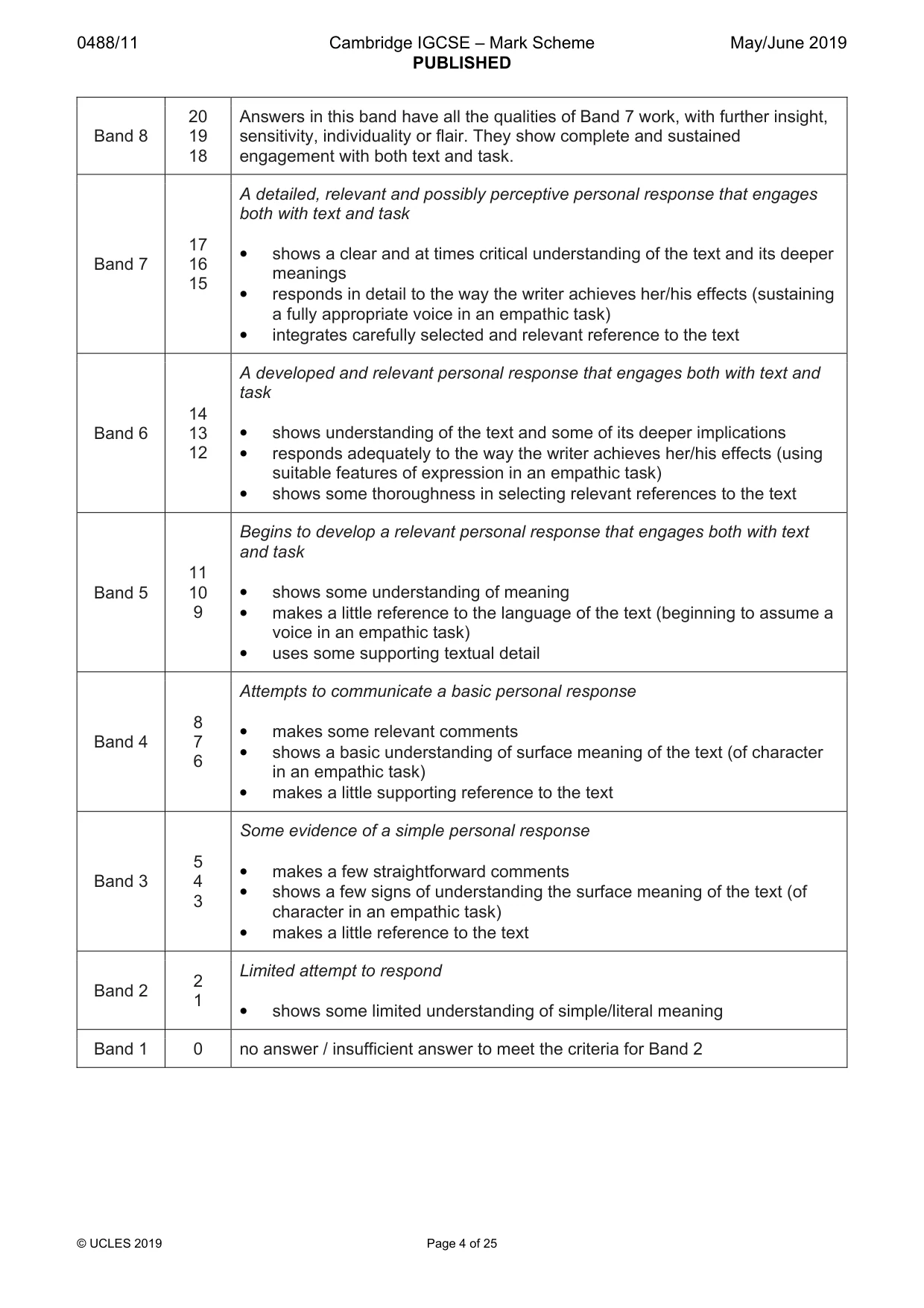
0488/11 Cambridge IGCSE – Mark Scheme PUBLISHED May/June 2019 © UCLES 2019 Page 4 of 25 Band 8 20 19 18 Answers in this band have all the qualities of Band 7 work, with further insight, sensitivity, individuality or flair. They show complete and sustained engagement with both text and task. Band 7 17 16 15 A detailed, relevant and possibly perceptive personal response that engages both with text and task • shows a clear and at times critical understanding of the text and its deeper meanings • responds in detail to the way the writer achieves her/his effects (sustaining a fully appropriate voice in an empathic task) • integrates carefully selected and relevant reference to the text Band 6 14 13 12 A developed and relevant personal response that engages both with text and task • shows understanding of the text and some of its deeper implications • responds adequately to the way the writer achieves her/his effects (using suitable features of expression in an empathic task) • shows some thoroughness in selecting relevant references to the text Band 5 11 10 9 Begins to develop a relevant personal response that engages both with text and task • shows some understanding of meaning • makes a little reference to the language of the text (beginning to assume a voice in an empathic task) • uses some supporting textual detail Band 4 8 7 6 Attempts to communicate a basic personal response • makes some relevant comments • shows a basic understanding of surface meaning of the text (of character in an empathic task) • makes a little supporting reference to the text Band 3 5 4 3 Some evidence of a simple personal response • makes a few straightforward comments • shows a few signs of understanding the surface meaning of the text (of character in an empathic task) • makes a little reference to the text Band 2 2 1 Limited attempt to respond • shows some limited understanding of simple/literal meaning Band 1 0 no answer / insufficient answer to meet the criteria for Band 2
Mark scheme, page 5
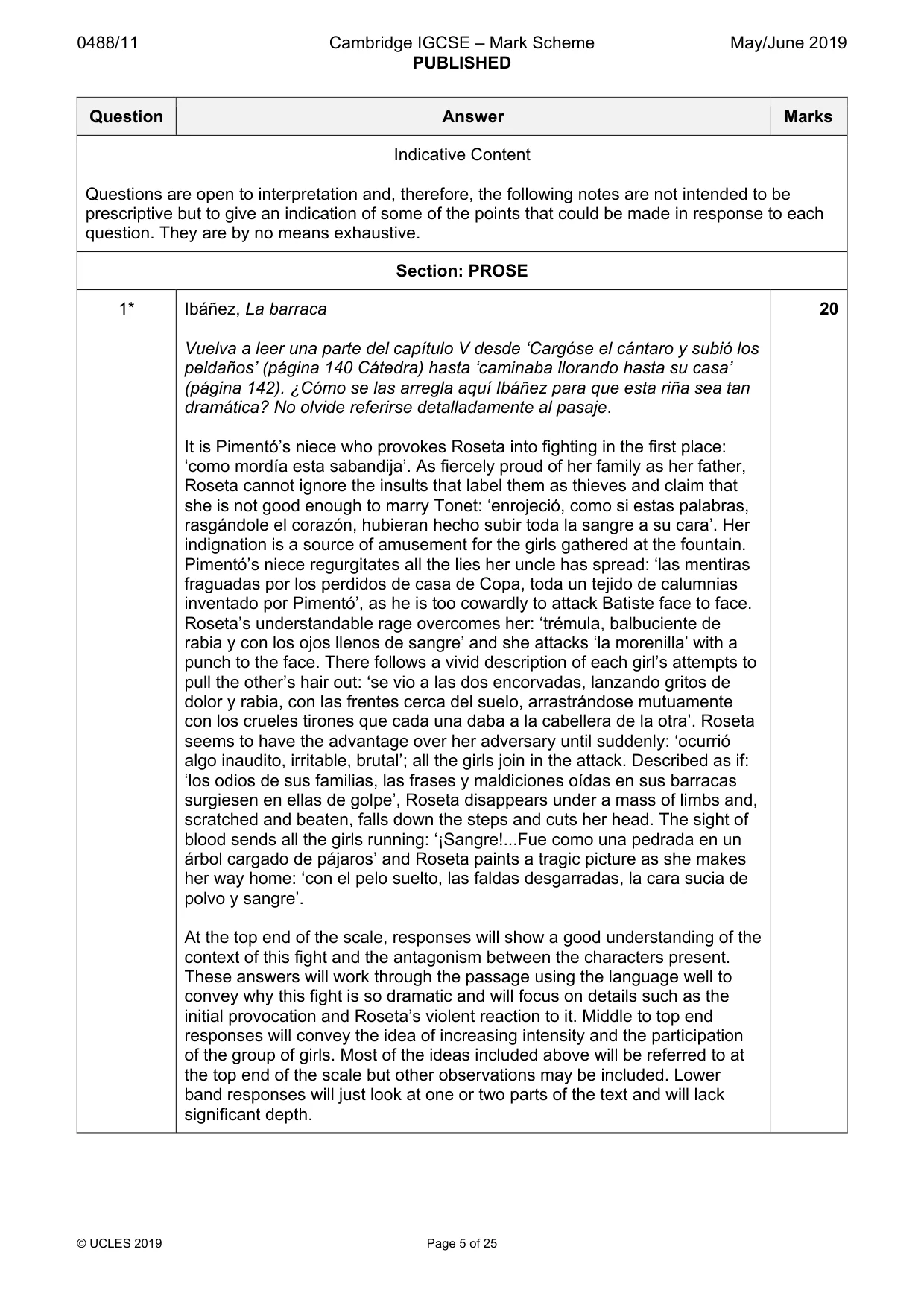
0488/11 Cambridge IGCSE – Mark Scheme PUBLISHED May/June 2019 © UCLES 2019 Page 5 of 25 Question Answer Marks Indicative Content Questions are open to interpretation and, therefore, the following notes are not intended to be prescriptive but to give an indication of some of the points that could be made in response to each question. They are by no means exhaustive. Section: PROSE 1* Ibáñez, La barraca Vuelva a leer una parte del capítulo V desde ‘Cargóse el cántaro y subió los peldaños’ (página 140 Cátedra) hasta ‘caminaba llorando hasta su casa’ (página 142). ¿Cómo se las arregla aquí Ibáñez para que esta riña sea tan dramática? No olvide referirse detalladamente al pasaje. It is Pimentó’s niece who provokes Roseta into fighting in the first place: ‘como mordía esta sabandija’. As fiercely proud of her family as her father, Roseta cannot ignore the insults that label them as thieves and claim that she is not good enough to marry Tonet: ‘enrojeció, como si estas palabras, rasgándole el corazón, hubieran hecho subir toda la sangre a su cara’. Her indignation is a source of amusement for the girls gathered at the fountain. Pimentó’s niece regurgitates all the lies her uncle has spread: ‘las mentiras fraguadas por los perdidos de casa de Copa, toda un tejido de calumnias inventado por Pimentó’, as he is too cowardly to attack Batiste face to face. Roseta’s understandable rage overcomes her: ‘trémula, balbuciente de rabia y con los ojos llenos de sangre’ and she attacks ‘la morenilla’ with a punch to the face. There follows a vivid description of each girl’s attempts to pull the other’s hair out: ‘se vio a las dos encorvadas, lanzando gritos de dolor y rabia, con las frentes cerca del suelo, arrastrándose mutuamente con los crueles tirones que cada una daba a la cabellera de la otra’. Roseta seems to have the advantage over her adversary until suddenly: ‘ocurrió algo inaudito, irritable, brutal’; all the girls join in the attack. Described as if: ‘los odios de sus familias, las frases y maldiciones oídas en sus barracas surgiesen en ellas de golpe’, Roseta disappears under a mass of limbs and, scratched and beaten, falls down the steps and cuts her head. The sight of blood sends all the girls running: ‘¡Sangre!...Fue como una pedrada en un árbol cargado de pájaros’ and Roseta paints a tragic picture as she makes her way home: ‘con el pelo suelto, las faldas desgarradas, la cara sucia de polvo y sangre’. At the top end of the scale, responses will show a good understanding of the context of this fight and the antagonism between the characters present. These answers will work through the passage using the language well to convey why this fight is so dramatic and will focus on details such as the initial provocation and Roseta’s violent reaction to it. Middle to top end responses will convey the idea of increasing intensity and the participation of the group of girls. Most of the ideas included above will be referred to at the top end of the scale but other observations may be included. Lower band responses will just look at one or two parts of the text and will lack significant depth. 20
Mark scheme, page 6
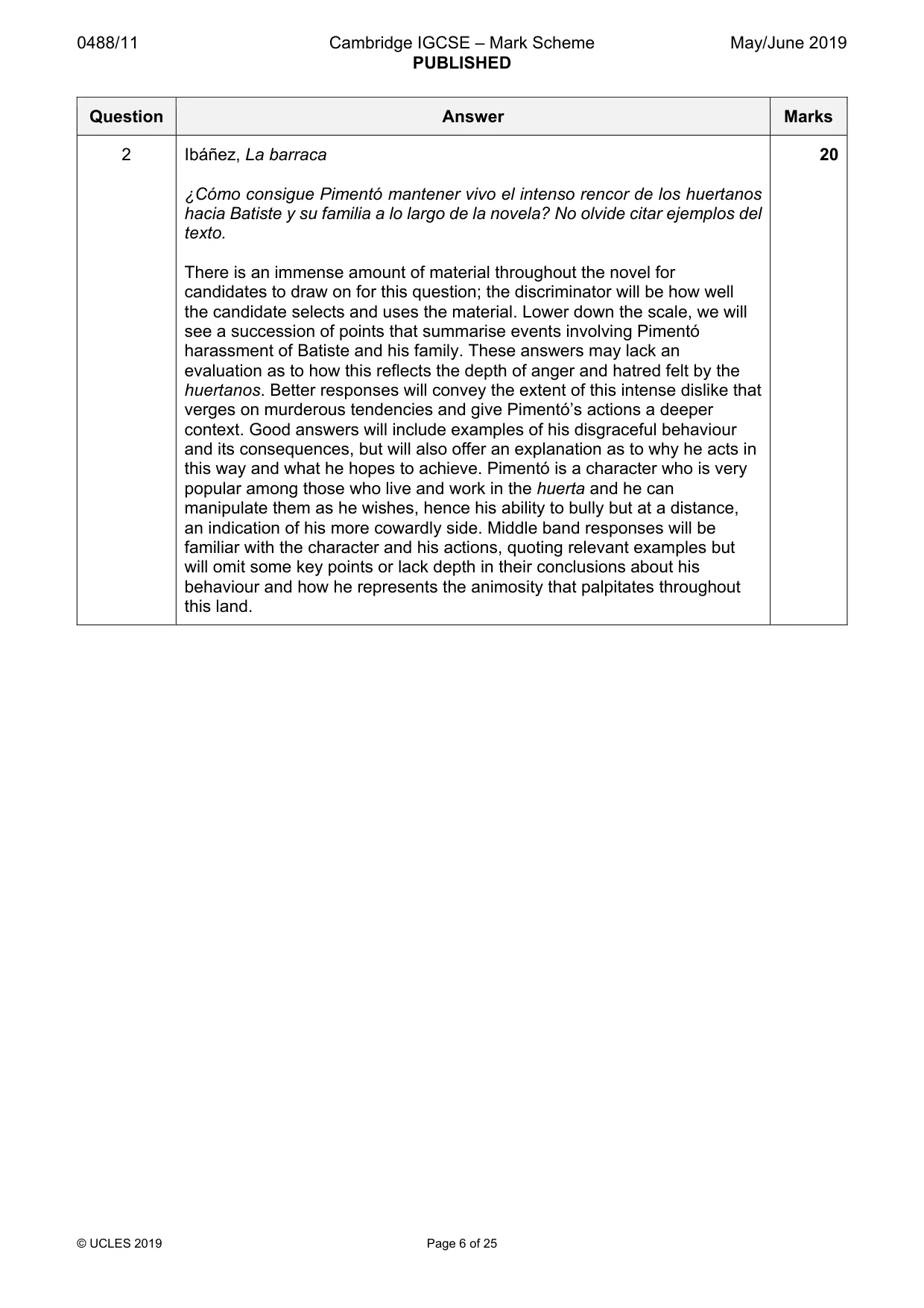
0488/11 Cambridge IGCSE – Mark Scheme PUBLISHED May/June 2019 © UCLES 2019 Page 6 of 25 Question Answer Marks 2 Ibáñez, La barraca ¿Cómo consigue Pimentó mantener vivo el intenso rencor de los huertanos hacia Batiste y su familia a lo largo de la novela? No olvide citar ejemplos del texto. There is an immense amount of material throughout the novel for candidates to draw on for this question; the discriminator will be how well the candidate selects and uses the material. Lower down the scale, we will see a succession of points that summarise events involving Pimentó harassment of Batiste and his family. These answers may lack an evaluation as to how this reflects the depth of anger and hatred felt by the huertanos. Better responses will convey the extent of this intense dislike that verges on murderous tendencies and give Pimentó’s actions a deeper context. Good answers will include examples of his disgraceful behaviour and its consequences, but will also offer an explanation as to why he acts in this way and what he hopes to achieve. Pimentó is a character who is very popular among those who live and work in the huerta and he can manipulate them as he wishes, hence his ability to bully but at a distance, an indication of his more cowardly side. Middle band responses will be familiar with the character and his actions, quoting relevant examples but will omit some key points or lack depth in their conclusions about his behaviour and how he represents the animosity that palpitates throughout this land. 20
Mark scheme, page 7
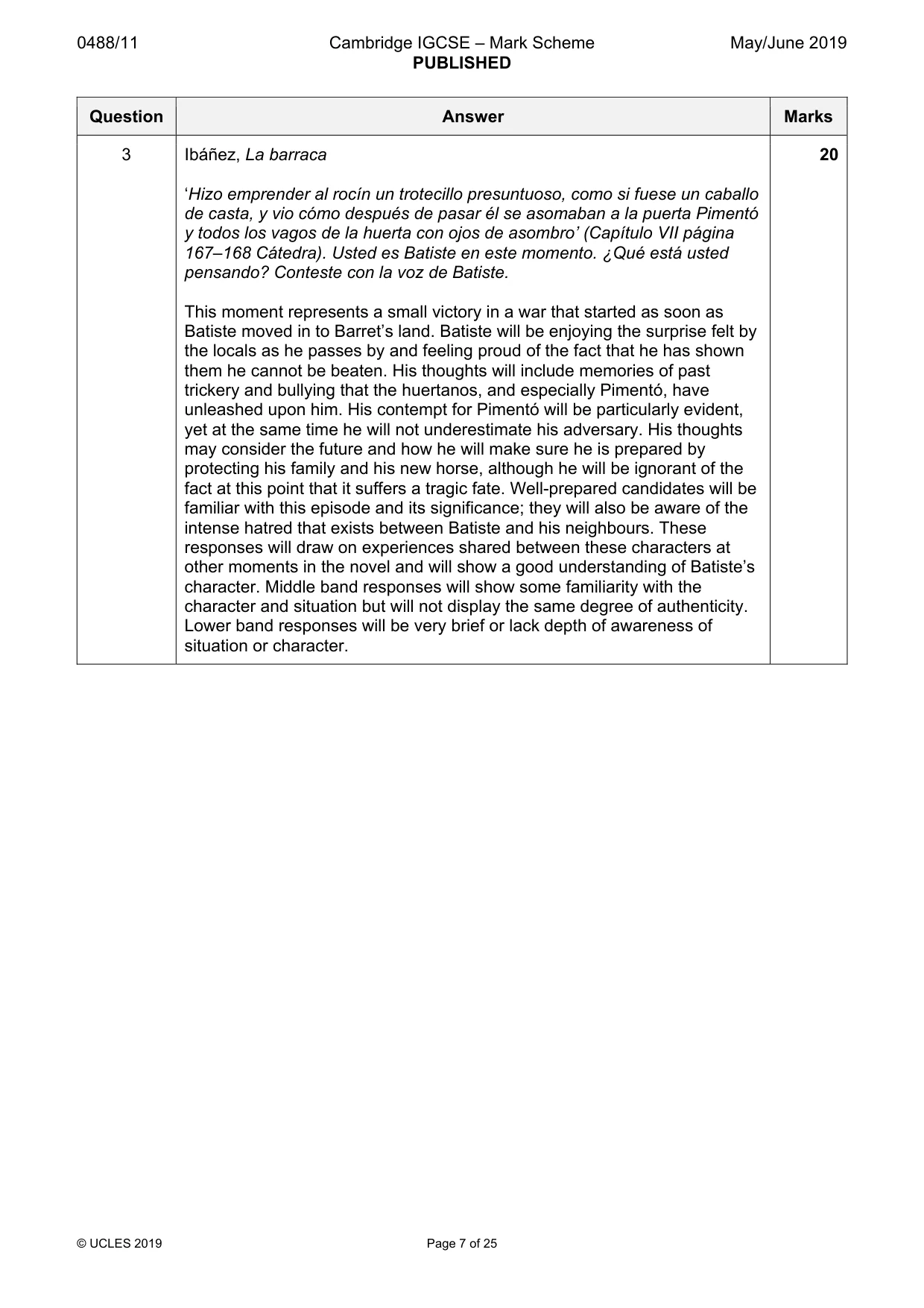
0488/11 Cambridge IGCSE – Mark Scheme PUBLISHED May/June 2019 © UCLES 2019 Page 7 of 25 Question Answer Marks 3 Ibáñez, La barraca ‘Hizo emprender al rocín un trotecillo presuntuoso, como si fuese un caballo de casta, y vio cómo después de pasar él se asomaban a la puerta Pimentó y todos los vagos de la huerta con ojos de asombro’ (Capítulo VII página 167–168 Cátedra). Usted es Batiste en este momento. ¿Qué está usted pensando? Conteste con la voz de Batiste. This moment represents a small victory in a war that started as soon as Batiste moved in to Barret’s land. Batiste will be enjoying the surprise felt by the locals as he passes by and feeling proud of the fact that he has shown them he cannot be beaten. His thoughts will include memories of past trickery and bullying that the huertanos, and especially Pimentó, have unleashed upon him. His contempt for Pimentó will be particularly evident, yet at the same time he will not underestimate his adversary. His thoughts may consider the future and how he will make sure he is prepared by protecting his family and his new horse, although he will be ignorant of the fact at this point that it suffers a tragic fate. Well-prepared candidates will be familiar with this episode and its significance; they will also be aware of the intense hatred that exists between Batiste and his neighbours. These responses will draw on experiences shared between these characters at other moments in the novel and will show a good understanding of Batiste’s character. Middle band responses will show some familiarity with the character and situation but will not display the same degree of authenticity. Lower band responses will be very brief or lack depth of awareness of situation or character. 20
Mark scheme, page 8
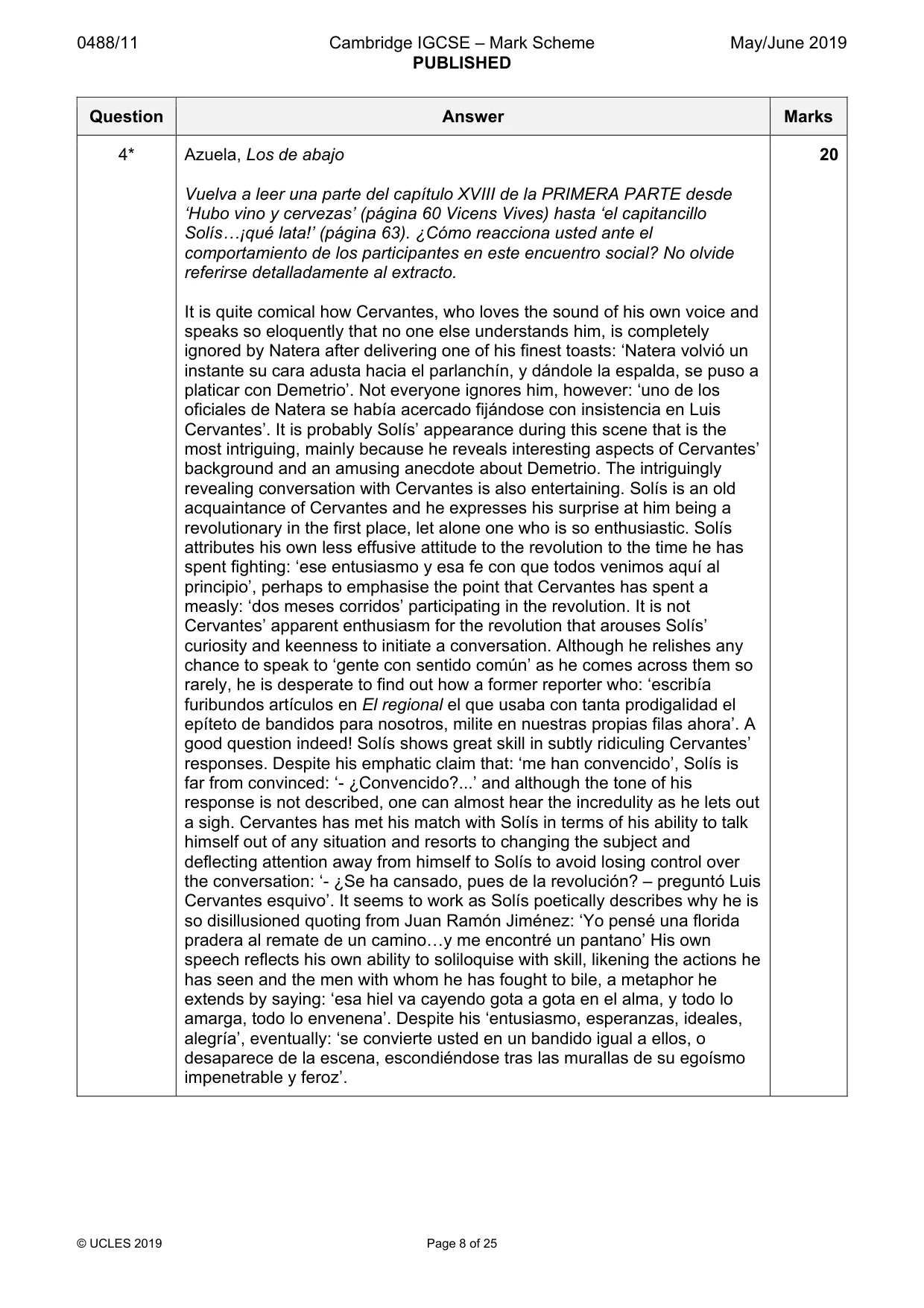
0488/11 Cambridge IGCSE – Mark Scheme PUBLISHED May/June 2019 © UCLES 2019 Page 8 of 25 Question Answer Marks 4* Azuela, Los de abajo Vuelva a leer una parte del capítulo XVIII de la PRIMERA PARTE desde ‘Hubo vino y cervezas’ (página 60 Vicens Vives) hasta ‘el capitancillo Solís«¡qué lata!’ (página 63). ¿Cómo reacciona usted ante el comportamiento de los participantes en este encuentro social? No olvide referirse detalladamente al extracto. It is quite comical how Cervantes, who loves the sound of his own voice and speaks so eloquently that no one else understands him, is completely ignored by Natera after delivering one of his finest toasts: ‘Natera volvió un instante su cara adusta hacia el parlanchín, y dándole la espalda, se puso a platicar con Demetrio’. Not everyone ignores him, however: ‘uno de los oficiales de Natera se había acercado fijándose con insistencia en Luis Cervantes’. It is probably Solís’ appearance during this scene that is the most intriguing, mainly because he reveals interesting aspects of Cervantes’ background and an amusing anecdote about Demetrio. The intriguingly revealing conversation with Cervantes is also entertaining. Solís is an old acquaintance of Cervantes and he expresses his surprise at him being a revolutionary in the first place, let alone one who is so enthusiastic. Solís attributes his own less effusive attitude to the revolution to the time he has spent fighting: ‘ese entusiasmo y esa fe con que todos venimos aquí al principio’, perhaps to emphasise the point that Cervantes has spent a measly: ‘dos meses corridos’ participating in the revolution. It is not Cervantes’ apparent enthusiasm for the revolution that arouses Solís’ curiosity and keenness to initiate a conversation. Although he relishes any chance to speak to ‘gente con sentido común’ as he comes across them so rarely, he is desperate to find out how a former reporter who: ‘escribía furibundos artículos en El regional el que usaba con tanta prodigalidad el epíteto de bandidos para nosotros, milite en nuestras propias filas ahora’. A good question indeed! Solís shows great skill in subtly ridiculing Cervantes’ responses. Despite his emphatic claim that: ‘me han convencido’, Solís is far from convinced: ‘- ¿Convencido?...’ and although the tone of his response is not described, one can almost hear the incredulity as he lets out a sigh. Cervantes has met his match with Solís in terms of his ability to talk himself out of any situation and resorts to changing the subject and deflecting attention away from himself to Solís to avoid losing control over the conversation: ‘- ¿Se ha cansado, pues de la revolución? – preguntó Luis Cervantes esquivo’. It seems to work as Solís poetically describes why he is so disillusioned quoting from Juan Ramón Jiménez: ‘Yo pensé una florida pradera al remate de un camino«y me encontré un pantano’ His own speech reflects his own ability to soliloquise with skill, likening the actions he has seen and the men with whom he has fought to bile, a metaphor he extends by saying: ‘esa hiel va cayendo gota a gota en el alma, y todo lo amarga, todo lo envenena’. Despite his ‘entusiasmo, esperanzas, ideales, alegría’, eventually: ‘se convierte usted en un bandido igual a ellos, o desaparece de la escena, escondiéndose tras las murallas de su egoísmo impenetrable y feroz’. 20
Mark scheme, page 9
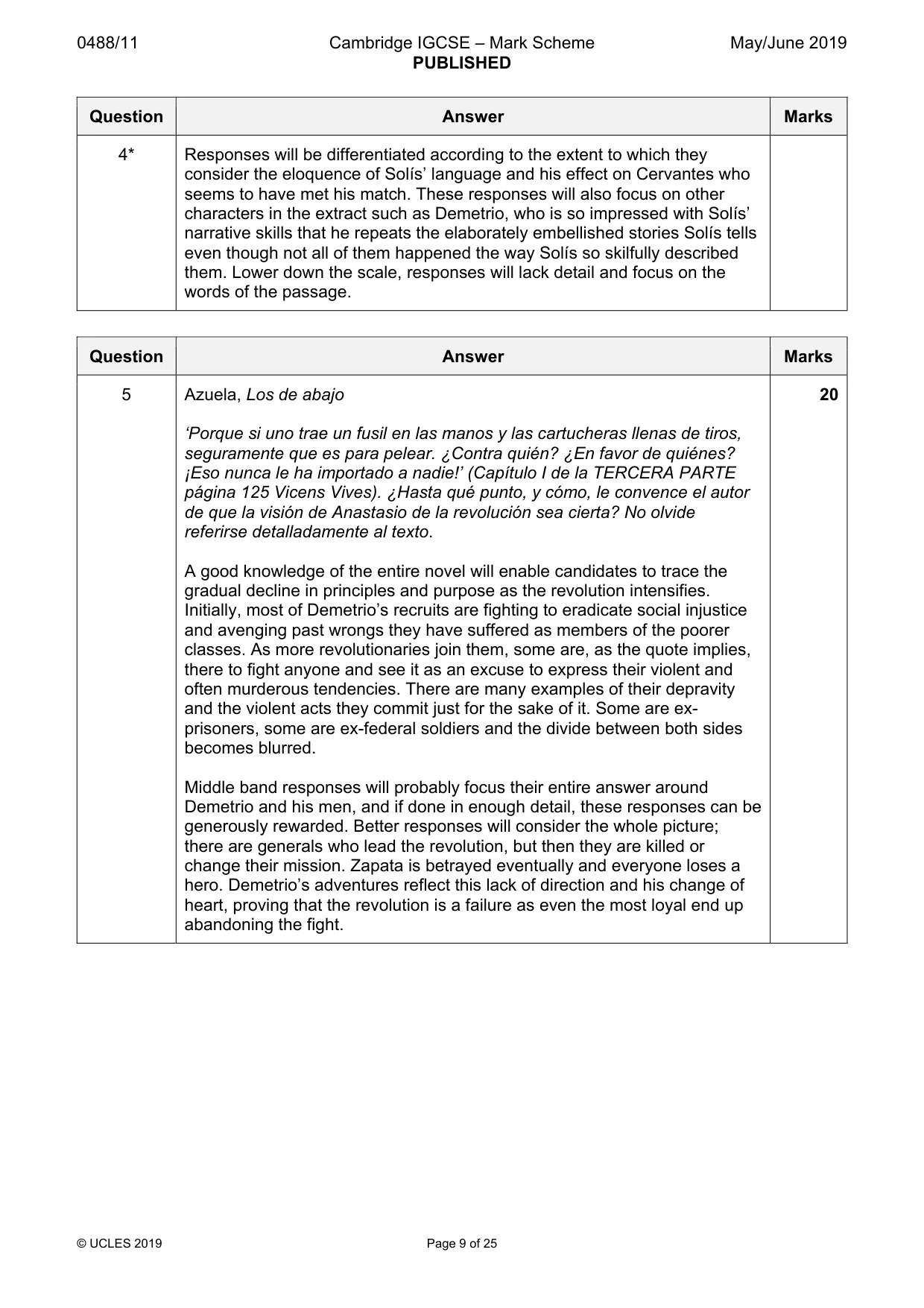
0488/11 Cambridge IGCSE – Mark Scheme PUBLISHED May/June 2019 © UCLES 2019 Page 9 of 25 Question Answer Marks 4* Responses will be differentiated according to the extent to which they consider the eloquence of Solís’ language and his effect on Cervantes who seems to have met his match. These responses will also focus on other characters in the extract such as Demetrio, who is so impressed with Solís’ narrative skills that he repeats the elaborately embellished stories Solís tells even though not all of them happened the way Solís so skilfully described them. Lower down the scale, responses will lack detail and focus on the words of the passage. Question Answer Marks 5 Azuela, Los de abajo ‘Porque si uno trae un fusil en las manos y las cartucheras llenas de tiros, seguramente que es para pelear. ¿Contra quién? ¿En favor de quiénes? ¡Eso nunca le ha importado a nadie!’ (Capítulo I de la TERCERA PARTE página 125 Vicens Vives). ¿Hasta qué punto, y cómo, le convence el autor de que la visión de Anastasio de la revolución sea cierta? No olvide referirse detalladamente al texto. A good knowledge of the entire novel will enable candidates to trace the gradual decline in principles and purpose as the revolution intensifies. Initially, most of Demetrio’s recruits are fighting to eradicate social injustice and avenging past wrongs they have suffered as members of the poorer classes. As more revolutionaries join them, some are, as the quote implies, there to fight anyone and see it as an excuse to express their violent and often murderous tendencies. There are many examples of their depravity and the violent acts they commit just for the sake of it. Some are ex- prisoners, some are ex-federal soldiers and the divide between both sides becomes blurred. Middle band responses will probably focus their entire answer around Demetrio and his men, and if done in enough detail, these responses can be generously rewarded. Better responses will consider the whole picture; there are generals who lead the revolution, but then they are killed or change their mission. Zapata is betrayed eventually and everyone loses a hero. Demetrio’s adventures reflect this lack of direction and his change of heart, proving that the revolution is a failure as even the most loyal end up abandoning the fight. 20
Mark scheme, page 10
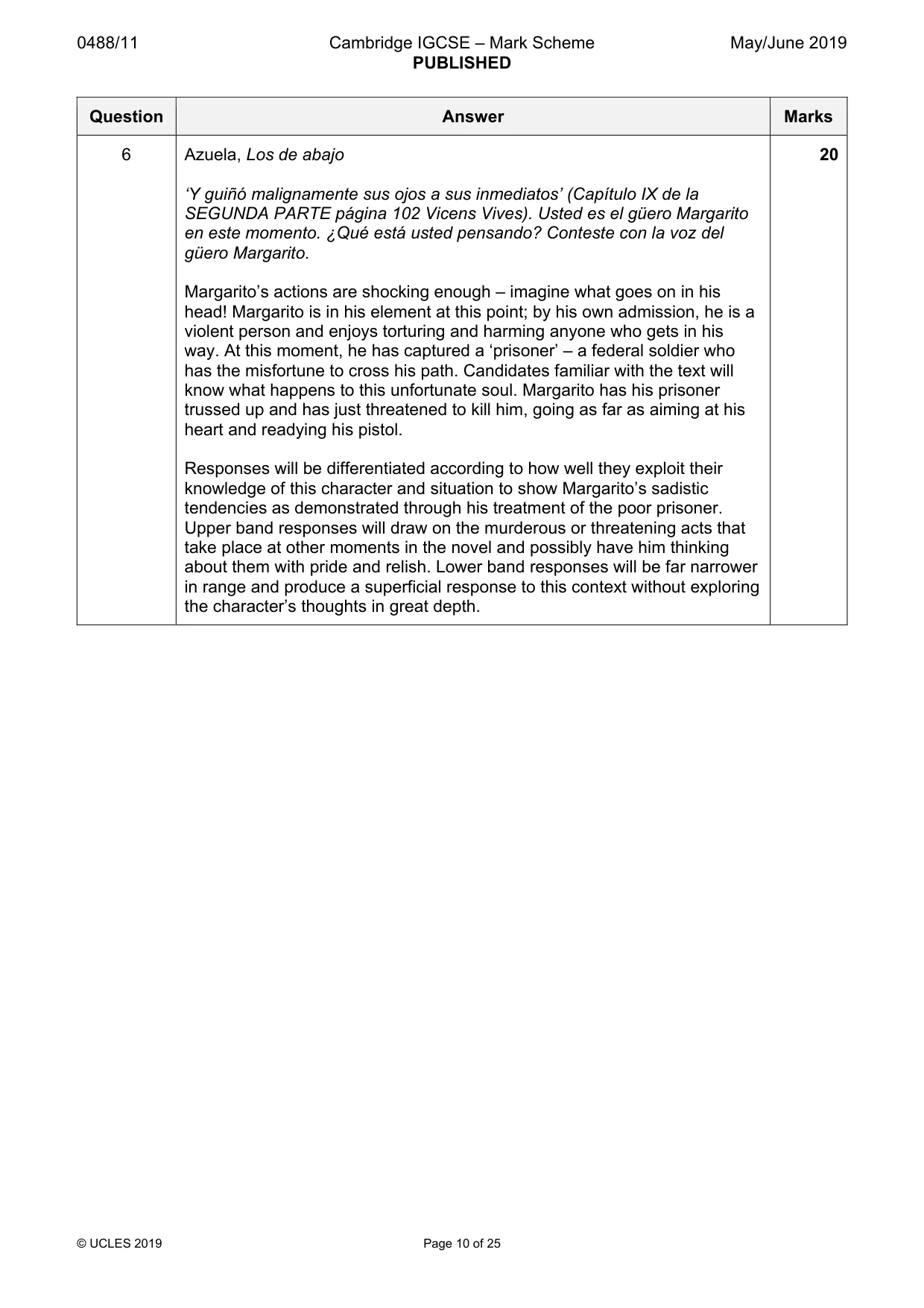
0488/11 Cambridge IGCSE – Mark Scheme PUBLISHED May/June 2019 © UCLES 2019 Page 10 of 25 Question Answer Marks 6 Azuela, Los de abajo ‘Y guiñó malignamente sus ojos a sus inmediatos’ (Capítulo IX de la SEGUNDA PARTE página 102 Vicens Vives). Usted es el güero Margarito en este momento. ¿Qué está usted pensando? Conteste con la voz del güero Margarito. Margarito’s actions are shocking enough – imagine what goes on in his head! Margarito is in his element at this point; by his own admission, he is a violent person and enjoys torturing and harming anyone who gets in his way. At this moment, he has captured a ‘prisoner’ – a federal soldier who has the misfortune to cross his path. Candidates familiar with the text will know what happens to this unfortunate soul. Margarito has his prisoner trussed up and has just threatened to kill him, going as far as aiming at his heart and readying his pistol. Responses will be differentiated according to how well they exploit their knowledge of this character and situation to show Margarito’s sadistic tendencies as demonstrated through his treatment of the poor prisoner. Upper band responses will draw on the murderous or threatening acts that take place at other moments in the novel and possibly have him thinking about them with pride and relish. Lower band responses will be far narrower in range and produce a superficial response to this context without exploring the character’s thoughts in great depth. 20
Mark scheme, page 11
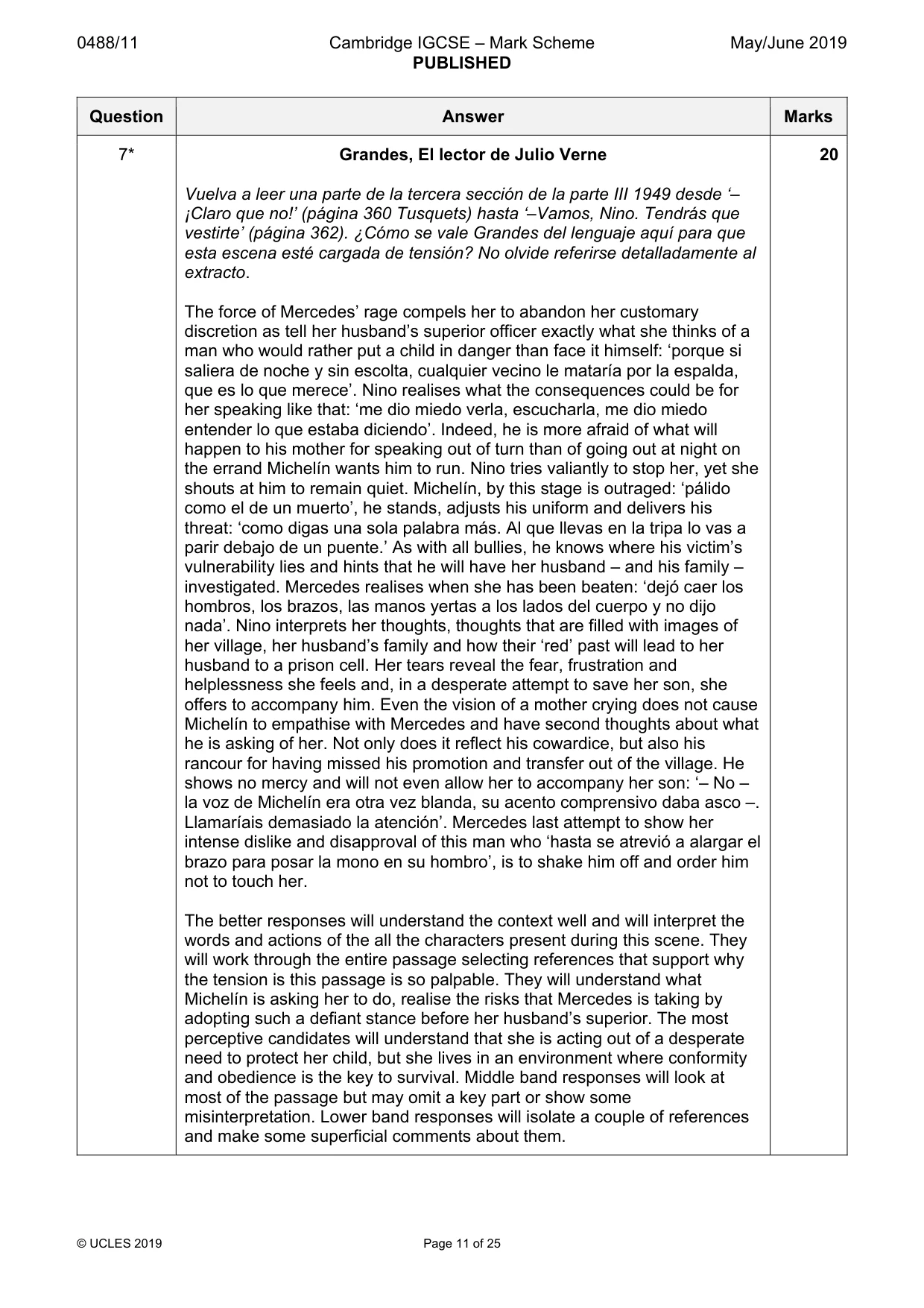
0488/11 Cambridge IGCSE – Mark Scheme PUBLISHED May/June 2019 © UCLES 2019 Page 11 of 25 Question Answer Marks 7* Grandes, El lector de Julio Verne Vuelva a leer una parte de la tercera sección de la parte III 1949 desde ‘– ¡Claro que no!’ (página 360 Tusquets) hasta ‘–Vamos, Nino. Tendrás que vestirte’ (página 362). ¿Cómo se vale Grandes del lenguaje aquí para que esta escena esté cargada de tensión? No olvide referirse detalladamente al extracto. The force of Mercedes’ rage compels her to abandon her customary discretion as tell her husband’s superior officer exactly what she thinks of a man who would rather put a child in danger than face it himself: ‘porque si saliera de noche y sin escolta, cualquier vecino le mataría por la espalda, que es lo que merece’. Nino realises what the consequences could be for her speaking like that: ‘me dio miedo verla, escucharla, me dio miedo entender lo que estaba diciendo’. Indeed, he is more afraid of what will happen to his mother for speaking out of turn than of going out at night on the errand Michelín wants him to run. Nino tries valiantly to stop her, yet she shouts at him to remain quiet. Michelín, by this stage is outraged: ‘pálido como el de un muerto’, he stands, adjusts his uniform and delivers his threat: ‘como digas una sola palabra más. Al que llevas en la tripa lo vas a parir debajo de un puente.’ As with all bullies, he knows where his victim’s vulnerability lies and hints that he will have her husband – and his family – investigated. Mercedes realises when she has been beaten: ‘dejó caer los hombros, los brazos, las manos yertas a los lados del cuerpo y no dijo nada’. Nino interprets her thoughts, thoughts that are filled with images of her village, her husband’s family and how their ‘red’ past will lead to her husband to a prison cell. Her tears reveal the fear, frustration and helplessness she feels and, in a desperate attempt to save her son, she offers to accompany him. Even the vision of a mother crying does not cause Michelín to empathise with Mercedes and have second thoughts about what he is asking of her. Not only does it reflect his cowardice, but also his rancour for having missed his promotion and transfer out of the village. He shows no mercy and will not even allow her to accompany her son: ‘– No – la voz de Michelín era otra vez blanda, su acento comprensivo daba asco –. Llamaríais demasiado la atención’. Mercedes last attempt to show her intense dislike and disapproval of this man who ‘hasta se atrevió a alargar el brazo para posar la mono en su hombro’, is to shake him off and order him not to touch her. The better responses will understand the context well and will interpret the words and actions of the all the characters present during this scene. They will work through the entire passage selecting references that support why the tension is this passage is so palpable. They will understand what Michelín is asking her to do, realise the risks that Mercedes is taking by adopting such a defiant stance before her husband’s superior. The most perceptive candidates will understand that she is acting out of a desperate need to protect her child, but she lives in an environment where conformity and obedience is the key to survival. Middle band responses will look at most of the passage but may omit a key part or show some misinterpretation. Lower band responses will isolate a couple of references and make some superficial comments about them. 20
Mark scheme, page 12
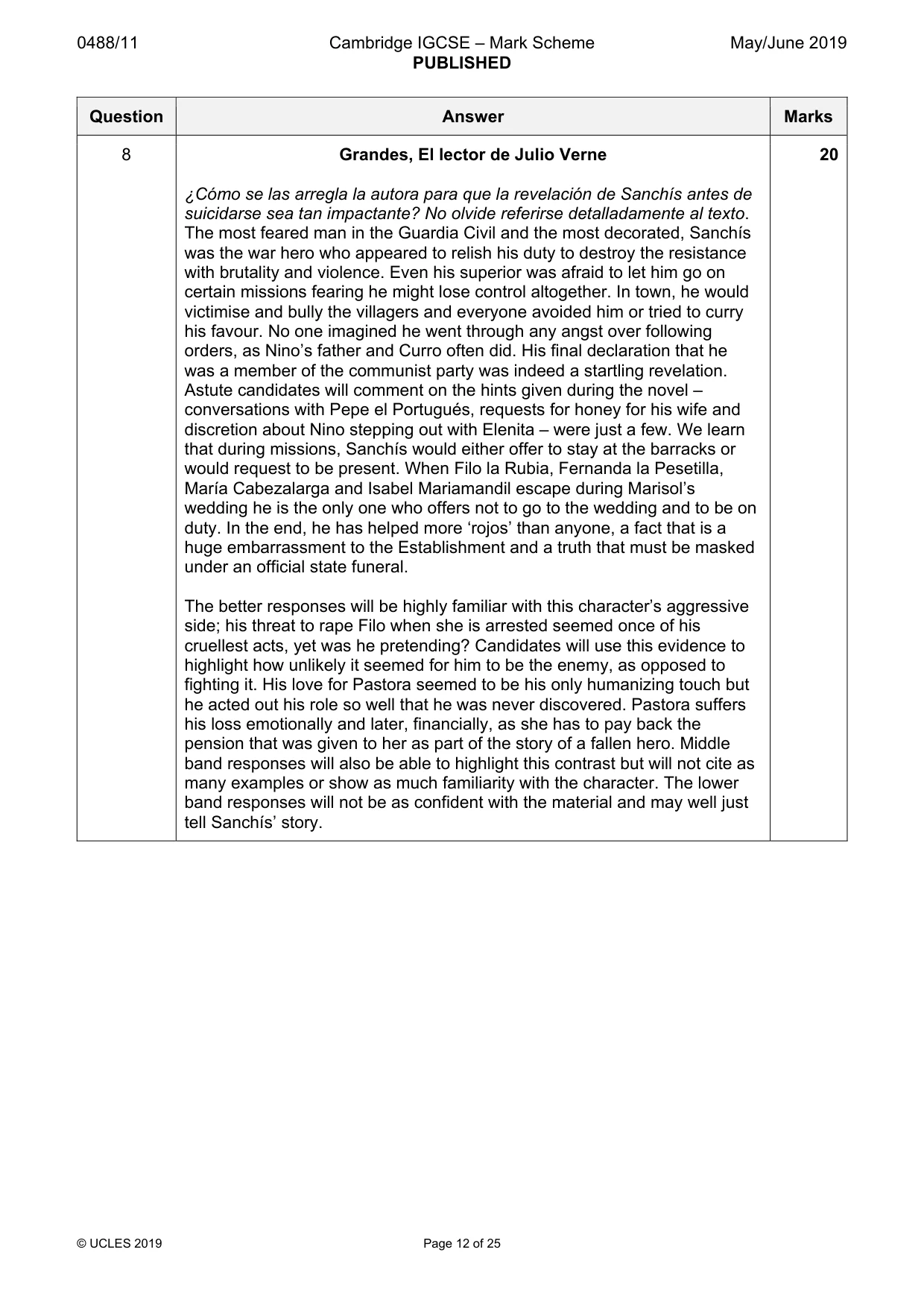
0488/11 Cambridge IGCSE – Mark Scheme PUBLISHED May/June 2019 © UCLES 2019 Page 12 of 25 Question Answer Marks 8 Grandes, El lector de Julio Verne ¿Cómo se las arregla la autora para que la revelación de Sanchís antes de suicidarse sea tan impactante? No olvide referirse detalladamente al texto. The most feared man in the Guardia Civil and the most decorated, Sanchís was the war hero who appeared to relish his duty to destroy the resistance with brutality and violence. Even his superior was afraid to let him go on certain missions fearing he might lose control altogether. In town, he would victimise and bully the villagers and everyone avoided him or tried to curry his favour. No one imagined he went through any angst over following orders, as Nino’s father and Curro often did. His final declaration that he was a member of the communist party was indeed a startling revelation. Astute candidates will comment on the hints given during the novel – conversations with Pepe el Portugués, requests for honey for his wife and discretion about Nino stepping out with Elenita – were just a few. We learn that during missions, Sanchís would either offer to stay at the barracks or would request to be present. When Filo la Rubia, Fernanda la Pesetilla, María Cabezalarga and Isabel Mariamandil escape during Marisol’s wedding he is the only one who offers not to go to the wedding and to be on duty. In the end, he has helped more ‘rojos’ than anyone, a fact that is a huge embarrassment to the Establishment and a truth that must be masked under an official state funeral. The better responses will be highly familiar with this character’s aggressive side; his threat to rape Filo when she is arrested seemed once of his cruellest acts, yet was he pretending? Candidates will use this evidence to highlight how unlikely it seemed for him to be the enemy, as opposed to fighting it. His love for Pastora seemed to be his only humanizing touch but he acted out his role so well that he was never discovered. Pastora suffers his loss emotionally and later, financially, as she has to pay back the pension that was given to her as part of the story of a fallen hero. Middle band responses will also be able to highlight this contrast but will not cite as many examples or show as much familiarity with the character. The lower band responses will not be as confident with the material and may well just tell Sanchís’ story. 20
Mark scheme, page 13
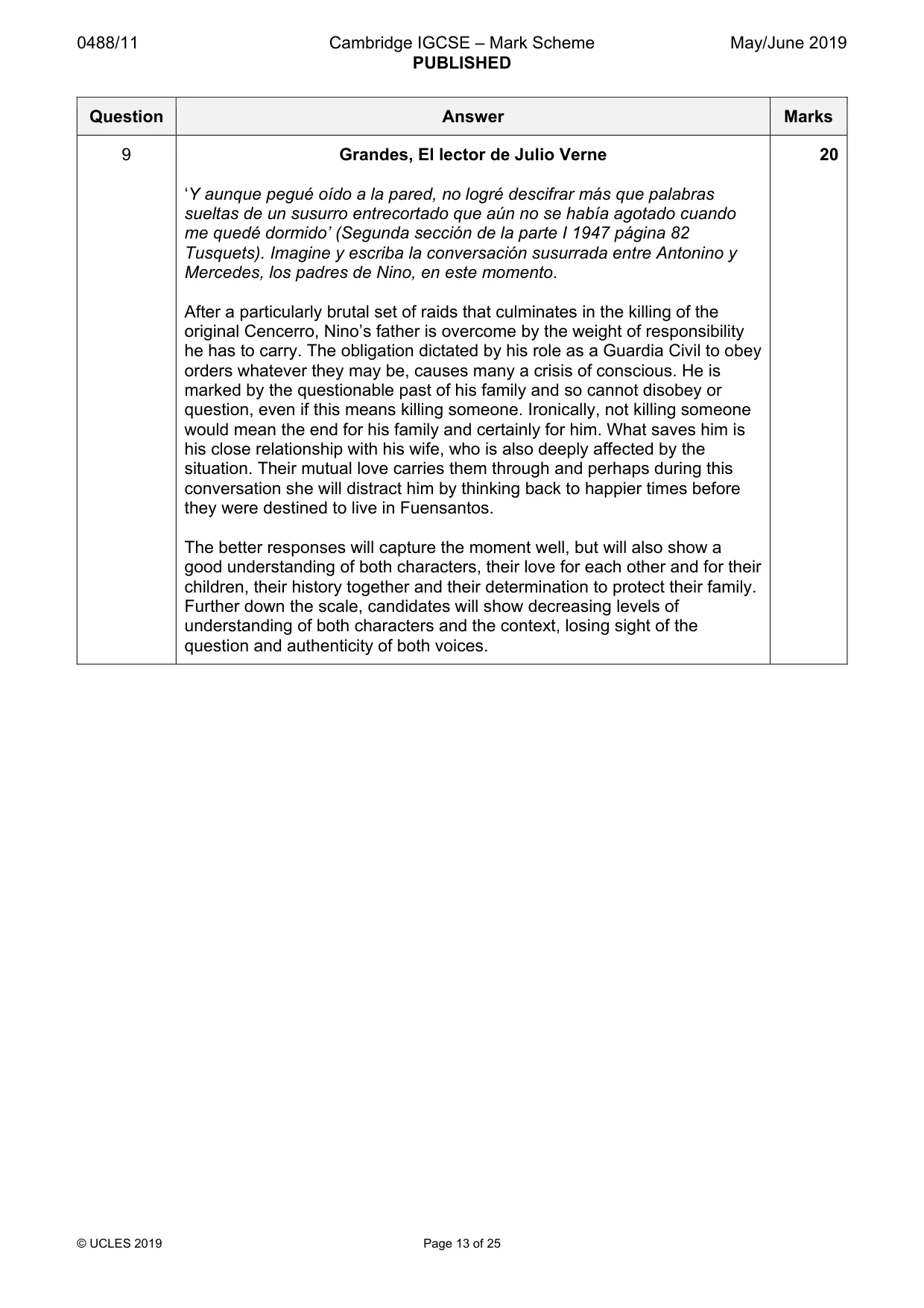
0488/11 Cambridge IGCSE – Mark Scheme PUBLISHED May/June 2019 © UCLES 2019 Page 13 of 25 Question Answer Marks 9 Grandes, El lector de Julio Verne ‘Y aunque pegué oído a la pared, no logré descifrar más que palabras sueltas de un susurro entrecortado que aún no se había agotado cuando me quedé dormido’ (Segunda sección de la parte I 1947 página 82 Tusquets). Imagine y escriba la conversación susurrada entre Antonino y Mercedes, los padres de Nino, en este momento. After a particularly brutal set of raids that culminates in the killing of the original Cencerro, Nino’s father is overcome by the weight of responsibility he has to carry. The obligation dictated by his role as a Guardia Civil to obey orders whatever they may be, causes many a crisis of conscious. He is marked by the questionable past of his family and so cannot disobey or question, even if this means killing someone. Ironically, not killing someone would mean the end for his family and certainly for him. What saves him is his close relationship with his wife, who is also deeply affected by the situation. Their mutual love carries them through and perhaps during this conversation she will distract him by thinking back to happier times before they were destined to live in Fuensantos. The better responses will capture the moment well, but will also show a good understanding of both characters, their love for each other and for their children, their history together and their determination to protect their family. Further down the scale, candidates will show decreasing levels of understanding of both characters and the context, losing sight of the question and authenticity of both voices. 20
Mark scheme, page 14
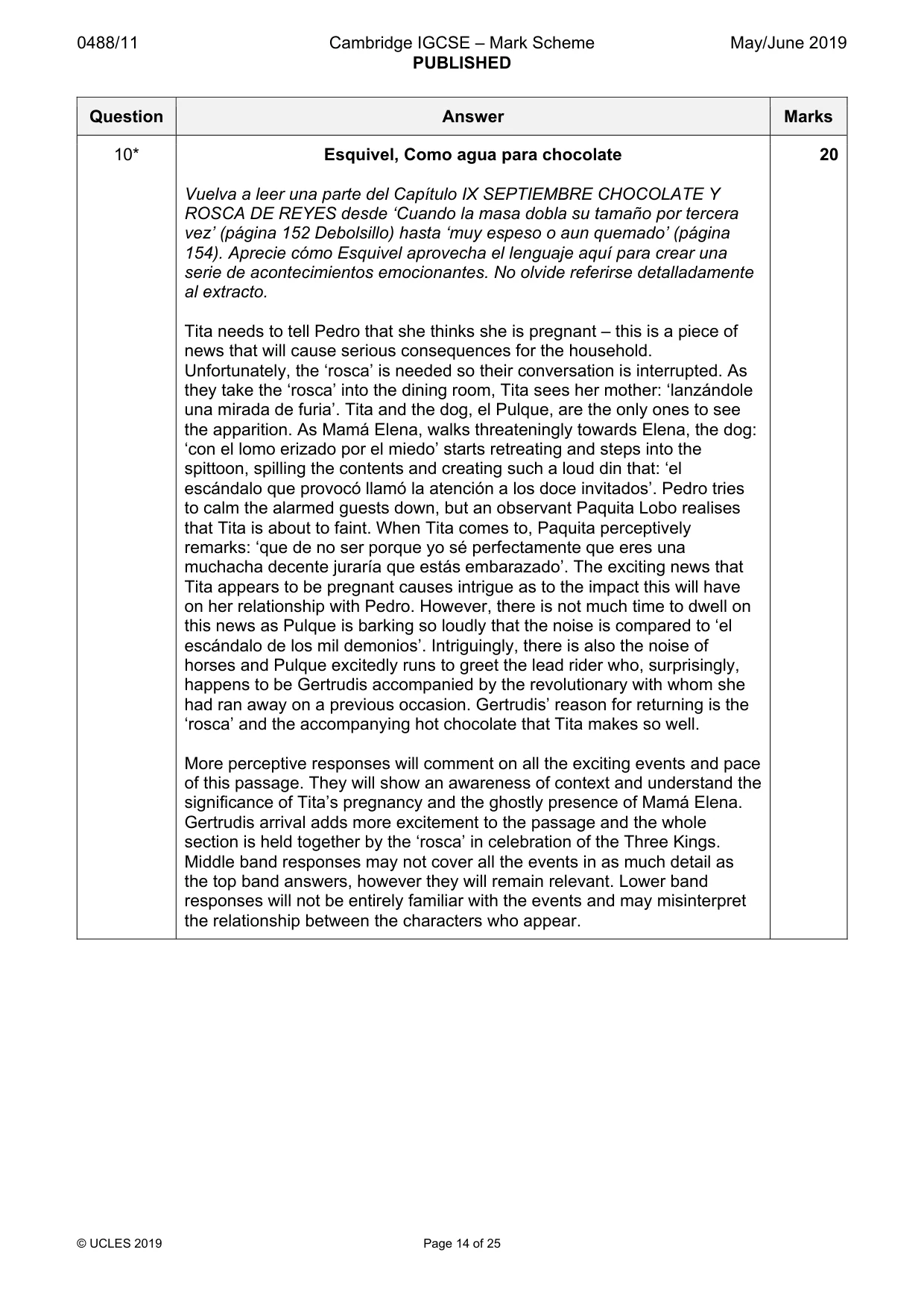
0488/11 Cambridge IGCSE – Mark Scheme PUBLISHED May/June 2019 © UCLES 2019 Page 14 of 25 Question Answer Marks 10* Esquivel, Como agua para chocolate Vuelva a leer una parte del Capítulo IX SEPTIEMBRE CHOCOLATE Y ROSCA DE REYES desde ‘Cuando la masa dobla su tamaño por tercera vez’ (página 152 Debolsillo) hasta ‘muy espeso o aun quemado’ (página 154). Aprecie cómo Esquivel aprovecha el lenguaje aquí para crear una serie de acontecimientos emocionantes. No olvide referirse detalladamente al extracto. Tita needs to tell Pedro that she thinks she is pregnant – this is a piece of news that will cause serious consequences for the household. Unfortunately, the ‘rosca’ is needed so their conversation is interrupted. As they take the ‘rosca’ into the dining room, Tita sees her mother: ‘lanzándole una mirada de furia’. Tita and the dog, el Pulque, are the only ones to see the apparition. As Mamá Elena, walks threateningly towards Elena, the dog: ‘con el lomo erizado por el miedo’ starts retreating and steps into the spittoon, spilling the contents and creating such a loud din that: ‘el escándalo que provocó llamó la atención a los doce invitados’. Pedro tries to calm the alarmed guests down, but an observant Paquita Lobo realises that Tita is about to faint. When Tita comes to, Paquita perceptively remarks: ‘que de no ser porque yo sé perfectamente que eres una muchacha decente juraría que estás embarazado’. The exciting news that Tita appears to be pregnant causes intrigue as to the impact this will have on her relationship with Pedro. However, there is not much time to dwell on this news as Pulque is barking so loudly that the noise is compared to ‘el escándalo de los mil demonios’. Intriguingly, there is also the noise of horses and Pulque excitedly runs to greet the lead rider who, surprisingly, happens to be Gertrudis accompanied by the revolutionary with whom she had ran away on a previous occasion. Gertrudis’ reason for returning is the ‘rosca’ and the accompanying hot chocolate that Tita makes so well. More perceptive responses will comment on all the exciting events and pace of this passage. They will show an awareness of context and understand the significance of Tita’s pregnancy and the ghostly presence of Mamá Elena. Gertrudis arrival adds more excitement to the passage and the whole section is held together by the ‘rosca’ in celebration of the Three Kings. Middle band responses may not cover all the events in as much detail as the top band answers, however they will remain relevant. Lower band responses will not be entirely familiar with the events and may misinterpret the relationship between the characters who appear. 20
Mark scheme, page 15
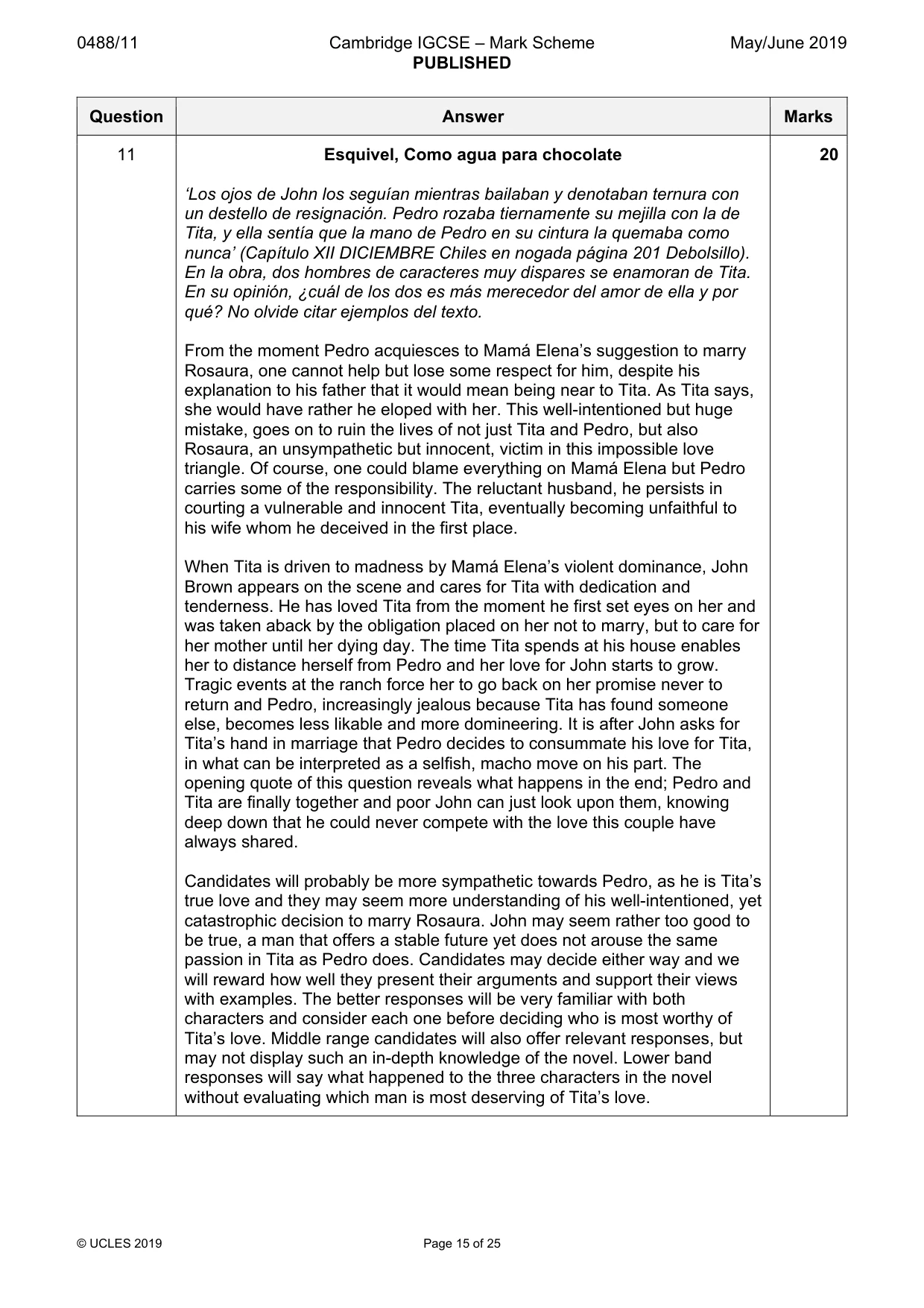
0488/11 Cambridge IGCSE – Mark Scheme PUBLISHED May/June 2019 © UCLES 2019 Page 15 of 25 Question Answer Marks 11 Esquivel, Como agua para chocolate ‘Los ojos de John los seguían mientras bailaban y denotaban ternura con un destello de resignación. Pedro rozaba tiernamente su mejilla con la de Tita, y ella sentía que la mano de Pedro en su cintura la quemaba como nunca’ (Capítulo XII DICIEMBRE Chiles en nogada página 201 Debolsillo). En la obra, dos hombres de caracteres muy dispares se enamoran de Tita. En su opinión, ¿cuál de los dos es más merecedor del amor de ella y por qué? No olvide citar ejemplos del texto. From the moment Pedro acquiesces to Mamá Elena’s suggestion to marry Rosaura, one cannot help but lose some respect for him, despite his explanation to his father that it would mean being near to Tita. As Tita says, she would have rather he eloped with her. This well-intentioned but huge mistake, goes on to ruin the lives of not just Tita and Pedro, but also Rosaura, an unsympathetic but innocent, victim in this impossible love triangle. Of course, one could blame everything on Mamá Elena but Pedro carries some of the responsibility. The reluctant husband, he persists in courting a vulnerable and innocent Tita, eventually becoming unfaithful to his wife whom he deceived in the first place. When Tita is driven to madness by Mamá Elena’s violent dominance, John Brown appears on the scene and cares for Tita with dedication and tenderness. He has loved Tita from the moment he first set eyes on her and was taken aback by the obligation placed on her not to marry, but to care for her mother until her dying day. The time Tita spends at his house enables her to distance herself from Pedro and her love for John starts to grow. Tragic events at the ranch force her to go back on her promise never to return and Pedro, increasingly jealous because Tita has found someone else, becomes less likable and more domineering. It is after John asks for Tita’s hand in marriage that Pedro decides to consummate his love for Tita, in what can be interpreted as a selfish, macho move on his part. The opening quote of this question reveals what happens in the end; Pedro and Tita are finally together and poor John can just look upon them, knowing deep down that he could never compete with the love this couple have always shared. Candidates will probably be more sympathetic towards Pedro, as he is Tita’s true love and they may seem more understanding of his well-intentioned, yet catastrophic decision to marry Rosaura. John may seem rather too good to be true, a man that offers a stable future yet does not arouse the same passion in Tita as Pedro does. Candidates may decide either way and we will reward how well they present their arguments and support their views with examples. The better responses will be very familiar with both characters and consider each one before deciding who is most worthy of Tita’s love. Middle range candidates will also offer relevant responses, but may not display such an in-depth knowledge of the novel. Lower band responses will say what happened to the three characters in the novel without evaluating which man is most deserving of Tita’s love. 20
Mark scheme, page 16
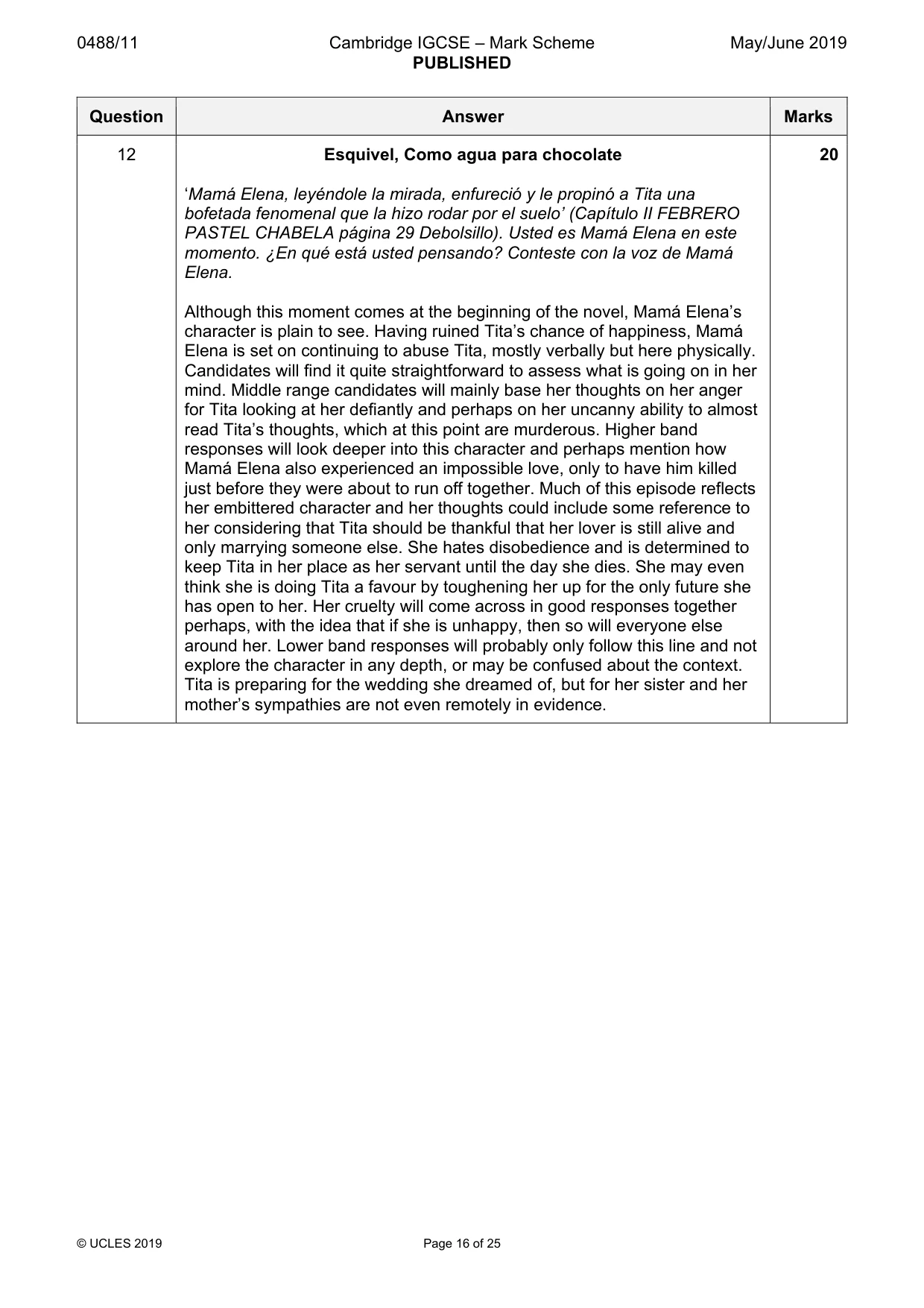
0488/11 Cambridge IGCSE – Mark Scheme PUBLISHED May/June 2019 © UCLES 2019 Page 16 of 25 Question Answer Marks 12 Esquivel, Como agua para chocolate ‘Mamá Elena, leyéndole la mirada, enfureció y le propinó a Tita una bofetada fenomenal que la hizo rodar por el suelo’ (Capítulo II FEBRERO PASTEL CHABELA página 29 Debolsillo). Usted es Mamá Elena en este momento. ¿En qué está usted pensando? Conteste con la voz de Mamá Elena. Although this moment comes at the beginning of the novel, Mamá Elena’s character is plain to see. Having ruined Tita’s chance of happiness, Mamá Elena is set on continuing to abuse Tita, mostly verbally but here physically. Candidates will find it quite straightforward to assess what is going on in her mind. Middle range candidates will mainly base her thoughts on her anger for Tita looking at her defiantly and perhaps on her uncanny ability to almost read Tita’s thoughts, which at this point are murderous. Higher band responses will look deeper into this character and perhaps mention how Mamá Elena also experienced an impossible love, only to have him killed just before they were about to run off together. Much of this episode reflects her embittered character and her thoughts could include some reference to her considering that Tita should be thankful that her lover is still alive and only marrying someone else. She hates disobedience and is determined to keep Tita in her place as her servant until the day she dies. She may even think she is doing Tita a favour by toughening her up for the only future she has open to her. Her cruelty will come across in good responses together perhaps, with the idea that if she is unhappy, then so will everyone else around her. Lower band responses will probably only follow this line and not explore the character in any depth, or may be confused about the context. Tita is preparing for the wedding she dreamed of, but for her sister and her mother’s sympathies are not even remotely in evidence. 20
Mark scheme, page 17
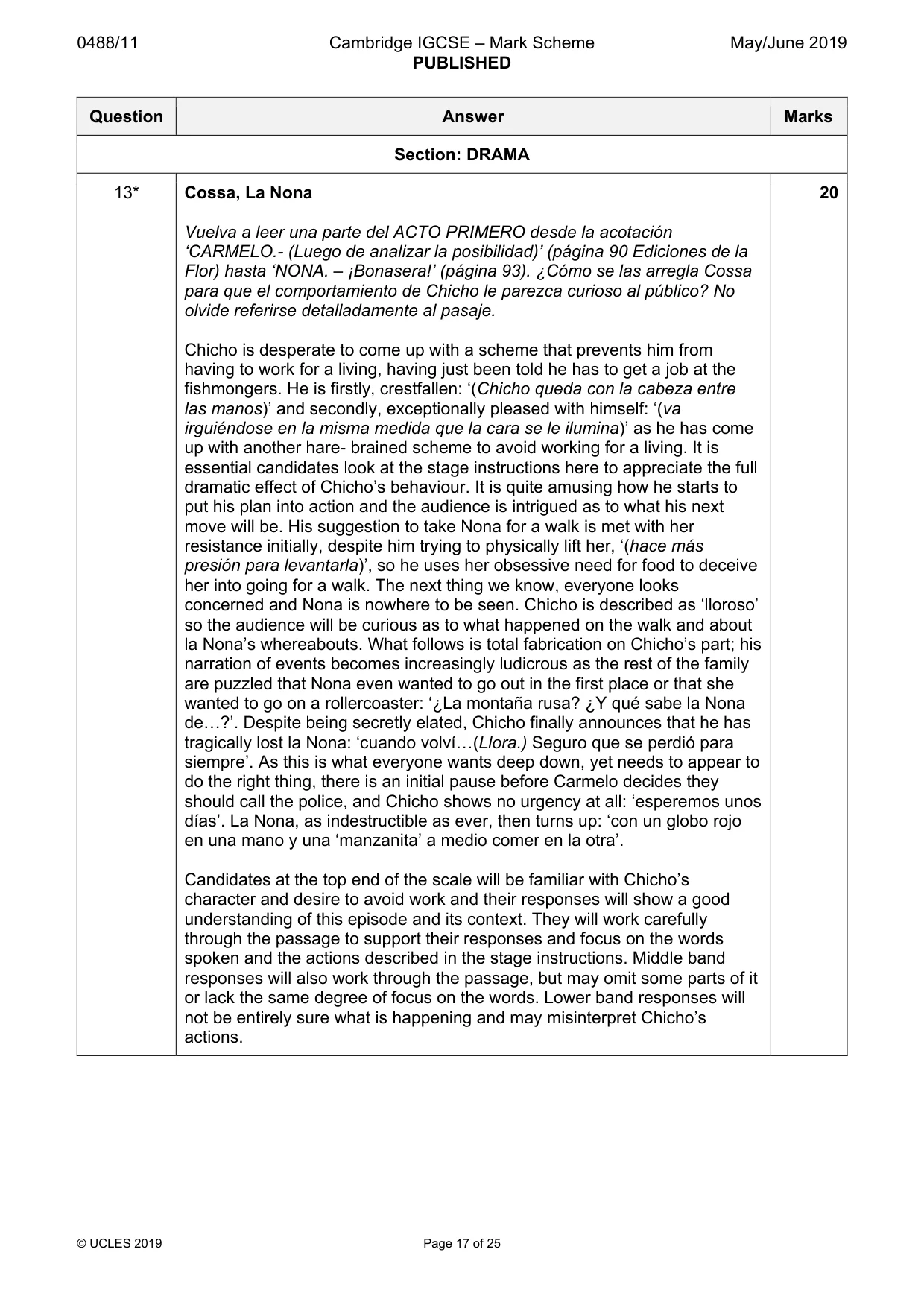
0488/11 Cambridge IGCSE – Mark Scheme PUBLISHED May/June 2019 © UCLES 2019 Page 17 of 25 Question Answer Marks Section: DRAMA 13* Cossa, La Nona Vuelva a leer una parte del ACTO PRIMERO desde la acotación ‘CARMELO.- (Luego de analizar la posibilidad)’ (página 90 Ediciones de la Flor) hasta ‘NONA. – ¡Bonasera!’ (página 93). ¿Cómo se las arregla Cossa para que el comportamiento de Chicho le parezca curioso al público? No olvide referirse detalladamente al pasaje. Chicho is desperate to come up with a scheme that prevents him from having to work for a living, having just been told he has to get a job at the fishmongers. He is firstly, crestfallen: ‘(Chicho queda con la cabeza entre las manos)’ and secondly, exceptionally pleased with himself: ‘(va irguiéndose en la misma medida que la cara se le ilumina)’ as he has come up with another hare- brained scheme to avoid working for a living. It is essential candidates look at the stage instructions here to appreciate the full dramatic effect of Chicho’s behaviour. It is quite amusing how he starts to put his plan into action and the audience is intrigued as to what his next move will be. His suggestion to take Nona for a walk is met with her resistance initially, despite him trying to physically lift her, ‘(hace más presión para levantarla)’, so he uses her obsessive need for food to deceive her into going for a walk. The next thing we know, everyone looks concerned and Nona is nowhere to be seen. Chicho is described as ‘lloroso’ so the audience will be curious as to what happened on the walk and about la Nona’s whereabouts. What follows is total fabrication on Chicho’s part; his narration of events becomes increasingly ludicrous as the rest of the family are puzzled that Nona even wanted to go out in the first place or that she wanted to go on a rollercoaster: ‘¿La montaña rusa? ¿Y qué sabe la Nona de«?’. Despite being secretly elated, Chicho finally announces that he has tragically lost la Nona: ‘cuando volví«(Llora.) Seguro que se perdió para siempre’. As this is what everyone wants deep down, yet needs to appear to do the right thing, there is an initial pause before Carmelo decides they should call the police, and Chicho shows no urgency at all: ‘esperemos unos días’. La Nona, as indestructible as ever, then turns up: ‘con un globo rojo en una mano y una ‘manzanita’ a medio comer en la otra’. Candidates at the top end of the scale will be familiar with Chicho’s character and desire to avoid work and their responses will show a good understanding of this episode and its context. They will work carefully through the passage to support their responses and focus on the words spoken and the actions described in the stage instructions. Middle band responses will also work through the passage, but may omit some parts of it or lack the same degree of focus on the words. Lower band responses will not be entirely sure what is happening and may misinterpret Chicho’s actions. 20
Mark scheme, page 18
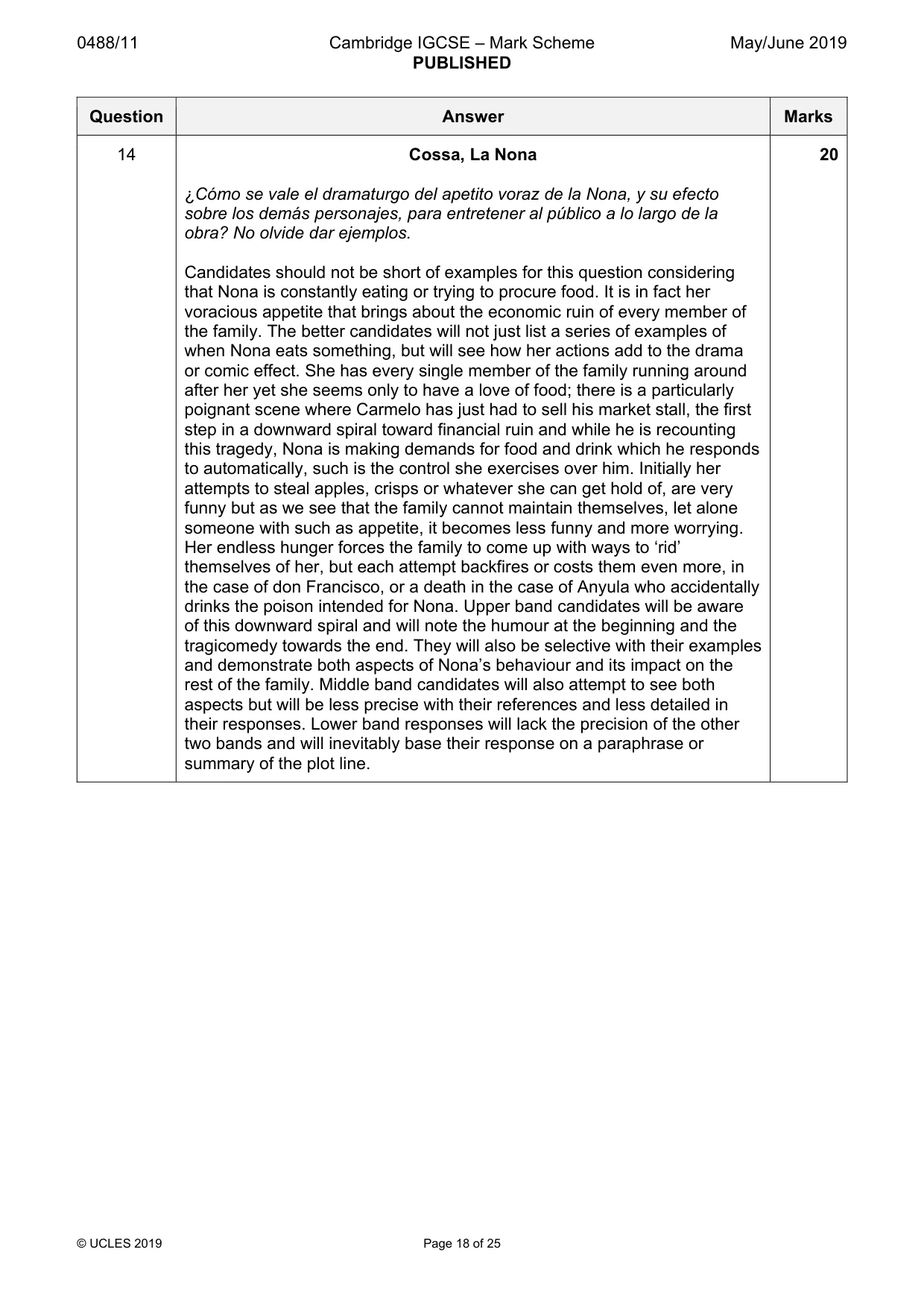
0488/11 Cambridge IGCSE – Mark Scheme PUBLISHED May/June 2019 © UCLES 2019 Page 18 of 25 Question Answer Marks 14 Cossa, La Nona ¿Cómo se vale el dramaturgo del apetito voraz de la Nona, y su efecto sobre los demás personajes, para entretener al público a lo largo de la obra? No olvide dar ejemplos. Candidates should not be short of examples for this question considering that Nona is constantly eating or trying to procure food. It is in fact her voracious appetite that brings about the economic ruin of every member of the family. The better candidates will not just list a series of examples of when Nona eats something, but will see how her actions add to the drama or comic effect. She has every single member of the family running around after her yet she seems only to have a love of food; there is a particularly poignant scene where Carmelo has just had to sell his market stall, the first step in a downward spiral toward financial ruin and while he is recounting this tragedy, Nona is making demands for food and drink which he responds to automatically, such is the control she exercises over him. Initially her attempts to steal apples, crisps or whatever she can get hold of, are very funny but as we see that the family cannot maintain themselves, let alone someone with such as appetite, it becomes less funny and more worrying. Her endless hunger forces the family to come up with ways to ‘rid’ themselves of her, but each attempt backfires or costs them even more, in the case of don Francisco, or a death in the case of Anyula who accidentally drinks the poison intended for Nona. Upper band candidates will be aware of this downward spiral and will note the humour at the beginning and the tragicomedy towards the end. They will also be selective with their examples and demonstrate both aspects of Nona’s behaviour and its impact on the rest of the family. Middle band candidates will also attempt to see both aspects but will be less precise with their references and less detailed in their responses. Lower band responses will lack the precision of the other two bands and will inevitably base their response on a paraphrase or summary of the plot line. 20
Mark scheme, page 19
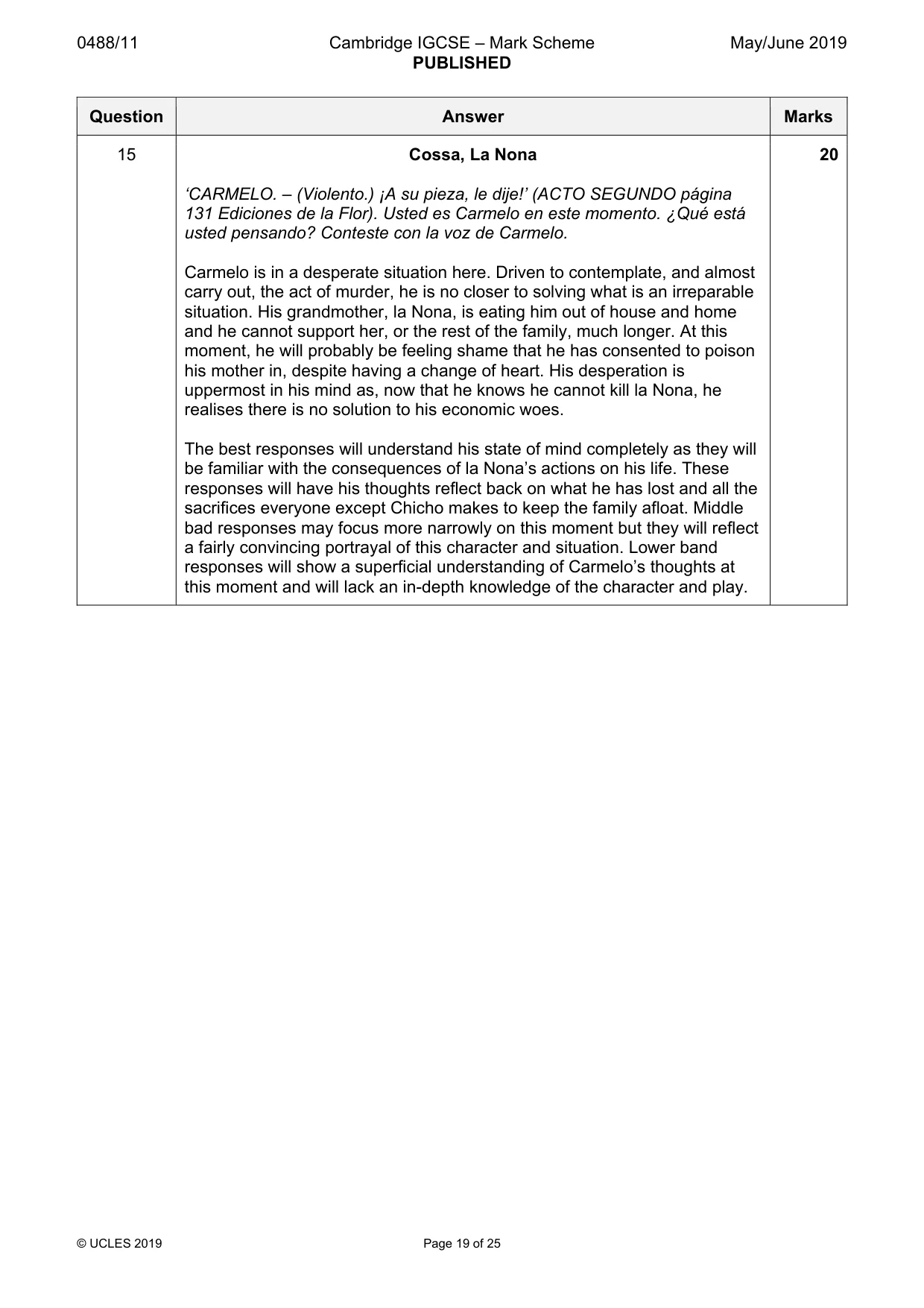
0488/11 Cambridge IGCSE – Mark Scheme PUBLISHED May/June 2019 © UCLES 2019 Page 19 of 25 Question Answer Marks 15 Cossa, La Nona ‘CARMELO. – (Violento.) ¡A su pieza, le dije!’ (ACTO SEGUNDO página 131 Ediciones de la Flor). Usted es Carmelo en este momento. ¿Qué está usted pensando? Conteste con la voz de Carmelo. Carmelo is in a desperate situation here. Driven to contemplate, and almost carry out, the act of murder, he is no closer to solving what is an irreparable situation. His grandmother, la Nona, is eating him out of house and home and he cannot support her, or the rest of the family, much longer. At this moment, he will probably be feeling shame that he has consented to poison his mother in, despite having a change of heart. His desperation is uppermost in his mind as, now that he knows he cannot kill la Nona, he realises there is no solution to his economic woes. The best responses will understand his state of mind completely as they will be familiar with the consequences of la Nona’s actions on his life. These responses will have his thoughts reflect back on what he has lost and all the sacrifices everyone except Chicho makes to keep the family afloat. Middle bad responses may focus more narrowly on this moment but they will reflect a fairly convincing portrayal of this character and situation. Lower band responses will show a superficial understanding of Carmelo’s thoughts at this moment and will lack an in-depth knowledge of the character and play. 20
Mark scheme, page 20
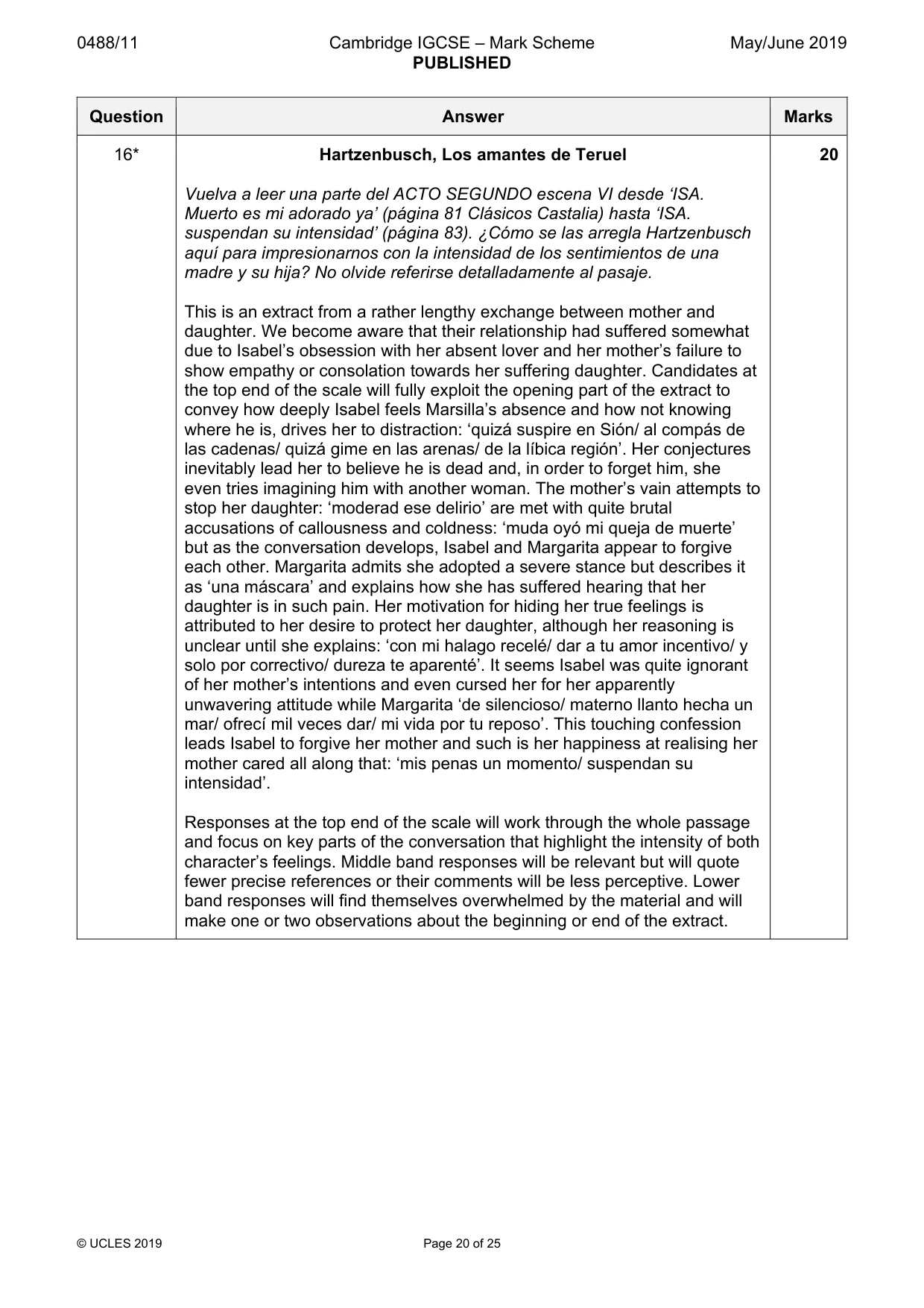
0488/11 Cambridge IGCSE – Mark Scheme PUBLISHED May/June 2019 © UCLES 2019 Page 20 of 25 Question Answer Marks 16* Hartzenbusch, Los amantes de Teruel Vuelva a leer una parte del ACTO SEGUNDO escena VI desde ‘ISA. Muerto es mi adorado ya’ (página 81 Clásicos Castalia) hasta ‘ISA. suspendan su intensidad’ (página 83). ¿Cómo se las arregla Hartzenbusch aquí para impresionarnos con la intensidad de los sentimientos de una madre y su hija? No olvide referirse detalladamente al pasaje. This is an extract from a rather lengthy exchange between mother and daughter. We become aware that their relationship had suffered somewhat due to Isabel’s obsession with her absent lover and her mother’s failure to show empathy or consolation towards her suffering daughter. Candidates at the top end of the scale will fully exploit the opening part of the extract to convey how deeply Isabel feels Marsilla’s absence and how not knowing where he is, drives her to distraction: ‘quizá suspire en Sión/ al compás de las cadenas/ quizá gime en las arenas/ de la líbica región’. Her conjectures inevitably lead her to believe he is dead and, in order to forget him, she even tries imagining him with another woman. The mother’s vain attempts to stop her daughter: ‘moderad ese delirio’ are met with quite brutal accusations of callousness and coldness: ‘muda oyó mi queja de muerte’ but as the conversation develops, Isabel and Margarita appear to forgive each other. Margarita admits she adopted a severe stance but describes it as ‘una máscara’ and explains how she has suffered hearing that her daughter is in such pain. Her motivation for hiding her true feelings is attributed to her desire to protect her daughter, although her reasoning is unclear until she explains: ‘con mi halago recelé/ dar a tu amor incentivo/ y solo por correctivo/ dureza te aparenté’. It seems Isabel was quite ignorant of her mother’s intentions and even cursed her for her apparently unwavering attitude while Margarita ‘de silencioso/ materno llanto hecha un mar/ ofrecí mil veces dar/ mi vida por tu reposo’. This touching confession leads Isabel to forgive her mother and such is her happiness at realising her mother cared all along that: ‘mis penas un momento/ suspendan su intensidad’. Responses at the top end of the scale will work through the whole passage and focus on key parts of the conversation that highlight the intensity of both character’s feelings. Middle band responses will be relevant but will quote fewer precise references or their comments will be less perceptive. Lower band responses will find themselves overwhelmed by the material and will make one or two observations about the beginning or end of the extract. 20
Mark scheme, page 21
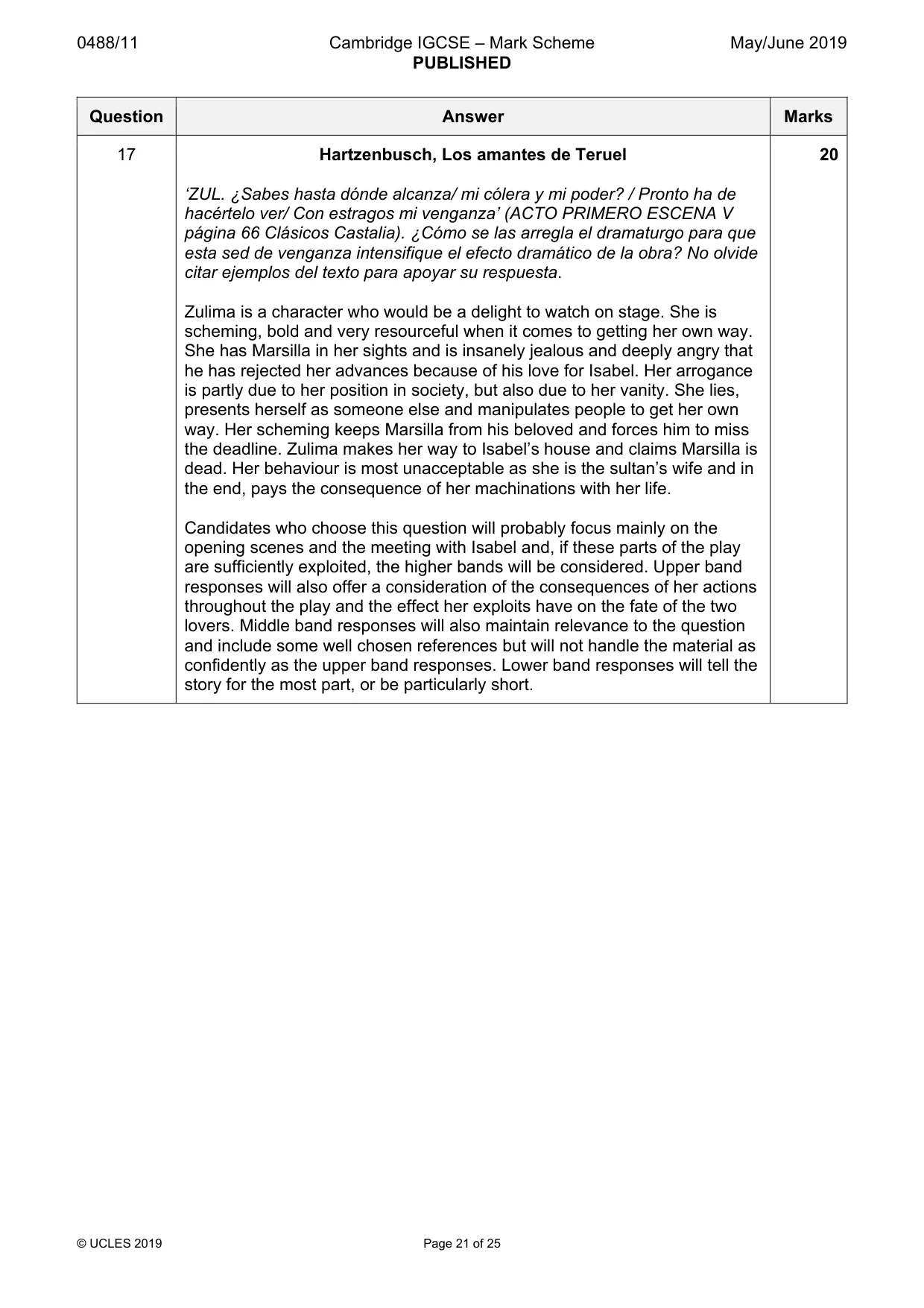
0488/11 Cambridge IGCSE – Mark Scheme PUBLISHED May/June 2019 © UCLES 2019 Page 21 of 25 Question Answer Marks 17 Hartzenbusch, Los amantes de Teruel ‘ZUL. ¿Sabes hasta dónde alcanza/ mi cólera y mi poder? / Pronto ha de hacértelo ver/ Con estragos mi venganza’ (ACTO PRIMERO ESCENA V página 66 Clásicos Castalia). ¿Cómo se las arregla el dramaturgo para que esta sed de venganza intensifique el efecto dramático de la obra? No olvide citar ejemplos del texto para apoyar su respuesta. Zulima is a character who would be a delight to watch on stage. She is scheming, bold and very resourceful when it comes to getting her own way. She has Marsilla in her sights and is insanely jealous and deeply angry that he has rejected her advances because of his love for Isabel. Her arrogance is partly due to her position in society, but also due to her vanity. She lies, presents herself as someone else and manipulates people to get her own way. Her scheming keeps Marsilla from his beloved and forces him to miss the deadline. Zulima makes her way to Isabel’s house and claims Marsilla is dead. Her behaviour is most unacceptable as she is the sultan’s wife and in the end, pays the consequence of her machinations with her life. Candidates who choose this question will probably focus mainly on the opening scenes and the meeting with Isabel and, if these parts of the play are sufficiently exploited, the higher bands will be considered. Upper band responses will also offer a consideration of the consequences of her actions throughout the play and the effect her exploits have on the fate of the two lovers. Middle band responses will also maintain relevance to the question and include some well chosen references but will not handle the material as confidently as the upper band responses. Lower band responses will tell the story for the most part, or be particularly short. 20
Mark scheme, page 22
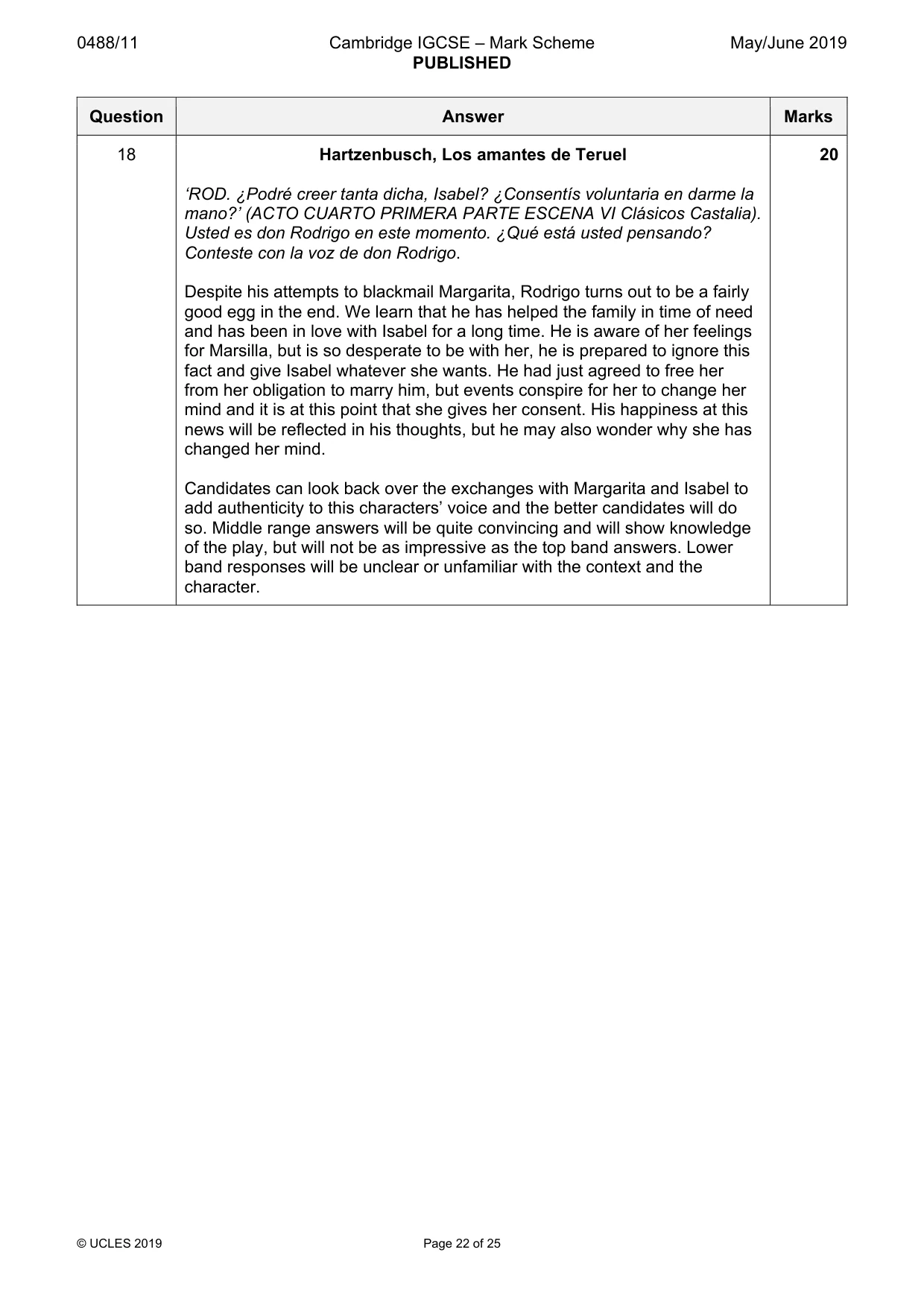
0488/11 Cambridge IGCSE – Mark Scheme PUBLISHED May/June 2019 © UCLES 2019 Page 22 of 25 Question Answer Marks 18 Hartzenbusch, Los amantes de Teruel ‘ROD. ¿Podré creer tanta dicha, Isabel? ¿Consentís voluntaria en darme la mano?’ (ACTO CUARTO PRIMERA PARTE ESCENA VI Clásicos Castalia). Usted es don Rodrigo en este momento. ¿Qué está usted pensando? Conteste con la voz de don Rodrigo. Despite his attempts to blackmail Margarita, Rodrigo turns out to be a fairly good egg in the end. We learn that he has helped the family in time of need and has been in love with Isabel for a long time. He is aware of her feelings for Marsilla, but is so desperate to be with her, he is prepared to ignore this fact and give Isabel whatever she wants. He had just agreed to free her from her obligation to marry him, but events conspire for her to change her mind and it is at this point that she gives her consent. His happiness at this news will be reflected in his thoughts, but he may also wonder why she has changed her mind. Candidates can look back over the exchanges with Margarita and Isabel to add authenticity to this characters’ voice and the better candidates will do so. Middle range answers will be quite convincing and will show knowledge of the play, but will not be as impressive as the top band answers. Lower band responses will be unclear or unfamiliar with the context and the character. 20
Mark scheme, page 23
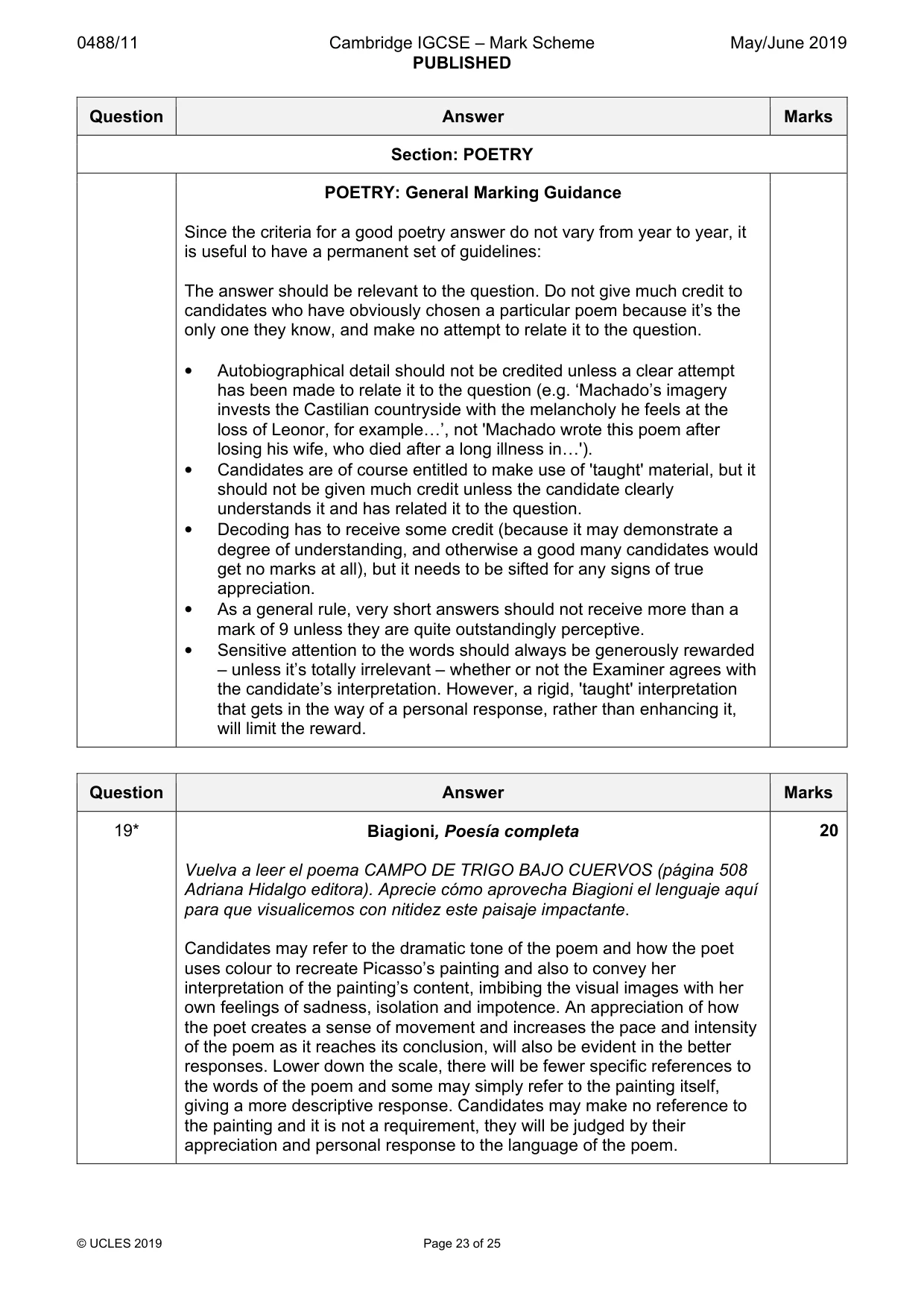
0488/11 Cambridge IGCSE – Mark Scheme PUBLISHED May/June 2019 © UCLES 2019 Page 23 of 25 Question Answer Marks Section: POETRY POETRY: General Marking Guidance Since the criteria for a good poetry answer do not vary from year to year, it is useful to have a permanent set of guidelines: The answer should be relevant to the question. Do not give much credit to candidates who have obviously chosen a particular poem because it’s the only one they know, and make no attempt to relate it to the question. • Autobiographical detail should not be credited unless a clear attempt has been made to relate it to the question (e.g. ‘Machado’s imagery invests the Castilian countryside with the melancholy he feels at the loss of Leonor, for example«’, not 'Machado wrote this poem after losing his wife, who died after a long illness in«'). • Candidates are of course entitled to make use of 'taught' material, but it should not be given much credit unless the candidate clearly understands it and has related it to the question. • Decoding has to receive some credit (because it may demonstrate a degree of understanding, and otherwise a good many candidates would get no marks at all), but it needs to be sifted for any signs of true appreciation. • As a general rule, very short answers should not receive more than a mark of 9 unless they are quite outstandingly perceptive. • Sensitive attention to the words should always be generously rewarded – unless it’s totally irrelevant – whether or not the Examiner agrees with the candidate’s interpretation. However, a rigid, 'taught' interpretation that gets in the way of a personal response, rather than enhancing it, will limit the reward. Question Answer Marks 19* Biagioni, Poesía completa Vuelva a leer el poema CAMPO DE TRIGO BAJO CUERVOS (página 508 Adriana Hidalgo editora). Aprecie cómo aprovecha Biagioni el lenguaje aquí para que visualicemos con nitidez este paisaje impactante. Candidates may refer to the dramatic tone of the poem and how the poet uses colour to recreate Picasso’s painting and also to convey her interpretation of the painting’s content, imbibing the visual images with her own feelings of sadness, isolation and impotence. An appreciation of how the poet creates a sense of movement and increases the pace and intensity of the poem as it reaches its conclusion, will also be evident in the better responses. Lower down the scale, there will be fewer specific references to the words of the poem and some may simply refer to the painting itself, giving a more descriptive response. Candidates may make no reference to the painting and it is not a requirement, they will be judged by their appreciation and personal response to the language of the poem. 20
Mark scheme, page 24
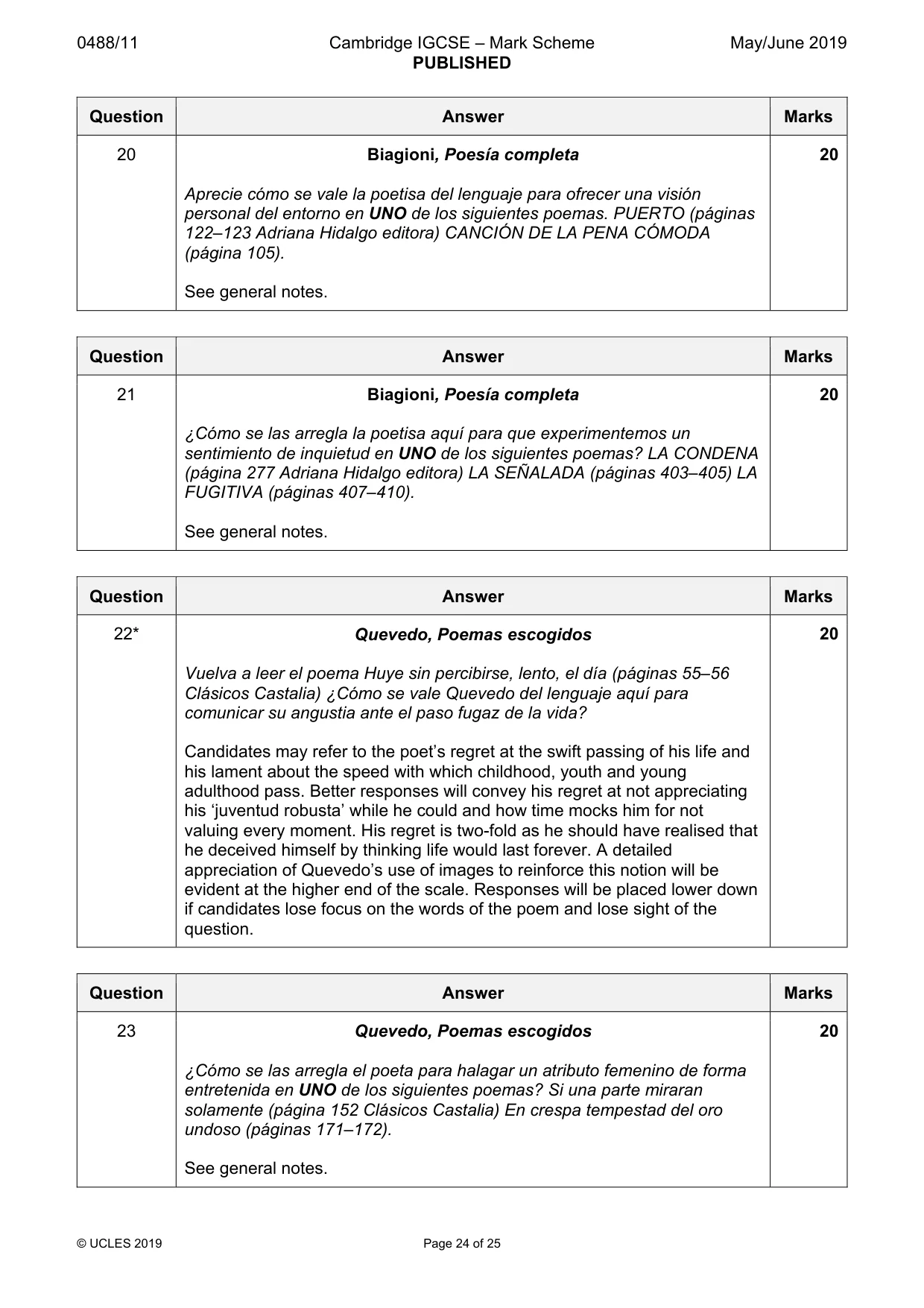
0488/11 Cambridge IGCSE – Mark Scheme PUBLISHED May/June 2019 © UCLES 2019 Page 24 of 25 Question Answer Marks 20 Biagioni, Poesía completa Aprecie cómo se vale la poetisa del lenguaje para ofrecer una visión personal del entorno en UNO de los siguientes poemas. PUERTO (páginas 122–123 Adriana Hidalgo editora) CANCIÓN DE LA PENA CÓMODA (página 105). See general notes. 20 Question Answer Marks 21 Biagioni, Poesía completa ¿Cómo se las arregla la poetisa aquí para que experimentemos un sentimiento de inquietud en UNO de los siguientes poemas? LA CONDENA (página 277 Adriana Hidalgo editora) LA SEÑALADA (páginas 403–405) LA FUGITIVA (páginas 407–410). See general notes. 20 Question Answer Marks 22* Quevedo, Poemas escogidos Vuelva a leer el poema Huye sin percibirse, lento, el día (páginas 55–56 Clásicos Castalia) ¿Cómo se vale Quevedo del lenguaje aquí para comunicar su angustia ante el paso fugaz de la vida? Candidates may refer to the poet’s regret at the swift passing of his life and his lament about the speed with which childhood, youth and young adulthood pass. Better responses will convey his regret at not appreciating his ‘juventud robusta’ while he could and how time mocks him for not valuing every moment. His regret is two-fold as he should have realised that he deceived himself by thinking life would last forever. A detailed appreciation of Quevedo’s use of images to reinforce this notion will be evident at the higher end of the scale. Responses will be placed lower down if candidates lose focus on the words of the poem and lose sight of the question. 20 Question Answer Marks 23 Quevedo, Poemas escogidos ¿Cómo se las arregla el poeta para halagar un atributo femenino de forma entretenida en UNO de los siguientes poemas? Si una parte miraran solamente (página 152 Clásicos Castalia) En crespa tempestad del oro undoso (páginas 171–172). See general notes. 20
Mark scheme, page 25
0488/11 Cambridge IGCSE – Mark Scheme PUBLISHED May/June 2019 © UCLES 2019 Page 25 of 25 Question Answer Marks 24 Quevedo, Poemas escogidos Dé su apreciación de cómo el poeta aprovecha el lenguaje para que esta boda sea tan entretenida en UNA de las siguientes secciones del poema Don Repollo y doña Berza (páginas 238–241). Desde ‘Don Repollo y doña Berza’ hasta ‘y su condición muy agria’ (versos 1–32) o Desde ‘A lo rico y a lo tramposo’ hasta ‘que la vista al gusto engaña’ (versos 33–60) o Desde ‘ La Berenjena, mostrando’ hasta ‘ni desposados sin tachas’ (versos 61–96). See general notes. 20
What you needed in this session
Cambridge’s own grade thresholds for 2019 May/June, Paper 1 · Variant 1. A higher threshold means an easier paper — the bar moves with how the cohort did.