Cambridge IGCSE Spanish - Literature 0488 — 2018 May/June Paper 1 · Variant 1
0488/11/M/J/18 · 60 marks · ≈68 min
The question paper and its mark scheme, free to read here and free to download. This is Cambridge’s own paper, exactly as it was sat.
Question paper8 pages


Mark scheme26 pages
Answers below. Sit the paper first if you are practising.
Paper as text
Question paper, page 1
* 6 2 3 7 2 5 8 1 6 9 * This document consists of 7 printed pages, 1 blank page and 1 Insert. DC (KN) 147697/4 © UCLES 2018 [Turn over Cambridge International Examinations Cambridge International General Certificate of Secondary Education LITERATURE (SPANISH) 0488/11 Paper 1 Spanish Texts May/June 2018 2 hours 15 minutes No Additional Materials are required. Texts studied should be taken into the examination room. READ THESE INSTRUCTIONS FIRST An answer booklet is provided inside this question paper. You should follow the instructions on the front cover of the answer booklet. If you need additional answer paper ask the invigilator for a continuation booklet. • Answer three questions in total: • Each answer must be on a different text • You must answer from at least two sections • Section A: Prose • Section B: Drama • Section C: Poetry • Answer at least one text-based question (marked *). You may choose all three of your questions from those marked *. All the questions in this paper carry equal marks. EN PRIMER LUGAR, LEA ESTAS INSTRUCCIONES El cuadernillo de respuestas se encuentra dentro de este cuadernillo de preguntas. Siga las instrucciones de la portada del cuadernillo de respuestas. También encontrará las instrucciones en español a continuación. Si necesita hojas adicionales, pídale al supervisor un cuadernillo de respuestas adicional. • Conteste usted tres preguntas en total: • Cada respuesta debe basarse en un texto diferente • Debe usted seleccionar preguntas de al menos dos de las secciones • Sección A: Prosa • Sección B: Teatro • Sección C: Poesía • Conteste al menos una pregunta basada en un extracto de texto (preguntas señaladas con un asterisco *). Si desea, puede contestar tres preguntas señaladas con un asterisco *. Todas las preguntas en este examen tienen igual valor.
Question paper, page 2
2 0488/11/M/J/18 © UCLES 2018 INSTRUCCIONES DEL CUADERNILLO DE RESPUESTAS Rellene las casillas de la portada del cuadernillo de respuestas con letra mayúscula. Use tinta azul oscuro o negra. NO ESCRIBA EN NINGÚN CÓDIGO DE BARRAS. Escriba sus respuestas en el cuadernillo de respuestas. Utilice ambas caras del papel. Por favor deje dos líneas en blanco entre sus respuestas a cada pregunta. Escriba el número de la pregunta que está contestando en el primer margen. Si la pregunta que está contestando también contiene secciones, por ejemplo 1a, escriba la sección de la pregunta en el segundo margen. Si ha utilizado cuadernillos de respuestas adicionales, por favor guárdelos dentro del cuadernillo de respuestas. Question Part 1 1 ai aii
Question paper, page 3
3 0488/11/M/J/18 © UCLES 2018 [Turn over EN TODAS SUS RESPUESTAS DEBE REFERIRSE DETALLADAMENTE AL TEXTO SECCIÓN A: PROSA Matto de Turner, Aves sin nido Alternativamente: 1* Vuelva a leer una parte del capítulo XXVII de la SEGUNDA PARTE desde ‘Y en seguida cruzó las piernas’ (página 164 Stockcero) hasta el final del capítulo ‘la ribera izquierda del río’ (página 166). ¿Cómo aprovecha Matto de Turner el lenguaje aquí para darnos una impresión muy viva de los personajes y sus experiencias? No olvide referirse detalladamente al pasaje. o 2 ‘Nacimos indios, esclavos del cura, esclavos del gobernador, esclavos del cacique, esclavos de todos los que agarran la vara del mandón’ (página 170 capítulo XXVIII de la SEGUNDA PARTE Stockcero). ¿Cómo se las arregla la autora para mostrarnos lo horrorosa que es la vida de estos ‘esclavos’? No olvide referirse detalladamente al texto. o 3 ‘El semblante de Marcela revelaba sus terribles sufrimientos, pero las palabras de Lucía parecían haberle dado alivio’ (capítulo XX de la PRIMERA PARTE página 56 Stockcero). Usted es Marcela en el momento en que llega a casa de Lucía herida de gravedad. ¿Qué está usted pensando? Conteste con la voz de Marcela. Matute, Pequeño teatro Alternativamente: 4* Vuelva a leer una parte del capítulo VI sección 2 desde ‘Aquella noche la luna apareció intacta’ (página 114 Austral) hasta ‘le producía una sensación agridulce, que le inquietaba’ (página 116). Esta cena se describe como ‘lenta y aburrida’. ¿Cómo se las arregla Matute para que la cena sea interesante para el lector? No olvide referirse detalladamente al pasaje. o 5 En su opinión de lector, ¿cuál es el personaje más impactado por la llegada de Marco y por qué? Dé ejemplos. o 6 ‘Los ojos de la señorita Eskarne se clavaron en la cara de Ilé como dos negros y diminutos perros rabiosos’ (capítulo XI sección 5 página 193 Austral). Usted es Eskarne Antía en este momento. ¿Qué está usted pensando? Conteste con la voz de Eskarne Antía.
Question paper, page 4
4 0488/11/M/J/18 © UCLES 2018 Blasco Ibáñez, La barraca Alternativamente: 7* Vuelva a leer una parte del capítulo VII desde ‘Llegó el momento decisivo’ (página 165 Cátedra) hasta ‘Trato cerrado’ (página 167). ¿Cómo se las arregla Ibáñez aquí para que la venta del caballo sea tan entretenida? No olvide referirse detalladamente al pasaje. o 8 ¿Cuál le parece ser la importancia en la novela de la tragedia del tío Barret? No olvide referirse detalladamente al texto. o 9 Usted es Teresa al final del capítulo VI (página 155 Cátedra). ¿Qué está usted pensando? Conteste con la voz de Teresa. Azuela, Los de abajo Alternativamente: 10* Vuelva a leer el principio del capítulo XXI de la PRIMERA PARTE desde ‘El atronar de la fusilería’ (página 68 Vicens Vives) hasta ‘-¡Ah, qué bonito soldado es su jefe!’ (página 69). Aprecie cómo Azuela aprovecha el lenguaje para que los acontecimientos relatados aquí sean tan emocionantes. No olvide referirse detalladamente al pasaje. o 11 ¿Cómo se las arregla el autor a lo largo de la novela para entristecernos con la lenta desilusión de los revolucionarios? Dé ejemplos. o 12 ‘El rostro de la Pintada se granitificó. Quiso hablar, pero sus músculos estaban rígidos’ (capítulo XII de la SEGUNDA PARTE página 112 Vicens Vives). Usted es la Pintada en este momento. ¿Qué está usted pensando? Conteste con la voz de la Pintada.
Question paper, page 5
5 0488/11/M/J/18 © UCLES 2018 [Turn over SECCIÓN B: TEATRO Duque de Rivas, Don Álvaro o la fuerza del sino Alternativamente: 13* Vuelva a leer una parte de la escena VII de la Jornada segunda desde ‘P. GUARDIÁN Sois muy joven, hija mía’ (página 120 Alianza Editorial) hasta ‘D.ª LEONOR. Sabréis que habito en estas asperezas, no otro ningún mortal’ (página 122). ¿Cómo reacciona usted ante la manera en que el Padre Guardián maneja la situación lamentable de Leonor? No olvide referirse detalladamente al texto. o 14 El dramaturgo puntualiza el argumento con escenas de carácter local. ¿Cuál de estos episodios encuentra usted el más entretenido, y por qué? Dé ejemplos. o 15 ‘(Vase el MARQUÉS, y queda LEONOR muy abatida y llorosa sentada en el sillón)’ (Escena V de la Jornada primera página 79 Alianza Editorial). Usted es el Marqués de Calatrava y acaba de hablar con su hija Leonor. ¿Qué está usted pensando? Conteste con la voz del marqués. García Lorca, Bodas de sangre Alternativamente: 16* Vuelva a leer el final del ACTO SEGUNDO CUADRO SEGUNDO desde ‘MADRE. Hijo’ (página 74 Vicens Vives) hasta ‘MADRE. Tú con el tuyo y yo con el mío. ¡Atrás! ¡Atrás!’ (página 77). ¿Cómo se las arregla Lorca aquí para dar un final dramático a este cuadro? No olvide referirse detalladamente al fragmento. o 17 ¿Hasta qué punto, y cómo, le ha convencido el dramaturgo de que la relación entre la Novia y el Novio estaba condenada al fracaso desde el principio? No olvide referirse detalladamente al texto. o 18 ‘SUEGRA: […]Sobre la cama pon una cruz de ceniza donde estuvo su almohada. (Salen.)’ (ACTO TERCERO CUADRO ÚLTIMO página 103 Vicens Vives) Imagine que la Mujer y la Suegra siguen hablando. Escriba la conversación.
Question paper, page 6
6 0488/11/M/J/18 © UCLES 2018 SECCIÓN C: POESÍA García Montero, Poesía Alternativamente: 19* Vuelva a leer el poema EL AMOR (páginas 407–408 Tusquets). Aprecie cómo García Montero aprovecha el lenguaje aquí para intrigarnos con la idea de que el amor tiene una lengua propia. o 20 Aprecie cómo el poeta aprovecha el lenguaje para comunicar una noción intrigante del paso del tiempo en UNO de los siguientes poemas. EL DESEO (páginas 416–417 Tusquets) NUEVO CANTO A TERESA (página 272) CANCIÓN ÍNTIMA (páginas 516–517). o 21 Aprecie cómo el poeta crea un efecto dinámico a través de una serie de pequeñas escenas en UNO de los siguientes poemas. ESCALA EN BARAJAS (páginas 303–304 Tusquets) EL LECTOR (páginas 341–342).
Question paper, page 7
7 0488/11/M/J/18 © UCLES 2018 Biagioni, Poesía completa Alternativamente: 22* Vuelva a leer el poema LA CONDENA (página 277 Adriana Hidalgo editora). Aprecie cómo Biagioni aprovecha el lenguaje aquí para que sintamos el horror de una pena infinita. o 23 ¿Cómo se las arregla la poetisa para evocar una emocionante escena de caza en UNO de los siguientes poemas? CONCÉNTRICOS (páginas 383–384 Adriana Hidalgo editora) PARES (páginas 386–387). o 24 ¿Cómo se las arregla la poetisa para darnos una impresión intrigante de la experiencia de viajar en UNO de los siguientes poemas? CANCIÓN PARA UN ROPERO DE HOTEL (página 185 Adriana Hidalgo editora) DIARIO (páginas 161–162).
Question paper, page 8
8 0488/11/M/J/18 © UCLES 2018 BLANK PAGE Permission to reproduce items where third-party owned material protected by copyright is included has been sought and cleared where possible. Every reasonable effort has been made by the publisher (UCLES) to trace copyright holders, but if any items requiring clearance have unwittingly been included, the publisher will be pleased to make amends at the earliest possible opportunity. To avoid the issue of disclosure of answer-related information to candidates, all copyright acknowledgements are reproduced online in the Cambridge International Examinations Copyright Acknowledgements Booklet. This is produced for each series of examinations and is freely available to download at www.cie.org.uk after the live examination series. Cambridge International Examinations is part of the Cambridge Assessment Group. Cambridge Assessment is the brand name of University of Cambridge Local Examinations Syndicate (UCLES), which is itself a department of the University of Cambridge.
Mark scheme, page 1
IGCSE™ is a registered trademark. This document consists of 26 printed pages. © UCLES 2018 [Turn over Cambridge Assessment International Education Cambridge International General Certificate of Secondary Education LITERATURE (SPANISH) 0488/11 Paper 1 Set Texts (Open Books) May/June 2018 MARK SCHEME Maximum Mark: 60 Published This mark scheme is published as an aid to teachers and candidates, to indicate the requirements of the examination. It shows the basis on which Examiners were instructed to award marks. It does not indicate the details of the discussions that took place at an Examiners’ meeting before marking began, which would have considered the acceptability of alternative answers. Mark schemes should be read in conjunction with the question paper and the Principal Examiner Report for Teachers. Cambridge International will not enter into discussions about these mark schemes. Cambridge International is publishing the mark schemes for the May/June 2018 series for most Cambridge IGCSE™, Cambridge International A and AS Level and Cambridge Pre-U components, and some Cambridge O Level components.
Mark scheme, page 2
0488/11 Cambridge IGCSE – Mark Scheme PUBLISHED May/June 2018 © UCLES 2018 Page 2 of 26 Generic Marking Principles These general marking principles must be applied by all examiners when marking candidate answers. They should be applied alongside the specific content of the mark scheme or generic level descriptors for a question. Each question paper and mark scheme will also comply with these marking principles. GENERIC MARKING PRINCIPLE 1: Marks must be awarded in line with: • the specific content of the mark scheme or the generic level descriptors for the question • the specific skills defined in the mark scheme or in the generic level descriptors for the question • the standard of response required by a candidate as exemplified by the standardisation scripts. GENERIC MARKING PRINCIPLE 2: Marks awarded are always whole marks (not half marks, or other fractions). GENERIC MARKING PRINCIPLE 3: Marks must be awarded positively: • marks are awarded for correct/valid answers, as defined in the mark scheme. However, credit is given for valid answers which go beyond the scope of the syllabus and mark scheme, referring to your Team Leader as appropriate • marks are awarded when candidates clearly demonstrate what they know and can do • marks are not deducted for errors • marks are not deducted for omissions • answers should only be judged on the quality of spelling, punctuation and grammar when these features are specifically assessed by the question as indicated by the mark scheme. The meaning, however, should be unambiguous. GENERIC MARKING PRINCIPLE 4: Rules must be applied consistently e.g. in situations where candidates have not followed instructions or in the application of generic level descriptors. GENERIC MARKING PRINCIPLE 5: Marks should be awarded using the full range of marks defined in the mark scheme for the question (however; the use of the full mark range may be limited according to the quality of the candidate responses seen). GENERIC MARKING PRINCIPLE 6: Marks awarded are based solely on the requirements as defined in the mark scheme. Marks should not be awarded with grade thresholds or grade descriptors in mind.
Mark scheme, page 3
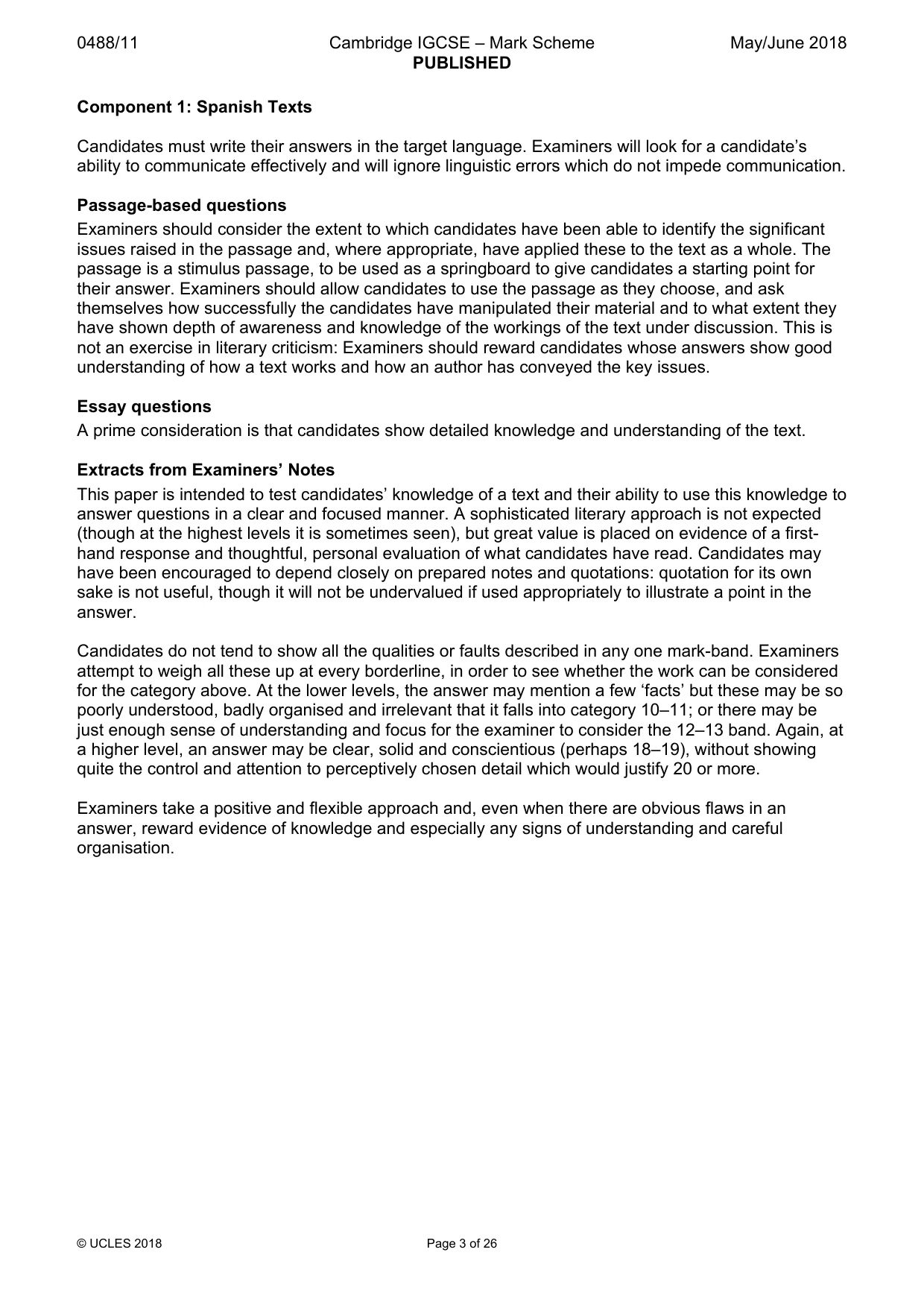
0488/11 Cambridge IGCSE – Mark Scheme PUBLISHED May/June 2018 © UCLES 2018 Page 3 of 26 Component 1: Spanish Texts Candidates must write their answers in the target language. Examiners will look for a candidate’s ability to communicate effectively and will ignore linguistic errors which do not impede communication. Passage-based questions Examiners should consider the extent to which candidates have been able to identify the significant issues raised in the passage and, where appropriate, have applied these to the text as a whole. The passage is a stimulus passage, to be used as a springboard to give candidates a starting point for their answer. Examiners should allow candidates to use the passage as they choose, and ask themselves how successfully the candidates have manipulated their material and to what extent they have shown depth of awareness and knowledge of the workings of the text under discussion. This is not an exercise in literary criticism: Examiners should reward candidates whose answers show good understanding of how a text works and how an author has conveyed the key issues. Essay questions A prime consideration is that candidates show detailed knowledge and understanding of the text. Extracts from Examiners’ Notes This paper is intended to test candidates’ knowledge of a text and their ability to use this knowledge to answer questions in a clear and focused manner. A sophisticated literary approach is not expected (though at the highest levels it is sometimes seen), but great value is placed on evidence of a first- hand response and thoughtful, personal evaluation of what candidates have read. Candidates may have been encouraged to depend closely on prepared notes and quotations: quotation for its own sake is not useful, though it will not be undervalued if used appropriately to illustrate a point in the answer. Candidates do not tend to show all the qualities or faults described in any one mark-band. Examiners attempt to weigh all these up at every borderline, in order to see whether the work can be considered for the category above. At the lower levels, the answer may mention a few ‘facts’ but these may be so poorly understood, badly organised and irrelevant that it falls into category 10–11; or there may be just enough sense of understanding and focus for the examiner to consider the 12–13 band. Again, at a higher level, an answer may be clear, solid and conscientious (perhaps 18–19), without showing quite the control and attention to perceptively chosen detail which would justify 20 or more. Examiners take a positive and flexible approach and, even when there are obvious flaws in an answer, reward evidence of knowledge and especially any signs of understanding and careful organisation.
Mark scheme, page 4
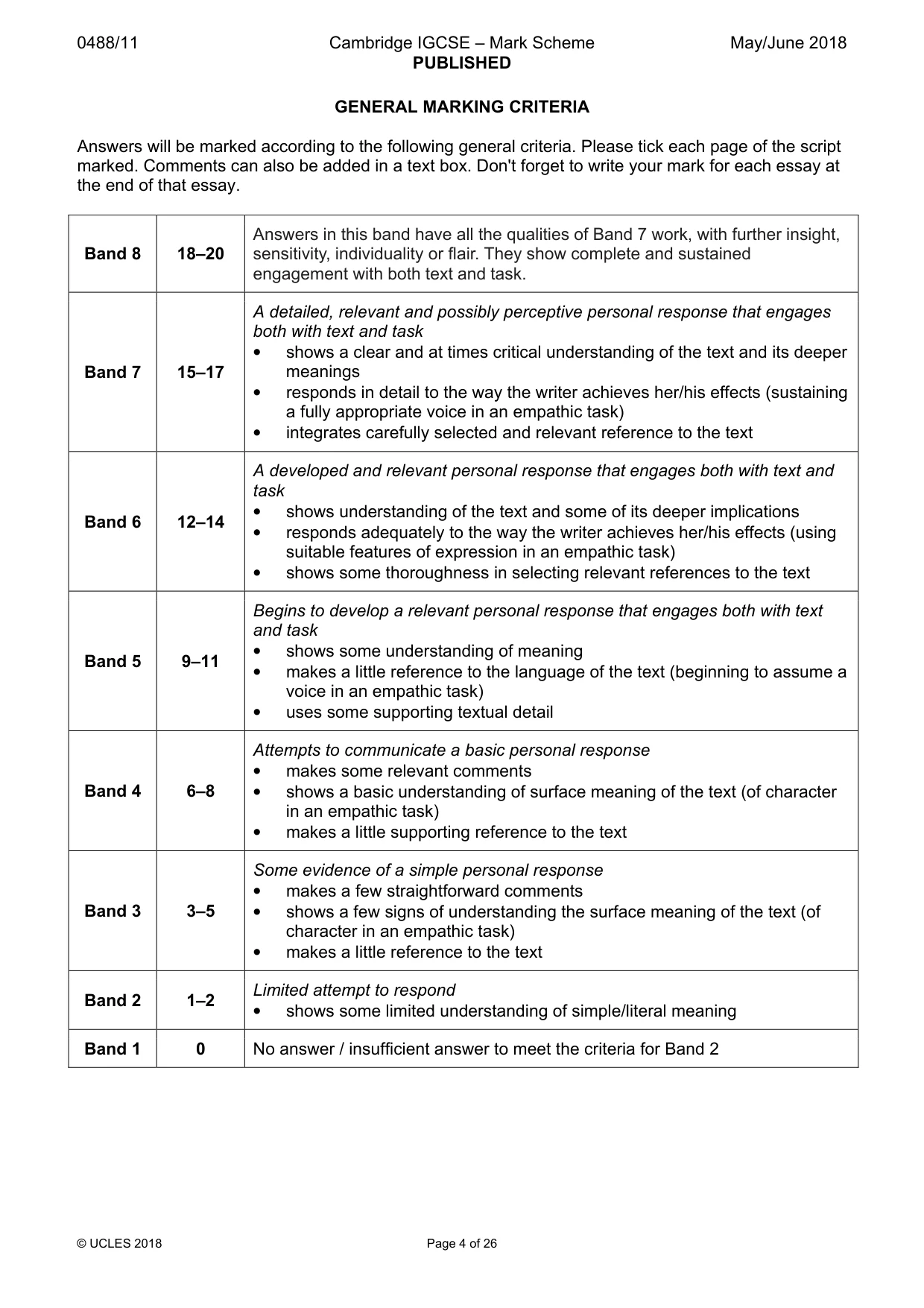
0488/11 Cambridge IGCSE – Mark Scheme PUBLISHED May/June 2018 © UCLES 2018 Page 4 of 26 GENERAL MARKING CRITERIA Answers will be marked according to the following general criteria. Please tick each page of the script marked. Comments can also be added in a text box. Don't forget to write your mark for each essay at the end of that essay. Band 8 18–20 Answers in this band have all the qualities of Band 7 work, with further insight, sensitivity, individuality or flair. They show complete and sustained engagement with both text and task. Band 7 15–17 A detailed, relevant and possibly perceptive personal response that engages both with text and task • shows a clear and at times critical understanding of the text and its deeper meanings • responds in detail to the way the writer achieves her/his effects (sustaining a fully appropriate voice in an empathic task) • integrates carefully selected and relevant reference to the text Band 6 12–14 A developed and relevant personal response that engages both with text and task • shows understanding of the text and some of its deeper implications • responds adequately to the way the writer achieves her/his effects (using suitable features of expression in an empathic task) • shows some thoroughness in selecting relevant references to the text Band 5 9–11 Begins to develop a relevant personal response that engages both with text and task • shows some understanding of meaning • makes a little reference to the language of the text (beginning to assume a voice in an empathic task) • uses some supporting textual detail Band 4 6–8 Attempts to communicate a basic personal response • makes some relevant comments • shows a basic understanding of surface meaning of the text (of character in an empathic task) • makes a little supporting reference to the text Band 3 3–5 Some evidence of a simple personal response • makes a few straightforward comments • shows a few signs of understanding the surface meaning of the text (of character in an empathic task) • makes a little reference to the text Band 2 1–2 Limited attempt to respond • shows some limited understanding of simple/literal meaning Band 1 0 No answer / insufficient answer to meet the criteria for Band 2
Mark scheme, page 5
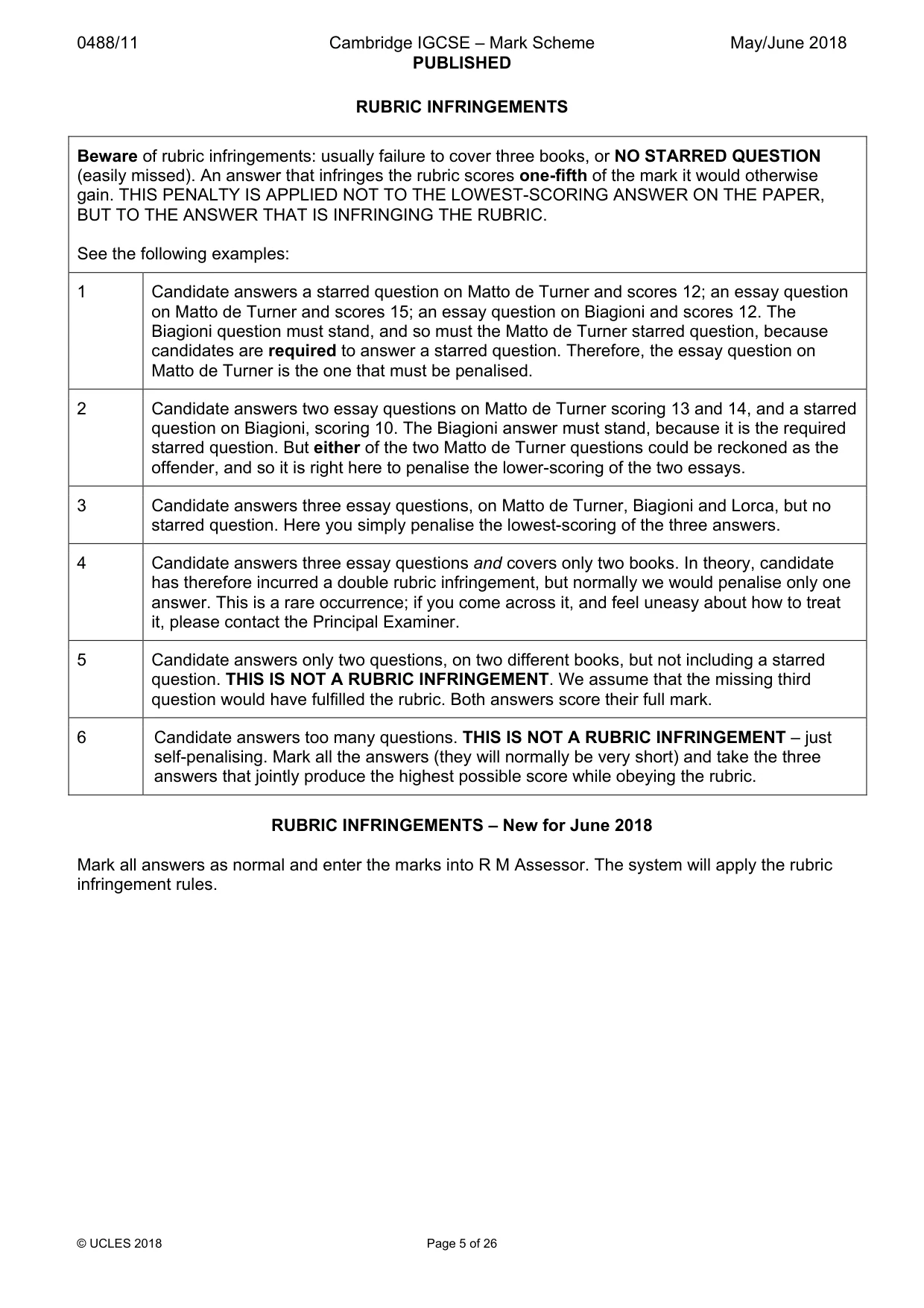
0488/11 Cambridge IGCSE – Mark Scheme PUBLISHED May/June 2018 © UCLES 2018 Page 5 of 26 RUBRIC INFRINGEMENTS Beware of rubric infringements: usually failure to cover three books, or NO STARRED QUESTION (easily missed). An answer that infringes the rubric scores one-fifth of the mark it would otherwise gain. THIS PENALTY IS APPLIED NOT TO THE LOWEST-SCORING ANSWER ON THE PAPER, BUT TO THE ANSWER THAT IS INFRINGING THE RUBRIC. See the following examples: 1 Candidate answers a starred question on Matto de Turner and scores 12; an essay question on Matto de Turner and scores 15; an essay question on Biagioni and scores 12. The Biagioni question must stand, and so must the Matto de Turner starred question, because candidates are required to answer a starred question. Therefore, the essay question on Matto de Turner is the one that must be penalised. 2 Candidate answers two essay questions on Matto de Turner scoring 13 and 14, and a starred question on Biagioni, scoring 10. The Biagioni answer must stand, because it is the required starred question. But either of the two Matto de Turner questions could be reckoned as the offender, and so it is right here to penalise the lower-scoring of the two essays. 3 Candidate answers three essay questions, on Matto de Turner, Biagioni and Lorca, but no starred question. Here you simply penalise the lowest-scoring of the three answers. 4 Candidate answers three essay questions and covers only two books. In theory, candidate has therefore incurred a double rubric infringement, but normally we would penalise only one answer. This is a rare occurrence; if you come across it, and feel uneasy about how to treat it, please contact the Principal Examiner. 5 Candidate answers only two questions, on two different books, but not including a starred question. THIS IS NOT A RUBRIC INFRINGEMENT. We assume that the missing third question would have fulfilled the rubric. Both answers score their full mark. 6 Candidate answers too many questions. THIS IS NOT A RUBRIC INFRINGEMENT – just self-penalising. Mark all the answers (they will normally be very short) and take the three answers that jointly produce the highest possible score while obeying the rubric. RUBRIC INFRINGEMENTS – New for June 2018 Mark all answers as normal and enter the marks into R M Assessor. The system will apply the rubric infringement rules.
Mark scheme, page 6
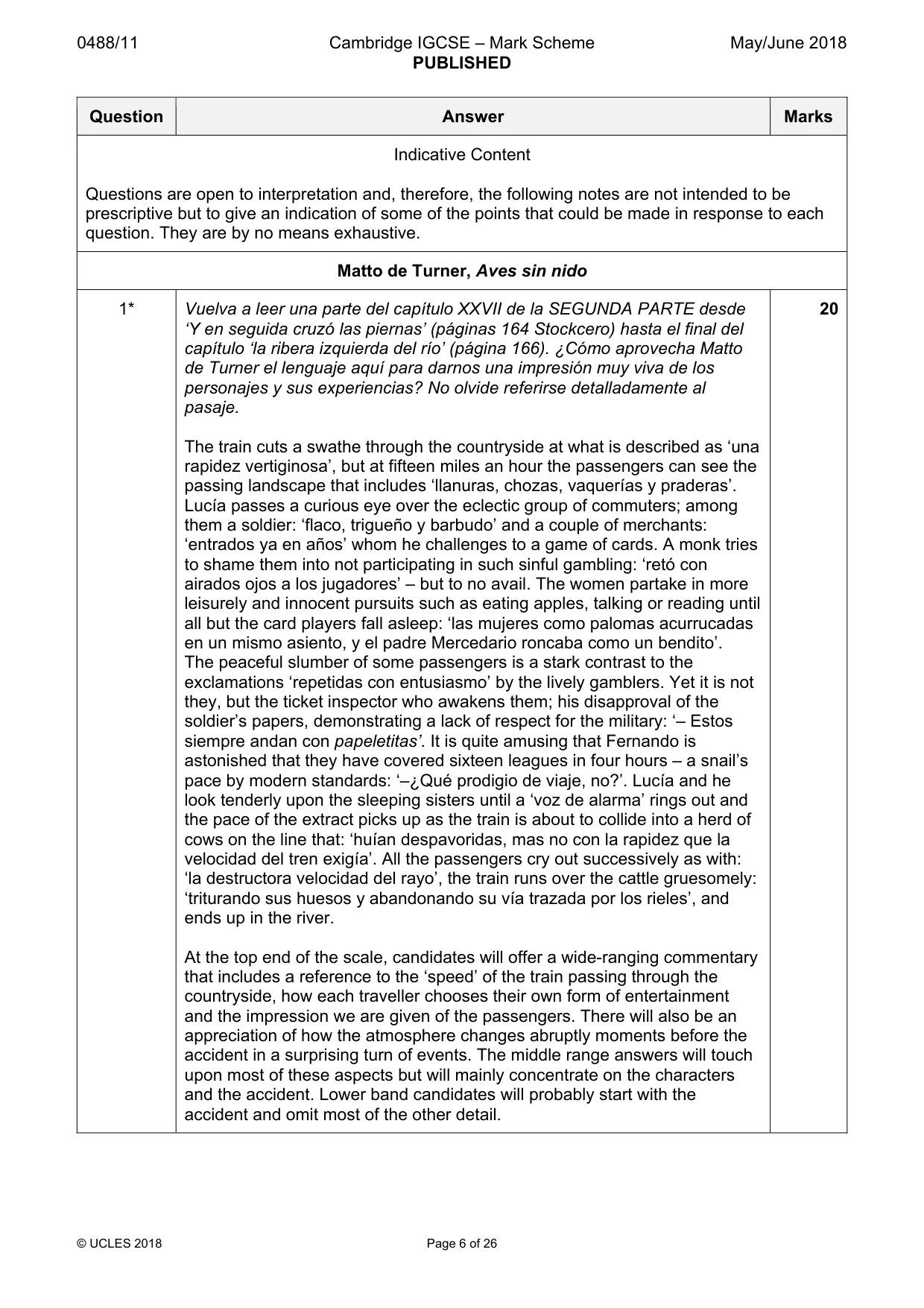
0488/11 Cambridge IGCSE – Mark Scheme PUBLISHED May/June 2018 © UCLES 2018 Page 6 of 26 Question Answer Marks Indicative Content Questions are open to interpretation and, therefore, the following notes are not intended to be prescriptive but to give an indication of some of the points that could be made in response to each question. They are by no means exhaustive. Matto de Turner, Aves sin nido 1* Vuelva a leer una parte del capítulo XXVII de la SEGUNDA PARTE desde ‘Y en seguida cruzó las piernas’ (páginas 164 Stockcero) hasta el final del capítulo ‘la ribera izquierda del río’ (página 166). ¿Cómo aprovecha Matto de Turner el lenguaje aquí para darnos una impresión muy viva de los personajes y sus experiencias? No olvide referirse detalladamente al pasaje. The train cuts a swathe through the countryside at what is described as ‘una rapidez vertiginosa’, but at fifteen miles an hour the passengers can see the passing landscape that includes ‘llanuras, chozas, vaquerías y praderas’. Lucía passes a curious eye over the eclectic group of commuters; among them a soldier: ‘flaco, trigueño y barbudo’ and a couple of merchants: ‘entrados ya en años’ whom he challenges to a game of cards. A monk tries to shame them into not participating in such sinful gambling: ‘retó con airados ojos a los jugadores’ – but to no avail. The women partake in more leisurely and innocent pursuits such as eating apples, talking or reading until all but the card players fall asleep: ‘las mujeres como palomas acurrucadas en un mismo asiento, y el padre Mercedario roncaba como un bendito’. The peaceful slumber of some passengers is a stark contrast to the exclamations ‘repetidas con entusiasmo’ by the lively gamblers. Yet it is not they, but the ticket inspector who awakens them; his disapproval of the soldier’s papers, demonstrating a lack of respect for the military: ‘– Estos siempre andan con papeletitas’. It is quite amusing that Fernando is astonished that they have covered sixteen leagues in four hours – a snail’s pace by modern standards: ‘–¿Qué prodigio de viaje, no?’. Lucía and he look tenderly upon the sleeping sisters until a ‘voz de alarma’ rings out and the pace of the extract picks up as the train is about to collide into a herd of cows on the line that: ‘huían despavoridas, mas no con la rapidez que la velocidad del tren exigía’. All the passengers cry out successively as with: ‘la destructora velocidad del rayo’, the train runs over the cattle gruesomely: ‘triturando sus huesos y abandonando su vía trazada por los rieles’, and ends up in the river. At the top end of the scale, candidates will offer a wide-ranging commentary that includes a reference to the ‘speed’ of the train passing through the countryside, how each traveller chooses their own form of entertainment and the impression we are given of the passengers. There will also be an appreciation of how the atmosphere changes abruptly moments before the accident in a surprising turn of events. The middle range answers will touch upon most of these aspects but will mainly concentrate on the characters and the accident. Lower band candidates will probably start with the accident and omit most of the other detail. 20
Mark scheme, page 7
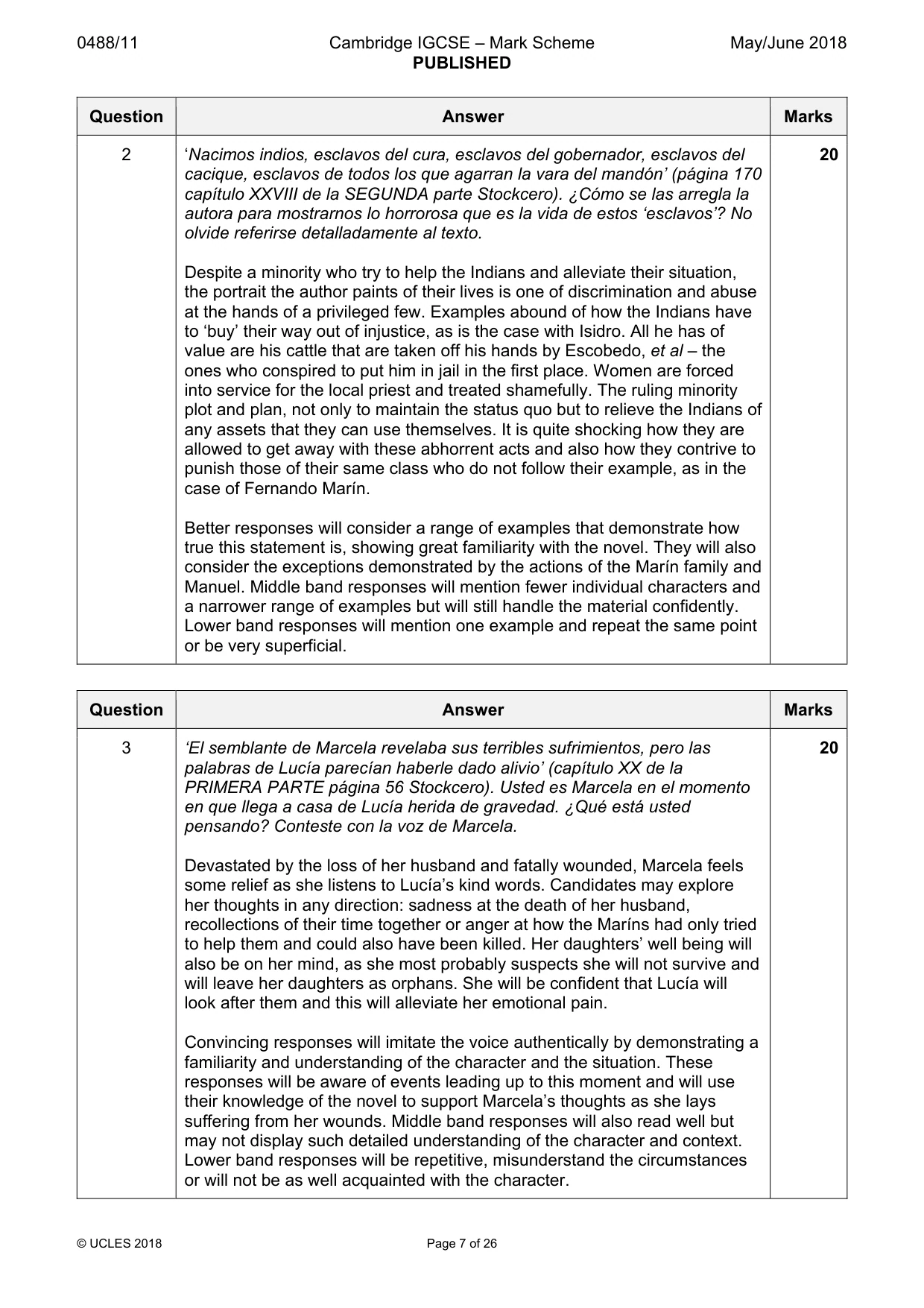
0488/11 Cambridge IGCSE – Mark Scheme PUBLISHED May/June 2018 © UCLES 2018 Page 7 of 26 Question Answer Marks 2 ‘Nacimos indios, esclavos del cura, esclavos del gobernador, esclavos del cacique, esclavos de todos los que agarran la vara del mandón’ (página 170 capítulo XXVIII de la SEGUNDA parte Stockcero). ¿Cómo se las arregla la autora para mostrarnos lo horrorosa que es la vida de estos ‘esclavos’? No olvide referirse detalladamente al texto. Despite a minority who try to help the Indians and alleviate their situation, the portrait the author paints of their lives is one of discrimination and abuse at the hands of a privileged few. Examples abound of how the Indians have to ‘buy’ their way out of injustice, as is the case with Isidro. All he has of value are his cattle that are taken off his hands by Escobedo, et al – the ones who conspired to put him in jail in the first place. Women are forced into service for the local priest and treated shamefully. The ruling minority plot and plan, not only to maintain the status quo but to relieve the Indians of any assets that they can use themselves. It is quite shocking how they are allowed to get away with these abhorrent acts and also how they contrive to punish those of their same class who do not follow their example, as in the case of Fernando Marín. Better responses will consider a range of examples that demonstrate how true this statement is, showing great familiarity with the novel. They will also consider the exceptions demonstrated by the actions of the Marín family and Manuel. Middle band responses will mention fewer individual characters and a narrower range of examples but will still handle the material confidently. Lower band responses will mention one example and repeat the same point or be very superficial. 20 Question Answer Marks 3 ‘El semblante de Marcela revelaba sus terribles sufrimientos, pero las palabras de Lucía parecían haberle dado alivio’ (capítulo XX de la PRIMERA PARTE página 56 Stockcero). Usted es Marcela en el momento en que llega a casa de Lucía herida de gravedad. ¿Qué está usted pensando? Conteste con la voz de Marcela. Devastated by the loss of her husband and fatally wounded, Marcela feels some relief as she listens to Lucía’s kind words. Candidates may explore her thoughts in any direction: sadness at the death of her husband, recollections of their time together or anger at how the Maríns had only tried to help them and could also have been killed. Her daughters’ well being will also be on her mind, as she most probably suspects she will not survive and will leave her daughters as orphans. She will be confident that Lucía will look after them and this will alleviate her emotional pain. Convincing responses will imitate the voice authentically by demonstrating a familiarity and understanding of the character and the situation. These responses will be aware of events leading up to this moment and will use their knowledge of the novel to support Marcela’s thoughts as she lays suffering from her wounds. Middle band responses will also read well but may not display such detailed understanding of the character and context. Lower band responses will be repetitive, misunderstand the circumstances or will not be as well acquainted with the character. 20
Mark scheme, page 8
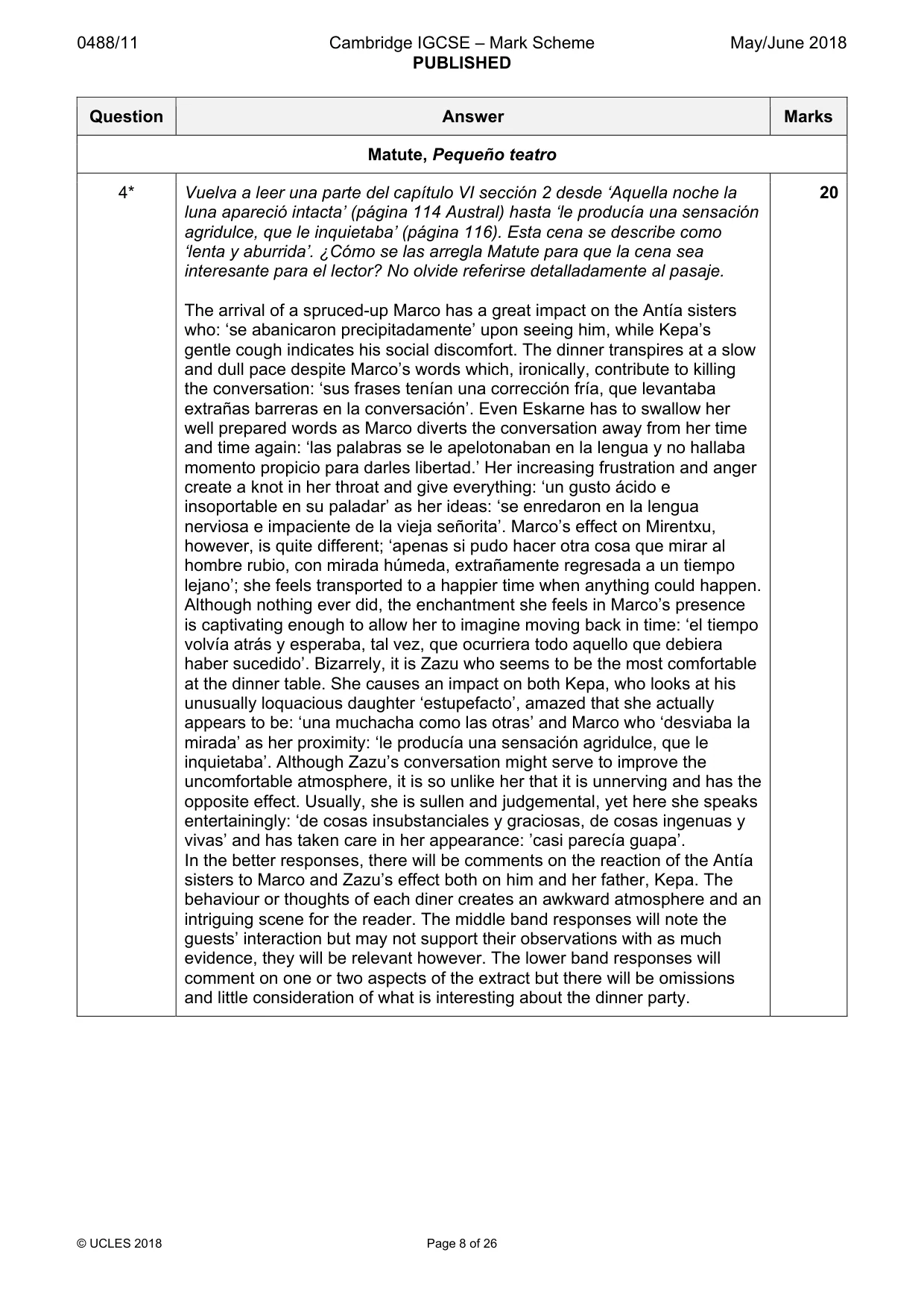
0488/11 Cambridge IGCSE – Mark Scheme PUBLISHED May/June 2018 © UCLES 2018 Page 8 of 26 Question Answer Marks Matute, Pequeño teatro 4* Vuelva a leer una parte del capítulo VI sección 2 desde ‘Aquella noche la luna apareció intacta’ (página 114 Austral) hasta ‘le producía una sensación agridulce, que le inquietaba’ (página 116). Esta cena se describe como ‘lenta y aburrida’. ¿Cómo se las arregla Matute para que la cena sea interesante para el lector? No olvide referirse detalladamente al pasaje. The arrival of a spruced-up Marco has a great impact on the Antía sisters who: ‘se abanicaron precipitadamente’ upon seeing him, while Kepa’s gentle cough indicates his social discomfort. The dinner transpires at a slow and dull pace despite Marco’s words which, ironically, contribute to killing the conversation: ‘sus frases tenían una corrección fría, que levantaba extrañas barreras en la conversación’. Even Eskarne has to swallow her well prepared words as Marco diverts the conversation away from her time and time again: ‘las palabras se le apelotonaban en la lengua y no hallaba momento propicio para darles libertad.’ Her increasing frustration and anger create a knot in her throat and give everything: ‘un gusto ácido e insoportable en su paladar’ as her ideas: ‘se enredaron en la lengua nerviosa e impaciente de la vieja señorita’. Marco’s effect on Mirentxu, however, is quite different; ‘apenas si pudo hacer otra cosa que mirar al hombre rubio, con mirada húmeda, extrañamente regresada a un tiempo lejano’; she feels transported to a happier time when anything could happen. Although nothing ever did, the enchantment she feels in Marco’s presence is captivating enough to allow her to imagine moving back in time: ‘el tiempo volvía atrás y esperaba, tal vez, que ocurriera todo aquello que debiera haber sucedido’. Bizarrely, it is Zazu who seems to be the most comfortable at the dinner table. She causes an impact on both Kepa, who looks at his unusually loquacious daughter ‘estupefacto’, amazed that she actually appears to be: ‘una muchacha como las otras’ and Marco who ‘desviaba la mirada’ as her proximity: ‘le producía una sensación agridulce, que le inquietaba’. Although Zazu’s conversation might serve to improve the uncomfortable atmosphere, it is so unlike her that it is unnerving and has the opposite effect. Usually, she is sullen and judgemental, yet here she speaks entertainingly: ‘de cosas insubstanciales y graciosas, de cosas ingenuas y vivas’ and has taken care in her appearance: ’casi parecía guapa’. In the better responses, there will be comments on the reaction of the Antía sisters to Marco and Zazu’s effect both on him and her father, Kepa. The behaviour or thoughts of each diner creates an awkward atmosphere and an intriguing scene for the reader. The middle band responses will note the guests’ interaction but may not support their observations with as much evidence, they will be relevant however. The lower band responses will comment on one or two aspects of the extract but there will be omissions and little consideration of what is interesting about the dinner party. 20
Mark scheme, page 9
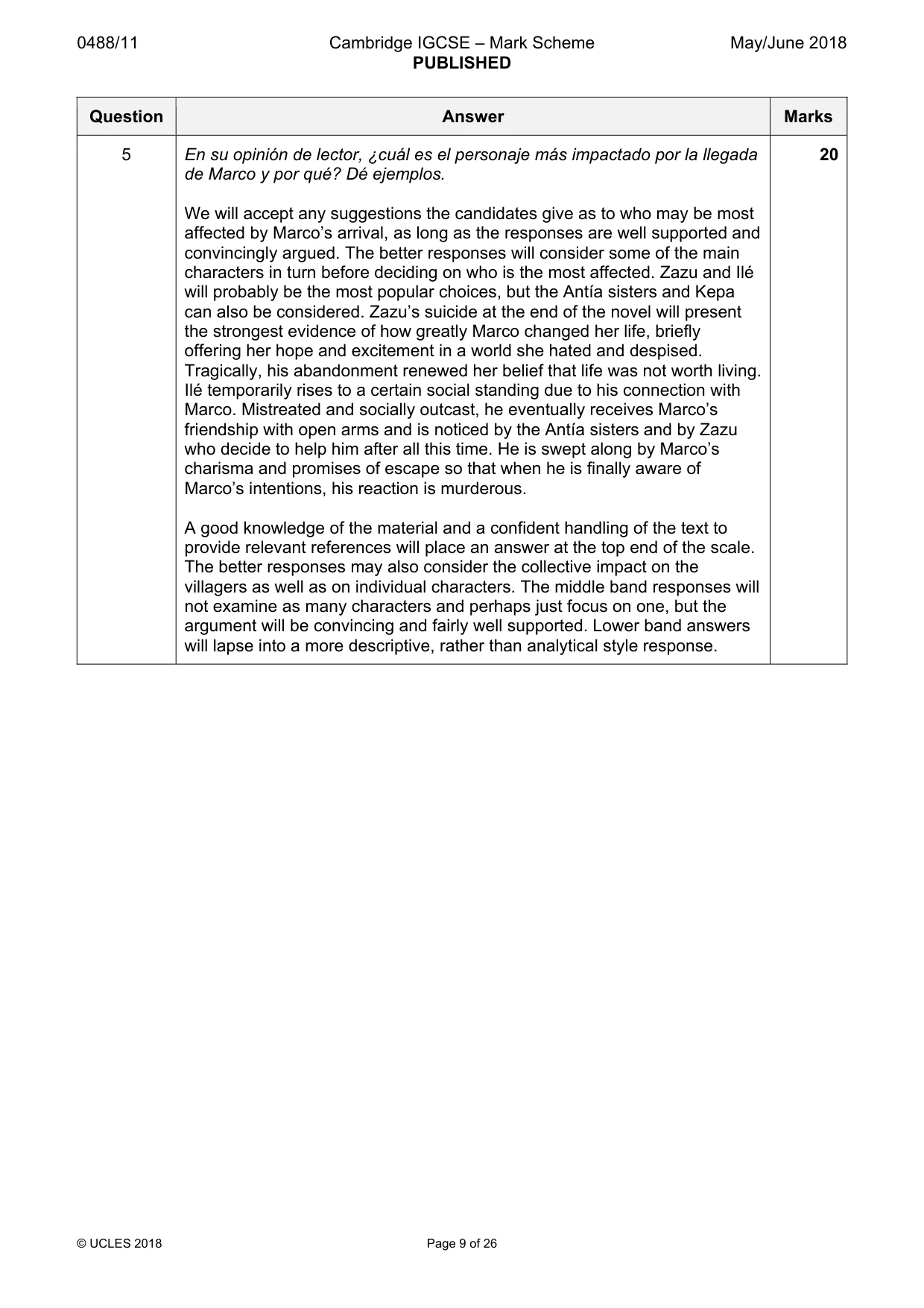
0488/11 Cambridge IGCSE – Mark Scheme PUBLISHED May/June 2018 © UCLES 2018 Page 9 of 26 Question Answer Marks 5 En su opinión de lector, ¿cuál es el personaje más impactado por la llegada de Marco y por qué? Dé ejemplos. We will accept any suggestions the candidates give as to who may be most affected by Marco’s arrival, as long as the responses are well supported and convincingly argued. The better responses will consider some of the main characters in turn before deciding on who is the most affected. Zazu and Ilé will probably be the most popular choices, but the Antía sisters and Kepa can also be considered. Zazu’s suicide at the end of the novel will present the strongest evidence of how greatly Marco changed her life, briefly offering her hope and excitement in a world she hated and despised. Tragically, his abandonment renewed her belief that life was not worth living. Ilé temporarily rises to a certain social standing due to his connection with Marco. Mistreated and socially outcast, he eventually receives Marco’s friendship with open arms and is noticed by the Antía sisters and by Zazu who decide to help him after all this time. He is swept along by Marco’s charisma and promises of escape so that when he is finally aware of Marco’s intentions, his reaction is murderous. A good knowledge of the material and a confident handling of the text to provide relevant references will place an answer at the top end of the scale. The better responses may also consider the collective impact on the villagers as well as on individual characters. The middle band responses will not examine as many characters and perhaps just focus on one, but the argument will be convincing and fairly well supported. Lower band answers will lapse into a more descriptive, rather than analytical style response. 20
Mark scheme, page 10
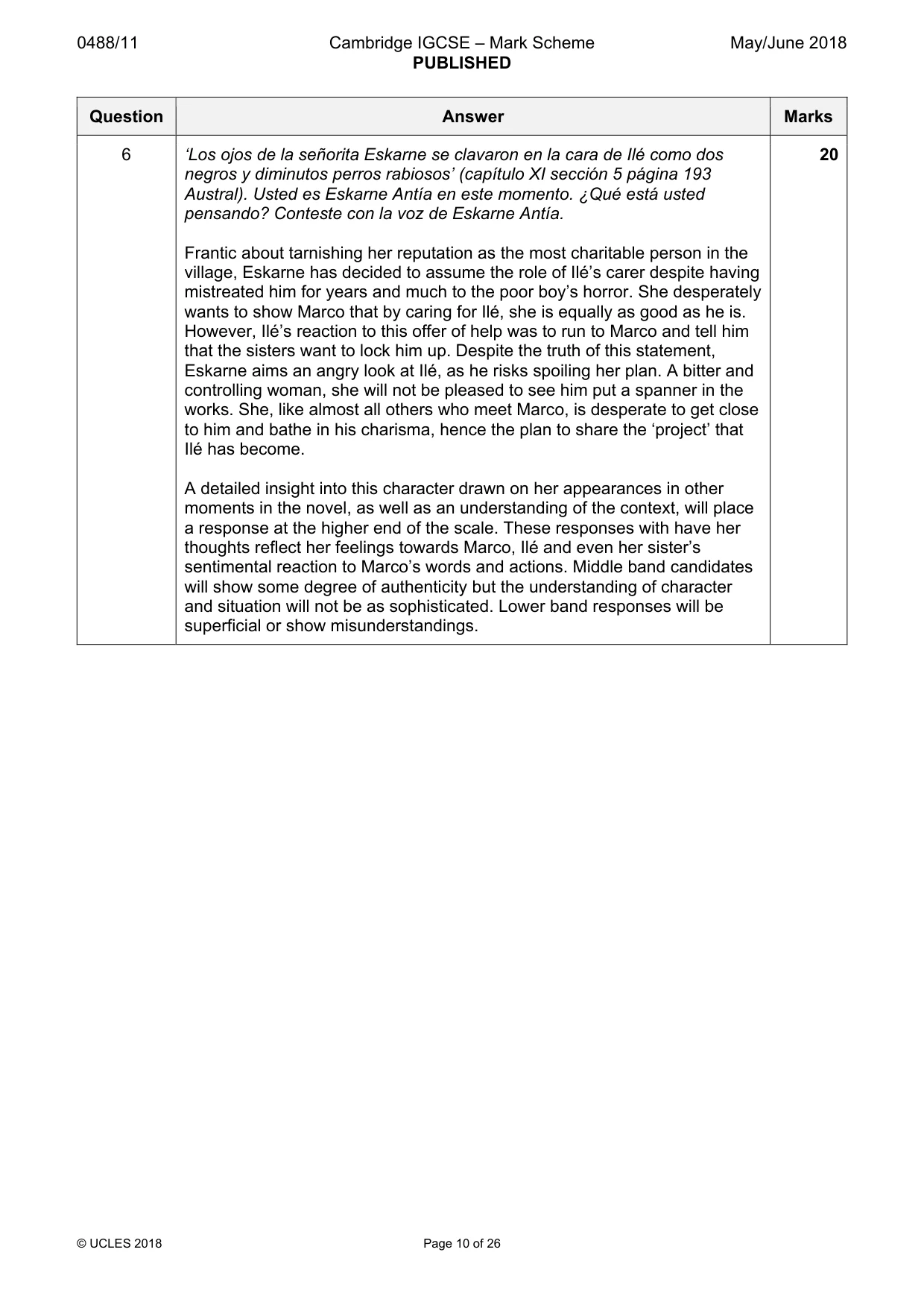
0488/11 Cambridge IGCSE – Mark Scheme PUBLISHED May/June 2018 © UCLES 2018 Page 10 of 26 Question Answer Marks 6 ‘Los ojos de la señorita Eskarne se clavaron en la cara de Ilé como dos negros y diminutos perros rabiosos’ (capítulo XI sección 5 página 193 Austral). Usted es Eskarne Antía en este momento. ¿Qué está usted pensando? Conteste con la voz de Eskarne Antía. Frantic about tarnishing her reputation as the most charitable person in the village, Eskarne has decided to assume the role of Ilé’s carer despite having mistreated him for years and much to the poor boy’s horror. She desperately wants to show Marco that by caring for Ilé, she is equally as good as he is. However, Ilé’s reaction to this offer of help was to run to Marco and tell him that the sisters want to lock him up. Despite the truth of this statement, Eskarne aims an angry look at Ilé, as he risks spoiling her plan. A bitter and controlling woman, she will not be pleased to see him put a spanner in the works. She, like almost all others who meet Marco, is desperate to get close to him and bathe in his charisma, hence the plan to share the ‘project’ that Ilé has become. A detailed insight into this character drawn on her appearances in other moments in the novel, as well as an understanding of the context, will place a response at the higher end of the scale. These responses with have her thoughts reflect her feelings towards Marco, Ilé and even her sister’s sentimental reaction to Marco’s words and actions. Middle band candidates will show some degree of authenticity but the understanding of character and situation will not be as sophisticated. Lower band responses will be superficial or show misunderstandings. 20
Mark scheme, page 11
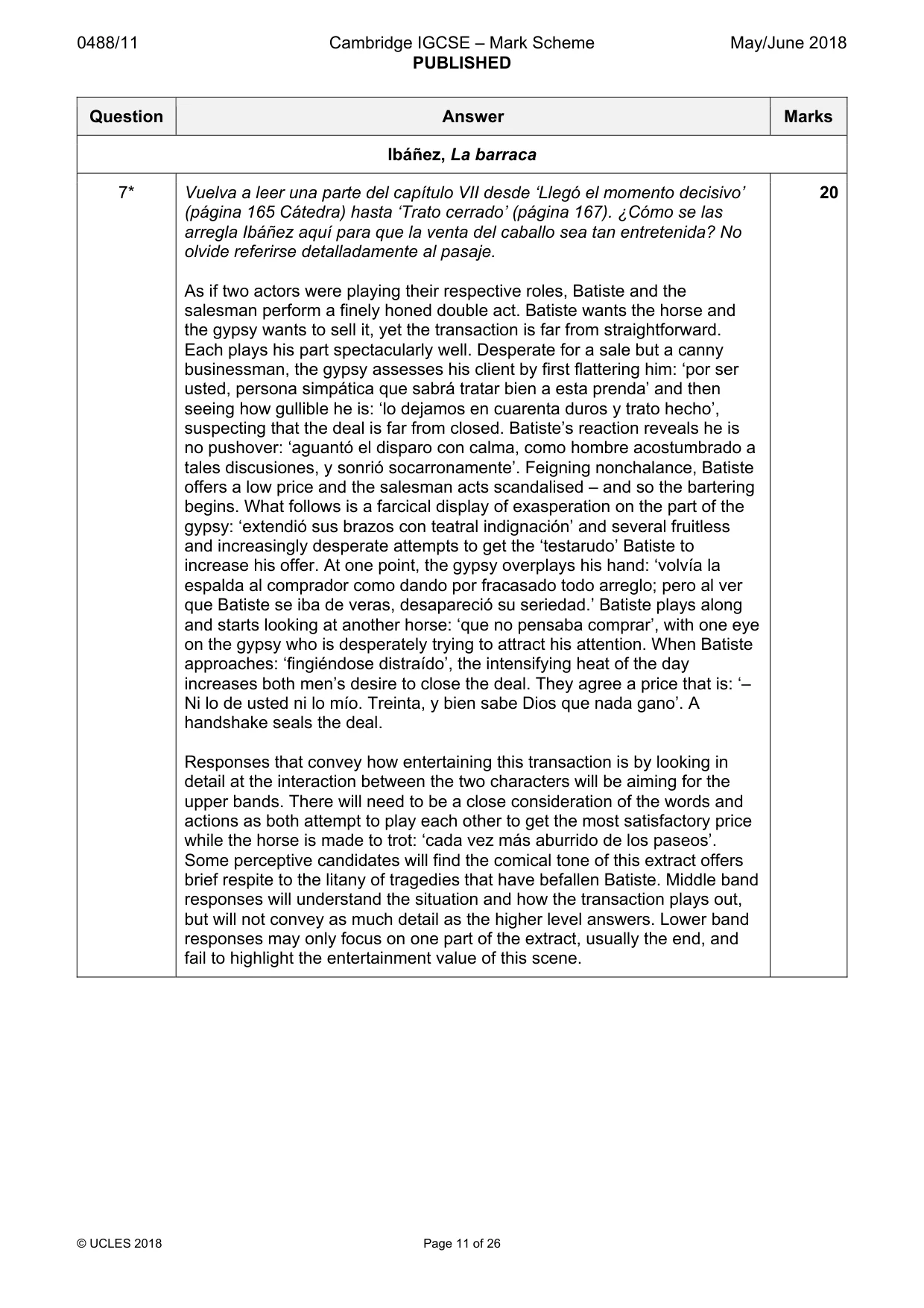
0488/11 Cambridge IGCSE – Mark Scheme PUBLISHED May/June 2018 © UCLES 2018 Page 11 of 26 Question Answer Marks Ibáñez, La barraca 7* Vuelva a leer una parte del capítulo VII desde ‘Llegó el momento decisivo’ (página 165 Cátedra) hasta ‘Trato cerrado’ (página 167). ¿Cómo se las arregla Ibáñez aquí para que la venta del caballo sea tan entretenida? No olvide referirse detalladamente al pasaje. As if two actors were playing their respective roles, Batiste and the salesman perform a finely honed double act. Batiste wants the horse and the gypsy wants to sell it, yet the transaction is far from straightforward. Each plays his part spectacularly well. Desperate for a sale but a canny businessman, the gypsy assesses his client by first flattering him: ‘por ser usted, persona simpática que sabrá tratar bien a esta prenda’ and then seeing how gullible he is: ‘lo dejamos en cuarenta duros y trato hecho’, suspecting that the deal is far from closed. Batiste’s reaction reveals he is no pushover: ‘aguantó el disparo con calma, como hombre acostumbrado a tales discusiones, y sonrió socarronamente’. Feigning nonchalance, Batiste offers a low price and the salesman acts scandalised – and so the bartering begins. What follows is a farcical display of exasperation on the part of the gypsy: ‘extendió sus brazos con teatral indignación’ and several fruitless and increasingly desperate attempts to get the ‘testarudo’ Batiste to increase his offer. At one point, the gypsy overplays his hand: ‘volvía la espalda al comprador como dando por fracasado todo arreglo; pero al ver que Batiste se iba de veras, desapareció su seriedad.’ Batiste plays along and starts looking at another horse: ‘que no pensaba comprar’, with one eye on the gypsy who is desperately trying to attract his attention. When Batiste approaches: ‘fingiéndose distraído’, the intensifying heat of the day increases both men’s desire to close the deal. They agree a price that is: ‘– Ni lo de usted ni lo mío. Treinta, y bien sabe Dios que nada gano’. A handshake seals the deal. Responses that convey how entertaining this transaction is by looking in detail at the interaction between the two characters will be aiming for the upper bands. There will need to be a close consideration of the words and actions as both attempt to play each other to get the most satisfactory price while the horse is made to trot: ‘cada vez más aburrido de los paseos’. Some perceptive candidates will find the comical tone of this extract offers brief respite to the litany of tragedies that have befallen Batiste. Middle band responses will understand the situation and how the transaction plays out, but will not convey as much detail as the higher level answers. Lower band responses may only focus on one part of the extract, usually the end, and fail to highlight the entertainment value of this scene. 20
Mark scheme, page 12
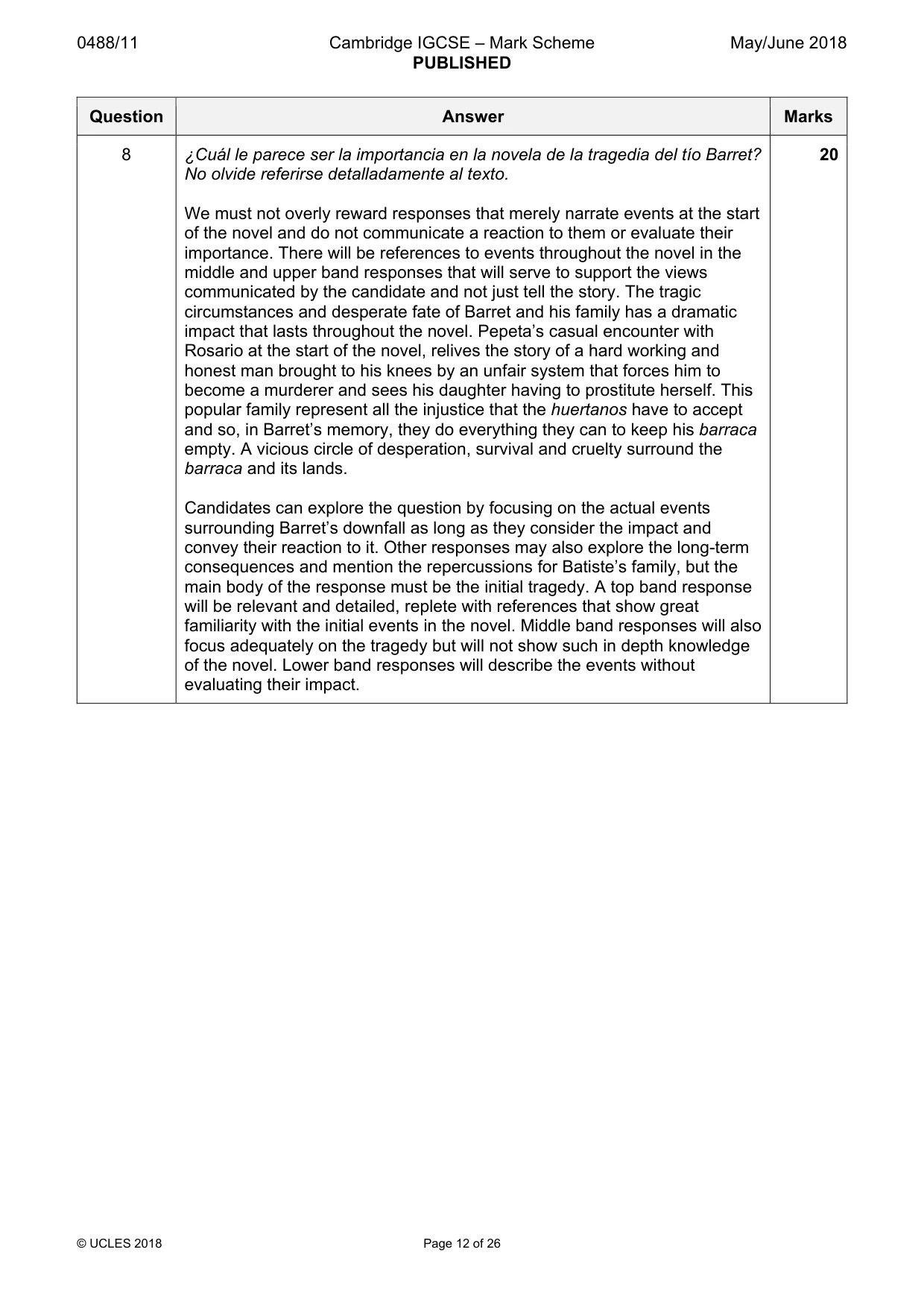
0488/11 Cambridge IGCSE – Mark Scheme PUBLISHED May/June 2018 © UCLES 2018 Page 12 of 26 Question Answer Marks 8 ¿Cuál le parece ser la importancia en la novela de la tragedia del tío Barret? No olvide referirse detalladamente al texto. We must not overly reward responses that merely narrate events at the start of the novel and do not communicate a reaction to them or evaluate their importance. There will be references to events throughout the novel in the middle and upper band responses that will serve to support the views communicated by the candidate and not just tell the story. The tragic circumstances and desperate fate of Barret and his family has a dramatic impact that lasts throughout the novel. Pepeta’s casual encounter with Rosario at the start of the novel, relives the story of a hard working and honest man brought to his knees by an unfair system that forces him to become a murderer and sees his daughter having to prostitute herself. This popular family represent all the injustice that the huertanos have to accept and so, in Barret’s memory, they do everything they can to keep his barraca empty. A vicious circle of desperation, survival and cruelty surround the barraca and its lands. Candidates can explore the question by focusing on the actual events surrounding Barret’s downfall as long as they consider the impact and convey their reaction to it. Other responses may also explore the long-term consequences and mention the repercussions for Batiste’s family, but the main body of the response must be the initial tragedy. A top band response will be relevant and detailed, replete with references that show great familiarity with the initial events in the novel. Middle band responses will also focus adequately on the tragedy but will not show such in depth knowledge of the novel. Lower band responses will describe the events without evaluating their impact. 20
Mark scheme, page 13
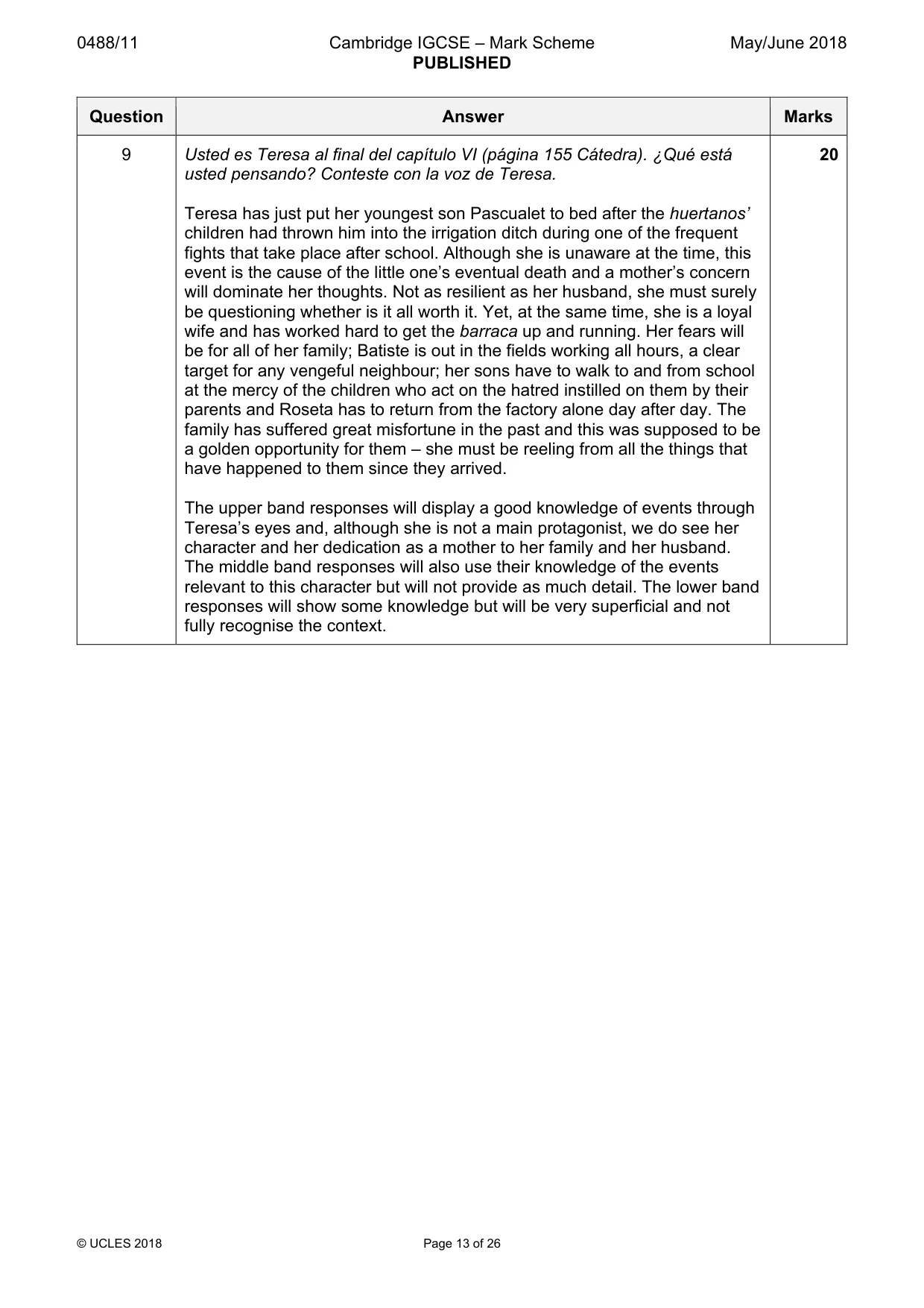
0488/11 Cambridge IGCSE – Mark Scheme PUBLISHED May/June 2018 © UCLES 2018 Page 13 of 26 Question Answer Marks 9 Usted es Teresa al final del capítulo VI (página 155 Cátedra). ¿Qué está usted pensando? Conteste con la voz de Teresa. Teresa has just put her youngest son Pascualet to bed after the huertanos’ children had thrown him into the irrigation ditch during one of the frequent fights that take place after school. Although she is unaware at the time, this event is the cause of the little one’s eventual death and a mother’s concern will dominate her thoughts. Not as resilient as her husband, she must surely be questioning whether is it all worth it. Yet, at the same time, she is a loyal wife and has worked hard to get the barraca up and running. Her fears will be for all of her family; Batiste is out in the fields working all hours, a clear target for any vengeful neighbour; her sons have to walk to and from school at the mercy of the children who act on the hatred instilled on them by their parents and Roseta has to return from the factory alone day after day. The family has suffered great misfortune in the past and this was supposed to be a golden opportunity for them – she must be reeling from all the things that have happened to them since they arrived. The upper band responses will display a good knowledge of events through Teresa’s eyes and, although she is not a main protagonist, we do see her character and her dedication as a mother to her family and her husband. The middle band responses will also use their knowledge of the events relevant to this character but will not provide as much detail. The lower band responses will show some knowledge but will be very superficial and not fully recognise the context. 20
Mark scheme, page 14
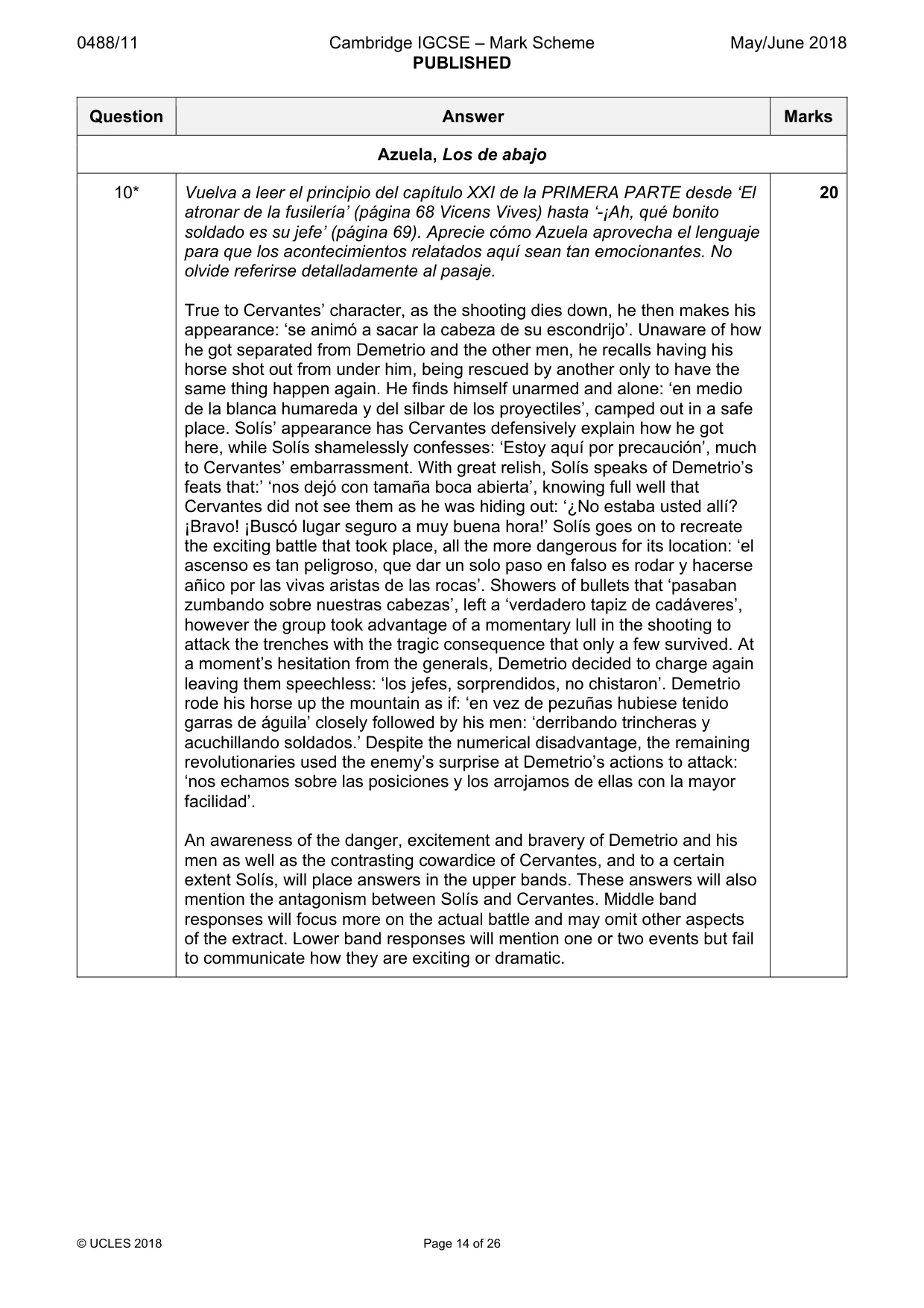
0488/11 Cambridge IGCSE – Mark Scheme PUBLISHED May/June 2018 © UCLES 2018 Page 14 of 26 Question Answer Marks Azuela, Los de abajo 10* Vuelva a leer el principio del capítulo XXI de la PRIMERA PARTE desde ‘El atronar de la fusilería’ (página 68 Vicens Vives) hasta ‘-¡Ah, qué bonito soldado es su jefe’ (página 69). Aprecie cómo Azuela aprovecha el lenguaje para que los acontecimientos relatados aquí sean tan emocionantes. No olvide referirse detalladamente al pasaje. True to Cervantes’ character, as the shooting dies down, he then makes his appearance: ‘se animó a sacar la cabeza de su escondrijo’. Unaware of how he got separated from Demetrio and the other men, he recalls having his horse shot out from under him, being rescued by another only to have the same thing happen again. He finds himself unarmed and alone: ‘en medio de la blanca humareda y del silbar de los proyectiles’, camped out in a safe place. Solís’ appearance has Cervantes defensively explain how he got here, while Solís shamelessly confesses: ‘Estoy aquí por precaución’, much to Cervantes’ embarrassment. With great relish, Solís speaks of Demetrio’s feats that:’ ‘nos dejó con tamaña boca abierta’, knowing full well that Cervantes did not see them as he was hiding out: ‘¿No estaba usted allí? ¡Bravo! ¡Buscó lugar seguro a muy buena hora!’ Solís goes on to recreate the exciting battle that took place, all the more dangerous for its location: ‘el ascenso es tan peligroso, que dar un solo paso en falso es rodar y hacerse añico por las vivas aristas de las rocas’. Showers of bullets that ‘pasaban zumbando sobre nuestras cabezas’, left a ‘verdadero tapiz de cadáveres’, however the group took advantage of a momentary lull in the shooting to attack the trenches with the tragic consequence that only a few survived. At a moment’s hesitation from the generals, Demetrio decided to charge again leaving them speechless: ‘los jefes, sorprendidos, no chistaron’. Demetrio rode his horse up the mountain as if: ‘en vez de pezuñas hubiese tenido garras de águila’ closely followed by his men: ‘derribando trincheras y acuchillando soldados.’ Despite the numerical disadvantage, the remaining revolutionaries used the enemy’s surprise at Demetrio’s actions to attack: ‘nos echamos sobre las posiciones y los arrojamos de ellas con la mayor facilidad’. An awareness of the danger, excitement and bravery of Demetrio and his men as well as the contrasting cowardice of Cervantes, and to a certain extent Solís, will place answers in the upper bands. These answers will also mention the antagonism between Solís and Cervantes. Middle band responses will focus more on the actual battle and may omit other aspects of the extract. Lower band responses will mention one or two events but fail to communicate how they are exciting or dramatic. 20
Mark scheme, page 15
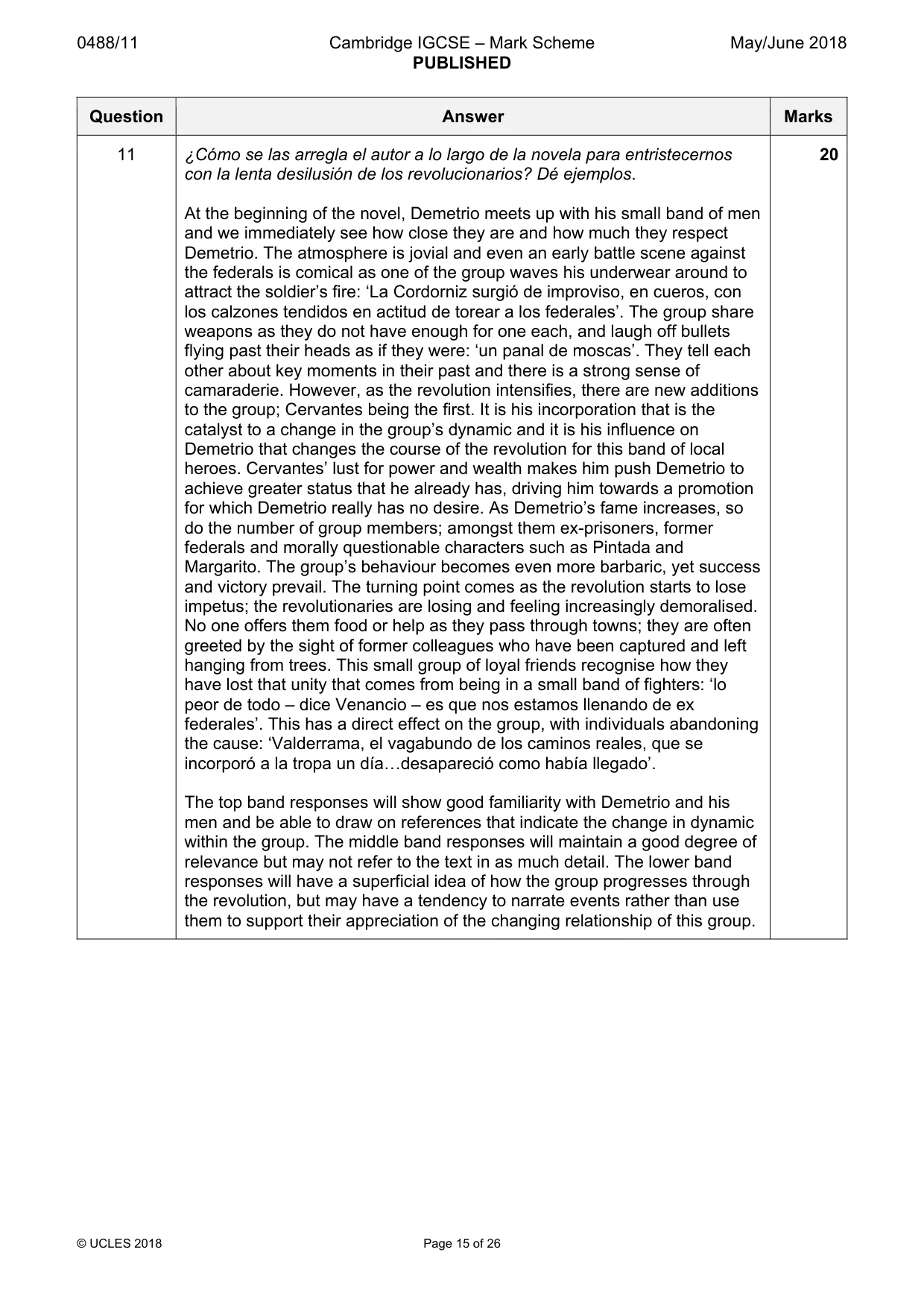
0488/11 Cambridge IGCSE – Mark Scheme PUBLISHED May/June 2018 © UCLES 2018 Page 15 of 26 Question Answer Marks 11 ¿Cómo se las arregla el autor a lo largo de la novela para entristecernos con la lenta desilusión de los revolucionarios? Dé ejemplos. At the beginning of the novel, Demetrio meets up with his small band of men and we immediately see how close they are and how much they respect Demetrio. The atmosphere is jovial and even an early battle scene against the federals is comical as one of the group waves his underwear around to attract the soldier’s fire: ‘La Cordorniz surgió de improviso, en cueros, con los calzones tendidos en actitud de torear a los federales’. The group share weapons as they do not have enough for one each, and laugh off bullets flying past their heads as if they were: ‘un panal de moscas’. They tell each other about key moments in their past and there is a strong sense of camaraderie. However, as the revolution intensifies, there are new additions to the group; Cervantes being the first. It is his incorporation that is the catalyst to a change in the group’s dynamic and it is his influence on Demetrio that changes the course of the revolution for this band of local heroes. Cervantes’ lust for power and wealth makes him push Demetrio to achieve greater status that he already has, driving him towards a promotion for which Demetrio really has no desire. As Demetrio’s fame increases, so do the number of group members; amongst them ex-prisoners, former federals and morally questionable characters such as Pintada and Margarito. The group’s behaviour becomes even more barbaric, yet success and victory prevail. The turning point comes as the revolution starts to lose impetus; the revolutionaries are losing and feeling increasingly demoralised. No one offers them food or help as they pass through towns; they are often greeted by the sight of former colleagues who have been captured and left hanging from trees. This small group of loyal friends recognise how they have lost that unity that comes from being in a small band of fighters: ‘lo peor de todo – dice Venancio – es que nos estamos llenando de ex federales’. This has a direct effect on the group, with individuals abandoning the cause: ‘Valderrama, el vagabundo de los caminos reales, que se incorporó a la tropa un día«desapareció como había llegado’. The top band responses will show good familiarity with Demetrio and his men and be able to draw on references that indicate the change in dynamic within the group. The middle band responses will maintain a good degree of relevance but may not refer to the text in as much detail. The lower band responses will have a superficial idea of how the group progresses through the revolution, but may have a tendency to narrate events rather than use them to support their appreciation of the changing relationship of this group. 20
Mark scheme, page 16
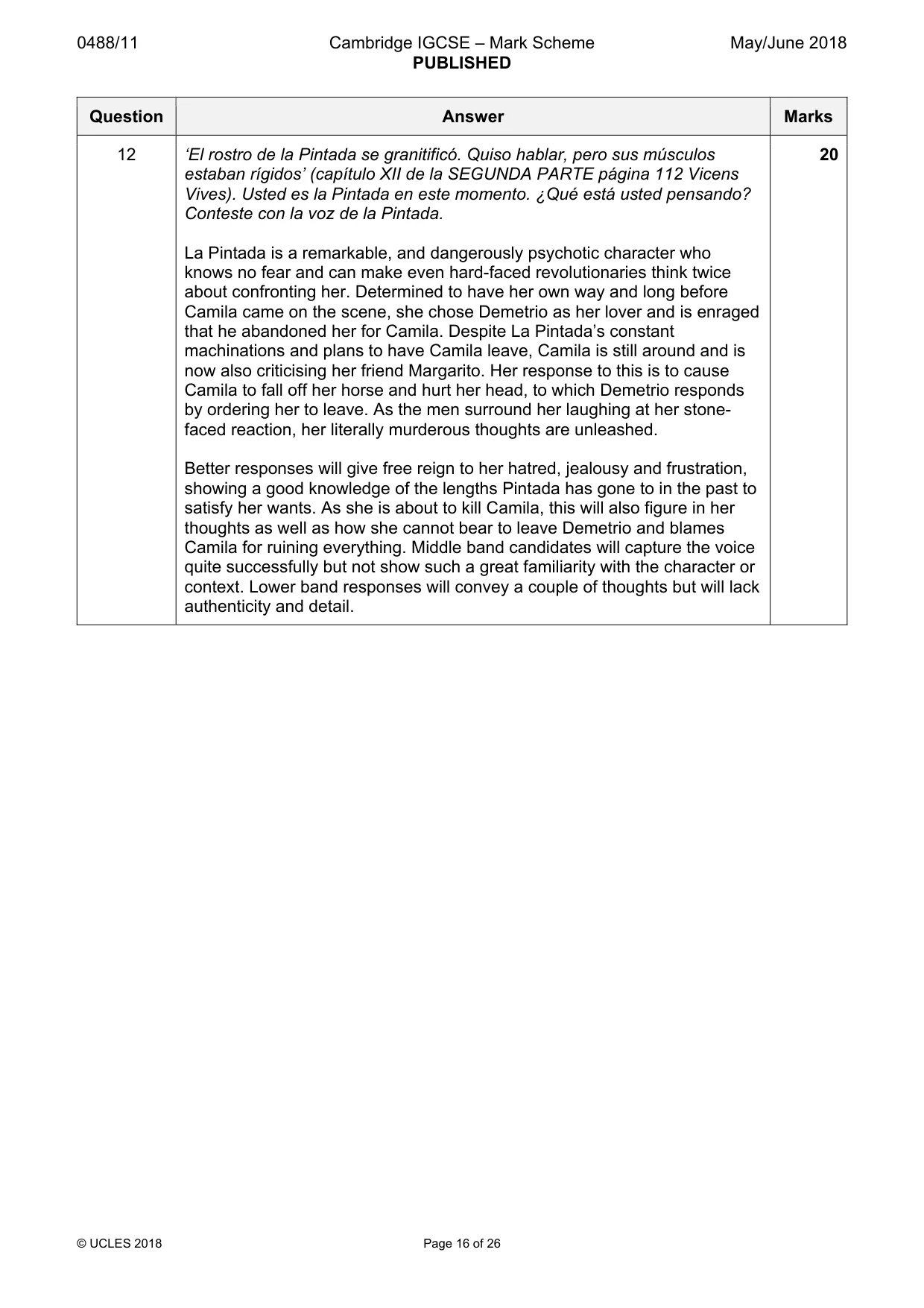
0488/11 Cambridge IGCSE – Mark Scheme PUBLISHED May/June 2018 © UCLES 2018 Page 16 of 26 Question Answer Marks 12 ‘El rostro de la Pintada se granitificó. Quiso hablar, pero sus músculos estaban rígidos’ (capítulo XII de la SEGUNDA PARTE página 112 Vicens Vives). Usted es la Pintada en este momento. ¿Qué está usted pensando? Conteste con la voz de la Pintada. La Pintada is a remarkable, and dangerously psychotic character who knows no fear and can make even hard-faced revolutionaries think twice about confronting her. Determined to have her own way and long before Camila came on the scene, she chose Demetrio as her lover and is enraged that he abandoned her for Camila. Despite La Pintada’s constant machinations and plans to have Camila leave, Camila is still around and is now also criticising her friend Margarito. Her response to this is to cause Camila to fall off her horse and hurt her head, to which Demetrio responds by ordering her to leave. As the men surround her laughing at her stone- faced reaction, her literally murderous thoughts are unleashed. Better responses will give free reign to her hatred, jealousy and frustration, showing a good knowledge of the lengths Pintada has gone to in the past to satisfy her wants. As she is about to kill Camila, this will also figure in her thoughts as well as how she cannot bear to leave Demetrio and blames Camila for ruining everything. Middle band candidates will capture the voice quite successfully but not show such a great familiarity with the character or context. Lower band responses will convey a couple of thoughts but will lack authenticity and detail. 20
Mark scheme, page 17
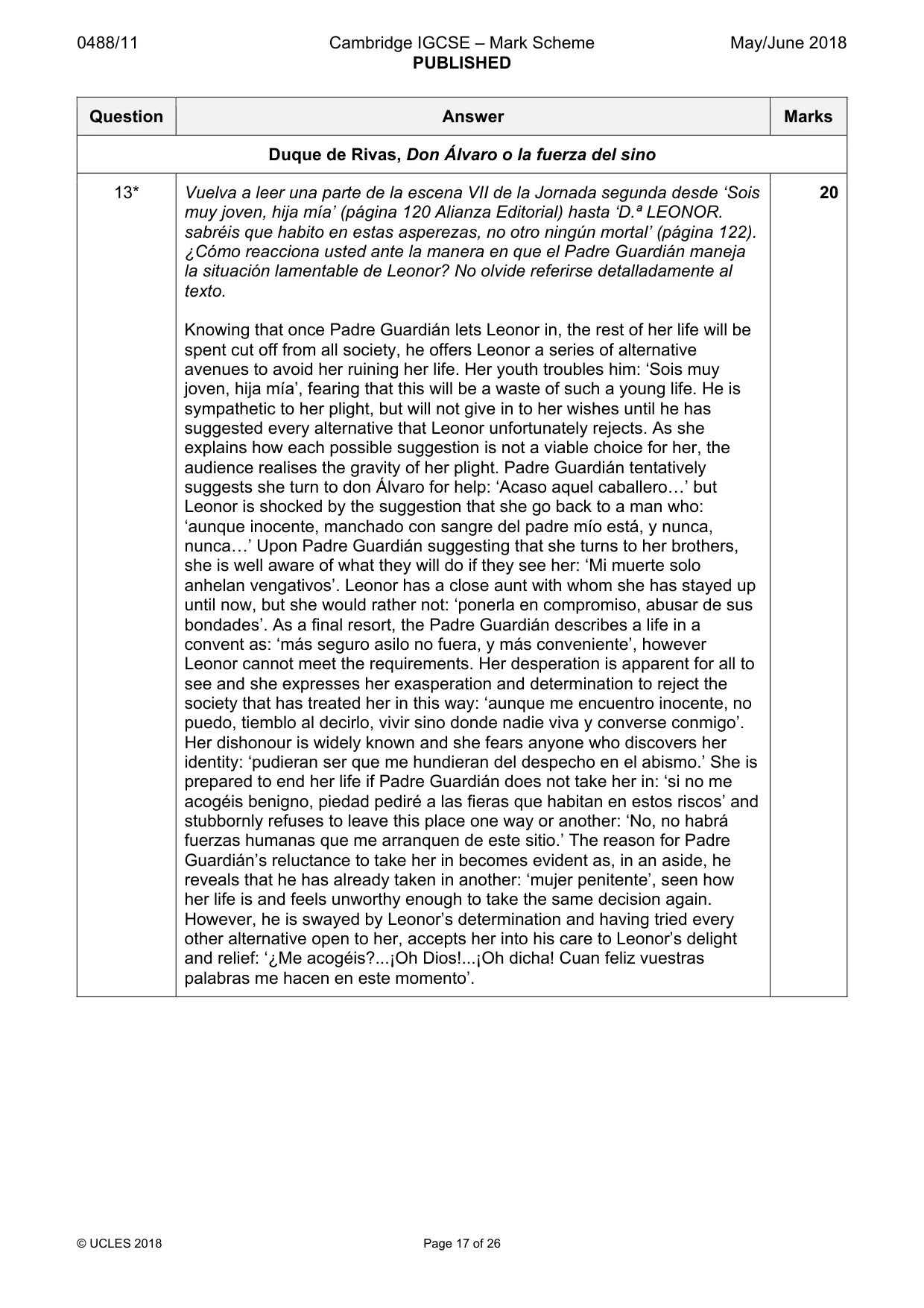
0488/11 Cambridge IGCSE – Mark Scheme PUBLISHED May/June 2018 © UCLES 2018 Page 17 of 26 Question Answer Marks Duque de Rivas, Don Álvaro o la fuerza del sino 13* Vuelva a leer una parte de la escena VII de la Jornada segunda desde ‘Sois muy joven, hija mía’ (página 120 Alianza Editorial) hasta ‘D.ª LEONOR. sabréis que habito en estas asperezas, no otro ningún mortal’ (página 122). ¿Cómo reacciona usted ante la manera en que el Padre Guardián maneja la situación lamentable de Leonor? No olvide referirse detalladamente al texto. Knowing that once Padre Guardián lets Leonor in, the rest of her life will be spent cut off from all society, he offers Leonor a series of alternative avenues to avoid her ruining her life. Her youth troubles him: ‘Sois muy joven, hija mía’, fearing that this will be a waste of such a young life. He is sympathetic to her plight, but will not give in to her wishes until he has suggested every alternative that Leonor unfortunately rejects. As she explains how each possible suggestion is not a viable choice for her, the audience realises the gravity of her plight. Padre Guardián tentatively suggests she turn to don Álvaro for help: ‘Acaso aquel caballero«’ but Leonor is shocked by the suggestion that she go back to a man who: ‘aunque inocente, manchado con sangre del padre mío está, y nunca, nunca«’ Upon Padre Guardián suggesting that she turns to her brothers, she is well aware of what they will do if they see her: ‘Mi muerte solo anhelan vengativos’. Leonor has a close aunt with whom she has stayed up until now, but she would rather not: ‘ponerla en compromiso, abusar de sus bondades’. As a final resort, the Padre Guardián describes a life in a convent as: ‘más seguro asilo no fuera, y más conveniente’, however Leonor cannot meet the requirements. Her desperation is apparent for all to see and she expresses her exasperation and determination to reject the society that has treated her in this way: ‘aunque me encuentro inocente, no puedo, tiemblo al decirlo, vivir sino donde nadie viva y converse conmigo’. Her dishonour is widely known and she fears anyone who discovers her identity: ‘pudieran ser que me hundieran del despecho en el abismo.’ She is prepared to end her life if Padre Guardián does not take her in: ‘si no me acogéis benigno, piedad pediré a las fieras que habitan en estos riscos’ and stubbornly refuses to leave this place one way or another: ‘No, no habrá fuerzas humanas que me arranquen de este sitio.’ The reason for Padre Guardián’s reluctance to take her in becomes evident as, in an aside, he reveals that he has already taken in another: ‘mujer penitente’, seen how her life is and feels unworthy enough to take the same decision again. However, he is swayed by Leonor’s determination and having tried every other alternative open to her, accepts her into his care to Leonor’s delight and relief: ‘¿Me acogéis?...¡Oh Dios!...¡Oh dicha! Cuan feliz vuestras palabras me hacen en este momento’. 20
Mark scheme, page 18
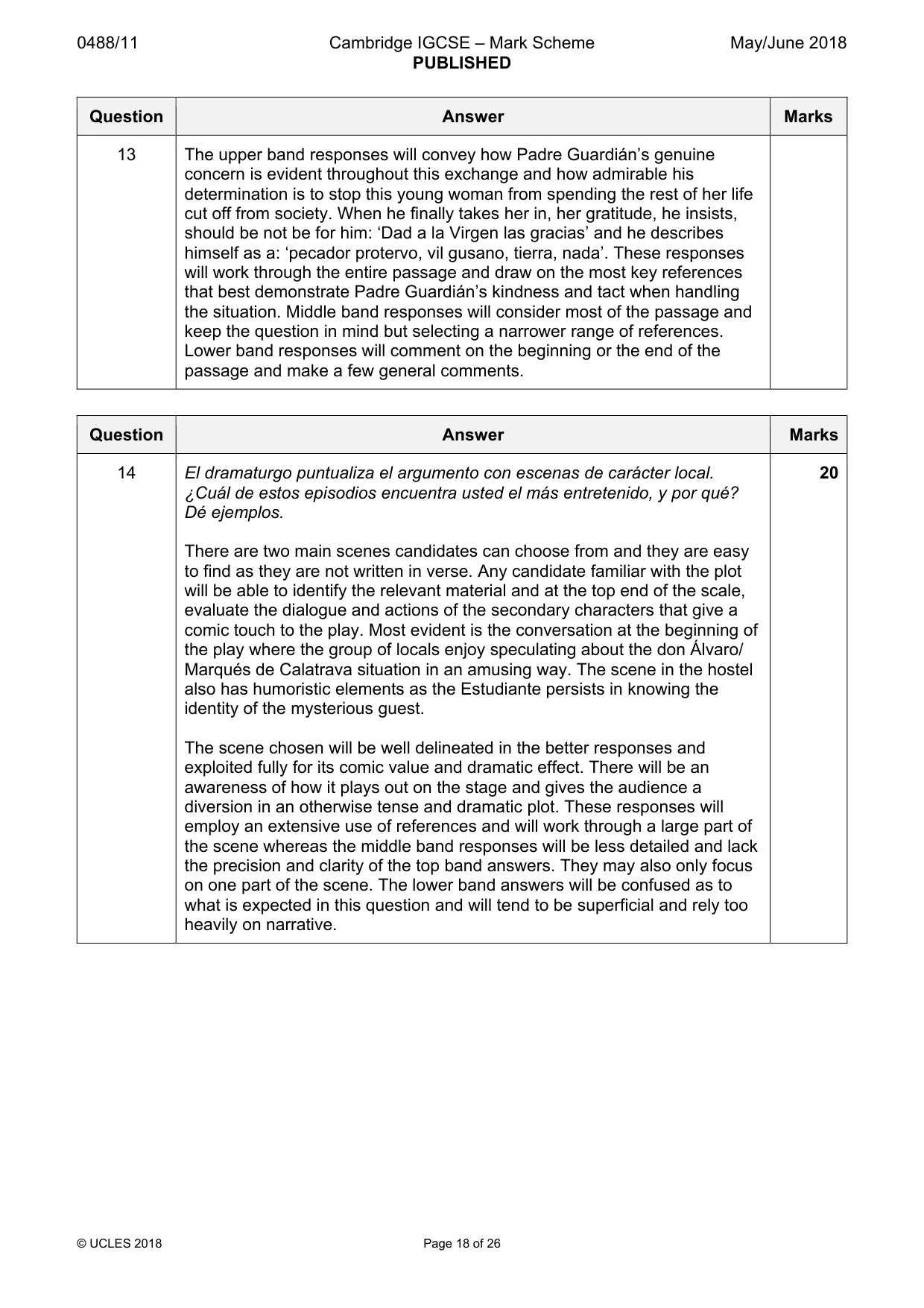
0488/11 Cambridge IGCSE – Mark Scheme PUBLISHED May/June 2018 © UCLES 2018 Page 18 of 26 Question Answer Marks 13 The upper band responses will convey how Padre Guardián’s genuine concern is evident throughout this exchange and how admirable his determination is to stop this young woman from spending the rest of her life cut off from society. When he finally takes her in, her gratitude, he insists, should be not be for him: ‘Dad a la Virgen las gracias’ and he describes himself as a: ‘pecador protervo, vil gusano, tierra, nada’. These responses will work through the entire passage and draw on the most key references that best demonstrate Padre Guardián’s kindness and tact when handling the situation. Middle band responses will consider most of the passage and keep the question in mind but selecting a narrower range of references. Lower band responses will comment on the beginning or the end of the passage and make a few general comments. Question Answer Marks 14 El dramaturgo puntualiza el argumento con escenas de carácter local. ¿Cuál de estos episodios encuentra usted el más entretenido, y por qué? Dé ejemplos. There are two main scenes candidates can choose from and they are easy to find as they are not written in verse. Any candidate familiar with the plot will be able to identify the relevant material and at the top end of the scale, evaluate the dialogue and actions of the secondary characters that give a comic touch to the play. Most evident is the conversation at the beginning of the play where the group of locals enjoy speculating about the don Álvaro/ Marqués de Calatrava situation in an amusing way. The scene in the hostel also has humoristic elements as the Estudiante persists in knowing the identity of the mysterious guest. The scene chosen will be well delineated in the better responses and exploited fully for its comic value and dramatic effect. There will be an awareness of how it plays out on the stage and gives the audience a diversion in an otherwise tense and dramatic plot. These responses will employ an extensive use of references and will work through a large part of the scene whereas the middle band responses will be less detailed and lack the precision and clarity of the top band answers. They may also only focus on one part of the scene. The lower band answers will be confused as to what is expected in this question and will tend to be superficial and rely too heavily on narrative. 20
Mark scheme, page 19
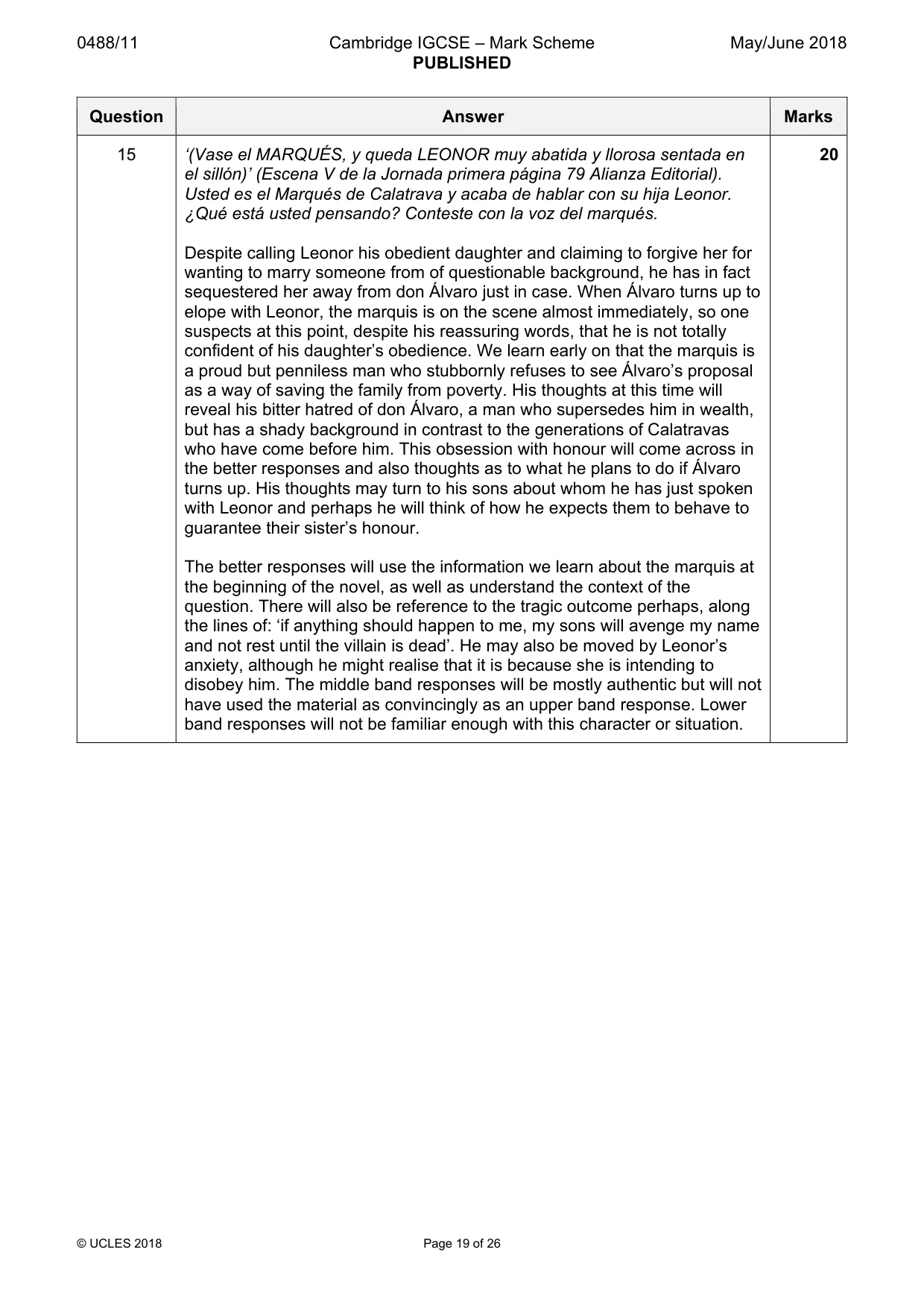
0488/11 Cambridge IGCSE – Mark Scheme PUBLISHED May/June 2018 © UCLES 2018 Page 19 of 26 Question Answer Marks 15 ‘(Vase el MARQUÉS, y queda LEONOR muy abatida y llorosa sentada en el sillón)’ (Escena V de la Jornada primera página 79 Alianza Editorial). Usted es el Marqués de Calatrava y acaba de hablar con su hija Leonor. ¿Qué está usted pensando? Conteste con la voz del marqués. Despite calling Leonor his obedient daughter and claiming to forgive her for wanting to marry someone from of questionable background, he has in fact sequestered her away from don Álvaro just in case. When Álvaro turns up to elope with Leonor, the marquis is on the scene almost immediately, so one suspects at this point, despite his reassuring words, that he is not totally confident of his daughter’s obedience. We learn early on that the marquis is a proud but penniless man who stubbornly refuses to see Álvaro’s proposal as a way of saving the family from poverty. His thoughts at this time will reveal his bitter hatred of don Álvaro, a man who supersedes him in wealth, but has a shady background in contrast to the generations of Calatravas who have come before him. This obsession with honour will come across in the better responses and also thoughts as to what he plans to do if Álvaro turns up. His thoughts may turn to his sons about whom he has just spoken with Leonor and perhaps he will think of how he expects them to behave to guarantee their sister’s honour. The better responses will use the information we learn about the marquis at the beginning of the novel, as well as understand the context of the question. There will also be reference to the tragic outcome perhaps, along the lines of: ‘if anything should happen to me, my sons will avenge my name and not rest until the villain is dead’. He may also be moved by Leonor’s anxiety, although he might realise that it is because she is intending to disobey him. The middle band responses will be mostly authentic but will not have used the material as convincingly as an upper band response. Lower band responses will not be familiar enough with this character or situation. 20
Mark scheme, page 20
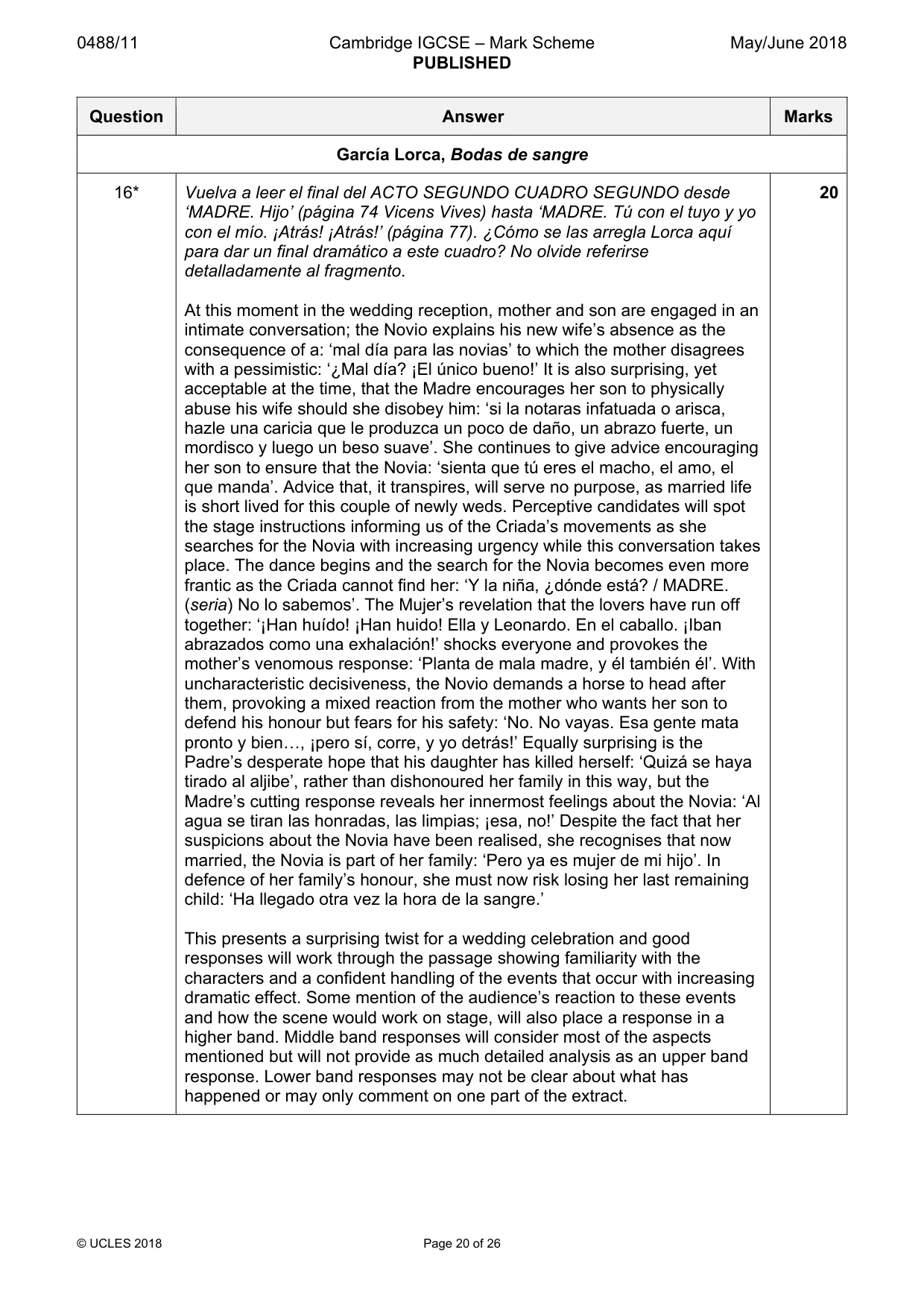
0488/11 Cambridge IGCSE – Mark Scheme PUBLISHED May/June 2018 © UCLES 2018 Page 20 of 26 Question Answer Marks García Lorca, Bodas de sangre 16* Vuelva a leer el final del ACTO SEGUNDO CUADRO SEGUNDO desde ‘MADRE. Hijo’ (página 74 Vicens Vives) hasta ‘MADRE. Tú con el tuyo y yo con el mío. ¡Atrás! ¡Atrás!’ (página 77). ¿Cómo se las arregla Lorca aquí para dar un final dramático a este cuadro? No olvide referirse detalladamente al fragmento. At this moment in the wedding reception, mother and son are engaged in an intimate conversation; the Novio explains his new wife’s absence as the consequence of a: ‘mal día para las novias’ to which the mother disagrees with a pessimistic: ‘¿Mal día? ¡El único bueno!’ It is also surprising, yet acceptable at the time, that the Madre encourages her son to physically abuse his wife should she disobey him: ‘si la notaras infatuada o arisca, hazle una caricia que le produzca un poco de daño, un abrazo fuerte, un mordisco y luego un beso suave’. She continues to give advice encouraging her son to ensure that the Novia: ‘sienta que tú eres el macho, el amo, el que manda’. Advice that, it transpires, will serve no purpose, as married life is short lived for this couple of newly weds. Perceptive candidates will spot the stage instructions informing us of the Criada’s movements as she searches for the Novia with increasing urgency while this conversation takes place. The dance begins and the search for the Novia becomes even more frantic as the Criada cannot find her: ‘Y la niña, ¿dónde está? / MADRE. (seria) No lo sabemos’. The Mujer’s revelation that the lovers have run off together: ‘¡Han huído! ¡Han huido! Ella y Leonardo. En el caballo. ¡Iban abrazados como una exhalación!’ shocks everyone and provokes the mother’s venomous response: ‘Planta de mala madre, y él también él’. With uncharacteristic decisiveness, the Novio demands a horse to head after them, provoking a mixed reaction from the mother who wants her son to defend his honour but fears for his safety: ‘No. No vayas. Esa gente mata pronto y bien«, ¡pero sí, corre, y yo detrás!’ Equally surprising is the Padre’s desperate hope that his daughter has killed herself: ‘Quizá se haya tirado al aljibe’, rather than dishonoured her family in this way, but the Madre’s cutting response reveals her innermost feelings about the Novia: ‘Al agua se tiran las honradas, las limpias; ¡esa, no!’ Despite the fact that her suspicions about the Novia have been realised, she recognises that now married, the Novia is part of her family: ‘Pero ya es mujer de mi hijo’. In defence of her family’s honour, she must now risk losing her last remaining child: ‘Ha llegado otra vez la hora de la sangre.’ This presents a surprising twist for a wedding celebration and good responses will work through the passage showing familiarity with the characters and a confident handling of the events that occur with increasing dramatic effect. Some mention of the audience’s reaction to these events and how the scene would work on stage, will also place a response in a higher band. Middle band responses will consider most of the aspects mentioned but will not provide as much detailed analysis as an upper band response. Lower band responses may not be clear about what has happened or may only comment on one part of the extract. 20
Mark scheme, page 21
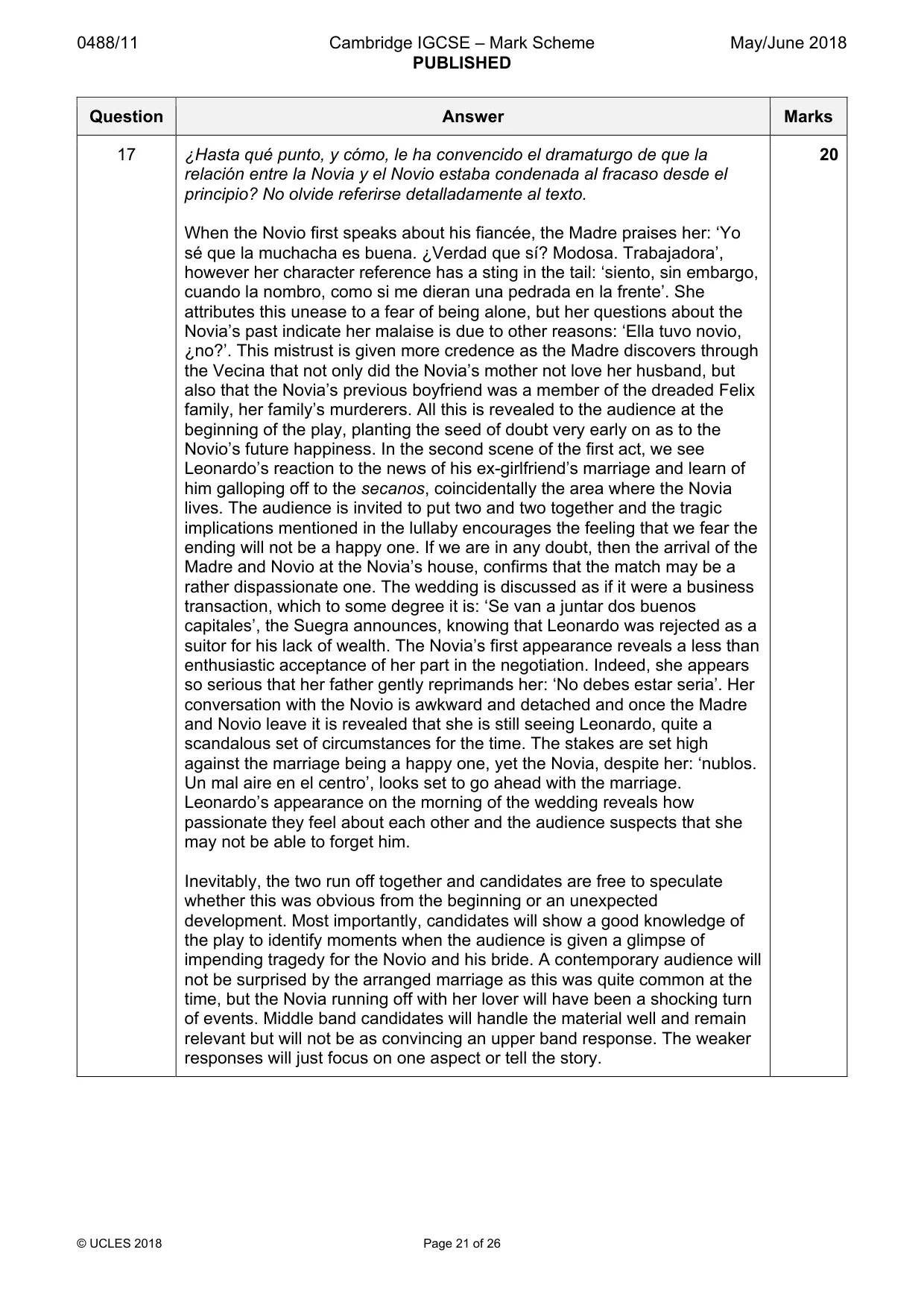
0488/11 Cambridge IGCSE – Mark Scheme PUBLISHED May/June 2018 © UCLES 2018 Page 21 of 26 Question Answer Marks 17 ¿Hasta qué punto, y cómo, le ha convencido el dramaturgo de que la relación entre la Novia y el Novio estaba condenada al fracaso desde el principio? No olvide referirse detalladamente al texto. When the Novio first speaks about his fiancée, the Madre praises her: ‘Yo sé que la muchacha es buena. ¿Verdad que sí? Modosa. Trabajadora’, however her character reference has a sting in the tail: ‘siento, sin embargo, cuando la nombro, como si me dieran una pedrada en la frente’. She attributes this unease to a fear of being alone, but her questions about the Novia’s past indicate her malaise is due to other reasons: ‘Ella tuvo novio, ¿no?’. This mistrust is given more credence as the Madre discovers through the Vecina that not only did the Novia’s mother not love her husband, but also that the Novia’s previous boyfriend was a member of the dreaded Felix family, her family’s murderers. All this is revealed to the audience at the beginning of the play, planting the seed of doubt very early on as to the Novio’s future happiness. In the second scene of the first act, we see Leonardo’s reaction to the news of his ex-girlfriend’s marriage and learn of him galloping off to the secanos, coincidentally the area where the Novia lives. The audience is invited to put two and two together and the tragic implications mentioned in the lullaby encourages the feeling that we fear the ending will not be a happy one. If we are in any doubt, then the arrival of the Madre and Novio at the Novia’s house, confirms that the match may be a rather dispassionate one. The wedding is discussed as if it were a business transaction, which to some degree it is: ‘Se van a juntar dos buenos capitales’, the Suegra announces, knowing that Leonardo was rejected as a suitor for his lack of wealth. The Novia’s first appearance reveals a less than enthusiastic acceptance of her part in the negotiation. Indeed, she appears so serious that her father gently reprimands her: ‘No debes estar seria’. Her conversation with the Novio is awkward and detached and once the Madre and Novio leave it is revealed that she is still seeing Leonardo, quite a scandalous set of circumstances for the time. The stakes are set high against the marriage being a happy one, yet the Novia, despite her: ‘nublos. Un mal aire en el centro’, looks set to go ahead with the marriage. Leonardo’s appearance on the morning of the wedding reveals how passionate they feel about each other and the audience suspects that she may not be able to forget him. Inevitably, the two run off together and candidates are free to speculate whether this was obvious from the beginning or an unexpected development. Most importantly, candidates will show a good knowledge of the play to identify moments when the audience is given a glimpse of impending tragedy for the Novio and his bride. A contemporary audience will not be surprised by the arranged marriage as this was quite common at the time, but the Novia running off with her lover will have been a shocking turn of events. Middle band candidates will handle the material well and remain relevant but will not be as convincing an upper band response. The weaker responses will just focus on one aspect or tell the story. 20
Mark scheme, page 22
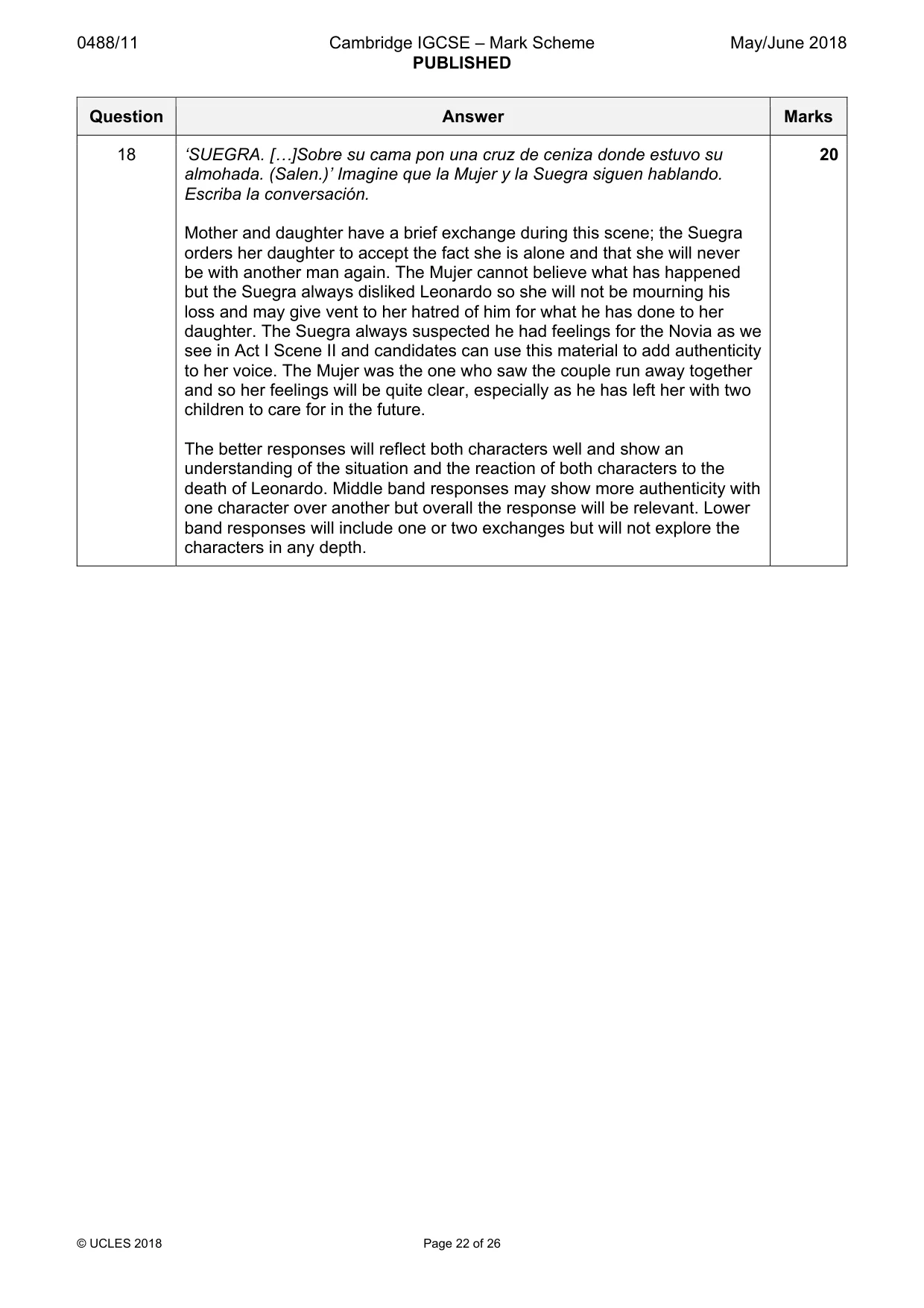
0488/11 Cambridge IGCSE – Mark Scheme PUBLISHED May/June 2018 © UCLES 2018 Page 22 of 26 Question Answer Marks 18 ‘SUEGRA. [«]Sobre su cama pon una cruz de ceniza donde estuvo su almohada. (Salen.)’ Imagine que la Mujer y la Suegra siguen hablando. Escriba la conversación. Mother and daughter have a brief exchange during this scene; the Suegra orders her daughter to accept the fact she is alone and that she will never be with another man again. The Mujer cannot believe what has happened but the Suegra always disliked Leonardo so she will not be mourning his loss and may give vent to her hatred of him for what he has done to her daughter. The Suegra always suspected he had feelings for the Novia as we see in Act I Scene II and candidates can use this material to add authenticity to her voice. The Mujer was the one who saw the couple run away together and so her feelings will be quite clear, especially as he has left her with two children to care for in the future. The better responses will reflect both characters well and show an understanding of the situation and the reaction of both characters to the death of Leonardo. Middle band responses may show more authenticity with one character over another but overall the response will be relevant. Lower band responses will include one or two exchanges but will not explore the characters in any depth. 20
Mark scheme, page 23
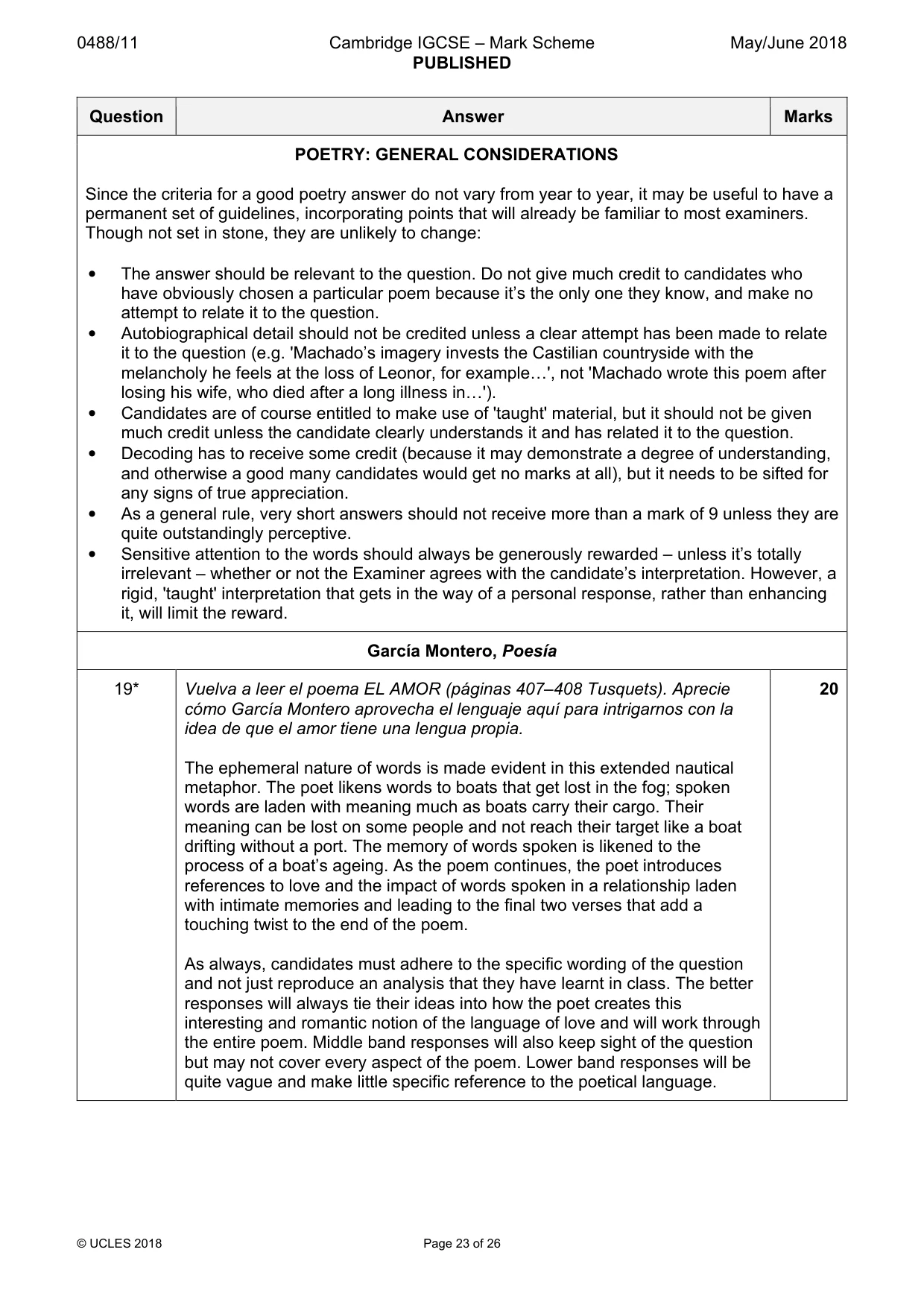
0488/11 Cambridge IGCSE – Mark Scheme PUBLISHED May/June 2018 © UCLES 2018 Page 23 of 26 Question Answer Marks POETRY: GENERAL CONSIDERATIONS Since the criteria for a good poetry answer do not vary from year to year, it may be useful to have a permanent set of guidelines, incorporating points that will already be familiar to most examiners. Though not set in stone, they are unlikely to change: • The answer should be relevant to the question. Do not give much credit to candidates who have obviously chosen a particular poem because it’s the only one they know, and make no attempt to relate it to the question. • Autobiographical detail should not be credited unless a clear attempt has been made to relate it to the question (e.g. 'Machado’s imagery invests the Castilian countryside with the melancholy he feels at the loss of Leonor, for example«', not 'Machado wrote this poem after losing his wife, who died after a long illness in«'). • Candidates are of course entitled to make use of 'taught' material, but it should not be given much credit unless the candidate clearly understands it and has related it to the question. • Decoding has to receive some credit (because it may demonstrate a degree of understanding, and otherwise a good many candidates would get no marks at all), but it needs to be sifted for any signs of true appreciation. • As a general rule, very short answers should not receive more than a mark of 9 unless they are quite outstandingly perceptive. • Sensitive attention to the words should always be generously rewarded – unless it’s totally irrelevant – whether or not the Examiner agrees with the candidate’s interpretation. However, a rigid, 'taught' interpretation that gets in the way of a personal response, rather than enhancing it, will limit the reward. García Montero, Poesía 19* Vuelva a leer el poema EL AMOR (páginas 407–408 Tusquets). Aprecie cómo García Montero aprovecha el lenguaje aquí para intrigarnos con la idea de que el amor tiene una lengua propia. The ephemeral nature of words is made evident in this extended nautical metaphor. The poet likens words to boats that get lost in the fog; spoken words are laden with meaning much as boats carry their cargo. Their meaning can be lost on some people and not reach their target like a boat drifting without a port. The memory of words spoken is likened to the process of a boat’s ageing. As the poem continues, the poet introduces references to love and the impact of words spoken in a relationship laden with intimate memories and leading to the final two verses that add a touching twist to the end of the poem. As always, candidates must adhere to the specific wording of the question and not just reproduce an analysis that they have learnt in class. The better responses will always tie their ideas into how the poet creates this interesting and romantic notion of the language of love and will work through the entire poem. Middle band responses will also keep sight of the question but may not cover every aspect of the poem. Lower band responses will be quite vague and make little specific reference to the poetical language. 20
Mark scheme, page 24
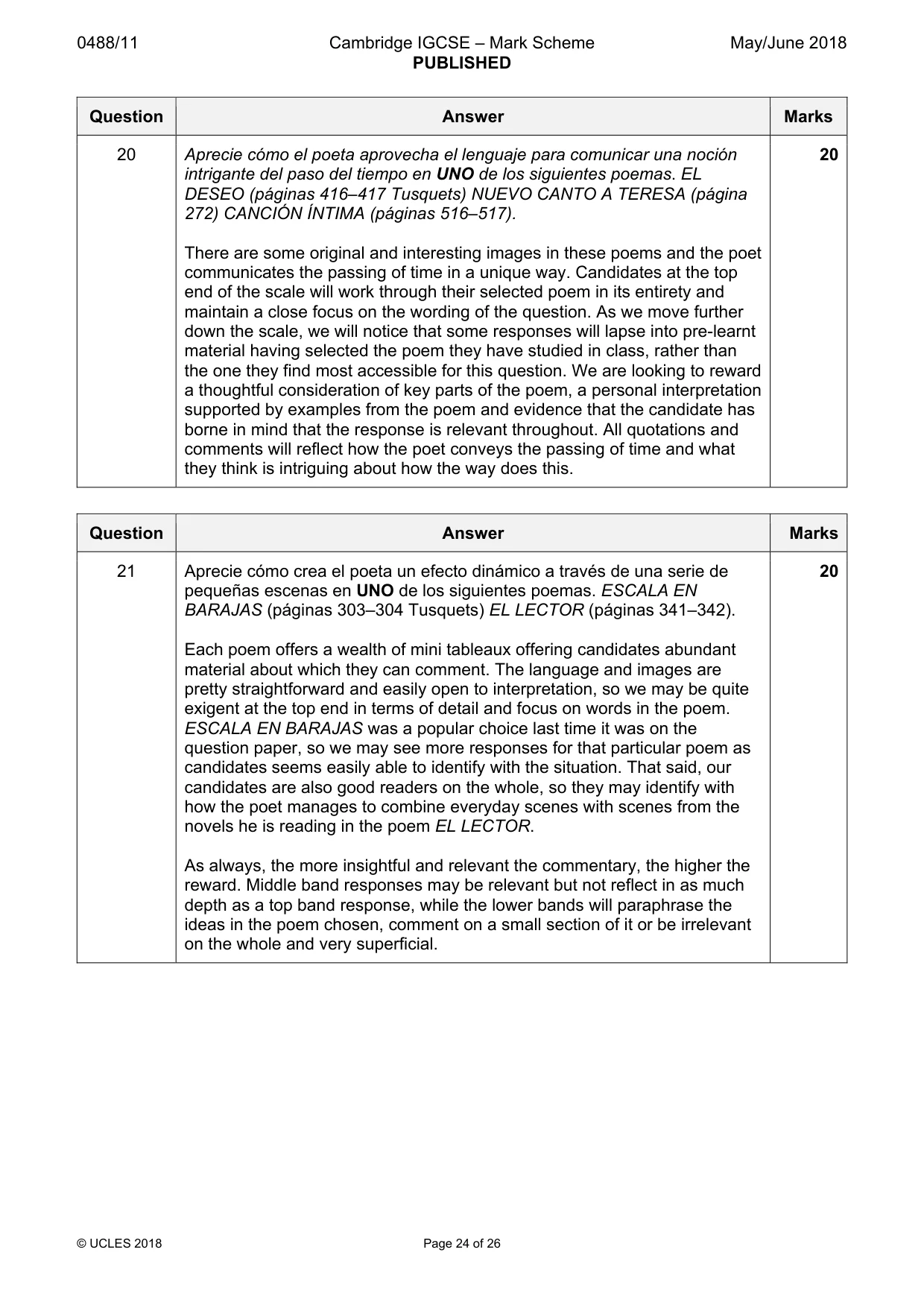
0488/11 Cambridge IGCSE – Mark Scheme PUBLISHED May/June 2018 © UCLES 2018 Page 24 of 26 Question Answer Marks 20 Aprecie cómo el poeta aprovecha el lenguaje para comunicar una noción intrigante del paso del tiempo en UNO de los siguientes poemas. EL DESEO (páginas 416–417 Tusquets) NUEVO CANTO A TERESA (página 272) CANCIÓN ÍNTIMA (páginas 516–517). There are some original and interesting images in these poems and the poet communicates the passing of time in a unique way. Candidates at the top end of the scale will work through their selected poem in its entirety and maintain a close focus on the wording of the question. As we move further down the scale, we will notice that some responses will lapse into pre-learnt material having selected the poem they have studied in class, rather than the one they find most accessible for this question. We are looking to reward a thoughtful consideration of key parts of the poem, a personal interpretation supported by examples from the poem and evidence that the candidate has borne in mind that the response is relevant throughout. All quotations and comments will reflect how the poet conveys the passing of time and what they think is intriguing about how the way does this. 20 Question Answer Marks 21 Aprecie cómo crea el poeta un efecto dinámico a través de una serie de pequeñas escenas en UNO de los siguientes poemas. ESCALA EN BARAJAS (páginas 303–304 Tusquets) EL LECTOR (páginas 341–342). Each poem offers a wealth of mini tableaux offering candidates abundant material about which they can comment. The language and images are pretty straightforward and easily open to interpretation, so we may be quite exigent at the top end in terms of detail and focus on words in the poem. ESCALA EN BARAJAS was a popular choice last time it was on the question paper, so we may see more responses for that particular poem as candidates seems easily able to identify with the situation. That said, our candidates are also good readers on the whole, so they may identify with how the poet manages to combine everyday scenes with scenes from the novels he is reading in the poem EL LECTOR. As always, the more insightful and relevant the commentary, the higher the reward. Middle band responses may be relevant but not reflect in as much depth as a top band response, while the lower bands will paraphrase the ideas in the poem chosen, comment on a small section of it or be irrelevant on the whole and very superficial. 20
Mark scheme, page 25
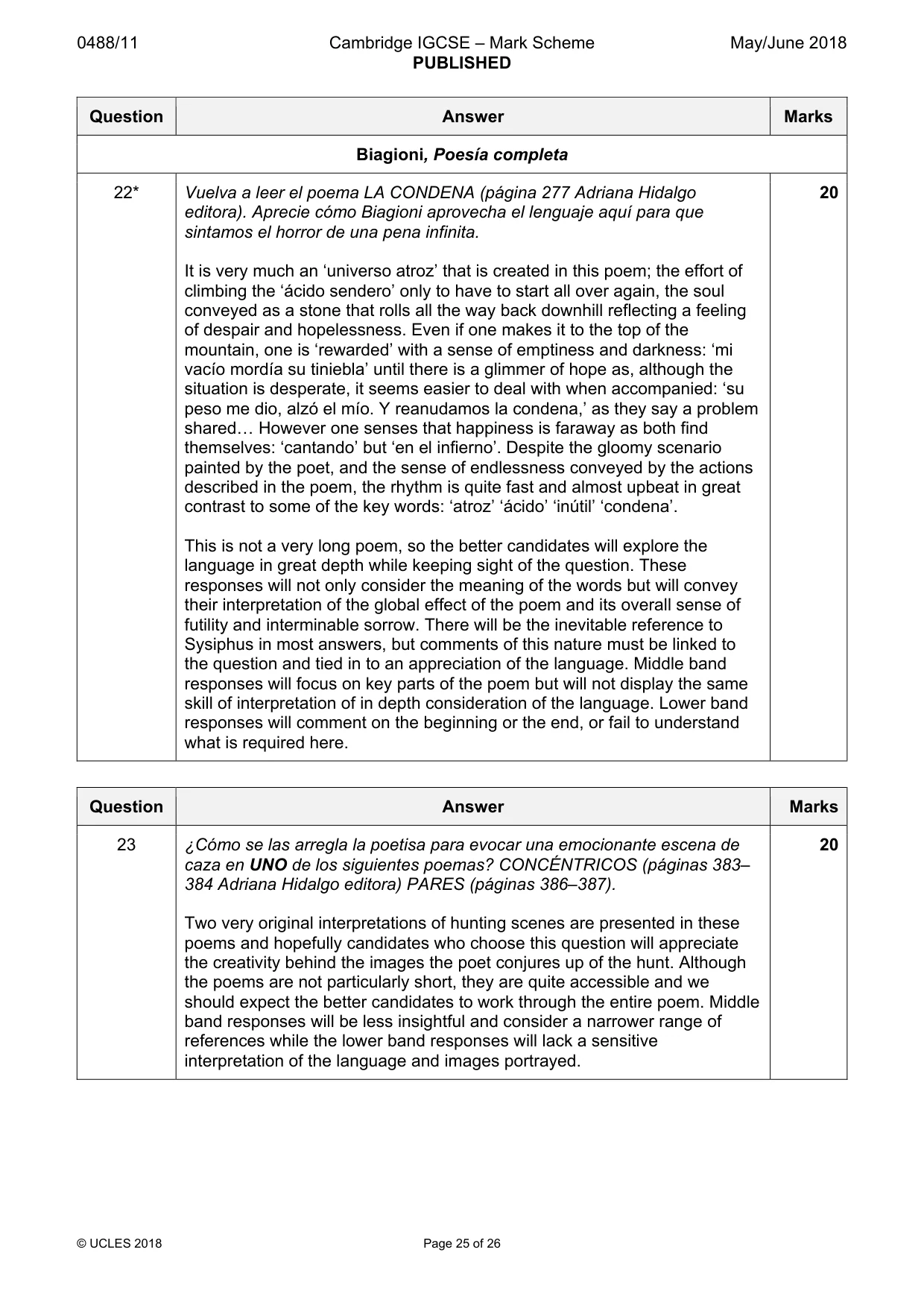
0488/11 Cambridge IGCSE – Mark Scheme PUBLISHED May/June 2018 © UCLES 2018 Page 25 of 26 Question Answer Marks Biagioni, Poesía completa 22* Vuelva a leer el poema LA CONDENA (página 277 Adriana Hidalgo editora). Aprecie cómo Biagioni aprovecha el lenguaje aquí para que sintamos el horror de una pena infinita. It is very much an ‘universo atroz’ that is created in this poem; the effort of climbing the ‘ácido sendero’ only to have to start all over again, the soul conveyed as a stone that rolls all the way back downhill reflecting a feeling of despair and hopelessness. Even if one makes it to the top of the mountain, one is ‘rewarded’ with a sense of emptiness and darkness: ‘mi vacío mordía su tiniebla’ until there is a glimmer of hope as, although the situation is desperate, it seems easier to deal with when accompanied: ‘su peso me dio, alzó el mío. Y reanudamos la condena,’ as they say a problem shared« However one senses that happiness is faraway as both find themselves: ‘cantando’ but ‘en el infierno’. Despite the gloomy scenario painted by the poet, and the sense of endlessness conveyed by the actions described in the poem, the rhythm is quite fast and almost upbeat in great contrast to some of the key words: ‘atroz’ ‘ácido’ ‘inútil’ ‘condena’. This is not a very long poem, so the better candidates will explore the language in great depth while keeping sight of the question. These responses will not only consider the meaning of the words but will convey their interpretation of the global effect of the poem and its overall sense of futility and interminable sorrow. There will be the inevitable reference to Sysiphus in most answers, but comments of this nature must be linked to the question and tied in to an appreciation of the language. Middle band responses will focus on key parts of the poem but will not display the same skill of interpretation of in depth consideration of the language. Lower band responses will comment on the beginning or the end, or fail to understand what is required here. 20 Question Answer Marks 23 ¿Cómo se las arregla la poetisa para evocar una emocionante escena de caza en UNO de los siguientes poemas? CONCÉNTRICOS (páginas 383– 384 Adriana Hidalgo editora) PARES (páginas 386–387). Two very original interpretations of hunting scenes are presented in these poems and hopefully candidates who choose this question will appreciate the creativity behind the images the poet conjures up of the hunt. Although the poems are not particularly short, they are quite accessible and we should expect the better candidates to work through the entire poem. Middle band responses will be less insightful and consider a narrower range of references while the lower band responses will lack a sensitive interpretation of the language and images portrayed. 20
Mark scheme, page 26
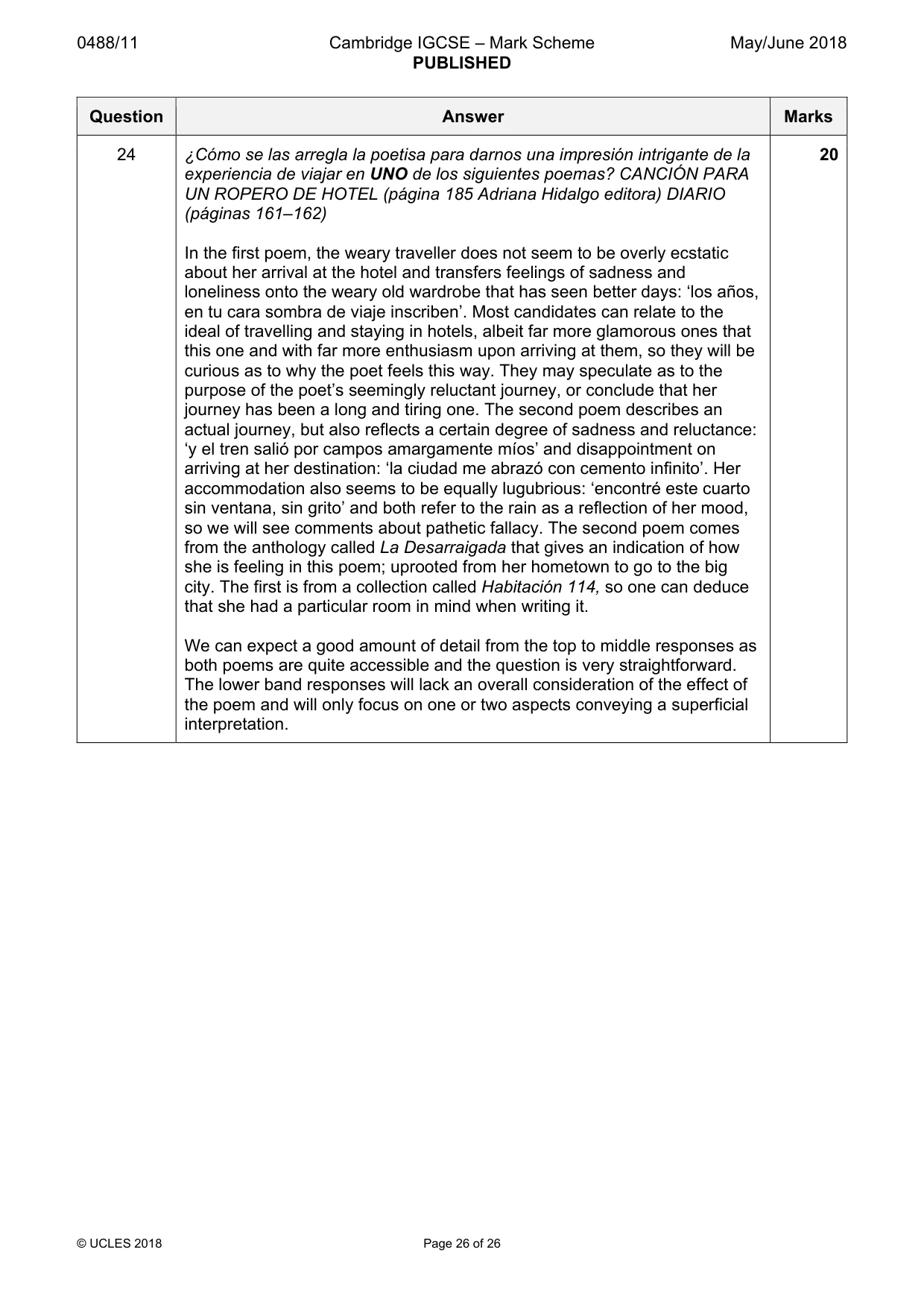
0488/11 Cambridge IGCSE – Mark Scheme PUBLISHED May/June 2018 © UCLES 2018 Page 26 of 26 Question Answer Marks 24 ¿Cómo se las arregla la poetisa para darnos una impresión intrigante de la experiencia de viajar en UNO de los siguientes poemas? CANCIÓN PARA UN ROPERO DE HOTEL (página 185 Adriana Hidalgo editora) DIARIO (páginas 161–162) In the first poem, the weary traveller does not seem to be overly ecstatic about her arrival at the hotel and transfers feelings of sadness and loneliness onto the weary old wardrobe that has seen better days: ‘los años, en tu cara sombra de viaje inscriben’. Most candidates can relate to the ideal of travelling and staying in hotels, albeit far more glamorous ones that this one and with far more enthusiasm upon arriving at them, so they will be curious as to why the poet feels this way. They may speculate as to the purpose of the poet’s seemingly reluctant journey, or conclude that her journey has been a long and tiring one. The second poem describes an actual journey, but also reflects a certain degree of sadness and reluctance: ‘y el tren salió por campos amargamente míos’ and disappointment on arriving at her destination: ‘la ciudad me abrazó con cemento infinito’. Her accommodation also seems to be equally lugubrious: ‘encontré este cuarto sin ventana, sin grito’ and both refer to the rain as a reflection of her mood, so we will see comments about pathetic fallacy. The second poem comes from the anthology called La Desarraigada that gives an indication of how she is feeling in this poem; uprooted from her hometown to go to the big city. The first is from a collection called Habitación 114, so one can deduce that she had a particular room in mind when writing it. We can expect a good amount of detail from the top to middle responses as both poems are quite accessible and the question is very straightforward. The lower band responses will lack an overall consideration of the effect of the poem and will only focus on one or two aspects conveying a superficial interpretation. 20
What you needed in this session
Cambridge’s own grade thresholds for 2018 May/June, Paper 1 · Variant 1. A higher threshold means an easier paper — the bar moves with how the cohort did.