Cambridge IGCSE Spanish - Literature 0488 — 2017 Oct/Nov Paper 3 · Variant 1
0488/31/O/N/17 · 20 marks · ≈23 min
The question paper and its mark scheme, free to read here and free to download. This is Cambridge’s own paper, exactly as it was sat.
Question paper4 pages

Mark scheme6 pages
Answers below. Sit the paper first if you are practising.
Paper as text
Question paper, page 1
This document consists of 3 printed pages, 1 blank page and 1 Insert. DC (RCL/JDA) 134525/3 © UCLES 2017 [Turn over Cambridge International Examinations Cambridge International General Certificate of Secondary Education * 1 3 8 1 7 2 3 3 5 5 * LITERATURE (SPANISH) 0488/03 Paper 3 Alternative to Coursework October/November 2017 1 hour 20 minutes No Additional Materials are required. READ THESE INSTRUCTIONS FIRST An answer booklet is provided inside this question paper. You should follow the instructions on the front cover of the answer booklet. If you need additional answer paper ask the invigilator for a continuation booklet. Answer the question in Spanish. EN PRIMER LUGAR, LEA ESTAS INSTRUCCIONES El cuadernillo de respuestas se encuentra dentro de este cuadernillo de preguntas. Siga las instrucciones de la portada del cuadernillo de respuestas. También encontrará las instrucciones en español a continuación. Si necesita hojas adicionales, pídale al supervisor un cuadernillo de respuestas adicional. Conteste la pregunta en español. INSTRUCCIONES DEL CUADERNILLO DE RESPUESTAS Rellene las casillas de la portada del cuadernillo de respuestas con letra mayúscula. Use tinta azul oscuro o negra. NO ESCRIBA EN NINGÚN CÓDIGO DE BARRAS. Escriba sus respuestas en el cuadernillo de respuestas. Utilice ambas caras del papel. Por favor deje dos líneas en blanco entre sus respuestas a cada pregunta. Escriba el número de la pregunta que está contestando en el primer margen. Question Part 1 1 ai aii Si la pregunta que está contestando también contiene secciones, por ejemplo 1a, escriba la sección de la pregunta en el segundo margen. Si ha utilizado cuadernillos de respuestas adicionales, por favor guárdelos dentro del cuadernillo de respuestas.
Question paper, page 2
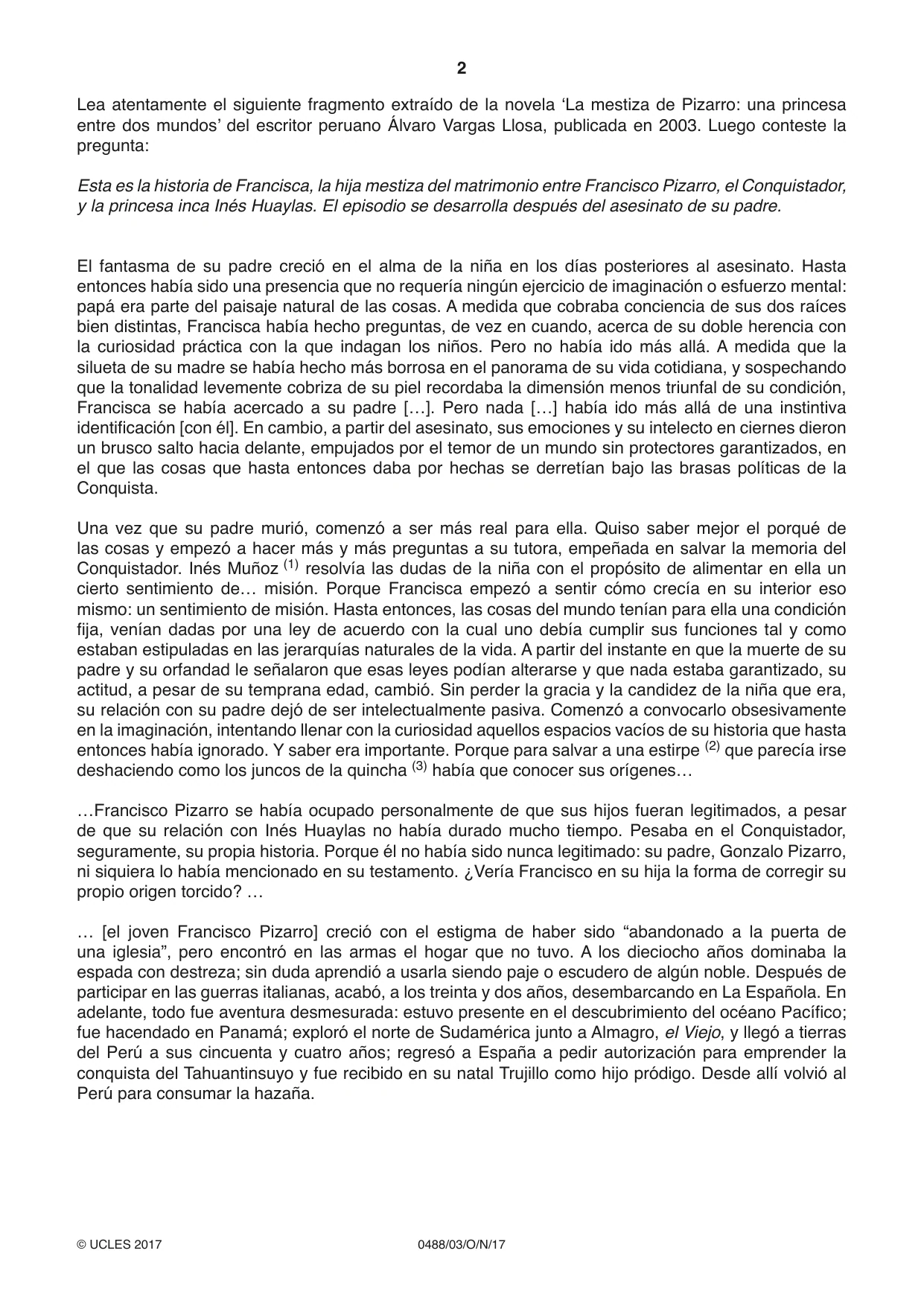
2 0488/03/O/N/17 © UCLES 2017 Lea atentamente el siguiente fragmento extraído de la novela ‘La mestiza de Pizarro: una princesa entre dos mundos’ del escritor peruano Álvaro Vargas Llosa, publicada en 2003. Luego conteste la pregunta: Esta es la historia de Francisca, la hija mestiza del matrimonio entre Francisco Pizarro, el Conquistador, y la princesa inca Inés Huaylas. El episodio se desarrolla después del asesinato de su padre. El fantasma de su padre creció en el alma de la niña en los días posteriores al asesinato. Hasta entonces había sido una presencia que no requería ningún ejercicio de imaginación o esfuerzo mental: papá era parte del paisaje natural de las cosas. A medida que cobraba conciencia de sus dos raíces bien distintas, Francisca había hecho preguntas, de vez en cuando, acerca de su doble herencia con la curiosidad práctica con la que indagan los niños. Pero no había ido más allá. A medida que la silueta de su madre se había hecho más borrosa en el panorama de su vida cotidiana, y sospechando que la tonalidad levemente cobriza de su piel recordaba la dimensión menos triunfal de su condición, Francisca se había acercado a su padre […]. Pero nada […] había ido más allá de una instintiva identificación [con él]. En cambio, a partir del asesinato, sus emociones y su intelecto en ciernes dieron un brusco salto hacia delante, empujados por el temor de un mundo sin protectores garantizados, en el que las cosas que hasta entonces daba por hechas se derretían bajo las brasas políticas de la Conquista. Una vez que su padre murió, comenzó a ser más real para ella. Quiso saber mejor el porqué de las cosas y empezó a hacer más y más preguntas a su tutora, empeñada en salvar la memoria del Conquistador. Inés Muñoz (1) resolvía las dudas de la niña con el propósito de alimentar en ella un cierto sentimiento de… misión. Porque Francisca empezó a sentir cómo crecía en su interior eso mismo: un sentimiento de misión. Hasta entonces, las cosas del mundo tenían para ella una condición fija, venían dadas por una ley de acuerdo con la cual uno debía cumplir sus funciones tal y como estaban estipuladas en las jerarquías naturales de la vida. A partir del instante en que la muerte de su padre y su orfandad le señalaron que esas leyes podían alterarse y que nada estaba garantizado, su actitud, a pesar de su temprana edad, cambió. Sin perder la gracia y la candidez de la niña que era, su relación con su padre dejó de ser intelectualmente pasiva. Comenzó a convocarlo obsesivamente en la imaginación, intentando llenar con la curiosidad aquellos espacios vacíos de su historia que hasta entonces había ignorado. Y saber era importante. Porque para salvar a una estirpe (2) que parecía irse deshaciendo como los juncos de la quincha (3) había que conocer sus orígenes… …Francisco Pizarro se había ocupado personalmente de que sus hijos fueran legitimados, a pesar de que su relación con Inés Huaylas no había durado mucho tiempo. Pesaba en el Conquistador, seguramente, su propia historia. Porque él no había sido nunca legitimado: su padre, Gonzalo Pizarro, ni siquiera lo había mencionado en su testamento. ¿Vería Francisco en su hija la forma de corregir su propio origen torcido? … … [el joven Francisco Pizarro] creció con el estigma de haber sido “abandonado a la puerta de una iglesia”, pero encontró en las armas el hogar que no tuvo. A los dieciocho años dominaba la espada con destreza; sin duda aprendió a usarla siendo paje o escudero de algún noble. Después de participar en las guerras italianas, acabó, a los treinta y dos años, desembarcando en La Española. En adelante, todo fue aventura desmesurada: estuvo presente en el descubrimiento del océano Pacífico; fue hacendado en Panamá; exploró el norte de Sudamérica junto a Almagro, el Viejo, y llegó a tierras del Perú a sus cincuenta y cuatro años; regresó a España a pedir autorización para emprender la conquista del Tahuantinsuyo y fue recibido en su natal Trujillo como hijo pródigo. Desde allí volvió al Perú para consumar la hazaña.
Question paper, page 3
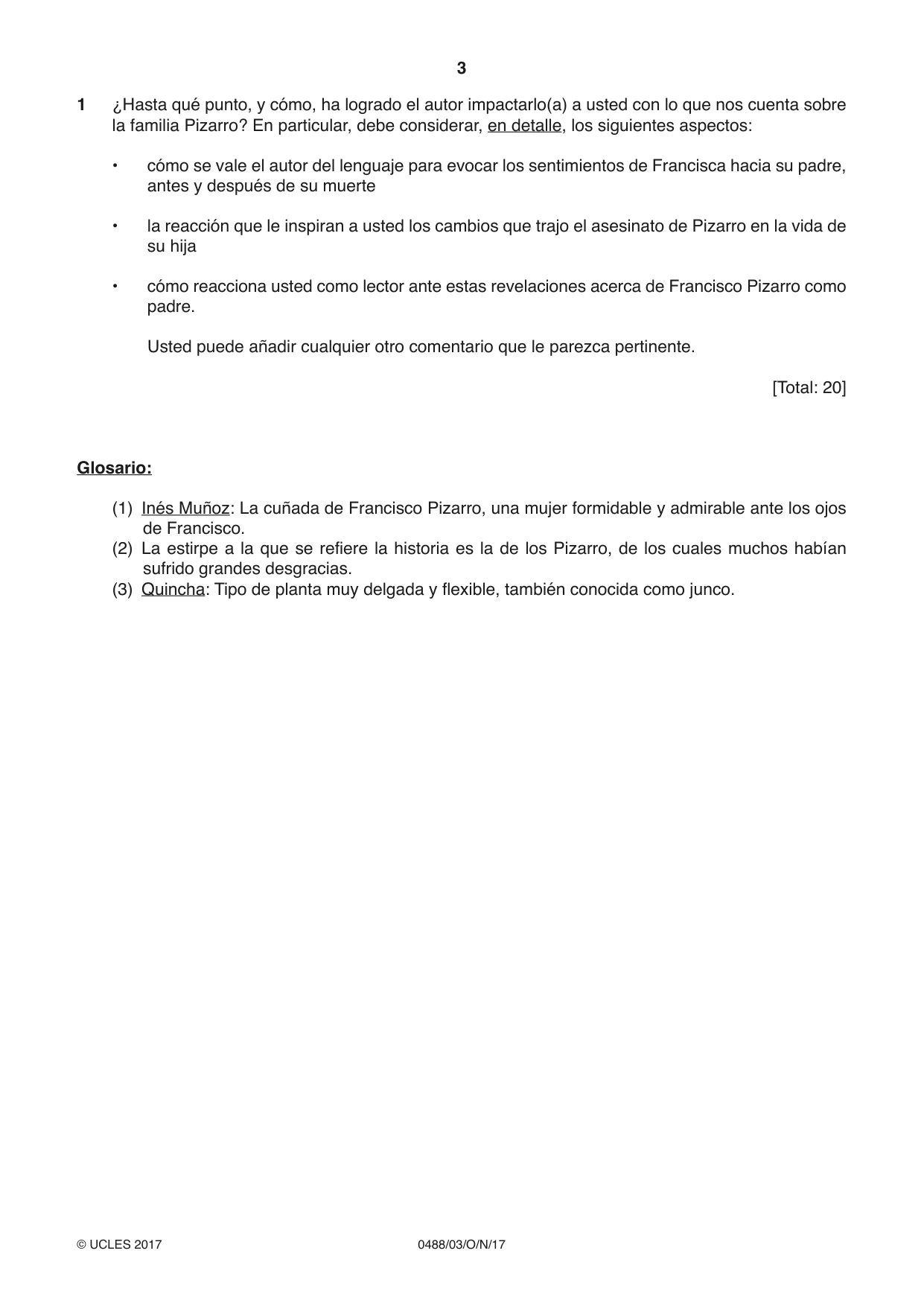
3 0488/03/O/N/17 © UCLES 2017 1 ¿Hasta qué punto, y cómo, ha logrado el autor impactarlo(a) a usted con lo que nos cuenta sobre la familia Pizarro? En particular, debe considerar, en detalle, los siguientes aspectos: • cómo se vale el autor del lenguaje para evocar los sentimientos de Francisca hacia su padre, antes y después de su muerte • la reacción que le inspiran a usted los cambios que trajo el asesinato de Pizarro en la vida de su hija • cómo reacciona usted como lector ante estas revelaciones acerca de Francisco Pizarro como padre. Usted puede añadir cualquier otro comentario que le parezca pertinente. [Total: 20] Glosario: (1) Inés Muñoz: La cuñada de Francisco Pizarro, una mujer formidable y admirable ante los ojos de Francisco. (2) La estirpe a la que se refiere la historia es la de los Pizarro, de los cuales muchos habían sufrido grandes desgracias. (3) Quincha: Tipo de planta muy delgada y flexible, también conocida como junco.
Question paper, page 4
4 0488/03/O/N/17 © UCLES 2017 BLANK PAGE Permission to reproduce items where third-party owned material protected by copyright is included has been sought and cleared where possible. Every reasonable effort has been made by the publisher (UCLES) to trace copyright holders, but if any items requiring clearance have unwittingly been included, the publisher will be pleased to make amends at the earliest possible opportunity. To avoid the issue of disclosure of answer-related information to candidates, all copyright acknowledgements are reproduced online in the Cambridge International Examinations Copyright Acknowledgements Booklet. This is produced for each series of examinations and is freely available to download at www.cie.org.uk after the live examination series. Cambridge International Examinations is part of the Cambridge Assessment Group. Cambridge Assessment is the brand name of University of Cambridge Local Examinations Syndicate (UCLES), which is itself a department of the University of Cambridge.
Mark scheme, page 1
® IGCSE is a registered trademark. This document consists of 6 printed pages. © UCLES 2017 [Turn over Cambridge Assessment International Education Cambridge International General Certificate of Secondary Education LITERATURE (SPANISH) 0488/03 Paper 3 Alternative to Coursework October/November 2017 MARK SCHEME Maximum Mark: 20 Published This mark scheme is published as an aid to teachers and candidates, to indicate the requirements of the examination. It shows the basis on which Examiners were instructed to award marks. It does not indicate the details of the discussions that took place at an Examiners’ meeting before marking began, which would have considered the acceptability of alternative answers. Mark schemes should be read in conjunction with the question paper and the Principal Examiner Report for Teachers. Cambridge International will not enter into discussions about these mark schemes. Cambridge International is publishing the mark schemes for the October/November 2017 series for most Cambridge IGCSE®, Cambridge International A and AS Level components and some Cambridge O Level components.
Mark scheme, page 2
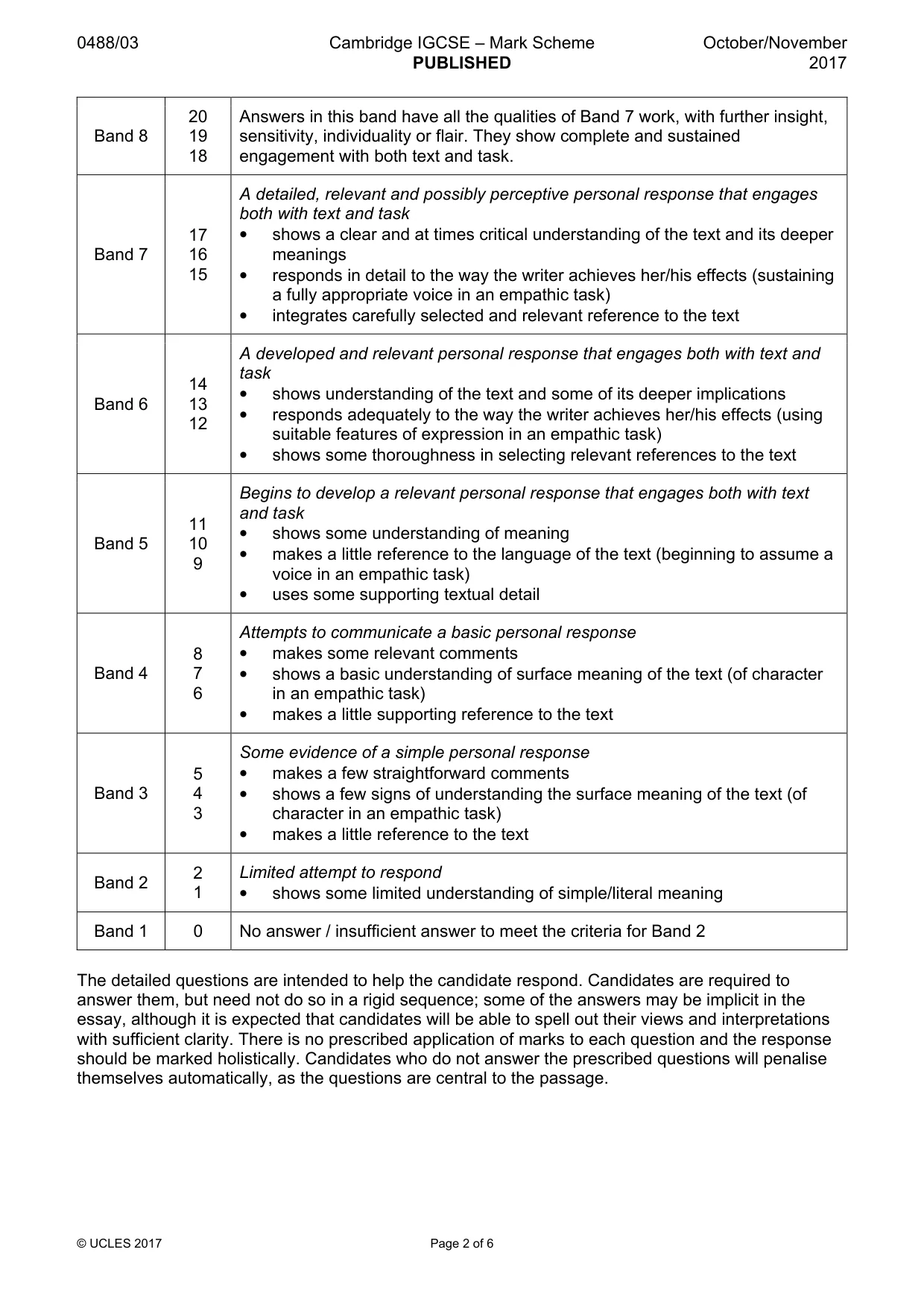
0488/03 Cambridge IGCSE – Mark Scheme PUBLISHED October/November 2017 © UCLES 2017 Page 2 of 6 Band 8 20 19 18 Answers in this band have all the qualities of Band 7 work, with further insight, sensitivity, individuality or flair. They show complete and sustained engagement with both text and task. Band 7 17 16 15 A detailed, relevant and possibly perceptive personal response that engages both with text and task • shows a clear and at times critical understanding of the text and its deeper meanings • responds in detail to the way the writer achieves her/his effects (sustaining a fully appropriate voice in an empathic task) • integrates carefully selected and relevant reference to the text Band 6 14 13 12 A developed and relevant personal response that engages both with text and task • shows understanding of the text and some of its deeper implications • responds adequately to the way the writer achieves her/his effects (using suitable features of expression in an empathic task) • shows some thoroughness in selecting relevant references to the text Band 5 11 10 9 Begins to develop a relevant personal response that engages both with text and task • shows some understanding of meaning • makes a little reference to the language of the text (beginning to assume a voice in an empathic task) • uses some supporting textual detail Band 4 8 7 6 Attempts to communicate a basic personal response • makes some relevant comments • shows a basic understanding of surface meaning of the text (of character in an empathic task) • makes a little supporting reference to the text Band 3 5 4 3 Some evidence of a simple personal response • makes a few straightforward comments • shows a few signs of understanding the surface meaning of the text (of character in an empathic task) • makes a little reference to the text Band 2 2 1 Limited attempt to respond • shows some limited understanding of simple/literal meaning Band 1 0 No answer / insufficient answer to meet the criteria for Band 2 The detailed questions are intended to help the candidate respond. Candidates are required to answer them, but need not do so in a rigid sequence; some of the answers may be implicit in the essay, although it is expected that candidates will be able to spell out their views and interpretations with sufficient clarity. There is no prescribed application of marks to each question and the response should be marked holistically. Candidates who do not answer the prescribed questions will penalise themselves automatically, as the questions are central to the passage.
Mark scheme, page 3
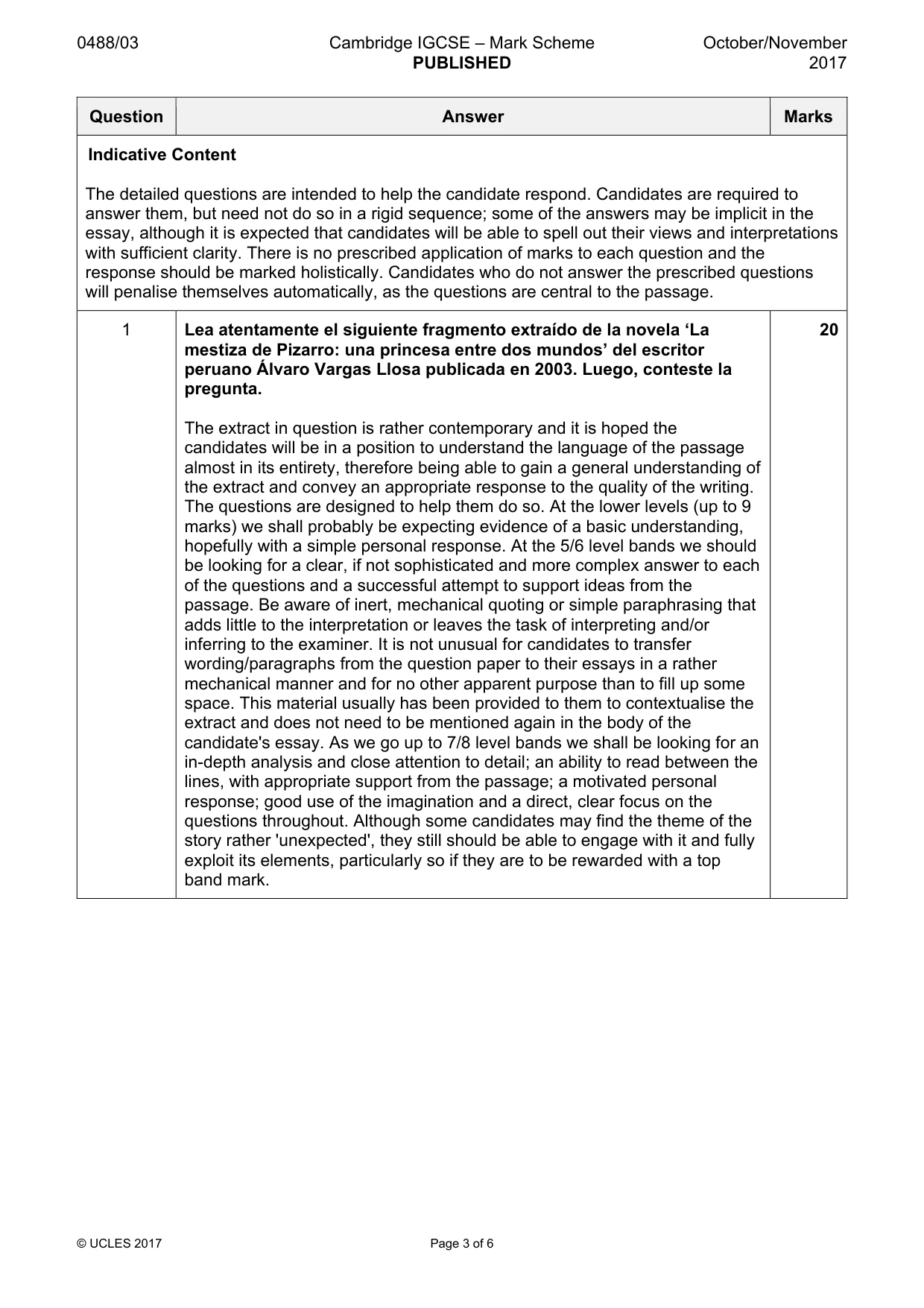
0488/03 Cambridge IGCSE – Mark Scheme PUBLISHED October/November 2017 © UCLES 2017 Page 3 of 6 Question Answer Marks Indicative Content The detailed questions are intended to help the candidate respond. Candidates are required to answer them, but need not do so in a rigid sequence; some of the answers may be implicit in the essay, although it is expected that candidates will be able to spell out their views and interpretations with sufficient clarity. There is no prescribed application of marks to each question and the response should be marked holistically. Candidates who do not answer the prescribed questions will penalise themselves automatically, as the questions are central to the passage. 1 Lea atentamente el siguiente fragmento extraído de la novela ‘La mestiza de Pizarro: una princesa entre dos mundos’ del escritor peruano Álvaro Vargas Llosa publicada en 2003. Luego, conteste la pregunta. The extract in question is rather contemporary and it is hoped the candidates will be in a position to understand the language of the passage almost in its entirety, therefore being able to gain a general understanding of the extract and convey an appropriate response to the quality of the writing. The questions are designed to help them do so. At the lower levels (up to 9 marks) we shall probably be expecting evidence of a basic understanding, hopefully with a simple personal response. At the 5/6 level bands we should be looking for a clear, if not sophisticated and more complex answer to each of the questions and a successful attempt to support ideas from the passage. Be aware of inert, mechanical quoting or simple paraphrasing that adds little to the interpretation or leaves the task of interpreting and/or inferring to the examiner. It is not unusual for candidates to transfer wording/paragraphs from the question paper to their essays in a rather mechanical manner and for no other apparent purpose than to fill up some space. This material usually has been provided to them to contextualise the extract and does not need to be mentioned again in the body of the candidate's essay. As we go up to 7/8 level bands we shall be looking for an in-depth analysis and close attention to detail; an ability to read between the lines, with appropriate support from the passage; a motivated personal response; good use of the imagination and a direct, clear focus on the questions throughout. Although some candidates may find the theme of the story rather 'unexpected', they still should be able to engage with it and fully exploit its elements, particularly so if they are to be rewarded with a top band mark. 20
Mark scheme, page 4
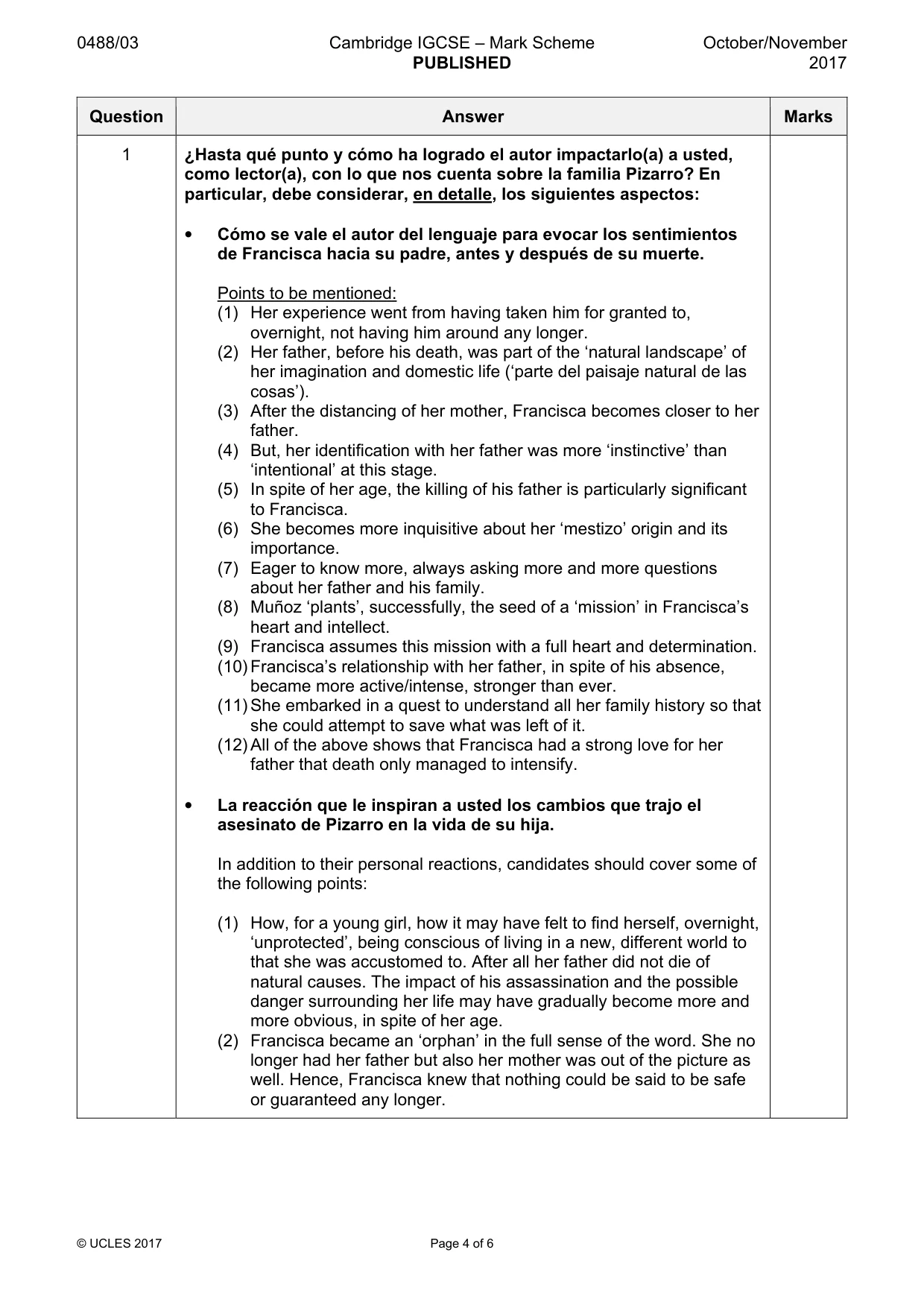
0488/03 Cambridge IGCSE – Mark Scheme PUBLISHED October/November 2017 © UCLES 2017 Page 4 of 6 Question Answer Marks 1 ¿Hasta qué punto y cómo ha logrado el autor impactarlo(a) a usted, como lector(a), con lo que nos cuenta sobre la familia Pizarro? En particular, debe considerar, en detalle, los siguientes aspectos: • Cómo se vale el autor del lenguaje para evocar los sentimientos de Francisca hacia su padre, antes y después de su muerte. Points to be mentioned: (1) Her experience went from having taken him for granted to, overnight, not having him around any longer. (2) Her father, before his death, was part of the ‘natural landscape’ of her imagination and domestic life (‘parte del paisaje natural de las cosas’). (3) After the distancing of her mother, Francisca becomes closer to her father. (4) But, her identification with her father was more ‘instinctive’ than ‘intentional’ at this stage. (5) In spite of her age, the killing of his father is particularly significant to Francisca. (6) She becomes more inquisitive about her ‘mestizo’ origin and its importance. (7) Eager to know more, always asking more and more questions about her father and his family. (8) Muñoz ‘plants’, successfully, the seed of a ‘mission’ in Francisca’s heart and intellect. (9) Francisca assumes this mission with a full heart and determination. (10) Francisca’s relationship with her father, in spite of his absence, became more active/intense, stronger than ever. (11) She embarked in a quest to understand all her family history so that she could attempt to save what was left of it. (12) All of the above shows that Francisca had a strong love for her father that death only managed to intensify. • La reacción que le inspiran a usted los cambios que trajo el asesinato de Pizarro en la vida de su hija. In addition to their personal reactions, candidates should cover some of the following points: (1) How, for a young girl, how it may have felt to find herself, overnight, ‘unprotected’, being conscious of living in a new, different world to that she was accustomed to. After all her father did not die of natural causes. The impact of his assassination and the possible danger surrounding her life may have gradually become more and more obvious, in spite of her age. (2) Francisca became an ‘orphan’ in the full sense of the word. She no longer had her father but also her mother was out of the picture as well. Hence, Francisca knew that nothing could be said to be safe or guaranteed any longer.
Mark scheme, page 5
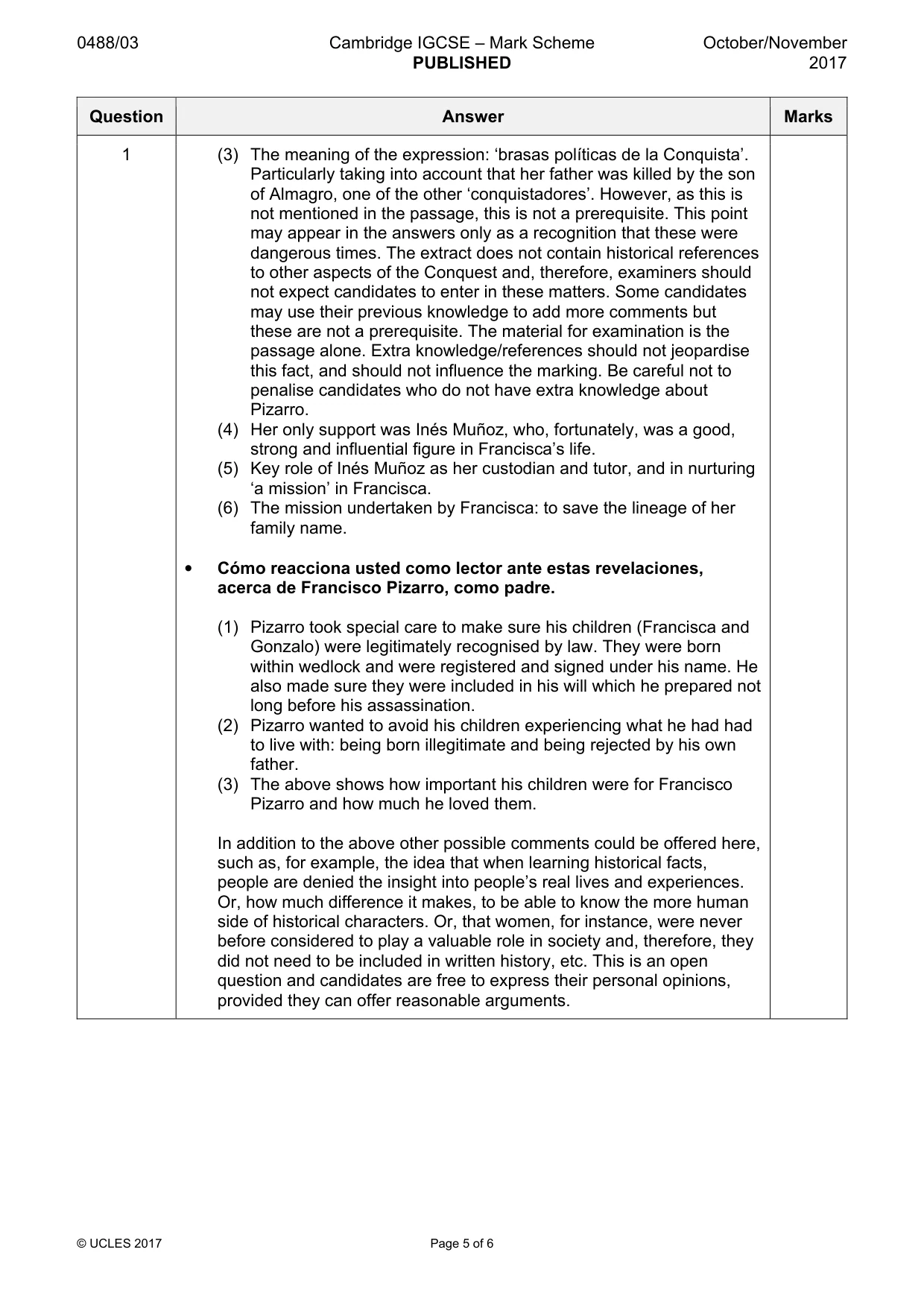
0488/03 Cambridge IGCSE – Mark Scheme PUBLISHED October/November 2017 © UCLES 2017 Page 5 of 6 Question Answer Marks 1 (3) The meaning of the expression: ‘brasas políticas de la Conquista’. Particularly taking into account that her father was killed by the son of Almagro, one of the other ‘conquistadores’. However, as this is not mentioned in the passage, this is not a prerequisite. This point may appear in the answers only as a recognition that these were dangerous times. The extract does not contain historical references to other aspects of the Conquest and, therefore, examiners should not expect candidates to enter in these matters. Some candidates may use their previous knowledge to add more comments but these are not a prerequisite. The material for examination is the passage alone. Extra knowledge/references should not jeopardise this fact, and should not influence the marking. Be careful not to penalise candidates who do not have extra knowledge about Pizarro. (4) Her only support was Inés Muñoz, who, fortunately, was a good, strong and influential figure in Francisca’s life. (5) Key role of Inés Muñoz as her custodian and tutor, and in nurturing ‘a mission’ in Francisca. (6) The mission undertaken by Francisca: to save the lineage of her family name. • Cómo reacciona usted como lector ante estas revelaciones, acerca de Francisco Pizarro, como padre. (1) Pizarro took special care to make sure his children (Francisca and Gonzalo) were legitimately recognised by law. They were born within wedlock and were registered and signed under his name. He also made sure they were included in his will which he prepared not long before his assassination. (2) Pizarro wanted to avoid his children experiencing what he had had to live with: being born illegitimate and being rejected by his own father. (3) The above shows how important his children were for Francisco Pizarro and how much he loved them. In addition to the above other possible comments could be offered here, such as, for example, the idea that when learning historical facts, people are denied the insight into people’s real lives and experiences. Or, how much difference it makes, to be able to know the more human side of historical characters. Or, that women, for instance, were never before considered to play a valuable role in society and, therefore, they did not need to be included in written history, etc. This is an open question and candidates are free to express their personal opinions, provided they can offer reasonable arguments.
Mark scheme, page 6
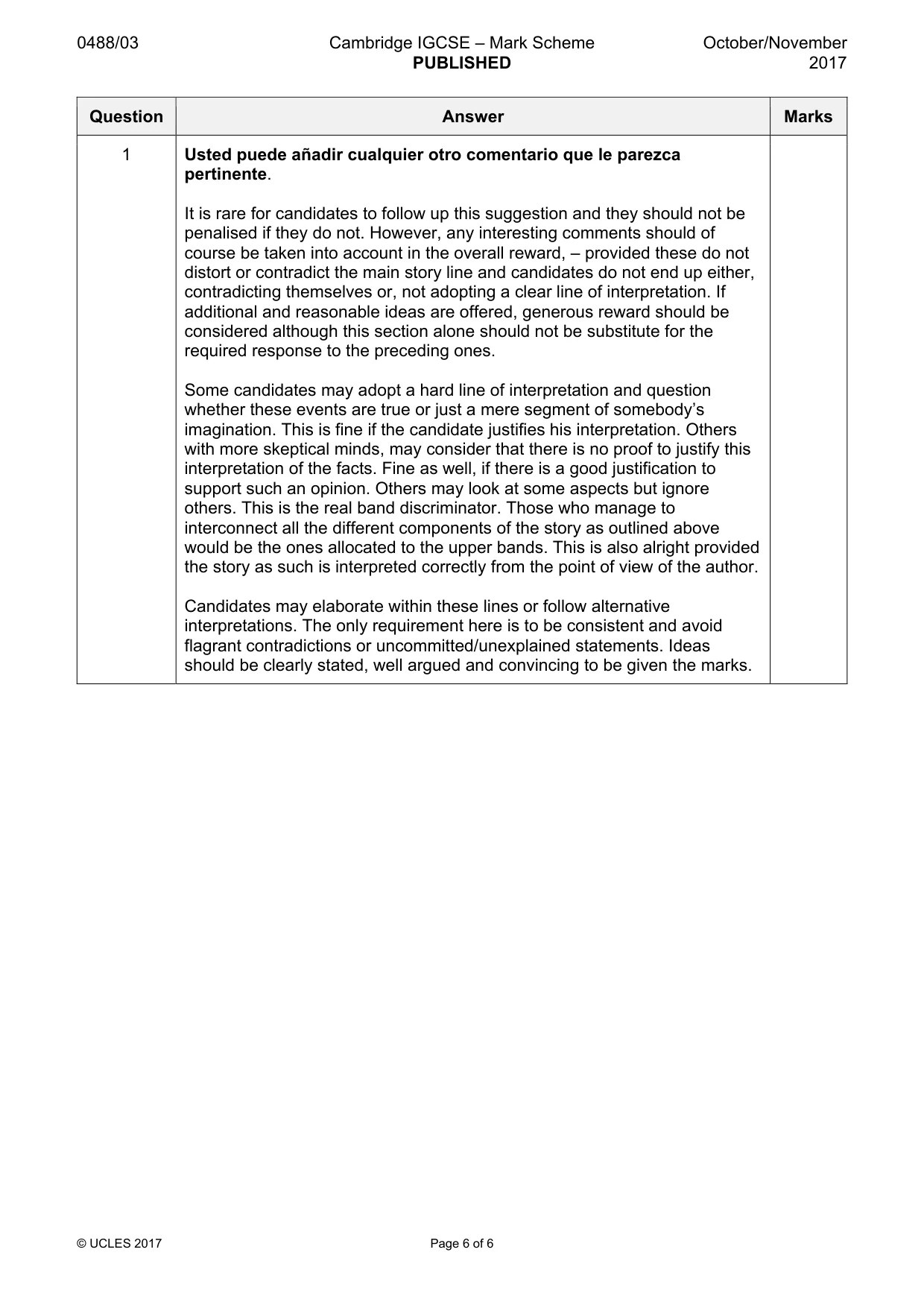
0488/03 Cambridge IGCSE – Mark Scheme PUBLISHED October/November 2017 © UCLES 2017 Page 6 of 6 Question Answer Marks 1 Usted puede añadir cualquier otro comentario que le parezca pertinente. It is rare for candidates to follow up this suggestion and they should not be penalised if they do not. However, any interesting comments should of course be taken into account in the overall reward, – provided these do not distort or contradict the main story line and candidates do not end up either, contradicting themselves or, not adopting a clear line of interpretation. If additional and reasonable ideas are offered, generous reward should be considered although this section alone should not be substitute for the required response to the preceding ones. Some candidates may adopt a hard line of interpretation and question whether these events are true or just a mere segment of somebody’s imagination. This is fine if the candidate justifies his interpretation. Others with more skeptical minds, may consider that there is no proof to justify this interpretation of the facts. Fine as well, if there is a good justification to support such an opinion. Others may look at some aspects but ignore others. This is the real band discriminator. Those who manage to interconnect all the different components of the story as outlined above would be the ones allocated to the upper bands. This is also alright provided the story as such is interpreted correctly from the point of view of the author. Candidates may elaborate within these lines or follow alternative interpretations. The only requirement here is to be consistent and avoid flagrant contradictions or uncommitted/unexplained statements. Ideas should be clearly stated, well argued and convincing to be given the marks.
What you needed in this session
Cambridge’s own grade thresholds for 2017 Oct/Nov, Paper 3 · Variant 1. A higher threshold means an easier paper — the bar moves with how the cohort did.