Cambridge IGCSE Spanish - Literature 0488 — 2017 May/June Paper 1 · Variant 3
0488/13/M/J/17 · 60 marks · ≈68 min
The question paper and its mark scheme, free to read here and free to download. This is Cambridge’s own paper, exactly as it was sat.
Question paper8 pages
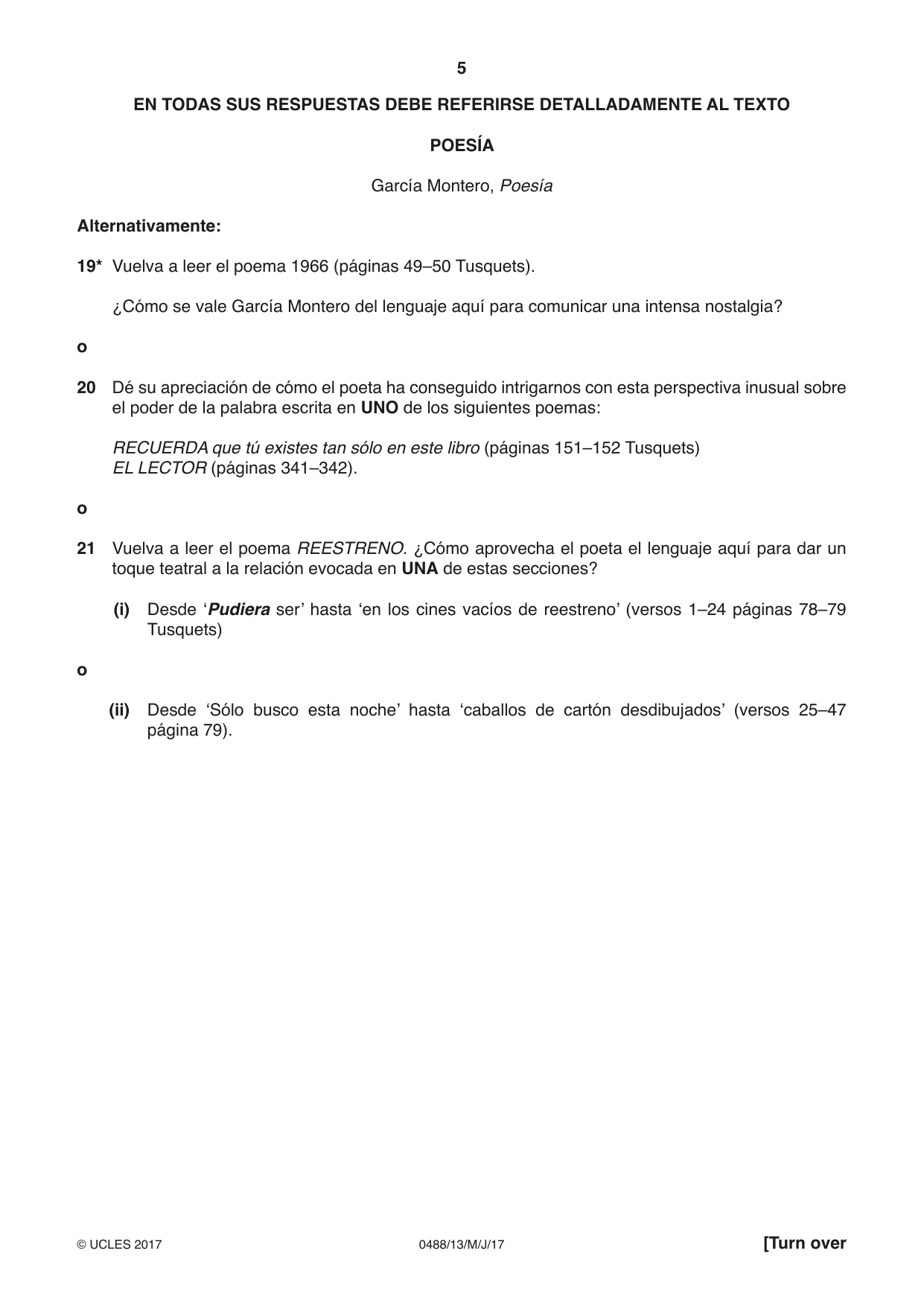
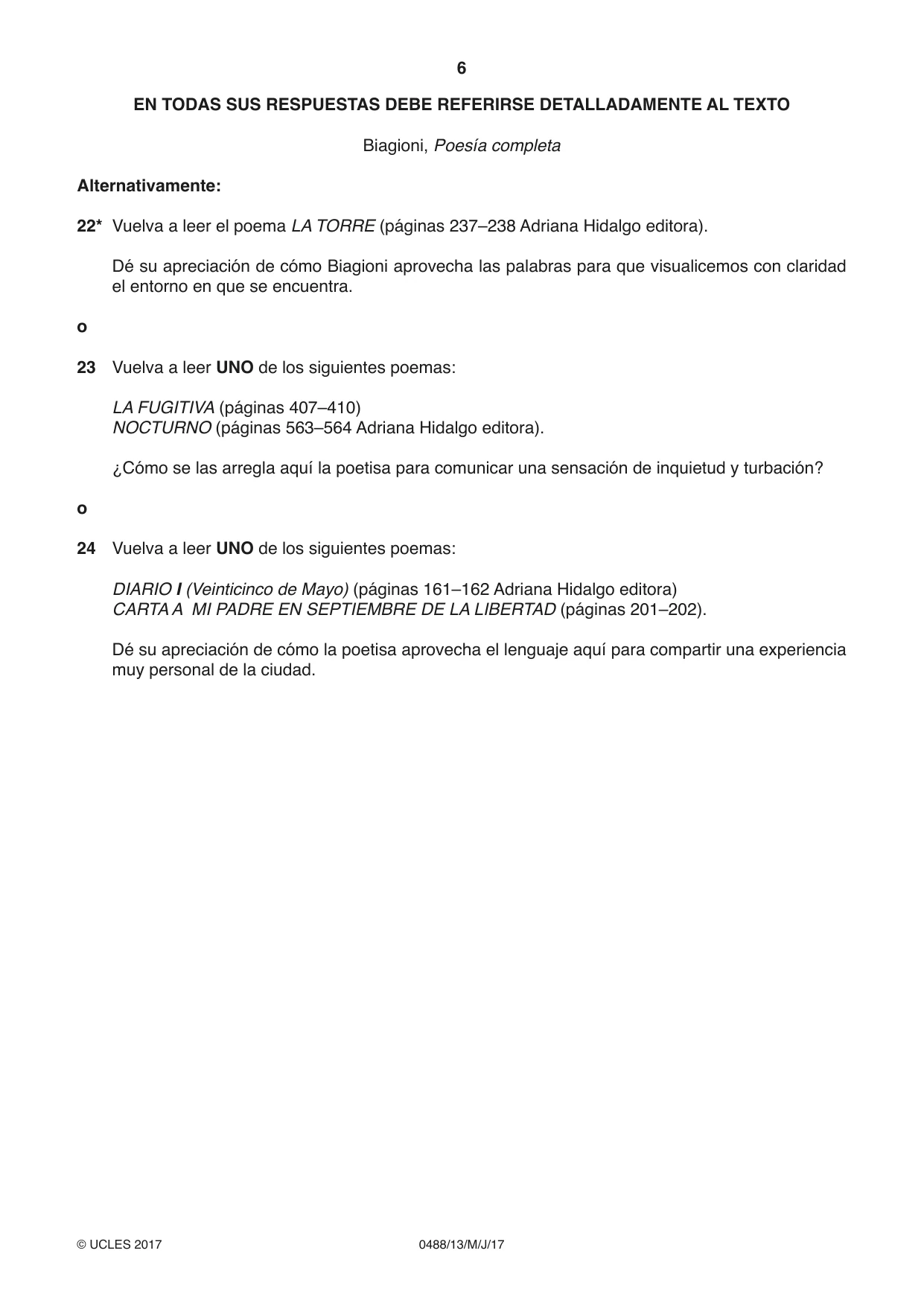


Mark scheme24 pages
Answers below. Sit the paper first if you are practising.
Paper as text
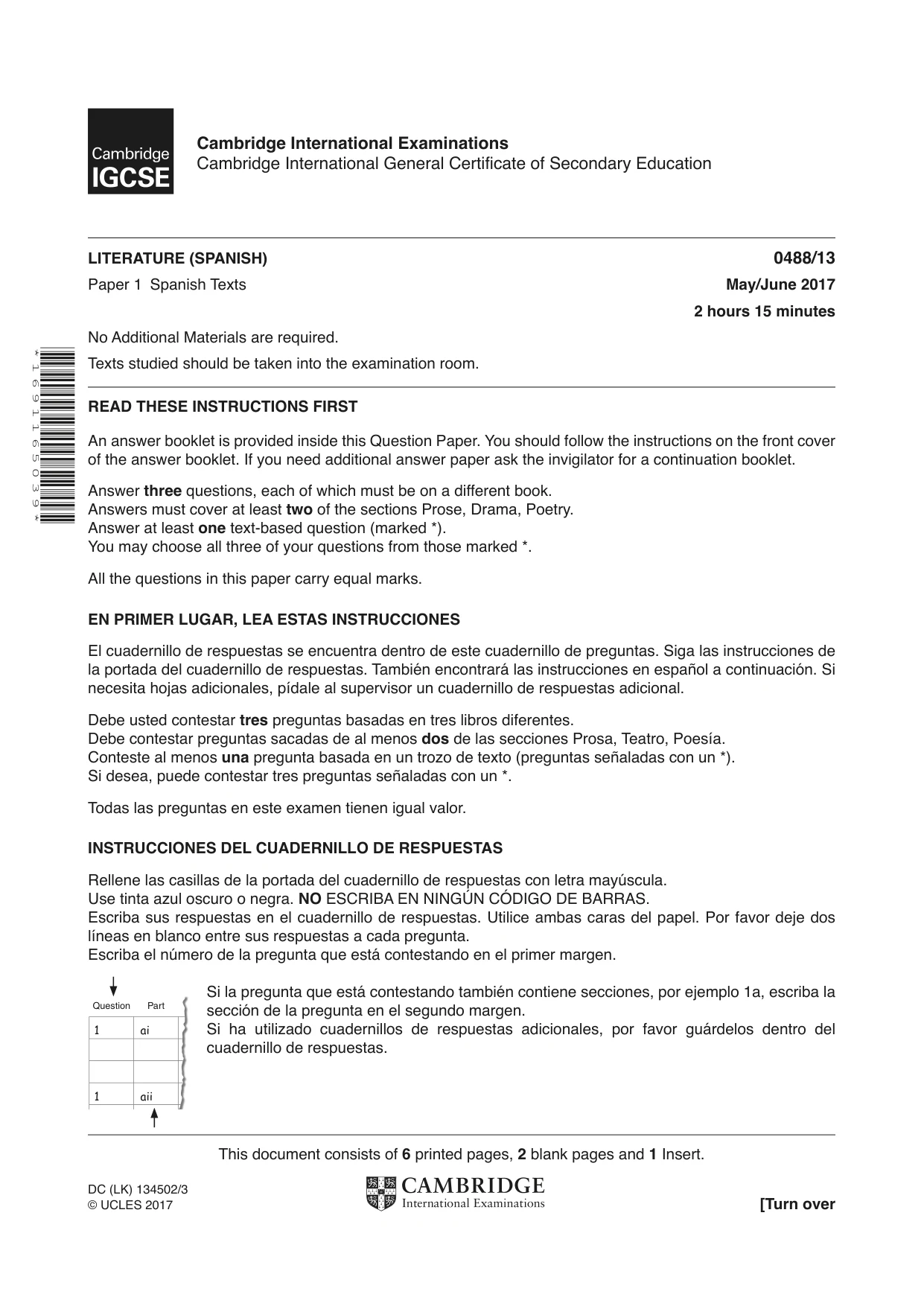
Question paper, page 1
* 1 6 9 1 1 6 5 0 3 9 * This document consists of 6 printed pages, 2 blank pages and 1 Insert. DC (LK) 134502/3 © UCLES 2017 [Turn over Cambridge International Examinations Cambridge International General Certificate of Secondary Education LITERATURE (SPANISH) 0488/13 Paper 1 Spanish Texts May/June 2017 2 hours 15 minutes No Additional Materials are required. Texts studied should be taken into the examination room. READ THESE INSTRUCTIONS FIRST An answer booklet is provided inside this Question Paper. You should follow the instructions on the front cover of the answer booklet. If you need additional answer paper ask the invigilator for a continuation booklet. Answer three questions, each of which must be on a different book. Answers must cover at least two of the sections Prose, Drama, Poetry. Answer at least one text-based question (marked *). You may choose all three of your questions from those marked *. All the questions in this paper carry equal marks. EN PRIMER LUGAR, LEA ESTAS INSTRUCCIONES El cuadernillo de respuestas se encuentra dentro de este cuadernillo de preguntas. Siga las instrucciones de la portada del cuadernillo de respuestas. También encontrará las instrucciones en español a continuación. Si necesita hojas adicionales, pídale al supervisor un cuadernillo de respuestas adicional. Debe usted contestar tres preguntas basadas en tres libros diferentes. Debe contestar preguntas sacadas de al menos dos de las secciones Prosa, Teatro, Poesía. Conteste al menos una pregunta basada en un trozo de texto (preguntas señaladas con un *). Si desea, puede contestar tres preguntas señaladas con un *. Todas las preguntas en este examen tienen igual valor. INSTRUCCIONES DEL CUADERNILLO DE RESPUESTAS Rellene las casillas de la portada del cuadernillo de respuestas con letra mayúscula. Use tinta azul oscuro o negra. NO ESCRIBA EN NINGÚN CÓDIGO DE BARRAS. Escriba sus respuestas en el cuadernillo de respuestas. Utilice ambas caras del papel. Por favor deje dos líneas en blanco entre sus respuestas a cada pregunta. Escriba el número de la pregunta que está contestando en el primer margen. Si la pregunta que está contestando también contiene secciones, por ejemplo 1a, escriba la sección de la pregunta en el segundo margen. Si ha utilizado cuadernillos de respuestas adicionales, por favor guárdelos dentro del cuadernillo de respuestas. Question Part 1 1 ai aii
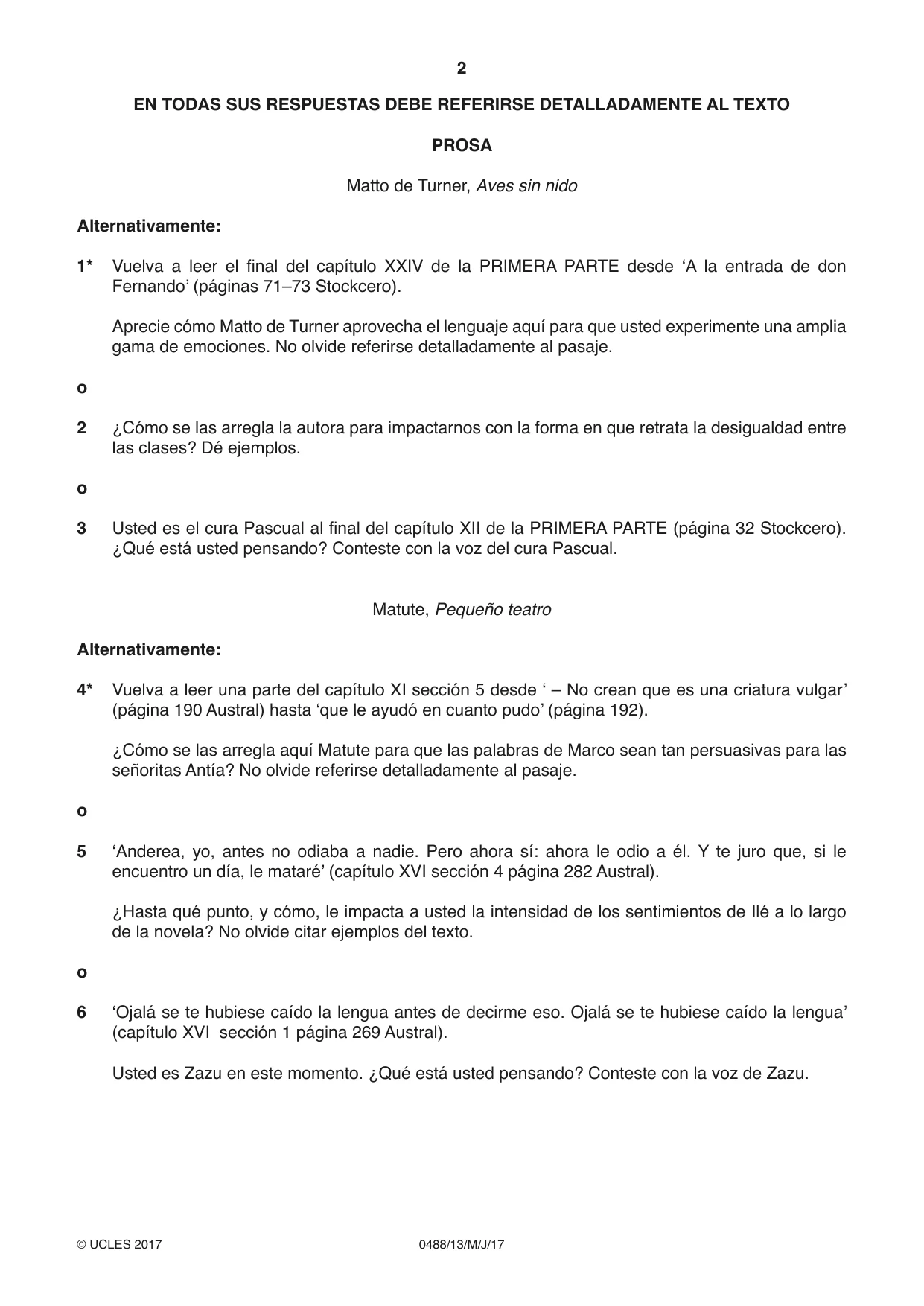
Question paper, page 2
2 0488/13/M/J/17 © UCLES 2017 EN TODAS SUS RESPUESTAS DEBE REFERIRSE DETALLADAMENTE AL TEXTO PROSA Matto de Turner, Aves sin nido Alternativamente: 1* Vuelva a leer el final del capítulo XXIV de la PRIMERA PARTE desde ‘A la entrada de don Fernando’ (páginas 71–73 Stockcero). Aprecie cómo Matto de Turner aprovecha el lenguaje aquí para que usted experimente una amplia gama de emociones. No olvide referirse detalladamente al pasaje. o 2 ¿Cómo se las arregla la autora para impactarnos con la forma en que retrata la desigualdad entre las clases? Dé ejemplos. o 3 Usted es el cura Pascual al final del capítulo XII de la PRIMERA PARTE (página 32 Stockcero). ¿Qué está usted pensando? Conteste con la voz del cura Pascual. Matute, Pequeño teatro Alternativamente: 4* Vuelva a leer una parte del capítulo XI sección 5 desde ‘ – No crean que es una criatura vulgar’ (página 190 Austral) hasta ‘que le ayudó en cuanto pudo’ (página 192). ¿Cómo se las arregla aquí Matute para que las palabras de Marco sean tan persuasivas para las señoritas Antía? No olvide referirse detalladamente al pasaje. o 5 ‘Anderea, yo, antes no odiaba a nadie. Pero ahora sí: ahora le odio a él. Y te juro que, si le encuentro un día, le mataré’ (capítulo XVI sección 4 página 282 Austral). ¿Hasta qué punto, y cómo, le impacta a usted la intensidad de los sentimientos de Ilé a lo largo de la novela? No olvide citar ejemplos del texto. o 6 ‘Ojalá se te hubiese caído la lengua antes de decirme eso. Ojalá se te hubiese caído la lengua’ (capítulo XVI sección 1 página 269 Austral). Usted es Zazu en este momento. ¿Qué está usted pensando? Conteste con la voz de Zazu.
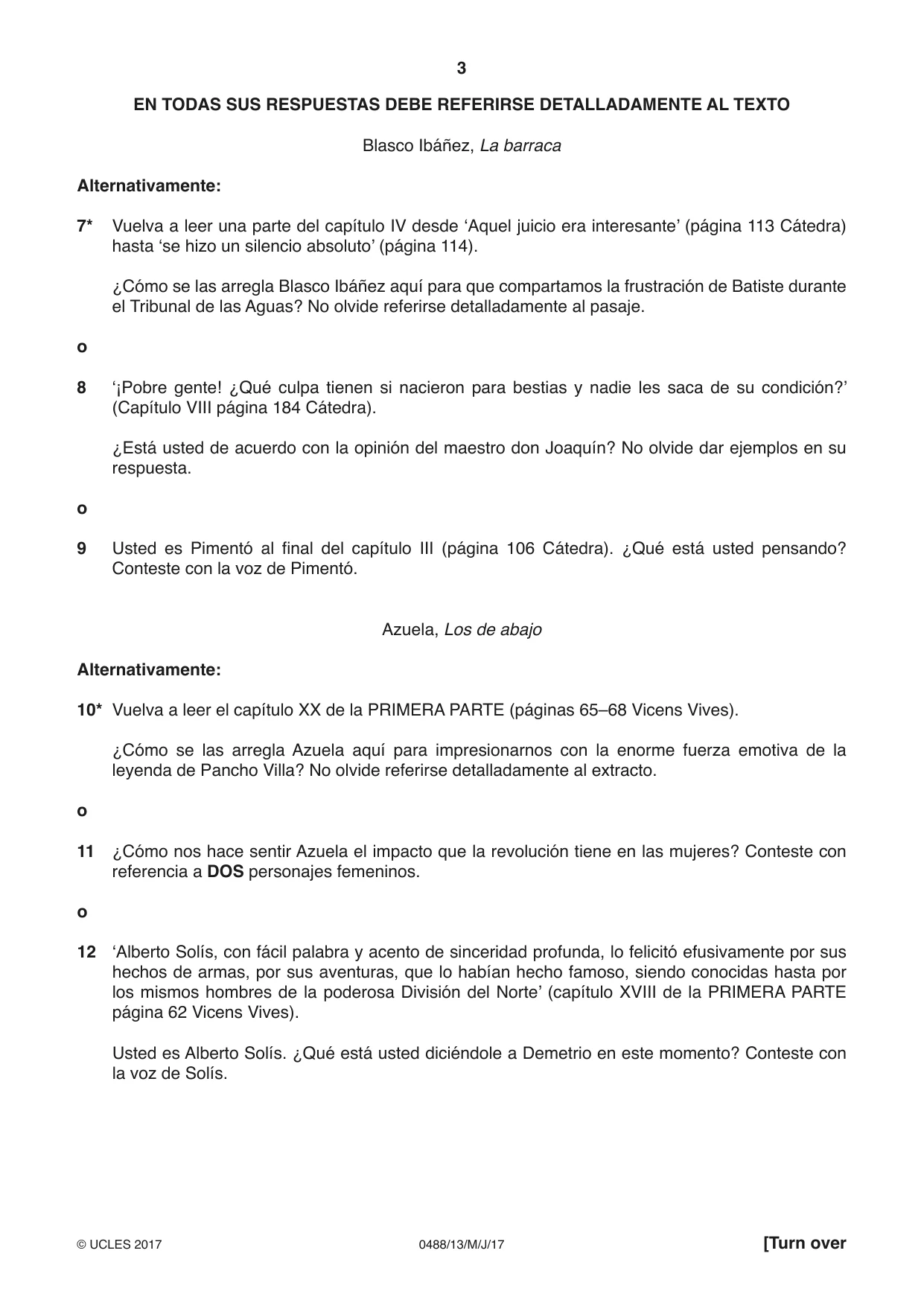
Question paper, page 3
3 0488/13/M/J/17 © UCLES 2017 [Turn over EN TODAS SUS RESPUESTAS DEBE REFERIRSE DETALLADAMENTE AL TEXTO Blasco Ibáñez, La barraca Alternativamente: 7* Vuelva a leer una parte del capítulo IV desde ‘Aquel juicio era interesante’ (página 113 Cátedra) hasta ‘se hizo un silencio absoluto’ (página 114). ¿Cómo se las arregla Blasco Ibáñez aquí para que compartamos la frustración de Batiste durante el Tribunal de las Aguas? No olvide referirse detalladamente al pasaje. o 8 ‘¡Pobre gente! ¿Qué culpa tienen si nacieron para bestias y nadie les saca de su condición?’ (Capítulo VIII página 184 Cátedra). ¿Está usted de acuerdo con la opinión del maestro don Joaquín? No olvide dar ejemplos en su respuesta. o 9 Usted es Pimentó al final del capítulo III (página 106 Cátedra). ¿Qué está usted pensando? Conteste con la voz de Pimentó. Azuela, Los de abajo Alternativamente: 10* Vuelva a leer el capítulo XX de la PRIMERA PARTE (páginas 65–68 Vicens Vives). ¿Cómo se las arregla Azuela aquí para impresionarnos con la enorme fuerza emotiva de la leyenda de Pancho Villa? No olvide referirse detalladamente al extracto. o 11 ¿Cómo nos hace sentir Azuela el impacto que la revolución tiene en las mujeres? Conteste con referencia a DOS personajes femeninos. o 12 ‘Alberto Solís, con fácil palabra y acento de sinceridad profunda, lo felicitó efusivamente por sus hechos de armas, por sus aventuras, que lo habían hecho famoso, siendo conocidas hasta por los mismos hombres de la poderosa División del Norte’ (capítulo XVIII de la PRIMERA PARTE página 62 Vicens Vives). Usted es Alberto Solís. ¿Qué está usted diciéndole a Demetrio en este momento? Conteste con la voz de Solís.
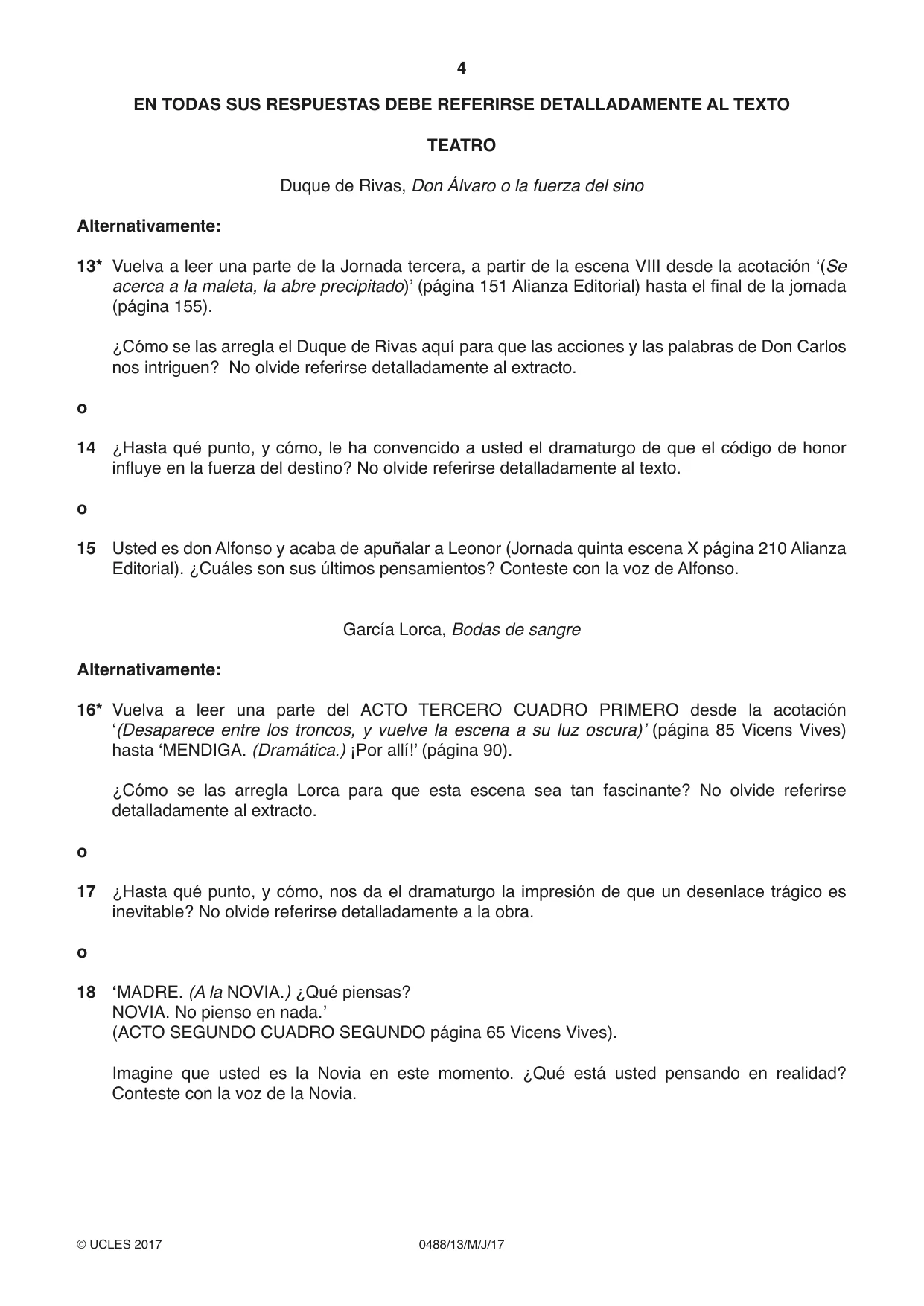
Question paper, page 4
4 0488/13/M/J/17 © UCLES 2017 EN TODAS SUS RESPUESTAS DEBE REFERIRSE DETALLADAMENTE AL TEXTO TEATRO Duque de Rivas, Don Álvaro o la fuerza del sino Alternativamente: 13* Vuelva a leer una parte de la Jornada tercera, a partir de la escena VIII desde la acotación ‘(Se acerca a la maleta, la abre precipitado)’ (página 151 Alianza Editorial) hasta el final de la jornada (página 155). ¿Cómo se las arregla el Duque de Rivas aquí para que las acciones y las palabras de Don Carlos nos intriguen? No olvide referirse detalladamente al extracto. o 14 ¿Hasta qué punto, y cómo, le ha convencido a usted el dramaturgo de que el código de honor influye en la fuerza del destino? No olvide referirse detalladamente al texto. o 15 Usted es don Alfonso y acaba de apuñalar a Leonor (Jornada quinta escena X página 210 Alianza Editorial). ¿Cuáles son sus últimos pensamientos? Conteste con la voz de Alfonso. García Lorca, Bodas de sangre Alternativamente: 16* Vuelva a leer una parte del ACTO TERCERO CUADRO PRIMERO desde la acotación ‘(Desaparece entre los troncos, y vuelve la escena a su luz oscura)’ (página 85 Vicens Vives) hasta ‘MENDIGA. (Dramática.) ¡Por allí!’ (página 90). ¿Cómo se las arregla Lorca para que esta escena sea tan fascinante? No olvide referirse detalladamente al extracto. o 17 ¿Hasta qué punto, y cómo, nos da el dramaturgo la impresión de que un desenlace trágico es inevitable? No olvide referirse detalladamente a la obra. o 18 ‘MADRE. (A la NOVIA.) ¿Qué piensas? NOVIA. No pienso en nada.’ (ACTO SEGUNDO CUADRO SEGUNDO página 65 Vicens Vives). Imagine que usted es la Novia en este momento. ¿Qué está usted pensando en realidad? Conteste con la voz de la Novia.
Question paper, page 5
5 0488/13/M/J/17 © UCLES 2017 [Turn over EN TODAS SUS RESPUESTAS DEBE REFERIRSE DETALLADAMENTE AL TEXTO POESÍA García Montero, Poesía Alternativamente: 19* Vuelva a leer el poema 1966 (páginas 49–50 Tusquets). ¿Cómo se vale García Montero del lenguaje aquí para comunicar una intensa nostalgia? o 20 Dé su apreciación de cómo el poeta ha conseguido intrigarnos con esta perspectiva inusual sobre el poder de la palabra escrita en UNO de los siguientes poemas: RECUERDA que tú existes tan sólo en este libro (páginas 151–152 Tusquets) EL LECTOR (páginas 341–342). o 21 Vuelva a leer el poema REESTRENO. ¿Cómo aprovecha el poeta el lenguaje aquí para dar un toque teatral a la relación evocada en UNA de estas secciones? (i) Desde ‘Pudiera ser’ hasta ‘en los cines vacíos de reestreno’ (versos 1–24 páginas 78–79 Tusquets) o (ii) Desde ‘Sólo busco esta noche’ hasta ‘caballos de cartón desdibujados’ (versos 25–47 página 79).
Question paper, page 6
6 0488/13/M/J/17 © UCLES 2017 EN TODAS SUS RESPUESTAS DEBE REFERIRSE DETALLADAMENTE AL TEXTO Biagioni, Poesía completa Alternativamente: 22* Vuelva a leer el poema LA TORRE (páginas 237–238 Adriana Hidalgo editora). Dé su apreciación de cómo Biagioni aprovecha las palabras para que visualicemos con claridad el entorno en que se encuentra. o 23 Vuelva a leer UNO de los siguientes poemas: LA FUGITIVA (páginas 407–410) NOCTURNO (páginas 563–564 Adriana Hidalgo editora). ¿Cómo se las arregla aquí la poetisa para comunicar una sensación de inquietud y turbación? o 24 Vuelva a leer UNO de los siguientes poemas: DIARIO I (Veinticinco de Mayo) (páginas 161–162 Adriana Hidalgo editora) CARTA A MI PADRE EN SEPTIEMBRE DE LA LIBERTAD (páginas 201–202). Dé su apreciación de cómo la poetisa aprovecha el lenguaje aquí para compartir una experiencia muy personal de la ciudad.
Question paper, page 7
7 0488/13/M/J/17 © UCLES 2017 BLANK PAGE
Question paper, page 8
8 0488/13/M/J/17 © UCLES 2017 Permission to reproduce items where third-party owned material protected by copyright is included has been sought and cleared where possible. Every reasonable effort has been made by the publisher (UCLES) to trace copyright holders, but if any items requiring clearance have unwittingly been included, the publisher will be pleased to make amends at the earliest possible opportunity. To avoid the issue of disclosure of answer-related information to candidates, all copyright acknowledgements are reproduced online in the Cambridge International Examinations Copyright Acknowledgements Booklet. This is produced for each series of examinations and is freely available to download at www.cie.org.uk after the live examination series. Cambridge International Examinations is part of the Cambridge Assessment Group. Cambridge Assessment is the brand name of University of Cambridge Local Examinations Syndicate (UCLES), which is itself a department of the University of Cambridge. BLANK PAGE
Mark scheme, page 1
® IGCSE is a registered trademark. This document consists of 24 printed pages. © UCLES 2017 [Turn over Cambridge International Examinations Cambridge International General Certificate of Secondary Education LITERATURE (SPANISH) 0488/13 Paper 1 Set Texts (Open Books) May/June 2017 MARK SCHEME Maximum Mark: 60 Published This mark scheme is published as an aid to teachers and candidates, to indicate the requirements of the examination. It shows the basis on which Examiners were instructed to award marks. It does not indicate the details of the discussions that took place at an Examiners’ meeting before marking began, which would have considered the acceptability of alternative answers. Mark schemes should be read in conjunction with the question paper and the Principal Examiner Report for Teachers. Cambridge will not enter into discussions about these mark schemes. Cambridge is publishing the mark schemes for the May/June 2017 series for most Cambridge IGCSE®, Cambridge International A and AS Level and Cambridge Pre-U components, and some Cambridge O Level components.
Mark scheme, page 2
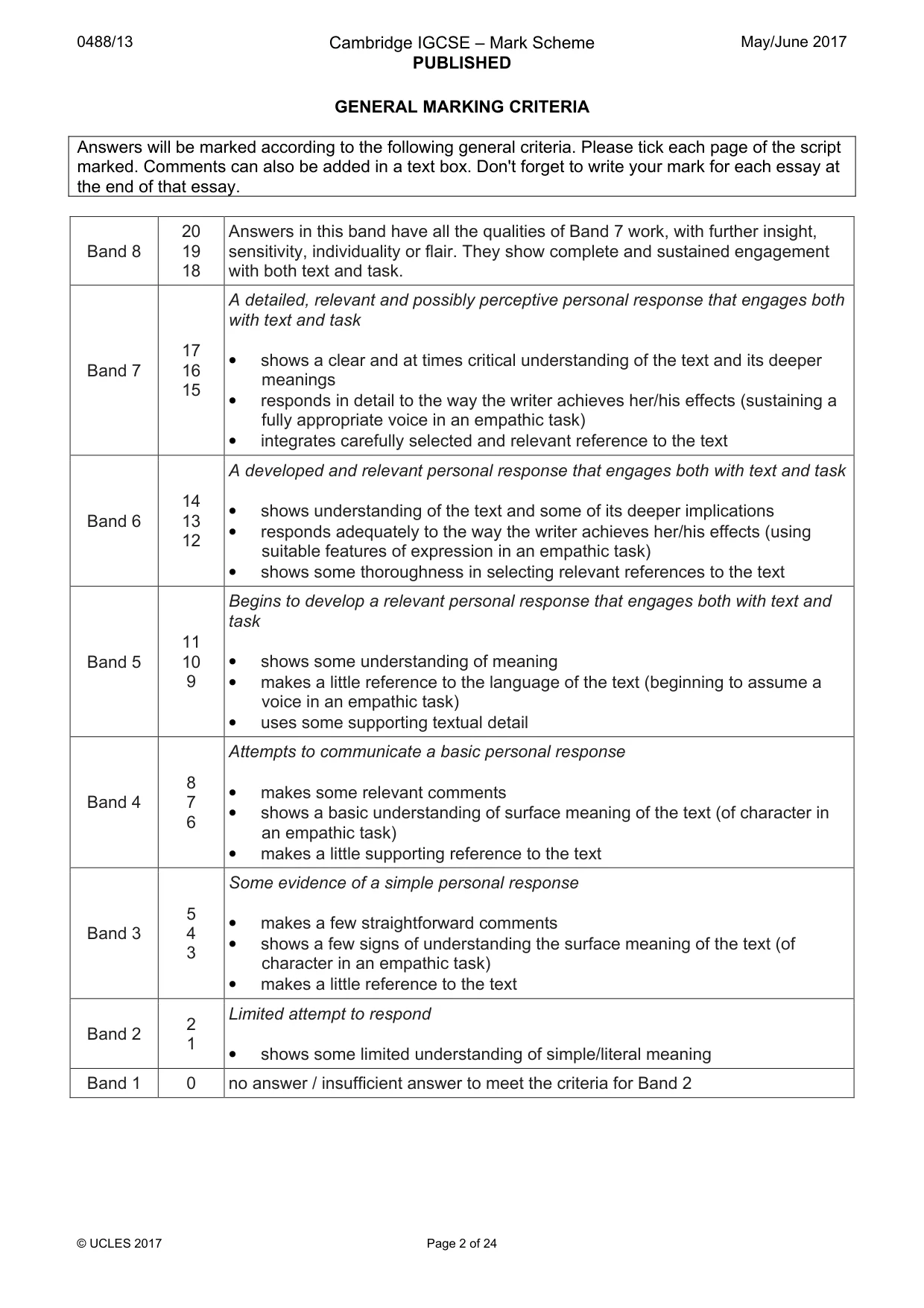
0488/13 Cambridge IGCSE – Mark Scheme PUBLISHED May/June 2017 © UCLES 2017 Page 2 of 24 GENERAL MARKING CRITERIA Answers will be marked according to the following general criteria. Please tick each page of the script marked. Comments can also be added in a text box. Don't forget to write your mark for each essay at the end of that essay. Band 8 20 19 18 Answers in this band have all the qualities of Band 7 work, with further insight, sensitivity, individuality or flair. They show complete and sustained engagement with both text and task. Band 7 17 16 15 A detailed, relevant and possibly perceptive personal response that engages both with text and task • shows a clear and at times critical understanding of the text and its deeper meanings • responds in detail to the way the writer achieves her/his effects (sustaining a fully appropriate voice in an empathic task) • integrates carefully selected and relevant reference to the text Band 6 14 13 12 A developed and relevant personal response that engages both with text and task • shows understanding of the text and some of its deeper implications • responds adequately to the way the writer achieves her/his effects (using suitable features of expression in an empathic task) • shows some thoroughness in selecting relevant references to the text Band 5 11 10 9 Begins to develop a relevant personal response that engages both with text and task • shows some understanding of meaning • makes a little reference to the language of the text (beginning to assume a voice in an empathic task) • uses some supporting textual detail Band 4 8 7 6 Attempts to communicate a basic personal response • makes some relevant comments • shows a basic understanding of surface meaning of the text (of character in an empathic task) • makes a little supporting reference to the text Band 3 5 4 3 Some evidence of a simple personal response • makes a few straightforward comments • shows a few signs of understanding the surface meaning of the text (of character in an empathic task) • makes a little reference to the text Band 2 2 1 Limited attempt to respond • shows some limited understanding of simple/literal meaning Band 1 0 no answer / insufficient answer to meet the criteria for Band 2
Mark scheme, page 3
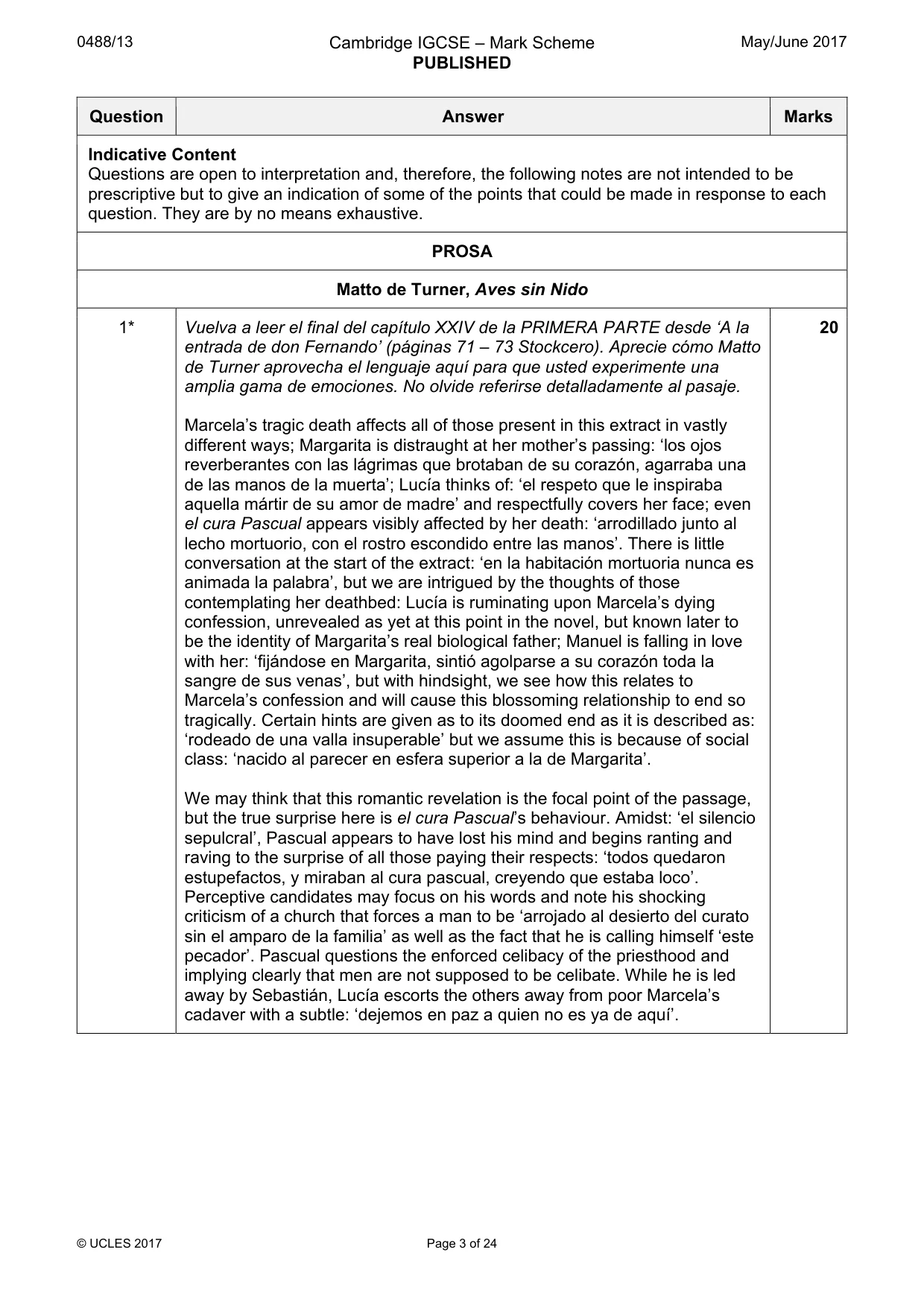
0488/13 Cambridge IGCSE – Mark Scheme PUBLISHED May/June 2017 © UCLES 2017 Page 3 of 24 Question Answer Marks Indicative Content Questions are open to interpretation and, therefore, the following notes are not intended to be prescriptive but to give an indication of some of the points that could be made in response to each question. They are by no means exhaustive. PROSA Matto de Turner, Aves sin Nido 1* Vuelva a leer el final del capítulo XXIV de la PRIMERA PARTE desde ‘A la entrada de don Fernando’ (páginas 71 – 73 Stockcero). Aprecie cómo Matto de Turner aprovecha el lenguaje aquí para que usted experimente una amplia gama de emociones. No olvide referirse detalladamente al pasaje. Marcela’s tragic death affects all of those present in this extract in vastly different ways; Margarita is distraught at her mother’s passing: ‘los ojos reverberantes con las lágrimas que brotaban de su corazón, agarraba una de las manos de la muerta’; Lucía thinks of: ‘el respeto que le inspiraba aquella mártir de su amor de madre’ and respectfully covers her face; even el cura Pascual appears visibly affected by her death: ‘arrodillado junto al lecho mortuorio, con el rostro escondido entre las manos’. There is little conversation at the start of the extract: ‘en la habitación mortuoria nunca es animada la palabra’, but we are intrigued by the thoughts of those contemplating her deathbed: Lucía is ruminating upon Marcela’s dying confession, unrevealed as yet at this point in the novel, but known later to be the identity of Margarita’s real biological father; Manuel is falling in love with her: ‘fijándose en Margarita, sintió agolparse a su corazón toda la sangre de sus venas’, but with hindsight, we see how this relates to Marcela’s confession and will cause this blossoming relationship to end so tragically. Certain hints are given as to its doomed end as it is described as: ‘rodeado de una valla insuperable’ but we assume this is because of social class: ‘nacido al parecer en esfera superior a la de Margarita’. We may think that this romantic revelation is the focal point of the passage, but the true surprise here is el cura Pascual’s behaviour. Amidst: ‘el silencio sepulcral’, Pascual appears to have lost his mind and begins ranting and raving to the surprise of all those paying their respects: ‘todos quedaron estupefactos, y miraban al cura pascual, creyendo que estaba loco’. Perceptive candidates may focus on his words and note his shocking criticism of a church that forces a man to be ‘arrojado al desierto del curato sin el amparo de la familia’ as well as the fact that he is calling himself ‘este pecador’. Pascual questions the enforced celibacy of the priesthood and implying clearly that men are not supposed to be celibate. While he is led away by Sebastián, Lucía escorts the others away from poor Marcela’s cadaver with a subtle: ‘dejemos en paz a quien no es ya de aquí’. 20
Mark scheme, page 4
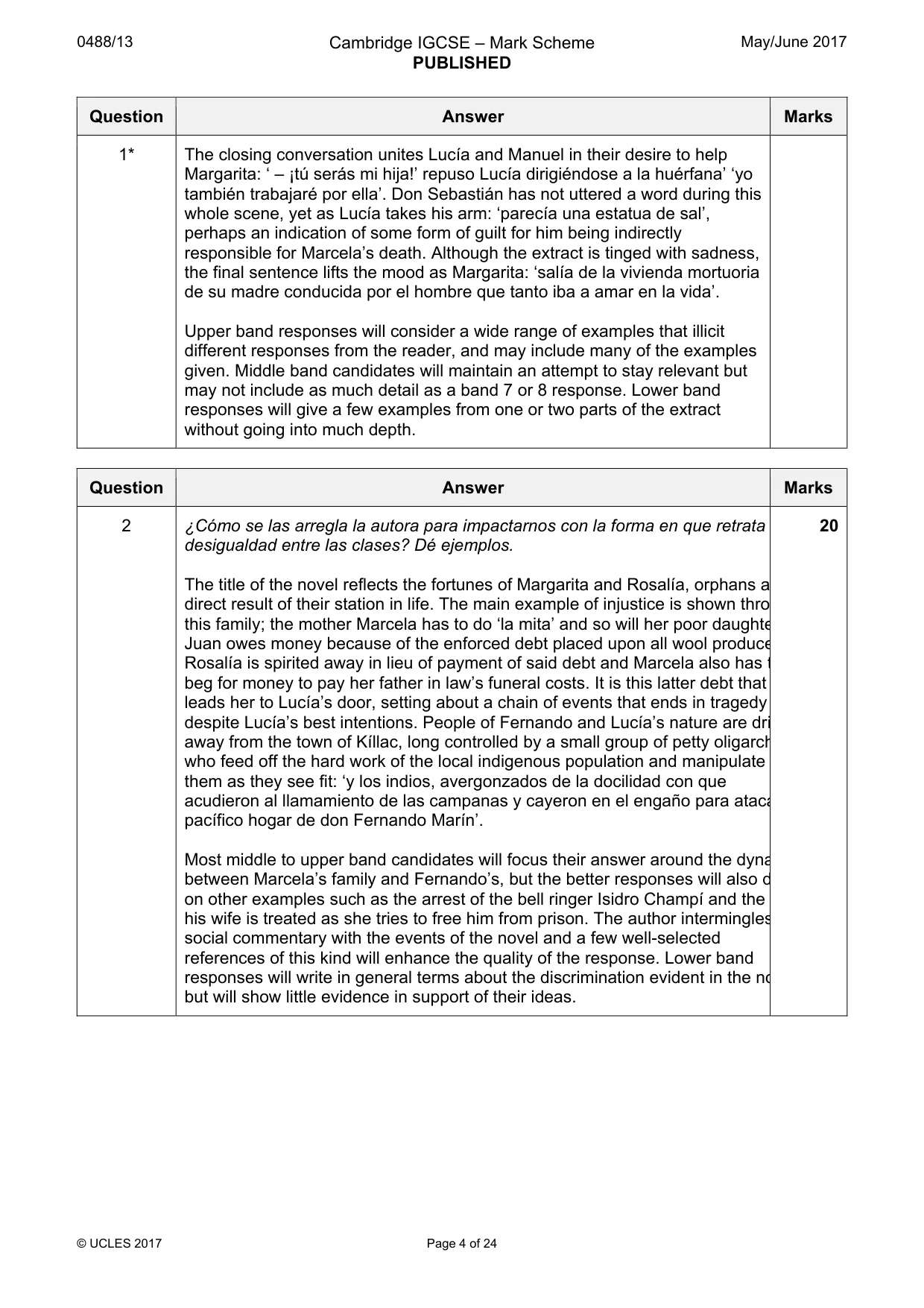
0488/13 Cambridge IGCSE – Mark Scheme PUBLISHED May/June 2017 © UCLES 2017 Page 4 of 24 Question Answer Marks 1* The closing conversation unites Lucía and Manuel in their desire to help Margarita: ‘ – ¡tú serás mi hija!’ repuso Lucía dirigiéndose a la huérfana’ ‘yo también trabajaré por ella’. Don Sebastián has not uttered a word during this whole scene, yet as Lucía takes his arm: ‘parecía una estatua de sal’, perhaps an indication of some form of guilt for him being indirectly responsible for Marcela’s death. Although the extract is tinged with sadness, the final sentence lifts the mood as Margarita: ‘salía de la vivienda mortuoria de su madre conducida por el hombre que tanto iba a amar en la vida’. Upper band responses will consider a wide range of examples that illicit different responses from the reader, and may include many of the examples given. Middle band candidates will maintain an attempt to stay relevant but may not include as much detail as a band 7 or 8 response. Lower band responses will give a few examples from one or two parts of the extract without going into much depth. Question Answer Marks 2 ¿Cómo se las arregla la autora para impactarnos con la forma en que retrata desigualdad entre las clases? Dé ejemplos. The title of the novel reflects the fortunes of Margarita and Rosalía, orphans a direct result of their station in life. The main example of injustice is shown thro this family; the mother Marcela has to do ‘la mita’ and so will her poor daughte Juan owes money because of the enforced debt placed upon all wool produce Rosalía is spirited away in lieu of payment of said debt and Marcela also has t beg for money to pay her father in law’s funeral costs. It is this latter debt that leads her to Lucía’s door, setting about a chain of events that ends in tragedy despite Lucía’s best intentions. People of Fernando and Lucía’s nature are dri away from the town of Kíllac, long controlled by a small group of petty oligarch who feed off the hard work of the local indigenous population and manipulate them as they see fit: ‘y los indios, avergonzados de la docilidad con que acudieron al llamamiento de las campanas y cayeron en el engaño para ataca pacífico hogar de don Fernando Marín’. Most middle to upper band candidates will focus their answer around the dyna between Marcela’s family and Fernando’s, but the better responses will also d on other examples such as the arrest of the bell ringer Isidro Champí and the his wife is treated as she tries to free him from prison. The author intermingles social commentary with the events of the novel and a few well-selected references of this kind will enhance the quality of the response. Lower band responses will write in general terms about the discrimination evident in the no but will show little evidence in support of their ideas. 20
Mark scheme, page 5
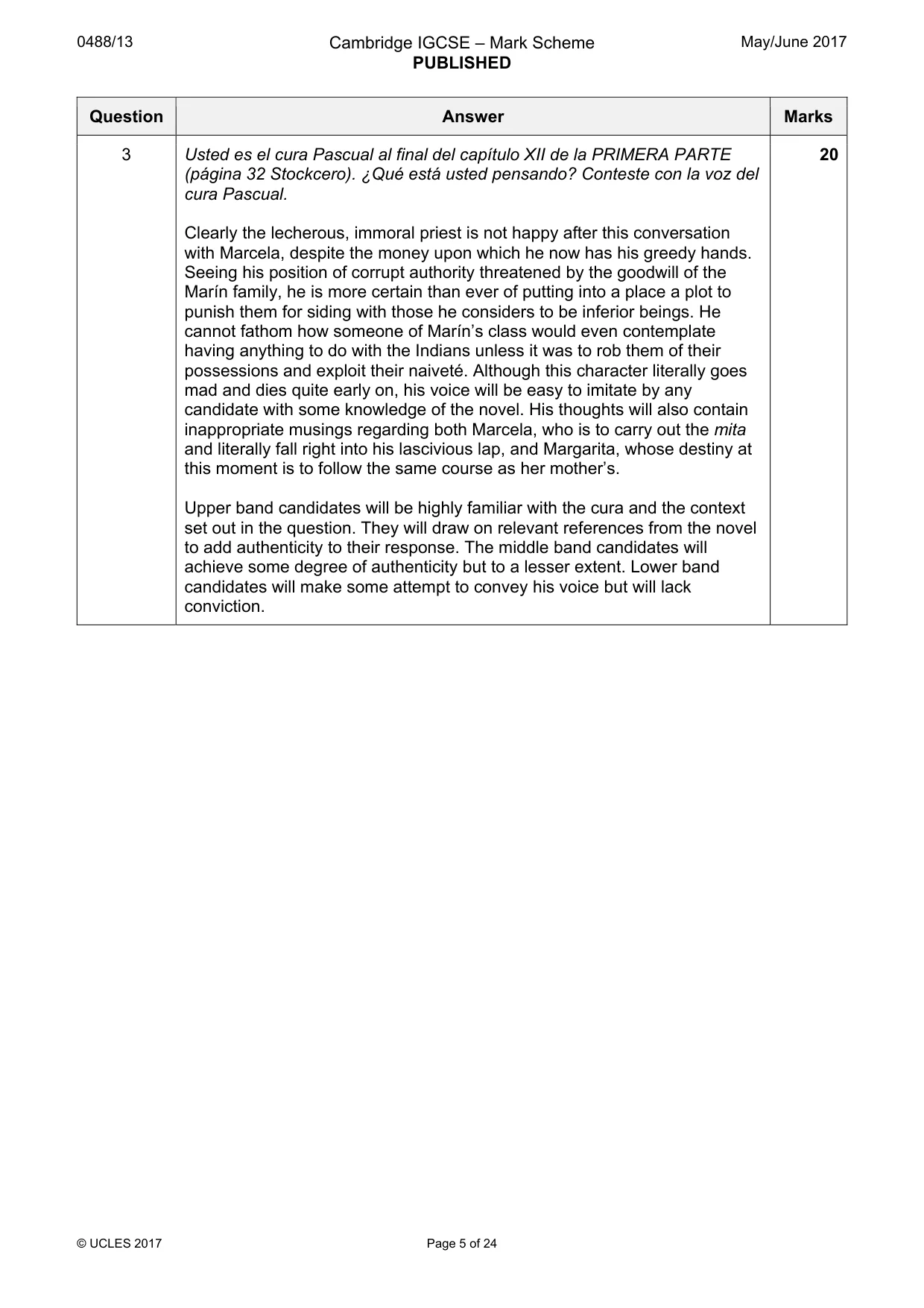
0488/13 Cambridge IGCSE – Mark Scheme PUBLISHED May/June 2017 © UCLES 2017 Page 5 of 24 Question Answer Marks 3 Usted es el cura Pascual al final del capítulo XII de la PRIMERA PARTE (página 32 Stockcero). ¿Qué está usted pensando? Conteste con la voz del cura Pascual. Clearly the lecherous, immoral priest is not happy after this conversation with Marcela, despite the money upon which he now has his greedy hands. Seeing his position of corrupt authority threatened by the goodwill of the Marín family, he is more certain than ever of putting into a place a plot to punish them for siding with those he considers to be inferior beings. He cannot fathom how someone of Marín’s class would even contemplate having anything to do with the Indians unless it was to rob them of their possessions and exploit their naiveté. Although this character literally goes mad and dies quite early on, his voice will be easy to imitate by any candidate with some knowledge of the novel. His thoughts will also contain inappropriate musings regarding both Marcela, who is to carry out the mita and literally fall right into his lascivious lap, and Margarita, whose destiny at this moment is to follow the same course as her mother’s. Upper band candidates will be highly familiar with the cura and the context set out in the question. They will draw on relevant references from the novel to add authenticity to their response. The middle band candidates will achieve some degree of authenticity but to a lesser extent. Lower band candidates will make some attempt to convey his voice but will lack conviction. 20
Mark scheme, page 6
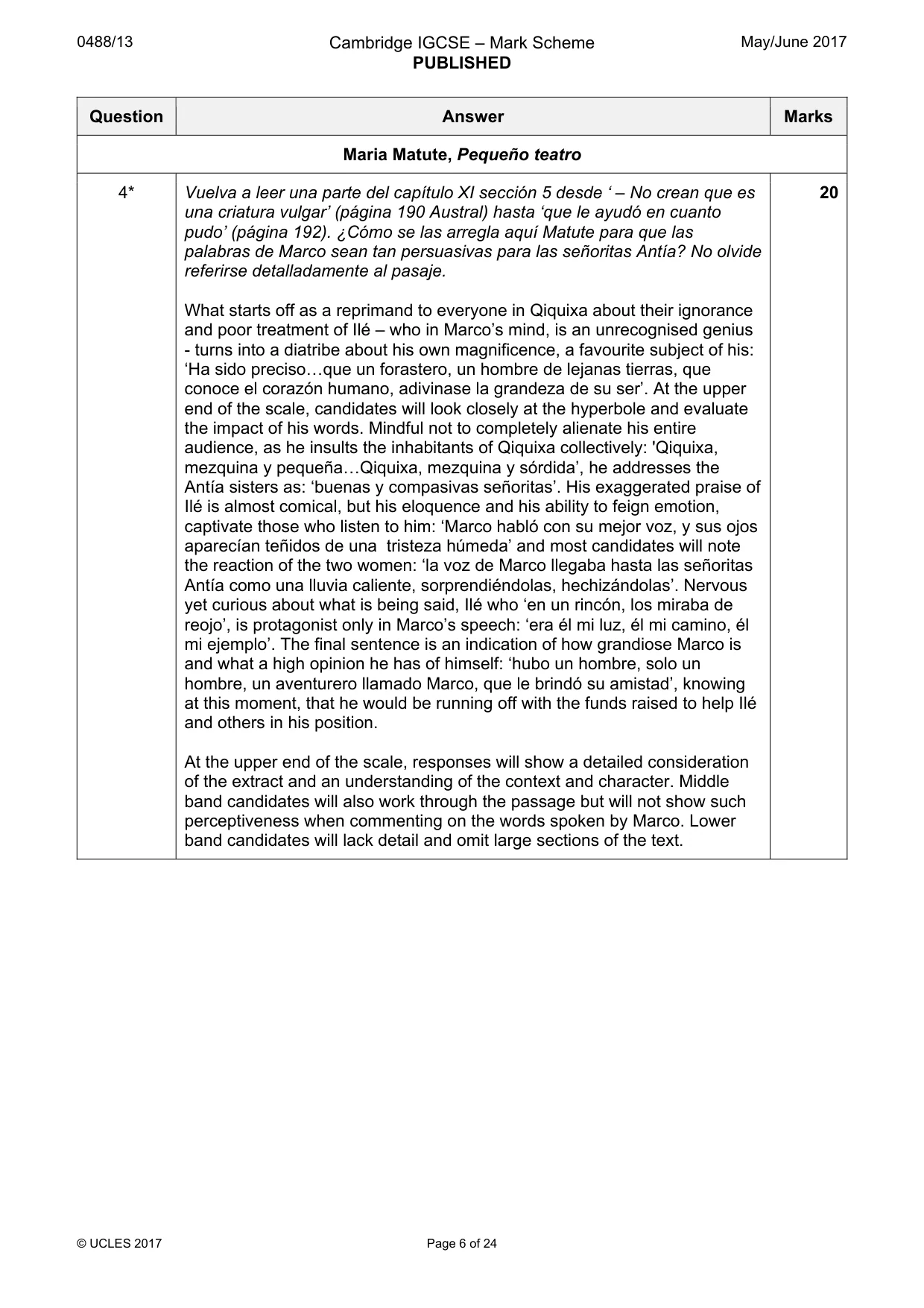
0488/13 Cambridge IGCSE – Mark Scheme PUBLISHED May/June 2017 © UCLES 2017 Page 6 of 24 Question Answer Marks Maria Matute, Pequeño teatro 4* Vuelva a leer una parte del capítulo XI sección 5 desde ‘ – No crean que es una criatura vulgar’ (página 190 Austral) hasta ‘que le ayudó en cuanto pudo’ (página 192). ¿Cómo se las arregla aquí Matute para que las palabras de Marco sean tan persuasivas para las señoritas Antía? No olvide referirse detalladamente al pasaje. What starts off as a reprimand to everyone in Qiquixa about their ignorance and poor treatment of Ilé – who in Marco’s mind, is an unrecognised genius - turns into a diatribe about his own magnificence, a favourite subject of his: ‘Ha sido preciso«que un forastero, un hombre de lejanas tierras, que conoce el corazón humano, adivinase la grandeza de su ser’. At the upper end of the scale, candidates will look closely at the hyperbole and evaluate the impact of his words. Mindful not to completely alienate his entire audience, as he insults the inhabitants of Qiquixa collectively: 'Qiquixa, mezquina y pequeña«Qiquixa, mezquina y sórdida’, he addresses the Antía sisters as: ‘buenas y compasivas señoritas’. His exaggerated praise of Ilé is almost comical, but his eloquence and his ability to feign emotion, captivate those who listen to him: ‘Marco habló con su mejor voz, y sus ojos aparecían teñidos de una tristeza húmeda’ and most candidates will note the reaction of the two women: ‘la voz de Marco llegaba hasta las señoritas Antía como una lluvia caliente, sorprendiéndolas, hechizándolas’. Nervous yet curious about what is being said, Ilé who ‘en un rincón, los miraba de reojo’, is protagonist only in Marco’s speech: ‘era él mi luz, él mi camino, él mi ejemplo’. The final sentence is an indication of how grandiose Marco is and what a high opinion he has of himself: ‘hubo un hombre, solo un hombre, un aventurero llamado Marco, que le brindó su amistad’, knowing at this moment, that he would be running off with the funds raised to help Ilé and others in his position. At the upper end of the scale, responses will show a detailed consideration of the extract and an understanding of the context and character. Middle band candidates will also work through the passage but will not show such perceptiveness when commenting on the words spoken by Marco. Lower band candidates will lack detail and omit large sections of the text. 20
Mark scheme, page 7
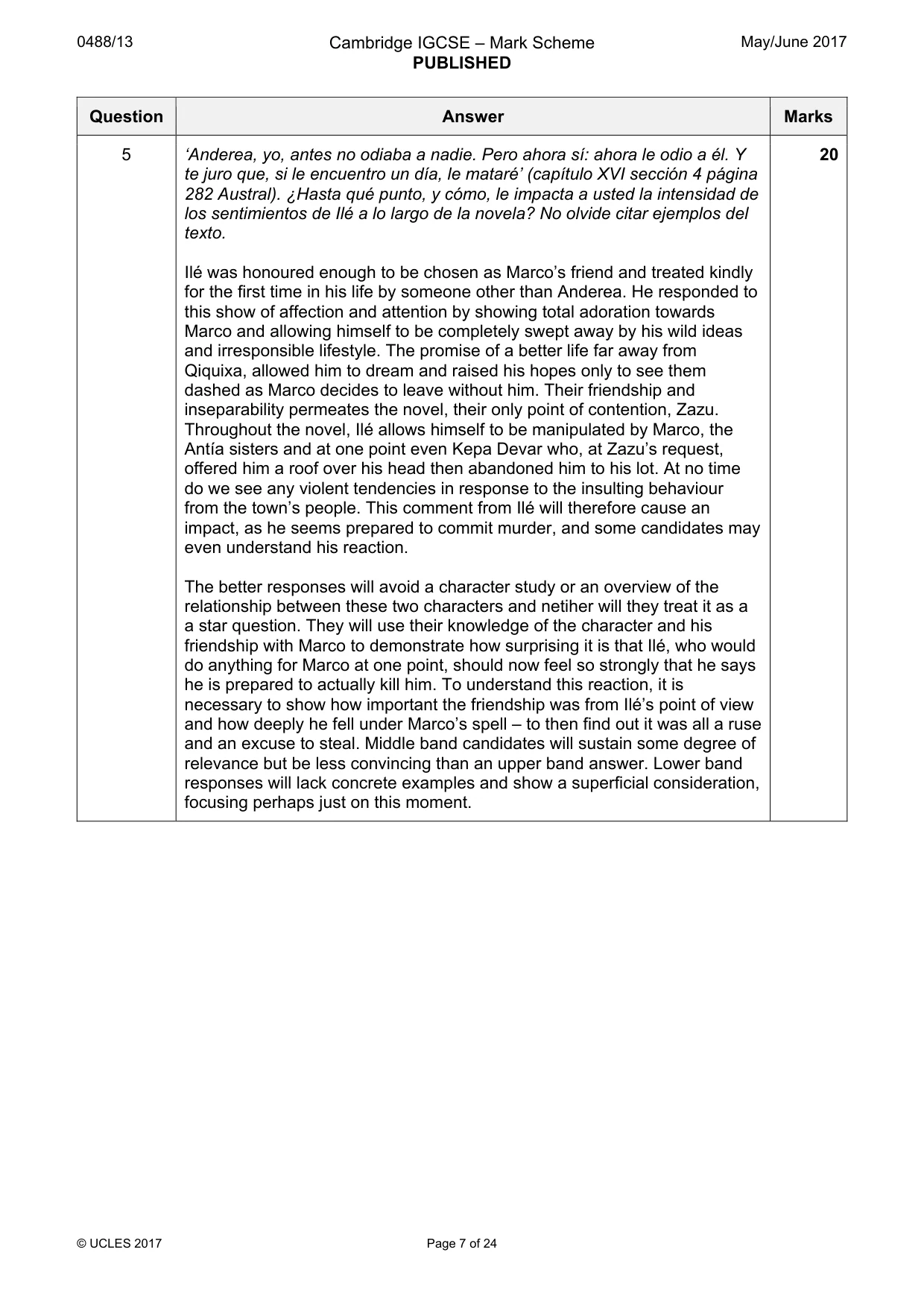
0488/13 Cambridge IGCSE – Mark Scheme PUBLISHED May/June 2017 © UCLES 2017 Page 7 of 24 Question Answer Marks 5 ‘Anderea, yo, antes no odiaba a nadie. Pero ahora sí: ahora le odio a él. Y te juro que, si le encuentro un día, le mataré’ (capítulo XVI sección 4 página 282 Austral). ¿Hasta qué punto, y cómo, le impacta a usted la intensidad de los sentimientos de Ilé a lo largo de la novela? No olvide citar ejemplos del texto. Ilé was honoured enough to be chosen as Marco’s friend and treated kindly for the first time in his life by someone other than Anderea. He responded to this show of affection and attention by showing total adoration towards Marco and allowing himself to be completely swept away by his wild ideas and irresponsible lifestyle. The promise of a better life far away from Qiquixa, allowed him to dream and raised his hopes only to see them dashed as Marco decides to leave without him. Their friendship and inseparability permeates the novel, their only point of contention, Zazu. Throughout the novel, Ilé allows himself to be manipulated by Marco, the Antía sisters and at one point even Kepa Devar who, at Zazu’s request, offered him a roof over his head then abandoned him to his lot. At no time do we see any violent tendencies in response to the insulting behaviour from the town’s people. This comment from Ilé will therefore cause an impact, as he seems prepared to commit murder, and some candidates may even understand his reaction. The better responses will avoid a character study or an overview of the relationship between these two characters and netiher will they treat it as a a star question. They will use their knowledge of the character and his friendship with Marco to demonstrate how surprising it is that Ilé, who would do anything for Marco at one point, should now feel so strongly that he says he is prepared to actually kill him. To understand this reaction, it is necessary to show how important the friendship was from Ilé’s point of view and how deeply he fell under Marco’s spell – to then find out it was all a ruse and an excuse to steal. Middle band candidates will sustain some degree of relevance but be less convincing than an upper band answer. Lower band responses will lack concrete examples and show a superficial consideration, focusing perhaps just on this moment. 20
Mark scheme, page 8
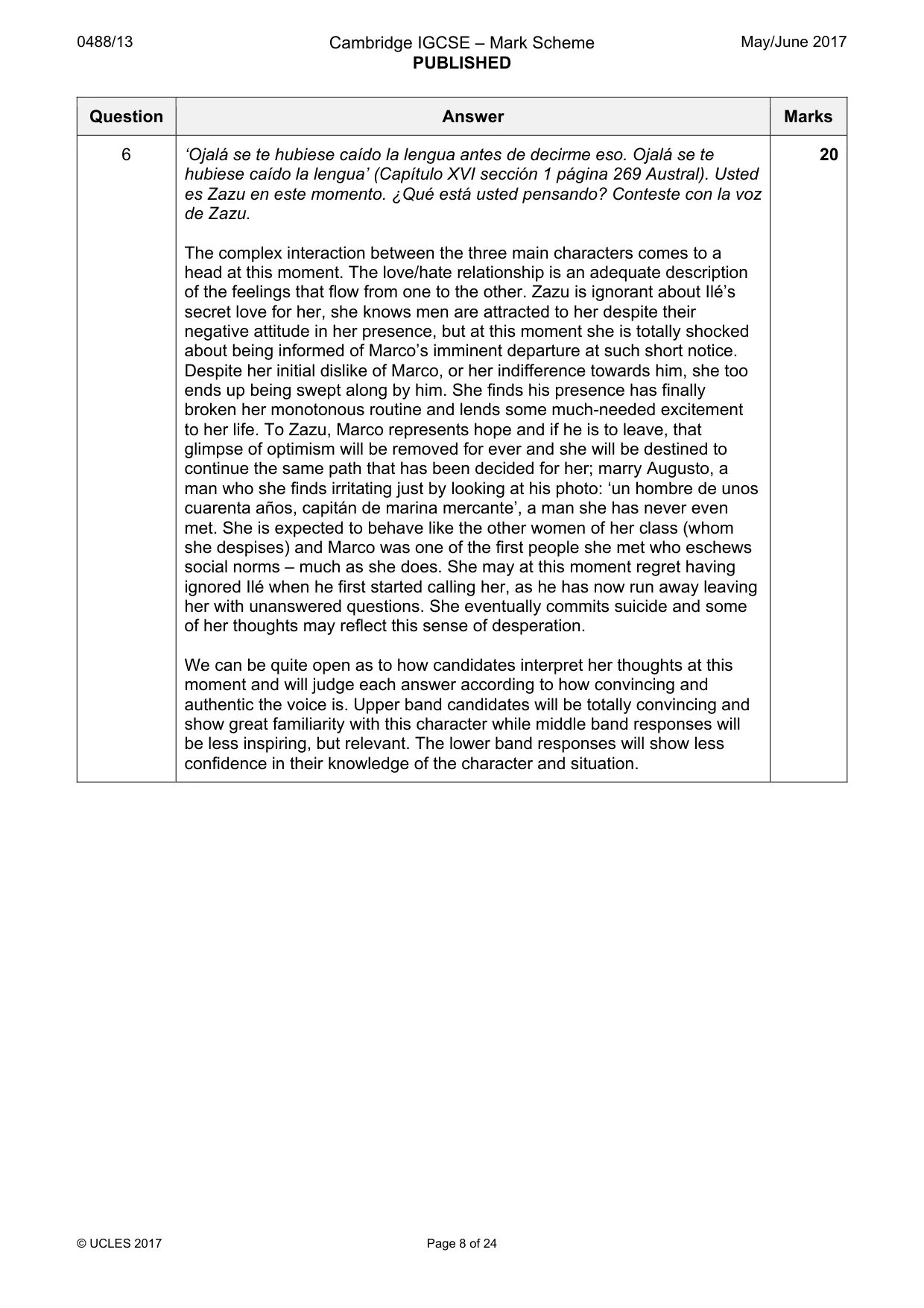
0488/13 Cambridge IGCSE – Mark Scheme PUBLISHED May/June 2017 © UCLES 2017 Page 8 of 24 Question Answer Marks 6 ‘Ojalá se te hubiese caído la lengua antes de decirme eso. Ojalá se te hubiese caído la lengua’ (Capítulo XVI sección 1 página 269 Austral). Usted es Zazu en este momento. ¿Qué está usted pensando? Conteste con la voz de Zazu. The complex interaction between the three main characters comes to a head at this moment. The love/hate relationship is an adequate description of the feelings that flow from one to the other. Zazu is ignorant about Ilé’s secret love for her, she knows men are attracted to her despite their negative attitude in her presence, but at this moment she is totally shocked about being informed of Marco’s imminent departure at such short notice. Despite her initial dislike of Marco, or her indifference towards him, she too ends up being swept along by him. She finds his presence has finally broken her monotonous routine and lends some much-needed excitement to her life. To Zazu, Marco represents hope and if he is to leave, that glimpse of optimism will be removed for ever and she will be destined to continue the same path that has been decided for her; marry Augusto, a man who she finds irritating just by looking at his photo: ‘un hombre de unos cuarenta años, capitán de marina mercante’, a man she has never even met. She is expected to behave like the other women of her class (whom she despises) and Marco was one of the first people she met who eschews social norms – much as she does. She may at this moment regret having ignored Ilé when he first started calling her, as he has now run away leaving her with unanswered questions. She eventually commits suicide and some of her thoughts may reflect this sense of desperation. We can be quite open as to how candidates interpret her thoughts at this moment and will judge each answer according to how convincing and authentic the voice is. Upper band candidates will be totally convincing and show great familiarity with this character while middle band responses will be less inspiring, but relevant. The lower band responses will show less confidence in their knowledge of the character and situation. 20
Mark scheme, page 9
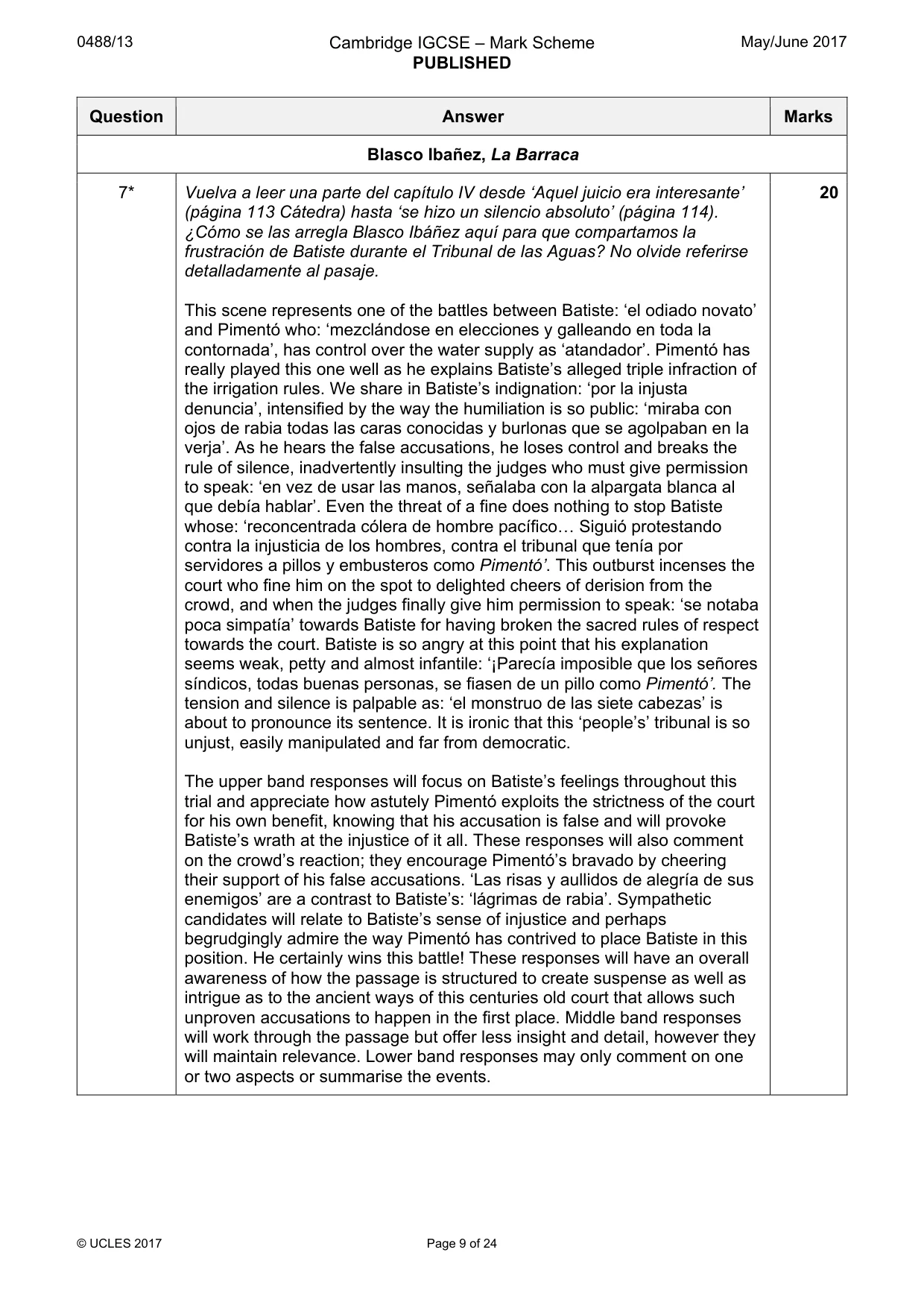
0488/13 Cambridge IGCSE – Mark Scheme PUBLISHED May/June 2017 © UCLES 2017 Page 9 of 24 Question Answer Marks Blasco Ibañez, La Barraca 7* Vuelva a leer una parte del capítulo IV desde ‘Aquel juicio era interesante’ (página 113 Cátedra) hasta ‘se hizo un silencio absoluto’ (página 114). ¿Cómo se las arregla Blasco Ibáñez aquí para que compartamos la frustración de Batiste durante el Tribunal de las Aguas? No olvide referirse detalladamente al pasaje. This scene represents one of the battles between Batiste: ‘el odiado novato’ and Pimentó who: ‘mezclándose en elecciones y galleando en toda la contornada’, has control over the water supply as ‘atandador’. Pimentó has really played this one well as he explains Batiste’s alleged triple infraction of the irrigation rules. We share in Batiste’s indignation: ‘por la injusta denuncia’, intensified by the way the humiliation is so public: ‘miraba con ojos de rabia todas las caras conocidas y burlonas que se agolpaban en la verja’. As he hears the false accusations, he loses control and breaks the rule of silence, inadvertently insulting the judges who must give permission to speak: ‘en vez de usar las manos, señalaba con la alpargata blanca al que debía hablar’. Even the threat of a fine does nothing to stop Batiste whose: ‘reconcentrada cólera de hombre pacífico« Siguió protestando contra la injusticia de los hombres, contra el tribunal que tenía por servidores a pillos y embusteros como Pimentó’. This outburst incenses the court who fine him on the spot to delighted cheers of derision from the crowd, and when the judges finally give him permission to speak: ‘se notaba poca simpatía’ towards Batiste for having broken the sacred rules of respect towards the court. Batiste is so angry at this point that his explanation seems weak, petty and almost infantile: ‘¡Parecía imposible que los señores síndicos, todas buenas personas, se fiasen de un pillo como Pimentó’. The tension and silence is palpable as: ‘el monstruo de las siete cabezas’ is about to pronounce its sentence. It is ironic that this ‘people’s’ tribunal is so unjust, easily manipulated and far from democratic. The upper band responses will focus on Batiste’s feelings throughout this trial and appreciate how astutely Pimentó exploits the strictness of the court for his own benefit, knowing that his accusation is false and will provoke Batiste’s wrath at the injustice of it all. These responses will also comment on the crowd’s reaction; they encourage Pimentó’s bravado by cheering their support of his false accusations. ‘Las risas y aullidos de alegría de sus enemigos’ are a contrast to Batiste’s: ‘lágrimas de rabia’. Sympathetic candidates will relate to Batiste’s sense of injustice and perhaps begrudgingly admire the way Pimentó has contrived to place Batiste in this position. He certainly wins this battle! These responses will have an overall awareness of how the passage is structured to create suspense as well as intrigue as to the ancient ways of this centuries old court that allows such unproven accusations to happen in the first place. Middle band responses will work through the passage but offer less insight and detail, however they will maintain relevance. Lower band responses may only comment on one or two aspects or summarise the events. 20
Mark scheme, page 10
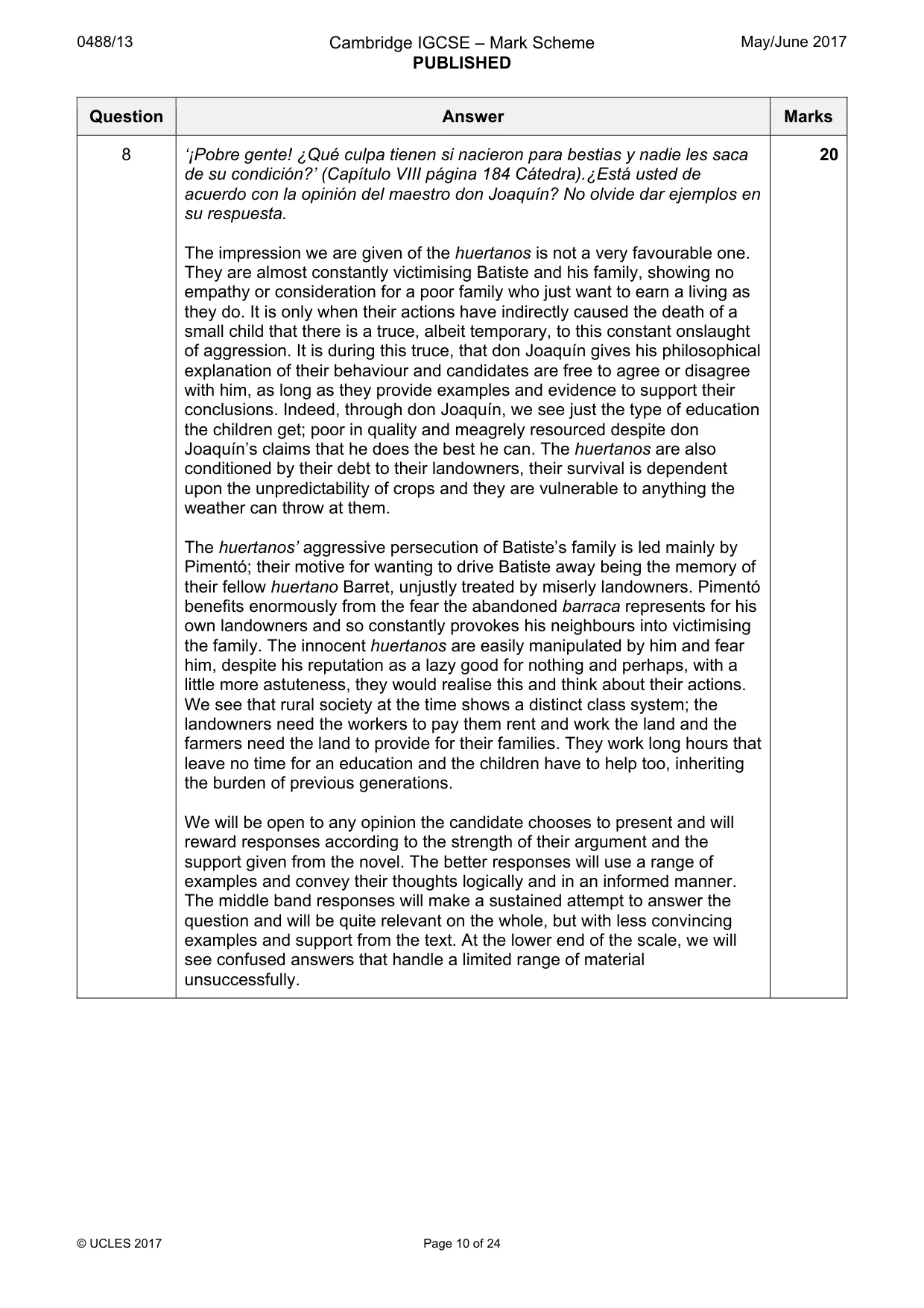
0488/13 Cambridge IGCSE – Mark Scheme PUBLISHED May/June 2017 © UCLES 2017 Page 10 of 24 Question Answer Marks 8 ‘¡Pobre gente! ¿Qué culpa tienen si nacieron para bestias y nadie les saca de su condición?’ (Capítulo VIII página 184 Cátedra).¿Está usted de acuerdo con la opinión del maestro don Joaquín? No olvide dar ejemplos en su respuesta. The impression we are given of the huertanos is not a very favourable one. They are almost constantly victimising Batiste and his family, showing no empathy or consideration for a poor family who just want to earn a living as they do. It is only when their actions have indirectly caused the death of a small child that there is a truce, albeit temporary, to this constant onslaught of aggression. It is during this truce, that don Joaquín gives his philosophical explanation of their behaviour and candidates are free to agree or disagree with him, as long as they provide examples and evidence to support their conclusions. Indeed, through don Joaquín, we see just the type of education the children get; poor in quality and meagrely resourced despite don Joaquín’s claims that he does the best he can. The huertanos are also conditioned by their debt to their landowners, their survival is dependent upon the unpredictability of crops and they are vulnerable to anything the weather can throw at them. The huertanos’ aggressive persecution of Batiste’s family is led mainly by Pimentó; their motive for wanting to drive Batiste away being the memory of their fellow huertano Barret, unjustly treated by miserly landowners. Pimentó benefits enormously from the fear the abandoned barraca represents for his own landowners and so constantly provokes his neighbours into victimising the family. The innocent huertanos are easily manipulated by him and fear him, despite his reputation as a lazy good for nothing and perhaps, with a little more astuteness, they would realise this and think about their actions. We see that rural society at the time shows a distinct class system; the landowners need the workers to pay them rent and work the land and the farmers need the land to provide for their families. They work long hours that leave no time for an education and the children have to help too, inheriting the burden of previous generations. We will be open to any opinion the candidate chooses to present and will reward responses according to the strength of their argument and the support given from the novel. The better responses will use a range of examples and convey their thoughts logically and in an informed manner. The middle band responses will make a sustained attempt to answer the question and will be quite relevant on the whole, but with less convincing examples and support from the text. At the lower end of the scale, we will see confused answers that handle a limited range of material unsuccessfully. 20
Mark scheme, page 11
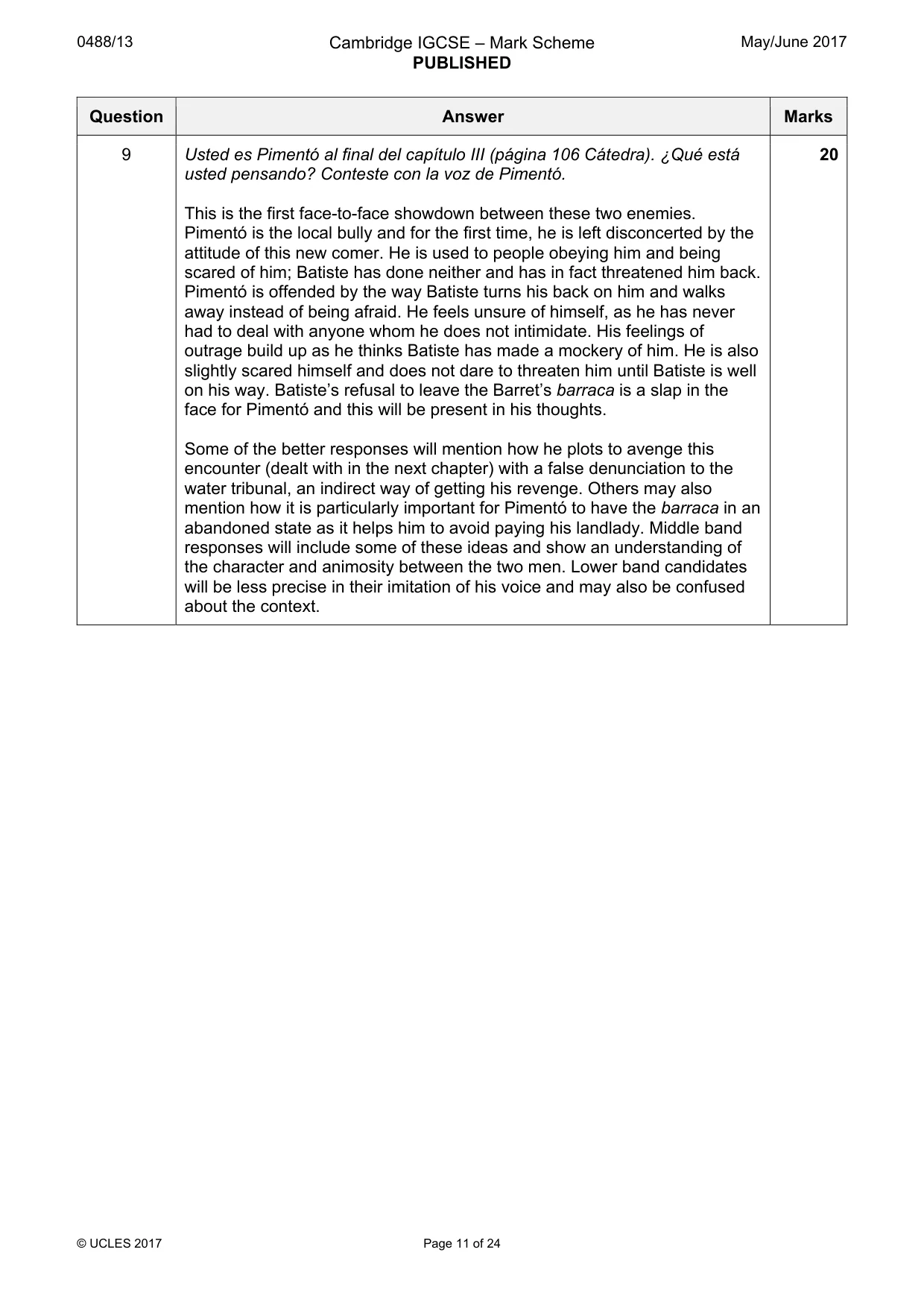
0488/13 Cambridge IGCSE – Mark Scheme PUBLISHED May/June 2017 © UCLES 2017 Page 11 of 24 Question Answer Marks 9 Usted es Pimentó al final del capítulo III (página 106 Cátedra). ¿Qué está usted pensando? Conteste con la voz de Pimentó. This is the first face-to-face showdown between these two enemies. Pimentó is the local bully and for the first time, he is left disconcerted by the attitude of this new comer. He is used to people obeying him and being scared of him; Batiste has done neither and has in fact threatened him back. Pimentó is offended by the way Batiste turns his back on him and walks away instead of being afraid. He feels unsure of himself, as he has never had to deal with anyone whom he does not intimidate. His feelings of outrage build up as he thinks Batiste has made a mockery of him. He is also slightly scared himself and does not dare to threaten him until Batiste is well on his way. Batiste’s refusal to leave the Barret’s barraca is a slap in the face for Pimentó and this will be present in his thoughts. Some of the better responses will mention how he plots to avenge this encounter (dealt with in the next chapter) with a false denunciation to the water tribunal, an indirect way of getting his revenge. Others may also mention how it is particularly important for Pimentó to have the barraca in an abandoned state as it helps him to avoid paying his landlady. Middle band responses will include some of these ideas and show an understanding of the character and animosity between the two men. Lower band candidates will be less precise in their imitation of his voice and may also be confused about the context. 20
Mark scheme, page 12
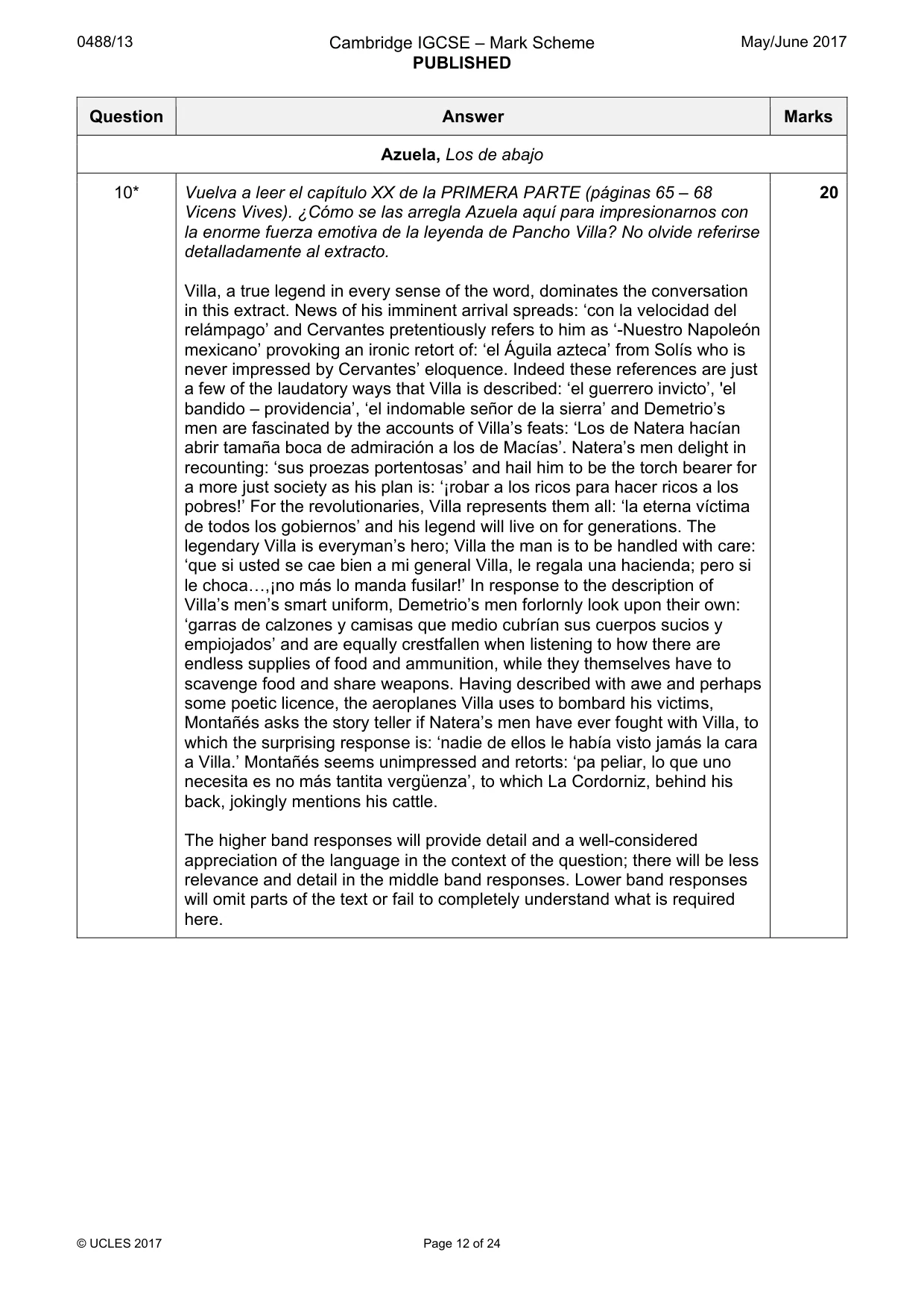
0488/13 Cambridge IGCSE – Mark Scheme PUBLISHED May/June 2017 © UCLES 2017 Page 12 of 24 Question Answer Marks Azuela, Los de abajo 10* Vuelva a leer el capítulo XX de la PRIMERA PARTE (páginas 65 – 68 Vicens Vives). ¿Cómo se las arregla Azuela aquí para impresionarnos con la enorme fuerza emotiva de la leyenda de Pancho Villa? No olvide referirse detalladamente al extracto. Villa, a true legend in every sense of the word, dominates the conversation in this extract. News of his imminent arrival spreads: ‘con la velocidad del relámpago’ and Cervantes pretentiously refers to him as ‘-Nuestro Napoleón mexicano’ provoking an ironic retort of: ‘el Águila azteca’ from Solís who is never impressed by Cervantes’ eloquence. Indeed these references are just a few of the laudatory ways that Villa is described: ‘el guerrero invicto’, 'el bandido – providencia’, ‘el indomable señor de la sierra’ and Demetrio’s men are fascinated by the accounts of Villa’s feats: ‘Los de Natera hacían abrir tamaña boca de admiración a los de Macías’. Natera’s men delight in recounting: ‘sus proezas portentosas’ and hail him to be the torch bearer for a more just society as his plan is: ‘¡robar a los ricos para hacer ricos a los pobres!’ For the revolutionaries, Villa represents them all: ‘la eterna víctima de todos los gobiernos’ and his legend will live on for generations. The legendary Villa is everyman’s hero; Villa the man is to be handled with care: ‘que si usted se cae bien a mi general Villa, le regala una hacienda; pero si le choca«,¡no más lo manda fusilar!’ In response to the description of Villa’s men’s smart uniform, Demetrio’s men forlornly look upon their own: ‘garras de calzones y camisas que medio cubrían sus cuerpos sucios y empiojados’ and are equally crestfallen when listening to how there are endless supplies of food and ammunition, while they themselves have to scavenge food and share weapons. Having described with awe and perhaps some poetic licence, the aeroplanes Villa uses to bombard his victims, Montañés asks the story teller if Natera’s men have ever fought with Villa, to which the surprising response is: ‘nadie de ellos le había visto jamás la cara a Villa.’ Montañés seems unimpressed and retorts: ‘pa peliar, lo que uno necesita es no más tantita vergüenza’, to which La Cordorniz, behind his back, jokingly mentions his cattle. The higher band responses will provide detail and a well-considered appreciation of the language in the context of the question; there will be less relevance and detail in the middle band responses. Lower band responses will omit parts of the text or fail to completely understand what is required here. 20
Mark scheme, page 13
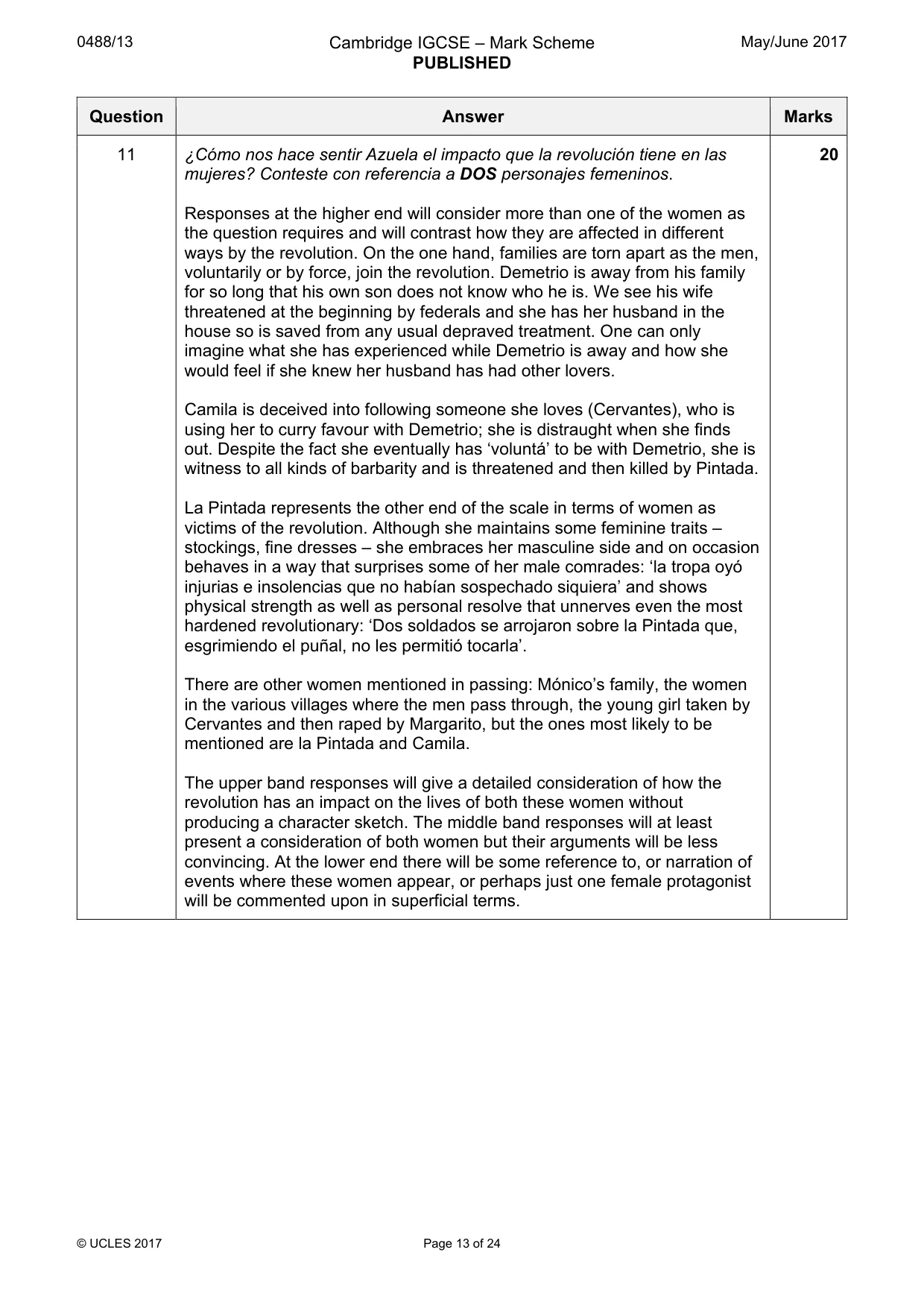
0488/13 Cambridge IGCSE – Mark Scheme PUBLISHED May/June 2017 © UCLES 2017 Page 13 of 24 Question Answer Marks 11 ¿Cómo nos hace sentir Azuela el impacto que la revolución tiene en las mujeres? Conteste con referencia a DOS personajes femeninos. Responses at the higher end will consider more than one of the women as the question requires and will contrast how they are affected in different ways by the revolution. On the one hand, families are torn apart as the men, voluntarily or by force, join the revolution. Demetrio is away from his family for so long that his own son does not know who he is. We see his wife threatened at the beginning by federals and she has her husband in the house so is saved from any usual depraved treatment. One can only imagine what she has experienced while Demetrio is away and how she would feel if she knew her husband has had other lovers. Camila is deceived into following someone she loves (Cervantes), who is using her to curry favour with Demetrio; she is distraught when she finds out. Despite the fact she eventually has ‘voluntá’ to be with Demetrio, she is witness to all kinds of barbarity and is threatened and then killed by Pintada. La Pintada represents the other end of the scale in terms of women as victims of the revolution. Although she maintains some feminine traits – stockings, fine dresses – she embraces her masculine side and on occasion behaves in a way that surprises some of her male comrades: ‘la tropa oyó injurias e insolencias que no habían sospechado siquiera’ and shows physical strength as well as personal resolve that unnerves even the most hardened revolutionary: ‘Dos soldados se arrojaron sobre la Pintada que, esgrimiendo el puñal, no les permitió tocarla’. There are other women mentioned in passing: Mónico’s family, the women in the various villages where the men pass through, the young girl taken by Cervantes and then raped by Margarito, but the ones most likely to be mentioned are la Pintada and Camila. The upper band responses will give a detailed consideration of how the revolution has an impact on the lives of both these women without producing a character sketch. The middle band responses will at least present a consideration of both women but their arguments will be less convincing. At the lower end there will be some reference to, or narration of events where these women appear, or perhaps just one female protagonist will be commented upon in superficial terms. 20
Mark scheme, page 14
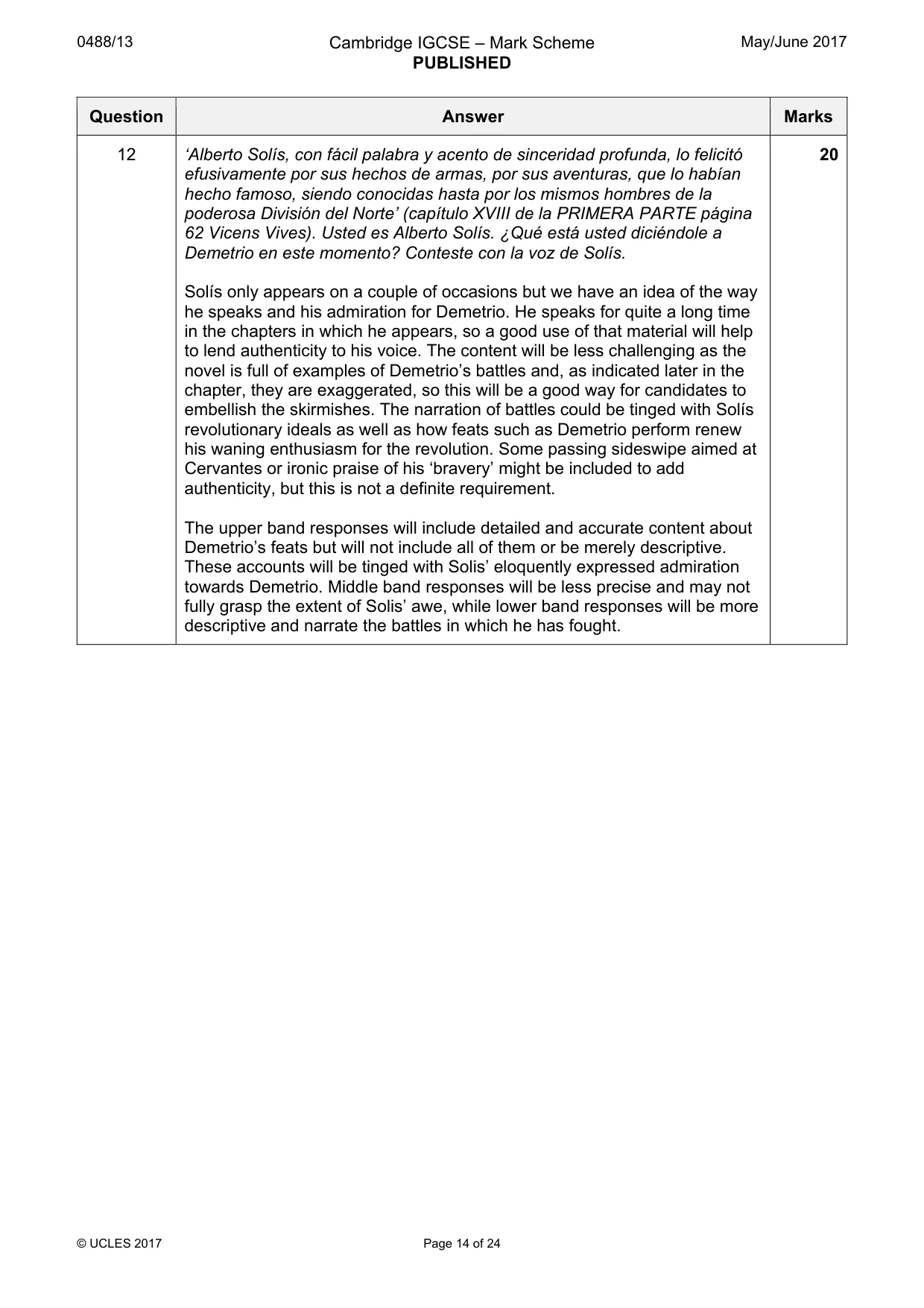
0488/13 Cambridge IGCSE – Mark Scheme PUBLISHED May/June 2017 © UCLES 2017 Page 14 of 24 Question Answer Marks 12 ‘Alberto Solís, con fácil palabra y acento de sinceridad profunda, lo felicitó efusivamente por sus hechos de armas, por sus aventuras, que lo habían hecho famoso, siendo conocidas hasta por los mismos hombres de la poderosa División del Norte’ (capítulo XVIII de la PRIMERA PARTE página 62 Vicens Vives). Usted es Alberto Solís. ¿Qué está usted diciéndole a Demetrio en este momento? Conteste con la voz de Solís. Solís only appears on a couple of occasions but we have an idea of the way he speaks and his admiration for Demetrio. He speaks for quite a long time in the chapters in which he appears, so a good use of that material will help to lend authenticity to his voice. The content will be less challenging as the novel is full of examples of Demetrio’s battles and, as indicated later in the chapter, they are exaggerated, so this will be a good way for candidates to embellish the skirmishes. The narration of battles could be tinged with Solís revolutionary ideals as well as how feats such as Demetrio perform renew his waning enthusiasm for the revolution. Some passing sideswipe aimed at Cervantes or ironic praise of his ‘bravery’ might be included to add authenticity, but this is not a definite requirement. The upper band responses will include detailed and accurate content about Demetrio’s feats but will not include all of them or be merely descriptive. These accounts will be tinged with Solis’ eloquently expressed admiration towards Demetrio. Middle band responses will be less precise and may not fully grasp the extent of Solis’ awe, while lower band responses will be more descriptive and narrate the battles in which he has fought. 20
Mark scheme, page 15
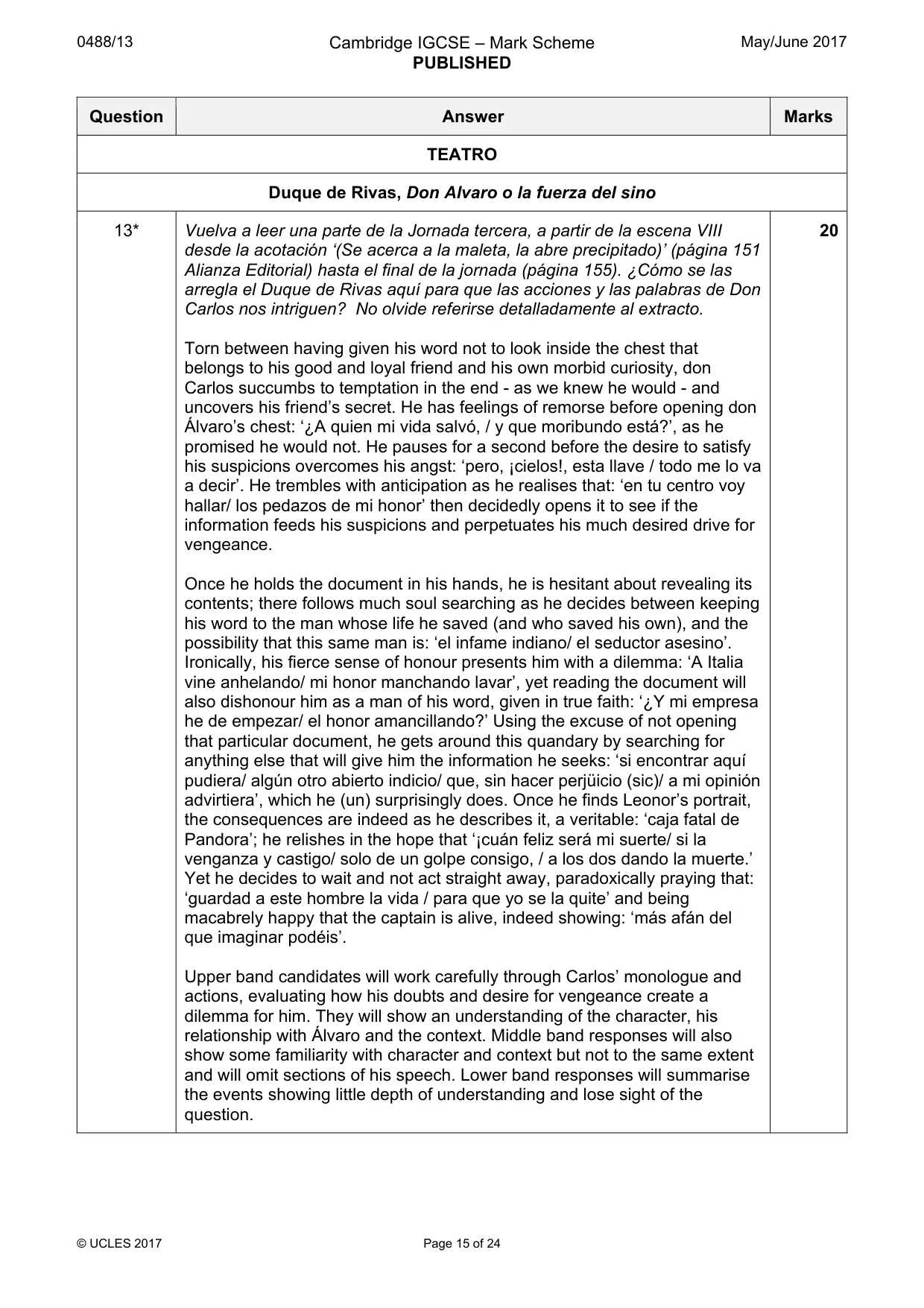
0488/13 Cambridge IGCSE – Mark Scheme PUBLISHED May/June 2017 © UCLES 2017 Page 15 of 24 Question Answer Marks TEATRO Duque de Rivas, Don Alvaro o la fuerza del sino 13* Vuelva a leer una parte de la Jornada tercera, a partir de la escena VIII desde la acotación ‘(Se acerca a la maleta, la abre precipitado)’ (página 151 Alianza Editorial) hasta el final de la jornada (página 155). ¿Cómo se las arregla el Duque de Rivas aquí para que las acciones y las palabras de Don Carlos nos intriguen? No olvide referirse detalladamente al extracto. Torn between having given his word not to look inside the chest that belongs to his good and loyal friend and his own morbid curiosity, don Carlos succumbs to temptation in the end - as we knew he would - and uncovers his friend’s secret. He has feelings of remorse before opening don Álvaro’s chest: ‘¿A quien mi vida salvó, / y que moribundo está?’, as he promised he would not. He pauses for a second before the desire to satisfy his suspicions overcomes his angst: ‘pero, ¡cielos!, esta llave / todo me lo va a decir’. He trembles with anticipation as he realises that: ‘en tu centro voy hallar/ los pedazos de mi honor’ then decidedly opens it to see if the information feeds his suspicions and perpetuates his much desired drive for vengeance. Once he holds the document in his hands, he is hesitant about revealing its contents; there follows much soul searching as he decides between keeping his word to the man whose life he saved (and who saved his own), and the possibility that this same man is: ‘el infame indiano/ el seductor asesino’. Ironically, his fierce sense of honour presents him with a dilemma: ‘A Italia vine anhelando/ mi honor manchando lavar’, yet reading the document will also dishonour him as a man of his word, given in true faith: ‘¿Y mi empresa he de empezar/ el honor amancillando?’ Using the excuse of not opening that particular document, he gets around this quandary by searching for anything else that will give him the information he seeks: ‘si encontrar aquí pudiera/ algún otro abierto indicio/ que, sin hacer perjüicio (sic)/ a mi opinión advirtiera’, which he (un) surprisingly does. Once he finds Leonor’s portrait, the consequences are indeed as he describes it, a veritable: ‘caja fatal de Pandora’; he relishes in the hope that ‘¡cuán feliz será mi suerte/ si la venganza y castigo/ solo de un golpe consigo, / a los dos dando la muerte.’ Yet he decides to wait and not act straight away, paradoxically praying that: ‘guardad a este hombre la vida / para que yo se la quite’ and being macabrely happy that the captain is alive, indeed showing: ‘más afán del que imaginar podéis’. Upper band candidates will work carefully through Carlos’ monologue and actions, evaluating how his doubts and desire for vengeance create a dilemma for him. They will show an understanding of the character, his relationship with Álvaro and the context. Middle band responses will also show some familiarity with character and context but not to the same extent and will omit sections of his speech. Lower band responses will summarise the events showing little depth of understanding and lose sight of the question. 20
Mark scheme, page 16
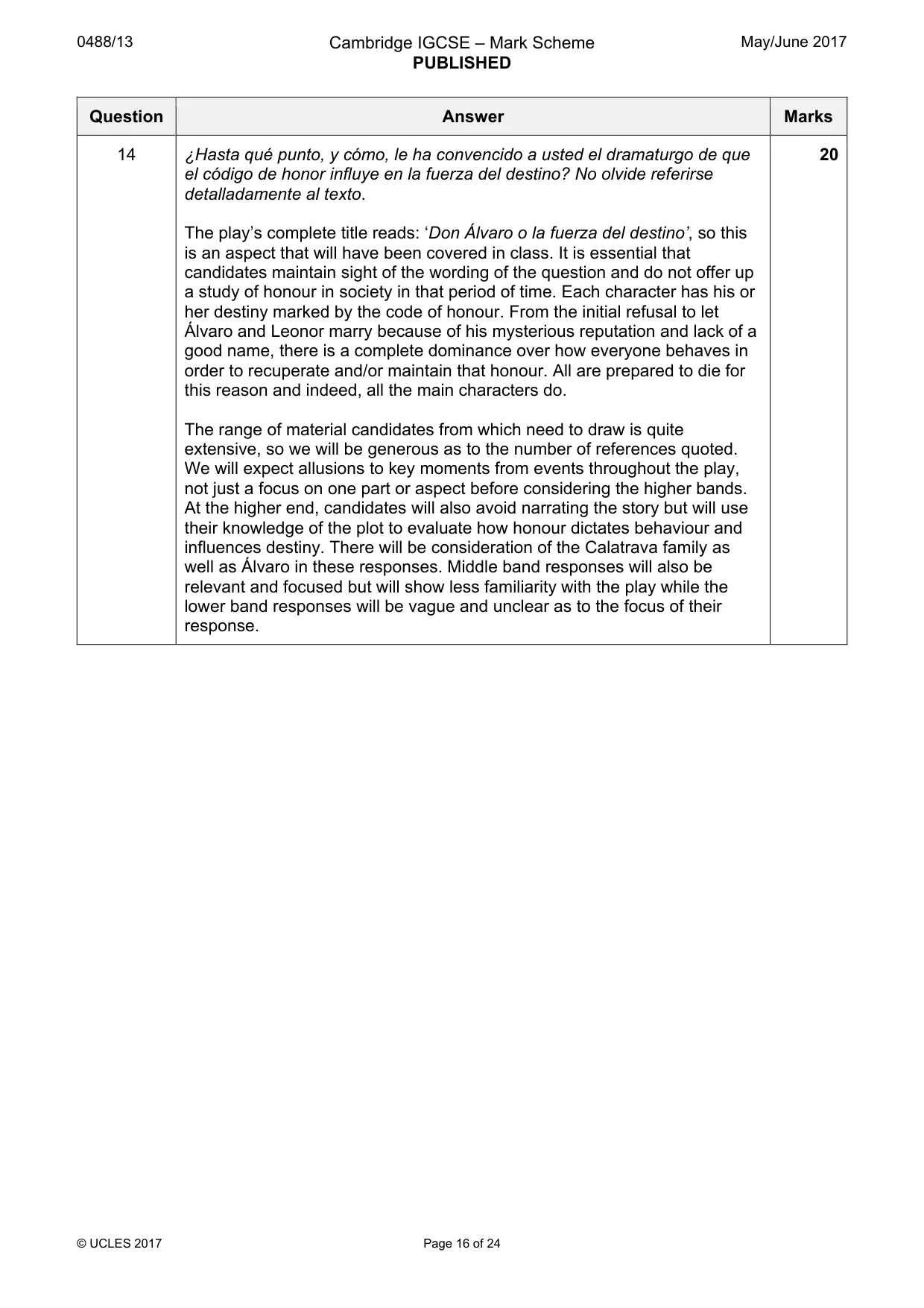
0488/13 Cambridge IGCSE – Mark Scheme PUBLISHED May/June 2017 © UCLES 2017 Page 16 of 24 Question Answer Marks 14 ¿Hasta qué punto, y cómo, le ha convencido a usted el dramaturgo de que el código de honor influye en la fuerza del destino? No olvide referirse detalladamente al texto. The play’s complete title reads: ‘Don Álvaro o la fuerza del destino’, so this is an aspect that will have been covered in class. It is essential that candidates maintain sight of the wording of the question and do not offer up a study of honour in society in that period of time. Each character has his or her destiny marked by the code of honour. From the initial refusal to let Álvaro and Leonor marry because of his mysterious reputation and lack of a good name, there is a complete dominance over how everyone behaves in order to recuperate and/or maintain that honour. All are prepared to die for this reason and indeed, all the main characters do. The range of material candidates from which need to draw is quite extensive, so we will be generous as to the number of references quoted. We will expect allusions to key moments from events throughout the play, not just a focus on one part or aspect before considering the higher bands. At the higher end, candidates will also avoid narrating the story but will use their knowledge of the plot to evaluate how honour dictates behaviour and influences destiny. There will be consideration of the Calatrava family as well as Álvaro in these responses. Middle band responses will also be relevant and focused but will show less familiarity with the play while the lower band responses will be vague and unclear as to the focus of their response. 20
Mark scheme, page 17
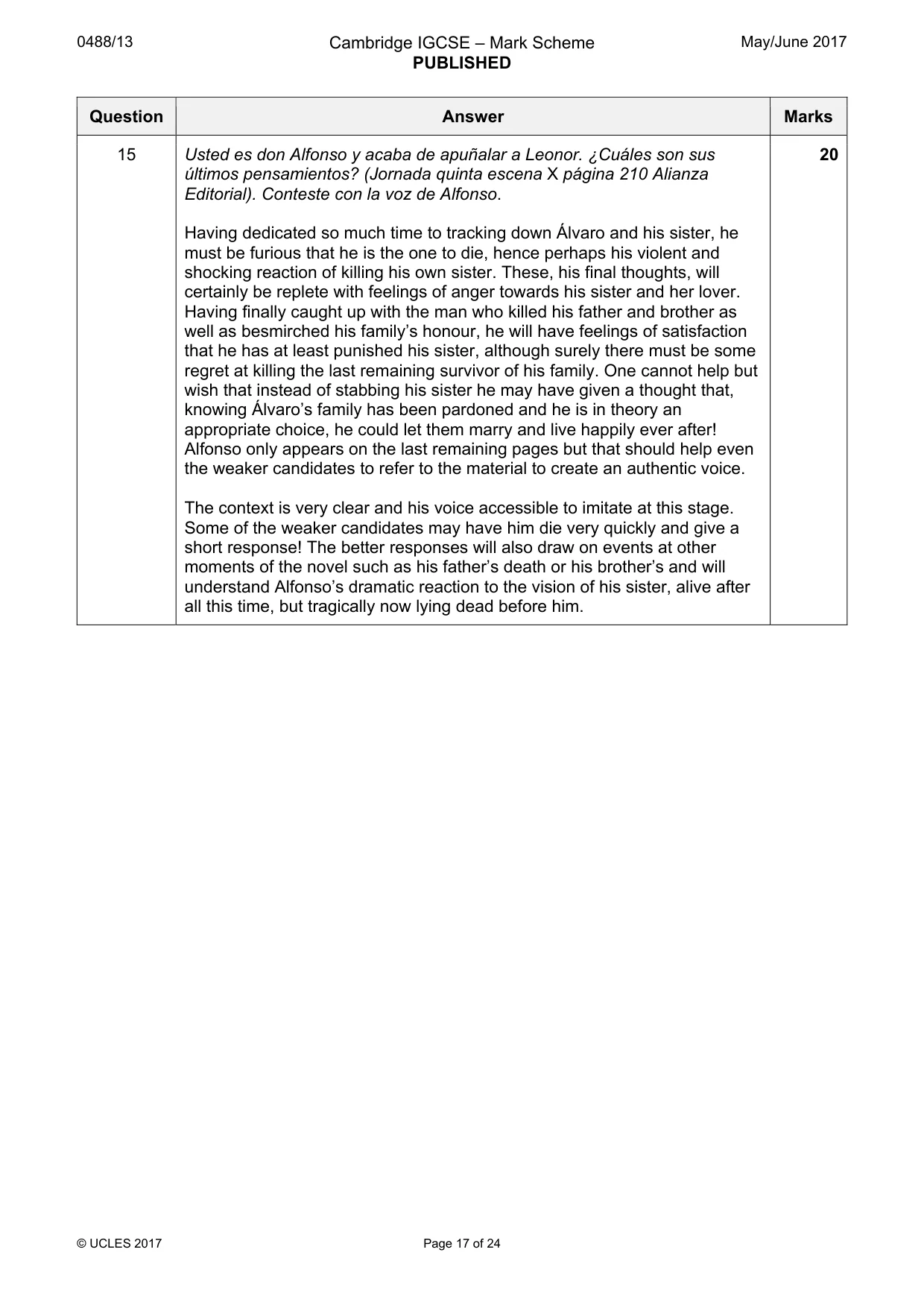
0488/13 Cambridge IGCSE – Mark Scheme PUBLISHED May/June 2017 © UCLES 2017 Page 17 of 24 Question Answer Marks 15 Usted es don Alfonso y acaba de apuñalar a Leonor. ¿Cuáles son sus últimos pensamientos? (Jornada quinta escena X página 210 Alianza Editorial). Conteste con la voz de Alfonso. Having dedicated so much time to tracking down Álvaro and his sister, he must be furious that he is the one to die, hence perhaps his violent and shocking reaction of killing his own sister. These, his final thoughts, will certainly be replete with feelings of anger towards his sister and her lover. Having finally caught up with the man who killed his father and brother as well as besmirched his family’s honour, he will have feelings of satisfaction that he has at least punished his sister, although surely there must be some regret at killing the last remaining survivor of his family. One cannot help but wish that instead of stabbing his sister he may have given a thought that, knowing Álvaro’s family has been pardoned and he is in theory an appropriate choice, he could let them marry and live happily ever after! Alfonso only appears on the last remaining pages but that should help even the weaker candidates to refer to the material to create an authentic voice. The context is very clear and his voice accessible to imitate at this stage. Some of the weaker candidates may have him die very quickly and give a short response! The better responses will also draw on events at other moments of the novel such as his father’s death or his brother’s and will understand Alfonso’s dramatic reaction to the vision of his sister, alive after all this time, but tragically now lying dead before him. 20
Mark scheme, page 18
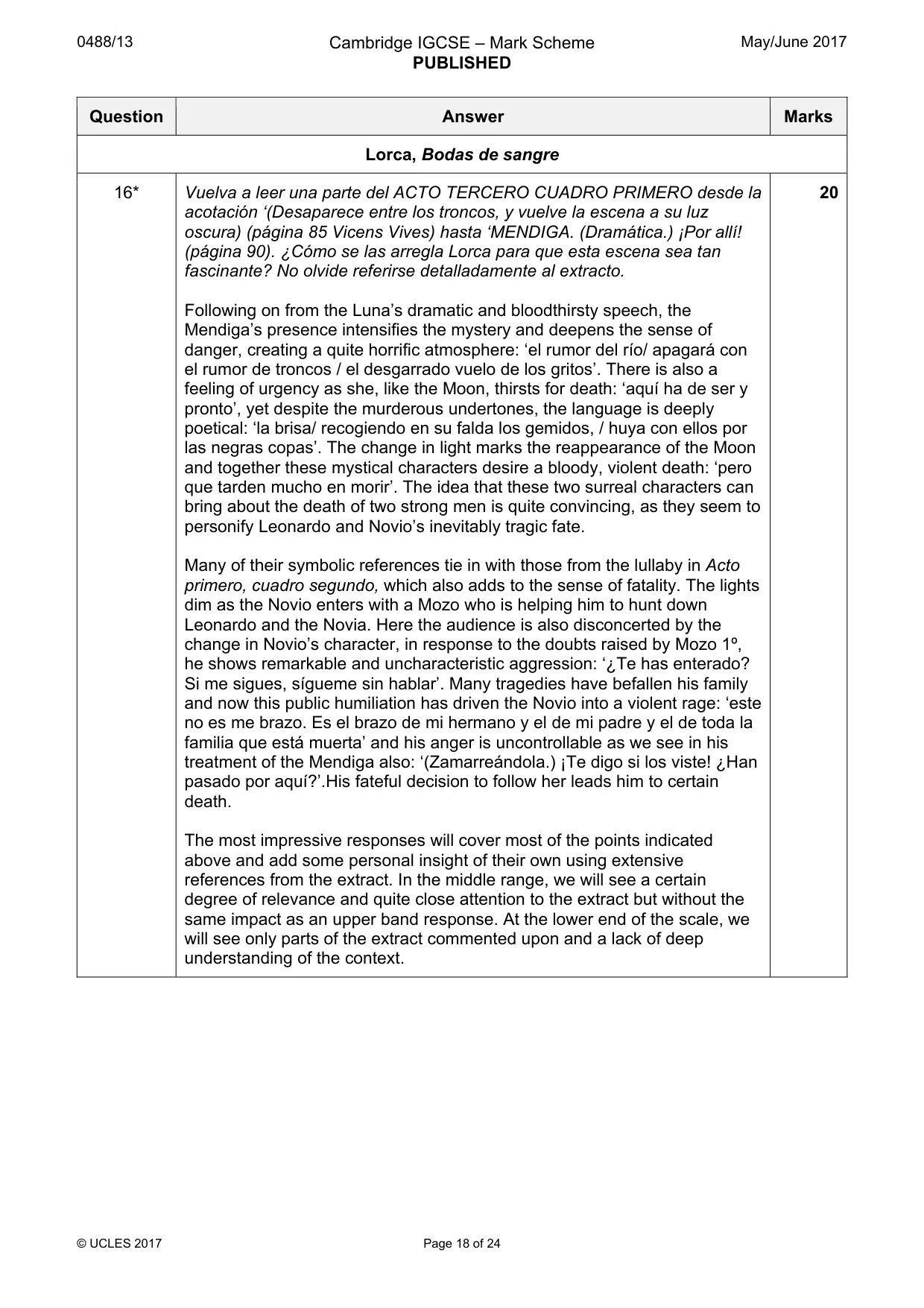
0488/13 Cambridge IGCSE – Mark Scheme PUBLISHED May/June 2017 © UCLES 2017 Page 18 of 24 Question Answer Marks Lorca, Bodas de sangre 16* Vuelva a leer una parte del ACTO TERCERO CUADRO PRIMERO desde la acotación ‘(Desaparece entre los troncos, y vuelve la escena a su luz oscura) (página 85 Vicens Vives) hasta ‘MENDIGA. (Dramática.) ¡Por allí! (página 90). ¿Cómo se las arregla Lorca para que esta escena sea tan fascinante? No olvide referirse detalladamente al extracto. Following on from the Luna’s dramatic and bloodthirsty speech, the Mendiga’s presence intensifies the mystery and deepens the sense of danger, creating a quite horrific atmosphere: ‘el rumor del río/ apagará con el rumor de troncos / el desgarrado vuelo de los gritos’. There is also a feeling of urgency as she, like the Moon, thirsts for death: ‘aquí ha de ser y pronto’, yet despite the murderous undertones, the language is deeply poetical: ‘la brisa/ recogiendo en su falda los gemidos, / huya con ellos por las negras copas’. The change in light marks the reappearance of the Moon and together these mystical characters desire a bloody, violent death: ‘pero que tarden mucho en morir’. The idea that these two surreal characters can bring about the death of two strong men is quite convincing, as they seem to personify Leonardo and Novio’s inevitably tragic fate. Many of their symbolic references tie in with those from the lullaby in Acto primero, cuadro segundo, which also adds to the sense of fatality. The lights dim as the Novio enters with a Mozo who is helping him to hunt down Leonardo and the Novia. Here the audience is also disconcerted by the change in Novio’s character, in response to the doubts raised by Mozo 1º, he shows remarkable and uncharacteristic aggression: ‘¿Te has enterado? Si me sigues, sígueme sin hablar’. Many tragedies have befallen his family and now this public humiliation has driven the Novio into a violent rage: ‘este no es me brazo. Es el brazo de mi hermano y el de mi padre y el de toda la familia que está muerta’ and his anger is uncontrollable as we see in his treatment of the Mendiga also: ‘(Zamarreándola.) ¡Te digo si los viste! ¿Han pasado por aquí?’.His fateful decision to follow her leads him to certain death. The most impressive responses will cover most of the points indicated above and add some personal insight of their own using extensive references from the extract. In the middle range, we will see a certain degree of relevance and quite close attention to the extract but without the same impact as an upper band response. At the lower end of the scale, we will see only parts of the extract commented upon and a lack of deep understanding of the context. 20
Mark scheme, page 19
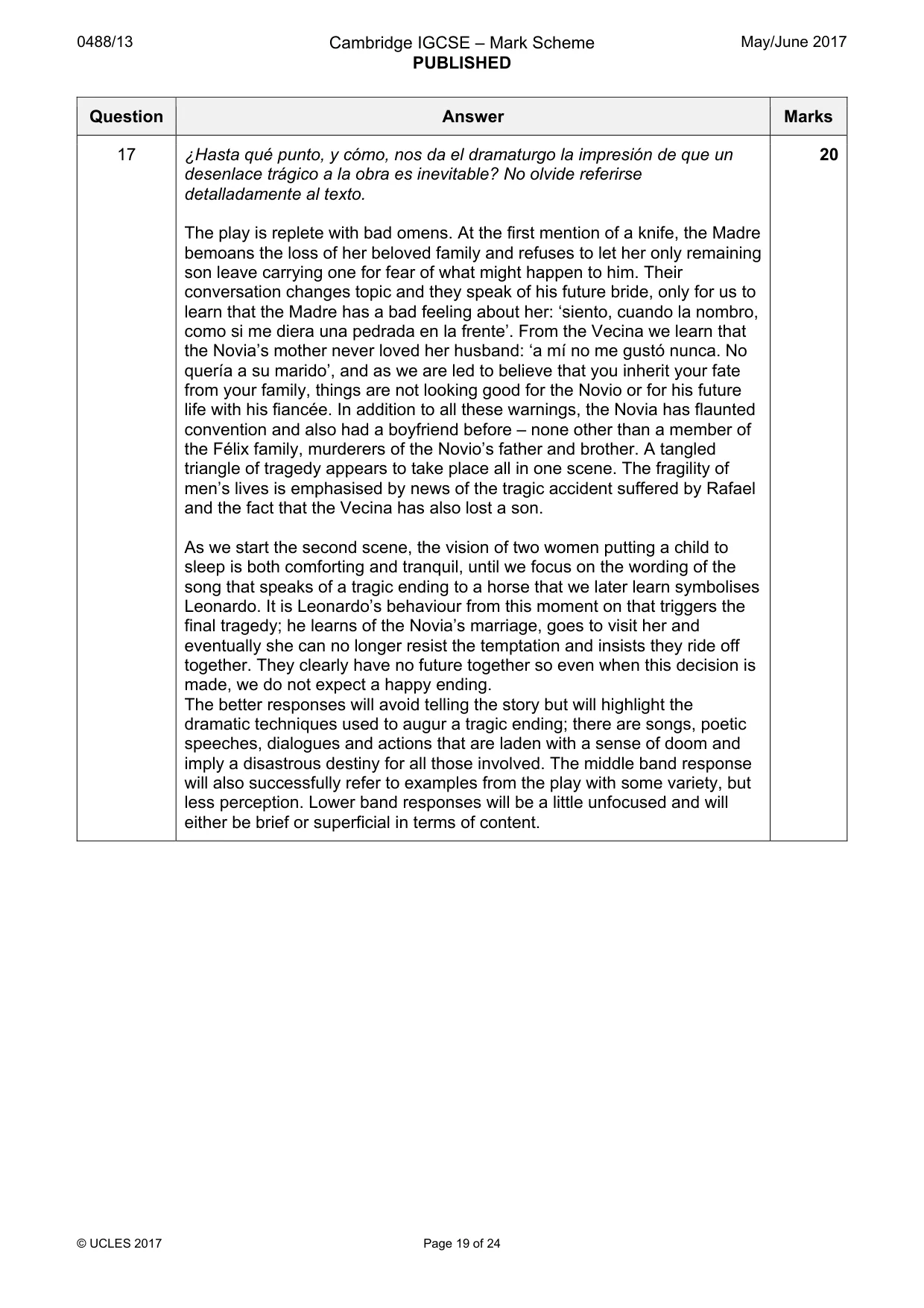
0488/13 Cambridge IGCSE – Mark Scheme PUBLISHED May/June 2017 © UCLES 2017 Page 19 of 24 Question Answer Marks 17 ¿Hasta qué punto, y cómo, nos da el dramaturgo la impresión de que un desenlace trágico a la obra es inevitable? No olvide referirse detalladamente al texto. The play is replete with bad omens. At the first mention of a knife, the Madre bemoans the loss of her beloved family and refuses to let her only remaining son leave carrying one for fear of what might happen to him. Their conversation changes topic and they speak of his future bride, only for us to learn that the Madre has a bad feeling about her: ‘siento, cuando la nombro, como si me diera una pedrada en la frente’. From the Vecina we learn that the Novia’s mother never loved her husband: ‘a mí no me gustó nunca. No quería a su marido’, and as we are led to believe that you inherit your fate from your family, things are not looking good for the Novio or for his future life with his fiancée. In addition to all these warnings, the Novia has flaunted convention and also had a boyfriend before – none other than a member of the Félix family, murderers of the Novio’s father and brother. A tangled triangle of tragedy appears to take place all in one scene. The fragility of men’s lives is emphasised by news of the tragic accident suffered by Rafael and the fact that the Vecina has also lost a son. As we start the second scene, the vision of two women putting a child to sleep is both comforting and tranquil, until we focus on the wording of the song that speaks of a tragic ending to a horse that we later learn symbolises Leonardo. It is Leonardo’s behaviour from this moment on that triggers the final tragedy; he learns of the Novia’s marriage, goes to visit her and eventually she can no longer resist the temptation and insists they ride off together. They clearly have no future together so even when this decision is made, we do not expect a happy ending. The better responses will avoid telling the story but will highlight the dramatic techniques used to augur a tragic ending; there are songs, poetic speeches, dialogues and actions that are laden with a sense of doom and imply a disastrous destiny for all those involved. The middle band response will also successfully refer to examples from the play with some variety, but less perception. Lower band responses will be a little unfocused and will either be brief or superficial in terms of content. 20
Mark scheme, page 20
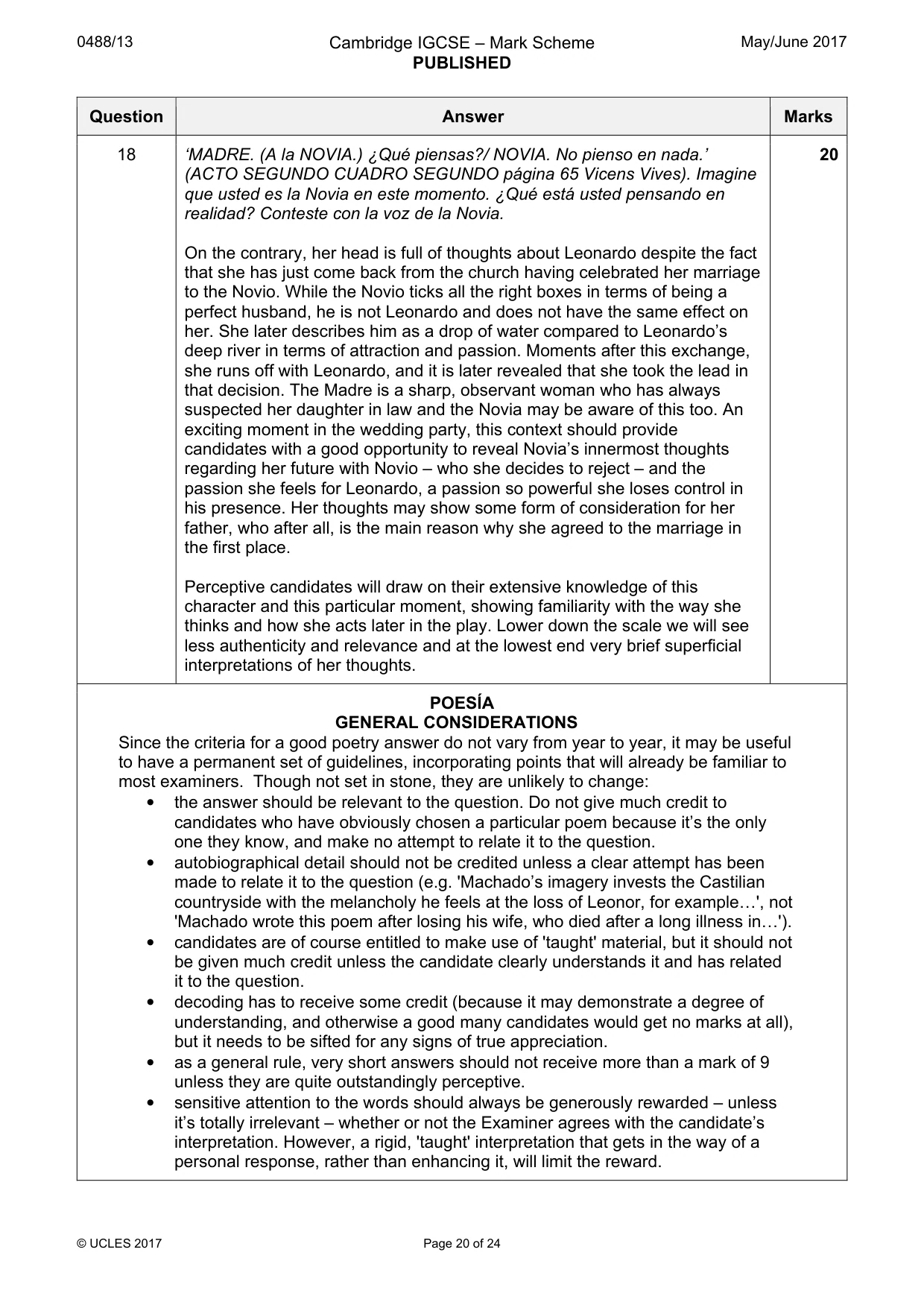
0488/13 Cambridge IGCSE – Mark Scheme PUBLISHED May/June 2017 © UCLES 2017 Page 20 of 24 Question Answer Marks 18 ‘MADRE. (A la NOVIA.) ¿Qué piensas?/ NOVIA. No pienso en nada.’ (ACTO SEGUNDO CUADRO SEGUNDO página 65 Vicens Vives). Imagine que usted es la Novia en este momento. ¿Qué está usted pensando en realidad? Conteste con la voz de la Novia. On the contrary, her head is full of thoughts about Leonardo despite the fact that she has just come back from the church having celebrated her marriage to the Novio. While the Novio ticks all the right boxes in terms of being a perfect husband, he is not Leonardo and does not have the same effect on her. She later describes him as a drop of water compared to Leonardo’s deep river in terms of attraction and passion. Moments after this exchange, she runs off with Leonardo, and it is later revealed that she took the lead in that decision. The Madre is a sharp, observant woman who has always suspected her daughter in law and the Novia may be aware of this too. An exciting moment in the wedding party, this context should provide candidates with a good opportunity to reveal Novia’s innermost thoughts regarding her future with Novio – who she decides to reject – and the passion she feels for Leonardo, a passion so powerful she loses control in his presence. Her thoughts may show some form of consideration for her father, who after all, is the main reason why she agreed to the marriage in the first place. Perceptive candidates will draw on their extensive knowledge of this character and this particular moment, showing familiarity with the way she thinks and how she acts later in the play. Lower down the scale we will see less authenticity and relevance and at the lowest end very brief superficial interpretations of her thoughts. 20 POESĺA GENERAL CONSIDERATIONS Since the criteria for a good poetry answer do not vary from year to year, it may be useful to have a permanent set of guidelines, incorporating points that will already be familiar to most examiners. Though not set in stone, they are unlikely to change: • the answer should be relevant to the question. Do not give much credit to candidates who have obviously chosen a particular poem because it’s the only one they know, and make no attempt to relate it to the question. • autobiographical detail should not be credited unless a clear attempt has been made to relate it to the question (e.g. 'Machado’s imagery invests the Castilian countryside with the melancholy he feels at the loss of Leonor, for example«', not 'Machado wrote this poem after losing his wife, who died after a long illness in«'). • candidates are of course entitled to make use of 'taught' material, but it should not be given much credit unless the candidate clearly understands it and has related it to the question. • decoding has to receive some credit (because it may demonstrate a degree of understanding, and otherwise a good many candidates would get no marks at all), but it needs to be sifted for any signs of true appreciation. • as a general rule, very short answers should not receive more than a mark of 9 unless they are quite outstandingly perceptive. • sensitive attention to the words should always be generously rewarded – unless it’s totally irrelevant – whether or not the Examiner agrees with the candidate’s interpretation. However, a rigid, 'taught' interpretation that gets in the way of a personal response, rather than enhancing it, will limit the reward.
Mark scheme, page 21
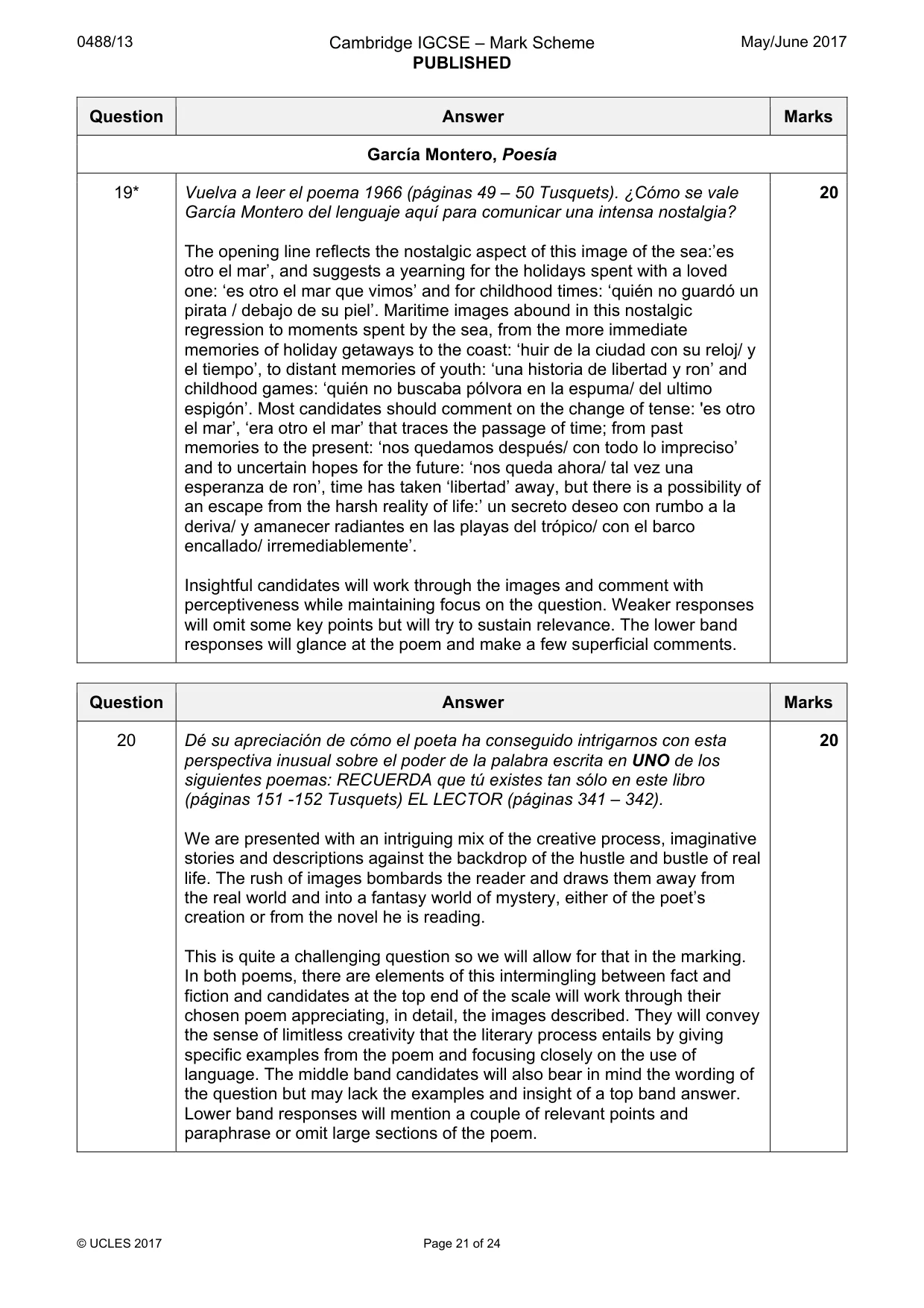
0488/13 Cambridge IGCSE – Mark Scheme PUBLISHED May/June 2017 © UCLES 2017 Page 21 of 24 Question Answer Marks García Montero, Poesía 19* Vuelva a leer el poema 1966 (páginas 49 – 50 Tusquets). ¿Cómo se vale García Montero del lenguaje aquí para comunicar una intensa nostalgia? The opening line reflects the nostalgic aspect of this image of the sea:’es otro el mar’, and suggests a yearning for the holidays spent with a loved one: ‘es otro el mar que vimos’ and for childhood times: ‘quién no guardó un pirata / debajo de su piel’. Maritime images abound in this nostalgic regression to moments spent by the sea, from the more immediate memories of holiday getaways to the coast: ‘huir de la ciudad con su reloj/ y el tiempo’, to distant memories of youth: ‘una historia de libertad y ron’ and childhood games: ‘quién no buscaba pólvora en la espuma/ del ultimo espigón’. Most candidates should comment on the change of tense: 'es otro el mar’, ‘era otro el mar’ that traces the passage of time; from past memories to the present: ‘nos quedamos después/ con todo lo impreciso’ and to uncertain hopes for the future: ‘nos queda ahora/ tal vez una esperanza de ron’, time has taken ‘libertad’ away, but there is a possibility of an escape from the harsh reality of life:’ un secreto deseo con rumbo a la deriva/ y amanecer radiantes en las playas del trópico/ con el barco encallado/ irremediablemente’. Insightful candidates will work through the images and comment with perceptiveness while maintaining focus on the question. Weaker responses will omit some key points but will try to sustain relevance. The lower band responses will glance at the poem and make a few superficial comments. 20 Question Answer Marks 20 Dé su apreciación de cómo el poeta ha conseguido intrigarnos con esta perspectiva inusual sobre el poder de la palabra escrita en UNO de los siguientes poemas: RECUERDA que tú existes tan sólo en este libro (páginas 151 -152 Tusquets) EL LECTOR (páginas 341 – 342). We are presented with an intriguing mix of the creative process, imaginative stories and descriptions against the backdrop of the hustle and bustle of real life. The rush of images bombards the reader and draws them away from the real world and into a fantasy world of mystery, either of the poet’s creation or from the novel he is reading. This is quite a challenging question so we will allow for that in the marking. In both poems, there are elements of this intermingling between fact and fiction and candidates at the top end of the scale will work through their chosen poem appreciating, in detail, the images described. They will convey the sense of limitless creativity that the literary process entails by giving specific examples from the poem and focusing closely on the use of language. The middle band candidates will also bear in mind the wording of the question but may lack the examples and insight of a top band answer. Lower band responses will mention a couple of relevant points and paraphrase or omit large sections of the poem. 20
Mark scheme, page 22
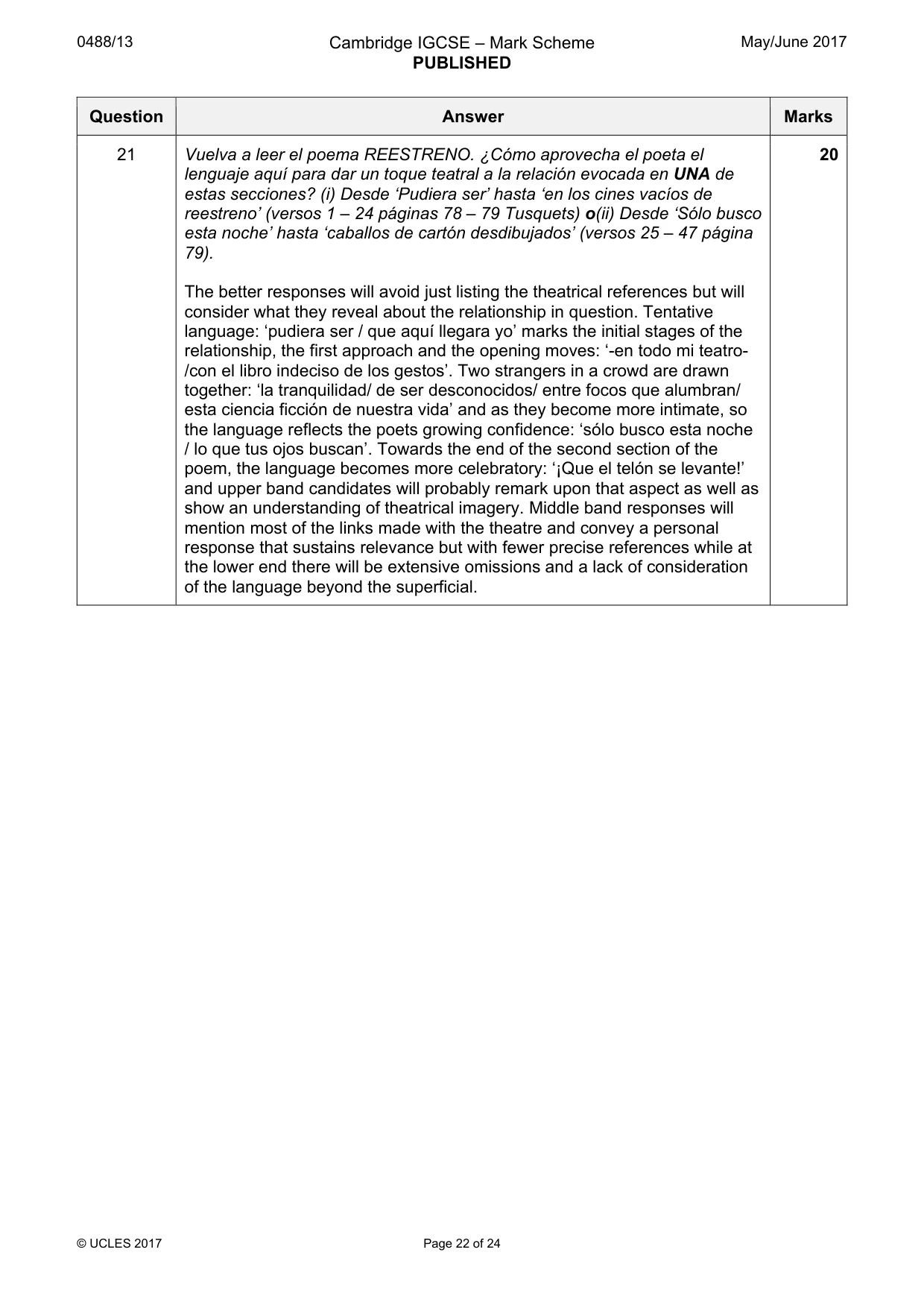
0488/13 Cambridge IGCSE – Mark Scheme PUBLISHED May/June 2017 © UCLES 2017 Page 22 of 24 Question Answer Marks 21 Vuelva a leer el poema REESTRENO. ¿Cómo aprovecha el poeta el lenguaje aquí para dar un toque teatral a la relación evocada en UNA de estas secciones? (i) Desde ‘Pudiera ser’ hasta ‘en los cines vacíos de reestreno’ (versos 1 – 24 páginas 78 – 79 Tusquets) o(ii) Desde ‘Sólo busco esta noche’ hasta ‘caballos de cartón desdibujados’ (versos 25 – 47 página 79). The better responses will avoid just listing the theatrical references but will consider what they reveal about the relationship in question. Tentative language: ‘pudiera ser / que aquí llegara yo’ marks the initial stages of the relationship, the first approach and the opening moves: ‘-en todo mi teatro- /con el libro indeciso de los gestos’. Two strangers in a crowd are drawn together: ‘la tranquilidad/ de ser desconocidos/ entre focos que alumbran/ esta ciencia ficción de nuestra vida’ and as they become more intimate, so the language reflects the poets growing confidence: ‘sólo busco esta noche / lo que tus ojos buscan’. Towards the end of the second section of the poem, the language becomes more celebratory: ‘¡Que el telón se levante!’ and upper band candidates will probably remark upon that aspect as well as show an understanding of theatrical imagery. Middle band responses will mention most of the links made with the theatre and convey a personal response that sustains relevance but with fewer precise references while at the lower end there will be extensive omissions and a lack of consideration of the language beyond the superficial. 20
Mark scheme, page 23
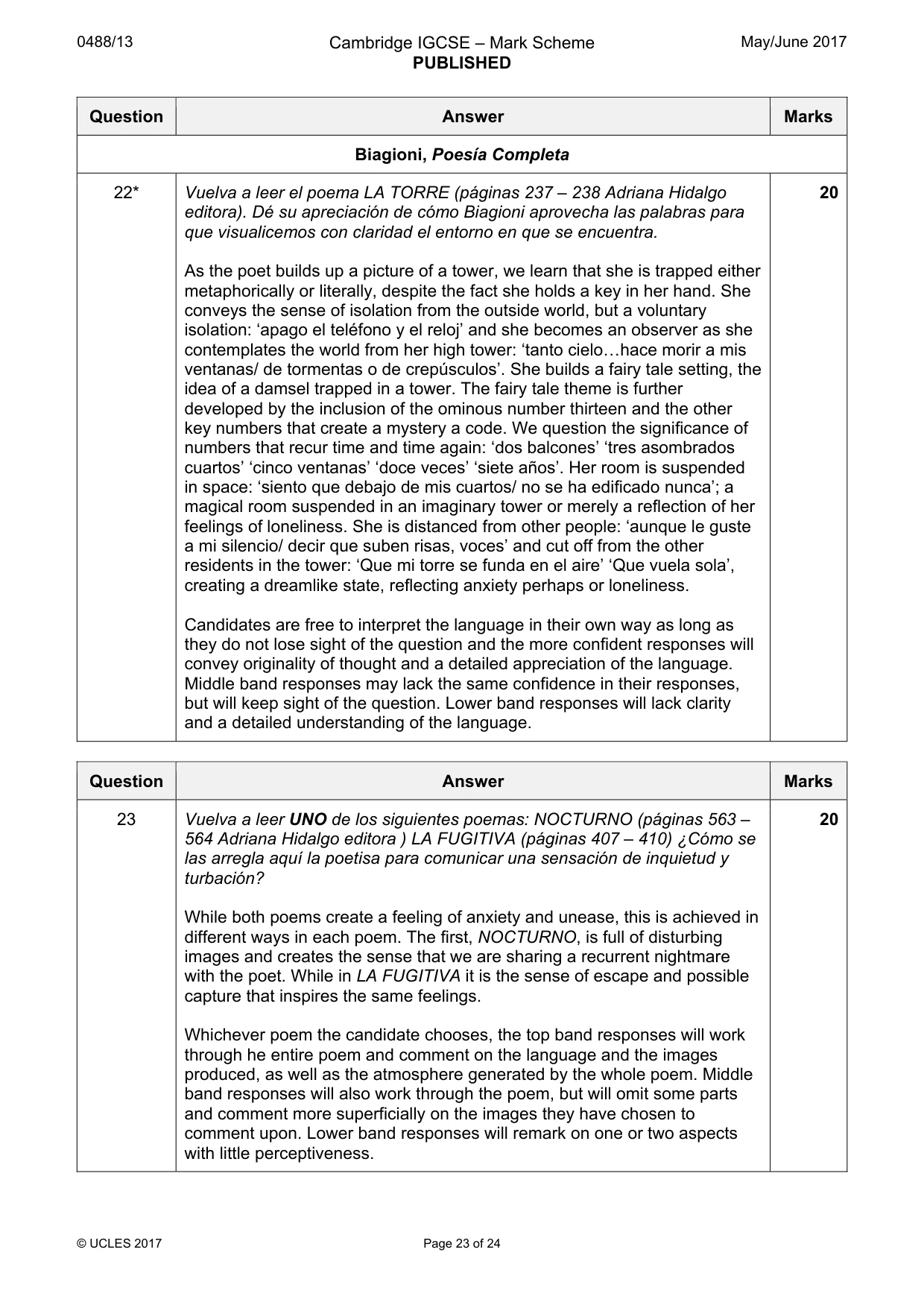
0488/13 Cambridge IGCSE – Mark Scheme PUBLISHED May/June 2017 © UCLES 2017 Page 23 of 24 Question Answer Marks Biagioni, Poesía Completa 22* Vuelva a leer el poema LA TORRE (páginas 237 – 238 Adriana Hidalgo editora). Dé su apreciación de cómo Biagioni aprovecha las palabras para que visualicemos con claridad el entorno en que se encuentra. As the poet builds up a picture of a tower, we learn that she is trapped either metaphorically or literally, despite the fact she holds a key in her hand. She conveys the sense of isolation from the outside world, but a voluntary isolation: ‘apago el teléfono y el reloj’ and she becomes an observer as she contemplates the world from her high tower: ‘tanto cielo«hace morir a mis ventanas/ de tormentas o de crepúsculos’. She builds a fairy tale setting, the idea of a damsel trapped in a tower. The fairy tale theme is further developed by the inclusion of the ominous number thirteen and the other key numbers that create a mystery a code. We question the significance of numbers that recur time and time again: ‘dos balcones’ ‘tres asombrados cuartos’ ‘cinco ventanas’ ‘doce veces’ ‘siete años’. Her room is suspended in space: ‘siento que debajo de mis cuartos/ no se ha edificado nunca’; a magical room suspended in an imaginary tower or merely a reflection of her feelings of loneliness. She is distanced from other people: ‘aunque le guste a mi silencio/ decir que suben risas, voces’ and cut off from the other residents in the tower: ‘Que mi torre se funda en el aire’ ‘Que vuela sola’, creating a dreamlike state, reflecting anxiety perhaps or loneliness. Candidates are free to interpret the language in their own way as long as they do not lose sight of the question and the more confident responses will convey originality of thought and a detailed appreciation of the language. Middle band responses may lack the same confidence in their responses, but will keep sight of the question. Lower band responses will lack clarity and a detailed understanding of the language. 20 Question Answer Marks 23 Vuelva a leer UNO de los siguientes poemas: NOCTURNO (páginas 563 – 564 Adriana Hidalgo editora ) LA FUGITIVA (páginas 407 – 410) ¿Cómo se las arregla aquí la poetisa para comunicar una sensación de inquietud y turbación? While both poems create a feeling of anxiety and unease, this is achieved in different ways in each poem. The first, NOCTURNO, is full of disturbing images and creates the sense that we are sharing a recurrent nightmare with the poet. While in LA FUGITIVA it is the sense of escape and possible capture that inspires the same feelings. Whichever poem the candidate chooses, the top band responses will work through he entire poem and comment on the language and the images produced, as well as the atmosphere generated by the whole poem. Middle band responses will also work through the poem, but will omit some parts and comment more superficially on the images they have chosen to comment upon. Lower band responses will remark on one or two aspects with little perceptiveness. 20
Mark scheme, page 24
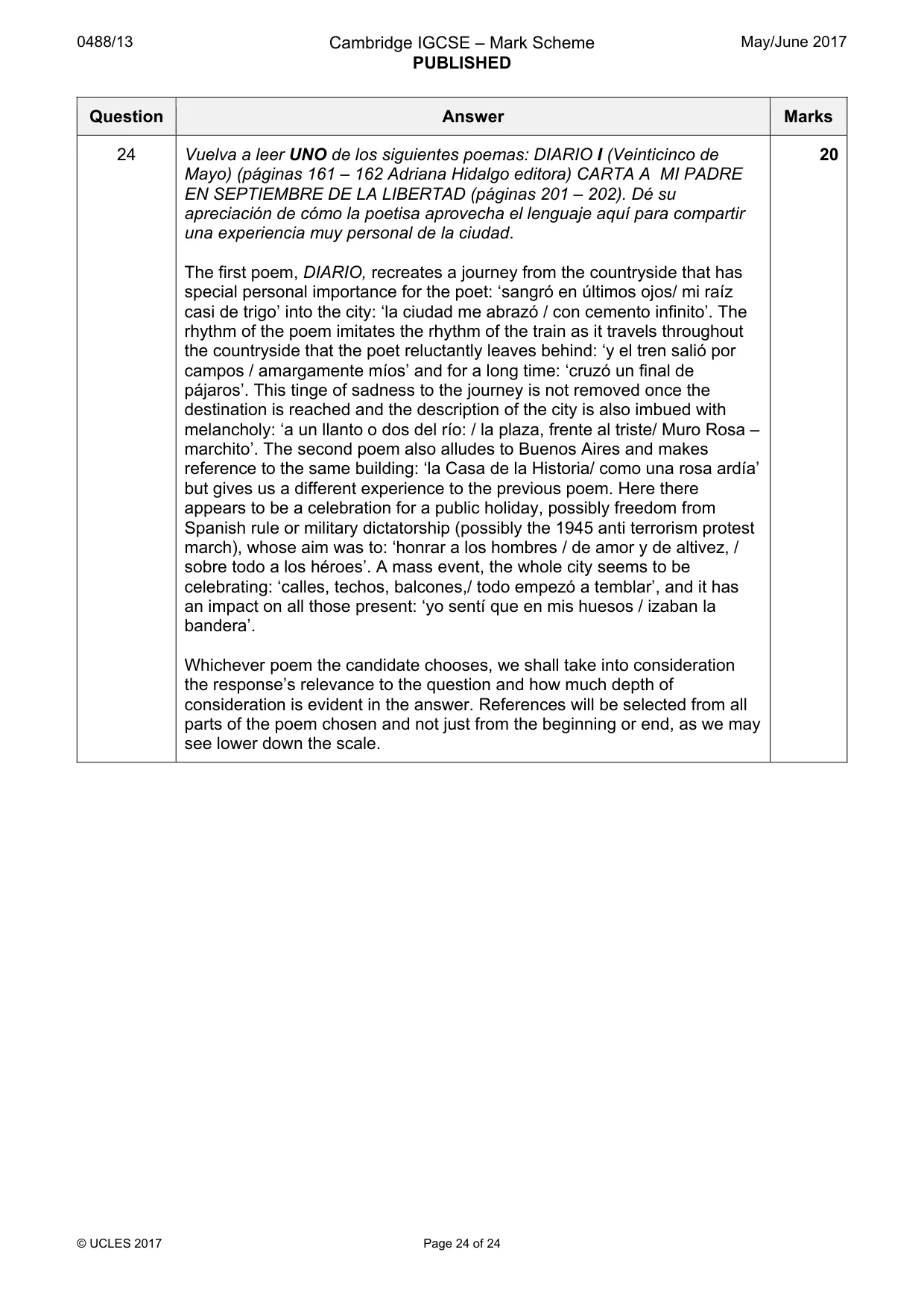
0488/13 Cambridge IGCSE – Mark Scheme PUBLISHED May/June 2017 © UCLES 2017 Page 24 of 24 Question Answer Marks 24 Vuelva a leer UNO de los siguientes poemas: DIARIO I (Veinticinco de Mayo) (páginas 161 – 162 Adriana Hidalgo editora) CARTA A MI PADRE EN SEPTIEMBRE DE LA LIBERTAD (páginas 201 – 202). Dé su apreciación de cómo la poetisa aprovecha el lenguaje aquí para compartir una experiencia muy personal de la ciudad. The first poem, DIARIO, recreates a journey from the countryside that has special personal importance for the poet: ‘sangró en últimos ojos/ mi raíz casi de trigo’ into the city: ‘la ciudad me abrazó / con cemento infinito’. The rhythm of the poem imitates the rhythm of the train as it travels throughout the countryside that the poet reluctantly leaves behind: ‘y el tren salió por campos / amargamente míos’ and for a long time: ‘cruzó un final de pájaros’. This tinge of sadness to the journey is not removed once the destination is reached and the description of the city is also imbued with melancholy: ‘a un llanto o dos del río: / la plaza, frente al triste/ Muro Rosa – marchito’. The second poem also alludes to Buenos Aires and makes reference to the same building: ‘la Casa de la Historia/ como una rosa ardía’ but gives us a different experience to the previous poem. Here there appears to be a celebration for a public holiday, possibly freedom from Spanish rule or military dictatorship (possibly the 1945 anti terrorism protest march), whose aim was to: ‘honrar a los hombres / de amor y de altivez, / sobre todo a los héroes’. A mass event, the whole city seems to be celebrating: ‘calles, techos, balcones,/ todo empezó a temblar’, and it has an impact on all those present: ‘yo sentí que en mis huesos / izaban la bandera’. Whichever poem the candidate chooses, we shall take into consideration the response’s relevance to the question and how much depth of consideration is evident in the answer. References will be selected from all parts of the poem chosen and not just from the beginning or end, as we may see lower down the scale. 20
What you needed in this session
Cambridge’s own grade thresholds for 2017 May/June, Paper 1 · Variant 3. A higher threshold means an easier paper — the bar moves with how the cohort did.