Cambridge IGCSE Spanish - Literature 0488 — 2017 May/June Paper 1 · Variant 1
0488/11/M/J/17 · 60 marks · ≈68 min
The question paper and its mark scheme, free to read here and free to download. This is Cambridge’s own paper, exactly as it was sat.
Question paper8 pages


Mark scheme26 pages
Answers below. Sit the paper first if you are practising.

Paper as text
Question paper, page 1
* 1 9 8 3 8 0 1 0 5 7 * This document consists of 6 printed pages, 2 blank pages and 1 Insert. DC (LK) 134499/3 © UCLES 2017 [Turn over Cambridge International Examinations Cambridge International General Certificate of Secondary Education LITERATURE (SPANISH) 0488/11 Paper 1 Spanish Texts May/June 2017 2 hours 15 minutes No Additional Materials are required. Texts studied should be taken into the examination room. READ THESE INSTRUCTIONS FIRST An answer booklet is provided inside this question paper. You should follow the instructions on the front cover of the answer booklet. If you need additional answer paper ask the invigilator for a continuation booklet. Answer three questions, each of which must be on a different book. Answers must cover at least two of the sections Prose, Drama, Poetry. Answer at least one text-based question (marked *). You may choose all three of your questions from those marked *. All the questions in this paper carry equal marks. EN PRIMER LUGAR, LEA ESTAS INSTRUCCIONES El cuadernillo de respuestas se encuentra dentro de este cuadernillo de preguntas. Siga las instrucciones de la portada del cuadernillo de respuestas. También encontrará las instrucciones en español a continuación. Si necesita hojas adicionales, pídale al supervisor un cuadernillo de respuestas adicional. Debe usted contestar tres preguntas basadas en tres libros diferentes. Debe contestar preguntas sacadas de al menos dos de las secciones Prosa, Teatro, Poesía. Conteste al menos una pregunta basada en un trozo de texto (preguntas señaladas con un *). Si desea, puede contestar tres preguntas señaladas con un *. Todas las preguntas en este examen tienen igual valor. INSTRUCCIONES DEL CUADERNILLO DE RESPUESTAS Rellene las casillas de la portada del cuadernillo de respuestas con letra mayúscula. Use tinta azul oscuro o negra. NO ESCRIBA EN NINGÚN CÓDIGO DE BARRAS. Escriba sus respuestas en el cuadernillo de respuestas. Utilice ambas caras del papel. Por favor deje dos líneas en blanco entre sus respuestas a cada pregunta. Escriba el número de la pregunta que está contestando en el primer margen. Si la pregunta que está contestando también contiene secciones, por ejemplo 1a, escriba la sección de la pregunta en el segundo margen. Si ha utilizado cuadernillos de respuestas adicionales, por favor guárdelos dentro del cuadernillo de respuestas. Question Part 1 1 ai aii
Question paper, page 2
2 0488/11/M/J/17 © UCLES 2017 EN TODAS SUS RESPUESTAS DEBE REFERIRSE DETALLADAMENTE AL TEXTO PROSA Matto de Turner, Aves sin nido Alternativamente: 1* Vuelva a leer el capítulo X de la SEGUNDA PARTE (páginas 109–110 Stockcero). ¿Cómo se vale Matto de Turner del lenguaje aquí para impactarnos con la forma en que se lleva a cabo la justicia en este fragmento? No olvide referirse detalladamente al pasaje. o 2 ¿Cómo reacciona usted ante la relación que tiene Fernando con su mujer Lucía y cómo se refleja esta relación en sus acciones hacia otros? No olvide referirse detalladamente al texto. o 3 ‘El cura volvió a tomar su asiento, preocupado y sin parar ya mientes en la despedida sumisa de Marcela y Margarita, a quienes vio alejarse mascullando frases entrecortadas’ (capítulo XII de la PRIMERA PARTE página 32 Stockcero). Escriba la conversación entre Marcela y Margarita mientras se alejan. Matute, Pequeño teatro Alternativamente: 4* Vuelva a leer una parte del capítulo XVI sección 1 desde ‘-Y, óyeme, Ilé Eroriak: esto es importante’ (página 265 Austral) hasta ‘Eso es, y no otra cosa’ (página 267). ¿Hasta qué punto, y cómo, ha conseguido Matute sorprenderlo(a) a usted con las revelaciones de Marco aquí? No olvide referirse detalladamente al pasaje. o 5 En su opinión de lector, ¿hasta qué punto, y cómo, aprovecha la autora el pueblo pesquero de Oiquixa como telón de fondo? Dé ejemplos. o 6 ‘-Nombradle presidente de la Asociación – dijo al fin Zazu -. Tened por seguro que se sentirá conmovido’ (capítulo IV sección 1 páginas 73–74 Austral). Usted es Zazu en este momento. ¿Qué está usted pensando? Conteste con la voz de Zazu.
Question paper, page 3
3 0488/11/M/J/17 © UCLES 2017 [Turn over EN TODAS SUS RESPUESTAS DEBE REFERIRSE DETALLADAMENTE AL TEXTO Blasco Ibáñez, La barraca Alternativamente: 7* Vuelva a leer una parte del capítulo IX desde ‘El valentón relataba modestamente sus glorias’ (página 202 Cátedra) hasta ‘chasqueaban el látigo’ (página 204). ¿Cómo reacciona usted ante el comportamiento de Pimentó hacia sus amos en este extracto? No olvide referirse detalladamente al pasaje. o 8 En su opinión de lector, de todos los actos vengativos de parte de los huertanos hacia la familia de Batiste, ¿cuál es el más impactante y por qué? No olvide referirse detalladamente al acto elegido. o 9 ‘Y plantado en la plazoleta, seguía mucho rato con la vista al grupo más numeroso, que se alejaba camino de Alboraya’ (capítulo VI página 152 Cátedra). Usted es el maestro don Joaquín en este momento. ¿Qué está usted pensando? Conteste con la voz de don Joaquín. Azuela, Los de abajo Alternativamente: 10* Vuelva a leer el final del capítulo I de la SEGUNDA PARTE desde ‘ – ¿Conque usté es el famoso Demetrio Macías que tanto se lució en Zacatecas?’ (páginas 78–80 Vicens Vives). ¿Cómo se las arregla aquí Azuela para impactarlo(a) a usted con el comportamiento de los revolucionarios? No olvide referirse detalladamente al extracto. o 11 ¿Cómo reacciona usted hacia la forma en que Cervantes manipula a Demetrio a lo largo de la novela? No olvide referirse detalladamente al texto. o 12 ‘Y Camila, muy asustada, fue a reunirse con Demetrio’ (capítulo IX de la SEGUNDA PARTE página 103 Vicens Vives). Usted es Camila en este momento. ¿Qué está usted pensando? Conteste con la voz de Camila.
Question paper, page 4
4 0488/11/M/J/17 © UCLES 2017 EN TODAS SUS RESPUESTAS DEBE REFERIRSE DETALLADAMENTE AL TEXTO TEATRO Duque de Rivas, Don Álvaro o la fuerza del sino Alternativamente: 13* Vuelva a leer la escena III de la Jornada segunda (páginas 106–110 Alianza Editorial). ¿Hasta qué punto, y cómo, ha logrado el Duque de Rivas crear un ambiente de tranquilidad a pesar de las palabras angustiosas de Leonor? No olvide referirse detalladamente al extracto en su respuesta. o 14 ¿Qué impresión le ha dado a usted el autor de la forma de actuar de los distintos miembros de la familia del marqués de Calatrava? No olvide referirse detalladamente a la obra. o 15 Usted es don Álvaro al final de la escena VI de la Jornada quinta (página 200 Alianza Editorial). ¿Qué está usted pensando? Conteste con la voz de Don Álvaro. García Lorca, Bodas de sangre Alternativamente: 16* Vuelva a leer una parte del ACTO TERCERO CUADRO ÚLTIMO desde la acotación ‘(Aparece la NOVIA. Viene sin azahar y con un manto negro)’ (página 109 Vicens Vives) hasta ‘MADRE. Llora. Pero en la puerta’ (página 111). Aprecie cómo aprovecha Lorca el lenguaje aquí para crear una escena final tanto poética como apasionante. No olvide referirse detalladamente al pasaje. o 17 ¿Cómo aprovecha el dramaturgo las canciones folclóricas para entretener al público? Dé ejemplos. o 18 ‘LEONARDO. (Agrio.) ¿Te puedes callar?’ (ACTO PRIMERO CUADRO SEGUNDO página 26 Vicens Vives). Usted es Leonardo. ¿Qué está usted pensando en este momento? Conteste con la voz de Leonardo.
Question paper, page 5
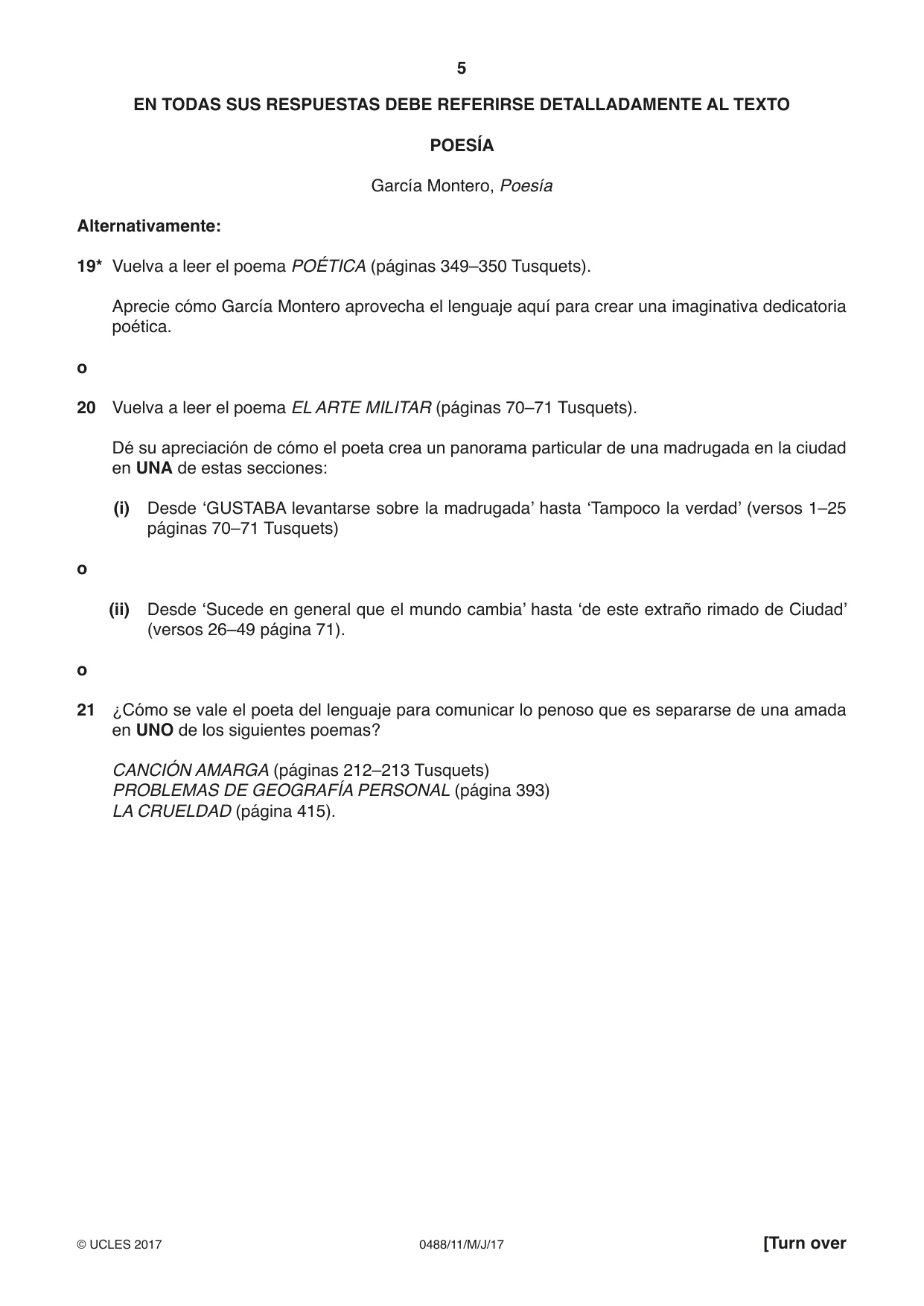
5 0488/11/M/J/17 © UCLES 2017 [Turn over EN TODAS SUS RESPUESTAS DEBE REFERIRSE DETALLADAMENTE AL TEXTO POESÍA García Montero, Poesía Alternativamente: 19* Vuelva a leer el poema POÉTICA (páginas 349–350 Tusquets). Aprecie cómo García Montero aprovecha el lenguaje aquí para crear una imaginativa dedicatoria poética. o 20 Vuelva a leer el poema EL ARTE MILITAR (páginas 70–71 Tusquets). Dé su apreciación de cómo el poeta crea un panorama particular de una madrugada en la ciudad en UNA de estas secciones: (i) Desde ‘GUSTABA levantarse sobre la madrugada’ hasta ‘Tampoco la verdad’ (versos 1–25 páginas 70–71 Tusquets) o (ii) Desde ‘Sucede en general que el mundo cambia’ hasta ‘de este extraño rimado de Ciudad’ (versos 26–49 página 71). o 21 ¿Cómo se vale el poeta del lenguaje para comunicar lo penoso que es separarse de una amada en UNO de los siguientes poemas? CANCIÓN AMARGA (páginas 212–213 Tusquets) PROBLEMAS DE GEOGRAFÍA PERSONAL (página 393) LA CRUELDAD (página 415).
Question paper, page 6
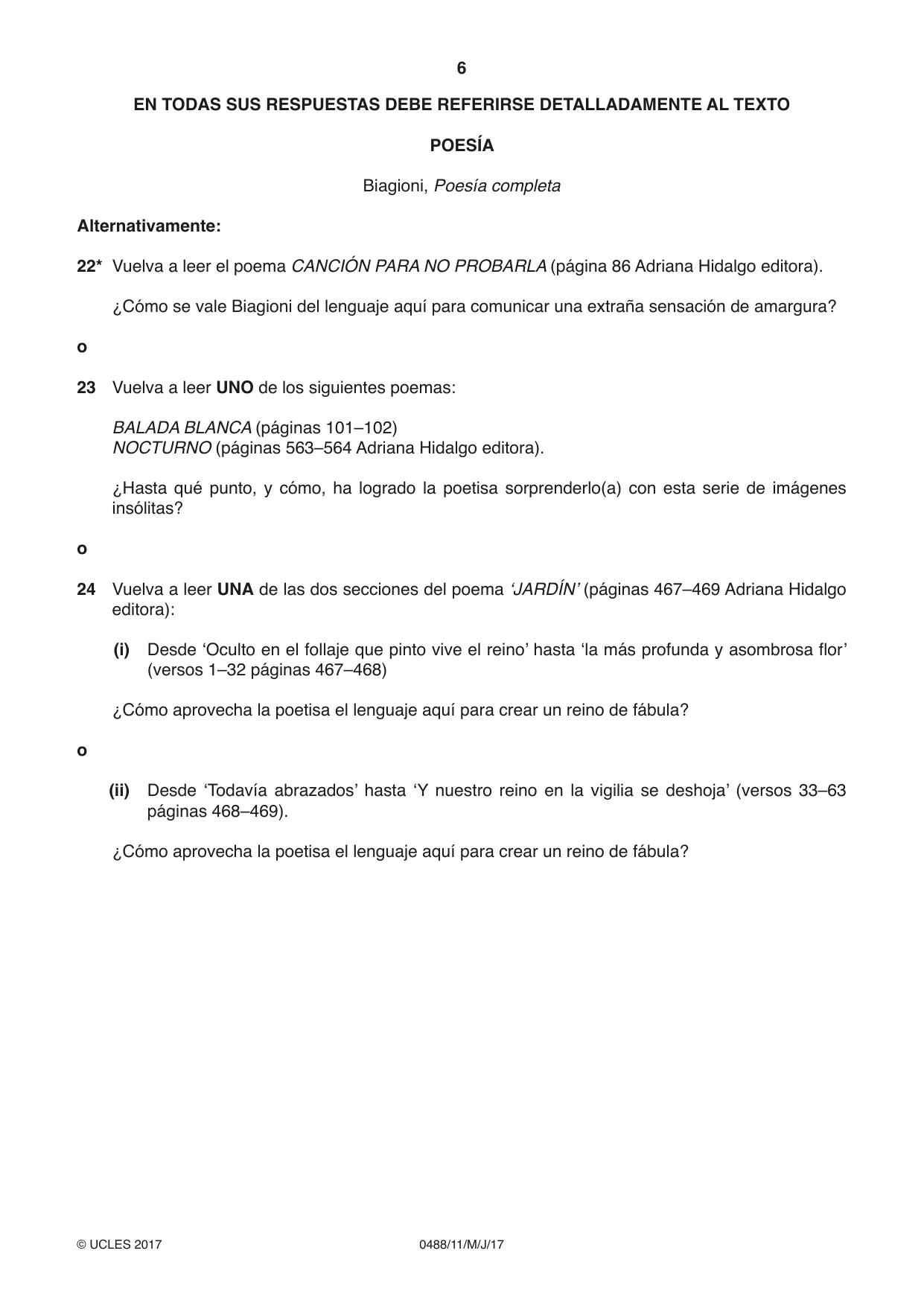
6 0488/11/M/J/17 © UCLES 2017 EN TODAS SUS RESPUESTAS DEBE REFERIRSE DETALLADAMENTE AL TEXTO POESÍA Biagioni, Poesía completa Alternativamente: 22* Vuelva a leer el poema CANCIÓN PARA NO PROBARLA (página 86 Adriana Hidalgo editora). ¿Cómo se vale Biagioni del lenguaje aquí para comunicar una extraña sensación de amargura? o 23 Vuelva a leer UNO de los siguientes poemas: BALADA BLANCA (páginas 101–102) NOCTURNO (páginas 563–564 Adriana Hidalgo editora). ¿Hasta qué punto, y cómo, ha logrado la poetisa sorprenderlo(a) con esta serie de imágenes insólitas? o 24 Vuelva a leer UNA de las dos secciones del poema ‘JARDÍN’ (páginas 467–469 Adriana Hidalgo editora): (i) Desde ‘Oculto en el follaje que pinto vive el reino’ hasta ‘la más profunda y asombrosa flor’ (versos 1–32 páginas 467–468) ¿Cómo aprovecha la poetisa el lenguaje aquí para crear un reino de fábula? o (ii) Desde ‘Todavía abrazados’ hasta ‘Y nuestro reino en la vigilia se deshoja’ (versos 33–63 páginas 468–469). ¿Cómo aprovecha la poetisa el lenguaje aquí para crear un reino de fábula?
Question paper, page 7
7 0488/11/M/J/17 © UCLES 2017 BLANK PAGE
Question paper, page 8
8 0488/11/M/J/17 © UCLES 2017 Permission to reproduce items where third-party owned material protected by copyright is included has been sought and cleared where possible. Every reasonable effort has been made by the publisher (UCLES) to trace copyright holders, but if any items requiring clearance have unwittingly been included, the publisher will be pleased to make amends at the earliest possible opportunity. To avoid the issue of disclosure of answer-related information to candidates, all copyright acknowledgements are reproduced online in the Cambridge International Examinations Copyright Acknowledgements Booklet. This is produced for each series of examinations and is freely available to download at www.cie.org.uk after the live examination series. Cambridge International Examinations is part of the Cambridge Assessment Group. Cambridge Assessment is the brand name of University of Cambridge Local Examinations Syndicate (UCLES), which is itself a department of the University of Cambridge. BLANK PAGE
Mark scheme, page 1
® IGCSE is a registered trademark. This document consists of 26 printed pages. © UCLES 2017 [Turn over Cambridge International Examinations Cambridge International General Certificate of Secondary Education LITREATURE (SPANISH) 0488/11 Paper 1 Set Texts (Open Books) May/June 2017 MARK SCHEME Maximum Mark: 60 Published This mark scheme is published as an aid to teachers and candidates, to indicate the requirements of the examination. It shows the basis on which Examiners were instructed to award marks. It does not indicate the details of the discussions that took place at an Examiners’ meeting before marking began, which would have considered the acceptability of alternative answers. Mark schemes should be read in conjunction with the question paper and the Principal Examiner Report for Teachers. Cambridge will not enter into discussions about these mark schemes. Cambridge is publishing the mark schemes for the May/June 2017 series for most Cambridge IGCSE®, Cambridge International A and AS Level and Cambridge Pre-U components, and some Cambridge O Level components.
Mark scheme, page 2
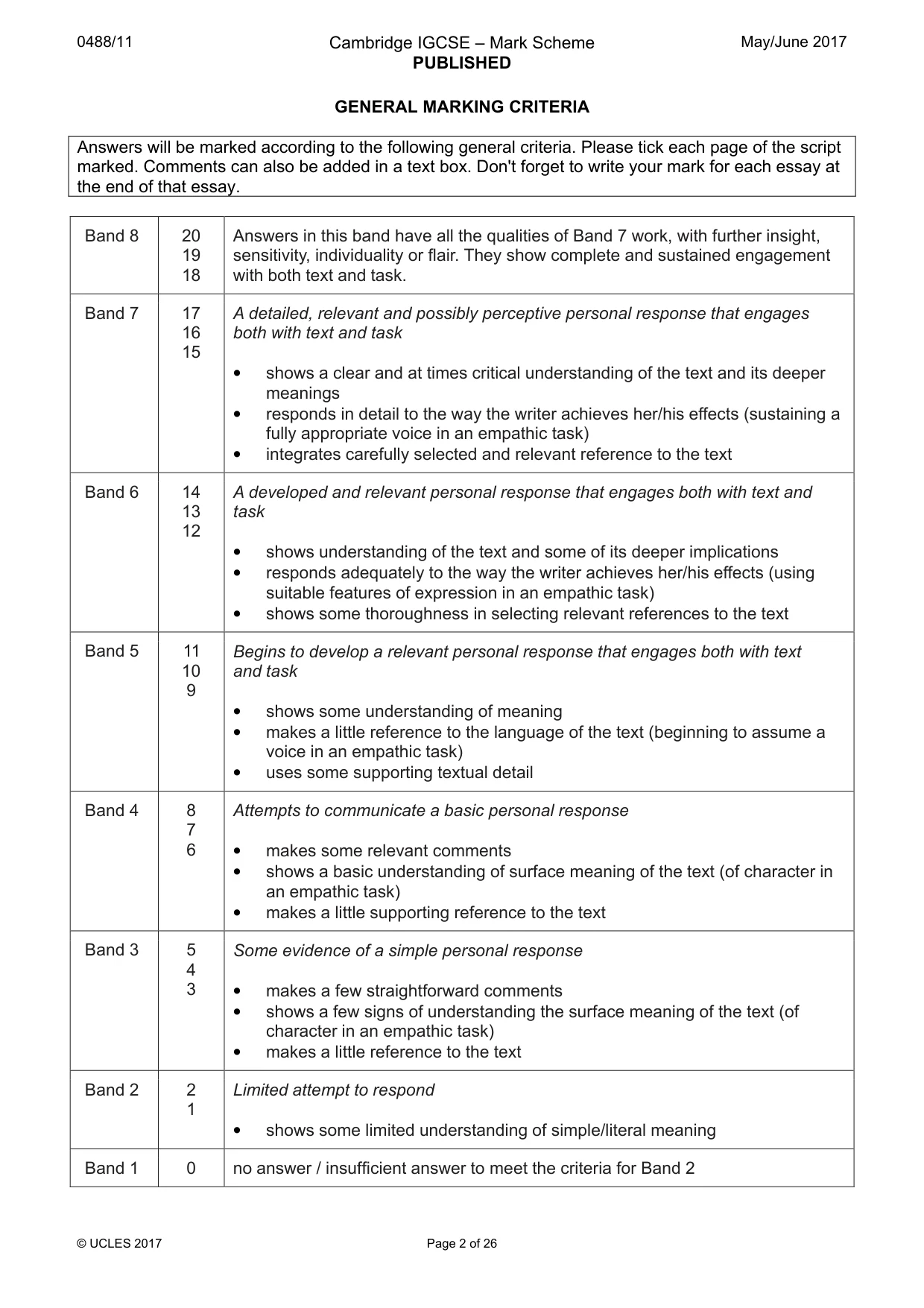
0488/11 Cambridge IGCSE – Mark Scheme PUBLISHED May/June 2017 © UCLES 2017 Page 2 of 26 GENERAL MARKING CRITERIA Answers will be marked according to the following general criteria. Please tick each page of the script marked. Comments can also be added in a text box. Don't forget to write your mark for each essay at the end of that essay. Band 8 20 19 18 Answers in this band have all the qualities of Band 7 work, with further insight, sensitivity, individuality or flair. They show complete and sustained engagement with both text and task. Band 7 17 16 15 A detailed, relevant and possibly perceptive personal response that engages both with text and task • shows a clear and at times critical understanding of the text and its deeper meanings • responds in detail to the way the writer achieves her/his effects (sustaining a fully appropriate voice in an empathic task) • integrates carefully selected and relevant reference to the text Band 6 14 13 12 A developed and relevant personal response that engages both with text and task • shows understanding of the text and some of its deeper implications • responds adequately to the way the writer achieves her/his effects (using suitable features of expression in an empathic task) • shows some thoroughness in selecting relevant references to the text Band 5 11 10 9 Begins to develop a relevant personal response that engages both with text and task • shows some understanding of meaning • makes a little reference to the language of the text (beginning to assume a voice in an empathic task) • uses some supporting textual detail Band 4 8 7 6 Attempts to communicate a basic personal response • makes some relevant comments • shows a basic understanding of surface meaning of the text (of character in an empathic task) • makes a little supporting reference to the text Band 3 5 4 3 Some evidence of a simple personal response • makes a few straightforward comments • shows a few signs of understanding the surface meaning of the text (of character in an empathic task) • makes a little reference to the text Band 2 2 1 Limited attempt to respond • shows some limited understanding of simple/literal meaning Band 1 0 no answer / insufficient answer to meet the criteria for Band 2
Mark scheme, page 3
0488/11 Cambridge IGCSE – Mark Scheme PUBLISHED May/June 2017 © UCLES 2017 Page 3 of 26 Question Answer Marks Indicative Content Questions are open to interpretation and, therefore, the following notes are not intended to be prescriptive but to give an indication of some of the points that could be made in response to each question. They are by no means exhaustive.
Mark scheme, page 4
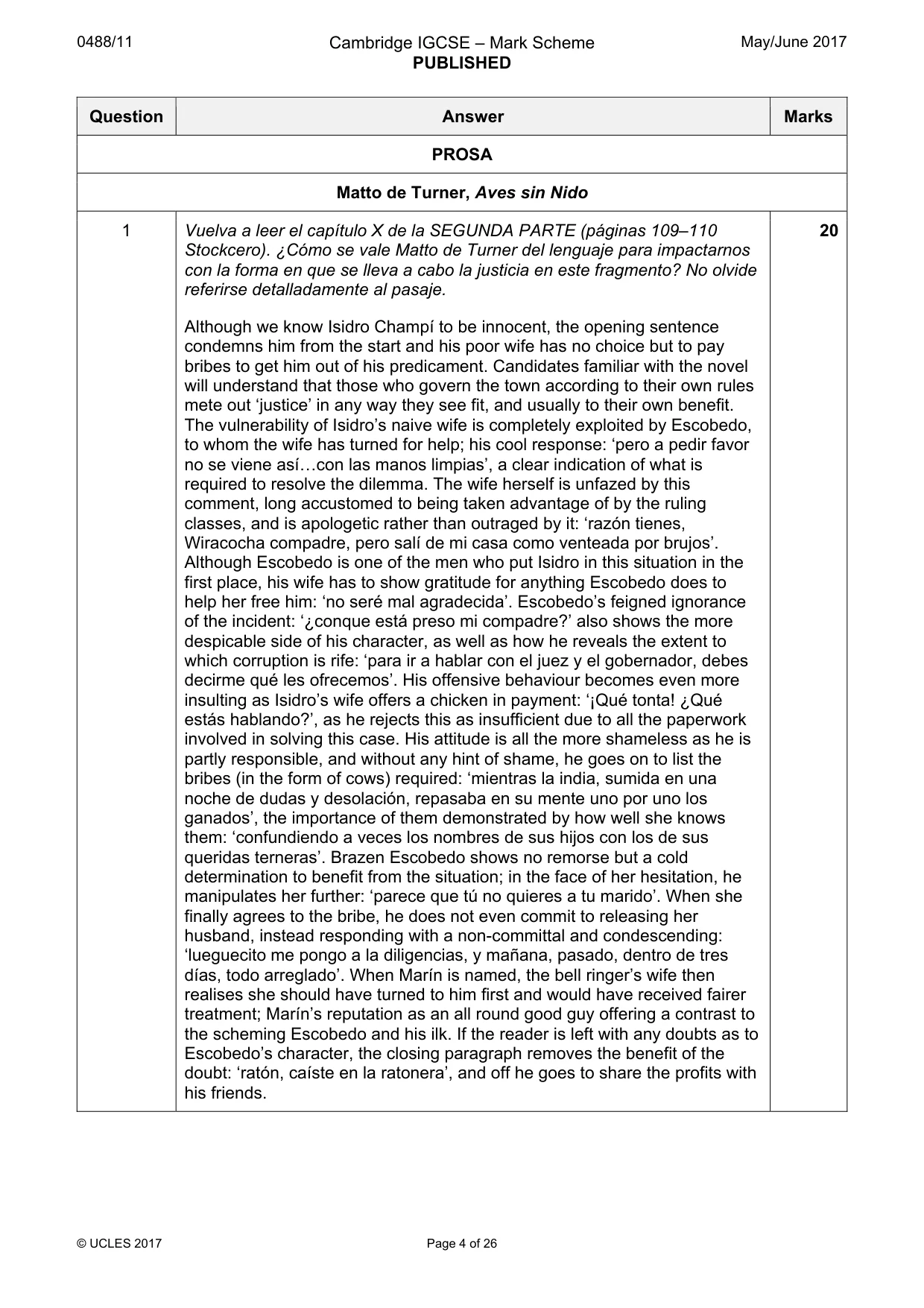
0488/11 Cambridge IGCSE – Mark Scheme PUBLISHED May/June 2017 © UCLES 2017 Page 4 of 26 Question Answer Marks PROSA Matto de Turner, Aves sin Nido 1 Vuelva a leer el capítulo X de la SEGUNDA PARTE (páginas 109–110 Stockcero). ¿Cómo se vale Matto de Turner del lenguaje para impactarnos con la forma en que se lleva a cabo la justicia en este fragmento? No olvide referirse detalladamente al pasaje. Although we know Isidro Champí to be innocent, the opening sentence condemns him from the start and his poor wife has no choice but to pay bribes to get him out of his predicament. Candidates familiar with the novel will understand that those who govern the town according to their own rules mete out ‘justice’ in any way they see fit, and usually to their own benefit. The vulnerability of Isidro’s naive wife is completely exploited by Escobedo, to whom the wife has turned for help; his cool response: ‘pero a pedir favor no se viene así«con las manos limpias’, a clear indication of what is required to resolve the dilemma. The wife herself is unfazed by this comment, long accustomed to being taken advantage of by the ruling classes, and is apologetic rather than outraged by it: ‘razón tienes, Wiracocha compadre, pero salí de mi casa como venteada por brujos’. Although Escobedo is one of the men who put Isidro in this situation in the first place, his wife has to show gratitude for anything Escobedo does to help her free him: ‘no seré mal agradecida’. Escobedo’s feigned ignorance of the incident: ‘¿conque está preso mi compadre?’ also shows the more despicable side of his character, as well as how he reveals the extent to which corruption is rife: ‘para ir a hablar con el juez y el gobernador, debes decirme qué les ofrecemos’. His offensive behaviour becomes even more insulting as Isidro’s wife offers a chicken in payment: ‘¡Qué tonta! ¿Qué estás hablando?’, as he rejects this as insufficient due to all the paperwork involved in solving this case. His attitude is all the more shameless as he is partly responsible, and without any hint of shame, he goes on to list the bribes (in the form of cows) required: ‘mientras la india, sumida en una noche de dudas y desolación, repasaba en su mente uno por uno los ganados’, the importance of them demonstrated by how well she knows them: ‘confundiendo a veces los nombres de sus hijos con los de sus queridas terneras’. Brazen Escobedo shows no remorse but a cold determination to benefit from the situation; in the face of her hesitation, he manipulates her further: ‘parece que tú no quieres a tu marido’. When she finally agrees to the bribe, he does not even commit to releasing her husband, instead responding with a non-committal and condescending: ‘lueguecito me pongo a la diligencias, y mañana, pasado, dentro de tres días, todo arreglado’. When Marín is named, the bell ringer’s wife then realises she should have turned to him first and would have received fairer treatment; Marín’s reputation as an all round good guy offering a contrast to the scheming Escobedo and his ilk. If the reader is left with any doubts as to Escobedo’s character, the closing paragraph removes the benefit of the doubt: ‘ratón, caíste en la ratonera’, and off he goes to share the profits with his friends. 20
Mark scheme, page 5
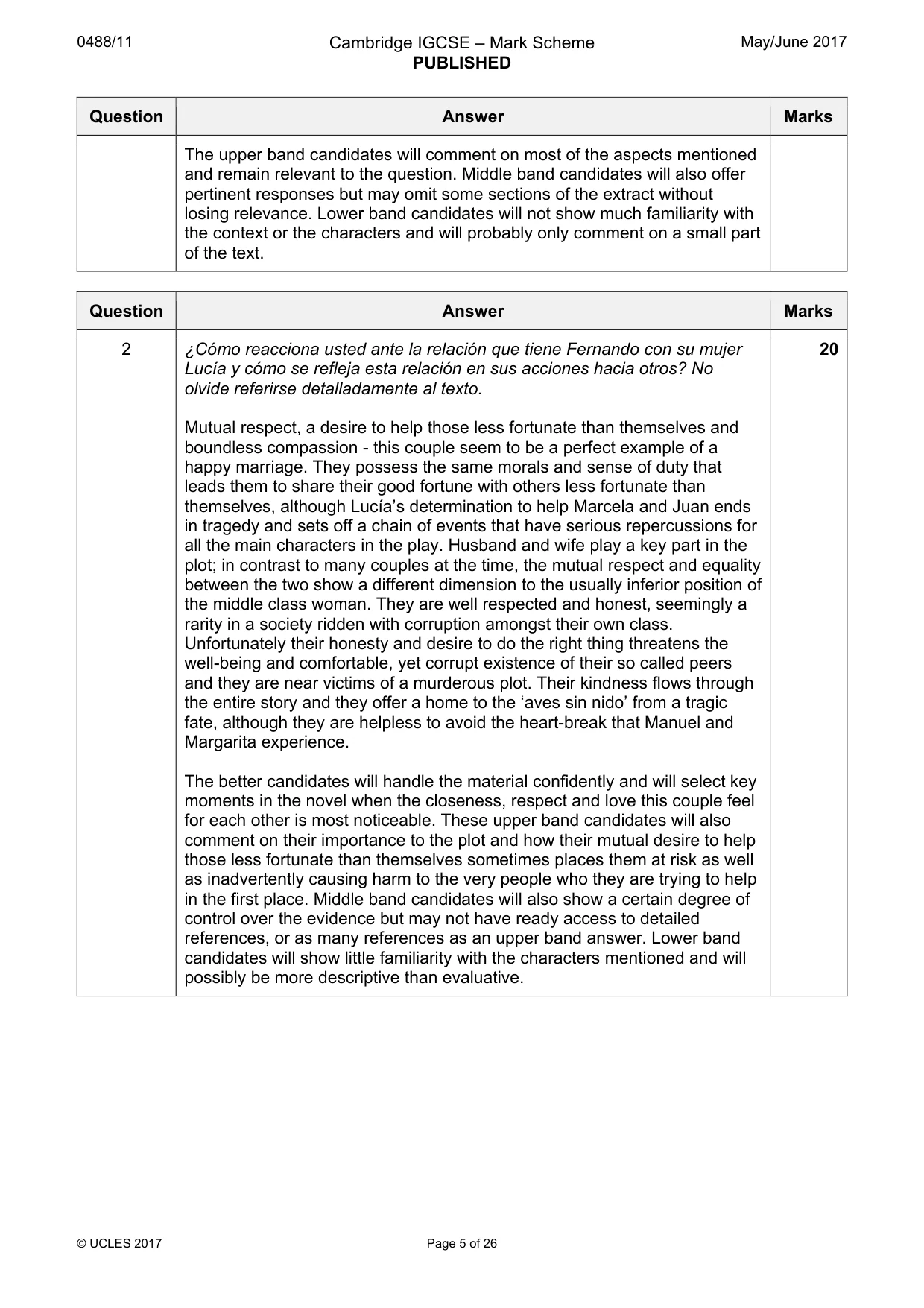
0488/11 Cambridge IGCSE – Mark Scheme PUBLISHED May/June 2017 © UCLES 2017 Page 5 of 26 Question Answer Marks The upper band candidates will comment on most of the aspects mentioned and remain relevant to the question. Middle band candidates will also offer pertinent responses but may omit some sections of the extract without losing relevance. Lower band candidates will not show much familiarity with the context or the characters and will probably only comment on a small part of the text. Question Answer Marks 2 ¿Cómo reacciona usted ante la relación que tiene Fernando con su mujer Lucía y cómo se refleja esta relación en sus acciones hacia otros? No olvide referirse detalladamente al texto. Mutual respect, a desire to help those less fortunate than themselves and boundless compassion - this couple seem to be a perfect example of a happy marriage. They possess the same morals and sense of duty that leads them to share their good fortune with others less fortunate than themselves, although Lucía’s determination to help Marcela and Juan ends in tragedy and sets off a chain of events that have serious repercussions for all the main characters in the play. Husband and wife play a key part in the plot; in contrast to many couples at the time, the mutual respect and equality between the two show a different dimension to the usually inferior position of the middle class woman. They are well respected and honest, seemingly a rarity in a society ridden with corruption amongst their own class. Unfortunately their honesty and desire to do the right thing threatens the well-being and comfortable, yet corrupt existence of their so called peers and they are near victims of a murderous plot. Their kindness flows through the entire story and they offer a home to the ‘aves sin nido’ from a tragic fate, although they are helpless to avoid the heart-break that Manuel and Margarita experience. The better candidates will handle the material confidently and will select key moments in the novel when the closeness, respect and love this couple feel for each other is most noticeable. These upper band candidates will also comment on their importance to the plot and how their mutual desire to help those less fortunate than themselves sometimes places them at risk as well as inadvertently causing harm to the very people who they are trying to help in the first place. Middle band candidates will also show a certain degree of control over the evidence but may not have ready access to detailed references, or as many references as an upper band answer. Lower band candidates will show little familiarity with the characters mentioned and will possibly be more descriptive than evaluative. 20
Mark scheme, page 6
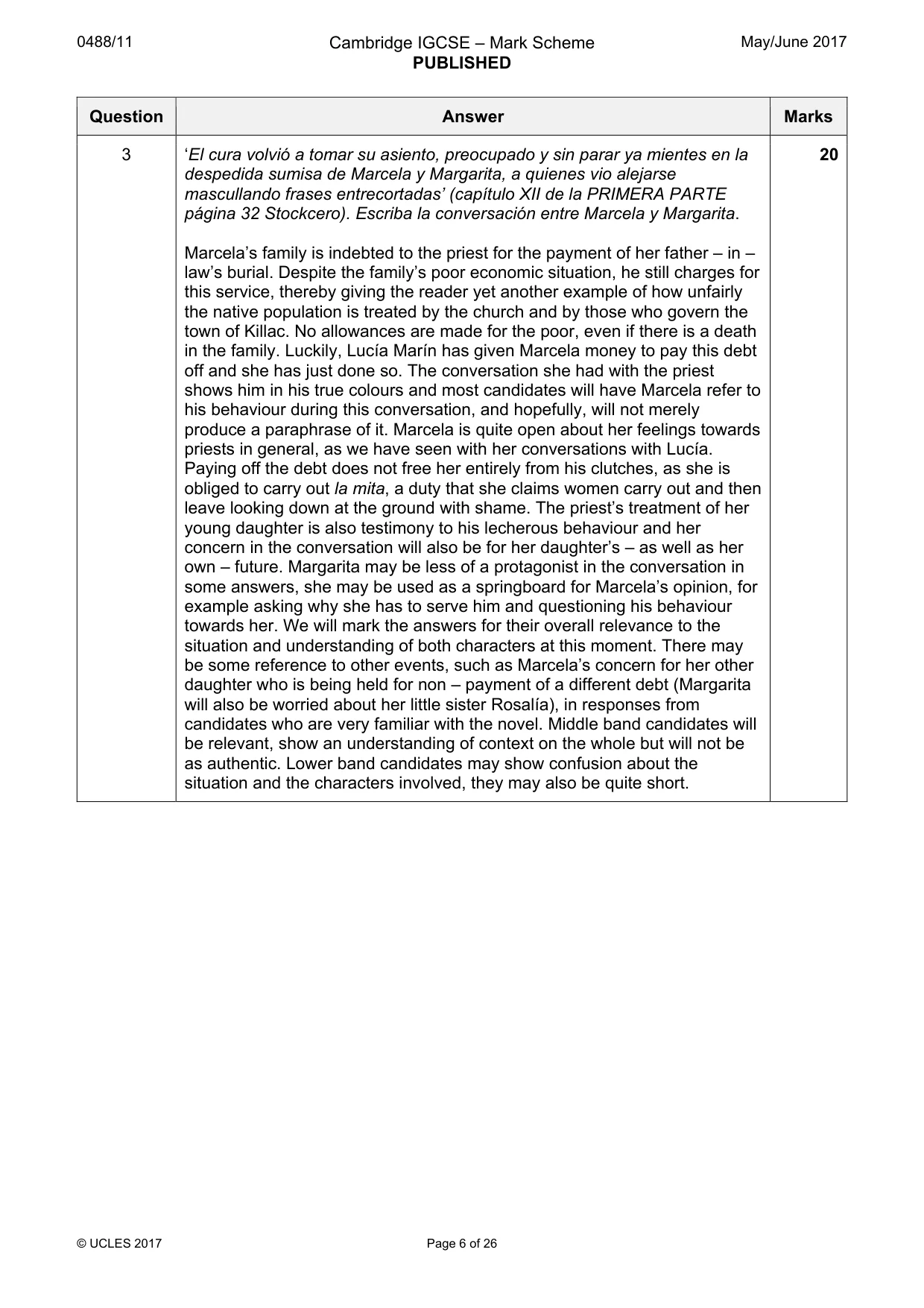
0488/11 Cambridge IGCSE – Mark Scheme PUBLISHED May/June 2017 © UCLES 2017 Page 6 of 26 Question Answer Marks 3 ‘El cura volvió a tomar su asiento, preocupado y sin parar ya mientes en la despedida sumisa de Marcela y Margarita, a quienes vio alejarse mascullando frases entrecortadas’ (capítulo XII de la PRIMERA PARTE página 32 Stockcero). Escriba la conversación entre Marcela y Margarita. Marcela’s family is indebted to the priest for the payment of her father – in – law’s burial. Despite the family’s poor economic situation, he still charges for this service, thereby giving the reader yet another example of how unfairly the native population is treated by the church and by those who govern the town of Killac. No allowances are made for the poor, even if there is a death in the family. Luckily, Lucía Marín has given Marcela money to pay this debt off and she has just done so. The conversation she had with the priest shows him in his true colours and most candidates will have Marcela refer to his behaviour during this conversation, and hopefully, will not merely produce a paraphrase of it. Marcela is quite open about her feelings towards priests in general, as we have seen with her conversations with Lucía. Paying off the debt does not free her entirely from his clutches, as she is obliged to carry out la mita, a duty that she claims women carry out and then leave looking down at the ground with shame. The priest’s treatment of her young daughter is also testimony to his lecherous behaviour and her concern in the conversation will also be for her daughter’s – as well as her own – future. Margarita may be less of a protagonist in the conversation in some answers, she may be used as a springboard for Marcela’s opinion, for example asking why she has to serve him and questioning his behaviour towards her. We will mark the answers for their overall relevance to the situation and understanding of both characters at this moment. There may be some reference to other events, such as Marcela’s concern for her other daughter who is being held for non – payment of a different debt (Margarita will also be worried about her little sister Rosalía), in responses from candidates who are very familiar with the novel. Middle band candidates will be relevant, show an understanding of context on the whole but will not be as authentic. Lower band candidates may show confusion about the situation and the characters involved, they may also be quite short. 20
Mark scheme, page 7
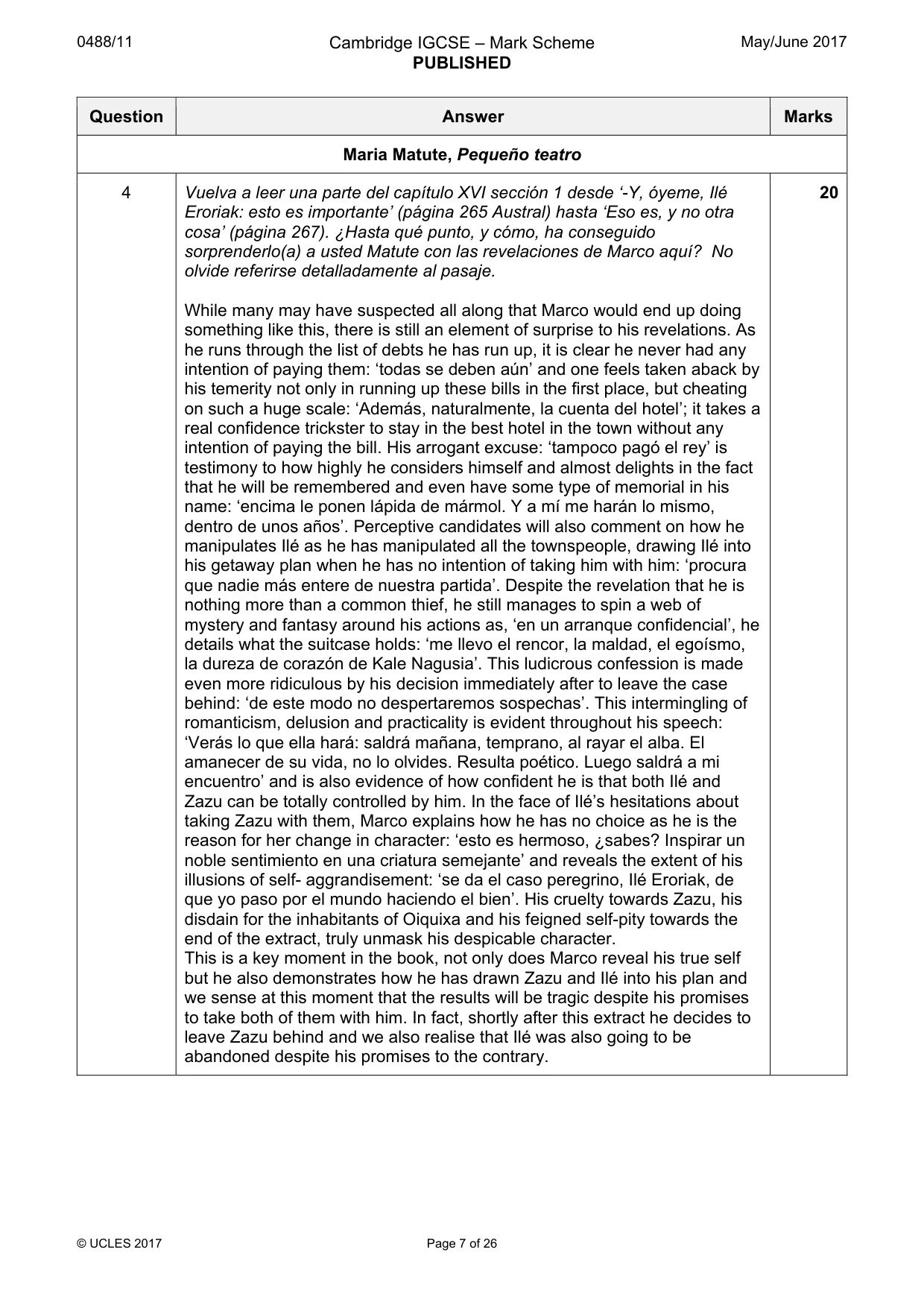
0488/11 Cambridge IGCSE – Mark Scheme PUBLISHED May/June 2017 © UCLES 2017 Page 7 of 26 Question Answer Marks Maria Matute, Pequeño teatro 4 Vuelva a leer una parte del capítulo XVI sección 1 desde ‘-Y, óyeme, Ilé Eroriak: esto es importante’ (página 265 Austral) hasta ‘Eso es, y no otra cosa’ (página 267). ¿Hasta qué punto, y cómo, ha conseguido sorprenderlo(a) a usted Matute con las revelaciones de Marco aquí? No olvide referirse detalladamente al pasaje. While many may have suspected all along that Marco would end up doing something like this, there is still an element of surprise to his revelations. As he runs through the list of debts he has run up, it is clear he never had any intention of paying them: ‘todas se deben aún’ and one feels taken aback by his temerity not only in running up these bills in the first place, but cheating on such a huge scale: ‘Además, naturalmente, la cuenta del hotel’; it takes a real confidence trickster to stay in the best hotel in the town without any intention of paying the bill. His arrogant excuse: ‘tampoco pagó el rey’ is testimony to how highly he considers himself and almost delights in the fact that he will be remembered and even have some type of memorial in his name: ‘encima le ponen lápida de mármol. Y a mí me harán lo mismo, dentro de unos años’. Perceptive candidates will also comment on how he manipulates Ilé as he has manipulated all the townspeople, drawing Ilé into his getaway plan when he has no intention of taking him with him: ‘procura que nadie más entere de nuestra partida’. Despite the revelation that he is nothing more than a common thief, he still manages to spin a web of mystery and fantasy around his actions as, ‘en un arranque confidencial’, he details what the suitcase holds: ‘me llevo el rencor, la maldad, el egoísmo, la dureza de corazón de Kale Nagusia’. This ludicrous confession is made even more ridiculous by his decision immediately after to leave the case behind: ‘de este modo no despertaremos sospechas’. This intermingling of romanticism, delusion and practicality is evident throughout his speech: ‘Verás lo que ella hará: saldrá mañana, temprano, al rayar el alba. El amanecer de su vida, no lo olvides. Resulta poético. Luego saldrá a mi encuentro’ and is also evidence of how confident he is that both Ilé and Zazu can be totally controlled by him. In the face of Ilé’s hesitations about taking Zazu with them, Marco explains how he has no choice as he is the reason for her change in character: ‘esto es hermoso, ¿sabes? Inspirar un noble sentimiento en una criatura semejante’ and reveals the extent of his illusions of self- aggrandisement: ‘se da el caso peregrino, Ilé Eroriak, de que yo paso por el mundo haciendo el bien’. His cruelty towards Zazu, his disdain for the inhabitants of Oiquixa and his feigned self-pity towards the end of the extract, truly unmask his despicable character. This is a key moment in the book, not only does Marco reveal his true self but he also demonstrates how he has drawn Zazu and Ilé into his plan and we sense at this moment that the results will be tragic despite his promises to take both of them with him. In fact, shortly after this extract he decides to leave Zazu behind and we also realise that Ilé was also going to be abandoned despite his promises to the contrary. 20
Mark scheme, page 8
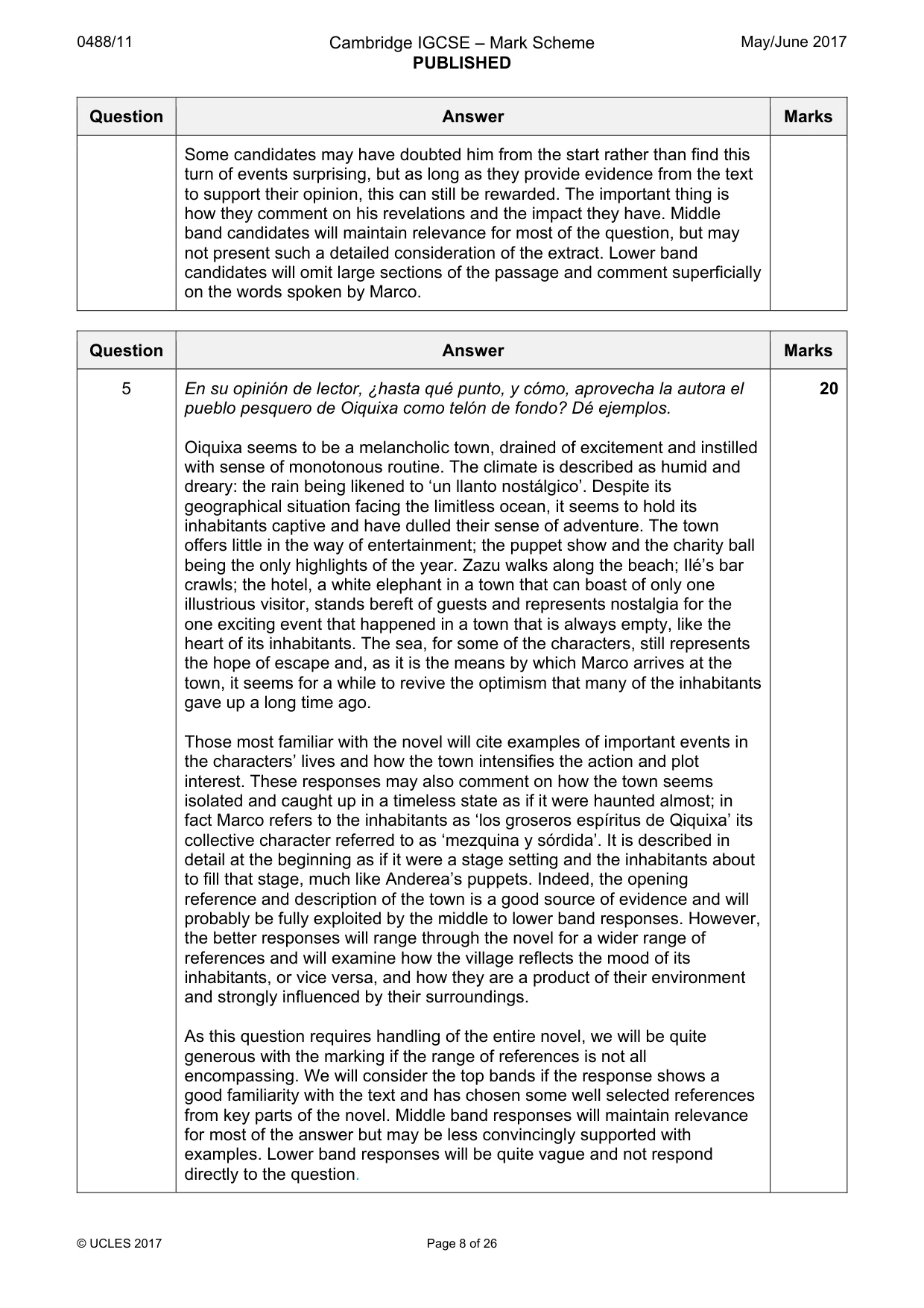
0488/11 Cambridge IGCSE – Mark Scheme PUBLISHED May/June 2017 © UCLES 2017 Page 8 of 26 Question Answer Marks Some candidates may have doubted him from the start rather than find this turn of events surprising, but as long as they provide evidence from the text to support their opinion, this can still be rewarded. The important thing is how they comment on his revelations and the impact they have. Middle band candidates will maintain relevance for most of the question, but may not present such a detailed consideration of the extract. Lower band candidates will omit large sections of the passage and comment superficially on the words spoken by Marco. Question Answer Marks 5 En su opinión de lector, ¿hasta qué punto, y cómo, aprovecha la autora el pueblo pesquero de Oiquixa como telón de fondo? Dé ejemplos. Oiquixa seems to be a melancholic town, drained of excitement and instilled with sense of monotonous routine. The climate is described as humid and dreary: the rain being likened to ‘un llanto nostálgico’. Despite its geographical situation facing the limitless ocean, it seems to hold its inhabitants captive and have dulled their sense of adventure. The town offers little in the way of entertainment; the puppet show and the charity ball being the only highlights of the year. Zazu walks along the beach; Ilé’s bar crawls; the hotel, a white elephant in a town that can boast of only one illustrious visitor, stands bereft of guests and represents nostalgia for the one exciting event that happened in a town that is always empty, like the heart of its inhabitants. The sea, for some of the characters, still represents the hope of escape and, as it is the means by which Marco arrives at the town, it seems for a while to revive the optimism that many of the inhabitants gave up a long time ago. Those most familiar with the novel will cite examples of important events in the characters’ lives and how the town intensifies the action and plot interest. These responses may also comment on how the town seems isolated and caught up in a timeless state as if it were haunted almost; in fact Marco refers to the inhabitants as ‘los groseros espíritus de Qiquixa’ its collective character referred to as ‘mezquina y sórdida’. It is described in detail at the beginning as if it were a stage setting and the inhabitants about to fill that stage, much like Anderea’s puppets. Indeed, the opening reference and description of the town is a good source of evidence and will probably be fully exploited by the middle to lower band responses. However, the better responses will range through the novel for a wider range of references and will examine how the village reflects the mood of its inhabitants, or vice versa, and how they are a product of their environment and strongly influenced by their surroundings. As this question requires handling of the entire novel, we will be quite generous with the marking if the range of references is not all encompassing. We will consider the top bands if the response shows a good familiarity with the text and has chosen some well selected references from key parts of the novel. Middle band responses will maintain relevance for most of the answer but may be less convincingly supported with examples. Lower band responses will be quite vague and not respond directly to the question. 20
Mark scheme, page 9
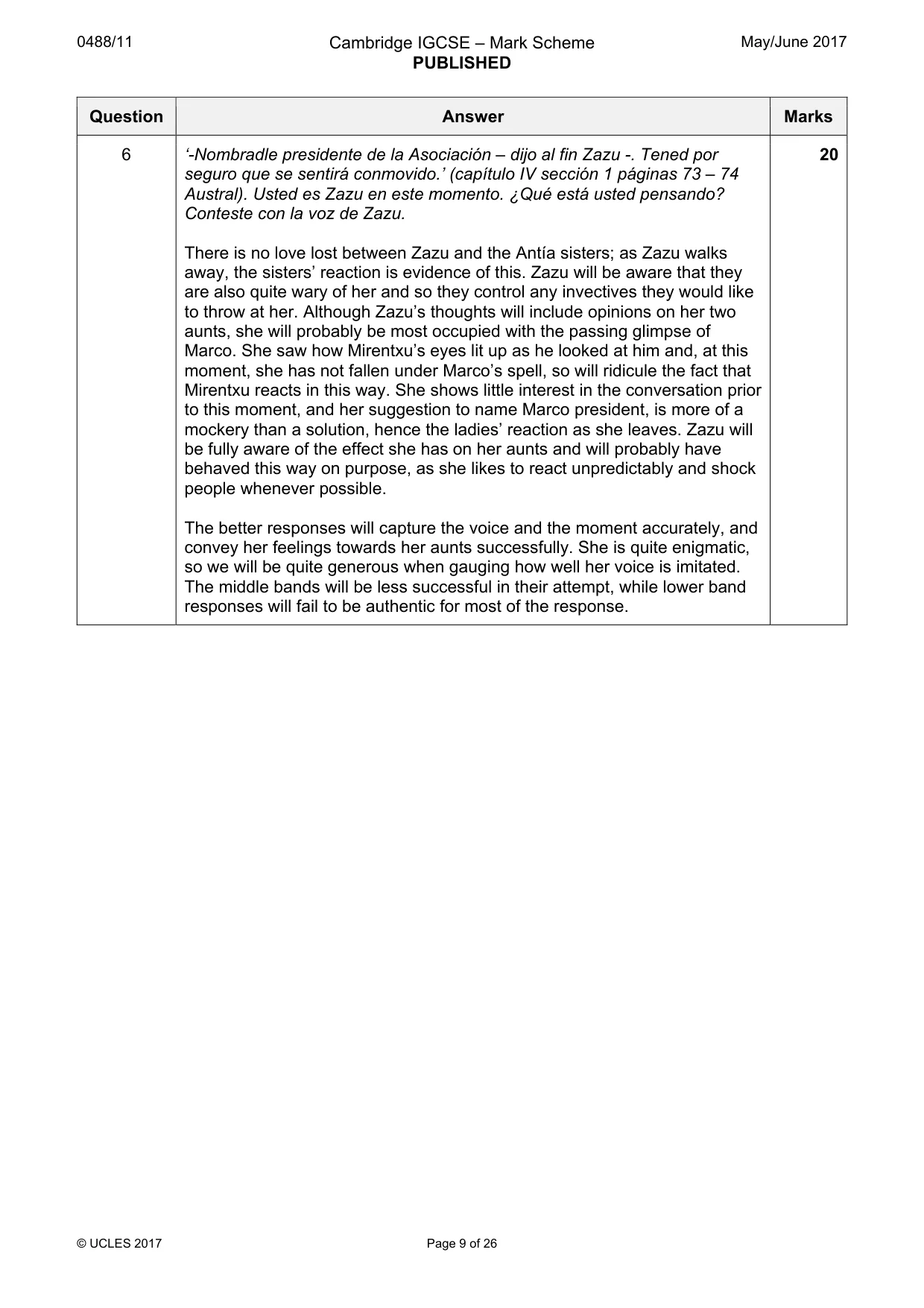
0488/11 Cambridge IGCSE – Mark Scheme PUBLISHED May/June 2017 © UCLES 2017 Page 9 of 26 Question Answer Marks 6 ‘-Nombradle presidente de la Asociación – dijo al fin Zazu -. Tened por seguro que se sentirá conmovido.’ (capítulo IV sección 1 páginas 73 – 74 Austral). Usted es Zazu en este momento. ¿Qué está usted pensando? Conteste con la voz de Zazu. There is no love lost between Zazu and the Antía sisters; as Zazu walks away, the sisters’ reaction is evidence of this. Zazu will be aware that they are also quite wary of her and so they control any invectives they would like to throw at her. Although Zazu’s thoughts will include opinions on her two aunts, she will probably be most occupied with the passing glimpse of Marco. She saw how Mirentxu’s eyes lit up as he looked at him and, at this moment, she has not fallen under Marco’s spell, so will ridicule the fact that Mirentxu reacts in this way. She shows little interest in the conversation prior to this moment, and her suggestion to name Marco president, is more of a mockery than a solution, hence the ladies’ reaction as she leaves. Zazu will be fully aware of the effect she has on her aunts and will probably have behaved this way on purpose, as she likes to react unpredictably and shock people whenever possible. The better responses will capture the voice and the moment accurately, and convey her feelings towards her aunts successfully. She is quite enigmatic, so we will be quite generous when gauging how well her voice is imitated. The middle bands will be less successful in their attempt, while lower band responses will fail to be authentic for most of the response. 20
Mark scheme, page 10
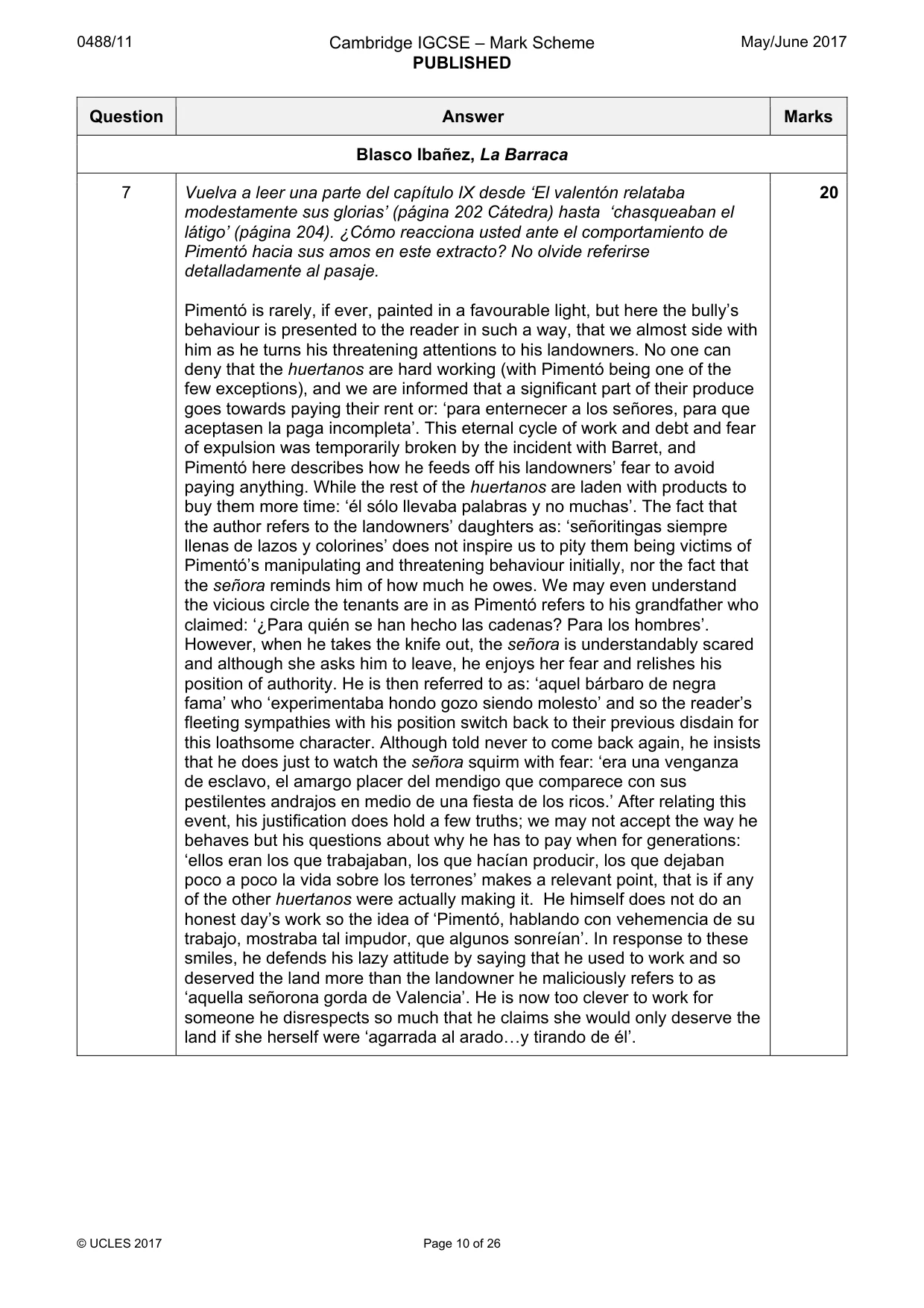
0488/11 Cambridge IGCSE – Mark Scheme PUBLISHED May/June 2017 © UCLES 2017 Page 10 of 26 Question Answer Marks Blasco Ibañez, La Barraca 7 Vuelva a leer una parte del capítulo IX desde ‘El valentón relataba modestamente sus glorias’ (página 202 Cátedra) hasta ‘chasqueaban el látigo’ (página 204). ¿Cómo reacciona usted ante el comportamiento de Pimentó hacia sus amos en este extracto? No olvide referirse detalladamente al pasaje. Pimentó is rarely, if ever, painted in a favourable light, but here the bully’s behaviour is presented to the reader in such a way, that we almost side with him as he turns his threatening attentions to his landowners. No one can deny that the huertanos are hard working (with Pimentó being one of the few exceptions), and we are informed that a significant part of their produce goes towards paying their rent or: ‘para enternecer a los señores, para que aceptasen la paga incompleta’. This eternal cycle of work and debt and fear of expulsion was temporarily broken by the incident with Barret, and Pimentó here describes how he feeds off his landowners’ fear to avoid paying anything. While the rest of the huertanos are laden with products to buy them more time: ‘él sólo llevaba palabras y no muchas’. The fact that the author refers to the landowners’ daughters as: ‘señoritingas siempre llenas de lazos y colorines’ does not inspire us to pity them being victims of Pimentó’s manipulating and threatening behaviour initially, nor the fact that the señora reminds him of how much he owes. We may even understand the vicious circle the tenants are in as Pimentó refers to his grandfather who claimed: ‘¿Para quién se han hecho las cadenas? Para los hombres’. However, when he takes the knife out, the señora is understandably scared and although she asks him to leave, he enjoys her fear and relishes his position of authority. He is then referred to as: ‘aquel bárbaro de negra fama’ who ‘experimentaba hondo gozo siendo molesto’ and so the reader’s fleeting sympathies with his position switch back to their previous disdain for this loathsome character. Although told never to come back again, he insists that he does just to watch the señora squirm with fear: ‘era una venganza de esclavo, el amargo placer del mendigo que comparece con sus pestilentes andrajos en medio de una fiesta de los ricos.’ After relating this event, his justification does hold a few truths; we may not accept the way he behaves but his questions about why he has to pay when for generations: ‘ellos eran los que trabajaban, los que hacían producir, los que dejaban poco a poco la vida sobre los terrones’ makes a relevant point, that is if any of the other huertanos were actually making it. He himself does not do an honest day’s work so the idea of ‘Pimentó, hablando con vehemencia de su trabajo, mostraba tal impudor, que algunos sonreían’. In response to these smiles, he defends his lazy attitude by saying that he used to work and so deserved the land more than the landowner he maliciously refers to as ‘aquella señorona gorda de Valencia’. He is now too clever to work for someone he disrespects so much that he claims she would only deserve the land if she herself were ‘agarrada al arado«y tirando de él’. 20
Mark scheme, page 11
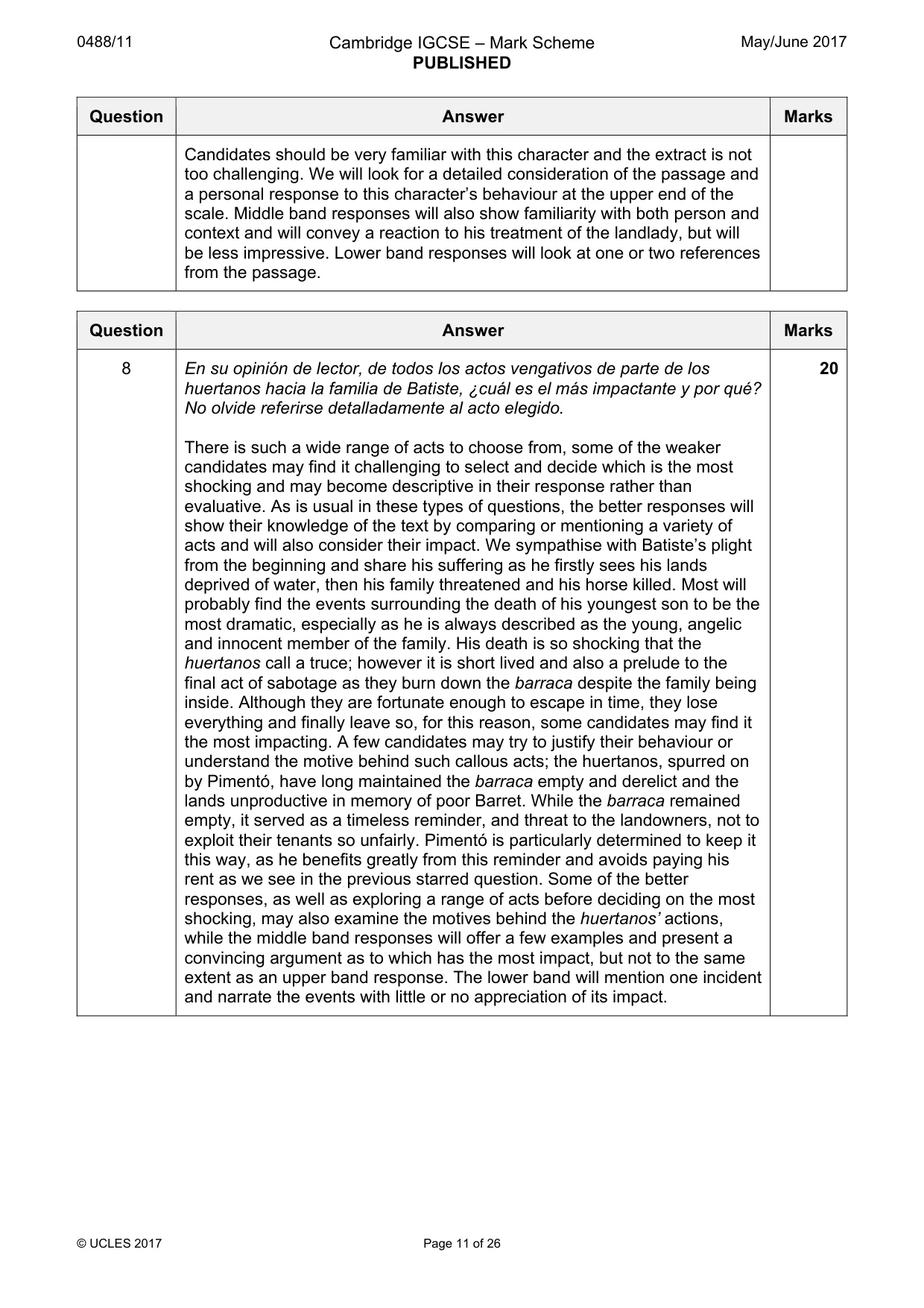
0488/11 Cambridge IGCSE – Mark Scheme PUBLISHED May/June 2017 © UCLES 2017 Page 11 of 26 Question Answer Marks Candidates should be very familiar with this character and the extract is not too challenging. We will look for a detailed consideration of the passage and a personal response to this character’s behaviour at the upper end of the scale. Middle band responses will also show familiarity with both person and context and will convey a reaction to his treatment of the landlady, but will be less impressive. Lower band responses will look at one or two references from the passage. Question Answer Marks 8 En su opinión de lector, de todos los actos vengativos de parte de los huertanos hacia la familia de Batiste, ¿cuál es el más impactante y por qué? No olvide referirse detalladamente al acto elegido. There is such a wide range of acts to choose from, some of the weaker candidates may find it challenging to select and decide which is the most shocking and may become descriptive in their response rather than evaluative. As is usual in these types of questions, the better responses will show their knowledge of the text by comparing or mentioning a variety of acts and will also consider their impact. We sympathise with Batiste’s plight from the beginning and share his suffering as he firstly sees his lands deprived of water, then his family threatened and his horse killed. Most will probably find the events surrounding the death of his youngest son to be the most dramatic, especially as he is always described as the young, angelic and innocent member of the family. His death is so shocking that the huertanos call a truce; however it is short lived and also a prelude to the final act of sabotage as they burn down the barraca despite the family being inside. Although they are fortunate enough to escape in time, they lose everything and finally leave so, for this reason, some candidates may find it the most impacting. A few candidates may try to justify their behaviour or understand the motive behind such callous acts; the huertanos, spurred on by Pimentó, have long maintained the barraca empty and derelict and the lands unproductive in memory of poor Barret. While the barraca remained empty, it served as a timeless reminder, and threat to the landowners, not to exploit their tenants so unfairly. Pimentó is particularly determined to keep it this way, as he benefits greatly from this reminder and avoids paying his rent as we see in the previous starred question. Some of the better responses, as well as exploring a range of acts before deciding on the most shocking, may also examine the motives behind the huertanos’ actions, while the middle band responses will offer a few examples and present a convincing argument as to which has the most impact, but not to the same extent as an upper band response. The lower band will mention one incident and narrate the events with little or no appreciation of its impact. 20
Mark scheme, page 12
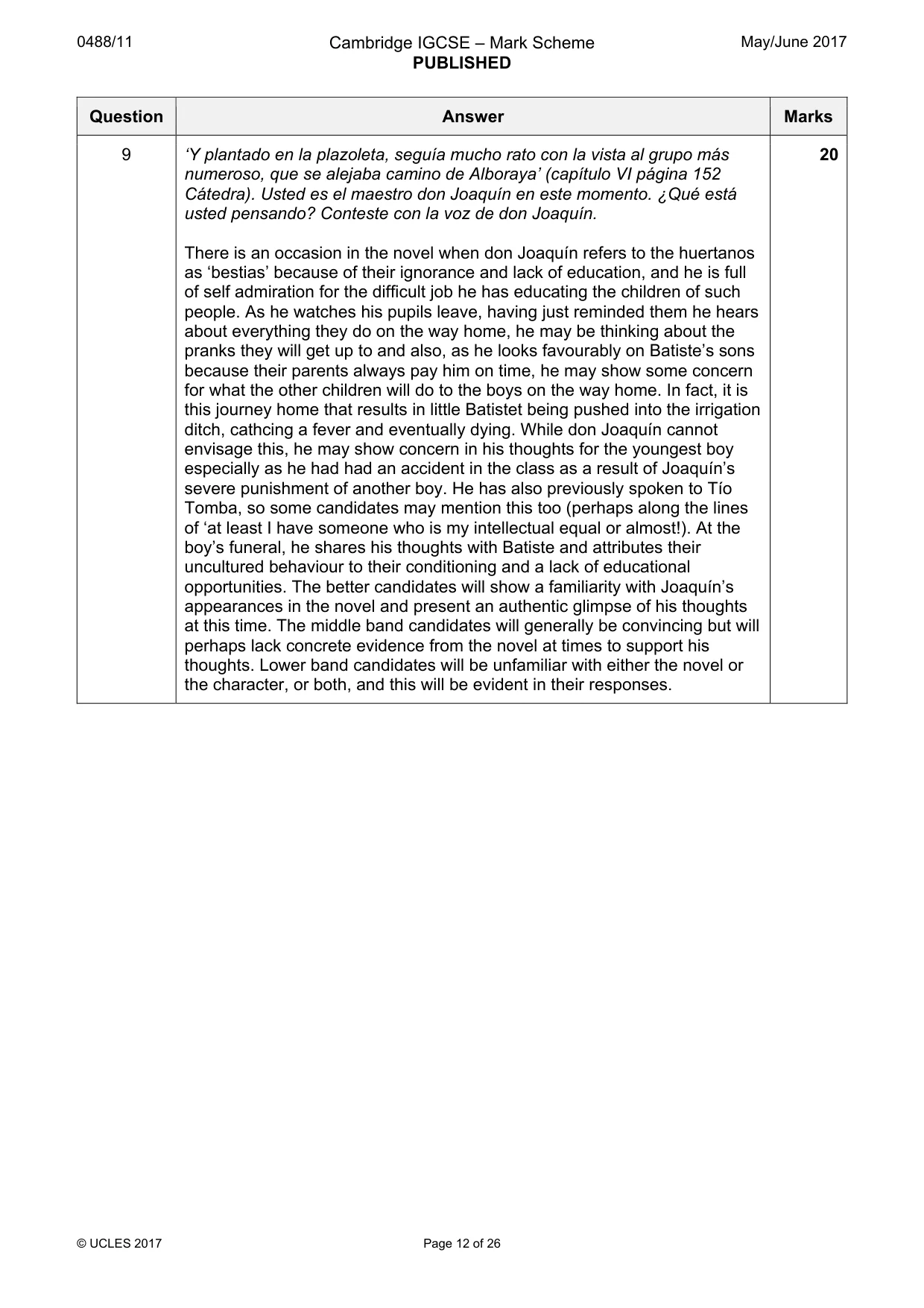
0488/11 Cambridge IGCSE – Mark Scheme PUBLISHED May/June 2017 © UCLES 2017 Page 12 of 26 Question Answer Marks 9 ‘Y plantado en la plazoleta, seguía mucho rato con la vista al grupo más numeroso, que se alejaba camino de Alboraya’ (capítulo VI página 152 Cátedra). Usted es el maestro don Joaquín en este momento. ¿Qué está usted pensando? Conteste con la voz de don Joaquín. There is an occasion in the novel when don Joaquín refers to the huertanos as ‘bestias’ because of their ignorance and lack of education, and he is full of self admiration for the difficult job he has educating the children of such people. As he watches his pupils leave, having just reminded them he hears about everything they do on the way home, he may be thinking about the pranks they will get up to and also, as he looks favourably on Batiste’s sons because their parents always pay him on time, he may show some concern for what the other children will do to the boys on the way home. In fact, it is this journey home that results in little Batistet being pushed into the irrigation ditch, cathcing a fever and eventually dying. While don Joaquín cannot envisage this, he may show concern in his thoughts for the youngest boy especially as he had had an accident in the class as a result of Joaquín’s severe punishment of another boy. He has also previously spoken to Tío Tomba, so some candidates may mention this too (perhaps along the lines of ‘at least I have someone who is my intellectual equal or almost!). At the boy’s funeral, he shares his thoughts with Batiste and attributes their uncultured behaviour to their conditioning and a lack of educational opportunities. The better candidates will show a familiarity with Joaquín’s appearances in the novel and present an authentic glimpse of his thoughts at this time. The middle band candidates will generally be convincing but will perhaps lack concrete evidence from the novel at times to support his thoughts. Lower band candidates will be unfamiliar with either the novel or the character, or both, and this will be evident in their responses. 20
Mark scheme, page 13
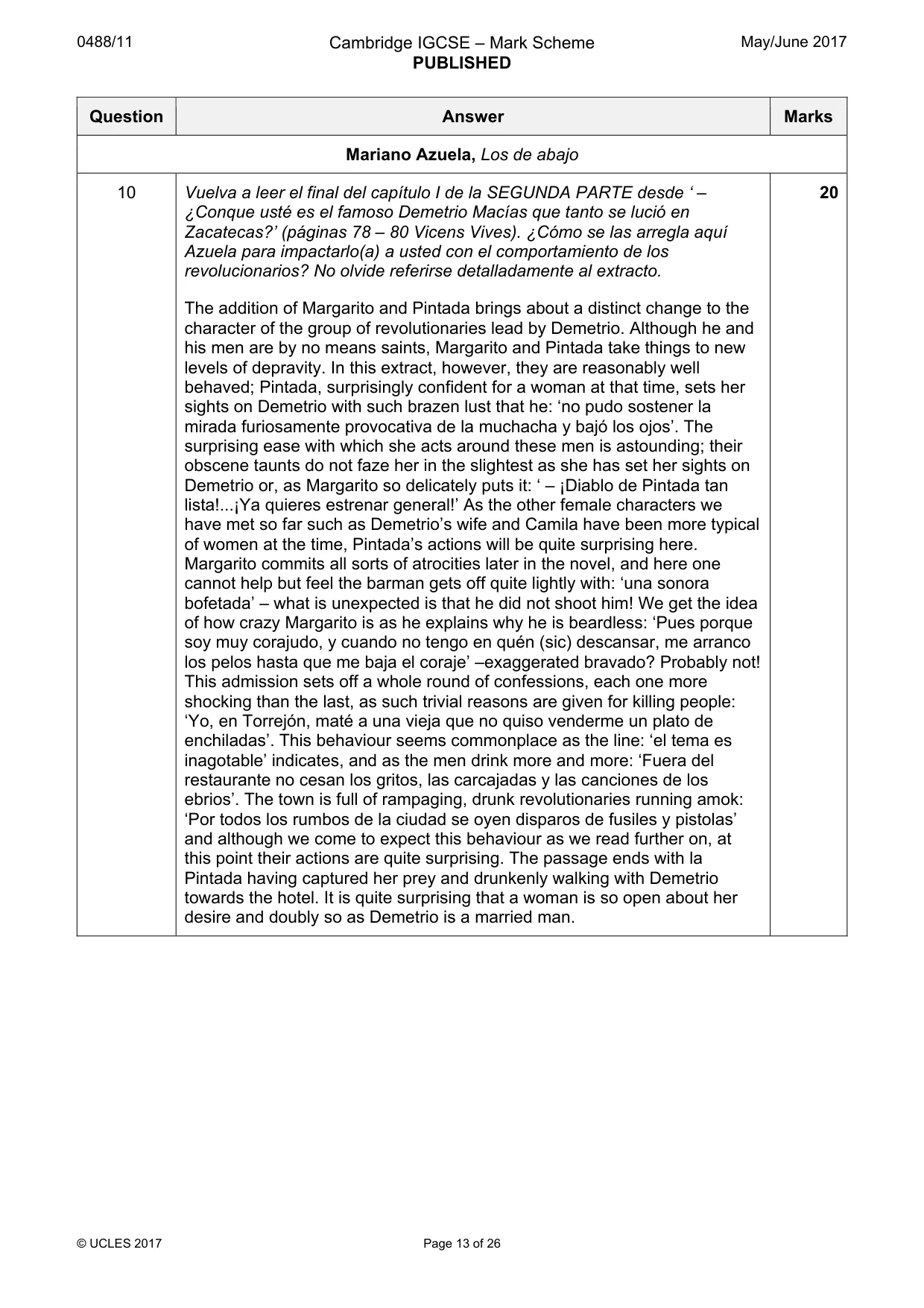
0488/11 Cambridge IGCSE – Mark Scheme PUBLISHED May/June 2017 © UCLES 2017 Page 13 of 26 Question Answer Marks Mariano Azuela, Los de abajo 10 Vuelva a leer el final del capítulo I de la SEGUNDA PARTE desde ‘ – ¿Conque usté es el famoso Demetrio Macías que tanto se lució en Zacatecas?’ (páginas 78 – 80 Vicens Vives). ¿Cómo se las arregla aquí Azuela para impactarlo(a) a usted con el comportamiento de los revolucionarios? No olvide referirse detalladamente al extracto. The addition of Margarito and Pintada brings about a distinct change to the character of the group of revolutionaries lead by Demetrio. Although he and his men are by no means saints, Margarito and Pintada take things to new levels of depravity. In this extract, however, they are reasonably well behaved; Pintada, surprisingly confident for a woman at that time, sets her sights on Demetrio with such brazen lust that he: ‘no pudo sostener la mirada furiosamente provocativa de la muchacha y bajó los ojos’. The surprising ease with which she acts around these men is astounding; their obscene taunts do not faze her in the slightest as she has set her sights on Demetrio or, as Margarito so delicately puts it: ‘ – ¡Diablo de Pintada tan lista!...¡Ya quieres estrenar general!’ As the other female characters we have met so far such as Demetrio’s wife and Camila have been more typical of women at the time, Pintada’s actions will be quite surprising here. Margarito commits all sorts of atrocities later in the novel, and here one cannot help but feel the barman gets off quite lightly with: ‘una sonora bofetada’ – what is unexpected is that he did not shoot him! We get the idea of how crazy Margarito is as he explains why he is beardless: ‘Pues porque soy muy corajudo, y cuando no tengo en quén (sic) descansar, me arranco los pelos hasta que me baja el coraje’ –exaggerated bravado? Probably not! This admission sets off a whole round of confessions, each one more shocking than the last, as such trivial reasons are given for killing people: ‘Yo, en Torrejón, maté a una vieja que no quiso venderme un plato de enchiladas’. This behaviour seems commonplace as the line: ‘el tema es inagotable’ indicates, and as the men drink more and more: ‘Fuera del restaurante no cesan los gritos, las carcajadas y las canciones de los ebrios’. The town is full of rampaging, drunk revolutionaries running amok: ‘Por todos los rumbos de la ciudad se oyen disparos de fusiles y pistolas’ and although we come to expect this behaviour as we read further on, at this point their actions are quite surprising. The passage ends with la Pintada having captured her prey and drunkenly walking with Demetrio towards the hotel. It is quite surprising that a woman is so open about her desire and doubly so as Demetrio is a married man. 20
Mark scheme, page 14
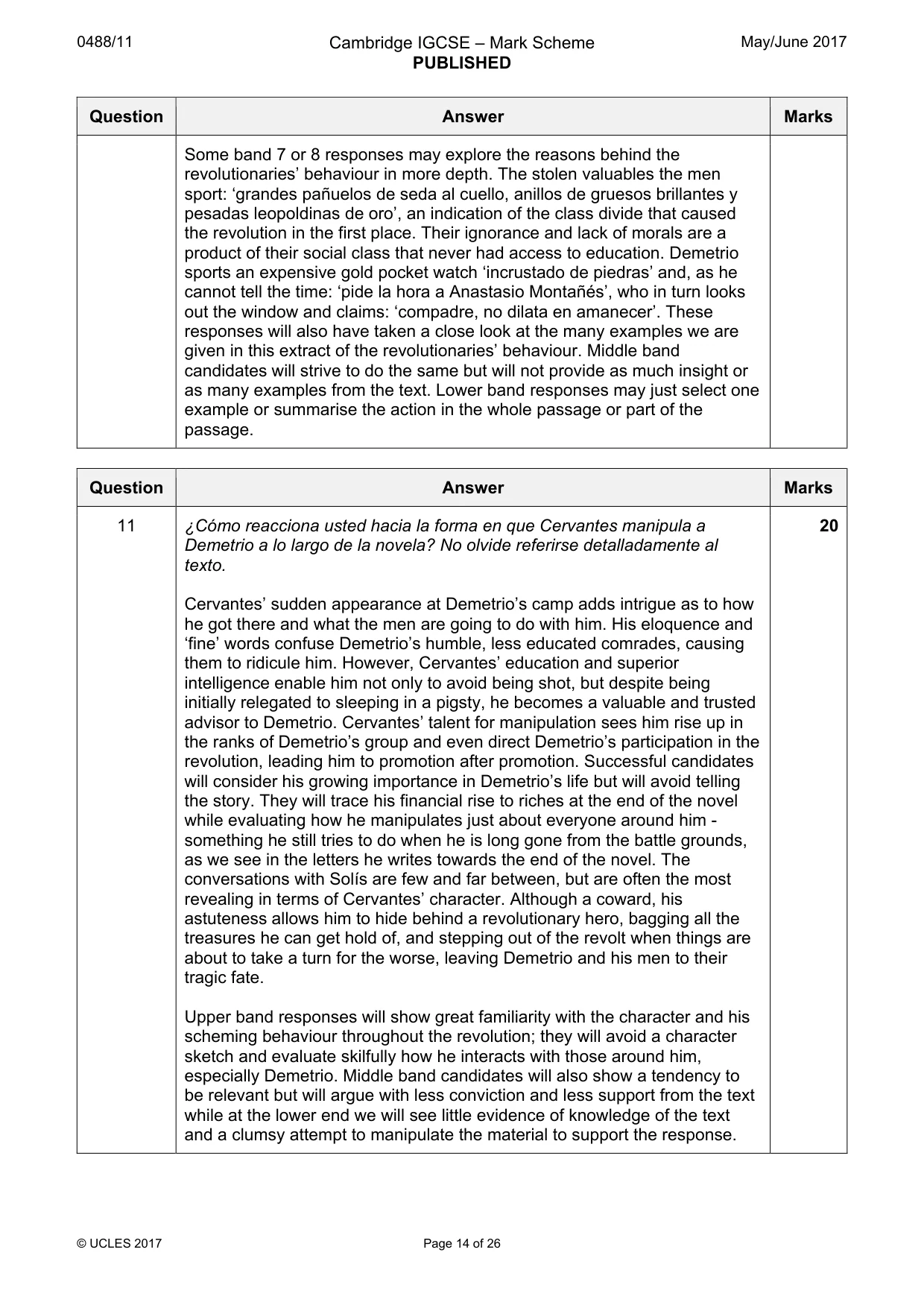
0488/11 Cambridge IGCSE – Mark Scheme PUBLISHED May/June 2017 © UCLES 2017 Page 14 of 26 Question Answer Marks Some band 7 or 8 responses may explore the reasons behind the revolutionaries’ behaviour in more depth. The stolen valuables the men sport: ‘grandes pañuelos de seda al cuello, anillos de gruesos brillantes y pesadas leopoldinas de oro’, an indication of the class divide that caused the revolution in the first place. Their ignorance and lack of morals are a product of their social class that never had access to education. Demetrio sports an expensive gold pocket watch ‘incrustado de piedras’ and, as he cannot tell the time: ‘pide la hora a Anastasio Montañés’, who in turn looks out the window and claims: ‘compadre, no dilata en amanecer’. These responses will also have taken a close look at the many examples we are given in this extract of the revolutionaries’ behaviour. Middle band candidates will strive to do the same but will not provide as much insight or as many examples from the text. Lower band responses may just select one example or summarise the action in the whole passage or part of the passage. Question Answer Marks 11 ¿Cómo reacciona usted hacia la forma en que Cervantes manipula a Demetrio a lo largo de la novela? No olvide referirse detalladamente al texto. Cervantes’ sudden appearance at Demetrio’s camp adds intrigue as to how he got there and what the men are going to do with him. His eloquence and ‘fine’ words confuse Demetrio’s humble, less educated comrades, causing them to ridicule him. However, Cervantes’ education and superior intelligence enable him not only to avoid being shot, but despite being initially relegated to sleeping in a pigsty, he becomes a valuable and trusted advisor to Demetrio. Cervantes’ talent for manipulation sees him rise up in the ranks of Demetrio’s group and even direct Demetrio’s participation in the revolution, leading him to promotion after promotion. Successful candidates will consider his growing importance in Demetrio’s life but will avoid telling the story. They will trace his financial rise to riches at the end of the novel while evaluating how he manipulates just about everyone around him - something he still tries to do when he is long gone from the battle grounds, as we see in the letters he writes towards the end of the novel. The conversations with Solís are few and far between, but are often the most revealing in terms of Cervantes’ character. Although a coward, his astuteness allows him to hide behind a revolutionary hero, bagging all the treasures he can get hold of, and stepping out of the revolt when things are about to take a turn for the worse, leaving Demetrio and his men to their tragic fate. Upper band responses will show great familiarity with the character and his scheming behaviour throughout the revolution; they will avoid a character sketch and evaluate skilfully how he interacts with those around him, especially Demetrio. Middle band candidates will also show a tendency to be relevant but will argue with less conviction and less support from the text while at the lower end we will see little evidence of knowledge of the text and a clumsy attempt to manipulate the material to support the response. 20
Mark scheme, page 15
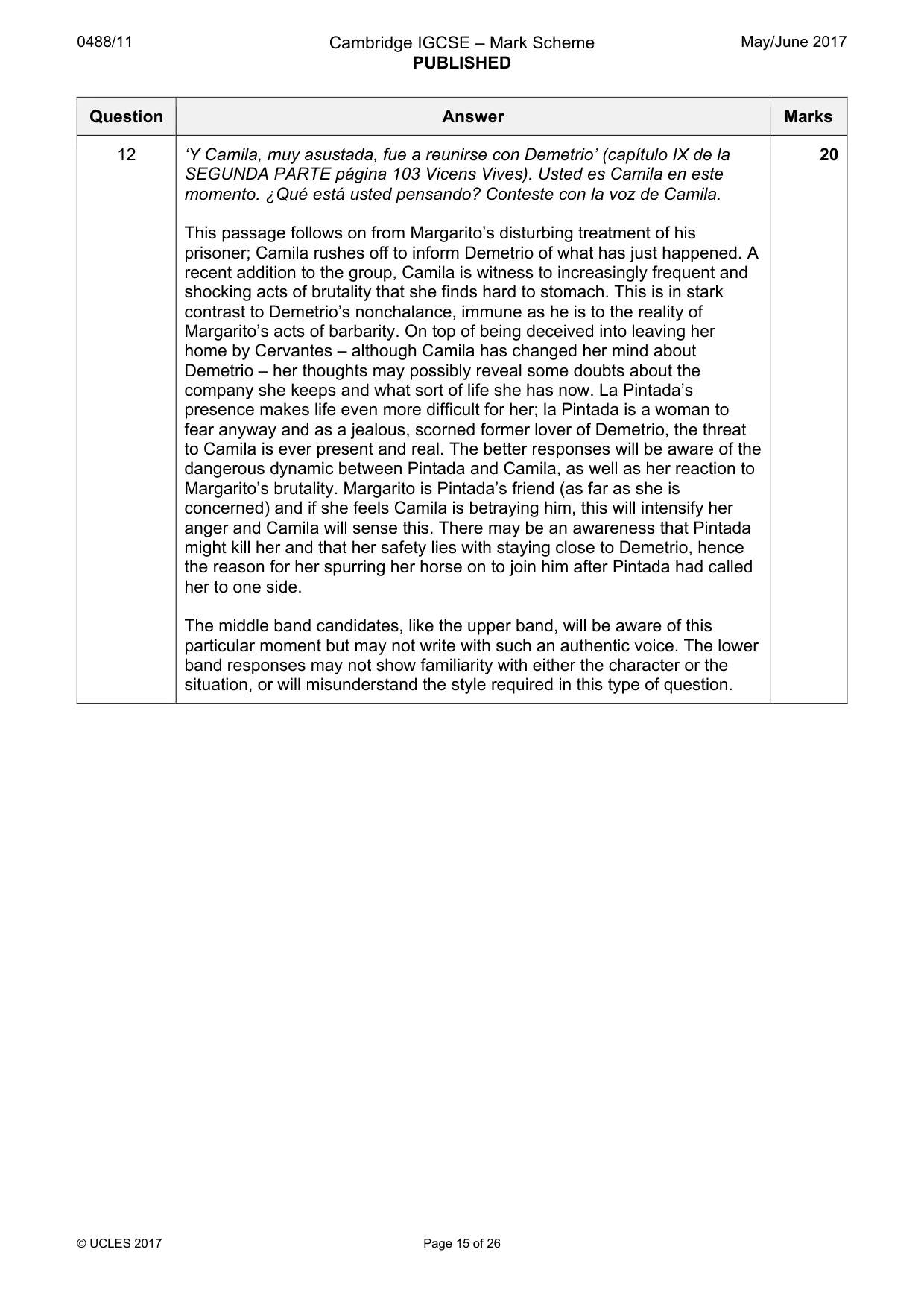
0488/11 Cambridge IGCSE – Mark Scheme PUBLISHED May/June 2017 © UCLES 2017 Page 15 of 26 Question Answer Marks 12 ‘Y Camila, muy asustada, fue a reunirse con Demetrio’ (capítulo IX de la SEGUNDA PARTE página 103 Vicens Vives). Usted es Camila en este momento. ¿Qué está usted pensando? Conteste con la voz de Camila. This passage follows on from Margarito’s disturbing treatment of his prisoner; Camila rushes off to inform Demetrio of what has just happened. A recent addition to the group, Camila is witness to increasingly frequent and shocking acts of brutality that she finds hard to stomach. This is in stark contrast to Demetrio’s nonchalance, immune as he is to the reality of Margarito’s acts of barbarity. On top of being deceived into leaving her home by Cervantes – although Camila has changed her mind about Demetrio – her thoughts may possibly reveal some doubts about the company she keeps and what sort of life she has now. La Pintada’s presence makes life even more difficult for her; la Pintada is a woman to fear anyway and as a jealous, scorned former lover of Demetrio, the threat to Camila is ever present and real. The better responses will be aware of the dangerous dynamic between Pintada and Camila, as well as her reaction to Margarito’s brutality. Margarito is Pintada’s friend (as far as she is concerned) and if she feels Camila is betraying him, this will intensify her anger and Camila will sense this. There may be an awareness that Pintada might kill her and that her safety lies with staying close to Demetrio, hence the reason for her spurring her horse on to join him after Pintada had called her to one side. The middle band candidates, like the upper band, will be aware of this particular moment but may not write with such an authentic voice. The lower band responses may not show familiarity with either the character or the situation, or will misunderstand the style required in this type of question. 20
Mark scheme, page 16
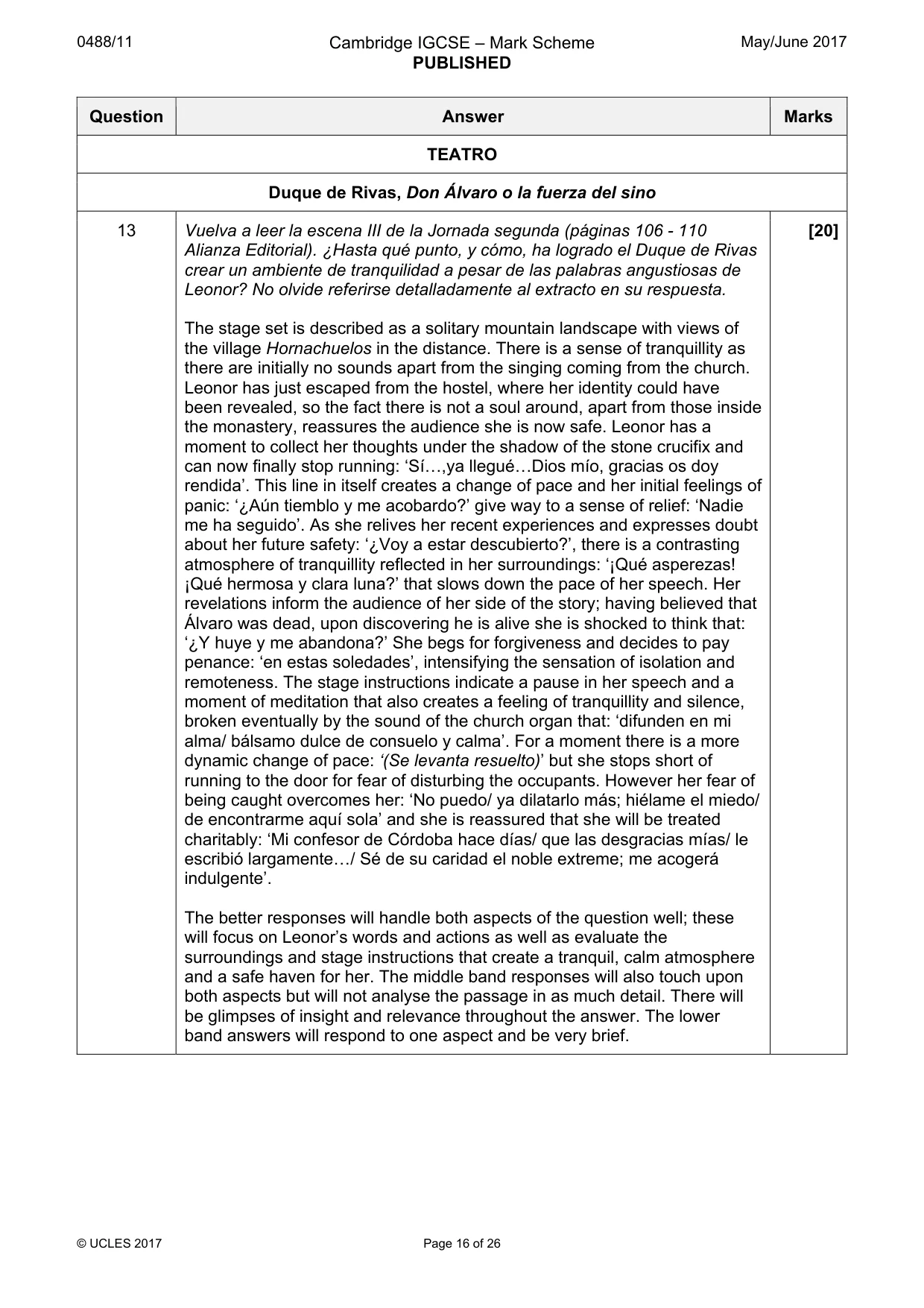
0488/11 Cambridge IGCSE – Mark Scheme PUBLISHED May/June 2017 © UCLES 2017 Page 16 of 26 Question Answer Marks TEATRO Duque de Rivas, Don Álvaro o la fuerza del sino 13 Vuelva a leer la escena III de la Jornada segunda (páginas 106 - 110 Alianza Editorial). ¿Hasta qué punto, y cómo, ha logrado el Duque de Rivas crear un ambiente de tranquilidad a pesar de las palabras angustiosas de Leonor? No olvide referirse detalladamente al extracto en su respuesta. The stage set is described as a solitary mountain landscape with views of the village Hornachuelos in the distance. There is a sense of tranquillity as there are initially no sounds apart from the singing coming from the church. Leonor has just escaped from the hostel, where her identity could have been revealed, so the fact there is not a soul around, apart from those inside the monastery, reassures the audience she is now safe. Leonor has a moment to collect her thoughts under the shadow of the stone crucifix and can now finally stop running: ‘Sí«,ya llegué«Dios mío, gracias os doy rendida’. This line in itself creates a change of pace and her initial feelings of panic: ‘¿Aún tiemblo y me acobardo?’ give way to a sense of relief: ‘Nadie me ha seguido’. As she relives her recent experiences and expresses doubt about her future safety: ‘¿Voy a estar descubierto?’, there is a contrasting atmosphere of tranquillity reflected in her surroundings: ‘¡Qué asperezas! ¡Qué hermosa y clara luna?’ that slows down the pace of her speech. Her revelations inform the audience of her side of the story; having believed that Álvaro was dead, upon discovering he is alive she is shocked to think that: ‘¿Y huye y me abandona?’ She begs for forgiveness and decides to pay penance: ‘en estas soledades’, intensifying the sensation of isolation and remoteness. The stage instructions indicate a pause in her speech and a moment of meditation that also creates a feeling of tranquillity and silence, broken eventually by the sound of the church organ that: ‘difunden en mi alma/ bálsamo dulce de consuelo y calma’. For a moment there is a more dynamic change of pace: ‘(Se levanta resuelto)’ but she stops short of running to the door for fear of disturbing the occupants. However her fear of being caught overcomes her: ‘No puedo/ ya dilatarlo más; hiélame el miedo/ de encontrarme aquí sola’ and she is reassured that she will be treated charitably: ‘Mi confesor de Córdoba hace días/ que las desgracias mías/ le escribió largamente«/ Sé de su caridad el noble extreme; me acogerá indulgente’. The better responses will handle both aspects of the question well; these will focus on Leonor’s words and actions as well as evaluate the surroundings and stage instructions that create a tranquil, calm atmosphere and a safe haven for her. The middle band responses will also touch upon both aspects but will not analyse the passage in as much detail. There will be glimpses of insight and relevance throughout the answer. The lower band answers will respond to one aspect and be very brief. [20]
Mark scheme, page 17
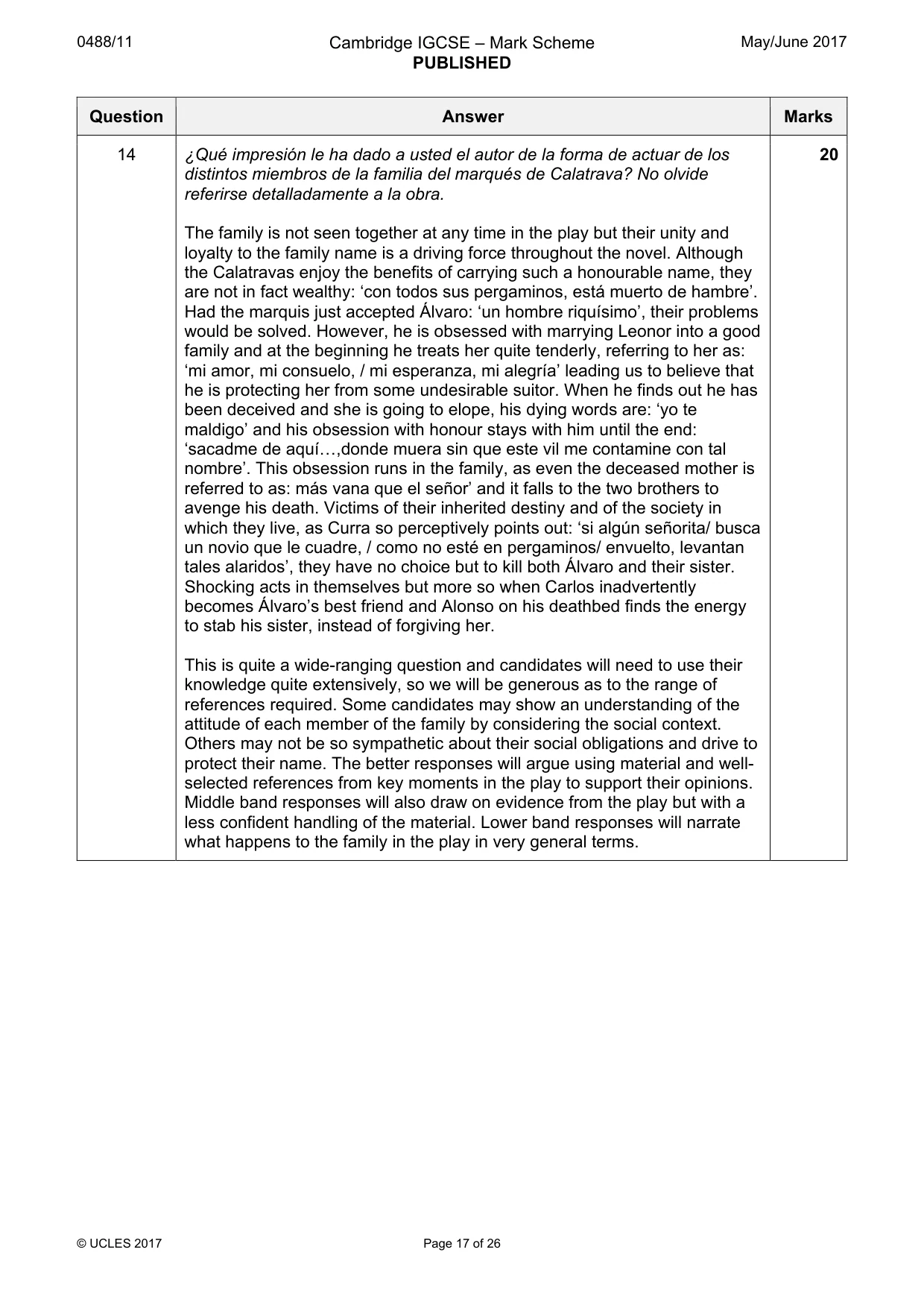
0488/11 Cambridge IGCSE – Mark Scheme PUBLISHED May/June 2017 © UCLES 2017 Page 17 of 26 Question Answer Marks 14 ¿Qué impresión le ha dado a usted el autor de la forma de actuar de los distintos miembros de la familia del marqués de Calatrava? No olvide referirse detalladamente a la obra. The family is not seen together at any time in the play but their unity and loyalty to the family name is a driving force throughout the novel. Although the Calatravas enjoy the benefits of carrying such a honourable name, they are not in fact wealthy: ‘con todos sus pergaminos, está muerto de hambre’. Had the marquis just accepted Álvaro: ‘un hombre riquísimo’, their problems would be solved. However, he is obsessed with marrying Leonor into a good family and at the beginning he treats her quite tenderly, referring to her as: ‘mi amor, mi consuelo, / mi esperanza, mi alegría’ leading us to believe that he is protecting her from some undesirable suitor. When he finds out he has been deceived and she is going to elope, his dying words are: ‘yo te maldigo’ and his obsession with honour stays with him until the end: ‘sacadme de aquí«,donde muera sin que este vil me contamine con tal nombre’. This obsession runs in the family, as even the deceased mother is referred to as: más vana que el señor’ and it falls to the two brothers to avenge his death. Victims of their inherited destiny and of the society in which they live, as Curra so perceptively points out: ‘si algún señorita/ busca un novio que le cuadre, / como no esté en pergaminos/ envuelto, levantan tales alaridos’, they have no choice but to kill both Álvaro and their sister. Shocking acts in themselves but more so when Carlos inadvertently becomes Álvaro’s best friend and Alonso on his deathbed finds the energy to stab his sister, instead of forgiving her. This is quite a wide-ranging question and candidates will need to use their knowledge quite extensively, so we will be generous as to the range of references required. Some candidates may show an understanding of the attitude of each member of the family by considering the social context. Others may not be so sympathetic about their social obligations and drive to protect their name. The better responses will argue using material and well- selected references from key moments in the play to support their opinions. Middle band responses will also draw on evidence from the play but with a less confident handling of the material. Lower band responses will narrate what happens to the family in the play in very general terms. 20
Mark scheme, page 18
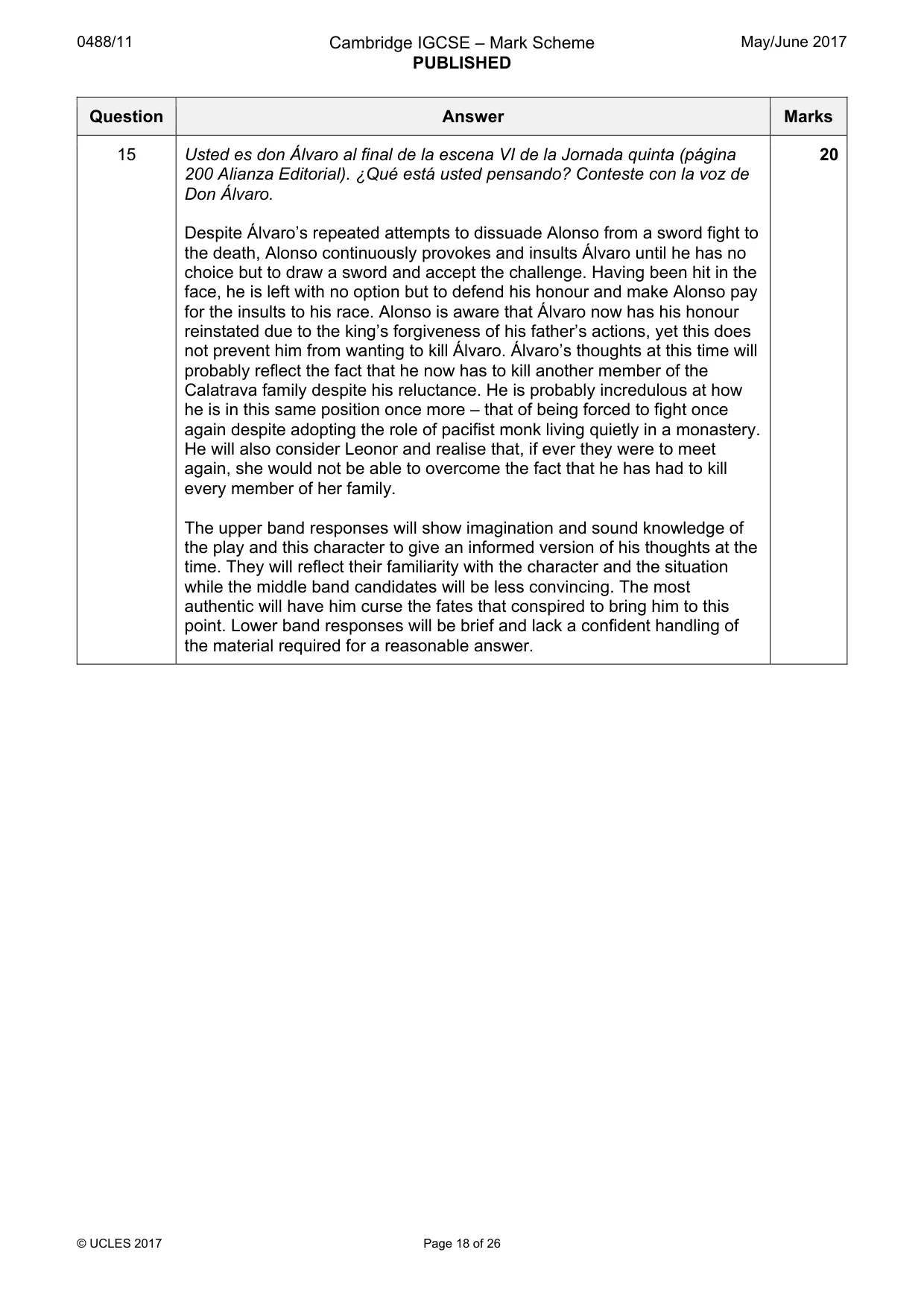
0488/11 Cambridge IGCSE – Mark Scheme PUBLISHED May/June 2017 © UCLES 2017 Page 18 of 26 Question Answer Marks 15 Usted es don Álvaro al final de la escena VI de la Jornada quinta (página 200 Alianza Editorial). ¿Qué está usted pensando? Conteste con la voz de Don Álvaro. Despite Álvaro’s repeated attempts to dissuade Alonso from a sword fight to the death, Alonso continuously provokes and insults Álvaro until he has no choice but to draw a sword and accept the challenge. Having been hit in the face, he is left with no option but to defend his honour and make Alonso pay for the insults to his race. Alonso is aware that Álvaro now has his honour reinstated due to the king’s forgiveness of his father’s actions, yet this does not prevent him from wanting to kill Álvaro. Álvaro’s thoughts at this time will probably reflect the fact that he now has to kill another member of the Calatrava family despite his reluctance. He is probably incredulous at how he is in this same position once more – that of being forced to fight once again despite adopting the role of pacifist monk living quietly in a monastery. He will also consider Leonor and realise that, if ever they were to meet again, she would not be able to overcome the fact that he has had to kill every member of her family. The upper band responses will show imagination and sound knowledge of the play and this character to give an informed version of his thoughts at the time. They will reflect their familiarity with the character and the situation while the middle band candidates will be less convincing. The most authentic will have him curse the fates that conspired to bring him to this point. Lower band responses will be brief and lack a confident handling of the material required for a reasonable answer. 20
Mark scheme, page 19
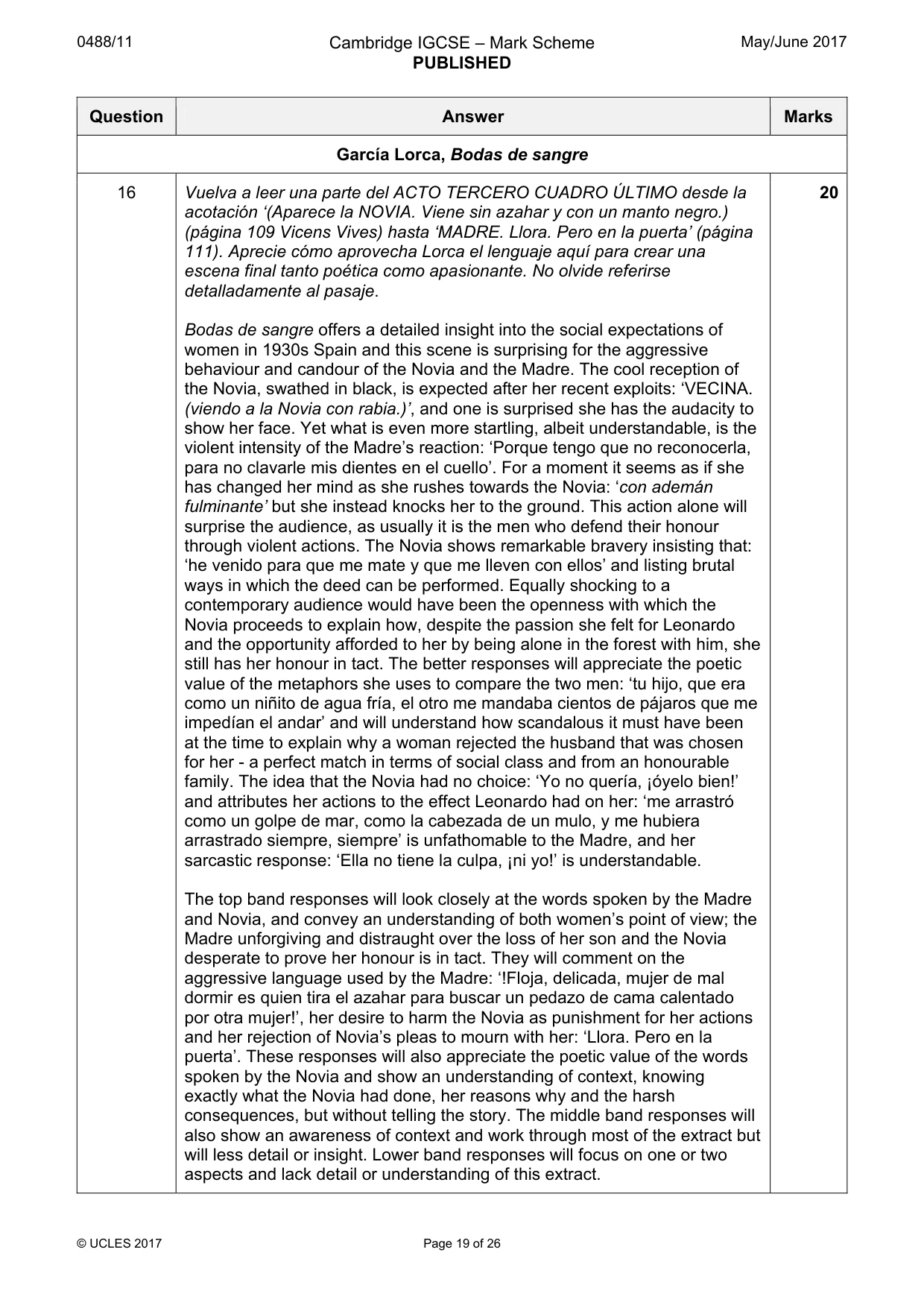
0488/11 Cambridge IGCSE – Mark Scheme PUBLISHED May/June 2017 © UCLES 2017 Page 19 of 26 Question Answer Marks García Lorca, Bodas de sangre 16 Vuelva a leer una parte del ACTO TERCERO CUADRO ÚLTIMO desde la acotación ‘(Aparece la NOVIA. Viene sin azahar y con un manto negro.) (página 109 Vicens Vives) hasta ‘MADRE. Llora. Pero en la puerta’ (página 111). Aprecie cómo aprovecha Lorca el lenguaje aquí para crear una escena final tanto poética como apasionante. No olvide referirse detalladamente al pasaje. Bodas de sangre offers a detailed insight into the social expectations of women in 1930s Spain and this scene is surprising for the aggressive behaviour and candour of the Novia and the Madre. The cool reception of the Novia, swathed in black, is expected after her recent exploits: ‘VECINA. (viendo a la Novia con rabia.)’, and one is surprised she has the audacity to show her face. Yet what is even more startling, albeit understandable, is the violent intensity of the Madre’s reaction: ‘Porque tengo que no reconocerla, para no clavarle mis dientes en el cuello’. For a moment it seems as if she has changed her mind as she rushes towards the Novia: ‘con ademán fulminante’ but she instead knocks her to the ground. This action alone will surprise the audience, as usually it is the men who defend their honour through violent actions. The Novia shows remarkable bravery insisting that: ‘he venido para que me mate y que me lleven con ellos’ and listing brutal ways in which the deed can be performed. Equally shocking to a contemporary audience would have been the openness with which the Novia proceeds to explain how, despite the passion she felt for Leonardo and the opportunity afforded to her by being alone in the forest with him, she still has her honour in tact. The better responses will appreciate the poetic value of the metaphors she uses to compare the two men: ‘tu hijo, que era como un niñito de agua fría, el otro me mandaba cientos de pájaros que me impedían el andar’ and will understand how scandalous it must have been at the time to explain why a woman rejected the husband that was chosen for her - a perfect match in terms of social class and from an honourable family. The idea that the Novia had no choice: ‘Yo no quería, ¡óyelo bien!’ and attributes her actions to the effect Leonardo had on her: ‘me arrastró como un golpe de mar, como la cabezada de un mulo, y me hubiera arrastrado siempre, siempre’ is unfathomable to the Madre, and her sarcastic response: ‘Ella no tiene la culpa, ¡ni yo!’ is understandable. The top band responses will look closely at the words spoken by the Madre and Novia, and convey an understanding of both women’s point of view; the Madre unforgiving and distraught over the loss of her son and the Novia desperate to prove her honour is in tact. They will comment on the aggressive language used by the Madre: ‘!Floja, delicada, mujer de mal dormir es quien tira el azahar para buscar un pedazo de cama calentado por otra mujer!’, her desire to harm the Novia as punishment for her actions and her rejection of Novia’s pleas to mourn with her: ‘Llora. Pero en la puerta’. These responses will also appreciate the poetic value of the words spoken by the Novia and show an understanding of context, knowing exactly what the Novia had done, her reasons why and the harsh consequences, but without telling the story. The middle band responses will also show an awareness of context and work through most of the extract but will less detail or insight. Lower band responses will focus on one or two aspects and lack detail or understanding of this extract. 20
Mark scheme, page 20
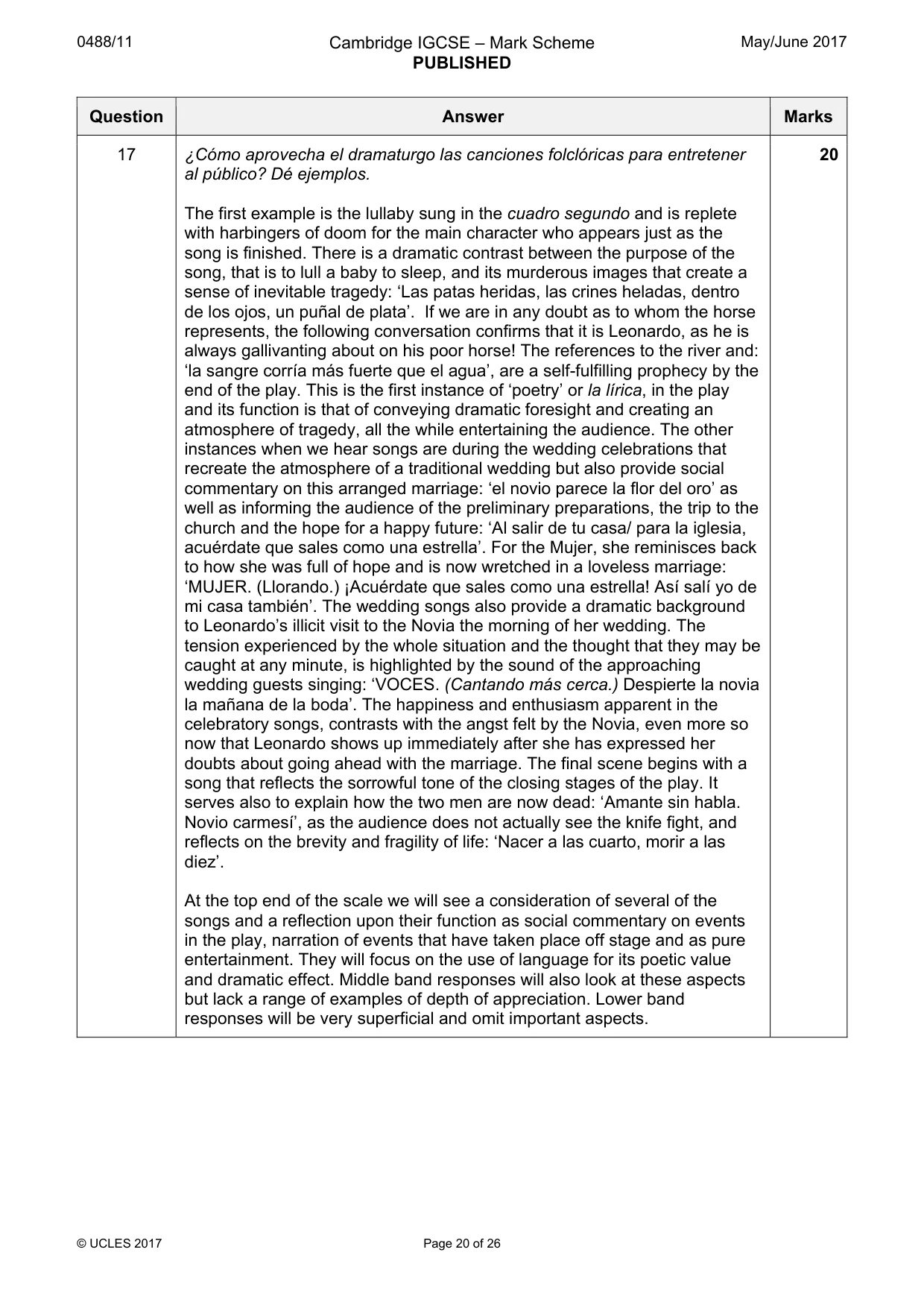
0488/11 Cambridge IGCSE – Mark Scheme PUBLISHED May/June 2017 © UCLES 2017 Page 20 of 26 Question Answer Marks 17 ¿Cómo aprovecha el dramaturgo las canciones folclóricas para entretener al público? Dé ejemplos. The first example is the lullaby sung in the cuadro segundo and is replete with harbingers of doom for the main character who appears just as the song is finished. There is a dramatic contrast between the purpose of the song, that is to lull a baby to sleep, and its murderous images that create a sense of inevitable tragedy: ‘Las patas heridas, las crines heladas, dentro de los ojos, un puñal de plata’. If we are in any doubt as to whom the horse represents, the following conversation confirms that it is Leonardo, as he is always gallivanting about on his poor horse! The references to the river and: ‘la sangre corría más fuerte que el agua’, are a self-fulfilling prophecy by the end of the play. This is the first instance of ‘poetry’ or la lírica, in the play and its function is that of conveying dramatic foresight and creating an atmosphere of tragedy, all the while entertaining the audience. The other instances when we hear songs are during the wedding celebrations that recreate the atmosphere of a traditional wedding but also provide social commentary on this arranged marriage: ‘el novio parece la flor del oro’ as well as informing the audience of the preliminary preparations, the trip to the church and the hope for a happy future: ‘Al salir de tu casa/ para la iglesia, acuérdate que sales como una estrella’. For the Mujer, she reminisces back to how she was full of hope and is now wretched in a loveless marriage: ‘MUJER. (Llorando.) ¡Acuérdate que sales como una estrella! Así salí yo de mi casa también’. The wedding songs also provide a dramatic background to Leonardo’s illicit visit to the Novia the morning of her wedding. The tension experienced by the whole situation and the thought that they may be caught at any minute, is highlighted by the sound of the approaching wedding guests singing: ‘VOCES. (Cantando más cerca.) Despierte la novia la mañana de la boda’. The happiness and enthusiasm apparent in the celebratory songs, contrasts with the angst felt by the Novia, even more so now that Leonardo shows up immediately after she has expressed her doubts about going ahead with the marriage. The final scene begins with a song that reflects the sorrowful tone of the closing stages of the play. It serves also to explain how the two men are now dead: ‘Amante sin habla. Novio carmesí’, as the audience does not actually see the knife fight, and reflects on the brevity and fragility of life: ‘Nacer a las cuarto, morir a las diez’. At the top end of the scale we will see a consideration of several of the songs and a reflection upon their function as social commentary on events in the play, narration of events that have taken place off stage and as pure entertainment. They will focus on the use of language for its poetic value and dramatic effect. Middle band responses will also look at these aspects but lack a range of examples of depth of appreciation. Lower band responses will be very superficial and omit important aspects. 20
Mark scheme, page 21
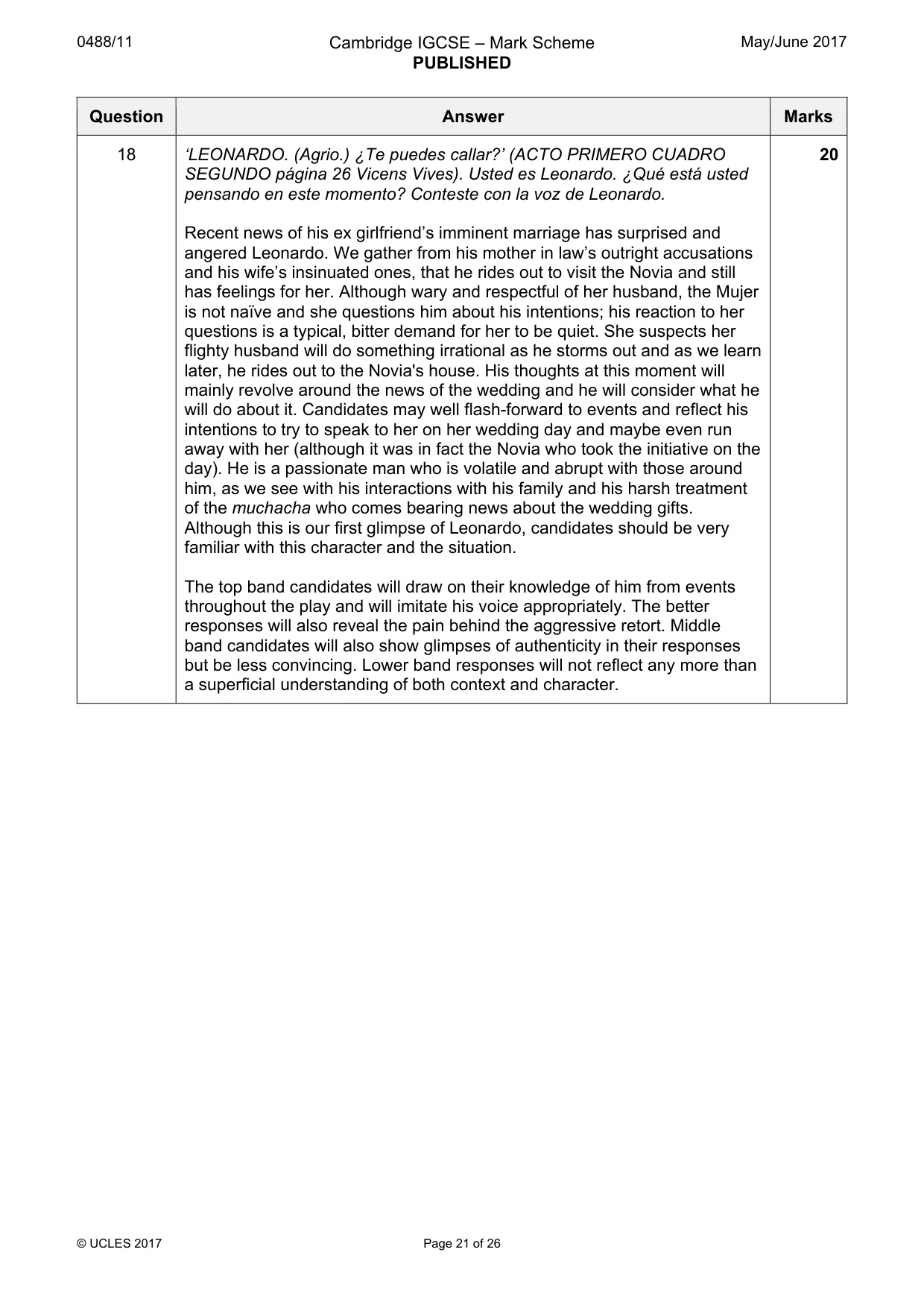
0488/11 Cambridge IGCSE – Mark Scheme PUBLISHED May/June 2017 © UCLES 2017 Page 21 of 26 Question Answer Marks 18 ‘LEONARDO. (Agrio.) ¿Te puedes callar?’ (ACTO PRIMERO CUADRO SEGUNDO página 26 Vicens Vives). Usted es Leonardo. ¿Qué está usted pensando en este momento? Conteste con la voz de Leonardo. Recent news of his ex girlfriend’s imminent marriage has surprised and angered Leonardo. We gather from his mother in law’s outright accusations and his wife’s insinuated ones, that he rides out to visit the Novia and still has feelings for her. Although wary and respectful of her husband, the Mujer is not naïve and she questions him about his intentions; his reaction to her questions is a typical, bitter demand for her to be quiet. She suspects her flighty husband will do something irrational as he storms out and as we learn later, he rides out to the Novia's house. His thoughts at this moment will mainly revolve around the news of the wedding and he will consider what he will do about it. Candidates may well flash-forward to events and reflect his intentions to try to speak to her on her wedding day and maybe even run away with her (although it was in fact the Novia who took the initiative on the day). He is a passionate man who is volatile and abrupt with those around him, as we see with his interactions with his family and his harsh treatment of the muchacha who comes bearing news about the wedding gifts. Although this is our first glimpse of Leonardo, candidates should be very familiar with this character and the situation. The top band candidates will draw on their knowledge of him from events throughout the play and will imitate his voice appropriately. The better responses will also reveal the pain behind the aggressive retort. Middle band candidates will also show glimpses of authenticity in their responses but be less convincing. Lower band responses will not reflect any more than a superficial understanding of both context and character. 20
Mark scheme, page 22
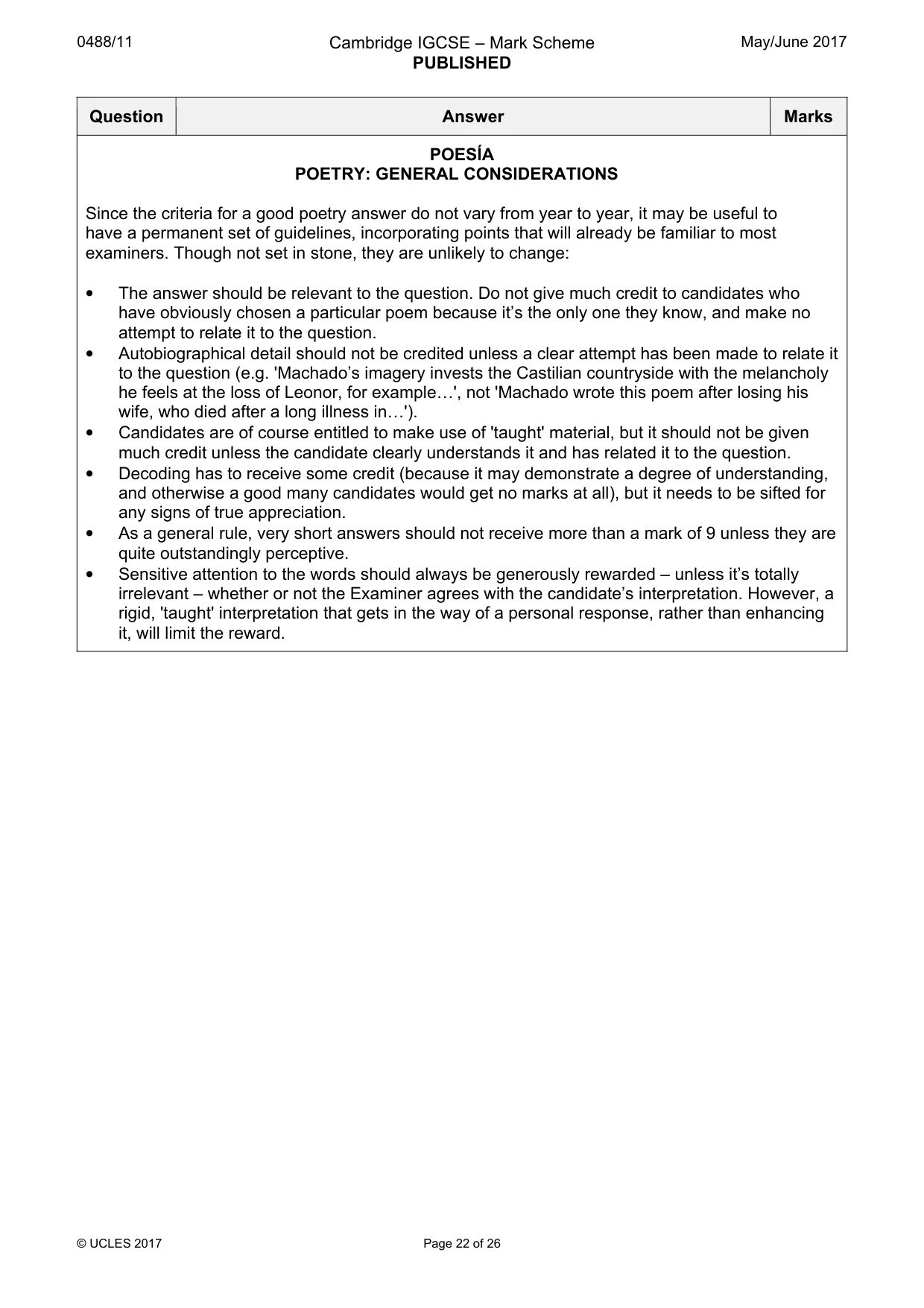
0488/11 Cambridge IGCSE – Mark Scheme PUBLISHED May/June 2017 © UCLES 2017 Page 22 of 26 Question Answer Marks POESĺA POETRY: GENERAL CONSIDERATIONS Since the criteria for a good poetry answer do not vary from year to year, it may be useful to have a permanent set of guidelines, incorporating points that will already be familiar to most examiners. Though not set in stone, they are unlikely to change: • The answer should be relevant to the question. Do not give much credit to candidates who have obviously chosen a particular poem because it’s the only one they know, and make no attempt to relate it to the question. • Autobiographical detail should not be credited unless a clear attempt has been made to relate it to the question (e.g. 'Machado’s imagery invests the Castilian countryside with the melancholy he feels at the loss of Leonor, for example«', not 'Machado wrote this poem after losing his wife, who died after a long illness in«'). • Candidates are of course entitled to make use of 'taught' material, but it should not be given much credit unless the candidate clearly understands it and has related it to the question. • Decoding has to receive some credit (because it may demonstrate a degree of understanding, and otherwise a good many candidates would get no marks at all), but it needs to be sifted for any signs of true appreciation. • As a general rule, very short answers should not receive more than a mark of 9 unless they are quite outstandingly perceptive. • Sensitive attention to the words should always be generously rewarded – unless it’s totally irrelevant – whether or not the Examiner agrees with the candidate’s interpretation. However, a rigid, 'taught' interpretation that gets in the way of a personal response, rather than enhancing it, will limit the reward.
Mark scheme, page 23
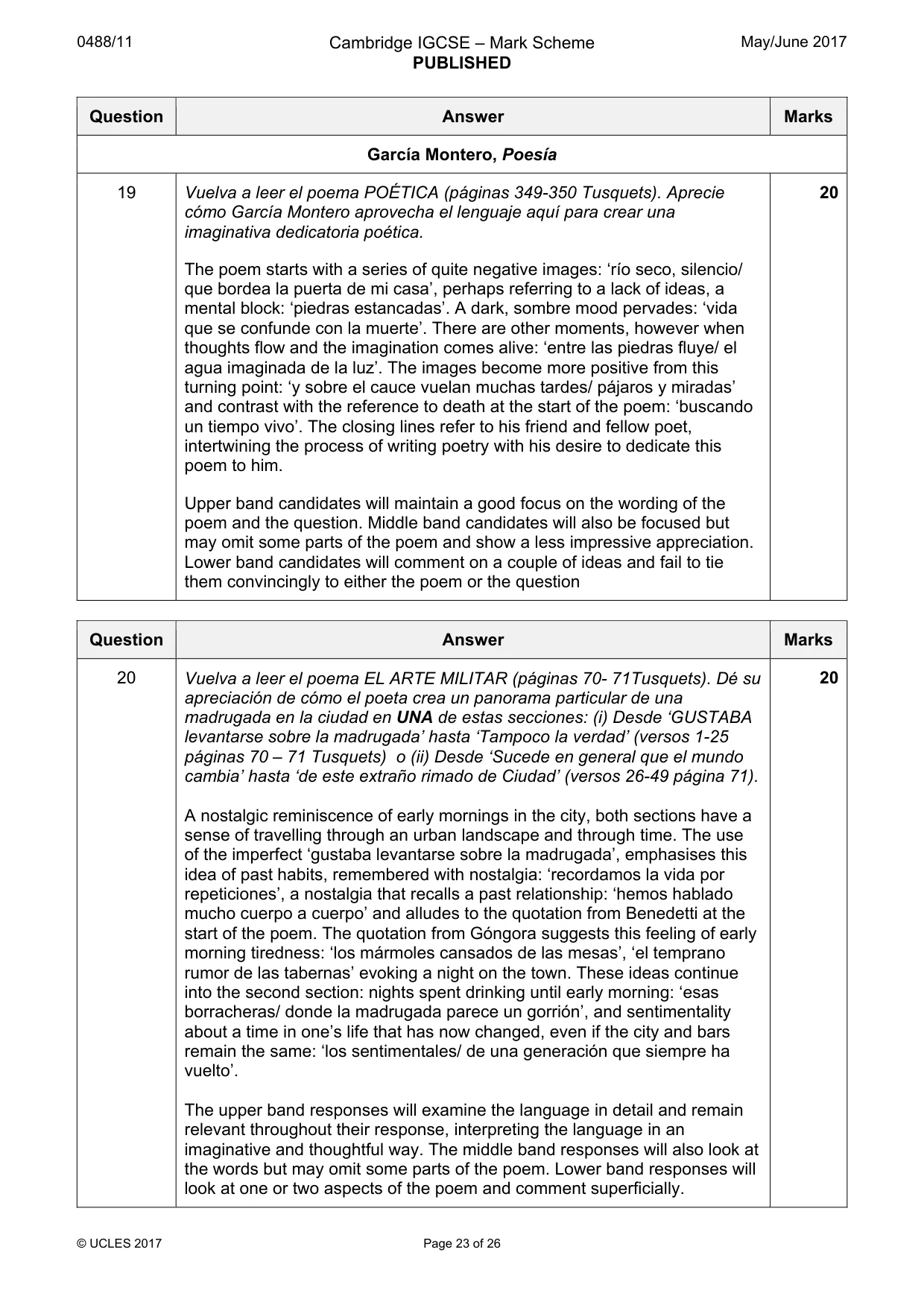
0488/11 Cambridge IGCSE – Mark Scheme PUBLISHED May/June 2017 © UCLES 2017 Page 23 of 26 Question Answer Marks García Montero, Poesía 19 Vuelva a leer el poema POÉTICA (páginas 349-350 Tusquets). Aprecie cómo García Montero aprovecha el lenguaje aquí para crear una imaginativa dedicatoria poética. The poem starts with a series of quite negative images: ‘río seco, silencio/ que bordea la puerta de mi casa’, perhaps referring to a lack of ideas, a mental block: ‘piedras estancadas’. A dark, sombre mood pervades: ‘vida que se confunde con la muerte’. There are other moments, however when thoughts flow and the imagination comes alive: ‘entre las piedras fluye/ el agua imaginada de la luz’. The images become more positive from this turning point: ‘y sobre el cauce vuelan muchas tardes/ pájaros y miradas’ and contrast with the reference to death at the start of the poem: ‘buscando un tiempo vivo’. The closing lines refer to his friend and fellow poet, intertwining the process of writing poetry with his desire to dedicate this poem to him. Upper band candidates will maintain a good focus on the wording of the poem and the question. Middle band candidates will also be focused but may omit some parts of the poem and show a less impressive appreciation. Lower band candidates will comment on a couple of ideas and fail to tie them convincingly to either the poem or the question 20 Question Answer Marks 20 Vuelva a leer el poema EL ARTE MILITAR (páginas 70- 71Tusquets). Dé su apreciación de cómo el poeta crea un panorama particular de una madrugada en la ciudad en UNA de estas secciones: (i) Desde ‘GUSTABA levantarse sobre la madrugada’ hasta ‘Tampoco la verdad’ (versos 1-25 páginas 70 – 71 Tusquets) o (ii) Desde ‘Sucede en general que el mundo cambia’ hasta ‘de este extraño rimado de Ciudad’ (versos 26-49 página 71). A nostalgic reminiscence of early mornings in the city, both sections have a sense of travelling through an urban landscape and through time. The use of the imperfect ‘gustaba levantarse sobre la madrugada’, emphasises this idea of past habits, remembered with nostalgia: ‘recordamos la vida por repeticiones’, a nostalgia that recalls a past relationship: ‘hemos hablado mucho cuerpo a cuerpo’ and alludes to the quotation from Benedetti at the start of the poem. The quotation from Góngora suggests this feeling of early morning tiredness: ‘los mármoles cansados de las mesas’, ‘el temprano rumor de las tabernas’ evoking a night on the town. These ideas continue into the second section: nights spent drinking until early morning: ‘esas borracheras/ donde la madrugada parece un gorrión’, and sentimentality about a time in one’s life that has now changed, even if the city and bars remain the same: ‘los sentimentales/ de una generación que siempre ha vuelto’. The upper band responses will examine the language in detail and remain relevant throughout their response, interpreting the language in an imaginative and thoughtful way. The middle band responses will also look at the words but may omit some parts of the poem. Lower band responses will look at one or two aspects of the poem and comment superficially. 20
Mark scheme, page 24
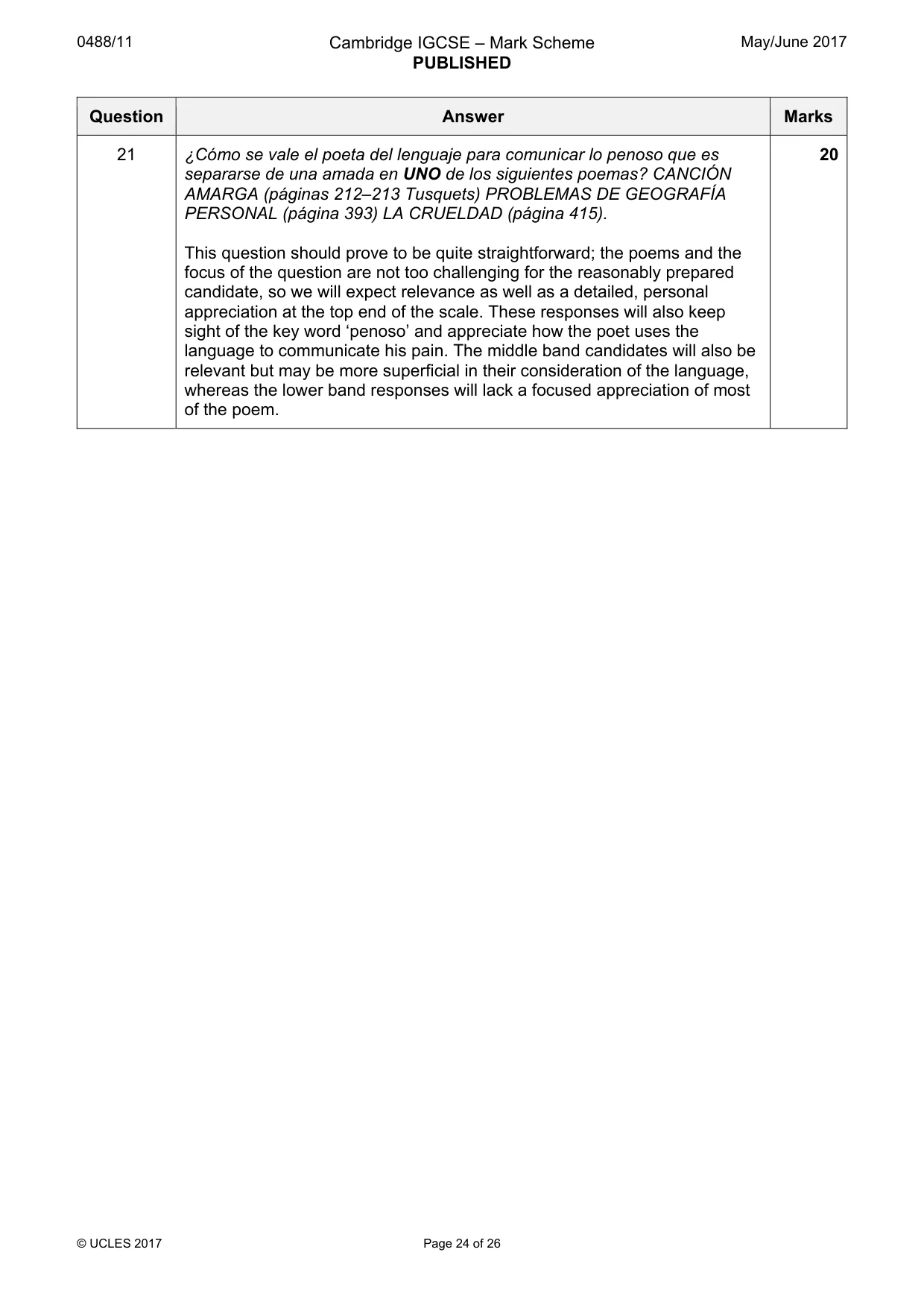
0488/11 Cambridge IGCSE – Mark Scheme PUBLISHED May/June 2017 © UCLES 2017 Page 24 of 26 Question Answer Marks 21 ¿Cómo se vale el poeta del lenguaje para comunicar lo penoso que es separarse de una amada en UNO de los siguientes poemas? CANCIÓN AMARGA (páginas 212–213 Tusquets) PROBLEMAS DE GEOGRAFÍA PERSONAL (página 393) LA CRUELDAD (página 415). This question should prove to be quite straightforward; the poems and the focus of the question are not too challenging for the reasonably prepared candidate, so we will expect relevance as well as a detailed, personal appreciation at the top end of the scale. These responses will also keep sight of the key word ‘penoso’ and appreciate how the poet uses the language to communicate his pain. The middle band candidates will also be relevant but may be more superficial in their consideration of the language, whereas the lower band responses will lack a focused appreciation of most of the poem. 20
Mark scheme, page 25
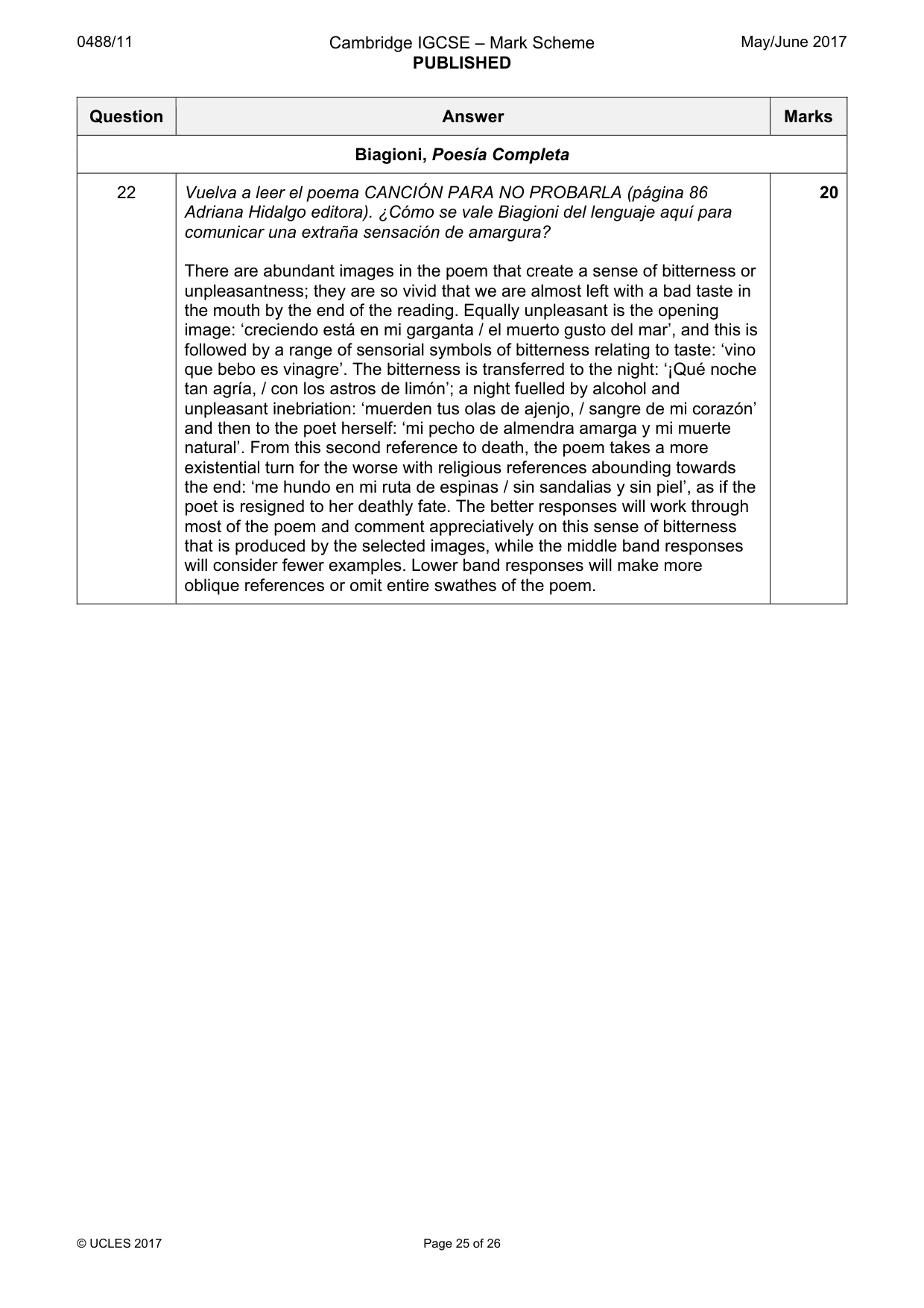
0488/11 Cambridge IGCSE – Mark Scheme PUBLISHED May/June 2017 © UCLES 2017 Page 25 of 26 Question Answer Marks Biagioni, Poesía Completa 22 Vuelva a leer el poema CANCIÓN PARA NO PROBARLA (página 86 Adriana Hidalgo editora). ¿Cómo se vale Biagioni del lenguaje aquí para comunicar una extraña sensación de amargura? There are abundant images in the poem that create a sense of bitterness or unpleasantness; they are so vivid that we are almost left with a bad taste in the mouth by the end of the reading. Equally unpleasant is the opening image: ‘creciendo está en mi garganta / el muerto gusto del mar’, and this is followed by a range of sensorial symbols of bitterness relating to taste: ‘vino que bebo es vinagre’. The bitterness is transferred to the night: ‘¡Qué noche tan agría, / con los astros de limón’; a night fuelled by alcohol and unpleasant inebriation: ‘muerden tus olas de ajenjo, / sangre de mi corazón’ and then to the poet herself: ‘mi pecho de almendra amarga y mi muerte natural’. From this second reference to death, the poem takes a more existential turn for the worse with religious references abounding towards the end: ‘me hundo en mi ruta de espinas / sin sandalias y sin piel’, as if the poet is resigned to her deathly fate. The better responses will work through most of the poem and comment appreciatively on this sense of bitterness that is produced by the selected images, while the middle band responses will consider fewer examples. Lower band responses will make more oblique references or omit entire swathes of the poem. 20
Mark scheme, page 26
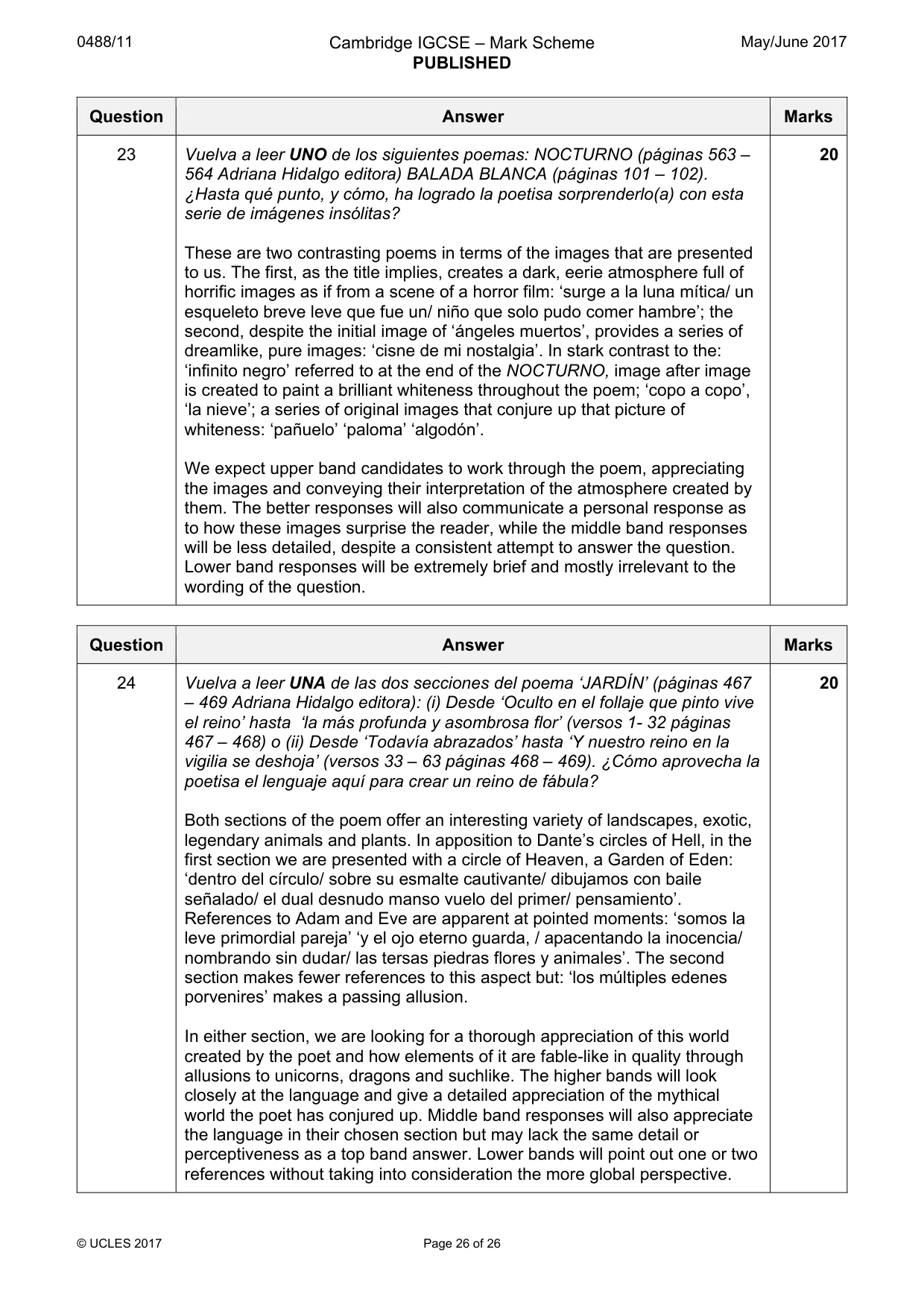
0488/11 Cambridge IGCSE – Mark Scheme PUBLISHED May/June 2017 © UCLES 2017 Page 26 of 26 Question Answer Marks 23 Vuelva a leer UNO de los siguientes poemas: NOCTURNO (páginas 563 – 564 Adriana Hidalgo editora) BALADA BLANCA (páginas 101 – 102). ¿Hasta qué punto, y cómo, ha logrado la poetisa sorprenderlo(a) con esta serie de imágenes insólitas? These are two contrasting poems in terms of the images that are presented to us. The first, as the title implies, creates a dark, eerie atmosphere full of horrific images as if from a scene of a horror film: ‘surge a la luna mítica/ un esqueleto breve leve que fue un/ niño que solo pudo comer hambre’; the second, despite the initial image of ‘ángeles muertos’, provides a series of dreamlike, pure images: ‘cisne de mi nostalgia’. In stark contrast to the: ‘infinito negro’ referred to at the end of the NOCTURNO, image after image is created to paint a brilliant whiteness throughout the poem; ‘copo a copo’, ‘la nieve’; a series of original images that conjure up that picture of whiteness: ‘pañuelo’ ‘paloma’ ‘algodón’. We expect upper band candidates to work through the poem, appreciating the images and conveying their interpretation of the atmosphere created by them. The better responses will also communicate a personal response as to how these images surprise the reader, while the middle band responses will be less detailed, despite a consistent attempt to answer the question. Lower band responses will be extremely brief and mostly irrelevant to the wording of the question. 20 Question Answer Marks 24 Vuelva a leer UNA de las dos secciones del poema ‘JARDÍN’ (páginas 467 – 469 Adriana Hidalgo editora): (i) Desde ‘Oculto en el follaje que pinto vive el reino’ hasta ‘la más profunda y asombrosa flor’ (versos 1- 32 páginas 467 – 468) o (ii) Desde ‘Todavía abrazados’ hasta ‘Y nuestro reino en la vigilia se deshoja’ (versos 33 – 63 páginas 468 – 469). ¿Cómo aprovecha la poetisa el lenguaje aquí para crear un reino de fábula? Both sections of the poem offer an interesting variety of landscapes, exotic, legendary animals and plants. In apposition to Dante’s circles of Hell, in the first section we are presented with a circle of Heaven, a Garden of Eden: ‘dentro del círculo/ sobre su esmalte cautivante/ dibujamos con baile señalado/ el dual desnudo manso vuelo del primer/ pensamiento’. References to Adam and Eve are apparent at pointed moments: ‘somos la leve primordial pareja’ ‘y el ojo eterno guarda, / apacentando la inocencia/ nombrando sin dudar/ las tersas piedras flores y animales’. The second section makes fewer references to this aspect but: ‘los múltiples edenes porvenires’ makes a passing allusion. In either section, we are looking for a thorough appreciation of this world created by the poet and how elements of it are fable-like in quality through allusions to unicorns, dragons and suchlike. The higher bands will look closely at the language and give a detailed appreciation of the mythical world the poet has conjured up. Middle band responses will also appreciate the language in their chosen section but may lack the same detail or perceptiveness as a top band answer. Lower bands will point out one or two references without taking into consideration the more global perspective. 20
What you needed in this session
Cambridge’s own grade thresholds for 2017 May/June, Paper 1 · Variant 1. A higher threshold means an easier paper — the bar moves with how the cohort did.