Cambridge IGCSE Spanish - Literature 0488 — 2016 Oct/Nov Paper 3 · Variant 1
0488/31/O/N/16 · 20 marks · ≈23 min
The question paper and its mark scheme, free to read here and free to download. This is Cambridge’s own paper, exactly as it was sat.
Question paper4 pages

Mark scheme6 pages
Answers below. Sit the paper first if you are practising.
Paper as text
Question paper, page 1
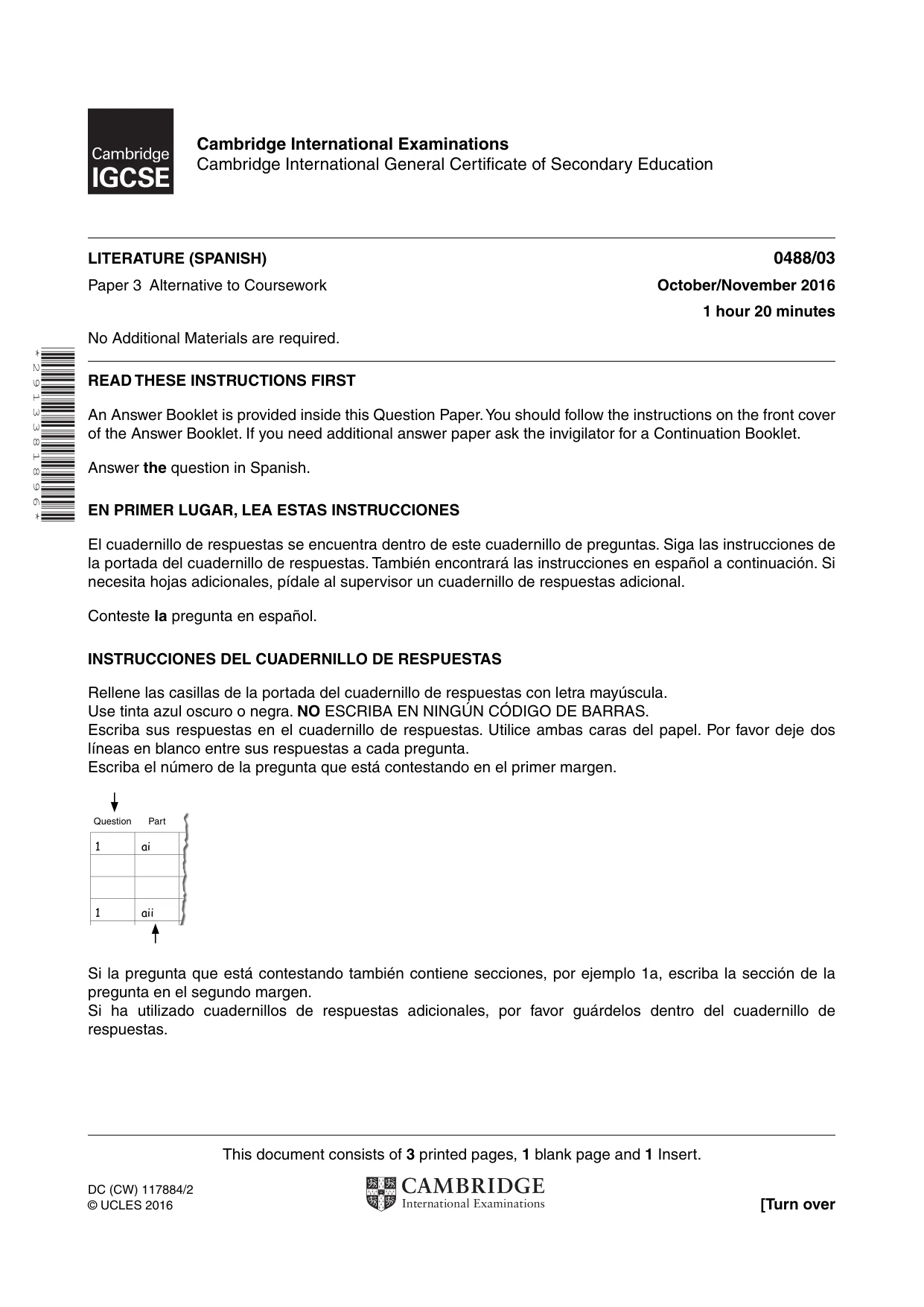
This document consists of 3 printed pages, 1 blank page and 1 Insert. DC (CW) 117884/2 © UCLES 2016 [Turn over Cambridge International Examinations Cambridge International General Certificate of Secondary Education * 2 9 1 3 3 8 1 8 9 6 * LITERATURE (SPANISH) 0488/03 Paper 3 Alternative to Coursework October/November 2016 1 hour 20 minutes No Additional Materials are required. READ THESE INSTRUCTIONS FIRST An Answer Booklet is provided inside this Question Paper. You should follow the instructions on the front cover of the Answer Booklet. If you need additional answer paper ask the invigilator for a Continuation Booklet. Answer the question in Spanish. EN PRIMER LUGAR, LEA ESTAS INSTRUCCIONES El cuadernillo de respuestas se encuentra dentro de este cuadernillo de preguntas. Siga las instrucciones de la portada del cuadernillo de respuestas. También encontrará las instrucciones en español a continuación. Si necesita hojas adicionales, pídale al supervisor un cuadernillo de respuestas adicional. Conteste la pregunta en español. INSTRUCCIONES DEL CUADERNILLO DE RESPUESTAS Rellene las casillas de la portada del cuadernillo de respuestas con letra mayúscula. Use tinta azul oscuro o negra. NO ESCRIBA EN NINGÚN CÓDIGO DE BARRAS. Escriba sus respuestas en el cuadernillo de respuestas. Utilice ambas caras del papel. Por favor deje dos líneas en blanco entre sus respuestas a cada pregunta. Escriba el número de la pregunta que está contestando en el primer margen. Question Part 1 1 ai aii Si la pregunta que está contestando también contiene secciones, por ejemplo 1a, escriba la sección de la pregunta en el segundo margen. Si ha utilizado cuadernillos de respuestas adicionales, por favor guárdelos dentro del cuadernillo de respuestas.
Question paper, page 2
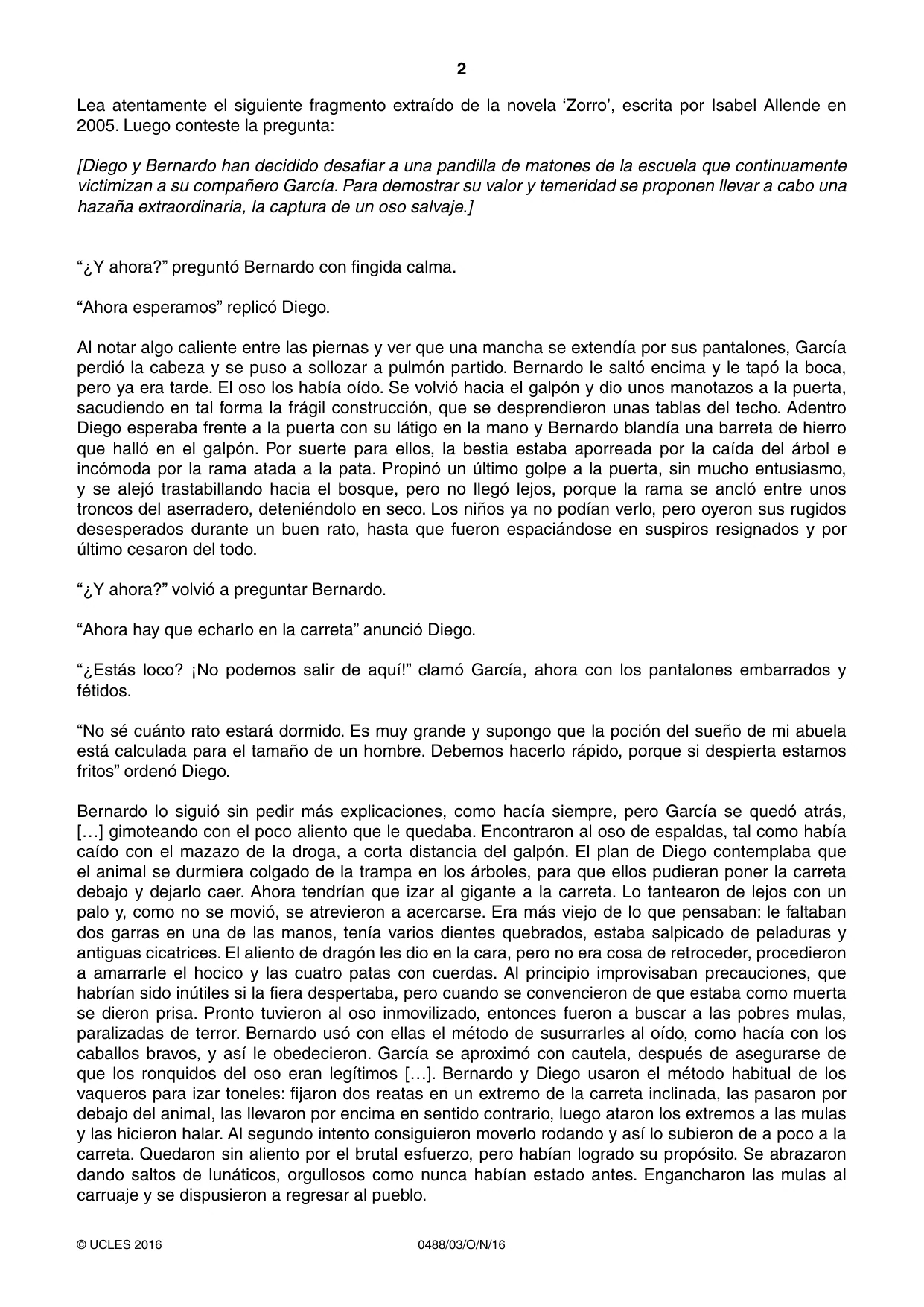
2 0488/03/O/N/16 © UCLES 2016 Lea atentamente el siguiente fragmento extraído de la novela ‘Zorro’, escrita por Isabel Allende en 2005. Luego conteste la pregunta: [Diego y Bernardo han decidido desafiar a una pandilla de matones de la escuela que continuamente victimizan a su compañero García. Para demostrar su valor y temeridad se proponen llevar a cabo una hazaña extraordinaria, la captura de un oso salvaje.] “¿Y ahora?” preguntó Bernardo con fingida calma. “Ahora esperamos” replicó Diego. Al notar algo caliente entre las piernas y ver que una mancha se extendía por sus pantalones, García perdió la cabeza y se puso a sollozar a pulmón partido. Bernardo le saltó encima y le tapó la boca, pero ya era tarde. El oso los había oído. Se volvió hacia el galpón y dio unos manotazos a la puerta, sacudiendo en tal forma la frágil construcción, que se desprendieron unas tablas del techo. Adentro Diego esperaba frente a la puerta con su látigo en la mano y Bernardo blandía una barreta de hierro que halló en el galpón. Por suerte para ellos, la bestia estaba aporreada por la caída del árbol e incómoda por la rama atada a la pata. Propinó un último golpe a la puerta, sin mucho entusiasmo, y se alejó trastabillando hacia el bosque, pero no llegó lejos, porque la rama se ancló entre unos troncos del aserradero, deteniéndolo en seco. Los niños ya no podían verlo, pero oyeron sus rugidos desesperados durante un buen rato, hasta que fueron espaciándose en suspiros resignados y por último cesaron del todo. “¿Y ahora?” volvió a preguntar Bernardo. “Ahora hay que echarlo en la carreta” anunció Diego. “¿Estás loco? ¡No podemos salir de aquí!” clamó García, ahora con los pantalones embarrados y fétidos. “No sé cuánto rato estará dormido. Es muy grande y supongo que la poción del sueño de mi abuela está calculada para el tamaño de un hombre. Debemos hacerlo rápido, porque si despierta estamos fritos” ordenó Diego. Bernardo lo siguió sin pedir más explicaciones, como hacía siempre, pero García se quedó atrás, […] gimoteando con el poco aliento que le quedaba. Encontraron al oso de espaldas, tal como había caído con el mazazo de la droga, a corta distancia del galpón. El plan de Diego contemplaba que el animal se durmiera colgado de la trampa en los árboles, para que ellos pudieran poner la carreta debajo y dejarlo caer. Ahora tendrían que izar al gigante a la carreta. Lo tantearon de lejos con un palo y, como no se movió, se atrevieron a acercarse. Era más viejo de lo que pensaban: le faltaban dos garras en una de las manos, tenía varios dientes quebrados, estaba salpicado de peladuras y antiguas cicatrices. El aliento de dragón les dio en la cara, pero no era cosa de retroceder, procedieron a amarrarle el hocico y las cuatro patas con cuerdas. Al principio improvisaban precauciones, que habrían sido inútiles si la fiera despertaba, pero cuando se convencieron de que estaba como muerta se dieron prisa. Pronto tuvieron al oso inmovilizado, entonces fueron a buscar a las pobres mulas, paralizadas de terror. Bernardo usó con ellas el método de susurrarles al oído, como hacía con los caballos bravos, y así le obedecieron. García se aproximó con cautela, después de asegurarse de que los ronquidos del oso eran legítimos […]. Bernardo y Diego usaron el método habitual de los vaqueros para izar toneles: fijaron dos reatas en un extremo de la carreta inclinada, las pasaron por debajo del animal, las llevaron por encima en sentido contrario, luego ataron los extremos a las mulas y las hicieron halar. Al segundo intento consiguieron moverlo rodando y así lo subieron de a poco a la carreta. Quedaron sin aliento por el brutal esfuerzo, pero habían logrado su propósito. Se abrazaron dando saltos de lunáticos, orgullosos como nunca habían estado antes. Engancharon las mulas al carruaje y se dispusieron a regresar al pueblo.
Question paper, page 3
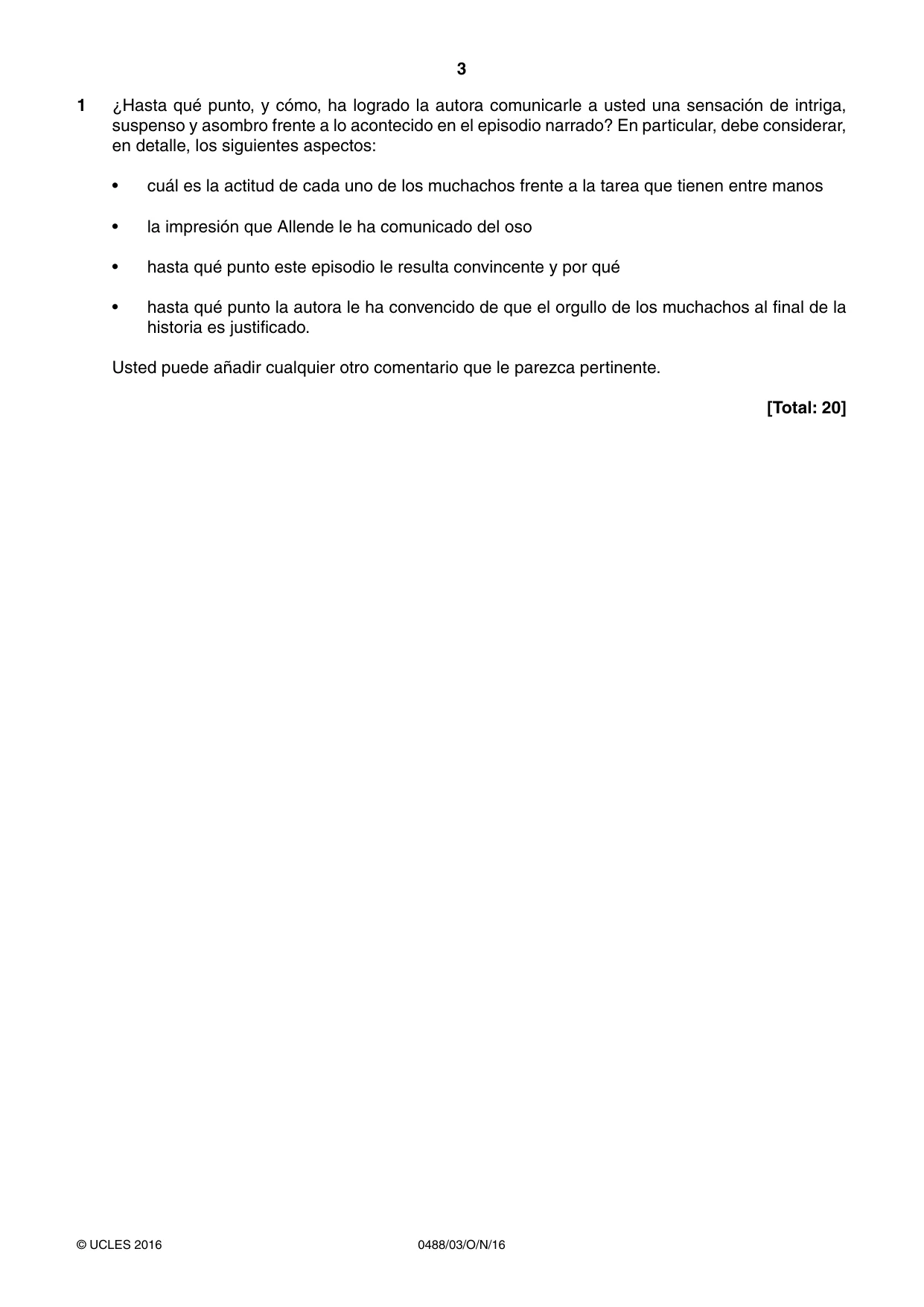
3 0488/03/O/N/16 © UCLES 2016 1 ¿Hasta qué punto, y cómo, ha logrado la autora comunicarle a usted una sensación de intriga, suspenso y asombro frente a lo acontecido en el episodio narrado? En particular, debe considerar, en detalle, los siguientes aspectos: • cuál es la actitud de cada uno de los muchachos frente a la tarea que tienen entre manos • la impresión que Allende le ha comunicado del oso • hasta qué punto este episodio le resulta convincente y por qué • hasta qué punto la autora le ha convencido de que el orgullo de los muchachos al final de la historia es justificado. Usted puede añadir cualquier otro comentario que le parezca pertinente. [Total: 20]
Question paper, page 4
4 0488/03/O/N/16 © UCLES 2016 BLANK PAGE Permission to reproduce items where third-party owned material protected by copyright is included has been sought and cleared where possible. Every reasonable effort has been made by the publisher (UCLES) to trace copyright holders, but if any items requiring clearance have unwittingly been included, the publisher will be pleased to make amends at the earliest possible opportunity. To avoid the issue of disclosure of answer-related information to candidates, all copyright acknowledgements are reproduced online in the Cambridge International Examinations Copyright Acknowledgements Booklet. This is produced for each series of examinations and is freely available to download at www.cie.org.uk after the live examination series. Cambridge International Examinations is part of the Cambridge Assessment Group. Cambridge Assessment is the brand name of University of Cambridge Local Examinations Syndicate (UCLES), which is itself a department of the University of Cambridge.
Mark scheme, page 1
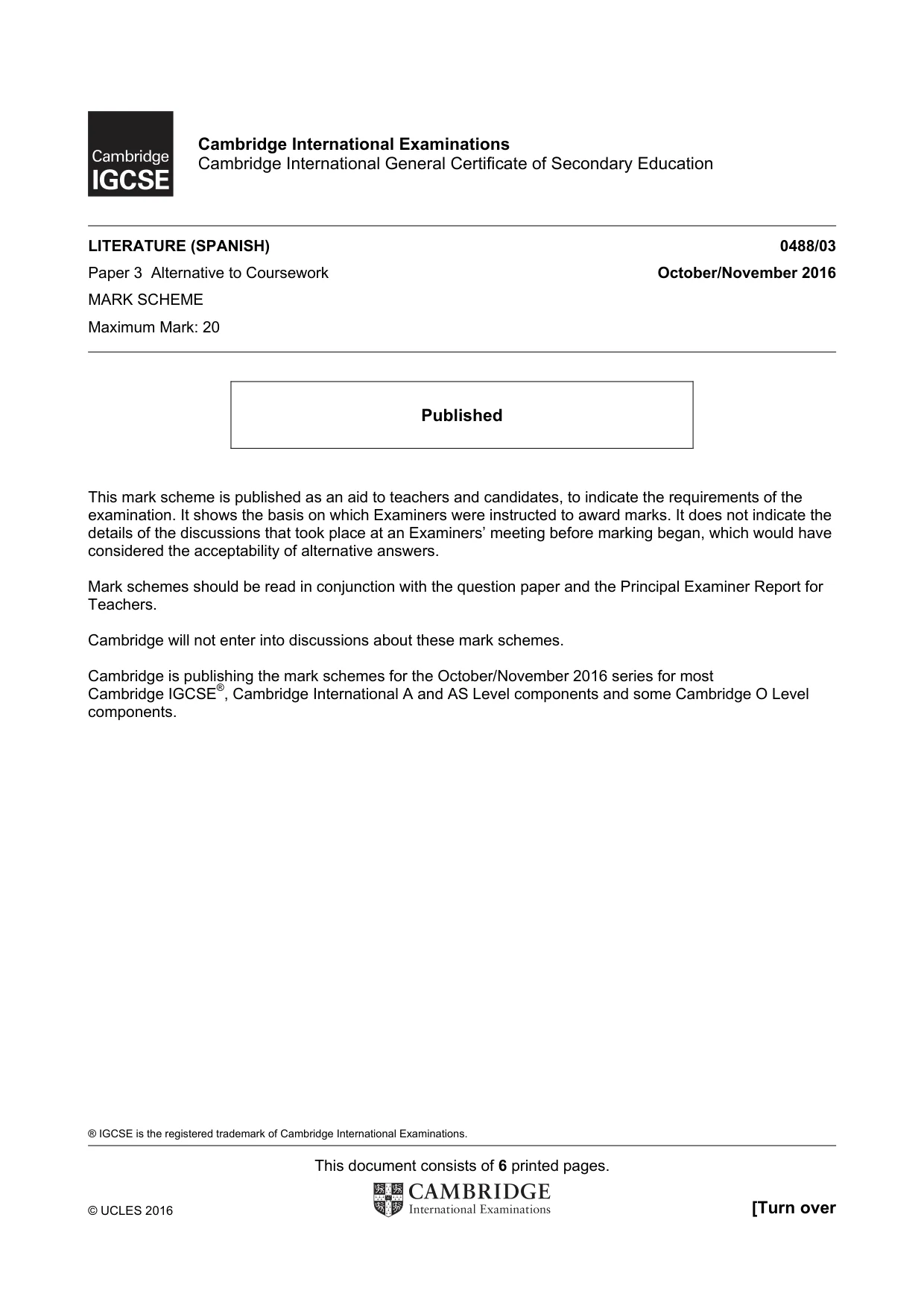
® IGCSE is the registered trademark of Cambridge International Examinations. This document consists of 6 printed pages. © UCLES 2016 [Turn over Cambridge International Examinations Cambridge International General Certificate of Secondary Education LITERATURE (SPANISH) 0488/03 Paper 3 Alternative to Coursework October/November 2016 MARK SCHEME Maximum Mark: 20 Published This mark scheme is published as an aid to teachers and candidates, to indicate the requirements of the examination. It shows the basis on which Examiners were instructed to award marks. It does not indicate the details of the discussions that took place at an Examiners’ meeting before marking began, which would have considered the acceptability of alternative answers. Mark schemes should be read in conjunction with the question paper and the Principal Examiner Report for Teachers. Cambridge will not enter into discussions about these mark schemes. Cambridge is publishing the mark schemes for the October/November 2016 series for most Cambridge IGCSE®, Cambridge International A and AS Level components and some Cambridge O Level components.
Mark scheme, page 2
Page 2 Mark Scheme Syllabus Paper Cambridge IGCSE – October/November 2016 0488 03 © UCLES 2016 Answers will be marked according to the following general criteria: Band Mark 1 18–20 Detailed, well-written, well-organised answer, paying close attention to author's use of language. Shows appreciation of structure and complete comprehension of passage; has no significant omissions and conveys a sensitive personal response. 2 15–17 Detailed answer, paying close attention to author's use of language. Understands or convincingly interprets all essentials of passage; few omissions. Conveys clear personal response but may be a bit cut-and-dried. 3 12–14 Competent answer with some attention to language. May be some misunderstandings and significant omissions, but conveys some personal appreciation. 4 9–11 Attempts to respond and does pay attention to some details of language, but there are significant misunderstandings and substantial omissions. May misrepresent author's intentions trying to apply some rigid preconception, or note use of literary devices without explaining their effect. Answer probably rather short. 5 6–8 Tries, but has not really grasped what passage is about. Offers a few ideas, some of them irrelevant or plainly wrong. A few glimmers are perceptible. Short, scrappy. 6 4–5 Short, scrappy answer; confused; little response to passage, but candidate has at least read it and tried to respond. 7 2–3 Scrawls a few lines; has attempted to read passage, but clearly doesn't understand it. 8 0–1 Nothing to reward. The detailed questions are intended to help the candidate respond. Candidates are required to answer them, but need not do so in a rigid sequence; some of the answers may be implicit in the essay, although it is expected that candidates will be able to spell out their views and interpretations with sufficient clarity. There is no prescribed application of marks to each question and the response should be marked holistically. Candidates who do not answer the prescribed questions will penalise themselves automatically, as the questions are central to the passage.
Mark scheme, page 3
Page 3 Mark Scheme Syllabus Paper Cambridge IGCSE – October/November 2016 0488 03 © UCLES 2016 Extract from Zorro by Isabel Allende (2005) Mark Scheme The detailed questions are intended to help the candidate respond. Candidates are required to answer them, but need not do so in a rigid sequence; some of the answers may be implicit in the essay, although it is expected that candidates will be able to spell out their views and interpretations with sufficient clarity. There is no prescribed application of marks to each question and the response should be marked holistically. Candidates who do not answer the prescribed questions will penalize themselves automatically, as the questions are central to the passage. Lea atentamente el siguiente fragmento extraído de la novela 'El Zorro’, escrita por Isabel Allende en 2003. Luego, conteste la pregunta. The extract in question is rather contemporary and it is hoped the candidates will be in a position to understand the language of the passage almost in its entirety, therefore being able to gain a general understanding of the extract and convey an appropriate response to the quality of the writing. The questions are designed to help them do so. At the lower levels (up to 9 marks) we shall probably be looking for evidence of a basic understanding, hopefully with a simple personal response. At the 4/3 level bands we should be looking for a clear, if not sophisticated and complex, answer to each of the questions and a successful attempt to support ideas from the passage. Be aware of inert, mechanical quoting or simple paraphrasing that adds little to the interpretation or leaves the task of interpreting and/or inferring to the examiner. It is not unusual for candidates to transfer wording/paragraphs from the question paper to their essays in a rather mechanical manner and for no other apparent purpose than to fill up some space. This material usually has been provided for them to contextualise the extract and does not need to be mentioned again in the body of the candidate's essay. As we go up to 2/1 level bands we shall be looking for an in-depth analysis and close attention to detail; an ability to read between the lines, with appropriate support from the passage; a motivated personal response; good use of the imagination and a direct, clear focus on the questions throughout. Although some candidates may find the theme of the story rather 'unexpected', they still should be able to engage with it and fully exploit its elements, particularly so if they are to be rewarded with a top band mark. 1 ¿Hasta qué punto y cómo ha logrado la autora comunicarle a usted una sensación de intriga, suspenso y asombro frente a lo acontecido en el episodio narrado? En particular, debe considerar, en detalle, los siguientes aspectos: • Cuál es la actitud de cada uno de los muchachos frente a la tarea que tienen entre manos. The episode narrates how Diego, Bernardo and García managed to capture a wild bear. This, in itself, is a highly risky endeavour that could result in a fatal outcome considering that the boys are still extremely young, probably around 10–12 years old (the author even refers to them as children) and the only thing they have in their favour is their audacity, intelligence and courage. The truth of the matter is that such an attempt, i.e. to capture a bear alive, would be an equally risky and challenging enterprise even for adult men if one takes into consideration that bears are wild animals, extremely powerful, aggressive and of great size and weight.
Mark scheme, page 4
Page 4 Mark Scheme Syllabus Paper Cambridge IGCSE – October/November 2016 0488 03 © UCLES 2016 In addition to these considerations, it needs to be taken into account that the three boys do not have the same attitude and/or disposition and skills for their mission. Only Diego and Bernardo show sufficient resilience, initiative and skills to carry out the task. Diego presents himself as the leader of the operation. He is the one who has a clear vision of what needs to be done to achieve their goal and accordingly gives directives to Bernardo. Diego had probably come up with the idea in the first place, but also knows how to lead the other boys. And, most importantly, he is able to improvise when their initial plan fails (the bear, due to its weight, breaks the branches of the trap and falls to the ground creating the additional problem of needing to find a way to lift the heavy animal into the wagon). Bernardo is his loyal companion and although, at points, he shows a certain insecurity or doubt (‘preguntó…con fingida calma’), he is ready to support Diego to the end. He also possesses certain special skills that will play a key role in achieving their mission, such as, for example, the ability to communicate with the mules to calm them down and to manage to persuade them to pull the wagon at a time when the beasts were terrified of the proximity of the bear. It needs to be emphasised that the task that awaited them required great physical strength, in addition to cunning, and that it should be said that none of them, by himself, would have been able to accomplish the task alone. García, on the other hand, shows clear signs of weakness and cowardice which make him more of a burden than a welcome help for the task in hand. But Garcia also puts the group in jeopardy when his loud sobs attract the attention of the bear that, until then, had not noticed their presence. Not only does Garcia show serious limitations during the unfolding of the episode but he also seems to have forgotten that Diego and Bernardo have decided to capture the bear in order to protect him from the harassment of the school gang. However, he gives a helping hand later in order to lift the bear, once he is convinced that the animal is totally knocked out. y la impresión que Allende le ha comunicado del oso The first impression suggests that the bear is a strong animal as his pounding on the door of the shed causes some planks to fall from the roof, but we soon learn that the bear had been weakened by the fall from the tree trap and that, in addition, it had his leg tied to a branch from the trap which was causing the animal to stumble along and, eventually, to get stuck among some logs lying in the grounds of the sawmill, thus, being unable to move. But, more importantly, the animal had been drugged by the boys and the effect of the drug was already taking effect. Moreover, shortly afterwards the animal collapsed and, although it still offered some resistance in the form of desperate growls, it eventually became silent. It had lost consciousness. The author’s description of the bear’s physical appearance indicates that the animal was not in the prime of life, not only because it appeared to be rather old, but also because it was rather battered: missing claws, broken teeth, bare patches on the skin and old wounds. Although this all gives the impression that the animal was, perhaps, weaker than what the boys were expecting, by no means it should be taken to indicate that the adventure was less risky. One important factor to consider was the sheer weight of the animal which by itself made it a lot stronger than people, particularly young boys. It is also possible to consider that all wild animals – young or old - are exposed to a rough existence and, therefore, even if the bear had been younger, it would probably still have shown signs of confrontations with other animals, men and/or nature. The above considerations are relevant for the following section of the exam. Candidates may reflect on the ‘disadvantages’ of the bear based on what we just described and think that the boys, therefore, stood a better chance of succeeding in their enterprise. Or, candidates may still consider that the mission was extremely risky. The interpretation is left open to them and to other possible interpretations.
Mark scheme, page 5
Page 5 Mark Scheme Syllabus Paper Cambridge IGCSE – October/November 2016 0488 03 © UCLES 2016 y Hasta qué punto este episodio le resulta convincente y por qué. Allende tells us a story that lies between the believable and the impossible. The main issue is that of the age of the protagonists. She refers to them as children, and perhaps being between the ages of 10 and 12 – although, the author does not, specifically, mention the exact ages – we need to agree with the fact that they are more children than adolescents. Thus, the question arises of how credible this prowess is. Could such young boys been able to carry the tasks described in this episode? What parts are more believable than others and why? Certainly the idea of using a drug is plausible. It only demanded knowing how to use it and having it at their disposal. Diego’s grandmother had it and it is believable that he would have seen her using it previously, so he had the know-how and, as said before, without this element the whole idea of capturing the bear would have been out of the question. Setting a trap for the bear in the way it is described is also something that young boys, living in the countryside, would have learnt how to do, even if only for trapping smaller animals. The trap in the story worked, in the sense that the bear fell in it and was lifted between the branches of the tree, although only momentarily. It is the fall of the bear to the ground that really adds an extra obstacle and it is the way the boys managed to lift the bear into the wagon that makes the reader doubt, to some extent, the verisimilitude of the story because, even if the mules were helping, they also needed to exert great physical effort to move the bear, and being so young, it is hard to believe they would have had the necessary strength. However, candidates are welcomed to offer their own interpretations and even imagine themselves in the situation in order to assess the possibilities. y Hasta qué punto la autora le ha convencido de que el orgullo de los muchachos al final de la historia es justificado. This question cannot be properly answered without considering the manner in which the boys managed to capture the bear. Even if this is not done in great detail, there should, at least, be consideration of the different steps undertaken and awareness that the process demanded some change of plans and thinking on the spot to achieve their purpose. Diego y Bernardo had managed to dope the bear, with the use of a drugged piece of bait (‘la poción del sueño de mi abuela’) but they needed to wait for it to take effect and because the bear had fallen from the trap and was still moving around they hid in the storehouse. However, García’s fear was such that he broke into uncontrollable sobs, attracting the attention of the bear which then approached the storehouse and started to bang hard on the door. However, the state of the bear was gradually deteriorating as the drug began taking effect and, eventually, the bear fell to the ground unconscious. Thus, the first step of the plan was accomplished. The second task was to lift the bear into the wagon and it was necessary to do it as quickly as possible as they did not know for how long the drug would work. As was already explained, the initial plan of trapping the bear among the tree branches and letting it drop directly on top of the wagon had failed because the weight of the bear broke the branches, and now they needed to find a way of moving the huge animal and lifting it onto the wagon, obviously an extremely difficult task. Diego and Bernardo followed the method that cowboys used to lift heavy barrels and with the help of ropes and the pulling of the mules they managed, after great effort, to lift the bear little by little into the wagon.
Mark scheme, page 6
Page 6 Mark Scheme Syllabus Paper Cambridge IGCSE – October/November 2016 0488 03 © UCLES 2016 Drugging the bear was, without doubt, the most important method used by the boys. Without this, it would have been practically impossible to capture the bear. The idea of putting a trap with the drugged bait was extremely clever because the animal ate the bait and was captured in the trap but, unfortunately, one part of the plan failed. The trap did not manage to hold the weight of the bear, which fell to the ground. This could have meant the end of the adventure as moving the huge bear was a really heavy and difficult task which, in addition, needed to be completed promptly. Therefore, it was remarkable that the boys were able to improvise and apply a method they had observed the cowboys using, and succeeding in lifting the bear into the wagon. But, we should bear in mind that this last step could have also failed and if the animal would have woken up they would have been in great danger. The fact that the boys finally managed to capture the bear is, of course, a great success, hence one could say that they were totally justified in feeling proud of it. And, even more so, as the reasons behind their mission were now reachable: not simply to show the school gang what they – including García - were capable of – and humiliate them through an act of great heroism which they were unlikely to surpass – but also the town people. Whether their parents may have been as excited and proud as the boys, is however a different question altogether. Usted puede añadir cualquier otro comentario que le parezca pertinente. It is rare for candidates to follow up this suggestion and they should not be penalised if they do not. However, any interesting comments should of course be taken into account in the overall reward, – provided these do not distort or contradict the main story line and candidates do not end up either contradicting themselves or failing to adopt one clear line of interpretation. If additional and reasonable ideas are offered, generous reward should be considered although this section alone is not a substitute for the required response to the preceding ones. Candidates may elaborate within the suggested lines above or follow alternative interpretations. The only requirement here is to be consistent and avoid flagrant contradictions or uncommitted/unexplained statements. Ideas should be clearly stated, well-argued and convincing to be given the marks. It is possible that candidates may consider the story beyond belief. They may question whether it is sufficiently realistic or believable. Or they may think of different ways of achieving the same result as the boys in the story. Others may criticize the activities of the unsupervised children and even put blame on their parents for the risks the children were exposed to. Also, some may consider what reactions would await the adventurers back at home, not just from their parents but from the village people. Moreover, some may sympathize with the bear and see the episode as an early example of abuse to animals. Whatever their reaction, if their reasoning is well supported it should be given credit.
What you needed in this session
Cambridge’s own grade thresholds for 2016 Oct/Nov, Paper 3 · Variant 1. A higher threshold means an easier paper — the bar moves with how the cohort did.