Cambridge IGCSE Spanish - Literature 0488 — 2015 Oct/Nov Paper 3 · Variant 1
0488/31/O/N/15 · 20 marks · ≈23 min
The question paper and its mark scheme, free to read here and free to download. This is Cambridge’s own paper, exactly as it was sat.
Question paper4 pages

Mark scheme4 pages
Answers below. Sit the paper first if you are practising.
Paper as text
Question paper, page 1
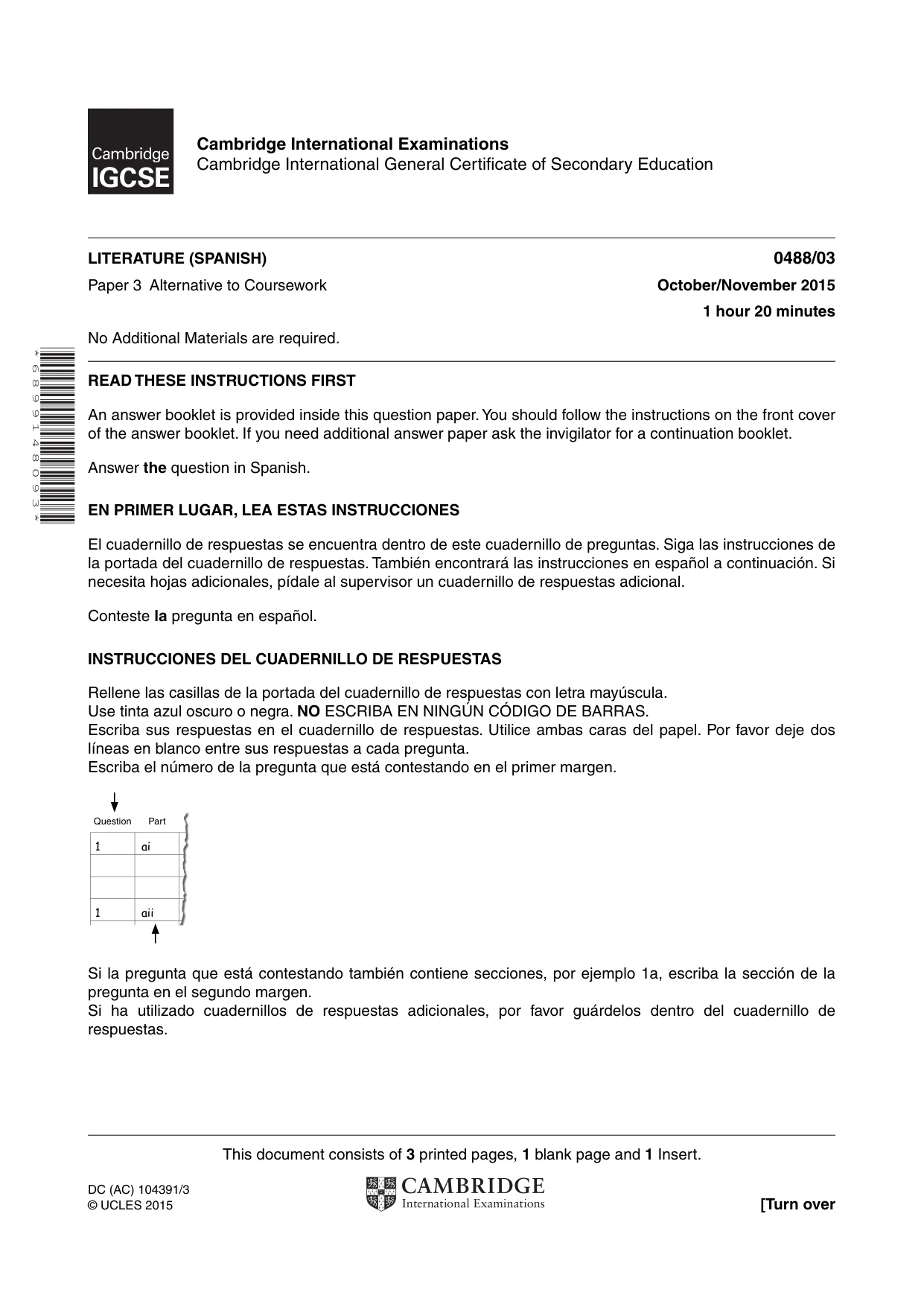
This document consists of 3 printed pages, 1 blank page and 1 Insert. DC (AC) 104391/3 © UCLES 2015 [Turn over Cambridge International Examinations Cambridge International General Certificate of Secondary Education * 6 8 9 9 1 4 8 0 9 3 * LITERATURE (SPANISH) 0488/03 Paper 3 Alternative to Coursework October/November 2015 1 hour 20 minutes No Additional Materials are required. READ THESE INSTRUCTIONS FIRST An answer booklet is provided inside this question paper. You should follow the instructions on the front cover of the answer booklet. If you need additional answer paper ask the invigilator for a continuation booklet. Answer the question in Spanish. EN PRIMER LUGAR, LEA ESTAS INSTRUCCIONES El cuadernillo de respuestas se encuentra dentro de este cuadernillo de preguntas. Siga las instrucciones de la portada del cuadernillo de respuestas. También encontrará las instrucciones en español a continuación. Si necesita hojas adicionales, pídale al supervisor un cuadernillo de respuestas adicional. Conteste la pregunta en español. INSTRUCCIONES DEL CUADERNILLO DE RESPUESTAS Rellene las casillas de la portada del cuadernillo de respuestas con letra mayúscula. Use tinta azul oscuro o negra. NO ESCRIBA EN NINGÚN CÓDIGO DE BARRAS. Escriba sus respuestas en el cuadernillo de respuestas. Utilice ambas caras del papel. Por favor deje dos líneas en blanco entre sus respuestas a cada pregunta. Escriba el número de la pregunta que está contestando en el primer margen. Question Part 1 1 ai aii Si la pregunta que está contestando también contiene secciones, por ejemplo 1a, escriba la sección de la pregunta en el segundo margen. Si ha utilizado cuadernillos de respuestas adicionales, por favor guárdelos dentro del cuadernillo de respuestas.
Question paper, page 2
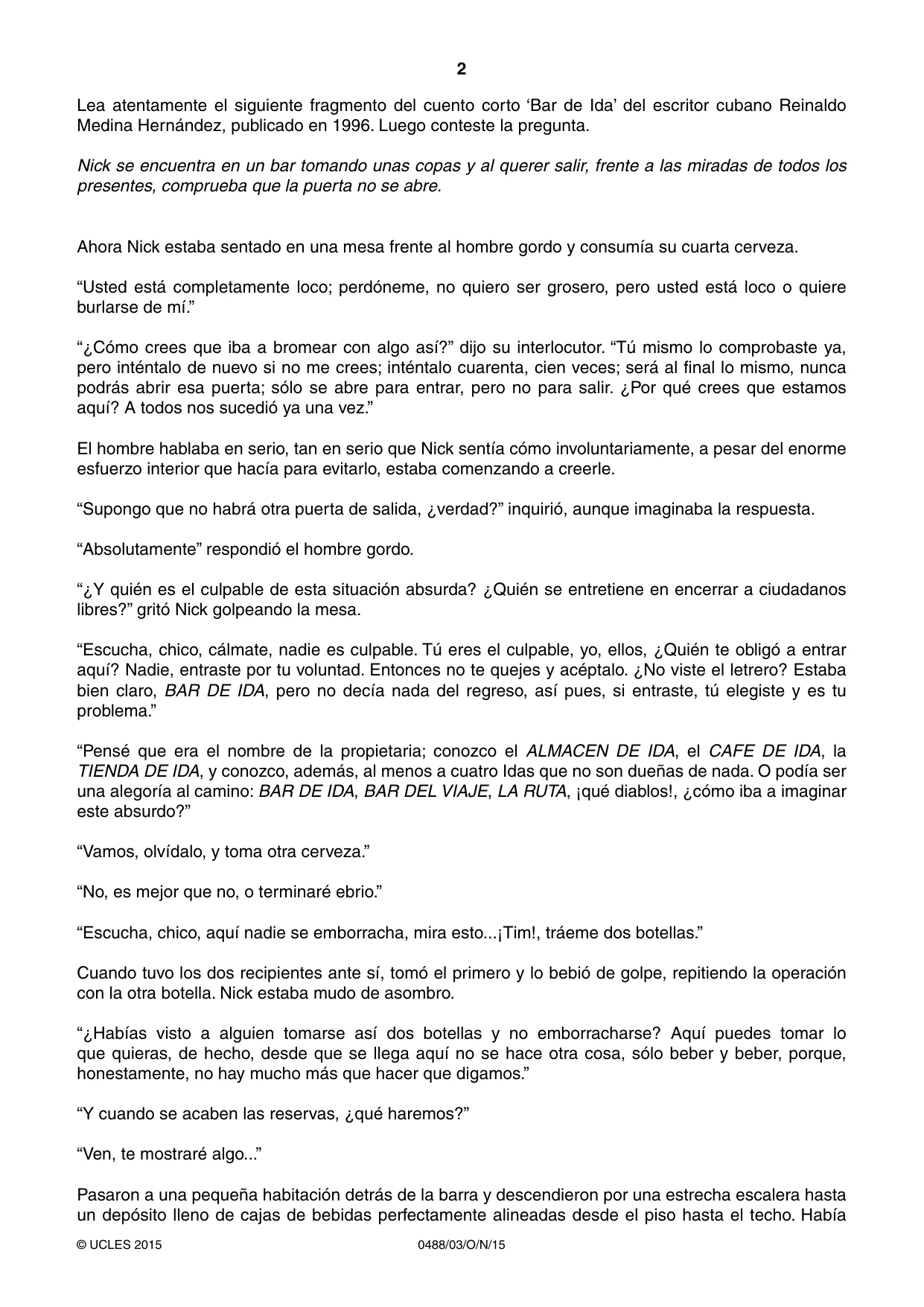
2 0488/03/O/N/15 © UCLES 2015 Lea atentamente el siguiente fragmento del cuento corto ‘Bar de Ida’ del escritor cubano Reinaldo Medina Hernández, publicado en 1996. Luego conteste la pregunta. Nick se encuentra en un bar tomando unas copas y al querer salir, frente a las miradas de todos los presentes, comprueba que la puerta no se abre. Ahora Nick estaba sentado en una mesa frente al hombre gordo y consumía su cuarta cerveza. “Usted está completamente loco; perdóneme, no quiero ser grosero, pero usted está loco o quiere burlarse de mí.” “¿Cómo crees que iba a bromear con algo así?” dijo su interlocutor. “Tú mismo lo comprobaste ya, pero inténtalo de nuevo si no me crees; inténtalo cuarenta, cien veces; será al final lo mismo, nunca podrás abrir esa puerta; sólo se abre para entrar, pero no para salir. ¿Por qué crees que estamos aquí? A todos nos sucedió ya una vez.” El hombre hablaba en serio, tan en serio que Nick sentía cómo involuntariamente, a pesar del enorme esfuerzo interior que hacía para evitarlo, estaba comenzando a creerle. “Supongo que no habrá otra puerta de salida, ¿verdad?” inquirió, aunque imaginaba la respuesta. “Absolutamente” respondió el hombre gordo. “¿Y quién es el culpable de esta situación absurda? ¿Quién se entretiene en encerrar a ciudadanos libres?” gritó Nick golpeando la mesa. “Escucha, chico, cálmate, nadie es culpable. Tú eres el culpable, yo, ellos, ¿Quién te obligó a entrar aquí? Nadie, entraste por tu voluntad. Entonces no te quejes y acéptalo. ¿No viste el letrero? Estaba bien claro, BAR DE IDA, pero no decía nada del regreso, así pues, si entraste, tú elegiste y es tu problema.” “Pensé que era el nombre de la propietaria; conozco el ALMACEN DE IDA, el CAFE DE IDA, la TIENDA DE IDA, y conozco, además, al menos a cuatro Idas que no son dueñas de nada. O podía ser una alegoría al camino: BAR DE IDA, BAR DEL VIAJE, LA RUTA, ¡qué diablos!, ¿cómo iba a imaginar este absurdo?” “Vamos, olvídalo, y toma otra cerveza.” “No, es mejor que no, o terminaré ebrio.” “Escucha, chico, aquí nadie se emborracha, mira esto...¡Tim!, tráeme dos botellas.” Cuando tuvo los dos recipientes ante sí, tomó el primero y lo bebió de g olpe, repitiendo la operación con la otra botella. Nick estaba mudo de asombro. “¿Habías visto a alguien tomarse así dos botellas y no emborracharse? Aquí puedes tomar lo que quieras, de hecho, desde que se llega aquí no se hace otra cosa, sólo beber y beber, porque, honestamente, no hay mucho más que hacer que digamos.” “Y cuando se acaben las reservas, ¿qué haremos?” “Ven, te mostraré algo...” Pasaron a una pequeña habitación detrás de la barra y descendieron por una estrecha escalera hasta un depósito lleno de cajas de bebidas perfectamente alineadas desde el piso hasta el techo. Había
Question paper, page 3
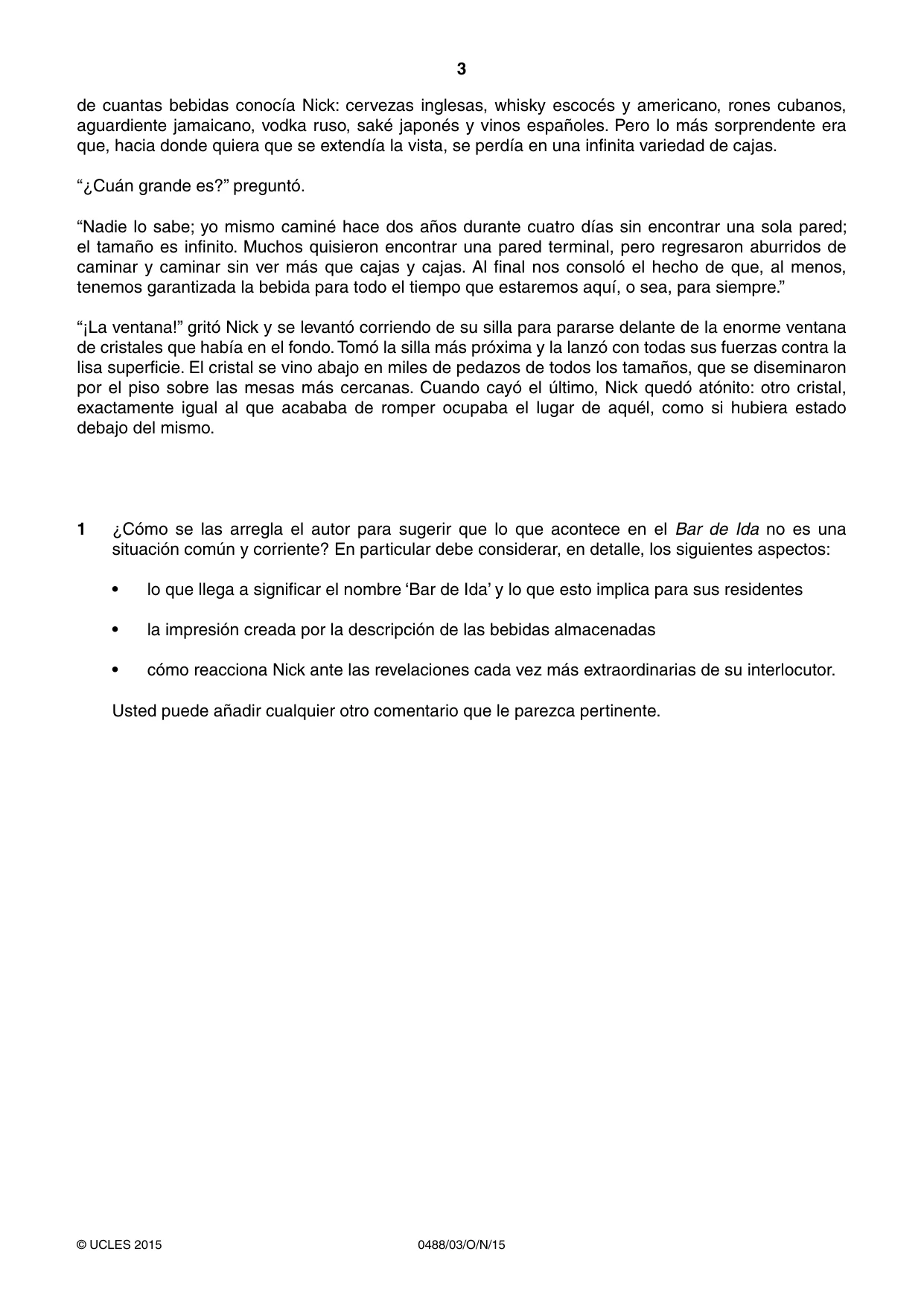
3 0488/03/O/N/15 © UCLES 2015 de cuantas bebidas conocía Nick: cervezas inglesas, whisky escocés y americano, rones cubanos, aguardiente jamaicano, vodka ruso, saké japonés y vinos españoles. Pero lo más sorprendente era que, hacia donde quiera que se extendía la vista, se perdía en una infinita variedad de cajas. “¿Cuán grande es?” preguntó. “Nadie lo sabe; yo mismo caminé hace dos años durante cuatro días sin encontrar una sola pared; el tamaño es infinito. Muchos quisieron encontrar una pared terminal, pero regresaron aburridos de caminar y caminar sin ver más que cajas y cajas. Al final nos consoló el hecho de que, al menos, tenemos garantizada la bebida para todo el tiempo que estaremos aquí, o sea, para siempre.” “¡La ventana!” gritó Nick y se levantó corriendo de su silla para pararse delante de la enorme ventana de cristales que había en el fondo. Tomó la silla más próxima y la lanzó con todas sus fuerzas contra la lisa superficie. El cristal se vino abajo en miles de pedazos de todos los tamaños, que se diseminaron por el piso sobre las mesas más cercanas. Cuando cayó el último, Nick quedó atónito: otro cristal, exactamente igual al que acababa de romper ocupaba el lugar de aquél, como si hubiera estado debajo del mismo. 1 ¿Cómo se las arregla el autor para sugerir que lo que acontece en el Bar de Ida no es una situación común y corriente? En particular debe considerar, en detalle, los siguientes aspectos: • lo que llega a significar el nombre ‘Bar de Ida’ y lo que esto implica para sus residentes • la impresión creada por la descripción de las bebidas almacenadas • cómo reacciona Nick ante las revelaciones cada vez más extraordinarias de su interlocutor. Usted puede añadir cualquier otro comentario que le parezca pertinente.
Question paper, page 4
4 0488/03/O/N/15 © UCLES 2015 BLANK PAGE Permission to reproduce items where third-party owned material protected by copyright is included has been sought and cleared where possible. Every reasonable effort has been made by the publisher (UCLES) to trace copyright holders, but if any items requiring clearance have unwittingly been included, the publisher will be pleased to make amends at the earliest possible opportunity. To avoid the issue of disclosure of answer-related information to candidates, all copyright acknowledgements are reproduced online in the Cambridge International Examinations Copyright Acknowledgements Booklet. This is produced for each series of examinations and is freely available to download at www.cie.org.uk after the live examination series. Cambridge International Examinations is part of the Cambridge Assessment Group. Cambridge Assessment is the brand name of University of Cambridge Local Examinations Syndicate (UCLES), which is itself a department of the University of Cambridge.
Mark scheme, page 1
® IGCSE is the registered trademark of Cambridge International Examinations. CAMBRIDGE INTERNATIONAL EXAMINATIONS Cambridge International General Certificate of Secondary Education MARK SCHEME for the October/November 2015 series 0488 LITERATURE (SPANISH) 0488/03 Paper 3 (Alternative to coursework), maximum raw mark 20 This mark scheme is published as an aid to teachers and candidates, to indicate the requirements of the examination. It shows the basis on which Examiners were instructed to award marks. It does not indicate the details of the discussions that took place at an Examiners’ meeting before marking began, which would have considered the acceptability of alternative answers. Mark schemes should be read in conjunction with the question paper and the Principal Examiner Report for Teachers. Cambridge will not enter into discussions about these mark schemes. Cambridge is publishing the mark schemes for the October/November 2015 series for most Cambridge IGCSE®, Cambridge International A and AS Level components and some Cambridge O Level components.
Mark scheme, page 2
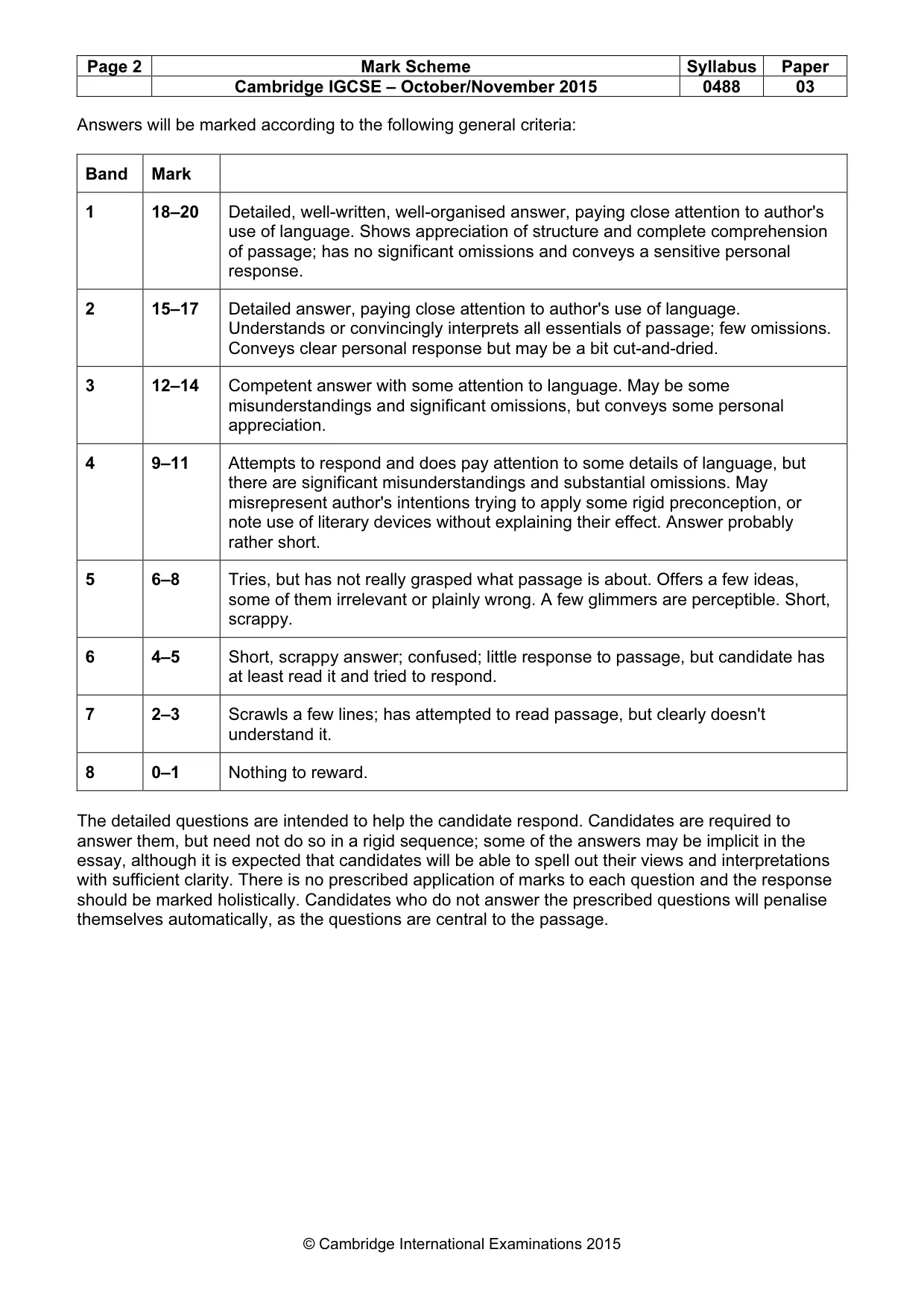
Page 2 Mark Scheme Syllabus Paper Cambridge IGCSE – October/November 2015 0488 03 © Cambridge International Examinations 2015 Answers will be marked according to the following general criteria: Band Mark 1 18–20 Detailed, well-written, well-organised answer, paying close attention to author's use of language. Shows appreciation of structure and complete comprehension of passage; has no significant omissions and conveys a sensitive personal response. 2 15–17 Detailed answer, paying close attention to author's use of language. Understands or convincingly interprets all essentials of passage; few omissions. Conveys clear personal response but may be a bit cut-and-dried. 3 12–14 Competent answer with some attention to language. May be some misunderstandings and significant omissions, but conveys some personal appreciation. 4 9–11 Attempts to respond and does pay attention to some details of language, but there are significant misunderstandings and substantial omissions. May misrepresent author's intentions trying to apply some rigid preconception, or note use of literary devices without explaining their effect. Answer probably rather short. 5 6–8 Tries, but has not really grasped what passage is about. Offers a few ideas, some of them irrelevant or plainly wrong. A few glimmers are perceptible. Short, scrappy. 6 4–5 Short, scrappy answer; confused; little response to passage, but candidate has at least read it and tried to respond. 7 2–3 Scrawls a few lines; has attempted to read passage, but clearly doesn't understand it. 8 0–1 Nothing to reward. The detailed questions are intended to help the candidate respond. Candidates are required to answer them, but need not do so in a rigid sequence; some of the answers may be implicit in the essay, although it is expected that candidates will be able to spell out their views and interpretations with sufficient clarity. There is no prescribed application of marks to each question and the response should be marked holistically. Candidates who do not answer the prescribed questions will penalise themselves automatically, as the questions are central to the passage.
Mark scheme, page 3
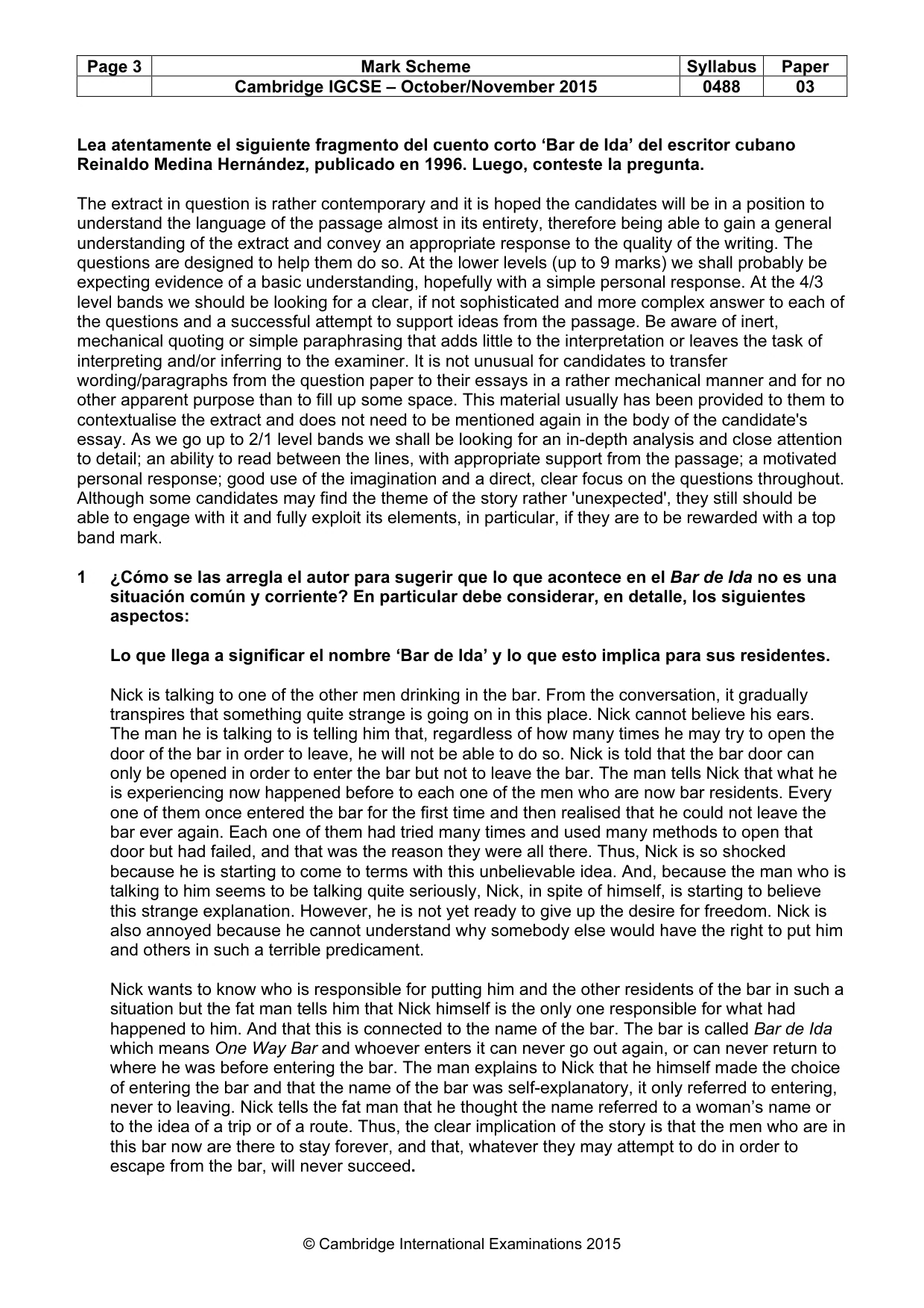
Page 3 Mark Scheme Syllabus Paper Cambridge IGCSE – October/November 2015 0488 03 © Cambridge International Examinations 2015 Lea atentamente el siguiente fragmento del cuento corto ‘Bar de Ida’ del escritor cubano Reinaldo Medina Hernández, publicado en 1996. Luego, conteste la pregunta. The extract in question is rather contemporary and it is hoped the candidates will be in a position to understand the language of the passage almost in its entirety, therefore being able to gain a general understanding of the extract and convey an appropriate response to the quality of the writing. The questions are designed to help them do so. At the lower levels (up to 9 marks) we shall probably be expecting evidence of a basic understanding, hopefully with a simple personal response. At the 4/3 level bands we should be looking for a clear, if not sophisticated and more complex answer to each of the questions and a successful attempt to support ideas from the passage. Be aware of inert, mechanical quoting or simple paraphrasing that adds little to the interpretation or leaves the task of interpreting and/or inferring to the examiner. It is not unusual for candidates to transfer wording/paragraphs from the question paper to their essays in a rather mechanical manner and for no other apparent purpose than to fill up some space. This material usually has been provided to them to contextualise the extract and does not need to be mentioned again in the body of the candidate's essay. As we go up to 2/1 level bands we shall be looking for an in-depth analysis and close attention to detail; an ability to read between the lines, with appropriate support from the passage; a motivated personal response; good use of the imagination and a direct, clear focus on the questions throughout. Although some candidates may find the theme of the story rather 'unexpected', they still should be able to engage with it and fully exploit its elements, in particular, if they are to be rewarded with a top band mark. 1 ¿Cómo se las arregla el autor para sugerir que lo que acontece en el Bar de Ida no es una situación común y corriente? En particular debe considerar, en detalle, los siguientes aspectos: Lo que llega a significar el nombre ‘Bar de Ida’ y lo que esto implica para sus residentes. Nick is talking to one of the other men drinking in the bar. From the conversation, it gradually transpires that something quite strange is going on in this place. Nick cannot believe his ears. The man he is talking to is telling him that, regardless of how many times he may try to open the door of the bar in order to leave, he will not be able to do so. Nick is told that the bar door can only be opened in order to enter the bar but not to leave the bar. The man tells Nick that what he is experiencing now happened before to each one of the men who are now bar residents. Every one of them once entered the bar for the first time and then realised that he could not leave the bar ever again. Each one of them had tried many times and used many methods to open that door but had failed, and that was the reason they were all there. Thus, Nick is so shocked because he is starting to come to terms with this unbelievable idea. And, because the man who is talking to him seems to be talking quite seriously, Nick, in spite of himself, is starting to believe this strange explanation. However, he is not yet ready to give up the desire for freedom. Nick is also annoyed because he cannot understand why somebody else would have the right to put him and others in such a terrible predicament. Nick wants to know who is responsible for putting him and the other residents of the bar in such a situation but the fat man tells him that Nick himself is the only one responsible for what had happened to him. And that this is connected to the name of the bar. The bar is called Bar de Ida which means One Way Bar and whoever enters it can never go out again, or can never return to where he was before entering the bar. The man explains to Nick that he himself made the choice of entering the bar and that the name of the bar was self-explanatory, it only referred to entering, never to leaving. Nick tells the fat man that he thought the name referred to a woman’s name or to the idea of a trip or of a route. Thus, the clear implication of the story is that the men who are in this bar now are there to stay forever, and that, whatever they may attempt to do in order to escape from the bar, will never succeed.
Mark scheme, page 4
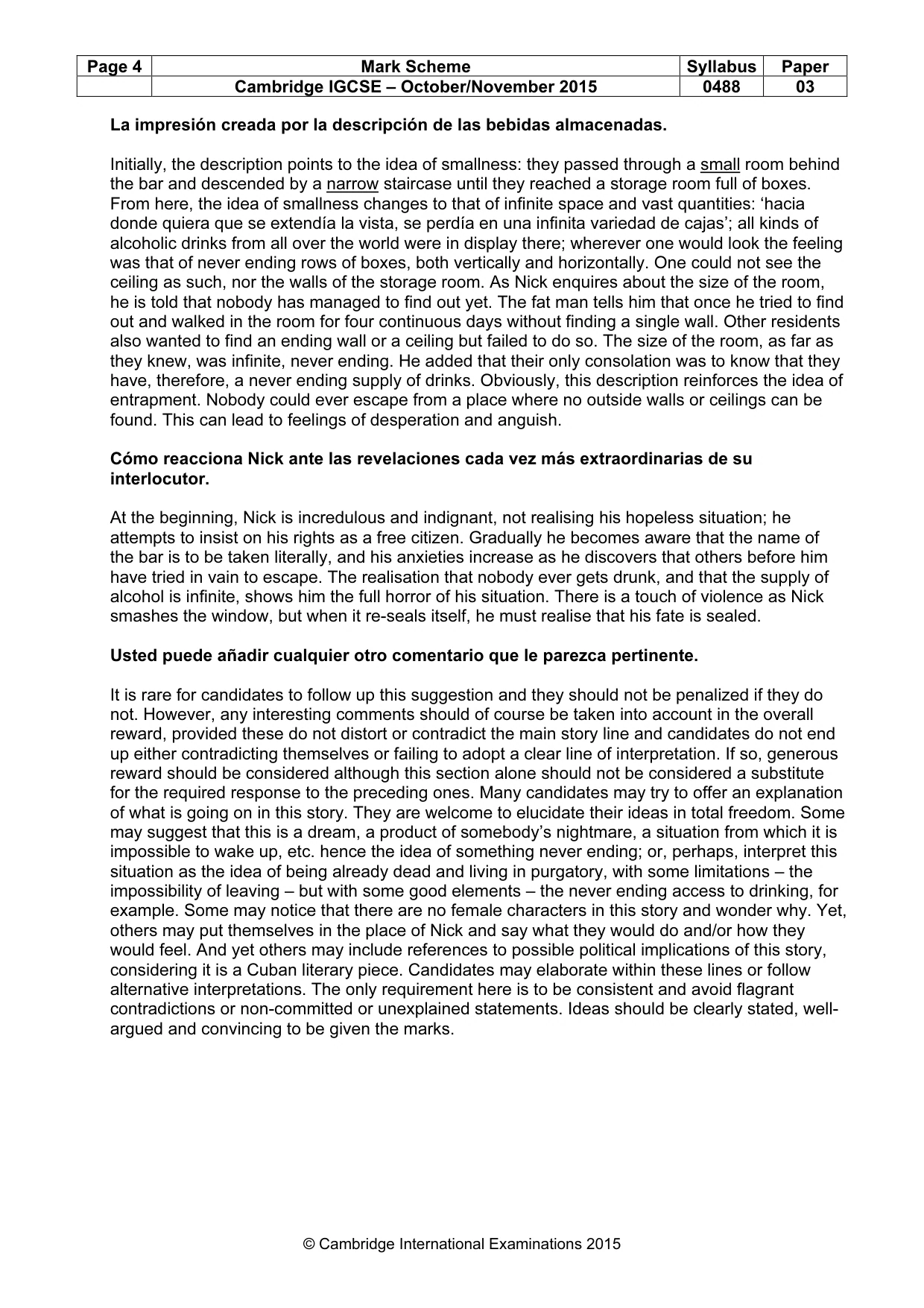
Page 4 Mark Scheme Syllabus Paper Cambridge IGCSE – October/November 2015 0488 03 © Cambridge International Examinations 2015 La impresión creada por la descripción de las bebidas almacenadas. Initially, the description points to the idea of smallness: they passed through a small room behind the bar and descended by a narrow staircase until they reached a storage room full of boxes. From here, the idea of smallness changes to that of infinite space and vast quantities: ‘hacia donde quiera que se extendía la vista, se perdía en una infinita variedad de cajas’; all kinds of alcoholic drinks from all over the world were in display there; wherever one would look the feeling was that of never ending rows of boxes, both vertically and horizontally. One could not see the ceiling as such, nor the walls of the storage room. As Nick enquires about the size of the room, he is told that nobody has managed to find out yet. The fat man tells him that once he tried to find out and walked in the room for four continuous days without finding a single wall. Other residents also wanted to find an ending wall or a ceiling but failed to do so. The size of the room, as far as they knew, was infinite, never ending. He added that their only consolation was to know that they have, therefore, a never ending supply of drinks. Obviously, this description reinforces the idea of entrapment. Nobody could ever escape from a place where no outside walls or ceilings can be found. This can lead to feelings of desperation and anguish. Cómo reacciona Nick ante las revelaciones cada vez más extraordinarias de su interlocutor. At the beginning, Nick is incredulous and indignant, not realising his hopeless situation; he attempts to insist on his rights as a free citizen. Gradually he becomes aware that the name of the bar is to be taken literally, and his anxieties increase as he discovers that others before him have tried in vain to escape. The realisation that nobody ever gets drunk, and that the supply of alcohol is infinite, shows him the full horror of his situation. There is a touch of violence as Nick smashes the window, but when it re-seals itself, he must realise that his fate is sealed. Usted puede añadir cualquier otro comentario que le parezca pertinente. It is rare for candidates to follow up this suggestion and they should not be penalized if they do not. However, any interesting comments should of course be taken into account in the overall reward, provided these do not distort or contradict the main story line and candidates do not end up either contradicting themselves or failing to adopt a clear line of interpretation. If so, generous reward should be considered although this section alone should not be considered a substitute for the required response to the preceding ones. Many candidates may try to offer an explanation of what is going on in this story. They are welcome to elucidate their ideas in total freedom. Some may suggest that this is a dream, a product of somebody’s nightmare, a situation from which it is impossible to wake up, etc. hence the idea of something never ending; or, perhaps, interpret this situation as the idea of being already dead and living in purgatory, with some limitations – the impossibility of leaving – but with some good elements – the never ending access to drinking, for example. Some may notice that there are no female characters in this story and wonder why. Yet, others may put themselves in the place of Nick and say what they would do and/or how they would feel. And yet others may include references to possible political implications of this story, considering it is a Cuban literary piece. Candidates may elaborate within these lines or follow alternative interpretations. The only requirement here is to be consistent and avoid flagrant contradictions or non-committed or unexplained statements. Ideas should be clearly stated, well- argued and convincing to be given the marks.
What you needed in this session
Cambridge’s own grade thresholds for 2015 Oct/Nov, Paper 3 · Variant 1. A higher threshold means an easier paper — the bar moves with how the cohort did.