Cambridge IGCSE Spanish - Literature 0488 — 2013 Oct/Nov Paper 3 · Variant 1
0488/31/O/N/13 · 20 marks · ≈23 min
The question paper and its mark scheme, free to read here and free to download. This is Cambridge’s own paper, exactly as it was sat.
Question paper4 pages
Mark scheme4 pages
Answers below. Sit the paper first if you are practising.
Paper as text
Question paper, page 1
This document consists of 3 printed pages and 1 blank page. DC (SJF) 59997/3 © UCLES 2013 [Turn over UNIVERSITY OF CAMBRIDGE INTERNATIONAL EXAMINATIONS International General Certificate of Secondary Education * 6 8 5 0 7 1 4 3 2 9 * LITERATURE (SPANISH) 0488/03 Paper 3 Alternative to Coursework October/November 2013 1 hour 20 minutes Additional Materials: Answer Booklet/Paper READ THESE INSTRUCTIONS FIRST If you have been given an Answer Booklet, follow the instructions on the front cover of the Booklet. Do not write your answer on the question paper. Write your Centre number, candidate number and name on all the work you hand in. Write in dark blue or black pen. Do not use staples, paper clips, highlighters, glue or correction fluid. At the end of the examination, fasten all your work securely together. Answer the question. EN PRIMER LUGAR, LEA ESTAS INSTRUCCIONES Si se le ha dado un Cuadernillo de Respuestas, siga las instrucciones de la tapa del Cuadernillo. No utilice nunca la hoja del examen para escribir su respuesta. Escriba el número del Centro, el número de estudiante que se le ha adjudicado y su nombre en todo el trabajo que vaya a entregar. Use tinta azul oscuro o negra. No use ni grapas, ni clips, ni rotulador, ni goma de pegar, ni corrector líquido. Al terminar el examen, si usa más de una hoja, únalas bien. Conteste la pregunta. www.XtremePapers.com
Question paper, page 2
2 0488/03/O/N/13 © UCLES 2013 Lea atentamente el siguiente poema de la escritora argentina Alfonsina Storni extraído de su libro Languidez, escrito en 1920. Luego conteste la pregunta: El León Entre barrotes negros, la dorada melena Paseas lentamente, y te tiendes por fin Descansando los tristes ojos sobre la arena Que brilla en los angostos senderos del jardín. Bajo el sol de la tarde te has quedado sereno Y ante tus ojos pasa, fresca y primaveral, La niña de quince años con su esponjado seno: ¿Sueñas echarle garras, oh, goloso animal? Miro tus grandes uñas, inútiles y corvas; Se abren tus fauces; veo el inútil molar, E inútiles como ellos van tus miradas torvas A morir en el hombre que te viene a mirar. El hombre que te mira tiene las manos finas, Tiene los ojos fijos y claros como tú. Se sonríe al mirarte. Tiene las manos finas, León, los ojos tiene como los tienes tú. Un día, suavemente, con sus corteses modos Hizo el hombre la jaula para encerrarte allí, Y ahora te contempla, apoyado de codos, Sobre el hierro prudente que lo aparta de ti. No cede. Bien lo sabes. Diez veces en un día Tu cuerpo contra el hierro carcelario se fue: Diez veces contra el hierro fue inútil tu porfía. Tus ojos, muy lejanos, hoy dicen: para qué. No obstante, cuando corta el silencio nocturno El rugido salvaje de algún otro león, Te crees en la selva, y el ojo, taciturno, Se te vuelve en la sombra encendido carbón. Entonces como otrora, se te afinan las uñas, Y la garganta seca de una salvaje sed, La piedra de tu celda vanamente rasguñas Y tu zarpazo inútil retumba en la pared. Los hijos que te nazcan, bestia caída y triste, De la leona esclava que por hembra te dan, Sufrirán en tu carne lo mismo que sufriste, Pero garras y dientes más débiles tendrán. ¿Lo comprendes y ruges? ¿Cuando escuálido un gato Pasa junto a tu jaula huyendo de un mastín Y a las ramas se trepa, se te salta al olfato Que así puede tu prole ser de mísera y ruin?
Question paper, page 3
3 0488/03/O/N/13 © UCLES 2013 Alguna vez te he visto durmiendo tu tristeza, La melena dorada sobre la piedra gris, Abandonado el cuerpo con la enorme pereza Que las siestas de fuego tienen en tu país. Y sobre tu salvaje melena enmarañada Mi cuello delicado sintió la tentación De abandonarse al tuyo, yo como tú, cansada, De otra jaula más vasta que la tuya, león. Como tú contra aquélla mil veces he saltado, Mil veces, impotente, me volví a acurrucar. ¡Cárcel de los sentidos que las cosas me han dado! Ah, yo del universo no me puedo escapar. 1 ¿Hasta que punto y cómo ha logrado la poetisa comunicarle sus sentimientos hacia el león a través de este poema? En particular, debe considerar, en detalle, los siguientes aspectos: • Lo que más le ha impactado a usted de la descripción del León, y por qué. • Cómo se vale la poetisa del lenguaje para comunicar la situación de cautiverio del león. Seleccione y analice las palabras más relevantes. • Cómo nos indica la poetisa que el león tiene un significado especial para ella. Usted puede añadir cualquier otro comentario que le parezca pertinente.
Question paper, page 4
4 0488/03/O/N/13 © UCLES 2013 BLANK PAGE Permission to reproduce items where third-party owned material protected by copyright is included has been sought and cleared where possible. Every reasonable effort has been made by the publisher (UCLES) to trace copyright holders, but if any items requiring clearance have unwittingly been included, the publisher will be pleased to make amends at the earliest possible opportunity. University of Cambridge International Examinations is part of the Cambridge Assessment Group. Cambridge Assessment is the brand name of University of Cambridge Local Examinations Syndicate (UCLES), which is itself a department of the University of Cambridge.
Mark scheme, page 1
CAMBRIDGE INTERNATIONAL EXAMINATIONS International General Certificate of Secondary Education MARK SCHEME for the October/November 2013 series 0488 LITERATURE (SPANISH) 0488/03 Paper 3 (Alternative to Coursework), maximum raw mark 20 This mark scheme is published as an aid to teachers and candidates, to indicate the requirements of the examination. It shows the basis on which Examiners were instructed to award marks. It does not indicate the details of the discussions that took place at an Examiners’ meeting before marking began, which would have considered the acceptability of alternative answers. Mark schemes should be read in conjunction with the question paper and the Principal Examiner Report for Teachers. Cambridge will not enter into discussions about these mark schemes. Cambridge is publishing the mark schemes for the October/November 2013 series for most IGCSE, GCE Advanced Level and Advanced Subsidiary Level components and some Ordinary Level components. www.XtremePapers.com
Mark scheme, page 2
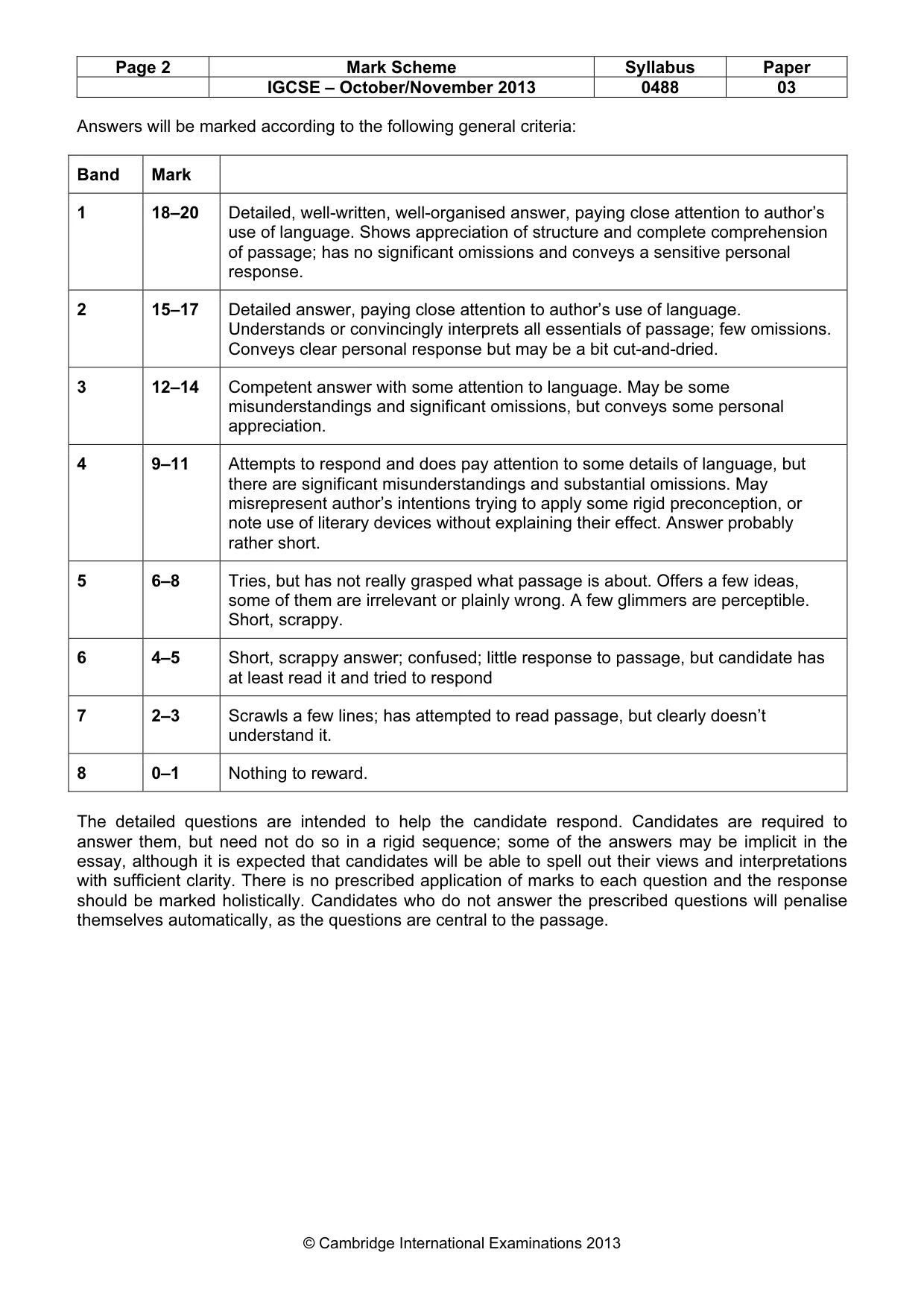
Page 2 Mark Scheme Syllabus Paper IGCSE – October/November 2013 0488 03 © Cambridge International Examinations 2013 Answers will be marked according to the following general criteria: Band Mark 1 18–20 Detailed, well-written, well-organised answer, paying close attention to author’s use of language. Shows appreciation of structure and complete comprehension of passage; has no significant omissions and conveys a sensitive personal response. 2 15–17 Detailed answer, paying close attention to author’s use of language. Understands or convincingly interprets all essentials of passage; few omissions. Conveys clear personal response but may be a bit cut-and-dried. 3 12–14 Competent answer with some attention to language. May be some misunderstandings and significant omissions, but conveys some personal appreciation. 4 9–11 Attempts to respond and does pay attention to some details of language, but there are significant misunderstandings and substantial omissions. May misrepresent author’s intentions trying to apply some rigid preconception, or note use of literary devices without explaining their effect. Answer probably rather short. 5 6–8 Tries, but has not really grasped what passage is about. Offers a few ideas, some of them are irrelevant or plainly wrong. A few glimmers are perceptible. Short, scrappy. 6 4–5 Short, scrappy answer; confused; little response to passage, but candidate has at least read it and tried to respond 7 2–3 Scrawls a few lines; has attempted to read passage, but clearly doesn’t understand it. 8 0–1 Nothing to reward. The detailed questions are intended to help the candidate respond. Candidates are required to answer them, but need not do so in a rigid sequence; some of the answers may be implicit in the essay, although it is expected that candidates will be able to spell out their views and interpretations with sufficient clarity. There is no prescribed application of marks to each question and the response should be marked holistically. Candidates who do not answer the prescribed questions will penalise themselves automatically, as the questions are central to the passage.
Mark scheme, page 3
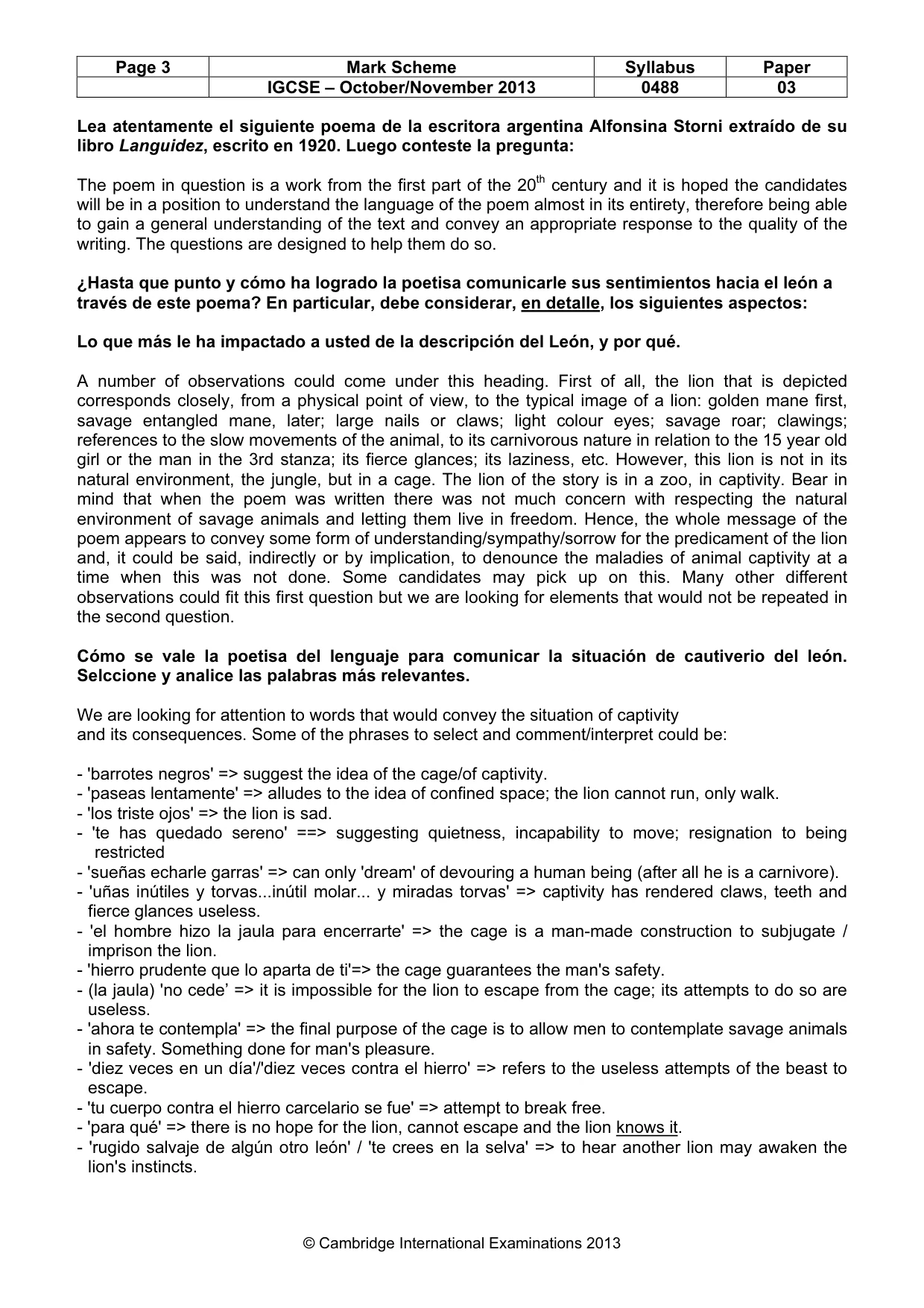
Page 3 Mark Scheme Syllabus Paper IGCSE – October/November 2013 0488 03 © Cambridge International Examinations 2013 Lea atentamente el siguiente poema de la escritora argentina Alfonsina Storni extraído de su libro Languidez, escrito en 1920. Luego conteste la pregunta: The poem in question is a work from the first part of the 20th century and it is hoped the candidates will be in a position to understand the language of the poem almost in its entirety, therefore being able to gain a general understanding of the text and convey an appropriate response to the quality of the writing. The questions are designed to help them do so. ¿Hasta que punto y cómo ha logrado la poetisa comunicarle sus sentimientos hacia el león a través de este poema? En particular, debe considerar, en detalle, los siguientes aspectos: Lo que más le ha impactado a usted de la descripción del León, y por qué. A number of observations could come under this heading. First of all, the lion that is depicted corresponds closely, from a physical point of view, to the typical image of a lion: golden mane first, savage entangled mane, later; large nails or claws; light colour eyes; savage roar; clawings; references to the slow movements of the animal, to its carnivorous nature in relation to the 15 year old girl or the man in the 3rd stanza; its fierce glances; its laziness, etc. However, this lion is not in its natural environment, the jungle, but in a cage. The lion of the story is in a zoo, in captivity. Bear in mind that when the poem was written there was not much concern with respecting the natural environment of savage animals and letting them live in freedom. Hence, the whole message of the poem appears to convey some form of understanding/sympathy/sorrow for the predicament of the lion and, it could be said, indirectly or by implication, to denounce the maladies of animal captivity at a time when this was not done. Some candidates may pick up on this. Many other different observations could fit this first question but we are looking for elements that would not be repeated in the second question. Cómo se vale la poetisa del lenguaje para comunicar la situación de cautiverio del león. Selccione y analice las palabras más relevantes. We are looking for attention to words that would convey the situation of captivity and its consequences. Some of the phrases to select and comment/interpret could be: - 'barrotes negros' => suggest the idea of the cage/of captivity. - 'paseas lentamente' => alludes to the idea of confined space; the lion cannot run, only walk. - 'los triste ojos' => the lion is sad. - 'te has quedado sereno' ==> suggesting quietness, incapability to move; resignation to being restricted - 'sueñas echarle garras' => can only 'dream' of devouring a human being (after all he is a carnivore). - 'uñas inútiles y torvas...inútil molar... y miradas torvas' => captivity has rendered claws, teeth and fierce glances useless. - 'el hombre hizo la jaula para encerrarte' => the cage is a man-made construction to subjugate / imprison the lion. - 'hierro prudente que lo aparta de ti'=> the cage guarantees the man's safety. - (la jaula) 'no cede’ => it is impossible for the lion to escape from the cage; its attempts to do so are useless. - 'ahora te contempla' => the final purpose of the cage is to allow men to contemplate savage animals in safety. Something done for man's pleasure. - 'diez veces en un día'/'diez veces contra el hierro' => refers to the useless attempts of the beast to escape. - 'tu cuerpo contra el hierro carcelario se fue' => attempt to break free. - 'para qué' => there is no hope for the lion, cannot escape and the lion knows it. - 'rugido salvaje de algún otro león' / 'te crees en la selva' => to hear another lion may awaken the lion's instincts.
Mark scheme, page 4
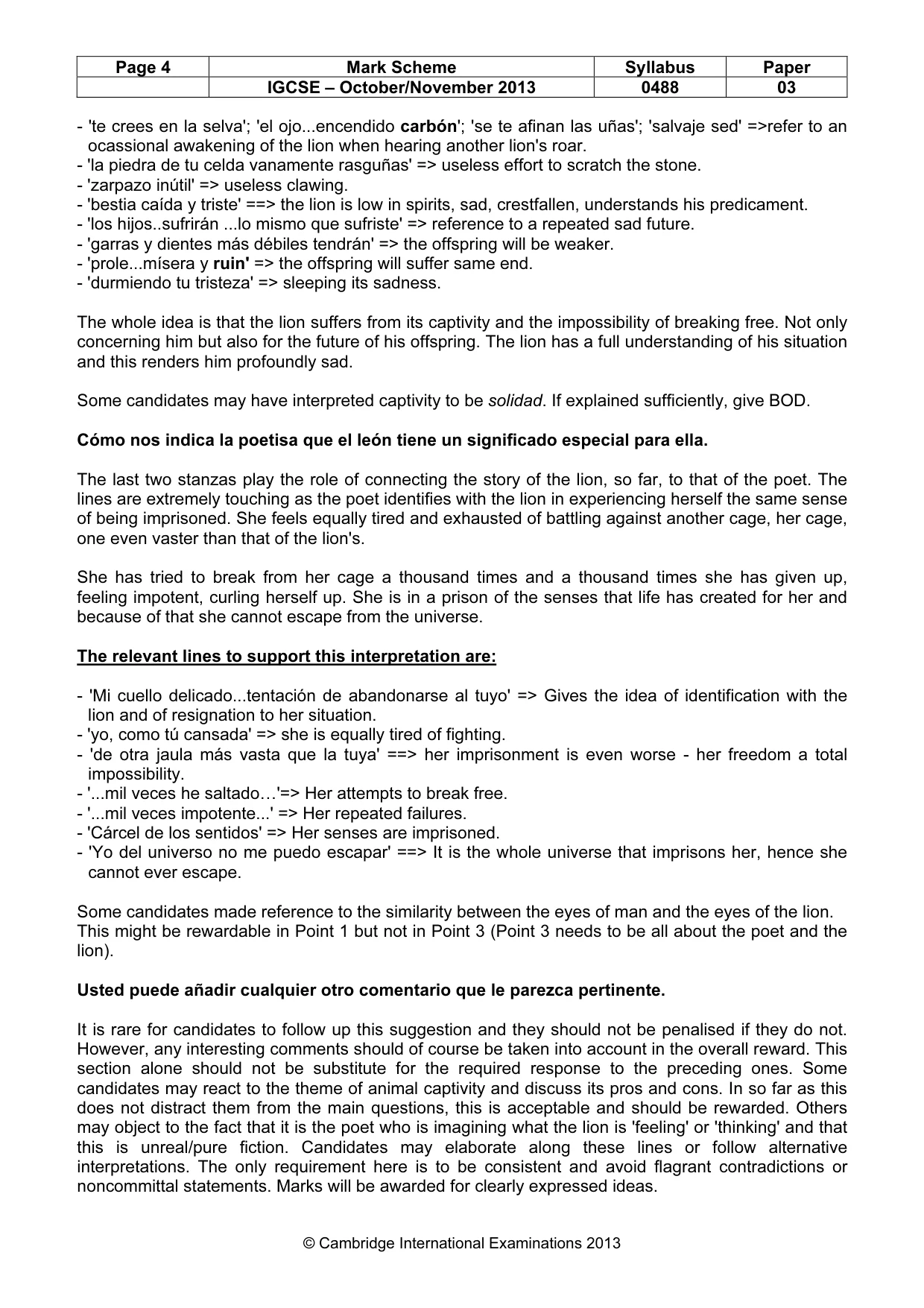
Page 4 Mark Scheme Syllabus Paper IGCSE – October/November 2013 0488 03 © Cambridge International Examinations 2013 - 'te crees en la selva'; 'el ojo...encendido carbón'; 'se te afinan las uñas'; 'salvaje sed' =>refer to an ocassional awakening of the lion when hearing another lion's roar. - 'la piedra de tu celda vanamente rasguñas' => useless effort to scratch the stone. - 'zarpazo inútil' => useless clawing. - 'bestia caída y triste' ==> the lion is low in spirits, sad, crestfallen, understands his predicament. - 'los hijos..sufrirán ...lo mismo que sufriste' => reference to a repeated sad future. - 'garras y dientes más débiles tendrán' => the offspring will be weaker. - 'prole...mísera y ruin' => the offspring will suffer same end. - 'durmiendo tu tristeza' => sleeping its sadness. The whole idea is that the lion suffers from its captivity and the impossibility of breaking free. Not only concerning him but also for the future of his offspring. The lion has a full understanding of his situation and this renders him profoundly sad. Some candidates may have interpreted captivity to be solidad. If explained sufficiently, give BOD. Cómo nos indica la poetisa que el león tiene un significado especial para ella. The last two stanzas play the role of connecting the story of the lion, so far, to that of the poet. The lines are extremely touching as the poet identifies with the lion in experiencing herself the same sense of being imprisoned. She feels equally tired and exhausted of battling against another cage, her cage, one even vaster than that of the lion's. She has tried to break from her cage a thousand times and a thousand times she has given up, feeling impotent, curling herself up. She is in a prison of the senses that life has created for her and because of that she cannot escape from the universe. The relevant lines to support this interpretation are: - 'Mi cuello delicado...tentación de abandonarse al tuyo' => Gives the idea of identification with the lion and of resignation to her situation. - 'yo, como tú cansada' => she is equally tired of fighting. - 'de otra jaula más vasta que la tuya' ==> her imprisonment is even worse - her freedom a total impossibility. - '...mil veces he saltado…'=> Her attempts to break free. - '...mil veces impotente...' => Her repeated failures. - 'Cárcel de los sentidos' => Her senses are imprisoned. - 'Yo del universo no me puedo escapar' ==> It is the whole universe that imprisons her, hence she cannot ever escape. Some candidates made reference to the similarity between the eyes of man and the eyes of the lion. This might be rewardable in Point 1 but not in Point 3 (Point 3 needs to be all about the poet and the lion). Usted puede añadir cualquier otro comentario que le parezca pertinente. It is rare for candidates to follow up this suggestion and they should not be penalised if they do not. However, any interesting comments should of course be taken into account in the overall reward. This section alone should not be substitute for the required response to the preceding ones. Some candidates may react to the theme of animal captivity and discuss its pros and cons. In so far as this does not distract them from the main questions, this is acceptable and should be rewarded. Others may object to the fact that it is the poet who is imagining what the lion is 'feeling' or 'thinking' and that this is unreal/pure fiction. Candidates may elaborate along these lines or follow alternative interpretations. The only requirement here is to be consistent and avoid flagrant contradictions or noncommittal statements. Marks will be awarded for clearly expressed ideas.
What you needed in this session
Cambridge’s own grade thresholds for 2013 Oct/Nov, Paper 3 · Variant 1. A higher threshold means an easier paper — the bar moves with how the cohort did.