Cambridge IGCSE Spanish - Literature 0488 — 2012 May/June Paper 3 · Variant 1
0488/31/M/J/12 · 20 marks · ≈23 min
The question paper and its mark scheme, free to read here and free to download. This is Cambridge’s own paper, exactly as it was sat.
Question paper4 pages

Mark scheme6 pages
Answers below. Sit the paper first if you are practising.
Paper as text
Question paper, page 1
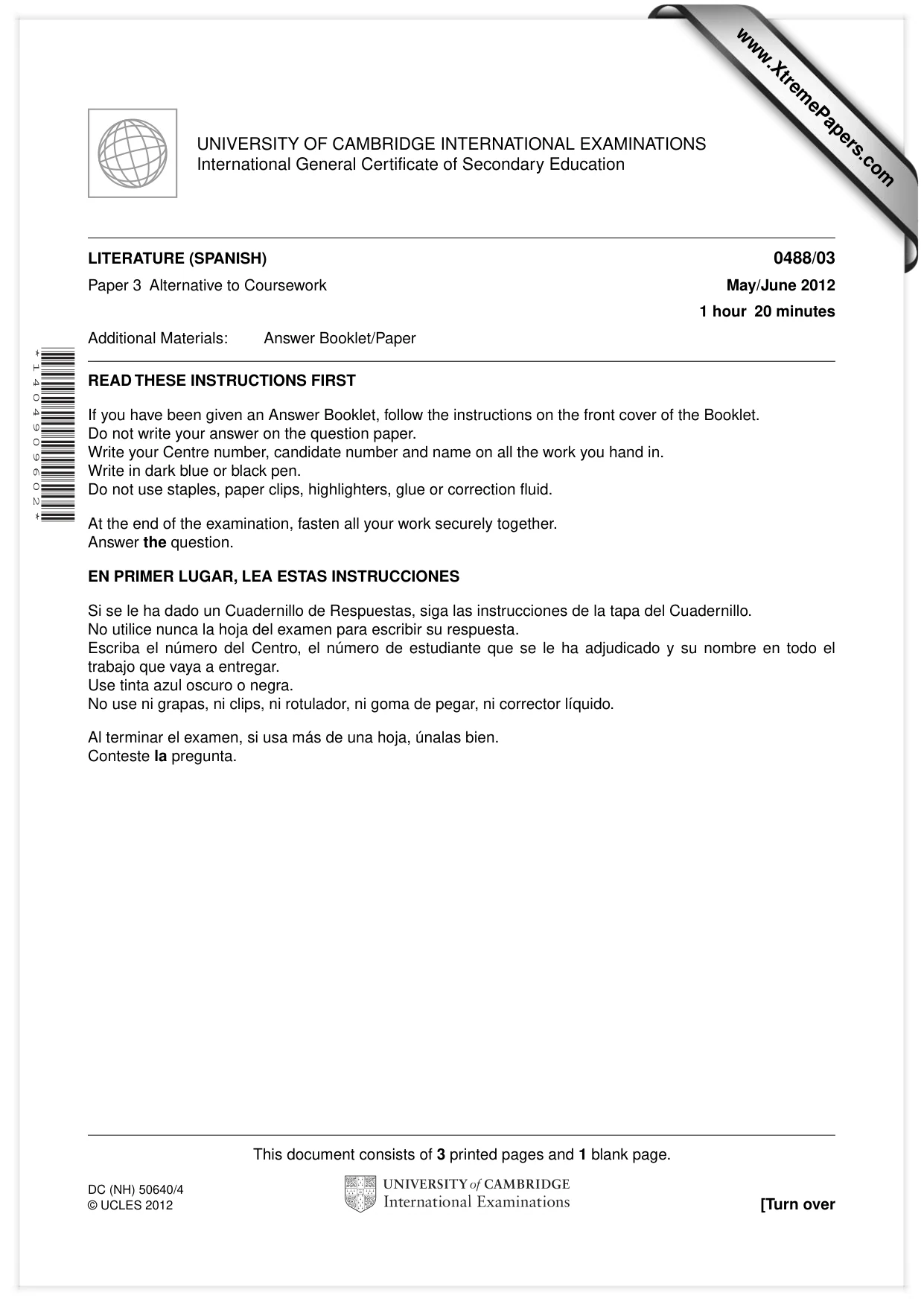
This document consists of 3 printed pages and 1 blank page. DC (NH) 50640/4 © UCLES 2012 [Turn over UNIVERSITY OF CAMBRIDGE INTERNATIONAL EXAMINATIONS International General Certificate of Secondary Education * 1 4 0 4 9 0 9 6 0 2 * LITERATURE (SPANISH) 0488/03 Paper 3 Alternative to Coursework May/June 2012 1 hour 20 minutes Additional Materials: Answer Booklet/Paper READ THESE INSTRUCTIONS FIRST If you have been given an Answer Booklet, follow the instructions on the front cover of the Booklet. Do not write your answer on the question paper. Write your Centre number, candidate number and name on all the work you hand in. Write in dark blue or black pen. Do not use staples, paper clips, highlighters, glue or correction fluid. At the end of the examination, fasten all your work securely together. Answer the question. EN PRIMER LUGAR, LEA ESTAS INSTRUCCIONES Si se le ha dado un Cuadernillo de Respuestas, siga las instrucciones de la tapa del Cuadernillo. No utilice nunca la hoja del examen para escribir su respuesta. Escriba el número del Centro, el número de estudiante que se le ha adjudicado y su nombre en todo el trabajo que vaya a entregar. Use tinta azul oscuro o negra. No use ni grapas, ni clips, ni rotulador, ni goma de pegar, ni corrector líquido. Al terminar el examen, si usa más de una hoja, únalas bien. Conteste la pregunta. www.XtremePapers.com
Question paper, page 2
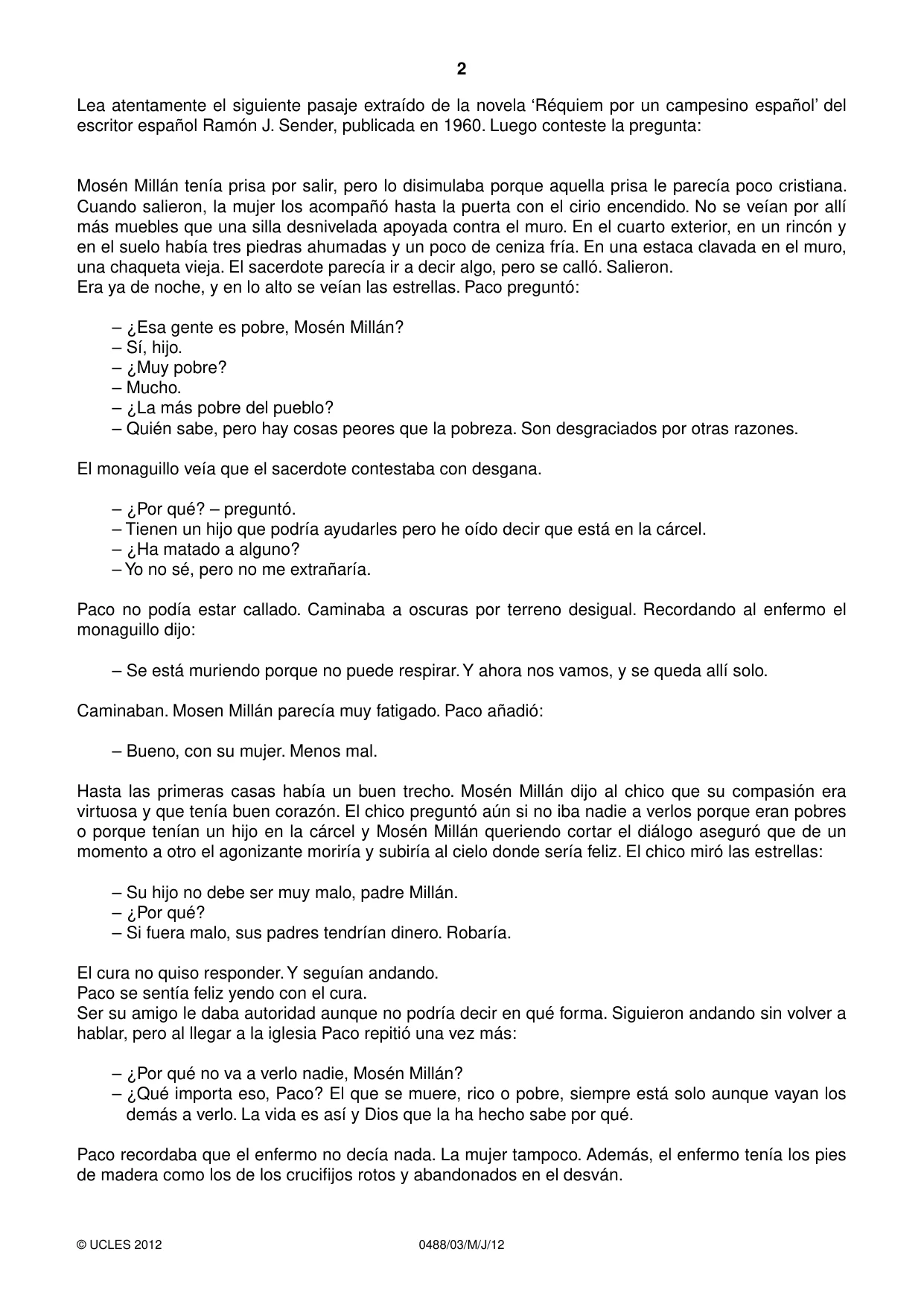
2 0488/03/M/J/12 © UCLES 2012 Lea atentamente el siguiente pasaje extraído de la novela ‘Réquiem por un campesino español’ del escritor español Ramón J. Sender, publicada en 1960. Luego conteste la pregunta: Mosén Millán tenía prisa por salir, pero lo disimulaba porque aquella prisa le parecía poco cristiana. Cuando salieron, la mujer los acompañó hasta la puerta con el cirio encendido. No se veían por allí más muebles que una silla desnivelada apoyada contra el muro. En el cuarto exterior, en un rincón y en el suelo había tres piedras ahumadas y un poco de ceniza fría. En una estaca clavada en el muro, una chaqueta vieja. El sacerdote parecía ir a decir algo, pero se calló. Salieron. Era ya de noche, y en lo alto se veían las estrellas. Paco preguntó: – ¿Esa gente es pobre, Mosén Millán? – Sí, hijo. – ¿Muy pobre? – Mucho. – ¿La más pobre del pueblo? – Quién sabe, pero hay cosas peores que la pobreza. Son desgraciados por otras razones. El monaguillo veía que el sacerdote contestaba con desgana. – ¿Por qué? – preguntó. – Tienen un hijo que podría ayudarles pero he oído decir que está en la cárcel. – ¿Ha matado a alguno? – Yo no sé, pero no me extrañaría. Paco no podía estar callado. Caminaba a oscuras por terreno desigual. Recordando al enfermo el monaguillo dijo: – Se está muriendo porque no puede respirar. Y ahora nos vamos, y se queda allí solo. Caminaban. Mosen Millán parecía muy fatigado. Paco añadió: – Bueno, con su mujer. Menos mal. Hasta las primeras casas había un buen trecho. Mosén Millán dijo al chico que su compasión era virtuosa y que tenía buen corazón. El chico preguntó aún si no iba nadie a verlos porque eran pobres o porque tenían un hijo en la cárcel y Mosén Millán queriendo cortar el diálogo aseguró que de un momento a otro el agonizante moriría y subiría al cielo donde sería feliz. El chico miró las estrellas: – Su hijo no debe ser muy malo, padre Millán. – ¿Por qué? – Si fuera malo, sus padres tendrían dinero. Robaría. El cura no quiso responder. Y seguían andando. Paco se sentía feliz yendo con el cura. Ser su amigo le daba autoridad aunque no podría decir en qué forma. Siguieron andando sin volver a hablar, pero al llegar a la iglesia Paco repitió una vez más: – ¿Por qué no va a verlo nadie, Mosén Millán? – ¿Qué importa eso, Paco? El que se muere, rico o pobre, siempre está solo aunque vayan los demás a verlo. La vida es así y Dios que la ha hecho sabe por qué. Paco recordaba que el enfermo no decía nada. La mujer tampoco. Además, el enfermo tenía los pies de madera como los de los crucifijos rotos y abandonados en el desván.
Question paper, page 3
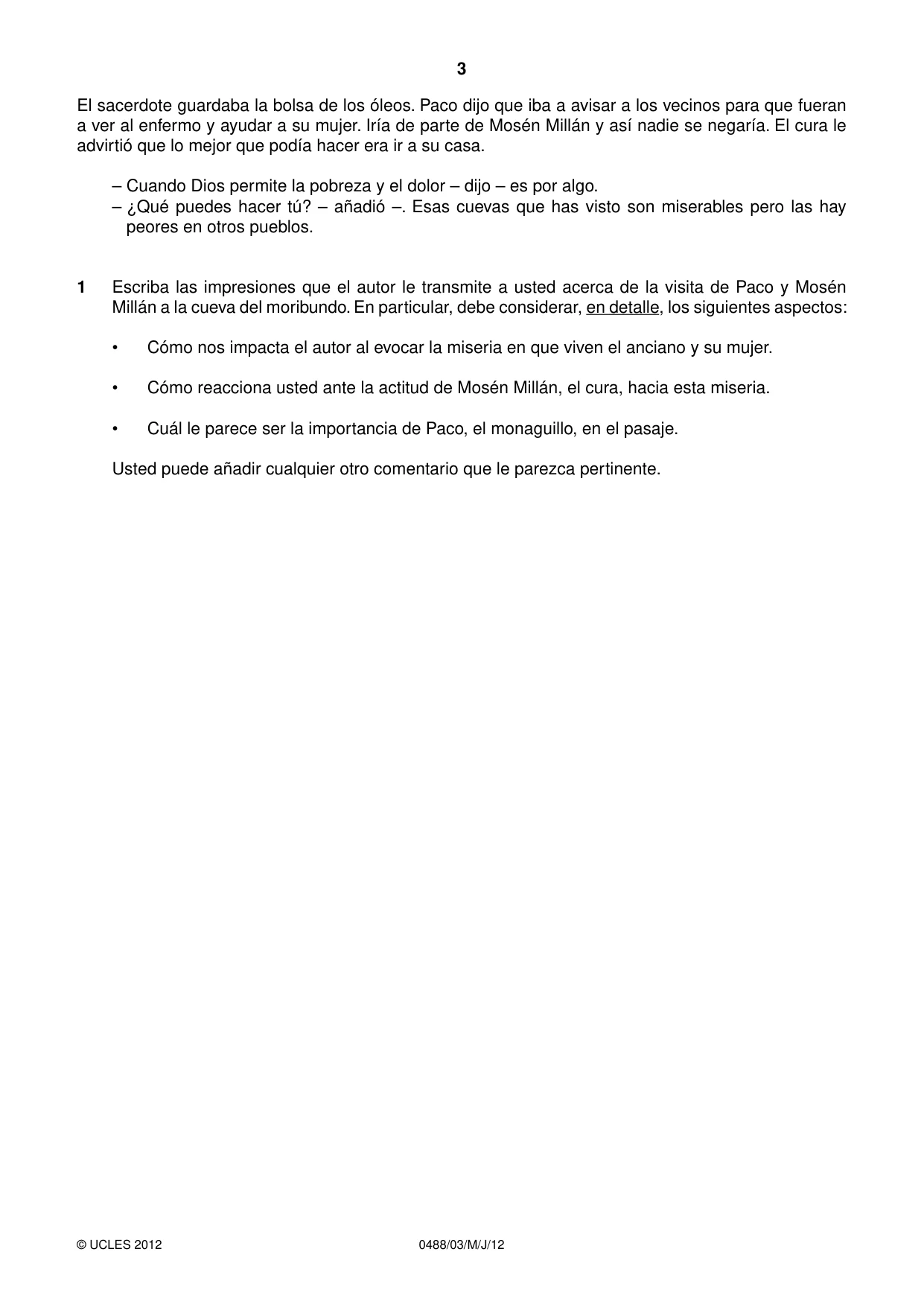
3 0488/03/M/J/12 © UCLES 2012 El sacerdote guardaba la bolsa de los óleos. Paco dijo que iba a avisar a los vecinos para que fueran a ver al enfermo y ayudar a su mujer. Iría de parte de Mosén Millán y así nadie se negaría. El cura le advirtió que lo mejor que podía hacer era ir a su casa. – Cuando Dios permite la pobreza y el dolor – dijo – es por algo. – ¿Qué puedes hacer tú? – añadió –. Esas cuevas que has visto son miserables pero las hay peores en otros pueblos. 1 Escriba las impresiones que el autor le transmite a usted acerca de la visita de Paco y Mosén Millán a la cueva del moribundo. En particular, debe considerar, en detalle, los siguientes aspectos: • Cómo nos impacta el autor al evocar la miseria en que viven el anciano y su mujer. • Cómo reacciona usted ante la actitud de Mosén Millán, el cura, hacia esta miseria. • Cuál le parece ser la importancia de Paco, el monaguillo, en el pasaje. Usted puede añadir cualquier otro comentario que le parezca pertinente.
Question paper, page 4
4 0488/03/M/J/12 © UCLES 2012 BLANK PAGE Copyright Acknowledgements: Insert © Ramón J Sender: Réquiem por un campesino español ; Editorial Proyección, Buenos Aires 1966. Permission to reproduce items where third-party owned material protected by copyright is included has been sought and cleared where possible. Every reasonable effort has been made by the publisher (UCLES) to trace copyright holders, but if any items requiring clearance have unwittingly been included, the publisher will be pleased to make amends at the earliest possible opportunity. University of Cambridge International Examinations is part of the Cambridge Assessment Group. Cambridge Assessment is the brand name of University of Cambridge Local Examinations Syndicate (UCLES), which is itself a department of the University of Cambridge.
Mark scheme, page 1
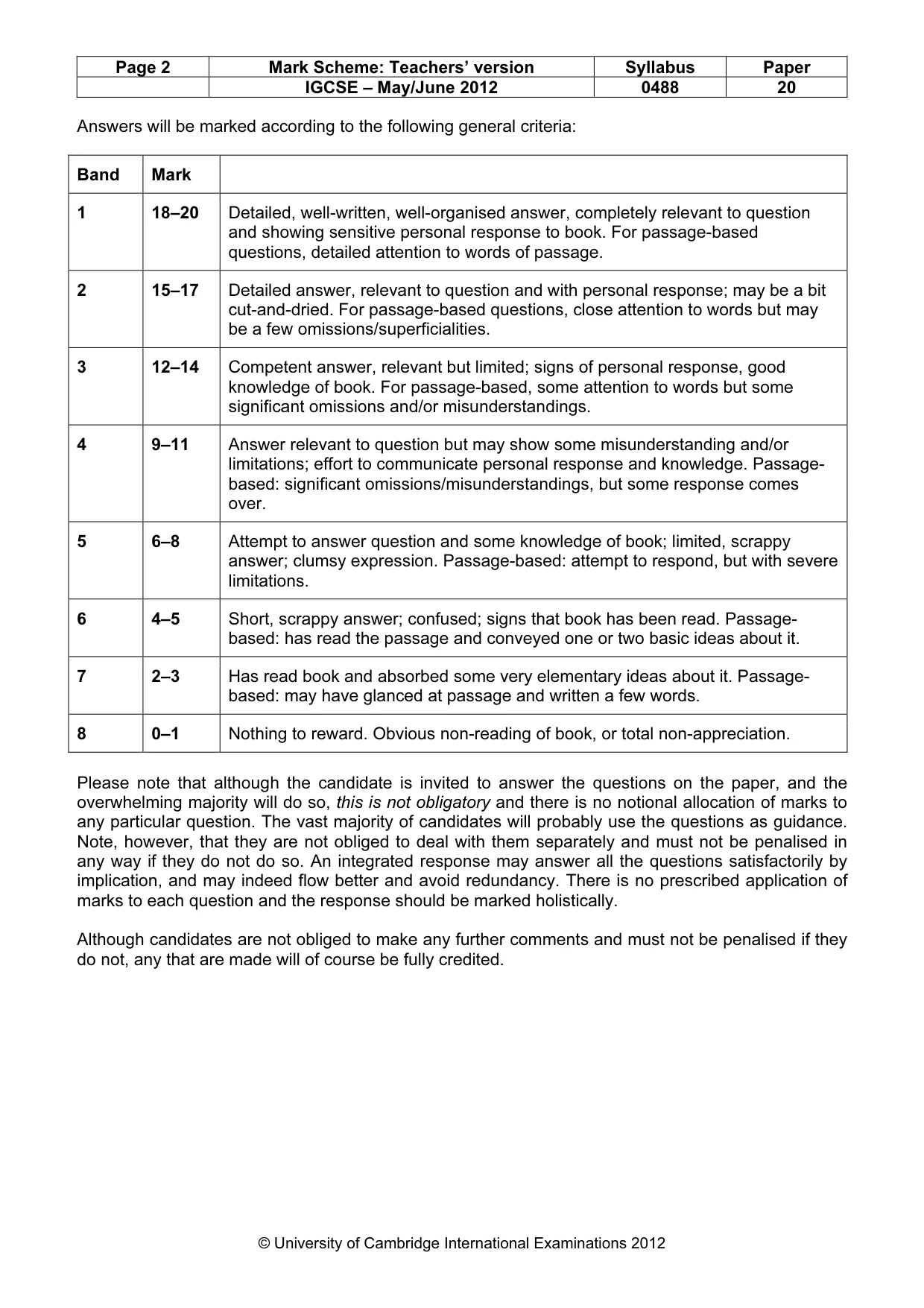
UNIVERSITY OF CAMBRIDGE INTERNATIONAL EXAMINATIONS International General Certificate of Secondary Education MARK SCHEME for the May/June 2012 question paper for the guidance of teachers 0488 LITERATURE (SPANISH) 0488/03 Paper 1 (Alternative to Coursework), maximum raw mark 20 This mark scheme is published as an aid to teachers and candidates, to indicate the requirements of the examination. It shows the basis on which Examiners were instructed to award marks. It does not indicate the details of the discussions that took place at an Examiners’ meeting before marking began, which would have considered the acceptability of alternative answers. Mark schemes must be read in conjunction with the question papers and the report on the examination. • Cambridge will not enter into discussions or correspondence in connection with these mark schemes. Cambridge is publishing the mark schemes for the May/June 2012 question papers for most IGCSE, GCE Advanced Level and Advanced Subsidiary Level syllabuses and some Ordinary Level syllabuses. www.XtremePapers.com
Mark scheme, page 2
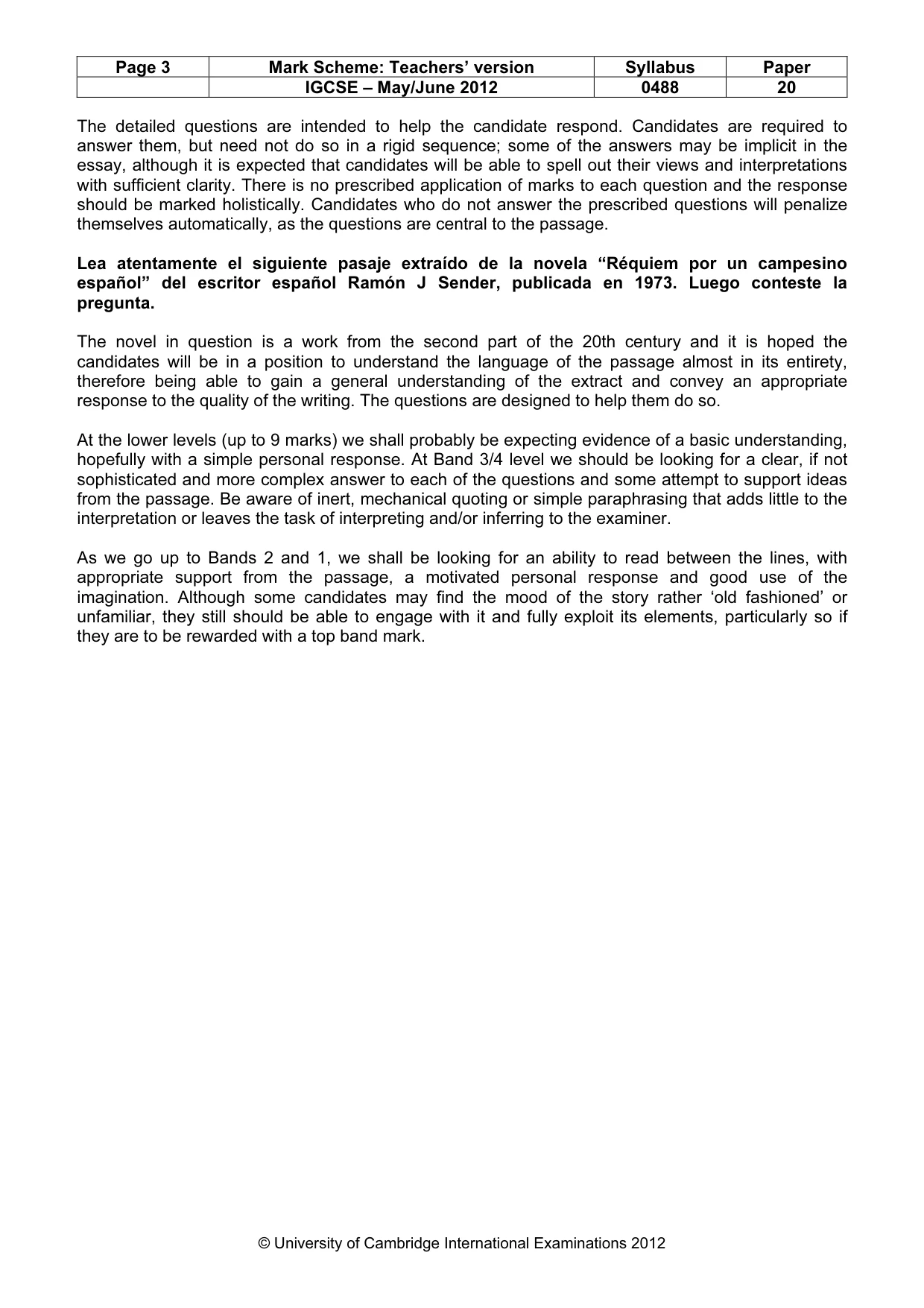
Page 2 Mark Scheme: Teachers’ version Syllabus Paper IGCSE – May/June 2012 0488 20 © University of Cambridge International Examinations 2012 Answers will be marked according to the following general criteria: Band Mark 1 18–20 Detailed, well-written, well-organised answer, completely relevant to question and showing sensitive personal response to book. For passage-based questions, detailed attention to words of passage. 2 15–17 Detailed answer, relevant to question and with personal response; may be a bit cut-and-dried. For passage-based questions, close attention to words but may be a few omissions/superficialities. 3 12–14 Competent answer, relevant but limited; signs of personal response, good knowledge of book. For passage-based, some attention to words but some significant omissions and/or misunderstandings. 4 9–11 Answer relevant to question but may show some misunderstanding and/or limitations; effort to communicate personal response and knowledge. Passage- based: significant omissions/misunderstandings, but some response comes over. 5 6–8 Attempt to answer question and some knowledge of book; limited, scrappy answer; clumsy expression. Passage-based: attempt to respond, but with severe limitations. 6 4–5 Short, scrappy answer; confused; signs that book has been read. Passage- based: has read the passage and conveyed one or two basic ideas about it. 7 2–3 Has read book and absorbed some very elementary ideas about it. Passage- based: may have glanced at passage and written a few words. 8 0–1 Nothing to reward. Obvious non-reading of book, or total non-appreciation. Please note that although the candidate is invited to answer the questions on the paper, and the overwhelming majority will do so, this is not obligatory and there is no notional allocation of marks to any particular question. The vast majority of candidates will probably use the questions as guidance. Note, however, that they are not obliged to deal with them separately and must not be penalised in any way if they do not do so. An integrated response may answer all the questions satisfactorily by implication, and may indeed flow better and avoid redundancy. There is no prescribed application of marks to each question and the response should be marked holistically. Although candidates are not obliged to make any further comments and must not be penalised if they do not, any that are made will of course be fully credited.
Mark scheme, page 3
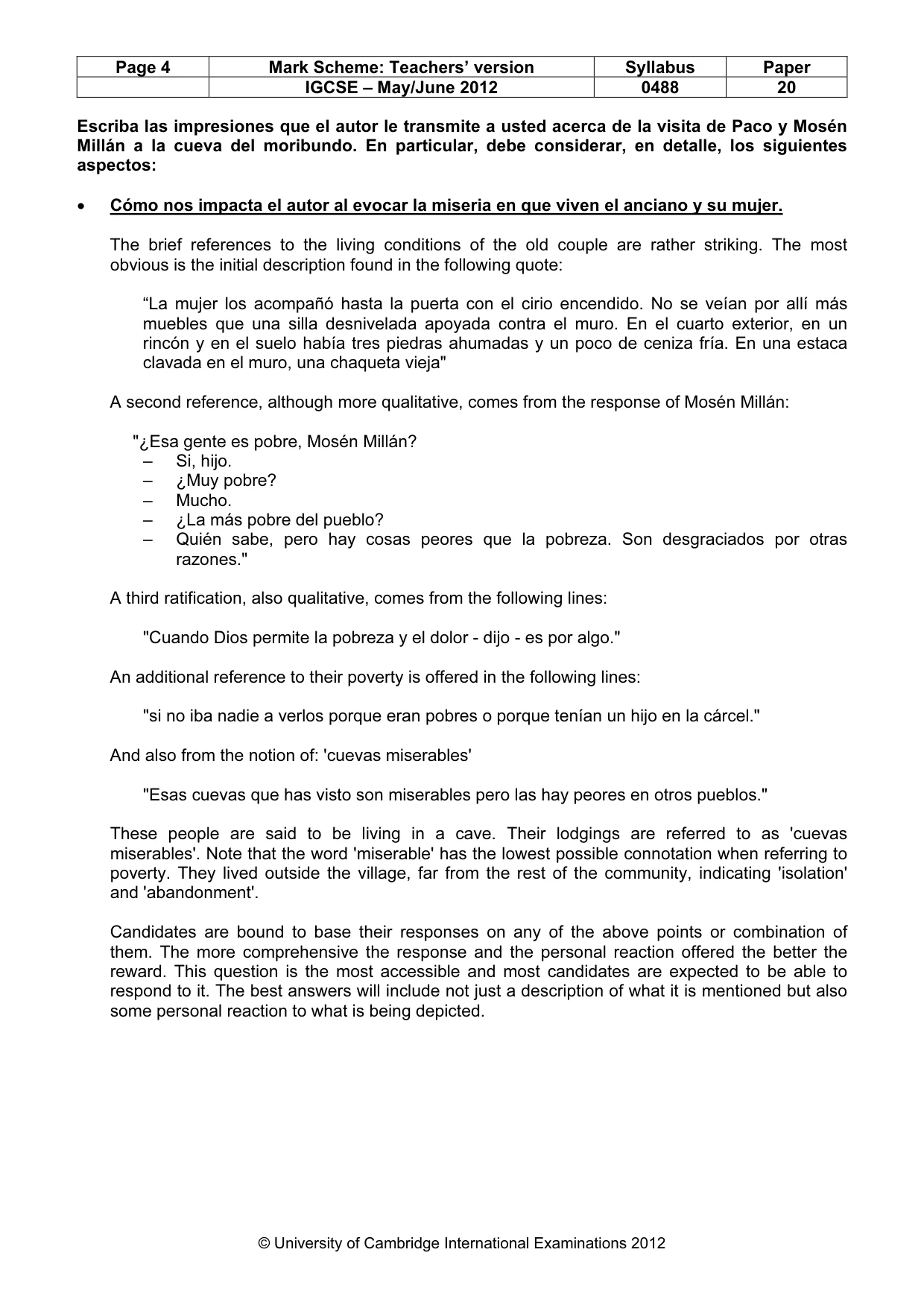
Page 3 Mark Scheme: Teachers’ version Syllabus Paper IGCSE – May/June 2012 0488 20 © University of Cambridge International Examinations 2012 The detailed questions are intended to help the candidate respond. Candidates are required to answer them, but need not do so in a rigid sequence; some of the answers may be implicit in the essay, although it is expected that candidates will be able to spell out their views and interpretations with sufficient clarity. There is no prescribed application of marks to each question and the response should be marked holistically. Candidates who do not answer the prescribed questions will penalize themselves automatically, as the questions are central to the passage. Lea atentamente el siguiente pasaje extraído de la novela “Réquiem por un campesino español” del escritor español Ramón J Sender, publicada en 1973. Luego conteste la pregunta. The novel in question is a work from the second part of the 20th century and it is hoped the candidates will be in a position to understand the language of the passage almost in its entirety, therefore being able to gain a general understanding of the extract and convey an appropriate response to the quality of the writing. The questions are designed to help them do so. At the lower levels (up to 9 marks) we shall probably be expecting evidence of a basic understanding, hopefully with a simple personal response. At Band 3/4 level we should be looking for a clear, if not sophisticated and more complex answer to each of the questions and some attempt to support ideas from the passage. Be aware of inert, mechanical quoting or simple paraphrasing that adds little to the interpretation or leaves the task of interpreting and/or inferring to the examiner. As we go up to Bands 2 and 1, we shall be looking for an ability to read between the lines, with appropriate support from the passage, a motivated personal response and good use of the imagination. Although some candidates may find the mood of the story rather ‘old fashioned’ or unfamiliar, they still should be able to engage with it and fully exploit its elements, particularly so if they are to be rewarded with a top band mark.
Mark scheme, page 4
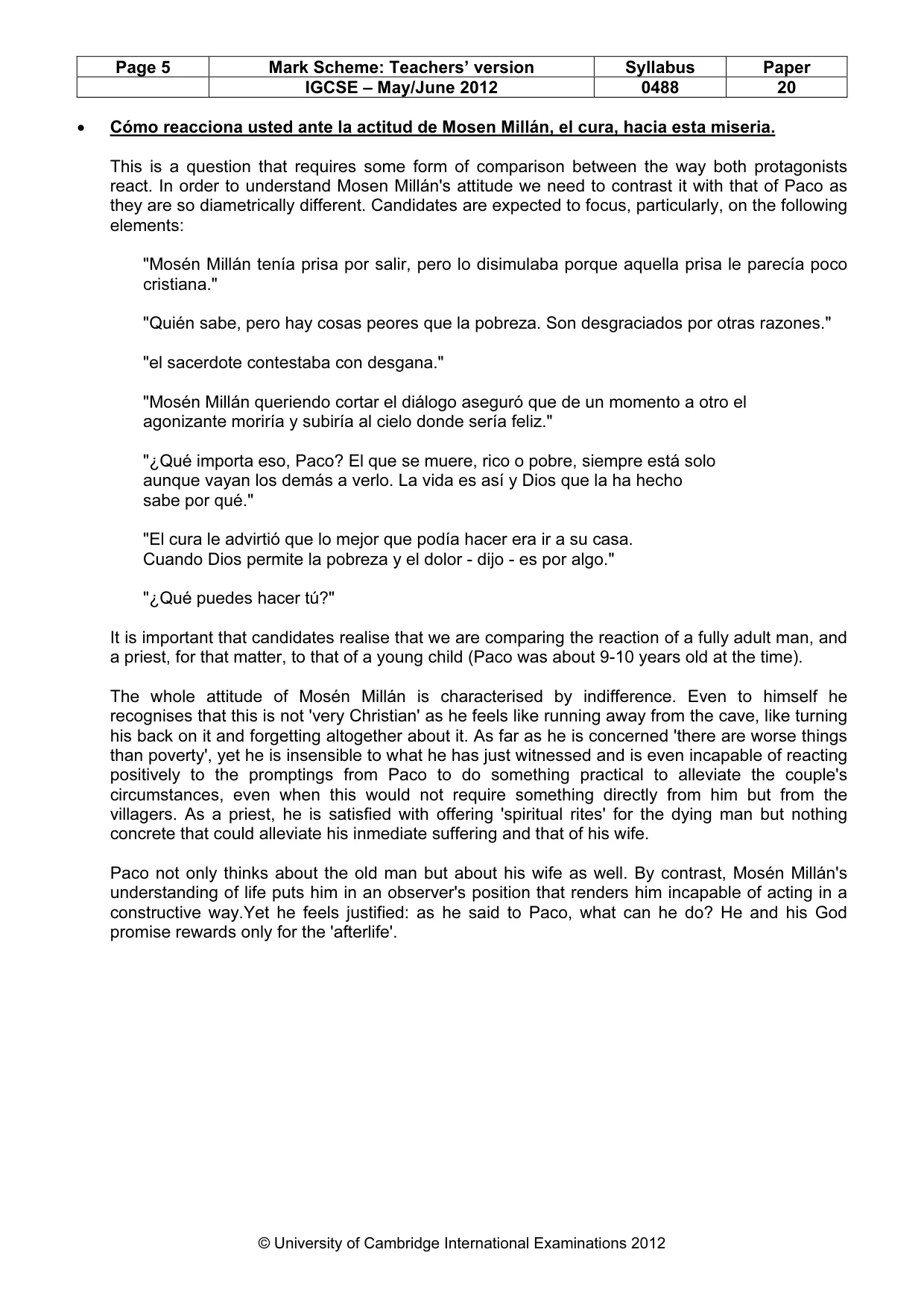
Page 4 Mark Scheme: Teachers’ version Syllabus Paper IGCSE – May/June 2012 0488 20 © University of Cambridge International Examinations 2012 Escriba las impresiones que el autor le transmite a usted acerca de la visita de Paco y Mosén Millán a la cueva del moribundo. En particular, debe considerar, en detalle, los siguientes aspectos: • Cómo nos impacta el autor al evocar la miseria en que viven el anciano y su mujer. The brief references to the living conditions of the old couple are rather striking. The most obvious is the initial description found in the following quote: “La mujer los acompañó hasta la puerta con el cirio encendido. No se veían por allí más muebles que una silla desnivelada apoyada contra el muro. En el cuarto exterior, en un rincón y en el suelo había tres piedras ahumadas y un poco de ceniza fría. En una estaca clavada en el muro, una chaqueta vieja" A second reference, although more qualitative, comes from the response of Mosén Millán: "¿Esa gente es pobre, Mosén Millán? – Si, hijo. – ¿Muy pobre? – Mucho. – ¿La más pobre del pueblo? – Quién sabe, pero hay cosas peores que la pobreza. Son desgraciados por otras razones." A third ratification, also qualitative, comes from the following lines: "Cuando Dios permite la pobreza y el dolor - dijo - es por algo." An additional reference to their poverty is offered in the following lines: "si no iba nadie a verlos porque eran pobres o porque tenían un hijo en la cárcel." And also from the notion of: 'cuevas miserables' "Esas cuevas que has visto son miserables pero las hay peores en otros pueblos." These people are said to be living in a cave. Their lodgings are referred to as 'cuevas miserables'. Note that the word 'miserable' has the lowest possible connotation when referring to poverty. They lived outside the village, far from the rest of the community, indicating 'isolation' and 'abandonment'. Candidates are bound to base their responses on any of the above points or combination of them. The more comprehensive the response and the personal reaction offered the better the reward. This question is the most accessible and most candidates are expected to be able to respond to it. The best answers will include not just a description of what it is mentioned but also some personal reaction to what is being depicted.
Mark scheme, page 5
Page 5 Mark Scheme: Teachers’ version Syllabus Paper IGCSE – May/June 2012 0488 20 © University of Cambridge International Examinations 2012 • Cómo reacciona usted ante la actitud de Mosen Millán, el cura, hacia esta miseria. This is a question that requires some form of comparison between the way both protagonists react. In order to understand Mosen Millán's attitude we need to contrast it with that of Paco as they are so diametrically different. Candidates are expected to focus, particularly, on the following elements: "Mosén Millán tenía prisa por salir, pero lo disimulaba porque aquella prisa le parecía poco cristiana." "Quién sabe, pero hay cosas peores que la pobreza. Son desgraciados por otras razones." "el sacerdote contestaba con desgana." "Mosén Millán queriendo cortar el diálogo aseguró que de un momento a otro el agonizante moriría y subiría al cielo donde sería feliz." "¿Qué importa eso, Paco? El que se muere, rico o pobre, siempre está solo aunque vayan los demás a verlo. La vida es así y Dios que la ha hecho sabe por qué." "El cura le advirtió que lo mejor que podía hacer era ir a su casa. Cuando Dios permite la pobreza y el dolor - dijo - es por algo." "¿Qué puedes hacer tú?" It is important that candidates realise that we are comparing the reaction of a fully adult man, and a priest, for that matter, to that of a young child (Paco was about 9-10 years old at the time). The whole attitude of Mosén Millán is characterised by indifference. Even to himself he recognises that this is not 'very Christian' as he feels like running away from the cave, like turning his back on it and forgetting altogether about it. As far as he is concerned 'there are worse things than poverty', yet he is insensible to what he has just witnessed and is even incapable of reacting positively to the promptings from Paco to do something practical to alleviate the couple's circumstances, even when this would not require something directly from him but from the villagers. As a priest, he is satisfied with offering 'spiritual rites' for the dying man but nothing concrete that could alleviate his inmediate suffering and that of his wife. Paco not only thinks about the old man but about his wife as well. By contrast, Mosén Millán's understanding of life puts him in an observer's position that renders him incapable of acting in a constructive way.Yet he feels justified: as he said to Paco, what can he do? He and his God promise rewards only for the 'afterlife'.
Mark scheme, page 6
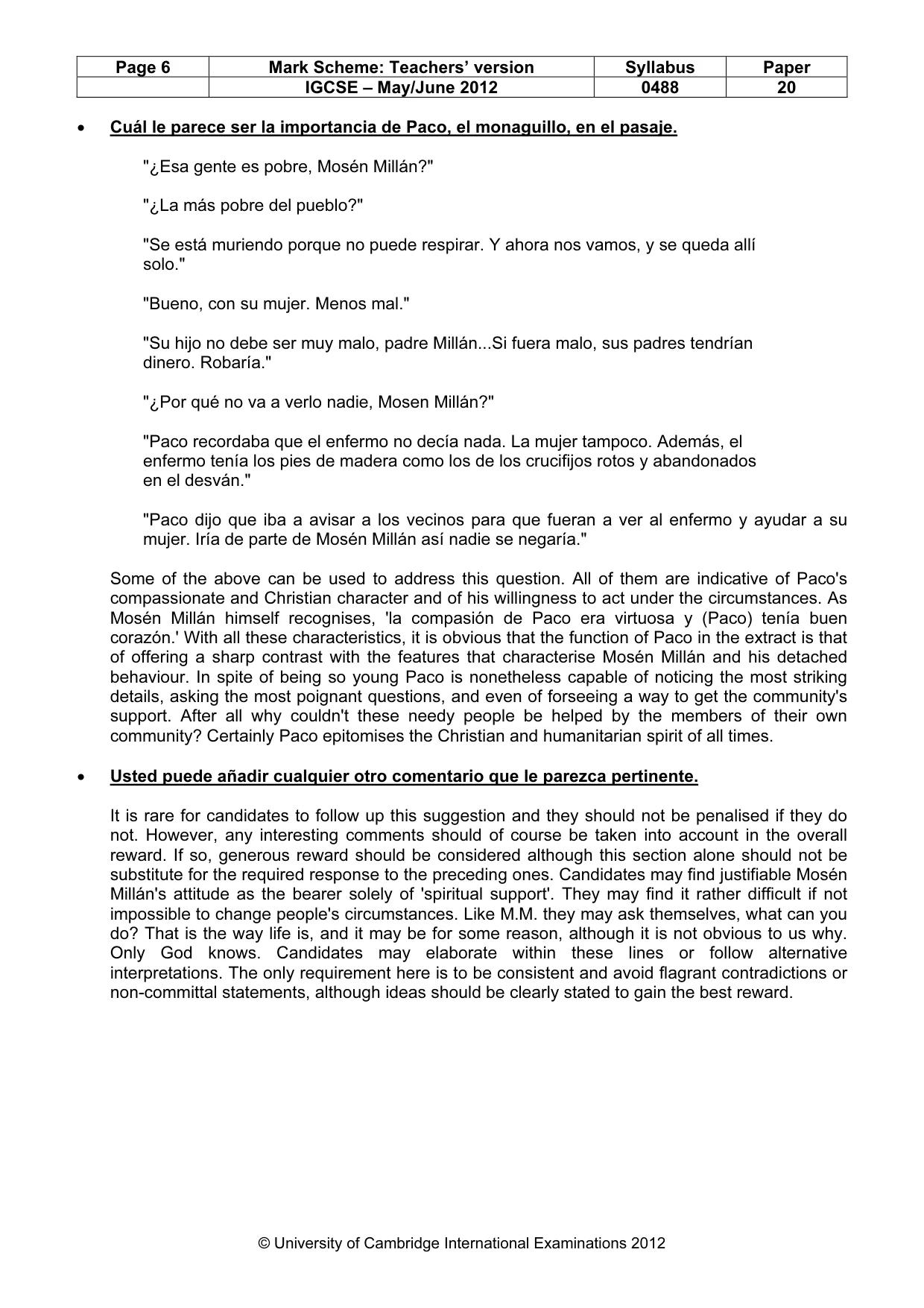
Page 6 Mark Scheme: Teachers’ version Syllabus Paper IGCSE – May/June 2012 0488 20 © University of Cambridge International Examinations 2012 • Cuál le parece ser la importancia de Paco, el monaguillo, en el pasaje. "¿Esa gente es pobre, Mosén Millán?" "¿La más pobre del pueblo?" "Se está muriendo porque no puede respirar. Y ahora nos vamos, y se queda allí solo." "Bueno, con su mujer. Menos mal." "Su hijo no debe ser muy malo, padre Millán...Si fuera malo, sus padres tendrían dinero. Robaría." "¿Por qué no va a verlo nadie, Mosen Millán?" "Paco recordaba que el enfermo no decía nada. La mujer tampoco. Además, el enfermo tenía los pies de madera como los de los crucifijos rotos y abandonados en el desván." "Paco dijo que iba a avisar a los vecinos para que fueran a ver al enfermo y ayudar a su mujer. Iría de parte de Mosén Millán así nadie se negaría." Some of the above can be used to address this question. All of them are indicative of Paco's compassionate and Christian character and of his willingness to act under the circumstances. As Mosén Millán himself recognises, 'la compasión de Paco era virtuosa y (Paco) tenía buen corazón.' With all these characteristics, it is obvious that the function of Paco in the extract is that of offering a sharp contrast with the features that characterise Mosén Millán and his detached behaviour. In spite of being so young Paco is nonetheless capable of noticing the most striking details, asking the most poignant questions, and even of forseeing a way to get the community's support. After all why couldn't these needy people be helped by the members of their own community? Certainly Paco epitomises the Christian and humanitarian spirit of all times. • Usted puede añadir cualquier otro comentario que le parezca pertinente. It is rare for candidates to follow up this suggestion and they should not be penalised if they do not. However, any interesting comments should of course be taken into account in the overall reward. If so, generous reward should be considered although this section alone should not be substitute for the required response to the preceding ones. Candidates may find justifiable Mosén Millán's attitude as the bearer solely of 'spiritual support'. They may find it rather difficult if not impossible to change people's circumstances. Like M.M. they may ask themselves, what can you do? That is the way life is, and it may be for some reason, although it is not obvious to us why. Only God knows. Candidates may elaborate within these lines or follow alternative interpretations. The only requirement here is to be consistent and avoid flagrant contradictions or non-committal statements, although ideas should be clearly stated to gain the best reward.
What you needed in this session
Cambridge’s own grade thresholds for 2012 May/June, Paper 3 · Variant 1. A higher threshold means an easier paper — the bar moves with how the cohort did.