Cambridge IGCSE Spanish - Literature 0488 — 2011 Oct/Nov Paper 3 · Variant 1
0488/31/O/N/11 · 20 marks · ≈23 min
The question paper and its mark scheme, free to read here and free to download. This is Cambridge’s own paper, exactly as it was sat.
Question paper4 pages
Mark scheme5 pages
Answers below. Sit the paper first if you are practising.
Paper as text
Question paper, page 1
This document consists of 3 printed pages and 1 blank page. DC (SJF) 35336/3 © UCLES 2011 [Turn over UNIVERSITY OF CAMBRIDGE INTERNATIONAL EXAMINATIONS International General Certificate of Secondary Education * 6 8 7 0 9 4 9 6 2 3 * LITERATURE (SPANISH) 0488/03 Paper 3 Alternative to Coursework October/November 2011 1 hour 20 minutes Additional Materials: Answer Booklet/Paper READ THESE INSTRUCTIONS FIRST If you have been given an Answer Booklet, follow the instructions on the front cover of the Booklet. Do not write your answer on the question paper. Write your Centre number, candidate number and name on all the work you hand in. Write in dark blue or black pen. Do not use staples, paper clips, highlighters, glue or correction fluid. At the end of the examination, fasten all your work securely together. Answer the question. EN PRIMER LUGAR, LEA ESTAS INSTRUCCIONES Si se le ha dado un Cuadernillo de Respuestas, siga las instrucciones de la tapa del Cuadernillo. No utilice nunca la hoja del examen para escribir su respuesta. Escriba el número del Centro, el número de estudiante que se le ha adjudicado y su nombre en todo el trabajo que vaya a entregar. Use tinta azul oscuro o negra. No use ni grapas, ni clips, ni rotulador, ni goma de pegar, ni corrector líquido. Al terminar el examen, si usa más de una hoja, únalas bien. Conteste la pregunta. www.XtremePapers.com
Question paper, page 2
2 0488/03/O/N/11 © UCLES 2011 Lea atentamente los siguientes pasajes extraídos del cuento ‘Plebster y Orsi, del Planeta Procyon’, del escritor argentino Roberto Fontanarrosa, publicado en 1993. Luego conteste la pregunta: Plebster volvió a observar, silencioso, el paso raudo de los meteoritos. Sus mayores, mucho tiempo atrás, cuando aún existía Vendelinus, le habían hablado acerca de aquel planeta cubierto de agua. Meme Plebster Jacobi, incluso, le había descrito un terráqueo con el que había mantenido relación, al comienzo de los tiempos, en una luna de Mercurio. – Dicen que los terráqueos no serían demasiado diferentes de nosotros – exclamó Orsi, excitado, como si le estuviese leyendo el pensamiento. – No tengo ningún interés en encontrarme con seres parecidos a ti. – Será rápido, Plebster. Si no los hallamos enseguida, subimos de nuevo a la nave y regresamos a casa. – Me tienes harto, Orsi. – Ya veras. Mira…comienza a cambiar el entorno. Plebster lo había percibido. El espacio, por los visores de la nave, se observaba más azul y mórbido y casi habían desaparecido los meteoritos. Las redondeadas extremidades inferiores, aptas para insertarse en la poceada superficie de Procyon, no eran, sin embargo, las ideales para desplazarse sobre la corteza terrestre. Con la torpeza propia de los forasteros, Orsi y Plebster se movían en aquel terreno, explorando las adyacencias de la nave. Todo era desolación. En la bruñida transparencia de sus escafandras rebotaban apenas los débiles rayos del sol que acertaban a pasar entre las densas nubes de polvo. Cada tanto, ráfagas de viento levantaban toneladas de cenizas, pedregullos y residuos metálicos que castigaban a los dos investigadores espaciales. El paisaje era gris y achatado. – Buena idea la tuya – dijo Plebster, dejando de caminar. Orsi no contestó. Se había parado sobre uno de los tantos montículos de rocas y giraba su cabezota con expresión de desencanto. – Busquemos un poco más –dijo al fin– . Es lógico que si están refugiados bajo tierra no podríamos verlos a simple vista. – Nos llevaría una eternidad hallarlos. Por otra parte, no olvides que el compendio de conocimientos decía que también solían detectarse explosiones nucleares subterráneas… – Algunas de sus tribus estaban muy preparadas para subsistir, Plebster. Habían esperado esa guerra por siglos. Tenían de todo allí abajo… […]
Question paper, page 3
3 0488/03/O/N/11 © UCLES 2011 Orsi corrió la cortina y ambos visitantes se hallaron ante un recinto poco iluminado. Una veintena de seres humanos se encontraban diseminados en pequeñas mesas redondas, distribuidas en torno a una tarima de madera. Los humanos eran, al menos de dos sexos diferentes, calculó Plebster. Bebían extraños tragos, hablaban poco entre ellos y no parecían demasiado jóvenes. Sobre la tarima, un terráqueo con la cabeza cubierta por un cabello oscuro y engrasado, de pie frente a un adminículo de metal que ampliaba el sonido de su voz, los observó de una ojeada. También hicieron lo propio otros nativos de los que estaban sentados. – ¡Y siguen llegando frente a nuestra Peña Tanguera “El Sótano del Dos por Cuatro”, mis queridos amigos! – anunció el terráqueo del cabello lustroso –. ¡Y es porque vienen a escuchar a Angelito Delfino, “El Ruiseñor de Floresta”, que ahora nos va a regalar, de Esteban Celedonio Flores y Ciriaco Ortiz, “Atenti Pebeta”! Los humanos de las mesas golpetearon unas contra otras sus extremidades superiores y allí supo Orsi que, de esa acción impensada, provenían los breves estallidos que habían oído en la escalera. – ¡Y esta canción, señores –continuó el anunciador– es para los nuevos amigos de la noche de Buenos Aires…! – y luego, dirigiéndose a Plebster y Orsi, preguntó–: ¿De dónde son, muchachos? – De Procyon – gritó Orsi, complacido. – ¡Para los amigos de Procyon, entonces…Angelito Delfino, “El Ruiseñor de Floresta” y “Atenti Pebeta”, de Flores y Ciriaco Ortiz! poceada = llena de pozos Vendelinus = nombre que en la historia se le da al planeta tierra. ‘Atenti Pebeta’ = nombre de un tango argentino en jerga rioplatense 1 Dé sus impresiones de cómo el autor presenta el planeta que exploran Plebster y Orsi. En particular, debe considerar, en detalle, los siguientes aspectos: • Lo que son Plebster y Orsi y cómo nos enteramos de esto. • Lo que se puede decir de sus personalidades y de cómo se tratan. • Lo que el autor quiere sugerirnos con sus descripciones de ‘Vendelinus’. • Cómo se las arregla el autor para sorprendernos e intrigarnos con su presentación de los ‘seres humanos’ y su reacción frente a Plebster y Orsi. Usted puede añadir cualquier otro comentario que le parezca pertinente.
Question paper, page 4
4 0488/03/O/N/11 © UCLES 2011 BLANK PAGE Copyright Acknowledgements: Question 1 © Roberto Fontanarrosa; Plebster y Orsi, del Planeta Procyon; Historias Futuras; Emece Editores S.A. Permission to reproduce items where third-party owned material protected by copyright is included has been sought and cleared where possible. Every reasonable effort has been made by the publisher (UCLES) to trace copyright holders, but if any items requiring clearance have unwittingly been included, the publisher will be pleased to make amends a t the earliest possible opportunity. University of Cambridge International Examinations is part of the Cambridge Assessment Group. Cambridge Assessment is the brand name of University of Cambridge Local Examinations Syndicate (UCLES), which is itself a department of the University of Cambridge.
Mark scheme, page 1
UNIVERSITY OF CAMBRIDGE INTERNATIONAL EXAMINATIONS International General Certificate of Secondary Education MARK SCHEME for the October/November 2011 question paper for the guidance of teachers 0488 LITERATURE (SPANISH) 0488/03 Paper 3 (Alternative to Coursework), maximum raw mark 20 This mark scheme is published as an aid to teachers and candidates, to indicate the requirements of the examination. It shows the basis on which Examiners were instructed to award marks. It does not indicate the details of the discussions that took place at an Examiners’ meeting before marking began, which would have considered the acceptability of alternative answers. Mark schemes must be read in conjunction with the question papers and the report on the examination. • Cambridge will not enter into discussions or correspondence in connection with these mark schemes. Cambridge is publishing the mark schemes for the October/November 2011 question papers for most IGCSE, GCE Advanced Level and Advanced Subsidiary Level syllabuses and some Ordinary Level syllabuses. www.XtremePapers.com
Mark scheme, page 2
Page 2 Mark Scheme: Teachers’ version Syllabus Paper IGCSE – October/November 2011 0488 03 © University of Cambridge International Examinations 2011 Answers will be marked according to the following general criteria: Band Mark 1 18–20 Detailed, well-written, well-organised answer, completely relevant to question and showing sensitive personal response to book. For passage-based questions, detailed attention to words of passage. 2 15–17 Detailed answer, relevant to question and with personal response; may be a bit cut-and-dried. For passage-based questions, close attention to words but may be a few omissions/superficialities. 3 12–14 Competent answer, relevant but limited; signs of personal response, good knowledge of book. For passage-based, some attention to words but some significant omissions and/or misunderstandings. 4 9–11 Answer relevant to question but may show some misunderstanding and/or limitations; effort to communicate personal response and knowledge. Passage- based: significant omissions/misunderstandings, but some response comes over. 5 6–8 Attempt to answer question and some knowledge of book; limited, scrappy answer; clumsy expression. Passage-based: attempt to respond, but with severe limitations. 6 4–5 Short, scrappy answer; confused; signs that book has been read. Passage-based: has read the passage and conveyed one or two basic ideas about it. 7 2–3 Has read book and absorbed some very elementary ideas about it. Passage- based: may have glanced at passage and written a few words. 8 0–1 Nothing to reward. Obvious non-reading of book, or total non-appreciation. Please note that although the candidate is invited to answer the questions on the paper, and the overwhelming majority will do so, this is not obligatory and there is no notional allocation of marks to any particular question. The vast majority of candidates will probably use the questions as guidance. Note, however, that they are not obliged to deal with them separately and must not be penalised in any way if they do not do so. An integrated response may answer all the questions satisfactorily by implication, and may indeed flow better and avoid redundancy. There is no prescribed application of marks to each question and the response should be marked holistically. Although candidates are not obliged to make any further comments and must not be penalised if they do not, any that are made will of course be fully credited. The detailed questions are intended to help the candidate respond. Candidates are required to answer them, but need not do so in a rigid sequence. Some of the answers may be implicit in the essay, although it is expected that candidates will be able to spell out their views and interpretations with sufficient clarity. There is no prescribed application of marks to each question and the response should be mark holistically. Candidates who do not answer the prescribed questions will penalize themselves automatically, as the questions are central to the passage.
Mark scheme, page 3
Page 3 Mark Scheme: Teachers’ version Syllabus Paper IGCSE – October/November 2011 0488 03 © University of Cambridge International Examinations 2011 This short story is a contemporary work and it is hoped the candidates will be in a position to understand the language of the passage almost in its entirety, therefore being able to gain a general understanding of the extract and convey an appropriate response to the quality of the writing. The questions are designed to help them do so. At the lower levels (up to 9 marks) we shall probably be expecting evidence of this basic understanding, hopefully with a simple personal response. At the (10–14) levels we should be looking for a clear, if not sophisticated and more complex answer to each of the questions and some attempt to support ideas from the passage. Be aware of inert, mechanical quoting or simple paraphrasing that adds little to the interpretation or expects the examiner to make the connections by implication. As we go up to 15+ marks we shall be looking for an ability to read between the lines, with appropriate support from the passage and a motivated personal response. Towards the top band (18–20 marks) a confident, consistent and detailed argumentation supplemented by a personal appreciation should be required. Lea atentamente el siguiente pasaje extraído del cuento corto ‘Plebster y Orsi, del Planeta Procyon’, del escritor argentino Roberto Fontanarrosa, publicado en 1993. Luego conteste la pregunta: Dé sus impresiones de cómo el autor presenta el planeta que exploran Plebster y Orsi. En particular, debe considerar, en detalle, los siguientes aspectos: • Lo que son Plebster y Orsi y cómo nos enteramos de esto. It is expected that most candidates will be able to determine that Plebster and Orsi are two extra- terrestrial beings. Various elements of the passage seem to suggest that such is the case and it is expected candidates will be able to resort to these specific elements to substantiate their understanding. A “Band 3’ candidate ought to be able to convey this essential point in some form and provide an adequate illustration of how this is manifested throughout the passage, expressing some personal response to the different elements presented in the extract. For a ‘Band 2+’ grade the candidate should be able to comment unequivocally on a fair number of indicators and even attempt a description of the physical appearance of the extra-terrestrial beings (aliens). Some of the key elements to be mentioned are: The immediate reading of the title of the story: ‘…del planeta Procyon” The reference to the meteors – they are travelling through space in a spaceship. The reference to various planets and moons. The mentioning of earthlings (‘terráqueos’). The description of their lower limbs (‘…las redondeadas extremidades inferiores …’) The description of their planet’s surface (‘…la poceada superficie de Procyon…’) The reference to the colour of the space (‘el espacio…más azul y mórbido …’) The reference to Orsi & Plebster as ‘researchers’ from outer space, etc. The reference to Orsi’s ‘huge head’ (‘…giraba su cabezota..,’, etc). In terms of assessment it should be considered that inert quoting or paraphrasing and simple description may be enough for a 4/5 Band grade; any attempt at interpreting should be rewarded and generously so as it appears to demonstrate some insight. Needless to say, the interpretation may differ from the one suggested here, yet it would need to be consistent and adequately supported.
Mark scheme, page 4
Page 4 Mark Scheme: Teachers’ version Syllabus Paper IGCSE – October/November 2011 0488 03 © University of Cambridge International Examinations 2011 • Lo que se puede decir de sus personalidades y de cómo se tratan. One of the most entertaining elements of the extract is the way in which the personalities of the extra- terrestrials are portrayed. Thus, Orsi comes across as an inquisitive/curious character, always ready for an adventure and with a friendly disposition, particularly shown when they meet the ‘earthlings’. Plebster, on the other hand, appears to be unfriendly, is at odds with Orsi – as if a history of bad interrelations between the two may precede this episode – and does not appear to have the same degree of interest in exploration/or curiosity as his partner. When he meets the ‘humans’ he does not feel as excited as Orsi does. Nevertheless, he joins the expedition and lands on ‘Vendelinus’ with Orsi to search for signs of human existence. It is particularly striking the way in which the author depicts the personalities of these aliens. In doing so he makes us feel very close to them. We find them very familiar and even friendly. He makes us like them. There is no element of fear associated to the reading of this story. On the contrary, we feel invited to like the aliens, particularly Orsi, and even the nature of their relationship makes us feel close to home, as they appear strongly ‘humanized’. It is interesting to see that in this story, it is the aliens who are the explorers and we, the ‘humans’ the object of their attention and not the other way round. Candidates may express different ideas and/or reactions to this part of the reading but in so far as they are plausible and well supported they should be appropriately rewarded. Here again, the general rules for assessing the quality of the candidates response apply. Paraphrasing and simple or limited description/repetition may be enough for a 4/5 Band grade; any attempt at interpreting, etc. etc. • Lo que el autor quiere sugerirnos con sus descripciones de ‘Vendelinus’. The term ‘Vendelinus” should be clearly associated to the planet earth as this information is openly provided to the candidates to avoid possible misunderstandings. The author appears to suggest that the story takes place after the occurrence of a massive war on earth. It is not said between whom (a war between humans or a war with extra-terrestrials?) or why this happened but it is suggested that everything disappeared from the surface of the earth. There were no buildings to be seen, no people, not the slightest trace of nature, in other words, nothing at all. In fact, after landing on the surface of Vendelinus, Orsi and Plebster could see nothing, not even a single sign of human existence. The landscape is described as in a state of complete desolation (‘todo era desolación’; ‘densas nubes de polvo’) and references are made to ashes and to metal fragments all over the place, perhaps suggestive of fires, burning and destruction of metal objects, typical of the aftermath of a war. Then, a reference to the possibility that the humans may be sheltered underground because of the ‘catastrophe’ is also made, together with the idea that the war had been long anticipated by the humans and that they were well prepared for it (‘…tenían de todo allí abajo…’). But, then, suddenly, the story moves to closer quarters, when the ‘aliens’ make their way into a subterranean refuge and find some two dozen ‘earthlings’ in a tavern.
Mark scheme, page 5
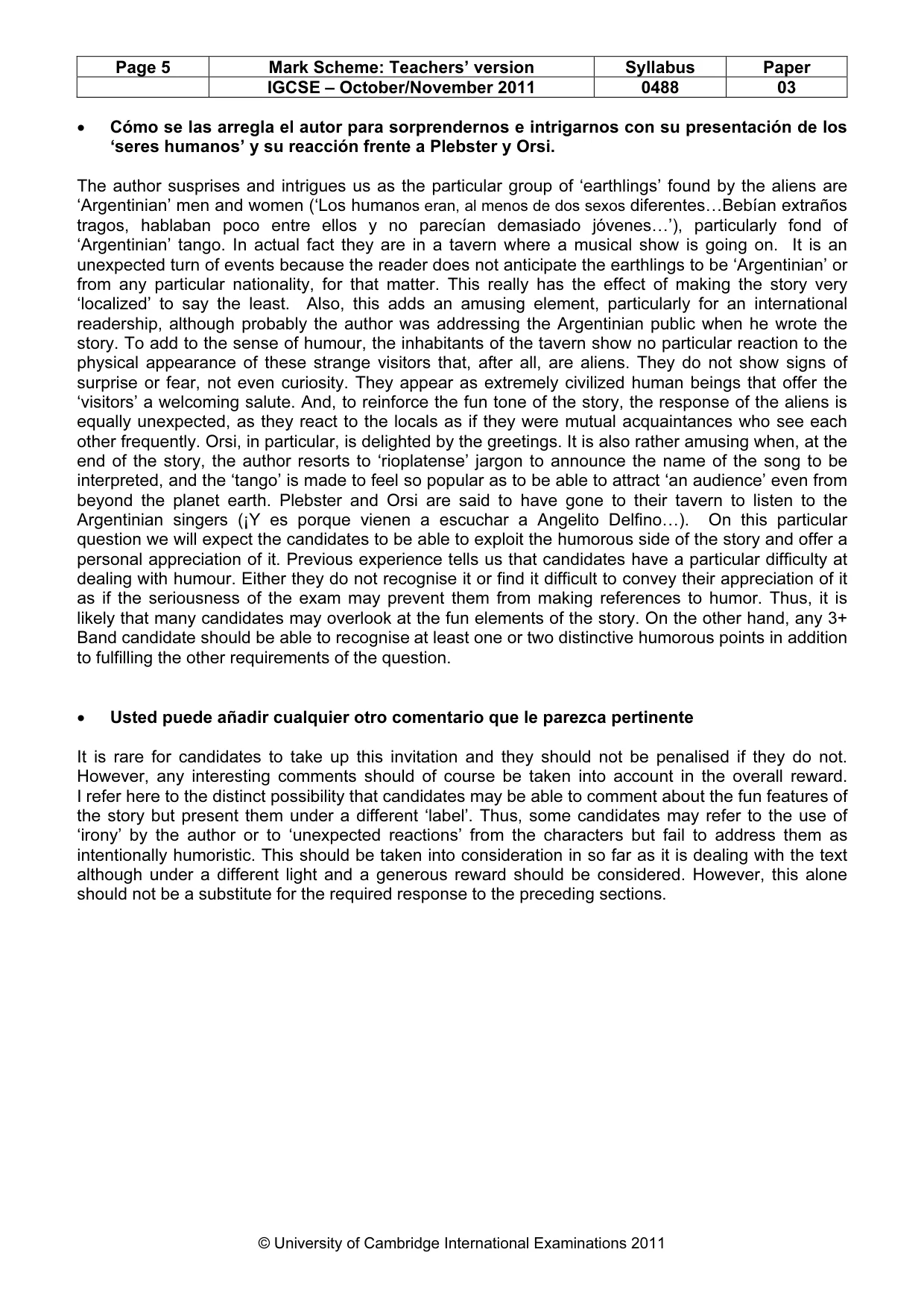
Page 5 Mark Scheme: Teachers’ version Syllabus Paper IGCSE – October/November 2011 0488 03 © University of Cambridge International Examinations 2011 • Cómo se las arregla el autor para sorprendernos e intrigarnos con su presentación de los ‘seres humanos’ y su reacción frente a Plebster y Orsi. The author susprises and intrigues us as the particular group of ‘earthlings’ found by the aliens are ‘Argentinian’ men and women (‘Los humanos eran, al menos de dos sexos diferentes…Bebían extraños tragos, hablaban poco entre ellos y no parecían demasiado jóvenes…’), particularly fond of ‘Argentinian’ tango. In actual fact they are in a tavern where a musical show is going on. It is an unexpected turn of events because the reader does not anticipate the earthlings to be ‘Argentinian’ or from any particular nationality, for that matter. This really has the effect of making the story very ‘localized’ to say the least. Also, this adds an amusing element, particularly for an international readership, although probably the author was addressing the Argentinian public when he wrote the story. To add to the sense of humour, the inhabitants of the tavern show no particular reaction to the physical appearance of these strange visitors that, after all, are aliens. They do not show signs of surprise or fear, not even curiosity. They appear as extremely civilized human beings that offer the ‘visitors’ a welcoming salute. And, to reinforce the fun tone of the story, the response of the aliens is equally unexpected, as they react to the locals as if they were mutual acquaintances who see each other frequently. Orsi, in particular, is delighted by the greetings. It is also rather amusing when, at the end of the story, the author resorts to ‘rioplatense’ jargon to announce the name of the song to be interpreted, and the ‘tango’ is made to feel so popular as to be able to attract ‘an audience’ even from beyond the planet earth. Plebster and Orsi are said to have gone to their tavern to listen to the Argentinian singers (¡Y es porque vienen a escuchar a Angelito Delfino…). On this particular question we will expect the candidates to be able to exploit the humorous side of the story and offer a personal appreciation of it. Previous experience tells us that candidates have a particular difficulty at dealing with humour. Either they do not recognise it or find it difficult to convey their appreciation of it as if the seriousness of the exam may prevent them from making references to humor. Thus, it is likely that many candidates may overlook at the fun elements of the story. On the other hand, any 3+ Band candidate should be able to recognise at least one or two distinctive humorous points in addition to fulfilling the other requirements of the question. • Usted puede añadir cualquier otro comentario que le parezca pertinente It is rare for candidates to take up this invitation and they should not be penalised if they do not. However, any interesting comments should of course be taken into account in the overall reward. I refer here to the distinct possibility that candidates may be able to comment about the fun features of the story but present them under a different ‘label’. Thus, some candidates may refer to the use of ‘irony’ by the author or to ‘unexpected reactions’ from the characters but fail to address them as intentionally humoristic. This should be taken into consideration in so far as it is dealing with the text although under a different light and a generous reward should be considered. However, this alone should not be a substitute for the required response to the preceding sections.
What you needed in this session
Cambridge’s own grade thresholds for 2011 Oct/Nov, Paper 3 · Variant 1. A higher threshold means an easier paper — the bar moves with how the cohort did.