Cambridge IGCSE Spanish - Literature 0488 — 2010 Oct/Nov Paper 3 · Variant 1
0488/31/O/N/10 · 20 marks · ≈23 min
The question paper and its mark scheme, free to read here and free to download. This is Cambridge’s own paper, exactly as it was sat.
Question paper4 pages
Mark scheme6 pages
Answers below. Sit the paper first if you are practising.
Paper as text
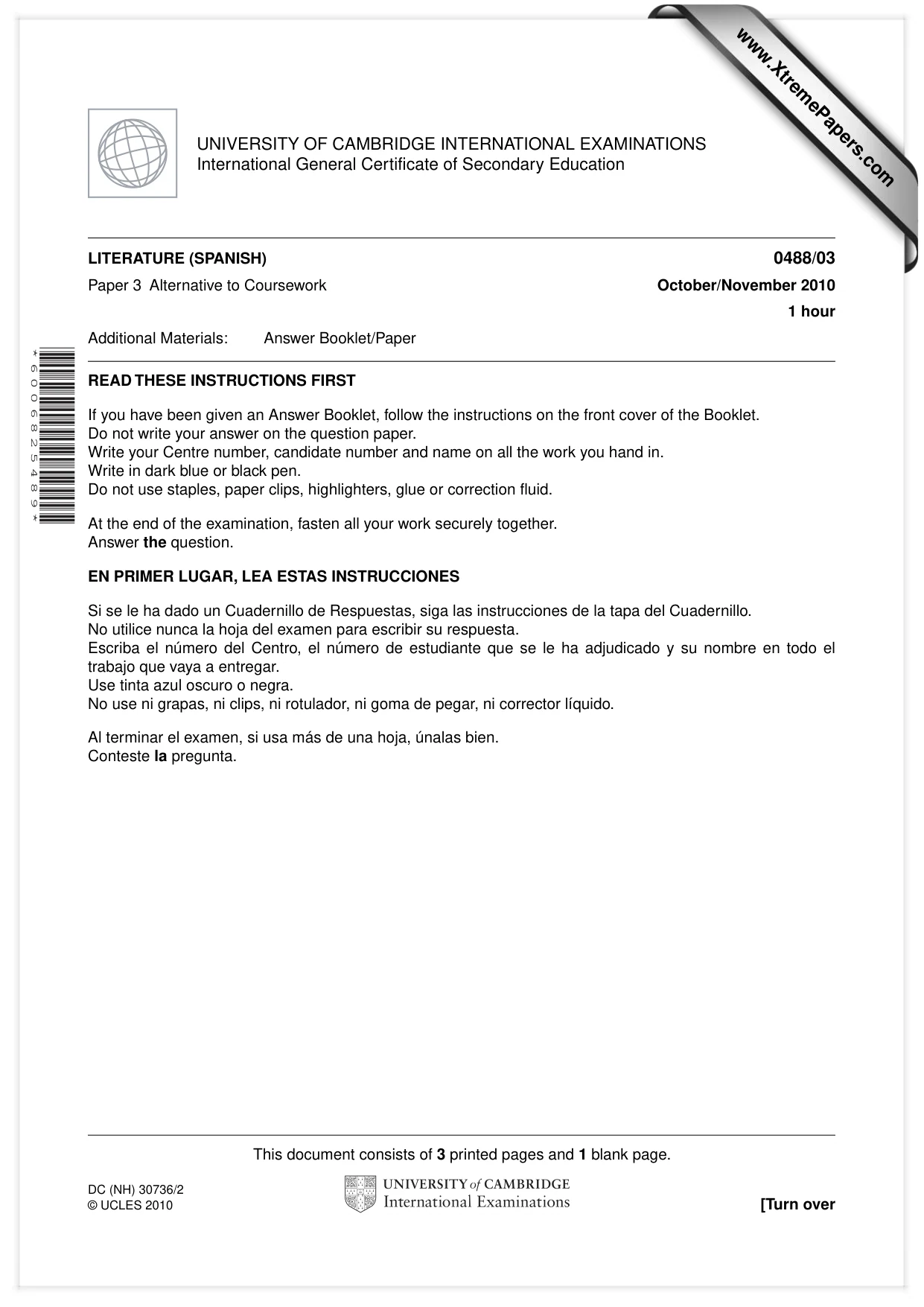
Question paper, page 1
This document consists of 3 printed pages and 1 blank page. DC (NH) 30736/2 © UCLES 2010 [Turn over UNIVERSITY OF CAMBRIDGE INTERNATIONAL EXAMINATIONS International General Certificate of Secondary Education * 6 0 0 6 8 2 5 4 8 9 * LITERATURE (SPANISH) 0488/03 Paper 3 Alternative to Coursework October/November 2010 1 hour Additional Materials: Answer Booklet/Paper READ THESE INSTRUCTIONS FIRST If you have been given an Answer Booklet, follow the instructions on the front cover of the Booklet. Do not write your answer on the question paper. Write your Centre number, candidate number and name on all the work you hand in. Write in dark blue or black pen. Do not use staples, paper clips, highlighters, glue or correction fluid. At the end of the examination, fasten all your work securely together. Answer the question. EN PRIMER LUGAR, LEA ESTAS INSTRUCCIONES Si se le ha dado un Cuadernillo de Respuestas, siga las instrucciones de la tapa del Cuadernillo. No utilice nunca la hoja del examen para escribir su respuesta. Escriba el número del Centro, el número de estudiante que se le ha adjudicado y su nombre en todo el trabajo que vaya a entregar. Use tinta azul oscuro o negra. No use ni grapas, ni clips, ni rotulador, ni goma de pegar, ni corrector líquido. Al terminar el examen, si usa más de una hoja, únalas bien. Conteste la pregunta. www.XtremePapers.com
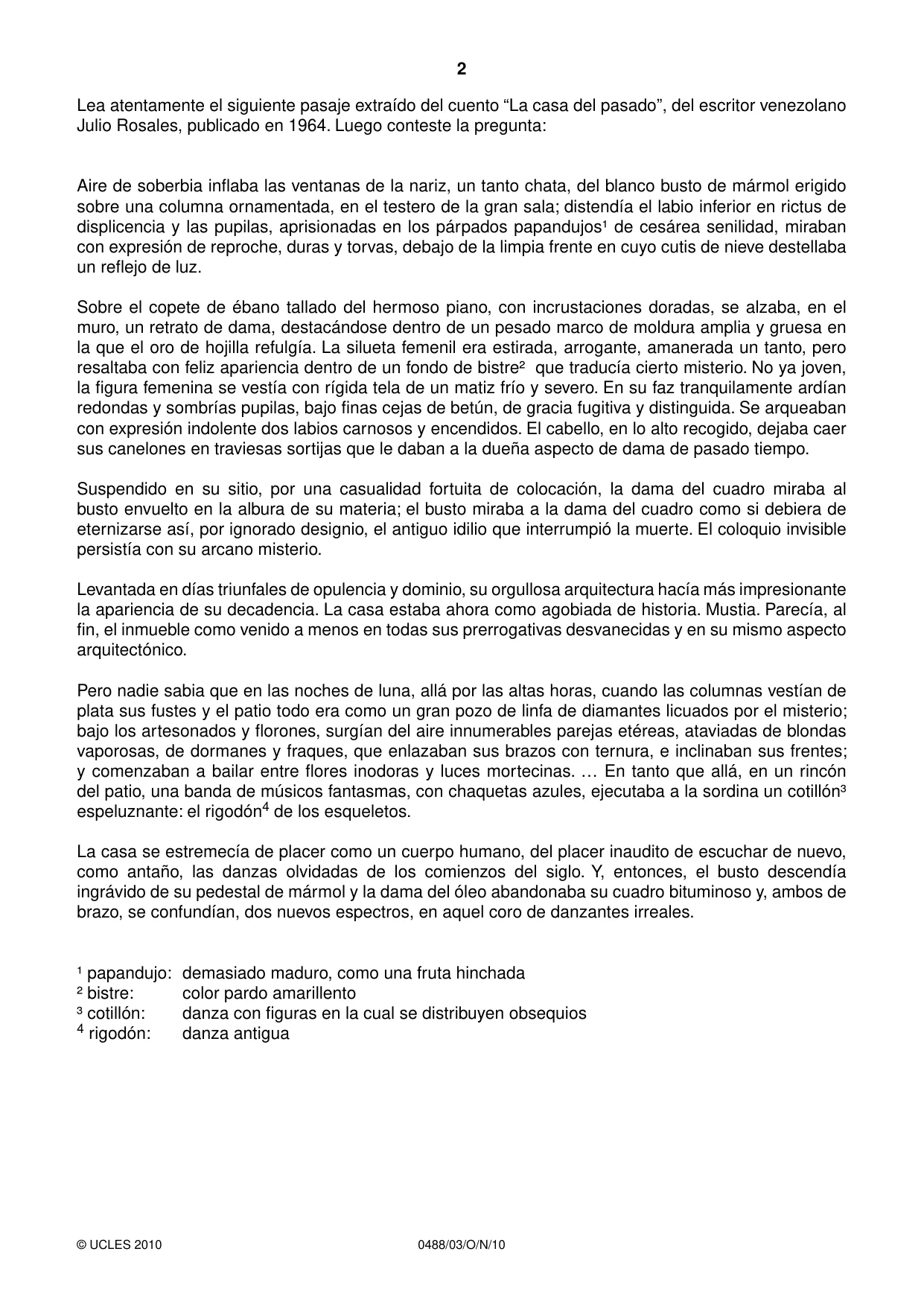
Question paper, page 2
2 0488/03/O/N/10 © UCLES 2010 Lea atentamente el siguiente pasaje extraído del cuento “La casa del pasado”, del escritor venezolano Julio Rosales, publicado en 1964. Luego conteste la pregunta: Aire de soberbia inflaba las ventanas de la nariz, un tanto chata, del blanco busto de mármol erigido sobre una columna ornamentada, en el testero de la gran sala; distendía el labio inferior en rictus de displicencia y las pupilas, aprisionadas en los párpados papandujos¹ de cesárea senilidad, miraban con expresión de reproche, duras y torvas, debajo de la limpia frente en cuyo cutis de nieve destellaba un reflejo de luz. Sobre el copete de ébano tallado del hermoso piano, con incrustaciones doradas, se alzaba, en el muro, un retrato de dama, destacándose dentro de un pesado marco de moldura amplia y gruesa en la que el oro de hojilla refulgía. La silueta femenil era estirada, arrogante, amanerada un tanto, pero resaltaba con feliz apariencia dentro de un fondo de bistre² que traducía cierto misterio. No ya joven, la figura femenina se vestía con rígida tela de un matiz frío y severo. En su faz tranquilamente ardían redondas y sombrías pupilas, bajo finas cejas de betún, de gracia fugitiva y distinguida. Se arqueaban con expresión indolente dos labios carnosos y encendidos. El cabello, en lo alto recogido, dejaba caer sus canelones en traviesas sortijas que le daban a la dueña aspecto de dama de pasado tiempo. Suspendido en su sitio, por una casualidad fortuita de colocación, la dama del cuadro miraba al busto envuelto en la albura de su materia; el busto miraba a la dama del cuadro como si debiera de eternizarse así, por ignorado designio, el antiguo idilio que interrumpió la muerte. El coloquio invisible persistía con su arcano misterio. Levantada en días triunfales de opulencia y dominio, su orgullosa arquitectura hacía más impresionante la apariencia de su decadencia. La casa estaba ahora como agobiada de historia. Mustia. Parecía, al fin, el inmueble como venido a menos en todas sus prerrogativas desvanecidas y en su mismo aspecto arquitectónico. Pero nadie sabia que en las noches de luna, allá por las altas horas, cuando las columnas vestían de plata sus fustes y el patio todo era como un gran pozo de linfa de diamantes licuados por el misterio; bajo los artesonados y florones, surgían del aire innumerables parejas etéreas, ataviadas de blondas vaporosas, de dormanes y fraques, que enlazaban sus brazos con ternura, e inclinaban sus frentes; y comenzaban a bailar entre flores inodoras y luces mortecinas. … En tanto que allá, en un rincón del patio, una banda de músicos fantasmas, con chaquetas azules, ejecutaba a la sordina un cotillón³ espeluznante: el rigodón4 de los esqueletos. La casa se estremecía de placer como un cuerpo humano, del placer inaudito de escuchar de nuevo, como antaño, las danzas olvidadas de los comienzos del siglo. Y, entonces, el busto descendía ingrávido de su pedestal de mármol y la dama del óleo abandonaba su cuadro bituminoso y, ambos de brazo, se confundían, dos nuevos espectros, en aquel coro de danzantes irreales. ¹ papandujo: demasiado maduro, como una fruta hinchada ² bistre: color pardo amarillento ³ cotillón: danza con figuras en la cual se distribuyen obsequios 4 rigodón: danza antigua
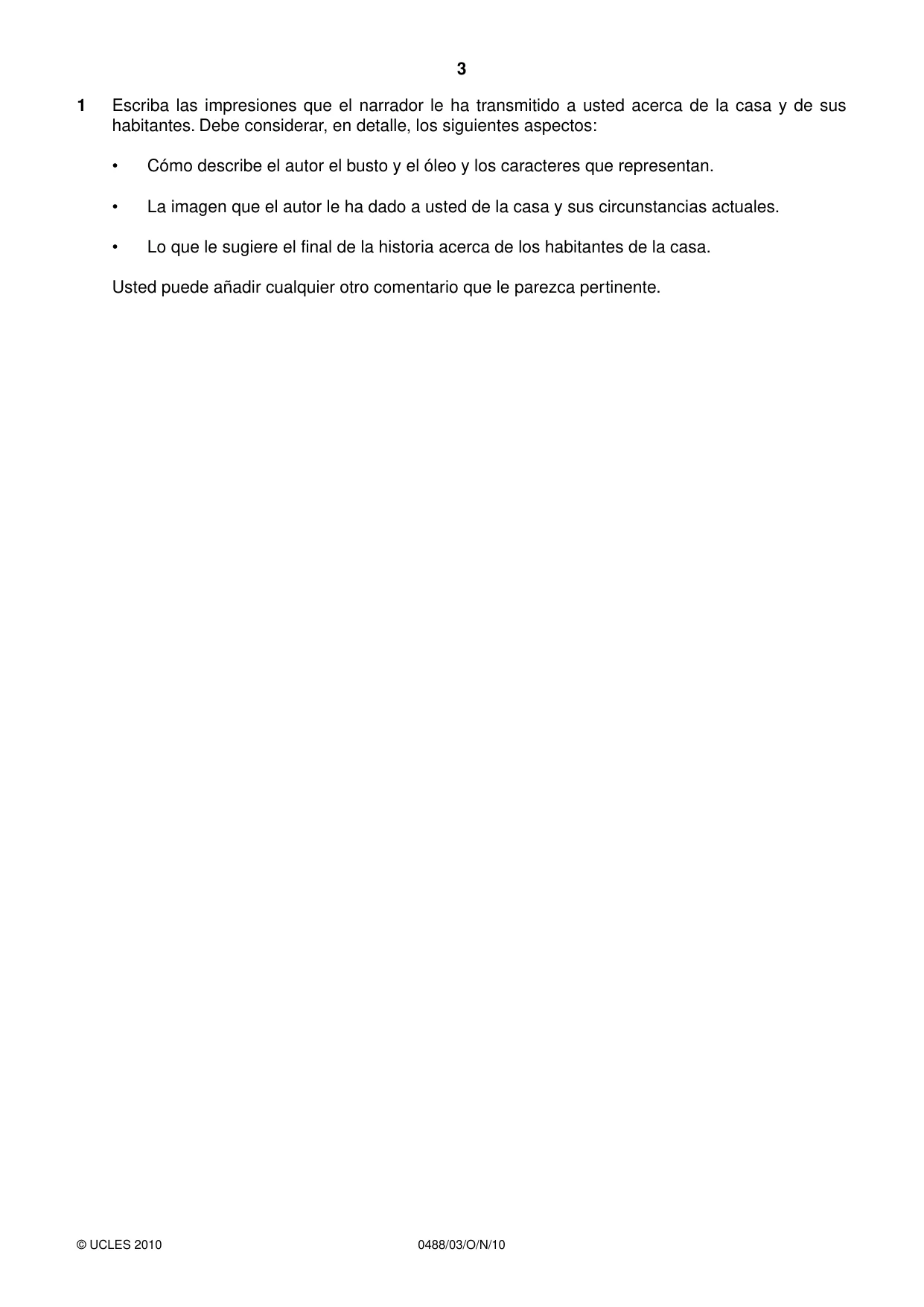
Question paper, page 3
3 0488/03/O/N/10 © UCLES 2010 1 Escriba las impresiones que el narrador le ha transmitido a usted acerca de la casa y de sus habitantes. Debe considerar, en detalle, los siguientes aspectos: • Cómo describe el autor el busto y el óleo y los caracteres que representan. • La imagen que el autor le ha dado a usted de la casa y sus circunstancias actuales. • Lo que le sugiere el final de la historia acerca de los habitantes de la casa. Usted puede añadir cualquier otro comentario que le parezca pertinente.
Question paper, page 4
4 0488/03/O/N/10 © UCLES 2010 BLANK PAGE Copyright Acknowledgements: Question 1 © Julio Rosales; La Casa del Pasado; Panal de Cuentos; Direccion de Cultura, Universidad Central de Venezuela; 1964. Permission to reproduce items where third-party owned material protected by copyright is included has been sought and cleared where possible. Every reasonable effort has been made by the publisher (UCLES) to trace copyright holders, but if any items requiring clearance have unwittingly been included, the publisher will be pleased to make amends a t the earliest possible opportunity. University of Cambridge International Examinations is part of the Cambridge Assessment Group. Cambridge Assessment is the brand name of University of Cambridge Local Examinations Syndicate (UCLES), which is itself a department of the University of Cambridge.
Mark scheme, page 1
UNIVERSITY OF CAMBRIDGE INTERNATIONAL EXAMINATIONS International General Certificate of Secondary Education MARK SCHEME for the October/November 2010 question paper for the guidance of teachers 0488 LITERATURE (SPANISH) 0488/03 Paper 3 (Alternative to Coursework), maximum raw mark 20 This mark scheme is published as an aid to teachers and candidates, to indicate the requirements of the examination. It shows the basis on which Examiners were instructed to award marks. It does not indicate the details of the discussions that took place at an Examiners’ meeting before marking began, which would have considered the acceptability of alternative answers. Mark schemes must be read in conjunction with the question papers and the report on the examination. • CIE will not enter into discussions or correspondence in connection with these mark schemes. CIE is publishing the mark schemes for the October/November 2010 question papers for most IGCSE, GCE Advanced Level and Advanced Subsidiary Level syllabuses and some Ordinary Level syllabuses. www.XtremePapers.com
Mark scheme, page 2
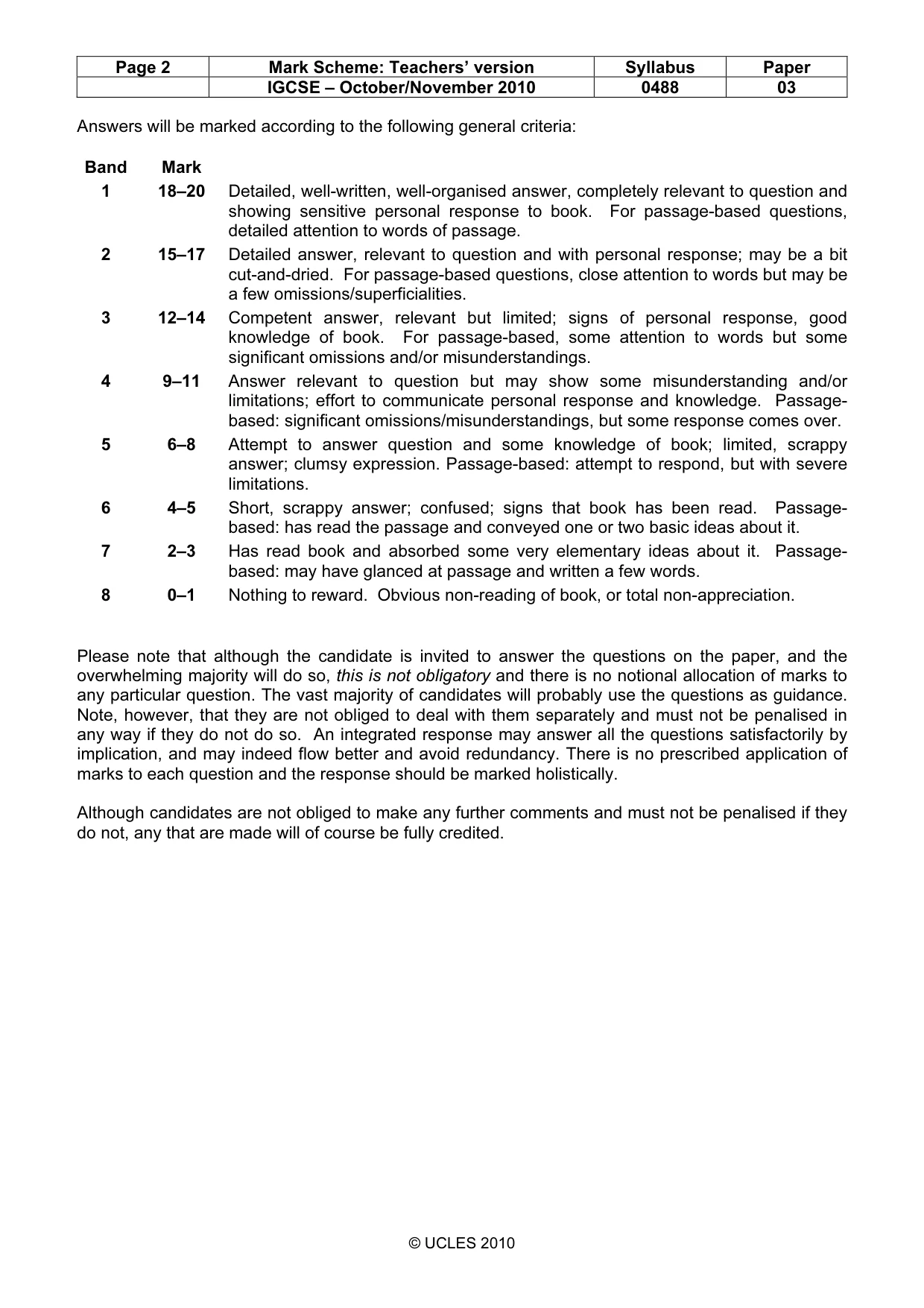
Page 2 Mark Scheme: Teachers’ version Syllabus Paper IGCSE – October/November 2010 0488 03 © UCLES 2010 Answers will be marked according to the following general criteria: Band Mark 1 18–20 Detailed, well-written, well-organised answer, completely relevant to question and showing sensitive personal response to book. For passage-based questions, detailed attention to words of passage. 2 15–17 Detailed answer, relevant to question and with personal response; may be a bit cut-and-dried. For passage-based questions, close attention to words but may be a few omissions/superficialities. 3 12–14 Competent answer, relevant but limited; signs of personal response, good knowledge of book. For passage-based, some attention to words but some significant omissions and/or misunderstandings. 4 9–11 Answer relevant to question but may show some misunderstanding and/or limitations; effort to communicate personal response and knowledge. Passage- based: significant omissions/misunderstandings, but some response comes over. 5 6–8 Attempt to answer question and some knowledge of book; limited, scrappy answer; clumsy expression. Passage-based: attempt to respond, but with severe limitations. 6 4–5 Short, scrappy answer; confused; signs that book has been read. Passage- based: has read the passage and conveyed one or two basic ideas about it. 7 2–3 Has read book and absorbed some very elementary ideas about it. Passage- based: may have glanced at passage and written a few words. 8 0–1 Nothing to reward. Obvious non-reading of book, or total non-appreciation. Please note that although the candidate is invited to answer the questions on the paper, and the overwhelming majority will do so, this is not obligatory and there is no notional allocation of marks to any particular question. The vast majority of candidates will probably use the questions as guidance. Note, however, that they are not obliged to deal with them separately and must not be penalised in any way if they do not do so. An integrated response may answer all the questions satisfactorily by implication, and may indeed flow better and avoid redundancy. There is no prescribed application of marks to each question and the response should be marked holistically. Although candidates are not obliged to make any further comments and must not be penalised if they do not, any that are made will of course be fully credited.
Mark scheme, page 3
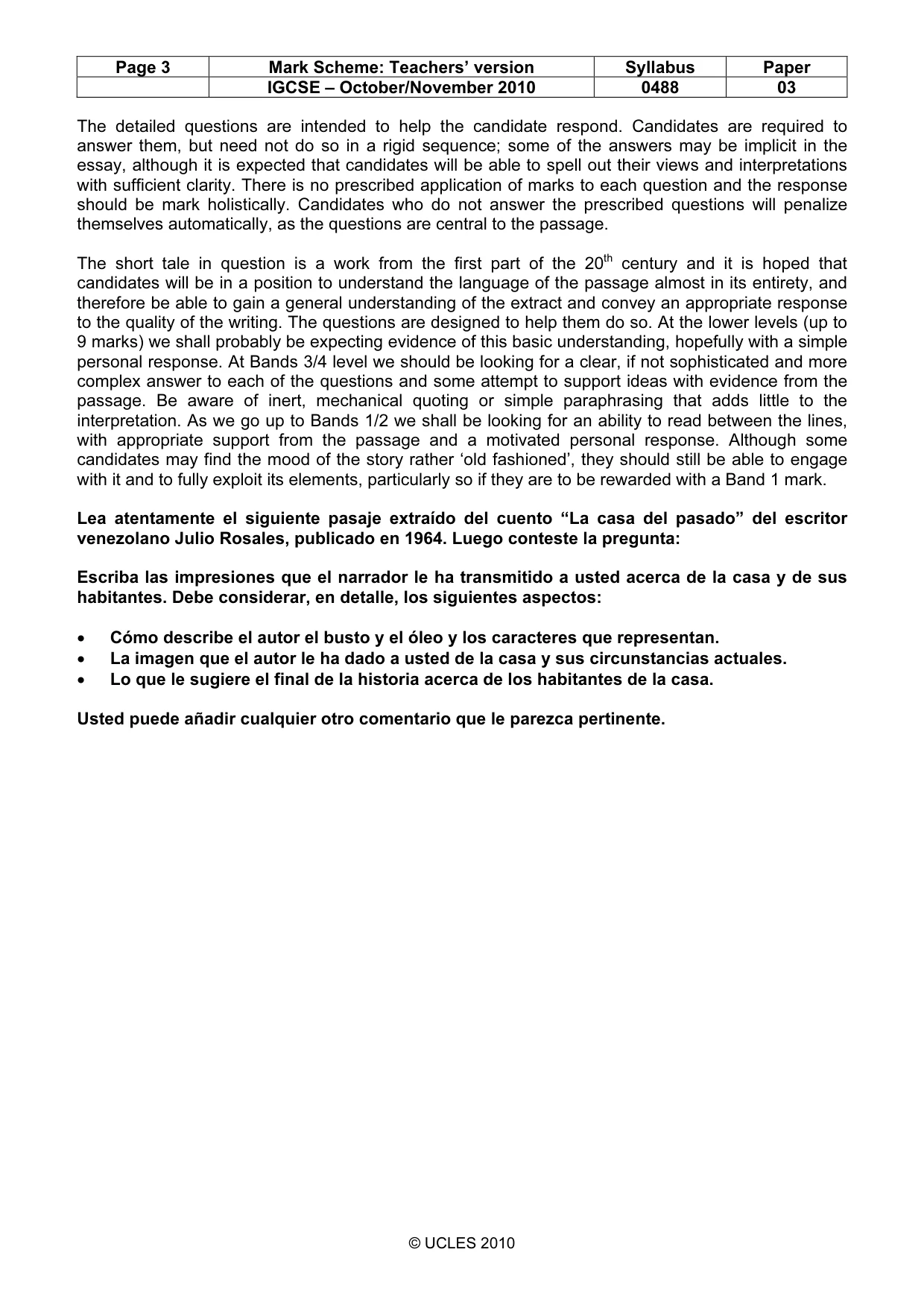
Page 3 Mark Scheme: Teachers’ version Syllabus Paper IGCSE – October/November 2010 0488 03 © UCLES 2010 The detailed questions are intended to help the candidate respond. Candidates are required to answer them, but need not do so in a rigid sequence; some of the answers may be implicit in the essay, although it is expected that candidates will be able to spell out their views and interpretations with sufficient clarity. There is no prescribed application of marks to each question and the response should be mark holistically. Candidates who do not answer the prescribed questions will penalize themselves automatically, as the questions are central to the passage. The short tale in question is a work from the first part of the 20th century and it is hoped that candidates will be in a position to understand the language of the passage almost in its entirety, and therefore be able to gain a general understanding of the extract and convey an appropriate response to the quality of the writing. The questions are designed to help them do so. At the lower levels (up to 9 marks) we shall probably be expecting evidence of this basic understanding, hopefully with a simple personal response. At Bands 3/4 level we should be looking for a clear, if not sophisticated and more complex answer to each of the questions and some attempt to support ideas with evidence from the passage. Be aware of inert, mechanical quoting or simple paraphrasing that adds little to the interpretation. As we go up to Bands 1/2 we shall be looking for an ability to read between the lines, with appropriate support from the passage and a motivated personal response. Although some candidates may find the mood of the story rather ‘old fashioned’, they should still be able to engage with it and to fully exploit its elements, particularly so if they are to be rewarded with a Band 1 mark. Lea atentamente el siguiente pasaje extraído del cuento “La casa del pasado” del escritor venezolano Julio Rosales, publicado en 1964. Luego conteste la pregunta: Escriba las impresiones que el narrador le ha transmitido a usted acerca de la casa y de sus habitantes. Debe considerar, en detalle, los siguientes aspectos: • Cómo describe el autor el busto y el óleo y los caracteres que representan. • La imagen que el autor le ha dado a usted de la casa y sus circunstancias actuales. • Lo que le sugiere el final de la historia acerca de los habitantes de la casa. Usted puede añadir cualquier otro comentario que le parezca pertinente.
Mark scheme, page 4
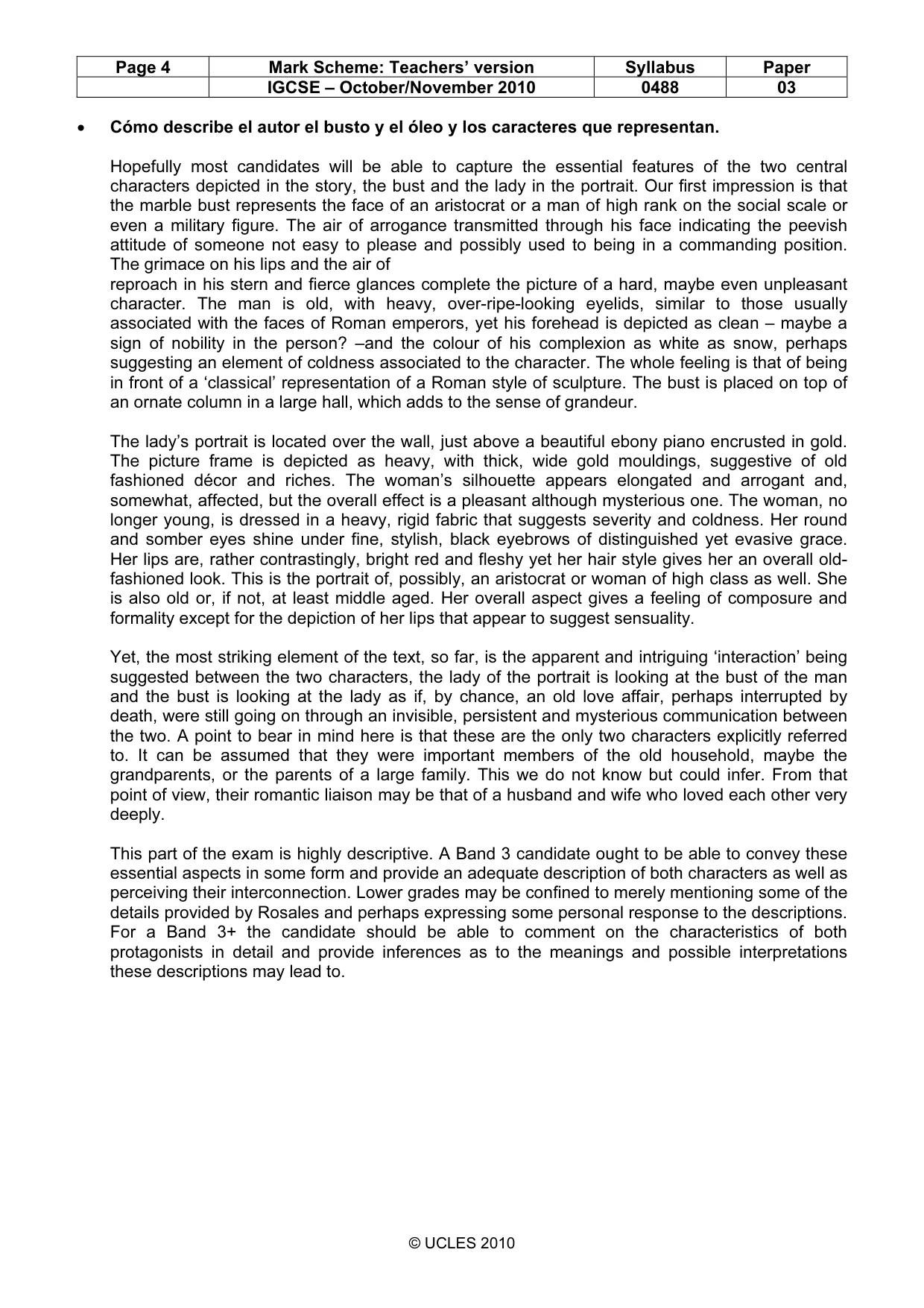
Page 4 Mark Scheme: Teachers’ version Syllabus Paper IGCSE – October/November 2010 0488 03 © UCLES 2010 • Cómo describe el autor el busto y el óleo y los caracteres que representan. Hopefully most candidates will be able to capture the essential features of the two central characters depicted in the story, the bust and the lady in the portrait. Our first impression is that the marble bust represents the face of an aristocrat or a man of high rank on the social scale or even a military figure. The air of arrogance transmitted through his face indicating the peevish attitude of someone not easy to please and possibly used to being in a commanding position. The grimace on his lips and the air of reproach in his stern and fierce glances complete the picture of a hard, maybe even unpleasant character. The man is old, with heavy, over-ripe-looking eyelids, similar to those usually associated with the faces of Roman emperors, yet his forehead is depicted as clean – maybe a sign of nobility in the person? –and the colour of his complexion as white as snow, perhaps suggesting an element of coldness associated to the character. The whole feeling is that of being in front of a ‘classical’ representation of a Roman style of sculpture. The bust is placed on top of an ornate column in a large hall, which adds to the sense of grandeur. The lady’s portrait is located over the wall, just above a beautiful ebony piano encrusted in gold. The picture frame is depicted as heavy, with thick, wide gold mouldings, suggestive of old fashioned décor and riches. The woman’s silhouette appears elongated and arrogant and, somewhat, affected, but the overall effect is a pleasant although mysterious one. The woman, no longer young, is dressed in a heavy, rigid fabric that suggests severity and coldness. Her round and somber eyes shine under fine, stylish, black eyebrows of distinguished yet evasive grace. Her lips are, rather contrastingly, bright red and fleshy yet her hair style gives her an overall old- fashioned look. This is the portrait of, possibly, an aristocrat or woman of high class as well. She is also old or, if not, at least middle aged. Her overall aspect gives a feeling of composure and formality except for the depiction of her lips that appear to suggest sensuality. Yet, the most striking element of the text, so far, is the apparent and intriguing ‘interaction’ being suggested between the two characters, the lady of the portrait is looking at the bust of the man and the bust is looking at the lady as if, by chance, an old love affair, perhaps interrupted by death, were still going on through an invisible, persistent and mysterious communication between the two. A point to bear in mind here is that these are the only two characters explicitly referred to. It can be assumed that they were important members of the old household, maybe the grandparents, or the parents of a large family. This we do not know but could infer. From that point of view, their romantic liaison may be that of a husband and wife who loved each other very deeply. This part of the exam is highly descriptive. A Band 3 candidate ought to be able to convey these essential aspects in some form and provide an adequate description of both characters as well as perceiving their interconnection. Lower grades may be confined to merely mentioning some of the details provided by Rosales and perhaps expressing some personal response to the descriptions. For a Band 3+ the candidate should be able to comment on the characteristics of both protagonists in detail and provide inferences as to the meanings and possible interpretations these descriptions may lead to.
Mark scheme, page 5
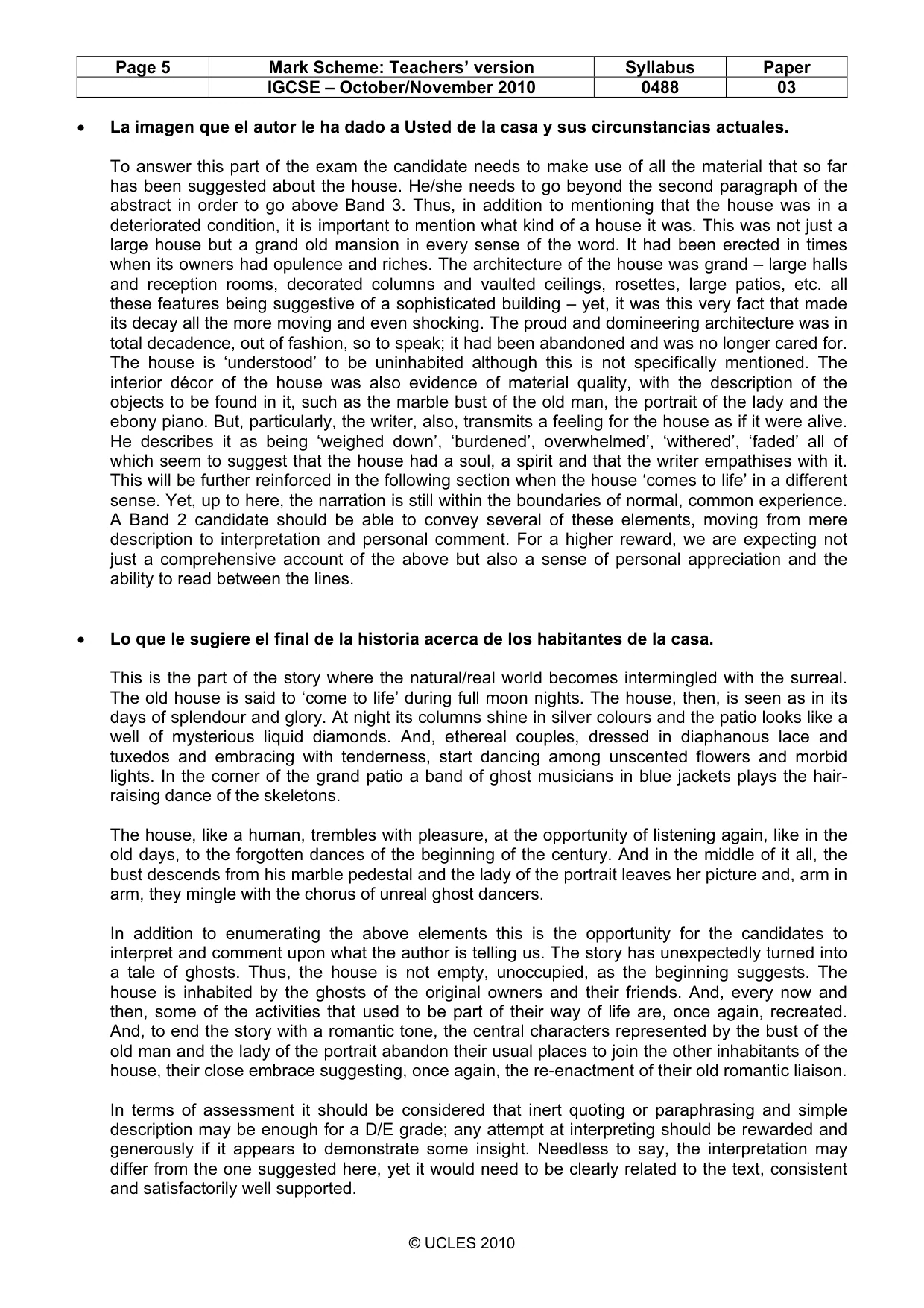
Page 5 Mark Scheme: Teachers’ version Syllabus Paper IGCSE – October/November 2010 0488 03 © UCLES 2010 • La imagen que el autor le ha dado a Usted de la casa y sus circunstancias actuales. To answer this part of the exam the candidate needs to make use of all the material that so far has been suggested about the house. He/she needs to go beyond the second paragraph of the abstract in order to go above Band 3. Thus, in addition to mentioning that the house was in a deteriorated condition, it is important to mention what kind of a house it was. This was not just a large house but a grand old mansion in every sense of the word. It had been erected in times when its owners had opulence and riches. The architecture of the house was grand – large halls and reception rooms, decorated columns and vaulted ceilings, rosettes, large patios, etc. all these features being suggestive of a sophisticated building – yet, it was this very fact that made its decay all the more moving and even shocking. The proud and domineering architecture was in total decadence, out of fashion, so to speak; it had been abandoned and was no longer cared for. The house is ‘understood’ to be uninhabited although this is not specifically mentioned. The interior décor of the house was also evidence of material quality, with the description of the objects to be found in it, such as the marble bust of the old man, the portrait of the lady and the ebony piano. But, particularly, the writer, also, transmits a feeling for the house as if it were alive. He describes it as being ‘weighed down’, ‘burdened’, overwhelmed’, ‘withered’, ‘faded’ all of which seem to suggest that the house had a soul, a spirit and that the writer empathises with it. This will be further reinforced in the following section when the house ‘comes to life’ in a different sense. Yet, up to here, the narration is still within the boundaries of normal, common experience. A Band 2 candidate should be able to convey several of these elements, moving from mere description to interpretation and personal comment. For a higher reward, we are expecting not just a comprehensive account of the above but also a sense of personal appreciation and the ability to read between the lines. • Lo que le sugiere el final de la historia acerca de los habitantes de la casa. This is the part of the story where the natural/real world becomes intermingled with the surreal. The old house is said to ‘come to life’ during full moon nights. The house, then, is seen as in its days of splendour and glory. At night its columns shine in silver colours and the patio looks like a well of mysterious liquid diamonds. And, ethereal couples, dressed in diaphanous lace and tuxedos and embracing with tenderness, start dancing among unscented flowers and morbid lights. In the corner of the grand patio a band of ghost musicians in blue jackets plays the hair- raising dance of the skeletons. The house, like a human, trembles with pleasure, at the opportunity of listening again, like in the old days, to the forgotten dances of the beginning of the century. And in the middle of it all, the bust descends from his marble pedestal and the lady of the portrait leaves her picture and, arm in arm, they mingle with the chorus of unreal ghost dancers. In addition to enumerating the above elements this is the opportunity for the candidates to interpret and comment upon what the author is telling us. The story has unexpectedly turned into a tale of ghosts. Thus, the house is not empty, unoccupied, as the beginning suggests. The house is inhabited by the ghosts of the original owners and their friends. And, every now and then, some of the activities that used to be part of their way of life are, once again, recreated. And, to end the story with a romantic tone, the central characters represented by the bust of the old man and the lady of the portrait abandon their usual places to join the other inhabitants of the house, their close embrace suggesting, once again, the re-enactment of their old romantic liaison. In terms of assessment it should be considered that inert quoting or paraphrasing and simple description may be enough for a D/E grade; any attempt at interpreting should be rewarded and generously if it appears to demonstrate some insight. Needless to say, the interpretation may differ from the one suggested here, yet it would need to be clearly related to the text, consistent and satisfactorily well supported.
Mark scheme, page 6
Page 6 Mark Scheme: Teachers’ version Syllabus Paper IGCSE – October/November 2010 0488 03 © UCLES 2010 Many candidates may only restrict themselves to describing the events, without further interpreting/commenting. Here again, the general rules apply for discerning among appropriate rewards, paraphrasing and simple or limited description may be enough for a Band 4; any attempt at interpreting starting to move the candidate towards higher grades, depending on the actual quality of the commentary/interpretation. Usted puede añadir cualquier otro comentario que le parezca pertinente. It is rare for candidates to follow up this suggestion and they should not be penalised if they do not. However, any interesting comments should of course be taken into account in the overall reward. For instance, it may be possible for some of the most observant candidates to comment about the narrator himself and his ‘old fashioned’ interest in the unreal/or supernatural. Although perhaps for some young people the theme may not be altogether unfamiliar or uninteresting as in this so called ‘new era’, beliefs in the surreal have become rather popular again. If so, generous reward should be considered although this alone should not be a substitute for the required response to the preceding sections.
What you needed in this session
Cambridge’s own grade thresholds for 2010 Oct/Nov, Paper 3 · Variant 1. A higher threshold means an easier paper — the bar moves with how the cohort did.