Cambridge IGCSE Spanish - Literature 0488 — 2009 Oct/Nov Paper 3 · Variant 1
0488/31/O/N/09 · 20 marks · ≈23 min
The question paper and its mark scheme, free to read here and free to download. This is Cambridge’s own paper, exactly as it was sat.
Question paper4 pages

Mark scheme3 pages
Answers below. Sit the paper first if you are practising.
Paper as text
Question paper, page 1
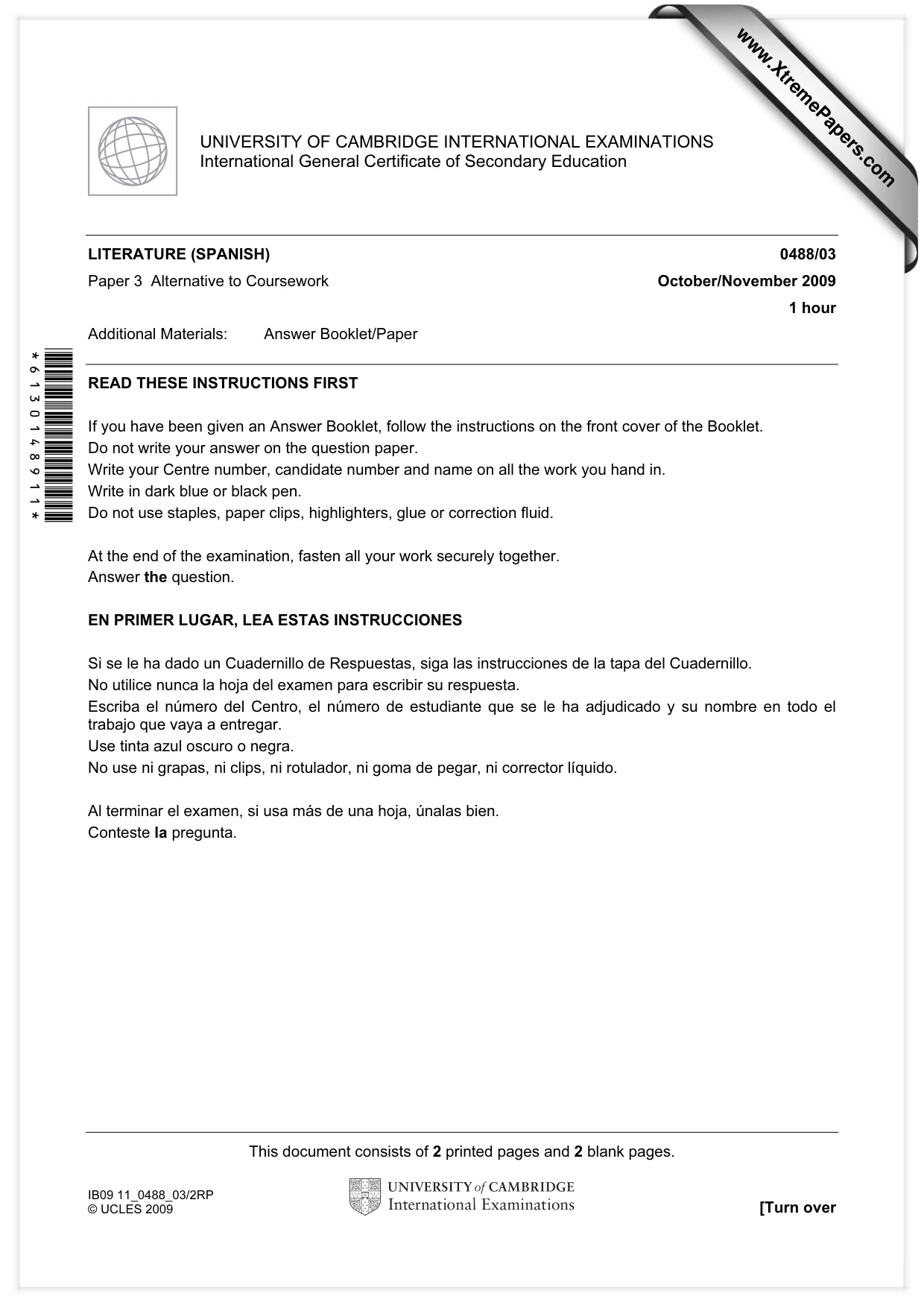
This document consists of 2 printed pages and 2 blank pages. IB09 11_0488_03/2RP © UCLES 2009 [Turn over *6130148911* UNIVERSITY OF CAMBRIDGE INTERNATIONAL EXAMINATIONS International General Certificate of Secondary Education LITERATURE (SPANISH) 0488/03 Paper 3 Alternative to Coursework October/November 2009 1 hour Additional Materials: Answer Booklet/Paper READ THESE INSTRUCTIONS FIRST If you have been given an Answer Booklet, follow the instructions on the front cover of the Booklet. Do not write your answer on the question paper. Write your Centre number, candidate number and name on all the work you hand in. Write in dark blue or black pen. Do not use staples, paper clips, highlighters, glue or correction fluid. At the end of the examination, fasten all your work securely together. Answer the question. EN PRIMER LUGAR, LEA ESTAS INSTRUCCIONES Si se le ha dado un Cuadernillo de Respuestas, siga las instrucciones de la tapa del Cuadernillo. No utilice nunca la hoja del examen para escribir su respuesta. Escriba el número del Centro, el número de estudiante que se le ha adjudicado y su nombre en todo el trabajo que vaya a entregar. Use tinta azul oscuro o negra. No use ni grapas, ni clips, ni rotulador, ni goma de pegar, ni corrector líquido. Al terminar el examen, si usa más de una hoja, únalas bien. Conteste la pregunta. www.XtremePapers.com
Question paper, page 2
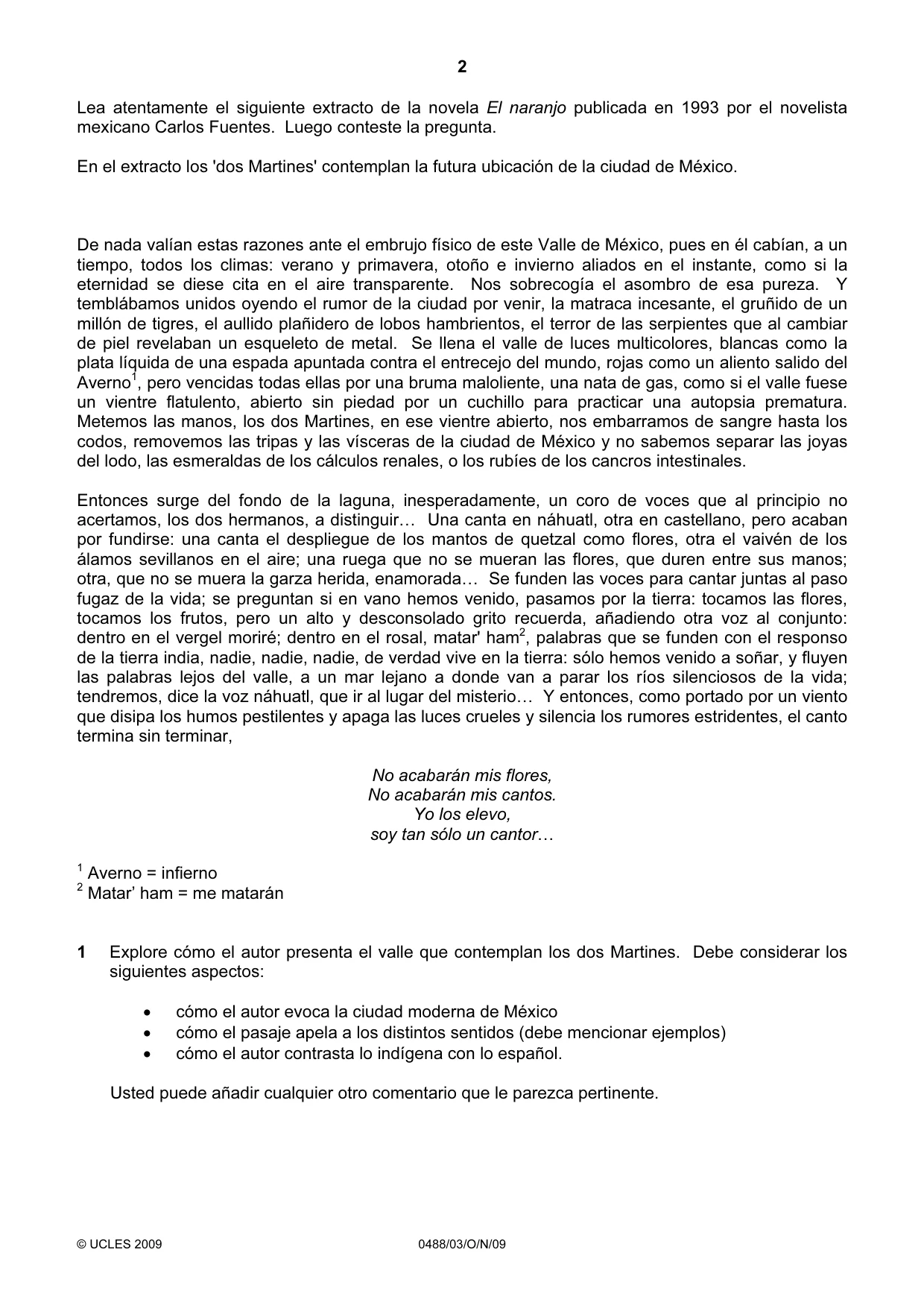
2 © UCLES 2009 0488/03/O/N/09 Lea atentamente el siguiente extracto de la novela El naranjo publicada en 1993 por el novelista mexicano Carlos Fuentes. Luego conteste la pregunta. En el extracto los 'dos Martines' contemplan la futura ubicación de la ciudad de México. De nada valían estas razones ante el embrujo físico de este Valle de México, pues en él cabían, a un tiempo, todos los climas: verano y primavera, otoño e invierno aliados en el instante, como si la eternidad se diese cita en el aire transparente. Nos sobrecogía el asombro de esa pureza. Y temblábamos unidos oyendo el rumor de la ciudad por venir, la matraca incesante, el gruñido de un millón de tigres, el aullido plañidero de lobos hambrientos, el terror de las serpientes que al cambiar de piel revelaban un esqueleto de metal. Se llena el valle de luces multicolores, blancas como la plata líquida de una espada apuntada contra el entrecejo del mundo, rojas como un aliento salido del Averno1, pero vencidas todas ellas por una bruma maloliente, una nata de gas, como si el valle fuese un vientre flatulento, abierto sin piedad por un cuchillo para practicar una autopsia prematura. Metemos las manos, los dos Martines, en ese vientre abierto, nos embarramos de sangre hasta los codos, removemos las tripas y las vísceras de la ciudad de México y no sabemos separar las joyas del lodo, las esmeraldas de los cálculos renales, o los rubíes de los cancros intestinales. Entonces surge del fondo de la laguna, inesperadamente, un coro de voces que al principio no acertamos, los dos hermanos, a distinguir… Una canta en náhuatl, otra en castellano, pero acaban por fundirse: una canta el despliegue de los mantos de quetzal como flores, otra el vaivén de los álamos sevillanos en el aire; una ruega que no se mueran las flores, que duren entre sus manos; otra, que no se muera la garza herida, enamorada… Se funden las voces para cantar juntas al paso fugaz de la vida; se preguntan si en vano hemos venido, pasamos por la tierra: tocamos las flores, tocamos los frutos, pero un alto y desconsolado grito recuerda, añadiendo otra voz al conjunto: dentro en el vergel moriré; dentro en el rosal, matar' ham2, palabras que se funden con el responso de la tierra india, nadie, nadie, nadie, de verdad vive en la tierra: sólo hemos venido a soñar, y fluyen las palabras lejos del valle, a un mar lejano a donde van a parar los ríos silenciosos de la vida; tendremos, dice la voz náhuatl, que ir al lugar del misterio… Y entonces, como portado por un viento que disipa los humos pestilentes y apaga las luces crueles y silencia los rumores estridentes, el canto termina sin terminar, No acabarán mis flores, No acabarán mis cantos. Yo los elevo, soy tan sólo un cantor… 1 Averno = infierno 2 Matar’ ham = me matarán 1 Explore cómo el autor presenta el valle que contemplan los dos Martines. Debe considerar los siguientes aspectos: • cómo el autor evoca la ciudad moderna de México • cómo el pasaje apela a los distintos sentidos (debe mencionar ejemplos) • cómo el autor contrasta lo indígena con lo español. Usted puede añadir cualquier otro comentario que le parezca pertinente.
Question paper, page 4
4 Copyright Acknowledgements: Question 1 © Carlos Fuentes; El naranjo; pp.95-6; Santillana SA; 1993. Permission to reproduce items where third-party owned material protected by copyright is included has been sought and cleared where possible. Every reasonable effort has been made by the publisher (UCLES) to trace copyright holders, but if any items requiring clearance have unwittingly been included, the publisher will be pleased to make amends at the earliest possible opportunity. University of Cambridge International Examinations is part of the Cambridge Assessment Group. Cambridge Assessment is the brand name of University of Cambridge Local Examinations Syndicate (UCLES), which is itself a department of the University of Cambridge. © UCLES 2009 0488/03/O/N/09 BLANK PAGE
Mark scheme, page 1
UNIVERSITY OF CAMBRIDGE INTERNATIONAL EXAMINATIONS International General Certificate of Secondary Education MARK SCHEME for the October/November 2009 question paper for the guidance of teachers 0488 LITERATURE (SPANISH) 0488/03 Paper 3 (Alternative to Coursework), maximum raw mark 20 This mark scheme is published as an aid to teachers and candidates, to indicate the requirements of the examination. It shows the basis on which Examiners were instructed to award marks. It does not indicate the details of the discussions that took place at an Examiners’ meeting before marking began, which would have considered the acceptability of alternative answers. Mark schemes must be read in conjunction with the question papers and the report on the examination. • CIE will not enter into discussions or correspondence in connection with these mark schemes. CIE is publishing the mark schemes for the October/November 2009 question papers for most IGCSE, GCE Advanced Level and Advanced Subsidiary Level syllabuses and some Ordinary Level syllabuses. www.XtremePapers.com
Mark scheme, page 2
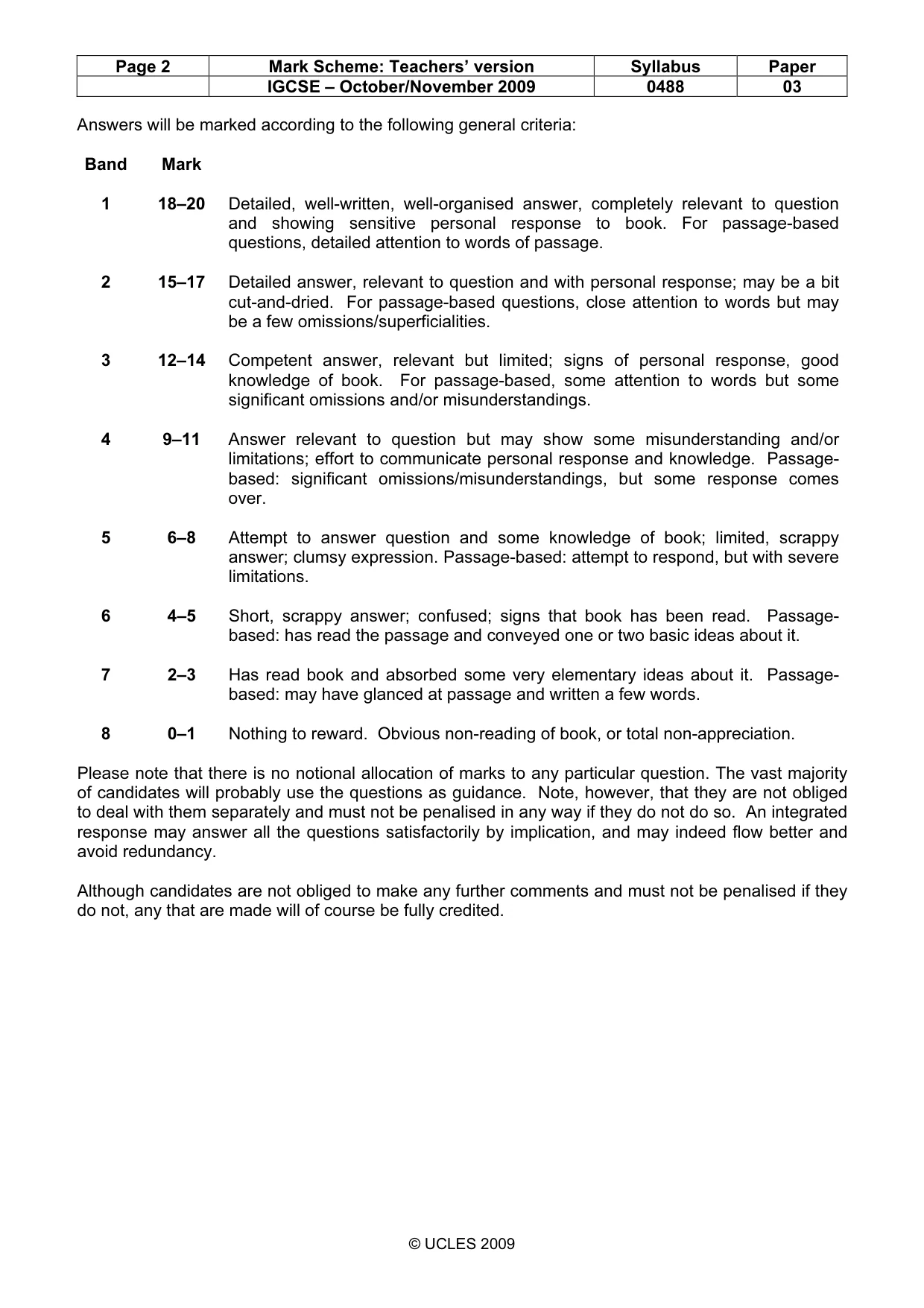
Page 2 Mark Scheme: Teachers’ version Syllabus Paper IGCSE – October/November 2009 0488 03 © UCLES 2009 Answers will be marked according to the following general criteria: Band Mark 1 18–20 Detailed, well-written, well-organised answer, completely relevant to question and showing sensitive personal response to book. For passage-based questions, detailed attention to words of passage. 2 15–17 Detailed answer, relevant to question and with personal response; may be a bit cut-and-dried. For passage-based questions, close attention to words but may be a few omissions/superficialities. 3 12–14 Competent answer, relevant but limited; signs of personal response, good knowledge of book. For passage-based, some attention to words but some significant omissions and/or misunderstandings. 4 9–11 Answer relevant to question but may show some misunderstanding and/or limitations; effort to communicate personal response and knowledge. Passage- based: significant omissions/misunderstandings, but some response comes over. 5 6–8 Attempt to answer question and some knowledge of book; limited, scrappy answer; clumsy expression. Passage-based: attempt to respond, but with severe limitations. 6 4–5 Short, scrappy answer; confused; signs that book has been read. Passage- based: has read the passage and conveyed one or two basic ideas about it. 7 2–3 Has read book and absorbed some very elementary ideas about it. Passage- based: may have glanced at passage and written a few words. 8 0–1 Nothing to reward. Obvious non-reading of book, or total non-appreciation. Please note that there is no notional allocation of marks to any particular question. The vast majority of candidates will probably use the questions as guidance. Note, however, that they are not obliged to deal with them separately and must not be penalised in any way if they do not do so. An integrated response may answer all the questions satisfactorily by implication, and may indeed flow better and avoid redundancy. Although candidates are not obliged to make any further comments and must not be penalised if they do not, any that are made will of course be fully credited.
Mark scheme, page 3
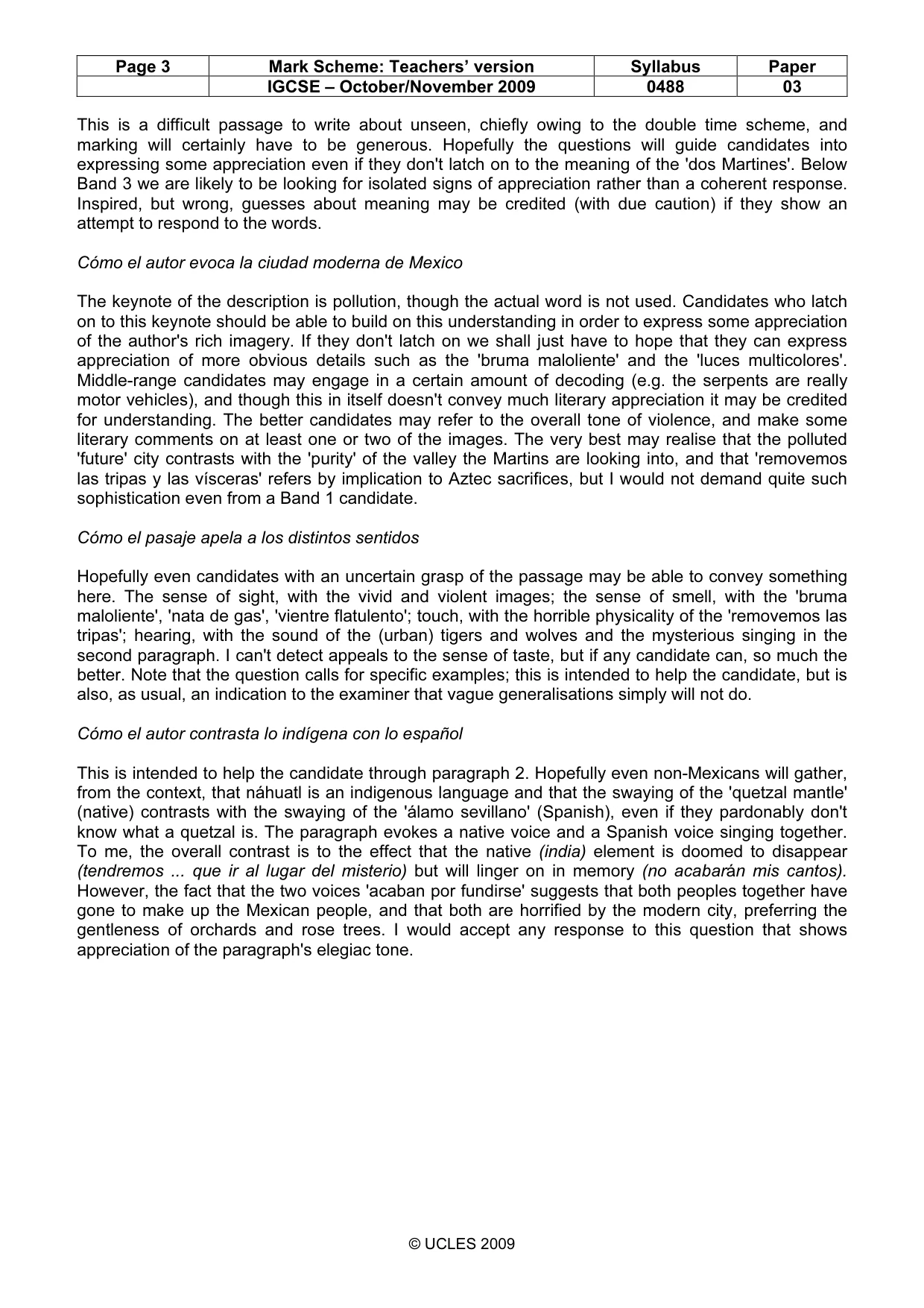
Page 3 Mark Scheme: Teachers’ version Syllabus Paper IGCSE – October/November 2009 0488 03 © UCLES 2009 This is a difficult passage to write about unseen, chiefly owing to the double time scheme, and marking will certainly have to be generous. Hopefully the questions will guide candidates into expressing some appreciation even if they don't latch on to the meaning of the 'dos Martines'. Below Band 3 we are likely to be looking for isolated signs of appreciation rather than a coherent response. Inspired, but wrong, guesses about meaning may be credited (with due caution) if they show an attempt to respond to the words. Cómo el autor evoca la ciudad moderna de Mexico The keynote of the description is pollution, though the actual word is not used. Candidates who latch on to this keynote should be able to build on this understanding in order to express some appreciation of the author's rich imagery. If they don't latch on we shall just have to hope that they can express appreciation of more obvious details such as the 'bruma maloliente' and the 'luces multicolores'. Middle-range candidates may engage in a certain amount of decoding (e.g. the serpents are really motor vehicles), and though this in itself doesn't convey much literary appreciation it may be credited for understanding. The better candidates may refer to the overall tone of violence, and make some literary comments on at least one or two of the images. The very best may realise that the polluted 'future' city contrasts with the 'purity' of the valley the Martins are looking into, and that 'removemos las tripas y las vísceras' refers by implication to Aztec sacrifices, but I would not demand quite such sophistication even from a Band 1 candidate. Cómo el pasaje apela a los distintos sentidos Hopefully even candidates with an uncertain grasp of the passage may be able to convey something here. The sense of sight, with the vivid and violent images; the sense of smell, with the 'bruma maloliente', 'nata de gas', 'vientre flatulento'; touch, with the horrible physicality of the 'removemos las tripas'; hearing, with the sound of the (urban) tigers and wolves and the mysterious singing in the second paragraph. I can't detect appeals to the sense of taste, but if any candidate can, so much the better. Note that the question calls for specific examples; this is intended to help the candidate, but is also, as usual, an indication to the examiner that vague generalisations simply will not do. Cómo el autor contrasta lo indígena con lo español This is intended to help the candidate through paragraph 2. Hopefully even non-Mexicans will gather, from the context, that náhuatl is an indigenous language and that the swaying of the 'quetzal mantle' (native) contrasts with the swaying of the 'álamo sevillano' (Spanish), even if they pardonably don't know what a quetzal is. The paragraph evokes a native voice and a Spanish voice singing together. To me, the overall contrast is to the effect that the native (india) element is doomed to disappear (tendremos ... que ir al lugar del misterio) but will linger on in memory (no acabarán mis cantos). However, the fact that the two voices 'acaban por fundirse' suggests that both peoples together have gone to make up the Mexican people, and that both are horrified by the modern city, preferring the gentleness of orchards and rose trees. I would accept any response to this question that shows appreciation of the paragraph's elegiac tone.
What you needed in this session
Cambridge’s own grade thresholds for 2009 Oct/Nov, Paper 3 · Variant 1. A higher threshold means an easier paper — the bar moves with how the cohort did.