Cambridge IGCSE Spanish - Literature 0488 — 2009 May/June Paper 3 · Variant 1
0488/31/M/J/09 · 20 marks · ≈23 min
The question paper and its mark scheme, free to read here and free to download. This is Cambridge’s own paper, exactly as it was sat.
Question paper4 pages


Mark scheme4 pages
Answers below. Sit the paper first if you are practising.
Paper as text
Question paper, page 1
This document consists of 3 printed pages and 1 blank page. IB09 06_0488_03/2RP © UCLES 2009 [Turn over *1393559889* UNIVERSITY OF CAMBRIDGE INTERNATIONAL EXAMINATIONS International General Certificate of Secondary Education LITERATURE (SPANISH) 0488/03 Paper 3 Alternative to Coursework May/June 2009 1 hour Additional Materials: Answer Booklet/Paper READ THESE INSTRUCTIONS FIRST If you have been given an Answer Booklet, follow the instructions on the front cover of the Booklet. Do not write your answer on the question paper. Write your Centre number, candidate number and name on all the work you hand in. Write in dark blue or black pen. Do not use staples, paper clips, highlighters, glue or correction fluid. At the end of the examination, fasten all your work securely together. Answer the question. EN PRIMER LUGAR, LEA ESTAS INSTRUCCIONES Si se le ha dado un Cuadernillo de Respuestas, siga las instrucciones de la tapa del Cuadernillo. No utilice nunca la hoja del examen para escribir su respuesta. Escriba el número del Centro, el número de estudiante que se le ha adjudicado y su nombre en todo el trabajo que vaya a entregar. Use tinta azul oscuro o negra. No use ni grapas, ni clips, ni rotulador, ni goma de pegar, ni corrector líquido. Al terminar el examen, si usa más de una hoja, únalas bien. Conteste la pregunta. www.XtremePapers.com
Question paper, page 2
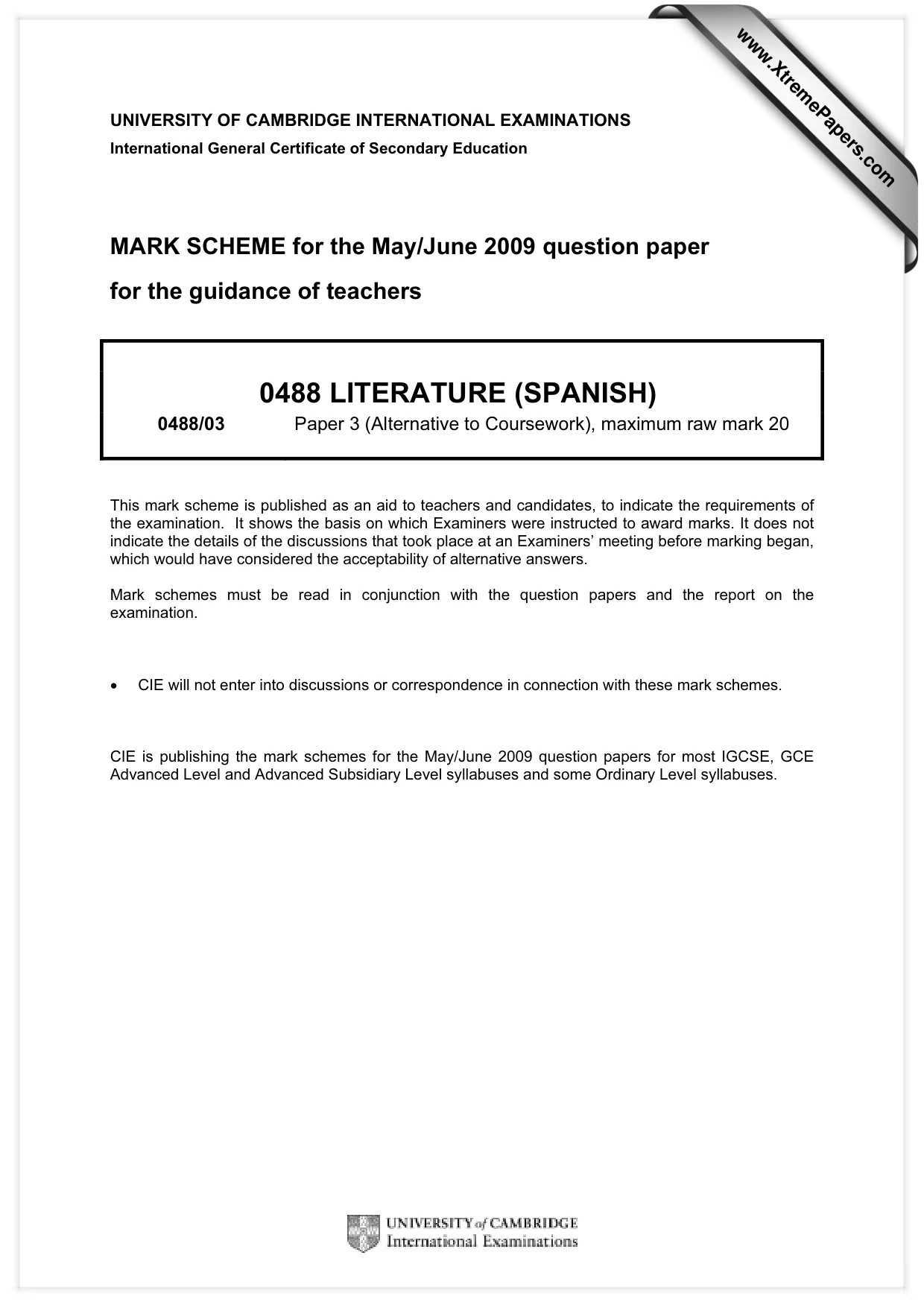
2 © UCLES 2009 0488/03/M/J/09 Lea atentamente este pasaje extraído de la novela Doña Perfecta del escritor español Benito Pérez Galdós (1843-1920). Luego conteste la pregunta. —¡Ah!, señor don Pepe. ¡Picarón! ¿Se ha encerrado usted aquí para hacer cocos a las niñas? El que esto decía era don Juan Tafetán, un sujeto amabilísimo y de los pocos que habían manifestado a Rey en el Casino cordial amistad y verdadera admiración. Con su carilla bermellonada, su bigote teñido de negro, sus ojuelos vivarachos, su estatura mezquina, su pelo con gran estudio peinado para ocultar la calvicie, don Juan Tafetán presentaba una figura bastante diferente de la de Antinóo; pero era muy simpático; tenía mucho gracejo y felicísimo ingenio para contar aventuras graciosas. Reía mucho, y al hacerlo, su cara se cubría toda, desde la frente a la barba, de grotescas arrugas. A pesar de estas cualidades y del aplauso que debía estimular su disposición a las picantes burlas, no era maldiciente. Queríanle todos, y Pepe Rey pasaba con él ratos agradables. El pobre Tafetán, empleado antaño en la Administración civil de la capital de la provincia, vivía modestamente de su sueldo en la Secretaría de Beneficencia, y completaba su pasar tocando gallardamente el clarinete en las procesiones, en las solemnidades de la catedral y en el teatro, cuando alguna traílla de desesperados cómicos aparecía por aquellos países con el alevoso propósito de dar funciones en Orbajosa. Pero lo más singular en don Juan Tafetán era su afición a las muchachas guapas. El mismo, cuando no ocultaba su calvicie con seis pelos llenos de pomada; cuando no se teñía el bigote; cuando andaba derechito y espigado por la poca pesadumbre de los años, había sido un Tenorio1 formidable, oírle contar sus conquistas era cosa de morirse de risa, porque hay Tenorios de Tenorios, y aquél fue de los más originales. —¿Qué niñas? Yo no veo niñas en ninguna parte—repuso Pepe Rey. —Hágase usted el anacoreta. Una de las celosías del balcón se abrió, dejando ver un rostro juvenil, encantador y risueño, que desapareció al instante como una luz apagada por el viento. —Ya, ya veo. —¿No las conoce usted? —Por mi vida que no. —Son las Troyas, las niñas de Troya. Pues no conoce usted nada bueno… Tres chicas preciosísimas, hijas de un coronel del Estado Mayor de Plazas, que murió en las calles de Madrid el 54. La celosía se abrió de nuevo y comparecieron dos caras. —Se están burlando de nosotros—dijo Tafetán, haciendo una seña amistosa a las niñas. —¿Las conoce usted? —¿Pues no las he de conocer? Las pobres están en la miseria. Yo no sé cómo viven. Cuando murió don Francisco Troya se hizo una suscripción para mantenerlas; pero esto duró poco. —¡Pobres muchachas! Me figuro que no serán un modelo de honradez… —¿Por qué no?... Yo no creo lo que en el pueblo se dice de ellas. Funcionó de nuevo la celosía. —Buenas tardes, niñas—gritó don Juan Tafetán, dirigiéndose a las tres, que artísticamente agrupadas aparecieron—. Este caballero dice que lo bueno no debe esconderse, y que abran ustedes toda la celosía. Pero la celosía se cerró, y alegre concierto de risas difundió una extraña alegría por la triste calle. Creeríase que pasaba una bandada de pájaros. —¿Quiere usted que vayamos allá?—dijo de súbito Tafetán. Sus ojos brillaban, y una sonrisa picaresca retozaba en sus amoratados labios. 1 Tenorio: es decir un don Juan.
Question paper, page 3
3 © UCLES 2009 0488/03/M/J/09 1 En su opinión, ¿cómo quiere el autor que percibamos a Don Juan Tafetán? Debe considerar los siguientes aspectos: • lo que escribe Galdós sobre la personalidad de Tafetán • su aspecto físico • su modo de hablar • su actitud hacia las mujeres. Usted puede añadir cualquier otro comentario que le parezca pertinente.
Question paper, page 4
4 Permission to reproduce items where third-party owned material protected by copyright is included has been sought and cleared where possible. Every reasonable effort has been made by the publisher (UCLES) to trace copyright holders, but if any items requiring clearance have unwittingly been included, the publisher will be pleased to make amends at the earliest possible opportunity. University of Cambridge International Examinations is part of the Cambridge Assessment Group. Cambridge Assessment is the brand name of University of Cambridge Local Examinations Syndicate (UCLES), which is itself a department of the University of Cambridge. 0488/03/M/J/09 BLANK PAGE
Mark scheme, page 1
UNIVERSITY OF CAMBRIDGE INTERNATIONAL EXAMINATIONS International General Certificate of Secondary Education MARK SCHEME for the May/June 2009 question paper for the guidance of teachers 0488 LITERATURE (SPANISH) 0488/03 Paper 3 (Alternative to Coursework), maximum raw mark 20 This mark scheme is published as an aid to teachers and candidates, to indicate the requirements of the examination. It shows the basis on which Examiners were instructed to award marks. It does not indicate the details of the discussions that took place at an Examiners’ meeting before marking began, which would have considered the acceptability of alternative answers. Mark schemes must be read in conjunction with the question papers and the report on the examination. • CIE will not enter into discussions or correspondence in connection with these mark schemes. CIE is publishing the mark schemes for the May/June 2009 question papers for most IGCSE, GCE Advanced Level and Advanced Subsidiary Level syllabuses and some Ordinary Level syllabuses. www.XtremePapers.com
Mark scheme, page 2
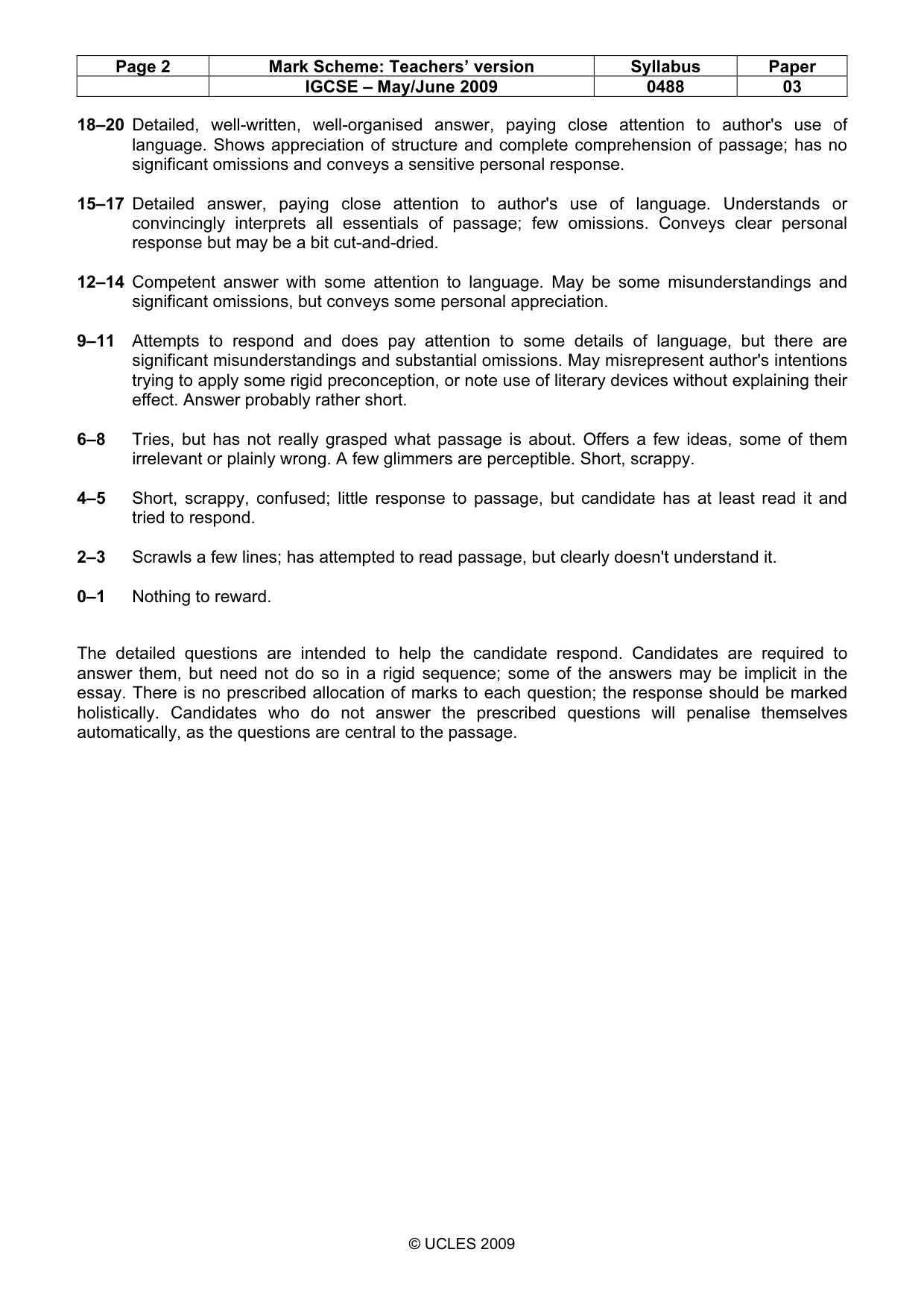
Page 2 Mark Scheme: Teachers’ version Syllabus Paper IGCSE – May/June 2009 0488 03 © UCLES 2009 18–20 Detailed, well-written, well-organised answer, paying close attention to author's use of language. Shows appreciation of structure and complete comprehension of passage; has no significant omissions and conveys a sensitive personal response. 15–17 Detailed answer, paying close attention to author's use of language. Understands or convincingly interprets all essentials of passage; few omissions. Conveys clear personal response but may be a bit cut-and-dried. 12–14 Competent answer with some attention to language. May be some misunderstandings and significant omissions, but conveys some personal appreciation. 9–11 Attempts to respond and does pay attention to some details of language, but there are significant misunderstandings and substantial omissions. May misrepresent author's intentions trying to apply some rigid preconception, or note use of literary devices without explaining their effect. Answer probably rather short. 6–8 Tries, but has not really grasped what passage is about. Offers a few ideas, some of them irrelevant or plainly wrong. A few glimmers are perceptible. Short, scrappy. 4–5 Short, scrappy, confused; little response to passage, but candidate has at least read it and tried to respond. 2–3 Scrawls a few lines; has attempted to read passage, but clearly doesn't understand it. 0–1 Nothing to reward. The detailed questions are intended to help the candidate respond. Candidates are required to answer them, but need not do so in a rigid sequence; some of the answers may be implicit in the essay. There is no prescribed allocation of marks to each question; the response should be marked holistically. Candidates who do not answer the prescribed questions will penalise themselves automatically, as the questions are central to the passage.
Mark scheme, page 3
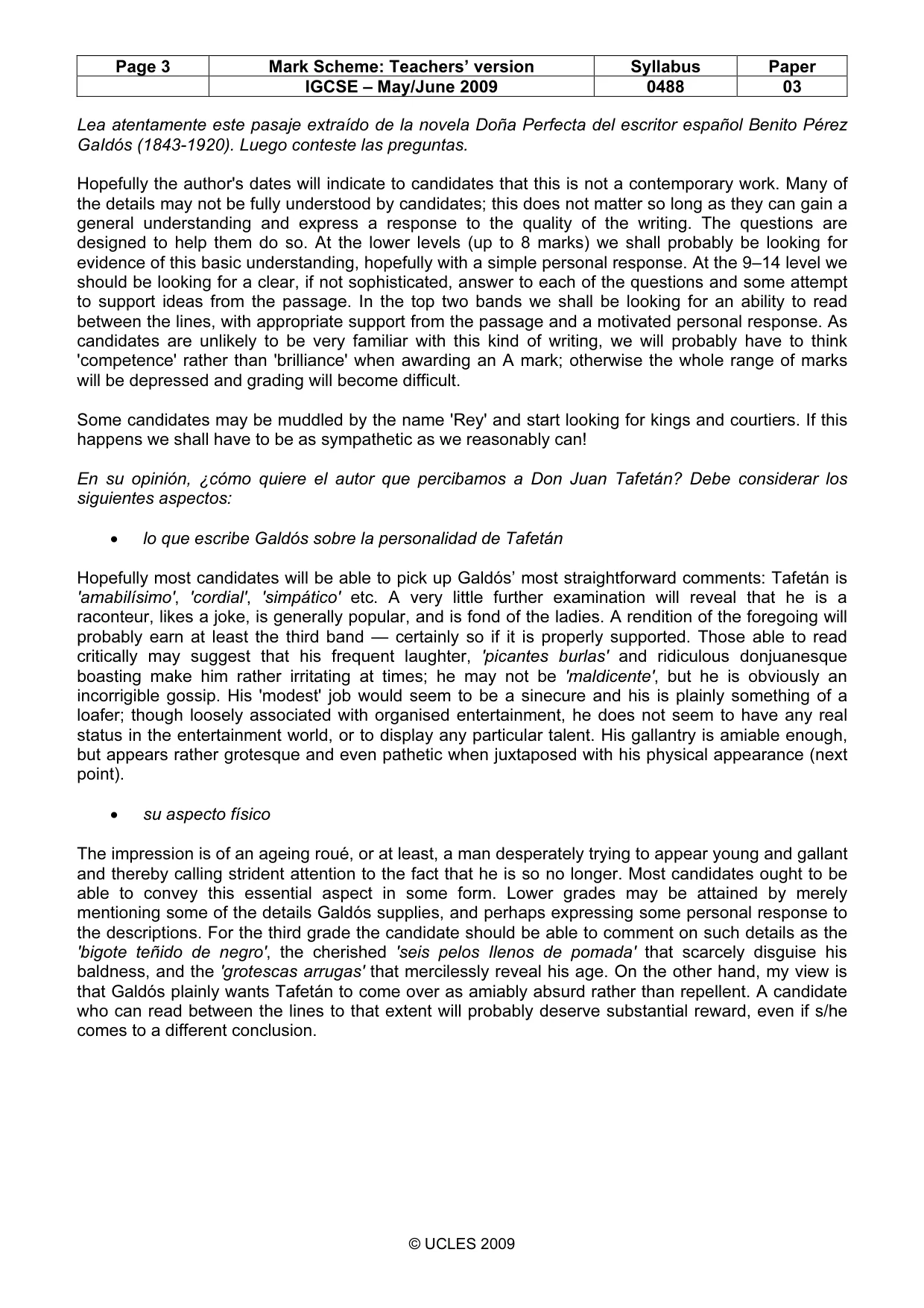
Page 3 Mark Scheme: Teachers’ version Syllabus Paper IGCSE – May/June 2009 0488 03 © UCLES 2009 Lea atentamente este pasaje extraído de la novela Doña Perfecta del escritor español Benito Pérez GaIdós (1843-1920). Luego conteste las preguntas. Hopefully the author's dates will indicate to candidates that this is not a contemporary work. Many of the details may not be fully understood by candidates; this does not matter so long as they can gain a general understanding and express a response to the quality of the writing. The questions are designed to help them do so. At the lower levels (up to 8 marks) we shall probably be looking for evidence of this basic understanding, hopefully with a simple personal response. At the 9–14 level we should be looking for a clear, if not sophisticated, answer to each of the questions and some attempt to support ideas from the passage. In the top two bands we shall be looking for an ability to read between the lines, with appropriate support from the passage and a motivated personal response. As candidates are unlikely to be very familiar with this kind of writing, we will probably have to think 'competence' rather than 'brilliance' when awarding an A mark; otherwise the whole range of marks will be depressed and grading will become difficult. Some candidates may be muddled by the name 'Rey' and start looking for kings and courtiers. If this happens we shall have to be as sympathetic as we reasonably can! En su opinión, ¿cómo quiere el autor que percibamos a Don Juan Tafetán? Debe considerar los siguientes aspectos: • lo que escribe Galdós sobre la personalidad de Tafetán Hopefully most candidates will be able to pick up Galdós’ most straightforward comments: Tafetán is 'amabilísimo', 'cordial', 'simpático' etc. A very little further examination will reveal that he is a raconteur, likes a joke, is generally popular, and is fond of the ladies. A rendition of the foregoing will probably earn at least the third band — certainly so if it is properly supported. Those able to read critically may suggest that his frequent laughter, 'picantes burlas' and ridiculous donjuanesque boasting make him rather irritating at times; he may not be 'maldicente', but he is obviously an incorrigible gossip. His 'modest' job would seem to be a sinecure and his is plainly something of a loafer; though loosely associated with organised entertainment, he does not seem to have any real status in the entertainment world, or to display any particular talent. His gallantry is amiable enough, but appears rather grotesque and even pathetic when juxtaposed with his physical appearance (next point). • su aspecto físico The impression is of an ageing roué, or at least, a man desperately trying to appear young and gallant and thereby calling strident attention to the fact that he is so no longer. Most candidates ought to be able to convey this essential aspect in some form. Lower grades may be attained by merely mentioning some of the details Galdós supplies, and perhaps expressing some personal response to the descriptions. For the third grade the candidate should be able to comment on such details as the 'bigote teñido de negro', the cherished 'seis pelos Ilenos de pomada' that scarcely disguise his baldness, and the 'grotescas arrugas' that mercilessly reveal his age. On the other hand, my view is that Galdós plainly wants Tafetán to come over as amiably absurd rather than repellent. A candidate who can read between the lines to that extent will probably deserve substantial reward, even if s/he comes to a different conclusion.
Mark scheme, page 4
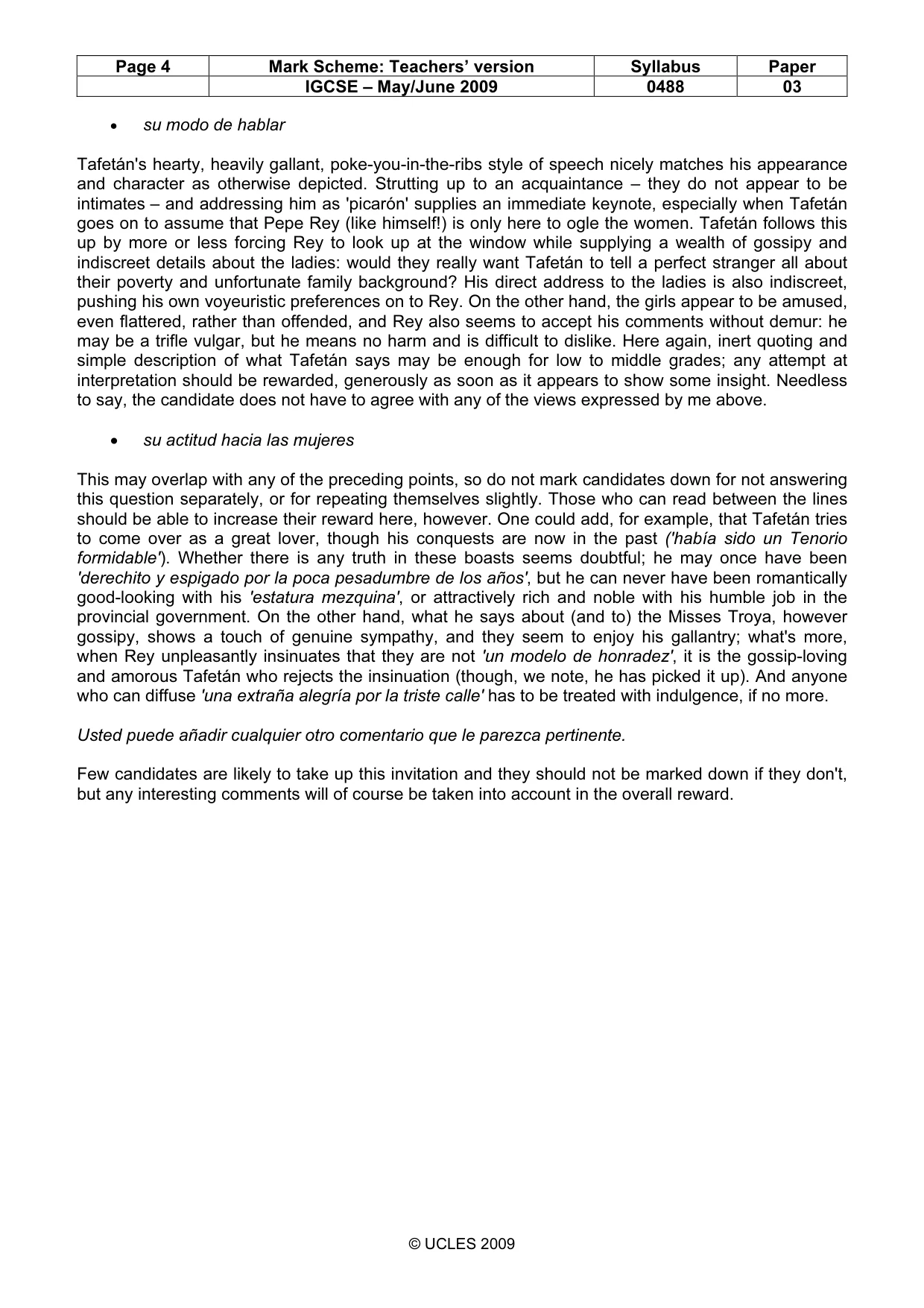
Page 4 Mark Scheme: Teachers’ version Syllabus Paper IGCSE – May/June 2009 0488 03 © UCLES 2009 • su modo de hablar Tafetán's hearty, heavily gallant, poke-you-in-the-ribs style of speech nicely matches his appearance and character as otherwise depicted. Strutting up to an acquaintance – they do not appear to be intimates – and addressing him as 'picarón' supplies an immediate keynote, especially when Tafetán goes on to assume that Pepe Rey (like himself!) is only here to ogle the women. Tafetán follows this up by more or less forcing Rey to look up at the window while supplying a wealth of gossipy and indiscreet details about the ladies: would they really want Tafetán to tell a perfect stranger all about their poverty and unfortunate family background? His direct address to the ladies is also indiscreet, pushing his own voyeuristic preferences on to Rey. On the other hand, the girls appear to be amused, even flattered, rather than offended, and Rey also seems to accept his comments without demur: he may be a trifle vulgar, but he means no harm and is difficult to dislike. Here again, inert quoting and simple description of what Tafetán says may be enough for low to middle grades; any attempt at interpretation should be rewarded, generously as soon as it appears to show some insight. Needless to say, the candidate does not have to agree with any of the views expressed by me above. • su actitud hacia las mujeres This may overlap with any of the preceding points, so do not mark candidates down for not answering this question separately, or for repeating themselves slightly. Those who can read between the lines should be able to increase their reward here, however. One could add, for example, that Tafetán tries to come over as a great lover, though his conquests are now in the past ('había sido un Tenorio formidable'). Whether there is any truth in these boasts seems doubtful; he may once have been 'derechito y espigado por la poca pesadumbre de los años', but he can never have been romantically good-looking with his 'estatura mezquina', or attractively rich and noble with his humble job in the provincial government. On the other hand, what he says about (and to) the Misses Troya, however gossipy, shows a touch of genuine sympathy, and they seem to enjoy his gallantry; what's more, when Rey unpleasantly insinuates that they are not 'un modelo de honradez', it is the gossip-loving and amorous Tafetán who rejects the insinuation (though, we note, he has picked it up). And anyone who can diffuse 'una extraña alegría por la triste calle' has to be treated with indulgence, if no more. Usted puede añadir cualquier otro comentario que le parezca pertinente. Few candidates are likely to take up this invitation and they should not be marked down if they don't, but any interesting comments will of course be taken into account in the overall reward.
What you needed in this session
Cambridge’s own grade thresholds for 2009 May/June, Paper 3 · Variant 1. A higher threshold means an easier paper — the bar moves with how the cohort did.