Cambridge IGCSE Spanish - Literature 0488 — 2008 Oct/Nov Paper 3 · Variant 1
0488/31/O/N/08 · 20 marks · ≈23 min
The question paper and its mark scheme, free to read here and free to download. This is Cambridge’s own paper, exactly as it was sat.
Question paper4 pages


Mark scheme3 pages
Answers below. Sit the paper first if you are practising.
Paper as text
Question paper, page 1
This document consists of 2 printed pages and 2 blank pages. IB08 11_0488_03/RP © UCLES 2008 [Turn over *0801297312* UNIVERSITY OF CAMBRIDGE INTERNATIONAL EXAMINATIONS International General Certificate of Secondary Education LITERATURE (SPANISH) 0488/03 Paper 3 Alternative to Coursework October/November 2008 1 hour Additional Materials: Answer Booklet/Paper READ THESE INSTRUCTIONS FIRST If you have been given an Answer Booklet, follow the instructions on the front cover of the Booklet. Do not write your answer on the question paper. Write your Centre number, candidate number and name on all the work you hand in. Write in dark blue or black pen. Do not use staples, paper clips, highlighters, glue or correction fluid. At the end of the examination, fasten all your work securely together. Answer the question. EN PRIMER LUGAR, LEA ESTAS INSTRUCCIONES Si se le ha dado un Cuadernillo de Respuestas, siga las instrucciones de la tapa del Cuadernillo. No utilice nunca la hoja del examen para escribir su respuesta. Escriba el número del Centro, el número de estudiante que se le ha adjudicado y su nombre en todo el trabajo que vaya a entregar. Use tinta azul oscuro o negra. No use ni grapas, ni clips, ni rotulador, ni goma de pegar, ni corrector líquido. Al terminar el examen, si usa más de una hoja, únalas bien. Conteste la pregunta. www.XtremePapers.com
Question paper, page 2
2 © UCLES 2008 0488/03/O/N/08 Lea atentamente el siguiente poema del poeta español Juan-Eduardo Cirlot (1916-1973). Luego conteste la pregunta. ORFEO* Del viviente silencio que los cuerpos sollozan, del canto palpitante de los bosques reunidos, del himno acumulado, solar, por las llanuras, Orfeo, en la ribera del fuego extiende el grito. Al rumor del incendio, las rojas, degradadas, las azules y negras bestias, mansas acuden; los pájaros descienden, y los árboles sufren: los oscuros cipreses de ensueño disonante. La subceleste calma de los sagrados valles lenta vibra, sublime de espumas y laureles, y, en el desnudo espacio, cristales y palomas, ambos gimen, prendidos en el pulso severo. Sonidos inmutables doran sordas montañas, y pechos, y cabellos, que a su luz resplandecen. El dolor ha encontrado la fuente, y el espejo en el camino profundo donde no se destruyen. Mujeres de ceniza, pastores enterrados, sueñan cielos de plata a través de la arena. Sus pupilas resecas se inundan de jacintos, y en la orilla del río las cañas se estremecen. El mar es un lamento que corta las magnolias, y el aire es un gemido que las estatuas muerde, pero tiene el abismo del hombre otra violencia con que expresar la sangre que invade sus paisajes. * Personaje de la mitología griega que con su voz y su lira encantaba las plantas, amansaba los animales y suavizaba las costumbres de los más rudos mortales. 1 Dé su apreciación de cómo el poeta crea un ambiente de misterio y maravilla. Debe considerar los siguientes aspectos: • cómo describe el poeta a las plantas, los animales y los humanos • las emociones evocadas, y cómo las expresa el poeta • el modo en que el poeta presenta a Orfeo • la yuxtaposición de ideas opuestas. Usted puede añadir cualquier otro comentario que le parezca pertinente.
Question paper, page 4
4 Copyright Acknowledgements: Question 1 © Juan-Eduardo Cirlot; Orfeo; Ediciones Cátedra. Permission to reproduce items where third-party owned material protected by copyright is included has been sought and cleared where possible. Every reasonable effort has been made by the publisher (UCLES) to trace copyright holders, but if any items requiring clearance have unwittingly been included, the publisher will be pleased to make amends at the earliest possible opportunity. University of Cambridge International Examinations is part of the Cambridge Assessment Group. Cambridge Assessment is the brand name of University of Cambridge Local Examinations Syndicate (UCLES), which is itself a department of the University of Cambridge. 0488/03/O/N/08 BLANK PAGE
Mark scheme, page 1
UNIVERSITY OF CAMBRIDGE INTERNATIONAL EXAMINATIONS International General Certificate of Secondary Education MARK SCHEME for the October/November 2008 question paper 0488 LITERATURE (SPANISH) 0488/03 Paper 3 (Alternative to Coursework), maximum raw mark 20 This mark scheme is published as an aid to teachers and candidates, to indicate the requirements of the examination. It shows the basis on which Examiners were instructed to award marks. It does not indicate the details of the discussions that took place at an Examiners’ meeting before marking began. All Examiners are instructed that alternative correct answers and unexpected approaches in candidates’ scripts must be given marks that fairly reflect the relevant knowledge and skills demonstrated. Mark schemes must be read in conjunction with the question papers and the report on the examination. • CIE will not enter into discussions or correspondence in connection with these mark schemes. CIE is publishing the mark schemes for the October/November 2008 question papers for most IGCSE, GCE Advanced Level and Advanced Subsidiary Level syllabuses and some Ordinary Level syllabuses. www.XtremePapers.com
Mark scheme, page 2
Page 2 Mark Scheme Syllabus Paper IGCSE – October/November 2008 0488 03 © UCLES 2008 Answers will be marked according to the following general criteria: 18–20 Detailed, well-written, well-organised answer, paying close attention to author’s use of language. Shows appreciation of structure and near-total comprehension of poem; has no significant omissions and conveys a sensitive personal response. 15–17 Detailed answer, paying close attention to author’s use of language. Understands or convincingly interprets all essentials of poem; few omissions. Conveys clear personal response but may be a bit cut-and-dried. 12–14 Competent answer with some attention to language. May be some misunderstandings and significant omissions, but conveys some personal appreciation. 9–11 Attempts to respond and does pay attention to some details of language, but there are significant misunderstandings and substantial omissions. May distort poem by trying to apply some rigid preconception, or note use of literary devices without explaining their effect. Answer probably rather short. 6–8 Tries, but has not really grasped what poem is about. Offers a few ideas, some of them irrelevant or plainly wrong. A few glimmers are perceptible. Short, scrappy. 4–5 Short, scrappy, confused; little response to poem, but candidate has at least read it and tried to respond. 2–3 Scrawls a few lines; has attempted to read poem, but clearly doesn’t understand it. 0–1 Nothing to reward. Please note that although the candidate is invited to answer the questions on the paper, and the overwhelming majority will do so, this is not obligatory and there is no notional allocation of marks to any particular question. The vast majority of candidates will probably use the questions as guidance. Note, however, that they are not obliged to deal with them separately and must not be penalised in any way if they do not do so. An integrated response may answer all the questions satisfactorily by implication, and may indeed flow better and avoid redundancy. Although candidates are not obliged to make any further comments and must not be penalised if they do not, any that are made will of course be fully credited. This is quite a difficult poem to write about unseen, and marking will almost certainly have to be generous. Hopefully the questions will guide candidates into expressing some appreciation even if they don’t understand the overall poem – supposing that 'understand' is an appropriate term for a poem of this nature. Dé su apreciación de cómo el poeta crea un ambiente de misterio y maravilla. This overall question specifically does not call for decoding or interpretation, but if candidates insist on trying to interpret, we shall have to follow them however far-fetched their ideas may seem. Credit should only be given, however, if the ideas are backed by some detail from the poem, and are, however tangentially, relevant to the question. Almost any claim for 'misterio y maravilla' may be accepted if backed by evidence.
Mark scheme, page 3
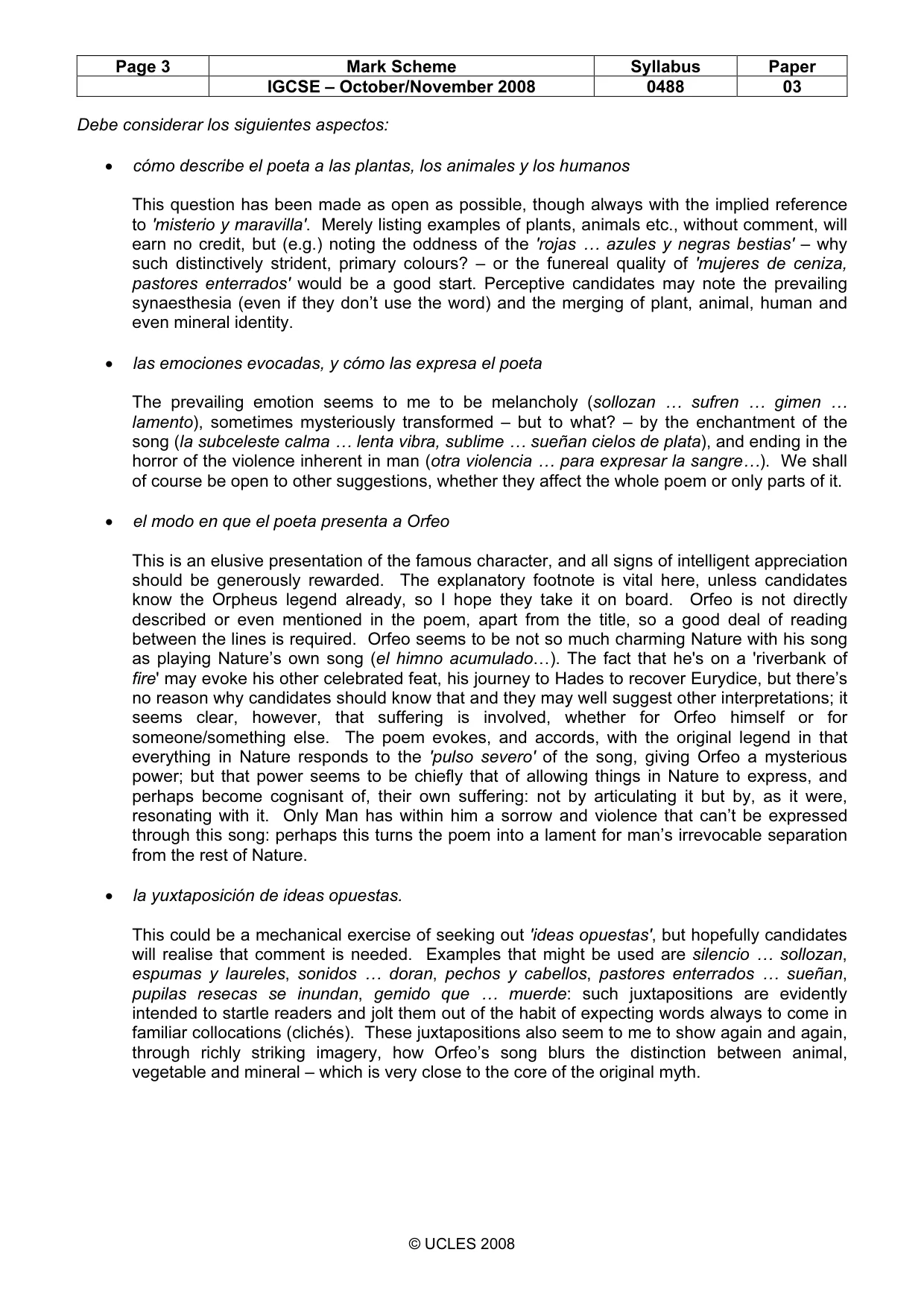
Page 3 Mark Scheme Syllabus Paper IGCSE – October/November 2008 0488 03 © UCLES 2008 Debe considerar los siguientes aspectos: • cómo describe el poeta a las plantas, los animales y los humanos This question has been made as open as possible, though always with the implied reference to 'misterio y maravilla'. Merely listing examples of plants, animals etc., without comment, will earn no credit, but (e.g.) noting the oddness of the 'rojas … azules y negras bestias' – why such distinctively strident, primary colours? – or the funereal quality of 'mujeres de ceniza, pastores enterrados' would be a good start. Perceptive candidates may note the prevailing synaesthesia (even if they don’t use the word) and the merging of plant, animal, human and even mineral identity. • las emociones evocadas, y cómo las expresa el poeta The prevailing emotion seems to me to be melancholy (sollozan … sufren … gimen … lamento), sometimes mysteriously transformed – but to what? – by the enchantment of the song (la subceleste calma … lenta vibra, sublime … sueñan cielos de plata), and ending in the horror of the violence inherent in man (otra violencia … para expresar la sangre…). We shall of course be open to other suggestions, whether they affect the whole poem or only parts of it. • el modo en que el poeta presenta a Orfeo This is an elusive presentation of the famous character, and all signs of intelligent appreciation should be generously rewarded. The explanatory footnote is vital here, unless candidates know the Orpheus legend already, so I hope they take it on board. Orfeo is not directly described or even mentioned in the poem, apart from the title, so a good deal of reading between the lines is required. Orfeo seems to be not so much charming Nature with his song as playing Nature’s own song (el himno acumulado…). The fact that he's on a 'riverbank of fire' may evoke his other celebrated feat, his journey to Hades to recover Eurydice, but there’s no reason why candidates should know that and they may well suggest other interpretations; it seems clear, however, that suffering is involved, whether for Orfeo himself or for someone/something else. The poem evokes, and accords, with the original legend in that everything in Nature responds to the 'pulso severo' of the song, giving Orfeo a mysterious power; but that power seems to be chiefly that of allowing things in Nature to express, and perhaps become cognisant of, their own suffering: not by articulating it but by, as it were, resonating with it. Only Man has within him a sorrow and violence that can’t be expressed through this song: perhaps this turns the poem into a lament for man’s irrevocable separation from the rest of Nature. • la yuxtaposición de ideas opuestas. This could be a mechanical exercise of seeking out 'ideas opuestas', but hopefully candidates will realise that comment is needed. Examples that might be used are silencio … sollozan, espumas y laureles, sonidos … doran, pechos y cabellos, pastores enterrados … sueñan, pupilas resecas se inundan, gemido que … muerde: such juxtapositions are evidently intended to startle readers and jolt them out of the habit of expecting words always to come in familiar collocations (clichés). These juxtapositions also seem to me to show again and again, through richly striking imagery, how Orfeo’s song blurs the distinction between animal, vegetable and mineral – which is very close to the core of the original myth.
What you needed in this session
Cambridge’s own grade thresholds for 2008 Oct/Nov, Paper 3 · Variant 1. A higher threshold means an easier paper — the bar moves with how the cohort did.