Cambridge IGCSE Spanish - Literature 0488 — 2008 May/June Paper 3 · Variant 1
0488/31/M/J/08 · 20 marks · ≈23 min
The question paper and its mark scheme, free to read here and free to download. This is Cambridge’s own paper, exactly as it was sat.
Question paper4 pages


Mark scheme4 pages
Answers below. Sit the paper first if you are practising.
Paper as text
Question paper, page 1
This document consists of 3 printed pages and 1 blank page. IB08 06_0488_03/4RP © UCLES 2008 [Turn over *0290216319* UNIVERSITY OF CAMBRIDGE INTERNATIONAL EXAMINATIONS International General Certificate of Secondary Education LITERATURE (SPANISH) 0488/03 Paper 3 Alternative to Coursework May/June 2008 1 hour Additional Materials: Answer Booklet/Paper READ THESE INSTRUCTIONS FIRST If you have been given an Answer Booklet, follow the instructions on the front cover of the Booklet. Do not write your answer on the question paper. Write your Centre number, candidate number and name on all the work you hand in. Write in dark blue or black pen. Do not use staples, paper clips, highlighters, glue or correction fluid. At the end of the examination, fasten all your work securely together. Answer the question. EN PRIMER LUGAR, LEA ESTAS INSTRUCCIONES Si se le ha dado un Cuadernillo de Respuestas, siga las instrucciones de la tapa del Cuadernillo. No utilice nunca la hoja del examen para escribir su respuesta. Escriba el número del Centro, el número de estudiante que se le ha adjudicado y su nombre en todo el trabajo que vaya a entregar. Use tinta azul oscuro o negra. No use ni grapas, ni clips, ni rotulador, ni goma de pegar, ni corrector líquido. Al terminar el examen, si usa más de una hoja, únalas bien. Conteste la pregunta. www.XtremePapers.com
Question paper, page 2
2 © UCLES 2008 0488/03/M/J/08 Lea atentamente este pasaje extraído de la novela La muerte de Honorio del escritor venezolano Miguel Otero Silva (1908-1985), publicada en 1963. Luego conteste la pregunta. Mi amiga de los ojos grises se llama Noemí y pertenece a una familia con pasado de grandes haciendas y presente de royaltys petroleros, un mundo remotísimo y ajeno a mis pensamientos. No es mi culpa si Noemí no me permite desaparecer de nuestro primer encuentro, si le insinúa al teniente Morillo que me lleve a su casa, si su boca carnosa me tienta como una fruta. Vuelvo a su casa cuantas veces quiere, a pesar de sus apellidos y de la atmósfera que la envuelve, y termino por enamorarme de ella como un infeliz, sabe Dios por cuánto tiempo. Noemí que también me quiere, de eso no tengo la menor duda, se ve en aprietos para explicar a sus padres, a la gente del club y a sus amigas de la infancia, esta repentina intimidad con un teniente provinciano sin otra fortuna que las dos estrellas de sus presillas. La veo los sábados y los domingos bajo los pinos de un parque. Y cuando no la veo, no me aparto de la central telefónica del cuartel en las horas precisas: once y media de la mañana, cinco en punto de la tarde. “Lo llaman a usted, teniente”, y es siempre Noemí. El único nubarrón en cielo tan radiante es Noemí afanada en aguijonear la admiración de los hombres, Noemí desplegando su sensualidad como un capote de torero. Noemí distribuyendo sonrisas y miradas que a mí me causan rencor y pesadumbre, aunque estoy seguro de que ella me quiere. Y si ella me quiere, esa avidez de crear a su alrededor un cerco de halagos masculinos, no puede ser sino un hábito de mujer mundana y nada más. Atribuyo mi zozobra a prejuicios montaraces pero luego me dedico a observar con detenimiento a las otras mujeres, a las que giran en torno a Noemí y compruebo desconsolado que únicamente ella cultiva esa siembra de miradas insistentes y de sonrisas prometedoras. Mi inquietud por aquel modo de ser de Noemí me quema por dentro como un tizón y amenaza con volverse resentimiento. Decido hablarle sin ambages del problema, aun a riesgo de exhibirme ante ella como un hombre celoso, sinónimo de cobarde porque en el corazón de todo hombre celoso se esconde una raíz de cobardía. Noemí me escucha serenamente y dice: “No me agrada despertar malos pensamientos, te lo juro”, “Haré un esfuerzo para librarme de mis atractivos involuntarios, si tanta molestia te causan”, “Tú me interesas por encima de todas las cosas de este mundo”. Me apaciguo completamente después de esa franca conversación con Noemí, pero mi sosiego dura apenas hasta la próxima fiesta donde nos invitan y donde ella insiste en repetir miradas misteriosas, sonrisas incitantes, entre cuanto personaje masculino de cierta prestancia o relieve se cruza con nosotros. Noemí y yo nos enfrascamos a renglón seguido en una lucha sorda que no concluye pronto en ruptura violenta porque en realidad nos queremos mucho, cada uno según su capacidad y manera de querer. Existe una fuerza dentro de ella que la arrastra con empuje más avasallante que el amor y es su apetencia de saberse codiciada por muchos hombres al mismo tiempo, aunque no me quiera sino a mí. Tan me quiere que la veo debatirse como los morfinómanos decididos a arrancarse el vicio, y como ellos lo logra temporalmente hasta el momento en que surge un sujeto importante o bien parecido y al punto se le derrumban sus propósitos, despliega miradas y sonrisas provocadoras, y yo sufro como un perro abandonado. Una tarde le digo, no impulsivamente sino tras haberlo meditado en noches de insomnio: “La próxima vez que te comportes de ese modo, no volverás a verme.”
Question paper, page 3
3 © UCLES 2008 0488/03/M/J/08 1 Escriba sus impresiones sobre el narrador y Noemí. Debe considerar los siguientes aspectos: • cómo el autor explota el lenguaje para comunicar la fascinación que Noemí ejerce sobre el narrador y los celos que ella le inspira • cómo nos hace comprender que el narrador se siente inferior a su amada • si el autor ha logrado convencerle a usted de que Noemí ama realmente al narrador. Usted puede añadir cualquier otro comentario que le parezca pertinente.
Question paper, page 4
4 Copyright Acknowledgements: Question 1 © Miguel Otero Silva; La muerte de Honorio; Monte Ávila Editores; 1972. Permission to reproduce items where third-party owned material protected by copyright is included has been sought and cleared where possible. Every reasonable effort has been made by the publisher (UCLES) to trace copyright holders, but if any items requiring clearance have unwittingly been included, the publisher will be pleased to make amends at the earliest possible opportunity. University of Cambridge International Examinations is part of the Cambridge Assessment Group. Cambridge Assessment is the brand name of University of Cambridge Local Examinations Syndicate (UCLES), which is itself a department of the University of Cambridge. 0488/03/M/J/08 BLANK PAGE
Mark scheme, page 1
UNIVERSITY OF CAMBRIDGE INTERNATIONAL EXAMINATIONS International General Certificate of Secondary Education MARK SCHEME for the May/June 2008 question paper 0488 LITERATURE (SPANISH) 0488/03 Paper 3 (Alternative to Coursework), maximum raw mark 20 This mark scheme is published as an aid to teachers and candidates, to indicate the requirements of the examination. It shows the basis on which Examiners were instructed to award marks. It does not indicate the details of the discussions that took place at an Examiners’ meeting before marking began. All Examiners are instructed that alternative correct answers and unexpected approaches in candidates’ scripts must be given marks that fairly reflect the relevant knowledge and skills demonstrated. Mark schemes must be read in conjunction with the question papers and the report on the examination. • CIE will not enter into discussions or correspondence in connection with these mark schemes. CIE is publishing the mark schemes for the May/June 2008 question papers for most IGCSE, GCE Advanced Level and Advanced Subsidiary Level syllabuses and some Ordinary Level syllabuses. www.XtremePapers.com
Mark scheme, page 2
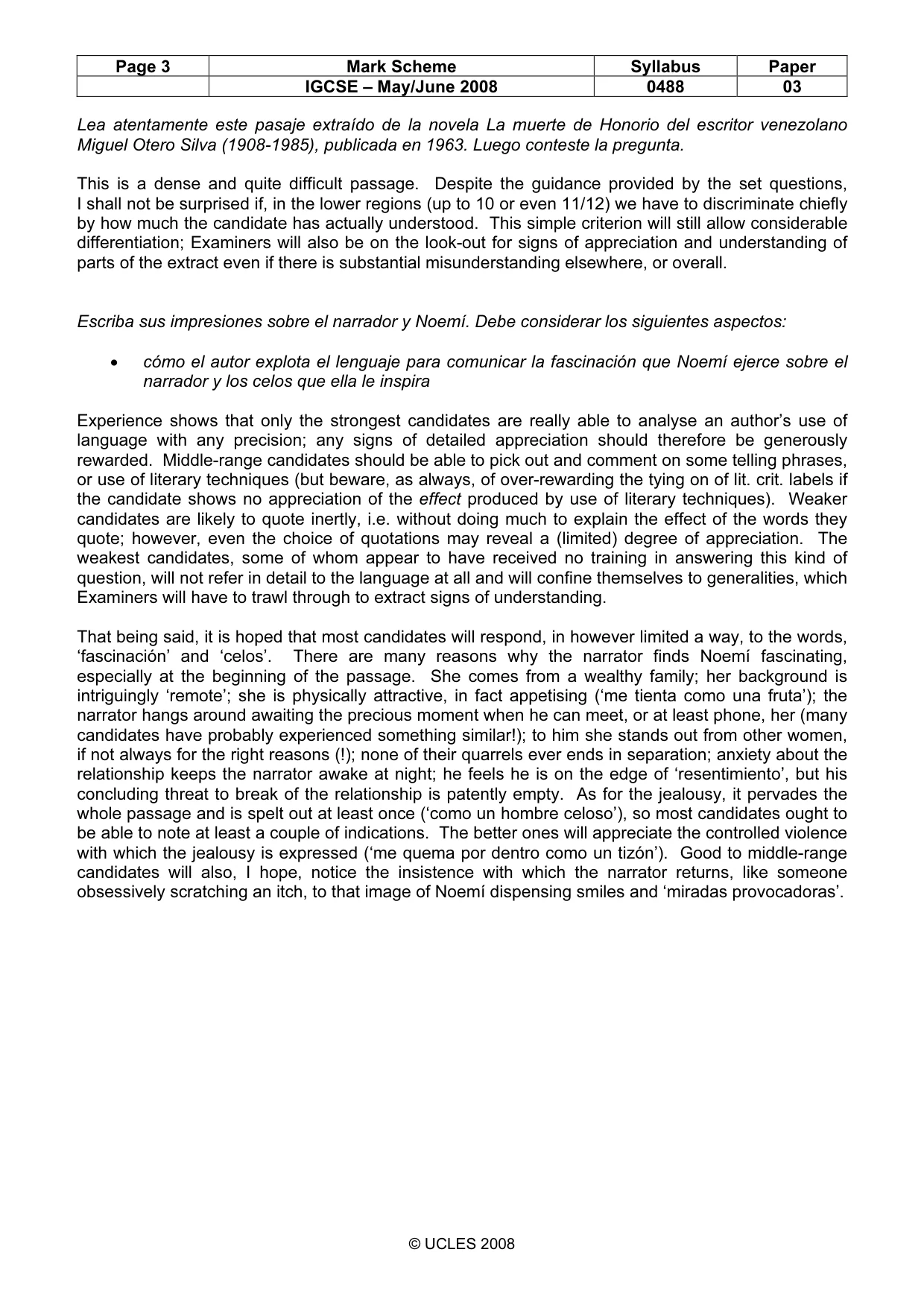
Page 2 Mark Scheme Syllabus Paper IGCSE – May/June 2008 0488 03 © UCLES 2008 Answers will be marked according to the following general criteria: 18–20 Detailed, well-written, well-organised answer, paying close attention to author’s use of language. Shows appreciation of structure and complete comprehension of passage; has no significant omissions and conveys a sensitive personal response. 15–17 Detailed answer, paying close attention to author’s use of language. Understands or convincingly interprets all essentials of passage; few omissions. Conveys clear personal response but may be a bit cut-and-dried. 12–14 Competent answer with some attention to language. May be some misunderstandings and significant omissions, but conveys some personal appreciation. 9–11 Attempts to respond and does pay attention to some details of language, but there are significant misunderstandings and substantial omissions. May misrepresent author’s intentions trying to apply some rigid preconception, or note use of literary devices without explaining their effect. Answer probably rather short. 6–8 Tries, but has not really grasped what passage is about. Offers a few ideas, some of them irrelevant or plainly wrong. A few glimmers are perceptible. Short, scrappy. 4–5 Short, scrappy, confused; little response to passage, but candidate has at least read it and tried to respond. 2–3 Scrawls a few lines; has attempted to read passage, but clearly doesn’t understand it. 0–1 Nothing to reward. The detailed questions are intended to help the candidate respond. Candidates are required to answer them, but need not do so in a rigid sequence; some of the answers may be implicit in the essay. There is no prescribed allocation of marks to each question; the response should be marked holistically. Candidates who do not answer the prescribed questions will penalise themselves automatically, as the questions are central to the passage
Mark scheme, page 3
Page 3 Mark Scheme Syllabus Paper IGCSE – May/June 2008 0488 03 © UCLES 2008 Lea atentamente este pasaje extraído de la novela La muerte de Honorio del escritor venezolano Miguel Otero Silva (1908-1985), publicada en 1963. Luego conteste la pregunta. This is a dense and quite difficult passage. Despite the guidance provided by the set questions, I shall not be surprised if, in the lower regions (up to 10 or even 11/12) we have to discriminate chiefly by how much the candidate has actually understood. This simple criterion will still allow considerable differentiation; Examiners will also be on the look-out for signs of appreciation and understanding of parts of the extract even if there is substantial misunderstanding elsewhere, or overall. Escriba sus impresiones sobre el narrador y Noemí. Debe considerar los siguientes aspectos: • cómo el autor explota el lenguaje para comunicar la fascinación que Noemí ejerce sobre el narrador y los celos que ella le inspira Experience shows that only the strongest candidates are really able to analyse an author’s use of language with any precision; any signs of detailed appreciation should therefore be generously rewarded. Middle-range candidates should be able to pick out and comment on some telling phrases, or use of literary techniques (but beware, as always, of over-rewarding the tying on of lit. crit. labels if the candidate shows no appreciation of the effect produced by use of literary techniques). Weaker candidates are likely to quote inertly, i.e. without doing much to explain the effect of the words they quote; however, even the choice of quotations may reveal a (limited) degree of appreciation. The weakest candidates, some of whom appear to have received no training in answering this kind of question, will not refer in detail to the language at all and will confine themselves to generalities, which Examiners will have to trawl through to extract signs of understanding. That being said, it is hoped that most candidates will respond, in however limited a way, to the words, ‘fascinación’ and ‘celos’. There are many reasons why the narrator finds Noemí fascinating, especially at the beginning of the passage. She comes from a wealthy family; her background is intriguingly ‘remote’; she is physically attractive, in fact appetising (‘me tienta como una fruta’); the narrator hangs around awaiting the precious moment when he can meet, or at least phone, her (many candidates have probably experienced something similar!); to him she stands out from other women, if not always for the right reasons (!); none of their quarrels ever ends in separation; anxiety about the relationship keeps the narrator awake at night; he feels he is on the edge of ‘resentimiento’, but his concluding threat to break of the relationship is patently empty. As for the jealousy, it pervades the whole passage and is spelt out at least once (‘como un hombre celoso’), so most candidates ought to be able to note at least a couple of indications. The better ones will appreciate the controlled violence with which the jealousy is expressed (‘me quema por dentro como un tizón’). Good to middle-range candidates will also, I hope, notice the insistence with which the narrator returns, like someone obsessively scratching an itch, to that image of Noemí dispensing smiles and ‘miradas provocadoras’.
Mark scheme, page 4
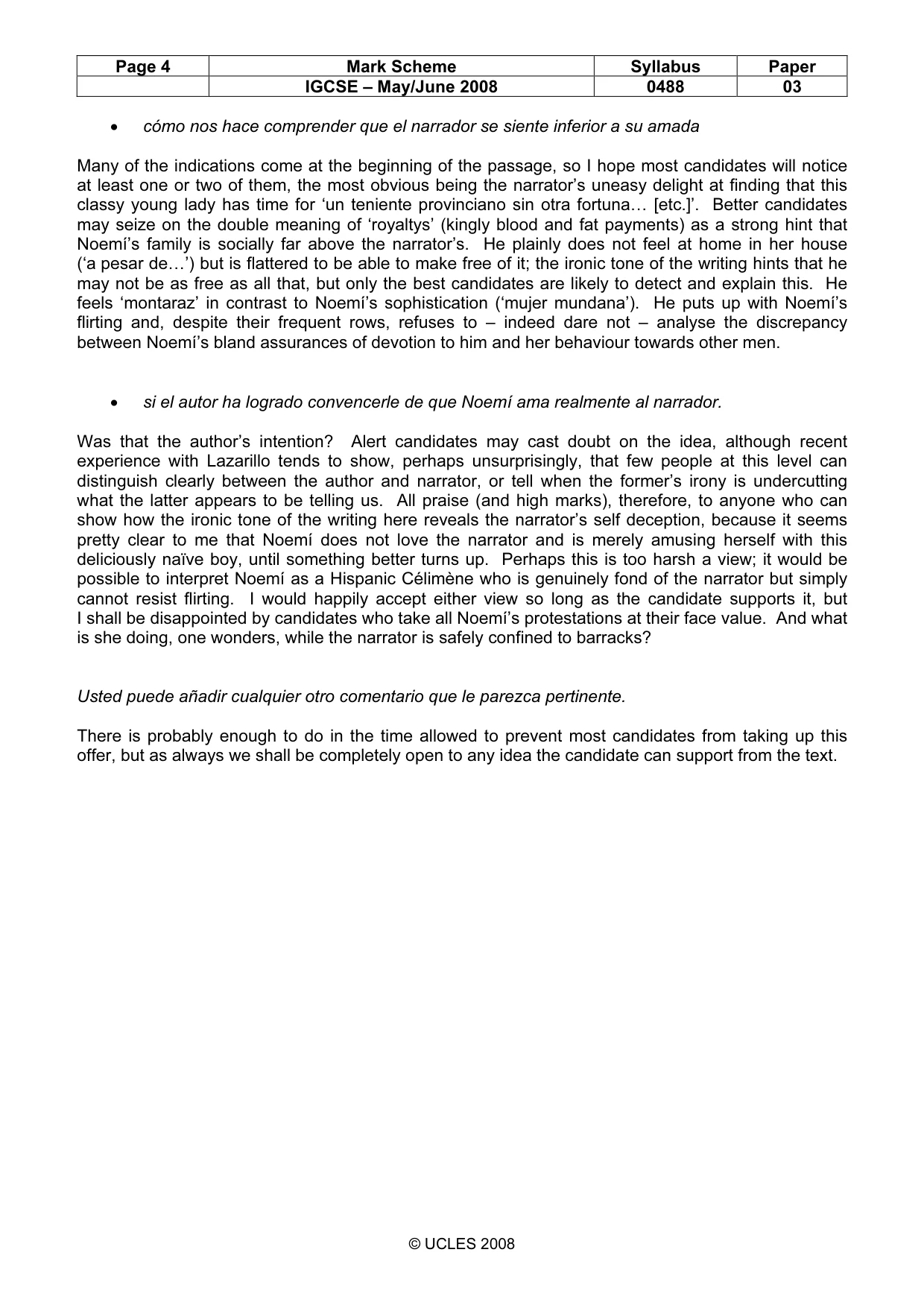
Page 4 Mark Scheme Syllabus Paper IGCSE – May/June 2008 0488 03 © UCLES 2008 • cómo nos hace comprender que el narrador se siente inferior a su amada Many of the indications come at the beginning of the passage, so I hope most candidates will notice at least one or two of them, the most obvious being the narrator’s uneasy delight at finding that this classy young lady has time for ‘un teniente provinciano sin otra fortuna… [etc.]’. Better candidates may seize on the double meaning of ‘royaltys’ (kingly blood and fat payments) as a strong hint that Noemí’s family is socially far above the narrator’s. He plainly does not feel at home in her house (‘a pesar de…’) but is flattered to be able to make free of it; the ironic tone of the writing hints that he may not be as free as all that, but only the best candidates are likely to detect and explain this. He feels ‘montaraz’ in contrast to Noemí’s sophistication (‘mujer mundana’). He puts up with Noemí’s flirting and, despite their frequent rows, refuses to – indeed dare not – analyse the discrepancy between Noemí’s bland assurances of devotion to him and her behaviour towards other men. • si el autor ha logrado convencerle de que Noemí ama realmente al narrador. Was that the author’s intention? Alert candidates may cast doubt on the idea, although recent experience with Lazarillo tends to show, perhaps unsurprisingly, that few people at this level can distinguish clearly between the author and narrator, or tell when the former’s irony is undercutting what the latter appears to be telling us. All praise (and high marks), therefore, to anyone who can show how the ironic tone of the writing here reveals the narrator’s self deception, because it seems pretty clear to me that Noemí does not love the narrator and is merely amusing herself with this deliciously naïve boy, until something better turns up. Perhaps this is too harsh a view; it would be possible to interpret Noemí as a Hispanic Célimène who is genuinely fond of the narrator but simply cannot resist flirting. I would happily accept either view so long as the candidate supports it, but I shall be disappointed by candidates who take all Noemí’s protestations at their face value. And what is she doing, one wonders, while the narrator is safely confined to barracks? Usted puede añadir cualquier otro comentario que le parezca pertinente. There is probably enough to do in the time allowed to prevent most candidates from taking up this offer, but as always we shall be completely open to any idea the candidate can support from the text.
What you needed in this session
Cambridge’s own grade thresholds for 2008 May/June, Paper 3 · Variant 1. A higher threshold means an easier paper — the bar moves with how the cohort did.