Cambridge IGCSE Spanish - Literature 0488 — 2007 Oct/Nov Paper 3 · Variant 1
0488/31/O/N/07 · 20 marks · ≈23 min
The question paper and its mark scheme, free to read here and free to download. This is Cambridge’s own paper, exactly as it was sat.
Question paper4 pages


Mark scheme4 pages
Answers below. Sit the paper first if you are practising.
Paper as text
Question paper, page 1
This document consists of 3 printed pages and 1 blank page. IB07 11_0488_03/2RP © UCLES 2007 [Turn over *3232848660* UNIVERSITY OF CAMBRIDGE INTERNATIONAL EXAMINATIONS International General Certificate of Secondary Education LITERATURE (SPANISH) 0488/03 Paper 3 Alternative to Coursework October/November 2007 1 hour Additional Materials: Answer Booklet/Paper READ THESE INSTRUCTIONS FIRST If you have been given an Answer Booklet, follow the instructions on the front cover of the Booklet. Do not write your answer on the question paper. Write your Centre number, candidate number and name on all the work you hand in. Write in dark blue or black pen. Do not use staples, paper clips, highlighters, glue or correction fluid. At the end of the examination, fasten all your work securely together. Answer the question. EN PRIMER LUGAR, LEA ESTAS INSTRUCCIONES Si se le ha dado un Cuadernillo de Respuestas, siga las instrucciones de la tapa del Cuadernillo. No utilice nunca la hoja del examen para escribir su respuesta. Escriba el número del Centro, el número de estudiante que se le ha adjudicado y su nombre en cada hoja de examen. Use tinta azul oscuro o negra. No use ni grapas, ni clips, ni rotulador, ni goma de pegar, ni corrector líquido. Al terminar el examen, si usa más de una hoja, únalas bien. Conteste la pregunta. www.XtremePapers.com
Question paper, page 2
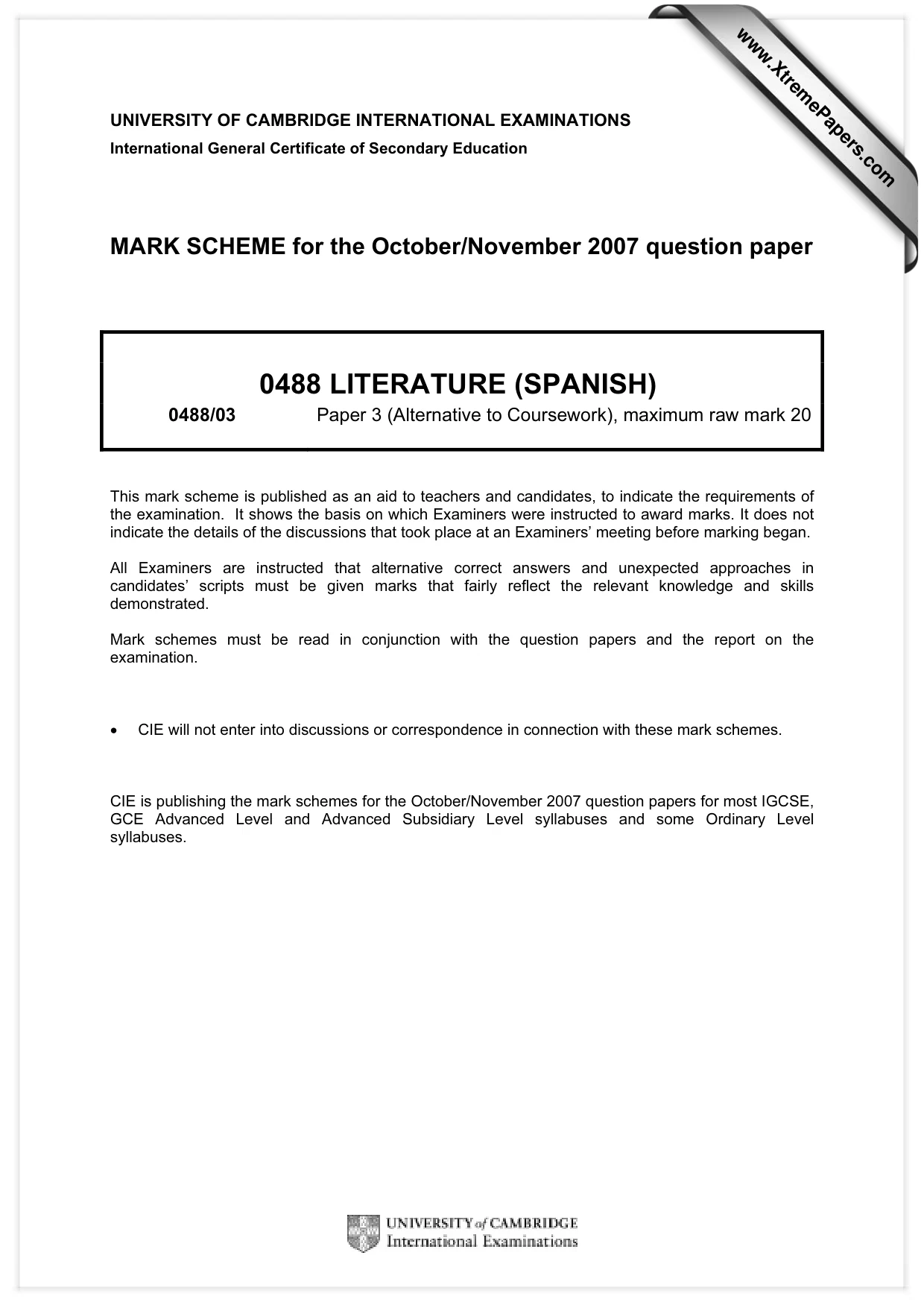
2 © UCLES 2007 0488/03/O/N/07 Lea el extracto siguiente de un poema escrito por el poeta uruguayo Juan Parra del Riego (1892- 1925) LOA DEL FUT-BOL ¡La pelota ríe y canta! ¡La pelota zumba y vuela! Y es el polvo una serpiente de algodón que se levanta tras el ágil jugador que de un salto se revela. ¡La pelota zumba y vuela! Y es la tarde que va abriendo su sombrilla de colores sobre el campo donde están los jugadores entre el marco de la fiesta popular: treinta mil caras que ríen y mujeres con sus trajes que en el viento son mensajes que no sé dónde se quieren, tan nerviosos, escapar. Mas, de pronto, suena el pito que prepara la partida Todos callan… se oye un grito y es al fin la acometida en que salta la pelota, que se va como bailando de pie en pie por los aires una jota de acrobática alegría que uno casi apenas ve. ¡Jugador de blanca y roja camiseta que, de pronto, arrebatado, zig-zaguea, jubiloso la gran Z de un ataque combinado junto al otro que al cruzársele en un paso de emoción cae al suelo y trémulo, ¡ay…! se levanta otra vez como de una eléctrica impulsión. Pero suena el breve pito de un opsay y de nuevo va rodando la pelota que ya traza un arco-iris momentáneo sobre el cielo, y epiléptica, rebota en los pies que hacen con ella como encajes por el suelo… Mas ahora, azul y blanco, otro adversario, se la lleva… se la lleva… se la lleva… se la lleva… se emociona allá el golquíper solitario, pero surge el back, que al salto que lo eleva un instante es sobre el sol una escultura, mientras ya como un cohete volador, la pelota que se queda como un astro por la altura, otra vez cae en el suelo con un ruido de tambor. Y de nuevo se levanta con su eléctrico vai-ven…
Question paper, page 3
3 © UCLES 2007 0488/03/O/N/07 1 Dé su apreciación de cómo el poeta le ha comunicado su pasión por el fútbol. Puede considerar los siguientes aspectos: • las imágenes que emplea el poeta para describir la pelota, y el efecto logrado • cómo describe a los aficionados • cómo evoca los rápidos movimientos de los jugadores • cómo aprovecha el ritmo y la rima para dar más vida al poema. Usted también puede añadir cualquier otro comentario que le parezca pertinente.
Question paper, page 4
4 Permission to reproduce items where third-party owned material protected by copyright is included has been sought and cleared where possible. Every reasonable effort has been made by the publisher (UCLES) to trace copyright holders, but if any items requiring clearance have unwittingly been included, the publisher will be pleased to make amends at the earliest possible opportunity. University of Cambridge International Examinations is part of the Cambridge Assessment Group. Cambridge Assessment is the brand name of University of Cambridge Local Examinations Syndicate (UCLES), which is itself a department of the University of Cambridge. 0488/03/O/N/07 BLANK PAGE
Mark scheme, page 1
UNIVERSITY OF CAMBRIDGE INTERNATIONAL EXAMINATIONS International General Certificate of Secondary Education MARK SCHEME for the October/November 2007 question paper 0488 LITERATURE (SPANISH) 0488/03 Paper 3 (Alternative to Coursework), maximum raw mark 20 This mark scheme is published as an aid to teachers and candidates, to indicate the requirements of the examination. It shows the basis on which Examiners were instructed to award marks. It does not indicate the details of the discussions that took place at an Examiners’ meeting before marking began. All Examiners are instructed that alternative correct answers and unexpected approaches in candidates’ scripts must be given marks that fairly reflect the relevant knowledge and skills demonstrated. Mark schemes must be read in conjunction with the question papers and the report on the examination. • CIE will not enter into discussions or correspondence in connection with these mark schemes. CIE is publishing the mark schemes for the October/November 2007 question papers for most IGCSE, GCE Advanced Level and Advanced Subsidiary Level syllabuses and some Ordinary Level syllabuses. www.XtremePapers.com
Mark scheme, page 2
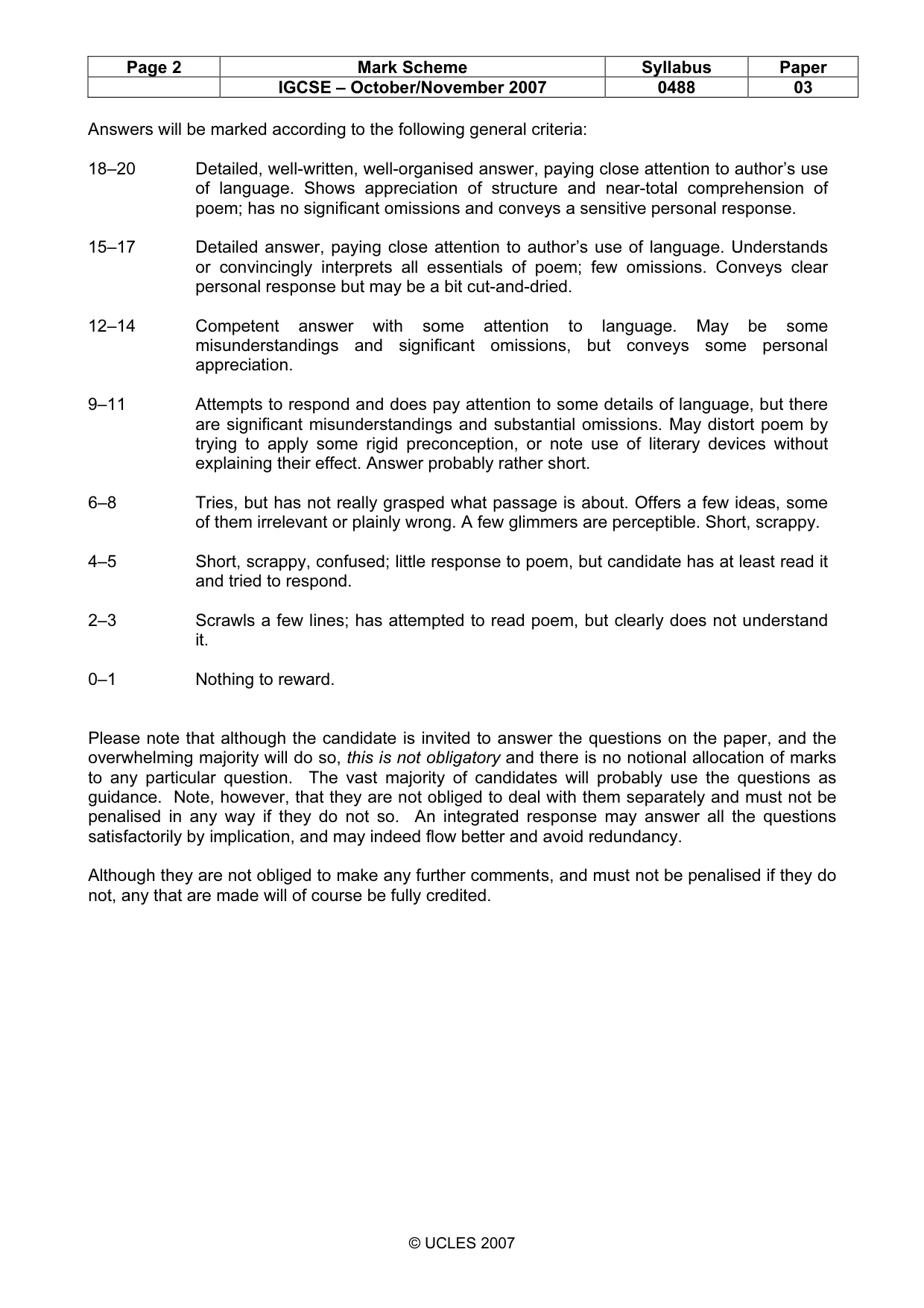
Page 2 Mark Scheme Syllabus Paper IGCSE – October/November 2007 0488 03 © UCLES 2007 Answers will be marked according to the following general criteria: 18–20 Detailed, well-written, well-organised answer, paying close attention to author’s use of language. Shows appreciation of structure and near-total comprehension of poem; has no significant omissions and conveys a sensitive personal response. 15–17 Detailed answer, paying close attention to author’s use of language. Understands or convincingly interprets all essentials of poem; few omissions. Conveys clear personal response but may be a bit cut-and-dried. 12–14 Competent answer with some attention to language. May be some misunderstandings and significant omissions, but conveys some personal appreciation. 9–11 Attempts to respond and does pay attention to some details of language, but there are significant misunderstandings and substantial omissions. May distort poem by trying to apply some rigid preconception, or note use of literary devices without explaining their effect. Answer probably rather short. 6–8 Tries, but has not really grasped what passage is about. Offers a few ideas, some of them irrelevant or plainly wrong. A few glimmers are perceptible. Short, scrappy. 4–5 Short, scrappy, confused; little response to poem, but candidate has at least read it and tried to respond. 2–3 Scrawls a few lines; has attempted to read poem, but clearly does not understand it. 0–1 Nothing to reward. Please note that although the candidate is invited to answer the questions on the paper, and the overwhelming majority will do so, this is not obligatory and there is no notional allocation of marks to any particular question. The vast majority of candidates will probably use the questions as guidance. Note, however, that they are not obliged to deal with them separately and must not be penalised in any way if they do not so. An integrated response may answer all the questions satisfactorily by implication, and may indeed flow better and avoid redundancy. Although they are not obliged to make any further comments, and must not be penalised if they do not, any that are made will of course be fully credited.
Mark scheme, page 3
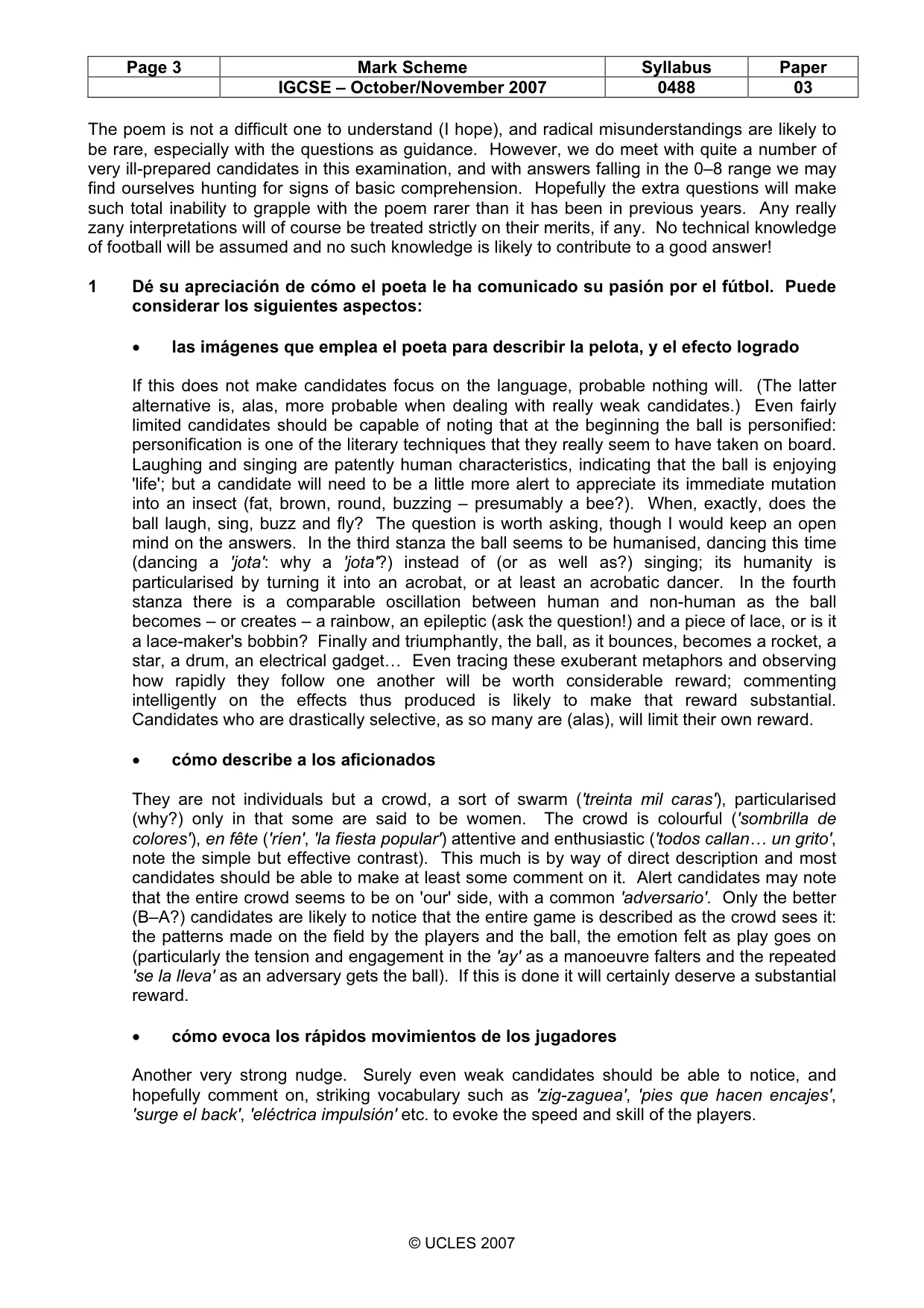
Page 3 Mark Scheme Syllabus Paper IGCSE – October/November 2007 0488 03 © UCLES 2007 The poem is not a difficult one to understand (I hope), and radical misunderstandings are likely to be rare, especially with the questions as guidance. However, we do meet with quite a number of very ill-prepared candidates in this examination, and with answers falling in the 0–8 range we may find ourselves hunting for signs of basic comprehension. Hopefully the extra questions will make such total inability to grapple with the poem rarer than it has been in previous years. Any really zany interpretations will of course be treated strictly on their merits, if any. No technical knowledge of football will be assumed and no such knowledge is likely to contribute to a good answer! 1 Dé su apreciación de cómo el poeta le ha comunicado su pasión por el fútbol. Puede considerar los siguientes aspectos: • las imágenes que emplea el poeta para describir la pelota, y el efecto logrado If this does not make candidates focus on the language, probable nothing will. (The latter alternative is, alas, more probable when dealing with really weak candidates.) Even fairly limited candidates should be capable of noting that at the beginning the ball is personified: personification is one of the literary techniques that they really seem to have taken on board. Laughing and singing are patently human characteristics, indicating that the ball is enjoying 'life'; but a candidate will need to be a little more alert to appreciate its immediate mutation into an insect (fat, brown, round, buzzing – presumably a bee?). When, exactly, does the ball laugh, sing, buzz and fly? The question is worth asking, though I would keep an open mind on the answers. In the third stanza the ball seems to be humanised, dancing this time (dancing a 'jota': why a 'jota'?) instead of (or as well as?) singing; its humanity is particularised by turning it into an acrobat, or at least an acrobatic dancer. In the fourth stanza there is a comparable oscillation between human and non-human as the ball becomes – or creates – a rainbow, an epileptic (ask the question!) and a piece of lace, or is it a lace-maker's bobbin? Finally and triumphantly, the ball, as it bounces, becomes a rocket, a star, a drum, an electrical gadget… Even tracing these exuberant metaphors and observing how rapidly they follow one another will be worth considerable reward; commenting intelligently on the effects thus produced is likely to make that reward substantial. Candidates who are drastically selective, as so many are (alas), will limit their own reward. • cómo describe a los aficionados They are not individuals but a crowd, a sort of swarm ('treinta mil caras'), particularised (why?) only in that some are said to be women. The crowd is colourful ('sombrilla de colores'), en fête ('ríen', 'la fiesta popular') attentive and enthusiastic ('todos callan… un grito', note the simple but effective contrast). This much is by way of direct description and most candidates should be able to make at least some comment on it. Alert candidates may note that the entire crowd seems to be on 'our' side, with a common 'adversario'. Only the better (B–A?) candidates are likely to notice that the entire game is described as the crowd sees it: the patterns made on the field by the players and the ball, the emotion felt as play goes on (particularly the tension and engagement in the 'ay' as a manoeuvre falters and the repeated 'se la lleva' as an adversary gets the ball). If this is done it will certainly deserve a substantial reward. • cómo evoca los rápidos movimientos de los jugadores Another very strong nudge. Surely even weak candidates should be able to notice, and hopefully comment on, striking vocabulary such as 'zig-zaguea', 'pies que hacen encajes', 'surge el back', 'eléctrica impulsión' etc. to evoke the speed and skill of the players.
Mark scheme, page 4
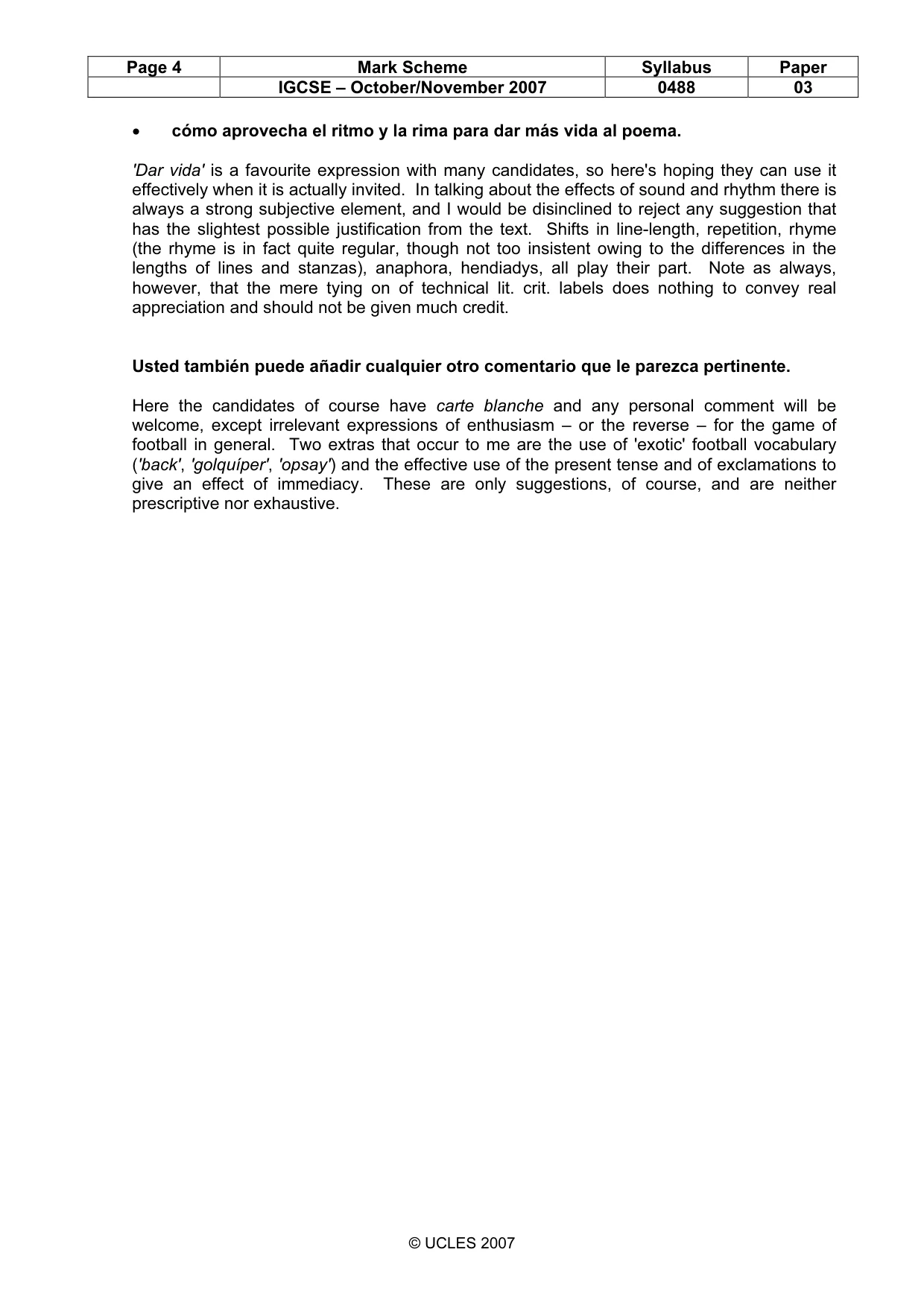
Page 4 Mark Scheme Syllabus Paper IGCSE – October/November 2007 0488 03 © UCLES 2007 • cómo aprovecha el ritmo y la rima para dar más vida al poema. 'Dar vida' is a favourite expression with many candidates, so here's hoping they can use it effectively when it is actually invited. In talking about the effects of sound and rhythm there is always a strong subjective element, and I would be disinclined to reject any suggestion that has the slightest possible justification from the text. Shifts in line-length, repetition, rhyme (the rhyme is in fact quite regular, though not too insistent owing to the differences in the lengths of lines and stanzas), anaphora, hendiadys, all play their part. Note as always, however, that the mere tying on of technical lit. crit. labels does nothing to convey real appreciation and should not be given much credit. Usted también puede añadir cualquier otro comentario que le parezca pertinente. Here the candidates of course have carte blanche and any personal comment will be welcome, except irrelevant expressions of enthusiasm – or the reverse – for the game of football in general. Two extras that occur to me are the use of 'exotic' football vocabulary ('back', 'golquíper', 'opsay') and the effective use of the present tense and of exclamations to give an effect of immediacy. These are only suggestions, of course, and are neither prescriptive nor exhaustive.
What you needed in this session
Cambridge’s own grade thresholds for 2007 Oct/Nov, Paper 3 · Variant 1. A higher threshold means an easier paper — the bar moves with how the cohort did.