Cambridge IGCSE Spanish - Literature 0488 — 2006 Oct/Nov Paper 3 · Variant 1
0488/31/O/N/06 · 20 marks · ≈23 min
The question paper and its mark scheme, free to read here and free to download. This is Cambridge’s own paper, exactly as it was sat.
Question paper2 pages
Mark scheme3 pages
Answers below. Sit the paper first if you are practising.
Paper as text
Question paper, page 1
UNIVERSITY OF CAMBRIDGE INTERNATIONAL EXAMINATIONS International General Certificate of Secondary Education LITERATURE (SPANISH) 0488/03 Paper 3 Alternative to Coursework October/November 2006 1 hour Additional Materials: Answer Booklet/Paper READ THESE INSTRUCTIONS FIRST If you have been given an Answer Booklet, follow the instructions on the front cover of the Booklet. Write your Centre number, candidate number and name on all the work you hand in. Write in dark blue or black pen. Do not use staples, paper clips, highlighters, glue or correction fluid. At the end of the examination, fasten all your work securely together. Answer the question. EN PRIMER LUGAR, LEA ESTAS INSTRUCCIONES Si se le ha dado un Cuadernillo de Respuestas, siga las instrucciones de la tapa del Cuadernillo. Escriba el número del Centro, el número de estudiante que se le ha adjudicado y su nombre en cada hoja de examen. Use tinta azul oscura o negra. No use ni grapas, ni clips, ni rotulador, ni goma de pegar, ni corrector líquido. Al terminar el examen, si usa más de una hoja átelas bien. Conteste la pregunta. This document consists of 2 printed pages. IB06 11_0488_03/3RP UCLES 2006 [Turn over www.XtremePapers.com
Question paper, page 2
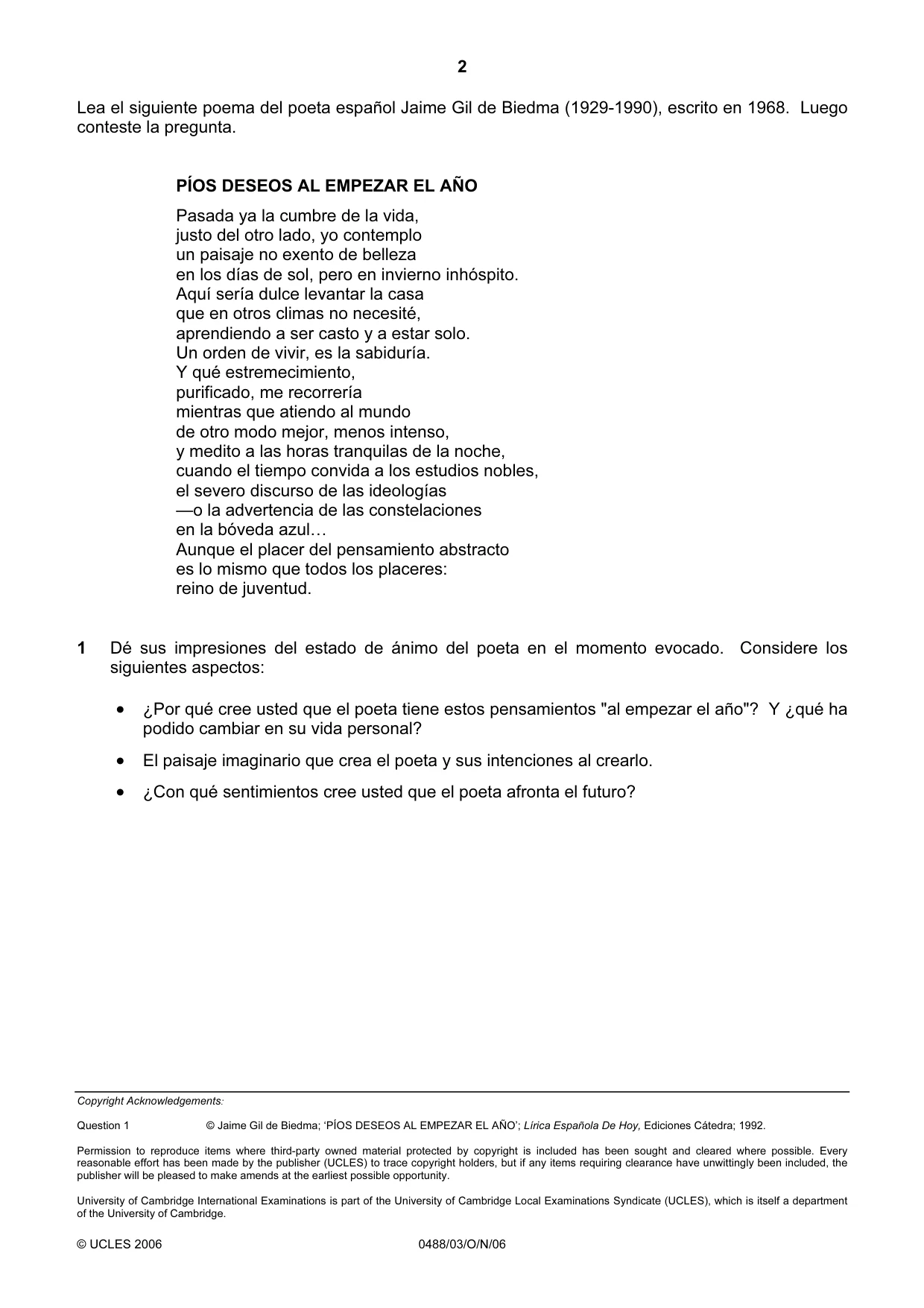
2 Copyright Acknowledgements: Question 1 © Jaime Gil de Biedma; ‘PÍOS DESEOS AL EMPEZAR EL AÑO’; Lírica Española De Hoy, Ediciones Cátedra; 1992. Permission to reproduce items where third-party owned material protected by copyright is included has been sought and cleared where possible. Every reasonable effort has been made by the publisher (UCLES) to trace copyright holders, but if any items requiring clearance have unwittingly been included, the publisher will be pleased to make amends at the earliest possible opportunity. University of Cambridge International Examinations is part of the University of Cambridge Local Examinations Syndicate (UCLES), which is itself a department of the University of Cambridge. © UCLES 2006 0488/03/O/N/06 Lea el siguiente poema del poeta español Jaime Gil de Biedma (1929-1990), escrito en 1968. Luego conteste la pregunta. PÍOS DESEOS AL EMPEZAR EL AÑO Pasada ya la cumbre de la vida, justo del otro lado, yo contemplo un paisaje no exento de belleza en los días de sol, pero en invierno inhóspito. Aquí sería dulce levantar la casa que en otros climas no necesité, aprendiendo a ser casto y a estar solo. Un orden de vivir, es la sabiduría. Y qué estremecimiento, purificado, me recorrería mientras que atiendo al mundo de otro modo mejor, menos intenso, y medito a las horas tranquilas de la noche, cuando el tiempo convida a los estudios nobles, el severo discurso de las ideologías —o la advertencia de las constelaciones en la bóveda azul… Aunque el placer del pensamiento abstracto es lo mismo que todos los placeres: reino de juventud. 1 Dé sus impresiones del estado de ánimo del poeta en el momento evocado. Considere los siguientes aspectos: • ¿Por qué cree usted que el poeta tiene estos pensamientos "al empezar el año"? Y ¿qué ha podido cambiar en su vida personal? • El paisaje imaginario que crea el poeta y sus intenciones al crearlo. • ¿Con qué sentimientos cree usted que el poeta afronta el futuro?
Mark scheme, page 1
UNIVERSITY OF CAMBRIDGE INTERNATIONAL EXAMINATIONS International General Certificate of Secondary Education MARK SCHEME for the October/November 2006 question paper 0488 LITERATURE (SPANISH) 0488/03 Paper 3 (Alternative to Coursework), maximum raw mark 20 This mark scheme is published as an aid to teachers and students, to indicate the requirements of the examination. It shows the basis on which Examiners were instructed to award marks. It does not indicate the details of the discussions that took place at an Examiners’ meeting before marking began. All Examiners are instructed that alternative correct answers and unexpected approaches in candidates’ scripts must be given marks that fairly reflect the relevant knowledge and skills demonstrated. Mark schemes must be read in conjunction with the question papers and the report on the examination. The grade thresholds for various grades are published in the report on the examination for most IGCSE, GCE Advanced Level and Advanced Subsidiary Level syllabuses. • CIE will not enter into discussions or correspondence in connection with these mark schemes. CIE is publishing the mark schemes for the October/November 2006 question papers for most IGCSE, GCE Advanced Level and Advanced Subsidiary Level syllabuses and some Ordinary Level syllabuses. www.XtremePapers.com
Mark scheme, page 2
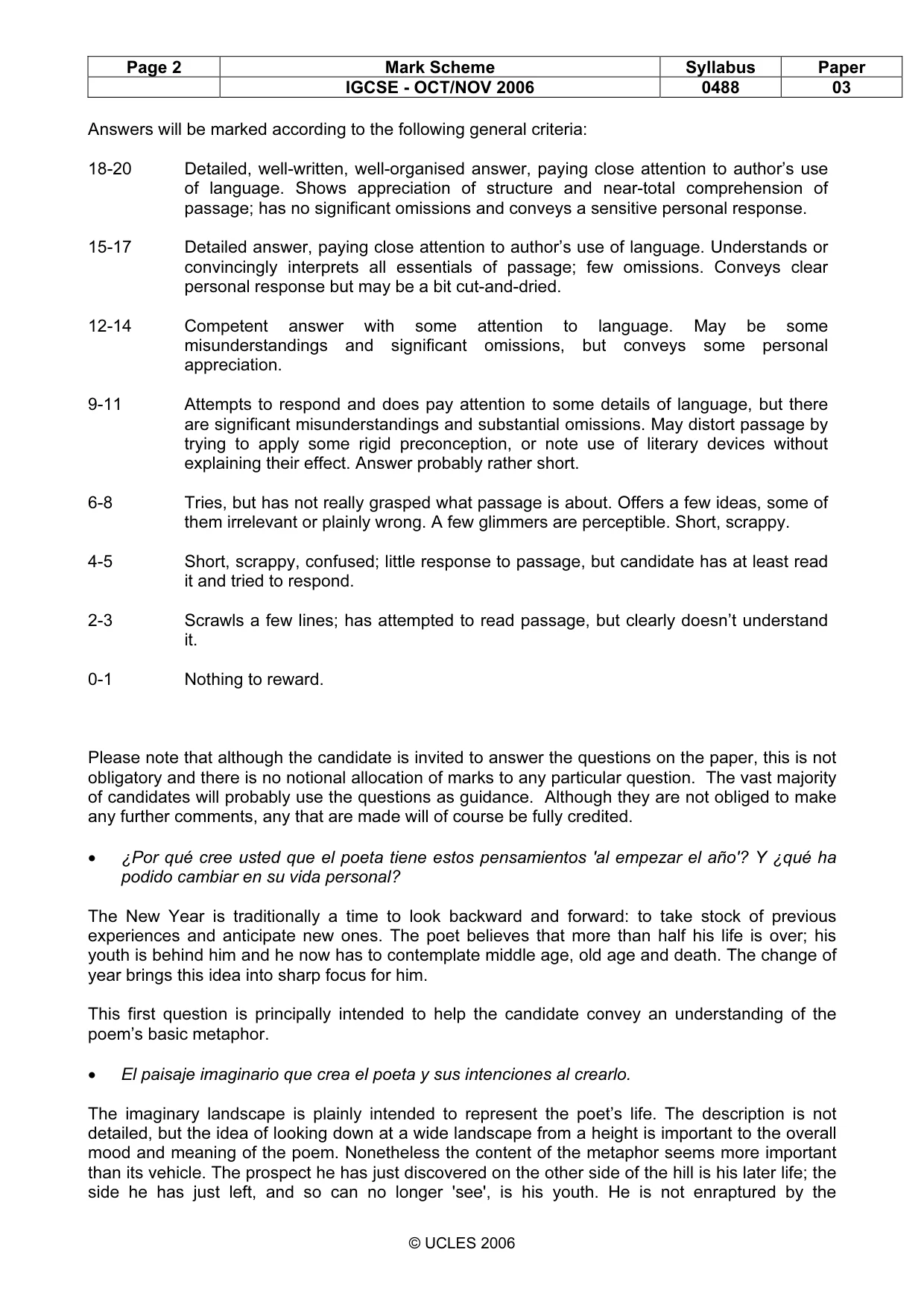
Page 2 Mark Scheme Syllabus Paper IGCSE - OCT/NOV 2006 0488 03 © UCLES 2006 Answers will be marked according to the following general criteria: 18-20 Detailed, well-written, well-organised answer, paying close attention to author’s use of language. Shows appreciation of structure and near-total comprehension of passage; has no significant omissions and conveys a sensitive personal response. 15-17 Detailed answer, paying close attention to author’s use of language. Understands or convincingly interprets all essentials of passage; few omissions. Conveys clear personal response but may be a bit cut-and-dried. 12-14 Competent answer with some attention to language. May be some misunderstandings and significant omissions, but conveys some personal appreciation. 9-11 Attempts to respond and does pay attention to some details of language, but there are significant misunderstandings and substantial omissions. May distort passage by trying to apply some rigid preconception, or note use of literary devices without explaining their effect. Answer probably rather short. 6-8 Tries, but has not really grasped what passage is about. Offers a few ideas, some of them irrelevant or plainly wrong. A few glimmers are perceptible. Short, scrappy. 4-5 Short, scrappy, confused; little response to passage, but candidate has at least read it and tried to respond. 2-3 Scrawls a few lines; has attempted to read passage, but clearly doesn’t understand it. 0-1 Nothing to reward. Please note that although the candidate is invited to answer the questions on the paper, this is not obligatory and there is no notional allocation of marks to any particular question. The vast majority of candidates will probably use the questions as guidance. Although they are not obliged to make any further comments, any that are made will of course be fully credited. • ¿Por qué cree usted que el poeta tiene estos pensamientos 'al empezar el año'? Y ¿qué ha podido cambiar en su vida personal? The New Year is traditionally a time to look backward and forward: to take stock of previous experiences and anticipate new ones. The poet believes that more than half his life is over; his youth is behind him and he now has to contemplate middle age, old age and death. The change of year brings this idea into sharp focus for him. This first question is principally intended to help the candidate convey an understanding of the poem’s basic metaphor. • El paisaje imaginario que crea el poeta y sus intenciones al crearlo. The imaginary landscape is plainly intended to represent the poet’s life. The description is not detailed, but the idea of looking down at a wide landscape from a height is important to the overall mood and meaning of the poem. Nonetheless the content of the metaphor seems more important than its vehicle. The prospect he has just discovered on the other side of the hill is his later life; the side he has just left, and so can no longer 'see', is his youth. He is not enraptured by the
Mark scheme, page 3
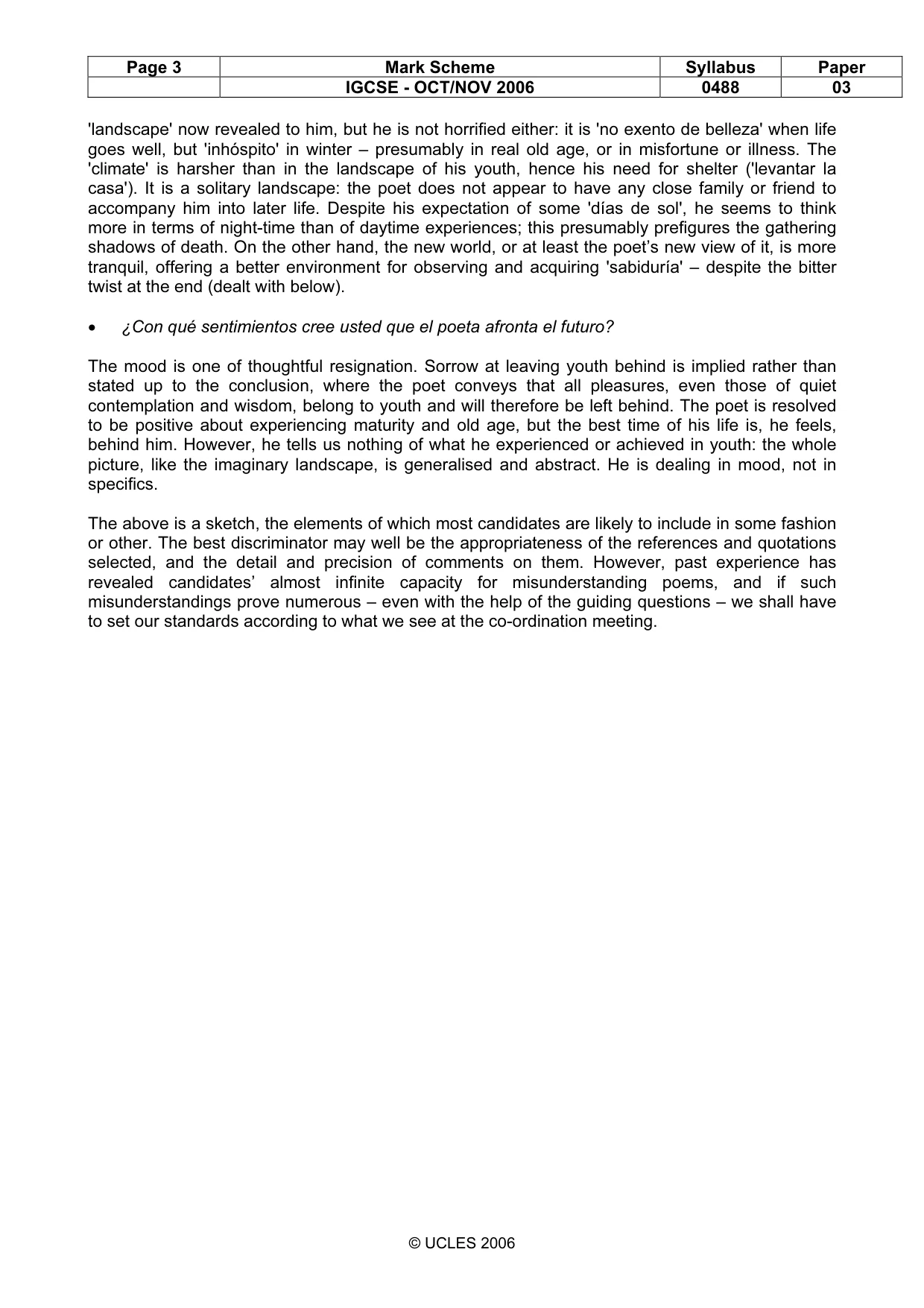
Page 3 Mark Scheme Syllabus Paper IGCSE - OCT/NOV 2006 0488 03 © UCLES 2006 'landscape' now revealed to him, but he is not horrified either: it is 'no exento de belleza' when life goes well, but 'inhóspito' in winter – presumably in real old age, or in misfortune or illness. The 'climate' is harsher than in the landscape of his youth, hence his need for shelter ('levantar la casa'). It is a solitary landscape: the poet does not appear to have any close family or friend to accompany him into later life. Despite his expectation of some 'días de sol', he seems to think more in terms of night-time than of daytime experiences; this presumably prefigures the gathering shadows of death. On the other hand, the new world, or at least the poet’s new view of it, is more tranquil, offering a better environment for observing and acquiring 'sabiduría' – despite the bitter twist at the end (dealt with below). • ¿Con qué sentimientos cree usted que el poeta afronta el futuro? The mood is one of thoughtful resignation. Sorrow at leaving youth behind is implied rather than stated up to the conclusion, where the poet conveys that all pleasures, even those of quiet contemplation and wisdom, belong to youth and will therefore be left behind. The poet is resolved to be positive about experiencing maturity and old age, but the best time of his life is, he feels, behind him. However, he tells us nothing of what he experienced or achieved in youth: the whole picture, like the imaginary landscape, is generalised and abstract. He is dealing in mood, not in specifics. The above is a sketch, the elements of which most candidates are likely to include in some fashion or other. The best discriminator may well be the appropriateness of the references and quotations selected, and the detail and precision of comments on them. However, past experience has revealed candidates’ almost infinite capacity for misunderstanding poems, and if such misunderstandings prove numerous – even with the help of the guiding questions – we shall have to set our standards according to what we see at the co-ordination meeting.
What you needed in this session
Cambridge’s own grade thresholds for 2006 Oct/Nov, Paper 3 · Variant 1. A higher threshold means an easier paper — the bar moves with how the cohort did.