Cambridge IGCSE Spanish - Literature 0488 — 2006 May/June Paper 3 · Variant 1
0488/31/M/J/06 · 20 marks · ≈23 min
The question paper and its mark scheme, free to read here and free to download. This is Cambridge’s own paper, exactly as it was sat.
Question paper4 pages
Mark scheme3 pages
Answers below. Sit the paper first if you are practising.
Paper as text
Question paper, page 1
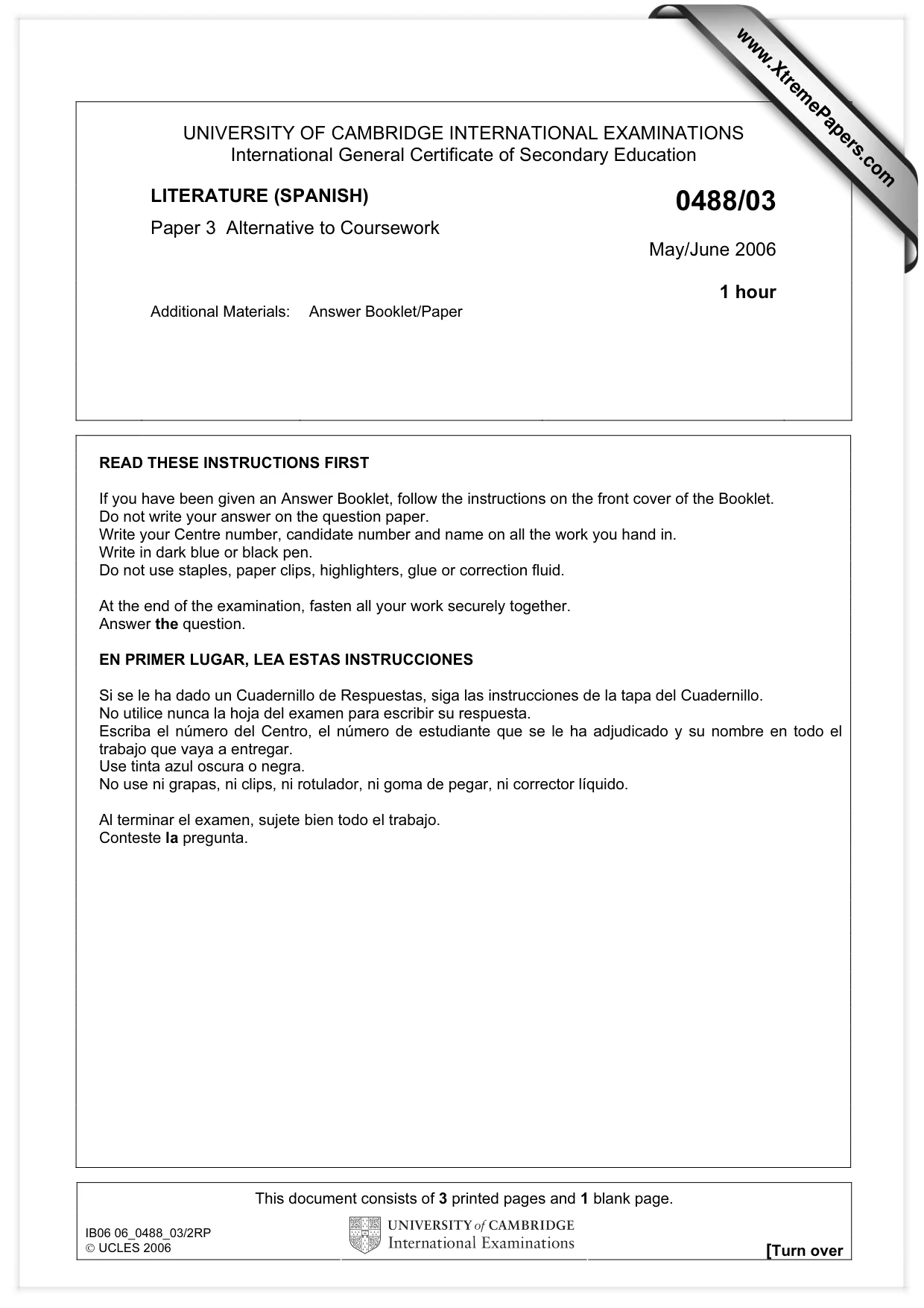
UNIVERSITY OF CAMBRIDGE INTERNATIONAL EXAMINATIONS International General Certificate of Secondary Education LITERATURE (SPANISH) 0488/03 Paper 3 Alternative to Coursework May/June 2006 1 hour Additional Materials: Answer Booklet/Paper READ THESE INSTRUCTIONS FIRST If you have been given an Answer Booklet, follow the instructions on the front cover of the Booklet. Do not write your answer on the question paper. Write your Centre number, candidate number and name on all the work you hand in. Write in dark blue or black pen. Do not use staples, paper clips, highlighters, glue or correction fluid. At the end of the examination, fasten all your work securely together. Answer the question. EN PRIMER LUGAR, LEA ESTAS INSTRUCCIONES Si se le ha dado un Cuadernillo de Respuestas, siga las instrucciones de la tapa del Cuadernillo. No utilice nunca la hoja del examen para escribir su respuesta. Escriba el número del Centro, el número de estudiante que se le ha adjudicado y su nombre en todo el trabajo que vaya a entregar. Use tinta azul oscura o negra. No use ni grapas, ni clips, ni rotulador, ni goma de pegar, ni corrector líquido. Al terminar el examen, sujete bien todo el trabajo. Conteste la pregunta. This document consists of 3 printed pages and 1 blank page. IB06 06_0488_03/2RP UCLES 2006 [Turn over www.XtremePapers.com
Question paper, page 2
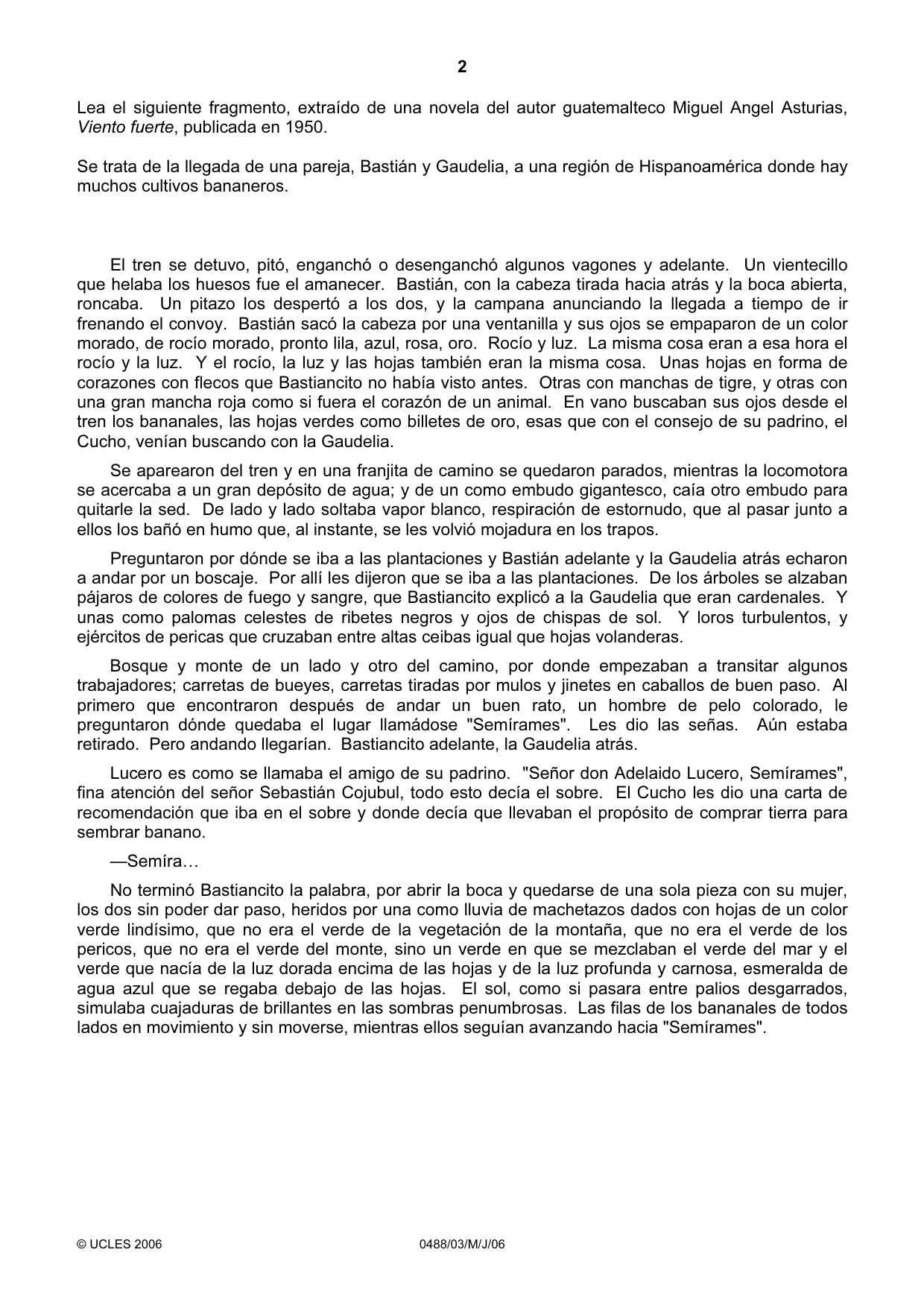
2 © UCLES 2006 0488/03/M/J/06 Lea el siguiente fragmento, extraído de una novela del autor guatemalteco Miguel Angel Asturias, Viento fuerte, publicada en 1950. Se trata de la llegada de una pareja, Bastián y Gaudelia, a una región de Hispanoamérica donde hay muchos cultivos bananeros. El tren se detuvo, pitó, enganchó o desenganchó algunos vagones y adelante. Un vientecillo que helaba los huesos fue el amanecer. Bastián, con la cabeza tirada hacia atrás y la boca abierta, roncaba. Un pitazo los despertó a los dos, y la campana anunciando la llegada a tiempo de ir frenando el convoy. Bastián sacó la cabeza por una ventanilla y sus ojos se empaparon de un color morado, de rocío morado, pronto lila, azul, rosa, oro. Rocío y luz. La misma cosa eran a esa hora el rocío y la luz. Y el rocío, la luz y las hojas también eran la misma cosa. Unas hojas en forma de corazones con flecos que Bastiancito no había visto antes. Otras con manchas de tigre, y otras con una gran mancha roja como si fuera el corazón de un animal. En vano buscaban sus ojos desde el tren los bananales, las hojas verdes como billetes de oro, esas que con el consejo de su padrino, el Cucho, venían buscando con la Gaudelia. Se aparearon del tren y en una franjita de camino se quedaron parados, mientras la locomotora se acercaba a un gran depósito de agua; y de un como embudo gigantesco, caía otro embudo para quitarle la sed. De lado y lado soltaba vapor blanco, respiración de estornudo, que al pasar junto a ellos los bañó en humo que, al instante, se les volvió mojadura en los trapos. Preguntaron por dónde se iba a las plantaciones y Bastián adelante y la Gaudelia atrás echaron a andar por un boscaje. Por allí les dijeron que se iba a las plantaciones. De los árboles se alzaban pájaros de colores de fuego y sangre, que Bastiancito explicó a la Gaudelia que eran cardenales. Y unas como palomas celestes de ribetes negros y ojos de chispas de sol. Y loros turbulentos, y ejércitos de pericas que cruzaban entre altas ceibas igual que hojas volanderas. Bosque y monte de un lado y otro del camino, por donde empezaban a transitar algunos trabajadores; carretas de bueyes, carretas tiradas por mulos y jinetes en caballos de buen paso. Al primero que encontraron después de andar un buen rato, un hombre de pelo colorado, le preguntaron dónde quedaba el lugar llamádose "Semírames". Les dio las señas. Aún estaba retirado. Pero andando llegarían. Bastiancito adelante, la Gaudelia atrás. Lucero es como se llamaba el amigo de su padrino. "Señor don Adelaido Lucero, Semírames", fina atención del señor Sebastián Cojubul, todo esto decía el sobre. El Cucho les dio una carta de recomendación que iba en el sobre y donde decía que llevaban el propósito de comprar tierra para sembrar banano. —Semíra… No terminó Bastiancito la palabra, por abrir la boca y quedarse de una sola pieza con su mujer, los dos sin poder dar paso, heridos por una como lluvia de machetazos dados con hojas de un color verde lindísimo, que no era el verde de la vegetación de la montaña, que no era el verde de los pericos, que no era el verde del monte, sino un verde en que se mezclaban el verde del mar y el verde que nacía de la luz dorada encima de las hojas y de la luz profunda y carnosa, esmeralda de agua azul que se regaba debajo de las hojas. El sol, como si pasara entre palios desgarrados, simulaba cuajaduras de brillantes en las sombras penumbrosas. Las filas de los bananales de todos lados en movimiento y sin moverse, mientras ellos seguían avanzando hacia "Semírames".
Question paper, page 3
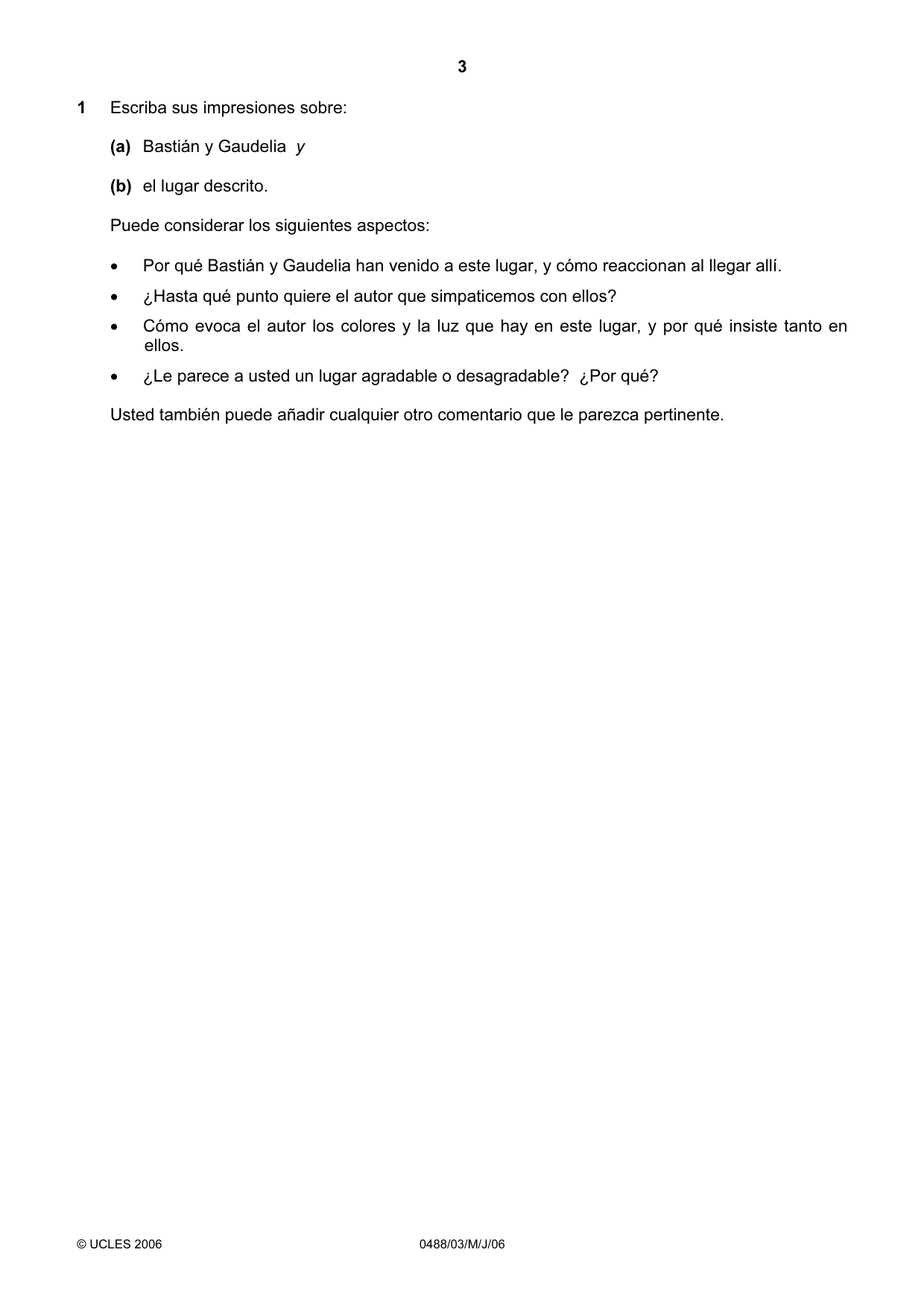
3 © UCLES 2006 0488/03/M/J/06 1 Escriba sus impresiones sobre: (a) Bastián y Gaudelia y (b) el lugar descrito. Puede considerar los siguientes aspectos: • Por qué Bastián y Gaudelia han venido a este lugar, y cómo reaccionan al llegar allí. • ¿Hasta qué punto quiere el autor que simpaticemos con ellos? • Cómo evoca el autor los colores y la luz que hay en este lugar, y por qué insiste tanto en ellos. • ¿Le parece a usted un lugar agradable o desagradable? ¿Por qué? Usted también puede añadir cualquier otro comentario que le parezca pertinente.
Question paper, page 4
4 Copyright Acknowledgements: Question 1 © Miguel Angel Asturias; Viento fuerte; Losada. Permission to reproduce items where third-party owned material protected by copyright is included has been sought and cleared where possible. Every reasonable effort has been made by the publisher (UCLES) to trace copyright holders, but if any items requiring clearance have unwittingly been included, the publisher will be pleased to make amends at the earliest possible opportunity. University of Cambridge International Examinations is part of the University of Cambridge Local Examinations Syndicate (UCLES), which is itself a department of the University of Cambridge. 0488/03/M/J/06 BLANK PAGE
Mark scheme, page 1
UNIVERSITY OF CAMBRIDGE INTERNATIONAL EXAMINATIONS International General Certificate of Secondary Education MARK SCHEME for the May/June 2006 question paper 0488 LITERATURE (SPANISH) 0488/03 Paper 3, maximum raw mark 20 These mark schemes are published as an aid to teachers and students, to indicate the requirements of the examination. They show the basis on which Examiners were initially instructed to award marks. They do not indicate the details of the discussions that took place at an Examiners’ meeting before marking began. Any substantial changes to the mark scheme that arose from these discussions will be recorded in the published Report on the Examination. All Examiners are instructed that alternative correct answers and unexpected approaches in candidates’ scripts must be given marks that fairly reflect the relevant knowledge and skills demonstrated. Mark schemes must be read in conjunction with the question papers and the Report on the Examination. The minimum marks in these components needed for various grades were previously published with these mark schemes, but are now instead included in the Report on the Examination for this session. • CIE will not enter into discussion or correspondence in connection with these mark schemes. CIE is publishing the mark schemes for the May/June 2006 question papers for most IGCSE and GCE Advanced Level and Advanced Subsidiary Level syllabuses and some Ordinary Level syllabuses. www.XtremePapers.com
Mark scheme, page 2
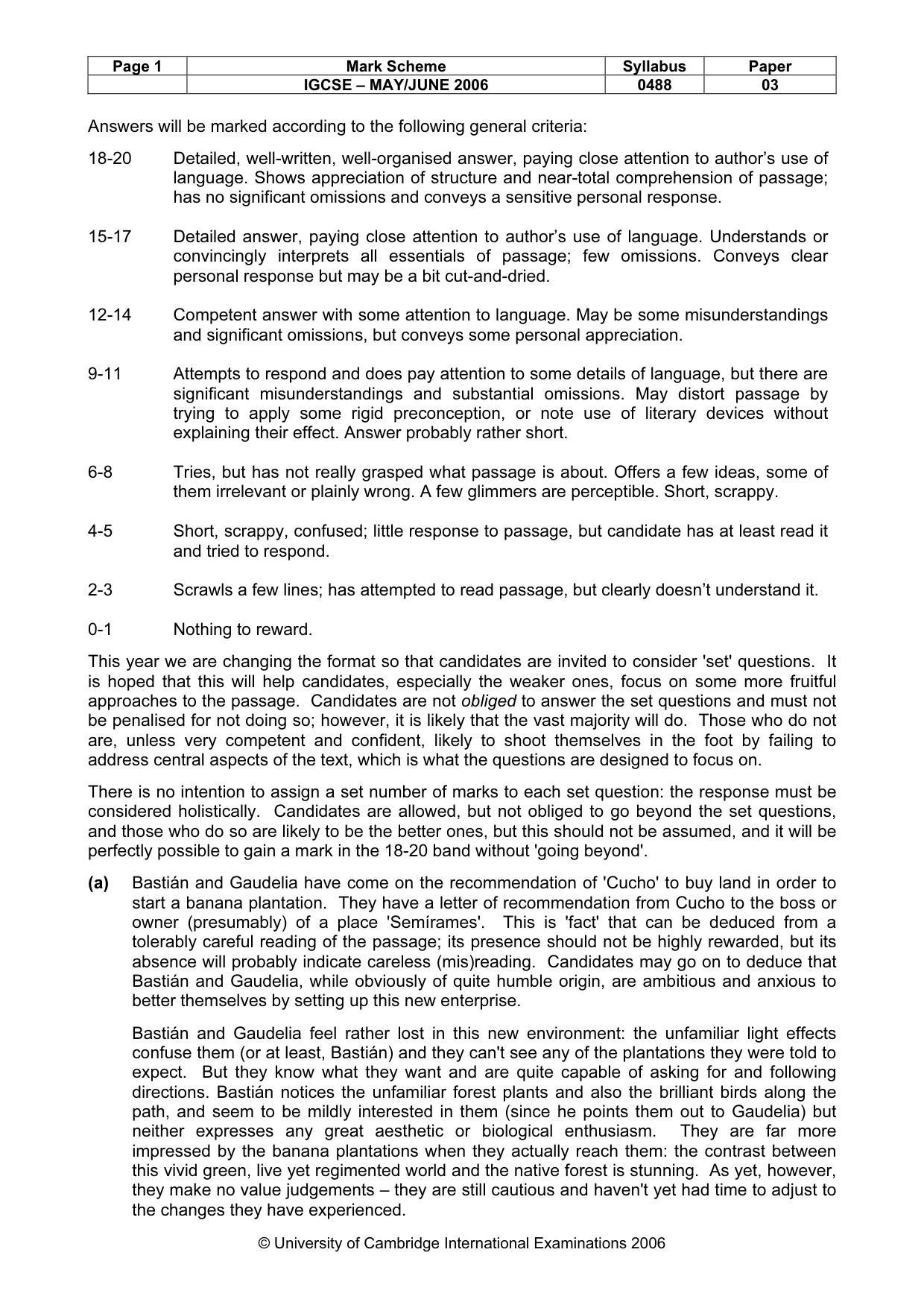
Page 1 Mark Scheme Syllabus Paper IGCSE – MAY/JUNE 2006 0488 03 © University of Cambridge International Examinations 2006 Answers will be marked according to the following general criteria: 18-20 Detailed, well-written, well-organised answer, paying close attention to author’s use of language. Shows appreciation of structure and near-total comprehension of passage; has no significant omissions and conveys a sensitive personal response. 15-17 Detailed answer, paying close attention to author’s use of language. Understands or convincingly interprets all essentials of passage; few omissions. Conveys clear personal response but may be a bit cut-and-dried. 12-14 Competent answer with some attention to language. May be some misunderstandings and significant omissions, but conveys some personal appreciation. 9-11 Attempts to respond and does pay attention to some details of language, but there are significant misunderstandings and substantial omissions. May distort passage by trying to apply some rigid preconception, or note use of literary devices without explaining their effect. Answer probably rather short. 6-8 Tries, but has not really grasped what passage is about. Offers a few ideas, some of them irrelevant or plainly wrong. A few glimmers are perceptible. Short, scrappy. 4-5 Short, scrappy, confused; little response to passage, but candidate has at least read it and tried to respond. 2-3 Scrawls a few lines; has attempted to read passage, but clearly doesn’t understand it. 0-1 Nothing to reward. This year we are changing the format so that candidates are invited to consider 'set' questions. It is hoped that this will help candidates, especially the weaker ones, focus on some more fruitful approaches to the passage. Candidates are not obliged to answer the set questions and must not be penalised for not doing so; however, it is likely that the vast majority will do. Those who do not are, unless very competent and confident, likely to shoot themselves in the foot by failing to address central aspects of the text, which is what the questions are designed to focus on. There is no intention to assign a set number of marks to each set question: the response must be considered holistically. Candidates are allowed, but not obliged to go beyond the set questions, and those who do so are likely to be the better ones, but this should not be assumed, and it will be perfectly possible to gain a mark in the 18-20 band without 'going beyond'. (a) Bastián and Gaudelia have come on the recommendation of 'Cucho' to buy land in order to start a banana plantation. They have a letter of recommendation from Cucho to the boss or owner (presumably) of a place 'Semírames'. This is 'fact' that can be deduced from a tolerably careful reading of the passage; its presence should not be highly rewarded, but its absence will probably indicate careless (mis)reading. Candidates may go on to deduce that Bastián and Gaudelia, while obviously of quite humble origin, are ambitious and anxious to better themselves by setting up this new enterprise. Bastián and Gaudelia feel rather lost in this new environment: the unfamiliar light effects confuse them (or at least, Bastián) and they can't see any of the plantations they were told to expect. But they know what they want and are quite capable of asking for and following directions. Bastián notices the unfamiliar forest plants and also the brilliant birds along the path, and seem to be mildly interested in them (since he points them out to Gaudelia) but neither expresses any great aesthetic or biological enthusiasm. They are far more impressed by the banana plantations when they actually reach them: the contrast between this vivid green, live yet regimented world and the native forest is stunning. As yet, however, they make no value judgements – they are still cautious and haven't yet had time to adjust to the changes they have experienced.
Mark scheme, page 3
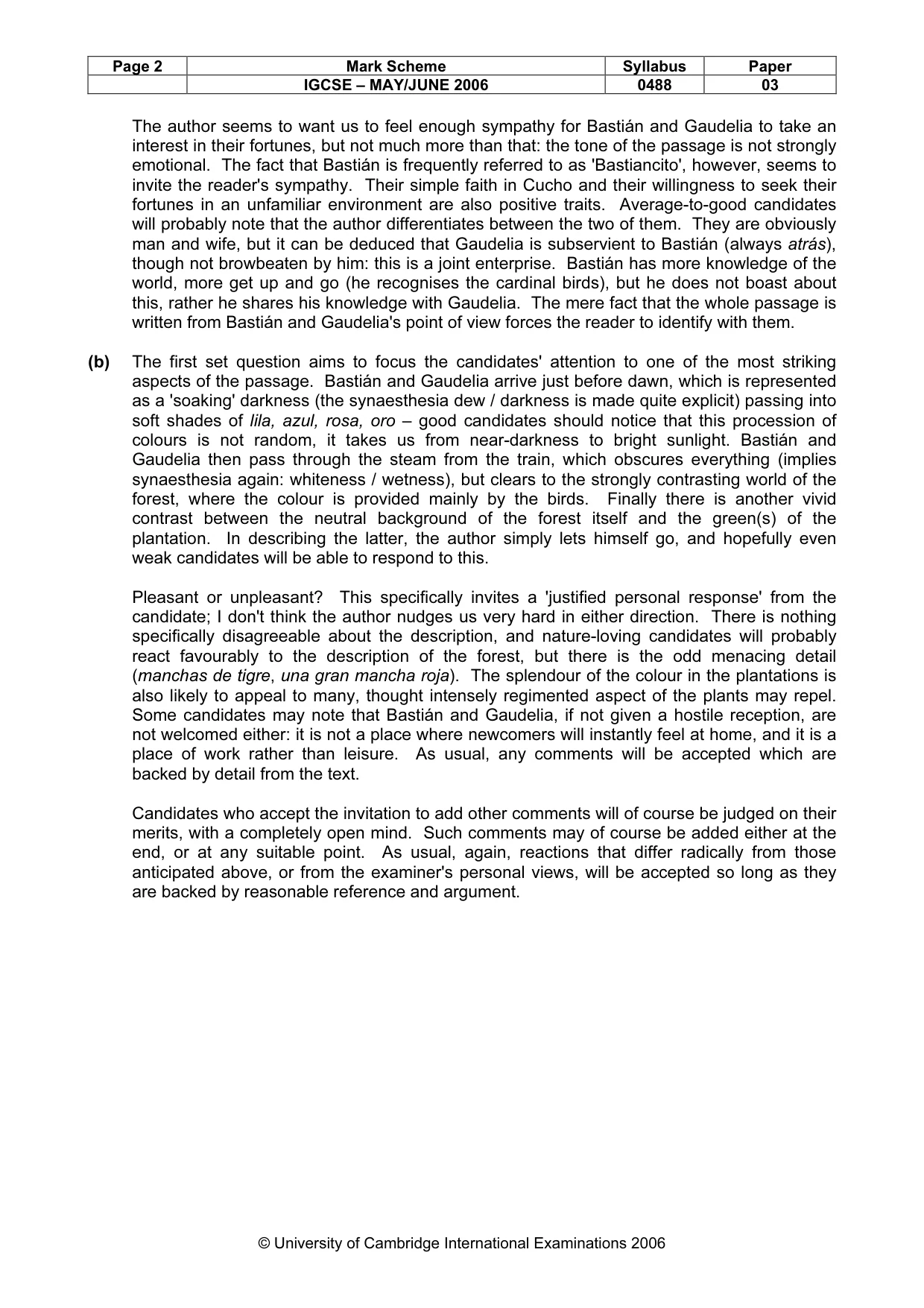
Page 2 Mark Scheme Syllabus Paper IGCSE – MAY/JUNE 2006 0488 03 © University of Cambridge International Examinations 2006 The author seems to want us to feel enough sympathy for Bastián and Gaudelia to take an interest in their fortunes, but not much more than that: the tone of the passage is not strongly emotional. The fact that Bastián is frequently referred to as 'Bastiancito', however, seems to invite the reader's sympathy. Their simple faith in Cucho and their willingness to seek their fortunes in an unfamiliar environment are also positive traits. Average-to-good candidates will probably note that the author differentiates between the two of them. They are obviously man and wife, but it can be deduced that Gaudelia is subservient to Bastián (always atrás), though not browbeaten by him: this is a joint enterprise. Bastián has more knowledge of the world, more get up and go (he recognises the cardinal birds), but he does not boast about this, rather he shares his knowledge with Gaudelia. The mere fact that the whole passage is written from Bastián and Gaudelia's point of view forces the reader to identify with them. (b) The first set question aims to focus the candidates' attention to one of the most striking aspects of the passage. Bastián and Gaudelia arrive just before dawn, which is represented as a 'soaking' darkness (the synaesthesia dew / darkness is made quite explicit) passing into soft shades of lila, azul, rosa, oro – good candidates should notice that this procession of colours is not random, it takes us from near-darkness to bright sunlight. Bastián and Gaudelia then pass through the steam from the train, which obscures everything (implies synaesthesia again: whiteness / wetness), but clears to the strongly contrasting world of the forest, where the colour is provided mainly by the birds. Finally there is another vivid contrast between the neutral background of the forest itself and the green(s) of the plantation. In describing the latter, the author simply lets himself go, and hopefully even weak candidates will be able to respond to this. Pleasant or unpleasant? This specifically invites a 'justified personal response' from the candidate; I don't think the author nudges us very hard in either direction. There is nothing specifically disagreeable about the description, and nature-loving candidates will probably react favourably to the description of the forest, but there is the odd menacing detail (manchas de tigre, una gran mancha roja). The splendour of the colour in the plantations is also likely to appeal to many, thought intensely regimented aspect of the plants may repel. Some candidates may note that Bastián and Gaudelia, if not given a hostile reception, are not welcomed either: it is not a place where newcomers will instantly feel at home, and it is a place of work rather than leisure. As usual, any comments will be accepted which are backed by detail from the text. Candidates who accept the invitation to add other comments will of course be judged on their merits, with a completely open mind. Such comments may of course be added either at the end, or at any suitable point. As usual, again, reactions that differ radically from those anticipated above, or from the examiner's personal views, will be accepted so long as they are backed by reasonable reference and argument.
What you needed in this session
Cambridge’s own grade thresholds for 2006 May/June, Paper 3 · Variant 1. A higher threshold means an easier paper — the bar moves with how the cohort did.