Cambridge IGCSE Spanish - Literature 0488 — 2005 Oct/Nov Paper 3 · Variant 1
0488/31/O/N/05
The question paper and its mark scheme, free to read here and free to download. This is Cambridge’s own paper, exactly as it was sat.
Question paper2 pages
Mark scheme3 pages
Answers below. Sit the paper first if you are practising.
Paper as text
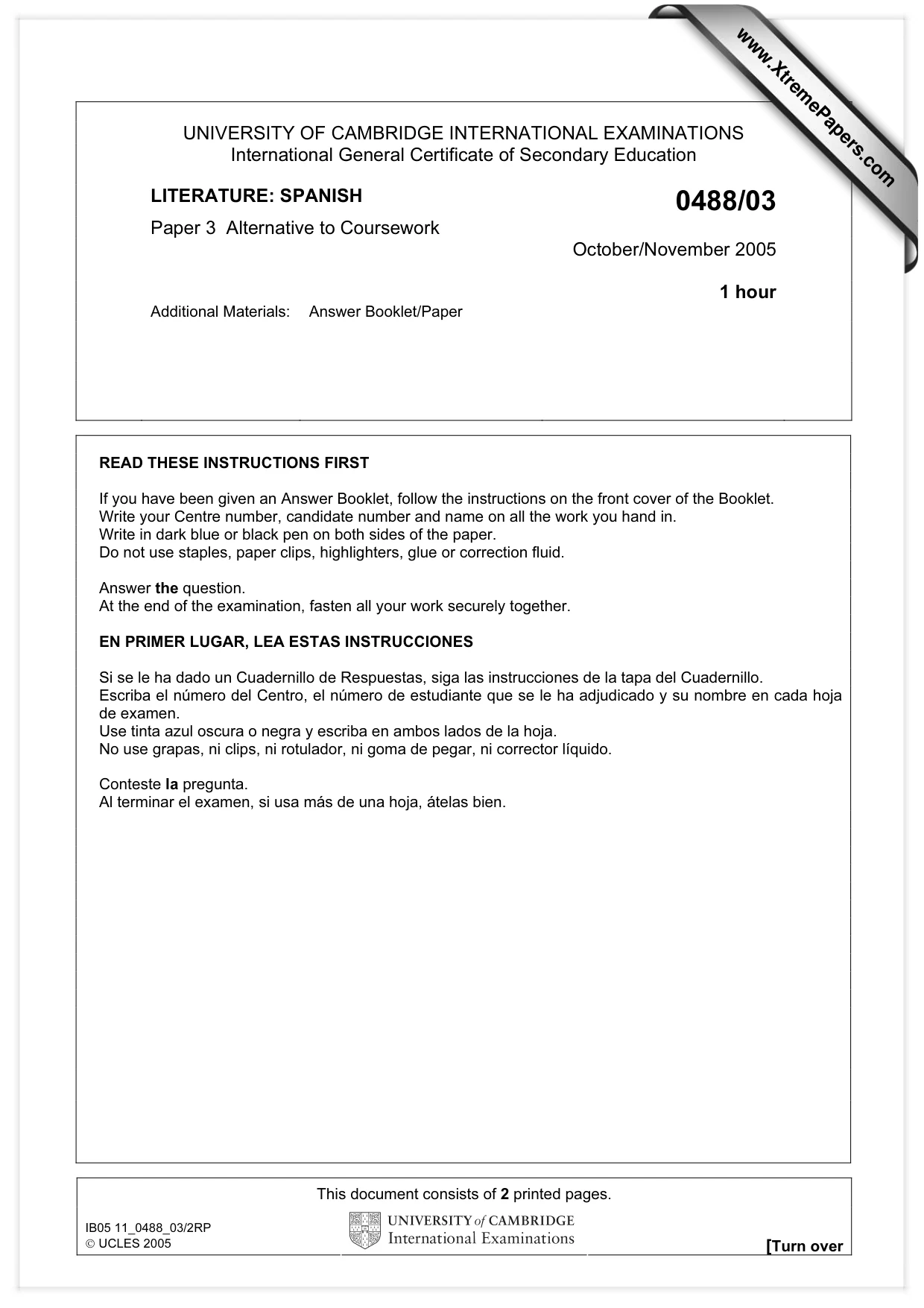
Question paper, page 1
UNIVERSITY OF CAMBRIDGE INTERNATIONAL EXAMINATIONS International General Certificate of Secondary Education LITERATURE: SPANISH 0488/03 Paper 3 Alternative to Coursework October/November 2005 1 hour Additional Materials: Answer Booklet/Paper READ THESE INSTRUCTIONS FIRST If you have been given an Answer Booklet, follow the instructions on the front cover of the Booklet. Write your Centre number, candidate number and name on all the work you hand in. Write in dark blue or black pen on both sides of the paper. Do not use staples, paper clips, highlighters, glue or correction fluid. Answer the question. At the end of the examination, fasten all your work securely together. EN PRIMER LUGAR, LEA ESTAS INSTRUCCIONES Si se le ha dado un Cuadernillo de Respuestas, siga las instrucciones de la tapa del Cuadernillo. Escriba el número del Centro, el número de estudiante que se le ha adjudicado y su nombre en cada hoja de examen. Use tinta azul oscura o negra y escriba en ambos lados de la hoja. No use grapas, ni clips, ni rotulador, ni goma de pegar, ni corrector líquido. Conteste la pregunta. Al terminar el examen, si usa más de una hoja, átelas bien. This document consists of 2 printed pages. IB05 11_0488_03/2RP UCLES 2005 [Turn over www.XtremePapers.com
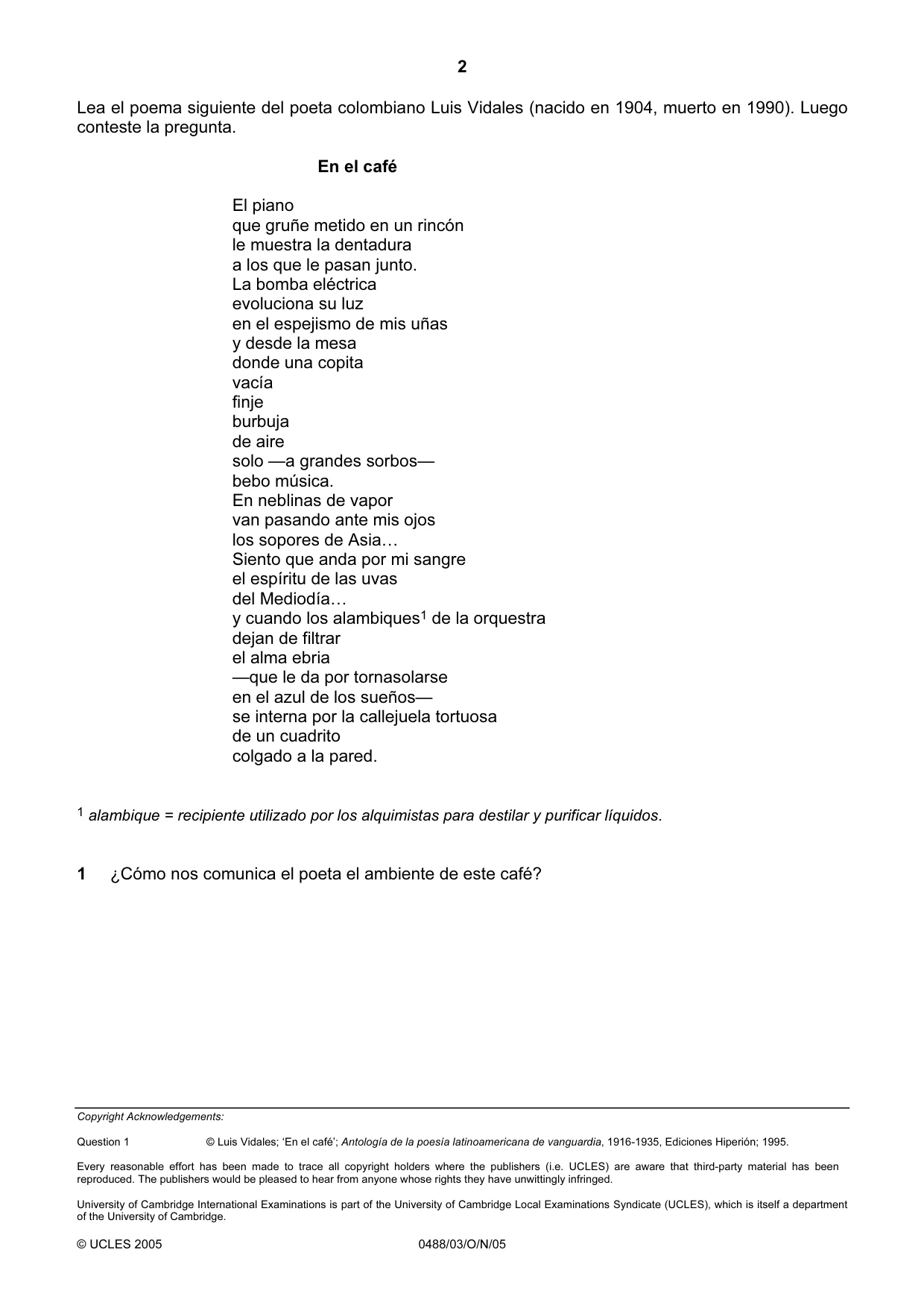
Question paper, page 2
2 Copyright Acknowledgements: Question 1 © Luis Vidales; ‘En el café’; Antología de la poesía latinoamericana de vanguardia, 1916-1935, Ediciones Hiperión; 1995. Every reasonable effort has been made to trace all copyright holders where the publishers (i.e. UCLES) are aware that third-party material has been reproduced. The publishers would be pleased to hear from anyone whose rights they have unwittingly infringed. University of Cambridge International Examinations is part of the University of Cambridge Local Examinations Syndicate (UCLES), which is itself a department of the University of Cambridge. © UCLES 2005 0488/03/O/N/05 Lea el poema siguiente del poeta colombiano Luis Vidales (nacido en 1904, muerto en 1990). Luego conteste la pregunta. En el café El piano que gruñe metido en un rincón le muestra la dentadura a los que le pasan junto. La bomba eléctrica evoluciona su luz en el espejismo de mis uñas y desde la mesa donde una copita vacía finje burbuja de aire solo —a grandes sorbos— bebo música. En neblinas de vapor van pasando ante mis ojos los sopores de Asia… Siento que anda por mi sangre el espíritu de las uvas del Mediodía… y cuando los alambiques1 de la orquestra dejan de filtrar el alma ebria —que le da por tornasolarse en el azul de los sueños— se interna por la callejuela tortuosa de un cuadrito colgado a la pared. 1 alambique = recipiente utilizado por los alquimistas para destilar y purificar líquidos. 1 ¿Cómo nos comunica el poeta el ambiente de este café?
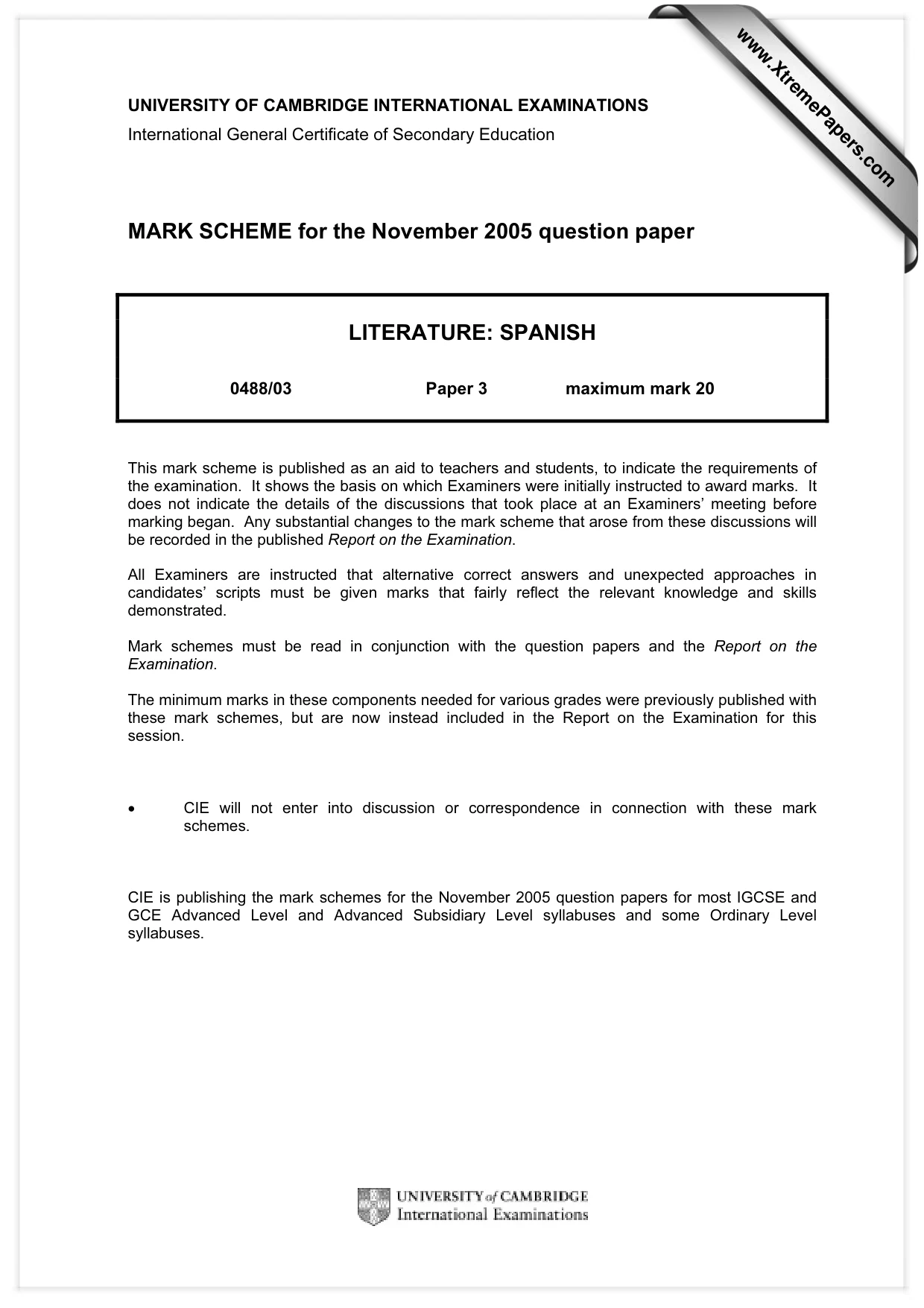
Mark scheme, page 1
UNIVERSITY OF CAMBRIDGE INTERNATIONAL EXAMINATIONS International General Certificate of Secondary Education MARK SCHEME for the November 2005 question paper LITERATURE: SPANISH 0488/03 Paper 3 maximum mark 20 This mark scheme is published as an aid to teachers and students, to indicate the requirements of the examination. It shows the basis on which Examiners were initially instructed to award marks. It does not indicate the details of the discussions that took place at an Examiners’ meeting before marking began. Any substantial changes to the mark scheme that arose from these discussions will be recorded in the published Report on the Examination. All Examiners are instructed that alternative correct answers and unexpected approaches in candidates’ scripts must be given marks that fairly reflect the relevant knowledge and skills demonstrated. Mark schemes must be read in conjunction with the question papers and the Report on the Examination. The minimum marks in these components needed for various grades were previously published with these mark schemes, but are now instead included in the Report on the Examination for this session. • CIE will not enter into discussion or correspondence in connection with these mark schemes. CIE is publishing the mark schemes for the November 2005 question papers for most IGCSE and GCE Advanced Level and Advanced Subsidiary Level syllabuses and some Ordinary Level syllabuses. www.XtremePapers.com
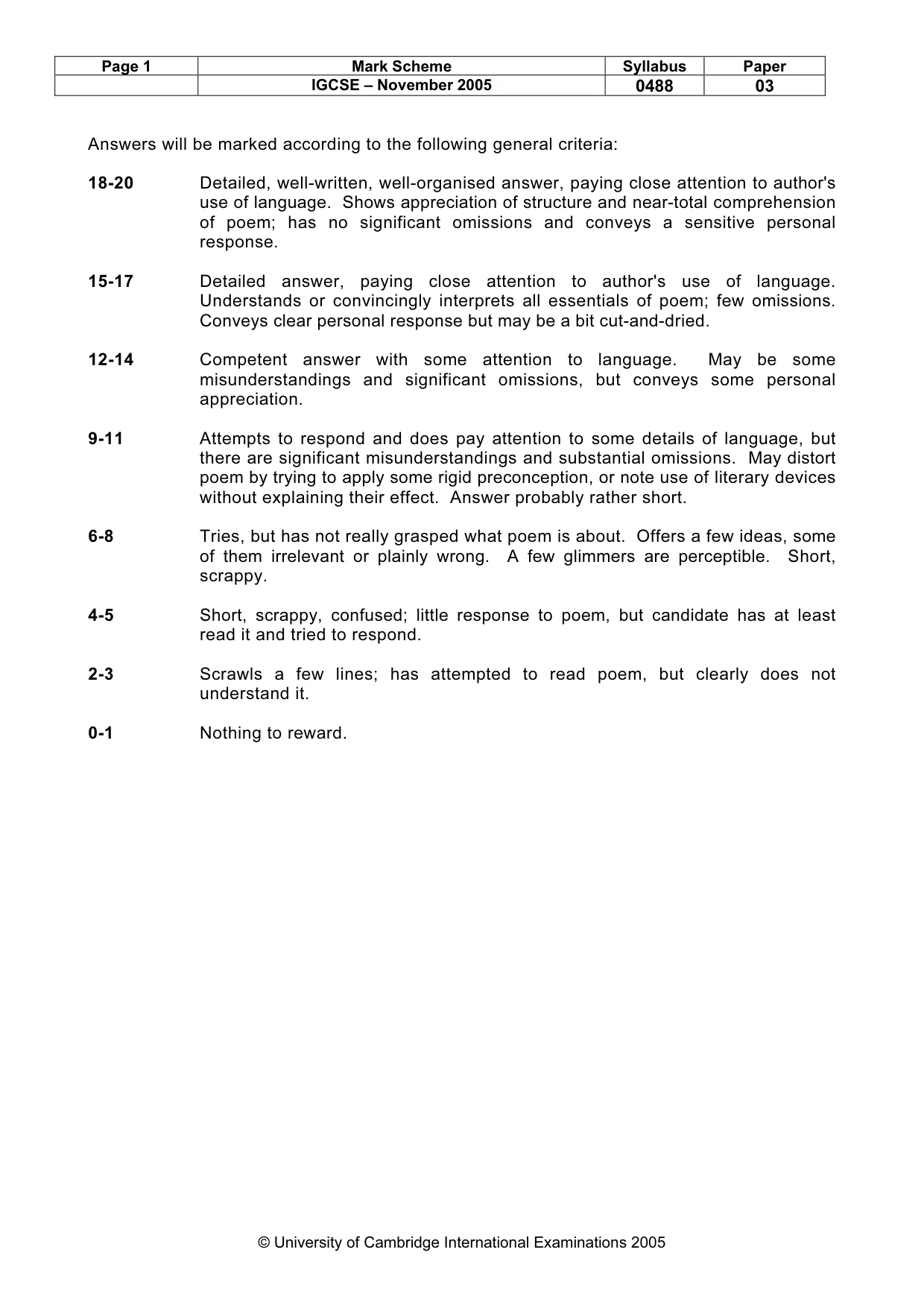
Mark scheme, page 2
Page 1 Mark Scheme Syllabus Paper IGCSE – November 2005 0488 03 © University of Cambridge International Examinations 2005 Answers will be marked according to the following general criteria: 18-20 Detailed, well-written, well-organised answer, paying close attention to author's use of language. Shows appreciation of structure and near-total comprehension of poem; has no significant omissions and conveys a sensitive personal response. 15-17 Detailed answer, paying close attention to author's use of language. Understands or convincingly interprets all essentials of poem; few omissions. Conveys clear personal response but may be a bit cut-and-dried. 12-14 Competent answer with some attention to language. May be some misunderstandings and significant omissions, but conveys some personal appreciation. 9-11 Attempts to respond and does pay attention to some details of language, but there are significant misunderstandings and substantial omissions. May distort poem by trying to apply some rigid preconception, or note use of literary devices without explaining their effect. Answer probably rather short. 6-8 Tries, but has not really grasped what poem is about. Offers a few ideas, some of them irrelevant or plainly wrong. A few glimmers are perceptible. Short, scrappy. 4-5 Short, scrappy, confused; little response to poem, but candidate has at least read it and tried to respond. 2-3 Scrawls a few lines; has attempted to read poem, but clearly does not understand it. 0-1 Nothing to reward.
Mark scheme, page 3
Page 2 Mark Scheme Syllabus Paper IGCSE – November 2005 0488 03 © University of Cambridge International Examinations 2005 This is quite a short poem (allowing for the very short lines!), and to gain high marks a candidate needs to look at it in considerable detail. However, I would not wish to be too prescriptive as to their comments, since their subjective impressions may vary quite widely, and anything with acceptable textual back-up should of course be credited. These are some possibilities: The first thing we notice is, of course, the piano. Paradoxically, while it is central to the beginning of the poem it is peripheral to the scene – 'metido en un rincón'. Note also that although it is being played, the player is obliterated from the poet's perception – the piano apparently does its own growling (angry at being put in the corner? or a kind of guard dog?). Anyway, it does not seem to communicate any cheerfulness to the café, since it both growls and snarls; nonetheless the comparison of its keys with teeth conveys that the poet has a sense of humour! The electric light – presumably a bare bulb – does not sound very cheerful either, but the poet finds a fascination in the way the light is reflected in his fingernails; note the implication that he is alone, silent, with no distractions. Again, the table has only one – empty – glass on it, which implies the poet has been drinking alone, not enjoying a convivial session with friends. However, like the piano keys, the empty glass suggests quite an agreeable idea to him – an air bubble. At this point (it seems to me – others may disagree) the mood of the poem swings up as the poet, instead of demanding a re-fill for his empty glass, swigs music instead of wine. The music works on his imagination to transform his dismal, or at least confined, surroundings into exotic visions of Asia; his glass may be empty but he has visions of grapes (or wine?); the piano is joined or superseded (in reality or imagination – it does not make much difference to the mood) by a full orchestra, his soul presumably 'distils' the gold of even richer imaginings. He is set free from the immanence of the cafe, spiritually rather than physically 'drunk' (good candidates will surely note the extended metaphor that runs through the poem), and enjoys the magic of exploring a picture – only a small one, but big enough for a visionary to get lost in. The whole thing could be read as a metaphor for the workings of the poetic imagination, though of course candidates are not bound to read it that way. As usual with poetry, the most likely weaknesses are inattention to detail, attempts to decode ('aquí el poeta está tratando de decir') and far-fetched interpretations that are not, and cannot be, justified from the words of the poem. The marking almost always needs to be a little more generous with poetry than with prose, but we shall have a better idea of how far to go in this direction when we have seen the sample scripts.