Cambridge IGCSE Spanish - Literature 0488 — 2005 May/June Paper 3 · Variant 1
0488/31/M/J/05
The question paper and its mark scheme, free to read here and free to download. This is Cambridge’s own paper, exactly as it was sat.
Question paper2 pages
Mark scheme4 pages
Answers below. Sit the paper first if you are practising.
Paper as text
Question paper, page 1
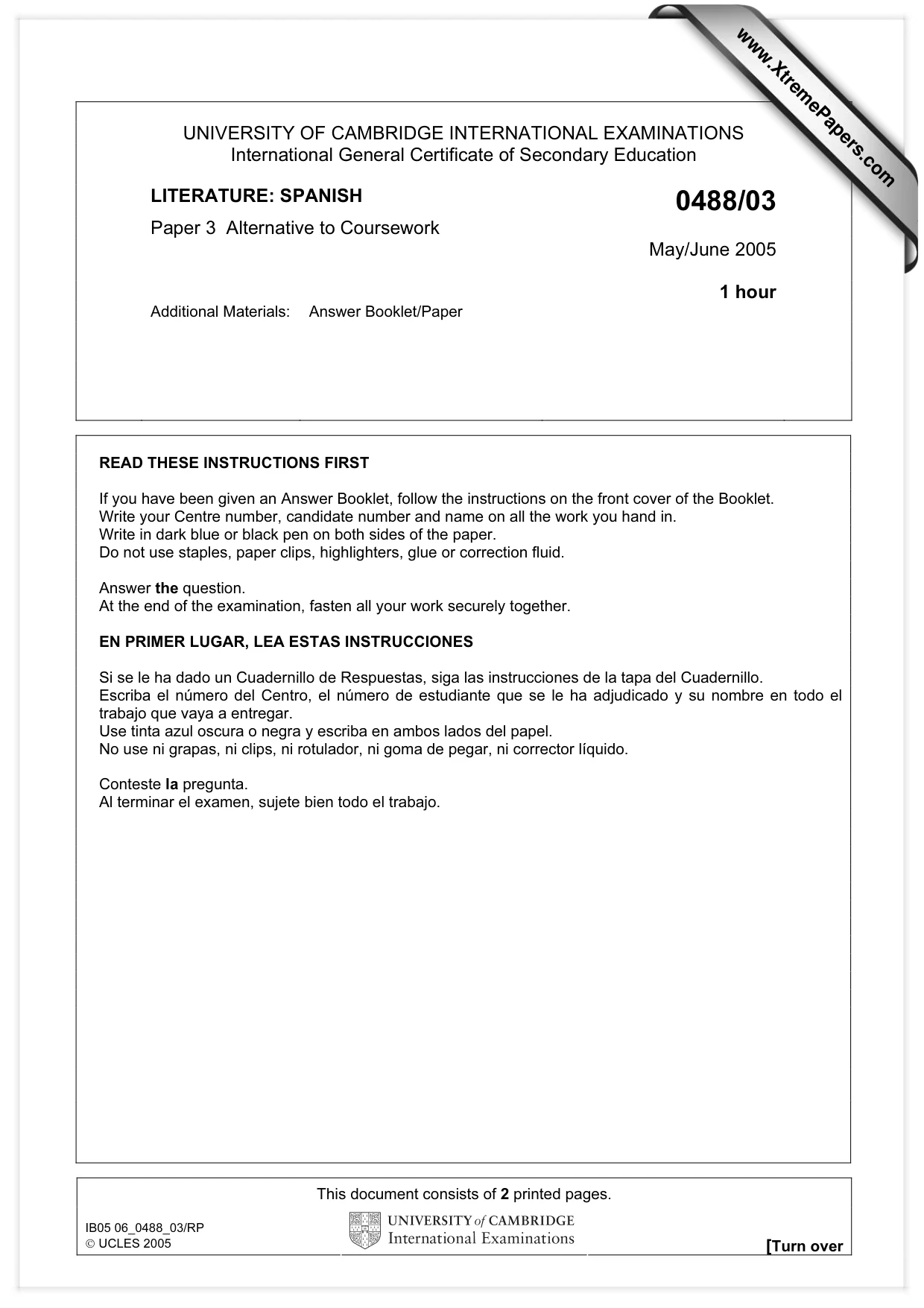
UNIVERSITY OF CAMBRIDGE INTERNATIONAL EXAMINATIONS International General Certificate of Secondary Education LITERATURE: SPANISH 0488/03 Paper 3 Alternative to Coursework May/June 2005 1 hour Additional Materials: Answer Booklet/Paper READ THESE INSTRUCTIONS FIRST If you have been given an Answer Booklet, follow the instructions on the front cover of the Booklet. Write your Centre number, candidate number and name on all the work you hand in. Write in dark blue or black pen on both sides of the paper. Do not use staples, paper clips, highlighters, glue or correction fluid. Answer the question. At the end of the examination, fasten all your work securely together. EN PRIMER LUGAR, LEA ESTAS INSTRUCCIONES Si se le ha dado un Cuadernillo de Respuestas, siga las instrucciones de la tapa del Cuadernillo. Escriba el número del Centro, el número de estudiante que se le ha adjudicado y su nombre en todo el trabajo que vaya a entregar. Use tinta azul oscura o negra y escriba en ambos lados del papel. No use ni grapas, ni clips, ni rotulador, ni goma de pegar, ni corrector líquido. Conteste la pregunta. Al terminar el examen, sujete bien todo el trabajo. This document consists of 2 printed pages. IB05 06_0488_03/RP UCLES 2005 [Turn over www.XtremePapers.com
Question paper, page 2
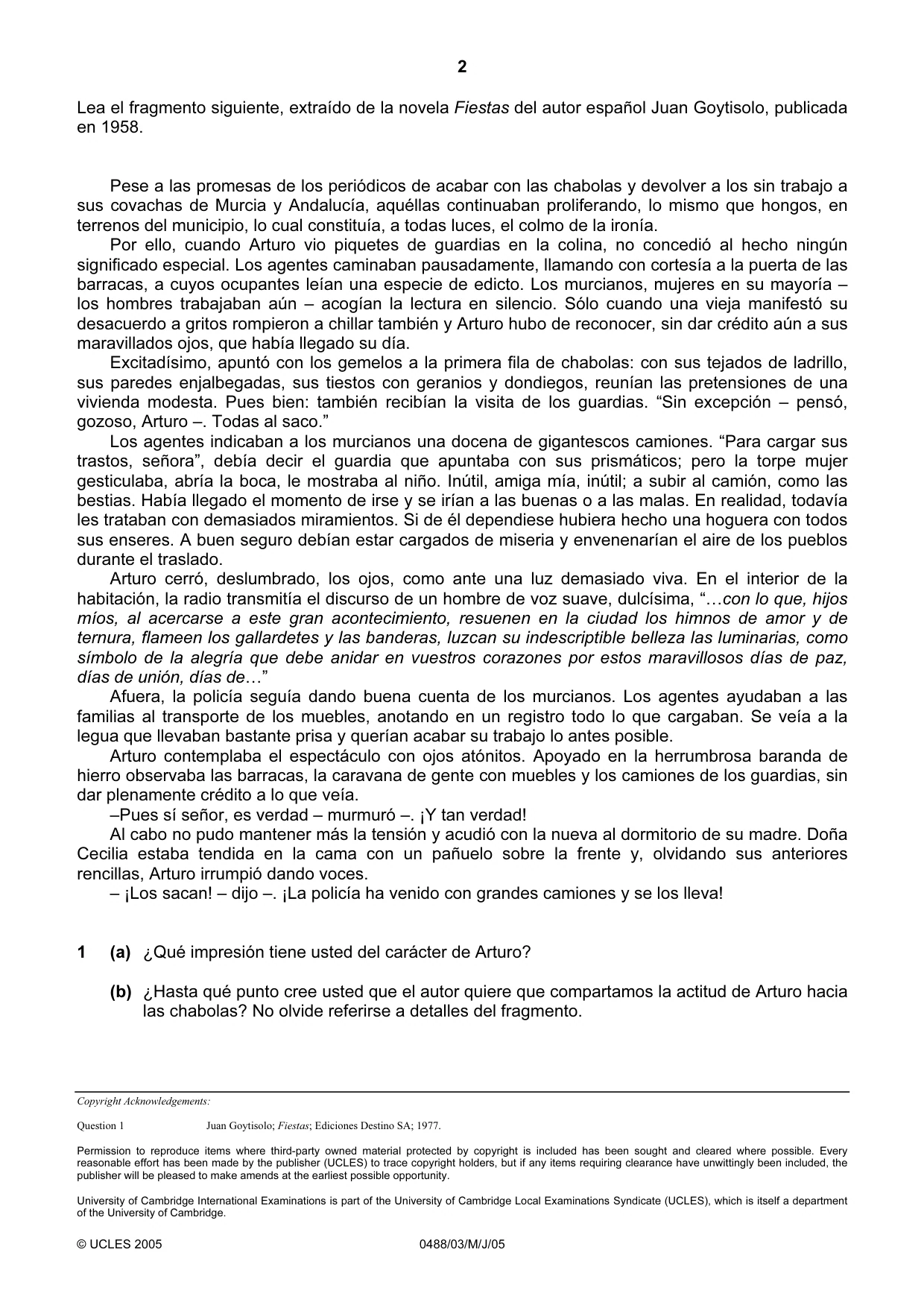
2 Copyright Acknowledgements: Question 1 Juan Goytisolo; Fiestas; Ediciones Destino SA; 1977. Permission to reproduce items where third-party owned material protected by copyright is included has been sought and cleared where possible. Every reasonable effort has been made by the publisher (UCLES) to trace copyright holders, but if any items requiring clearance have unwittingly been included, the publisher will be pleased to make amends at the earliest possible opportunity. University of Cambridge International Examinations is part of the University of Cambridge Local Examinations Syndicate (UCLES), which is itself a department of the University of Cambridge. © UCLES 2005 0488/03/M/J/05 Lea el fragmento siguiente, extraído de la novela Fiestas del autor español Juan Goytisolo, publicada en 1958. Pese a las promesas de los periódicos de acabar con las chabolas y devolver a los sin trabajo a sus covachas de Murcia y Andalucía, aquéllas continuaban proliferando, lo mismo que hongos, en terrenos del municipio, lo cual constituía, a todas luces, el colmo de la ironía. Por ello, cuando Arturo vio piquetes de guardias en la colina, no concedió al hecho ningún significado especial. Los agentes caminaban pausadamente, llamando con cortesía a la puerta de las barracas, a cuyos ocupantes leían una especie de edicto. Los murcianos, mujeres en su mayoría – los hombres trabajaban aún – acogían la lectura en silencio. Sólo cuando una vieja manifestó su desacuerdo a gritos rompieron a chillar también y Arturo hubo de reconocer, sin dar crédito aún a sus maravillados ojos, que había llegado su día. Excitadísimo, apuntó con los gemelos a la primera fila de chabolas: con sus tejados de ladrillo, sus paredes enjalbegadas, sus tiestos con geranios y dondiegos, reunían las pretensiones de una vivienda modesta. Pues bien: también recibían la visita de los guardias. “Sin excepción – pensó, gozoso, Arturo –. Todas al saco.” Los agentes indicaban a los murcianos una docena de gigantescos camiones. “Para cargar sus trastos, señora”, debía decir el guardia que apuntaba con sus prismáticos; pero la torpe mujer gesticulaba, abría la boca, le mostraba al niño. Inútil, amiga mía, inútil; a subir al camión, como las bestias. Había llegado el momento de irse y se irían a las buenas o a las malas. En realidad, todavía les trataban con demasiados miramientos. Si de él dependiese hubiera hecho una hoguera con todos sus enseres. A buen seguro debían estar cargados de miseria y envenenarían el aire de los pueblos durante el traslado. Arturo cerró, deslumbrado, los ojos, como ante una luz demasiado viva. En el interior de la habitación, la radio transmitía el discurso de un hombre de voz suave, dulcísima, “…con lo que, hijos míos, al acercarse a este gran acontecimiento, resuenen en la ciudad los himnos de amor y de ternura, flameen los gallardetes y las banderas, luzcan su indescriptible belleza las luminarias, como símbolo de la alegría que debe anidar en vuestros corazones por estos maravillosos días de paz, días de unión, días de…” Afuera, la policía seguía dando buena cuenta de los murcianos. Los agentes ayudaban a las familias al transporte de los muebles, anotando en un registro todo lo que cargaban. Se veía a la legua que llevaban bastante prisa y querían acabar su trabajo lo antes posible. Arturo contemplaba el espectáculo con ojos atónitos. Apoyado en la herrumbrosa baranda de hierro observaba las barracas, la caravana de gente con muebles y los camiones de los guardias, sin dar plenamente crédito a lo que veía. –Pues sí señor, es verdad – murmuró –. ¡Y tan verdad! Al cabo no pudo mantener más la tensión y acudió con la nueva al dormitorio de su madre. Doña Cecilia estaba tendida en la cama con un pañuelo sobre la frente y, olvidando sus anteriores rencillas, Arturo irrumpió dando voces. – ¡Los sacan! – dijo –. ¡La policía ha venido con grandes camiones y se los lleva! 1 (a) ¿Qué impresión tiene usted del carácter de Arturo? (b) ¿Hasta qué punto cree usted que el autor quiere que compartamos la actitud de Arturo hacia las chabolas? No olvide referirse a detalles del fragmento.
Mark scheme, page 1
UNIVERSITY OF CAMBRIDGE INTERNATIONAL EXAMINATIONS International General Certificate of Secondary Education MARK SCHEME for the June 2005 question paper 0488 LITERATURE (SPANISH) 0488/03 Paper 3, maximum mark 20 These mark schemes are published as an aid to teachers and students, to indicate the requirements of the examination. They show the basis on which Examiners were initially instructed to award marks. They do not indicate the details of the discussions that took place at an Examiners’ meeting before marking began. Any substantial changes to the mark scheme that arose from these discussions will be recorded in the published Report on the Examination. All Examiners are instructed that alternative correct answers and unexpected approaches in candidates’ scripts must be given marks that fairly reflect the relevant knowledge and skills demonstrated. Mark schemes must be read in conjunction with the question papers and the Report on the Examination. • CIE will not enter into discussion or correspondence in connection with these mark schemes. CIE is publishing the mark schemes for the June 2005 question papers for most IGCSE and GCE Advanced Level and Advanced Subsidiary Level syllabuses and some Ordinary Level syllabuses www.XtremePapers.com
Mark scheme, page 2
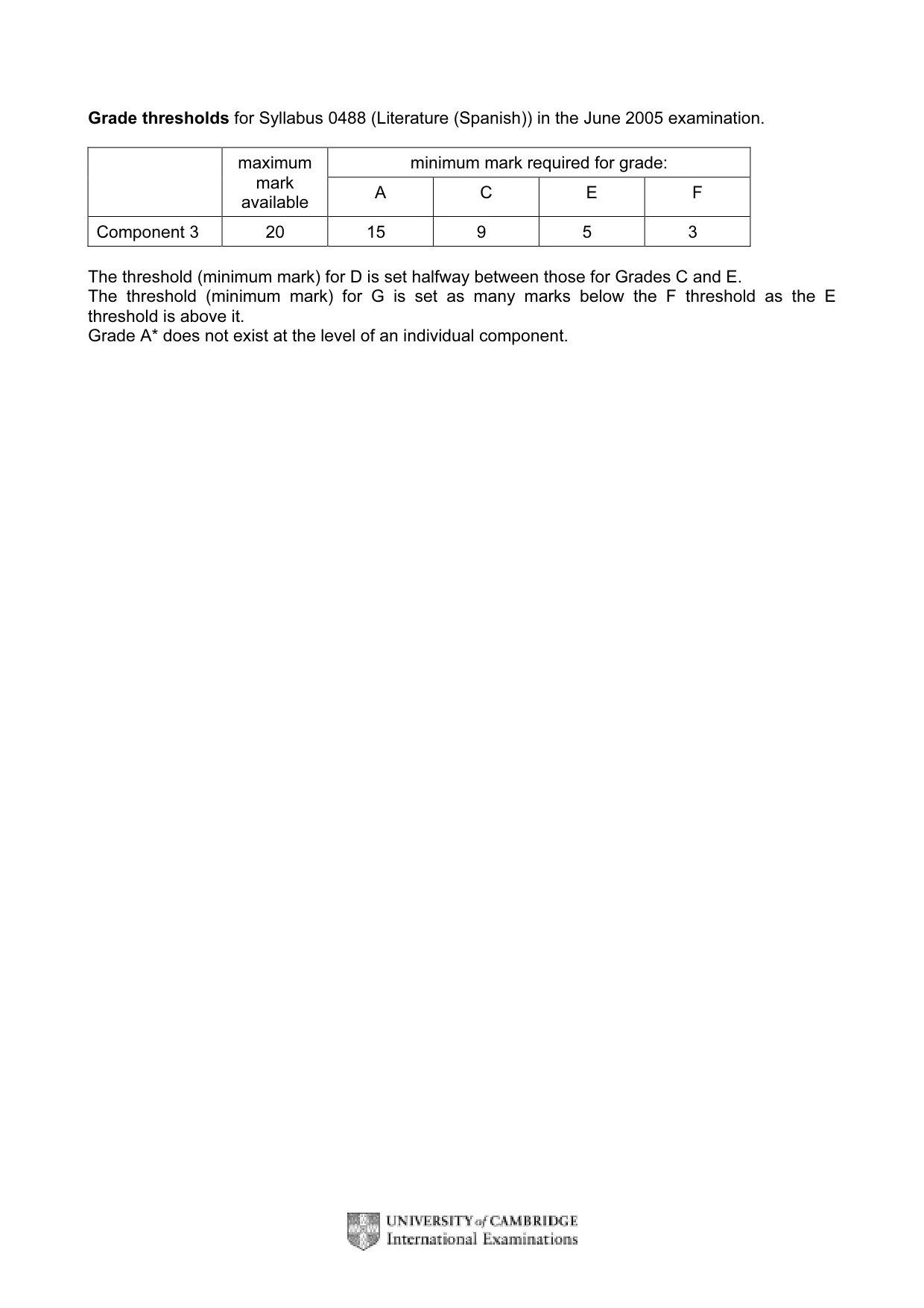
Grade thresholds for Syllabus 0488 (Literature (Spanish)) in the June 2005 examination. minimum mark required for grade: maximum mark available A C E F Component 3 20 15 9 5 3 The threshold (minimum mark) for D is set halfway between those for Grades C and E. The threshold (minimum mark) for G is set as many marks below the F threshold as the E threshold is above it. Grade A* does not exist at the level of an individual component.
Mark scheme, page 3
Page 1 Mark Scheme Syllabus Paper IGCSE - JUNE 2005 0488 3 © University of Cambridge International Examinations 2005 Answers will be marked according to the following general criteria: 18-20 Detailed, well-written, well-organised answer, paying close attention to author’s use of language. Shows appreciation of structure and near-total comprehension of passage; has no significant omissions and conveys a sensitive personal response. 15-17 Detailed answer, paying close attention to author’s use of language. Understands or convincingly interprets all essentials of passage; few omissions. Conveys clear personal response but may be a bit cut-and-dried. 12-14 Competent answer with some attention to language. May be some misunderstandings and significant omissions, but conveys some personal appreciation. 9-11 Attempts to respond and does pay attention to some details of language, but there are significant misunderstandings and substantial omissions. May distort passage by trying to apply some rigid preconception, or note use of literary devices without explaining their effect. Answer probably rather short. 6-8 Tries, but has not really grasped what passage is about. Offers a few ideas, some of them irrelevant or plainly wrong. A few glimmers are perceptible. Short, scrappy. 4-5 Short, scrappy, confused; little response to passage, but candidate has at least read it and tried to respond. 2-3 Scrawls a few lines; has attempted to read passage, but clearly doesn’t understand it. 0-1 Nothing to reward. This is a fairly straightforward passage and should present few difficulties of understanding so long as the candidate is able to detect the heavy irony. The first question is intended to help with and lead into the second: since Arturo is plainly meant to be a repulsive character, the author must want the reader to reject Arturo’s point of view. On the other hand, plenty of respectable citizens would object to having squatters in their vicinity and we must be prepared for answers that take that line. Even if the candidate is personally inclined to share Arturo’s viewpoint, however, a good answer will have to take account of the fact that the author pretty obviously does not. The best candidates are likely to be distinguished by their close attention to detail and ability to read between the lines. (a) Arturo is evidently devoid of human sympathy – as far as the squatters are concerned, at least. He clearly has no personal knowledge of them; the fact that he follows the whole operation from a safe distance, through binoculars, strongly indicates (though it does not prove) that he has never been to the settlement himself. Note how the distancing makes the operation seem unreal: Arturo does not see people suffering, he only sees an ‘espectáculo’ put on for Arturo’s benefit, as remote as a cinema documentary (though one would expect a less heartless spectator to be indignant at such scenes even when seeing them in a cinema). Arturo is (to put it clumsily) a regional racist, seeing people from the South as virtually subhuman (note ‘covachas’, ‘como hongos’, ‘como las bestias’); even the fact that these people are out of work is something to be condemned, not commiserated with. He finds the prospect of their eviction ‘enjoyable’ and ‘exciting’. When the actual eviction begins he seems to become more involved, feeling almost a personal vendetta against the unfortunate woman being turned out: ‘inútil, amiga mía, inútil…’; he depreciates the politeness exercised by the guardias. The realisation of his evidently long-cherished dream of getting rid of the squatters comes to him not just as a ‘spectacle’ but as a sort of divine revelation that he can scarcely credit. And like many visionaries, he cannot wait to communicate his vision to someone else, even if the only person available is someone he dislikes (it is hard to imagine Arturo liking anybody!). (b) Whatever the candidate’s personal opinion on the squatter problem (which may of course be stated or implied, but should not be allowed to distort the response), the answer to question (a) should provide the guideline here. There is ample evidence throughout the text that the author sympathises with the squatters and, unlike Arturo, thinks they are decent people doing their best in adverse circumstances: note particularly the poignant details of their attempts to create the appearance of ‘una vivienda modesta’. The fact that the victims are mainly defenceless women adds to the poignancy. The indications – clear even to the unsympathetic Arturo – that the guardias themselves plainly hate what they have to do, and try to mitigate its cruelty, should not be passed over. Nor, of course, should the savage irony of the background voice on the
Mark scheme, page 4
Page 2 Mark Scheme Syllabus Paper IGCSE - JUNE 2005 0488 3 © University of Cambridge International Examinations 2005 radio proclaiming ‘himnos de amor y de ternura’ – although (double irony) the radio is the voice of an administration which takes the same view as Arturo does. Even more savagely ironic is the idea of Doña Cecilia saying an Ave María in thanks for this most unchristian of happenings. Since the passage is not particularly difficult to understand, I think that we should expect a very large proportion of the above details to be noted before we award a mark of 18-20. For a mark of 12-14, the candidate should at least be aware of the narratorial irony, even if quite a lot of the detail is lacking. Any totally unexpected responses will, of course, be assessed on their merits.