Cambridge IGCSE Spanish - Foreign Language 0530 — 2022 Feb/March Paper 2 · Variant 2
0530/22/F/M/22 · 45 marks · ≈51 min
The question paper and its mark scheme, free to read here and free to download. This is Cambridge’s own paper, exactly as it was sat.
Question paper12 pages

Mark scheme10 pages
Answers below. Sit the paper first if you are practising.
Paper as text
Question paper, page 1
This document has 12 pages. Any blank pages are indicated. [Turn over Cambridge IGCSE™ DC (CE/JG) 302296/2 © UCLES 2022 SPANISH 0530/22 Paper 2 Reading February/March 2022 1 hour You must answer on the question paper. No additional materials are needed. INSTRUCTIONS ● Answer all questions. ● Use a black or dark blue pen. ● Write your name, centre number and candidate number in the boxes at the top of the page. ● Write your answer to each question in the space provided. ● Do not use an erasable pen or correction fluid. ● Do not write on any bar codes. ● Dictionaries are not allowed. INFORMATION ● The total mark for this paper is 45. ● The number of marks for each question or part question is shown in brackets [ ]. * 1 8 5 0 3 2 1 0 9 0 *
Question paper, page 2
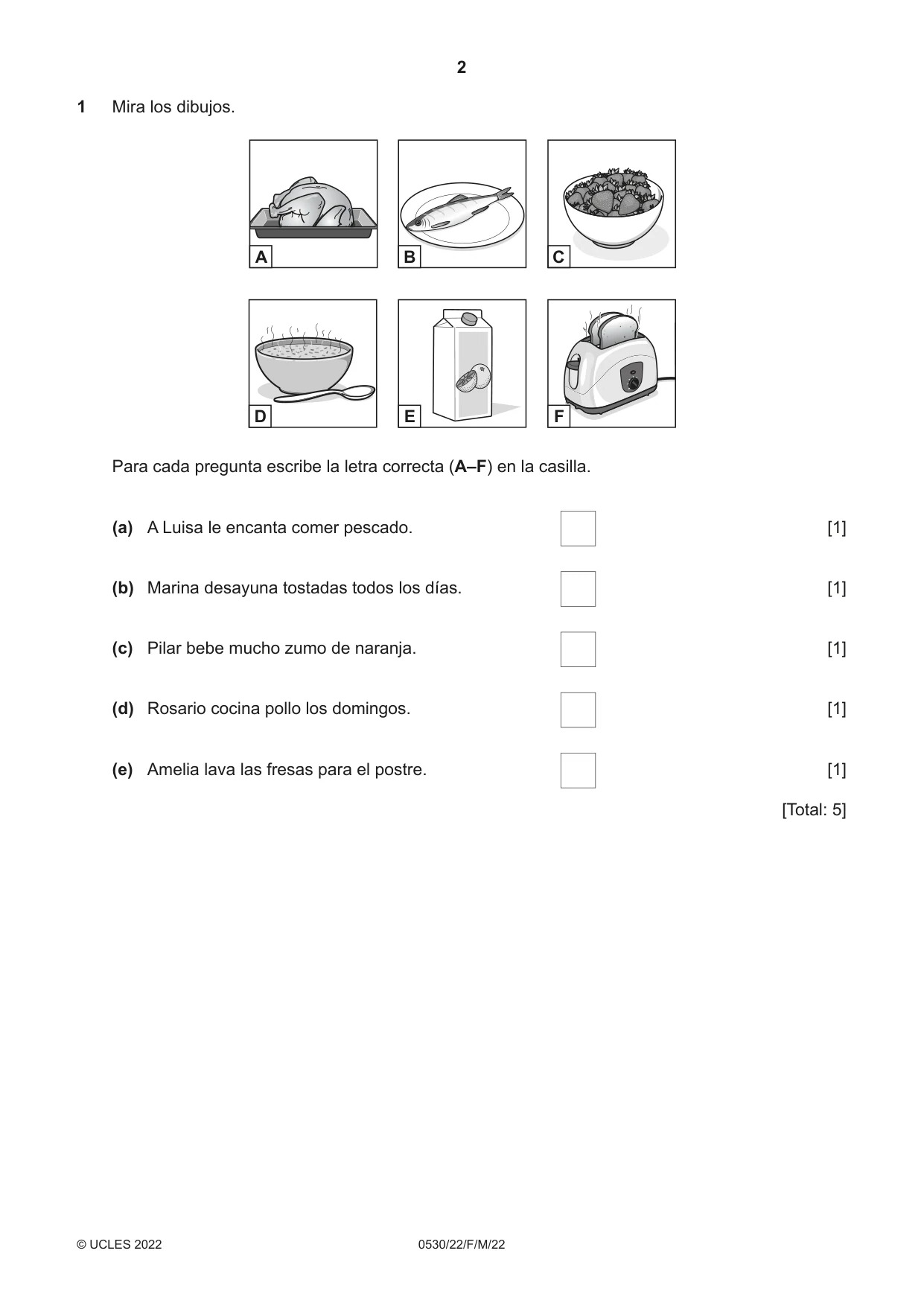
2 0530/22/ F /M /22 © UCLES 2022 1 Mira los dibujos. C B A E D F Para cada pregunta escribe la letra correcta (A–F) en la casilla. (a) A Luisa le encanta comer pescado. [1] (b) Marina desayuna tostadas todos los días. [1] (c) Pilar bebe mucho zumo de naranja. [1] (d) Rosario cocina pollo los domingos. [1] (e) Amelia lava las fresas para el postre. [1] [Total: 5]
Question paper, page 3
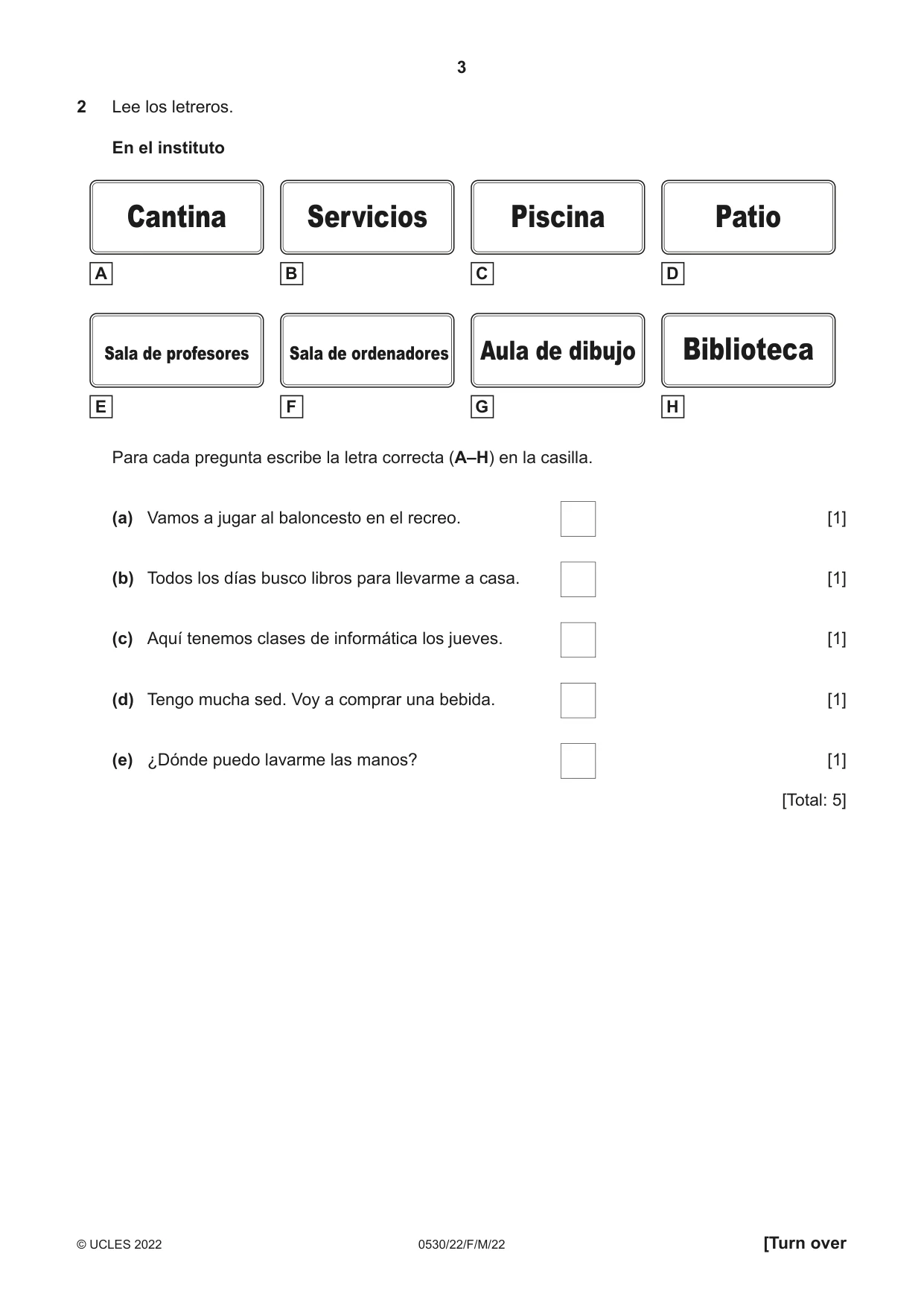
3 0530/22/F/M/22 © UCLES 2022 [Turn over 2 Lee los letreros. En el instituto Cantina Sala de profesores Sala de ordenadores Aula de dibujo Servicios Piscina Patio Biblioteca A B C D E F G H Para cada pregunta escribe la letra correcta (A–H) en la casilla. (a) Vamos a jugar al baloncesto en el recreo. [1] (b) Todos los días busco libros para llevarme a casa. [1] (c) Aquí tenemos clases de informática los jueves. [1] (d) Tengo mucha sed. Voy a comprar una bebida. [1] (e) ¿Dónde puedo lavarme las manos? [1] [Total: 5]
Question paper, page 4
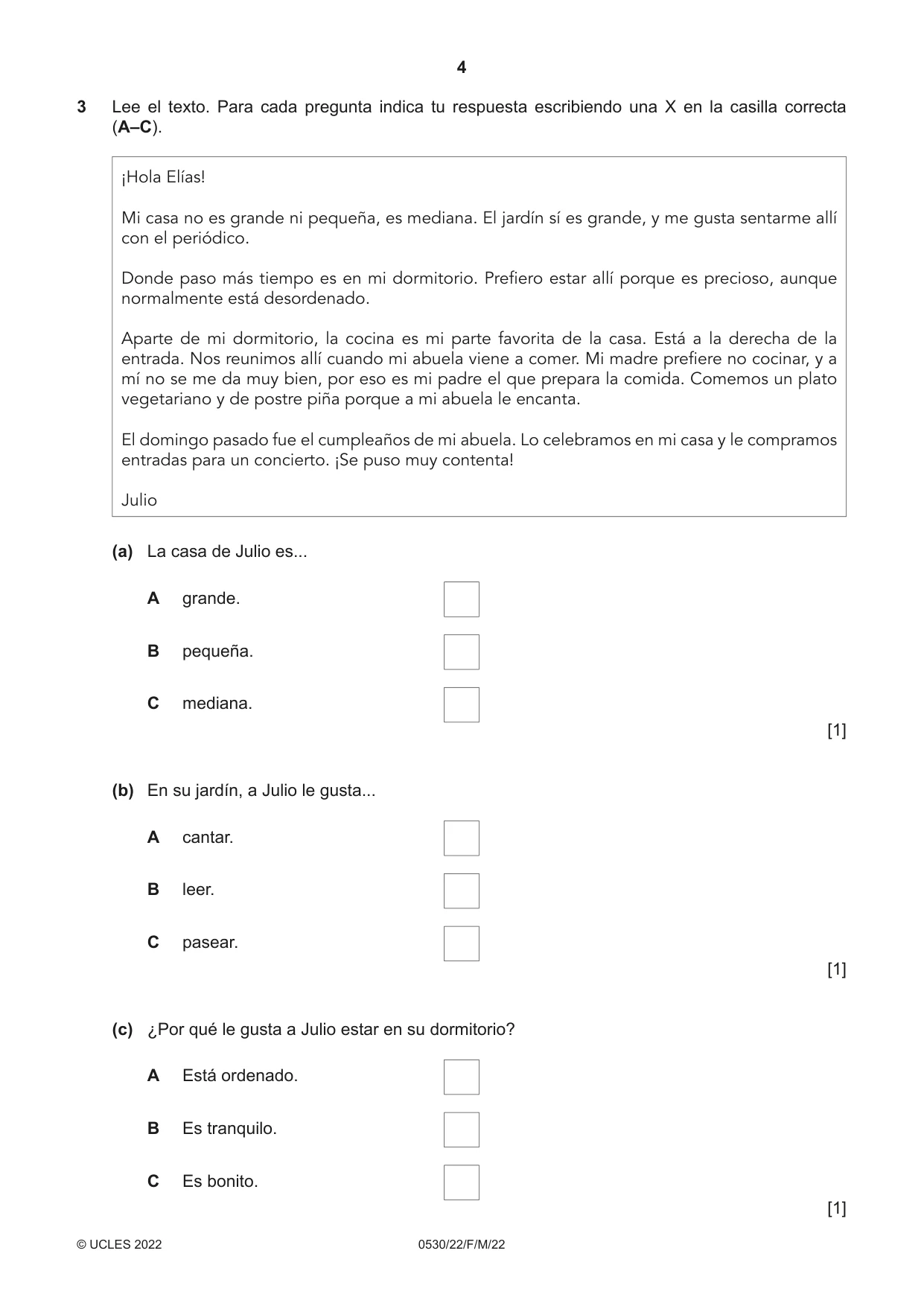
4 0530/22/F/M/22 © UCLES 2022 3 Lee el texto. Para cada pregunta indica tu respuesta escribiendo una X en la casilla correcta (A–C). ¡Hola Elías! Mi casa no es grande ni pequeña, es mediana. El jardín sí es grande, y me gusta sentarme allí con el periódico. Donde paso más tiempo es en mi dormitorio. Prefiero estar allí porque es precioso, aunque normalmente está desordenado. Aparte de mi dormitorio, la cocina es mi parte favorita de la casa. Está a la derecha de la entrada. Nos reunimos allí cuando mi abuela viene a comer. Mi madre prefiere no cocinar, y a mí no se me da muy bien, por eso es mi padre el que prepara la comida. Comemos un plato vegetariano y de postre piña porque a mi abuela le encanta. El domingo pasado fue el cumpleaños de mi abuela. Lo celebramos en mi casa y le compramos entradas para un concierto. ¡Se puso muy contenta! Julio (a) La casa de Julio es... A grande. B pequeña. C mediana. [1] (b) En su jardín, a Julio le gusta... A cantar. B leer. C pasear. [1] (c) ¿Por qué le gusta a Julio estar en su dormitorio? A Está ordenado. B Es tranquilo. C Es bonito. [1]
Question paper, page 5
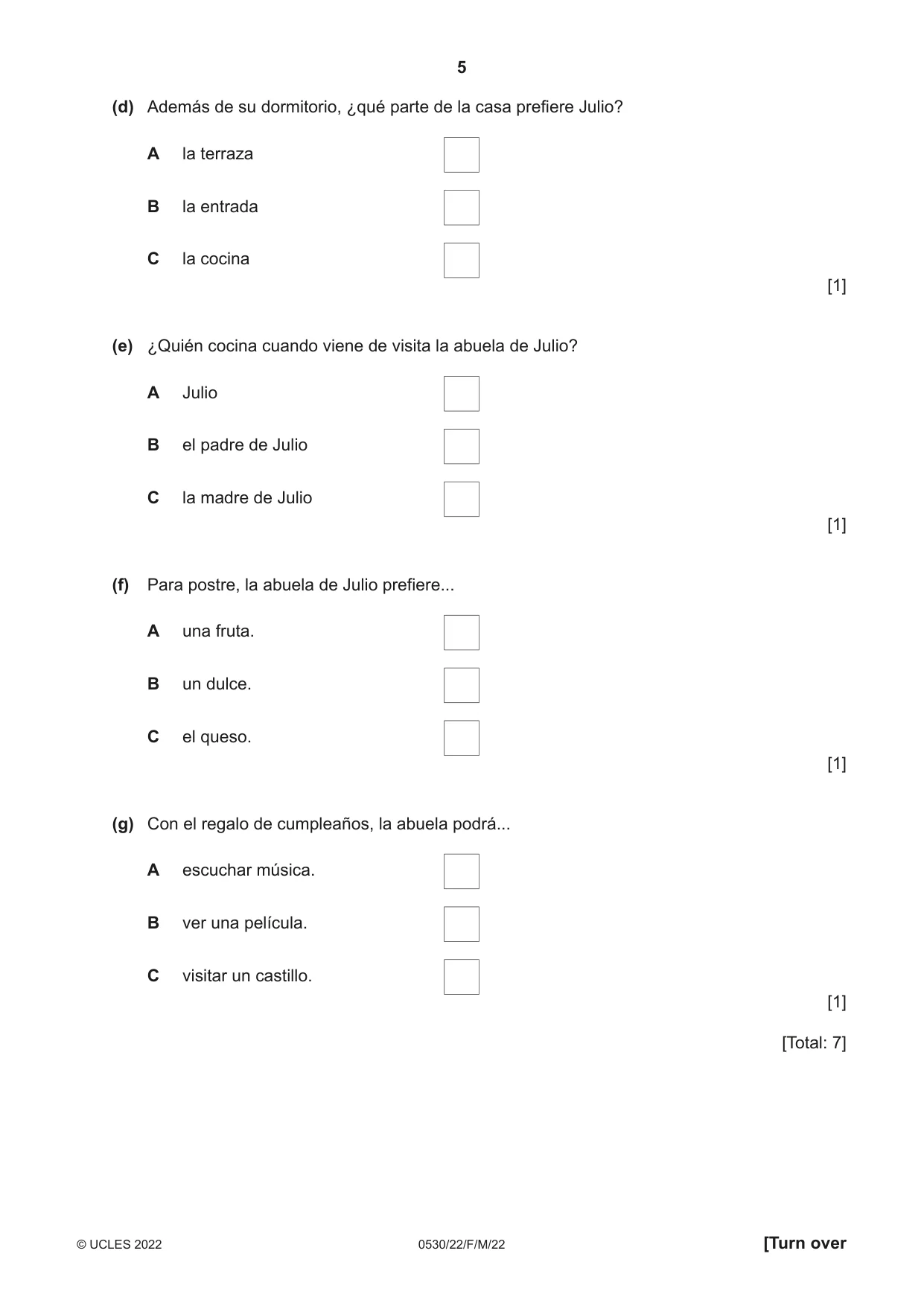
5 0530/22/F/M/22 © UCLES 2022 [Turn over (d) Además de su dormitorio, ¿qué parte de la casa prefiere Julio? A la terraza B la entrada C la cocina [1] (e) ¿Quién cocina cuando viene de visita la abuela de Julio? A Julio B el padre de Julio C la madre de Julio [1] (f) Para postre, la abuela de Julio prefiere... A una fruta. B un dulce. C el queso. [1] (g) Con el regalo de cumpleaños, la abuela podrá... A escuchar música. B ver una película. C visitar un castillo. [1] [Total: 7]
Question paper, page 6
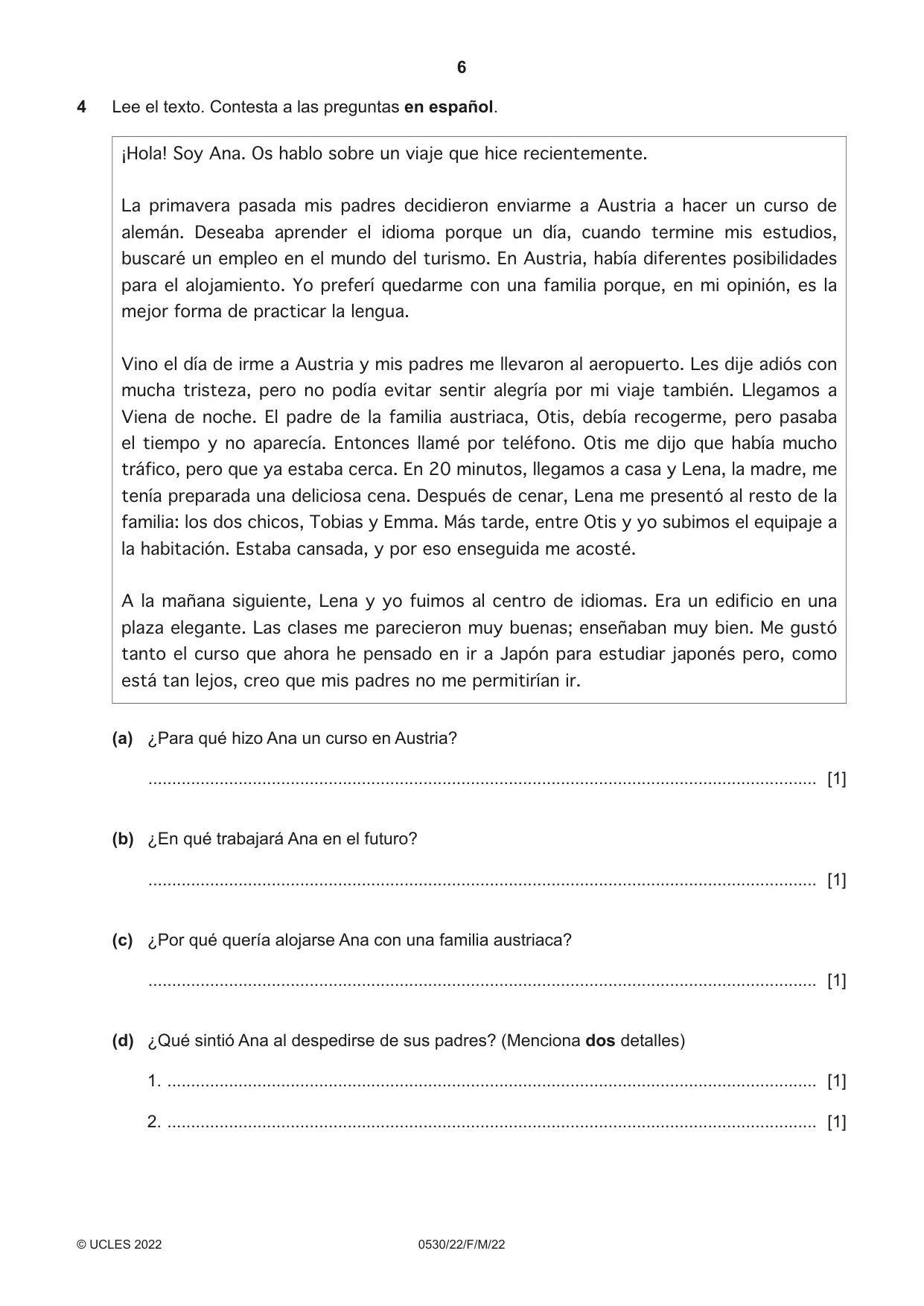
6 0530/22/F/M/22 © UCLES 2022 4 Lee el texto. Contesta a las preguntas en español. ¡Hola! Soy Ana. Os hablo sobre un viaje que hice recientemente. La primavera pasada mis padres decidieron enviarme a Austria a hacer un curso de alemán. Deseaba aprender el idioma porque un día, cuando termine mis estudios, buscaré un empleo en el mundo del turismo. En Austria, había diferentes posibilidades para el alojamiento. Yo preferí quedarme con una familia porque, en mi opinión, es la mejor forma de practicar la lengua. Vino el día de irme a Austria y mis padres me llevaron al aeropuerto. Les dije adiós con mucha tristeza, pero no podía evitar sentir alegría por mi viaje también. Llegamos a Viena de noche. El padre de la familia austriaca, Otis, debía recogerme, pero pasaba el tiempo y no aparecía. Entonces llamé por teléfono. Otis me dijo que había mucho tráfico, pero que ya estaba cerca. En 20 minutos, llegamos a casa y Lena, la madre, me tenía preparada una deliciosa cena. Después de cenar, Lena me presentó al resto de la familia: los dos chicos, Tobias y Emma. Más tarde, entre Otis y yo subimos el equipaje a la habitación. Estaba cansada, y por eso enseguida me acosté. A la mañana siguiente, Lena y yo fuimos al centro de idiomas. Era un edificio en una plaza elegante. Las clases me parecieron muy buenas; enseñaban muy bien. Me gustó tanto el curso que ahora he pensado en ir a Japón para estudiar japonés pero, como está tan lejos, creo que mis padres no me permitirían ir. (a) ¿Para qué hizo Ana un curso en Austria? … [1] (b) ¿En qué trabajará Ana en el futuro? … [1] (c) ¿Por qué quería alojarse Ana con una familia austriaca? … [1] (d) ¿Qué sintió Ana al despedirse de sus padres? (Menciona dos detalles) 1. … [1] 2. … [1]
Question paper, page 7
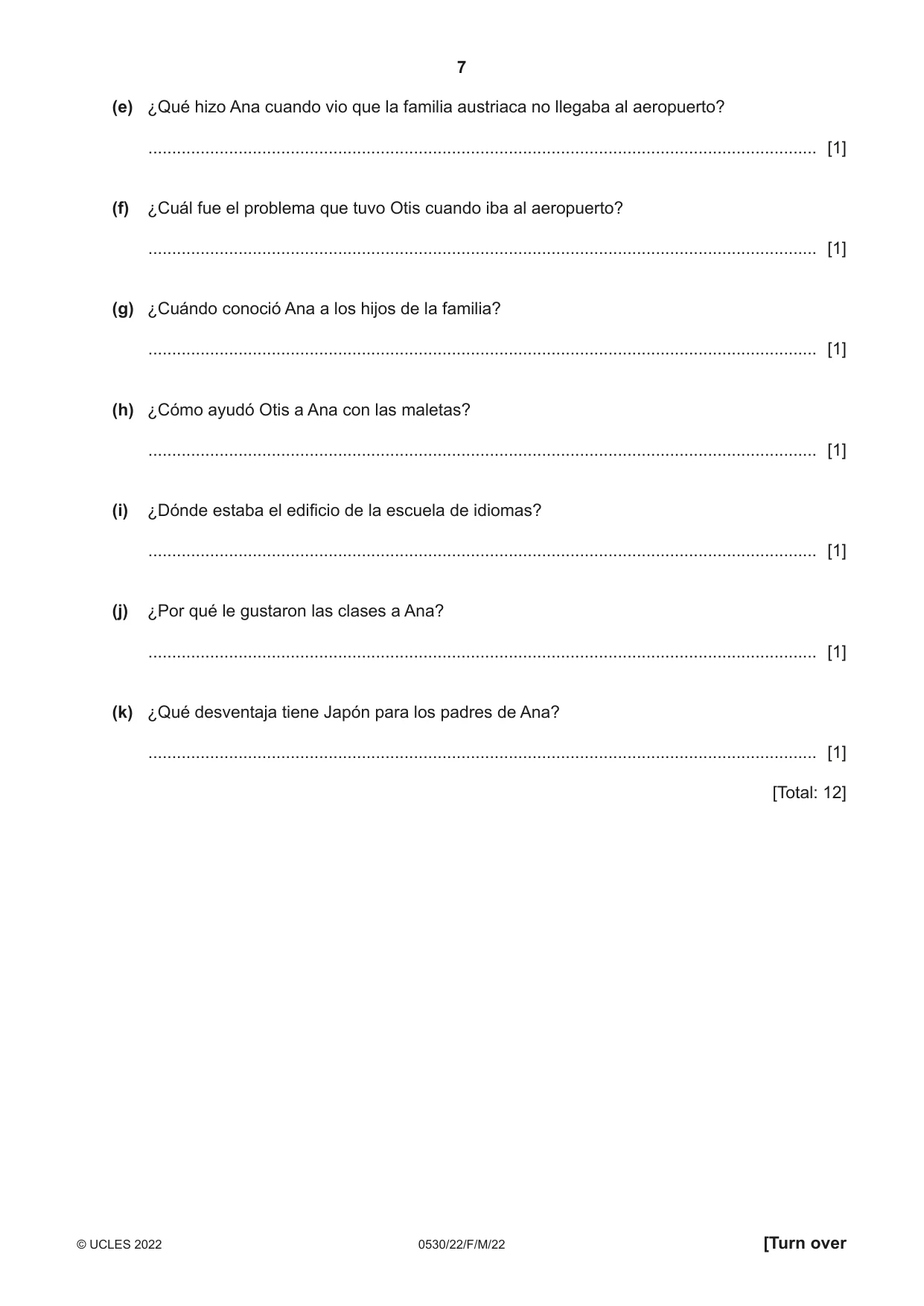
7 0530/22/F/M/22 © UCLES 2022 [Turn over (e) ¿Qué hizo Ana cuando vio que la familia austriaca no llegaba al aeropuerto? … [1] (f) ¿Cuál fue el problema que tuvo Otis cuando iba al aeropuerto? … [1] (g) ¿Cuándo conoció Ana a los hijos de la familia? … [1] (h) ¿Cómo ayudó Otis a Ana con las maletas? … [1] (i) ¿Dónde estaba el edificio de la escuela de idiomas? … [1] (j) ¿Por qué le gustaron las clases a Ana? … [1] (k) ¿Qué desventaja tiene Japón para los padres de Ana? … [1] [Total: 12]
Question paper, page 8
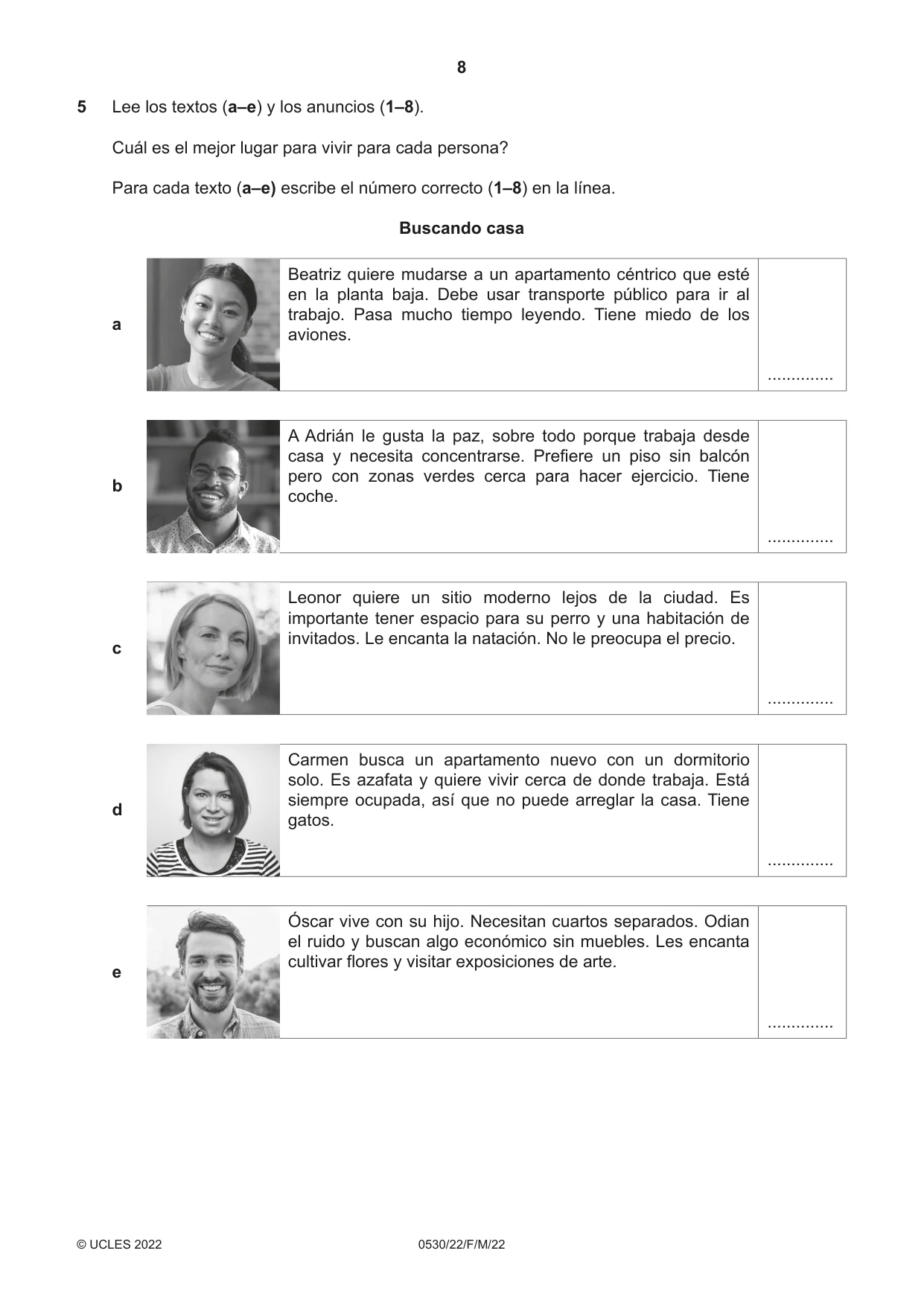
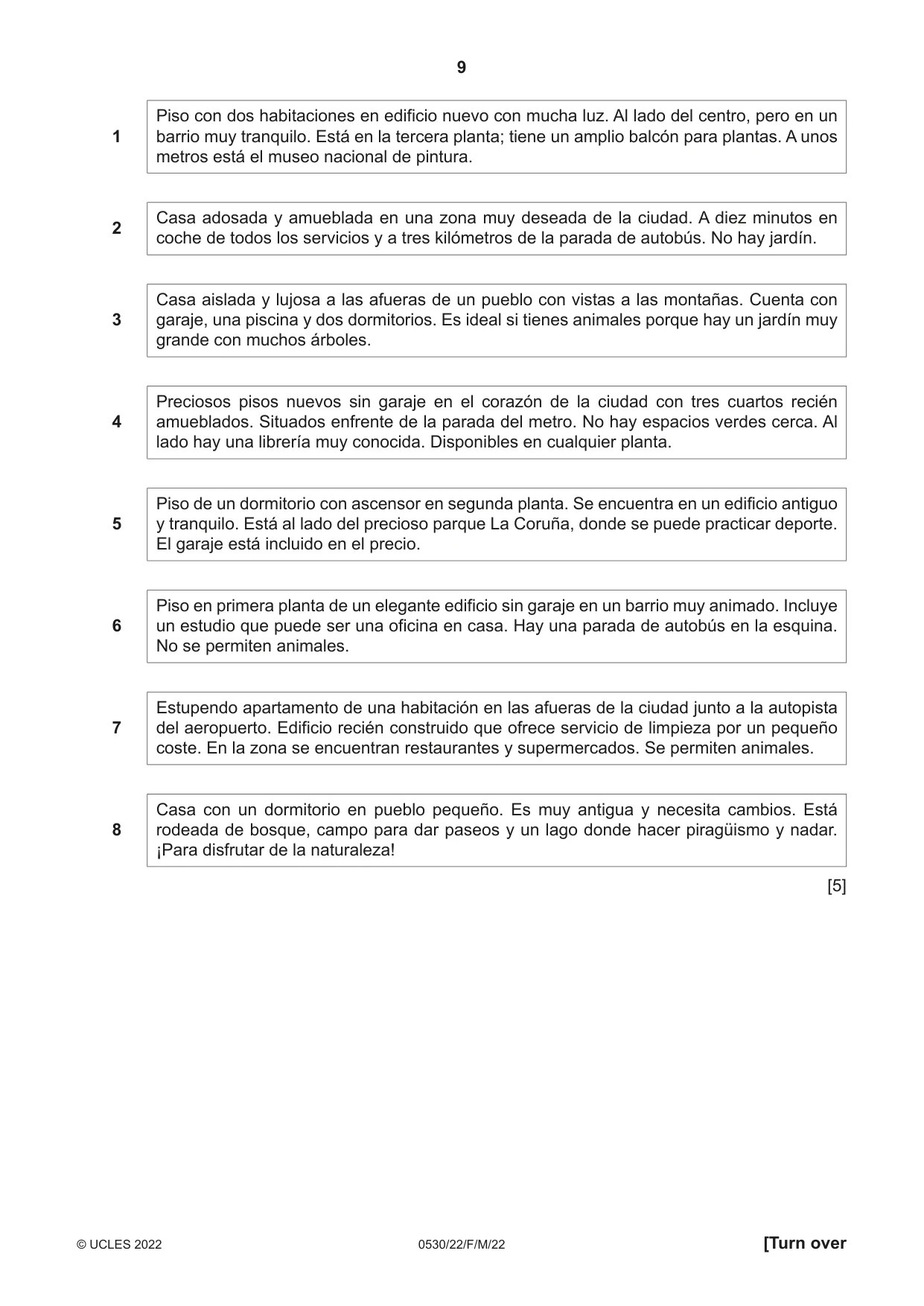
8 0530/22/F/M/22 © UCLES 2022 5 Lee los textos (a–e) y los anuncios (1–8). Cuál es el mejor lugar para vivir para cada persona? Para cada texto (a–e) escribe el número correcto (1–8) en la línea. Buscando casa a Beatriz quiere mudarse a un apartamento céntrico que esté en la planta baja. Debe usar transporte público para ir al trabajo. Pasa mucho tiempo leyendo. Tiene miedo de los aviones. … b A Adrián le gusta la paz, sobre todo porque trabaja desde casa y necesita concentrarse. Prefiere un piso sin balcón pero con zonas verdes cerca para hacer ejercicio. Tiene coche. … c Leonor quiere un sitio moderno lejos de la ciudad. Es importante tener espacio para su perro y una habitación de invitados. Le encanta la natación. No le preocupa el precio. … d Carmen busca un apartamento nuevo con un dormitorio solo. Es azafata y quiere vivir cerca de donde trabaja. Está siempre ocupada, así que no puede arreglar la casa. Tiene gatos. … e Óscar vive con su hijo. Necesitan cuartos separados. Odian el ruido y buscan algo económico sin muebles. Les encanta cultivar flores y visitar exposiciones de arte. …
Question paper, page 9
9 0530/22/F/M/22 © UCLES 2022 [Turn over 1 Piso con dos habitaciones en edificio nuevo con mucha luz. Al lado del centro, pero en un barrio muy tranquilo. Está en la tercera planta; tiene un amplio balcón para plantas. A unos metros está el museo nacional de pintura. 2 Casa adosada y amueblada en una zona muy deseada de la ciudad. A diez minutos en coche de todos los servicios y a tres kilómetros de la parada de autobús. No hay jardín. 3 Casa aislada y lujosa a las afueras de un pueblo con vistas a las montañas. Cuenta con garaje, una piscina y dos dormitorios. Es ideal si tienes animales porque hay un jardín muy grande con muchos árboles. 4 Preciosos pisos nuevos sin garaje en el corazón de la ciudad con tres cuartos recién amueblados. Situados enfrente de la parada del metro. No hay espacios verdes cerca. Al lado hay una librería muy conocida. Disponibles en cualquier planta. 5 Piso de un dormitorio con ascensor en segunda planta. Se encuentra en un edificio antiguo y tranquilo. Está al lado del precioso parque La Coruña, donde se puede practicar deporte. El garaje está incluido en el precio. 6 Piso en primera planta de un elegante edificio sin garaje en un barrio muy animado. Incluye un estudio que puede ser una oficina en casa. Hay una parada de autobús en la esquina. No se permiten animales. 7 Estupendo apartamento de una habitación en las afueras de la ciudad junto a la autopista del aeropuerto. Edificio recién construido que ofrece servicio de limpieza por un pequeño coste. En la zona se encuentran restaurantes y supermercados. Se permiten animales. 8 Casa con un dormitorio en pueblo pequeño. Es muy antigua y necesita cambios. Está rodeada de bosque, campo para dar paseos y un lago donde hacer piragüismo y nadar. ¡Para disfrutar de la naturaleza! [5]
Question paper, page 10
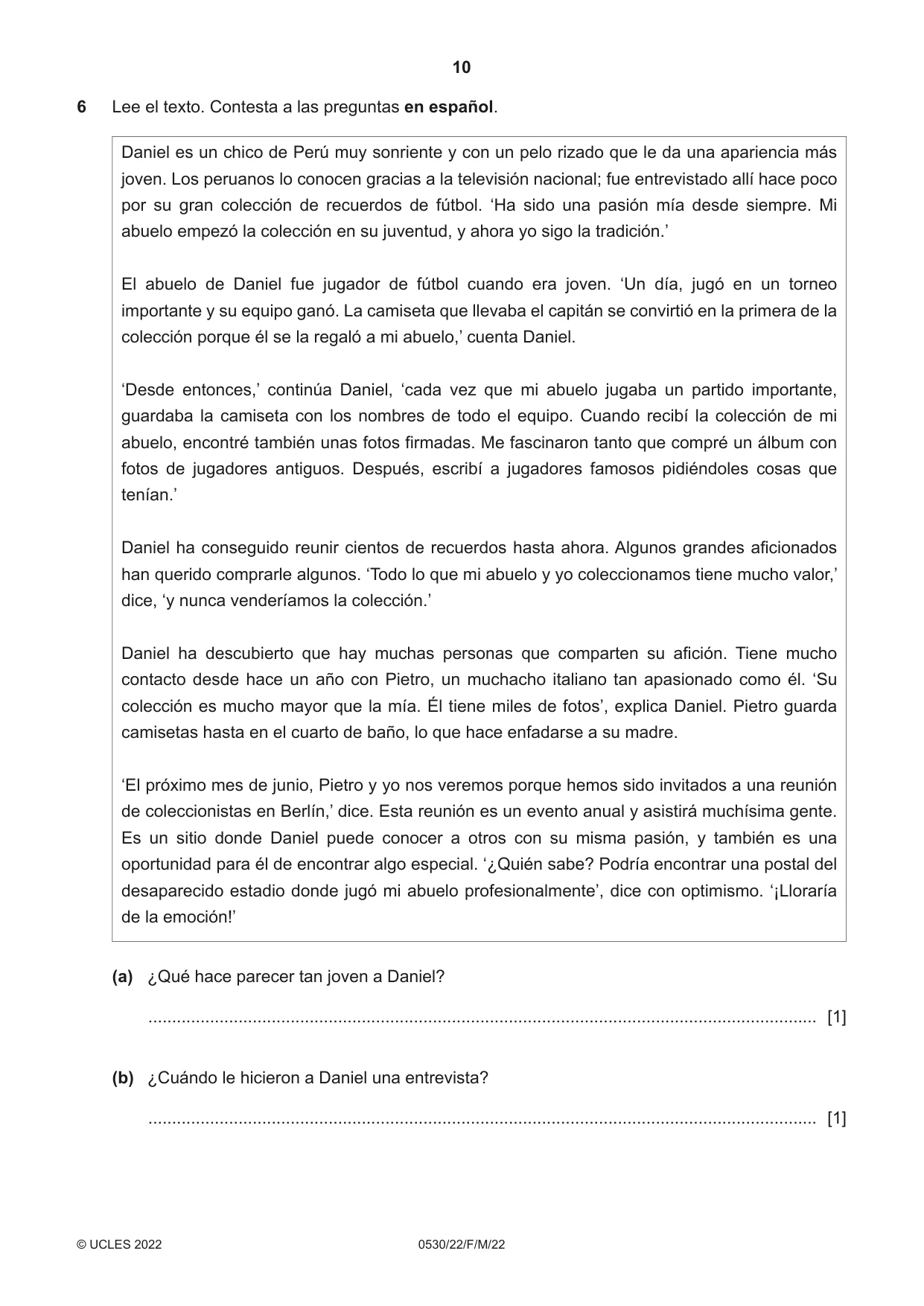
10 0530/22/F/M/22 © UCLES 2022 6 Lee el texto. Contesta a las preguntas en español. Daniel es un chico de Perú muy sonriente y con un pelo rizado que le da una apariencia más joven. Los peruanos lo conocen gracias a la televisión nacional; fue entrevistado allí hace poco por su gran colección de recuerdos de fútbol. ‘Ha sido una pasión mía desde siempre. Mi abuelo empezó la colección en su juventud, y ahora yo sigo la tradición.’ El abuelo de Daniel fue jugador de fútbol cuando era joven. ‘Un día, jugó en un torneo importante y su equipo ganó. La camiseta que llevaba el capitán se convirtió en la primera de la colección porque él se la regaló a mi abuelo,’ cuenta Daniel. ‘Desde entonces,’ continúa Daniel, ‘cada vez que mi abuelo jugaba un partido importante, guardaba la camiseta con los nombres de todo el equipo. Cuando recibí la colección de mi abuelo, encontré también unas fotos firmadas. Me fascinaron tanto que compré un álbum con fotos de jugadores antiguos. Después, escribí a jugadores famosos pidiéndoles cosas que tenían.’ Daniel ha conseguido reunir cientos de recuerdos hasta ahora. Algunos grandes aficionados han querido comprarle algunos. ‘Todo lo que mi abuelo y yo coleccionamos tiene mucho valor,’ dice, ‘y nunca venderíamos la colección.’ Daniel ha descubierto que hay muchas personas que comparten su afición. Tiene mucho contacto desde hace un año con Pietro, un muchacho italiano tan apasionado como él. ‘Su colección es mucho mayor que la mía. Él tiene miles de fotos’, explica Daniel. Pietro guarda camisetas hasta en el cuarto de baño, lo que hace enfadarse a su madre. ‘El próximo mes de junio, Pietro y yo nos veremos porque hemos sido invitados a una reunión de coleccionistas en Berlín,’ dice. Esta reunión es un evento anual y asistirá muchísima gente. Es un sitio donde Daniel puede conocer a otros con su misma pasión, y también es una oportunidad para él de encontrar algo especial. ‘¿Quién sabe? Podría encontrar una postal del desaparecido estadio donde jugó mi abuelo profesionalmente’, dice con optimismo. ‘¡Lloraría de la emoción!’ (a) ¿Qué hace parecer tan joven a Daniel? … [1] (b) ¿Cuándo le hicieron a Daniel una entrevista? … [1]
Question paper, page 11
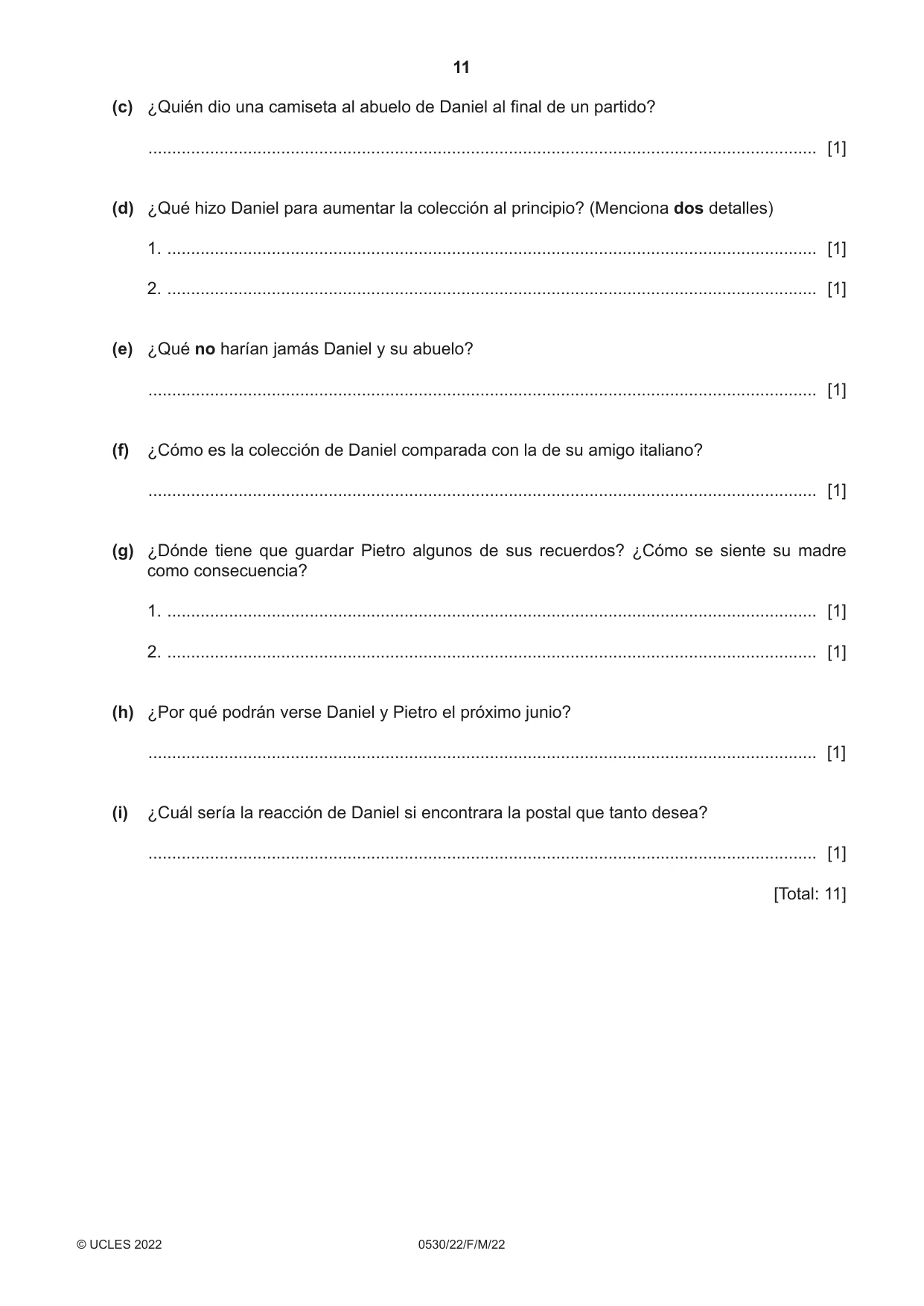
11 0530/22/F/M/22 © UCLES 2022 (c) ¿Quién dio una camiseta al abuelo de Daniel al final de un partido? … [1] (d) ¿Qué hizo Daniel para aumentar la colección al principio? (Menciona dos detalles) 1. … [1] 2. … [1] (e) ¿Qué no harían jamás Daniel y su abuelo? … [1] (f) ¿Cómo es la colección de Daniel comparada con la de su amigo italiano? … [1] (g) ¿Dónde tiene que guardar Pietro algunos de sus recuerdos? ¿Cómo se siente su madre como consecuencia? 1. … [1] 2. … [1] (h) ¿Por qué podrán verse Daniel y Pietro el próximo junio? … [1] (i) ¿Cuál sería la reacción de Daniel si encontrara la postal que tanto desea? … [1] [Total: 11]
Question paper, page 12
12 0530/22/F/M/22 © UCLES 2022 Permission to reproduce items where third-party owned material protected by copyright is included has been sought and cleared where possible. Every reasonable effort has been made by the publisher (UCLES) to trace copyright holders, but if any items requiring clearance have unwittingly been included, the publisher will be pleased to make amends at the earliest possible opportunity. To avoid the issue of disclosure of answer-related information to candidates, all copyright acknowledgements are reproduced online in the Cambridge Assessment International Education Copyright Acknowledgements Booklet. This is produced for each series of examinations and is freely available to download at www.cambridgeinternational.org after the live examination series. Cambridge Assessment International Education is part of Cambridge Assessment. Cambridge Assessment is the brand name of the University of Cambridge Local Examinations Syndicate (UCLES), which is a department of the University of Cambridge. BLANK PAGE
Mark scheme, page 1
This document consists of 10 printed pages. © UCLES 2022 [Turn over Cambridge IGCSE™ FOREIGN LANGUAGE SPANISH 0530/22 Paper 2 Reading February/March 2022 MARK SCHEME Maximum Mark: 45 Published This mark scheme is published as an aid to teachers and candidates, to indicate the requirements of the examination. It shows the basis on which Examiners were instructed to award marks. It does not indicate the details of the discussions that took place at an Examiners’ meeting before marking began, which would have considered the acceptability of alternative answers. Mark schemes should be read in conjunction with the question paper and the Principal Examiner Report for Teachers. Cambridge International will not enter into discussions about these mark schemes. Cambridge International is publishing the mark schemes for the February/March 2022 series for most Cambridge IGCSE™, Cambridge International A and AS Level components and some Cambridge O Level components.
Mark scheme, page 2
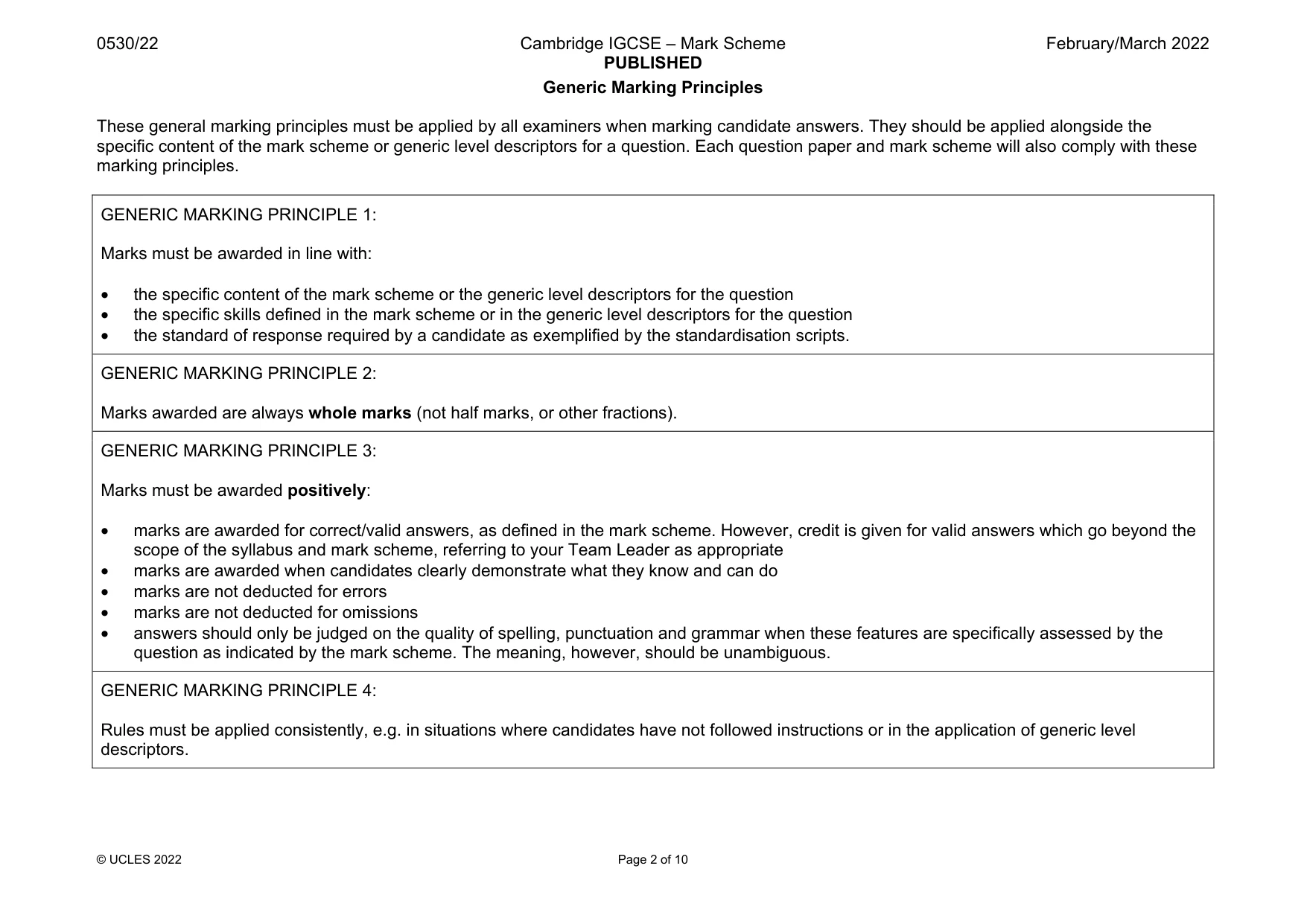
0530/22 Cambridge IGCSE – Mark Scheme PUBLISHED February/March 2022 © UCLES 2022 Page 2 of 10 Generic Marking Principles These general marking principles must be applied by all examiners when marking candidate answers. They should be applied alongside the specific content of the mark scheme or generic level descriptors for a question. Each question paper and mark scheme will also comply with these marking principles. GENERIC MARKING PRINCIPLE 1: Marks must be awarded in line with: • the specific content of the mark scheme or the generic level descriptors for the question • the specific skills defined in the mark scheme or in the generic level descriptors for the question • the standard of response required by a candidate as exemplified by the standardisation scripts. GENERIC MARKING PRINCIPLE 2: Marks awarded are always whole marks (not half marks, or other fractions). GENERIC MARKING PRINCIPLE 3: Marks must be awarded positively: • marks are awarded for correct/valid answers, as defined in the mark scheme. However, credit is given for valid answers which go beyond the scope of the syllabus and mark scheme, referring to your Team Leader as appropriate • marks are awarded when candidates clearly demonstrate what they know and can do • marks are not deducted for errors • marks are not deducted for omissions • answers should only be judged on the quality of spelling, punctuation and grammar when these features are specifically assessed by the question as indicated by the mark scheme. The meaning, however, should be unambiguous. GENERIC MARKING PRINCIPLE 4: Rules must be applied consistently, e.g. in situations where candidates have not followed instructions or in the application of generic level descriptors.
Mark scheme, page 3
0530/22 Cambridge IGCSE – Mark Scheme PUBLISHED February/March 2022 © UCLES 2022 Page 3 of 10 GENERIC MARKING PRINCIPLE 5: Marks should be awarded using the full range of marks defined in the mark scheme for the question (however; the use of the full mark range may be limited according to the quality of the candidate responses seen). GENERIC MARKING PRINCIPLE 6: Marks awarded are based solely on the requirements as defined in the mark scheme. Marks should not be awarded with grade thresholds or grade descriptors in mind.
Mark scheme, page 4
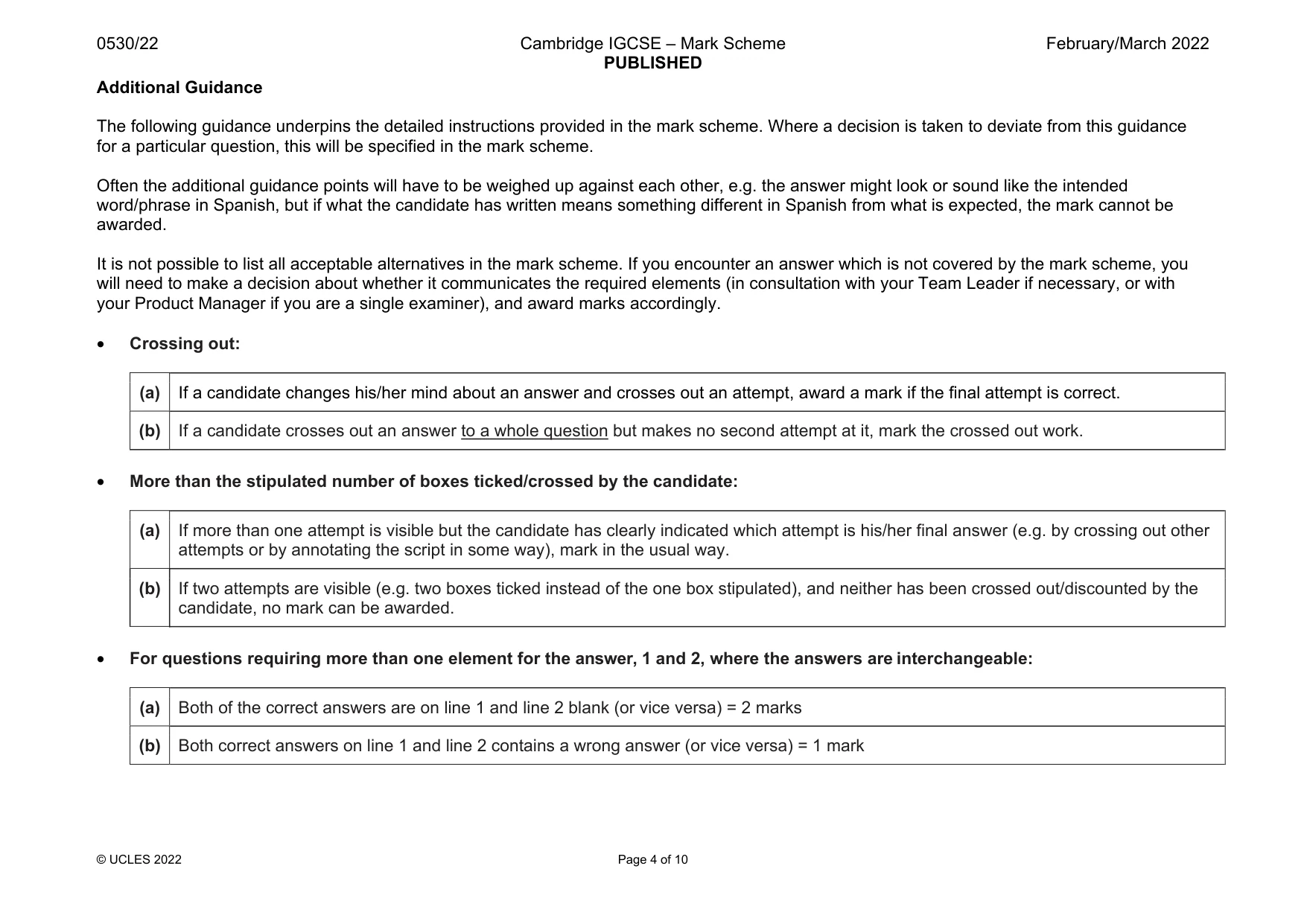
0530/22 Cambridge IGCSE – Mark Scheme PUBLISHED February/March 2022 © UCLES 2022 Page 4 of 10 Additional Guidance The following guidance underpins the detailed instructions provided in the mark scheme. Where a decision is taken to deviate from this guidance for a particular question, this will be specified in the mark scheme. Often the additional guidance points will have to be weighed up against each other, e.g. the answer might look or sound like the intended word/phrase in Spanish, but if what the candidate has written means something different in Spanish from what is expected, the mark cannot be awarded. It is not possible to list all acceptable alternatives in the mark scheme. If you encounter an answer which is not covered by the mark scheme, you will need to make a decision about whether it communicates the required elements (in consultation with your Team Leader if necessary, or with your Product Manager if you are a single examiner), and award marks accordingly. • Crossing out: (a) If a candidate changes his/her mind about an answer and crosses out an attempt, award a mark if the final attempt is correct. (b) If a candidate crosses out an answer to a whole question but makes no second attempt at it, mark the crossed out work. • More than the stipulated number of boxes ticked/crossed by the candidate: (a) If more than one attempt is visible but the candidate has clearly indicated which attempt is his/her final answer (e.g. by crossing out other attempts or by annotating the script in some way), mark in the usual way. (b) If two attempts are visible (e.g. two boxes ticked instead of the one box stipulated), and neither has been crossed out/discounted by the candidate, no mark can be awarded. • For questions requiring more than one element for the answer, 1 and 2, where the answers are interchangeable: (a) Both of the correct answers are on line 1 and line 2 blank (or vice versa) = 2 marks (b) Both correct answers on line 1 and line 2 contains a wrong answer (or vice versa) = 1 mark
Mark scheme, page 5
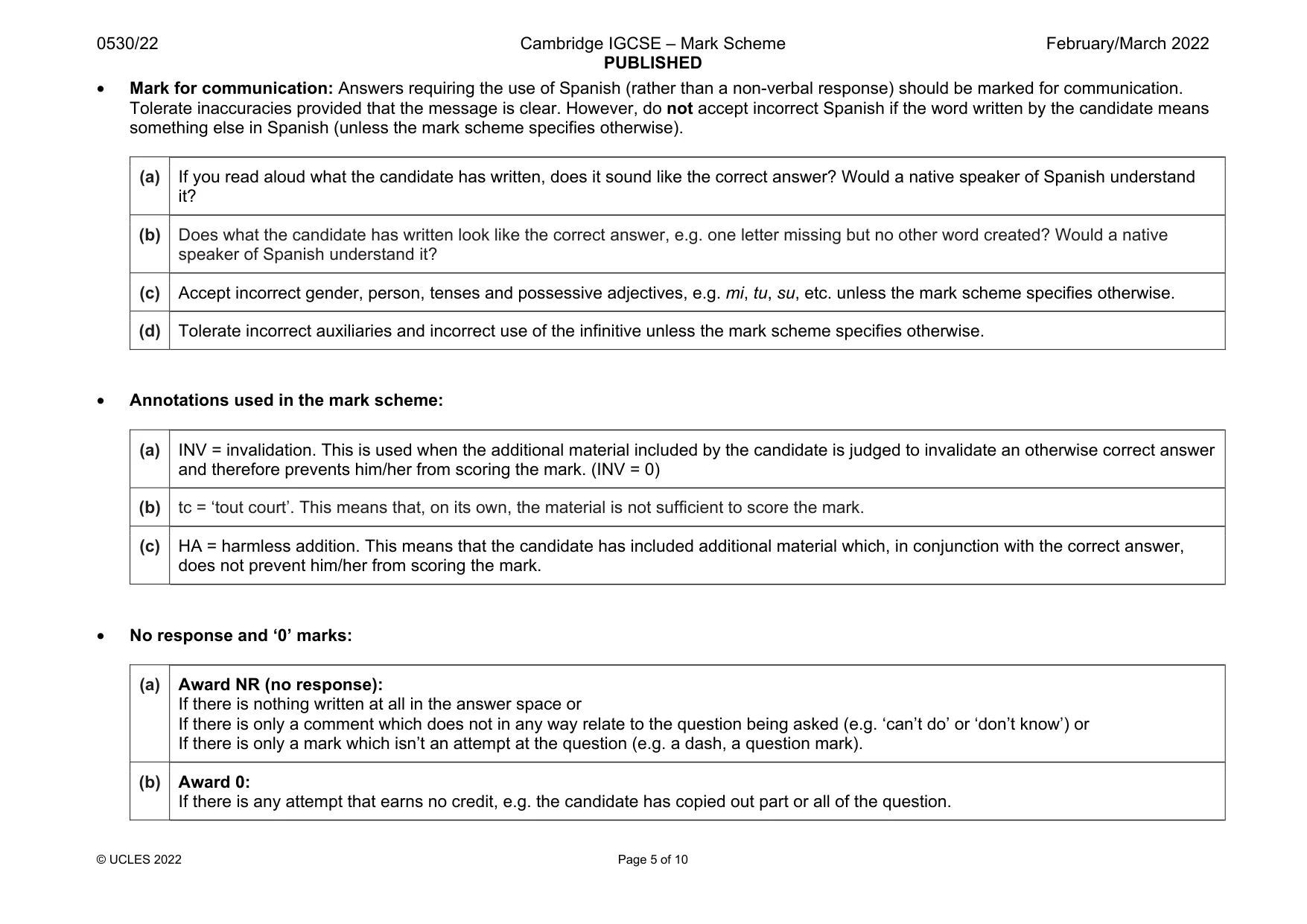
0530/22 Cambridge IGCSE – Mark Scheme PUBLISHED February/March 2022 © UCLES 2022 Page 5 of 10 • Mark for communication: Answers requiring the use of Spanish (rather than a non-verbal response) should be marked for communication. Tolerate inaccuracies provided that the message is clear. However, do not accept incorrect Spanish if the word written by the candidate means something else in Spanish (unless the mark scheme specifies otherwise). (a) If you read aloud what the candidate has written, does it sound like the correct answer? Would a native speaker of Spanish understand it? (b) Does what the candidate has written look like the correct answer, e.g. one letter missing but no other word created? Would a native speaker of Spanish understand it? (c) Accept incorrect gender, person, tenses and possessive adjectives, e.g. mi, tu, su, etc. unless the mark scheme specifies otherwise. (d) Tolerate incorrect auxiliaries and incorrect use of the infinitive unless the mark scheme specifies otherwise. • Annotations used in the mark scheme: (a) INV = invalidation. This is used when the additional material included by the candidate is judged to invalidate an otherwise correct answer and therefore prevents him/her from scoring the mark. (INV = 0) (b) tc = ‘tout court’. This means that, on its own, the material is not sufficient to score the mark. (c) HA = harmless addition. This means that the candidate has included additional material which, in conjunction with the correct answer, does not prevent him/her from scoring the mark. • No response and ‘0’ marks: (a) Award NR (no response): If there is nothing written at all in the answer space or If there is only a comment which does not in any way relate to the question being asked (e.g. ‘can’t do’ or ‘don’t know’) or If there is only a mark which isn’t an attempt at the question (e.g. a dash, a question mark). (b) Award 0: If there is any attempt that earns no credit, e.g. the candidate has copied out part or all of the question.
Mark scheme, page 6
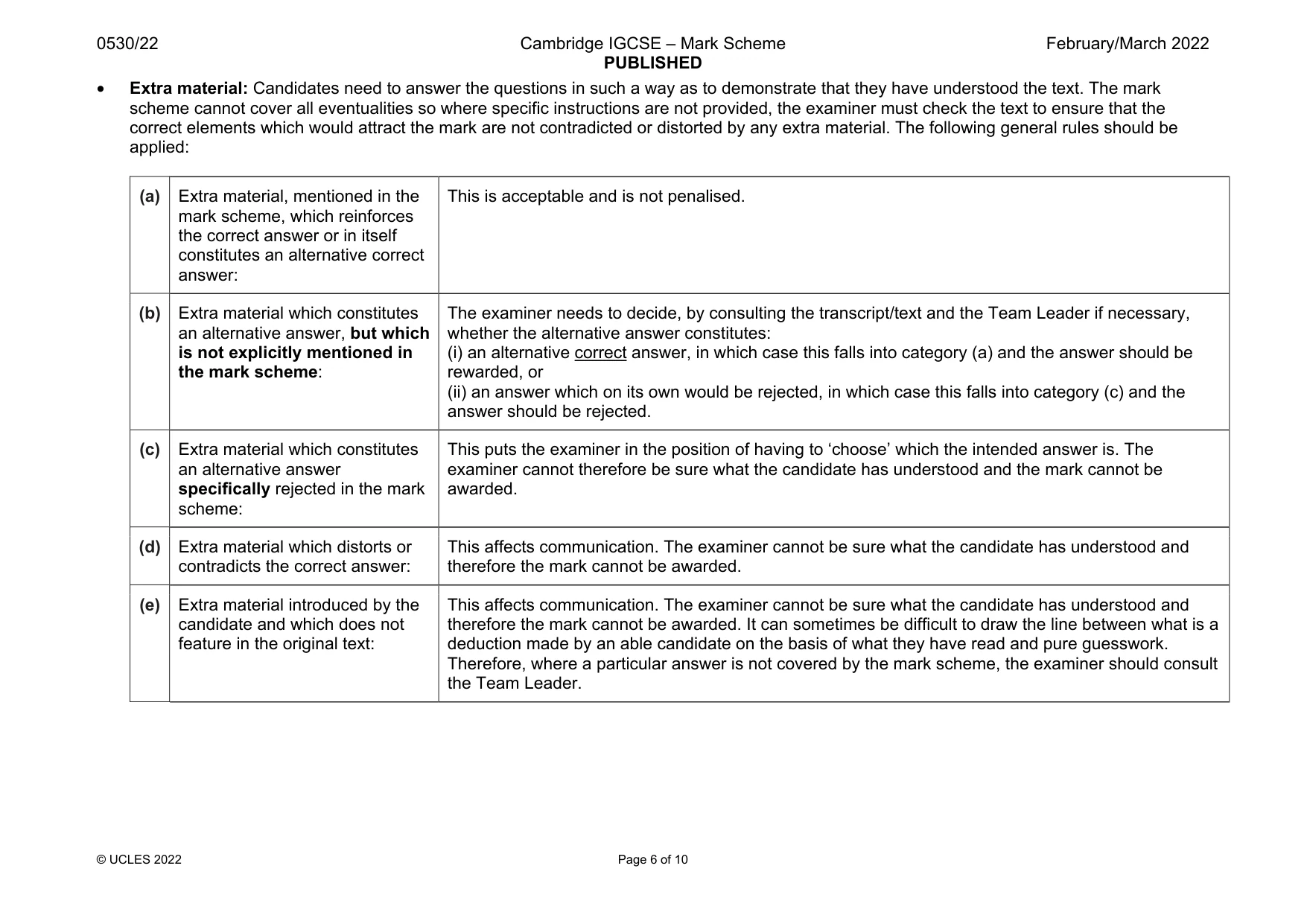
0530/22 Cambridge IGCSE – Mark Scheme PUBLISHED February/March 2022 © UCLES 2022 Page 6 of 10 • Extra material: Candidates need to answer the questions in such a way as to demonstrate that they have understood the text. The mark scheme cannot cover all eventualities so where specific instructions are not provided, the examiner must check the text to ensure that the correct elements which would attract the mark are not contradicted or distorted by any extra material. The following general rules should be applied: (a) Extra material, mentioned in the mark scheme, which reinforces the correct answer or in itself constitutes an alternative correct answer: This is acceptable and is not penalised. (b) Extra material which constitutes an alternative answer, but which is not explicitly mentioned in the mark scheme: The examiner needs to decide, by consulting the transcript/text and the Team Leader if necessary, whether the alternative answer constitutes: (i) an alternative correct answer, in which case this falls into category (a) and the answer should be rewarded, or (ii) an answer which on its own would be rejected, in which case this falls into category (c) and the answer should be rejected. (c) Extra material which constitutes an alternative answer specifically rejected in the mark scheme: This puts the examiner in the position of having to ‘choose’ which the intended answer is. The examiner cannot therefore be sure what the candidate has understood and the mark cannot be awarded. (d) Extra material which distorts or contradicts the correct answer: This affects communication. The examiner cannot be sure what the candidate has understood and therefore the mark cannot be awarded. (e) Extra material introduced by the candidate and which does not feature in the original text: This affects communication. The examiner cannot be sure what the candidate has understood and therefore the mark cannot be awarded. It can sometimes be difficult to draw the line between what is a deduction made by an able candidate on the basis of what they have read and pure guesswork. Therefore, where a particular answer is not covered by the mark scheme, the examiner should consult the Team Leader.
Mark scheme, page 7
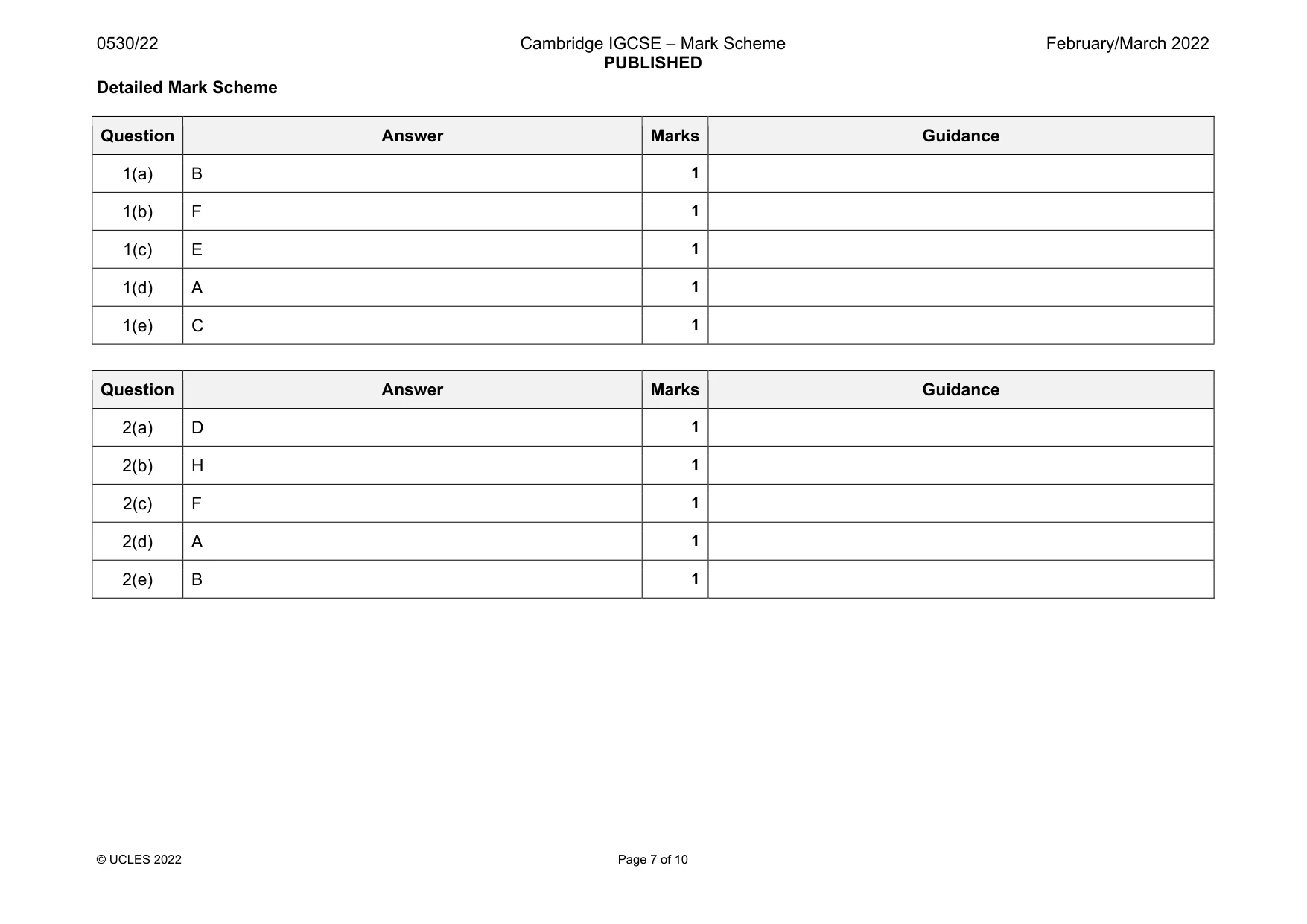
0530/22 Cambridge IGCSE – Mark Scheme PUBLISHED February/March 2022 © UCLES 2022 Page 7 of 10 Detailed Mark Scheme Question Answer Marks Guidance 1(a) B 1 1(b) F 1 1(c) E 1 1(d) A 1 1(e) C 1 Question Answer Marks Guidance 2(a) D 1 2(b) H 1 2(c) F 1 2(d) A 1 2(e) B 1
Mark scheme, page 8
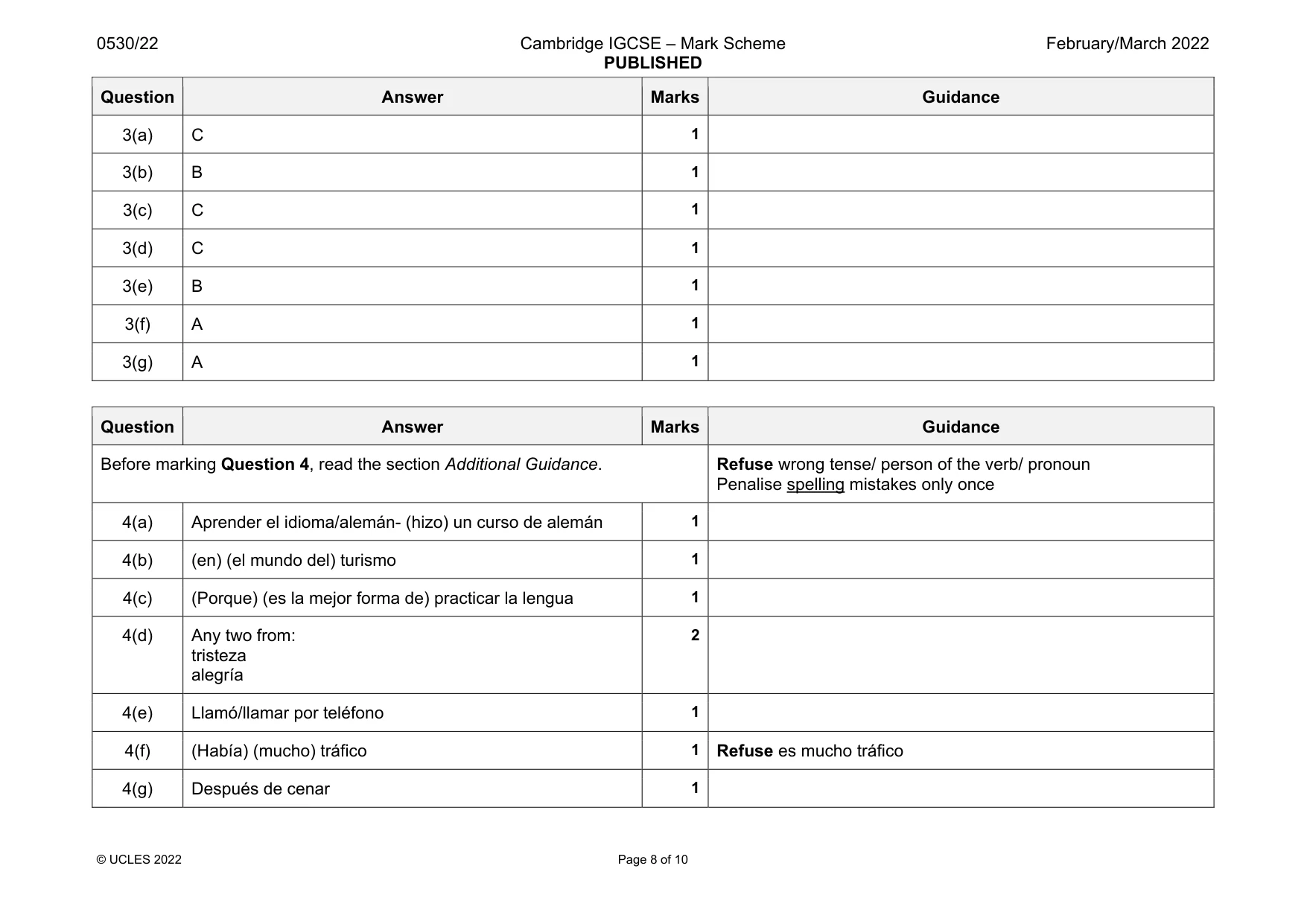
0530/22 Cambridge IGCSE – Mark Scheme PUBLISHED February/March 2022 © UCLES 2022 Page 8 of 10 Question Answer Marks Guidance 3(a) C 1 3(b) B 1 3(c) C 1 3(d) C 1 3(e) B 1 3(f) A 1 3(g) A 1 Question Answer Marks Guidance Before marking Question 4, read the section Additional Guidance. Refuse wrong tense/ person of the verb/ pronoun Penalise spelling mistakes only once 4(a) Aprender el idioma/alemán- (hizo) un curso de alemán 1 4(b) (en) (el mundo del) turismo 1 4(c) (Porque) (es la mejor forma de) practicar la lengua 1 4(d) Any two from: tristeza alegría 2 4(e) Llamó/llamar por teléfono 1 4(f) (Había) (mucho) tráfico 1 Refuse es mucho tráfico 4(g) Después de cenar 1
Mark scheme, page 9
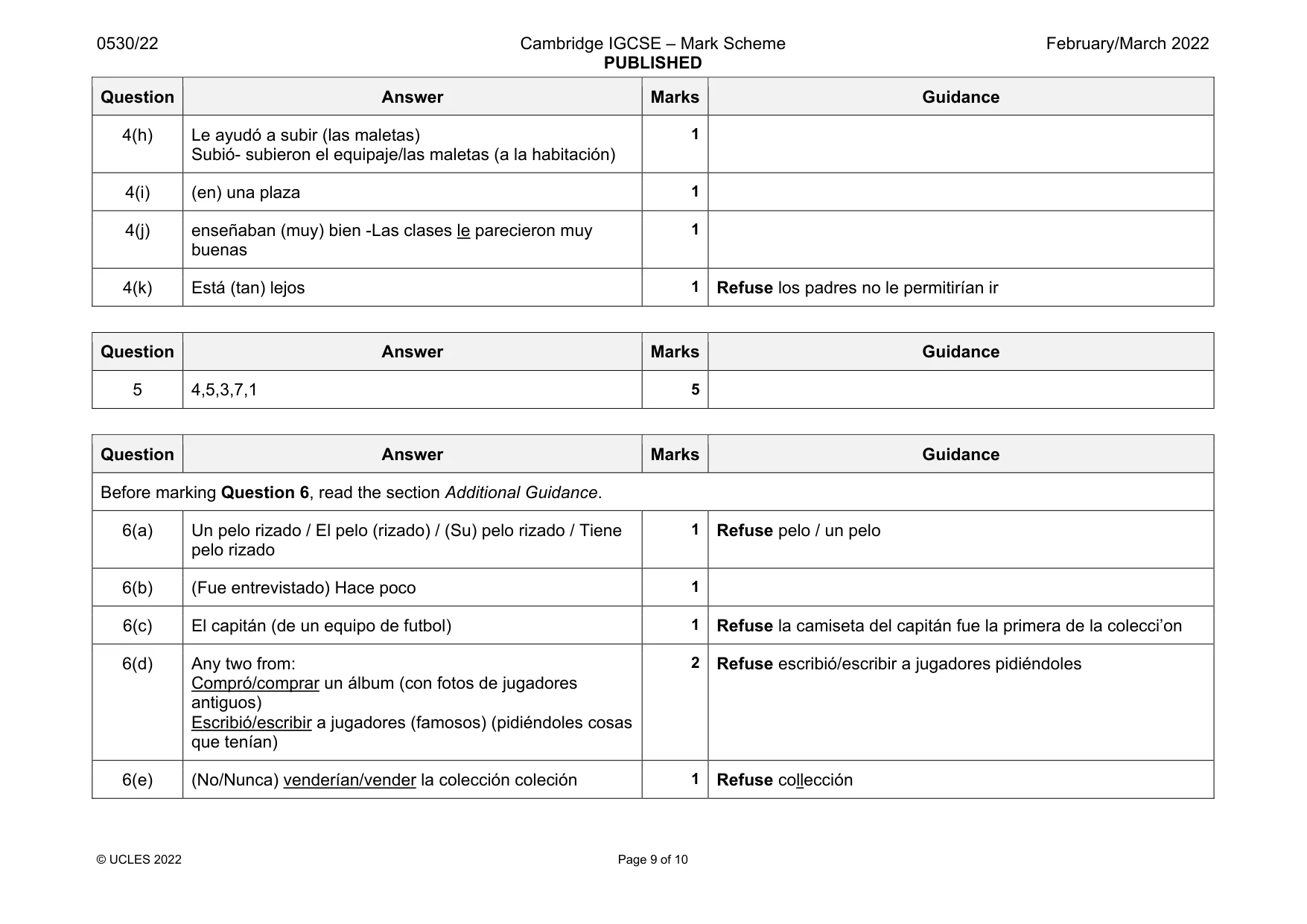
0530/22 Cambridge IGCSE – Mark Scheme PUBLISHED February/March 2022 © UCLES 2022 Page 9 of 10 Question Answer Marks Guidance 4(h) Le ayudó a subir (las maletas) Subió- subieron el equipaje/las maletas (a la habitación) 1 4(i) (en) una plaza 1 4(j) enseñaban (muy) bien -Las clases le parecieron muy buenas 1 4(k) Está (tan) lejos 1 Refuse los padres no le permitirían ir Question Answer Marks Guidance 5 4,5,3,7,1 5 Question Answer Marks Guidance Before marking Question 6, read the section Additional Guidance. 6(a) Un pelo rizado / El pelo (rizado) / (Su) pelo rizado / Tiene pelo rizado 1 Refuse pelo / un pelo 6(b) (Fue entrevistado) Hace poco 1 6(c) El capitán (de un equipo de futbol) 1 Refuse la camiseta del capitán fue la primera de la colecci’on 6(d) Any two from: Compró/comprar un álbum (con fotos de jugadores antiguos) Escribió/escribir a jugadores (famosos) (pidiéndoles cosas que tenían) 2 Refuse escribió/escribir a jugadores pidiéndoles 6(e) (No/Nunca) venderían/vender la colección coleción 1 Refuse collección
Mark scheme, page 10
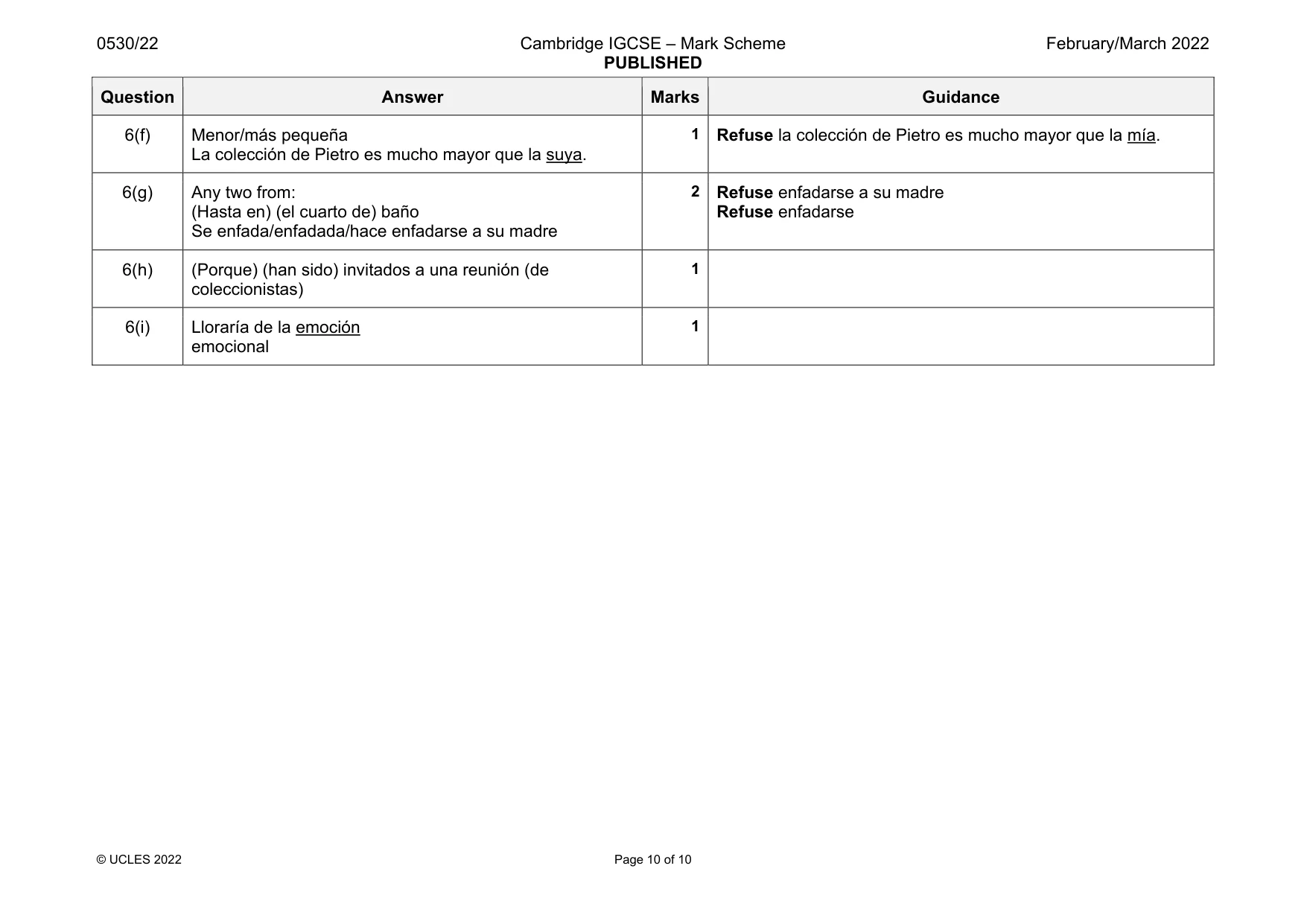
0530/22 Cambridge IGCSE – Mark Scheme PUBLISHED February/March 2022 © UCLES 2022 Page 10 of 10 Question Answer Marks Guidance 6(f) Menor/más pequeña La colección de Pietro es mucho mayor que la suya. 1 Refuse la colección de Pietro es mucho mayor que la mía. 6(g) Any two from: (Hasta en) (el cuarto de) baño Se enfada/enfadada/hace enfadarse a su madre 2 Refuse enfadarse a su madre Refuse enfadarse 6(h) (Porque) (han sido) invitados a una reunión (de coleccionistas) 1 6(i) Lloraría de la emoción emocional 1
What you needed in this session
Cambridge’s own grade thresholds for 2022 Feb/March, Paper 2 · Variant 2. A higher threshold means an easier paper — the bar moves with how the cohort did.