Cambridge IGCSE Spanish - Foreign Language 0530 — 2021 Feb/March Paper 2 · Variant 2
0530/22/F/M/21 · 45 marks · ≈51 min
The question paper and its mark scheme, free to read here and free to download. This is Cambridge’s own paper, exactly as it was sat.
Question paper12 pages

Mark scheme10 pages
Answers below. Sit the paper first if you are practising.
Paper as text
Question paper, page 1
This document has 12 pages. Any blank pages are indicated. DC (RW/CB) 207482/2 © UCLES 2021 [Turn over * 9 8 2 8 9 3 3 1 7 5 * SPANISH 0530/22 Paper 2 Reading February/March 2021 1 hour You must answer on the question paper. No additional materials are needed. INSTRUCTIONS ● Answer all questions. ● Use a black or dark blue pen. ● Write your name, centre number and candidate number in the boxes at the top of the page. ● Write your answer to each question in the space provided. ● Do not use an erasable pen or correction fluid. ● Do not write on any bar codes. ● Dictionaries are not allowed. INFORMATION ● The total mark for this paper is 45. ● The number of marks for each question or part question is shown in brackets [ ]. Cambridge IGCSE™
Question paper, page 2
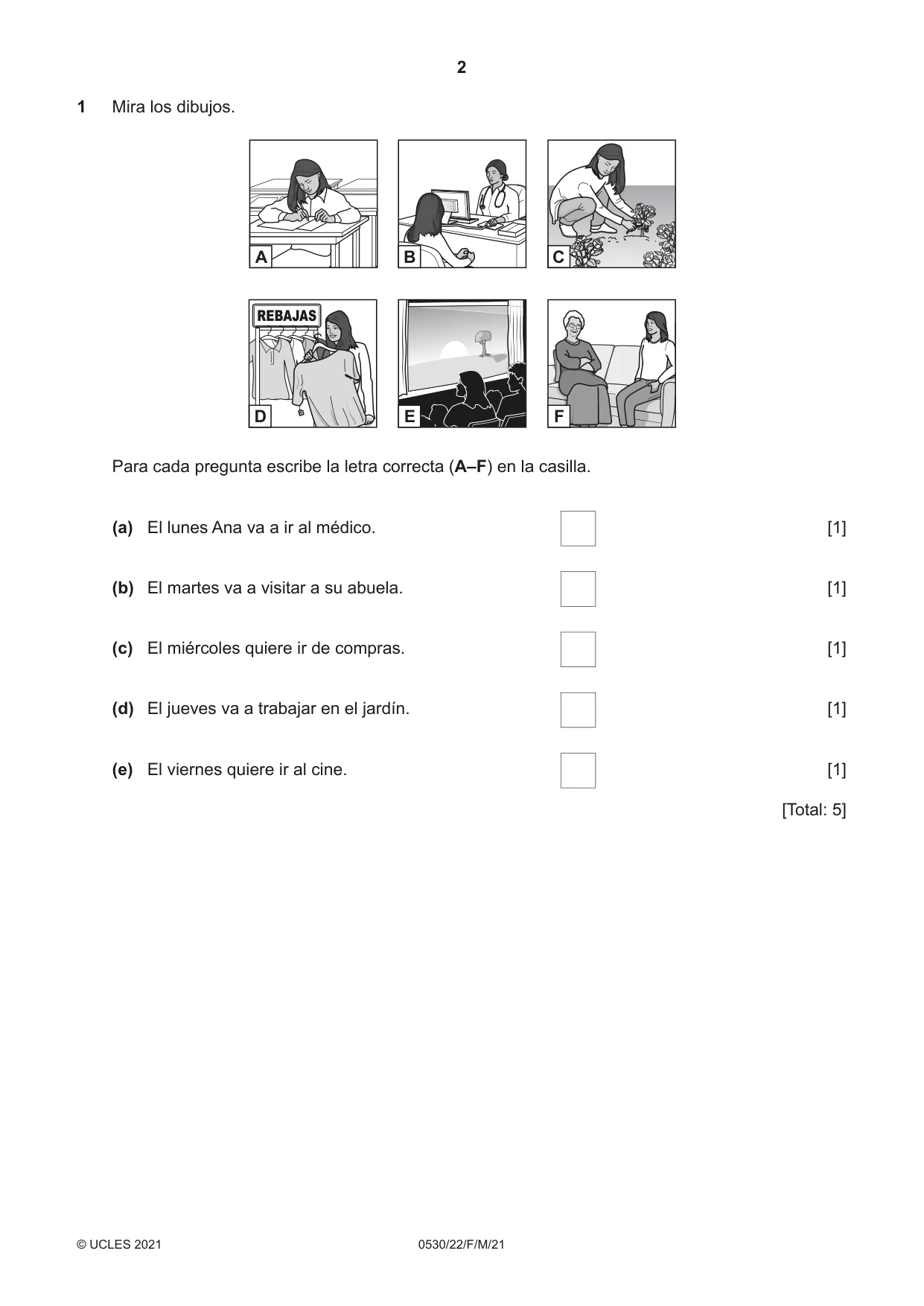
2 0530/22/ F /M /21 © UCLES 2021 1 Mira los dibujos. REBAJAS C B A E D F Para cada pregunta escribe la letra correcta (A–F) en la casilla. (a) El lunes Ana va a ir al médico. [1] (b) El martes va a visitar a su abuela. [1] (c) El miércoles quiere ir de compras. [1] (d) El jueves va a trabajar en el jardín. [1] (e) El viernes quiere ir al cine. [1] [Total: 5]
Question paper, page 3
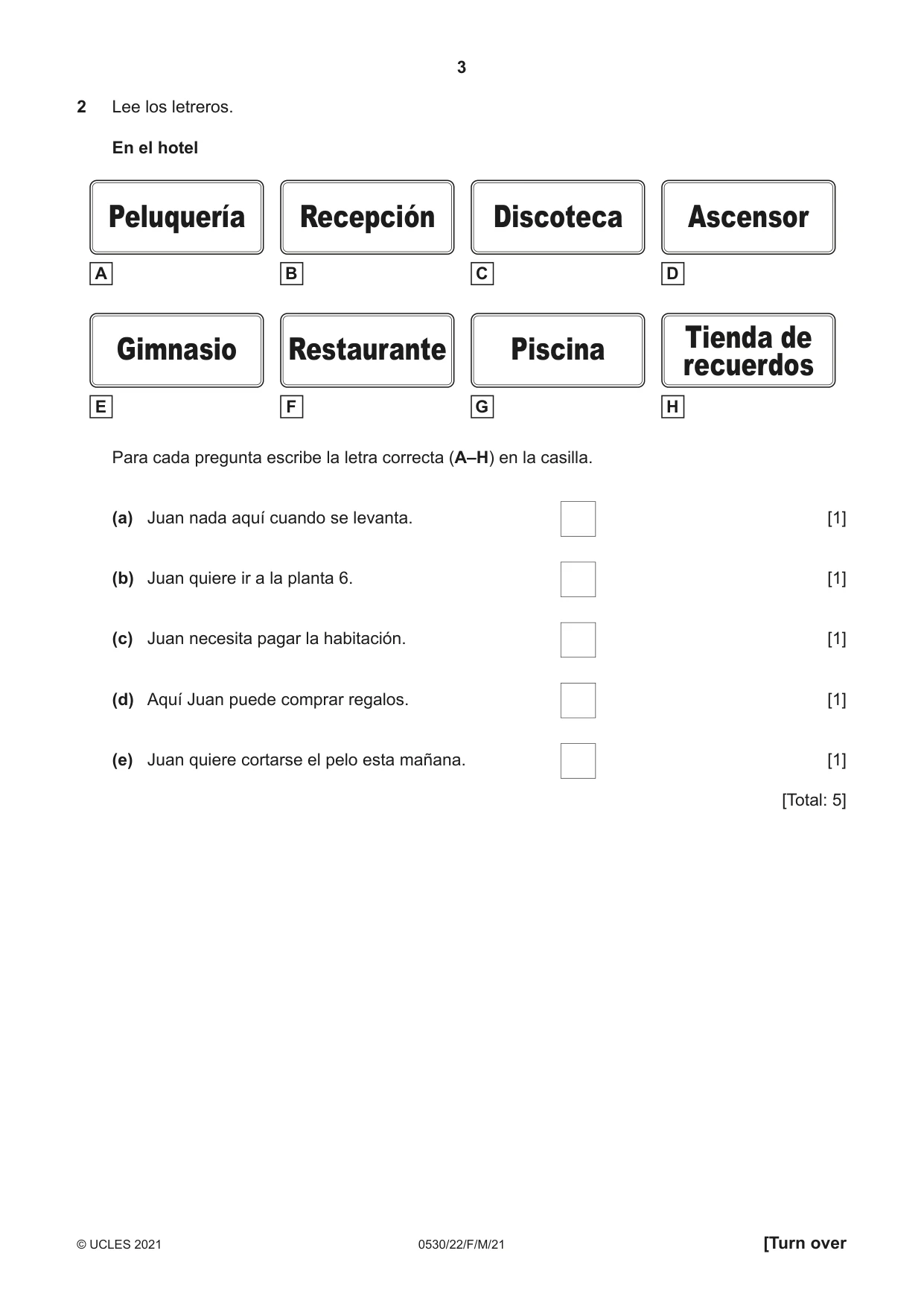
3 0530/22/F/M/21 © UCLES 2021 [Turn over 2 Lee los letreros. En el hotel Peluquería Gimnasio Restaurante Piscina Recepción Discoteca Ascensor Tienda de recuerdos A B C D E F G H Para cada pregunta escribe la letra correcta (A–H) en la casilla. (a) Juan nada aquí cuando se levanta. [1] (b) Juan quiere ir a la planta 6. [1] (c) Juan necesita pagar la habitación. [1] (d) Aquí Juan puede comprar regalos. [1] (e) Juan quiere cortarse el pelo esta mañana. [1] [Total: 5]
Question paper, page 4
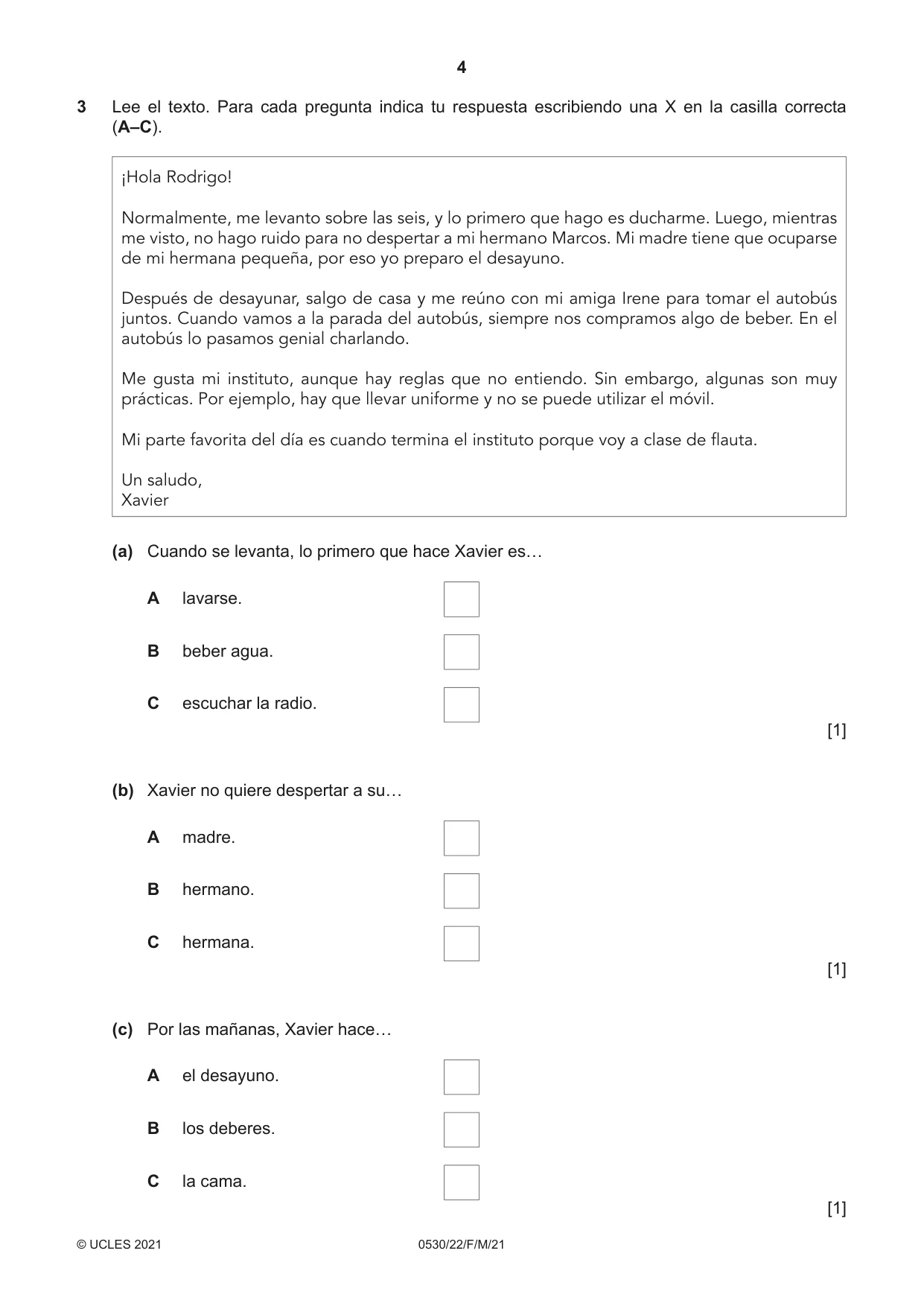
4 0530/22/F/M/21 © UCLES 2021 3 Lee el texto. Para cada pregunta indica tu respuesta escribiendo una X en la casilla correcta (A–C). ¡Hola Rodrigo! Normalmente, me levanto sobre las seis, y lo primero que hago es ducharme. Luego, mientras me visto, no hago ruido para no despertar a mi hermano Marcos. Mi madre tiene que ocuparse de mi hermana pequeña, por eso yo preparo el desayuno. Después de desayunar, salgo de casa y me reúno con mi amiga Irene para tomar el autobús juntos. Cuando vamos a la parada del autobús, siempre nos compramos algo de beber. En el autobús lo pasamos genial charlando. Me gusta mi instituto, aunque hay reglas que no entiendo. Sin embargo, algunas son muy prácticas. Por ejemplo, hay que llevar uniforme y no se puede utilizar el móvil. Mi parte favorita del día es cuando termina el instituto porque voy a clase de flauta. Un saludo, Xavier (a) Cuando se levanta, lo primero que hace Xavier es… A lavarse. B beber agua. C escuchar la radio. [1] (b) Xavier no quiere despertar a su… A madre. B hermano. C hermana. [1] (c) Por las mañanas, Xavier hace… A el desayuno. B los deberes. C la cama. [1]
Question paper, page 5
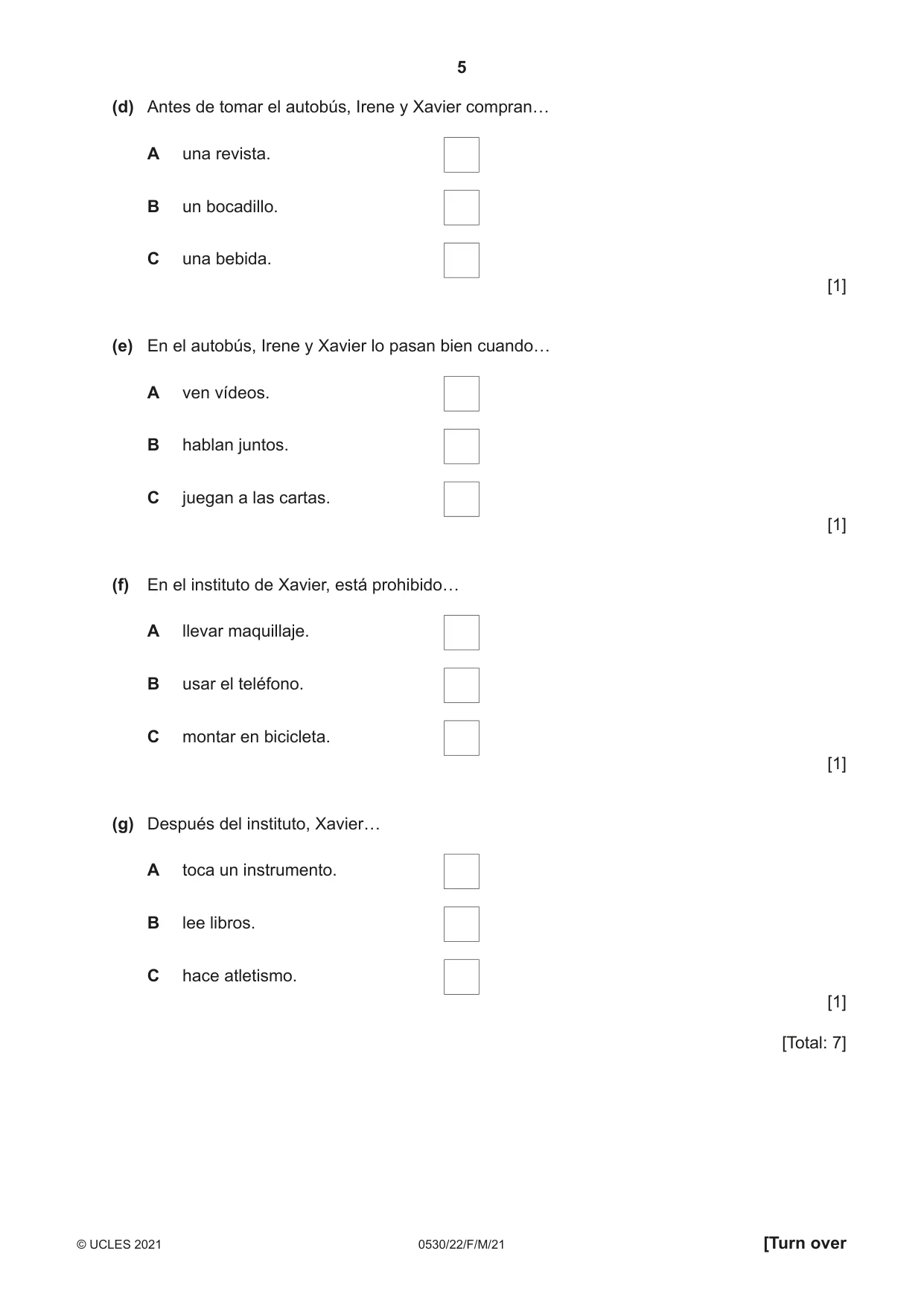
5 0530/22/F/M/21 © UCLES 2021 [Turn over (d) Antes de tomar el autobús, Irene y Xavier compran… A una revista. B un bocadillo. C una bebida. [1] (e) En el autobús, Irene y Xavier lo pasan bien cuando… A ven vídeos. B hablan juntos. C juegan a las cartas. [1] (f) En el instituto de Xavier, está prohibido… A llevar maquillaje. B usar el teléfono. C montar en bicicleta. [1] (g) Después del instituto, Xavier… A toca un instrumento. B lee libros. C hace atletismo. [1] [Total: 7]
Question paper, page 6
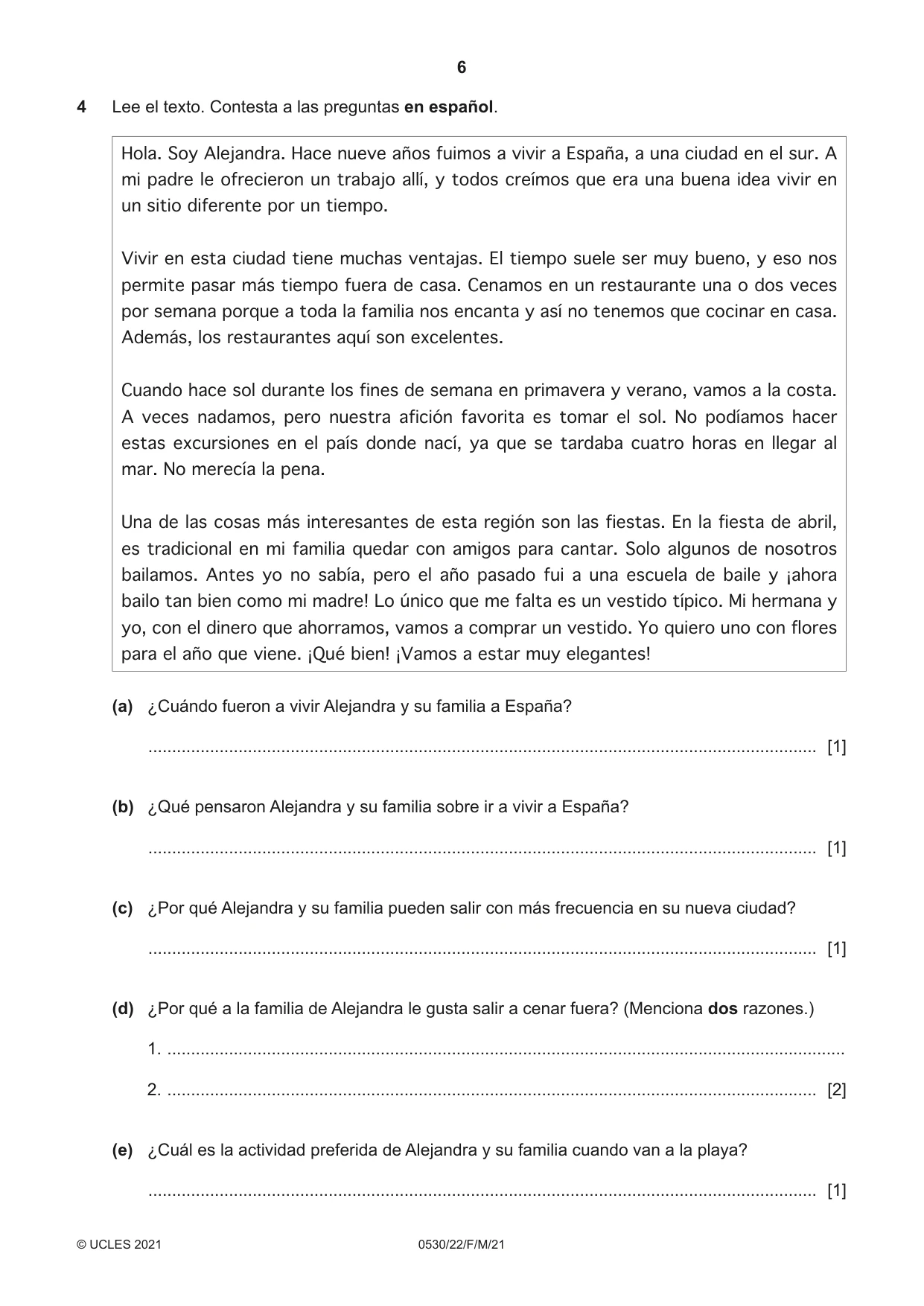
6 0530/22/F/M/21 © UCLES 2021 4 Lee el texto. Contesta a las preguntas en español. Hola. Soy Alejandra. Hace nueve años fuimos a vivir a España, a una ciudad en el sur. A mi padre le ofrecieron un trabajo allí, y todos creímos que era una buena idea vivir en un sitio diferente por un tiempo. Vivir en esta ciudad tiene muchas ventajas. El tiempo suele ser muy bueno, y eso nos permite pasar más tiempo fuera de casa. Cenamos en un restaurante una o dos veces por semana porque a toda la familia nos encanta y así no tenemos que cocinar en casa. Además, los restaurantes aquí son excelentes. Cuando hace sol durante los fines de semana en primavera y verano, vamos a la costa. A veces nadamos, pero nuestra afición favorita es tomar el sol. No podíamos hacer estas excursiones en el país donde nací, ya que se tardaba cuatro horas en llegar al mar. No merecía la pena. Una de las cosas más interesantes de esta región son las fiestas. En la fiesta de abril, es tradicional en mi familia quedar con amigos para cantar. Solo algunos de nosotros bailamos. Antes yo no sabía, pero el año pasado fui a una escuela de baile y ¡ahora bailo tan bien como mi madre! Lo único que me falta es un vestido típico. Mi hermana y yo, con el dinero que ahorramos, vamos a comprar un vestido. Yo quiero uno con flores para el año que viene. ¡Qué bien! ¡Vamos a estar muy elegantes! (a) ¿Cuándo fueron a vivir Alejandra y su familia a España? … [1] (b) ¿Qué pensaron Alejandra y su familia sobre ir a vivir a España? … [1] (c) ¿Por qué Alejandra y su familia pueden salir con más frecuencia en su nueva ciudad? … [1] (d) ¿Por qué a la familia de Alejandra le gusta salir a cenar fuera? (Menciona dos razones.) 1. … 2. … [2] (e) ¿Cuál es la actividad preferida de Alejandra y su familia cuando van a la playa? … [1]
Question paper, page 7
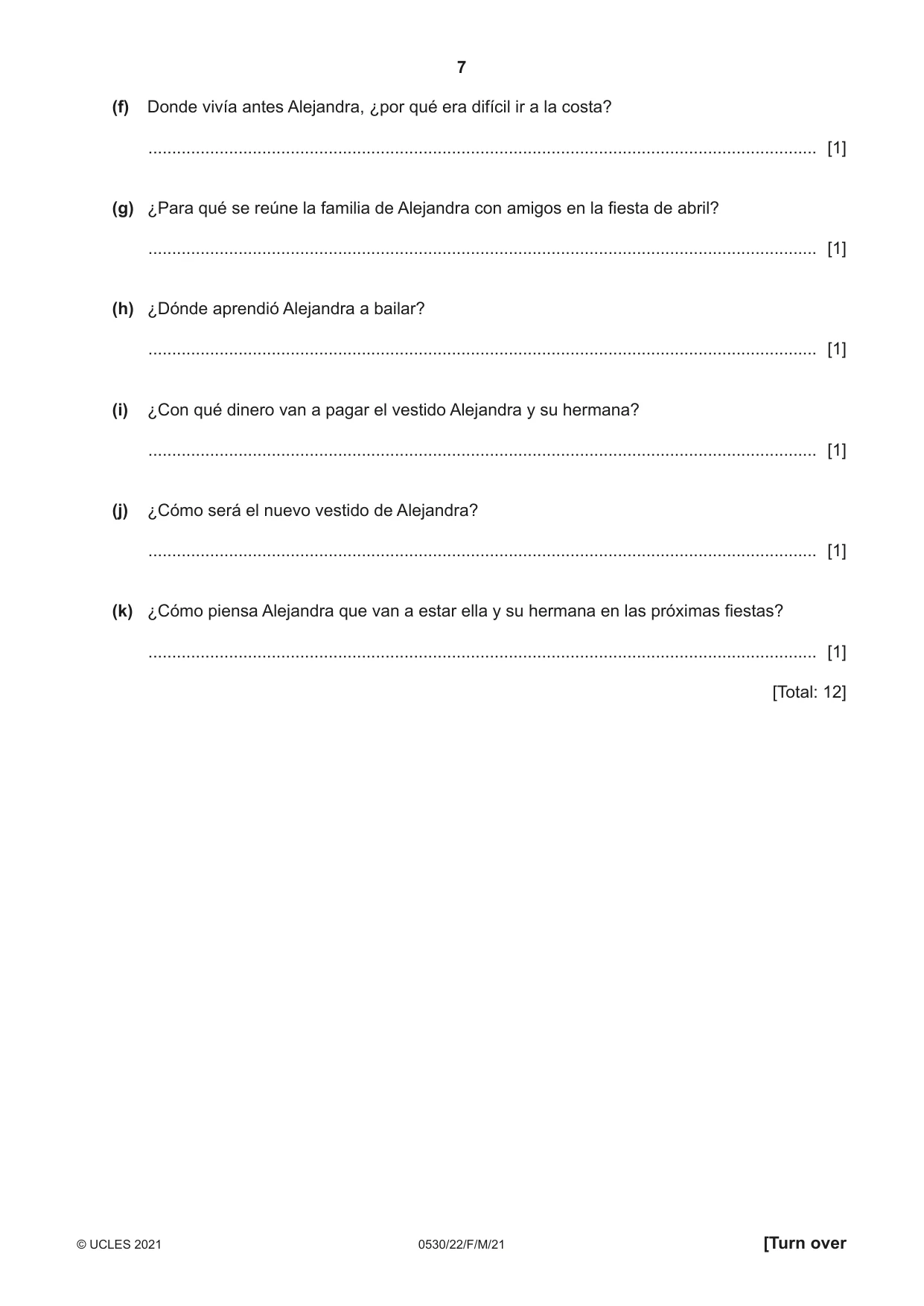
7 0530/22/F/M/21 © UCLES 2021 [Turn over (f) Donde vivía antes Alejandra, ¿por qué era difícil ir a la costa? … [1] (g) ¿Para qué se reúne la familia de Alejandra con amigos en la fiesta de abril? … [1] (h) ¿Dónde aprendió Alejandra a bailar? … [1] (i) ¿Con qué dinero van a pagar el vestido Alejandra y su hermana? … [1] (j) ¿Cómo será el nuevo vestido de Alejandra? … [1] (k) ¿Cómo piensa Alejandra que van a estar ella y su hermana en las próximas fiestas? … [1] [Total: 12]
Question paper, page 8
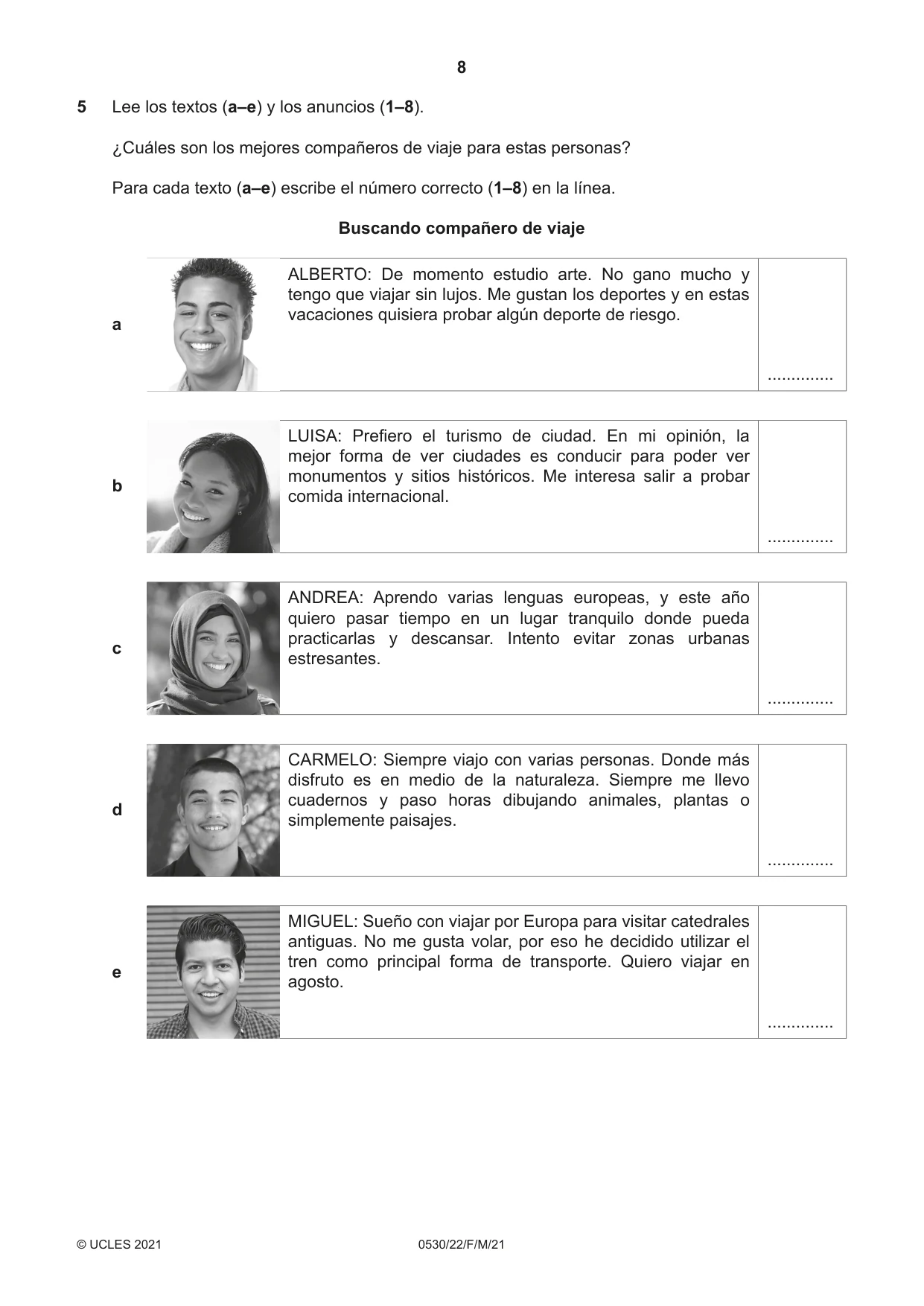
8 0530/22/F/M/21 © UCLES 2021 5 Lee los textos (a–e) y los anuncios (1–8). ¿Cuáles son los mejores compañeros de viaje para estas personas? Para cada texto (a–e) escribe el número correcto (1–8) en la línea. Buscando compañero de viaje a ALBERTO: De momento estudio arte. No gano mucho y tengo que viajar sin lujos. Me gustan los deportes y en estas vacaciones quisiera probar algún deporte de riesgo. … b LUISA: Prefiero el turismo de ciudad. En mi opinión, la mejor forma de ver ciudades es conducir para poder ver monumentos y sitios históricos. Me interesa salir a probar comida internacional. … c ANDREA: Aprendo varias lenguas europeas, y este año quiero pasar tiempo en un lugar tranquilo donde pueda practicarlas y descansar. Intento evitar zonas urbanas estresantes. … d CARMELO: Siempre viajo con varias personas. Donde más disfruto es en medio de la naturaleza. Siempre me llevo cuadernos y paso horas dibujando animales, plantas o simplemente paisajes. … e MIGUEL: Sueño con viajar por Europa para visitar catedrales antiguas. No me gusta volar, por eso he decidido utilizar el tren como principal forma de transporte. Quiero viajar en agosto. …
Question paper, page 9
9 0530/22/F/M/21 © UCLES 2021 [Turn over 1 Si sabes hablar idiomas y te gustaría hablar con gente nativa para mejorarlos, entonces acompáñame al destino ideal. Voy a un pueblo pequeño para pasar un tiempo con los habitantes del lugar. 2 Somos tres amigos que buscamos a una cuarta persona. Le tiene que gustar pasar tiempo al aire libre y disfrutar del campo. Los tres somos conductores, así que no es necesario saber conducir. ¡No dudes en escribirnos! 3 El año pasado vi un documental sobre las montañas de Canadá, y me encantaría ir con otra persona. Debes tener en cuenta que no es un viaje barato. Tengo planes para hacer muchas actividades deportivas, entre ellas el esquí. ¡Anímate! 4 Necesito un compañero de viaje para compartir un coche de alquiler y visitar capitales famosas. También me interesa mucho la cocina extranjera y quiero probar distintos tipos de restaurantes internacionales. 5 Como tengo poco dinero, a mi futuro compañero de viaje no le importará viajar en transporte público y quedarse en alojamiento básico. Me encantan los deportes y quisiera probar la escalada en estas vacaciones. 6 Busco compañía para un viaje en autocar en el lugar de mis sueños: Japón. Si eres aficionado a los cómics japoneses y te chifla la comida japonesa, ¡entonces vente! Si además puedes hablar japonés, ¡este es tu viaje! 7 Si eres alguien a quien le preocupa la contaminación, ¡has encontrado a la persona perfecta para compartir viaje en julio! Quiero conocer muchas ciudades del mundo, pero sin utilizar transportes que dañan la naturaleza como el avión y el coche. 8 ¿Te gusta el arte? ¿Quieres visitar los edificios históricos de otros países? Si te interesan la arquitectura y el arte, conmigo lo vas a pasar en grande. Prefiero alojarme en albergues y cocinar mi propia comida. [5]
Question paper, page 10
10 0530/22/F/M/21 © UCLES 2021 6 Lee el texto. Contesta a las preguntas en español. El proyecto Mar Limpio Sandra y un grupo de sus amigos del club de surf iban a ir a las competiciones en Puerto Rico por segunda vez. Sin embargo, esta vez iban a poder participar, por lo que estaban muy felices. Por supuesto, también sabían que verían peces exóticos. Eso les hacía ilusión. Después de dejar su equipaje en el hotel, Sandra le pidió a su amiga Emilia bajar a la playa con ella. “Ya veo. ¡Quieres empezar a hacer surf inmediatamente! ¡Qué impaciente eres!” le dijo Emilia. Sin embargo, al entrar en el agua, algo extraño le llamó la atención a Sandra. Se dio cuenta de que, en vez de peces, había trozos de plástico en el fondo. Salió inmediatamente del agua, triste, y decidió en ese momento que tenía que hacer algo para evitar el aumento de este desastre ecológico. Cuando volvieron a casa, lo primero que hizo Sandra fue contar a sus compañeros de instituto lo que vio durante su tiempo en Puerto Rico. Les dijo a continuación lo preocupada que estaba y que necesitaba hacer algo. Entonces uno de sus compañeros, Luis, tuvo una idea. “¿Por qué no hacemos canciones para informar a la gente sobre la situación?” preguntó. “A todo el mundo, creo yo, le gusta la música.” “¡Qué buena idea!” dijo Sandra. “¿Hacemos un concurso? Después, la canción que reciba el primer premio, podríamos ponerla en las redes sociales.” “Sí, ¡y la mandaríamos a la radio!” contestó Luis, entusiasmado. Así fue como empezó el proyecto Mar Limpio. Gracias al éxito de la canción ganadora, muchas personas se ponen en contacto con Sandra cada día para ofrecerse como voluntarios. Ahora unos quinientos de estos voluntarios participan semanalmente quitando plástico y otra basura de las costas. “Me sorprende muchísimo todo lo que hemos conseguido,” dice Sandra. “Sobre todo hemos quitado miles de kilos de basura de las costas y eso es lo que más ha merecido la pena.” (a) ¿Por qué se sentían contentos Sandra y sus amigos? (Menciona dos razones.) 1. … 2. … [2]
Question paper, page 11
11 0530/22/F/M/21 © UCLES 2021 (b) ¿Qué hizo pensar a Emilia que Sandra era impaciente? … [1] (c) ¿Cuándo vio Sandra que había plástico en el mar? … [1] (d) Según lo que dijo Sandra a otros alumnos, ¿cómo se sentía sobre el problema del plástico? … [1] (e) ¿Por qué Luis pensó que las canciones serían una buena manera de informar? … [1] (f) ¿Qué iban a hacer Sandra y Luis con la canción ganadora en el concurso? (Menciona dos detalles.) 1. … 2. … [2] (g) ¿Con qué frecuencia limpian los voluntarios la costa? … [1] (h) ¿Cómo reacciona Sandra al ver los resultados de lo que han logrado? … [1] (i) Según Sandra, ¿qué es lo mejor que han hecho los voluntarios? … [1] [Total: 11]
Question paper, page 12
12 0530/22/F/M/21 © UCLES 2021 Permission to reproduce items where third-party owned material protected by copyright is included has been sought and cleared where possible. Every reasonable effort has been made by the publisher (UCLES) to trace copyright holders, but if any items requiring clearance have unwittingly been included, the publisher will be pleased to make amends at the earliest possible opportunity. To avoid the issue of disclosure of answer-related information to candidates, all copyright acknowledgements are reproduced online in the Cambridge Assessment International Education Copyright Acknowledgements Booklet. This is produced for each series of examinations and is freely available to download at www.cambridgeinternational.org after the live examination series. Cambridge Assessment International Education is part of the Cambridge Assessment Group. Cambridge Assessment is the brand name of the University of Cambridge Local Examinations Syndicate (UCLES), which itself is a department of the University of Cambridge. BLANK PAGE
Mark scheme, page 1
This document consists of 10 printed pages. © UCLES 2021 [Turn over Cambridge IGCSE™ FOREIGN LANGUAGE SPANISH 0530/22 Paper 2 Reading March 2021 MARK SCHEME Maximum Mark: 45 Published This mark scheme is published as an aid to teachers and candidates, to indicate the requirements of the examination. It shows the basis on which Examiners were instructed to award marks. It does not indicate the details of the discussions that took place at an Examiners’ meeting before marking began, which would have considered the acceptability of alternative answers. Mark schemes should be read in conjunction with the question paper and the Principal Examiner Report for Teachers. Cambridge International will not enter into discussions about these mark schemes. Cambridge International is publishing the mark schemes for the March 2021 series for most Cambridge IGCSE™, Cambridge International A and AS Level components and some Cambridge O Level components.
Mark scheme, page 2
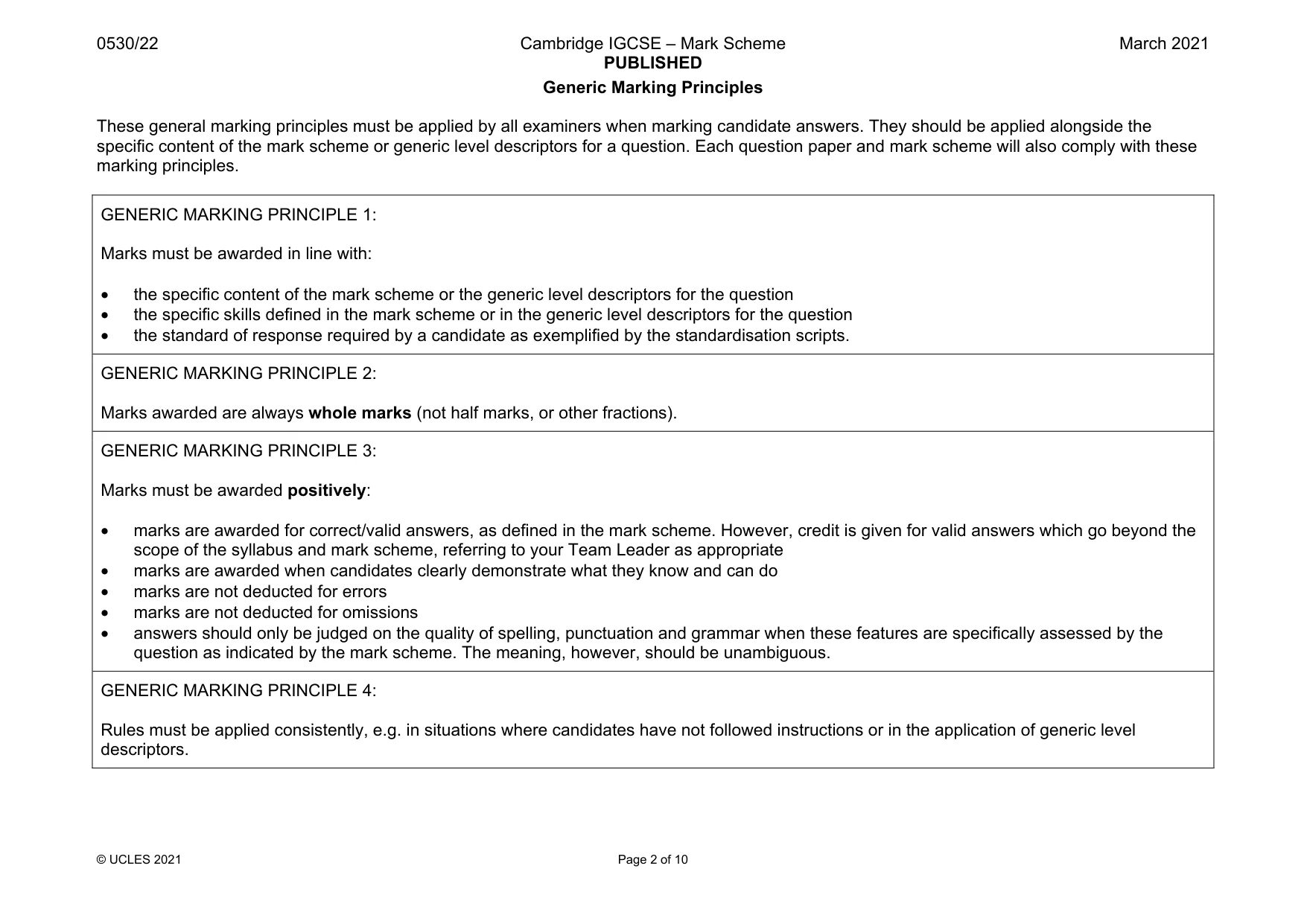
0530/22 Cambridge IGCSE – Mark Scheme PUBLISHED March 2021 © UCLES 2021 Page 2 of 10 Generic Marking Principles These general marking principles must be applied by all examiners when marking candidate answers. They should be applied alongside the specific content of the mark scheme or generic level descriptors for a question. Each question paper and mark scheme will also comply with these marking principles. GENERIC MARKING PRINCIPLE 1: Marks must be awarded in line with: • the specific content of the mark scheme or the generic level descriptors for the question • the specific skills defined in the mark scheme or in the generic level descriptors for the question • the standard of response required by a candidate as exemplified by the standardisation scripts. GENERIC MARKING PRINCIPLE 2: Marks awarded are always whole marks (not half marks, or other fractions). GENERIC MARKING PRINCIPLE 3: Marks must be awarded positively: • marks are awarded for correct/valid answers, as defined in the mark scheme. However, credit is given for valid answers which go beyond the scope of the syllabus and mark scheme, referring to your Team Leader as appropriate • marks are awarded when candidates clearly demonstrate what they know and can do • marks are not deducted for errors • marks are not deducted for omissions • answers should only be judged on the quality of spelling, punctuation and grammar when these features are specifically assessed by the question as indicated by the mark scheme. The meaning, however, should be unambiguous. GENERIC MARKING PRINCIPLE 4: Rules must be applied consistently, e.g. in situations where candidates have not followed instructions or in the application of generic level descriptors.
Mark scheme, page 3
0530/22 Cambridge IGCSE – Mark Scheme PUBLISHED March 2021 © UCLES 2021 Page 3 of 10 GENERIC MARKING PRINCIPLE 5: Marks should be awarded using the full range of marks defined in the mark scheme for the question (however; the use of the full mark range may be limited according to the quality of the candidate responses seen). GENERIC MARKING PRINCIPLE 6: Marks awarded are based solely on the requirements as defined in the mark scheme. Marks should not be awarded with grade thresholds or grade descriptors in mind.
Mark scheme, page 4
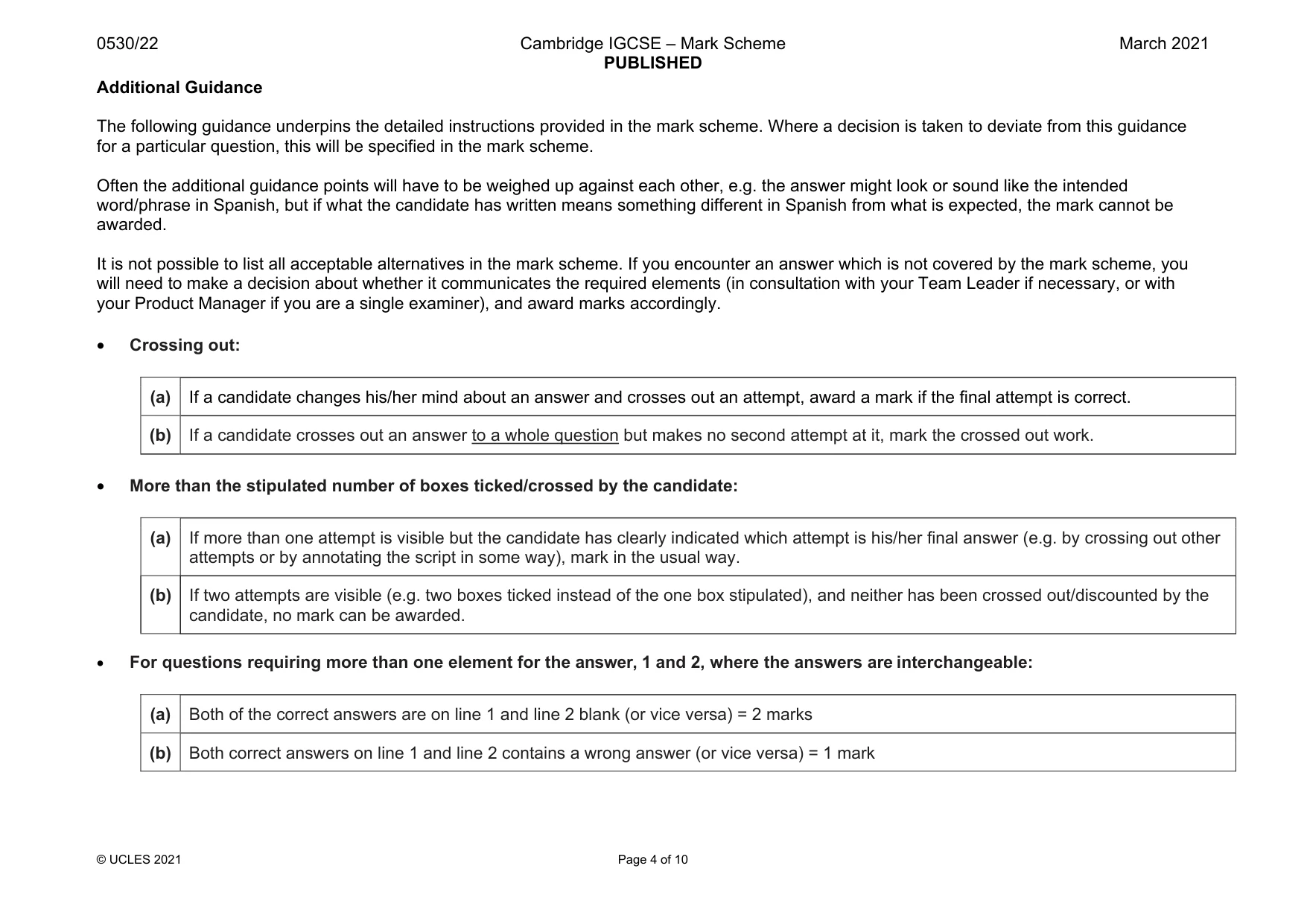
0530/22 Cambridge IGCSE – Mark Scheme PUBLISHED March 2021 © UCLES 2021 Page 4 of 10 Additional Guidance The following guidance underpins the detailed instructions provided in the mark scheme. Where a decision is taken to deviate from this guidance for a particular question, this will be specified in the mark scheme. Often the additional guidance points will have to be weighed up against each other, e.g. the answer might look or sound like the intended word/phrase in Spanish, but if what the candidate has written means something different in Spanish from what is expected, the mark cannot be awarded. It is not possible to list all acceptable alternatives in the mark scheme. If you encounter an answer which is not covered by the mark scheme, you will need to make a decision about whether it communicates the required elements (in consultation with your Team Leader if necessary, or with your Product Manager if you are a single examiner), and award marks accordingly. • Crossing out: (a) If a candidate changes his/her mind about an answer and crosses out an attempt, award a mark if the final attempt is correct. (b) If a candidate crosses out an answer to a whole question but makes no second attempt at it, mark the crossed out work. • More than the stipulated number of boxes ticked/crossed by the candidate: (a) If more than one attempt is visible but the candidate has clearly indicated which attempt is his/her final answer (e.g. by crossing out other attempts or by annotating the script in some way), mark in the usual way. (b) If two attempts are visible (e.g. two boxes ticked instead of the one box stipulated), and neither has been crossed out/discounted by the candidate, no mark can be awarded. • For questions requiring more than one element for the answer, 1 and 2, where the answers are interchangeable: (a) Both of the correct answers are on line 1 and line 2 blank (or vice versa) = 2 marks (b) Both correct answers on line 1 and line 2 contains a wrong answer (or vice versa) = 1 mark
Mark scheme, page 5
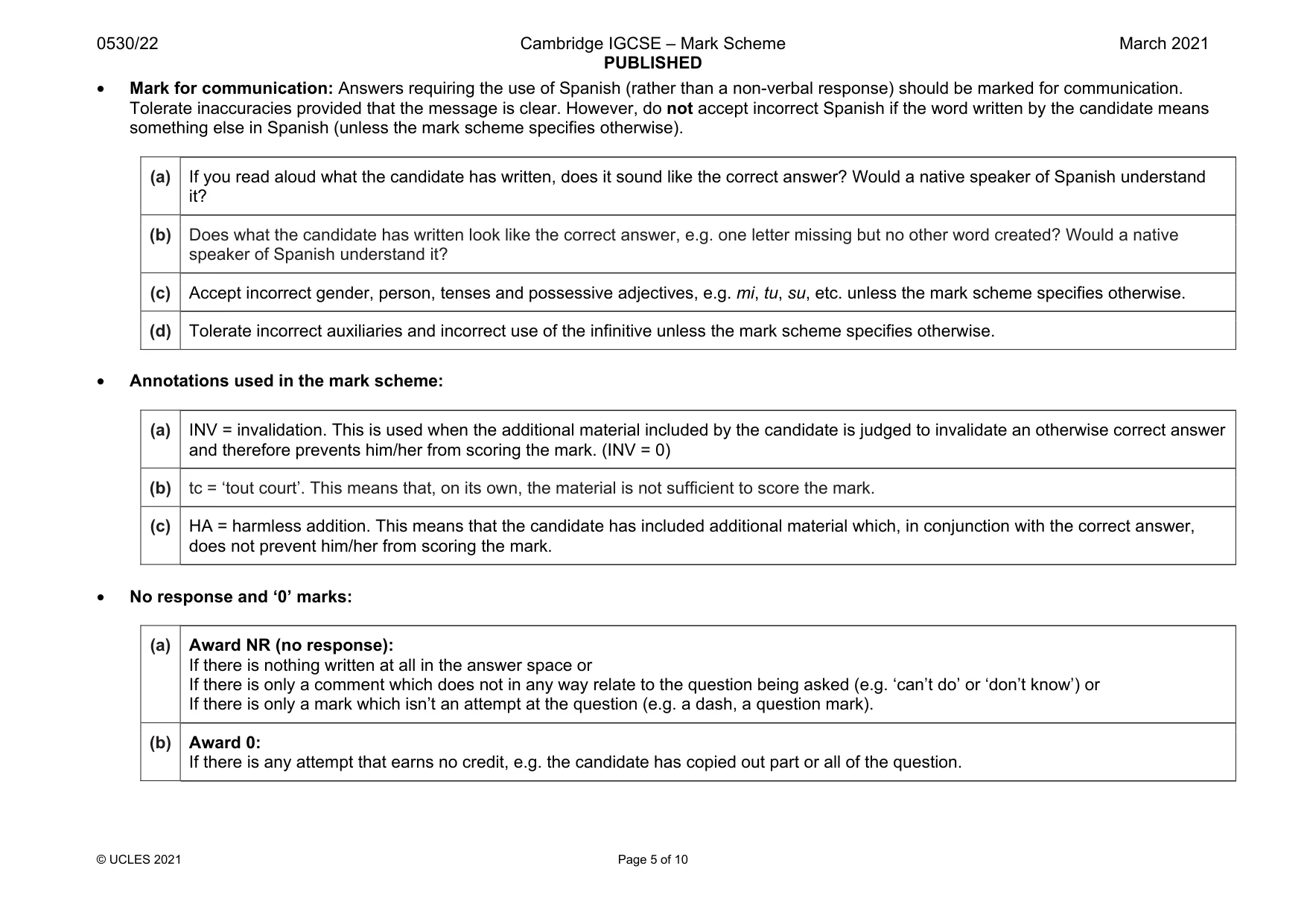
0530/22 Cambridge IGCSE – Mark Scheme PUBLISHED March 2021 © UCLES 2021 Page 5 of 10 • Mark for communication: Answers requiring the use of Spanish (rather than a non-verbal response) should be marked for communication. Tolerate inaccuracies provided that the message is clear. However, do not accept incorrect Spanish if the word written by the candidate means something else in Spanish (unless the mark scheme specifies otherwise). (a) If you read aloud what the candidate has written, does it sound like the correct answer? Would a native speaker of Spanish understand it? (b) Does what the candidate has written look like the correct answer, e.g. one letter missing but no other word created? Would a native speaker of Spanish understand it? (c) Accept incorrect gender, person, tenses and possessive adjectives, e.g. mi, tu, su, etc. unless the mark scheme specifies otherwise. (d) Tolerate incorrect auxiliaries and incorrect use of the infinitive unless the mark scheme specifies otherwise. • Annotations used in the mark scheme: (a) INV = invalidation. This is used when the additional material included by the candidate is judged to invalidate an otherwise correct answer and therefore prevents him/her from scoring the mark. (INV = 0) (b) tc = ‘tout court’. This means that, on its own, the material is not sufficient to score the mark. (c) HA = harmless addition. This means that the candidate has included additional material which, in conjunction with the correct answer, does not prevent him/her from scoring the mark. • No response and ‘0’ marks: (a) Award NR (no response): If there is nothing written at all in the answer space or If there is only a comment which does not in any way relate to the question being asked (e.g. ‘can’t do’ or ‘don’t know’) or If there is only a mark which isn’t an attempt at the question (e.g. a dash, a question mark). (b) Award 0: If there is any attempt that earns no credit, e.g. the candidate has copied out part or all of the question.
Mark scheme, page 6
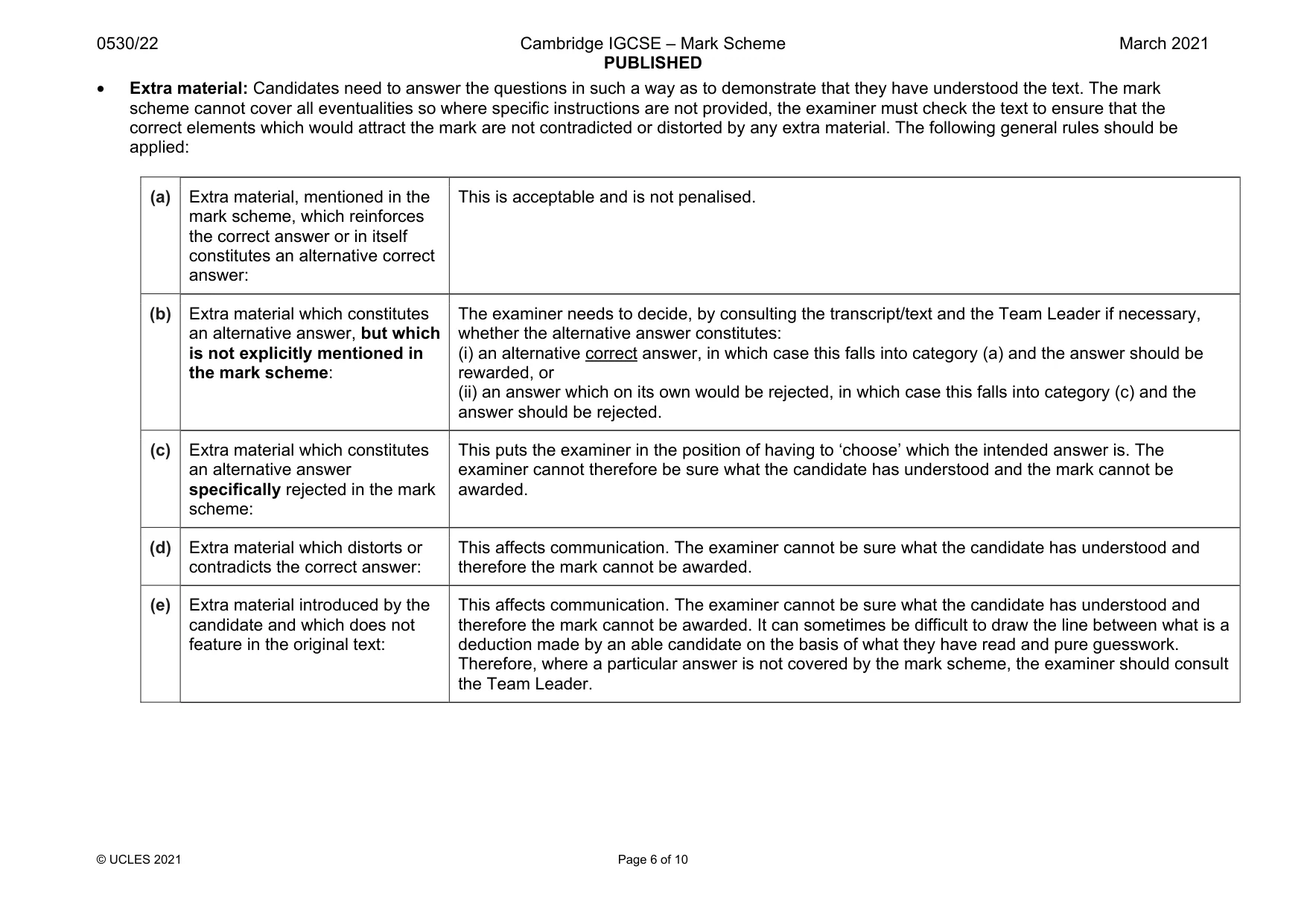
0530/22 Cambridge IGCSE – Mark Scheme PUBLISHED March 2021 © UCLES 2021 Page 6 of 10 • Extra material: Candidates need to answer the questions in such a way as to demonstrate that they have understood the text. The mark scheme cannot cover all eventualities so where specific instructions are not provided, the examiner must check the text to ensure that the correct elements which would attract the mark are not contradicted or distorted by any extra material. The following general rules should be applied: (a) Extra material, mentioned in the mark scheme, which reinforces the correct answer or in itself constitutes an alternative correct answer: This is acceptable and is not penalised. (b) Extra material which constitutes an alternative answer, but which is not explicitly mentioned in the mark scheme: The examiner needs to decide, by consulting the transcript/text and the Team Leader if necessary, whether the alternative answer constitutes: (i) an alternative correct answer, in which case this falls into category (a) and the answer should be rewarded, or (ii) an answer which on its own would be rejected, in which case this falls into category (c) and the answer should be rejected. (c) Extra material which constitutes an alternative answer specifically rejected in the mark scheme: This puts the examiner in the position of having to ‘choose’ which the intended answer is. The examiner cannot therefore be sure what the candidate has understood and the mark cannot be awarded. (d) Extra material which distorts or contradicts the correct answer: This affects communication. The examiner cannot be sure what the candidate has understood and therefore the mark cannot be awarded. (e) Extra material introduced by the candidate and which does not feature in the original text: This affects communication. The examiner cannot be sure what the candidate has understood and therefore the mark cannot be awarded. It can sometimes be difficult to draw the line between what is a deduction made by an able candidate on the basis of what they have read and pure guesswork. Therefore, where a particular answer is not covered by the mark scheme, the examiner should consult the Team Leader.
Mark scheme, page 7
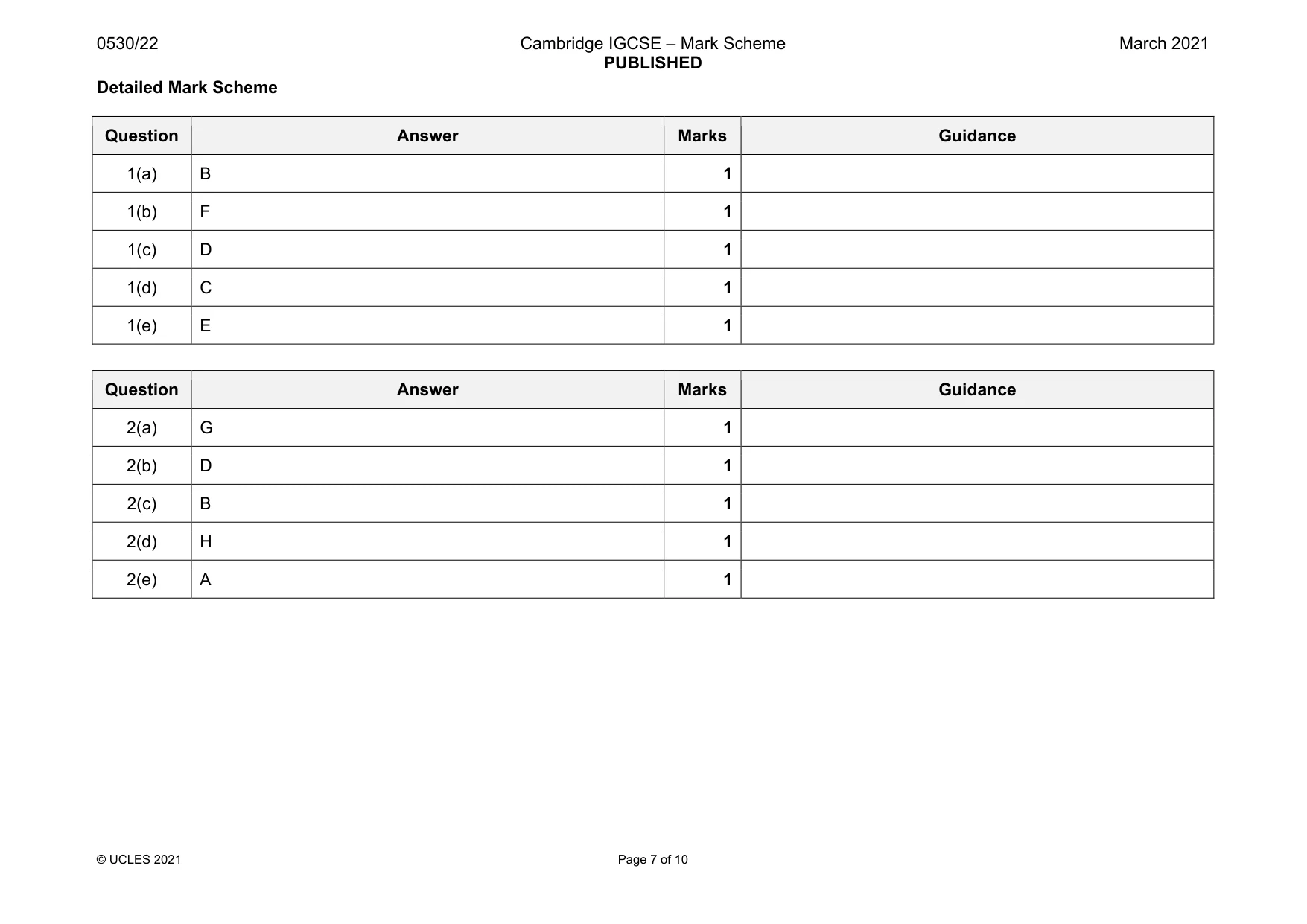
0530/22 Cambridge IGCSE – Mark Scheme PUBLISHED March 2021 © UCLES 2021 Page 7 of 10 Detailed Mark Scheme Question Answer Marks Guidance 1(a) B 1 1(b) F 1 1(c) D 1 1(d) C 1 1(e) E 1 Question Answer Marks Guidance 2(a) G 1 2(b) D 1 2(c) B 1 2(d) H 1 2(e) A 1
Mark scheme, page 8
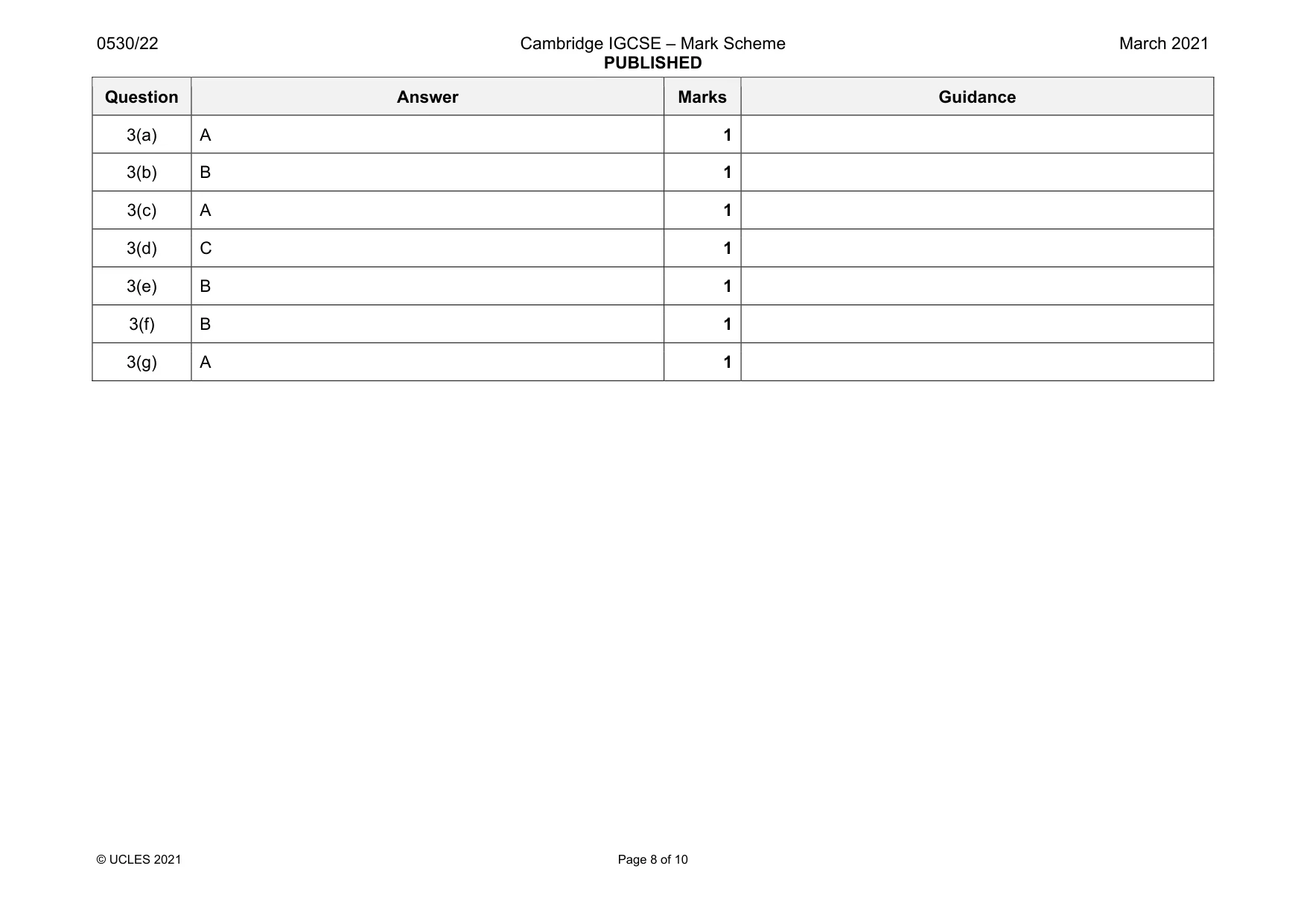
0530/22 Cambridge IGCSE – Mark Scheme PUBLISHED March 2021 © UCLES 2021 Page 8 of 10 Question Answer Marks Guidance 3(a) A 1 3(b) B 1 3(c) A 1 3(d) C 1 3(e) B 1 3(f) B 1 3(g) A 1
Mark scheme, page 9
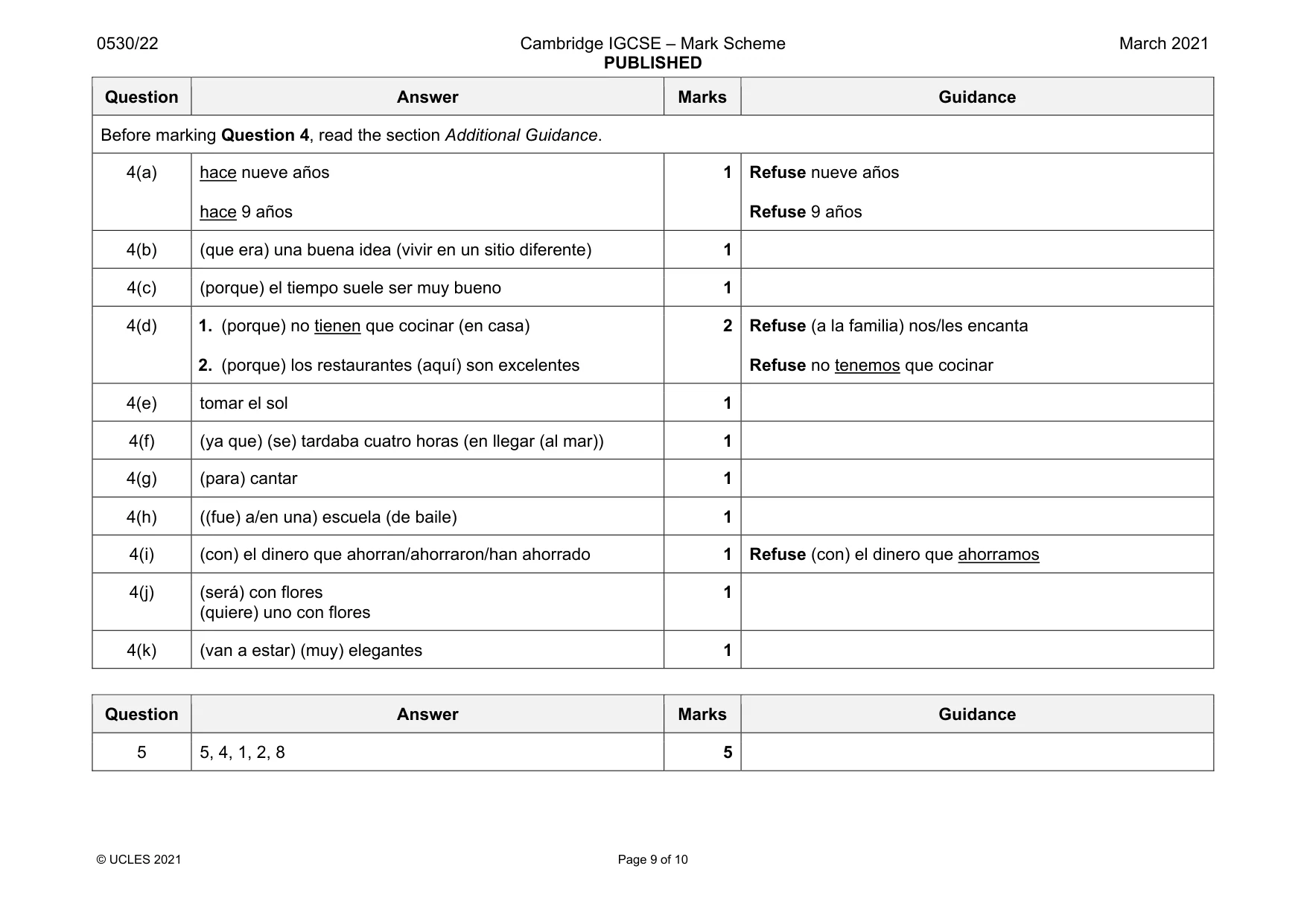
0530/22 Cambridge IGCSE – Mark Scheme PUBLISHED March 2021 © UCLES 2021 Page 9 of 10 Question Answer Marks Guidance Before marking Question 4, read the section Additional Guidance. 4(a) hace nueve años hace 9 años 1 Refuse nueve años Refuse 9 años 4(b) (que era) una buena idea (vivir en un sitio diferente) 1 4(c) (porque) el tiempo suele ser muy bueno 1 4(d) 1. (porque) no tienen que cocinar (en casa) 2. (porque) los restaurantes (aquí) son excelentes 2 Refuse (a la familia) nos/les encanta Refuse no tenemos que cocinar 4(e) tomar el sol 1 4(f) (ya que) (se) tardaba cuatro horas (en llegar (al mar)) 1 4(g) (para) cantar 1 4(h) ((fue) a/en una) escuela (de baile) 1 4(i) (con) el dinero que ahorran/ahorraron/han ahorrado 1 Refuse (con) el dinero que ahorramos 4(j) (será) con flores (quiere) uno con flores 1 4(k) (van a estar) (muy) elegantes 1 Question Answer Marks Guidance 5 5, 4, 1, 2, 8 5
Mark scheme, page 10
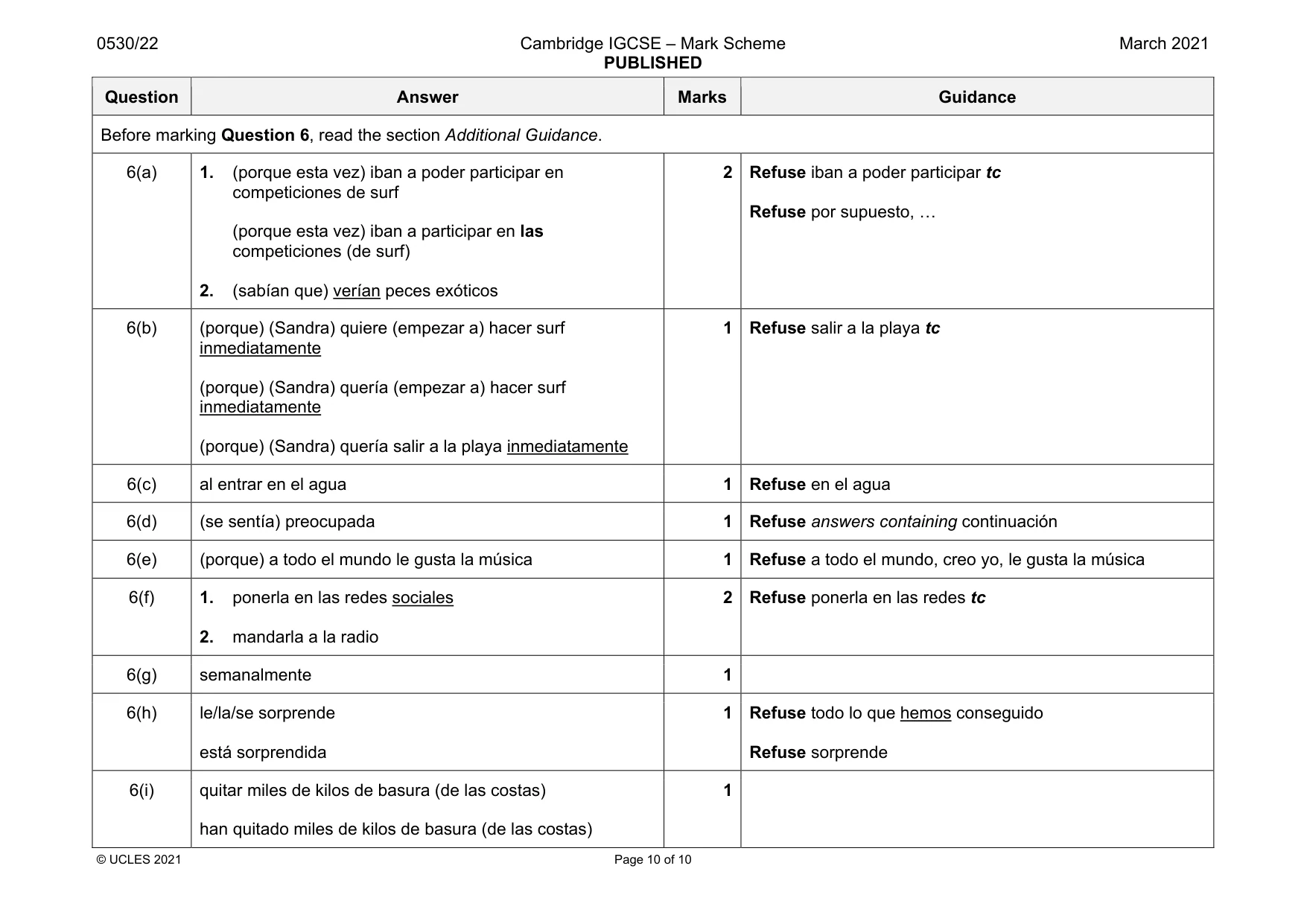
0530/22 Cambridge IGCSE – Mark Scheme PUBLISHED March 2021 © UCLES 2021 Page 10 of 10 Question Answer Marks Guidance Before marking Question 6, read the section Additional Guidance. 6(a) 1. (porque esta vez) iban a poder participar en competiciones de surf (porque esta vez) iban a participar en las competiciones (de surf) 2. (sabían que) verían peces exóticos 2 Refuse iban a poder participar tc Refuse por supuesto, … 6(b) (porque) (Sandra) quiere (empezar a) hacer surf inmediatamente (porque) (Sandra) quería (empezar a) hacer surf inmediatamente (porque) (Sandra) quería salir a la playa inmediatamente 1 Refuse salir a la playa tc 6(c) al entrar en el agua 1 Refuse en el agua 6(d) (se sentía) preocupada 1 Refuse answers containing continuación 6(e) (porque) a todo el mundo le gusta la música 1 Refuse a todo el mundo, creo yo, le gusta la música 6(f) 1. ponerla en las redes sociales 2. mandarla a la radio 2 Refuse ponerla en las redes tc 6(g) semanalmente 1 6(h) le/la/se sorprende está sorprendida 1 Refuse todo lo que hemos conseguido Refuse sorprende 6(i) quitar miles de kilos de basura (de las costas) han quitado miles de kilos de basura (de las costas) 1
What you needed in this session
Cambridge’s own grade thresholds for 2021 Feb/March, Paper 2 · Variant 2. A higher threshold means an easier paper — the bar moves with how the cohort did.