Cambridge IGCSE Sciences - Co-ordinated (Double) 0654 — 2021 Oct/Nov Paper 6 · Variant 3
0654/63/O/N/21 · 7 questions · 60 marks · ≈68 min
The question paper and its mark scheme, free to read here and free to download. This is Cambridge’s own paper, exactly as it was sat.
Question paper20 pages




Mark scheme9 pages
Answers below. Sit the paper first if you are practising.
Questions as text
Q1 · A student investigates the action of the enzyme amylase on starch
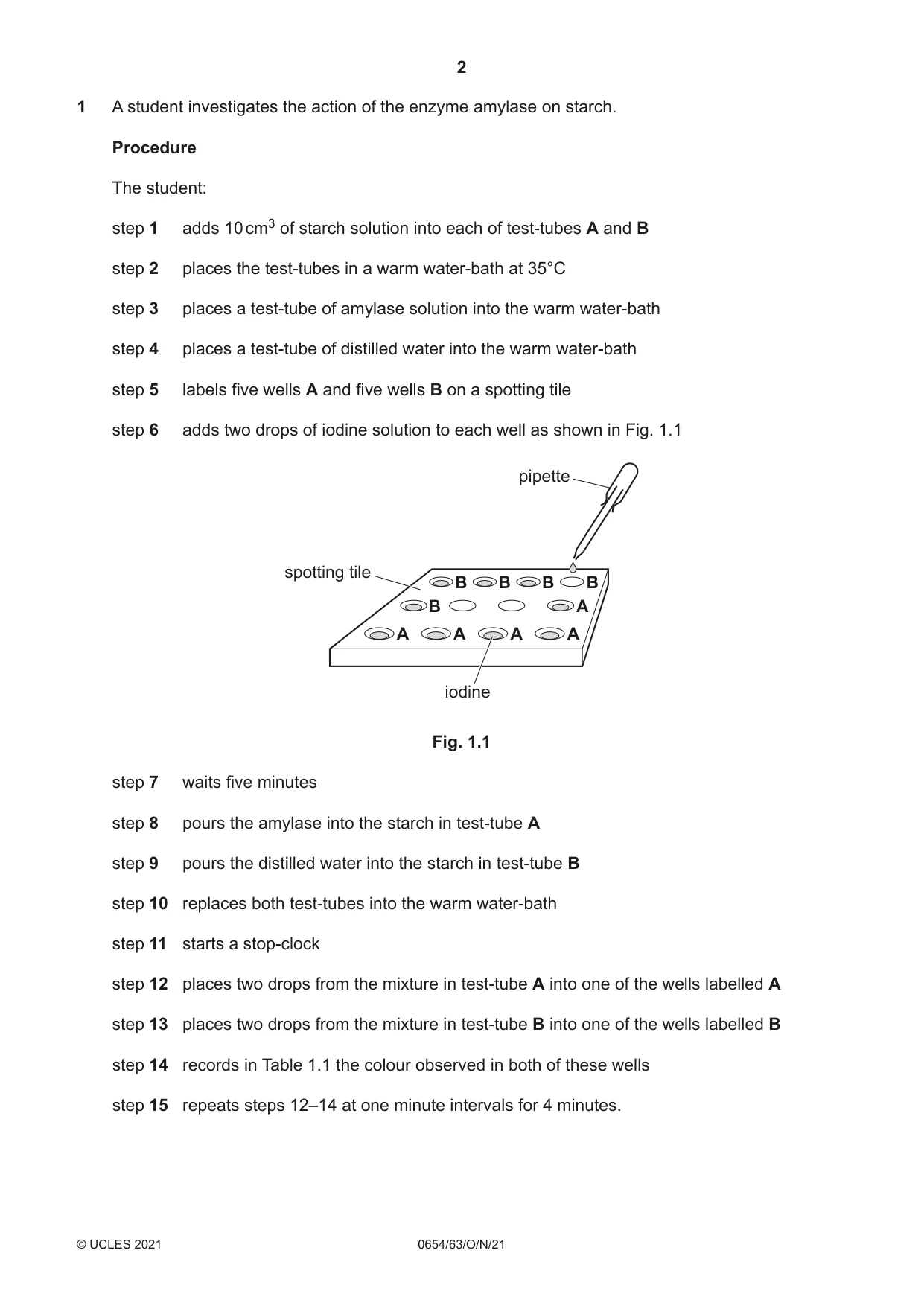
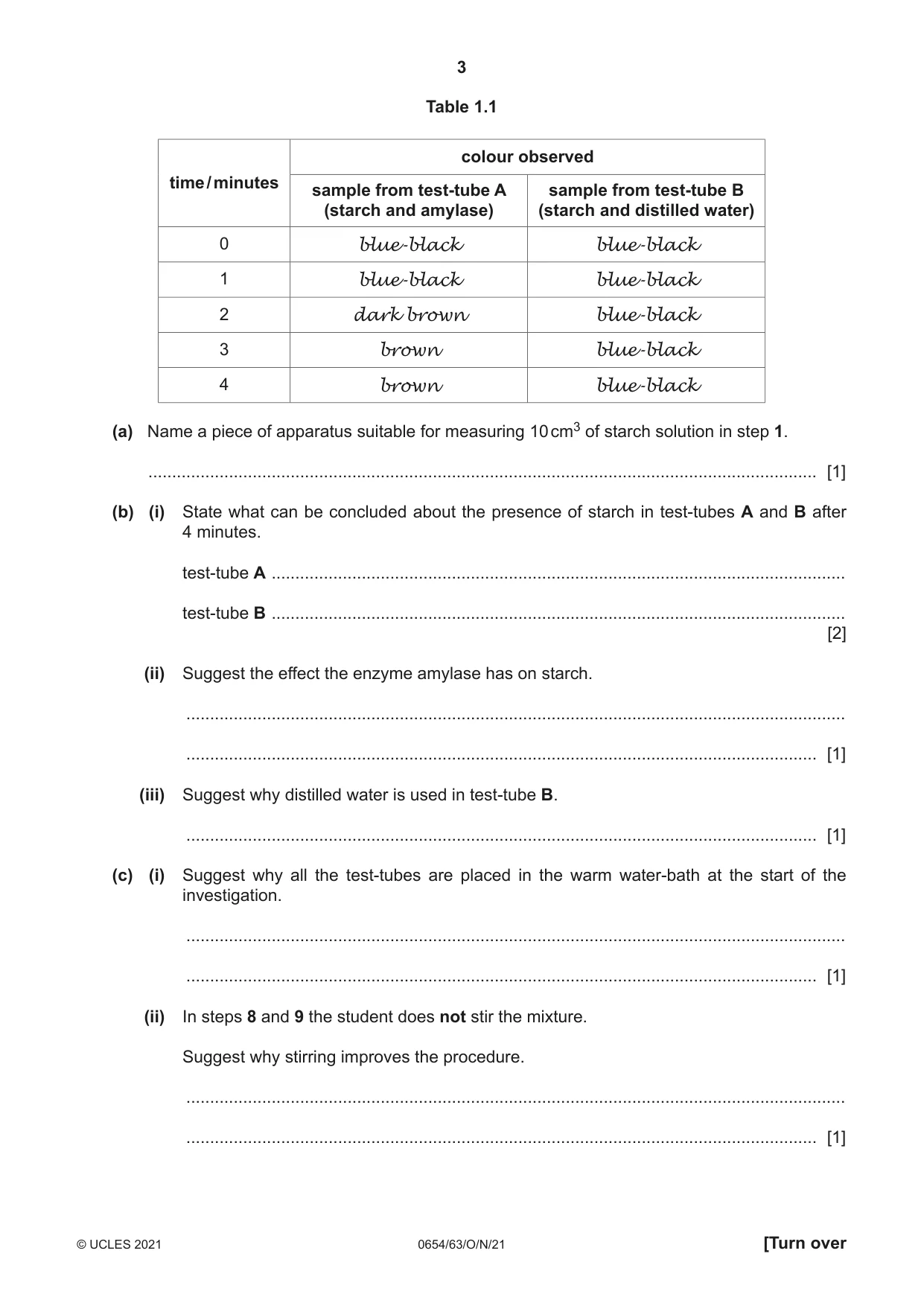
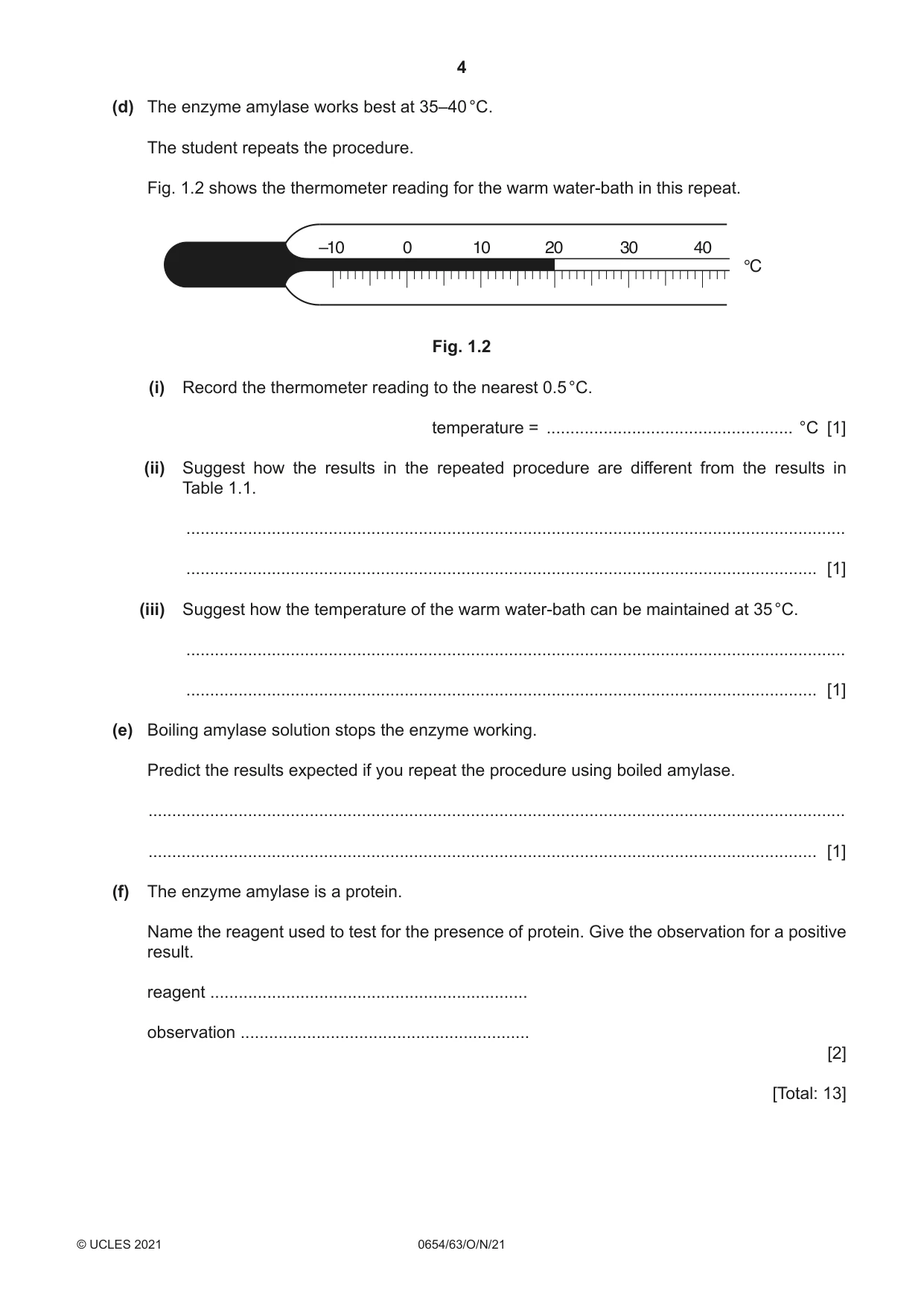
1 A student investigates the action of the enzyme amylase on starch. Procedure The student: step 1 adds 10 cm3 of starch solution into each of test-tubes A and B step 2 places the test-tubes in a warm water-bath at 35°C step 3 places a test-tube of amylase solution into the warm water-bath step 4 places a test-tube of distilled water into the warm water-bath step 5 labels five wells A and five wells B on a spotting tile step 6 adds two drops of iodine solution to each well as shown in Fig. 1.1 pipette spotting tile B B B B B A A A A A iodine Fig. 1.1 step 7 waits five minutes step 8 pours the amylase into the starch in test-tube A step 9 pours the distilled water into the starch in test-tube B step 10 replaces both test-tubes into the warm water-bath step 11 starts a stop-clock step 12 places two drops from the mixture in test-tube A into one of the wells labelled A step 13 places two drops from the mixture in test-tube B into one of the wells labelled B step 14 records in Table 1.1 the colour observed in both of these wells step 15 repeats steps 12–14 at one minute intervals for 4 minutes. Table 1.1 colour observed time / minutes sample from test-tube A sample from test-tube B (starch and amylase) (starch and distilled water) 0 blue-black blue-black 1 blue-black blue-black 2 dark brown blue-black 3 brown blue-black 4 brown blue-black (a) Name a piece of apparatus suitable for measuring 10 cm3 of starch solution in step 1. ............................................................................................................................................. [1] (b) (i) State what can be concluded about the presence of starch in test-tubes A and B after 4 minutes. test-tube A ......................................................................................................................... test-tube B ......................................................................................................................... [2] (ii) Suggest the effect the enzyme amylase has on starch. ........................................................................................................................................... ..................................................................................................................................... [1] (iii) Suggest why distilled water is used in test-tube B. ..................................................................................................................................... [1] (c) (i) Suggest why all the test-tubes are placed in the warm water-bath at the start of the investigation. ........................................................................................................................................... ..................................................................................................................................... [1] (ii) In steps 8 and 9 the student does not stir the mixture. Suggest why stirring improves the procedure. ........................................................................................................................................... ..................................................................................................................................... [1] (d) The enzyme amylase works best at 35–40 °C. The student repeats the procedure. Fig. 1.2 shows the thermometer reading for the warm water-bath in this repeat. –10 0 10 20 30 40 °C Fig. 1.2 (i) Record the thermometer reading to the nearest 0.5 °C. temperature = .................................................... °C [1] (ii) Suggest how the results in the repeated procedure are different from the results in Table 1.1. ........................................................................................................................................... ..................................................................................................................................... [1] (iii) Suggest how the temperature of the warm water-bath can be maintained at 35 °C. ........................................................................................................................................... ..................................................................................................................................... [1] (e) Boiling amylase solution stops the enzyme working. Predict the results expected if you repeat the procedure using boiled amylase. ................................................................................................................................................... ............................................................................................................................................. [1] (f) The enzyme amylase is a protein. Name the reagent used to test for the presence of protein. Give the observation for a positive result. reagent ................................................................... observation ............................................................. [2] [Total: 13]
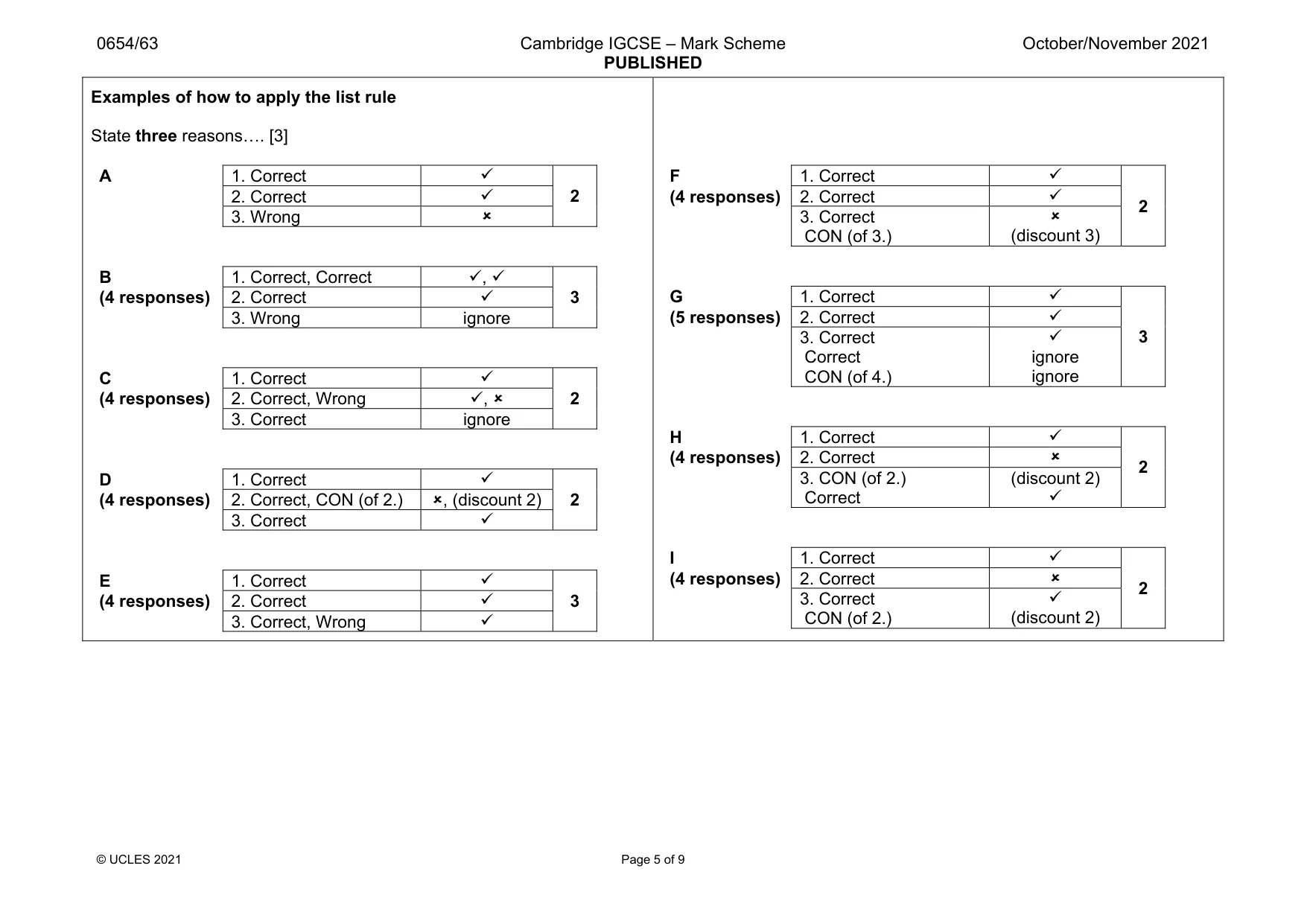
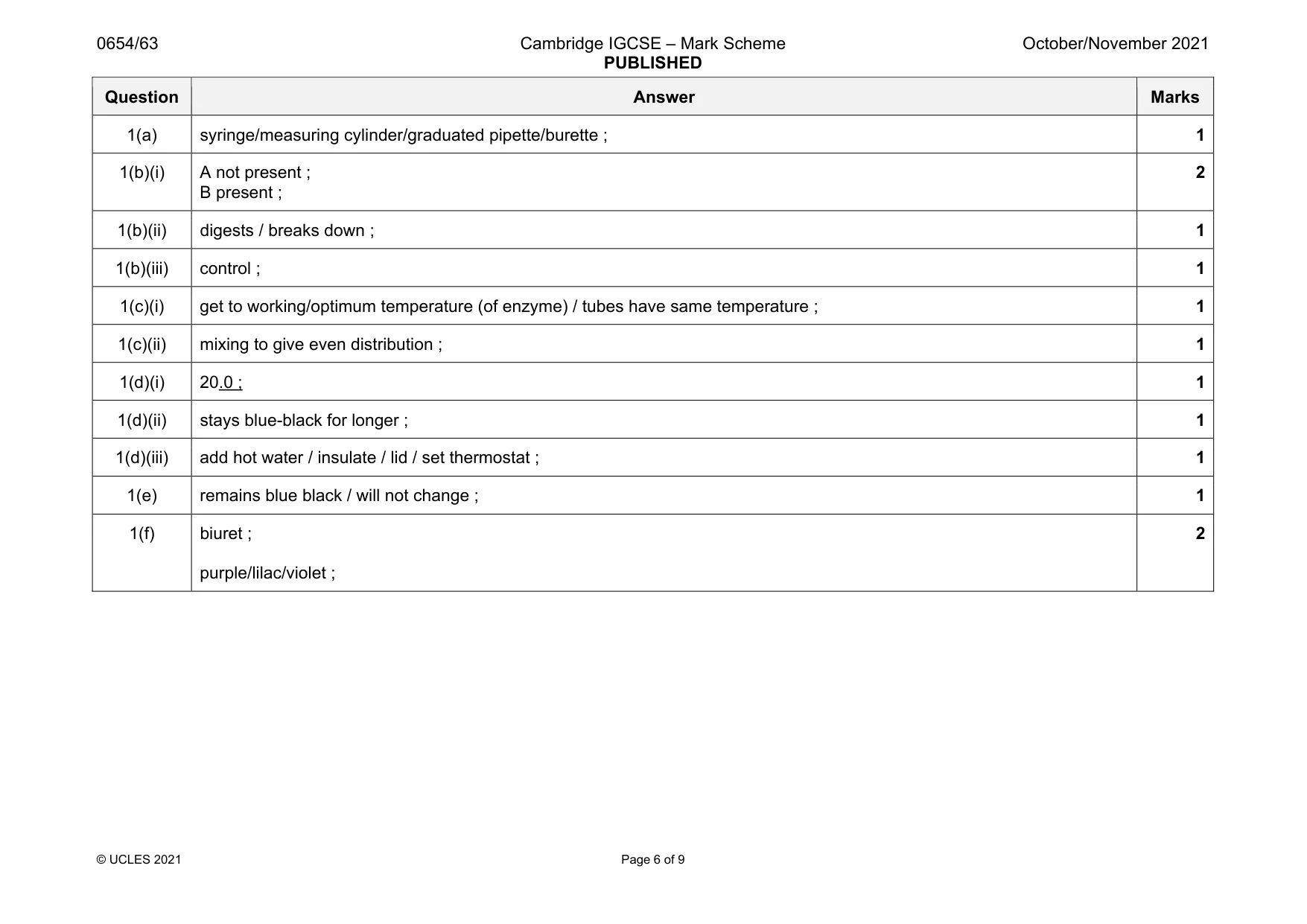
Mark scheme: 1(a) syringe/measuring cylinder/graduated pipette/burette ; 1 1(b)(i) A not present ; B present ; 2 1(b)(ii) digests / breaks down ; 1 1(b)(iii) control ; 1 1(c)(i) get to working/optimum temperature (of enzyme) / tubes have same temperature ; 1 1(c)(ii) mixing to give even distribution ; 1 1(d)(i) 20.0 ; 1 1(d)(ii) stays blue-black for longer ; 1 1(d)(iii) add hot water / insulate / lid / set thermostat ; 1 1(e) remains blue black / will not change ; 1 1(f) biuret ; purple/lilac/violet ; 2
Q2 · Washing powders remove stains from clothes by dissolving the stain
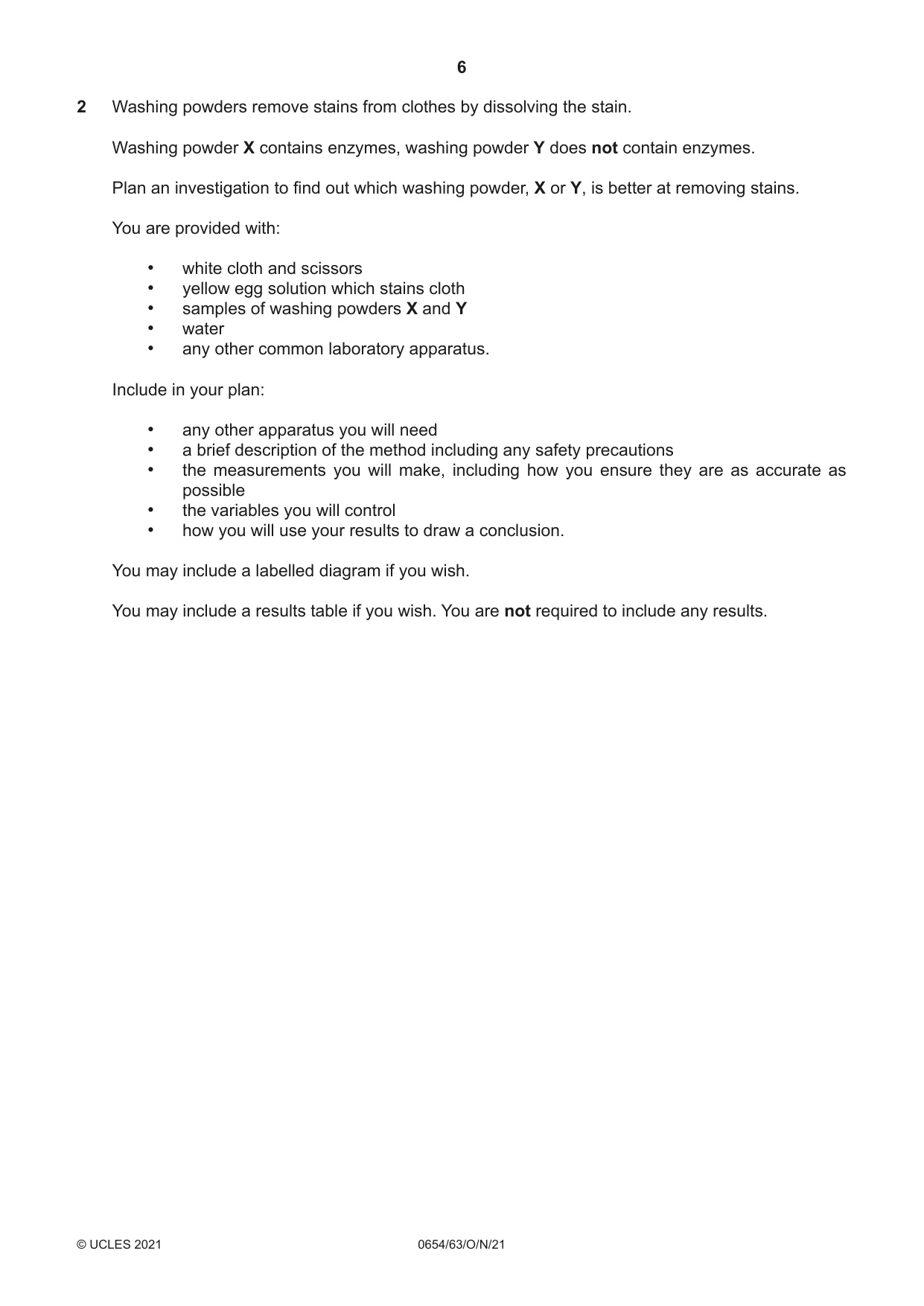
2 Washing powders remove stains from clothes by dissolving the stain. Washing powder X contains enzymes, washing powder Y does not contain enzymes. Plan an investigation to find out which washing powder, X or Y, is better at removing stains. You are provided with: • white cloth and scissors • yellow egg solution which stains cloth • samples of washing powders X and Y • water • any other common laboratory apparatus. Include in your plan: • any other apparatus you will need • a brief description of the method including any safety precautions • the measurements you will make, including how you ensure they are as accurate as possible • the variables you will control • how you will use your results to draw a conclusion. You may include a labelled diagram if you wish. You may include a results table if you wish. You are not required to include any results. .......................................................................................................................................................... .......................................................................................................................................................... .......................................................................................................................................................... .......................................................................................................................................................... .......................................................................................................................................................... .......................................................................................................................................................... .......................................................................................................................................................... .......................................................................................................................................................... .......................................................................................................................................................... .......................................................................................................................................................... .......................................................................................................................................................... .......................................................................................................................................................... .......................................................................................................................................................... .......................................................................................................................................................... .................................................................................................................................................... [7]
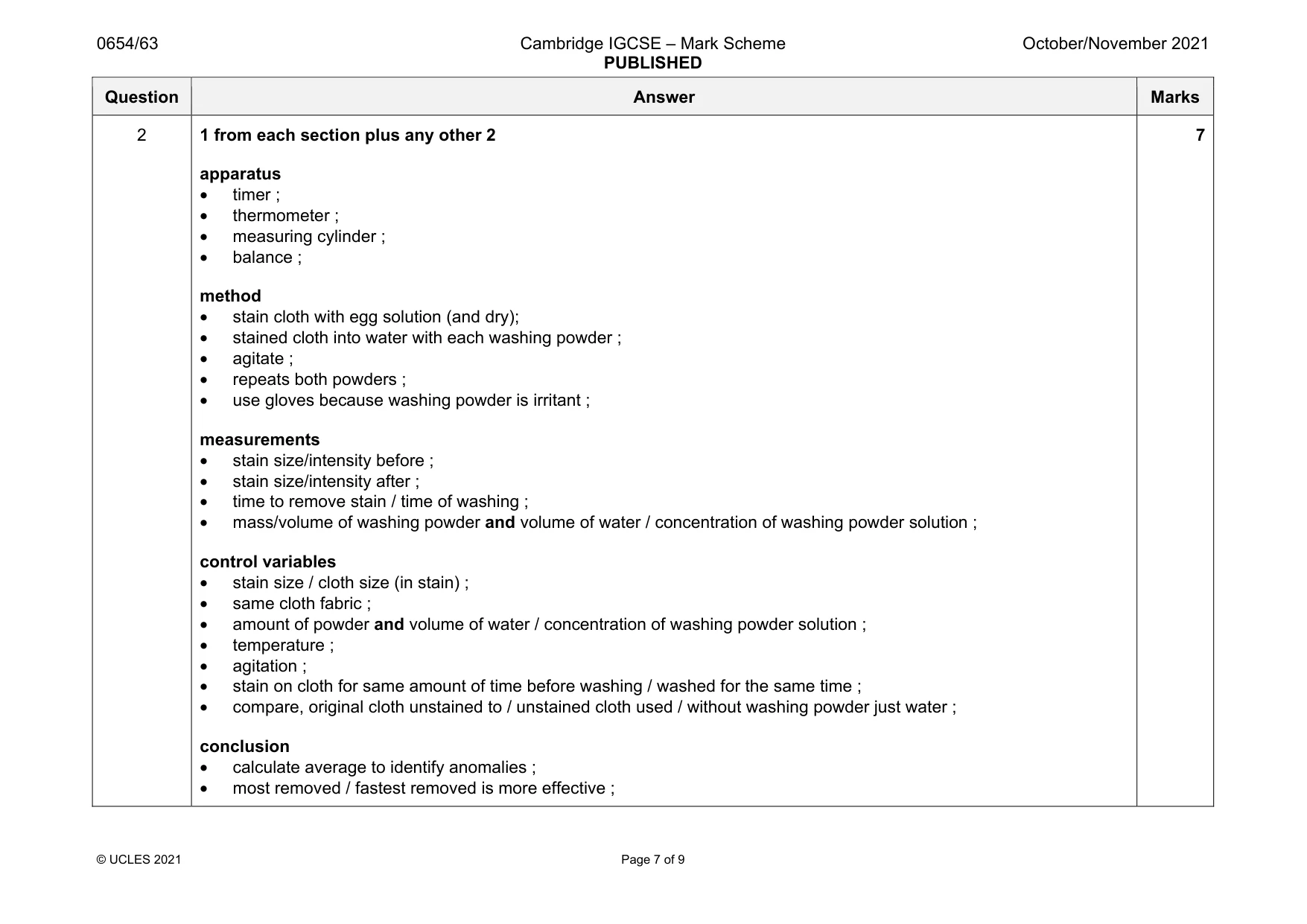
Mark scheme: 2 1 from each section plus any other 2 apparatus • timer ; • thermometer ; • measuring cylinder ; • balance ; method • stain cloth with egg solution (and dry); • stained cloth into water with each washing powder ; • agitate ; • repeats both powders ; • use gloves because washing powder is irritant ; measurements • stain size/intensity before ; • stain size/intensity after ; • time to remove stain / time of washing ; • mass/volume of washing powder and volume of water / concentration of washing powder solution ; control variables • stain size / cloth size (in stain) ; • same cloth fabric ; • amount of powder and volume of water / concentration of washing powder solution ; • temperature ; • agitation ; • stain on cloth for same amount of time before washing / washed for the same time ; • compare, original cloth unstained to / unstained cloth used / without washing powder just water ; conclusion • calculate average to identify anomalies ; • most removed / fastest removed is more effective ; 7
Q3 · A student investigates the amount of energy given off by ethanol when it burns
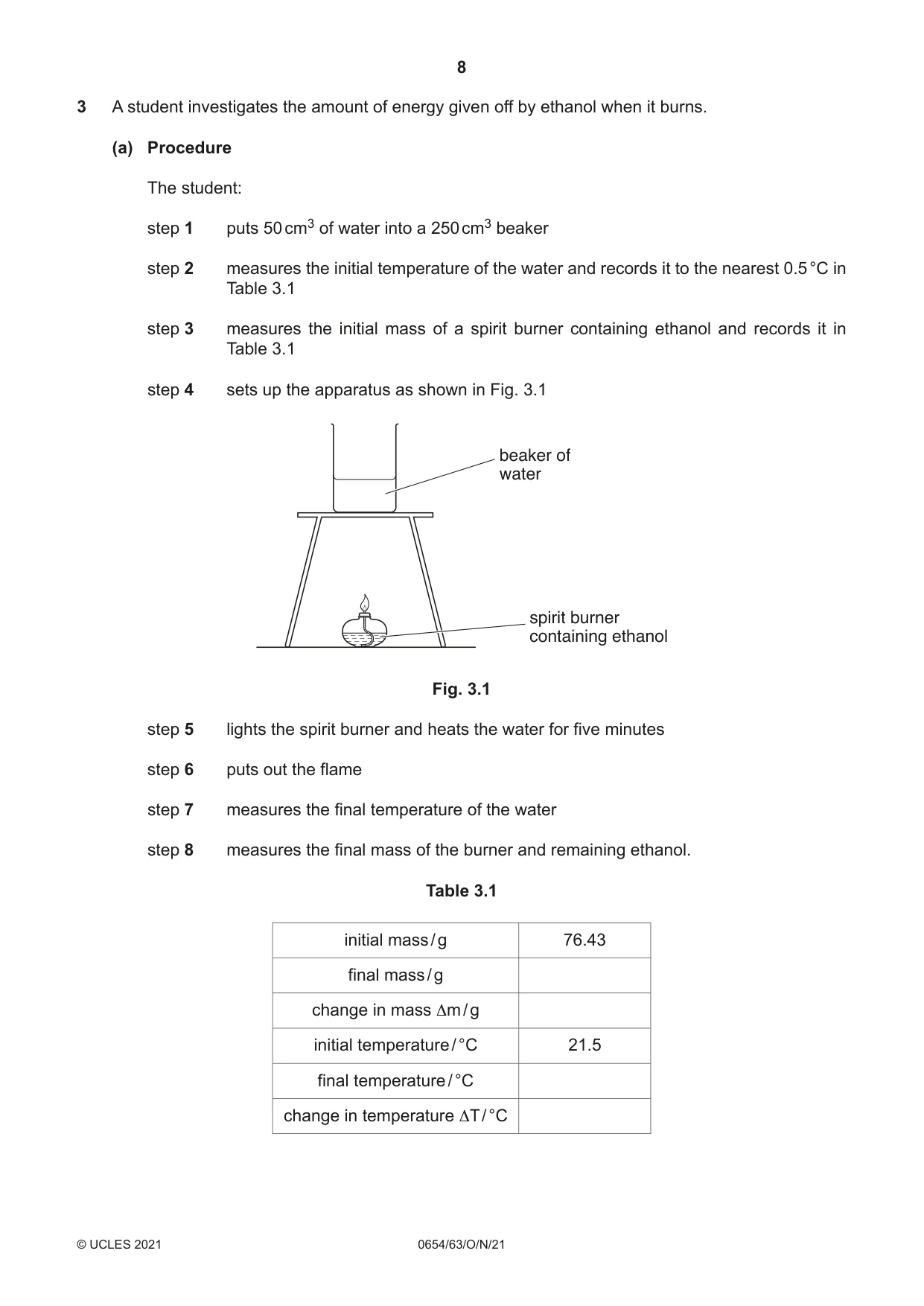
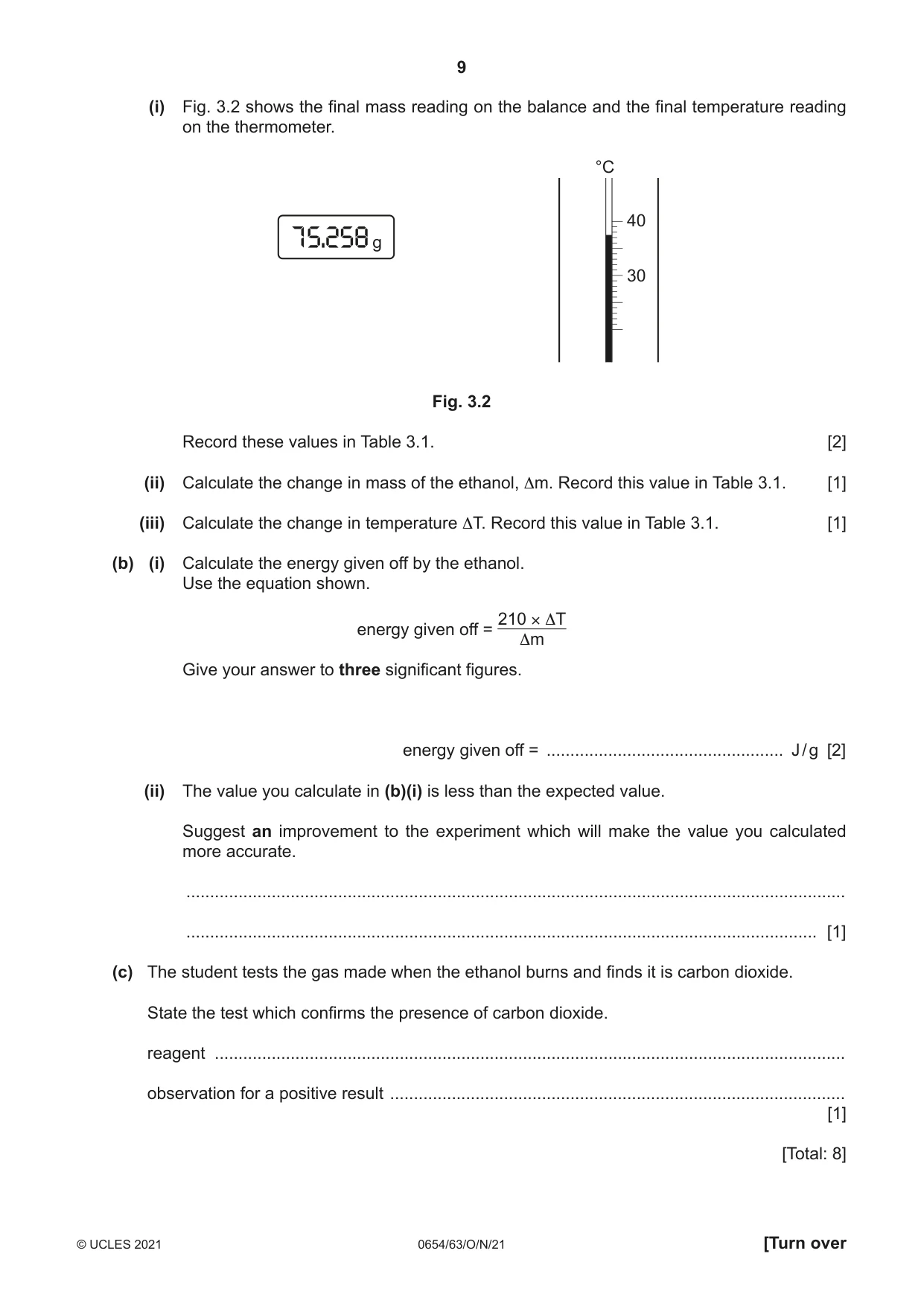
3 A student investigates the amount of energy given off by ethanol when it burns. (a) Procedure The student: step 1 puts 50 cm3 of water into a 250 cm3 beaker step 2 measures the initial temperature of the water and records it to the nearest 0.5 °C in Table 3.1 step 3 measures the initial mass of a spirit burner containing ethanol and records it in Table 3.1 step 4 sets up the apparatus as shown in Fig. 3.1 beaker of water spirit burner containing ethanol Fig. 3.1 step 5 lights the spirit burner and heats the water for five minutes step 6 puts out the flame step 7 measures the final temperature of the water step 8 measures the final mass of the burner and remaining ethanol. Table 3.1 initial mass / g 76.43 final mass / g change in mass Δm / g initial temperature / °C 21.5 final temperature / °C change in temperature ΔT / °C (i) Fig. 3.2 shows the final mass reading on the balance and the final temperature reading on the thermometer. °C 40 g 30 Fig. 3.2 Record these values in Table 3.1. [2] (ii) Calculate the change in mass of the ethanol, Δm. Record this value in Table 3.1. [1] (iii) Calculate the change in temperature ΔT. Record this value in Table 3.1. [1] (b) (i) Calculate the energy given off by the ethanol. Use the equation shown. 210 × ΔT energy given off = Δm Give your answer to three significant figures. energy given off = .................................................. J / g [2] (ii) The value you calculate in (b)(i) is less than the expected value. Suggest an improvement to the experiment which will make the value you calculated more accurate. ........................................................................................................................................... ..................................................................................................................................... [1] (c) The student tests the gas made when the ethanol burns and finds it is carbon dioxide. State the test which confirms the presence of carbon dioxide. reagent ..................................................................................................................................... observation for a positive result ................................................................................................ [1] [Total: 8]
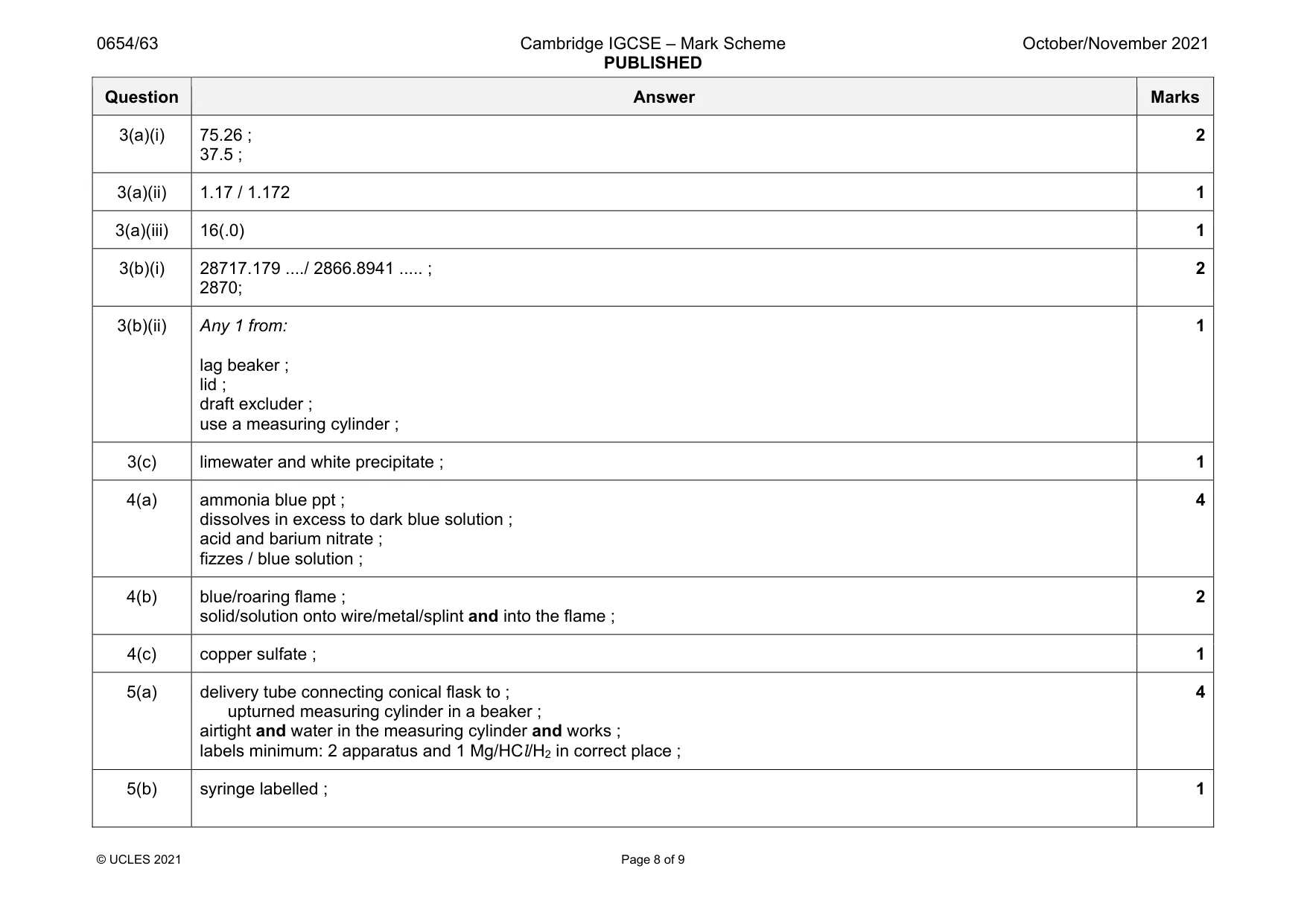
Mark scheme: 3(a)(i) 75.26 ; 37.5 ; 2 3(a)(ii) 1.17 / 1.172 1 3(a)(iii) 16(.0) 1 3(b)(i) 28717.179 ..../ 2866.8941 ..... ; 2870; 2 3(b)(ii) Any 1 from: lag beaker ; lid ; draft excluder ; use a measuring cylinder ; 1 3(c) limewater and white precipitate ; 1 4
Q4 · You are going to find a test to identify substance X
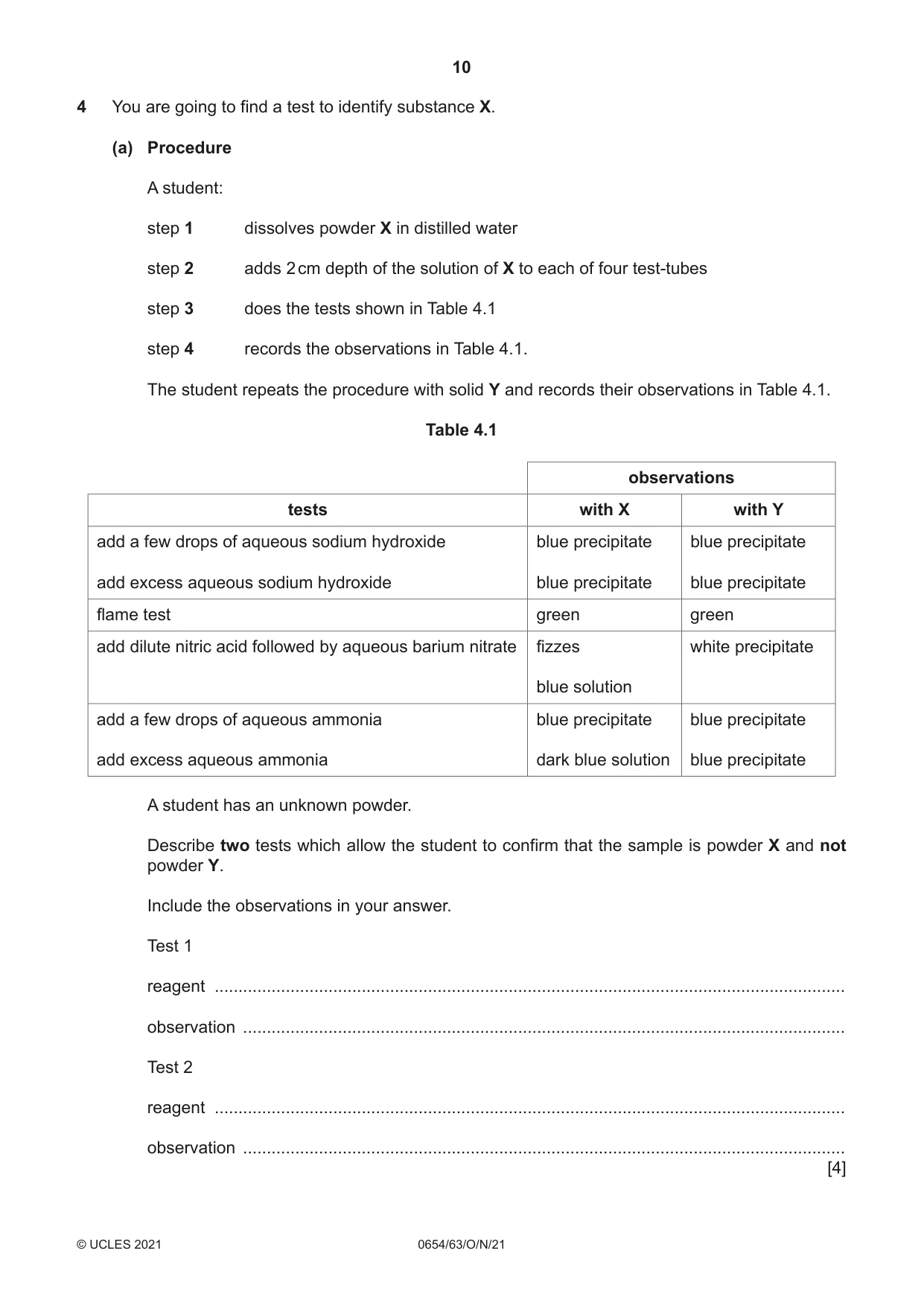
4 You are going to find a test to identify substance X. (a) Procedure A student: step 1 dissolves powder X in distilled water step 2 adds 2 cm depth of the solution of X to each of four test-tubes step 3 does the tests shown in Table 4.1 step 4 records the observations in Table 4.1. The student repeats the procedure with solid Y and records their observations in Table 4.1. Table 4.1 observations tests with X with Y add a few drops of aqueous sodium hydroxide blue precipitate blue precipitate add excess aqueous sodium hydroxide blue precipitate blue precipitate flame test green green add dilute nitric acid followed by aqueous barium nitrate fizzes white precipitate blue solution add a few drops of aqueous ammonia blue precipitate blue precipitate add excess aqueous ammonia dark blue solution blue precipitate A student has an unknown powder. Describe two tests which allow the student to confirm that the sample is powder X and not powder Y. Include the observations in your answer. Test 1 reagent ..................................................................................................................................... observation ............................................................................................................................... Test 2 reagent ..................................................................................................................................... observation ............................................................................................................................... [4] (b) Describe how to do a flame test. ................................................................................................................................................... ................................................................................................................................................... ............................................................................................................................................. [2] (c) A sample of an unknown blue solid is heated. The solid turns white. When water is added to the white solid it turns blue. Suggest the identity of the unknown solid. ............................................................................................................................................. [1] [Total: 7]
Mark scheme: 4(a) ammonia blue ppt ; dissolves in excess to dark blue solution ; acid and barium nitrate ; fizzes / blue solution ; 4(b) blue/roaring flame ; solid/solution onto wire/metal/splint and into the flame ; 2 4(c) copper sulfate ; 1
Q5 · Hydrogen gas can be made from magnesium ribbon and dilute hydrochloric acid
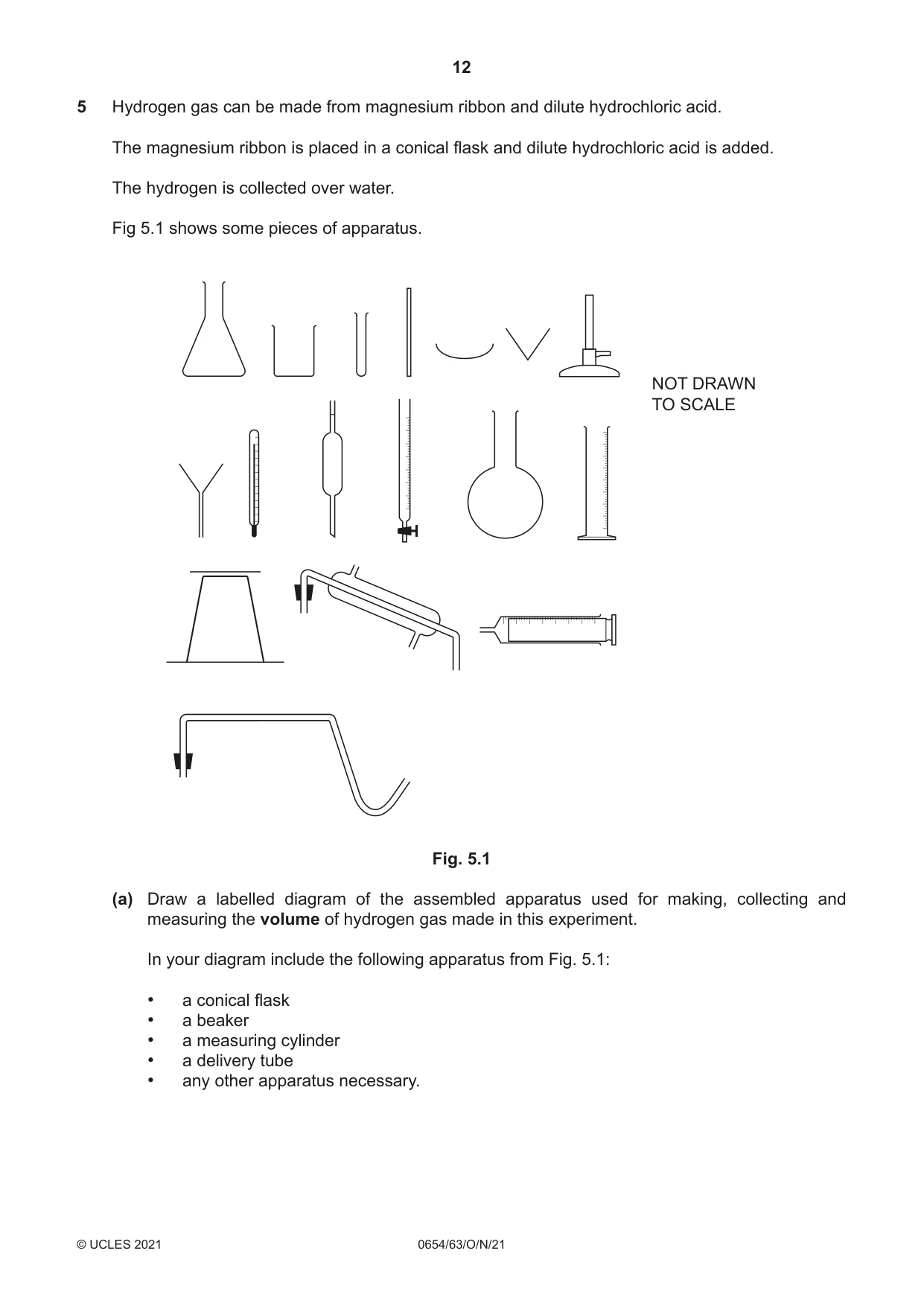
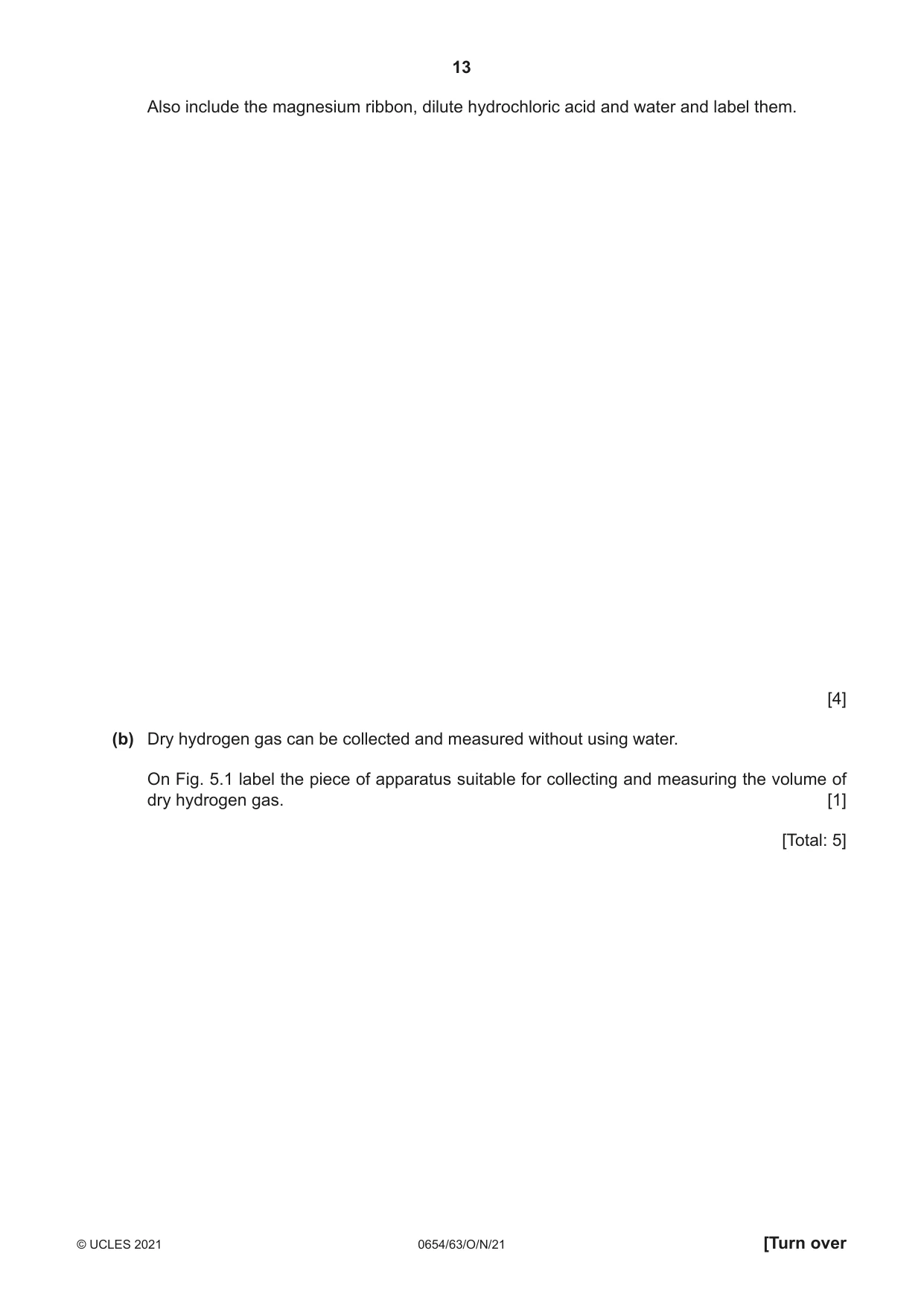
5 Hydrogen gas can be made from magnesium ribbon and dilute hydrochloric acid. The magnesium ribbon is placed in a conical flask and dilute hydrochloric acid is added. The hydrogen is collected over water. Fig 5.1 shows some pieces of apparatus. NOT DRAWN TO SCALE Fig. 5.1 (a) Draw a labelled diagram of the assembled apparatus used for making, collecting and measuring the volume of hydrogen gas made in this experiment. In your diagram include the following apparatus from Fig. 5.1: • a conical flask • a beaker • a measuring cylinder • a delivery tube • any other apparatus necessary. Also include the magnesium ribbon, dilute hydrochloric acid and water and label them. [4] (b) Dry hydrogen gas can be collected and measured without using water. On Fig. 5.1 label the piece of apparatus suitable for collecting and measuring the volume of dry hydrogen gas. [1] [Total: 5]
Mark scheme: 5(a) delivery tube connecting conical flask to ; upturned measuring cylinder in a beaker ; airtight and water in the measuring cylinder and works ; labels minimum: 2 apparatus and 1 Mg/HCl/H2 in correct place ; 4 5(b) syringe labelled ; 1
Q6 · A student determines the acceleration due to gravity g by measuring the period of a…
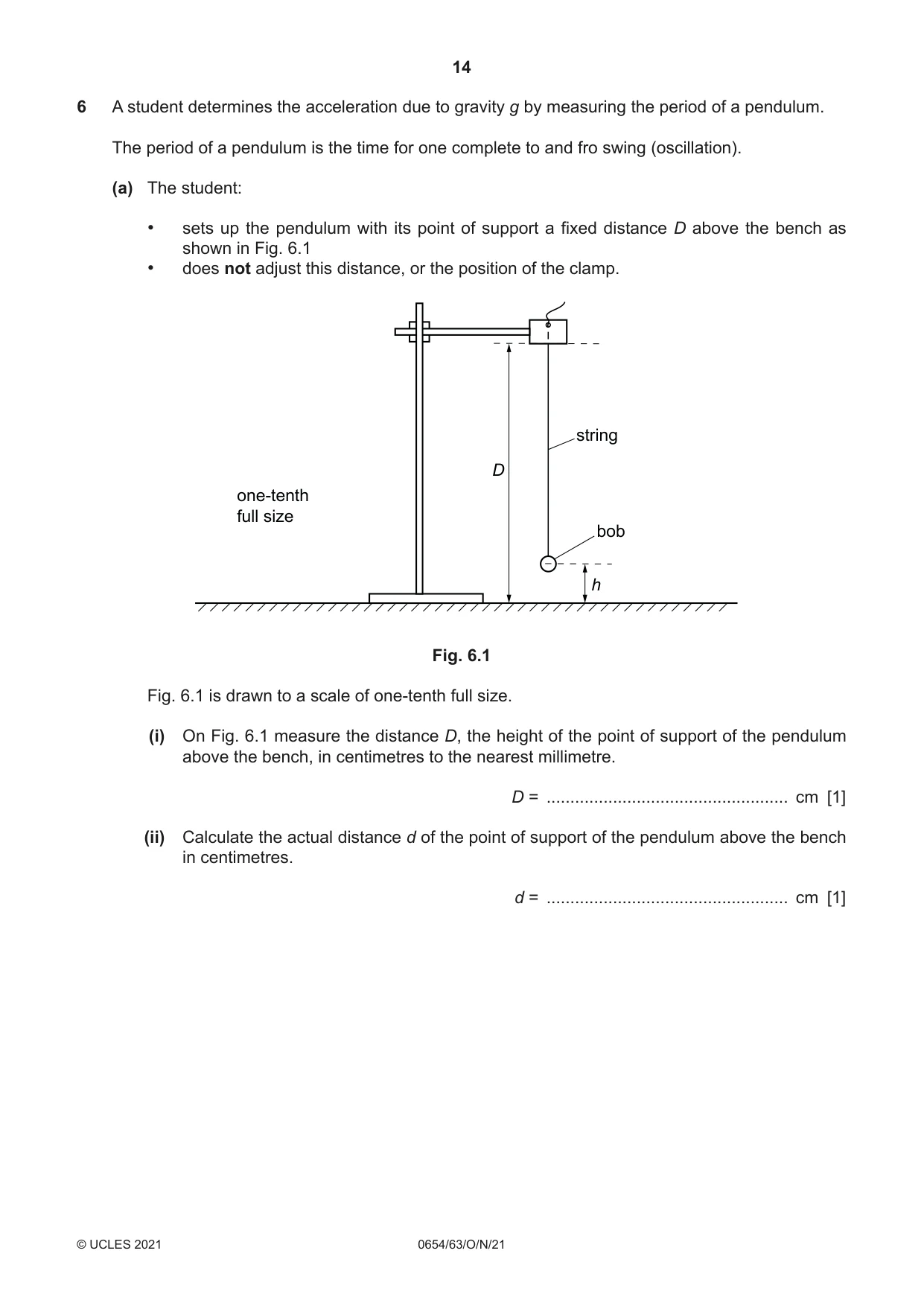
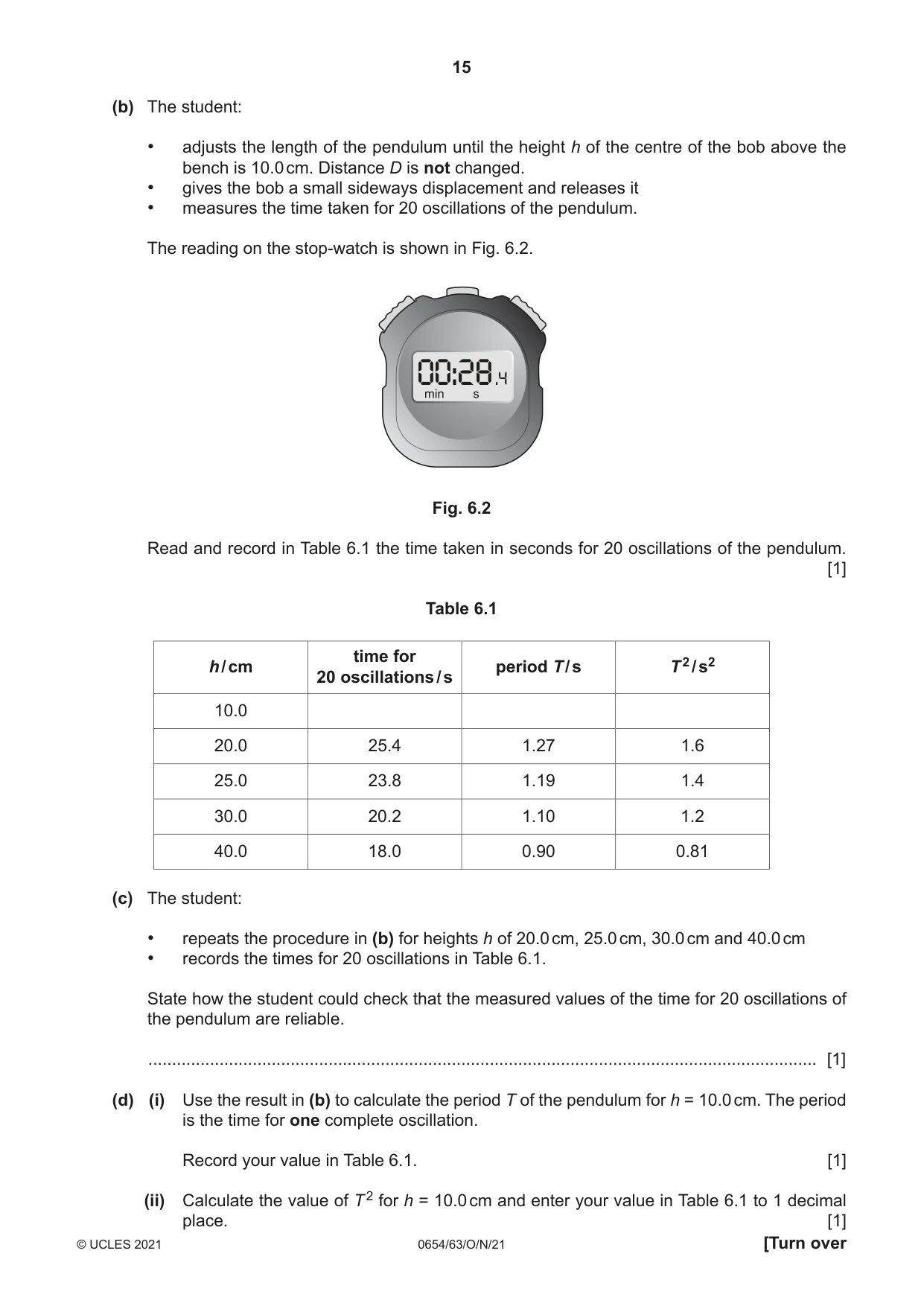
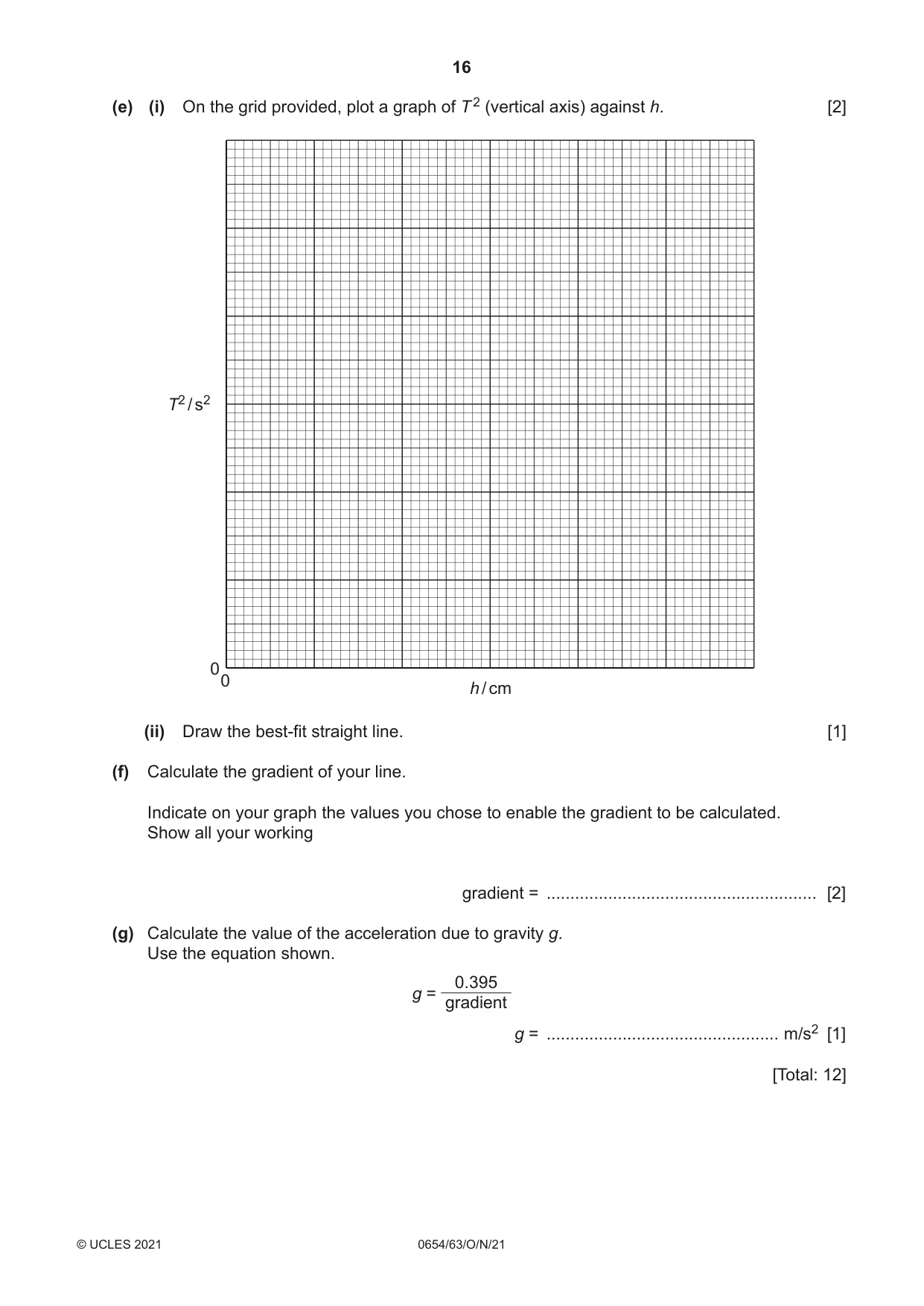
6 A student determines the acceleration due to gravity g by measuring the period of a pendulum. The period of a pendulum is the time for one complete to and fro swing (oscillation). (a) The student: • sets up the pendulum with its point of support a fixed distance D above the bench as shown in Fig. 6.1 • does not adjust this distance, or the position of the clamp. string D one-tenth full size bob h Fig. 6.1 Fig. 6.1 is drawn to a scale of one-tenth full size. (i) On Fig. 6.1 measure the distance D, the height of the point of support of the pendulum above the bench, in centimetres to the nearest millimetre. D = ................................................... cm [1] (ii) Calculate the actual distance d of the point of support of the pendulum above the bench in centimetres. d = ................................................... cm [1] (b) The student: • adjusts the length of the pendulum until the height h of the centre of the bob above the bench is 10.0 cm. Distance D is not changed. • gives the bob a small sideways displacement and releases it • measures the time taken for 20 oscillations of the pendulum. The reading on the stop-watch is shown in Fig. 6.2. 00:28 .4 Fig. 6.2 Read and record in Table 6.1 the time taken in seconds for 20 oscillations of the pendulum. [1] Table 6.1 time for 2 h / cm period T / s T / s2 20 oscillations / s 10.0 20.0 25.4 1.27 1.6 25.0 23.8 1.19 1.4 30.0 20.2 1.10 1.2 40.0 18.0 0.90 0.81 (c) The student: • repeats the procedure in (b) for heights h of 20.0 cm, 25.0 cm, 30.0 cm and 40.0 cm • records the times for 20 oscillations in Table 6.1. State how the student could check that the measured values of the time for 20 oscillations of the pendulum are reliable. ............................................................................................................................................. [1] (d) (i) Use the result in (b) to calculate the period T of the pendulum for h = 10.0 cm. The period is the time for one complete oscillation. Record your value in Table 6.1. [1] (ii) Calculate the value of T 2 for h = 10.0 cm and enter your value in Table 6.1 to 1 decimal place. [1] (e) (i) On the grid provided, plot a graph of T 2 (vertical axis) against h. [2] T2 / s2 0 0 h / cm (ii) Draw the best-fit straight line. [1] (f) Calculate the gradient of your line. Indicate on your graph the values you chose to enable the gradient to be calculated. Show all your working gradient = ......................................................... [2] (g) Calculate the value of the acceleration due to gravity g. Use the equation shown. 0.395 g = gradient g = ................................................. m/s2 [1] [Total: 12]
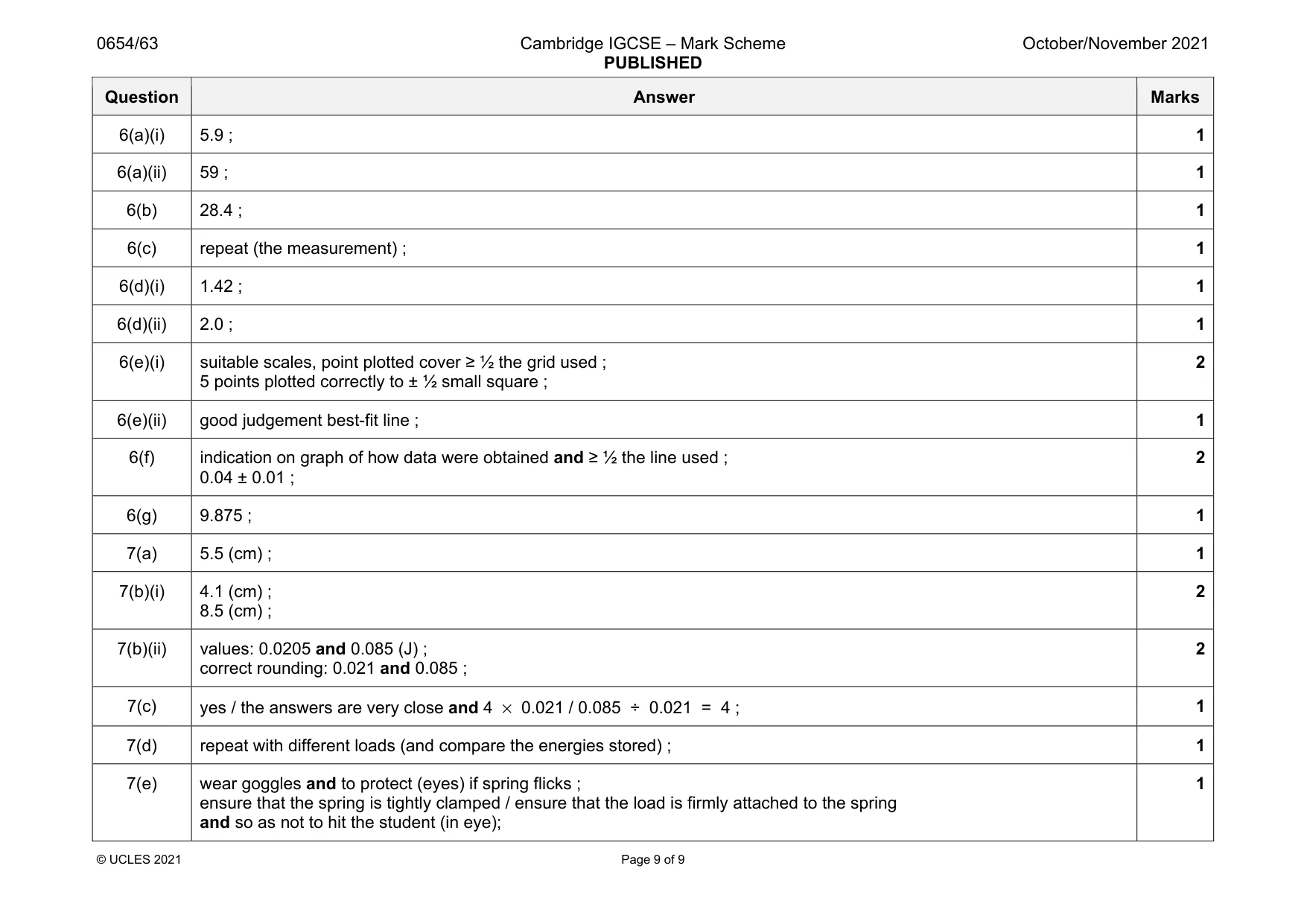
Mark scheme: 6(a)(i) 5.9 ; 1 6(a)(ii) 59 ; 1 6(b) 28.4 ; 1 6(c) repeat (the measurement) ; 1 6(d)(i) 1.42 ; 1 6(d)(ii) 2.0 ; 1 6(e)(i) suitable scales, point plotted cover ≥ ½ the grid used ; 5 points plotted correctly to ± ½ small square ; 2 6(e)(ii) good judgement best-fit line ; 1 6(f) indication on graph of how data were obtained and ≥ ½ the line used ; 0.04 ± 0.01 ; 2 6(g) 9.875 ; 1
More questions on Physical quantities and measurement techniques
Q7 · A student measures the energy stored in a spring when different loads L are added to it
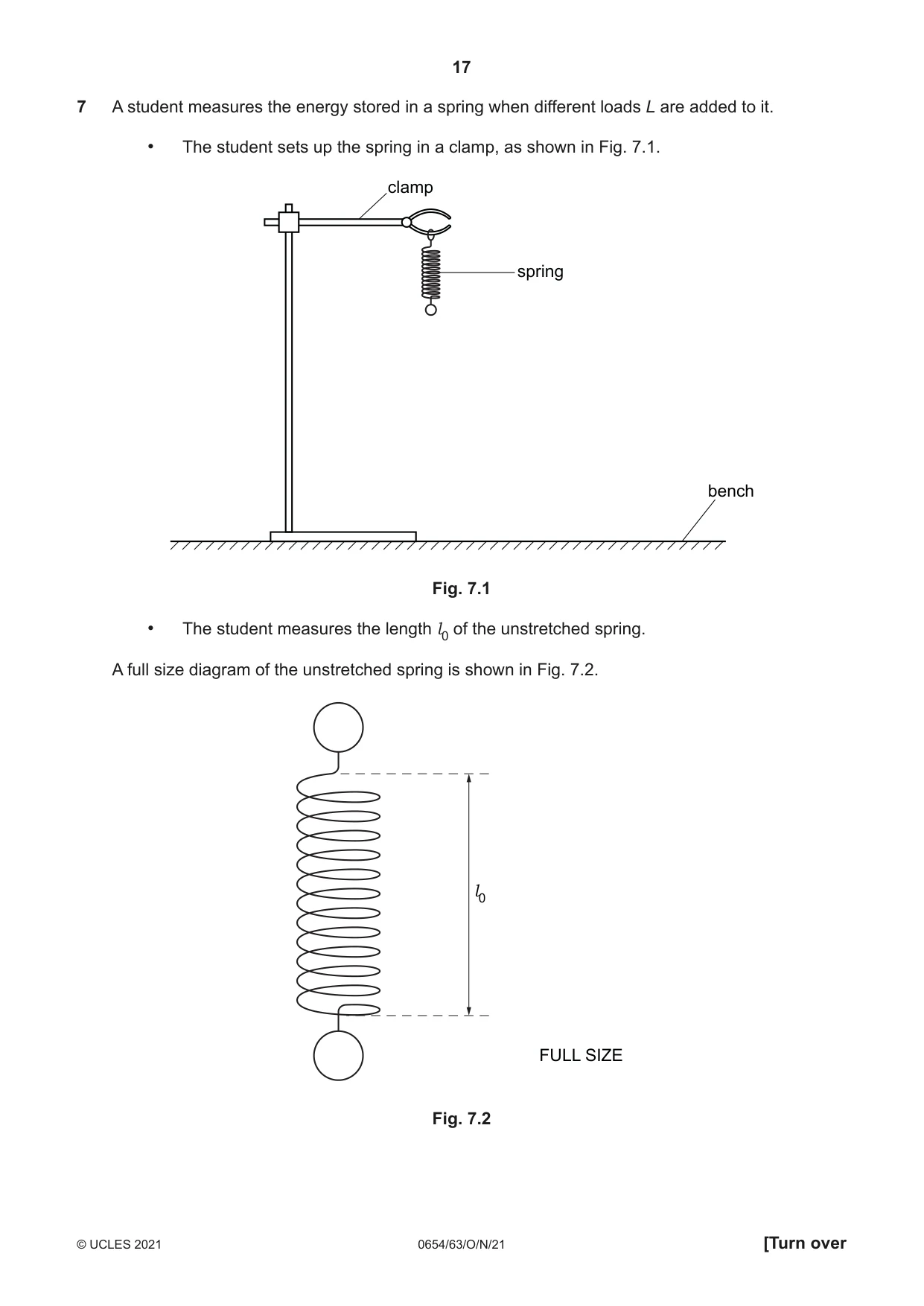
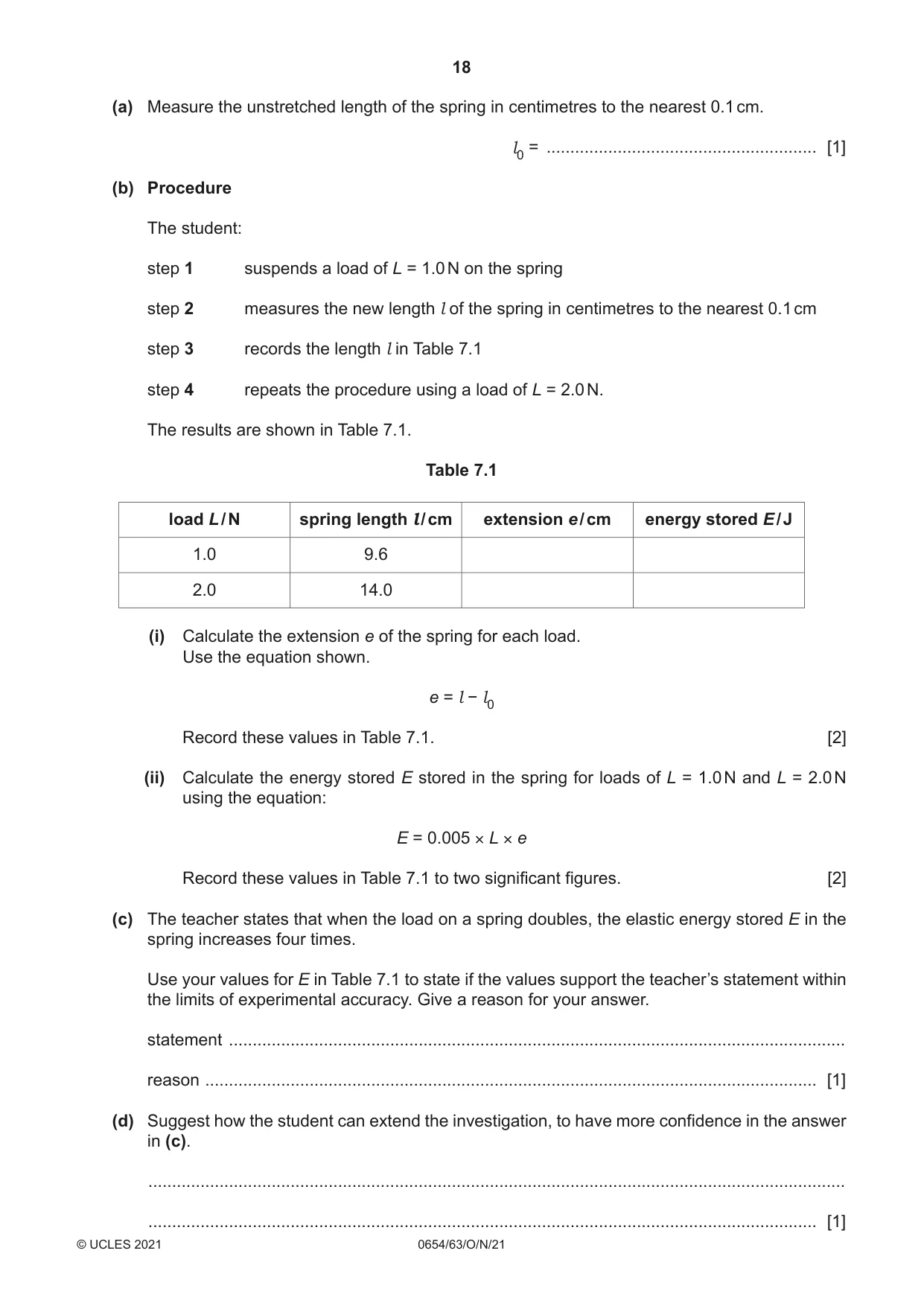
7 A student measures the energy stored in a spring when different loads L are added to it. • The student sets up the spring in a clamp, as shown in Fig. 7.1. clamp spring bench Fig. 7.1 • The student measures the length l0 of the unstretched spring. A full size diagram of the unstretched spring is shown in Fig. 7.2. l0 FULL SIZE Fig. 7.2 (a) Measure the unstretched length of the spring in centimetres to the nearest 0.1 cm. l0 = ......................................................... [1] (b) Procedure The student: step 1 suspends a load of L = 1.0 N on the spring step 2 measures the new length l of the spring in centimetres to the nearest 0.1 cm step 3 records the length l in Table 7.1 step 4 repeats the procedure using a load of L = 2.0 N. The results are shown in Table 7.1. Table 7.1 load L / N spring length l / cm extension e / cm energy stored E / J 1.0 9.6 2.0 14.0 (i) Calculate the extension e of the spring for each load. Use the equation shown. e = l − l0 Record these values in Table 7.1. [2] (ii) Calculate the energy stored E stored in the spring for loads of L = 1.0 N and L = 2.0 N using the equation: E = 0.005 × L × e Record these values in Table 7.1 to two significant figures. [2] (c) The teacher states that when the load on a spring doubles, the elastic energy stored E in the spring increases four times. Use your values for E in Table 7.1 to state if the values support the teacher’s statement within the limits of experimental accuracy. Give a reason for your answer. statement .................................................................................................................................. reason ................................................................................................................................. [1] (d) Suggest how the student can extend the investigation, to have more confidence in the answer in (c). ................................................................................................................................................... ............................................................................................................................................. [1] (e) Stretched springs are potentially dangerous. State one safety precaution that is taken when working with stretched springs. Explain your answer. safety precaution ...................................................................................................................... explanation ......................................................................................................................... [1] [Total: 8]
Mark scheme: 7(a) 5.5 (cm) ; 1 7(b)(i) 4.1 (cm) ; 8.5 (cm) ; 2 7(b)(ii) values: 0.0205 and 0.085 (J) ; correct rounding: 0.021 and 0.085 ; 2 7(c) yes / the answers are very close and 4 × 0.021 / 0.085 ÷ 0.021 = 4 ; 1 7(d) repeat with different loads (and compare the energies stored) ; 1 7(e) wear goggles and to protect (eyes) if spring flicks ; ensure that the spring is tightly clamped / ensure that the load is firmly attached to the spring and so as not to hit the student (in eye); 1
What was in this paper
The subtopics covered by these 7 questions, and how many questions each got. Open one in a new tab to see every Cambridge question on it.
What you needed in this session
Cambridge’s own grade thresholds for 2021 Oct/Nov, Paper 6 · Variant 3. A higher threshold means an easier paper — the bar moves with how the cohort did.