Cambridge IGCSE Sciences - Co-ordinated (Double) 0654 — 2020 Oct/Nov Paper 6 · Variant 3
0654/63/O/N/20 · 7 questions · 60 marks · ≈68 min
The question paper and its mark scheme, free to read here and free to download. This is Cambridge’s own paper, exactly as it was sat.
Question paper16 pages
Mark scheme10 pages
Answers below. Sit the paper first if you are practising.
Questions as text
Q1 · A student uses a potato cylinder cut into slices to investigate the action of the enzyme…
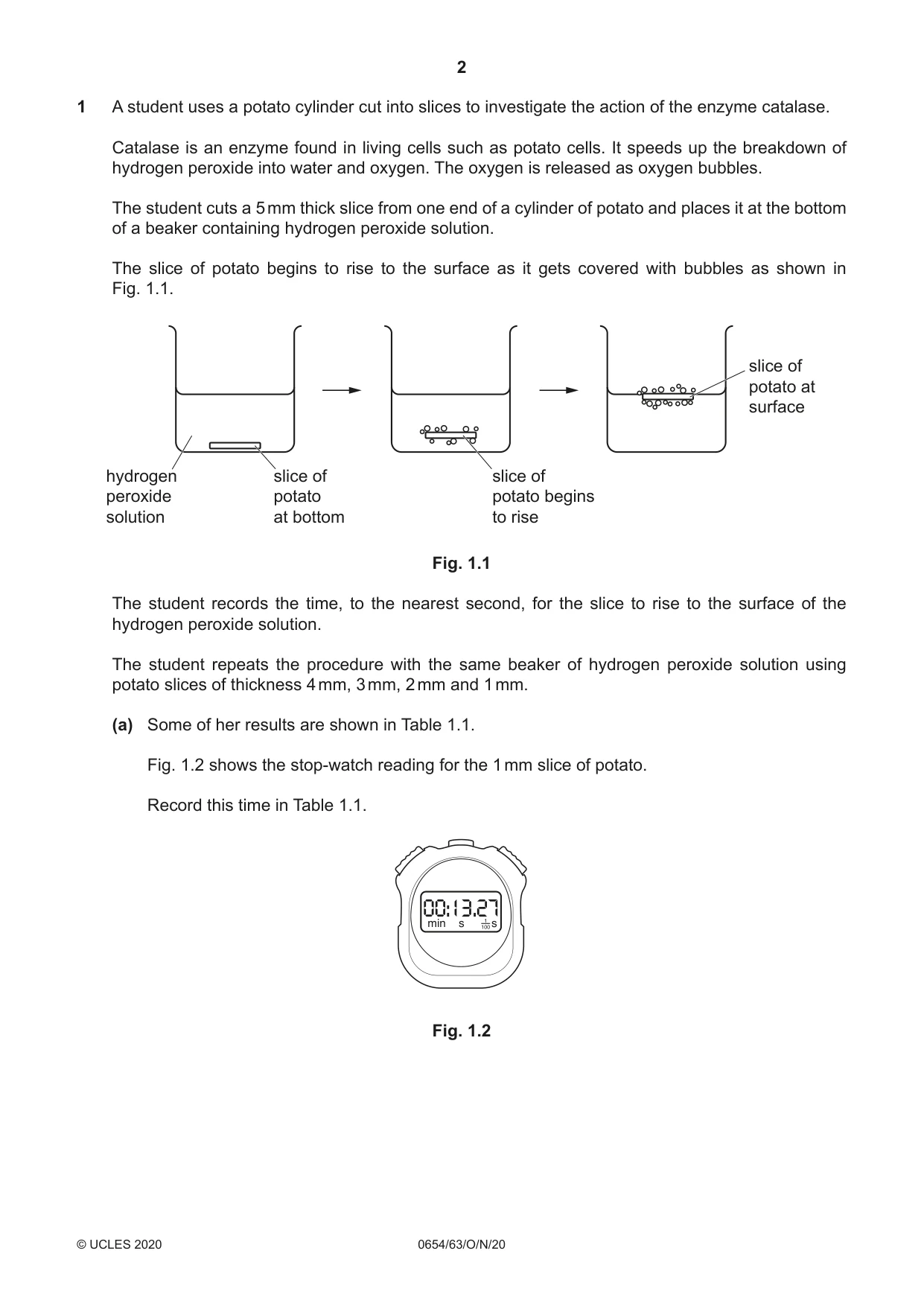
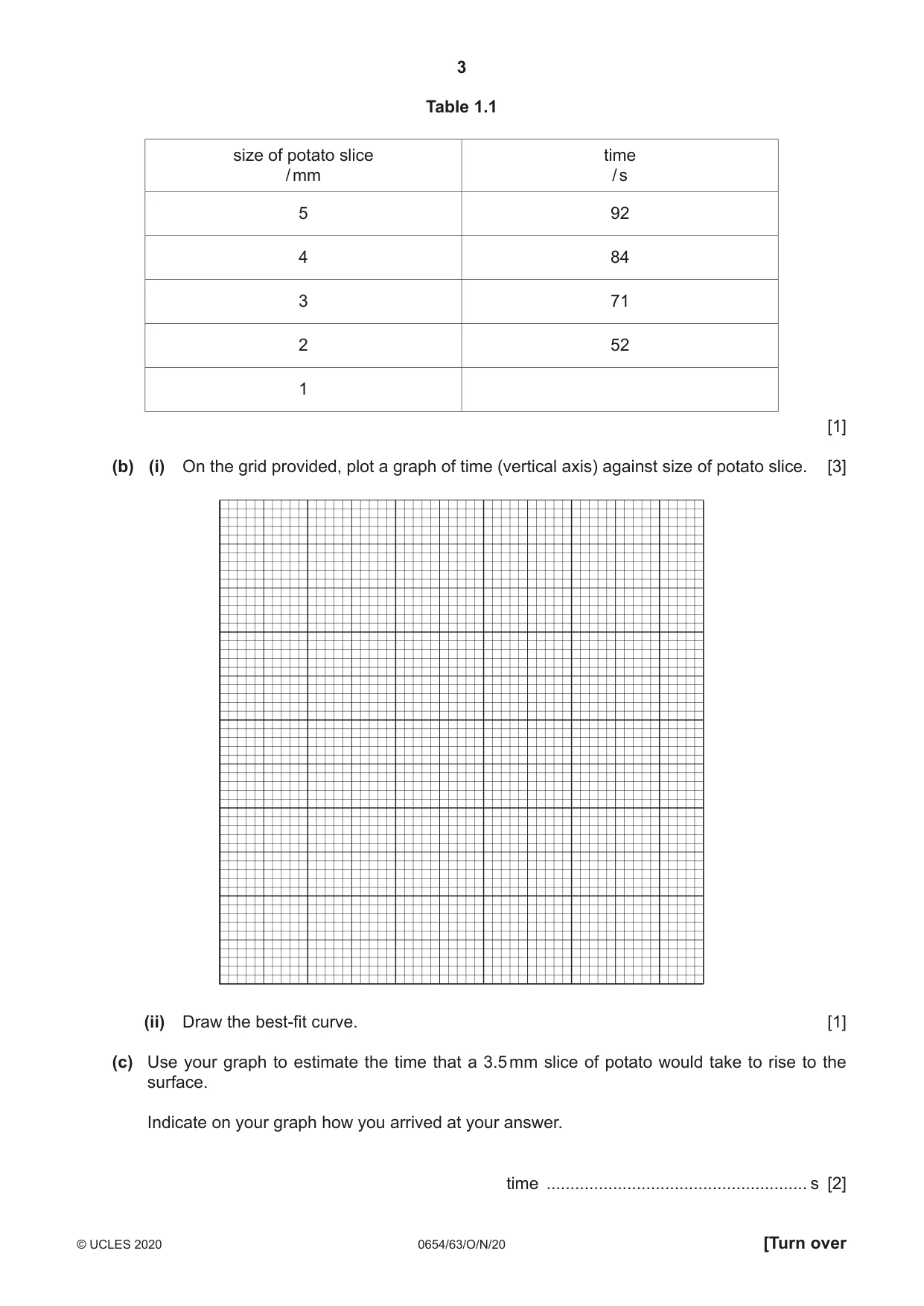
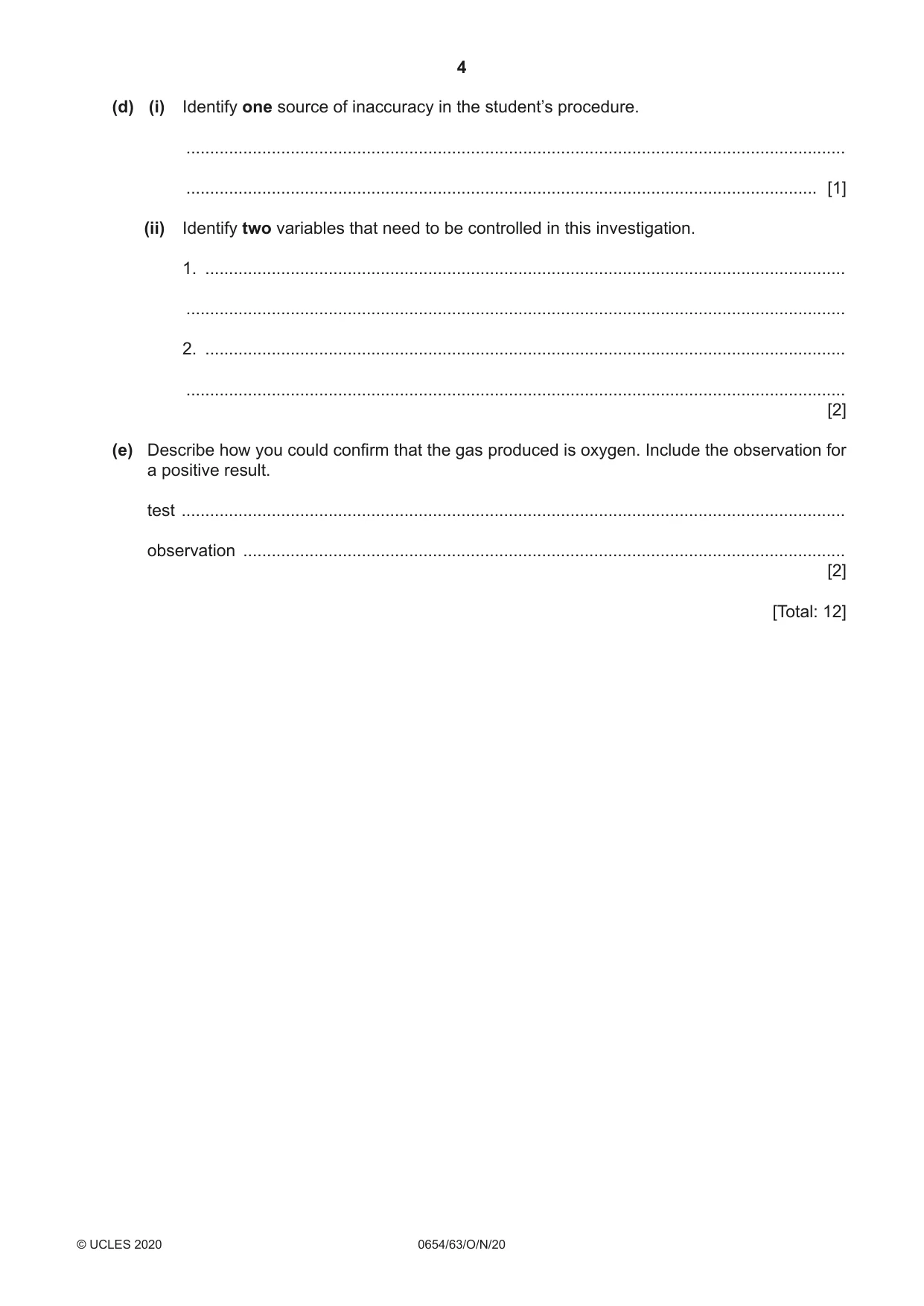
1 A student uses a potato cylinder cut into slices to investigate the action of the enzyme catalase. Catalase is an enzyme found in living cells such as potato cells. It speeds up the breakdown of hydrogen peroxide into water and oxygen. The oxygen is released as oxygen bubbles. The student cuts a 5 mm thick slice from one end of a cylinder of potato and places it at the bottom of a beaker containing hydrogen peroxide solution. The slice of potato begins to rise to the surface as it gets covered with bubbles as shown in Fig. 1.1. slice of potato at surface hydrogen slice of slice of peroxide potato potato begins solution at bottom to rise Fig. 1.1 The student records the time, to the nearest second, for the slice to rise to the surface of the hydrogen peroxide solution. The student repeats the procedure with the same beaker of hydrogen peroxide solution using potato slices of thickness 4 mm, 3 mm, 2 mm and 1 mm. (a) Some of her results are shown in Table 1.1. Fig. 1.2 shows the stop-watch reading for the 1 mm slice of potato. Record this time in Table 1.1. 00:13.271 min s 100 s Fig. 1.2 Table 1.1 size of potato slice time / mm / s 5 92 4 84 3 71 2 52 1 [1] (b) (i) On the grid provided, plot a graph of time (vertical axis) against size of potato slice. [3] (ii) Draw the best-fit curve. [1] (c) Use your graph to estimate the time that a 3.5 mm slice of potato would take to rise to the surface. Indicate on your graph how you arrived at your answer. time ....................................................... s [2] (d) (i) Identify one source of inaccuracy in the student’s procedure. ........................................................................................................................................... ..................................................................................................................................... [1] (ii) Identify two variables that need to be controlled in this investigation. 1. ....................................................................................................................................... ........................................................................................................................................... 2. ....................................................................................................................................... ........................................................................................................................................... [2] (e) Describe how you could confirm that the gas produced is oxygen. Include the observation for a positive result. test ............................................................................................................................................ observation ............................................................................................................................... [2] [Total: 12]
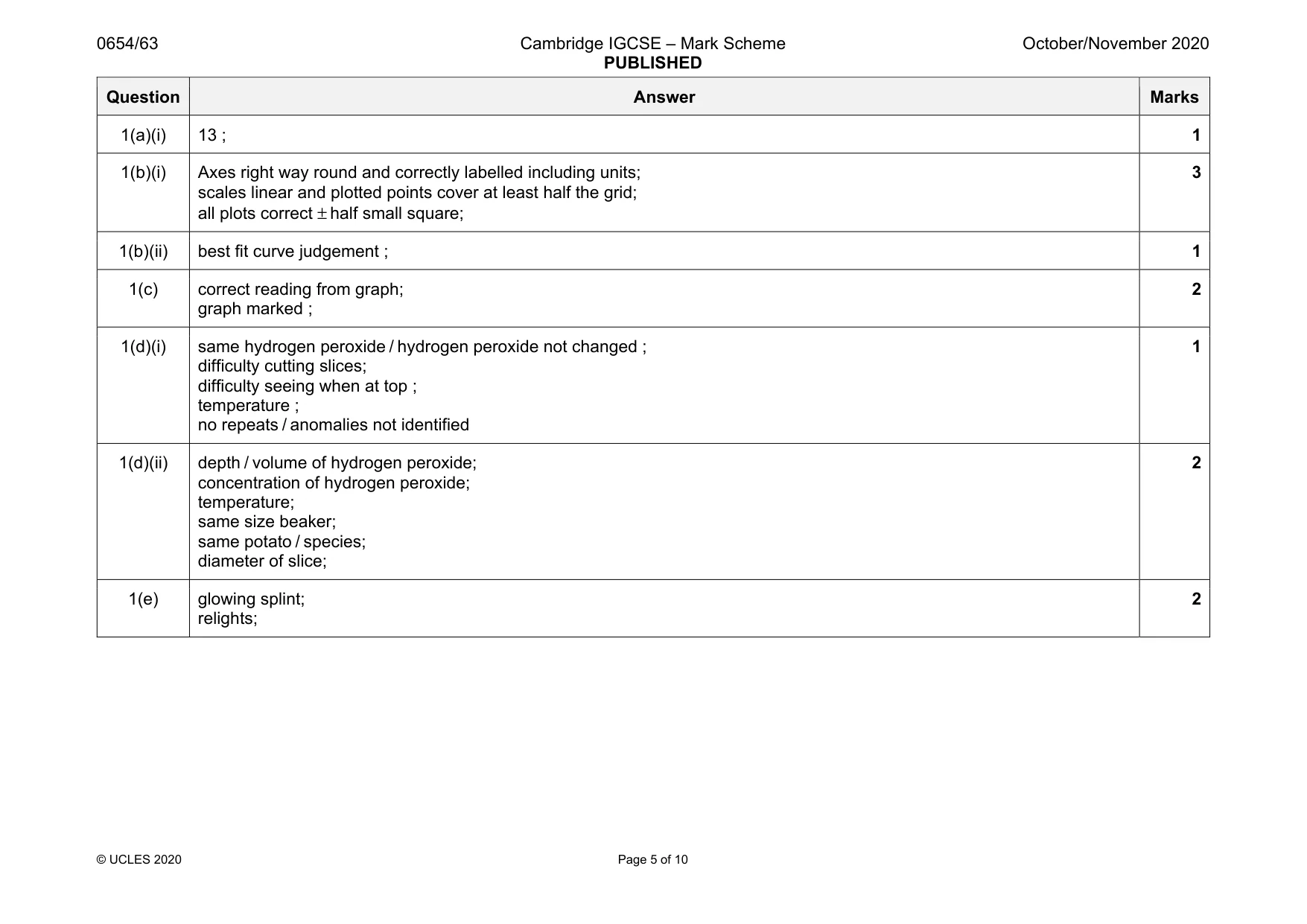
Mark scheme: 1(a)(i) 13 ; 1 1(b)(i) Axes right way round and correctly labelled including units; scales linear and plotted points cover at least half the grid; all plots correct ± half small square; 3 1(b)(ii) best fit curve judgement ; 1 1(c) correct reading from graph; graph marked ; 2 1(d)(i) same hydrogen peroxide / hydrogen peroxide not changed ; difficulty cutting slices; difficulty seeing when at top ; temperature ; no repeats / anomalies not identified 1 1(d)(ii) depth / volume of hydrogen peroxide; concentration of hydrogen peroxide; temperature; same size beaker; same potato / species; diameter of slice; 2 1(e) glowing splint; relights; 2
Q2 · A student tests some potato for its nutrient content using iodine solution and biuret…
2 A student tests some potato for its nutrient content using iodine solution and biuret solution. (a) (i) The potato tests positive with the iodine solution and negative with the biuret solution. State the colours the student observes. colour observed with iodine solution ................................................................................. colour observed with biuret solution .................................................................................. [2] (ii) State the nutrient that these two solutions test for. iodine solution tests for ..................................................................................................... biuret solution tests for ...................................................................................................... [2] (b) A student wants to test some potato using Benedict’s solution. (i) Name the nutrient that Benedict’s solution tests for. ..................................................................................................................................... [1] (ii) State the colour the student observes if the potato contains: a small amount of this nutrient ........................................................................................................................................... a large amount of this nutrient. ........................................................................................................................................... [2] (c) State which of the test solutions in (a) and (b) requires the use of heat. ............................................................................................................................................. [1] [Total: 8]
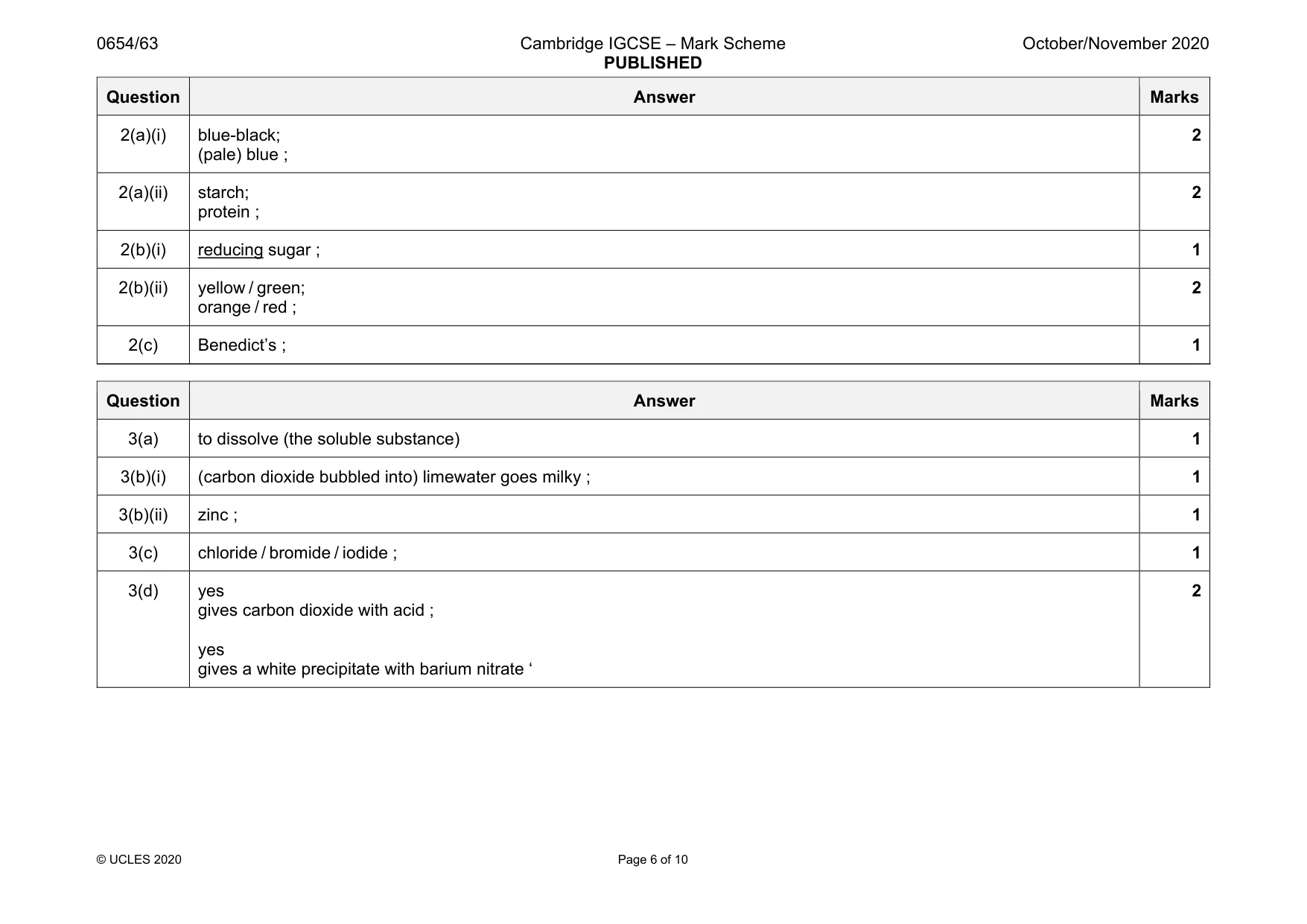
Mark scheme: 2(a)(i) blue-black; (pale) blue ; 2 2(a)(ii) starch; protein ; 2 2(b)(i) reducing sugar ; 1 2(b)(ii) yellow / green; orange / red ; 2 2(c) Benedict’s ; 1
Q3 · A student is provided with solid J, which is a mixture of two compounds
3 A student is provided with solid J, which is a mixture of two compounds. One compound is soluble in water and the other is insoluble in water. The student does a series of experiments to identify some of the ions in J. The student: • places some of solid J into a beaker • adds some distilled water to J and stirs • filters the mixture. (a) Suggest why the mixture is stirred. ................................................................................................................................................... ............................................................................................................................................. [1] (b) The student places a small sample of the residue from the filter paper into a test-tube. (i) The student adds some dilute nitric acid into this test-tube. The mixture fizzes and produces a colourless solution. The gas given off is carbon dioxide. State the test used to identify carbon dioxide and give the observation for a positive result. test .................................................................................................................................... observation ........................................................................................................................ ........................................................................................................................................... [1] (ii) As soon as the mixture in (b)(i) stops fizzing, the student adds aqueous sodium hydroxide until it is in excess. The student observes a white precipitate that is soluble in excess. Circle the cation shown to be present in the residue. copper ion iron(II) ion iron(III) ion zinc ion [1] (c) The student adds some of the liquid filtrate to a test-tube. The student adds some dilute nitric acid and aqueous silver nitrate to the filtrate. No precipitate is observed. Name one anion that cannot be present in the filtrate. ............................................................................................................................................. [1] (d) The student adds some of the liquid filtrate to a clean test-tube. The student adds some dilute nitric acid and aqueous barium nitrate to the filtrate. The student observes a white precipitate. State if the results in (b) and (d) support the conclusion that J contains both carbonate and sulfate ions. Justify your answer using information from these results. J contains carbonate ions yes / no justification ................................................................................................................................ ................................................................................................................................................... J contains sulfate ions yes / no justification ................................................................................................................................ ................................................................................................................................................... [2] [Total: 6]
Mark scheme: 3(a) to dissolve (the soluble substance) 1 3(b)(i) (carbon dioxide bubbled into) limewater goes milky ; 1 3(b)(ii) zinc ; 1 3(c) chloride / bromide / iodide ; 1 3(d) yes gives carbon dioxide with acid ; yes gives a white precipitate with barium nitrate ‘ 2
Q4 · A student is provided with solid sodium hydrogencarbonate labelled K
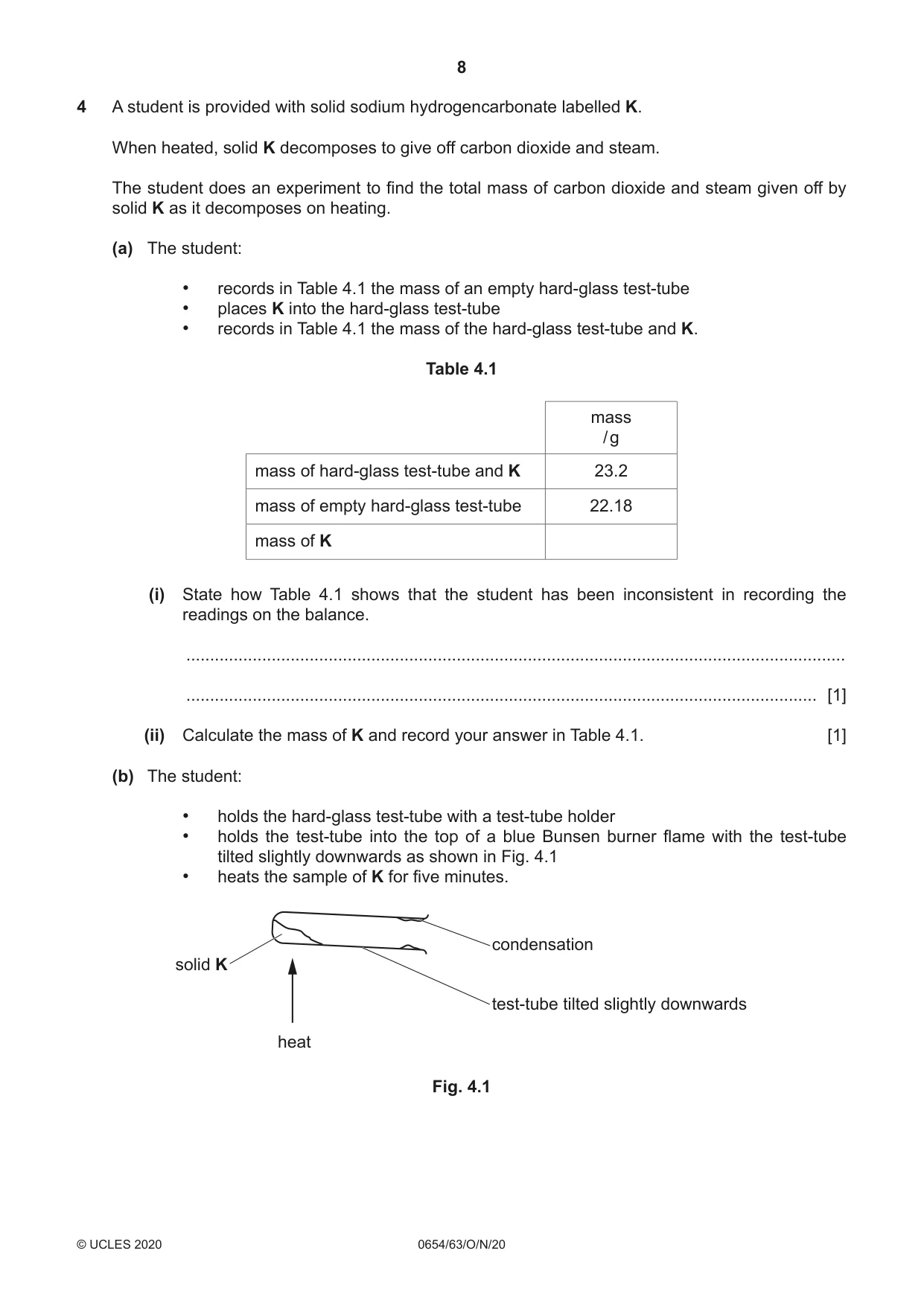
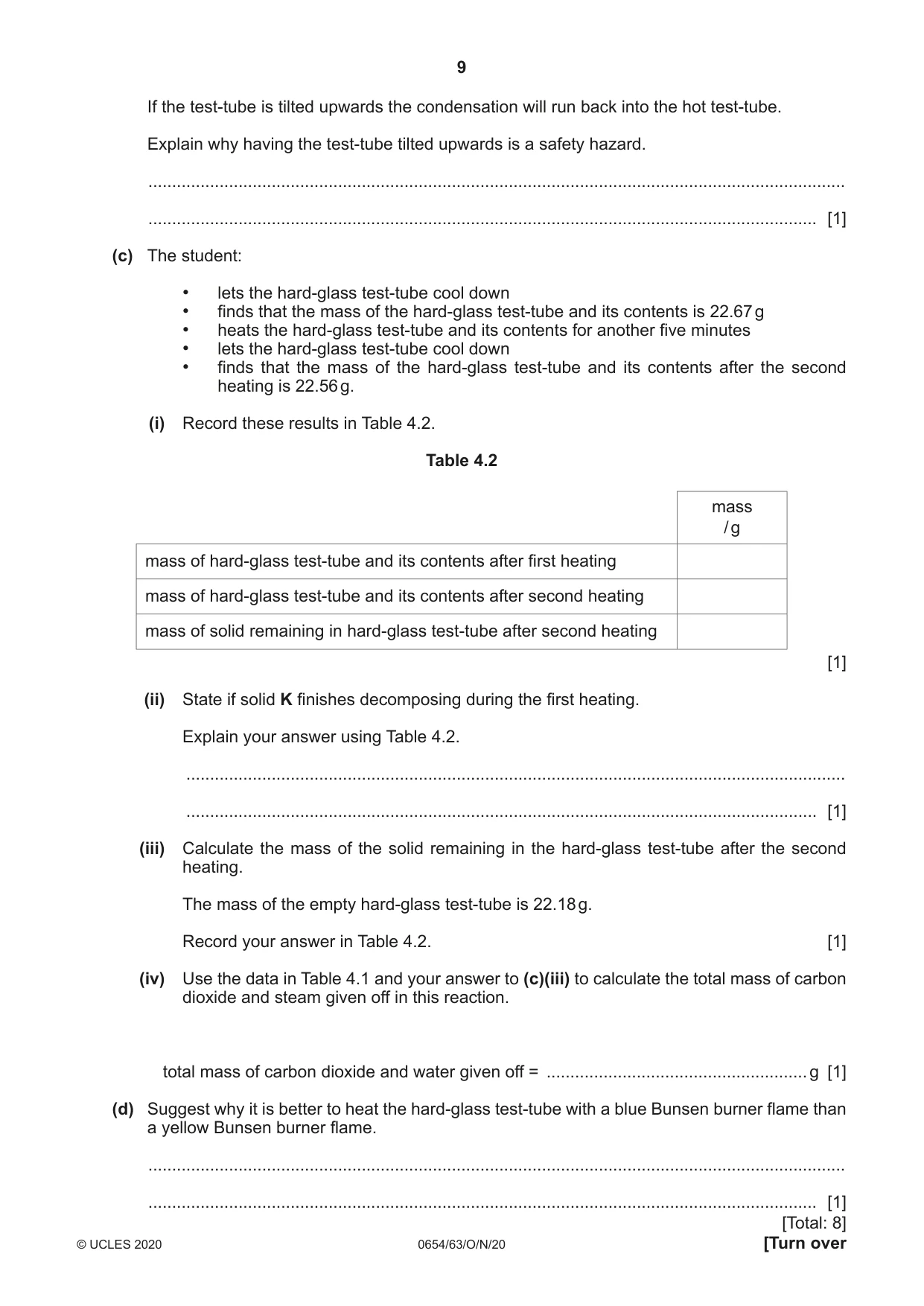
4 A student is provided with solid sodium hydrogencarbonate labelled K. When heated, solid K decomposes to give off carbon dioxide and steam. The student does an experiment to find the total mass of carbon dioxide and steam given off by solid K as it decomposes on heating. (a) The student: • records in Table 4.1 the mass of an empty hard-glass test-tube • places K into the hard-glass test-tube • records in Table 4.1 the mass of the hard-glass test-tube and K. Table 4.1 mass / g mass of hard-glass test-tube and K 23.2 mass of empty hard-glass test-tube 22.18 mass of K (i) State how Table 4.1 shows that the student has been inconsistent in recording the readings on the balance. ........................................................................................................................................... ..................................................................................................................................... [1] (ii) Calculate the mass of K and record your answer in Table 4.1. [1] (b) The student: • holds the hard-glass test-tube with a test-tube holder • holds the test-tube into the top of a blue Bunsen burner flame with the test-tube tilted slightly downwards as shown in Fig. 4.1 • heats the sample of K for five minutes. condensation solid K test-tube tilted slightly downwards heat Fig. 4.1 If the test-tube is tilted upwards the condensation will run back into the hot test-tube. Explain why having the test-tube tilted upwards is a safety hazard. ................................................................................................................................................... ............................................................................................................................................. [1] (c) The student: • lets the hard-glass test-tube cool down • finds that the mass of the hard-glass test-tube and its contents is 22.67 g • heats the hard-glass test-tube and its contents for another five minutes • lets the hard-glass test-tube cool down • finds that the mass of the hard-glass test-tube and its contents after the second heating is 22.56 g. (i) Record these results in Table 4.2. Table 4.2 mass / g mass of hard-glass test-tube and its contents after first heating mass of hard-glass test-tube and its contents after second heating mass of solid remaining in hard-glass test-tube after second heating [1] (ii) State if solid K finishes decomposing during the first heating. Explain your answer using Table 4.2. ........................................................................................................................................... ..................................................................................................................................... [1] (iii) Calculate the mass of the solid remaining in the hard-glass test-tube after the second heating. The mass of the empty hard-glass test-tube is 22.18 g. Record your answer in Table 4.2. [1] (iv) Use the data in Table 4.1 and your answer to (c)(iii) to calculate the total mass of carbon dioxide and steam given off in this reaction. total mass of carbon dioxide and water given off = ....................................................... g [1] (d) Suggest why it is better to heat the hard-glass test-tube with a blue Bunsen burner flame than a yellow Bunsen burner flame. ................................................................................................................................................... ............................................................................................................................................. [1] [Total: 8]
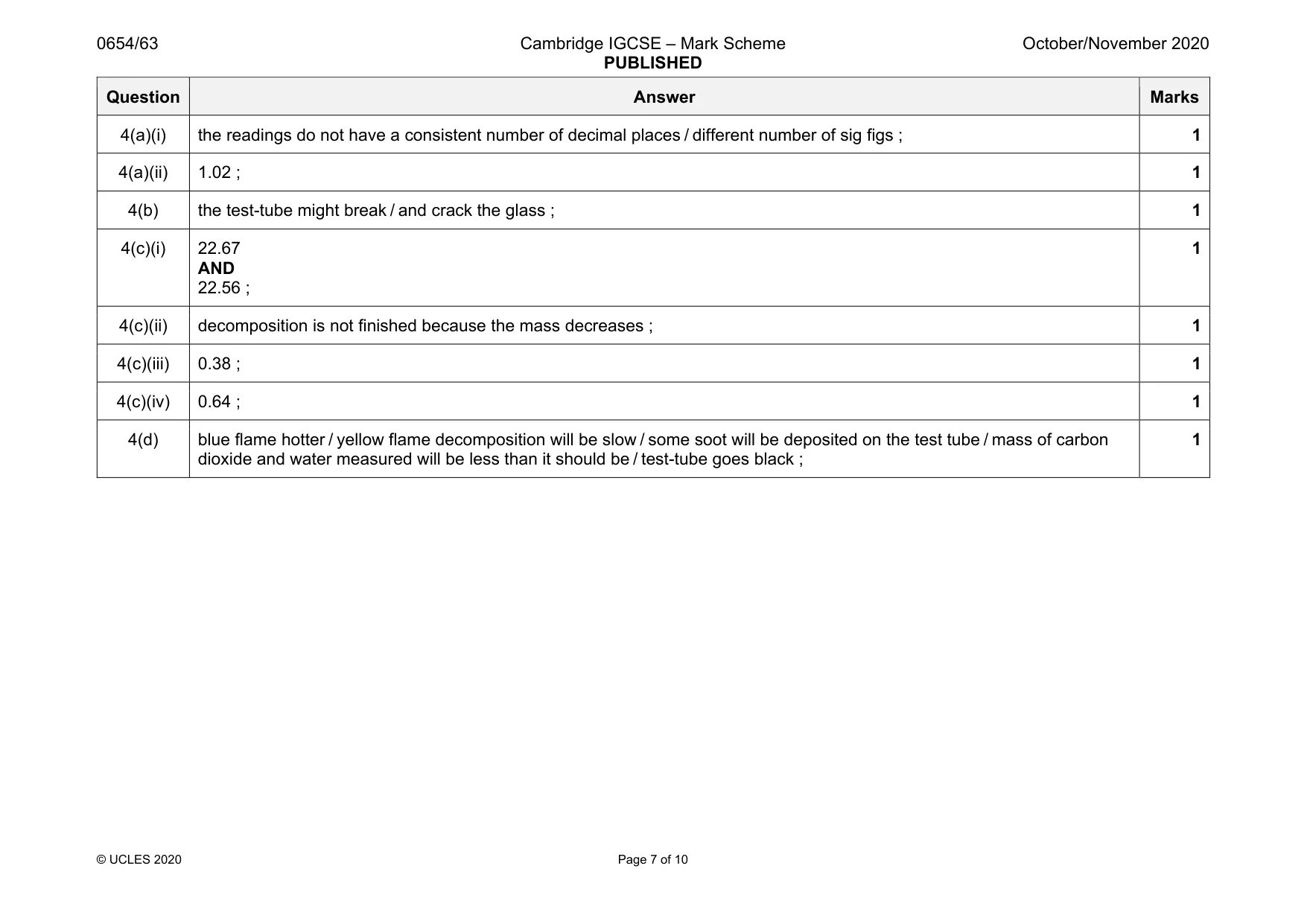
Mark scheme: 4(a)(i) the readings do not have a consistent number of decimal places / different number of sig figs ; 1 4(a)(ii) 1.02 ; 1 4(b) the test-tube might break / and crack the glass ; 1 4(c)(i) 22.67 AND 22.56 ; 1 4(c)(ii) decomposition is not finished because the mass decreases ; 1 4(c)(iii) 0.38 ; 1 4(c)(iv) 0.64 ; 1 4(d) blue flame hotter / yellow flame decomposition will be slow / some soot will be deposited on the test tube / mass of carbon dioxide and water measured will be less than it should be / test-tube goes black ; 1
Q5 · A student investigates the electrolysis of dilute sulfuric acid
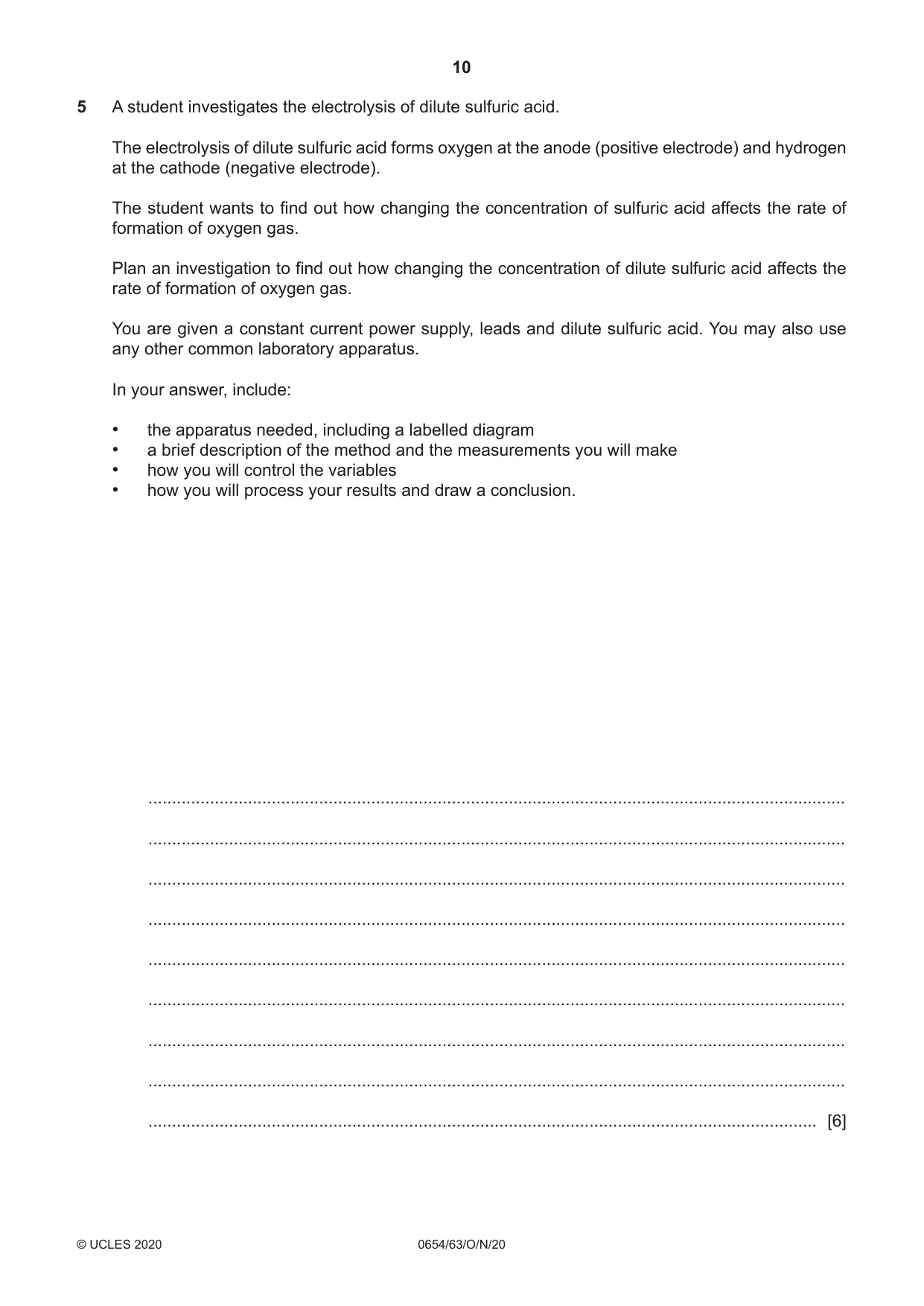
5 A student investigates the electrolysis of dilute sulfuric acid. The electrolysis of dilute sulfuric acid forms oxygen at the anode (positive electrode) and hydrogen at the cathode (negative electrode). The student wants to find out how changing the concentration of sulfuric acid affects the rate of formation of oxygen gas. Plan an investigation to find out how changing the concentration of dilute sulfuric acid affects the rate of formation of oxygen gas. You are given a constant current power supply, leads and dilute sulfuric acid. You may also use any other common laboratory apparatus. In your answer, include: • the apparatus needed, including a labelled diagram • a brief description of the method and the measurements you will make • how you will control the variables • how you will process your results and draw a conclusion. ................................................................................................................................................... ................................................................................................................................................... ................................................................................................................................................... ................................................................................................................................................... ................................................................................................................................................... ................................................................................................................................................... ................................................................................................................................................... ................................................................................................................................................... ............................................................................................................................................. [6]
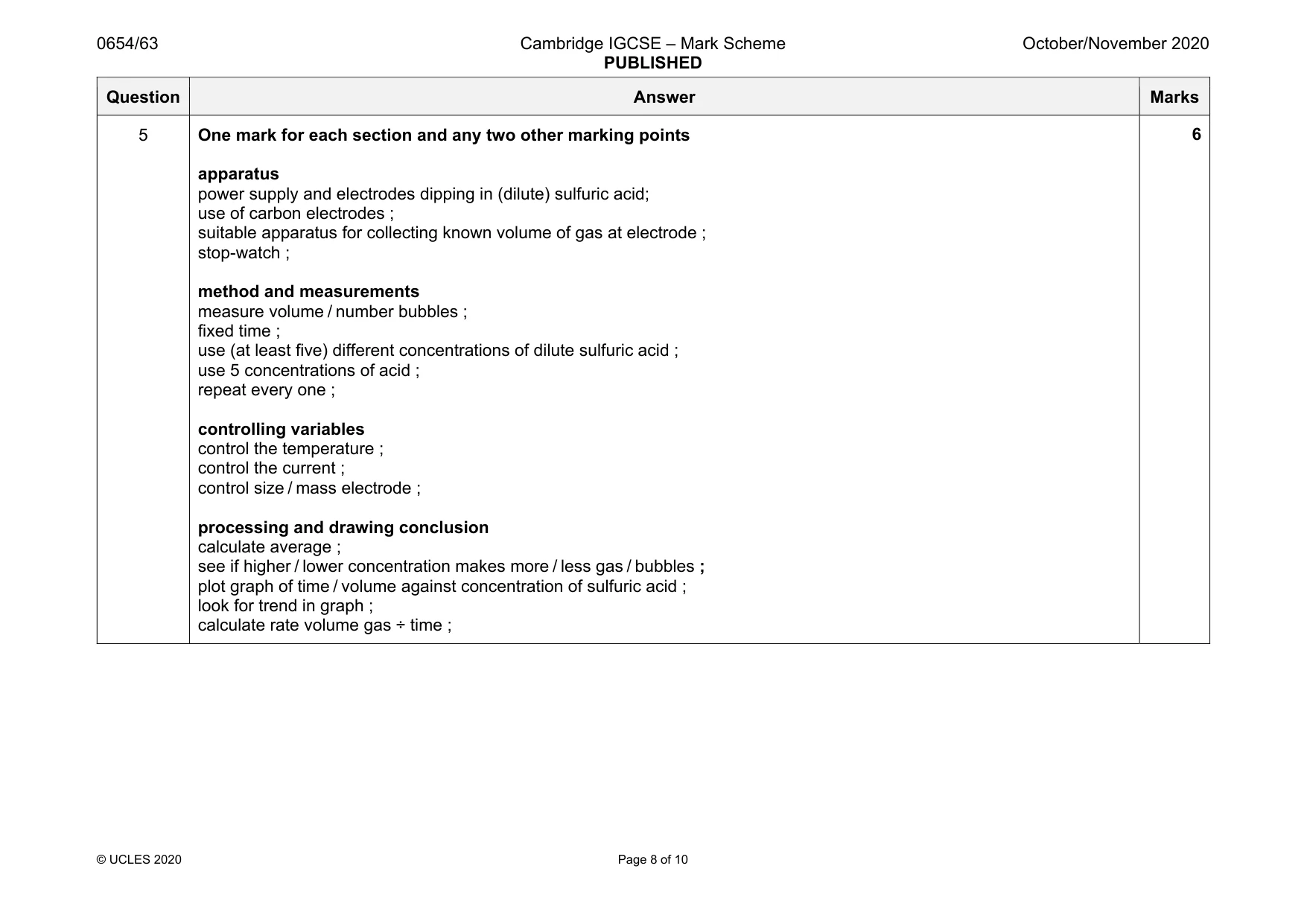
Mark scheme: 5 One mark for each section and any two other marking points apparatus power supply and electrodes dipping in (dilute) sulfuric acid; use of carbon electrodes ; suitable apparatus for collecting known volume of gas at electrode ; stop-watch ; method and measurements measure volume / number bubbles ; fixed time ; use (at least five) different concentrations of dilute sulfuric acid ; use 5 concentrations of acid ; repeat every one ; controlling variables control the temperature ; control the current ; control size / mass electrode ; processing and drawing conclusion calculate average ; see if higher / lower concentration makes more / less gas / bubbles ; plot graph of time / volume against concentration of sulfuric acid ; look for trend in graph ; calculate rate volume gas ÷ time ;
Q6 · A student investigates the resistance of different lamp combinations
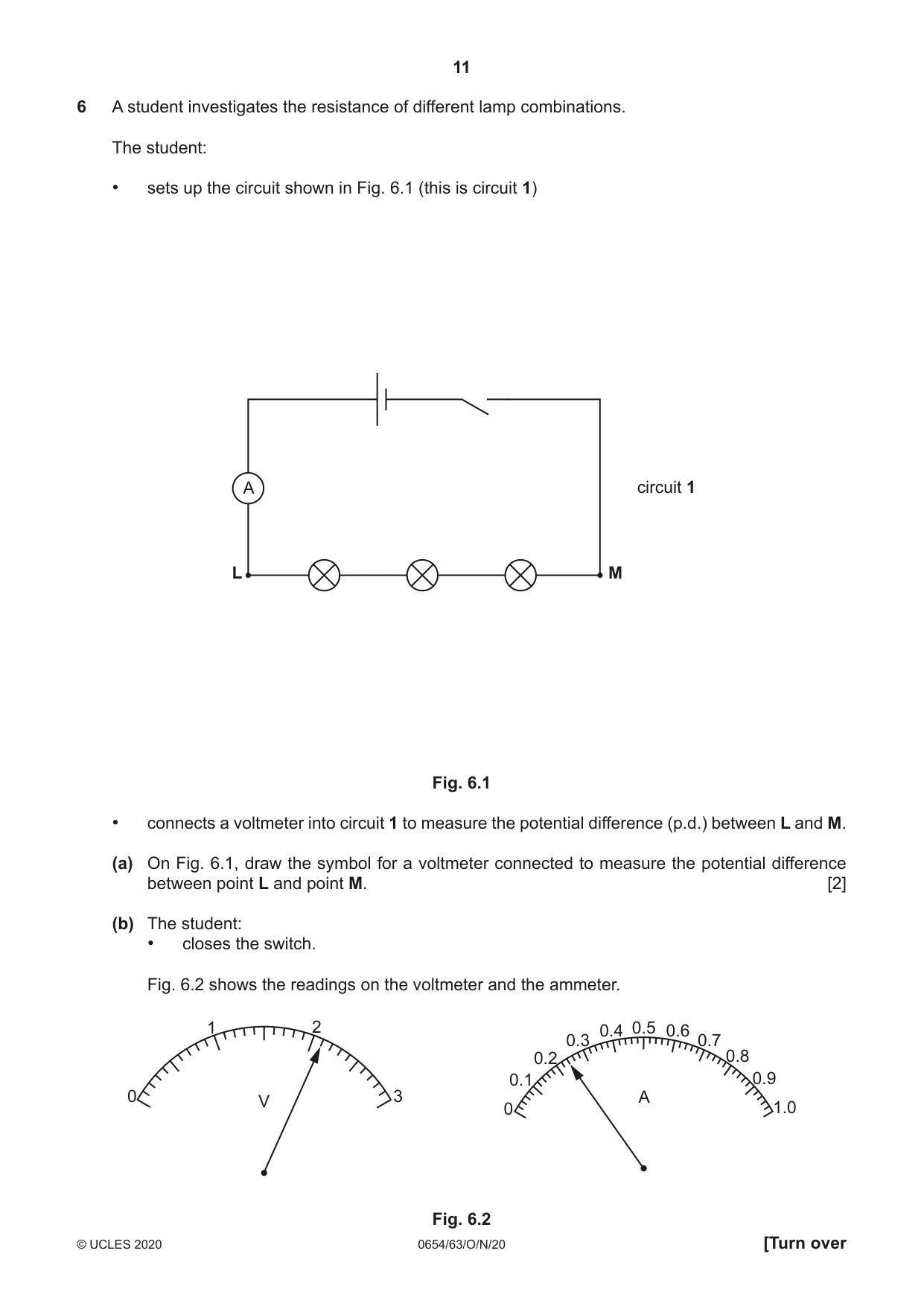
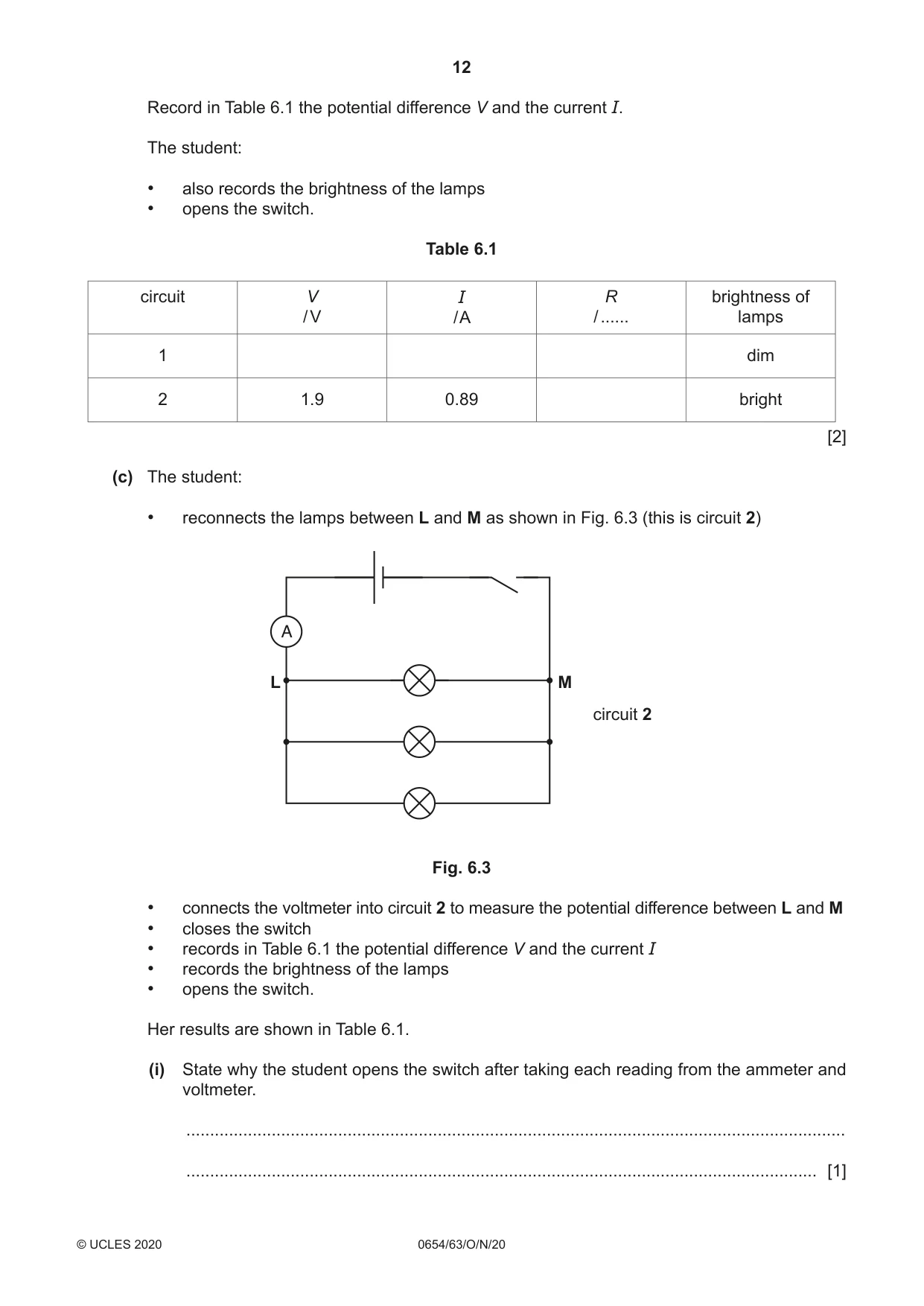
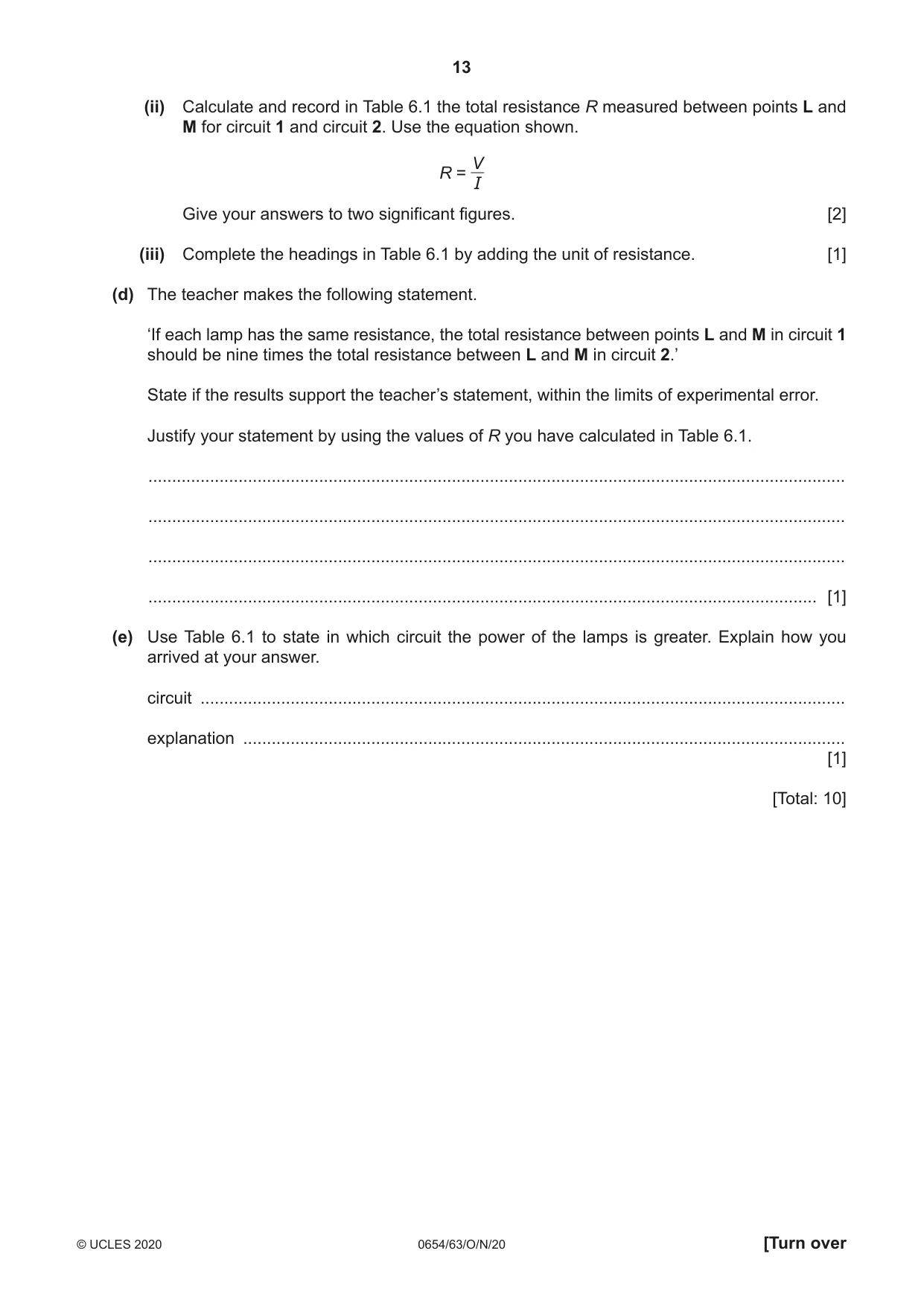
6 A student investigates the resistance of different lamp combinations. The student: • sets up the circuit shown in Fig. 6.1 (this is circuit 1) A circuit 1 L M Fig. 6.1 • connects a voltmeter into circuit 1 to measure the potential difference (p.d.) between L and M. (a) On Fig. 6.1, draw the symbol for a voltmeter connected to measure the potential difference between point L and point M. [2] (b) The student: • closes the switch. Fig. 6.2 shows the readings on the voltmeter and the ammeter. 1 2 0.4 0.5 0.6 0.3 0.7 0.2 0.8 0.1 0.9 0 3 A V 0 1.0 Fig. 6.2 Record in Table 6.1 the potential difference V and the current I. The student: • also records the brightness of the lamps • opens the switch. Table 6.1 circuit V I R brightness of / V / A / ...... lamps 1 dim 2 1.9 0.89 bright [2] (c) The student: • reconnects the lamps between L and M as shown in Fig. 6.3 (this is circuit 2) A L M circuit 2 Fig. 6.3 • connects the voltmeter into circuit 2 to measure the potential difference between L and M • closes the switch • records in Table 6.1 the potential difference V and the current I • records the brightness of the lamps • opens the switch. Her results are shown in Table 6.1. (i) State why the student opens the switch after taking each reading from the ammeter and voltmeter. ........................................................................................................................................... ..................................................................................................................................... [1] (ii) Calculate and record in Table 6.1 the total resistance R measured between points L and M for circuit 1 and circuit 2. Use the equation shown. V R = I Give your answers to two significant figures. [2] (iii) Complete the headings in Table 6.1 by adding the unit of resistance. [1] (d) The teacher makes the following statement. ‘If each lamp has the same resistance, the total resistance between points L and M in circuit 1 should be nine times the total resistance between L and M in circuit 2.’ State if the results support the teacher’s statement, within the limits of experimental error. Justify your statement by using the values of R you have calculated in Table 6.1. ................................................................................................................................................... ................................................................................................................................................... ................................................................................................................................................... ............................................................................................................................................. [1] (e) Use Table 6.1 to state in which circuit the power of the lamps is greater. Explain how you arrived at your answer. circuit ........................................................................................................................................ explanation ............................................................................................................................... [1] [Total: 10]
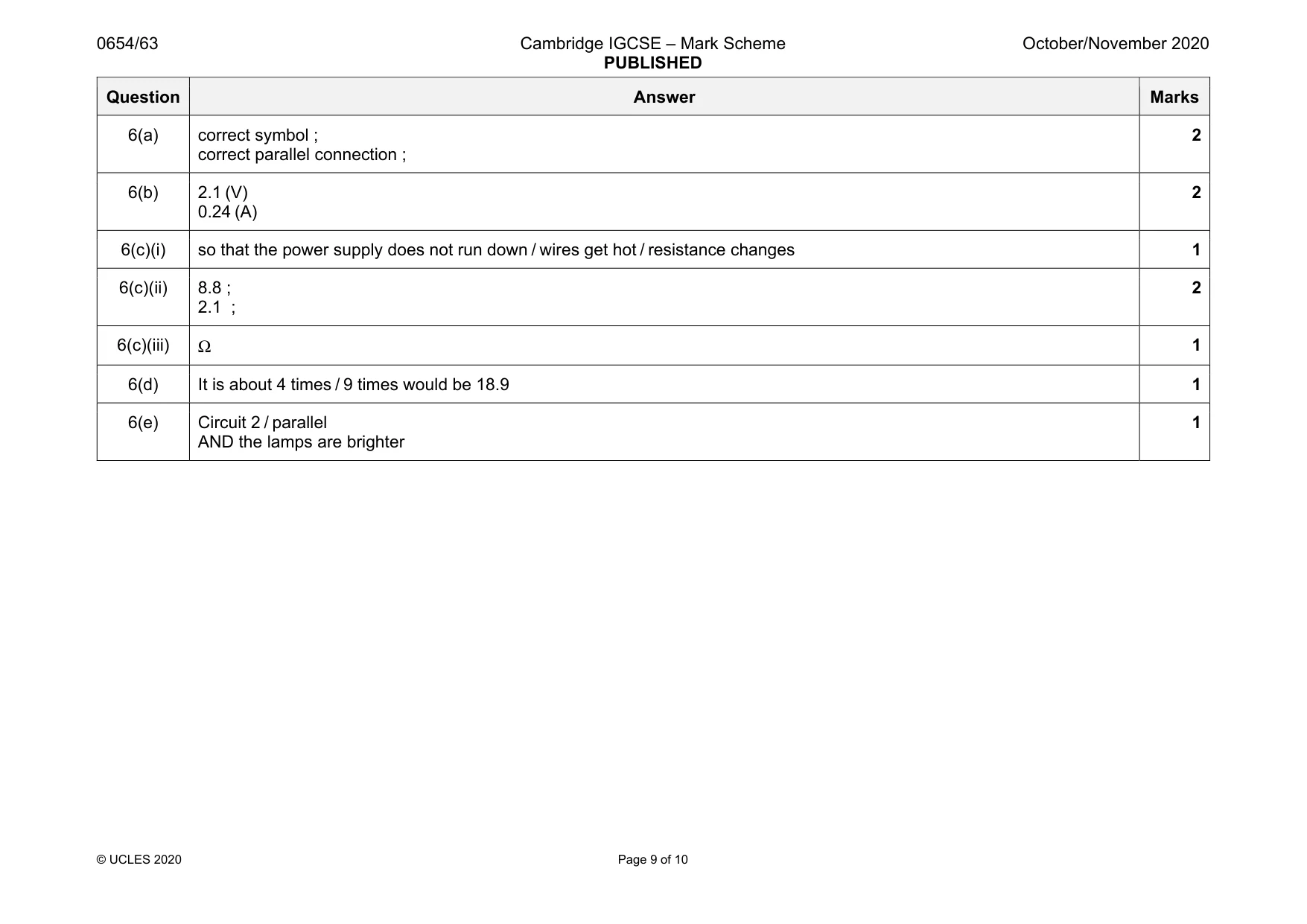
Mark scheme: 6(a) correct symbol ; correct parallel connection ; 2 6(b) 2.1 (V) 0.24 (A) 2 6(c)(i) so that the power supply does not run down / wires get hot / resistance changes 1 6(c)(ii) 8.8 ; 2.1 ; 2 6(c)(iii) Ω 1 6(d) It is about 4 times / 9 times would be 18.9 1 6(e) Circuit 2 / parallel AND the lamps are brighter 1
Q7 · A student investigates the rate of decrease in temperature of two beakers P and Q that…
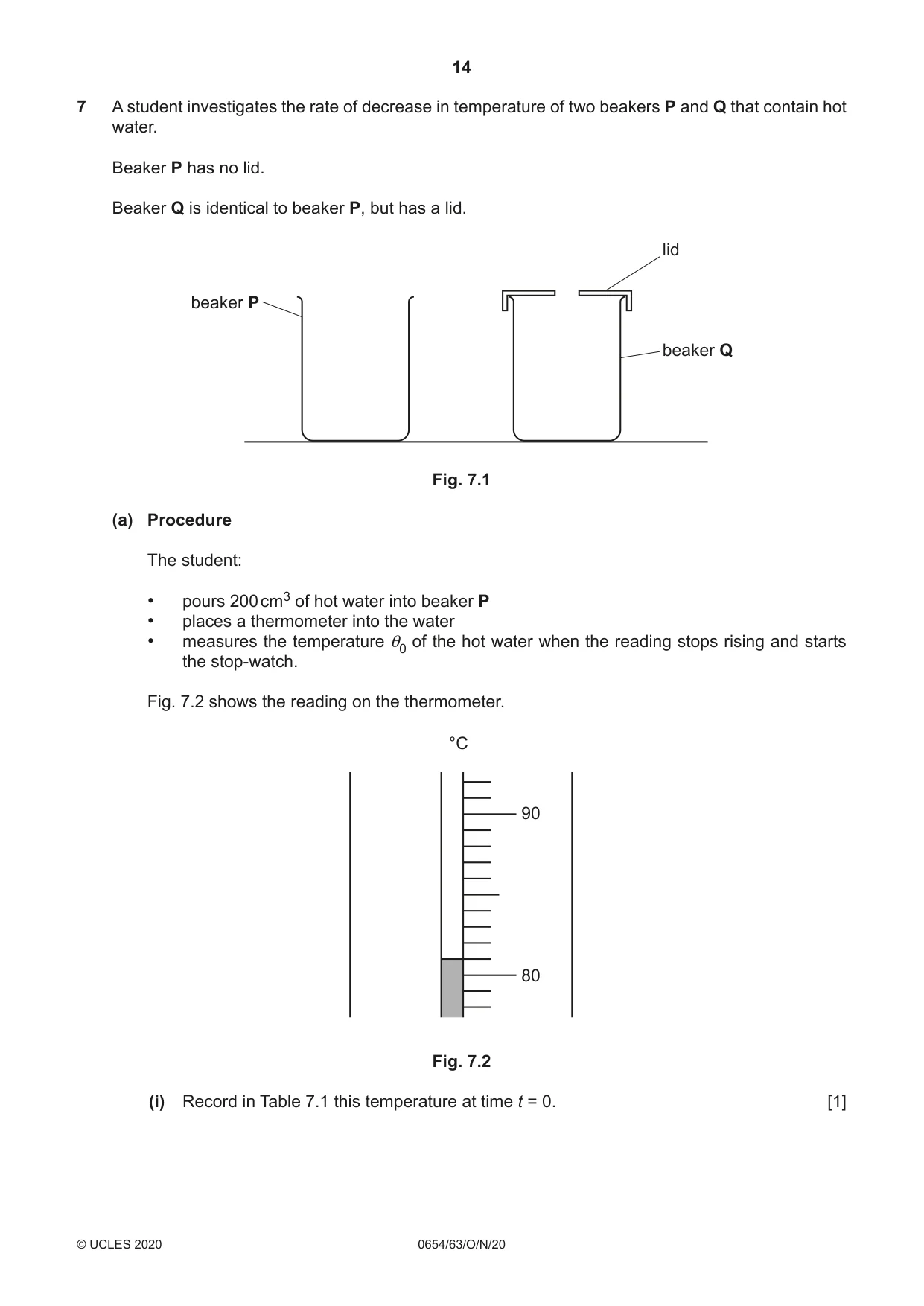
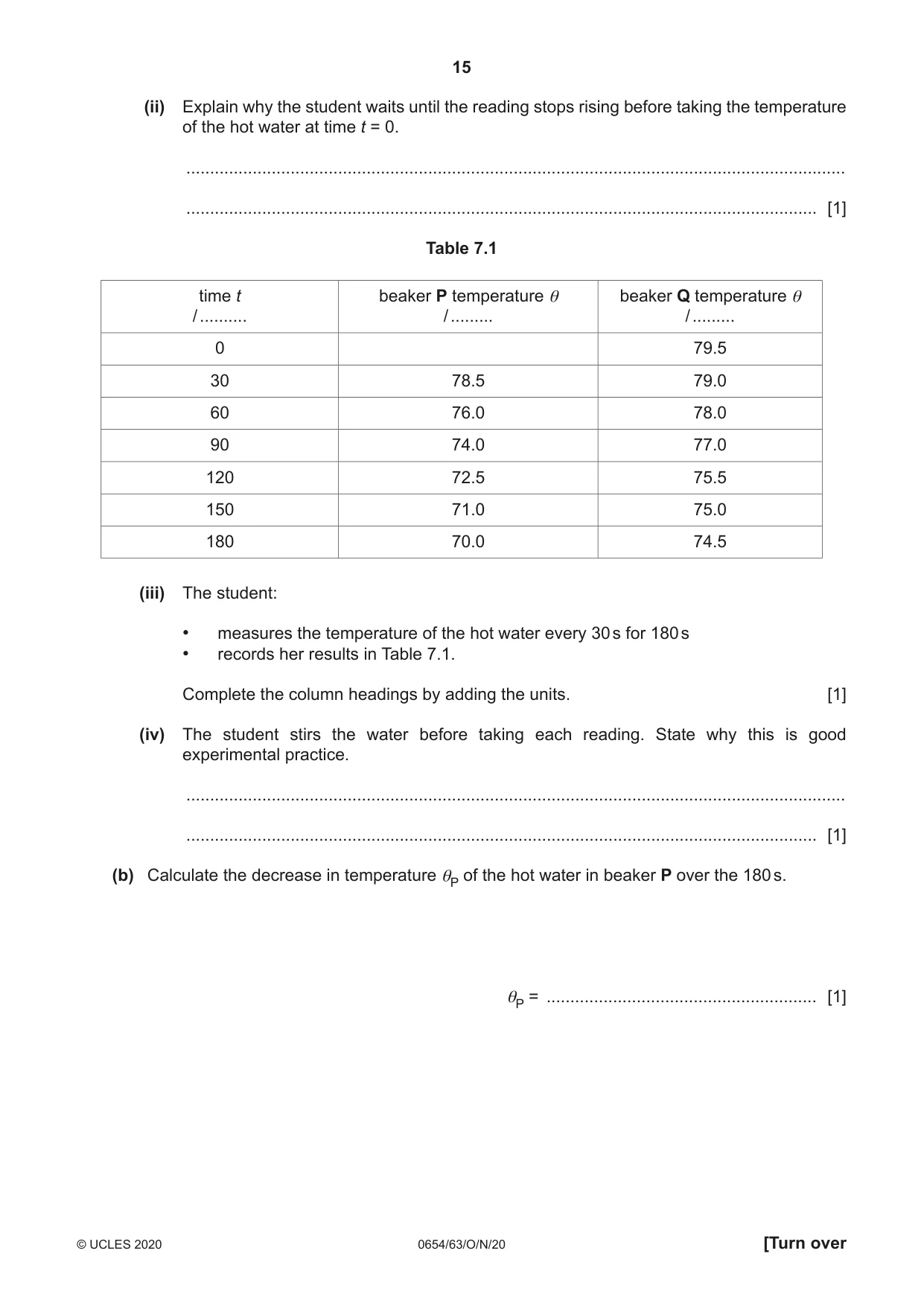
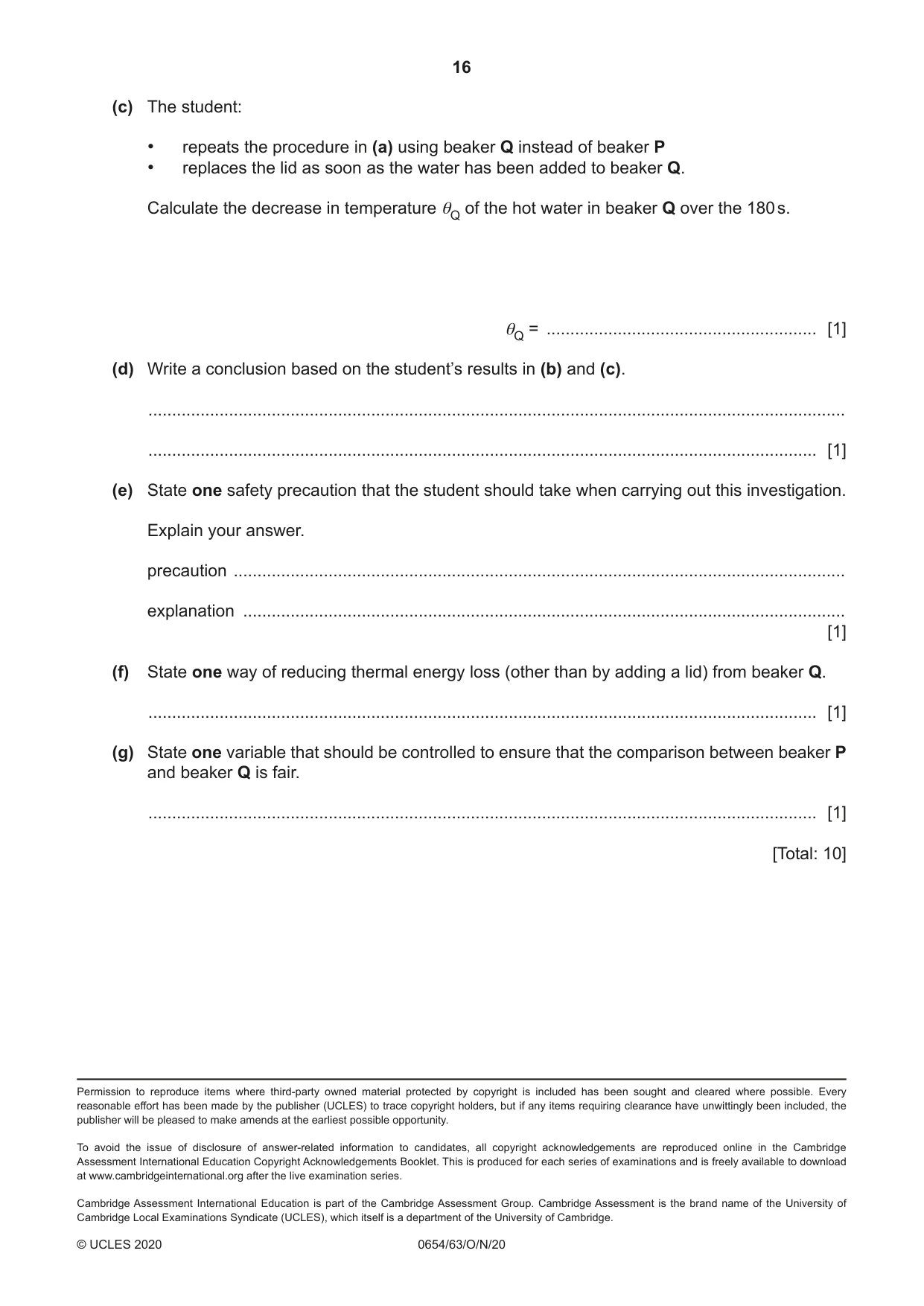
7 A student investigates the rate of decrease in temperature of two beakers P and Q that contain hot water. Beaker P has no lid. Beaker Q is identical to beaker P, but has a lid. lid beaker P beaker Q Fig. 7.1 (a) Procedure The student: • pours 200 cm3 of hot water into beaker P • places a thermometer into the water • measures the temperature θ0 of the hot water when the reading stops rising and starts the stop-watch. Fig. 7.2 shows the reading on the thermometer. °C 90 80 Fig. 7.2 (i) Record in Table 7.1 this temperature at time t = 0. [1] (ii) Explain why the student waits until the reading stops rising before taking the temperature of the hot water at time t = 0. ........................................................................................................................................... ..................................................................................................................................... [1] Table 7.1 time t beaker P temperature θ beaker Q temperature θ / .......... / ......... / ......... 0 79.5 30 78.5 79.0 60 76.0 78.0 90 74.0 77.0 120 72.5 75.5 150 71.0 75.0 180 70.0 74.5 (iii) The student: • measures the temperature of the hot water every 30 s for 180 s • records her results in Table 7.1. Complete the column headings by adding the units. [1] (iv) The student stirs the water before taking each reading. State why this is good experimental practice. ........................................................................................................................................... ..................................................................................................................................... [1] (b) Calculate the decrease in temperature θP of the hot water in beaker P over the 180 s. θP = ......................................................... [1] (c) The student: • repeats the procedure in (a) using beaker Q instead of beaker P • replaces the lid as soon as the water has been added to beaker Q. Calculate the decrease in temperature θQ of the hot water in beaker Q over the 180 s. θQ = ......................................................... [1] (d) Write a conclusion based on the student’s results in (b) and (c). ................................................................................................................................................... ............................................................................................................................................. [1] (e) State one safety precaution that the student should take when carrying out this investigation. Explain your answer. precaution ................................................................................................................................. explanation ............................................................................................................................... [1] (f) State one way of reducing thermal energy loss (other than by adding a lid) from beaker Q. ............................................................................................................................................. [1] (g) State one variable that should be controlled to ensure that the comparison between beaker P and beaker Q is fair. ............................................................................................................................................. [1] [Total: 10]
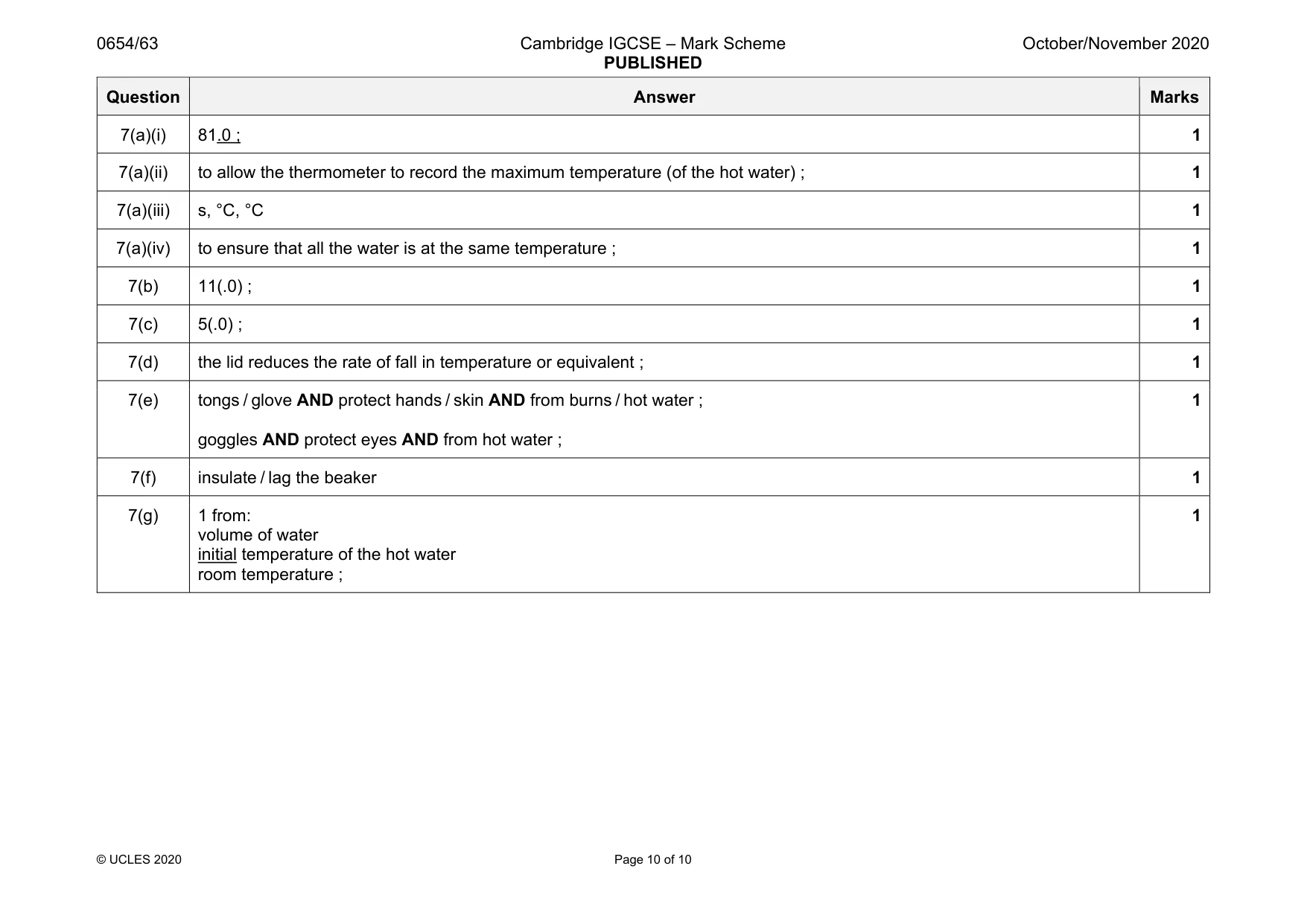
Mark scheme: 7(a)(i) 81.0 ; 1 7(a)(ii) to allow the thermometer to record the maximum temperature (of the hot water) ; 1 7(a)(iii) s, °C, °C 1 7(a)(iv) to ensure that all the water is at the same temperature ; 1 7(b) 11(.0) ; 1 7(c) 5(.0) ; 1 7(d) the lid reduces the rate of fall in temperature or equivalent ; 1 7(e) tongs / glove AND protect hands / skin AND from burns / hot water ; goggles AND protect eyes AND from hot water ; 1 7(f) insulate / lag the beaker 1 7(g) 1 from: volume of water initial temperature of the hot water room temperature ; 1
What was in this paper
The subtopics covered by these 7 questions, and how many questions each got. Open one in a new tab to see every Cambridge question on it.
What you needed in this session
Cambridge’s own grade thresholds for 2020 Oct/Nov, Paper 6 · Variant 3. A higher threshold means an easier paper — the bar moves with how the cohort did.